
Grade 10 Science Worksheets
7,069 worksheets
Measurable Criteria Worksheet for Grade 10 Science | California Standards
JCreated byJ.S SheetsLearning Objectives
- Understand the difference between constraints and criteria in design processes.
- Identify measurable performance targets for projects.
- Distinguish between constraints that limit choices and criteria that define goals.
Also included in: Grade 10 Engineering Design Optimization Science Lesson Bundle +1 more
Instant download
10th Grade Science | Energy Accounting Worksheet (PDF + Answer Key)
 Created byCopper Leaf Classroom
Learning Objectives
- Understand the principles of energy flow in physical systems using energy flow diagrams.
- Apply system boundary definitions and sign conventions effectively in energy calculations.
- Use algebraic and graphical methods to summarize energy transfers and predict energy distribution.
Instant download

Grade 10 Dynamic Equilibrium Worksheet | Practice & Assessment PDF
 Created byClear Sky Classroom
Learning Objectives
- Explain why chemical equilibrium is dynamic using forward and reverse reaction rates
- Interpret equilibrium expressions and predict how equilibrium shifts under changes in concentration, pressure, or temperature
- Use Le Châtelier’s principle and K (equilibrium constant) reasoning to forecast net reaction trends
Instant download

Grade 10 Genetic Variation Worksheet | Practice & Assessment PDF
Created byClear Sky ClassroomLearning Objectives
- Explain how recombination during meiosis (independent assortment and crossing over) creates new allele combinations within a population.
- Describe how mutations and gene flow contribute additional genetic variation beyond what recombination produces.
- Connect sources of genetic variation to how natural selection can change population traits over time.
Instant download

Grade 10 Science | Meiosis and Genetic Variation Worksheet | AP Practice
 Created byLumora Learning
Learning Objectives
- Explain the processes of homologous pairing, recombination, independent assortment, and chromosomal segregation in meiosis.
- Describe how crossing-over and nondisjunction contribute to genetic variation and their effects on genotypic and phenotypic outcomes.
- Relate mechanisms of genetic variation to evolutionary processes and patterns observed in inheritance and molecular population data.
Also included in: Grade 10 Science | Biology and Ecosystems Custom Bundle | AP
Instant download
Grade 10 Science – Food Web Energy Daily Reading Worksheet + Answer Key
JCreated byJ.S SheetsLearning Objectives
- Understand the components of a food web and their roles
- Explain how energy flows through ecosystems
- Identify the connections between photosynthesis, respiration, and biomass
Also included in: Grade 10 Science Lesson Group BC Framework – Daily Reading Worksheets Bundle +1 more
Instant download
Grade 10 Science | Collision Theory Worksheet | Alberta Standard
Created byLumora LearningLearning Objectives
- Explain how molecular collisions influence reaction rates according to collision theory.
- Describe the concepts of activation energy and effective collisions.
- Analyze the role of energy barriers in chemical reactions, including examples like catalysts in Alberta's industrial applications.
Instant download
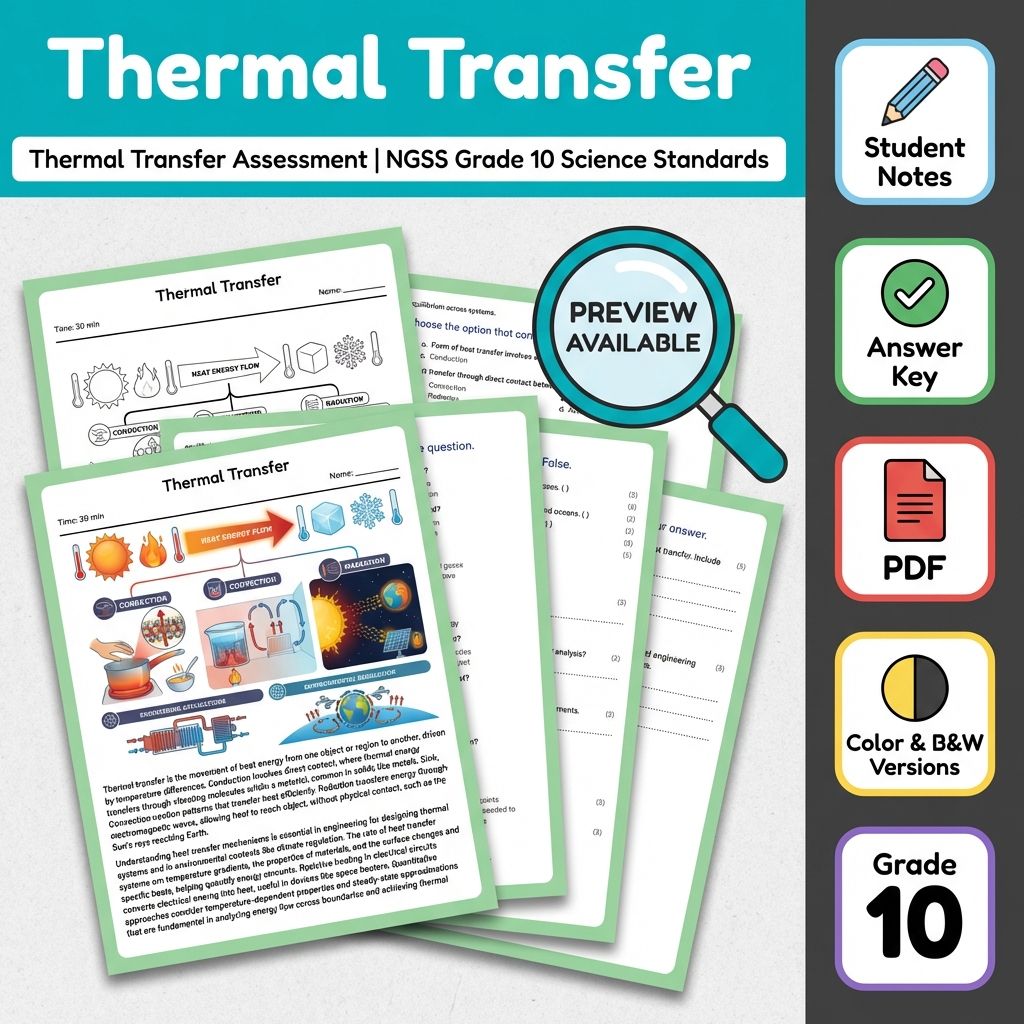
Thermal Transfer Assessment | NGSS Grade 10 Science Standards
 Created byPrism Point Learning
Learning Objectives
- Understand the mechanisms of heat transfer: conduction, convection, and radiation.
- Connect thermal energy changes to specific heat and phase change phenomena.
- Explain resistive heating and how electrical energy converts to thermal energy.
Also included in: Grade 10 Science | Work & Power NGSS Assessment Mini Bundle – Printable
Instant download

Grade 10 Stratigraphic Record Worksheet | AP Practice PDF
Created byClear Sky ClassroomLearning Objectives
- Use principles of stratigraphy (superposition, correlation, and unconformities) to interpret relative Earth history.
- Explain how radiometric decay helps determine absolute ages and why uncertainty matters.
- Connect fossil assemblages and biostratigraphic ranges to reconstruct past environments and climate changes.
Also included in: Grade 10 Earth & Space Sciences Science Lesson Bundle: Advanced Placement (AP) +1 more
Instant download
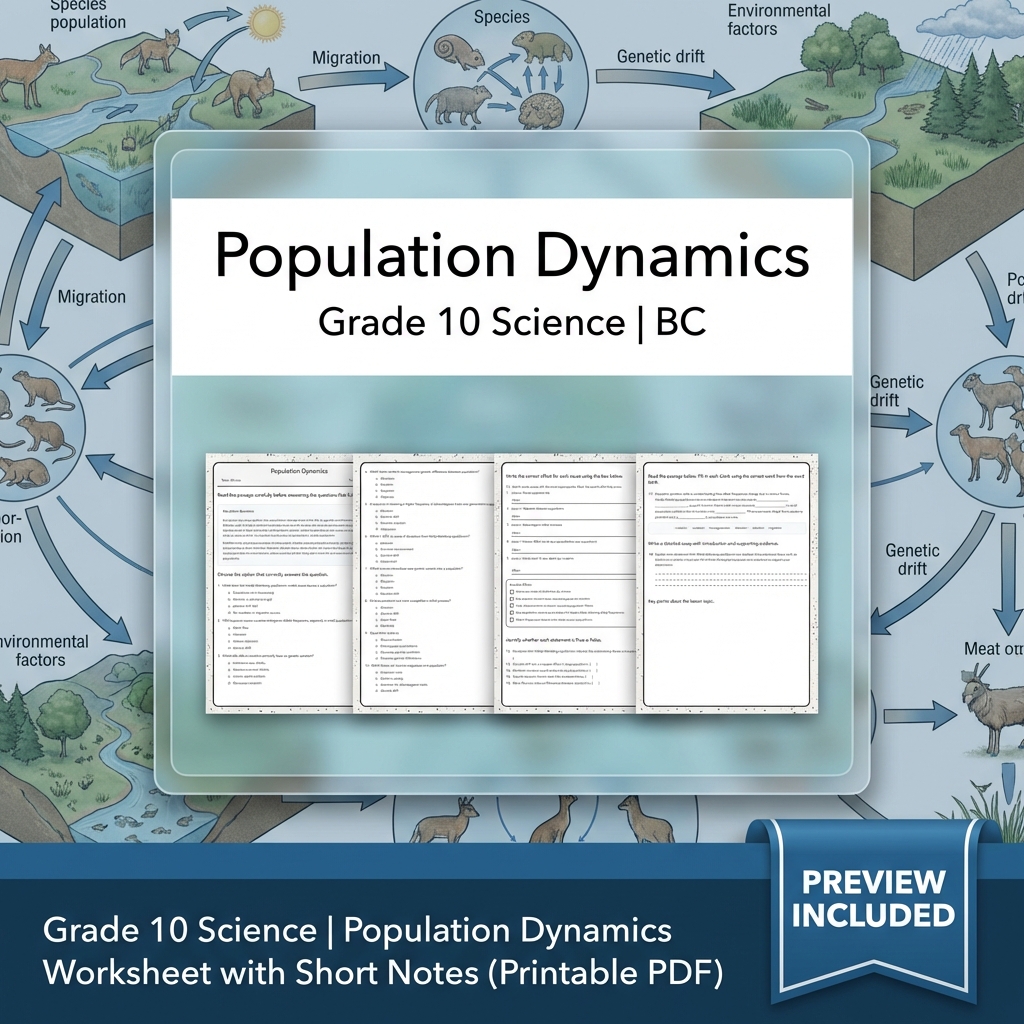
Grade 10 Science | Population Dynamics Worksheet with Short Notes (PDF)
 Created byMeadowlark Worksheets
Learning Objectives
- Understand how population genetics influences evolutionary change.
- Identify factors that cause deviations from Hardy-Weinberg equilibrium.
- Analyze the effects of natural selection, genetic drift, gene flow, and mutation on populations.
Also included in: Grade 10 Science | BC Framework Lesson Group Worksheet Pack +1 more
Instant download
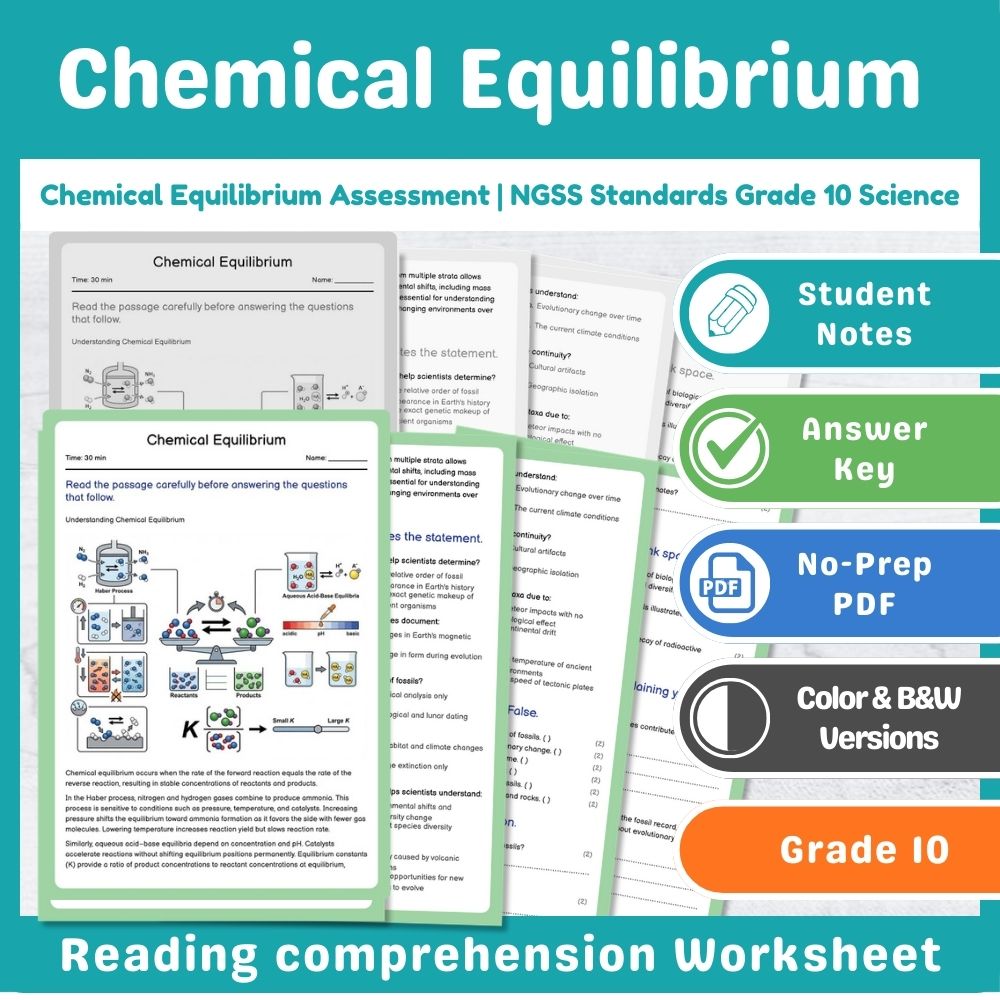
Chemical Equilibrium Assessment | NGSS Standards Grade 10 Science
Created byPrism Point LearningLearning Objectives
- Understand the concept of chemical equilibrium and factors affecting it.
- Identify how changes in pressure, temperature, and concentration influence equilibrium positions.
- Explain the role of catalysts and equilibrium constants in chemical reactions.
Instant download

Grade 10 Science Worksheet | Cytoskeleton Roles TEKS (PDF)
 Created byEvergreen Desk Education
Learning Objectives
- Explain how microtubules, actin filaments, and intermediate filaments contribute to cell structure and function
- Describe how motor proteins use cytoskeletal tracks to move vesicles and support intracellular transport
- Connect cytoskeleton roles to cell movement, cytokinesis, and mitosis (organelle positioning and chromosome segregation)
Instant download

Grade 10 Science Communicating Results Worksheet | Ontario Curriculum
Created byClear Sky ClassroomLearning Objectives
- Write clear, evidence-based science reports that link data to claims using structured summaries.
- Use appropriate uncertainty language and limitations to communicate how confident results are.
- Present data using tables, graphs, and statistical indicators with documented methods and data provenance.
Instant download
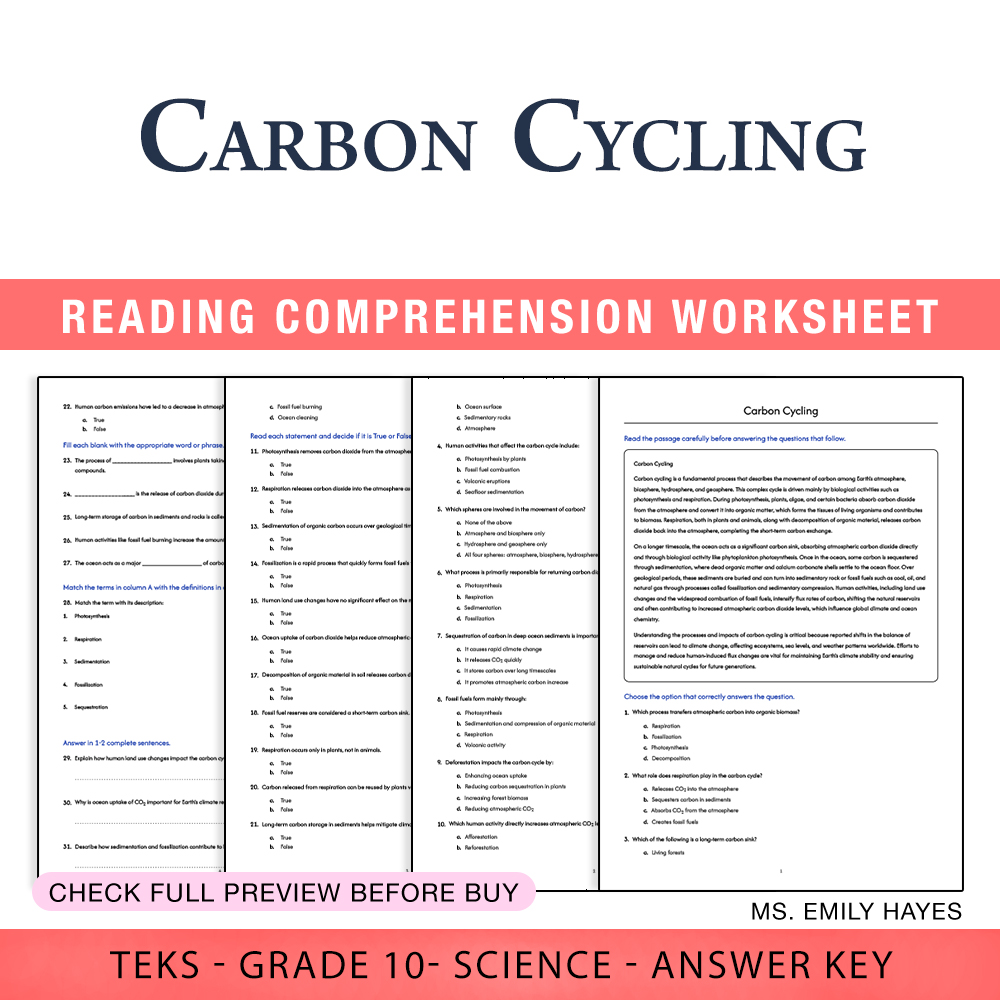
Grade 10 Science | Carbon Cycling Worksheet (PDF+ Answer Key)
Created byCopper Leaf ClassroomLearning Objectives
- Understand the main processes involved in the carbon cycle among Earth's spheres.
- Identify the roles of photosynthesis and respiration in carbon flux.
- Explain how human activities influence carbon reservoirs and climate change.
Instant download

Grade 10 Biodiversity Overview Worksheet | BC Practice & PDF
Created byClear Sky ClassroomLearning Objectives
- Explain biodiversity at genetic, species, and ecosystem levels
- Identify how richness and evenness describe biodiversity patterns
- Analyze how habitat availability, climate stability, disturbance, gradients, and evolutionary history influence biodiversity
Instant download
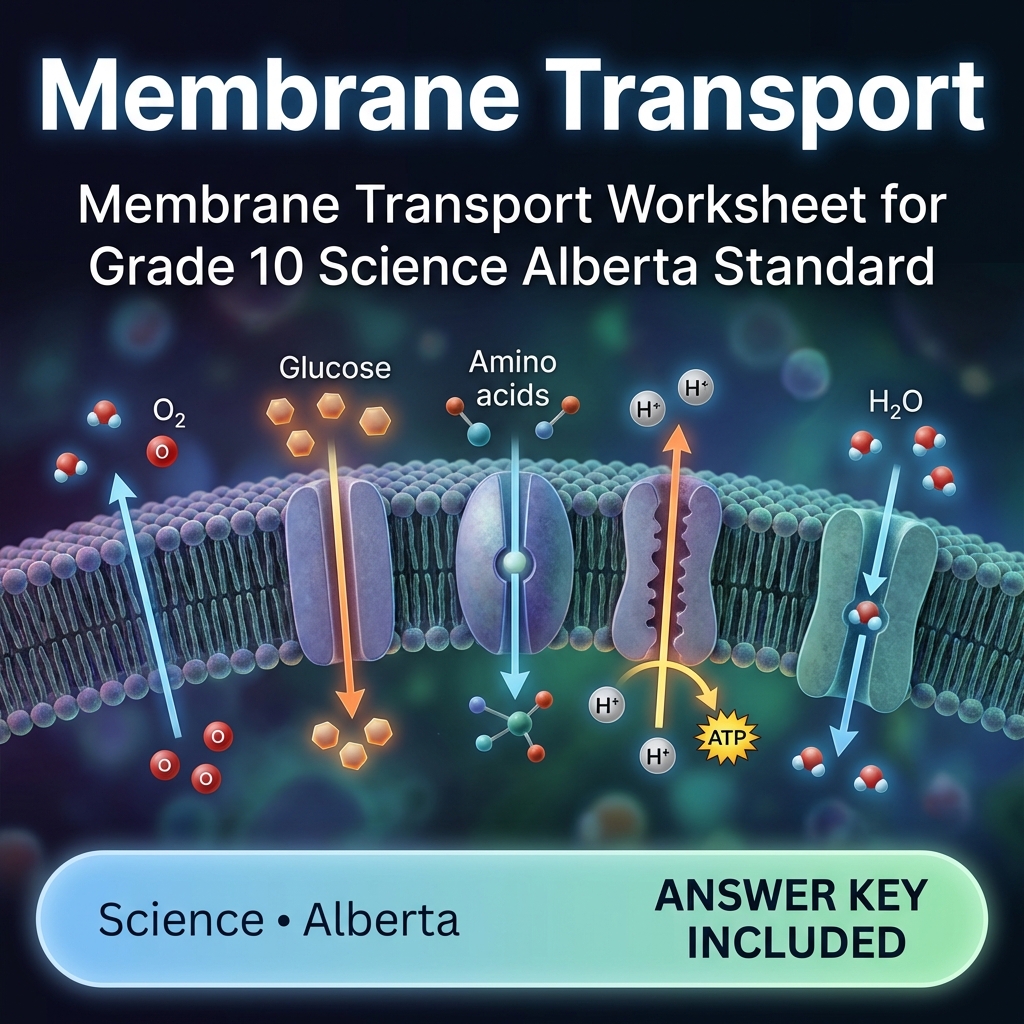
Membrane Transport Worksheet for Grade 10 Science Alberta Standard
 Created byCoral Reef Learning
Learning Objectives
- Explain the mechanisms of diffusion, osmosis, and facilitated transport in cell membranes.
- Describe how membrane proteins and lipid composition influence permeability and cellular signaling.
- Understand the role of membrane transport in maintaining homeostasis in different environments.
Instant download
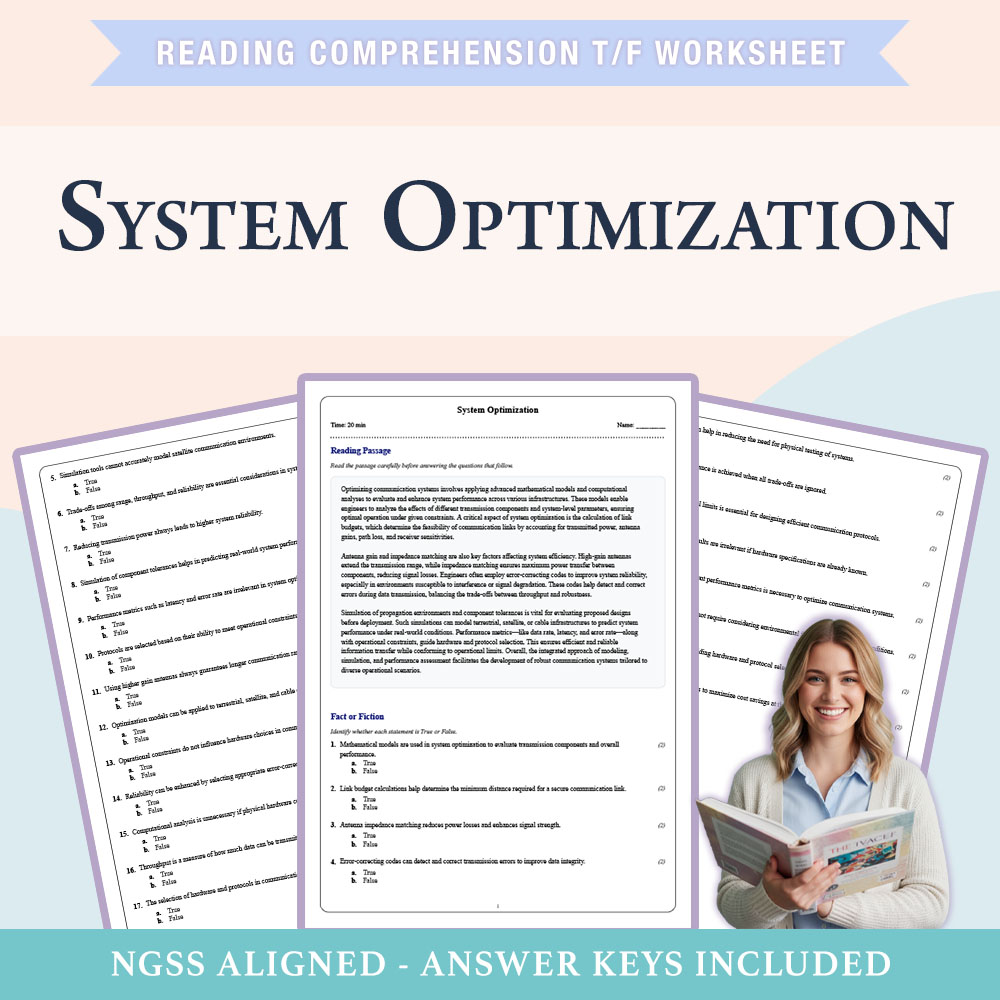
10th Grade Science | System Optimization Worksheet (PDF + Answer Key)
Created byCopper Leaf ClassroomLearning Objectives
- Understand how mathematical models and computational analysis are used in optimizing communication systems.
- Identify key performance metrics and trade-offs involved in system design.
- Recognize the role of simulation and analysis in evaluating communication infrastructure proposals.
Also included in: Grade 10 Science | Wave Properties & Electromagnetic Behavior (PDF +Answer Key) +1 more
Instant download
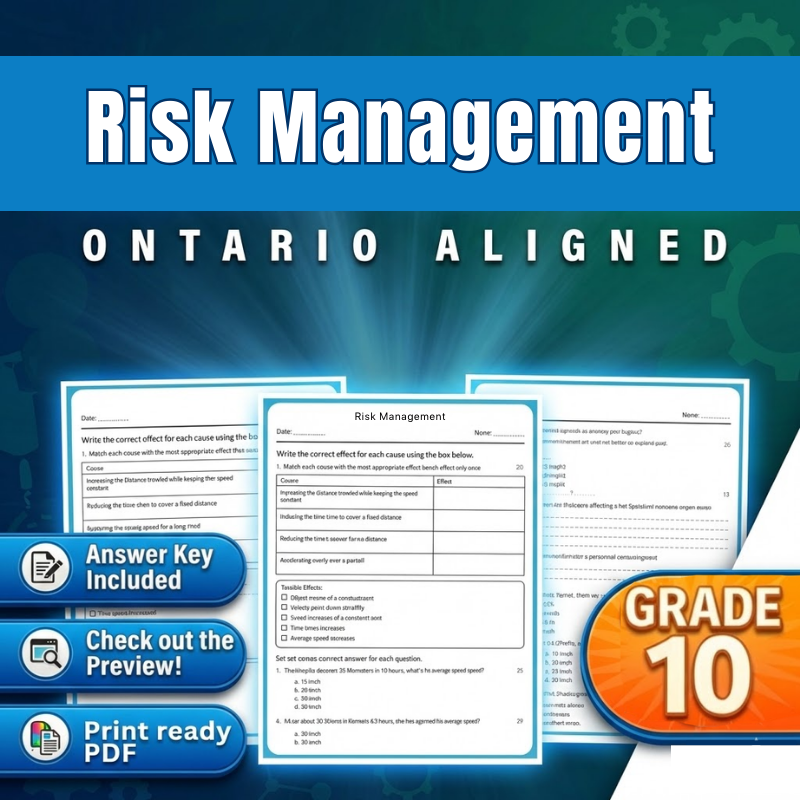
Grade 10 Science | Risk Management Worksheet (Ontario) (PDF)
 Created byBright Mind Resources
Learning Objectives
- Identify hazards systematically in laboratory settings and field sampling.
- Understand principles of hazard mitigation including elimination, substitution, engineering controls, and administrative procedures.
- Evaluate residual risks and document mitigation plans to improve safety during routine analyses and field activities.
Instant download

Grade 10 Science – Evolutionary Evidence & NGSS | Daily Reading Worksheet
Created byBright Mind ResourcesLearning Objectives
- Understand different types of fossil evidence supporting evolution
- Identify transitional forms and their significance
- Comprehend the role of comparative anatomy and embryology in evolutionary studies
Also included in: Evolution Grade 10 Science Daily Reading Worksheets Lesson Bundle | NGSS +2 more
Instant download

Grade 10 Science – Cell Basics & Structures Daily Reading Worksheet | Alberta
Created byBright Mind ResourcesLearning Objectives
- Understand the structure and function of cellular components
- Identify different types of cells in various ecosystems
- Describe the importance of cells as the building blocks of life
Also included in: Grade 10 Science Daily Reading: Cells & Systems Lesson Bundle | Alberta +1 more
Instant download
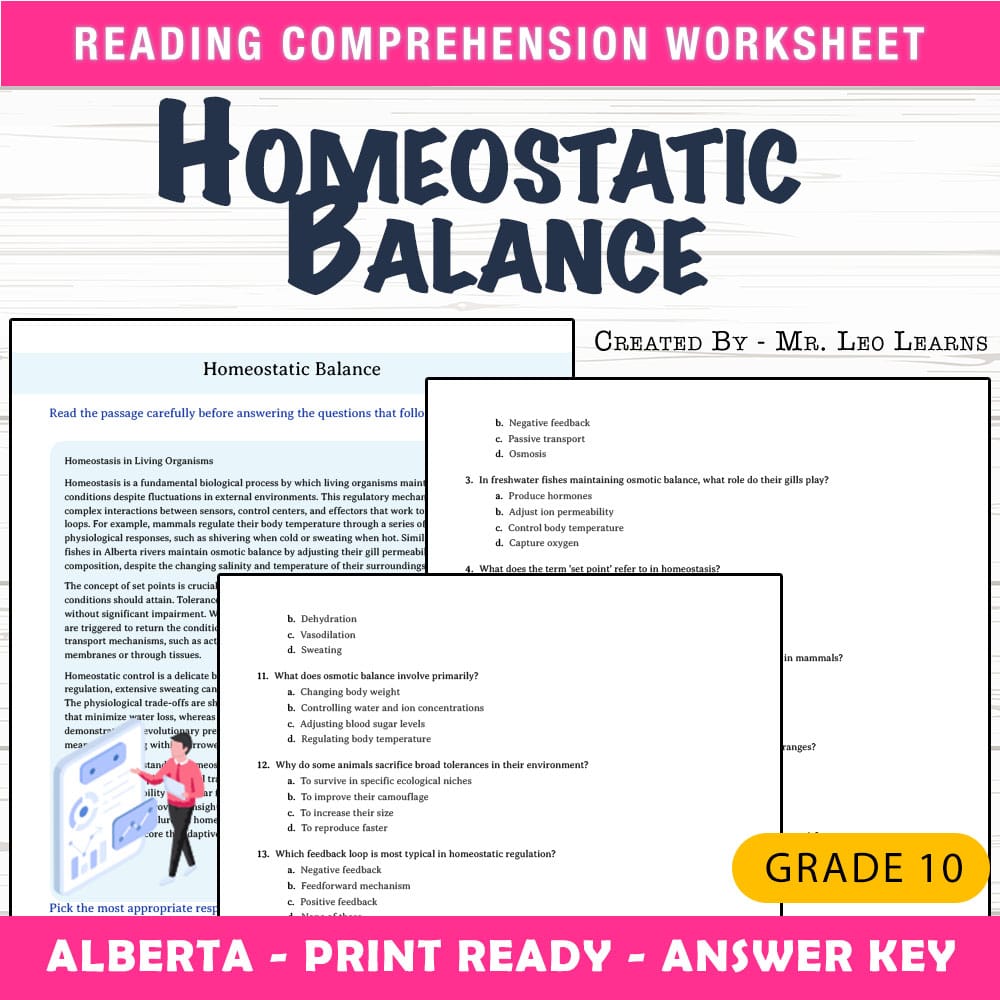
Grade 10 Science — Worksheet MCQ Paper for Mastering Homeostatic Balance
 Created byThe Resource Hub
Learning Objectives
- Understand the concept of homeostasis and its importance in maintaining internal stability.
- Identify various physiological mechanisms involved in temperature regulation and osmotic balance.
- Explain the role of sensor-effector loops and controlled transport in homeostasis.
Also included in: Grade 10 Science Cells and Systems Lesson Bundle | Alberta Curriculum +1 more
Instant download
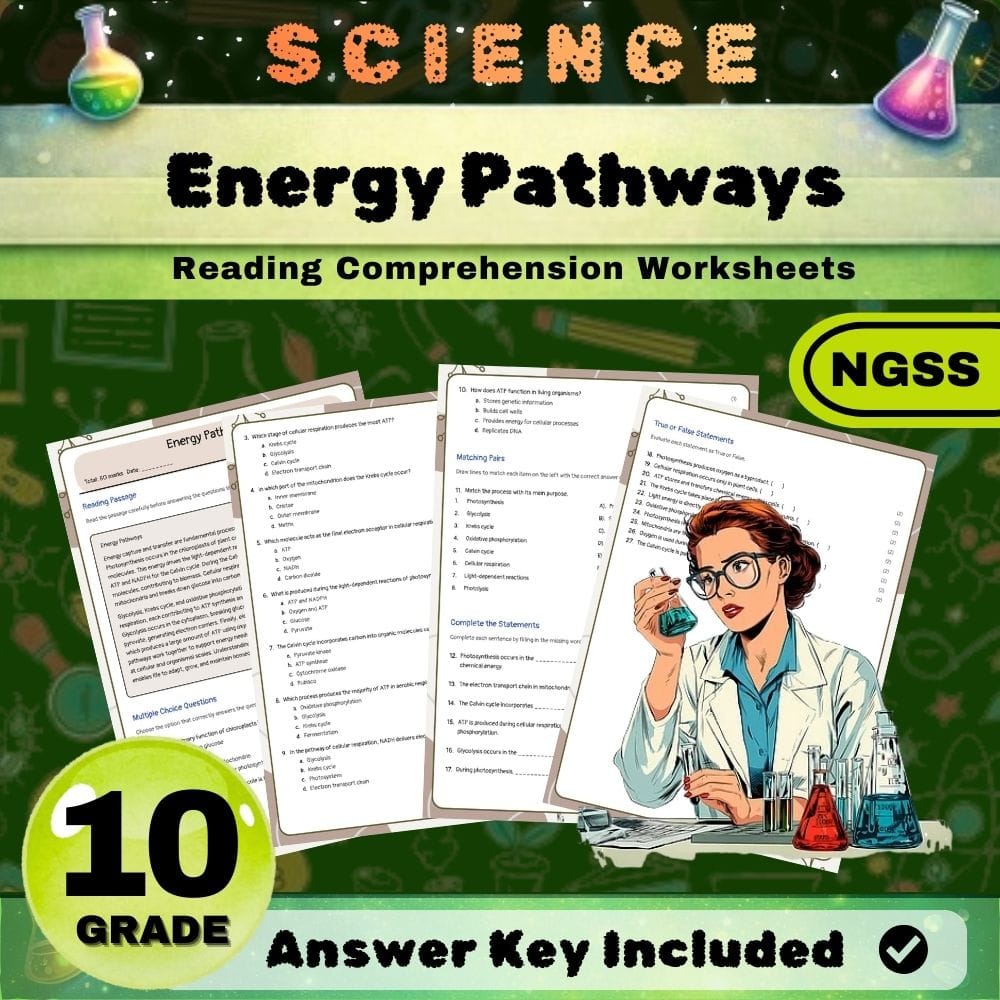
Grade 10 Science | Energy Pathways NGSS Worksheet (PDF)
 Created byMaple Path Learning
Learning Objectives
- Describe how photosynthesis captures light energy and converts it into chemical energy.
- Explain the processes of cellular respiration and how they produce ATP from glucose.
- Identify the roles of chloroplasts, mitochondria, and other cellular components in energy transfer.
Also included in: Grade 10 Science From Molecules to Organisms Lesson Bundle | NGSS +1 more
Instant download

Carrying Capacity Factors Worksheet | California Standards Grade 10 Science
JCreated byJ.S SheetsLearning Objectives
- Understand the key factors that influence an ecosystem's carrying capacity.
- Identify how resource availability, competition, predators, and disease affect population sizes.
- Explain how energy flow and nutrient availability impact ecosystem stability.
Also included in: Grade 10 Genetic Variation and Evolution Science Lesson Bundle +1 more
Instant download

Organelle Architecture Test Prep Printable | Grade 10 Science
Created byPrism Point LearningLearning Objectives
- Compare major eukaryotic cell organelles by structure, membrane arrangement, and electron-microscopy features.
- Explain how compartmentalization supports cellular complexity and contrasts with prokaryotic organization.
- Identify how cytoskeletal elements and membrane-bound compartments contribute to internal cell architecture.
Also included in: Grade 10 Cells & Energy Science Lesson Bundle Ontario Framework Pack
Instant download

Grade 10 Science | Multiple Evidence Lines - Daily Reading Comprehension
Created byCoral Reef LearningLearning Objectives
- Understand how fossil records provide evidence of evolutionary change
- Identify patterns in the fossil record supporting common ancestry
- Interpret molecular data such as DNA and protein similarities among organisms
Instant download
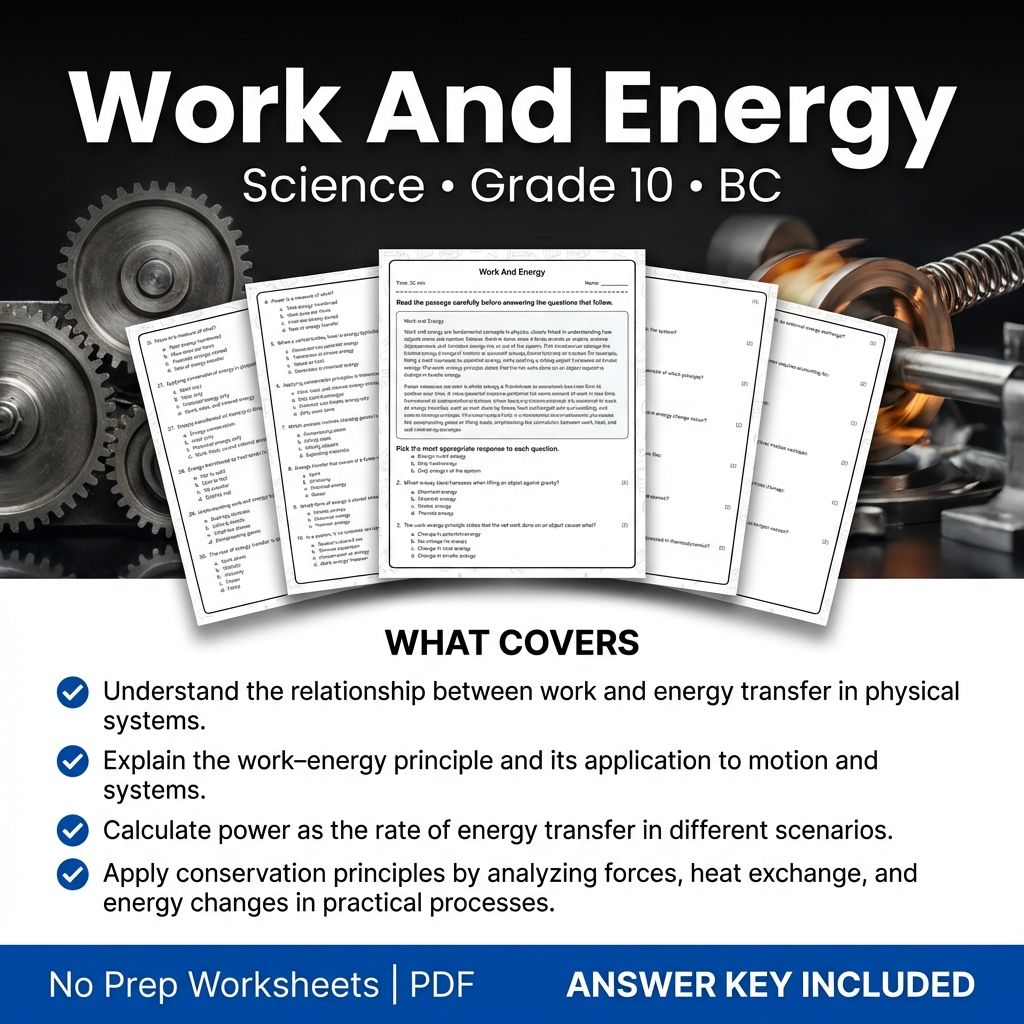
Grade 10 Science Worksheet | Work and Energy Practice PDF & Answer Key
Created byCoral Reef LearningLearning Objectives
- Understand the relationship between work and energy transfer in physical systems.
- Explain the work–energy principle and its application to motion and systems.
- Calculate power as the rate of energy transfer in different scenarios.
Instant download
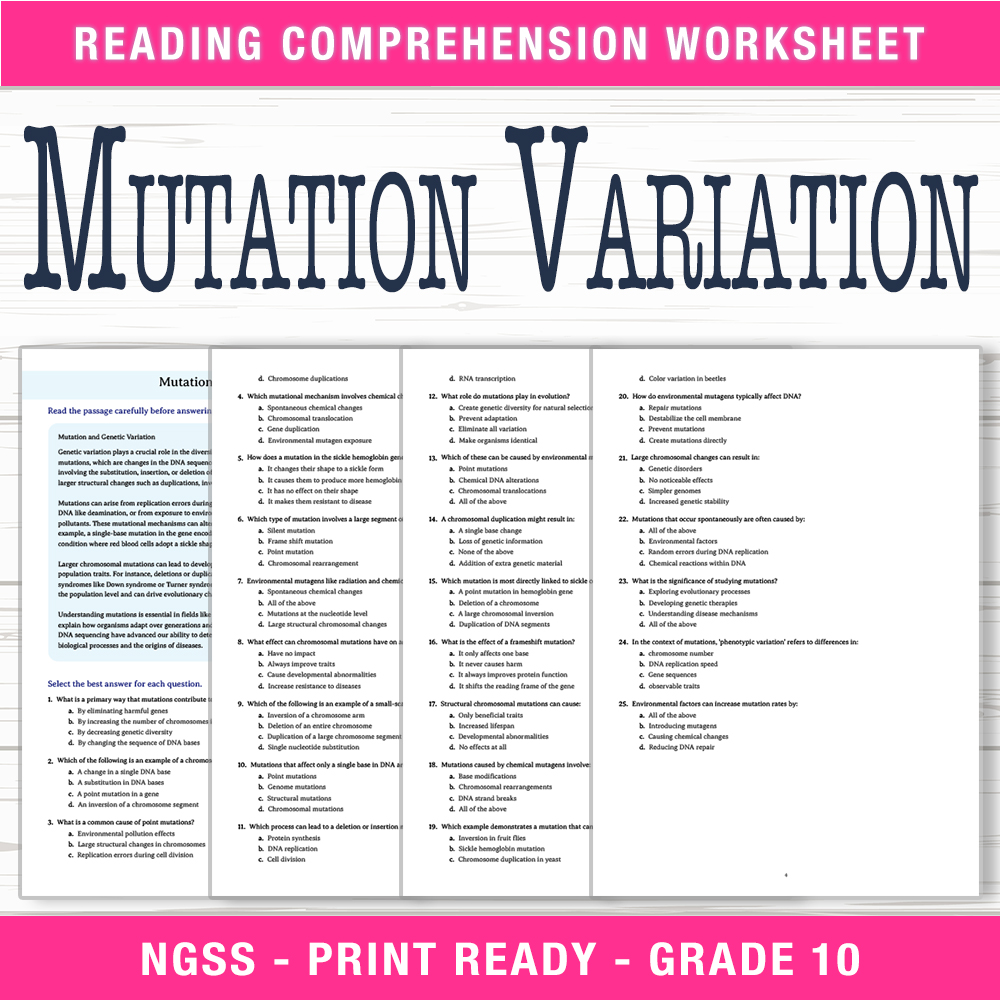
Grade 10 Science | Mutation Variation Worksheet (PDF + Answer Key)
 Created byRiverstone Classroom
Learning Objectives
- Understand the molecular mechanisms behind genetic mutations, including point mutations, insertions, deletions, and structural rearrangements.
- Identify various mutational mechanisms such as replication errors, spontaneous chemical changes, and environmental mutagens.
- Explain how mutations can alter gene function and contribute to phenotypic diversity, including human examples like sickle hemoglobin.
Instant download

Grade 10 Natural Selection Worksheet | General Practice PDF
Created byClear Sky ClassroomLearning Objectives
- Explain how heritable variation and differential reproduction lead to natural selection in populations
- Describe how allele frequencies can shift over generations as a result of selection pressures
- Use examples to distinguish adaptation from an organism’s lifetime responses to the environment
Instant download

Grade 10 Science – Kinematic Graphs & Motion Analysis | Daily Reading Worksheet
Created byBright Mind ResourcesLearning Objectives
- Understand how position vs. time graphs illustrate an object's motion.
- Interpret the slope of position-time graphs to find velocity.
- Analyze shapes of graphs to determine acceleration and movement patterns.
Also included in: Energy & Systems Interactions Grade 10 Science lesson bundle | Alberta +1 more
Instant download

Grade 10 Science | Work & Power in Physics - Daily Reading Comprehension
Created byCoral Reef LearningLearning Objectives
- Understand the concept of work in physics
- Calculate work done by a force through displacement
- Relate work to energy transfer and the work–energy theorem
Instant download

Grade 10 Science | Thermodynamic Limits Worksheet + Answer Key (PDF)
Created byBright Mind ResourcesLearning Objectives
- Explain the first and second laws of thermodynamics and their implications on energy conservation and entropy.
- Describe how heat engines and refrigerators operate between temperature reservoirs.
- Calculate the theoretical maximum efficiency of heat engines using Carnot's principles.
Instant download
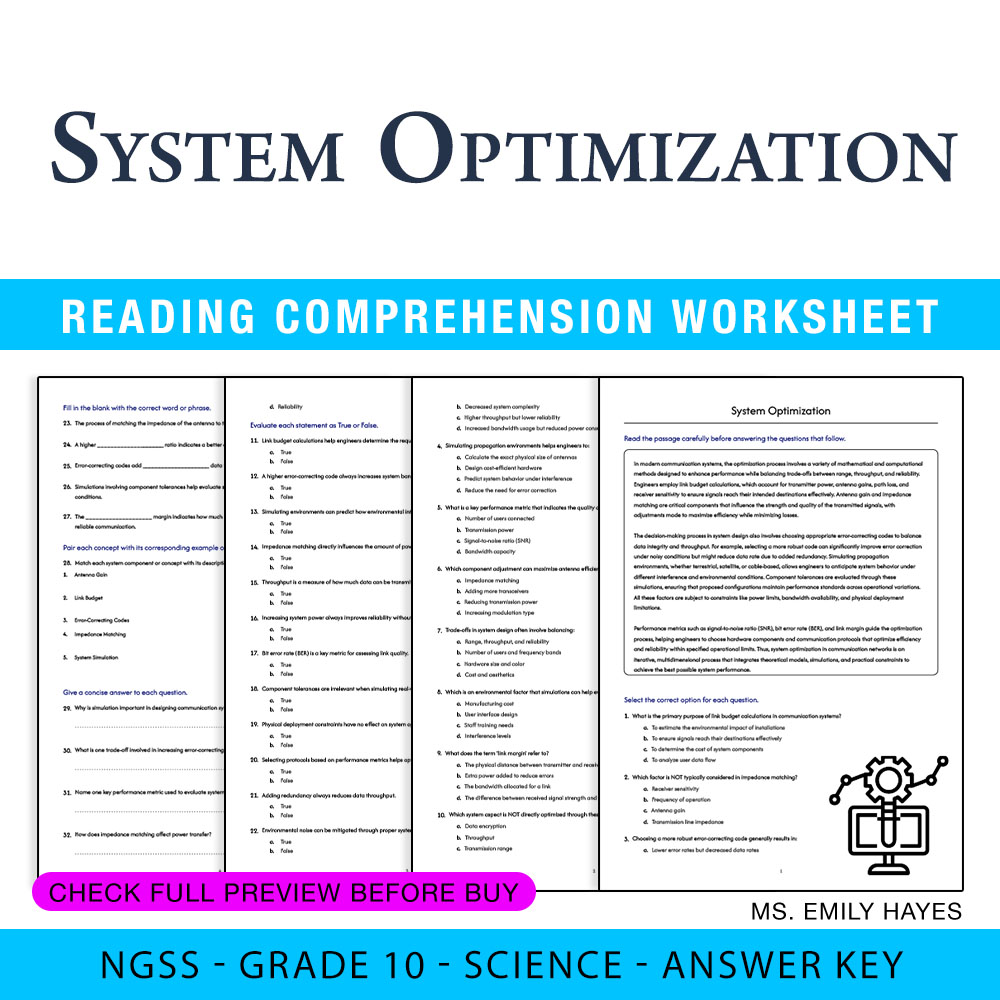
10th Grade Science | System Optimization Worksheet (PDF+ Answer Key)
Created byCopper Leaf ClassroomLearning Objectives
- Understand mathematical models used in communication system optimization
- Analyze the trade-offs involved in system components such as antennas and coding
- Evaluate performance metrics and constraints for communication systems
Instant download

Grade 10 Science Worksheet – Matter Conservation (PDF)
Created byEvergreen Desk EducationLearning Objectives
- Explain how the total amount of matter is conserved during physical and chemical changes using particle and atom models.
- Differentiate particle rearrangement in physical changes from atom rearrangement in chemical changes.
- Use atom or particle counts to predict whether mass and number of atoms match on both sides of a reaction.
Also included in: Grade 10 Conservation Laws in Science Lesson Bundle – General Framework +1 more
Instant download
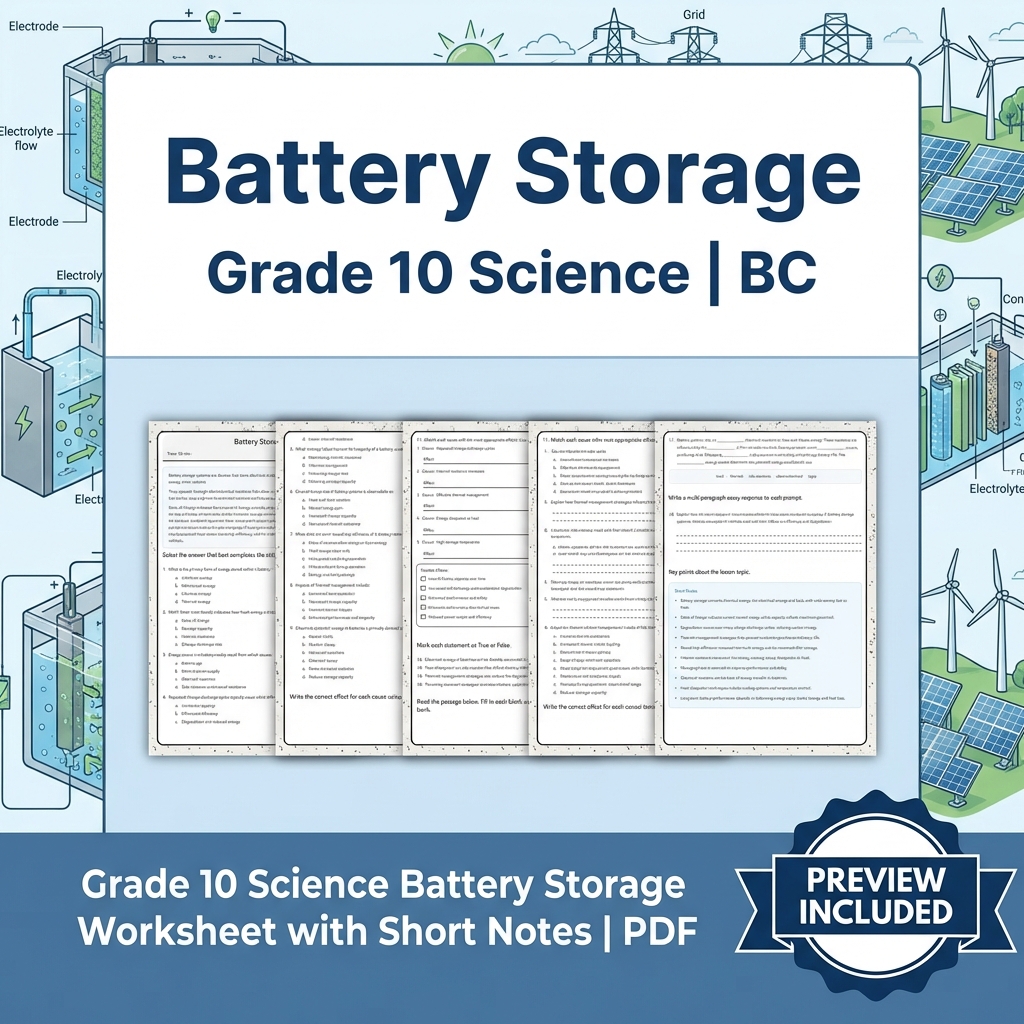
Grade 10 Science Battery Storage Worksheet with Short Notes | PDF
Created byMeadowlark WorksheetsLearning Objectives
- Understand how battery storage converts and maintains energy through chemical and electrical processes.
- Explain the concepts of state of charge, storage capacity, and their significance in battery performance.
- Analyze degradation mechanisms affecting battery life through charge–discharge cycles.
Also included in: Grade 10 Science Lesson Bundle | Energy & Thermodynamics Worksheets +1 more
Instant download

Cytoskeleton Roles Worksheet | TEKS-Aligned Grade 10 Science Practice
JCreated byJ.S SheetsLearning Objectives
- Explain how microtubules, microfilaments (actin), and intermediate filaments contribute to cell structure and function
- Describe how motor proteins move vesicles along microtubules and how this supports intracellular transport
- Analyze how actin and microtubules help with cell movement, cytokinesis, and chromosome segregation during mitosis
Instant download

Forces and Acceleration Worksheet | Standards-Aligned Grade 10 Science Practice
JCreated byJ.S SheetsLearning Objectives
- Understand how net force, mass, and acceleration are related through Newton's second law.
- Identify and interpret free-body diagrams illustrating different forces acting on objects.
- Use algebraic and vector component analysis to predict motion changes under various force conditions.
Instant download
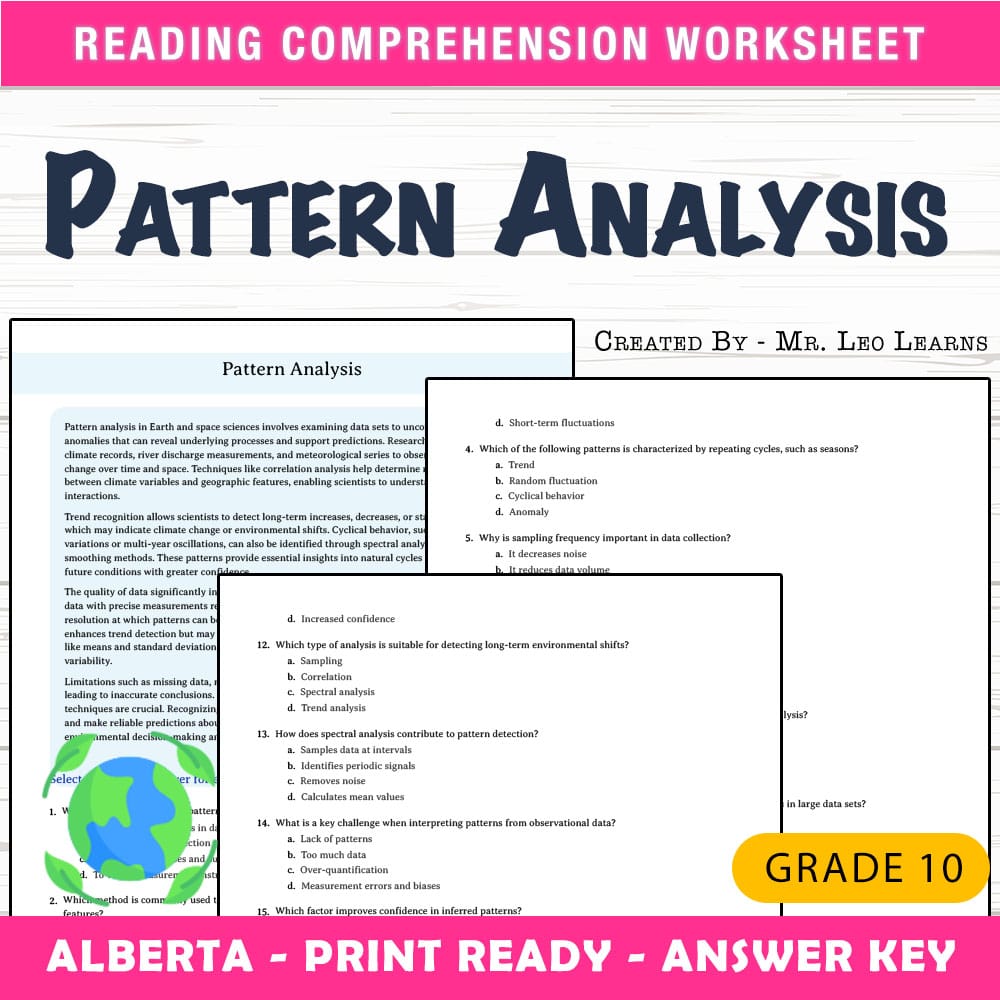
Grade 10 Science — Pattern Analysis Worksheet MCQ Pape
Created byThe Resource HubLearning Objectives
- Understand methods for identifying temporal and spatial patterns in Earth and space phenomena.
- Learn how data quality, sampling, and statistical summaries affect pattern detection.
- Apply correlation, trend recognition, and cyclical analysis to climate and river data.
Also included in: Grade 10 Science Bundle | Earth and Space Systems Worksheets +1 more
Instant download
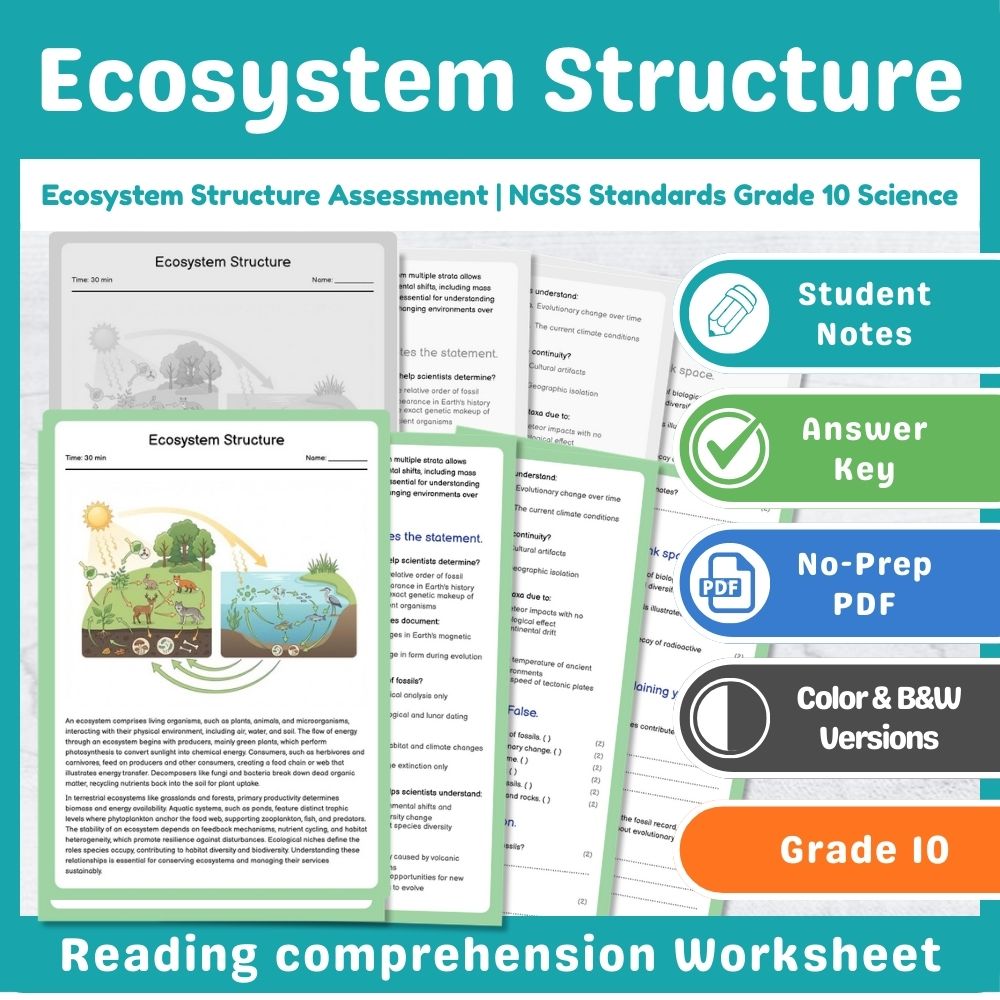
Ecosystem Structure Assessment for Grade 10 Science NGSS Standards
Created byPrism Point LearningLearning Objectives
- Explain the roles of biotic and abiotic components in ecosystems.
- Identify and analyze food webs, trophic levels, and energy flow within ecosystems.
- Understand the concepts of ecosystem stability, feedback loops, and ecological niches.
Instant download
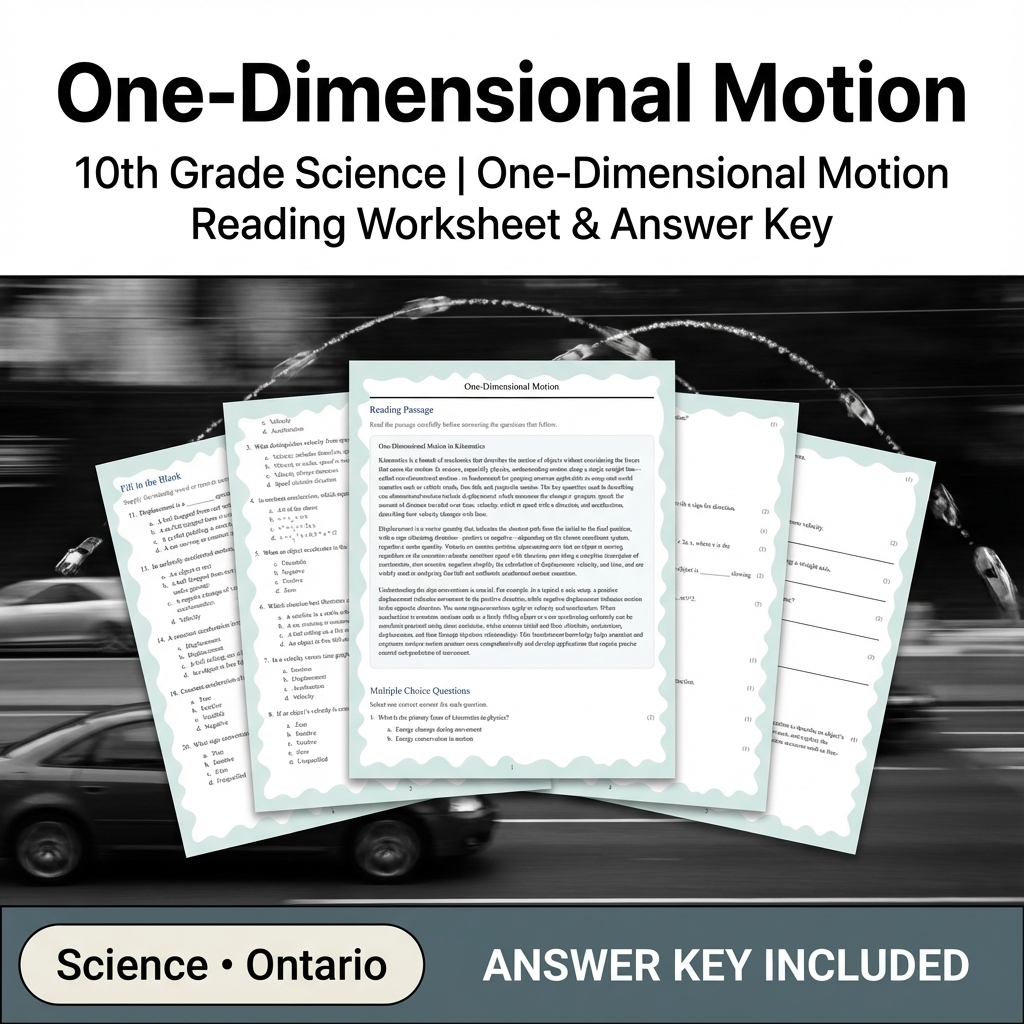
10th Grade Science | One-Dimensional Motion Reading Worksheet & Answer Key
JCreated byJ.S SheetsLearning Objectives
- Define and relate fundamental kinematic quantities along a single axis.
- Differentiate between average and instantaneous velocity and acceleration.
- Apply constant-acceleration equations to free-fall and uniformly accelerated motion.
Also included in: Grade 10 Science Unit Bundle – Motion, Forces & Mechanics (Answer Keys Included) +1 more
Instant download
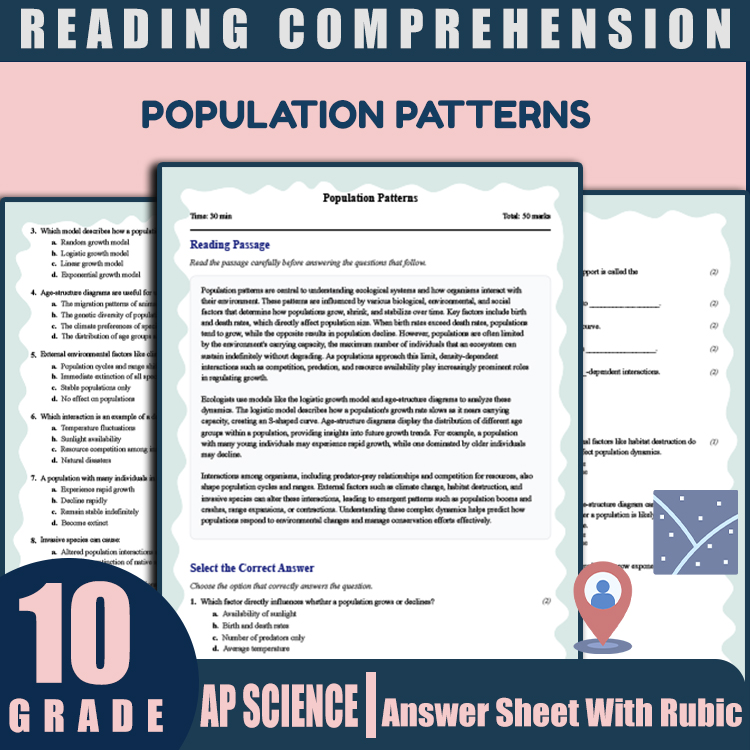
10th Grade Science | Population Patterns Reading Worksheet with Answer Key (PDF)
JCreated byJ.S SheetsLearning Objectives
- Understand the factors that influence population structure, including birth and death rates.
- Describe how carrying capacity and density-dependent interactions affect populations.
- Analyze population models and interpret age-structure diagrams to explain population dynamics.
Also included in: Grade 10 Science Unit | Cell Biology, Genetics, & Ecosystems Worksheet Pack +1 more
Instant download

Natural Selection Worksheet | Evolution, Adaptation & Genetics Activities
Created byPrism Point LearningLearning Objectives
- Explain how heritable differences can change allele frequencies over generations
- Use evidence-based reasoning to describe adaptation at the population level
- Compare convergent and divergent outcomes from different or similar selective pressures
Instant download

Grade 10 Science – Negative Feedback Worksheet (TEKS) PDF
Created byEvergreen Desk EducationLearning Objectives
- Explain how negative feedback systems maintain internal stability using sensors, control centers, and effectors.
- Interpret how deviations from a set point trigger antagonistic (opposite) corrective responses.
- Compare negative feedback to positive feedback using temperature, blood glucose, and blood pressure examples.
Instant download

Body Temperature Grade 10 Science Worksheet | TEKS-Aligned Practice
JCreated byJ.S SheetsLearning Objectives
- Explain how the hypothalamus acts as a control center to regulate body temperature.
- Describe how the nervous, circulatory, muscular, and integumentary systems work together to maintain thermal equilibrium.
- Interpret examples of feedback mechanisms (heat production, heat loss, and behavioral adjustments) in daily life.
Instant download
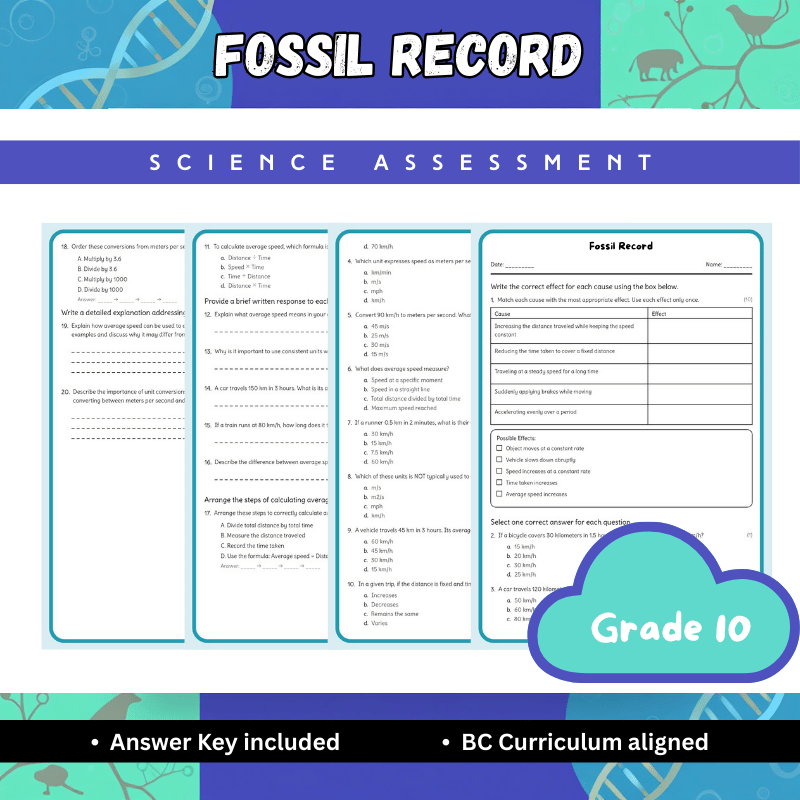
Grade 10 Science | Fossil Record Worksheet + Answer Key (PDF) for BC Standards
Created byBright Mind ResourcesLearning Objectives
- Understand how the fossil record documents evolutionary change over geological time.
- Interpret stratigraphic context and radiometric dating to place fossils in chronological order.
- Analyze patterns of morphological change and extinction events through fossil evidence.
Instant download
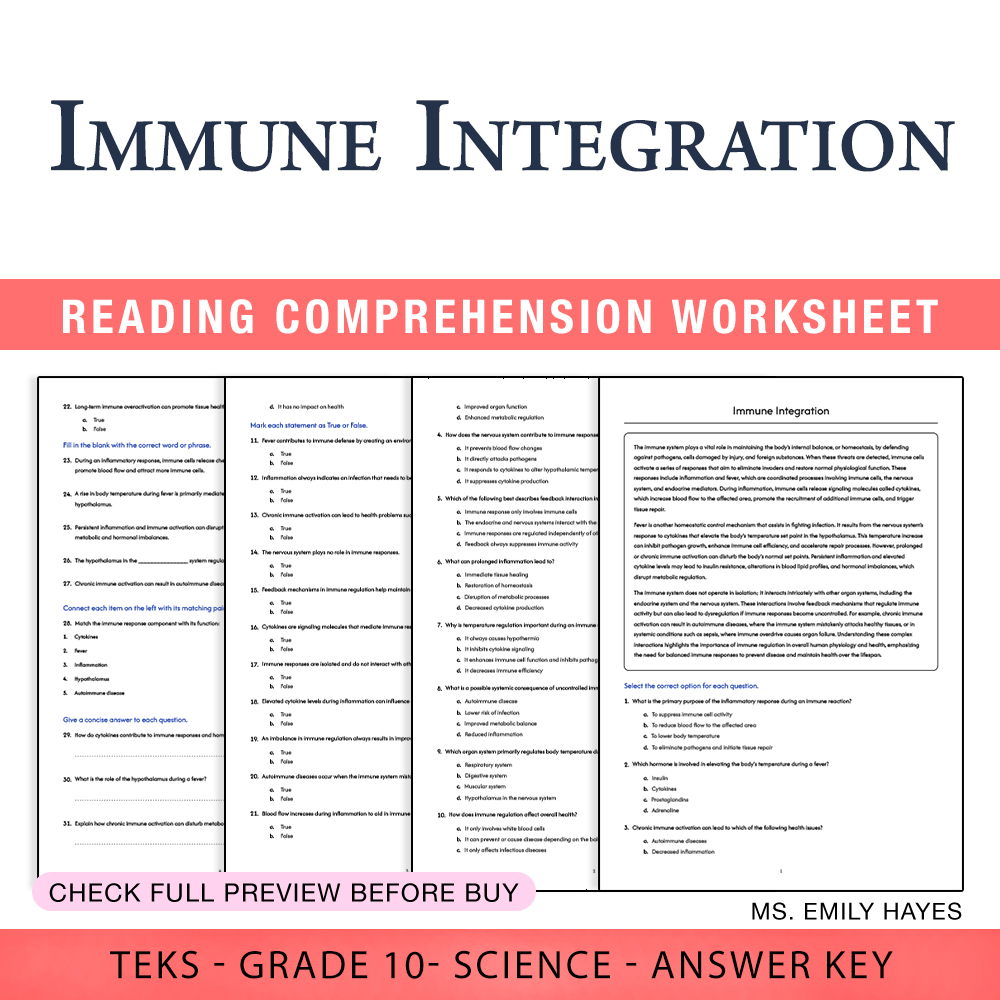
10th Grade Science | Immune System Mastery Worksheet (PDF+ Answer Key)
Created byCopper Leaf ClassroomLearning Objectives
- Understand how the immune system contributes to maintaining homeostasis.
- Identify responses of the immune system during inflammation and fever.
- Learn how immune regulation interacts with other organ systems.
Instant download
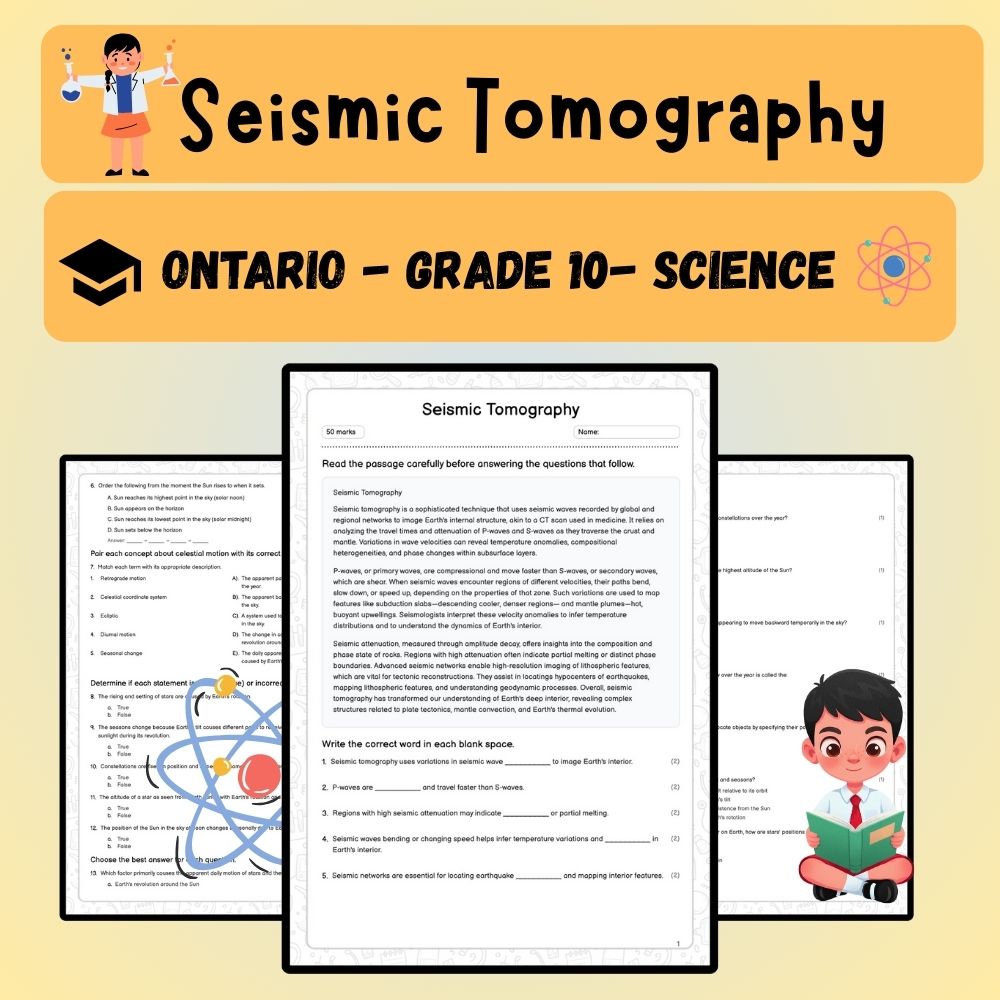
Grade 10 Science | Seismic Tomography Worksheet (PDF) – Ontario Standard
Created byPrism Point LearningLearning Objectives
- Explain the types of seismic waves and their properties.
- Describe how seismic travel times and attenuation are used to infer Earth's internal structure.
- Interpret P- and S-wave velocity variations to identify temperature, composition, and phase changes.
Also included in: Grade 10 Science UNIT Bundle | Earth Processes & Resources Ontario Standards +1 more
Instant download
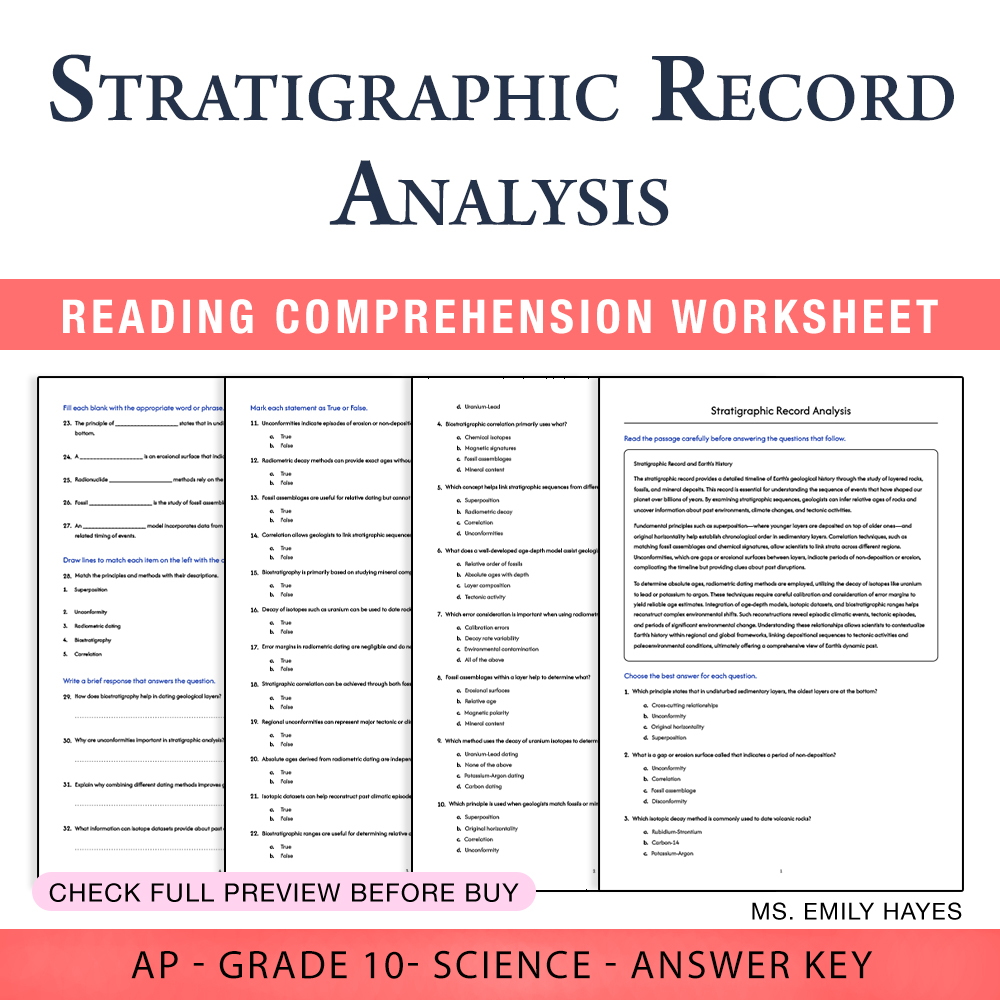
10th Grade Science | Stratigraphic Record Analysis Worksheet (PDF + Answer Key)
Created byCopper Leaf ClassroomLearning Objectives
- Interpret stratigraphic sequences and fossil assemblages to determine relative ages.
- Understand principles such as superposition, correlation, and unconformities in Earth history.
- Evaluate radiometric decay methods and error considerations in absolute age dating.
Also included in: Grade 10 Science AP – Surface Processes & Earth Systems (PDF + Answer Key) +1 more
Instant download

Atmospheric Patterns Worksheet Pack | Grade 10 AP Science Weather Systems
Created byPrism Point LearningLearning Objectives
- Explain how atmospheric structure and pressure systems influence weather and regional climate.
- Interpret synoptic-scale ideas such as frontal boundaries and storm tracks using pressure and wind representations.
- Use thermodynamic and moisture principles to predict how temperature, humidity, and vertical stability affect precipitation.
Also included in: Earth Systems, Climate & Adaptation Lesson Bundle: Grade 10 Science AP
Instant download
About Grade 10 Science Worksheets
Find Science worksheets built for Grade 10. All 7,069 cover core skills, practice, and review, each an instant PDF download.
Every worksheet on MyTeachingSheets is created by independent teacher-authors and reviewed before publication. All resources download as printable PDFs for classroom, homework, or at-home practice, and many include answer keys. Preview any worksheet free before buying.