
Grade 10 Science Worksheets
7,069 worksheets
Grade 10 Science – Mechanics Applications Reading Worksheet | Ontario Standards
 Created byBright Mind Resources
Learning Objectives
- Understand the forces acting on objects on inclined planes
- Apply Newtonian dynamics to real-world mechanical systems
- Analyze how gravity and other forces influence motion on slopes
Also included in: Grade 10 Force & Motion Science Daily Reading Lesson Bundle – Ontario +1 more
Instant download

Grade 10 Plate Narratives Worksheet | Assessment & Practice PDF
 Created byClear Sky Classroom
Learning Objectives
- Explain how mantle convection drives plate motion and how subduction shapes Earth’s surface.
- Interpret tectonic settings using maps, cross-sections, and seismic evidence.
- Connect plate boundary types to mountain building, volcanism, and earthquake distribution.
Also included in: Grade 10 Earth & Space Sciences Science Lesson Bundle: Advanced Placement (AP) +1 more
Instant download

Grade 10 Science – Trophic Efficiency Daily Reading Worksheet + Answer Key
JCreated byJ.S SheetsLearning Objectives
- Define trophic levels and describe their role in ecosystems.
- Explain the concept of energy transfer between trophic levels.
- Discuss factors that affect trophic efficiency and its ecological significance.
Also included in: Grade 10 Science Lesson Group – Ecosystems and Environmental Impact Worksheets +1 more
Instant download

Grade 10 Science – Energy Flow in Ecosystems Daily Worksheet + Answer Key
JCreated byJ.S SheetsLearning Objectives
- Understand how sunlight is captured by photosynthetic organisms
- Explain the role of producers in energy transfer
- Describe how energy moves through trophic levels
Also included in: Grade 10 Science Lesson Group – Ecosystems and Environmental Impact Worksheets +1 more
Instant download

Grade 10 Science – Ecological Succession Daily Reading Worksheet + Answer Key
JCreated byJ.S SheetsLearning Objectives
- Understand the concept of primary succession and its stages.
- Identify different features and processes involved in primary succession.
- Recognize environmental conditions that lead to primary succession.
Also included in: Grade 10 Science Lesson Group – Ecosystems and Environmental Impact Worksheets +1 more
Instant download

Grade 10 Science – Biodiversity Value Daily Reading Worksheet + Answer Key
JCreated byJ.S SheetsLearning Objectives
- Understand the concept of biodiversity and its types
- Identify the ecological benefits of biodiversity
- Recognize factors that threaten biodiversity
Also included in: Grade 10 Science Lesson Group – Ecosystems and Environmental Impact Worksheets +1 more
Instant download
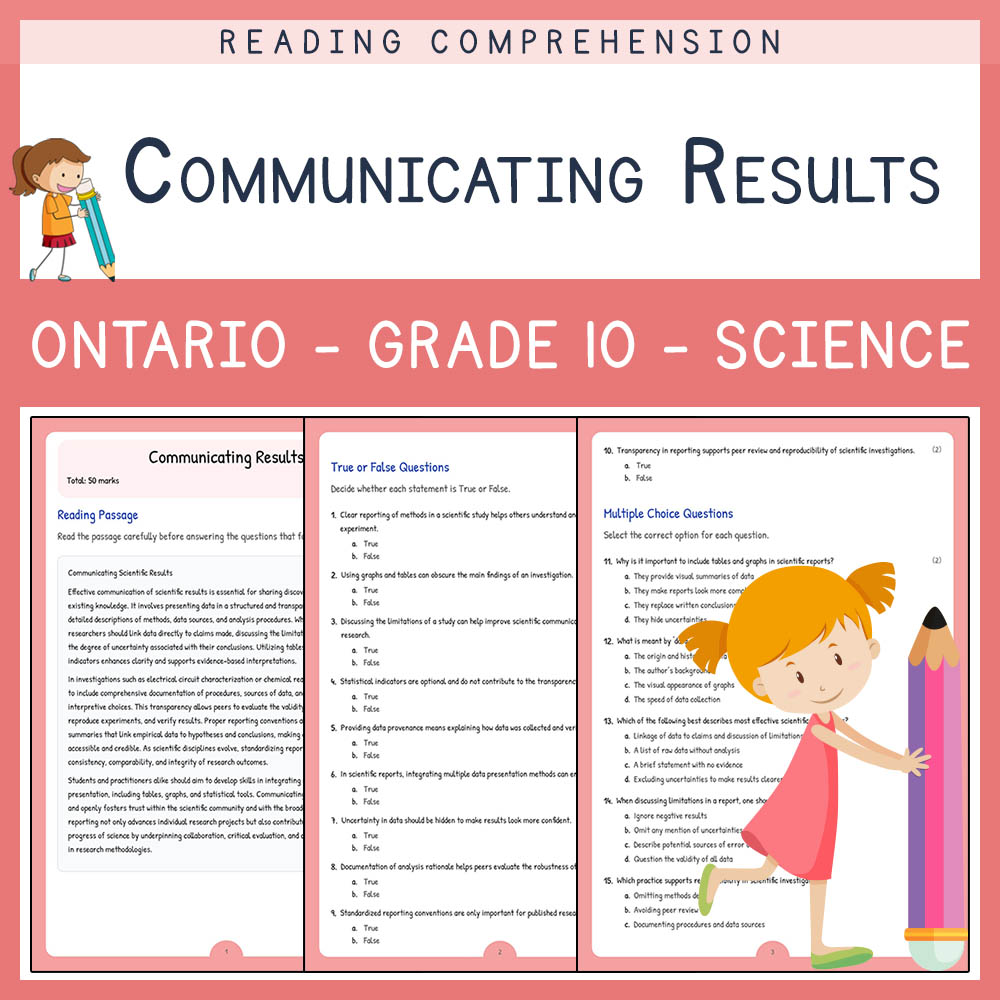
Grade 10 Science | Communicating Results Worksheet Elena | Ontario Standards
 Created byLumora Learning
Learning Objectives
- Understand and apply conventions for clear, evidence-based reporting of scientific investigations.
- Develop skills to integrate data tables, graphs, and statistical indicators into reports to support conclusions.
- Recognize the importance of documenting methods, data provenance, and interpretive rationale for peer evaluation and reproducibility.
Instant download

Grade 10 Science – Atomic Structure & Periodic Trends | Daily Reading Worksheet
Created byBright Mind ResourcesLearning Objectives
- Identify the parts of an atom and their functions
- Describe electron configuration and nuclear composition
- Interpret periodic trends related to atomic structure
Also included in: Chemical Reactions Grade 10 Science Daily Reading Worksheets Bundle | NGSS +2 more
Instant download

Grade 10 Science – Bond Energetics & Chemical Reactions |Daily Reading Worksheet
Created byBright Mind ResourcesLearning Objectives
- Understand the concept of chemical bonds and their energy changes
- Differentiate between exothermic and endothermic processes
- Interpret potential energy diagrams and bond enthalpy values
Also included in: Chemical Reactions Grade 10 Science Daily Reading Worksheets Bundle | NGSS +2 more
Instant download

Grade 10 Science – Chemical Equilibrium & NGSS | Daily Reading Worksheet
Created byBright Mind ResourcesLearning Objectives
- Understand the concept of chemical equilibrium and how it reflects a balance in reversible reactions
- Identify factors that influence the position of equilibrium, such as pressure, concentration, and temperature
- Recognize how catalysts affect reaction rates without changing equilibrium position
Also included in: Chemical Reactions Grade 10 Science Daily Reading Worksheets Bundle | NGSS +2 more
Instant download
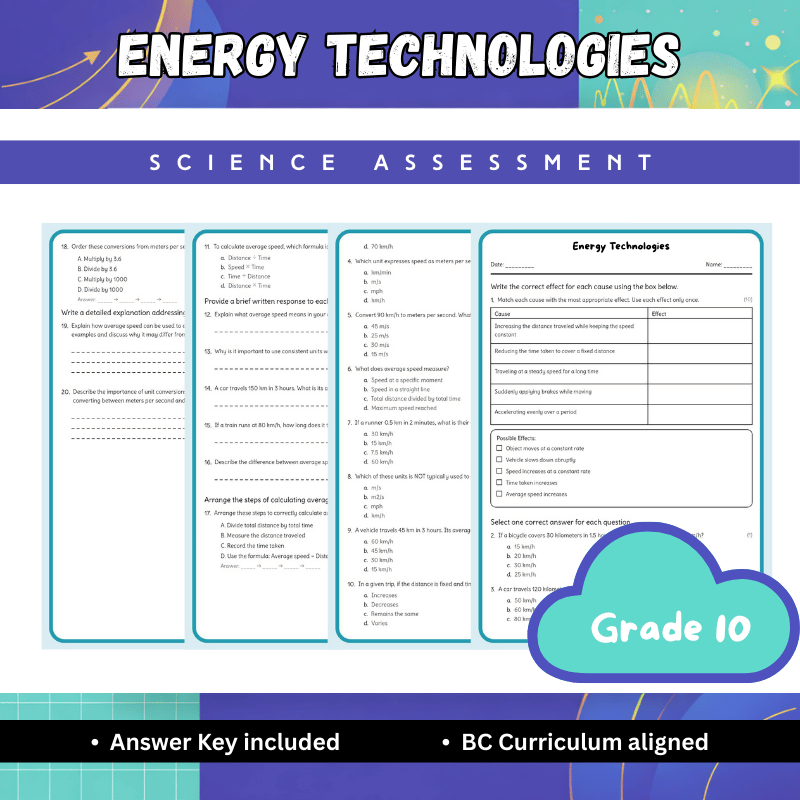
Grade 10 Science | Energy Forms Worksheet (Answer Key) – BC Standards
Created byBright Mind ResourcesLearning Objectives
- Identify and describe different forms of energy such as kinetic, potential, thermal, chemical, radiant, and nuclear.
- Explain how objects store and release energy during various processes like movement, respiration, and heating.
- Recognize examples of energy transformation in physical and biological systems.
Instant download

Grade 10 Science Metabolic Control Worksheet | Alberta Biology PDF
 Created byEvergreen Desk Education
Learning Objectives
- Explain how enzyme kinetics influence cellular metabolism and metabolic flux
- Describe feedback inhibition and how regulatory motifs balance energy production and biosynthesis
- Evaluate how compartmentalization and environmental conditions affect enzyme activity in Alberta species
Instant download
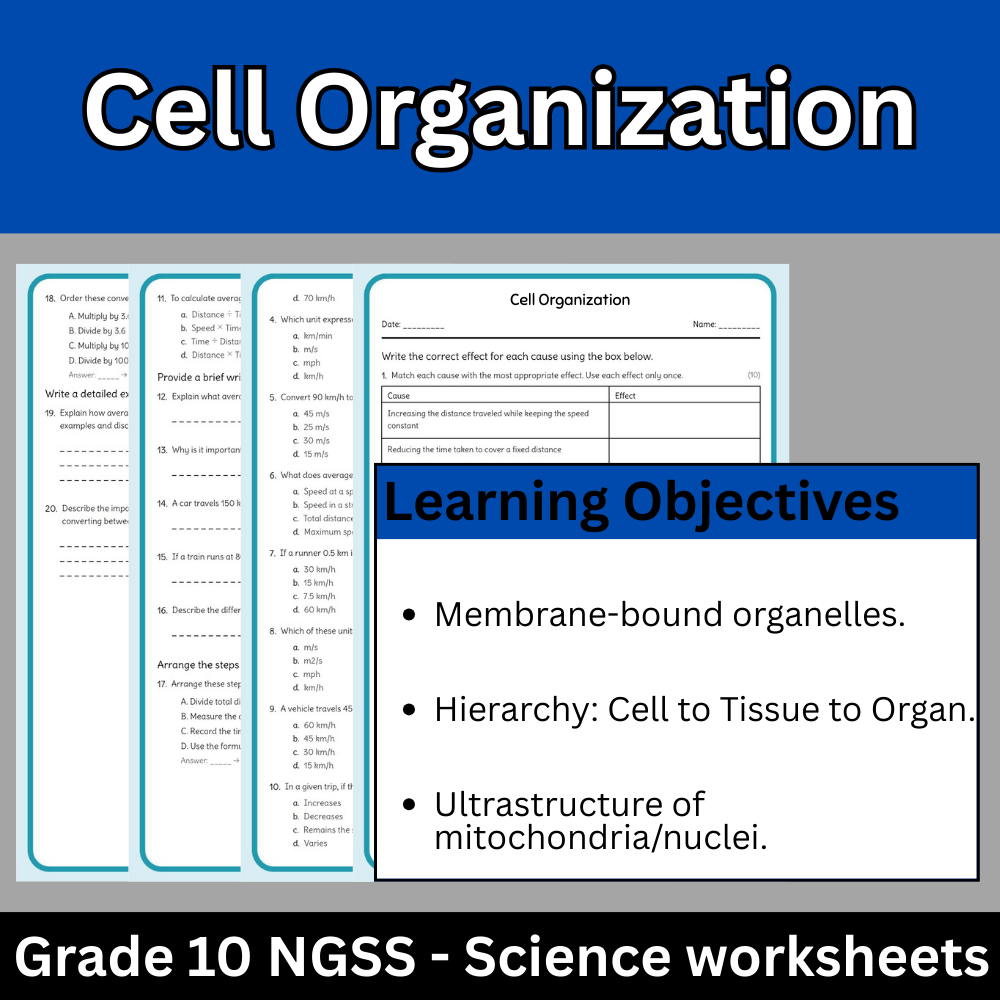
Grade 10 Science - Cell Organization Worksheet + Answer Key (NGSS Aligned)
Created byBright Mind ResourcesLearning Objectives
- Identify the structure and functions of membrane-bound organelles in eukaryotic and prokaryotic cells.
- Explain hierarchical organization from cells to tissues and organs, including examples like epithelial and muscle tissues.
- Compare ultrastructures of mitochondria, chloroplasts, endoplasmic reticulum, and nucleus with their metabolic and genetic functions.
Instant download
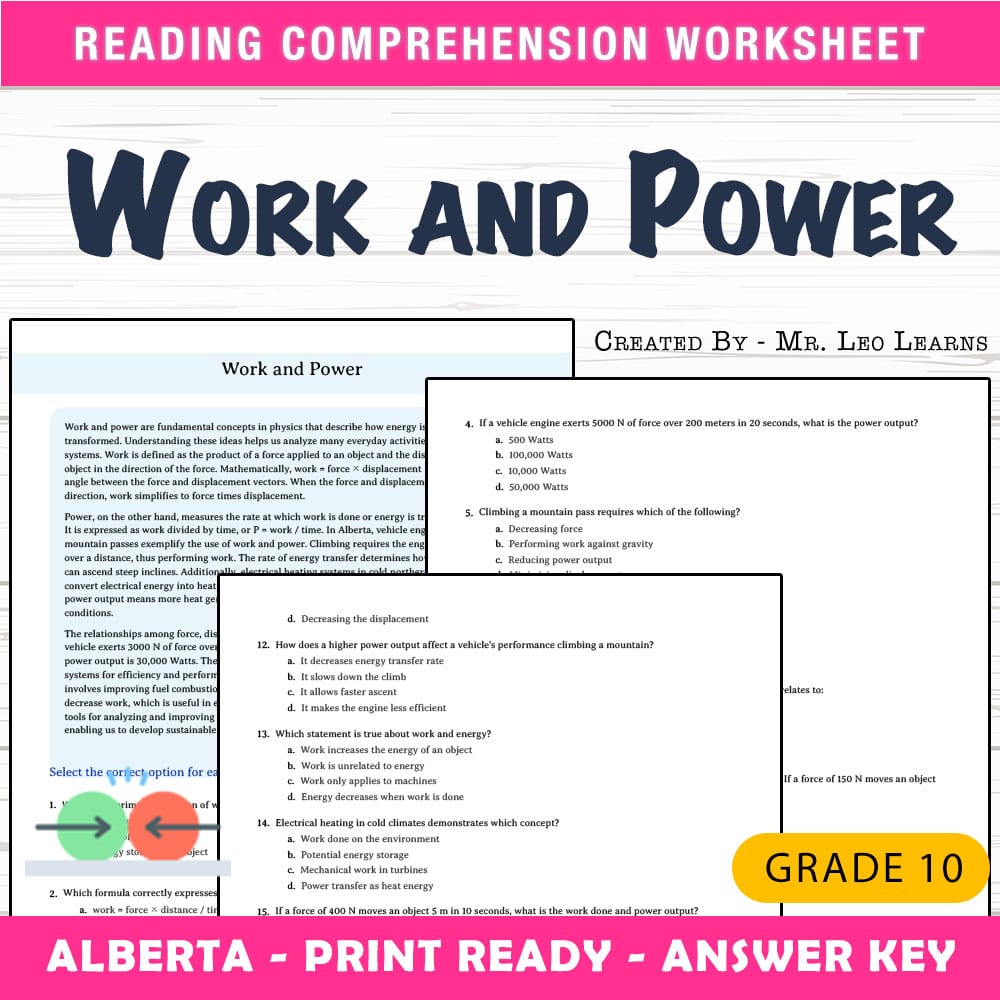
Grade 10 Science — Worksheet MCQ Paper for Mastering Work and Power
 Created byThe Resource Hub
Learning Objectives
- Explain the concepts of work and power in mechanical contexts.
- Calculate work done using force and displacement measurements.
- Understand how power relates to energy transfer over time.
Also included in: Grade 10 Science | Energy, Motion & Electricity Worksheet Bundle | Alberta +1 more
Instant download
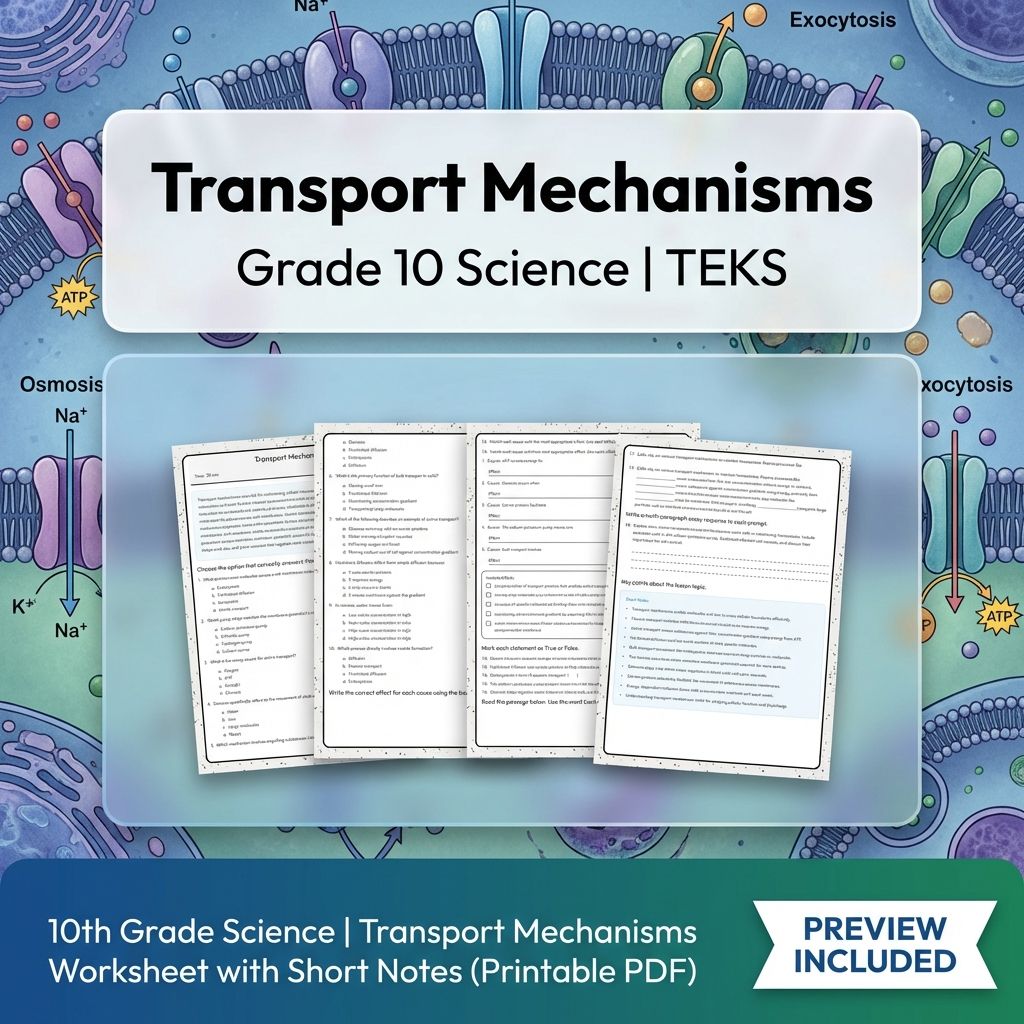
10th Grade Science | Transport Mechanisms Worksheet with Short Notes (PDF)
 Created byMeadowlark Worksheets
Learning Objectives
- Describe different passive and active transport mechanisms across cell membranes.
- Explain the role of carrier proteins, pumps, and bulk transport in cellular function.
- Identify examples of transport mechanisms like the sodium–potassium pump and facilitated diffusion.
Instant download
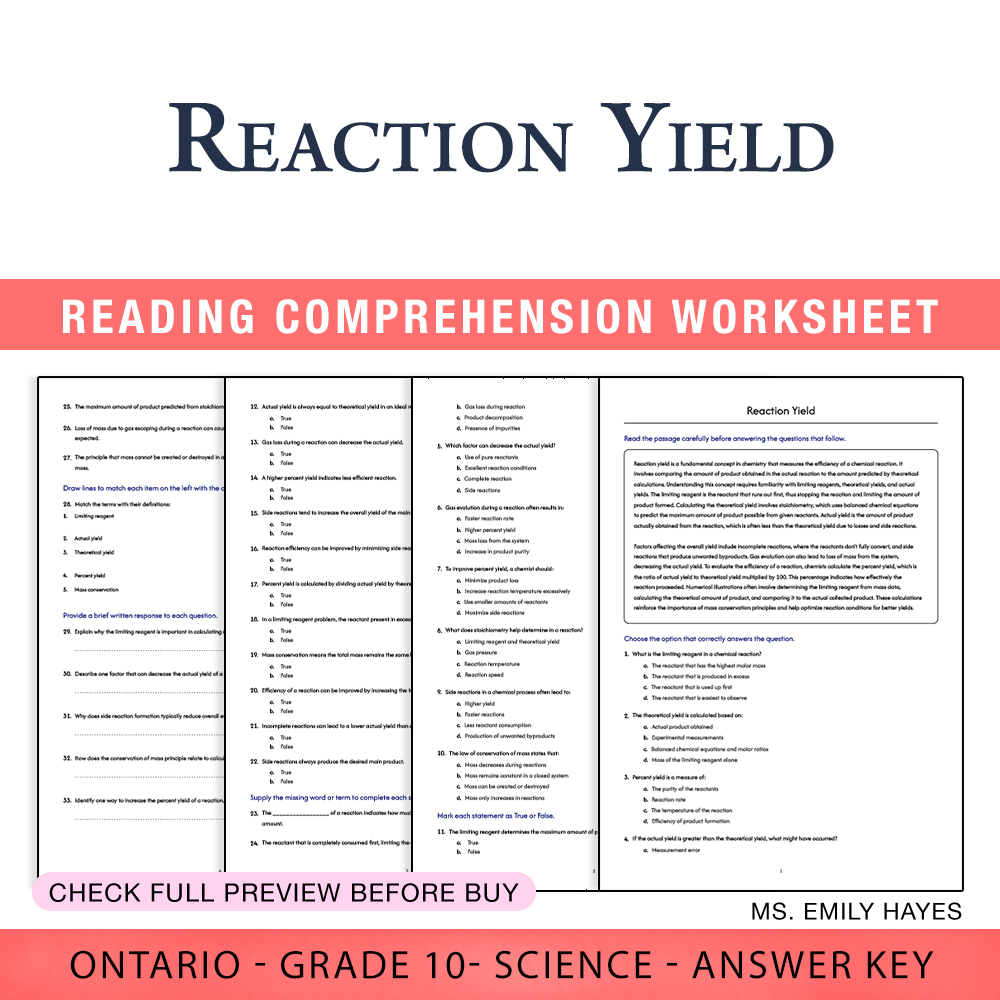
10th Grade Science | Reaction Yield Worksheet (PDF + Answer Key)
 Created byCopper Leaf Classroom
Learning Objectives
- Understand the concept of limiting reagent in chemical reactions.
- Calculate theoretical, actual, and percent yields of products in chemical processes.
- Identify factors that affect reaction yield such as incomplete reactions, side reactions, and gas loss.
Instant download
Grade 10 Science | Ecosystem Basics Worksheet (PDF) – TEKS-Aligned Activities
Created byBright Mind ResourcesLearning Objectives
- Define the key components and functions of an ecosystem.
- Identify various roles of producers, consumers, and decomposers within an ecosystem.
- Understand the flow of energy and cycling of matter in ecosystems.
Also included in: Grade 10 Science | Ecosystems & Biodiversity Unit Worksheet Bundle(TEKS-Aligned) +5 more
Instant download

Grade 10 Science – Reaction Types in Chemistry | Daily Reading Worksheet
Created byBright Mind ResourcesLearning Objectives
- Understand the different types of chemical reactions: synthesis, decomposition, single and double displacement, and combustion.
- Identify reaction types from chemical equations.
- Recognize the indicators of each reaction type.
Also included in: Grade 10 Chemistry Science Lesson Bundle Daily Reading Worksheets | Alberta +1 more
Instant download
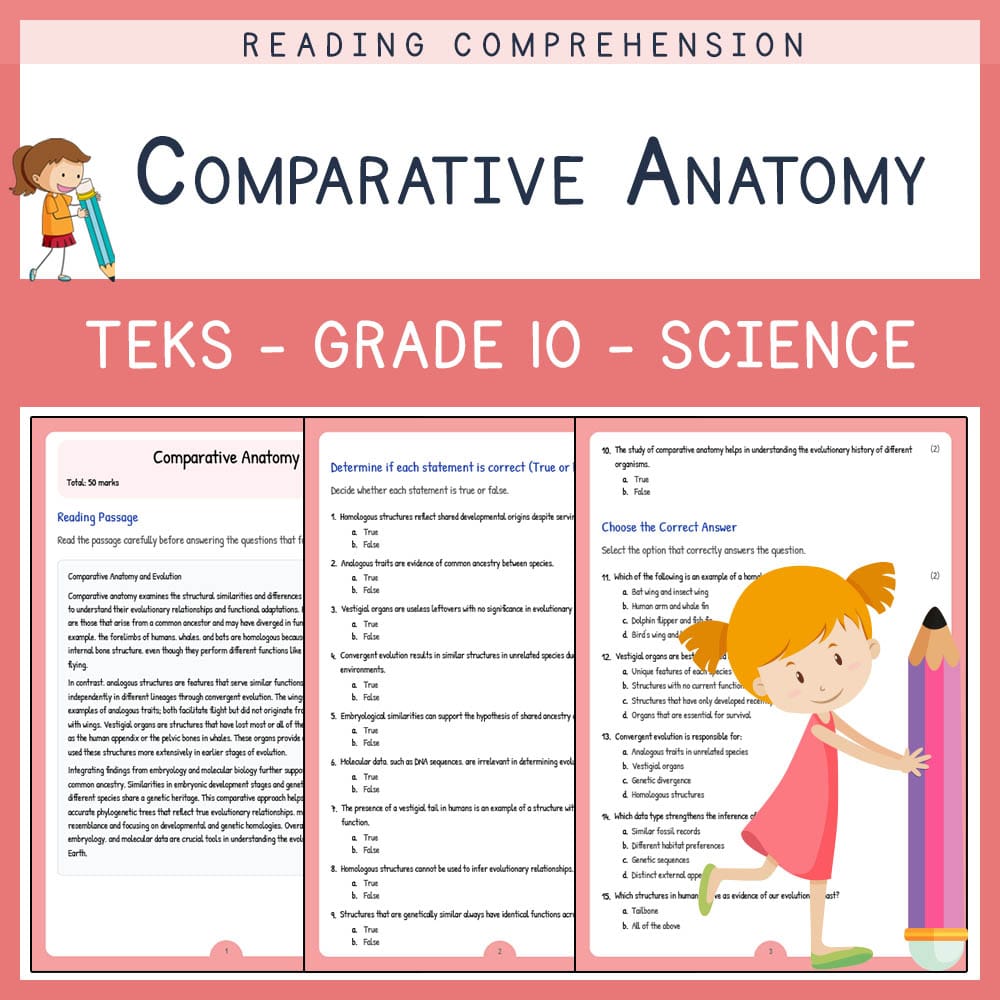
Grade 10 Science | Comparative Anatomy Worksheet | TEKS Aligned
Created byLumora LearningLearning Objectives
- Understand the concept of homologous and analogous structures and their significance in evolution.
- Identify vestigial organs and explain their importance as evidence of evolutionary change.
- Interpret anatomical, embryological, and molecular data to infer evolutionary relationships.
Also included in: Grade 10 Science | Evolution & Classification Lesson Bundle | TEKS Aligned +1 more
Instant download
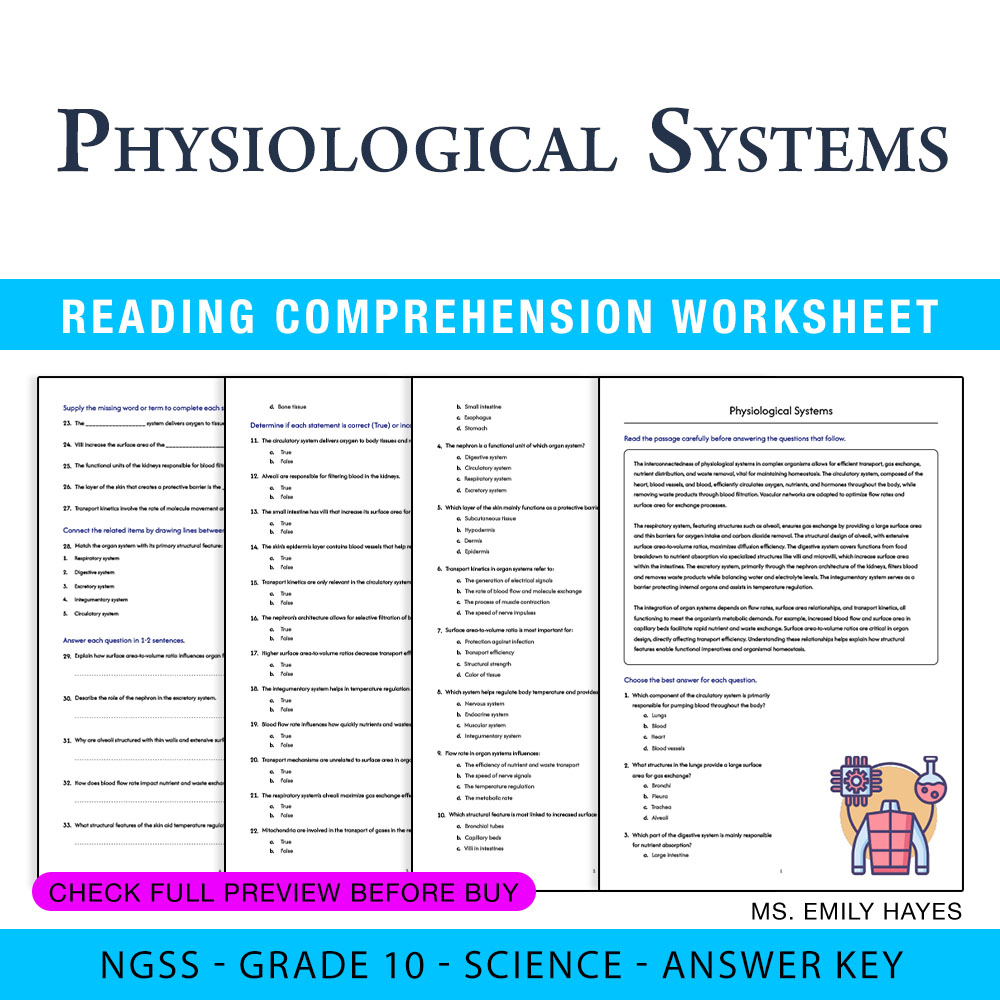
Grade 10 Science | Physiological Systems Worksheet (PDF+ Answer Key)
Created byCopper Leaf ClassroomLearning Objectives
- Describe the structural features and functions of the circulatory, respiratory, digestive, excretory, and integumentary systems.
- Analyze how different organ systems coordinate to meet organismal demands using flow rates, surface area relationships, and transport mechanisms.
- Compare and contrast structural adaptations and their functional implications across various physiological systems.
Instant download
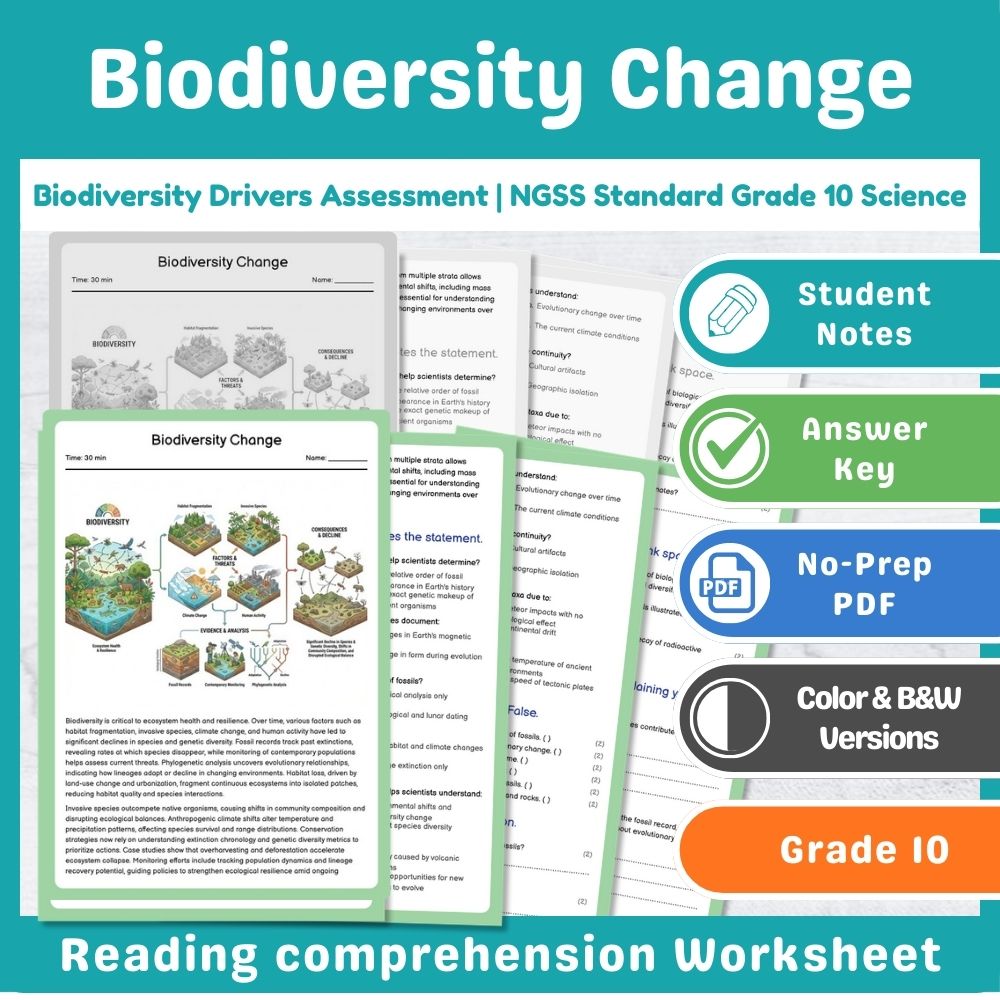
Biodiversity Change Assessment for Grade 10 Science NGSS Standards
 Created byPrism Point Learning
Learning Objectives
- Understand the factors that influence biodiversity loss and ecosystem change.
- Identify evidence and methods used to monitor biodiversity and extinction rates.
- Analyze the impacts of human actions on ecological resilience and genetic diversity.
Instant download
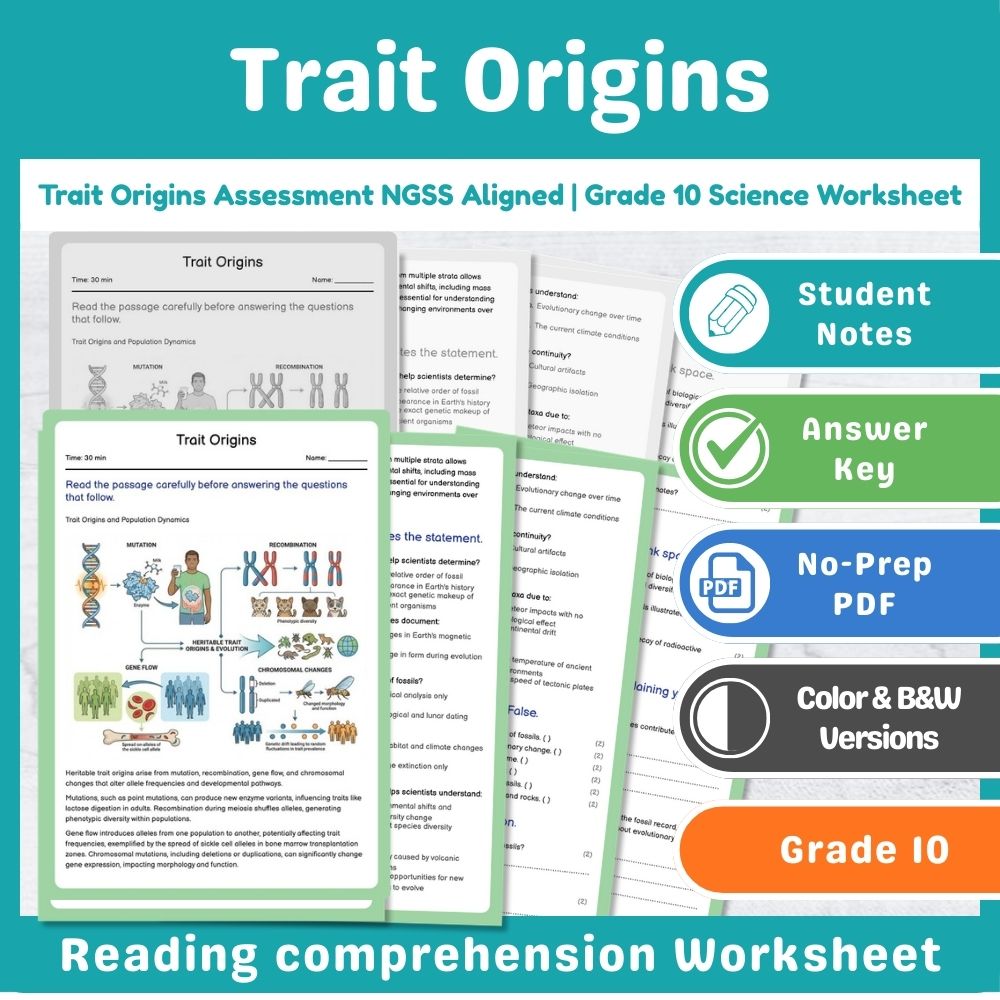
Trait Origins Assessment NGSS Aligned | Grade 10 Science Worksheet
Created byPrism Point LearningLearning Objectives
- Understand the molecular and population-level processes that influence heritable trait variation.
- Identify examples of genetic mutations and chromosomal changes affecting traits.
- Explain how population processes such as genetic drift and nonrandom mating modify trait distributions.
Instant download
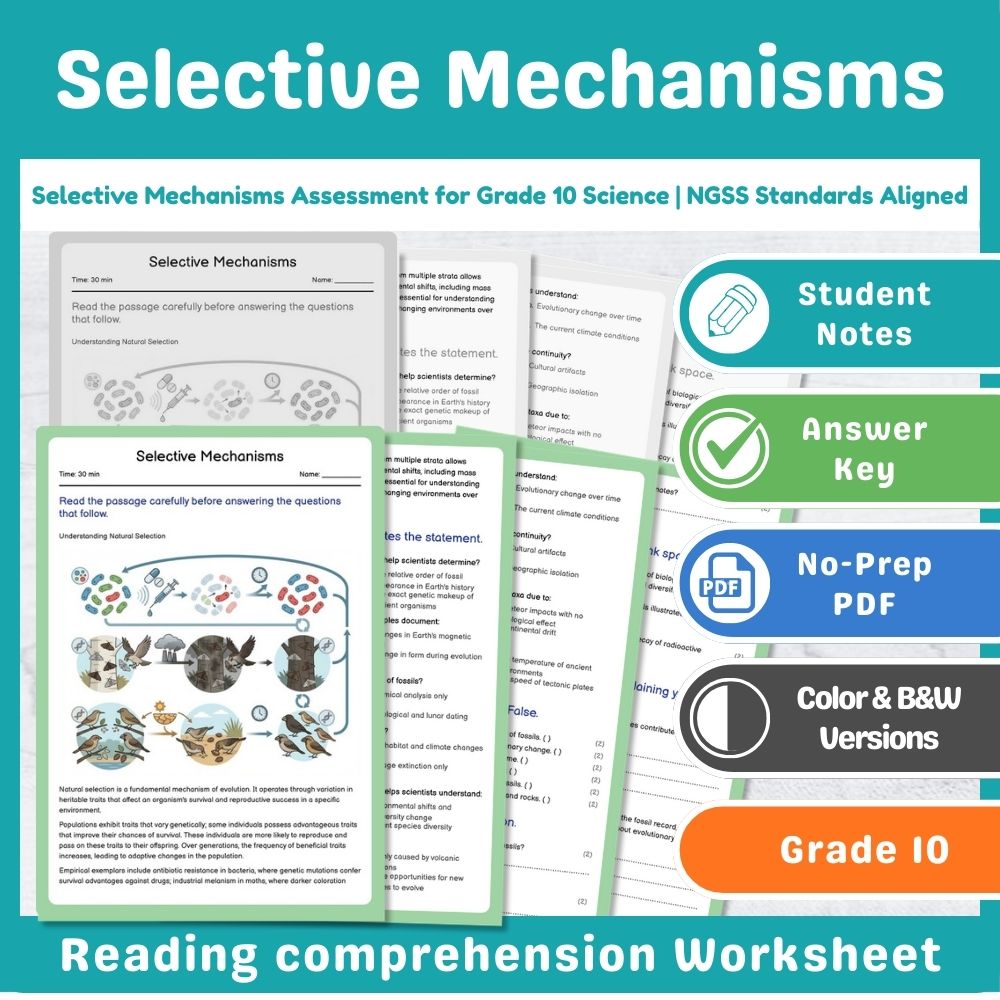
Selective Mechanisms Assessment for Grade 10 Science | NGSS Standards Aligned
Created byPrism Point LearningLearning Objectives
- Understand how natural selection operates through variation in heritable traits.
- Identify real-world examples illustrating adaptive changes due to environmental pressures.
- Analyze the role of reproductive success and fitness differentials in evolution.
Instant download
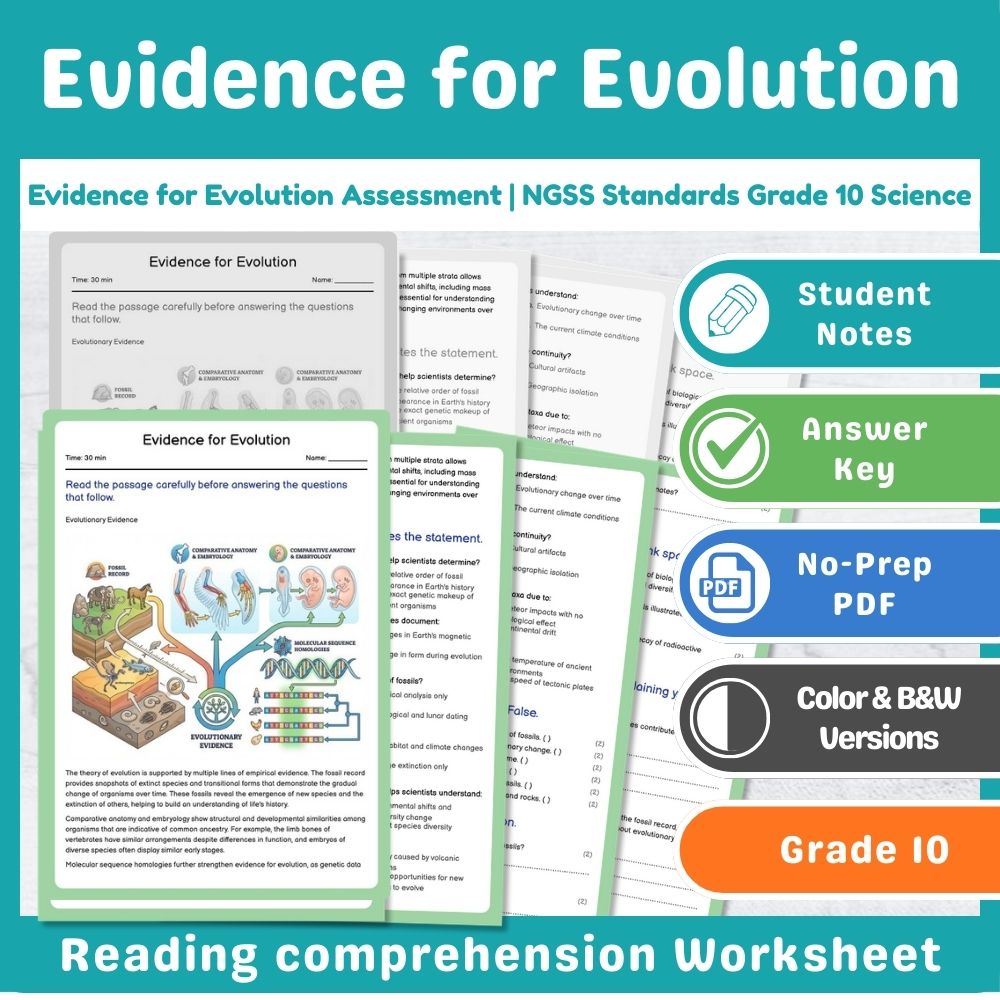
Evidence for Evolution Assessment | NGSS Standards Grade 10 Science
Created byPrism Point LearningLearning Objectives
- Understand the key lines of scientific evidence supporting common ancestry and evolution.
- Identify how fossil records, comparative anatomy, embryology, and molecular data corroborate evolutionary theory.
- Analyze the role of radiometric dating and biogeography in establishing evolutionary timelines.
Instant download
Grade 10 Science Cell Biochemistry Worksheet with Short Notes (Printable PDF)
Created byMeadowlark WorksheetsLearning Objectives
- Understand the role of membranes and organelles in cell function.
- Explain how enzymes facilitate biochemical reactions.
- Describe the energy transfer process involving ATP in cells.
Also included in: Grade 10 Natural Selection & Heredity Science Lesson Bundle - General +1 more
Instant download
Grade 10 Science | Heredity Patterns Worksheet with Short Notes (Printable PDF)
Created byMeadowlark WorksheetsLearning Objectives
- Understand how genetic information is encoded in DNA and passed through chromosomes.
- Identify the roles of alleles in inheritance and trait expression.
- Predict inheritance outcomes using genotype and phenotype relationships.
Also included in: Grade 10 Natural Selection & Heredity Science Lesson Bundle - General +1 more
Instant download

Cell Membrane Worksheet for Grade 10 Science TEKS Standards– PDF
JCreated byJ.S SheetsLearning Objectives
- Explain how a phospholipid bilayer acts as a selectively permeable barrier to regulate transport into and out of cells.
- Describe how membrane proteins (integral and peripheral) and cholesterol influence transport and membrane behavior.
- Connect membrane components, such as carbohydrate markers, to cell recognition and signaling.
Instant download
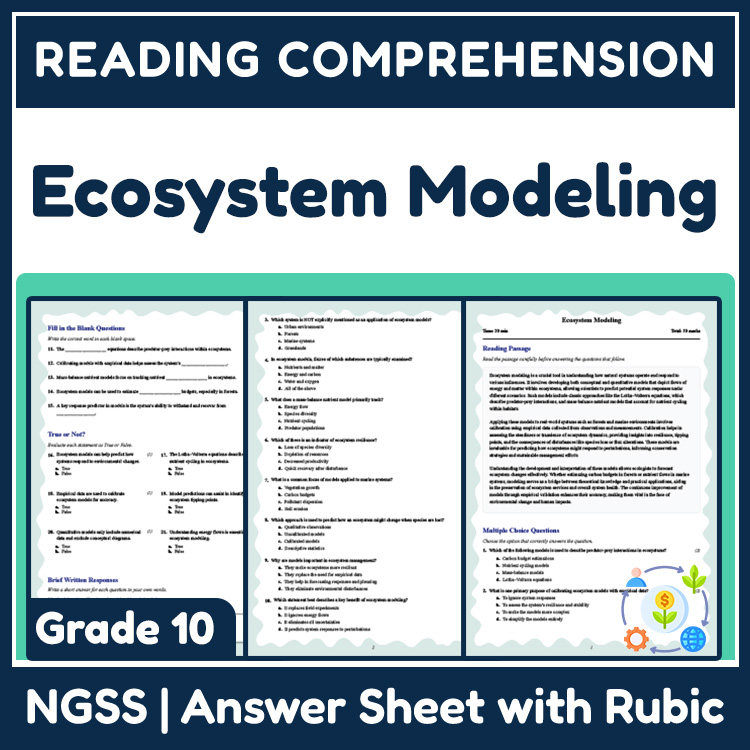
10th Grade Science | Ecosystem Modeling Reading Worksheet & Answer Key (PDF)
JCreated byJ.S SheetsLearning Objectives
- Understand the development and use of conceptual and quantitative models for ecosystems.
- Interpret the flow of energy and matter in different ecosystems using models like Lotka–Volterra equations and mass-balance models.
- Analyze how ecosystem responses to perturbations can be predicted and evaluated.
Also included in: Grade 10 Science | Ecosystems & Biodiversity Uanit Worksheets
Instant download
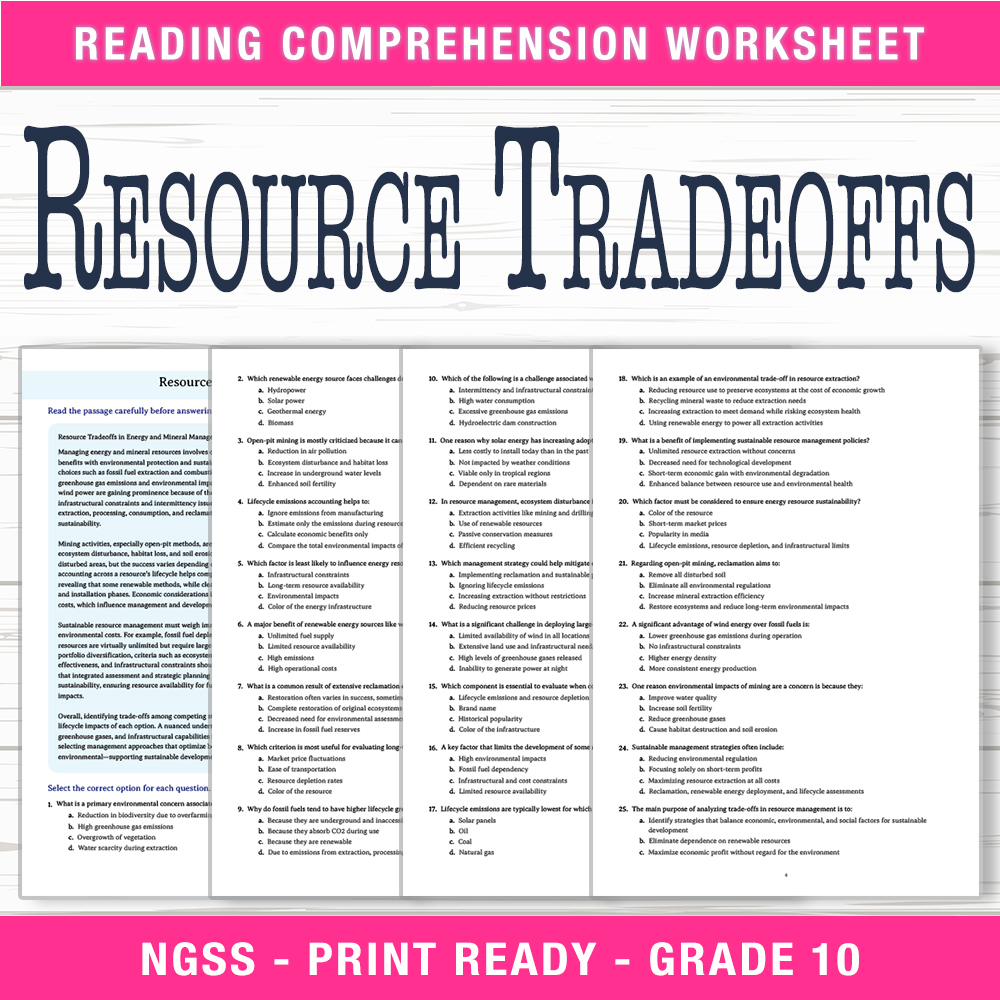
Grade 10 Science | Resource Tradeoffs Worksheet (PDF + Answer Key)
 Created byRiverstone Classroom
Learning Objectives
- Analyze different energy and mineral resource options based on economic, environmental, and sustainability criteria.
- Evaluate case studies involving fossil fuels, renewable energy sources, mining impacts, and lifecycle emissions.
- Apply trade-off analysis using criteria such as resource depletion, ecosystem disturbance, and greenhouse gas emissions.
Instant download
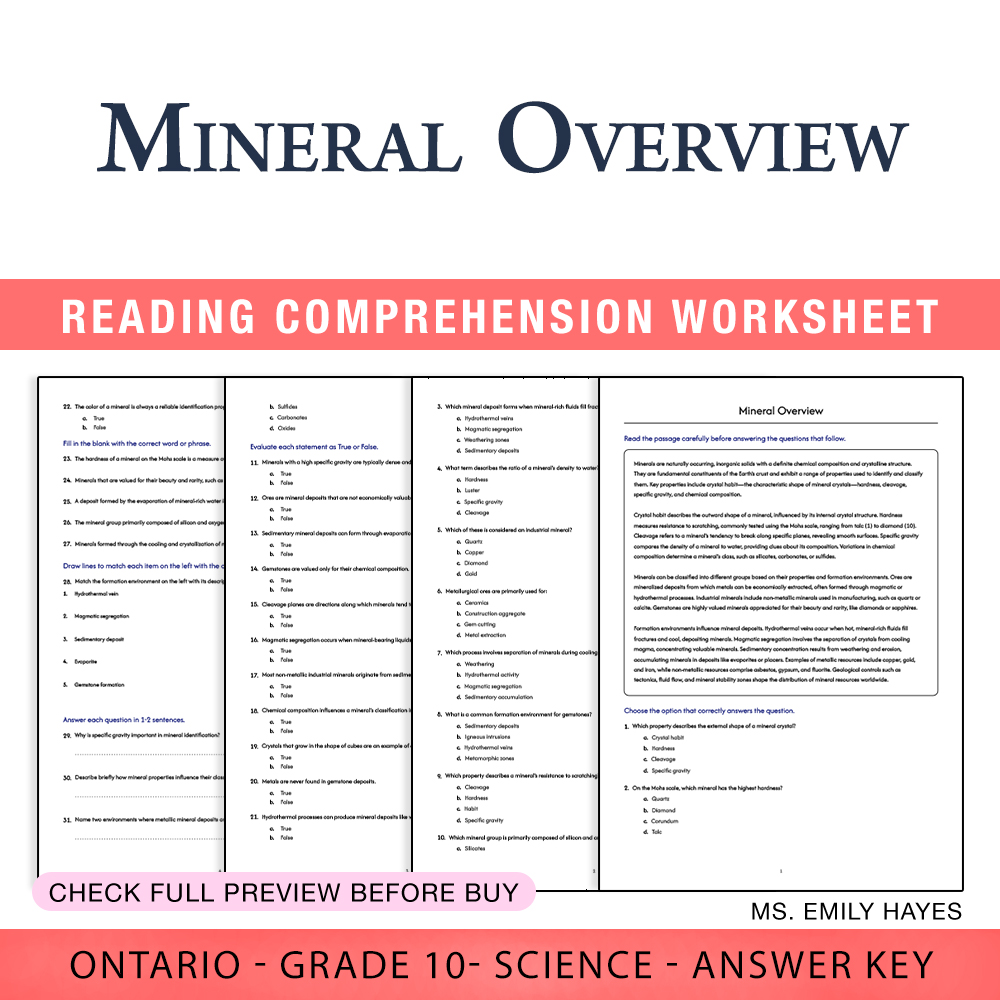
Grade 10 Science | Mineral Overview Worksheet (PDF + Answer Key)
Created byCopper Leaf ClassroomLearning Objectives
- Understand the properties and classifications of minerals essential to geology and industry.
- Identify and differentiate between various types of mineral resources such as ores, industrial minerals, and gemstones.
- Explain common mineral formation environments and the geological factors influencing mineral distribution.
Instant download
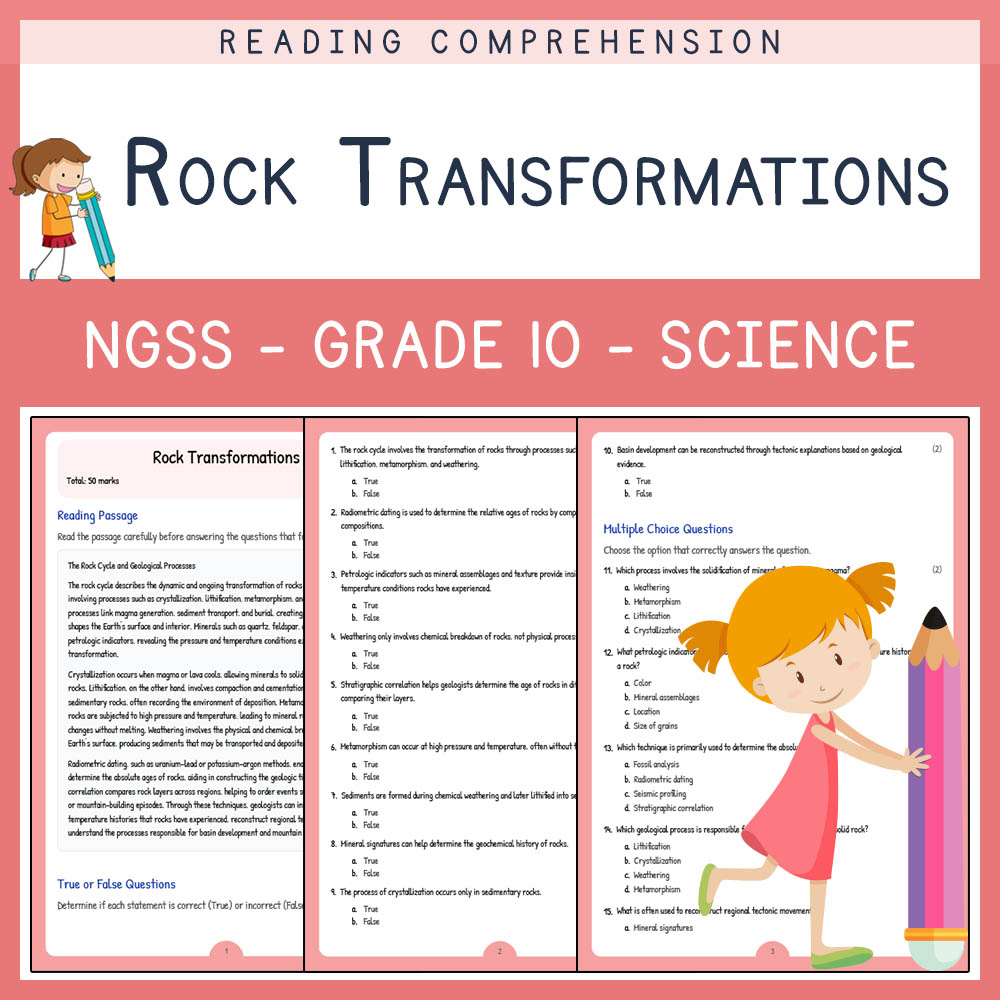
Grade 10 Science | Rock Transformations Worksheet (PDF + Answer Key) for NGSS
Created byLumora LearningLearning Objectives
- Understand the processes involved in the rock cycle, including crystallization, lithification, metamorphism, and weathering.
- Identify petrologic indicators such as mineral assemblages, texture, and geochemical signatures to interpret pressure–temperature histories.
- Explain how radiometric dating and stratigraphic correlation are used to order geological events and reconstruct regional geologic histories.
Instant download

Photosynthesis Basics Assessment for Grade 10 Science TEKS
Created byPrism Point LearningLearning Objectives
- Understand key concepts related to Science
- Apply knowledge through practice questions
- Demonstrate comprehension of the material
Instant download
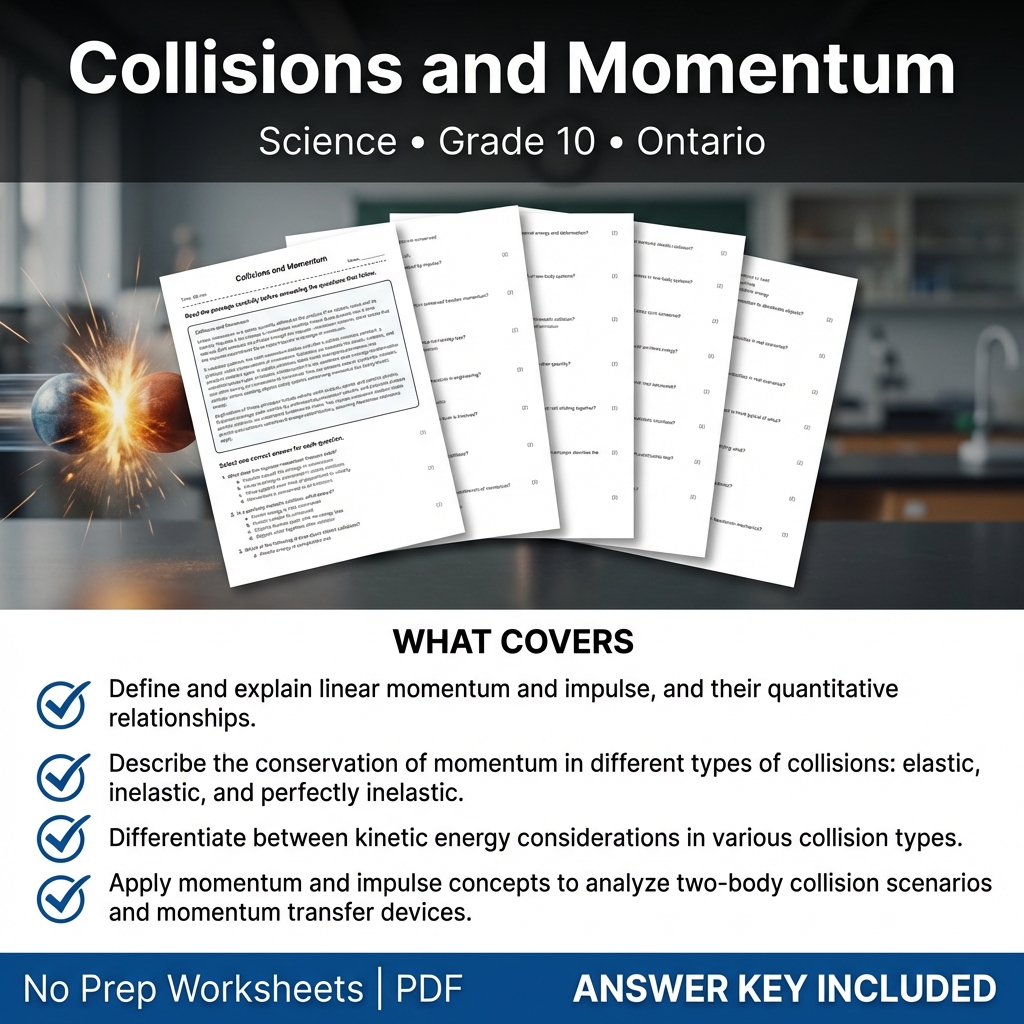
Collisions and Momentum Worksheet | Ontario Grade 10 Science Practice
 Created byCoral Reef Learning
Learning Objectives
- Define and explain linear momentum and impulse, and their quantitative relationships.
- Describe the conservation of momentum in different types of collisions: elastic, inelastic, and perfectly inelastic.
- Differentiate between kinetic energy considerations in various collision types.
Instant download

Grade 10 Science | Atomic Structure Worksheet with Short Notes (Printable PDF)
Created byMeadowlark WorksheetsLearning Objectives
- Understand the electron configuration, nuclear composition, and periodic trends related to atomic structure.
- Identify patterns of valence electrons and how they influence the formation of ions and oxidation states.
- Explain the significance of isotopes and atomic mass in relation to elemental properties.
Also included in: Grade 10 Science – Matter and Its Interactions NGSS Unit Bundle (7 Worksheets) +1 more
Instant download

Grade 10 Science | Reaction Evidence Worksheet with Short Notes (Printable PDF)
Created byMeadowlark WorksheetsLearning Objectives
- Understand how conservation of atoms supports identification of reaction products.
- Explain how observable evidence confirms chemical reactions.
- Correlate reactant properties with products in chemical equations.
Also included in: Grade 10 Science – Matter and Its Interactions NGSS Unit Bundle (7 Worksheets) +1 more
Instant download

Grade 10 Science | Chemical Equilibrium Worksheet with Short Notes (PDF)
Created byMeadowlark WorksheetsLearning Objectives
- Understand the concept of chemical equilibrium and its characteristics.
- Identify factors that affect the position of equilibrium.
- Explain how to interpret equilibrium expressions and calculations.
Also included in: Grade 10 Science – Matter and Its Interactions NGSS Unit Bundle (7 Worksheets) +1 more
Instant download

Grade 10 Science | Mass Conservation Worksheet with Short Notes (Printable PDF)
Created byMeadowlark WorksheetsLearning Objectives
- Understand the principle of atomic and mass conservation in chemical reactions.
- Use balanced chemical equations to track atom counts.
- Apply molar concepts and calculations to verify mass invariance.
Also included in: Grade 10 Science – Matter and Its Interactions NGSS Unit Bundle (7 Worksheets) +1 more
Instant download

Grade 10 Science Reaction Rates Worksheet with Short Notes (Printable PDF)
Created byMeadowlark WorksheetsLearning Objectives
- Explain how collision theory and rate laws determine reaction speed.
- Identify factors such as temperature, concentration, surface area, and catalysts that influence rate.
- Interpret empirical data using concepts of molecular collision frequency and activation energy.
Also included in: Grade 10 Science – Matter and Its Interactions NGSS Unit Bundle (7 Worksheets) +1 more
Instant download
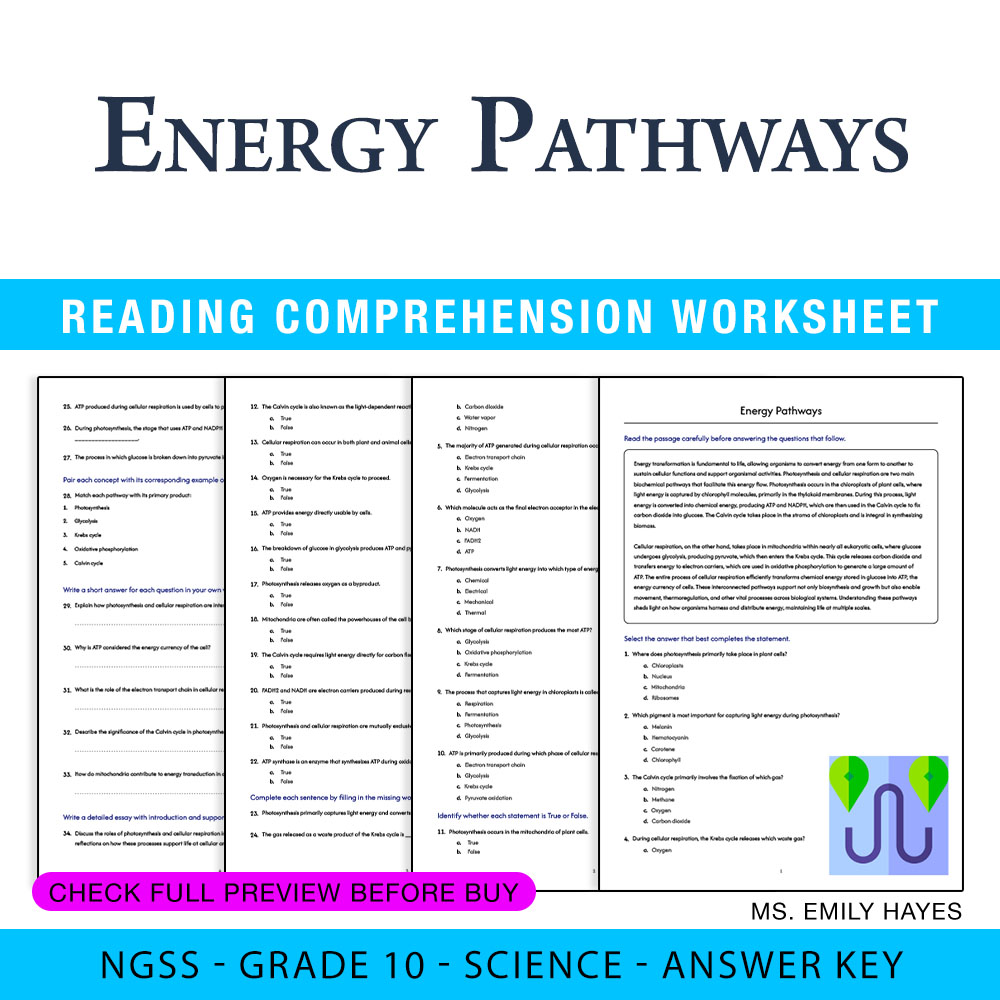
10th Grade Science | Energy Pathways Worksheet (PDF+ Answer Key)
Created byCopper Leaf ClassroomLearning Objectives
- Explain the process of photosynthesis and its role in energy capture.
- Describe cellular respiration pathways and their relationship to ATP production.
- Illustrate how energy transduction supports life processes across cellular and organismal scales.
Instant download

Grade 10 Science | Multiple Evidence Lines Worksheet | California Standards
Created byLumora LearningLearning Objectives
- Explain how multiple independent evidence lines support the idea of common ancestry and evolutionary change
- Identify key contributions of fossil records, molecular data, and biogeographic patterns to evolutionary explanations
- Evaluate how converging evidence strengthens scientific claims about how biodiversity arises
Instant download

Biodiversity Value Assessment | TEKS Standards Grade 10 Science Worksheet
Created byPrism Point LearningLearning Objectives
- Define biodiversity and its components such as genetic, species, and ecosystem diversity.
- Explain the importance of biodiversity for ecosystem resilience and services.
- Identify threats to biodiversity and strategies for conservation.
Also included in: Grade 10 Ecosystems Science Lesson Bundle for TEKS Assessment Worksheets
Instant download

Grade 10 Science | Balancing Equations - Daily Reading Comprehension
Created byCoral Reef LearningLearning Objectives
- Understand the principle of conservation of mass in chemical reactions.
- Identify atoms and molecules before and after a chemical reaction.
- Learn how to balance chemical equations using coefficients.
Instant download
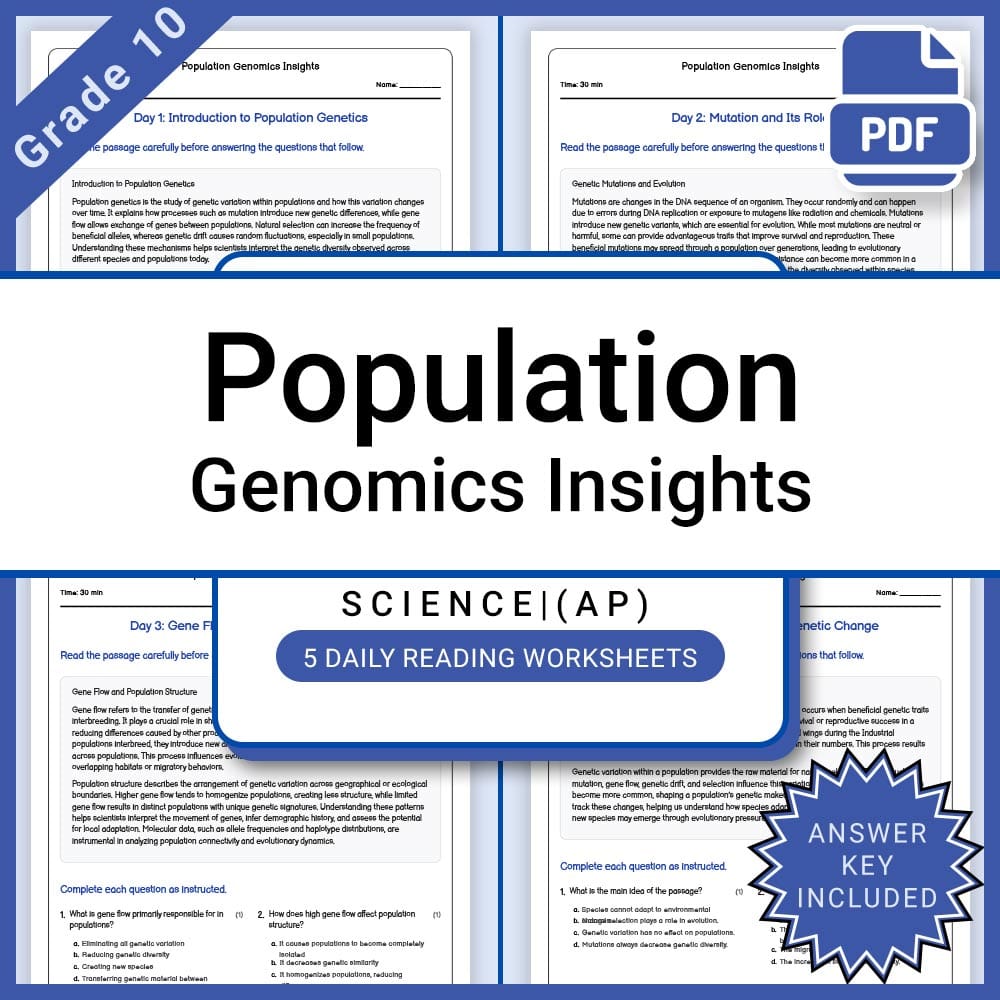
Grade 10 Science – Population Genomics Daily Reading Worksheet + Answer Key
JCreated byJ.S SheetsLearning Objectives
- Understand the concept of genetic variation within populations.
- Describe mechanisms like mutation, gene flow, selection, and genetic drift.
- Learn how genomic data can reveal population history and adaptation.
Also included in: Grade 10 Science Lesson Group Bundle | AP Framework & Daily Worksheets
Instant download
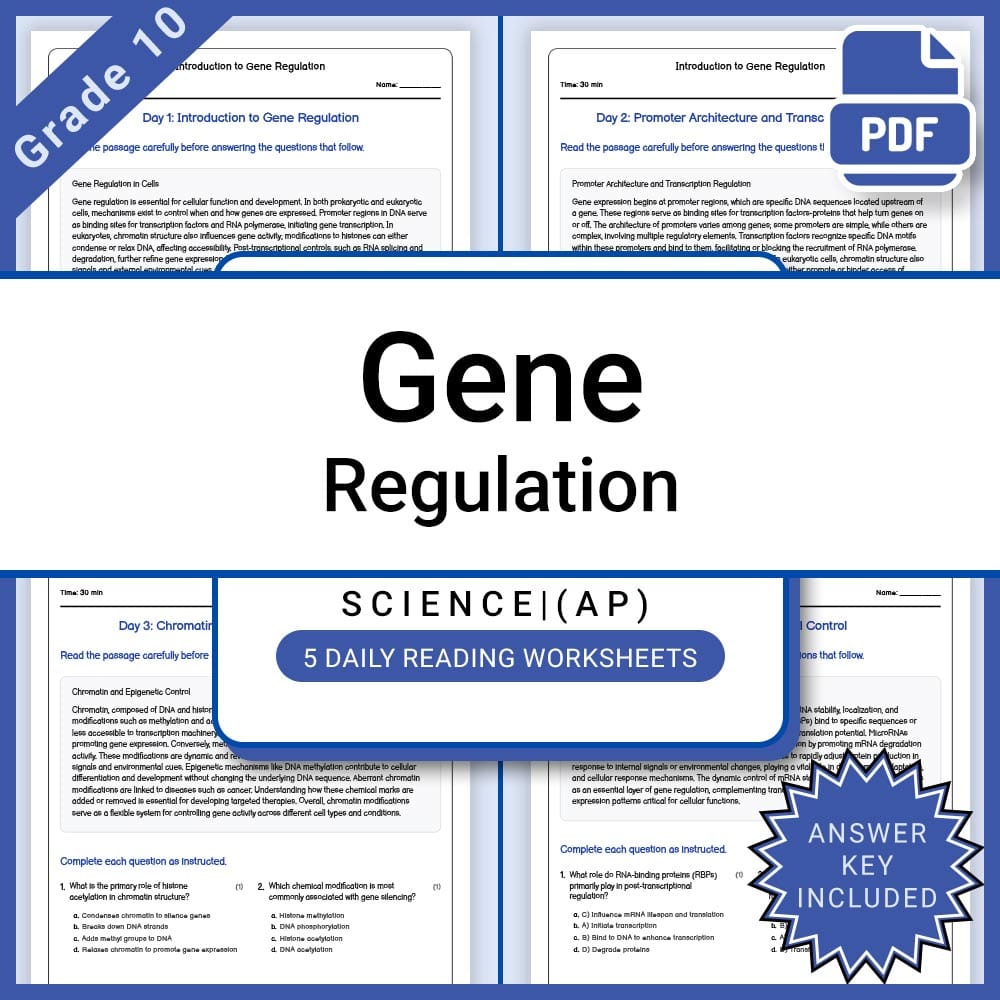
Grade 10 Science – Introduction to Gene Regulation Worksheet with Answer Key
JCreated byJ.S SheetsLearning Objectives
- Understand key concepts related to Science
- Apply knowledge through practice questions
- Demonstrate comprehension of the material
Also included in: Grade 10 Science Lesson Group Bundle | AP Framework & Daily Worksheets
Instant download
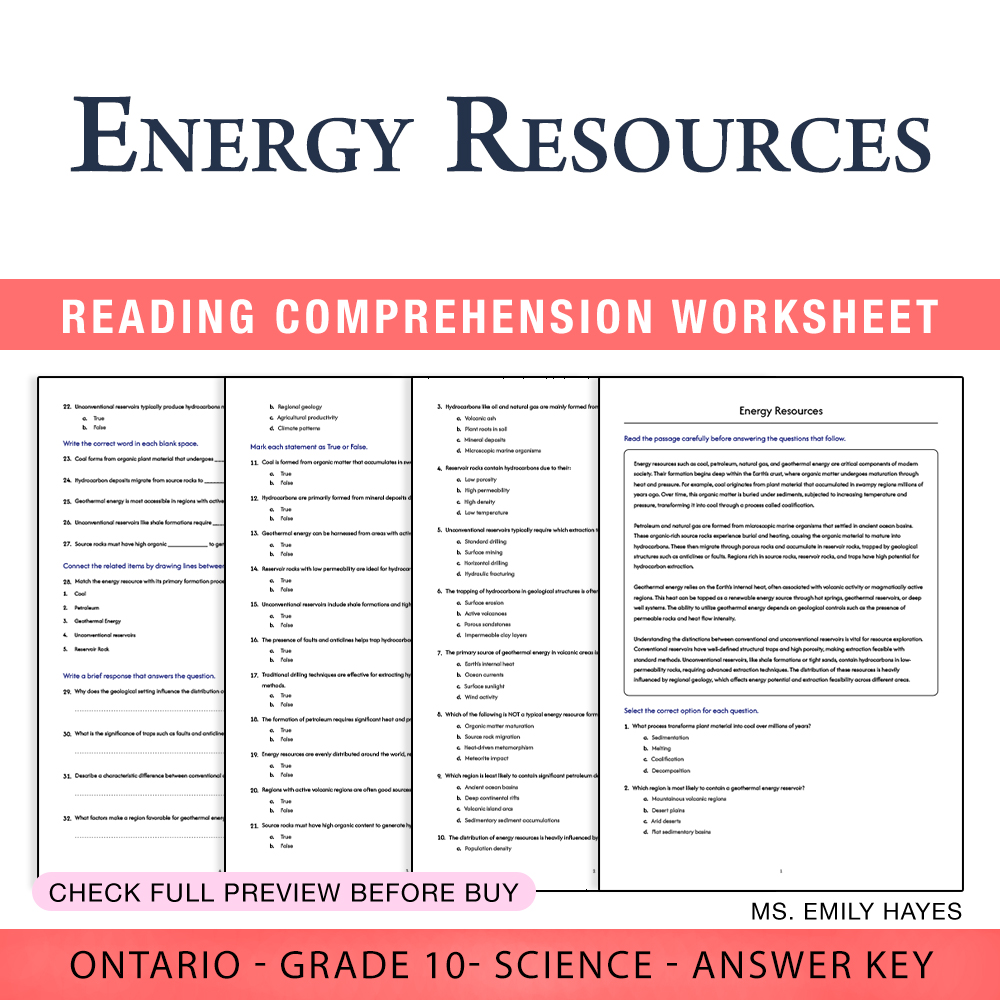
Grade 10 Science | Energy Resources Worksheet (PDF + Answer Key)
Created byCopper Leaf ClassroomLearning Objectives
- Describe the geological origins and distribution of coal, petroleum, and natural gas.
- Explain the characteristics and formation processes of geothermal energy.
- Identify and differentiate between conventional and unconventional reservoirs.
Instant download

Carrying Capacity Worksheet for Grade 10 Science TEKS Standards
JCreated byJ.S SheetsLearning Objectives
- Explain the concept of carrying capacity and how it relates to population growth and survival
- Describe how limiting factors like resources, predation, disease, and waste can change carrying capacity
- Interpret why populations often fluctuate around carrying capacity and what happens when they exceed it
Instant download
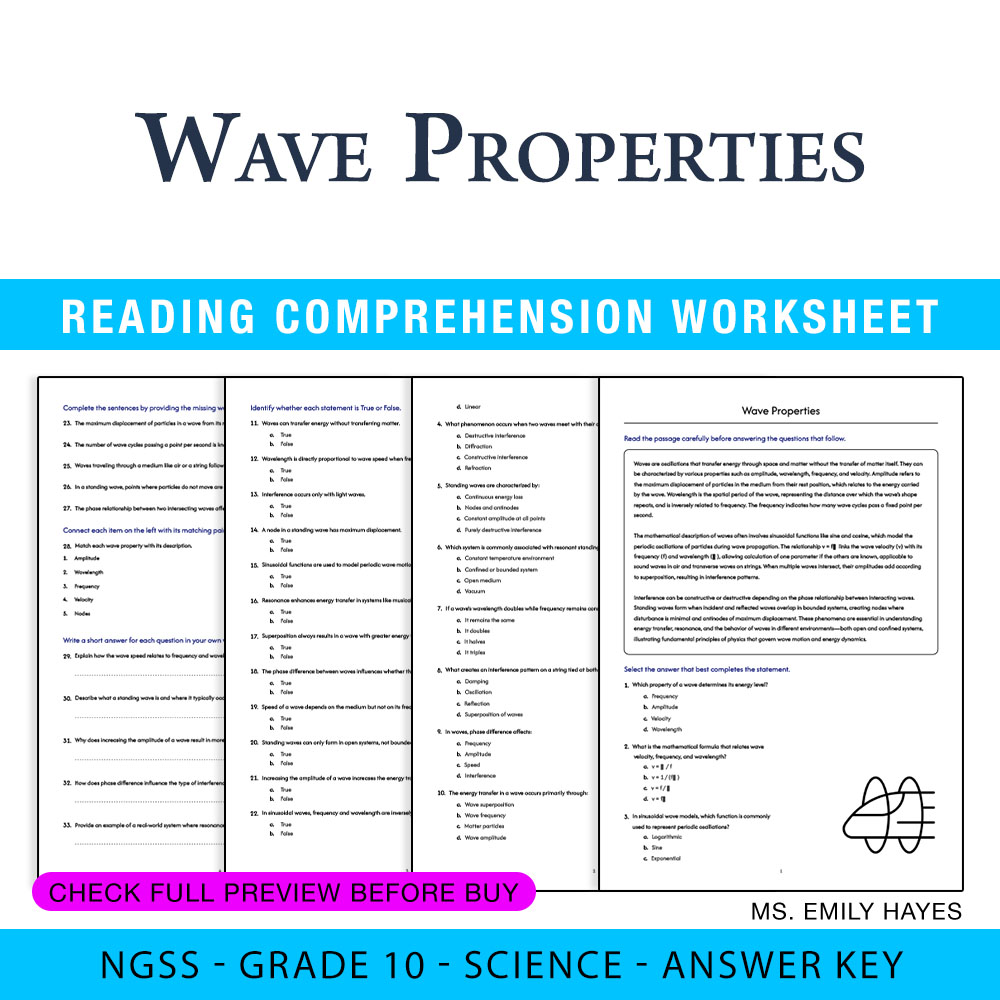
Grade 10 Science | Wave Properties Worksheet (PDF + Answer Key)
Created byCopper Leaf ClassroomLearning Objectives
- Explain the mathematical relationships that characterize wave properties such as amplitude, wavelength, frequency, and velocity.
- Describe how sinusoidal functions model wave behavior and how superposition leads to interference patterns.
- Analyze the formation of standing waves and their significance in energy transfer and resonance in various systems.
Instant download
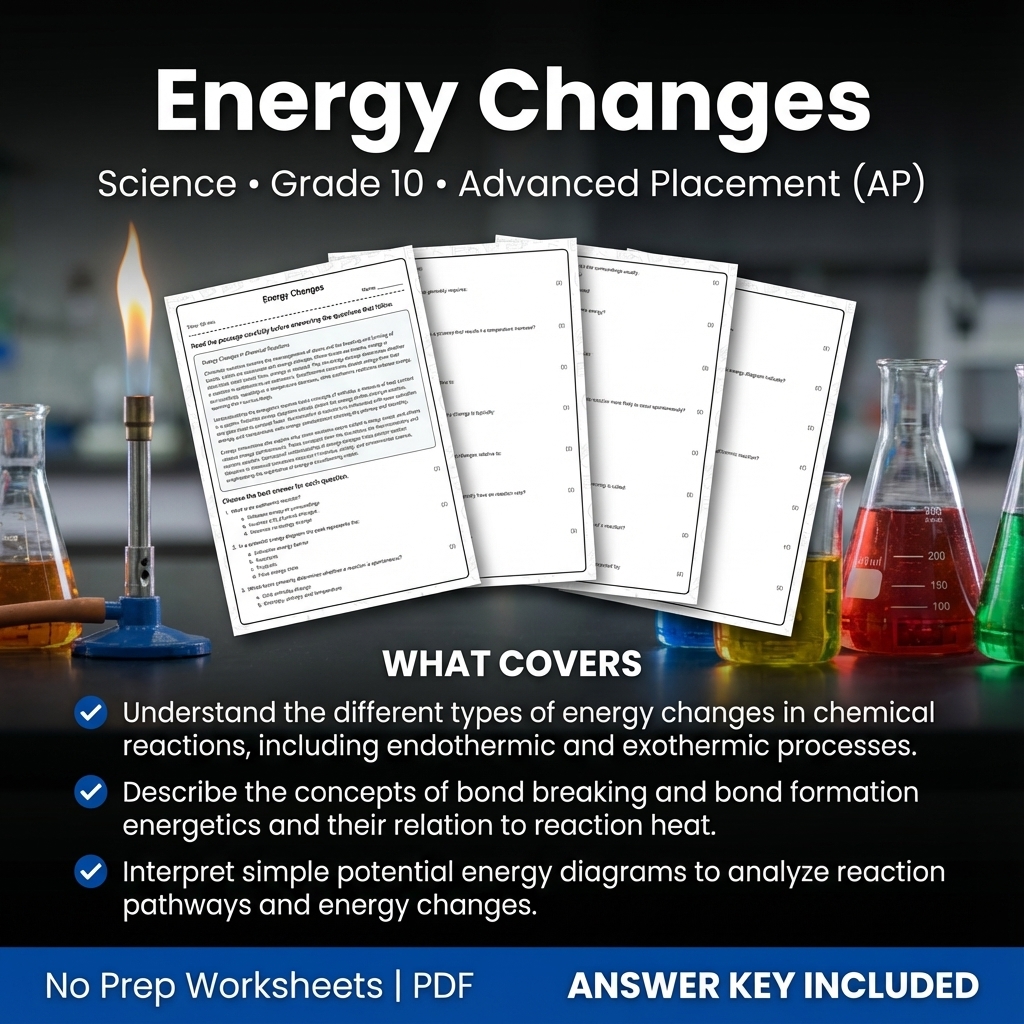
Grade 10 Science | Energy Changes Worksheet (Printable PDF + Answer Key)
Created byCoral Reef LearningLearning Objectives
- Understand the different types of energy changes in chemical reactions, including endothermic and exothermic processes.
- Describe the concepts of bond breaking and bond formation energetics and their relation to reaction heat.
- Interpret simple potential energy diagrams to analyze reaction pathways and energy changes.
Also included in: Grade 10 Science Unit Bundle | Thermochemistry, Stoichiometry & Atomic Structure +1 more
Instant download
About Grade 10 Science Worksheets
Find Science worksheets built for Grade 10. All 7,069 cover core skills, practice, and review, each an instant PDF download.
Every worksheet on MyTeachingSheets is created by independent teacher-authors and reviewed before publication. All resources download as printable PDFs for classroom, homework, or at-home practice, and many include answer keys. Preview any worksheet free before buying.