
Grade 10 Science Worksheets
7,069 worksheets
Grade 10 Science | Speciation Processes Worksheet (PDF+ Answer Key)
 Created byCopper Leaf Classroom
Learning Objectives
- Explain the concept of speciation and how reproductive barriers lead to the formation of new species.
- Differentiate between allopatric and sympatric speciation in various contexts.
- Identify pathways such as reinforcement, hybrid zones, and polyploidy that promote speciation.
Also included in: Grade 10 Science BC | Evolution, Biodiversity & Ecology (PDF + Answer Key) +1 more
Instant download
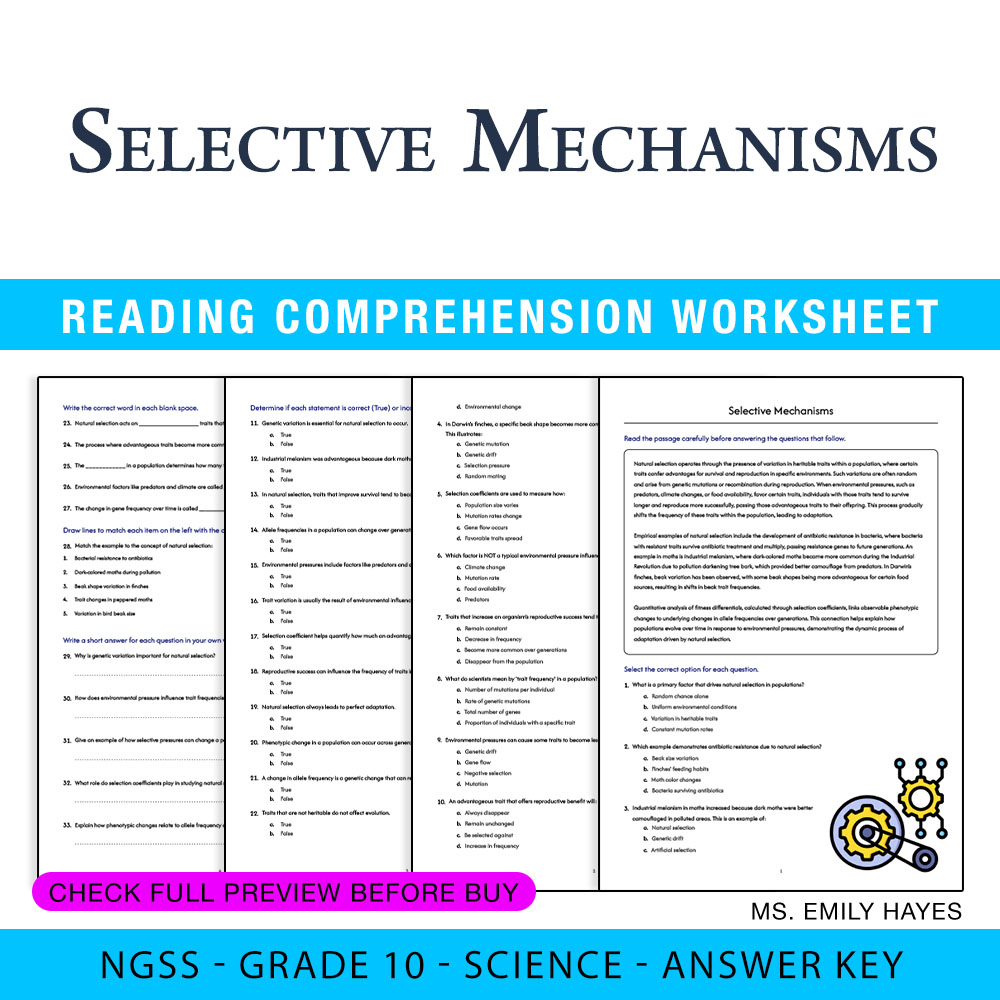
Grade 10 Science | Speciation Processes Worksheet (PDF + Answer Key)
Created byCopper Leaf ClassroomLearning Objectives
- Explain the mechanisms that lead to reproductive isolation and speciation.
- Identify empirical examples of different speciation processes.
- Describe phylogenetic patterns and evidence for lineage splitting.
Instant download

Grade 10 Science – Redox Reactions & Electron Transfer | Daily Reading Worksheet
 Created byBright Mind Resources
Learning Objectives
- Define oxidation and reduction processes in chemical reactions.
- Identify oxidation and reduction in simple chemical equations.
- Explain the transfer of electrons and changes in oxidation states.
Also included in: Chem Reactions Grade 10 Science Daily Reading Worksheets Lesson Bundle | BC +1 more
Instant download

Light and Carbon Assessment | TEKS Grade 10 Science
 Created byPrism Point Learning
Learning Objectives
- Describe the process of light reactions and their role in photosynthesis.
- Understand how the Calvin cycle fixes carbon dioxide into sugars.
- Identify the roles of chlorophyll, accessory pigments, and enzymes like RuBisCO.
Instant download
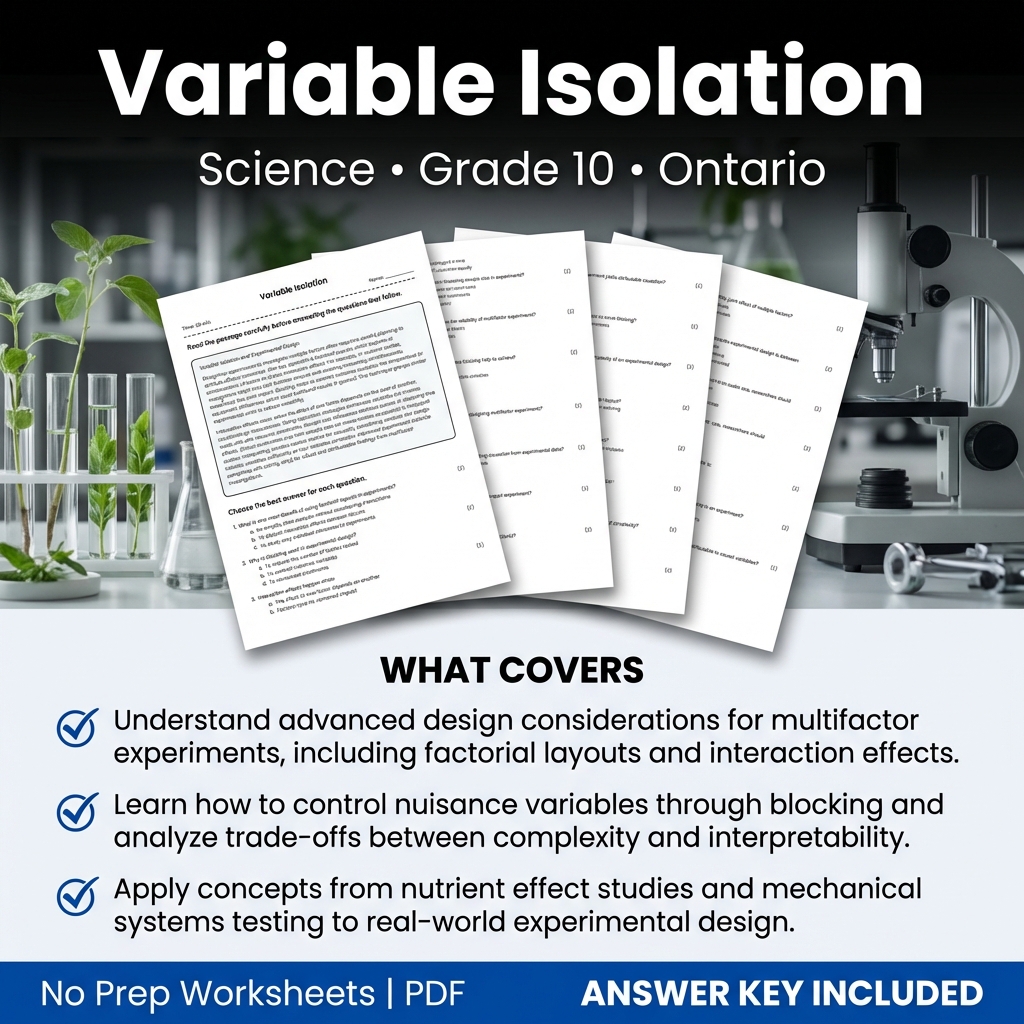
Grade 10 Science Worksheet on Variable Isolation | Ontario Standards
 Created byCoral Reef Learning
Learning Objectives
- Understand advanced design considerations for multifactor experiments, including factorial layouts and interaction effects.
- Learn how to control nuisance variables through blocking and analyze trade-offs between complexity and interpretability.
- Apply concepts from nutrient effect studies and mechanical systems testing to real-world experimental design.
Instant download
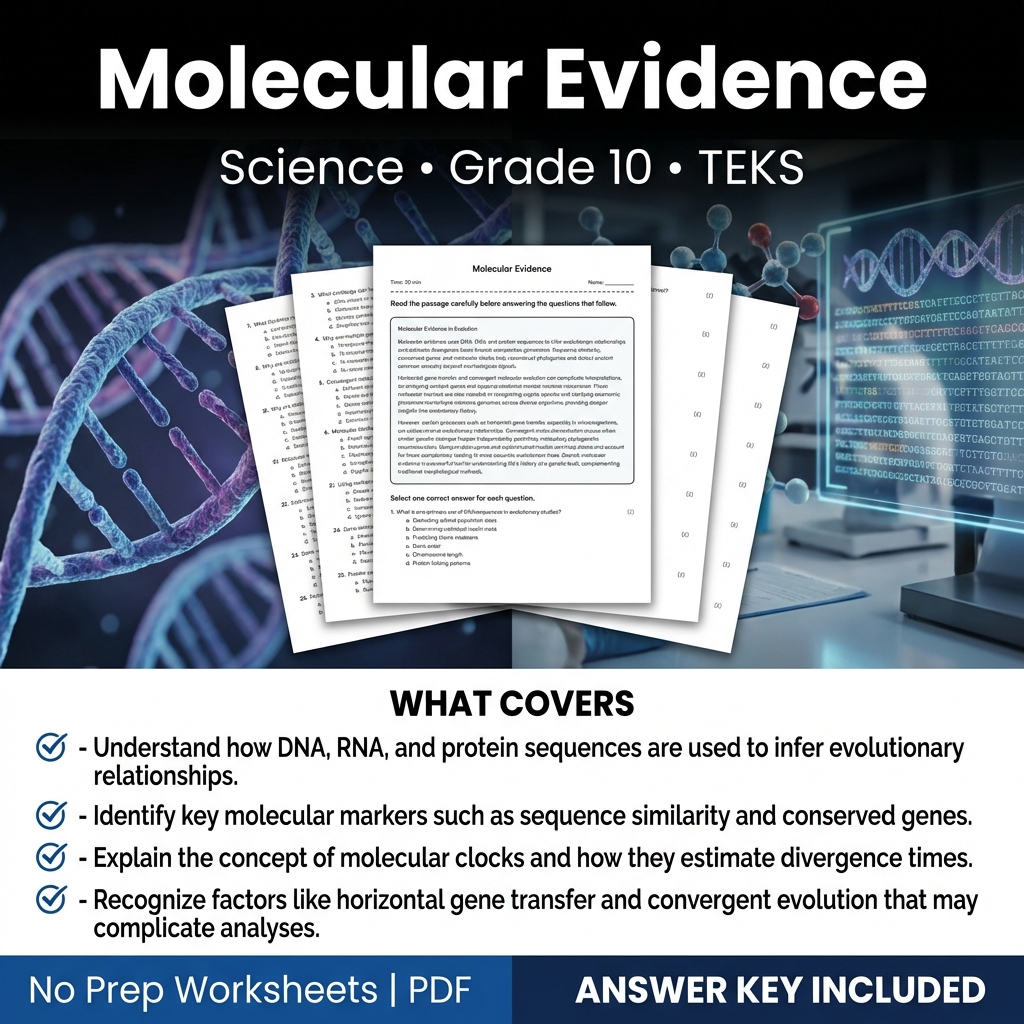
Molecular Evidence Worksheet for Grade 10 Science | TEKS
Created byCoral Reef LearningLearning Objectives
- Understand how DNA, RNA, and protein sequences are used to infer evolutionary relationships.
- Identify key molecular markers such as sequence similarity and conserved genes.
- Explain the concept of molecular clocks and how they estimate divergence times.
Instant download
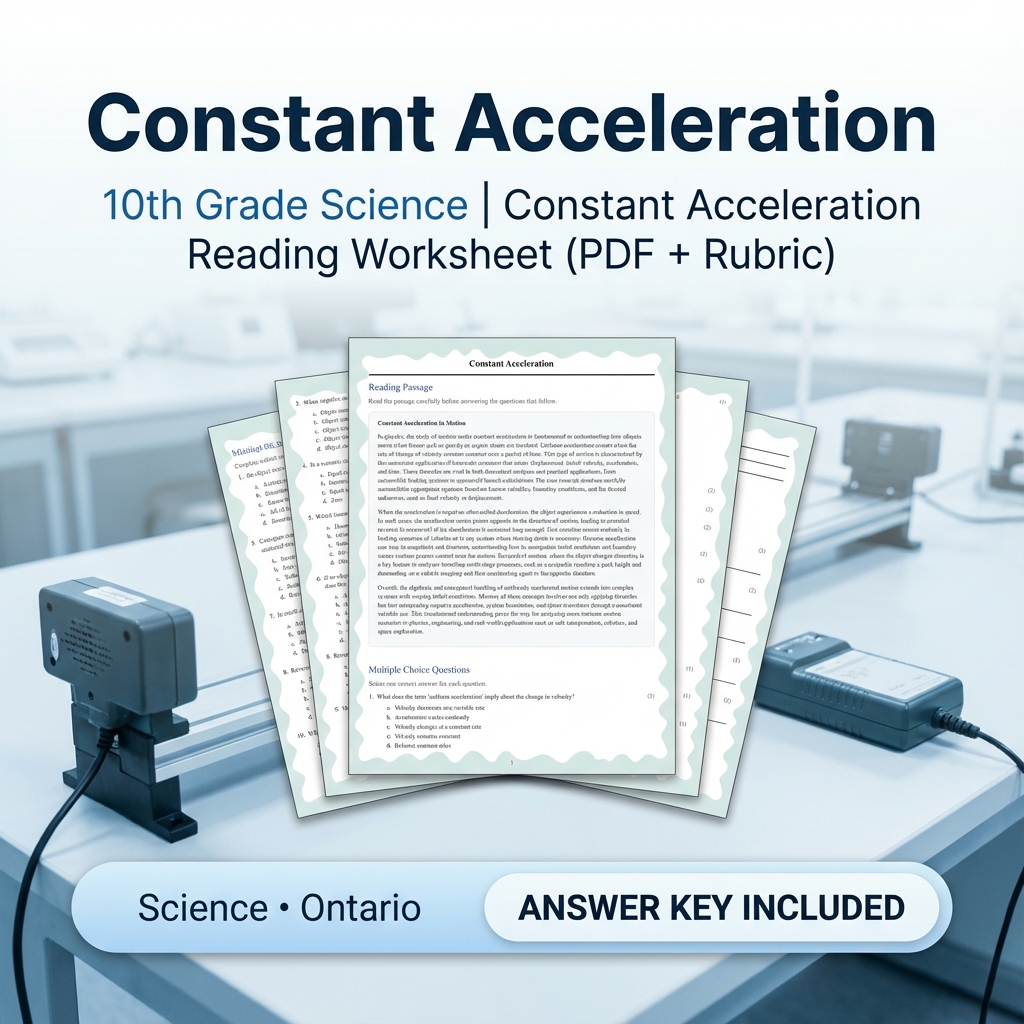
10th Grade Science | Constant Acceleration Reading Worksheet (PDF + Rubric)
JCreated byJ.S SheetsLearning Objectives
- Understand the basic concepts of uniform acceleration in one-dimensional motion.
- Apply kinematic formulas to analyze systems with initial velocities, displacements, and varying acceleration.
- Interpret the effects of negative acceleration and motion reversal in different scenarios.
Also included in: Grade 10 Science Unit Bundle – Motion, Forces & Mechanics (Answer Keys Included) +1 more
Instant download
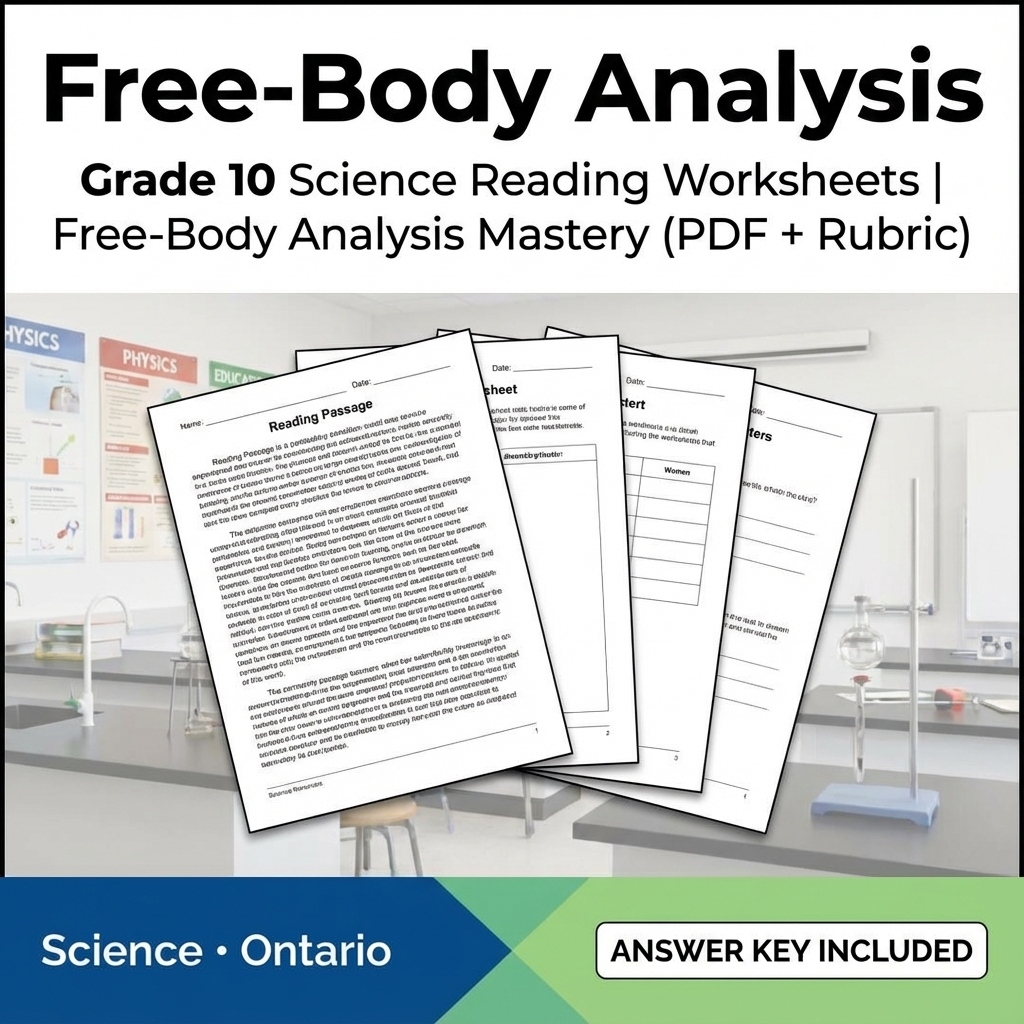
Grade 10 Science Reading Worksheets | Free-Body Analysis Mastery (PDF + Rubric)
JCreated byJ.S SheetsLearning Objectives
- Understand the concept of free-body diagrams and their role in force analysis.
- Learn procedures for identifying individual forces acting on an object.
- Recognize how to choose coordinate axes and resolve vectors into components.
Also included in: Grade 10 Science Unit Bundle – Motion, Forces & Mechanics (Answer Keys Included) +1 more
Instant download
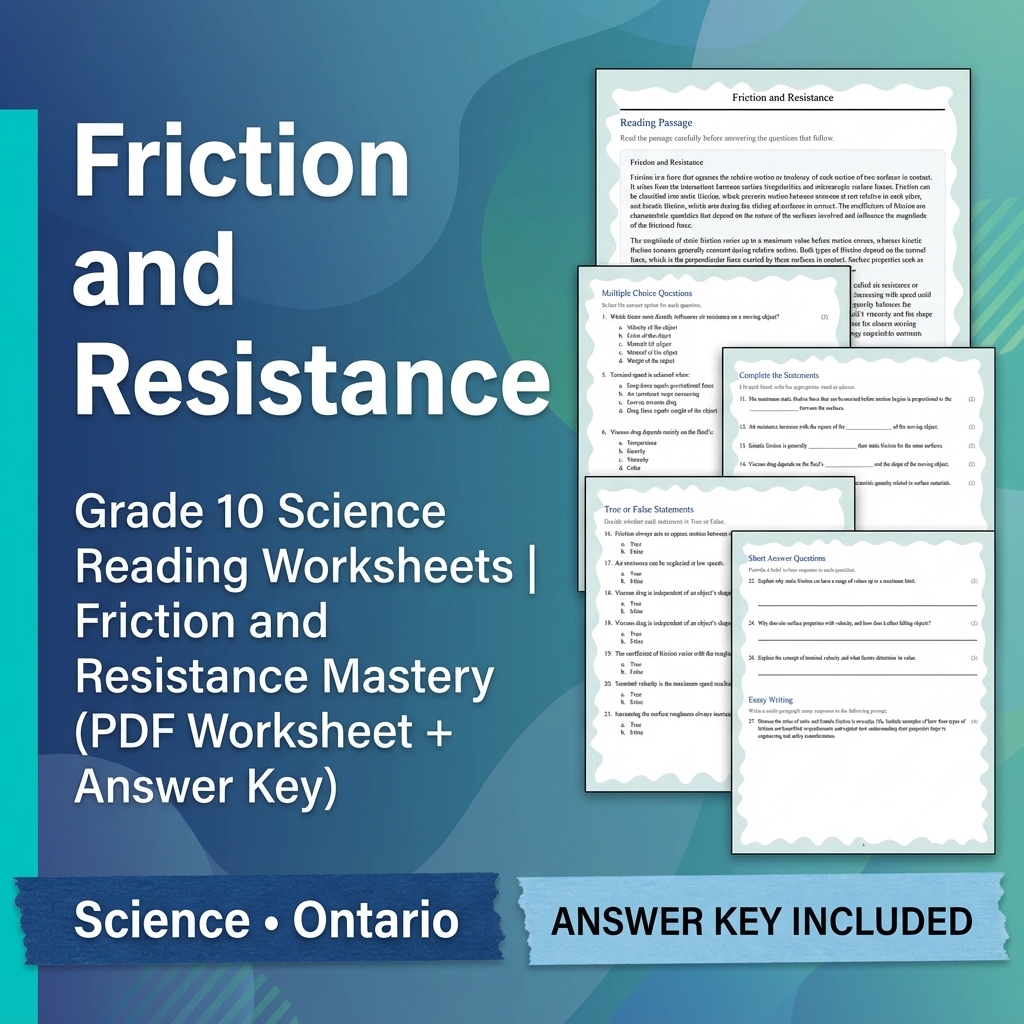
Grade 10 Science | Friction and Resistance Mastery (PDF Worksheet + Answer Key)
JCreated byJ.S SheetsLearning Objectives
- Understand the different types of friction and their characteristics.
- Explain how normal force and surface properties influence friction.
- Describe the concepts of air resistance and viscous drag and their effects on motion.
Also included in: Grade 10 Science Unit Bundle – Motion, Forces & Mechanics (Answer Keys Included) +1 more
Instant download
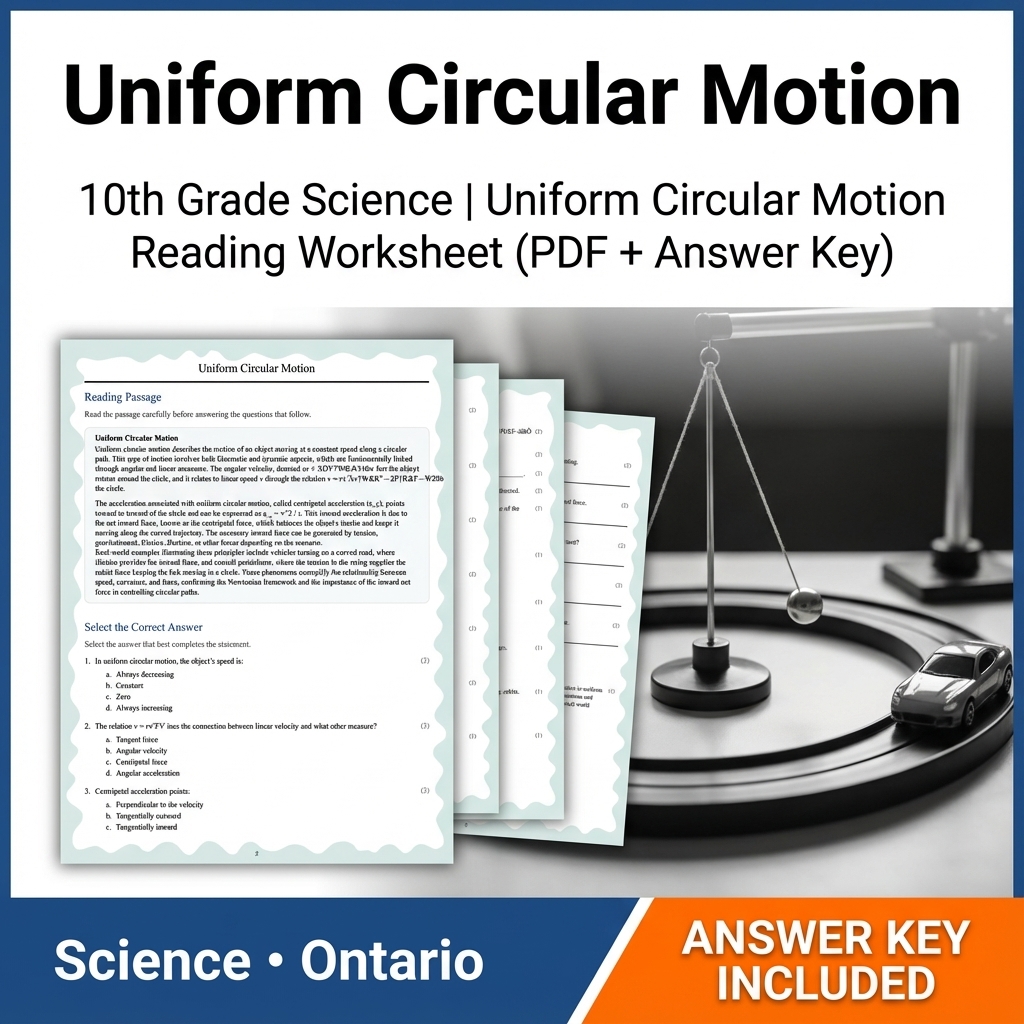
10th Grade Science | Uniform Circular Motion (PDF + Answer Key)
JCreated byJ.S SheetsLearning Objectives
- Understand the kinematic and dynamic principles of motion on a circular path.
- Relate angular velocity to linear speed and comprehend centripetal acceleration.
- Explain the role of inward net force in maintaining uniform circular motion.
Also included in: Grade 10 Science Unit Bundle – Motion, Forces & Mechanics (Answer Keys Included) +1 more
Instant download
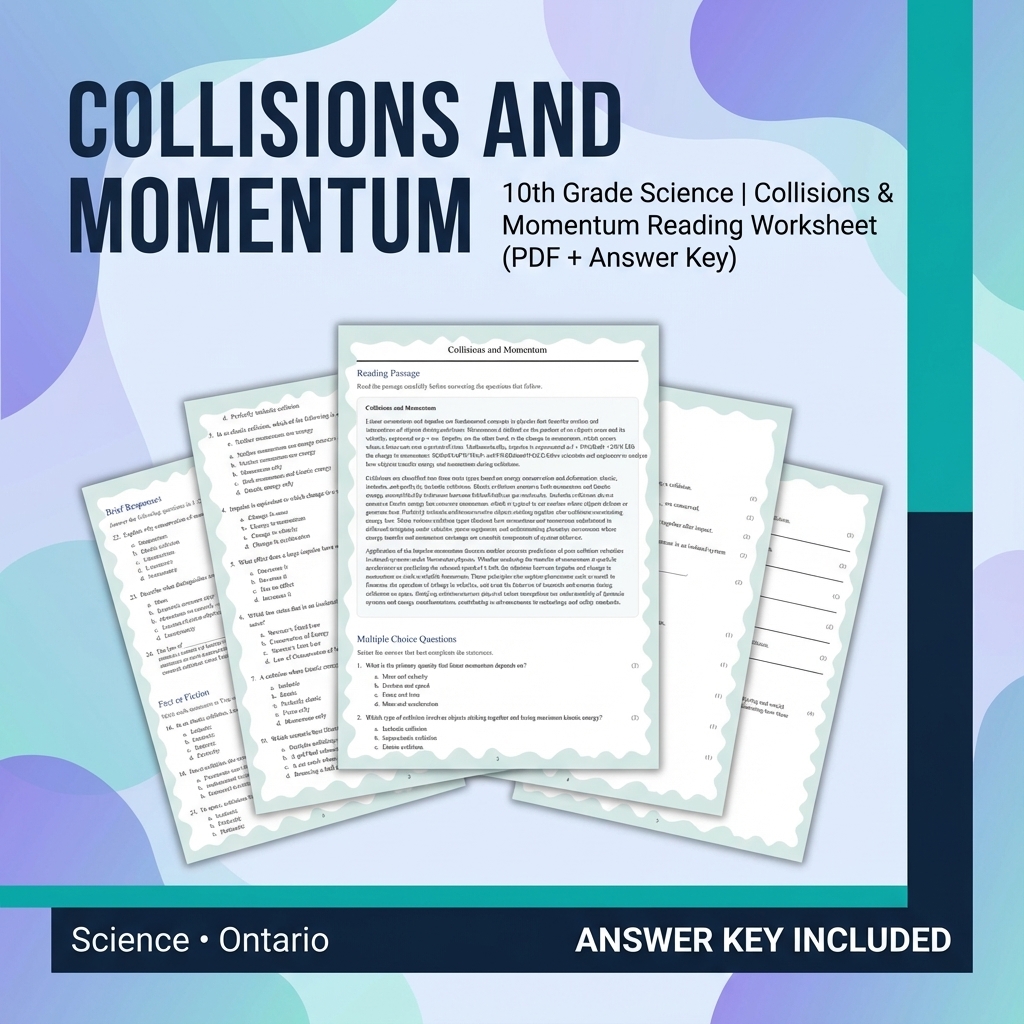
10th Grade Science | Collisions & Momentum Reading Worksheet (PDF + Answer Key)
JCreated byJ.S SheetsLearning Objectives
- Define and explain the concepts of linear momentum and impulse.
- Describe the different types of collisions: elastic, inelastic, and perfectly inelastic.
- Apply conservation of momentum principles to analyze two-body collision scenarios.
Also included in: Grade 10 Science Unit Bundle – Motion, Forces & Mechanics (Answer Keys Included) +1 more
Instant download
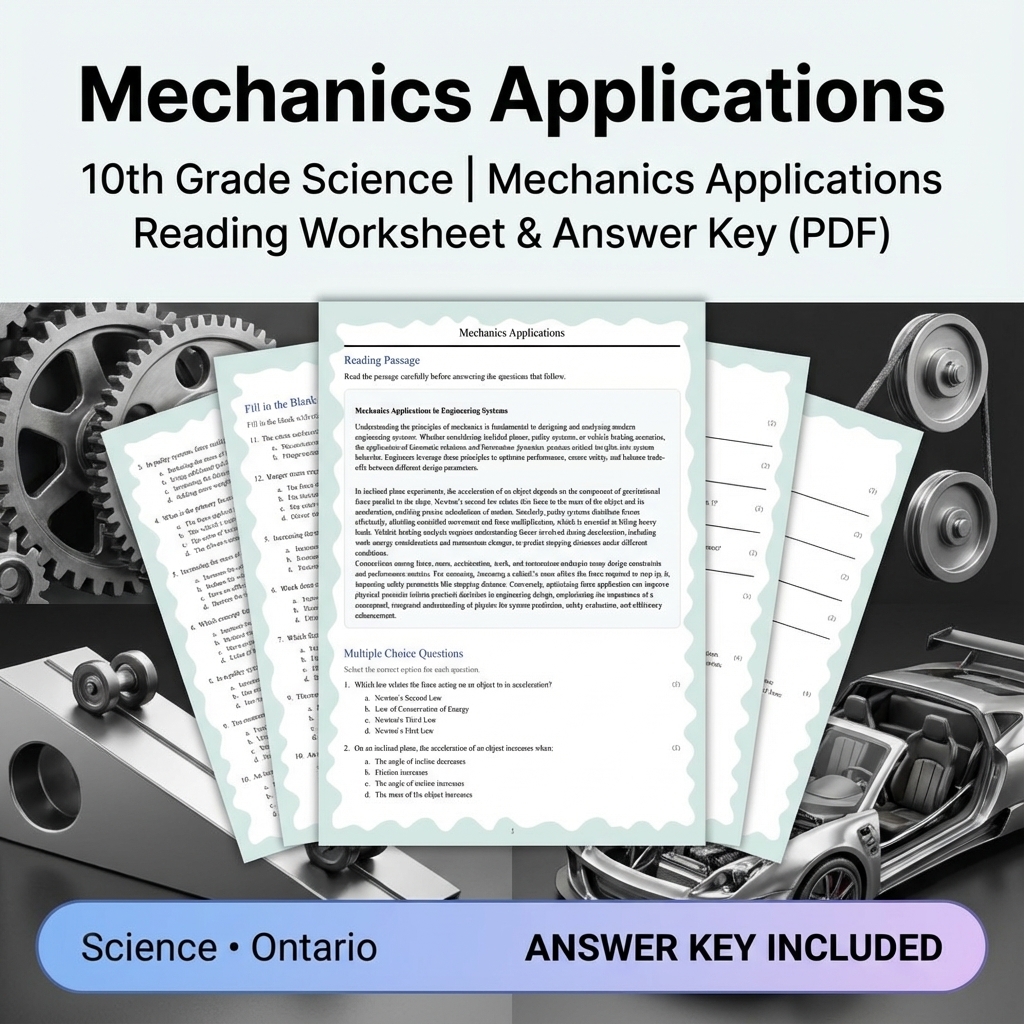
10th Grade Science | Mechanics Applications Reading Worksheet & Answer Key (PDF)
JCreated byJ.S SheetsLearning Objectives
- Understand how kinematic relations and Newtonian dynamics are applied in practical mechanical systems.
- Analyze the connections between force, mass, acceleration, work, and momentum in engineering contexts.
- Interpret safety parameters like stopping distance through conceptual integration of physical laws.
Also included in: Grade 10 Science Unit Bundle – Motion, Forces & Mechanics (Answer Keys Included) +1 more
Instant download
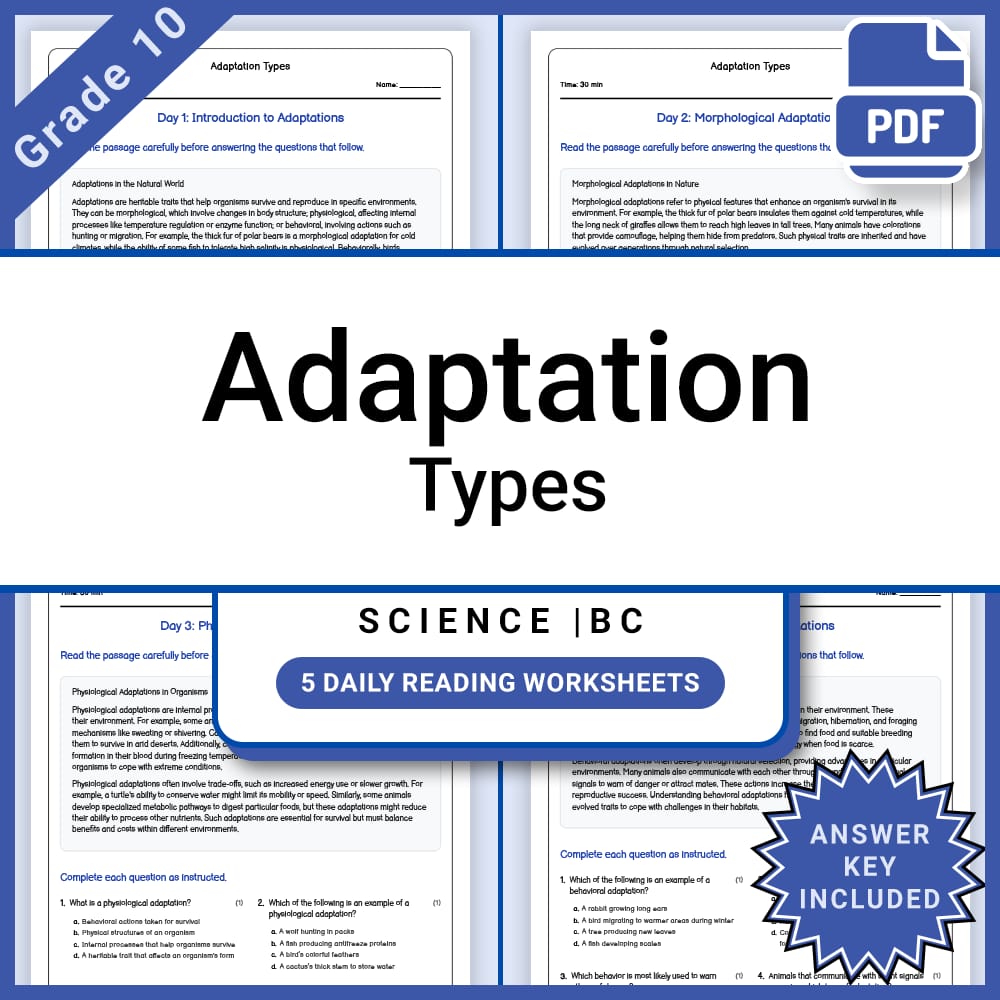
Grade 10 Science – Adaptation Types Daily Reading Worksheet with Answer Key
JCreated byJ.S SheetsLearning Objectives
- Define morphological, physiological, and behavioral adaptations.
- Explain how adaptations improve survival or reproduction in specific environments.
- Identify examples of different adaptation types.
Also included in: Grade 10 Science Lesson Bundle | Genetics, Evolution, Biodiversity & More +1 more
Instant download

Grade 10 Science | Energy Accounting - Daily Reading Comprehension
Created byCoral Reef LearningLearning Objectives
- Understand and describe energy transfer mechanisms in different systems
- Identify types of energy flows within mechanical, electrical, and thermal systems
- Utilize energy flow diagrams to analyze energy transfer
Instant download

Remote Sensing Spectral Data Worksheets for Grade 10 Science
 Created bySunny Desk Resources
Learning Objectives
- Describe how satellite and aerial remote sensing collect information about land cover, vegetation health, water extent, and surface temperature.
- Explain how spectral information and multi-spectral indices can reveal environmental change over time.
- Identify common derived remote sensing products and how they support system-scale interpretation with ground measurements.
Also included in: Earth Systems, Climate, and Sustainability Lesson Bundle | Grade 10 Science | Alberta +1 more
Instant download

Grade 10 Science | Membrane Dynamics Worksheet (AP Standards) (PDF)
 Created byEvergreen Desk Education
Learning Objectives
- Explain how membrane composition and selective permeability create electrochemical gradients
- Compare diffusion, carrier-mediated transport, and vesicular trafficking in terms of energy use and directionality
- Use Nernst concepts and flux-rate reasoning to predict ion distribution and signal propagation
Also included in: Grade 10 Genetics & Cell Systems Science Lesson Bundle – Advanced Placement (AP) +1 more
Instant download
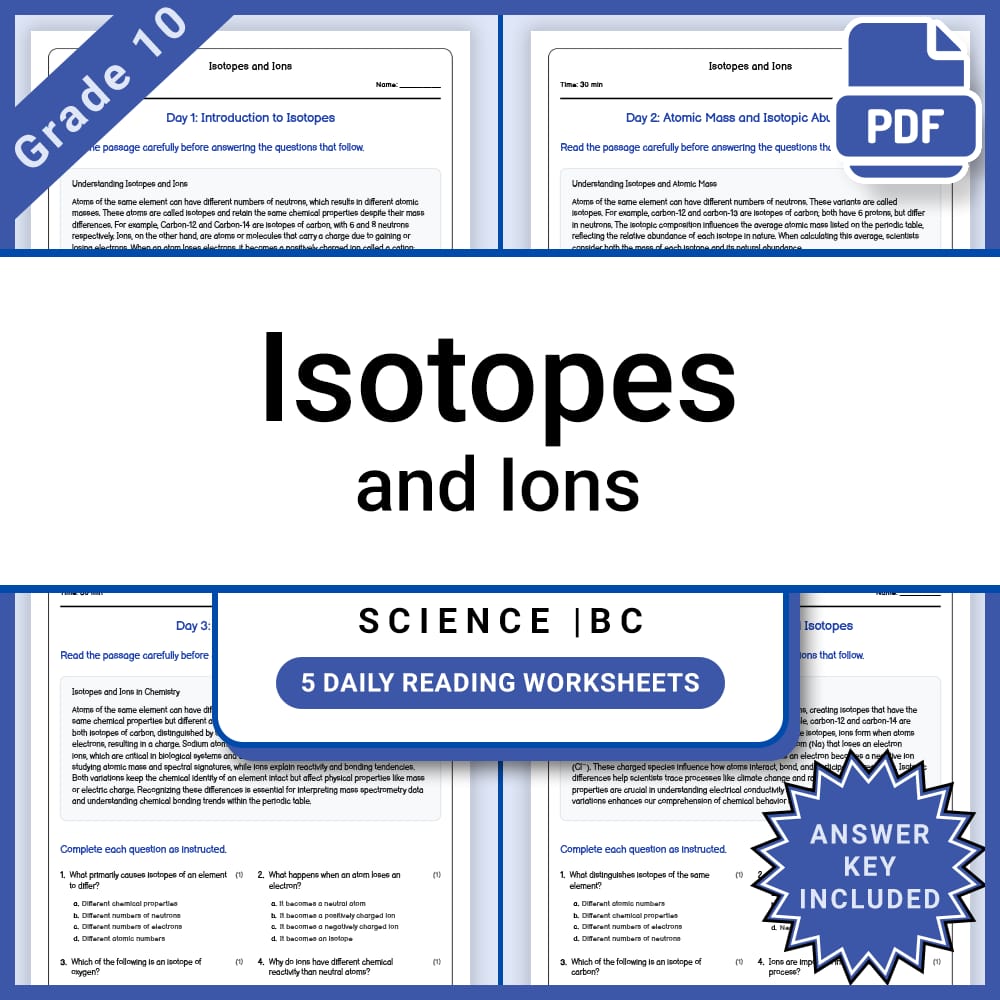
Grade 10 Science – Isotopes and Ions Daily Reading Worksheet + Answer Key
JCreated byJ.S SheetsLearning Objectives
- Understand key concepts related to Science
- Apply knowledge through practice questions
- Demonstrate comprehension of the material
Also included in: Grade 10 Science Lesson Group – Core Concepts & Skills Bundle +1 more
Instant download
Grade 10 Science – Bonding Types Daily Reading Worksheet with Answer Key
JCreated byJ.S SheetsLearning Objectives
- Understand the different types of chemical bonds: ionic, covalent, and metallic.
- Identify ionic bonds based on electron transfer and element properties.
- Describe how atoms achieve stability through bonding mechanisms.
Also included in: Grade 10 Science Lesson Group – Core Concepts & Skills Bundle +1 more
Instant download
Grade 10 Science – Yield and Purity Daily Reading Worksheet + Answer Key
JCreated byJ.S SheetsLearning Objectives
- Define percent yield and explain how it measures process efficiency.
- Describe the concept of purity and its importance in chemical samples.
- Connect measured mass to atomic conservation in chemical transformations.
Also included in: Grade 10 Science Lesson Group – Core Concepts & Skills Bundle +1 more
Instant download
Grade 10 Science – Atomic Particles Daily Reading Worksheet with Answer Key
JCreated byJ.S SheetsLearning Objectives
- Identify the subatomic particles that make up atoms.
- Describe the roles of protons, neutrons, and electrons within an atom.
- Understand how atomic number and mass number relate to atomic structure.
Also included in: Grade 10 Science Lesson Group – Core Concepts & Skills Bundle +1 more
Instant download
Grade 10 Science Reaction Classification Daily Reading Worksheet + Answer Key
JCreated byJ.S SheetsLearning Objectives
- Understand the different types of chemical reactions, especially synthesis reactions.
- Identify synthesis reactions based on reactants and products.
- Explain the characteristic features of synthesis reactions and their significance.
Also included in: Grade 10 Science Lesson Group – Core Concepts & Skills Bundle +1 more
Instant download
Grade 10 Science – Reaction Energetics Daily Reading Worksheet + Answer Key
JCreated byJ.S SheetsLearning Objectives
- Understand the concept of energy changes during chemical reactions
- Differentiate between exothermic and endothermic reactions
- Identify signs of energy release or absorption in reactions
Also included in: Grade 10 Science Lesson Group – Core Concepts & Skills Bundle +1 more
Instant download
Grade 10 Science – Balancing Equations Daily Reading Worksheet + Answer Key
JCreated byJ.S SheetsLearning Objectives
- Understand the importance of balancing chemical equations
- Identify unbalanced vs. balanced equations
- Learn how coefficients are used to balance equations
Also included in: Grade 10 Science Lesson Group – Core Concepts & Skills Bundle +1 more
Instant download

Grade 10 Design Tradeoffs Worksheet | Engineering Biology Standards
Created byEvergreen Desk EducationLearning Objectives
- Explain why improving one performance criterion can worsen another when constraints limit design choices.
- Identify common criteria (stiffness, strength, safety, cost, weight, fatigue resistance) and describe how they can conflict.
- Evaluate design alternatives by using tradeoff reasoning to justify the “best overall” feasible option.
Instant download
10th Grade Science | Inheritance Patterns Worksheet (PDF+ Answer Key)
Created byCopper Leaf ClassroomLearning Objectives
- Describe the principles of Mendelian inheritance, including segregation and dominance.
- Interpret trait transmission patterns using pedigrees and Punnett squares.
- Explain the role of molecular markers and chromosomal behavior during cell division in inheritance.
Also included in: Grade 10 Science | Key Concepts in Biology & Ecosystems (PDF+ Answer Key) +1 more
Instant download
Grade 10 Science | Atomic Structure Worksheet (NGSS) – PDF
 Created byMaple Path Learning
Learning Objectives
- Understand electron configurations, nuclear composition, and periodic trends to predict elemental properties.
- Interpret energy-level diagrams, electron shells, and sublevel occupancy to explain periodicity and behavior.
- Connect isotopes, atomic mass, and reactivity to explain oxidation states and elemental properties.
Also included in: Grade 10 Science Matter and Its Interactions Lesson Bundle | NGSS +1 more
Instant download
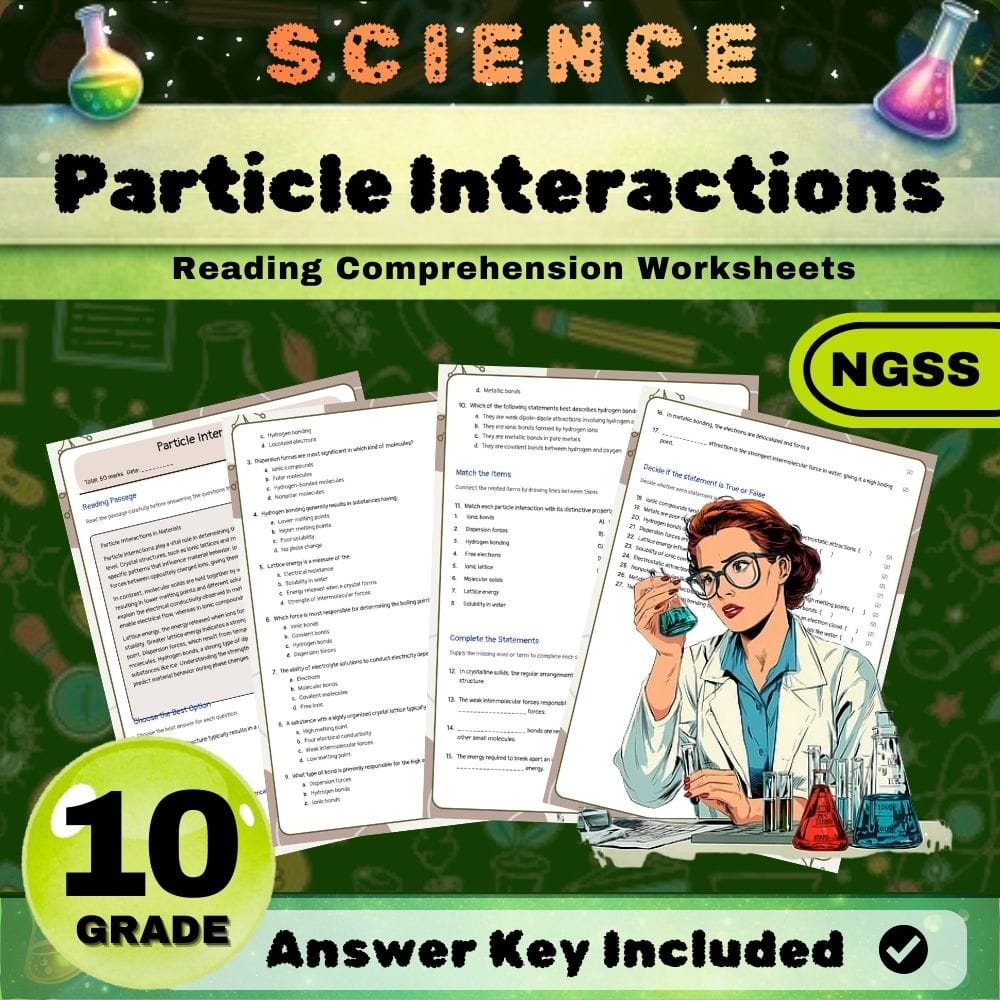
Grade 10 Science | Particle Interactions Worksheet (NGSS) (PDF)
Created byMaple Path LearningLearning Objectives
- Compare and contrast different types of particle interactions and their effects on material properties.
- Explain how crystal structures, molecular forces, and electrical interactions influence phase transitions, melting points, and solubility.
- Analyze how lattice energy, dispersion forces, and hydrogen bonding determine the physical behaviors of solids and liquids.
Also included in: Grade 10 Science Matter and Its Interactions Lesson Bundle | NGSS +1 more
Instant download
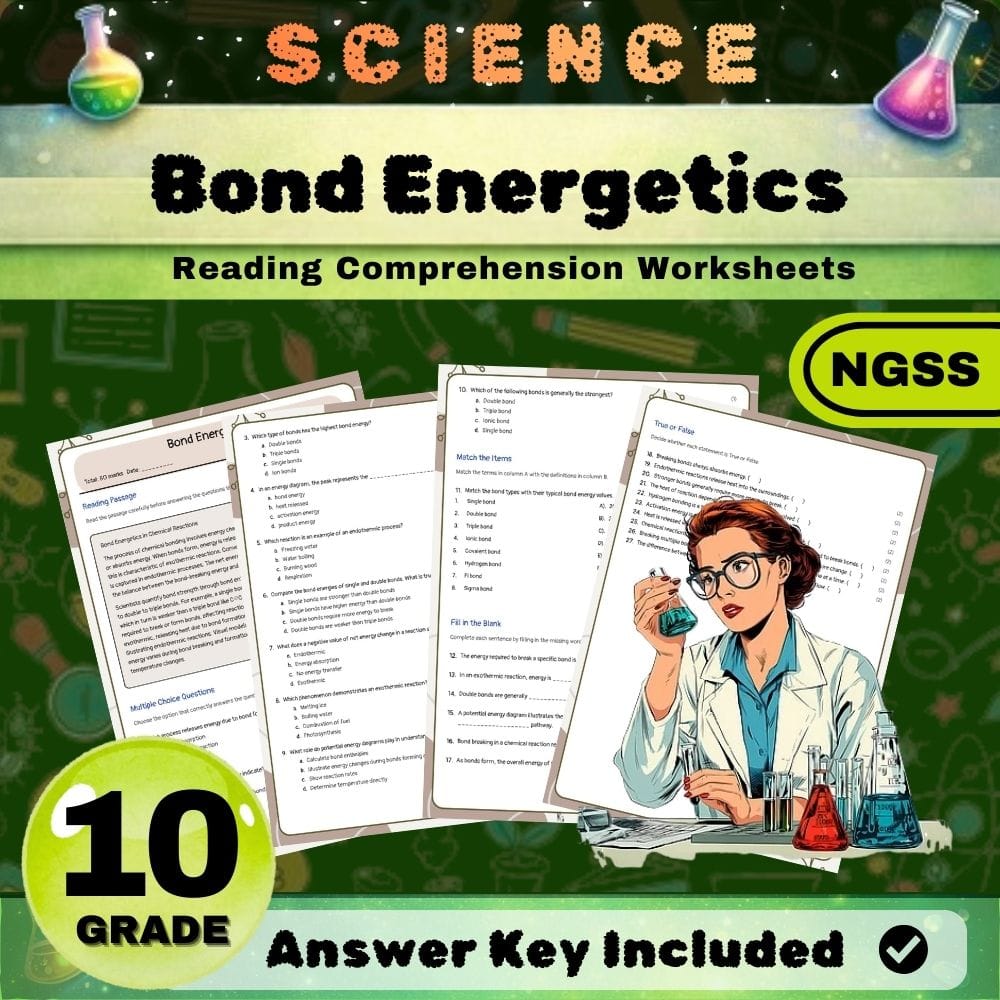
Grade 10 Science – Bond Energetics Worksheet (NGSS) (PDF)
Created byMaple Path LearningLearning Objectives
- Explain how chemical bonds store and release energy during reactions.
- Distinguish between exothermic and endothermic processes based on bond energy changes.
- Analyze potential energy diagrams to interpret energy flow in reactions.
Also included in: Grade 10 Science Matter and Its Interactions Lesson Bundle | NGSS +1 more
Instant download
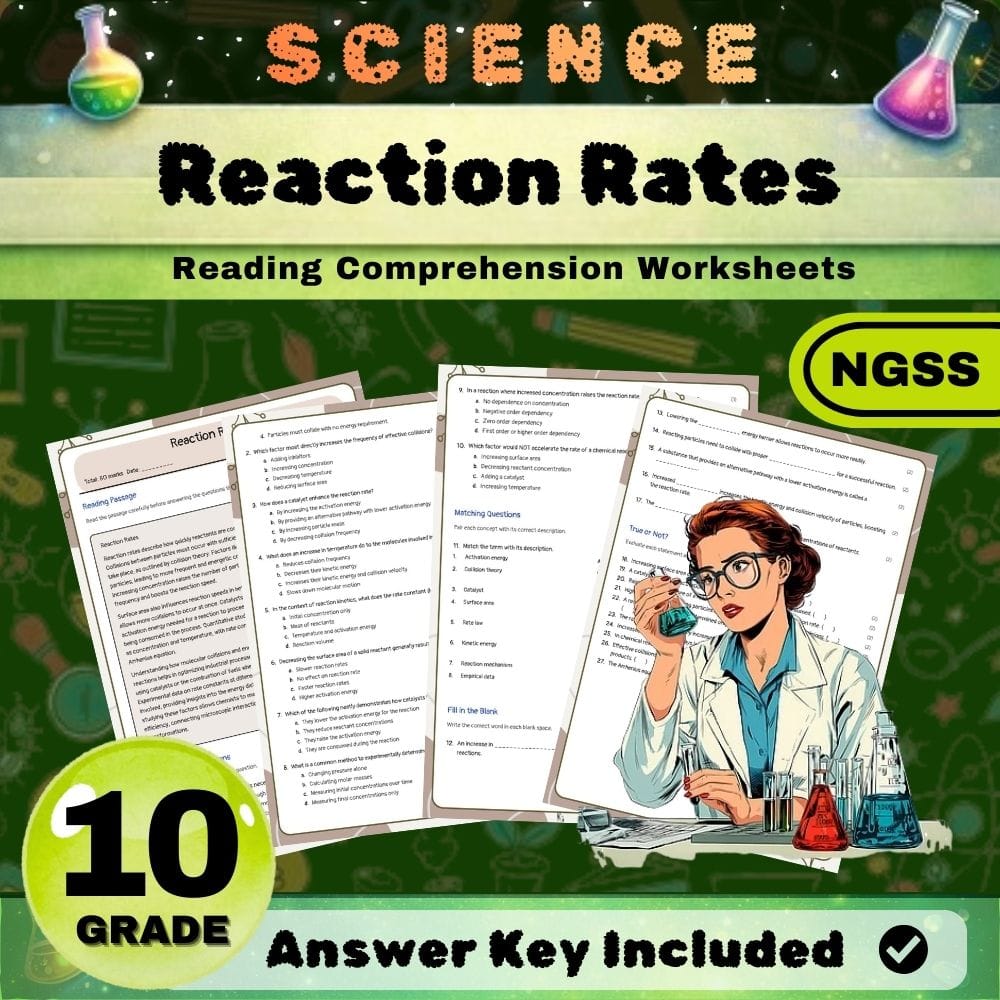
Grade 10 Science | Reaction Rates Worksheet (NGSS Standards) (PDF)
Created byMaple Path LearningLearning Objectives
- Explain how collision theory relates to reaction rate variations due to temperature, concentration, surface area, and catalysts.
- Interpret how changes in kinetic energy and collision frequency influence the rate constants and overall reaction speed.
- Apply empirical rate laws to analyze experimental data and predict reaction behavior under different conditions.
Also included in: Grade 10 Science Matter and Its Interactions Lesson Bundle | NGSS +1 more
Instant download
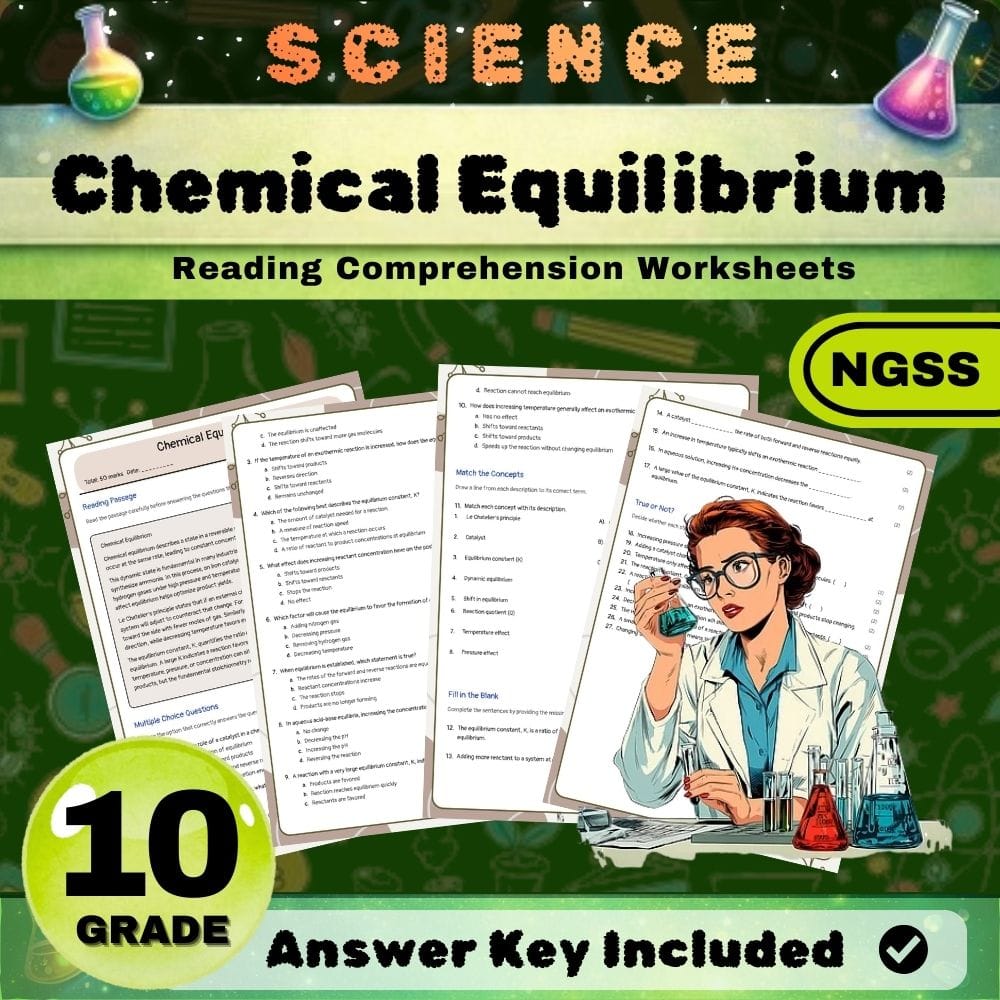
Grade 10 Science | Chemical Equilibrium Worksheet (NGSS) PDF
Created byMaple Path LearningLearning Objectives
- Explain how changes in pressure, concentration, and temperature shift chemical equilibrium according to Le Chatelier's principle.
- Describe the role of catalysts in speeding up equilibrium without changing the position of equilibrium.
- Interpret the meaning of equilibrium constants and how they quantify the extent of a reaction.
Also included in: Grade 10 Science Matter and Its Interactions Lesson Bundle | NGSS +1 more
Instant download
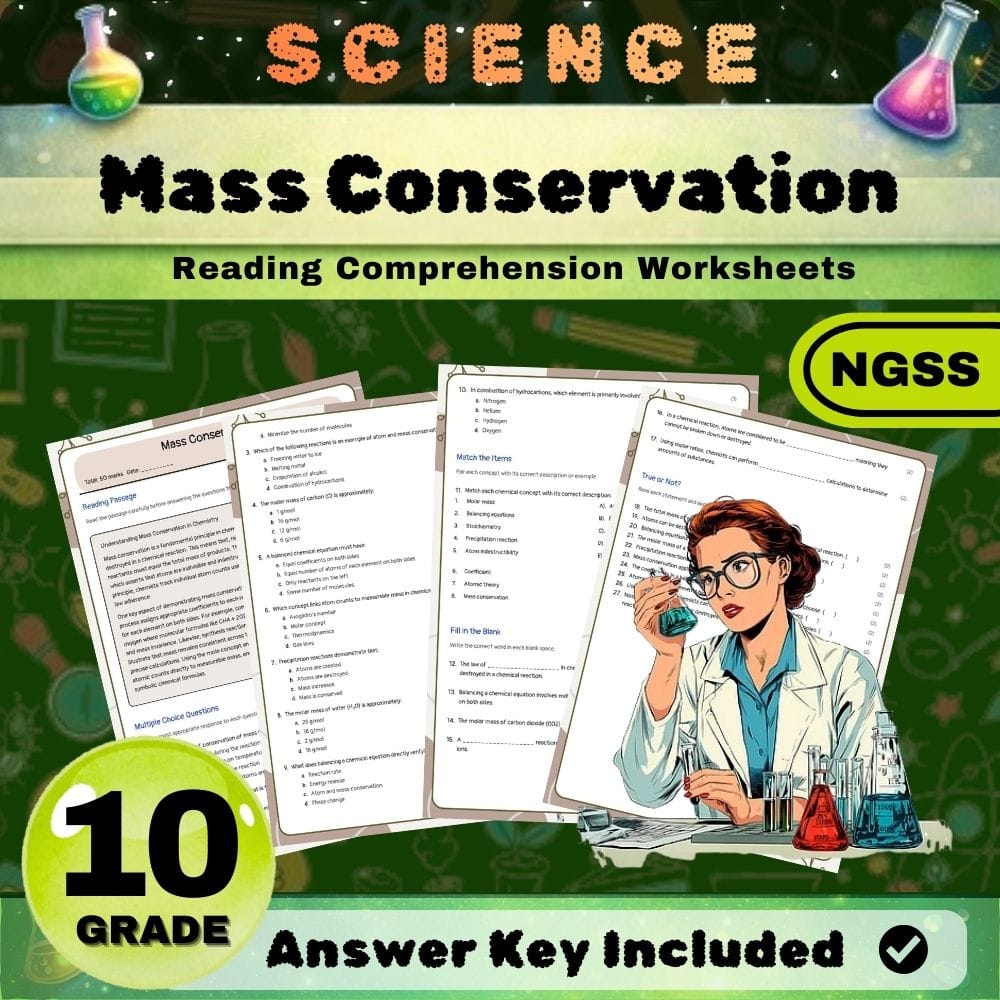
Grade 10 Science | Mass Conservation Worksheet (PDF) NGSS Aligned
Created byMaple Path LearningLearning Objectives
- Explain how chemical reactions conserve mass through atom balance and stoichiometry.
- Use molar concepts, molar masses, and coefficients to verify mass invariance in reactions.
- Balance chemical equations to demonstrate conservation of atoms.
Also included in: Grade 10 Science Matter and Its Interactions Lesson Bundle | NGSS +1 more
Instant download

Grade 10 Science – Solar Conversion & Energy Technology | Reading Worksheet
Created byBright Mind ResourcesLearning Objectives
- Understand key concepts related to Science
- Apply knowledge through practice questions
- Demonstrate comprehension of the material
Also included in: Grade 10 Energy Science Daily Reading Worksheets Lesson Bundle | BC +1 more
Instant download
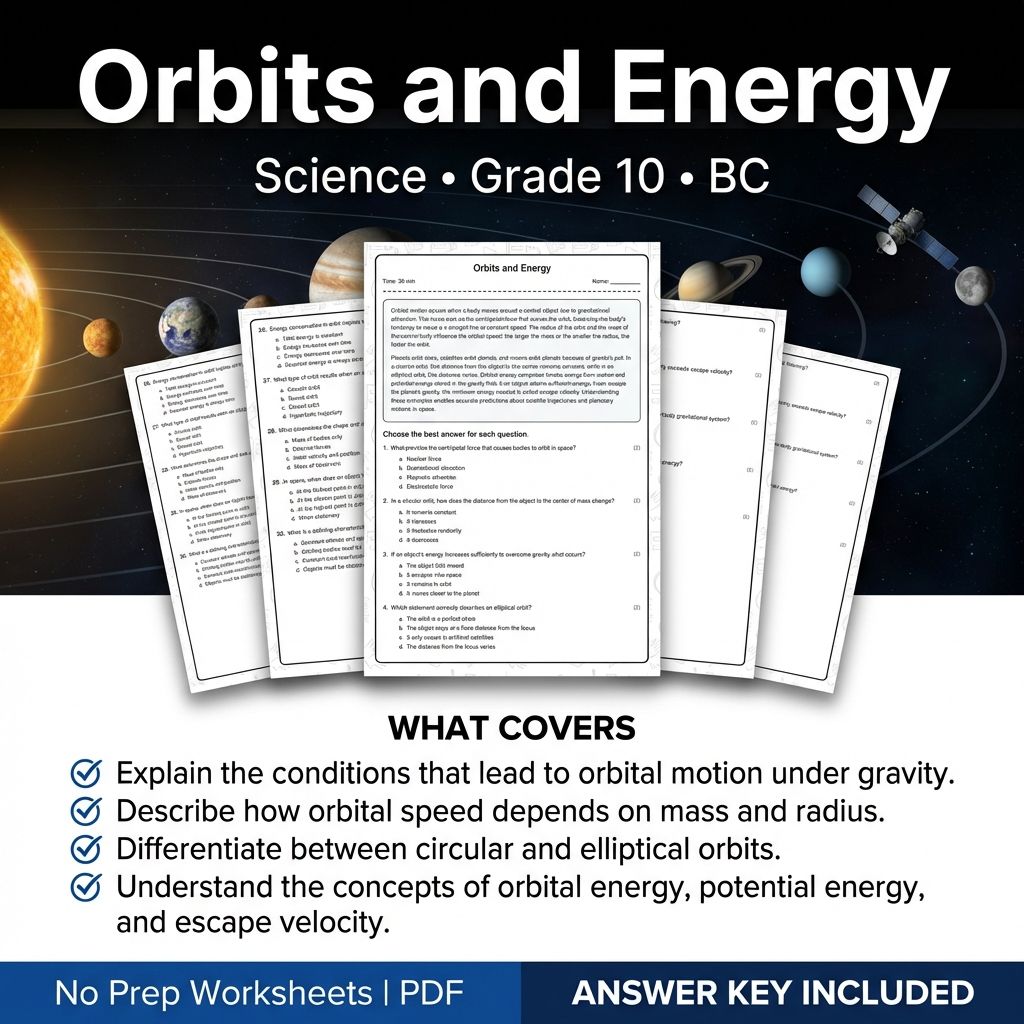
Grade 10 Science | Orbits and Energy Worksheet with Answer Key PDF
Created byCoral Reef LearningLearning Objectives
- Explain the conditions that lead to orbital motion under gravity.
- Describe how orbital speed depends on mass and radius.
- Differentiate between circular and elliptical orbits.
Instant download
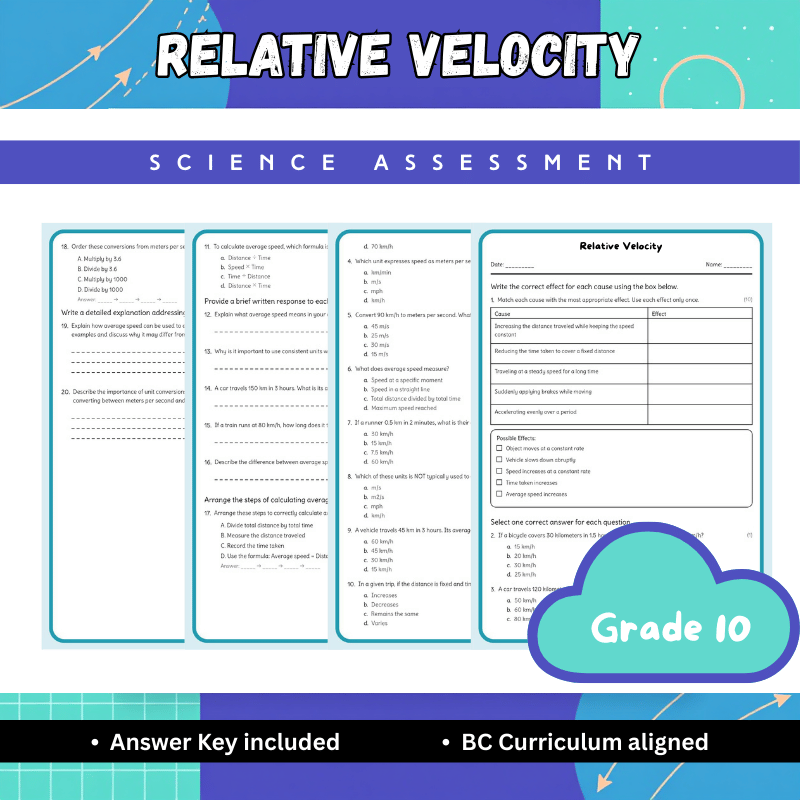
Grade 10 Science | Understanding Relative Velocity Worksheet(PDF) – BC Standards
Created byBright Mind ResourcesLearning Objectives
- Explain the concept of relative velocity between objects from different reference frames.
- Calculate relative velocity using vector subtraction for different scenarios.
- Describe how frame of reference affects the observation of motion.
Instant download

Vectors And Components Worksheet | Grade 10 Science Practice
Created byPrism Point LearningLearning Objectives
- Explain how to decompose a vector into perpendicular components and use trigonometry to relate direction to component magnitudes
- Resolve two-dimensional motion (velocity and acceleration) into horizontal and vertical components to simplify problem solving
- Distinguish between vector quantities (with direction) and scalar quantities (speed) in physical descriptions
Also included in: Forces, Motion & Fields Lesson Bundle | Grade 10 Science | BC +1 more
Instant download
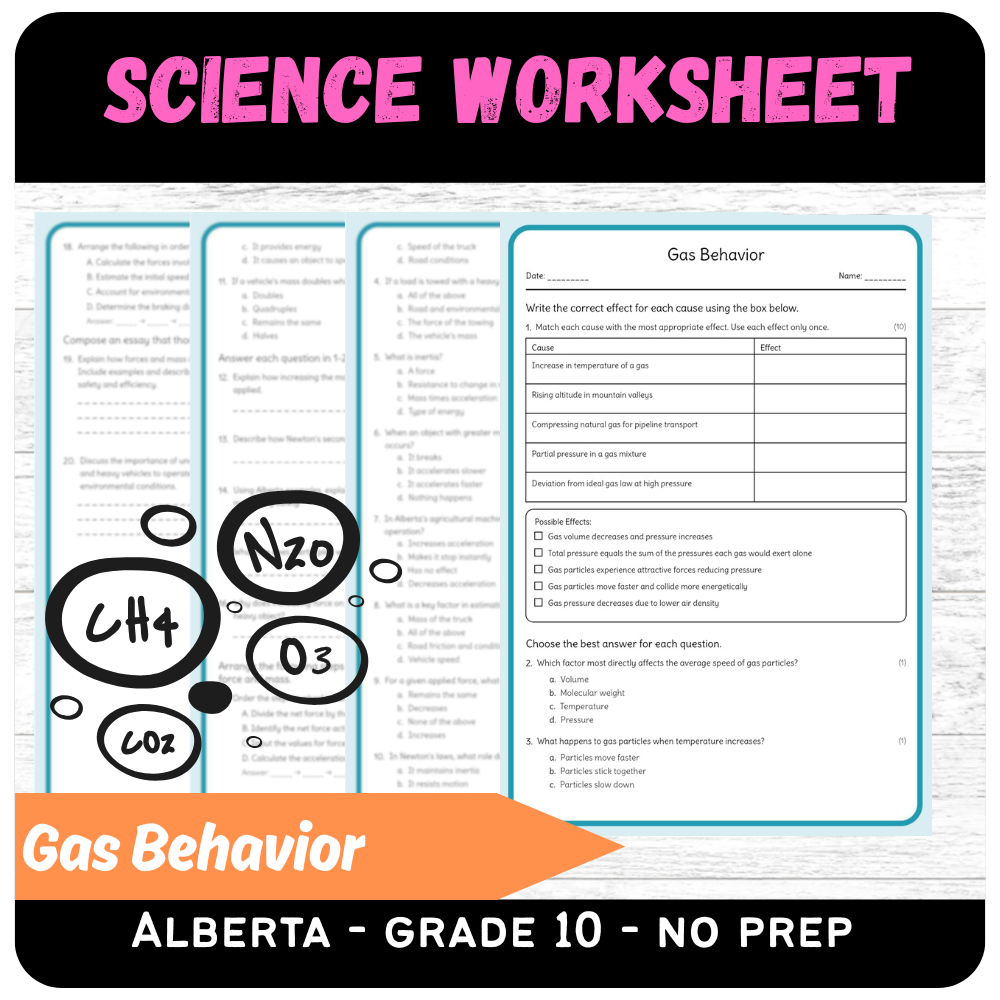
Grade 10 Science – Gas Behavior (Worksheet + Answer Key) | Alberta Standards
Created byBright Mind ResourcesLearning Objectives
- Describe how particulate motion influences gas laws and behavior.
- Explain regional phenomena affecting gases, such as pressure changes in valleys and altitude.
- Analyze deviations from ideal gas behavior and partial pressures in mixture systems.
Instant download
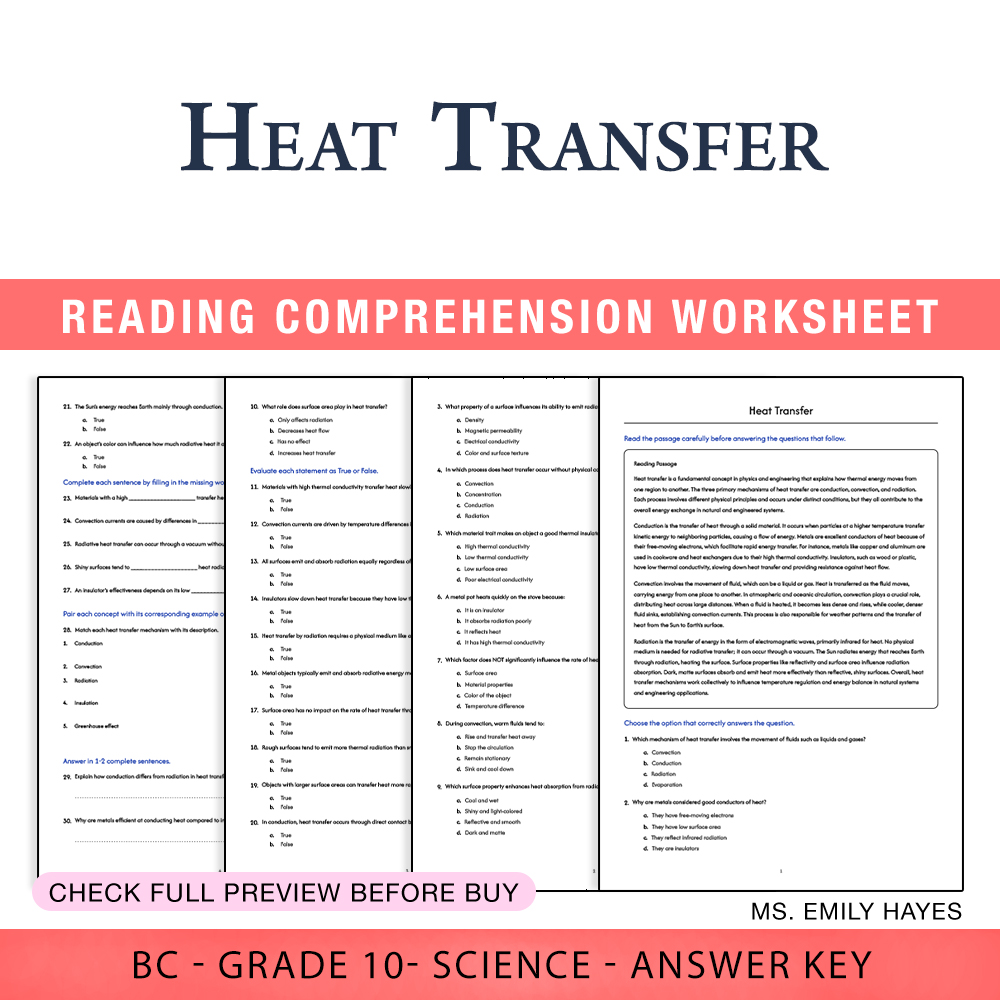
10th Grade Science | Heat Transfer Worksheet (PDF + Answer Key)
Created byCopper Leaf ClassroomLearning Objectives
- Understand the mechanisms of heat transfer: conduction, convection, and radiation.
- Identify material properties that influence heat transfer rates.
- Explain how surface area affects heat exchange.
Also included in: Grade 10 Science BC – Energy, Thermodynamics & Ecosystems (PDF + Answer Key) +1 more
Instant download
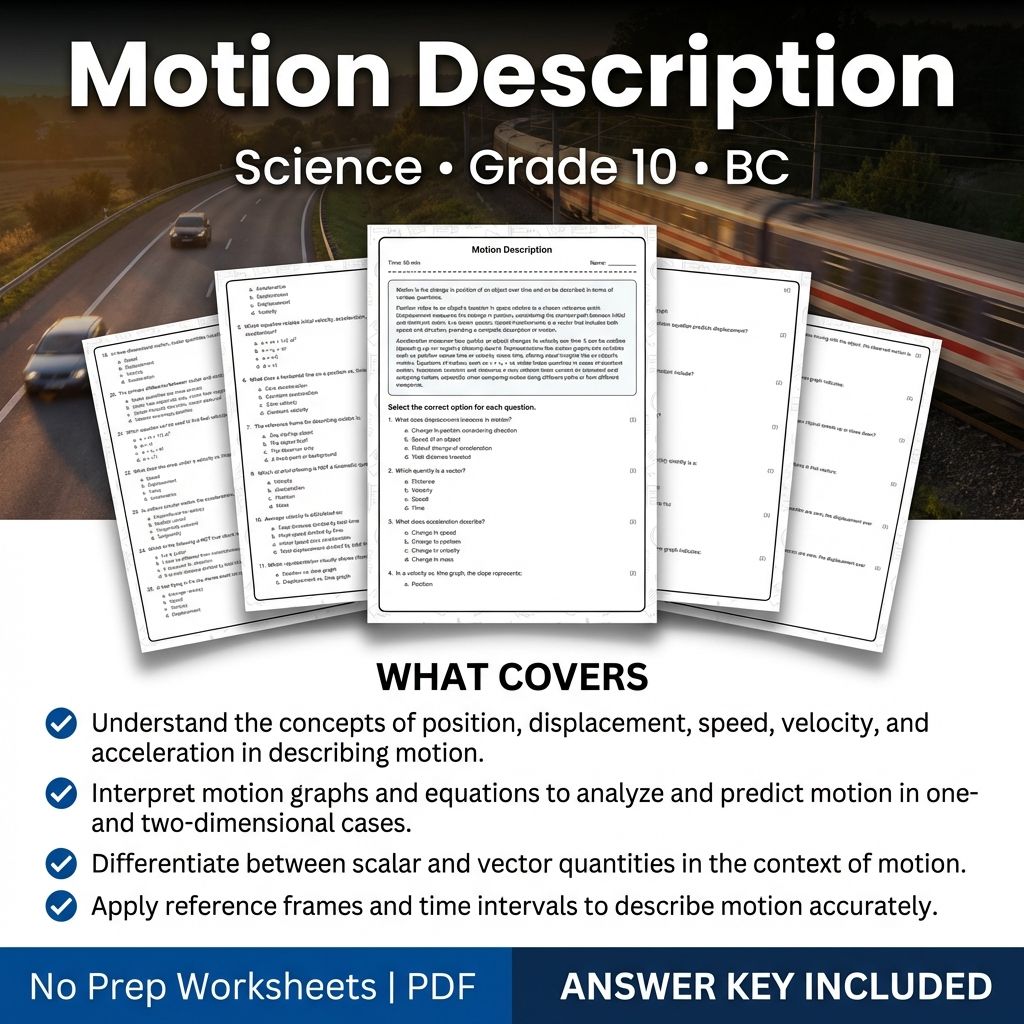
Grade 10 Science Worksheet | Motion Description Practice & Answer Key (PDF)
Created byCoral Reef LearningLearning Objectives
- Understand the concepts of position, displacement, speed, velocity, and acceleration in describing motion.
- Interpret motion graphs and equations to analyze and predict motion in one- and two-dimensional cases.
- Differentiate between scalar and vector quantities in the context of motion.
Instant download

Grade 10 Science – Variable Isolation & Experiment Design | Daily Worksheet
 Created byQuiet Forest Education
Learning Objectives
- Understand the concepts of independent and dependent variables
- Identify variables in scientific scenarios
- Explore the design considerations for multifactor studies
Also included in: Scientific Investigation Grade 10 Science Daily Worksheets Bundle | Ontario +1 more
Instant download

Grade 10 Science | Energy Pathways Worksheet with Short Notes (Printable PDF)
 Created byMeadowlark Worksheets
Learning Objectives
- Explain how photosynthesis and cellular respiration are coupled pathways that transfer energy in cells.
- Describe the processes occurring in chloroplasts and mitochondria related to ATP production.
- Identify the steps of the Calvin cycle, glycolysis, Krebs cycle, and oxidative phosphorylation.
Also included in: Grade 10 Science NGSS Bundle | Molecules to Organisms Structures & Processes +1 more
Instant download

Grade 10 Science Feedback Control Worksheet with Short Notes (Printable PDF)
Created byMeadowlark WorksheetsLearning Objectives
- Describe the concepts of homeostasis and feedback mechanisms
- Differentiate between negative and positive feedback loops
- Identify key sensors, control centers, and effectors in physiological regulation
Also included in: Grade 10 Science NGSS Bundle | Molecules to Organisms Structures & Processes +1 more
Instant download

Grade 10 Science | Physiological Systems Worksheet with Short Notes (PDF)
Created byMeadowlark WorksheetsLearning Objectives
- Compare and analyze the structure and function of circulatory, respiratory, digestive, excretory, and integumentary systems.
- Understand how organ system features contribute to their functional roles in transport, gas exchange, and waste removal.
- Describe the integration of multiple organ systems in meeting organismal metabolic needs.
Also included in: Grade 10 Science NGSS Bundle | Molecules to Organisms Structures & Processes +1 more
Instant download

Grade 10 Science | Cell Organization Worksheet with Short Notes (Printable PDF)
Created byMeadowlark WorksheetsLearning Objectives
- Understand the structure and functions of membrane-bound organelles in eukaryotic and prokaryotic cells.
- Explain the hierarchical organization from cells to tissues and organs.
- Compare and contrast different types of tissues, such as epithelial and muscle tissue.
Also included in: Grade 10 Science NGSS Bundle | Molecules to Organisms Structures & Processes +1 more
Instant download
Grade 10 Science | Fluid Balance TEKS Worksheet & Answer Key (PDF)
Created byBright Mind ResourcesLearning Objectives
- Describe the processes of glomerular filtration, tubular reabsorption, and secretion in nephron function.
- Explain how hormones such as antidiuretic hormone and aldosterone regulate urine production.
- Analyze how the kidneys maintain blood osmolarity and blood pressure through feedback mechanisms.
Also included in: Grade 10 Science | Body Systems & Homeostasis Worksheet Bundle (TEKS Aligned) +5 more
Instant download
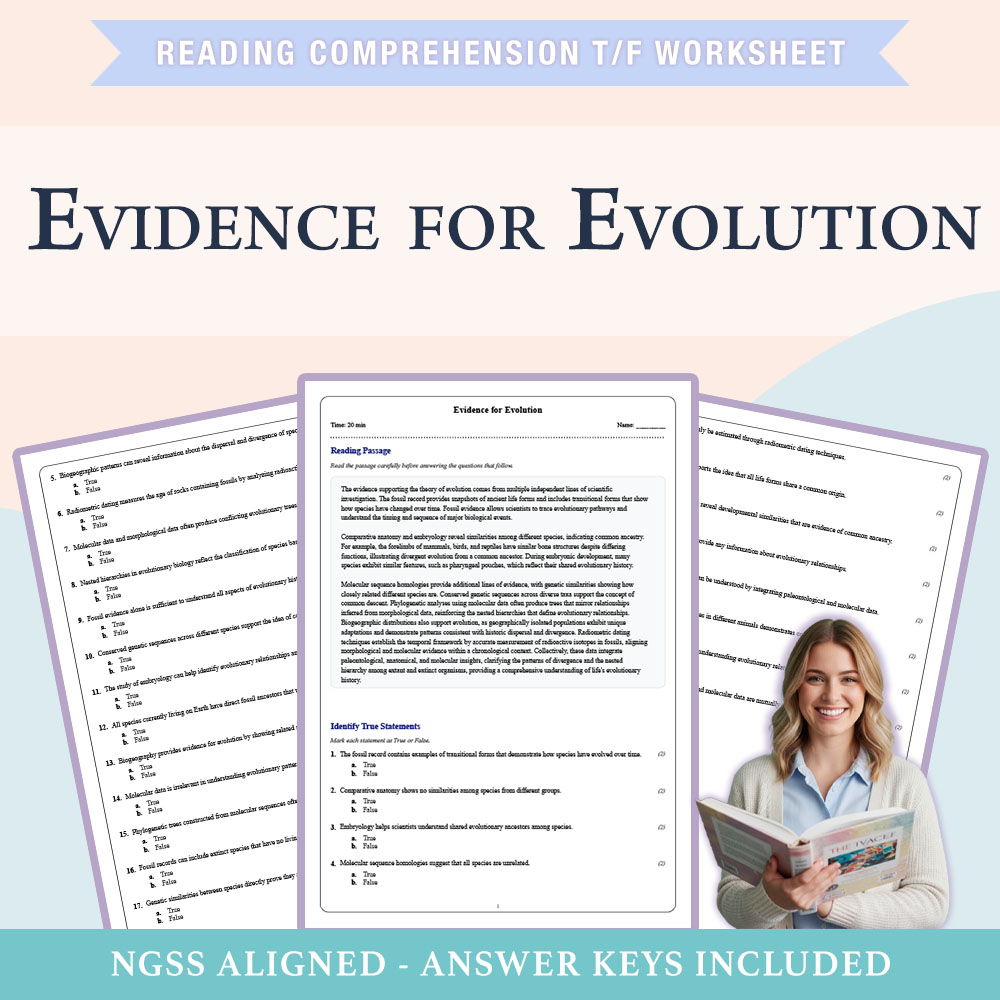
Grade 10 Science | Evidence for Evolution Worksheet (PDF + Answer Key)
Created byCopper Leaf ClassroomLearning Objectives
- Understand the various lines of evidence supporting the theory of evolution.
- Explain how fossil records, comparative anatomy, embryology, and molecular data contribute to evolutionary studies.
- Recognize the role of radiometric dating and biogeography in establishing evolutionary timelines.
Also included in: Grade 10 Science | Evolution & Biodiversity Unit Bundle (PDF + Answer Key) +1 more
Instant download
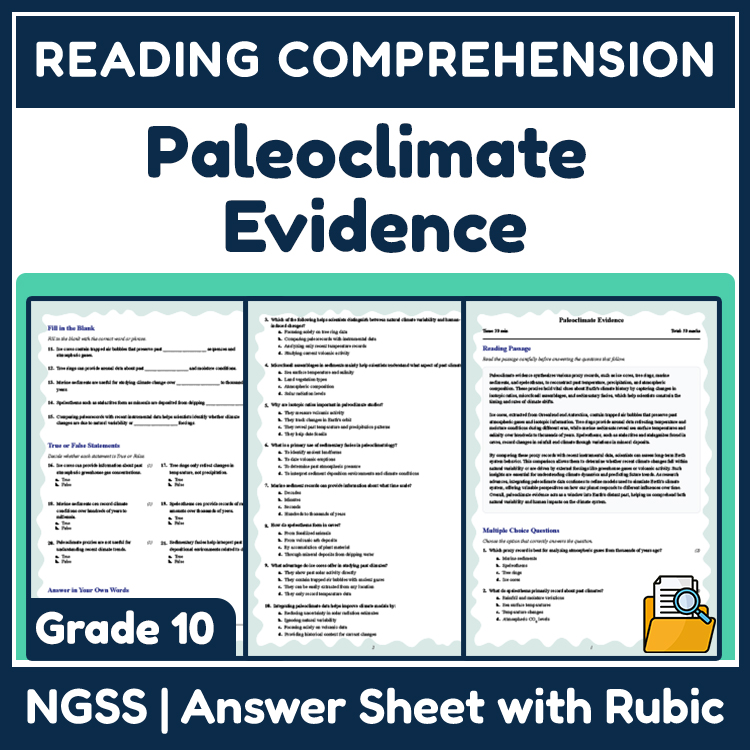
10th Grade Science | Paleoclimate Evidence Reading Worksheet (PDF + Rubric)
JCreated byJ.S SheetsLearning Objectives
- Understand the types of proxy records used to reconstruct past climates.
- Analyze how isotopic ratios and microfossil assemblages provide clues to historical climate conditions.
- Evaluate how paleorecords compare with recent instrumental data to assess long-term climate trends.
Also included in: Grade 10 Science Unit | Earth Systems & Climate Change Worksheets Bundle
Instant download

Grade 10 Science – Introduction to One-Dimensional Motion Daily Worksheet
Created byQuiet Forest EducationLearning Objectives
- Understand and define displacement, speed, velocity, and acceleration.
- Differentiate between average and instantaneous values of motion quantities.
- Apply constant-acceleration equations to real-world motion scenarios.
Also included in: Motion and Forces Grade 10 Science Daily Reading Worksheets Bundle | Ontario +1 more
Instant download
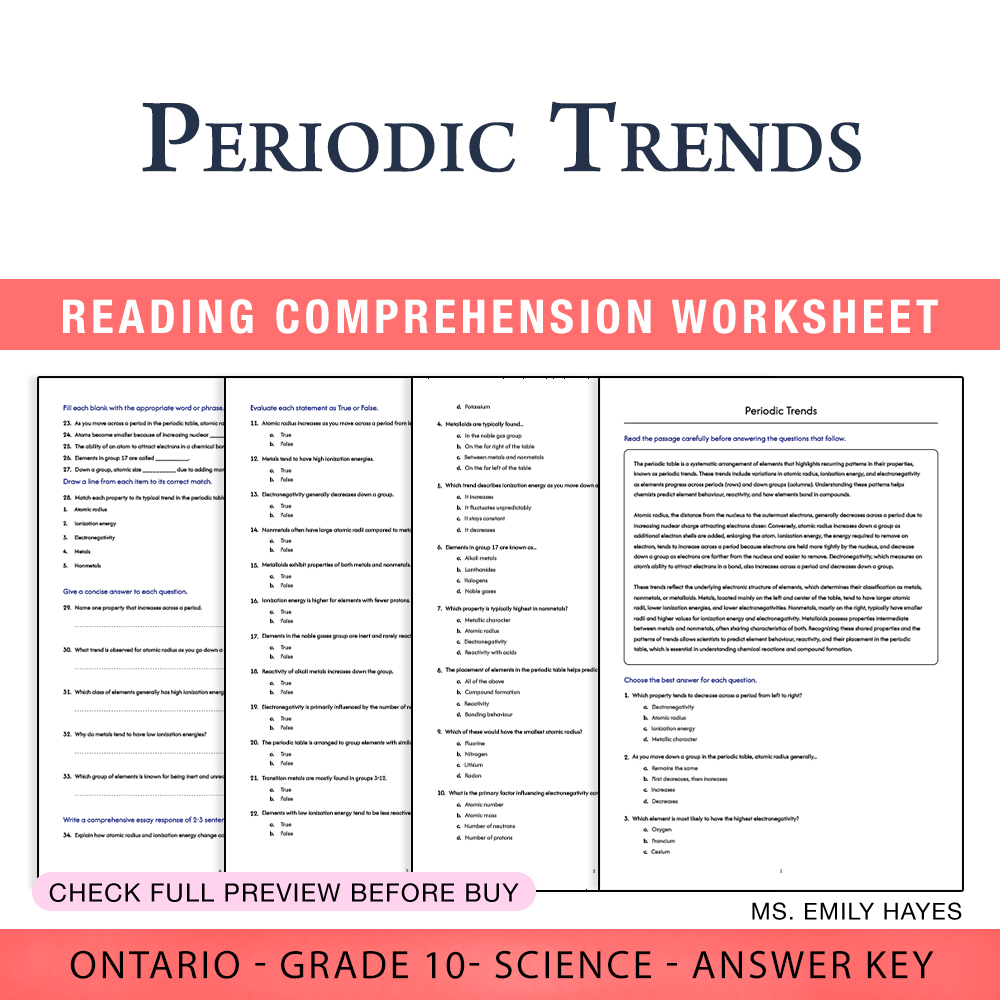
10th Grade Science | Periodic Trends Worksheet (PDF + Answer Key)
Created byCopper Leaf ClassroomLearning Objectives
- Understand the concept of periodic trends and their significance in chemistry.
- Identify and analyze patterns such as atomic radius, ionization energy, and electronegativity across periods and groups.
- Classify elements as metals, nonmetals, or metalloids based on shared properties and trends.
Instant download
About Grade 10 Science Worksheets
Find Science worksheets built for Grade 10. All 7,069 cover core skills, practice, and review, each an instant PDF download.
Every worksheet on MyTeachingSheets is created by independent teacher-authors and reviewed before publication. All resources download as printable PDFs for classroom, homework, or at-home practice, and many include answer keys. Preview any worksheet free before buying.