
Grade 10 Science Worksheets
7,069 worksheets
Momentum Transfer Assessment | Alberta Standards Grade 10 Science
 Created byPrism Point Learning
Learning Objectives
- Explain the principle of conservation of momentum in closed systems.
- Analyze how impulse affects velocity changes during collisions.
- Compare energy conservation with momentum conservation in dynamic interactions.
Also included in: Grade 10 Energy, Motion and Electricity Science Lesson Bundle: Alberta +1 more
Instant download

Paleoclimate Records Assessment for Grade 10 Science | Alberta Standards
Created byPrism Point LearningLearning Objectives
- Understand the role of proxy archives such as tree rings, lake sediments, and peat deposits in reconstructing past climate.
- Identify methods used to extract and interpret climate signals from proxy data.
- Explain how multi-proxy records contribute to understanding climate variability, natural trends, and recent changes.
Also included in: Grade 10 Earth and Space Systems Science Lesson Bundle for Alberta +1 more
Instant download

Resource Cycles Assessment | Alberta Standards Grade 10 Science
Created byPrism Point LearningLearning Objectives
- Understand the components and pathways of Earth's resource cycles.
- Identify reservoirs, fluxes, and their drivers within resource cycles.
- Analyze the impact of changing flux rates on ecosystems and resource availability.
Also included in: Grade 10 Earth and Space Systems Science Lesson Bundle for Alberta +1 more
Instant download

Molar Relationships Assessment for Grade 10 Science | Alberta Standards
Created byPrism Point LearningLearning Objectives
- Understand the concept of the mole and its significance in chemistry.
- Perform mole-to-mass and mole-to-mole conversions accurately.
- Identify limiting reagents and calculate theoretical yields in chemical reactions.
Also included in: Grade 10 Matter and Chemical Change Science Lesson Bundle: Alberta +1 more
Instant download

Force Relations Assessment | Alberta Standards Grade 10 Science
Created byPrism Point LearningLearning Objectives
- Understand how net force, mass, and acceleration relate through Newton's laws.
- Analyze how varying mass and applied forces influence motion outcomes.
- Apply mathematical relationships to estimate safe operational parameters of machinery.
Also included in: Grade 10 Energy, Motion and Electricity Science Lesson Bundle: Alberta +1 more
Instant download

Reaction Types Assessment | Alberta Standards-Aligned Evaluation Grade 10 Science
Created byPrism Point LearningLearning Objectives
- Identify and define the main types of chemical reactions including synthesis, decomposition, single and double displacement, and combustion.
- Predict the products of common reaction types using representative equations and classifying observed chemical changes.
- Interpret reaction patterns and classify reactions based on species transformations under Alberta environmental conditions.
Also included in: Grade 10 Matter and Chemical Change Science Lesson Bundle: Alberta +1 more
Instant download

Energy Diagrams Assessment | Alberta Standards Grade 10 Science
Created byPrism Point LearningLearning Objectives
- Interpret energy distribution graphs and bar charts in mechanical and thermal processes.
- Identify energy sources and sinks in different physical phenomena.
- Apply conservation of energy principles when analyzing regional and engineered systems.
Also included in: Grade 10 Energy, Motion and Electricity Science Lesson Bundle: Alberta +1 more
Instant download

Hydroecological Links Assessment | Alberta Grade 10 Science Standards
Created byPrism Point LearningLearning Objectives
- Describe how water movement affects ecosystems and habitat quality.
- Explain river-floodplain exchanges, wetland functions, and groundwater-vegetation interactions.
- Analyze how hydrologic changes influence species distribution and ecosystem services.
Also included in: Grade 10 Earth and Space Systems Science Lesson Bundle for Alberta +1 more
Instant download

Orbital Forcing Assessment | Alberta Standards Grade 10 Science
Created byPrism Point LearningLearning Objectives
- Understand how Earth's orbital parameters influence climate cycles over long timescales.
- Describe the mechanisms by which orbital variations affect insolation and seasonal contrast.
- Distinguish between orbital drivers and short-term atmospheric or anthropogenic influences on regional climate.
Also included in: Grade 10 Earth and Space Systems Science Lesson Bundle for Alberta +1 more
Instant download

Energy Forms Assessment | Alberta Standards Grade 10 Science
Created byPrism Point LearningLearning Objectives
- Define kinetic and potential energy with real-world examples.
- Explain the principle of energy conservation and how energy interconverts between forms.
- Describe how non-conservative forces affect energy distribution in systems.
Also included in: Grade 10 Energy, Motion and Electricity Science Lesson Bundle: Alberta +1 more
Instant download
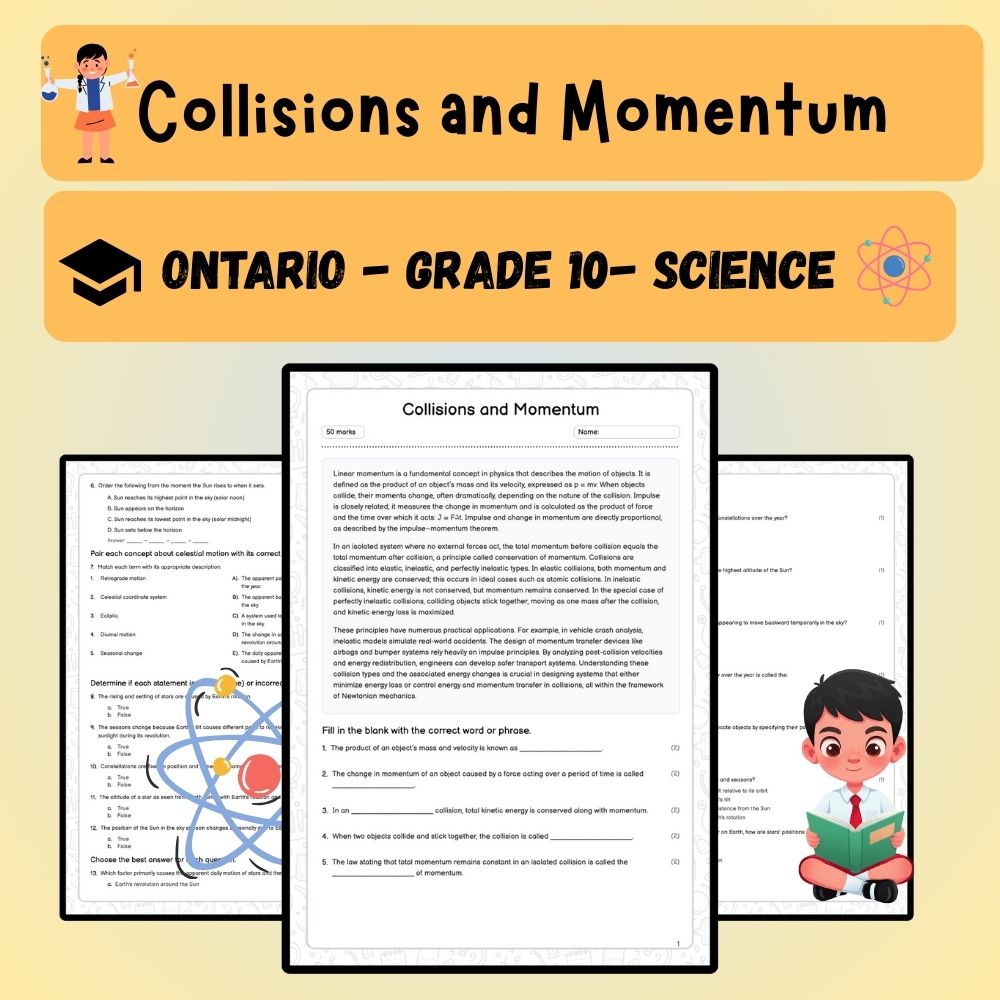
Grade 10 Science | Collisions and Momentum Worksheet (PDF) – Ontario Standards
Created byPrism Point LearningLearning Objectives
- Define and relate linear momentum and impulse to changes in motion
- Explain the conservation of momentum in various types of collisions
- Analyse energy redistribution and energy considerations in elastic, inelastic, and perfectly inelastic collisions
Also included in: Grade 10 Science Unit Bundle | Motion, Forces & Mechanics Worksheets (Ontario Standards) +1 more
Instant download
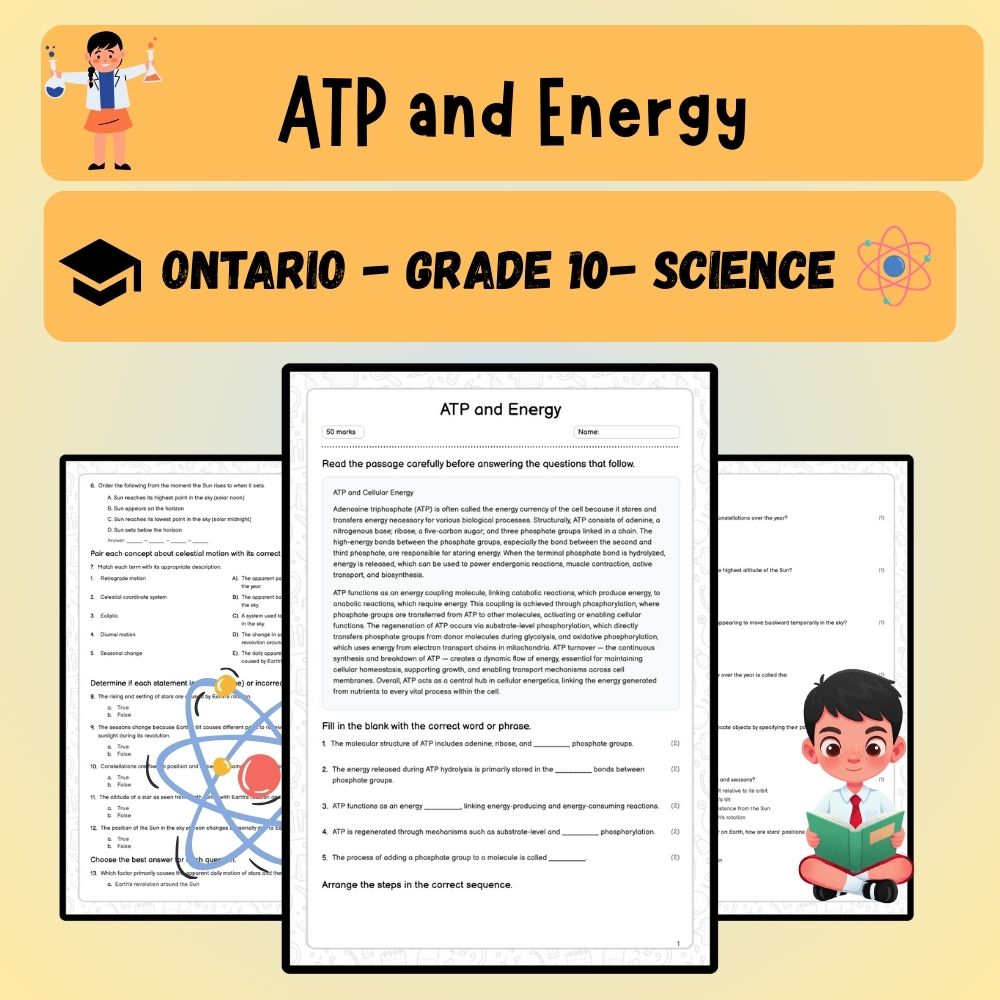
Grade 10 Science | ATP and Energy Worksheet – Ontario Standards (PDF)
Created byPrism Point LearningLearning Objectives
- Describe the molecular structure and role of ATP as an energy carrier in cells.
- Explain how ATP releases energy through phosphate bond hydrolysis and how energy is coupled to cellular work.
- Identify mechanisms of ATP regeneration, including substrate-level and oxidative phosphorylation.
Also included in: Grade 10 Science Unit | Cells, Photosynthesis & Microbes Worksheet Pack +1 more
Instant download
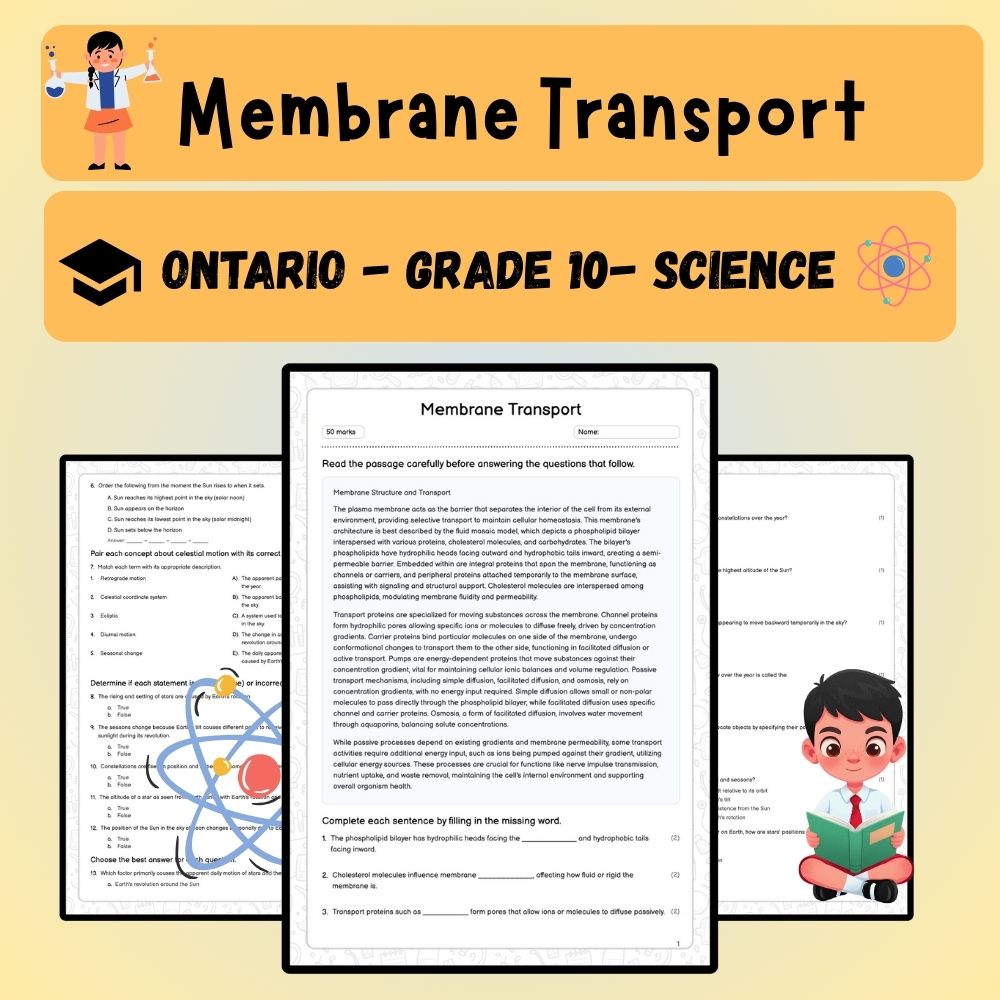
Grade 10 Science | Membrane Transport Worksheet (PDF) Aligned with Ontario Standards
Created byPrism Point LearningLearning Objectives
- Understand the structure and components of the plasma membrane as described by the fluid mosaic model.
- Differentiate between types of transport proteins such as channels, carriers, and pumps based on structural features and functions.
- Explain passive transport mechanisms—including simple diffusion, facilitated diffusion, and osmosis—in terms of concentration gradients and permeability.
Also included in: Grade 10 Science Unit | Cells, Photosynthesis & Microbes Worksheet Pack +1 more
Instant download
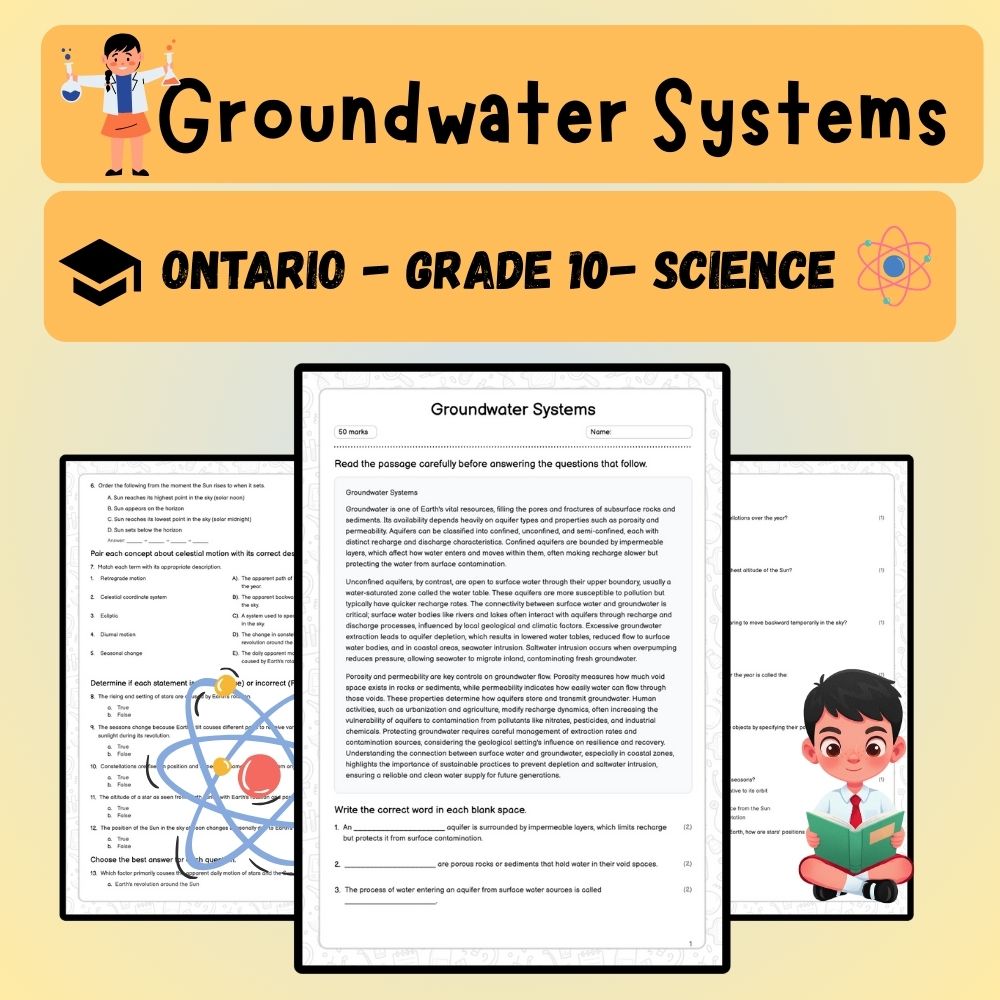
Grade 10 Science | Groundwater Systems Worksheet (Answer Key) – Ontario Standards
Created byPrism Point LearningLearning Objectives
- Describe the main types of aquifers and their properties, including porosity and permeability.
- Explain the processes of groundwater recharge and discharge, and their relation to surface water.
- Analyze factors contributing to groundwater vulnerability, contamination transport, and aquifer depletion.
Also included in: Grade 10 Science UNIT Bundle | Earth Processes & Resources Ontario Standards +1 more
Instant download
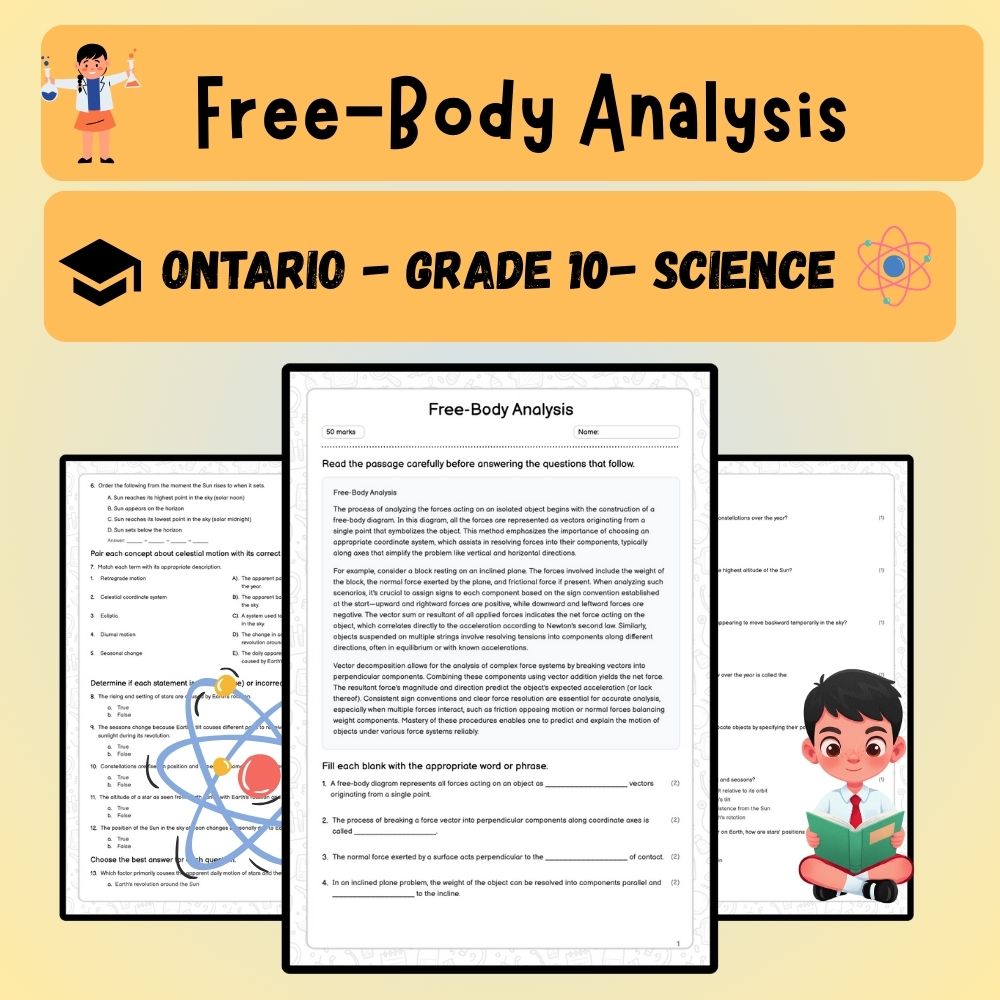
Grade 10 Science | Free-Body Analysis Worksheet (PDF) – Ontario Standards
Created byPrism Point LearningLearning Objectives
- Understand the principles of representing forces acting on an object using free-body diagrams.
- Learn how to identify and resolve individual forces into components.
- Apply vector addition to determine the resultant force and its relation to acceleration.
Also included in: Grade 10 Science Unit Bundle | Motion, Forces & Mechanics Worksheets (Ontario Standards) +1 more
Instant download
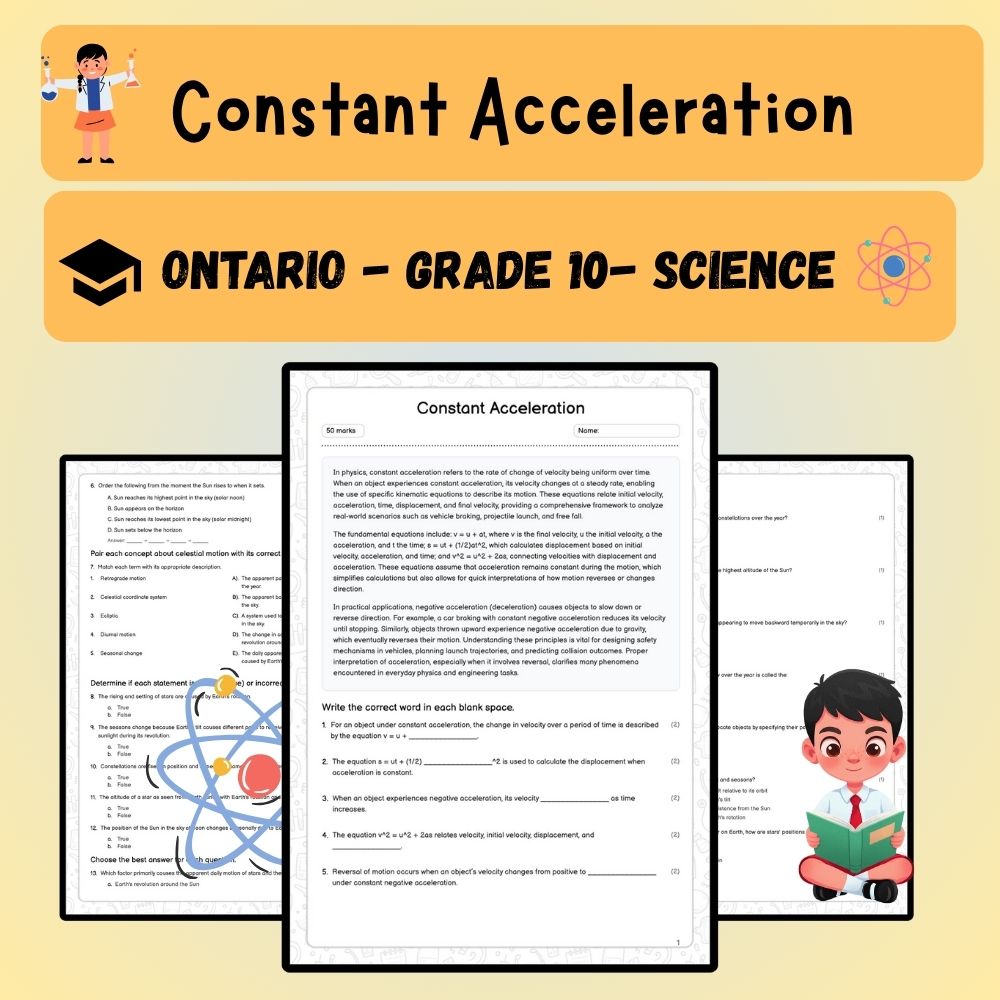
Grade 10 Science | Constant Acceleration Worksheet (PDF) – Ontario Standard
Created byPrism Point LearningLearning Objectives
- Understand the kinematic equations related to uniformly accelerated motion.
- Interpret and analyze motion scenarios with varying initial velocities, displacements, and times.
- Apply algebraic formulas to solve problems involving acceleration, velocity, and displacement.
Also included in: Grade 10 Science Unit Bundle | Motion, Forces & Mechanics Worksheets (Ontario Standards) +1 more
Instant download

Grade 10 Science | One-Dimensional Motion Worksheet (Answer Key) PDF
Created byPrism Point LearningLearning Objectives
- Define and relate key kinematic quantities such as displacement, speed, velocity, and acceleration.
- Differentiate between average and instantaneous measures of motion.
- Apply constant-acceleration equations to scenarios like free-fall and uniformly accelerated motion.
Also included in: Grade 10 Science Unit Bundle | Motion, Forces & Mechanics Worksheets (Ontario Standards) +1 more
Instant download
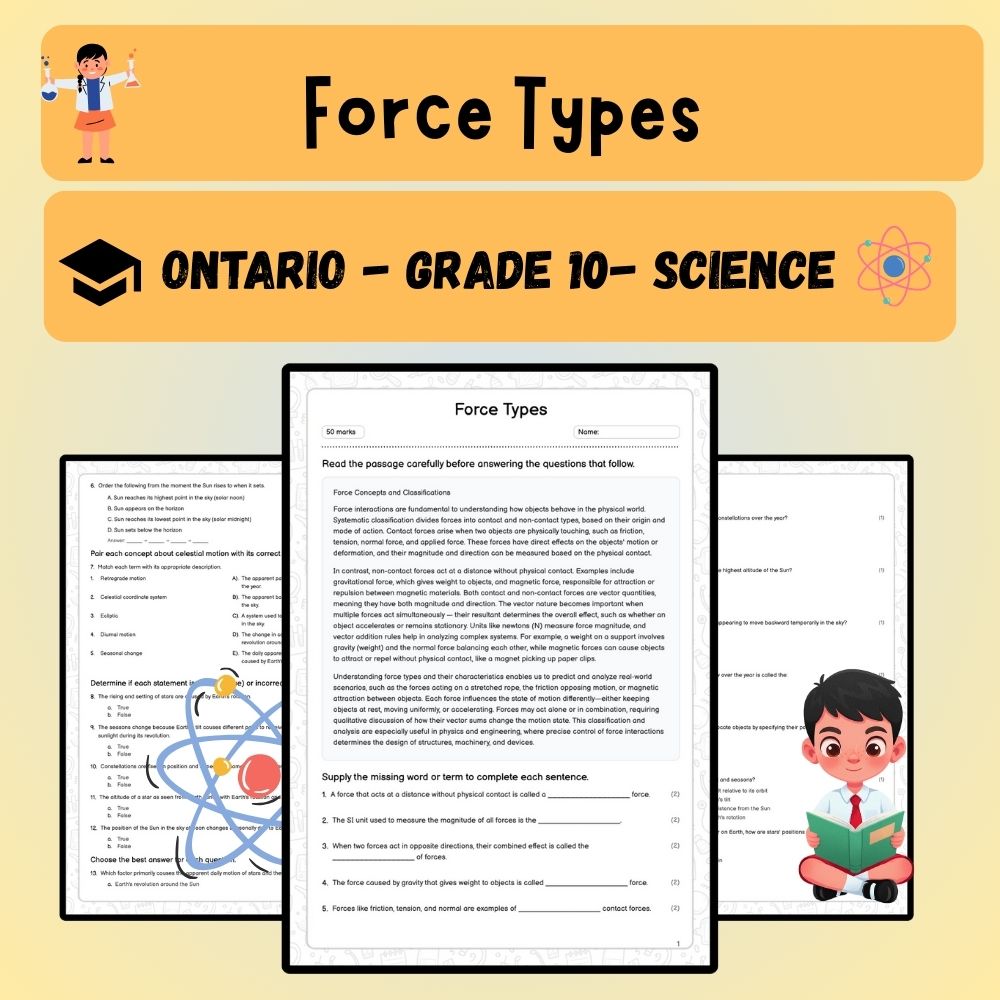
Grade 10 Science | Force Types Worksheet (PDF) – Ontario Standards
Created byPrism Point LearningLearning Objectives
- Identify and differentiate between contact and non-contact forces.
- Describe the origin, direction, and magnitude of various force types.
- Understand the vector nature of forces and how they combine.
Also included in: Grade 10 Science Unit Bundle | Motion, Forces & Mechanics Worksheets (Ontario Standards) +1 more
Instant download

Grade 10 Science | Scientific Reasoning Worksheet | NGSSS Aligned
 Created byLumora Learning
Learning Objectives
- Explain how evidence and claims are logically connected in scientific reasoning
- Distinguish correlation from causation and evaluate the strength of conclusions
- Identify how hypotheses guide tests and how alternative explanations can be assessed
Instant download
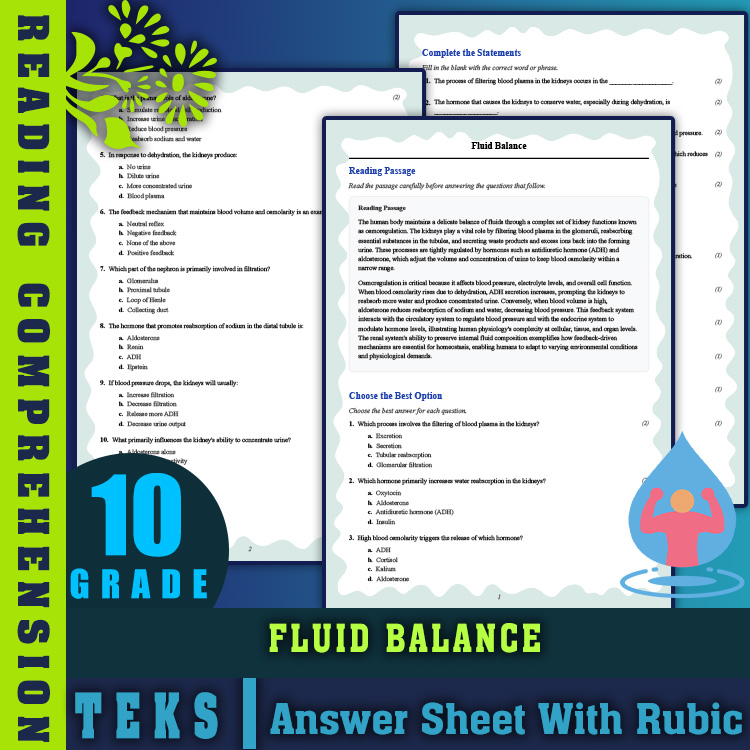
10th Grade Science | Fluid Balance Reading Worksheet (PDF + Rubric)
JCreated byJ.S SheetsLearning Objectives
- Understand the processes of glomerular filtration, tubular reabsorption, and secretion in renal function
- Explain how hormones like antidiuretic hormone and aldosterone regulate fluid and solute balance
- Describe the interactions between kidneys, circulatory, and endocrine systems in maintaining blood osmolarity and pressure
Instant download

Grade 10 Bond Polarity Worksheet | AP Practice & Assessment PDF
 Created byClear Sky Classroom
Learning Objectives
- Explain bond polarity using electronegativity differences and describe how electron distribution affects bond behavior.
- Represent bond polarity with dipole vectors and use dipole moment ideas to compare different bonds.
- Classify bonds on a polar-covalent to ionic continuum and predict how polarity influences intermolecular attractions and solubility.
Also included in: Grade 10 Chemistry Foundations Science Lesson Bundle: AP Worksheet Set +1 more
Instant download
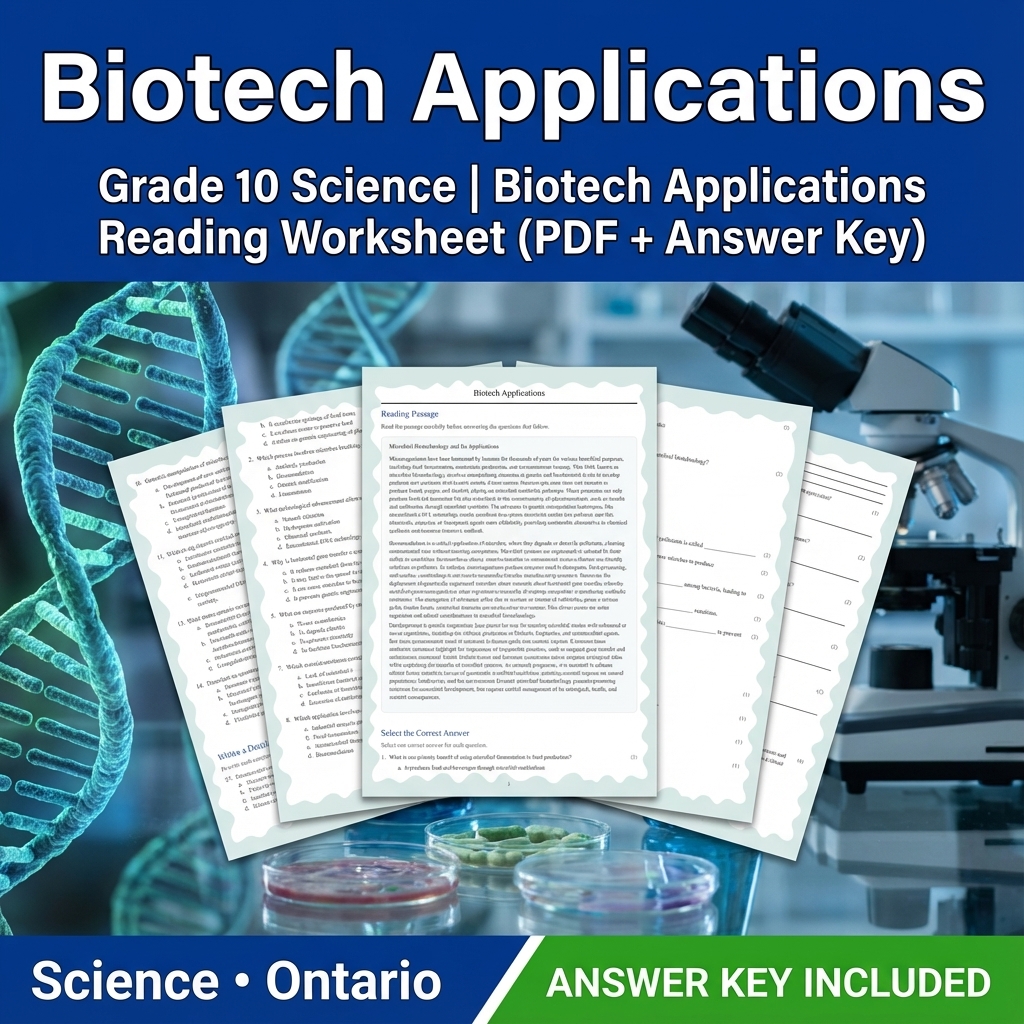
Grade 10 Science | Biotech Applications Reading Worksheet (PDF + Answer Key)
JCreated byJ.S SheetsLearning Objectives
- Understand the key biotechnological applications of microorganisms.
- Describe the principles of microbial genetic manipulation for product synthesis.
- Explain the concepts of bioremediation and industrial enzyme production.
Also included in: Grade 10 Science Unit Bundle | Cell Biology, Microbes & Energy Activities +1 more
Instant download

Evolutionary Evidence Worksheet | Grade 10 Science printable PDF NGSS
Learning Objectives
- Explain how multiple independent lines of evidence support common ancestry and descent with modification.
- Describe how the fossil record, radiometric dating, comparative anatomy, embryology, molecular sequences, and biogeography contribute to evolutionary conclusions.
- Use examples to connect evidence types to patterns of divergence and relatedness across organisms.
Instant download

Selective Mechanisms Worksheet | Grade 10 Science printable PDF NGSS
Learning Objectives
- Explain how heritable variation and environmental pressures drive natural selection in populations
- Interpret how differential survival and reproduction change allele frequencies over generations
- Use fitness and selection coefficient ideas to connect phenotypic change to population genetics dynamics
Instant download

Biodiversity Change Worksheet | Science Assessment Grade 10 NGSS Printable PDF
Learning Objectives
- Explain how human activities and environmental change can reduce biodiversity through multiple mechanisms such as habitat fragmentation, invasive species, and climate shifts.
- Interpret how fossil evidence, phylogenetic analysis, and population monitoring can show patterns of species loss and recovery potential.
- Evaluate causal links among factors that reduce genetic diversity and ecological resilience, and propose conservation strategies based on evidence.
Instant download
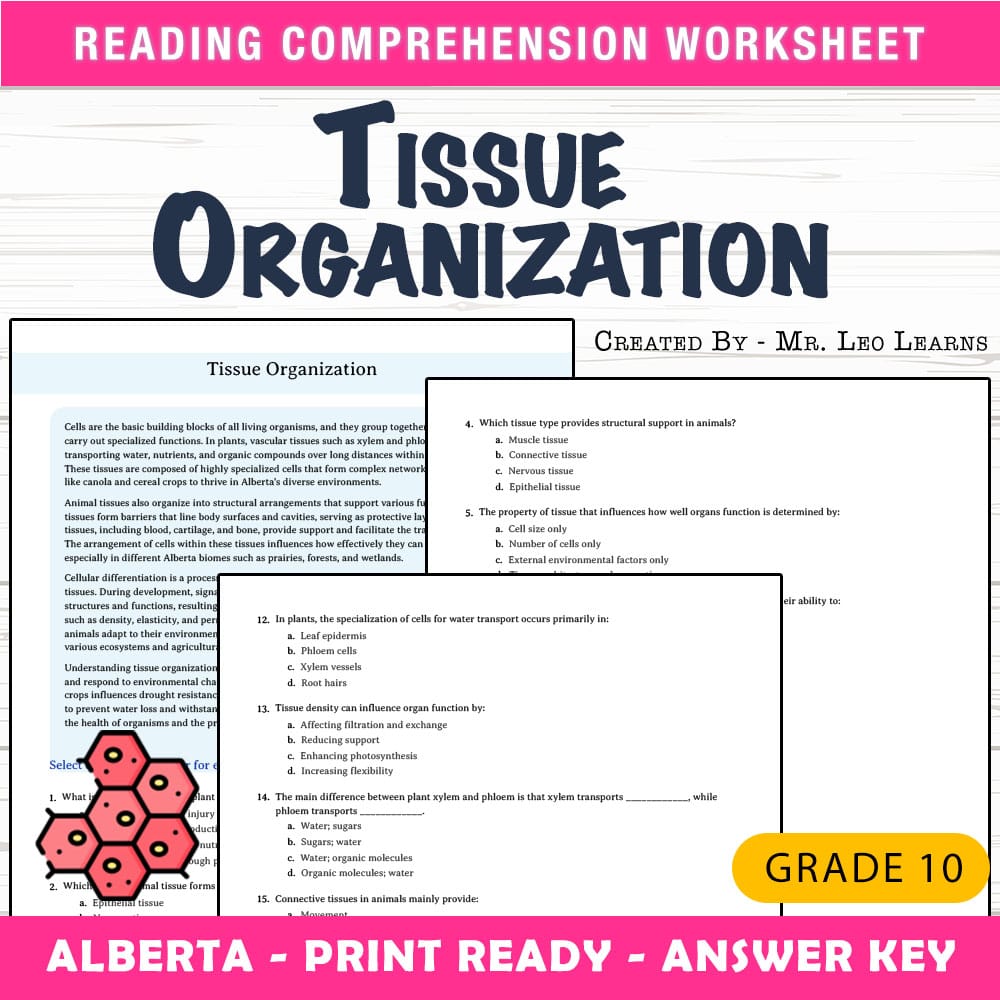
Grade 10 Science — Tissue Organization Worksheet MCQ Paper for Mastery
 Created byThe Resource Hub
Learning Objectives
- Understand how cells with similar structures form tissues that perform specific functions.
- Identify different types of plant and animal tissues and their roles in biological systems.
- Explain how tissue properties impact organ performance across Alberta biomes and agriculture.
Also included in: Grade 10 Science Cells and Systems Lesson Bundle | Alberta Curriculum +1 more
Instant download
Dynamic Equilibrium Worksheet for Grade 10 Science | Alberta Standards
 Created byCoral Reef Learning
Learning Objectives
- Explain the concept of dynamic equilibrium in chemical reactions.
- Interpret equilibrium constant expressions and understand their significance.
- Predict system shifts in response to changes in concentration, pressure, and temperature.
Instant download
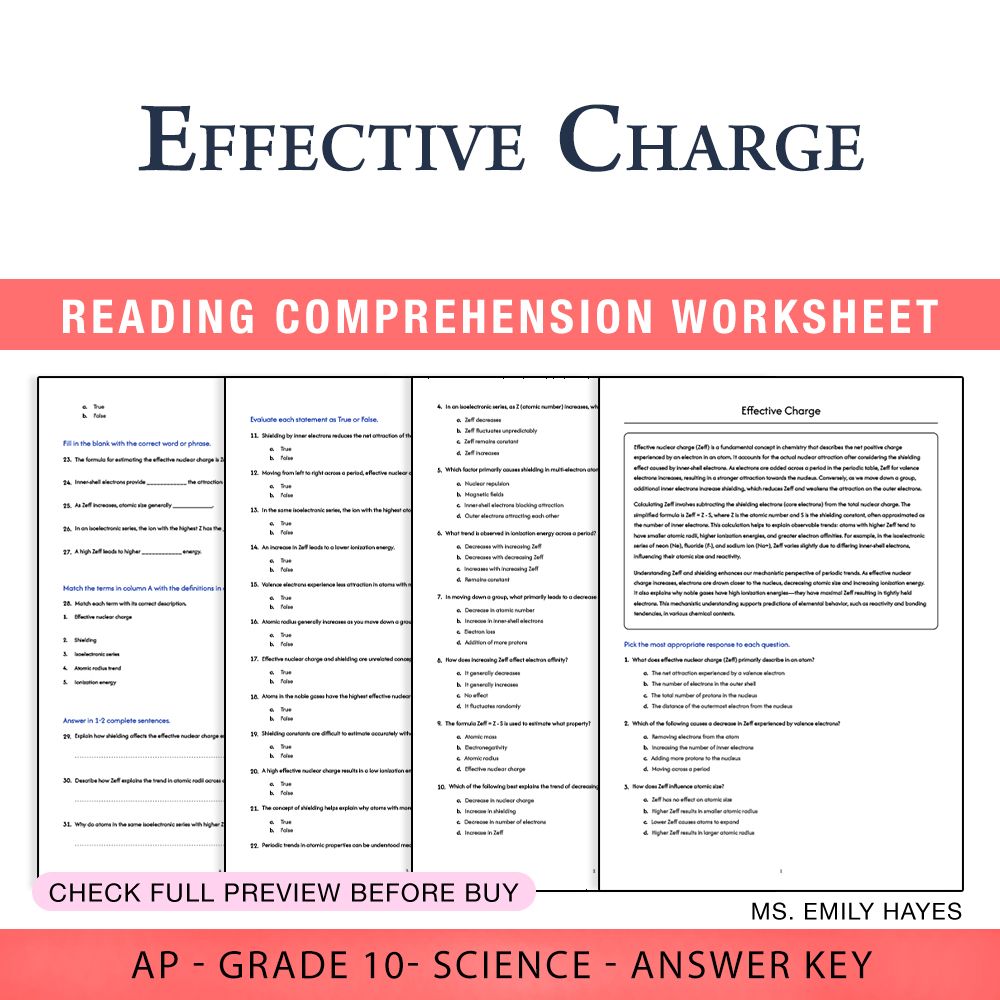
10th Grade Science | Master Effective Nuclear Charge Worksheet (PDF+ Answer Key)
 Created byCopper Leaf Classroom
Learning Objectives
- Understand the concept of effective nuclear charge (Zeff) and how it influences atomic properties.
- Analyze the effects of shielding by inner electrons on valence electron attraction.
- Apply Zeff reasoning to explain periodic trends in atomic radius, ionization energy, and electron affinity.
Also included in: Grade 10 Science -Atomic Structure & Chemical Reactions (PDF+ Answer Key) +1 more
Instant download

Grade 10 Energy Transfer Worksheet | General Practice PDF
Created byClear Sky ClassroomLearning Objectives
- Explain how energy transfers between systems and how energy can change form during everyday and experimental situations
- Identify the roles of kinetic energy, gravitational potential energy, and elastic energy in observed changes
- Describe common pathways for energy transfer, including heating, work by forces, and radiation
Instant download

Sphere Connections Worksheet | AP Science | Grade 10
JCreated byJ.S SheetsLearning Objectives
- Understand how the geosphere, hydrosphere, atmosphere, and biosphere interact through coupled processes.
- Analyze systems thinking models such as flow diagrams and mass-balance reasoning to explain environmental interactions.
- Identify how perturbations propagate across Earth's spheres and affect observable indicators like streamflow and soil moisture.
Instant download
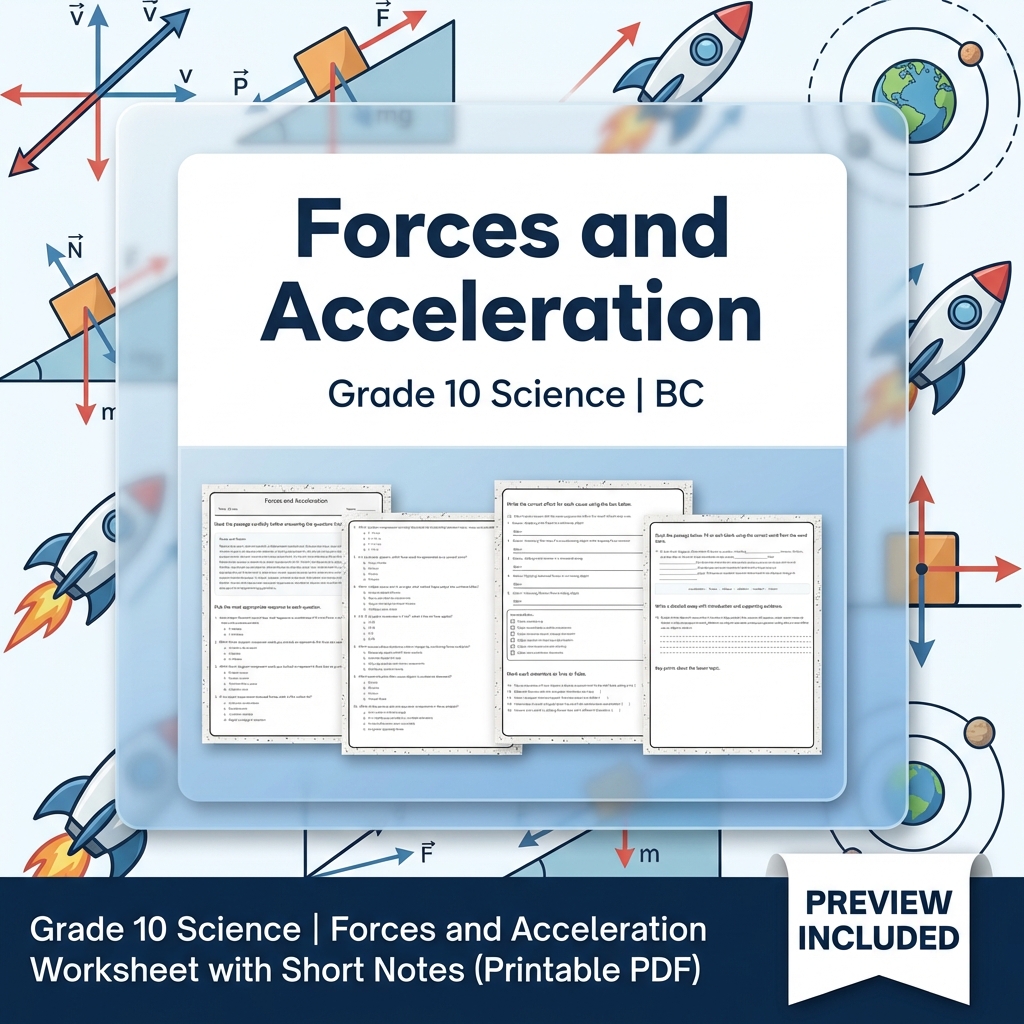
Grade 10 Science | Forces and Acceleration Worksheet with Short Notes (PDF)
 Created byMeadowlark Worksheets
Learning Objectives
- Understand Newtonian dynamics and the relationship between net force, mass, and acceleration.
- Interpret and create free-body diagrams representing different forces.
- Use algebraic relations and vector components to analyze motion.
Also included in: Grade 10 Science Lesson Bundle | Physics and Forces Worksheets | BC Framework +1 more
Instant download
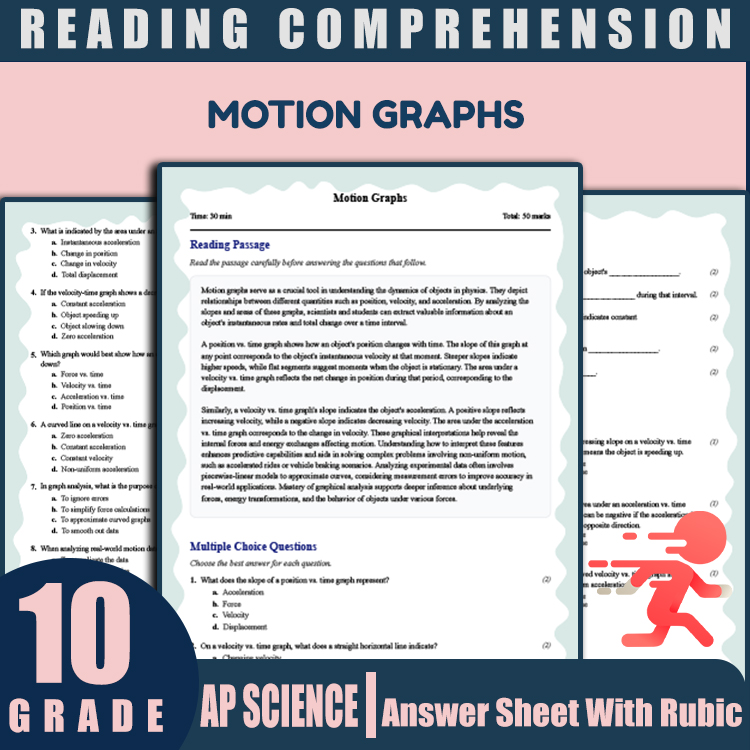
10th Grade Science | Motion Graphs Reading Worksheet (PDF & Answer Key)
JCreated byJ.S SheetsLearning Objectives
- Understand how slopes of position, velocity, and acceleration graphs relate to instantaneous rates in motion.
- Analyze areas under velocity and acceleration graphs to determine total change in position or velocity.
- Connect graphical features to derivatives and integrals in the context of non-uniform motion.
Also included in: Grade 10 Science Unit Bundle | Motion, Forces & Energy Worksheets (PDF) +1 more
Instant download

Adaptation Planning Worksheet | NGSS Science Standards Grade 10
JCreated byJ.S SheetsLearning Objectives
- Evaluate infrastructural and policy responses to natural hazards and environmental change.
- Analyze trade-offs among economic, social, and ecological factors in adaptation strategies.
- Interpret risk maps, hazard analyses, and cost–benefit data to assess feasibility and resilience.
Also included in: Grade 10 Climate Change Science Lesson Bundle | NGSS Practice Worksheets
Instant download

DNA and Genes Worksheet Grade 10 Biology Genetics NGSSS Science Activity
 Created byEvergreen Desk Education
Learning Objectives
- Explain how genetic information stored in DNA is organized into chromosomes and expressed through genes
- Describe how gene information is converted into functional proteins or RNA products
- Interpret how DNA variation and inheritance lead to observable traits
Instant download

Hydroecology River and Wetland Systems Worksheets Grade 10
 Created bySunny Desk Resources
Learning Objectives
- Explain how water availability and timing influence habitat suitability and primary productivity in ecosystems.
- Describe how river–floodplain and groundwater–vegetation exchanges affect nutrient cycling.
- Predict ecosystem responses to altered hydrologic regimes, including cascading ecological effects.
Also included in: Earth Systems, Climate, and Sustainability Lesson Bundle | Grade 10 Science | Alberta +1 more
Instant download

Climate and River Data Patterns Grade 10 Science Worksheet
Created bySunny Desk ResourcesLearning Objectives
- Identify temporal and spatial patterns in Earth and space datasets using observational evidence
- Distinguish correlation, trends, and cyclical behavior in climate, river discharge, and meteorological records
- Evaluate how data quality and sampling frequency affect confidence in inferred patterns
Also included in: Earth Systems, Climate, and Sustainability Lesson Bundle | Grade 10 Science | Alberta +1 more
Instant download
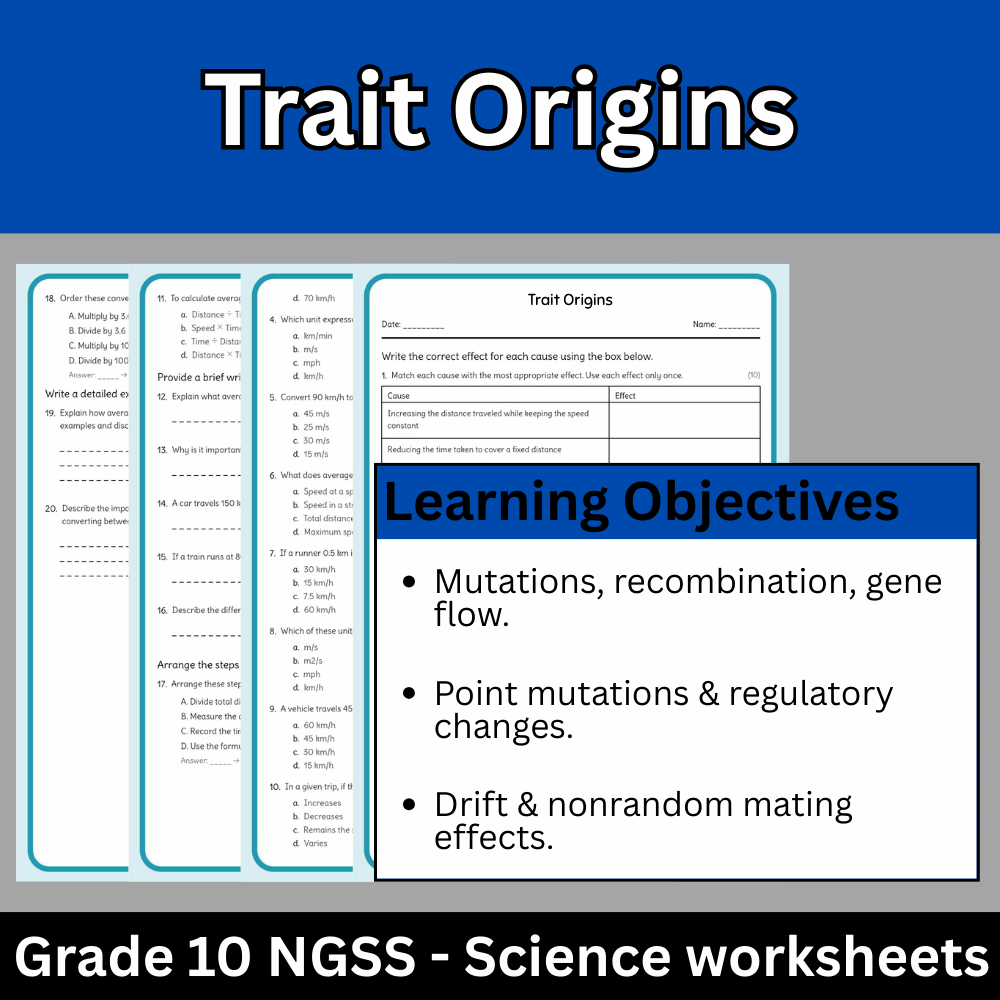
Grade 10 Science | Biodiversity Drivers Worksheet (Answer Key) – NGSS Standards
 Created byBright Mind Resources
Learning Objectives
- Identify key factors influencing species richness and composition in various habitats.
- Explain how habitat fragmentation, invasive species, land-use change, and climate shifts impact ecosystems.
- Analyze mechanisms such as genetic diversity, metapopulation structure, and connectivity affecting extinction risk and recovery.
Instant download
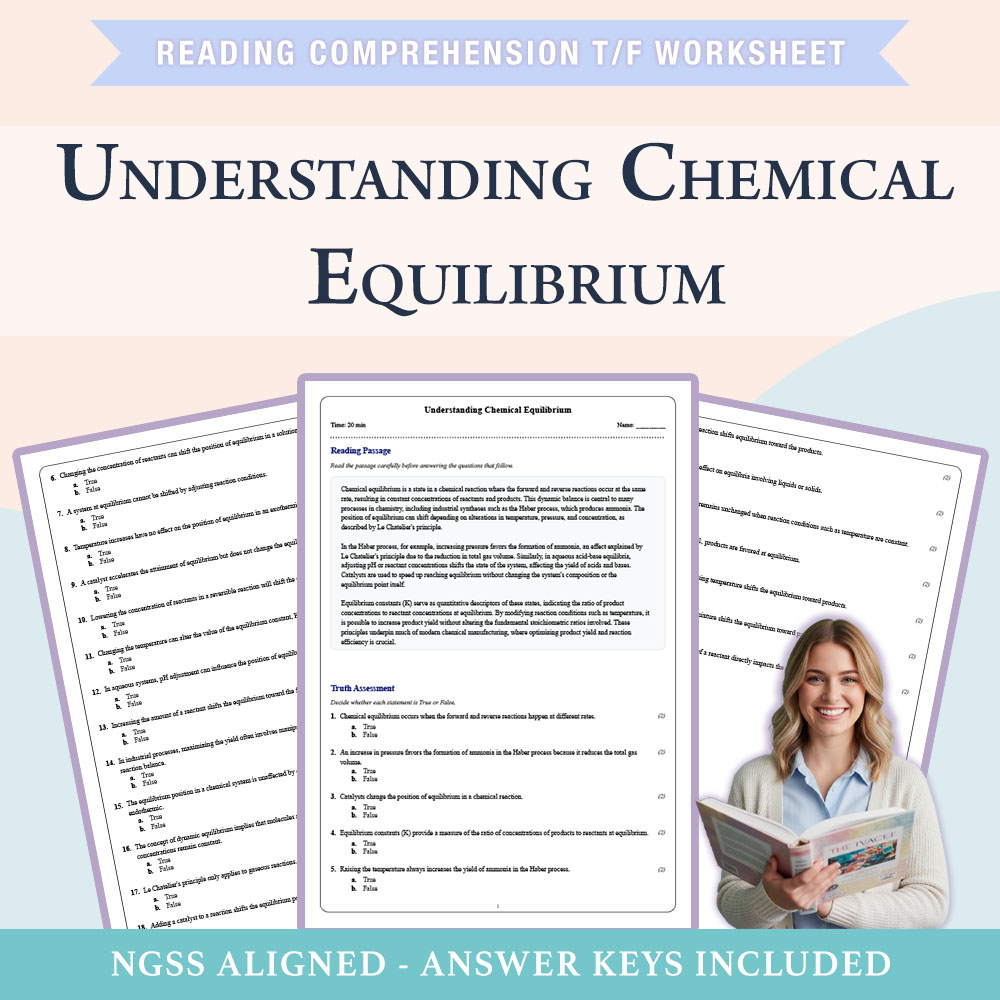
10th Grade Science |Understanding Chemical Equilibrium Worksheet (PDF + Answers)
Created byCopper Leaf ClassroomLearning Objectives
- Explain the concept of chemical equilibrium and how it depends on reaction conditions.
- Identify how changes in pressure, concentration, and temperature influence the position of equilibrium in chemical systems.
- Describe the role of catalysts and equilibrium constants in chemical reactions.
Also included in: Grade 10 Science | Chemical Reaction & Particle Interactions (PDF + Answer Key) +1 more
Instant download
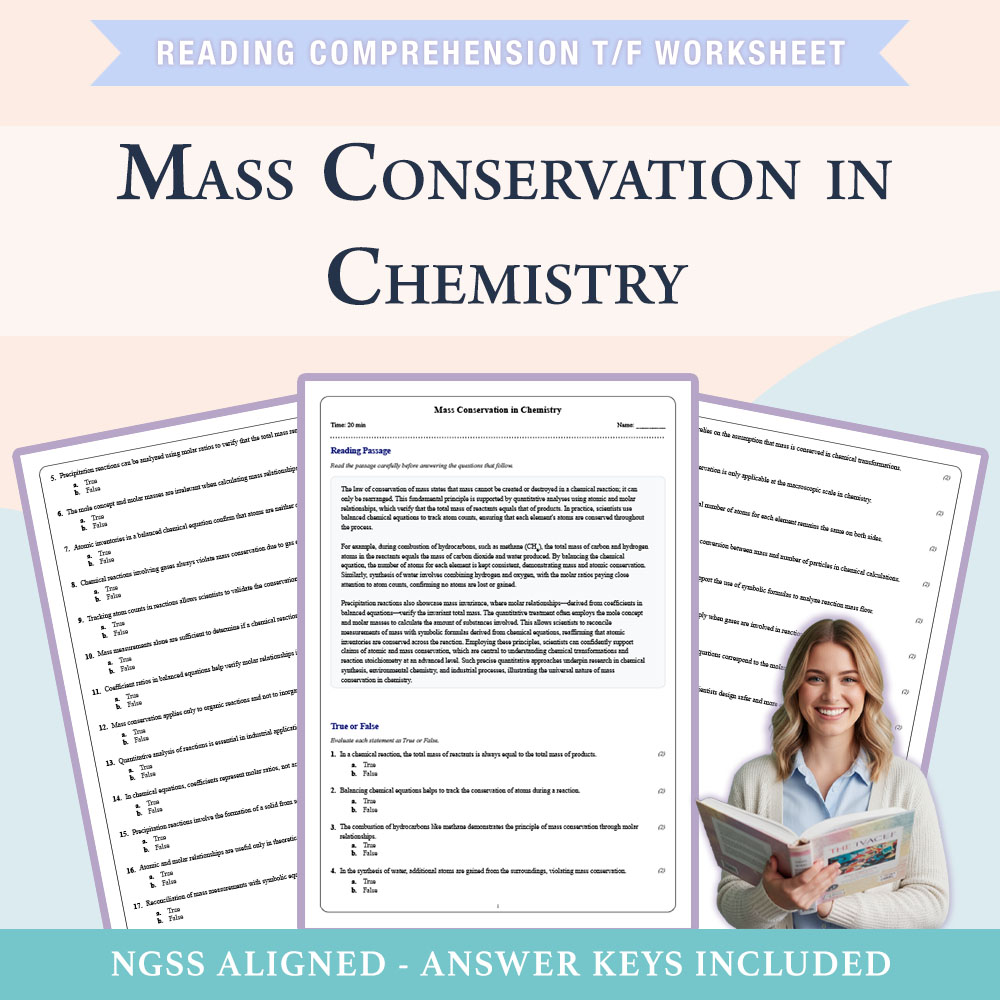
10th Grade Science | Mass Conservation in Chemistry Worksheet (PDF + Answer Key)
Created byCopper Leaf ClassroomLearning Objectives
- Understand how balanced chemical equations demonstrate the conservation of atoms and mass.
- Identify various chemical reactions where mass invariance is verified through molar relationships.
- Apply mole concepts, molar masses, and coefficients to analyze and confirm mass conservation in chemical processes.
Also included in: Grade 10 Science | Chemical Reaction & Particle Interactions (PDF + Answer Key) +1 more
Instant download
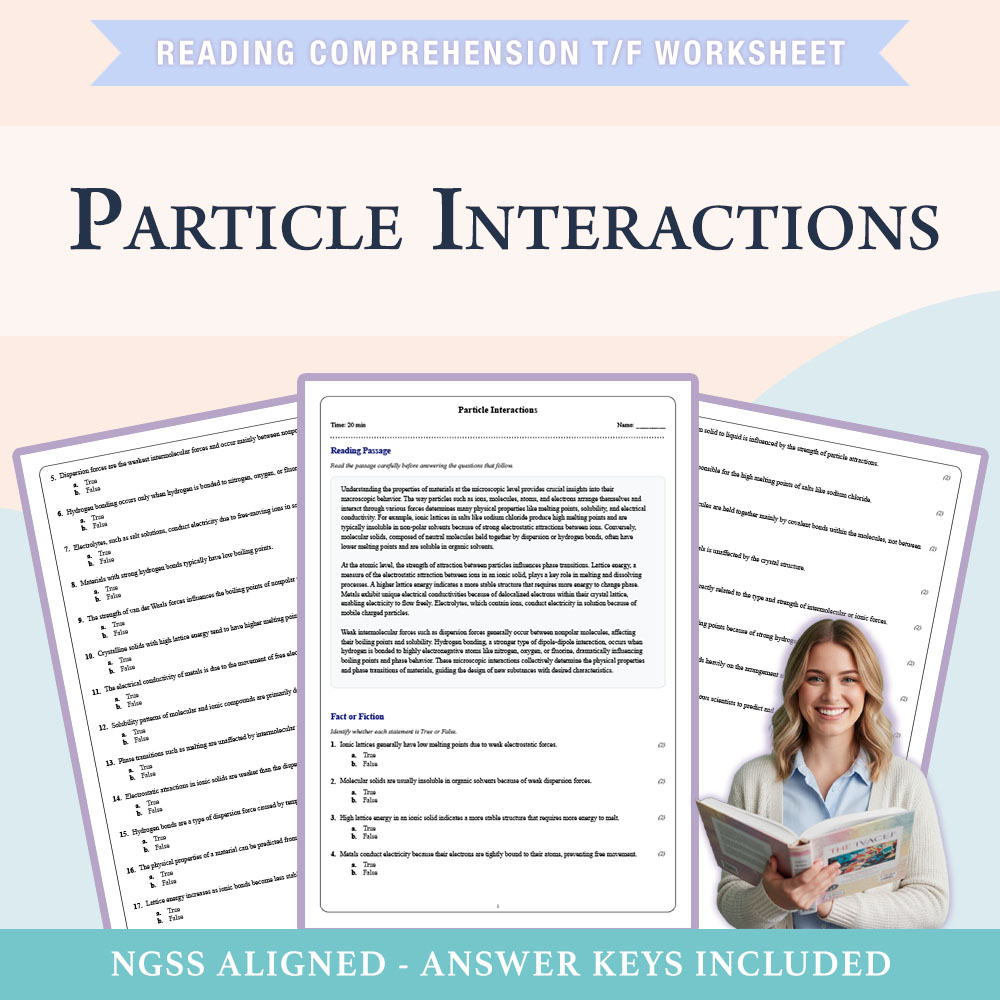
10th Grade Science | Particle Interactions Worksheet (PDF + Answer Key)
Created byCopper Leaf ClassroomLearning Objectives
- Understand how crystal structure and molecular interactions influence macroscopic properties of materials.
- Differentiate between ionic lattices, molecular solids, metals, and electrolytes based on their particle arrangements and electrical behavior.
- Explain how lattice energy, dispersion forces, and hydrogen bonding affect phase transitions and physical properties.
Also included in: Grade 10 Science | Chemical Reaction & Particle Interactions (PDF + Answer Key) +1 more
Instant download
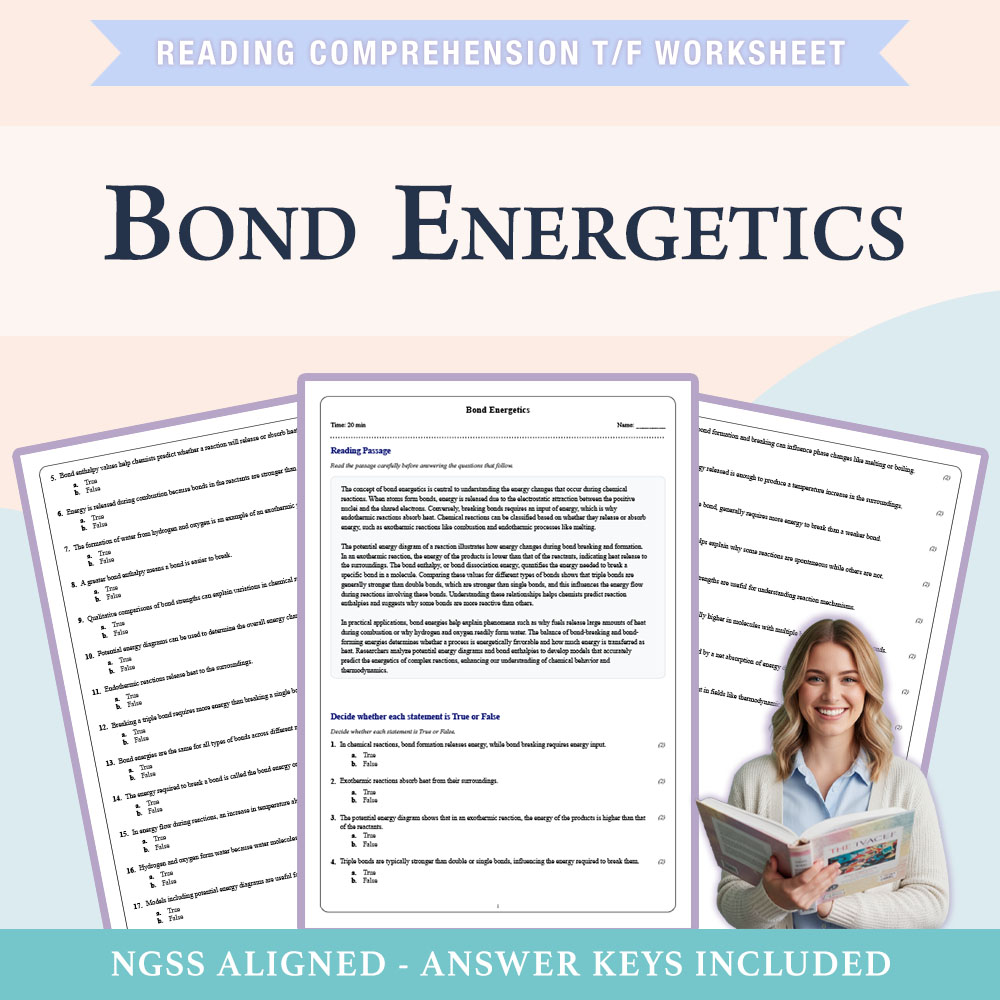
10th Grade Science | Bond Energetics Worksheet (PDF + Answer Key)
Created byCopper Leaf ClassroomLearning Objectives
- Understand how chemical bond formation and breaking relate to energy changes in reactions.
- Distinguish between exothermic and endothermic processes based on bond energies.
- Analyze potential energy diagrams and bond enthalpy values to interpret energy flow during chemical reactions.
Also included in: Grade 10 Science | Chemical Reaction & Particle Interactions (PDF + Answer Key) +1 more
Instant download
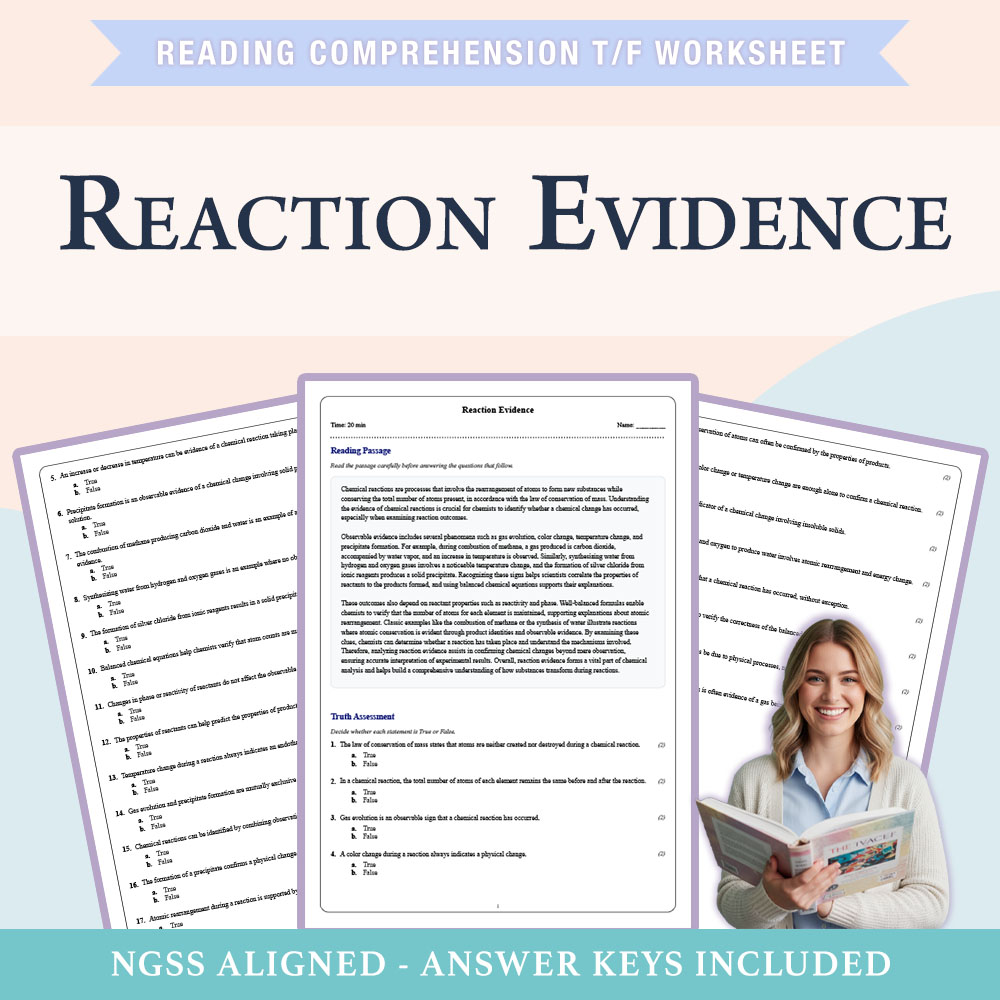
10th Grade Science | Reaction Evidence Worksheet (PDF + Answer Key)
Created byCopper Leaf ClassroomLearning Objectives
- Understand how chemical reactions conserve atoms and involve atomic rearrangement.
- Identify observable evidence of chemical reactions such as gas evolution, color change, temperature change, and precipitate formation.
- Relate reactant properties to the identities of products using balanced formulas.
Also included in: Grade 10 Science | Chemical Reaction & Particle Interactions (PDF + Answer Key) +1 more
Instant download

Grade 10 Science – Thermochemistry Worksheet (AP Standard) PDF
Created byEvergreen Desk EducationLearning Objectives
- Use thermochemical equations to connect enthalpy change with reaction stoichiometry.
- Apply conservation of energy to calorimetry problems and interpret heat exchange.
- Use Hess’s law and bond enthalpy approximations to predict reaction enthalpy.
Also included in: Grade 10 Chemistry Science Lesson Bundle AP Framework Worksheets Practice +1 more
Instant download

Grade 10 Science – Stoichiometric Analysis Worksheet (AP) PDF
Created byEvergreen Desk EducationLearning Objectives
- Use mole ratios to solve multi-step stoichiometry problems and track units consistently.
- Identify limiting reactants and determine theoretical yields from balanced chemical equations.
- Convert between mass, concentration, moles, and percent composition, including empirical formulas.
Also included in: Grade 10 Chemistry Science Lesson Bundle AP Framework Worksheets Practice +1 more
Instant download

Grade 10 Science Bonding Models Worksheet (AP) | PDF & Answer Key
Created byEvergreen Desk EducationLearning Objectives
- Compare ionic, covalent, and metallic bonding using electron-transfer and electron-sharing models.
- Use Lewis structures and basic molecular orbital ideas to explain structure and bonding behavior.
- Predict macroscopic properties (conductivity, melting point, and solubility) from bonding type.
Also included in: Grade 10 Chemistry Science Lesson Bundle AP Framework Worksheets Practice +1 more
Instant download

Grade 10 Science – Reaction Stoichiometry Worksheet (AP) (PDF)
Created byEvergreen Desk EducationLearning Objectives
- Use the mole concept and molar mass to convert between mass, moles, and particle amounts in chemical reactions.
- Apply balanced chemical equations to determine stoichiometric mole ratios for mass-to-mass calculations.
- Identify the limiting reagent and calculate theoretical yield using mole ratios and unit analysis.
Also included in: Grade 10 Chemistry Science Lesson Bundle AP Framework Worksheets Practice +1 more
Instant download

Grade 10 Science | Effective Charge Worksheet (AP Standards) Practice
Created byEvergreen Desk EducationLearning Objectives
- Explain effective nuclear charge (Zeff) and how inner-shell electrons provide shielding.
- Use simplified Zeff reasoning to predict trends in atomic radius, ionization energy, and electron affinity across an isoelectronic series.
- Connect Zeff-based mechanistic thinking to real periodic behavior and chemical reactivity.
Also included in: Grade 10 Chemistry Science Lesson Bundle AP Framework Worksheets Practice +1 more
Instant download

Grade 10 Science | Heat Engines & Energy Conversion - Reading Comprehension
Created byCoral Reef LearningLearning Objectives
- Define what heat engines are and explain their basic operation.
- Identify different types of heat engines such as internal combustion, gas turbines, and steam turbines.
- Understand factors affecting the efficiency of heat engines, including temperature differences and cycle design.
Instant download
About Grade 10 Science Worksheets
Find Science worksheets built for Grade 10. All 7,069 cover core skills, practice, and review, each an instant PDF download.
Every worksheet on MyTeachingSheets is created by independent teacher-authors and reviewed before publication. All resources download as printable PDFs for classroom, homework, or at-home practice, and many include answer keys. Preview any worksheet free before buying.