
Grade 10 Science Worksheets
7,069 worksheets
Force Interactions Test Prep Worksheet | Grade 10 Science NGSS
 Created byPrism Point Learning
Learning Objectives
- Classify forces as contact or noncontact and identify typical examples of each
- Apply Newton’s third law to determine paired force interactions in real situations
- Use vector ideas (magnitude and direction) to reason about net force and equilibrium
Also included in: Grade 10 Forces and Conservation Science Lesson Bundle – NGSS
Instant download
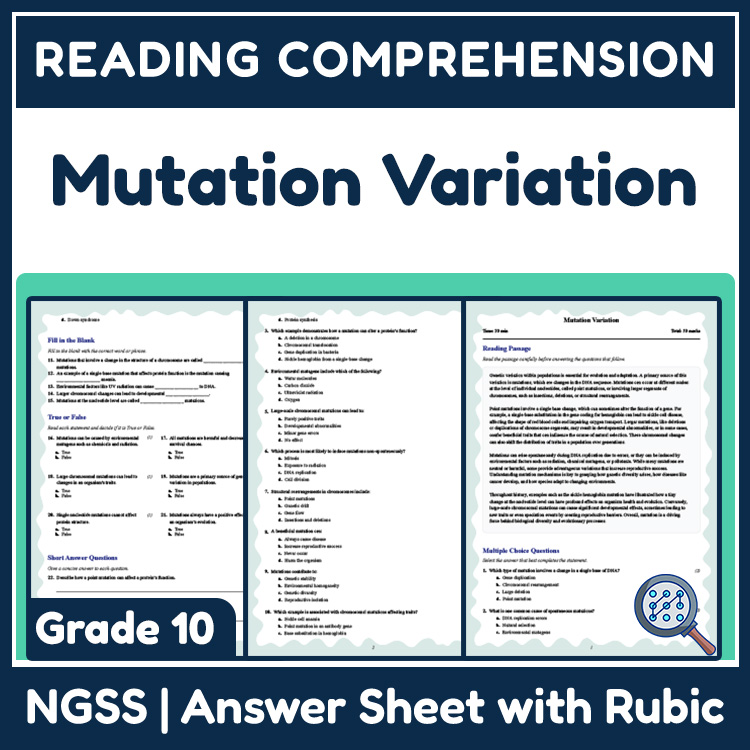
10th Grade Science | Mutation Variation Reading Worksheet (PDF & Answer Key)
JCreated byJ.S SheetsLearning Objectives
- Understand the types of genetic mutations at nucleotide and chromosomal levels.
- Identify different mechanisms that cause mutations and their effects on gene function.
- Recognize examples of mutations affecting protein structure and organism traits.
Instant download
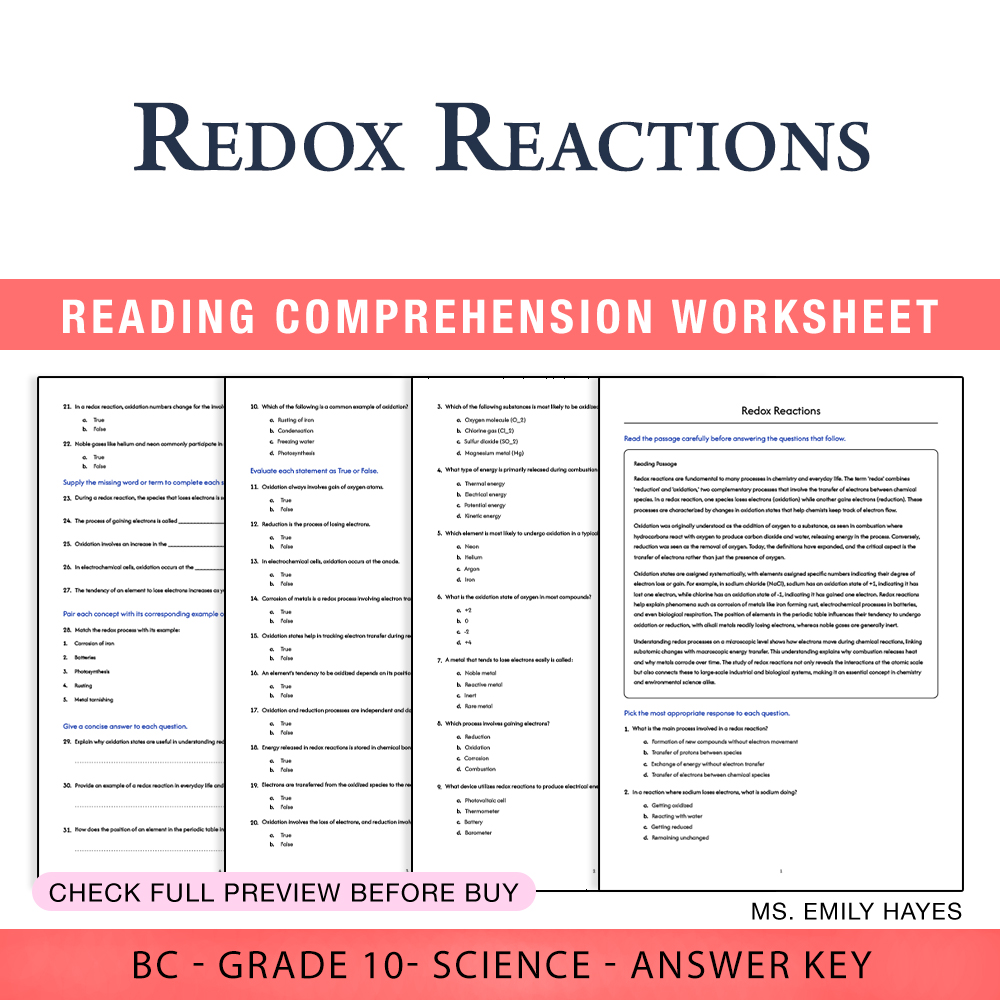
Grade 10 Science | Redox Reactions Worksheet (PDF + Answer Key)
 Created byCopper Leaf Classroom
Learning Objectives
- Understand the concept of oxidation and reduction in redox reactions.
- Identify oxidation states of elements involved in redox processes.
- Explain how electron transfer relates to chemical change and energy transfer.
Also included in: Grade 10 Science BC| Chemistry, Reactions & Atomic Structure (PDF+ Answer Keys) +1 more
Instant download

Systems Interactions Worksheet for Grade 10 Science – TEKS Practice
JCreated byJ.S SheetsLearning Objectives
- Explain how multiple organ systems coordinate to maintain homeostasis during stressors such as exercise or dehydration
- Describe how feedback pathways (neural, hormonal, and physiological) help regulate blood flow, gas exchange, and fluid balance
- Analyze emergent outcomes that result from integrated system interactions rather than from single organs alone
Instant download
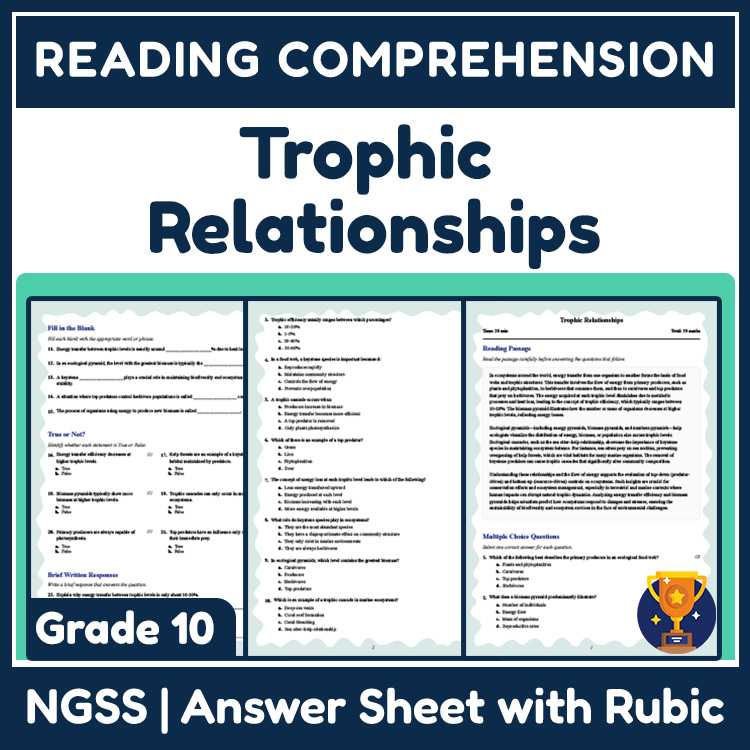
10th Grade Science | Trophic Relationships Reading Worksheet & Answer Key (PDF)
JCreated byJ.S SheetsLearning Objectives
- Understand how energy transfers through different trophic levels in ecosystems.
- Identify the components and structure of food webs and ecological pyramids.
- Explain the concept of trophic efficiency and biomass distribution.
Also included in: Grade 10 Science | Ecosystems & Biodiversity Uanit Worksheets
Instant download

Biodiversity Drivers Practice Worksheet | Grade 10 Science NGSS
Created byPrism Point LearningLearning Objectives
- Explain how habitat fragmentation, invasive species, land-use change, and climate-driven range shifts can affect species richness and composition
- Describe how genetic diversity, metapopulation structure, and connectivity influence extinction risk and recovery
- Evaluate how evidence from terrestrial and aquatic studies can link biodiversity loss to ecosystem function and long-term viability
Also included in: Grade 10 Ecosystems & Biodiversity Science Lesson Bundle Practice: NGSS
Instant download
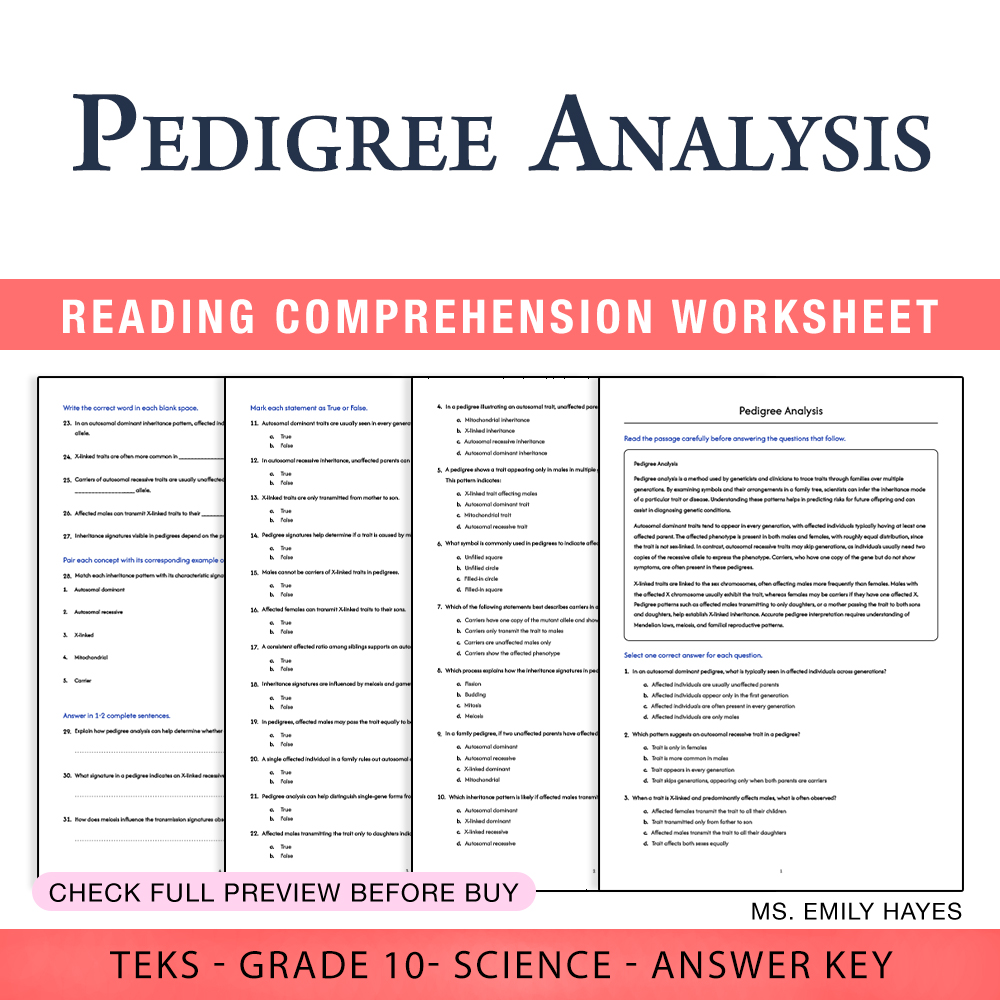
10th Grade Science | Pedigree Analysis Worksheet (PDF+ Answer Key)
Created byCopper Leaf ClassroomLearning Objectives
- Interpret family trees (pedigrees) to determine inheritance patterns.
- Differentiate between autosomal dominant, autosomal recessive, and X-linked traits using pedigree signatures.
- Predict genotype probabilities based on pedigree data.
Instant download

Grade 10 Science | Equilibrium Systems - Daily Reading Comprehension
 Created byCoral Reef Learning
Learning Objectives
- Define static equilibrium in physical systems.
- Identify conditions for static equilibrium using vector summation of forces.
- Describe how support reactions balance in equilibrium situations.
Instant download

Variation Sources Worksheet | Grade 10 Science Activities
Created byPrism Point LearningLearning Objectives
- Explain how mutations, recombination, and chromosomal rearrangements create heritable variation within populations.
- Describe how natural selection changes allele frequencies across generations when environmental conditions favor certain traits.
- Connect genetic diversity to the ability of populations to adapt to changing selective pressures.
Also included in: Grade 10 Evolution, Speciation & Biodiversity Lesson Bundle | BC Science +1 more
Instant download
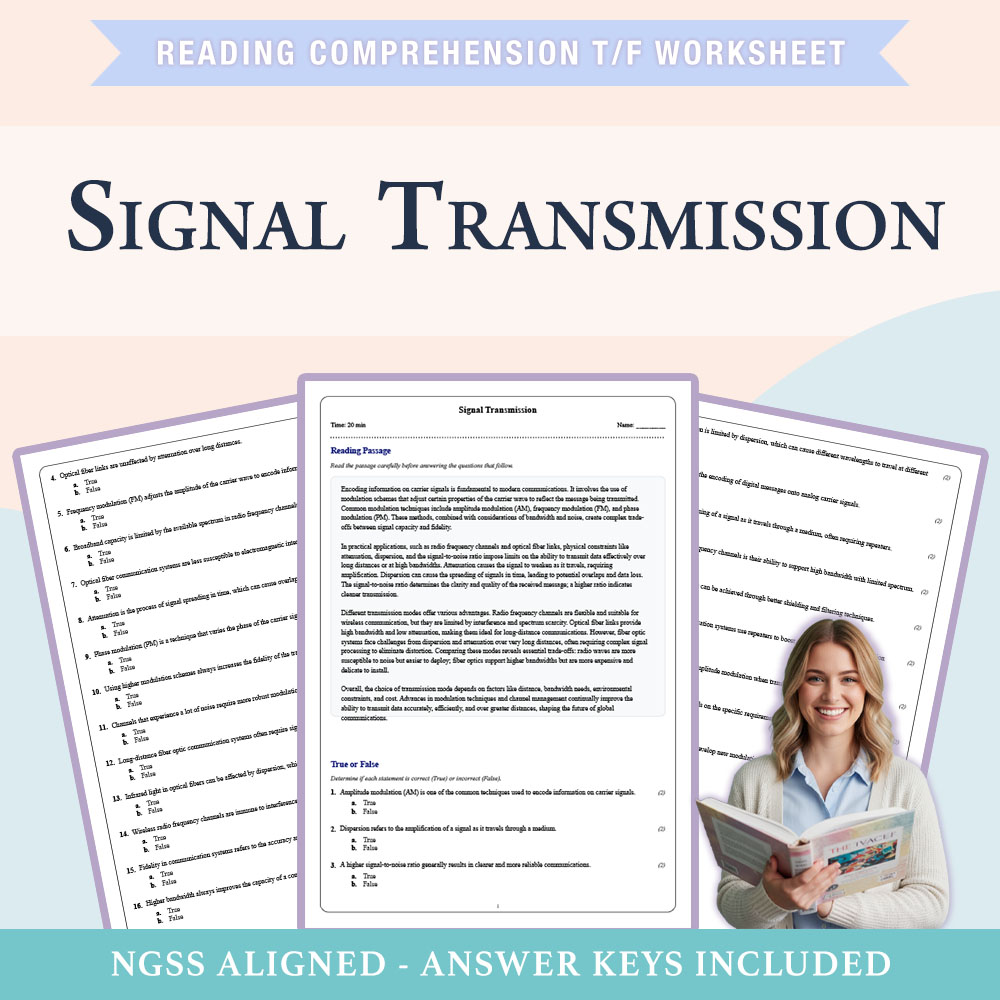
Grade 10 Science | Signal Transmission Worksheet (PDF + Answer Key)
Created byCopper Leaf ClassroomLearning Objectives
- Understand the basic principles of encoding information on carrier signals using modulation techniques.
- Identify the impact of channel constraints such as bandwidth and noise on signal transmission quality.
- Compare different transmission modes like radio frequency channels and optical fiber links, analyzing their advantages and limitations.
Also included in: Grade 10 Science | Wave Properties & Electromagnetic Behavior (PDF +Answer Key) +1 more
Instant download
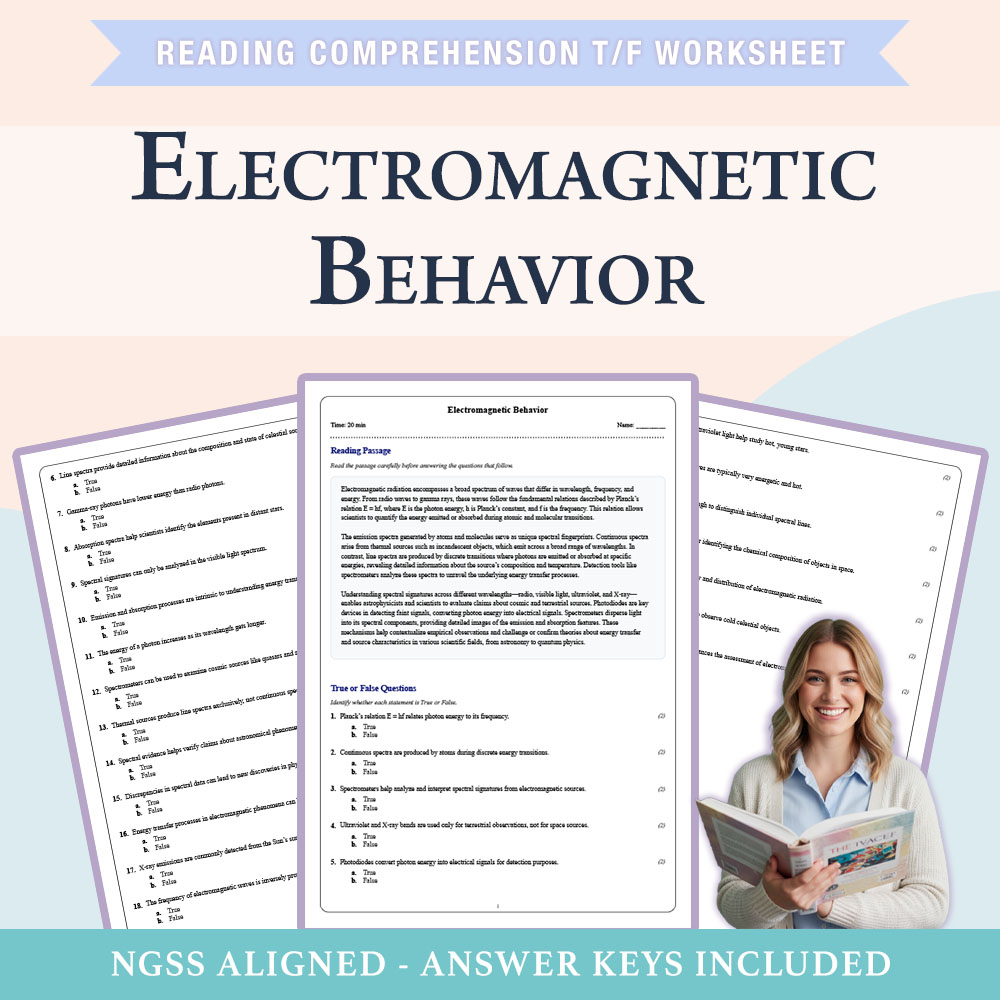
Grade 10 Science | Electromagnetic Behavior Worksheet (PDF + Answer Key)
Created byCopper Leaf ClassroomLearning Objectives
- Understand the properties of electromagnetic emission and absorption.
- Interpret spectral signatures and photon energy relations in electromagnetic sources.
- Evaluate observational claims across different electromagnetic bands using spectral evidence.
Also included in: Grade 10 Science | Wave Properties & Electromagnetic Behavior (PDF +Answer Key) +1 more
Instant download
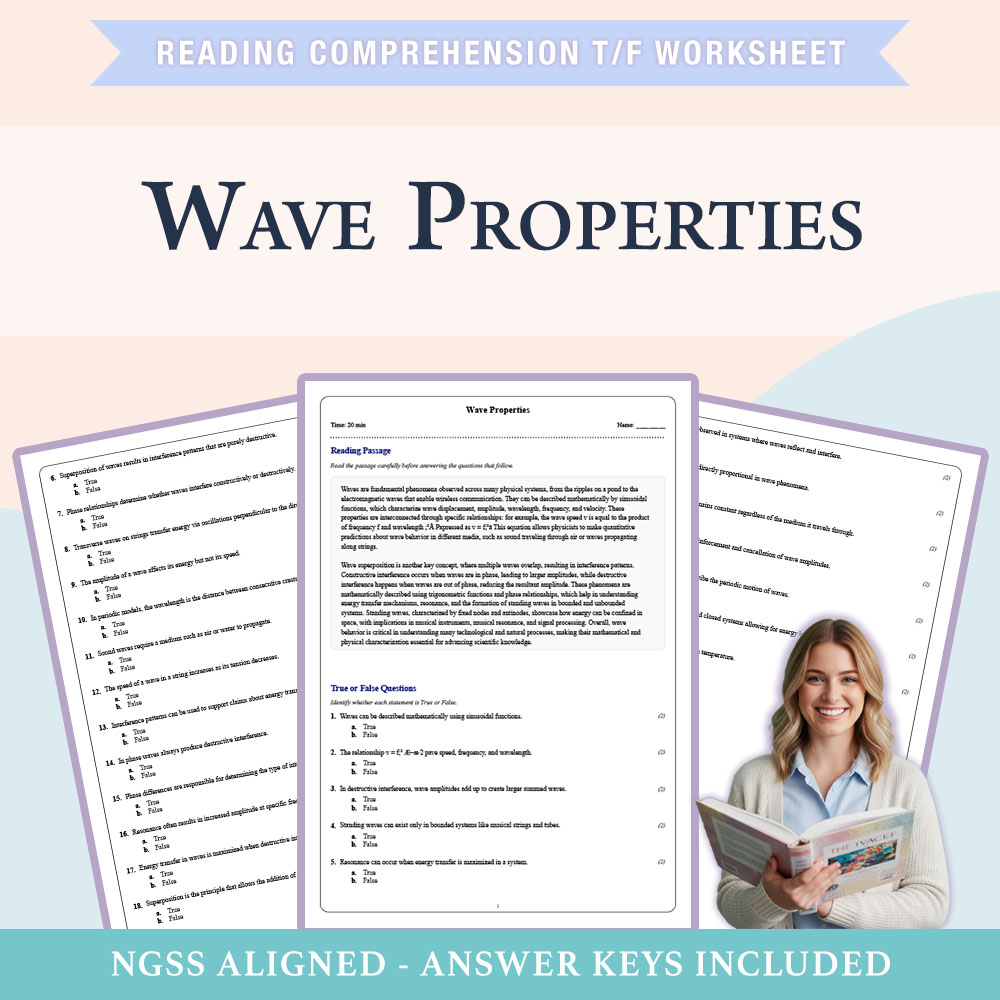
Grade 10 Science | Wave Properties Worksheet (PDF + Answer Key)
Created byCopper Leaf ClassroomLearning Objectives
- Understand the mathematical relationships governing wave properties such as amplitude, wavelength, frequency, and speed.
- Interpret sinusoidal and periodic models of wave behavior including superposition and interference patterns.
- Explain how phase relationships and trigonometric functions support energy transfer and resonance in various systems.
Also included in: Grade 10 Science | Wave Properties & Electromagnetic Behavior (PDF +Answer Key) +1 more
Instant download
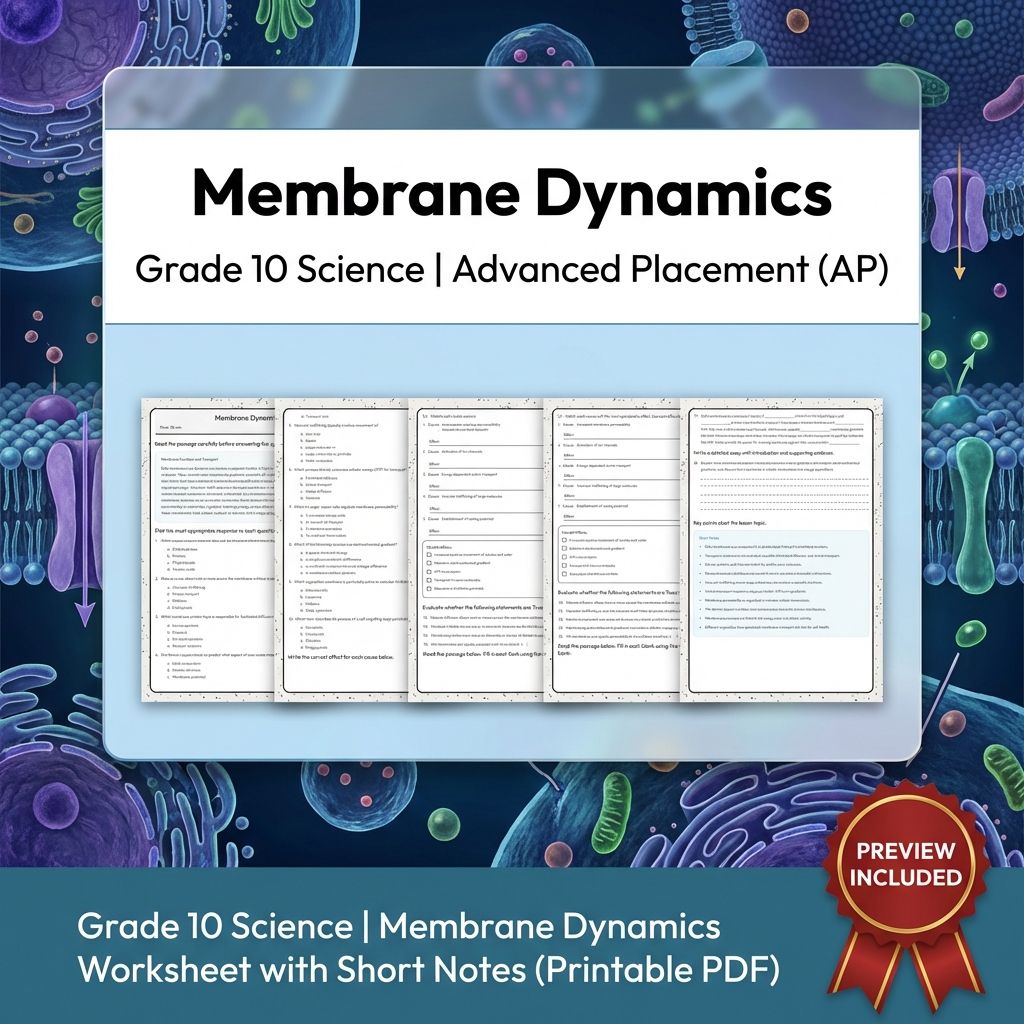
Grade 10 Science | Membrane Dynamics Worksheet with Short Notes (Printable PDF)
 Created byMeadowlark Worksheets
Learning Objectives
- Understand the composition of cellular membranes and their role in transport mechanisms.
- Describe different transport processes such as diffusion, carrier-mediated transport, and vesicular trafficking.
- Explain how membrane potentials and electrochemical gradients are established and maintained.
Instant download
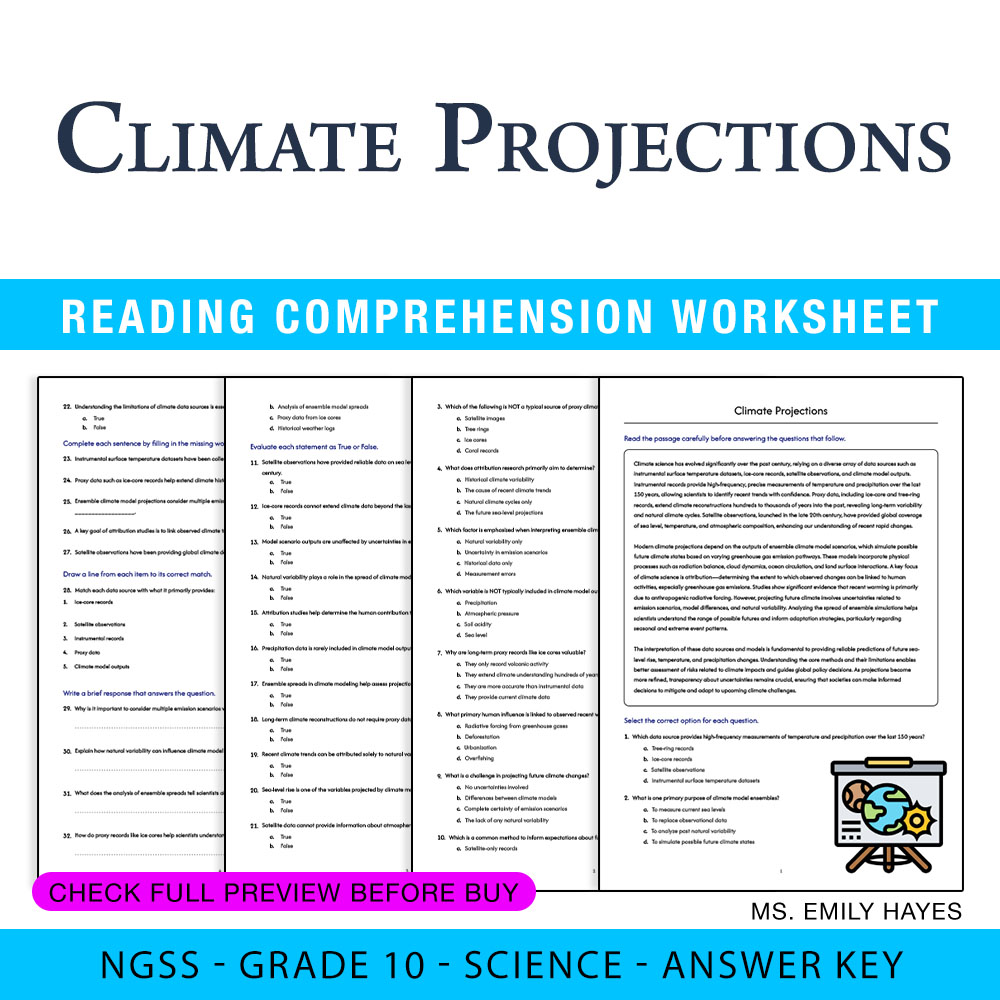
10th Grade Science | Climate Projections Worksheet (PDF+ Answer Key)
Created byCopper Leaf ClassroomLearning Objectives
- Understand the sources of climate data including instrumental records and proxy data.
- Analyze model outputs to interpret trends in global and regional climate variables.
- Assess the uncertainties involved in climate projections and their implications for future climate patterns.
Instant download

Grade 10 Science | Multiple Evidence Worksheet | Standard Practice
 Created byLumora Learning
Learning Objectives
- Explain how multiple lines of evidence (fossils, anatomy/development, molecular sequences, and biogeography) can support evolutionary claims about biological change over time
- Evaluate whether a specific claim is better supported by one type of evidence or by the convergence of several evidence types
- Use evidence reasoning to connect patterns in organisms to historical explanations
Instant download

Grade 10 Science | Work Concepts in Physics - Daily Reading Comprehension
Created byCoral Reef LearningLearning Objectives
- Understand the definition of work as the product of force and displacement
- Recognize the scalar nature of work
- Relate work to changes in kinetic energy
Also included in: Physics Principles Reading Lesson Bundle Grade 10 Science Advanced placement +1 more
Instant download

Cell Biochemistry Worksheet for Grade 10 Biology Science Activities
Created byPrism Point LearningLearning Objectives
- Explain how cell membranes regulate exchange of materials and support homeostasis.
- Describe how organelles and enzymes enable specialized biochemical functions in cells.
- Connect enzyme-catalyzed reactions and ATP energy use to cellular growth, repair, and reproduction.
Instant download
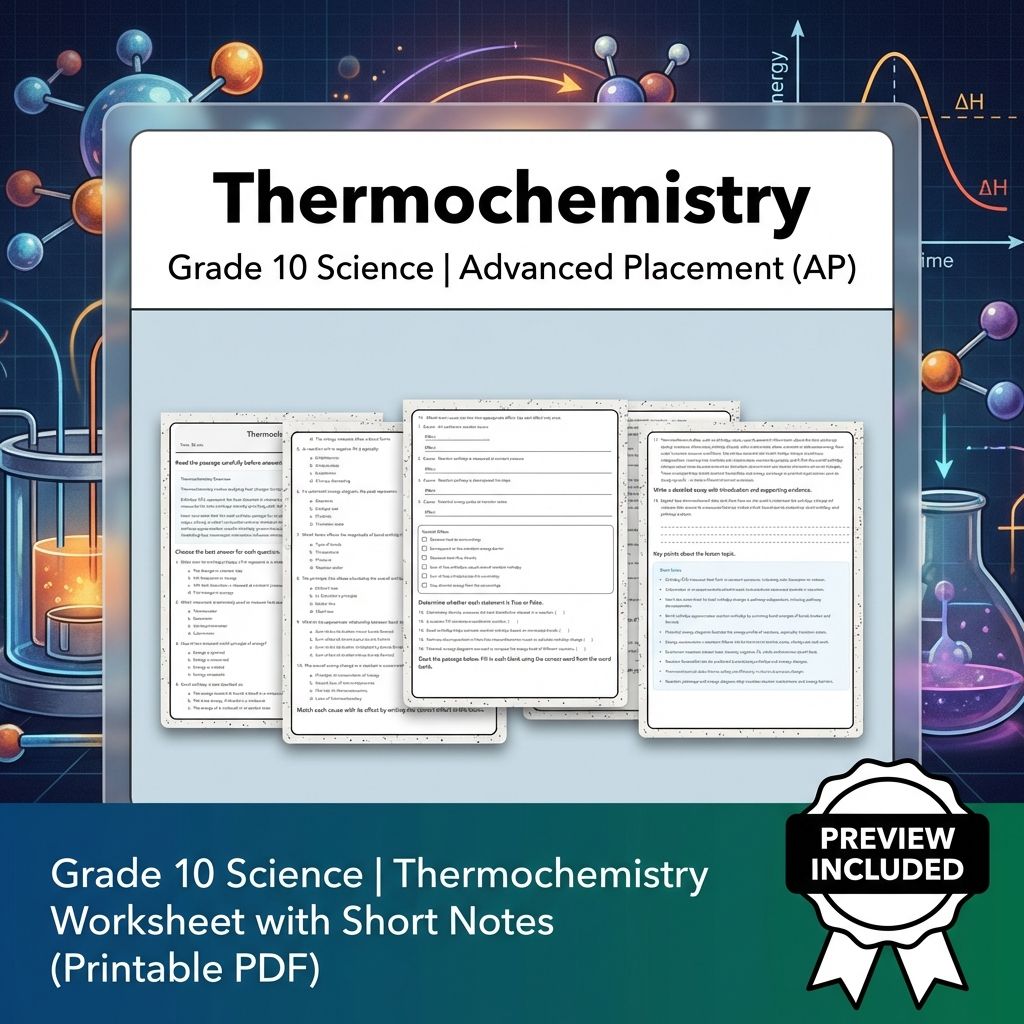
Grade 10 Science | Thermochemistry Worksheet with Short Notes (Printable PDF)
Created byMeadowlark WorksheetsLearning Objectives
- Explain how enthalpy changes relate to reaction stoichiometry and energy flow.
- Describe calorimetric methods used to measure heat transfer in reactions.
- Apply Hess's law to determine reaction enthalpy pathways.
Also included in: Grade 10 Science | Comprehensive Unit Bundle on Atomic Structure
Instant download

Grade 10 Galactic Structure Worksheet | NGSS Practice PDF
 Created byClear Sky Classroom
Learning Objectives
- Explain how galaxy structure (such as barred spirals and spiral arms) relates to gravity and large-scale organization.
- Interpret redshift and spectral line shifts as evidence for galaxy motion and (for distant galaxies) expanding space.
- Use brightness, distance, and intrinsic luminosity to reason about why galaxies appear different across ranges.
Instant download
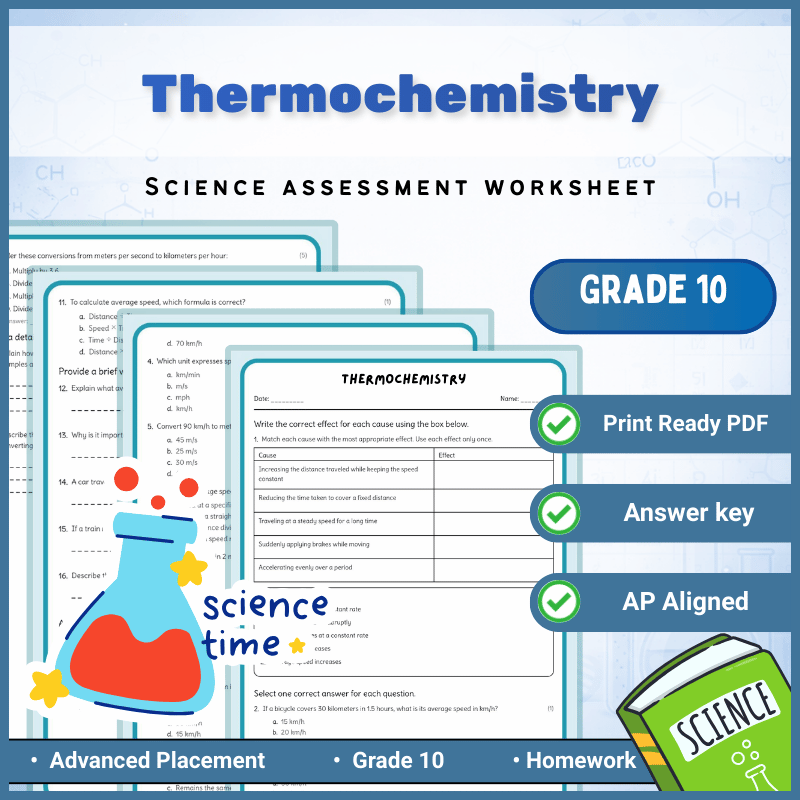
Grade 10 Science | Thermochemistry Worksheet + Answer Key (AP Standard, PDF)
 Created byBright Mind Resources
Learning Objectives
- Understand how enthalpy changes relate to reaction stoichiometry and calorimetry.
- Apply Hess's law to determine reaction enthalpies through pathway decomposition.
- Estimate bond enthalpies and interpret potential energy diagrams for reaction energetics.
Instant download
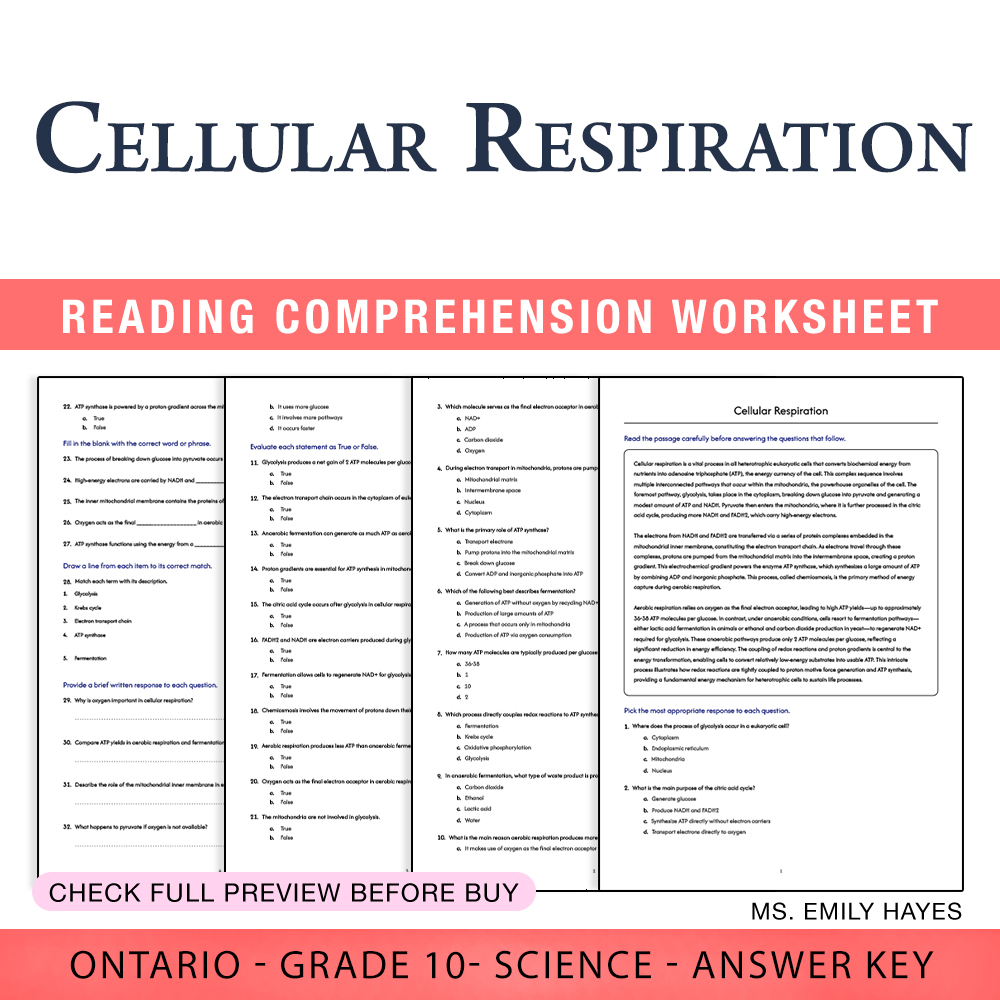
Grade 10 Science | Cellular Respiration Worksheet (PDF + Answer Key)
Created byCopper Leaf ClassroomLearning Objectives
- Describe the sequential pathways of cellular respiration: glycolysis, citric acid cycle, and electron transport chain
- Explain the role of mitochondria in eukaryotic energy production
- Contrast aerobic ATP yield versus anaerobic fermentation outcomes
Instant download
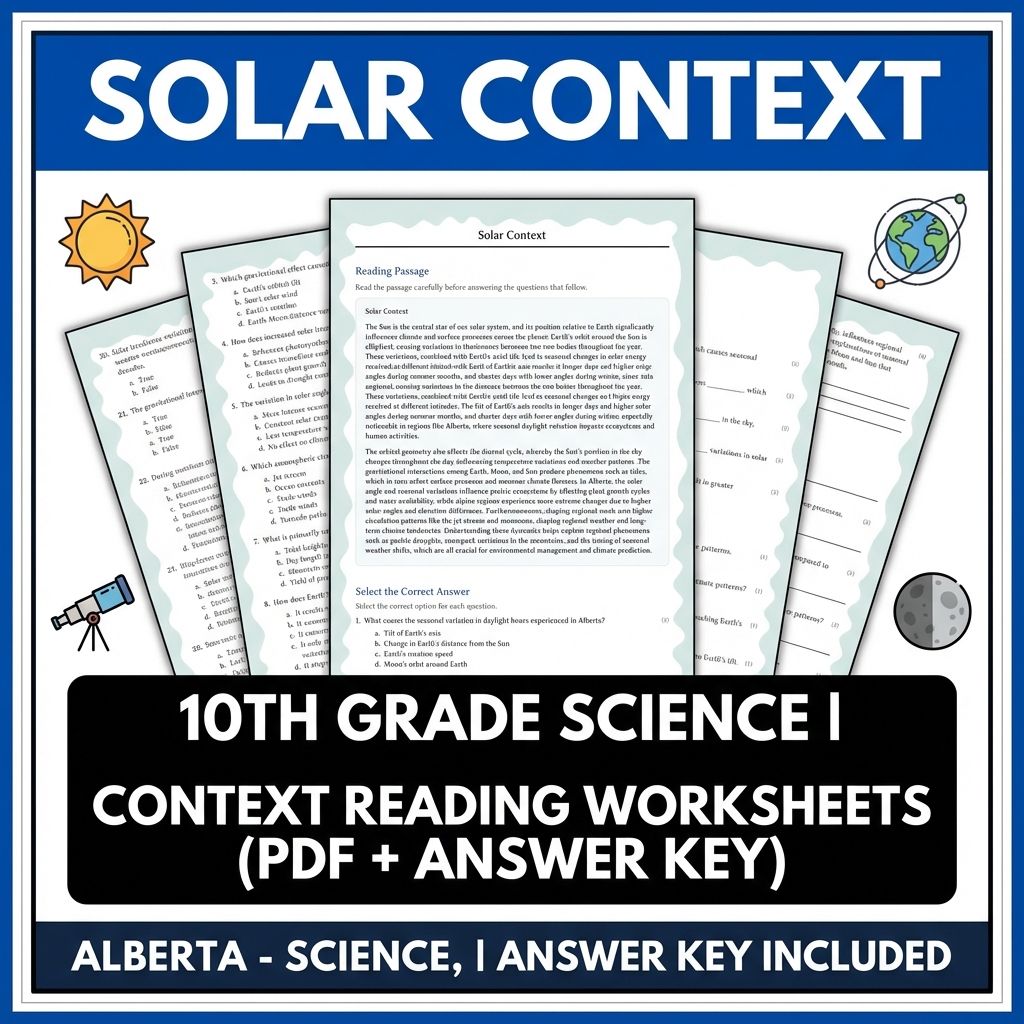
10th Grade Science | Solar Context Reading Worksheets (PDF + Answer Key)
JCreated byJ.S SheetsLearning Objectives
- Understand the relationship between Earth's rotation, orbit, and seasonal daylight variation.
- Describe how solar irradiance affects climate and surface processes on Earth.
- Explain gravitational interactions among Earth, Moon, and Sun and their effects on regional phenomena.
Also included in: Grade 10 Science Unit Bundle – Earth Systems, Climate & Remote Sensing Worksheets +1 more
Instant download
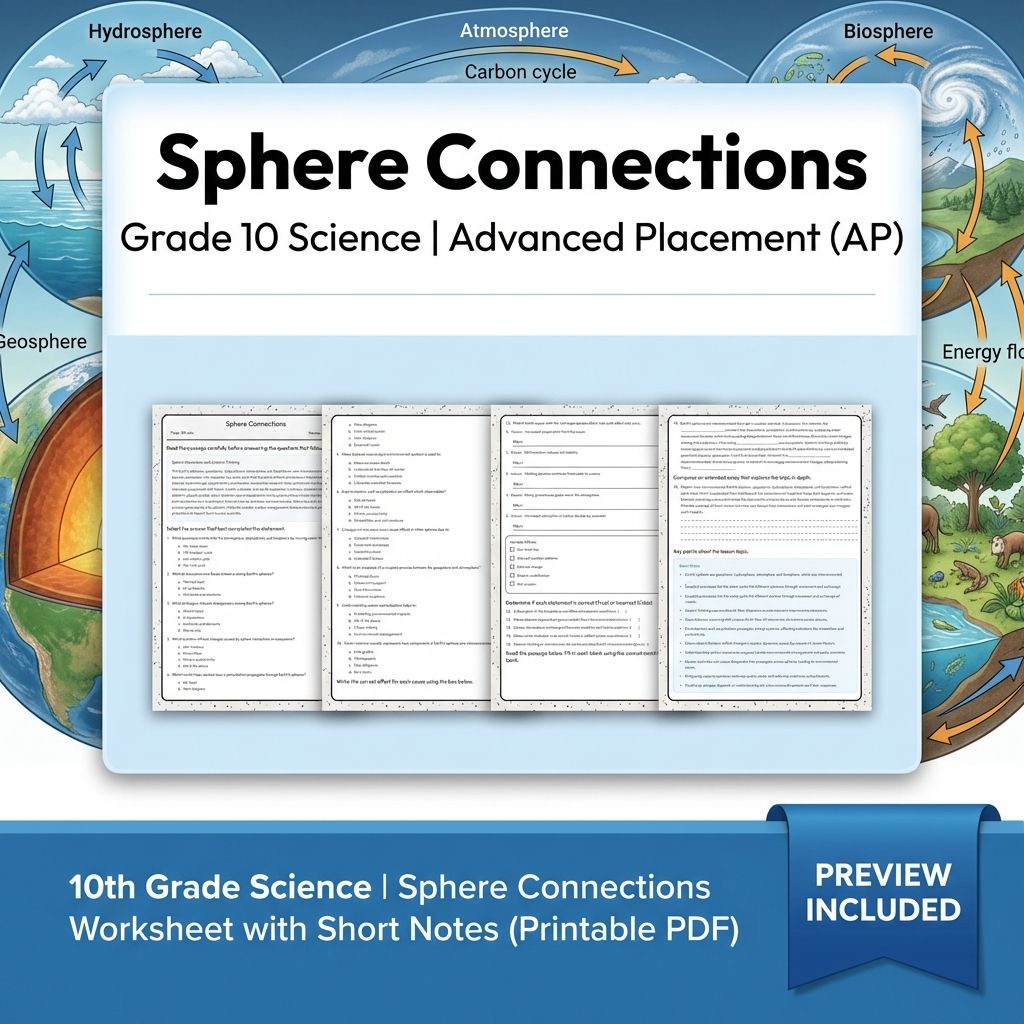
10th Grade Science | Sphere Connections Worksheet with Short Notes (PDF)
Created byMeadowlark WorksheetsLearning Objectives
- Explain how the four spheres—geosphere, hydrosphere, atmosphere, and biosphere—interact through coupled processes.
- Use flow diagrams and mass-balance reasoning to understand system perturbations and their propagation.
- Identify observable indicators such as streamflow, soil moisture, and primary productivity that reflect sphere interactions.
Instant download
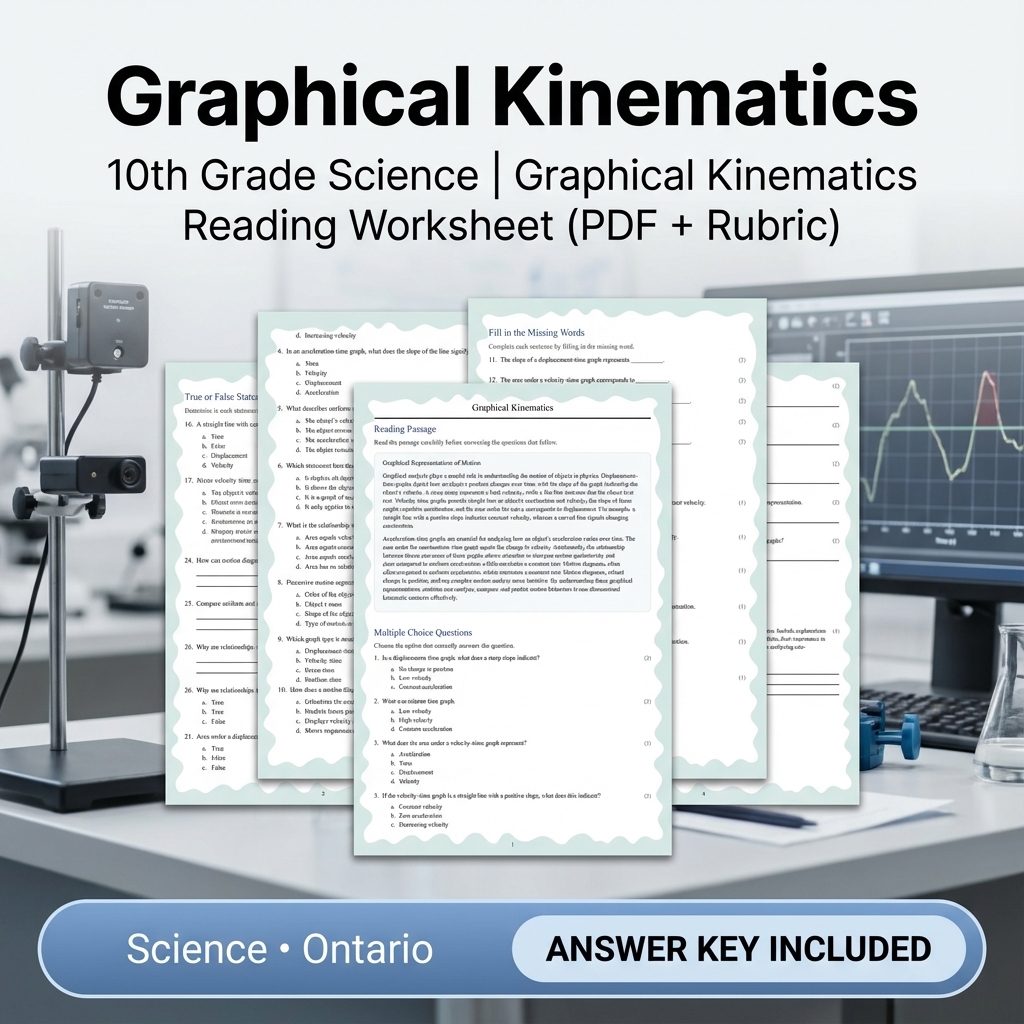
10th Grade Science | Graphical Kinematics Reading Worksheet (PDF + Rubric)
JCreated byJ.S SheetsLearning Objectives
- Understand the interpretation of displacement–time, velocity–time, and acceleration–time graphs.
- Explain the relationships between graph slope, area, and kinematic quantities.
- Compare different types of motion, including piecewise and uniformly accelerating motion.
Also included in: Grade 10 Science Unit Bundle – Motion, Forces & Mechanics (Answer Keys Included) +1 more
Instant download

Grade 10 Science | Causal Relationships in Ecosystems - Reading Comprehension
Created byCoral Reef LearningLearning Objectives
- Identify and distinguish between different causal factors influencing ecosystems.
- Learn to interpret simple control matrices for causal analysis.
- Develop initial skills in visualizing causal relationships through graphs.
Also included in: Science Practices Reading Comprehension Lesson Bundle: Grade 10 Science AP +1 more
Instant download
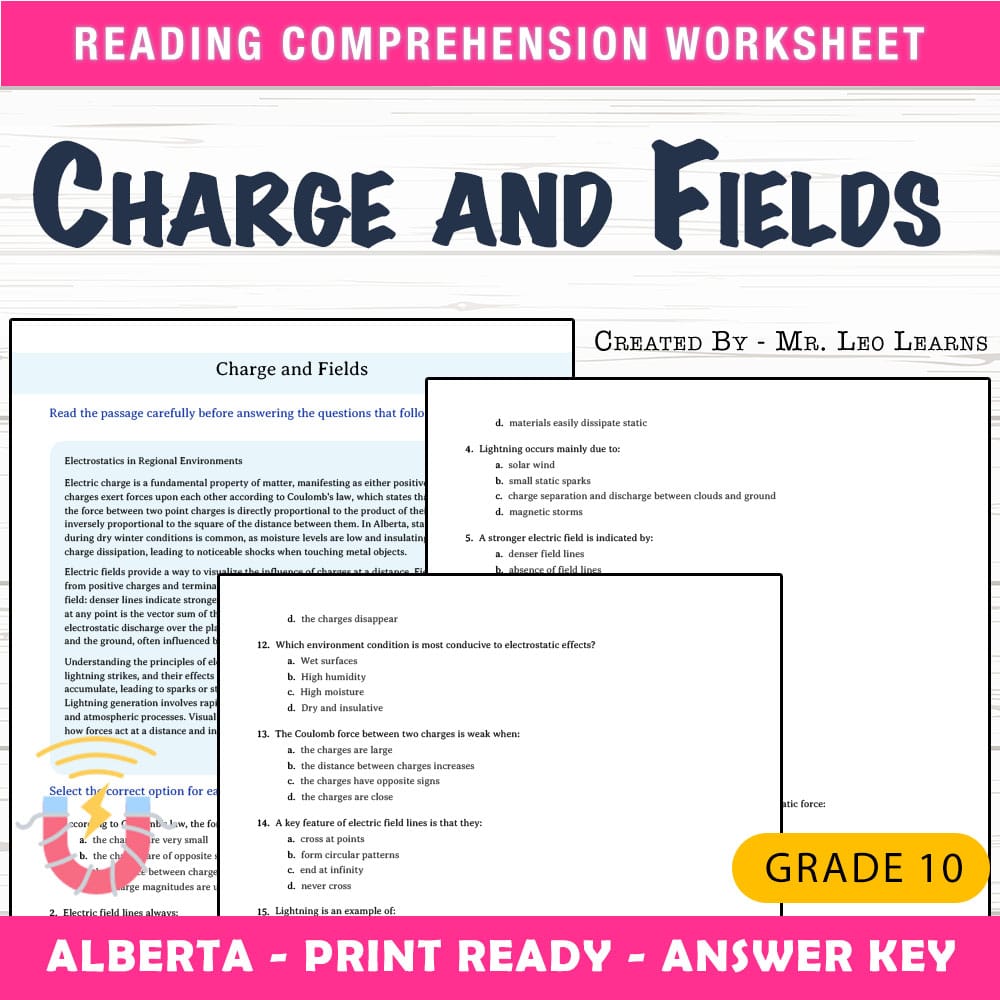
Grade 10 Science — Charge and Fields Worksheet MCQ Paper for Mastery
 Created byThe Resource Hub
Learning Objectives
- Understand the concept of electric charge and charge sign.
- Calculate electrostatic forces between point charges using Coulomb's law.
- Visualize electric field lines and apply superposition principles.
Also included in: Grade 10 Science | Energy, Motion & Electricity Worksheet Bundle | Alberta +1 more
Instant download
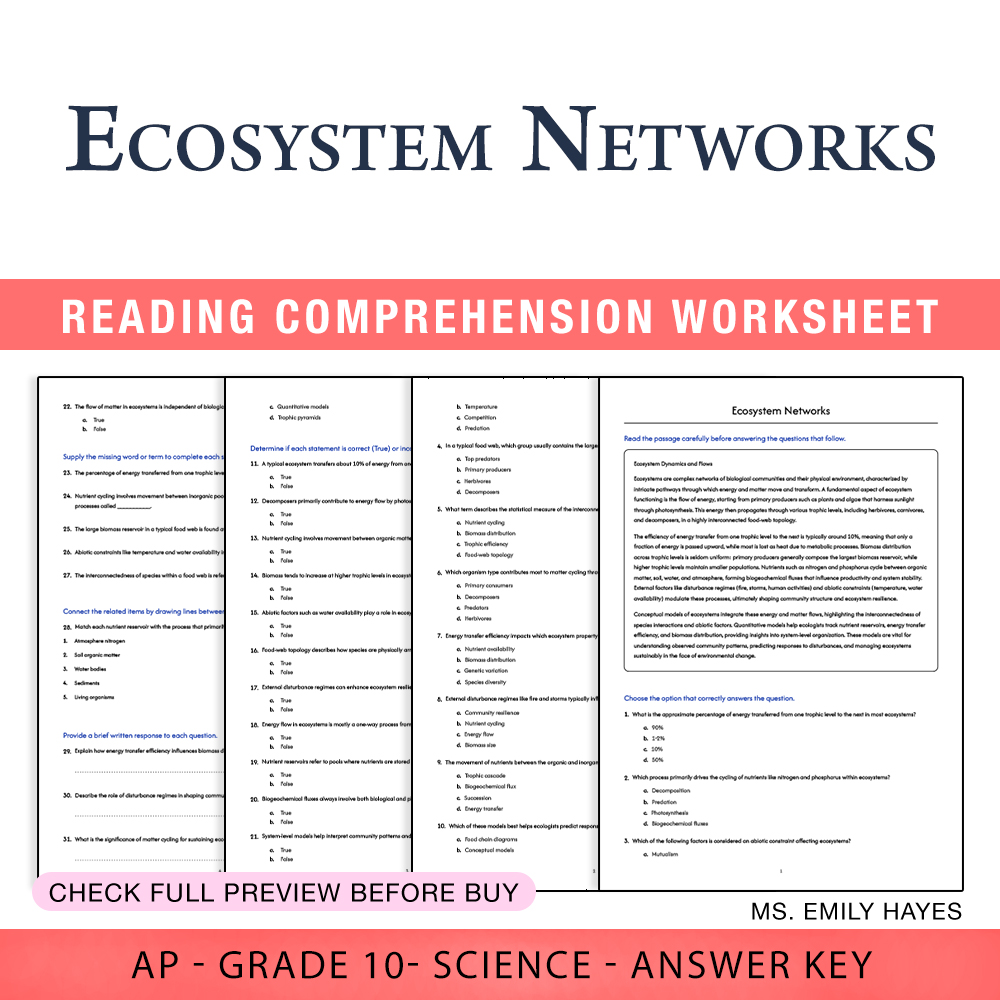
10th Grade Science | Ecosystem Networks Worksheet (PDF+ Answer Key)
Created byCopper Leaf ClassroomLearning Objectives
- Describe energy flow and matter cycling within ecosystems using trophic structures and food-web topology.
- Quantify energy transfer efficiency, biomass distribution, and nutrient reservoirs in ecosystems.
- Explain how species interactions, disturbance regimes, and abiotic factors influence ecosystem stability and properties.
Also included in: Grade 10 Science | Key Concepts in Biology & Ecosystems (PDF+ Answer Key) +1 more
Instant download

10th Grade Science | Surface Processes Worksheet (PDF+ Answer Key)
Created byCopper Leaf ClassroomLearning Objectives
- Describe the fundamental concepts of weathering, erosion, sediment transport, and deposition shaping landscapes.
- Interpret surface change patterns using graphical representations of fluvial incision, mass wasting, and sediment budgets.
- Relate surface process outcomes to climate, lithology, and human activity and recognize observable signatures such as sediment grain sizes and channel profiles.
Also included in: Grade 10 Science AP – Surface Processes & Earth Systems (PDF + Answer Key) +1 more
Instant download

Homeostatic Balance Worksheet | Science Assessment | Alberta Grade 10
JCreated byJ.S SheetsLearning Objectives
- Understand the mechanisms that maintain internal stability in mammals and freshwater fishes.
- Identify key components of homeostasis such as sensors, effectors, and set points.
- Explain the physiological trade-offs involved in maintaining homeostasis in fluctuating environments.
Also included in: Grade 10 Cell Systems & Homeostasis Science Lesson Bundle | Alberta +1 more
Instant download

Metabolic Control Worksheet for Grade 10 Science | Standards-Aligned Practice
JCreated byJ.S SheetsLearning Objectives
- Understand how enzyme kinetics regulate cellular metabolism.
- Explain feedback inhibition and its role in metabolic pathways.
- Describe how compartmentalization affects enzyme activity and resource allocation.
Also included in: Grade 10 Cell Systems & Homeostasis Science Lesson Bundle | Alberta +1 more
Instant download

Spheres Overview Worksheet | Standards-Aligned Science Practice Grade 10
JCreated byJ.S SheetsLearning Objectives
- Identify the four main Earth spheres and their basic properties.
- Understand how matter and energy move among the spheres using regional Alberta examples.
- Explain the interconnections between physical structures, water, air, and living organisms in shaping regional patterns.
Also included in: Grade 10 Earth Systems & Climate Science Lesson Bundle – Alberta Framework +1 more
Instant download

Pattern Analysis Worksheet | Alberta Standards Grade 10 Science Practice
JCreated byJ.S SheetsLearning Objectives
- Understand methods for identifying temporal and spatial patterns in Earth and space phenomena.
- Interpret regional climate records, river discharge measurements, and meteorological series.
- Recognize the influence of data quality, sampling frequency, and statistical summaries on pattern detection.
Also included in: Grade 10 Earth Systems & Climate Science Lesson Bundle – Alberta Framework +1 more
Instant download

Integrated Systems Worksheet | Alberta Standards Grade 10 Science Practice PDF
JCreated byJ.S SheetsLearning Objectives
- Understand how energy, motion, and electrical concepts are interconnected in system-level processes.
- Trace energy transformations and account for losses in mechanical and electrical systems.
- Apply conservation principles to evaluate the performance of integrated energy systems.
Also included in: Grade 10 Science Practice Worksheets: Alberta Science Full-Year Bundle
Instant download

Orbital Forcing Worksheet | Grade 10 Science | Alberta Standards
JCreated byJ.S SheetsLearning Objectives
- Understand how Earth's orbital parameters influence climate cycles.
- Describe the effects of orbital variations on insolation and glacial rhythms.
- Distinguish between orbital drivers and short-term climate influences.
Also included in: Grade 10 Earth Systems & Climate Science Lesson Bundle – Alberta Framework +1 more
Instant download
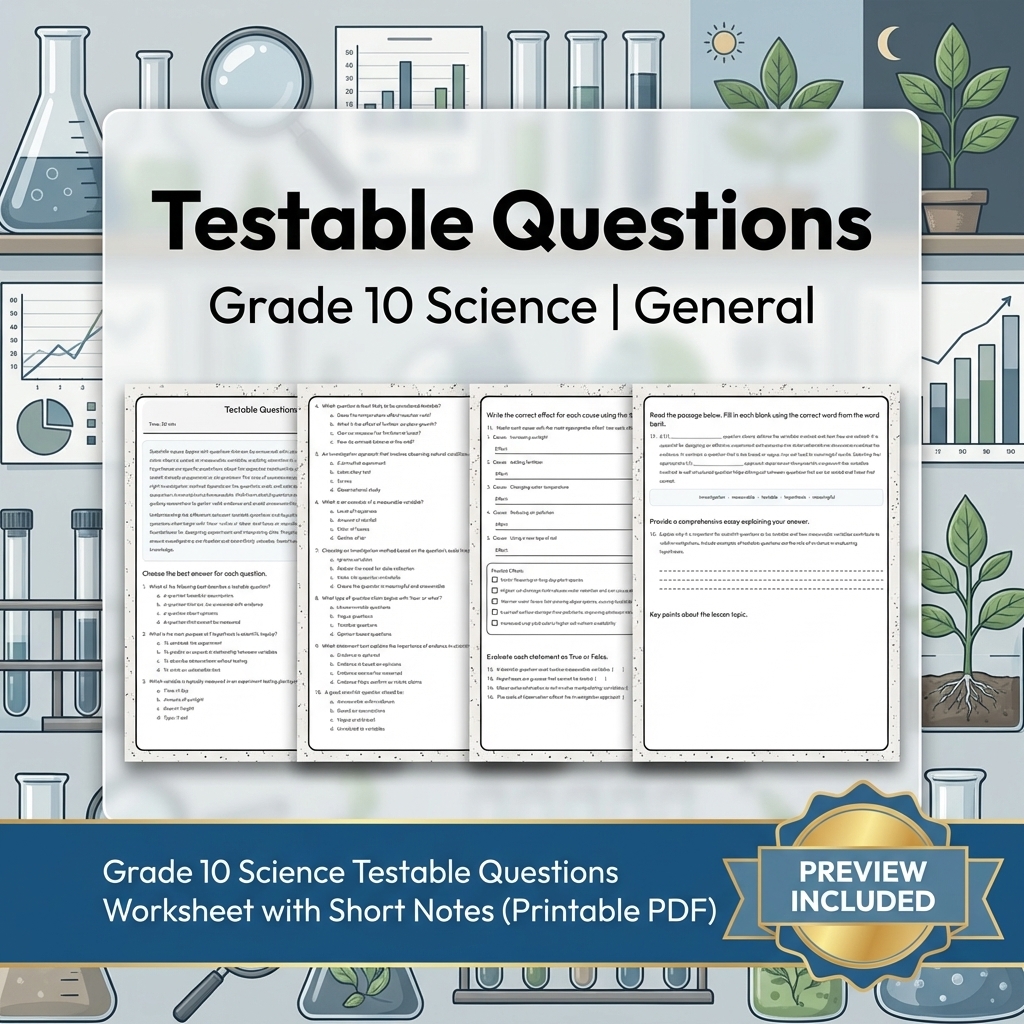
Grade 10 Science Testable Questions Worksheet with Short Notes (Printable PDF)
Created byMeadowlark WorksheetsLearning Objectives
- Understand the difference between testable questions and hypotheses.
- Identify measurable variables in scientific inquiries.
- Recognize appropriate investigation approaches for different types of questions.
Also included in: Grade 10 Measurement Uncertainty Science Lesson Bundle: General +1 more
Instant download
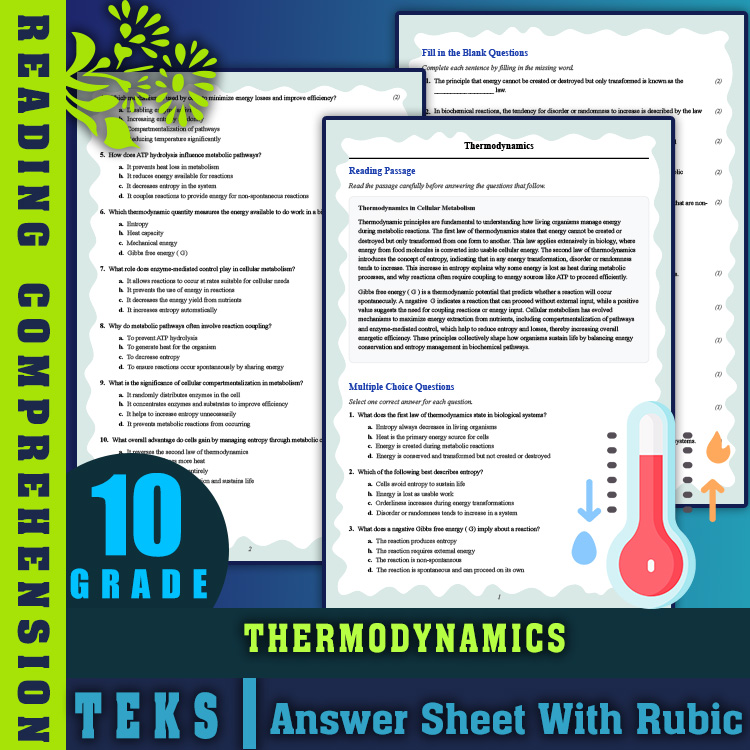
Grade 10 Science | Thermodynamics Reading Worksheet & Answer Key (PDF)
JCreated byJ.S SheetsLearning Objectives
- Understand the first and second laws of thermodynamics in the context of cellular metabolism.
- Explain how Gibbs free energy determines the spontaneity of biochemical reactions.
- Describe mechanisms cells use to optimize energy efficiency, including compartmentalization and enzyme control.
Instant download
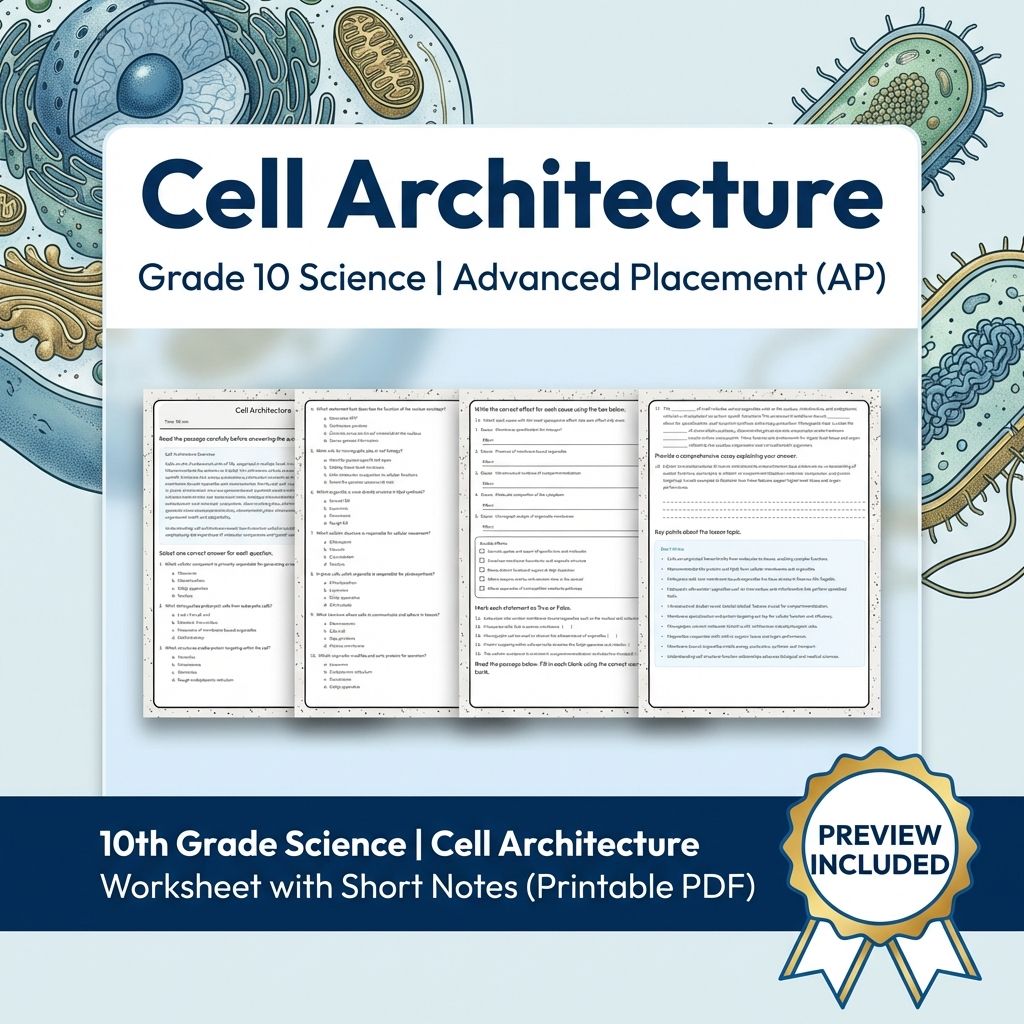
10th Grade Science | Cell Architecture Worksheet with Short Notes (PDF)
Created byMeadowlark WorksheetsLearning Objectives
- Understand the hierarchical organization of biological structures from macromolecules to tissues.
- Compare the components and functions of prokaryotic and eukaryotic cells.
- Relate ultrastructural features of organelles to their physiological roles such as compartmentalization and protein targeting.
Instant download
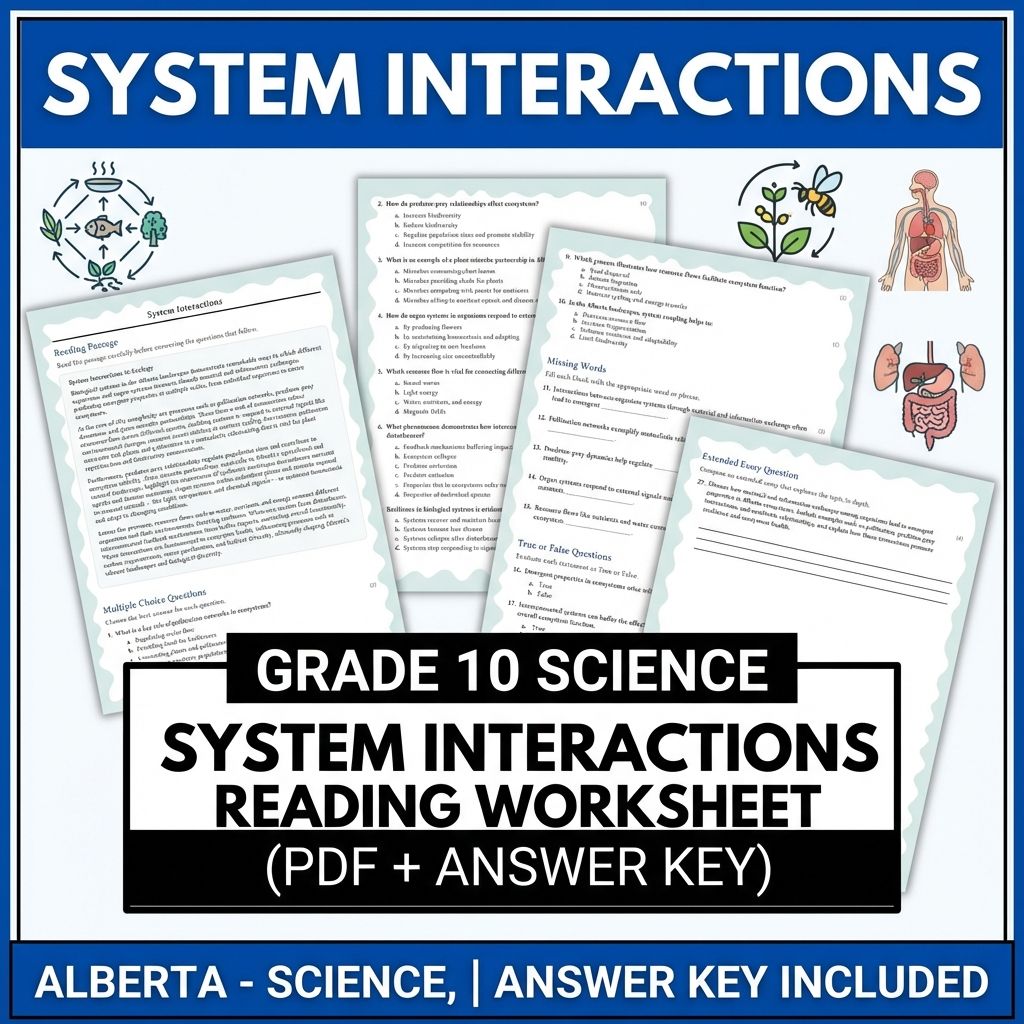
Grade 10 Science | System Interactions Reading Worksheet (PDF + Answer Key)
JCreated byJ.S SheetsLearning Objectives
- Understand how biological systems exchange materials and information.
- Identify examples of system coupling in ecological contexts.
- Explain how organ systems respond to external signals and resource flows.
Also included in: Grade 10 Science | Cell Systems, Energy, & Homeostasis (Standards-Aligned) +1 more
Instant download

Resource Tradeoffs Practice Worksheet | Grade 10 Science NGSS Review
Created byPrism Point LearningLearning Objectives
- Compare energy and mineral resource options using criteria such as cost, environmental impacts, and long-term availability.
- Explain how resource depletion, ecosystem disturbance, and greenhouse gas emissions affect sustainability decisions.
- Use lifecycle emissions reasoning to evaluate trade-offs among fossil fuels, solar, wind, and mining practices.
Instant download
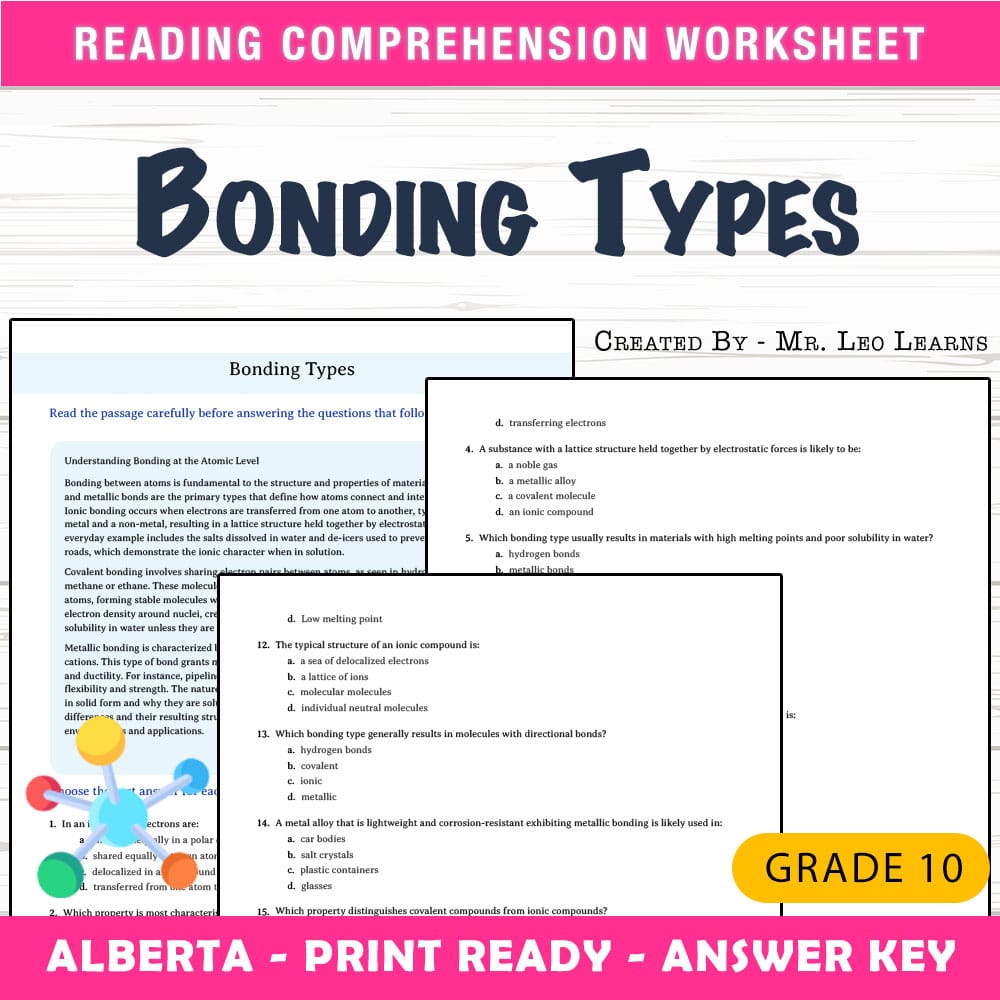
Grade 10 Science — Worksheet MCQ Paper for Mastering Bonding Types
Created byThe Resource HubLearning Objectives
- Understand the different types of chemical bonding: ionic, covalent, and metallic.
- Relate bonding types to macroscopic properties like conductivity, melting point, and solubility.
- Identify lattice structures and electron sharing mechanisms for different bond types.
Also included in: Grade 10 Science Lesson Bundle | Matter and Chemical Change Worksheets +1 more
Instant download
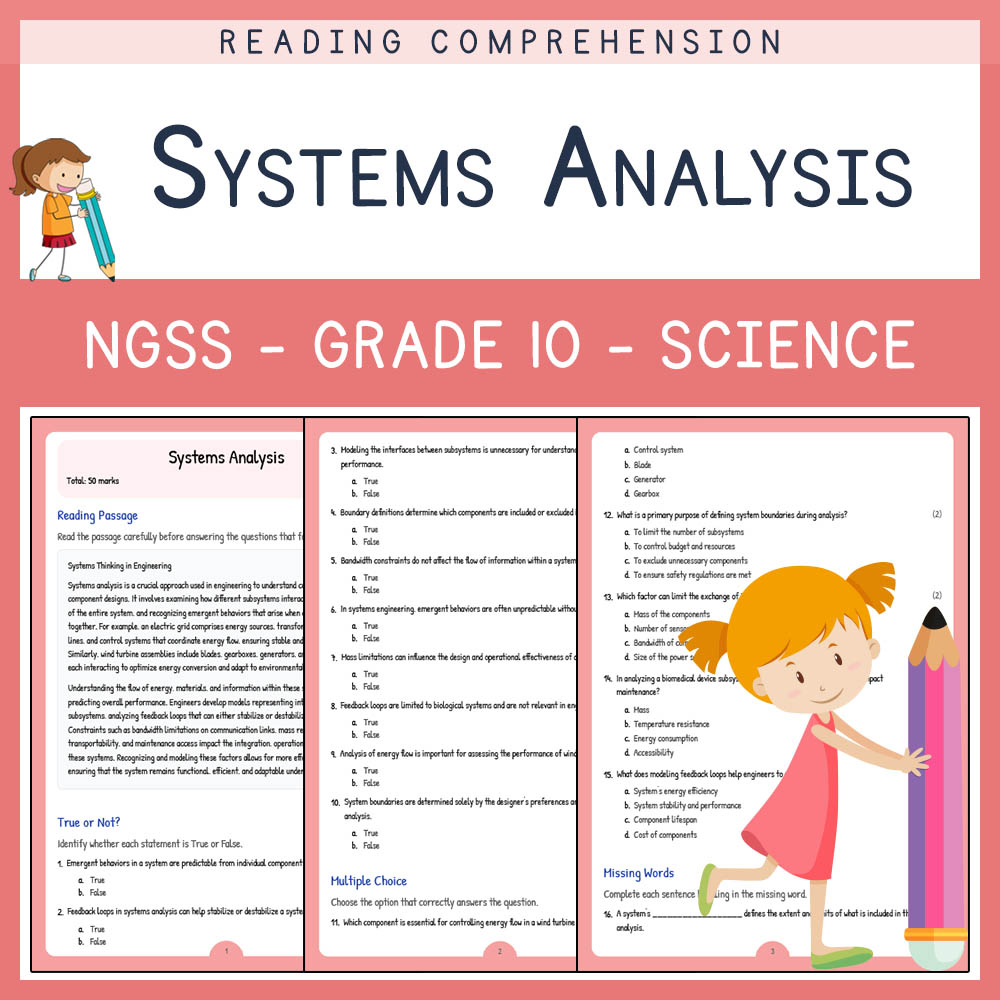
Grade 10 Science | Systems Analysis Worksheet & Answer Key – NGSS Aligned
Created byLumora LearningLearning Objectives
- Understand the concept of systems thinking in engineering contexts.
- Identify interactions, boundaries, and emergent behaviors in complex systems.
- Apply modeling tools to analyze subsystem interactions and feedback loops.
Instant download
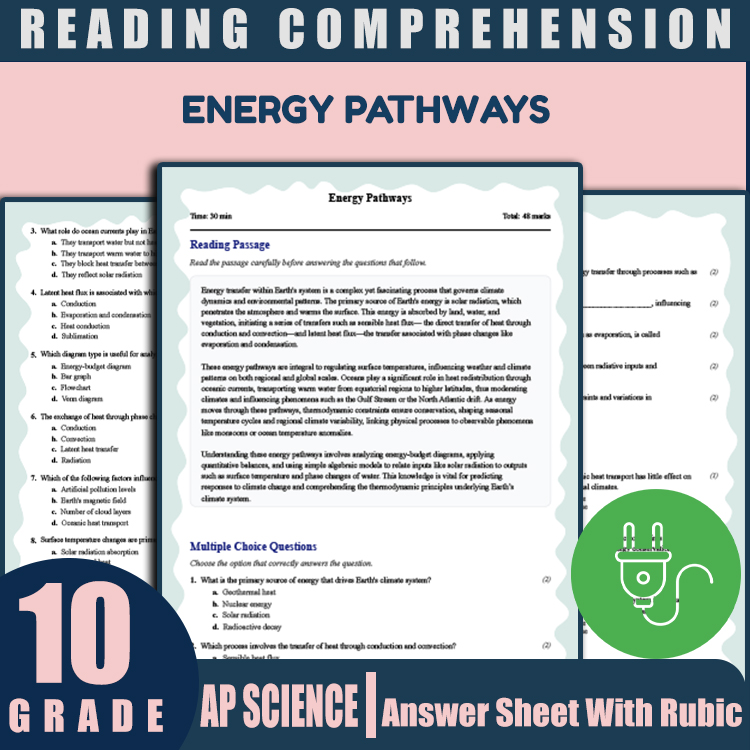
10th Grade Science | Energy Pathways Reading Worksheets (PDF + Rubric)
JCreated byJ.S SheetsLearning Objectives
- Describe how solar radiation is absorbed and transferred within Earth's systems.
- Identify different energy fluxes such as sensible and latent heat fluxes.
- Explain oceanic heat transport and its effect on regional climates.
Also included in: Grade 10 Science Unit | Earth Processes & Climate Worksheets (PDF + Answer Key) +1 more
Instant download

Grade 10 Science | Newtonian Forces - Daily Reading Comprehension
Created byCoral Reef LearningLearning Objectives
- Understand the concept of force and how it influences motion.
- Identify different types of forces in everyday situations.
- Explain how net force affects the acceleration of an object.
Instant download
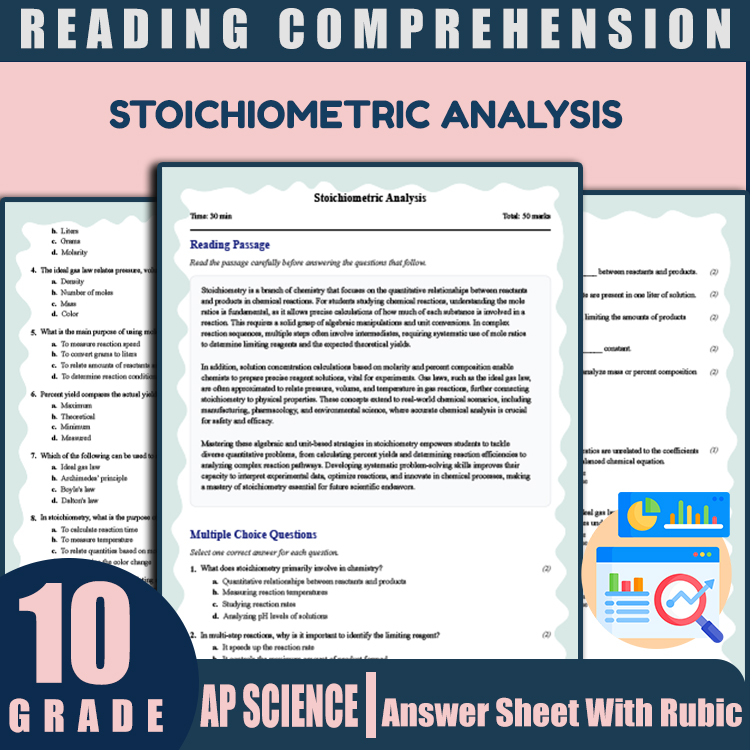
10th Grade Science | Stoichiometric Analysis Reading Worksheet (PDF + Rubric)
JCreated byJ.S SheetsLearning Objectives
- Understand and interpret chemical equations in stoichiometry.
- Apply algebraic methods to solve multi-step chemical calculations.
- Convert solution concentrations and relate measured quantities to theoretical yields.
Also included in: Grade 10 Science Unit Worksheet Bundle | Chemical Reactions & Atomic Structure +1 more
Instant download
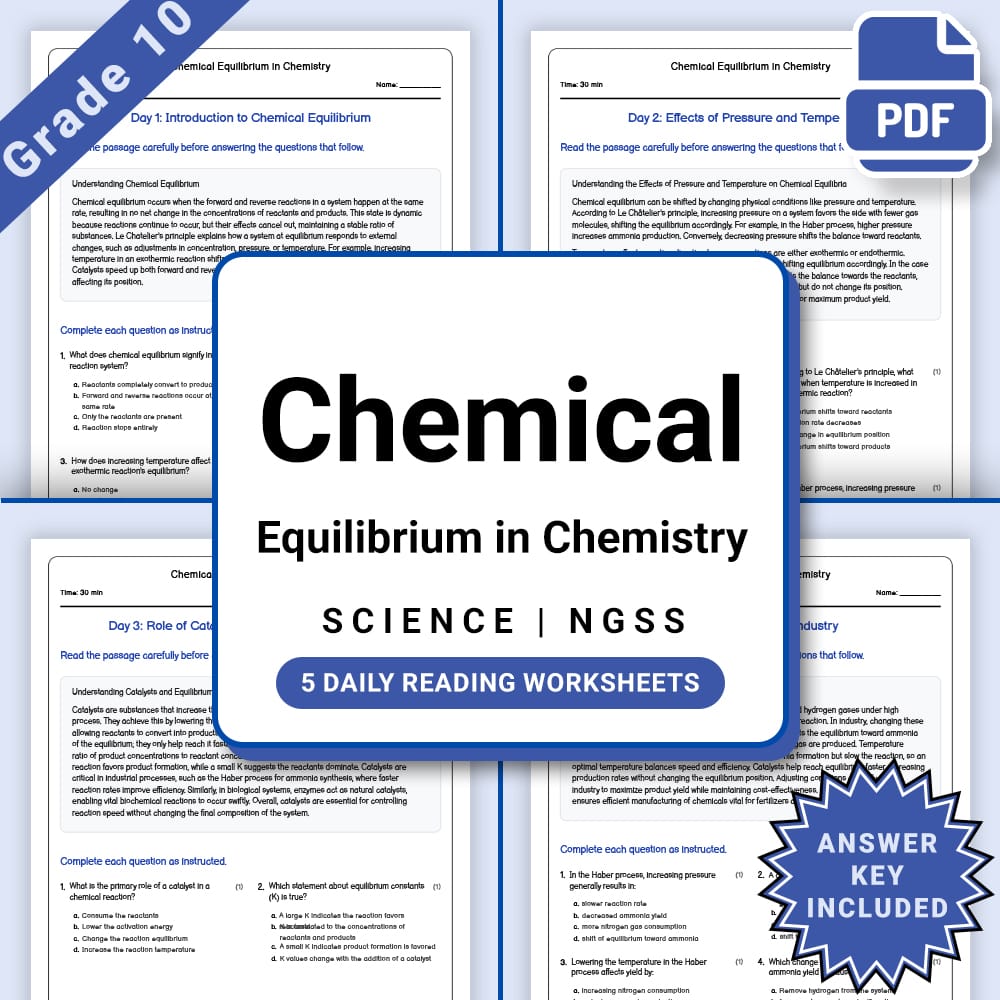
Grade 10 Science – Chemical Equilibrium Worksheet (PDF +Answer Key)
Created byCopper Leaf ClassroomLearning Objectives
- Define chemical equilibrium and understand its characteristics.
- Describe Le Chatelier's principle and how it predicts reaction shifts due to changes in conditions.
- Identify factors such as pressure, temperature, and concentration that influence equilibrium.
Instant download

Grade 10 Worksheet B: Nutrient Cycling Worksheet | NGSS Practice PDF
Created byClear Sky ClassroomLearning Objectives
- Explain how carbon and nitrogen move among the atmosphere, biosphere, lithosphere, and hydrosphere through major biogeochemical processes
- Describe how photosynthesis, respiration, nitrification, denitrification, and decomposition control nutrient pools and fluxes
- Analyze how human activities (fossil fuel combustion and agricultural runoff) change nutrient cycling and affect ecosystems
Also included in: Grade 10 Ecosystem Energy Transfer & Biodiversity Science Lesson Bundle: NGSS +1 more
Instant download
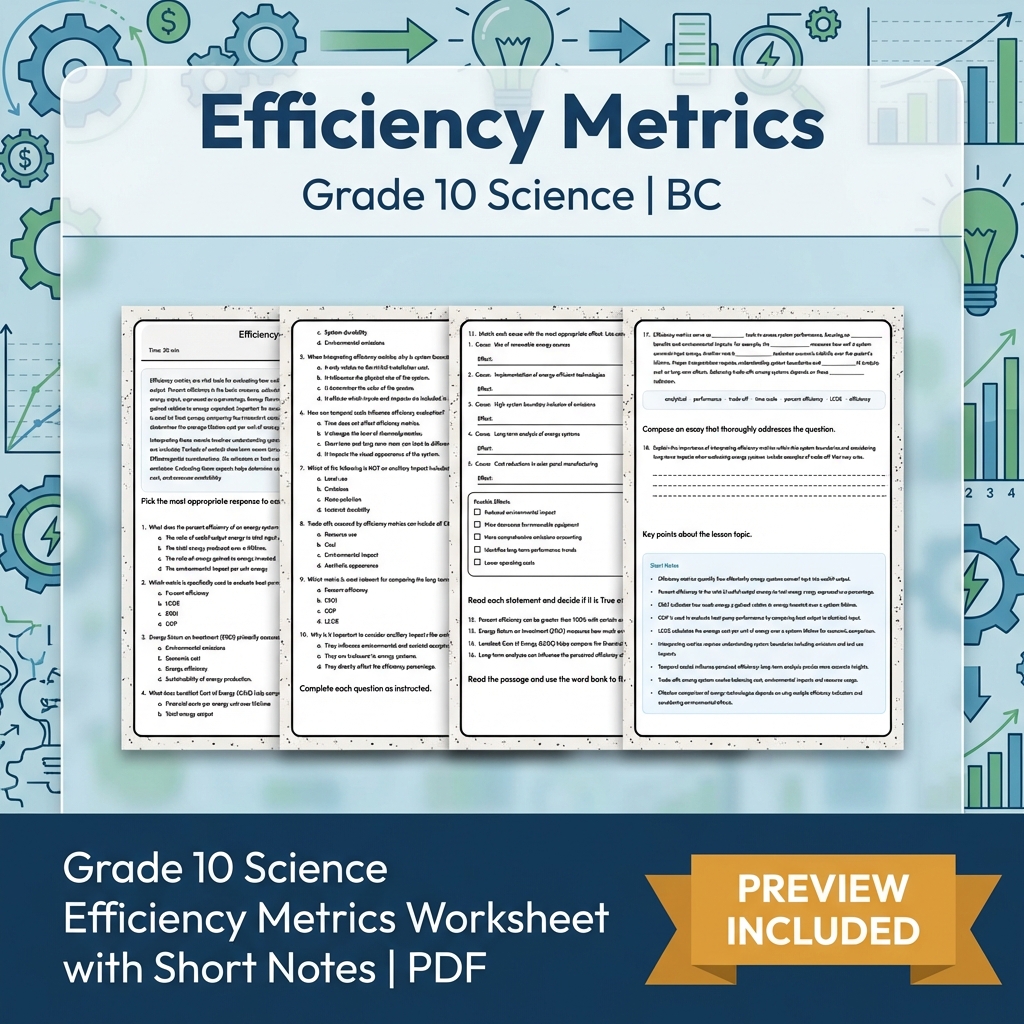
Grade 10 Science Efficiency Metrics Worksheet with Short Notes | PDF
Created byMeadowlark WorksheetsLearning Objectives
- Understand different efficiency metrics used to evaluate systems.
- Interpret and compare efficiency measures such as percent efficiency, EROI, COP, and LCOE.
- Analyze boundary conditions and long-term impacts affecting efficiency assessment.
Also included in: Grade 10 Science Lesson Bundle | Energy & Thermodynamics Worksheets +1 more
Instant download

Grade 10 Science Periodic Trends Worksheet | Standards-Aligned Practice
JCreated byJ.S SheetsLearning Objectives
- Explain periodic trends in atomic radius, ionization energy, and electronegativity across periods and down groups
- Use group and period relationships to predict valence electron patterns and likely reactivity
- Classify elements as metals, nonmetals, or metalloids based on shared properties and trend behavior
Instant download
About Grade 10 Science Worksheets
Find Science worksheets built for Grade 10. All 7,069 cover core skills, practice, and review, each an instant PDF download.
Every worksheet on MyTeachingSheets is created by independent teacher-authors and reviewed before publication. All resources download as printable PDFs for classroom, homework, or at-home practice, and many include answer keys. Preview any worksheet free before buying.