
Grade 10 Science Worksheets
7,069 worksheets
Grade 10 Science – Physical Properties & Measurement | Daily Reading Worksheet
 Created byBright Mind Resources
Learning Objectives
- Define and identify measurable physical attributes of substances.
- Differentiate between intensive and extensive properties.
- Understand the concept of physical change and its reversibility.
Also included in: Grade 10 Chemistry Science Daily Reading Worksheets Lesson Bundle | Ontario +1 more
Instant download

Grade 10 Science – Mixture & Separation Techniques | Daily Reading Worksheet
Created byBright Mind ResourcesLearning Objectives
- Understand different methods used to separate mixtures
- Identify characteristics of homogeneous and heterogeneous mixtures
- Describe the principles behind filtration, distillation, chromatography, and centrifugation
Also included in: Grade 10 Chemistry Science Daily Reading Worksheets Lesson Bundle | Ontario +1 more
Instant download
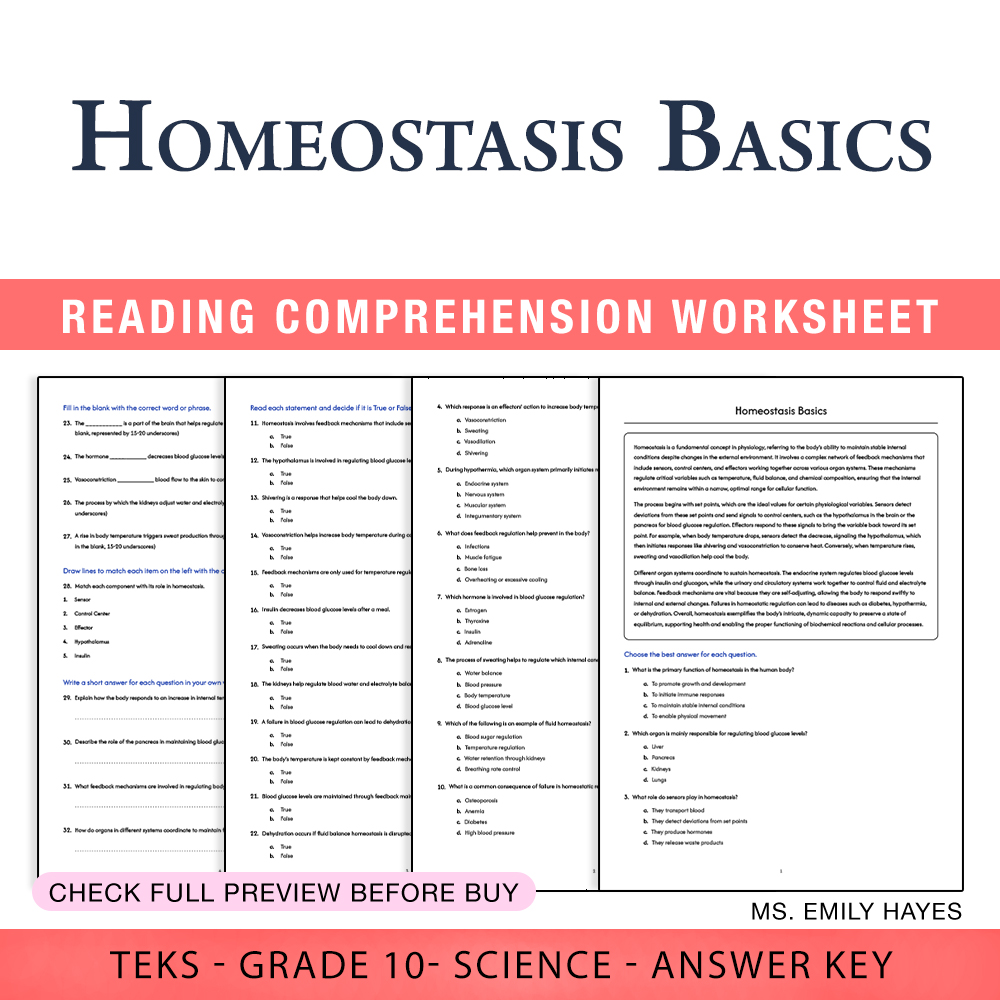
Grade 10 Science | Homeostasis Basics Worksheet (PDF+ Answer Key)
 Created byCopper Leaf Classroom
Learning Objectives
- Explain the concept of homeostasis and its importance in human body functions.
- Identify the key components involved in maintaining internal stability, including set points, sensors, and effectors.
- Describe how feedback mechanisms regulate temperature, blood glucose, and fluid balance.
Instant download
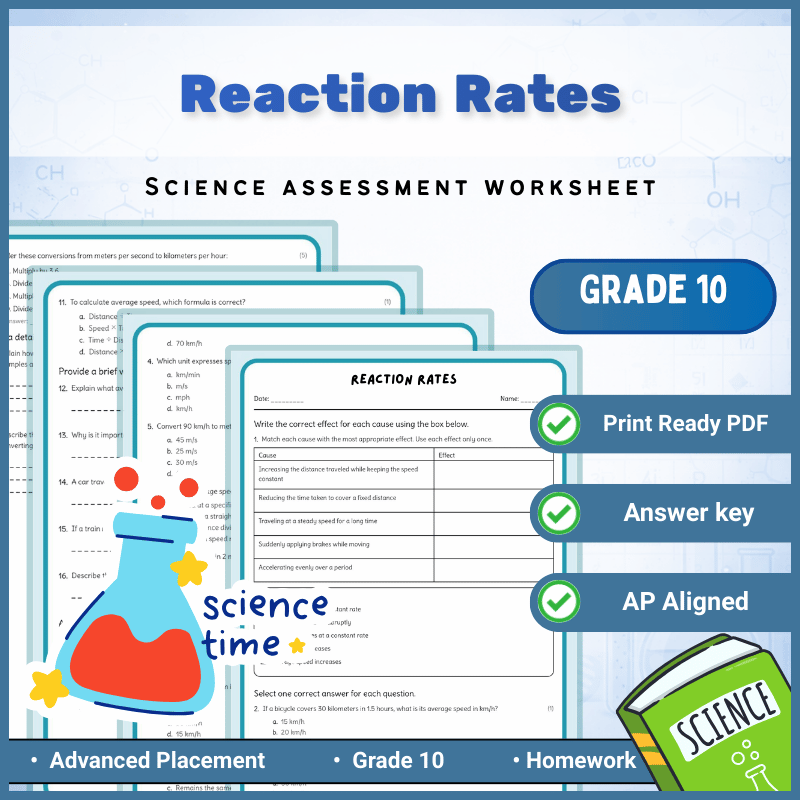
Grade 10 Science | Reaction Rates Worksheet – AP Standard & Practice (PDF)
Created byBright Mind ResourcesLearning Objectives
- Understand the factors that influence the speed of chemical reactions.
- Interpret graphical and mathematical representations of reaction concentration over time.
- Describe how temperature and catalysts modify reaction pathways.
Instant download
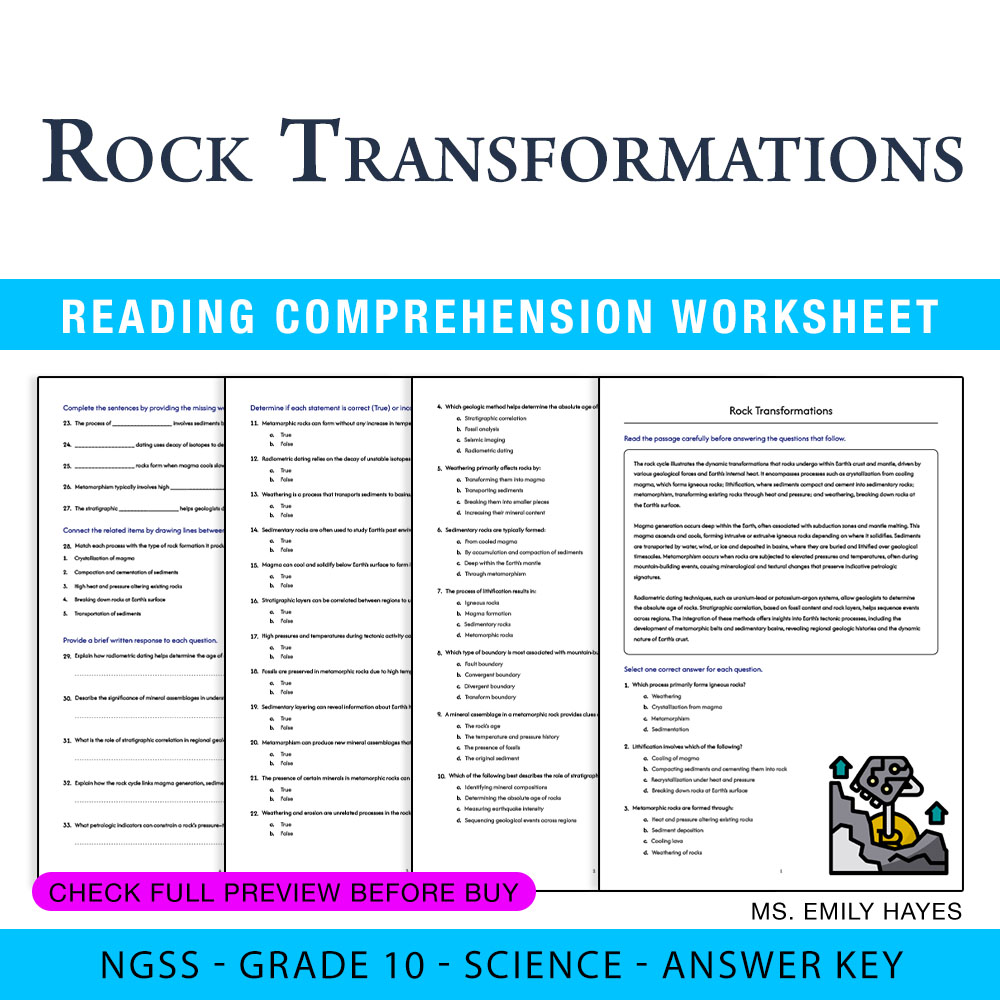
Grade 10 Science | Rock Transformations Worksheet (PDF+ Answer Key)
Created byCopper Leaf ClassroomLearning Objectives
- Explain the processes involved in the rock cycle, including crystallization, lithification, metamorphism, and weathering.
- Describe how geologic indicators such as mineral assemblages, textures, and geochemical signatures constrain pressure–temperature histories of rocks.
- Apply radiometric dating and stratigraphic correlation techniques to order igneous, sedimentary, and metamorphic events, and understand their role in reconstructing regional geologic histories.
Instant download

Gravitational Fields & Point-Mass Orbits Worksheet | NGSS Grade 10 Science
 Created byAmber Owl Education
Learning Objectives
- Explain gravitational field strength and direction using field vector ideas
- Use Newton’s law of gravitation and inverse-square behavior for point masses
- Relate gravitational forces to orbital motion and orbital period for circular orbits
Instant download

Grade 10 Science | Mendelian Patterns Worksheet (NGSS10 PDF)
 Created bySilver Birch Teaching
Learning Objectives
- Explain Mendelian inheritance patterns using probability and pedigree analysis.
- Describe the concepts of dominance, segregation, and independent assortment.
- Relate chromosome behavior during meiosis to Mendelian principles.
Also included in: Grade 10 Genetics Science Lesson Bundle NGSS: Mutation, Mendelian, DNA +1 more
Instant download

Grade 10 Science | Mutation Variation Worksheet (NGSS Aligned) (PDF)
Created bySilver Birch TeachingLearning Objectives
- Understand how mutations at nucleotide and chromosomal scales contribute to genetic variation.
- Identify different mutational mechanisms and their effects on gene function and phenotype.
- Analyze examples such as sickle hemoglobin to understand the impact of point mutations.
Also included in: Grade 10 Genetics Science Lesson Bundle NGSS: Mutation, Mendelian, DNA +1 more
Instant download

Grade 10 Science – Endothermic and Exothermic Worksheet (PDF) | General Standards
 Created byEvergreen Desk Education
Learning Objectives
- Distinguish endothermic and exothermic reactions using qualitative energy changes in the surroundings and the reacting particles.
- Interpret simple energy profiles and relate them to temperature change and observable evidence such as light release.
- Explain how bond energy and particle kinetic energy shift during endothermic and exothermic processes.
Also included in: Grade 10 Conservation Laws in Science Lesson Bundle – General Framework +1 more
Instant download
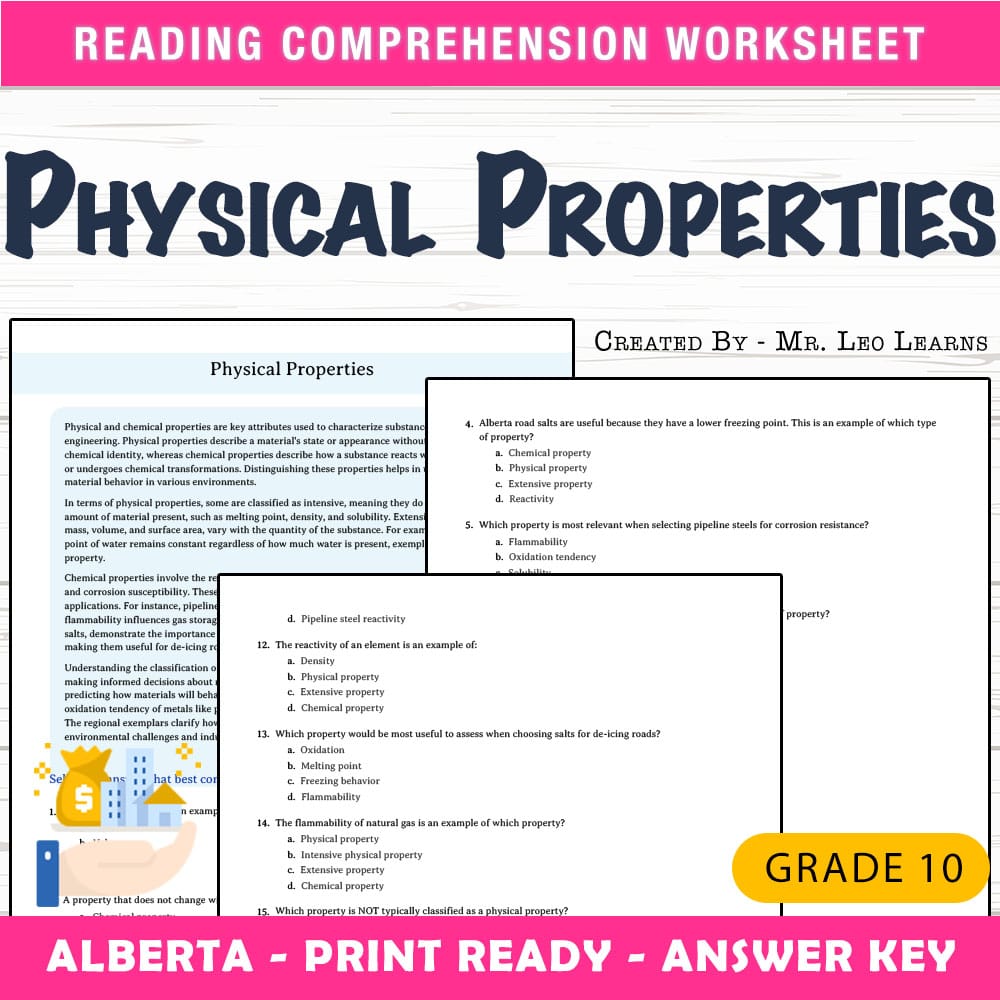
Grade 10 Science — Worksheet MCQ Paper for Mastering Physical Properties
 Created byThe Resource Hub
Learning Objectives
- Understand the distinction between physical and chemical properties of substances.
- Identify examples of intensive and extensive physical properties.
- Recognize chemical properties such as reactivity and oxidation tendency.
Also included in: Grade 10 Science Lesson Bundle | Matter and Chemical Change Worksheets +1 more
Instant download
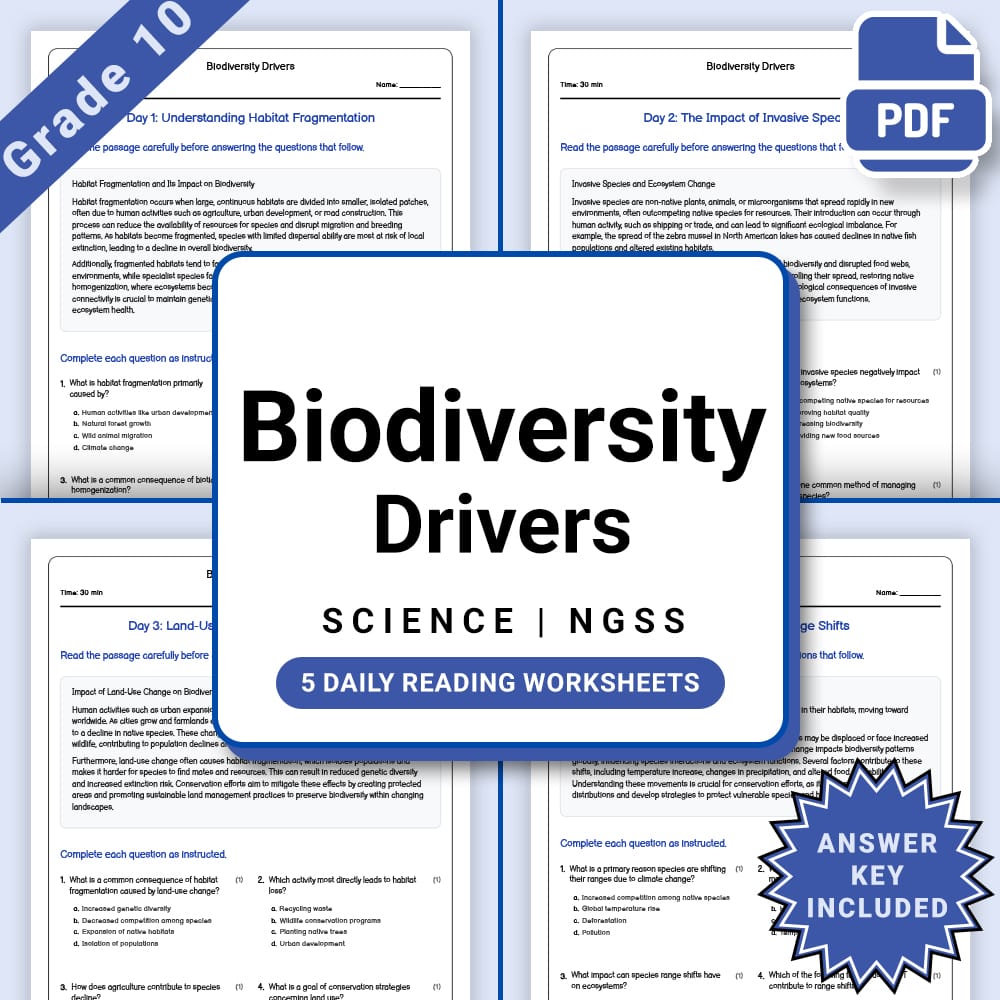
Grade 10 Science – Biodiversity Drivers Daily Worksheet (PDF +Answer Key)
Created byCopper Leaf ClassroomLearning Objectives
- Understand how habitat fragmentation impacts species richness
- Identify the effects of invasive species on native ecosystems
- Explain how land-use change influences biodiversity
Instant download

Grade 10 Science | Genetic Mutations Worksheet | TEKS Aligned
 Created byLumora Learning
Learning Objectives
- Understand different types of genetic mutations and their molecular impacts.
- Identify the consequences of point mutations, insertions, deletions, and larger chromosomal changes.
- Explain how mutations influence protein function and phenotypic variation.
Also included in: Grade 10 Science | Genetics & Molecular Biology Lesson Bundle | TEKS Aligned +1 more
Instant download

Grade 10 Science | RNA Variants Worksheet | TEKS Aligned
Created byLumora LearningLearning Objectives
- Identify the different types of RNA and their functions in protein synthesis.
- Explain how RNA substitutes uracil for thymine and pairs with DNA during transcription.
- Describe the roles of messenger RNA, transfer RNA, and ribosomal RNA in translating genetic information.
Also included in: Grade 10 Science | Genetics & Molecular Biology Lesson Bundle | TEKS Aligned +1 more
Instant download

Grade 10 Science | DNA Structure Worksheet | TEKS-Aligned
Created byLumora LearningLearning Objectives
- Understand the structure and components of DNA including nucleotide subunits.
- Identify complementary base pairing rules in DNA.
- Explain the role of hydrogen bonds in stabilizing the DNA double helix.
Also included in: Grade 10 Science | Genetics & Molecular Biology Lesson Bundle | TEKS Aligned +1 more
Instant download

Grade 10 Science | DNA Replication Worksheet | TEKS-Aligned
Created byLumora LearningLearning Objectives
- Understand the steps involved in DNA replication, including enzyme functions and strand synthesis.
- Describe the roles of helicase, primase, DNA polymerase, and other enzymes during replication.
- Identify the differences between leading and lagging strands and the formation of Okazaki fragments.
Also included in: Grade 10 Science | Genetics & Molecular Biology Lesson Bundle | TEKS Aligned +1 more
Instant download

Grade 10 Science | Inheritance Patterns Worksheet | TEKS Aligned
Created byLumora LearningLearning Objectives
- Explain how dominant and recessive alleles influence phenotype expression.
- Describe Mendelian principles such as segregation and independent assortment.
- Analyze monohybrid and dihybrid crosses to predict trait ratios.
Also included in: Grade 10 Science | Genetics & Molecular Biology Lesson Bundle | TEKS Aligned +1 more
Instant download

Grade 10 Worksheet B: Gravitation Fields Practice | NGSS PDF
 Created byClear Sky Classroom
Learning Objectives
- Explain gravitational fields using inverse-square behavior for point masses
- Use gravitational field vectors and Newton’s law to predict force and motion
- Apply orbital relations (speed and period) for circular and elliptical orbits
Also included in: Grade 10 Forces & Motion Science Lesson Bundle (NGSS) +1 more
Instant download
Grade 10 Science | Ecological Succession Worksheet (Answer Key) – TEKS-Aligned
Created byBright Mind ResourcesLearning Objectives
- Understand the difference between primary and secondary succession.
- Identify the processes involved in succession pathways such as species colonization and competition.
- Describe how disturbance frequency and intensity influence succession and biodiversity.
Also included in: Grade 10 Science | Ecosystems & Biodiversity Unit Worksheet Bundle(TEKS-Aligned) +5 more
Instant download
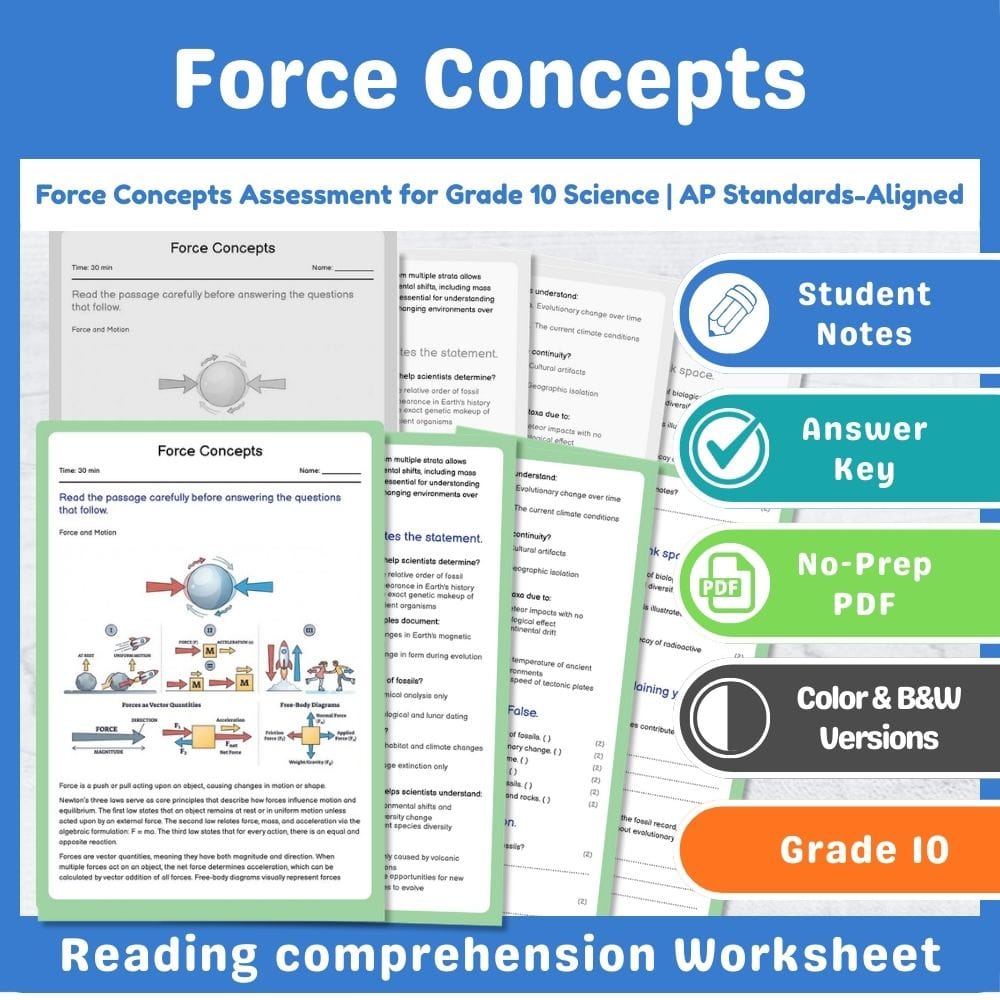
Force Concepts Assessment for Grade 10 Science | AP Standards-Aligned
 Created byPrism Point Learning
Learning Objectives
- Understand the vector nature of forces and how to determine net force in various scenarios.
- Explain Newton's three laws and their applications to motion and equilibrium.
- Interpret free-body diagrams and algebraic formulations of forces.
Also included in: Lesson Grade 10 Science Assessment Bundle | AP Standards-Aligned
Instant download

Grade 10 Atomic Structure Worksheet | Practice & NGSS PDF
Created byClear Sky ClassroomLearning Objectives
- Identify and describe the roles of protons, neutrons, and electrons in an atom
- Explain isotopes using proton number and neutron number and relate this to atomic mass
- Use electron energy-level ideas to describe how atoms absorb and emit energy
Instant download
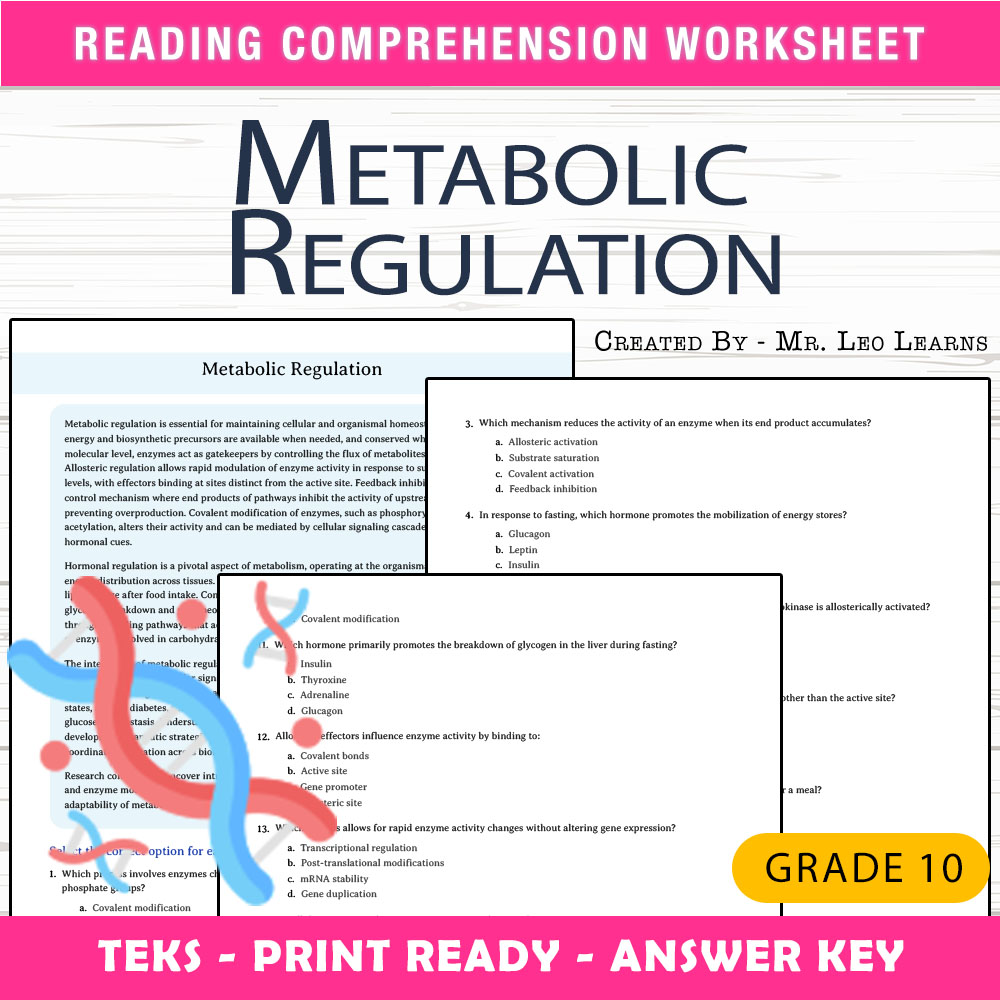
Grade 10 Science – Metabolic Regulation Worksheet for Mastery
Created byThe Resource HubLearning Objectives
- Describe how enzyme activity is regulated through allosteric interactions and feedback inhibition.
- Explain the roles of hormonal signals such as insulin and glucagon in carbohydrate metabolism.
- Identify key mechanisms of covalent enzyme modification and their significance in metabolic response.
Also included in: Grade 10 Science Unit Bundle | Energy, Photosynthesis & Cellular Respiration +1 more
Instant download
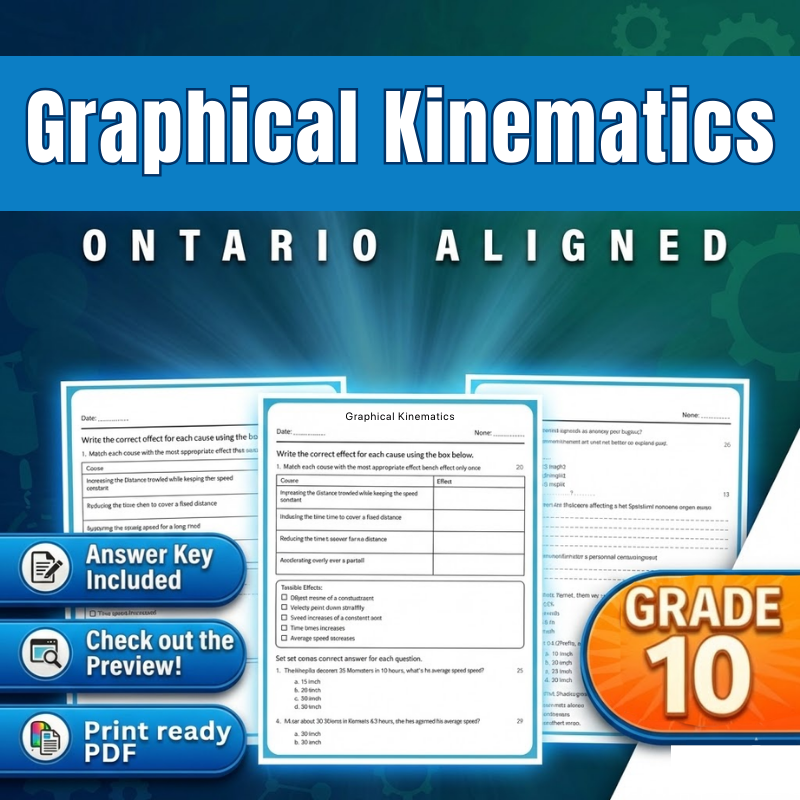
Grade 10 Science – Graphical Kinematics Worksheet (Ontario) (PDF)
Created byBright Mind ResourcesLearning Objectives
- Understand the relationship between displacement–time, velocity–time, and acceleration–time graphs.
- Interpret the slope of a velocity–time graph as acceleration and the area under the graph as displacement.
- Compare piecewise and uniformly accelerating motions using graphical representations.
Instant download
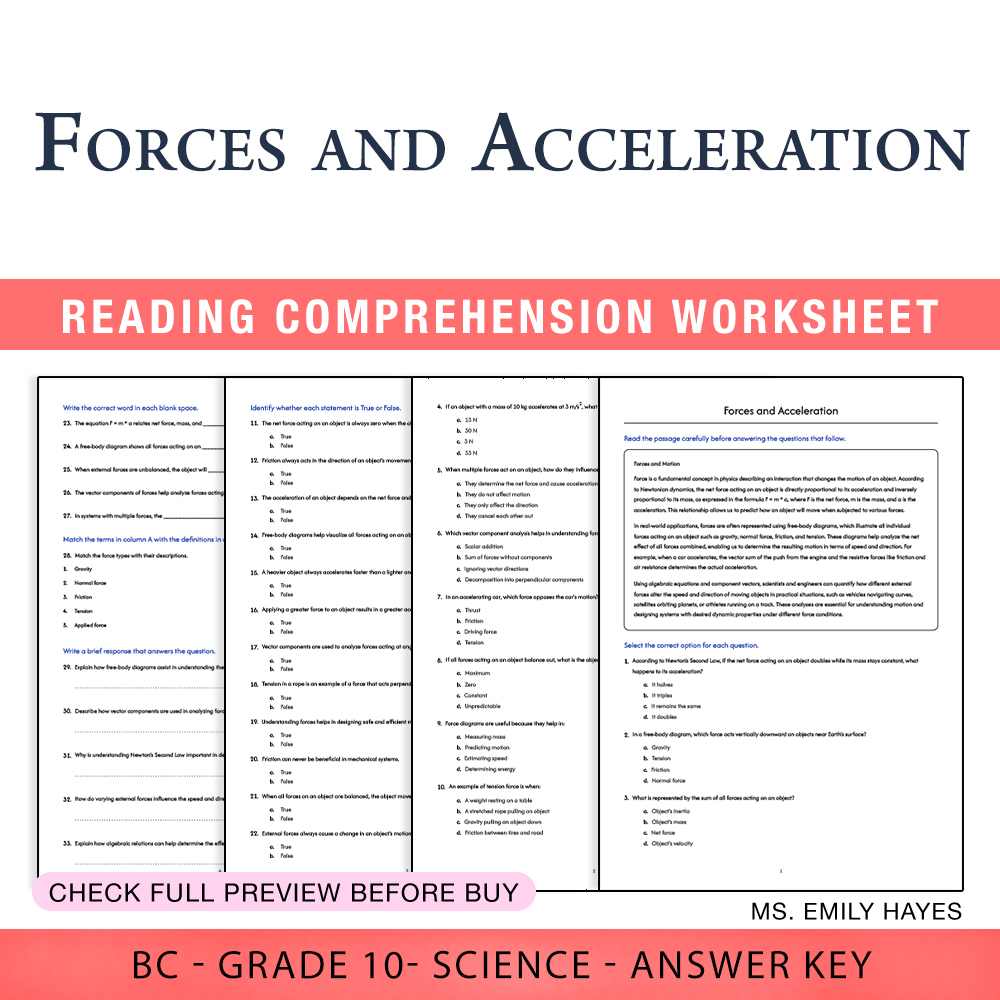
10th Grade Science | Forces and Acceleration Worksheet (PDF+ Answer Key)
Created byCopper Leaf ClassroomLearning Objectives
- Understand the relationship between net force, mass, and acceleration through Newton's Second Law.
- Interpret free-body diagrams to identify individual forces acting on an object.
- Apply algebraic and vector components to analyze how forces affect an object's motion.
Also included in: Grade 10 Science BC | Forces, Motion & Fields Worksheets (PDF + Answer Key) +1 more
Instant download
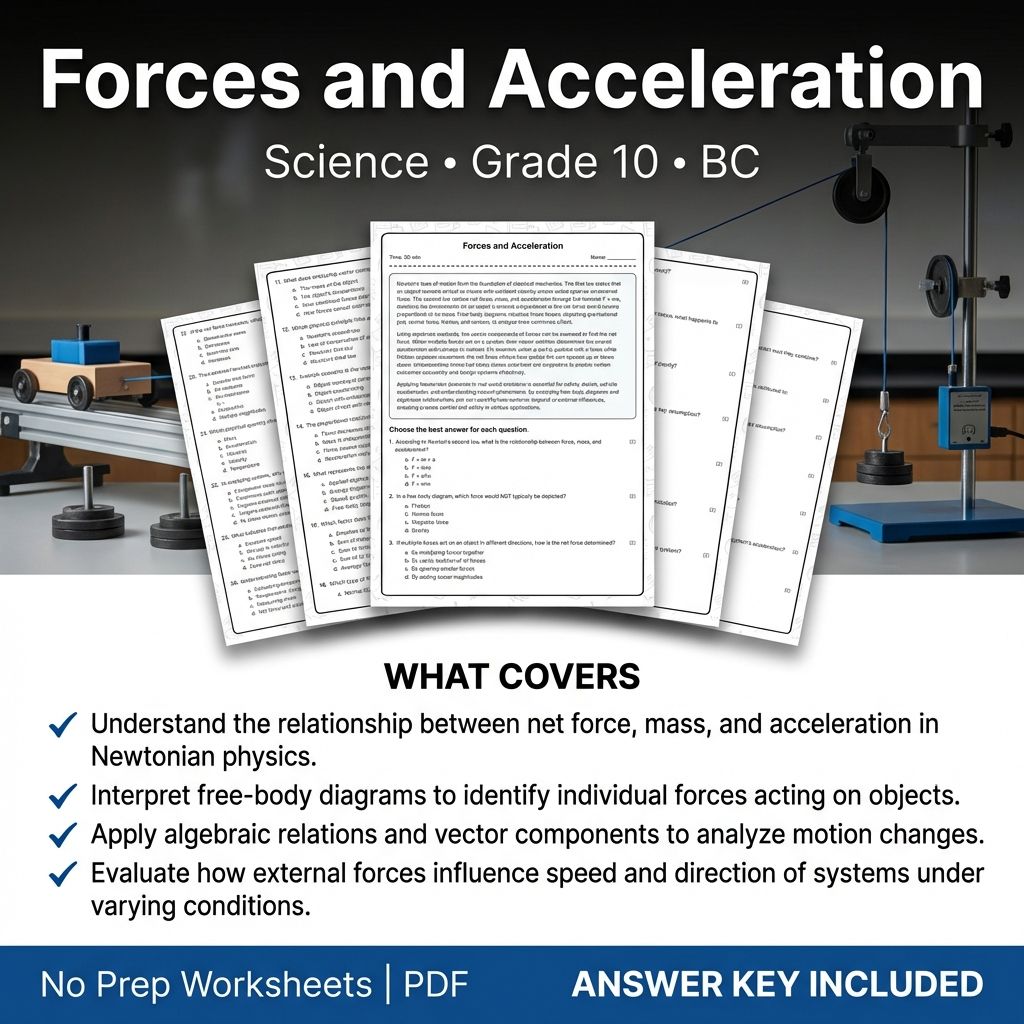
10th Grade Science | Forces and Acceleration Worksheet with Answer Key (PDF)
 Created byCoral Reef Learning
Learning Objectives
- Understand the relationship between net force, mass, and acceleration in Newtonian physics.
- Interpret free-body diagrams to identify individual forces acting on objects.
- Apply algebraic relations and vector components to analyze motion changes.
Instant download
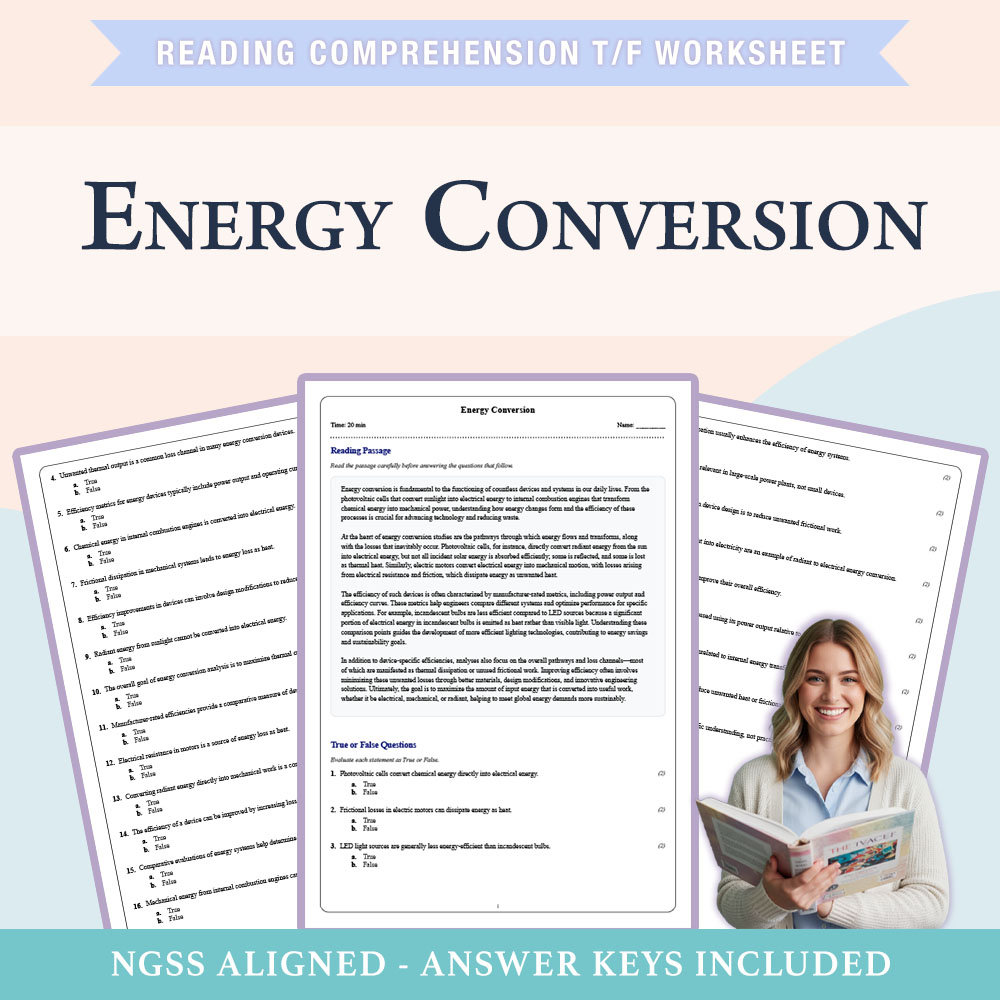
10th Grade Science | Energy Conversion Worksheet (PDF +Answer Key)
Created byCopper Leaf ClassroomLearning Objectives
- Understand the basic pathways of energy conversion between chemical, electrical, mechanical, and radiant forms.
- Analyze the efficiency metrics and loss channels in various energy conversion devices.
- Evaluate real-world systems based on manufacturer-rated efficiencies and operating characteristics.
Also included in: Grade 10 Science | Energy and Work Worksheets Bundle (PDF + Answer Key) +1 more
Instant download

Rock Transformations Worksheet | NGSS-Aligned Science Practice for Grade 10
JCreated byJ.S SheetsLearning Objectives
- Understand the processes involved in the rock cycle, including crystallization, lithification, metamorphism, and weathering.
- Identify petrologic indicators such as mineral assemblages, texture, and geochemical signatures to interpret pressure–temperature histories.
- Explain how radiometric dating and stratigraphic correlation are used to order geologic events and reconstruct tectonic histories.
Instant download
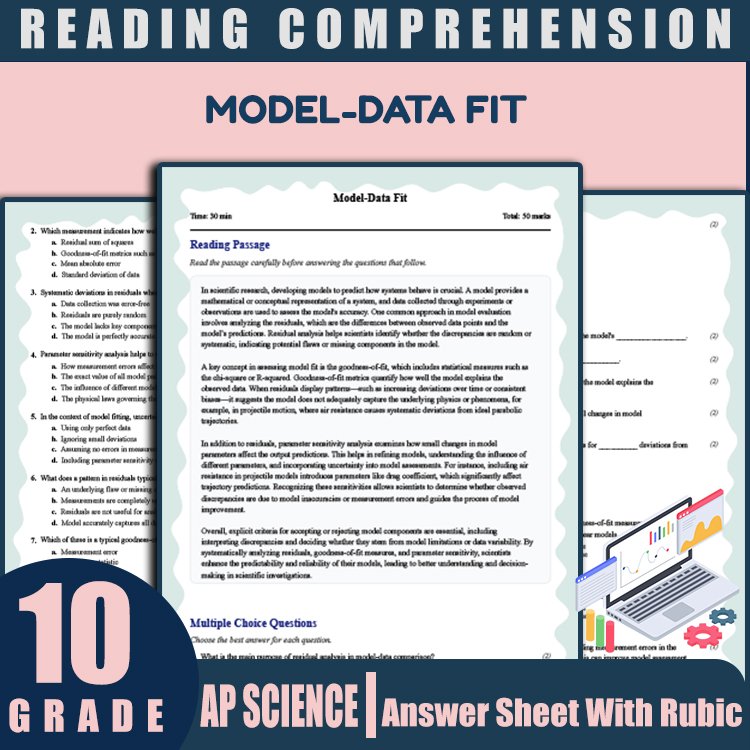
10th Grade Science | Model-Data Fit Reading Worksheet (PDF & Answer Key)
JCreated byJ.S SheetsLearning Objectives
- Understand the concept of residuals and how they indicate the fit between a model and observed data.
- Interpret goodness-of-fit metrics to evaluate model performance and identify systematic deviations.
- Analyze parameter sensitivity and its role in refining models and understanding uncertainty.
Also included in: Grade 10 Science Unit Worksheet Pack – Data Analysis & Scientific Reasoning +1 more
Instant download

Grade 10 Science | Fossil Record Worksheet | BC Standards
Created byLumora LearningLearning Objectives
- Understand how the fossil record documents morphological change through geological time.
- Learn how stratigraphic context and radiometric dating are used to interpret fossils chronologically.
- Analyze patterns of gradual and abrupt changes in fossil lineages to infer evolutionary processes.
Also included in: Grade 10 Science | Evolution & Biodiversity Lesson Bundle | BC Framework
Instant download
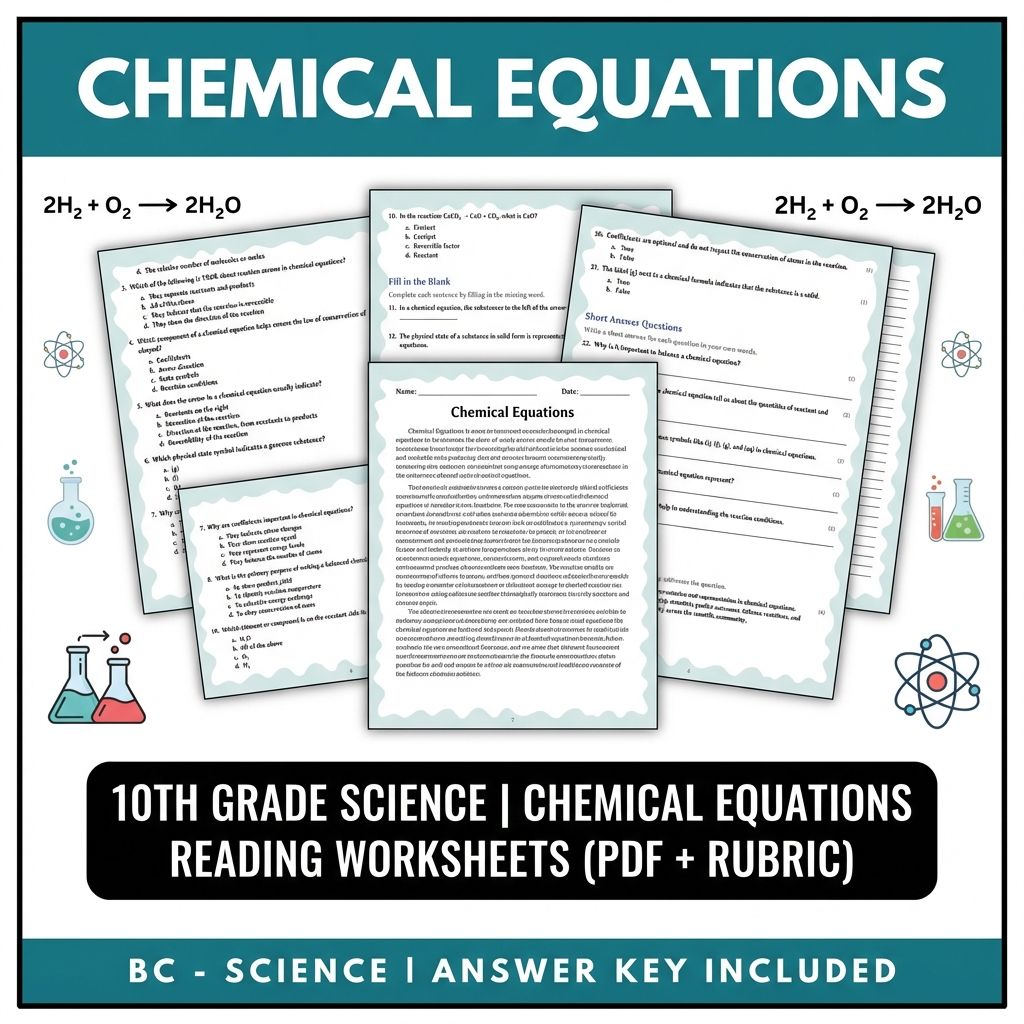
10th Grade Science | Chemical Equations Reading Worksheets (PDF + Rubric)
JCreated byJ.S SheetsLearning Objectives
- Understand the structure and notation of chemical equations.
- Identify reactants, products, and physical states in equations.
- Explain the significance of coefficients and state symbols.
Instant download
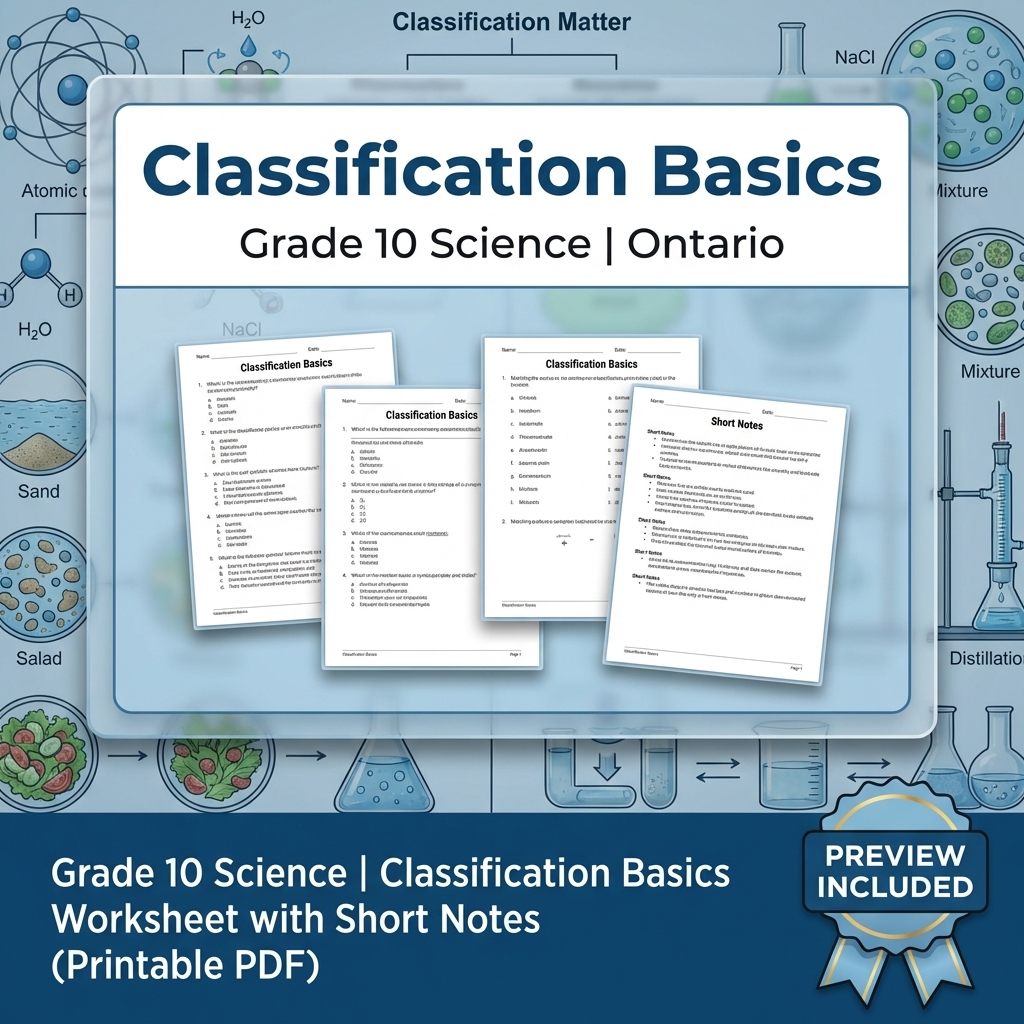
Grade 10 Science | Classification Basics Worksheet with Short Notes
 Created byMeadowlark Worksheets
Learning Objectives
- Understand the fundamental schemes for classifying matter based on states, purity, and composition.
- Distinguish between pure substances, mixtures, elements, and compounds with examples.
- Relate microscopic models and chemical formulas to macroscopic classification criteria.
Also included in: Grade 10 Science Lesson Group Bundle with Ontario Framework +1 more
Instant download

Grade 10 Science – Periodic Trends & Atomic Size | Daily Reading Worksheet
Created byBright Mind ResourcesLearning Objectives
- Understand how atomic size varies across periods and groups in the periodic table
- Identify factors influencing atomic size, including nuclear charge and electron shielding
- Interpret periodic table patterns to predict atomic properties
Also included in: Physical Science Grade 10 Daily Reading Worksheets Lesson Bundle | Florida NGSSS +1 more
Instant download

Energy Diagrams Worksheet Grade 10 Science | KE PE & Friction Alberta
Created byEvergreen Desk EducationLearning Objectives
- Interpret energy diagrams and bar charts to describe how energy is distributed and transferred between forms.
- Identify sources and sinks of energy in mechanical and thermal processes, including friction on icy roads.
- Use energy conservation concepts to explain changes in potential energy, kinetic energy, and heat energy.
Instant download
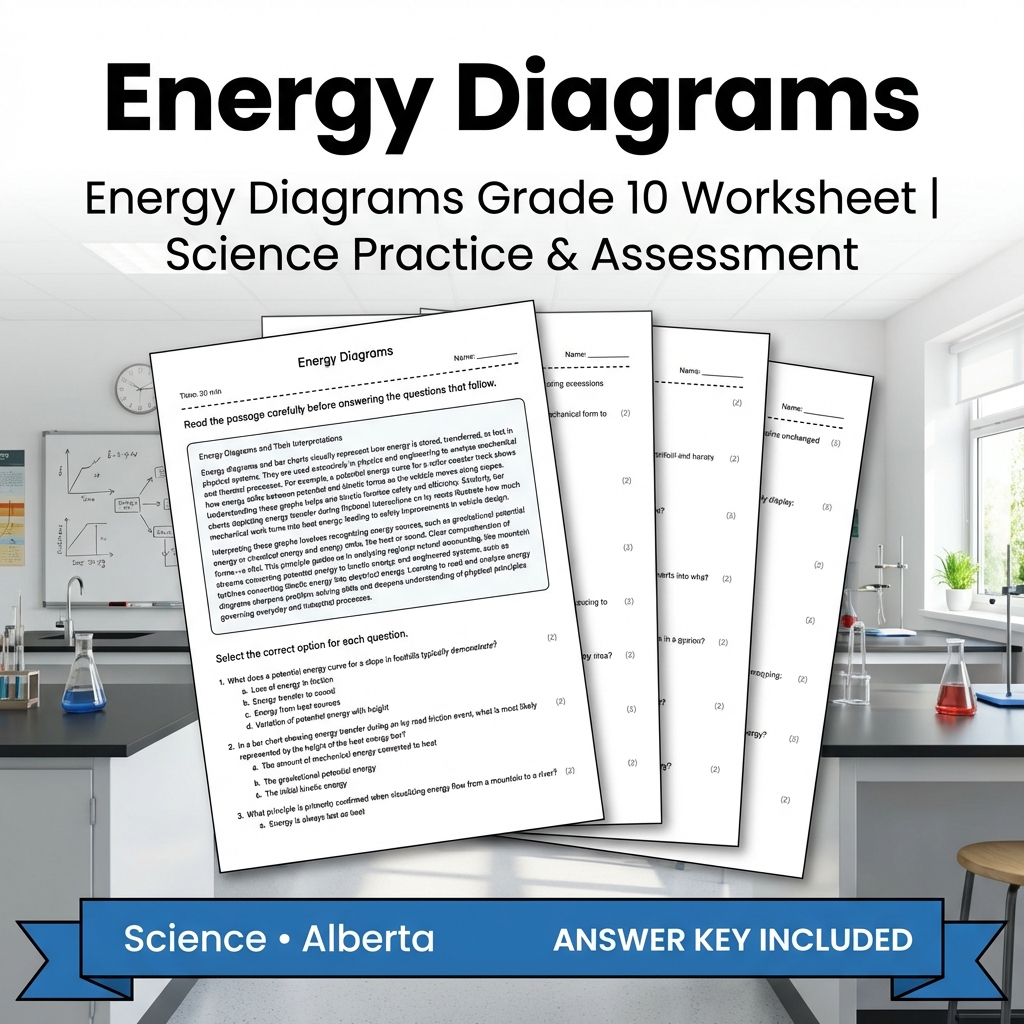
Energy Diagrams Grade 10 Worksheet | Science Practice & Assessment
Created byCoral Reef LearningLearning Objectives
- Interpret energy diagrams and bar charts to analyze energy transfer and distribution.
- Identify sources and sinks of energy in various processes.
- Link visual graph representations to conservation principles in real-world phenomena.
Instant download

Radiation Energy Transfer Worksheet | Grade 10 Heat Transfer Practice
Created byPrism Point LearningLearning Objectives
- Explain how electromagnetic radiation transfers energy without direct contact
- Describe how absorption of radiation can change the temperature or state of matter
- Connect properties of radiation (e.g., wavelength/energy) to the effects observed in materials
Instant download
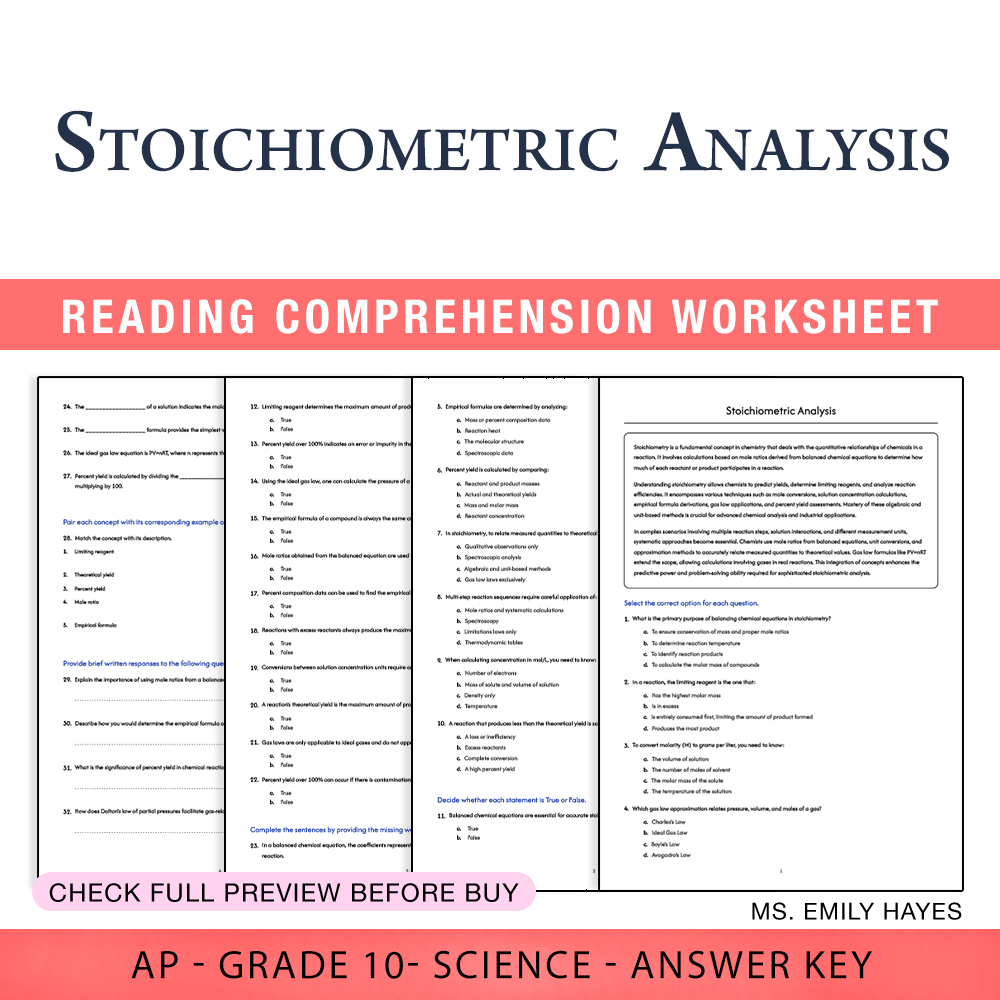
10th Grade Science | Stoichiometric Analysis Worksheet (PDF+ Answer Key)
Created byCopper Leaf ClassroomLearning Objectives
- Develop algebraic and unit-based strategies for complex stoichiometric relationships.
- Apply mole ratios and limiting reagent concepts to solve multi-step reactions.
- Convert solution concentrations and determine empirical formulas from mass or percent data.
Also included in: Grade 10 Science -Atomic Structure & Chemical Reactions (PDF+ Answer Key) +1 more
Instant download
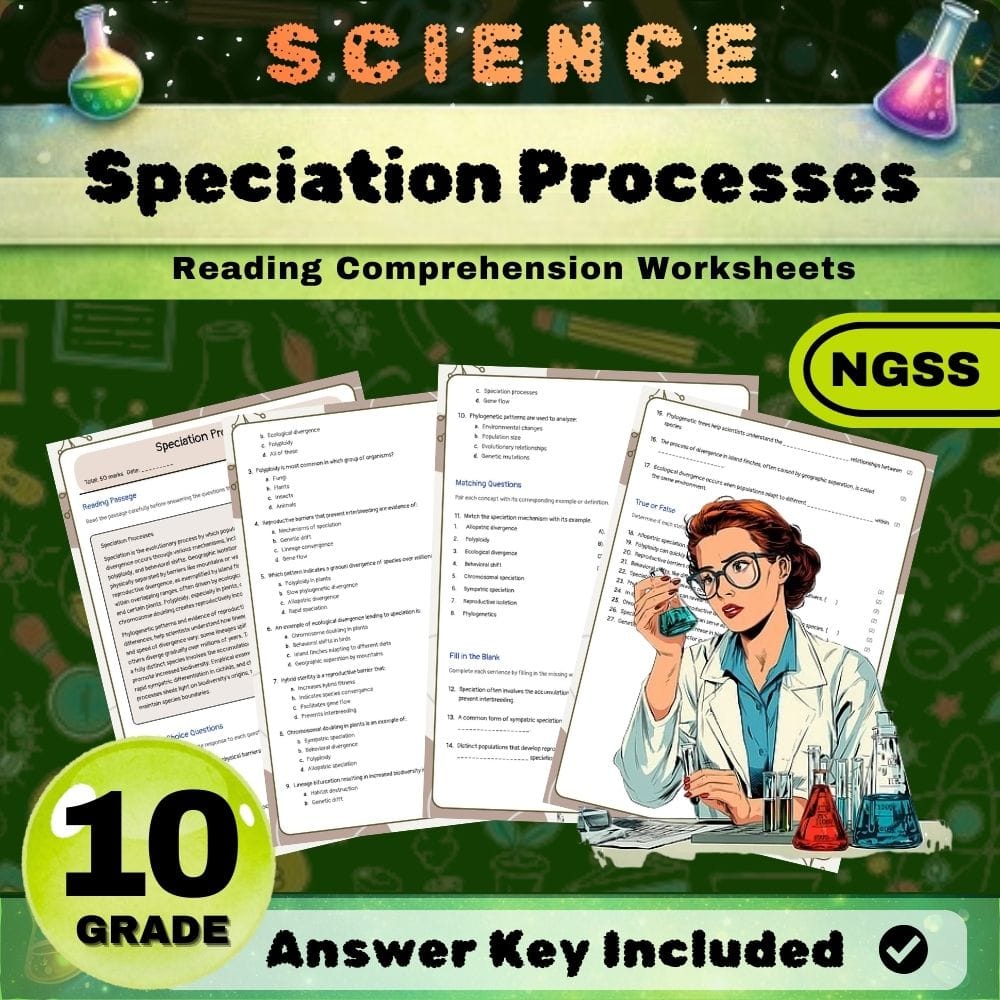
Grade 10 Science | Speciation Processes NGSS Worksheet (PDF)
 Created byMaple Path Learning
Learning Objectives
- Understand the mechanisms of reproductive isolation leading to speciation.
- Identify empirical examples of different speciation processes.
- Analyze phylogenetic patterns and reproductive barriers to determine mechanisms of lineage splitting.
Also included in: Grade 10 Science | Biological Evolution Unity and Diversity Lesson Bundle | NGSS +1 more
Instant download
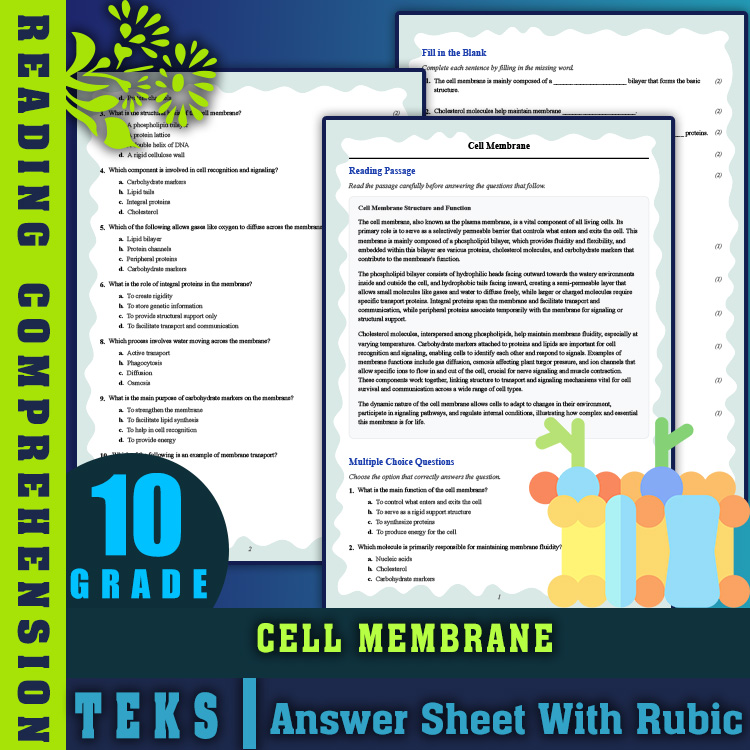
Grade 10 Science | Cell Membrane Reading Worksheet (PDF + Rubric)
JCreated byJ.S SheetsLearning Objectives
- Understand the structure and components of the cell membrane
- Explain how membrane components influence cell function
- Identify examples of membrane transport and signaling processes
Instant download
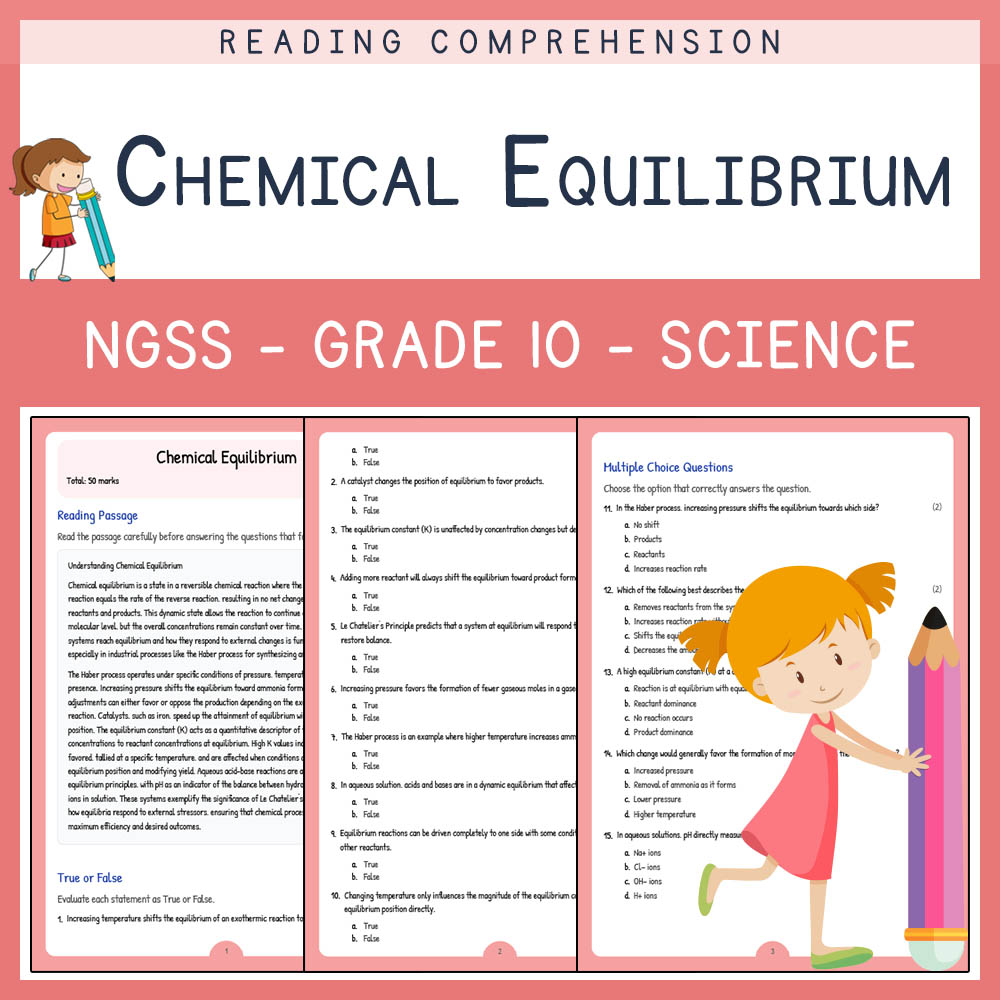
Grade 10 Science | Chemical Equilibrium Worksheet & Answer Key (NGSS Aligned)
Created byLumora LearningLearning Objectives
- Understand the concept of dynamic chemical equilibrium and how it responds to changes in conditions.
- Describe the role of catalysts, equilibrium constants, and the impact of temperature and pressure modifications on the position of equilibrium.
- Apply Le Chatelier's Principle to predict shifts in equilibrium in various chemical systems.
Instant download

Energy Pathways Worksheet | NGSS Aligned Grade 10 Science Practice
JCreated byJ.S SheetsLearning Objectives
- Describe the biochemical pathways involved in energy capture and transfer, including photosynthesis and cellular respiration.
- Explain how ATP is produced through chloroplast and mitochondrial processes.
- Identify the roles of the Calvin cycle, glycolysis, Krebs cycle, and oxidative phosphorylation in energy transduction.
Instant download

Grade 10 Science | Projectile Motion Worksheet | BC Standard
Created byLumora LearningLearning Objectives
- Explain the components of projectile motion and their independence.
- Calculate time of flight, range, and maximum height using kinematic relations.
- Describe how initial speed and launch angle affect projectile trajectory.
Instant download
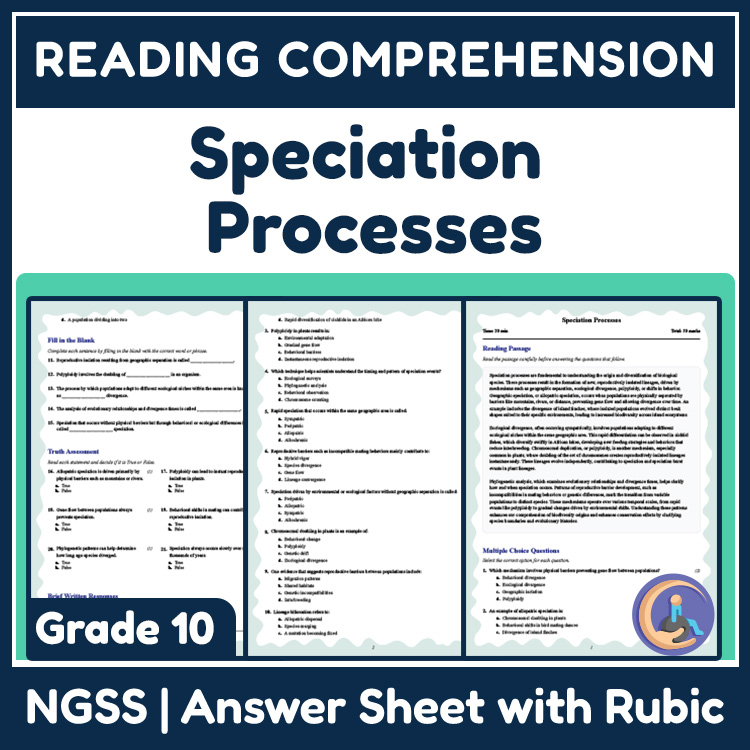
10th Grade Science | Speciation Processes Reading Worksheet (PDF + Rubric)
JCreated byJ.S SheetsLearning Objectives
- Explain the mechanisms by which reproductive isolation occurs in different speciation processes.
- Identify real-world examples of speciation and describe their significance in biodiversity.
- Analyze phylogenetic patterns to understand how lineages diverge over time.
Also included in: Grade 10 Science | Evolution & Biodiversity Unit Worksheet Bundle
Instant download
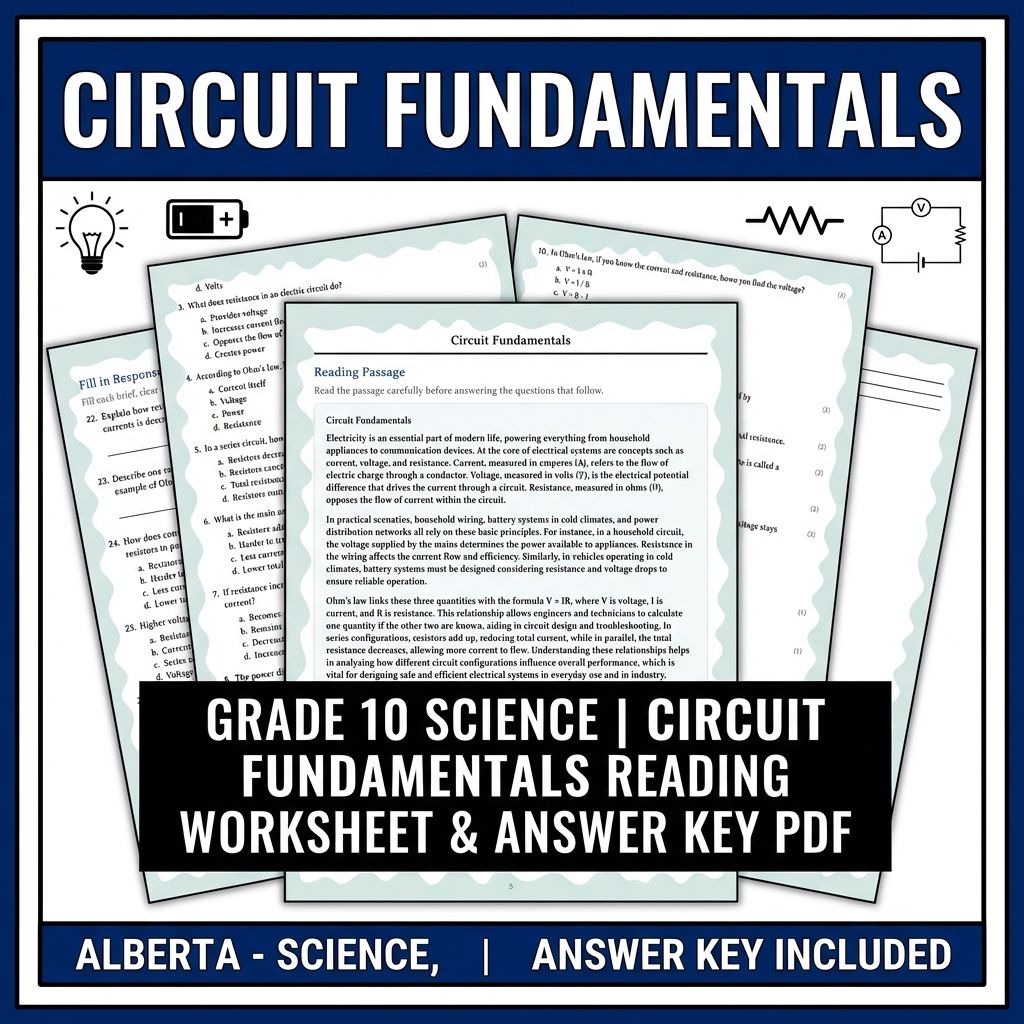
Grade 10 Science | Circuit Fundamentals Reading Worksheet & Answer Key PDF
JCreated byJ.S SheetsLearning Objectives
- Define current, voltage, and resistance and explain their interrelationships in electrical circuits.
- Describe Ohm's law and apply it to simple circuit problems.
- Differentiate between series and parallel circuit configurations and analyze their behavior.
Also included in: Grade 10 Science Bundle | Energy, Circuits & Mechanics (Answer Keys Included) +1 more
Instant download
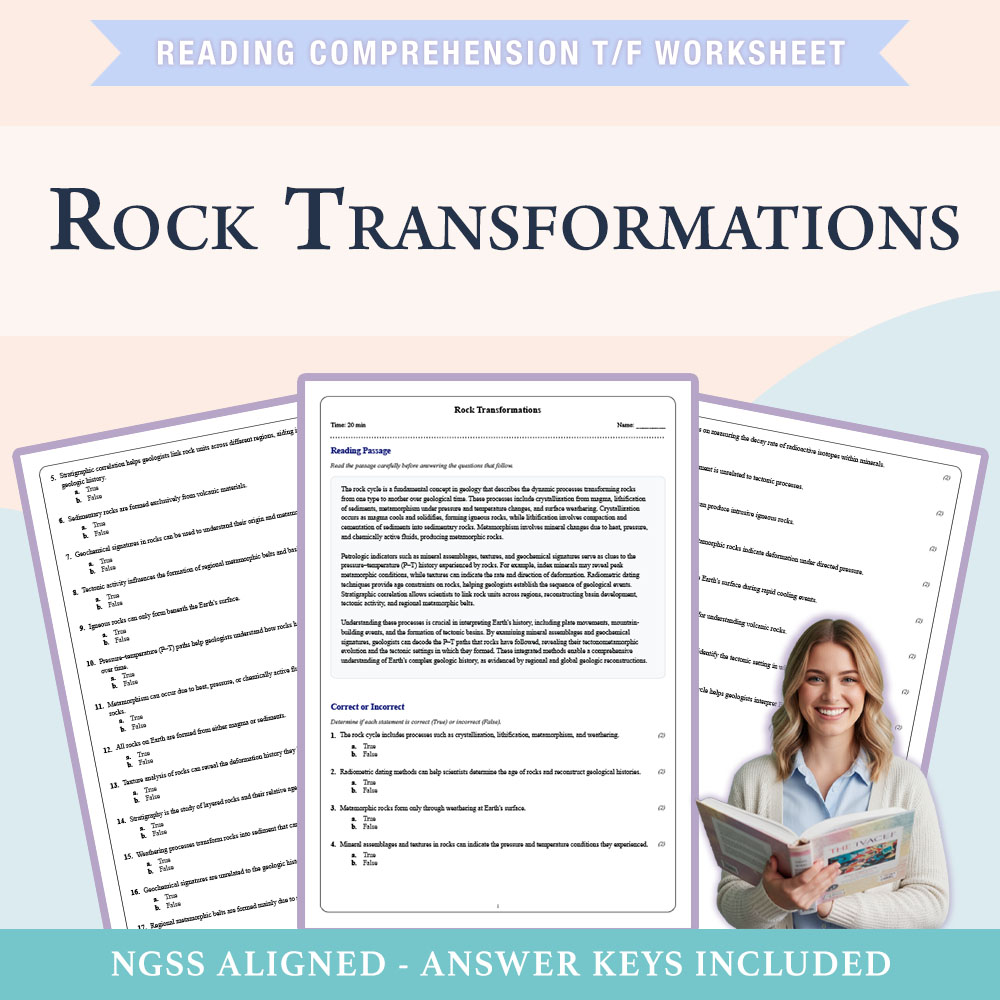
10th Grade Science | Rock Transformations Worksheet (PDF +Answer Key)
Created byCopper Leaf ClassroomLearning Objectives
- Understand the processes involved in the rock cycle, including crystallization, lithification, metamorphism, and weathering.
- Identify petrologic indicators such as mineral assemblages, textures, and geochemical signatures to infer pressure-temperature histories.
- Explain how radiometric dating and stratigraphic correlation help reconstruct regional geologic histories and tectonic events.
Also included in: Grade 10 Science | Earth Systems & Climate Change Bundle (PDF + Answer Key) +1 more
Instant download

Geologic Mapping Worksheet | NGSS Science Practice for Grade 10
JCreated byJ.S SheetsLearning Objectives
- Understand the key data sets used in geologic mapping, such as seismic profiles, gravity, and magnetic anomalies.
- Interpret stratigraphic contacts, fault systems, and basin architecture using cross-sections and 3D models.
- Explain how rates from dated strata and geochronology inform landscape evolution and tectonic structures.
Instant download
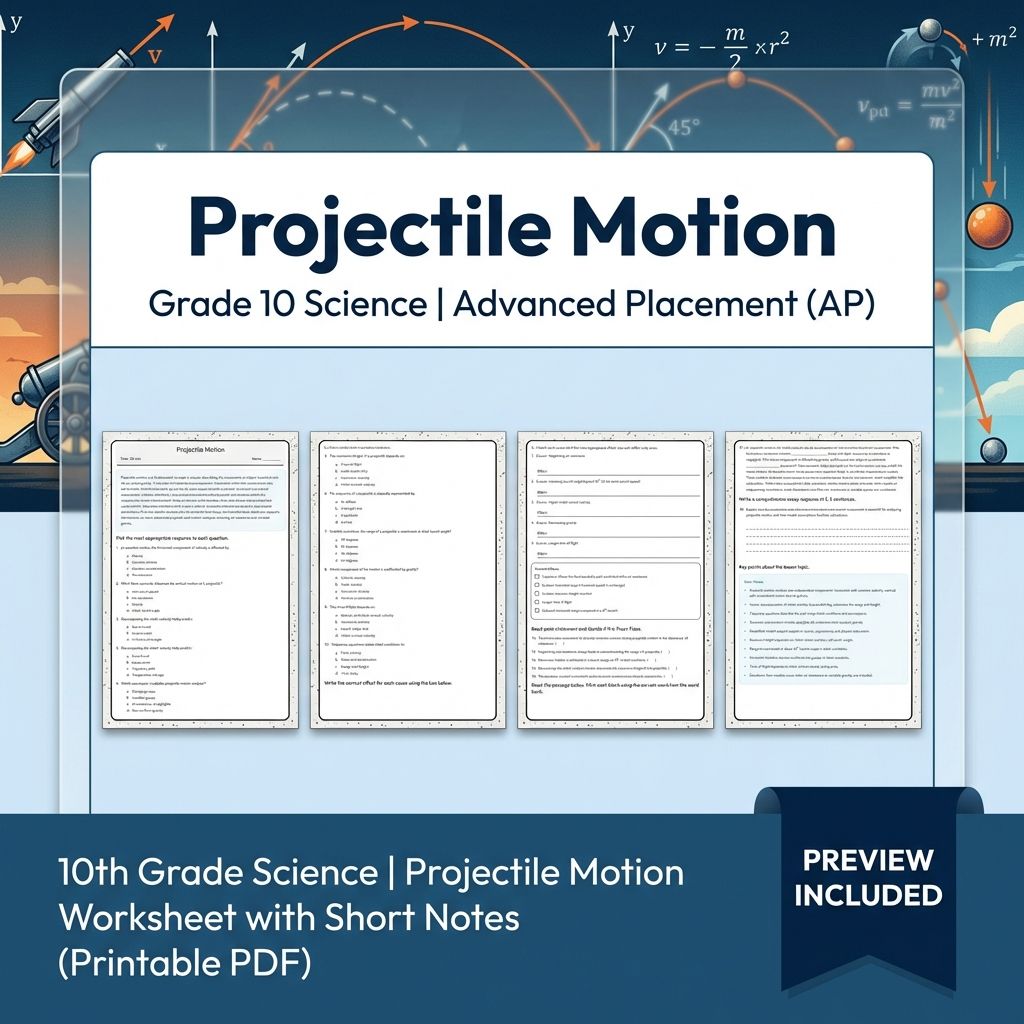
10th Grade Science | Projectile Motion Worksheet with Short Notes (PDF)
Created byMeadowlark WorksheetsLearning Objectives
- Understand the independent components of horizontal and vertical motion in projectile trajectories.
- Apply vector decomposition to predict projectile range, time of flight, and maximum height.
- Use parametric equations and trajectory formulas to link initial conditions with motion outcomes.
Instant download
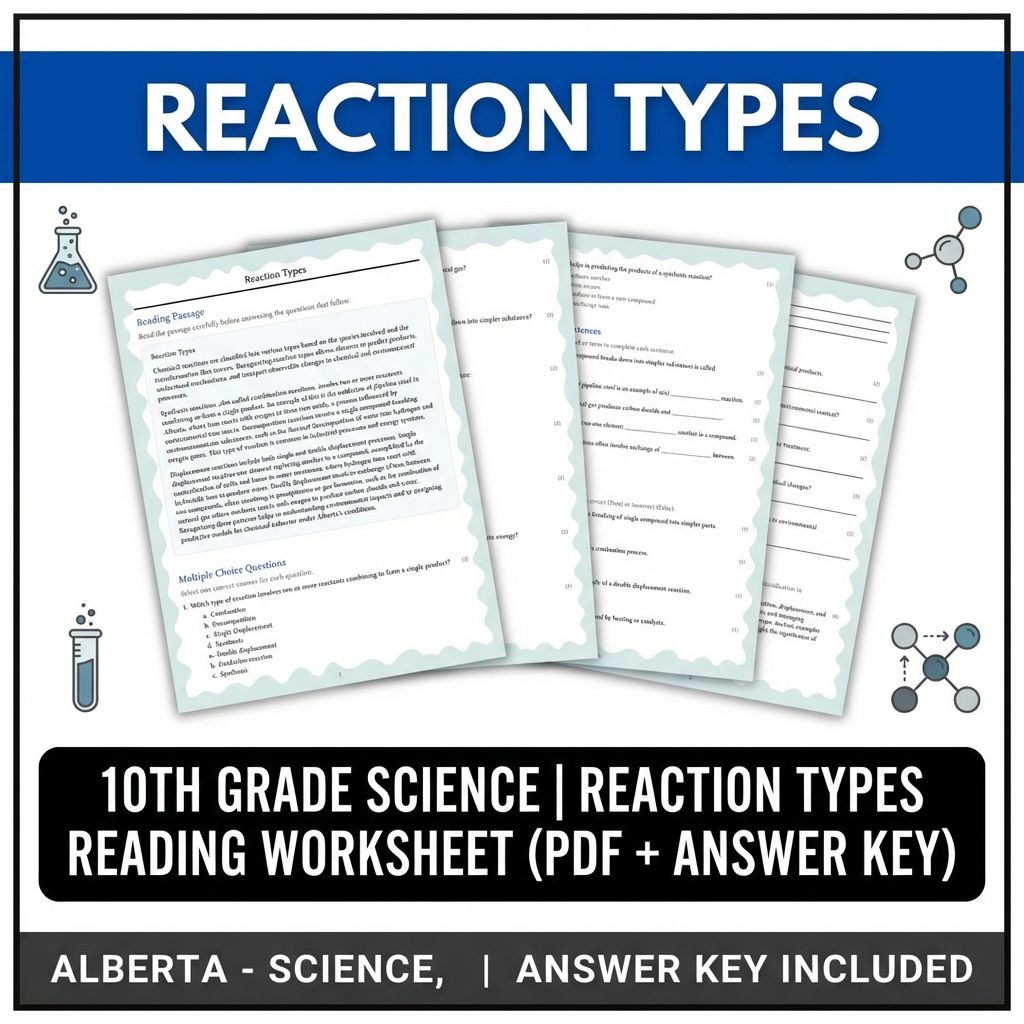
10th Grade Science | Reaction Types Reading Worksheet (PDF + Answer Key)
JCreated byJ.S SheetsLearning Objectives
- Understand different types of chemical reactions including synthesis, decomposition, single and double displacement, and combustion.
- Identify predictive patterns and representative equations for each reaction type.
- Apply reaction classification to Alberta-relevant examples such as steel oxidation and natural gas combustion.
Also included in: Grade 10 Science Unit Bundle | Chemical Reactions & Properties Worksheets +1 more
Instant download
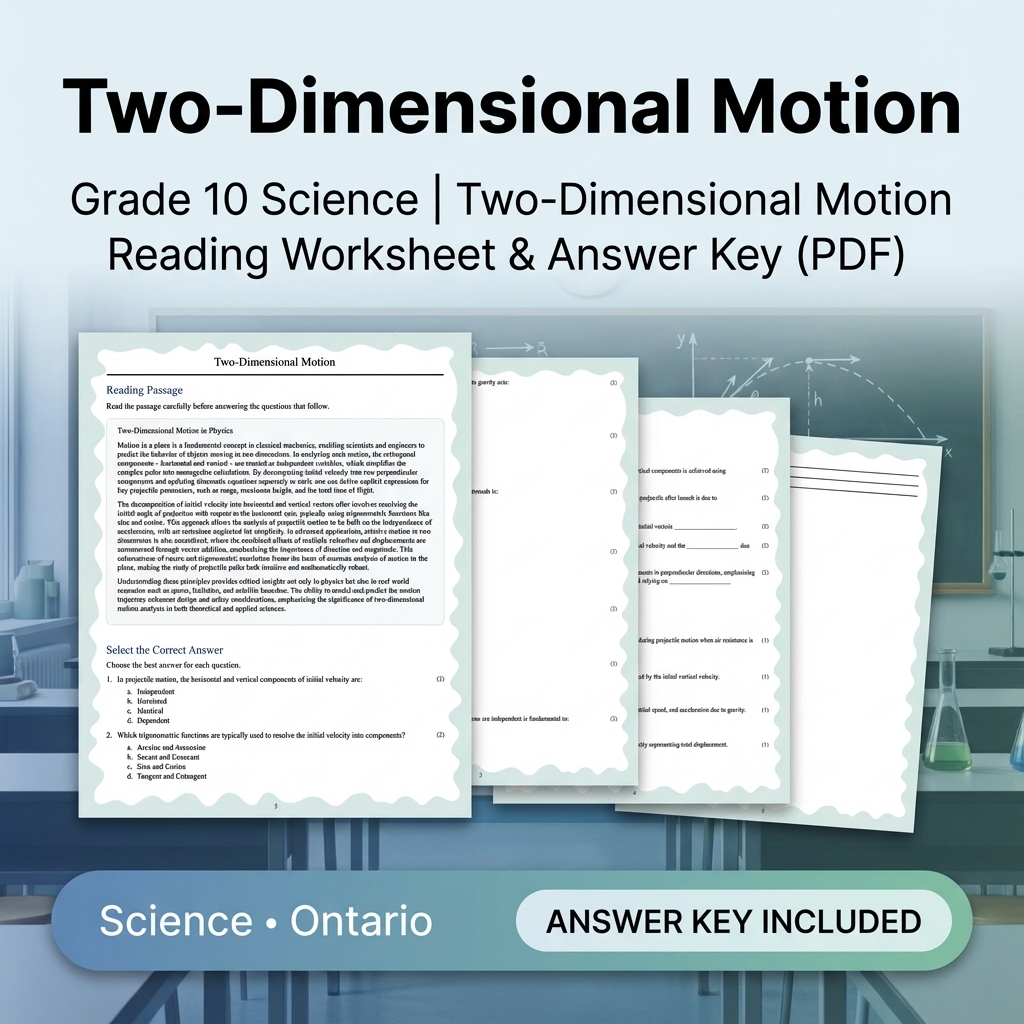
Grade 10 Science | Two-Dimensional Motion Reading Worksheet & Answer Key (PDF)
JCreated byJ.S SheetsLearning Objectives
- Explain the concept of motion in a plane and the independence of orthogonal components.
- Derive and analyze projectile trajectories under uniform gravitational acceleration neglecting air resistance.
- Decompose initial velocity into horizontal and vertical components using trigonometry.
Also included in: Grade 10 Science Unit Bundle – Motion, Forces & Mechanics (Answer Keys Included) +1 more
Instant download
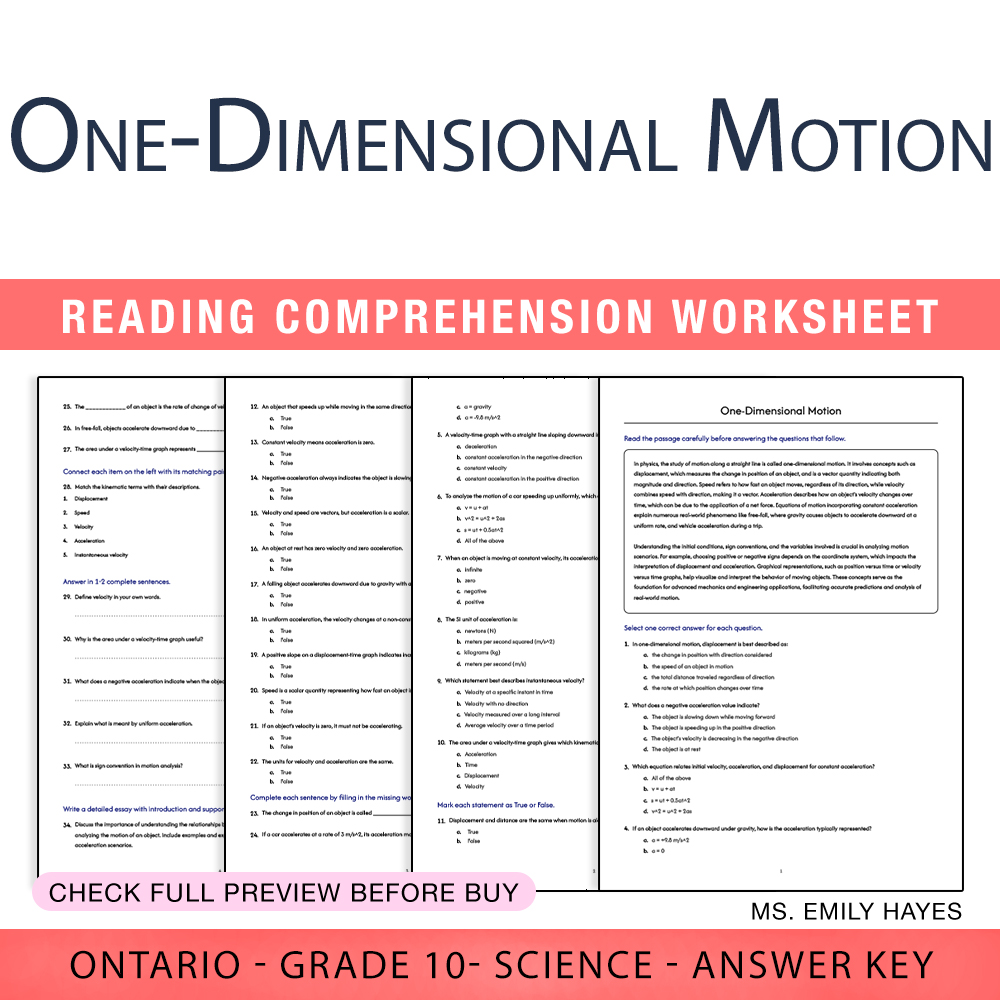
10th Grade Science | One-Dimensional Motion Worksheet (PDF + Answer Key)
Created byCopper Leaf ClassroomLearning Objectives
- Define and differentiate between displacement, speed, velocity, and acceleration in linear motion.
- Apply algebraic equations of motion to specific scenarios such as free-fall and uniformly accelerated vehicles.
- Interpret and analyze motion graphs and symbolic representations to describe kinematic quantities.
Instant download
About Grade 10 Science Worksheets
Find Science worksheets built for Grade 10. All 7,069 cover core skills, practice, and review, each an instant PDF download.
Every worksheet on MyTeachingSheets is created by independent teacher-authors and reviewed before publication. All resources download as printable PDFs for classroom, homework, or at-home practice, and many include answer keys. Preview any worksheet free before buying.