
Grade 10 Science Worksheets
7,069 worksheets
Grade 10 Science – Design Fundamentals Worksheet (Ontario Standards) (PDF)
 Created byEvergreen Desk Education
Learning Objectives
- Formulate testable science questions by clearly identifying variables and operational definitions.
- Classify independent, dependent, and controlled variables and justify choices for fair testing.
- Use criteria for reproducibility and measurement consistency to design investigations.
Also included in: Grade 10 Scientific Inquiry & Data Reasoning Science Lesson Bundle: Ontario +1 more
Instant download

Grade 10 Science – Variable Isolation Worksheet (Ontario Standards) (PDF)
Created byEvergreen Desk EducationLearning Objectives
- Explain how isolating variables helps distinguish causation from correlation in multifactor investigations.
- Identify how factorial layouts, interaction effects, and blocking strategies control complexity and nuisance variables.
- Apply criteria for judging whether a design supports attributable causation using replication and sample size.
Also included in: Grade 10 Scientific Inquiry & Data Reasoning Science Lesson Bundle: Ontario +1 more
Instant download

Grade 10 Science | Risk Management Worksheet (Ontario) (PDF)
Created byEvergreen Desk EducationLearning Objectives
- Identify hazards in laboratory and field sampling contexts using chemical, biological, and physical hazard examples.
- Apply qualitative risk assessment steps to estimate likelihood and consequence and support mitigation decisions.
- Explain how the hierarchy of controls (elimination, substitution, engineering, and administrative procedures) reduces risk.
Also included in: Grade 10 Scientific Inquiry & Data Reasoning Science Lesson Bundle: Ontario +1 more
Instant download

Grade 10 Science Worksheet – Career Pathways | Ontario Standards (PDF)
Created byEvergreen Desk EducationLearning Objectives
- Identify how different science careers connect to laboratory practice and scientific inquiry.
- Describe credential pathways and workplace certifications that support entry into technical science roles.
- Explain how data collection, instrument calibration, and regulatory compliance appear in real workplace responsibilities.
Also included in: Grade 10 Scientific Inquiry & Data Reasoning Science Lesson Bundle: Ontario +1 more
Instant download

Grade 10 Science – Ethics and Safety Worksheet (Ontario Standards) (PDF)
Created byEvergreen Desk EducationLearning Objectives
- Explain how ethical responsibilities (data honesty, consent, humane treatment) support scientific safety and credibility.
- Describe what researchers and professionals should do when they encounter unsafe or unethical conditions.
- Evaluate how oversight, certification, and reporting norms contribute to long-term trust in scientific evidence.
Also included in: Grade 10 Scientific Inquiry & Data Reasoning Science Lesson Bundle: Ontario +1 more
Instant download
Energy Forms Worksheet for Grade 10 Science | Alberta Standards
 Created byCoral Reef Learning
Learning Objectives
- Understand the concepts of kinetic and potential energy and how they relate to motion and stored capacity to do work.
- Describe examples of kinetic and potential energy in Alberta, such as snowmobiling and water in reservoirs.
- Explain the principle of conservation of energy and how it applies in idealized systems and real-world scenarios with non-conservative forces.
Instant download
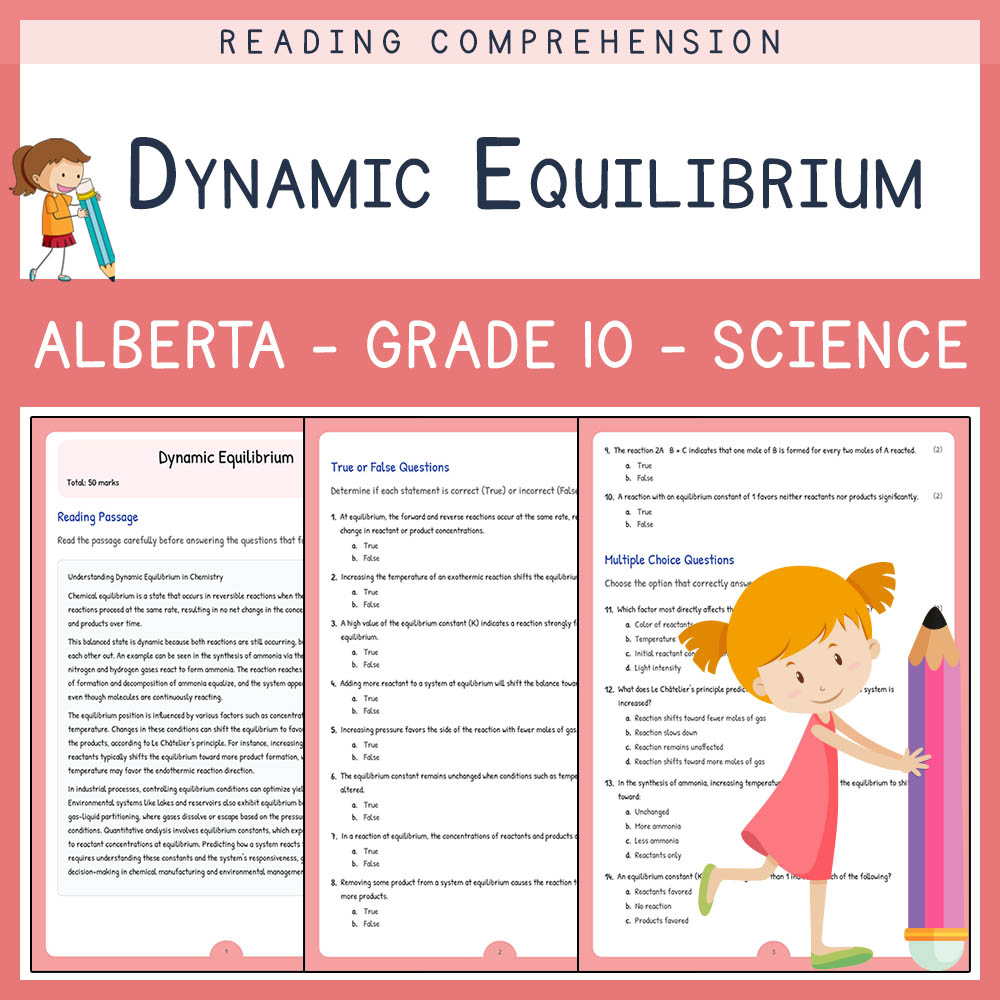
Grade 10 Science | Dynamic Equilibrium Worksheet | Alberta Standards
 Created byLumora Learning
Learning Objectives
- Explain the concept of dynamic chemical equilibrium and how reactions reach balance.
- Describe factors such as concentration, pressure, and temperature that influence equilibrium position.
- Interpret equilibrium constants and predict shifts when systems undergo perturbations.
Instant download
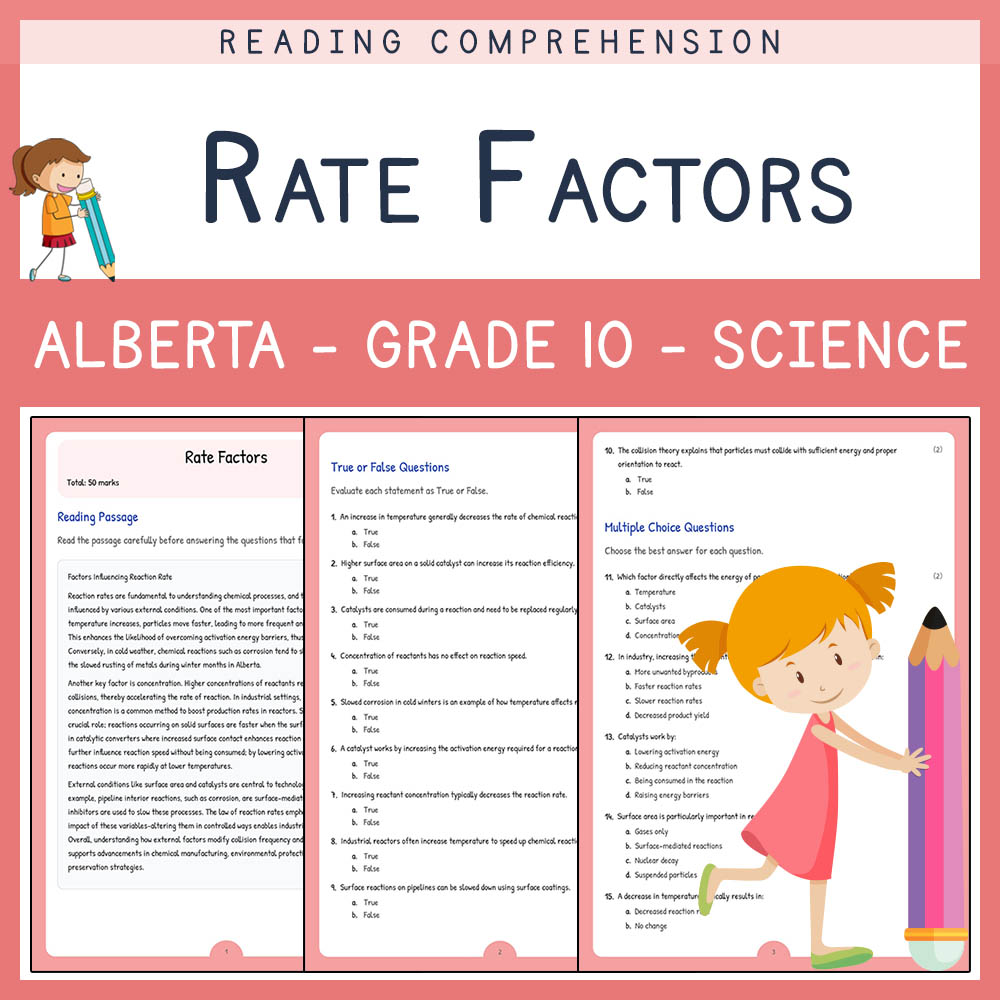
Grade 10 Science Worksheet | Rate Factors | Alberta Standards
Created byLumora LearningLearning Objectives
- Understand how temperature, concentration, surface area, and catalysts influence reaction rates.
- Analyze quantitative effects of rate variables in chemical reactions.
- Describe conceptual relationships between external conditions and reaction speed.
Instant download
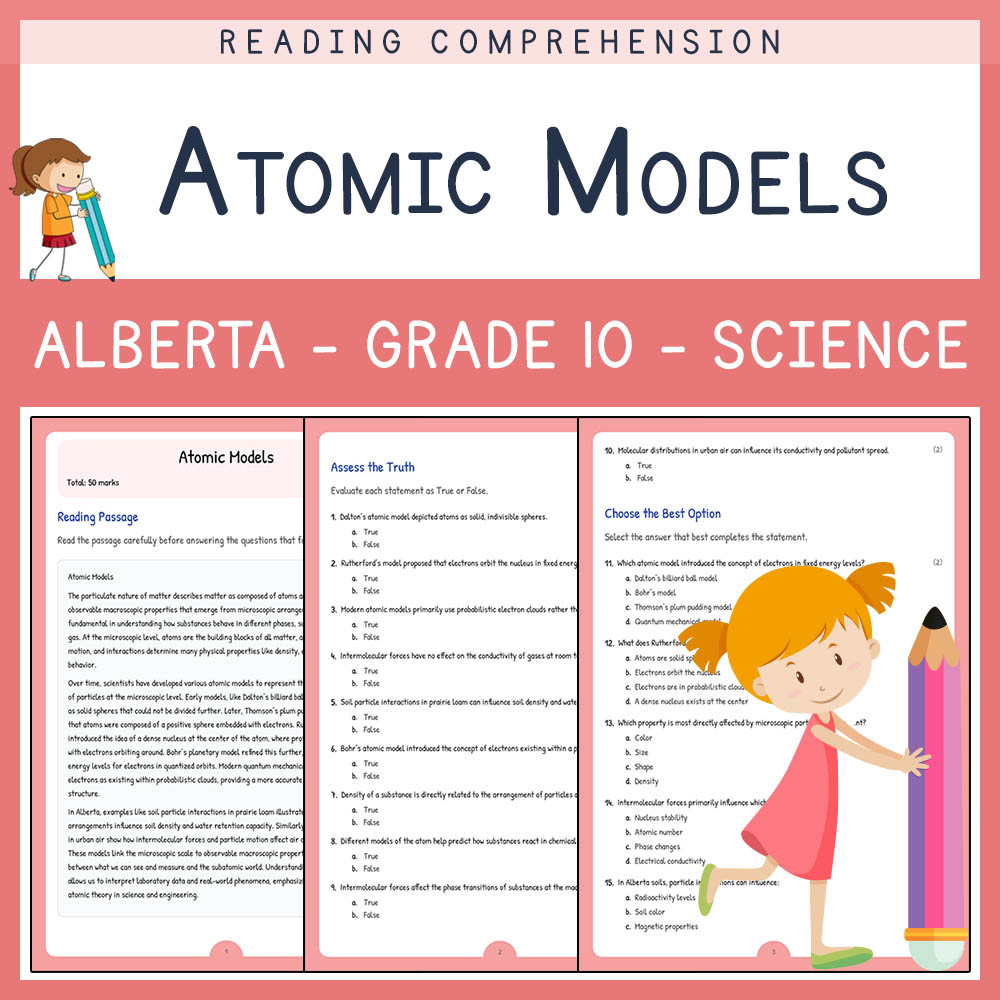
Grade 10 Science | Atomic Models Worksheet | Alberta
Created byLumora LearningLearning Objectives
- Understand the concept of particulate nature of matter at the atomic level.
- Explore various atomic models and their representations of particles and forces.
- Connect microscopic atomic arrangements to macroscopic properties such as density, phase, and conductivity.
Instant download
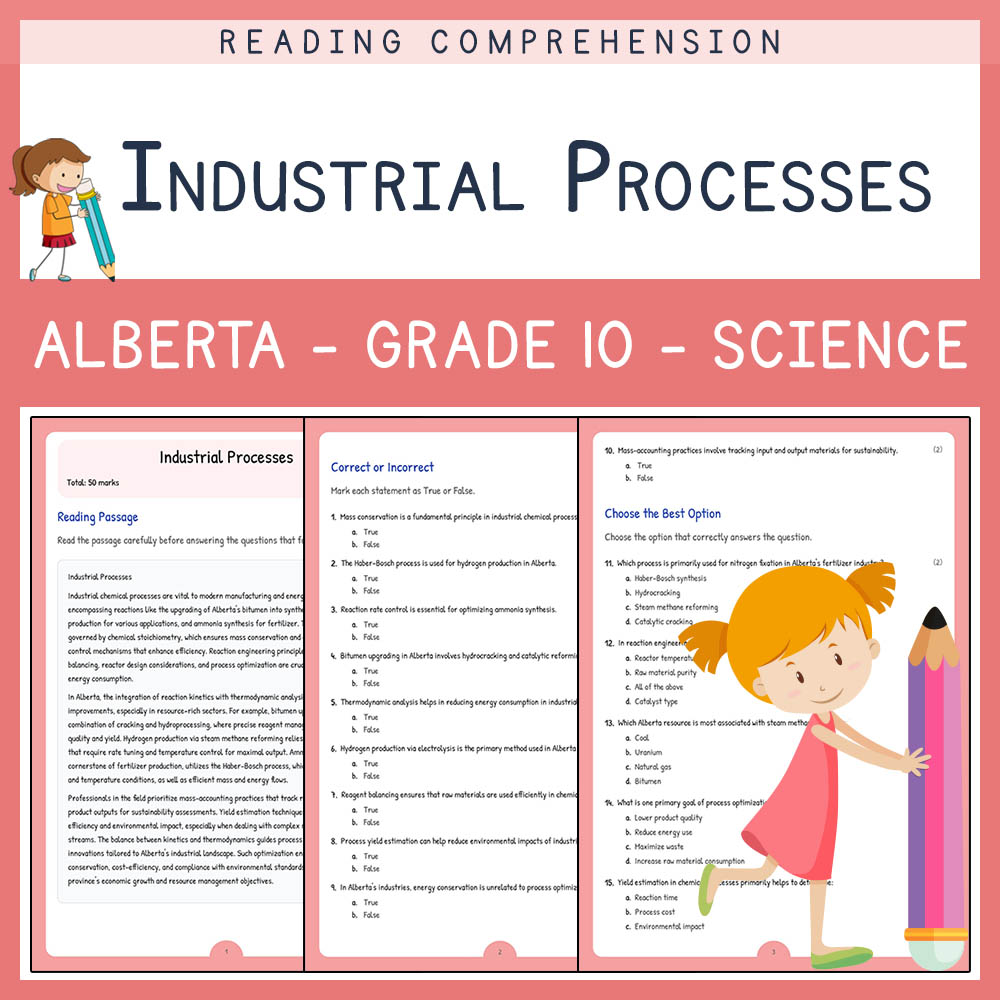
Grade 10 Science Worksheet | Industrial Processes | Alberta Standards
Created byLumora LearningLearning Objectives
- Understand key concepts of stoichiometry and mass conservation in industrial reactions.
- Explore Alberta-specific examples of chemical processes such as bitumen upgrading, hydrogen production, and ammonia synthesis.
- Analyze the role of kinetics and thermodynamics in process optimization.
Instant download
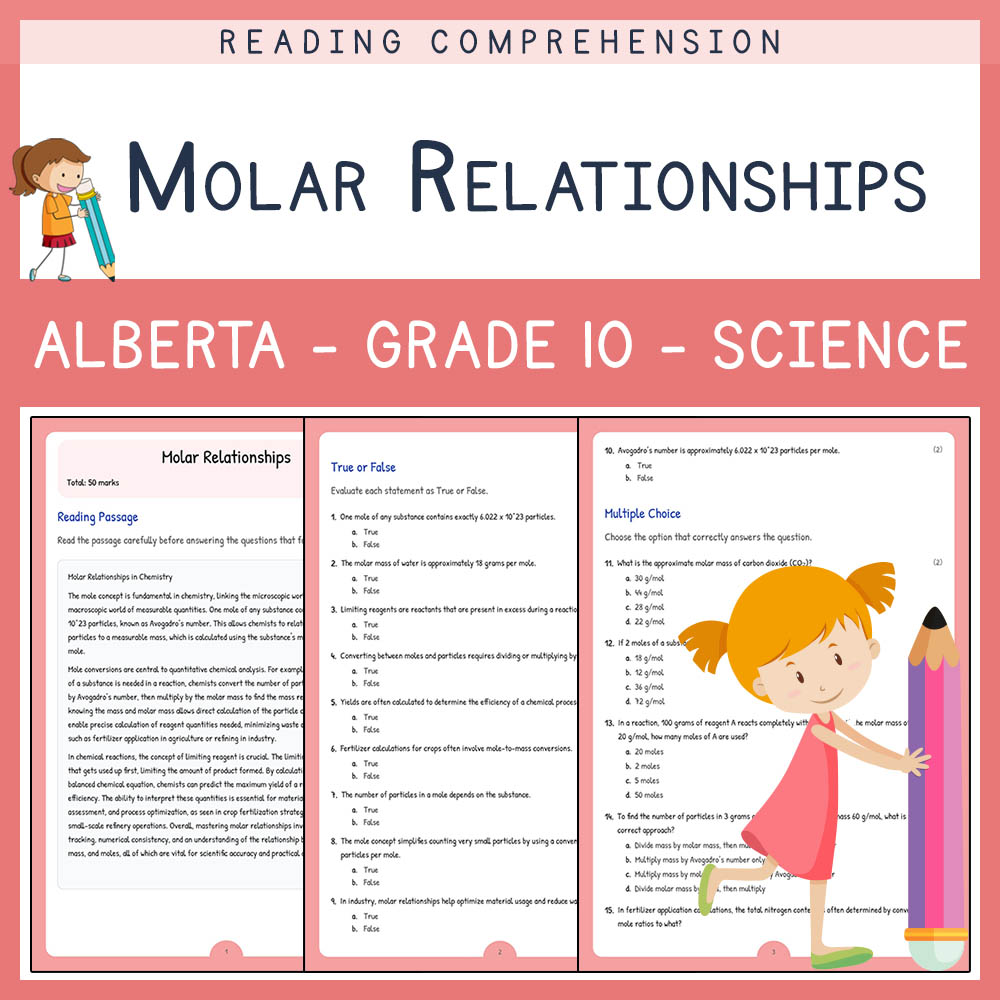
Grade 10 Science | Molar Relationships Worksheet | Alberta Standards
Created byLumora LearningLearning Objectives
- Understand the concept of the mole and its relationship to particle count and mass.
- Perform mole-to-mass, mass-to-mole, and mole-to-mole conversions using molar mass and Avogadro's number.
- Identify limiting reagents in chemical reactions and calculate yields based on mole ratios.
Instant download
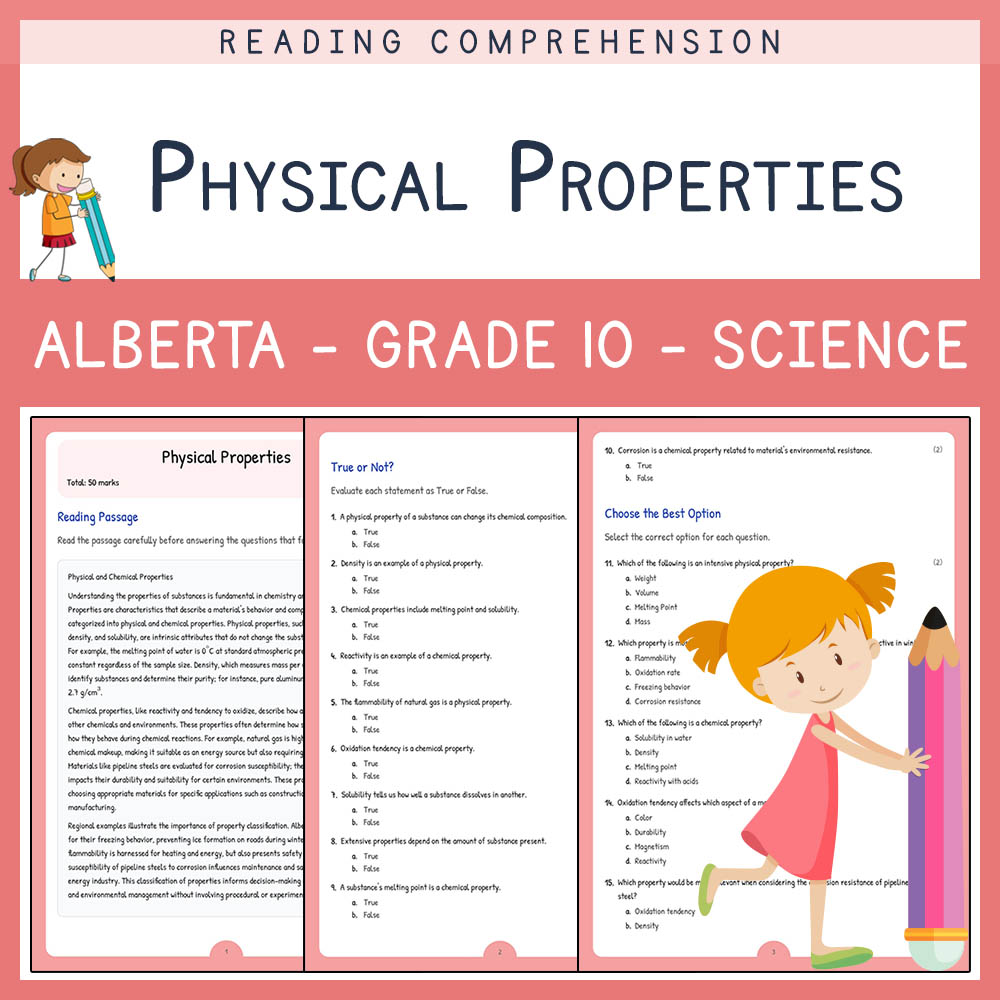
Grade 10 Science | Physical Properties Worksheet | Alberta Standards
Created byLumora LearningLearning Objectives
- Differentiate between physical and chemical properties of substances.
- Identify and classify various physical properties such as melting point, density, and solubility.
- Understand chemical properties like reactivity and oxidation tendency.
Instant download
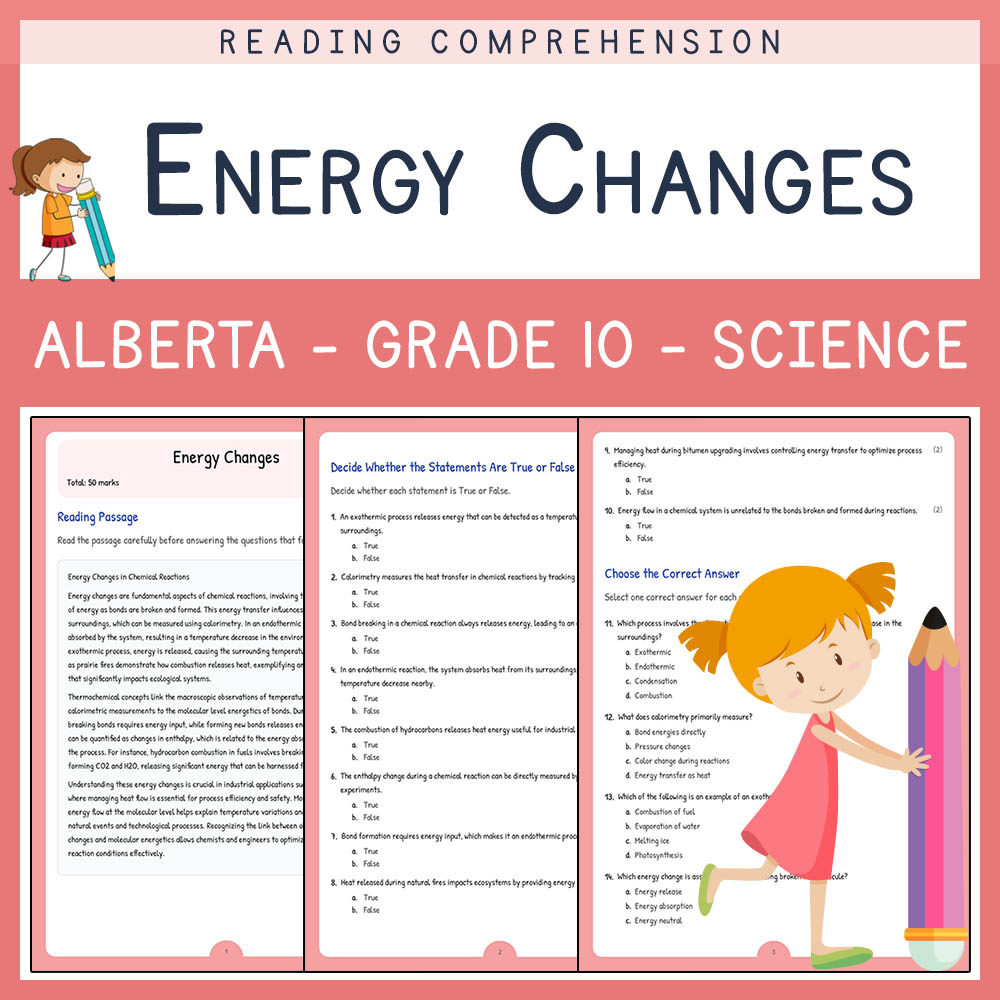
Grade 10 Science | Energy Changes Worksheet | Alberta Aligned
Created byLumora LearningLearning Objectives
- Describe the concepts of endothermic and exothermic energy changes in chemical reactions.
- Relate molecular energetics to macroscopic temperature and calorimetric measurements.
- Identify real-world examples of energy absorption and release in industrial and natural systems.
Instant download
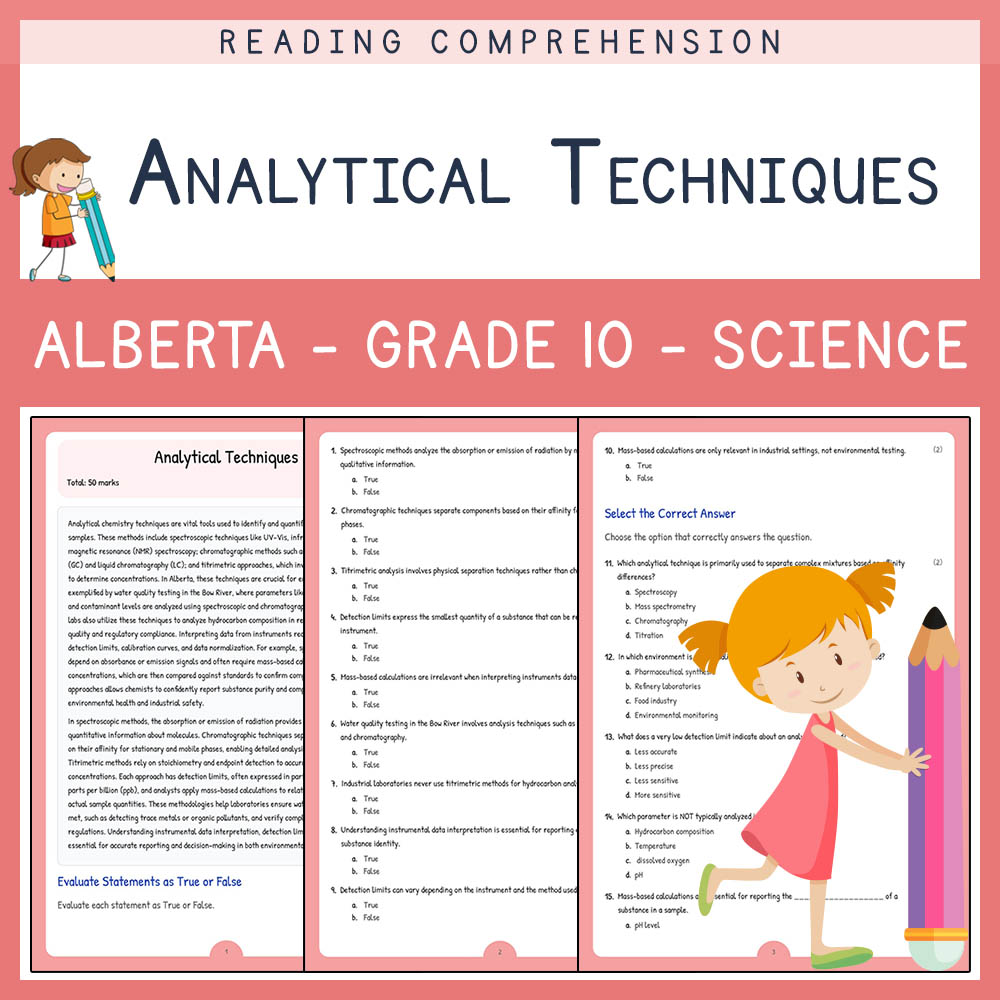
Grade 10 Science | Analytical Techniques Worksheet | Alberta
Created byLumora LearningLearning Objectives
- Understand various spectroscopic, chromatographic, and titrimetric approaches in analytical chemistry.
- Interpret instrumental data and recognize detection limits in substance analysis.
- Apply mass-based calculations to determine substance composition and ensure compliance in environmental and industry contexts.
Instant download

Grade 10 Science | Solution Concentration Worksheet | Alberta Standards
Created byLumora LearningLearning Objectives
- Understand different methods to express solution concentration, including molarity, mass percent, and parts per million.
- Apply formulas and calculations to determine concentration in various contexts.
- Relate concentration measures to environmental and regulatory standards relevant in Alberta.
Instant download
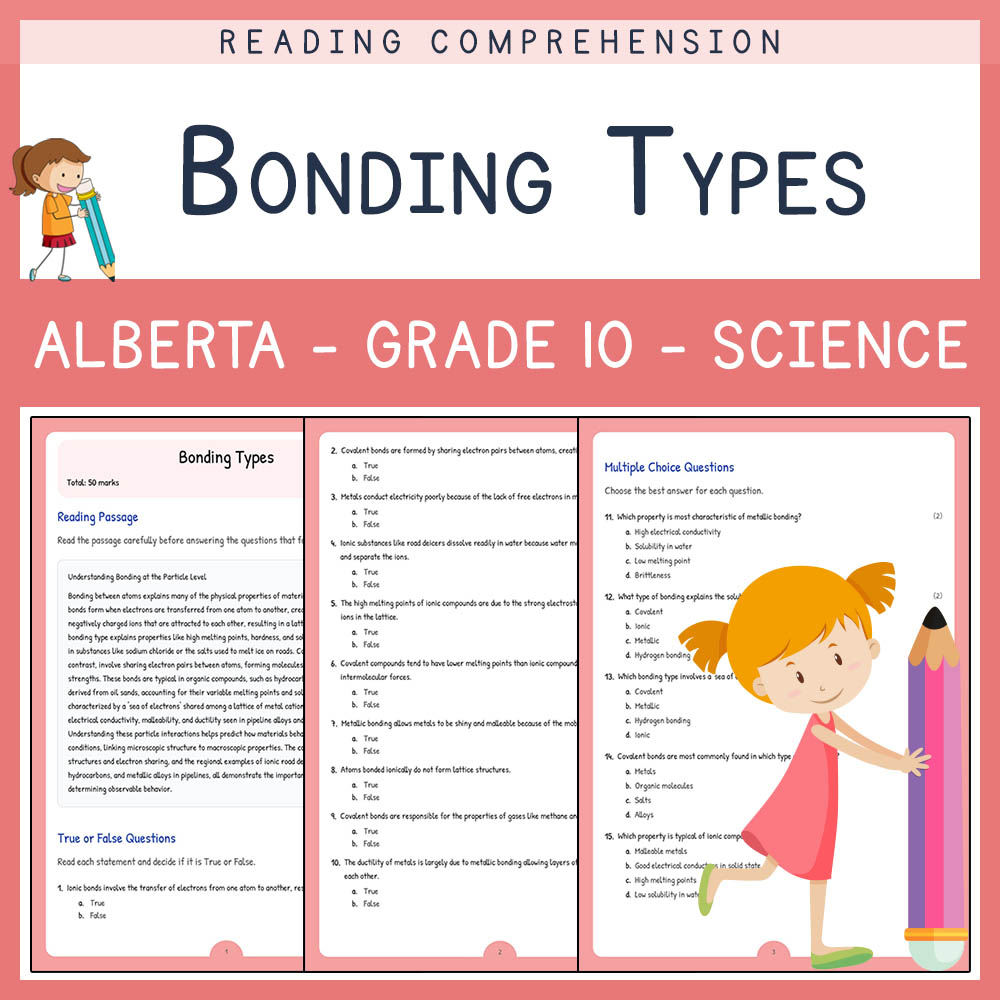
Grade 10 Science | Bonding Types Worksheet | Alberta Standards
Created byLumora LearningLearning Objectives
- Explain the differences between ionic, covalent, and metallic bonding at the particle level.
- Relate bonding types to observable properties such as conductivity, melting point, and solubility.
- Identify examples of each bonding type in real-world materials and applications.
Instant download
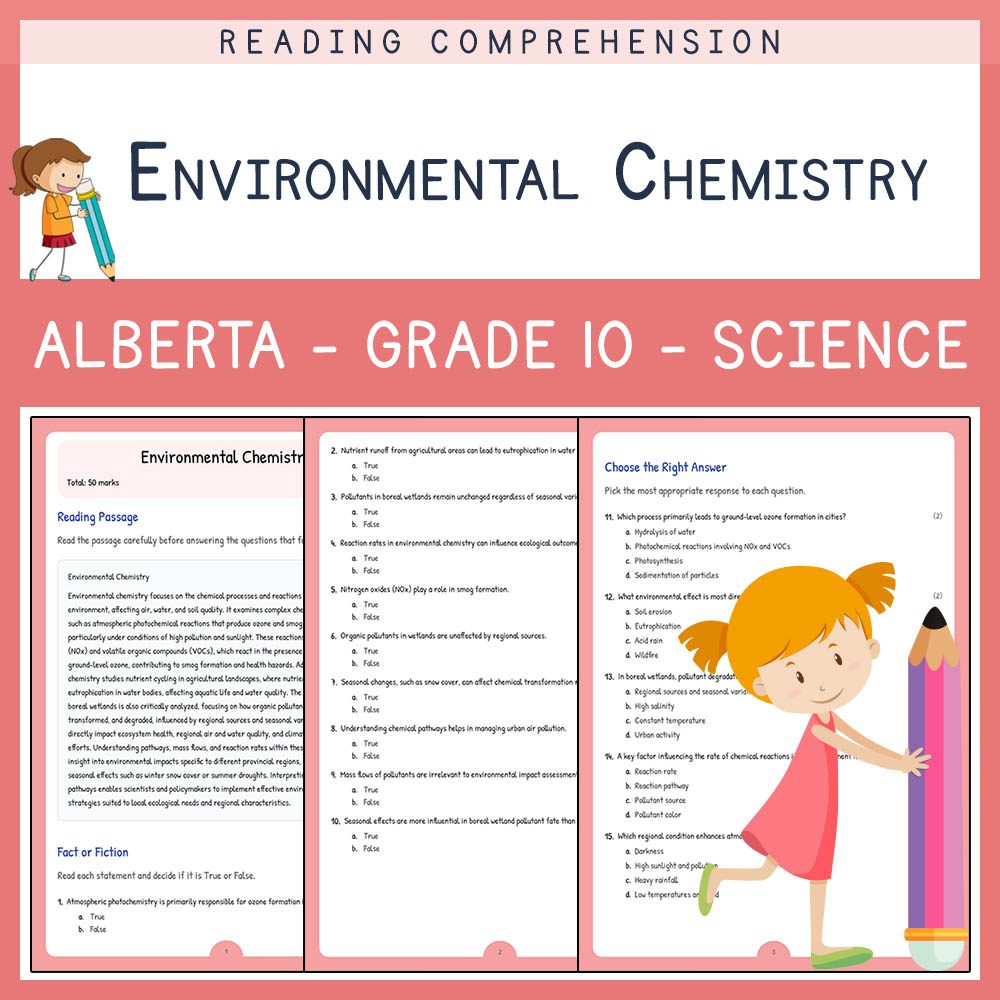
Grade 10 Science | Environmental Chemistry Worksheet | Alberta Standards
Created byLumora LearningLearning Objectives
- Understand chemical transformations and transport affecting air, water, and soil quality.
- Interpret chemical pathways, mass flows, and rate influences in environmental contexts.
- Analyze regional sources and seasonal effects on atmospheric, aquatic, and terrestrial environments.
Instant download
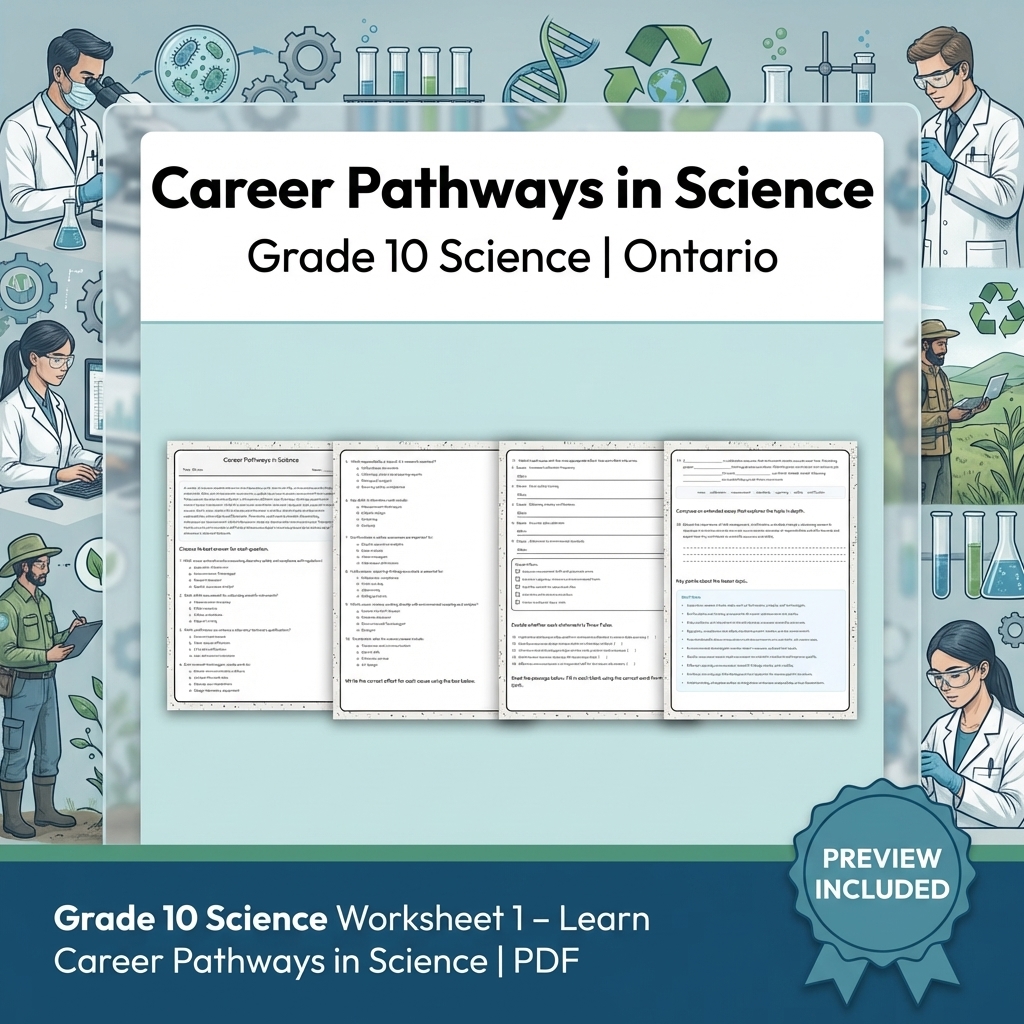
Grade 10 Science Worksheet Learn Career Pathways in Science | PDF
 Created byMeadowlark Worksheets
Learning Objectives
- Identify various career options linked to scientific inquiry and laboratory practices.
- Understand credential pathways, certifications, and key skill development.
- Recognize responsibilities related to data collection, instrument calibration, and compliance.
Also included in: Grade 10 Science Lesson Group Bundle | Ontario Curriculum Worksheets +1 more
Instant download
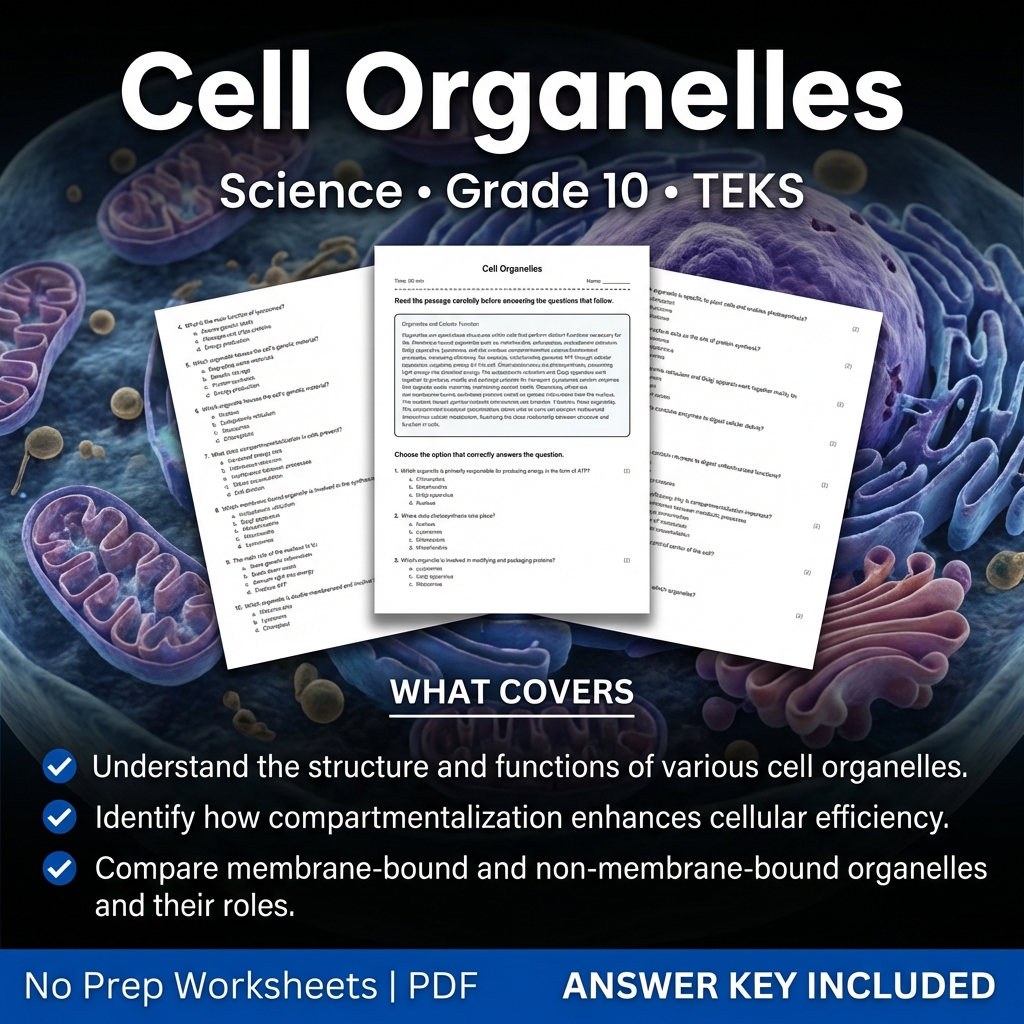
Grade 10 Science Worksheet on Cell Organelles | TEKS Standards
Created byCoral Reef LearningLearning Objectives
- Understand the structure and functions of various cell organelles.
- Identify how compartmentalization enhances cellular efficiency.
- Compare membrane-bound and non-membrane-bound organelles and their roles.
Instant download
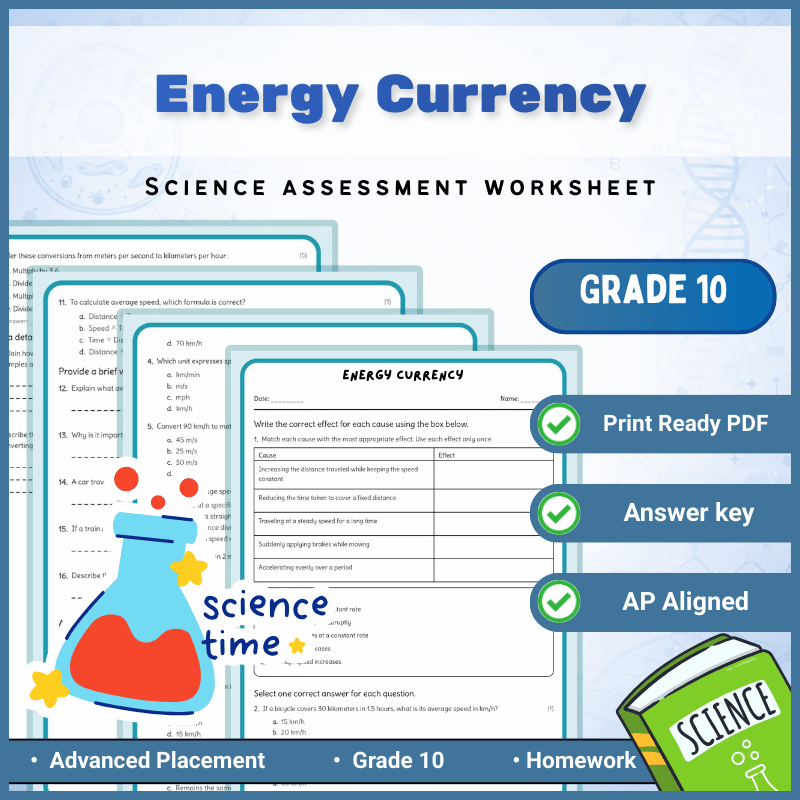
Grade 10 Science | Energy Currency Worksheet (AP) – Science 1 PDF
 Created byBright Mind Resources
Learning Objectives
- Explain the role of adenosine triphosphate (ATP) as the energy currency in biological systems.
- Compare and analyze redox reactions, bond energy changes, and free energy diagrams related to cellular energy transfer.
- Describe how energy transfer supports cellular organization, metabolic coupling, and transient energy storage through phosphorylation.
Instant download

Grade 10 Molecular Coding Worksheet | DNA to Protein | NGSS Biology
 Created byAmber Owl Education
Learning Objectives
- Explain how the order of nucleotides in DNA and RNA determines the order of amino acids in a protein
- Describe how transcription and translation connect DNA sequence to protein structure and function
- Analyze how point mutations and frameshifts can change proteins and affect an organism
Instant download

Organelle Architecture in Eukaryotic Cells Worksheet Grade 10 Science
 Created byChalk and Compass
Learning Objectives
- Identify major eukaryotic organelles and describe their structural features using electron microscopy language.
- Compare internal organization in prokaryotic versus eukaryotic cells, focusing on compartmentalization.
- Explain how membrane-bound compartments contribute to cellular complexity without focusing on specific metabolic pathways.
Also included in: Cells, Photosynthesis, Respiration & Microbes Lesson Bundle – Grade 10 Science +1 more
Instant download

Grade 10 Groundwater Systems Worksheet | Aquifers, Flow & Contamination
Created byChalk and CompassLearning Objectives
- Explain how aquifer type and rock properties such as porosity and permeability affect groundwater movement.
- Describe recharge and discharge processes and how groundwater connects to surface water.
- Identify key factors that control vulnerability to contamination, including contaminant transport and aquifer depletion.
Also included in: Grade 10 Science Earth Processes & Resource Use Lesson Bundle | Ontario +1 more
Instant download

Grade 10 Plate Tectonics Worksheet | Boundaries, Evidence & Doodle Note
Created byChalk and CompassLearning Objectives
- Describe the three main types of plate boundaries and the typical geological outcomes of each.
- Explain how mantle convection and slab pull can drive plate motion.
- Identify evidence that supports plate tectonics, including continental fit, palaeomagnetism, and earthquake distribution.
Also included in: Grade 10 Science Earth Processes & Resource Use Lesson Bundle | Ontario +1 more
Instant download

Ecosystem Roles of Microorganisms Worksheet Grade 10 Science Ontario
Created byChalk and CompassLearning Objectives
- Explain how microorganisms support ecosystem processes such as decomposition and nutrient cycling.
- Describe microbial roles in carbon and nitrogen fluxes, including symbiotic partnerships.
- Use key vocabulary to interpret how microbial community composition affects soil fertility and ecosystem resilience.
Also included in: Cells, Photosynthesis, Respiration & Microbes Lesson Bundle – Grade 10 Science +1 more
Instant download

Grade 10 Sustainable Strategies for Resource Use Science Worksheet Ontario
Created byChalk and CompassLearning Objectives
- Explain circular economy principles that reduce waste during resource extraction and use
- Use life-cycle thinking to compare low-impact extraction and rehabilitation strategies
- Evaluate trade-offs among economic development, community needs, and long-term environmental stewardship
Also included in: Grade 10 Science Earth Processes & Resource Use Lesson Bundle | Ontario +1 more
Instant download

Grade 10 Science Classification Basics States Purity & Mixtures Worksheet
Created byChalk and CompassLearning Objectives
- Classify matter as an element, a compound, or a mixture using chemical formulas and purity criteria.
- Differentiate pure substances from mixtures by using ideas of heterogeneity and homogeneity.
- Connect macroscopic observations to microscopic particle models and symbolic notation.
Also included in: Chemistry Foundations & Chemical Reactions Lesson Bundle: Grade 10 Science +1 more
Instant download

Grade 10 Science Career Pathways Worksheet | Lab Skills & Scientific Reporting
Created byChalk and CompassLearning Objectives
- Survey career roles that rely on scientific inquiry, laboratory practice, and data reporting.
- Describe common responsibilities such as instrument calibration, safety procedures, and regulatory compliance.
- Identify credential and certification pathways and connect them to transferable technical and communication skills.
Also included in: Grade 10 Science Variables & Control Data Analysis Lesson Bundle | Ontario +1 more
Instant download

Grade 10 Science Risk Management Laboratory Safety Worksheet Ontario
Created byChalk and CompassLearning Objectives
- Identify common hazards in chemical, biological, and physical laboratory settings using systematic observation.
- Apply qualitative risk assessment by estimating likelihood and consequence to prioritize controls.
- Select appropriate hazard-reduction measures using the hierarchy of elimination, substitution, engineering controls, and administrative procedures.
Also included in: Grade 10 Science Variables & Control Data Analysis Lesson Bundle | Ontario +1 more
Instant download

Grade 10 One-Dimensional Motion Worksheet | Ontario Science Kinematics
Created byChalk and CompassLearning Objectives
- Classify common forces as contact or non-contact interactions.
- Describe how force direction and magnitude affect the motion of an object.
- Distinguish vector forces from scalar effects using everyday examples.
Also included in: Grade 10 Science Motion, Forces & Momentum Lesson Bundle – Ontario Framework +1 more
Instant download

Grade 10 Physical Properties Worksheet | Ontario Science Activity & Notes
Created byChalk and CompassLearning Objectives
- Differentiate intensive and extensive physical properties using measurable examples.
- Explain how physical changes differ from chemical changes using evidence of reversibility.
- Use data such as density, melting point, and boiling point to compare and identify materials.
Also included in: Chemistry Foundations & Chemical Reactions Lesson Bundle: Grade 10 Science +1 more
Instant download

Geologic Time Assessment | Florida NGSSS Standards – Grade 10 Science
 Created byPrism Point Learning
Learning Objectives
- Explain how relative dating techniques (superposition and cross-cutting relationships) can order geologic events.
- Describe how unconformities and fossil evidence (index fossils) help reconstruct gaps and time intervals in Earth’s history.
- Analyze how evidence from the rock record can be used to interpret major environmental changes and mass extinctions.
Also included in: Grade 10 Earth and Space Systems Science Lesson Bundle – Florida NGSSS +1 more
Instant download
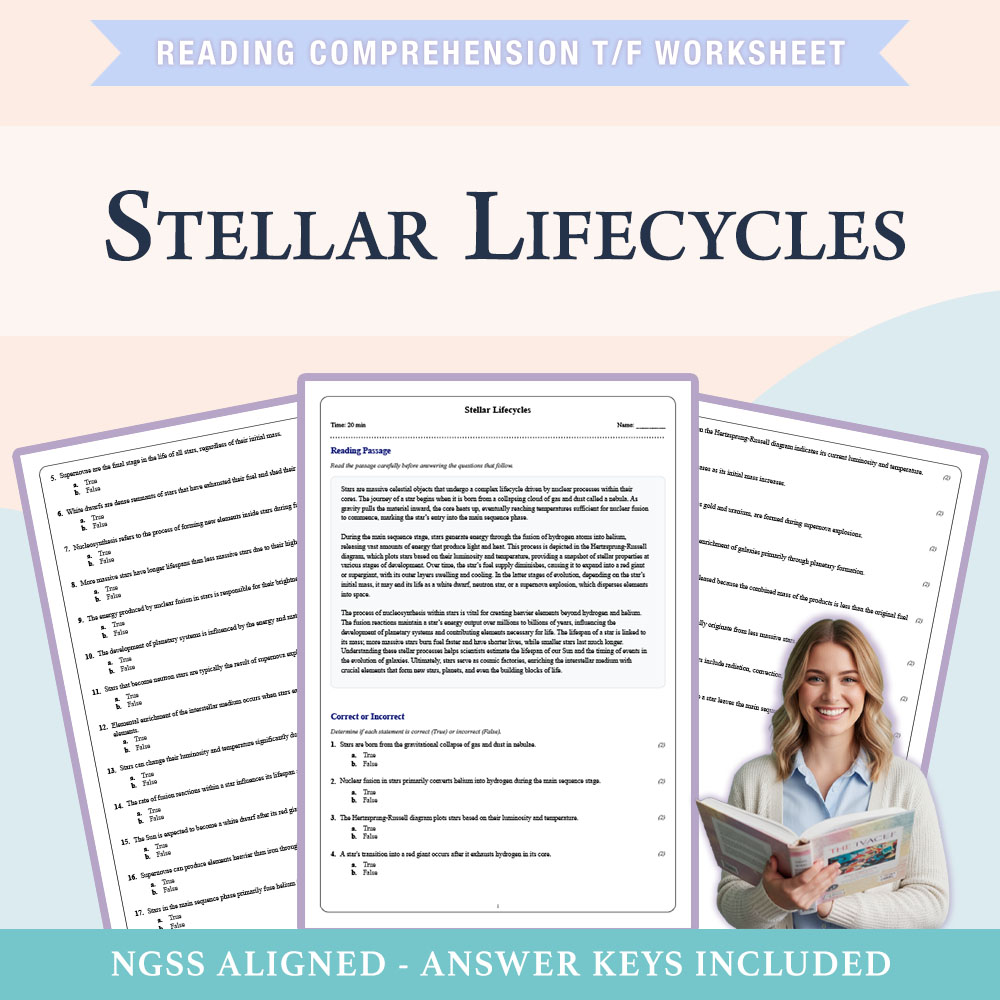
10th Grade Science | Stellar Lifecycles Worksheet (PDF + Answer Key)
 Created byCopper Leaf Classroom
Learning Objectives
- Understand the key processes involved in stellar evolution, including nuclear fusion, energy transport, and luminosity changes.
- Identify the different stages of stellar evolution depicted in the Hertzsprung-Russell diagram.
- Explain the end-stage outcomes of stars such as white dwarfs, neutron stars, and supernovae.
Also included in: Grade 10 Science |Stellar Lifecycles & Planetary Motion Bundle(PDF + Answer Key) +1 more
Instant download
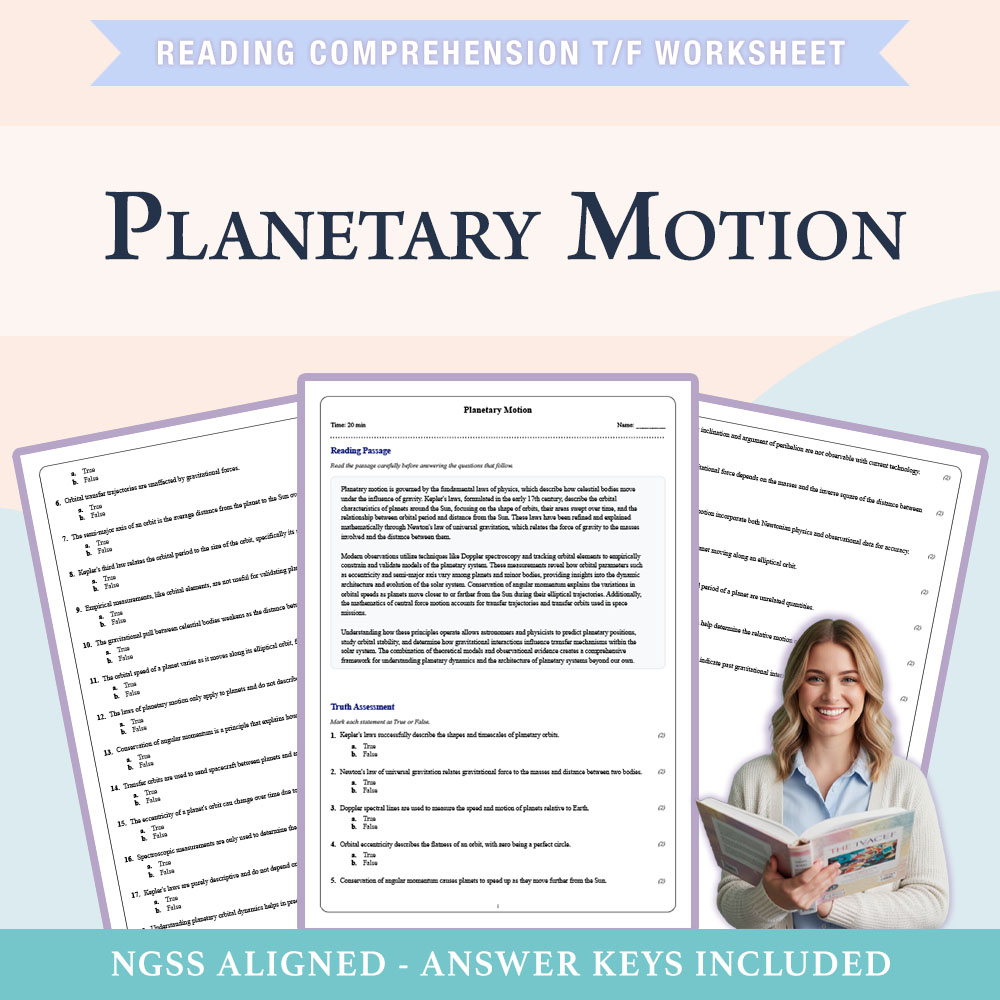
10th Grade Science | Planetary Motion Worksheet (PDF + Answer Key)
Created byCopper Leaf ClassroomLearning Objectives
- Understand the principles of Kepler's laws and Newtonian gravitation as they apply to planetary motion.
- Identify how observational methods provide empirical data to support models of planetary systems.
- Explain how conservation laws influence orbital dynamics and trajectories within the solar system.
Also included in: Grade 10 Science |Stellar Lifecycles & Planetary Motion Bundle(PDF + Answer Key) +1 more
Instant download
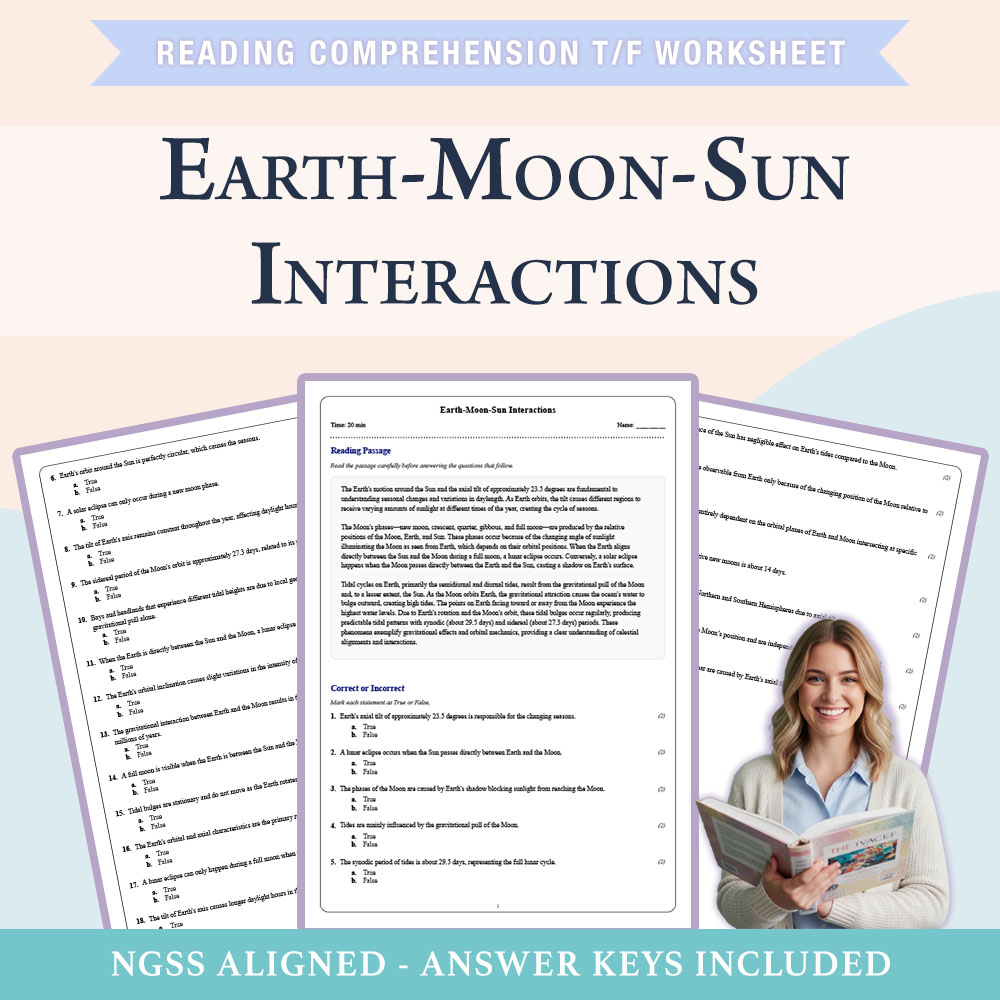
10th Grade Science | Earth-Moon-Sun Interactions Worksheet (PDF + Answer Key)
Created byCopper Leaf ClassroomLearning Objectives
- Understand how the relative positions of Earth, Moon, and Sun cause lunar and solar phases, eclipses, and seasons.
- Explain how gravitational interactions produce tidal cycles and the significance of synodic and sidereal periods.
- Identify the effects of axial tilt and orbital inclination on daylength and insolation variation.
Also included in: Grade 10 Science |Stellar Lifecycles & Planetary Motion Bundle(PDF + Answer Key) +1 more
Instant download
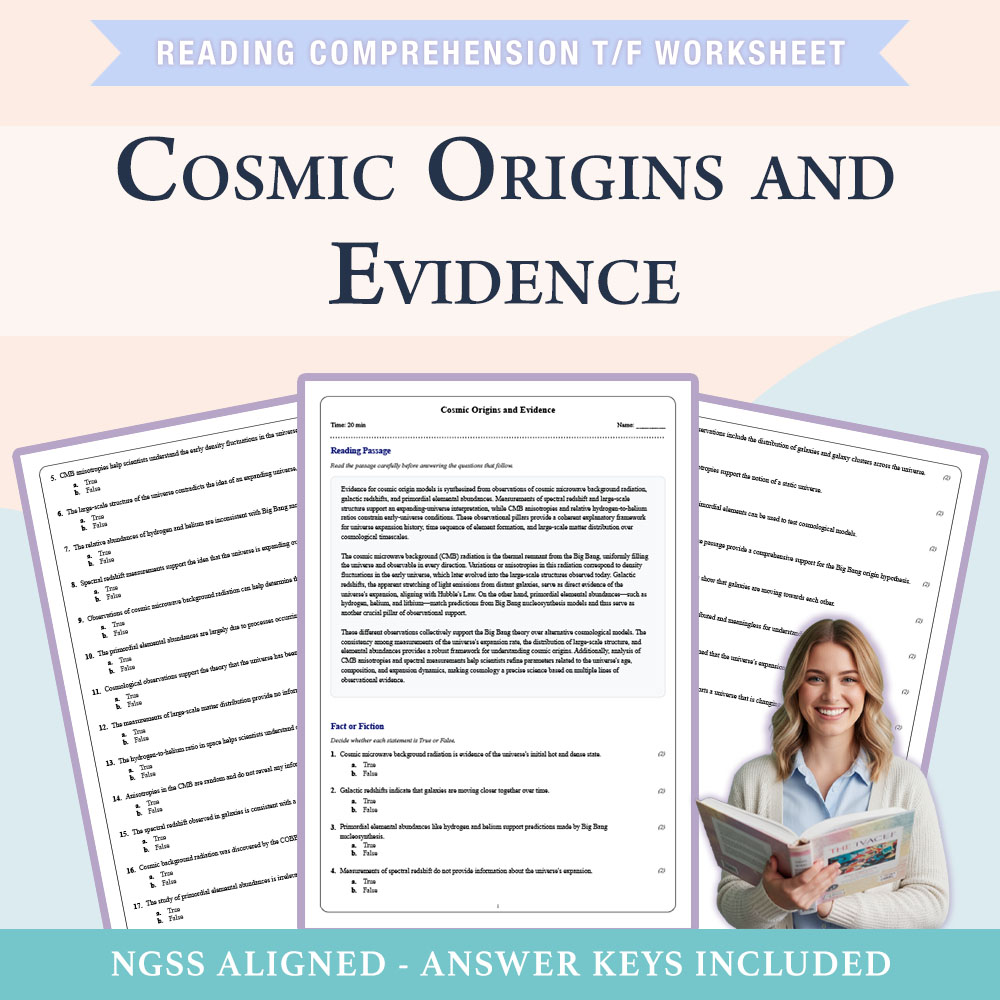
10th Grade Science | Cosmic Origins and Evidence Worksheet (PDF + Answer Key)
Created byCopper Leaf ClassroomLearning Objectives
- Understand the observational evidence supporting models of the universe's cosmic origin.
- Distinguish between different types of observational data used in cosmology.
- Evaluate statements about universe expansion, early-universe conditions, and large-scale structure based on scientific evidence.
Also included in: Grade 10 Science |Stellar Lifecycles & Planetary Motion Bundle(PDF + Answer Key) +1 more
Instant download
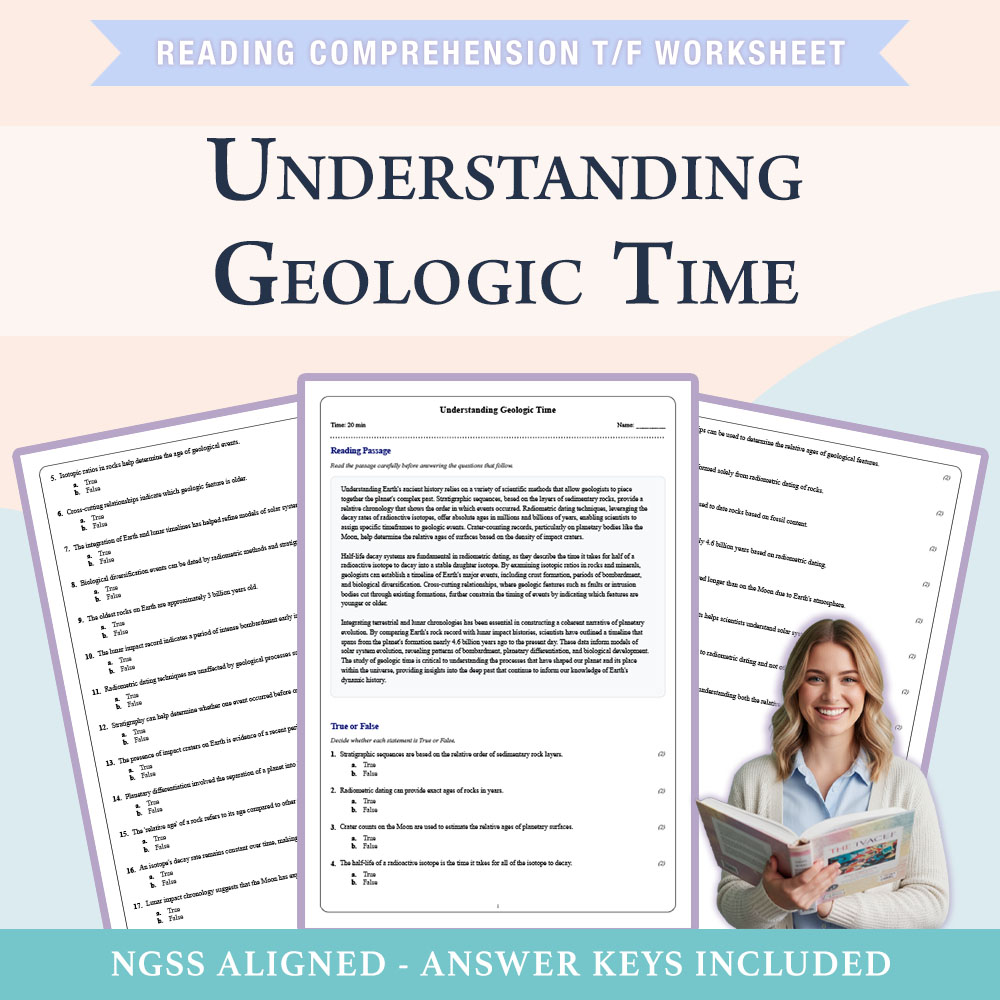
10th Grade Science | Understanding Geologic Time Worksheet (PDF + Answer Key)
Created byCopper Leaf ClassroomLearning Objectives
- Describe the methods used to reconstruct Earth's geologic history, including stratigraphic sequences and radiometric dating.
- Explain key concepts such as half-life decay systems, isotopic ratios, and cross-cutting relationships in determining the timing of geological events.
- Understand how terrestrial and lunar time scales integrate to form a comprehensive narrative of Earth's and the solar system's history.
Also included in: Grade 10 Science |Stellar Lifecycles & Planetary Motion Bundle(PDF + Answer Key) +1 more
Instant download

Grade 10 Ecosystem Modeling Worksheet | NGSS Science Systems Activity
 Created byBRIGHT PATH RESOURCES
Learning Objectives
- Understand different types of ecosystem models and their purposes
- Interpret the use of models like Lotka–Volterra equations and mass-balance models
- Analyze how models predict ecosystem responses to disturbances
Also included in: Grade 10 Ecology Lesson Bundle | Daily Reading | ngss Science +1 more
Instant download
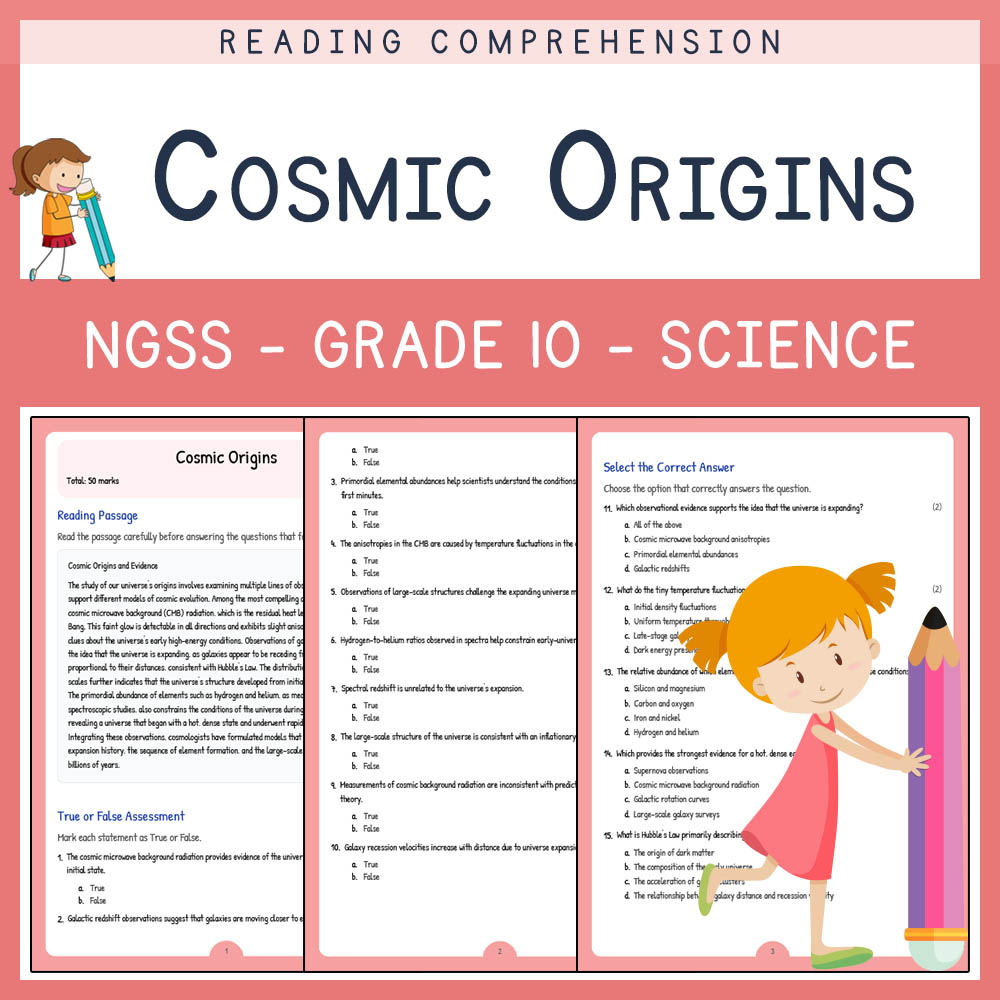
Grade 10 Science | Cosmic Origins Worksheet & Answer Key for NGSS Alignment
Created byLumora LearningLearning Objectives
- Understand the evidence supporting models of cosmic origin, including observations of cosmic microwave background radiation, galactic redshifts, and elemental abundances.
- Explain how spectral redshift and large-scale structure observations support an expanding universe.
- Identify the role of cosmic microwave background anisotropies and primordial element ratios in constraining early-universe conditions.
Instant download
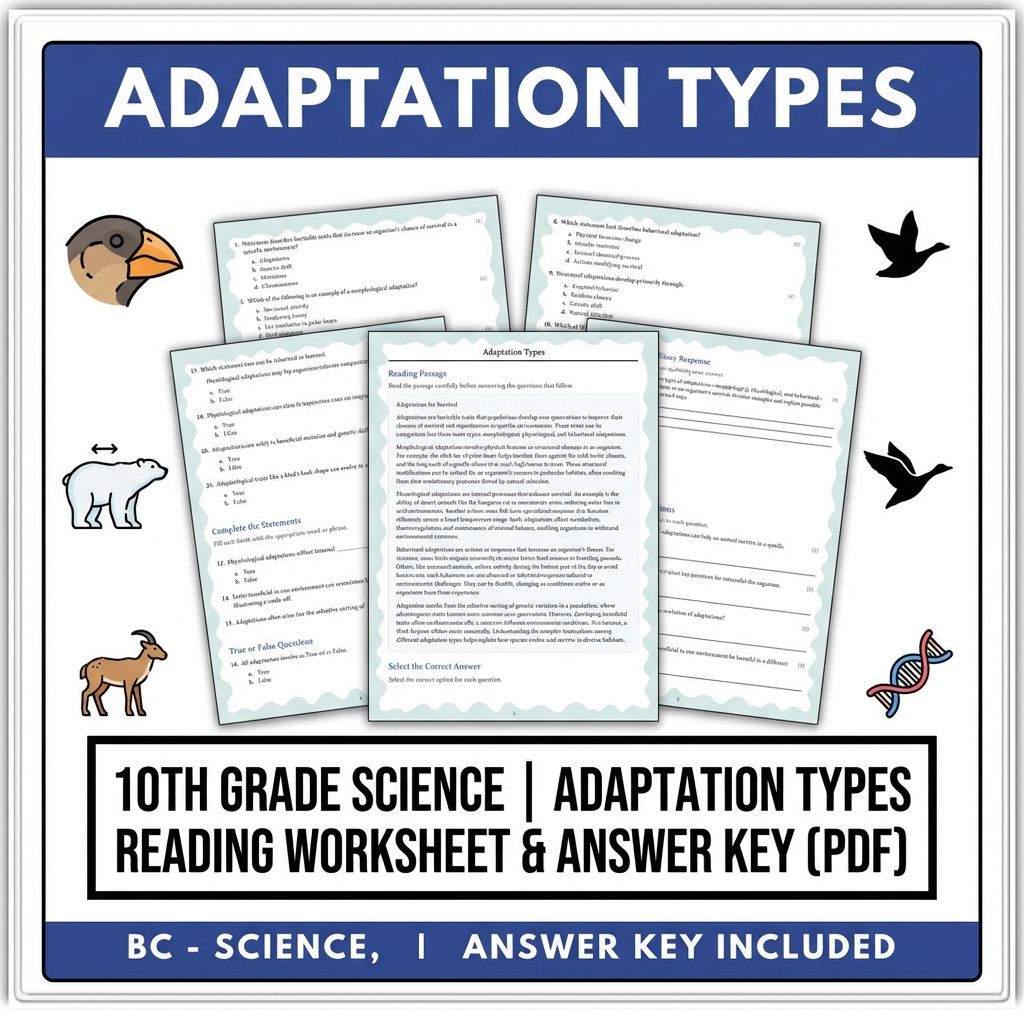
10th Grade Science | Adaptation Types Reading Worksheet & Answer Key (PDF)
JCreated byJ.S SheetsLearning Objectives
- Understand the different types of adaptations: morphological, physiological, and behavioral.
- Identify examples of adaptation in various environments.
- Explain how adaptations improve survival and reproduction.
Instant download

Energy Forms Worksheet for Grade 10 Science | Standards-Aligned Practice
JCreated byJ.S SheetsLearning Objectives
- Define kinetic and potential energy with real-world examples.
- Explain the principle of energy conservation in mechanical systems.
- Describe how non-conservative forces affect energy distribution.
Also included in: Grade 10 Science Practice Worksheets: Alberta Science Full-Year Bundle
Instant download

Grade 10 Science | Thermodynamic Limits Worksheet | BC Standards
Created byLumora LearningLearning Objectives
- Understand the fundamental principles of thermodynamics, including energy conservation and entropy.
- Explain how heat engines and refrigerators operate between temperature reservoirs.
- Apply Carnot relationships to determine maximum efficiency of heat engines.
Instant download
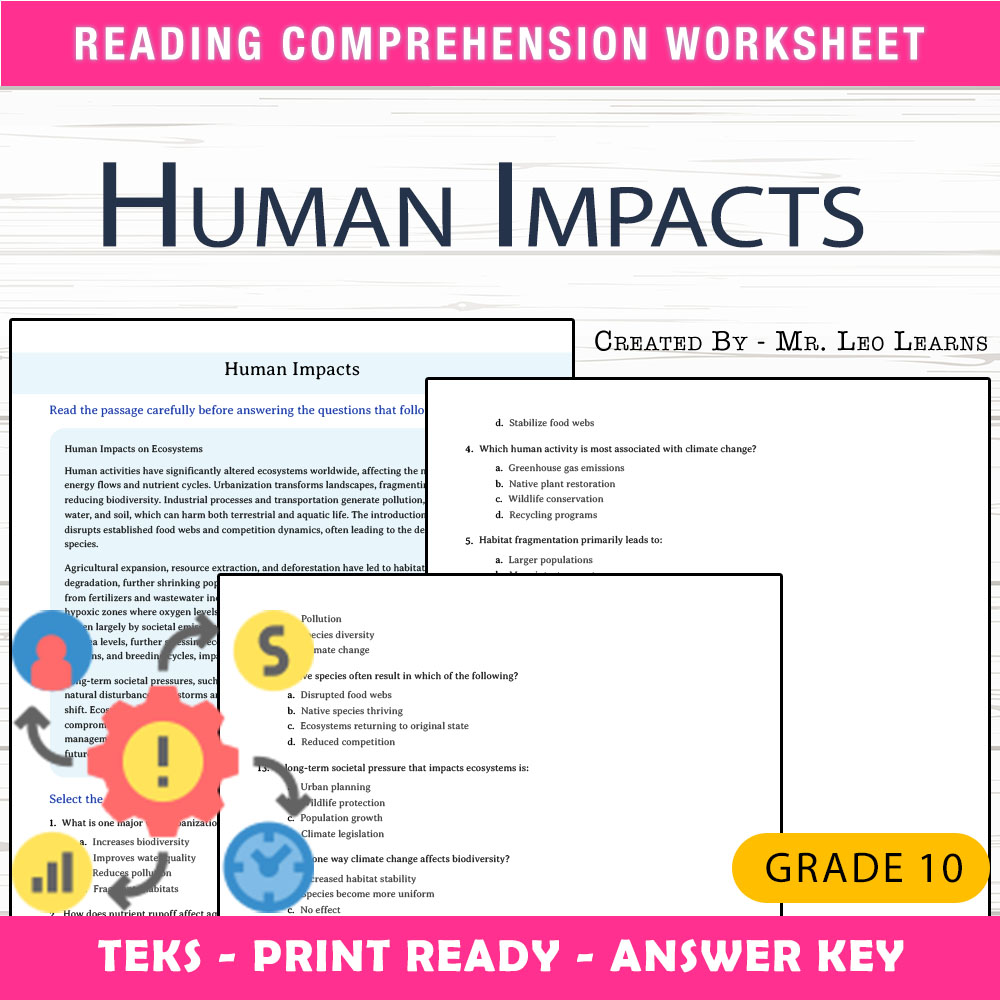
Grade 10 Science — Human Impacts Worksheet for Ecosystem Learning
 Created byThe Resource Hub
Learning Objectives
- Describe how human activities modify ecosystems through habitat change, pollution, and species introductions.
- Explain the effects of urbanization and agriculture on biodiversity and community dynamics.
- Identify causes and consequences of nutrient runoff, invasive species, and climate change on ecosystems.
Also included in: Grade 10 Science Unit Bundle | Ecosystems & Ecology Worksheets +1 more
Instant download
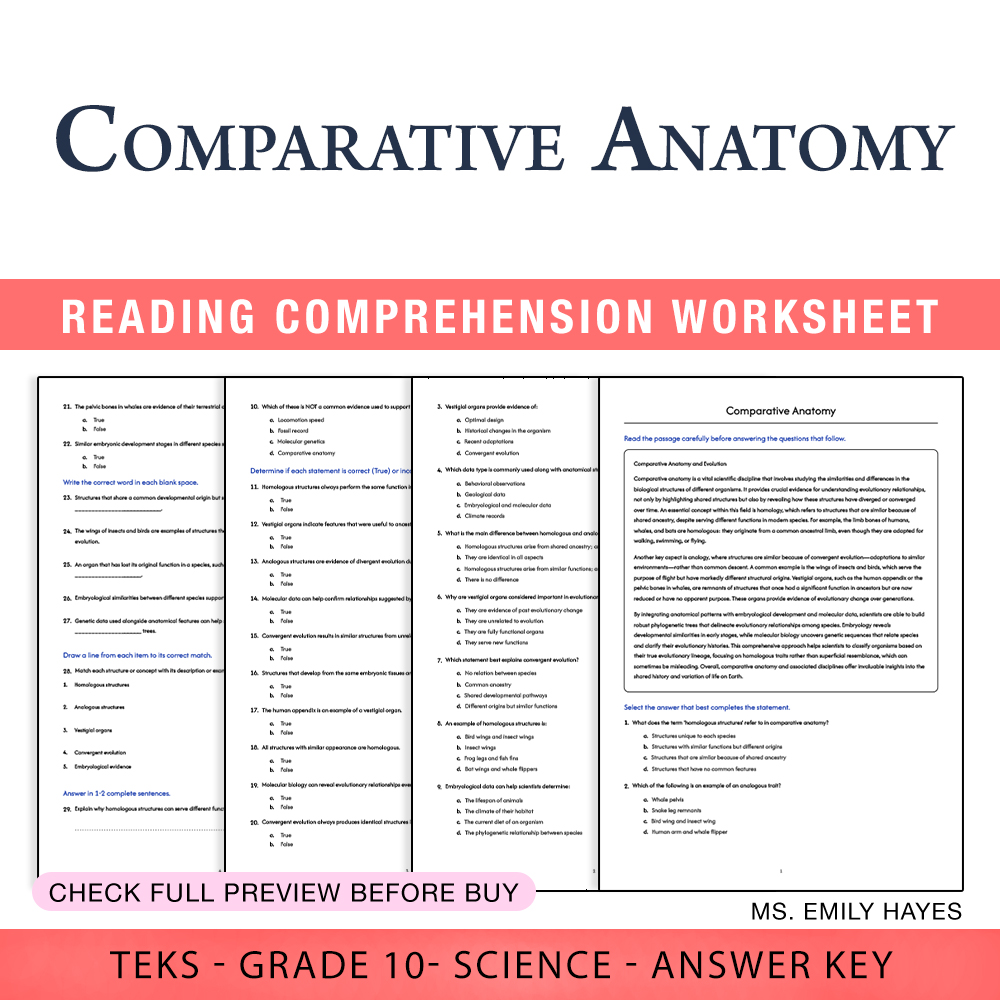
10th Grade Science | Comparative Anatomy Worksheet (PDF+ Answer Key)
Created byCopper Leaf ClassroomLearning Objectives
- Understand the concept of homologous and analogous structures in different organisms.
- Identify vestigial organs and their significance in evolutionary history.
- Analyze how embryological and molecular data contribute to phylogenetic reconstructions.
Instant download

Grade 10 Science | Phylogenetic Trees Worksheet (TEKS) Practice Set
Created byEvergreen Desk EducationLearning Objectives
- Explain how branching patterns in phylogenetic trees represent common ancestry and evolutionary divergence.
- Identify how synapomorphies, molecular sequences, and fossil placements support or challenge evolutionary hypotheses.
- Use evidence to interpret relationships and relative timing of splits in phylogenetic trees.
Instant download

Grade 10 Science – Membrane Structure Daily Reading Worksheet + Answer Key
JCreated byJ.S SheetsLearning Objectives
- Identify the key components of the plasma membrane
- Explain the fluid mosaic model
- Describe the roles of phospholipids, proteins, and cholesterol in the membrane
Also included in: Grade 10 Science Lesson Group Bundle | Cell Structure & Function TEKS +1 more
Instant download

Grade 10 Science – Cytoskeleton Daily Reading Worksheet + Answer Key
JCreated byJ.S SheetsLearning Objectives
- Describe the three main components of the cytoskeleton: microfilaments, intermediate filaments, and microtubules.
- Explain how motor proteins move vesicles along microtubules.
- Identify how actin filaments contribute to cell movement and division.
Also included in: Grade 10 Science Lesson Group Bundle | Cell Structure & Function TEKS +1 more
Instant download

Grade 10 Science – Intercellular Communication Daily Worksheet with Answer Key
JCreated byJ.S SheetsLearning Objectives
- Identify different modes of cell signaling
- Understand receptor–ligand interactions
- Explain signal transduction pathways
Also included in: Grade 10 Science Lesson Group Bundle | Cell Structure & Function TEKS +1 more
Instant download
About Grade 10 Science Worksheets
Find Science worksheets built for Grade 10. All 7,069 cover core skills, practice, and review, each an instant PDF download.
Every worksheet on MyTeachingSheets is created by independent teacher-authors and reviewed before publication. All resources download as printable PDFs for classroom, homework, or at-home practice, and many include answer keys. Preview any worksheet free before buying.