
Grade 11 Science Worksheets
6,616 worksheets
Titration Theory Worksheet | Standards-Aligned Science Practice Grade 11
JCreated byJ.S SheetsLearning Objectives
- Understand the principles of titration and its application in analytical chemistry.
- Identify the components involved in titration, including indicators and titrants.
- Calculate unknown concentrations using titration data and volume relationships.
Instant download

Grade 11 Science – Synthesis Reasoning Worksheet (AP Standards) PDF
 Created byEvergreen Desk Education
Learning Objectives
- Use quantitative evidence and model predictions to compare competing scientific hypotheses
- Synthesize empirical findings with model validation results and stated design/experimental constraints
- Evaluate uncertainty using an evidentiary hierarchy to justify defensible conclusions
Also included in: Grade 11 Science Practices AP Framework Science Lesson Bundle Worksheets +1 more
Instant download
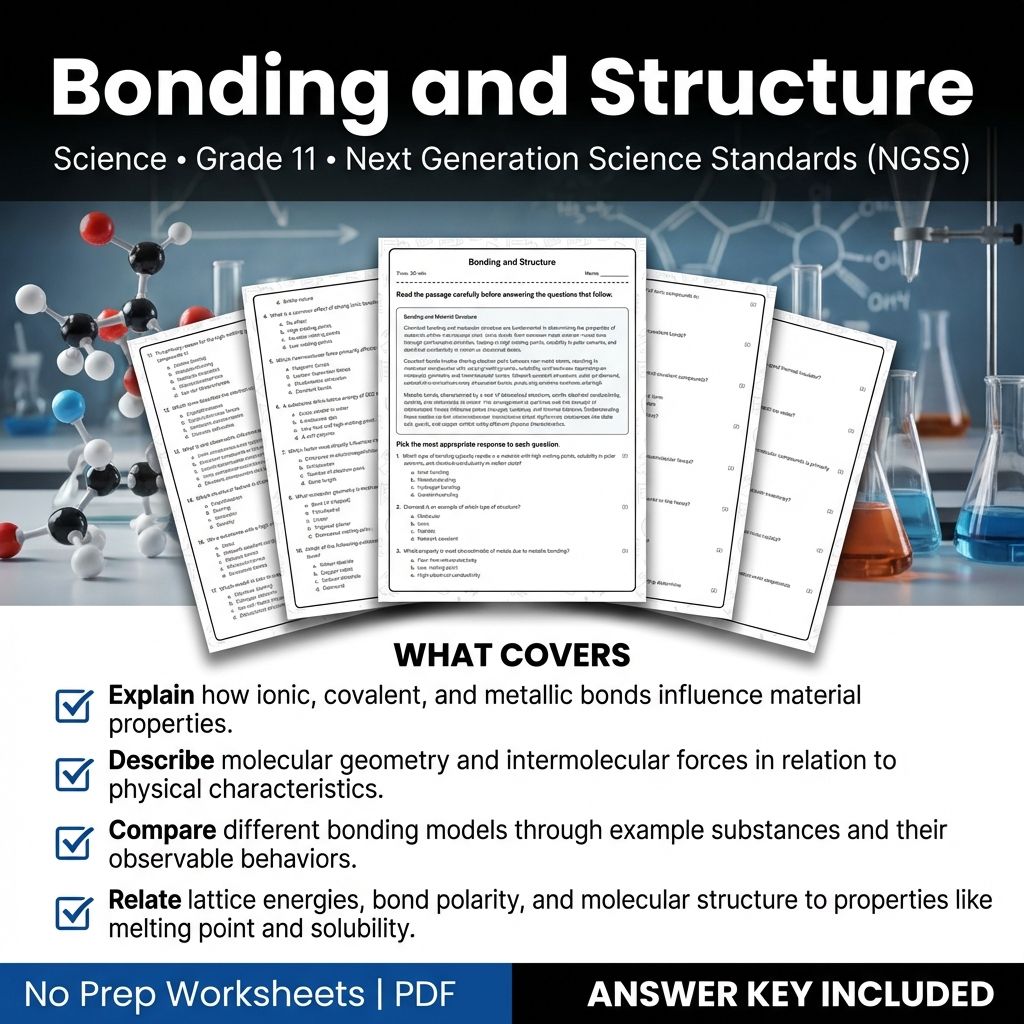
11th Grade Science | Bonding and Structure Worksheet & Answer Key(Printable PDF)
 Created byCoral Reef Learning
Learning Objectives
- Explain how ionic, covalent, and metallic bonds influence material properties.
- Describe molecular geometry and intermolecular forces in relation to physical characteristics.
- Compare different bonding models through example substances and their observable behaviors.
Also included in: Grade 11 Science Unit Bundle – Chemical Reactions & Periodic Trends Worksheets +1 more
Instant download
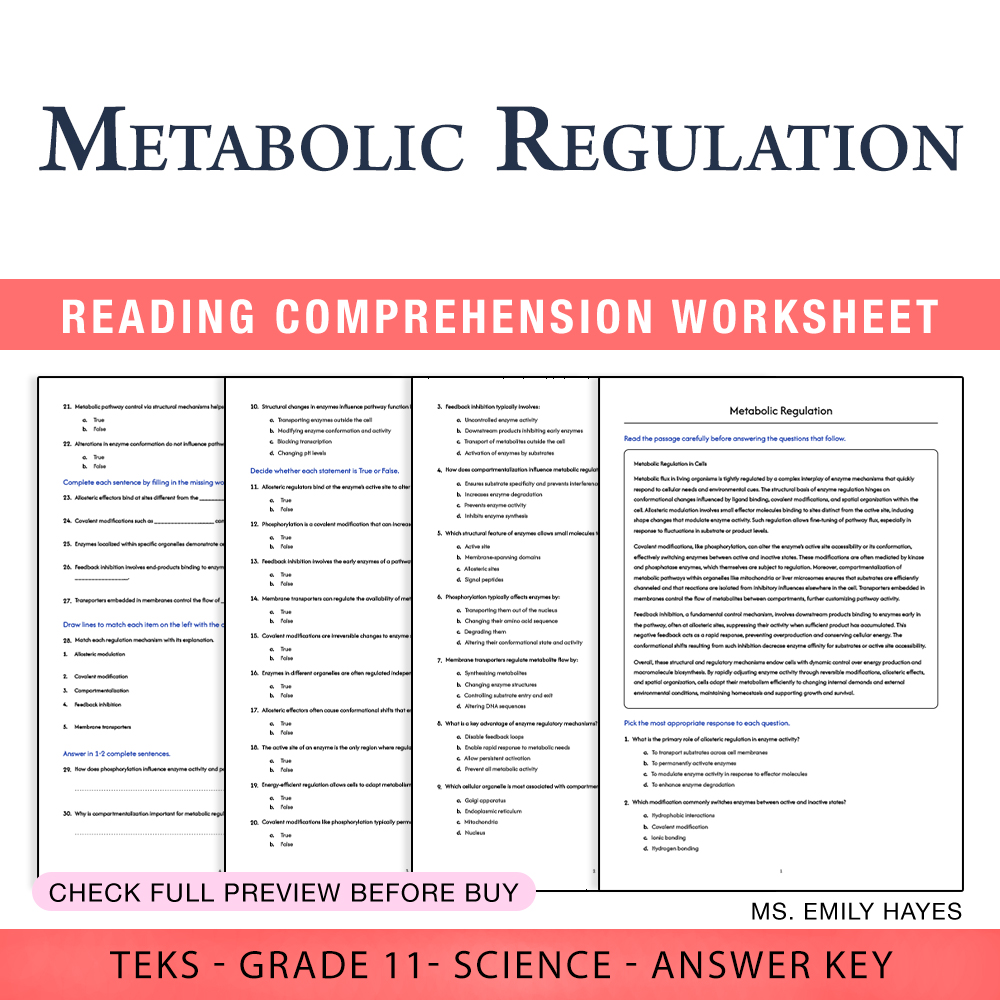
11th Grade Science | Metabolic Regulation Worksheet (PDF+ Answer Key)
 Created byCopper Leaf Classroom
Learning Objectives
- Understand the mechanisms linking enzyme structure to pathway control, including allosteric modulation, covalent modification, and compartmentalization.
- Explain how feedback inhibition and phosphorylation alter enzyme activity and pathway flux.
- Describe cellular strategies such as organellar separation and membrane transporters in metabolic regulation.
Instant download
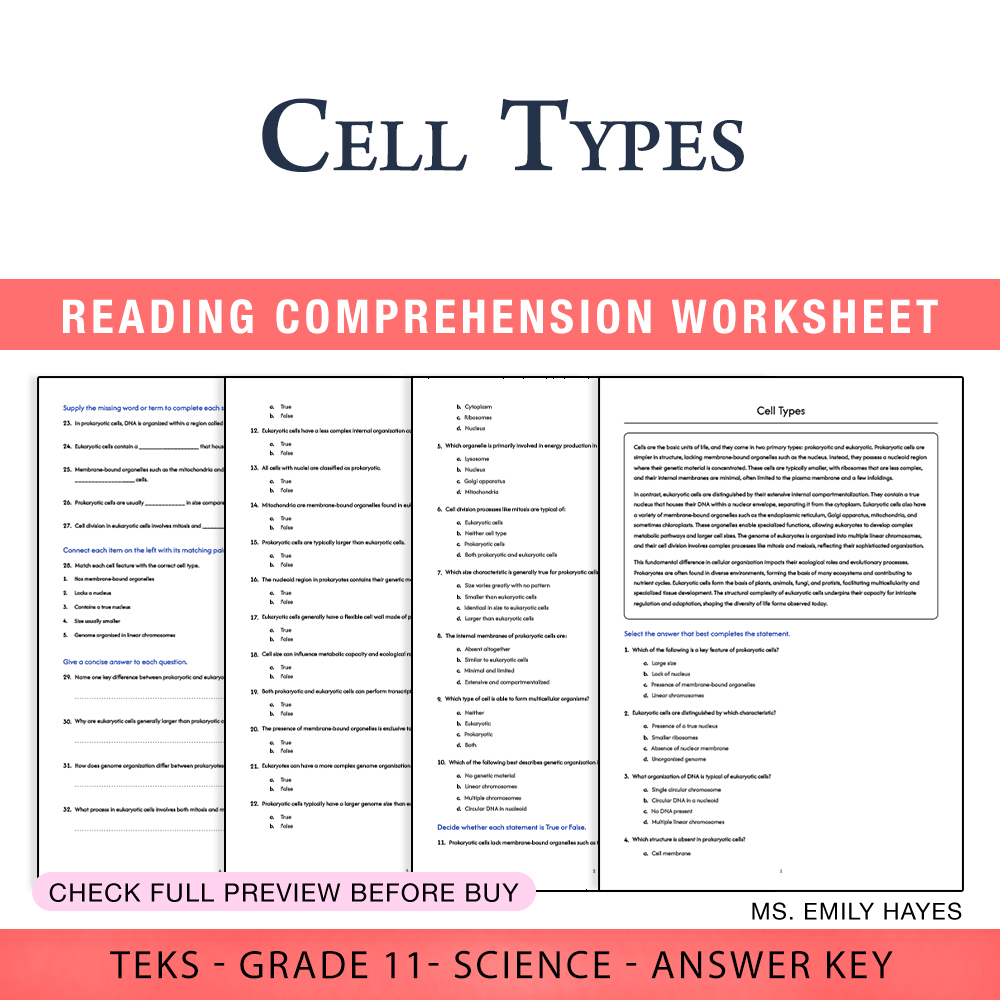
11th Grade Science | Cell Types Worksheet (PDF+ Answer Key)
Created byCopper Leaf ClassroomLearning Objectives
- Understand the structural differences between prokaryotic and eukaryotic cells.
- Identify key features of prokaryotic and eukaryotic cell organization.
- Compare genome organization and cell division mechanisms in different cell types.
Instant download

DNA Maintenance Worksheet for Grade 11 Science | AP Standards Practice
JCreated byJ.S SheetsLearning Objectives
- Explain the molecular mechanisms involved in DNA replication and repair.
- Describe how polymerase fidelity, proofreading, and repair pathways maintain genome stability.
- Identify causes and consequences of mutations and how repair failures affect cells.
Instant download
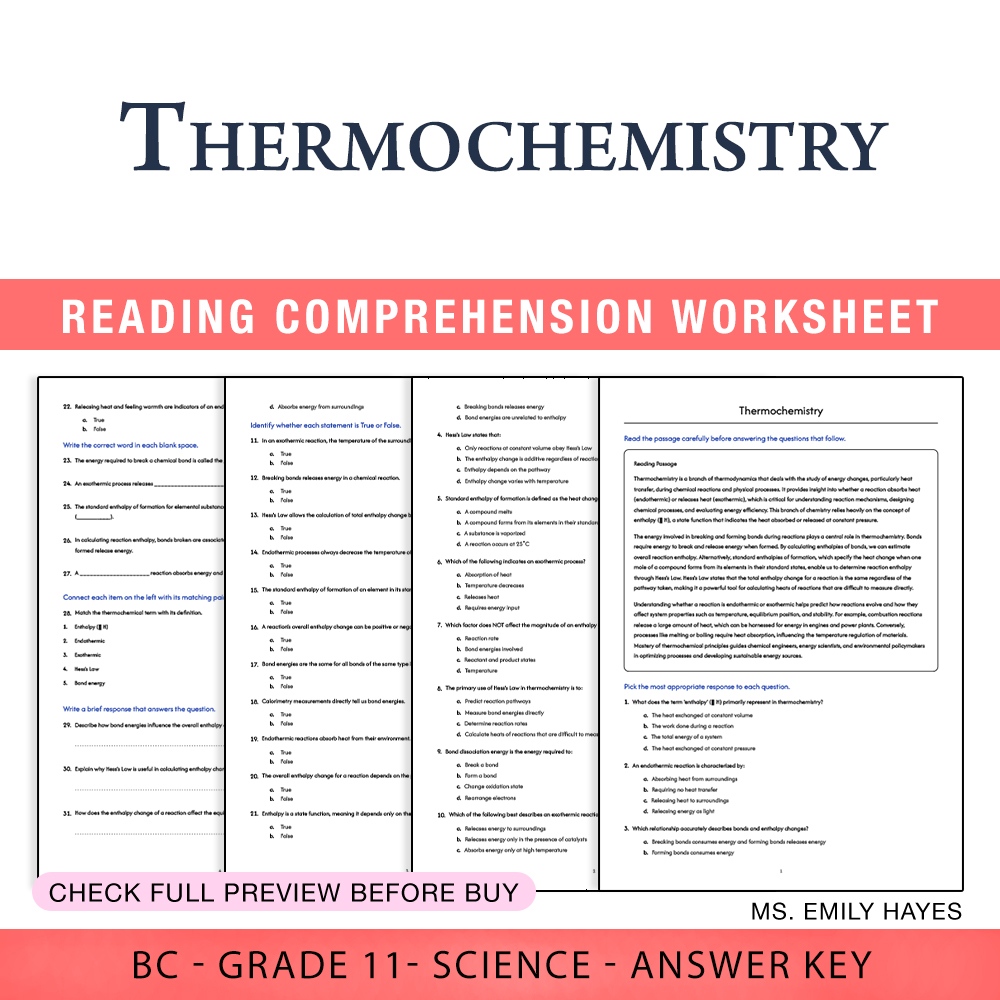
11th Grade Science | Thermochemistry Worksheet (PDF + Answer Key)
Created byCopper Leaf ClassroomLearning Objectives
- Understand the concept of energy changes in chemical reactions, including endothermic and exothermic processes.
- Describe how enthalpy and bond energies relate to reaction energetics.
- Apply Hess's Law and standard enthalpies of formation to calculate heat changes in reactions.
Also included in: Grade 11 Science BC– Thermochemistry, Bonding & Reactions (PDF + Answer Key) +1 more
Instant download
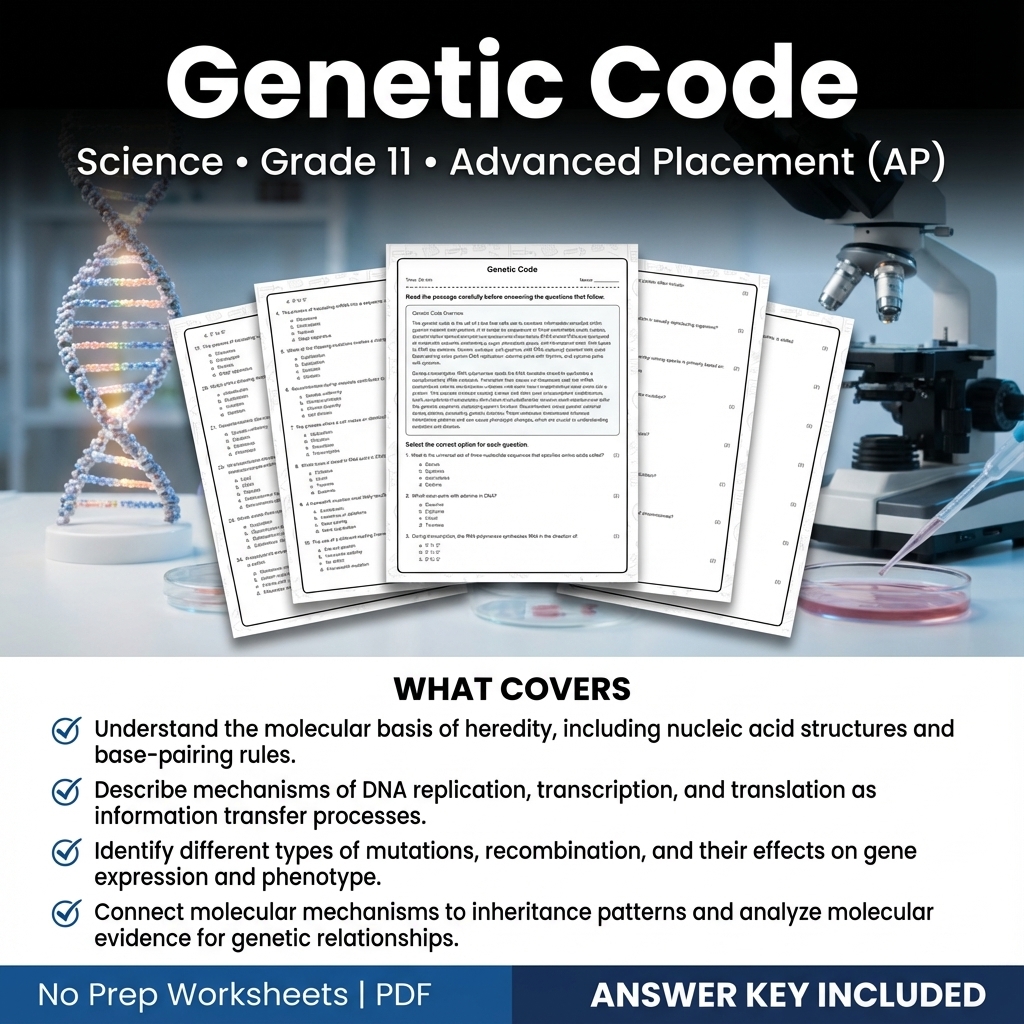
11th Grade Science | Genetic Code Worksheet (Printable PDF + Answer Key)
Created byCoral Reef LearningLearning Objectives
- Understand the molecular basis of heredity, including nucleic acid structures and base-pairing rules.
- Describe mechanisms of DNA replication, transcription, and translation as information transfer processes.
- Identify different types of mutations, recombination, and their effects on gene expression and phenotype.
Also included in: Grade 11 Science Unit Worksheet Bundle – Biological Systems & Molecular Concepts +1 more
Instant download
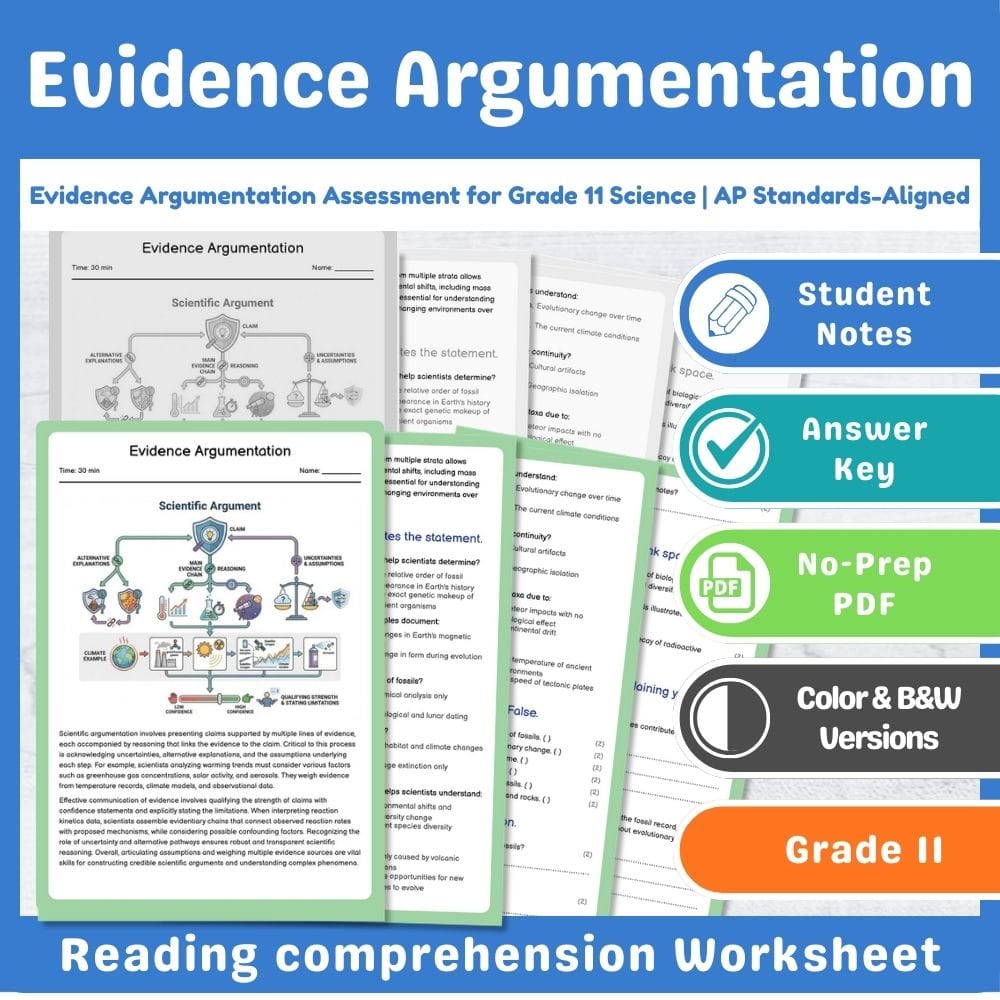
Evidence Argumentation Assessment for Grade 11 Science | AP Standards-Aligned
 Created byPrism Point Learning
Learning Objectives
- Understand the structure of scientific arguments connecting claims, evidence, and reasoning.
- Identify methods for articulating assumptions and qualifying claims with confidence statements.
- Assess various lines of evidence and interpret their implications for scientific hypotheses.
Also included in: Grade 11 Science Mini Bundle | AP Science Practices & Skills
Instant download
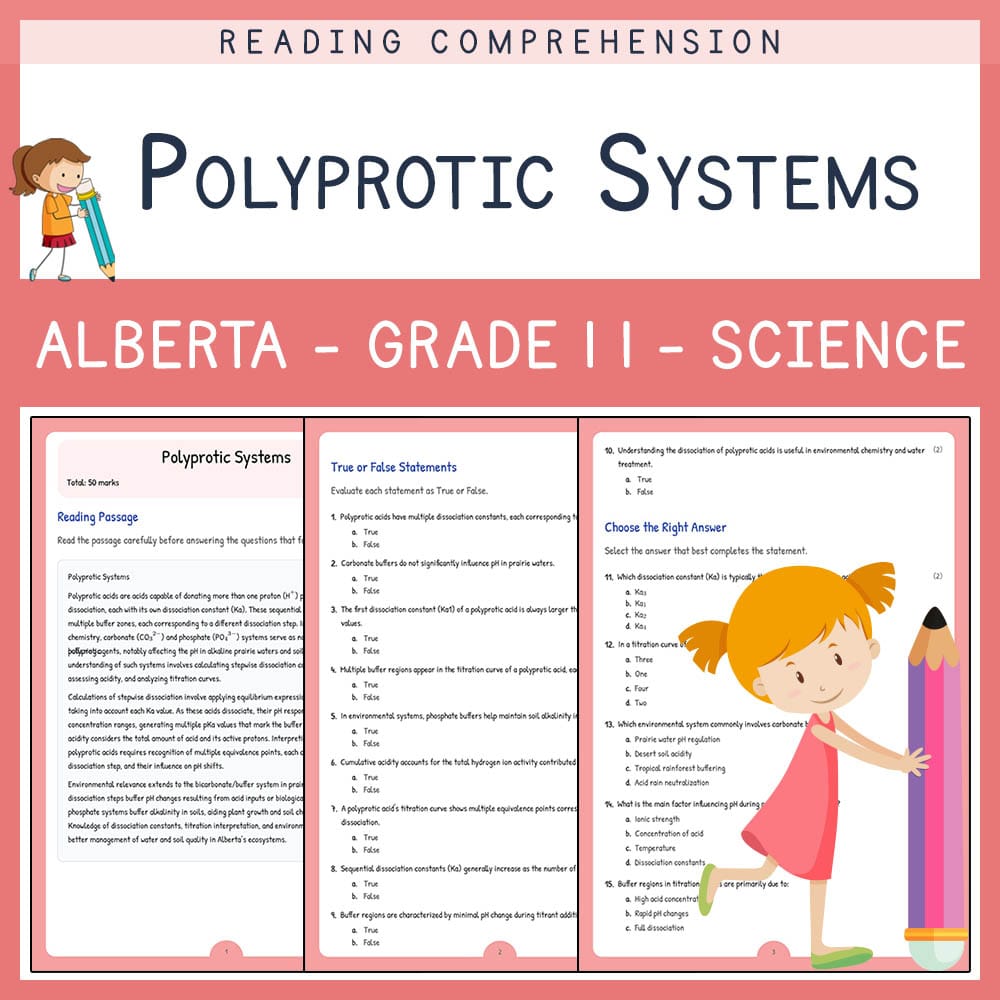
Grade 11 Science | Polyprotic Systems Worksheet | Alberta Standards
 Created byLumora Learning
Learning Objectives
- Understand the dissociation processes of polyprotic acids and their sequential dissociation constants.
- Learn how to calculate stepwise dissociation, cumulative acidity, and interpret titration curves of polyprotic acids.
- Explore environmental relevance of carbonate and phosphate buffer systems, especially in prairie waters and soils in Alberta.
Instant download
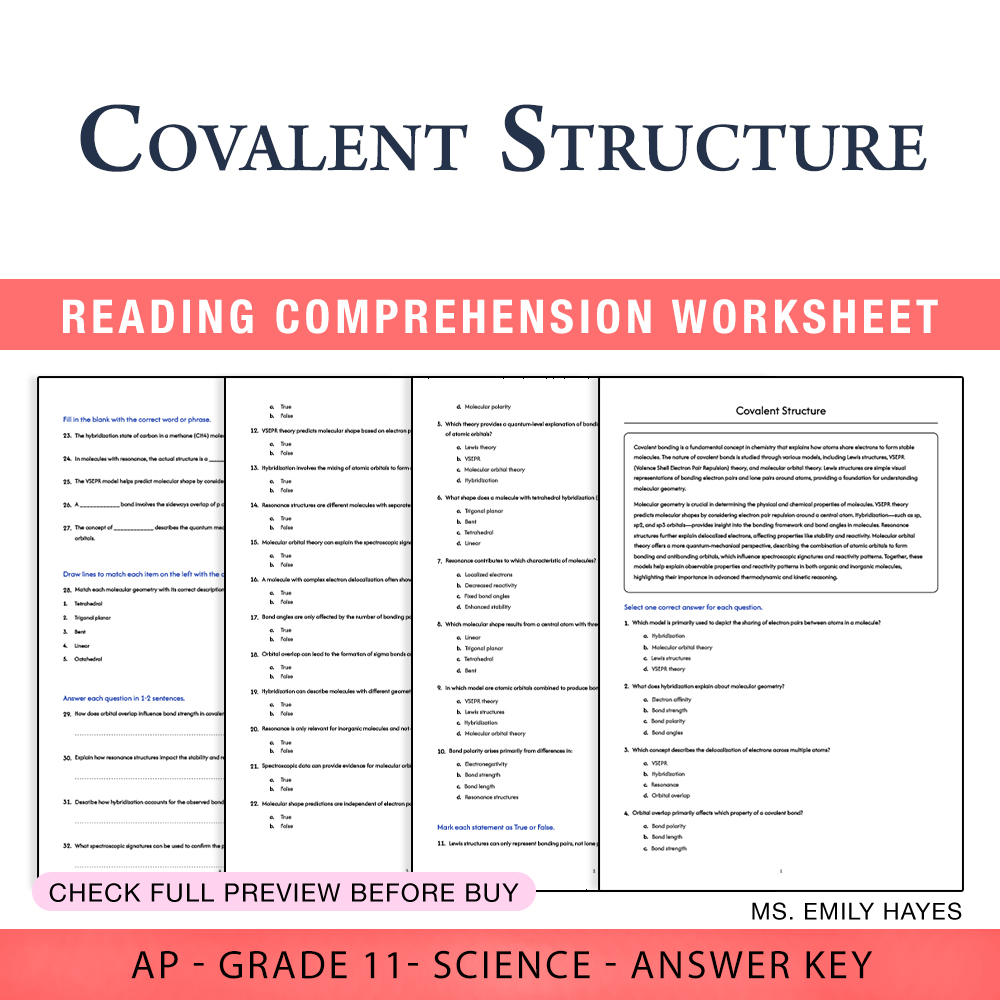
11th Grade Science | Covalent Structure Worksheet (PDF+ Answer Key)
Created byCopper Leaf ClassroomLearning Objectives
- Explain the principles of molecular geometry, orbital overlap, hybridization, and resonance in covalent molecules.
- Use Lewis structures and VSEPR models to predict bond angles and molecular shapes.
- Describe how molecular orbital theory accounts for spectroscopic signatures and reactivity patterns in organic and inorganic molecules.
Also included in: Grade 11 Science | Chemistry Foundations AP Worksheet Bundle (PDF+ Answer Keys) +1 more
Instant download

Grade 11 Wave Superposition, Interference & Resonance Worksheet | Ontario
 Created byChalk and Compass
Learning Objectives
- Explain how the superposition principle produces interference patterns and standing waves
- Identify nodes and antinodes and connect them to boundary conditions in strings and air columns
- Relate resonant frequencies to harmonics and the fundamental frequency in bounded systems
Also included in: Motion, Energy, Waves & DC Circuits Lesson Bundle – Grade 11 Science Ontario +1 more
Instant download
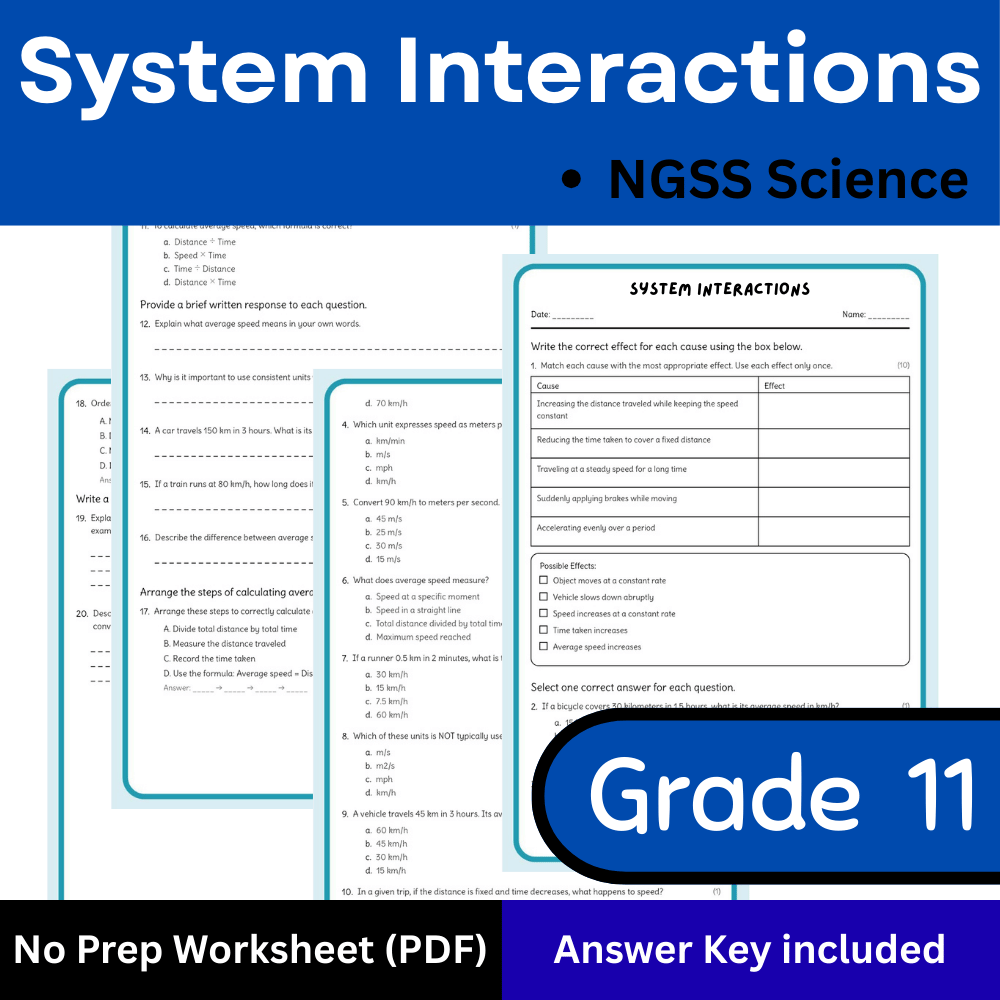
Grade 11 Science – System Interactions Worksheet (NGSS Aligned, PDF)
 Created byBright Mind Resources
Learning Objectives
- Understand Earth's major reservoirs and the energy exchanges among atmosphere, hydrosphere, geosphere, and biosphere.
- Analyze how solar energy input and radiative balance influence system states over various timescales.
- Describe heat transfer mechanisms and feedbacks that alter Earth's surface and interior processes.
Instant download
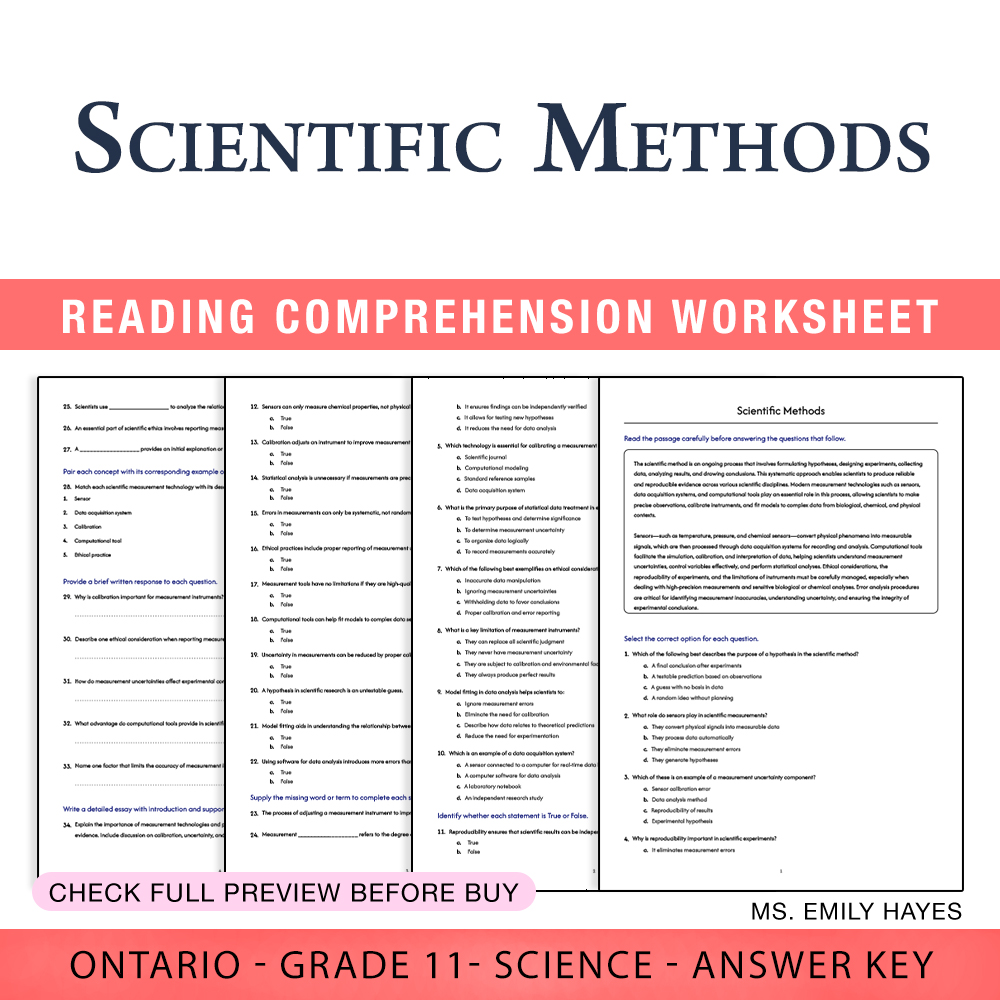
Grade 11 Science | Scientific Methods Worksheet (PDF + Answer Key)
Created byCopper Leaf ClassroomLearning Objectives
- Understand the key components of the scientific method, including hypothesis formulation, variable control, measurement, and data analysis.
- Recognize the roles of measurement technologies such as sensors, data acquisition systems, and computational tools in scientific research.
- Identify ethical considerations, reproducibility, and limitations related to scientific instruments and procedures.
Instant download
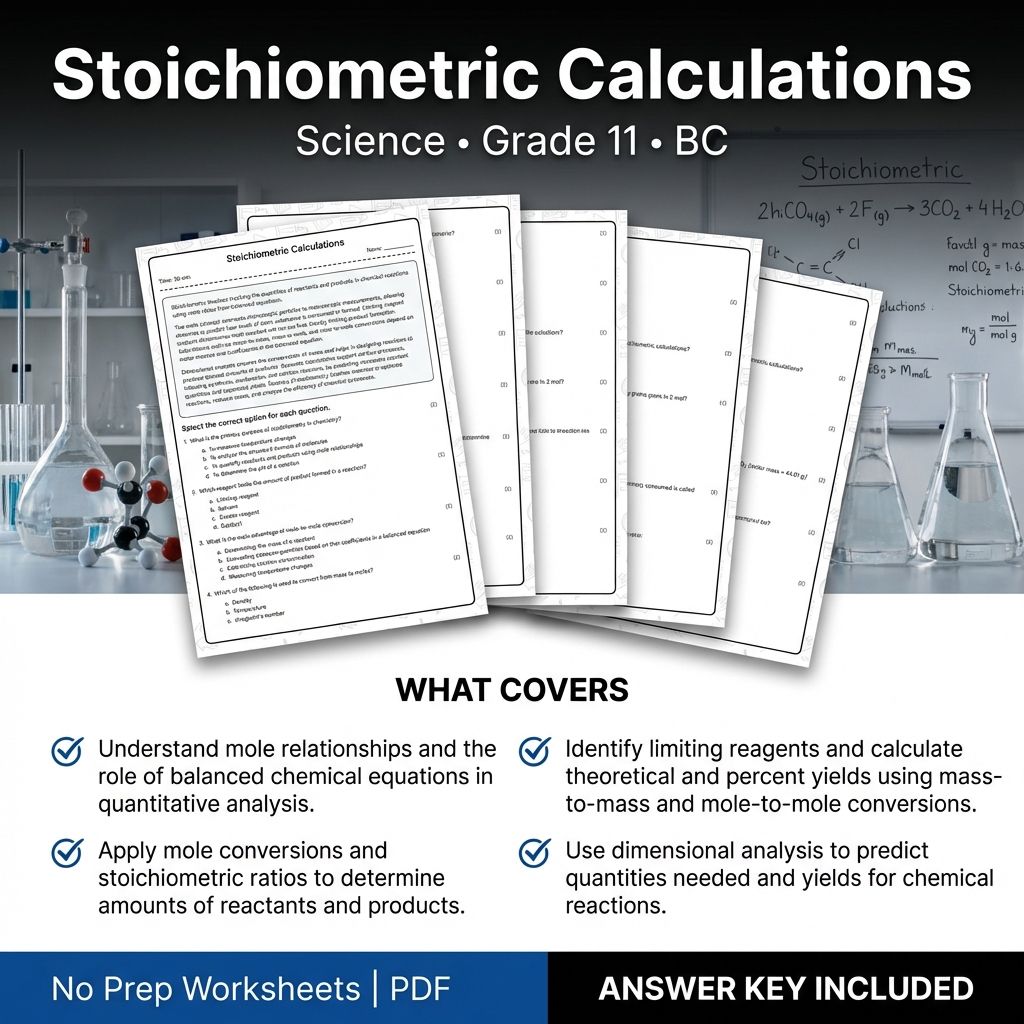
11th Grade Science | Stoichiometric Calculations Worksheet & Answer Key (PDF)
Created byCoral Reef LearningLearning Objectives
- Understand mole relationships and the role of balanced chemical equations in quantitative analysis.
- Apply mole conversions and stoichiometric ratios to determine amounts of reactants and products.
- Identify limiting reagents and calculate theoretical and percent yields using mass-to-mass and mole-to-mole conversions.
Instant download
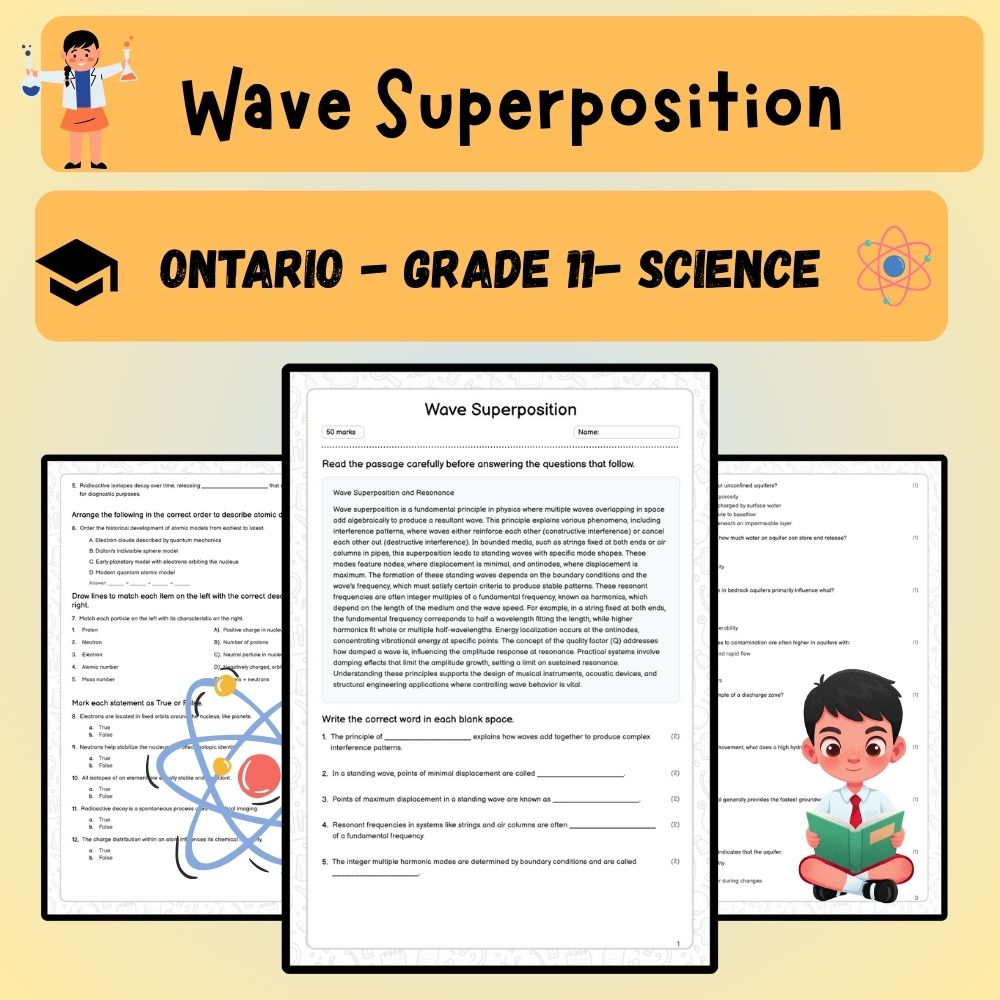
Grade 11 Science – Wave Superposition Worksheet (PDF) | Ontario Standards
Created byPrism Point LearningLearning Objectives
- Explain the principle of superposition and how it governs interference patterns.
- Describe the formation of standing waves, nodes, and antinodes in bounded media.
- Identify resonant frequencies and harmonics in wave systems such as strings and air columns.
Also included in: Grade 11 Science Unit Bundle | Motion, Energy & Waves Worksheets +1 more
Instant download

Stoichiometric Calculations Worksheet | Ontario Grade 11 Science Practice
JCreated byJ.S SheetsLearning Objectives
- Use the mole concept to convert between mass, moles, and particle counts.
- Apply molar mass and Avogadro’s number in stoichiometric calculations.
- Determine the limiting reagent and calculate theoretical yield and percent yield.
Instant download
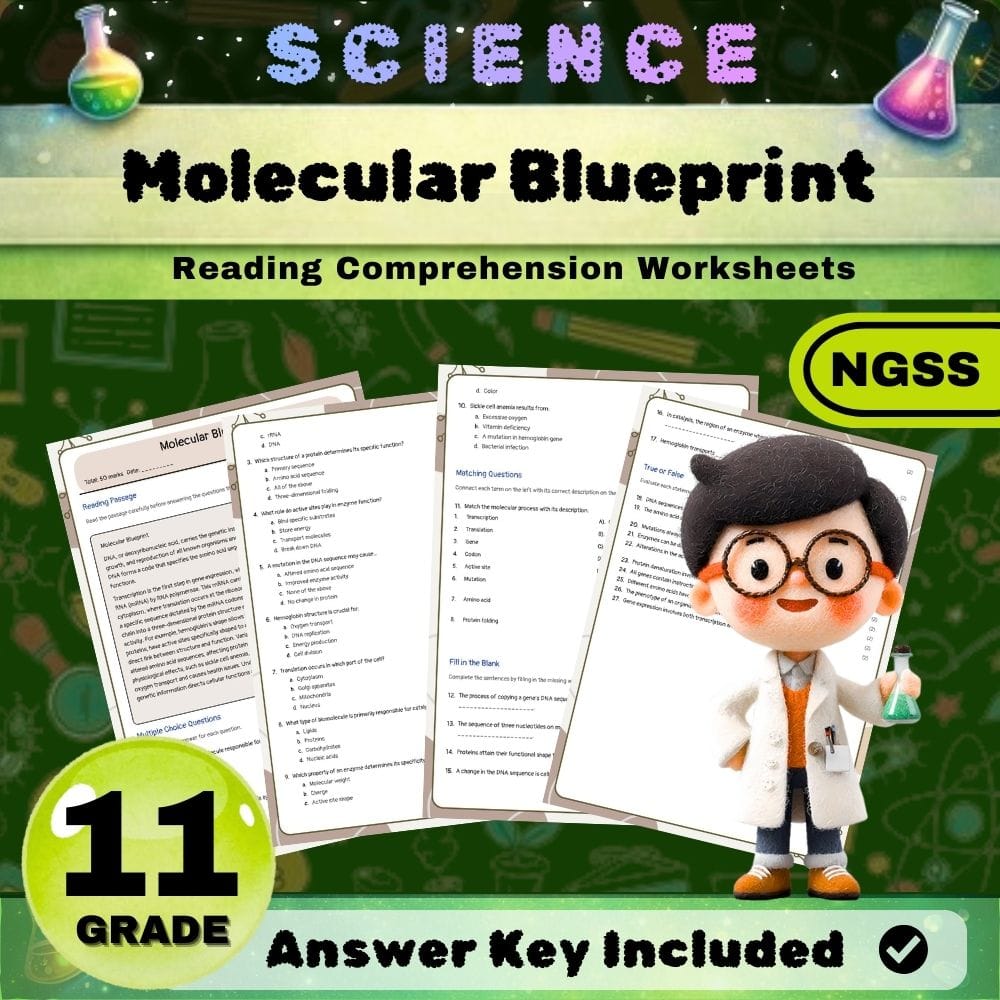
High School Biology | Molecular Blueprint Worksheet (NGSS) (PDF)
 Created byMaple Path Learning
Learning Objectives
- Explain how DNA sequence determines protein structure and function through transcription and translation.
- Describe the relationship between amino acid sequences and protein folding, active sites, and functions.
- Illustrate how variations in genotype can alter protein conformation and physiological effects.
Also included in: Grade 11 Life Science Biology Lesson Bundle (NGSS) | SCIENCE NGSS +1 more
Instant download

Population Dynamics Worksheet | Grade 11 Science | Ontario Standards
JCreated byJ.S SheetsLearning Objectives
- Explain how exponential and logistic growth models differ and how carrying capacity shapes population trajectories.
- Analyze how birth rate, death rate, age structure, and sex ratio influence population change.
- Evaluate the roles of density-dependent and density-independent factors in regulating population size.
Instant download
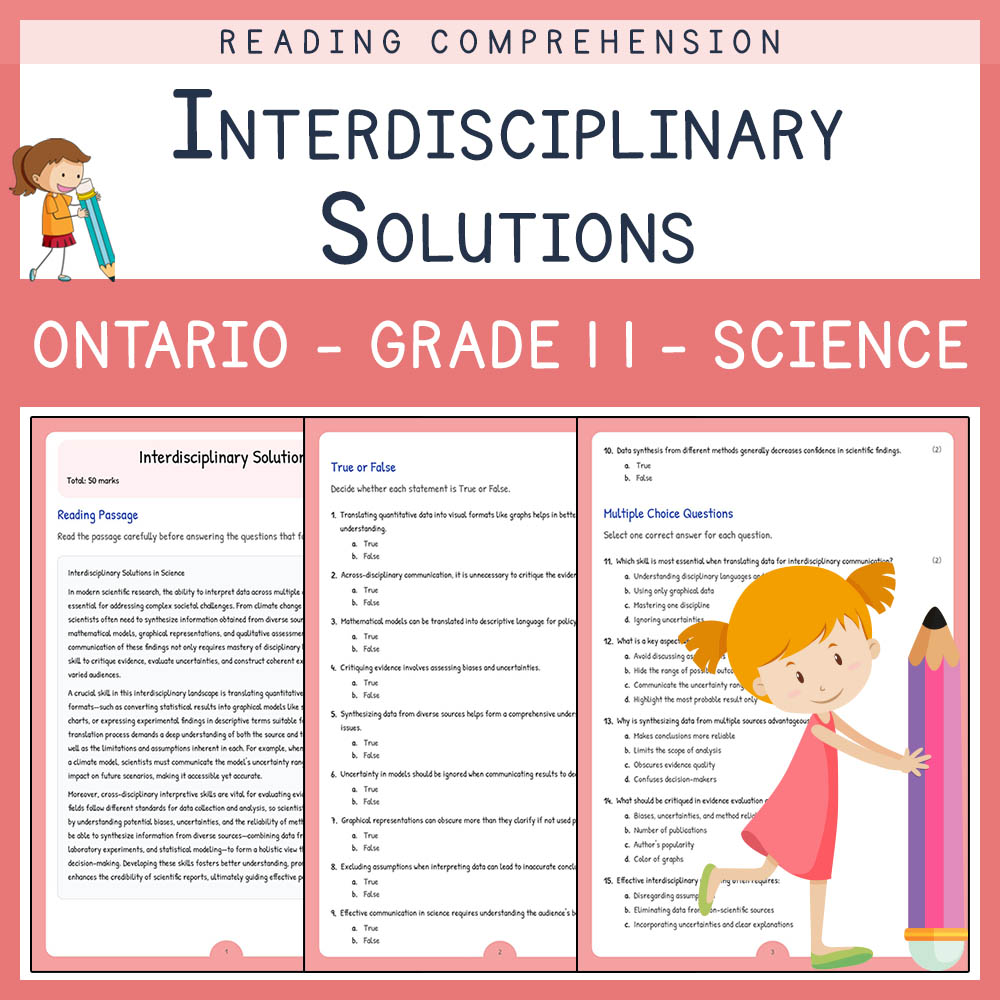
Grade 11 Science | Interdisciplinary Solutions Worksheet | Ontario Assessment
Created byLumora LearningLearning Objectives
- Interpret and communicate scientific information through various graphical, mathematical, and structured formats.
- Translate quantitative findings between different disciplinary languages while critiquing evidence quality.
- Construct clear, discipline-appropriate explanations that incorporate uncertainty and assumptions in scientific contexts.
Instant download

Grade 11 Science Worksheet | Understanding Homeostatic Failure (PDF)
Created byEvergreen Desk EducationLearning Objectives
- Explain how chronic disorders and acute insults can disrupt homeostatic regulation in interconnected body systems
- Identify how compensatory mechanisms can fail or become harmful through maladaptive positive feedback
- Analyze how disruptions (e.g., insulin resistance, dehydration) can lead to systemic consequences and multi-organ failure
Instant download

Grade 11 Titration Calculations Worksheet | Alberta Chemistry PDF
Created byEvergreen Desk EducationLearning Objectives
- Use stoichiometry to relate moles of acid/base to equivalence conditions in titration problems.
- Calculate unknown concentrations and equivalence (endpoint) volumes from balanced reactions.
- Apply pH relationships for strong vs. weak acid/base titrations and interpret how weak dissociation affects results.
Instant download

Grade 11 Titration Calculations Worksheet | Practice & PDF
 Created byClear Sky Classroom
Learning Objectives
- Use balanced chemical equations and stoichiometric coefficients to relate moles in acid-base titrations
- Calculate unknown concentrations from measured titrant volumes at the equivalence point
- Distinguish strong vs. weak acid/base titrations and predict qualitative endpoint pH behavior using Ka and Kb
Instant download
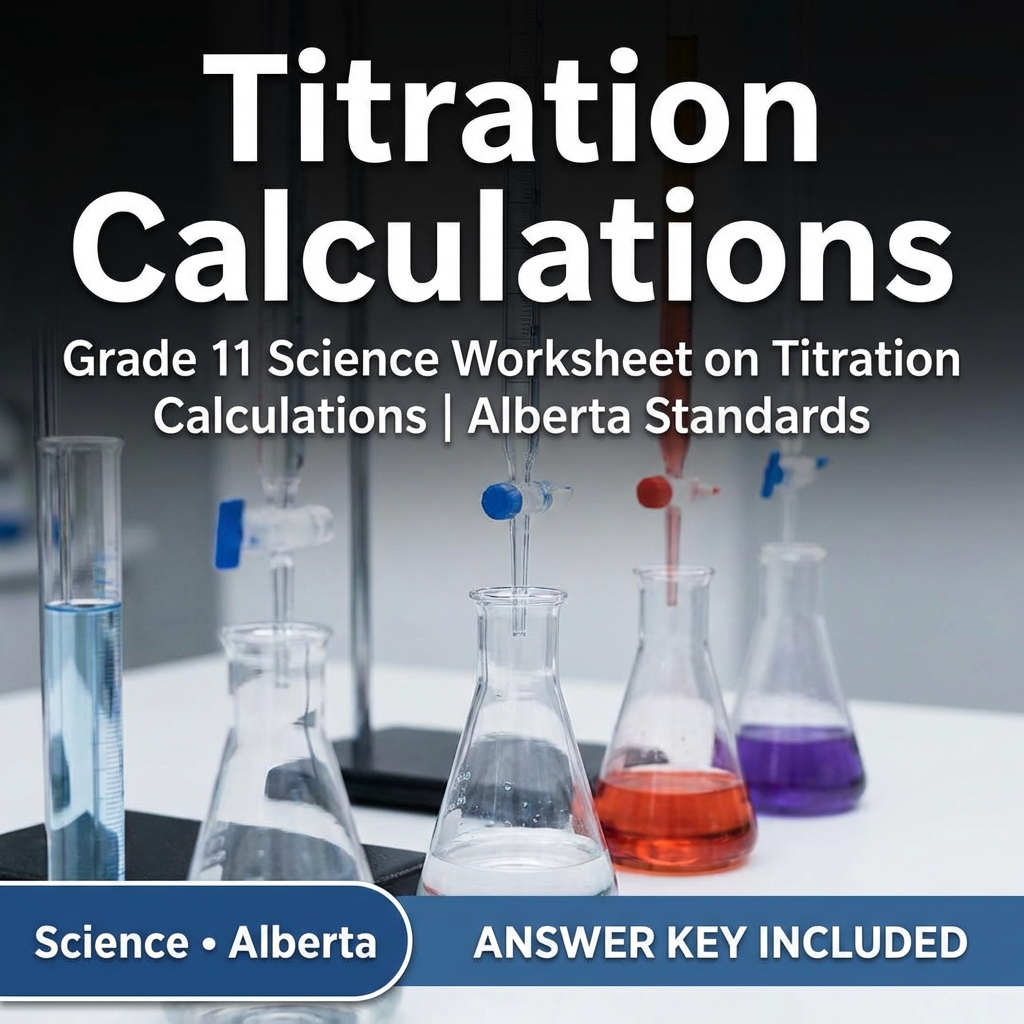
Grade 11 Science Worksheet on Titration Calculations | Alberta Standards
Created byCoral Reef LearningLearning Objectives
- Understand the principles of titration and how to apply stoichiometry to determine unknown concentrations.
- Calculate equivalence point volumes and pH at endpoints in acid-base titrations.
- Solve complex titration problems involving weak acids/bases and dissociation equilibria.
Instant download

Heritable Variation | Master Genes Phenotypes Population Change Grade 11
JCreated byJ.S SheetsLearning Objectives
- Explain how genetic variation arises from differences in alleles and from mutation and recombination.
- Describe how heritable differences influence phenotypes and can affect survival and reproduction.
- Connect heritable variation to how populations change over generations.
Also included in: Grade 11 Biological Systems Science Lesson Bundle: General Framework +1 more
Instant download
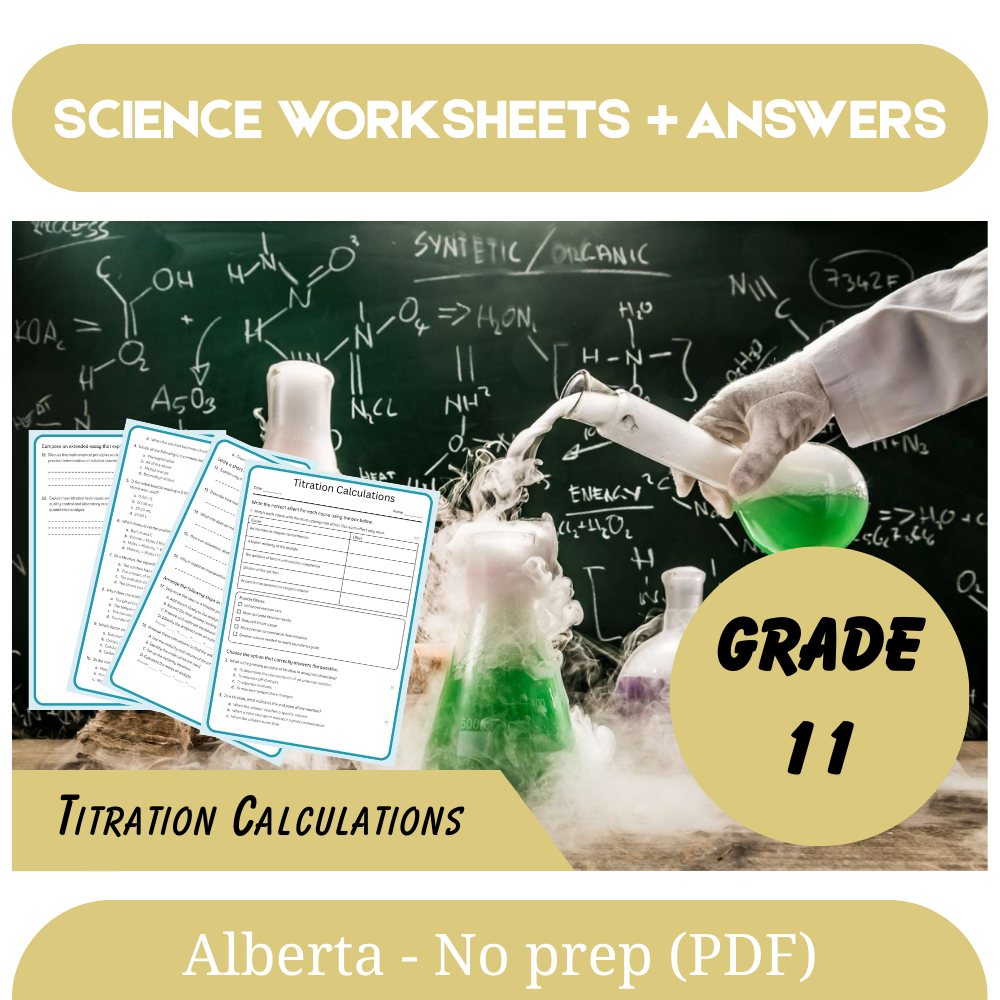
Grade 11 Science | Titration Calculations Worksheet (PDF)
Created byBright Mind ResourcesLearning Objectives
- Understand the principles of titration and stoichiometry in acid-base reactions
- Apply concentration relationships to solve titration problems
- Determine unknown concentrations, equivalence volumes, and endpoint pH
Instant download
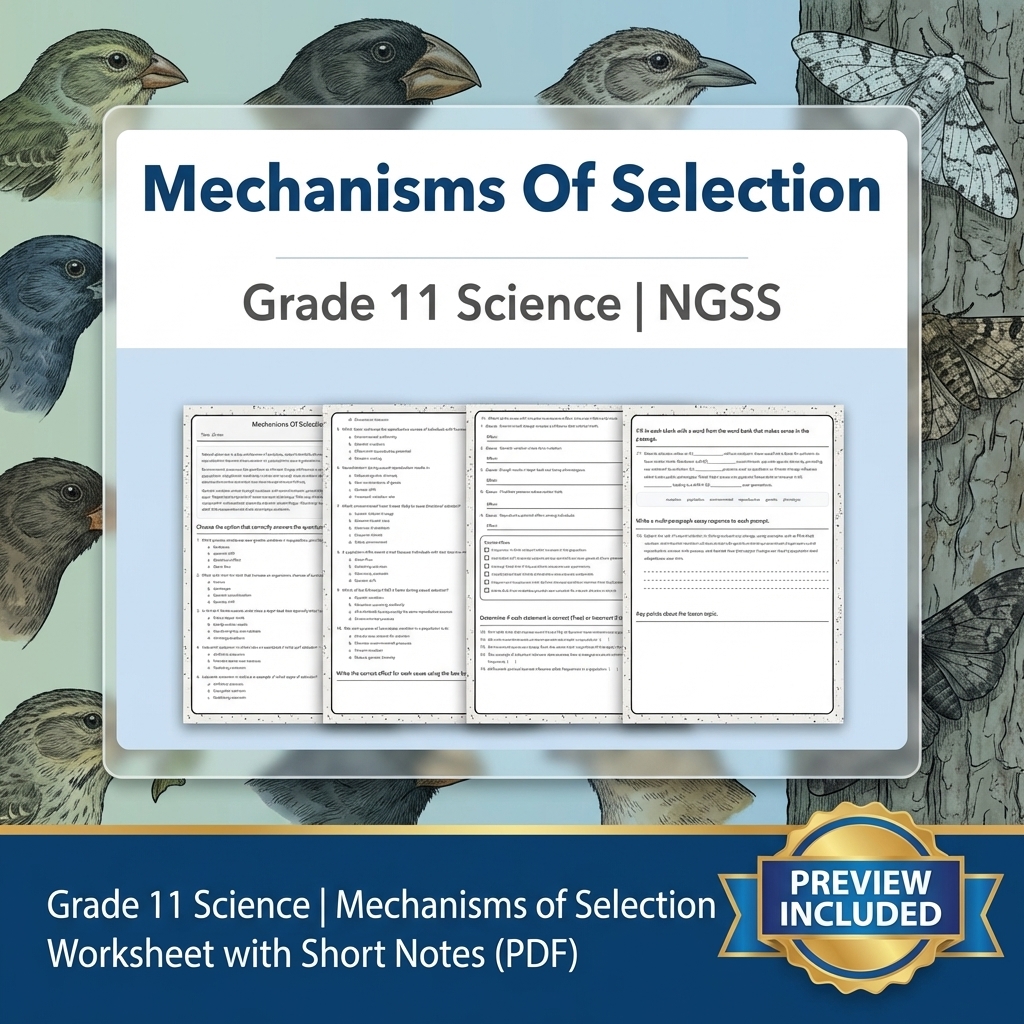
Grade 11 Science | Mechanisms of Selection Worksheet with Short Notes (PDF)
 Created byMeadowlark Worksheets
Learning Objectives
- Understand the fundamental principles of natural selection and its role in evolution.
- Identify factors such as genetic variation, reproductive potential, and environmental pressures that influence natural selection.
- Analyze classic examples like finch beak variation and industrial melanism to illustrate natural selection in action.
Also included in: Grade 11 Science NGSS Unit | Biological Evolution & Diversity Worksheet Bundle +1 more
Instant download
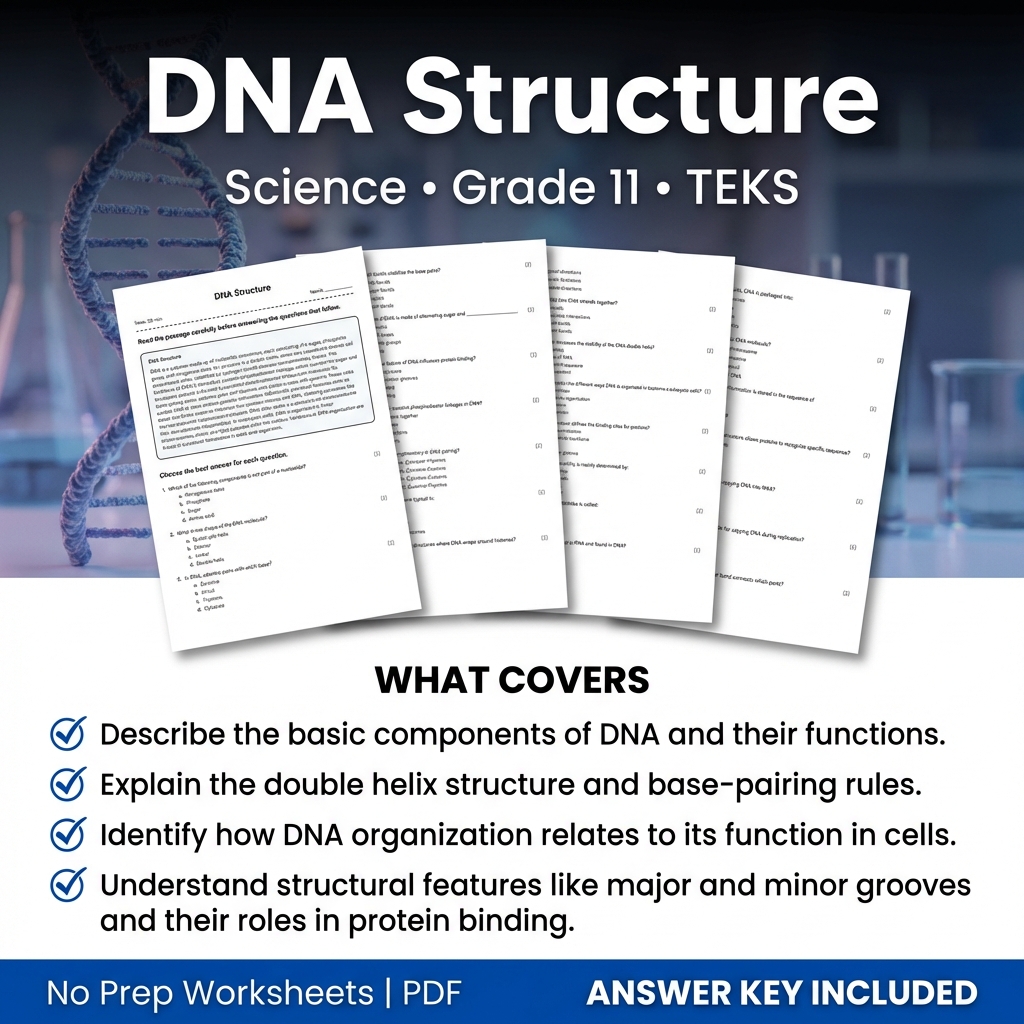
DNA Structure Worksheet for Grade 11 Science | TEKS aligned practice
Created byCoral Reef LearningLearning Objectives
- Describe the basic components of DNA and their functions.
- Explain the double helix structure and base-pairing rules.
- Identify how DNA organization relates to its function in cells.
Instant download
Grade 11 Science | Cell Membrane Concept Worksheet + Answer Key | TEKS-Aligned
Created byBright Mind ResourcesLearning Objectives
- Describe the structure and components of the cell membrane, including phospholipids, proteins, and cholesterol.
- Explain the different transport mechanisms across the cell membrane, such as passive diffusion, facilitated diffusion, active transport, and vesicular processes.
- Understand how the cell membrane maintains internal homeostasis and responds to environmental signals.
Also included in: Grade 11 Science | Cell & Systems Dynamics Unit Worksheet Bundle (TEKS-Aligned) +2 more
Instant download
Grade 11 Science – Photosynthesis Basics Worksheet (Worksheet + Answer Key) - TEKS Aligned
Created byBright Mind ResourcesLearning Objectives
- Understand the process of photosynthesis and its inputs and outputs.
- Identify the roles of light-dependent reactions and the Calvin cycle.
- Explain how cellular respiration relates to photosynthesis.
Also included in: Grade 11 Science Unit Bundle – Cell Function, Respiration & Photosynthesis-TEKS +2 more
Instant download
Grade 11 Science – Phylogenetic Trees Worksheet (Answer Key) | TEKS Aligned
Created byBright Mind ResourcesLearning Objectives
- Interpret hypotheses of evolutionary relationships using phylogenetic trees.
- Identify shared derived characters and their significance in tree topology.
- Differentiate between rooted and unrooted trees and their purposes.
Also included in: Grade 11 Science | Evolution & Phylogenetics Worksheet Bundle (TEKS Aligned) +2 more
Instant download
Grade 11 Science | Immune Responses Worksheet (Answer Key) - TEKS Aligned
Created byBright Mind ResourcesLearning Objectives
- Describe the different components of the immune system and their functions.
- Explain the roles of innate and adaptive immunity, including antibodies and memory cells.
- Identify environmental factors that influence immune activity and potential dysregulation.
Also included in: Grade 11 Science: Human Body & Homeostasis Unit Worksheet Bundle (TEKS Aligned) +2 more
Instant download
Grade 11 Science | ATP Synthase Understanding Worksheet+ Answer Key – TEKS Align
Created byBright Mind ResourcesLearning Objectives
- Explain the mechanism by which ATP synthase converts a proton gradient into chemical energy.
- Describe how conformational changes facilitate ATP formation during proton flow.
- Relate membrane potential and proton pumping to ATP production in cells.
Also included in: Grade 11 Science Unit Bundle – Cell Function, Respiration & Photosynthesis-TEKS +2 more
Instant download
Grade 11 Science | Mendelian Patterns Worksheet (Answer Key) Aligned with TEKS
Created byBright Mind ResourcesLearning Objectives
- Understand the principles of segregation and independent assortment in Mendelian inheritance.
- Identify dominant and recessive relationships and predict phenotypic ratios from genotypes.
- Use Punnett squares to determine probabilities of different genetic crosses.
Also included in: Grade 11 Science DNA & Genetics Unit Worksheet Pack+ Answer Key (TEKS-Aligned) +2 more
Instant download
Grade 11 Science – Conservation Strategies Worksheet (PDF) | TEKS-Aligned
Created byBright Mind ResourcesLearning Objectives
- Understand various conservation strategies used to protect biodiversity.
- Identify and explain methods such as habitat restoration, protected areas, and policy interventions.
- Analyze the ecological importance of corridors, monitoring, and management in conservation.
Also included in: Grade 11 Science - Ecosystem & Biogeochemical Cycles Unit Worksheet Pack - TEKS +2 more
Instant download
Grade 11 Science | Mechanisms of Evolution Worksheet (Worksheet + Answer Key) – TEKS Aligned
Created byBright Mind ResourcesLearning Objectives
- Explain the roles of mutation, natural selection, genetic drift, and gene flow in evolution.
- Identify the impact of these mechanisms on genetic diversity within populations.
- Analyze how environmental pressures influence evolutionary processes.
Also included in: Grade 11 Science | Evolution & Phylogenetics Worksheet Bundle (TEKS Aligned) +2 more
Instant download
Grade 11 Science | DNA Replication Mechanisms Worksheet (PDF) for TEKS Standards
Created byBright Mind ResourcesLearning Objectives
- Describe the steps involved in DNA replication, including enzyme functions.
- Explain how anti-fidelity mechanisms like proofreading and mismatch repair maintain genome integrity.
- Identify the roles of key enzymes such as helicase, primase, DNA polymerase, ligase, and telomerase.
Also included in: Grade 11 Science DNA & Genetics Unit Worksheet Pack+ Answer Key (TEKS-Aligned) +2 more
Instant download
Grade 11 Science | Integrated Cycles Worksheet (Answer Key) – TEKS Aligned
Created byBright Mind ResourcesLearning Objectives
- Describe the interconnected processes of photosynthesis and cellular respiration.
- Explain how energy and carbon are redistributed within organisms and ecosystems.
- Analyze how biochemical pathways coordinate with ecological energy flow.
Also included in: Grade 11 Science Unit Bundle – Cell Function, Respiration & Photosynthesis-TEKS +2 more
Instant download

Grade 11 Bonding Types Worksheet | Practice & Assessment PDF
Created byClear Sky ClassroomLearning Objectives
- Compare ionic, covalent, and metallic bonding using the electron transfer, electron sharing, and delocalized electron models
- Relate bond type to characteristic structural motifs (ionic lattices, molecular covalent structures, and metallic electron seas)
- Explain how bond type helps predict differences in conductivity, hardness, and solubility
Instant download

Combustion Reactions Worksheet | Grade 11 Science Activities
Created byPrism Point LearningLearning Objectives
- Explain complete and incomplete combustion and relate them to oxygen availability and fuel type.
- Calculate oxygen demand conceptually and describe how stoichiometry affects CO2 and CO formation.
- Identify common combustion pollutants, including nitrogen oxides, and describe how conditions influence emissions.
Instant download
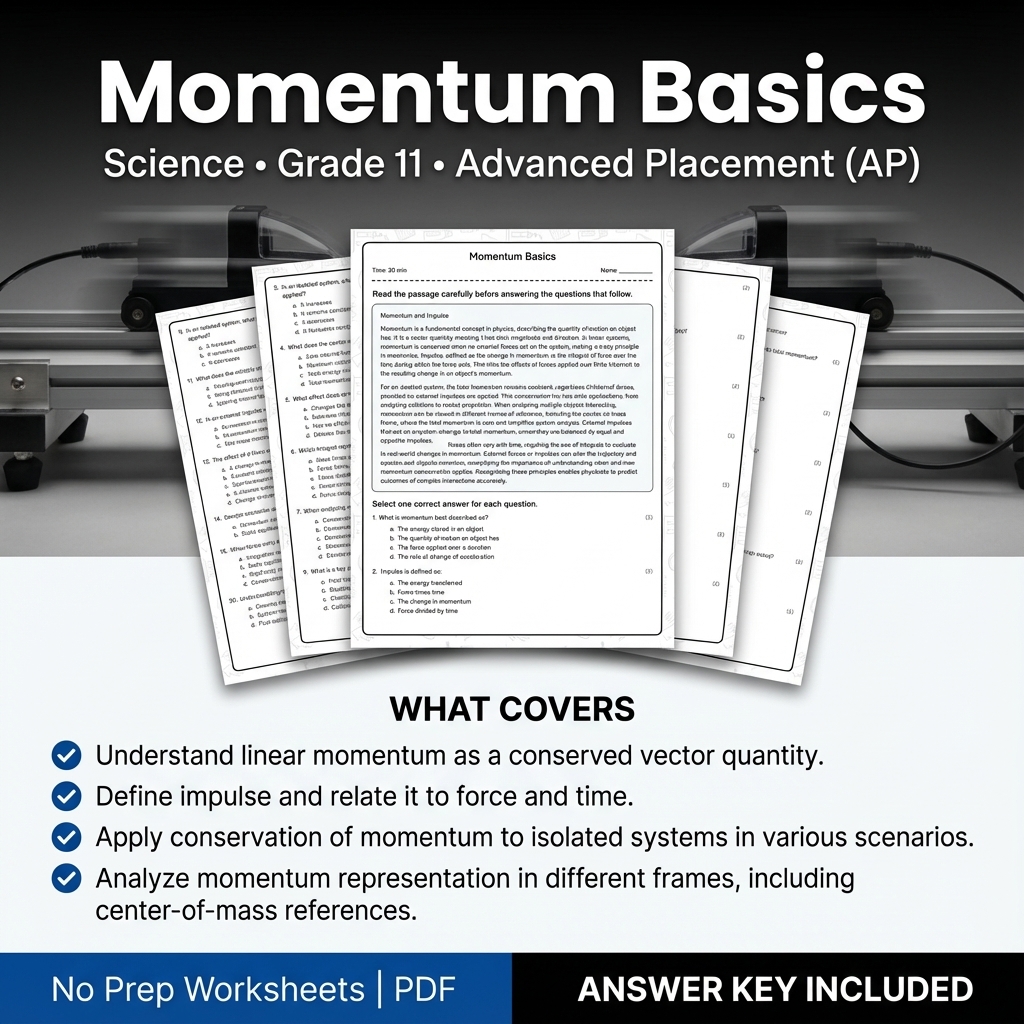
11th Grade Science | Momentum Basics Worksheet (Printable PDF + Answer Key)
Created byCoral Reef LearningLearning Objectives
- Understand linear momentum as a conserved vector quantity.
- Define impulse and relate it to force and time.
- Apply conservation of momentum to isolated systems in various scenarios.
Also included in: Grade 11 Science Unit | Physics Worksheets on Work, Power & Motion PDF Bundle +1 more
Instant download

Mole Concept Worksheet for Grade 11 Science | Standards-Aligned Practice PDF
JCreated byJ.S SheetsLearning Objectives
- Understand the definition and significance of the mole in chemistry.
- Learn to convert between mass, number of particles, and moles using molar mass and Avogadro's number.
- Apply mole relationships to solve problems involving gases, mass, and particles.
Instant download

Grade 11 Science | Circular Motion Worksheet | BC-Aligned
Created byLumora LearningLearning Objectives
- Describe the fundamental concepts of uniform circular motion, including centripetal force and acceleration.
- Explain the forces responsible for circular motion in different contexts such as banking, orbital systems, and rotating platforms.
- Distinguish between true inward forces and perceived outward sensations in rotating and orbital systems.
Also included in: Grade 11 Science | Physics Custom Bundle | BC-Aligned Worksheet Set
Instant download
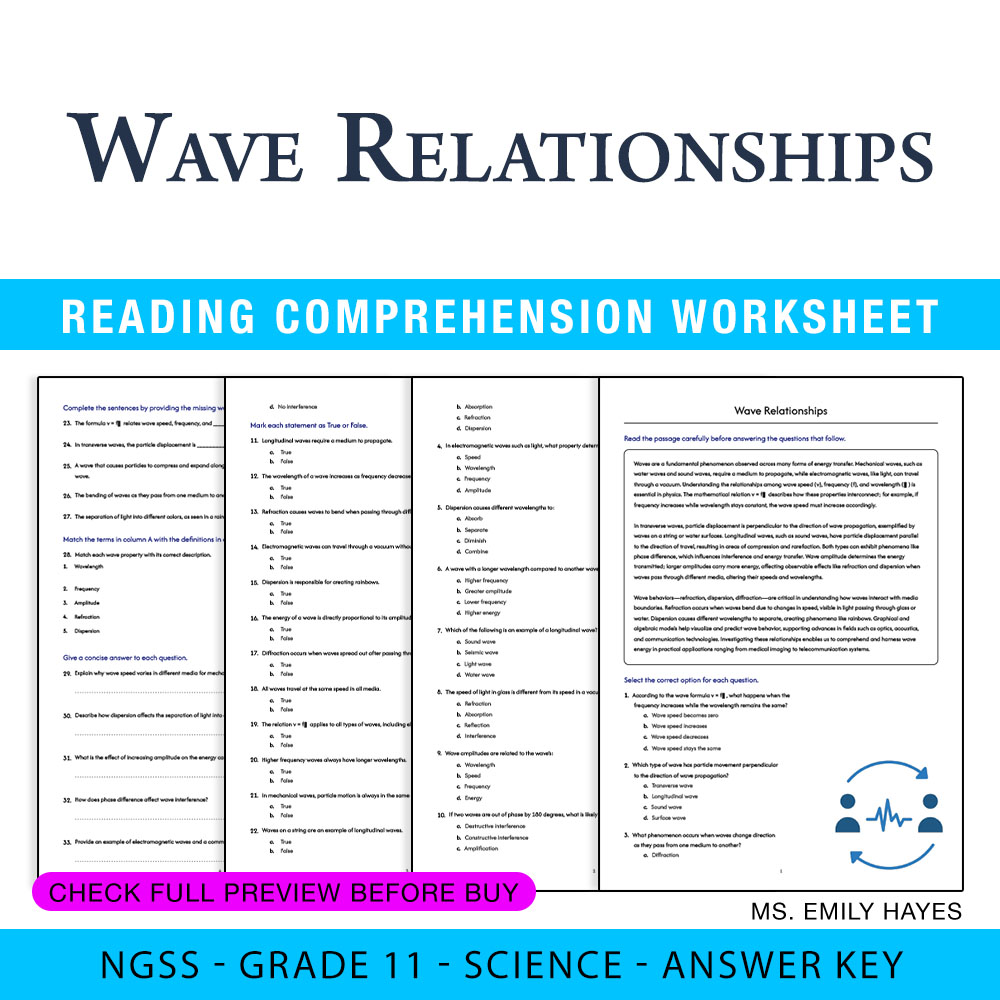
11th Grade Science | Wave Relationships Worksheet (PDF+ Answer Key)
Created byCopper Leaf ClassroomLearning Objectives
- Understand the mathematical relationships among wave properties such as v = fλ.
- Describe and compare transverse and longitudinal waves in various media.
- Explain wave behaviors like refraction and dispersion using graphs and algebraic representations.
Instant download
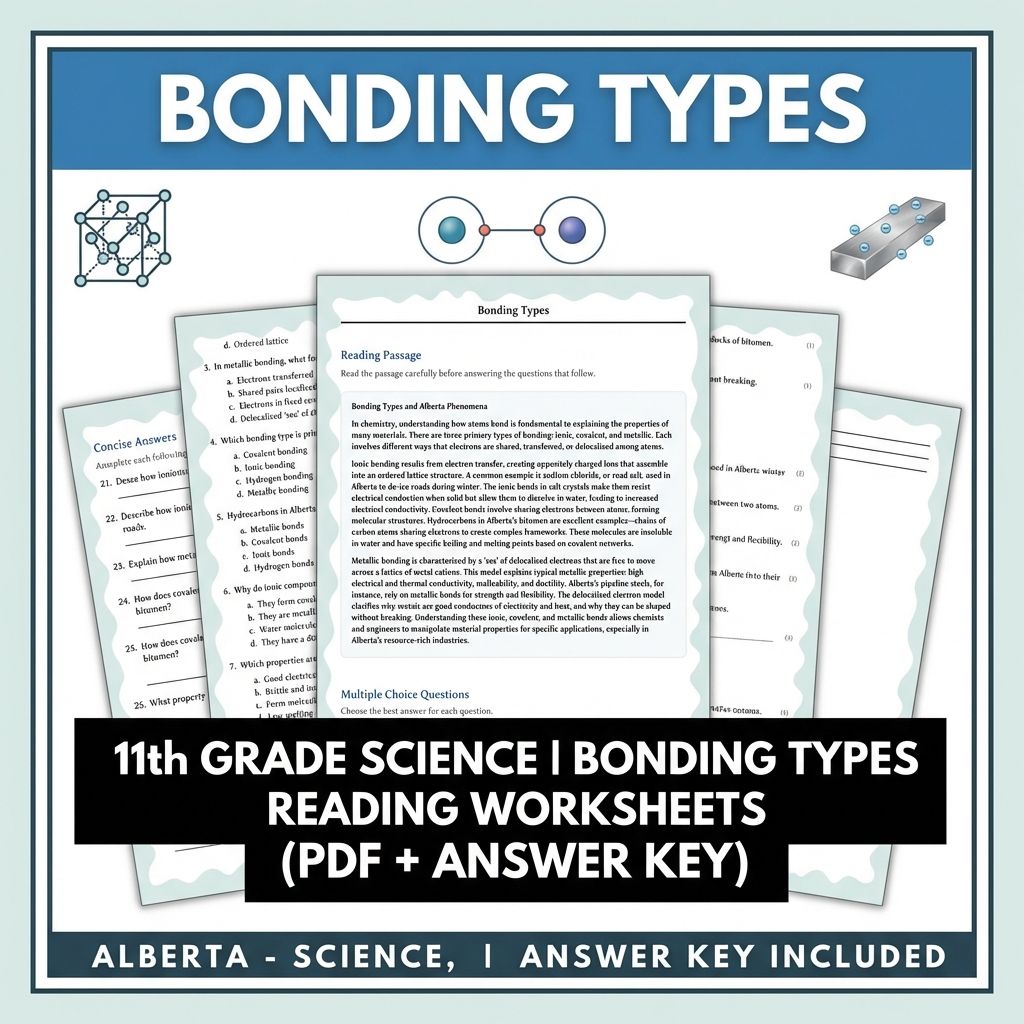
11th Grade Science | Bonding Types Reading Worksheets (PDF + Answer Key)
JCreated byJ.S SheetsLearning Objectives
- Compare electron transfer, electron sharing, and delocalized electron models in ionic, covalent, and metallic bonds.
- Understand how bonding types influence the structure and properties of materials such as salt, hydrocarbons, and steel.
- Link real Alberta phenomena to bonding models, including road salt, bitumen, and pipeline steel.
Instant download

Advanced Models Worksheet | Grade 11 Chemistry Practice
Created byPrism Point LearningLearning Objectives
- Explain how molecular orbital theory and band theory together describe delocalization and bonding in solids and transition-metal complexes.
- Relate orbital overlap and band structure to metallic conduction and semiconductor behavior.
- Use molecular symmetry and orbital/band models to predict spectroscopic features and reactivity trends.
Also included in: VSEPR & Chemical Bonding Lesson Bundle | Grade 11 Science | Alberta
Instant download

Dipole Interactions Worksheet | Grade 11 Science Activities
Created byPrism Point LearningLearning Objectives
- Explain how dipole–dipole attractions form between polar molecules and how orientation affects intermolecular forces
- Predict how temperature changes dipole interactions and related physical properties in solutions and condensed phases
- Use dipole interactions to justify examples such as miscibility and boiling-point differences in Alberta-relevant contexts
Also included in: VSEPR & Chemical Bonding Lesson Bundle | Grade 11 Science | Alberta
Instant download

VSEPR Basics Worksheet | Grade 11 Science Activities
Created byPrism Point LearningLearning Objectives
- Use VSEPR electron-pair repulsion to predict molecular geometry from bonding and nonbonding pairs.
- Relate molecular shape to bond angles and predict relative polarity based on symmetry.
- Identify the electron-pair geometry vs. the molecular geometry for common VSEPR families.
Also included in: VSEPR & Chemical Bonding Lesson Bundle | Grade 11 Science | Alberta
Instant download
About Grade 11 Science Worksheets
Browse 6,616 printable Grade 11 Science worksheets — ready-to-print PDFs with answer keys where available.
Each resource here is built by an independent educator and reviewed for quality. Worksheets print straight from PDF and suit classroom use, homework, or extra practice; most come with answer keys, and you can preview before purchasing.