
Grade 11 Science Worksheets
6,616 worksheets
ATP Synthase Worksheet for Grade 11 Science | TEKS-Aligned Practice
JCreated byJ.S SheetsLearning Objectives
- Explain how ATP synthase converts a proton gradient into ATP through rotational coupling.
- Describe the roles of the F0 and F1 regions in proton flow and ATP formation.
- Connect proton-motive force (membrane potential and concentration differences) to ADP and Pi condensation.
Instant download
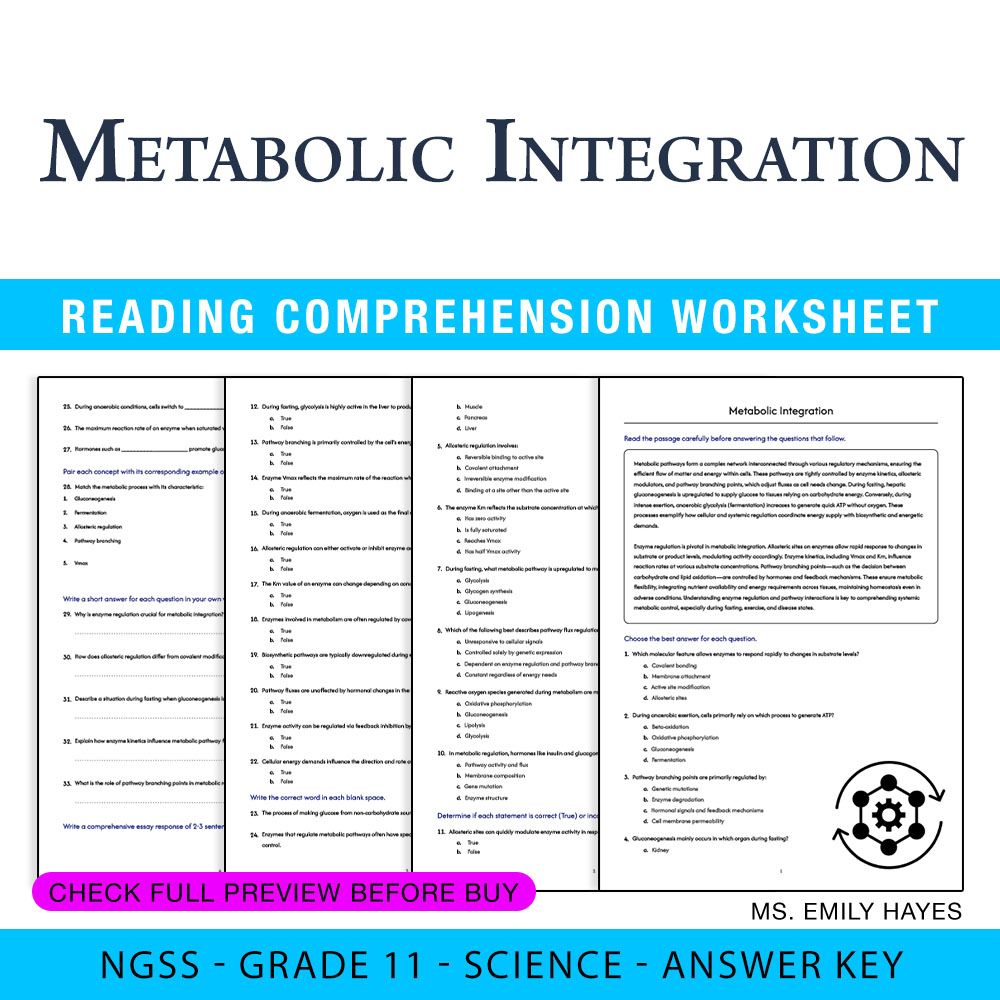
11th Grade Science | Metabolic Integration Worksheet (PDF+ Answer Key)
 Created byCopper Leaf Classroom
Learning Objectives
- Understand how interconnected metabolic pathways regulate energy flow in cells.
- Identify key enzymes and their roles in carbohydrate, lipid, and protein metabolism.
- Explain examples of metabolic regulation during fasting and exertion.
Instant download
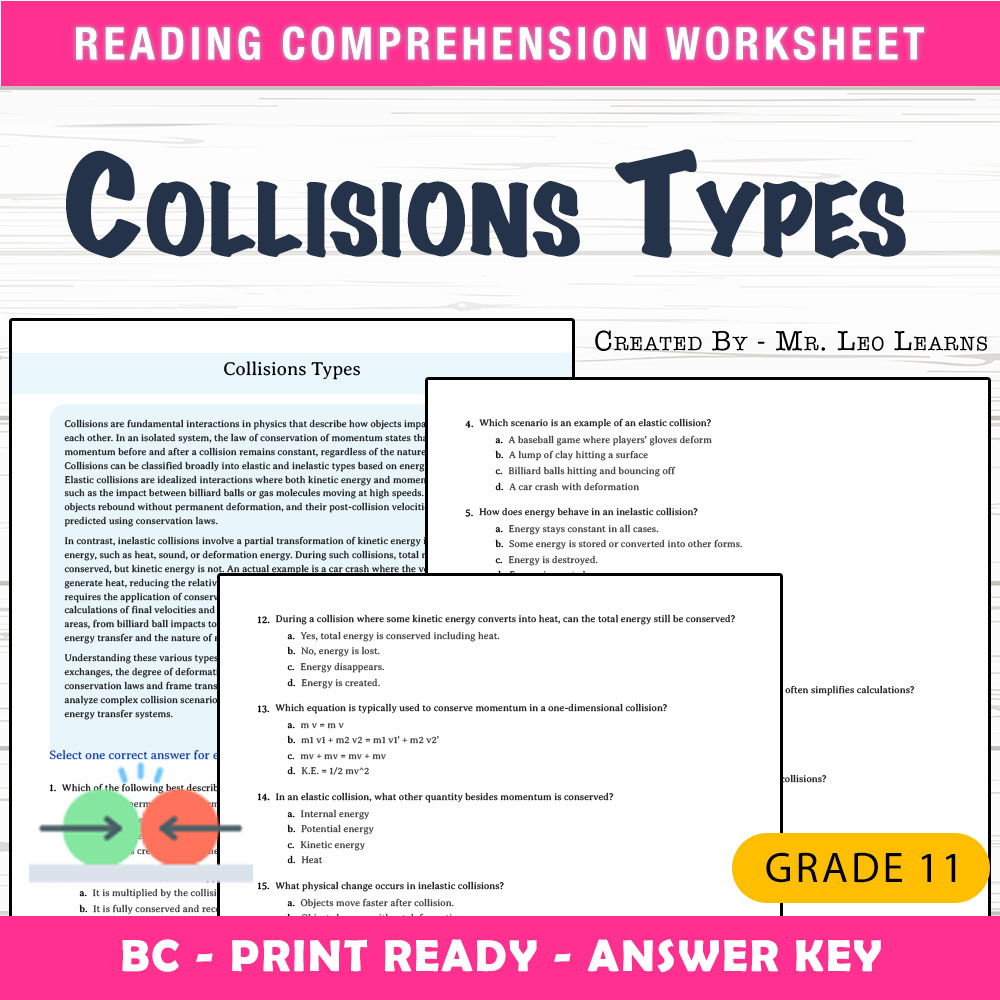
Grade 11 Science — Collisions Types Worksheet for Mastery
 Created byThe Resource Hub
Learning Objectives
- Understand the difference between elastic and inelastic collisions.
- Apply conservation of momentum to analyze collision scenarios.
- Identify energy changes during elastic and inelastic collisions.
Also included in: Grade 11 Science BC Physics Unit Bundle | Motion, Energy & Forces Worksheets +1 more
Instant download

Grade 11 Science | Stoichiometry Basics Worksheet | AP Aligned
 Created byLumora Learning
Learning Objectives
- Understand mole relationships, molar mass, and how to interpret balanced chemical equations.
- Apply limiting reagent reasoning and calculate percent yield in chemical reactions.
- Differentiate between empirical and molecular formulas using mass and mole data.
Also included in: Grade 11 Science | Chemistry Foundations Custom Bundle | AP-Aligned
Instant download
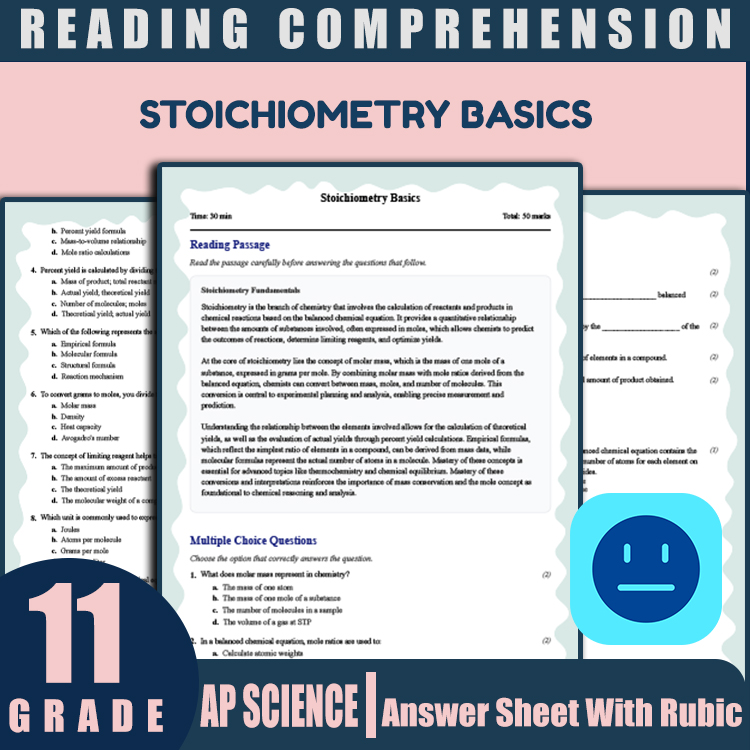
11th Grade Science | Stoichiometry Basics Reading Worksheet (PDF + Rubric)
JCreated byJ.S SheetsLearning Objectives
- Understand and interpret mole relationships, molar mass, and balanced equations in chemical reactions.
- Apply stoichiometric calculations to determine limiting reagents, percent yields, and empirical formulas.
Also included in: Grade 11 Science Unit Worksheet Bundle – Chemical Bonding, Kinetics & More (PDF) +1 more
Instant download

11th Grade Science | Momentum Collisions Worksheet (PDF + Answer Key)
Created byCopper Leaf ClassroomLearning Objectives
- Explain the concepts of linear momentum and impulse formalism in translational motion
- Analyze conservation of momentum during elastic and inelastic collisions
- Calculate post-collision velocities using impulse-momentum relations and vector decomposition
Instant download
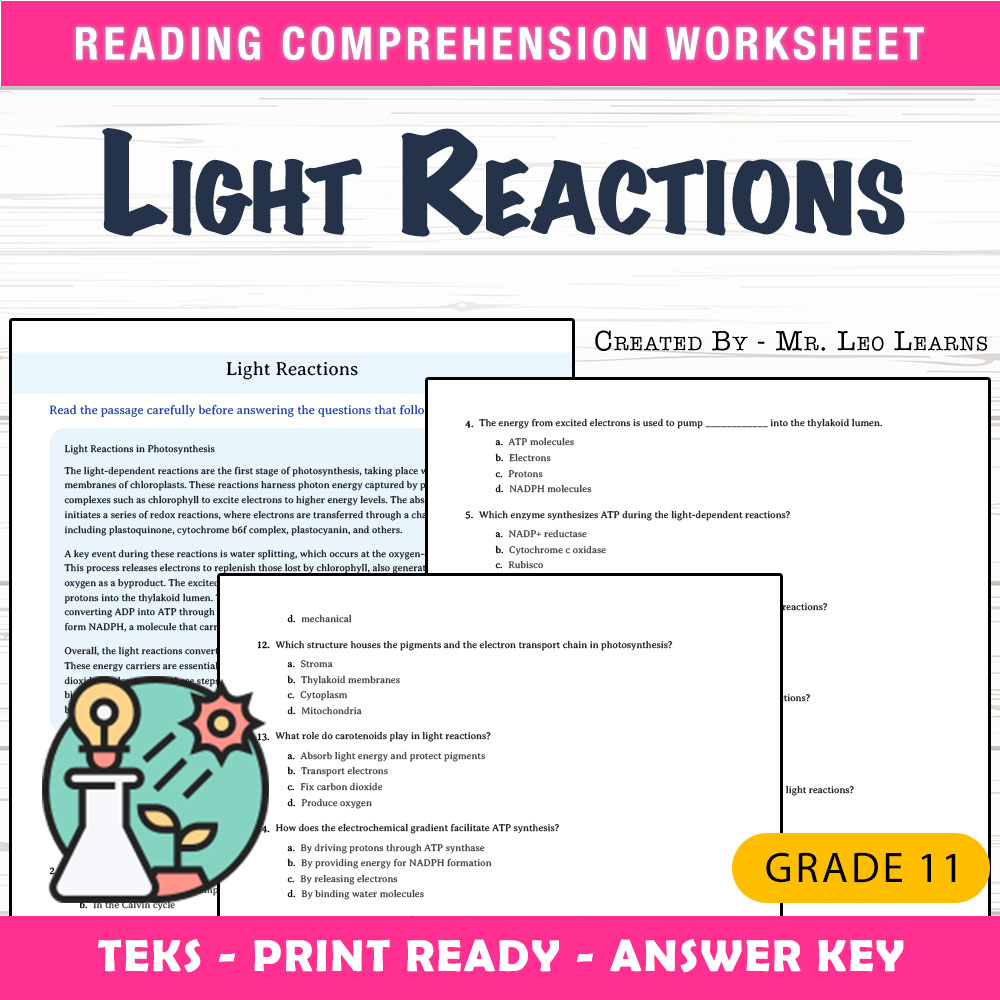
Grade 11 Science – Light Reactions Worksheet for Mastering Photosynthesis
Created byThe Resource HubLearning Objectives
- Explain the process of light-dependent reactions in photosynthesis.
- Identify the roles of pigments, electron transport chain, and ATP synthase in light reactions.
- Describe how water splitting releases oxygen as a byproduct.
Also included in: Grade 11 Science | Cellular Energy & Photosynthesis Unit Worksheet Bundle +1 more
Instant download
11th Grade Science | Energy Accounting Worksheet (PDF + Answer Key)
Created byCopper Leaf ClassroomLearning Objectives
- Create computational models to analyze energy transfers among system components.
- Relate heat, work, and stored energy in various physical systems using representations.
- Compare predicted energy flows to actual data, emphasizing total energy conservation.
Instant download
11th Grade Science | Energy Flow in Ecosystems Worksheet (PDF + Answer Key)
Created byCopper Leaf ClassroomLearning Objectives
- Understand the concept of energy transfer within food webs, including trophic levels and biomass pyramids.
- Recognize the processes of photosynthesis and cellular respiration and their roles in energy flow.
- Analyze how energy loss affects community structure, species abundance, and ecosystem functioning.
Instant download
11th Grade Science | Energy Concepts Worksheet (PDF+ Answer Key)
Created byCopper Leaf ClassroomLearning Objectives
- Define and explain the concepts of work, kinetic energy, and potential energy.
- Describe the principle of energy conservation in closed systems.
- Differentiate between conservative and nonconservative forces with relevant examples.
Also included in: Grade 11 Science | Physics Principles Worksheet Bundle (PDF+ Answer Key)) +1 more
Instant download
Grade 11 Science | Fossil Record Worksheet (PDF + Answer Key)
Created byCopper Leaf ClassroomLearning Objectives
- Understand how the fossil record documents evolutionary change over deep time.
- Identify methods such as stratigraphic distribution and radiometric dating used to establish temporal sequences.
- Explain the significance of transitional fossils in demonstrating morphological intermediates.
Also included in: Grade 11 Science BC | Genetics, Evolution & Cell Biology (PDF + Answer Keys) +1 more
Instant download
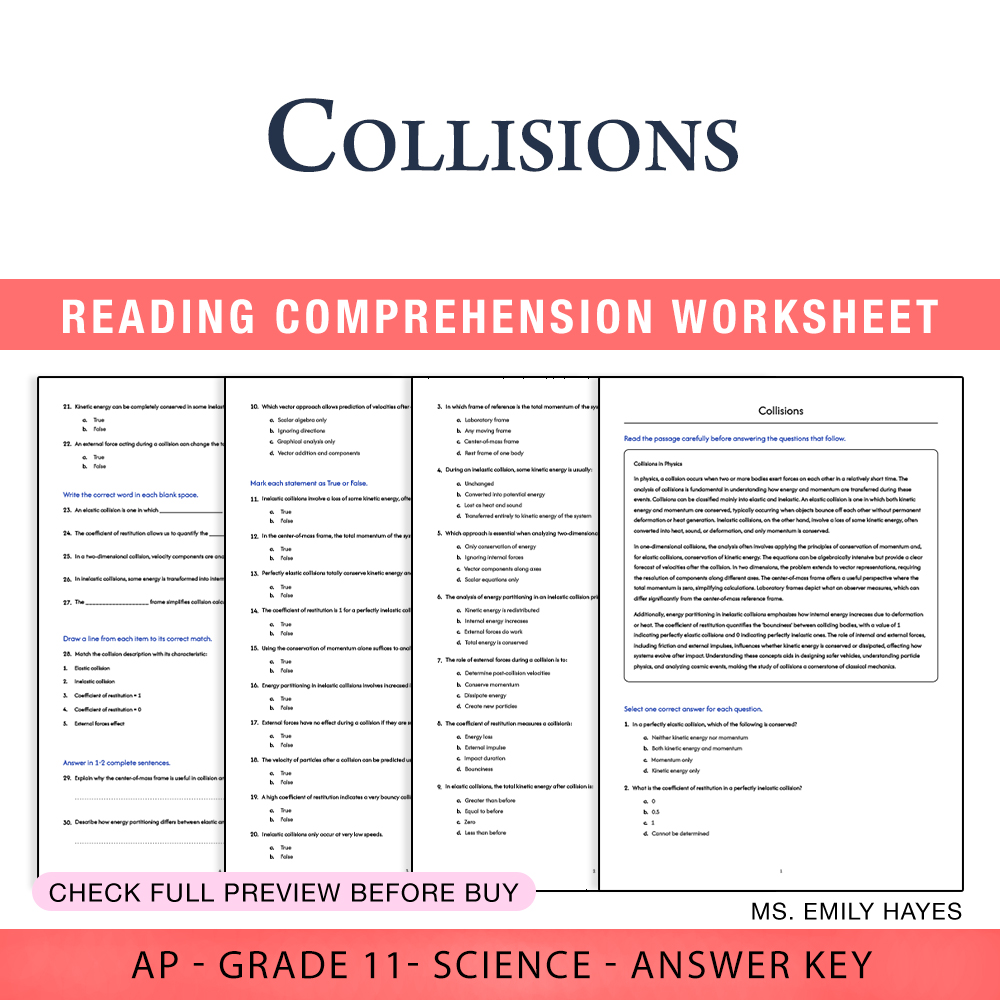
11th Grade Science | Collisions Worksheet (PDF+ Answer Key)
Created byCopper Leaf ClassroomLearning Objectives
- Understand the principles of elastic and inelastic collisions in one and two dimensions.
- Apply conservation of momentum and kinetic energy to analyze collision scenarios.
- Compare laboratory and center-of-mass reference frames in collision problems.
Also included in: Grade 11 Science | Physics Principles Worksheet Bundle (PDF+ Answer Key)) +1 more
Instant download
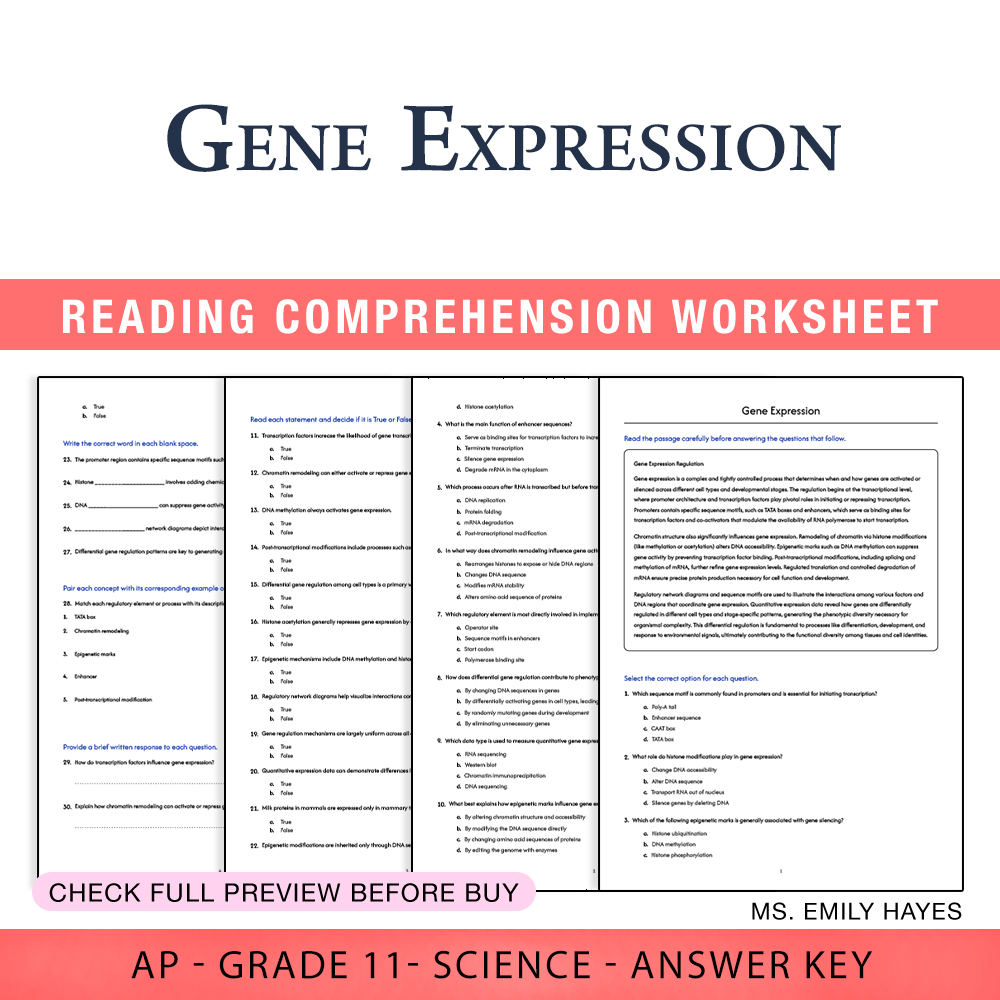
Grade 11 Science | Gene Expression Worksheet (PDF+ Answer Key)
Created byCopper Leaf ClassroomLearning Objectives
- Explain the mechanisms regulating gene expression from transcription to post-transcriptional modifications.
- Identify the roles of promoter architecture, transcription factors, chromatin remodeling, and epigenetic marks in gene regulation.
- Analyze how sequence motifs, regulatory network diagrams, and expression data illustrate gene regulation.
Also included in: Grade 11 Science | Biology & Ecosystems AP Worksheet Bundle (PDF+ Answer Keys) +1 more
Instant download
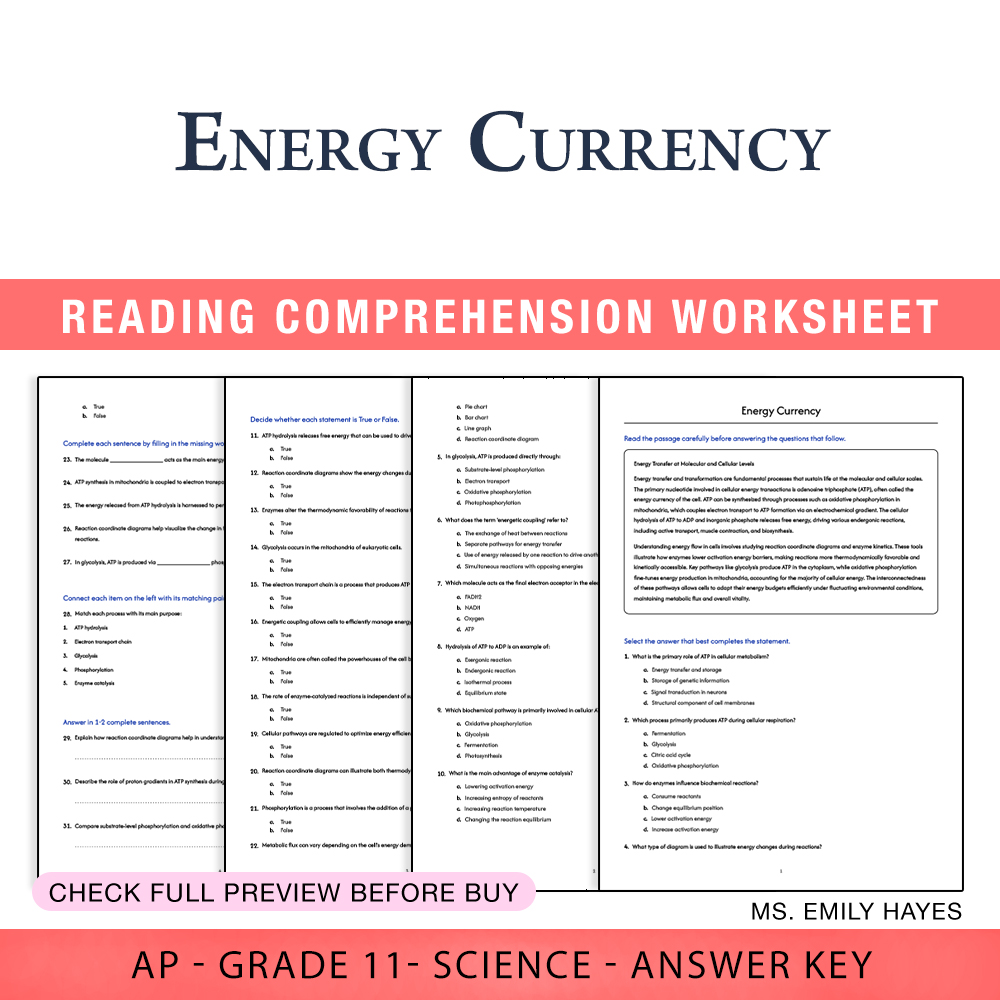
11th Grade Science | Energy Currency Worksheet (PDF+ Answer Key)
Created byCopper Leaf ClassroomLearning Objectives
- Explain the principles of molecular and cellular energy transfer and transformation.
- Describe ATP synthesis, hydrolysis, and energy coupling mechanisms in cellular processes.
- Interpret reaction coordinate diagrams and enzyme kinetics related to bioenergetics.
Also included in: Grade 11 Science | Biology & Ecosystems AP Worksheet Bundle (PDF+ Answer Keys) +1 more
Instant download
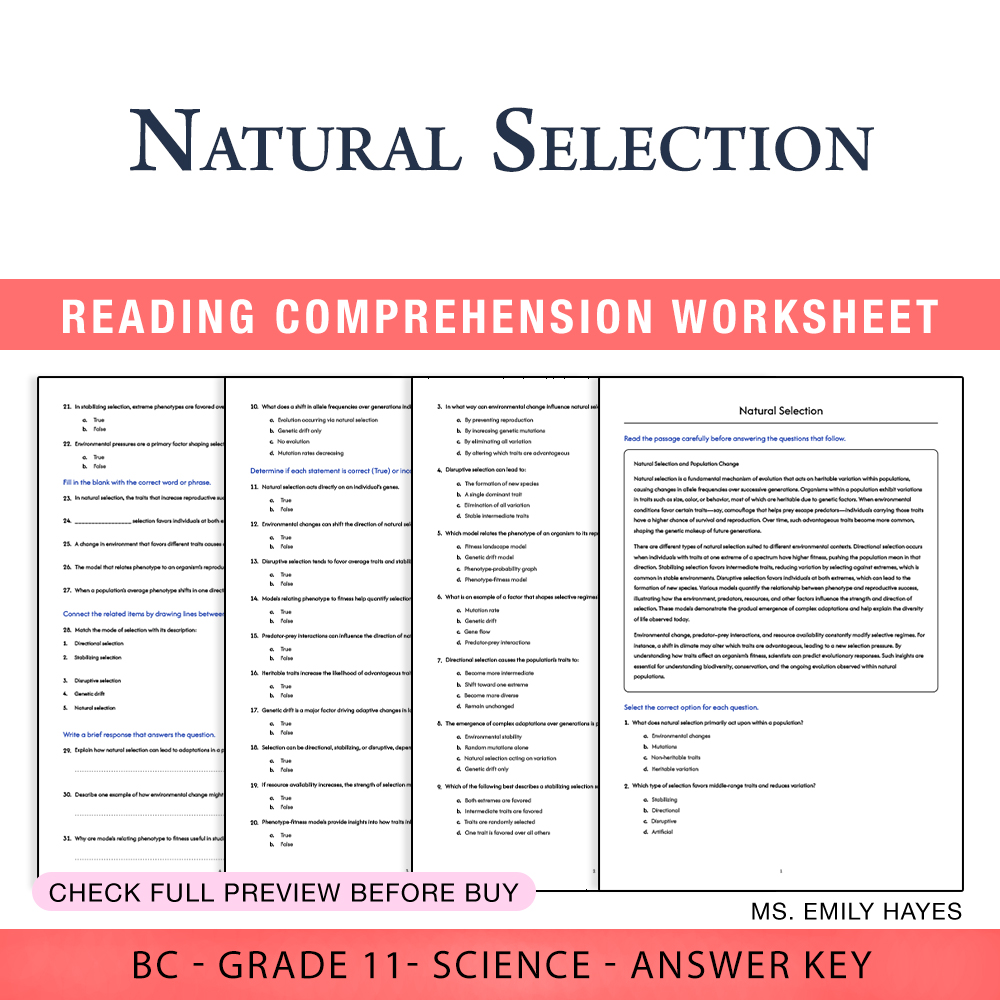
Grade 11 Science | Natural Selection Worksheet (PDF + Answer Key)
Created byCopper Leaf ClassroomLearning Objectives
- Explain how natural selection acts on heritable traits in populations.
- Identify different modes of selection: directional, stabilizing, and disruptive.
- Describe how environmental factors influence selective pressures.
Also included in: Grade 11 Science BC | Genetics, Evolution & Cell Biology (PDF + Answer Keys) +1 more
Instant download
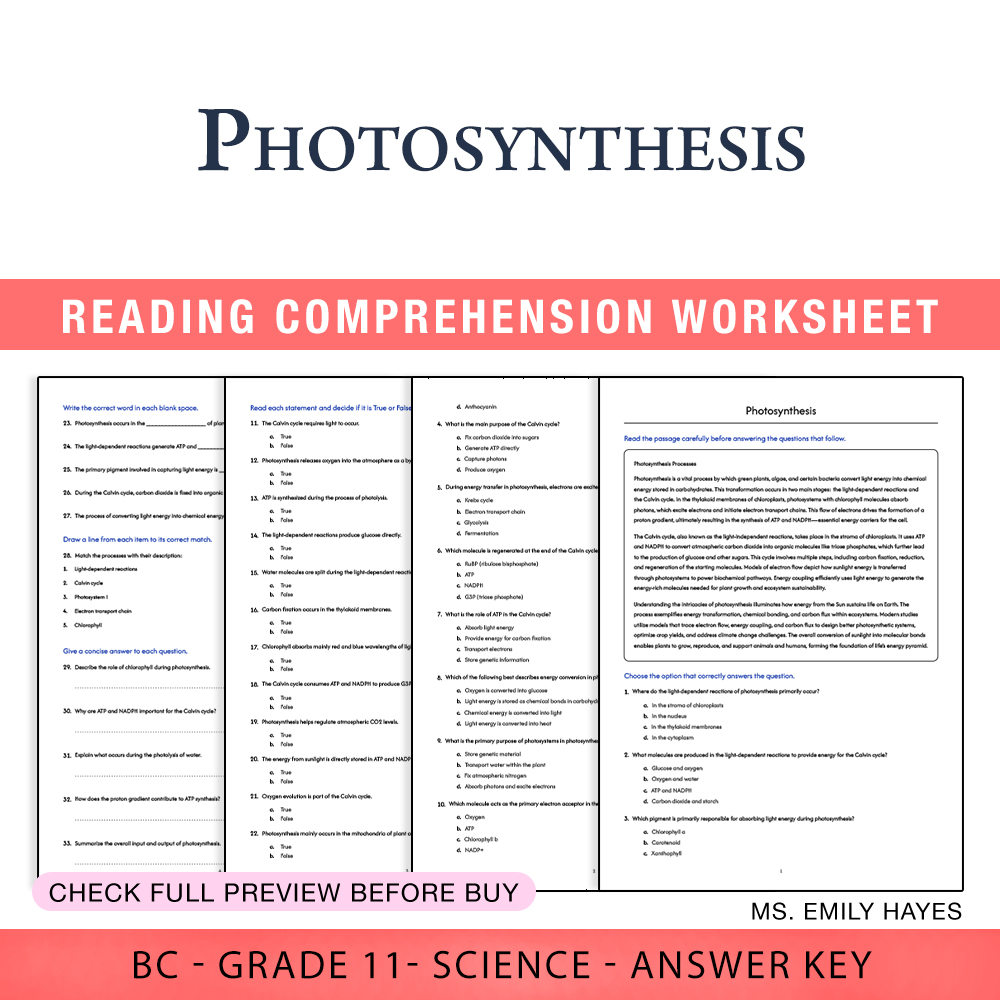
11th Grade Science | Photosynthesis Worksheet (PDF + Answer Key)
Created byCopper Leaf ClassroomLearning Objectives
- Describe the process of photosynthesis, including light-dependent reactions and the Calvin cycle.
- Explain the roles of photosystems, electron transport, ATP, and NADPH in energy conversion.
- Analyze how light energy is transformed into chemical energy within the chloroplasts.
Also included in: Grade 11 Science BC | Genetics, Evolution & Cell Biology (PDF + Answer Keys) +1 more
Instant download
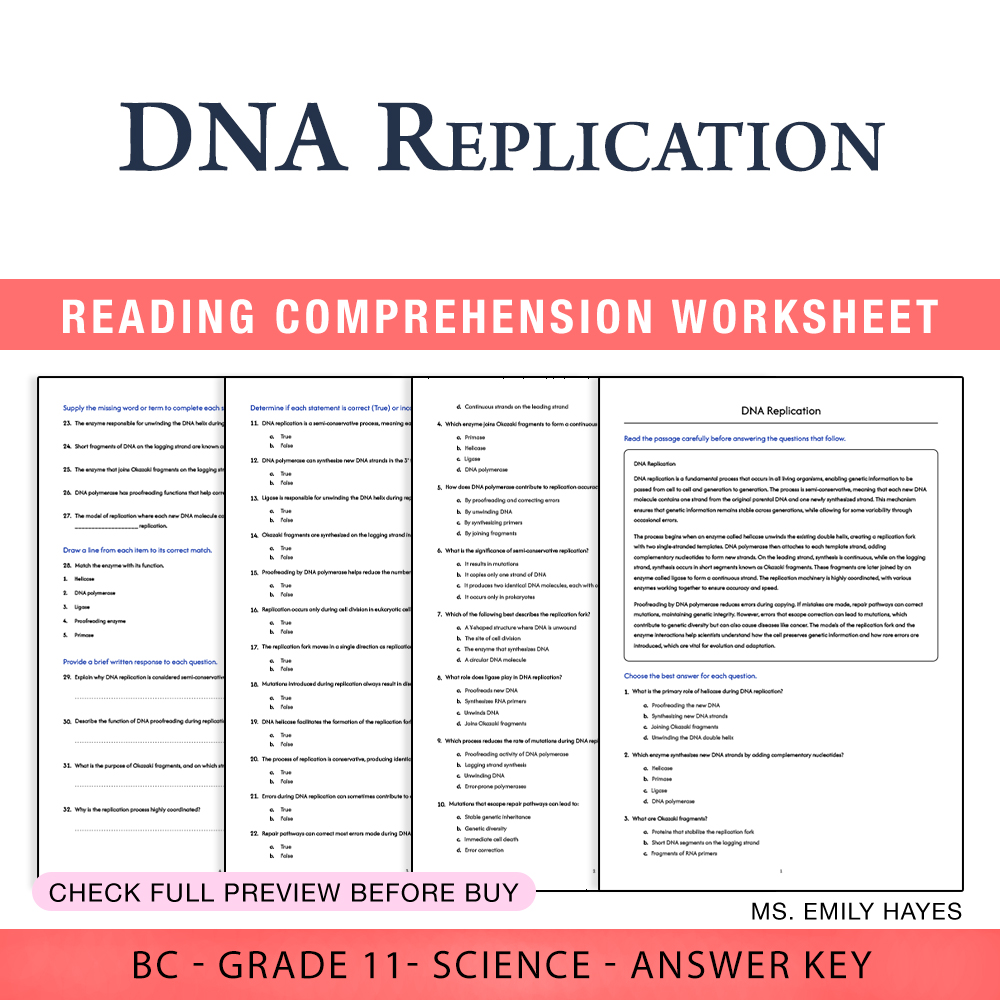
11th Grade Science | DNA Replication Worksheet (PDF + Answer Key)
Created byCopper Leaf ClassroomLearning Objectives
- Describe the process of semi-conservative DNA replication.
- Identify the roles of key enzymes such as helicase, DNA polymerase, ligase, and proofreading enzymes.
- Explain how replication forks are formed and function during DNA replication.
Also included in: Grade 11 Science BC | Genetics, Evolution & Cell Biology (PDF + Answer Keys) +1 more
Instant download
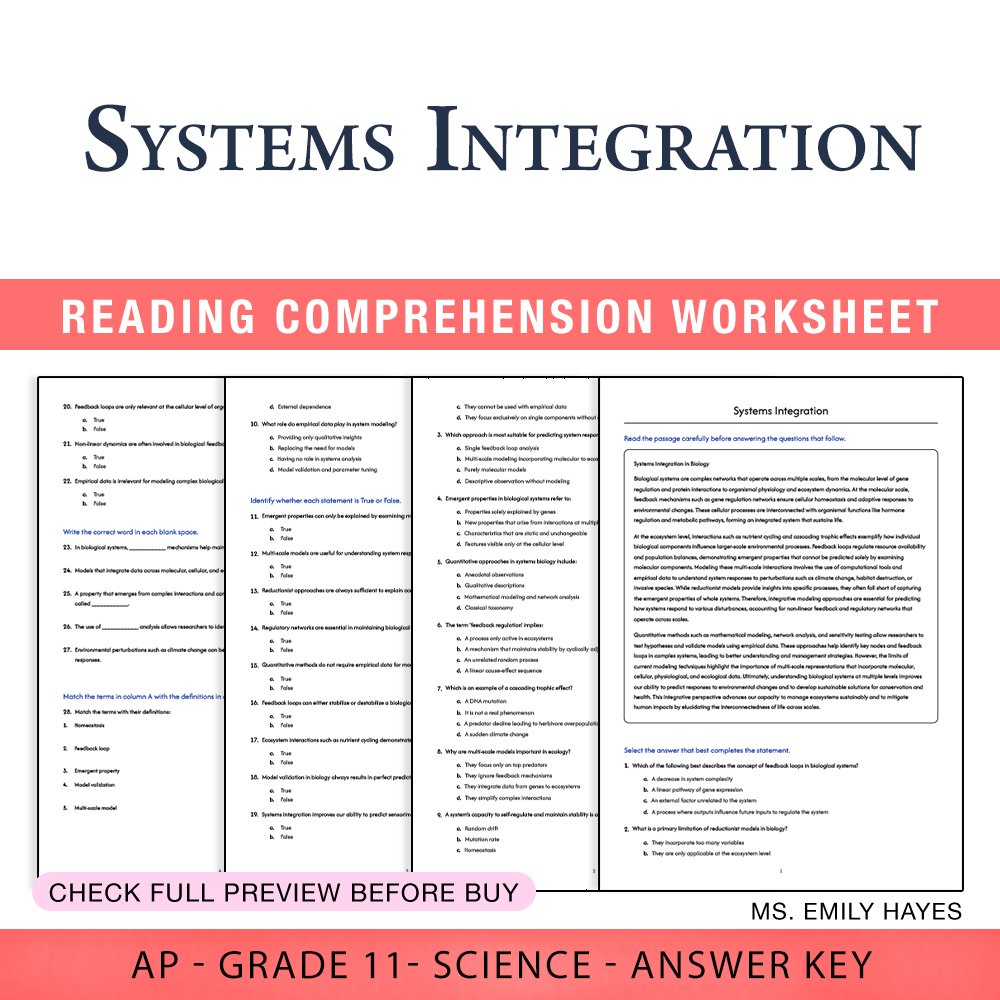
11th Grade Science | Systems Integration Worksheet (PDF+ Answer Key)
Created byCopper Leaf ClassroomLearning Objectives
- Understand how biological systems operate across molecular, cellular, organismal, and ecosystem levels.
- Describe feedback loops and regulatory networks in biological systems.
- Explain the use of modeling and quantitative approaches to predict system responses to perturbations.
Also included in: Grade 11 Science | Biology & Ecosystems AP Worksheet Bundle (PDF+ Answer Keys) +1 more
Instant download
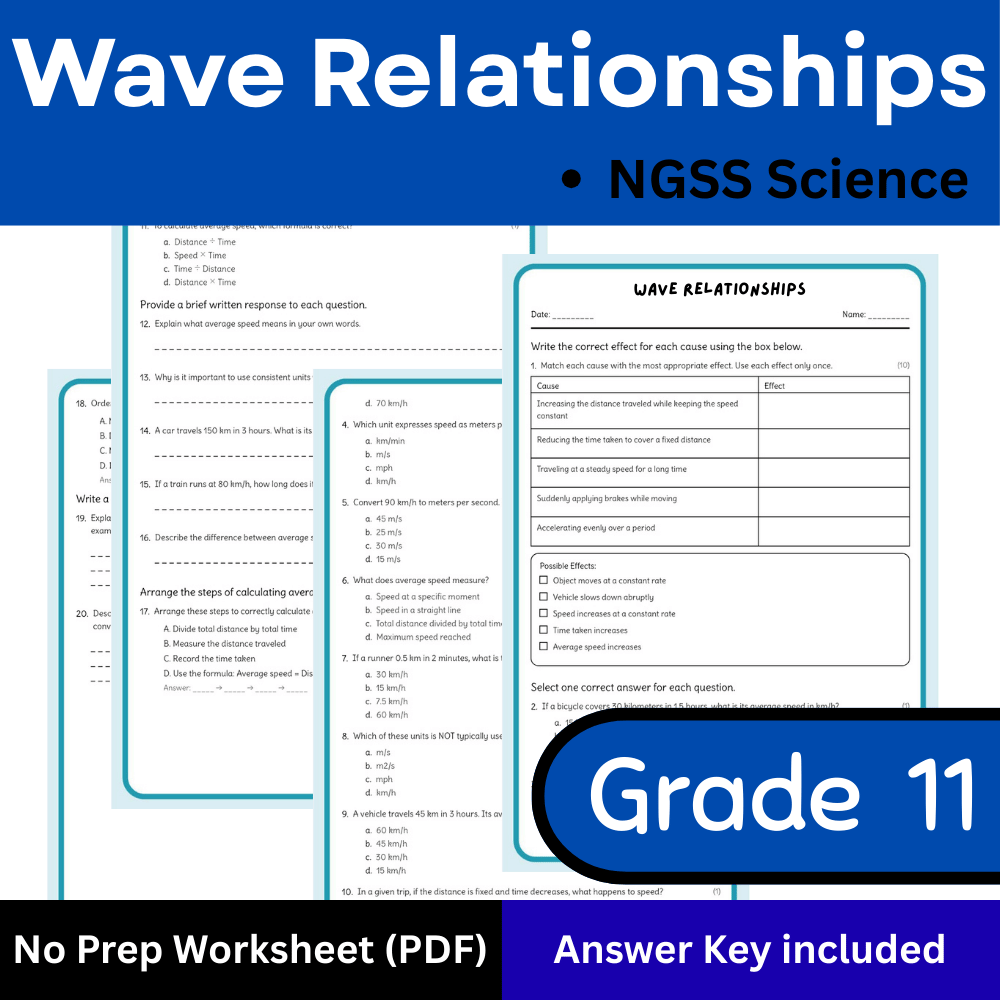
11th Grade Science | Wave Relationships Worksheet (Answer Key) – NGSS
 Created byBright Mind Resources
Learning Objectives
- Understand the mathematical relationships among wave properties such as speed, frequency, and wavelength.
- Describe the differences and similarities between transverse and longitudinal waves using examples.
- Analyze wave behaviors like refraction and dispersion through graphs and calculations.
Instant download
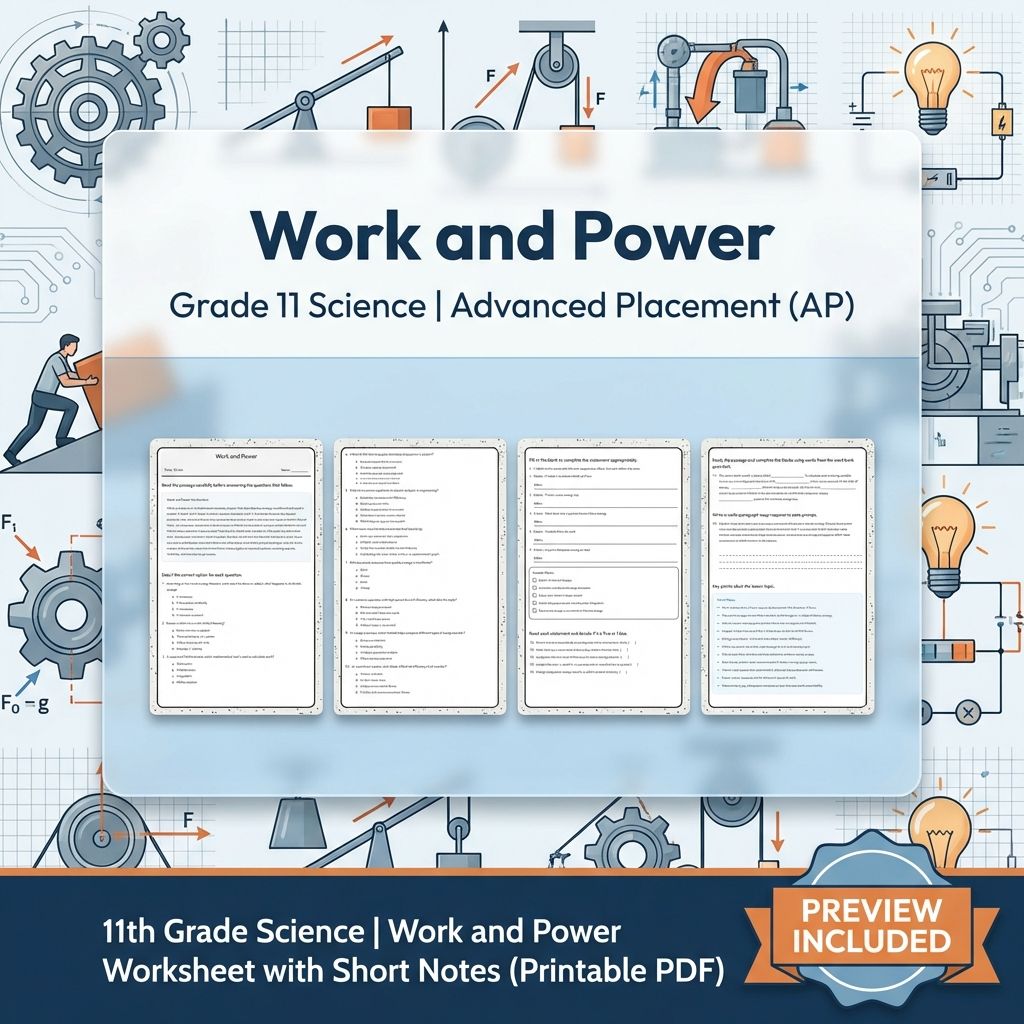
11th Grade Science | Work and Power Worksheet with Short Notes (Printable PDF)
 Created byMeadowlark Worksheets
Learning Objectives
- Explain the work–energy theorem and its application to systems with forces.
- Connect net work done to changes in kinetic energy.
- Define and calculate power as the rate of energy transfer.
Also included in: Grade 11 Physics Unit Worksheet Pack | Kinematics, Forces & Energy (Collection) +1 more
Instant download
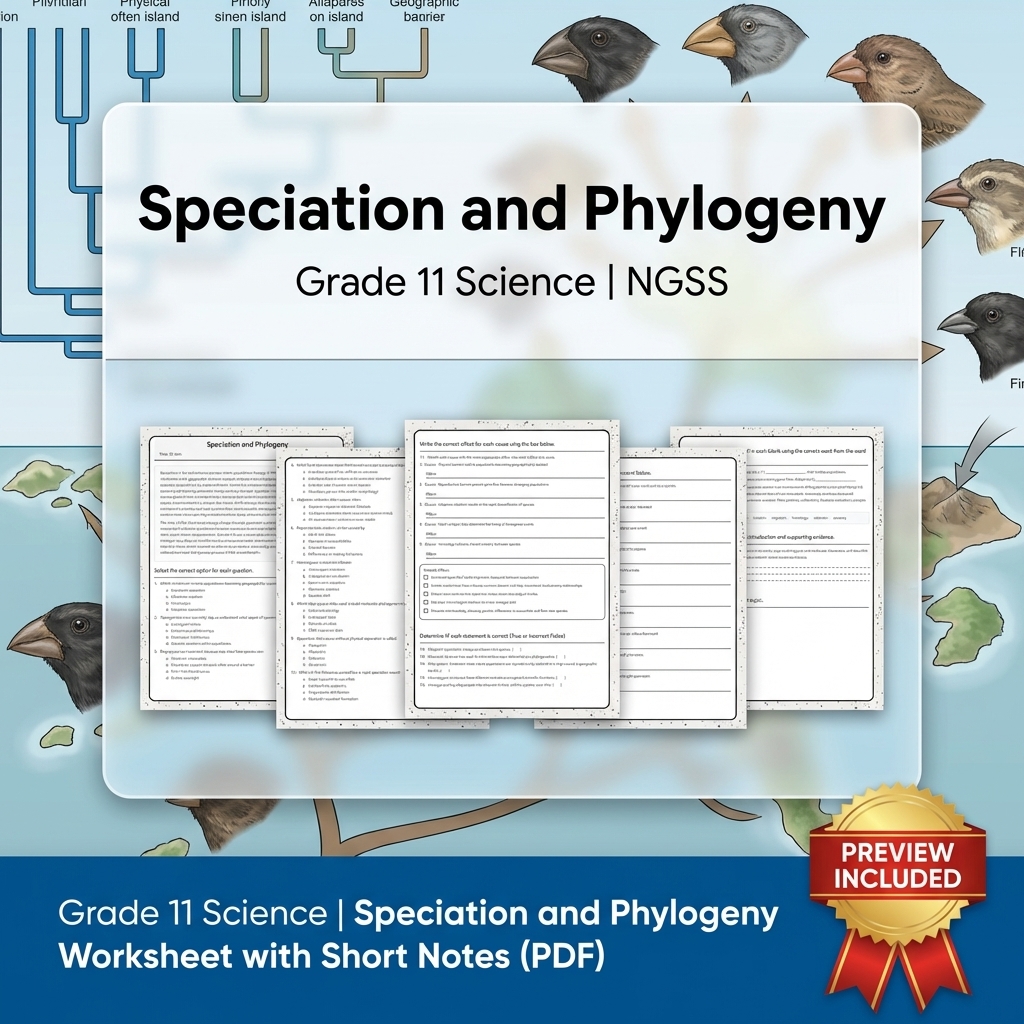
Grade 11 Science | Speciation and Phylogeny Worksheet with Short Notes (PDF)
Created byMeadowlark WorksheetsLearning Objectives
- Explain the mechanisms driving the origin of new species, including geographic isolation and reproductive barriers.
- Interpret phylogenetic trees using morphological and molecular data to understand evolutionary relationships.
- Differentiate between modes of speciation such as allopatric and sympatric.
Also included in: Grade 11 Science NGSS Unit | Biological Evolution & Diversity Worksheet Bundle +1 more
Instant download
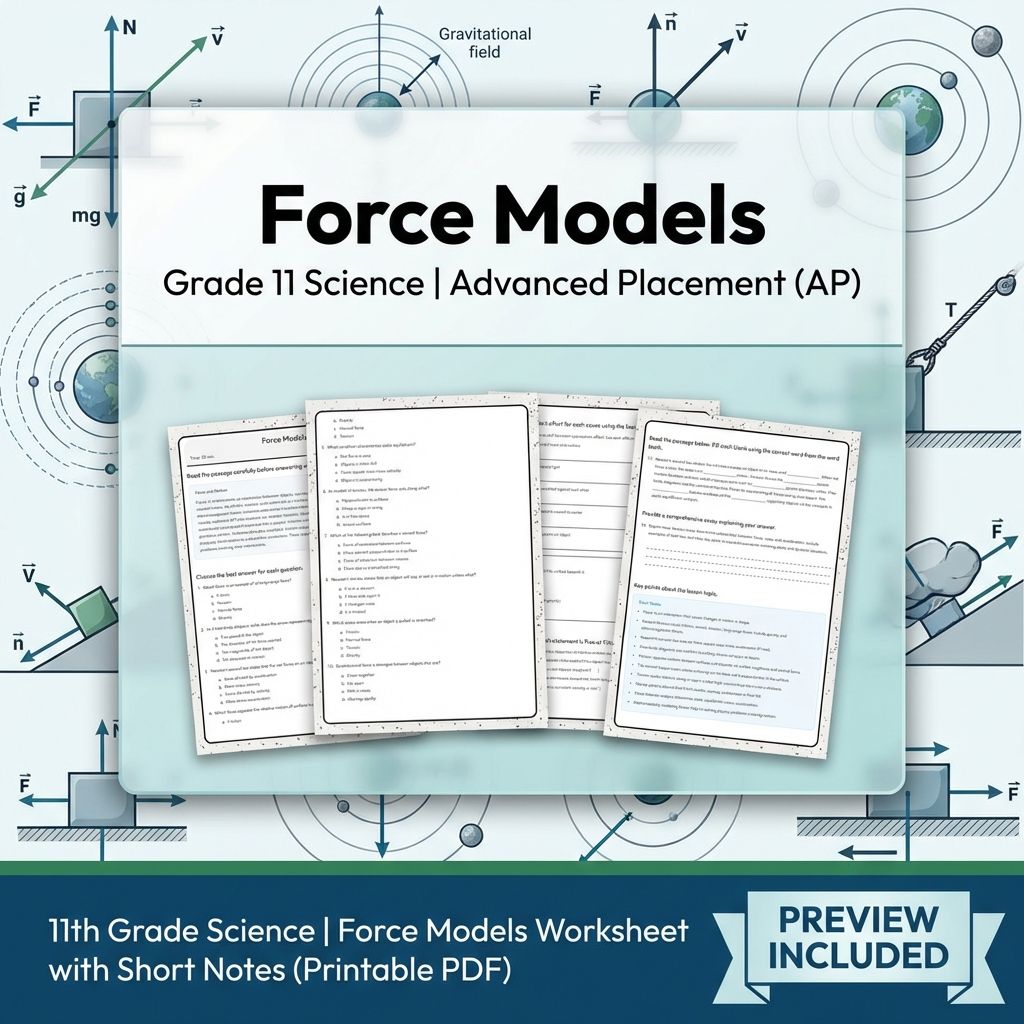
11th Grade Science | Force Models Worksheet with Short Notes (PDF)
Created byMeadowlark WorksheetsLearning Objectives
- Explain force as an interaction between objects and understand how forces are represented using diagrams.
- Differentiate between contact and long-range forces such as gravity and electromagnetic forces.
- Apply Newton's laws to analyze problems involving net force, mass, and acceleration.
Also included in: Grade 11 Physics Unit Worksheet Pack | Kinematics, Forces & Energy (Collection) +1 more
Instant download
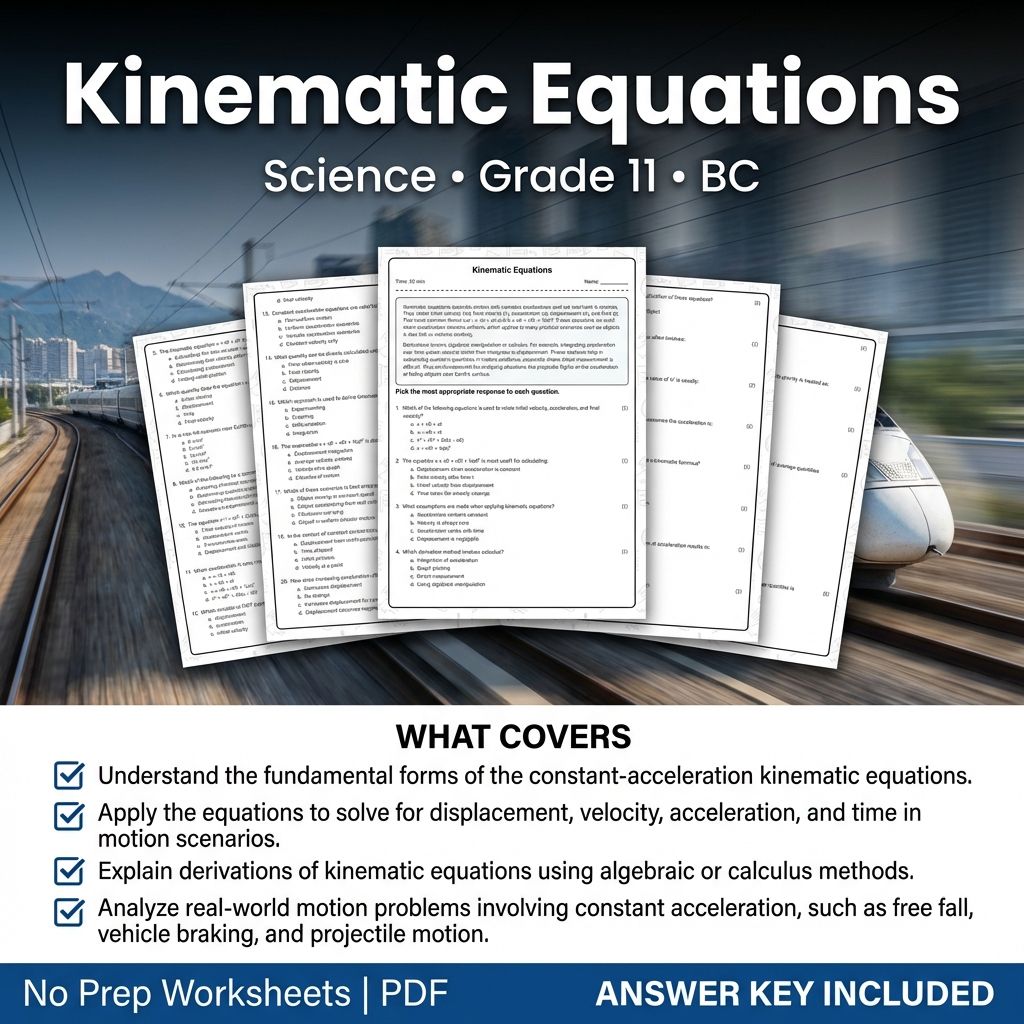
Grade 11 Science Worksheet on Kinematic Equations | BC Standards
 Created byCoral Reef Learning
Learning Objectives
- Understand the fundamental forms of the constant-acceleration kinematic equations.
- Apply the equations to solve for displacement, velocity, acceleration, and time in motion scenarios.
- Explain derivations of kinematic equations using algebraic or calculus methods.
Instant download
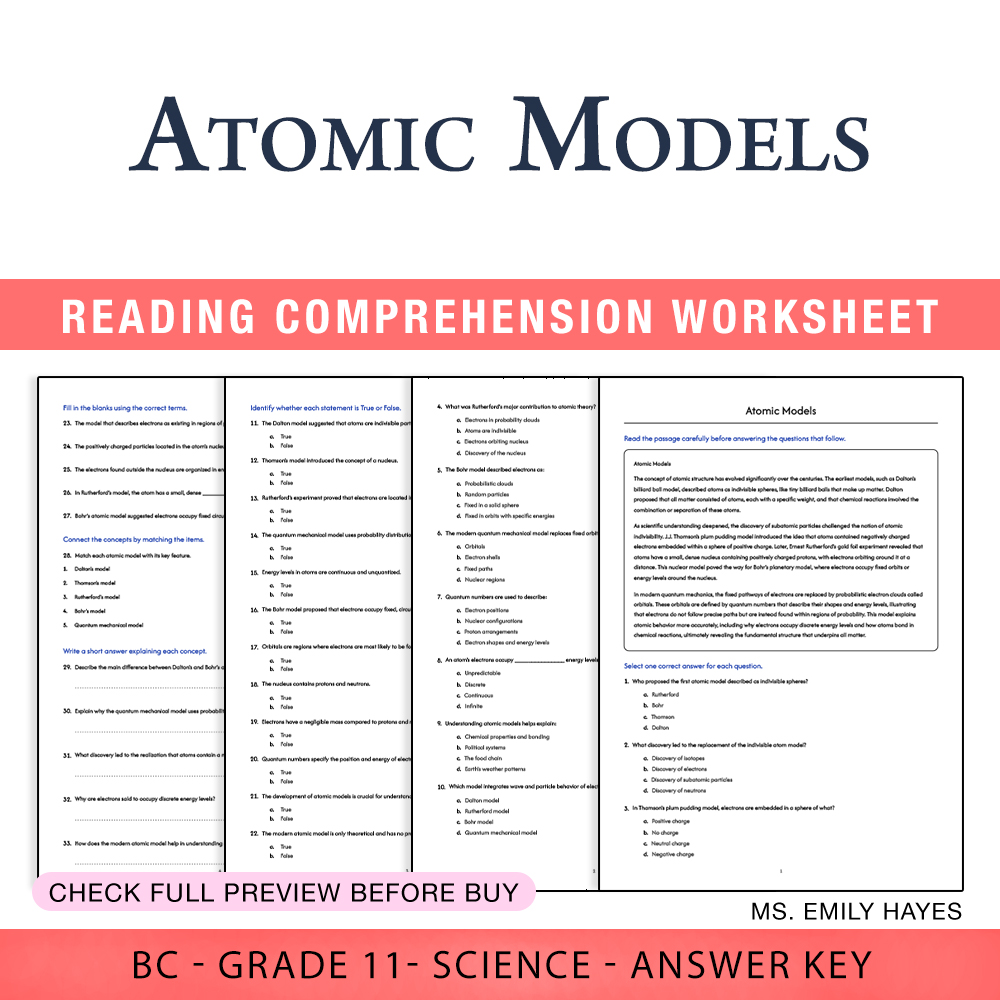
11th Grade Science | Atomic Models Worksheet (PDF + Answer Key)
Created byCopper Leaf ClassroomLearning Objectives
- Describe the progression of atomic models from early to quantum mechanical concepts.
- Identify key features and differences of historical and modern atomic models.
- Explain how electron behavior and energy levels are represented in current atomic theories.
Also included in: Grade 11 Science BC– Thermochemistry, Bonding & Reactions (PDF + Answer Key) +1 more
Instant download
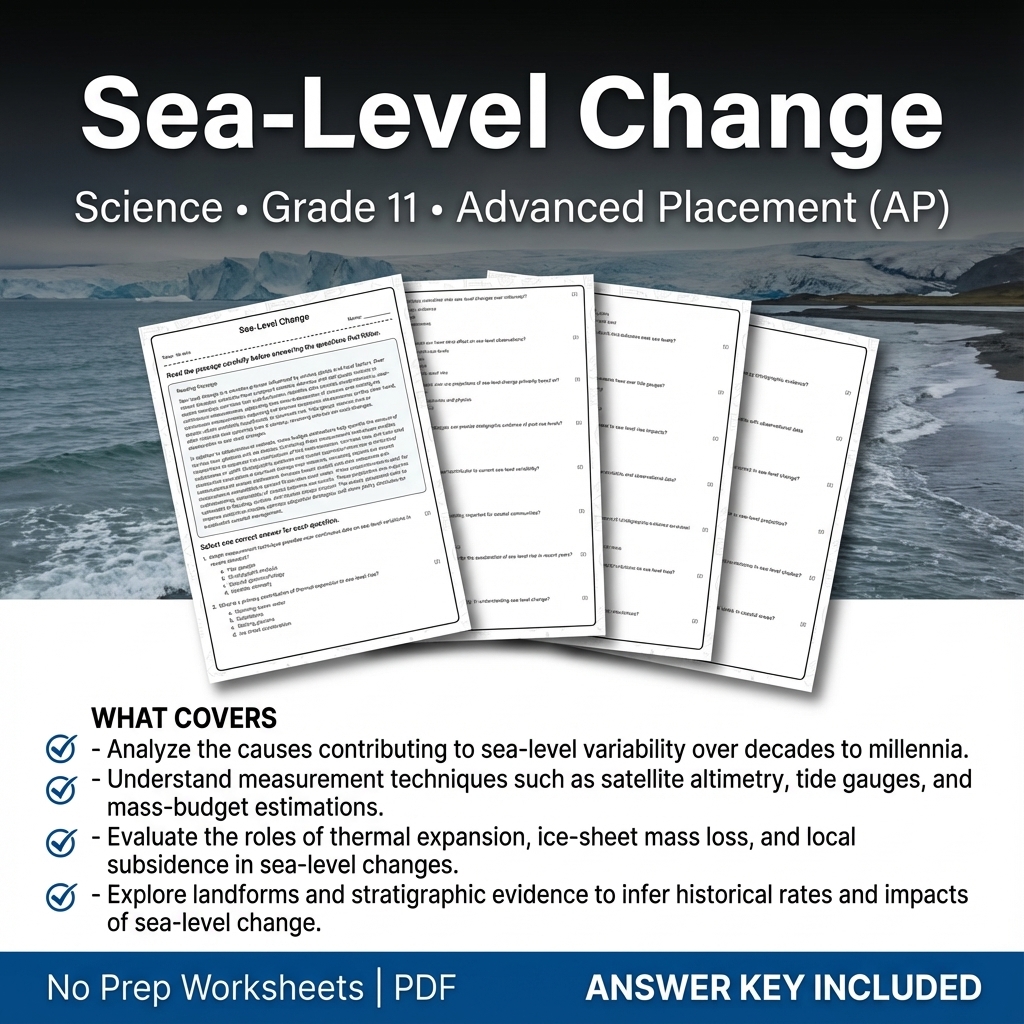
11th Grade Science | Sea-Level Change Worksheet (Printable PDF + Answer Key)
Created byCoral Reef LearningLearning Objectives
- Analyze the causes contributing to sea-level variability over decades to millennia.
- Understand measurement techniques such as satellite altimetry, tide gauges, and mass-budget estimations.
- Evaluate the roles of thermal expansion, ice-sheet mass loss, and local subsidence in sea-level changes.
Also included in: Grade 11 Science Unit Bundle – Earth Systems, Energy & Cycles Worksheets +1 more
Instant download
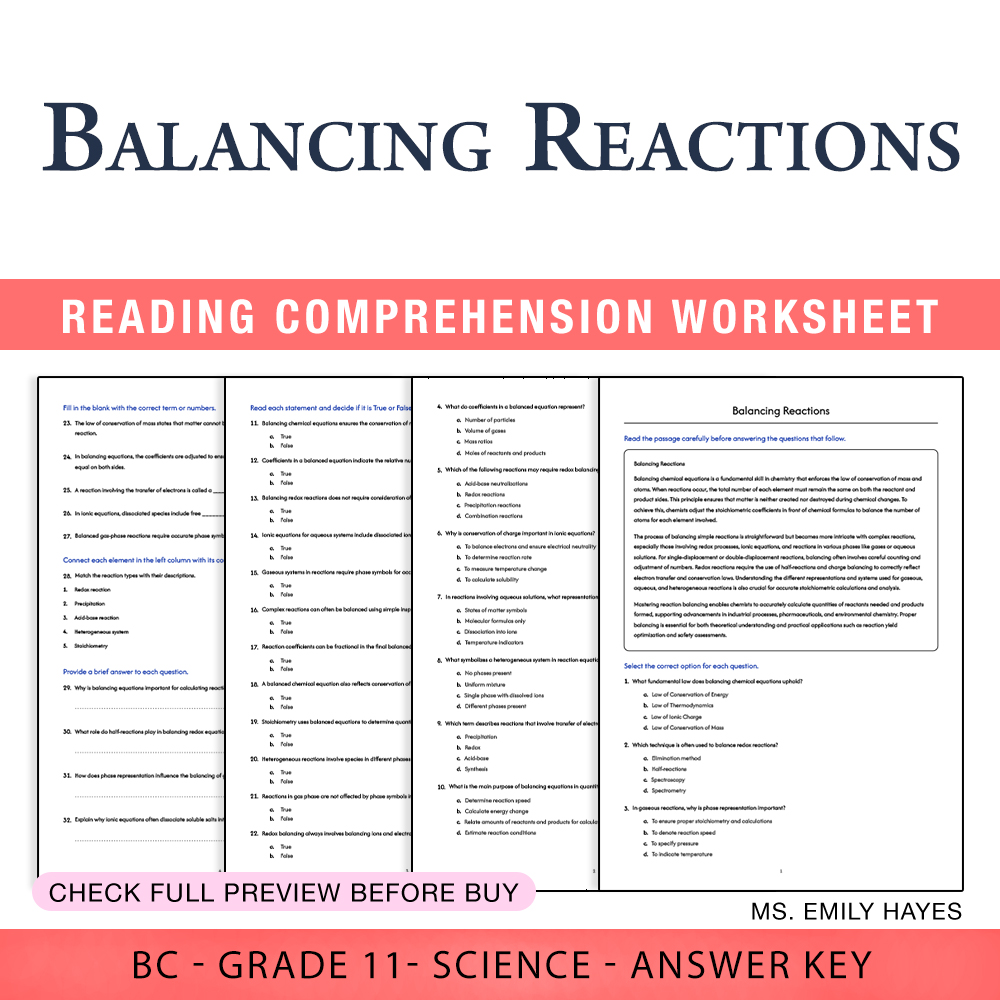
11th Grade Science | Balancing Reactions Worksheet (PDF + Answer Key)
Created byCopper Leaf ClassroomLearning Objectives
- Explain the importance of conservation of mass and atoms in chemical equations.
- Identify methods for balancing simple and complex chemical reactions.
- Apply stoichiometric coefficients to balance equations correctly.
Also included in: Grade 11 Science BC– Thermochemistry, Bonding & Reactions (PDF + Answer Key) +1 more
Instant download
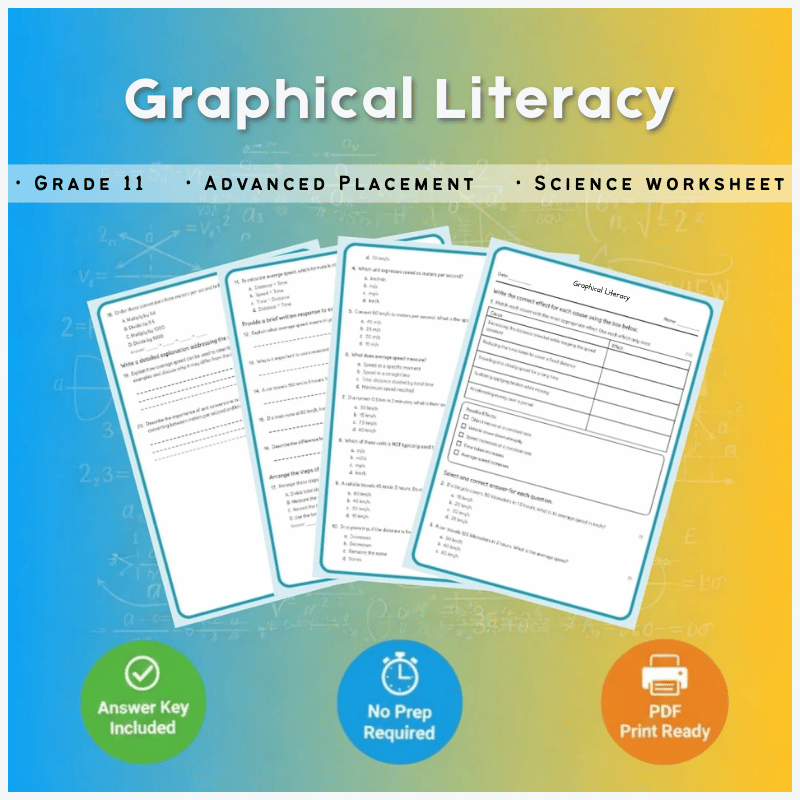
Grade 11 Science – Graphical Literacy Practice Worksheet (Answer) | AP Standards
Created byBright Mind ResourcesLearning Objectives
- Identify different types of graphical representations used in sciences such as scatterplots, histograms, box plots, and line graphs.
- Interpret trends, patterns, and anomalies from various graphs related to phenomena like seasonal temperature and reaction rates.
- Critique the design choices in graphs, including axis selection, scale, normalization, and annotation, and understand how they influence data interpretation.
Instant download

Grade 11 Science – Evaluating Explanations & Scientific Reasoning | Worksheet
Created byBright Mind ResourcesLearning Objectives
- Understand how evidence supports scientific explanations
- Identify the importance of multiple observations and testing alternative explanations
- Distinguish correlation from causation in scientific reasoning
Also included in: Nature of Science Grade 11 Sci Reading Worksheets Lesson Bundle | FL NGSSS +1 more
Instant download

Grade 11 Science – Evidence & Data | Daily Reading Worksheet
Created byBright Mind ResourcesLearning Objectives
- Understand the role of evidence in scientific explanations
- Identify relevant and reliable data from observations and measurements
- Distinguish between consistent patterns and random variation in data
Also included in: Nature of Science Grade 11 Sci Reading Worksheets Lesson Bundle | FL NGSSS +1 more
Instant download

Grade 11 Science – Scientific Inquiry & Weather Observation | Reading Worksheet
Created byBright Mind ResourcesLearning Objectives
- Understand the basics of scientific inquiry through weather observations.
- Learn to make careful observations and record data systematically.
- Identify natural causes and evidence in weather patterns.
Also included in: Nature of Science Grade 11 Sci Reading Worksheets Lesson Bundle | FL NGSSS +1 more
Instant download

Grade 11 Science – Testable Ideas & Scientific Hypotheses | Reading Worksheet
Created byBright Mind ResourcesLearning Objectives
- Understand the concept of hypotheses and their role in scientific investigation.
- Differentiate between testable predictions and non-testable ideas.
- Recognize how evidence and predictions connect in scientific reasoning.
Also included in: Nature of Science Grade 11 Sci Reading Worksheets Lesson Bundle | FL NGSSS +1 more
Instant download

Heat Transfer Worksheet for Grade 11 Science | NGSS-Aligned Assessment
JCreated byJ.S SheetsLearning Objectives
- Understand the mechanisms of heat transfer: conduction, convection, and radiation.
- Identify real-world examples of heat transfer in thermal systems.
- Explain the roles of heat flux, temperature gradients, and material properties in thermal processes.
Also included in: Grade 11 Energy Transfer and Conversion Science Lesson Bundle – NGSS +1 more
Instant download
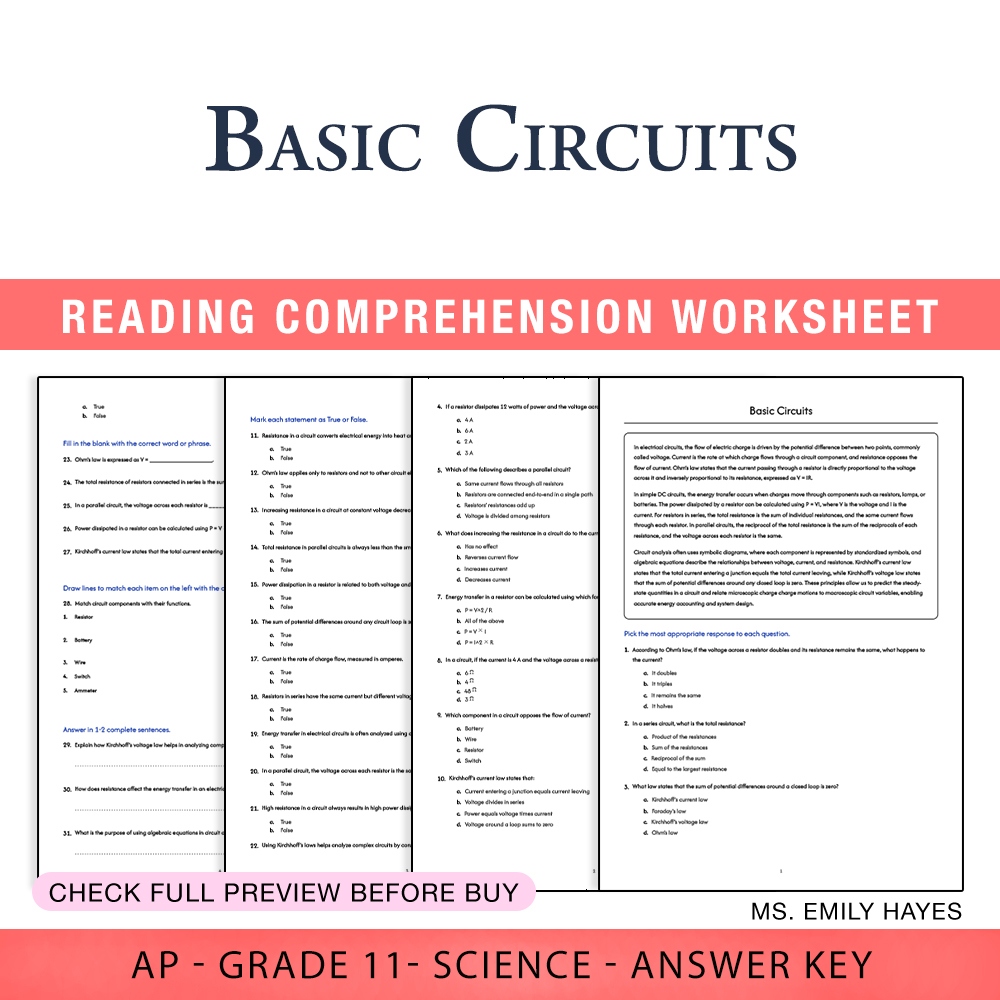
11th Grade Science | Basic Circuits Worksheet (PDF+ Answer Key)
Created byCopper Leaf ClassroomLearning Objectives
- Understand the concepts of electric potential difference, current, and resistance in DC circuits.
- Apply Ohm's law and Kirchhoff's rules to analyze series and parallel circuits.
- Calculate power dissipation and energy transfer in electrical systems.
Also included in: Grade 11 Science | Physics Principles Worksheet Bundle (PDF+ Answer Key)) +1 more
Instant download
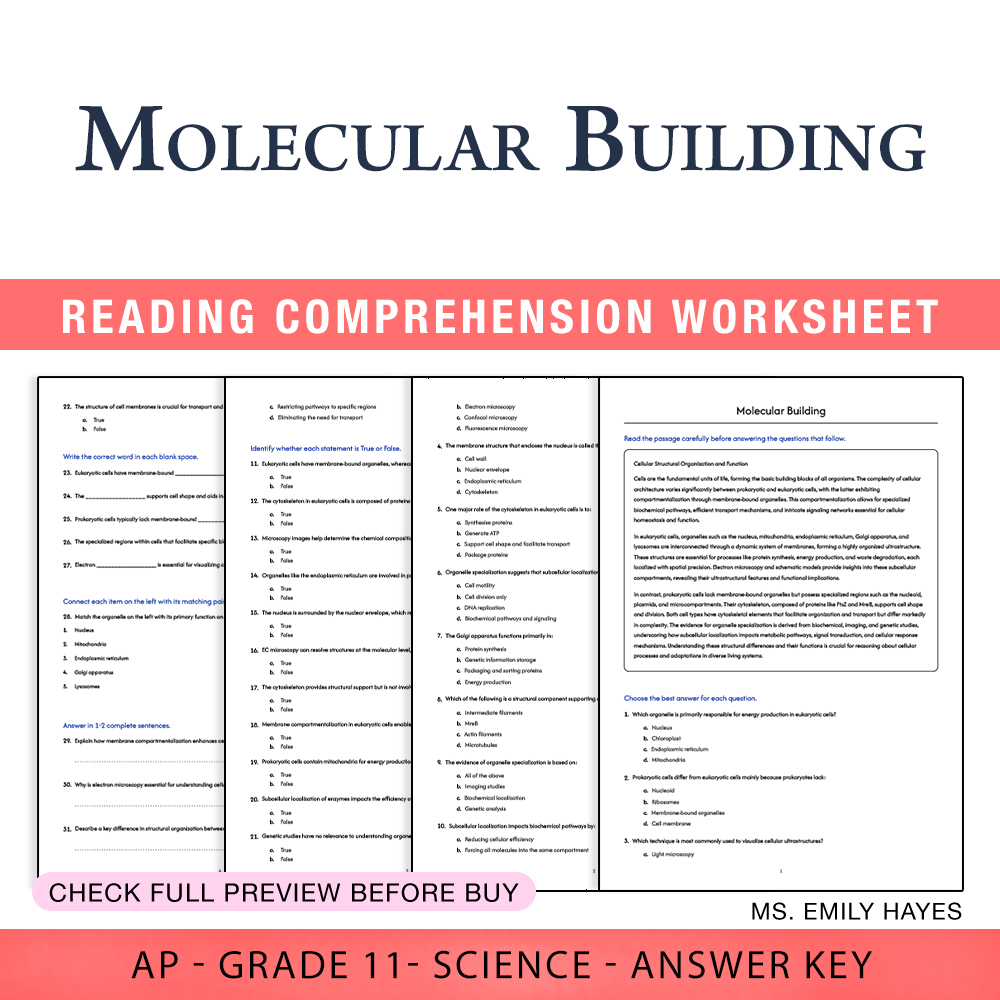
11th Grade Science | Molecular Building Worksheet (PDF+ Answer Key)
Created byCopper Leaf ClassroomLearning Objectives
- Describe the organization of cellular components from macromolecules to organelles.
- Compare structural features of prokaryotic and eukaryotic cells.
- Analyze microscopy images and schematic models to connect ultrastructure with function.
Also included in: Grade 11 Science | Biology & Ecosystems AP Worksheet Bundle (PDF+ Answer Keys) +1 more
Instant download
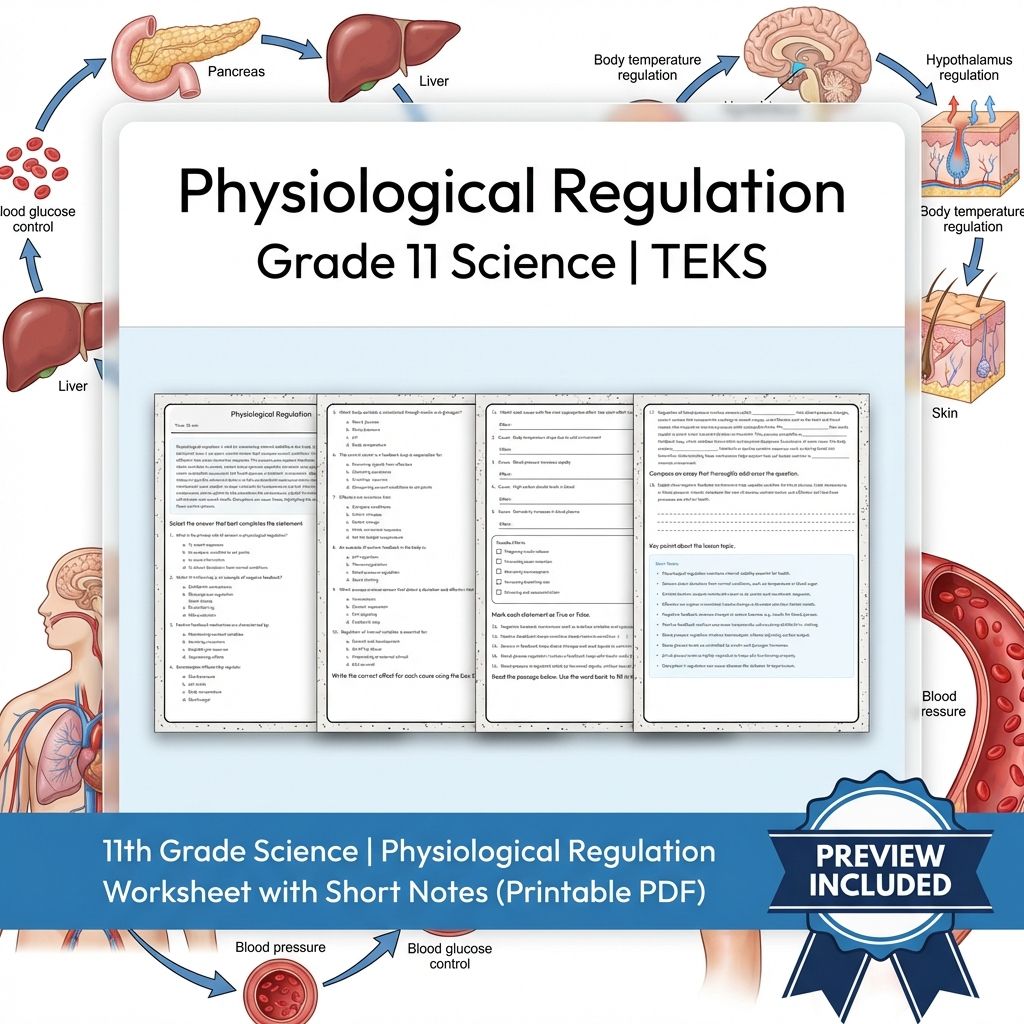
11th Grade Science | Physiological Regulation Worksheet with Short Notes (PDF)
Created byMeadowlark WorksheetsLearning Objectives
- Understand how the body maintains internal stability through various regulatory mechanisms.
- Identify key components of negative and positive feedback systems in physiological processes.
- Describe examples of physiological regulation such as blood glucose control and blood pressure adjustment.
Instant download

Classification Methods Worksheet | Grade 11 Science Practice
 Created byPrism Point Learning
Learning Objectives
- Explain how cladistic, phenetic, and phylogenomic approaches differ in grouping organisms.
- Describe how morphological, molecular, and computational data contribute to classification.
- Use taxonomic systems to interpret and revise biological relatedness based on new evidence.
Also included in: Evolution & Classification Lesson Bundle | Grade 11 Science | TEKS
Instant download
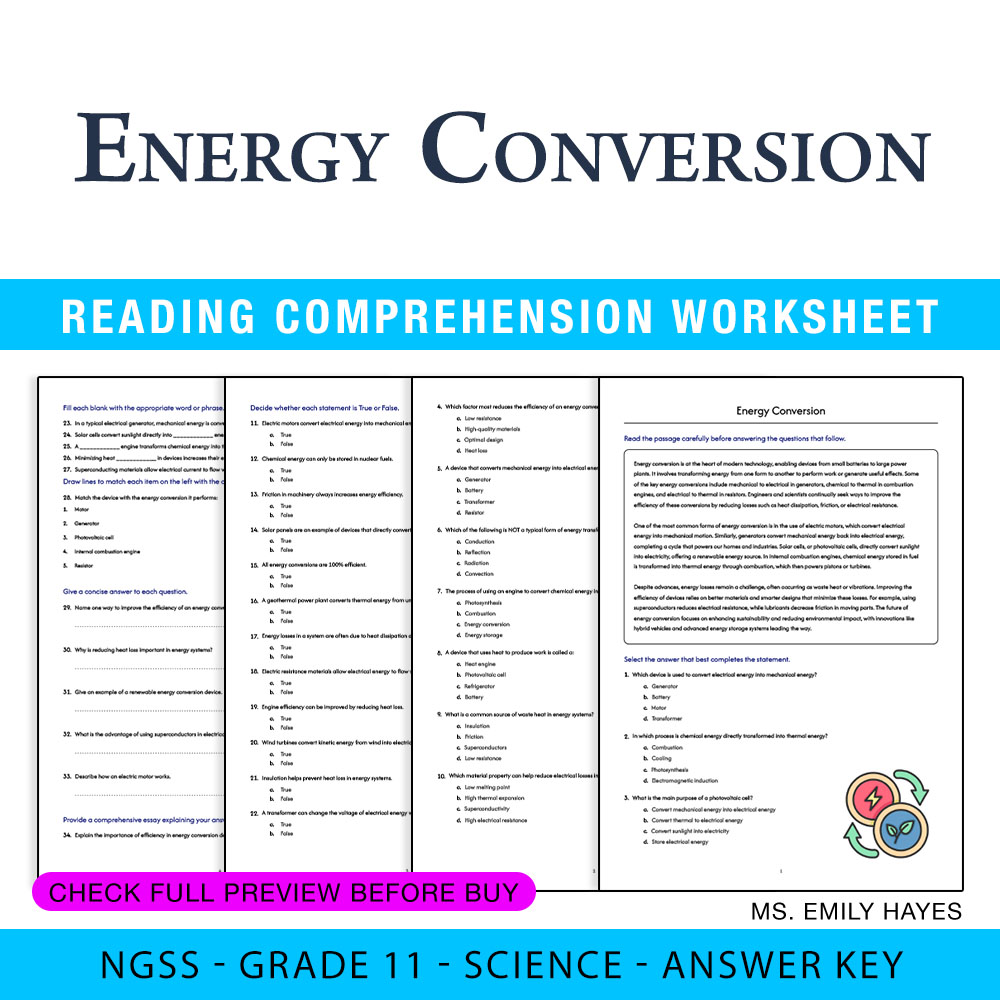
11th Grade Science | Energy Conversion Worksheet (PDF + Answer Key)
Created byCopper Leaf ClassroomLearning Objectives
- Understand the principles of energy conversion between mechanical, electrical, chemical, and thermal forms.
- Design and build devices that optimize energy transfer efficiency.
- Compare the performance of different energy conversion systems such as motors, generators, photovoltaic cells, and engines.
Instant download
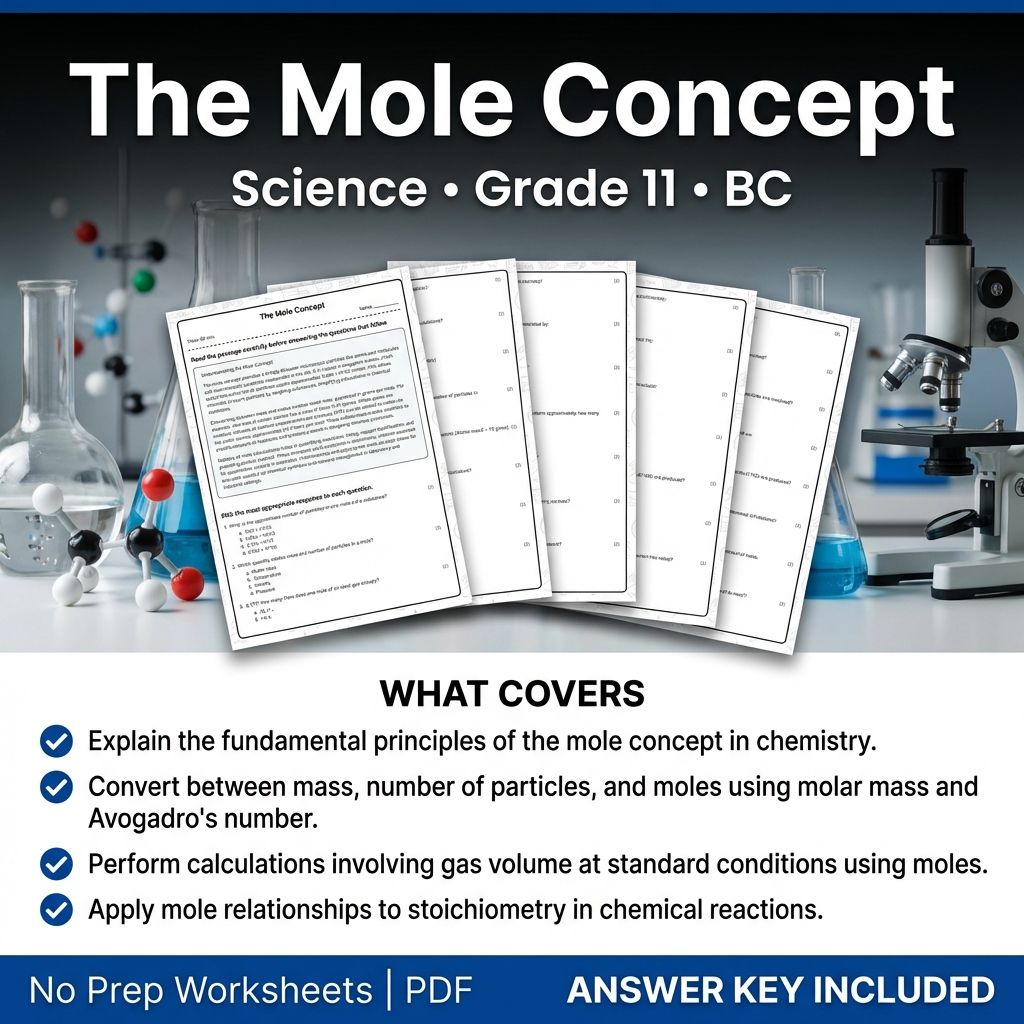
11th Grade Science | The Mole Concept Worksheet & Answer Key (Printable PDF)
Created byCoral Reef LearningLearning Objectives
- Explain the fundamental principles of the mole concept in chemistry.
- Convert between mass, number of particles, and moles using molar mass and Avogadro's number.
- Perform calculations involving gas volume at standard conditions using moles.
Instant download
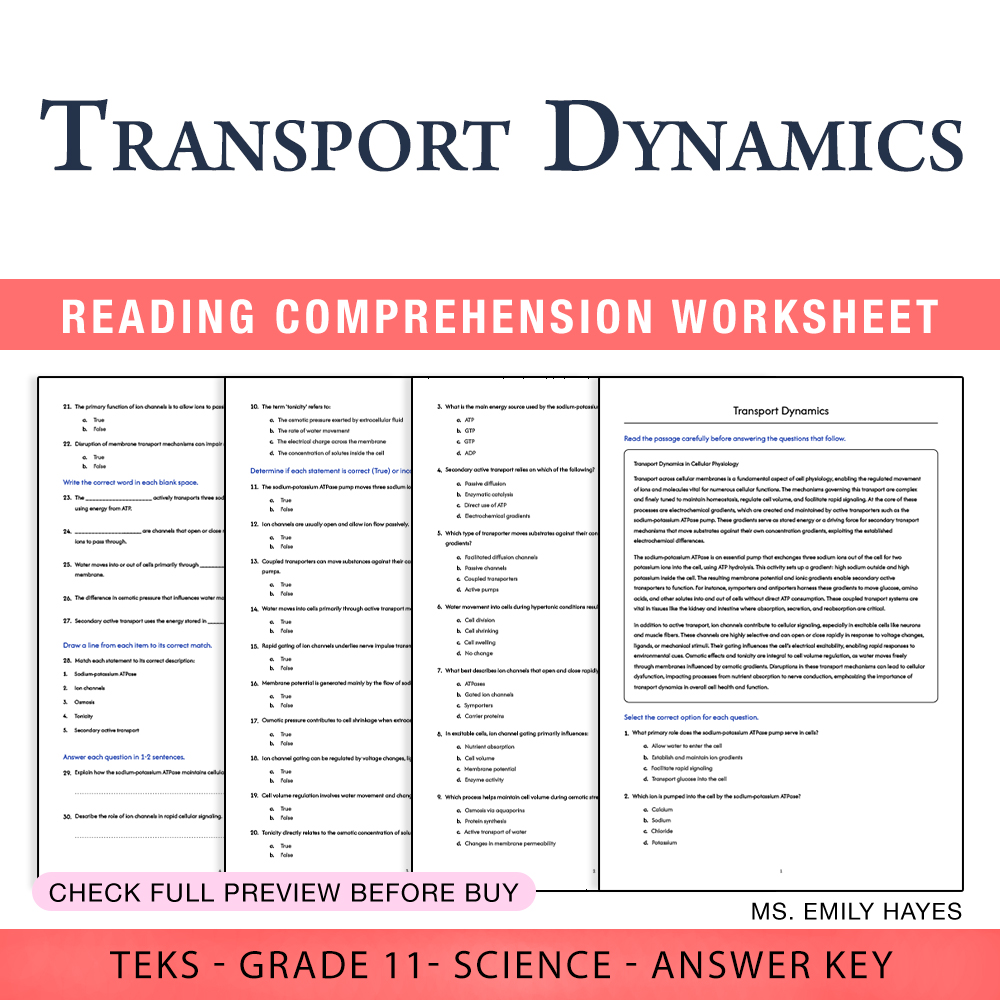
11th Grade Science | Transport Dynamics Worksheet (PDF+ Answer Key)
Created byCopper Leaf ClassroomLearning Objectives
- Explain how electrochemical gradients and membrane properties facilitate ion and molecule movement across cell membranes.
- Describe the role of active pumps such as the sodium-potassium ATPase in establishing ion gradients.
- Identify mechanisms of secondary active transport and their dependence on established gradients.
Instant download

Grade11 Science | Equilibrium Systems Worksheet Elena | AP Aligned
Created byLumora LearningLearning Objectives
- Understand the principles of dynamic chemical equilibrium in homogeneous and heterogeneous systems.
- Apply equilibrium constants (Kc and Kp) to predict the direction of reactions under various conditions.
- Use reaction quotient (Q) comparisons and Le Châtelier's principle to analyze shifts in equilibrium.
Also included in: Grade 11 Science | Chemistry Foundations Custom Bundle | AP-Aligned
Instant download
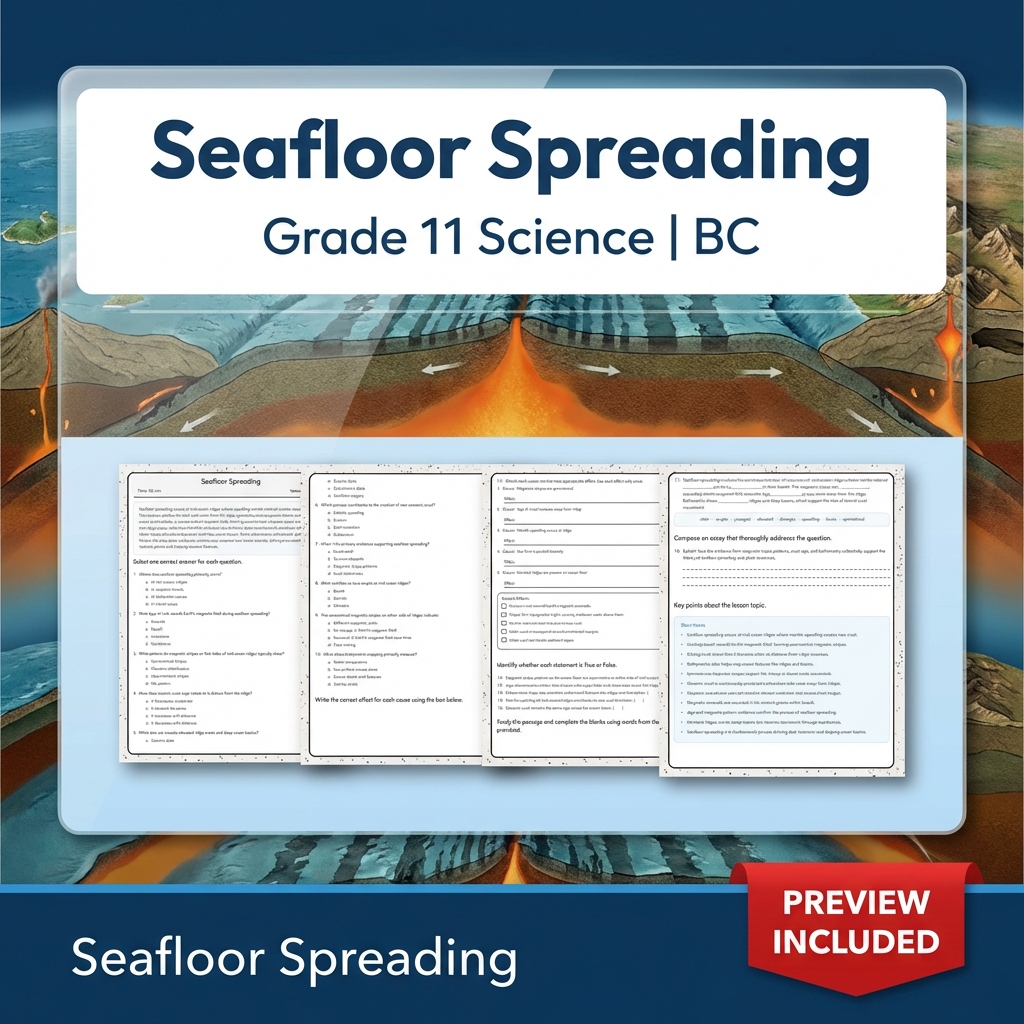
Grade 11 Science | Seafloor Spreading Worksheet with Short Notes (Printable PDF)
Created byMeadowlark WorksheetsLearning Objectives
- Understand the process of seafloor spreading and how it shapes ocean basins.
- Identify how magnetic patterns on the ocean floor provide evidence for plate tectonics.
- Explain how age determinations of crust support the theory of seafloor spreading.
Instant download
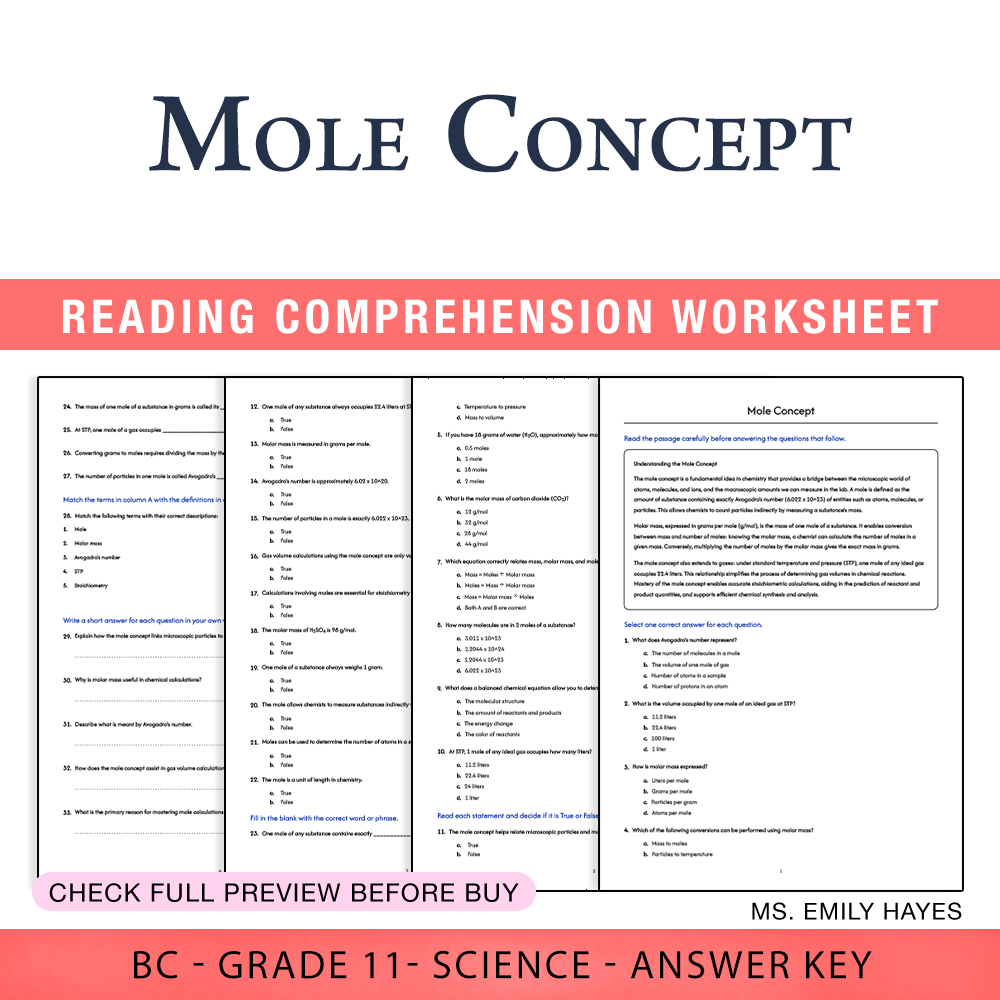
11th Grade Science | Mole Concept Worksheet (PDF + Answer Key)
Created byCopper Leaf ClassroomLearning Objectives
- Explain the fundamental principles of the mole concept and its significance in chemistry.
- Convert between mass, number of particles, and moles using molar mass and Avogadro's number.
- Apply mole calculations to determine quantities of reactants and products in chemical reactions.
Also included in: Grade 11 Science BC– Thermochemistry, Bonding & Reactions (PDF + Answer Key) +1 more
Instant download
Grade 11 Science – System Interactions Worksheet + Answer Key - TEKS Aligned
Created byBright Mind ResourcesLearning Objectives
- Describe how body systems communicate to maintain internal balance.
- Identify the roles of the respiratory, circulatory, renal, endocrine, and nervous systems in homeostasis.
- Explain how cross-system interactions support rapid and sustained responses to stress.
Also included in: Grade 11 Science: Human Body & Homeostasis Unit Worksheet Bundle (TEKS Aligned) +2 more
Instant download
11th Grade Science | Circular Motion Worksheet (PDF+ Answer Key)
Created byCopper Leaf ClassroomLearning Objectives
- Describe uniform and non-uniform circular motion in terms of centripetal and tangential acceleration.
- Model net forces acting in circular motion using radial and tangential components.
- Apply kinematic descriptions in polar coordinates to analyze circular motion scenarios.
Also included in: Grade 11 Science | Physics Principles Worksheet Bundle (PDF+ Answer Key)) +1 more
Instant download
11th Grade Science | Community Interactions Worksheet (PDF+ Answer Key)
Created byCopper Leaf ClassroomLearning Objectives
- Describe different types of interspecific interactions such as competition, predation, mutualism, and facilitation.
- Interpret food web diagrams and interaction matrices to analyze energy flow and interaction strength.
- Explain the roles of keystone species, trophic cascades, and niche partitioning in community structure.
Also included in: Grade 11 Science | Biology & Ecosystems AP Worksheet Bundle (PDF+ Answer Keys) +1 more
Instant download
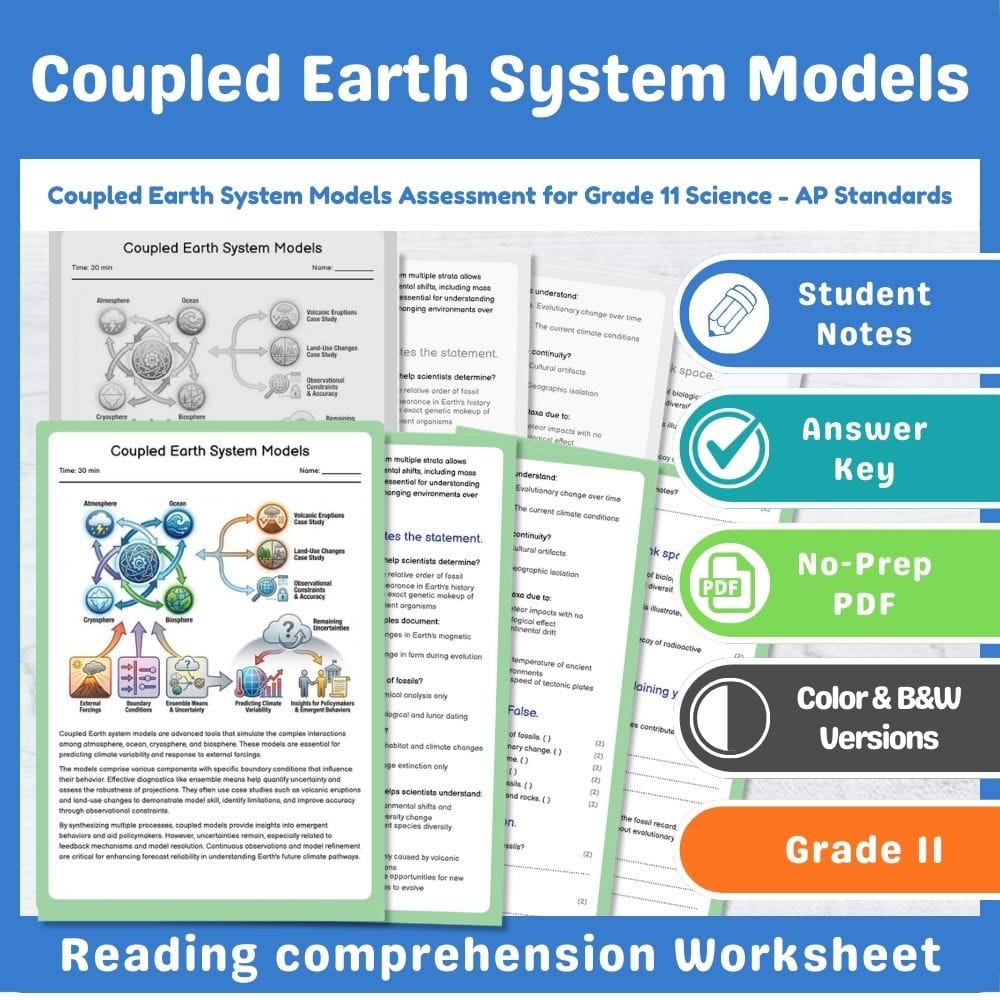
Coupled Earth System Models Assessment for Grade 11 Science - AP Standards
Created byPrism Point LearningLearning Objectives
- Understand the components and functions of coupled Earth system models.
- Describe how atmosphere, ocean, cryosphere, and biosphere processes are integrated.
- Explain the role of boundary conditions and diagnostics in model evaluation.
Also included in: Lesson Grade 11 Science Assessment Bundle | Earth Systems & Climate
Instant download
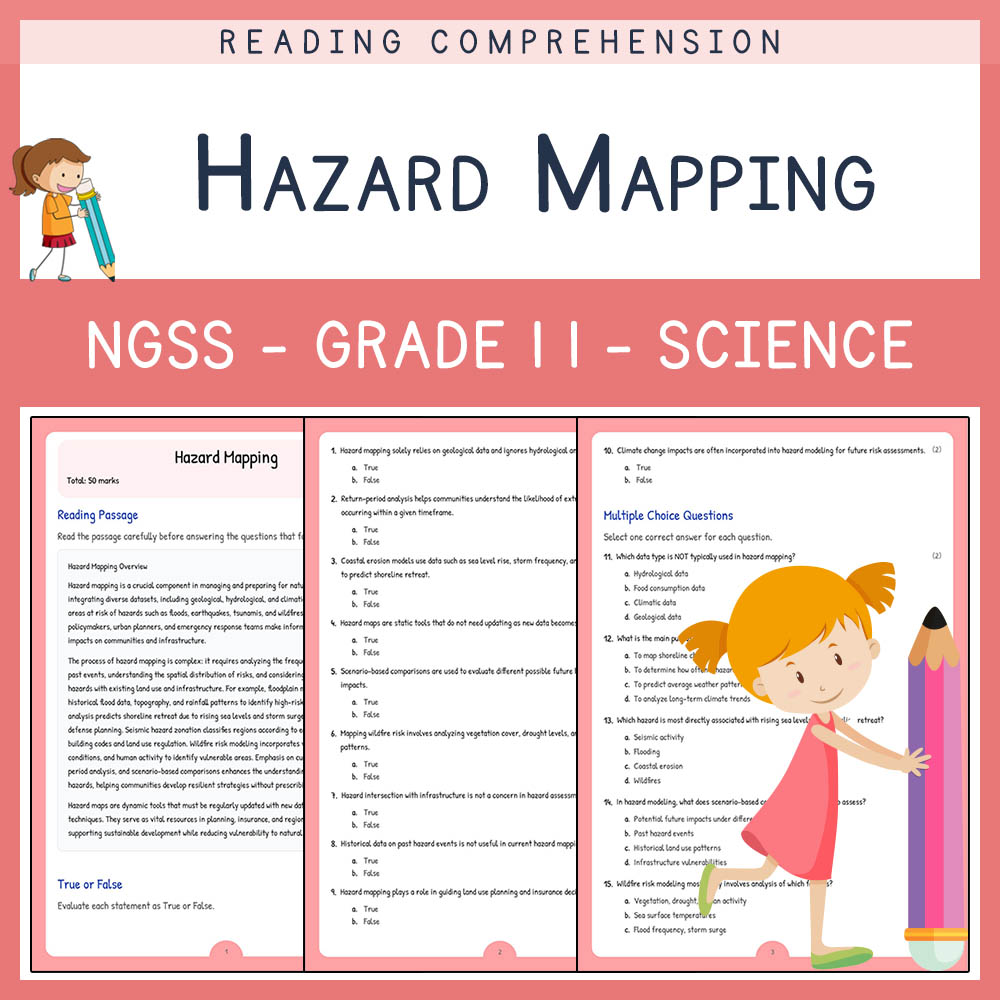
Grade 11 Science | Hazard Mapping Worksheet & Answer Key (NGSS Aligned)
Created byLumora LearningLearning Objectives
- Understand the methods used to assess and map natural hazards.
- Identify different types of data involved in hazard mapping.
- Analyze the intersection of hazards with infrastructure and land use.
Instant download
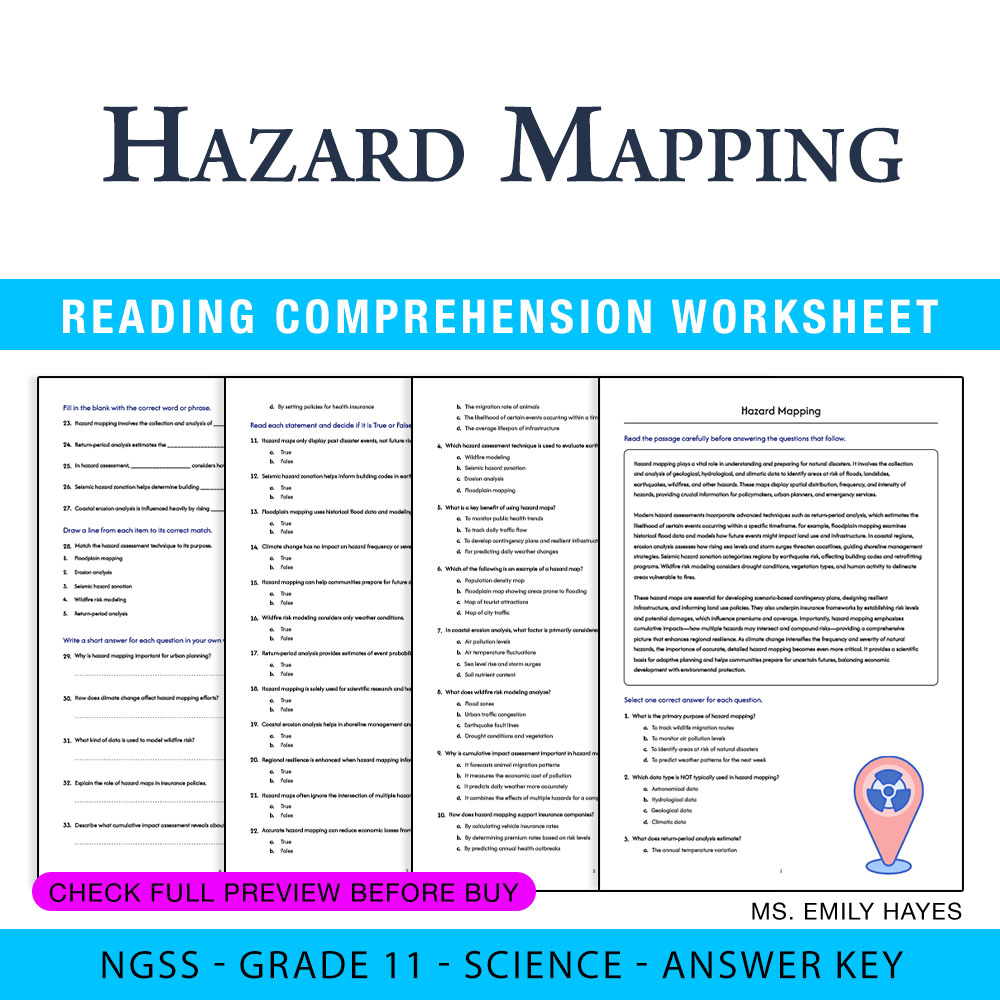
11th Grade Science | Hazard Mapping Worksheet (PDF+ Answer Key)
Created byCopper Leaf ClassroomLearning Objectives
- Understand the purpose and methods of hazard mapping in assessing natural risks.
- Analyze how geological, hydrological, and climatic data intersect to inform hazard assessments.
- Explain the importance of scenario-based analysis and return-period data in planning and resilience.
Instant download
About Grade 11 Science Worksheets
Browse 6,616 printable Grade 11 Science worksheets — ready-to-print PDFs with answer keys where available.
Each resource here is built by an independent educator and reviewed for quality. Worksheets print straight from PDF and suit classroom use, homework, or extra practice; most come with answer keys, and you can preview before purchasing.