
Grade 11 Science Worksheets
6,616 worksheets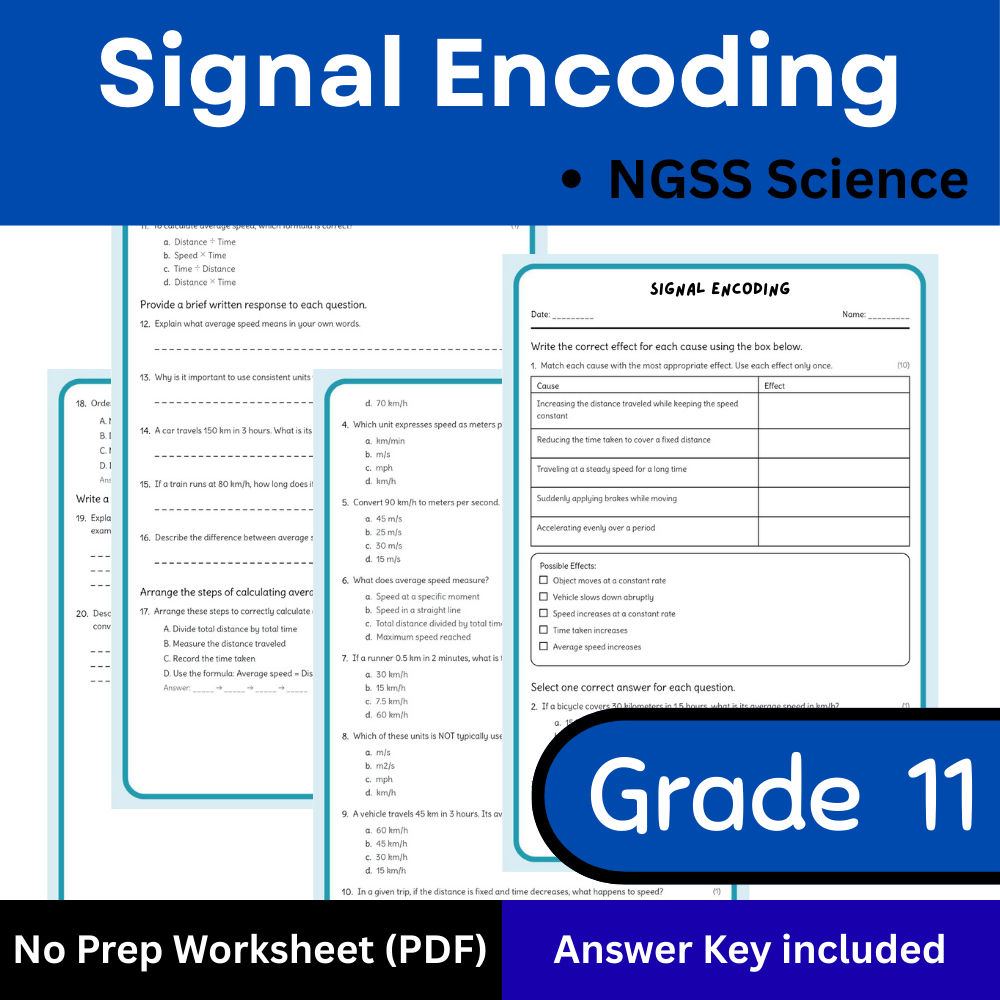
Grade 11 Science | Signal Encoding Worksheet (NGSS Aligned + PDF)
 Created byBright Mind Resources
Learning Objectives
- Compare advantages of digital and analog transmission and storage concerning bandwidth, noise, and fidelity.
- Explain principles of encoding, modulation, and decoding in data communication.
- Use quantitative measures like bit rate, signal-to-noise ratio, and spectral occupancy to evaluate transmission capacity and reliability.
Instant download

Chemical Evidence of Reactions Worksheets: Grade 11 Science
 Created bySunny Desk Resources
Learning Objectives
- Identify evidence that indicates a chemical reaction has occurred
- Explain how observations reflect microscopic particle rearrangement
- Use conservation of matter to predict reaction observations
Also included in: Stoichiometry & Chemical Reactions Lesson Bundle — Grade 11 Science Alberta +1 more
Instant download

Lewis Structures Worksheet Grade 11 Chemistry | Alberta Standards PDF
 Created byEvergreen Desk Education
Learning Objectives
- Represent valence electrons, bonding pairs, and lone pairs in Lewis structures for common Grade 11 molecules.
- Use formal charge to choose the Lewis structure with minimized overall charge and most reasonable bonding.
- Identify resonance structures and explain how they reflect delocalized electrons.
Instant download
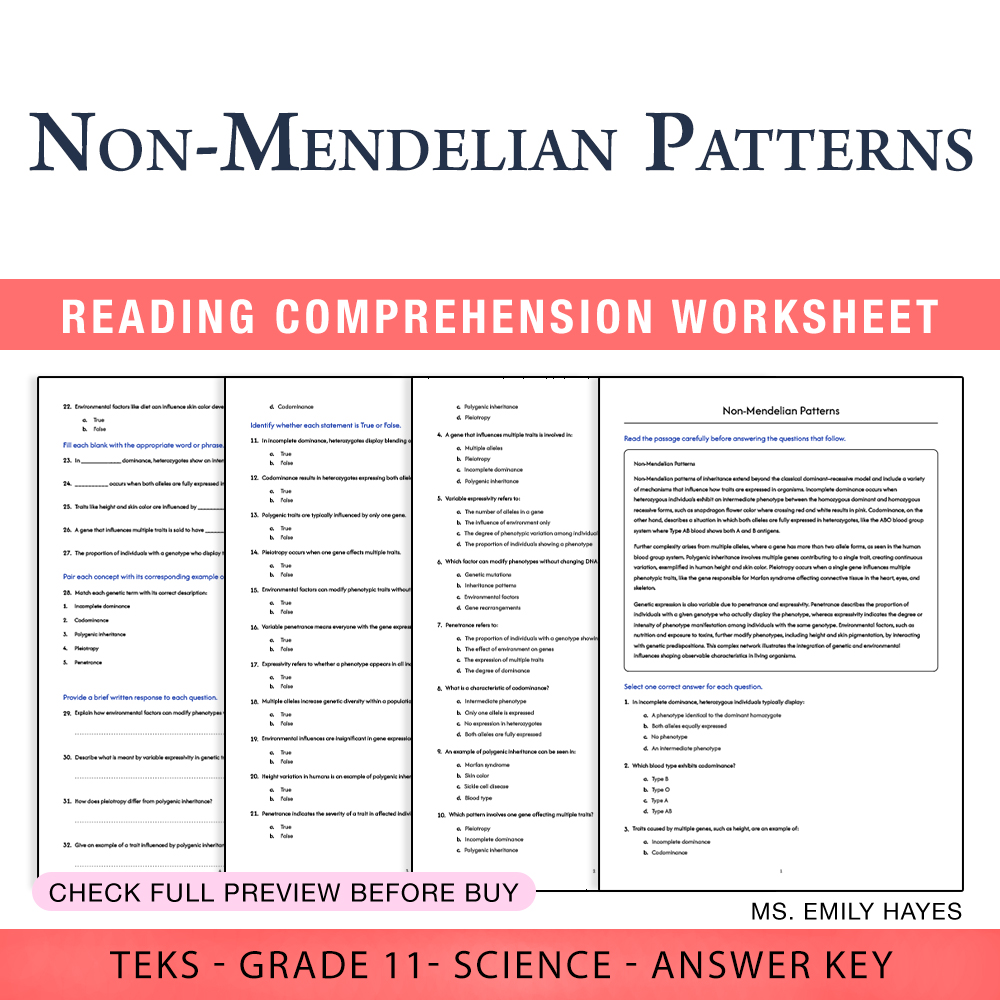
Grade 11 Science | Non-Mendelian Patterns Worksheet (PDF+ Answer Key)
 Created byCopper Leaf Classroom
Learning Objectives
- Understand various non-Mendelian inheritance patterns such as incomplete dominance and codominance.
- Explain how multiple alleles and polygenic inheritance contribute to trait variation.
- Describe the concepts of pleiotropy, variable penetrance, and expressivity and their effects on phenotypes.
Instant download

Grade 11 Science – Atomic Structure & Subatomic Particles | Reading Worksheet
Created byBright Mind ResourcesLearning Objectives
- Understand the composition of atoms, including protons, neutrons, and electrons.
- Identify the roles of subatomic particles and how they influence atomic properties.
- Interpret emission spectra and mass spectrometry data as evidence of discrete energy levels.
Also included in: Grade 11 Chemistry Concepts Science Daily Reading Worksheets Lesson Bundle | AP +2 more
Instant download

Molecular Orbitals & Band Structures Worksheets | Grade 11 Chemistry
Created bySunny Desk ResourcesLearning Objectives
- Explain how orbital overlap contributes to electronic delocalization
- Describe how molecular symmetry supports delocalization in bonding models
- Explain electrical behavior using band theory
Also included in: Grade 11 Chemistry Lesson Bundle — Bonding, Polarity & Orbitals (Alberta) +1 more
Instant download

Grade 11 Science | Atomic Structure - Daily Reading Comprehension
 Created byCoral Reef Learning
Learning Objectives
- Identify protons, neutrons, and electrons within an atom.
- Understand the significance of each subatomic particle in atomic identity.
- Learn how electron energy levels influence bonding and physical properties.
Instant download

Testable Hypotheses Worksheet Grade 11 Science Inquiry & Practice
 Created byPrism Point Learning
Learning Objectives
- Explain how a testable hypothesis connects a specific question to expected relationships among variables.
- Identify independent and dependent variables in an experimental scenario.
- Use controls and constants to justify why results support or refute a hypothesis.
Instant download
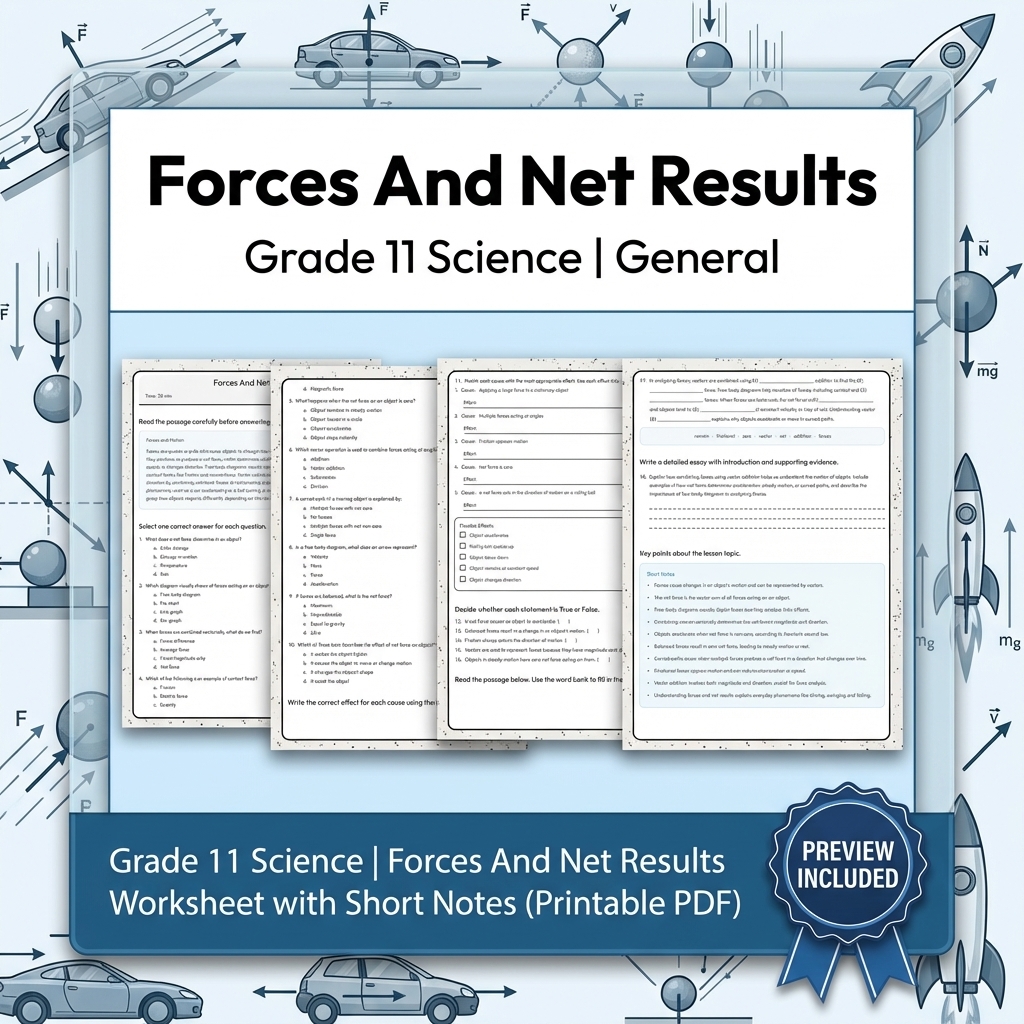
Grade 11 Science | Forces And Net Results Worksheet with Short Notes
 Created byMeadowlark Worksheets
Learning Objectives
- Understand how forces affect motion and acceleration.
- Interpret free-body diagrams to analyze forces acting on objects.
- Learn how to combine vectors to determine net force and direction.
Also included in: Grade 11 Science Concept Mastery Lesson Bundle (General Framework) +1 more
Instant download

Grade 11 Worksheet B: Climate Dynamics Worksheet | NGSS Practice PDF
 Created byClear Sky Classroom
Learning Objectives
- Analyze how atmospheric composition affects Earth’s radiative balance and energy availability.
- Explain how albedo feedbacks and greenhouse gas forcing can change climate over time.
- Interpret how ocean-atmosphere interactions and teleconnections influence temperature and precipitation patterns.
Also included in: Grade 11 Earth Systems Modeling Science Worksheet B Lesson Bundle NGSS +1 more
Instant download

Grade 11 Science | Control Variables Worksheet | AP Aligned
 Created byLumora Learning
Learning Objectives
- Understand the purpose of control variables in scientific experiments.
- Identify strategies for selecting and implementing control treatments.
- Explain how control choices influence the interpretation of experimental results.
Instant download

Grade 11 Science Worksheet | Center of Mass Concepts (Ontario Framework)
Created byEvergreen Desk EducationLearning Objectives
- Explain how the center of mass simplifies multi-particle motion and relates COM acceleration to external net force
- Solve qualitative and quantitative problems using momentum and COM velocity for collisions and recoil
- Apply mass distribution and rigid-body assumptions to determine COM positions in simple systems
Also included in: Grade 11 Motion, Forces, and Electricity Science Lesson Bundle: Ontario +1 more
Instant download

VSEPR Shapes and Bond Angles Worksheet for Grade 11 Chemistry
Created bySunny Desk ResourcesLearning Objectives
- Explain how VSEPR predicts molecular geometry from electron pairs
- Identify electron-pair geometry for coordination numbers from 2 to 6
- Identify molecular shapes for common electron-domain arrangements
Also included in: Grade 11 Chemistry Lesson Bundle — Bonding, Polarity & Orbitals (Alberta) +1 more
Instant download

Bond Polarity and Molecular Polarity Worksheets | Grade 11 Chemistry
Created bySunny Desk ResourcesLearning Objectives
- Explain how electronegativity differences create polar bonds
- Describe how partial charges arise in polar bonds
- Explain how bond dipoles determine overall molecular polarity
Also included in: Grade 11 Chemistry Lesson Bundle — Bonding, Polarity & Orbitals (Alberta) +1 more
Instant download

Speciation Mechanisms Assessment | TEKS Grade 11 Science Worksheet
Created byPrism Point LearningLearning Objectives
- Understand the different mechanisms that lead to speciation in populations.
- Identify reproductive barriers and their roles in reproductive isolation.
- Differentiate between allopatric, sympatric, and parapatric speciation.
Also included in: Grade 11 Evolution, Speciation & Phylogeny Science Lesson Bundle | TEKS
Instant download
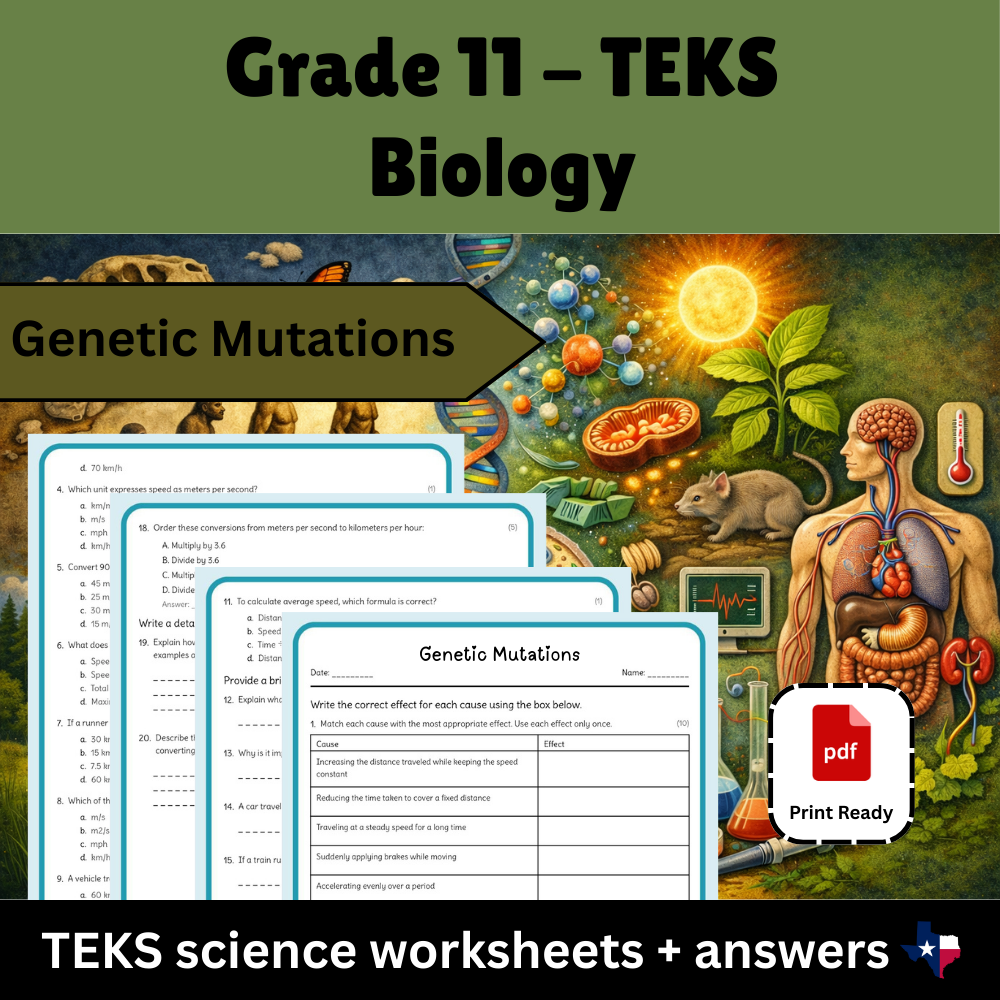
Grade 11 Science | Genetic Mutations Worksheet + Answer Key - TEKS Standards
Created byBright Mind ResourcesLearning Objectives
- Explain how genetic mutations alter DNA sequences and their types.
- Identify the consequences of mutations at the protein level, including silent, missense, and nonsense changes.
- Describe how mutations can affect gene regulation and phenotypes.
Also included in: Grade 11 Science DNA & Genetics Unit Worksheet Pack+ Answer Key (TEKS-Aligned) +2 more
Instant download

System Components Worksheet | Grade 11 AP Science Practice Activities
Created byPrism Point LearningLearning Objectives
- Identify Earth’s major subsystems (atmosphere, hydrosphere, lithosphere, biosphere) and describe how they act as reservoirs.
- Explain how mass and energy move among subsystems using fluxes and conceptual box-and-arrow models.
- Use evidence and key terminology to describe interactions such as ocean–atmosphere coupling and watershed transfers.
Instant download

Grade 11 Science | Molecular Geometry - Daily Reading Comprehension
Created byCoral Reef LearningLearning Objectives
- Understand the principles of VSEPR theory for predicting molecular shapes
- Identify linear molecular geometry based on electron domain considerations
- Correlate molecular shape with polarity and physical properties
Instant download

Grade 11 Science – Percent Concentrations & Solutions | Daily Reading Worksheet
Created byBright Mind ResourcesLearning Objectives
- Define mass percent, volume percent, and parts per million.
- Convert between different concentration units.
- Interpret practical examples of concentration in environmental and industrial contexts.
Also included in: Grade 11 Solutions Science Daily Reading Worksheets lesson bundle | Alberta +1 more
Instant download

Digital Information Worksheet | Grade 11 Technology & Science Activity
Created byPrism Point LearningLearning Objectives
- Explain how digital transmission converts continuous signals into discrete levels represented by bits.
- Describe how noise affects communication and how error correction improves reliability.
- Analyze the tradeoff between sampling rate, bandwidth, and data requirements in digital systems.
Instant download

Glycolysis & Energy Carriers Cellular Respiration Worksheet | Grade 11
 Created byBRIGHT PATH RESOURCES
Learning Objectives
- Summarize glycolysis in the correct order of key steps
- Identify the main energy carriers produced during glycolysis
- Explain how ATP and NADH connect to later respiration pathways
Instant download

Henderson Equation Worksheet | Standards-Aligned Science Practice for Grade 11
JCreated byJ.S SheetsLearning Objectives
- Understand the mathematical relationship expressed by the Henderson–Hasselbalch equation.
- Apply the Henderson–Hasselbalch equation to calculate buffer pH and concentrations.
- Analyze environmental and industrial scenarios where buffer systems are used and optimized using the Henderson equation.
Instant download

Grade 11 Science | Atmospheric Structure Worksheet | AP Aligned
Created byLumora LearningLearning Objectives
- Describe the vertical and horizontal composition of the atmosphere.
- Explain pressure gradients and temperature profiles that influence weather patterns.
- Interpret sounding profiles, pressure maps, and radiative balance diagrams.
Also included in: Grade 11 Science | Earth and Space Sciences Custom Bundle | AP
Instant download

Grade 11 Science — Worksheet MCQ Paper for Covalent Structure
 Created byThe Resource Hub
Learning Objectives
- Understand molecular geometry and how electron pairs influence bond angles.
- Explain orbital overlap, hybridization, and resonance in relation to bond strength and molecular properties.
- Apply Lewis structures and VSEPR models to predict molecular shapes and polarity.
Also included in: Grade 11 Science AP Worksheet Bundle: Mastering Key Concepts +1 more
Instant download

Criteria and Constraints Worksheet | Grade 11 Engineering Science
Created byPrism Point LearningLearning Objectives
- Explain the difference between criteria (desired outcomes) and constraints (limitations) in engineering design.
- Identify qualitative versus quantitative criteria in real-world problem statements.
- Interpret how constraints such as safety, cost, and environmental limits affect feasible solutions.
Instant download
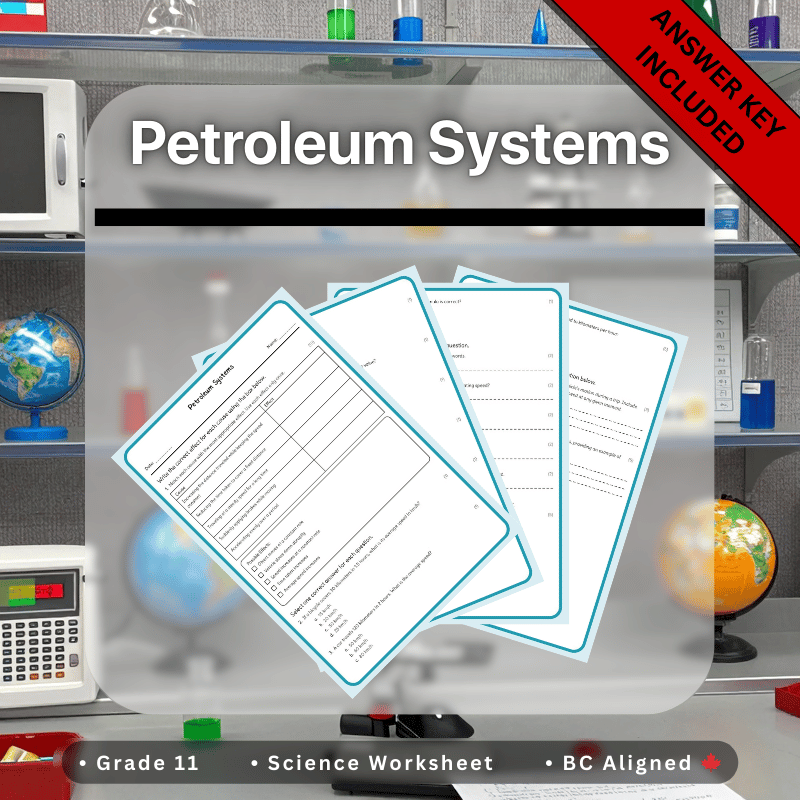
Grade 11 Science | Petroleum Systems Worksheet + Answer Key (BC Standards)
Created byBright Mind ResourcesLearning Objectives
- Understand the components and processes involved in petroleum system formation.
- Identify factors controlling hydrocarbon generation, migration, and accumulation.
- Analyze the role of geological processes in determining reservoir quality and trap formation.
Instant download

Grade 11 Science | Biogeochemical Cycles - Daily Reading Comprehension
Created byCoral Reef LearningLearning Objectives
- Understand the components and processes of the carbon cycle.
- Identify the roles of various environmental reservoirs in biogeochemical cycles.
- Analyze how human activities impact the carbon cycle.
Instant download

Pressure Effects Worksheet for Grade 11 Science | Alberta Standards Practice
JCreated byJ.S SheetsLearning Objectives
- Explain how pressure influences gas solubility according to Henry's law.
- Describe the proportionality concepts between pressure and gas dissolution.
- Analyze practical consequences of pressure changes on carbonation and aquatic oxygen levels.
Instant download

Grade 11 Science | Covalent Structure Worksheet | AP Aligned
Created byLumora LearningLearning Objectives
- Understand molecular geometry, orbital overlap, hybridization, and resonance as frameworks for bonding properties.
- Apply Lewis structures and VSEPR models to predict bond angles, bond order, and polarity.
- Explain how molecular orbital descriptions relate to spectroscopic signatures and reactivity patterns.
Also included in: Grade 11 Science | Chemistry Foundations Custom Bundle | AP-Aligned
Instant download

Grade 11 Iterative Testing Refinement Worksheet | Practice & PDF
Created byClear Sky ClassroomLearning Objectives
- Explain how iterative testing uses results to refine a design over multiple versions.
- Analyze how observed outcomes can reveal specific design causes (e.g., structural weakness, instability, or losses).
- Evaluate how each iteration reduces uncertainty and improves reliability under realistic conditions.
Instant download

Grade 11 Science | Dipole Interactions - Daily Reading Comprehension
Created byCoral Reef LearningLearning Objectives
- Understand the concept of molecular polarity and how dipoles form.
- Identify polar and nonpolar molecules based on molecular structure.
- Explain the energetic effects of dipole interactions in condensed phases and solutions.
Also included in: Matter and Chemical Bonding Lesson Bundle – Grade 11 Science Alberta +1 more
Instant download

DNA Replication Worksheet | Grade 11 Science Practice
Created byPrism Point LearningLearning Objectives
- Explain how semi-conservative DNA replication produces two DNA molecules using complementary base pairing
- Describe the roles of helicase, DNA polymerase, ligase, Okazaki fragments, and proofreading/repair in maintaining sequence integrity
- Distinguish leading-strand and lagging-strand synthesis and connect errors to genetic variation
Also included in: Grade 11 Science Biology Cells, Genetics & Evolution Lesson Bundle | BC
Instant download

Grade 11 Energy Transformations Worksheet | Physical Science + Answer Key
Created byEvergreen Desk EducationLearning Objectives
- Explain how organisms obtain and transform energy through ATP and redox reactions.
- Describe energy flow between producers and consumers using the concept of energy conversion (not creation).
- Compare where energy is captured, where it is released, and how it supports growth, maintenance, and reproduction.
Instant download
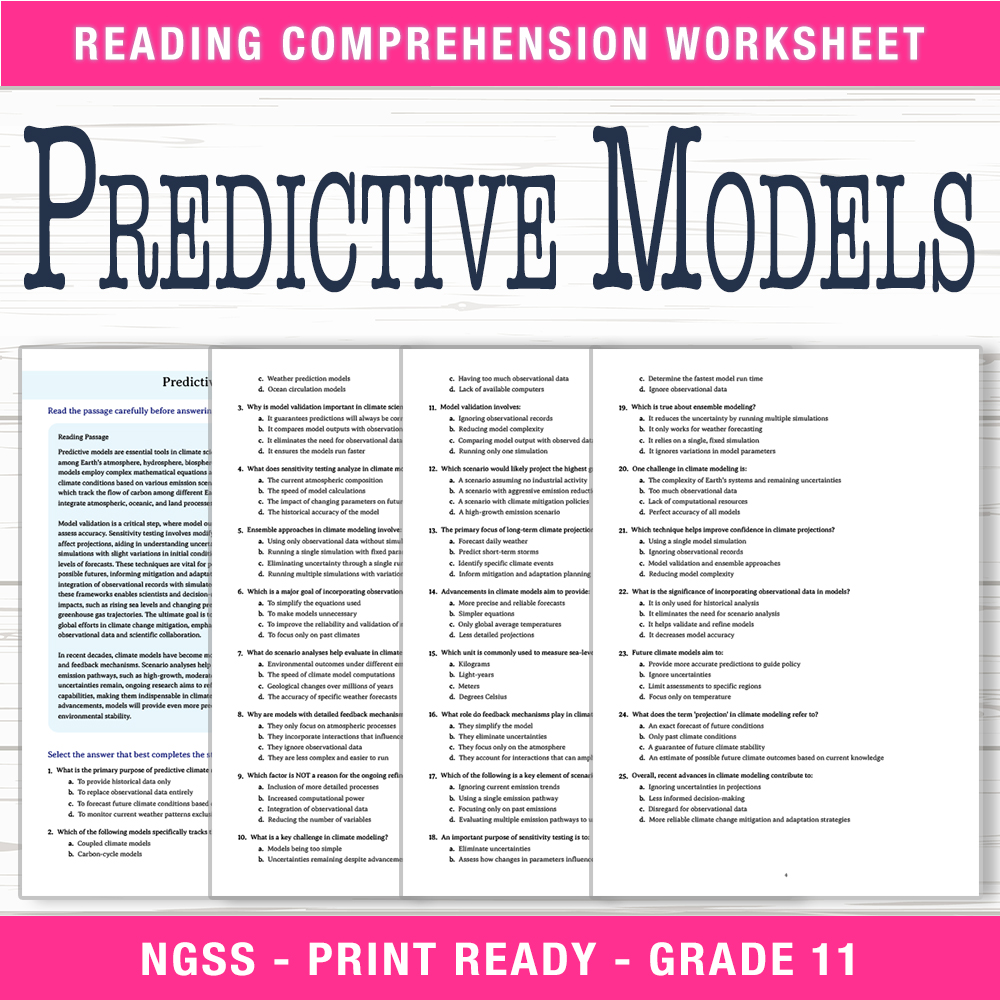
Grade 11 Science | Predictive Models Worksheet (PDF + Answer Key)
 Created byRiverstone Classroom
Learning Objectives
- Understand how modeling frameworks simulate interactions among Earth's systems and human influences.
- Identify different types of climate models and their purposes in projecting environmental changes.
- Explain the importance of model validation, sensitivity testing, and ensemble approaches in climate science.
Instant download

Trophic Levels Assessment | Standards-Aligned Assessment Grade 11 Science
Created byPrism Point LearningLearning Objectives
- Explain how energy flows through trophic levels in an ecosystem using the producer-to-consumer pathway.
- Describe why biomass and population sizes typically decrease at higher trophic levels due to energy loss.
- Apply trophic-level concepts to predict how changes in one population affect other organisms.
Also included in: Grade 11 Population, Genetics & Energy Systems Science Lesson Bundle: Florida NGSSS +1 more
Instant download
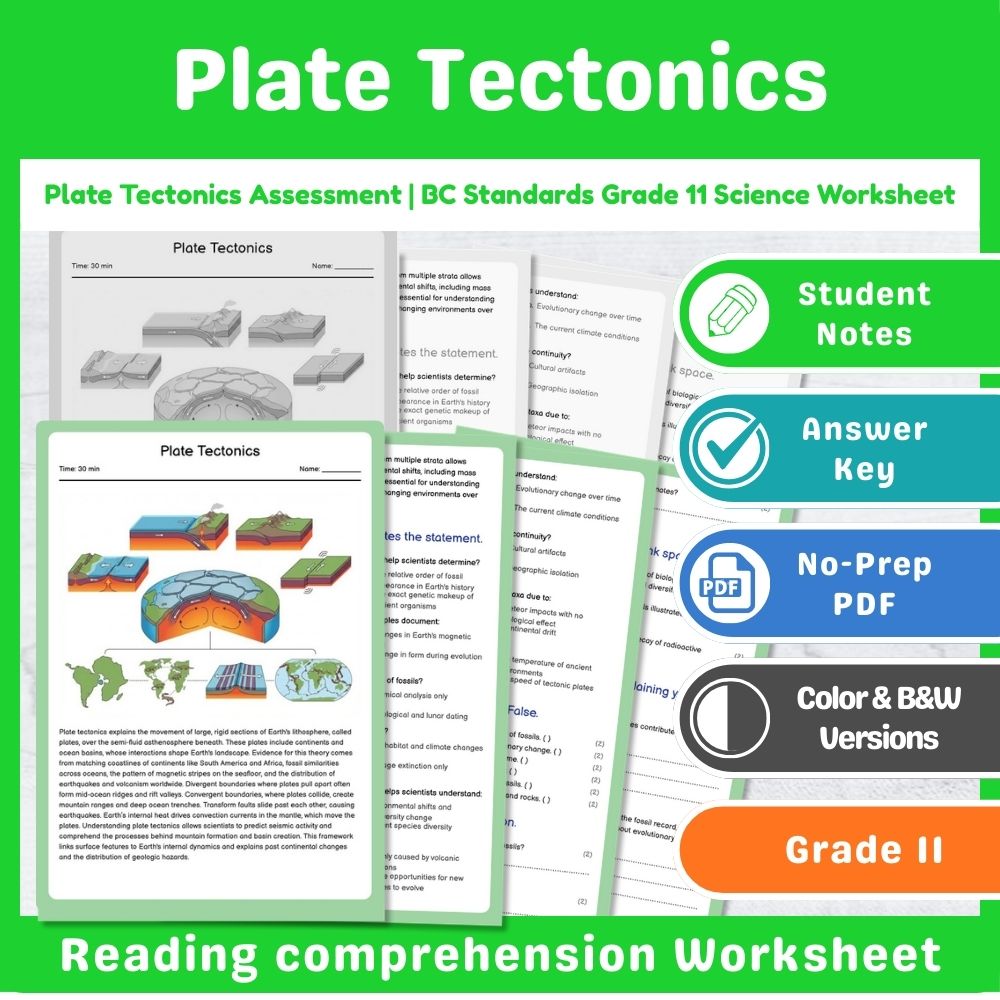
Plate Tectonics Assessment | BC Standards Grade 11 Science Worksheet
Created byPrism Point LearningLearning Objectives
- Understand the fundamentals of plate tectonics and their role in Earth's surface features.
- Identify the types of evidence supporting the theory of plate tectonics.
- Explain how Earth's tectonic activity causes geological phenomena like earthquakes and volcanoes.
Also included in: Grade 11 Science Assessment | Plate Tectonics BC Standards Mini Bundle
Instant download

Reaction Rearrangement Worksheet | Grade 11 Chemistry Science Activity
Created byPrism Point LearningLearning Objectives
- Explain chemical reactions using the particle model of bonds breaking and forming.
- Describe conservation of atoms and how balanced equations reflect it.
- Connect microscopic rearrangements to observable macroscopic changes in reactants and products.
Instant download

Trophic Energy Transfer Worksheet | Energy Pyramid Ecology Grade 11 Science CA
Created byEvergreen Desk EducationLearning Objectives
- Explain how energy moves from producers to higher trophic levels through feeding
- Justify why available energy decreases at each successive trophic level
- Use energy-transfer concepts to interpret simplified food-chain or energy-flow models
Instant download

Grade 11 Science | Genetic Code - Daily Reading Comprehension
Created byCoral Reef LearningLearning Objectives
- Understand the molecular structure of DNA and RNA
- Learn base-pairing rules and how nucleic acids replicate
- Describe the processes of transcription and translation
Also included in: Biology and Ecosystems Lesson Bundle | Grade 11 Science AP +1 more
Instant download

Grade 11 Science | Membrane Energetics - Daily Reading Comprehension
Created byCoral Reef LearningLearning Objectives
- Understand the concept of proton motive force and its role in ATP synthesis.
- Describe the structure and function of electron transport chains in aerobic and photosynthetic systems.
- Interpret redox potential diagrams and electrochemical gradient representations.
Also included in: Biology and Ecosystems Lesson Bundle | Grade 11 Science AP +1 more
Instant download

Henry’s Law and Gas Solubility Worksheets – Grade 11 Science
Created bySunny Desk ResourcesLearning Objectives
- Explain gas solubility in liquids using Henry’s law.
- Interpret how gas partial pressure affects dissolved gas solubility.
- Analyze atmospheric pressure effects on dissolved gases in water.
Also included in: Grade 11 Science Alberta Solubility & Solutions Lesson Bundle: Ksp & Equilibria +1 more
Instant download

Solubility Factors in Solutions Worksheets | Grade 11 Science
Created bySunny Desk ResourcesLearning Objectives
- Explain how intermolecular forces affect solute-solvent interactions
- Predict how temperature changes the solubility of solids and gases
- Describe how pressure affects the solubility of gases
Also included in: Grade 11 Science Alberta Solubility & Solutions Lesson Bundle: Ksp & Equilibria +1 more
Instant download

Grade 11 Science – Industrial Stoichiometry & Industry Daily Reading Worksheet
Created byBright Mind ResourcesLearning Objectives
- Understand the concept of stoichiometry in large-scale chemical processes
- Identify key components and reactants in industrial chemical reactions
- Apply mass and mole balances to real-world industrial scenarios
Also included in: Reaction Analysis Grade 11 Science Daily Reading Worksheets Bundle | Alberta +1 more
Instant download

Feedback Control Loops Worksheet | Grade 11 Science Systems Practice
Created byPrism Point LearningLearning Objectives
- Explain how feedback control loops maintain internal conditions using negative and positive feedback.
- Identify components of a feedback system (stimulus, sensor/receptor, control center, effectors, and response).
- Predict whether a given feedback loop will stabilize or amplify a change based on the direction of response.
Instant download

Cell Types Assessment | TEKS Grade 11 Science Printable Worksheet
Created byPrism Point LearningLearning Objectives
- Differentiate between prokaryotic and eukaryotic cell structures.
- Identify key features of prokaryotic and eukaryotic cells.
- Explain how cell organization impacts function and organism complexity.
Also included in: Grade 11 Cell Systems, Energy & Genetics Science: Lesson Bundle TEKS
Instant download

Impulse Applications Worksheet | NGSS Grade 11 Science MCQ Assessment
 Created byCedar Grove Learning
Learning Objectives
- Understand the impulse–momentum relationship and its application to safety systems.
- Evaluate how force–time data influences crash-protection design.
- Analyze material deformation parameters in collision scenarios.
Instant download

Grade 11 Science – Land Use Change & Ecosystems | Daily Reading Worksheet
Created byBright Mind ResourcesLearning Objectives
- Identify different types of land use changes such as agriculture, urbanization, resource extraction, and infrastructure development.
- Understand the effects of land use change on habitats, including habitat loss, fragmentation, and connectivity.
- Explain key concepts such as edge effects, corridor design, and landscape metrics that influence species movement and gene flow.
Also included in: Grade 11 Ecosystems Science Daily Reading Lesson Bundle | Ontario +1 more
Instant download

Grade 11 Science – Orbital Mechanics & Kepler's Laws | Daily Reading Worksheet
Created byBright Mind ResourcesLearning Objectives
- Understand the fundamental principles of Kepler's laws of planetary motion.
- Analyze how gravitational forces influence orbital paths.
- Identify examples of orbital resonances and perturbations in the solar system.
Also included in: Grade 11 Kepler's Laws Science Daily Reading Lesson Bundle | NGSS +2 more
Instant download
About Grade 11 Science Worksheets
Browse 6,616 printable Grade 11 Science worksheets — ready-to-print PDFs with answer keys where available.
Each resource here is built by an independent educator and reviewed for quality. Worksheets print straight from PDF and suit classroom use, homework, or extra practice; most come with answer keys, and you can preview before purchasing.