
Grade 11 Science Worksheets
6,616 worksheets
Force Types Assessment for Grade 11 Science | Florida NGSSS
 Created byPrism Point Learning
Learning Objectives
- Differentiate between gravitational force, normal force, friction, and tension
- Explain how net force determines an object’s acceleration and direction of motion
- Use correct scientific vocabulary (force, vector, net force, acceleration, friction, tension) to describe real-world situations
Also included in: Lesson Grade 11 Forces Energy & Chemistry Science Assessment Lesson Bundle | Florida (NGSSS) +1 more
Instant download

Grade 11 Science – Work & Energy | Daily Reading Worksheet
 Created byBright Mind Resources
Learning Objectives
- Understand the concepts of work and energy
- Identify how work transfers energy
- Differentiate between kinetic and potential energy
Also included in: Motion & Forces Grade 11 Science Daily Reading Worksheets Lesson Bundle | BC +1 more
Instant download

Grade 11 Wave Reflection And Refraction Worksheet | General Practice PDF
 Created byClear Sky Classroom
Learning Objectives
- Explain how reflection of a wave changes direction while maintaining frequency at a boundary.
- Describe how refraction occurs when a wave enters a new medium with different speed, wavelength, and bending of the path.
- Compare ray and wave representations and explain why frequency remains tied to the source.
Instant download

Grade 11 Science | Reaction Energetics - Daily Reading Comprehension
 Created byCoral Reef Learning
Learning Objectives
- Explain the concept of enthalpy and its importance in chemical reactions
- Describe how calorimetric methods determine heat transfer
- Apply Hess’s law to find overall reaction heats from individual steps
Also included in: Chemistry Foundations Lesson Bundle: Grade 11 Science AP +1 more
Instant download
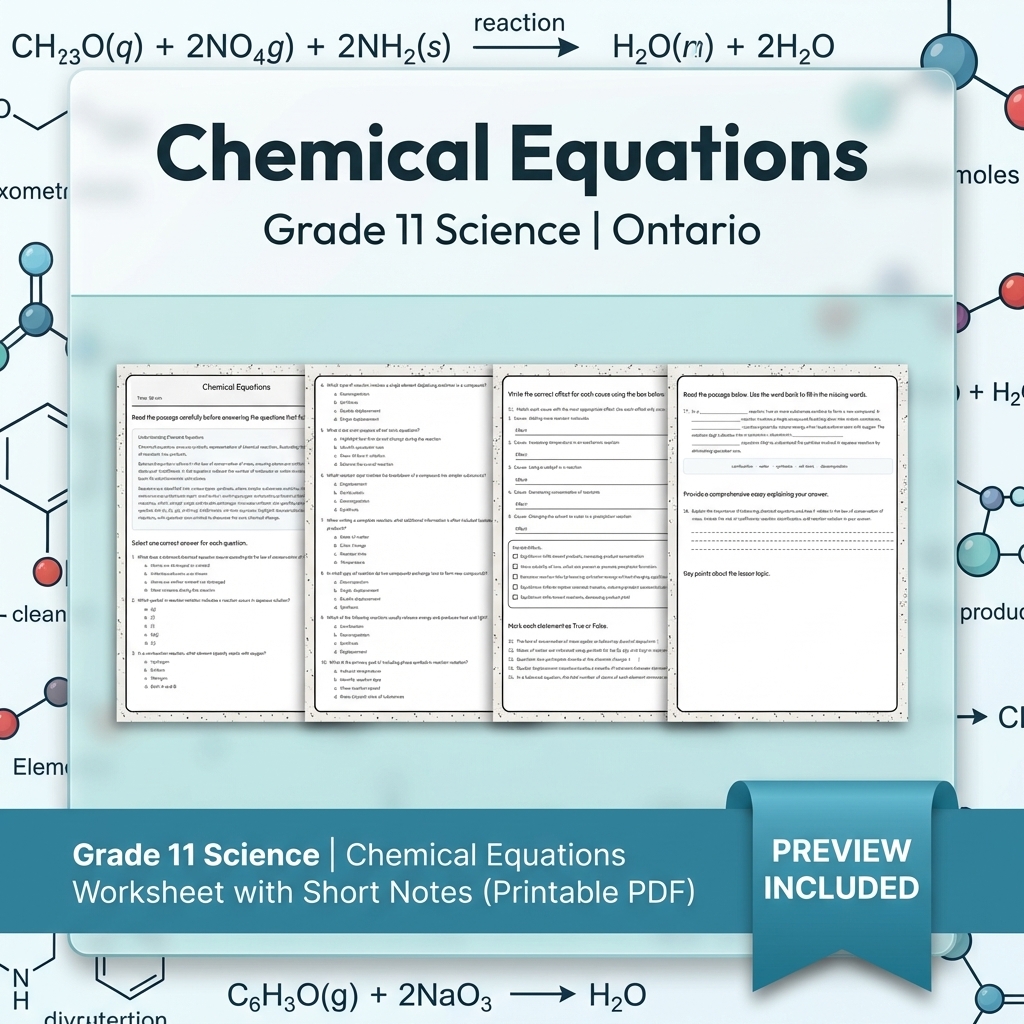
Grade 11 Science | Chemical Equations Worksheet with Short Notes (Printable PDF)
 Created byMeadowlark Worksheets
Learning Objectives
- Understand the representation of chemical change through balanced symbolic equations.
- Identify and classify different types of chemical reactions: synthesis, decomposition, combustion, and displacement.
- Interpret reaction notation including states of matter and phase considerations.
Also included in: Grade 11 Science Lesson Bundle – Ontario Curriculum +1 more
Instant download

Grade 11 Science – Transport & Ion Movement | Daily Reading Worksheet
Created byBright Mind ResourcesLearning Objectives
- Understand how ions move across cell membranes.
- Identify the roles of active and passive transport mechanisms.
- Describe how electrochemical gradients are established and maintained.
Also included in: Grade 11 Cell Systems Life Science Daily Reading Lesson Bundle | TEKS +2 more
Instant download

Grade 11 Science | Conservation of Matter Worksheet | California Standard
 Created byLumora Learning
Learning Objectives
- Explain the principle of conservation of matter in biological and ecosystem processes.
- Use chemical element cycling (e.g., carbon and nitrogen) to describe how matter moves between air, soil, water, and living organisms.
- Predict how growth, metabolism, and reproduction transform matter without creating or destroying it.
Instant download

Motion Graphs Worksheet for Grade 11 Science | BC Standards Practice PDF
JCreated byJ.S SheetsLearning Objectives
- Interpret position–time and velocity–time graphs to analyze motion.
- Understand how the slope of a graph relates to velocity and acceleration.
- Calculate displacement from the area under a velocity–time graph.
Instant download

Acid-Base Titration Indicators Worksheets - Grade 11 Chemistry
 Created bySunny Desk Resources
Learning Objectives
- Compare indicator transition ranges with expected equivalence pH
- Select indicators appropriate for common acid–base titrations
- Predict which indicator gives a clearer titration endpoint
Also included in: Grade 11 Acid-Base Chemistry Lesson Bundle: Alberta Science +1 more
Instant download

Conservation of Mass and Mass Balance in Reactions Worksheet Grade 11
 Created byBRIGHT PATH RESOURCES
Learning Objectives
- Explain conservation of mass in closed systems
- Compare total mass of reactants and products
- Apply mass balance reasoning to sealed setups
Also included in: Physical Science Worksheets Bundle | Grade 11 Science | Waves & Matter +4 more
Instant download

Ionic and Covalent Bonding Assessment for Grade 11 Science
Created byPrism Point LearningLearning Objectives
- Explain the differences between ionic and covalent bonds in terms of electron distribution.
- Describe how bonding types influence properties like melting point, electrical conductivity, and solubility.
- Identify examples of materials with ionic and covalent bonds and analyze their structural differences.
Instant download

Grade 11 Science – Linkage and Recombination Daily Reading
JCreated byJ.S SheetsLearning Objectives
- Explain the concept of gene linkage and how genes located close together on a chromosome tend to be inherited together.
- Describe the process of crossing over during meiosis and its effect on recombination frequency.
- Interpret genetic linkage maps and understand how physical distances between genes are estimated.
Also included in: Grade 11 Science Lesson Bundle TEKS | Molecular Genetics & Inheritance +1 more
Instant download

Grade 11 Worksheet B: Ecosystem Change and Stability Practice | NGSS PDF
Created byClear Sky ClassroomLearning Objectives
- Explain how disturbance regimes, land-use change, connectivity loss, and climate variation influence ecosystem stability and change
- Differentiate resilience, resistance, and regime shifts using examples from real ecosystems
- Analyze how thresholds and feedback loops can drive changes in species composition and ecosystem services
Also included in: Grade 11 Ecosystem Dynamics Science Lesson Bundle: Worksheet B (NGSS) +1 more
Instant download

Forces and Net Results Worksheet for Grade 11 Physics Science Practice
Created byPrism Point LearningLearning Objectives
- Explain how net force is determined by combining multiple forces using vector reasoning
- Interpret free-body diagrams, including contact forces and friction, to predict changes in motion
- Determine whether an object accelerates, moves steadily, or follows a curved path based on net force direction and magnitude
Instant download

Grade 11 Science Worksheet B: Mutation Dynamics Practice | NGSS
Created byClear Sky ClassroomLearning Objectives
- Explain how different types of mutations and chromosomal alterations generate genetic variation
- Analyze how mutation sources (replication errors and mutagen exposure) influence mutation dynamics and rates
- Evaluate how mutations can change protein function and lead to heritable traits and disease phenotypes
Also included in: Grade 11 Genetics Science Lesson Bundle: NGSS Mutation & Inheritance +1 more
Instant download

Radiometric Dating Worksheet | Grade 11 Science Activities
Created byPrism Point LearningLearning Objectives
- Explain how radiometric dating uses parent and daughter isotopes and known decay rates to estimate absolute ages.
- Differentiate isotope systems by the time ranges and materials they are suitable for (e.g., U-Pb for zircon, C-14 for recent organics).
- Describe how closed-system behavior and closure temperature affect whether isotopic evidence is preserved in minerals.
Instant download

Grade 11 Science – Photoelectric Effect & Photons Daily Reading Worksheet
Created byBright Mind ResourcesLearning Objectives
- Explain the concept of photons and their energy.
- Describe how photon energy relates to light frequency.
- Understand the photoelectric effect and the threshold work function.
Also included in: Grade 11 Energy Science Daily Reading Lesson Bundle | California Standards +1 more
Instant download

Engineering Systems Trade-Offs Worksheets Grade 11 Science
Created byBRIGHT PATH RESOURCESLearning Objectives
- Explain how systems thinking connects multiple engineering outcomes
- Identify trade-offs among performance, cost, safety, and efficiency
- Identify environmental impact as an engineering trade-off
Also included in: Engineering Design Worksheets Bundle | Grade 11 Science | General +4 more
Instant download

Grade 11 Science – Periodic Trends Worksheet (PDF) BC Standards
 Created byEvergreen Desk Education
Learning Objectives
- Explain how effective nuclear charge and electron shielding create predictable periodic trends in atomic radius and ionization energy.
- Use periodic trends to compare electron affinity and electronegativity across periods and down groups.
- Predict likely ion charges and bond polarity tendencies from an element’s position on the periodic table.
Instant download

Phase Behavior Worksheet | Grade 11 AP Science Practice
Created byPrism Point LearningLearning Objectives
- Interpret qualitative phase diagrams and relate them to intermolecular forces and molecular structure.
- Use vapor pressure curves to explain vapor–liquid equilibria and how temperature changes boiling and freezing points.
- Predict colligative-property trends (boiling point elevation, freezing-point depression, and osmotic behavior) in idealized and non-ideal cases.
Also included in: AP Chemistry Foundations Lesson Bundle | Grade 11 Science | AP Framework
Instant download

Grade 11 Science – Glycolysis Pathways Worksheet (Ontario Standard) (PDF)
Created byEvergreen Desk EducationLearning Objectives
- Explain the stepwise conversion of glucose to pyruvate in glycolysis, including where substrate-level phosphorylation occurs.
- Describe how redox coenzymes (NAD+ and NADH) change during glycolysis and why those changes matter for energy yield.
- Compare the aerobic and anaerobic fates of pyruvate and relate them to differences in overall ATP production.
Also included in: Grade 11 Cellular Metabolism & Genetics Science Lesson Bundle: Ontario +1 more
Instant download

Grade 11 Science | Gas Stoichiometry - Daily Reading Comprehension
Created byCoral Reef LearningLearning Objectives
- Understand the principles of Boyle's, Charles's, and Gay-Lussac's gas laws.
- Apply gas laws to solve problems involving pressure, volume, and temperature.
- Relate gas laws to real-world industrial scenarios in Alberta.
Also included in: Chemical Reactions and Stoichiometry Lesson Bundle | Grade 11 Science Alberta +1 more
Instant download

Grade 11 Science – Energy & Systems Daily Reading Worksheet | Ontario Standards
 Created byQuiet Forest Education
Learning Objectives
- Understand how energy flows through ecosystems
- Identify chemical transformations in cellular respiration
- Analyze mechanical constraints on organism movement
Also included in: Science Grade 11 Daily Reading Worksheets Bundle | Ontario Framework +1 more
Instant download
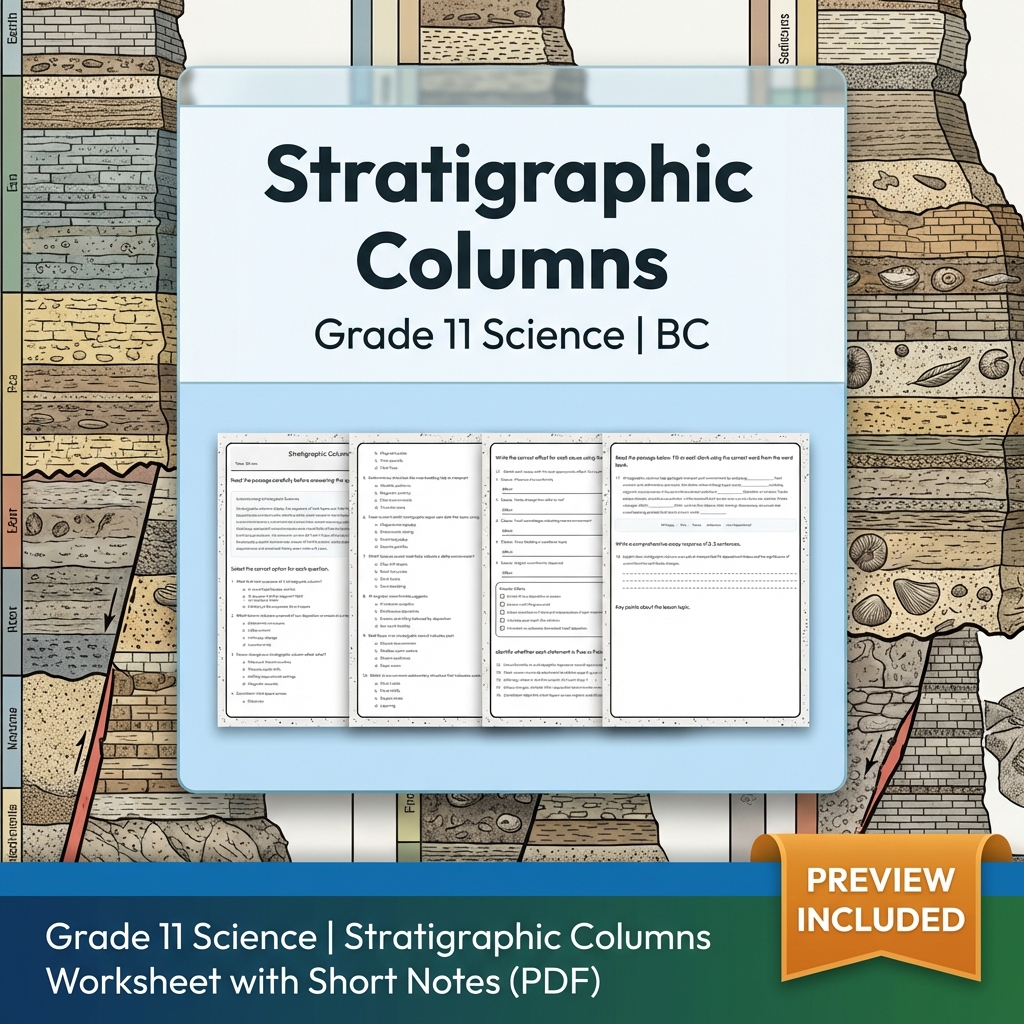
Grade 11 Science | Stratigraphic Columns Worksheet with Short Notes (PDF)
Created byMeadowlark WorksheetsLearning Objectives
- Understand the components and significance of stratigraphic columns in geology.
- Interpret depositional histories, unconformities, and facies changes from stratigraphic data.
- Learn how correlation links layers across distances in the geologic record.
Instant download
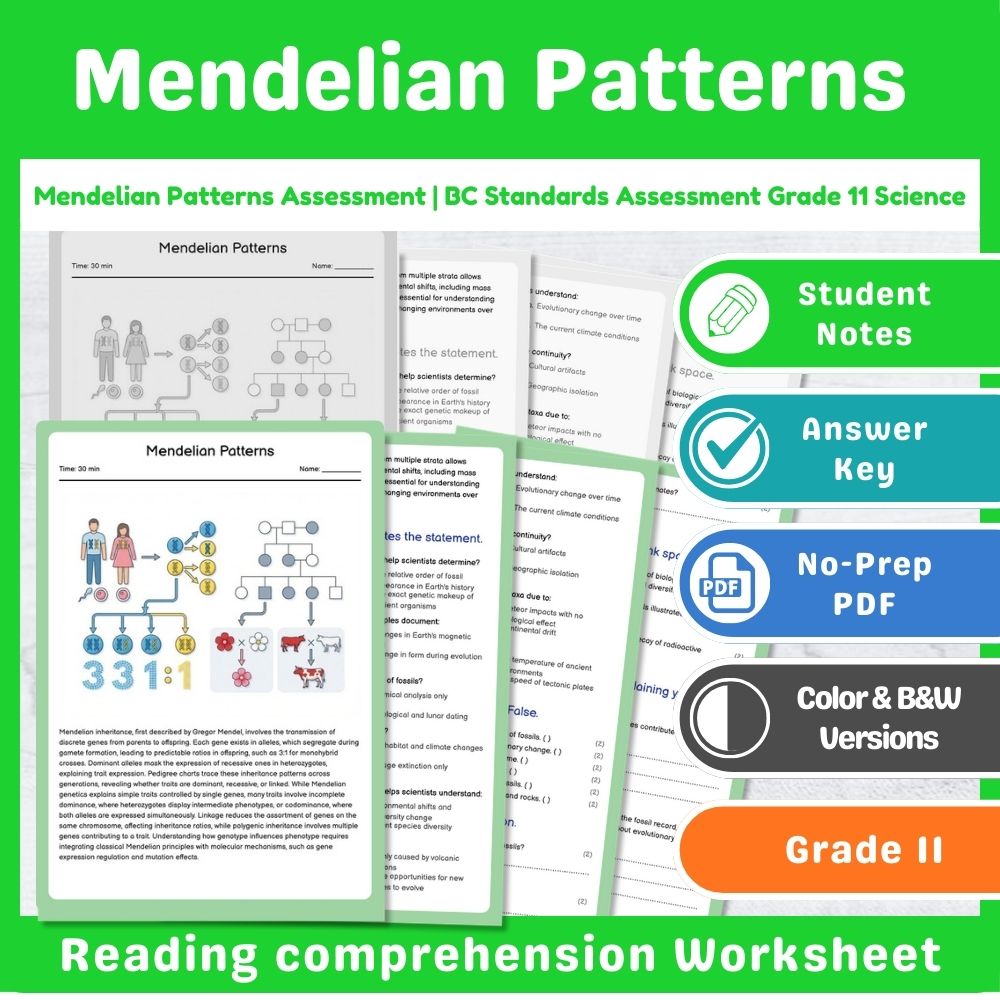
Mendelian Patterns Assessment | BC Standards Assessment Grade 11 Science
Created byPrism Point LearningLearning Objectives
- Understand the principles of Mendelian inheritance and the segregation of alleles.
- Identify dominant and recessive patterns and predict genotype and phenotype ratios.
- Trace inheritance patterns across generations using pedigrees.
Also included in: Grade 11 Science Lesson Assessment Bundle | Photosynthesis & Genetics
Instant download

Solution Stoichiometry Worksheet | Grade 11 Science Practices
Created byPrism Point LearningLearning Objectives
- Convert between molarity, volume, and moles for reactants in aqueous solutions
- Use balanced chemical equations and mole ratios to predict reactant consumption and product formation
- Apply equivalence (stoichiometric) relationships and mass conservation to solve solution-phase problems
Instant download
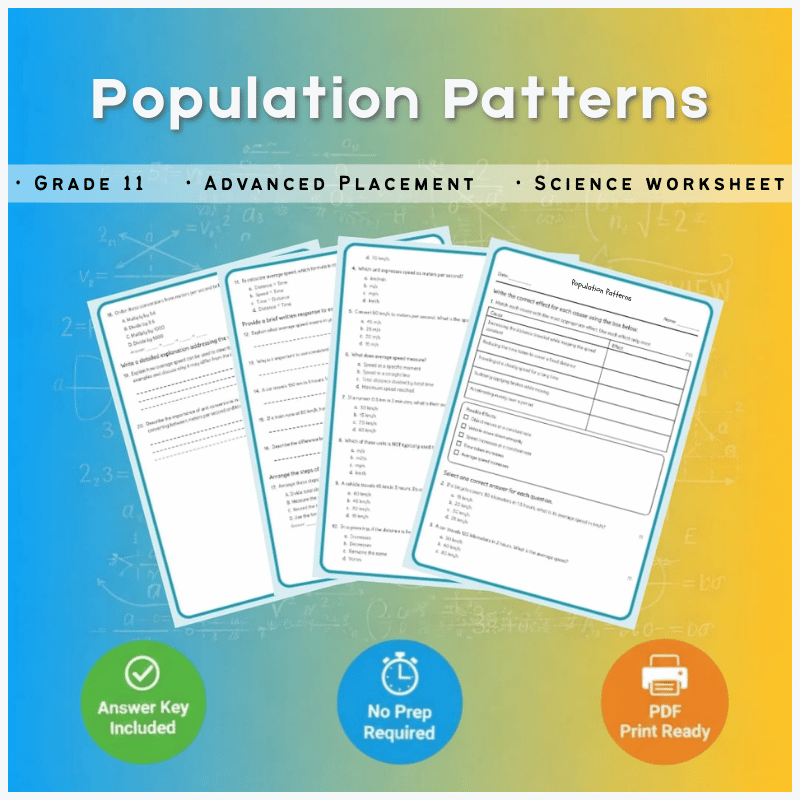
Grade 11 Science | Population Patterns Worksheet (AP Standards) – Science 1 PDF
Created byBright Mind ResourcesLearning Objectives
- Explain principles of population dynamics, including exponential and logistic growth models.
- Identify factors influencing population fluctuations such as density-dependent and density-independent factors.
- Interpret graphical models and life-history tables to analyze population trends.
Instant download

Grade 11 Science – Human Alterations & Ecosystems | Daily Reading Worksheet
Created byBright Mind ResourcesLearning Objectives
- Understand how habitat fragmentation impacts plant and animal species.
- Identify different types of human alterations affecting ecosystems.
- Analyze the ecological consequences of habitat fragmentation.
Also included in: Grade 11 Ecosystem & Ecology Science Lesson Bundle | TEKS Daily Reading +2 more
Instant download

Renal Regulation Worksheet for Grade 11 Science | TEKS Standards Practice
JCreated byJ.S SheetsLearning Objectives
- Explain how nephrons regulate fluid volume, electrolyte composition, and acid-base balance
- Describe the roles of ADH and aldosterone in controlling water and sodium/potassium handling
- Use renal clearance and feedback mechanisms (including the renin-angiotensin system) to predict physiological responses
Instant download

Grade 11 Science | Periodic Table - Daily Reading Comprehension
Created byCoral Reef LearningLearning Objectives
- Identify the main groups and periods in the periodic table.
- Explain how electron configurations relate to element properties.
- Describe patterns in metallic character, reactivity, and atomic size.
Instant download

Criteria and Constraints Worksheet for Grade 11 Science
JCreated byJ.S SheetsLearning Objectives
- Understand the role of criteria and constraints in engineering design.
- Identify qualitative and quantitative criteria used in solving real-world challenges.
- Explain how constraints restrict feasible solutions in project planning.
Also included in: Grade 11 Engineering Design Optimization Science lesson bundle +1 more
Instant download
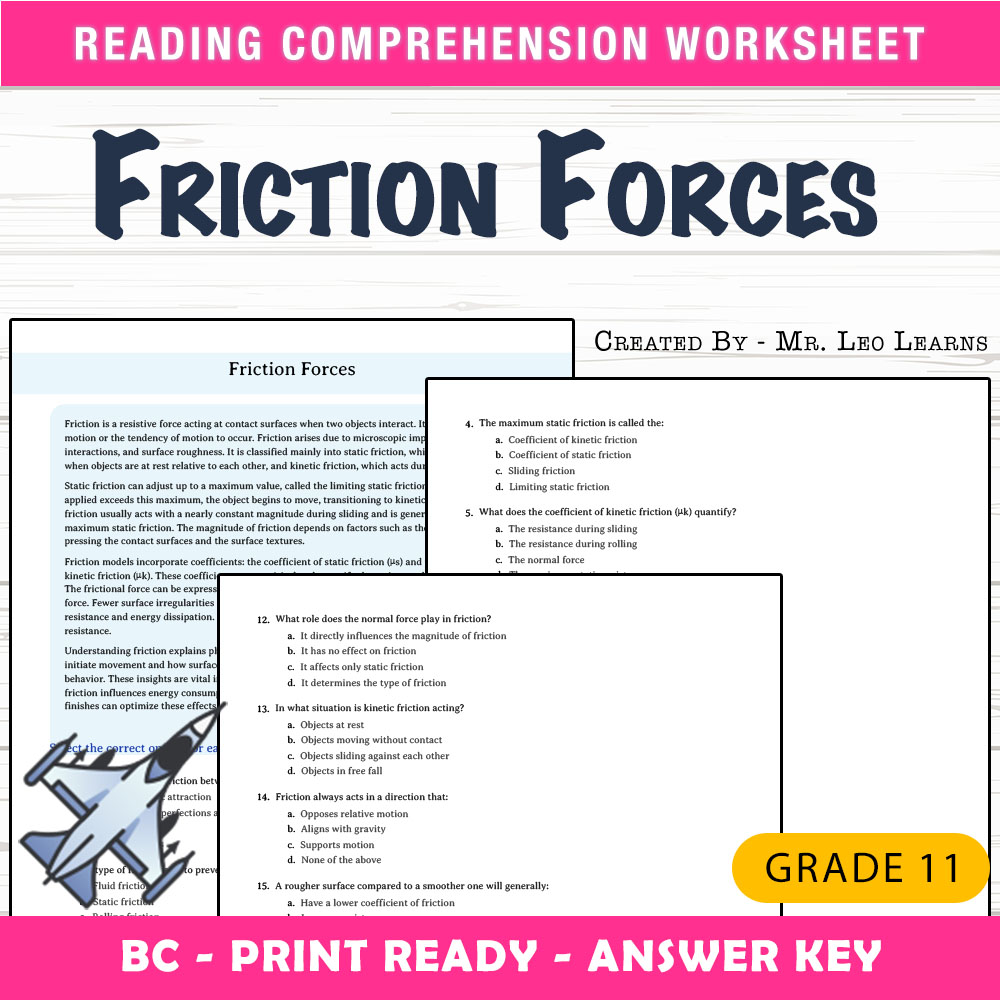
Grade 11 Science — Worksheet MCQ Paper for Mastering Friction Forces
 Created byThe Resource Hub
Learning Objectives
- Understand the nature of static and kinetic friction and their differences.
- Describe how friction depends on normal force and surface properties.
- Explain the role of coefficients of friction in modeling resistance.
Also included in: Grade 11 Science BC Physics Unit Bundle | Motion, Energy & Forces Worksheets +1 more
Instant download

Grade 11 Science – Nutrient Cycling & Ecosystems | Daily Reading Worksheet
Created byQuiet Forest EducationLearning Objectives
- Understand the key biogeochemical cycles with emphasis on carbon and nitrogen pathways.
- Identify processes such as fixation, mineralization, and denitrification.
- Describe the pools and fluxes of nutrients across different environmental compartments.
Also included in: Ecosystems and Ecology Grade 11 Science Daily Reading Worksheets Bundle | Ontario +1 more
Instant download

Grade 11 Mineral Deposits Worksheet | BC Practice & PDF
Created byClear Sky ClassroomLearning Objectives
- Explain how hydrothermal, placer (sedimentary sorting), and magmatic processes can form mineral deposits.
- Identify how host rock, depth, accessibility, and geological setting affect whether a deposit is economically viable.
- Describe how extraction methods and environmental considerations shape impacts before and after mining.
Instant download
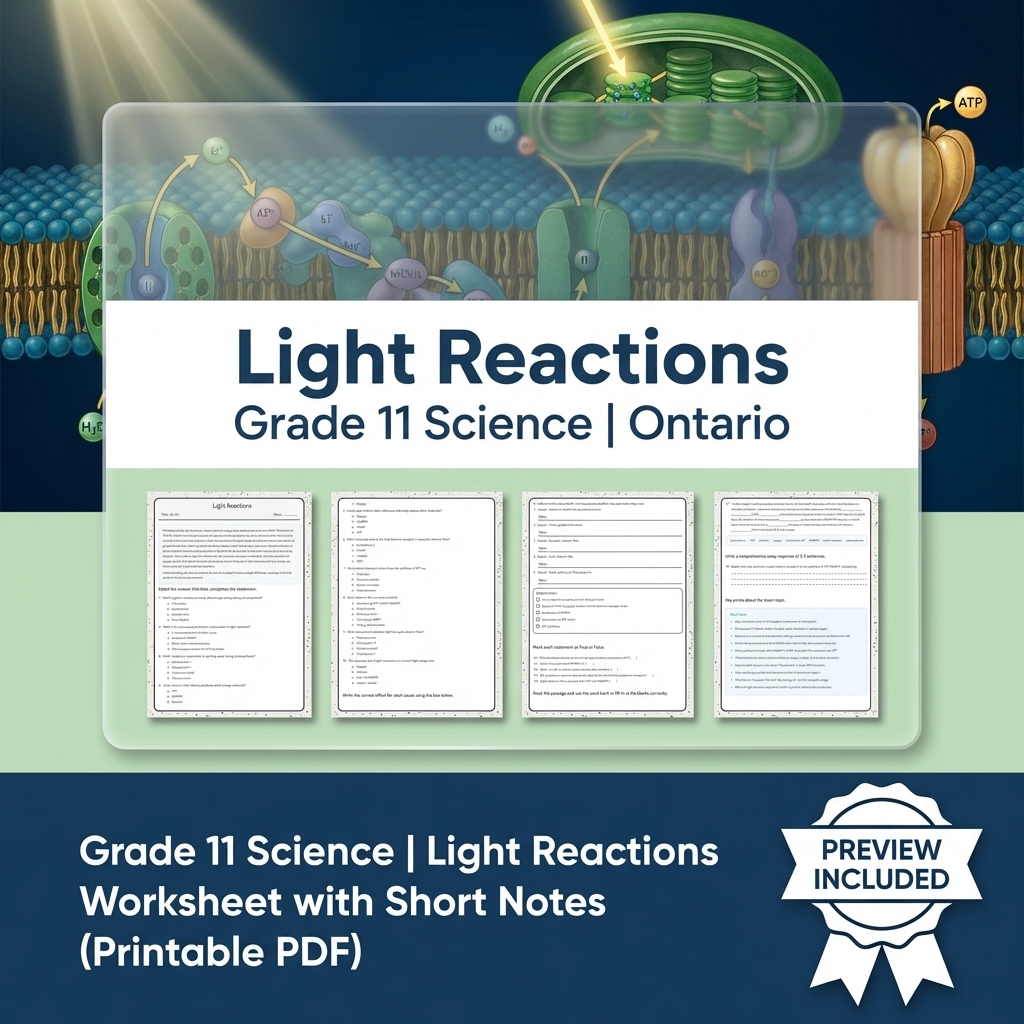
Grade 11 Science | Light Reactions Worksheet with Short Notes (Printable PDF)
Created byMeadowlark WorksheetsLearning Objectives
- Understand the process of photon capture and energy transfer in light reactions of photosynthesis.
- Describe the electron transport chain components and their sequence.
- Explain the difference between cyclic and noncyclic electron flow and their roles in ATP and NADPH production.
Also included in: Grade 11 Science | Ontario Curriculum on Cell Processes and Metabolism +1 more
Instant download

Grade 11 Systems Integration Worksheet | Practice & Assessment PDF
Created byClear Sky ClassroomLearning Objectives
- Explain how biological processes at molecular and cellular levels scale up to organismal physiology and ecosystem dynamics
- Model and interpret feedback loops and regulatory networks that produce homeostasis and emergent system behavior
- Evaluate the limits of reductionist models and justify multi-scale modeling to predict responses to perturbations
Also included in: Grade 11 Systems Integration and Genetics Science Lesson Bundle: AP +1 more
Instant download

Grade 11 Science | Natural Selection - Daily Reading Comprehension
Created byCoral Reef LearningLearning Objectives
- Understand the basic concepts of natural selection
- Identify how environmental factors influence survival and reproduction
- Recognize different modes of selection: directional, stabilizing, and disruptive
Instant download

Grade 11 Science – Wave Superposition & Interference | Daily Reading Worksheet
Created byQuiet Forest EducationLearning Objectives
- Understand the principle of superposition and how waves interfere
- Describe standing waves and the formation of nodes and antinodes
- Explain resonant frequencies and harmonic modes in stringed instruments or air columns
Also included in: Wave & Motion Science Grade 11 Daily Reading Worksheets Bundle | Ontario +1 more
Instant download

Chemical Reactions Assessment Practice | Grade 11 Science
Created byPrism Point LearningLearning Objectives
- Explain chemical reactions using conservation of mass and particle conservation ideas.
- Balance chemical equations and use stoichiometry to find limiting reagents and theoretical yield.
- Describe how reaction energetics and equilibrium relate to observable changes such as temperature and enthalpy.
Instant download
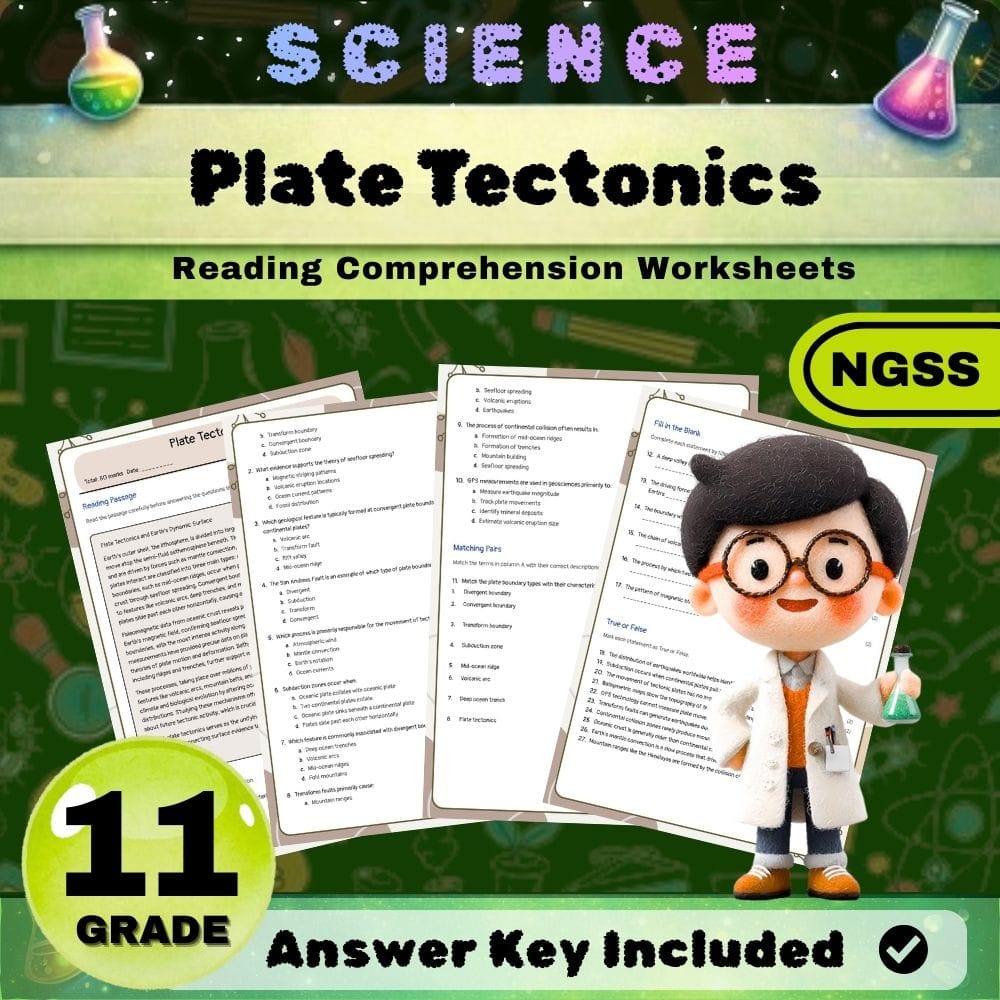
Grade 11 Science| Plate Tectonics Worksheet (NGSS) (PDF)
 Created byMaple Path Learning
Learning Objectives
- Describe the different types of plate boundaries and their associated geological processes.
- Analyze geologic evidence such as paleomagnetic data, earthquake distribution, and bathymetric maps to understand lithospheric motions.
- Explain mechanisms like seafloor spreading, subduction, transform faulting, and continental collision and how they relate to Earth's surface features.
Also included in: Grade 11 Earth Systems Science Lesson Bundle – NGSS Modeling Worksheets +1 more
Instant download

Grade 11 Science | Phylogenetic Trees - Daily Reading Comprehension
Created byCoral Reef LearningLearning Objectives
- Describe the purpose of phylogenetic trees in understanding evolution.
- Identify key features of phylogenetic trees such as branches, nodes, and clades.
- Explain how molecular data contributes to constructing phylogenetic trees.
Instant download

Grade 11 Science | Mendelian Patterns Worksheet (PDF) – TEKS Aligned
Created byEvergreen Desk EducationLearning Objectives
- Explain segregation and independent assortment as foundations of Mendelian inheritance.
- Use dominant/recessive relationships to predict phenotypes from given genotypes.
- Apply Punnett square logic to calculate probabilities for monohybrid and dihybrid crosses.
Instant download

Grade 11 Science | Radiometric Dating Worksheet (BC Standard) (PDF)
Created byEvergreen Desk EducationLearning Objectives
- Explain how radiometric dating uses parent and daughter isotopes and known half-lives to calculate absolute age.
- Compare different isotope systems (e.g., U–Pb in zircon and C-14 for recent organic matter) and the timescales they cover.
- Describe why closed-system behavior and closure temperature affect whether isotopic ages are reliable.
Instant download

pH Fundamentals Worksheet | Science | Alberta Grade 11 Assessment
JCreated byJ.S SheetsLearning Objectives
- Understand the concept of pH and its significance in chemistry and environmental science.
- Interpret the pH scale and relate hydrogen ion concentration to acidity and alkalinity.
- Analyze regional phenomena such as acid deposition and their effects on aquatic systems.
Instant download

Strong Versus Weak Chemistry Worksheet | Grade 11 Science Standards Practice
JCreated byJ.S SheetsLearning Objectives
- Understand the difference between strong and weak acids and bases in terms of ionization.
- Identify examples of strong and weak acids and bases.
- Explain how ionization affects hydrogen and hydroxide ion concentrations in solutions.
Instant download

Grade 11 Science – Saturation & Solubility | Daily Reading Worksheet
Created byBright Mind ResourcesLearning Objectives
- Define and identify the three main saturation states: unsaturated, saturated, and supersaturated.
- Explain the conditions that lead to each saturation state in solutions.
- Describe natural and industrial examples of saturation, such as mineral deposits and seasonal crystallization.
Also included in: Grade 11 Solutions Science Daily Reading Worksheets lesson bundle | Alberta +1 more
Instant download

Grade 11 Science – Cellular Respiration & Energy Cycle | Daily Reading Worksheet
Created byBright Mind ResourcesLearning Objectives
- Understand the main stages of cellular respiration
- Explain how electrons transfer energy during respiration
- Describe the role of oxygen as the final electron acceptor
Also included in: Grade 11 Biology Science Daily Reading Worksheets lesson bundle | BC +1 more
Instant download

Speciation And Phylogeny Review Practice Assessment | Grade 11 Science
Created byPrism Point LearningLearning Objectives
- Explain how geographic isolation and reproductive barriers can lead to population divergence and speciation.
- Compare allopatric and sympatric speciation and describe adaptive radiation as a driver of diversification.
- Interpret phylogenetic trees using concepts like monophyly, homology, and tree topology.
Also included in: Grade 11 Statistical Models and Evolution Science Lesson Bundle - NGSS
Instant download
About Grade 11 Science Worksheets
Browse 6,616 printable Grade 11 Science worksheets — ready-to-print PDFs with answer keys where available.
Each resource here is built by an independent educator and reviewed for quality. Worksheets print straight from PDF and suit classroom use, homework, or extra practice; most come with answer keys, and you can preview before purchasing.