
Grade 11 Science Worksheets
6,616 worksheets
Surface Area Effects Worksheet for Grade 11 Chemistry Science Practice
 Created byPrism Point Learning
Learning Objectives
- Explain how surface area affects the fraction of reactants that can contact each other in heterogeneous systems.
- Describe why smaller particle sizes usually increase reaction rate due to more effective contact points.
- Connect surface-area ideas to real-world processes such as corrosion and decomposition.
Instant download

Systems In Ecology Test Prep Printable | Grade 11 Science
Created byPrism Point LearningLearning Objectives
- Explain how population dynamics like logistic growth relate to carrying capacity and limiting factors.
- Analyze how species interactions (e.g., predation and competition) can be represented using ecological models.
- Describe how biogeochemical cycling (e.g., nitrogen and carbon) affects ecosystem productivity and stability.
Instant download

Grade 11 Science Daily Reading: Mutation Dynamics | NGSS Biology Worksheet
 Created byBRIGHT PATH RESOURCES
Learning Objectives
- Explain what genetic mutations are and how they create variation.
- Identify common sources of mutation in DNA (replication errors and mutagen exposure).
- Describe how different types of mutations can affect protein function.
Also included in: Heredity Variation Grade11 Science Daily Reading Worksheets Lesson Bundle | NGSS +1 more
Instant download

Grade 11 Science | Mutation and Variation Worksheet | California Standards
 Created byLumora Learning
Learning Objectives
- Explain how mutations create genetic variation in populations
- Differentiate between DNA sequence changes and their effects on proteins or gene regulation
- Evaluate how environmental conditions influence whether a mutation affects a trait
Instant download

Energy Conservation Worksheet for Grade 11 Science | Standards-Aligned Practice
JCreated byJ.S SheetsLearning Objectives
- Apply the conservation of energy principle to closed systems by relating kinetic and potential energy changes
- Use energy bar diagrams and potential energy ideas to predict how energy converts during motion
- Explain how non-conservative forces affect mechanical energy and how to account for them in energy balance
Instant download

Physical vs Chemical Changes Worksheet Grade 11 Science NGSSS Assessment
Created byPrism Point LearningLearning Objectives
- Distinguish physical changes from chemical changes by identifying whether new substances form.
- Use observable evidence (gas, color/temperature change, precipitate formation) to infer chemical reactions.
- Explain why physical changes are often reversible while chemical changes are not.
Instant download

Grade 11 Science – Organelle Pathways Daily Worksheet | Ontario Standards
 Created byQuiet Forest Education
Learning Objectives
- Understand the process of co-translational import of proteins into the endoplasmic reticulum
- Identify the signals and mechanisms involved in targeting proteins to the ER
- Describe the roles of the Golgi apparatus in modification and sorting of proteins
Also included in: Cell Biology Grade 11 Science Daily Reading Worksheets Bundle | Ontario +1 more
Instant download

Scientific Inquiry Assessment Grade 11 | Florida NGSSS Science Evaluation
Created byPrism Point LearningLearning Objectives
- Explain how scientific inquiry connects observations to evidence-based explanations
- Differentiate claims supported by natural causes and testable evidence from non-scientific reasoning
- Evaluate how inquiry can proceed non-linearly using prior knowledge while remaining open to alternative interpretations
Also included in: Grade 11 Scientific Inquiry, Models, and Evidence Science Lesson Bundle NGSSS +1 more
Instant download
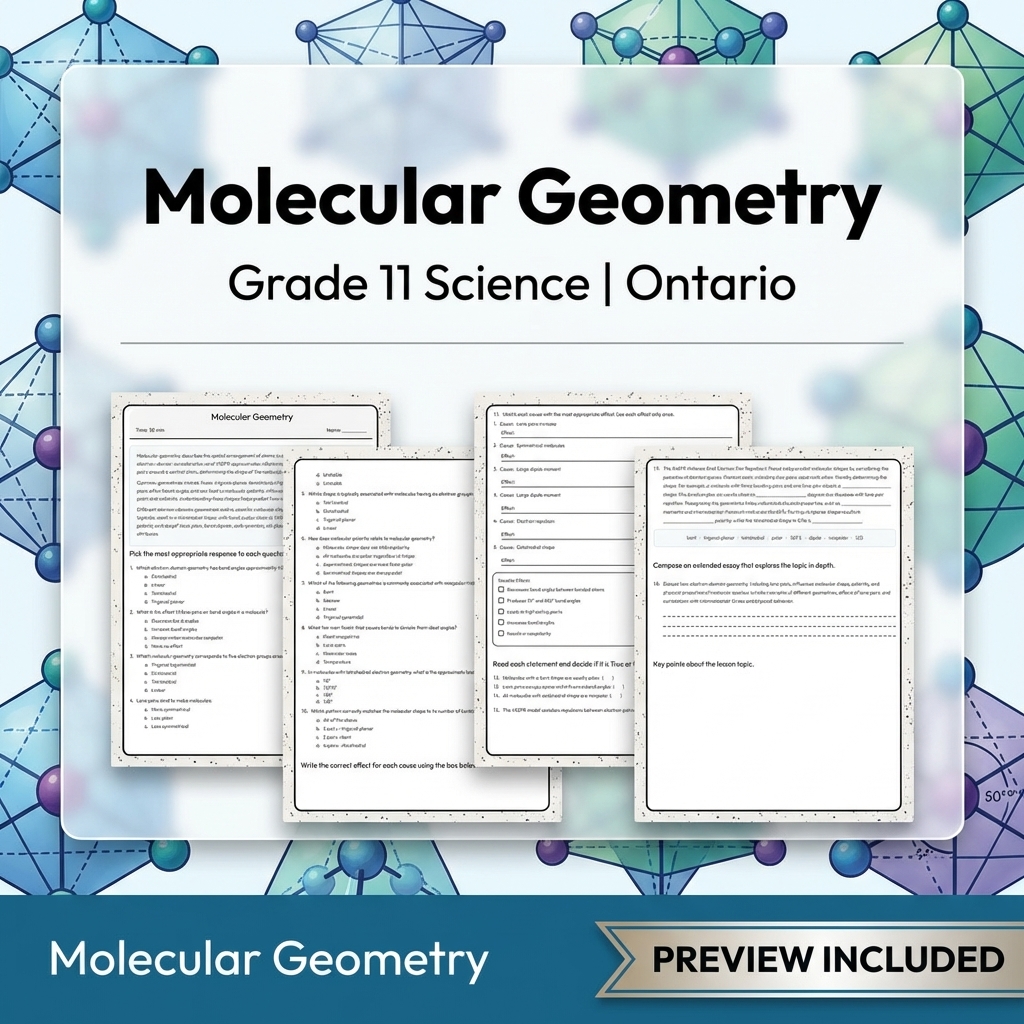
Grade 11 Science | Molecular Geometry Worksheet with Short Notes (Printable PDF)
 Created byMeadowlark Worksheets
Learning Objectives
- Describe the shapes of molecules based on electron-domain considerations using VSEPR theory.
- Predict molecular shapes and bond angles for different electron geometries.
- Explain how lone pairs influence molecular geometry and polarity.
Also included in: Grade 11 Science Lesson Bundle – Ontario Curriculum +1 more
Instant download
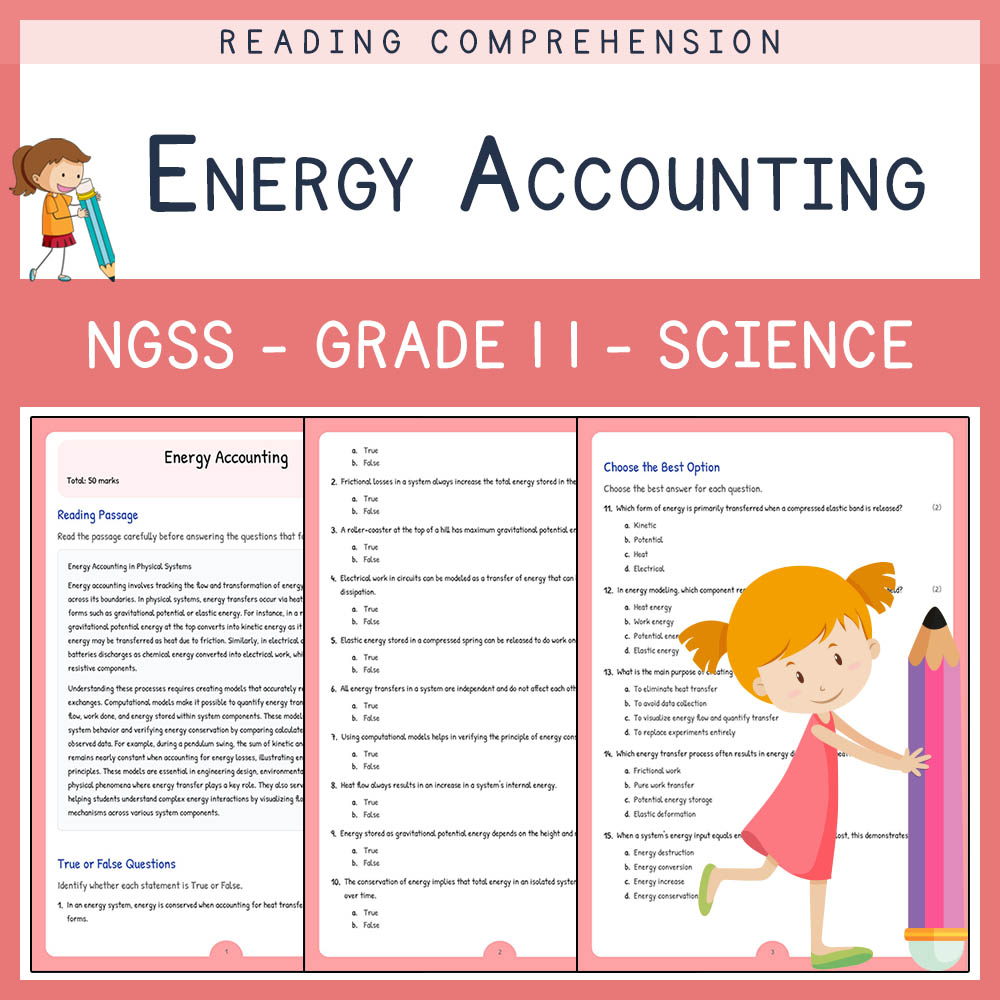
Grade 11 Science | Energy Accounting Worksheet (PDF + Answer Key) – NGSS aligned
Created byLumora LearningLearning Objectives
- Understand how to construct computational models for energy transfer among system components.
- Apply formulas to calculate heat, work, and energy stored in gravitational or elastic forms.
- Use computational representations to relate energy exchanges and verify total energy conservation.
Instant download

Polyprotic Systems Worksheet Grade 11 Chemistry Alberta Science PDF
 Created byEvergreen Desk Education
Learning Objectives
- Explain how polyprotic acids dissociate in steps and how each dissociation constant (Ka1, Ka2, …) affects pH.
- Interpret titration curves for polyprotic acids using buffer regions and equivalence points.
- Calculate stepwise and cumulative acid behavior (conceptually and in simple quantitative problems) for carbonate and phosphate systems.
Instant download

Solar System Motion and Composition Worksheets Grade 11 Science
Created byBRIGHT PATH RESOURCESLearning Objectives
- Explain how gravity contributes to long-term planetary system stability
- Interpret spectral evidence to infer composition and temperature
- Compare orbital elements as evidence of system evolution
Also included in: Earth & Space Science Bundle | Grade 11 Science Worksheets | General +4 more
Instant download

Grade 11 Science | Internal Structures Worksheet Elena | California Standards
Created byLumora LearningLearning Objectives
- Explain how internal structures (cells, tissues, organs) enable essential life processes in organisms
- Analyze how specialized surfaces and organization increase rates of exchange such as gas exchange and nutrient uptake
- Evaluate how the form of internal structures supports specific physical and chemical interactions needed for survival, growth, and reproduction
Instant download

Genetic Mutations Assessment | TEKS Standards Grade 11 Science
Created byPrism Point LearningLearning Objectives
- Describe the different types of genetic mutations and their effects on DNA and proteins.
- Explain how mutations can influence phenotypes and contribute to genetic variation.
- Identify sources of mutations, including replication errors and environmental factors.
Also included in: Grade 11 Molecular Genetics Science Lesson Bundle: TEKS Assessments
Instant download

Grade 11 Science – Microscopic Energy & Particle Motion| Daily Reading Worksheet
 Created byBright Mind Resources
Learning Objectives
- Understand how energy at the microscopic level relates to macroscopic phenomena
- Describe molecular motion and its connection to thermal energy
- Identify how energy changes occur during particle collisions and vibrations
Also included in: Grade 11 Energy Transfers Science Daily Reading Worksheets Lesson Bundle | NGSS +2 more
Instant download

Grade 11 Hybridization Worksheet | BC Practice & PDF
 Created byClear Sky Classroom
Learning Objectives
- Explain how hybridization models account for molecular geometry and bond angles in covalent molecules.
- Identify the hybridization of common bonding arrangements (sp, sp2, sp3) and connect them to linear, trigonal planar, and tetrahedral shapes.
- Describe how hybrid orbitals form sigma bonds and how unhybridized orbitals can contribute to pi bonding in multiple bonds.
Instant download

Grade 11 Digital Information Worksheet | California Standards Practice PDF
Created byClear Sky ClassroomLearning Objectives
- Explain how digital communication converts continuous signals into discrete binary representations for storage or transmission
- Describe how sampling rate and bandwidth affect the fidelity and data rate of a digital system
- Evaluate how error correction improves reliability of messages transmitted through noisy channels
Instant download

Conservation Strategies Assessment for Grade 11 Science | TEKS
Created byPrism Point LearningLearning Objectives
- Understand various conservation strategies and their roles in biodiversity preservation.
- Identify and differentiate among protected areas, habitat restoration, and policy interventions.
- Explain the importance of connectivity corridors and monitoring in conservation efforts.
Instant download
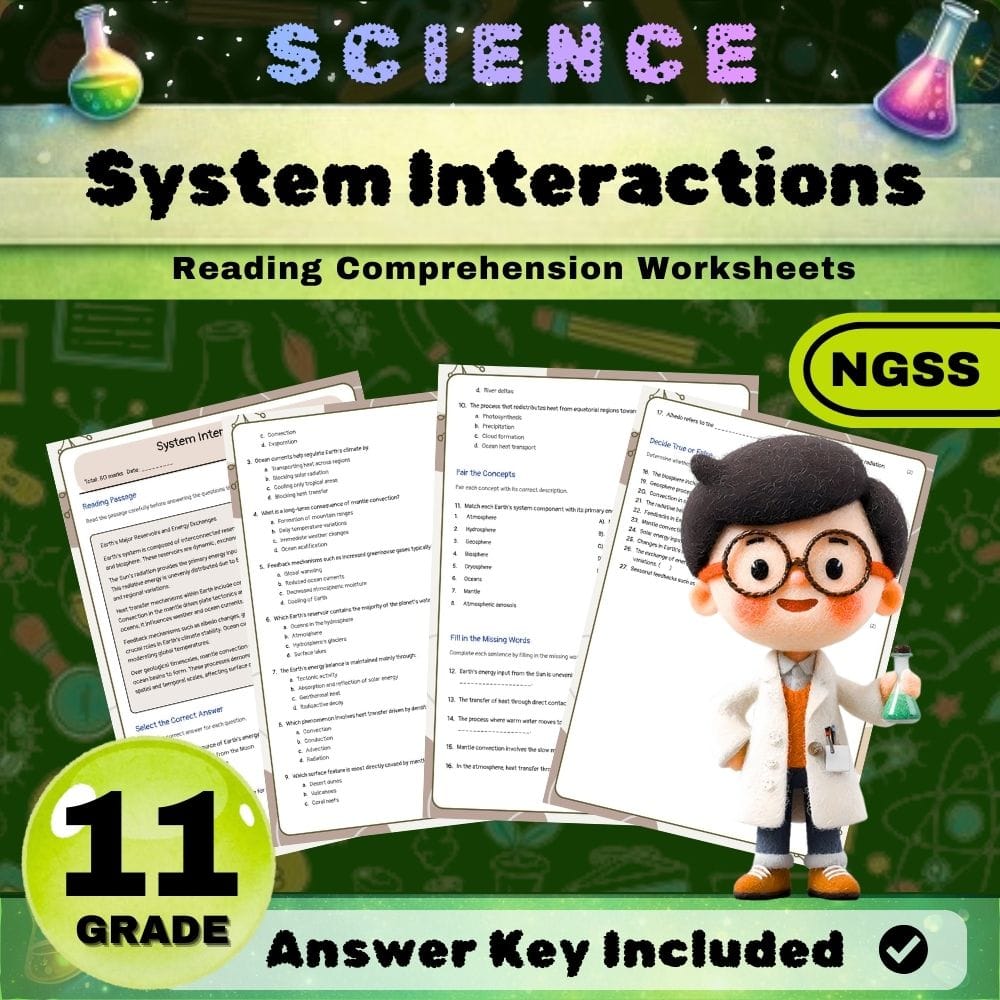
Grade 11 Science | System Interactions Worksheet (NGSS Printable PDF)
 Created byMaple Path Learning
Learning Objectives
- Understand the major Earth's reservoirs and how energy is exchanged among the atmosphere, hydrosphere, geosphere, and biosphere.
- Analyze how spatial and temporal scales influence Earth's energy system and feedback mechanisms.
- Describe phenomena such as ocean heat transport and mantle convection in the context of Earth's system interactions.
Also included in: Grade 11 Earth Systems Science Lesson Bundle – NGSS Modeling Worksheets +1 more
Instant download

Intermolecular Forces and Observable Properties Worksheet Grade 11
Created byBRIGHT PATH RESOURCESLearning Objectives
- Explain differences among major intermolecular forces
- Connect intermolecular forces to boiling point and viscosity
- Compare solubility in polar and nonpolar solvents
Also included in: Physical Science Worksheets Bundle | Grade 11 Science | Waves & Matter +4 more
Instant download

Grade 11 Redox Processes Worksheet | Practice & Assessment PDF
Created byClear Sky ClassroomLearning Objectives
- Determine oxidation states using systematic rules and interpret what the changes mean
- Balance redox equations in acidic and basic media using electron bookkeeping
- Use redox stoichiometry to predict relative product amounts and environmental implications
Instant download

Grade 11 Science | Fossil Evidence Worksheet (TEKS Aligned PDF)
Created byEvergreen Desk EducationLearning Objectives
- Explain how fossil morphology and stratigraphic relationships provide relative timelines for evolutionary change.
- Describe how radiometric dating can convert fossil ages into absolute ages.
- Evaluate how transitional forms and extinction/diversification patterns are inferred from the fossil record while accounting for preservation bias and gaps.
Instant download

Lewis Structures, Formal Charge and Octet Exceptions Worksheets Grade 11
 Created bySunny Desk Resources
Learning Objectives
- Construct Lewis structures using valence electrons and lone pairs
- Calculate formal charges within molecular structures
- Select appropriate resonance structures using formal charge
Also included in: Grade 11 Chemistry Lesson Bundle — Bonding, Polarity & Orbitals (Alberta) +1 more
Instant download

Industrial Stoichiometry Worksheets: Mass and Mole Balances Grade 11
Created bySunny Desk ResourcesLearning Objectives
- Explain stoichiometric ratios in industrial feed and product rates
- Calculate mass and mole balances for process units
- Identify limiting reactants from industrial reaction information
Also included in: Stoichiometry & Chemical Reactions Lesson Bundle — Grade 11 Science Alberta +1 more
Instant download

Grade 11 Science – Energy Transfer & Forms of Energy | Daily Reading Worksheet
Created byQuiet Forest EducationLearning Objectives
- Understand the fundamental concepts of energy and its different forms.
- Identify various modes of energy transfer such as work, heat, and power.
- Learn conservation principles related to energy in closed and open systems.
Also included in: Science Grade 11 Daily Reading Worksheets Bundle | Ontario Framework +1 more
Instant download

Grade11 Science | Atomic Structure Worksheet Elena | AP Aligned
Created byLumora LearningLearning Objectives
- Understand the subatomic components of atoms and their roles.
- Explain how emission spectra and mass spectrometry support discrete energy levels.
- Describe quantum numbers and orbital models for electron distribution.
Also included in: Grade 11 Science | Chemistry Foundations Custom Bundle | AP-Aligned
Instant download

Genetic Drift Worksheet | TEKS-Aligned Science Practice for Grade 11
JCreated byJ.S SheetsLearning Objectives
- Explain how genetic drift changes allele frequencies through chance events, especially in small populations
- Compare bottleneck and founder effects and describe how each can reduce genetic variation
- Evaluate why drift can change allele frequencies independently of fitness and how this differs from natural selection
Instant download

Grade 11 Phase Behavior Worksheet | AP Practice & Assessment PDF
Created byClear Sky ClassroomLearning Objectives
- Interpret key features of phase diagrams and vapor–liquid equilibrium in relation to intermolecular forces.
- Explain how solute type and particle number affect vapor pressure, boiling point elevation, and freezing point depression.
- Use colligative-property relationships (ideal case) to predict trends for boiling, freezing, and osmotic behavior.
Also included in: Grade 11 AP Chemistry Science Lesson Bundle: Foundations & Models +1 more
Instant download
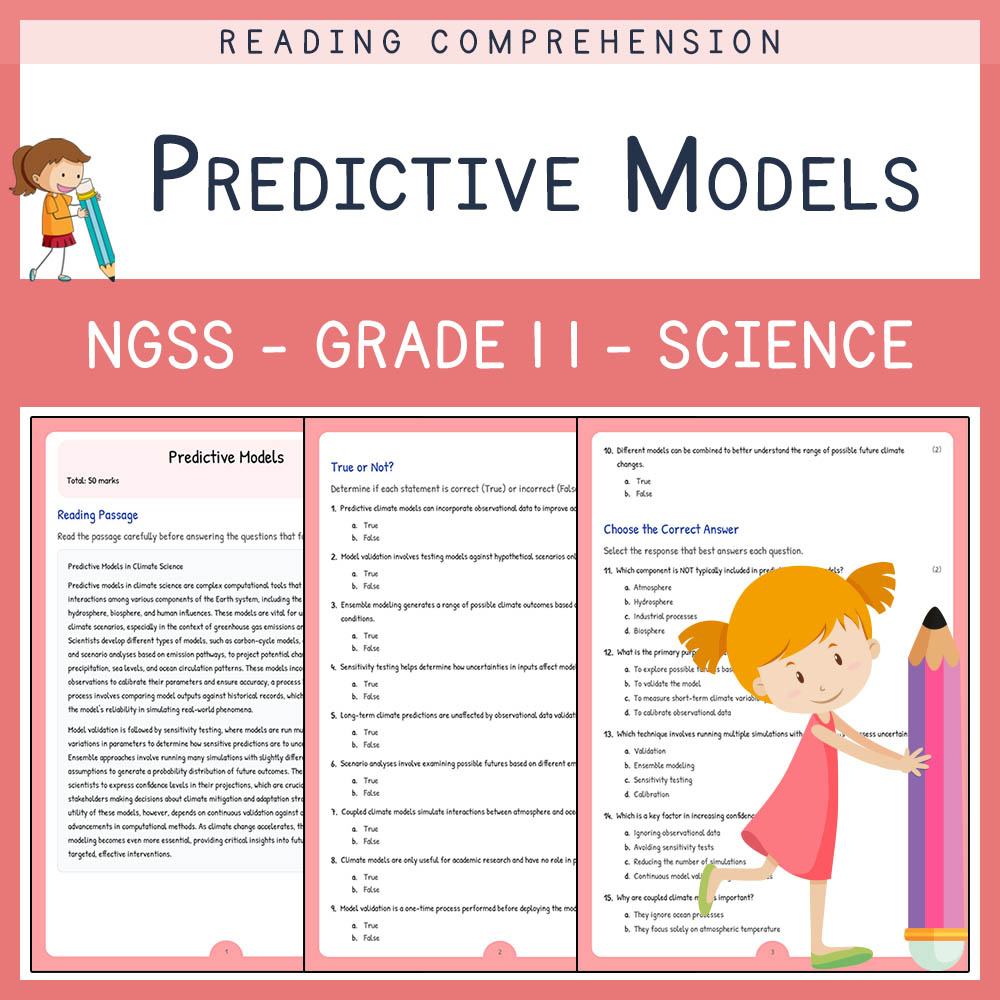
Grade 11 Science | Predictive Models Worksheet & Answer Key – NGSS-Aligned
Created byLumora LearningLearning Objectives
- Understand the application of modeling in climate science and environmental projections.
- Identify different types of climate models and their uses.
- Evaluate the importance of model validation and uncertainty testing in predictive science.
Instant download

Grade 11 Science Worksheet – Impulse and Momentum (PDF) BC Standards
Created byEvergreen Desk EducationLearning Objectives
- Explain linear momentum as the product of mass and velocity and identify its units.
- Use the impulse–momentum relationship to predict how velocity changes during collisions or braking.
- Compare situations where force acts for a short time versus a long time and relate this to changes in momentum.
Instant download
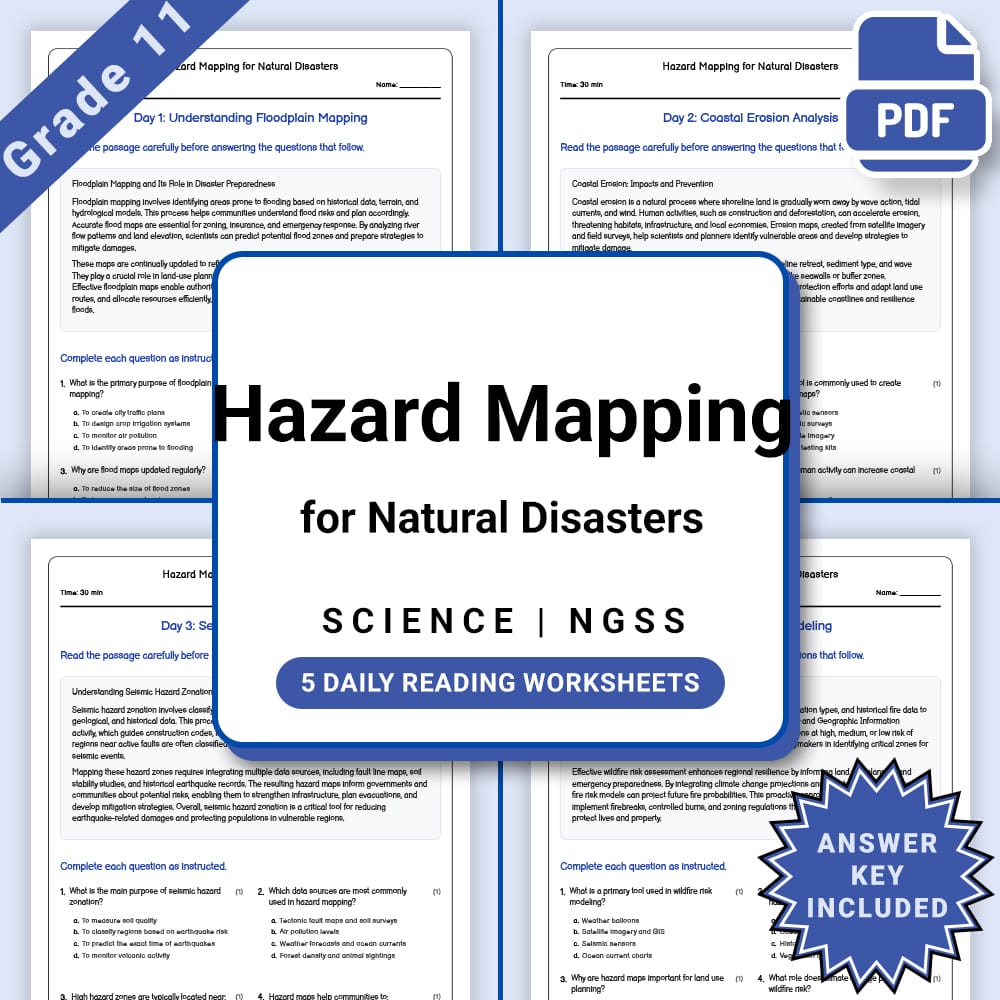
Grade 11 Science – Hazard Mapping for Natural Disasters Worksheet(PDF +Answers)
 Created byCopper Leaf Classroom
Learning Objectives
- Understand the purpose and importance of floodplain mapping.
- Analyze geological and hydrological data to assess flood risks.
- Learn how hazard maps support regional planning and resilience.
Instant download

Grade 11 Science – Respiratory System & Gas Exchange | Daily Reading Worksheet
Created byBright Mind ResourcesLearning Objectives
- Describe the main structures involved in the human respiratory system.
- Explain how gas exchange occurs in the alveoli.
- Identify the processes of ventilation and diffusion.
Also included in: Grade 11 Human Body Systems Science Daily Reading Worksheets Bundle | TEKS +2 more
Instant download
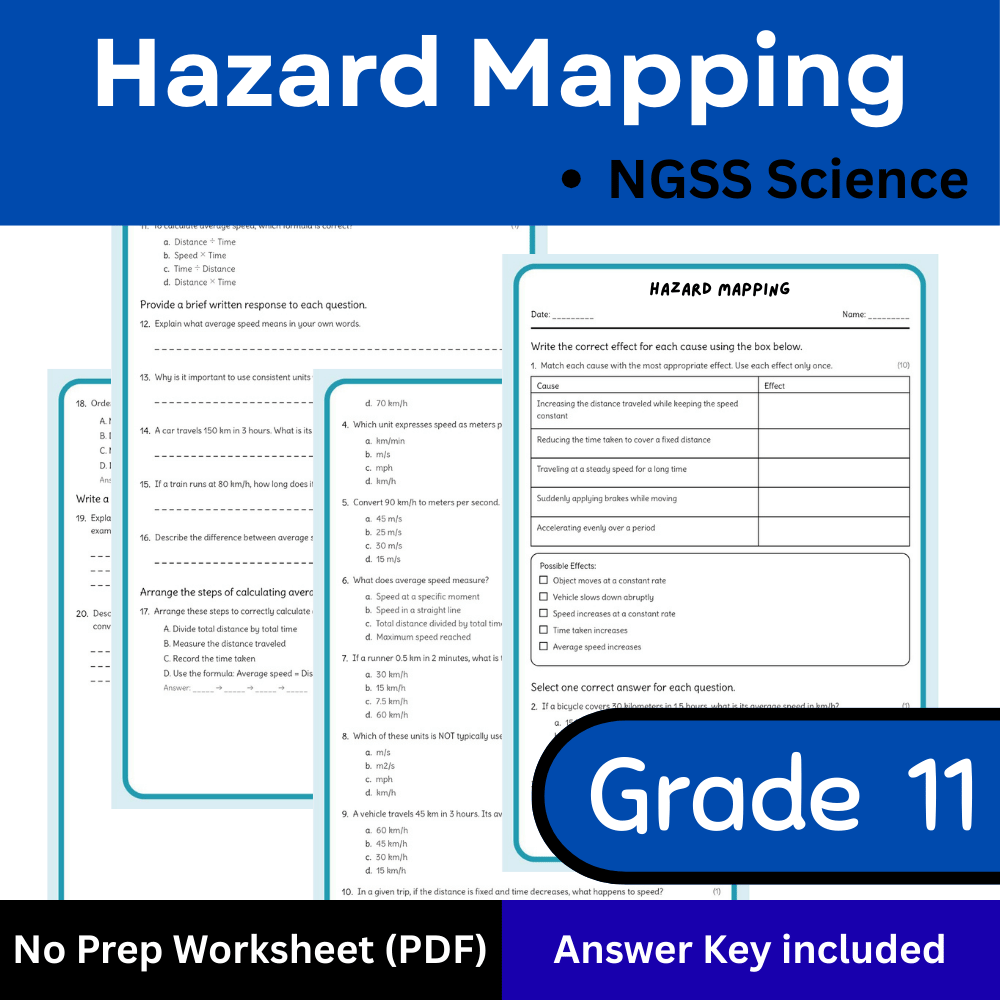
Grade 11 Science | Hazard Mapping Worksheet (NGSS) | Science PDF
Created byBright Mind ResourcesLearning Objectives
- Understand the purpose and application of hazard mapping in assessing natural risks.
- Identify different types of natural hazards and their spatial distributions.
- Analyze how hazard data informs land use planning and resilience strategies.
Instant download

Grade 11 Science – Reaction Rearrangement & Chemical Equations | Worksheet
Created byBright Mind ResourcesLearning Objectives
- Identify changes in atom connectivity during chemical reactions
- Explain how bonds break and reform without changing atom identities
- Connect microscopic particle models to macroscopic observations
Also included in: Grade 11 Energy Science Daily Reading Lesson Bundle | California Standards +1 more
Instant download
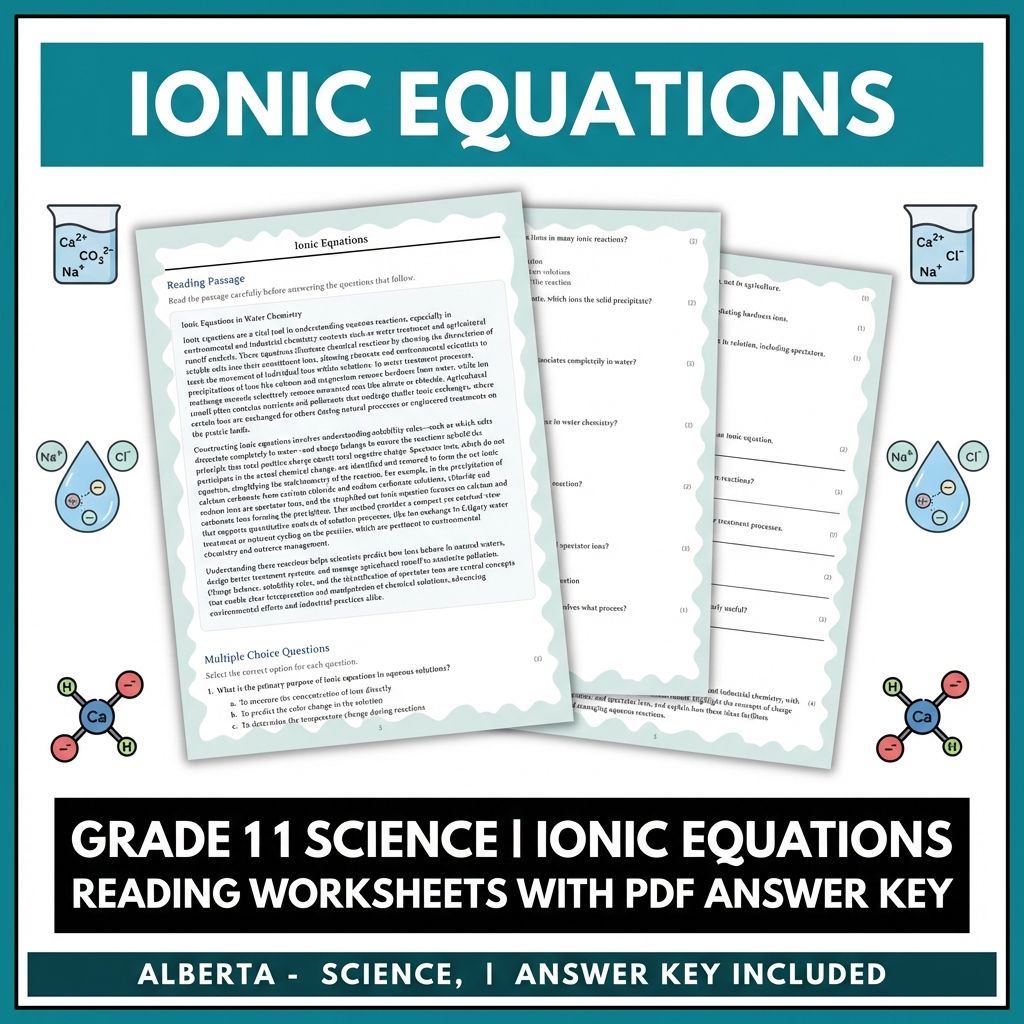
Grade 11 Science | Ionic Equations Reading Worksheets with PDF Answer Key
JCreated byJ.S SheetsLearning Objectives
- Understand the concept of ionic equations and their role in representing aqueous reactions.
- Identify spectator ions and differentiate between complete and net ionic equations.
- Apply charge balance and solubility rules to construct ionic equations.
Instant download

Grade 11 Science – Mantle Convection Worksheet (BC Standards) (PDF)
Created byEvergreen Desk EducationLearning Objectives
- Explain how thermal energy drives slow circulation in Earth’s mantle (mantle convection).
- Describe how mantle convection patterns relate to plate motion at ridges, subduction zones, and hotspots.
- Use evidence such as seismic tomography and gravity anomalies to infer mantle flow behavior.
Instant download
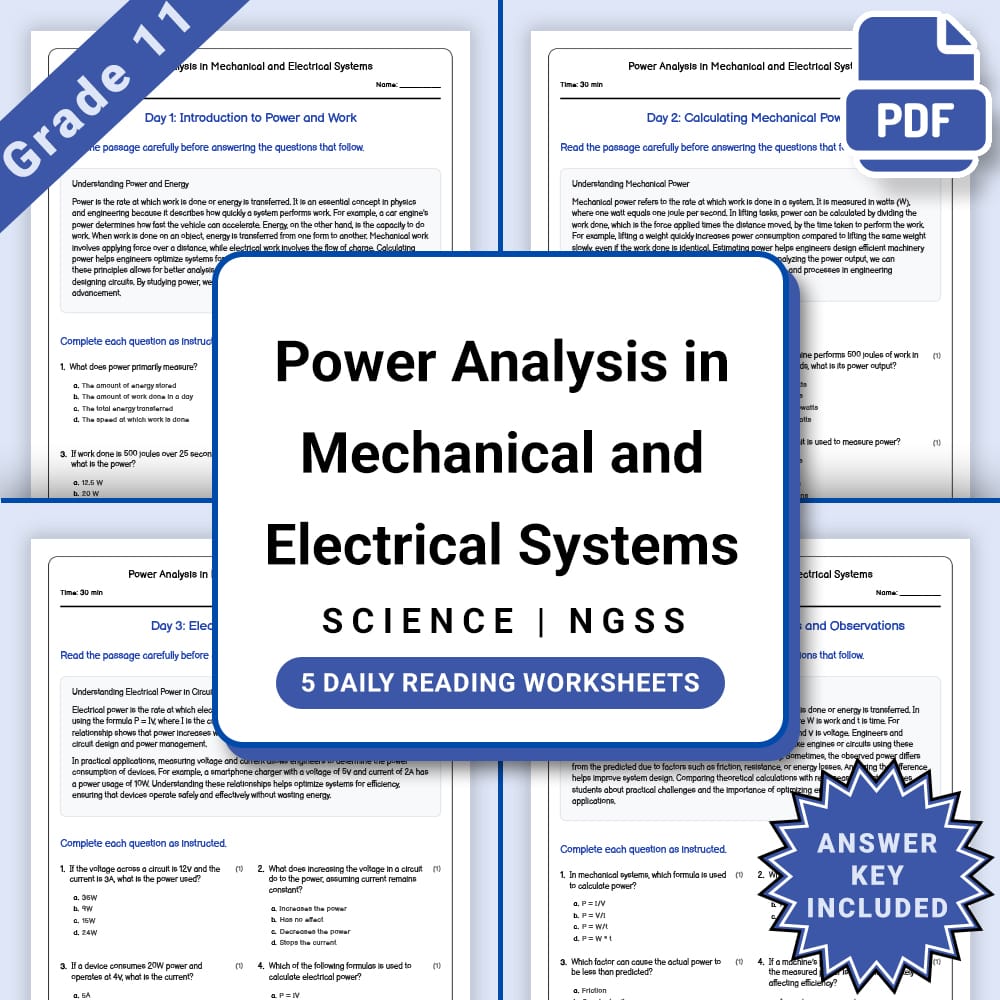
Grade 11 Science – Power Analysis in Mechanical Worksheet(PDF +Answer Key)
Created byCopper Leaf ClassroomLearning Objectives
- Understand the concepts of work, energy, and power in physical systems
- Create computational models to calculate energy changes and power
- Use formulas P = W/t and P = IV to analyze systems such as lifting masses, engines, and circuits
Instant download
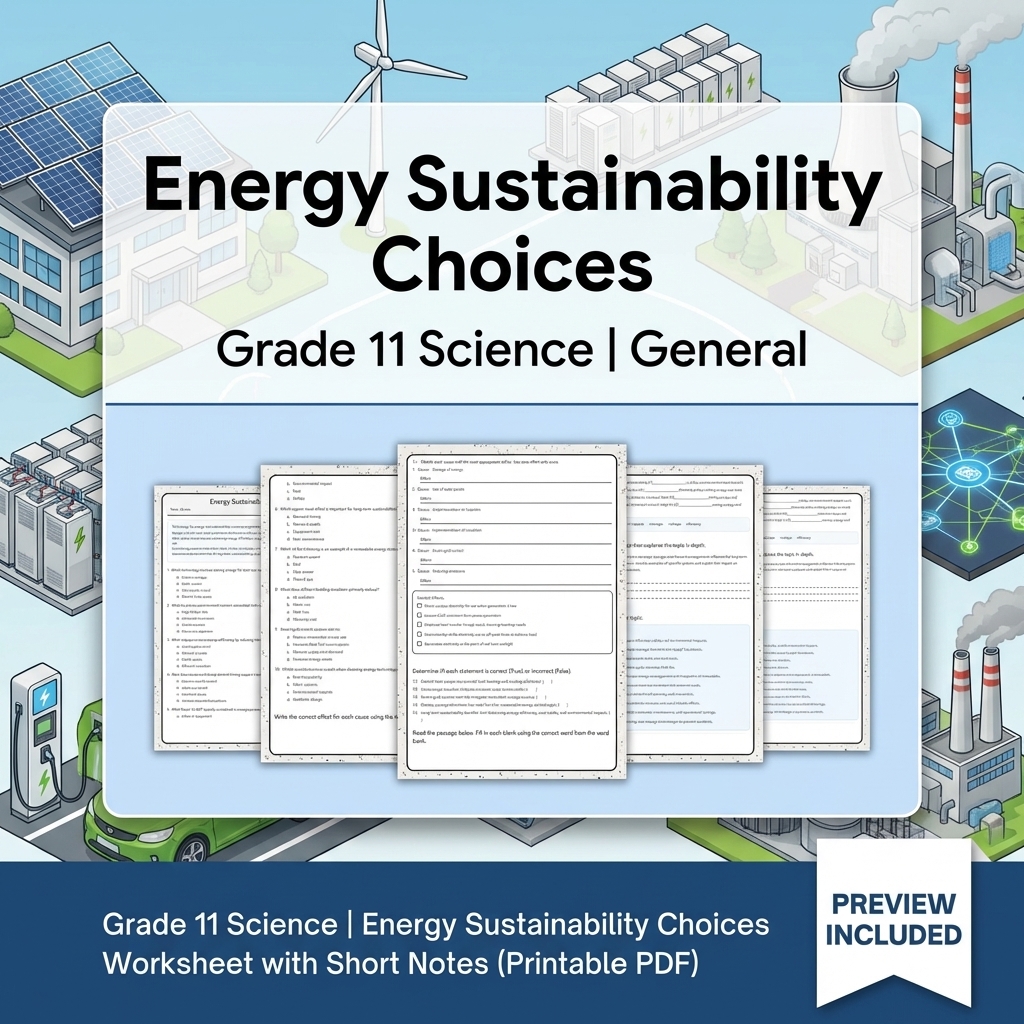
Grade 11 Science | Energy Sustainability Choices Worksheet with Short Notes
Created byMeadowlark WorksheetsLearning Objectives
- Understand how engineering designs influence environmental outcomes in energy systems.
- Identify key considerations such as efficiency, cost, safety, and environmental impacts.
- Analyze how system-level effects like storage influence demand and sustainability.
Also included in: Grade 11 Designing Reliable Systems Science Lesson Bundle – General +1 more
Instant download

Energy Transfer Processes Worksheet | Grade 11 Physics Science Activity
Created byPrism Point LearningLearning Objectives
- Explain how energy moves through thermal conduction, convection, and radiation.
- Predict how temperature changes when energy transfers between systems.
- Compare why insulators slow energy transfer and how materials can transfer energy with their environment.
Instant download

Grade 11 Science – Circular Motion Worksheet (Ontario) (PDF)
Created byEvergreen Desk EducationLearning Objectives
- Explain centripetal and tangential acceleration for objects moving in circular paths, including direction and magnitude.
- Analyze uniform vs non-uniform circular motion using relationships among speed, angular velocity, radius, period, and frequency.
- Calculate centripetal force and net radial force, and interpret how friction, banking, and rotating frames affect motion.
Also included in: Grade 11 Motion, Forces, and Electricity Science Lesson Bundle: Ontario +1 more
Instant download

Grade 11 Graphical Motion Worksheet | Practice & Assessment PDF
Created byClear Sky ClassroomLearning Objectives
- Interpret motion graphs by relating slope and area to average and instantaneous kinematic quantities.
- Construct piecewise and curved position and velocity graphs to represent constant vs. variable acceleration.
- Connect derivatives and integrals of position and velocity functions to physical rates, and apply graphical reasoning to multi-part motion.
Also included in: Grade 11 Physics Motion & Energy Science Lesson Bundle | Advanced Placement (AP) +1 more
Instant download

Grade 11 Science | Speciation Mechanisms Worksheet Elena | California Standards
Created byLumora LearningLearning Objectives
- Explain how reproductive isolation prevents gene flow and enables divergence between populations
- Compare geographic, ecological, and temporal mechanisms that can lead to speciation
- Describe how mutations and natural selection can accumulate independently after isolation begins
Instant download

Buffer Capacity in Acid-Base Systems Worksheets Grade 11 Science
Created bySunny Desk ResourcesLearning Objectives
- Explain what buffer capacity means in acid-base systems
- Describe how total buffer concentration affects buffering capacity
- Explain how component ratios influence resistance to pH change
Also included in: Grade 11 Acid-Base Chemistry Lesson Bundle: Alberta Science +1 more
Instant download
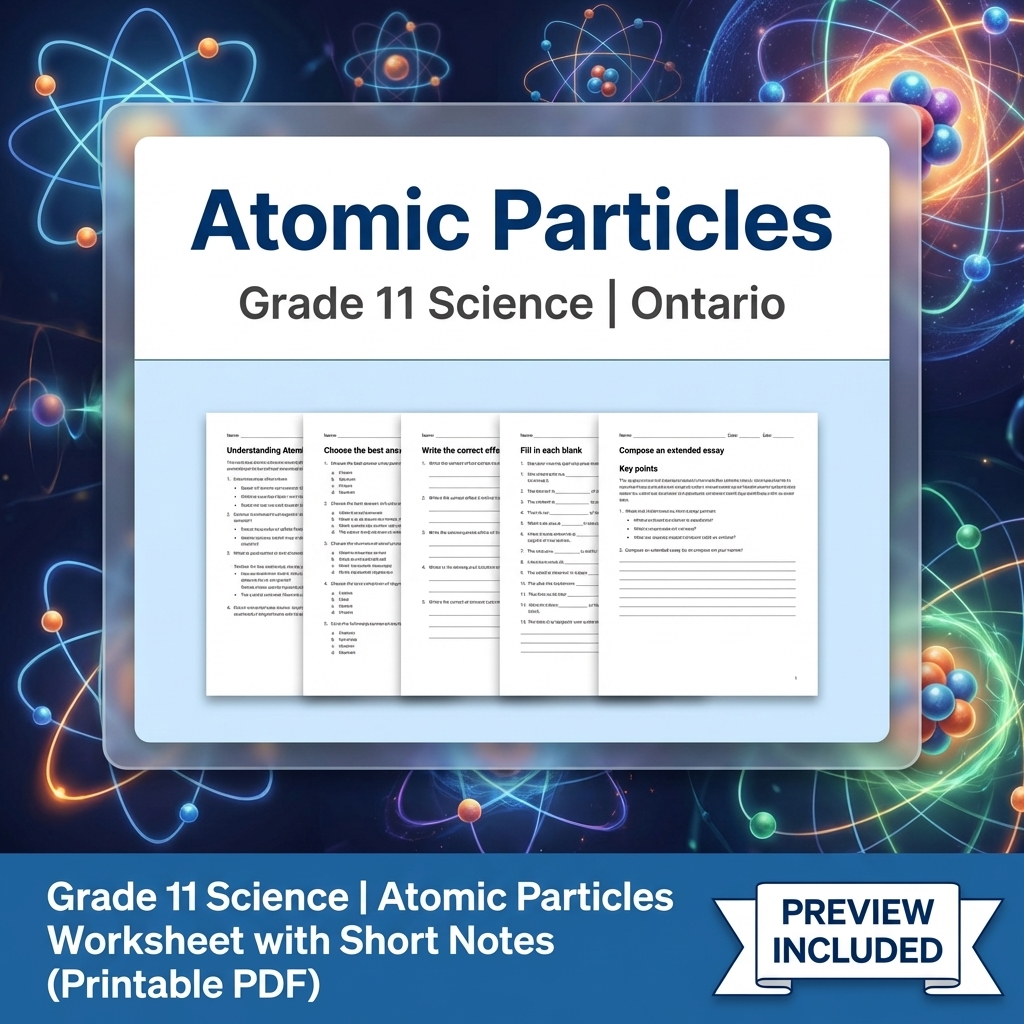
Grade 11 Science | Atomic Particles Worksheet with Short Notes (Printable PDF)
Created byMeadowlark WorksheetsLearning Objectives
- Describe the roles of protons, neutrons, and electrons in atomic structure.
- Contrast early planetary models with quantum models of the atom.
- Explain concepts of nuclear stability and isotopic variation.
Also included in: Grade 11 Science Lesson Bundle – Ontario Curriculum +1 more
Instant download

Population Growth Worksheet | Grade 11 Science Activities
Created byPrism Point LearningLearning Objectives
- Explain how birth rate, death rate, immigration, and emigration affect population size over time
- Compare exponential growth with logistic growth using the idea of carrying capacity
- Describe how density-dependent and density-independent factors influence population trajectories
Instant download

Grade 11 Population Dynamics in Ecology Worksheet | NGSS Ecology Activity
Created byBRIGHT PATH RESOURCESLearning Objectives
- Understand the key factors affecting population size, including birth, death, immigration, and emigration
- Identify different forms of population growth: exponential and logistic
- Recognize predator-prey interactions and their impact on populations
Also included in: Ecosystems Interactions Energy and Dynamics Grade 11 Science Bundle | NGSS +1 more
Instant download

Genetic Mutations & DNA Sequence Changes Worksheet | Grade 11 Biology | TEKS
Created byBRIGHT PATH RESOURCESLearning Objectives
- Identify common types of DNA sequence mutations described in a passage.
- Connect DNA sequence changes to how proteins and gene expression can be affected.
- Distinguish between coding changes, regulatory changes, and their possible effects on phenotypes.
Instant download

Grade 11 Science | Space Evidence & Motion - Daily Reading Comprehension
 Created byCoral Reef Learning
Learning Objectives
- Understand models of solar system formation
- Analyze orbital dynamics and electromagnetic observations
- Identify how gravitational interactions influence planetary stability
Instant download
About Grade 11 Science Worksheets
Browse 6,616 printable Grade 11 Science worksheets — ready-to-print PDFs with answer keys where available.
Each resource here is built by an independent educator and reviewed for quality. Worksheets print straight from PDF and suit classroom use, homework, or extra practice; most come with answer keys, and you can preview before purchasing.