
Grade 3 Science Worksheets
425 worksheets
Grade 3 Science Patterns From Data Worksheet with Short Notes (Printable PDF)
 Created byMeadowlark Worksheets
Learning Objectives
- Understand how data organization reveals patterns.
- Learn to interpret tables and graphs for comparisons.
- Connect patterns in data to reasoning and explanations.
Also included in: Grade 3 Science Lesson Bundle | Data, Models, and Evidence Activities +1 more
Instant download

Grade 3 Design Problem Statement Worksheet | Practice & PDF
 Created byClear Sky Classroom
Learning Objectives
- Identify the parts of a simple design problem statement: a real need or want, the situation, the goal, and success criteria.
- Distinguish between describing what must change (goal and success) and choosing specific materials or exact measurements.
- Create and evaluate clear design problem statements using plain, targeted language.
Instant download

Science Grade 3 Human Body System
 Created byTeacherNest
Learning Objectives
- Identify key human body parts and their jobs in simple terms
- Match body parts to functions shown in a labeled diagram
- Answer questions about how systems work together in the body
Instant download
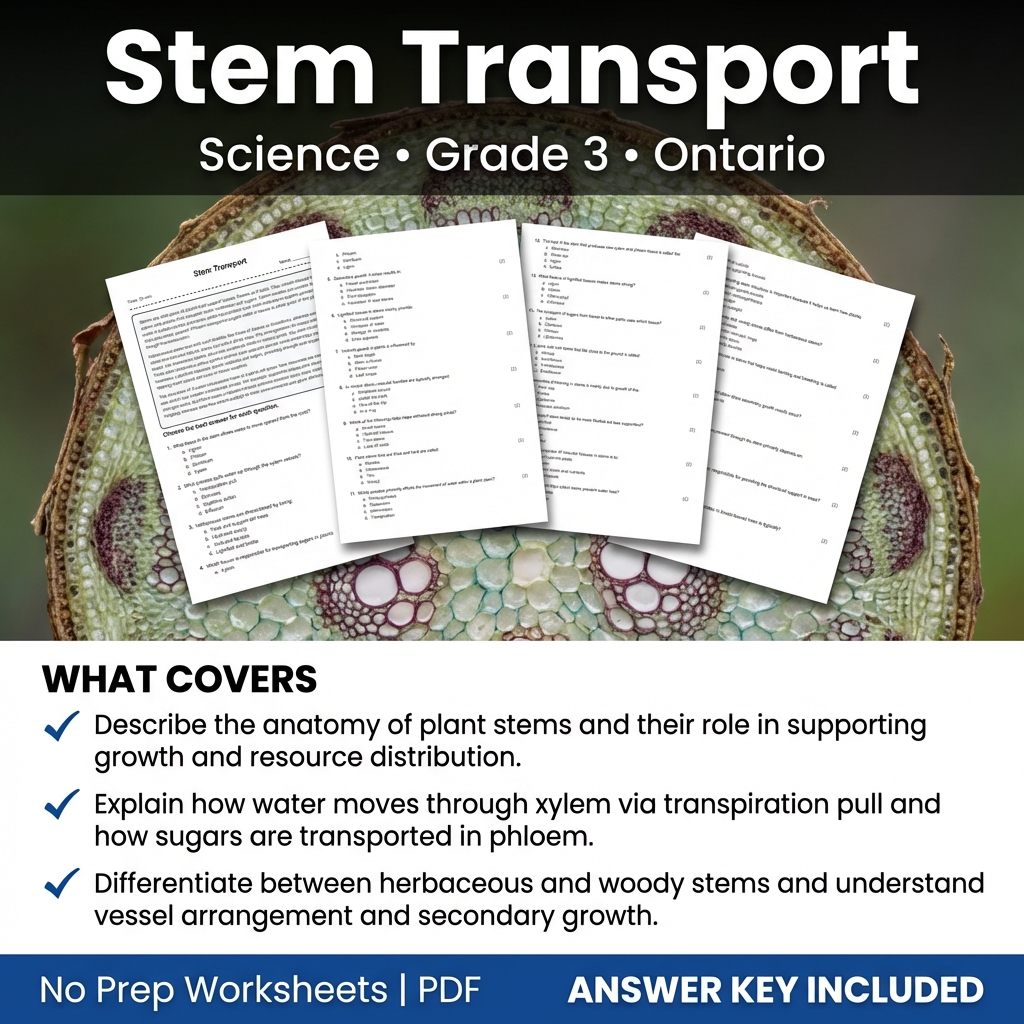
Stem Transport Science Worksheet for Grade 3 | Ontario Standards
 Created byCoral Reef Learning
Learning Objectives
- Describe the anatomy of plant stems and their role in supporting growth and resource distribution.
- Explain how water moves through xylem via transpiration pull and how sugars are transported in phloem.
- Differentiate between herbaceous and woody stems and understand vessel arrangement and secondary growth.
Instant download
Grade 3 Science | Body Structures Worksheet with Short Notes (Printable PDF)
Created byMeadowlark WorksheetsLearning Objectives
- Identify common external and internal structures of plants and animals.
- Understand the roles of different body parts in survival, growth, and reproduction.
- Recognize structural diversity among organisms using models and drawings.
Also included in: Grade 3 Science NGSS Unit | From Molecules to Organisms Bundle +1 more
Instant download

Science Grade 3 Sound & Vibrations
Created byTeacherNestLearning Objectives
- Identify solids, liquids, and gases from everyday examples
- Match each matter state to its properties
- Sort items by state of matter and label diagrams
Instant download
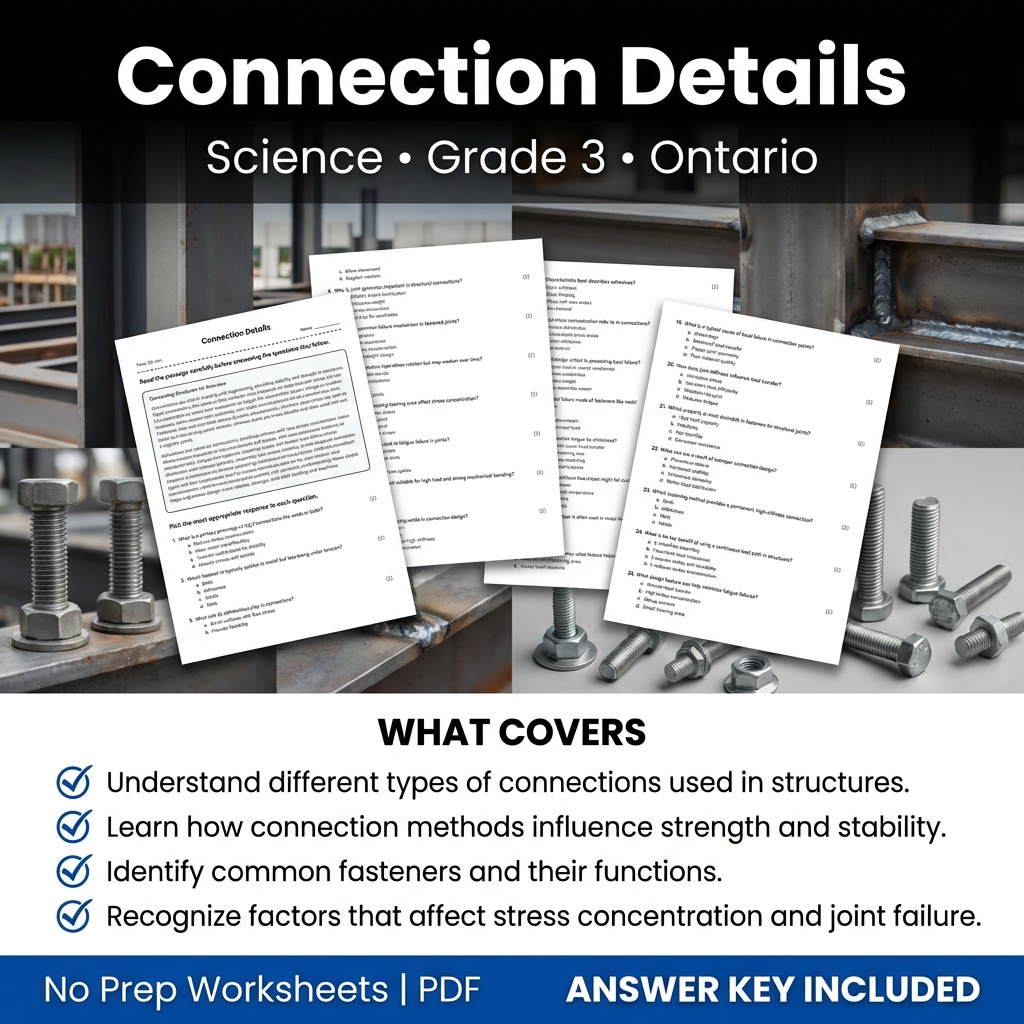
Connection Details Science Worksheet for Grade 3 | Ontario Standards
Created byCoral Reef LearningLearning Objectives
- Understand different types of connections used in structures.
- Learn how connection methods influence strength and stability.
- Identify common fasteners and their functions.
Instant download

Grade 3 Landform Processes Worksheet | NGSS Practice PDF
Created byClear Sky ClassroomLearning Objectives
- Identify how weathering, erosion, and deposition change landforms over time.
- Explain how water, wind, and ice can move soil and sediment to create features like valleys, stream channels, deltas, and hills.
- Use maps, photos, and simple models to connect observable landform changes to surface processes.
Instant download
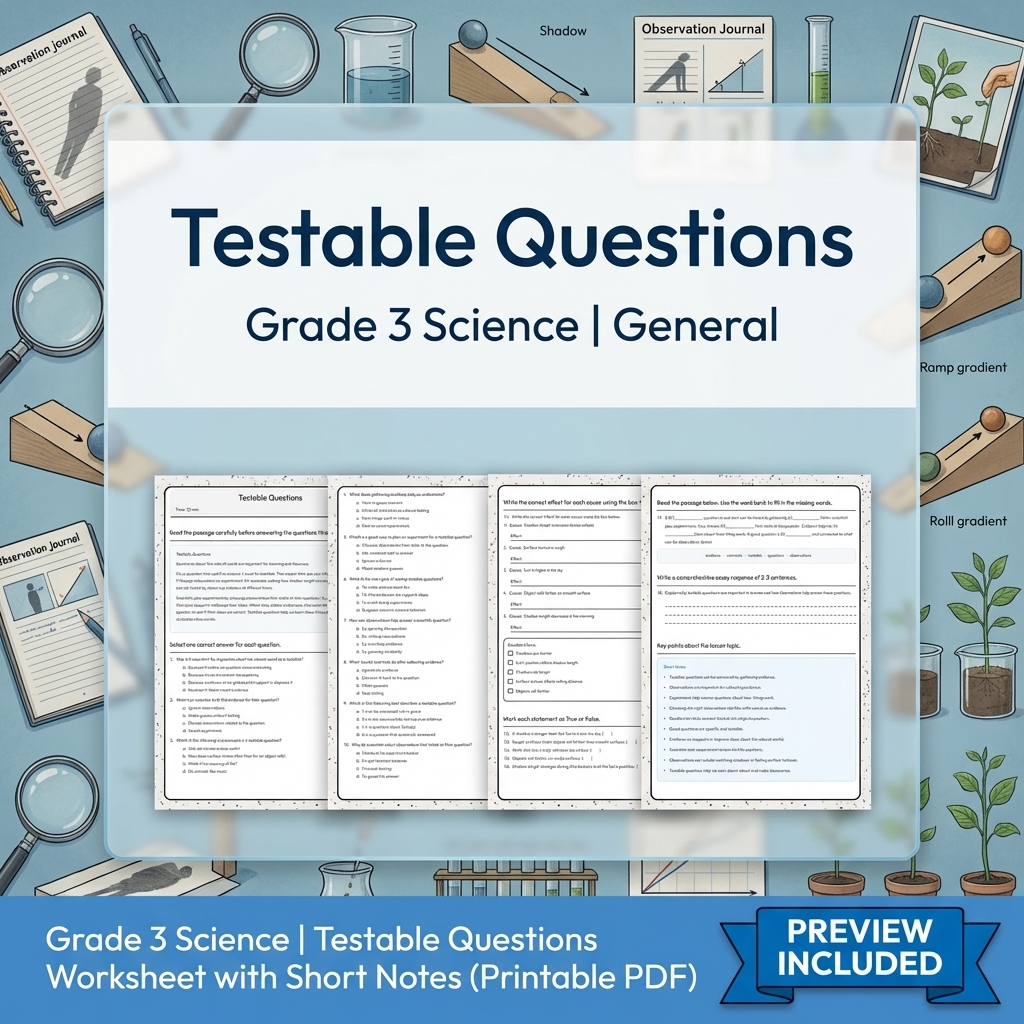
Grade 3 Science | Testable Questions Worksheet with Short Notes (Printable PDF)
Created byMeadowlark WorksheetsLearning Objectives
- Understand what makes a question testable and connected to evidence.
- Identify observations that relate to scientific questions.
- Learn how to select relevant evidence to support a question.
Also included in: Grade 3 Science Lesson Bundle | Data, Models, and Evidence Activities +1 more
Instant download
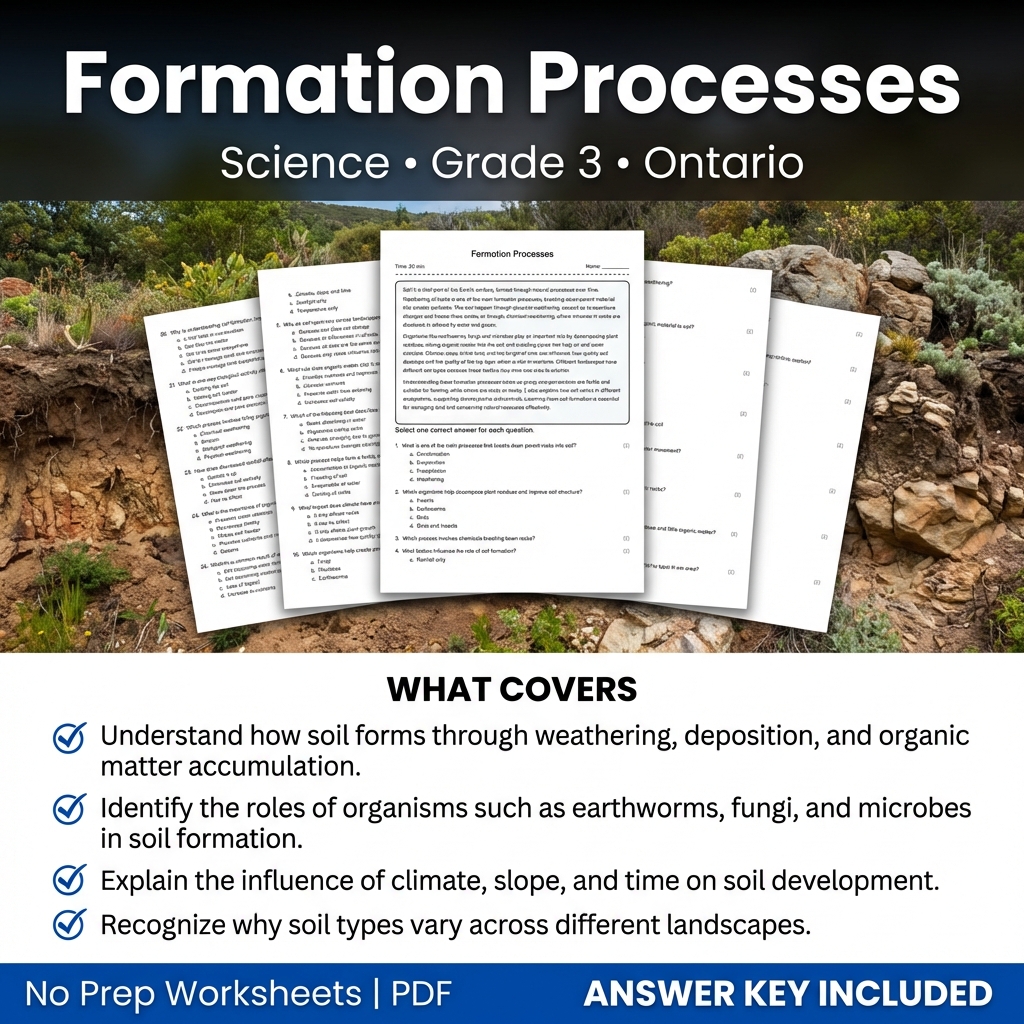
Formation Processes Worksheet | Science | Grade 3 | Ontario Standards
Created byCoral Reef LearningLearning Objectives
- Understand how soil forms through weathering, deposition, and organic matter accumulation.
- Identify the roles of organisms such as earthworms, fungi, and microbes in soil formation.
- Explain the influence of climate, slope, and time on soil development.
Instant download
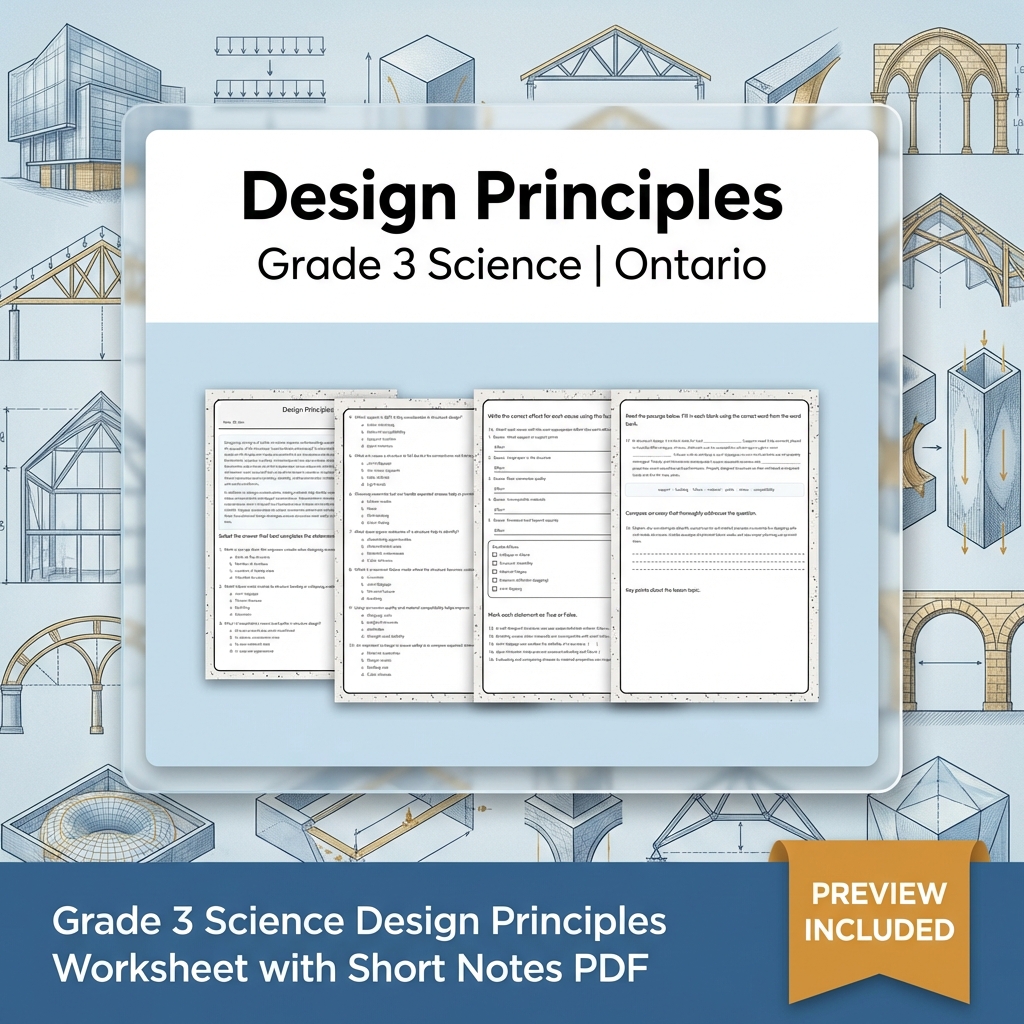
Grade 3 Science Design Principles Worksheet with Short Notes PDF
Created byMeadowlark WorksheetsLearning Objectives
- Understand the key considerations in planning and evaluating simple structures.
- Identify common failure modes in structural design.
- Use basic evaluation strategies to compare stresses and material properties.
Also included in: Grade 3 Science Basic Structures & Materials Worksheet Bundle | Ontario +1 more
Instant download
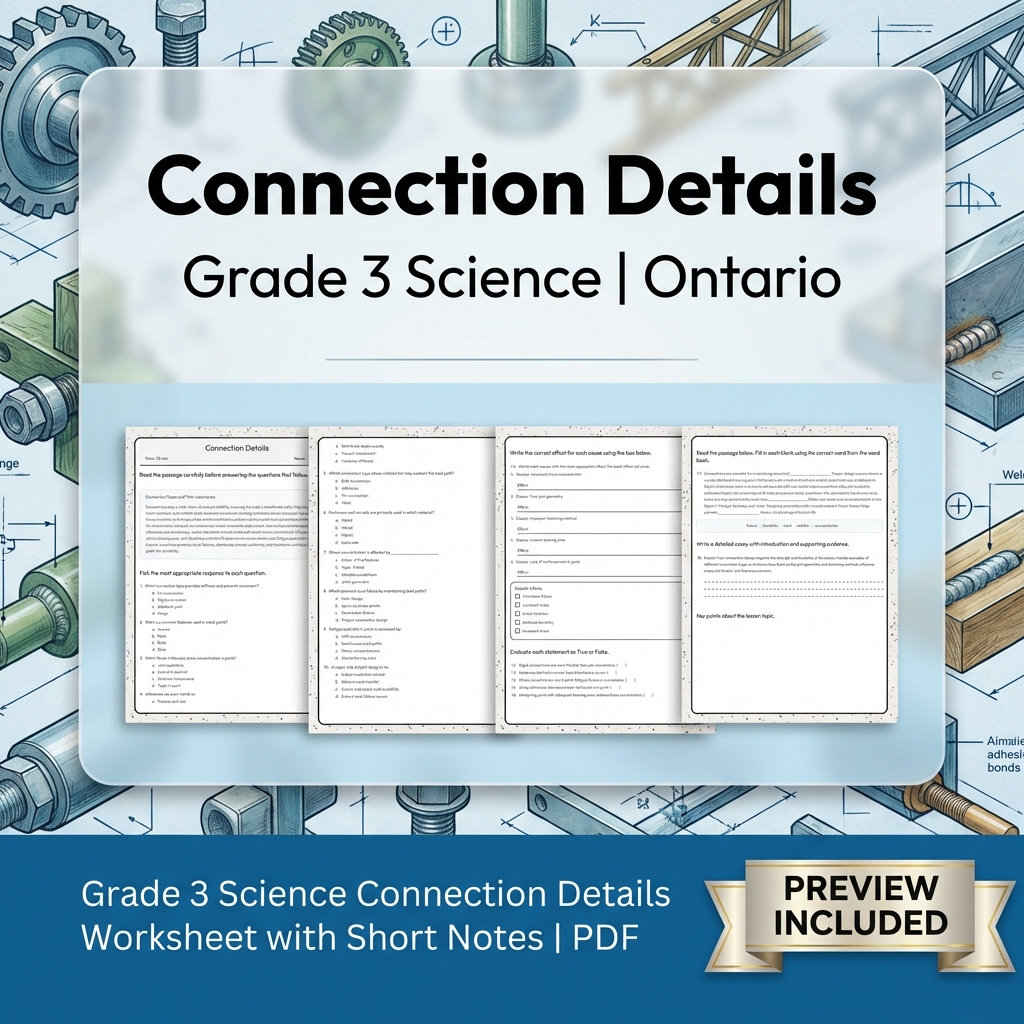
Grade 3 Science Connection Details Worksheet with Short Notes | PDF
Created byMeadowlark WorksheetsLearning Objectives
- Understand different types of connection methods in structures and their effects on stability.
- Identify the materials and fasteners used in various connections.
- Analyze how connection design influences stress distribution and failure mechanisms.
Also included in: Grade 3 Science Basic Structures & Materials Worksheet Bundle | Ontario +1 more
Instant download
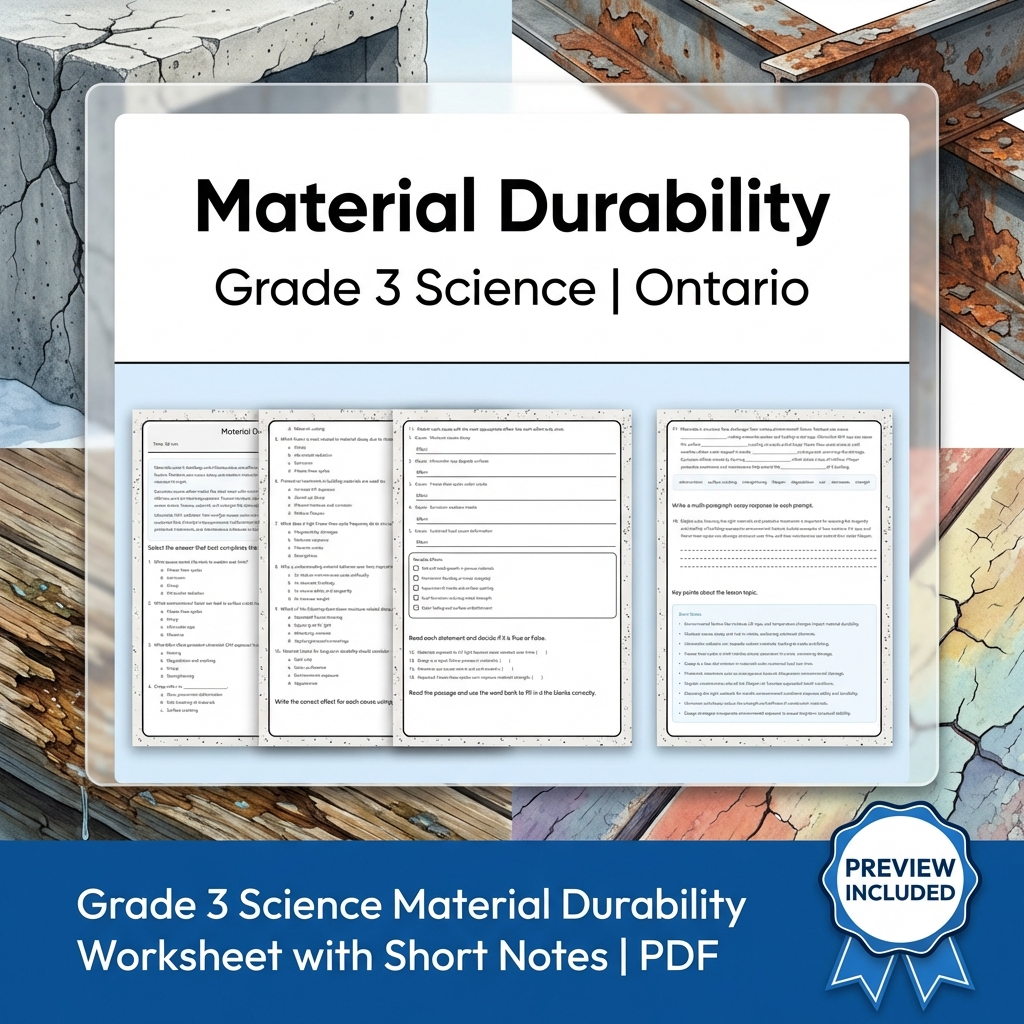
Grade 3 Science Material Durability Worksheet with Short Notes | PDF
Created byMeadowlark WorksheetsLearning Objectives
- Understand environmental factors affecting material performance in structures.
- Identify causes and consequences of material decay over time.
- Learn about protective treatments and maintenance for durability.
Also included in: Grade 3 Science Basic Structures & Materials Worksheet Bundle | Ontario +1 more
Instant download
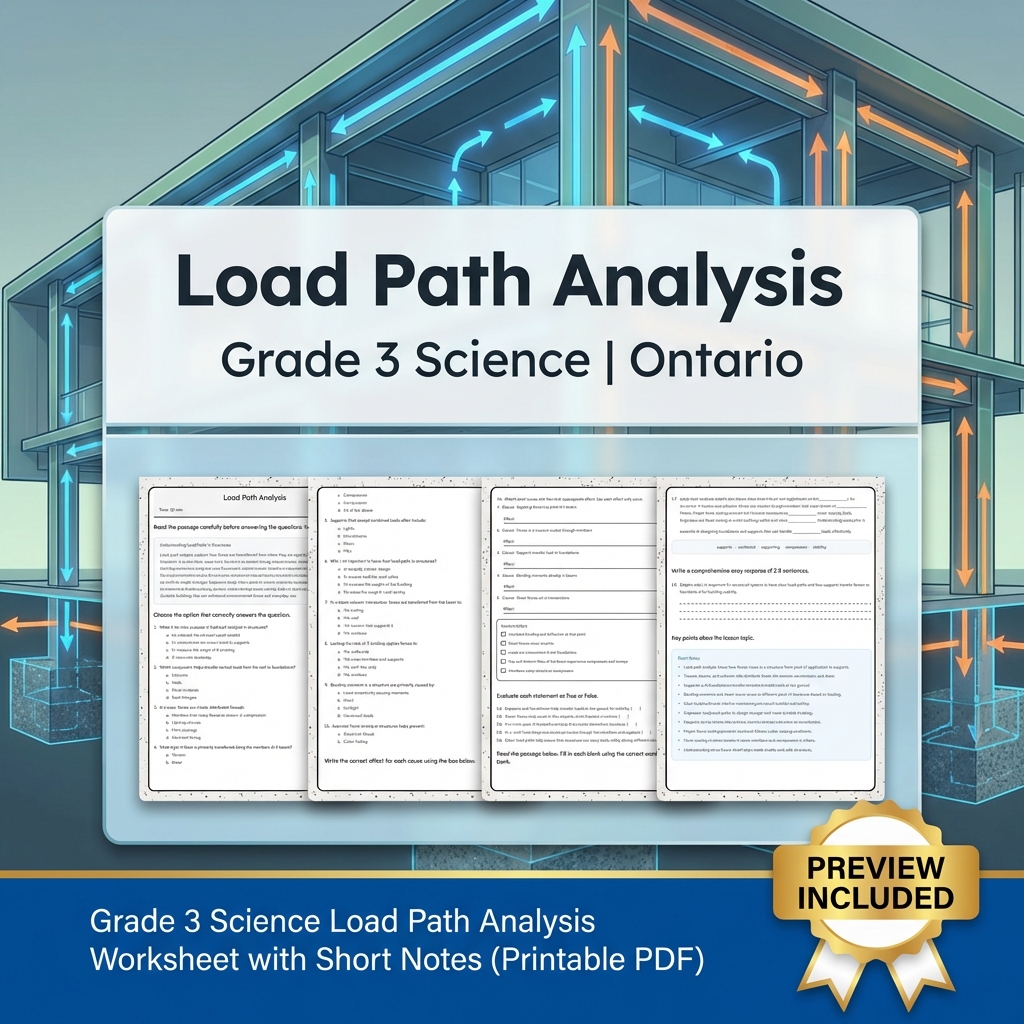
Grade 3 Science Load Path Analysis Worksheet with Short Notes (Printable PDF)
Created byMeadowlark WorksheetsLearning Objectives
- Understand how forces travel through structural systems from points of application to supports.
- Identify how trusses, beams, and columns distribute forces such as axial forces, bending moments, and shear.
- Explain the concept of supports and foundations accepting combined loads.
Also included in: Grade 3 Science Basic Structures & Materials Worksheet Bundle | Ontario +1 more
Instant download
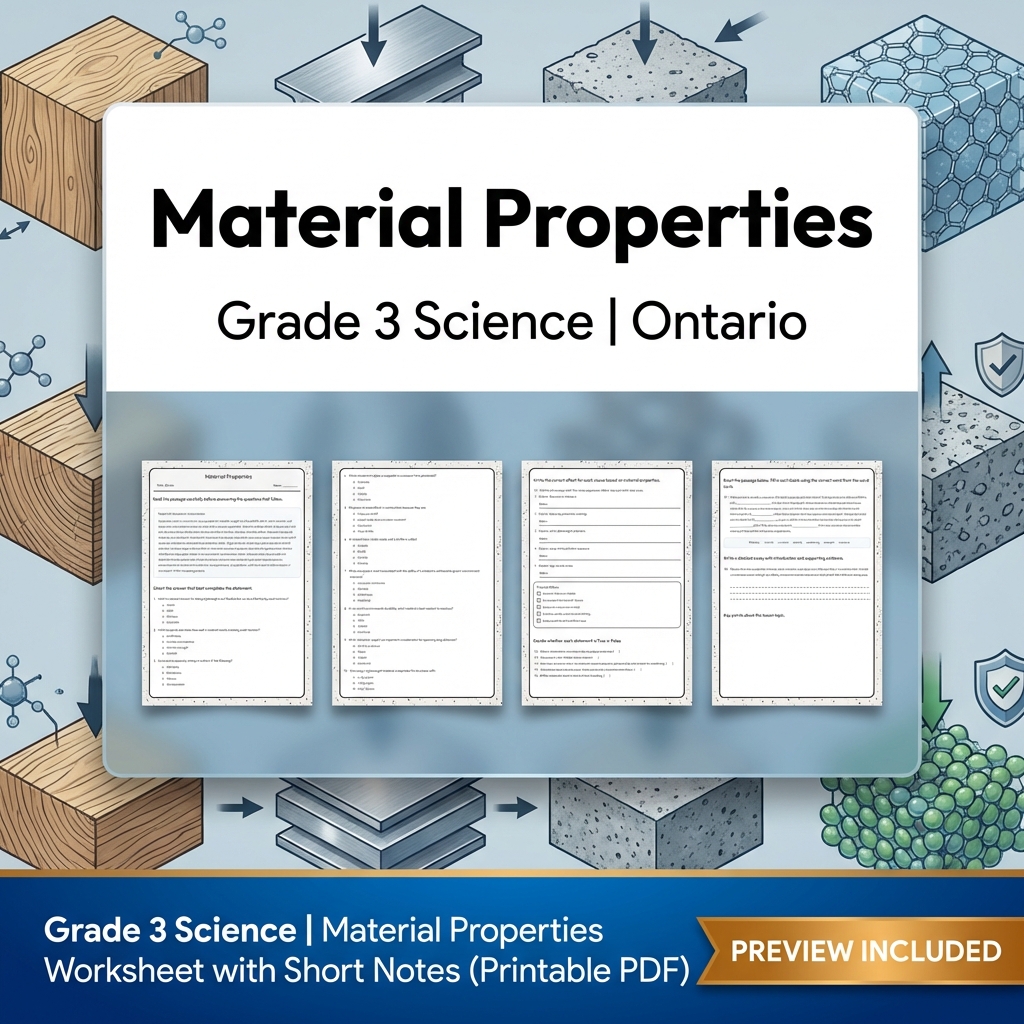
Grade 3 Science | Material Properties Worksheet with Short Notes (Printable PDF)
Created byMeadowlark WorksheetsLearning Objectives
- Compare common construction materials and their properties related to strength and stability.
- Identify how environmental factors affect different materials over time.
- Understand trade-offs in choosing materials based on weight, durability, and cost.
Also included in: Grade 3 Science Basic Structures & Materials Worksheet Bundle | Ontario +1 more
Instant download
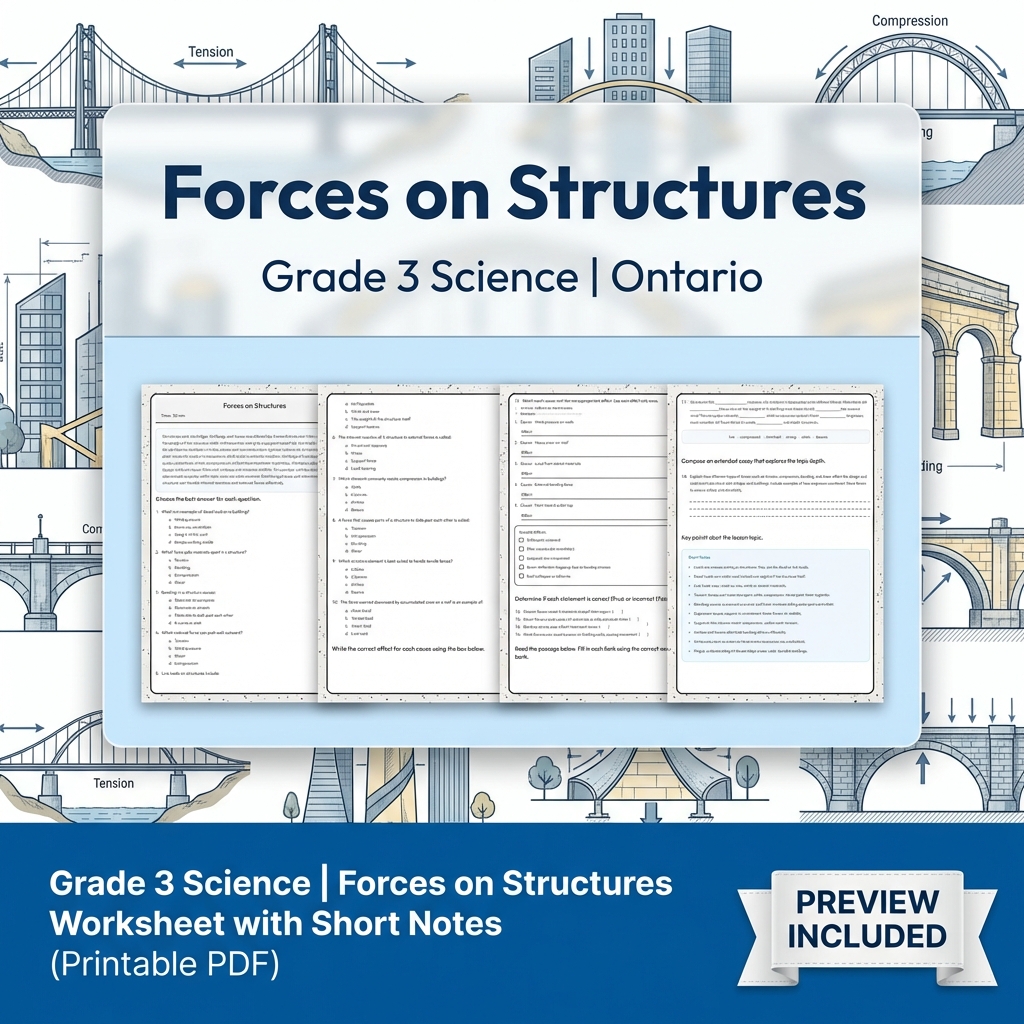
Grade 3 Science | Forces on Structures Worksheet with Short Notes(Printable PDF)
Created byMeadowlark WorksheetsLearning Objectives
- Understand the different types of forces acting on simple structures.
- Identify load types such as dead loads and live loads.
- Relate forces like tension, compression, bending, and shear to structural elements.
Also included in: Grade 3 Science Basic Structures & Materials Worksheet Bundle | Ontario +1 more
Instant download
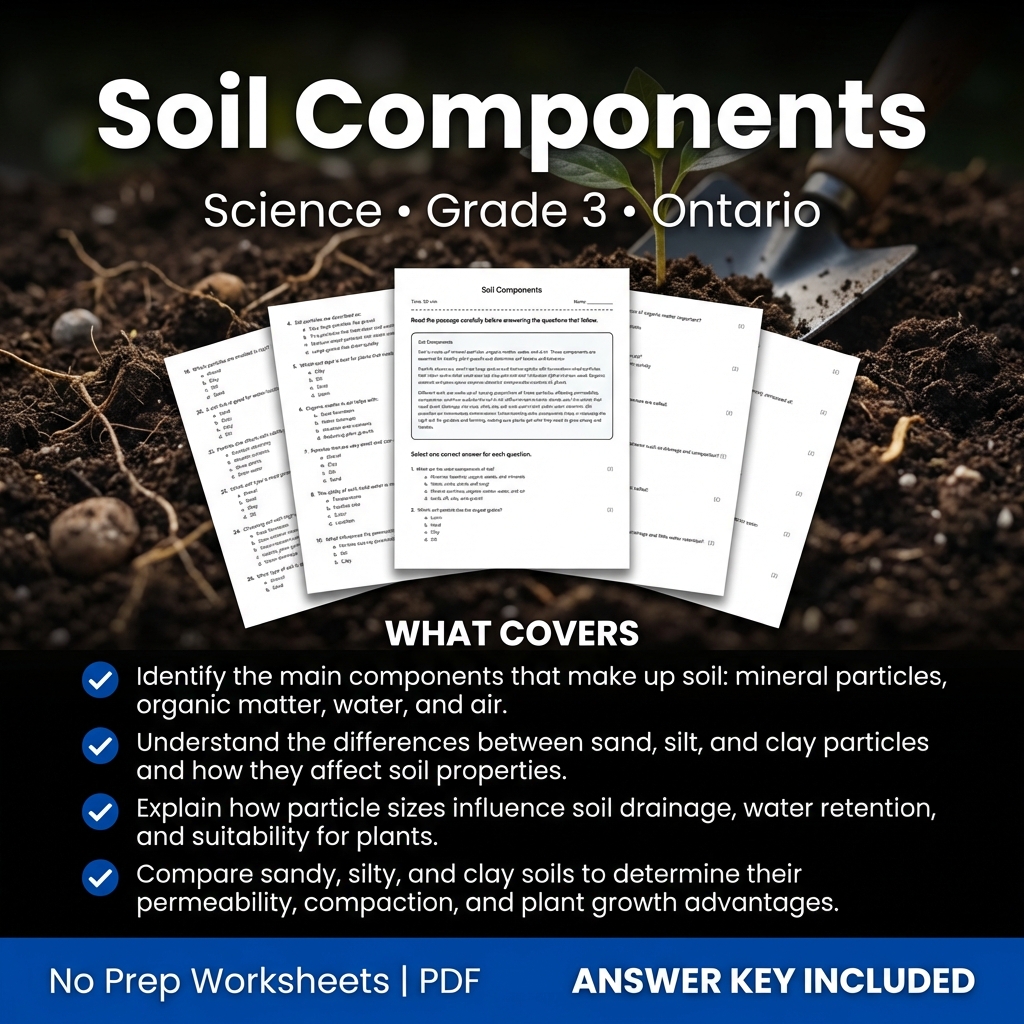
Soil Components Grade 3 Science Worksheet | Ontario Standards
Created byCoral Reef LearningLearning Objectives
- Identify the main components that make up soil: mineral particles, organic matter, water, and air.
- Understand the differences between sand, silt, and clay particles and how they affect soil properties.
- Explain how particle sizes influence soil drainage, water retention, and suitability for plants.
Instant download

Material Properties and Structural Trade-Offs Worksheets Grade 3
 Created byPrism Point Learning
Learning Objectives
- Compare common building materials using density, stiffness, and strength properties.
- Explain how brittleness, corrosion resistance, and load type affect structural stability.
- Choose suitable materials for a simple construction scenario based on trade-offs.
Instant download
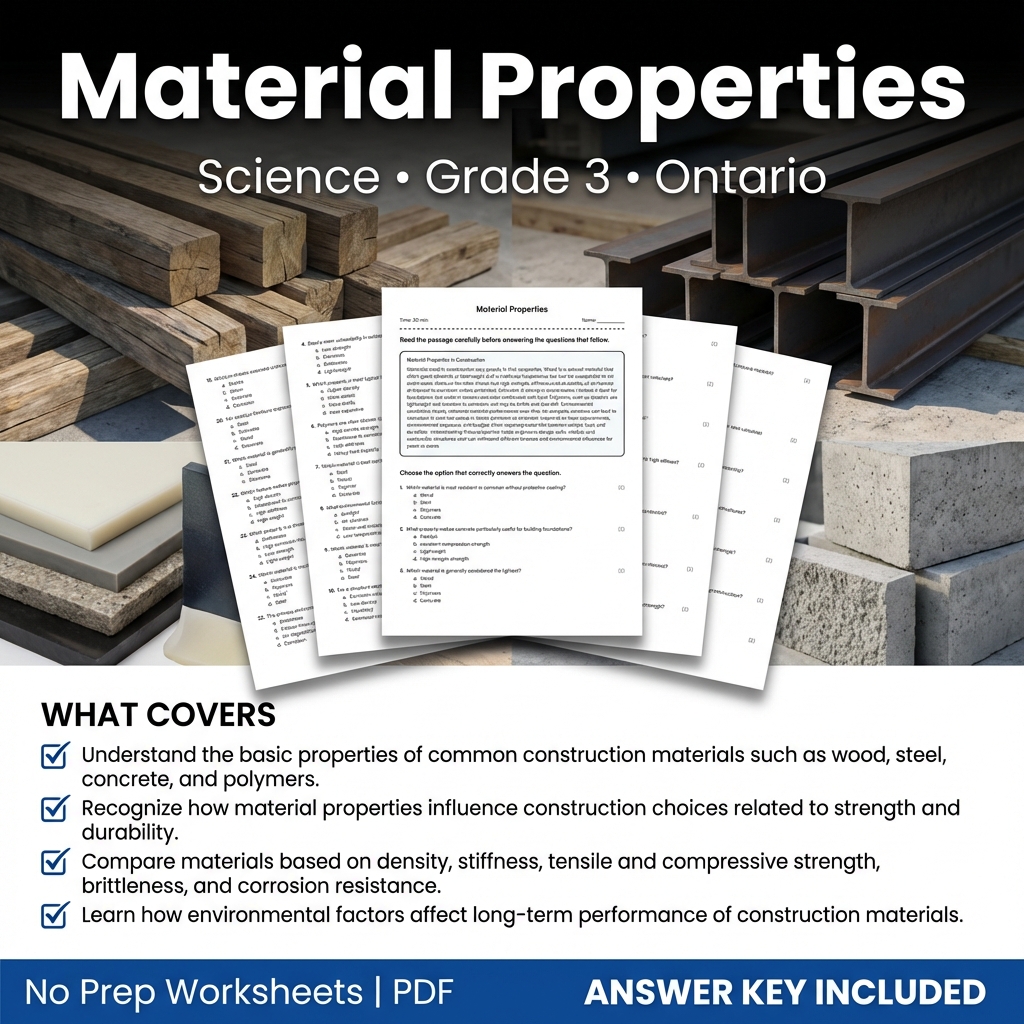
Material Properties Worksheet for Grade 3 Science | Ontario Framework
Created byCoral Reef LearningLearning Objectives
- Understand the basic properties of common construction materials such as wood, steel, concrete, and polymers.
- Recognize how material properties influence construction choices related to strength and durability.
- Compare materials based on density, stiffness, tensile and compressive strength, brittleness, and corrosion resistance.
Instant download
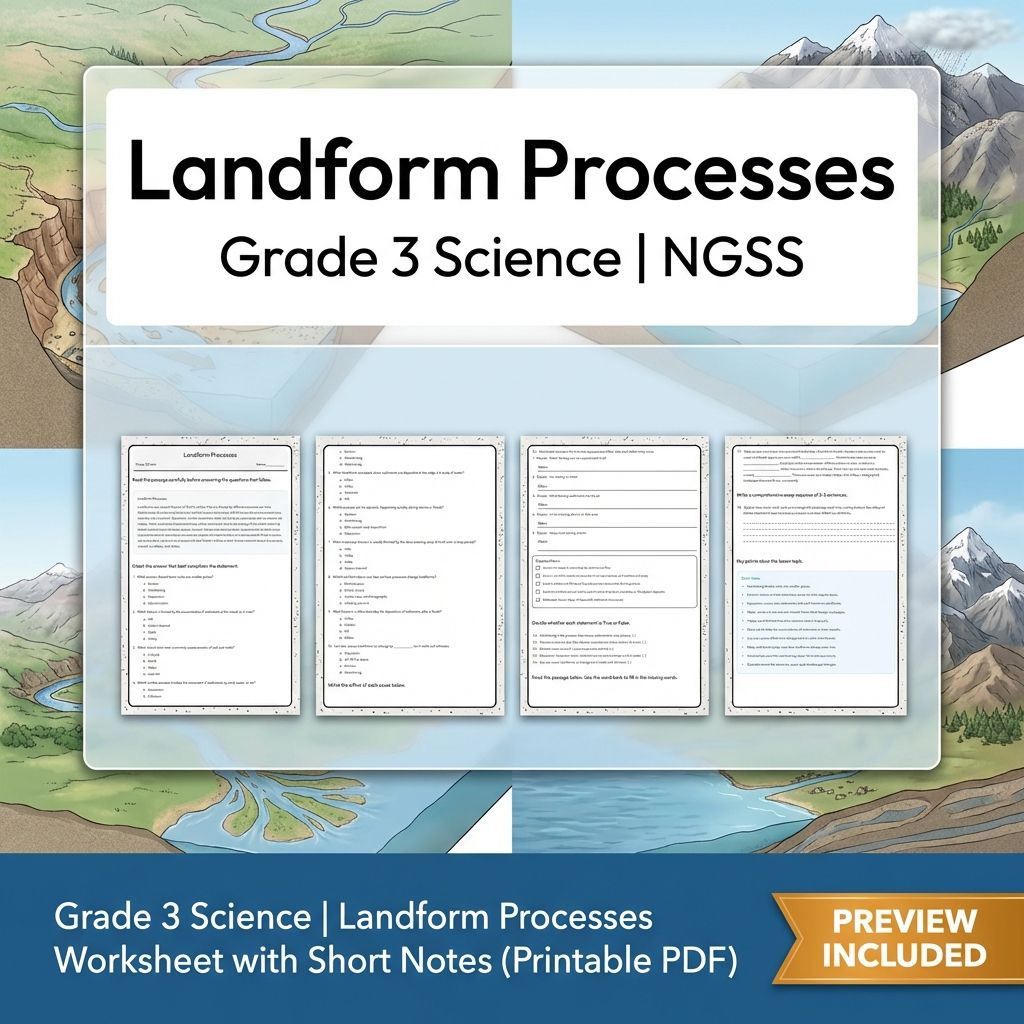
Grade 3 Science | Landform Processes Worksheet with Short Notes (Printable PDF)
Created byMeadowlark WorksheetsLearning Objectives
- Identify different surface processes such as weathering, erosion, and deposition.
- Describe how water, wind, and ice shape local landforms like valleys, deltas, and hills.
- Understand the impact of surface processes on landscape change over time.
Also included in: Grade 3 Science | Earth's Systems Unit Bundle (NGSS-Aligned Worksheets) +1 more
Instant download
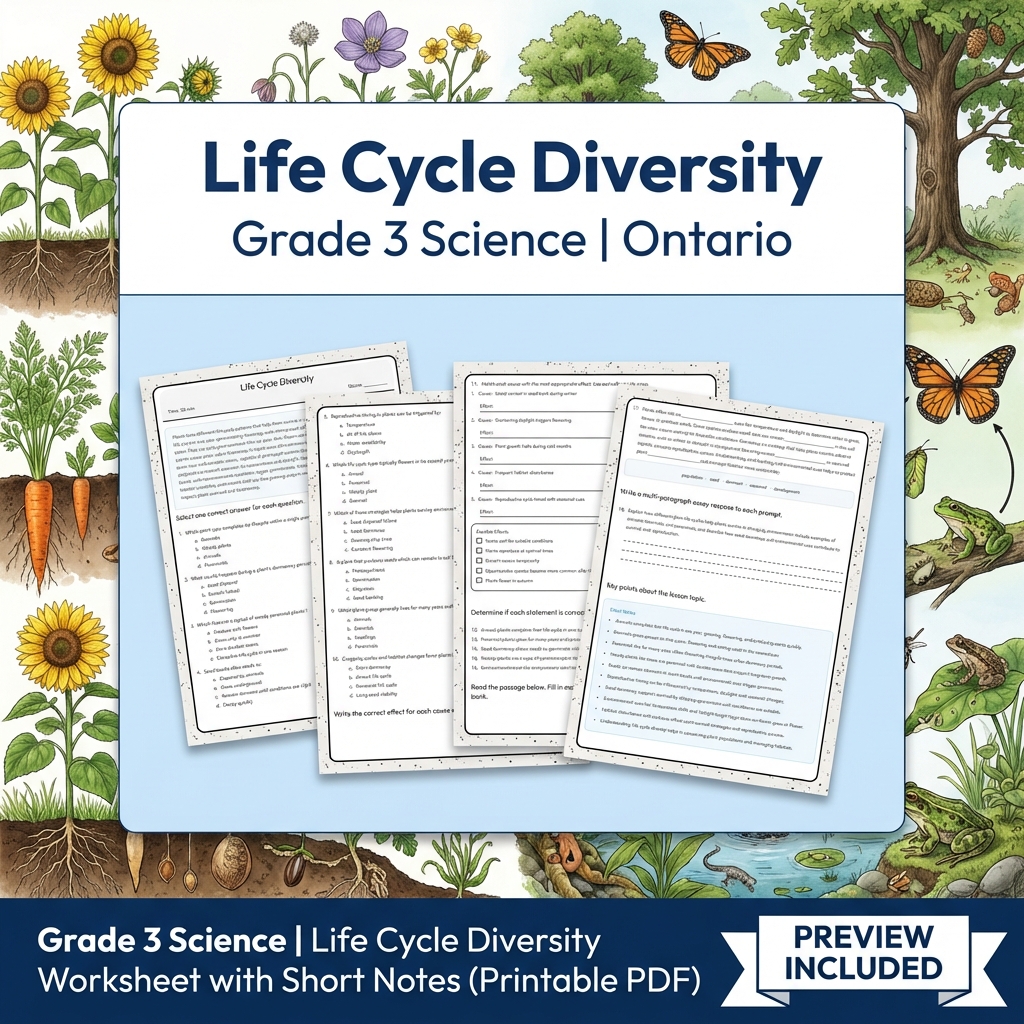
Grade 3 Science | Life Cycle Diversity Worksheet with Short Notes(Printable PDF)
Created byMeadowlark WorksheetsLearning Objectives
- Compare and describe life cycle patterns of annuals, biennials, perennials, and woody plants.
- Identify key stages such as germination, flowering, seed set, and dormancy strategies.
- Explain seed banking and environmental cues that trigger plant development.
Also included in: Grade 3 Science Lesson Group | Ontario STEM Worksheets Bundle Transport & Plants +1 more
Instant download

Grade 3 Animal Body Structures Worksheet | NGSS Practice PDF
Created byClear Sky ClassroomLearning Objectives
- Explain how animal body structures help them survive in their environments.
- Identify how body coverings, limbs, and other protective features support movement and safety.
- Use evidence from short texts to describe the main idea about adaptations.
Instant download

Grade 3 Sorting by Evidence Worksheet | General Practice PDF
Created byClear Sky ClassroomLearning Objectives
- Use multiple properties (mass/volume, texture, and shape) to sort and describe materials more precisely.
- Explain how comparing two materials with shared and different properties strengthens evidence-based conclusions.
- Use evidence statements to decide whether they are true or false about sorting materials.
Instant download
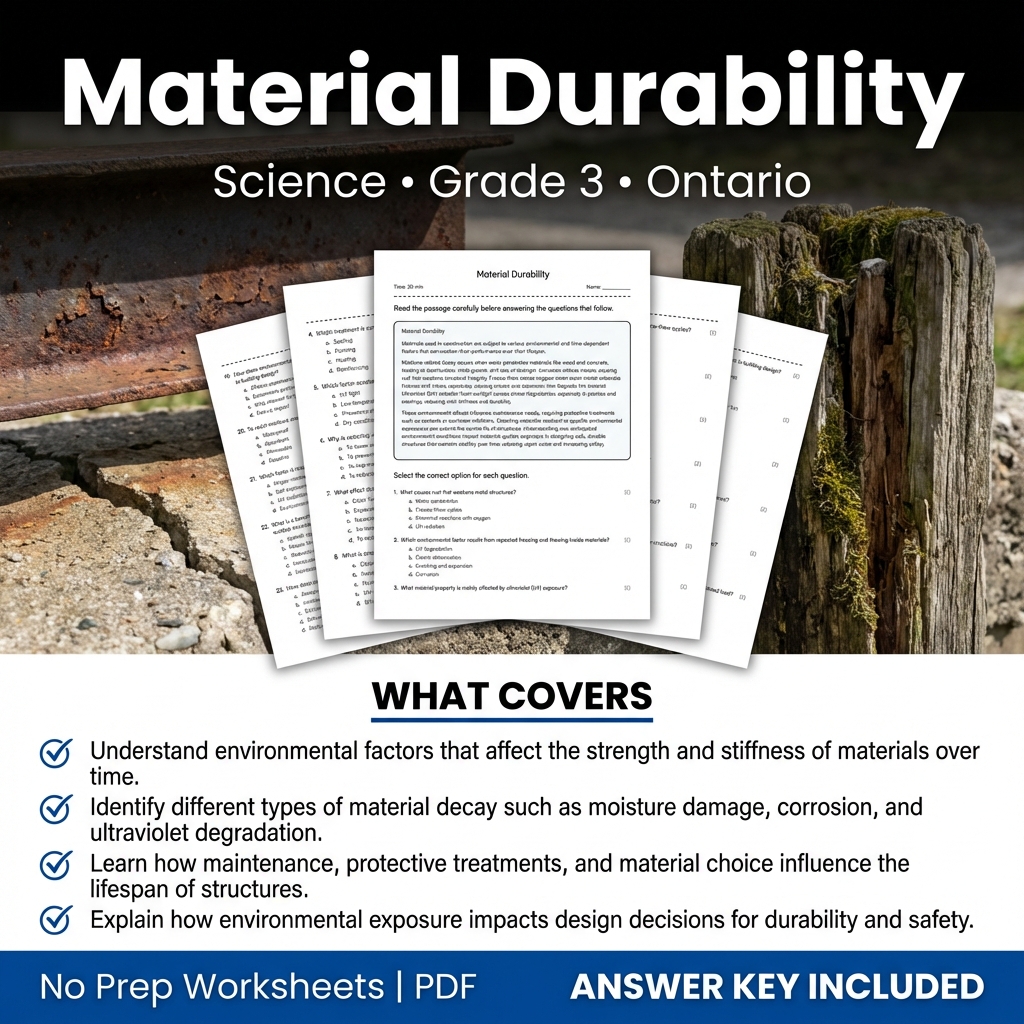
Grade 3 Science Worksheet on Material Durability | Ontario Standards
Created byCoral Reef LearningLearning Objectives
- Understand environmental factors that affect the strength and stiffness of materials over time.
- Identify different types of material decay such as moisture damage, corrosion, and ultraviolet degradation.
- Learn how maintenance, protective treatments, and material choice influence the lifespan of structures.
Instant download

Form and Function in Living Things Worksheets Grade 3 Science
 Created byTeachers Club
Learning Objectives
- Explain how an external or internal structure helps an organism survive and reproduce.
- Identify evidence that links structure (form) to the job it performs (function).
- Compare how different species have different structures for similar life needs.
Also included in: From Molecules to Organisms Grade 3 Science NGSS Bundle +1 more
Instant download
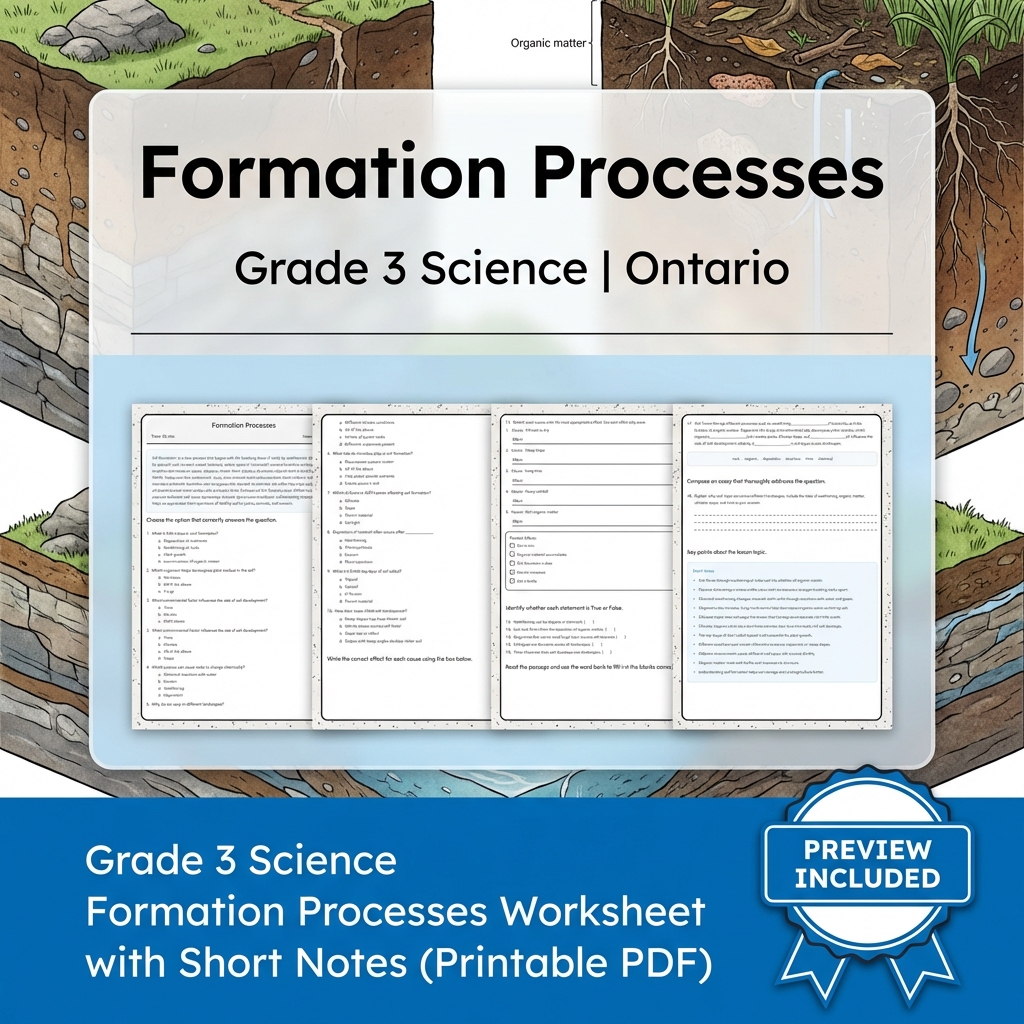
Grade 3 Science Formation Processes Worksheet with Short Notes (Printable PDF)
Created byMeadowlark WorksheetsLearning Objectives
- Understand how soil forms through weathering, deposition, and organic matter accumulation.
- Identify the roles of organisms and environmental factors in soil formation.
- Explain different processes that affect soil development and variation.
Also included in: Grade 3 Science Lesson Group Worksheets | Ontario Framework +1 more
Instant download
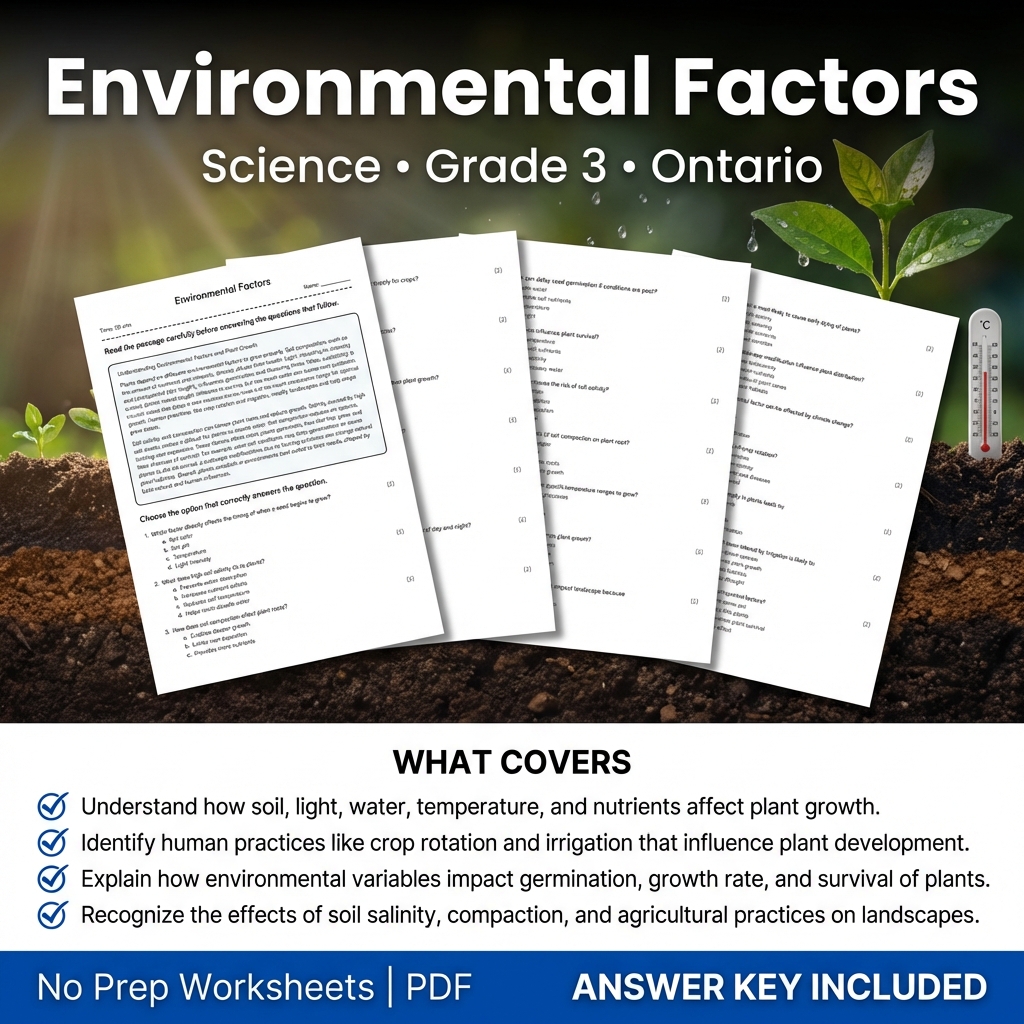
Environmental Factors Grade 3 Science Worksheet | Ontario Standards
Created byCoral Reef LearningLearning Objectives
- Understand how soil, light, water, temperature, and nutrients affect plant growth.
- Identify human practices like crop rotation and irrigation that influence plant development.
- Explain how environmental variables impact germination, growth rate, and survival of plants.
Instant download

Grade 3 Prototype Testing Worksheet | Practice & Assessment PDF
Created byClear Sky ClassroomLearning Objectives
- Explain what a prototype is and why it is tested.
- Identify evidence from testing (strength, fit, stability, and function).
- Match test observations to the intended goal of the design.
Instant download

Grade 3 Reasoning With Models Worksheet | Practice & General PDF
Created byClear Sky ClassroomLearning Objectives
- Explain how scientific models represent ideas that are hard to see, measure, or predict
- Use models to describe relationships and cause-and-effect connections
- Choose evidence and observations that best support or improve a model
Instant download
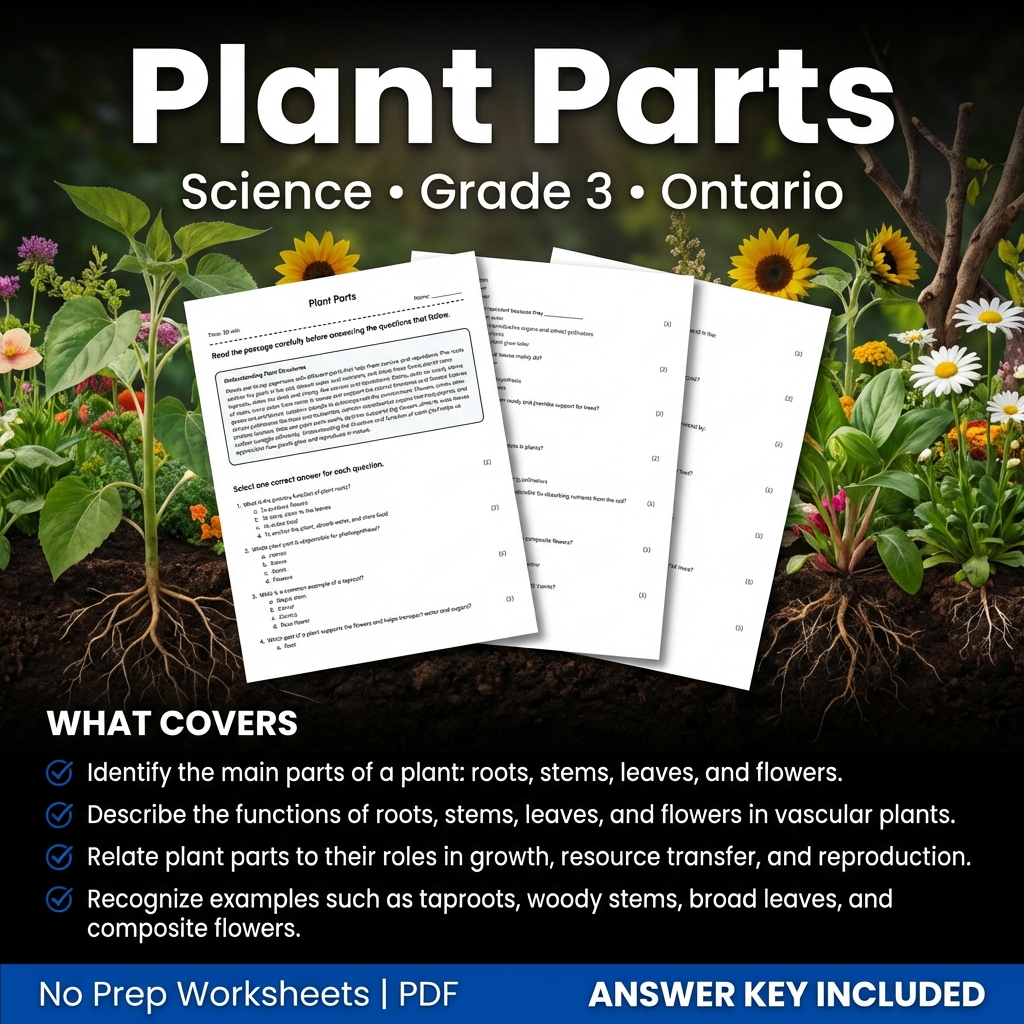
Plant Parts Science Worksheet Grade 3 | Ontario Standard Practice
Created byCoral Reef LearningLearning Objectives
- Identify the main parts of a plant: roots, stems, leaves, and flowers.
- Describe the functions of roots, stems, leaves, and flowers in vascular plants.
- Relate plant parts to their roles in growth, resource transfer, and reproduction.
Instant download
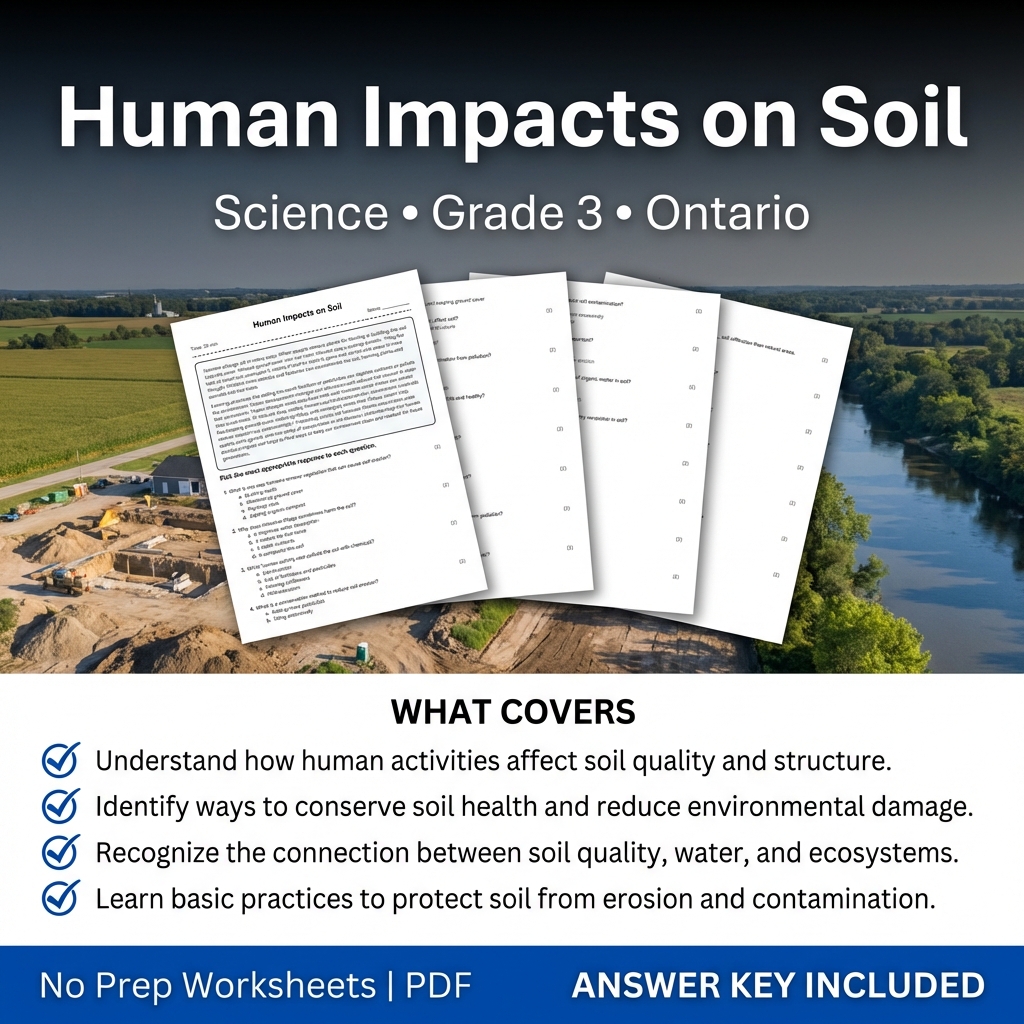
Human Impacts on Soil Grade 3 Science Worksheet | Ontario Standards
Created byCoral Reef LearningLearning Objectives
- Understand how human activities affect soil quality and structure.
- Identify ways to conserve soil health and reduce environmental damage.
- Recognize the connection between soil quality, water, and ecosystems.
Instant download

Grade 3 Load Path Analysis Worksheet | Ontario Use Practice PDF
Created byClear Sky ClassroomLearning Objectives
- Explain how loads travel through a structural system from where they are applied to supports and foundations.
- Identify axial forces, bending moments, and shear in simple trusses, beams, and columns.
- Describe what supports and foundations do when they accept combined loads.
Instant download

Grade 3 Science Worksheet | Understanding Weathering Patterns (PDF)
 Created byEvergreen Desk Education
Learning Objectives
- Explain how weathering slowly changes rocks and soil
- Identify patterns in weathering caused by wind, water, sunlight, and temperature changes
- Distinguish weathering from weather
Also included in: Grade 3 Weather & Earth Materials Science Lesson Bundle: General Framework +1 more
Instant download

Grade 3 Science – Shadows and Transparency Worksheet (PDF)
Created byEvergreen Desk EducationLearning Objectives
- Explain why shadows form when objects block light along its path
- Describe how light creates darker regions behind an object
- Compare how opaque, transparent, and translucent materials affect what we can see
Also included in: Grade 3 Science: Light, Sound & Matter Lesson Bundle for General Framework +1 more
Instant download
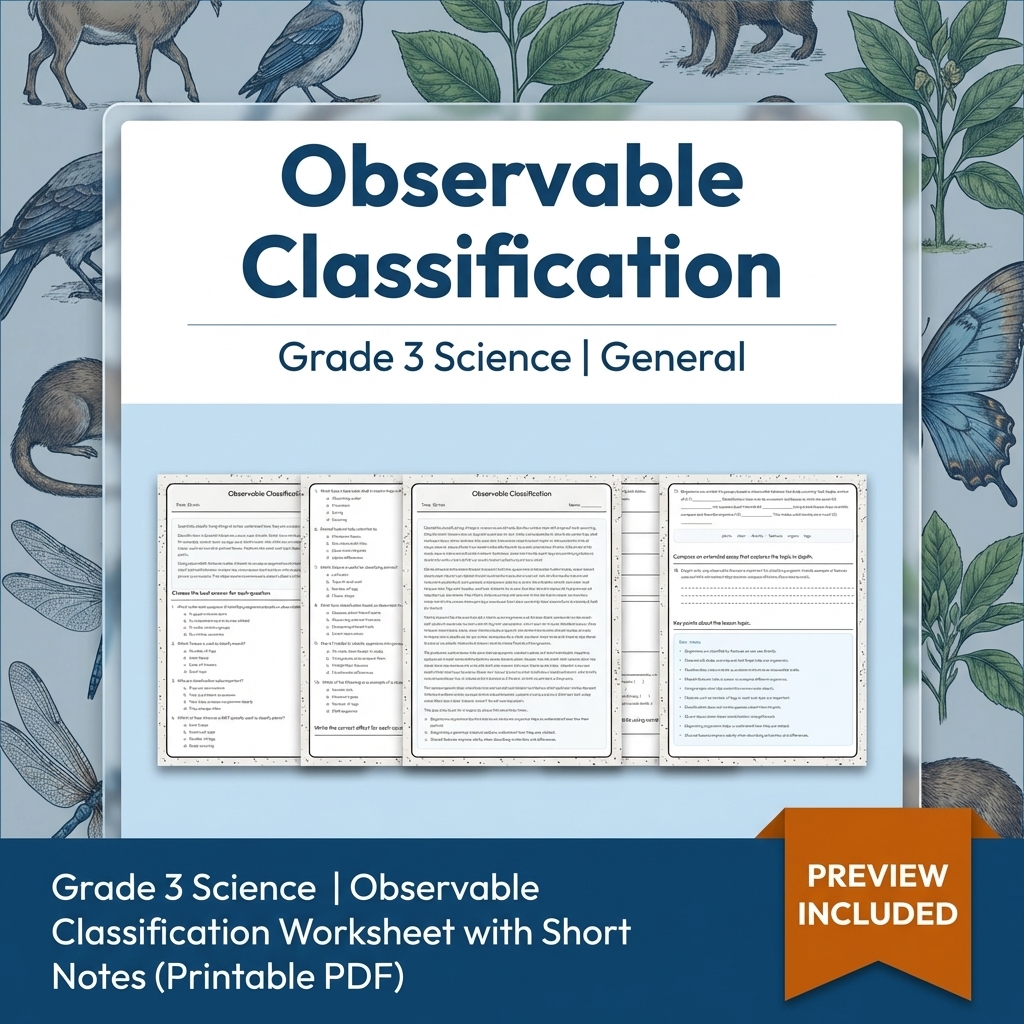
Grade 3 Science | Observable Classification Worksheet with Short Notes
Created byMeadowlark WorksheetsLearning Objectives
- Understand how organisms are classified based on observable features.
- Identify different features such as body covering, leaf shape, number of legs, and seed coat type.
- Learn classification rules that are consistent and based on direct observation.
Also included in: Grade 3 Science Lesson Group | Engaging Science Worksheets & Activities +1 more
Instant download
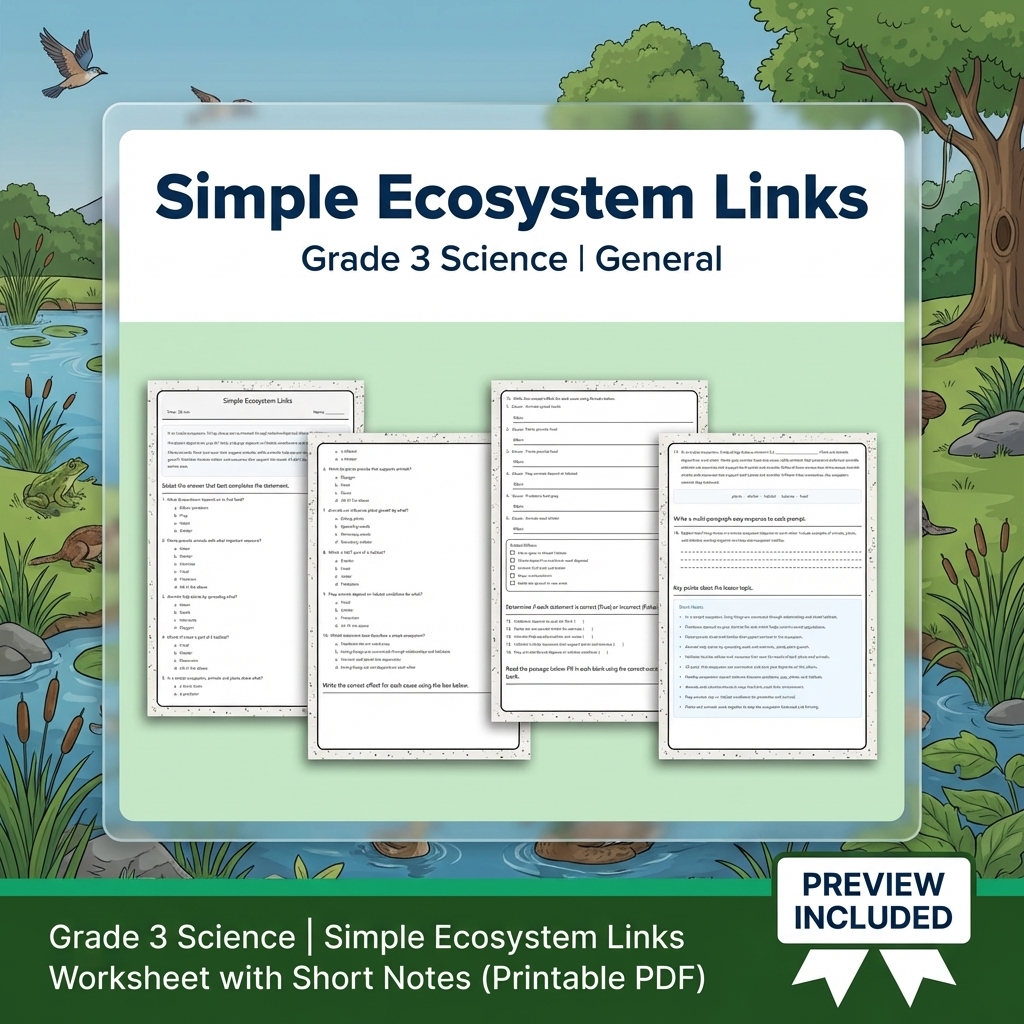
Grade 3 Science | Simple Ecosystem Links Worksheet with Short Notes
Created byMeadowlark WorksheetsLearning Objectives
- Understand how living things are connected in a simple ecosystem.
- Identify relationships between predators, prey, plants, and animals.
- Learn how habitats support the survival of plants and animals.
Also included in: Grade 3 Science Lesson Group | Engaging Science Worksheets & Activities +1 more
Instant download
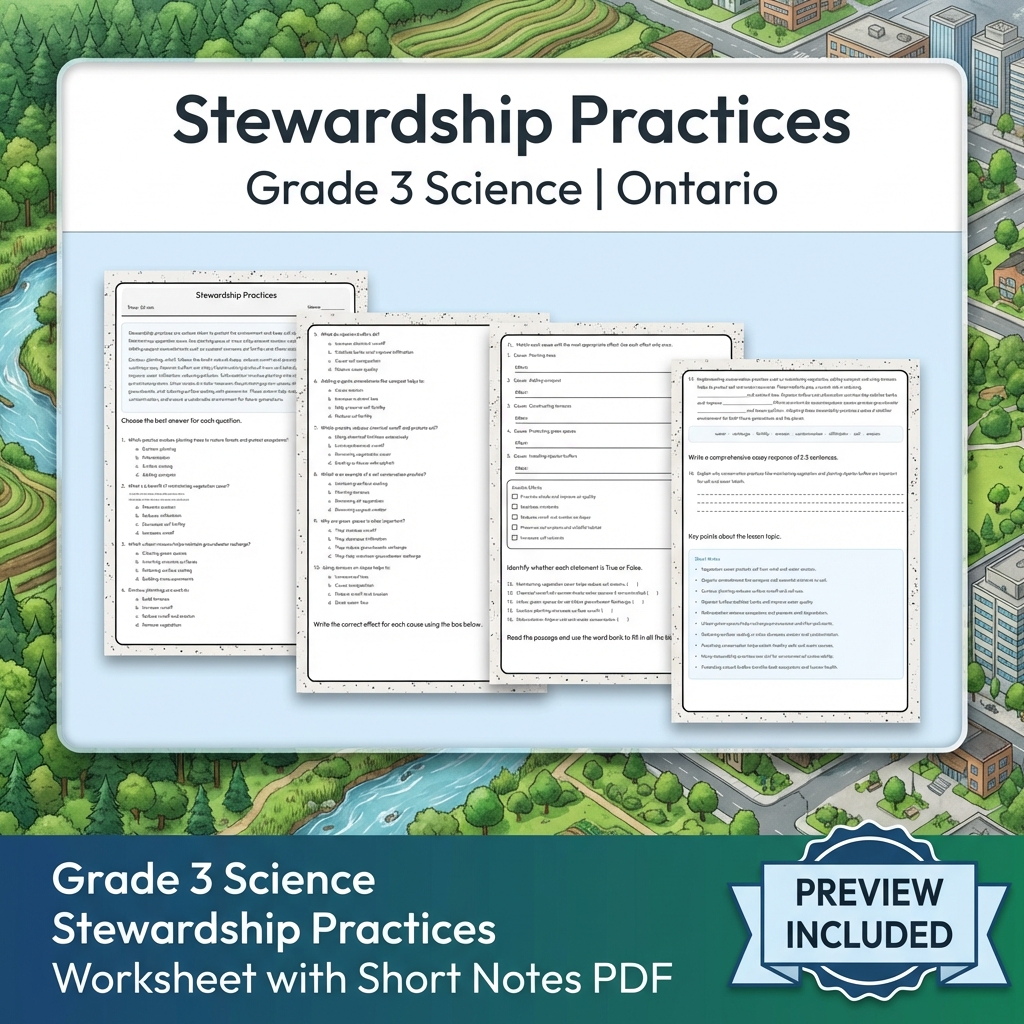
Grade 3 Science Stewardship Practices Worksheet with Short Notes PDF
Created byMeadowlark WorksheetsLearning Objectives
- Understand conservation approaches that help maintain soil and water health.
- Identify practices that reduce runoff, erosion, and nutrient loss.
- Explain the role of buffers and reforestation in environmental stewardship.
Also included in: Grade 3 Science Lesson Group Worksheets | Ontario Framework +1 more
Instant download

Grade 3 Science | Safe Tool Use Worksheet (Practice Set) - General Standards
Created byEvergreen Desk EducationLearning Objectives
- Identify safe tool-use practices for measuring, joining, and shaping materials.
- Explain why using a tool for its intended purpose helps prevent accidents and improves results.
- Apply safety rules to a classroom tool-work scenario.
Also included in: Grade 3 Simple Machines Science Lesson Bundle: General +1 more
Instant download

Grade 3 Science Worksheet | Prototype Testing (PDF) - General Standards
Created byEvergreen Desk EducationLearning Objectives
- Explain what a prototype is and why testing is important for improving a design
- Identify key observation criteria during prototype testing: strength, fit, stability, and function
- Compare testing results to the intended goal to decide what to improve in a design
Also included in: Grade 3 Simple Machines Science Lesson Bundle: General +1 more
Instant download

Grade 3 Science | Load-Bearing Structures Worksheet (PDF) – General Standards
Created byEvergreen Desk EducationLearning Objectives
- Explain how engineers help structures support forces without collapsing
- Identify how shape and connections (such as triangles and cross-bracing) improve stability
- Describe how testing shows whether a structure stays aligned and resists bending
Also included in: Grade 3 Simple Machines Science Lesson Bundle: General +1 more
Instant download

Science Grade 3 Healthy Habits & Nutrition
Created byTeacherNestLearning Objectives
- Match food groups and nutrients to balanced plate examples
- Identify healthy habits that support growth, movement, and body needs
- Label a balanced plate with correct portions and food choices
Instant download

Testable Evidence Worksheets | Grade 3 Scientific Inquiry Practice
 Created byBRIGHT PATH RESOURCES
Learning Objectives
- Explain why a science question must be testable and connected to evidence.
- Identify observations and measurements that can provide evidence for a question.
- Choose evidence-based results that match a testable plan.
Also included in: Grade 3 Science Worksheets Bundle | Scientific Inquiry & Evidence Claims +2 more
Instant download

Using Models to Explain Patterns Worksheets | Grade 3 Science Inquiry
Created byBRIGHT PATH RESOURCESLearning Objectives
- Explain how a model represents ideas that are not directly visible or are too large or small to observe.
- Use models to identify cause-and-effect relationships suggested by evidence.
- Compare what a model shows with what real observations show to decide if the model helps explain them.
Also included in: Grade 3 Science Worksheets Bundle | Scientific Inquiry & Evidence Claims +2 more
Instant download

Data Representation in Weather Science Worksheets Grade 3
Created byBRIGHT PATH RESOURCESLearning Objectives
- Identify different data representations such as tally tables and bar graphs.
- Interpret labels, counts, and scales in simple graphs.
- Choose an appropriate representation to show patterns in data.
Also included in: Grade 3 Science Worksheets Bundle | Scientific Inquiry & Evidence Claims +2 more
Instant download

Model Evidence Fit: Scientific Inquiry Worksheets for Grade 3
Created byBRIGHT PATH RESOURCESLearning Objectives
- Explain that models make predictions and evidence can support or challenge them.
- Use observed patterns to decide whether evidence fits a model’s main idea.
- Revise a model-based explanation when new evidence does not match.
Also included in: Grade 3 Science Worksheets Bundle | Scientific Inquiry & Evidence Claims +2 more
Instant download

Grade 3 Weather Patterns Worksheet | Practice & Assessment PDF
Created byClear Sky ClassroomLearning Objectives
- Represent local weather observations (temperature, precipitation, and cloud cover) using simple graphs and tables
- Identify daily and seasonal patterns in weather data across weeks and months
- Interpret graphical information to describe changes in weather variability and precipitation trends
Instant download
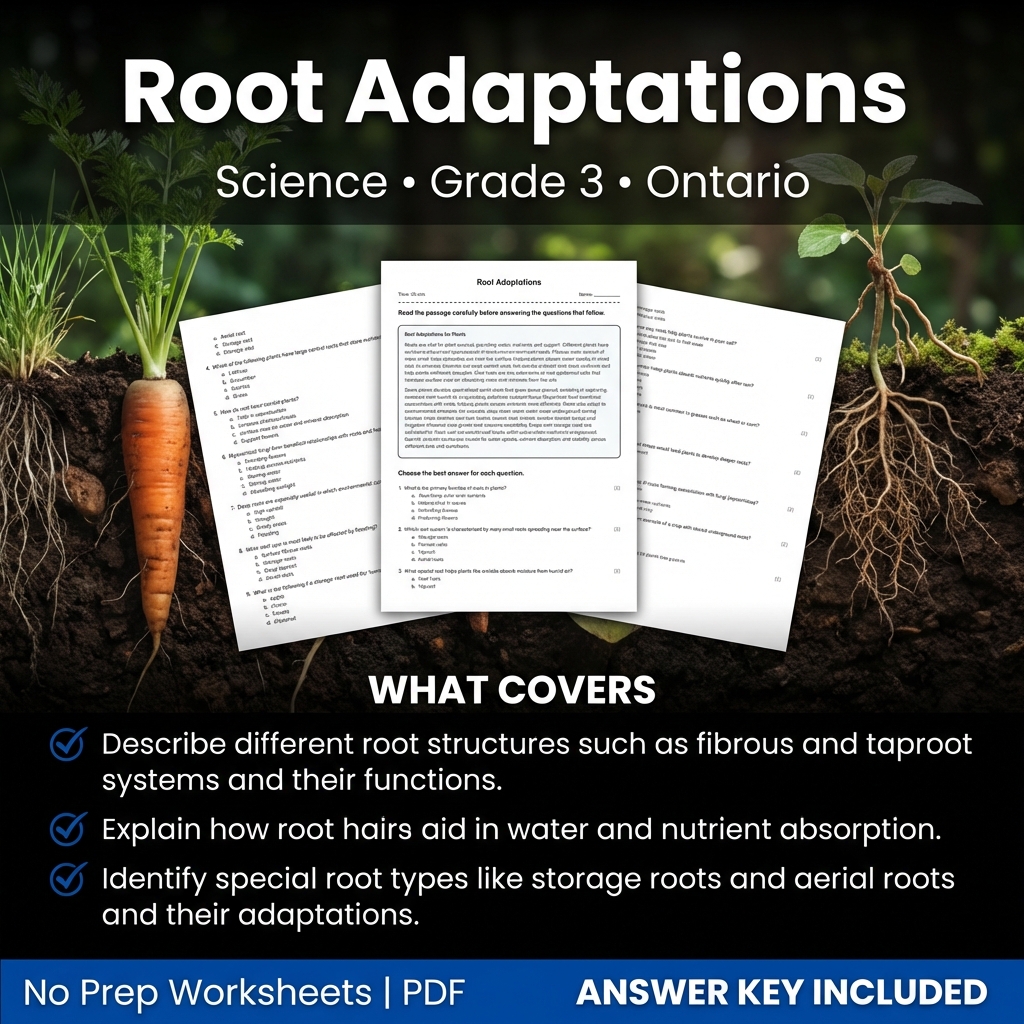
Root Adaptations Science Worksheet for Grade 3 | Ontario Standards
Created byCoral Reef LearningLearning Objectives
- Describe different root structures such as fibrous and taproot systems and their functions.
- Explain how root hairs aid in water and nutrient absorption.
- Identify special root types like storage roots and aerial roots and their adaptations.
Instant download

Net Influence and Motion Worksheet Grade 3 Science Ontario Activity Pack
 Created byChalk and Compass
Learning Objectives
- Explain how balanced forces can result in no change in motion
- Predict whether an object will stay at rest or move, based on net influence
- Describe how a stronger pull or push can change an object's speed or direction
Also included in: Grade 3 Science Forces and Motion Lesson Bundle | Ontario +1 more
Instant download
About Grade 3 Science Worksheets
Browse 425 printable Grade 3 Science worksheets — ready-to-print PDFs with answer keys where available.
Each resource here is built by an independent educator and reviewed for quality. Worksheets print straight from PDF and suit classroom use, homework, or extra practice; most come with answer keys, and you can preview before purchasing.