
Grade 3 Science Worksheets
425 worksheets
Grade 3 Mixing Evidence Worksheet | California Standards Practice PDF
 Created byClear Sky Classroom
Learning Objectives
- Identify evidence that suggests a chemical change may occur when materials are mixed
- Compare the properties of a new product to the expected properties of the starting materials
- Use observations like color, texture, and heat to explain how mixing can create new substances
Instant download

Grade 3 Climate Weather Distinction Worksheet | Practice & PDF
Created byClear Sky ClassroomLearning Objectives
- Differentiate between weather and climate using appropriate time scales.
- Identify examples of weather events versus long-term climate patterns.
- Explain why a single day or storm does not automatically change a region’s climate.
Instant download
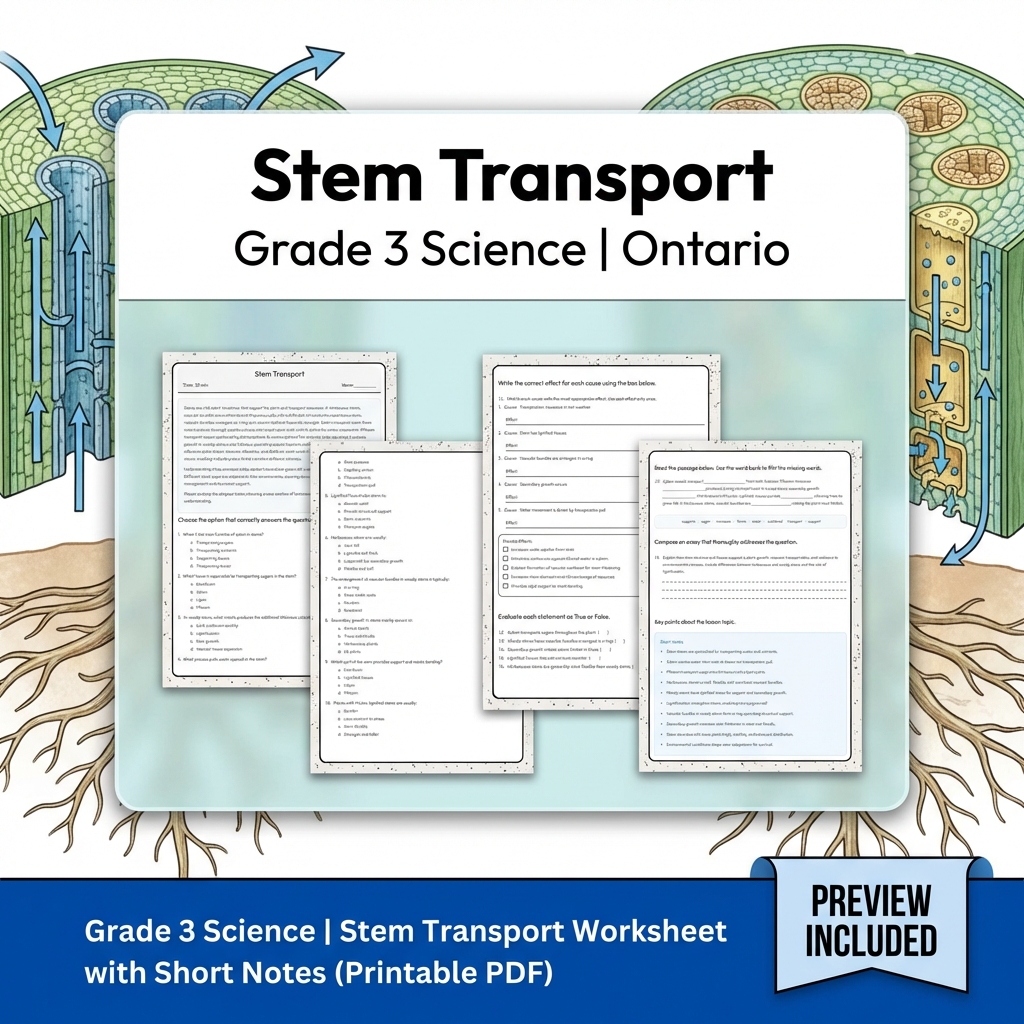
Grade 3 Science | Stem Transport Worksheet with Short Notes (Printable PDF)
 Created byMeadowlark Worksheets
Learning Objectives
- Describe the structure and function of stem tissues involved in water and nutrient transport.
- Explain how xylem and phloem work to support plant growth and resource distribution.
- Compare herbaceous and woody stems in terms of structure and growth features.
Also included in: Grade 3 Science Lesson Group | Ontario STEM Worksheets Bundle Transport & Plants +1 more
Instant download
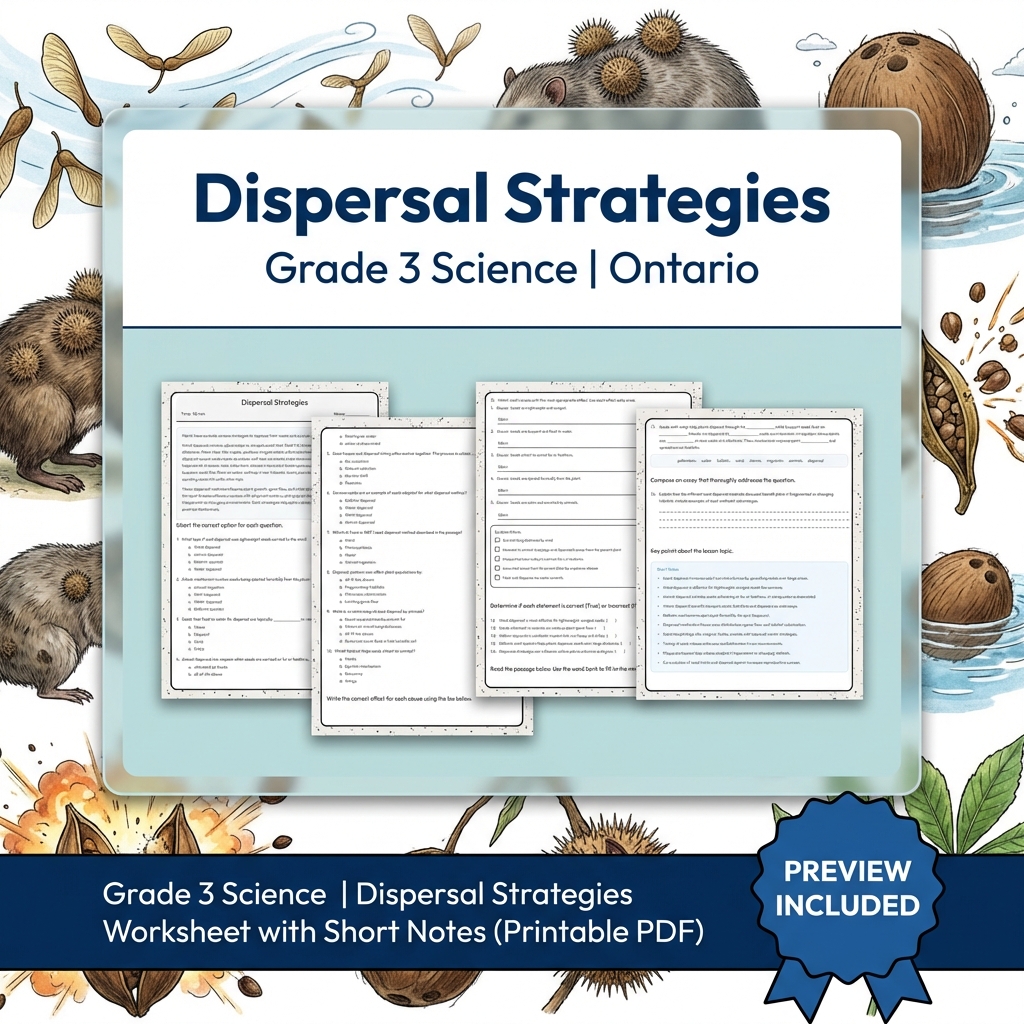
Grade 3 Science | Dispersal Strategies Worksheet with Short Notes
Created byMeadowlark WorksheetsLearning Objectives
- Describe different methods of seed dispersal and their ecological importance.
- Explain how seed morphology and dispersal timing influence plant success.
- Identify how dispersal patterns affect plant populations and habitats.
Also included in: Grade 3 Science Lesson Group | Ontario STEM Worksheets Bundle Transport & Plants +1 more
Instant download
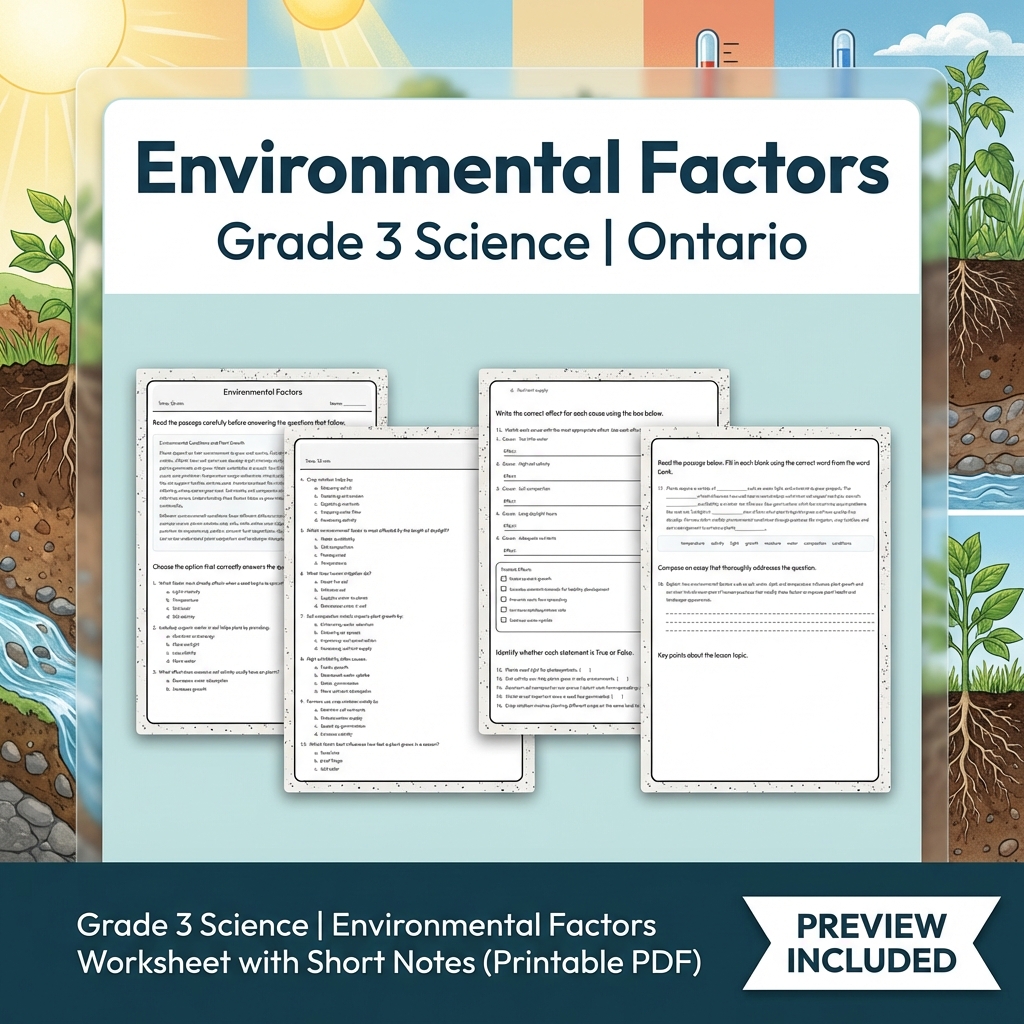
Grade 3 Science | Environmental Factors Worksheet with Short Notes
Created byMeadowlark WorksheetsLearning Objectives
- Understand how soil, light, water, temperature, and nutrients affect plant growth.
- Identify human practices that modify landscape and influence plant development.
- Describe how environmental variables impact germination, growth rates, and survival.
Also included in: Grade 3 Science Lesson Group | Ontario STEM Worksheets Bundle Transport & Plants +1 more
Instant download
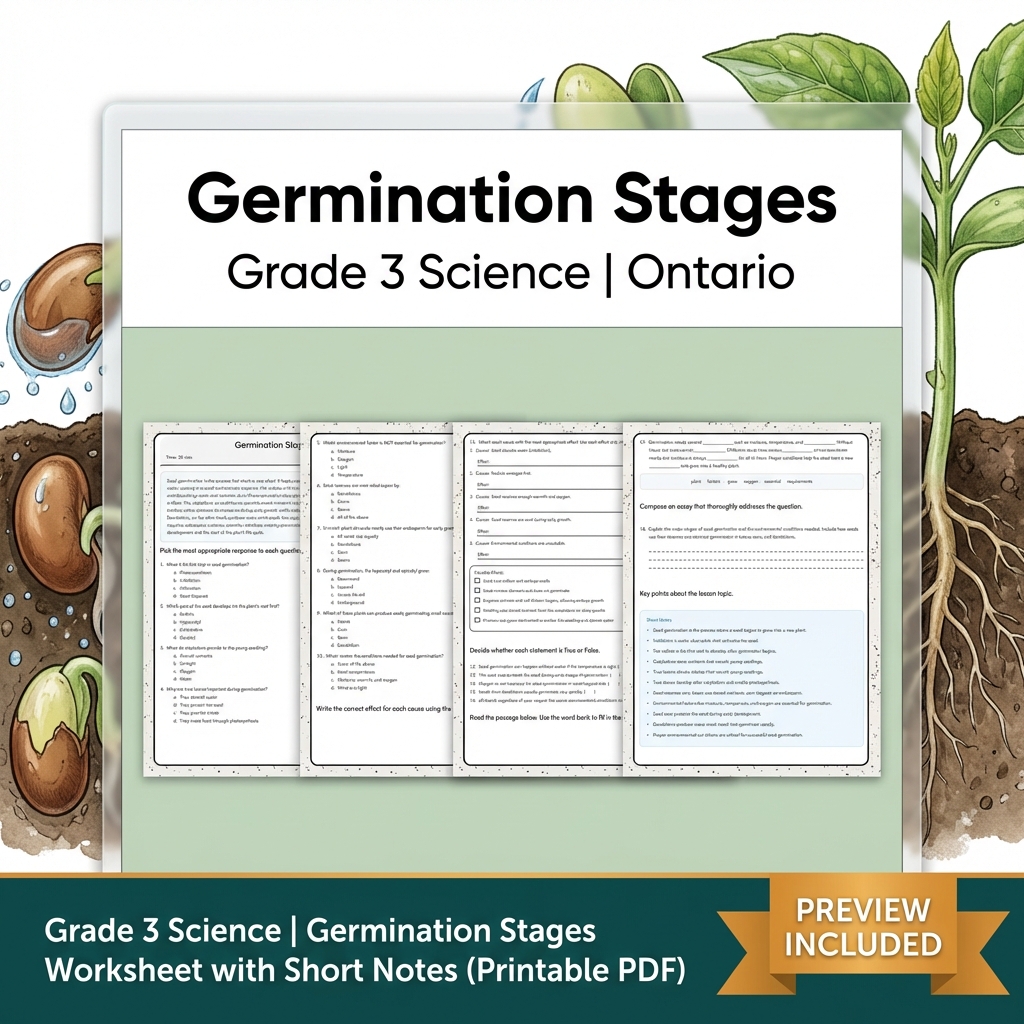
Grade 3 Science | Germination Stages Worksheet with Short Notes (Printable PDF)
Created byMeadowlark WorksheetsLearning Objectives
- Describe the major stages of seed germination, including imbibition, radicle emergence, hypocotyl and epicotyl growth, cotyledon function, and true leaf development.
- Explain the role of seed reserves during early growth.
- Compare germination processes in different plants such as beans, corn, and dandelions.
Also included in: Grade 3 Science Lesson Group | Ontario STEM Worksheets Bundle Transport & Plants +1 more
Instant download
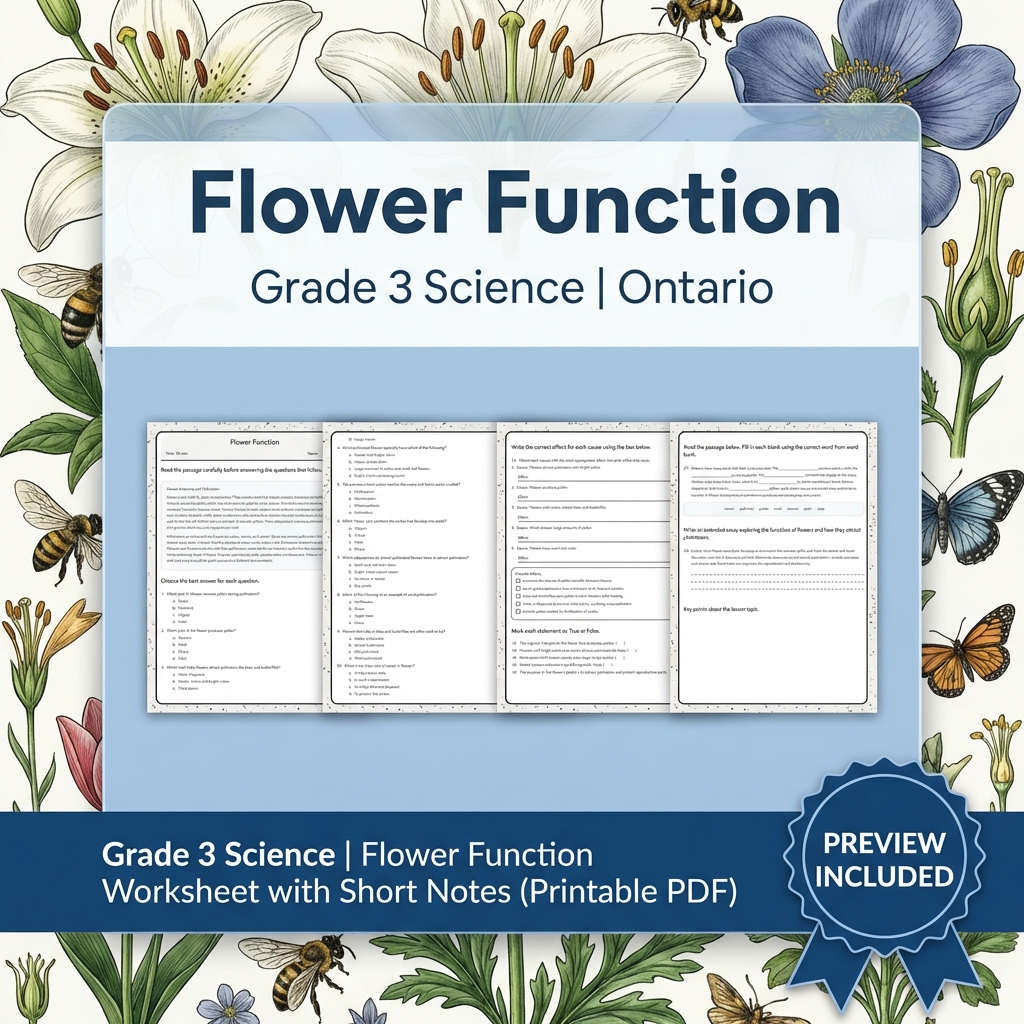
Grade 3 Science | Flower Function Worksheet with Short Notes (Printable PDF)
Created byMeadowlark WorksheetsLearning Objectives
- Identify the main parts of a flower and their functions.
- Explain how flowers reproduce and produce seeds.
- Describe different pollination methods and traits that attract pollinators.
Also included in: Grade 3 Science Lesson Group | Ontario STEM Worksheets Bundle Transport & Plants +1 more
Instant download
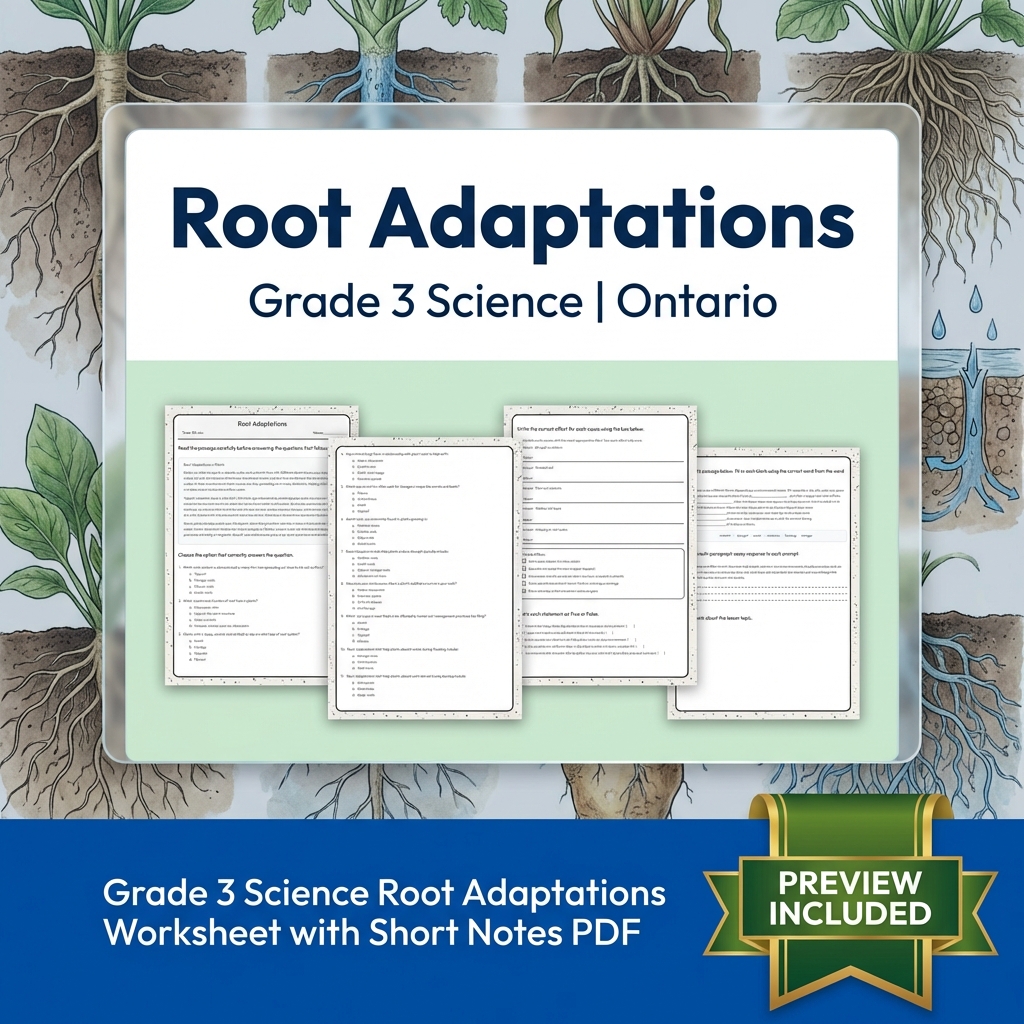
Grade 3 Science Root Adaptations Worksheet with Short Notes PDF
Created byMeadowlark WorksheetsLearning Objectives
- Describe different root structures, including fibrous and taproot systems.
- Explain plant adaptations such as root hairs, mycorrhizal associations, and storage roots.
- Analyze how root architecture influences water and nutrient uptake and plant stability.
Also included in: Grade 3 Science Lesson Group | Ontario STEM Worksheets Bundle Transport & Plants +1 more
Instant download

Science Grade 3 State Of Matter
 Created byTeacherNest
Learning Objectives
- Identify solids, liquids, and gases from simple everyday examples
- Match each state of matter to its properties
- Sort objects by state and justify choices
Instant download

Science Grade 3 The Water Cycle
Created byTeacherNestLearning Objectives
- Identify evaporation, condensation, precipitation, and collection in the water cycle.
- Label a water cycle diagram with correct stage names.
- Explain the Sun’s role in moving water through the cycle.
Instant download

Grade 3 Material Durability Worksheet | Practice & Assessment PDF
Created byClear Sky ClassroomLearning Objectives
- Describe how moisture, corrosion, freeze-thaw cycles, and ultraviolet (UV) light can weaken materials over time.
- Explain how material durability affects strength and stiffness in structures.
- Identify maintenance actions and protective treatments that extend a structure’s reasonable lifespan.
Instant download

Fair Prototype Testing: Engineering Design Worksheets Grade 3
 Created byTeachers Club
Learning Objectives
- Explain how a fair test controls variables to compare prototype designs.
- Identify common failure points and describe what happened during a test.
- Propose targeted design changes based on recorded evidence.
Also included in: Grade 3 Engineering Design Worksheets & NGSS Science Bundle +1 more
Instant download

Grade 3 Material Properties Worksheet | Practice & Assessment PDF
Created byClear Sky ClassroomLearning Objectives
- Identify material properties that affect strength and stability (density, stiffness, tensile strength, compressive strength, brittleness).
- Compare common construction materials (wood, steel, concrete, and selected polymers) based on key properties.
- Connect material properties to real-world choices for loads, spans, connections, and durability.
Instant download

Grade 3 Growth Changes Needs Worksheet | Practice & PDF
Created byClear Sky ClassroomLearning Objectives
- Explain how an organism’s growth can change its survival needs.
- Identify how young vs. adult stages can require different resources within the same habitat.
- Use evidence from a text to determine main ideas about growth-related changes.
Instant download
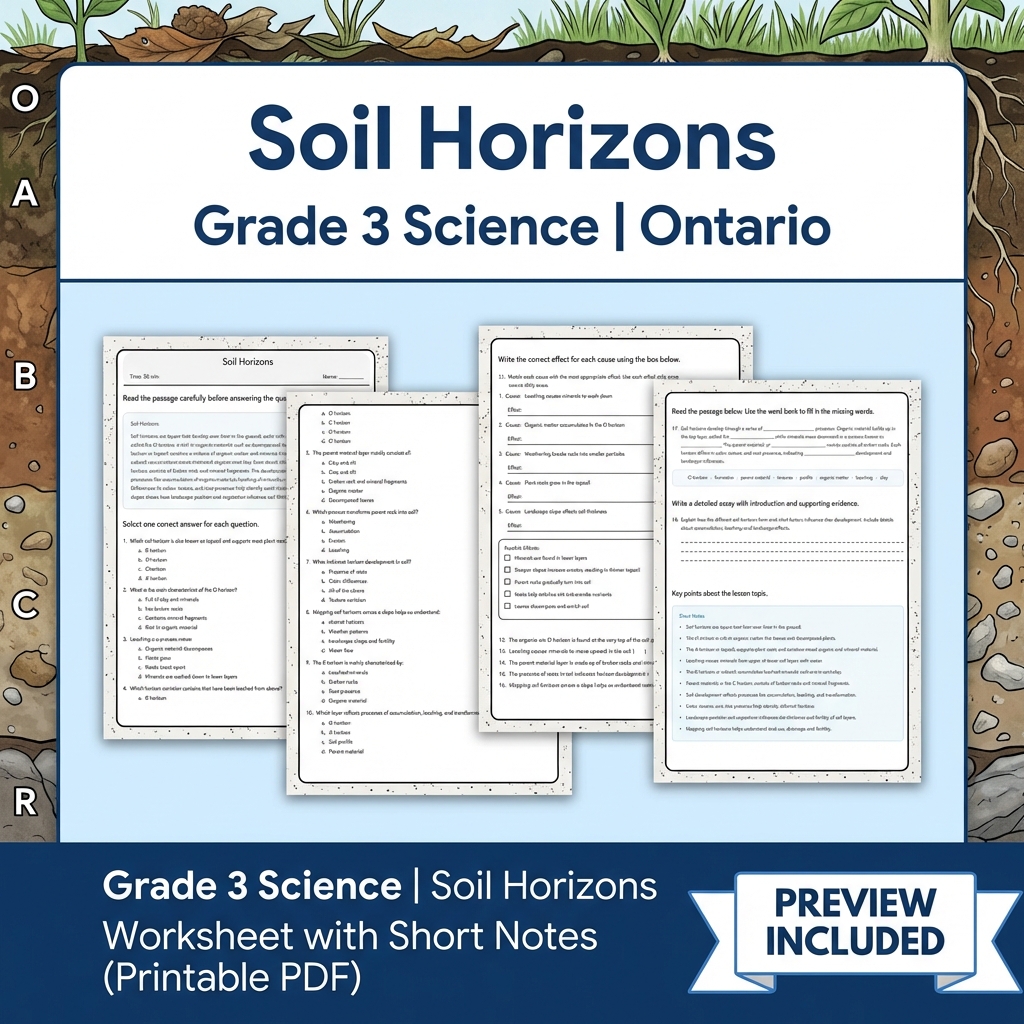
Grade 3 Science | Soil Horizons Worksheet with Short Notes (Printable PDF)
Created byMeadowlark WorksheetsLearning Objectives
- Understand the different layers of soil called horizons.
- Recognize features that indicate horizon development.
- Describe how landscape and vegetation affect soil layers.
Also included in: Grade 3 Science Lesson Group Worksheets | Ontario Framework +1 more
Instant download

Grade 3 Water Movement Through Soil Worksheet | Ontario Science Activity
 Created byChalk and Compass
Learning Objectives
- Describe how infiltration, percolation, capillary rise, and runoff move water through soil
- Explain how soil texture and structure affect how quickly water moves and how long soil stays wet
- Use evidence from soil and land slope to predict where water will collect, drain, or flow on the surface
Also included in: Grade 3 Science Soil Properties & Formation Lesson Bundle | Ontario +1 more
Instant download

Grade 3 Connection Details Worksheet | Ontario Practice & PDF
Created byClear Sky ClassroomLearning Objectives
- Identify rigid and pin connection types and explain how they influence structural stiffness and stability.
- Describe how nails, bolts, welds, and adhesives transfer load through a joint.
- Explain how joint geometry, bearing area, and fastening method affect stress concentration and possible failure.
Instant download
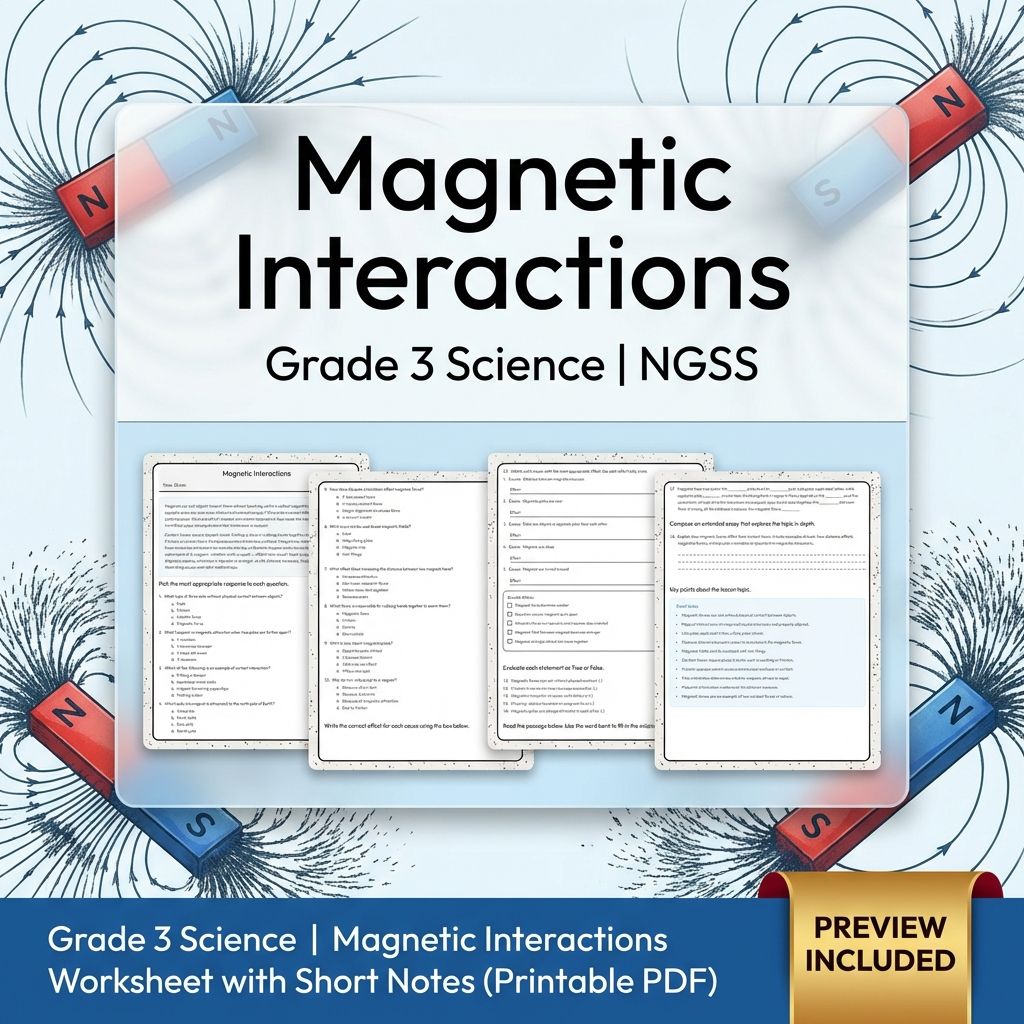
Grade 3 Science | Magnetic Interactions Worksheet with Short Notes (PDF)
Created byMeadowlark WorksheetsLearning Objectives
- Describe the difference between magnetic and contact forces.
- Identify examples of magnetic attraction and repulsion.
- Explain how distance and pole orientation affect magnetic forces.
Also included in: Grade 3 Science NGSS Unit | Motion and Stability: Forces & Interactions +1 more
Instant download

Grade 3 Science | Design Improvements Worksheet (PDF)
 Created byEvergreen Desk Education
Learning Objectives
- Explain how test results provide evidence for improving a design.
- Describe how specific changes (shape, support, or materials) can improve performance.
- Match outcomes from a test to the original problem goal and revise a solution.
Also included in: Grade 3 Simple Machines Science Lesson Bundle: General +1 more
Instant download
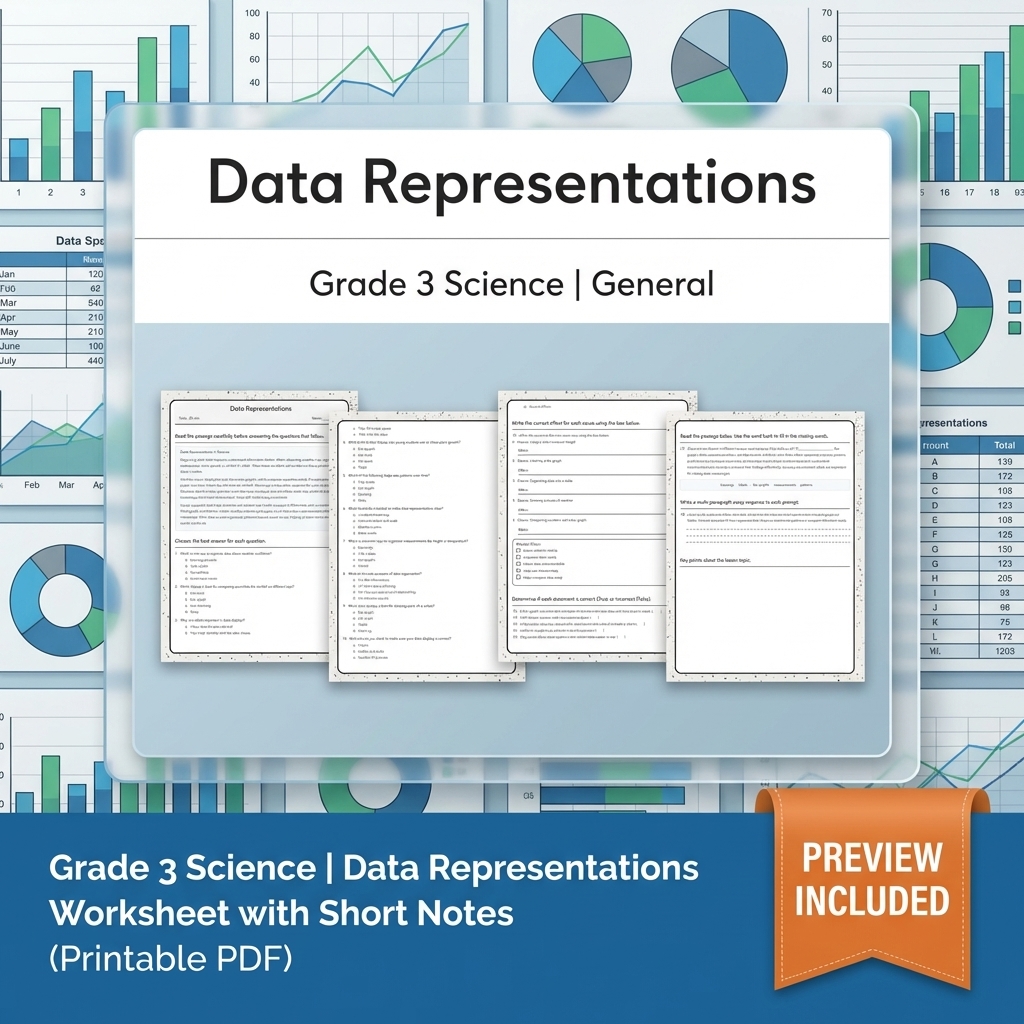
Grade 3 Science | Data Representations Worksheet with Short Notes
Created byMeadowlark WorksheetsLearning Objectives
- Understand different ways to organize and represent data, such as drawings, tables, and graphs.
- Identify patterns and relationships within data displays like bar graphs and tally tables.
- Create simple data representations with accuracy and appropriate labels.
Also included in: Grade 3 Science Lesson Bundle | Data, Models, and Evidence Activities +1 more
Instant download
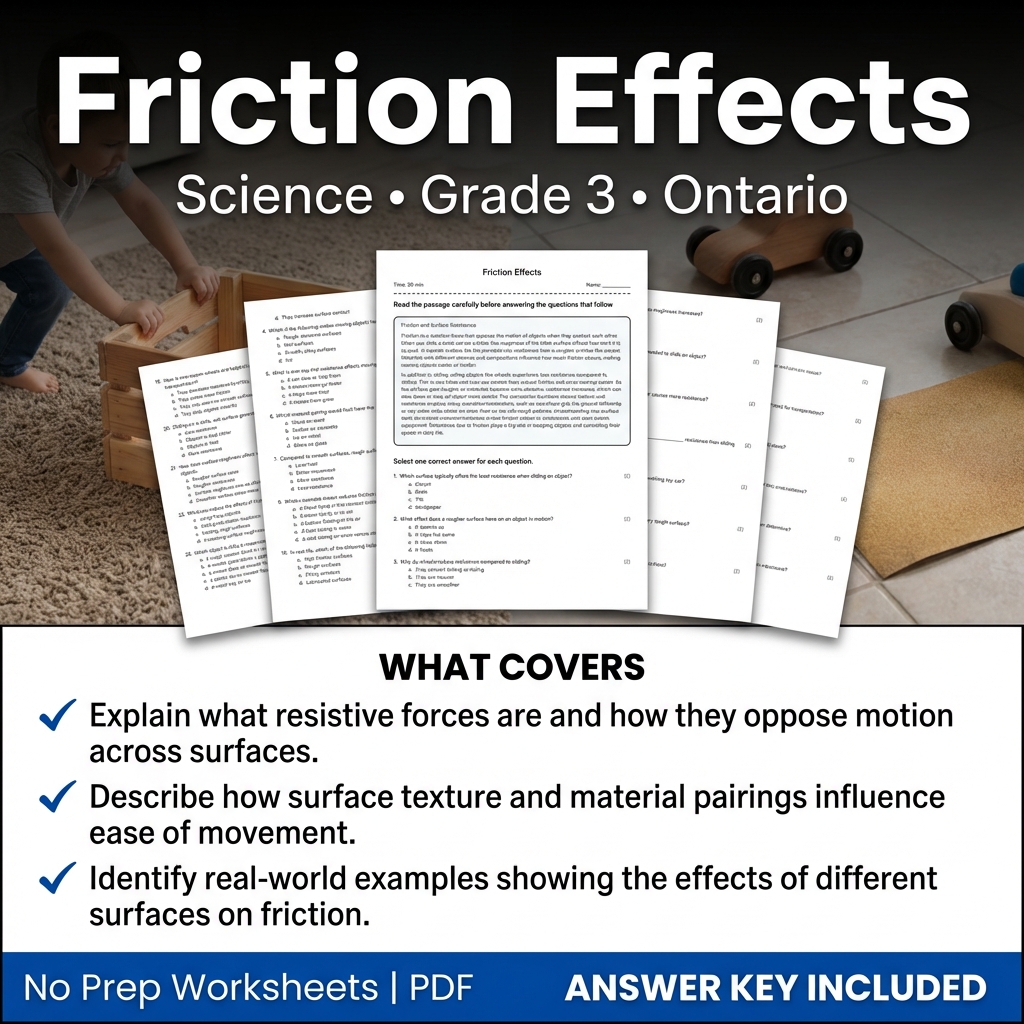
Friction Effects Grade 3 Science Worksheet | Ontario Standards
 Created byCoral Reef Learning
Learning Objectives
- Explain what resistive forces are and how they oppose motion across surfaces.
- Describe how surface texture and material pairings influence ease of movement.
- Identify real-world examples showing the effects of different surfaces on friction.
Instant download

Speed Comparison Using Distance-Time Data Worksheets Grade 3
 Created byPrism Point Learning
Learning Objectives
- Describe how to compare motions using distance and time information.
- Distinguish steady-speed motion from changing-speed motion using summaries.
- Use relative language and simple ratios to decide which object is faster.
Also included in: Forces & Motion Lesson Bundle | Grade 3 Science | Ontario
Instant download

Grade 3 Science Rocks and Soil Worksheet (General) – Assessment PDF
Created byEvergreen Desk EducationLearning Objectives
- Compare rocks and soil by appearance and by how they respond to pressure and handling.
- Describe how soil is made from smaller particles and organic matter, while rocks are usually solid pieces.
- Explain how properties of rocks and soil can affect where plants and water are found.
Also included in: Grade 3 Weather & Earth Materials Science Lesson Bundle: General Framework +1 more
Instant download

Grade 3 Plant Life Cycle Worksheet | Practice & Assessment PDF
Created byClear Sky ClassroomLearning Objectives
- Identify the main stages of a flowering plant’s life cycle from seed to new seeds.
- Explain how germination, growth, and reproduction help plants continue their species.
- Describe how plant structures (roots, leaves, stems, flowers, fruit, seeds) support survival in a local environment.
Instant download
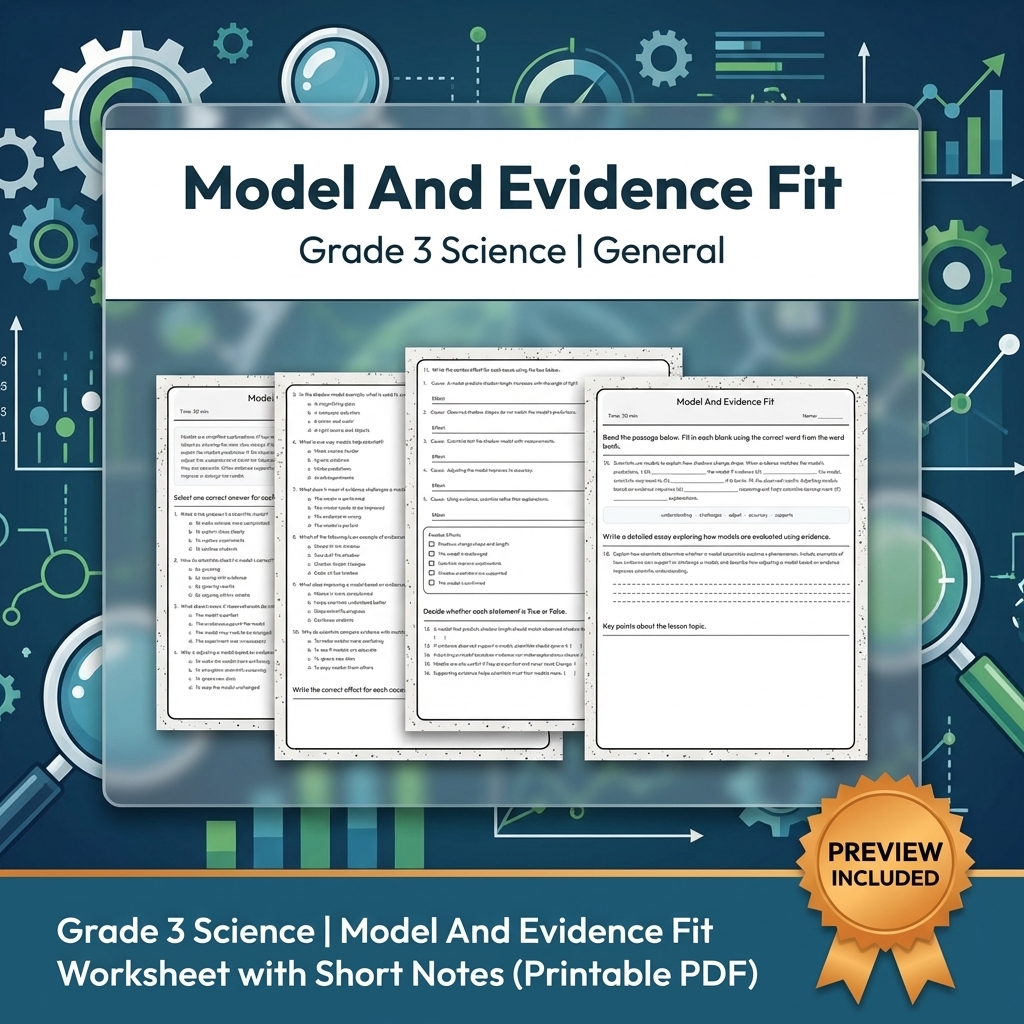
Grade 3 Science | Model And Evidence Fit Worksheet with Short Notes
Created byMeadowlark WorksheetsLearning Objectives
- Understand how models are evaluated by comparing evidence to their main ideas.
- Learn how observed results support or challenge scientific explanations.
- Explore examples of model testing, such as shadow shapes and light sources.
Also included in: Grade 3 Science Lesson Bundle | Data, Models, and Evidence Activities +1 more
Instant download

Grade 3 Feeding Structures and Survival Worksheet | NGSS Practice PDF
Created byClear Sky ClassroomLearning Objectives
- Explain how different beaks, teeth, and mouthparts help animals get specific types of food.
- Describe how feeding structures support survival and growth in an animal’s habitat.
- Identify examples of how diet differences lead to different body structures for feeding.
Instant download
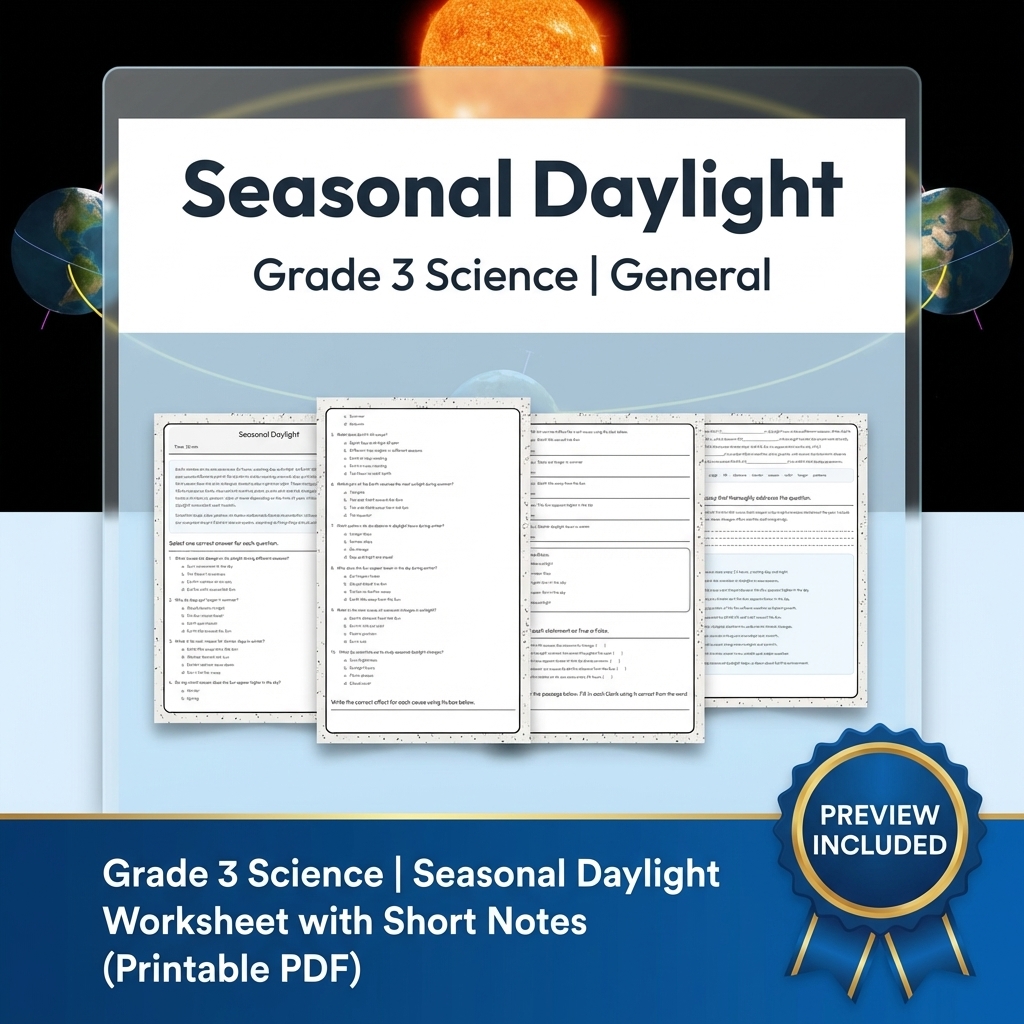
Grade 3 Science | Seasonal Daylight Worksheet with Short Notes (Printable PDF)
Created byMeadowlark WorksheetsLearning Objectives
- Understand how Earth's rotation and tilt affect day length across seasons.
- Identify observable changes in sunlight during different times of the year.
- Connect the position of the Sun in the sky with seasonal daylight patterns.
Also included in: Grade 3 Science Lesson Group | Weather, Water Cycle, and More +1 more
Instant download

Grade 3 Measuring Distance and Speed Worksheet | Ontario Science Activity
Created byChalk and CompassLearning Objectives
- Use consistent units to describe how far an object moves
- Measure and compare elapsed time using seconds
- Calculate and compare simple speeds using distance and time
Also included in: Grade 3 Science Forces and Motion Lesson Bundle | Ontario +1 more
Instant download
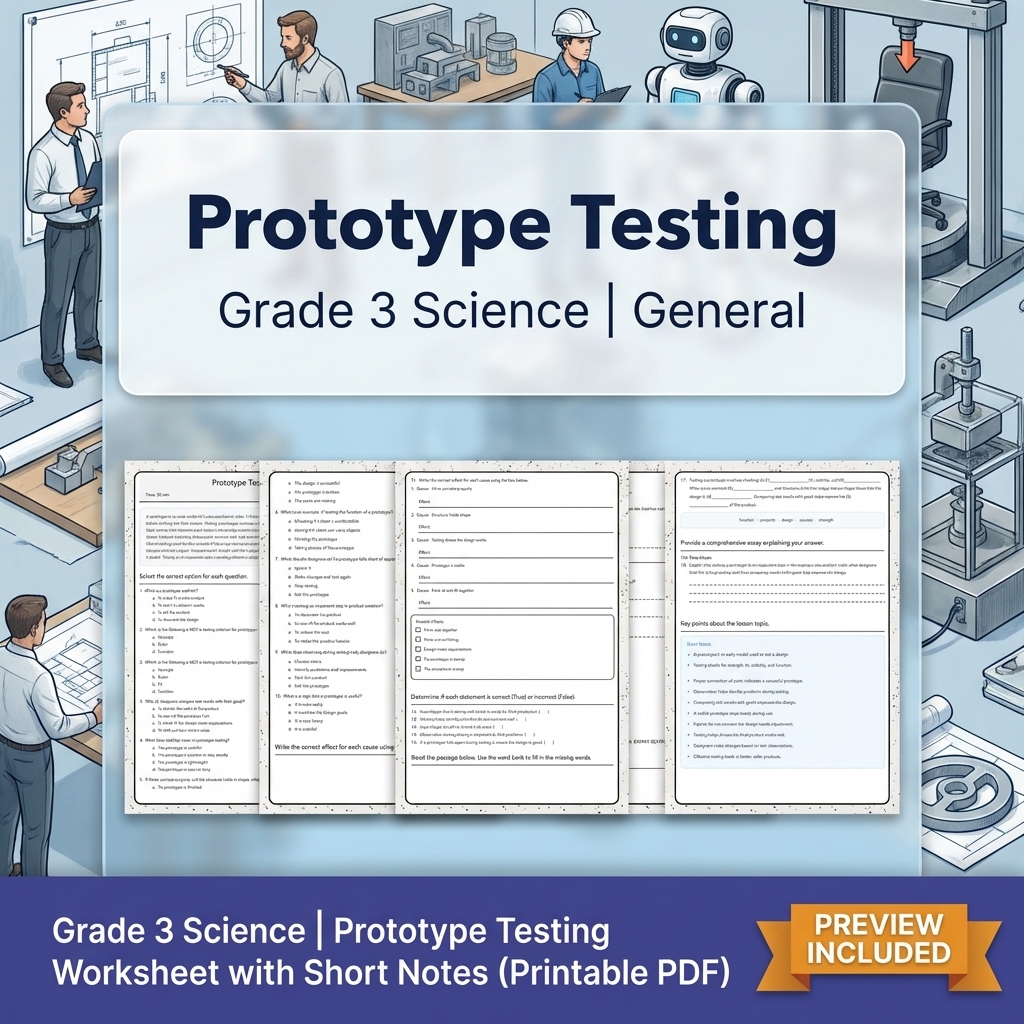
Grade 3 Science | Prototype Testing Worksheet with Short Notes (Printable PDF)
Created byMeadowlark WorksheetsLearning Objectives
- Understand what a prototype is and its purpose.
- Identify key criteria used to test prototypes such as strength, fit, stability, and function.
- Learn how to compare test results with design goals to evaluate a prototype.
Also included in: Grade 3 Science Lesson Bundle: Simple Machines, Tools, and Design Skills +1 more
Instant download

Grade 3 Science Environmental Effects on Material Durability Worksheet
Created byChalk and CompassLearning Objectives
- Describe how moisture, corrosion, freeze-thaw cycles, and ultraviolet light can weaken structures over time
- Explain why protective treatments and maintenance help materials last longer
- Use cause-and-effect reasoning to choose materials with compatible durability for a given environment
Also included in: Grade 3 Science Simple Structures Lesson Bundle | Ontario +1 more
Instant download

Evidence-Based Claims Science Worksheets for Grade 3 Inquiry
 Created byBRIGHT PATH RESOURCES
Learning Objectives
- Explain the difference between an opinion and an evidence-supported claim
- Use evidence to support a reasoning statement that answers a question
- Identify how comparisons and repeated observations strengthen explanations
Also included in: Grade 3 Science Worksheets Bundle | Scientific Inquiry & Evidence Claims +2 more
Instant download

Grade 3 Science Worksheet | Reflection and Absorption (PDF) for Understanding Light
Created byEvergreen Desk EducationLearning Objectives
- Explain the difference between reflection and absorption when light reaches an object.
- Describe how shiny and dark surfaces change how bright an object looks.
- Use observations of brightness to predict whether an object reflects or absorbs more light.
Also included in: Grade 3 Science: Light, Sound & Matter Lesson Bundle for General Framework +1 more
Instant download

Inclined Motion and Gravity Worksheets | Grade 3 Forces & Motion
Created byPrism Point LearningLearning Objectives
- Describe how a sloped surface changes an object's tendency to move by comparing the pull that acts along the slope.
- Compare gentle and steep inclines using the idea of “speed tendency” from gravity along the surface.
- Explain how surface features and object motion (rolling or sliding) can change what happens on an incline.
Also included in: Forces & Motion Lesson Bundle | Grade 3 Science | Ontario
Instant download

Grade 3 Load Paths in Trusses, Beams & Columns Science Worksheet Ontario
Created byChalk and CompassLearning Objectives
- Describe how forces move from where they act to supports through structural members.
- Identify how axial force, bending moment, and shear can appear in beams and trusses.
- Explain what supports and foundations do when they receive combined loads.
Also included in: Grade 3 Science Simple Structures Lesson Bundle | Ontario +1 more
Instant download

Grade 3 Forces as Pushes and Pulls Worksheet | Ontario Science Activity
Created byChalk and CompassLearning Objectives
- Explain that a force is a push or a pull that can change an object’s speed or direction.
- Identify the direction and magnitude of a force in everyday situations.
- Distinguish contact forces and non-contact forces using simple examples.
Also included in: Grade 3 Science Forces and Motion Lesson Bundle | Ontario +1 more
Instant download
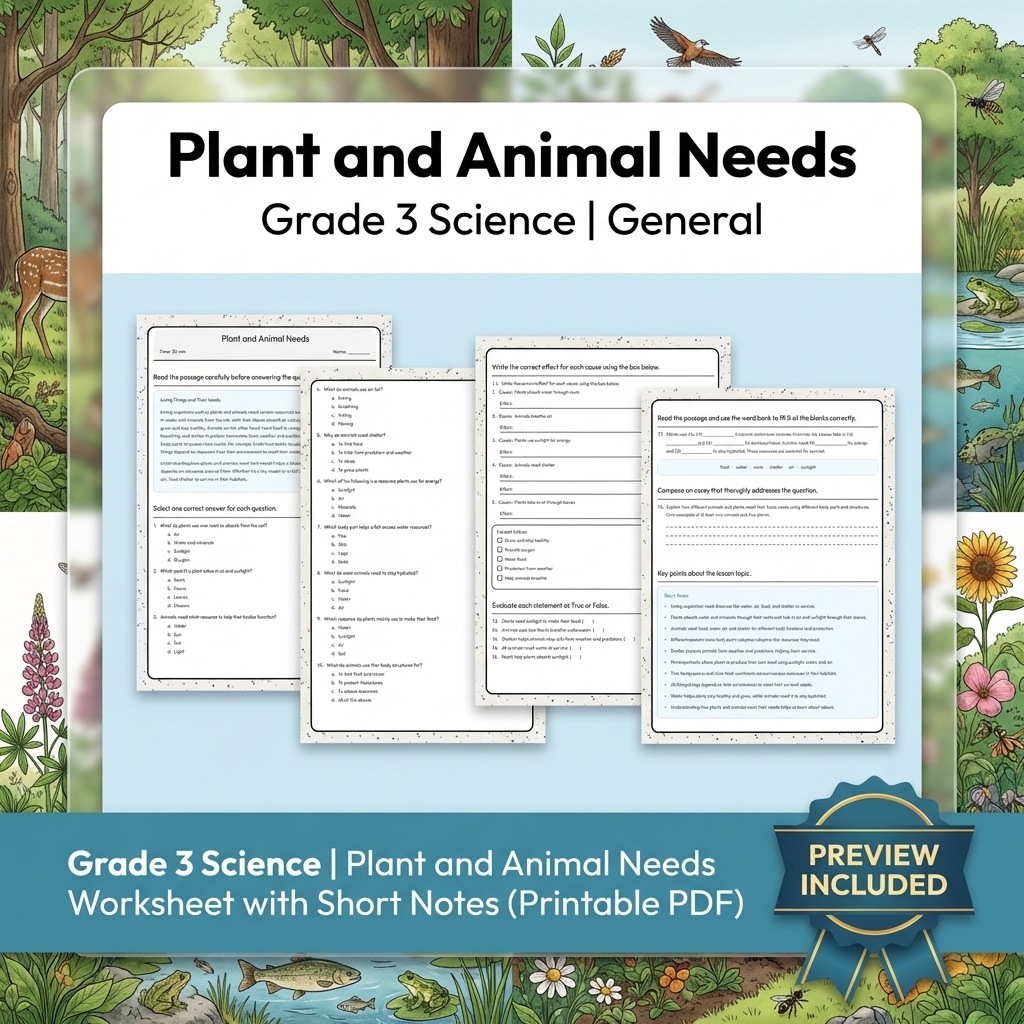
Grade 3 Science | Plant and Animal Needs Worksheet with Short Notes
Created byMeadowlark WorksheetsLearning Objectives
- Understand the basic needs of plants and animals for survival.
- Identify resources plants and animals obtain from their environment.
- Describe how different species meet the same needs using different body structures.
Also included in: Grade 3 Science Lesson Group | Engaging Science Worksheets & Activities +1 more
Instant download

Grade 3 Landform Processes Science Daily Reading Worksheet | NGSS Activity
Created byBRIGHT PATH RESOURCESLearning Objectives
- Explain how weathering can break rocks into smaller pieces.
- Identify cause-and-effect relationships in a science text.
- Describe how small rock pieces can be moved later by water, wind, or ice.
Also included in: Weather Patterns & Landform Processes Grade 3 Science Daily Bundle | NGSS +2 more
Instant download
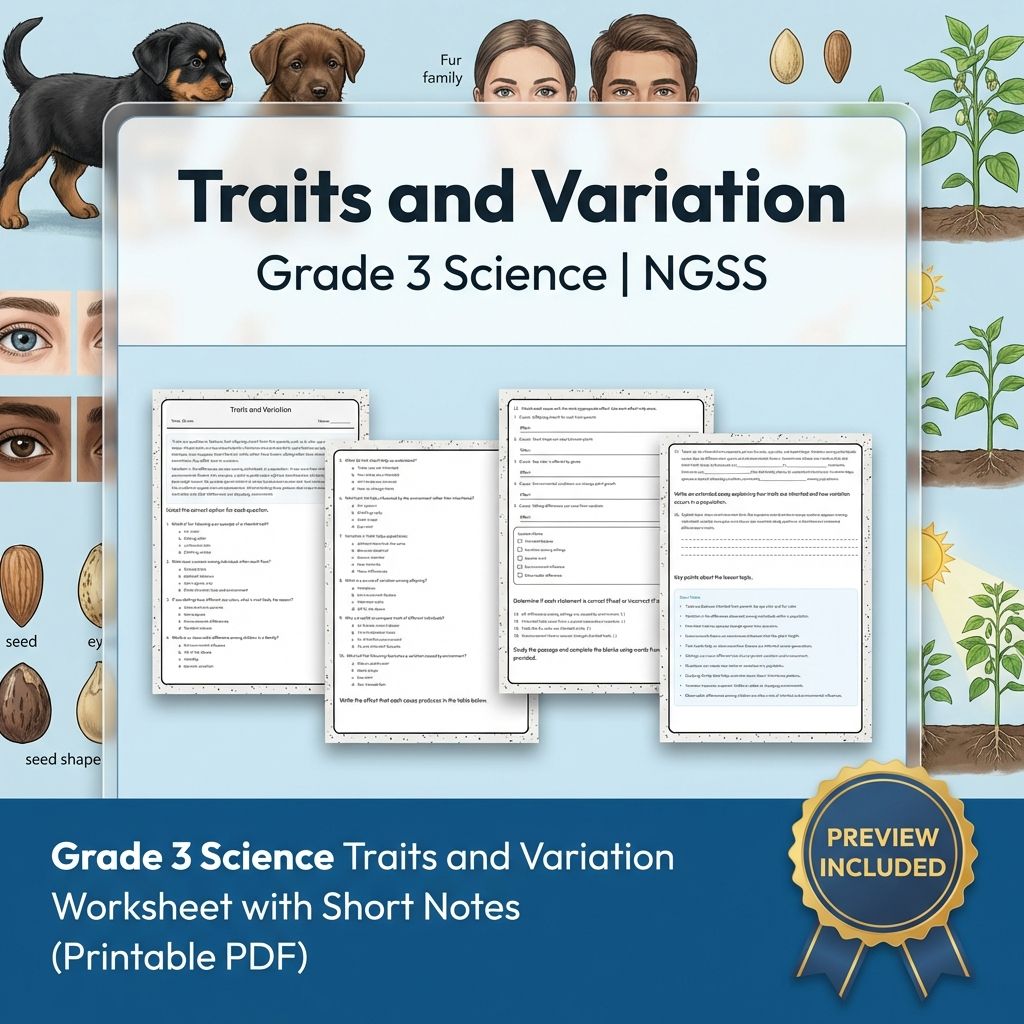
Grade 3 Science Traits and Variation Worksheet with Short Notes (Printable PDF)
Created byMeadowlark WorksheetsLearning Objectives
- Understand how offspring inherit traits from parents.
- Identify observable variations among individuals.
- Interpret data from family traits and trait charts.
Also included in: Grade 3 Science Unit | Heredity, Inheritance & Traits NGSS Bundle +1 more
Instant download

Grade 3 Pitch and Loudness Worksheet | NGSS Practice PDF
Created byClear Sky ClassroomLearning Objectives
- Explain how pitch is connected to the speed of vibrations.
- Explain how loudness is connected to the strength of vibrations.
- Use examples (strings, drums) to distinguish pitch from loudness.
Instant download

Simple Machines Worksheets | Grade 3 Force and Engineering Practice
Created byBRIGHT PATH RESOURCESLearning Objectives
- Identify common simple machines and describe what each one changes about force or direction of motion
- Compare effort and force needs for different simple machines such as levers, pulleys, and inclined planes
- Use information about a machine to predict how it helps people do work
Also included in: Grade 3 Science Simple Machines & Engineering Worksheets Bundle +2 more
Instant download
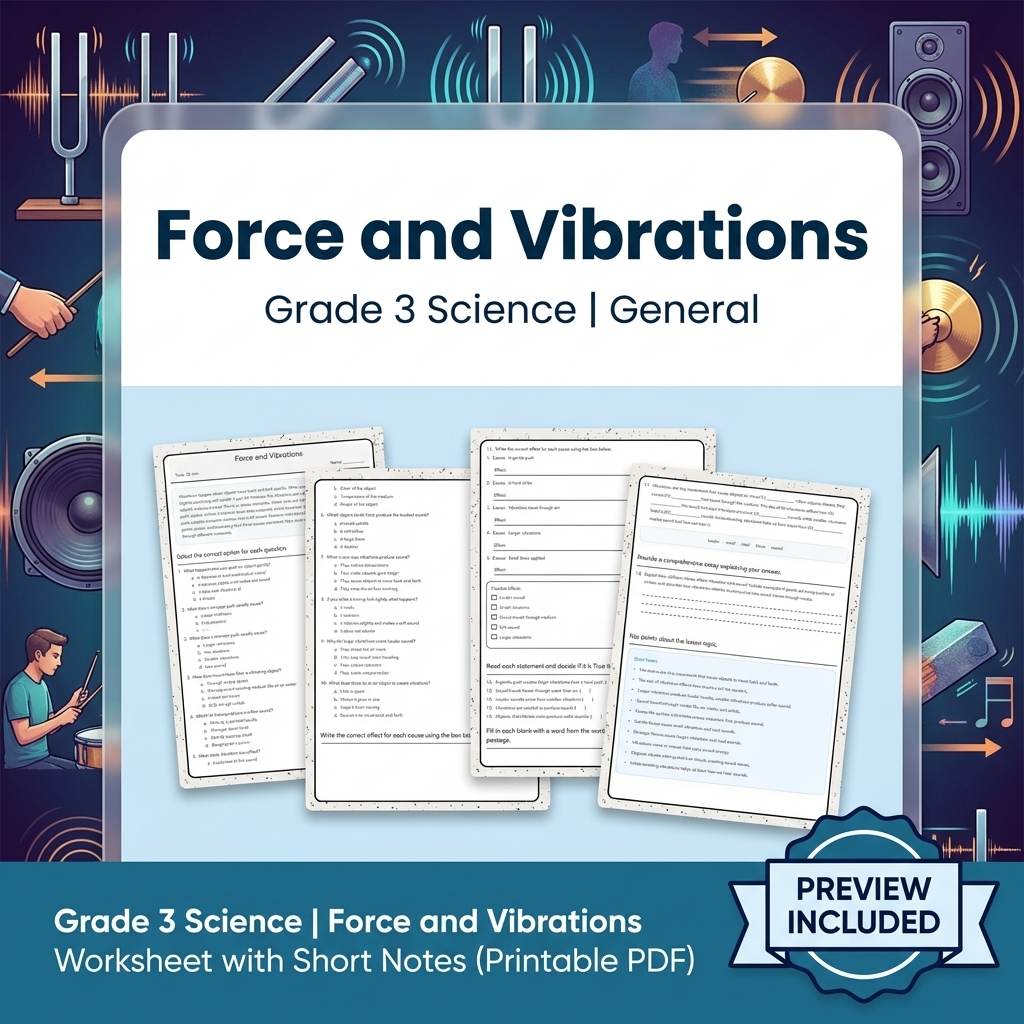
Grade 3 Science | Force and Vibrations Worksheet with Short Notes
Created byMeadowlark WorksheetsLearning Objectives
- Understand how simple forces cause objects to vibrate.
- Learn how vibrations produce sound and how sound travels through media.
- Identify different types of forces and their effects on objects.
Also included in: Grade 3 Science Lesson Group: Worksheets for Properties, Water, Sound & Light +1 more
Instant download

Metamorphosis Stages Worksheets Grade 3 Life Cycle Activity & Review
Created byBRIGHT PATH RESOURCESLearning Objectives
- Identify the main stages of metamorphosis: egg, larva, pupa, and adult.
- Explain how body form changes during metamorphosis to fit different needs.
- Describe how adult animals may require different resources than larvae.
Also included in: Grade 3 Science Life Cycles Habitats & Classification Worksheets Bundle +2 more
Instant download

Vibrations That Produce Sound Worksheets | Grade 3 Science
Created byBRIGHT PATH RESOURCESLearning Objectives
- Explain that sound is made by vibrating objects
- Describe how a vibrating object transfers energy to a medium that carries sound
- Identify examples of sound sources such as stretched strings and struck surfaces
Also included in: Grade 3 Science Worksheets Bundle | Matter, Light and Sound Unit +2 more
Instant download

Grade 3 Science Water Cycle Changes Worksheet (PDF) | General Standards
Created byEvergreen Desk EducationLearning Objectives
- Explain how water changes form (liquid, vapor, and solid) during the water cycle
- Describe the roles of evaporation, condensation, and precipitation in moving water through air, clouds, and the ground
- Use temperature changes to predict whether water will become vapor, liquid droplets, or ice
Also included in: Grade 3 Weather & Earth Materials Science Lesson Bundle: General Framework +1 more
Instant download

Grade 3 Science – Simple Machines Worksheet (General Standard) PDF
Created byEvergreen Desk EducationLearning Objectives
- Explain how simple machines help people do work by changing force or direction
- Identify examples of levers, pulleys, and inclined planes and describe what each one changes
- Use simple machine vocabulary (effort, load, force, direction) to answer science questions
Also included in: Grade 3 Simple Machines Science Lesson Bundle: General +1 more
Instant download
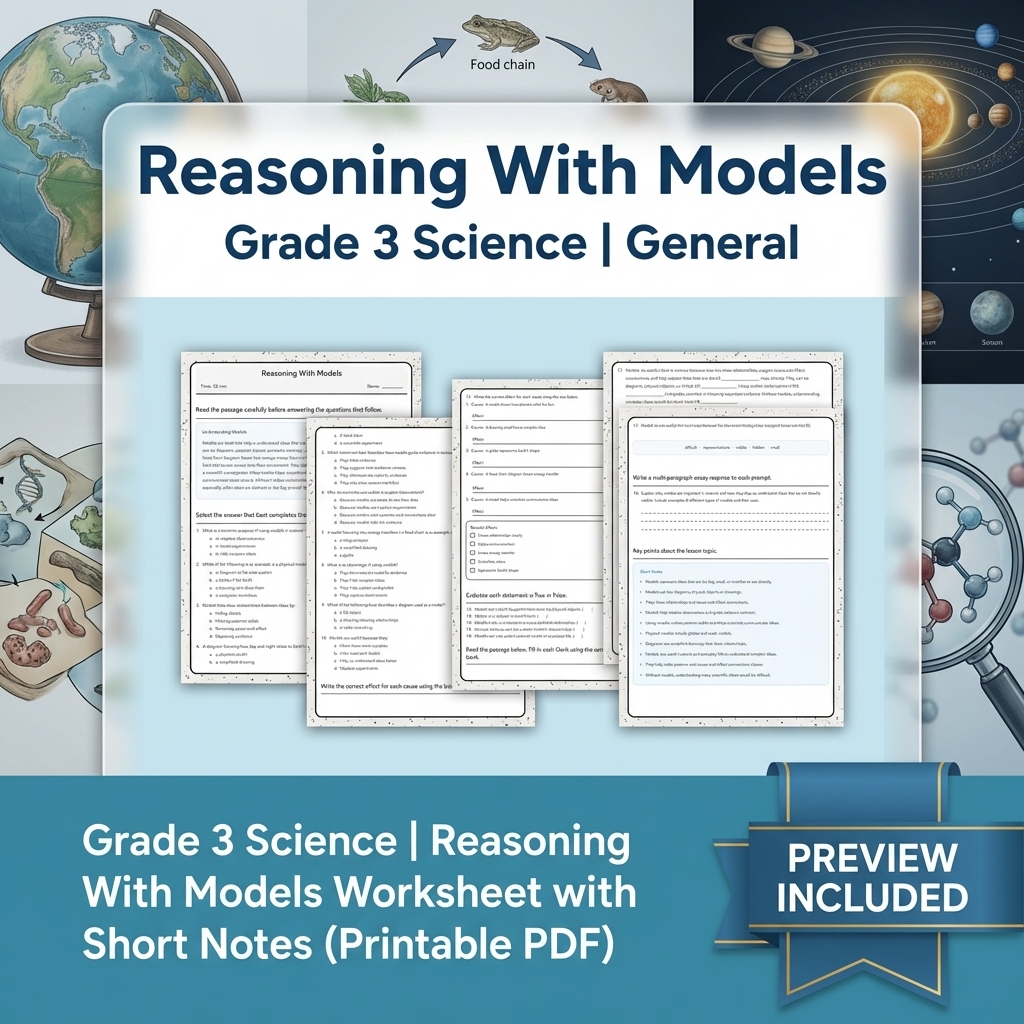
Grade 3 Science | Reasoning With Models Worksheet with Short Notes
Created byMeadowlark WorksheetsLearning Objectives
- Understand how models represent ideas that are not directly visible.
- Identify different types of models like diagrams, physical representations, and drawings.
- Explain how models show relationships and cause-and-effect connections.
Also included in: Grade 3 Science Lesson Bundle | Data, Models, and Evidence Activities +1 more
Instant download

Grade 3 Metamorphosis Stages Worksheet | NGSS Practice PDF
Created byClear Sky ClassroomLearning Objectives
- Identify the major stages of metamorphosis in monarch/butterflies and frogs
- Explain how an animal’s structures and behaviors change from one stage to the next
- Use science vocabulary related to life cycles to answer questions accurately
Instant download

Grade 3 Science Stewardship Practices for Healthy Soil Ontario Worksheet
Created byChalk and CompassLearning Objectives
- Describe how conservation practices help keep soil healthy over time
- Identify ways to reduce runoff, erosion, nutrient loss, and chemical pollution
- Explain how vegetation, compost, and buffers can protect water and fertility
Also included in: Grade 3 Science Soil Properties & Formation Lesson Bundle | Ontario +1 more
Instant download
About Grade 3 Science Worksheets
Browse 425 printable Grade 3 Science worksheets — ready-to-print PDFs with answer keys where available.
Each resource here is built by an independent educator and reviewed for quality. Worksheets print straight from PDF and suit classroom use, homework, or extra practice; most come with answer keys, and you can preview before purchasing.