
Grade 3 Science Worksheets
425 worksheets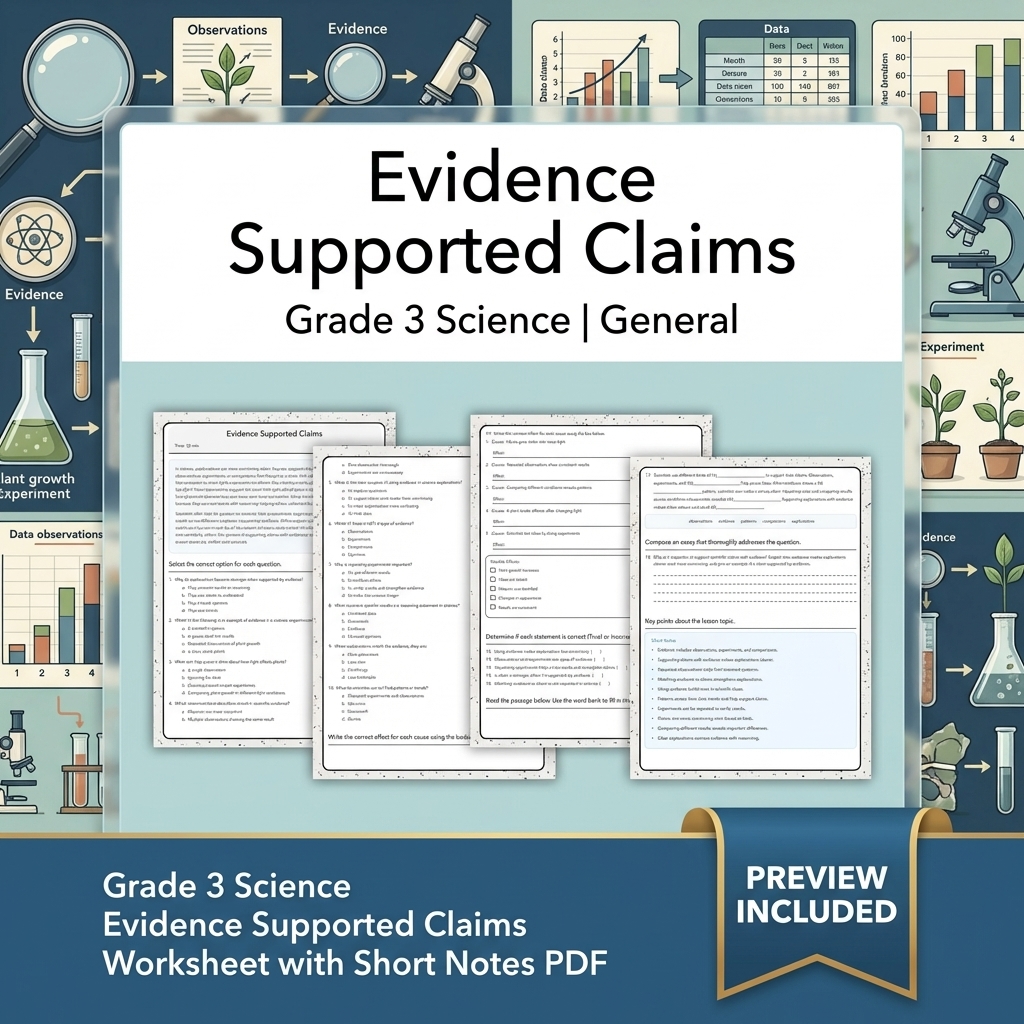
Grade 3 Science Evidence Supported Claims Worksheet with Short Notes PDF
 Created byMeadowlark Worksheets
Learning Objectives
- Understand how evidence strengthens scientific explanations and claims.
- Identify different types of evidence used to support claims.
- Connect specific results to reasoning statements through evidence.
Also included in: Grade 3 Science Lesson Bundle | Data, Models, and Evidence Activities +1 more
Instant download

Grade 3 Stem Transport Worksheet | Ontario Practice PDF
 Created byClear Sky Classroom
Learning Objectives
- Identify major stem parts and describe how xylem and phloem help plants transport resources.
- Explain how transpiration pull and sugar translocation support plant growth.
- Contrast herbaceous and woody stems, including vascular bundle arrangement and secondary growth.
Instant download

Structural Forms Worksheets: Arches, Beams & Frames | Grade 3
 Created byPrism Point Learning
Learning Objectives
- Identify structural forms (arches, beams, and frames) and describe their typical uses
- Compare how curvature, span, and connections affect strength and stability
- Distinguish compressive and bending behavior in simple structural examples
Instant download

Load Path Analysis Worksheets: Structural Systems Grade 3 Science
Created byPrism Point LearningLearning Objectives
- Describe how forces move from where they act to structural supports through a load path.
- Identify how trusses, beams, and columns share axial forces, shear, and bending moments.
- Explain how supports and foundations accept combined loads to help structures stay stable.
Instant download

Grade 3 Science Material Properties & Structural Trade-Offs Worksheet
 Created byChalk and Compass
Learning Objectives
- Identify how material properties such as density, stiffness, tensile strength, compressive strength, brittleness, and corrosion resistance affect structural stability.
- Match common construction materials to key property descriptions and choose the best material for a given load or environment.
- Explain, using evidence from a short passage, how material choice involves trade-offs among strength, durability, weight, and cost.
Also included in: Grade 3 Science Simple Structures Lesson Bundle | Ontario +1 more
Instant download

Grade 3 Material Uses Worksheet | Practice & Assessment PDF
Created byClear Sky ClassroomLearning Objectives
- Explain how the properties of rocks help them be used for hard, durable surfaces and construction.
- Describe how soil properties support plant growth and water absorption.
- Compare how rocks and soil behave and explain why different materials are chosen for different jobs.
Instant download

Soil Components and Texture Worksheets and Review Activity Grade 3
Created byPrism Point LearningLearning Objectives
- Identify the main components of soil: mineral particles, organic matter, water, and air.
- Describe how sand, silt, and clay particle sizes affect soil texture and drainage.
- Explain how organic matter and pore space relate to aeration and nutrient availability.
Also included in: Grade 3 Soil Science Lesson Bundle | Ontario Unit Framework
Instant download

Grade 3 Root Adaptations Worksheet | Ontario Practice & PDF
Created byClear Sky ClassroomLearning Objectives
- Describe how root morphology and root architecture help plants survive in different soils and conditions.
- Compare fibrous root systems and taproot systems, including how they affect water uptake and nutrient acquisition.
- Explain how root hairs, storage roots, mycorrhizal associations, and specialized aerial roots support plant survival.
Instant download

Grade 3 Body Structures Science Daily Reading Worksheet | NGSS Activity
 Created byBRIGHT PATH RESOURCES
Learning Objectives
- Identify an external structure on an animal or plant.
- Explain what the structure does in the life of the organism.
- Use clues from a reading passage to answer science questions.
Also included in: Body Structures Grade 3 Science Daily Reading Worksheets Lesson Bundle | NGSS +2 more
Instant download
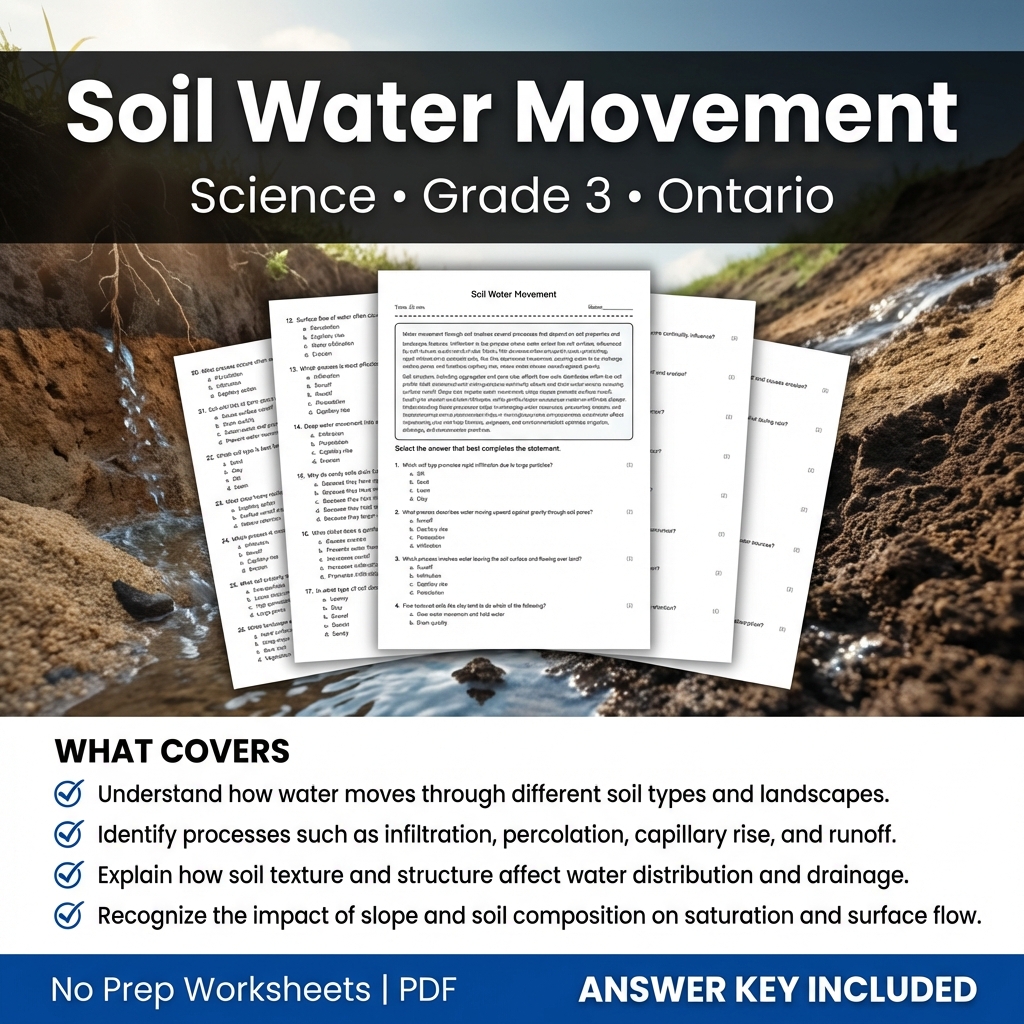
Soil Water Movement Worksheet | Grade 3 Science Practice & Assessment
 Created byCoral Reef Learning
Learning Objectives
- Understand how water moves through different soil types and landscapes.
- Identify processes such as infiltration, percolation, capillary rise, and runoff.
- Explain how soil texture and structure affect water distribution and drainage.
Instant download
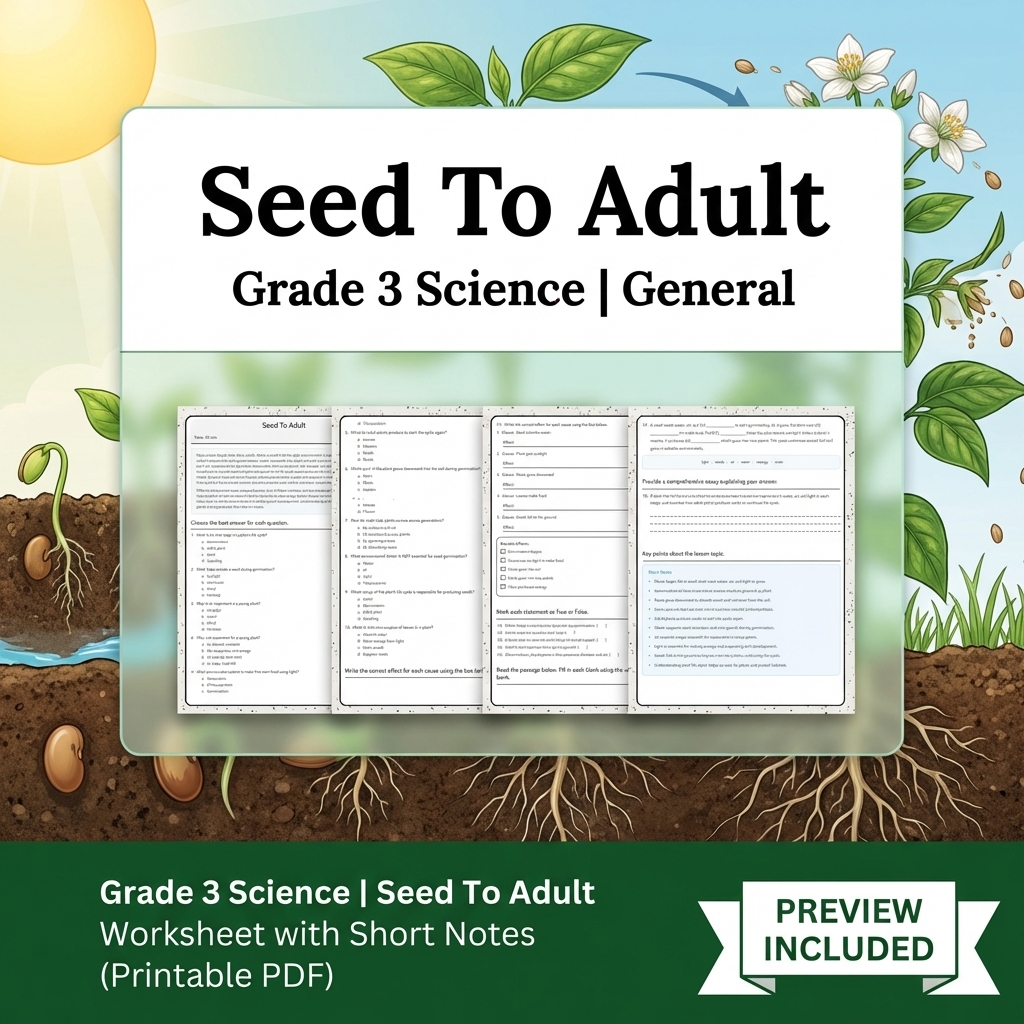
Grade 3 Science | Seed To Adult Worksheet with Short Notes (Printable PDF)
Created byMeadowlark WorksheetsLearning Objectives
- Understand the stages of a plant's life cycle from seed to adult.
- Identify the importance of water, air, and light in plant growth.
- Describe how adult plants produce seeds to continue the cycle.
Also included in: Grade 3 Science Lesson Group | Engaging Science Worksheets & Activities +1 more
Instant download

Grade 3 Science Worksheet | Straight Light Paths (PDF) for General Standards
 Created byEvergreen Desk Education
Learning Objectives
- Explain that many light paths can be described as straight lines.
- Identify how light behaves when it meets an opening, a barrier, or an edge.
- Use evidence from simple observations to describe where light can and cannot reach.
Also included in: Grade 3 Science: Light, Sound & Matter Lesson Bundle for General Framework +1 more
Instant download

Grade 3 Hazard Solutions Worksheet | Practice & NGSS PDF
Created byClear Sky ClassroomLearning Objectives
- Make reasoned claims about how design solutions reduce impacts of weather-related hazards.
- Use observational evidence, simple models, and community-style maps to compare the effectiveness of hazard solutions.
- Explain trade-offs (cost, durability, and local topography) when choosing among hazard-reduction designs.
Instant download

Animal and Plant Body Structures Worksheets for Grade 3 Science
 Created byLumora Learning
Learning Objectives
- Identify common external and internal body structures in plants and animals
- Match structures to the functions they help with for survival, growth, and reproduction
- Use models or simple drawings to show how different structures work together
Instant download

Grade 3 Model And Evidence Fit Worksheet | General Practice PDF
Created byClear Sky ClassroomLearning Objectives
- Explain how evidence can support or challenge a model’s predictions.
- Use observations to judge whether a model’s main idea fits real results.
- Revise an explanation when evidence does not match a model.
Instant download

Friction and Surface Texture Worksheets: Forces & Motion Grade 3
Created byPrism Point LearningLearning Objectives
- Explain how friction is a resistive force that can slow or stop moving objects.
- Compare sliding versus rolling to describe differences in friction effects.
- Predict how different surface textures and materials change how easily an object moves.
Also included in: Forces & Motion Lesson Bundle | Grade 3 Science | Ontario
Instant download

Grade 3 Changes of State Worksheet | NGSS Practice PDF
Created byClear Sky ClassroomLearning Objectives
- Explain how energy changes cause matter to change state (solid, liquid, gas).
- Describe melting, freezing, evaporation, and condensation as physical changes.
- Use temperature information to predict which state change is most likely.
Instant download
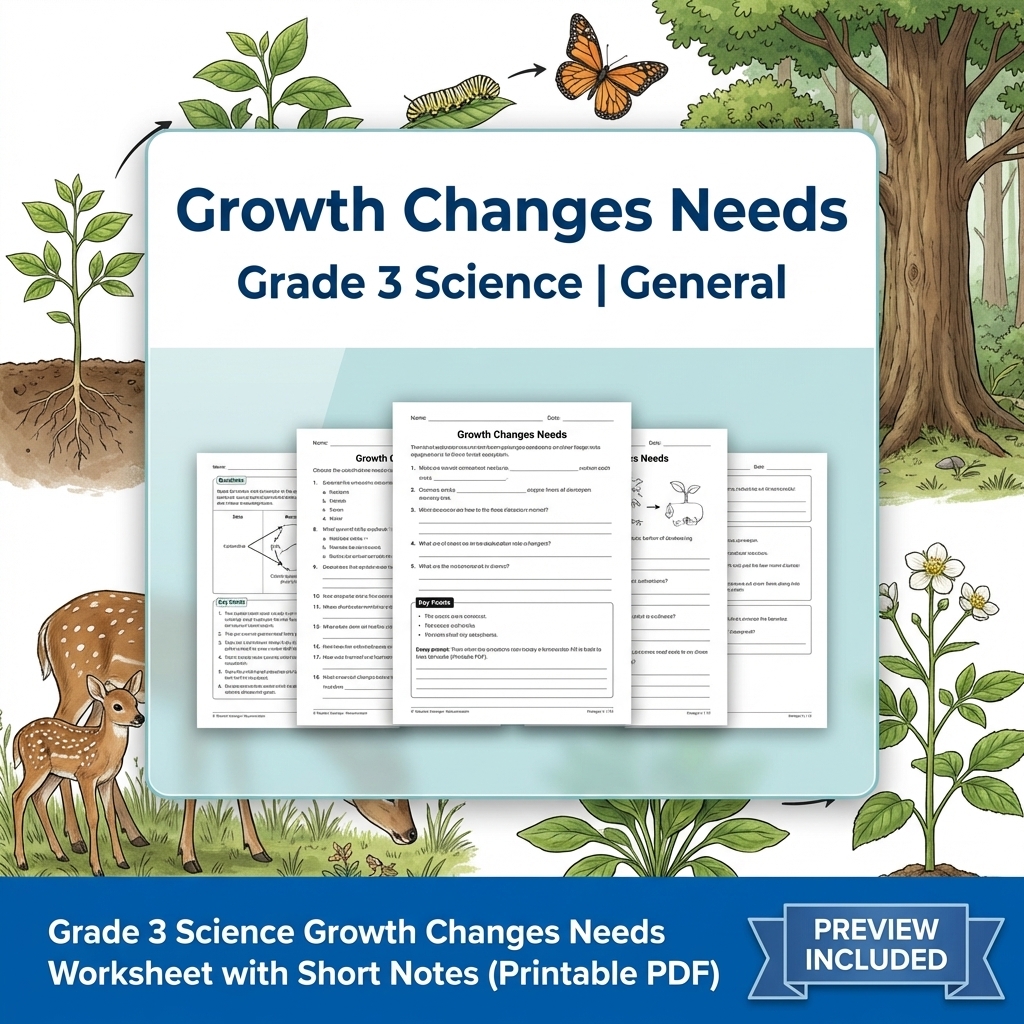
Grade 3 Science Growth Changes Needs Worksheet with Short Notes (Printable PDF)
Created byMeadowlark WorksheetsLearning Objectives
- Understand how organisms change as they grow.
- Identify the different needs of young and adult organisms.
- Describe how size, structures, and behaviors relate to survival needs.
Also included in: Grade 3 Science Lesson Group | Engaging Science Worksheets & Activities +1 more
Instant download

Grade 3 Physical Adaptations Worksheet | NGSS Practice PDF
Created byClear Sky ClassroomLearning Objectives
- Explain what physical adaptations are and how they help organisms survive and reproduce.
- Identify examples of physical adaptations in animals and plants and match them to the habitat or need they support.
- Describe how different environments can lead to different body features.
Instant download

Grade 3 Inclined Motion Worksheet | Practice & Assessment PDF
Created byClear Sky ClassroomLearning Objectives
- Explain how a sloped surface changes an object's tendency to move by redirecting the pull of gravity.
- Compare gentle versus steep inclines by describing how the slope angle affects downward motion tendency.
- Use examples of sliding and rolling to predict how speed tendency changes with slope and surface conditions.
Instant download

Grade 3 Science Worksheet | Sorting by Evidence (PDF) for Scientific Observation
Created byEvergreen Desk EducationLearning Objectives
- Use multiple material properties (mass, volume, texture, and shape) as evidence to sort and describe materials.
- Explain how comparing two materials with shared properties—but different other properties—helps distinguish them.
- Make and justify claims about materials using observations rather than guessing.
Also included in: Grade 3 Science: Light, Sound & Matter Lesson Bundle for General Framework +1 more
Instant download

Grade 3 Plant Root Functions Worksheet | NGSS Practice PDF
Created byClear Sky ClassroomLearning Objectives
- Describe how plant roots absorb water and dissolved minerals from soil
- Explain how different root shapes help plants survive in different environments
- Identify how roots support anchoring and help transport materials to stems and leaves
Instant download

Human Impacts on Soil Health Worksheets and Review Activity Grade 3
Created byPrism Point LearningLearning Objectives
- Describe how human actions can change soil quality over time
- Identify ways soil erosion, compaction, and nutrient loss can happen
- Explain how conservation practices help protect soil health
Also included in: Grade 3 Soil Science Lesson Bundle | Ontario Unit Framework
Instant download

Grade 3 Magnetic Interactions Worksheet | NGSS Practice PDF
Created byClear Sky ClassroomLearning Objectives
- Explain how magnets interact through forces that act at a distance.
- Distinguish magnetic forces from contact forces such as pushing and friction.
- Describe how magnetic interaction strength changes with distance and pole orientation.
Instant download
Grade 3 Science | Metamorphosis Stages Worksheet with Short Notes
Created byMeadowlark WorksheetsLearning Objectives
- Understand the main stages of metamorphosis in animals.
- Identify the characteristics of each stage in a life cycle.
- Explain how stage changes help animals meet their needs.
Also included in: Grade 3 Science Lesson Group | Engaging Science Worksheets & Activities +1 more
Instant download

Forces and Motion Worksheets | Grade 3 Science Practice Activities
Created byPrism Point LearningLearning Objectives
- Define force as a push or a pull
- Explain how a force can change an object's speed or direction
- Distinguish between contact forces and non-contact forces in everyday examples
Also included in: Forces & Motion Lesson Bundle | Grade 3 Science | Ontario
Instant download

Grade 3 Science | Life Cycle Stages Worksheet (PDF) – General Standards
Created byEvergreen Desk EducationLearning Objectives
- Explain that organisms go through distinct life cycle stages (such as germination, growth, and adulthood).
- Describe how an organism’s needs change from one life cycle stage to another.
- Use examples to connect life cycle stages to how populations continue from one generation to the next.
Also included in: Grade 3 Life Cycles & Classification Science Lesson Bundle: General +1 more
Instant download

Strong & Stable Structures Worksheets: Design Principles Grade 3 Science
Created byPrism Point LearningLearning Objectives
- Identify design choices that improve strength and stability in simple structures
- Explain how intended function, load paths, supports, and span affect structural performance
- Describe common failure modes such as buckling, tension fracture, and joint slippage
Instant download

Strong & Stable Structures Worksheets: Connections & Load Transfer Grade 3
Created byPrism Point LearningLearning Objectives
- Identify how rigid and pin connections affect stiffness and movement in structures
- Explain how fasteners and adhesives transfer loads through joints
- Describe how joint geometry and bearing area can change stress concentration
Instant download

Pitch, Loudness, and Vibration Rate Worksheets Grade 3 Science
Created byBRIGHT PATH RESOURCESLearning Objectives
- Explain how faster and slower vibrations affect perceived pitch
- Describe how stronger vibration motions relate to loudness
- Match vocabulary terms to definitions about sound and vibrations
Also included in: Grade 3 Science Worksheets Bundle | Matter, Light and Sound Unit +2 more
Instant download

Grade 3 Science – Simple Ecosystem Links Worksheet (PDF)
Created byEvergreen Desk EducationLearning Objectives
- Explain how living things in a simple ecosystem are connected through food and habitat needs.
- Identify producers, consumers, and predators/prey relationships in a shared habitat.
- Describe how animals and plants affect each other through seed spreading and growth.
Also included in: Grade 3 Life Cycles & Classification Science Lesson Bundle: General +1 more
Instant download

Plant Parts: Structure & Function Worksheets | Grade 3 Science
Created byPrism Point LearningLearning Objectives
- Identify the main parts of vascular plants: roots, stems, leaves, and flowers.
- Describe how roots, stems, leaves, and flowers help plants grow and reproduce.
- Connect specific structures (like taproots and woody stems) to their functions.
Also included in: Plant Growth & Reproduction Lesson Bundle | Grade 3 Science | Ontario
Instant download

Prototype Testing Worksheets | Grade 3 Engineering & Technology
Created byBRIGHT PATH RESOURCESLearning Objectives
- Define prototype and explain why testing is used
- Identify evidence from prototype tests (strength, fit, stability, function)
- Compare test results with the intended goal and describe how designs improve
Also included in: Grade 3 Science Simple Machines & Engineering Worksheets Bundle +2 more
Instant download

Grade 3 Metamorphosis Stages Worksheet | Practice & Review PDF
Created byClear Sky ClassroomLearning Objectives
- Identify the main stages of metamorphosis in insects: egg, larva, pupa, and adult.
- Explain how each stage’s body form helps an organism meet its needs.
- Use vocabulary (larva, pupa, adult) to describe life cycle changes.
Instant download
Grade 3 Science | Habitat Provides Shelter Worksheet with Short Notes
Created byMeadowlark WorksheetsLearning Objectives
- Understand what a habitat is and how it provides shelter for living things.
- Identify different types of habitats and their resources.
- Describe how habitats support the needs of organisms like water, shelter, and food.
Also included in: Grade 3 Science Lesson Group | Engaging Science Worksheets & Activities +1 more
Instant download
Grade 3 Science | Design Improvements Worksheet with Short Notes (Printable PDF)
Created byMeadowlark WorksheetsLearning Objectives
- Understand how test results provide evidence for improving designs.
- Learn how small adjustments can change performance in measurable ways.
- Identify different types of design changes such as shape, support, and materials.
Also included in: Grade 3 Science Lesson Bundle: Simple Machines, Tools, and Design Skills +1 more
Instant download

Grade 3 Life Cycle Stages Worksheet | General Practice PDF
Created byClear Sky ClassroomLearning Objectives
- Identify major life cycle stages of common organisms and explain what happens in each stage.
- Describe how needs (food, shelter, and environment) can change from a young stage to an adult stage.
- Explain how life cycles help populations continue from one generation to the next.
Instant download

Magnetic and Contact Interactions Worksheets for Grade 3 Science Practice
Created byLumora LearningLearning Objectives
- Describe how magnets can attract or repel each other without touching
- Distinguish magnetic forces from contact forces such as pushes and friction
- Explain how distance and pole orientation affect the strength of magnetic attraction or repulsion
Instant download

Grade 3 Predicting Motion From Forces and Slopes Science Worksheet Ontario
Created byChalk and CompassLearning Objectives
- Use qualitative cause-and-effect reasoning to predict what happens when an influence changes
- Describe how slope and added influences affect the speed and direction of an object’s motion
- Explain predictions using clear directional and comparative language
Also included in: Grade 3 Science Forces and Motion Lesson Bundle | Ontario +1 more
Instant download

Forces & Motion Worksheets: Predicting Directional Effects | Grade 3
Created byPrism Point LearningLearning Objectives
- Explain how changing one influence affects an outcome using qualitative cause-and-effect reasoning
- Predict how slope incline and additional influences change the speed and direction of motion
- Use comparisons (greater/less) to justify predictions about resistive interactions
Also included in: Forces & Motion Lesson Bundle | Grade 3 Science | Ontario
Instant download
Grade 3 Science | Design Steps Worksheet with Short Notes (Printable PDF)
Created byMeadowlark WorksheetsLearning Objectives
- Understand the steps involved in the engineering design process.
- Identify the importance of defining problems and proposing solutions.
- Recognize how asking questions and considering constraints aid in designing.
Also included in: Grade 3 Science Lesson Bundle: Simple Machines, Tools, and Design Skills +1 more
Instant download

Design Criteria and Constraints Worksheets | Grade 3 Science
 Created byTeachers Club
Learning Objectives
- Define design criteria and constraints for a given engineering problem
- Identify desired function, measurable success measures, and limits in a design scenario
- Describe trade-offs between competing requirements when choosing a solution
Also included in: Grade 3 Engineering Design Worksheets & NGSS Science Bundle +1 more
Instant download

Improving Designs with Test Evidence | Grade 3 Engineering Worksheet
Created byBRIGHT PATH RESOURCESLearning Objectives
- Explain how test results provide evidence to improve a design.
- Identify ways a design can be changed (shape, support, or materials) and what is being measured.
- Describe how matching outcomes to a goal helps refine a solution.
Also included in: Grade 3 Science Simple Machines & Engineering Worksheets Bundle +2 more
Instant download

Grade 3 Material Properties Worksheet | Practice & PDF
Created byClear Sky ClassroomLearning Objectives
- Identify observable material properties such as color, texture, size, shape, and response to light or touch.
- Compare two samples by describing similarities and differences in their material properties.
- Use evidence from observations to explain why two materials are alike or different.
Instant download

Grade 3 Motion From Net Forces Worksheet | California Standards Practice PDF
Created byClear Sky ClassroomLearning Objectives
- Explain how pushes and pulls affect an object’s motion.
- Determine how net force changes speed and/or direction.
- Use the idea of zero net force to describe when motion stays the same.
Instant download

Grade 3 Daily Weather Worksheet | Practice & Assessment PDF
Created byClear Sky ClassroomLearning Objectives
- Identify key parts of daily weather observations, such as temperature, precipitation, and wind.
- Use daily weather measurements to compare what happens from one day to the next.
- Explain how observable weather conditions affect daily life.
Instant download

Flower Structure and Reproduction Worksheets | Grade 3 Plant Science
Created byPrism Point LearningLearning Objectives
- Identify the main parts of a flower and describe their roles in reproduction.
- Explain how pollen is produced, received by the stigma, and how fertilization leads to seeds.
- Compare wind pollination and animal pollination and describe traits that help flowers interact with pollinators.
Also included in: Plant Growth & Reproduction Lesson Bundle | Grade 3 Science | Ontario
Instant download

Grade 3 Evidence Supported Claims Worksheet | Practice & PDF
Created byClear Sky ClassroomLearning Objectives
- Explain the difference between a claim and evidence
- Use evidence to support a reasoning statement that answers a question
- Recognize patterns in observations over time and across comparisons
Instant download
About Grade 3 Science Worksheets
Browse 425 printable Grade 3 Science worksheets — ready-to-print PDFs with answer keys where available.
Each resource here is built by an independent educator and reviewed for quality. Worksheets print straight from PDF and suit classroom use, homework, or extra practice; most come with answer keys, and you can preview before purchasing.