
Grade 3 Science Worksheets
425 worksheets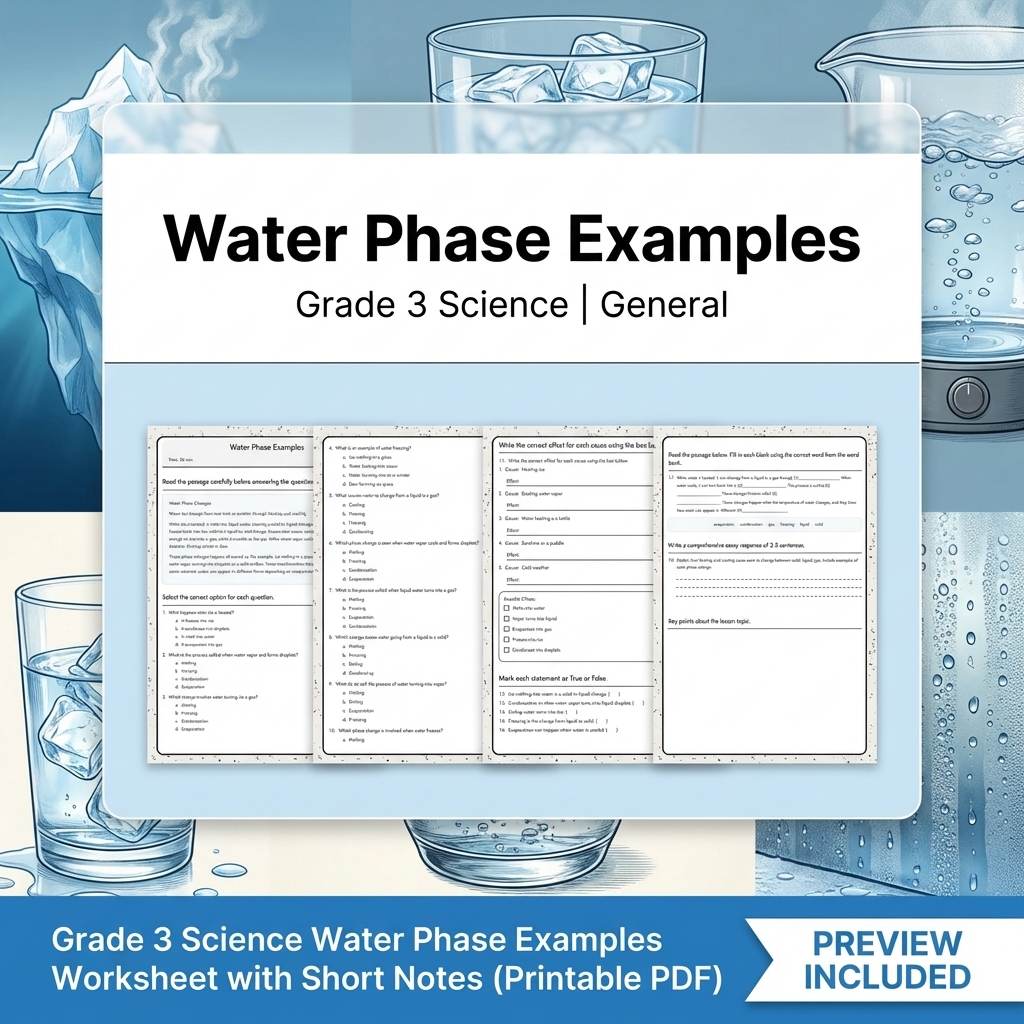
Grade 3 Science Water Phase Examples Worksheet with Short Notes (Printable PDF)
 Created byMeadowlark Worksheets
Learning Objectives
- Understand how heating and cooling cause observable phase changes in water.
- Identify examples of melting, freezing, evaporation, and condensation.
- Describe how the same material can appear in different states.
Also included in: Grade 3 Science Lesson Group: Worksheets for Properties, Water, Sound & Light +1 more
Instant download

Grade 3 Selecting Best Fit Worksheet | California Standards Practice PDF
 Created byClear Sky Classroom
Learning Objectives
- Explain how evidence is used to choose the best fit solution based on agreed-upon criteria for success.
- Describe tradeoffs by connecting improvements in one criterion to possible effects on another criterion.
- Acknowledge constraints (such as material limits and rules) and explain how they shape a design choice.
Instant download

Grade 3 Life Cycle Patterns in Seed Plants Science Worksheet Ontario
 Created byChalk and Compass
Learning Objectives
- Compare annual, biennial, perennial, and woody plant life cycles by timing of germination, flowering, seed set, and dormancy.
- Explain how seed banking and seasonal cues help plant populations survive through unfavorable seasons.
- Describe how environmental variability and human land-use can favor certain life histories and affect population persistence.
Also included in: Plant Growth and Life Cycles Lesson Bundle – Grade 3 Science Ontario +1 more
Instant download

Grade 3 Motion Patterns Science Daily Reading Worksheet | NGSS Activity
 Created byBRIGHT PATH RESOURCES
Learning Objectives
- Identify a repeating motion pattern using time comparisons.
- Use distance and time ideas to describe how rolling motion changes.
- Predict what might happen next in a rolling motion pattern.
Also included in: Motion and Stability Grade 3 Science Daily Reading Worksheets Bundle | NGSS +2 more
Instant download
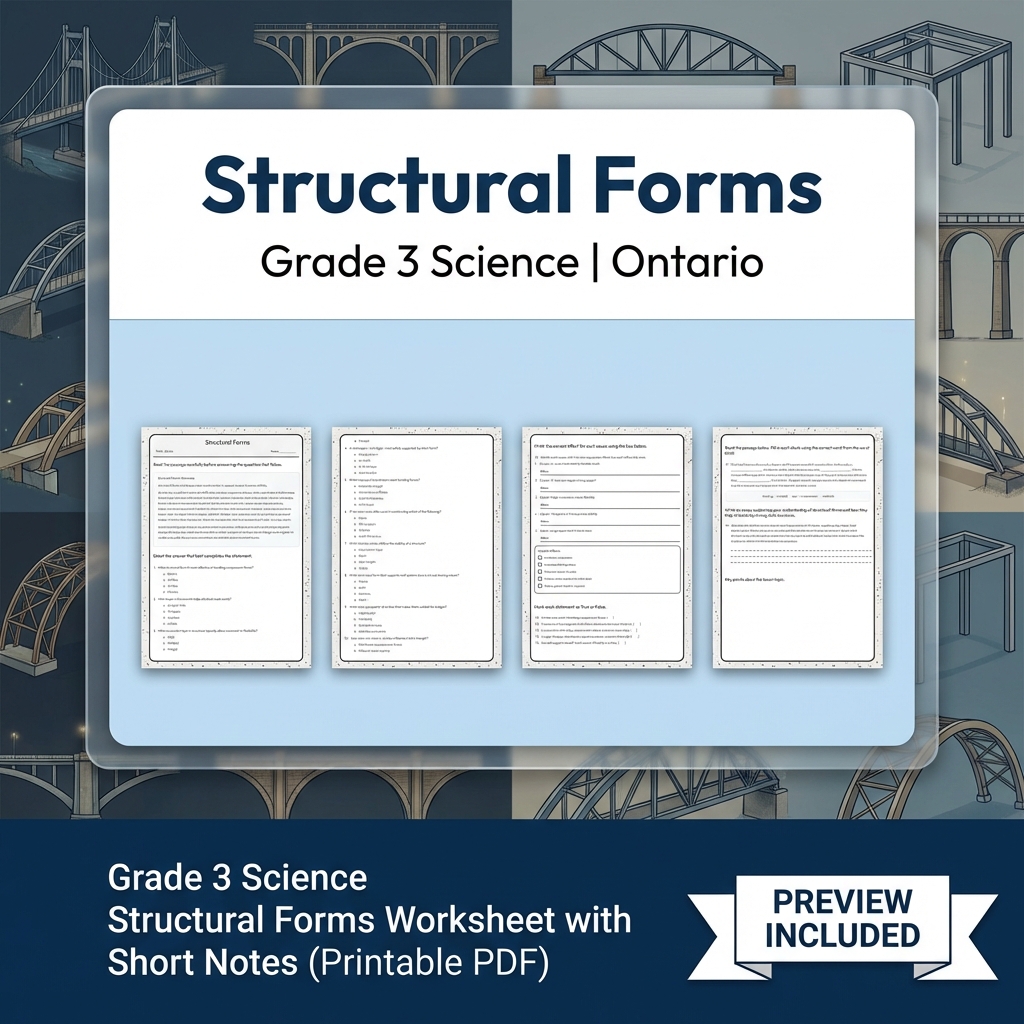
Grade 3 Science Structural Forms Worksheet with Short Notes (Printable PDF)
Created byMeadowlark WorksheetsLearning Objectives
- Understand different types of structural forms such as arches, beams, and frames.
- Identify how shape, span, and connection types affect the strength and stability of structures.
- Learn vocabulary related to compression, bending, and load distribution in structures.
Also included in: Grade 3 Science Basic Structures & Materials Worksheet Bundle | Ontario +1 more
Instant download

Grade 3 Weather Patterns Science Daily Reading Worksheet | NGSS Activity
Created byBRIGHT PATH RESOURCESLearning Objectives
- Identify the main idea and key details from a short weather-data description.
- Use notes and simple data to describe daily weather changes.
- Explain how clouds and temperature can vary from day to day.
Also included in: Weather Patterns & Landform Processes Grade 3 Science Daily Bundle | NGSS +2 more
Instant download

Grade 3 Hazard Solutions Science Daily Reading Worksheet | NGSS Activity
Created byBRIGHT PATH RESOURCESLearning Objectives
- Use evidence from a text to make a reasoned claim about a solution for flood risk.
- Compare benefits and trade-offs of hazard solutions using details from a short passage.
- Explain why a chosen design would work better during strong rain in a specific setting.
Also included in: Grade 3 Science Full-Year Bundle | NGSS Daily Reading +1 more
Instant download
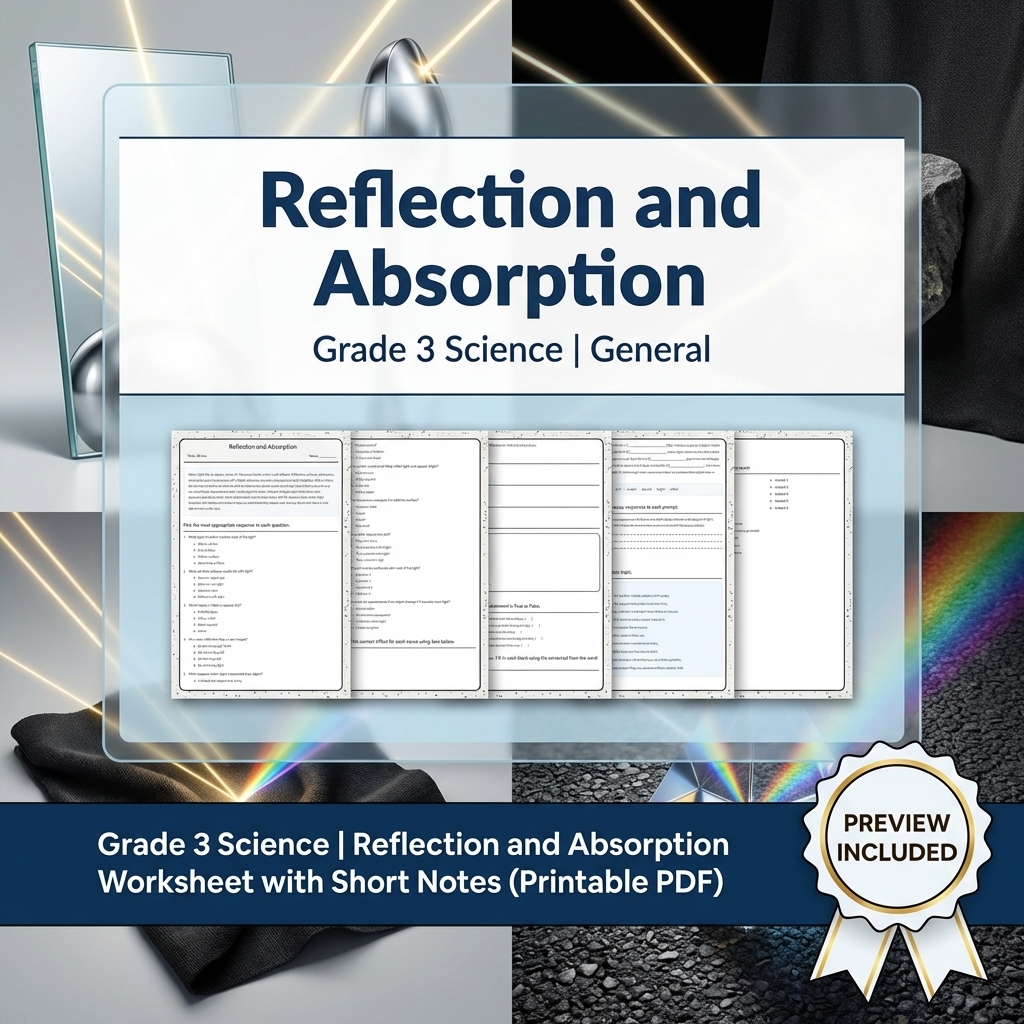
Grade 3 Science | Reflection and Absorption Worksheet with Short Notes
Created byMeadowlark WorksheetsLearning Objectives
- Understand how objects reflect and absorb light.
- Identify the differences between shiny and dull surfaces.
- Observe how light interactions affect the appearance of objects.
Also included in: Grade 3 Science Lesson Group: Worksheets for Properties, Water, Sound & Light +1 more
Instant download

Grade 3 Group Survival Science Daily Reading Worksheet | NGSS Activity
Created byBRIGHT PATH RESOURCESLearning Objectives
- Identify the main idea of a science passage about group survival.
- Find key details that explain how groups help organisms survive.
- Use evidence from the passage to answer questions about traits and resources.
Also included in: Grade 3 Science Full-Year Bundle | NGSS Daily Reading +1 more
Instant download

Grade 3 Science Worksheet | Vibrating Sound Makers (PDF)
 Created byEvergreen Desk Education
Learning Objectives
- Explain how vibrations produce sound.
- Identify common sound sources and describe how they vibrate.
- Classify sound effects using cause-and-effect reasoning.
Also included in: Grade 3 Science: Light, Sound & Matter Lesson Bundle for General Framework +1 more
Instant download

Grade 3 Science Worksheet | Water Phases Examples (PDF)
Created byEvergreen Desk EducationLearning Objectives
- Identify examples of water changing phases when heated or cooled.
- Explain solid, liquid, and gas changes using everyday observations.
- Match phase changes (melting, freezing, evaporation, condensation) to states of matter.
Also included in: Grade 3 Science: Light, Sound & Matter Lesson Bundle for General Framework +1 more
Instant download

Grade 3 Testing Improvements Science Daily Reading Worksheet | NGSS STEM
Created byBRIGHT PATH RESOURCESLearning Objectives
- Identify the controlled variables in a fair test.
- Explain why keeping conditions the same helps results make sense.
- Connect test results to design improvements.
Also included in: Designing Solutions Grade 3 Science Daily Reading Worksheets Lesson Bundle| NGSS +2 more
Instant download

SCIENCE GRADE 3 WEATHER AND CLIMATE PATTERNS
 Created byTeacherNest
Learning Objectives
- Identify sunny, rainy, windy, snowy, and stormy weather conditions
- Plot and read simple weather charts and monthly temperature graphs
- Compare weather and climate using graphic organizers
Instant download

Grade 3 Flower Function Worksheet | Practice & Assessment PDF
Created byClear Sky ClassroomLearning Objectives
- Identify major flower parts (sepals, petals, stamens, and pistils) and explain what each part does in reproduction
- Describe how pollen production, stigma reception, and fertilization lead to seed formation
- Compare wind pollination and animal pollination and explain how flower traits help attract pollinators
Instant download

Weather-Related Hazard Design Solutions Worksheets | Grade 3
 Created byTeachers Club
Learning Objectives
- Make a reasoned claim about which design solution best reduces flooding or strong-wind impacts
- Use observational evidence and simple models to compare solution effectiveness under different weather scenarios
- Explain trade-offs among cost, durability, and fit to local topography
Also included in: Grade 3 Science Full Year Bundle | NGSS Worksheets & Printables
Instant download
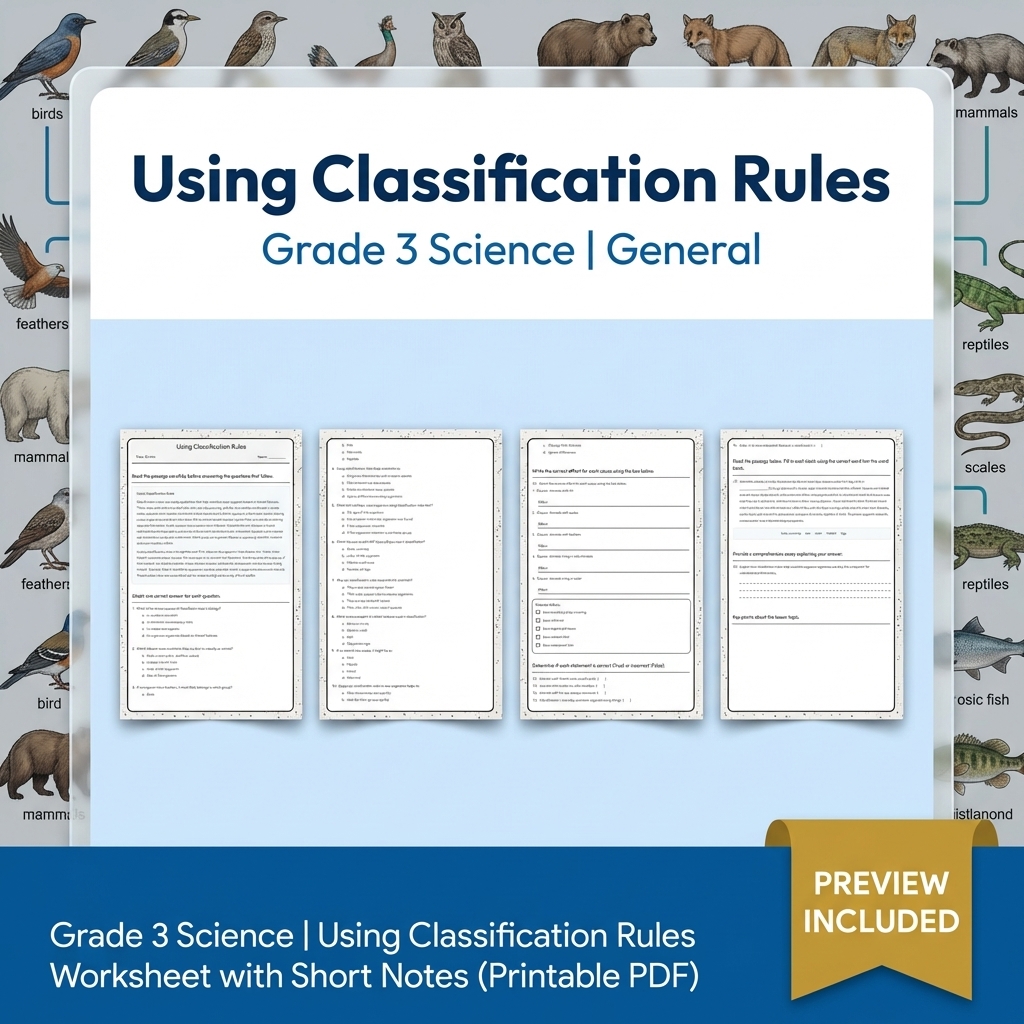
Grade 3 Science | Using Classification Rules Worksheet with Short Notes
Created byMeadowlark WorksheetsLearning Objectives
- Understand how simple classification rules help organize organisms.
- Identify observable features used in classification.
- Apply classification rules to sort new organisms.
Also included in: Grade 3 Science Lesson Group | Engaging Science Worksheets & Activities +1 more
Instant download

Grade 3 Science Worksheet | Habitat Provides Shelter (PDF)
Created byEvergreen Desk EducationLearning Objectives
- Explain how a habitat provides shelter, food, water, and environmental conditions for living things.
- Identify examples of shelter in different habitats (forest floor, pond, field).
- Describe how living things in the same habitat interact when their needs overlap.
Also included in: Grade 3 Life Cycles & Classification Science Lesson Bundle: General +1 more
Instant download

Grade 3 Science Worksheet | Predator Prey Dependence (PDF)
Created byEvergreen Desk EducationLearning Objectives
- Explain how predators and prey depend on each other within an ecosystem.
- Describe how changes in prey population can affect predator survival and behavior.
- Use evidence to support how food and shelter needs connect different organisms in a habitat.
Also included in: Grade 3 Life Cycles & Classification Science Lesson Bundle: General +1 more
Instant download

Grade 3 Life Cycle Comparisons Worksheet | NGSS Practice PDF
Created byClear Sky ClassroomLearning Objectives
- Describe how life cycles progress through stages from early growth to adulthood
- Compare plant life cycles (seed-to-seed) with animal life cycles (youth stages and adult stages)
- Explain how different life cycle stages help organisms survive, grow, and reproduce
Instant download

Grade 3 Weather Measurements Worksheet | Practice & Assessment PDF
Created byClear Sky ClassroomLearning Objectives
- Identify common weather elements such as temperature, precipitation, cloud cover, and wind.
- Explain how weather measurements are recorded and used to look for patterns over time.
- Use weather data to answer questions about short-term conditions and possible seasonal changes.
Instant download

Inherited Traits and Variation Worksheets | Grade 3 Science
Created byTeachers ClubLearning Objectives
- Explain how offspring can inherit traits from parents
- Describe variation among individuals in a population using examples
- Use simple trait data to identify inherited characteristics and variation
Also included in: Grade 3 Science Full Year Bundle | NGSS Worksheets & Printables
Instant download

Day and Night Worksheets: Earth’s Rotation for Grade 3 Science
Created byBRIGHT PATH RESOURCESLearning Objectives
- Explain how Earth’s rotation causes day and night
- Describe how different sides of Earth face the Sun during its spin
- Recognize that the daily cycle is caused by Earth’s motion, not the Sun’s motion
Also included in: Grade 3 Earth Science Worksheets Bundle: Weathering, Water Cycle & More +2 more
Instant download

Grade 3 Adaptations and Habitat Fit Worksheet | NGSS Practice PDF
Created byClear Sky ClassroomLearning Objectives
- Explain how adaptations help organisms survive by matching their needs to habitat conditions.
- Describe examples of adaptations in deserts and in forests/grasslands.
- Use evidence from a habitat scenario to predict how an organism might survive when conditions change.
Instant download
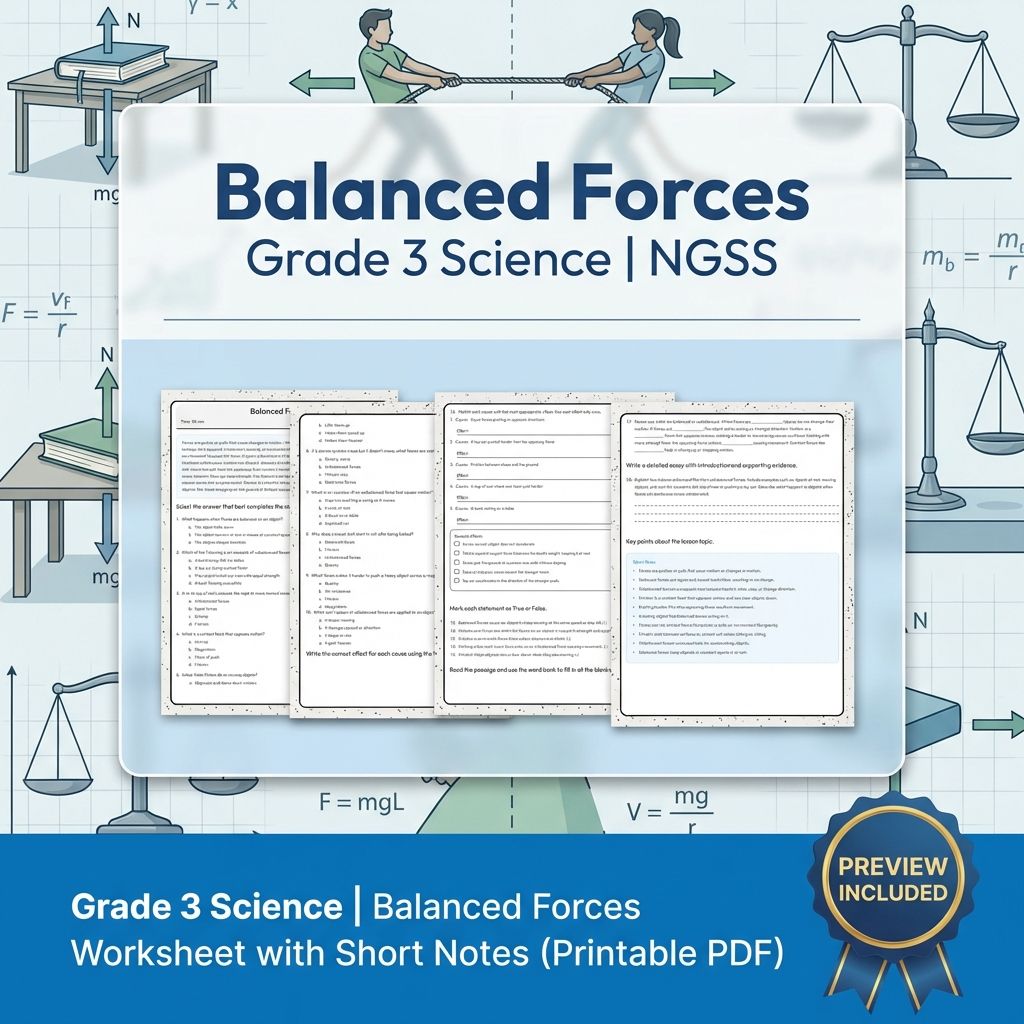
Grade 3 Science | Balanced Forces Worksheet with Short Notes (Printable PDF)
Created byMeadowlark WorksheetsLearning Objectives
- Understand how balanced forces produce no change in an object's motion.
- Recognize examples of balanced and unbalanced forces in everyday life.
- Explain how unbalanced forces cause objects to start, stop, or change direction.
Also included in: Grade 3 Science NGSS Unit | Motion and Stability: Forces & Interactions +1 more
Instant download

Grade 3 Forces Defined Worksheet | Practice & Assessment PDF
Created byClear Sky ClassroomLearning Objectives
- Explain that a force is a push or a pull that can change how an object moves.
- Describe how force has direction and magnitude using everyday examples.
- Distinguish between contact forces and non-contact forces in simple terms.
Instant download

Ecosystem Interactions Worksheets: Cooperation & Resource Sharing Grade 3
Created byTeachers ClubLearning Objectives
- Explain how groups of organisms can increase survival through shared defense, foraging, or care of young.
- Describe how competition for limited resources affects which traits help a population survive.
- Use observable traits and ecological context to support a claim about group survival.
Also included in: Grade 3 Science Full Year Bundle | NGSS Worksheets & Printables
Instant download

Grade 3 Friction Effects Worksheet | NGSS Practice PDF
Created byClear Sky ClassroomLearning Objectives
- Describe how friction affects the motion of objects
- Explain how surface roughness and material change the strength of friction
- Identify everyday examples where friction helps or slows movement
Instant download

Stem Transport & Tree Growth Worksheets | Grade 3 Science
 Created byPrism Point Learning
Learning Objectives
- Describe how xylem and transpiration pull move water through stems to support growth
- Explain how phloem translocation moves sugars to different parts of a plant
- Compare herbaceous and woody stems by vascular bundle arrangement and growth over time
Also included in: Plant Growth & Reproduction Lesson Bundle | Grade 3 Science | Ontario
Instant download

Grade 3 Science Worksheet | Data Representations and Graphs (PDF)
Created byEvergreen Desk EducationLearning Objectives
- Explain how observations and measurements can be organized into clear representations like tally tables and bar graphs.
- Use correct labels and an appropriate scale to make data in a representation easier to compare.
- Identify patterns and comparisons in data representations and explain what they show.
Also included in: Grade 3 Scientific Evidence & Data Science Lesson Bundle: General +1 more
Instant download

Grade 3 Science Worksheet – Clouds and Rainfall (PDF) | General Standards
Created byEvergreen Desk EducationLearning Objectives
- Explain how temperature and water vapor help form clouds
- Describe how condensation can lead to precipitation (rain or snow)
- Use observations of cloudiness and timing to connect weather to water’s changing forms
Also included in: Grade 3 Weather & Earth Materials Science Lesson Bundle: General Framework +1 more
Instant download
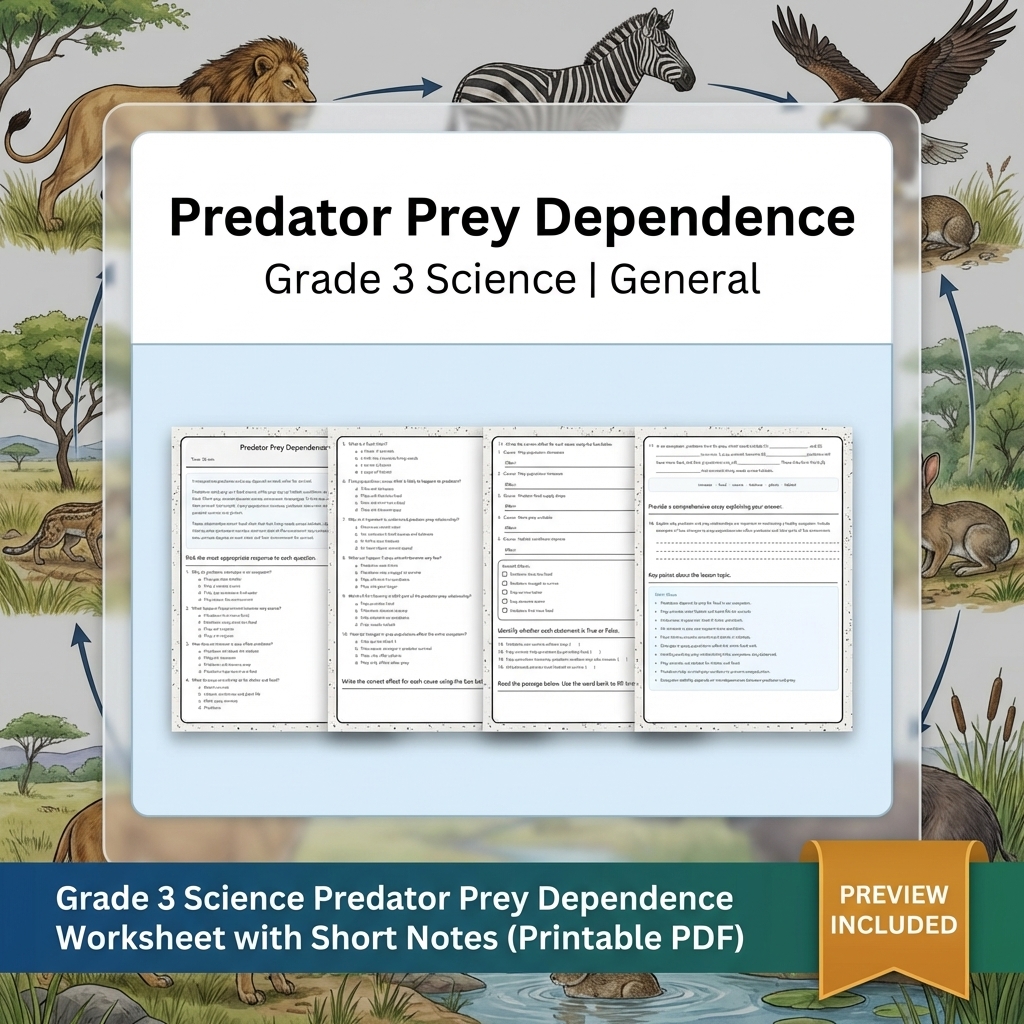
Grade 3 Science Predator Prey Dependence Worksheet with Short Notes
Created byMeadowlark WorksheetsLearning Objectives
- Understand how predators and prey depend on each other within an ecosystem.
- Identify the effects of changes in prey populations on predator survival.
- Explain the relationship between habitat conditions, food sources, and animal survival.
Also included in: Grade 3 Science Lesson Group | Engaging Science Worksheets & Activities +1 more
Instant download

Grade 3 Balanced Forces Science Daily Reading Worksheet | NGSS Activity
Created byBRIGHT PATH RESOURCESLearning Objectives
- Explain what a force is and that forces can act by touching or without touching.
- Identify how balanced forces keep an object’s motion the same.
- Describe how unbalanced forces change an object’s motion.
Also included in: Motion and Stability Grade 3 Science Daily Reading Worksheets Bundle | NGSS +2 more
Instant download

Grade 3 Science Worksheet | Day and Night Causes (PDF) with Answer Key
Created byEvergreen Desk EducationLearning Objectives
- Explain how Earth’s rotation causes day and night.
- Describe how sunlight reaches the side of Earth facing the Sun.
- Recognize that Earth’s motion, not the Sun’s motion, creates the daily cycle.
Also included in: Grade 3 Weather & Earth Materials Science Lesson Bundle: General Framework +1 more
Instant download

Shadows and Transparency Worksheets | Grade 3 Science
Created byBRIGHT PATH RESOURCESLearning Objectives
- Explain why shadows form when objects block light.
- Identify how opaque and transparent materials affect what you can see.
- Use evidence from a diagram to describe where light goes and where shadows form.
Also included in: Grade 3 Science Worksheets Bundle | Matter, Light and Sound Unit +2 more
Instant download

Grade 3 Motion Patterns Worksheet | NGSS Practice PDF
Created byClear Sky ClassroomLearning Objectives
- Identify patterns in motion by comparing distance and time for an object
- Describe how friction can cause objects to slow down and how slopes can change speed
- Use simple measurements to make predictions about future motion
Instant download

Grade 3 Traits and Variation Science Daily Reading Worksheet | NGSS
Created byBRIGHT PATH RESOURCESLearning Objectives
- Identify inherited traits in a family by reading and observing similarities.
- Describe how variation can still happen even when traits are inherited.
Also included in: Grade 3 Science Full-Year Bundle | NGSS Daily Reading +1 more
Instant download
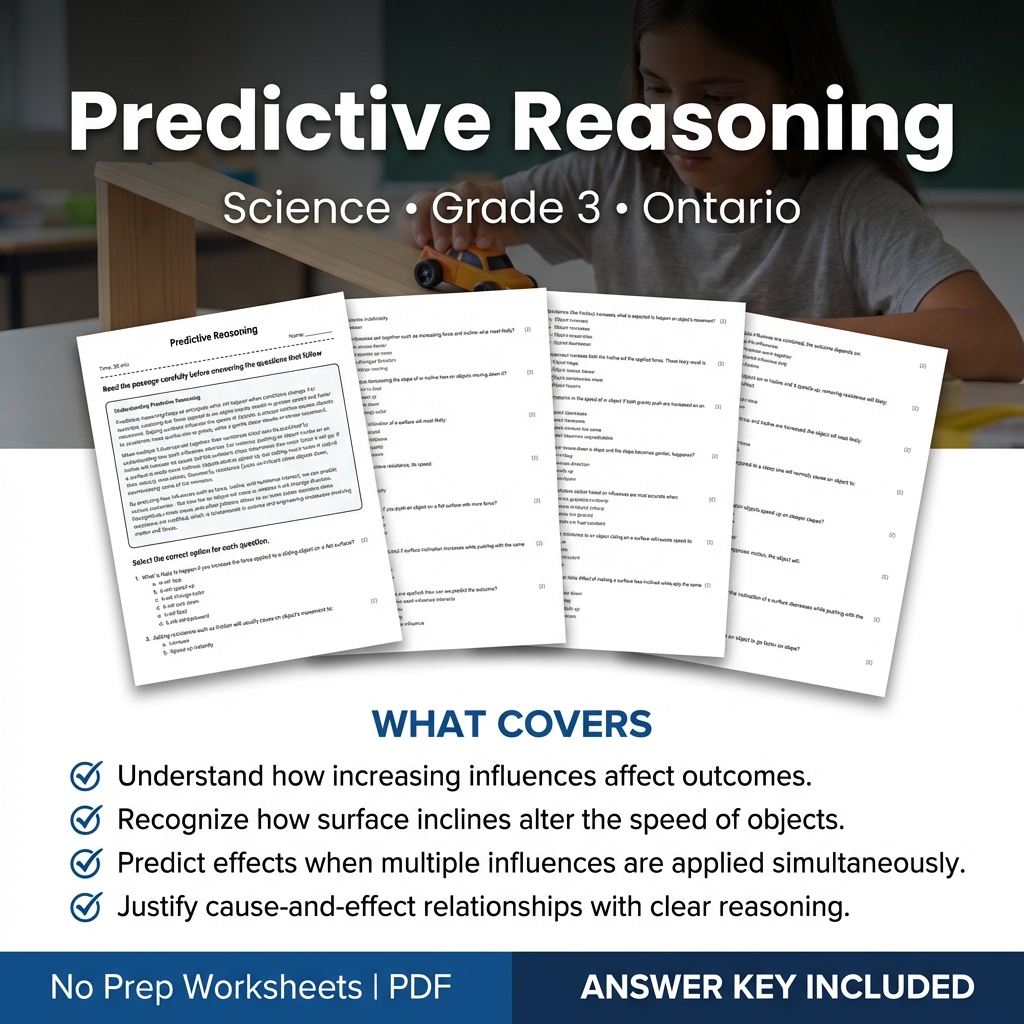
Predictive Reasoning Worksheet for Grade 3 Science | Ontario Standards
 Created byCoral Reef Learning
Learning Objectives
- Understand how increasing influences affect outcomes.
- Recognize how surface inclines alter the speed of objects.
- Predict effects when multiple influences are applied simultaneously.
Instant download

Grade 3 Motion Prediction Worksheet | California Standards Practice PDF
Created byClear Sky ClassroomLearning Objectives
- Identify patterns in an object’s motion over equal time intervals.
- Use a pattern to predict what happens next in an object’s position or distance.
- Explain how repeated measurements support motion predictions.
Instant download

Grade 3 Predictive Reasoning Worksheet | Ontario Practice PDF
Created byClear Sky ClassroomLearning Objectives
- Use cause-and-effect reasoning to predict how changes in a situation can change outcomes.
- Explain directional influences (increase/decrease) and speed-related consequences using scientific language.
- Compare two scenarios and justify which one will produce a faster, slower, or different result.
Instant download

Grade 3 Testing Improvements Worksheet | Practice & NGSS PDF
Created byClear Sky ClassroomLearning Objectives
- Explain how fair tests control variables to learn whether a prototype change improves results.
- Identify possible failure modes in a prototype and describe how test outcomes guide design modifications.
- Use recorded observations to compare test results from the original model and an improved version.
Instant download
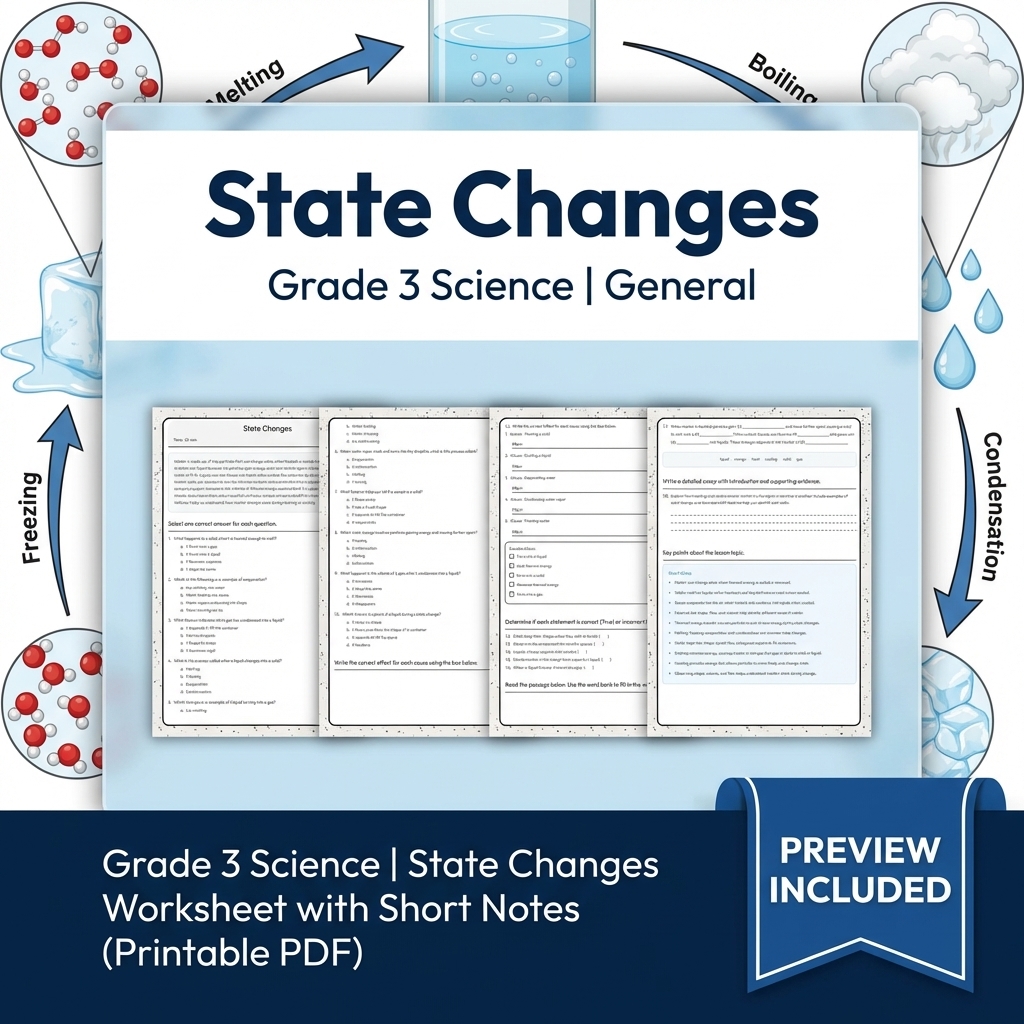
Grade 3 Science | State Changes Worksheet with Short Notes (Printable PDF)
Created byMeadowlark WorksheetsLearning Objectives
- Understand different state changes of matter when heating or cooling.
- Identify features that indicate whether a sample is solid, liquid, or gas.
- Describe the processes of melting, freezing, evaporation, and condensation.
Also included in: Grade 3 Science Lesson Group: Worksheets for Properties, Water, Sound & Light +1 more
Instant download

Grade 3 Science Worksheet | Growth Changes Needs (PDF)
Created byEvergreen Desk EducationLearning Objectives
- Explain how an organism’s survival needs can change as it grows and develops.
- Describe examples of changing needs in plants and animals at different life stages.
- Use evidence from a text to identify relationships between growth and resources.
Also included in: Grade 3 Life Cycles & Classification Science Lesson Bundle: General +1 more
Instant download

Grade 3 Inherited Trait Evidence Worksheet | Practice & PDF
Created byClear Sky ClassroomLearning Objectives
- Identify observable inherited traits in plants and animals and describe how they pass from parents to offspring.
- Use evidence from multiple generations to explain why offspring resemble their parents.
- Distinguish between shared traits in a group and differences between individual organisms.
Instant download

Soil Properties and Plant Growth Worksheets | Grade 3 Science
Created byPrism Point LearningLearning Objectives
- Explain how soil pore size and structure affect water retention and drainage
- Describe how soil aeration influences oxygen supply to plant roots
- Compare loam, clay, and sandy soils using retention, drainage, and aeration
Also included in: Grade 3 Soil Science Lesson Bundle | Ontario Unit Framework
Instant download

Grade 3 Seasonal Environment Predictability Worksheet | Practice & PDF
Created byClear Sky ClassroomLearning Objectives
- Explain how changing sunlight across the year leads to predictable seasonal patterns in temperature and precipitation.
- Describe how atmospheric processes connect longer-term seasonal trends to typical weather outcomes.
- Distinguish predictable seasonal patterns from short-term weather events that can vary.
Instant download

Grade 3 Life Cycle Patterns Worksheet | Practice & Standards PDF
Created byClear Sky ClassroomLearning Objectives
- Explain that living things grow through predictable life cycle stages.
- Identify common stages such as egg, juvenile, and adult in familiar organisms.
- Describe how life cycle patterns connect one generation to the next.
Instant download

Grade 3 Balanced Forces Worksheet | NGSS Practice PDF
Created byClear Sky ClassroomLearning Objectives
- Explain what balanced forces are and how they affect an object's motion.
- Identify examples of balanced forces in everyday situations.
- Describe how net force relates to whether an object stays at rest or moves steadily.
Instant download

Environmental Factors Affecting Plant Growth Worksheets Grade 3
Created byPrism Point LearningLearning Objectives
- Describe how soil, light, water, temperature, and nutrients affect plant germination and growth
- Explain how human practices and environmental stresses can change where plants survive and establish
- Use evidence from scenarios to predict how a change in conditions may affect plant survival
Also included in: Plant Growth & Reproduction Lesson Bundle | Grade 3 Science | Ontario
Instant download
About Grade 3 Science Worksheets
Browse 425 printable Grade 3 Science worksheets — ready-to-print PDFs with answer keys where available.
Each resource here is built by an independent educator and reviewed for quality. Worksheets print straight from PDF and suit classroom use, homework, or extra practice; most come with answer keys, and you can preview before purchasing.