
Grade 4 Science Worksheets
454 worksheets
Grade 4 Science Inquiry Worksheet | NGSS Practice PDF
 Created byClear Sky Classroom
Learning Objectives
- Explain how scientific inquiry uses observations and questions as starting points
- Use evidence from measurements or data to support an explanation
- Describe how scientists revise ideas when new evidence does not match
Instant download

Grade 4 Energy Loss Between Steps Worksheet | NGSS Practice PDF
Created byClear Sky ClassroomLearning Objectives
- Explain why energy decreases at each step of a food chain
- Describe how organisms use energy for life processes and how energy can be lost as heat
- Connect energy loss to why longer food chains usually have fewer top consumers
Instant download

Grade 4 Habitat and Interdependence Worksheet | NGSS Practice PDF
Created byClear Sky ClassroomLearning Objectives
- Explain what a habitat is and describe key habitat conditions (food, water, shelter, and living conditions).
- Describe how organisms in the same habitat depend on one another for resources.
- Use evidence from a text to identify main ideas and make correct claims about habitat relationships.
Instant download

Grade 4 Constraints Types Worksheet | California Standards Practice PDF
Created byClear Sky ClassroomLearning Objectives
- Identify different types of constraints that affect a design during problem solving.
- Explain how constraints limit possible solutions in real-world engineering situations.
- Use vocabulary such as material, dimensions, mass, operating conditions, time, and environmental safety to describe constraints.
Instant download
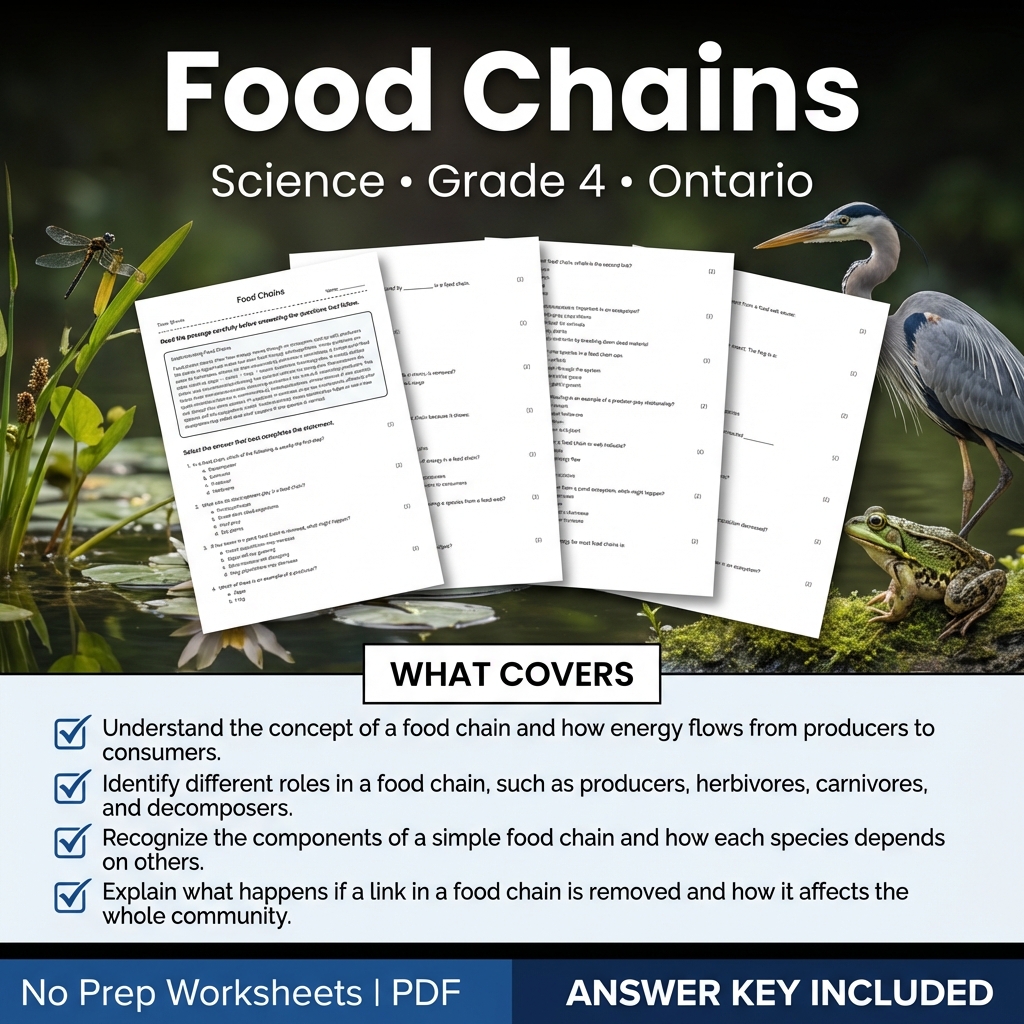
Food Chains Worksheet for Grade 4 Science | Ontario Standards
 Created byCoral Reef Learning
Learning Objectives
- Understand the concept of a food chain and how energy flows from producers to consumers.
- Identify different roles in a food chain, such as producers, herbivores, carnivores, and decomposers.
- Recognize the components of a simple food chain and how each species depends on others.
Instant download

Grade 4 States of Matter Worksheet | NGSS Practice & PDF
Created byClear Sky ClassroomLearning Objectives
- Distinguish solids, liquids, and gases by their observable properties.
- Identify how particles and movement relate to shape and volume in different states of matter.
- Use temperature-related thinking to explain why matter can change state.
Instant download

Grade 4 Pattern To Model Worksheet | Practice & PDF
Created byClear Sky ClassroomLearning Objectives
- Explain how patterns in data tables and charts can be modeled to show relationships.
- Use simple models (diagrams, arrow models, or graphs) to make predictions from data.
- Identify where a model fits the evidence well and where it may need more data.
Instant download

Grade 4 Comparing Solution Ideas Worksheet | NGSS Practice PDF
Created byClear Sky ClassroomLearning Objectives
- Generate multiple solution ideas for a problem using given constraints
- Compare solution ideas by considering tradeoffs related to criteria and limits
- Explain which solution best meets the original problem statement using evidence
Instant download

Grade 4 Parts Functioning Worksheet | Practice & Assessment PDF
Created byClear Sky ClassroomLearning Objectives
- Explain how major parts of an engineering design work together to meet success criteria and constraints.
- Describe structure-to-purpose relationships by linking a component’s function to its effect on heat transfer.
- Use evidence from a model design to identify which parts reduce melting and why.
Instant download

Grade 4 Surface Mapping Worksheet | NGSS Practice PDF
Created byClear Sky ClassroomLearning Objectives
- Interpret topographic maps by using contour lines and elevation gradients to describe changes in terrain
- Identify drainage patterns and depositional zones by analyzing river networks and landforms on maps or images
- Match map symbols and scale information to real-world features shown in aerial or satellite views
Instant download

Grade 4 Measuring Weather Worksheet | Practice & PDF
Created byClear Sky ClassroomLearning Objectives
- Identify common weather measurements and the tools used to measure them (temperature, precipitation, wind, and observable conditions).
- Explain why recording weather data in numbers and categories helps scientists compare conditions over time.
- Use weather data ideas to describe patterns and possible changes in weather.
Instant download

Grade 4 Shape and Volume Worksheet | NGSS Practice PDF
Created byClear Sky ClassroomLearning Objectives
- Explain how solids, liquids, and gases differ in shape and volume.
- Use everyday examples to describe how matter occupies space.
- Identify the best main idea for short science reading paragraphs.
Instant download

Grade 4 Push Pull Motion Worksheet | General Practice PDF
Created byClear Sky ClassroomLearning Objectives
- Explain how push and pull forces can change an object’s motion by changing speed and/or direction
- Identify force direction and strength as key factors that affect how an object moves
- Compare the effects of stronger versus weaker forces acting on the same object
Instant download
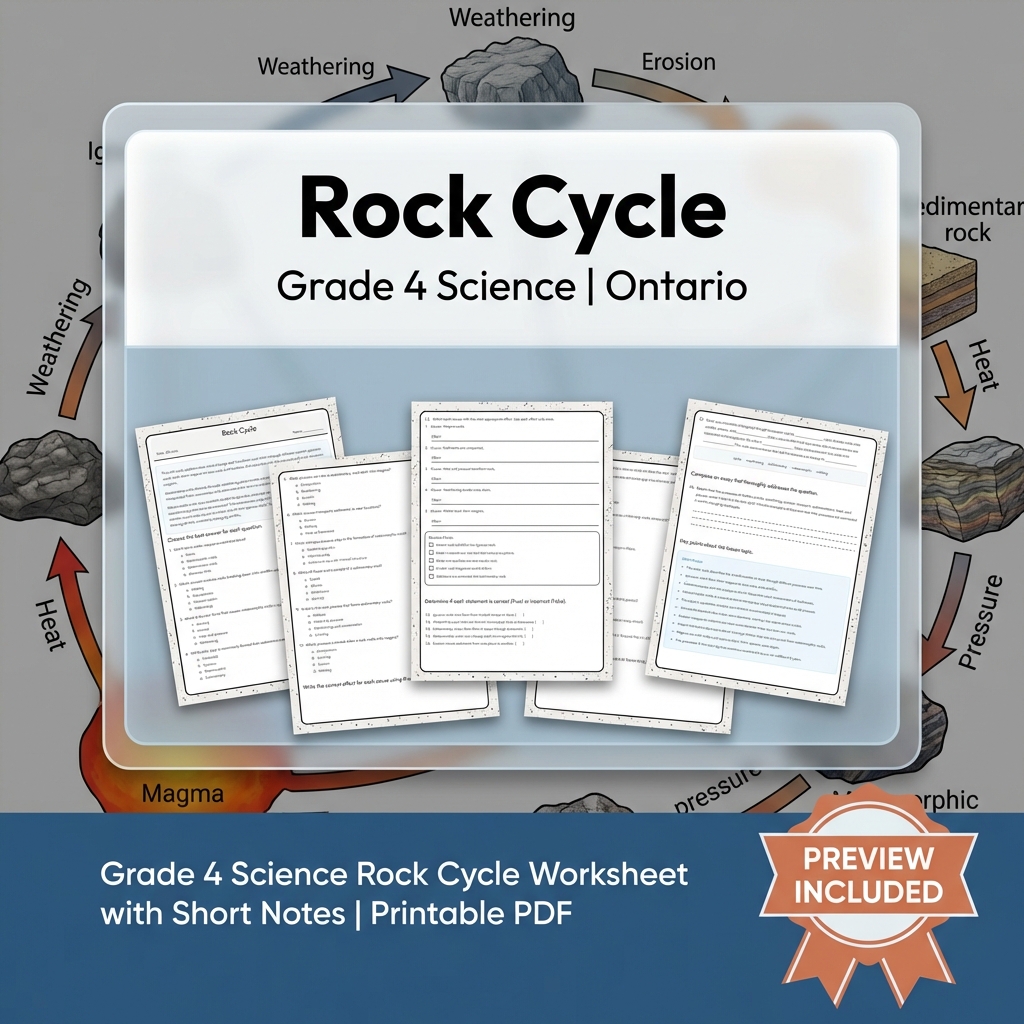
Grade 4 Science Rock Cycle Worksheet with Short Notes | Printable PDF
 Created byMeadowlark Worksheets
Learning Objectives
- Understand the processes involved in the rock cycle and how rocks transform among igneous, sedimentary, and metamorphic forms.
- Identify key processes such as melting, cooling, weathering, erosion, transport, compaction, cementation, heat, and pressure.
- Recognize real-world examples like lava cooling to basalt and sediment forming sandstone in the cycle.
Also included in: Grade 4 Science Lesson Bundle | Earth & Soil Topics for Ontario +1 more
Instant download
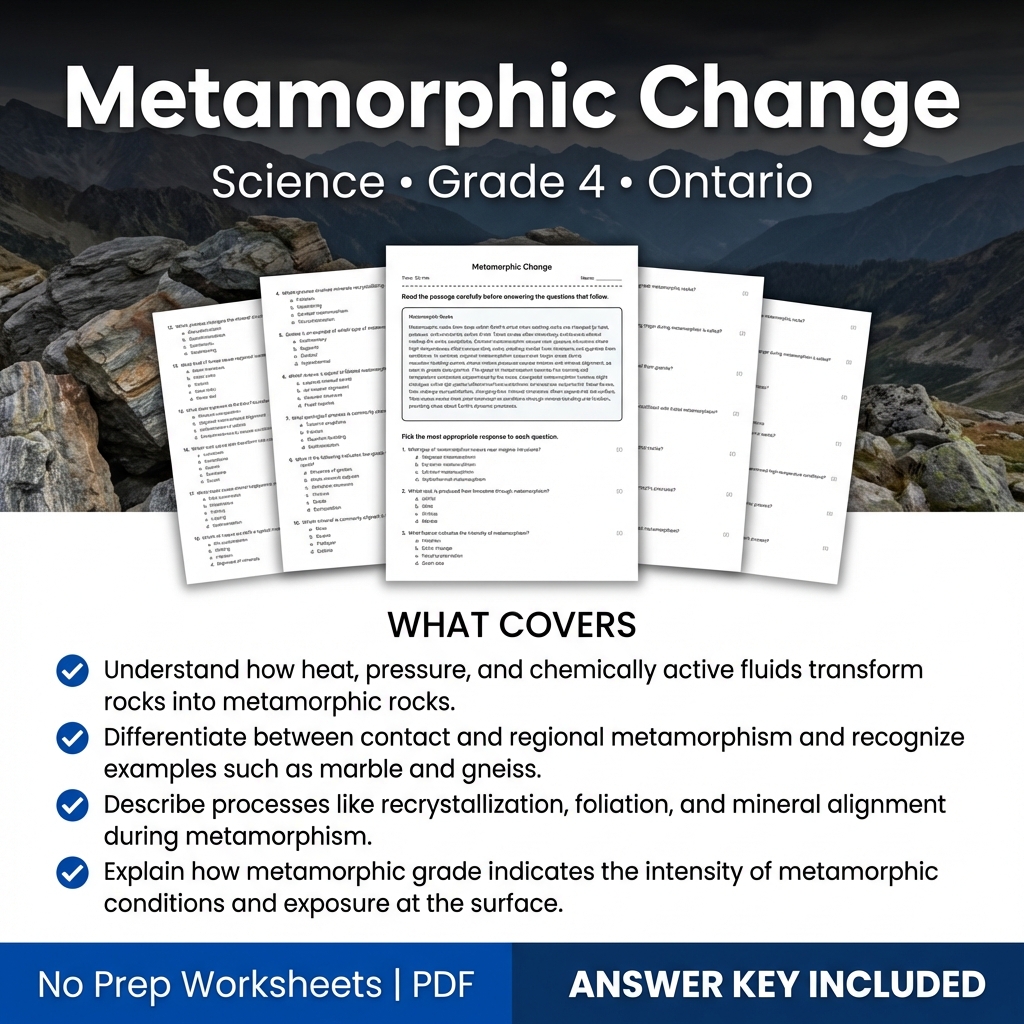
Grade 4 Science Worksheet on Metamorphic Change | Ontario Standards
Created byCoral Reef LearningLearning Objectives
- Understand how heat, pressure, and chemically active fluids transform rocks into metamorphic rocks.
- Differentiate between contact and regional metamorphism and recognize examples such as marble and gneiss.
- Describe processes like recrystallization, foliation, and mineral alignment during metamorphism.
Instant download

Grade 4 Surface Change Worksheet | Practice & Assessment PDF
Created byClear Sky ClassroomLearning Objectives
- Explain how erosion and deposition change Earth’s surface
- Describe how water and wind move and reshape Earth materials
- Identify landforms affected by surface-change processes such as riverbanks and shorelines
Instant download
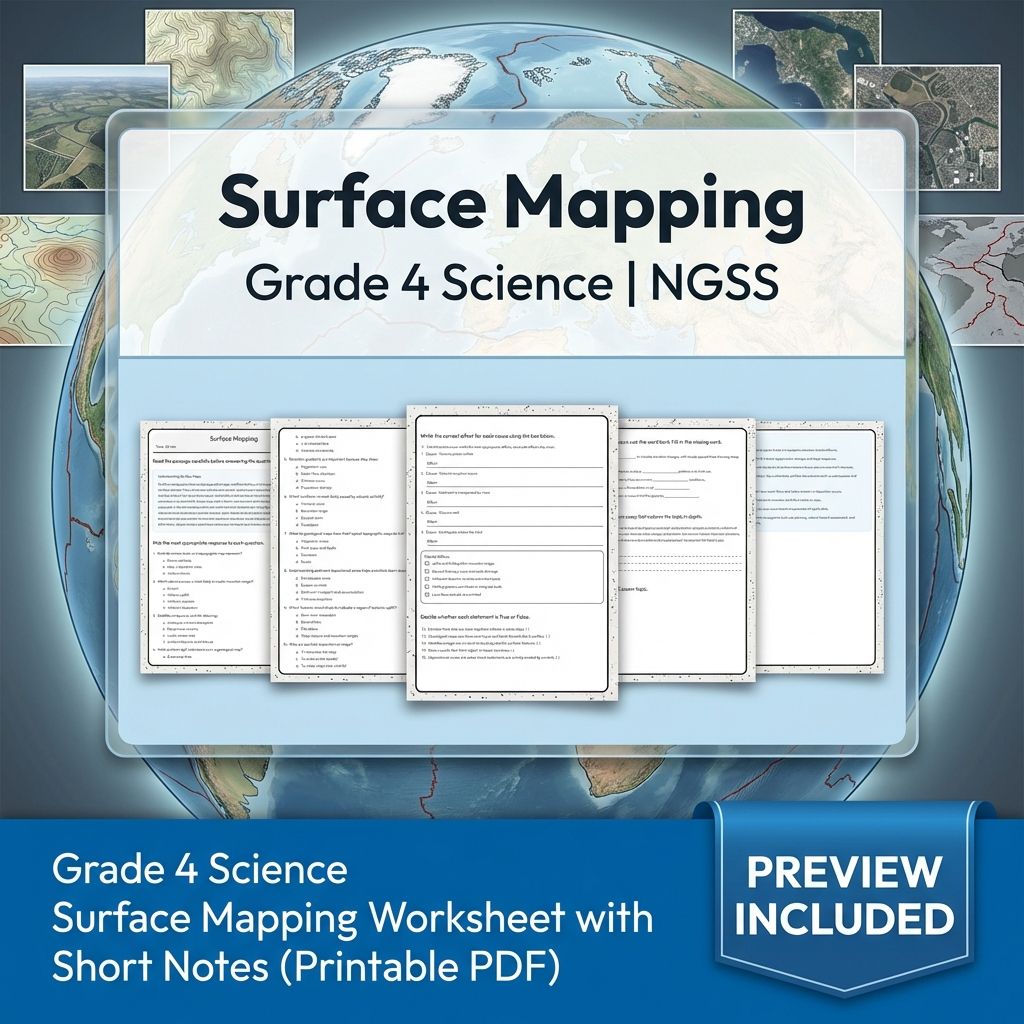
Grade 4 Science Surface Mapping Worksheet with Short Notes (Printable PDF)
Created byMeadowlark WorksheetsLearning Objectives
- Understand how to interpret topographic and geological maps.
- Identify and analyze spatial patterns of Earth's surface features.
- Relate map symbols, scale, and elevation to real-world landforms and processes.
Also included in: Grade 4 Science | Earth's Systems Unit Bundle NGSS-Aligned Worksheets +1 more
Instant download

Grade 4 Pitch And Volume Worksheet | Practice & Assessment PDF
Created byClear Sky ClassroomLearning Objectives
- Explain how amplitude relates to sound volume (loudness) using simple observations.
- Describe how pitch relates to how fast an object vibrates.
- Use distance to predict how clearly a sound can be heard.
Instant download

Grade 4 Simple Machines Worksheet | Practice & PDF
Created byClear Sky ClassroomLearning Objectives
- Explain how simple machines change the direction or size of forces to make tasks easier
- Describe the roles of effort force, output force, and fulcrum in a lever
- Use examples of inclined planes and levers to predict how motion changes
Instant download

Grade 4 Wheel and Axle & Pulley Systems Worksheet | Ontario Science
 Created byChalk and Compass
Learning Objectives
- Explain how a wheel-and-axle system turns rotational motion into linear motion or force
- Compare fixed and movable pulleys and describe how each changes the direction and size of input force
- Use wheel radius and axle radius to predict mechanical advantage in simple wheel-and-axle examples
Also included in: Grade 4 Science Simple Machines & Mechanical Advantage Lesson Bundle | Ontario +1 more
Instant download

Grade 4 Wave Properties Science Daily Reading Worksheet | NGSS Activity
 Created byBRIGHT PATH RESOURCES
Learning Objectives
- Define the parts of a wave: crest, trough, and displacement
- Explain what wavelength and amplitude mean using a model
- Identify wave patterns described by position and displacement
Also included in: Waves & Transfer Grade 4 Science Daily Reading Worksheets Lesson Bundle | NGSS +2 more
Instant download
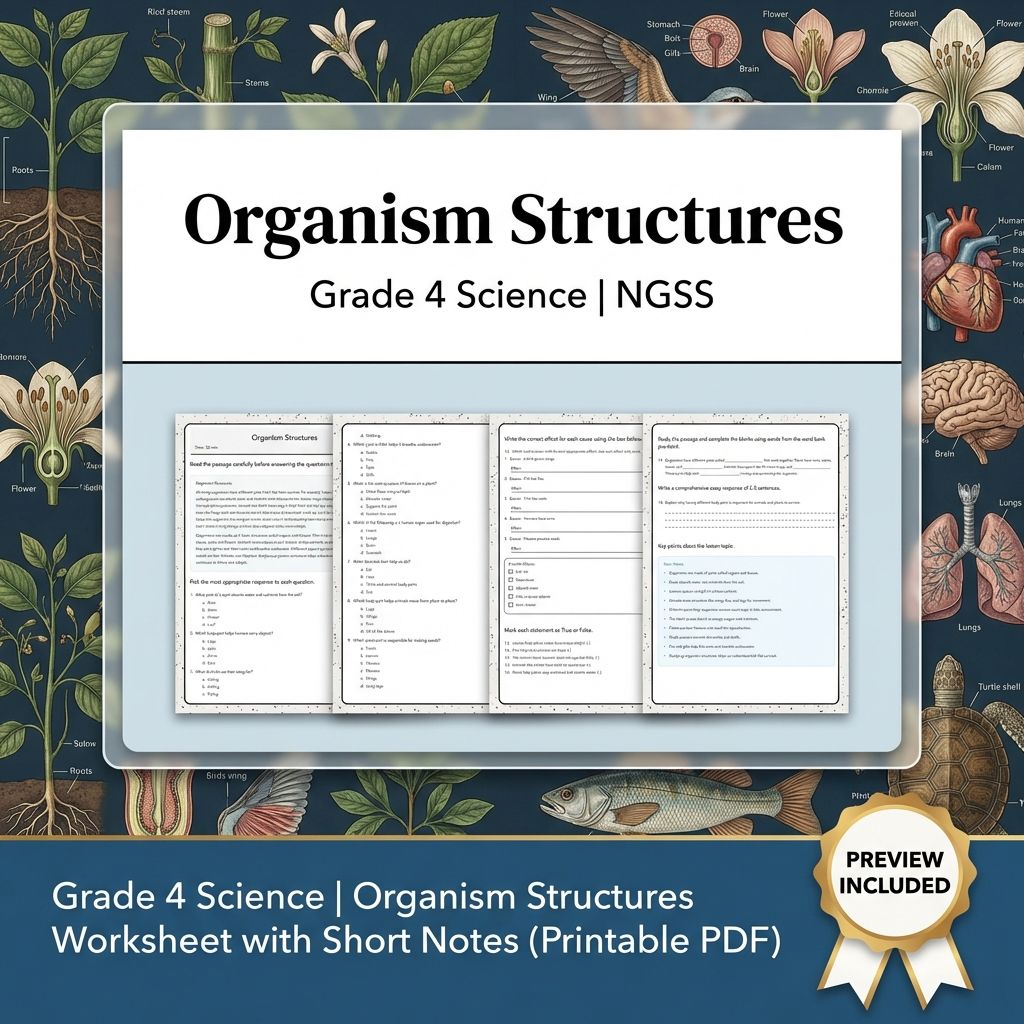
Grade 4 Science | Organism Structures Worksheet with Short Notes (Printable PDF)
Created byMeadowlark WorksheetsLearning Objectives
- Identify the main parts of different organisms and their functions.
- Understand how structures help organisms survive in their environment.
- Learn the differences between plant and animal structures.
Also included in: Grade 4 Science Structures and Processes (NGSS) Molecules to Organisms Bundle +1 more
Instant download

Grade 4 Lever Basics Worksheet | Practice & Assessment PDF
Created byClear Sky ClassroomLearning Objectives
- Identify the fulcrum, input arm, and output arm in common lever examples (seesaw, wheelbarrow, tweezers).
- Classify levers into first-, second-, and third-class based on fulcrum, load, and effort positions.
- Explain how input force, output force, and mechanical advantage are related to arm lengths.
Instant download

Grade 4 Using Models Worksheet | NGSS Practice PDF
Created byClear Sky ClassroomLearning Objectives
- Explain why scientists use models to represent objects, systems, or processes that are hard to observe directly.
- Describe how models use simplified parts, patterns, or scale representations to connect evidence to explanations.
- Identify how assumptions in a model can be tested and revised using new observations.
Instant download

Grade 4 Integrated Mechanisms Worksheet | Ontario Science Activities & Guide
Created byChalk and CompassLearning Objectives
- Explain how gears, pulleys, levers, and linkages can work together to create a desired output motion or force.
- Describe trade-offs in combined mechanisms, such as torque versus speed and simplicity versus compactness.
- Use vocabulary such as torque, speed, linkage, and direction change to interpret simple real-world designs.
Also included in: Grade 4 Science Simple Machines & Mechanical Advantage Lesson Bundle | Ontario +1 more
Instant download

Grade 4 Energy Transfer Worksheet | NGSS Practice PDF
Created byClear Sky ClassroomLearning Objectives
- Identify mechanisms of energy transfer between objects and across different media (solids, liquids, gases).
- Connect energy transfer to observable changes in motion and to changes in thermal state.
- Use evidence from temperature or motion observations to explain what energy was transferred and how.
Instant download
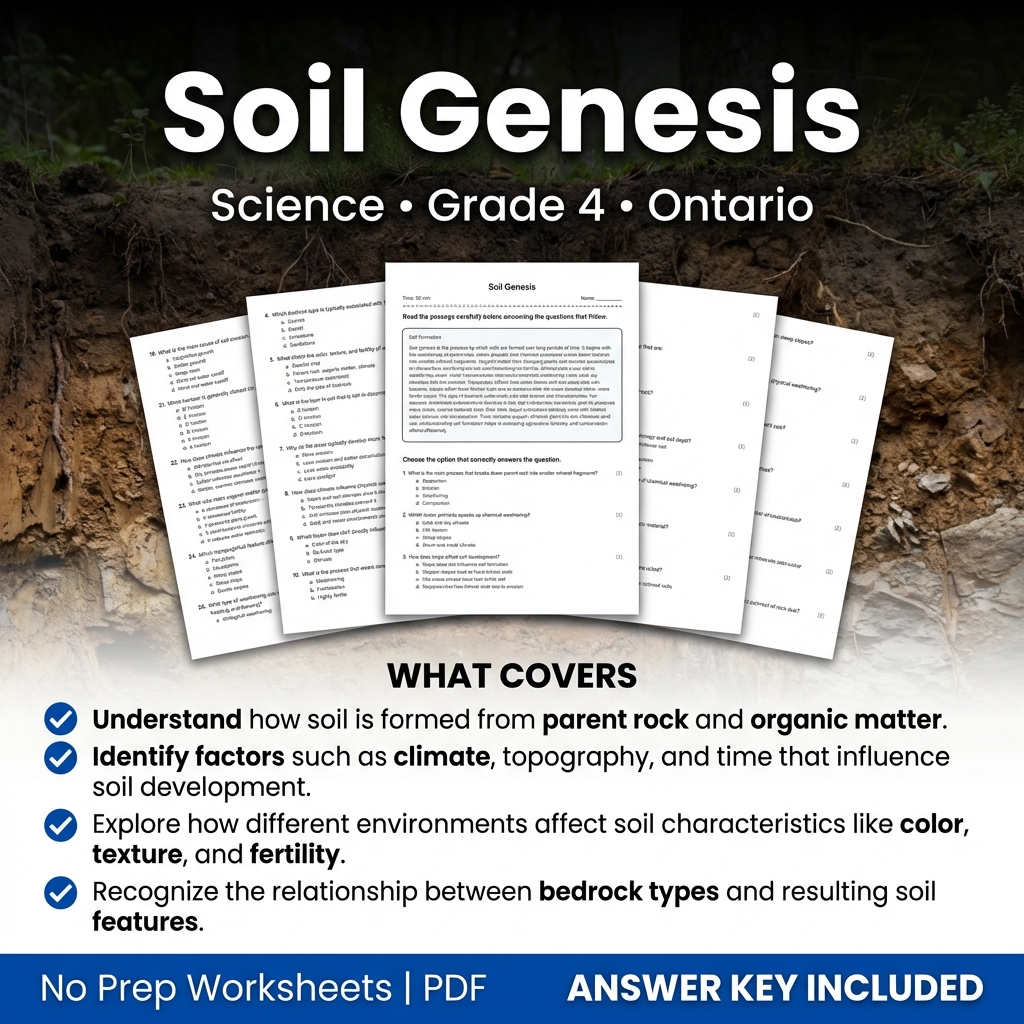
Soil Genesis Grade 4 Science Worksheet | Ontario Standards
Created byCoral Reef LearningLearning Objectives
- Understand how soil is formed from parent rock and organic matter.
- Identify factors such as climate, topography, and time that influence soil development.
- Explore how different environments affect soil characteristics like color, texture, and fertility.
Instant download

Grade 4 Sound in Different Media Worksheet | Ontario Science Activity Pack
Created byChalk and CompassLearning Objectives
- Explain how wave speed depends on the medium for sound (solids, liquids, and gases).
- Describe how boundaries between media can cause partial reflection and reduced clarity.
- Identify how temperature and medium composition can change how sound travels and how quickly it fades.
Also included in: Grade 4 Science Sound and Light Lesson Bundle | Ontario +1 more
Instant download

Grade 4 Sound from Vibrations and Wave Patterns Science Worksheet Ontario
Created byChalk and CompassLearning Objectives
- Explain how vibrating objects create sound by making matter move in repeating patterns
- Describe how frequency and amplitude affect pitch and loudness
- Identify common features of mechanical sound waves, including compressions and rarefactions
Also included in: Grade 4 Science Sound and Light Lesson Bundle | Ontario +1 more
Instant download

Grade 4 Specular and Diffuse Reflection Worksheet | Ontario Science Activity
Created byChalk and CompassLearning Objectives
- Describe how smooth surfaces can produce specular reflection and clearer images in a plane mirror
- Explain the equal-angle relationship between incident and reflected rays
- Compare specular and diffuse reflection using brightness and clarity of images
Also included in: Grade 4 Science Sound and Light Lesson Bundle | Ontario +1 more
Instant download

Grade 4 Pitch and Loudness of Sound Waves Worksheet | Ontario Science
Created byChalk and CompassLearning Objectives
- Explain that pitch depends on frequency and that loudness depends on amplitude
- Identify how changes in vibrating strings and air columns can change pitch and loudness
- Use sound-source comparisons to predict which change makes a sound higher or lower, louder or softer
Also included in: Grade 4 Science Sound and Light Lesson Bundle | Ontario +1 more
Instant download

Grade 4 Echoes and Sound Absorption Worksheet | Ontario Science Activity
Created byChalk and CompassLearning Objectives
- Explain how sound reflection can create echoes and reverberation in enclosed spaces
- Describe how distance to a reflecting surface affects the time delay between direct and reflected sound
- Compare how different surface materials absorb or reflect sound energy
Also included in: Grade 4 Science Sound and Light Lesson Bundle | Ontario +1 more
Instant download

Grade 4 Science | Pulley Systems Worksheet with Short Notes (Printable PDF)
Created byMeadowlark WorksheetsLearning Objectives
- Understand how single fixed pulleys change the direction of force.
- Explain how multiple pulleys in block-and-tackle systems provide mechanical advantages.
- Describe the difference between simple linkages and complex linkage systems like four-bar linkages.
Also included in: Grade 4 Science Lesson Bundle | Simple Machines & Mechanisms +1 more
Instant download

Growth Needs of Living Things Worksheets | Grade 4 Science Practice
Created byBRIGHT PATH RESOURCESLearning Objectives
- Explain how energy from food, water, and oxygen help organisms grow over time.
- Identify how temperature and habitat features affect organism growth and development.
- Describe what can happen to growth when basic needs are not met consistently.
Also included in: Grade 4 Science Life Cycles Ecosystems & Metamorphosis Worksheets Bundle +2 more
Instant download

Grade 4 Science | Wave Interactions Worksheet with Short Notes (Printable PDF)
Created byMeadowlark WorksheetsLearning Objectives
- Understand how waves are reflected, absorbed, or transmitted at boundaries between materials.
- Identify observable outcomes of wave interactions such as diminished intensity or redirected wave paths.
- Compare different materials based on their interaction with waves.
Also included in: Grade 4 Science NGSS Waves and Information Transfer Unit Bundle +1 more
Instant download
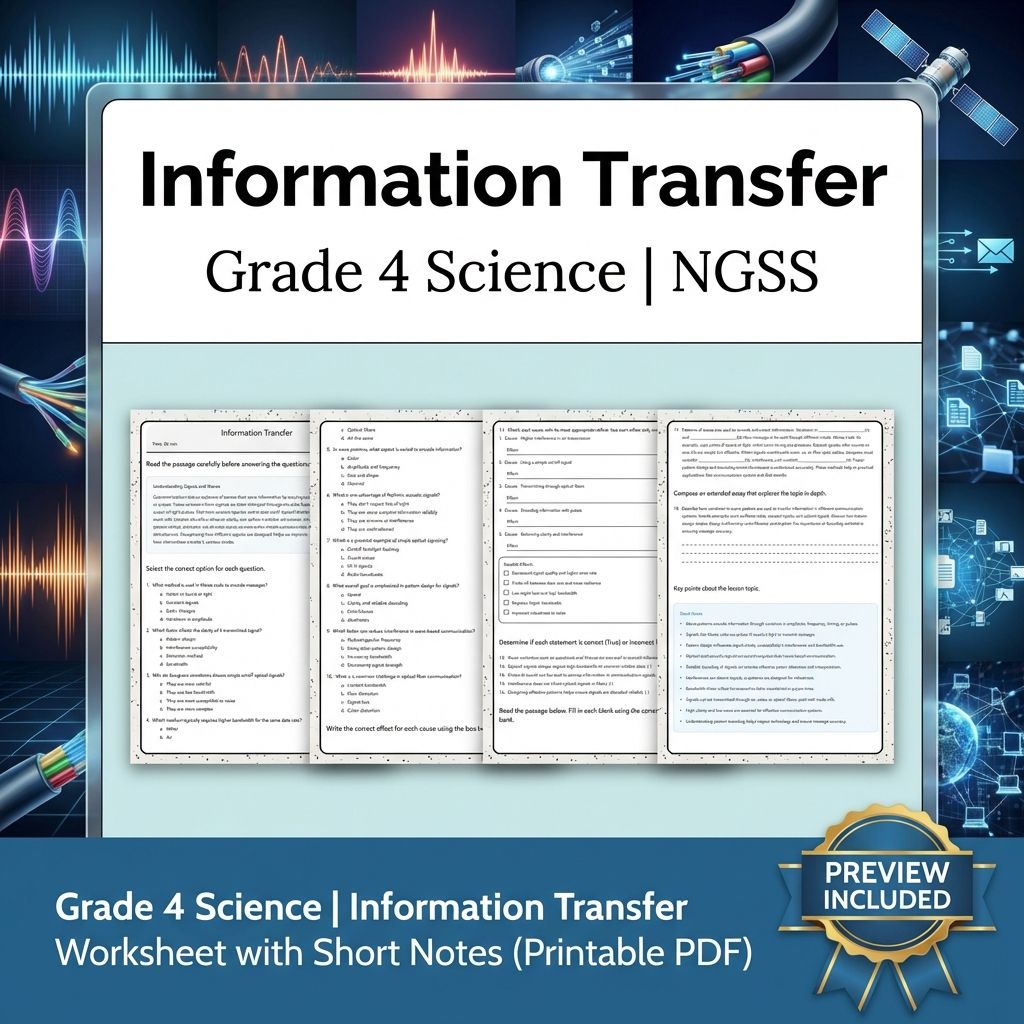
Grade 4 Science | Information Transfer Worksheet with Short Notes (PDF)
Created byMeadowlark WorksheetsLearning Objectives
- Understand how patterns of waves encode and transmit information.
- Identify different types of signals such as Morse code, rhythmic sounds, and optical signals.
- Compare signal clarity, interference susceptibility, and bandwidth requirements across media.
Also included in: Grade 4 Science NGSS Waves and Information Transfer Unit Bundle +1 more
Instant download
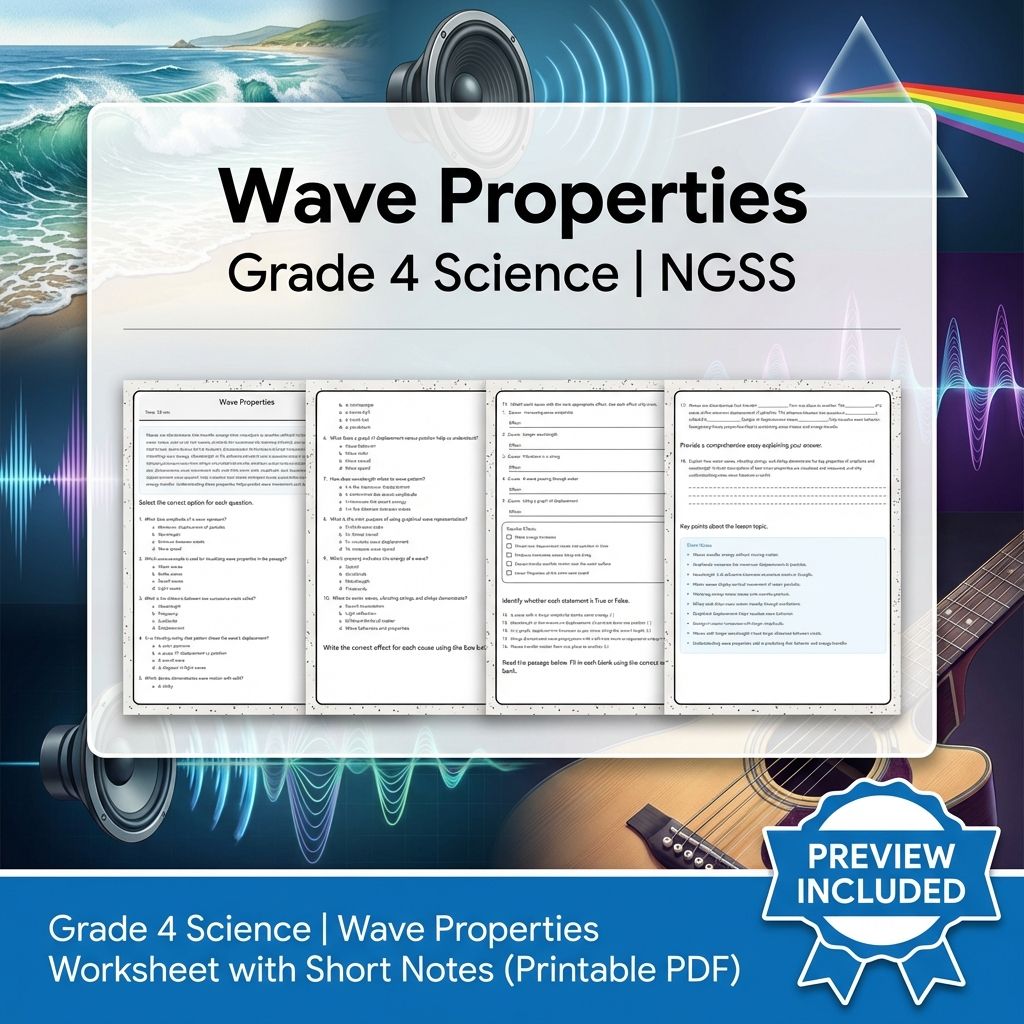
Grade 4 Science | Wave Properties Worksheet with Short Notes (Printable PDF)
Created byMeadowlark WorksheetsLearning Objectives
- Describe how amplitude and wavelength characterize wave behavior.
- Identify examples of waves such as water waves, vibrating strings, and slinkys.
- Interpret graphical displacement vs. position representations of waves.
Also included in: Grade 4 Science NGSS Waves and Information Transfer Unit Bundle +1 more
Instant download

Ecosystem Interactions Worksheets | Predators Prey Competition Grade 4
Created byBRIGHT PATH RESOURCESLearning Objectives
- Explain how predators and prey can affect each other’s population sizes in an ecosystem over time.
- Describe how competition for limited resources can change populations and growth rates.
- Identify examples of mutual relationships and predict how they may affect ecosystem stability.
Also included in: Grade 4 Science Life Cycles Ecosystems & Metamorphosis Worksheets Bundle +2 more
Instant download
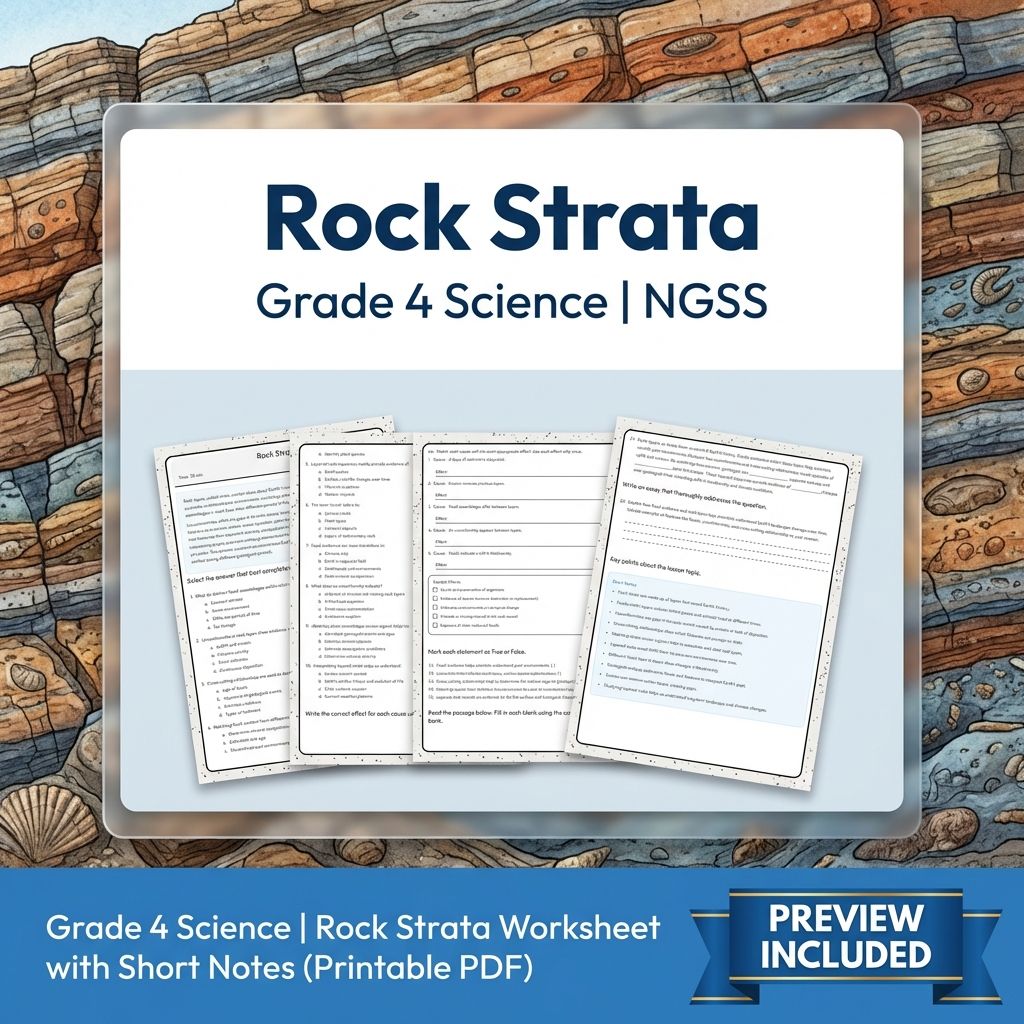
Grade 4 Science | Rock Strata Worksheet with Short Notes (Printable PDF)
Created byMeadowlark WorksheetsLearning Objectives
- Understand how rock layers and fossils provide evidence of Earth's landscape changes over time.
- Identify features such as fossil assemblages, unconformities, and cross-cutting relationships as indicators of geological events.
- Interpret layered rock records to reconstruct past environments and shifts in biodiversity.
Also included in: Grade 4 Science | Earth's Place in the Universe Unit Bundle +1 more
Instant download

Grade 4 Science | Lunar Phase Pattern Worksheet (PDF) – General Standards
 Created byEvergreen Desk Education
Learning Objectives
- Explain why the Moon’s visible shape changes during a month
- Describe the repeating sequence of lunar phases from the student’s viewpoint on Earth
- Use observations to support a claim about how lunar phases follow a pattern
Also included in: Grade 4 Weather and Earth-Sun-Moon Cycles Science Lesson Bundle: General +1 more
Instant download

Grade 4 Science Worksheet | Growth Conditions and Needs (PDF)
Created byEvergreen Desk EducationLearning Objectives
- Explain how food, water, oxygen, and temperature support growth over time.
- Describe how habitat features can affect an organism’s growth and development.
- Use evidence from a passage to answer questions about growth conditions.
Also included in: Grade 4 Ecosystems & Classification Science Lesson Bundle (General) +1 more
Instant download

Grade 4 Science – Design Problem Worksheet (PDF) General Standards
Created byEvergreen Desk EducationLearning Objectives
- Identify observations that lead to a design problem.
- Write or describe a clear problem statement of what needs to change.
- Connect possible solution ideas to changes in shape, materials, or structure.
Also included in: Grade 4 Engineering Design & Electricity Science Lesson Bundle - General +1 more
Instant download

Grade 4 Science | Comparing Life Cycles Worksheet (Worksheet + Answer Key)
Created byEvergreen Desk EducationLearning Objectives
- Compare life cycles of different organisms by observing stage-by-stage body features, movement, and feeding needs
- Distinguish between complete metamorphosis and gradual development using evidence from observable stages
- Explain how developmental changes help organisms survive as their needs change
Also included in: Grade 4 Ecosystems & Classification Science Lesson Bundle (General) +1 more
Instant download

Grade 4 Science | Testing Results Worksheet (PDF) – General Standards
Created byEvergreen Desk EducationLearning Objectives
- Explain how testing results provide evidence about whether a proposed solution works.
- Describe how recording results clearly helps scientists find patterns across attempts.
- Use data from test outcomes to identify what worked, what failed, and what to improve.
Also included in: Grade 4 Engineering Design & Electricity Science Lesson Bundle - General +1 more
Instant download
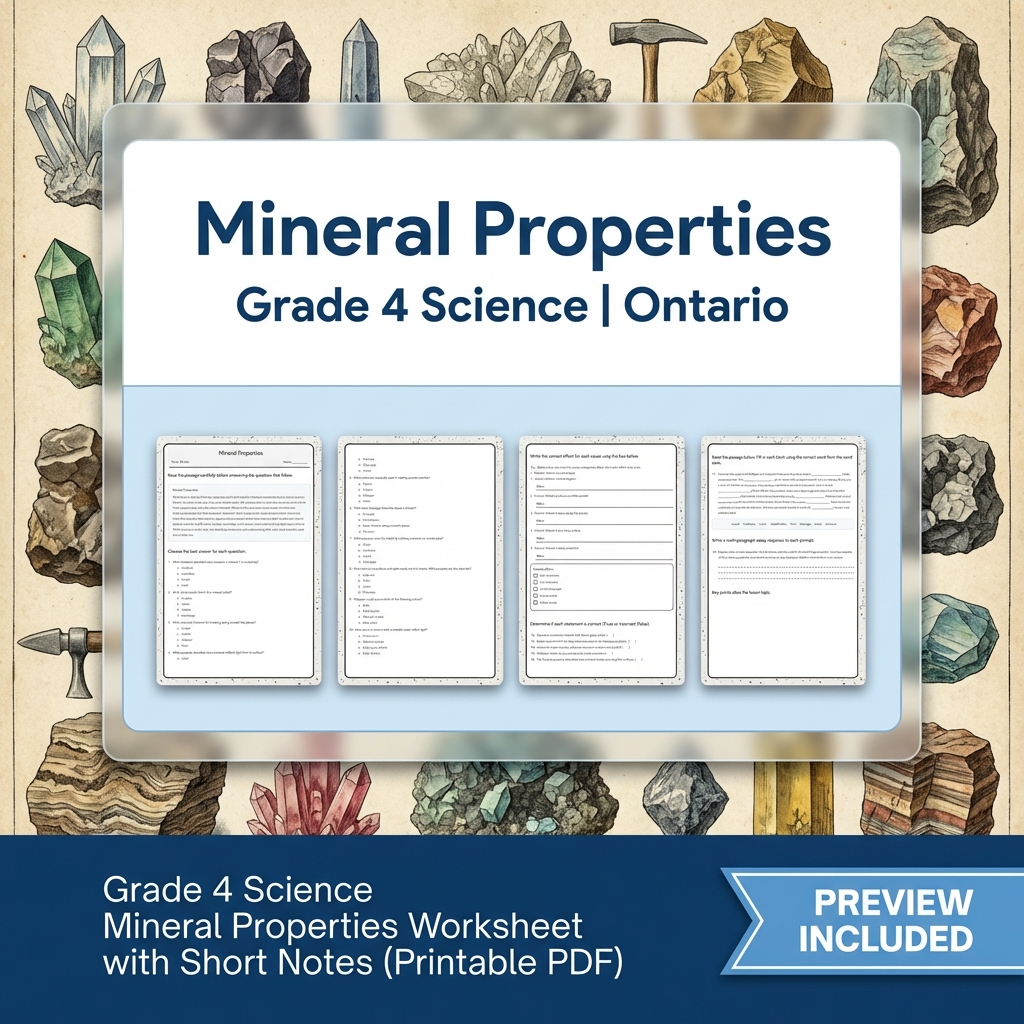
Grade 4 Science Mineral Properties Worksheet with Short Notes (Printable PDF)
Created byMeadowlark WorksheetsLearning Objectives
- Understand the key properties used to identify minerals, such as hardness, streak, cleavage, fracture, lustre, and colour.
- Learn simple field tests to distinguish different minerals and support classification.
- Recognize the importance of mineral properties in rock formation and everyday materials.
Also included in: Grade 4 Science Lesson Bundle | Earth & Soil Topics for Ontario +1 more
Instant download

Grade 4 Ray Models for Light and Shadows Worksheet | Ontario Science
Created byChalk and CompassLearning Objectives
- Use ray lines to predict where light is fully blocked and where light is present in shadows.
- Explain how extending rays helps locate regions of full illumination and darkness.
- Use incident and reflected ray directions to describe simple reflections on smooth surfaces.
Also included in: Grade 4 Science Sound and Light Lesson Bundle | Ontario +1 more
Instant download

Grade 4 Mechanical Advantage Force & Distance Ratios Science Worksheet
Created byChalk and CompassLearning Objectives
- Explain how mechanical advantage relates input and output forces using a ratio
- Use distance (or rotation) trade-offs to interpret how force changes affect motion
- Convert between units appropriately and describe what a ratio without units means
Also included in: Grade 4 Science Simple Machines & Mechanical Advantage Lesson Bundle | Ontario +1 more
Instant download

Grade 4 Metamorphic Rock Formation Worksheet | Ontario Science Activity
Created byChalk and CompassLearning Objectives
- Explain how heat, pressure, and chemically active fluids change preexisting rocks into metamorphic rocks.
- Distinguish contact metamorphism from regional metamorphism using examples and where they occur.
- Describe how recrystallization, foliation, and mineral alignment show metamorphic change.
Also included in: Grade 4 Science Rocks, Soil & Rock Cycle Lesson Bundle – Ontario +1 more
Instant download
About Grade 4 Science Worksheets
Find Science worksheets built for Grade 4. All 454 cover core skills, practice, and review, each an instant PDF download.
MyTeachingSheets worksheets are made by real teacher-authors and checked before they go live. Download any as a print-ready PDF for lessons, homework, or independent practice — most include answer keys, and previews are always free.