
Grade 4 Science Worksheets
454 worksheets
Grade 4 Gear Systems Worksheet | Mechanical Advantage | Ontario Science
 Created byChalk and Compass
Learning Objectives
- Explain how meshing gear teeth transmit rotational motion from one gear to another.
- Calculate or predict how gear ratio affects rotational speed and torque direction changes.
- Describe how idler gears and compound gear trains change motion in compact mechanisms.
Also included in: Grade 4 Science Simple Machines & Mechanical Advantage Lesson Bundle | Ontario +1 more
Instant download

Grade 4 Science Worksheet | Earth Sun Moon Concepts (PDF)
 Created byEvergreen Desk Education
Learning Objectives
- Explain how Earth’s rotation and its position relative to the Sun relate to daily patterns of light and temperature.
- Describe how the Moon orbits Earth and why different amounts of the Moon’s sunlit side are visible.
- Use models or sky observations to connect motion in space to predictable changes we see.
Also included in: Grade 4 Weather and Earth-Sun-Moon Cycles Science Lesson Bundle: General +1 more
Instant download
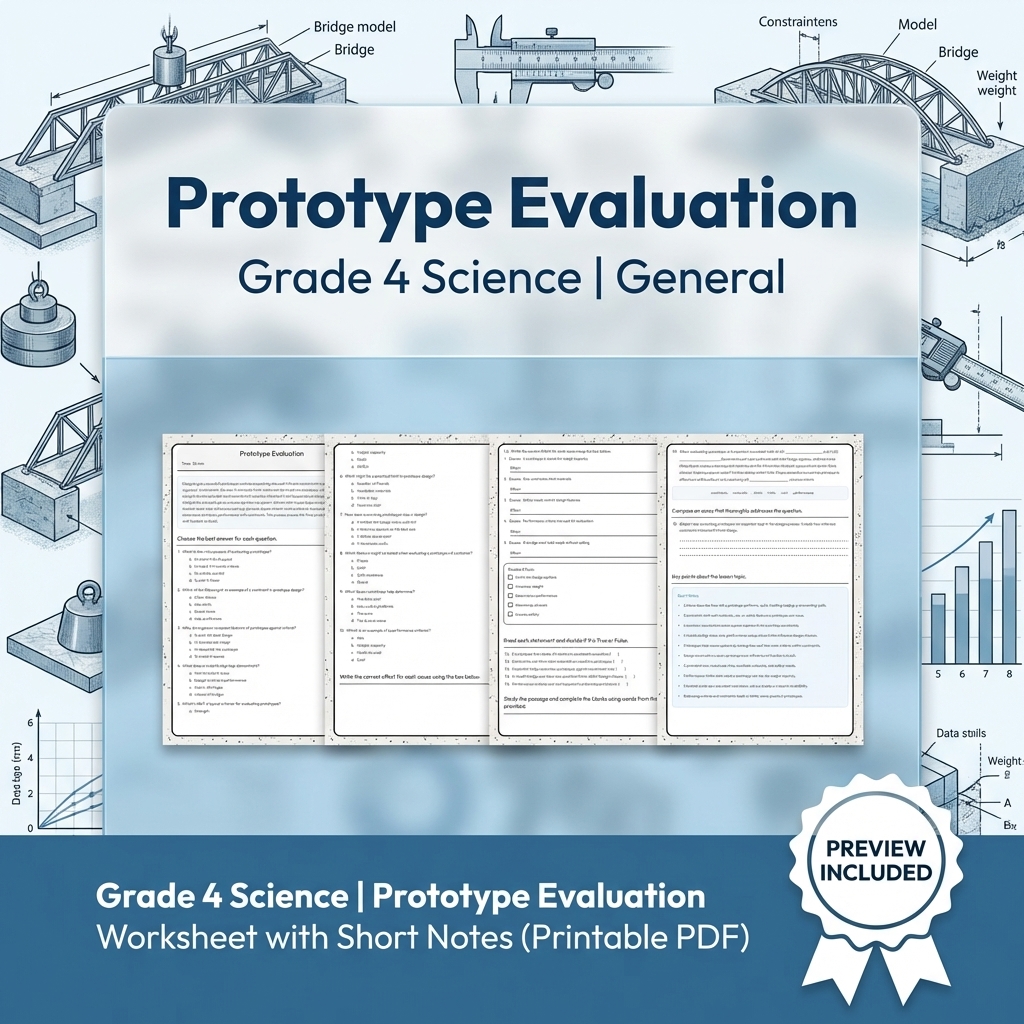
Grade 4 Science | Prototype Evaluation Worksheet with Short Notes
 Created byMeadowlark Worksheets
Learning Objectives
- Understand how to evaluate prototypes using specific criteria.
- Learn the constraints that limit design options.
- Compare performance features against criteria within constraints.
Also included in: Grade 4 Science Lesson Group Comprehensive Worksheets for Hands-On Learning +1 more
Instant download

Grade 4 Habitat vs Niche Worksheet | Abiotic & Biotic Components Science
Created byChalk and CompassLearning Objectives
- Identify abiotic and biotic components of a habitat.
- Explain how shelter, food, water, space, and light are habitat components.
- Distinguish habitat from niche using simple examples.
Also included in: Grade 4 Science Habitat & Biodiversity Lesson Bundle | Ontario +1 more
Instant download

Light Ray Models and Shadows Worksheets | Grade 4 Science Lesson
 Created byPrism Point Learning
Learning Objectives
- Use ray models to describe how light travels in straight lines.
- Predict areas of full illumination and darkness using intersecting and extended rays.
- Explain how angle relationships determine reflected directions from smooth surfaces.
Also included in: Sound & Light Waves Lesson Bundle Grade 4 Science Ontario
Instant download

Engineering Design Testing and Variable Control Worksheets Grade 4
 Created byTeachers Club
Learning Objectives
- Plan a fair test by isolating one variable and keeping other conditions the same
- Collect and record quantitative data such as time, displacement, or load
- Interpret results to identify likely failure modes and choose an improved design change
Also included in: Grade 4 Engineering Design Science Worksheets | NGSS Bundle +1 more
Instant download
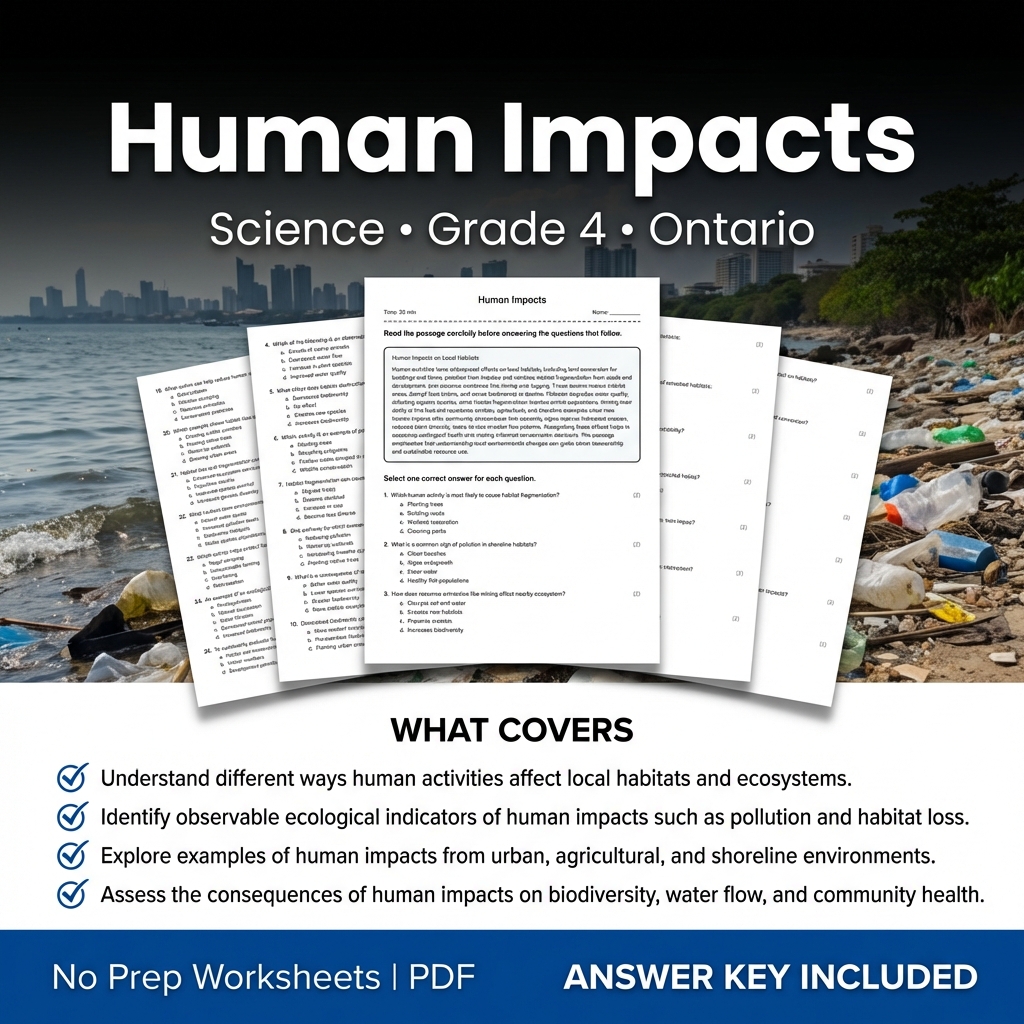
Human Impacts Grade 4 Science Worksheet | Ontario Standard Practice
 Created byCoral Reef Learning
Learning Objectives
- Understand different ways human activities affect local habitats and ecosystems.
- Identify observable ecological indicators of human impacts such as pollution and habitat loss.
- Explore examples of human impacts from urban, agricultural, and shoreline environments.
Instant download

Grade 4 Conservation Strategies Habitat Recovery Worksheet | Ontario Science
Created byChalk and CompassLearning Objectives
- Explain how protected areas, buffer zones, and habitat corridors help reduce harm to habitats and species.
- Distinguish passive protection from active restoration and creation of connected habitats.
- Describe how monitoring ecological indicators can show whether conservation efforts are working.
Also included in: Grade 4 Science Habitat & Biodiversity Lesson Bundle | Ontario +1 more
Instant download
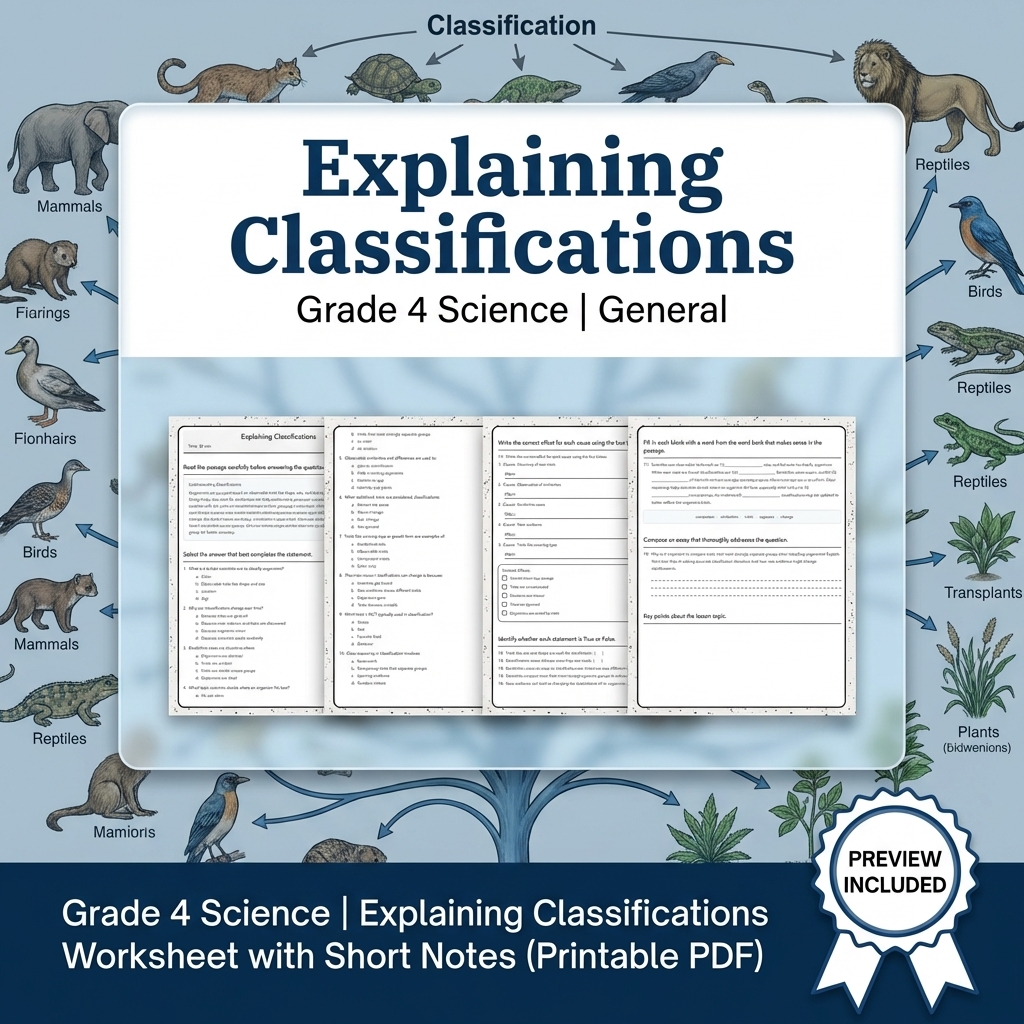
Grade 4 Science | Explaining Classifications Worksheet with Short Notes
Created byMeadowlark WorksheetsLearning Objectives
- Understand how organisms are classified based on observable traits.
- Learn how evidence influences classification decisions and changes.
- Identify traits that separate different groups of organisms.
Also included in: Grade 4 Science Lesson Group Bundle | Ecosystems, Life Cycles & Classification +1 more
Instant download

Mechanical Advantage Worksheets: Forces & Distance Ratios Grade 4
Created byPrism Point LearningLearning Objectives
- Explain how mechanical advantage relates input force and output force using a ratio.
- Use distance ratios (or gear tooth counts) to predict output distance.
- Identify correct units and representations for force, distance, and rotation.
Instant download

Animal Senses and Responses Worksheets | Grade 4 Science NGSS
Created byTeachers ClubLearning Objectives
- Describe how animals gather information using their senses.
- Explain how sensory input helps an animal decide on a response.
- Match senses to common behaviors such as moving, freezing, or seeking shelter.
Also included in: Grade 4 Science Worksheets | NGSS Structures & Processes Bundle +1 more
Instant download
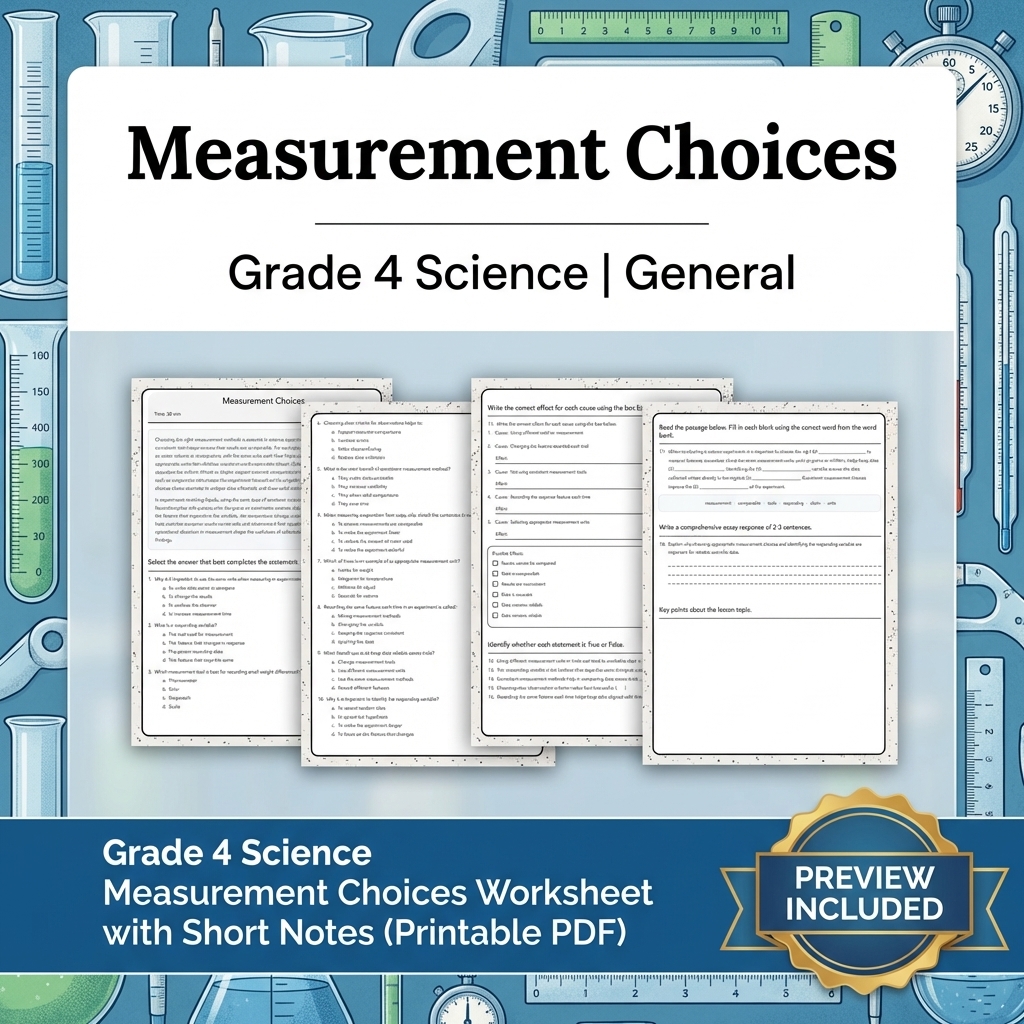
Grade 4 Science Measurement Choices Worksheet with Short Notes (Printable PDF)
Created byMeadowlark WorksheetsLearning Objectives
- Understand the importance of consistent measurement methods in data collection.
- Identify appropriate units and criteria for recording observations.
- Recognize the responding variable in an experiment to ensure data accuracy.
Also included in: Grade 4 Science Lesson Group | Comprehensive Worksheets & Resources +1 more
Instant download
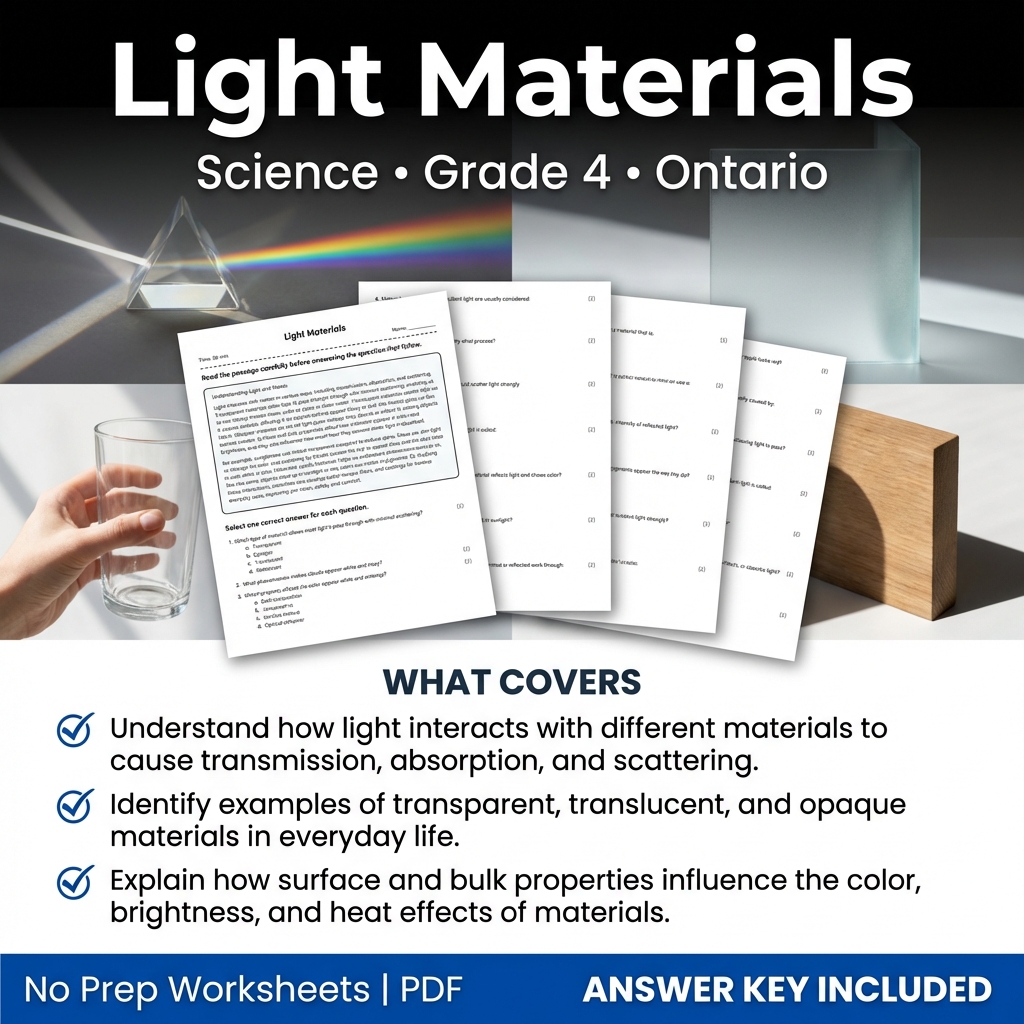
Grade 4 Science Worksheet on Light Materials | Ontario Standards
Created byCoral Reef LearningLearning Objectives
- Understand how light interacts with different materials to cause transmission, absorption, and scattering.
- Identify examples of transparent, translucent, and opaque materials in everyday life.
- Explain how surface and bulk properties influence the color, brightness, and heat effects of materials.
Instant download

Grade 4 Energy Conversion in a Battery Science Reading Worksheet | NGSS
 Created byBRIGHT PATH RESOURCES
Learning Objectives
- Identify input and output energy forms in a battery.
- Explain how a battery converts chemical energy into electrical energy.
- Describe energy losses during energy conversion as heat.
Also included in: Energy Transfer Grade 4 Science Daily Reading Worksheets Lesson Bundle | NGSS +2 more
Instant download
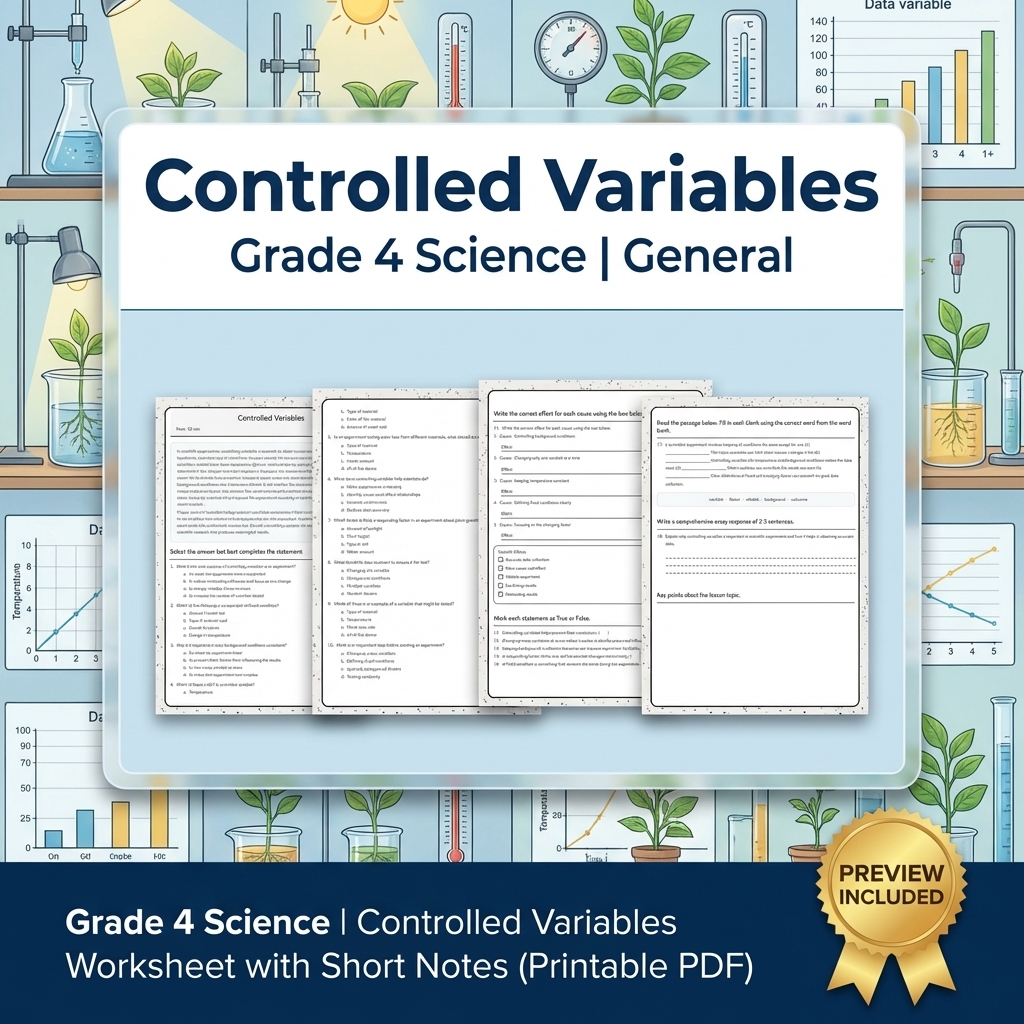
Grade 4 Science | Controlled Variables Worksheet with Short Notes
Created byMeadowlark WorksheetsLearning Objectives
- Understand the purpose of controlled variables in experiments.
- Identify the components of a controlled experiment.
- Learn how controlling variables improves data accuracy.
Also included in: Grade 4 Science Lesson Group | Comprehensive Worksheets & Resources +1 more
Instant download

Grade 4 Science – Constraint Tradeoffs Worksheet (PDF) General Standards
Created byEvergreen Desk EducationLearning Objectives
- Explain how constraints limit design options in science and engineering problems
- Describe common tradeoffs that happen when one requirement conflicts with another
- Use criteria and evidence to choose the best design option that stays within limits
Also included in: Grade 4 Engineering Design & Electricity Science Lesson Bundle - General +1 more
Instant download

Ecosystem Roles Worksheets | Producers Consumers Decomposers Grade 4
Created byBRIGHT PATH RESOURCESLearning Objectives
- Describe the roles of producers, consumers, and decomposers in an ecosystem
- Explain how organisms transfer energy through feeding relationships
- Model how decomposers return nutrients to the environment
Also included in: Grade 4 Science Life Cycles Ecosystems & Metamorphosis Worksheets Bundle +2 more
Instant download

Engineering Design Constraints Worksheets | Grade 4 Science Practice
Created byBRIGHT PATH RESOURCESLearning Objectives
- Explain how constraints limit design options and create tradeoffs.
- Identify examples of competing needs in a simple engineering design problem.
- Use criteria to choose the best tradeoff that still meets important limits.
Also included in: Grade 4 Science Engineering Design & Technology Worksheets Bundle +2 more
Instant download

Scientific Communication & Evidence Worksheets for Grade 4 Science
Created byBRIGHT PATH RESOURCESLearning Objectives
- State a clear claim using precise scientific language.
- Match evidence to a claim and explain how the evidence supports it.
- Describe how patterns were interpreted from data using logical reasoning.
Also included in: Grade 4 Science Scientific Inquiry & Fair Test Worksheets Bundle +2 more
Instant download

Grade 4 Science | Day Night Cycle Worksheet (PDF) for Concept Mastery
Created byEvergreen Desk EducationLearning Objectives
- Explain how Earth’s rotation causes day and night
- Describe how the Sun appears to move across the sky during the day
- Use observations (daylight and darkness timing) to support the day/night pattern
Also included in: Grade 4 Weather and Earth-Sun-Moon Cycles Science Lesson Bundle: General +1 more
Instant download

Grade 4 Science | Deposition Changes Worksheet with Short Notes (Printable PDF)
Created byMeadowlark WorksheetsLearning Objectives
- Understand the process of deposition and how it affects landforms.
- Identify different examples of deposition caused by water and wind.
- Explain how deposition builds up land over time.
Also included in: Grade 4 Science Weather and Earth Cycles Lesson Bundle +1 more
Instant download
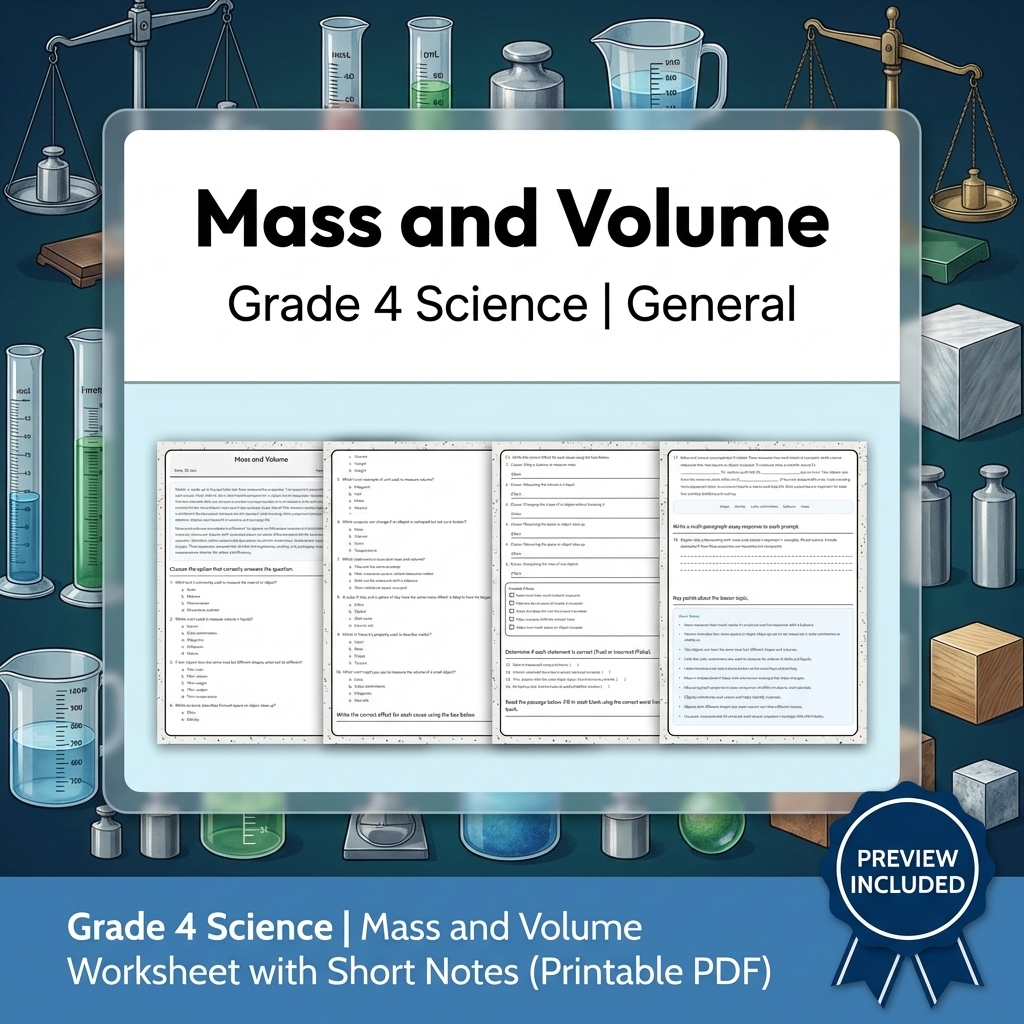
Grade 4 Science | Mass and Volume Worksheet with Short Notes (Printable PDF)
Created byMeadowlark WorksheetsLearning Objectives
- Understand the concepts of mass and volume and how they are measured.
- Compare different samples based on their mass and volume.
- Recognize that the same mass can have different volumes depending on shape.
Also included in: Grade 4 Science Lesson Group: Engaging Worksheets for Key Concepts +1 more
Instant download

Grade 4 Science Worksheet on Simple Machines | Ontario Standards
Created byCoral Reef LearningLearning Objectives
- Identify and describe common simple machines and their mechanical functions.
- Explain how simple machines change the magnitude, direction, or distance of force.
- Recognize examples of simple machines in daily life and classify their function.
Instant download

Grade 4 Science | Ecosystem Changes Worksheet (PDF) – General Standards
Created byEvergreen Desk EducationLearning Objectives
- Explain how predator-prey interactions can change populations over time.
- Describe how competition for limited resources affects ecosystem stability.
- Identify mutual relationships and predict how connected populations may respond.
Also included in: Grade 4 Ecosystems & Classification Science Lesson Bundle (General) +1 more
Instant download

Plant and Animal Structures Worksheets | Grade 4 Science NGSS
Created byTeachers ClubLearning Objectives
- Explain how external and internal structures help plants and animals survive.
- Describe how plant roots, stems, and leaves perform different functions.
- Identify animal structures that help with feeding, support, and protection.
Also included in: Grade 4 Science Worksheets | NGSS Structures & Processes Bundle +1 more
Instant download

Wave Interactions Worksheets: Reflection, Absorption & Transmission
Created byTeachers ClubLearning Objectives
- Describe how waves can be reflected, absorbed, or transmitted when they meet different materials
- Use the terms reflection, absorption, and transmission to explain observable changes in wave behavior
- Compare how different materials affect wave direction and intensity
Also included in: Grade 4 Science Waves Worksheets | NGSS Wave Bundle +1 more
Instant download
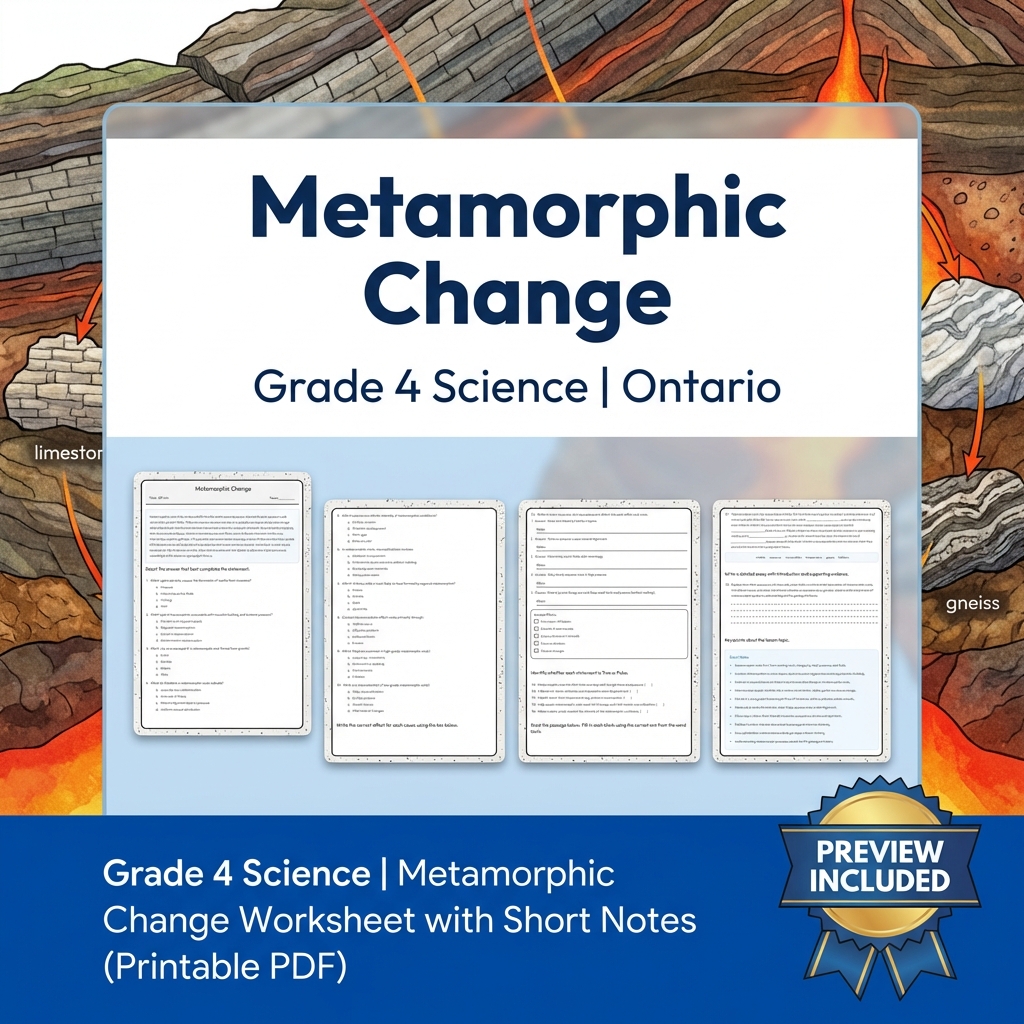
Grade 4 Science | Metamorphic Change Worksheet with Short Notes (Printable PDF)
Created byMeadowlark WorksheetsLearning Objectives
- Explain how heat, pressure, and chemically active fluids change preexisting rocks into metamorphic rocks.
- Distinguish between contact and regional metamorphism and recognize examples such as marble and gneiss.
- Describe how mineralogy, texture, and foliation are affected during metamorphic processes.
Also included in: Grade 4 Science Lesson Bundle | Earth & Soil Topics for Ontario +1 more
Instant download

Energy Transfer Worksheets: Interactions & Thermal Changes Grade 4
Created byTeachers ClubLearning Objectives
- Describe how energy can transfer when objects collide, roll, or swing.
- Connect changes in motion to energy transfer during interactions.
- Explain heat flow from warmer materials to cooler materials and relate it to temperature change.
Also included in: Energy Grade 4 Science Worksheets | NGSS Energy Unit Bundle +1 more
Instant download
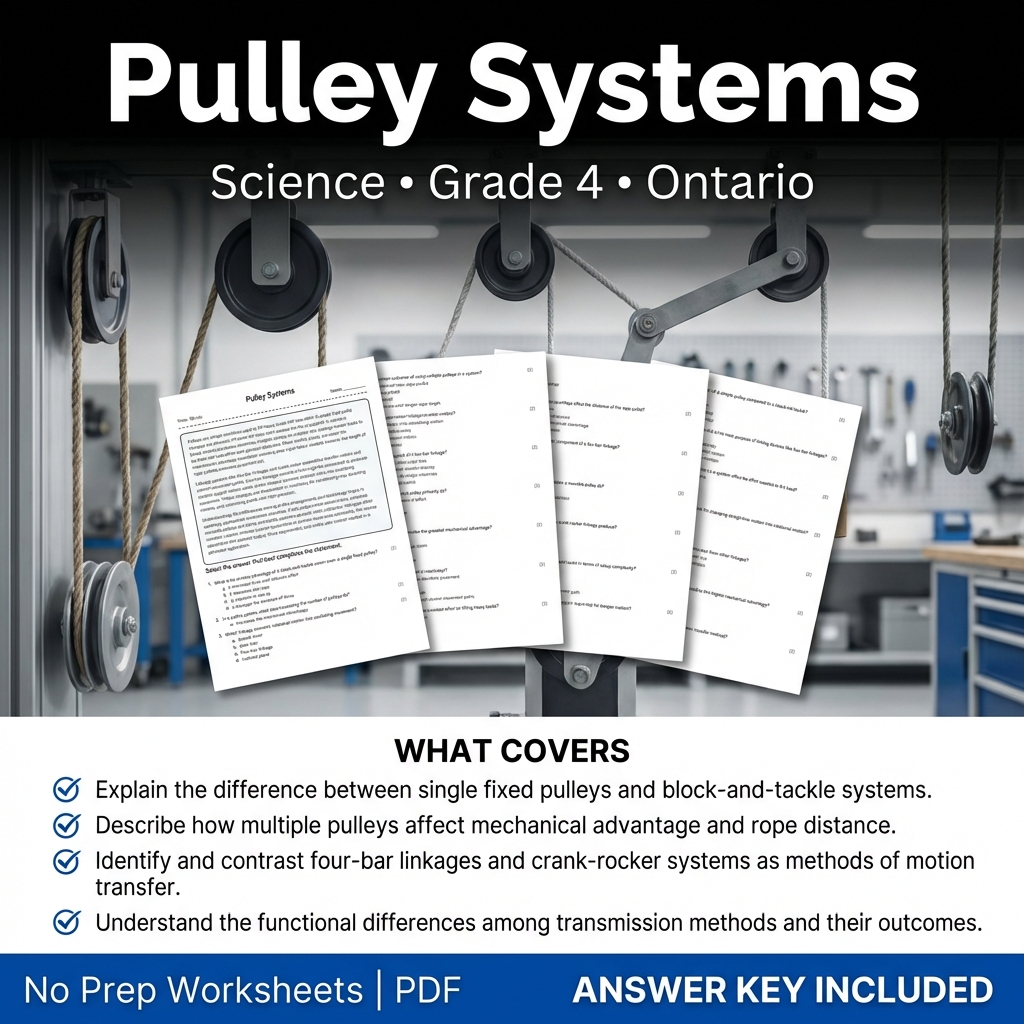
Pulley Systems Worksheet for Grade 4 Science | Ontario Alignment
Created byCoral Reef LearningLearning Objectives
- Explain the difference between single fixed pulleys and block-and-tackle systems.
- Describe how multiple pulleys affect mechanical advantage and rope distance.
- Identify and contrast four-bar linkages and crank-rocker systems as methods of motion transfer.
Instant download
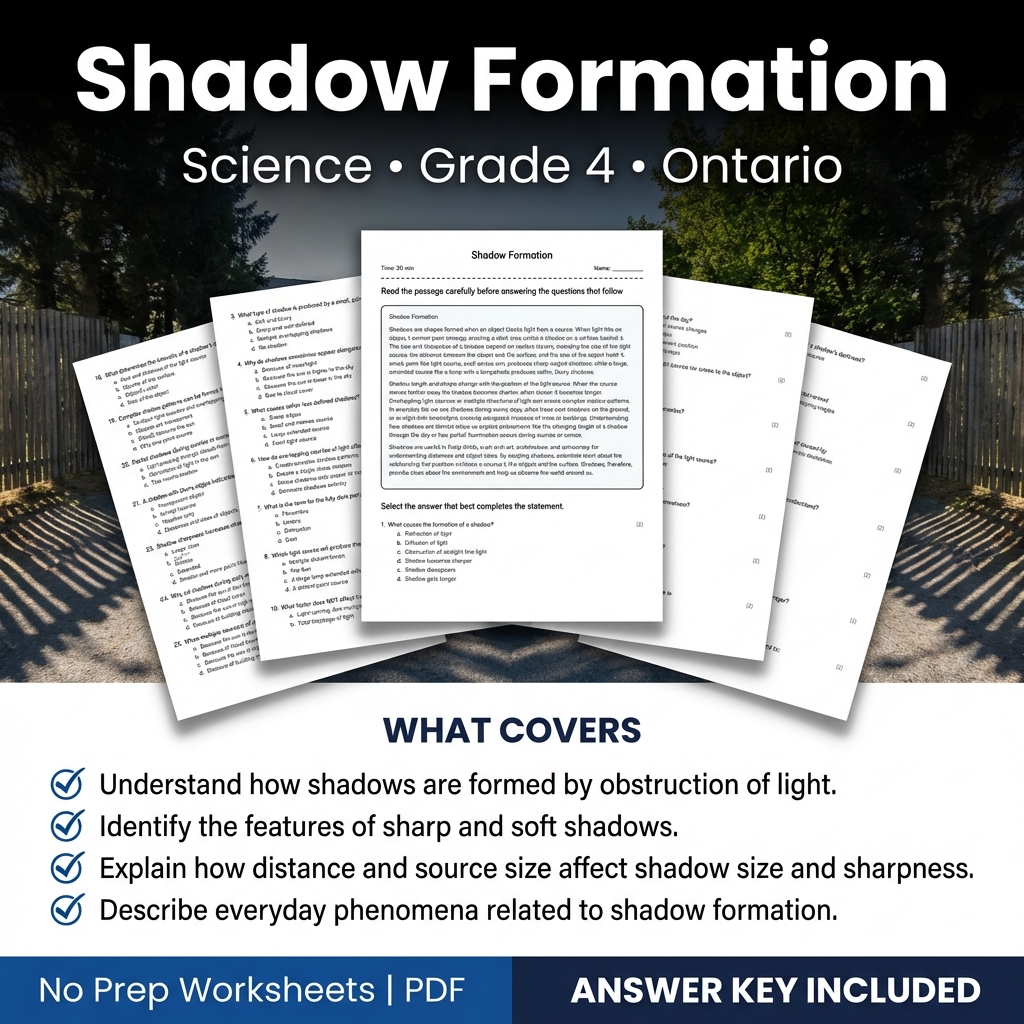
Grade 4 Science Worksheet on Shadow Formation | Ontario Standards
Created byCoral Reef LearningLearning Objectives
- Understand how shadows are formed by obstruction of light.
- Identify the features of sharp and soft shadows.
- Explain how distance and source size affect shadow size and sharpness.
Instant download

Grade 4 Lever Basics Worksheet | Fulcrum, Arms & Mechanical Advantage
Created byChalk and CompassLearning Objectives
- Identify the fulcrum, input arm, and output arm in common lever examples.
- Explain torque in simple terms using the idea of turning caused by force on an arm.
- Classify levers into first-, second-, and third-class levers by fulcrum position.
Also included in: Grade 4 Science Simple Machines & Mechanical Advantage Lesson Bundle | Ontario +1 more
Instant download

Weathering and Erosion Landforms Worksheets | Grade 4 Earth Science
Created byTeachers ClubLearning Objectives
- Identify weathering processes caused by running water, wind, ice, waves, and plant roots.
- Match common landforms to the agents that shape them through erosion.
- Compare relative rates of sediment movement under different environmental conditions.
Also included in: Grade 4 Earth Science Worksheets | NGSS Earth's Systems Bundle +1 more
Instant download

Topographic Maps and Elevation Patterns Worksheets for Grade 4 Science
Created byTeachers ClubLearning Objectives
- Identify map symbols and use the map scale to interpret distances on surface maps
- Explain how contour lines show elevation changes and identify steep vs. gentle slopes
- Determine drainage patterns from map features and describe how rivers deposit sediments
Also included in: Grade 4 Earth Science Worksheets | NGSS Earth's Systems Bundle +1 more
Instant download
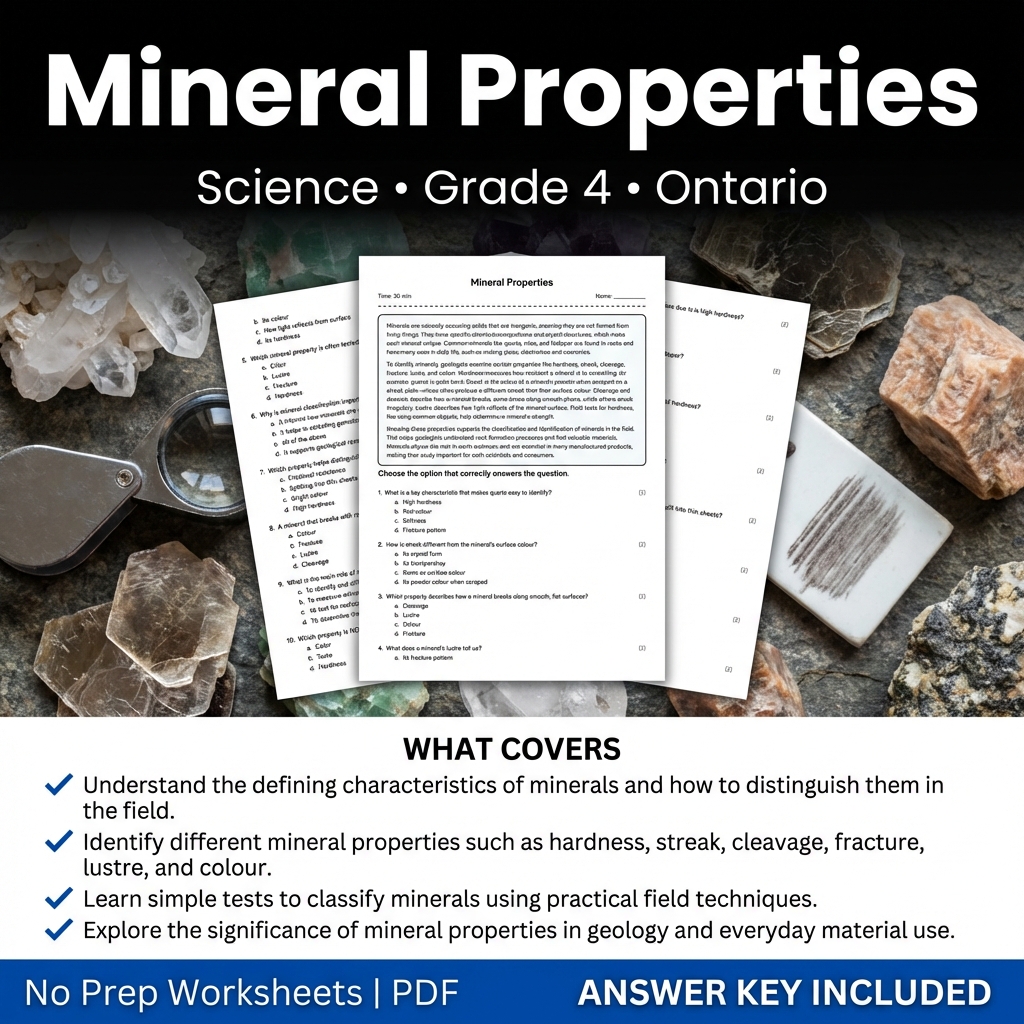
Mineral Properties Worksheet for Grade 4 Science | Ontario Standards
Created byCoral Reef LearningLearning Objectives
- Understand the defining characteristics of minerals and how to distinguish them in the field.
- Identify different mineral properties such as hardness, streak, cleavage, fracture, lustre, and colour.
- Learn simple tests to classify minerals using practical field techniques.
Instant download

Grade 4 Test and Refine Worksheet | NGSS Practice PDF
 Created byClear Sky Classroom
Learning Objectives
- Plan a fair test by changing only one variable at a time while keeping other conditions the same.
- Collect and record quantitative results during trials using measurements such as load, time, and displacement.
- Interpret test outcomes to identify failure modes and decide what design change to make next.
Instant download

Grade 4 Energy Conversion Worksheet | NGSS Practice PDF
Created byClear Sky ClassroomLearning Objectives
- Explain that energy can change form in devices while following the conservation of energy
- Identify input and output energy forms in common examples such as batteries, motors, and bulbs
- Describe common energy losses as heat and how efficiency affects what you observe
Instant download

Grade 4 Wind Vs Water Erosion Worksheet | California Standards Practice PDF
Created byClear Sky ClassroomLearning Objectives
- Describe how wind erosion moves and removes fine particles from exposed land.
- Explain how moving water erodes land during storms by carrying soil and reshaping streambanks and slopes.
- Compare solutions that reduce wind erosion with solutions that manage water flow and impact.
Instant download

Grade 4 Day And Night Worksheet | Practice & Assessment PDF
Created byClear Sky ClassroomLearning Objectives
- Explain how Earth’s rotation causes regular changes in sunlight and darkness.
- Use vocabulary such as axis, rotate, daytime, and nighttime to describe day and night.
- Identify how locations on Earth experience sunrise and sunset at different times.
Instant download
Grade 4 Science | Day Night Cycle Worksheet with Short Notes (Printable PDF)
Created byMeadowlark WorksheetsLearning Objectives
- Understand how Earth's rotation causes day and night.
- Identify patterns of daylight and darkness in the sky.
- Explain the movement of the Sun across the sky.
Also included in: Grade 4 Science Weather and Earth Cycles Lesson Bundle +1 more
Instant download

Grade 4 Shadows And Light Paths Worksheet | Practice & PDF
Created byClear Sky ClassroomLearning Objectives
- Explain how light travels in straight lines and how that creates shadows when an object blocks the light
- Predict how the size and position of a shadow change when an object moves, gets larger, or is placed closer to a surface
- Use simple straight-line reasoning to describe how the direction of incoming light affects a shadow’s orientation
Instant download

Grade 4 Science | System Components Worksheet (PDF) – General Standards
Created byEvergreen Desk EducationLearning Objectives
- Identify the input, mechanism, control, and output parts of a simple technological system.
- Explain how energy moves through a system and how component properties affect how well it works.
- Connect system components to a real-world water-pumping design by choosing suitable materials and mechanisms.
Also included in: Grade 4 Engineering Design & Electricity Science Lesson Bundle - General +1 more
Instant download

Grade 4 Animal Life Cycles Worksheet | NGSS Practice PDF
Created byClear Sky ClassroomLearning Objectives
- Explain what a life cycle is and why animals go through different stages
- Identify common stages of animal life cycles (such as egg, larva, tadpole, adult)
- Describe how metamorphosis changes an animal’s body form as it develops
Instant download

Conservation Strategies Worksheets | Grade 4 Habitats & Communities
Created byPrism Point LearningLearning Objectives
- Describe how habitat protection, restoration, and habitat creation support species recovery.
- Compare passive protection and active restoration as conservation strategies.
- Explain how protected areas and buffer zones can reduce harm to habitats.
Also included in: Grade 4 Habitats & Communities Lesson Bundle | Ontario Science Framework
Instant download

Biodiversity Measures Worksheets | Grade 4 Science Habitats & Communities
Created byPrism Point LearningLearning Objectives
- Explain how species richness, relative abundance, and evenness describe biodiversity in a community.
- Identify how introduced and native species can change community composition over time.
- Describe how habitat heterogeneity supports greater biodiversity.
Also included in: Grade 4 Habitats & Communities Lesson Bundle | Ontario Science Framework
Instant download

Grade 4 Sun Shadows Worksheet | NGSS Practice & PDF
Created byClear Sky ClassroomLearning Objectives
- Explain how the Sun’s changing position during the day affects shadow direction and length.
- Describe how sunlight hitting an object at different angles changes the shadow shape and extent.
- Use time-of-day observations to connect shadow patterns to Earth’s rotation.
Instant download
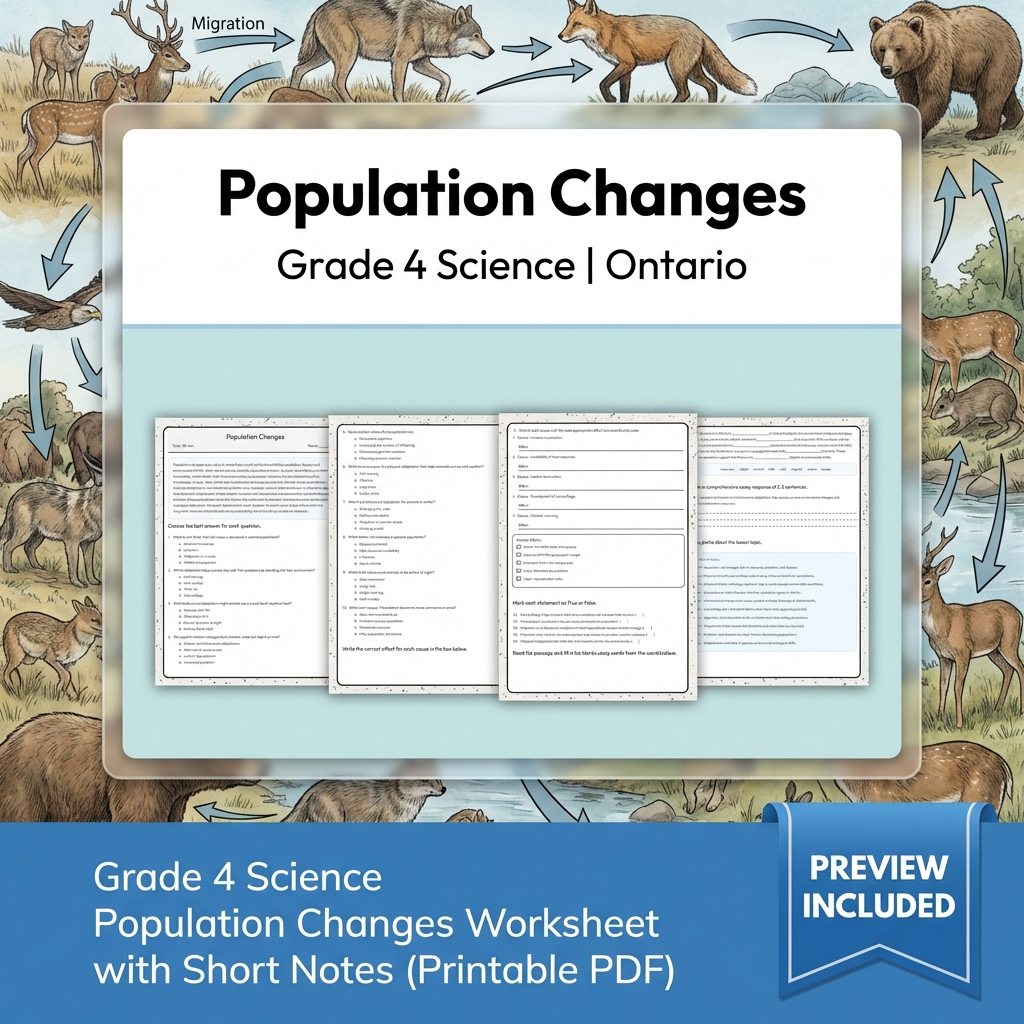
Grade 4 Science Population Changes Worksheet with Short Notes (Printable PDF)
Created byMeadowlark WorksheetsLearning Objectives
- Understand factors that influence population increases or decreases in species.
- Identify both physical and behavioral adaptations that support species survival.
- Explain how environmental conditions affect population dynamics and adaptations.
Also included in: Grade 4 Science Lesson Group Bundle – Ontario Framework Units +1 more
Instant download

Food Chains & Webs Worksheets | Grade 4 Energy Flow Science
Created byPrism Point LearningLearning Objectives
- Identify producers, consumers, and decomposers in simple pond food chains.
- Explain how energy moves through a food chain using arrows.
- Describe how removing one link can affect other species in a food web.
Also included in: Grade 4 Habitats & Communities Lesson Bundle | Ontario Science Framework
Instant download

Wetland Communities and Adaptations Worksheets | Grade 4 Science
Created byPrism Point LearningLearning Objectives
- Describe how water depth, soil saturation, and flooding shape wetland communities
- Identify plant and animal adaptations that help organisms live in wetlands
- Compare marshes, swamps, and bogs using dominant vegetation and hydrology
Also included in: Grade 4 Habitats & Communities Lesson Bundle | Ontario Science Framework
Instant download
About Grade 4 Science Worksheets
Find Science worksheets built for Grade 4. All 454 cover core skills, practice, and review, each an instant PDF download.
MyTeachingSheets worksheets are made by real teacher-authors and checked before they go live. Download any as a print-ready PDF for lessons, homework, or independent practice — most include answer keys, and previews are always free.