
Grade 4 Science Worksheets
454 worksheets
Grade 4 Rock Strata Science Daily Reading Worksheet | NGSS Earth Science
 Created byBRIGHT PATH RESOURCES
Learning Objectives
- Identify the main idea and key details about rock layers (strata).
- Explain how fossil evidence and layer order help scientists infer past environments.
Also included in: Grade 4 Science Full-Year Bundle | NGSS Daily Reading Worksheets +1 more
Instant download

Grade 4 Energy Forms Worksheet | NGSS Practice PDF
 Created byClear Sky Classroom
Learning Objectives
- Identify thermal, light, sound, and electrical energy and describe how each one can be observed in everyday situations.
- Explain how energy transfers through matter and space using examples of conduction, transmission of light, and sound through air.
- Model and describe electrical energy transfer in simple circuits using the movement of electrons.
Instant download

Pulley Systems and Mechanical Advantage Worksheets Grade 4 Science
 Created byPrism Point Learning
Learning Objectives
- Describe how pulleys transfer motion to move a load.
- Compare single fixed pulleys with block-and-tackle systems in terms of mechanical advantage and rope distance.
- Explain how compound pulley arrangements and linkages can control motion and direction.
Instant download

Grade 4 Measurement Choices Worksheet | General Practice PDF
Created byClear Sky ClassroomLearning Objectives
- Explain how choosing consistent measurement methods and units improves the usefulness of data.
- Identify the responding variable in a claim and select what should be recorded each trial.
- Use clear criteria to record observations so data from multiple trials can be compared.
Instant download

Grade 4 Rock Fossil Evidence Worksheet | California Standards Practice PDF
Created byClear Sky ClassroomLearning Objectives
- Explain how rock layers can preserve evidence from Earth’s past environments.
- Describe how fossils and sediment or layering patterns help scientists infer environmental change over time.
- Use observable features of rocks (layer position and fossil type) to support a claim about the past.
Instant download

Soil Texture, Structure, and Water Retention Grade 4 Worksheets
Created byPrism Point LearningLearning Objectives
- Identify how sand, silt, clay, and loam differ in particle size and texture.
- Explain how soil texture affects permeability and aeration for plant roots.
- Describe how organic matter helps soil structure and nutrient retention.
Also included in: Grade 4 Weathering, Soil & Rock Cycle Lesson Bundle | Ontario Science
Instant download

Mineral Properties and Identification Worksheets | Grade 4 Science
Created byPrism Point LearningLearning Objectives
- Describe minerals as naturally occurring, inorganic solids with characteristic chemical composition and crystal structure.
- Use observable properties such as hardness, cleavage, fracture, streak, lustre, and colour to identify minerals.
- Apply simple field tests to compare mineral properties, including a hardness test and a streak test.
Also included in: Grade 4 Weathering, Soil & Rock Cycle Lesson Bundle | Ontario Science
Instant download

Energy Transfer Worksheets: Matter and Space | Grade 4 Science
 Created byTeachers Club
Learning Objectives
- Identify examples of thermal, light, sound, and electrical energy from everyday situations
- Describe observable effects that show energy is moving
- Explain how heat, light, sound, and electrical energy transfer through matter and space
Also included in: Energy Grade 4 Science Worksheets | NGSS Energy Unit Bundle +1 more
Instant download

Igneous Rocks Worksheets: Cooling History & Formation | Grade 4
Created byPrism Point LearningLearning Objectives
- Describe how igneous rocks form from magma or lava
- Compare intrusive and extrusive igneous bodies based on cooling rate and crystal size
- Use igneous texture and mineral content to infer a rock’s cooling history and setting
Also included in: Grade 4 Weathering, Soil & Rock Cycle Lesson Bundle | Ontario Science
Instant download

Grade 4 Forces Push Pull Worksheet | NGSS Practice PDF
Created byClear Sky ClassroomLearning Objectives
- Explain how forces can change an object’s motion, including starting, slowing, and changing direction.
- Distinguish between contact forces (pushes and pulls) and describe the role of strength and direction.
- Use evidence from a scenario to identify what force is happening and predict the effect on motion.
Instant download

Grade 4 Water Cycle Worksheet | NGSS Practice & PDF
Created byClear Sky ClassroomLearning Objectives
- Identify the main stages of the water cycle: evaporation, condensation, precipitation, and collection
- Explain how solar energy drives the water cycle and how water moves between Earth’s systems
- Use key vocabulary to describe how water changes state (liquid, gas, and ice) during the cycle
Instant download

Grade 4 Senses and Responses Science Daily Reading Worksheet | NGSS
Created byBRIGHT PATH RESOURCESLearning Objectives
- Explain how vision helps animals move safely.
- Identify details from a text about senses and responses.
- Use evidence from a passage to answer questions about cause and effect.
Also included in: Senses, Responses & Plant Roots Grade 4 Science Worksheets Bundle | Ngss +2 more
Instant download
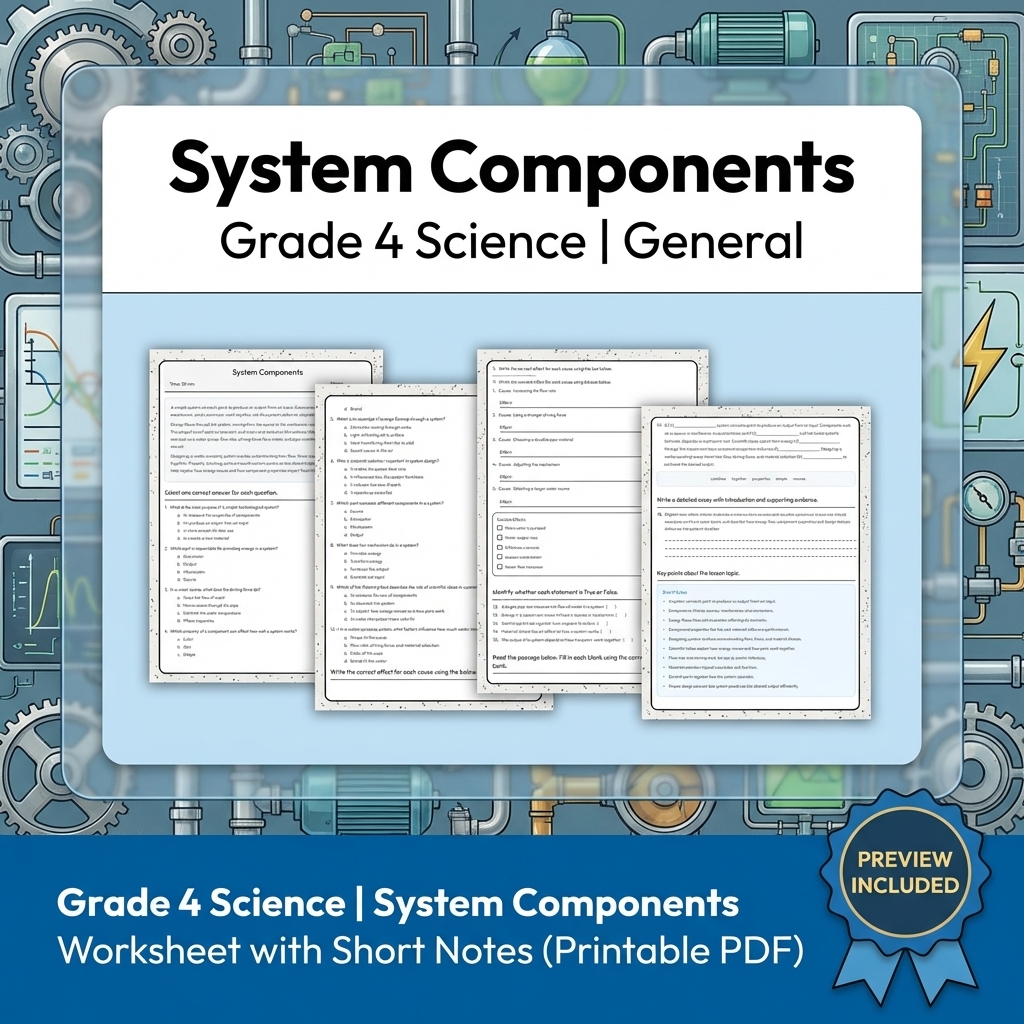
Grade 4 Science | System Components Worksheet with Short Notes (Printable PDF)
 Created byMeadowlark Worksheets
Learning Objectives
- Understand the basic parts of a simple technological system and their functions.
- Explain how energy moves through a system and how components work together.
- Describe the role of flow, driving force, and material selection in system design.
Also included in: Grade 4 Science Lesson Group Comprehensive Worksheets for Hands-On Learning +1 more
Instant download

Rock Strata Evidence of Earth Change Worksheets | Grade 4 Science Practice
Created byTeachers ClubLearning Objectives
- Describe how sedimentary rock layers (strata) form and how they can be read in order.
- Identify evidence in rock strata such as fossils, buried soil horizons, cross-cutting events, and unconformities.
- Explain how fossils in different layers can show changing environments over time.
Also included in: Grade 4 Science Worksheets Full Year Bundle | NGSS Aligned
Instant download

Inclined Planes & Mechanical Advantage Grade 4 Science Worksheets
Created byPrism Point LearningLearning Objectives
- Explain how slope and screw pitch can reduce the input force needed to move an object
- Compare ramps and screw threads as examples of inclined planes
- Describe how friction and surface contact can limit the mechanical advantage
Instant download

Grade 4 Community Roles Worksheet | Practice & Assessment PDF
Created byClear Sky ClassroomLearning Objectives
- Identify community roles such as producers, primary consumers, secondary consumers, decomposers, pollinators, predators, and prey.
- Explain how energy and matter move through a community using trophic functions and feeding modes.
- Describe how decomposers recycle nutrients to help habitats stay stable and resilient.
Instant download
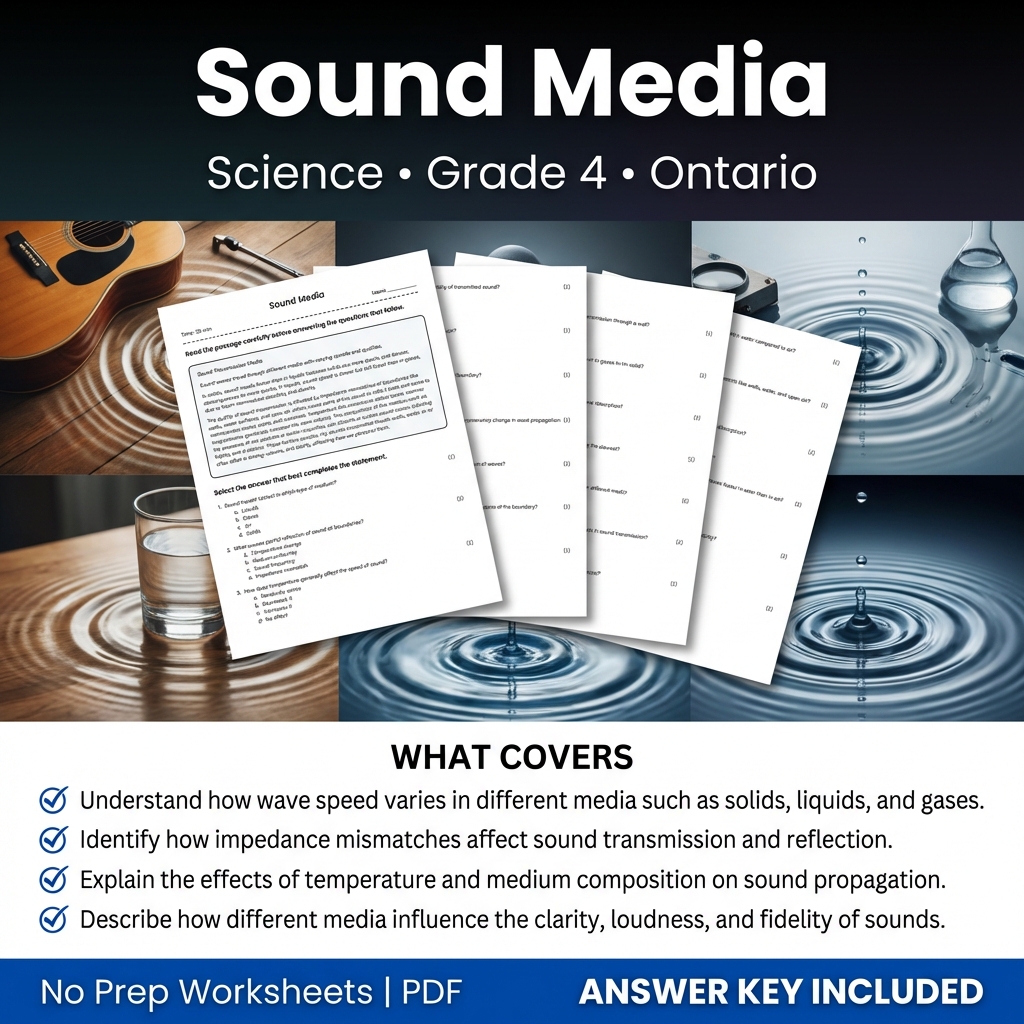
Grade 4 Science Worksheet on Sound Media | Ontario Standards
 Created byCoral Reef Learning
Learning Objectives
- Understand how wave speed varies in different media such as solids, liquids, and gases.
- Identify how impedance mismatches affect sound transmission and reflection.
- Explain the effects of temperature and medium composition on sound propagation.
Instant download

Wave Patterns and Information Transfer Worksheets Grade 4 Science
Created byTeachers ClubLearning Objectives
- Explain how wave patterns can represent information using amplitude, frequency, timing, and pulses
- Identify examples of information transfer that use sound or light pulses
- Compare how signal clarity can change when interference and bandwidth limits affect transmission
Also included in: Grade 4 Science Waves Worksheets | NGSS Wave Bundle +1 more
Instant download

Wheel-and-Axle Systems & Pulley Types Worksheets | Grade 4 Science
Created byPrism Point LearningLearning Objectives
- Explain how wheel-and-axle and pulley systems can change the direction and size of an applied force
- Compare fixed pulleys and movable pulleys in terms of mechanical advantage and how they affect effort
- Describe how wheel radius and axle radius relate to speed versus force trade-offs
Instant download

Habitat Components & Niches Worksheets | Grade 4 Ecosystems
Created byPrism Point LearningLearning Objectives
- Identify biotic and abiotic habitat components and explain how each affects living things
- Distinguish habitat from niche using simple examples such as pond edges and tree canopies
- Describe how shelter, food, water, and space help determine where species are found
Also included in: Grade 4 Habitats & Communities Lesson Bundle | Ontario Science Framework
Instant download

Friction and Mechanical Advantage Efficiency Worksheets Grade 4 Science
Created byPrism Point LearningLearning Objectives
- Explain how friction reduces the efficiency of a mechanism by increasing the input force needed.
- Compare ideal mechanical advantage and actual mechanical advantage in real machines.
- Identify materials and surface features that affect wear, lubrication, and long-term performance.
Instant download

Grade 4 New Substances Worksheet | NGSS Practice PDF
Created byClear Sky ClassroomLearning Objectives
- Identify evidence that a chemical change forms a new substance with new properties
- Distinguish physical changes from chemical changes using observations and clues
- Explain why some changes cannot be undone by simply heating or cooling
Instant download

Sound and Instrument Design Worksheets: Pitch, Vibration & Resonance
Created byPrism Point LearningLearning Objectives
- Describe how strings, wind columns, and percussion change pitch or frequency
- Explain how vibration, resonance, and excitation relate to loudness
- Compare instrument features using measurable physical ideas like length, tension, and size
Also included in: Sound & Light Waves Lesson Bundle Grade 4 Science Ontario
Instant download

Grade 4 Science | Erosion Processes Worksheet (PDF) – General Standards
 Created byEvergreen Desk Education
Learning Objectives
- Describe how flowing water, wind, and ice can break down and move Earth materials.
- Explain how erosion changes landforms by removing material from one place and depositing it in another.
- Identify evidence of erosion, such as worn edges and exposed layers.
Also included in: Grade 4 Weather and Earth-Sun-Moon Cycles Science Lesson Bundle: General +1 more
Instant download
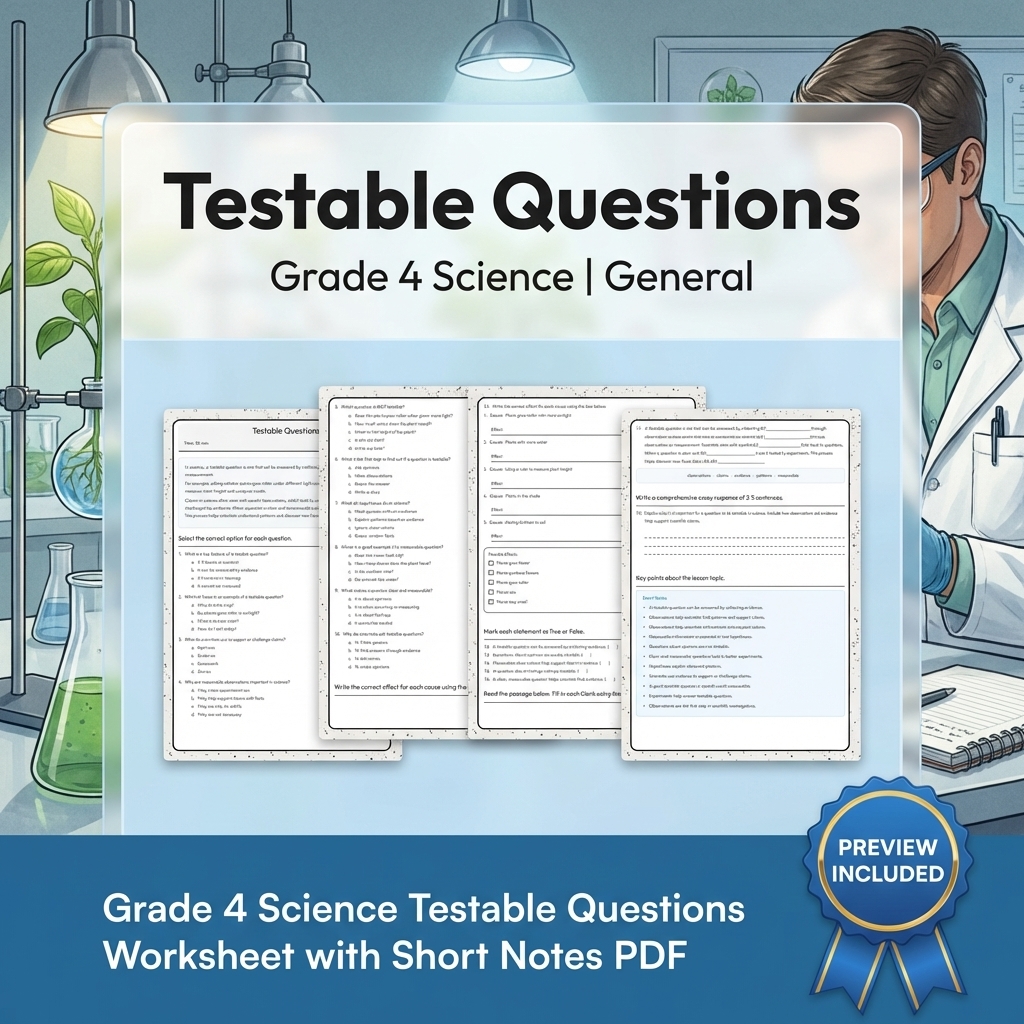
Grade 4 Science Testable Questions Worksheet with Short Notes PDF
Created byMeadowlark WorksheetsLearning Objectives
- Understand what makes a question testable through observation and evidence.
- Learn how to develop hypotheses based on patterns observed.
- Identify measurable information to support or challenge claims.
Also included in: Grade 4 Science Lesson Group | Comprehensive Worksheets & Resources +1 more
Instant download
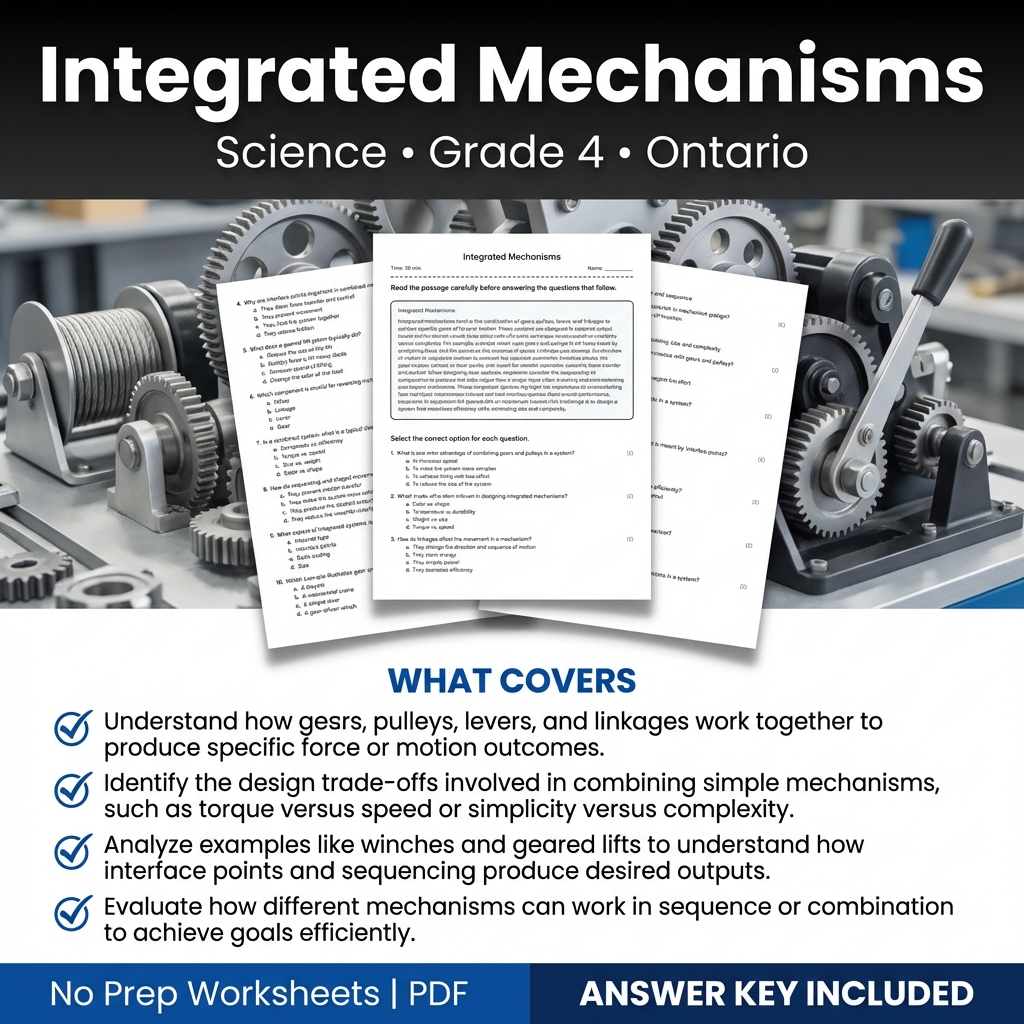
Integrated Mechanisms Science Worksheet for Grade 4 | Ontario Standards
Created byCoral Reef LearningLearning Objectives
- Understand how gears, pulleys, levers, and linkages work together to produce specific force or motion outcomes.
- Identify the design trade-offs involved in combining simple mechanisms, such as torque versus speed or simplicity versus complexity.
- Analyze examples like winches and geared lifts to understand how interface points and sequencing produce desired outputs.
Instant download

Sound Waves and Vibrations Worksheets Grade 4 Science
Created byPrism Point LearningLearning Objectives
- Describe how vibrating objects create compressions and rarefactions in matter
- Explain how frequency and amplitude affect pitch and loudness
- Identify examples of sound transmission in solids, liquids, and gases
Also included in: Sound & Light Waves Lesson Bundle Grade 4 Science Ontario
Instant download

Grade 4 Mass and Temperature Worksheet | NGSS Practice & PDF
Created byClear Sky ClassroomLearning Objectives
- Explain how mass describes the amount of matter in an object and how it can be compared
- Describe temperature as a measure of how hot or cold something is and relate it to energy transfer
- Use mass and temperature together to better understand everyday changes in matter
Instant download

Weathering Agents and Rock Changes Grade 4 Science Worksheets
Created byPrism Point LearningLearning Objectives
- Identify physical and chemical weathering agents and describe their effects on rocks
- Explain how freeze-thaw, abrasion, and plant roots can break rocks into smaller pieces
- Describe how oxidation and dissolution can change rock minerals and help form soil
Also included in: Grade 4 Weathering, Soil & Rock Cycle Lesson Bundle | Ontario Science
Instant download

Grade 4 Light And Sound Worksheet | General Use Practice PDF
Created byClear Sky ClassroomLearning Objectives
- Explain how light travels and how shadows form when objects block light.
- Describe how sound is produced and how it travels through a medium like air.
- Connect changes in distance and barriers to patterns for light and sound, including shadows, delays, and muffling.
Instant download

Light Sources and Straight-Line Travel Science Worksheets Grade 4
Created byPrism Point LearningLearning Objectives
- Compare natural and artificial light sources based on how they produce light.
- Describe how emitted light and reflected light differ when objects are seen.
- Use the idea that light travels in straight lines to predict visibility and beam paths.
Also included in: Sound & Light Waves Lesson Bundle Grade 4 Science Ontario
Instant download

Grade 4 Community Roles & Food Web Energy Flow Science Worksheet Ontario
 Created byChalk and Compass
Learning Objectives
- Identify producers, primary consumers, secondary consumers, and decomposers in a community
- Explain how energy and matter move through feeding roles over time
- Distinguish pollinators, predators, and prey by their roles in a food relationship
Also included in: Grade 4 Science Habitat & Biodiversity Lesson Bundle | Ontario +1 more
Instant download

Engineering Design Science Worksheets | Grade 4 Principles Practice
Created byBRIGHT PATH RESOURCESLearning Objectives
- Explain how force, friction, gravity, electricity, and material properties affect a design’s performance.
- Match scientific ideas to real-world design examples.
- Use scientific vocabulary to complete sentences and questions about simple prototypes.
Also included in: Grade 4 Science Engineering Design & Technology Worksheets Bundle +2 more
Instant download

Rock Texture and Types Worksheets Grade 4 Science
Created byPrism Point LearningLearning Objectives
- Classify common rocks as igneous, sedimentary, or metamorphic by observing texture and composition.
- Distinguish grain size, crystal arrangement, and layering/foliation using visible features.
- Explain how texture can record a rock’s formation environment, such as cooling rate or sediment transport.
Also included in: Grade 4 Weathering, Soil & Rock Cycle Lesson Bundle | Ontario Science
Instant download

Technology Systems Worksheets | Water Pumping Grade 4 Science Practice
Created byBRIGHT PATH RESOURCESLearning Objectives
- Identify common system components in a simple technological system, including a source, mechanism, and control or connector.
- Explain how energy moves through a system to produce an output from an input.
- Describe how material and component properties affect how well a system works.
Also included in: Grade 4 Science Engineering Design & Technology Worksheets Bundle +2 more
Instant download

Sound Echoes, Absorption & Room Acoustics Worksheets | Grade 4 Science
Created byPrism Point LearningLearning Objectives
- Explain how sound reflection creates echoes in open and enclosed spaces
- Describe how distance to a reflecting surface affects the time between direct and reflected sound
- Compare how soft and hard surfaces influence sound absorption and reverberation
Also included in: Sound & Light Waves Lesson Bundle Grade 4 Science Ontario
Instant download

Engineering Design Solutions Worksheets | Grade 4 Science Practice
Created byBRIGHT PATH RESOURCESLearning Objectives
- Describe how observations of a real situation lead to a design problem
- Explain how a design solution can change materials, shape, or structure
- Use evidence from a scenario to choose an effective design approach
Also included in: Grade 4 Science Engineering Design & Technology Worksheets Bundle +2 more
Instant download

Energy Sources, Pollution & Resource Use Worksheets Grade 4 Science
Created byTeachers ClubLearning Objectives
- Describe how energy is produced from natural resources such as coal, oil, natural gas, wind, and sunlight.
- Explain how burning fuels and using energy can affect air and water quality and habitats.
- Compare trade-offs between fossil fuels and renewable energy sources using examples.
Also included in: Grade 4 Science Worksheets Full Year Bundle | NGSS Aligned
Instant download
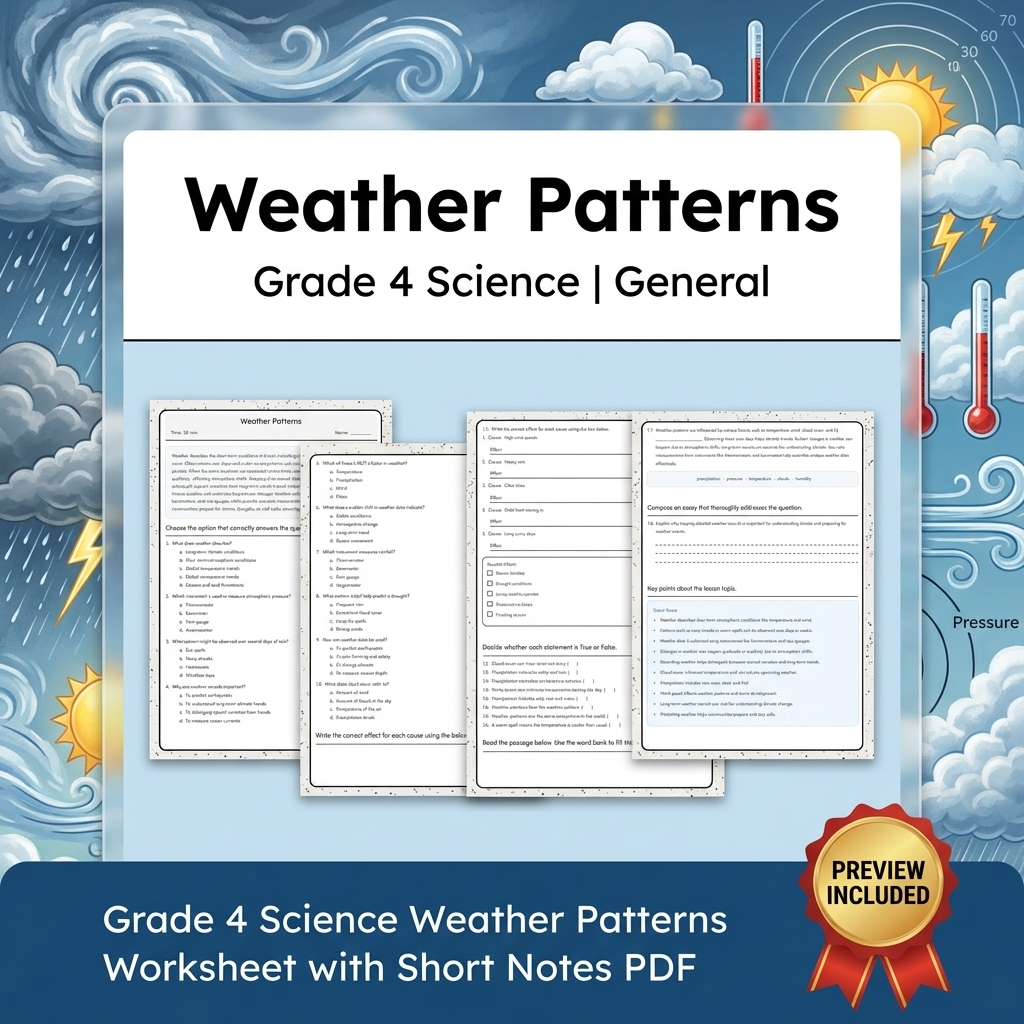
Grade 4 Science Weather Patterns Worksheet with Short Notes PDF
Created byMeadowlark WorksheetsLearning Objectives
- Understand what weather describes and the factors that influence it.
- Identify patterns in weather over days and weeks.
- Learn how to record and compare weather data over time.
Also included in: Grade 4 Science Weather and Earth Cycles Lesson Bundle +1 more
Instant download

Engineering Design Criteria and Constraints Worksheets | Grade 4 Science
Created byBRIGHT PATH RESOURCESLearning Objectives
- Describe criteria that show how well a prototype works.
- Identify constraints that limit materials, size, or safety for a prototype.
- Compare prototype features to criteria while following constraints.
Also included in: Grade 4 Science Engineering Design & Technology Worksheets Bundle +2 more
Instant download
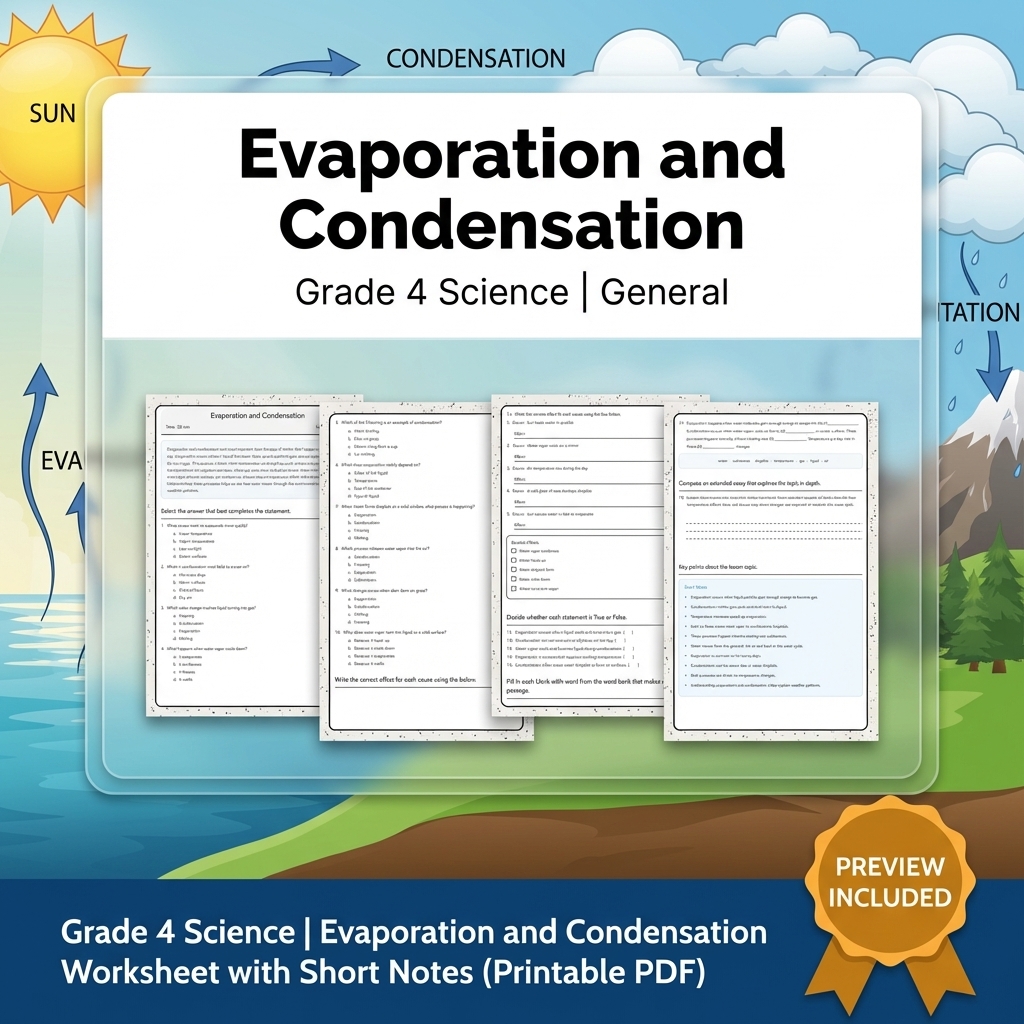
Grade 4 Science | Evaporation and Condensation Worksheet with Short Notes
Created byMeadowlark WorksheetsLearning Objectives
- Understand the processes of evaporation and condensation.
- Identify everyday examples of evaporation and condensation.
- Describe how temperature influences state changes between liquid and gas.
Also included in: Grade 4 Science Lesson Group: Engaging Worksheets for Key Concepts +1 more
Instant download

Engineering Design Solution Comparison Worksheets | Grade 4 Science Review
Created byTeachers ClubLearning Objectives
- Generate multiple possible design solutions for a simple problem.
- Compare solutions using measurable and observable criteria such as distance, speed, and stability.
- Use qualitative and quantitative evidence to choose one solution for refinement.
Also included in: Grade 4 Engineering Design Science Worksheets | NGSS Bundle +1 more
Instant download
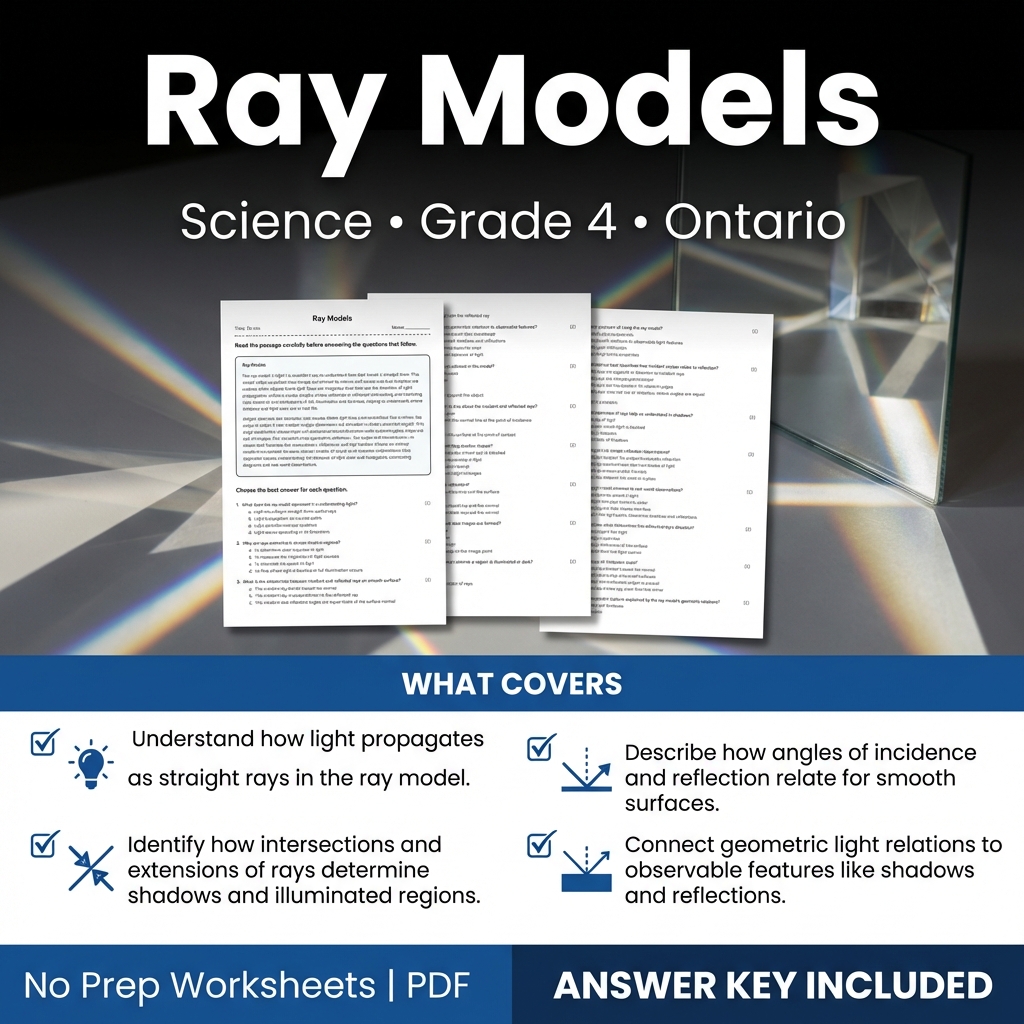
Ray Models Worksheet for Grade 4 Science | Ontario Standards Practice
Created byCoral Reef LearningLearning Objectives
- Understand how light propagates as straight rays in the ray model.
- Identify how intersections and extensions of rays determine shadows and illuminated regions.
- Describe how angles of incidence and reflection relate for smooth surfaces.
Instant download

Grade 4 Day Night Cycle Worksheet | Practice & Assessment PDF
Created byClear Sky ClassroomLearning Objectives
- Explain how Earth’s rotation causes predictable day and night.
- Describe how the Sun appears to move across the sky due to Earth’s turning.
- Use observations (sunrise, sunset, time of daylight) to support the day/night cycle explanation.
Instant download

Grade 4 Ecosystem Changes Worksheet | Practice & Assessment PDF
Created byClear Sky ClassroomLearning Objectives
- Explain how predator-prey relationships can change population sizes over time
- Describe how competition for limited resources can affect growth rates and survival
- Identify mutual relationships and use population evidence to infer ecosystem connections
Instant download

Population Change and Survival Adaptations Worksheets Grade 4
Created byPrism Point LearningLearning Objectives
- Explain how population size can increase or decrease over generations
- Identify traits and behaviors that can improve survival in a specific environment
- Match examples of limiting factors, predation, and disease to their effects on populations
Also included in: Grade 4 Habitats & Communities Lesson Bundle | Ontario Science Framework
Instant download

Grade 4 Producers, Consumers, and Decomposers Worksheet | Practice & PDF
Created byClear Sky ClassroomLearning Objectives
- Explain the roles of producers, consumers, and decomposers in a food chain.
- Describe how energy moves through an ecosystem from one organism to another.
- Model how decomposers recycle nutrients back into the environment.
Instant download

Sound Waves: Pitch and Loudness Worksheets | Grade 4 Science
Created byPrism Point LearningLearning Objectives
- Explain how wave frequency relates to pitch and how wave amplitude relates to loudness.
- Describe how changing tension, length, mass per unit length, and air-column conditions can change frequency.
- Identify factors that affect how loud a sound is, such as excitation force, surface area, and coupling.
Also included in: Sound & Light Waves Lesson Bundle Grade 4 Science Ontario
Instant download
About Grade 4 Science Worksheets
Find Science worksheets built for Grade 4. All 454 cover core skills, practice, and review, each an instant PDF download.
MyTeachingSheets worksheets are made by real teacher-authors and checked before they go live. Download any as a print-ready PDF for lessons, homework, or independent practice — most include answer keys, and previews are always free.