
Grade 4 Science Worksheets
454 worksheets
Grade 4 Water In Weather Worksheet | General Practice PDF
 Created byClear Sky Classroom
Learning Objectives
- Explain how water changes form (liquid, vapor, and ice) and how that relates to clouds and precipitation.
- Describe how temperature affects how much water vapor air can hold and how weather changes season to season.
- Use evidence from a text to identify main ideas about moisture, cloud formation, and precipitation.
Instant download

Reading & Interpreting Data Displays Worksheets for Grade 4 Science
 Created byBRIGHT PATH RESOURCES
Learning Objectives
- Identify information shown in charts, tables, and diagrams.
- Compare variables and describe patterns found in data displays.
- Explain how organizing observations helps reveal trends.
Also included in: Grade 4 Science Scientific Inquiry & Fair Test Worksheets Bundle +2 more
Instant download

Grade 4 Science | Explaining Classifications Worksheet (PDF)
 Created byEvergreen Desk Education
Learning Objectives
- Identify observable traits that support why organisms are placed in specific groups.
- Explain how similarities and differences help justify a classification decision.
- Describe what to do with borderline cases by comparing the strongest separating traits.
Also included in: Grade 4 Ecosystems & Classification Science Lesson Bundle (General) +1 more
Instant download

Grade 4 Reversible Phase Changes Worksheet | Practice & Assessment PDF
Created byClear Sky ClassroomLearning Objectives
- Identify reversible phase changes and describe how temperature changes can reverse them.
- Match common phase-change processes to the correct direction (melting/freezing, evaporation/condensation).
- Explain why reversible phase changes usually do not create a new material.
Instant download

Shadows and Light Worksheets | Light Paths Grade 4 Science Practice
Created byBRIGHT PATH RESOURCESLearning Objectives
- Describe how straight-line light paths help explain why shadows form
- Predict how changing the position of an object changes the shadow’s location
- Explain how the size or closeness of an object affects shadow size
Also included in: Grade 4 Science Physical Science Worksheets Bundle | Matter Forces Light Sound +2 more
Instant download

Grade 4 Food Chains Worksheet | Practice & Assessment PDF
Created byClear Sky ClassroomLearning Objectives
- Explain how energy moves through an ecosystem using producers and consumers in a food chain.
- Use arrows to describe feeding relationships in a food chain.
- Predict how changes in one organism population can affect other organisms connected by feeding relationships.
Instant download

Rock Cycle Processes and Transformations Worksheets Grade 4
 Created byPrism Point Learning
Learning Objectives
- Describe how igneous, sedimentary, and metamorphic rocks connect through the rock cycle.
- Identify processes that change rock materials, including melting and cooling, weathering and erosion, transport, compaction and cementation, and heat and pressure.
- Explain that rock cycle changes repeat over geologic time and involve pathways that can loop.
Also included in: Grade 4 Weathering, Soil & Rock Cycle Lesson Bundle | Ontario Science
Instant download

Forces and Motion Worksheets | Pushes and Pulls Grade 4 Science
Created byBRIGHT PATH RESOURCESLearning Objectives
- Explain how a push or pull can change an object’s speed and direction.
- Compare force strength and use it to predict changes in motion.
- Identify situations where a net force changes an object’s motion.
Also included in: Grade 4 Science Physical Science Worksheets Bundle | Matter Forces Light Sound +2 more
Instant download

Engineering Design Testing Worksheets | Grade 4 Science Practice
Created byBRIGHT PATH RESOURCESLearning Objectives
- Explain how testing results provide evidence about whether a solution works as expected
- Interpret recorded results to find patterns from multiple attempts
- Identify which parts of a design are effective and which parts need improvement
Also included in: Grade 4 Science Engineering Design & Technology Worksheets Bundle +2 more
Instant download

Water Cycle Worksheets | Weather Moisture & Precipitation Grade 4
Created byBRIGHT PATH RESOURCESLearning Objectives
- Explain how water vapor in the air can form clouds and moisture when air cools
- Describe how precipitation happens when water droplets or ice crystals grow in clouds
- Identify how seasonal changes in temperature and moisture affect local weather patterns
Also included in: Grade 4 Science Earth Weather Space Patterns Worksheets Bundle +2 more
Instant download

Grade 4 Organism Structures Worksheet | NGSS Practice PDF
Created byClear Sky ClassroomLearning Objectives
- Explain how external and internal structures help plants and animals perform life functions.
- Describe how plant structures such as roots, stems, and leaves support obtaining food, transporting materials, and making food.
- Identify animal structures (such as beaks, teeth, limbs, and organs) and match them to their functions.
Instant download

Sedimentary Rock Formation & Evidence Worksheets Grade 4 Science
Created byPrism Point LearningLearning Objectives
- Describe the steps that form sedimentary rocks: weathering, erosion, transport, deposition, compaction, and cementation.
- Differentiate clastic, chemical, and organic sedimentary rocks using clear examples.
- Explain how grain sorting, bedding, and fossils can show past environments.
Also included in: Grade 4 Weathering, Soil & Rock Cycle Lesson Bundle | Ontario Science
Instant download

Simple Machines Worksheets | Levers & Inclined Planes Grade 4 Science
Created byBRIGHT PATH RESOURCESLearning Objectives
- Explain how simple machines change the effect of a force on an object.
- Identify the effort and direction changes caused by a lever and an inclined plane.
- Use vocabulary from the lesson (effort, load, fulcrum, inclined plane) to describe simple machine examples.
Also included in: Grade 4 Science Physical Science Worksheets Bundle | Matter Forces Light Sound +2 more
Instant download

Defining Measurable Design Problems Worksheets | Grade 4 Science
 Created byTeachers Club
Learning Objectives
- Identify a design problem using measurable success criteria and realistic constraints.
- List constraints such as materials, cost, and size when planning a solution.
- Use simple sketches or models to represent requirements and trade-offs among criteria.
Also included in: Grade 4 Engineering Design Science Worksheets | NGSS Bundle +1 more
Instant download

Grade 4 Mixing And Separation Worksheet | General Practice PDF
Created byClear Sky ClassroomLearning Objectives
- Explain how mixtures can be classified by whether components are evenly spread or stay distinct.
- Describe how physical properties (size, solubility, and evaporation) help separate mixture components.
- Use evidence from observations to choose an appropriate separation method for a given mixture.
Instant download

Mass and Volume of Matter Worksheets for Grade 4 Physical Science
Created byBRIGHT PATH RESOURCESLearning Objectives
- Define mass and volume as measurable properties of matter.
- Use balances to compare the masses of different samples.
- Use volume units (like cubic centimeters) to compare the space an object occupies.
Also included in: Grade 4 Science Physical Science Worksheets Bundle | Matter Forces Light Sound +2 more
Instant download

Earth’s Rotation and Day Night Cycle Worksheets | Grade 4 Science
Created byBRIGHT PATH RESOURCESLearning Objectives
- Explain how Earth’s rotation causes day and night
- Identify key observations that show day/night timing is predictable
- Use models and diagrams to describe the Sun-Earth facing sides during day and night
Also included in: Grade 4 Science Earth Weather Space Patterns Worksheets Bundle +2 more
Instant download

Grade 4 Science | Friction And Efficiency Worksheet with Short Notes(PDF)
 Created byMeadowlark Worksheets
Learning Objectives
- Understand how friction affects the efficiency of mechanisms.
- Identify factors that influence the reduction of energy losses in machines.
- Differentiate between ideal and actual mechanical advantage in real-world systems.
Also included in: Grade 4 Science Lesson Bundle | Simple Machines & Mechanisms +1 more
Instant download

Grade 4 Earth Sun Moon Worksheet | Practice & General PDF
Created byClear Sky ClassroomLearning Objectives
- Explain how Earth’s rotation affects day and night.
- Describe how Earth’s position relative to the Sun supports predictable patterns of light and warmth.
- Summarize how the Moon’s orbit causes changes in the amount of its sunlit side we see.
Instant download

Light and Sound Patterns Worksheets for Grade 4 Physical Science
Created byBRIGHT PATH RESOURCESLearning Objectives
- Explain how light forms shadows when it travels in straight lines
- Describe how sound is made by vibrating objects and needs a medium such as air
- Predict how distance and barriers affect what you see for light and what you hear for sound
Also included in: Grade 4 Science Physical Science Worksheets Bundle | Matter Forces Light Sound +2 more
Instant download

Sound Worksheets | Pitch, Amplitude & Distance Grade 4 Science
Created byBRIGHT PATH RESOURCESLearning Objectives
- Explain how amplitude relates to sound volume.
- Describe how pitch relates to how fast something vibrates.
- Predict how distance changes how clearly sound can be heard.
Also included in: Grade 4 Science Physical Science Worksheets Bundle | Matter Forces Light Sound +2 more
Instant download

Earth Sun Moon Worksheets | Day Night & Moon Phases Grade 4
Created byBRIGHT PATH RESOURCESLearning Objectives
- Explain how Earth’s position relative to the Sun helps create day and night
- Describe how the Moon’s orbit around Earth changes which part of its sunlit side we see
- Use models and terms to compare Earth, the Sun, and the Moon
Also included in: Grade 4 Science Earth Weather Space Patterns Worksheets Bundle +2 more
Instant download

Grade 4 Human Impacts on Local Habitats Worksheet | Ontario Science
 Created byChalk and Compass
Learning Objectives
- Identify how habitat loss, pollution, fragmentation, and resource extraction can affect local species
- Explain how human activities can change food chains, biodiversity, and water flow (hydrology)
- Use observable ecological indicators to describe the effects of human impacts
Also included in: Grade 4 Science Habitat & Biodiversity Lesson Bundle | Ontario +1 more
Instant download

Grade 4 Weather Versus Climate Worksheet | NGSS Practice PDF
Created byClear Sky ClassroomLearning Objectives
- Explain the difference between weather and climate using examples of temperature, precipitation, wind, and cloud cover.
- Identify how weather can change quickly while climate changes more slowly over years.
- Use key vocabulary related to atmosphere and patterns to answer questions about observations and long-term trends.
Instant download

Grade 4 Solution Comparison Science Daily Reading Worksheet | NGSS STEM
Created byBRIGHT PATH RESOURCESLearning Objectives
- Identify criteria and constraints for comparing solutions.
- Explain why comparisons should be fair and measurable.
- Use one criterion and one constraint to judge a design idea.
Also included in: Engineering Design Grade 4 Science Daily Reading Worksheets Lesson Bundle | Ngss +2 more
Instant download

Grade 4 Soil Formation and Soil Horizons Worksheet | Ontario Science
Created byChalk and CompassLearning Objectives
- Explain how soil forms from weathering of parent rock and the buildup of organic matter over time
- Describe how different horizons can form with distinct color, texture, and fertility
- Connect climate, slope, and drainage to how quickly soil develops and how deep it becomes
Also included in: Grade 4 Science Rocks, Soil & Rock Cycle Lesson Bundle – Ontario +1 more
Instant download

Separating Mixtures Worksheets | Filtration Grade 4 Science Practice
Created byBRIGHT PATH RESOURCESLearning Objectives
- Explain how the differences between mixture components help scientists choose a separation method.
- Identify when filtering is useful for separating large, undissolved particles from a liquid.
- Describe how solubility differences guide separating a dissolved substance from an undissolved one.
Also included in: Grade 4 Science Physical Science Worksheets Bundle | Matter Forces Light Sound +2 more
Instant download
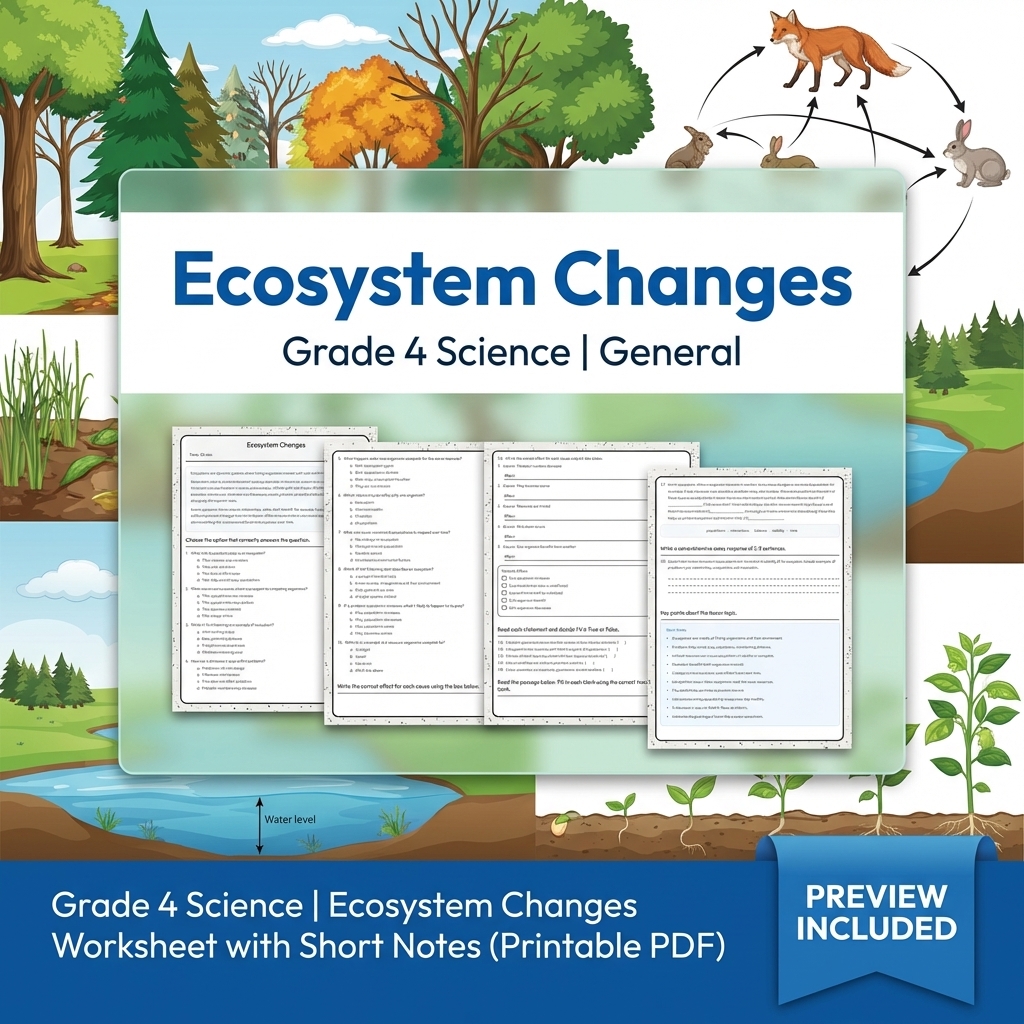
Grade 4 Science | Ecosystem Changes Worksheet with Short Notes (Printable PDF)
Created byMeadowlark WorksheetsLearning Objectives
- Understand how interactions among organisms affect ecosystem stability.
- Identify different types of relationships such as predation, competition, and mutualism.
- Analyze how changes in one population can influence other populations over time.
Also included in: Grade 4 Science Lesson Group Bundle | Ecosystems, Life Cycles & Classification +1 more
Instant download

Grade 4 Communicating Evidence Worksheet | NGSS Practice PDF
Created byClear Sky ClassroomLearning Objectives
- Explain how evidence supports a scientific claim by describing the reasoning connection.
- Use organized representations (tables, graphs, labeled diagrams) to communicate evidence clearly.
- Distinguish between what is known from evidence and what is being proposed or tested next.
Instant download

Grade 4 Separation Choices Worksheet | Practice & Assessment PDF
Created byClear Sky ClassroomLearning Objectives
- Explain how differences in particle size, solubility, and state-change ability determine a separation method for mixtures.
- Choose an appropriate separation approach based on mixture observations such as appearance and whether components dissolve.
- Use evidence from a scenario to justify why a particular separation method works.
Instant download

Simple Machines: Integrated Mechanisms & Motion Worksheets Grade 4
Created byPrism Point LearningLearning Objectives
- Describe how gears, pulleys, levers, and linkages work together to change force and motion
- Use torque and speed trade-offs to predict how a combined mechanism affects output motion
- Explain how interface points, direction reversals, and sequencing determine the final output
Instant download

Metamorphic Rocks Worksheets: Heat, Pressure & Fluids | Grade 4
Created byPrism Point LearningLearning Objectives
- Describe how heat, pressure, and chemically active fluids can change a preexisting rock into metamorphic rock.
- Compare contact metamorphism and regional metamorphism by where they form and what causes them.
- Explain how recrystallization and foliation relate to textures seen in metamorphic rocks.
Also included in: Grade 4 Weathering, Soil & Rock Cycle Lesson Bundle | Ontario Science
Instant download

Grade 4 Explaining Classifications Worksheet | General Practice PDF
Created byClear Sky ClassroomLearning Objectives
- Explain why organisms are placed into groups by using observable traits as evidence.
- Use classification reasoning to compare similarities and differences between organisms.
- Describe how classifications can change when new traits or evidence are considered.
Instant download

States of Matter Worksheets | Temperature Changes Grade 4 Science
Created byBRIGHT PATH RESOURCESLearning Objectives
- Describe how solids, liquids, and gases change when temperature increases or decreases.
- Explain the particle ideas behind melting, freezing, evaporation, and condensation.
- Match common state-change terms to the correct temperature change.
Also included in: Grade 4 Science Physical Science Worksheets Bundle | Matter Forces Light Sound +2 more
Instant download

Food Chains and Energy Transfer Worksheets | Grade 4 Science
Created byBRIGHT PATH RESOURCESLearning Objectives
- Explain how energy moves through an ecosystem using a food chain
- Identify producers and consumers in a food chain
- Describe how changes in one population can affect other connected populations
Also included in: Grade 4 Science Life Cycles Ecosystems & Metamorphosis Worksheets Bundle +2 more
Instant download
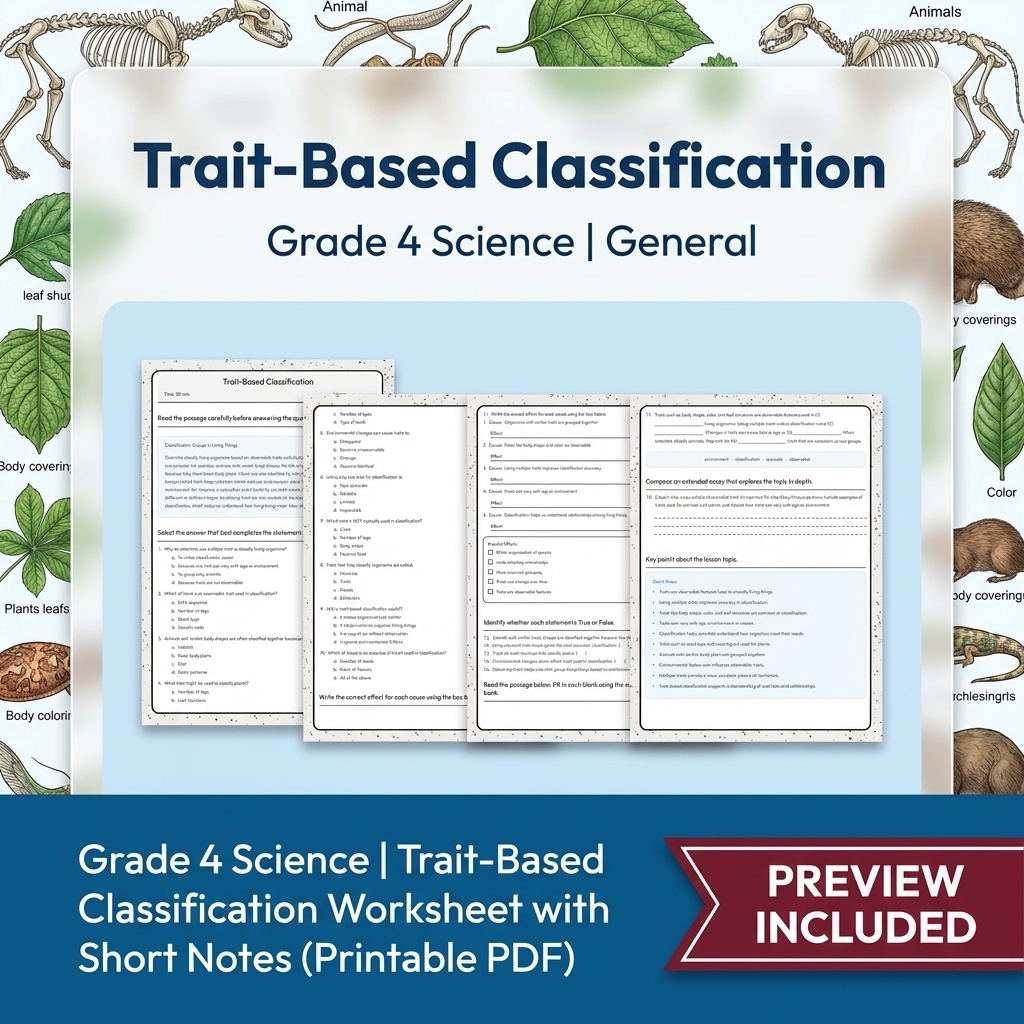
Grade 4 Science | Trait-Based Classification Worksheet with Short Notes
Created byMeadowlark WorksheetsLearning Objectives
- Understand how traits are used to classify living organisms.
- Identify observable traits such as body shape, color, and leaf structure.
- Explain why using multiple traits improves classification accuracy.
Also included in: Grade 4 Science Lesson Group Bundle | Ecosystems, Life Cycles & Classification +1 more
Instant download

Engineering Design Data Worksheets | Grade 4 Science Practice
Created byBRIGHT PATH RESOURCESLearning Objectives
- Explain how recording results can show a relationship between design changes and performance.
- Identify which outcome measure increases or decreases when a feature changes.
- Use patterns in data to suggest a targeted design revision.
Also included in: Grade 4 Science Engineering Design & Technology Worksheets Bundle +2 more
Instant download

Comparing Complete and Incomplete Metamorphosis Worksheets Grade 4
Created byBRIGHT PATH RESOURCESLearning Objectives
- Compare the stages of life cycles in different organisms by using observable features.
- Identify key differences between complete metamorphosis and gradual development.
- Explain how each life-cycle stage meets changing survival needs.
Also included in: Grade 4 Science Life Cycles Ecosystems & Metamorphosis Worksheets Bundle +2 more
Instant download

Life Cycle Stages Worksheets | Grade 4 Life Science Practice
Created byBRIGHT PATH RESOURCESLearning Objectives
- Describe the repeating stages in an organism’s life cycle from one generation to the next.
- Identify structures that provide evidence for life cycle stages at different times in a life cycle.
- Explain how life cycle stages can differ within the same environment.
Also included in: Grade 4 Science Life Cycles Ecosystems & Metamorphosis Worksheets Bundle +2 more
Instant download

Primary & Secondary Succession Worksheets | Grade 4 Science
Created byPrism Point LearningLearning Objectives
- Describe the difference between primary and secondary succession after a disturbance
- Identify how pioneer species and soil development change over time
- Explain how changing resources and species interactions affect community diversity
Also included in: Grade 4 Habitats & Communities Lesson Bundle | Ontario Science Framework
Instant download
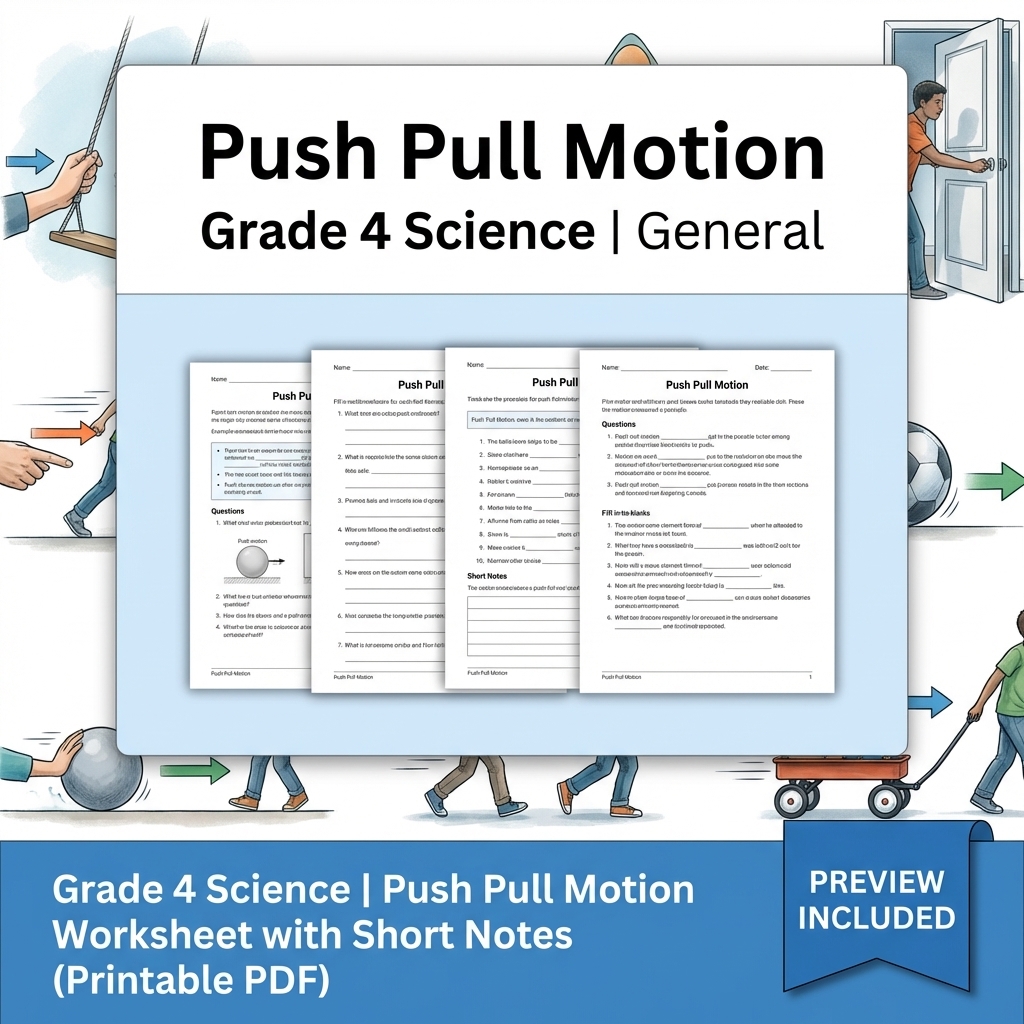
Grade 4 Science | Push Pull Motion Worksheet with Short Notes (Printable PDF)
Created byMeadowlark WorksheetsLearning Objectives
- Understand how forces like push and pull change an object's speed and direction.
- Identify examples of push and pull forces in everyday life.
- Explain how force strength affects the motion of objects.
Also included in: Grade 4 Science Lesson Group: Engaging Worksheets for Key Concepts +1 more
Instant download

Classifying Living Things Worksheets | Grade 4 Science Practice
Created byBRIGHT PATH RESOURCESLearning Objectives
- Identify observable traits used to group living things.
- Explain why using multiple traits improves classification.
- Match classification terms to examples and definitions.
Also included in: Grade 4 Science Life Cycles Ecosystems & Metamorphosis Worksheets Bundle +2 more
Instant download

Evaporation and Condensation Worksheets for Grade 4 Science
Created byBRIGHT PATH RESOURCESLearning Objectives
- Describe how evaporation changes liquid water into water vapor using particles escaping into the air
- Explain how condensation happens when a gas cools and forms liquid again on cooler surfaces
- Compare evaporation and condensation by linking each to temperature changes
Also included in: Grade 4 Science Physical Science Worksheets Bundle | Matter Forces Light Sound +2 more
Instant download

Classifying Living Things Worksheets | Grade 4 Trait Reasoning
Created byBRIGHT PATH RESOURCESLearning Objectives
- Explain how observable traits are used to group organisms
- Justify classification decisions using clear trait comparisons
- Describe how adding new evidence can change how an organism is grouped
Also included in: Grade 4 Science Life Cycles Ecosystems & Metamorphosis Worksheets Bundle +2 more
Instant download

Moon Phases Worksheets | Lunar Patterns & Perspective Grade 4
Created byBRIGHT PATH RESOURCESLearning Objectives
- Describe how the Moon’s visible shape changes over about a month
- Explain that lunar phases depend on which part of the sunlit half faces Earth
- Identify the repeating pattern of phases in the correct order
Also included in: Grade 4 Science Earth Weather Space Patterns Worksheets Bundle +2 more
Instant download

Data Patterns & Scientific Models Worksheets for Grade 4 Science
Created byBRIGHT PATH RESOURCESLearning Objectives
- Identify patterns in tables and charts and describe what they suggest.
- Use a simple model (arrows, graphs, or diagrams) to show relationships between variables.
- Explain how a model can help predict outcomes and show where more evidence is needed.
Also included in: Grade 4 Science Scientific Inquiry & Fair Test Worksheets Bundle +2 more
Instant download

Grade 4 Science Worksheet | Scientific Design & Electrical Concepts (PDF)
Created byEvergreen Desk EducationLearning Objectives
- Explain how scientific ideas (force, friction, gravity, electricity, and material properties) affect design choices.
- Use evidence from observable behavior to decide which design option will likely work better.
- Describe how complete systems (like electrical circuits) help explain why a prototype succeeds or fails.
Also included in: Grade 4 Engineering Design & Electricity Science Lesson Bundle - General +1 more
Instant download

Grade 4 Science | Energy Conversion Worksheet with Short Notes (Printable PDF)
Created byMeadowlark WorksheetsLearning Objectives
- Understand the different types of energy and how energy is transformed from one form to another.
- Identify examples of energy conversion in everyday life.
- Learn the importance of energy conservation and ways to minimize energy loss.
Also included in: Grade 4 Science Energy Unit | NGSS-Aligned Worksheet Collection (Printable PDF) +1 more
Instant download
About Grade 4 Science Worksheets
Find Science worksheets built for Grade 4. All 454 cover core skills, practice, and review, each an instant PDF download.
MyTeachingSheets worksheets are made by real teacher-authors and checked before they go live. Download any as a print-ready PDF for lessons, homework, or independent practice — most include answer keys, and previews are always free.