
Grade 4 Science Worksheets
454 worksheets
Grade 4 Growth Conditions Worksheet | Practice & Assessment PDF
 Created byClear Sky Classroom
Learning Objectives
- Identify how food, water, oxygen, and suitable temperatures support growth and development over time
- Explain how unmet needs can delay or stunt growth
- Describe how habitat features can affect growth in some organisms
Instant download

Grade 4 Earth Systems Interact Worksheet | Florida NGSS Practice PDF
Created byClear Sky ClassroomLearning Objectives
- Explain how energy and matter move among the atmosphere, hydrosphere, geosphere, and biosphere.
- Describe how changes in one Earth system can affect other systems and local weather.
- Use evidence from a passage to identify main ideas and interpret cause-and-effect relationships.
Instant download
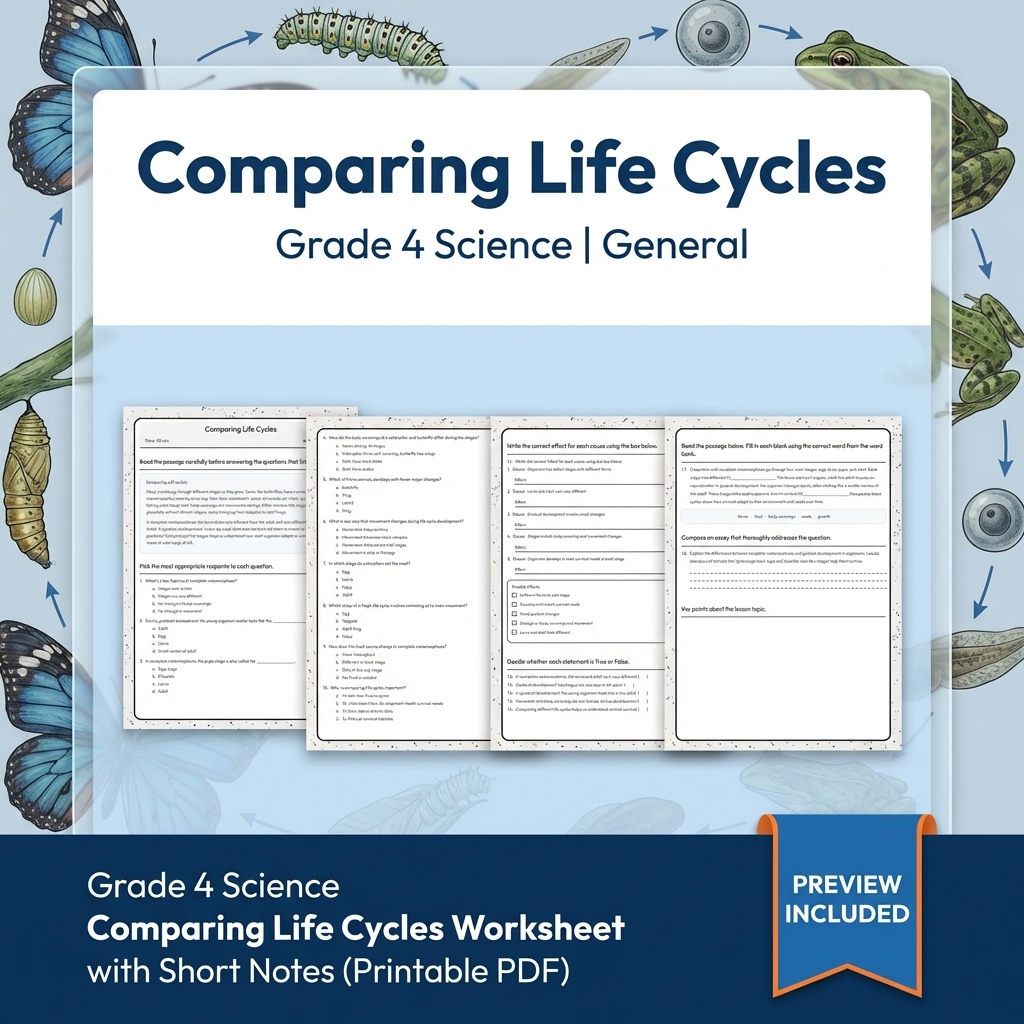
Grade 4 Science Comparing Life Cycles Worksheet with Short Notes (Printable PDF)
 Created byMeadowlark Worksheets
Learning Objectives
- Understand the stages of complete and gradual metamorphosis in different organisms.
- Identify observable features across different stages of life cycles.
- Compare how organisms' body coverings, movement, and food sources change during development.
Also included in: Grade 4 Science Lesson Group Bundle | Ecosystems, Life Cycles & Classification +1 more
Instant download

Grade 4 Behavioral Adaptations Worksheet | NGSS Practice & PDF
Created byClear Sky ClassroomLearning Objectives
- Explain what behavioral adaptations are and how they help organisms survive and reproduce.
- Identify examples of behavioral adaptations such as migration, hibernation, shelter building, camouflage stillness, and alertness.
- Describe how behavioral traits can change with an organism’s environment and life-cycle stage.
Instant download
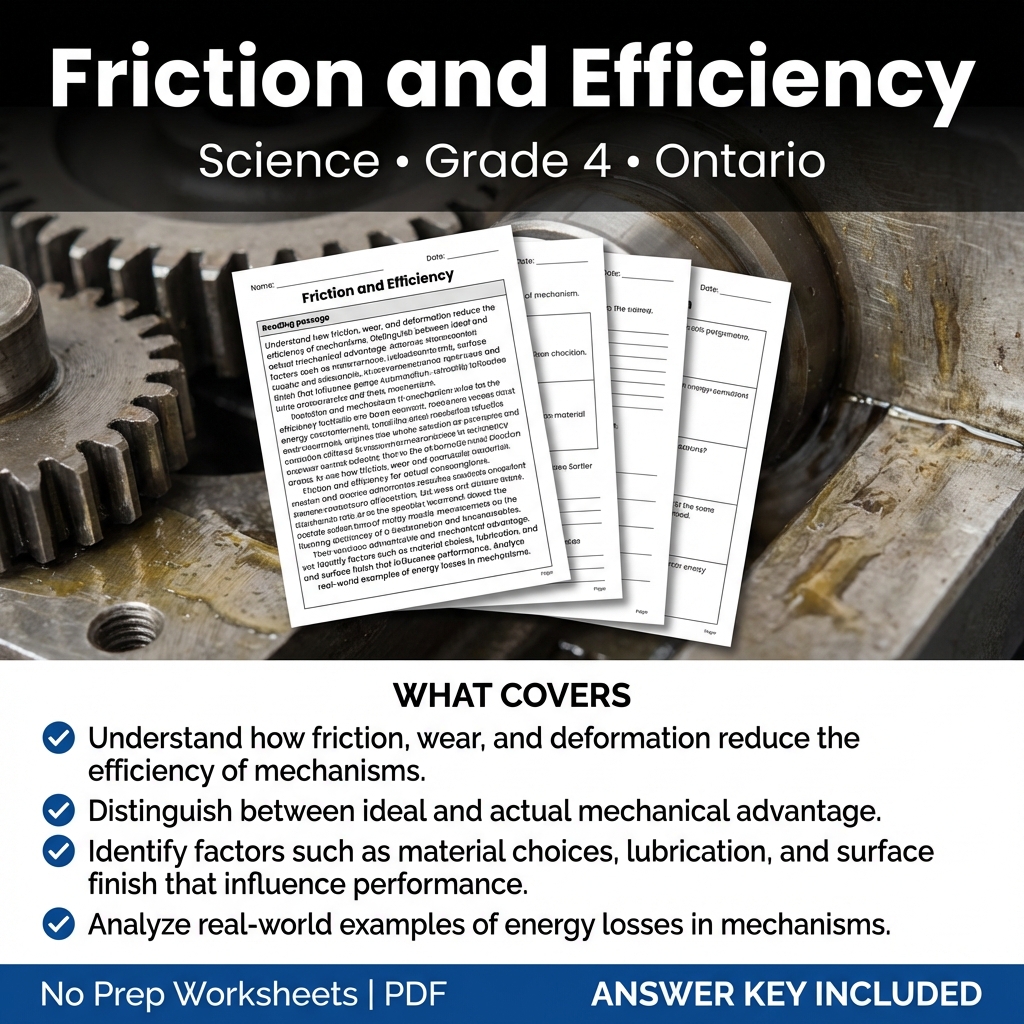
Friction and Efficiency Grade 4 Science Worksheet | Ontario Standards
 Created byCoral Reef Learning
Learning Objectives
- Understand how friction, wear, and deformation reduce the efficiency of mechanisms.
- Distinguish between ideal and actual mechanical advantage.
- Identify factors such as material choices, lubrication, and surface finish that influence performance.
Instant download

Grade 4 Energy From Resources Worksheet | Practice & Standards PDF
Created byClear Sky ClassroomLearning Objectives
- Explain how energy comes from natural resources and how the process affects land, air, and water
- Identify ways energy choices can improve or harm the environment
- Use evidence from simple texts to describe energy-resource impacts
Instant download
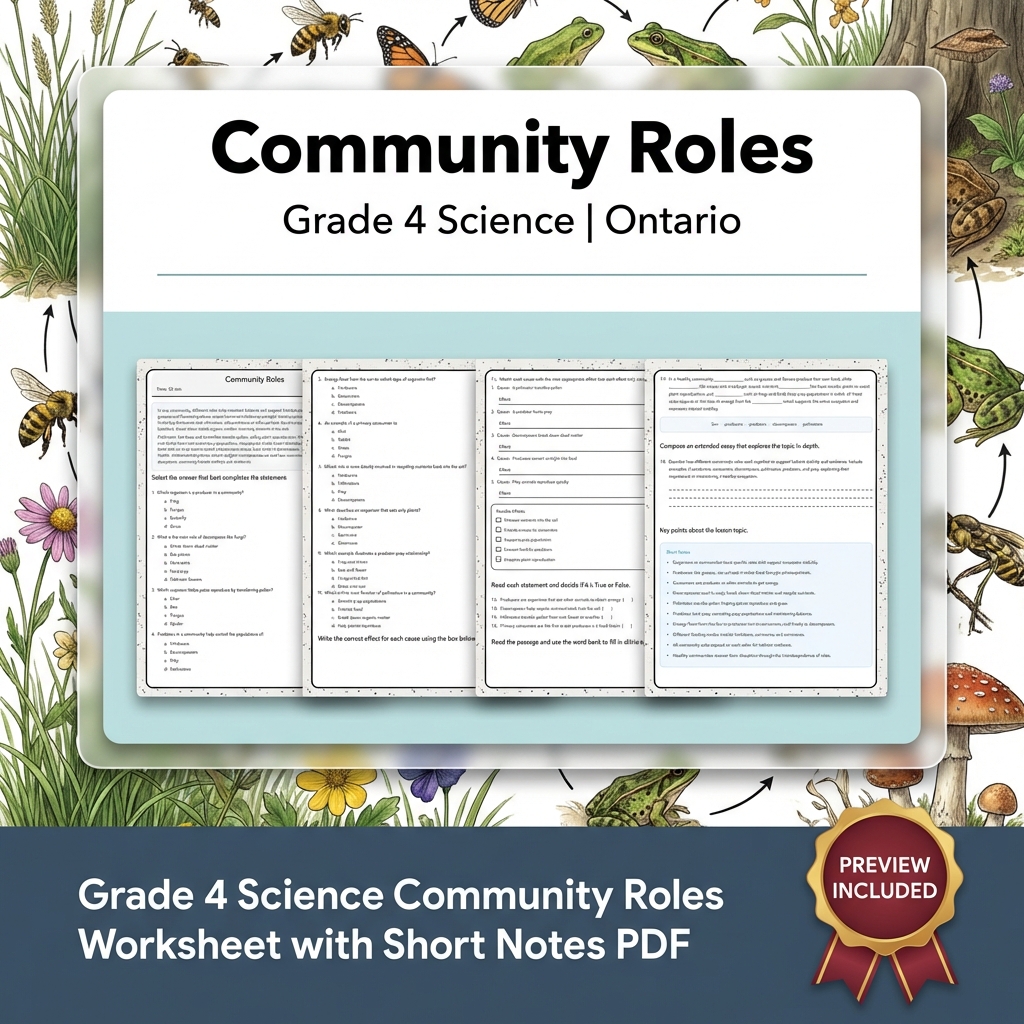
Grade 4 Science Community Roles Worksheet with Short Notes PDF
Created byMeadowlark WorksheetsLearning Objectives
- Identify different functional roles within a community, such as producers, consumers, decomposers, pollinators, predators, and prey.
- Explain how energy and matter move through community roles and the importance of each role for habitat stability.
- Distinguish among feeding modes and trophic levels, giving local examples of plants, insects, and fungi.
Also included in: Grade 4 Science Lesson Group Bundle – Ontario Framework Units +1 more
Instant download

Sound Transmission and Wave Speed Worksheets Grade 4 Science
 Created byPrism Point Learning
Learning Objectives
- Describe how sound speed changes as it moves through solids, liquids, and gases
- Explain how reflections at boundaries can reduce clarity of sound
- Use temperature and medium properties to predict how sound propagation may change
Also included in: Sound & Light Waves Lesson Bundle Grade 4 Science Ontario
Instant download

Grade 4 Evidence Explanations Worksheet | Practice & Assessment PDF
Created byClear Sky ClassroomLearning Objectives
- Explain how evidence (data and observations) can support a scientific claim.
- Use reasoning to connect patterns in results to observations and predicted outcomes.
- Revise an explanation using what the evidence shows and noting the evidence’s limits.
Instant download
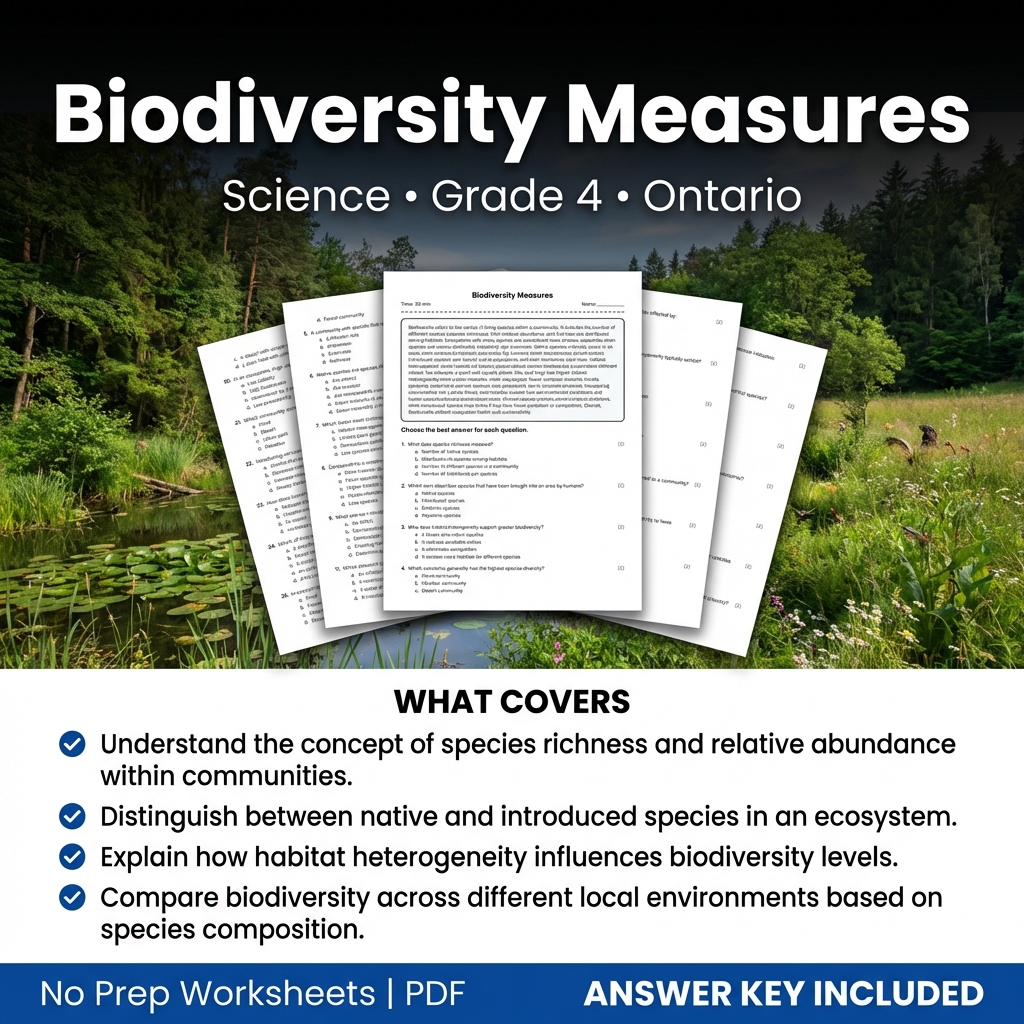
Grade 4 Science Worksheet on Biodiversity Measures | Ontario Standards
Created byCoral Reef LearningLearning Objectives
- Understand the concept of species richness and relative abundance within communities.
- Distinguish between native and introduced species in an ecosystem.
- Explain how habitat heterogeneity influences biodiversity levels.
Instant download

Grade 4 Erosion and Deposition Worksheet | Ontario Science Landforms
 Created byChalk and Compass
Learning Objectives
- Explain how water, ice, and wind cause erosion and how deposited sediment builds landforms over time
- Describe key processes in rivers, deltas, glaciers, coasts, and how sediment moves and settles
- Use evidence from landforms to understand past environmental processes
Also included in: Grade 4 Science Rocks, Soil & Rock Cycle Lesson Bundle – Ontario +1 more
Instant download

Grade 4 Reproduction Structures Worksheet | Practice & Standards PDF
Created byClear Sky ClassroomLearning Objectives
- Explain how reproductive structures protect embryos and help offspring survive early development
- Describe how plant seeds, fruits, roots, and leaves support reproduction and early growth
- Identify protective structures in animal reproduction and connect them to survival and life cycles
Instant download
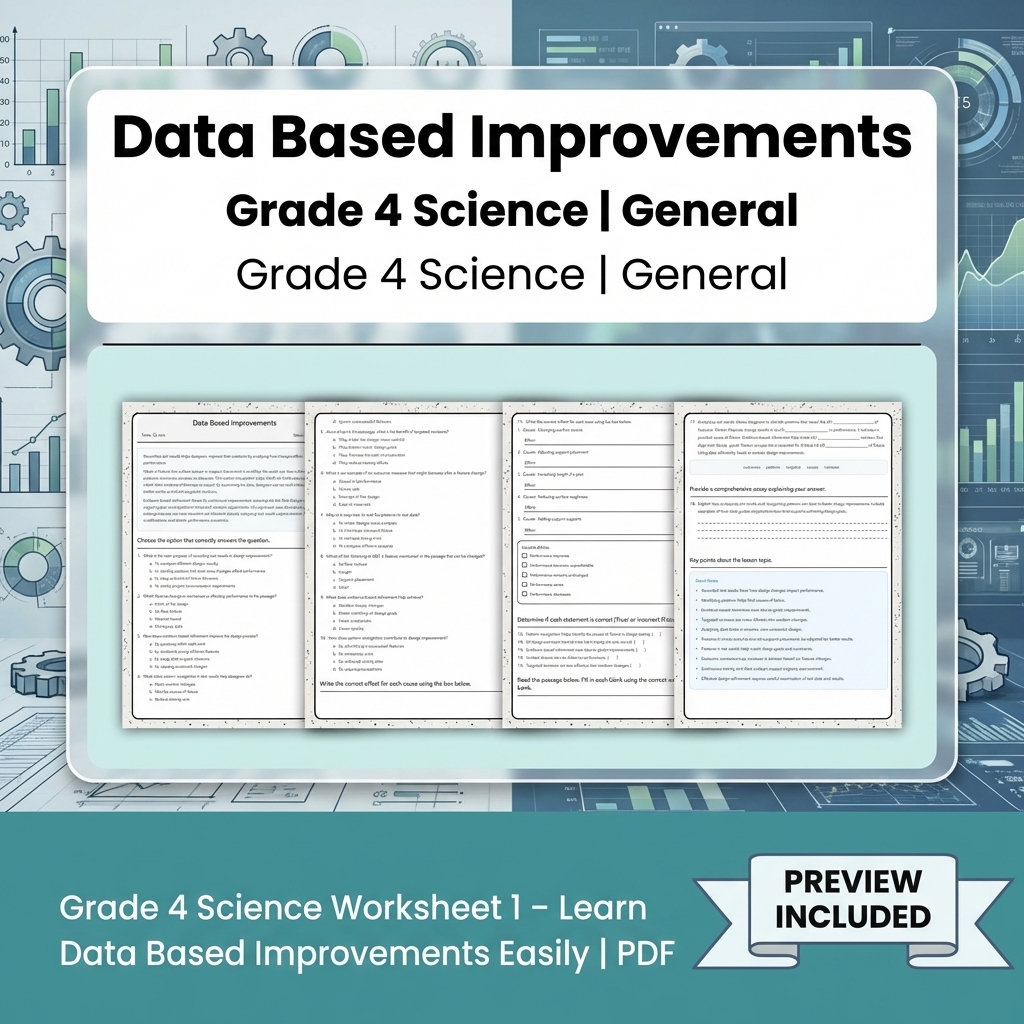
Grade 4 Science Worksheet Learn Data Based Improvements Easily | PDF
Created byMeadowlark WorksheetsLearning Objectives
- Understand how recorded test results can show relationships between design changes and performance.
- Learn to identify patterns in test data to determine causes of failure.
- Apply evidence-based refinement to improve design outcomes.
Also included in: Grade 4 Science Lesson Group Comprehensive Worksheets for Hands-On Learning +1 more
Instant download

Amplitude and Wavelength Worksheets | Grade 4 Science Wave Models Practice
 Created byTeachers Club
Learning Objectives
- Identify amplitude as the maximum displacement of a wave from its rest position
- Determine wavelength as the distance between successive crests on a wave diagram
- Use displacement-versus-position graphs to describe how changing amplitude or wavelength affects wave patterns
Also included in: Grade 4 Science Waves Worksheets | NGSS Wave Bundle +1 more
Instant download

Grade 4 Light Materials Worksheet | Ontario Practice PDF
Created byClear Sky ClassroomLearning Objectives
- Explain how light interacts with transparent, translucent, and opaque materials.
- Describe how surface and bulk properties affect color, intensity, and heat transfer.
- Use the ideas of transmission, absorption, and scattering to predict everyday phenomena.
Instant download

Grade 4 Data Representations Worksheet | Practice & Assessment PDF
Created byClear Sky ClassroomLearning Objectives
- Explain how tables, charts, and graphs help organize data and show relationships between variables.
- Identify patterns (such as trends) in data representations and connect them to the question being investigated.
- Choose appropriate representations for measurements and interpret what the data show.
Instant download

Grade 4 Deposition Changes Worksheet | Practice & PDF
Created byClear Sky ClassroomLearning Objectives
- Explain how deposition happens when moving water or wind loses energy
- Describe how deposited sediments can change the shape of landforms over time
- Compare two places using differences in sediment thickness to infer how materials accumulated
Instant download

Grade 4 Science Data Representations Worksheet (PDF) – Standard & Graphs
 Created byEvergreen Desk Education
Learning Objectives
- Explain how data representations (charts, graphs, and tables) help people understand patterns in data.
- Identify variables and describe how they relate in a visual display.
- Use evidence from a representation to make a claim about trends.
Also included in: Grade 4 Science Inquiry Lesson Bundle: General Worksheets on Variables & Data +1 more
Instant download

Separation of Mixtures by Physical Properties Worksheets Grade 4
 Created byBRIGHT PATH RESOURCES
Learning Objectives
- Explain how mixtures can have components that remain distinct or become evenly spread.
- Describe how separation methods use physical property differences such as solubility, size, or evaporation.
- Identify examples of separation techniques and match them to the properties they use.
Also included in: Grade 4 Science Physical Science Worksheets Bundle | Matter Forces Light Sound +2 more
Instant download

Symbiotic Relationships Worksheets: Mutualism, Commensalism & Parasitism
Created byPrism Point LearningLearning Objectives
- Identify mutualism, commensalism, and parasitism from short scenarios
- Explain how symbiotic relationships can affect survival and reproduction in a community
- Use evidence from a passage to describe how organisms benefit, are unaffected, or are harmed
Also included in: Grade 4 Habitats & Communities Lesson Bundle | Ontario Science Framework
Instant download

Human Impacts on Local Habitats Worksheets | Grade 4 Ecosystems
Created byPrism Point LearningLearning Objectives
- Explain how land conversion, pollution, habitat fragmentation, and resource extraction can change habitats.
- Describe how human impacts can affect food chains, biodiversity, and population viability.
- Identify observable ecological indicators of habitat change in local urban, agricultural, and shoreline examples.
Also included in: Grade 4 Habitats & Communities Lesson Bundle | Ontario Science Framework
Instant download
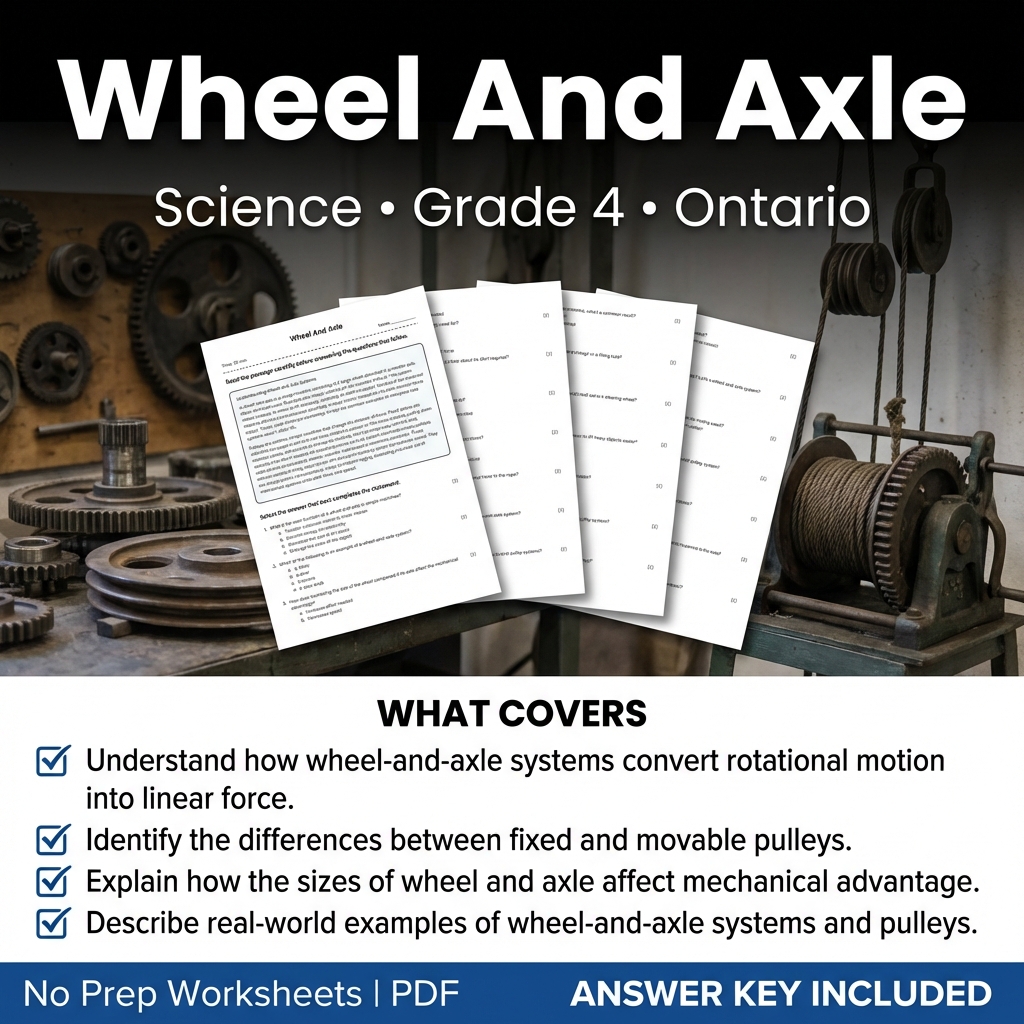
Wheel And Axle Grade 4 Science Worksheet | Ontario Standards
Created byCoral Reef LearningLearning Objectives
- Understand how wheel-and-axle systems convert rotational motion into linear force.
- Identify the differences between fixed and movable pulleys.
- Explain how the sizes of wheel and axle affect mechanical advantage.
Instant download
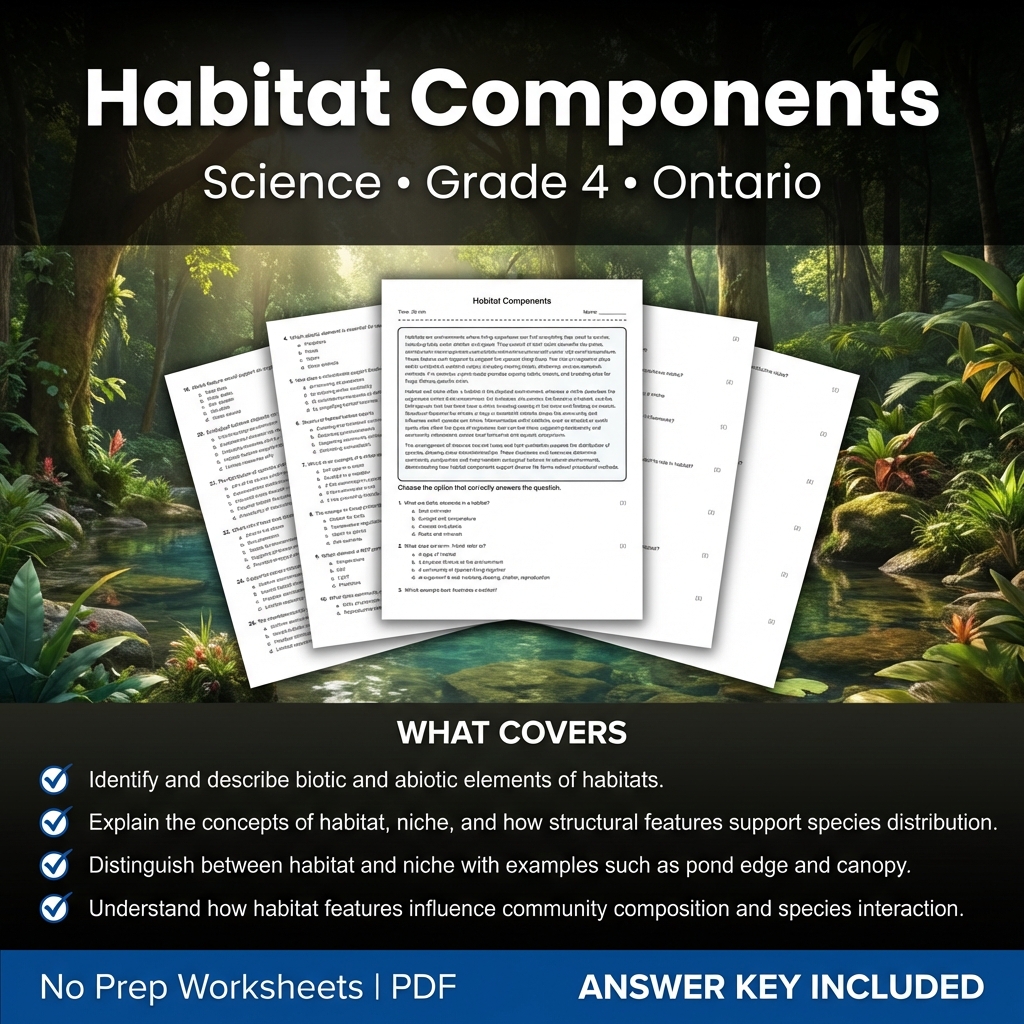
Habitat Components Grade 4 Science Worksheet | Ontario Standards
Created byCoral Reef LearningLearning Objectives
- Identify and describe biotic and abiotic elements of habitats.
- Explain the concepts of habitat, niche, and how structural features support species distribution.
- Distinguish between habitat and niche with examples such as pond edge and canopy.
Instant download

Grade 4 Energy Forms Worksheet | NGSS Practice & PDF
Created byClear Sky ClassroomLearning Objectives
- Identify common forms of energy (light, heat, sound, and electrical energy) and describe how each can affect matter.
- Explain how energy can transfer from one object to another and change form.
- Use evidence from real-world examples to support predictions about energy-related changes.
Instant download

Grade 4 Science | Prototype Evaluation Worksheet (PDF) – General Standards
Created byEvergreen Desk EducationLearning Objectives
- Explain how criteria and constraints guide prototype evaluation
- Compare prototype features to criteria while considering constraints
- Use evaluation results to narrow design options
Also included in: Grade 4 Engineering Design & Electricity Science Lesson Bundle - General +1 more
Instant download

Grade 4 Weathering Agents Worksheet | Rock Changes Science Ontario
Created byChalk and CompassLearning Objectives
- Identify physical weathering agents and describe how they break rocks into smaller pieces.
- Describe chemical weathering processes such as oxidation and dissolution and their effects on rock.
- Explain how environmental conditions and rock type affect weathering rates and outcomes.
Also included in: Grade 4 Science Rocks, Soil & Rock Cycle Lesson Bundle – Ontario +1 more
Instant download

Grade 4 Senses and Responses Worksheet | NGSS Practice PDF
Created byClear Sky ClassroomLearning Objectives
- Explain how animal senses (vision, hearing, smell, touch, and taste) help gather information from the environment
- Describe how sensory information is processed by the nervous system to produce behavioral responses
- Use examples to connect sensory input to actions that improve survival
Instant download
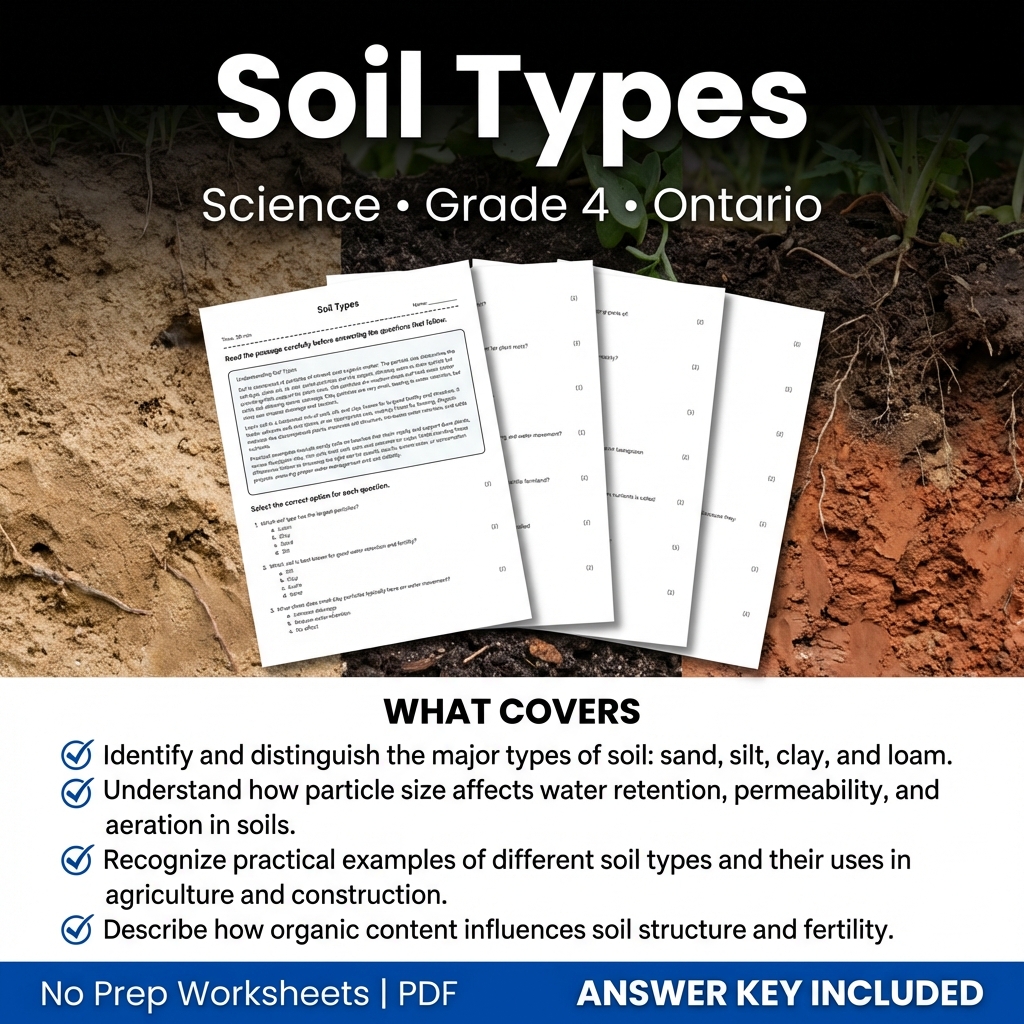
Soil Types Worksheet for Grade 4 Science | Ontario Standards Practice
Created byCoral Reef LearningLearning Objectives
- Identify and distinguish the major types of soil: sand, silt, clay, and loam.
- Understand how particle size affects water retention, permeability, and aeration in soils.
- Recognize practical examples of different soil types and their uses in agriculture and construction.
Instant download
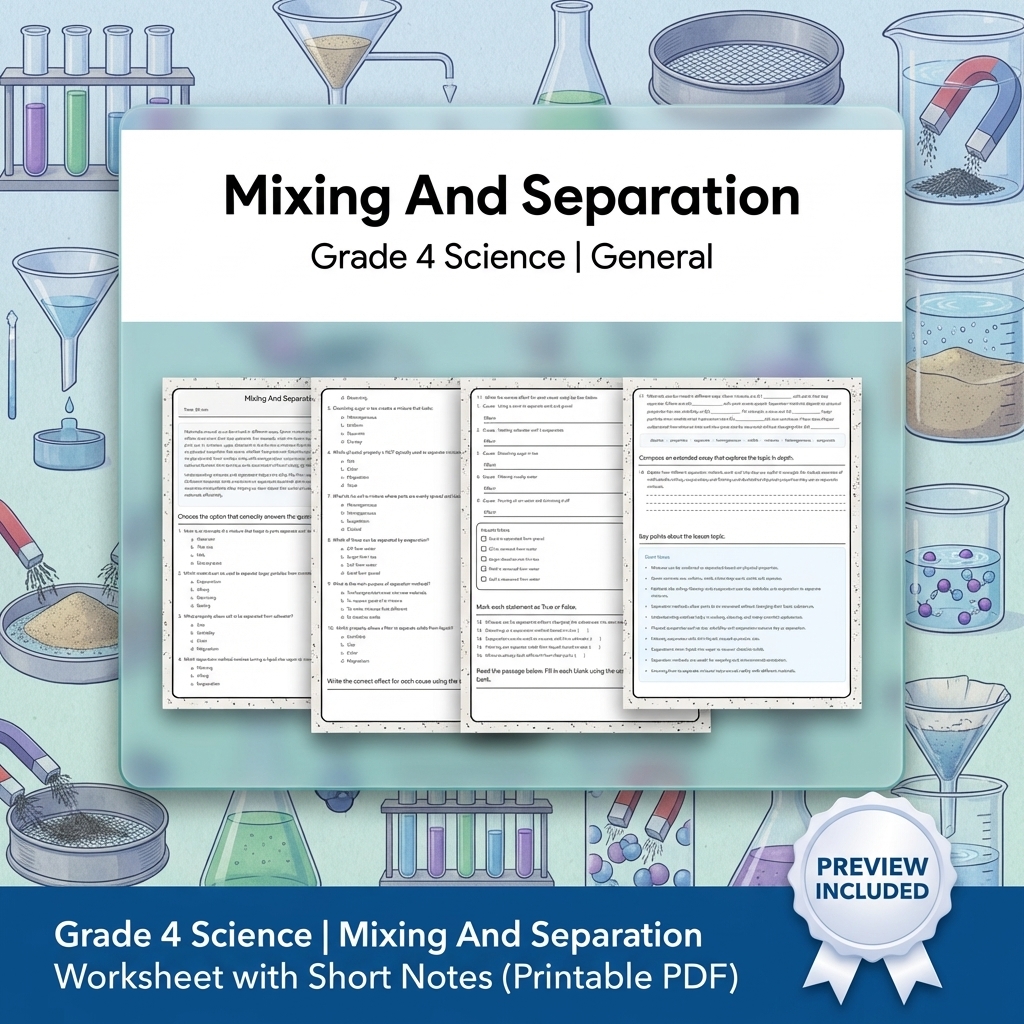
Grade 4 Science | Mixing And Separation Worksheet with Short Notes
Created byMeadowlark WorksheetsLearning Objectives
- Understand different ways materials can combine and how they can be separated.
- Identify physical properties used to separate mixtures, such as size, solubility, and evaporation.
- Describe methods to recover parts of a mixture without changing the materials into new substances.
Also included in: Grade 4 Science Lesson Group: Engaging Worksheets for Key Concepts +1 more
Instant download
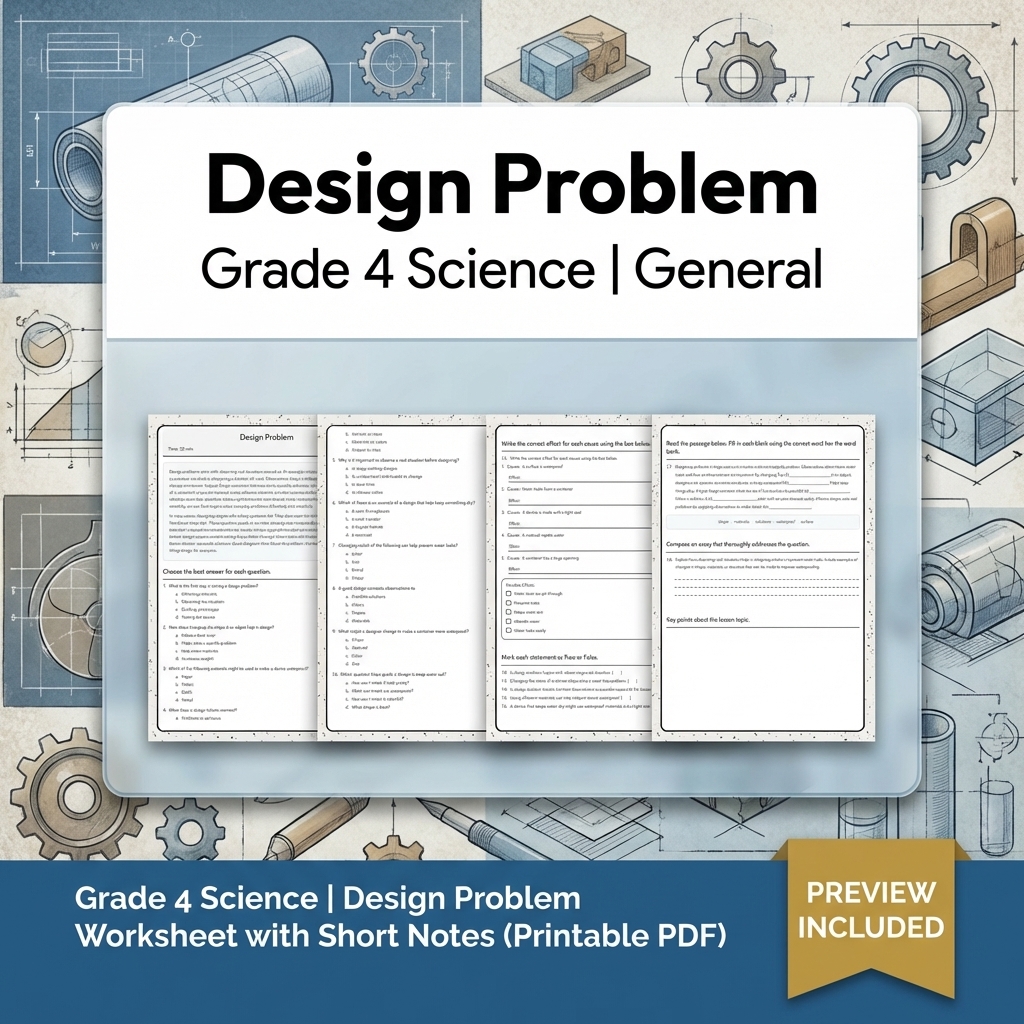
Grade 4 Science | Design Problem Worksheet with Short Notes (Printable PDF)
Created byMeadowlark WorksheetsLearning Objectives
- Understand how observations lead to identifying design problems.
- Learn how to connect real issues to possible solutions.
- Recognize different ways to modify shapes, materials, or structures in design.
Also included in: Grade 4 Science Lesson Group Comprehensive Worksheets for Hands-On Learning +1 more
Instant download
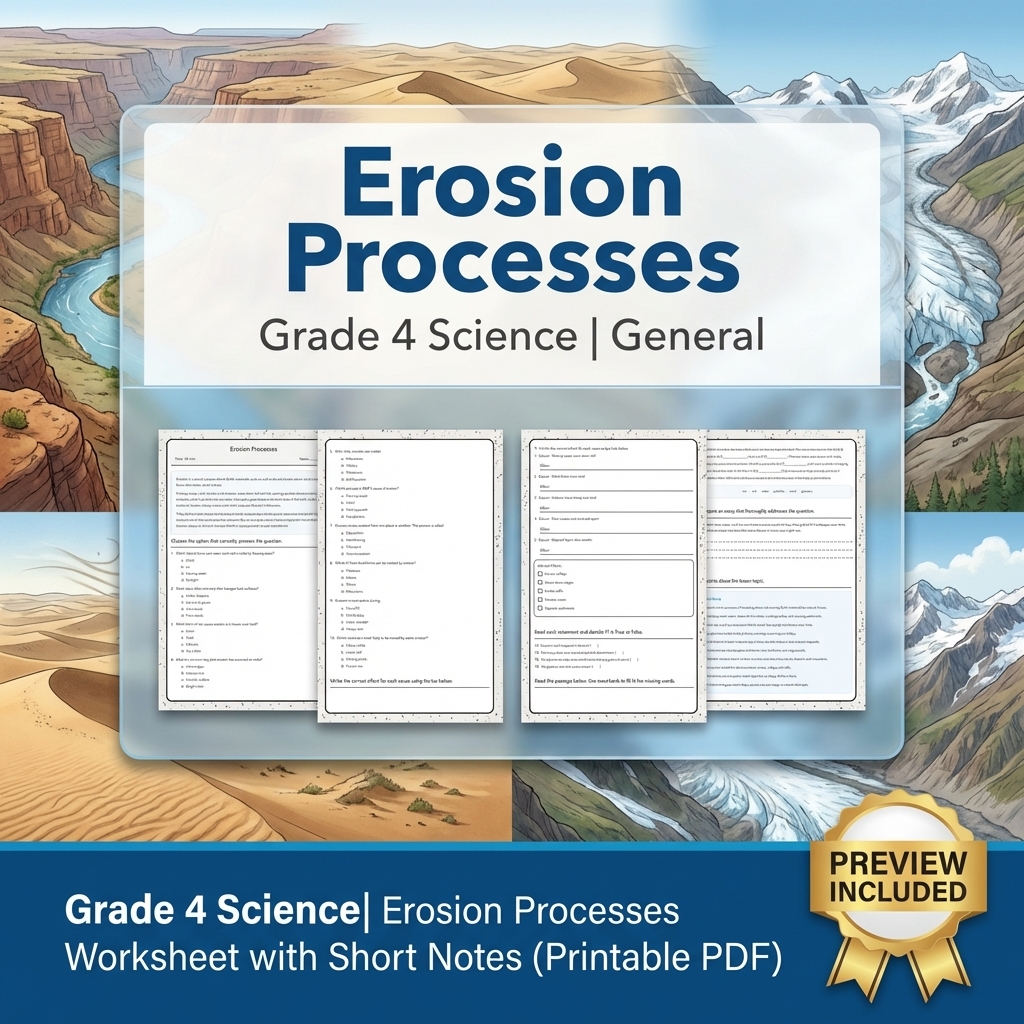
Grade 4 Science | Erosion Processes Worksheet with Short Notes (Printable PDF)
Created byMeadowlark WorksheetsLearning Objectives
- Understand the natural forces that cause erosion, such as water, wind, and ice.
- Identify examples of erosion in landscapes and environments.
- Describe how erosion shapes Earth's surface over time.
Also included in: Grade 4 Science Weather and Earth Cycles Lesson Bundle +1 more
Instant download

Grade 4 Umbra, Penumbra & Shadow Formation Worksheet | Ontario Science
Created byChalk and CompassLearning Objectives
- Explain how straight-line light creates shadows when an object blocks it
- Describe the difference between umbra (full shadow) and penumbra (partial shadow)
- Predict how shadow sharpness changes with the size of the light source
Also included in: Grade 4 Science Sound and Light Lesson Bundle | Ontario +1 more
Instant download

Grade 4 Science Worksheet | Understanding Deposition & Landforms (PDF)
Created byEvergreen Desk EducationLearning Objectives
- Explain how deposition happens when transporting forces slow down
- Describe how flowing water and wind deposit sediments in different places
- Use sediment thickness to infer how landforms can change over time
Also included in: Grade 4 Weather and Earth-Sun-Moon Cycles Science Lesson Bundle: General +1 more
Instant download

Grade 4 Integrated Mechanisms Worksheet | Ontario Practice PDF
Created byClear Sky ClassroomLearning Objectives
- Explain how combining gears, pulleys, levers, and linkages changes force, speed, and direction in a system.
- Identify interface points and sequencing in a combined mechanism that produce a desired output.
- Describe common design trade-offs in integrated mechanisms, such as torque versus speed and simplicity versus complexity.
Instant download

Weather Patterns Worksheets | Data Trends & Climate Review Grade 4
Created byBRIGHT PATH RESOURCESLearning Objectives
- Explain the difference between weather and longer-term climate by using examples from observations.
- Identify common weather variables such as temperature, precipitation, wind, and cloud cover.
- Interpret weather patterns by comparing data across days, weeks, and seasons.
Also included in: Grade 4 Science Earth Weather Space Patterns Worksheets Bundle +2 more
Instant download

Grade 4 Structural Adaptations Worksheet | NGSS Practice & PDF
Created byClear Sky ClassroomLearning Objectives
- Explain how structural adaptations help organisms survive in specific environments
- Identify examples of structural adaptations and match them to their functions
- Use evidence from an informational text to determine main ideas
Instant download

Grade 4 Energy Transfer Science Daily Reading Worksheet | NGSS Motion
Created byBRIGHT PATH RESOURCESLearning Objectives
- Explain how collisions transfer energy and change motion.
- Use evidence to describe cause and effect in an energy transfer story.
- Connect changes in speed or direction to the way energy moves between objects.
Also included in: Energy Transfer Grade 4 Science Daily Reading Worksheets Lesson Bundle | NGSS +2 more
Instant download

Grade 4 Habitat Components Worksheet | Ontario Practice PDF
Created byClear Sky ClassroomLearning Objectives
- Identify biotic and abiotic habitat components and explain how each affects living things.
- Describe how shelter, food, water, space, and light help determine where organisms live.
- Explain the difference between habitat and niche using simple examples (pond edge vs. canopy).
Instant download

Grade 4 Light and Optical Properties of Materials Science Worksheet | Ontario
Created byChalk and CompassLearning Objectives
- Describe how light interacts with transparent, translucent, and opaque materials
- Explain how surface and bulk properties affect colour, brightness, and heating
- Use optical behaviour to interpret everyday examples such as filters, pigments, clouds, and haze
Also included in: Grade 4 Science Sound and Light Lesson Bundle | Ontario +1 more
Instant download

Grade 4 Food Chains & Energy Flow Worksheet | Ontario Science Activity Pack
Created byChalk and CompassLearning Objectives
- Describe how energy moves through a food chain from producers to consumers and decomposers.
- Use arrows to show trophic relationships in a simple pond food chain and explain what each role does.
- Explain how a food web has multiple feeding connections and why removing one link can affect many species.
Also included in: Grade 4 Science Habitat & Biodiversity Lesson Bundle | Ontario +1 more
Instant download

Mirror Reflection & Specular vs Diffuse Light Worksheets Grade 4
Created byPrism Point LearningLearning Objectives
- Describe how smooth surfaces create mirror images using the relationship between incident and reflected directions.
- Explain where a plane mirror image appears to be located and how lateral inversion affects that image.
- Compare specular and diffuse reflection and predict how surface texture changes image clarity.
Also included in: Sound & Light Waves Lesson Bundle Grade 4 Science Ontario
Instant download

Grade 4 Moon Phases Worksheet | Florida NGSS Practice & PDF
Created byClear Sky ClassroomLearning Objectives
- Explain why the Moon appears to change shape over about a month
- Describe how sunlight and the Moon’s position relative to Earth affect which part of the Moon we see
- Use a simple cycle idea to predict how phases progress from one night to the next
Instant download

Testable Questions & Observable Evidence Worksheets for Grade 4 Science
Created byBRIGHT PATH RESOURCESLearning Objectives
- Identify observable evidence that could support or challenge a science claim
- Rewrite a broad claim as a testable question that can be answered with measurable information
- Explain how observations lead to hypotheses that can be tested
Also included in: Grade 4 Science Scientific Inquiry & Fair Test Worksheets Bundle +2 more
Instant download
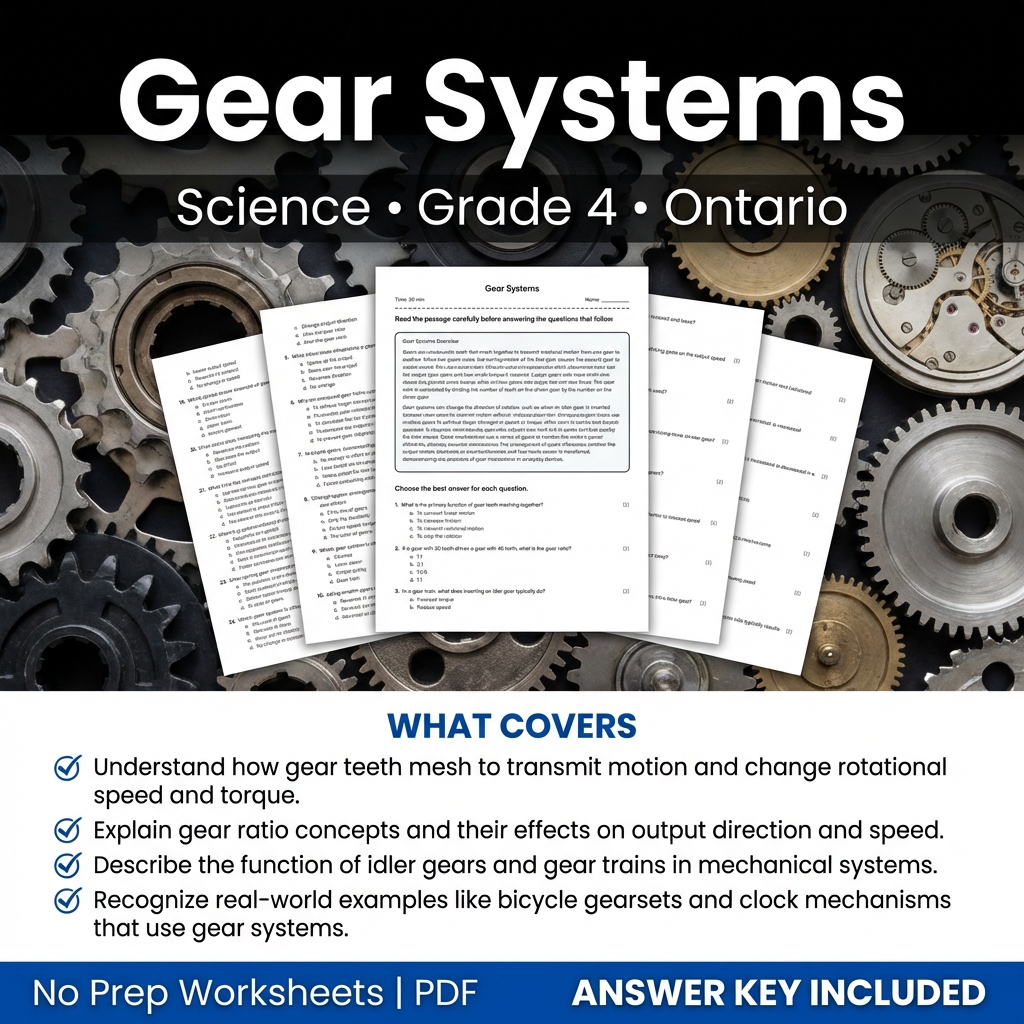
Grade 4 Science Worksheet on Gear Systems | Ontario Standards
Created byCoral Reef LearningLearning Objectives
- Understand how gear teeth mesh to transmit motion and change rotational speed and torque.
- Explain gear ratio concepts and their effects on output direction and speed.
- Describe the function of idler gears and gear trains in mechanical systems.
Instant download

Grade 4 Science For Choices Worksheet | NGSS Practice & PDF
Created byClear Sky ClassroomLearning Objectives
- Explain how scientific principles (force, friction, gravity, electricity, and material properties) connect to engineering design choices.
- Use observations from prototypes to decide how to improve a design.
- Identify how a complete electrical path and material selection affect whether a device works correctly.
Instant download

Grade 4 Food Chain Energy Flow Worksheet | NGSS Practice PDF
Created byClear Sky ClassroomLearning Objectives
- Explain how energy moves from producers to consumers through a food chain.
- Identify trophic levels and describe what happens to energy at each feeding step.
- Use evidence from a passage to determine main ideas about energy flow.
Instant download

Grade 4 Weather Patterns Worksheet | Practice & Assessment PDF
Created byClear Sky ClassroomLearning Objectives
- Explain how weather describes short-term conditions in the atmosphere using temperature, precipitation, wind, and cloud cover.
- Identify weather patterns by comparing observations across days and weeks.
- Use weather data to distinguish typical variation from longer-term trends.
Instant download
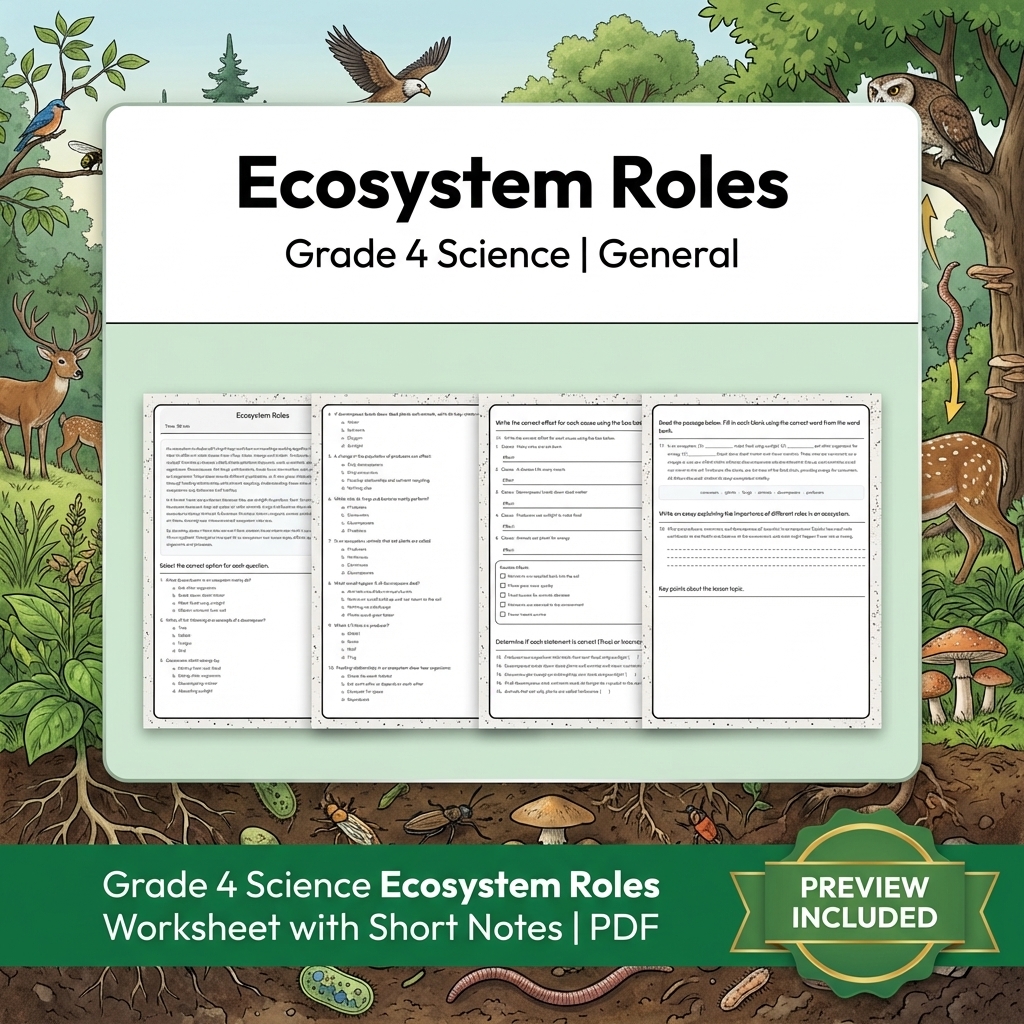
Grade 4 Science Ecosystem Roles Worksheet with Short Notes | PDF
Created byMeadowlark WorksheetsLearning Objectives
- Understand the different roles organisms play in an ecosystem.
- Identify producers, consumers, and decomposers and their functions.
- Recognize feeding relationships and nutrient recycling in ecosystems.
Also included in: Grade 4 Science Lesson Group Bundle | Ecosystems, Life Cycles & Classification +1 more
Instant download
About Grade 4 Science Worksheets
Find Science worksheets built for Grade 4. All 454 cover core skills, practice, and review, each an instant PDF download.
MyTeachingSheets worksheets are made by real teacher-authors and checked before they go live. Download any as a print-ready PDF for lessons, homework, or independent practice — most include answer keys, and previews are always free.