
Grade 6 Worksheets
8,578 grade resources
Grade 6 Science – Population Dynamics & Change | Daily Reading Worksheet
 Created byElena Brooks
Learning Objectives
- Understand the concept of population change over time
- Identify different types of population change such as growth, decline, and stabilization
- Interpret simple graphs and charts related to population data
Also included in: Grade 6 Science Biological Evolution Worksheet Bundle | NGSS Standards +1 more
Instant download
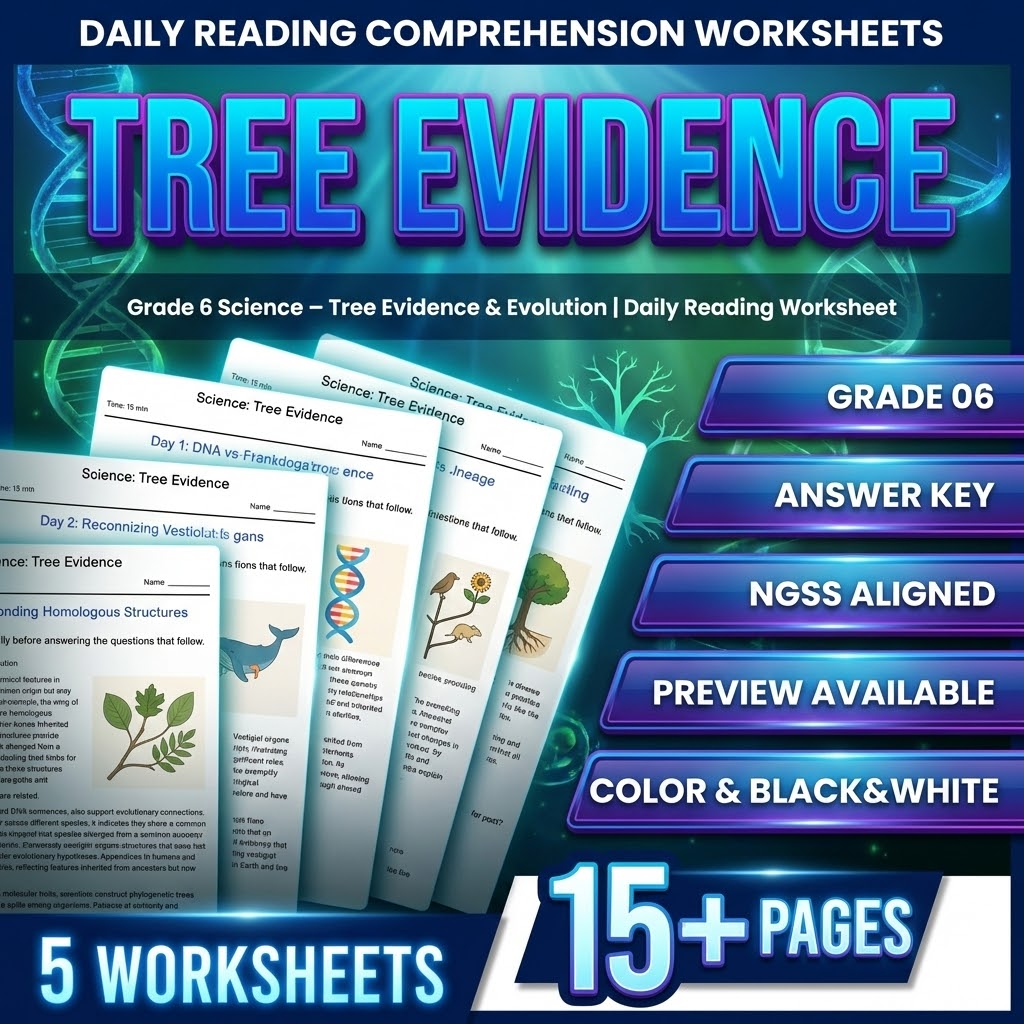
Grade 6 Science – Tree Evidence & Evolution | Daily Reading Worksheet
Created byElena BrooksLearning Objectives
- Understand what homologous structures are and how they indicate evolutionary relationships.
- Identify homologous structures in different species based on anatomical features.
- Analyze the significance of molecular traits such as conserved DNA sequences in evolution.
Also included in: Grade 6 Science Biological Evolution Worksheet Bundle | NGSS Standards +1 more
Instant download
Grade 6 Science – Natural Selection & Evolution | Daily Reading Worksheet
Created byElena BrooksLearning Objectives
- Understand the concept of natural selection and how traits are favored based on environmental pressures.
- Identify examples of natural selection in real-world scenarios.
- Describe how certain traits increase survival and reproduction chances in various environments.
Also included in: Grade 6 Science Biological Evolution Worksheet Bundle | NGSS Standards +1 more
Instant download

Grade 6 Science – Biodiversity Patterns in Ecosystems | Daily Reading Worksheet
Created byElena BrooksLearning Objectives
- Understand the concept of biodiversity and how it varies across different ecosystems.
- Identify factors that influence species richness and distribution.
- Analyze data displays related to biodiversity and interpret ecological patterns.
Also included in: Grade 6 Science Biological Evolution Worksheet Bundle | NGSS Standards +1 more
Instant download
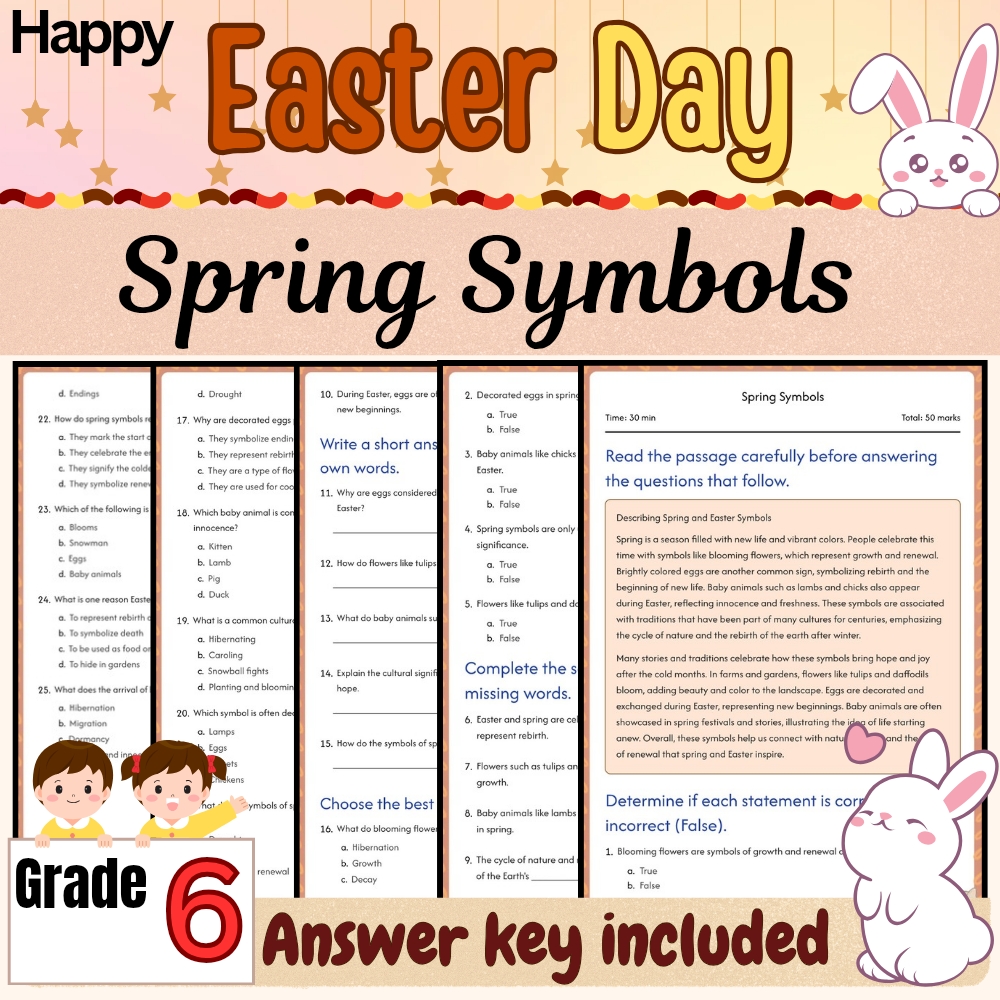
Grade 6 Seasonal | Happy Easter Symbols Worksheet for Mastery | Printable PDF
 Created byShaNova Worksheets
Learning Objectives
- Identify and describe symbols associated with spring and Easter, such as flowers, eggs, and baby animals.
- Analyze descriptive language related to growth, renewal, and new life.
- Understand the cultural significance of spring celebrations linked to Easter.
Instant download
6th Grade Science | Recrystallization Reading Worksheet & Answer Key PDF
JCreated byJ.S SheetsLearning Objectives
- Understand the process of recrystallization and how it purifies dissolved solids.
- Identify the factors that influence the size and purity of crystals during recrystallization.
- Explain how solubility curves and temperature control enable selective recovery of substances.
Instant download

Grade 6 Holiday | Recycling and Waste Worksheet for Mastery | PDF + Answer Key
Created byShaNova WorksheetsLearning Objectives
- Understand the importance of reducing waste through recycling and reusing materials.
- Identify common items that can be recycled or repurposed.
- Explain how recycling impacts the environment and community health.
Also included in: Grade 6 Holiday Earth Day Worksheets | Environmental Science Bundle
Instant download
Grade 6 Science Worksheet on Orbital Dynamics | Ontario Standards
 Created byCoral Reef Learning
Learning Objectives
- Explain the difference between elliptical and near-circular orbits.
- Describe how orbital speed varies with distance from a central body.
- Understand the balance of gravitational force and inertial motion in maintaining orbits.
Instant download
6th Grade Science | Cell Evidence Worksheet with Answer Key (Printable PDF)
Created byCoral Reef LearningLearning Objectives
- Identify key features that distinguish single-celled and multicellular organisms based on microscopy and specimen evidence.
- Explain the relationship among cells, tissues, organs, and whole organisms in biological organization.
- Recognize observable specialization and membrane-bound compartments in different cell types.
Instant download

Grade 6 Science | Understanding Testable Questions - Daily Reading Comprehension
Created byCoral Reef LearningLearning Objectives
- Define what makes a scientific question testable.
- Identify variables and evidence in scientific questions.
- Differentiate between testable and non-testable questions.
Instant download
Grade 6 Valentine Day Cultural Celebrations Worksheet for Mastery|PDF+Answer Key
Created byShaNova WorksheetsLearning Objectives
- Explore how different cultures celebrate Valentine's Day and similar festivals worldwide.
- Identify and compare symbols and traditions associated with love and friendship across cultures.
- Develop awareness and appreciation for cultural diversity in holiday practices.
Instant download
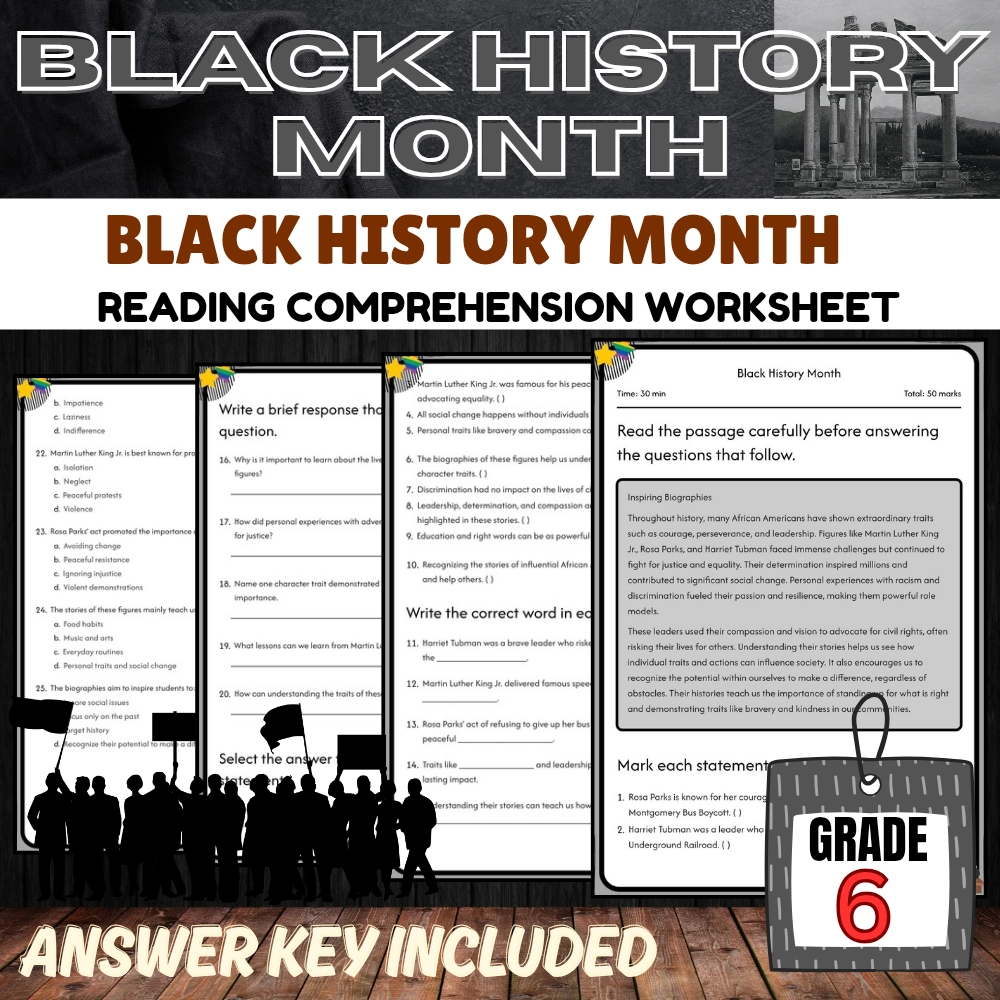
Grade 6 Black History Month Worksheet for Mastering Key Figures|PDF + Answer Key
Created byShaNova WorksheetsLearning Objectives
- Recognize the achievements of influential African American figures in history.
- Analyze key traits such as determination, leadership, and compassion demonstrated by these figures.
- Understand how personal experiences of these individuals contributed to social change.
Instant download

Grade 6 Science – Streamlining & Aerodynamics | Daily Reading Worksheet
 Created byBright Mind Resources
Learning Objectives
- Understand the basic principles of streamlining and how it reduces air resistance.
- Identify key design features that improve aerodynamic flow like tapered tails and rounded noses.
- Explain how shape affects pressure distribution and energy consumption in flight.
Also included in: Aerodynamics Grade 6 Science Daily Reading Worksheets Lesson Bundle | Alberta +2 more
Instant download

Optimizing Designs Worksheet | Grade 6 Science | Review & Assessment
 Created byPrism Point Learning
Learning Objectives
- Use data from comparative tests to identify performance characteristics and trade-offs between design alternatives.
- Interpret graphs and averages to support decisions about improving a design while meeting constraints.
- Discuss measurement error and explain how uncertainty can affect conclusions from test results.
Also included in: Grade 6 Engineering Design Process Science Lesson Bundle for NGSS
Instant download

Grade 6 Back To School Worksheet for Mastering New Beginnings | PDF + Answer Key
Created byShaNova WorksheetsLearning Objectives
- Identify key details and main ideas from a short back-to-school reading passage
- Use reading strategies to evaluate statements as true or false
- Demonstrate understanding of vocabulary and routines connected to new beginnings
Instant download
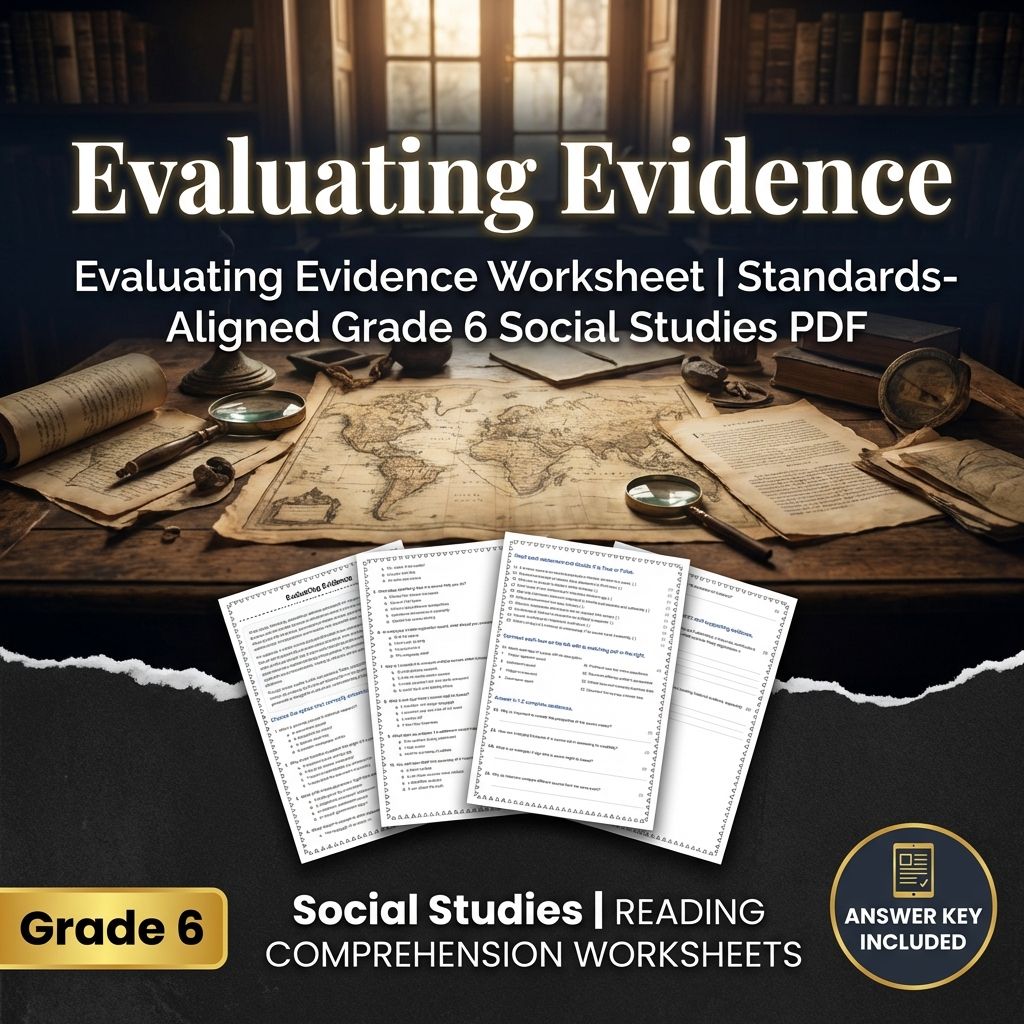
Evaluating Evidence Worksheet | Standards-Aligned Grade 6 Social Studies PDF
JCreated byJ.S SheetsLearning Objectives
- Learn to assess the credibility of historical sources.
- Identify bias and perspective in case studies.
- Compare authenticity and relevance of different types of evidence.
Also included in: Grade 6 Social Studies | Analyzing Evidence & Narratives Bundle +1 more
Instant download

Grade 6 Science – Flight Forces Worksheet (Ontario Standards) (PDF)
 Created byEvergreen Desk Education
Learning Objectives
- Explain the four aerodynamic forces (lift, drag, thrust, and weight) and how they act on an object in motion through air.
- Use ideas of vector direction and magnitude to predict how forces affect climb, level cruise, and descent.
- Identify equilibrium conditions for steady, level flight by comparing lift and weight and thrust and drag.
Also included in: Grade 6 Flight & Aerodynamics Science Lesson Bundle Worksheets (Ontario) +1 more
Instant download
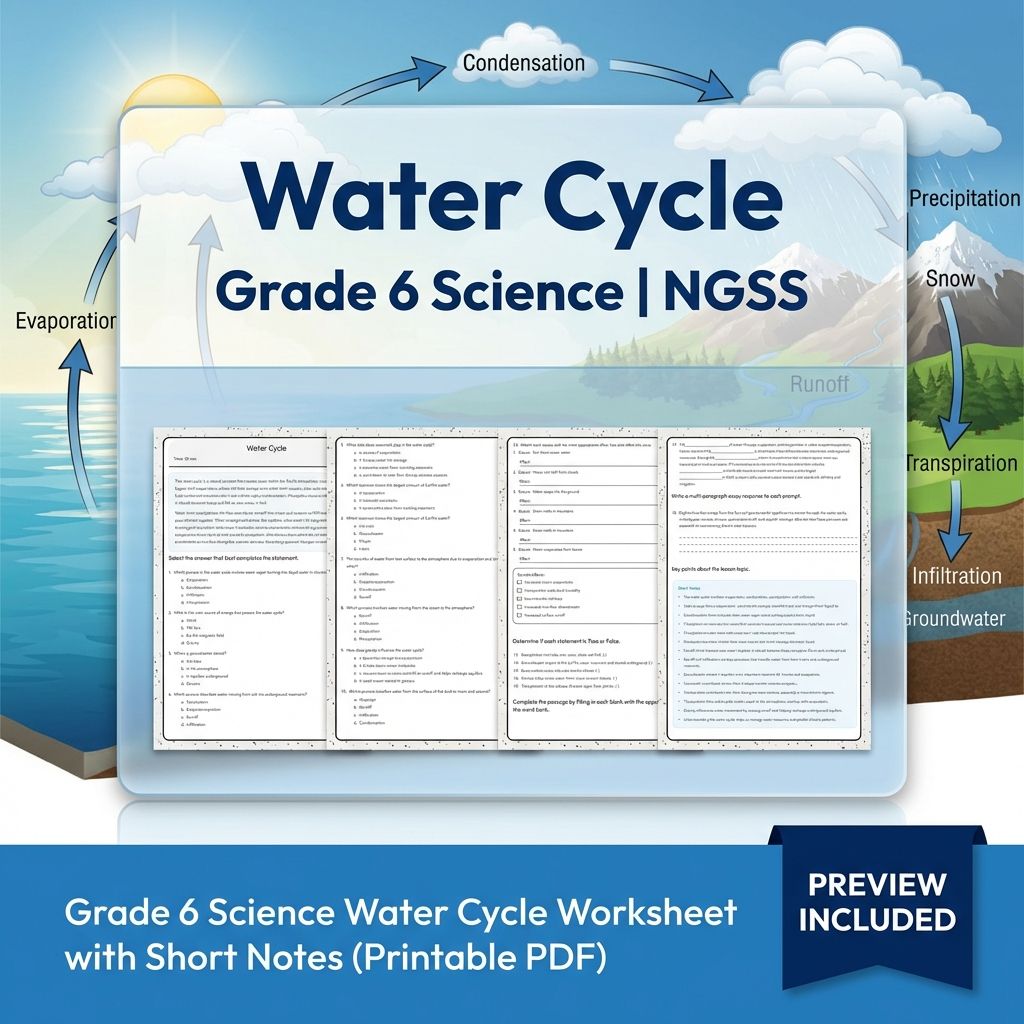
Grade 6 Science Water Cycle Worksheet with Short Notes (Printable PDF)
 Created byMeadowlark Worksheets
Learning Objectives
- Describe the processes involved in the water cycle, including evaporation, condensation, and precipitation.
- Explain how energy from the sun and gravity drive water movement across the hydrosphere.
- Identify different reservoirs of water such as oceans, ice, and groundwater, and understand how water transfers occur between them.
Also included in: Grade 6 Science | Earth's Systems Unit Bundle NGSS-Aligned Worksheets +1 more
Instant download

Grade 6 Random Error & Measurement Analysis Worksheet | Alberta Science
 Created byBRIGHT PATH RESOURCES
Learning Objectives
- Identify random error by recognizing scatter in data
- Explain how random error affects the reliability of a conclusion
- Differentiate random error from systematic shifts using evidence from measurements
Also included in: Inquiry Data Grade 6 Science Daily Reading Worksheets Lesson Bundle | Alberta +1 more
Instant download
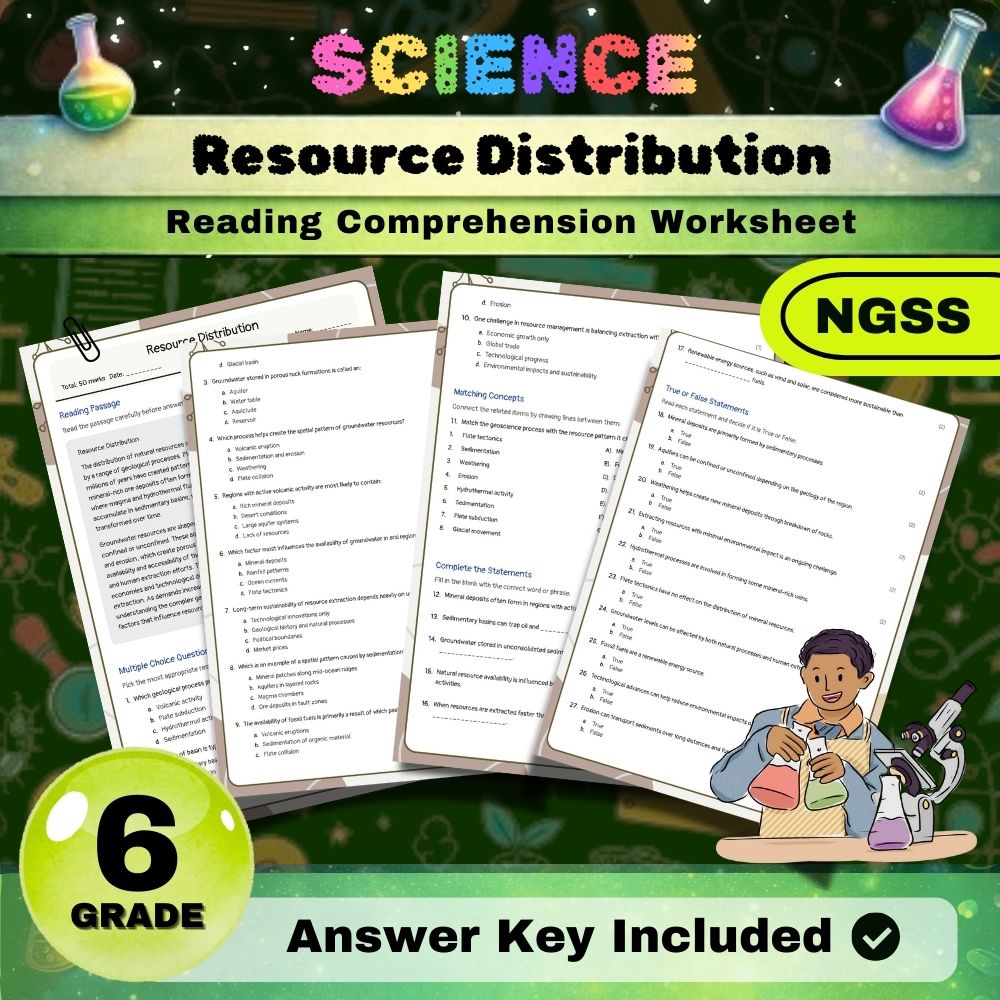
6th Grade Science | Resource Distribution NGSS Worksheet (PDF)
 Created byMaple Path Learning
Learning Objectives
- Understand the geological processes that influence the distribution of mineral, energy, and groundwater resources.
- Analyze how historical and ongoing geoscience processes create spatial patterns in resource deposits and aquifers.
- Evaluate the trade-offs in resource extraction considering demand, environmental impact, and technological constraints.
Also included in: Grade 6 Science | Earth's Systems & Sustainability NGSS Unit Bundle +1 more
Instant download
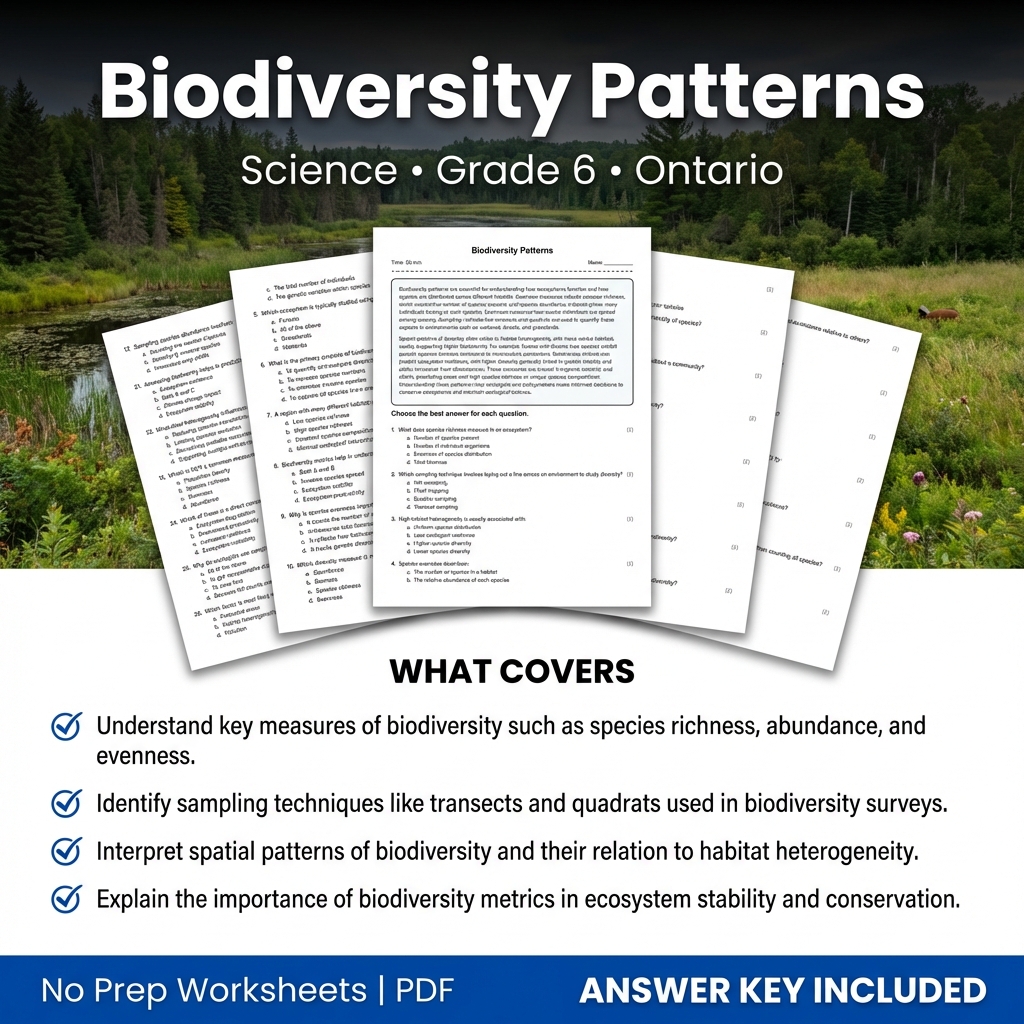
Grade 6 Science Worksheet on Biodiversity Patterns | Ontario Standard
Created byCoral Reef LearningLearning Objectives
- Understand key measures of biodiversity such as species richness, abundance, and evenness.
- Identify sampling techniques like transects and quadrats used in biodiversity surveys.
- Interpret spatial patterns of biodiversity and their relation to habitat heterogeneity.
Instant download

Ancient Africa Social Studies Worksheet | TEKS-Aligned Grade 6 Assessment
JCreated byJ.S SheetsLearning Objectives
- Identify major ancient African civilizations and describe key features of their societies.
- Explain how writing, architecture, and trade helped civilizations share knowledge and grow.
- Compare innovations from different regions of ancient Africa and connect them to broader human history.
Instant download
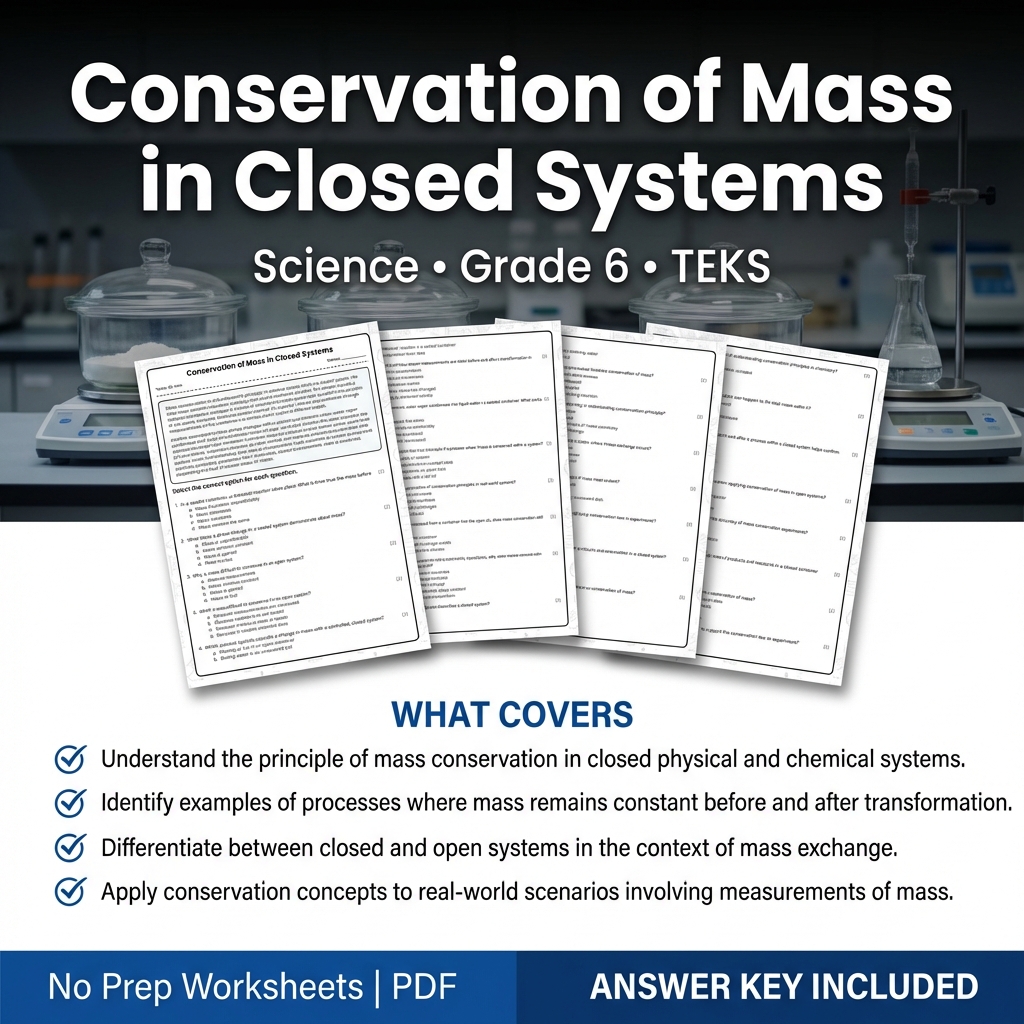
Grade 6 Science Worksheet on Conservation of Mass in Closed Systems | TEKS
Created byCoral Reef LearningLearning Objectives
- Understand the principle of mass conservation in closed physical and chemical systems.
- Identify examples of processes where mass remains constant before and after transformation.
- Differentiate between closed and open systems in the context of mass exchange.
Instant download

Grade 6 Data Representations Worksheet | Practice & Assessment PDF
 Created byClear Sky Classroom
Learning Objectives
- Explain the purpose of tables, bar graphs, and line graphs when representing data
- Identify how labels, units, and scales help readers interpret graphs accurately
- Choose an appropriate data representation for different types of observations (numerical vs. categorical)
Instant download

King's Voice Worksheet Elena | January Standards Grade 6 Holiday
 Created byLumora Learning
Learning Objectives
- Analyze how Martin Luther King Jr.'s speech uses repetition and metaphors to persuade listeners.
- Demonstrate comprehension of persuasive language by identifying main ideas and supporting details.
- Explain how nonviolent advocacy connects to the message and purpose of the speeches.
Instant download
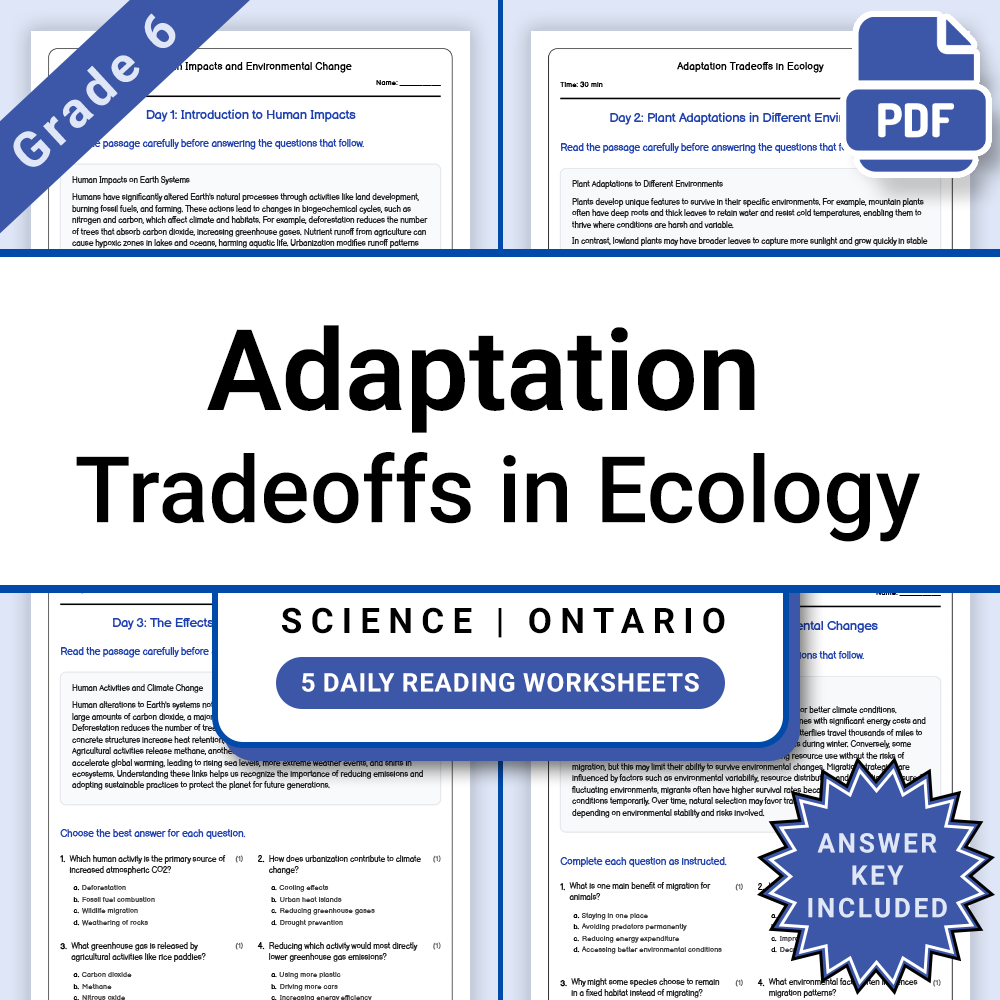
Grade 6 – Adaptation Tradeoffs in Ecology Daily Reading Worksheet + Answer Key
JCreated byJ.S SheetsLearning Objectives
- Understand the difference between specialists and generalists in adaptation.
- Identify benefits and costs associated with narrow and broad ecological strategies.
- Analyze examples such as plant ecotypes, insect behaviors, and migratory patterns.
Also included in: Grade 6 Science Biodiversity Lesson Bundle – Ecosystems and Conservation +1 more
Instant download
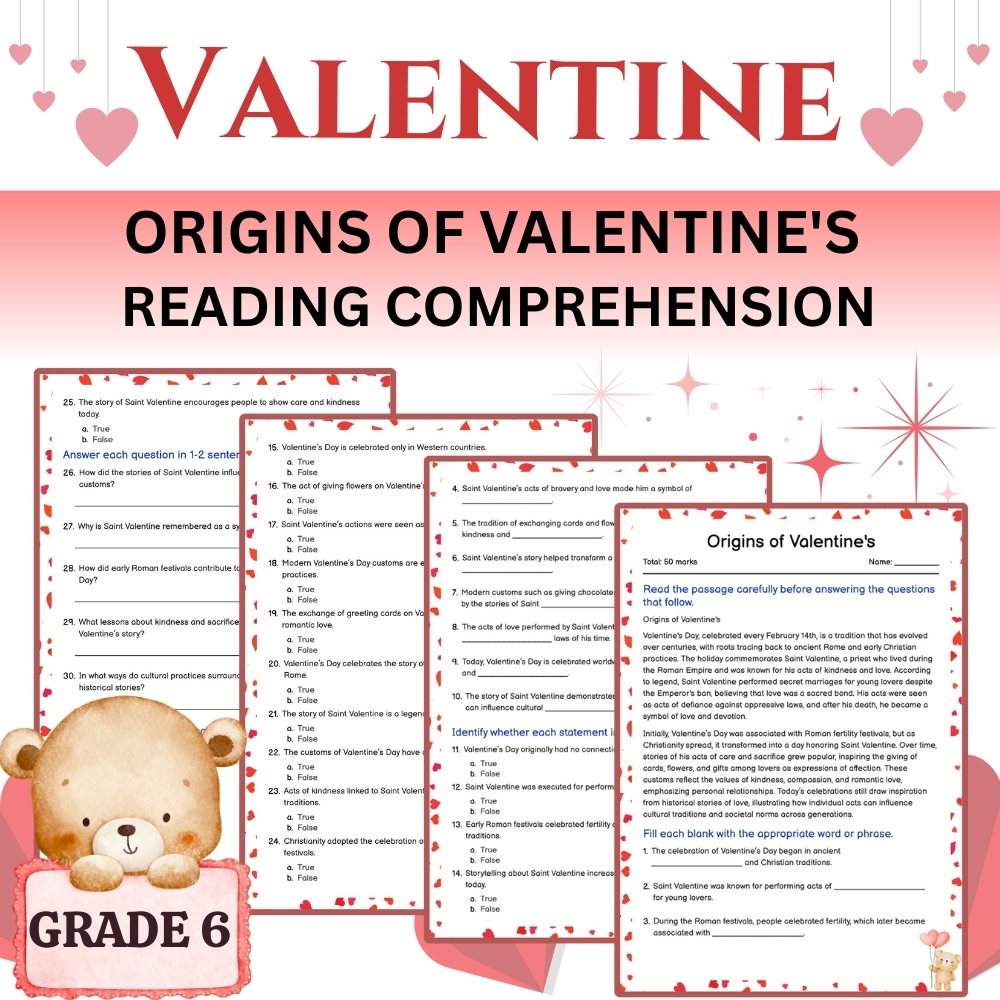
Grade 6 Seasonal Holidays | Origins of Valentine's Worksheet (Worksheet + Answer Key)
Learning Objectives
- Explore the historical roots and significance of Valentine's Day in ancient Rome and Christian traditions.
- Describe the story of Saint Valentine and his acts of kindness.
- Understand how historical figures influence modern customs related to love and gift-giving.
Instant download

Research Projects and Environmental Challenges Worksheet | Grade 6 Holiday Printable PDF
Learning Objectives
- Develop research skills to investigate environmental issues.
- Analyze data and propose innovative solutions.
- Understand the importance of scientific inquiry in sustainability.
Instant download
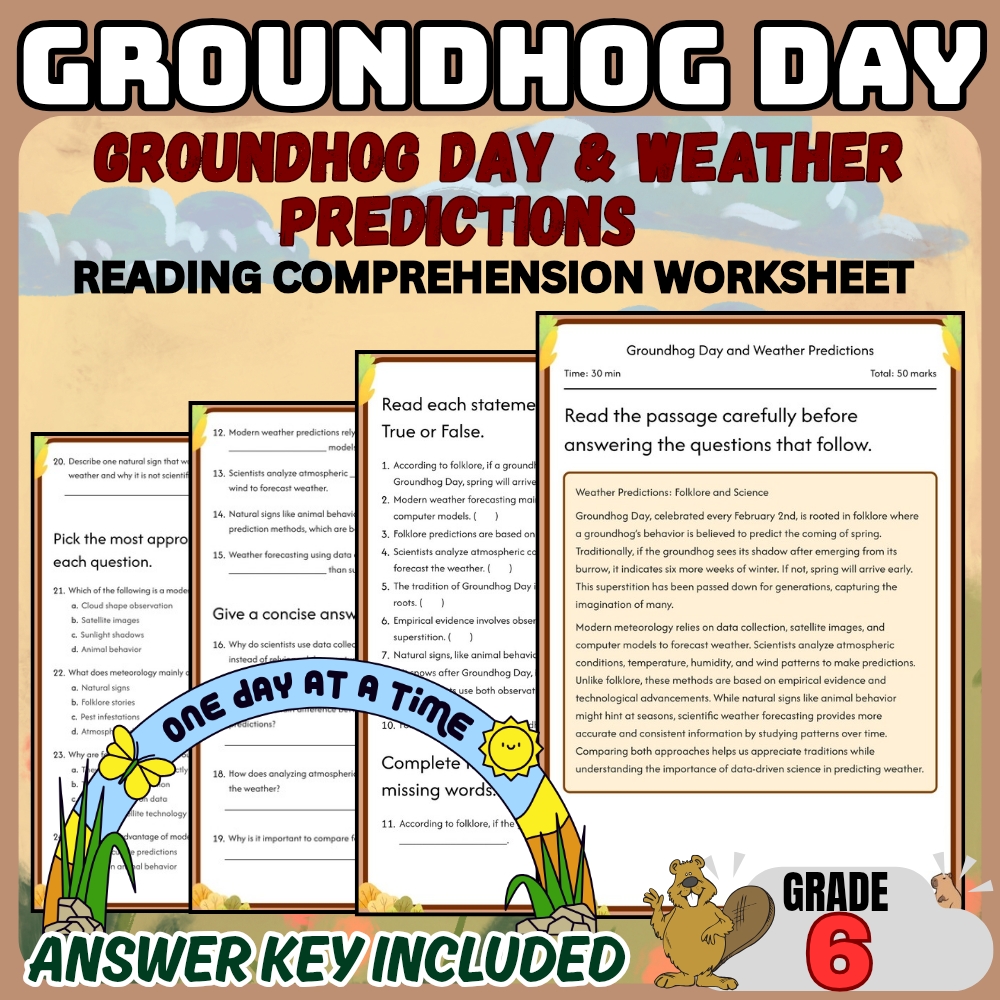
Grade 6 Holiday Groundhog Day for Mastering Weather Predictions|PDF + Answer Key
Created byShaNova WorksheetsLearning Objectives
- Understand the folklore tradition of Groundhog Day as a seasonal predictor.
- Explore the scientific methods used in modern weather forecasting.
- Compare superstition-based predictions with empirical scientific data.
Instant download
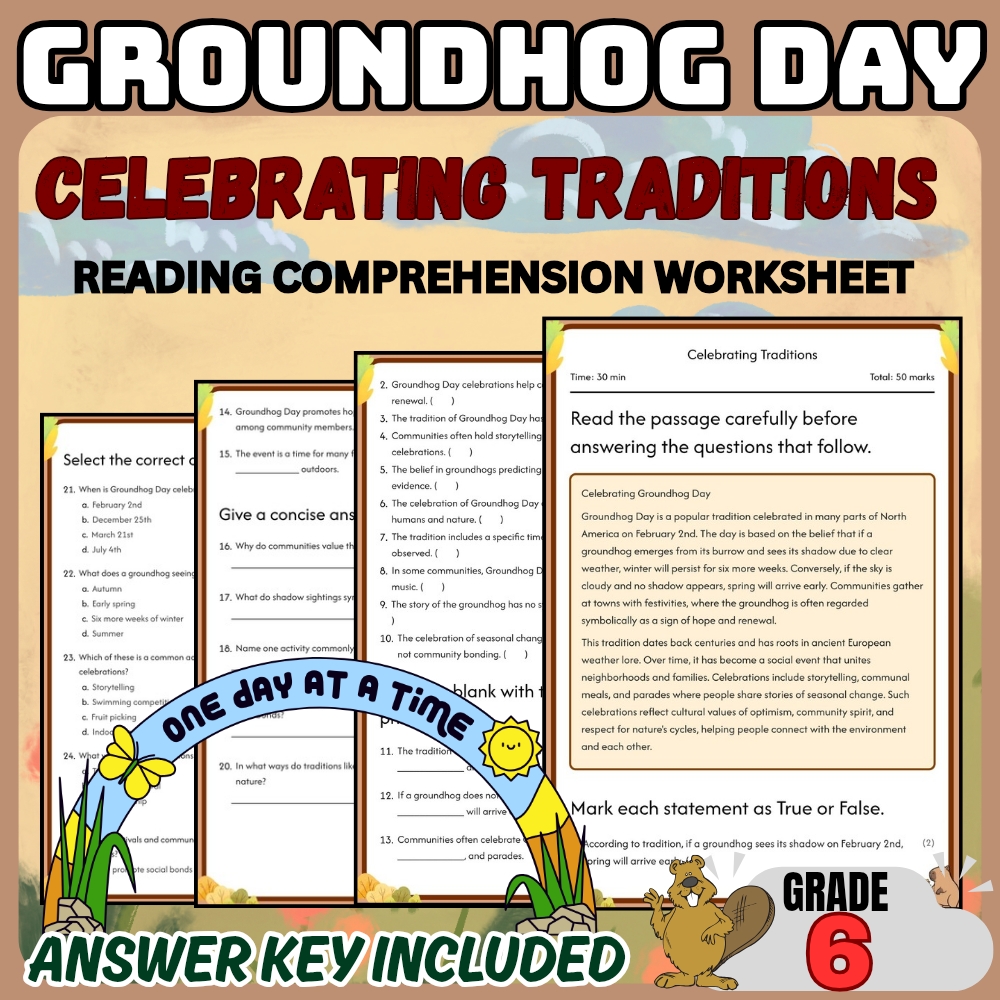
Grade 6 Holiday Groundhog Day Worksheet for Mastering Traditions|PDF+Answer Key
Created byShaNova WorksheetsLearning Objectives
- Understand how Groundhog Day is celebrated in various communities.
- Explore the symbolic meanings of shadow sightings and festivities.
- Reflect on the importance of cultural traditions in fostering social connections.
Instant download

Grade 6 Science | Counting Atoms in Chemical Reactions | California Standards
Created byLumora LearningLearning Objectives
- Explain how conservation of matter is supported by counting atoms in a particle model of a reaction.
- Determine whether an equation or particle diagram is balanced by comparing atom counts on the reactant and product sides.
- Use particle-level reasoning to describe how atoms are rearranged into new combinations during chemical change.
Instant download

Grade 6 Maths – Representation Selection Worksheet (PDF) Ontario Standards
Created byClear Sky ClassroomLearning Objectives
- Identify appropriate mathematical representations such as graphs, equations, and models for different types of problems.
- Analyze how choosing different representations can enhance understanding and problem-solving strategies.
- Apply various representations to interpret data, solve problems, and communicate mathematical ideas effectively.
Also included in: Grade 6 Maths Social-Emotional Skills and Mathematical Processes Lesson Bundle +1 more
Instant download

Grade 6 Roots and Water Worksheet | Alberta Practice & PDF
Created byClear Sky ClassroomLearning Objectives
- Explain how different root structures help trees anchor, take up water and nutrients, and store resources.
- Describe how mycorrhizal associations support absorption of water and nutrients, especially during drought.
- Connect root adaptations to tree distribution, competition, and recovery after disturbance.
Also included in: Grade 6 Biodiversity & Plant Ecosystems Science Lesson Bundle | Alberta +1 more
Instant download
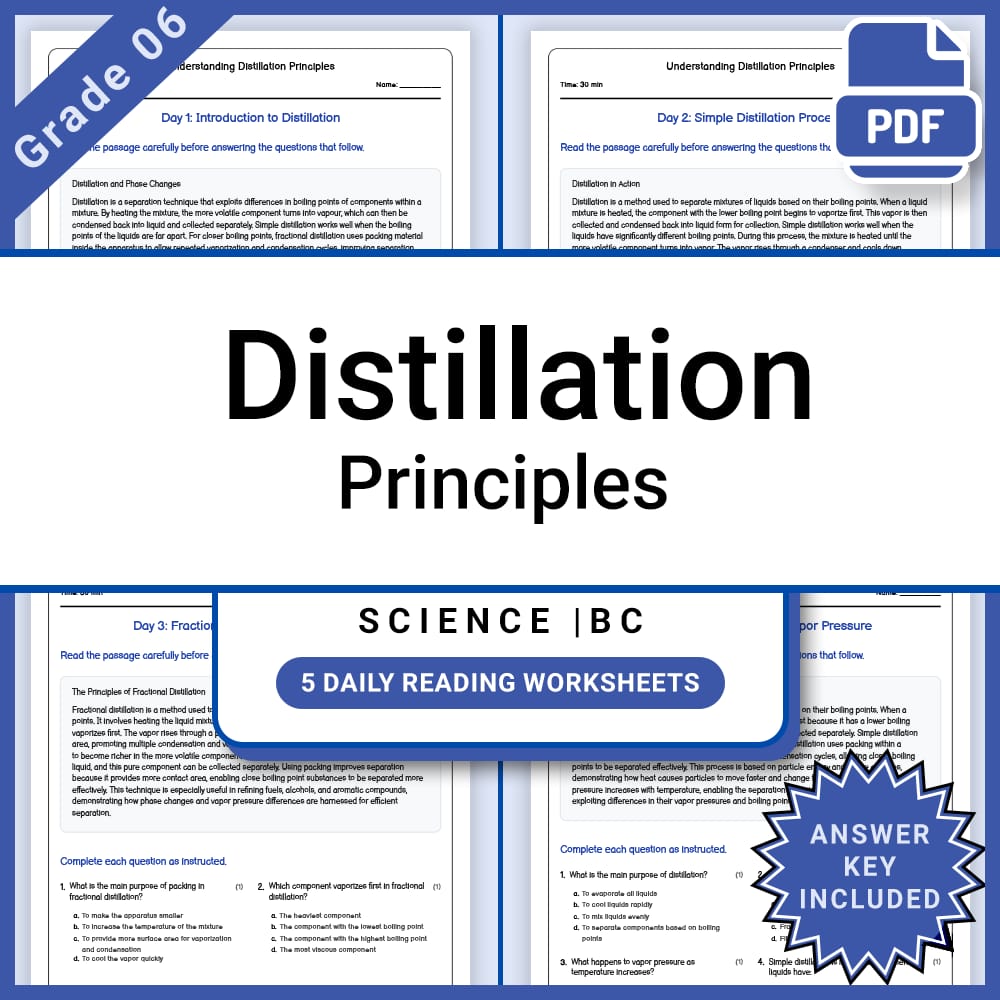
Grade 6 Science – Distillation Principles Daily Reading Worksheet + Answer Key
JCreated byJ.S SheetsLearning Objectives
- Explain the basic concept of distillation and how it separates mixtures.
- Describe the difference between simple and fractional distillation.
- Understand the role of boiling points and vapor pressure in distillation.
Also included in: Grade 6 Science Lesson Group Bundle | Inquiry-Based Science Activities +1 more
Instant download
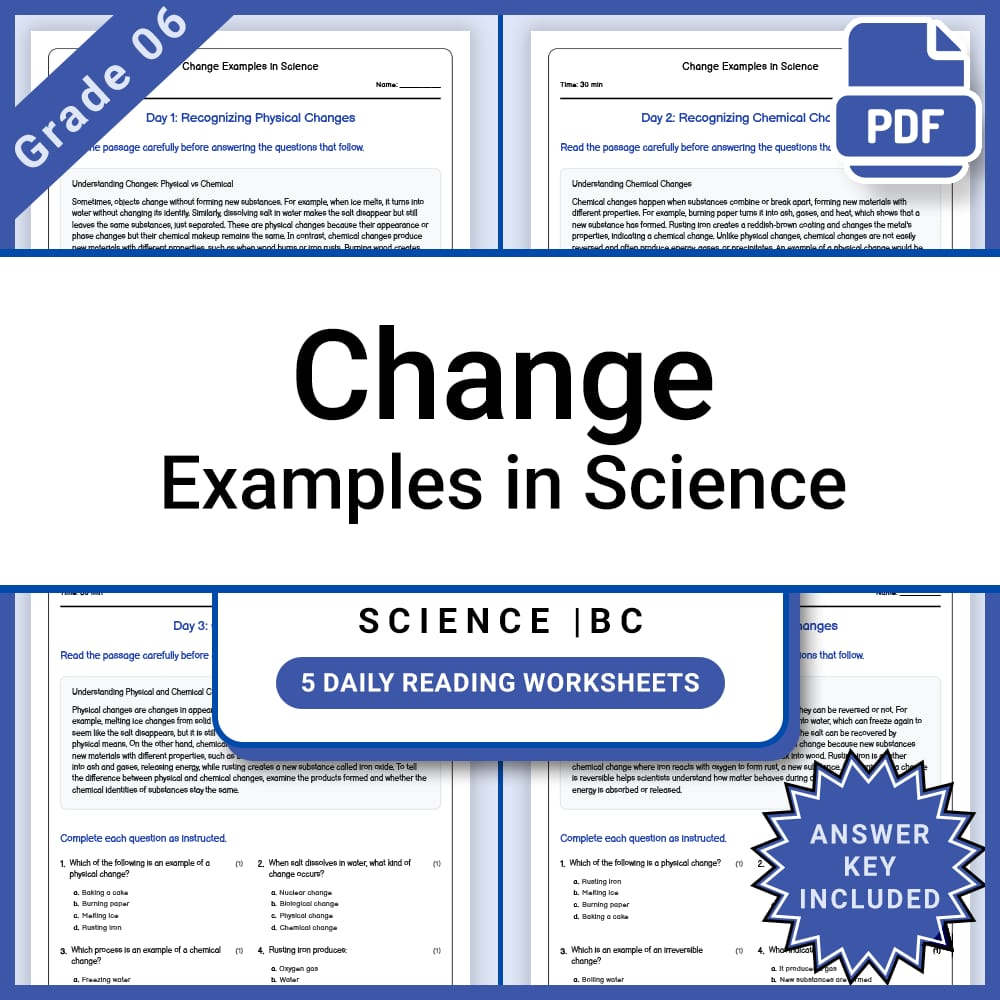
Grade 6 Science – Change Examples Daily Reading Worksheet with Answer Key
JCreated byJ.S SheetsLearning Objectives
- Understand key concepts related to Science
- Apply knowledge through practice questions
- Demonstrate comprehension of the material
Also included in: Grade 6 Science Lesson Group Bundle | Inquiry-Based Science Activities +1 more
Instant download
Grade 6 Science – Particle Model Daily Reading Worksheet + Answer Key
JCreated byJ.S SheetsLearning Objectives
- Describe the particle arrangements in solids, liquids, and gases.
- Explain how particle behavior relates to the properties of matter.
- Identify the differences in particle motion in different states of matter.
Also included in: Grade 6 Science Lesson Group Bundle | Inquiry-Based Science Activities +1 more
Instant download
Grade 6 Science – Law of Conservation of Mass Daily Worksheet + Answer Key
JCreated byJ.S SheetsLearning Objectives
- Explain the law of conservation of mass
- Identify examples of physical and chemical changes where mass is conserved
- Differentiate between open and closed systems in mass measurement
Also included in: Grade 6 Science Lesson Group Bundle | Inquiry-Based Science Activities +1 more
Instant download
Grade 6 Science – Recrystallization Daily Reading Worksheet + Answer Key
JCreated byJ.S SheetsLearning Objectives
- Explain the process of recrystallization and its purpose.
- Identify key concepts such as solubility, crystal formation, and saturation.
- Describe how temperature affects solubility and crystal size.
Also included in: Grade 6 Science Lesson Group Bundle | Inquiry-Based Science Activities +1 more
Instant download
Grade 6 Science – Crystal Structures | Daily Reading Worksheet + Answer Key
JCreated byJ.S SheetsLearning Objectives
- Define crystalline and amorphous solids.
- Describe how particle arrangements affect physical properties.
- Compare the characteristics of crystalline and amorphous materials.
Also included in: Grade 6 Science Lesson Group Bundle | Inquiry-Based Science Activities +1 more
Instant download
Grade 6 Science – Physical Properties Daily Reading Worksheet with Answer Key
JCreated byJ.S SheetsLearning Objectives
- Identify observable physical properties of matter
- Understand the importance of physical properties in classifying materials
- Differentiate between physical and chemical changes
Also included in: Grade 6 Science Lesson Group Bundle | Inquiry-Based Science Activities +1 more
Instant download
Grade 6 Science – Phase Changes Daily Reading Worksheet & Answer Key
JCreated byJ.S SheetsLearning Objectives
- Recognize different phase changes such as melting, boiling, freezing, and condensation.
- Understand how energy transfer occurs during phase changes.
- Explain why temperature plateaus during a phase change despite continuous energy input.
Also included in: Grade 6 Science Lesson Group Bundle | Inquiry-Based Science Activities +1 more
Instant download
Grade 6 Science – Chemical Indicators Daily Reading Worksheet + Answer Key
JCreated byJ.S SheetsLearning Objectives
- Identify observable signs of chemical reactions
- Understand the difference between physical and chemical changes
- Recognize various chemical indicators such as gas production, precipitate formation, color change, energy emission, and light or sound release
Also included in: Grade 6 Science Lesson Group Bundle | Inquiry-Based Science Activities +1 more
Instant download
Grade 6 Science – Gas Pressure Particles Daily Reading Worksheet + Answer Key
JCreated byJ.S SheetsLearning Objectives
- Explain how gas particles move and collide within a container.
- Describe how particle speed and collision frequency influence gas pressure.
- Connect the particle model to real-world examples of gas behavior.
Also included in: Grade 6 Science Lesson Group Bundle | Inquiry-Based Science Activities +1 more
Instant download
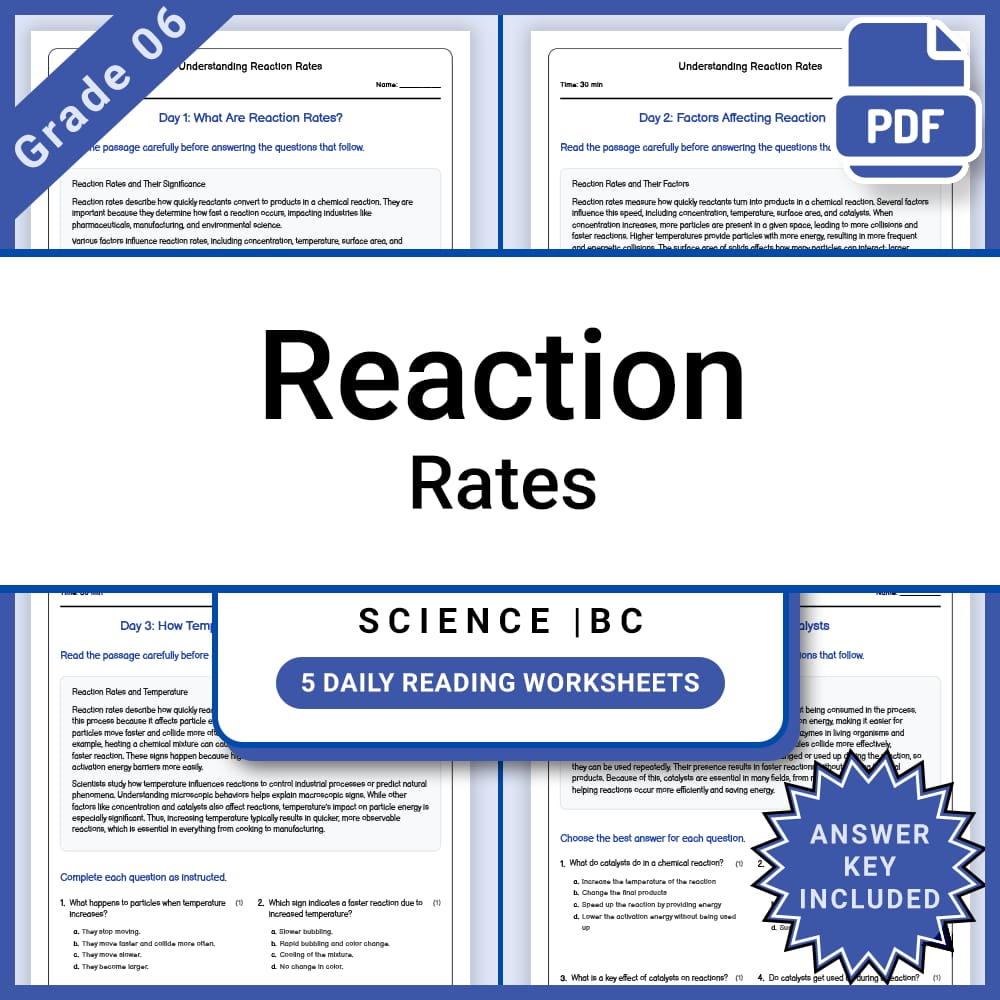
Grade 6 Science – Reaction Rates Daily Reading Worksheet + Answer Key
JCreated byJ.S SheetsLearning Objectives
- Understand key concepts related to Science
- Apply knowledge through practice questions
- Demonstrate comprehension of the material
Also included in: Grade 6 Science Lesson Group Bundle | Inquiry-Based Science Activities +1 more
Instant download
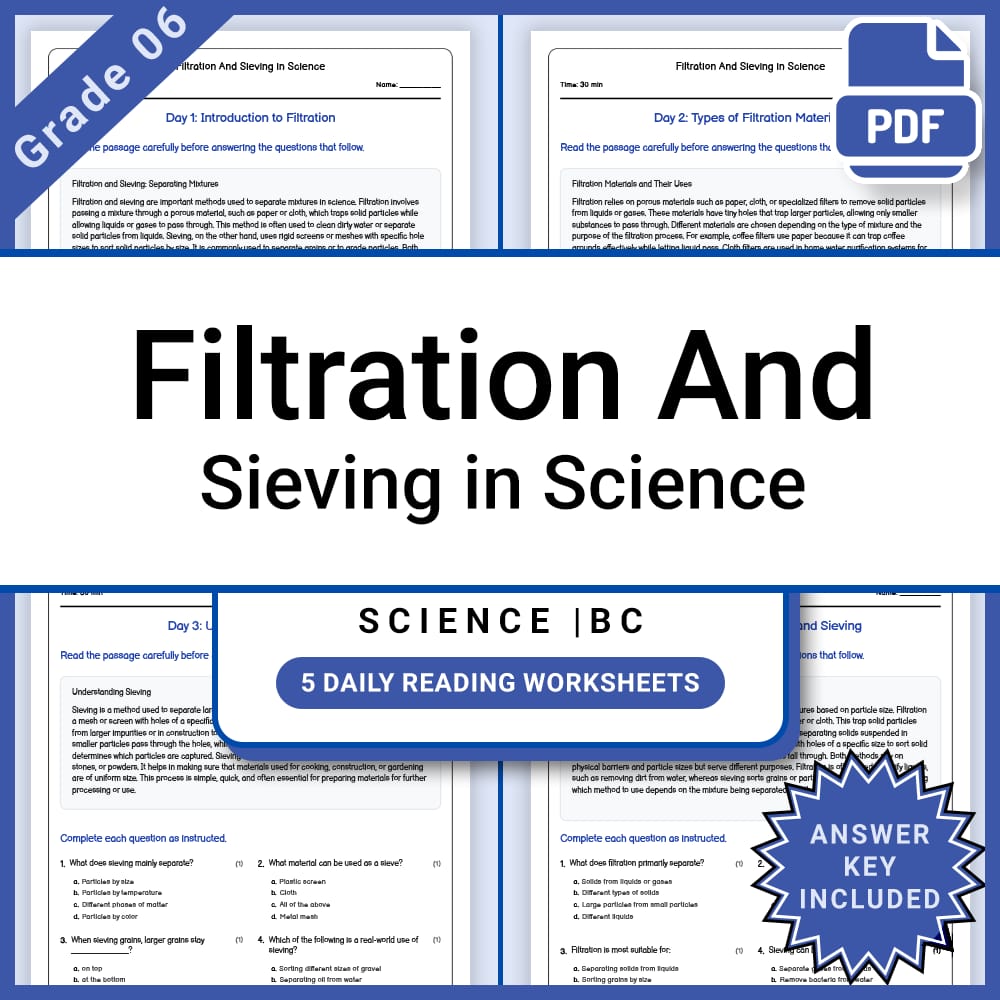
Grade 6 Science – Filtration and Sieving Daily Reading Worksheet + Answer Key
JCreated byJ.S SheetsLearning Objectives
- Understand the concepts of filtration and sieving
- Identify objects and materials used in filtration and sieving
- Explain the differences between filtration and sieving
Also included in: Grade 6 Science Lesson Group Bundle | Inquiry-Based Science Activities +1 more
Instant download

Grade 6 Science – Model to Explain Change | Daily Reading Worksheet
Created byBright Mind ResourcesLearning Objectives
- Understand the particle model and how it explains physical changes.
- Identify the differences between physical and chemical changes using particle models.
- Recognize examples of physical changes in everyday life.
Also included in: Grade 6 Matter Science Daily Reading Worksheets Lesson Bundle | CA Standards +1 more
Instant download
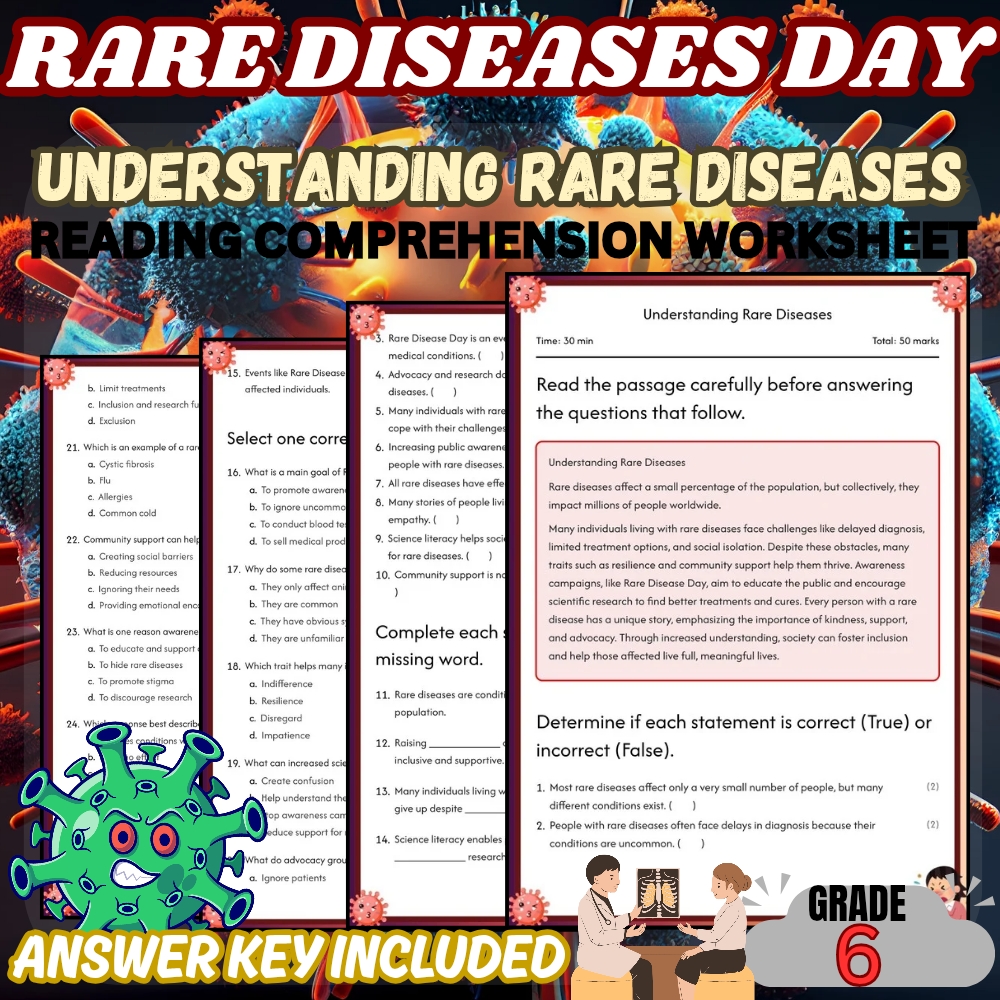
Grade 6 Rare disease day for Understanding Rare Diseases | PDF + Answer Key
Created byShaNova WorksheetsLearning Objectives
- Introduce students to the concept of rare diseases and their impact on individuals and communities.
- Develop awareness of health-related vocabulary associated with medical conditions.
- Encourage empathy and understanding of the challenges faced by people living with rare diseases.
Instant download
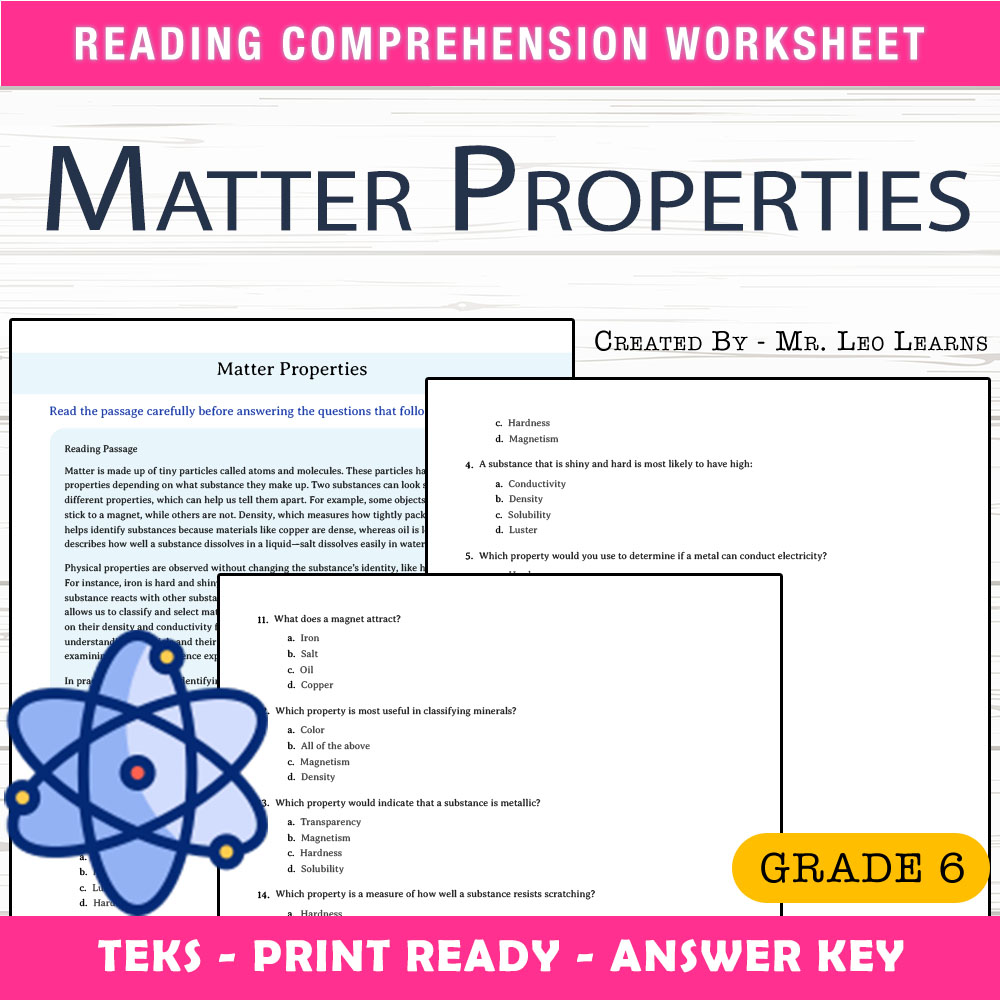
Grade 6 Science – Matter Properties Worksheet for Mastery
 Created byThe Resource Hub
Learning Objectives
- Understand the physical and chemical properties used to identify substances.
- Describe and compare properties such as density, solubility, magnetism, and conductivity.
- Relate observed properties to real-world examples like iron, salt, oil, and copper.
Also included in: Grade 6 Science Unit Bundle | States, Matter, Forces & Energy Mastery
Instant download
Browse more categories
About Grade 6 Worksheets
Browse 8,578 printable Grade 6 worksheets across math, ELA, science, and social studies — each a ready-to-print PDF with optional answer keys.
MyTeachingSheets worksheets are made by real teacher-authors and checked before they go live. Download any as a print-ready PDF for lessons, homework, or independent practice — most include answer keys, and previews are always free.