
Grade 6 Worksheets
8,578 grade resources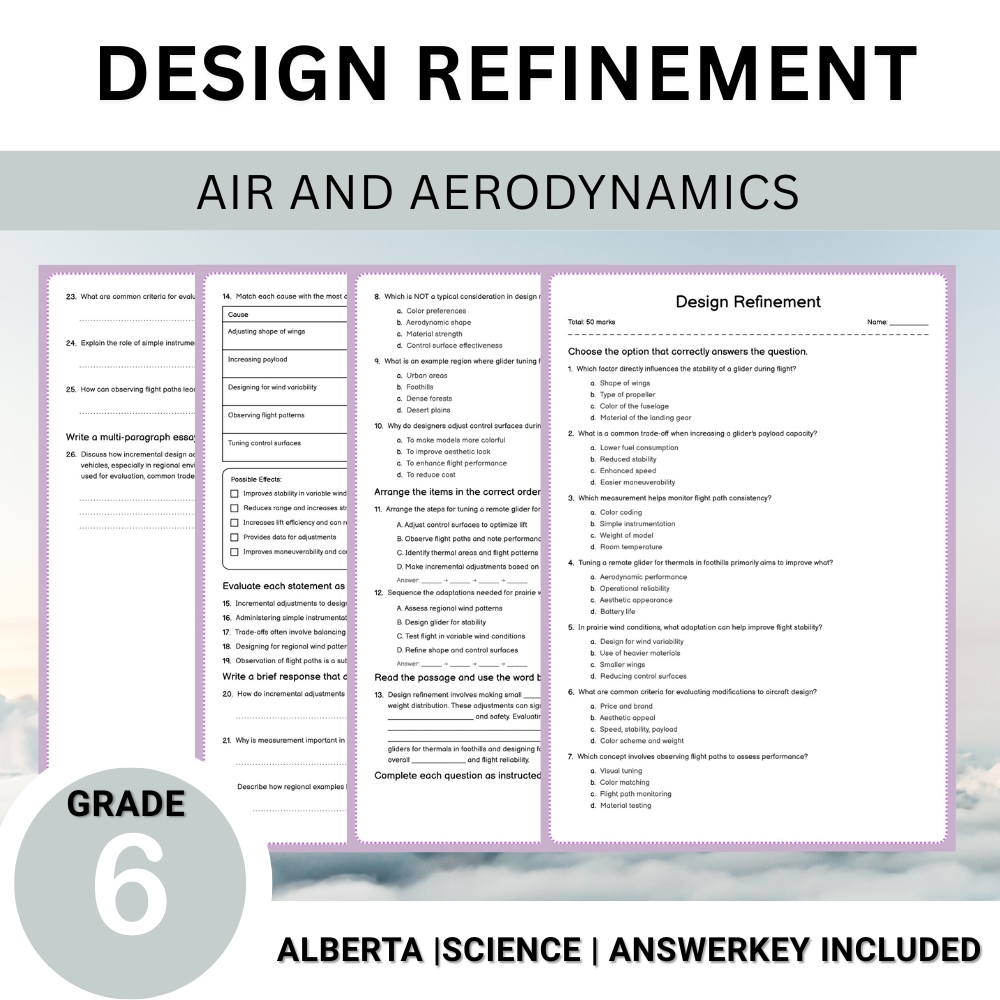
Grade 6 Science | Design Refinement Worksheet – Science (PDF) for Alberta Standards
Learning Objectives
- Understand how incremental adjustments affect aerodynamic performance.
- Identify criteria for evaluating modifications in aircraft design.
- Explain trade-offs between speed, stability, and payload capacity.
Also included in: Grade 6 Science Unit Bundle | Flight, Air Pressure & Aerodynamics Worksheets +1 more
Instant download
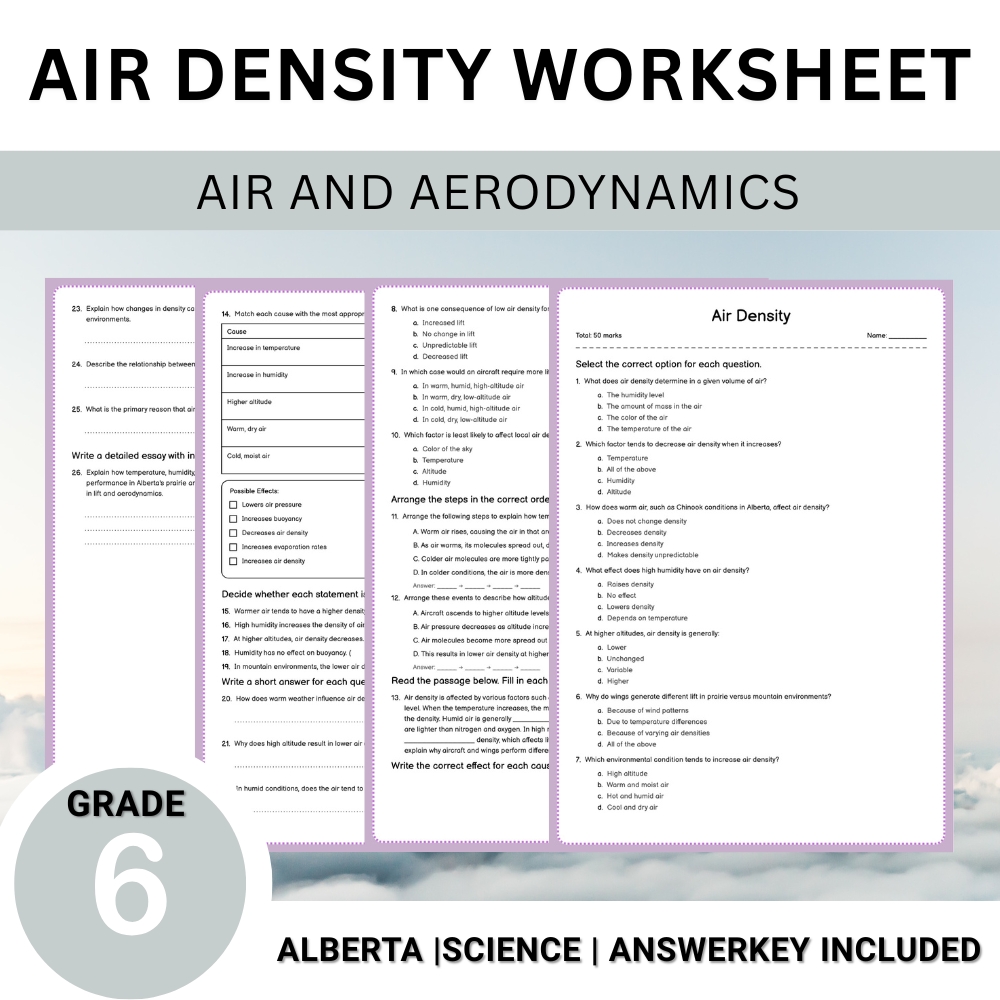
Grade 6 Science | Air Density Worksheet (Printable PDF & Assessment)
Learning Objectives
- Understand what air density is and how it affects buoyancy and aerodynamics.
- Explain how temperature, humidity, and altitude influence air density.
- Describe the differences in air density under various atmospheric conditions.
Also included in: Grade 6 Science Unit Bundle | Flight, Air Pressure & Aerodynamics Worksheets +1 more
Instant download
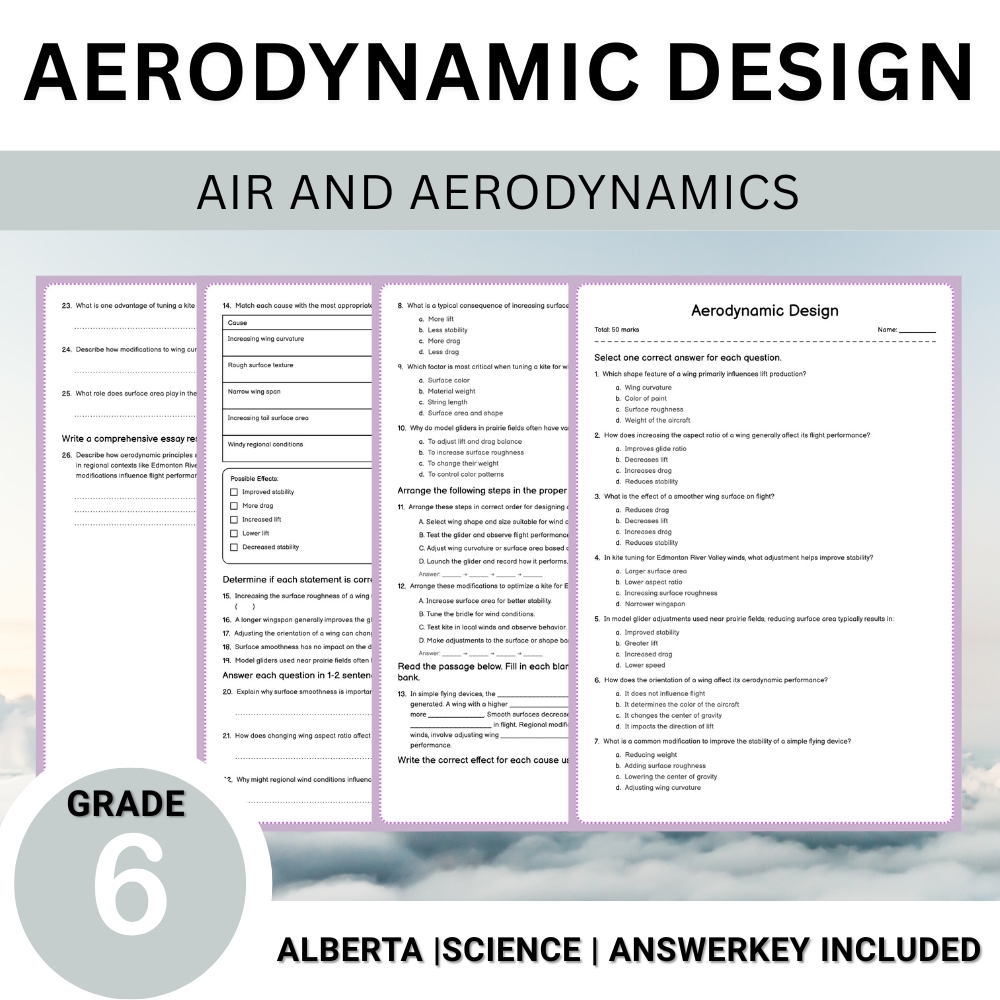
Grade 6 Science | Aerodynamic Design Worksheet (Printable PDF) for Assessment & Student Practice
Learning Objectives
- Understand the principles of aerodynamics that affect flight, including lift, drag, and stability.
- Identify how shape, surface smoothness, and orientation influence aircraft performance.
- Describe practical applications of aerodynamic modifications in kite tuning and model glider adjustments.
Also included in: Grade 6 Science Unit Bundle | Flight, Air Pressure & Aerodynamics Worksheets +1 more
Instant download
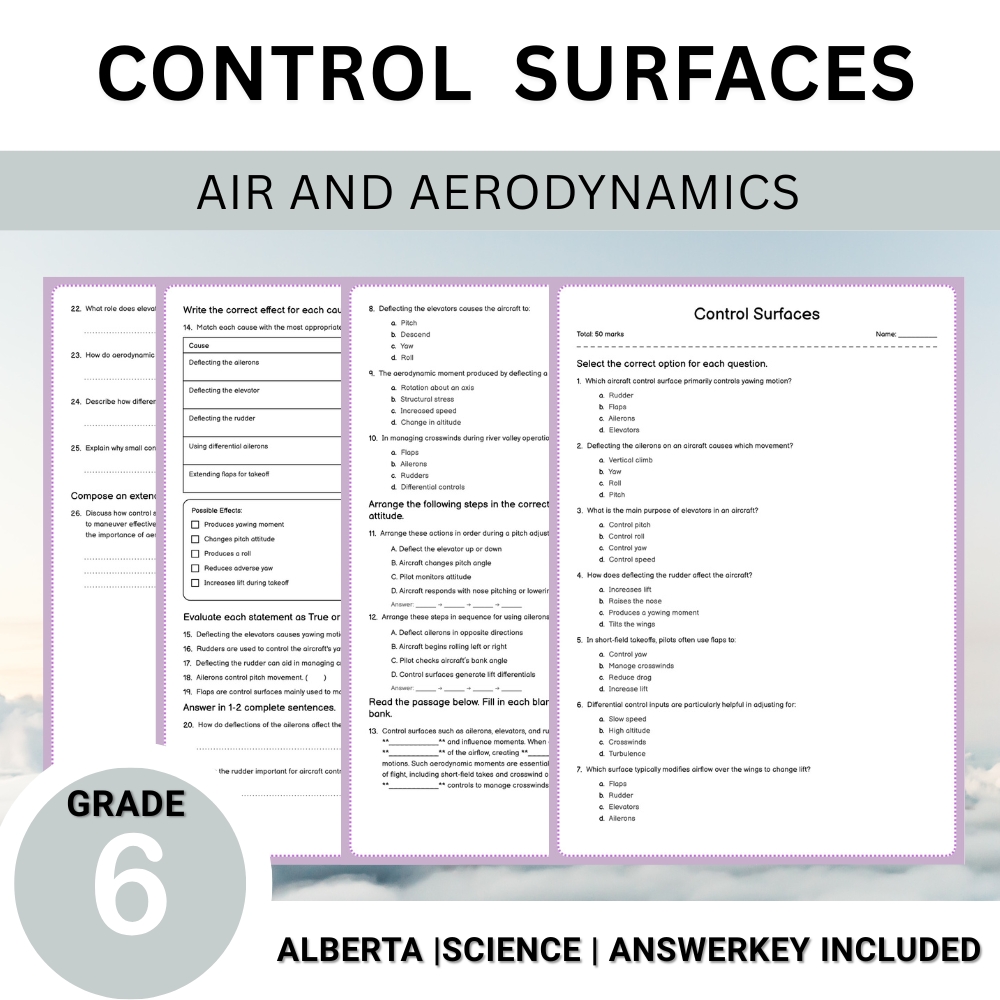
Grade 6 Science | Control Surfaces Worksheet – Classroom Assessment & Practice PDF
Learning Objectives
- Describe the function of various control surfaces such as ailerons, elevators, and rudders.
- Explain how deflection of control surfaces affects airflow and aircraft attitude.
- Understand how aerodynamic moments are produced and how they influence rolling, pitching, and yawing motions.
Also included in: Grade 6 Science Unit Bundle | Flight, Air Pressure & Aerodynamics Worksheets +1 more
Instant download
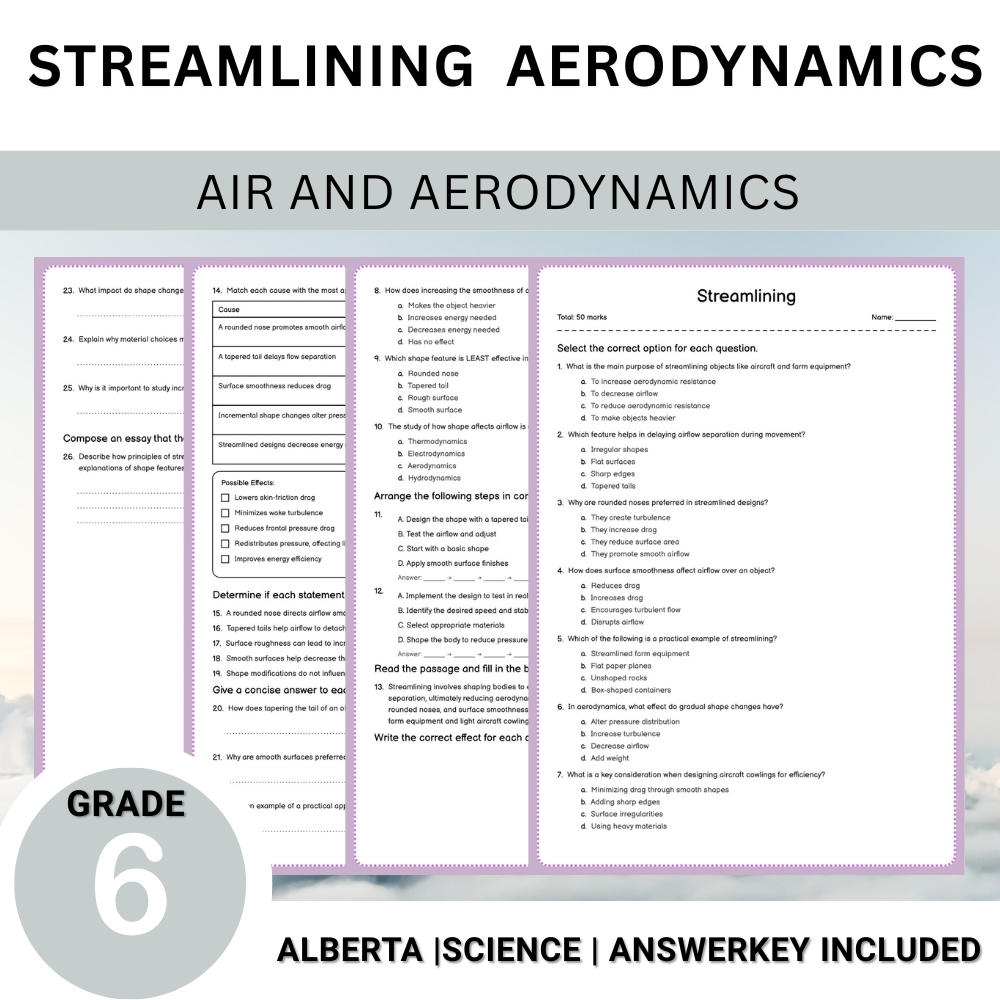
Grade 6 Science | Streamlining Worksheet – Assessment & Student Practice
Learning Objectives
- Understand how shape modifications in objects reduce aerodynamic resistance.
- Identify key principles like tapered tails, rounded noses, and surface smoothness that influence airflow.
- Connect practical examples such as farm equipment and aircraft cowlings to aerodynamic efficiency.
Also included in: Grade 6 Science Unit Bundle | Flight, Air Pressure & Aerodynamics Worksheets +1 more
Instant download
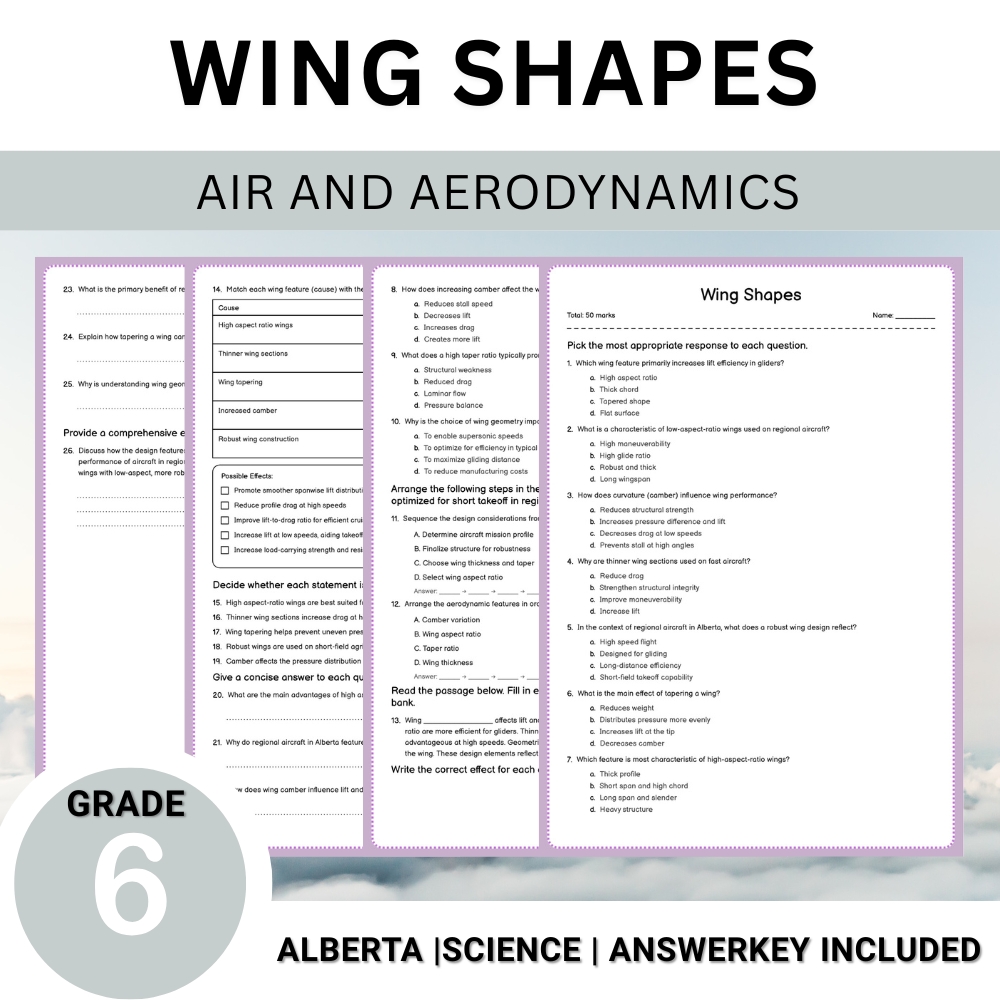
Grade 6 Science | Wing Shapes Worksheet (Assessment & Student Practice Printable )
Learning Objectives
- Understand how wing shape affects lift, stall, and maneuverability in aircraft.
- Identify features such as camber, aspect ratio, and taper, and their influence on wing performance.
- Compare high-aspect-ratio wings used in gliders with low-aspect, robust wings used in regional aircraft.
Also included in: Grade 6 Science Unit Bundle | Flight, Air Pressure & Aerodynamics Worksheets +1 more
Instant download
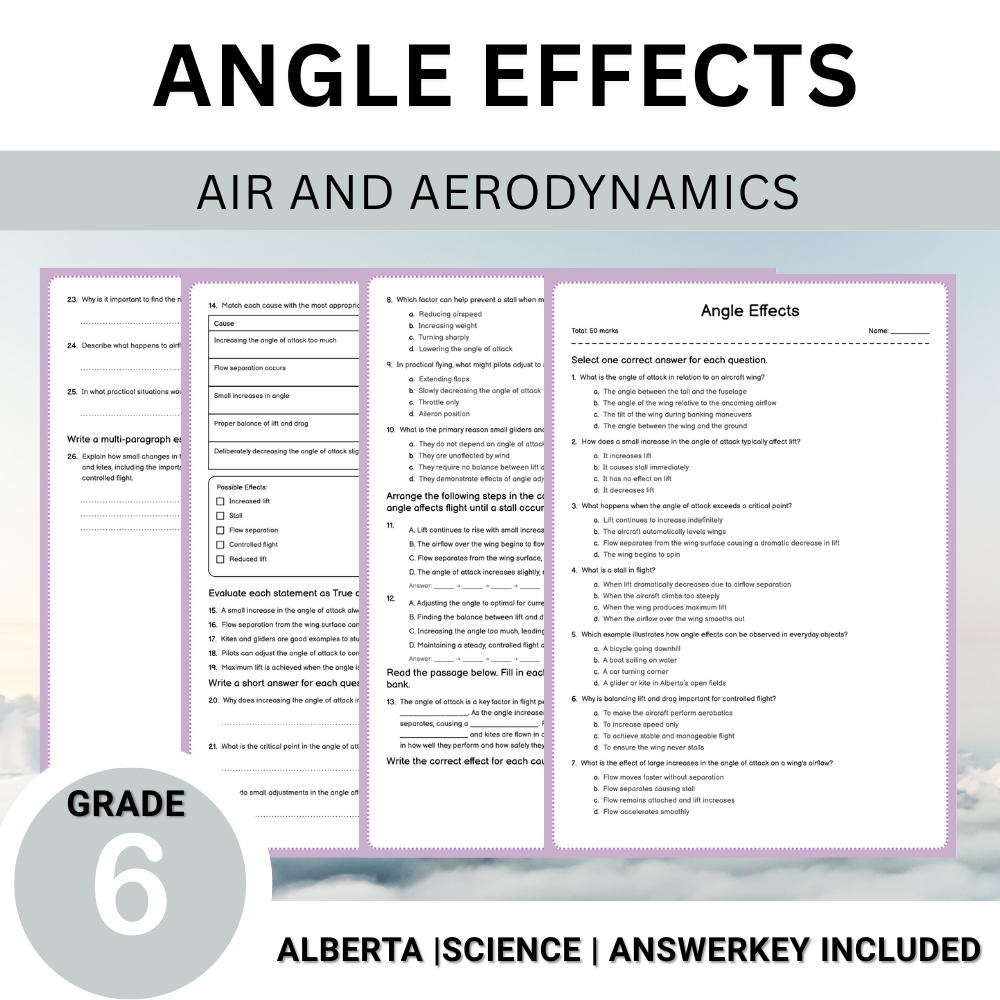
Grade 6 Science | Angle Effects Worksheet (Printable PDF & Assessment)
Learning Objectives
- Understand how the angle of attack influences lift and drag on wings.
- Identify the effects of increasing the angle of attack on flight performance.
- Explain what occurs during a stall when the angle exceeds a critical point.
Also included in: Grade 6 Science Unit Bundle | Flight, Air Pressure & Aerodynamics Worksheets +1 more
Instant download
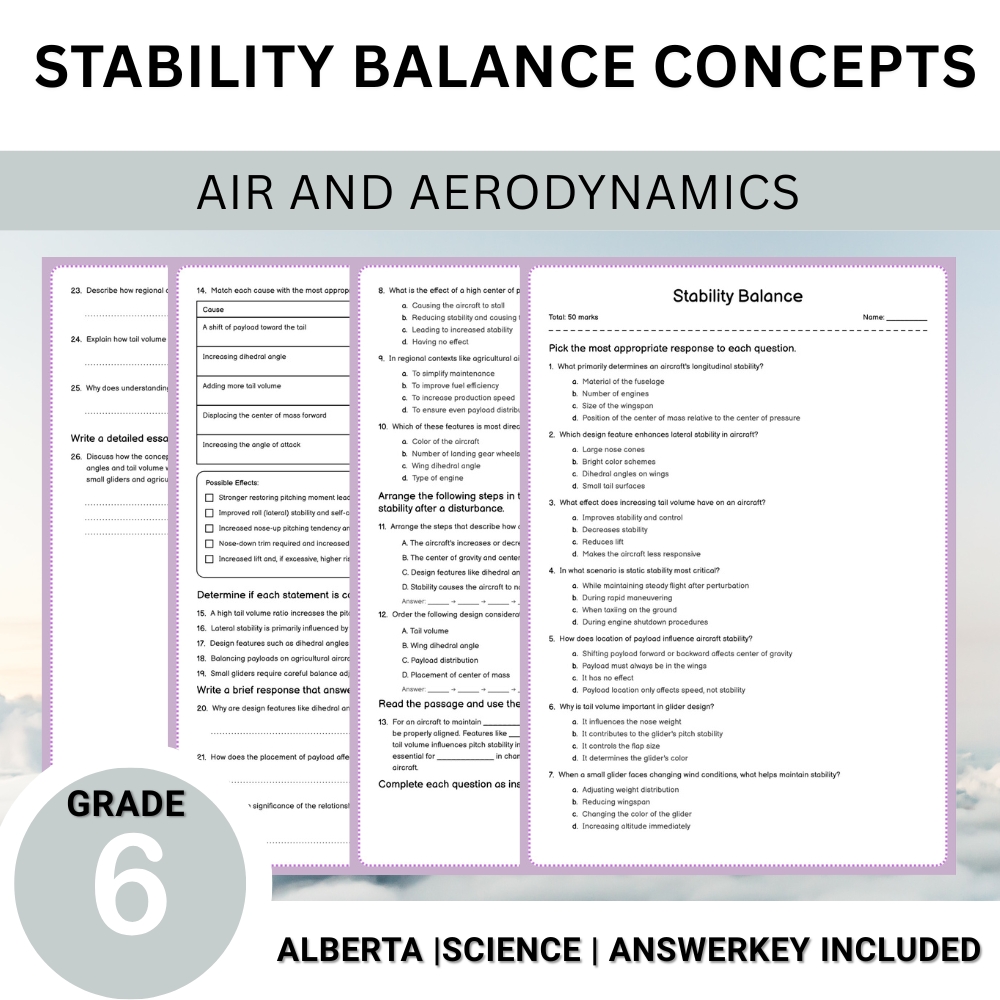
Grade 6 Science | Stability and Balance Worksheet (Print & Assess) - PDF
Learning Objectives
- Understand the concepts of longitudinal and lateral stability in flight.
- Identify how center of mass and center of pressure influence static stability.
- Describe design features such as dihedral angles and tail volume that contribute to stability.
Also included in: Grade 6 Science Unit Bundle | Flight, Air Pressure & Aerodynamics Worksheets +1 more
Instant download
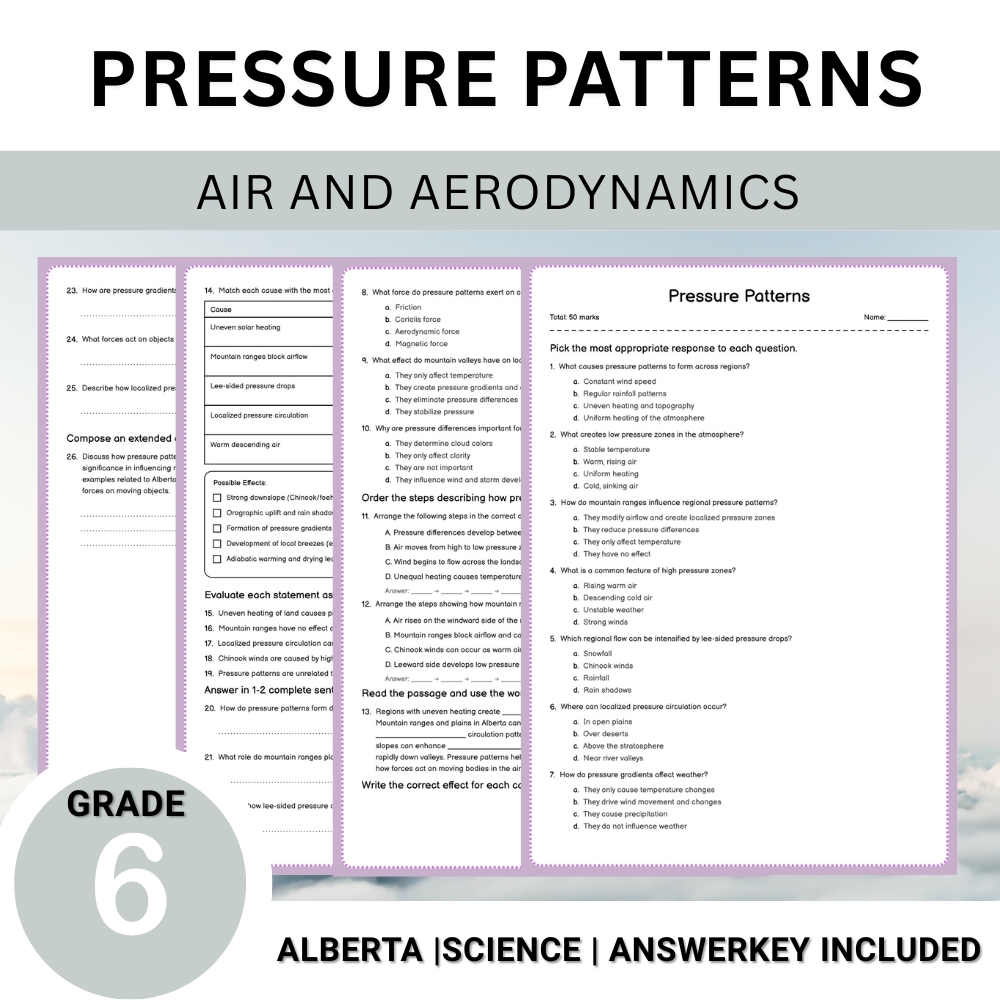
Grade 6 Science | Pressure Patterns Worksheet (Printable PDF & Assessment)
Learning Objectives
- Understand how uneven heating and topography create pressure differences that influence wind.
- Identify low and high pressure zones and their effects on regional weather.
- Explain how mountain ranges and plains modify pressure and airflow patterns in Alberta.
Also included in: Grade 6 Science Unit Bundle | Flight, Air Pressure & Aerodynamics Worksheets +1 more
Instant download
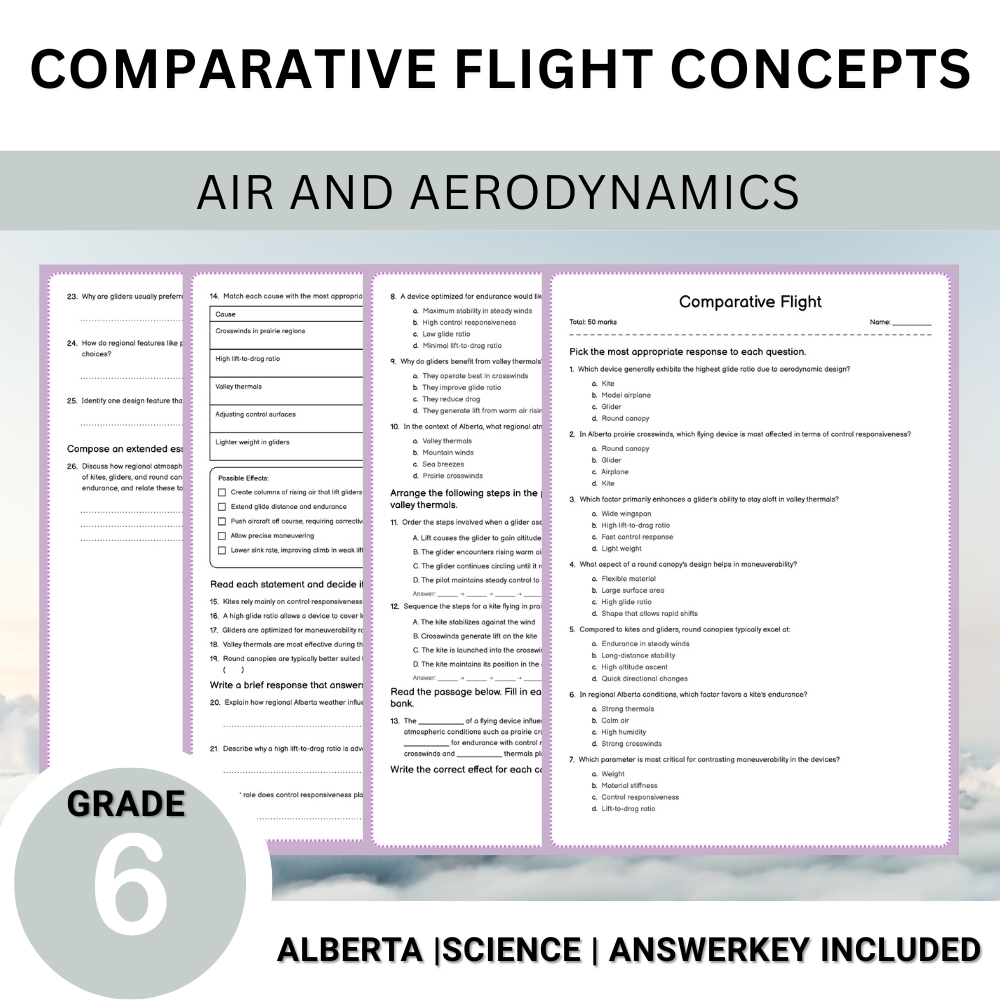
Grade 6 Science | Comparative Flight Worksheet (Assessment & Student Practice PDF)
Learning Objectives
- Compare the flight performance of kites, gliders, and round canopies based on glide ratio, lift-to-drag performance, and control responsiveness.
- Analyze how design parameters influence endurance versus maneuverability in different flying devices.
- Apply regional atmospheric concepts such as prairie crosswinds and valley thermals to understanding flight outcomes.
Also included in: Grade 6 Science Unit Bundle | Flight, Air Pressure & Aerodynamics Worksheets +1 more
Instant download
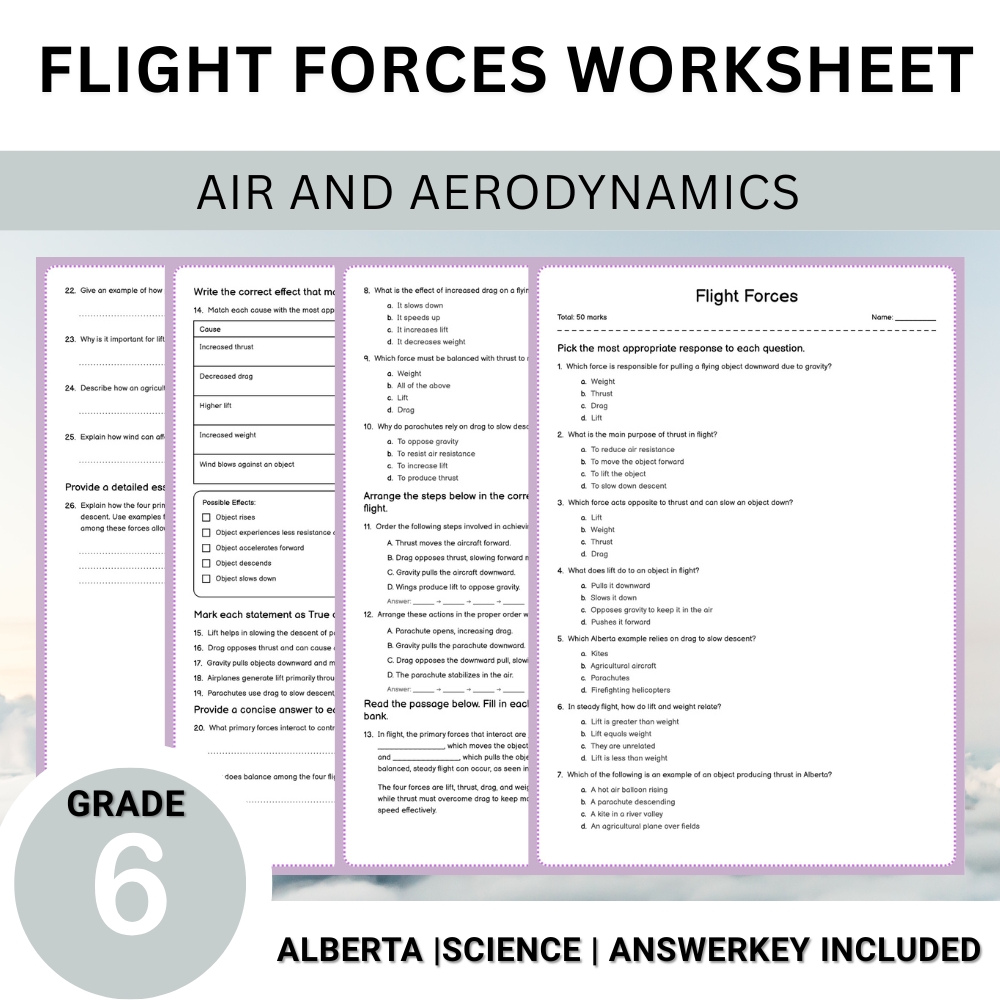
6th Grade Science – Flight Forces Worksheet (Worksheet + Answer Key) | Alberta Standards
Learning Objectives
- Identify and describe the four primary forces that affect an object's motion through air.
- Explain how lift, thrust, drag, and weight interact to enable steady flight or descent.
- Provide real-world examples of flight forces in Alberta, such as kites, agricultural aircraft, and parachutes.
Also included in: Grade 6 Science Unit Bundle | Flight, Air Pressure & Aerodynamics Worksheets +1 more
Instant download

Grade 6 World Earth Day Worksheet for Mastering Earth's Origins|PDF + Answer Key
 Created byShaNova Worksheets
Learning Objectives
- Understand the history and significance of Earth Day.
- Identify key figures and grassroots efforts that contributed to Earth Day's creation.
- Recognize the importance of environmental awareness and civic engagement.
Also included in: Grade 6 Holiday Earth Day Worksheets | Environmental Science Bundle
Instant download
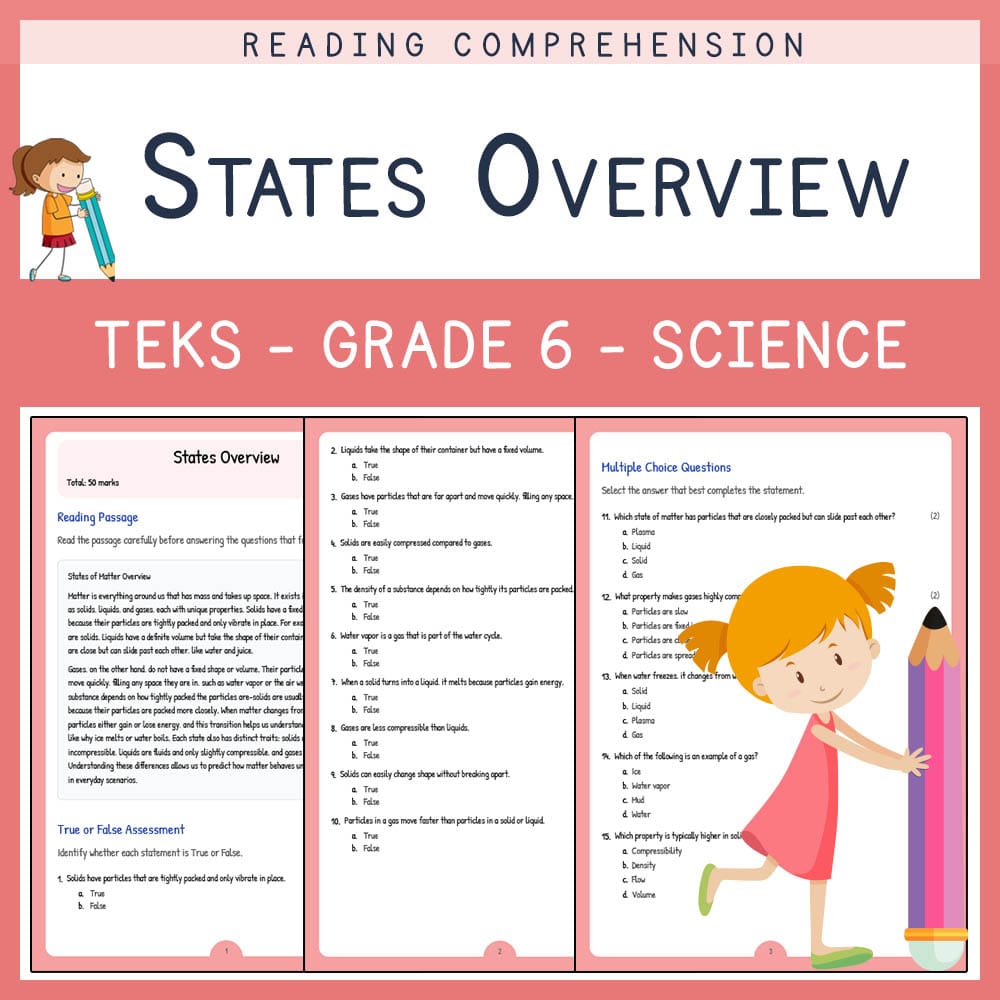
Grade 6 Science | States Overview Worksheet | TEKS-Aligned
 Created byLumora Learning
Learning Objectives
- Describe the three main states of matter: solid, liquid, and gas.
- Explain how particles are arranged and move in different states of matter.
- Compare properties such as shape, volume, density, and compressibility among solids, liquids, and gases.
Also included in: Grade 6 Science | Matter and Energy Lesson Bundle | TEKS Aligned
Instant download

Safety and Ethics in Science Worksheet Grade 6 | Standards-Aligned Practice
JCreated byJ.S SheetsLearning Objectives
- Explain why risk assessment is necessary before beginning a science activity
- Describe safe, ethical handling of tools, materials, and substances
- Apply ethical principles for living organisms, informed consent, and confidentiality in community and fieldwork
Instant download
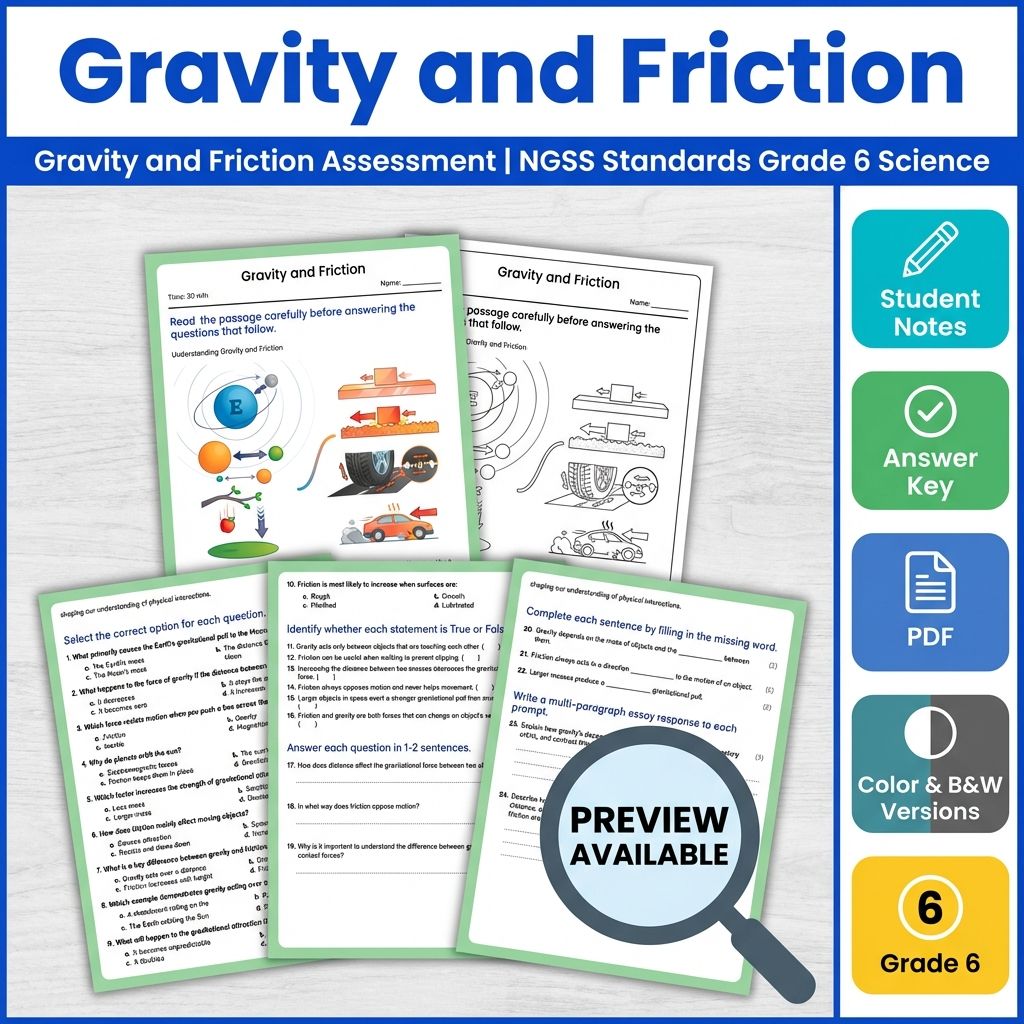
Gravity and Friction Assessment | NGSS Standards Grade 6 Science
 Created byPrism Point Learning
Learning Objectives
- Explain how gravity depends on mass and distance, using examples like Earth-Moon interactions and planetary orbits.
- Describe how contact forces like friction resist motion and differ from gravitational forces.
- Analyze quantitative patterns showing stronger attraction with larger masses and weaker attraction with increased distance.
Also included in: Grade 6 Science Mini Bundle | Forces and Interactions NGSS Standards +1 more
Instant download
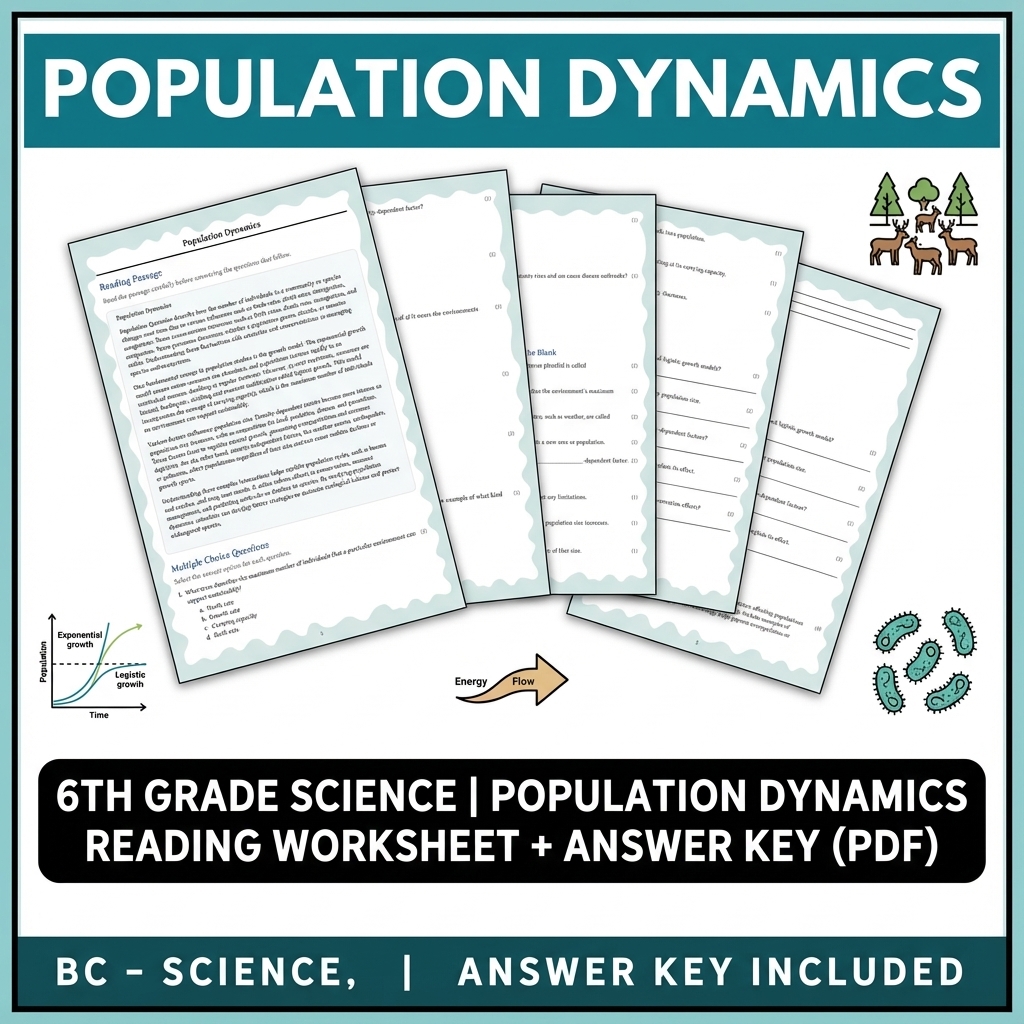
6th Grade Science | Population Dynamics Reading Worksheet + Answer Key (PDF)
JCreated byJ.S SheetsLearning Objectives
- Understand the concept of population dynamics and how populations change over time.
- Identify factors that influence population growth and decline, including birth, death, immigration, and emigration.
- Differentiate between growth models such as exponential and logistic growth.
Instant download
Global and Canadian Perspectives Social Studies | Standards-Aligned Grade 6
JCreated byJ.S SheetsLearning Objectives
- Understand Indigenous land and governance relationships within the Canadian context.
- Compare Indigenous and global land stewardship practices and governance structures.
- Explore themes of land rights, sovereignty, and mutual responsibilities across cultures.
Also included in: Grade 6 Social Studies | Indigenous Land Responsibilities Bundle +1 more
Instant download
Responsibility and Ethics Worksheet for Grade 6 Social Studies | BC Standards
JCreated byJ.S SheetsLearning Objectives
- Understand the key concepts of land care and environmental responsibility within Indigenous values.
- Recognize contemporary ethical issues relating to resource use and cultural preservation.
- Analyze the community’s role in maintaining respectful relationships with the land.
Also included in: Grade 6 Social Studies | Indigenous Land Responsibilities Bundle +1 more
Instant download
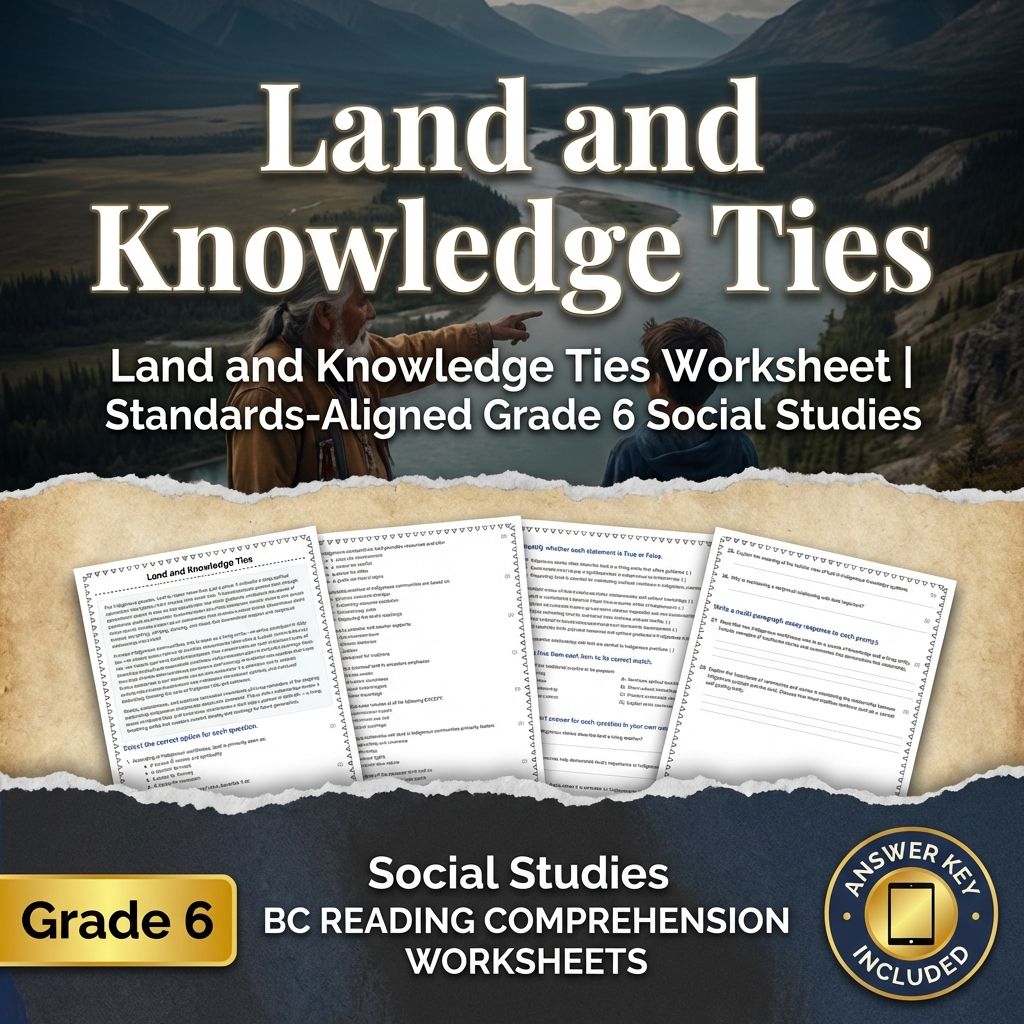
Land and Knowledge Ties Worksheet | Standards-Aligned Grade 6 Social Studies
JCreated byJ.S SheetsLearning Objectives
- Understand how Indigenous worldviews perceive land as a source of identity, spirituality, and knowledge.
- Identify traditional stories, ceremonies, and practices that demonstrate connections to specific territories.
- Explain the role of land as a living entity that guides and teaches within Indigenous knowledge systems.
Also included in: Grade 6 Social Studies | Indigenous Land Responsibilities Bundle +1 more
Instant download
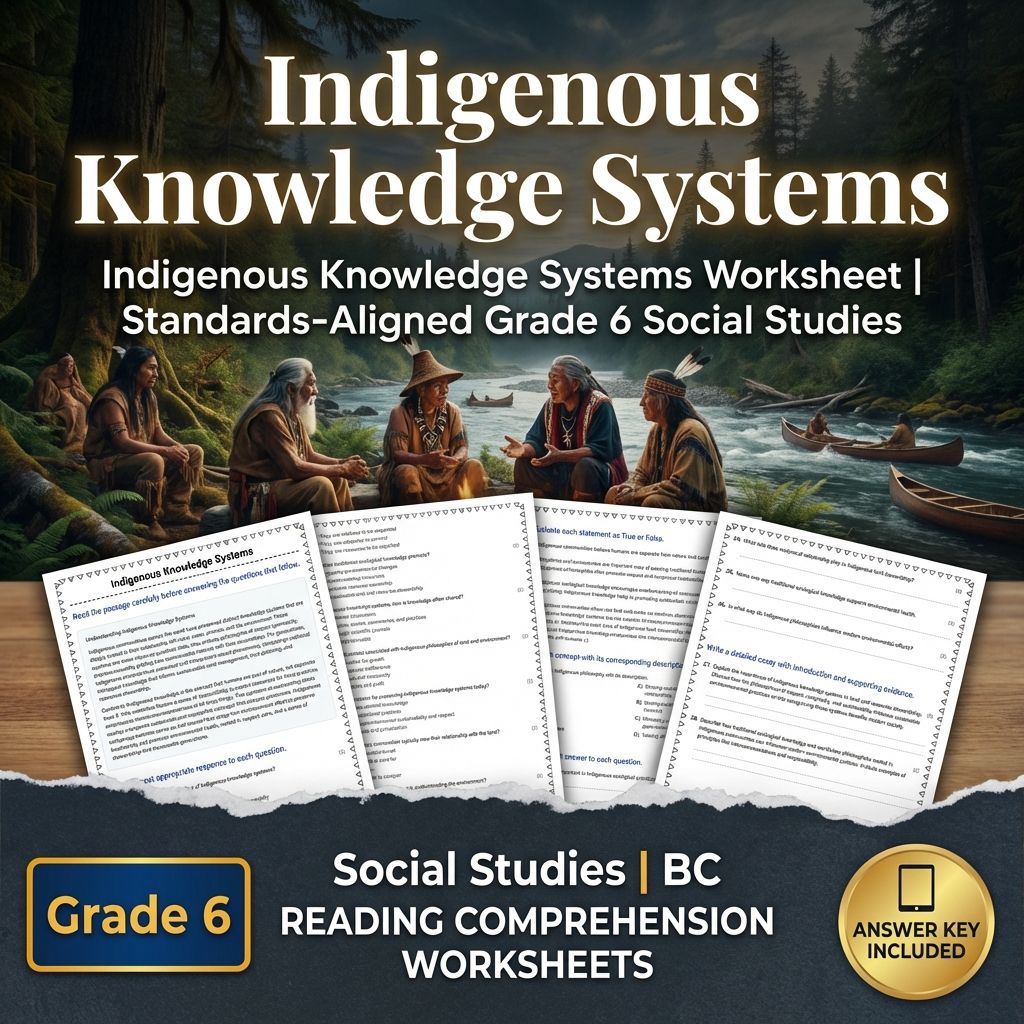
Indigenous Knowledge Systems | Standards-Aligned Grade 6 Social Studies
JCreated byJ.S SheetsLearning Objectives
- Understand the concept of Indigenous knowledge systems and their role in land and resource stewardship.
- Recognize traditional ways of understanding and caring for the environment.
- Explore the interconnectedness of land, water, animals, and community responsibilities in Indigenous worldviews.
Also included in: Grade 6 Social Studies | Indigenous Land Responsibilities Bundle +1 more
Instant download
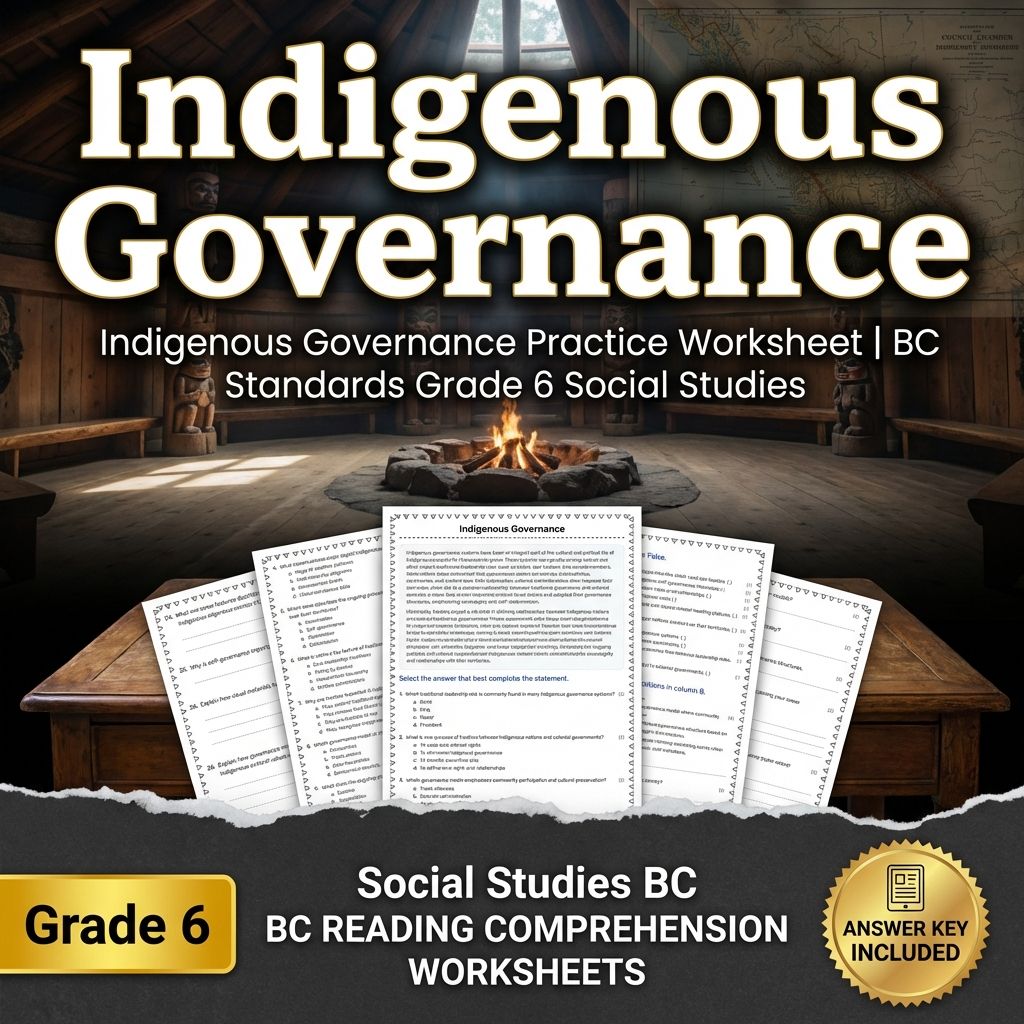
Indigenous Governance Practice Worksheet | BC Standards Grade 6 Social Studies
JCreated byJ.S SheetsLearning Objectives
- Locate and describe various Indigenous governance structures and their historical context.
- Explain traditional leadership roles and self-governance initiatives within Indigenous nations.
- Analyze treaty agreements and their impact on Indigenous sovereignty and relationships.
Also included in: Grade 6 Social Studies | Indigenous Land Responsibilities Bundle +1 more
Instant download
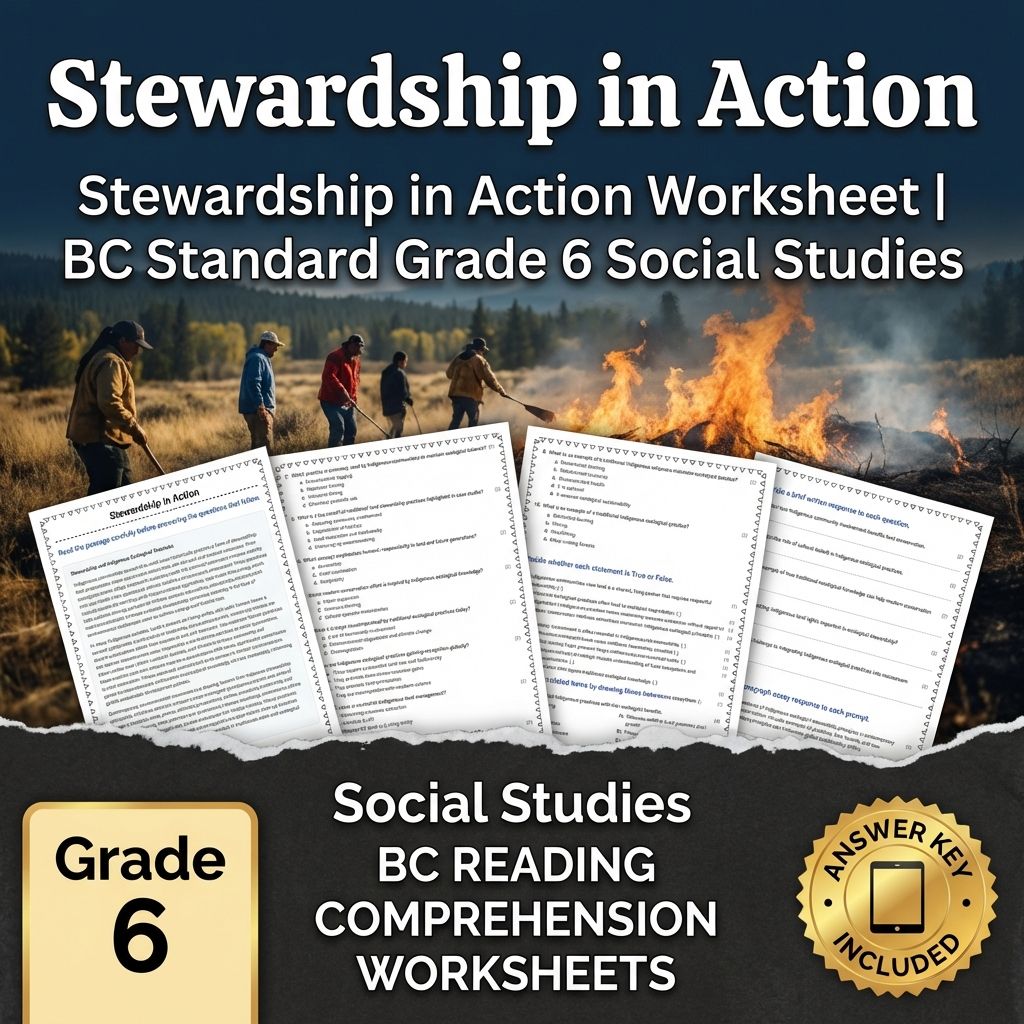
Stewardship in Action Worksheet | BC Standard Grade 6 Social Studies
JCreated byJ.S SheetsLearning Objectives
- Understand the principles of ecological stewardship practiced by Indigenous communities.
- Identify examples of sustainable resource management and conservation.
- Explain the importance of reciprocal relationships between communities and land.
Also included in: Grade 6 Social Studies | Indigenous Land Responsibilities Bundle +1 more
Instant download
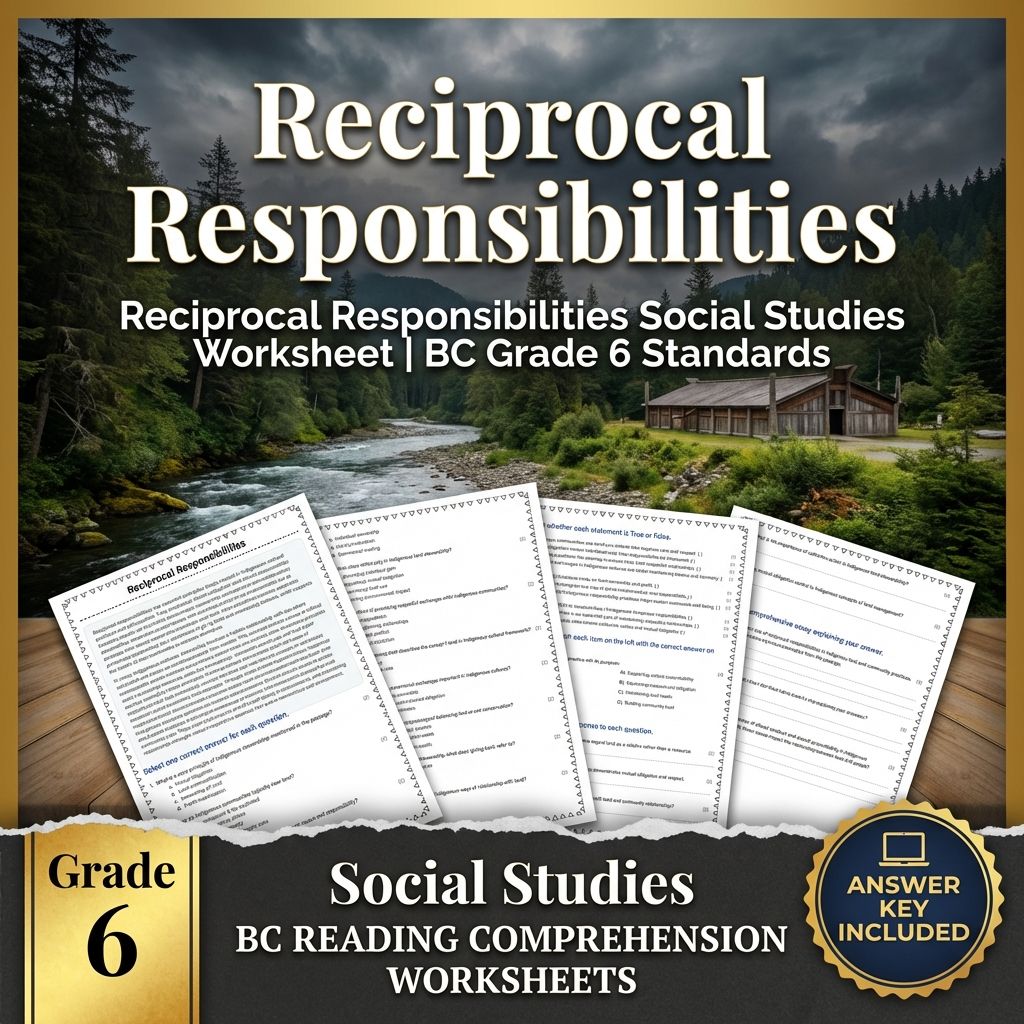
Reciprocal Responsibilities Social Studies Worksheet | BC Grade 6 Standards
JCreated byJ.S SheetsLearning Objectives
- Understand the principles of reciprocal responsibilities within relationships with land and community.
- Explore Indigenous concepts of stewardship and mutual obligation.
- Identify community practices that demonstrate respectful exchanges and shared accountability.
Also included in: Grade 6 Social Studies | Indigenous Land Responsibilities Bundle +1 more
Instant download

Patriot Day 9/11 Remembrance and Resilience Worksheets Grade 6
Created byShaNova WorksheetsLearning Objectives
- Explain how unity and shared civic actions can help communities heal after a crisis.
- Identify examples of resilience shown by individuals and groups across different places.
- Describe the role of civic symbols and community support in building a sense of belonging.
Also included in: Patriot Day 9/11 Remembrance Lesson Bundle | Grade 6 Holiday | September
Instant download

Patriot Day 9/11 Security and Society Worksheets Grade 6 Reading Review
Created byShaNova WorksheetsLearning Objectives
- Explain how September 11 influenced public security policies and global cooperation
- Identify ways communities and individuals responded through remembrance and civic responsibility
- Use key vocabulary to describe historical change and long-term effects
Also included in: Patriot Day 9/11 Remembrance Lesson Bundle | Grade 6 Holiday | September
Instant download

Food Webs Practice Worksheet | Grade 6 Science Test Prep Ontario
Created byPrism Point LearningLearning Objectives
- Identify producers, consumers, and decomposers in different ecosystems.
- Explain how energy moves through trophic levels in a food web and why energy decreases at each step.
- Describe how removing or adding a species can affect other organisms through interconnected feeding relationships.
Also included in: Grade 6 Biodiversity & Adaptation Science Lesson Bundle Ontario
Instant download
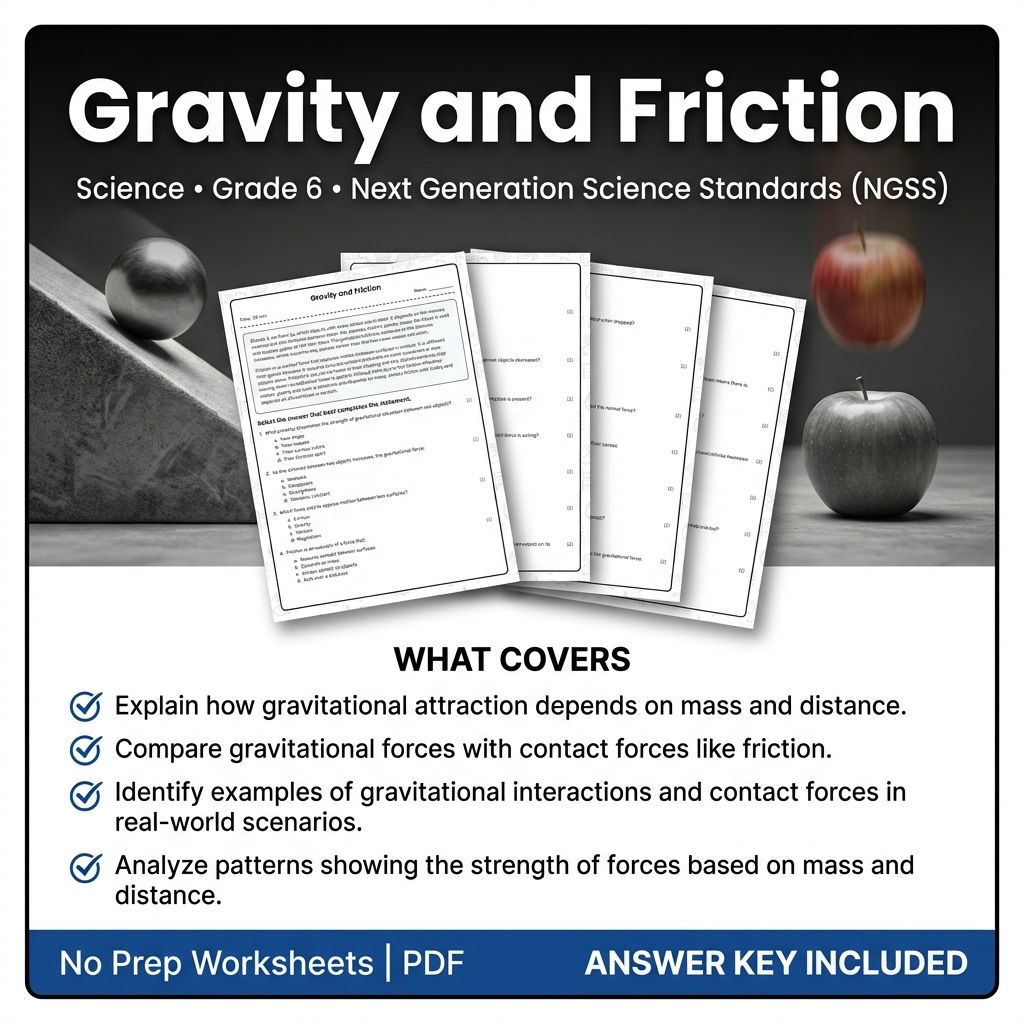
Grade 6 Science | Gravity and Friction Worksheet with Answer Key (Printable PDF)
 Created byCoral Reef Learning
Learning Objectives
- Explain how gravitational attraction depends on mass and distance.
- Compare gravitational forces with contact forces like friction.
- Identify examples of gravitational interactions and contact forces in real-world scenarios.
Instant download
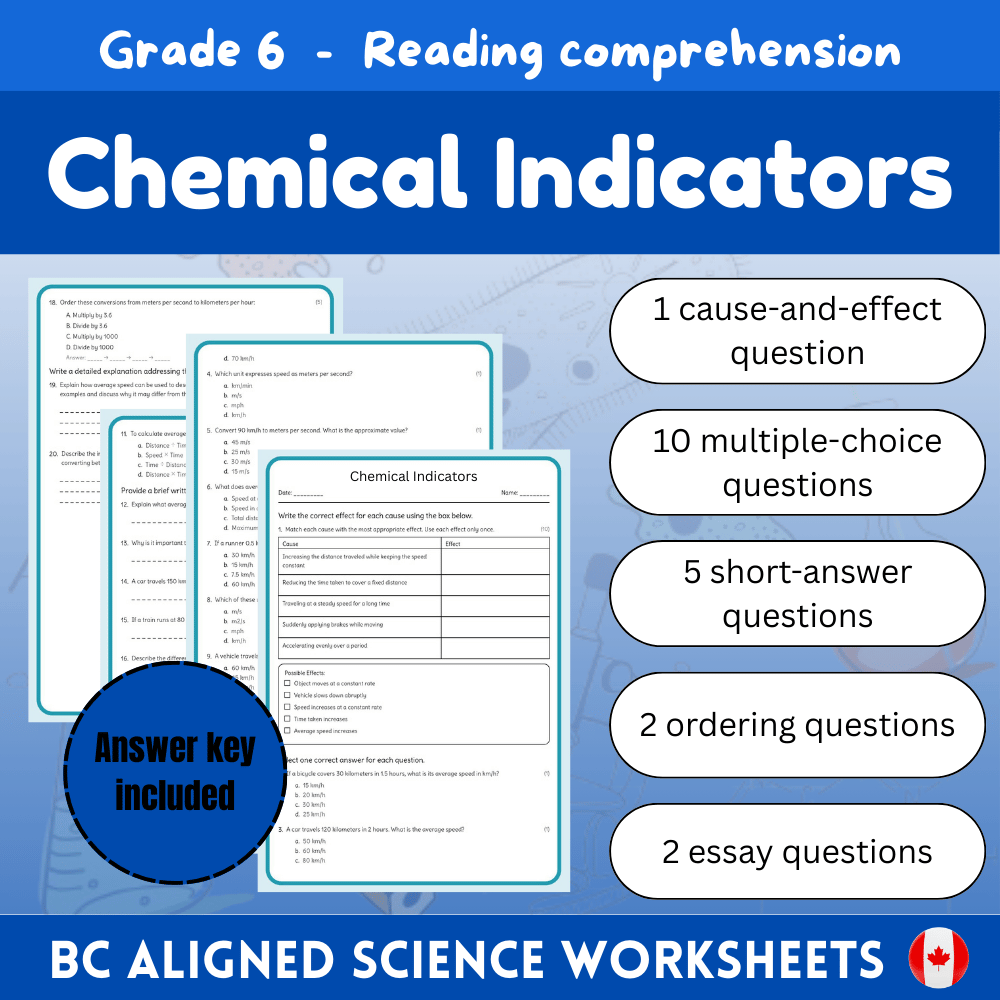
6th Grade Science | Chemical Indicators Worksheet + Answer Key (PDF)
 Created byBright Mind Resources
Learning Objectives
- Identify observable signs indicating a chemical reaction has taken place.
- Distinguish between physical and chemical changes using various indicators.
- Understand the importance of multiple observations to confirm a chemical change.
Instant download

6th Grade Science | Climate Systems | NGSS Worksheet & Answer Key
 Created byCedar Grove Learning
Learning Objectives
- Explain how unequal solar heating and planetary rotation create global circulation patterns.
- Identify and describe major atmospheric cells, wind systems, and ocean currents that influence regional climates.
- Analyze how circulation patterns like Hadley, Ferrel, and polar cells affect climate zones and phenomena like El Niño.
Also included in: Grade 6 Science | Weather, Water Cycle & Climate NGSS Worksheet Bundle +1 more
Instant download

Organ Definition Worksheet for Grade 6 Science | Standards-Aligned Practice
JCreated byJ.S SheetsLearning Objectives
- Understand what an organ is and how it is composed of different tissue types.
- Identify examples of organs and their functions within the human body.
- Explain how tissue interactions within organs enable vital processes like secretion, contraction, and absorption.
Instant download

6th Grade Science Worksheet – Transfer Mechanisms of Heat (PDF)
 Created byEvergreen Desk Education
Learning Objectives
- Identify the three main mechanisms of heat transfer: conduction, convection, and radiation.
- Use evidence from everyday examples to determine which mechanism is most likely occurring.
- Explain how temperature and state changes can indicate the dominant heat-transfer pathway.
Also included in: Grade 6 Heat and Matter Science Lesson Bundle for General Framework +1 more
Instant download

Grade 6 Science | Understanding Precipitation - Daily Reading Comprehension
Created byCoral Reef LearningLearning Objectives
- Identify different types of precipitation such as rain, snow, sleet, and hail.
- Explain how precipitation forms and reaches the Earth's surface.
- Describe the process of infiltration and how water moves into the ground.
Instant download
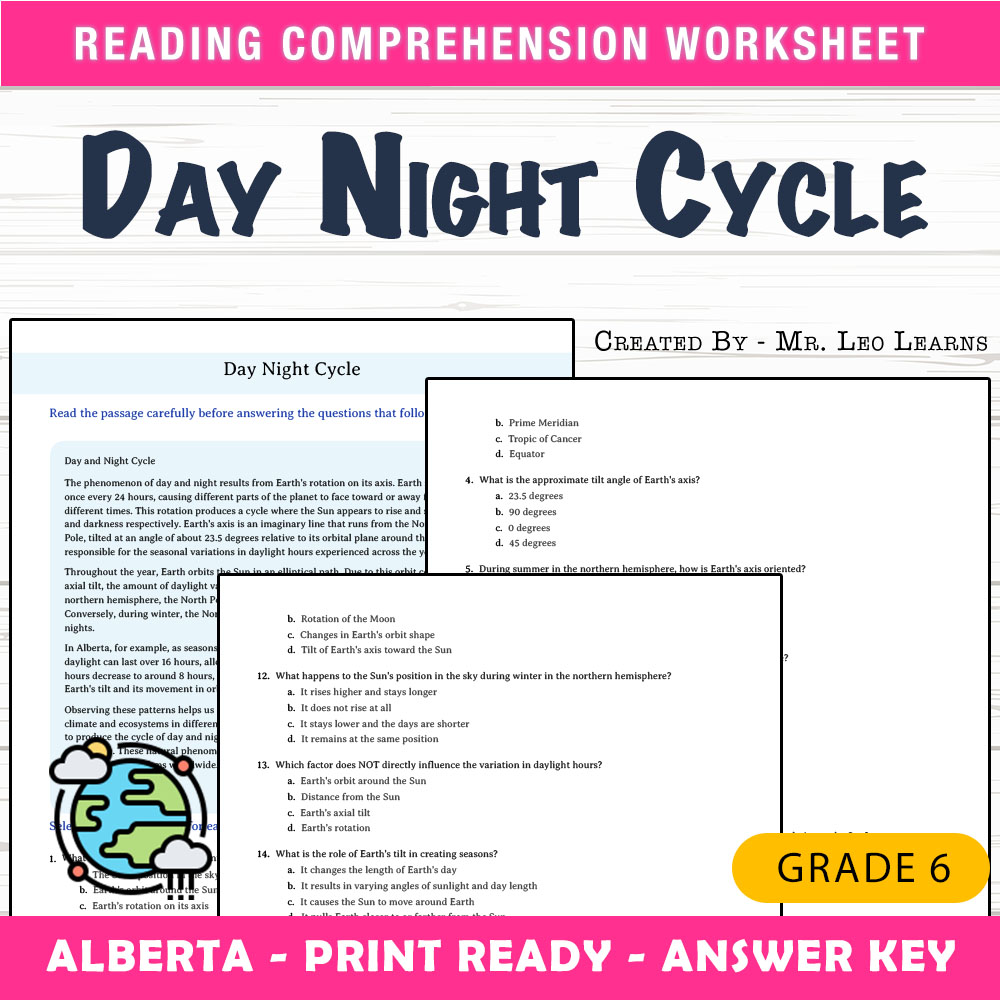
Grade 6 Science — Day Night Cycle Worksheet MCQ Paper
 Created byThe Resource Hub
Learning Objectives
- Understand the mechanics of Earth's rotation and how it causes day and night.
- Identify the factors that influence variation in daylight hours throughout the year.
- Explain how Earth's axial tilt and orbit around the Sun create seasonal changes in day length.
Also included in: Grade 6 Science Sky Science Unit Bundle – Celestial Motion & Earth-Sun Relations +1 more
Instant download

Grade 6 Holiday | Exploring Classic Tales Word Book Day | PDF + Answer Key
Created byShaNova WorksheetsLearning Objectives
- Analyze themes of tragedy, comedy, and history in Shakespeare's plays.
- Identify character motivations and poetic devices used in classic literature.
- Develop vocabulary related to storytelling and literary analysis.
Also included in: Grade 6 Word Book Day Holiday Custom Bundle for Writing Workshop
Instant download

Grade 6 Holiday| Word Book Day for Mastering Writing in Verse | PDF + Answer Key
Created byShaNova WorksheetsLearning Objectives
- Understand poetic devices such as rhyme, meter, and imagery.
- Explore themes like love, imagination, and human nature through poetry.
- Create original short sonnets or poetic dialogues inspired by Shakespeare.
Also included in: Grade 6 Word Book Day Holiday Custom Bundle for Writing Workshop
Instant download

Waves And Technology Worksheet for Grade 6 Science | Standards-Aligned Practice
JCreated byJ.S SheetsLearning Objectives
- Understand how sound and light waves transfer energy in technological devices.
- Identify the functions of speakers, microphones, and cameras in terms of wave conversions.
- Explain how wave properties like frequency and intensity influence device performance.
Instant download
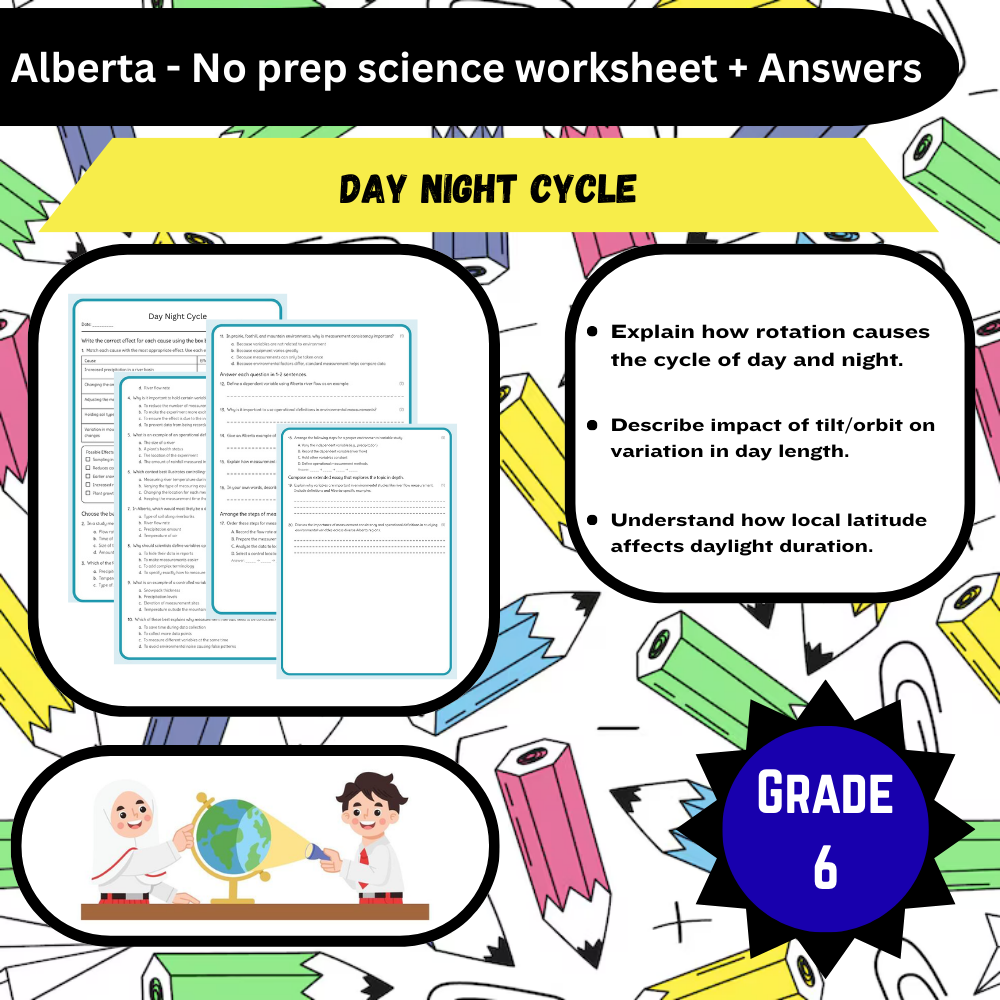
Grade 6 Science – Day Night Cycle Worksheet (PDF) | Alberta Standard
Created byBright Mind ResourcesLearning Objectives
- Explain how Earth's rotation causes the cycle of day and night.
- Describe the impact of Earth's tilt and orbit on the variation in day length throughout the year.
- Understand how local latitude affects daylight duration within Alberta.
Instant download
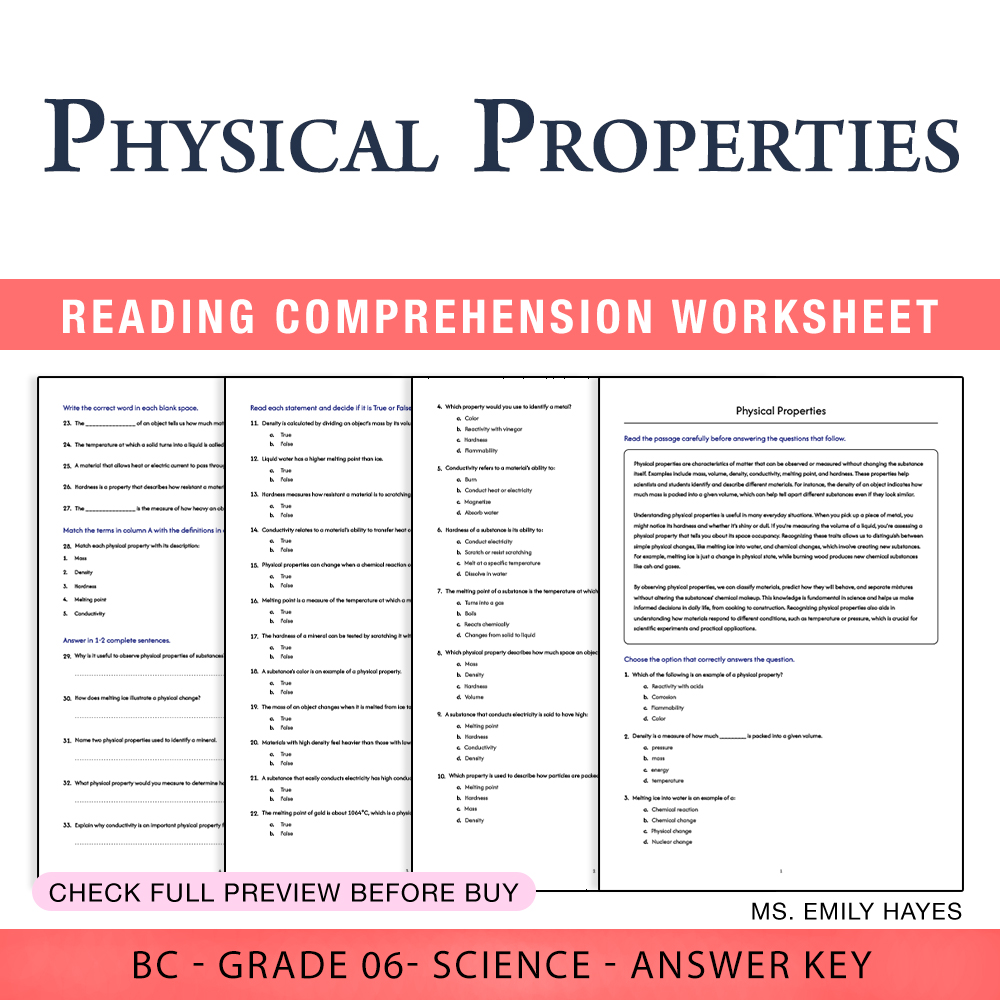
6th Grade Science | Physical Properties Worksheet (PDF+ Answer Key)
 Created byCopper Leaf Classroom
Learning Objectives
- Understand and define physical properties of matter such as mass, volume, density, conductivity, melting point, and hardness.
- Differentiate between physical changes and chemical changes based on physical property observations and measurements.
- Recognize common examples of physical properties and describe how they are used to identify substances.
Also included in: Grade 6 Science BC| Reaction Rates & Chemical Properties (PDF+ Answer Keys) +1 more
Instant download
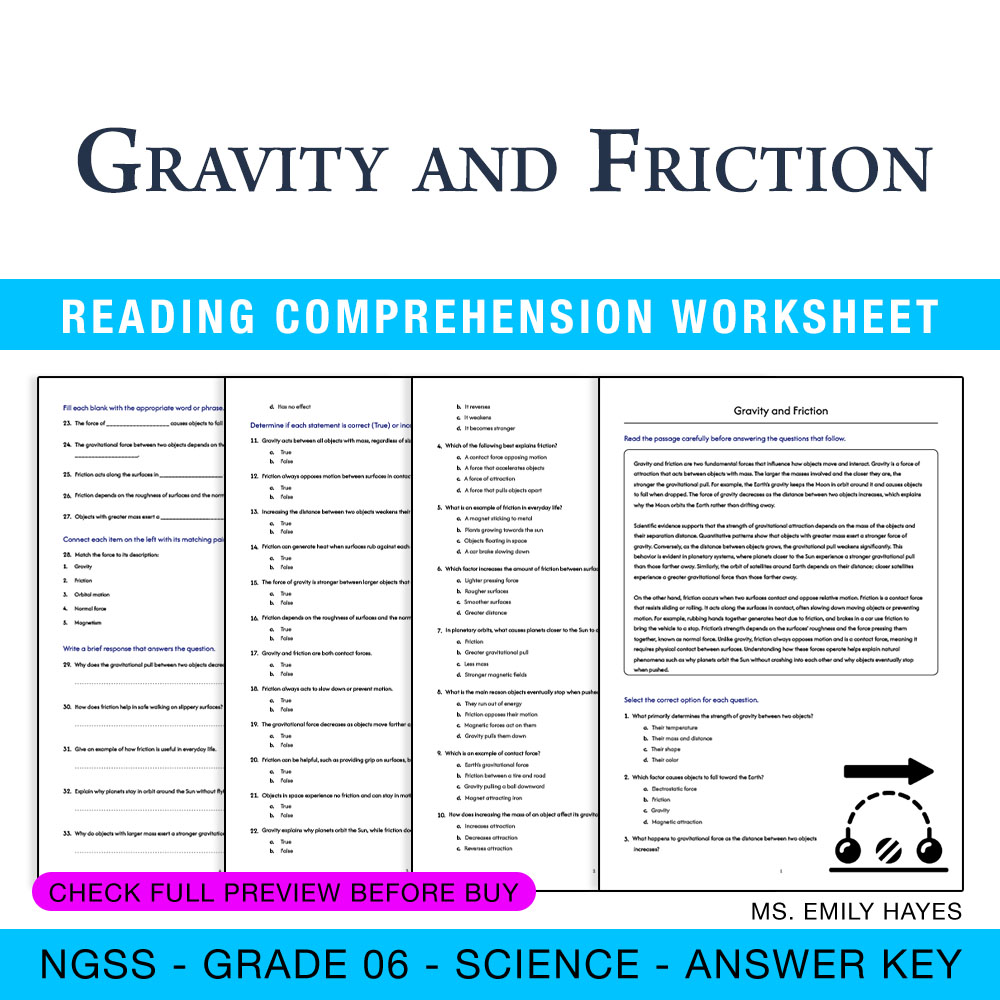
6th Grade Science | Gravity and Friction Worksheet (PDF + Answer Key)
Created byCopper Leaf ClassroomLearning Objectives
- Describe how gravity depends on mass and distance using examples like Earth-Moon system and planetary orbits.
- Explain the concept of friction as a contact force that resists motion along surfaces.
- Differentiate between gravitational forces and contact forces such as friction in how they affect motion and orbiting behavior.
Instant download

Grades 6 - 8 Holiday Worksheet - Summer Transitions Assessment
Learning Objectives
- Explain how children can transition from school routines to summer activities responsibly and safely.
- Identify rights and responsibilities that support independence during summer break.
- Compare how different cultures approach summer breaks and how emotions and planning affect well-being.
Instant download
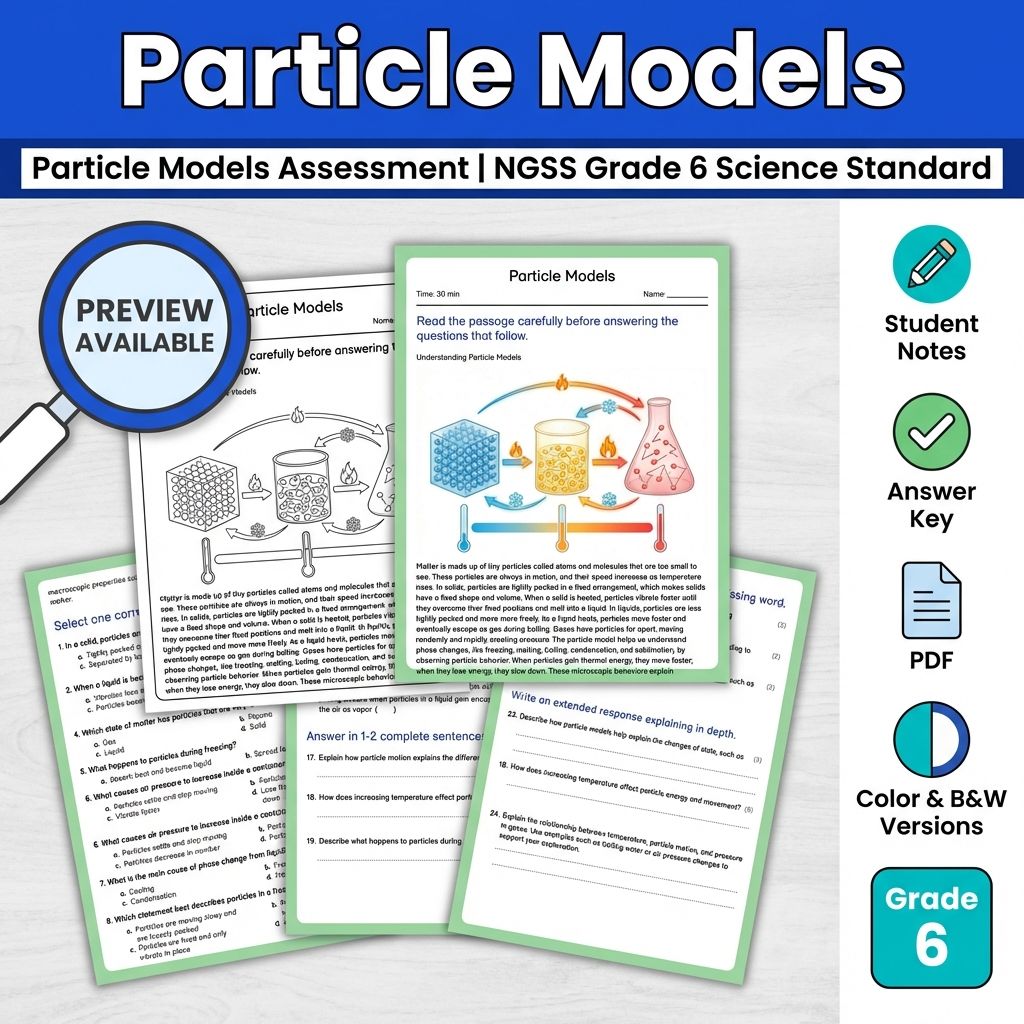
Particle Models Assessment | NGSS Grade 6 Science Standard
Created byPrism Point LearningLearning Objectives
- Explain matter as composed of particles too small to see using particle models.
- Describe how particle motion, collisions, and spacing relate to states of matter and phase changes.
- Relate temperature and thermal energy to particle kinetic energy and pressure in gases.
Also included in: Grade 6 Science Mini Bundle | Matter and Its Interactions NGSS Not Specified +1 more
Instant download

Food Webs Worksheet for Grade 6 Science | Standards-Aligned Assessment
JCreated byJ.S SheetsLearning Objectives
- Understand the concept of a food web and its interconnected feeding relationships.
- Identify how changes in one species can affect the entire ecosystem.
- Recognize the importance of biodiversity and connectivity in ecosystem stability.
Instant download

Groundwater and Baseflow Worksheet | Grade 6 Water Cycle Practice
Created byPrism Point LearningLearning Objectives
- Explain how precipitation infiltrates and percolates to recharge groundwater stored in aquifers.
- Describe how groundwater can supply streams as baseflow and help maintain river flow during dry periods.
- Identify how permeability and landscape geometry affect the connection between groundwater and surface water.
Also included in: Grade 6 Water Cycle Systems Lesson Bundle | California Standards
Instant download

Energy Drives Change Worksheet Grade 6 Science Energy Transfer
Created byPrism Point LearningLearning Objectives
- Explain how energy from the Sun and gravity drive Earth system processes such as heating, evaporation, and the movement of water and sediments.
- Describe how changes in energy affect water’s state and how this relates to evaporation and cloud formation.
- Connect energy-driven weathering and transport to changes in where sediments and soils accumulate.
Also included in: Grade 6 Water Cycle Systems Lesson Bundle | California Standards
Instant download

Precipitation and Infiltration Worksheet Grade 6 Water Cycle Practice
Created byPrism Point LearningLearning Objectives
- Explain how precipitation returns water to Earth’s surface.
- Describe how infiltration affects soil moisture and possible groundwater recharge.
- Compare infiltration and surface runoff as pathways for water movement.
Also included in: Grade 6 Water Cycle Systems Lesson Bundle | California Standards
Instant download

Condensation and Clouds Worksheet Grade 6 Science Water Cycle
Created byPrism Point LearningLearning Objectives
- Explain how water vapor changes into liquid droplets or ice crystals during condensation.
- Describe how cloud formation connects atmospheric conditions to rainfall.
- Connect clouds to energy balance by explaining how they affect sunlight.
Also included in: Grade 6 Water Cycle Systems Lesson Bundle | California Standards
Instant download
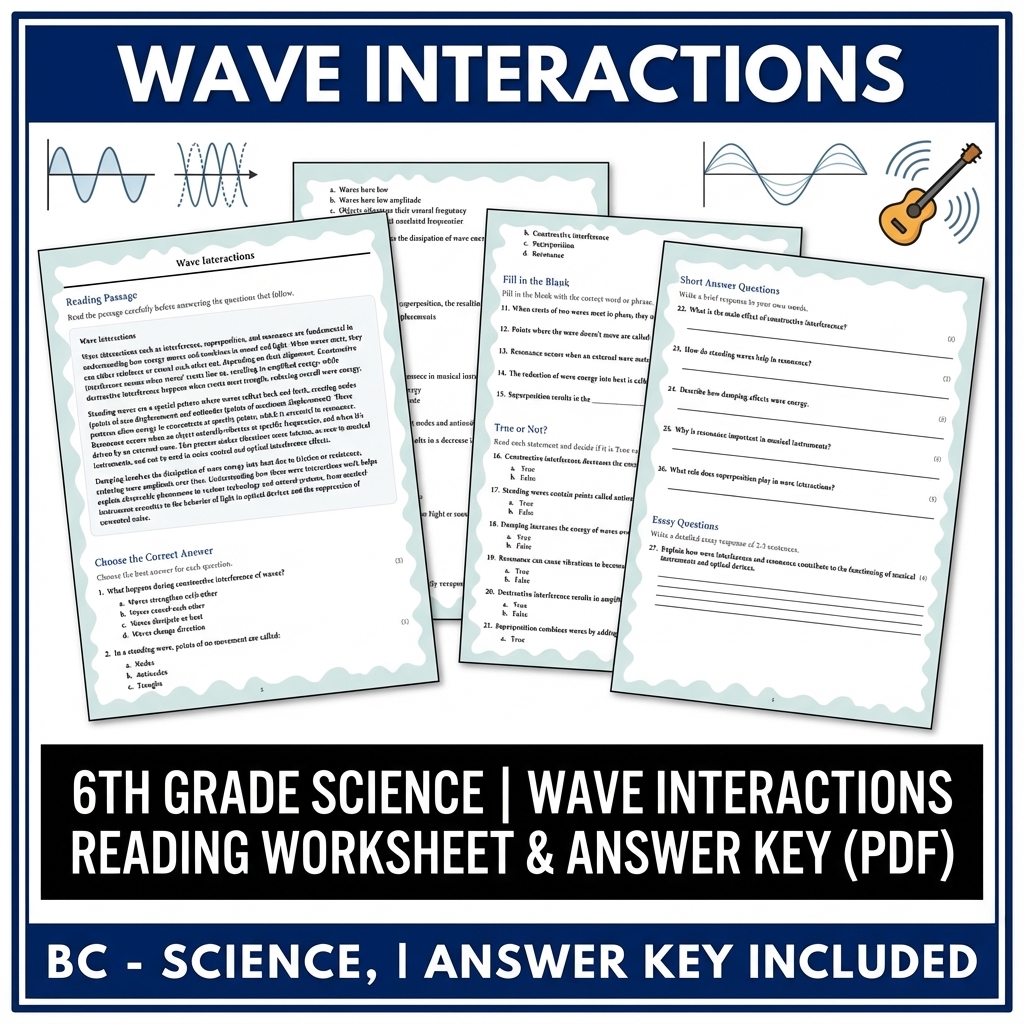
6th Grade Science | Wave Interactions Reading Worksheet (PDF & Answer Key)
JCreated byJ.S SheetsLearning Objectives
- Describe how wave interference, superposition, and resonance affect sound and light.
- Explain the processes of constructive and destructive interference in waves.
- Identify how standing waves and resonance influence energy concentration in systems.
Instant download
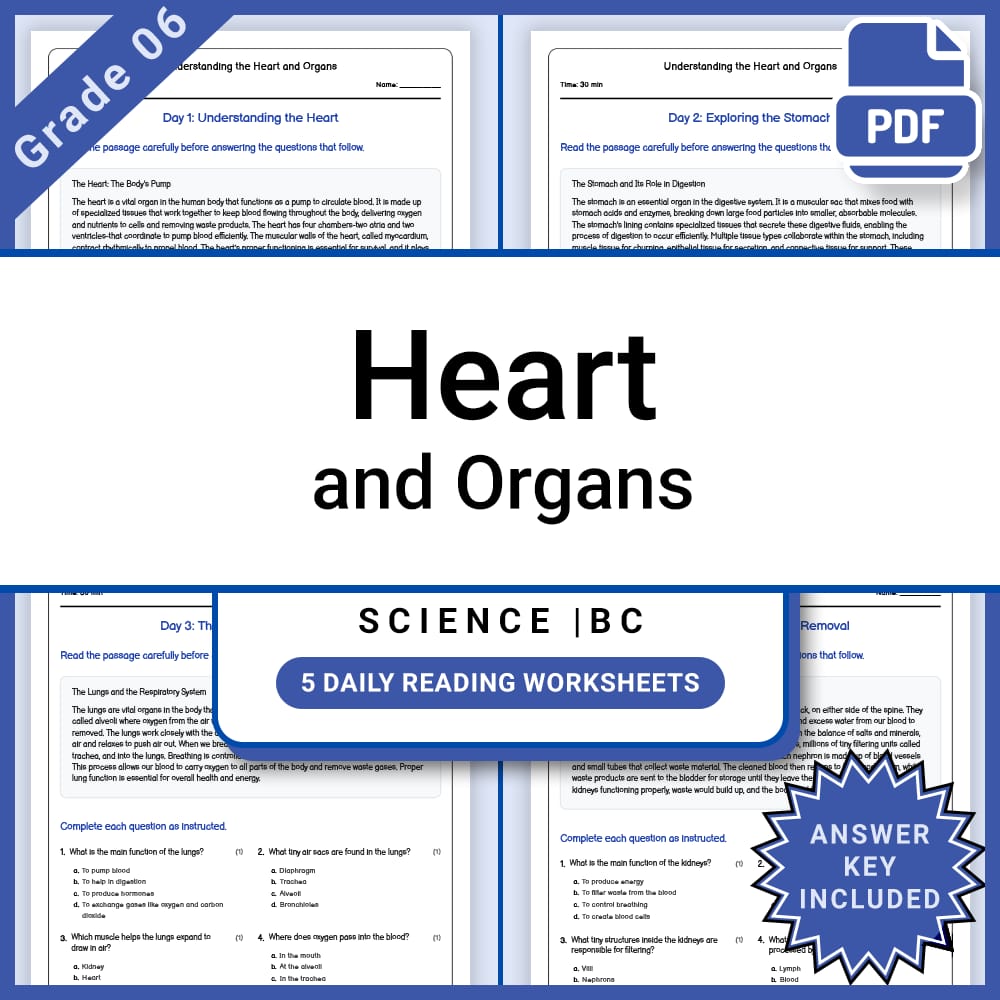
Grade 6 Science – Heart and Organs Daily Reading Worksheet + Answer Key
JCreated byJ.S SheetsLearning Objectives
- Define what an organ is and describe its functions.
- Identify the structure and function of the heart as a vital organ.
- Differentiate between tissues and organs in the human body.
Also included in: Grade 6 Science Lesson Group | Body Systems and Adaptations Bundle +1 more
Instant download
Browse more categories
About Grade 6 Worksheets
Browse 8,578 printable Grade 6 worksheets across math, ELA, science, and social studies — each a ready-to-print PDF with optional answer keys.
MyTeachingSheets worksheets are made by real teacher-authors and checked before they go live. Download any as a print-ready PDF for lessons, homework, or independent practice — most include answer keys, and previews are always free.