
Grade 6 Worksheets
8,582 grade resources
Cultural Crossroads Worksheet | California Standards Grade 6 Social Studies
JCreated byJ.S SheetsLearning Objectives
- Explain how Egypt and Kush interacted through trade, diplomacy, and warfare along the Nile Valley.
- Identify ways cultural ideas (art and religion) were exchanged between Egyptian and Kushite societies.
- Use timelines and map ideas to compare changes and influences in each civilization over time.
Instant download

Grade 6 Science – Component Functions & Circuits | Daily Reading Worksheet
 Created byBright Mind Resources
Learning Objectives
- Identify and describe the roles of common circuit components such as power sources, resistive loads, switches, and connectors.
- Interpret schematic symbols and relate them to physical components.
- Understand how each component affects current and voltage within a circuit.
Also included in: Grade 6 Electricity Science Daily Reading Lesson Bundle | Ontario +1 more
Instant download

6th Grade ELA Worksheet – Drafting Process | Common Core (PDF)
 Created byGolden Apple Studio
Learning Objectives
- Explain the purpose of planning, outlining, drafting, and revising in the drafting process
- Use audience and purpose to make decisions about content, organization, and word choice
- Create and use a simple outline to draft coherent paragraphs with topic sentences and transitions
Also included in: Grade 6 ELA Claim, Evidence & Argument Writing Lesson Bundle | CCSS +1 more
Instant download

Health Decision Foundations Worksheet | Grade 6 NHES Health Activities
 Created byPrism Point Learning
Learning Objectives
- Describe a simple process for making health decisions using available information.
- Identify how personal values, preferences, and context influence choices.
- Practice evaluating options for everyday health behaviors such as food, exercise, and safety.
Instant download

Text Features Worksheet for Grade 6 ELA | Standards-Aligned Practice PDF
JCreated byJ.S SheetsLearning Objectives
- Identify common text features in informational texts, including headings, subheadings, captions, and graphics.
- Explain how text features help readers locate and understand key information.
- Use text features to navigate a text and support comprehension.
Instant download

Carrying Capacity and Resource Limits Worksheets | Grade 6 Science
 Created byTeachers Club
Learning Objectives
- Explain how limited resources affect population size over time
- Interpret quantitative observations and identify patterns related to carrying capacity
- Use resource gradients to predict species distribution in different environments
Also included in: Grade 6 Science Full Year Bundle | NGSS Worksheets & Printables +1 more
Instant download
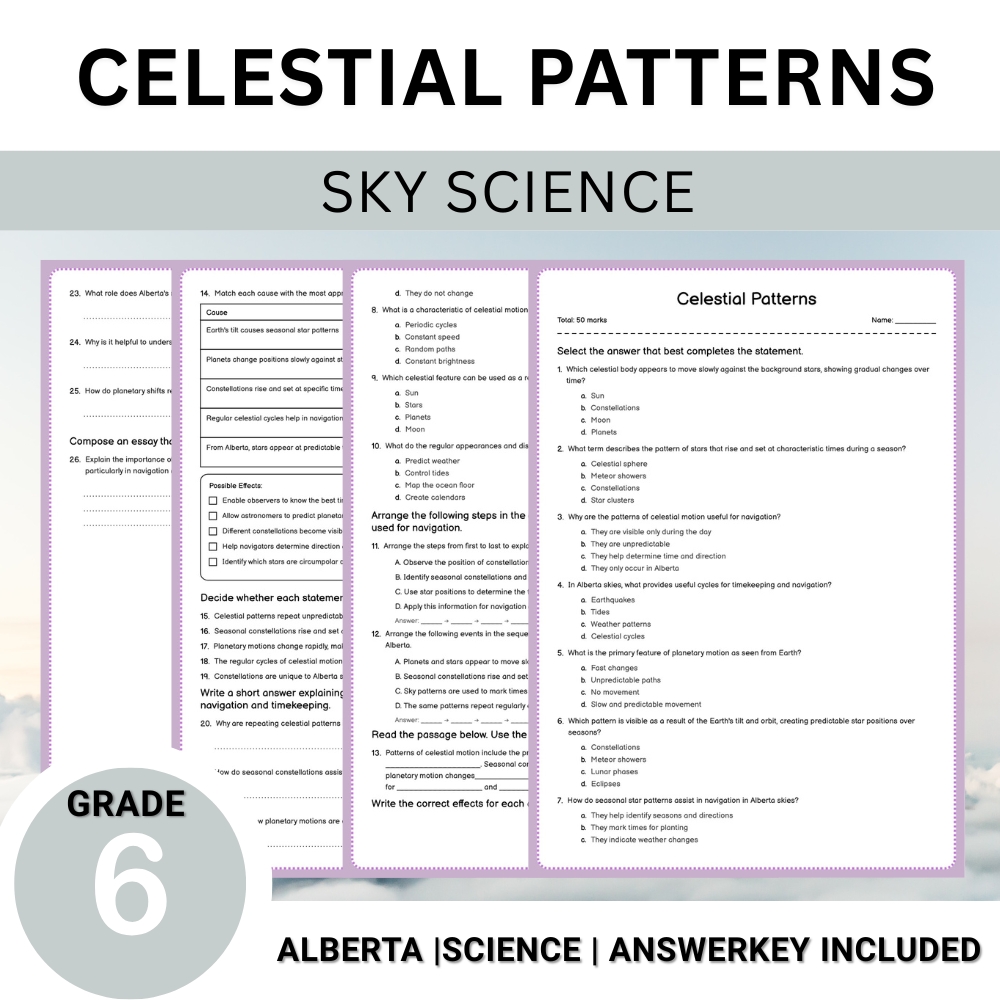
Grade 6 Science | Celestial Patterns Worksheet (Assessment & Student Practice PDF)
Learning Objectives
- Identify and describe common celestial motion patterns, including the paths of the Sun, Moon, planets, and constellations.
- Explain how seasonal constellations and planetary appearances are used for timekeeping and navigation.
- Predict celestial positions based on observed repeating patterns in the night sky.
Also included in: Grade 6 Science | Celestial & Space Phenomena UNIT Worksheet Bundle (Assessment & Practice) +1 more
Instant download
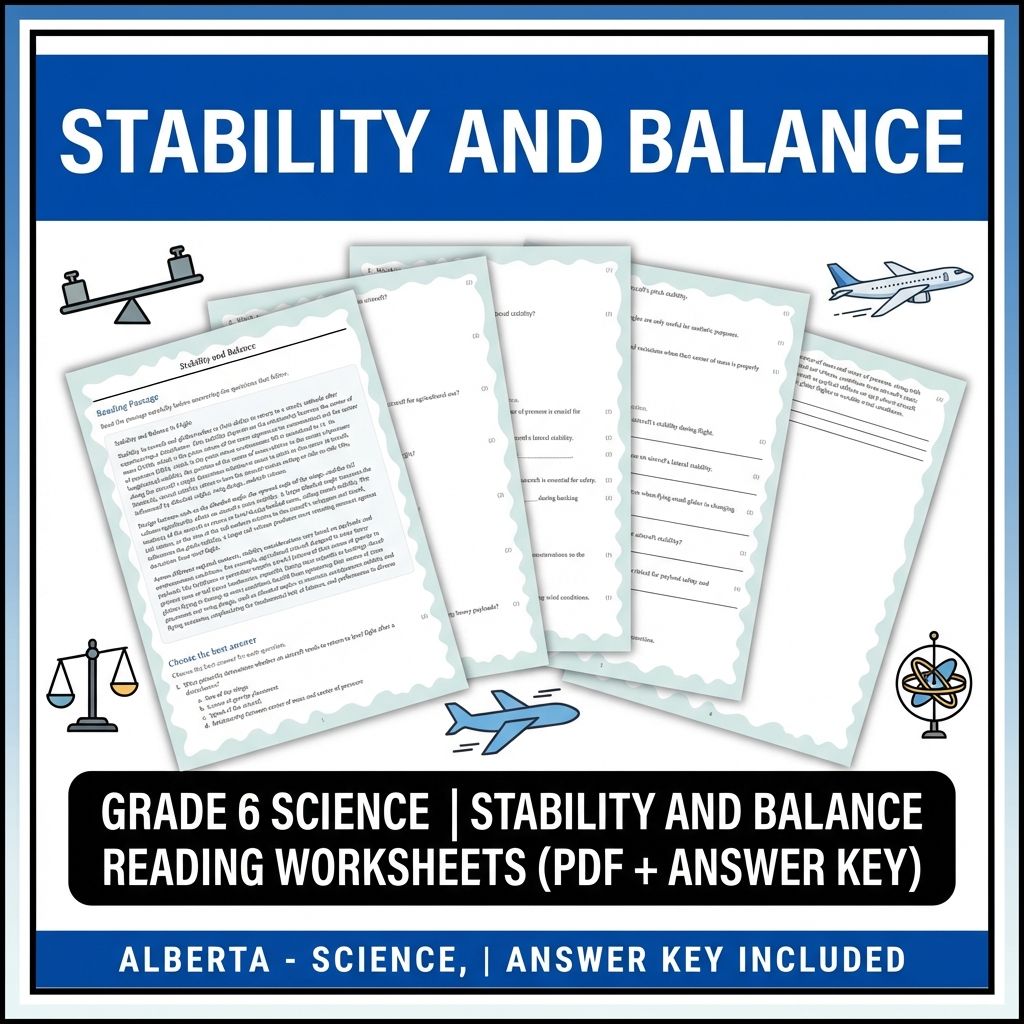
Grade 6 Science | Stability and Balance Reading Worksheets (PDF + Answer Key)
JCreated byJ.S SheetsLearning Objectives
- Understand how longitudinal and lateral stability affect aircraft and glider behavior.
- Explain the relationship between center of mass and center of pressure in maintaining stability.
- Identify design features such as dihedral angles and tail volume that contribute to static stability.
Also included in: Grade 6 Science | Flight Physics & Aerodynamics UNIT Pack (Answer Keys Included) +1 more
Instant download

Grade 6 Science – Tools Safety & Measurement Practices | Daily Reading Worksheet
Created byBright Mind ResourcesLearning Objectives
- Identify proper handling procedures for measurement tools.
- Recognize safety precautions for electronic and mechanical instruments.
- Understand protocols to prevent contamination and device damage.
Also included in: Grade 6 Science Data & Inquiry Daily Reading Worksheets Lesson Bundle | Alberta +2 more
Instant download

How Variation Becomes Traits: DNA, Environment & Grade 6 Worksheet
Created byTeachers ClubLearning Objectives
- Explain how DNA sequence differences can lead to phenotypic variation in a population.
- Describe how environmental factors can affect traits through development and gene expression.
- Use evidence-based examples to connect macromolecules and gene regulation to organism characteristics.
Also included in: From Molecules to Organisms Grade 6 Science NGSS Bundle +2 more
Instant download

Grade 6 | World Refugees Day Worksheet for Building Bridges | PDF + Answer Key
 Created byShaNova Worksheets
Learning Objectives
- Explain what World Refugees Day is and why it is observed on June 20
- Identify respectful and supportive actions that help build bridges between communities
- Use accurate vocabulary related to refugees, displacement, and human rights
Instant download

Grade 6 Science | Introduction to Particle Models - Daily Reading Comprehension
 Created byCoral Reef Learning
Learning Objectives
- Understand the concept of matter being made up of tiny particles.
- Recognize different types of atoms and molecules in particle models.
- Learn how particle models help explain properties and changes in substances.
Instant download

Cell Structure and Organelles Worksheets | Grade 6 Science
 Created byBRIGHT PATH RESOURCES
Learning Objectives
- Identify major parts of a cell and describe their basic functions.
- Explain how the cell membrane controls what enters and leaves the cell.
- Use evidence from a passage to fill in missing cell-structure terms.
Also included in: Grade 6 Life Science Worksheets Bundle | Ecosystems & Body Systems +2 more
Instant download

6th Grade Science | Forces and Motion Worksheet with Answer Key (Printable PDF)
Created byCoral Reef LearningLearning Objectives
- Describe the relationship between net force, mass, and acceleration based on Newton's Second Law.
- Explain how vector addition influences the motion of objects under multiple forces.
- Identify real-world scenarios involving net force and calculate resulting motion changes.
Instant download

Caption Meanings Worksheet Pack | Grade 6 ELA Activities
 Created bySunny Desk Resources
Learning Objectives
- Explain how captions help readers interpret images and diagrams accurately
- Identify the purpose of caption details such as definitions, context, sources, and limitations
- Use caption information to make correct inferences about what the author wants the reader to notice
Also included in: Grade 6 Reading and Viewing Lesson Bundle | Alberta ELA Framework +1 more
Instant download

Earth's Spheres and Interior Worksheets | Grade 6 TEKS Science
Created byPrism Point LearningLearning Objectives
- Identify examples of the biosphere, hydrosphere, atmosphere, and geosphere
- Identify the crust, mantle, outer core, and inner core
- Compare Earth's spheres with its interior layers
Instant download

Density Evidence Worksheet | Grade 6 Science Practice
Created byPrism Point LearningLearning Objectives
- Explain how density links mass and volume to predict whether an object will float or sink
- Use density evidence to compare substances and interpret layers in mixtures
- Make claims supported by measurements or estimates of density
Instant download

Food Molecules Worksheet | Grade 6 Digestion & Energy Science
Created byPrism Point LearningLearning Objectives
- Explain how food provides chemical building materials and stored energy to the body.
- Describe how digestion breaks large food molecules into smaller molecules that can be absorbed.
- Connect specific food molecules with different body needs (like proteins for structure and carbohydrates for quick energy).
Also included in: Animals Matter Lesson Bundle | Grade 6 Science | California Standards
Instant download

Language Precision Worksheet Grade 6 TEKS ELA Academic Vocabulary Skills
Created bySunny Desk ResourcesLearning Objectives
- Identify how precise verbs and qualifiers (like likely, may, always) change the certainty of a claim.
- Use comparative terms (like greater, less, similar) to interpret relationships and avoid misreading conclusions.
- Revise sentences by replacing vague language with more precise language to support accurate understanding.
Instant download

Chemical Evidence Worksheet Grade 6 Science Chemical Change Activities
Created byPrism Point LearningLearning Objectives
- Identify chemical evidence by observing changes such as color change, gas formation, and precipitates.
- Explain why chemical evidence shows a change in composition, not just temporary mixing.
- Use examples like iron rusting and burning paper to connect observations to particle-level changes.
Instant download

Plot Development Worksheet Pack Grade 6 ELA Practice and Review
Created bySunny Desk ResourcesLearning Objectives
- Identify the stages of plot (exposition, rising action, climax, falling action, resolution) in a story.
- Explain how events are interconnected and build conflict toward a climax.
- Use plot sequencing to describe how a resolution connects to the story’s central idea.
Also included in: Reading: Literature Lesson Bundle | Grade 6 ELA | Common Core (CCSS) +1 more
Instant download

Tides Worksheets: Daily, Spring and Neap Tides Grade 6 TEKS
Created byPrism Point LearningLearning Objectives
- Explain how Moon and Sun gravity contributes to tidal patterns
- Compare daily tides with spring and neap tide conditions
- Interpret Earth-Moon-Sun positions to explain tidal range
Instant download

Food Chains Worksheet | Grade 6 Science TEKS Practice
Created byPrism Point LearningLearning Objectives
- Define producers, consumers, and decomposers and describe how each role supports a food chain.
- Identify trophic levels in simple pond and grassland examples and explain energy transfer between levels.
- Explain why energy decreases at each step and how matter (nutrients) is recycled through detrital processing.
Also included in: Grade 6 Ecosystem Interactions Science Lesson Bundle Worksheets | TEKS +1 more
Instant download

Audience Fit Grade 6 ELA Writing Skills Worksheet Ontario
Created bySunny Desk ResourcesLearning Objectives
- Identify how purpose and audience change word choice, details, and organization in writing
- Select appropriate tone and level of explanation for different audiences
- Revise a piece of writing to better fit an audience using evidence and clarity
Instant download

Making Inferences Worksheet Grade 6 ELA Reading Comprehension + Answer Key
 Created byLumora Learning
Learning Objectives
- Explain what an inference is and how it differs from a stated fact
- Make inferences by using clues such as word choice (tone) and events in a text
- Support an inference with specific evidence from the text
Instant download
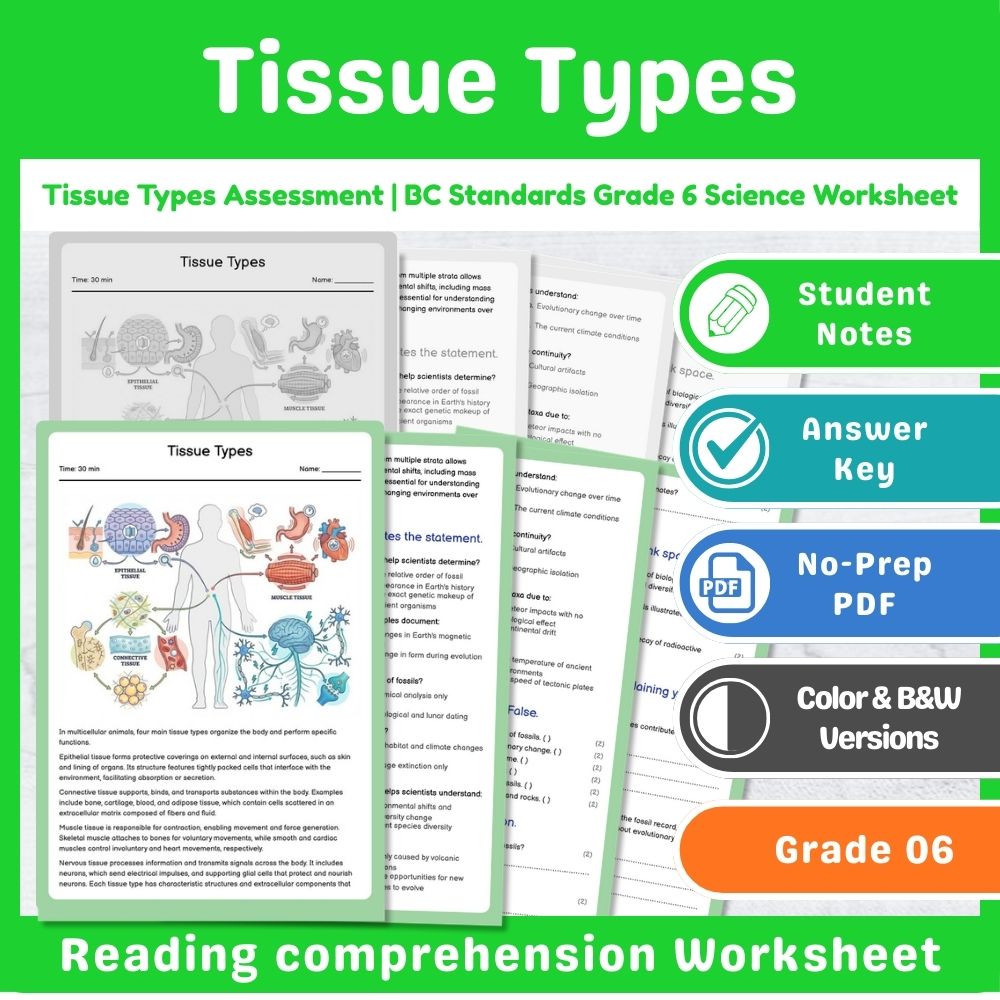
Tissue Types Assessment | BC Standards Grade 6 Science Worksheet
Created byPrism Point LearningLearning Objectives
- Identify the four main tissue types in animals: epithelial, connective, muscle, and nervous.
- Describe the functions and structures of each tissue type.
- Explain how tissue types organize to form organs and contribute to animal body functions.
Instant download

Grade 6 Tissue Types Worksheet | BC Practice & Assessment PDF
 Created byClear Sky Classroom
Learning Objectives
- Identify the four main tissue types in multicellular animals and describe what each tissue type mainly does
- Match tissue types to their key functions and characteristic structures
- Explain how epithelial, connective, muscle, and nervous tissues work together in organs
Instant download

Grade 6 Science – Musculoskeletal System & Daily Reading Worksheet
Created byBright Mind ResourcesLearning Objectives
- Identify the main components of the musculoskeletal system (bones, muscles, joints).
- Describe the functions of bones, muscles, and joints in supporting the body.
- Explain how the system interacts with other body systems for movement and support.
Also included in: Grade 6 Science: Organ Systems & Adaptations Daily Reading Lesson Bundle | BC +1 more
Instant download

Grade 6 Solar Timekeeping Worksheet | Alberta Practice PDF
Created byClear Sky ClassroomLearning Objectives
- Explain how apparent solar motion produces local solar noon and a solar-based clock.
- Describe why solar time and civil clock time can differ due to longitude, time zones, and the equation of time.
- Connect observed solar position to how communities schedule activities using civil time.
Also included in: Grade 6 Sky Science Sun–Earth–Moon Science Lesson Bundle for Alberta +1 more
Instant download

Grade 6 Optimizing Designs in Science Worksheet | NGSS Engineering Activity
Created byBRIGHT PATH RESOURCESLearning Objectives
- Understand how to analyze data from prototype tests
- Learn to interpret graphs, averages, and discuss errors
- Evaluate trade-offs in design choices such as strength vs. weight
Also included in: Engineering Design Grade 6 Science Daily Reading Worksheets Lesson Bundle | Ngss +2 more
Instant download

Circuit Components Worksheets: Functions of Circuits Grade 6 Science
Created byPrism Point LearningLearning Objectives
- Identify functions of power sources, switches, loads, and connectors
- Match physical circuit components with their schematic symbols
- Explain how resistance changes qualitatively affect circuit current
Also included in: Grade 6 Electricity Lesson Bundle | Ontario Science Framework
Instant download

6th Grade Health Worksheet | Inclusive Participation & Respect (PDF)
Created bySunny Desk ResourcesLearning Objectives
- Explain strategies for safe, inclusive participation in physical activities.
- Identify how to make respectful modifications so everyone can join in.
- Demonstrate respectful communication and teamwork behaviors during activity.
Also included in: Grade 6 Active Living Health Lesson Bundle: Ontario Health Skills Framework +1 more
Instant download

Theme Meaning Inferences Worksheet Pack | Grade 6 ELA Practice
Created bySunny Desk ResourcesLearning Objectives
- Use details from a text to make inferences about a theme
- Explain how patterns (repeated ideas, conflicts, and decisions) support a theme
- Distinguish between an explicit statement and its broader implication
Also included in: Reading and Viewing Lesson Bundle – Grade 6 ELA (BC Framework) +1 more
Instant download

6th Grade Math – Organizing Data Worksheet (Ontario) Practice Set (PDF)
Created byClear Sky ClassroomLearning Objectives
- Understand how to organize data into tables and charts for clearer interpretation.
- Apply basic calculations to interpret data displays and draw conclusions.
- Develop problem-solving skills related to data organization in real-world contexts.
Also included in: Grade 6 Maths Lesson Group Bundle – Data, Probability, Measures & Analysis +1 more
Instant download
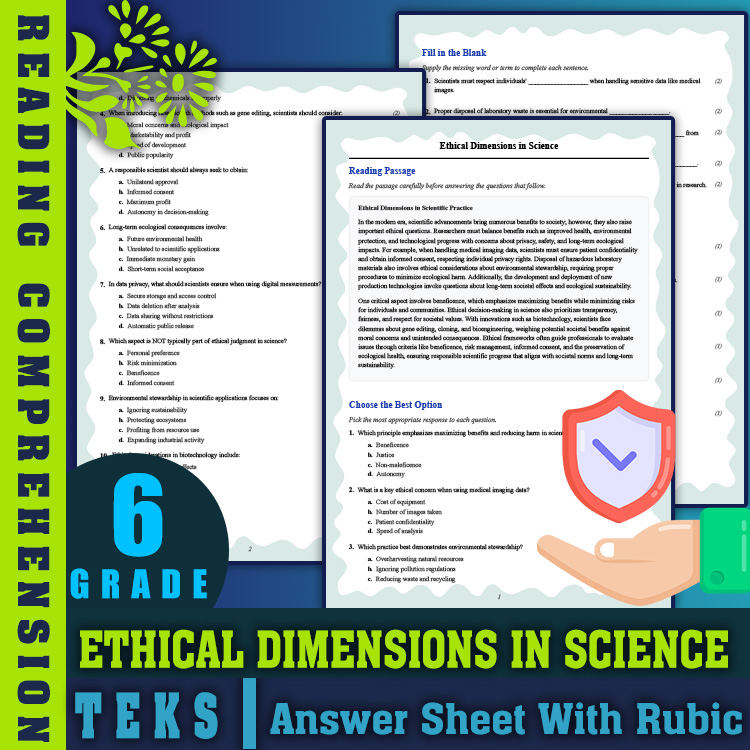
6th Grade Science | Ethical Dimensions in Science Reading Worksheet
JCreated byJ.S SheetsLearning Objectives
- Understand the key ethical considerations in scientific applications.
- Evaluate scenarios based on ethical principles such as beneficence, informed consent, and risk minimization.
- Identify appropriate ethical responses to issues like data privacy, environmental stewardship, and biotechnology decisions.
Instant download

Grade 6 Science | Energy Drives Change Worksheet Elena | California Standards
Created byLumora LearningLearning Objectives
- Explain how energy from the Sun and gravity drive Earth system processes.
- Describe how heating affects water state changes, evaporation, and cloud formation.
- Model how gravity influences the movement and accumulation of sediments on slopes.
Instant download
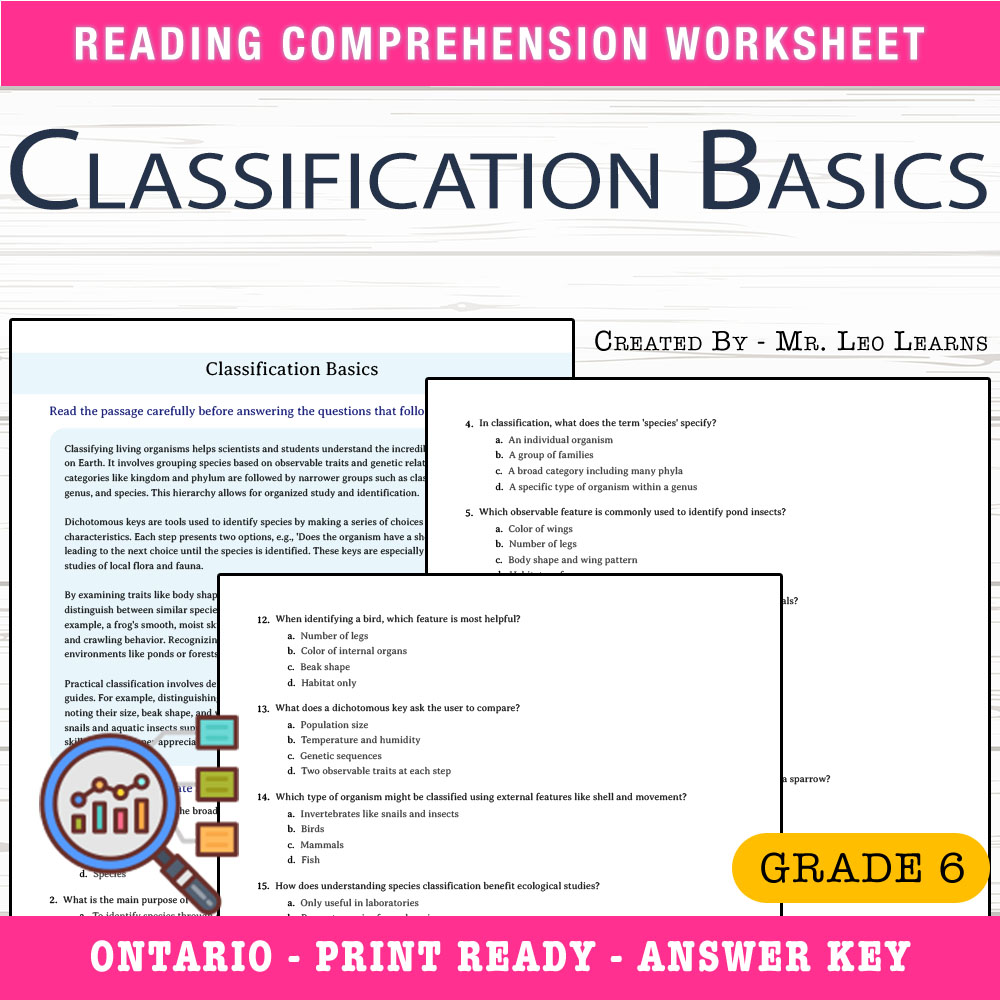
Grade 6 Science — Classification Basics Worksheet for Mastery
 Created byThe Resource Hub
Learning Objectives
- Understand the hierarchy of biological classification from kingdom to species.
- Learn how to use observable characteristics to classify local species.
- Understand the purpose and construction of dichotomous keys for identifying organisms.
Also included in: Grade 6 Science Unit Bundle | Ecosystems, Genetic Traits & Environmental Impact +1 more
Instant download

Tone and Voice Worksheet for Grade 6 ELA | Standards-Aligned Practice PDF
JCreated byJ.S SheetsLearning Objectives
- Explain how tone shows an author’s attitude and how voice reflects a writer’s style and stance.
- Identify word choice and sentence style that create either a formal or an informal tone.
- Revise a short message to match an intended audience by adjusting tone and voice.
Instant download

Energy Transformations Assessment for Grade 6 Science | NGSSS Standards
Created byPrism Point LearningLearning Objectives
- Explain how energy can change forms (potential, kinetic, thermal, electrical, and light) while total energy is conserved.
- Identify observable evidence of energy transformations such as motion, temperature change, and brightness.
- Use cause-and-effect reasoning to describe how one energy form transfers to another in real-world situations.
Also included in: Grade 6 Energy and Matter Science Lesson Bundle Unit: Florida NGSSS
Instant download

Science Worksheet: Variation Effects Assessment | NGSS Grade 6
 Created bySkylark Worksheets
Learning Objectives
- Explain how phenotypic variation can result from interactions between genes and environmental factors.
- Describe how environmental conditions can influence gene expression and traits during development.
- Use examples (nutrition, temperature, inherited traits) to predict how traits may differ within a population.
Also included in: Grade 6 Cell Systems and Energy Pathways Science Lesson Bundle NGSS +1 more
Instant download

Grade 6 Social Studies — Education Change Worksheet MCQ Paper
Created byThe Resource HubLearning Objectives
- Identify key differences between Indigenous approaches to learning and later institutional schooling.
- Explain reasons governments promoted educational reforms using policy and economic needs.
- Describe consequences of schooling changes for cultural continuity and assimilation.
Instant download

Grade 6 Science Worksheet Learn Iterative Improvement Easily | PDF
 Created byMeadowlark Worksheets
Learning Objectives
- Understand the concept of iterative improvement and its role in design.
- Identify how evaluation results influence design changes.
- Explain the importance of balancing properties, needs, and limitations during refinement.
Also included in: Grade 6 Science Lesson Bundle | Critical Thinking & Problem Solving +1 more
Instant download

Grade 6 Science | Community Stewardship in Science - Daily Reading Comprehension
Created byCoral Reef LearningLearning Objectives
- Understand the importance of scientific methods in community issues.
- Recognize the role of respectful engagement and cultural sensitivity.
- Learn protocols for obtaining consent and validating community data.
Instant download

Grade 6 Cloud And Precipitation Worksheet | NGSS Practice PDF
Created byClear Sky ClassroomLearning Objectives
- Explain how clouds form when water vapor cools and condenses onto tiny particles in the atmosphere
- Describe how precipitation forms when droplets or ice crystals become heavy enough to fall
- Distinguish between types of precipitation (rain, snow, sleet, hail) based on temperature changes
Instant download

Grade 6 Math | Value and Savings Worksheet (PDF) – Ontario Standards
Created byClear Sky ClassroomLearning Objectives
- Understand how to determine the value of products in relation to their costs.
- Apply percentage discounts and savings to real-world shopping scenarios.
- Evaluate different options to identify the best value for money.
Also included in: Grade 6 Math Financial Literacy Bundle | Ontario Standards Practice +1 more
Instant download

Grade 6 Social Studies — Rural Continuities Worksheet MCQ Paper
Created byThe Resource HubLearning Objectives
- Explain how rural communities maintain continuity in farming and resource harvesting over time.
- Analyze how technology, family labor, and local governance interact to shape rural life.
- Evaluate evidence from oral histories and archival records to interpret rural identity and resilience.
Instant download

Science Careers Worksheet | Grade 6 Science Activities
Created byPrism Point LearningLearning Objectives
- Describe how scientific inquiry and technology work together in different science careers.
- Match common workplace tasks to specific roles in science and engineering.
- Explain how data collection and instrument use support interpreting measurement results.
Also included in: Grade 6 Science Ethics and Societal Impacts Lesson Bundle for TEKS +1 more
Instant download

Building on Peers Grade 6 ELA Worksheet | Standards-Aligned Practice PDF
JCreated byJ.S SheetsLearning Objectives
- Explain how collaborative discussion refines ideas through paraphrasing, acknowledging others, and adding connections.
- Use respectful disagreement based on reasoning or evidence rather than personal comments.
- Practice claim-and-counterclaim speaking moves by referencing shared points and asking follow-up questions.
Instant download
Browse more categories
About Grade 6 Worksheets
Browse 8,582 printable Grade 6 worksheets across math, ELA, science, and social studies — each a ready-to-print PDF with optional answer keys.
MyTeachingSheets worksheets are made by real teacher-authors and checked before they go live. Download any as a print-ready PDF for lessons, homework, or independent practice — most include answer keys, and previews are always free.