
Grade 6 Science Worksheets
5,969 worksheets
Grade 6 Control Surfaces Worksheet | Alberta Practice & PDF
 Created byClear Sky Classroom
Learning Objectives
- Identify the functions of ailerons, elevators, and rudders in changing an aircraft’s motion
- Explain how control surface deflection changes lift, drag, and aerodynamic moments
- Describe how roll, pitch, and yaw relate to aircraft attitude changes
Also included in: Grade 6 Air and Aerodynamics Science Lesson Bundle (Alberta Framework) +1 more
Instant download

Grade 6 Cell Functions Worksheet | NGSS Practice PDF
Created byClear Sky ClassroomLearning Objectives
- Identify the main organelles of a cell and their functions.
- Understand how cell structures relate to their roles in energy production, protein synthesis, waste removal, and regulation.
- Compare plant and animal cells to see how specialization affects cell function.
Also included in: Grade 6 Molecules to Organisms Science Lesson Bundle: Structures (NGSS) +1 more
Instant download

Grade 6 Conservation of Mass Worksheet | NGSS Practice PDF
Created byClear Sky ClassroomLearning Objectives
- Understand that mass is conserved during physical and chemical changes.
- Trace atoms and molecules through different processes to see that total mass remains constant.
- Use models and diagrams to explain the principle of mass conservation in closed systems.
Also included in: Grade 6 Matter & Chemical Reactions Science Lesson Bundle—NGSS Worksheets +1 more
Instant download

Grade 6 Energy Flow Worksheet | NGSS Practice PDF
Created byClear Sky ClassroomLearning Objectives
- Understand the components of food webs, including producers, consumers, and decomposers.
- Explain how energy diminishes across trophic levels in an ecosystem.
- Describe the roles of photosynthesis and cellular respiration in energy transfer.
Also included in: Grade 6 Ecosystems Science Lesson Bundle for NGSS: Species, Energy, Biodiversity +1 more
Instant download

Grade 6 Resource Distribution Worksheet | NGSS Practice & PDF
Created byClear Sky ClassroomLearning Objectives
- Understand how geological processes influence the distribution of mineral, energy, and groundwater resources.
- Identify spatial patterns in resource deposits and aquifers.
- Evaluate the impacts of extraction and technological constraints on resource availability.
Also included in: Grade 6 Human Impacts Earth Systems Science Lesson Bundle Resource – NGSS +1 more
Instant download

Grade 6 Growth and Stored Energy Worksheet | NGSS Practice PDF
Created byClear Sky ClassroomLearning Objectives
- Explain how photosynthesis provides energy for plant growth, repair, and reproduction.
- Describe how plants store chemical energy (such as sugars and starch) for later use.
- Use evidence to connect stored energy to plant structure changes over time.
Instant download

Grade 6 Variation Effects Worksheet | NGSS Practice PDF
Created byClear Sky ClassroomLearning Objectives
- Understand how genetic and environmental factors influence phenotypic variation.
- Identify examples of phenotypic variation caused by different influences.
- Explain the link between DNA, gene expression, and observable traits.
Also included in: Grade 6 Molecules to Organisms Science Lesson Bundle: Structures (NGSS) +1 more
Instant download

Grade 6 Organ Systems Overview Worksheet | BC Use Practice PDF
Created byClear Sky ClassroomLearning Objectives
- Identify major organ systems and the functions they perform in the human body
- Explain how organ systems interact to maintain internal balance (homeostasis)
- Use scientific vocabulary to describe digestion, transport, gas exchange, defense, and control
Instant download

Grade 6 Growth Rings Worksheet | Practice & Assessment PDF
Created byClear Sky ClassroomLearning Objectives
- Explain how tree growth rings record annual radial growth and what information ring width and density can provide
- Describe how dendrochronology uses growth-ring patterns to reconstruct past environmental conditions
- Use evidence from growth rings to connect tree physiology and environmental changes
Also included in: Grade 6 Biodiversity & Plant Ecosystems Science Lesson Bundle | Alberta +1 more
Instant download

Grade 6 Human Impacts Worksheet | Practice & Assessment PDF
Created byClear Sky ClassroomLearning Objectives
- Identify ways human activities alter Earth's systems and cycles.
- Explain the causal links between human actions and environmental changes.
- Analyze examples of land-use change, fossil fuel use, agriculture, and waste management impacts.
Also included in: Grade 6 Human Impacts Earth Systems Science Lesson Bundle Resource – NGSS +1 more
Instant download

Grade 6 Integrated Management Worksheet | Practice & PDF
Created byClear Sky ClassroomLearning Objectives
- Explain how integrated management balances ecological, economic, and social goals in a forest landscape.
- Describe how ecosystem-based planning and monitoring help reduce risks such as wildfire and mountain pine beetle.
- Use evidence from texts to identify main ideas and make connections between stakeholders and forest outcomes.
Also included in: Grade 6 Biodiversity & Plant Ecosystems Science Lesson Bundle | Alberta +1 more
Instant download

Grade 6 Claim Evaluation Worksheet | Practice & PDF
Created byClear Sky ClassroomLearning Objectives
- Use clear criteria to judge whether a claim follows from the provided data and methods
- Evaluate the relevance and consistency of evidence when supporting a scientific conclusion
- Consider uncertainty and alternative explanations when assessing how strong a claim is
Also included in: Grade 6 Scientific Investigation Data Analysis Science Lesson Bundle | Alberta +1 more
Instant download

Grade 6 Species Classification Worksheet | Practice & Assessment PDF
Created byClear Sky ClassroomLearning Objectives
- Classify organisms using functional groups such as producers, consumers, and decomposers
- Distinguish native species from invasive or pest species and explain how they can change ecosystem balance
- Use functional classification to make predictions about energy flow and competitive interactions in ecosystems
Also included in: Grade 6 Biodiversity & Plant Ecosystems Science Lesson Bundle | Alberta +1 more
Instant download

Grade 6 Sky Observations Worksheet | Practice & Assessment PDF
Created byClear Sky ClassroomLearning Objectives
- Explain how systematic sky observations (Sun, Moon, stars) can reveal repeating patterns over time
- Use daily records to describe apparent motions of the Sun and the Moon relative to Earth
- Interpret Moon phases and star patterns using evidence from observational data
Also included in: Grade 6 Sky Science Sun–Earth–Moon Science Lesson Bundle for Alberta +1 more
Instant download

Grade 6 Day Night Cycle Worksheet | Practice & Assessment PDF
Created byClear Sky ClassroomLearning Objectives
- Explain how Earth’s rotation and the fixed direction of sunlight create day and night
- Describe why day length changes during the year due to Earth’s axial tilt and orbit
- Connect observed daylight patterns in Alberta to Earth’s orientation and motion
Also included in: Grade 6 Sky Science Sun–Earth–Moon Science Lesson Bundle for Alberta +1 more
Instant download

Grade 6 Earth Rotation Worksheet | Alberta Practice & PDF
Created byClear Sky ClassroomLearning Objectives
- Explain how Earth’s axial rotation causes alternating daylight and darkness
- Describe how Earth’s rotation creates the apparent daily motion of the Sun and other celestial objects
- Use rotation concepts to relate sunrise, solar noon, and sunset to Earth’s time zones in Alberta
Also included in: Grade 6 Sky Science Sun–Earth–Moon Science Lesson Bundle for Alberta +1 more
Instant download

Grade 6 Mass Conservation Worksheet | Practice & California Standards PDF
Created byClear Sky ClassroomLearning Objectives
- Explain mass conservation in terms of particles and atoms in a closed system
- Connect the idea of conserved atoms to macroscopic measurements of mass
- Use evidence from models to predict how mass changes (or does not change) during reactions
Instant download

Grade 6 Science | Density Evidence Worksheet with Short Notes (Printable PDF)
 Created byMeadowlark Worksheets
Learning Objectives
- Understand how density relates mass to volume and its role in classifying substances.
- Identify behaviors of objects with different densities in water.
- Apply concepts of density to explain why objects float or sink.
Also included in: Grade 6 Science Lesson Bundle – Teaching Transfer, Mixtures, Motion & More +1 more
Instant download
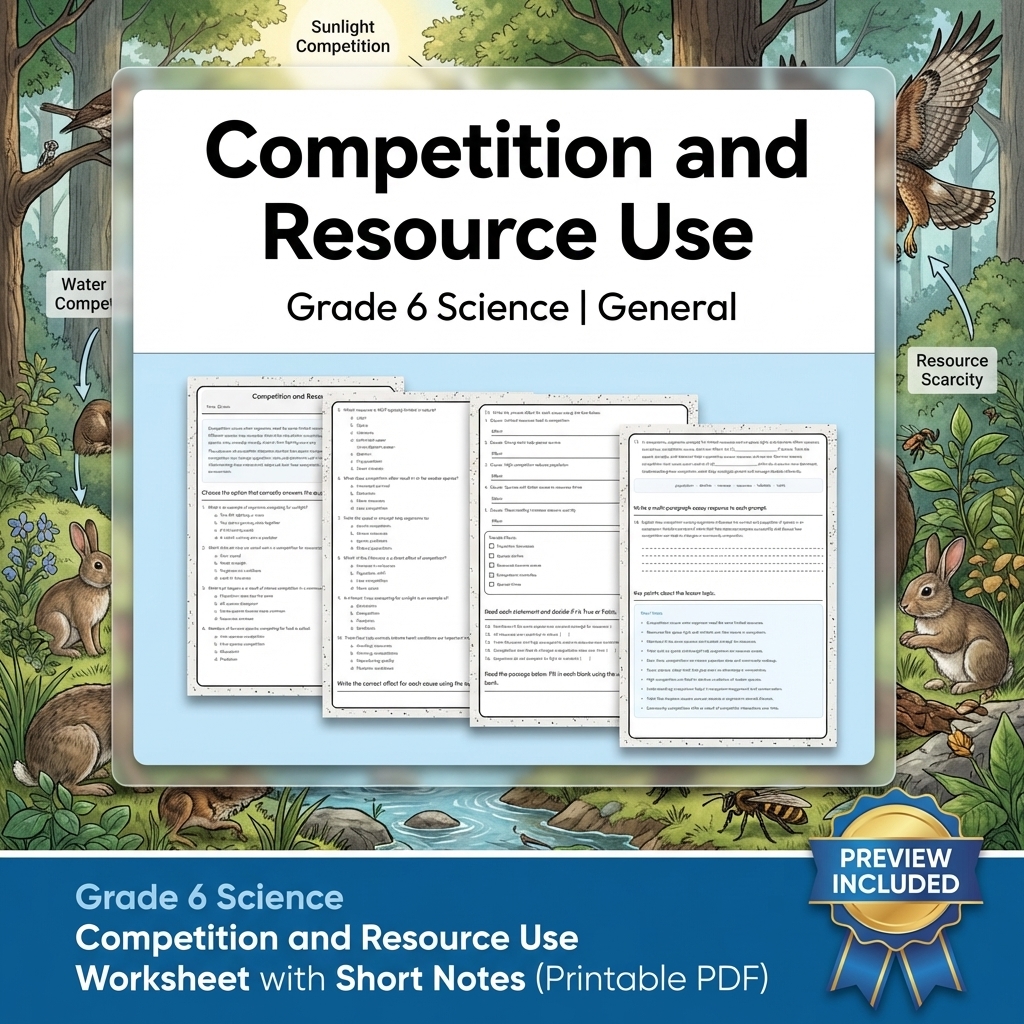
Grade 6 Science Competition and Resource Use Worksheet with Short Notes
Created byMeadowlark WorksheetsLearning Objectives
- Understand how organisms compete for limited resources in their environment.
- Identify different types of competition among species and within species.
- Explain how competition influences population sizes and community dynamics.
Also included in: Grade 6 Science Lesson Group | Body Systems and Life Processes Worksheet Bundle +1 more
Instant download
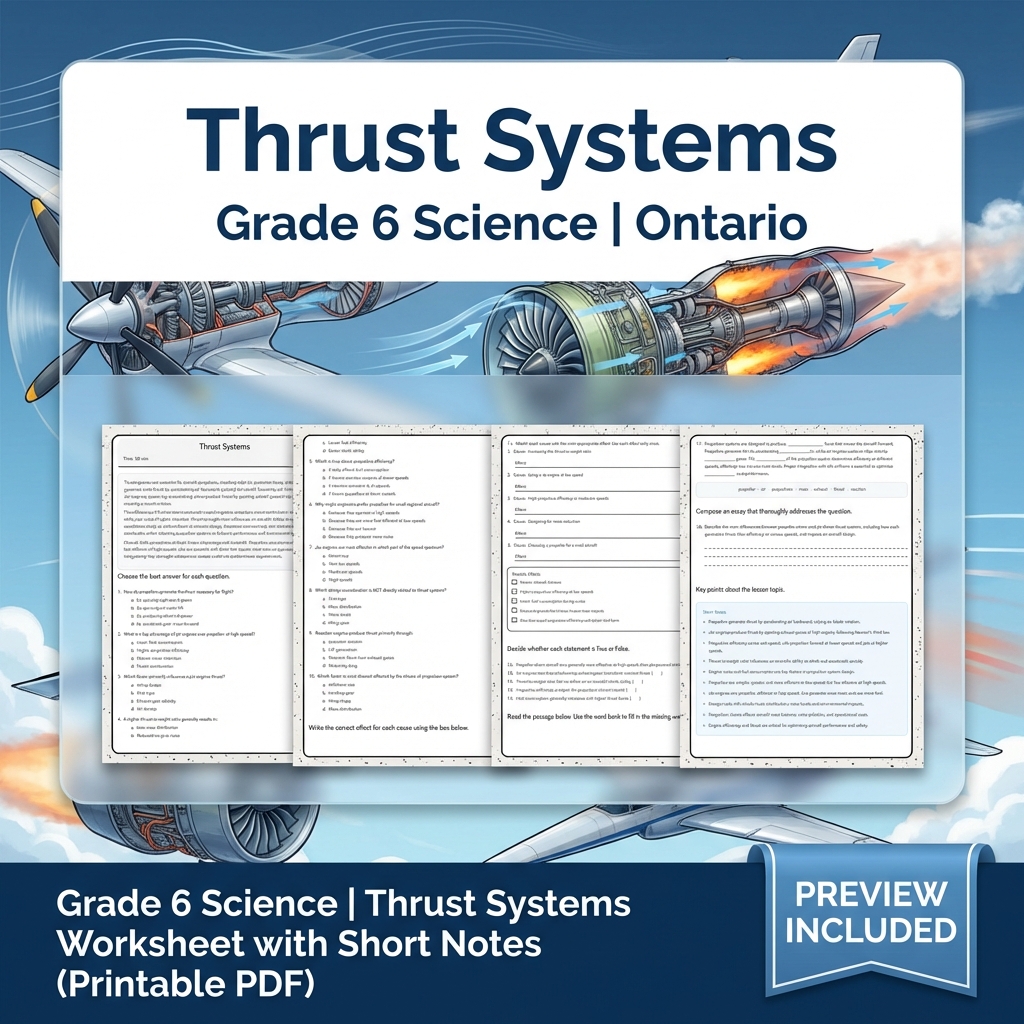
Grade 6 Science | Thrust Systems Worksheet with Short Notes (Printable PDF)
Created byMeadowlark WorksheetsLearning Objectives
- Understand the principles behind propeller-driven and jet-driven propulsion methods.
- Compare how axial and reaction thrusts are generated in different propulsion systems.
- Analyze the impact of thrust-to-weight ratio on aircraft climb and acceleration.
Also included in: Grade 6 Science Lesson Group Bundle – Ontario Framework Worksheets +1 more
Instant download
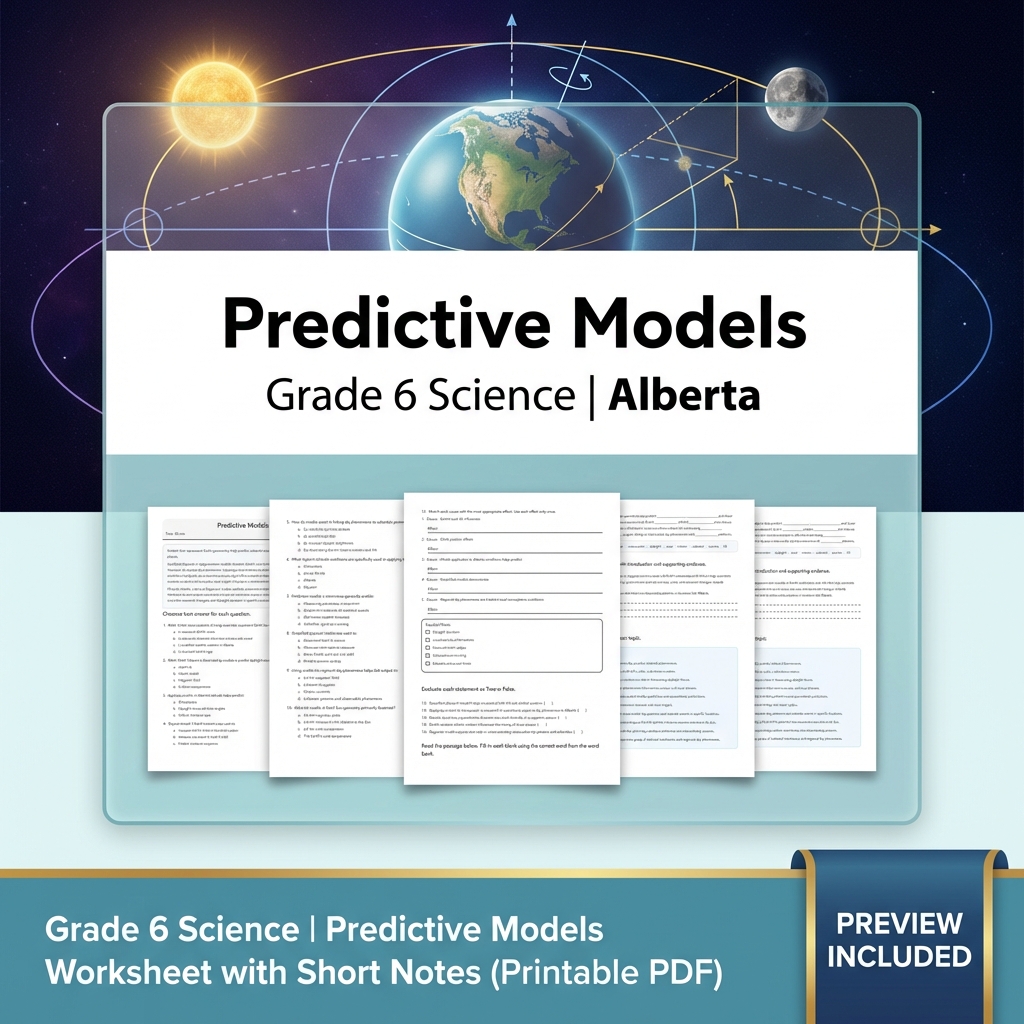
Grade 6 Science | Predictive Models Worksheet with Short Notes (Printable PDF)
Created byMeadowlark WorksheetsLearning Objectives
- Understand how models of Earth–Sun geometry help predict celestial phenomena.
- Identify different types of models used in astronomy.
- Apply simplified models to regional conditions to forecast daylight and solar angles.
Also included in: Grade 6 Science Sky Science Unit Bundle | Alberta Curriculum Worksheets +1 more
Instant download
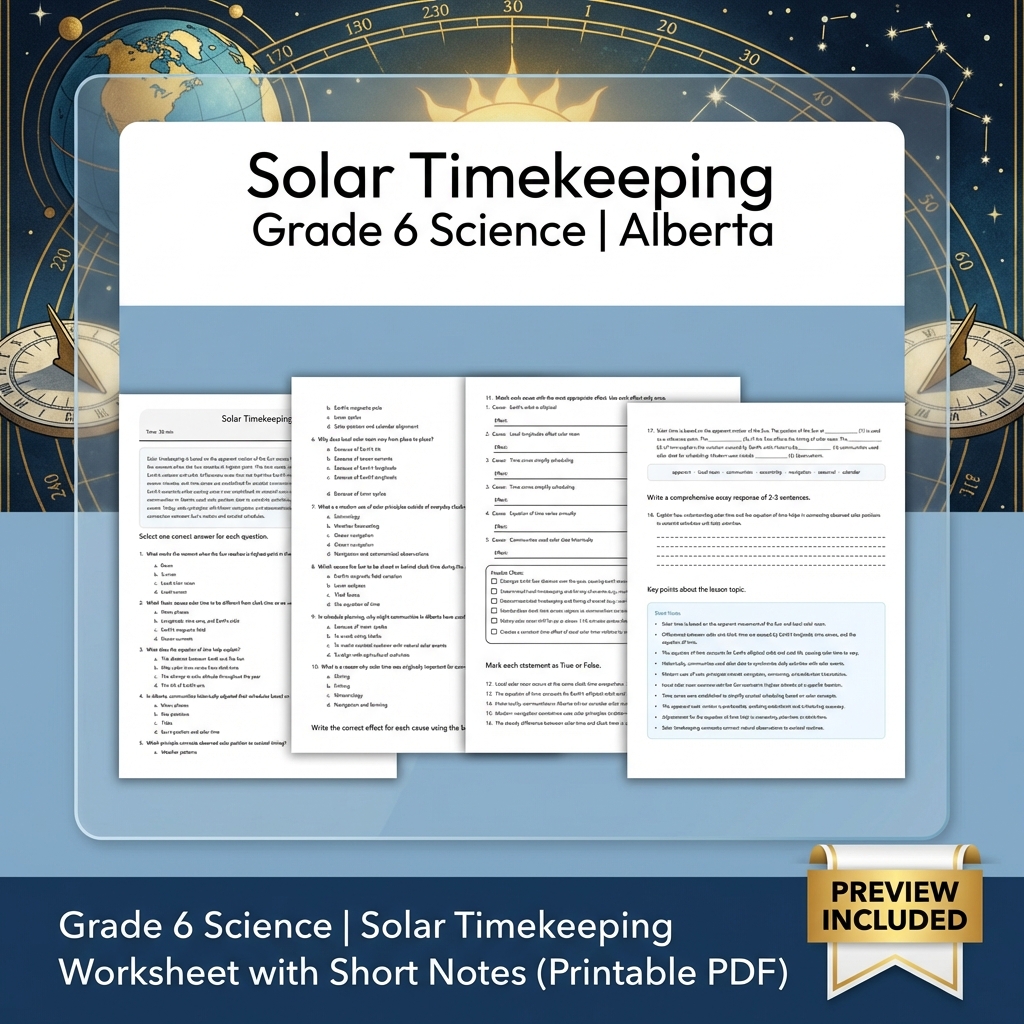
Grade 6 Science | Solar Timekeeping Worksheet with Short Notes (Printable PDF)
Created byMeadowlark WorksheetsLearning Objectives
- Understand how apparent solar motion and local solar noon relate to solar timekeeping.
- Identify factors such as longitude, time zones, and the equation of time that cause differences between solar and clock time.
- Explore the historical and modern applications of solar time in Alberta communities.
Also included in: Grade 6 Science Sky Science Unit Bundle | Alberta Curriculum Worksheets +1 more
Instant download
Grade 6 Science | Component Functions Worksheet with Short Notes (Printable PDF)
Created byMeadowlark WorksheetsLearning Objectives
- Understand the roles of different circuit components such as power sources, resistive loads, switches, and connectors.
- Interpret how each component influences current and voltage in a circuit.
- Link physical components to schematic symbols and typical characteristics.
Also included in: Grade 6 Science Lesson Group on Energy, Circuits & Properties +1 more
Instant download

Grade 6 Science Materials For Performance Worksheet with Short Notes
Created byMeadowlark WorksheetsLearning Objectives
- Understand how material properties affect their suitability for different uses.
- Compare different materials based on strength, water resistance, and conductivity.
- Analyze how practical limitations influence material selection.
Also included in: Grade 6 Science Lesson Bundle | Critical Thinking & Problem Solving +1 more
Instant download
Grade 6 Science Circuit Diagnosis Worksheet with Short Notes (Printable PDF)
Created byMeadowlark WorksheetsLearning Objectives
- Understand the principles of troubleshooting faults in electrical circuits.
- Learn how to infer circuit faults from symptoms such as uneven brightness and continuity issues.
- Analyze circuit topology and measurement patterns to diagnose faults.
Also included in: Grade 6 Science Lesson Group on Energy, Circuits & Properties +1 more
Instant download
Grade 6 Science | Current Fundamentals Worksheet with Short Notes
Created byMeadowlark WorksheetsLearning Objectives
- Describe how electric current flows through a conductor and understand organized charge movement.
- Distinguish between conventional current direction and electron flow in circuits.
- Explain potential difference and its role as the driving force for current.
Also included in: Grade 6 Science Lesson Group on Energy, Circuits & Properties +1 more
Instant download
Grade 6 Science | Drag Components Worksheet with Short Notes (Printable PDF)
Created byMeadowlark WorksheetsLearning Objectives
- Understand the different sources of drag in aerodynamics and their dependence on shape, speed, and lift.
- Identify the components of parasitic drag and induced drag in aircraft design.
- Explain trade-offs involved in wing design related to drag reduction and lift production.
Also included in: Grade 6 Science Lesson Group Bundle – Ontario Framework Worksheets +1 more
Instant download

Grade 6 Science | Matter Properties Worksheet with Short Notes (Printable PDF)
Created byMeadowlark WorksheetsLearning Objectives
- Identify observable properties of different substances such as color, hardness, and texture.
- Understand how substances can be categorized by their properties and forms.
- Compare properties of common materials like copper, wood, and glass.
Also included in: Grade 6 Science Lesson Bundle – Teaching Transfer, Mixtures, Motion & More +1 more
Instant download
Grade 6 Science Optimization Tradeoffs Worksheet with Short Notes (PDF)
Created byMeadowlark WorksheetsLearning Objectives
- Understand how multi-criteria design balances lift, drag, weight, stability, and manufacturability.
- Explore methods for parameter tuning and Pareto trade-off concepts.
- Analyze how structural constraints influence wing aspect ratio and material selection.
Also included in: Grade 6 Science Lesson Group Bundle – Ontario Framework Worksheets +1 more
Instant download
Grade 6 Science | Filtration And Sieving Worksheet with Short Notes (PDF)
Created byMeadowlark WorksheetsLearning Objectives
- Understand the processes of filtration and sieving in separating mixtures.
- Identify different methods used to separate mixtures based on particle size and phase.
- Explain how porous materials help in filtration and sieving.
Also included in: Grade 6 Science | Matter, Properties & Change UNIT Worksheet Bundle +1 more
Instant download
Grade 6 Science | Control Coupling Worksheet with Short Notes (Printable PDF)
Created byMeadowlark WorksheetsLearning Objectives
- Understand how aerodynamic interactions affect aircraft control
- Identify examples of control coupling such as adverse yaw and elevator–aileron coupling
- Learn techniques like differential and Frise ailerons to mitigate control coupling effects
Also included in: Grade 6 Science Lesson Group Bundle – Ontario Framework Worksheets +1 more
Instant download
Grade 6 Science | Food Webs Worksheet with Short Notes (Printable PDF)
Created byMeadowlark WorksheetsLearning Objectives
- Understand how food webs illustrate interconnected feeding relationships among species.
- Identify the roles of producers, consumers, and decomposers in a food web.
- Analyze the impact of species decline or removal on an ecosystem.
Also included in: Grade 6 Science | Ecosystems & Interdependence UNIT Worksheet Bundle +1 more
Instant download
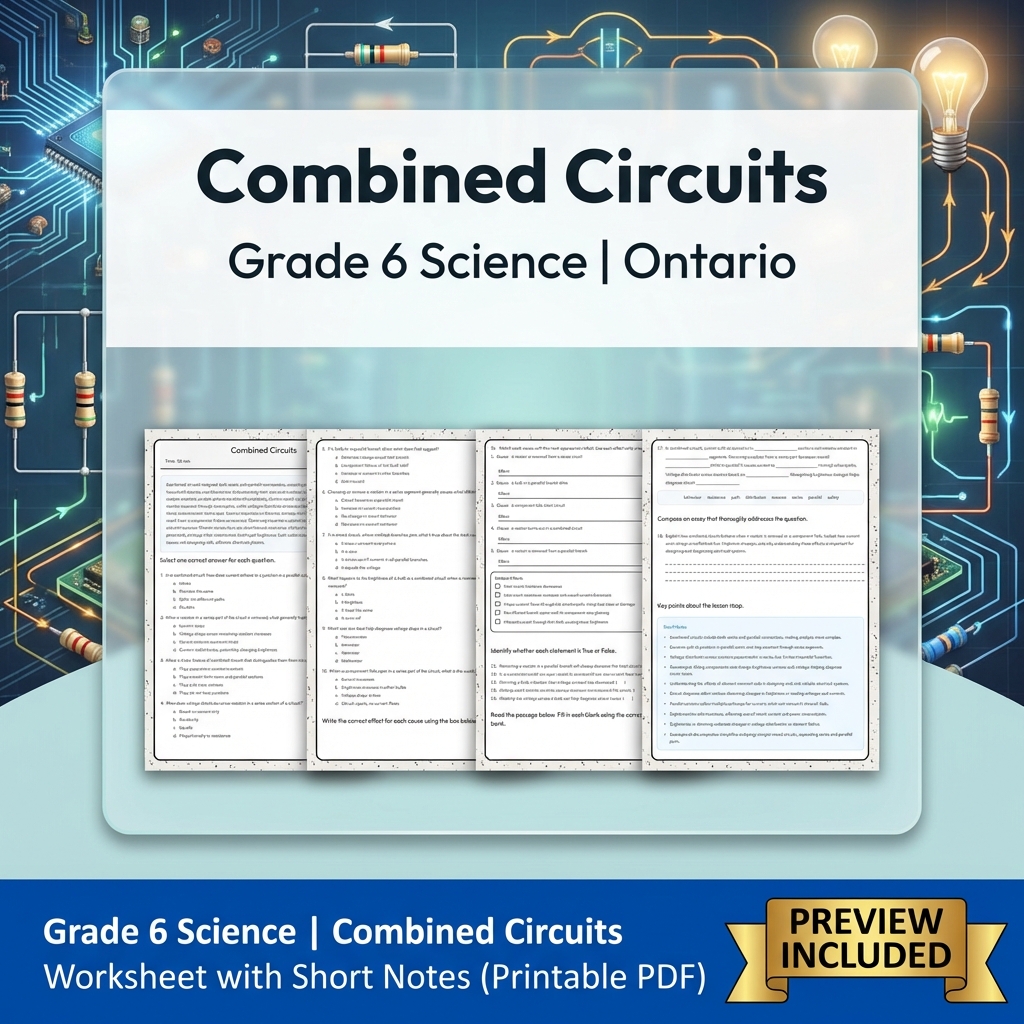
Grade 6 Science | Combined Circuits Worksheet with Short Notes (Printable PDF)
Created byMeadowlark WorksheetsLearning Objectives
- Explain methods of decomposing mixed series-parallel circuits into simpler subcircuits.
- Describe how currents and voltages distribute in combined electrical configurations.
- Identify the effects of component removal or failure on overall circuit behaviour.
Also included in: Grade 6 Science Lesson Group on Energy, Circuits & Properties +1 more
Instant download
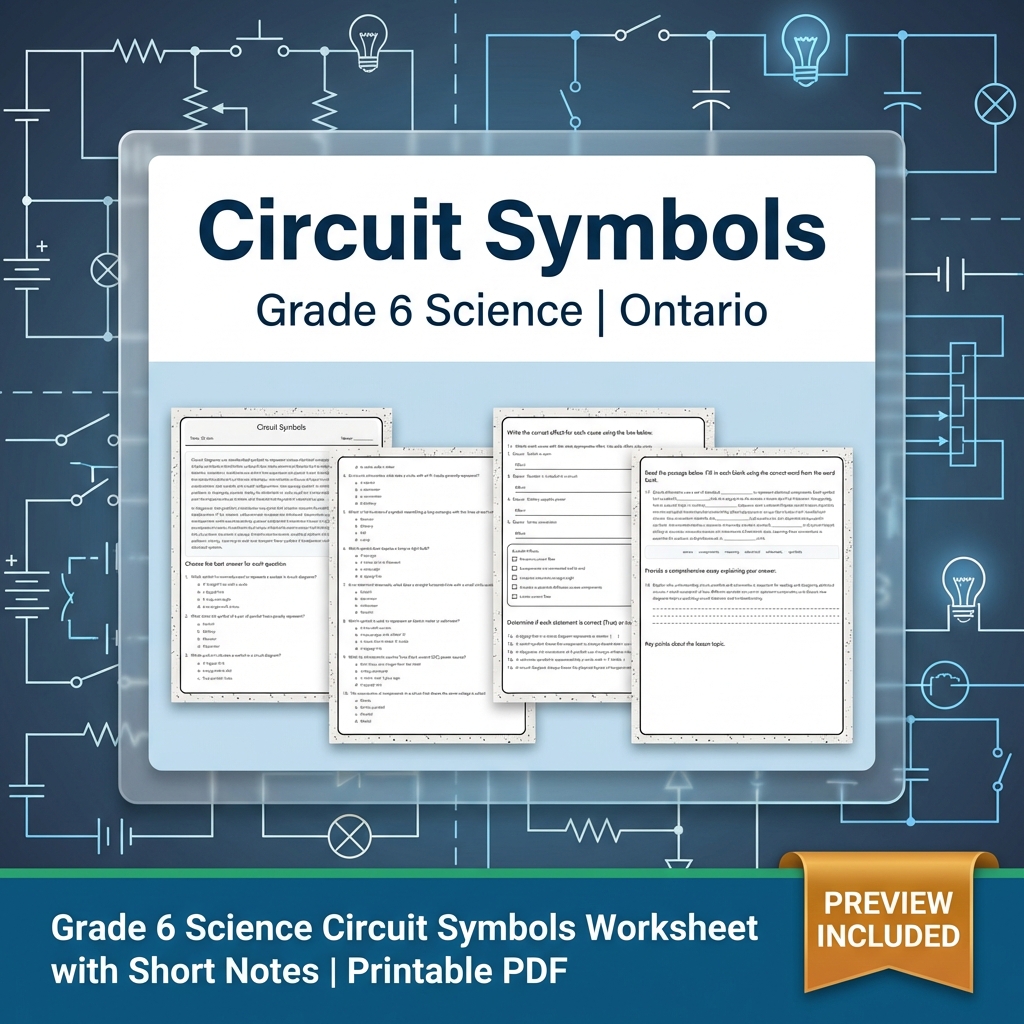
Grade 6 Science Circuit Symbols Worksheet with Short Notes | Printable PDF
Created byMeadowlark WorksheetsLearning Objectives
- Identify and interpret standard schematic symbols for electrical components.
- Understand how circuit diagrams represent physical connections and configurations.
- Read schematic symbols to predict circuit behavior in series, parallel, and mixed arrangements.
Also included in: Grade 6 Science Lesson Group on Energy, Circuits & Properties +1 more
Instant download
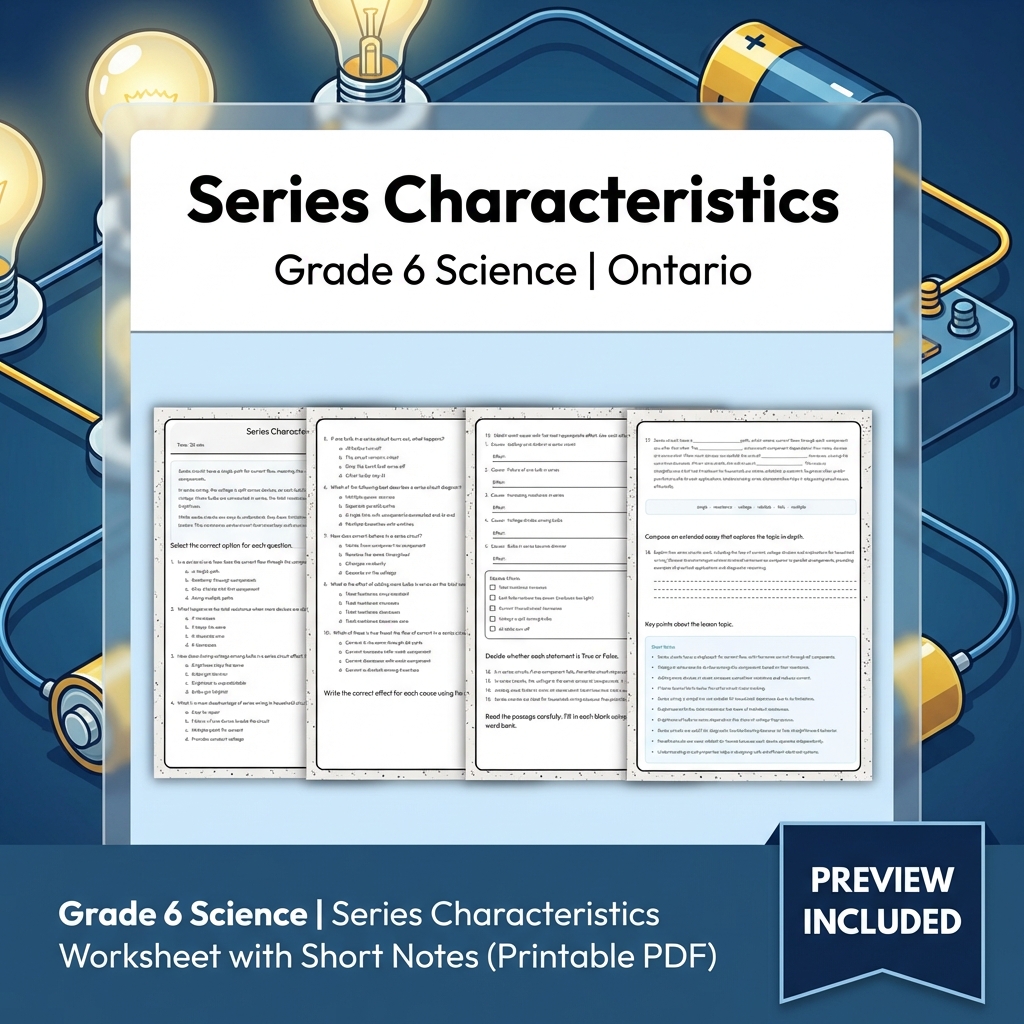
Grade 6 Science | Series Characteristics Worksheet with Short Notes (PDF)
Created byMeadowlark WorksheetsLearning Objectives
- Describe the single-path nature of series circuits and how current flows through each component.
- Explain voltage division among series elements and how it affectsBright bulbs.
- Analyze the effects of combined resistance in series and limitations in household wiring.
Also included in: Grade 6 Science Lesson Group on Energy, Circuits & Properties +1 more
Instant download
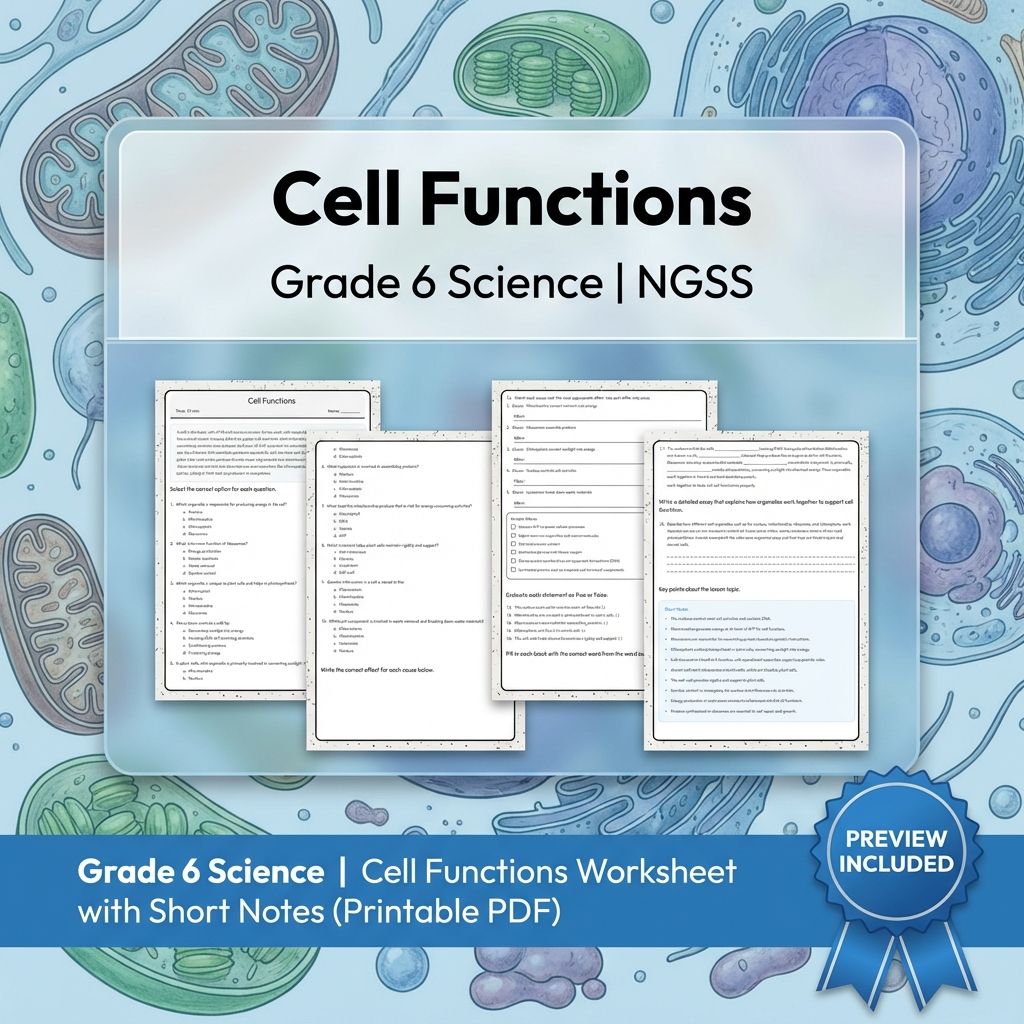
Grade 6 Science | Cell Functions Worksheet with Short Notes (Printable PDF)
Created byMeadowlark WorksheetsLearning Objectives
- Describe the roles of key cell organelles such as the nucleus, mitochondria, ribosomes, and chloroplasts.
- Explain how cell structure relates to cell function in plant and animal cells.
- Identify organelles responsible for energy production, protein synthesis, waste removal, and genetic control.
Also included in: Grade 6 Science NGSS From Molecules to Organisms: Structures & Processes +1 more
Instant download
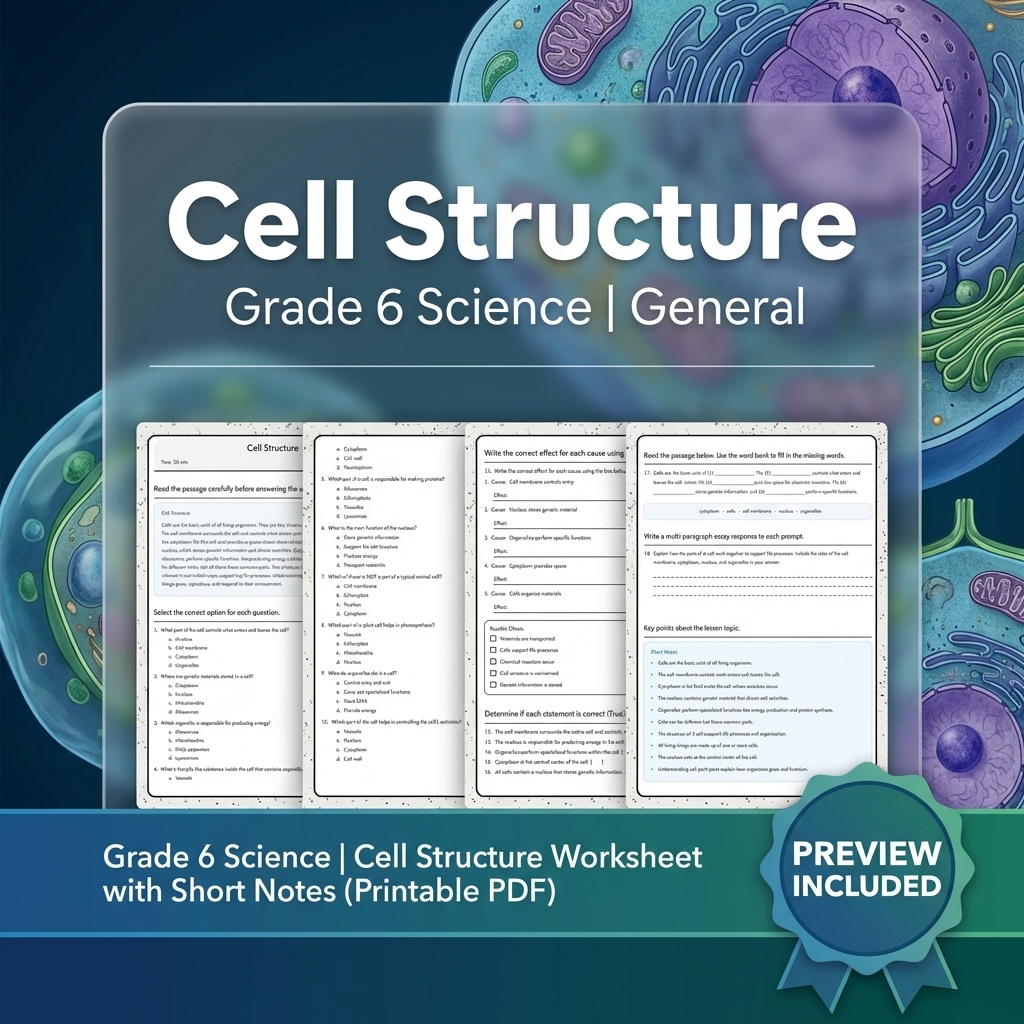
Grade 6 Science | Cell Structure Worksheet with Short Notes (Printable PDF)
Created byMeadowlark WorksheetsLearning Objectives
- Identify the main parts of a cell and their functions.
- Explain how cell parts work together to support life processes.
- Differentiate between shared and distinct parts of plant and animal cells.
Also included in: Grade 6 Science Lesson Group | Body Systems and Life Processes Worksheet Bundle +1 more
Instant download
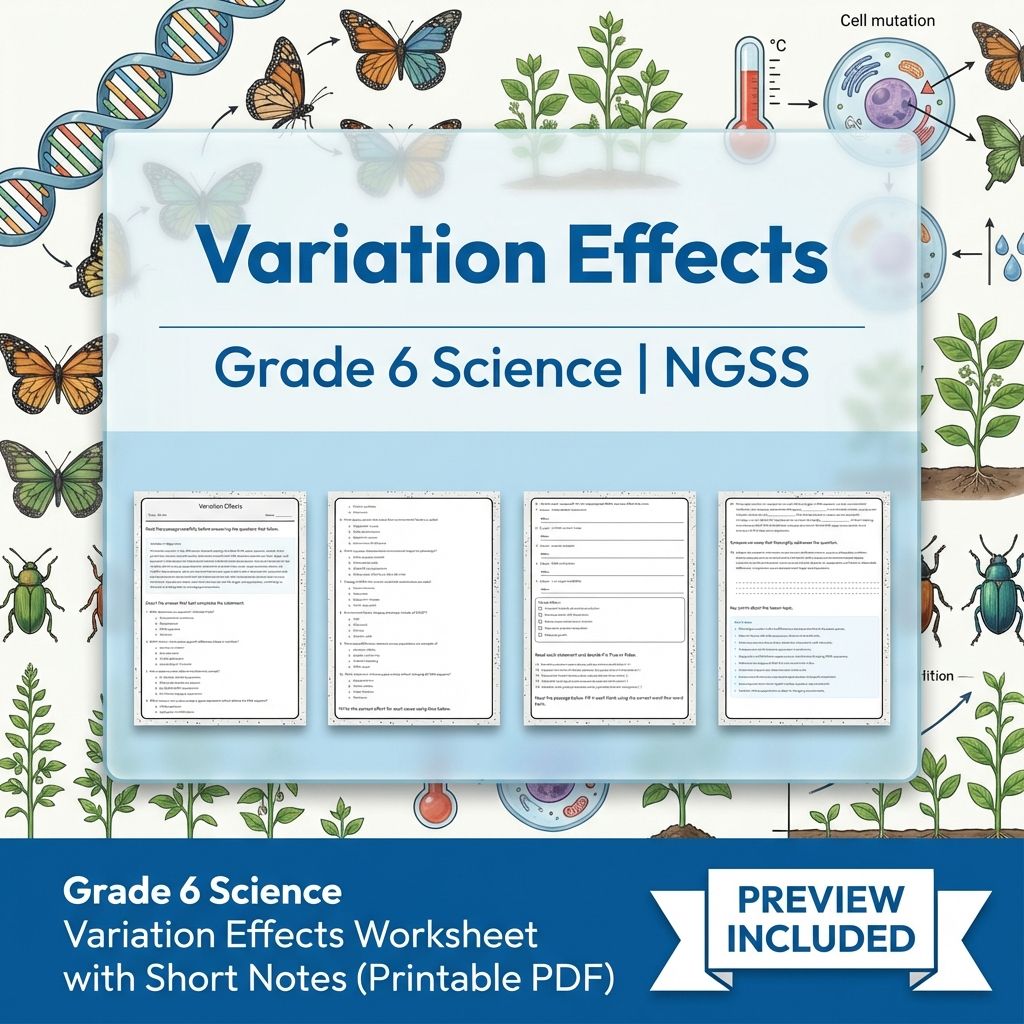
Grade 6 Science Variation Effects Worksheet with Short Notes (Printable PDF)
Created byMeadowlark WorksheetsLearning Objectives
- Understand how phenotypic variation arises from genetic and environmental factors.
- Identify examples of inherited traits, nutrition influences, and temperature-dependent gene expression.
- Explain the link between DNA, macromolecular processes, and organismal differences.
Also included in: Grade 6 Science NGSS From Molecules to Organisms: Structures & Processes +1 more
Instant download
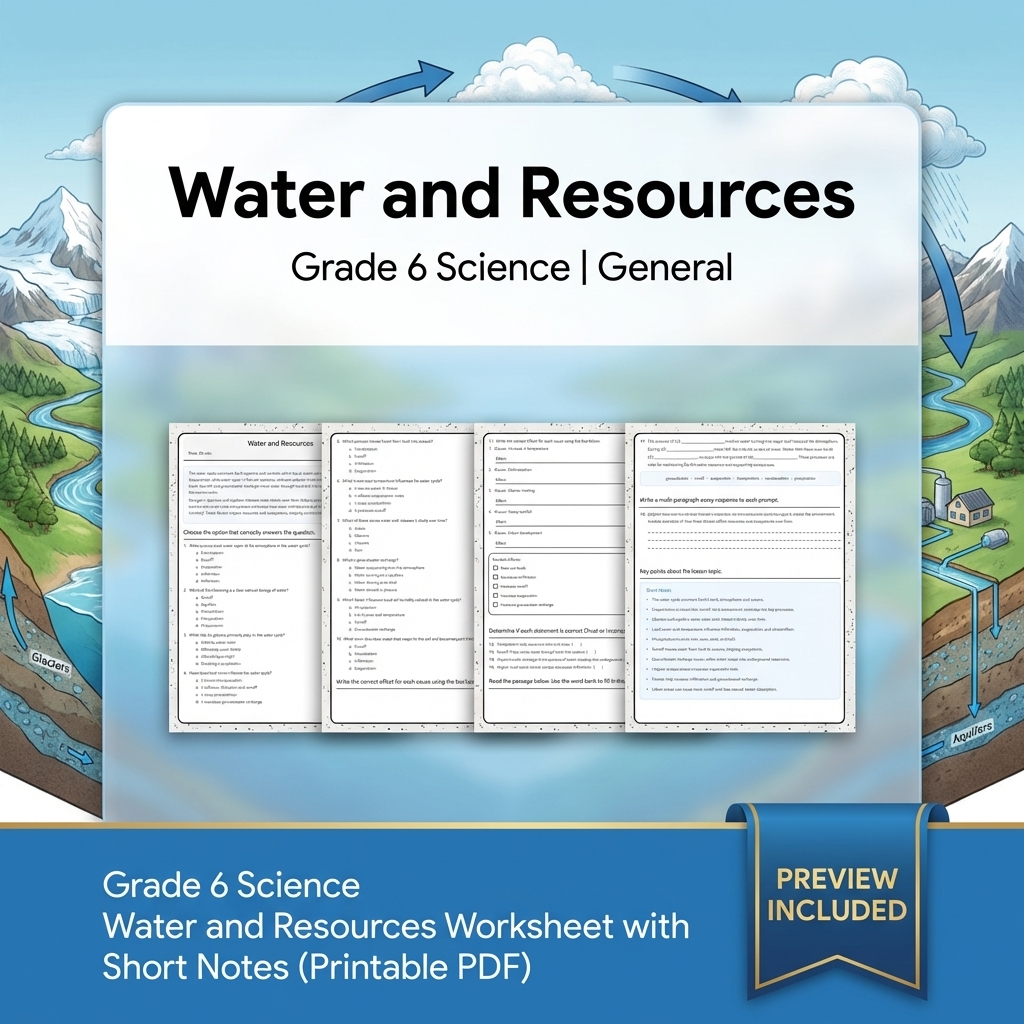
Grade 6 Science Water and Resources Worksheet with Short Notes (Printable PDF)
Created byMeadowlark WorksheetsLearning Objectives
- Understand the water cycle and its connection to Earth's systems.
- Identify processes such as evaporation, precipitation, runoff, and groundwater recharge.
- Explain how land cover and temperature influence water resources.
Also included in: Grade 6 Science Lesson Group Weather, Water, Space, Erosion & Climate +1 more
Instant download
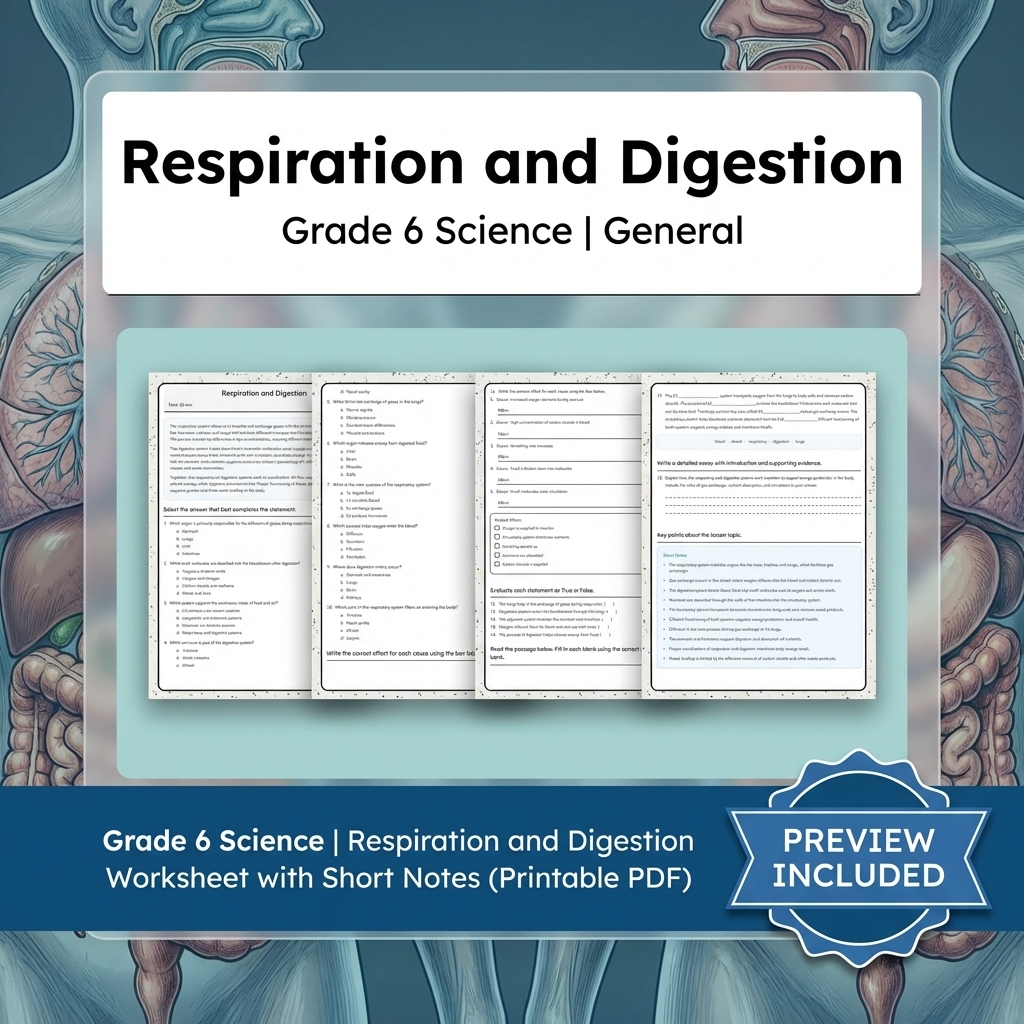
Grade 6 Science | Respiration and Digestion Worksheet with Short Notes
Created byMeadowlark WorksheetsLearning Objectives
- Identify the structures involved in the respiratory and digestive systems.
- Explain how gases are exchanged and nutrients are processed in the body.
- Describe the flow of air and digested materials during respiration and digestion.
Also included in: Grade 6 Science Lesson Group | Body Systems and Life Processes Worksheet Bundle +1 more
Instant download
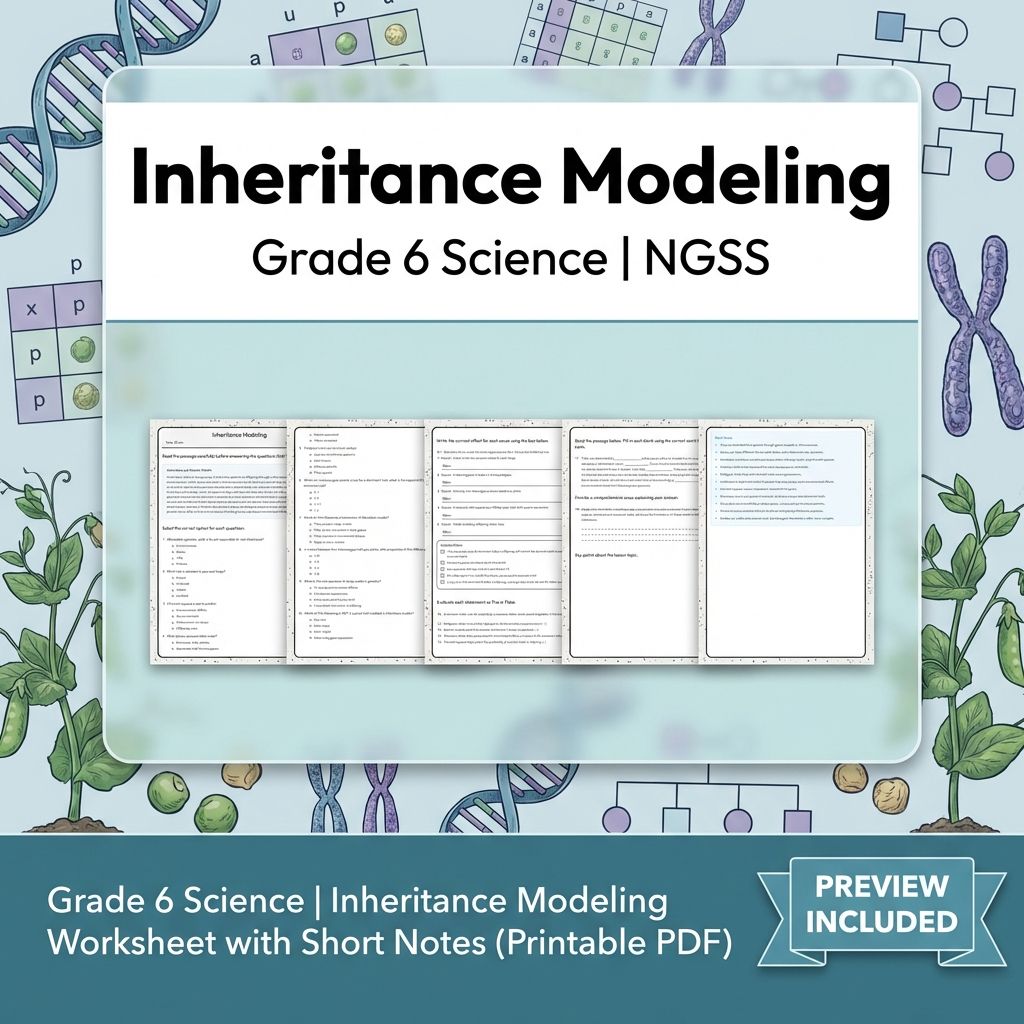
Grade 6 Science | Inheritance Modeling Worksheet with Short Notes (PDF)
Created byMeadowlark WorksheetsLearning Objectives
- Understand how traits are transmitted from parents to offspring through genes.
- Model Mendelian inheritance patterns using Punnett squares and probability.
- Interpret family pedigrees to analyze inheritance traits.
Also included in: Grade 6 Science | Heredity: Inheritance & Variation NGSS Unit | Worksheets +1 more
Instant download

Grade 6 Science Transfer Mechanisms Worksheet with Short Notes PDF
Created byMeadowlark WorksheetsLearning Objectives
- Understand the three main pathways of heat transfer: conduction, convection, and radiation.
- Identify examples of each heat transfer mechanism in real-world situations.
- Explain how temperature change and state change indicate the dominant heat transfer pathway.
Also included in: Grade 6 Science Lesson Bundle – Teaching Transfer, Mixtures, Motion & More +1 more
Instant download

Grade 6 Science Magnetic Separation Worksheet with Short Notes | PDF
Created byMeadowlark WorksheetsLearning Objectives
- Understand how magnetic separation uses differences in magnetic properties to sort materials.
- Identify examples of magnetic separation in everyday life and technology.
- Explain the process of separating magnetic from nonmagnetic materials.
Also included in: Grade 6 Science Lesson Bundle – Teaching Transfer, Mixtures, Motion & More +1 more
Instant download

Grade 6 Science | Filtration Method Worksheet with Short Notes (Printable PDF)
Created byMeadowlark WorksheetsLearning Objectives
- Understand how filtration separates components of a mixture based on particle size.
- Identify the properties of substances retained and those passing through a filter.
- Connect observable evidence, such as sediment and clarity, to filtration processes.
Also included in: Grade 6 Science Lesson Bundle – Teaching Transfer, Mixtures, Motion & More +1 more
Instant download
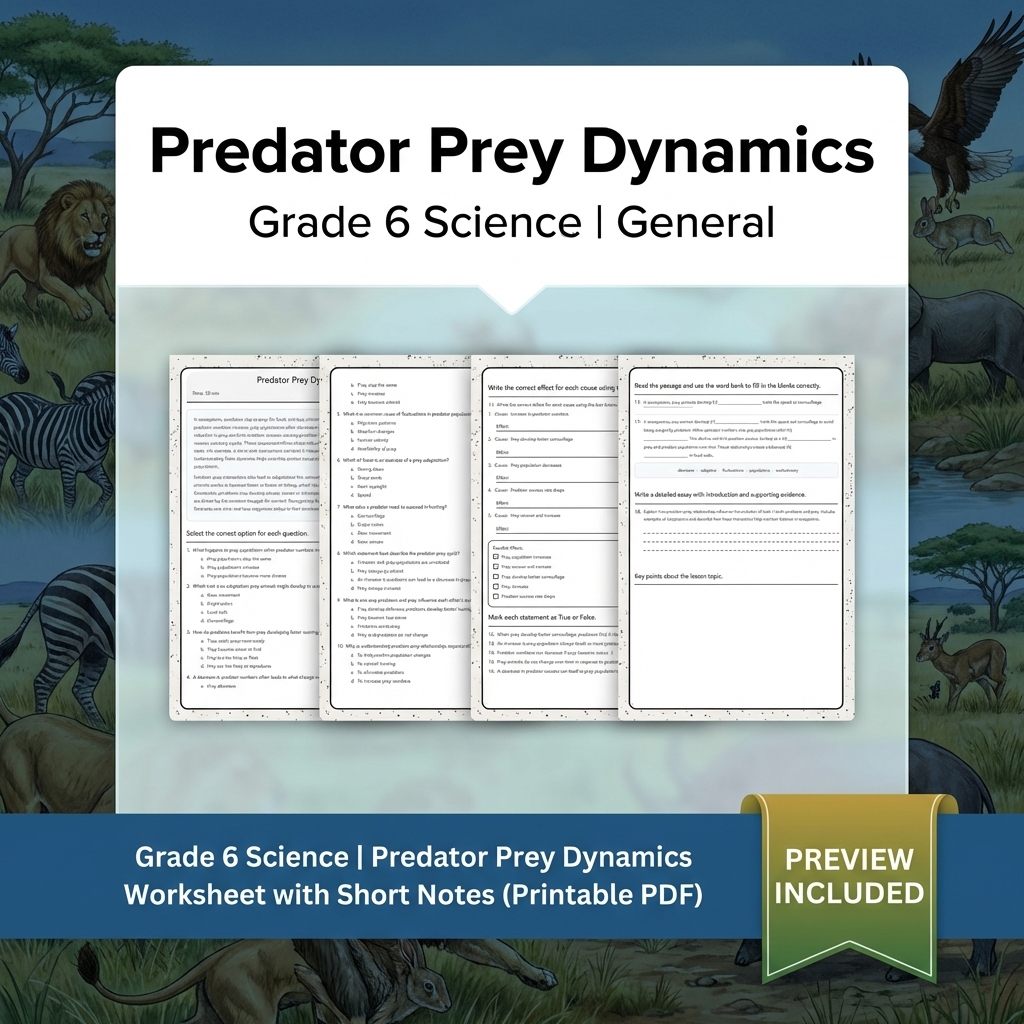
Grade 6 Science | Predator Prey Dynamics Worksheet with Short Notes
Created byMeadowlark WorksheetsLearning Objectives
- Understand how predator and prey populations affect each other in ecosystems.
- Identify cause-and-effect relationships in predator-prey interactions.
- Analyze how prey develop adaptations to avoid predators.
Also included in: Grade 6 Science Lesson Group | Body Systems and Life Processes Worksheet Bundle +1 more
Instant download
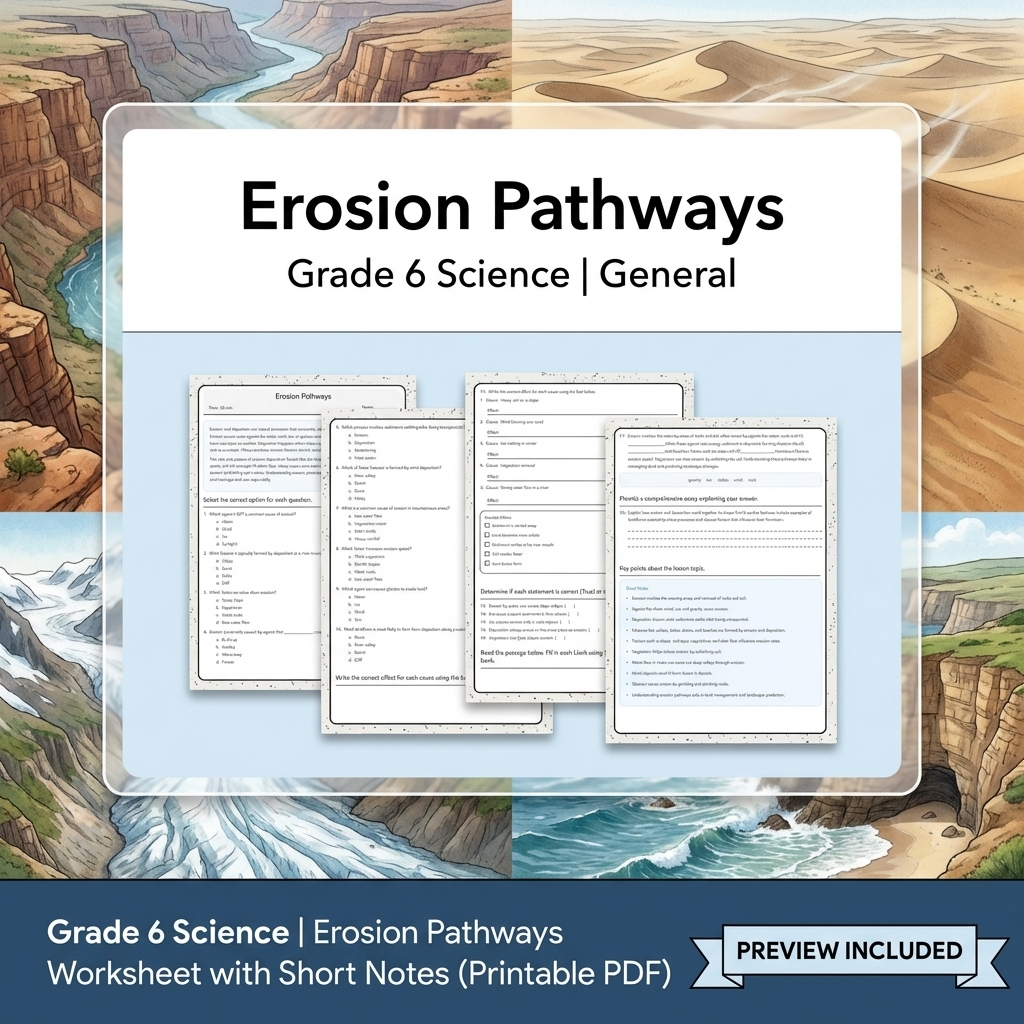
Grade 6 Science | Erosion Pathways Worksheet with Short Notes (Printable PDF)
Created byMeadowlark WorksheetsLearning Objectives
- Understand the processes of erosion and deposition and how they shape Earth's surface.
- Identify agents responsible for erosion, such as water, wind, ice, and gravity.
- Explain how erosion and deposition form features like valleys, deltas, dunes, and beaches.
Also included in: Grade 6 Science Lesson Group Weather, Water, Space, Erosion & Climate +1 more
Instant download
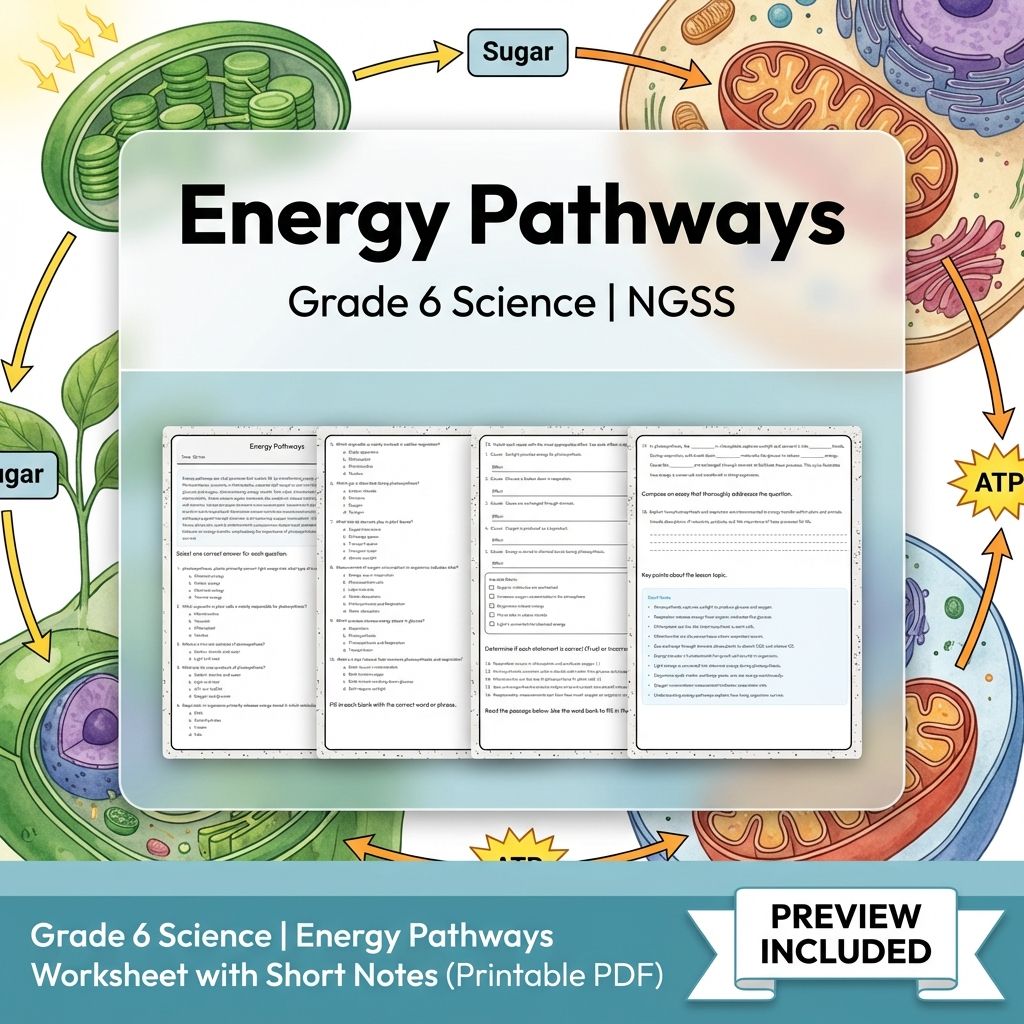
Grade 6 Science | Energy Pathways Worksheet with Short Notes (Printable PDF)
Created byMeadowlark WorksheetsLearning Objectives
- Describe how photosynthesis and respiration transform energy in cells.
- Identify reactants and products of photosynthesis and respiration.
- Explain how light energy is converted into chemical bonds in plants.
Also included in: Grade 6 Science NGSS From Molecules to Organisms: Structures & Processes +1 more
Instant download

Grade 6 Science | Forces and Motion Worksheet with Short Notes (Printable PDF)
Created byMeadowlark WorksheetsLearning Objectives
- Understand how forces affect the movement of objects.
- Identify examples of balanced and unbalanced forces.
- Describe how forces change speed and direction.
Also included in: Grade 6 Science Lesson Bundle – Teaching Transfer, Mixtures, Motion & More +1 more
Instant download
About Grade 6 Science Worksheets
Explore Grade 6 Science worksheets for classwork, homework, or review. Our 5,969 printables download instantly as PDFs.
MyTeachingSheets worksheets are made by real teacher-authors and checked before they go live. Download any as a print-ready PDF for lessons, homework, or independent practice — most include answer keys, and previews are always free.