
Grade 7 Science Worksheets
6,039 worksheets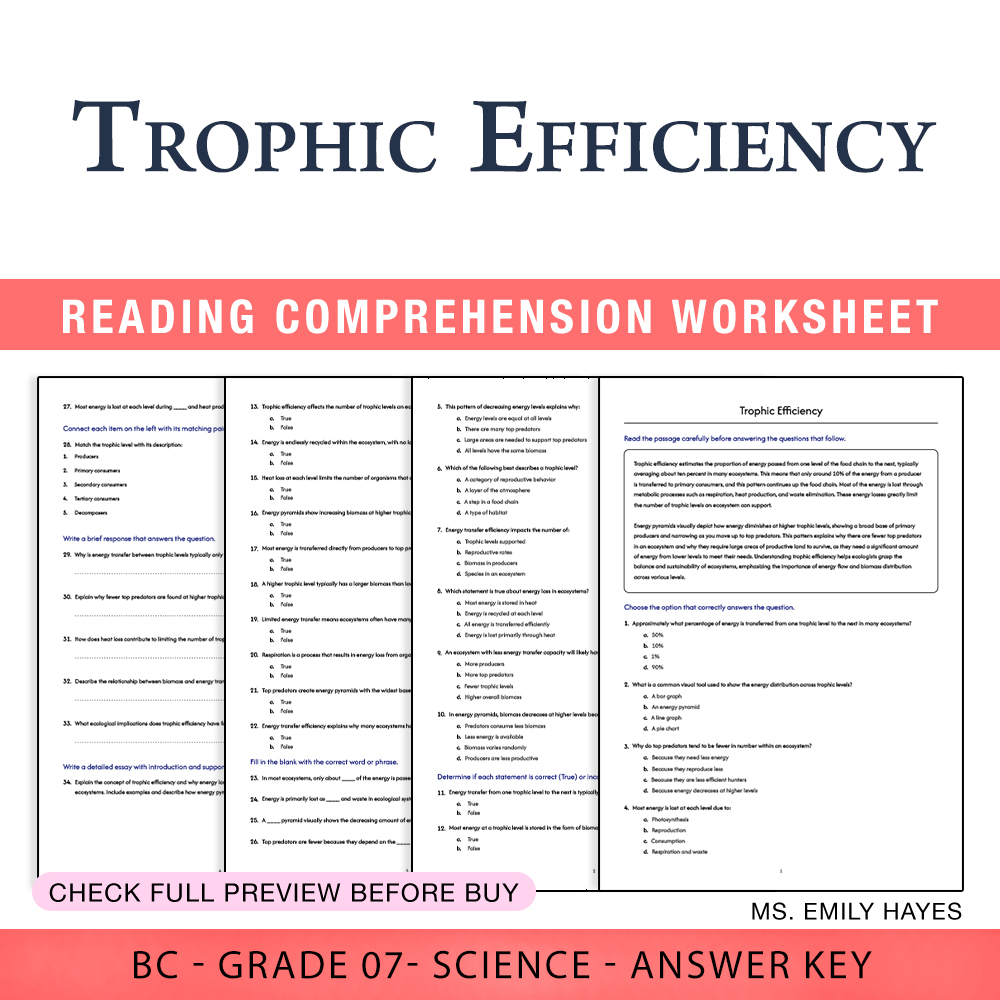
7th Grade Science | Trophic Efficiency Worksheet (PDF+ Answer Key)
 Created byCopper Leaf Classroom
Learning Objectives
- Understand the concept of trophic efficiency and how energy is transferred between levels in an ecosystem.
- Interpret energy pyramids and grasp why top predators are fewer in number.
- Explain the reasons behind energy loss at each trophic level and its ecological implications.
Also included in: Grade 7 Science Bundle | Ecosystem Dynamics & Population (PDF+ Answer Key) +1 more
Instant download
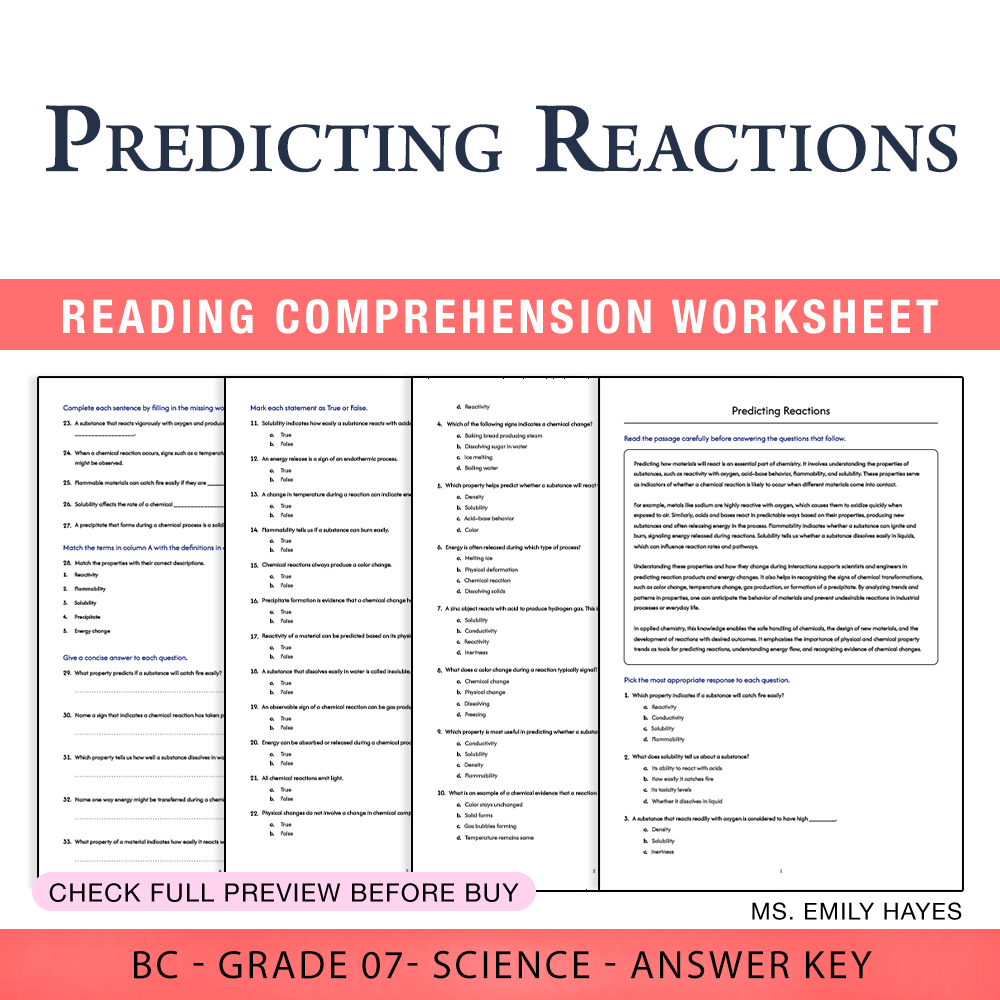
7th Grade Science | Predicting Chemical Reactions Worksheet (PDF + Answer Key)
Created byCopper Leaf ClassroomLearning Objectives
- Understand how physical and chemical properties can indicate the likelihood of chemical reactions.
- Identify signs of chemical changes during material interactions.
- Apply knowledge of properties like reactivity, solubility, flammability, and acid-base behavior to predict reaction outcomes.
Also included in: Grade 7 Science Bundle| States of Matter & Chemical Reactions (PDF+ Answer Keys) +1 more
Instant download
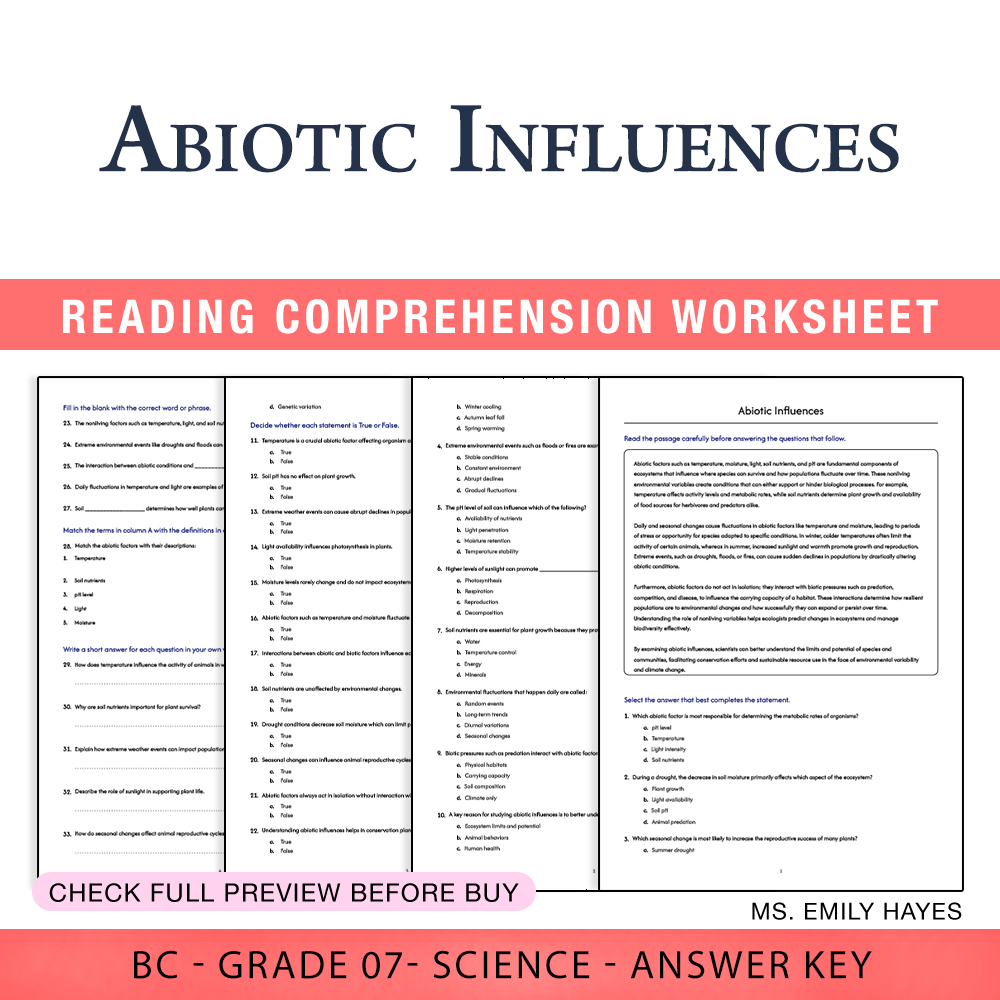
7th Grade Science | Abiotic Influences Worksheet (PDF+ Answer Key)
Created byCopper Leaf ClassroomLearning Objectives
- Understand how abiotic factors such as temperature, moisture, light, soil nutrients, and pH affect species distribution and survival.
- Explain how seasonal and daily fluctuations influence environmental conditions and biological processes.
- Analyze the interactions between abiotic conditions and biotic pressures in determining ecosystem capacity and resilience.
Also included in: Grade 7 Science Bundle | Ecosystem Dynamics & Population (PDF+ Answer Key) +1 more
Instant download

Grade 7 Science | Plate Basics Worksheet (PDF+ Answer Key)
Created byCopper Leaf ClassroomLearning Objectives
- Understand the structure and composition of Earth's lithospheric plates.
- Identify the different types of plate boundaries and their effects on Earth's surface.
- Explain how plate movements influence geological features and activity.
Also included in: Grade 7 Science | Earth Systems & Geology Unit (PDF+ Answer Keys) +1 more
Instant download
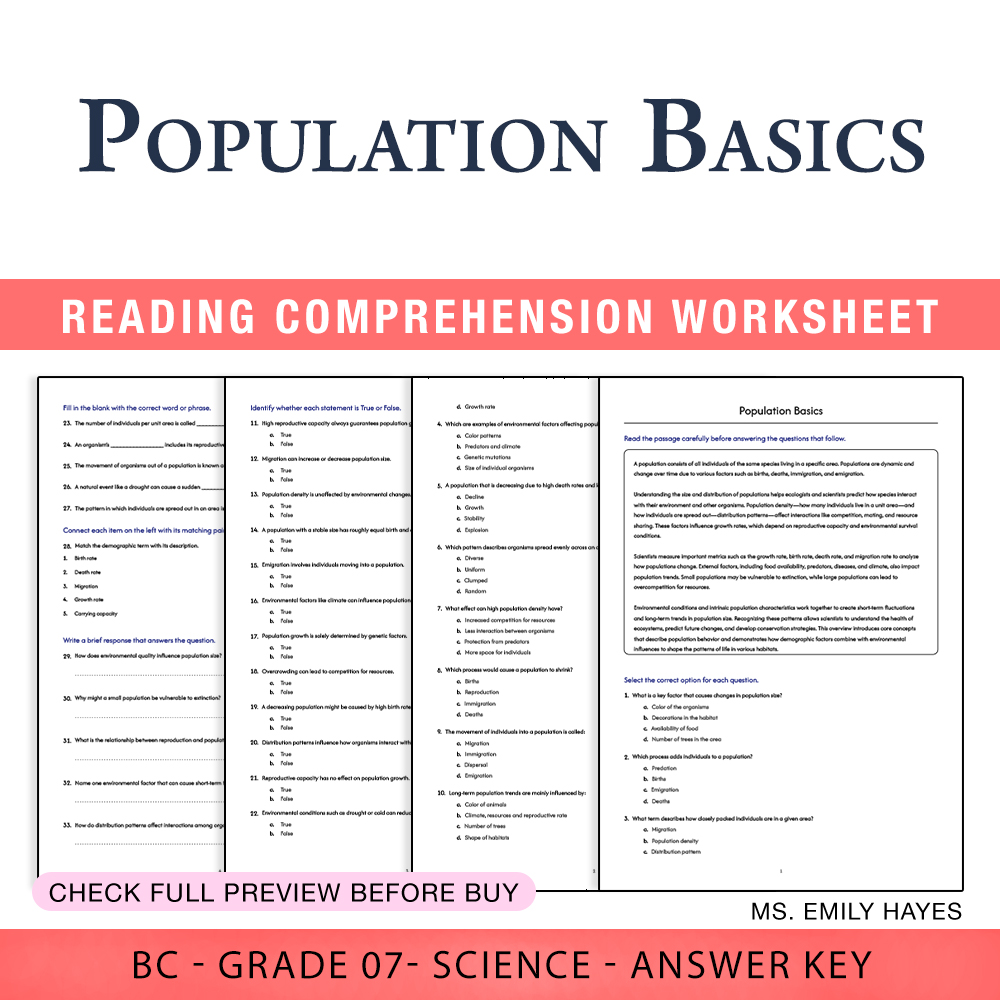
Grade 7 Science | Population Basics Worksheet (PDF+ Answer Key)
Created byCopper Leaf ClassroomLearning Objectives
- Understand the concept of a population and its components.
- Identify factors that influence population size and distribution.
- Explain how demographic and environmental factors impact population dynamics.
Also included in: Grade 7 Science Bundle | Ecosystem Dynamics & Population (PDF+ Answer Key) +1 more
Instant download
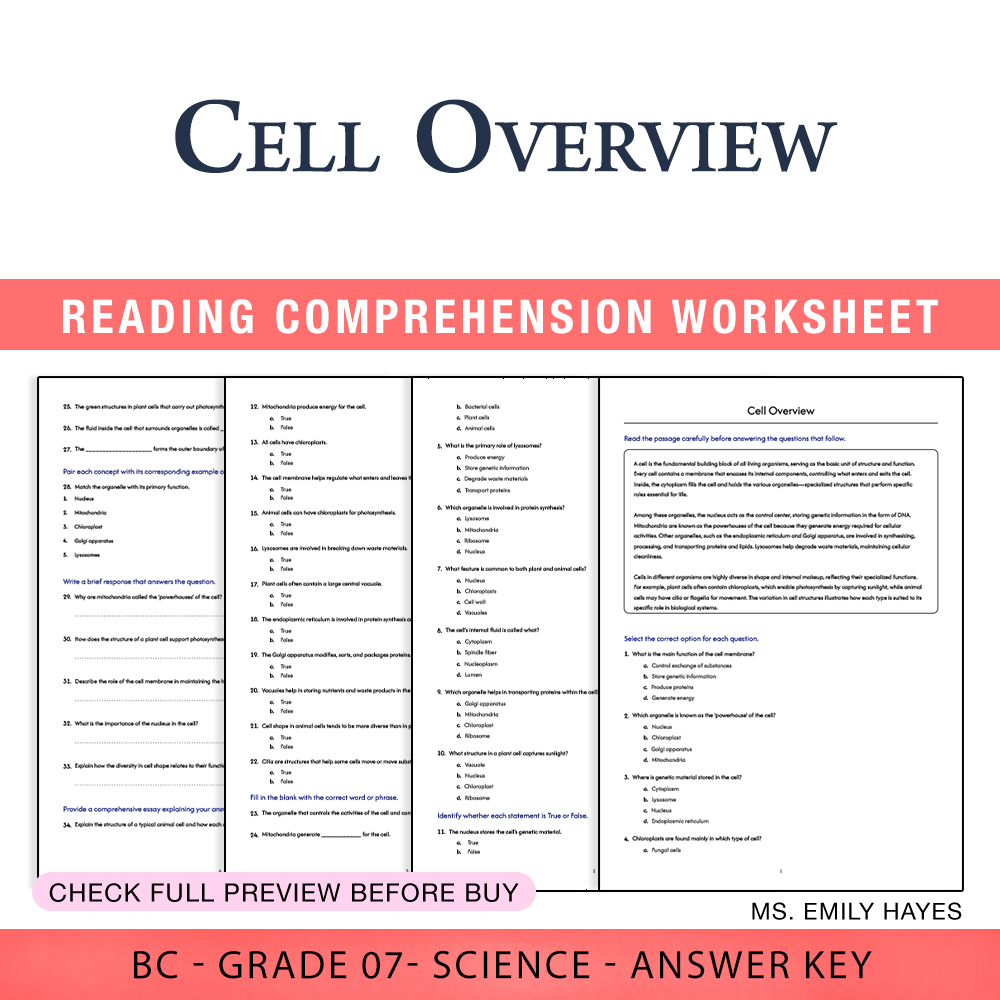
7th Grade Science | Cell Overview Worksheet (PDF+ Answer Key)
Created byCopper Leaf ClassroomLearning Objectives
- Describe the basic structure and functions of a cell
- Identify different organelles and their roles within the cell
- Explain how cell shape and components relate to their specific functions
Also included in: Grade 7 Science Unit – Cells, Organ Systems & Surface Area (PDF+ Answer Key) +1 more
Instant download

7th Grade Science | Chemical Properties Worksheet (PDF+ Answer Key)
Created byCopper Leaf ClassroomLearning Objectives
- Understand and identify various chemical properties of substances.
- Explain how observable changes indicate chemical reactions.
- Recognize the role of chemical properties in real-world reactions.
Also included in: Grade 7 Science Bundle| States of Matter & Chemical Reactions (PDF+ Answer Keys) +1 more
Instant download
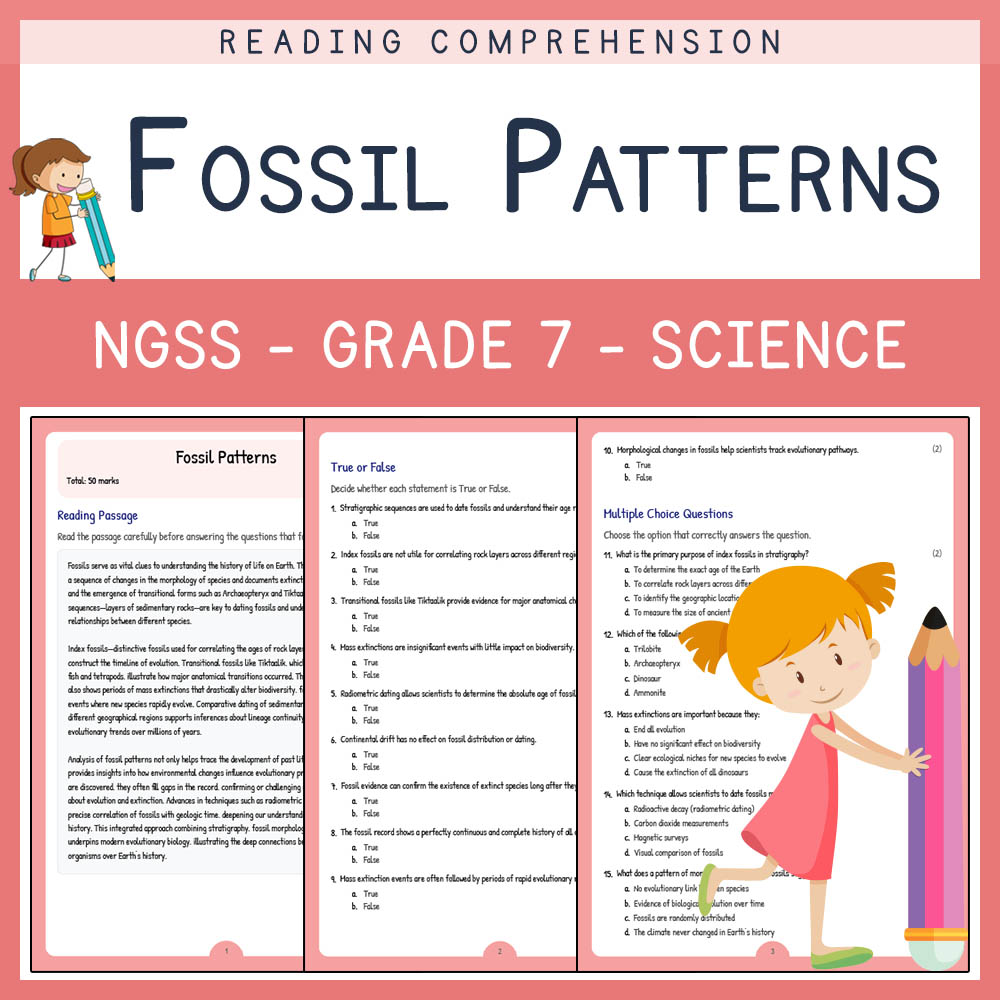
Grade 7 Science | Fossil Patterns Worksheet (Answer Key) | NGSS Alignment
 Created byLumora Learning
Learning Objectives
- Understand the concept of stratigraphic sequences and their importance in fossil record analysis.
- Identify key types of fossils such as index fossils and transitional forms.
- Analyze patterns of extinction, radiation, and morphological change over geologic time.
Instant download
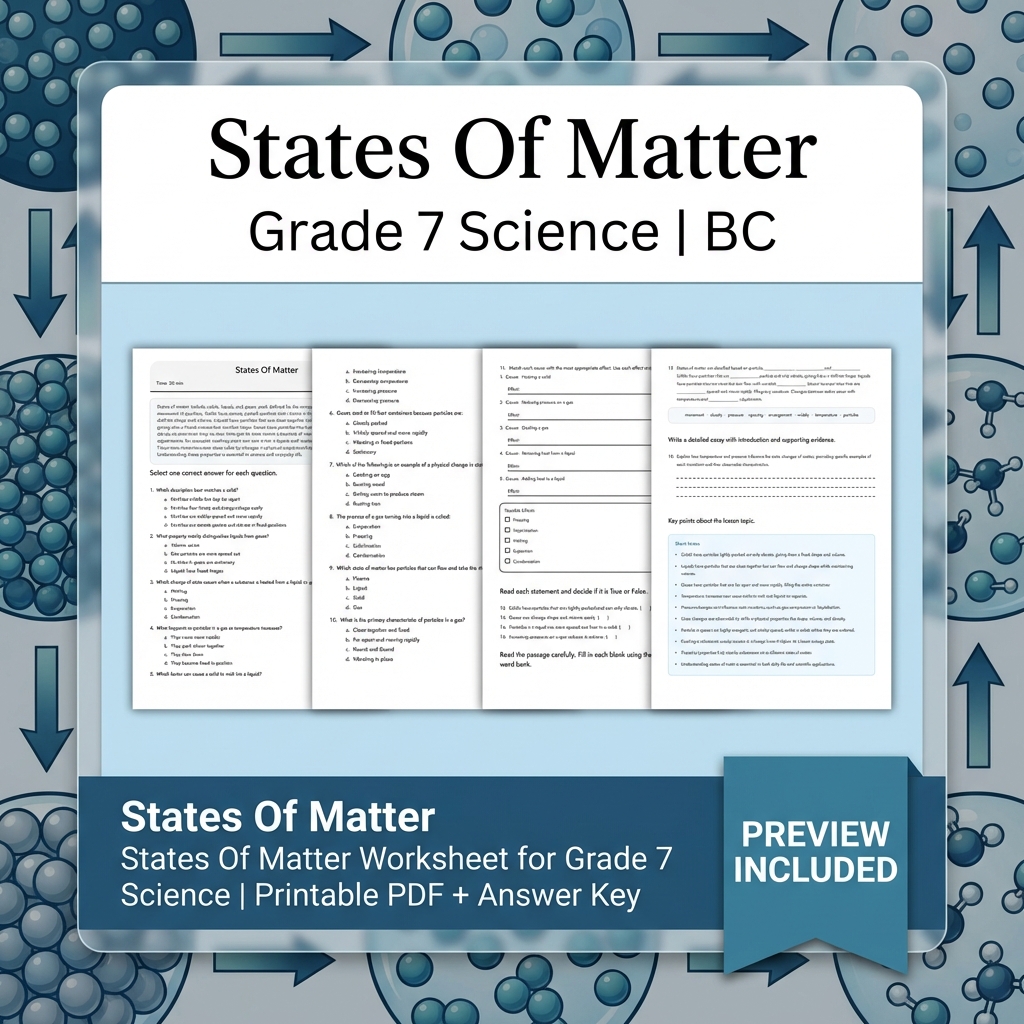
States Of Matter Worksheet for Grade 7 Science | Printable PDF + Answer Key
 Created byMeadowlark Worksheets
Learning Objectives
- Understand and describe the different states of matter: solids, liquids, and gases.
- Identify particle arrangement, spacing, and movement in each state.
- Explain how temperature and pressure affect state changes.
Also included in: Grade 7 Science Lesson Bundle | BC Framework on Matter & Reactions Worksheets +1 more
Instant download
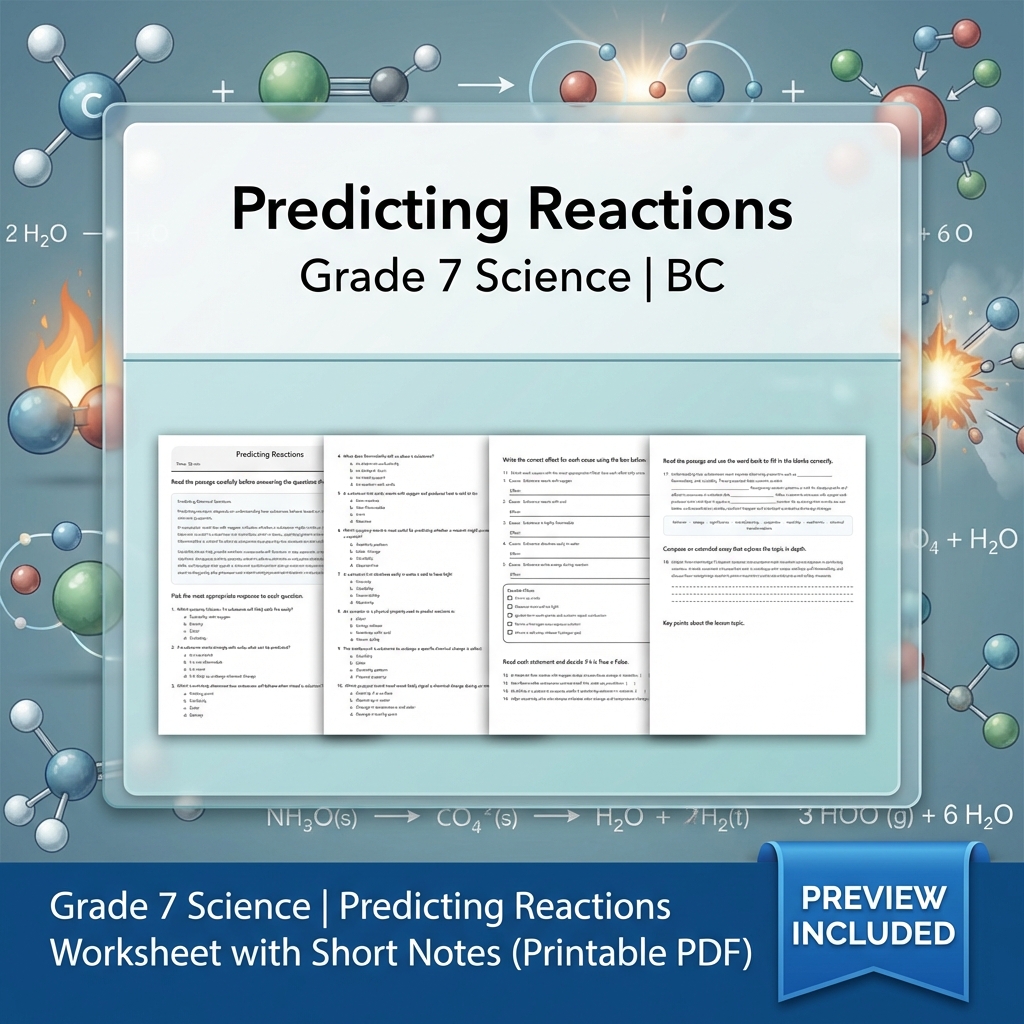
Grade 7 Science | Predicting Reactions Worksheet with Short Notes (PDF)
Created byMeadowlark WorksheetsLearning Objectives
- Understand how physical and chemical properties can predict reactions.
- Identify reactivity patterns and evidence of chemical changes.
- Use property trends to anticipate products and energy changes during reactions.
Also included in: Grade 7 Science Lesson Bundle | BC Framework on Matter & Reactions Worksheets +1 more
Instant download
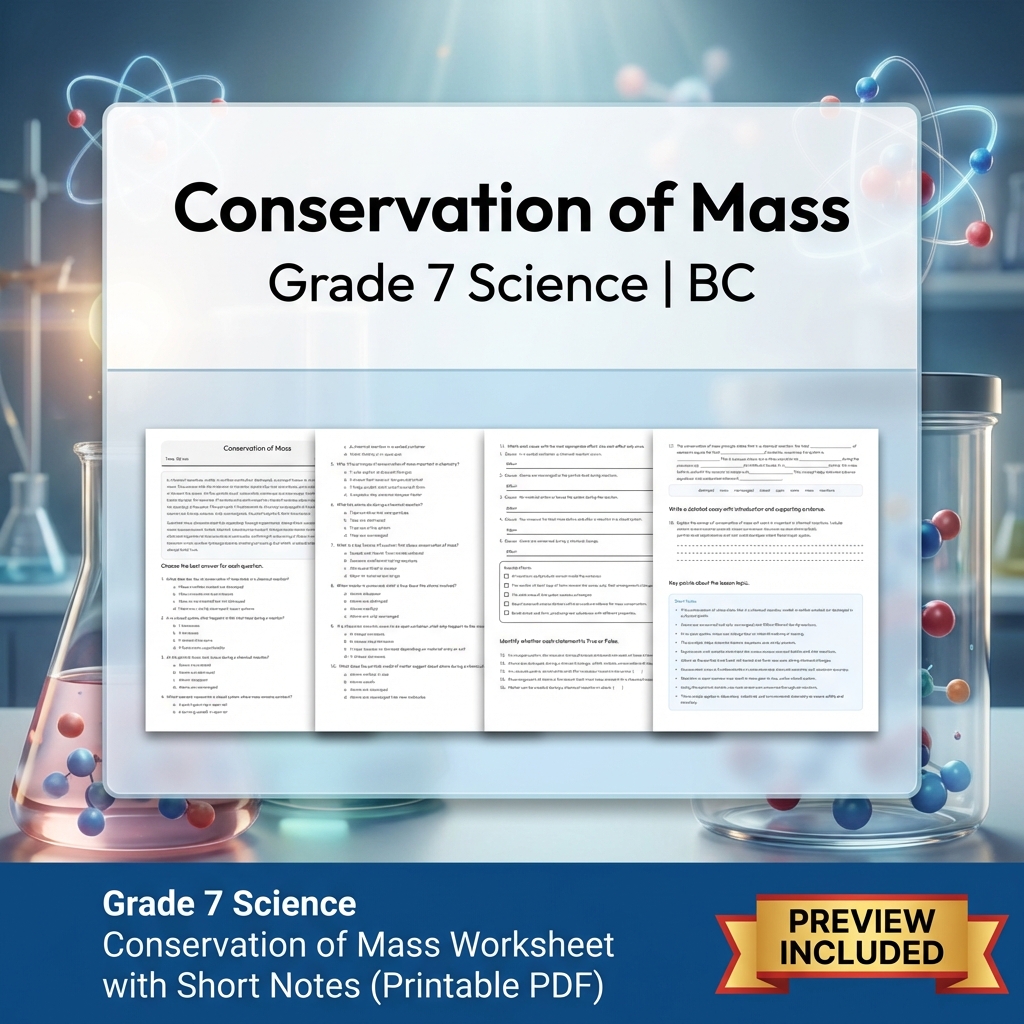
Grade 7 Science Conservation of Mass Worksheet with Short Notes (Printable PDF)
Created byMeadowlark WorksheetsLearning Objectives
- Explain the principle of conservation of mass in chemical reactions.
- Describe at the particle level how atoms are conserved and rearranged.
- Identify examples of closed systems where mass remains constant before and after reactions.
Also included in: Grade 7 Science Lesson Bundle | BC Framework on Matter & Reactions Worksheets +1 more
Instant download
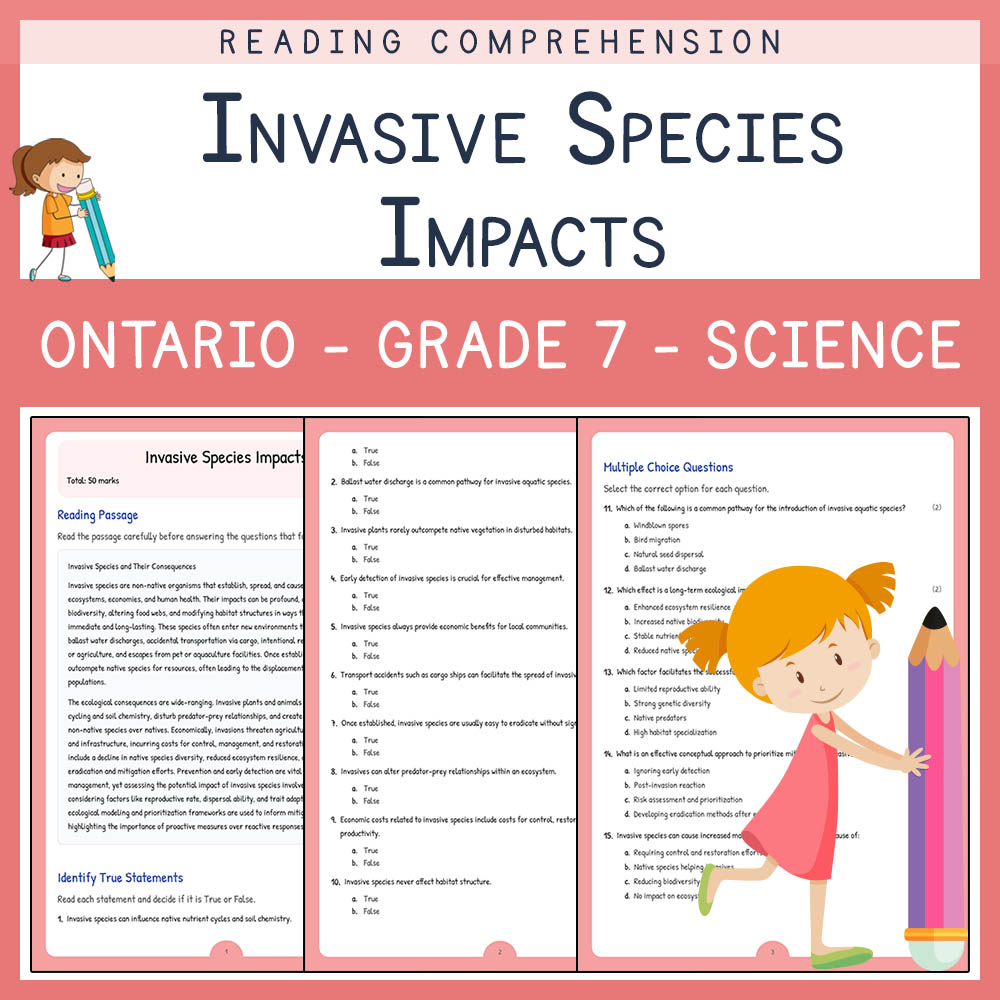
Grade 7 Science | Invasive Species Impacts Worksheet & Answer Key (PDF)
Created byLumora LearningLearning Objectives
- Understand the ecological and economic consequences of non-native species introductions.
- Identify pathways and factors facilitating invasive species establishment.
- Analyze long-term effects of invasive species on native biodiversity and ecosystem health.
Instant download
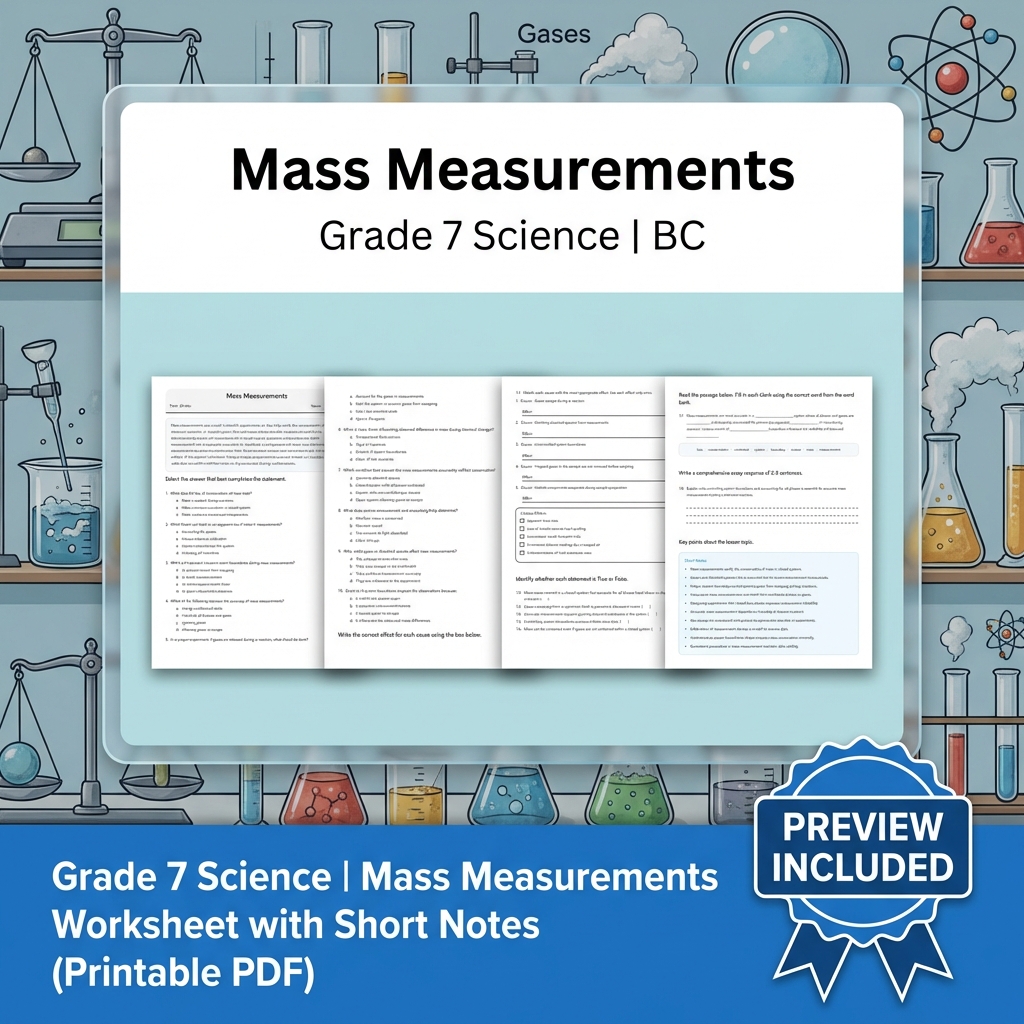
Grade 7 Science | Mass Measurements Worksheet with Short Notes (Printable PDF)
Created byMeadowlark WorksheetsLearning Objectives
- Understand the principles of mass conservation in chemical and physical processes.
- Identify factors affecting accuracy in mass measurements.
- Explain how system boundaries influence mass observations.
Also included in: Grade 7 Science Lesson Bundle | BC Framework on Matter & Reactions Worksheets +1 more
Instant download

Accuracy and Uncertainty Assessment for Grade 7 Science | Standards-Aligned
 Created byPrism Point Learning
Learning Objectives
- Understand how measurement tools have resolution limits affecting data accuracy.
- Explain the concept of uncertainty in repeated measurements and data interpretation.
- Interpret graphs and tables that include ranges or error estimates to evaluate data significance.
Also included in: Grade 7 Scientific Inquiry Practices Science Lesson Bundle: General
Instant download

Investigation Variables Assessment | General Standards Grade 7 Science
Created byPrism Point LearningLearning Objectives
- Identify the different types of variables in scientific investigations.
- Understand how to design investigation plans with clear variables and evidence.
- Distinguish between independent, dependent, and controlled variables in experiments.
Also included in: Grade 7 Scientific Inquiry Practices Science Lesson Bundle: General
Instant download
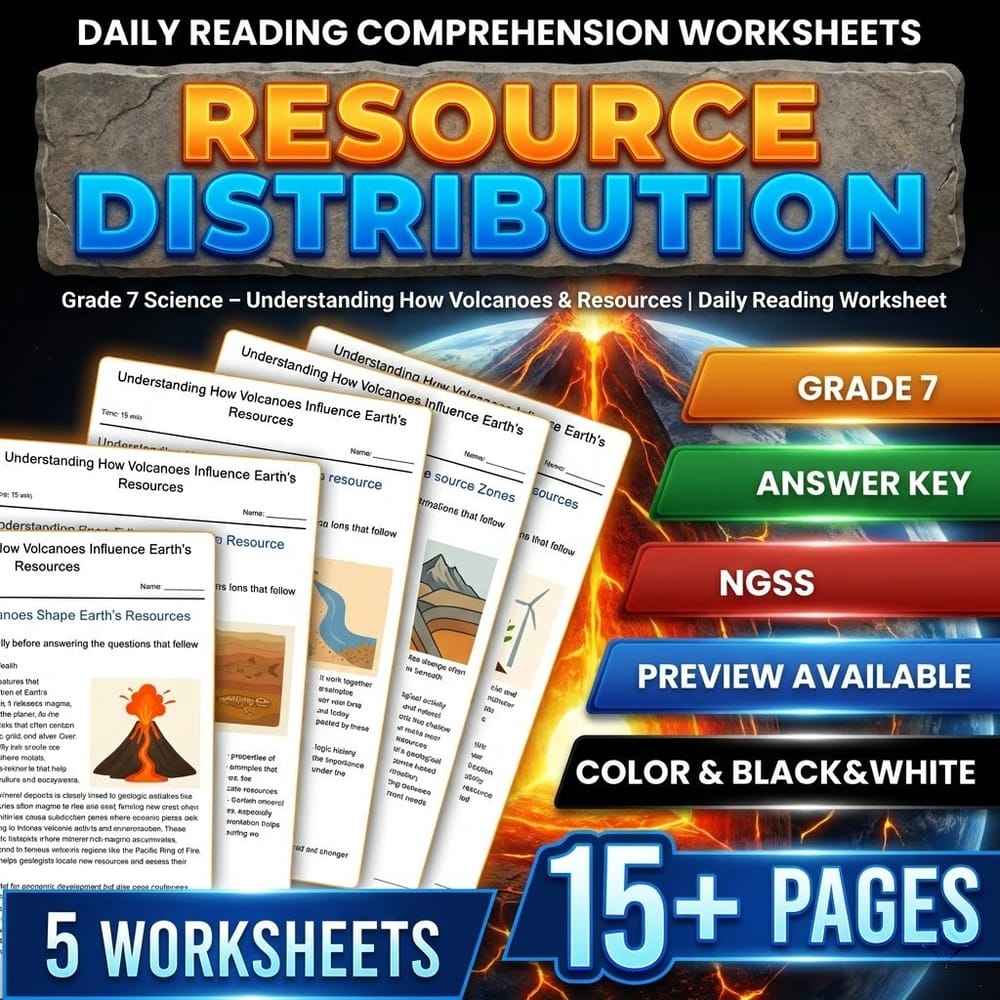
Grade 7 Science – Volcanoes & Resources | Daily Reading Worksheet
 Created byElena Brooks
Learning Objectives
- Explain how volcanic activity contributes to mineral and resource deposits.
- Identify geologic processes related to resource distribution.
- Analyze case studies of volcanic regions and resource locations.
Also included in: Natural Disasters and Environmental Impacts Grade 7 Worksheets Bundle | NGSS +1 more
Instant download
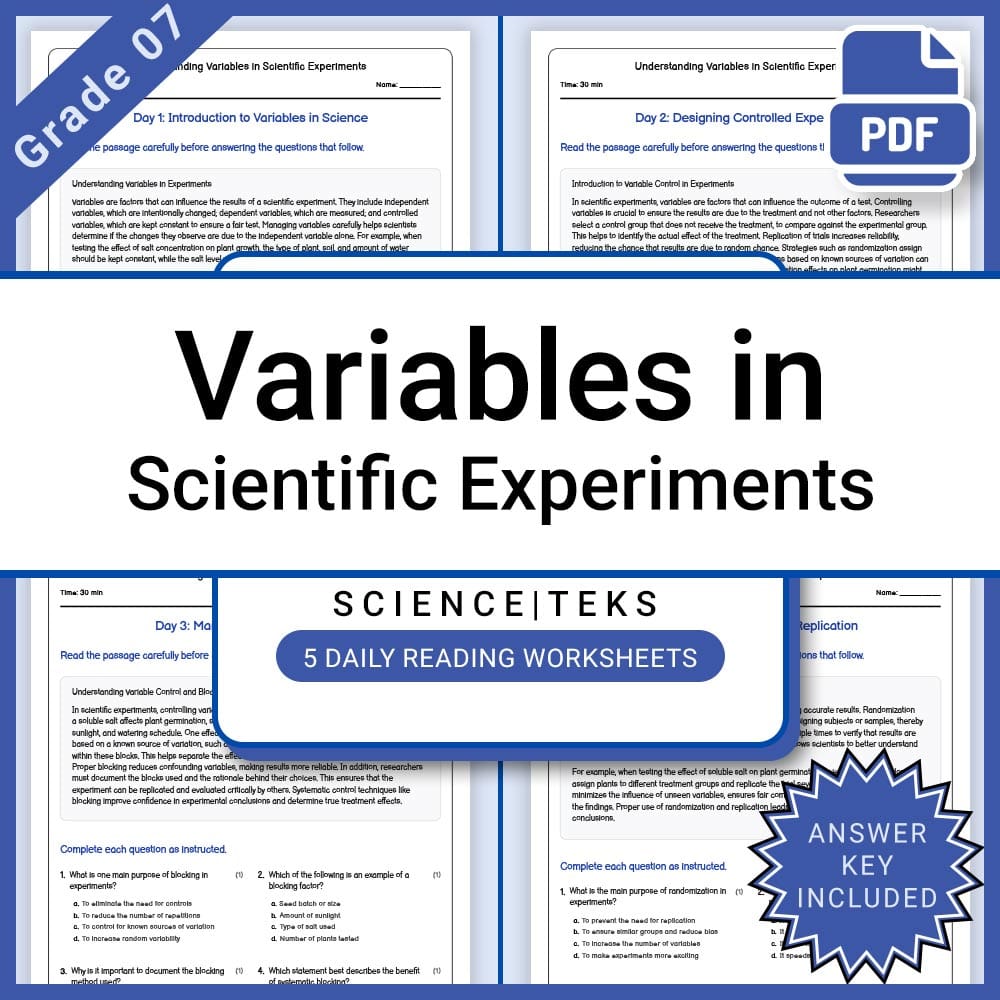
Grade 7 Science – Variables in Experiments Daily Reading Worksheet + Answer Key
JCreated byJ.S SheetsLearning Objectives
- Identify different types of variables in experiments
- Understand the importance of control groups
- Learn strategies to manage variables such as randomization and blocking
Also included in: Grade 7 Science Lesson Group TEKS Bundle | Daily Reading Worksheets +1 more
Instant download
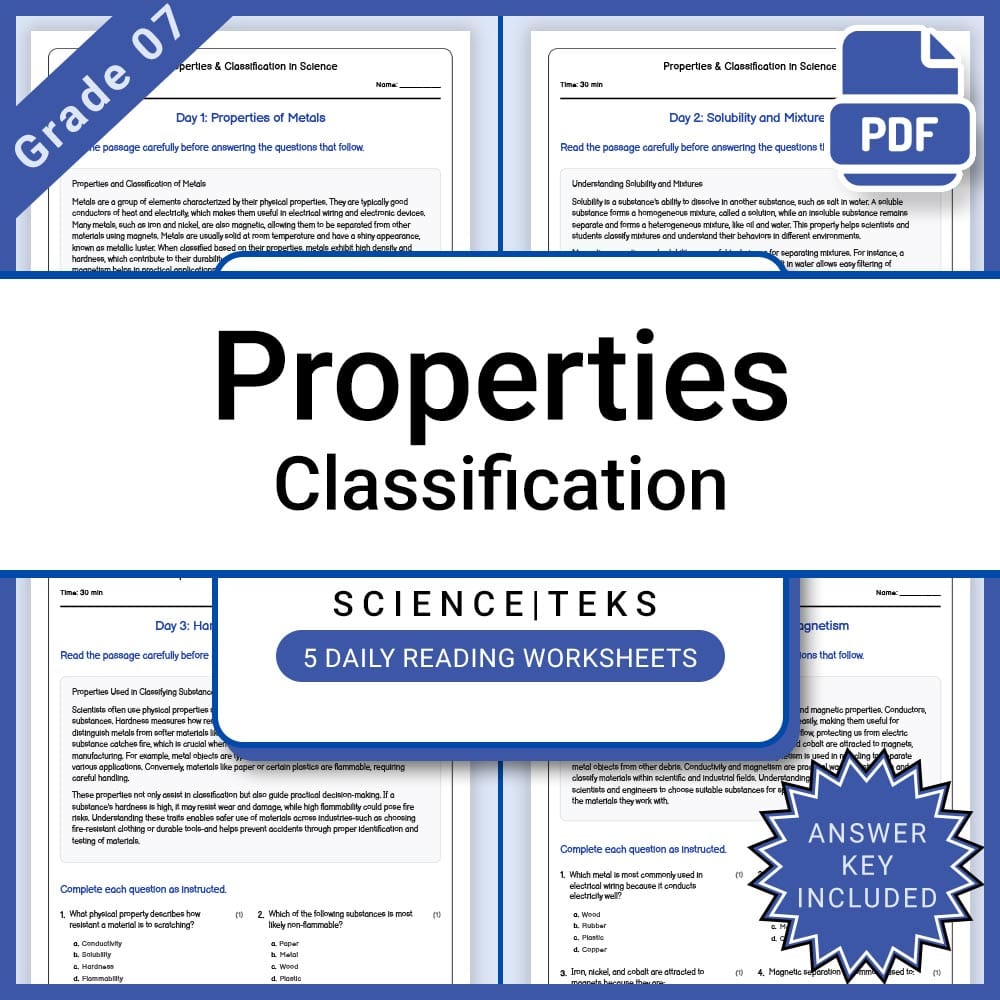
Grade 7 Science – Properties & Classification Daily Worksheet + Answer Key
JCreated byJ.S SheetsLearning Objectives
- Understand the physical properties used to classify substances such as density, solubility, hardness, electrical conductivity, magnetism, and flammability.
- Identify observable and measurable attributes that distinguish elements, compounds, and mixtures.
- Apply property-based classification techniques using common examples like metal conductivity and magnetic separation.
Also included in: Grade 7 Science Lesson Group: TEKS-Aligned Daily Reading Worksheets +1 more
Instant download
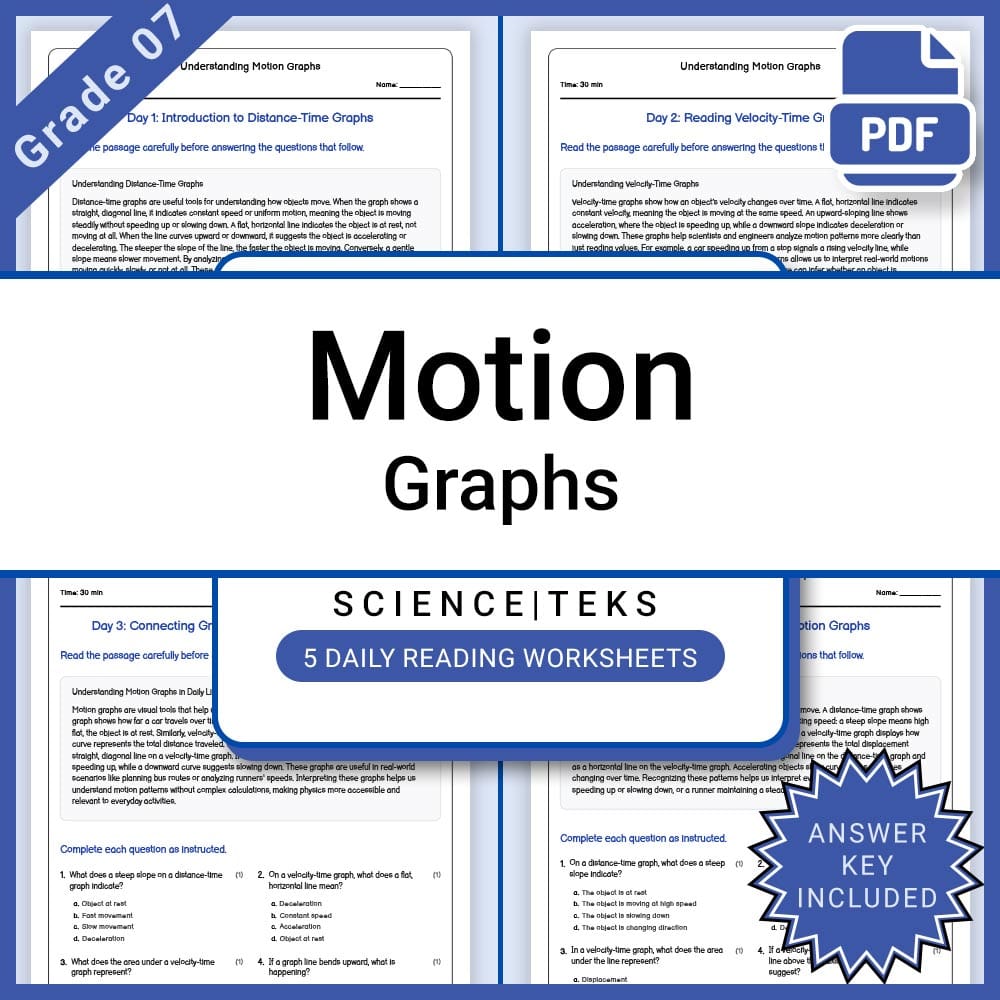
Grade 7 Science – Motion Graphs Daily Reading Worksheet + Answer Key
JCreated byJ.S SheetsLearning Objectives
- Interpret basic distance–time graphs
- Identify different patterns of motion from graphs
- Relate the slope of a distance–time graph to speed
Also included in: Grade 7 Science Lesson Group Bundle with TEKS Framework +1 more
Instant download
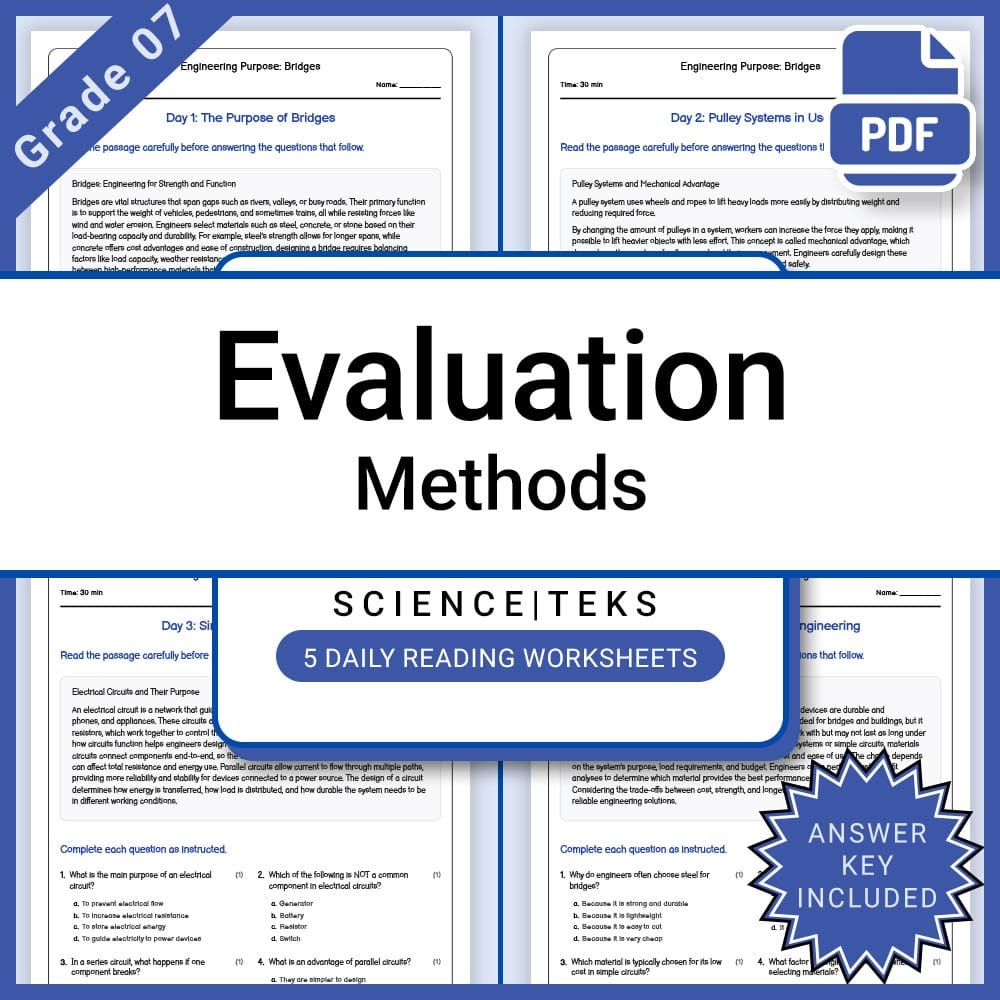
Grade 7 Science – Evaluation Methods Daily Reading Worksheet + Answer Key
JCreated byJ.S SheetsLearning Objectives
- Understand how to critically evaluate scientific explanations and models.
- Identify logical fallacies and distinguish between correlation and causation.
- Assess the strength and limitations of scientific evidence and data.
Also included in: Grade 7 Science Lesson Group TEKS Bundle | Daily Reading Worksheets +1 more
Instant download
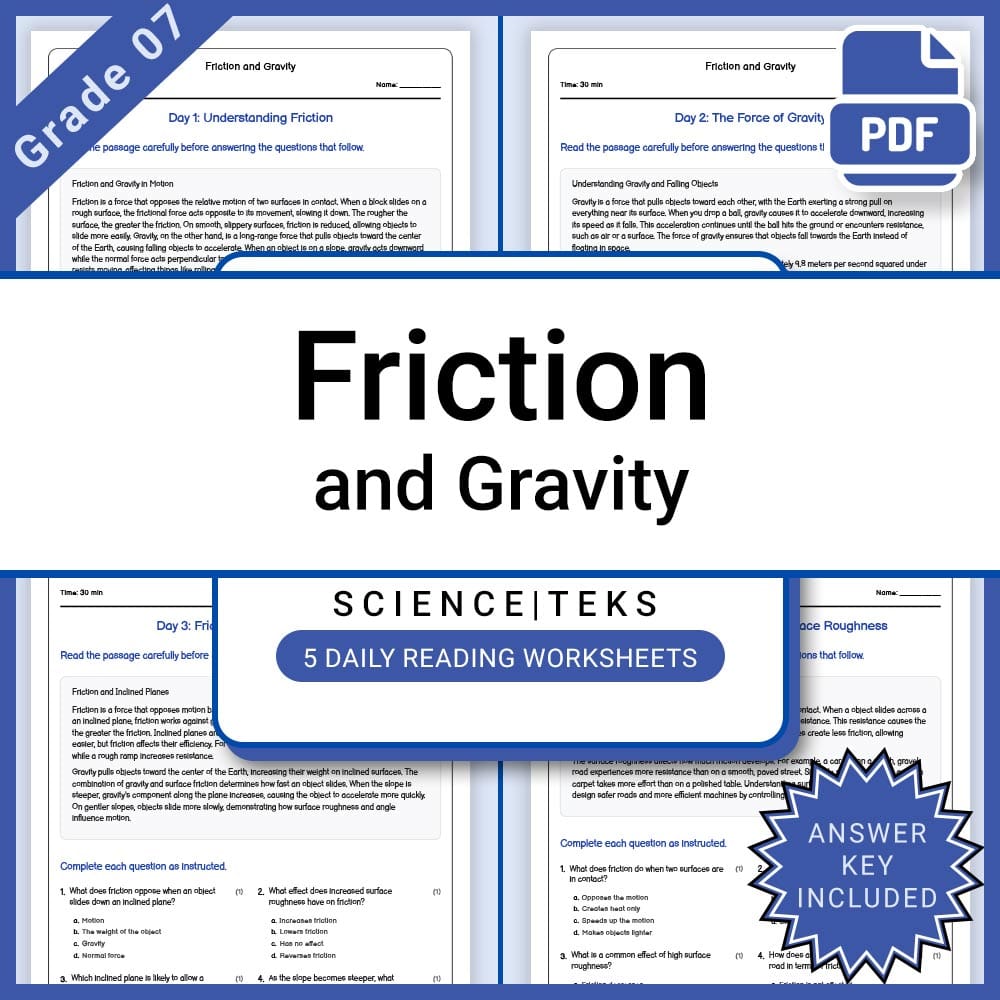
Grade 7 Science – Friction and Gravity Daily Reading Worksheet + Answer Key
JCreated byJ.S SheetsLearning Objectives
- Understand how friction opposes motion and affects objects on different surfaces.
- Explain the role of gravity as a long-range force that causes objects to accelerate downward.
- Describe how surface roughness influences the amount of friction between objects.
Also included in: Grade 7 Science Lesson Group Bundle with TEKS Framework +1 more
Instant download
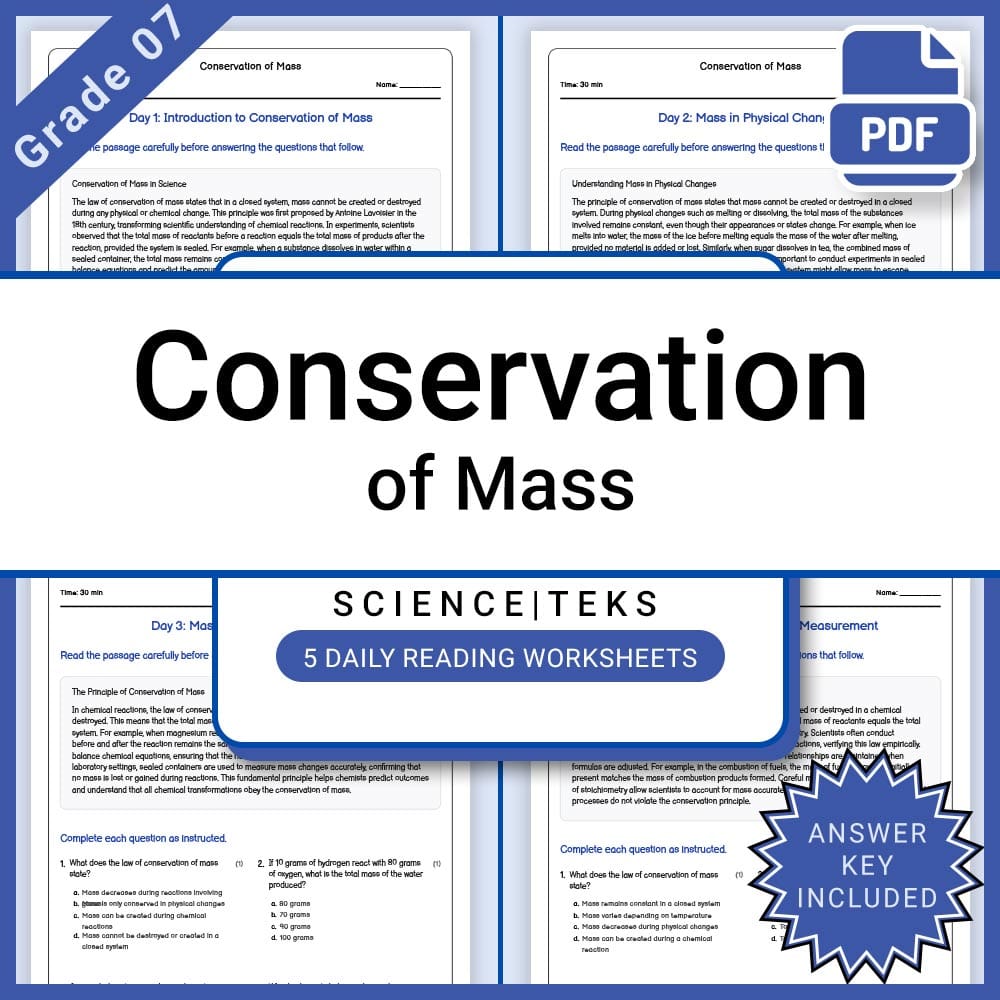
Grade 7 Science Conservation of Mass Daily Reading Worksheet with Answer Key
JCreated byJ.S SheetsLearning Objectives
- Understand the law of conservation of mass as a principle in physical and chemical processes.
- Apply the concept of mass accounting to reactions and dissolution processes.
- Recognize how balancing chemical formulas relates to mass conservation.
Also included in: Grade 7 Science Lesson Group: TEKS-Aligned Daily Reading Worksheets +1 more
Instant download
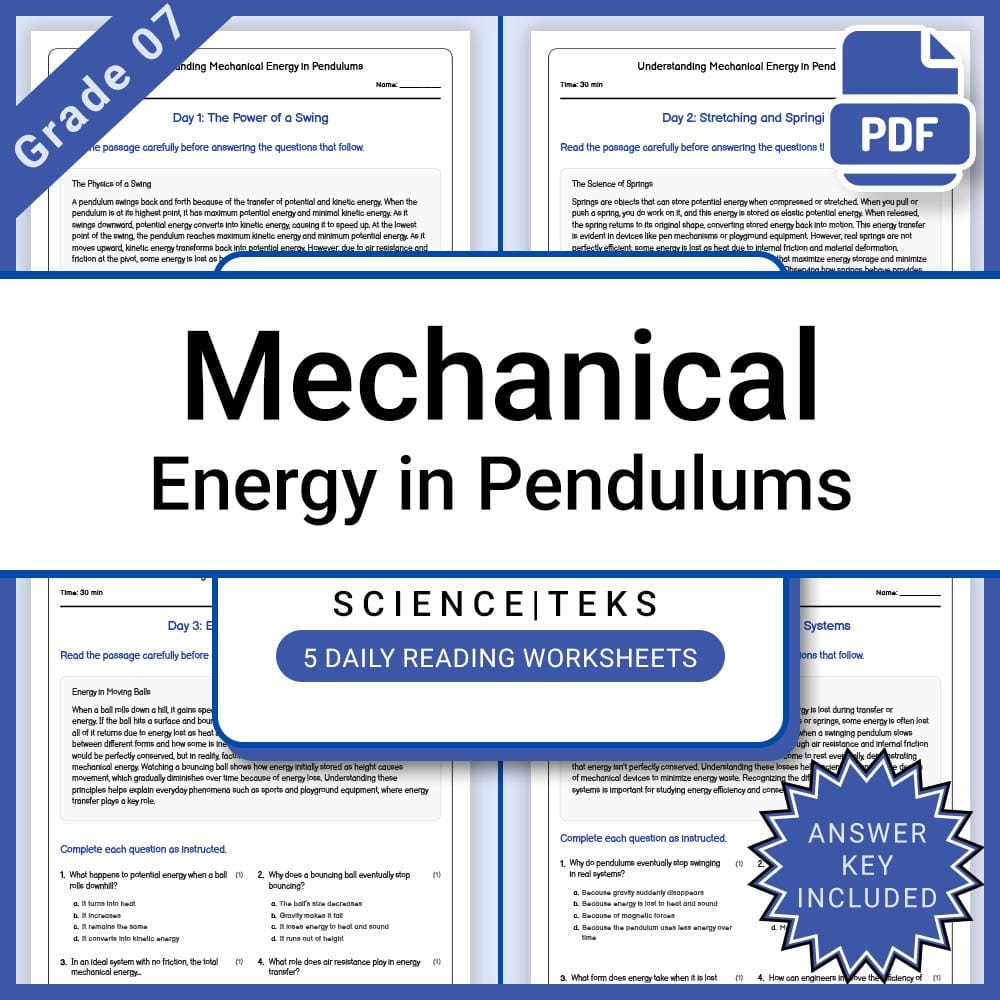
Grade 7 Science – Mechanical Energy Pendulums Worksheet + Answer Key
JCreated byJ.S SheetsLearning Objectives
- Identify how energy transfers between potential and kinetic in a swinging pendulum.
- Explain the concept of energy conservation within a mechanical system.
- Recognize observable signs of energy loss in real-world systems like pendulums.
Also included in: Grade 7 Science Lesson Group Bundle with TEKS Framework +1 more
Instant download
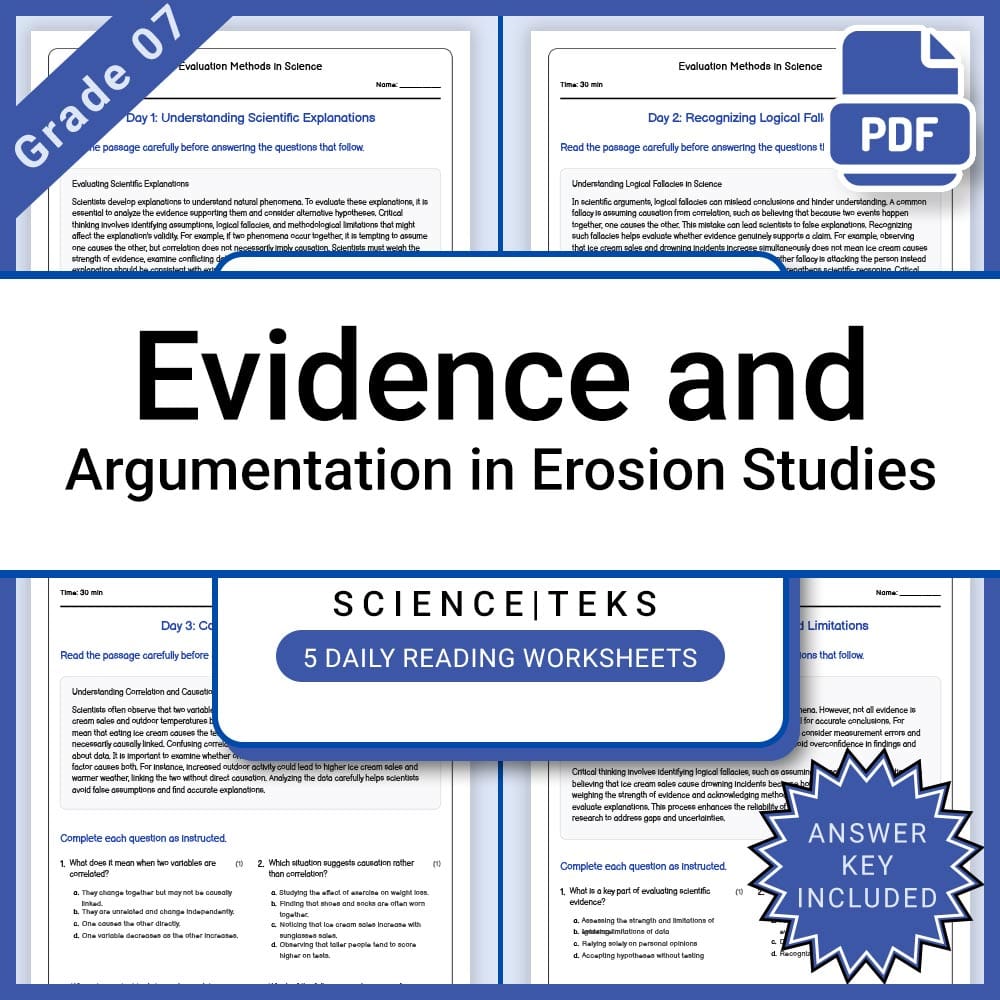
Grade 7 Science – Evidence and Argumentation Daily Worksheet + Answer Key
JCreated byJ.S SheetsLearning Objectives
- Understand key concepts related to Science
- Apply knowledge through practice questions
- Demonstrate comprehension of the material
Also included in: Grade 7 Science Lesson Group TEKS Bundle | Daily Reading Worksheets +1 more
Instant download
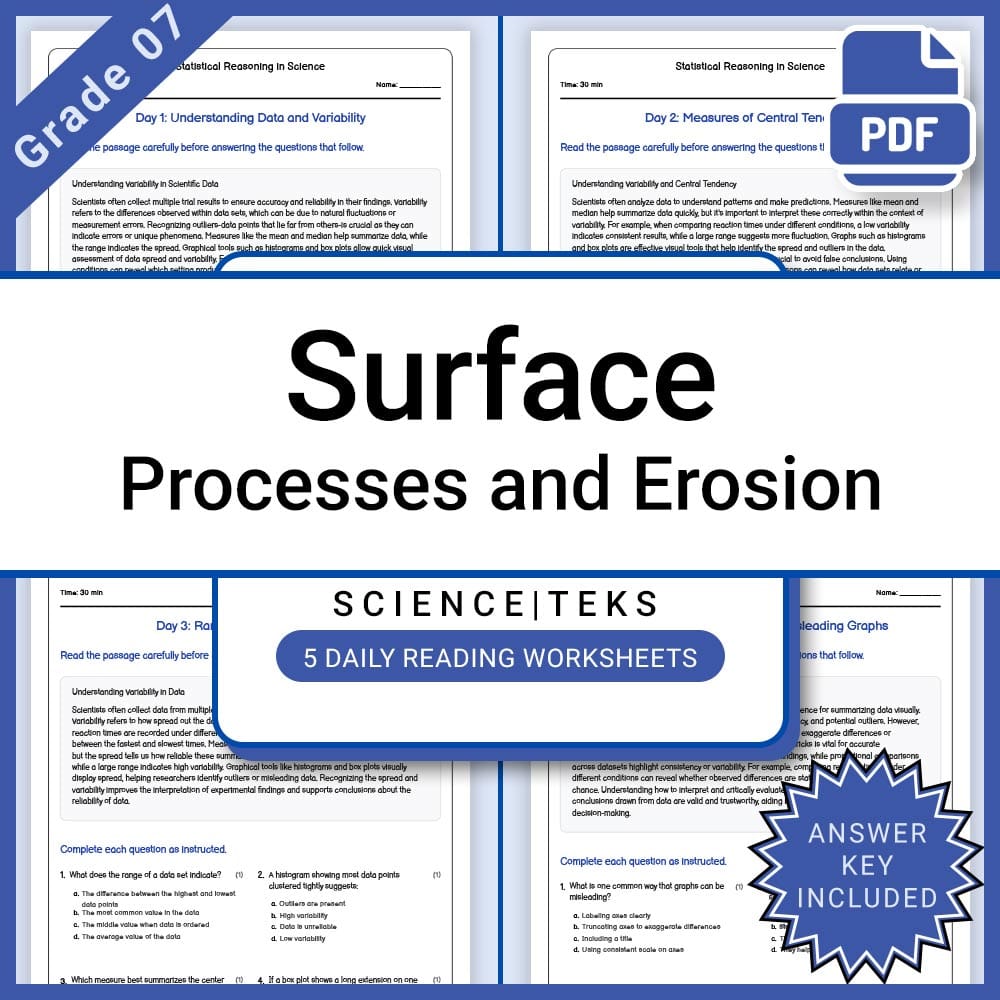
Grade 7 Science – Surface Processes and Erosion Worksheet + Answer Key
JCreated byJ.S SheetsLearning Objectives
- Understand how water influences the shaping of Earth's landforms.
- Identify and describe different landforms created by erosion.
- Explain the natural forces driving surface change over time.
Also included in: Grade 7 Science Lesson Group – TEKS Aligned & Concept-Focused Lesson Bundle +1 more
Instant download
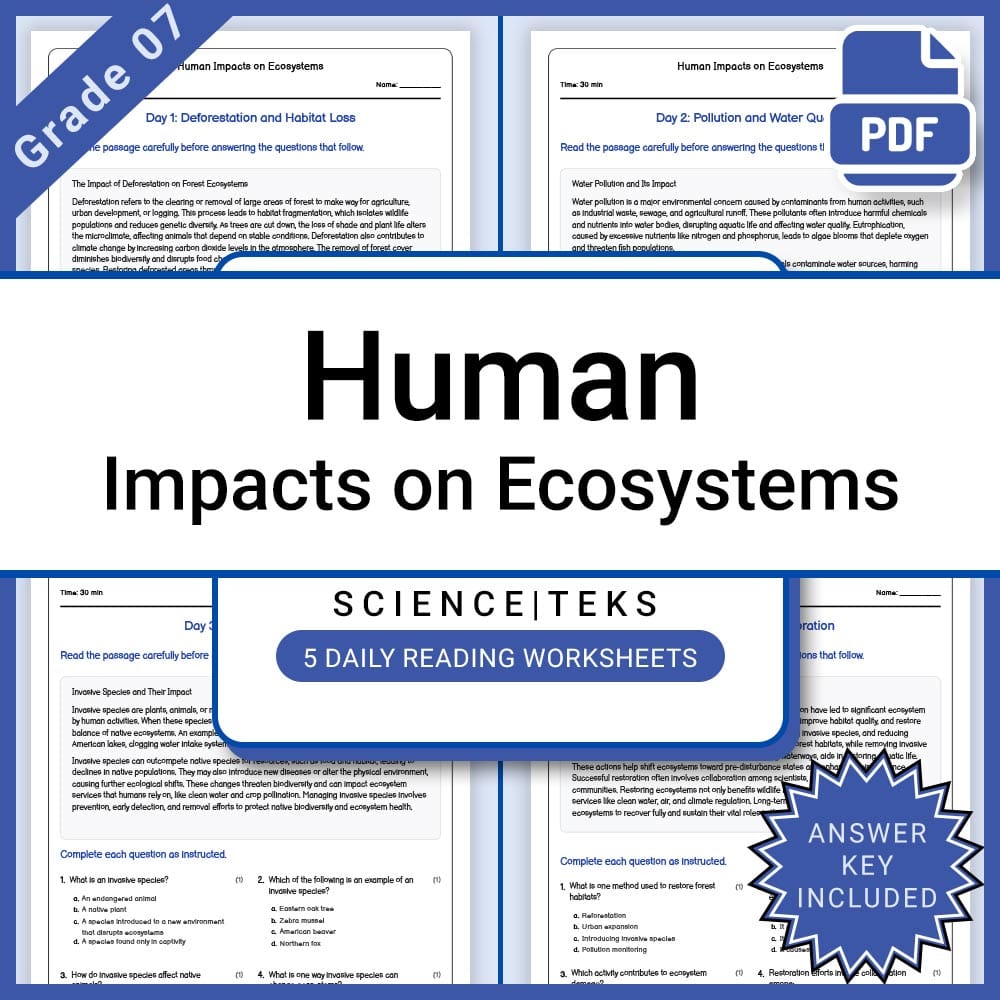
Grade 7 Science – Human Impacts on Ecosystems Worksheet + Answer Key
JCreated byJ.S SheetsLearning Objectives
- Understand the causes and effects of deforestation and habitat loss
- Identify examples of human activities that alter ecosystems
- Analyze how habitat fragmentation affects biodiversity and ecosystem services
Also included in: Grade 7 Science Lesson Bundle | Ecosystems, Cell Structure & Adaptations +1 more
Instant download
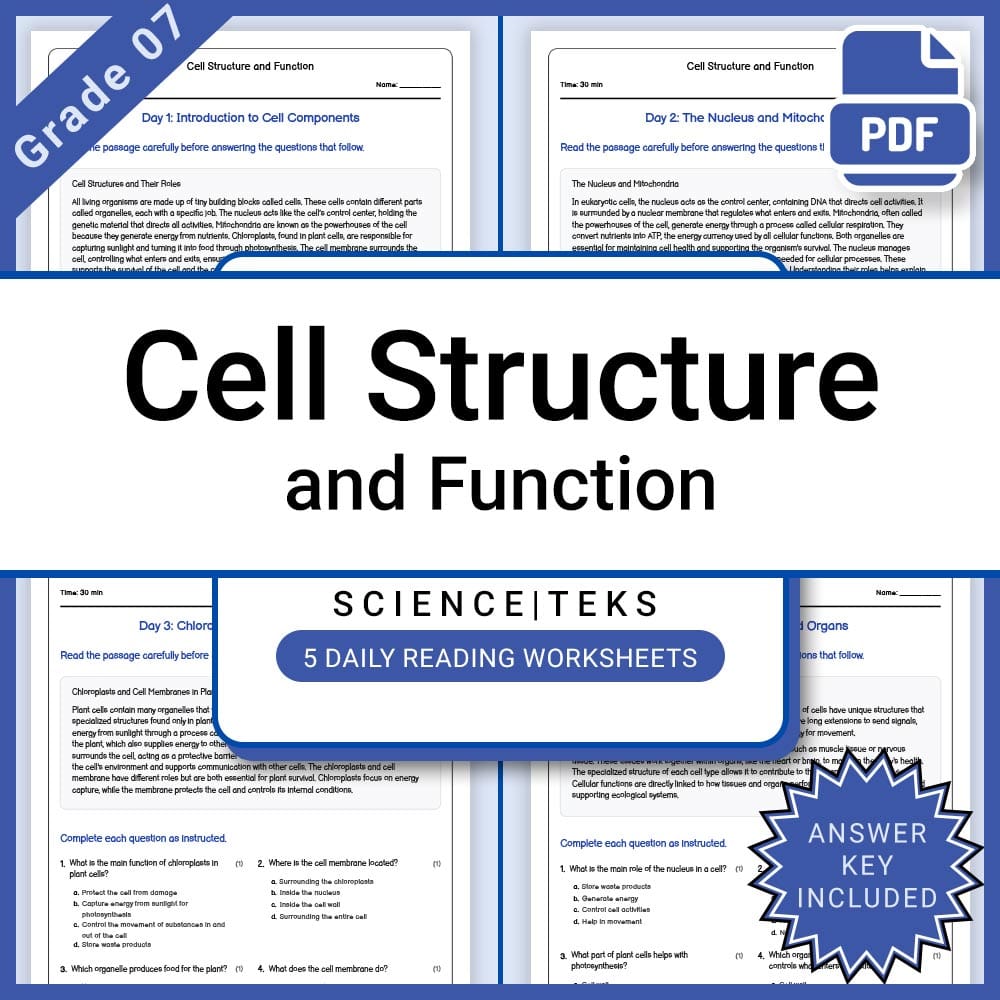
Grade 7 Science – Cell Structure and Function Worksheet + Answer Key
JCreated byJ.S SheetsLearning Objectives
- Identify and describe the main organelles in a cell.
- Understand the functions of the nucleus, mitochondria, chloroplasts, and cell membrane.
- Explain how cellular structures relate to the organism's overall function and survival.
Also included in: Grade 7 Science Lesson Bundle | Ecosystems, Cell Structure & Adaptations +1 more
Instant download
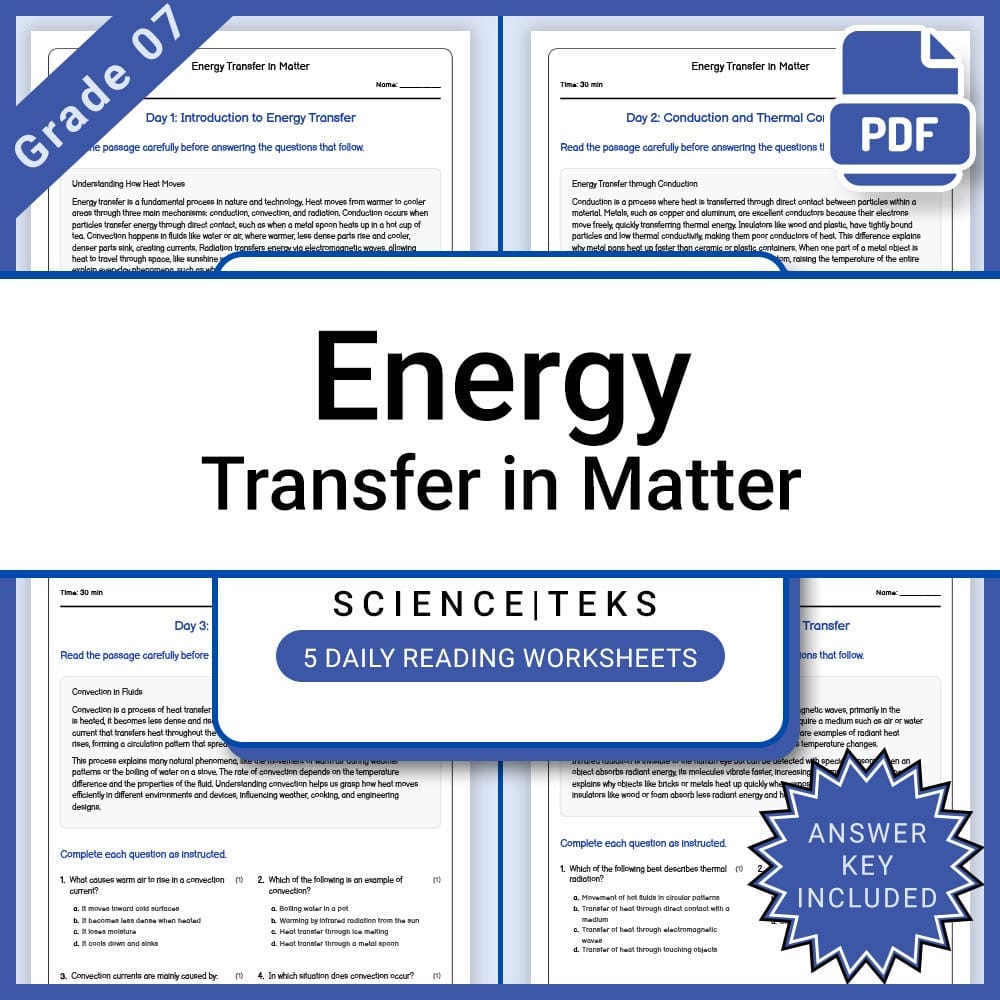
Grade 7 Science – Energy Transfer Daily Reading Worksheet with Answer Key
JCreated byJ.S SheetsLearning Objectives
- Recognize the different mechanisms of heat transfer: conduction, convection, and radiation.
- Identify examples of each energy transfer mechanism in everyday life.
- Understand how temperature gradients influence energy flow.
Also included in: Grade 7 Science Lesson Group: TEKS-Aligned Daily Reading Worksheets +1 more
Instant download

Grade 7 Science – Gas Behavior Daily Reading Worksheet with Answer Key
JCreated byJ.S SheetsLearning Objectives
- Understand how pressure, volume, and temperature affect gases
- Describe diffusion and compressibility phenomena in gases
- Relate observable gas behaviors to the properties of gases
Also included in: Grade 7 Science Lesson Group: TEKS-Aligned Daily Reading Worksheets +1 more
Instant download
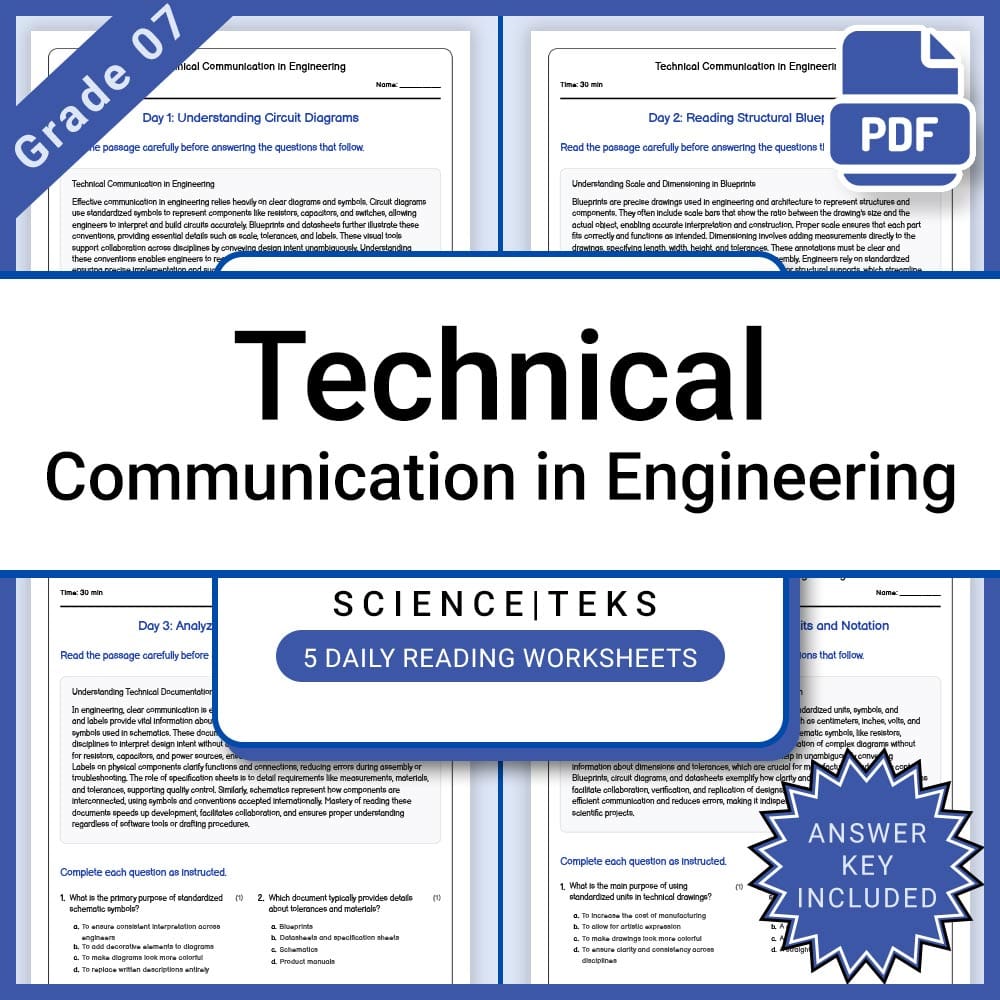
Grade 7 Science – Technical Communication Daily Worksheet with Answer Key
JCreated byJ.S SheetsLearning Objectives
- Understand the conventions used in technical drawings and diagrams.
- Interpret schematic symbols and standardized units.
- Identify key features of circuit diagrams, blueprints, and datasheets.
Also included in: Grade 7 Science Lesson Group TEKS Bundle – Standards and Inquiry Activities +1 more
Instant download
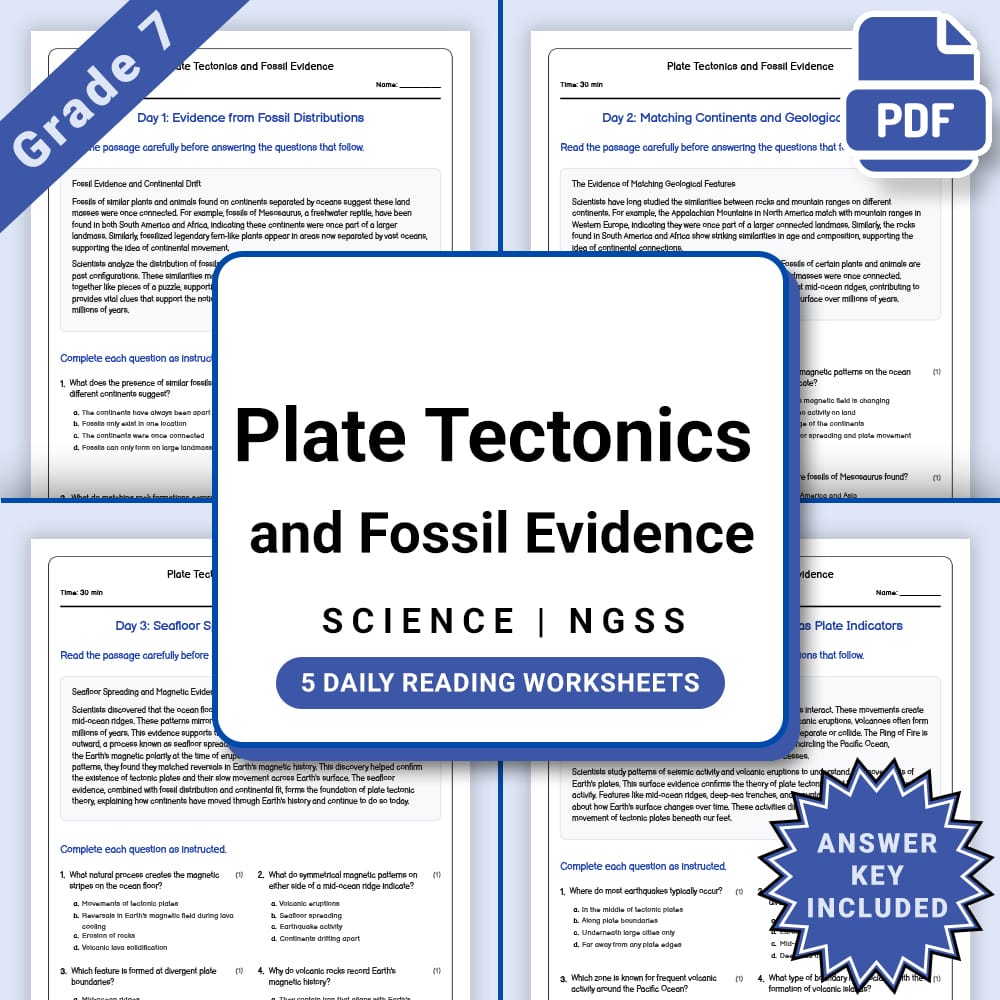
Grade 7 Science –Plate Tectonics and Fossil Evidence Worksheet(PDF + Answer Key)
Created byCopper Leaf ClassroomLearning Objectives
- Understand key concepts related to Science
- Apply knowledge through practice questions
- Demonstrate comprehension of the material
Instant download
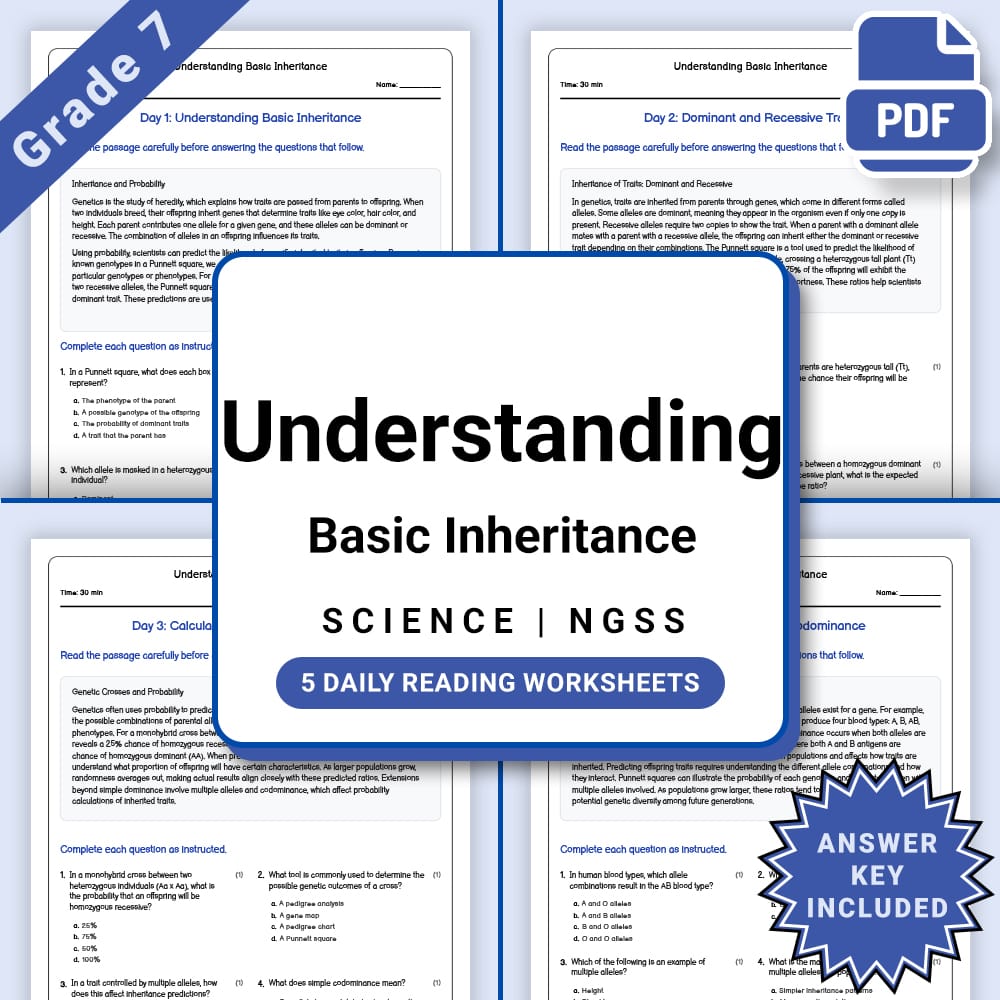
Grade 7 Science – Understanding Basic Inheritance Worksheet(PDF + Answer Key)
Created byCopper Leaf ClassroomLearning Objectives
- Interpret Punnett squares to predict genetic outcomes.
- Calculate probabilities of different genotypes and phenotypes.
- Understand how dominant and recessive alleles affect inheritance ratios.
Instant download
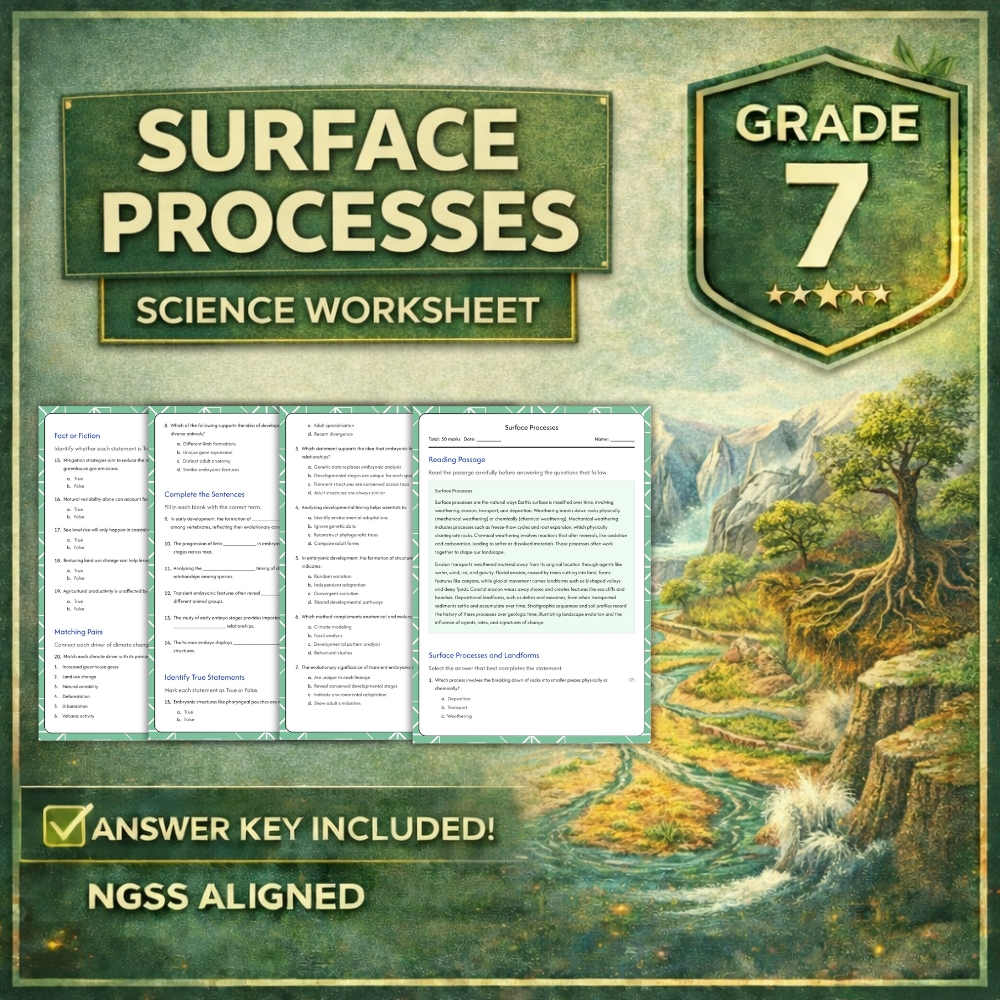
Grade 7 Science | Surface Processes Worksheet (NGSS-Aligned + Answer Key)
 Created byCedar Grove Learning
Learning Objectives
- Describe the key geologic processes that shape Earth's surface over short and long timescales.
- Distinguish between mechanical and chemical weathering and identify examples of each.
- Explain how erosion, transport, and deposition contribute to landscape features such as canyons, deltas, and landforms.
Also included in: Grade 7 Science Bundle | Earth Systems & Processes NGSS (Worksheet Pack)
Instant download
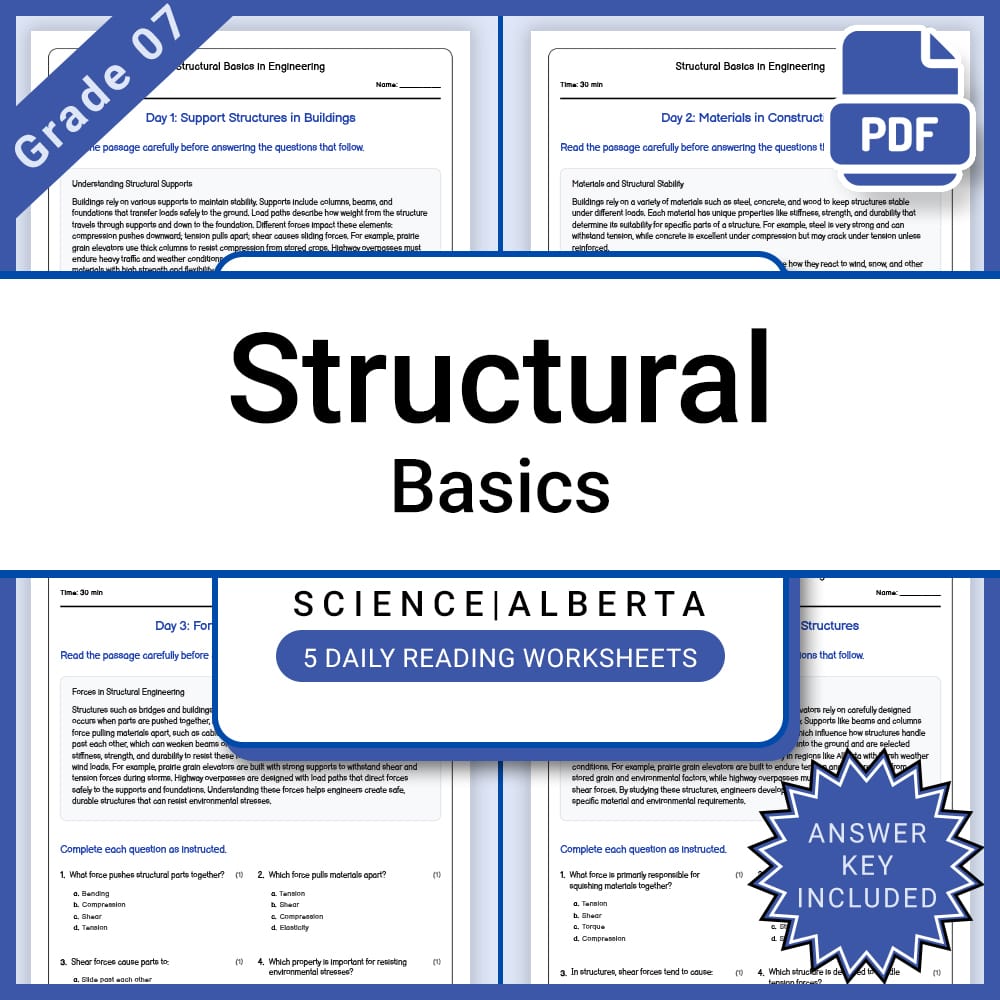
Grade 7 – Structural Basics in Engineering Daily Worksheet with Answer Key
JCreated byJ.S SheetsLearning Objectives
- Understand the roles of supports, foundations, and load paths in structures
- Identify how different forces like compression, tension, and shear affect structural components
- Evaluate the properties of construction materials such as stiffness, strength, and durability
Also included in: Grade 7 Science Lesson Group | Structural Engineering & Motion Worksheets +1 more
Instant download
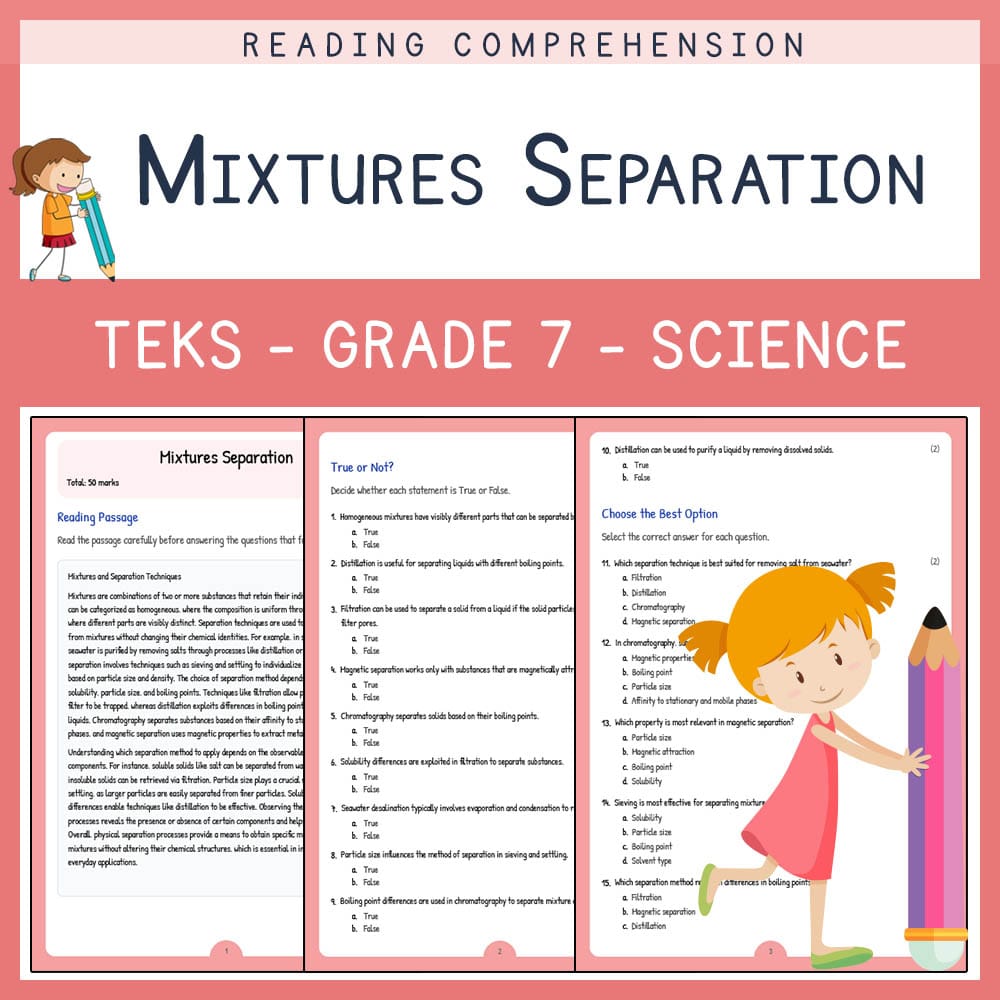
Grade 7 Science | Mixtures Separation Worksheet | TEKS Alligned
Created byLumora LearningLearning Objectives
- Understand the differences between homogeneous and heterogeneous mixtures.
- Describe various separation techniques such as filtration, distillation, chromatography, and magnetic separation.
- Explain how properties like solubility, particle size, and boiling points influence method selection.
Also included in: Grade 7 Science | Matter and Energy Lesson Bundle | TEKS Aligned
Instant download
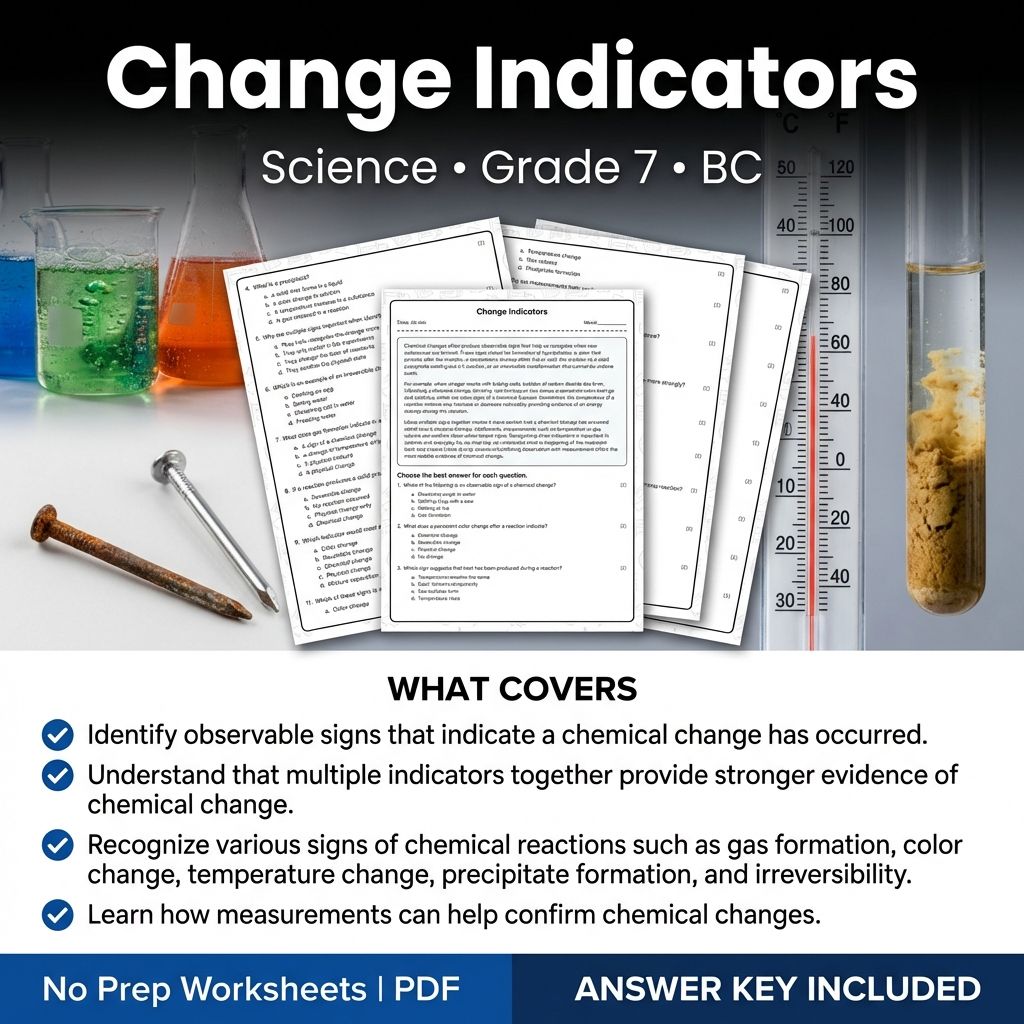
7th Grade Science Worksheet | Change Indicators Practice & Assessment PDF
 Created byCoral Reef Learning
Learning Objectives
- Identify observable signs that indicate a chemical change has occurred.
- Understand that multiple indicators together provide stronger evidence of chemical change.
- Recognize various signs of chemical reactions such as gas formation, color change, temperature change, precipitate formation, and irreversibility.
Instant download

Descriptive Statistics Science Worksheets Grade 7 | Mean, Median & IQR
Created byPrism Point LearningLearning Objectives
- Define mean, median, mode, and interquartile range
- Explain how outliers affect mean and variance
- Interpret box plots using median and IQR
Also included in: Scientific Inquiry & Data Practices Lesson Bundle | Grade 7 Science | Ontario +1 more
Instant download

Grade 7 Science | Closed Systems Worksheet | BC Standard
Created byLumora LearningLearning Objectives
- Understand the difference between closed and open systems in terms of matter transfer.
- Explain how mass is conserved in a closed system during reactions.
- Identify scenarios where systems are open versus closed and interpret mass changes accordingly.
Also included in: Grade 7 Science | Matter & Chemical Change Unit Bundle | BC Aligned
Instant download

Grade 7 Ecosystem Energy Flow Worksheet | NGSS Practice PDF
 Created byClear Sky Classroom
Learning Objectives
- Explain how energy enters an ecosystem mainly through photosynthesis and moves through trophic levels
- Describe how energy decreases at each transfer due to metabolic processes and energy loss as heat
- Compare the roles of producers, consumers, and decomposers in energy flow
Instant download

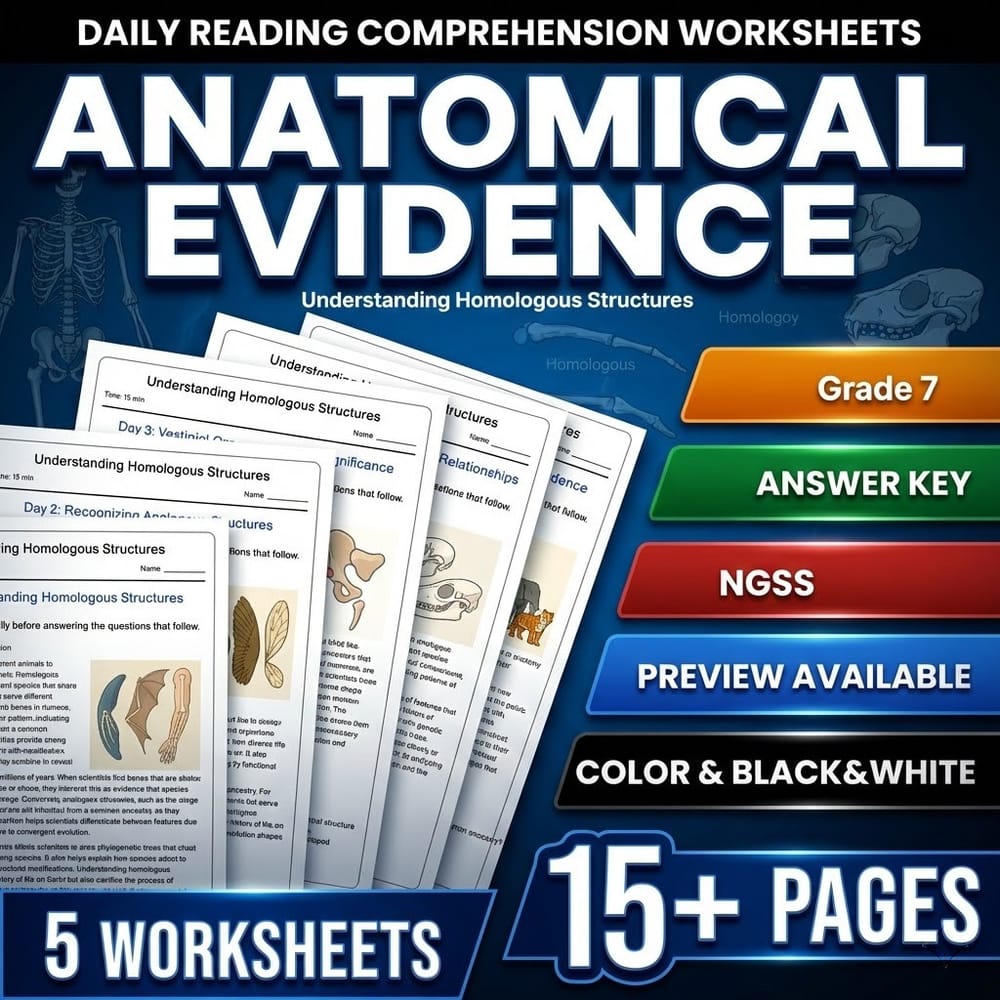
Grade 7 Science | Anatomical Evidence of Evolution - Daily Reading Comprehension
Created byCoral Reef LearningLearning Objectives
- Understand the concept of homologous and analogous structures.
- Identify examples of homologous structures in different species.
- Recognize vestigial organs and their significance.
Instant download
Grade 7 Science – Homologous Structures & Evolution | Daily Reading Worksheet
Created byElena BrooksLearning Objectives
- Identify and explain what homologous structures are
- Compare bone structures found in different species
- Understand how anatomical similarities inform evolutionary relationships
Also included in: Evolution and Natural Selection Grade 7 Science Worksheets Bundle | NGSS +1 more
Instant download
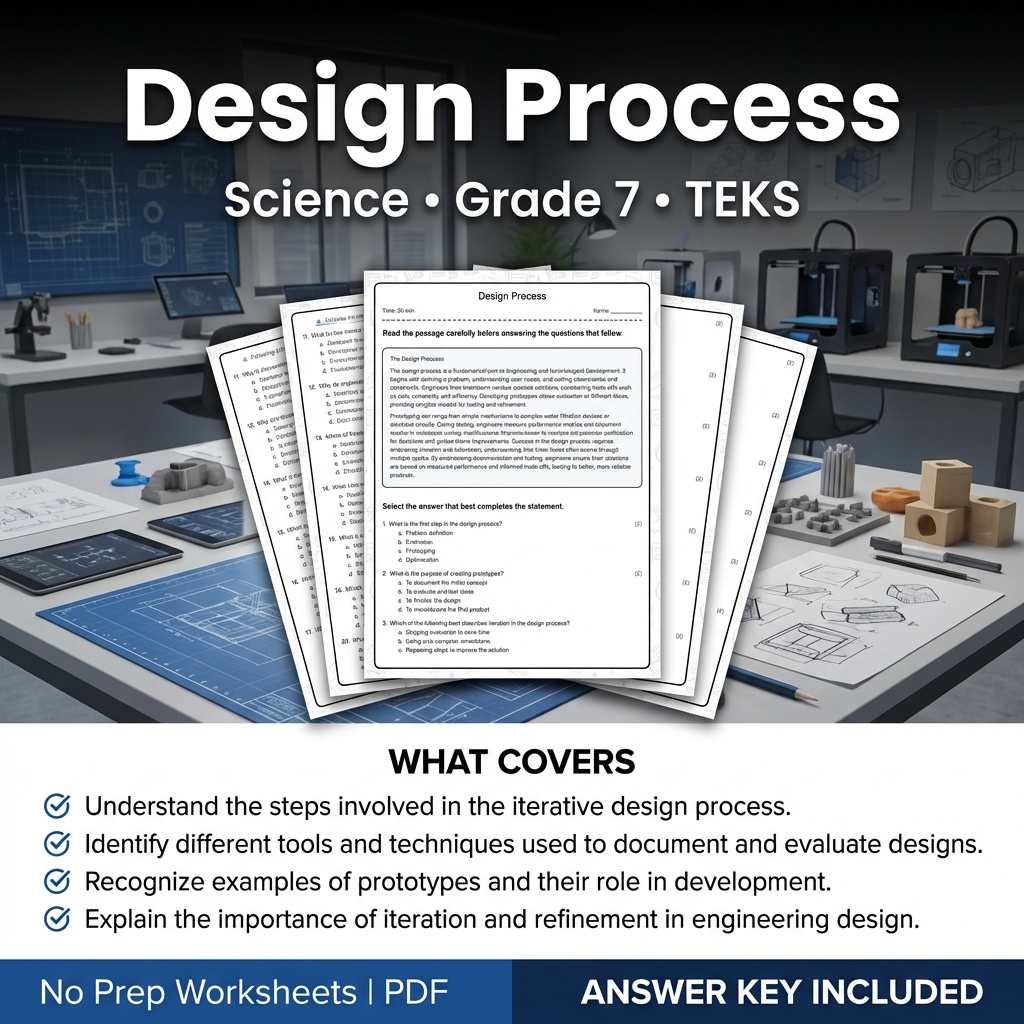
Grade 7 Science Worksheet on Design Process | TEKS-Aligned Practice
Created byCoral Reef LearningLearning Objectives
- Understand the steps involved in the iterative design process.
- Identify different tools and techniques used to document and evaluate designs.
- Recognize examples of prototypes and their role in development.
Instant download
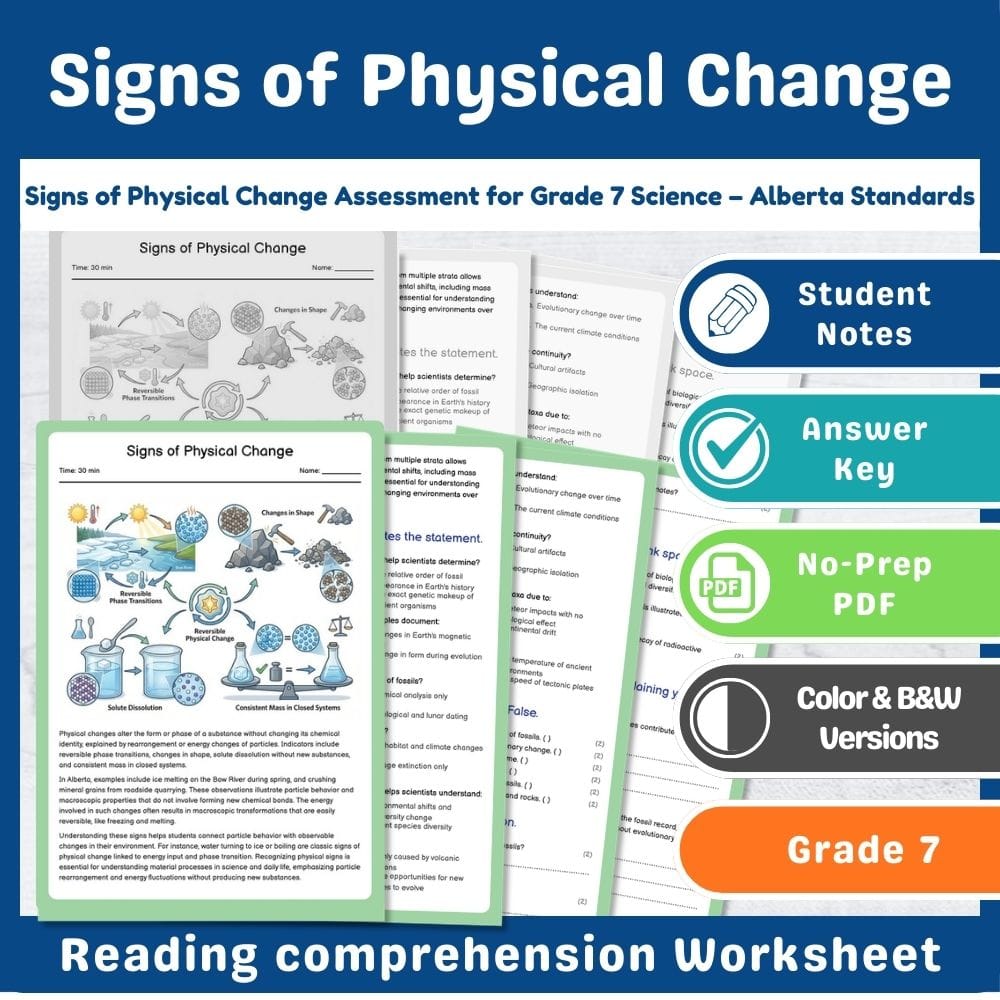
Signs of Physical Change Assessment for Grade 7 Science – Alberta Standards
Created byPrism Point LearningLearning Objectives
- Define physical change and identify its key indicators.
- Explain how particle behavior relates to observable signs of physical changes.
- Differentiate between physical and chemical changes based on physical signs.
Also included in: Lesson Grade 7 Science Mini Bundle | Matter and Chemical Change +1 more
Instant download
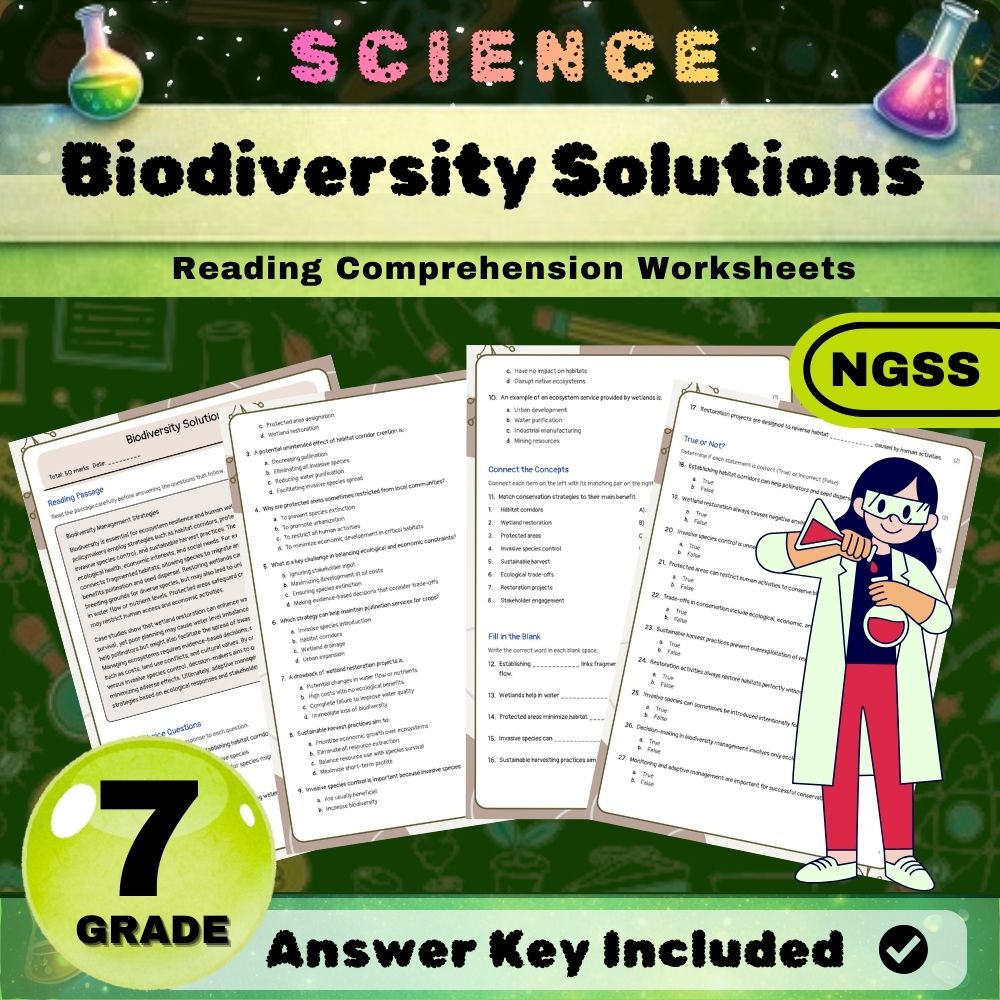
7th Grade Science | Biodiversity Solutions NGSS Worksheet (PDF)
 Created byMaple Path Learning
Learning Objectives
- Understand different management strategies used to maintain biodiversity and ecosystem services.
- Analyze case examples of wetland restoration and habitat corridors to evaluate benefits and trade-offs.
- Compare ecological, economic, and social constraints of conservation approaches and predict outcomes for species persistence.
Also included in: Grade 7 Science Unit Bundle | Ecosystems, Biodiversity & Environmental Impact +1 more
Instant download
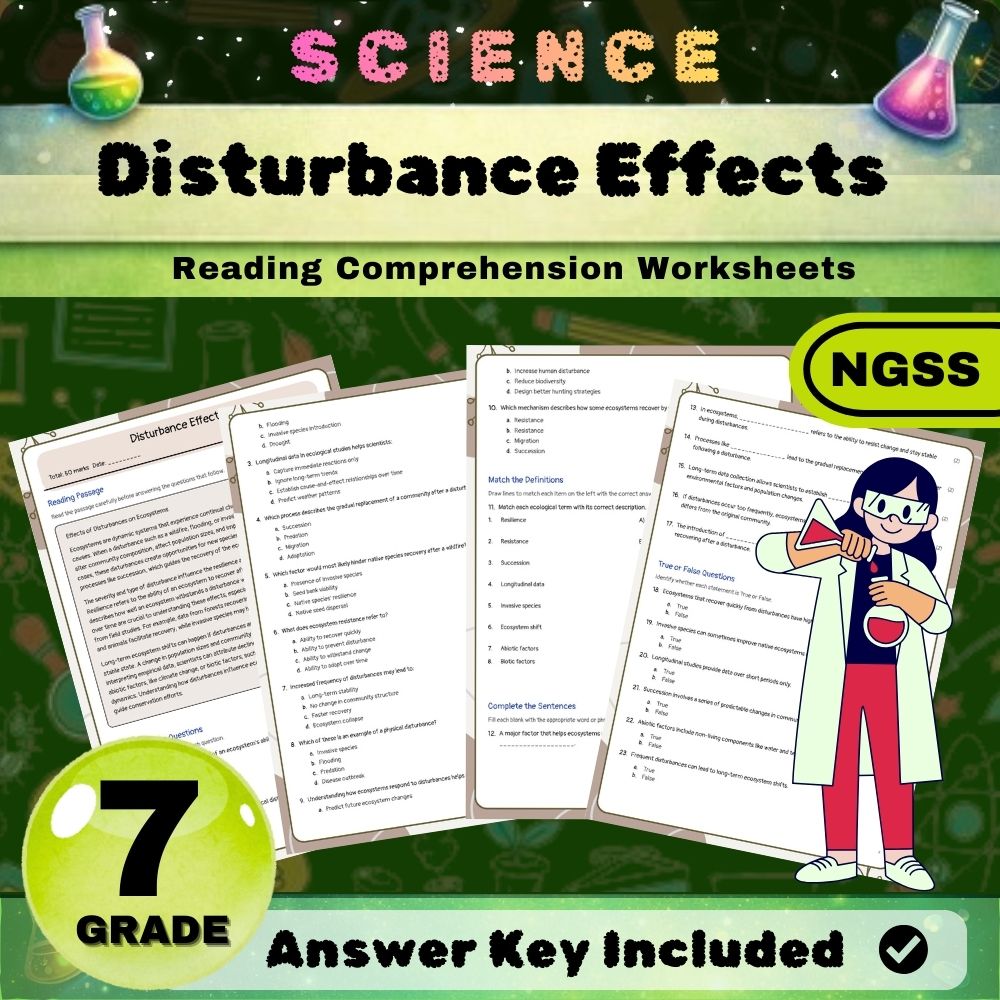
7th Grade Science | Effects of Disturbances NGSS Worksheet (PDF + Answer Key)
Created byMaple Path LearningLearning Objectives
- Understand how biological and physical disturbances can impact populations and ecosystems.
- Analyze empirical data and observations to identify causes and effects of disturbances.
- Explain mechanisms of resilience, resistance, and succession in ecosystem recovery.
Also included in: Grade 7 Science Unit Bundle | Ecosystems, Biodiversity & Environmental Impact +1 more
Instant download
Grade 7 Science | Energy Flow in Ecosystems Worksheet (PDF) NGSS-Aligned
Created byMaple Path LearningLearning Objectives
- Explain how energy is transferred through trophic levels in food webs and energy pyramids.
- Describe the roles of producers, consumers, and decomposers in ecosystems and their contributions to energy flow.
- Understand mechanisms of energy capture like photosynthesis and energy release like cellular respiration.
Also included in: Grade 7 Science Unit Bundle | Ecosystems, Biodiversity & Environmental Impact +1 more
Instant download
Grade 7 Science – Population Limits NGSS Worksheet (PDF)
Created byMaple Path LearningLearning Objectives
- Explain how resource availability affects population growth and size.
- Interpret data and graphs related to population dynamics and carrying capacity.
- Describe how competition for resources influences population fluctuations in ecosystems.
Also included in: Grade 7 Science Unit Bundle | Ecosystems, Biodiversity & Environmental Impact +1 more
Instant download

Mixtures and Solutions Worksheet | NGSS Science Practice for Grade 7
JCreated byJ.S SheetsLearning Objectives
- Differentiate between homogeneous and heterogeneous mixtures and solutions.
- Understand concepts of solubility, saturation, and concentration in mixtures.
- Identify examples of solutions, colloids, and suspensions based on particle size and behavior.
Also included in: Grade 7 Structure and Properties of Matter Science Lesson Bundle: NGSS +1 more
Instant download
About Grade 7 Science Worksheets
Browse 6,039 printable Grade 7 Science worksheets — ready-to-print PDFs with answer keys where available.
Every worksheet on MyTeachingSheets is created by independent teacher-authors and reviewed before publication. All resources download as printable PDFs for classroom, homework, or at-home practice, and many include answer keys. Preview any worksheet free before buying.