
Grade 7 Science Worksheets
6,039 worksheets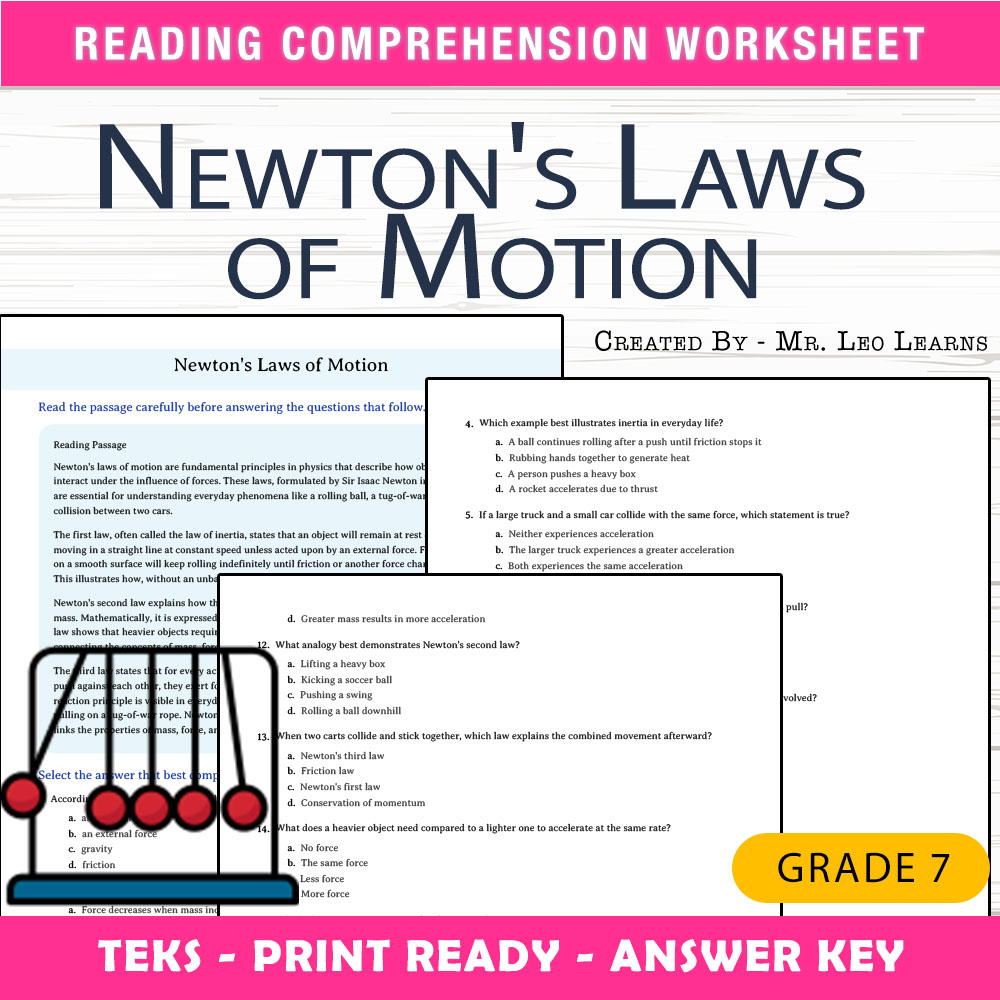
Grade 7 Science – Newton's Laws of Motion Worksheet for Mastery
 Created byThe Resource Hub
Learning Objectives
- Understand Newton's three laws of motion and how they describe force and movement.
- Identify real-world phenomena that illustrate inertia, acceleration, and action-reaction pairs.
- Connect qualitative descriptions of force and mass to algebraic proportionality in objects in motion.
Also included in: Grade 7 Science Unit Bundle – Motion, Forces & Energy Worksheets for Mastery +1 more
Instant download
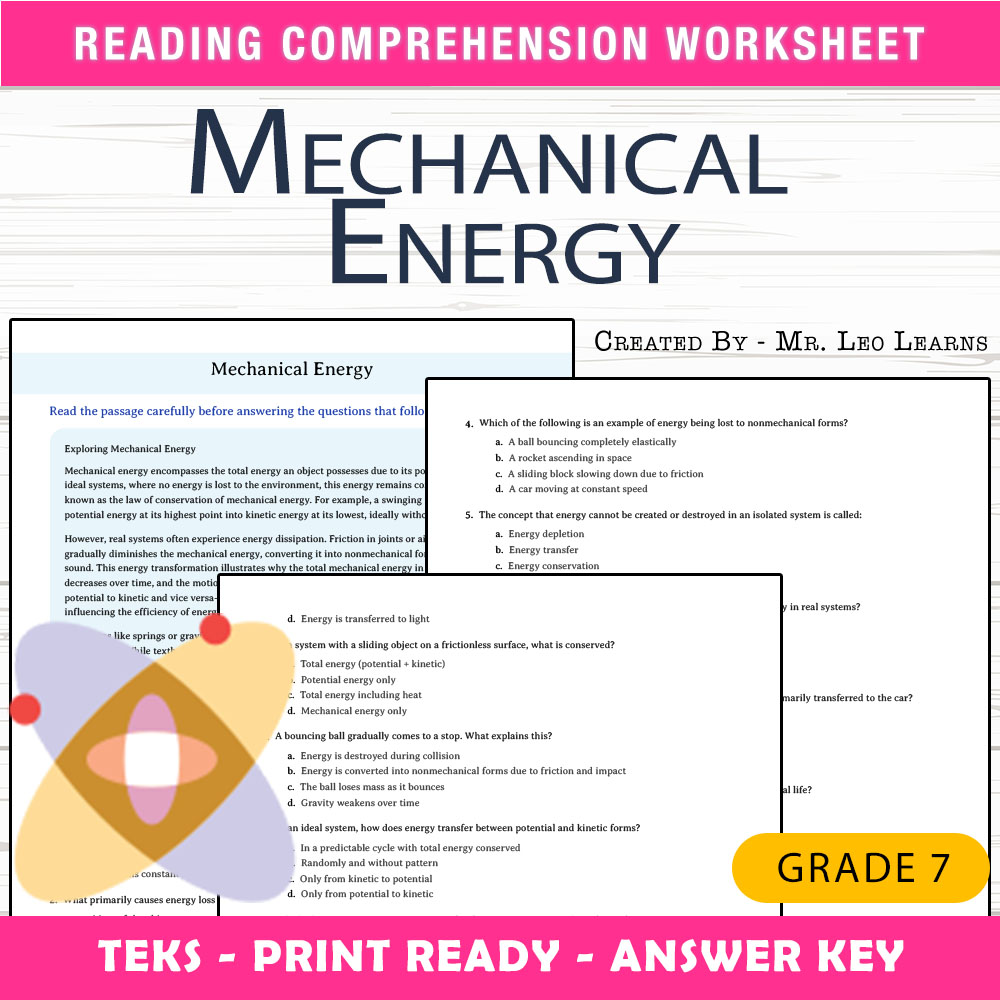
Grade 7 Science — Mechanical Energy Worksheet for Mastery
Created byThe Resource HubLearning Objectives
- Understand the concept of mechanical energy conservation in ideal and real systems.
- Explain how energy transfers among system components during motion such as swinging pendulums and springs.
- Identify observable signs of energy loss and discuss how nonmechanical energy forms influence system behavior.
Also included in: Grade 7 Science Unit Bundle – Motion, Forces & Energy Worksheets for Mastery +1 more
Instant download
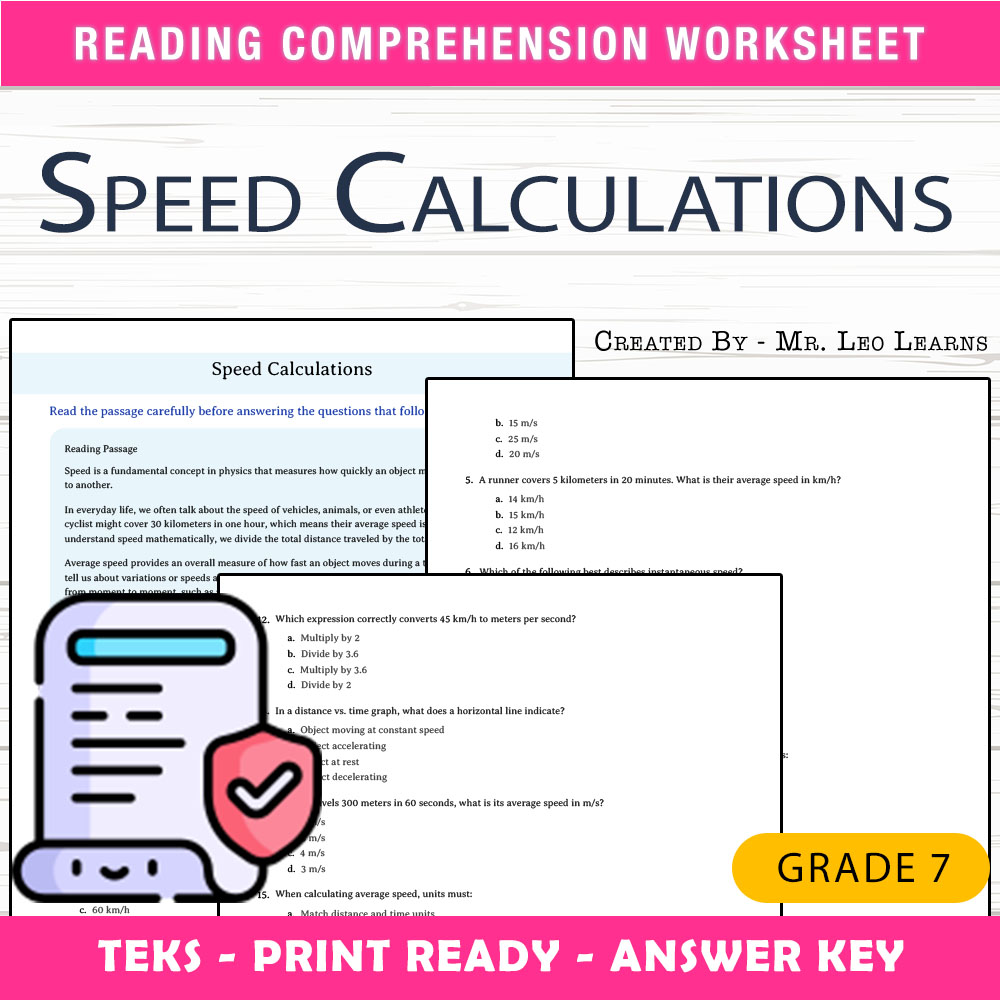
Grade 7 Science — Speed Calculations Worksheet for Mastery
Created byThe Resource HubLearning Objectives
- Understand how to calculate average speed using distance and time data.
- Distinguish between average speed and instantaneous speed through examples.
- Convert units between meters per second and kilometers per hour.
Also included in: Grade 7 Science Unit Bundle – Motion, Forces & Energy Worksheets for Mastery +1 more
Instant download
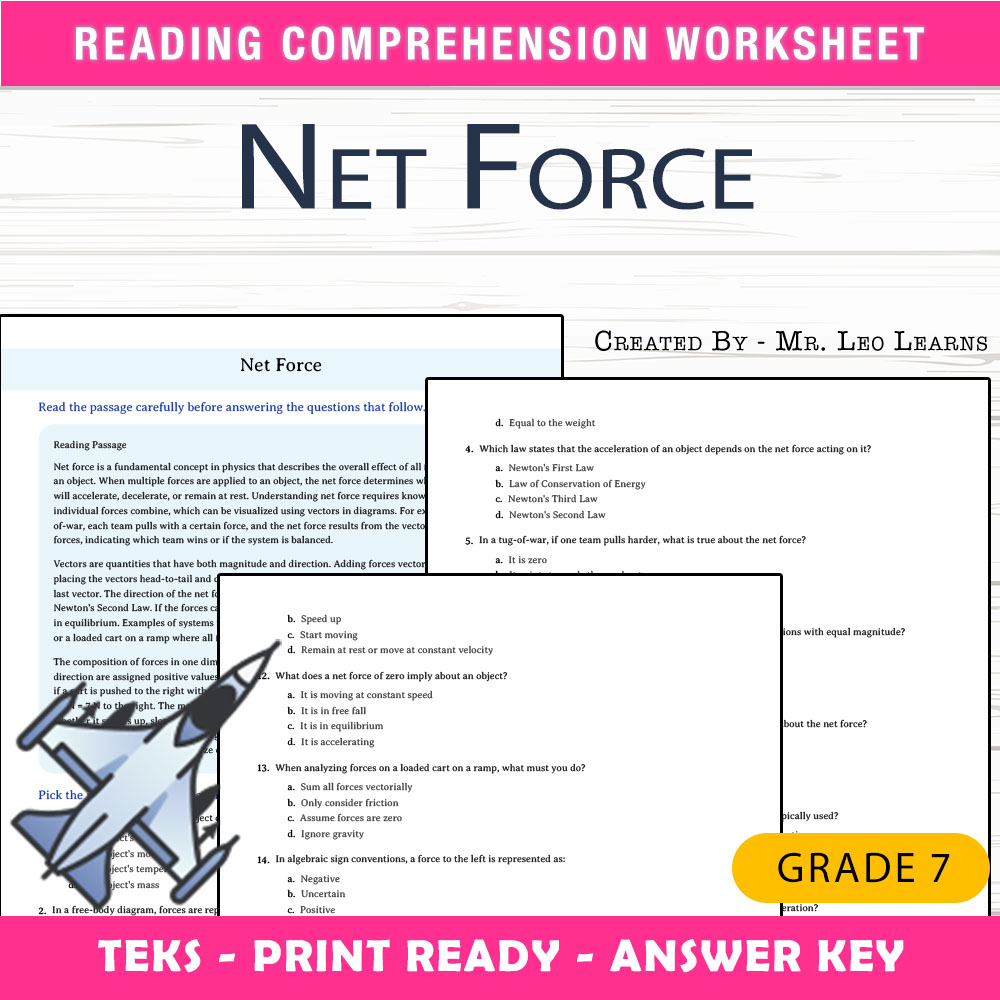
Grade 7 Science — Net Force Worksheet for Mastery
Created byThe Resource HubLearning Objectives
- Understand the concept of net force and how it determines the motion of objects.
- Compose vectors representing forces in free-body diagrams.
- Apply vector addition and equilibrium conditions to analyze systems like elevators, tug-of-war, and carts on ramps.
Also included in: Grade 7 Science Unit Bundle – Motion, Forces & Energy Worksheets for Mastery +1 more
Instant download
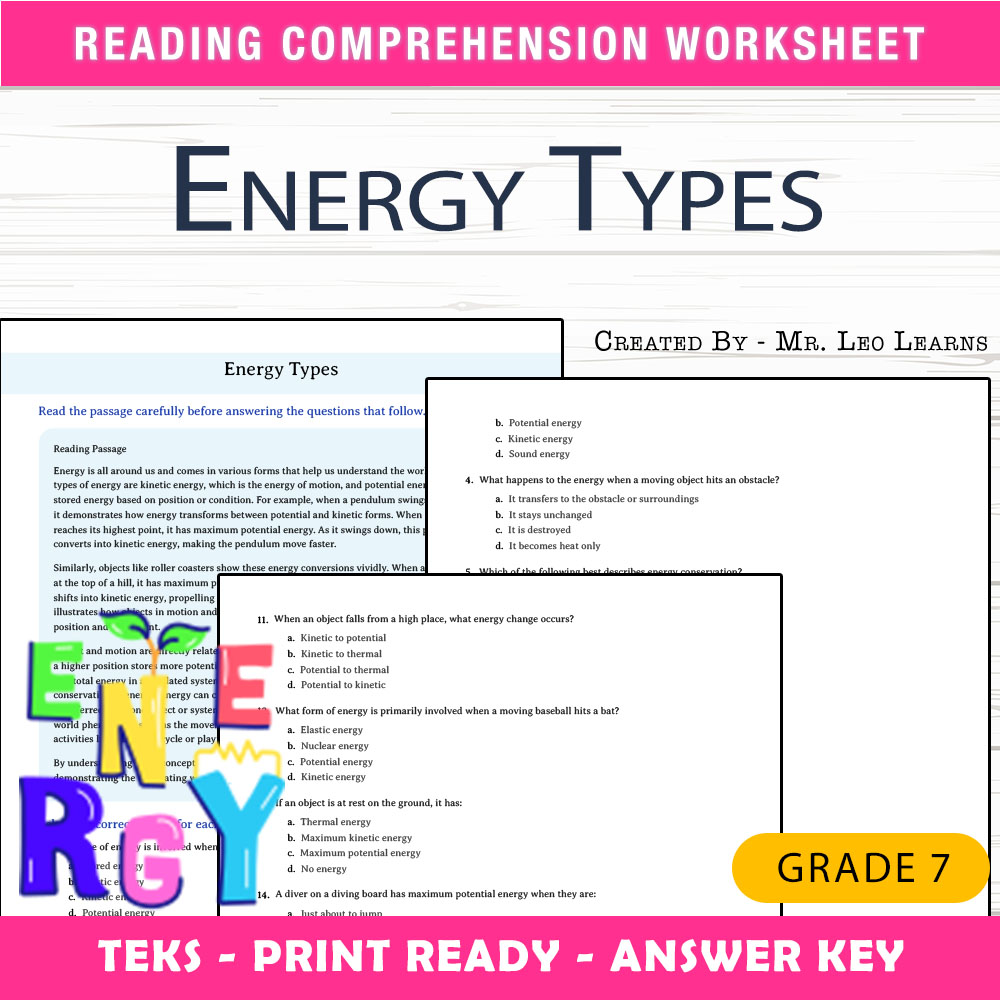
Grade 7 Science — Energy Types Worksheet for Mastery
Created byThe Resource HubLearning Objectives
- Define kinetic energy as energy of motion and potential energy as stored energy.
- Describe everyday phenomena illustrating kinetic and potential energy.
- Explain how height and motion relate to different forms of energy.
Also included in: Grade 7 Science Unit Bundle – Motion, Forces & Energy Worksheets for Mastery +1 more
Instant download
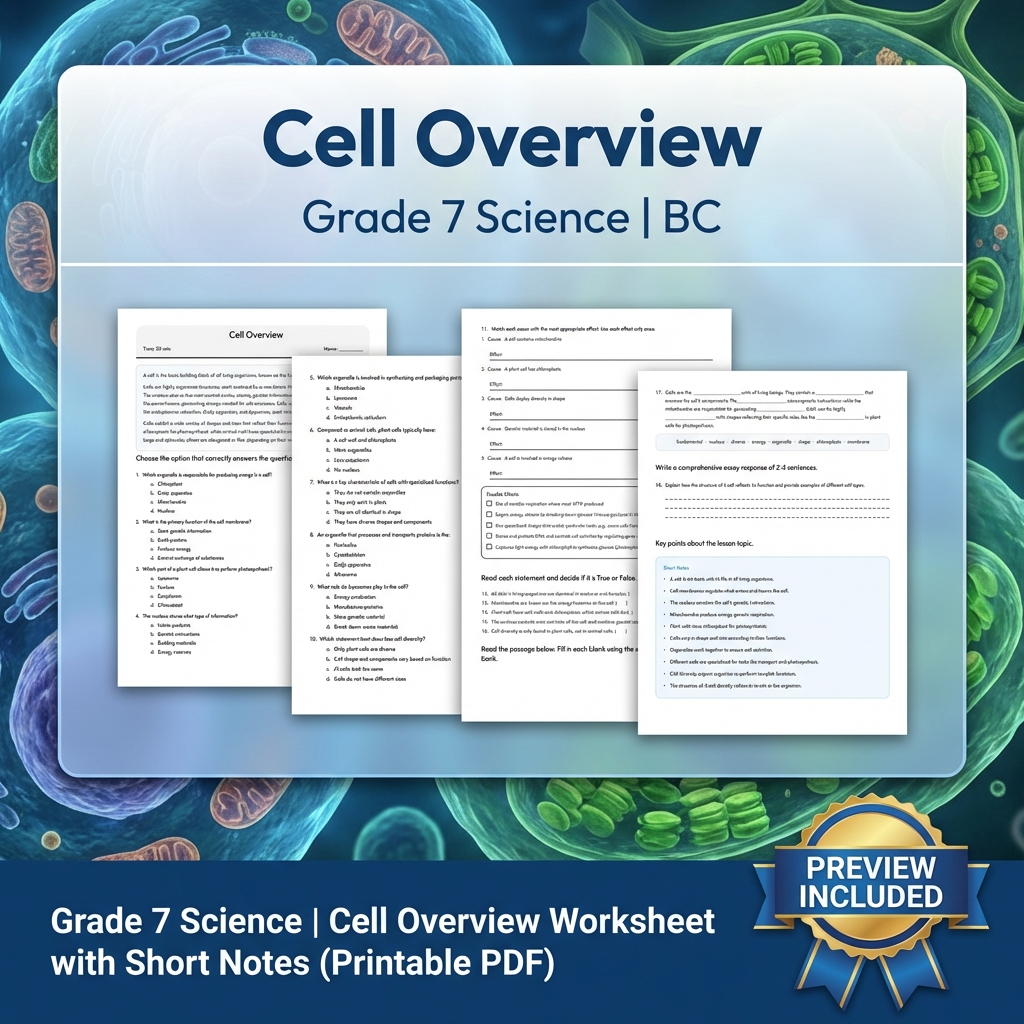
Grade 7 Science | Cell Overview Worksheet with Short Notes (Printable PDF)
 Created byMeadowlark Worksheets
Learning Objectives
- Identify the main parts of a cell and their functions.
- Describe the diversity in cell shapes and components based on their roles.
- Understand the structural differences between plant and animal cells.
Also included in: Grade 7 Science Lesson Bundle | Cell Structures & Functions Worksheets +1 more
Instant download
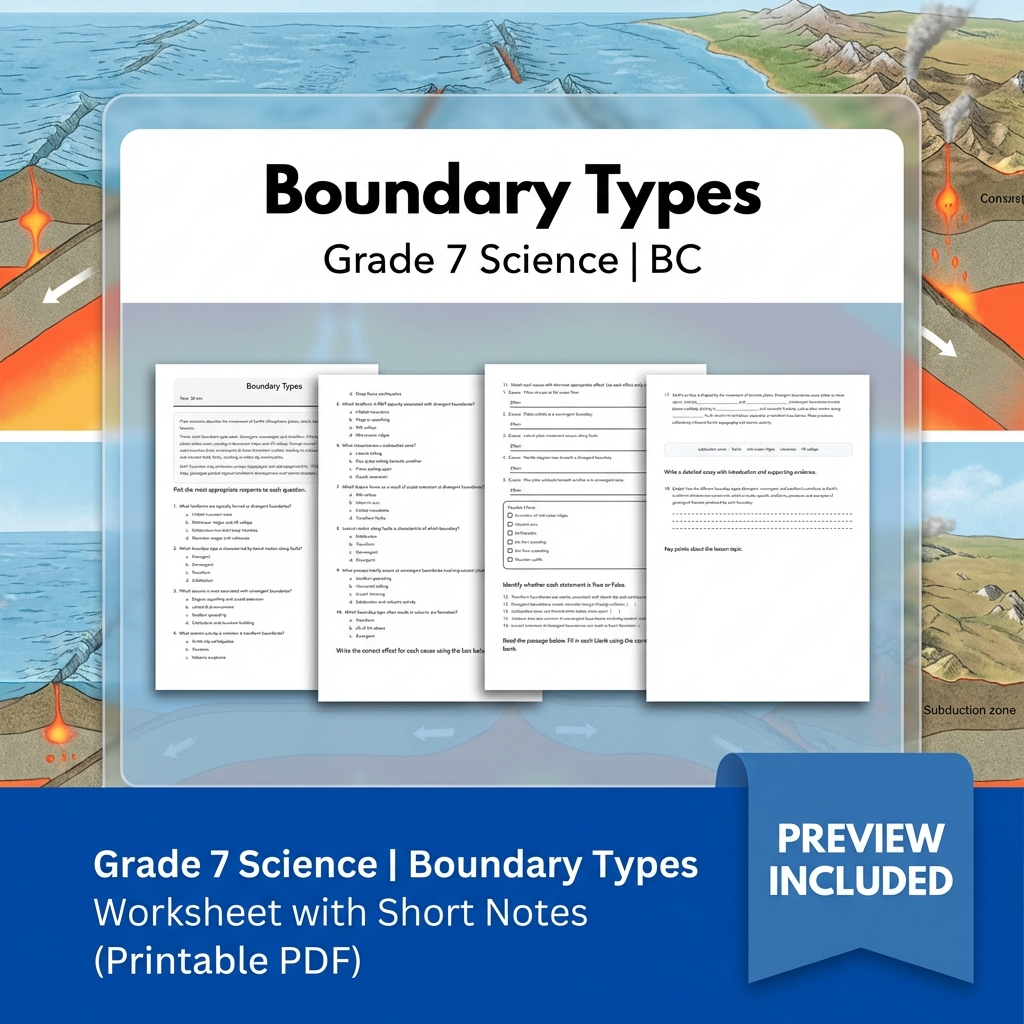
Grade 7 Science | Boundary Types Worksheet with Short Notes (Printable PDF)
Created byMeadowlark WorksheetsLearning Objectives
- Identify the three principal boundary types and their characteristic landforms.
- Explain how divergent boundaries create mid-ocean ridges and rift valleys.
- Describe the processes that occur at convergent boundaries, including subduction and mountain formation.
Also included in: Grade 7 Science Lesson Bundle | Earth Processes Worksheets Group +1 more
Instant download
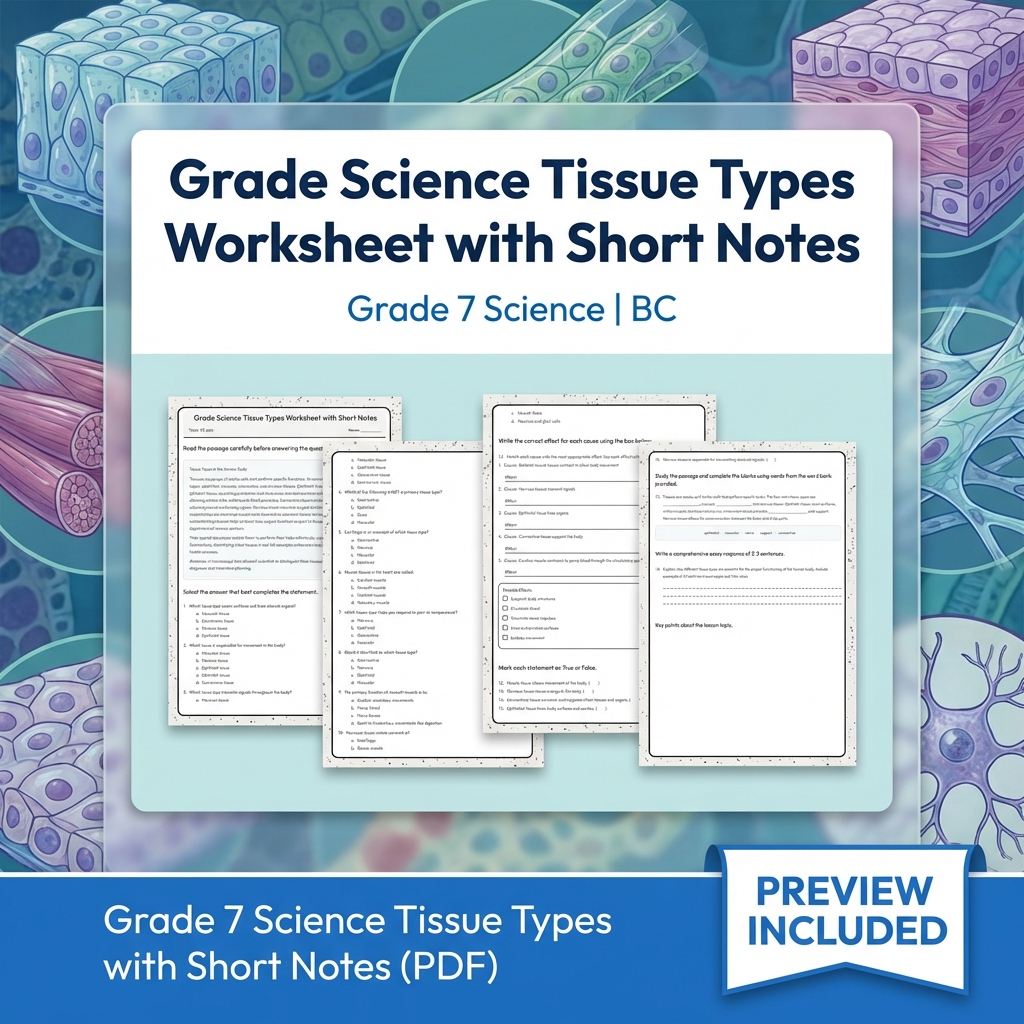
Grade 7 Science Tissue Types with Short Notes (PDF)
Created byMeadowlark WorksheetsLearning Objectives
- Identify different tissue types in the human body.
- Describe the functions of epithelial, muscular, connective, and nervous tissues.
- Understand how tissues work together to form organs and systems.
Also included in: Grade 7 Science Lesson Bundle | Cell Structures & Functions Worksheets +1 more
Instant download
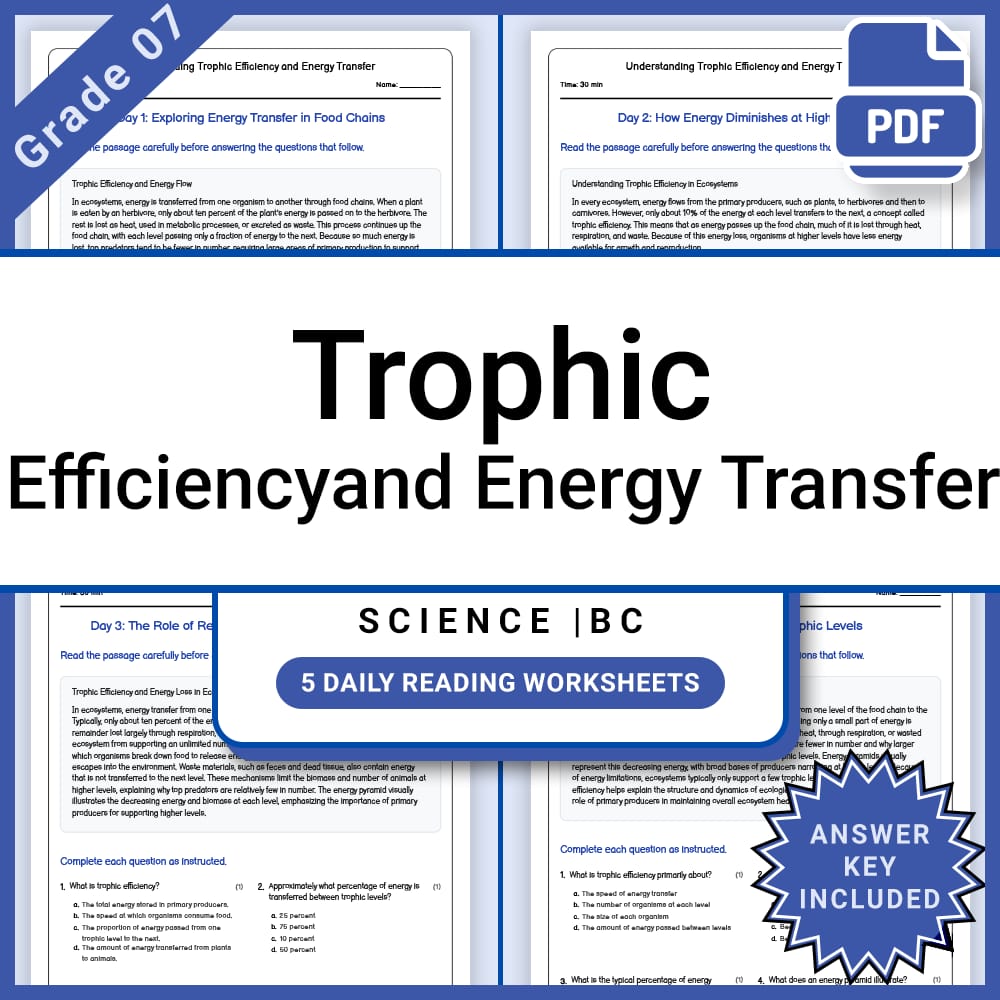
Grade 7 Science – Trophic Efficiency Daily Reading Worksheet + Answer Key
JCreated byJ.S SheetsLearning Objectives
- Explain the concept of trophic efficiency
- Describe how energy is transferred through food chains
- Identify factors that cause energy loss in ecosystems
Also included in: Grade 7 Science Lesson Group: Ecosystems and Population Framework +1 more
Instant download
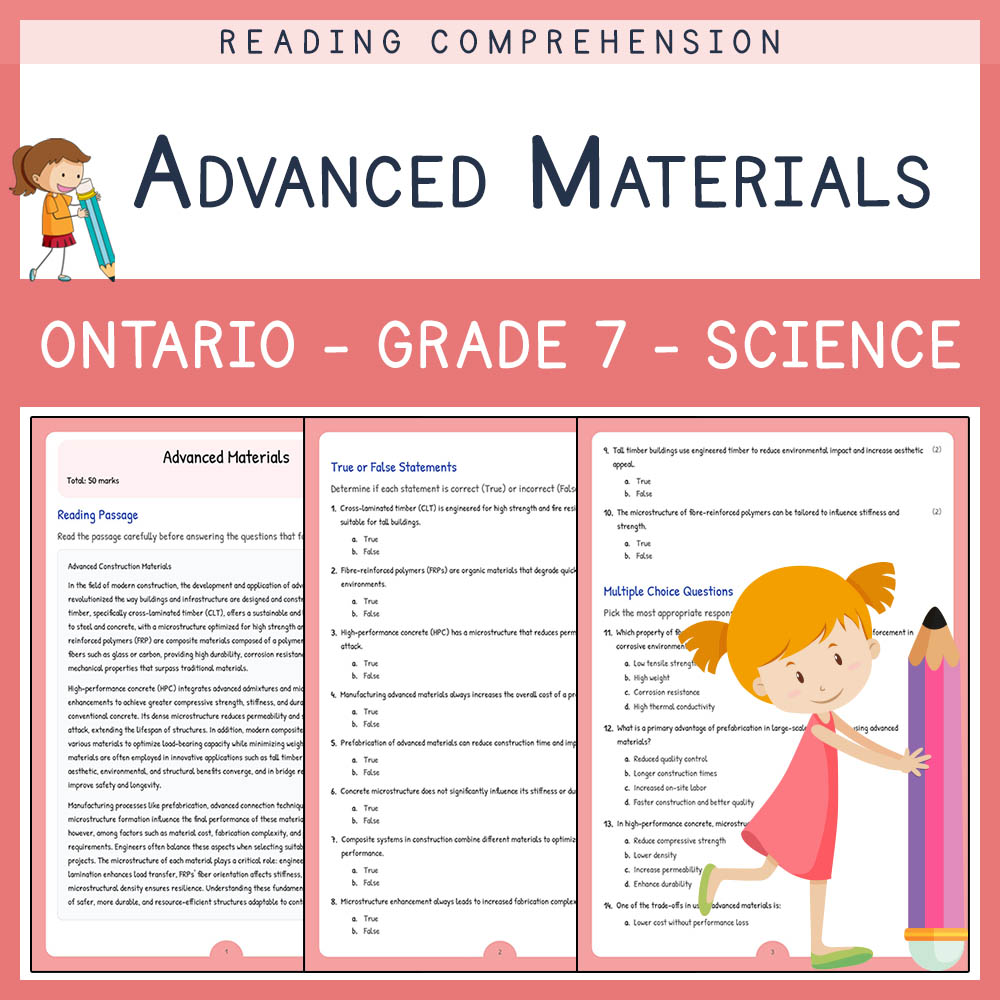
Grade 7 Science | Advanced Materials Worksheet with Answer Key (PDF)
 Created byLumora Learning
Learning Objectives
- Understand the properties and manufacturing processes of engineered timber, fibre-reinforced polymers, and high-performance concrete.
- Explain how microstructure enhances the strength, stiffness, and durability of advanced materials.
- Analyze the trade-offs among cost, fabrication complexity, and performance of modern construction materials.
Also included in: Grade 7 Science | Form Function Design Structures Unit Bundle | Ontario
Instant download
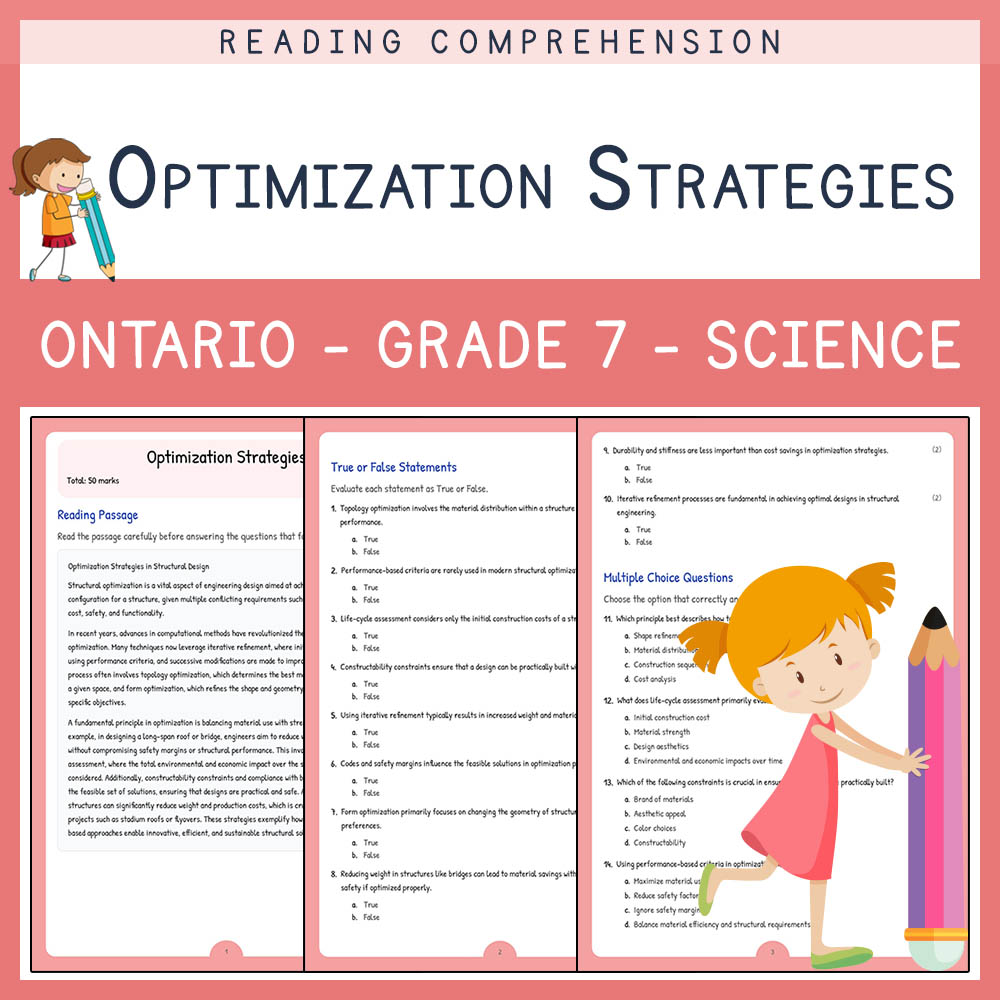
Grade 7 Science | Optimization Strategies Worksheet with Answer Key (PDF)
Created byLumora LearningLearning Objectives
- Understand key principles of structural optimization including topology and form optimization.
- Identify criteria used in performance-based optimization, including life-cycle assessment and constraints.
- Analyze how optimization reduces weight and cost while maintaining strength, stiffness, and durability.
Also included in: Grade 7 Science | Form Function Design Structures Unit Bundle | Ontario
Instant download
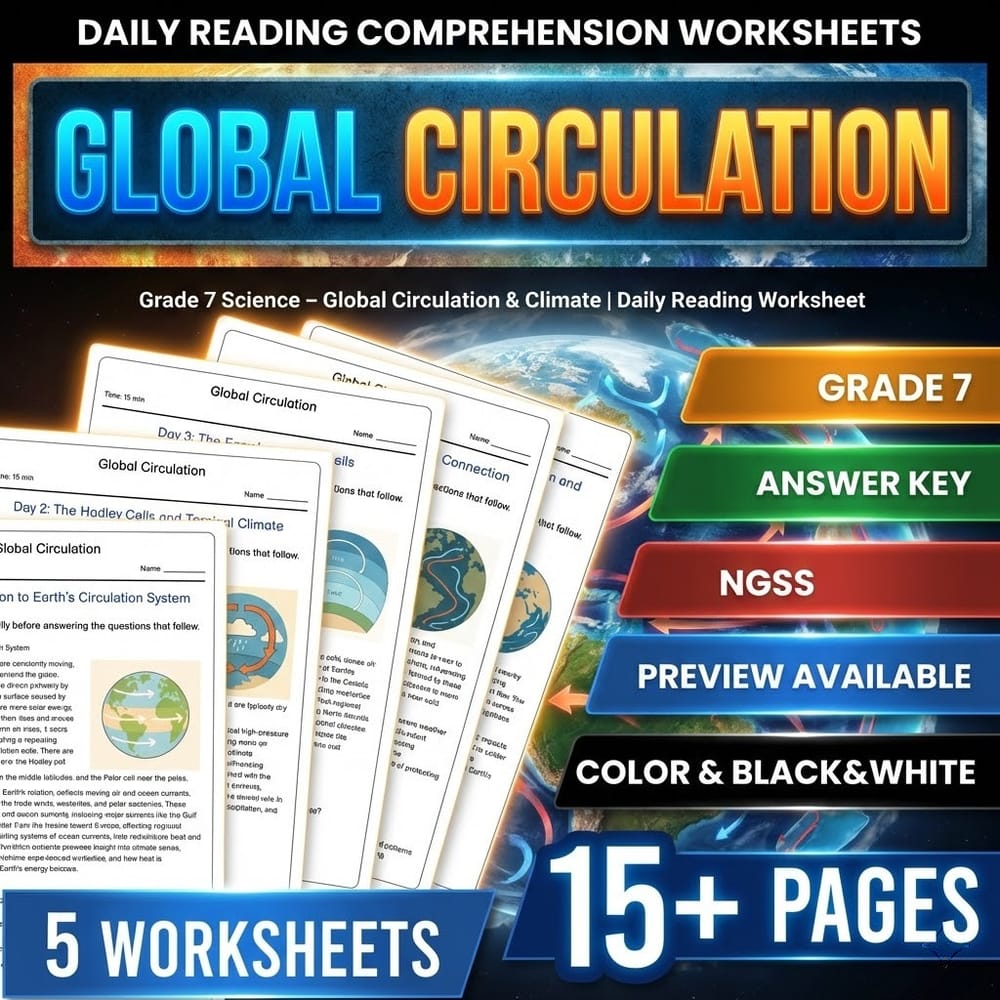
Grade 7 Science – Global Circulation & Climate | Daily Reading Worksheet
 Created byElena Brooks
Learning Objectives
- Understand key concepts related to Science
- Apply knowledge through practice questions
- Demonstrate comprehension of the material
Also included in: Water Cycle & Landforms Grade 7 Science Daily Reading Worksheets Bundle | NGSS +1 more
Instant download

Grade 7 Genotype and Phenotype Worksheet | NGSS Practice PDF
 Created byClear Sky Classroom
Learning Objectives
- Explain the difference between genotype and phenotype.
- Use dominant and recessive alleles to predict possible phenotypes.
- Describe how environmental factors can affect how a genotype becomes a phenotype.
Instant download
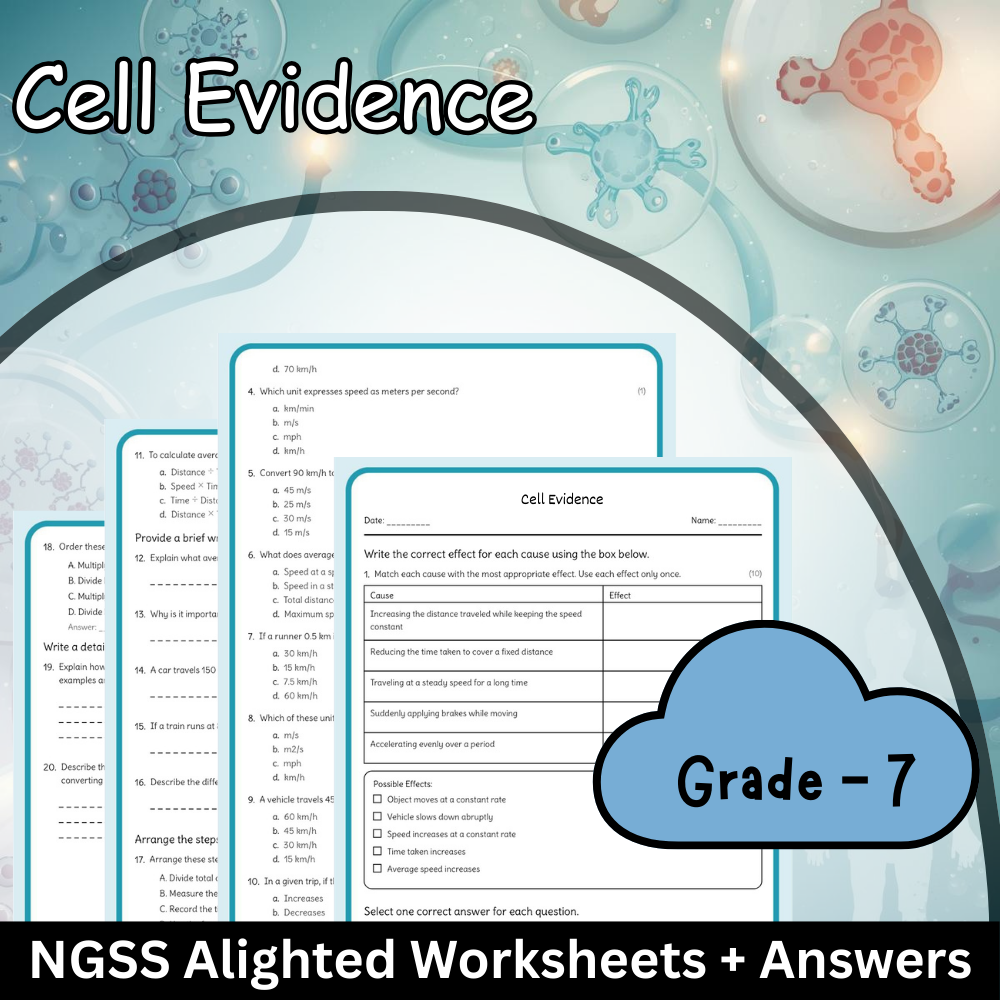
Grade 7 Science | Cell Evidence Worksheet (Answer Key) NGSS Aligned PDF
 Created byBright Mind Resources
Learning Objectives
- Observe and compare plant epidermis, animal epithelial tissue, and protist cells under a microscope.
- Identify cell boundaries such as plasma membranes and cell walls in different types of cells.
- Distinguish between unicellular and multicellular organization using examples like onion epidermis and protists.
Instant download
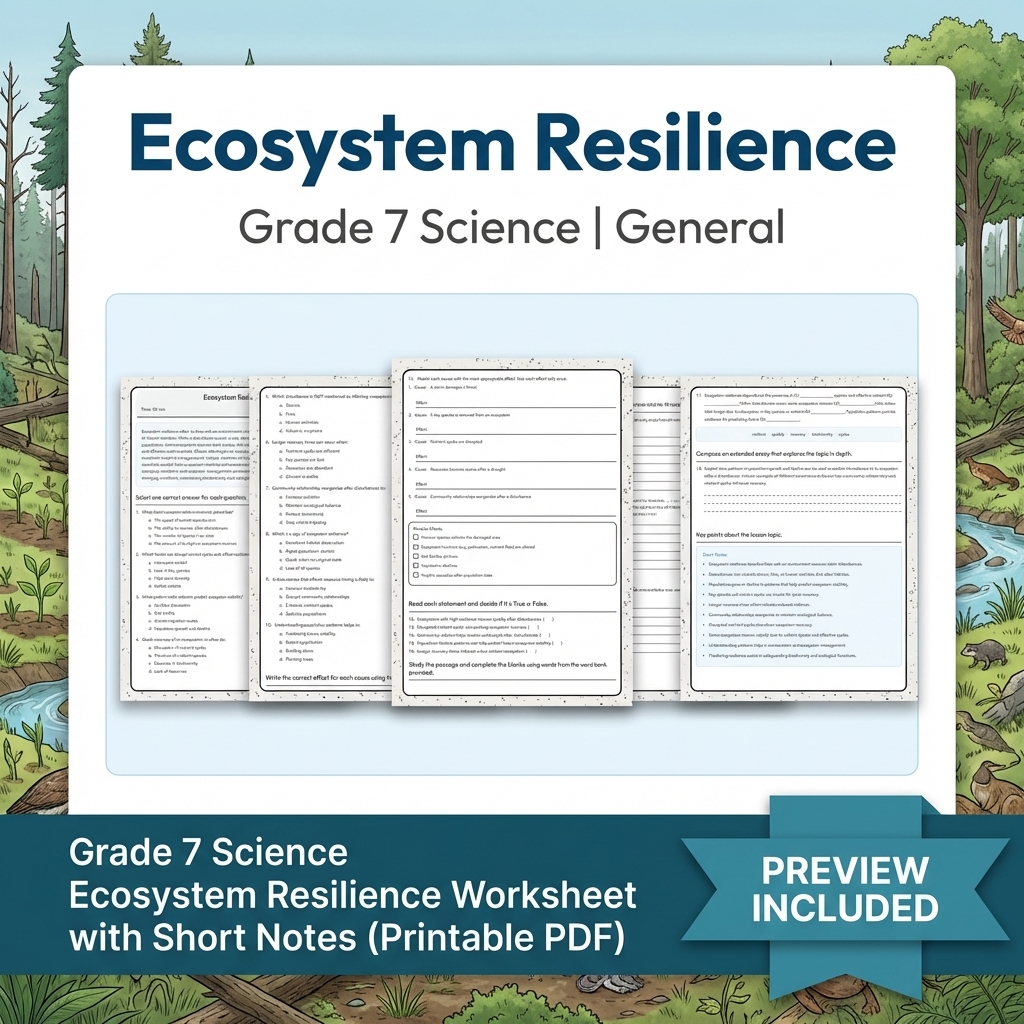
Grade 7 Science Ecosystem Resilience Worksheet with Short Notes (Printable PDF)
Created byMeadowlark WorksheetsLearning Objectives
- Understand the concept of ecosystem resilience and factors influencing it.
- Identify patterns of population change after disturbances.
- Analyze how community relationships reorganize in response to environmental changes.
Also included in: Grade 7 Ecosystem Dynamics Science Lesson Bundle: General Framework +1 more
Instant download
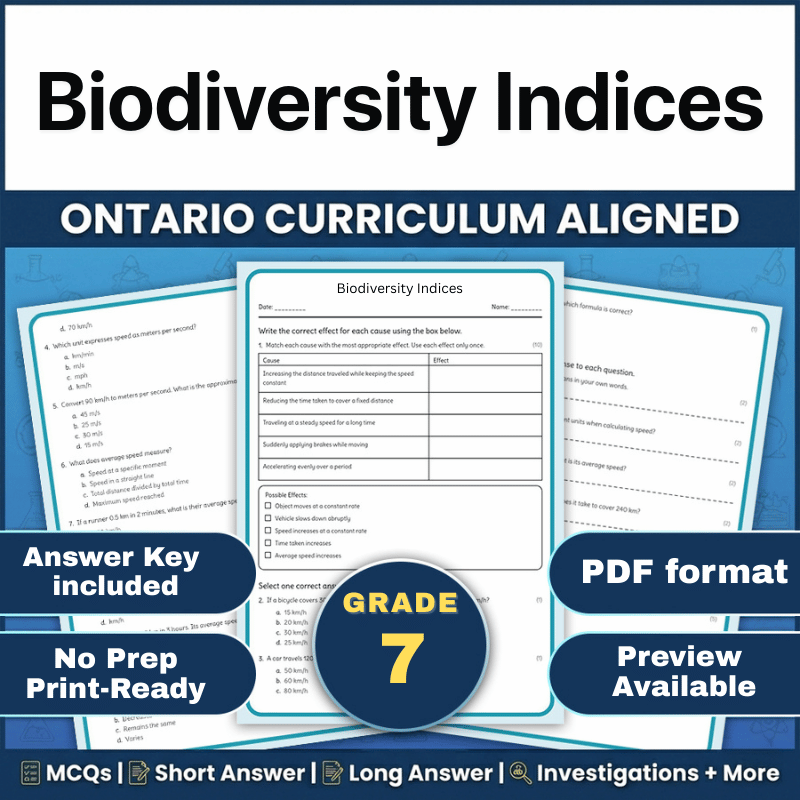
Grade 7 Science – Biodiversity Indices Worksheet (Ontario) (Practice Set)
Created byBright Mind ResourcesLearning Objectives
- Understand quantitative measures of biodiversity such as species richness and evenness.
- Interpret diversity values across different habitats and their ecological implications.
- Explain the relationships among habitat heterogeneity, niche diversity, and species turnover.
Instant download

Friction and Stability Worksheet | Forces, Net Force, Motion | Grade 7 Science
 Created byEvergreen Desk Education
Learning Objectives
- Explain how friction opposes relative motion between surfaces and affects net force.
- Predict whether an object speeds up, slows down, or moves at (nearly) constant velocity based on the relationship between applied force and friction.
- Describe how surface texture (smooth vs. rough) changes the size of friction and influences motion.
Instant download

Grade 7 Science | Cited Scientific Reasoning | General Standards
Created byLumora LearningLearning Objectives
- Identify how a scientific claim must be supported by specific data and observations.
- Explain why evidence implies a claim using appropriate comparisons, units, and relationships.
- Evaluate alternative explanations by stating which evidence supports one explanation more strongly.
Instant download
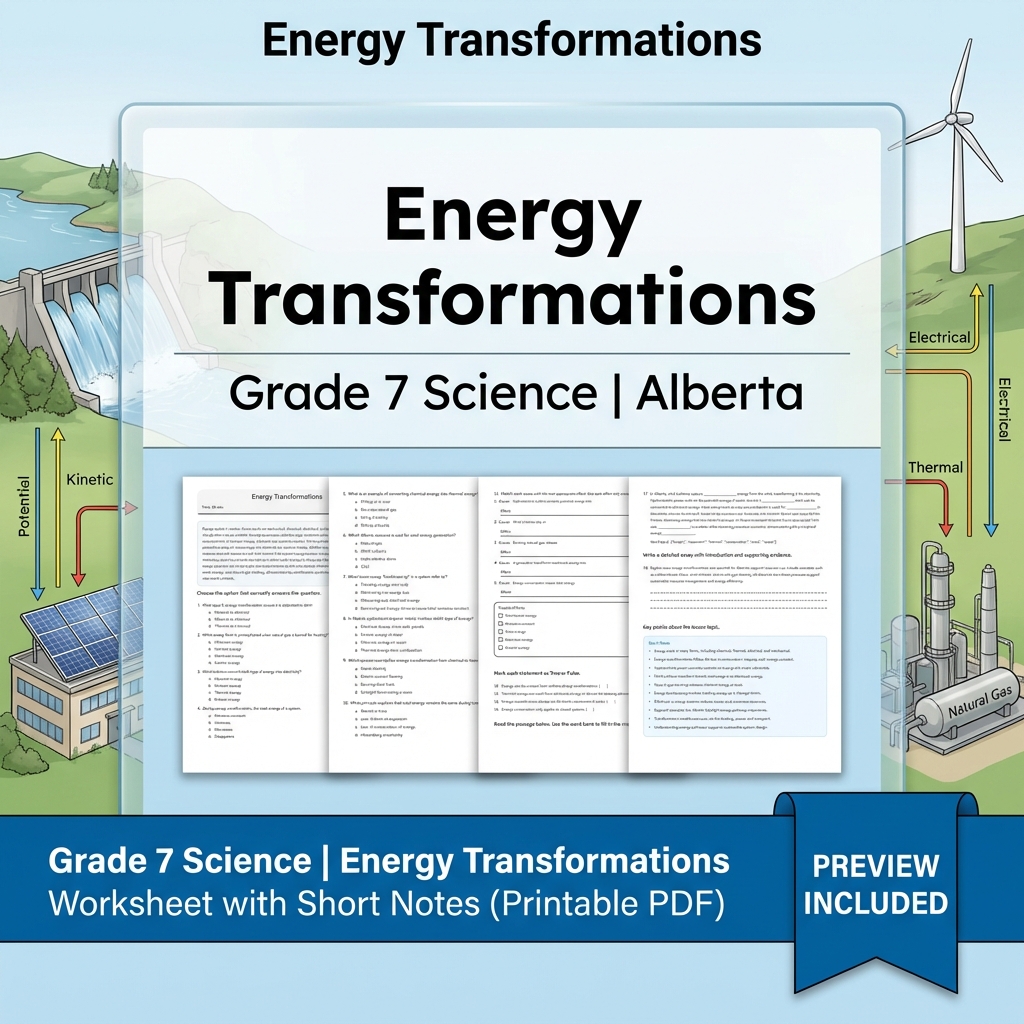
Grade 7 Science | Energy Transformations Worksheet with Short Notes (PDF)
Created byMeadowlark WorksheetsLearning Objectives
- Recognize different forms of energy and how they interconvert.
- Understand the concept of energy conservation during transformations.
- Identify regional resource examples related to energy processes.
Instant download
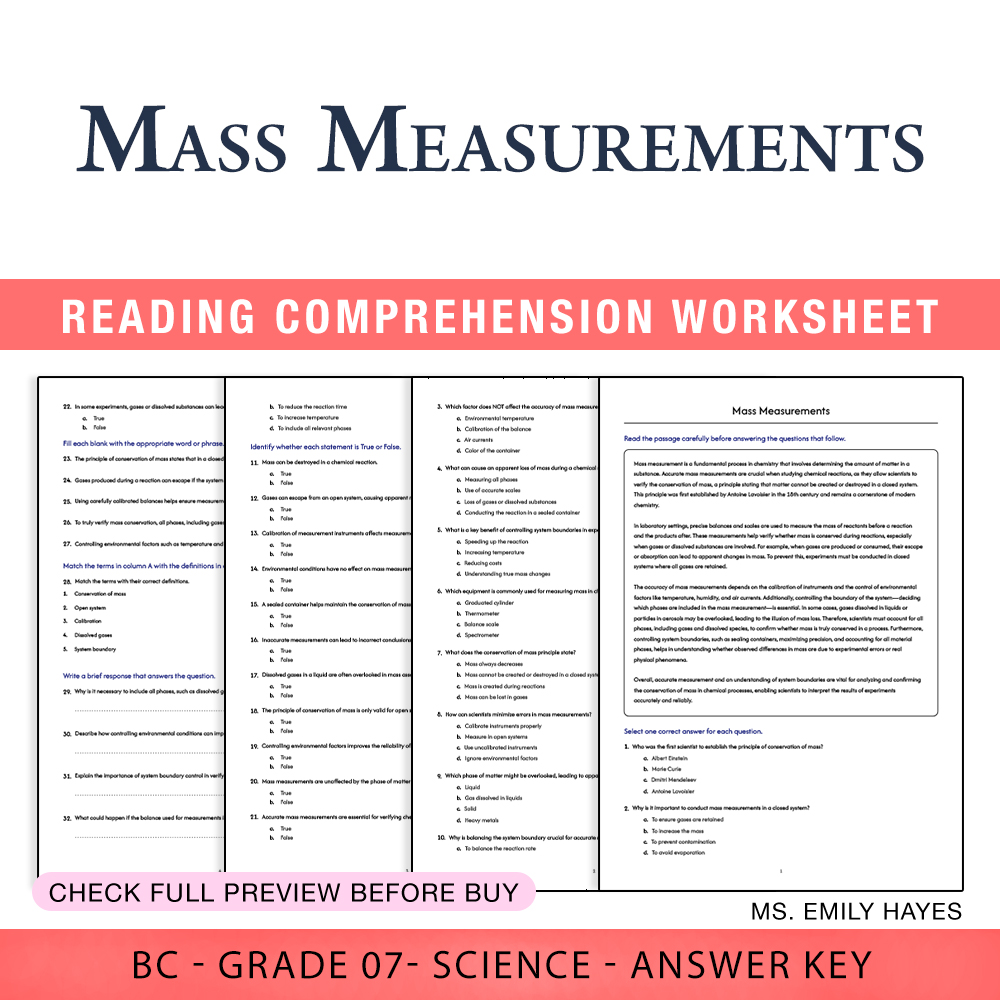
7th Grade Science | Mass Measurements Worksheet (PDF+ Answer Key)
 Created byCopper Leaf Classroom
Learning Objectives
- Understand the concept of mass and its importance in chemical reactions.
- Learn how to accurately measure mass before and after a chemical process.
- Identify factors that affect the conservation of mass in closed and open systems.
Also included in: Grade 7 Science Bundle| States of Matter & Chemical Reactions (PDF+ Answer Keys) +1 more
Instant download
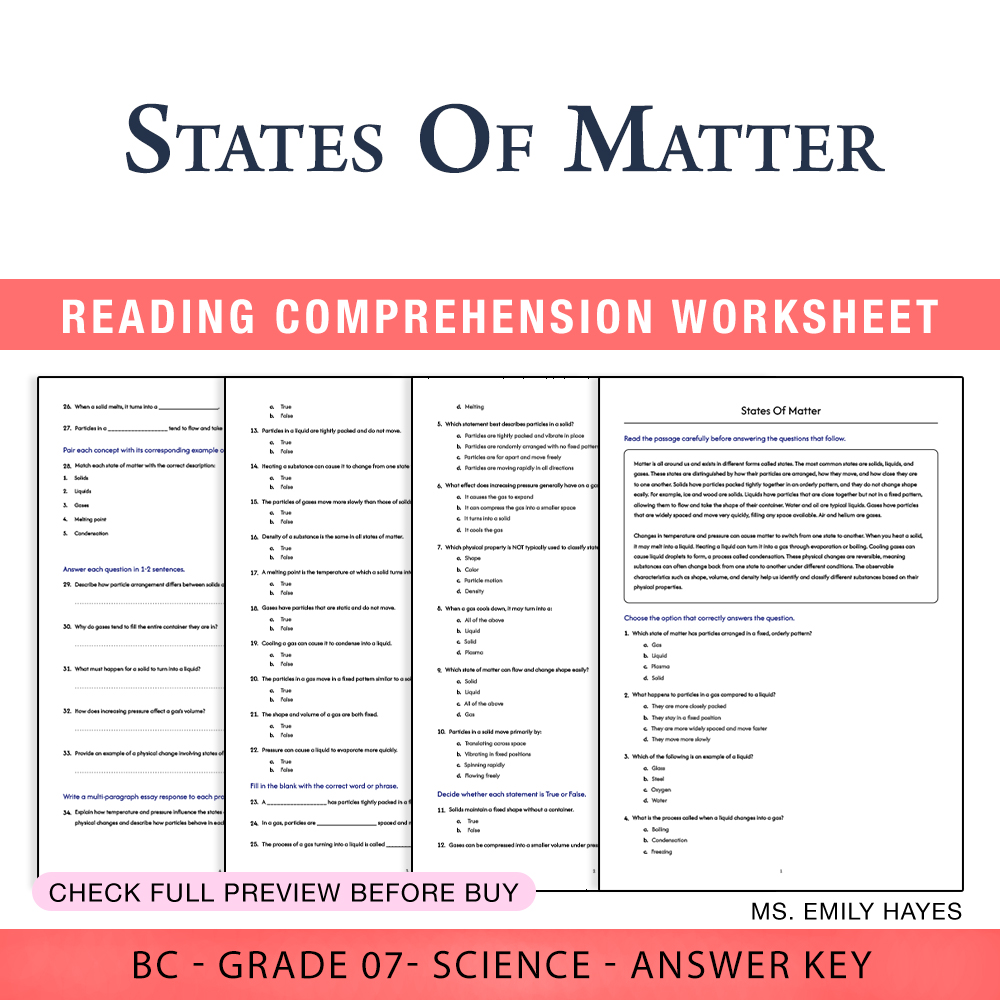
7th Grade Science | States Of Matter Worksheet (PDF+ Answer Key)
Created byCopper Leaf ClassroomLearning Objectives
- Describe the three main states of matter: solids, liquids, and gases, based on particle arrangement, spacing, and movement.
- Explain how temperature and pressure influence the transitions between different states of matter.
- Identify observable characteristics of solids, liquids, and gases to classify substances by physical properties.
Also included in: Grade 7 Science Bundle| States of Matter & Chemical Reactions (PDF+ Answer Keys) +1 more
Instant download
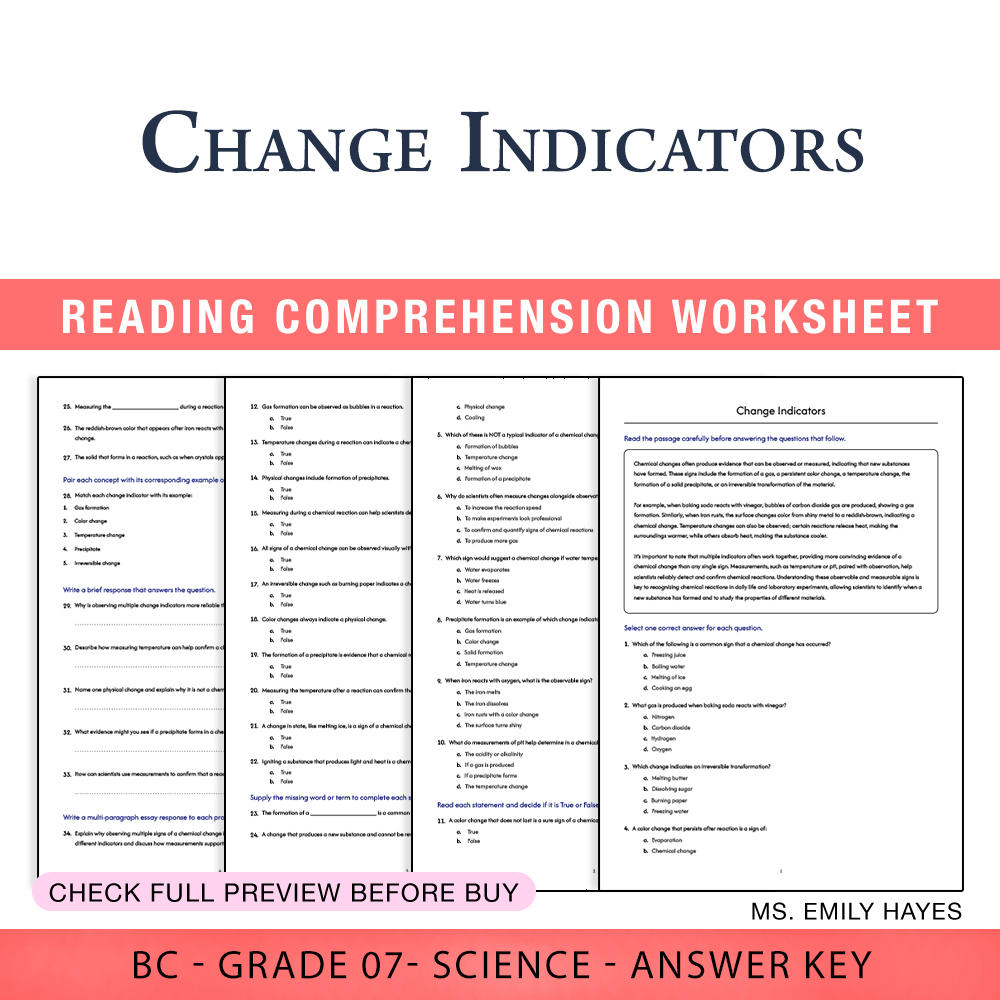
7th Grade Science | Change Indicators Worksheet (PDF+ Answer Key)
Created byCopper Leaf ClassroomLearning Objectives
- Identify observable signs that indicate a chemical change has occurred
- Differentiate between physical and chemical changes based on evidence
- Explain why multiple change indicators together provide stronger evidence for chemical reactions
Also included in: Grade 7 Science Bundle| States of Matter & Chemical Reactions (PDF+ Answer Keys) +1 more
Instant download
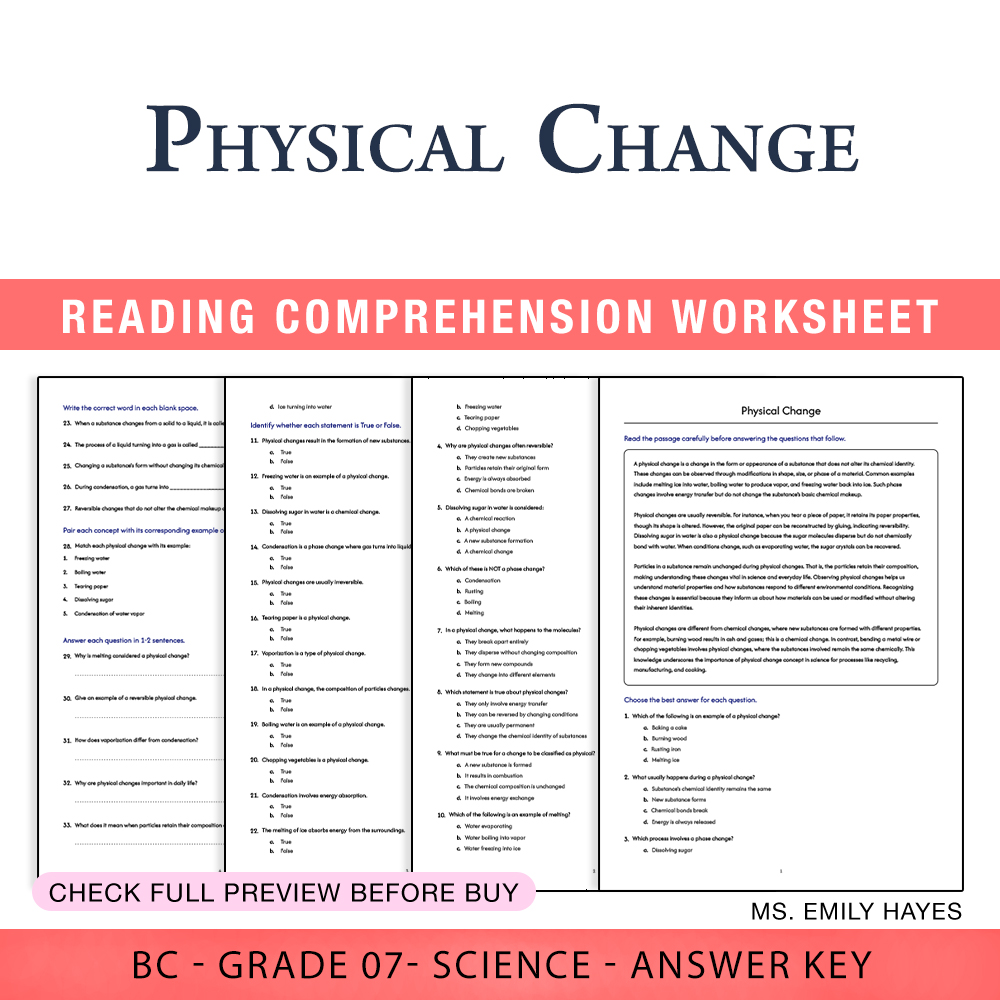
7th Grade Science | Physical Change Worksheet (PDF + Answer Key)
Created byCopper Leaf ClassroomLearning Objectives
- Define physical change and identify examples of physical changes.
- Differentiate between physical and chemical changes based on observable attributes.
- Explain why physical changes are often reversible.
Also included in: Grade 7 Science Bundle| States of Matter & Chemical Reactions (PDF+ Answer Keys) +1 more
Instant download

Earth System Spheres How Interactions Shape Earth - Grade 7 Science Worksheet
JCreated byJ.S SheetsLearning Objectives
- Identify Earth’s four system spheres: atmosphere, hydrosphere, geosphere, and biosphere.
- Explain how matter and energy move between spheres (water, gases, and rock/soil interactions).
- Describe how changes in one sphere can affect other spheres, including climate and ecosystems.
Also included in: Grade 7 Earth Systems, Cycles & Feedbacks Science lesson bundle – General +1 more
Instant download

Grade 7 Science Weather Data Patterns Worksheet | Standards-Aligned Practice
JCreated byJ.S SheetsLearning Objectives
- Distinguish weather from climate using data about temperature, wind, humidity, and precipitation
- Interpret how pressure changes and air mass movement can explain weather patterns over time and across locations
- Connect long-term climate trends to major factors such as greenhouse gases, ocean circulation, land cover, volcanic aerosols, and solar energy
Also included in: Grade 7 Earth Systems, Cycles & Feedbacks Science lesson bundle – General +1 more
Instant download

Science Worksheet Geologic Change Hazards | Grade 7 Assessment PDF
JCreated byJ.S SheetsLearning Objectives
- Explain how gradual geologic processes (weathering, erosion, deposition) reshape Earth’s surface
- Describe how plate tectonics can cause rapid hazards such as earthquakes and volcanic eruptions
- Use geologic evidence (fault features, lava flows, ash/layering) to connect past events to present-day landforms
Also included in: Grade 7 Earth Systems, Cycles & Feedbacks Science lesson bundle – General +1 more
Instant download

Grade 7 Science Sound Production Worksheet | Standards-Aligned Practice
JCreated byJ.S SheetsLearning Objectives
- Explain how vibrating objects produce sound through pressure waves in a medium.
- Relate frequency to pitch and amplitude to loudness.
- Describe how sound transmission depends on the presence of matter (not vacuum).
Also included in: Grade 7 Energy Transfer and Change Science Lesson Bundle – General Framework +1 more
Instant download
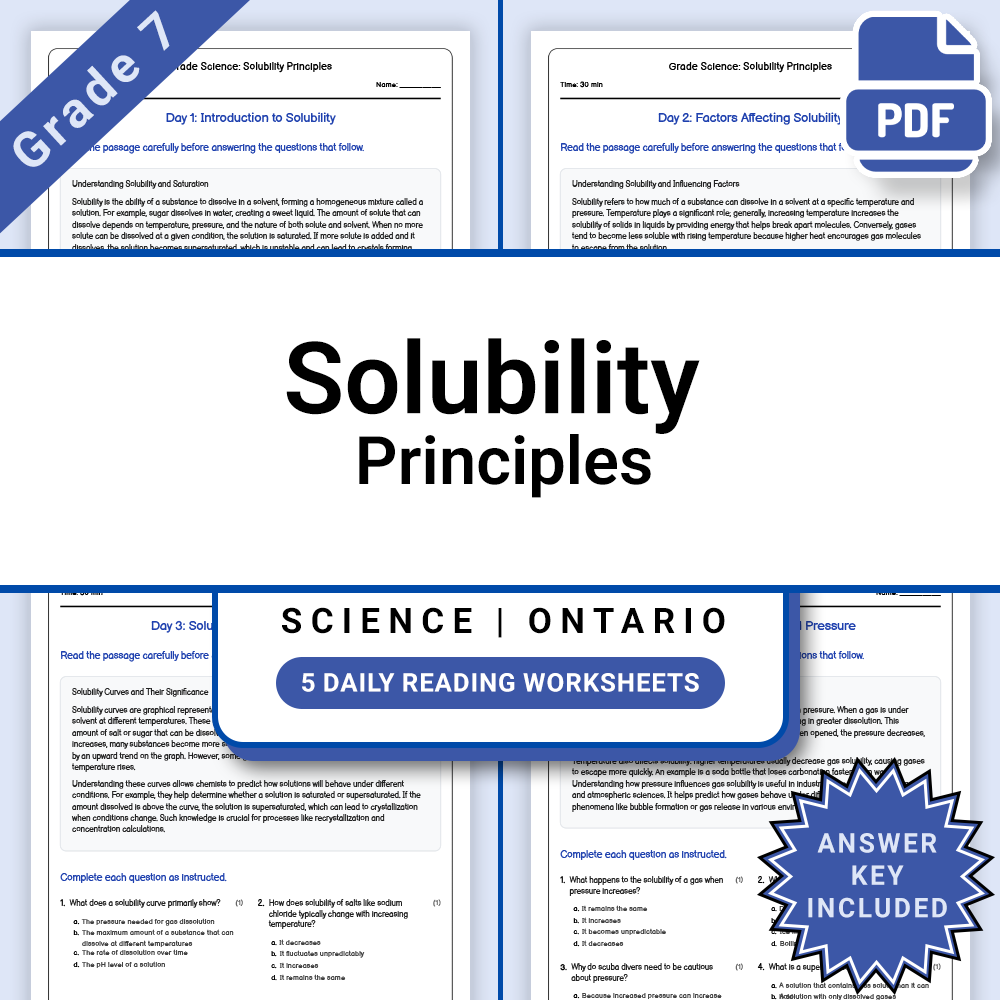
Grade 7 Science – Solubility Principles Daily Reading Worksheet + Answer Key
JCreated byJ.S SheetsLearning Objectives
- Understand the basic concepts of solubility and saturation
- Identify factors affecting dissolving processes such as temperature, pressure, and solvent polarity
- Interpret solubility curves and concepts of supersaturation
Also included in: Grade 7 Science Lesson Group | Ontario Framework Worksheets Bundle +1 more
Instant download
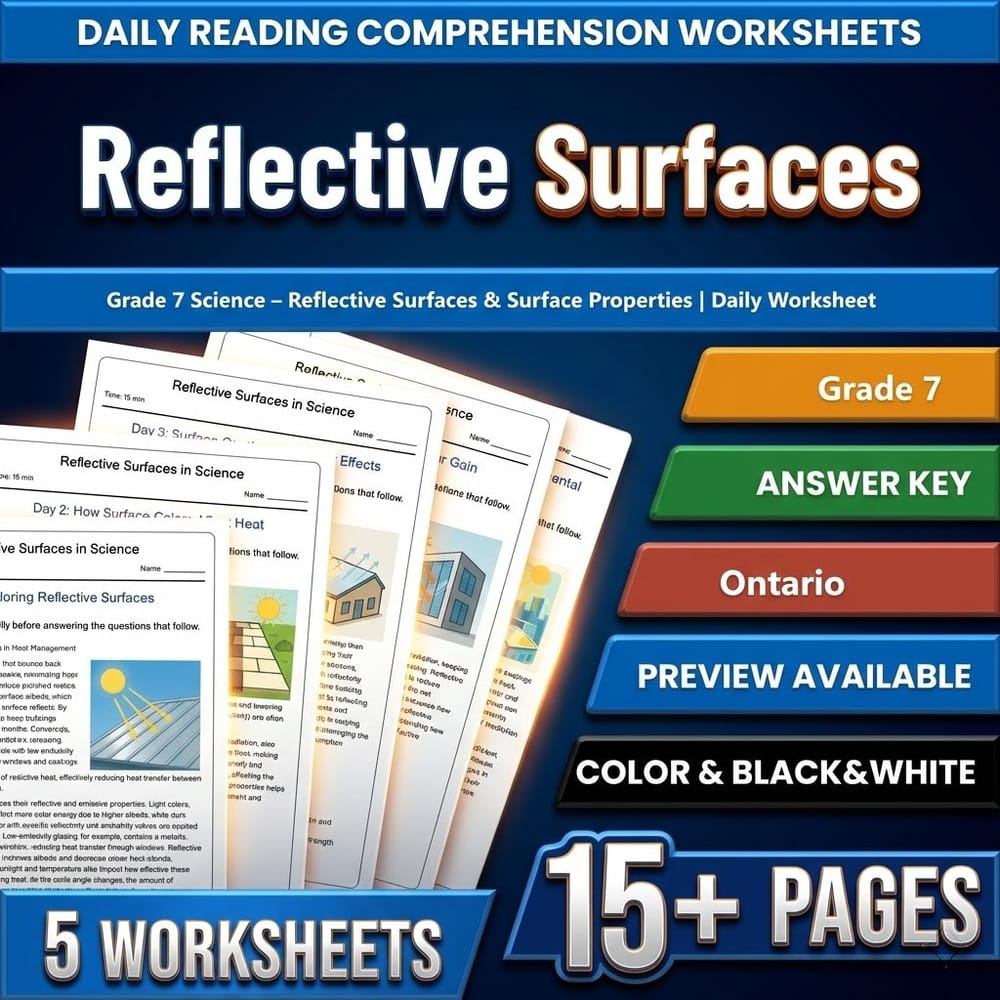
Grade 7 Science – Reflective Surfaces & Surface Properties | Daily Worksheet
 Created byQuiet Forest Education
Learning Objectives
- Understand the properties of reflective and emissive surfaces
- Identify how surface properties influence radiative heat exchange
- Analyze the effects of color and coating on solar gain
Also included in: Thermal Energy Grade 7 Science Daily Reading Worksheets Bundle | Ontario +1 more
Instant download
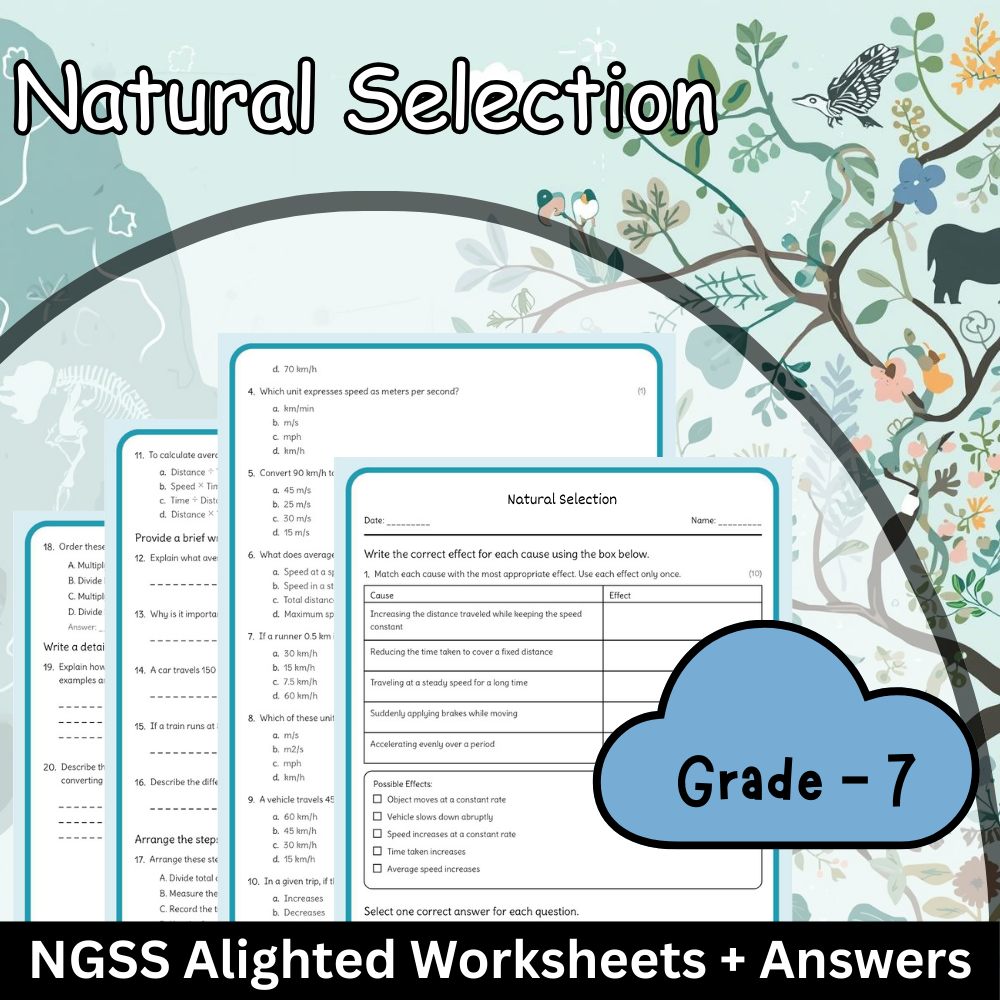
Grade 7 Science | Natural Selection & Evolution Worksheet + Answer Key - PDF
Created byBright Mind ResourcesLearning Objectives
- Explain how heritable variation and environmental pressures influence natural selection.
- Identify mechanisms by which populations adapt over generations.
- Describe examples of adaptation, such as antibiotic resistance and beak size variation.
Instant download
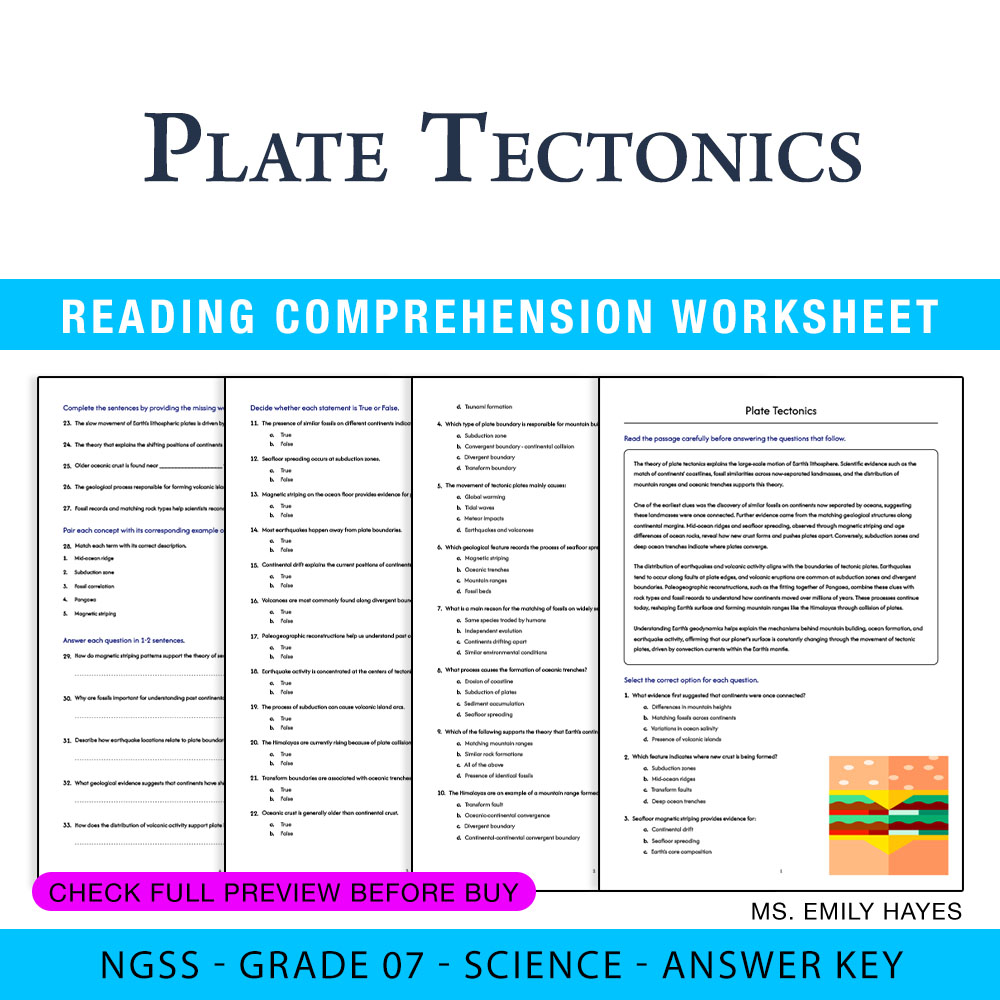
7th Grade Science | Plate Tectonics Worksheet (PDF+ Answer Key)
Created byCopper Leaf ClassroomLearning Objectives
- Describe the evidence supporting the theory of plate tectonics.
- Explain how geologic features such as mid-ocean ridges and trenches relate to plate movements.
- Identify significance of fossil distribution and rock types in reconstructing past continents.
Instant download
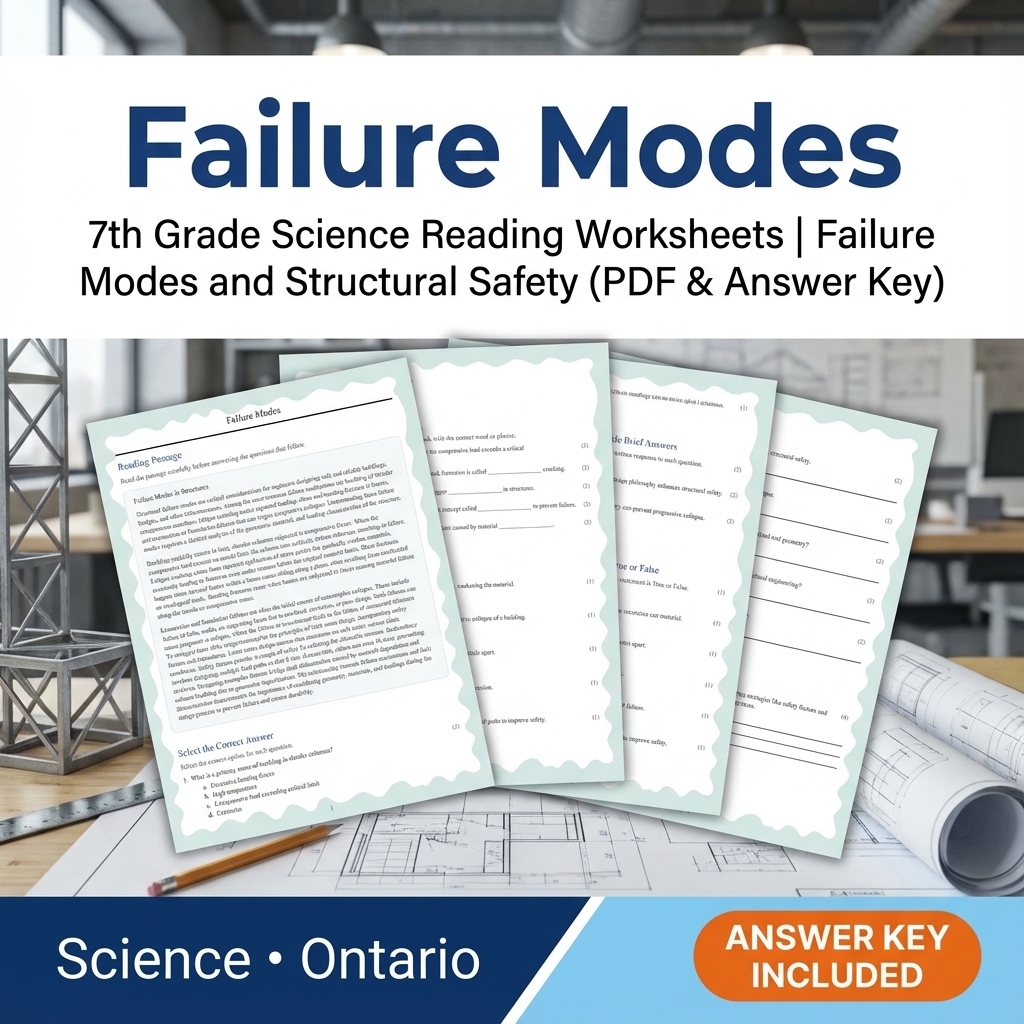
7th Grade Science | Failure Modes and Structural Safety (PDF & Answer Key)
JCreated byJ.S SheetsLearning Objectives
- Understand common structural failure modes such as buckling, fatigue, shear, and connection failures.
- Learn how limit states design philosophy, safety factors, and redundancy mitigate failure risks.
- Relate failure mechanisms to geometric, material, and loading characteristics using real-world exemplars.
Also included in: Grade 7 Science Unit Bundle – Structural Engineering & Material Testing +1 more
Instant download
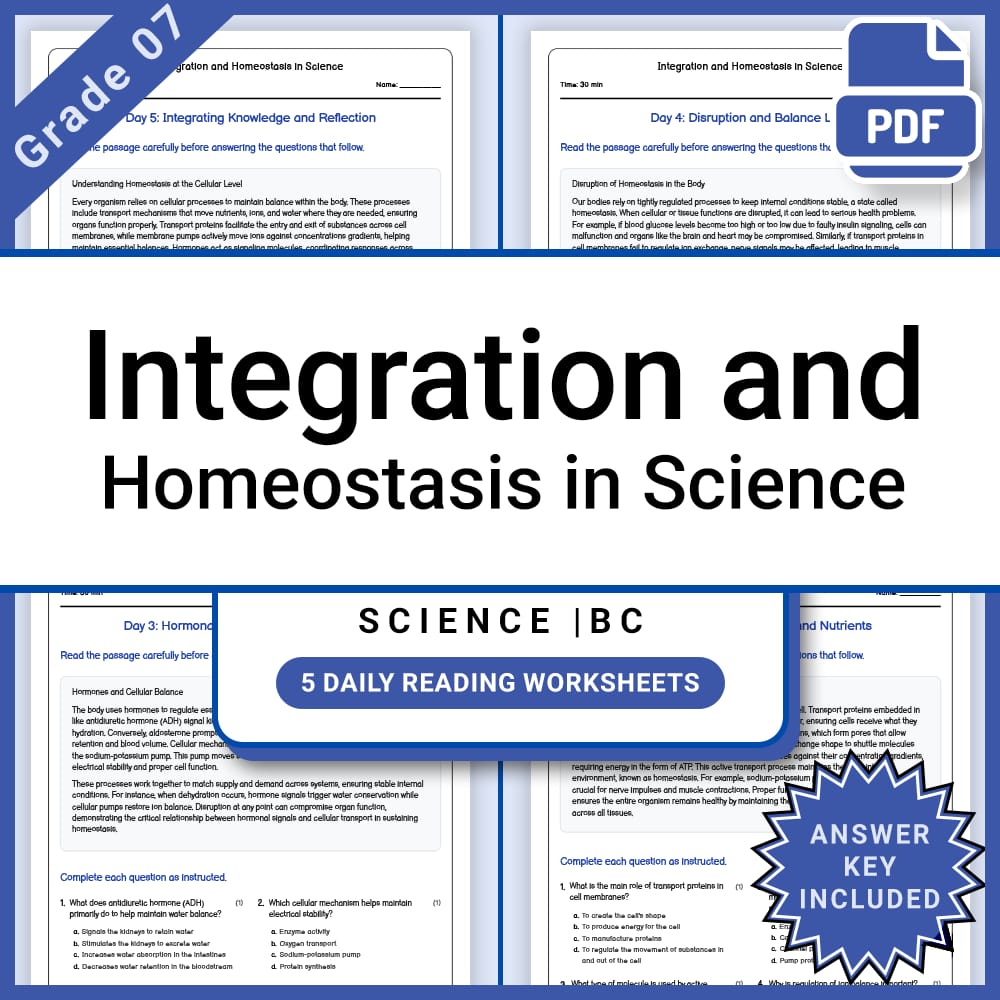
Grade 7 Science – Integration and Homeostasis Daily Worksheet with Answer Key
JCreated byJ.S SheetsLearning Objectives
- Understand the role of cellular structures in transport processes.
- Explain how transport proteins, membrane pumps, and hormones regulate body functions.
- Describe how cellular and tissue-level mechanisms maintain homeostasis.
Also included in: Grade 7 Science Lesson Group Bundle | Cell Structures and Processes +1 more
Instant download
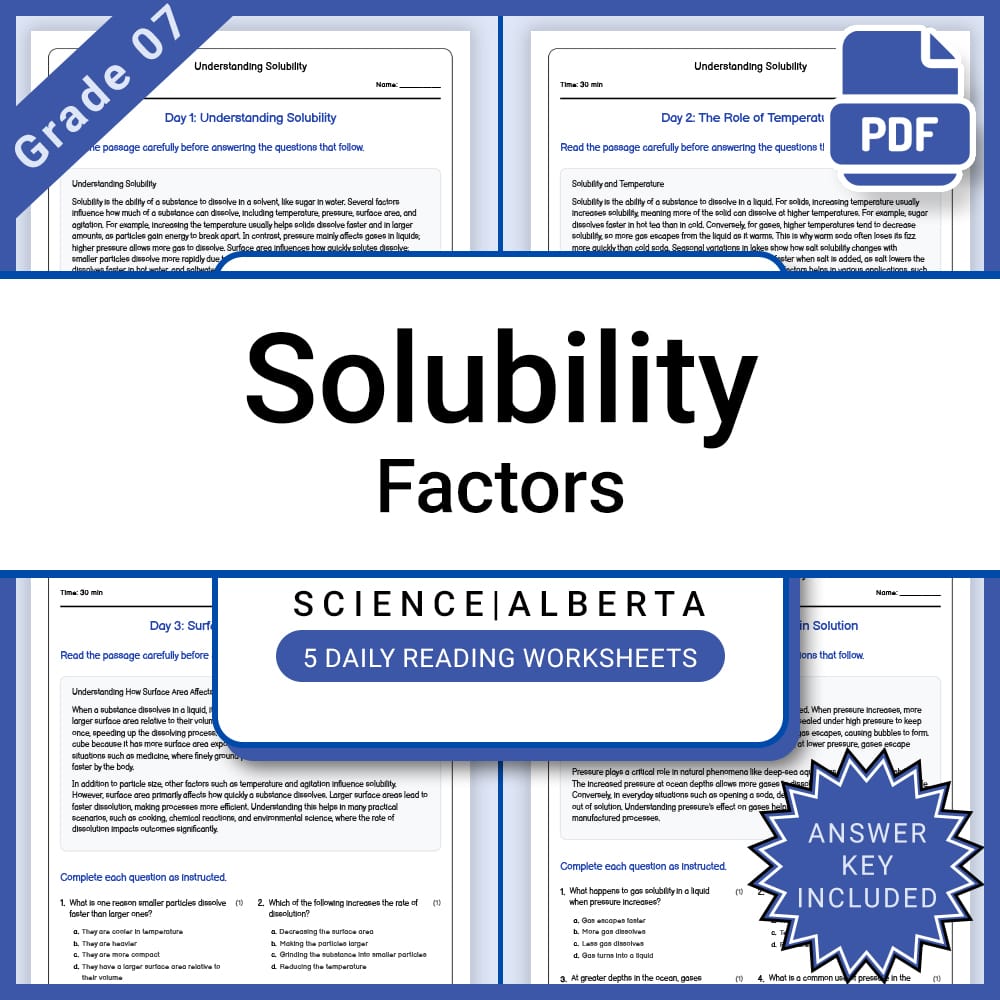
Grade 7 Science – Solubility Daily Reading Worksheet with Answer Key
JCreated byJ.S SheetsLearning Objectives
- Explain what solubility means in science.
- Identify factors that affect how well substances dissolve.
- Understand how temperature influences solubility for solids and gases.
Also included in: Grade 7 Science Lesson Bundle | Alberta Framework for Classroom Use +1 more
Instant download
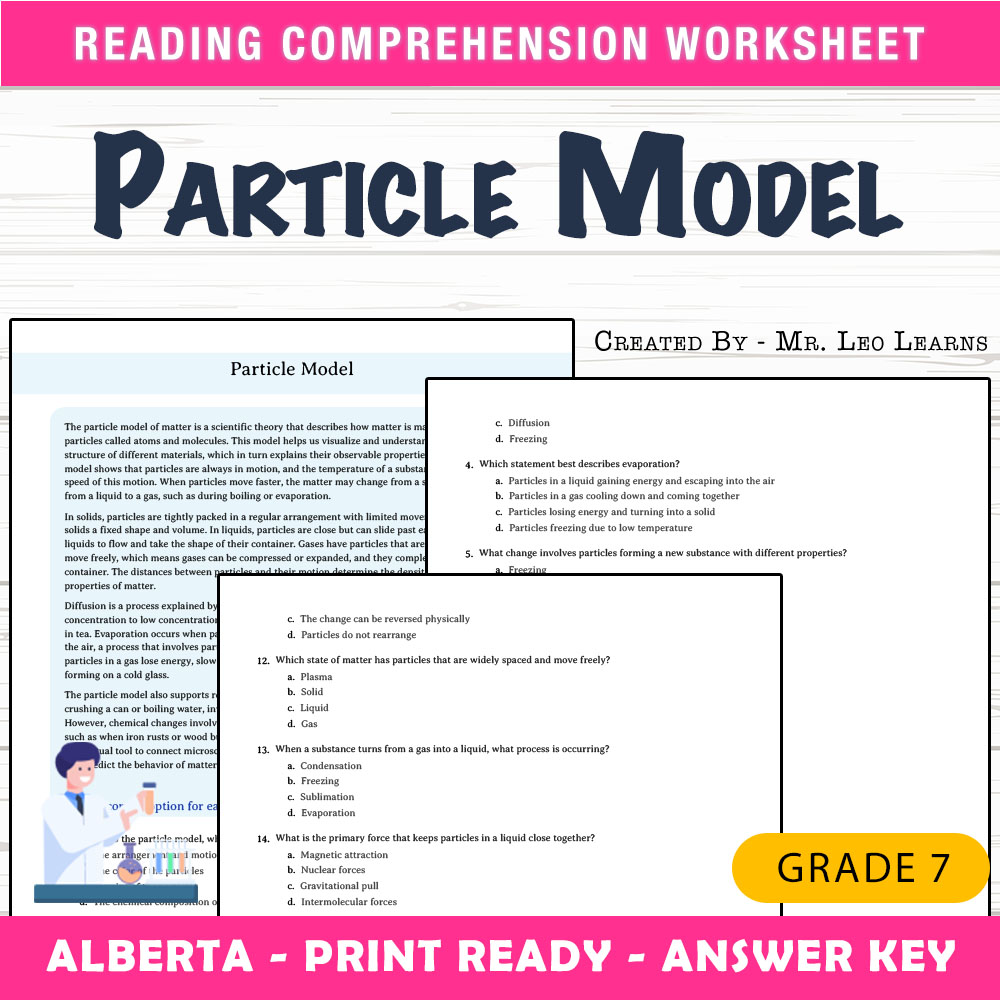
Grade 7 Science — Particle Model Worksheet for Mastery
Created byThe Resource HubLearning Objectives
- Understand the basic principles of the particle model of matter.
- Explain how particle arrangement and motion influence states of matter.
- Describe phenomena like diffusion, evaporation, and condensation using the particle model.
Also included in: Grade 7 Science Alberta Matter and Chemical Change Worksheet Collection +1 more
Instant download
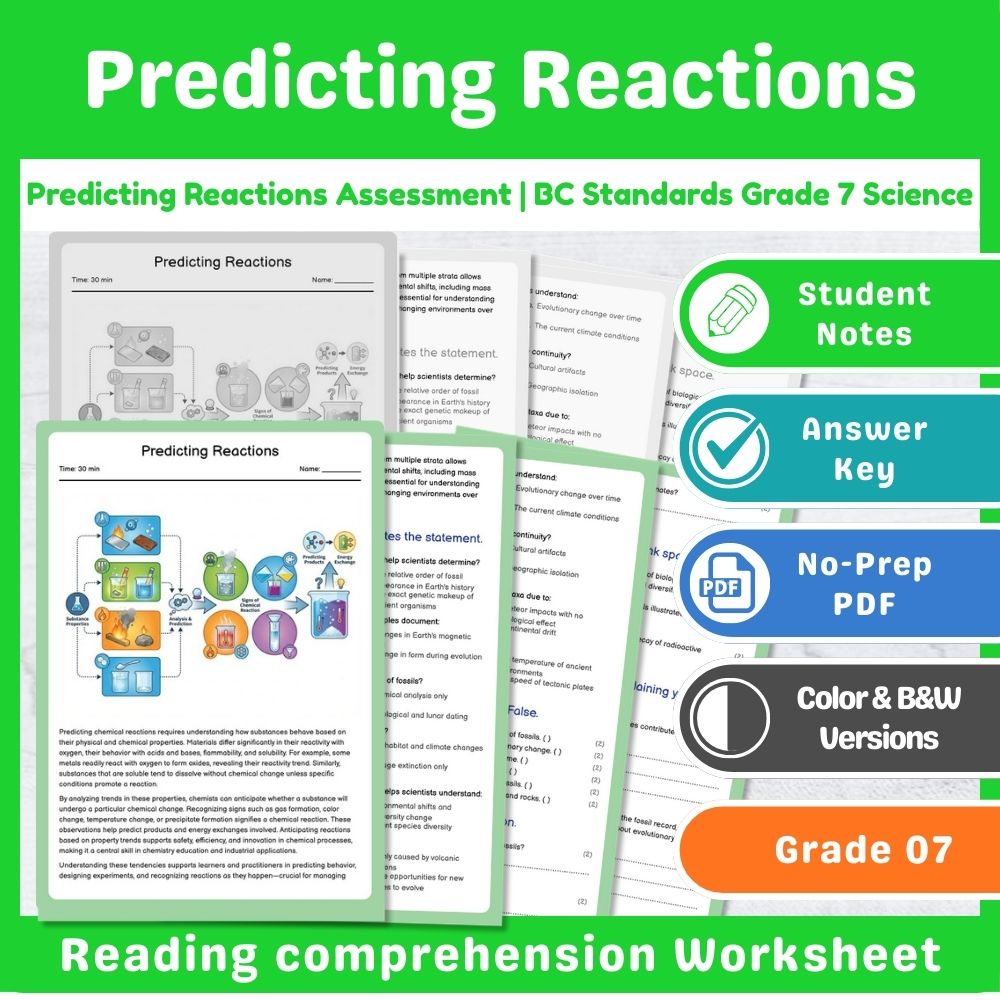
Predicting Reactions Assessment | BC Standards Grade 7 Science
 Created byPrism Point Learning
Learning Objectives
- Understand how physical and chemical properties can indicate potential reactions.
- Identify signs and evidence of chemical changes during interactions among materials.
- Learn to predict possible products based on reacting substances' properties.
Instant download

Evidence for a Changing Earth Worksheets | Grade 7 TEKS Science
Created byPrism Point LearningLearning Objectives
- Explain how fossils provide evidence of past organisms and environments
- Apply superposition to compare the relative ages of undisturbed rock layers
- Identify how tilting, folding, and faulting alter rock-layer arrangements
Instant download

Energy Pyramids and Matter Cycling Worksheets Grade 7 Science TEKS
Created byPrism Point LearningLearning Objectives
- Explain why usable energy decreases at higher trophic levels.
- Trace energy transfer through a food chain.
- Compare energy flow with matter cycling in ecosystems.
Instant download

Temperature and Particle Motion Worksheets | Grade 7 Science
Created byPrism Point LearningLearning Objectives
- Explain how temperature relates to average particle kinetic energy
- Compare samples by temperature and total thermal energy
- Interpret graphs showing relationships between temperature and particle motion
Instant download

Planetary Habitability Worksheets | Grade 7 TEKS Science
Created byPrism Point LearningLearning Objectives
- Identify conditions on Earth that support known forms of life
- Compare sunlight, water, and atmospheric conditions across planets
- Explain how multiple environmental conditions contribute to habitability
Instant download

Organism Classification and Ecological Roles Worksheets | Grade 7 Science
Created byPrism Point LearningLearning Objectives
- Compare shared characteristics used to classify organisms
- Explain why biological classification is an evidence-based model
- Describe bacterial symbiosis and its benefits to plants
Instant download

Human Organ Systems Worksheets | Support, Protection and Coordination
Created byPrism Point LearningLearning Objectives
- Identify the main functions of seven major human organ systems
- Compare how body systems provide support, protection, and coordination
- Explain how nervous signals and muscles produce a quick response
Instant download
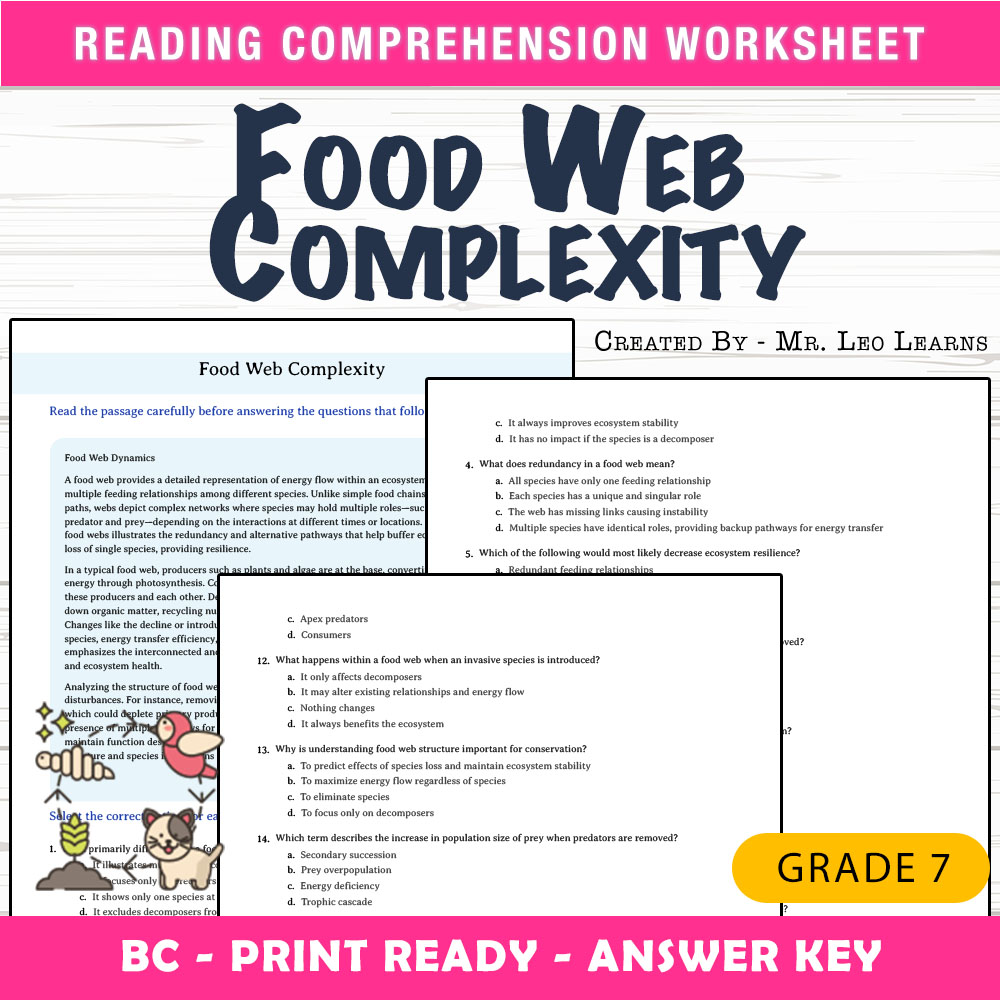
Grade 7 Science — Food Web Complexity Worksheet for Mastery
Created byThe Resource HubLearning Objectives
- Understand the concept of a food web and its role in ecosystems.
- Identify various species roles within a food web such as producers, consumers, and decomposers.
- Explain how interconnected feeding relationships contribute to ecosystem stability.
Also included in: Grade 7 Science Ecosystems & Interactions Worksheet Bundle +1 more
Instant download
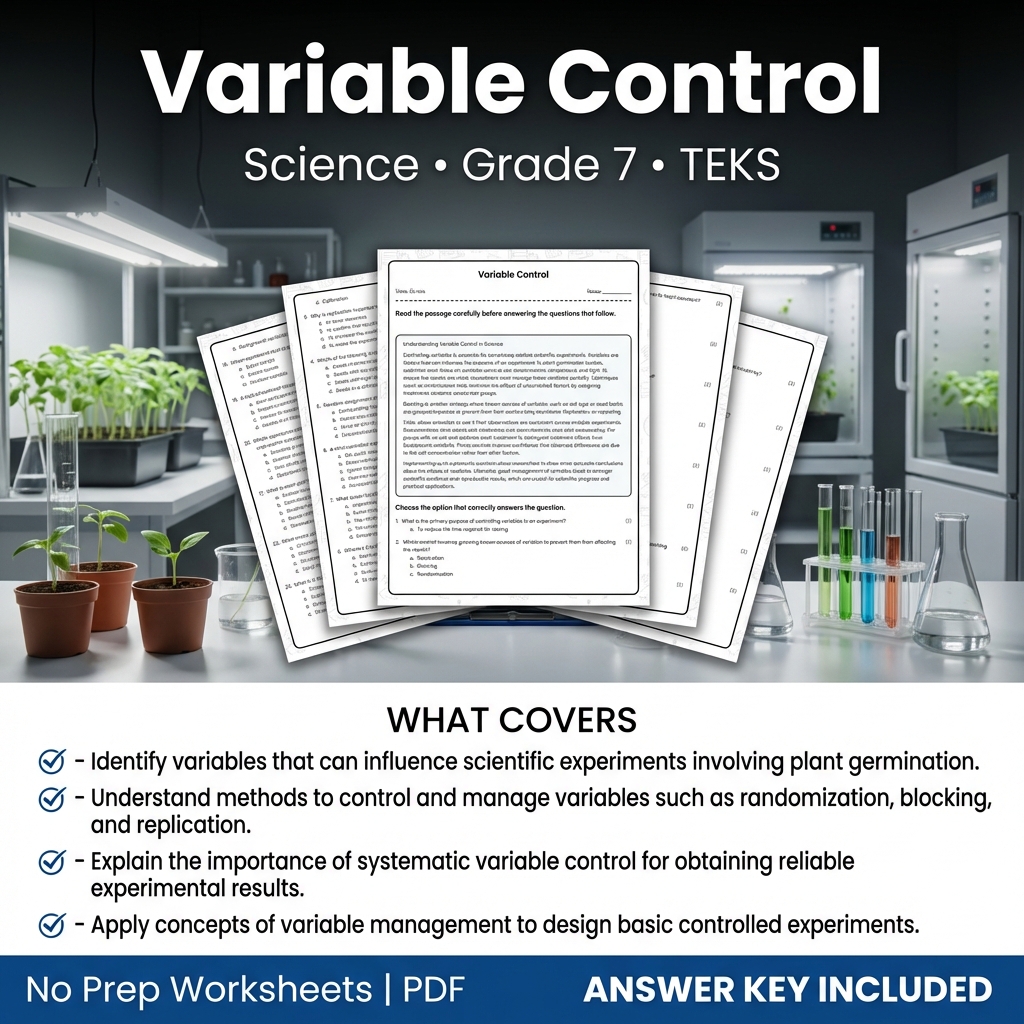
Grade 7 Science Worksheet on Atmospheric Systems TEKS aligned
 Created byCoral Reef Learning
Learning Objectives
- Describe the main processes involved in atmospheric energy transfer and circulation.
- Identify the roles of air masses, pressure gradients, and circulation cells in weather patterns.
- Explain how phenomena like fronts, jet streams, and greenhouse gases influence climate variability.
Instant download
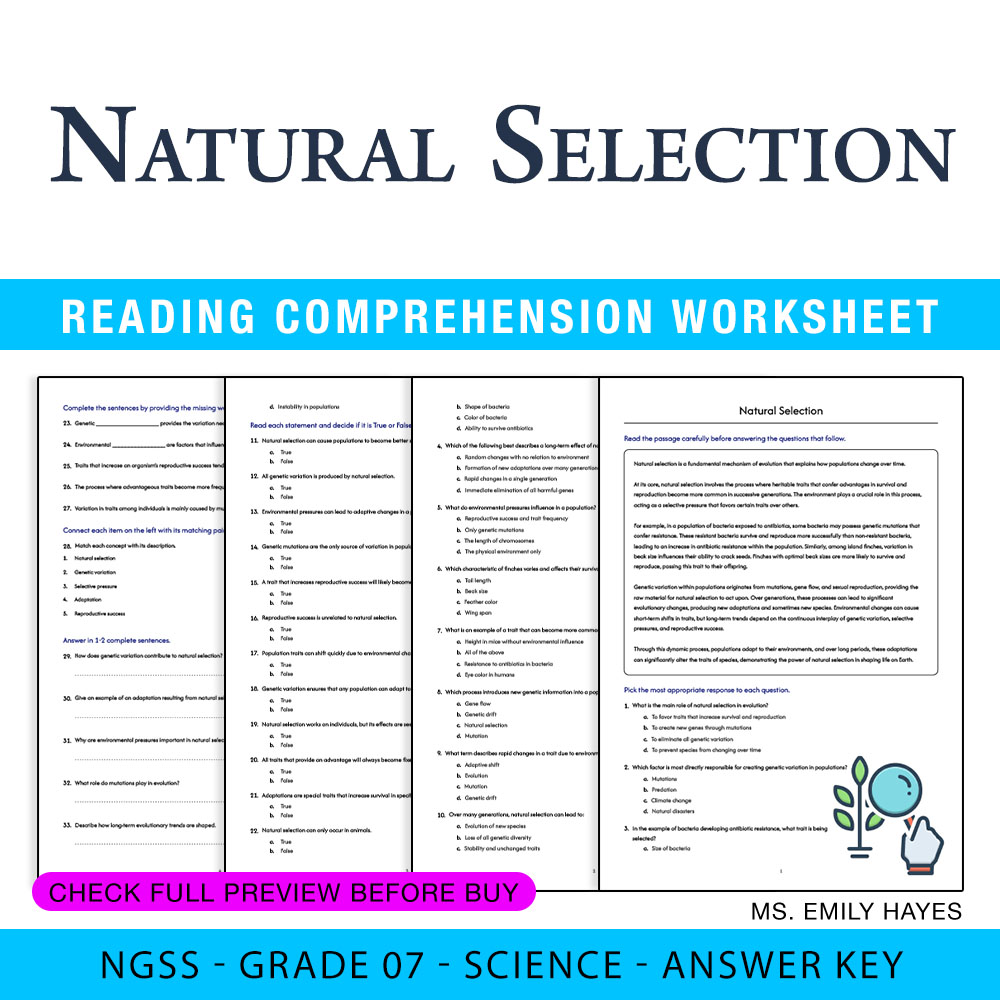
7th Grade Science | Natural Selection Worksheet (PDF + Answer Key)
Created byCopper Leaf ClassroomLearning Objectives
- Explain the mechanisms of natural selection and how they lead to adaptation in populations.
- Identify sources of genetic variation relevant to evolution.
- Describe how environmental pressures influence reproductive success and trait distribution.
Instant download
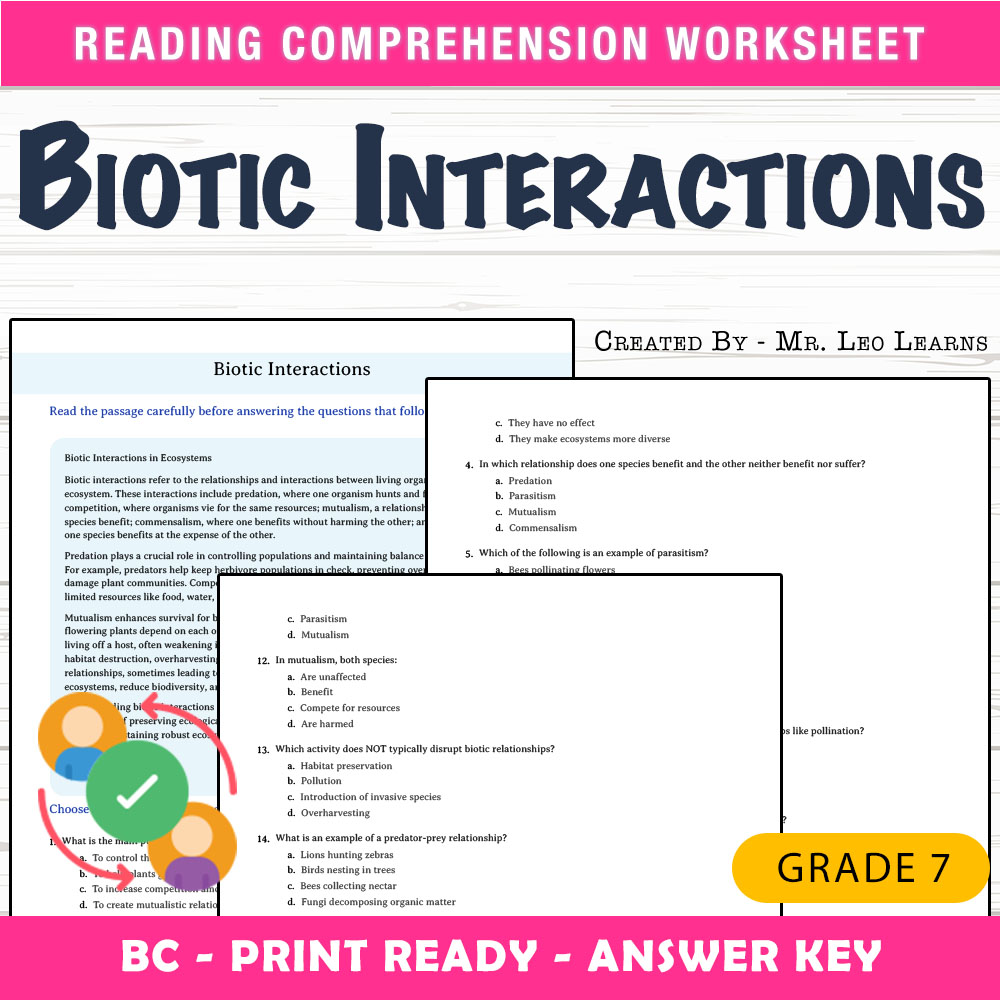
Grade 7 Science — Biotic Interactions Worksheet MCQ Paper
Created byThe Resource HubLearning Objectives
- Understand the different types of biotic interactions such as predation, competition, mutualism, commensalism, and parasitism.
- Recognize how human activities can disrupt natural biotic relationships and affect ecosystems.
- Explain the importance of biotic relationships in maintaining biodiversity and ecosystem stability.
Also included in: Grade 7 Science Ecosystems & Interactions Worksheet Bundle +1 more
Instant download

Concentration, Dilution and Dissolving Rate Worksheets Grade 7
Created byPrism Point LearningLearning Objectives
- Identify solutes and solvents in aqueous solutions.
- Explain how adding solvent changes solution concentration.
- Compare temperature, surface area and agitation as dissolving-rate factors.
Instant download

Average Speed and Displacement Worksheets | Grade 7 TEKS Science
Created byPrism Point LearningLearning Objectives
- Calculate average speed using total distance and elapsed time
- Select appropriate units for reporting average speed
- Distinguish total distance from displacement in straight-line motion
Instant download
About Grade 7 Science Worksheets
Browse 6,039 printable Grade 7 Science worksheets — ready-to-print PDFs with answer keys where available.
Every worksheet on MyTeachingSheets is created by independent teacher-authors and reviewed before publication. All resources download as printable PDFs for classroom, homework, or at-home practice, and many include answer keys. Preview any worksheet free before buying.