
Grade 7 Science Worksheets
6,039 worksheets
Cellular Organization in Plants and Animals Worksheets Grade 7 Science
 Created byPrism Point Learning
Learning Objectives
- Identify specialized cells and describe the functions they perform.
- Explain how cells with similar functions form tissues.
- Compare the roles of tissues within plant and animal organs.
Instant download

Investigable Questions and Design Testing Worksheets | Grade 7 Science
Created byPrism Point LearningLearning Objectives
- Identify questions that can be investigated through observation or measurement.
- Compare descriptive, comparative, and experimental investigation methods.
- Select tools and measurements suited to an investigation question.
Instant download

Rock Strata Practice Worksheet | Grade 7 Science Review & Assessment
Created byPrism Point LearningLearning Objectives
- Explain how superposition, original horizontality, and cross-cutting relationships help determine relative ages of rock strata.
- Identify how fossils, unconformities, and intrusive contacts can be used as markers to correlate layers.
- Construct a logical relative timeline using stratigraphic observations and scientific reasoning.
Also included in: Grade 7 Earth and Space Science Lesson Bundle NGSS Test Prep Worksheets
Instant download
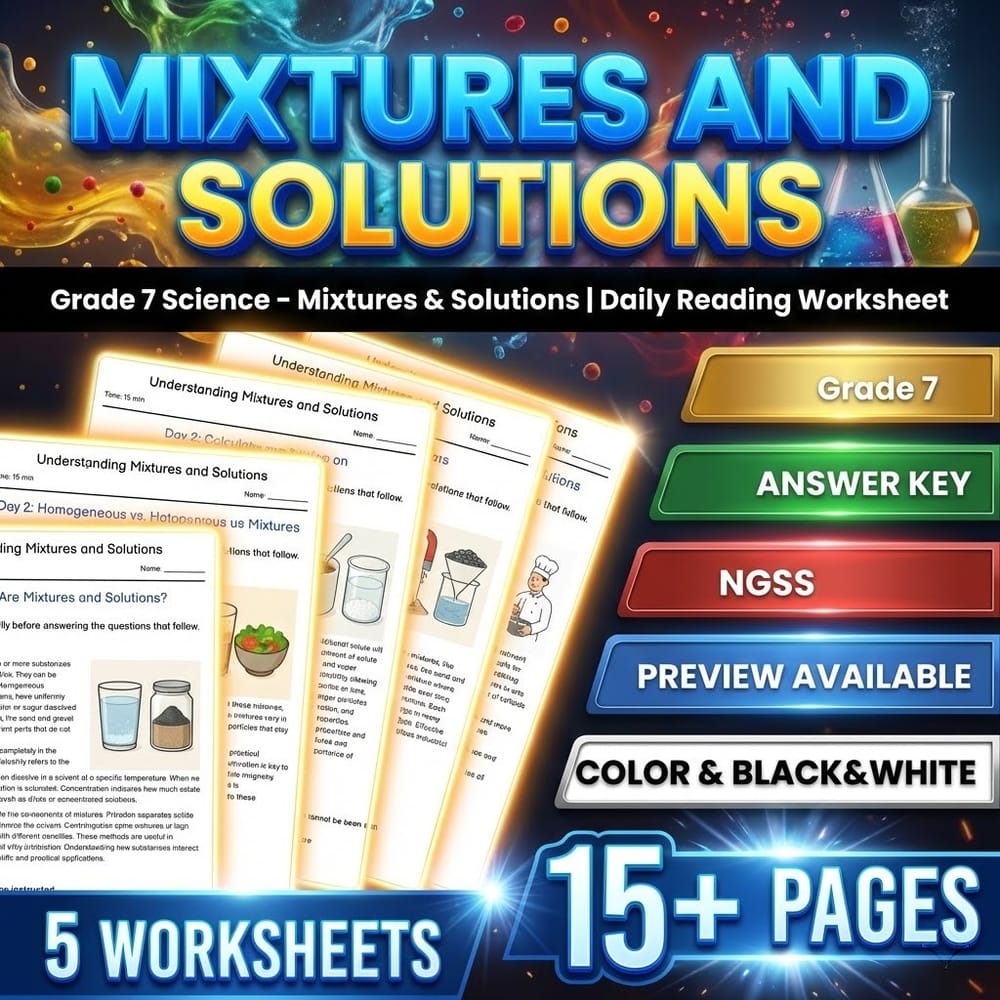
Grade 7 Science – Mixtures & Solutions | Daily Reading Worksheet
 Created byElena Brooks
Learning Objectives
- Define and distinguish between mixtures and solutions.
- Identify homogeneous and heterogeneous mixtures.
- Describe solubility, saturation, and concentration.
Also included in: Materials and Chemical Reactions Grade 7 Science Worksheets Bundle | NGSS +1 more
Instant download
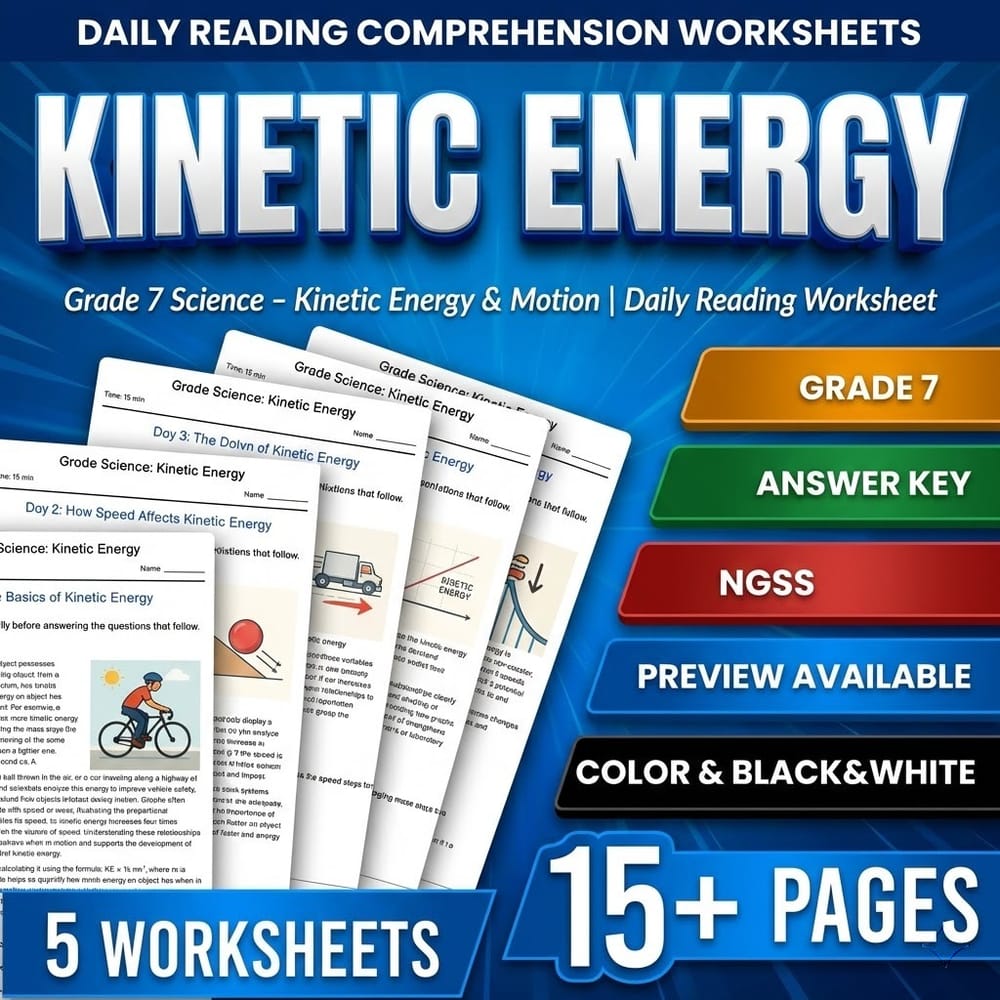
Grade 7 Science – Kinetic Energy & Motion | Daily Reading Worksheet
Created byElena BrooksLearning Objectives
- Understand the concept of kinetic energy and its relationship with motion.
- Identify examples of kinetic energy in everyday objects and activities.
- Interpret basic graphs showing relationships between kinetic energy, mass, and speed.
Also included in: Energy Grade 7 Science Daily Reading Worksheets Bundle | NGSS +1 more
Instant download
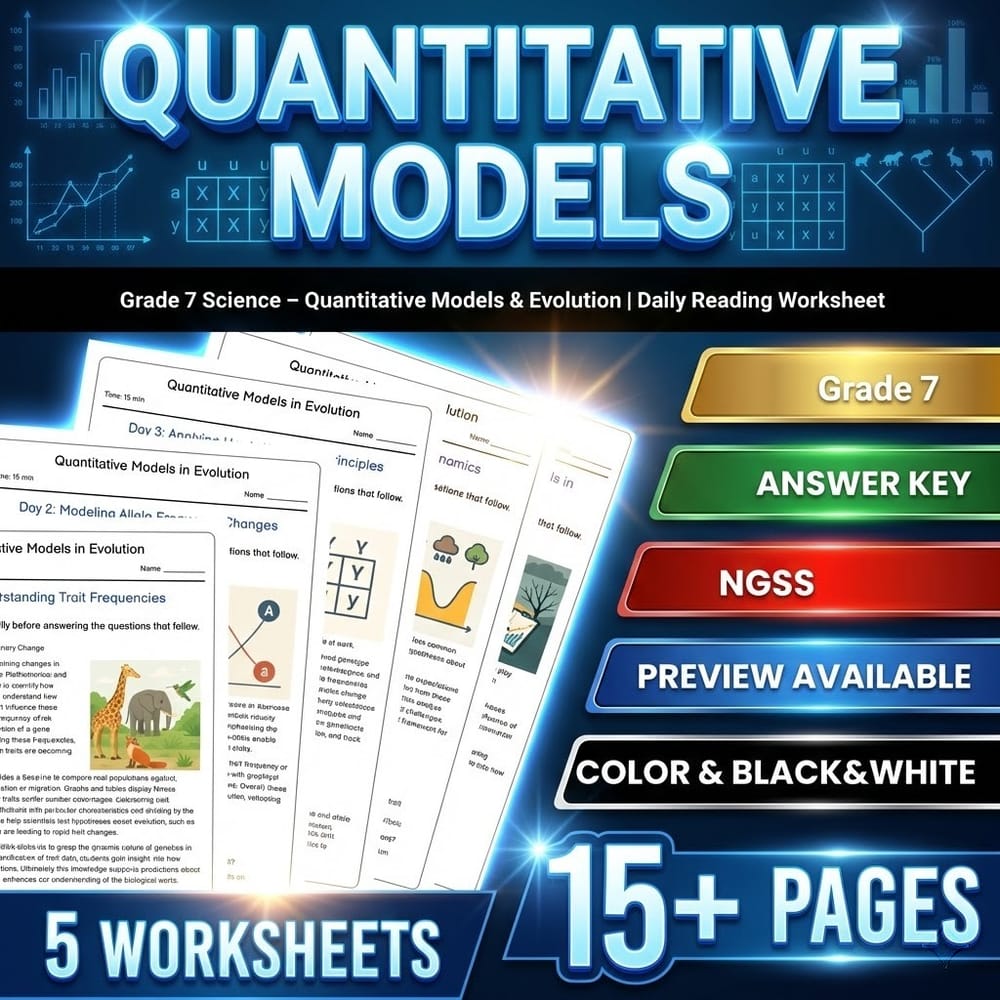
Grade 7 Science – Quantitative Models & Evolution | Daily Reading Worksheet
Created byElena BrooksLearning Objectives
- Understand how trait frequencies are measured in populations
- Interpret data related to allele frequencies and population dynamics
- Apply basic Hardy-Weinberg principles to evolve hypotheses
Also included in: Evolution and Natural Selection Grade 7 Science Worksheets Bundle | NGSS +1 more
Instant download
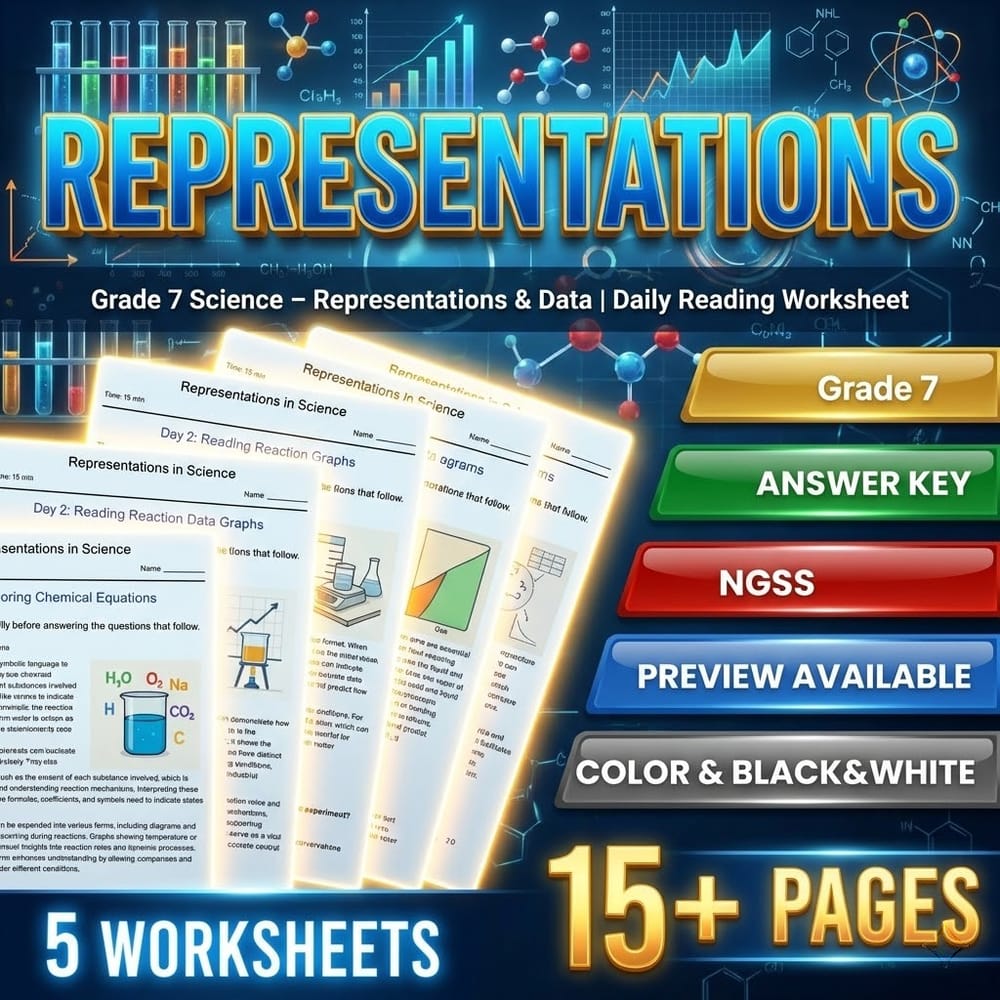
Grade 7 Science – Representations & Data | Daily Reading Worksheet
Created byElena BrooksLearning Objectives
- Understand how symbolic chemical equations represent matter interactions.
- Interpret graphs showing changes in mass or temperature over time.
- Analyze tabulated experimental data to draw conclusions about chemical reactions.
Also included in: Materials and Chemical Reactions Grade 7 Science Worksheets Bundle | NGSS +1 more
Instant download
Grade 7 Science – Natural Selection & Traits | Daily Reading Worksheet
Created byElena BrooksLearning Objectives
- Understand the concept of natural selection and how it leads to adaptation.
- Identify factors that influence survival and reproduction in populations.
- Describe examples of traits that enhance survival in different environments.
Also included in: Evolution and Natural Selection Grade 7 Science Worksheets Bundle | NGSS +1 more
Instant download
Grade 7 Science – Solution Comparison & Engineering Design | Worksheet NGSS
Created byElena BrooksLearning Objectives
- Understand the criteria for evaluating engineering design solutions.
- Compare different bridge truss configurations using models and data.
- Analyze the trade-offs among performance, cost, and durability.
Also included in: Structural Engineering Grade 7 Science Daily Reading Worksheets Bundle | NGSS +1 more
Instant download
Grade 7 Science – Rock Cycle & Earth's Rocks | Daily Reading Worksheet
Created byElena BrooksLearning Objectives
- Understand the different types of rocks: igneous, sedimentary, and metamorphic.
- Learn how rocks change from one type to another in the rock cycle.
- Identify processes such as melting, crystallization, weathering, and metamorphism.
Also included in: Water Cycle & Landforms Grade 7 Science Daily Reading Worksheets Bundle | NGSS +1 more
Instant download
Grade 7 Science – Plate Tectonics & Seafloor Evidence | Daily Reading Worksheet
Created byElena BrooksLearning Objectives
- Understand the basic concepts of plate tectonics
- Identify various geologic evidence supporting plate movement
- Recognize how Earth's features relate to tectonic activity
Also included in: Water Cycle & Landforms Grade 7 Science Daily Reading Worksheets Bundle | NGSS +1 more
Instant download

Grade 7 Science – Heat Transfer & Conduction | Daily Reading Worksheet
Created byElena BrooksLearning Objectives
- Understand the mechanisms of heat transfer: conduction, convection, and radiation.
- Identify examples of heat transfer in everyday life.
- Describe how temperature changes indicate heat transfer.
Also included in: Energy Grade 7 Science Daily Reading Worksheets Bundle | NGSS +1 more
Instant download
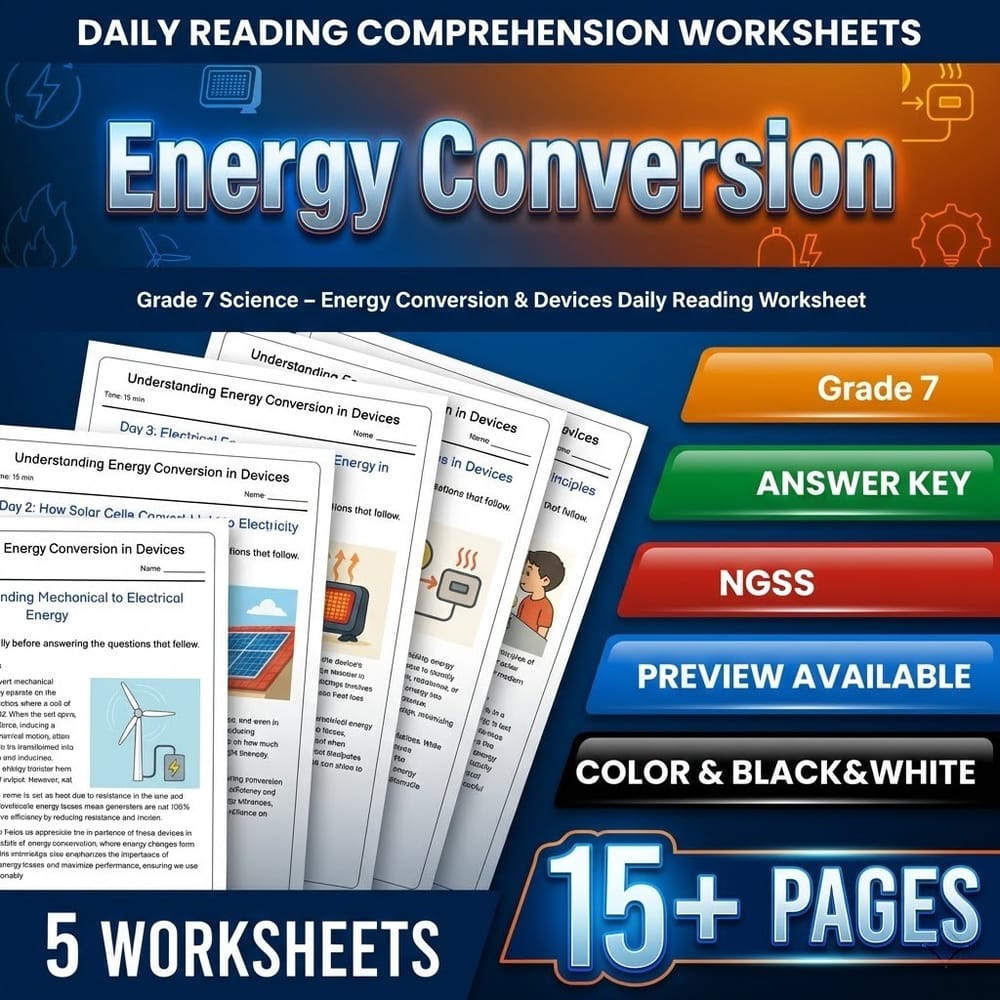
Grade 7 Science – Energy Conversion & Devices Daily Reading Worksheet
Created byElena BrooksLearning Objectives
- Explain how mechanical energy is transformed into electrical energy in generators.
- Identify different types of energy conversions in common devices.
- Discuss the concepts of energy transfer, conservation, and losses in energy transformation processes.
Also included in: Energy Grade 7 Science Daily Reading Worksheets Bundle | NGSS +1 more
Instant download
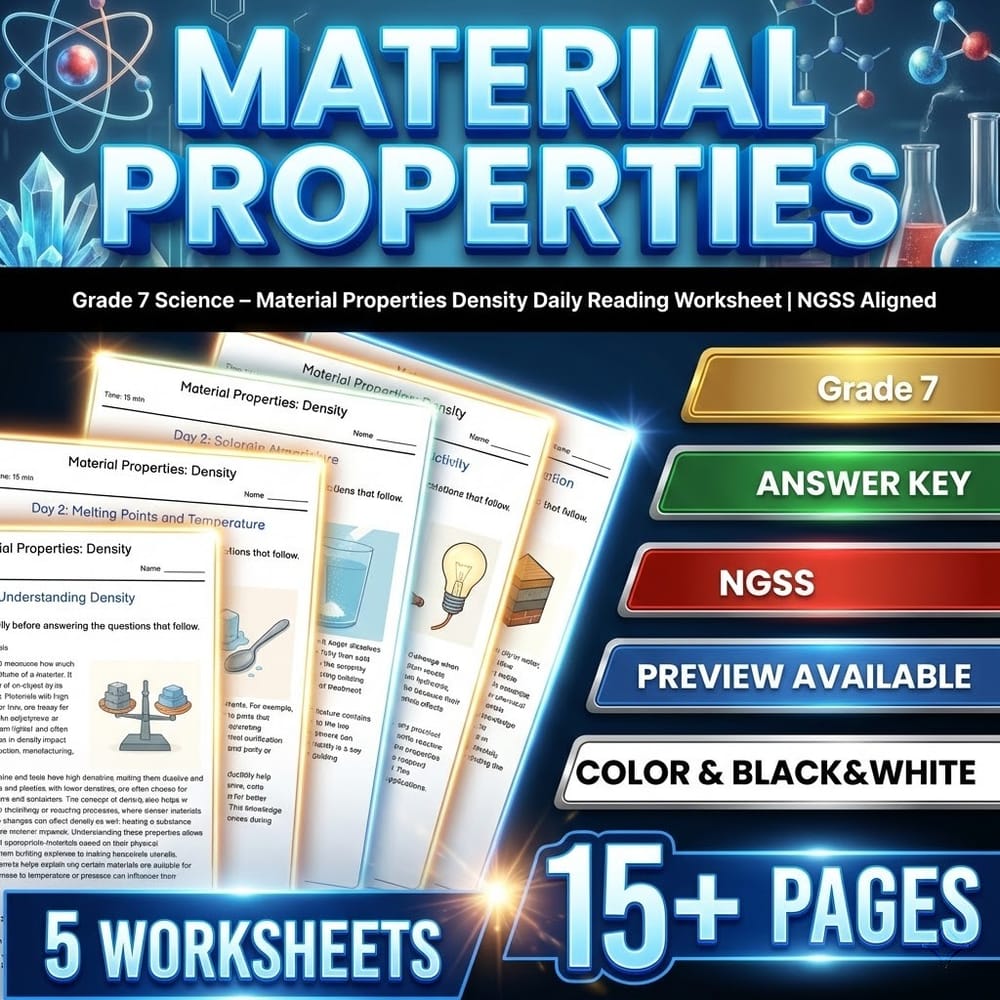
Grade 7 Science – Material Properties Density Daily Reading Worksheet | NGSS
Created byElena BrooksLearning Objectives
- Understand the concept of density and how it distinguishes materials.
- Compare densities of metals and polymers.
- Learn how density affects the use of materials in everyday life.
Also included in: Materials and Chemical Reactions Grade 7 Science Worksheets Bundle | NGSS +1 more
Instant download

Grade 7 Science | Integration and Homeostasis Worksheet | BC Standards
 Created byLumora Learning
Learning Objectives
- Understand how cellular structures and transport mechanisms work together to maintain homeostasis.
- Identify the roles of transport proteins, membrane pumps, and hormones in regulating nutrient and ion levels.
- Explain how organ systems coordinate to match supply and demand for water, nutrients, and ions.
Instant download

Grade 7 Science – Conservation of Matter & Changes | Daily Reading Worksheet
 Created byBright Mind Resources
Learning Objectives
- Understand how matter is conserved during physical and chemical changes.
- Identify examples of physical vs. chemical changes.
- Explain the importance of mass conservation in scientific observations.
Also included in: Grade 7 Matter & Forces Science Reading Lesson Bundle | California Standards +1 more
Instant download
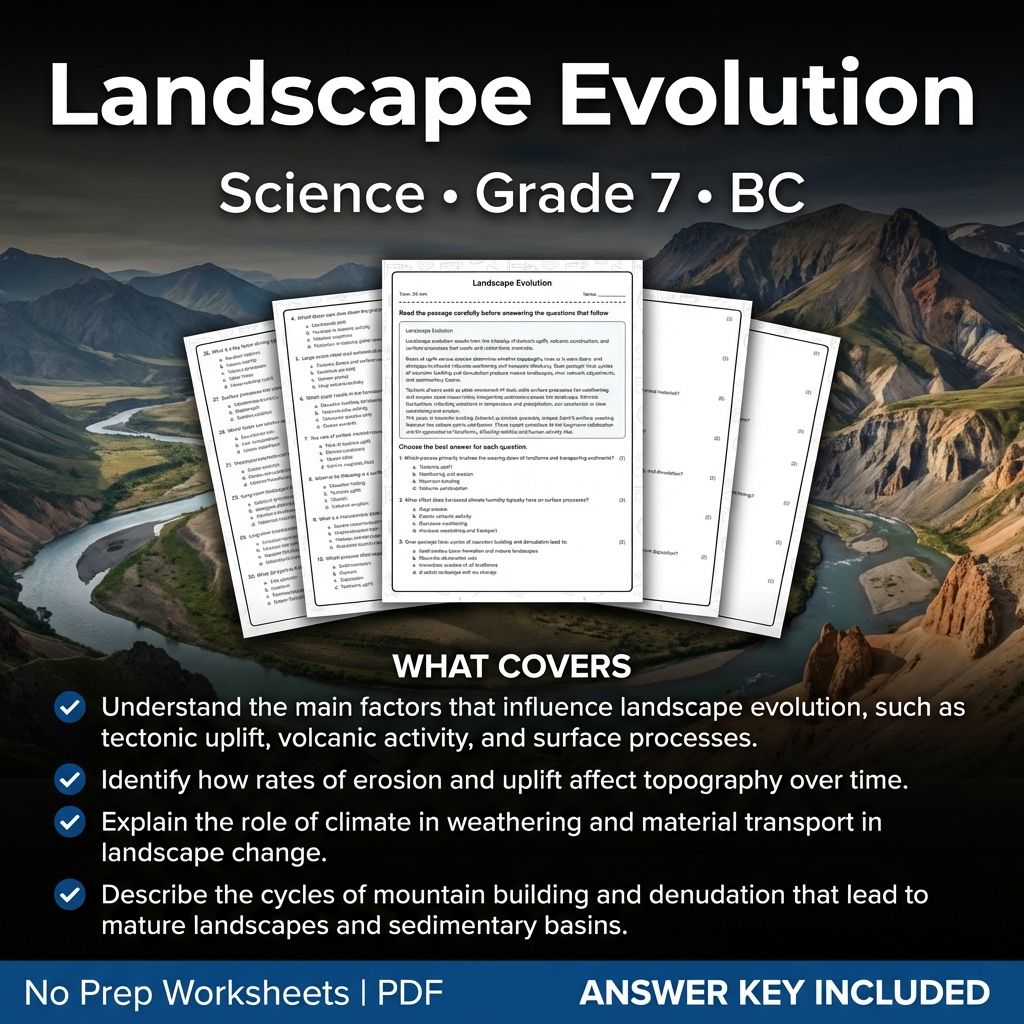
Grade 7 Science | Landscape Evolution Worksheet & Answer Key (Printable PDF)
 Created byCoral Reef Learning
Learning Objectives
- Understand the main factors that influence landscape evolution, such as tectonic uplift, volcanic activity, and surface processes.
- Identify how rates of erosion and uplift affect topography over time.
- Explain the role of climate in weathering and material transport in landscape change.
Instant download
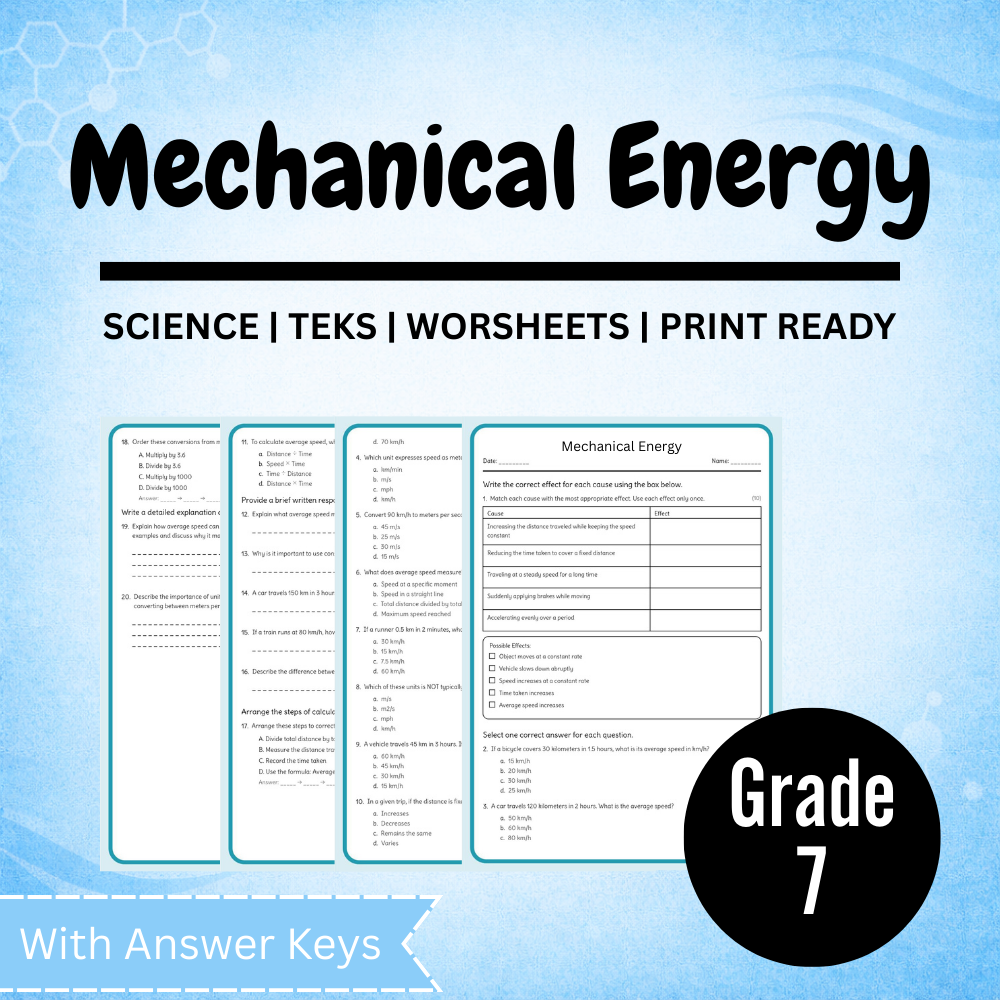
Grade 7 Science | Mechanical Energy TEKS Worksheet (Answer Key) | Fun & Interactive
Created byBright Mind ResourcesLearning Objectives
- Explain the concept of mechanical energy conservation in ideal and real systems.
- Describe how energy is transferred and redistributed among system components during motion such as swinging pendulums and springs.
- Identify factors that lead to energy loss and understand the limits of energy conservation in real systems.
Also included in: Grade 7 Science Unit Workbook | Motion, Forces & Energy TEKS-Aligned Worksheets +2 more
Instant download
Grade 7 Science | Friction & Gravity Concept Worksheet (PDF) – TEKS Aligned
Created byBright Mind ResourcesLearning Objectives
- Understand how friction acts as a force opposing motion and how surface roughness affects resistance.
- Explain how gravity causes acceleration and influences objects in free fall or on inclines.
- Differentiate between contact forces like friction and long-range forces such as gravity.
Also included in: Grade 7 Science Unit Workbook | Motion, Forces & Energy TEKS-Aligned Worksheets +2 more
Instant download
Grade 7 Science | Newton's Laws Worksheet (Answer Key) - TEKS Aligned
Created byBright Mind ResourcesLearning Objectives
- Understand the core principles of Newton's three laws of motion.
- Explain how force and mass affect motion using real-world examples.
- Identify examples of inertia, acceleration, and action–reaction pairs in everyday systems.
Also included in: Grade 7 Science Unit Workbook | Motion, Forces & Energy TEKS-Aligned Worksheets +2 more
Instant download
Grade 7 Science | Motion Principles Worksheet (Worksheet + Answer Key) – TEKS Aligned
Created byBright Mind ResourcesLearning Objectives
- Understand the basic concepts of speed, velocity, and acceleration through examples.
- Distinguish between scalar and vector quantities in motion scenarios.
- Analyze motion cases such as a bicycle accelerating, a car braking, and a ball thrown upward.
Also included in: Grade 7 Science Unit Workbook | Motion, Forces & Energy TEKS-Aligned Worksheets +2 more
Instant download
Grade 7 Science | Types of Energy Worksheet (Answer Key) – TEKS Aligned
Created byBright Mind ResourcesLearning Objectives
- Define kinetic energy as the energy of motion in objects.
- Explain potential energy as stored energy based on height or position.
- Describe how energy transfers between potential and kinetic forms in familiar phenomena.
Also included in: Grade 7 Science Unit Workbook | Motion, Forces & Energy TEKS-Aligned Worksheets +2 more
Instant download
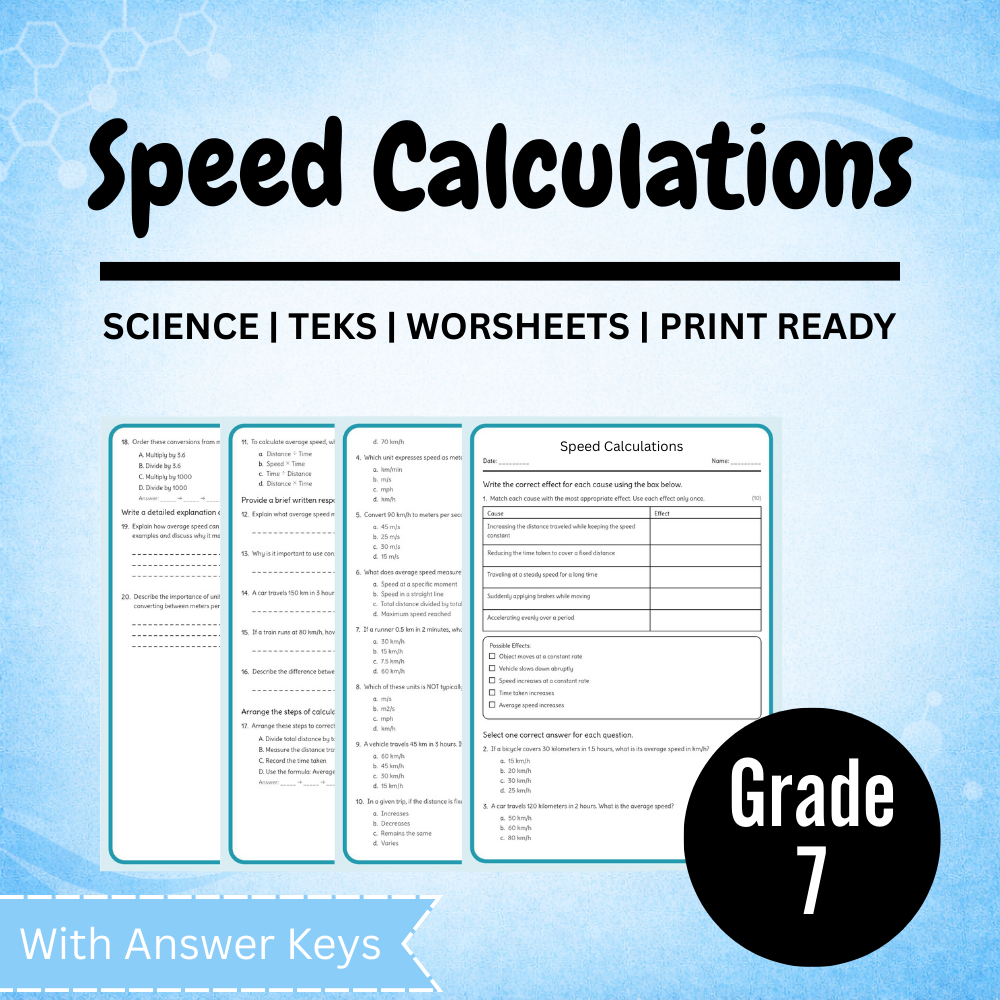
7th Grade Science | Speed Calculations Worksheet (PDF) - TEKS Standard
Created byBright Mind ResourcesLearning Objectives
- Understand how to calculate average speed using distance and time data.
- Distinguish between average speed and instantaneous speed through numerical examples.
- Convert between meters per second and kilometers per hour units.
Also included in: Grade 7 Science Unit Workbook | Motion, Forces & Energy TEKS-Aligned Worksheets +2 more
Instant download
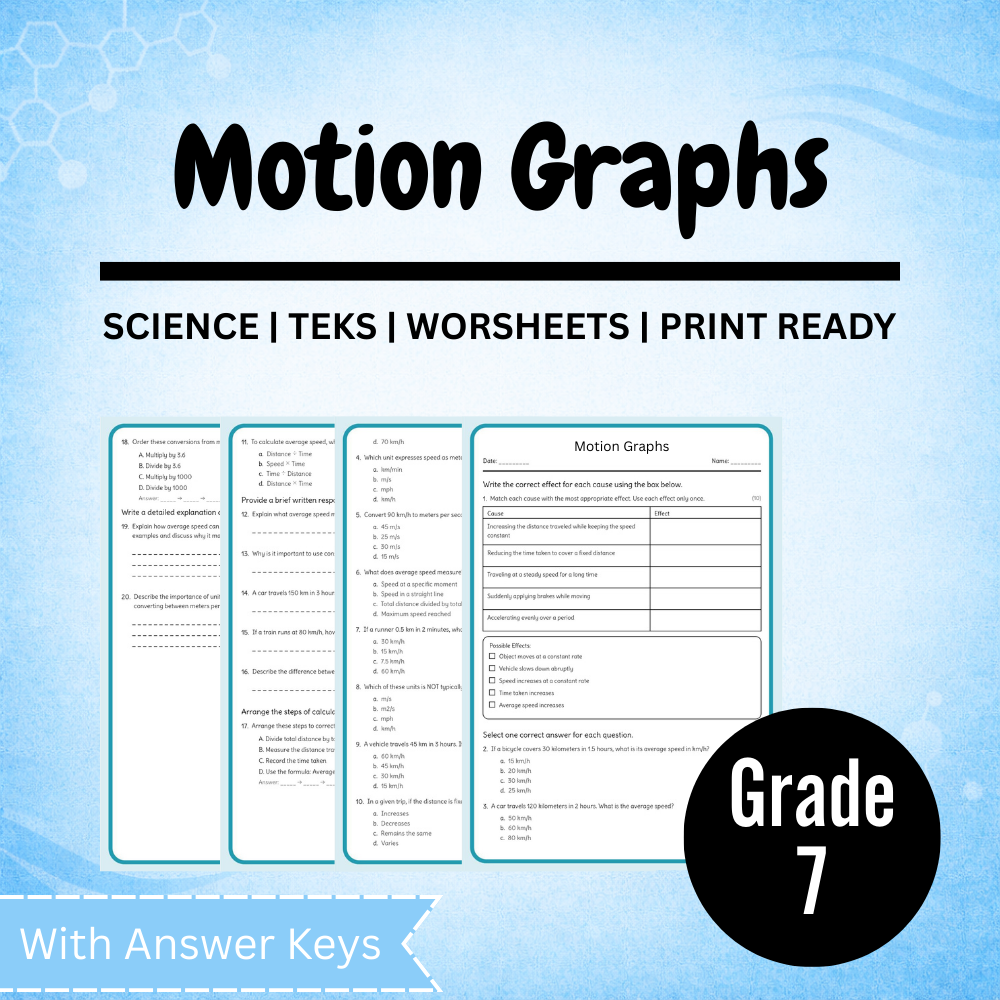
Grade 7 Science | Motion Graphs Worksheet (Worksheet + Answer Key) TEKS-Aligned
Created byBright Mind ResourcesLearning Objectives
- Interpret and describe patterns of motion from distance–time and velocity–time graphs.
- Relate slopes to speed and understand areas under velocity curves as displacement.
- Compare different types of motion graphs qualitatively using real-world examples.
Also included in: Grade 7 Science Unit Workbook | Motion, Forces & Energy TEKS-Aligned Worksheets +2 more
Instant download
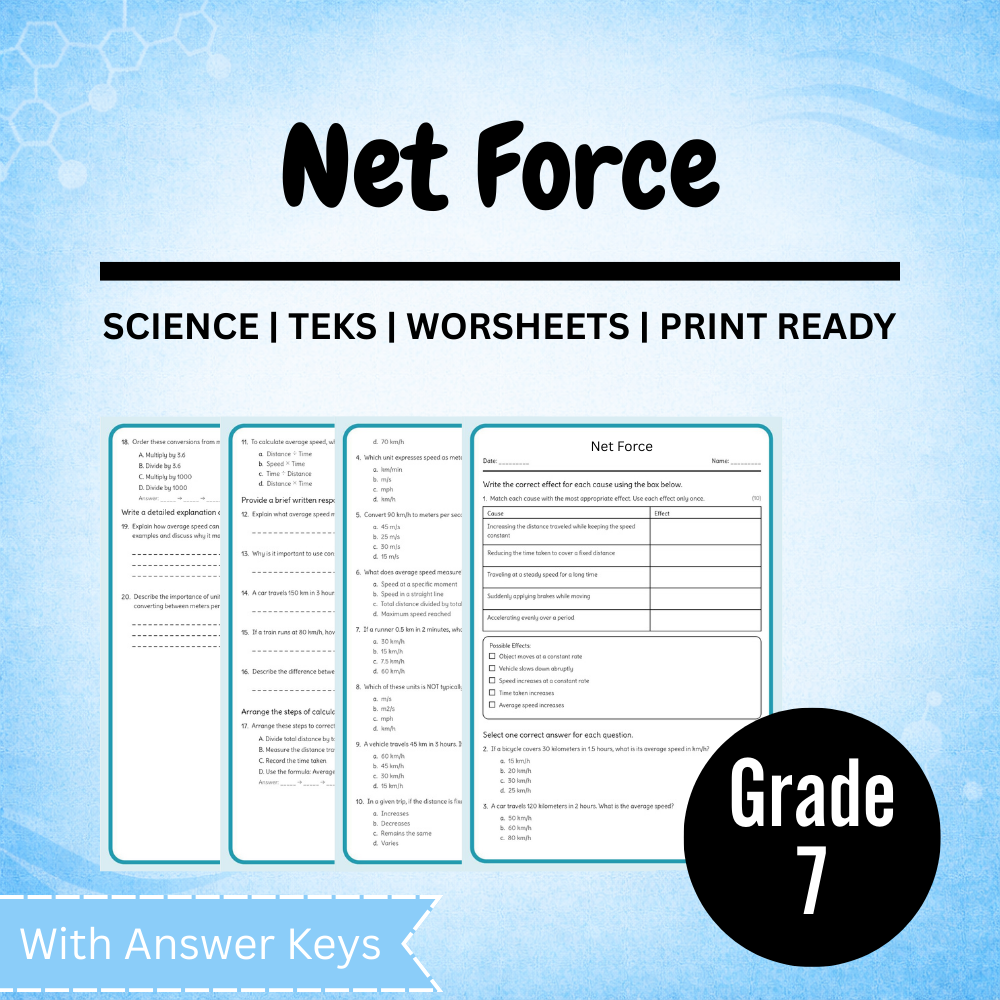
Grade 7 Science | Net Force Worksheet (Worksheet + Answer Key) – TEKS Aligned
Created byBright Mind ResourcesLearning Objectives
- Understand the concept of net force and how vectors are combined in various systems.
- Analyze forces acting on objects using free-body diagrams and vector addition.
- Explain how net force influences the motion of objects, including equilibrium scenarios.
Also included in: Grade 7 Science Unit Workbook | Motion, Forces & Energy TEKS-Aligned Worksheets +2 more
Instant download
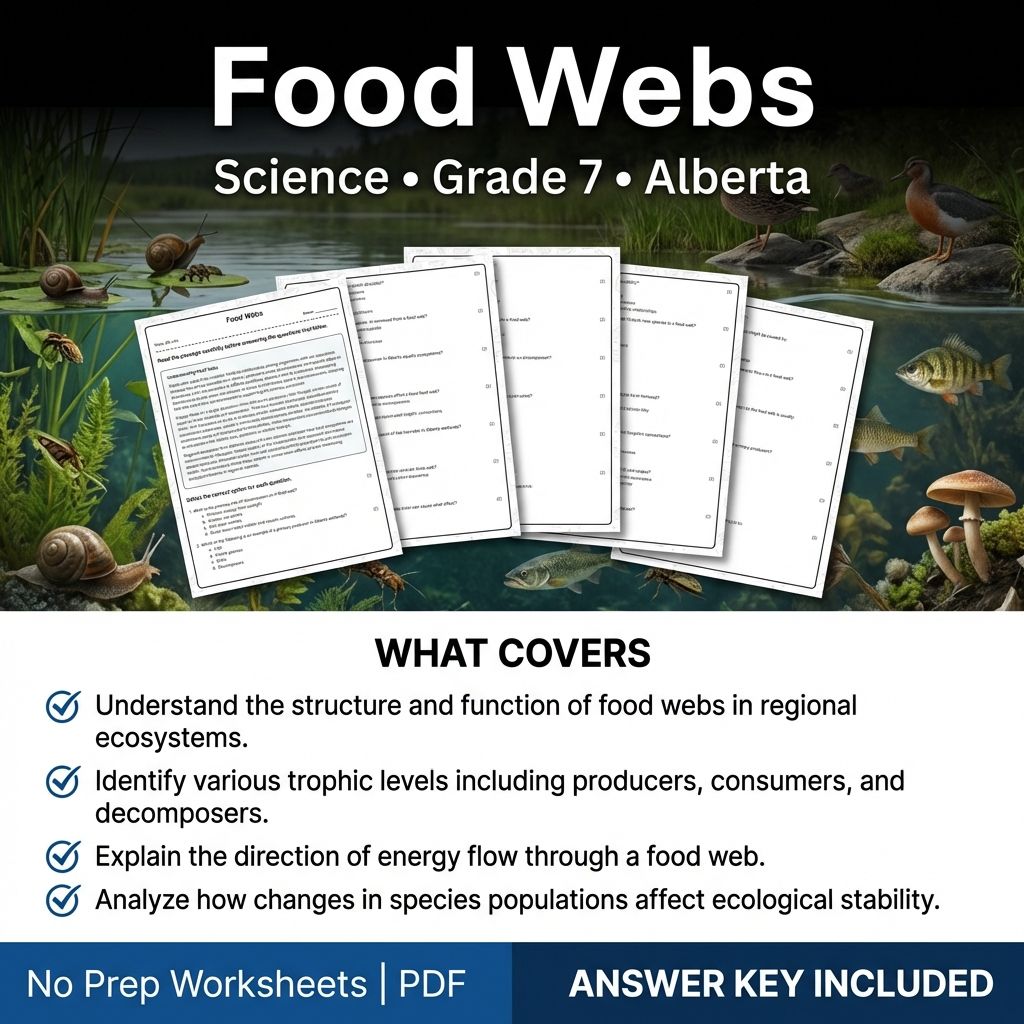
Food Webs Worksheet for Grade 7 Science | Alberta Standards Practice
Created byCoral Reef LearningLearning Objectives
- Understand the structure and function of food webs in regional ecosystems.
- Identify various trophic levels including producers, consumers, and decomposers.
- Explain the direction of energy flow through a food web.
Instant download
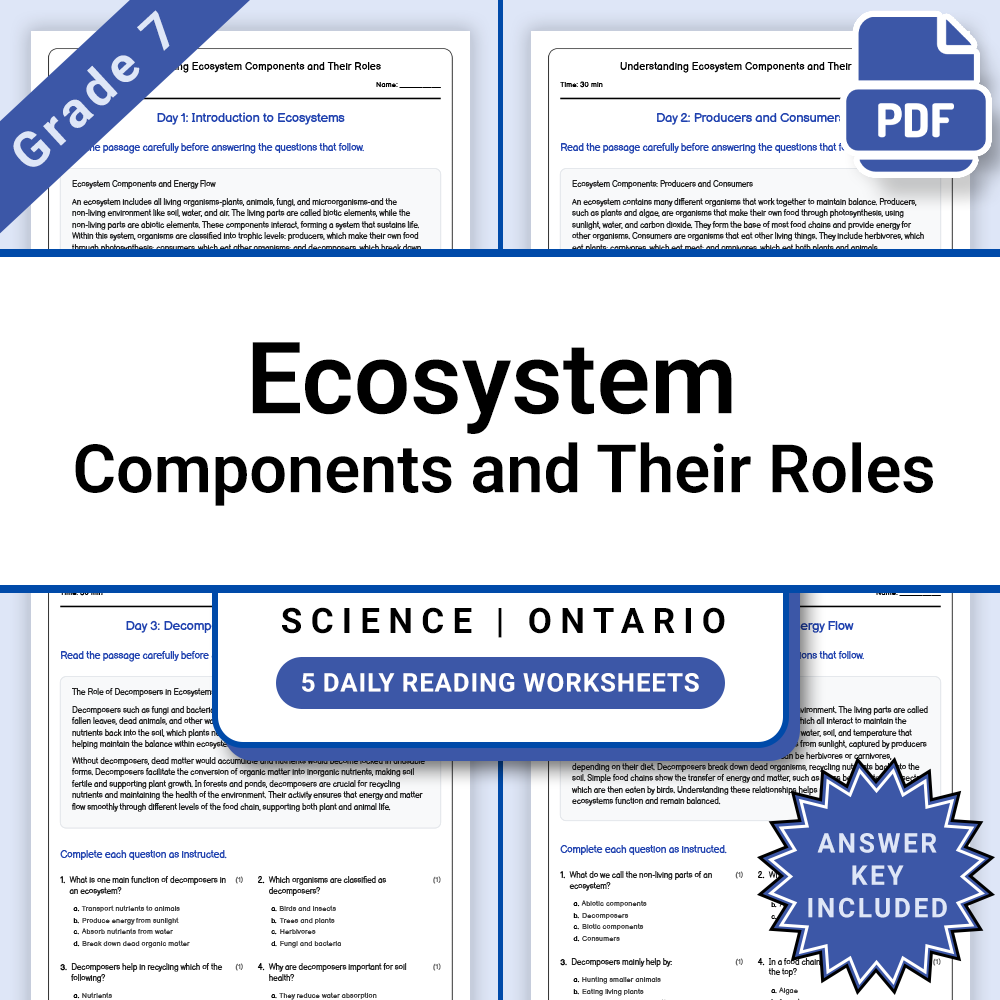
Grade 7 Science – Understanding Ecosystem Components Worksheet + Answer Key
JCreated byJ.S SheetsLearning Objectives
- Define biotic and abiotic components of ecosystems.
- Identify trophic categories: producers, consumers, decomposers.
- Explain how energy flows from sunlight to organic matter.
Also included in: Grade 7 Science Lesson Group Bundle | Ecology & Ecosystems Framework +1 more
Instant download
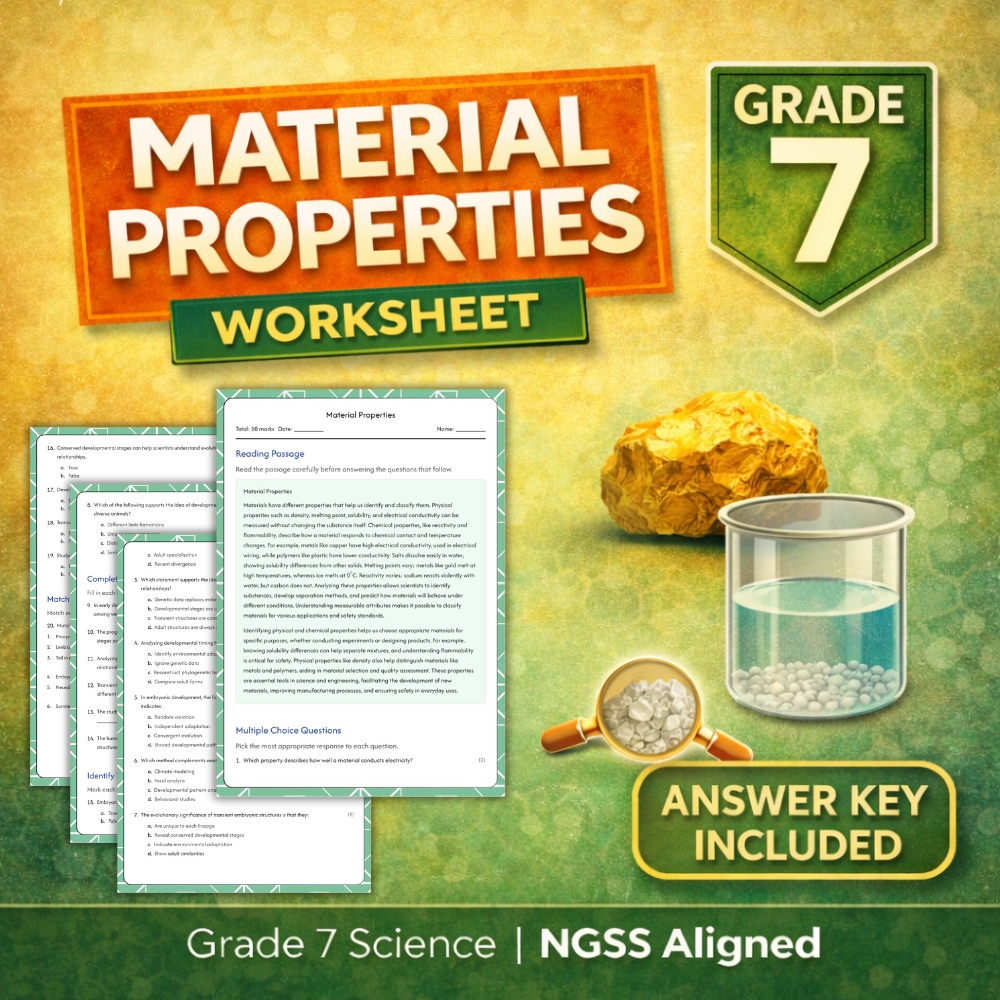
7th Grade Science | Material Properties Worksheet (NGSS & Answer Key)
 Created byCedar Grove Learning
Learning Objectives
- Distinguish between physical and chemical properties of materials.
- Identify measurable descriptors such as density, melting point, solubility, conductivity, reactivity, and flammability.
- Analyze property data to support material identification and separation strategies.
Instant download
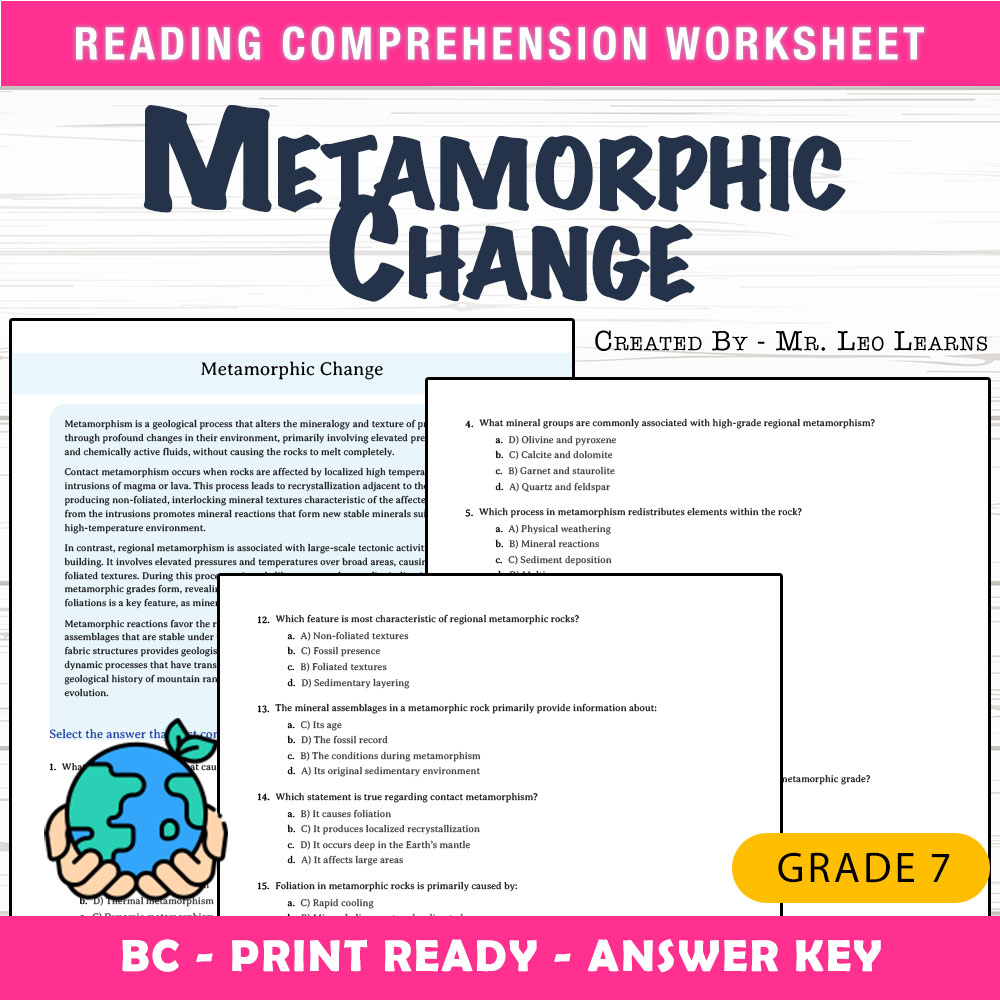
Grade 7 Science — Metamorphic Change Worksheet MCQ Paper for Mastery
 Created byThe Resource Hub
Learning Objectives
- Understand the processes involved in metamorphism and its effects on rocks.
- Differentiate between contact and regional metamorphism.
- Identify minerals and textures indicative of metamorphic grade.
Also included in: Grade 7 Science | Earth's Systems & Processes Worksheet Bundle – BC Framework +1 more
Instant download
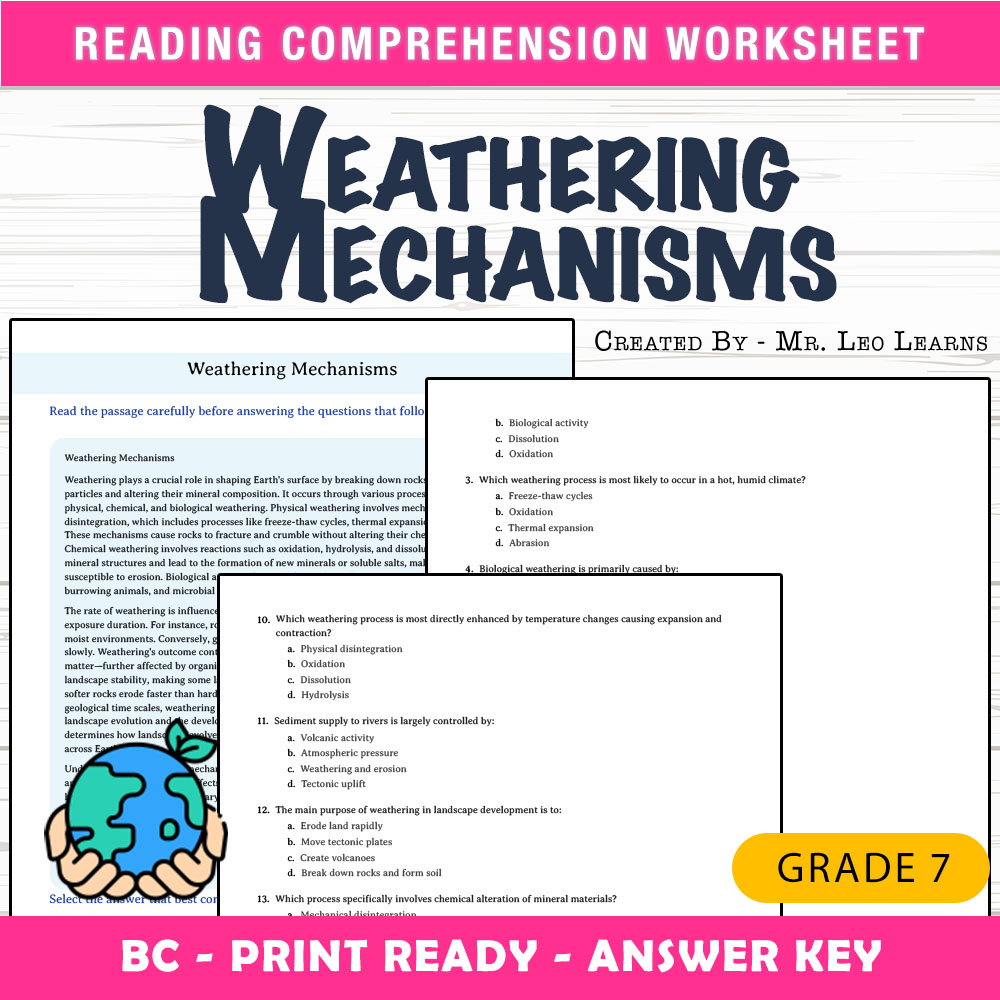
Grade 7 Science — Weathering Mechanisms Worksheet MCQ Paper
Created byThe Resource HubLearning Objectives
- Understand different physical, chemical, and biological processes involved in weathering.
- Identify how weathering influences landscape features and sediment supply.
- Recognize factors affecting weathering rates and landform development.
Also included in: Grade 7 Science | Earth's Systems & Processes Worksheet Bundle – BC Framework +1 more
Instant download
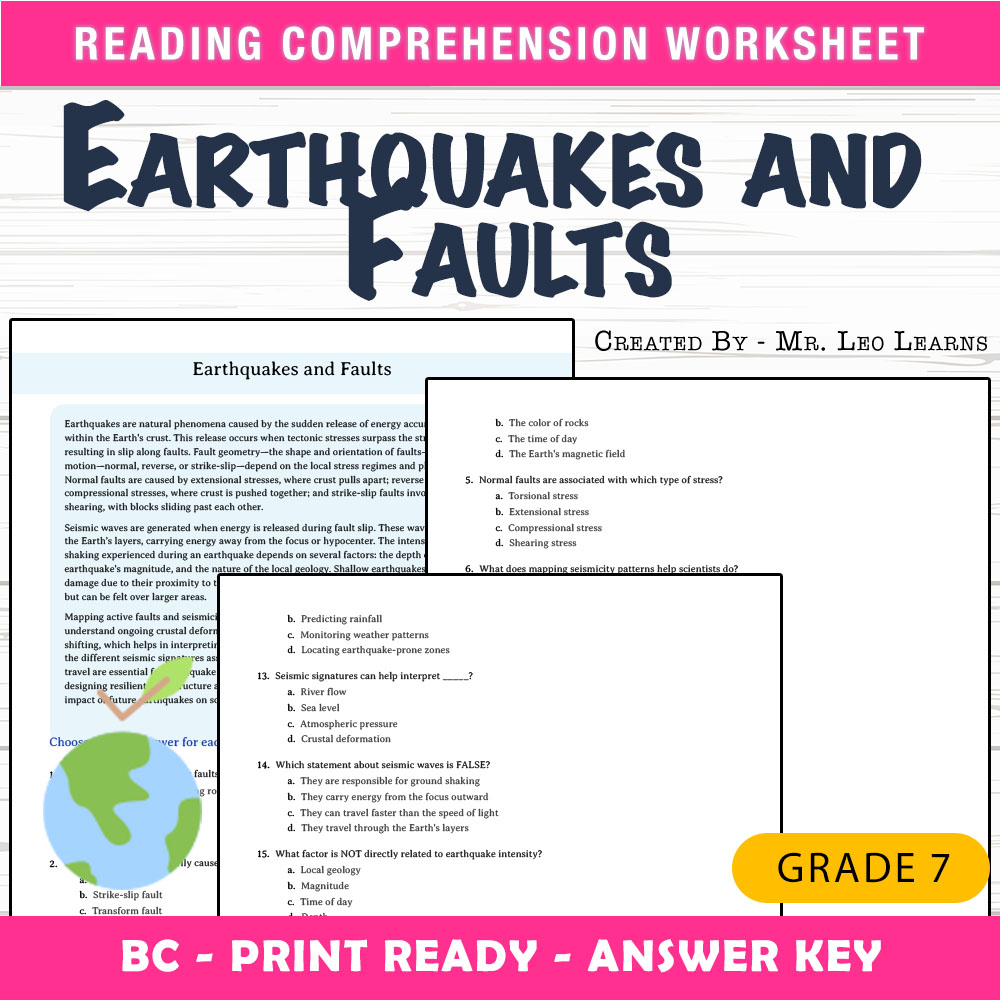
Grade 7 Science — Earthquakes and Faults Worksheet MCQ PDF + Answer Key
Created byThe Resource HubLearning Objectives
- Understand the causes and mechanisms of earthquakes and fault movement.
- Identify different types of faults and their seismic signatures.
- Describe how seismic waves travel and what influences earthquake intensity.
Also included in: Grade 7 Science | Earth's Systems & Processes Worksheet Bundle – BC Framework +1 more
Instant download
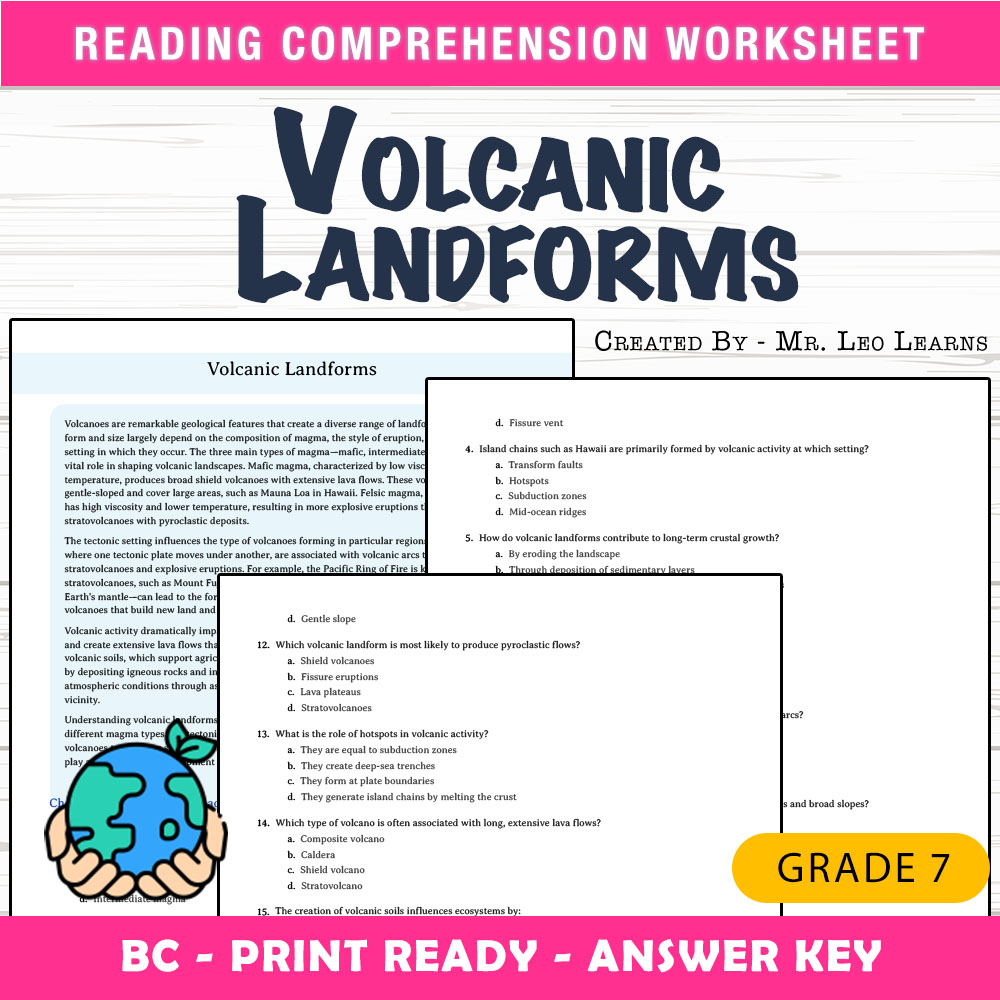
Grade 7 Science — Volcanic Landforms Worksheet MCQ Paper
Created byThe Resource HubLearning Objectives
- Understand different types of volcanic landforms and how magma composition influences their formation.
- Identify the characteristics of shield volcanoes and stratovolcanoes.
- Recognize tectonic settings such as subduction zones and hotspots that lead to volcanic activity.
Also included in: Grade 7 Science | Earth's Systems & Processes Worksheet Bundle – BC Framework +1 more
Instant download
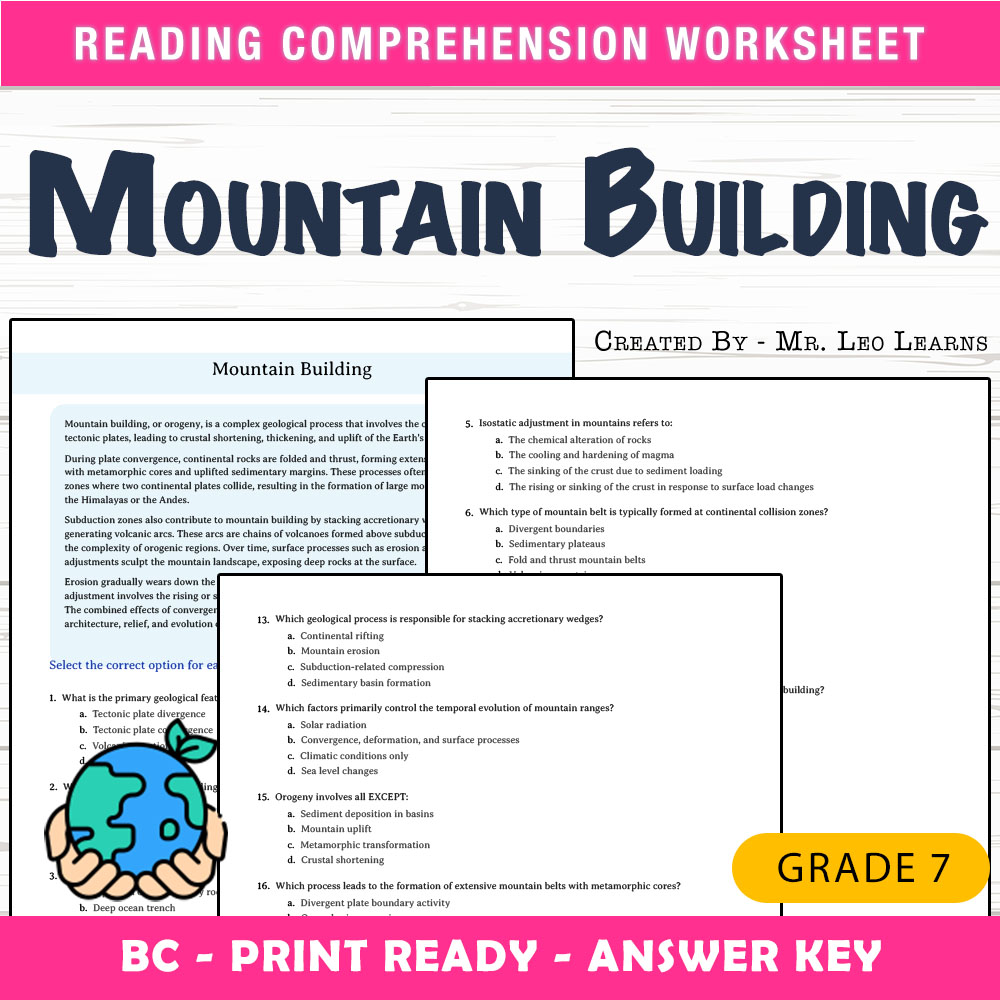
Grade 7 Science — Mountain Building Worksheet MCQ Paper
Created byThe Resource HubLearning Objectives
- Understand the geological processes involved in mountain formation during orogeny.
- Identify different tectonic plate interactions that lead to mountain building.
- Describe surface processes like erosion and isostatic adjustment that shape mountain relief.
Also included in: Grade 7 Science | Earth's Systems & Processes Worksheet Bundle – BC Framework +1 more
Instant download
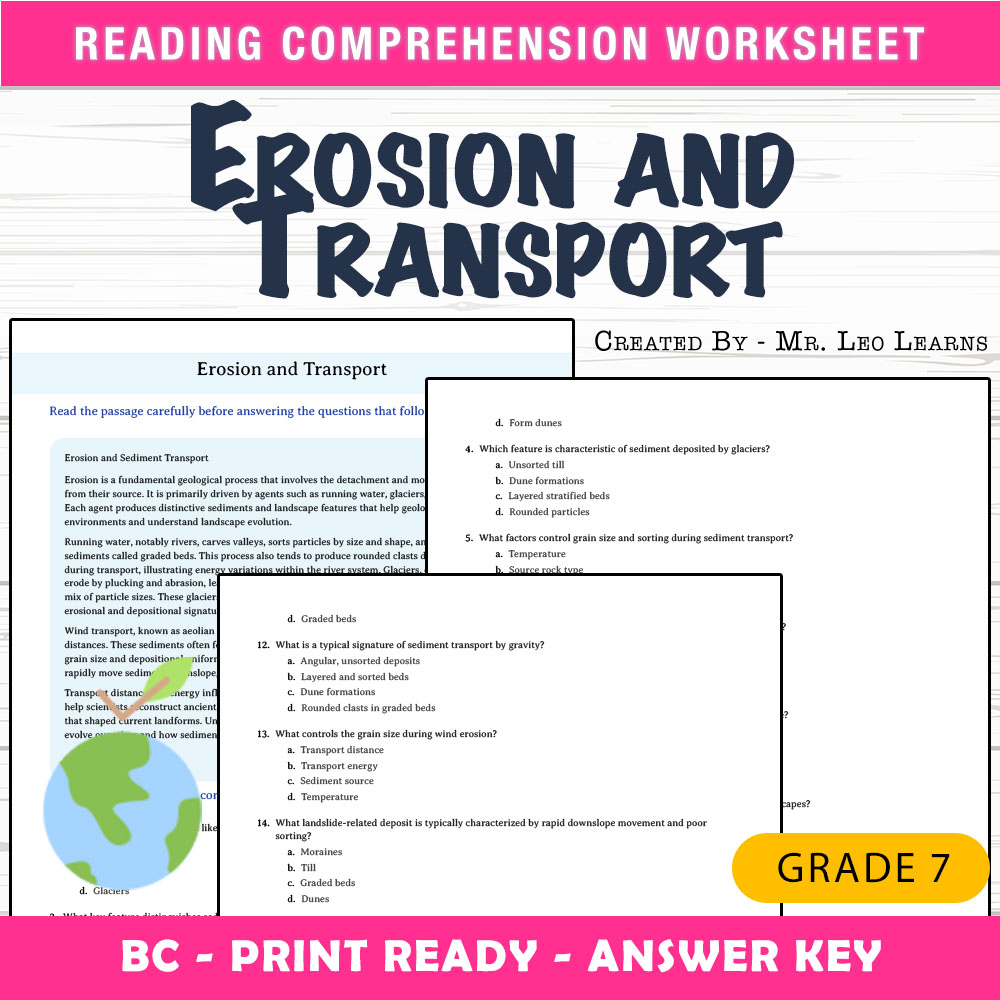
Grade 7 Science — Erosion and Transport Worksheet MCQ Paper
Created byThe Resource HubLearning Objectives
- Understand the agents responsible for erosion and transportation of sediments.
- Identify distinctive signatures of sediment transported by water, glaciers, wind, and gravity.
- Explain how sediment sorting and grain size relate to landscape evolution and paleoenvironments.
Also included in: Grade 7 Science | Earth's Systems & Processes Worksheet Bundle – BC Framework +1 more
Instant download
Grade 7 Science — Landscape Evolution Worksheet for Mastery
Created byThe Resource HubLearning Objectives
- Understand the key processes involved in landscape evolution, including tectonic uplift, volcanic activity, and surface processes.
- Identify how climate influences weathering, erosion, and sediment transport in landscape change.
- Explain the cycle of mountain building and denudation over geologic time.
Also included in: Grade 7 Science | Earth's Systems & Processes Worksheet Bundle – BC Framework +1 more
Instant download
Grade 7 Science — Plate Basics Worksheet for Mastery
Created byThe Resource HubLearning Objectives
- Understand the structure and function of Earth's tectonic plates.
- Identify the three main types of plate boundaries and their effects.
- Explain how plate movements influence geological activity such as earthquakes and mountain formation.
Also included in: Grade 7 Science | Earth's Systems & Processes Worksheet Bundle – BC Framework +1 more
Instant download
Grade 7 Science — Rock Cycle MCQ Practice Worksheet PDF + Answer Key
Created byThe Resource HubLearning Objectives
- Understand the processes involved in the rock cycle and how they connect tectonics, magmatism, and surface processes.
- Identify the roles of uplift, erosion, burial, and heat in transforming rocks.
- Explain how plate motions and surface agents contribute to crustal recycling.
Also included in: Grade 7 Science | Earth's Systems & Processes Worksheet Bundle – BC Framework +1 more
Instant download
Grade 7 Science — Igneous Processes Worksheet MCQ Paper
Created byThe Resource HubLearning Objectives
- Understand how magma forms through different geological processes.
- Identify the characteristics of intrusive and extrusive igneous rocks.
- Explain how cooling rates affect mineral texture in igneous rocks.
Also included in: Grade 7 Science | Earth's Systems & Processes Worksheet Bundle – BC Framework +1 more
Instant download
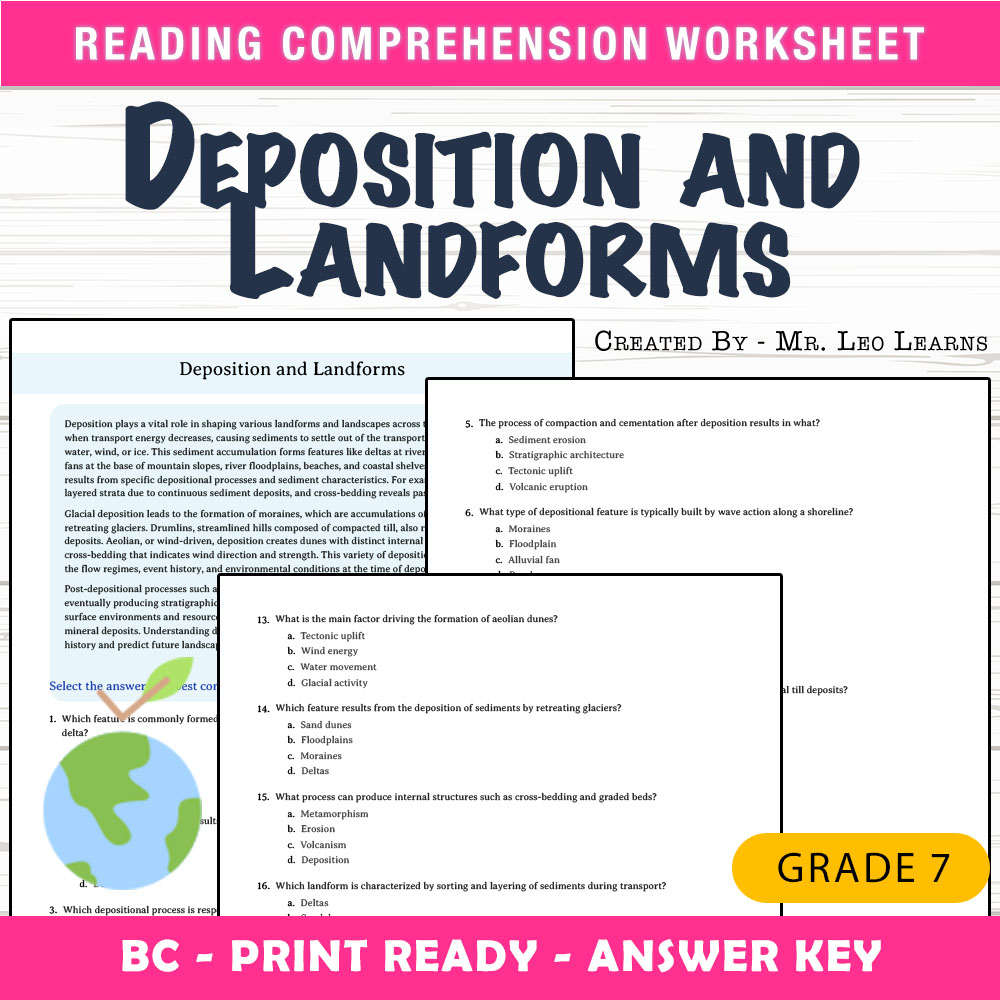
Grade 7 Science — Deposition and Landforms Worksheet MCQ Paper
Created byThe Resource HubLearning Objectives
- Understand the processes of deposition and how they form various landforms.
- Identify different types of depositional features such as deltas, beaches, and moraines.
- Recognize depositional structures like layered strata, cross-bedding, and graded beds.
Also included in: Grade 7 Science | Earth's Systems & Processes Worksheet Bundle – BC Framework +1 more
Instant download
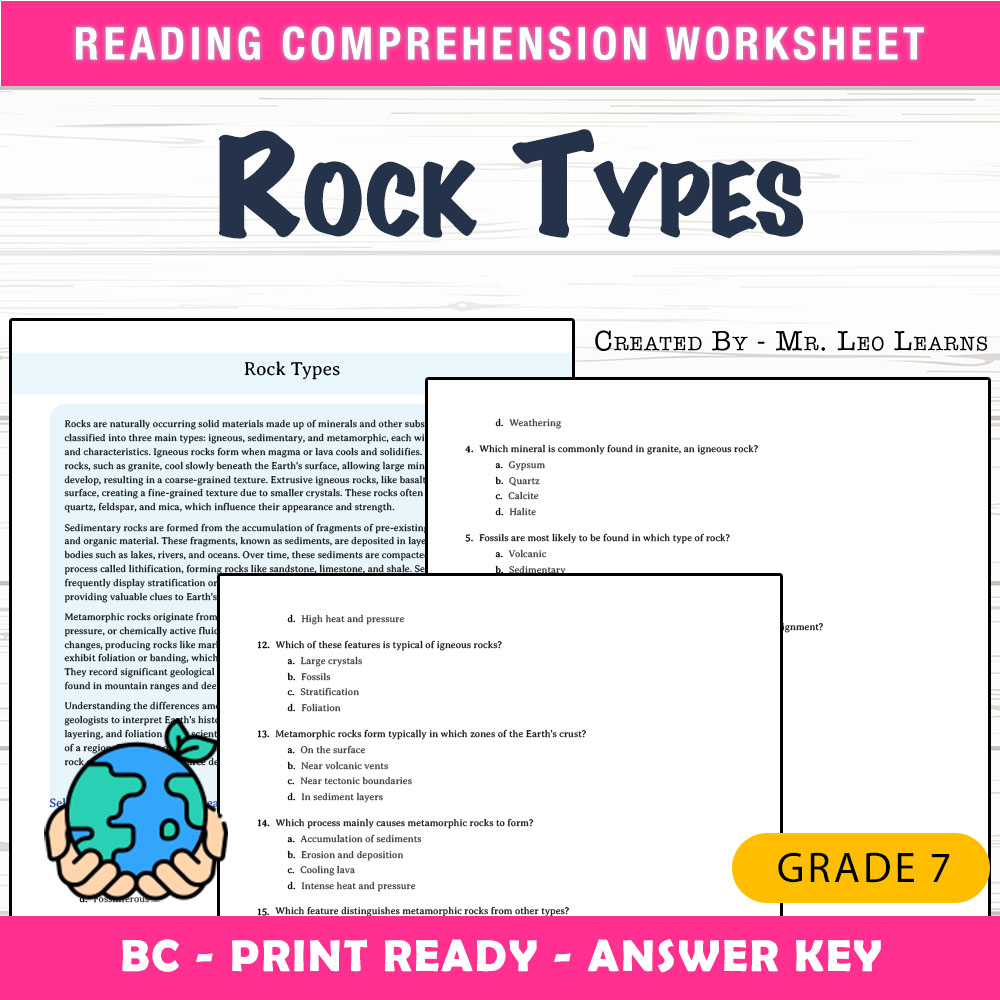
Grade 7 Science — Rock Types Worksheet MCQ Paper for Mastery
Created byThe Resource HubLearning Objectives
- Understand the three main types of rocks: igneous, sedimentary, and metamorphic.
- Identify key characteristics that distinguish rock types based on mineral content, texture, and structures.
- Describe the origins and formation processes of each rock type.
Also included in: Grade 7 Science | Earth's Systems & Processes Worksheet Bundle – BC Framework +1 more
Instant download
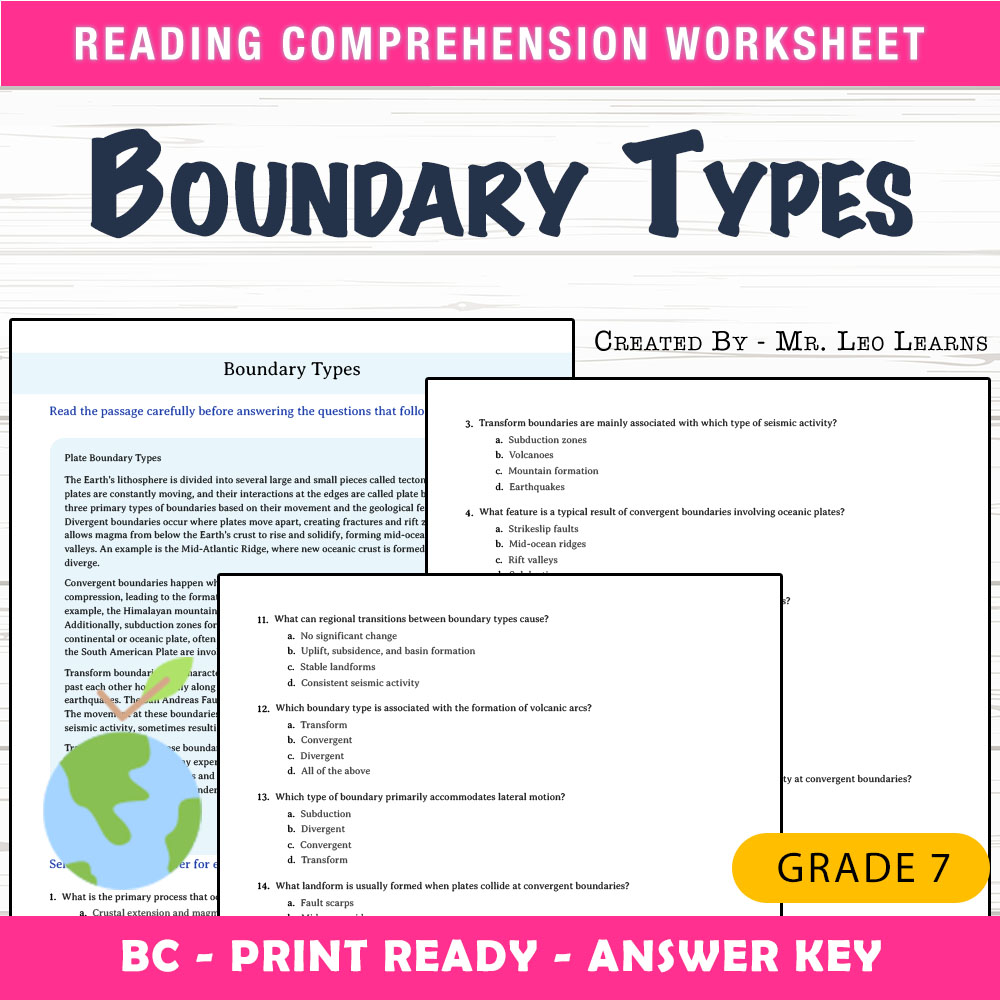
Grade 7 Science — Boundary Types Worksheet MCQ Paper for Mastery
Created byThe Resource HubLearning Objectives
- Identify and describe the three main types of plate boundaries.
- Understand the landforms and processes associated with divergent, convergent, and transform boundaries.
- Explain how boundary interactions influence Earth's surface features and seismic activity.
Also included in: Grade 7 Science | Earth's Systems & Processes Worksheet Bundle – BC Framework +1 more
Instant download
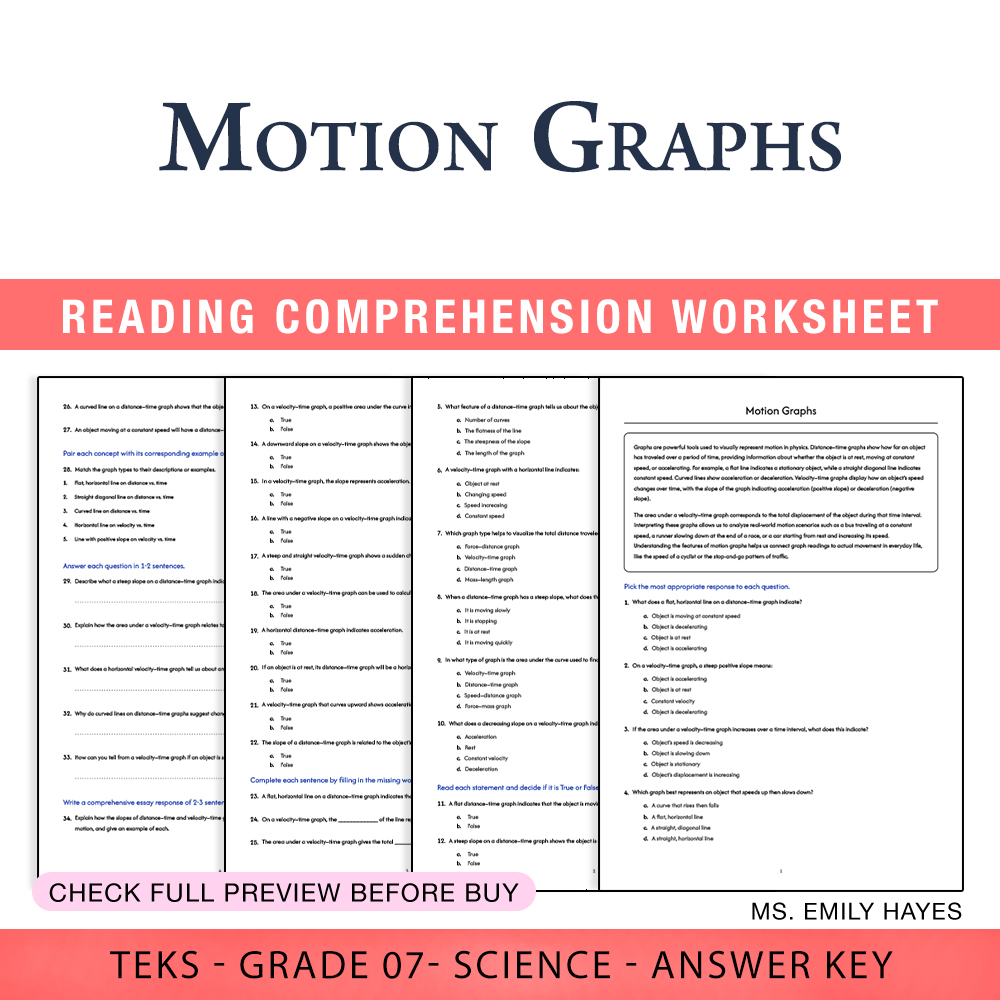
7th Grade Science | Motion Graphs Worksheet (PDF+ Answer Key)
 Created byCopper Leaf Classroom
Learning Objectives
- Interpret and analyze distance–time graphs to identify patterns like constant speed, acceleration, and rest periods.
- Understand velocity–time graphs and relate slopes to speed changes and areas to displacement.
- Compare different types of graphs qualitatively and relate them to real-world motion scenarios such as bus routes and running laps.
Instant download

Air Masses Fronts Worksheet | California Standards Grade 7 Science Practice
JCreated byJ.S SheetsLearning Objectives
- Understand how air masses and fronts influence weather patterns.
- Identify the characteristics of different air masses and types of fronts.
- Explain how boundaries between air masses lead to weather changes such as storms and precipitation.
Also included in: Grade 7 Engineering Tradeoffs & Optimization Science Lesson Bundle +1 more
Instant download

Grade 7 Science | Inherited Traits Worksheet | Florida NGSSS Aligned
Created byLumora LearningLearning Objectives
- Explain how inherited traits are passed from parents to offspring through genetic information carried in reproductive cells
- Describe how variation among parents can lead to observable differences in offspring
- Identify examples of inherited traits and relate them to heritable factors such as blood type, seed shape, or fur color
Instant download

Food Building Blocks Assessment | California Standards Grade 7 Science
Created byPrism Point LearningLearning Objectives
- Explain how food molecules can be used for building body structures and for providing usable energy
- Describe how digestion and cellular processes transform food molecules into forms the body can use
- Connect eating habits to changes in growth, repair, and body condition over time
Also included in: Grade 7 Energy Flow and Matter Cycling Science lesson bundle – California Standards +1 more
Instant download
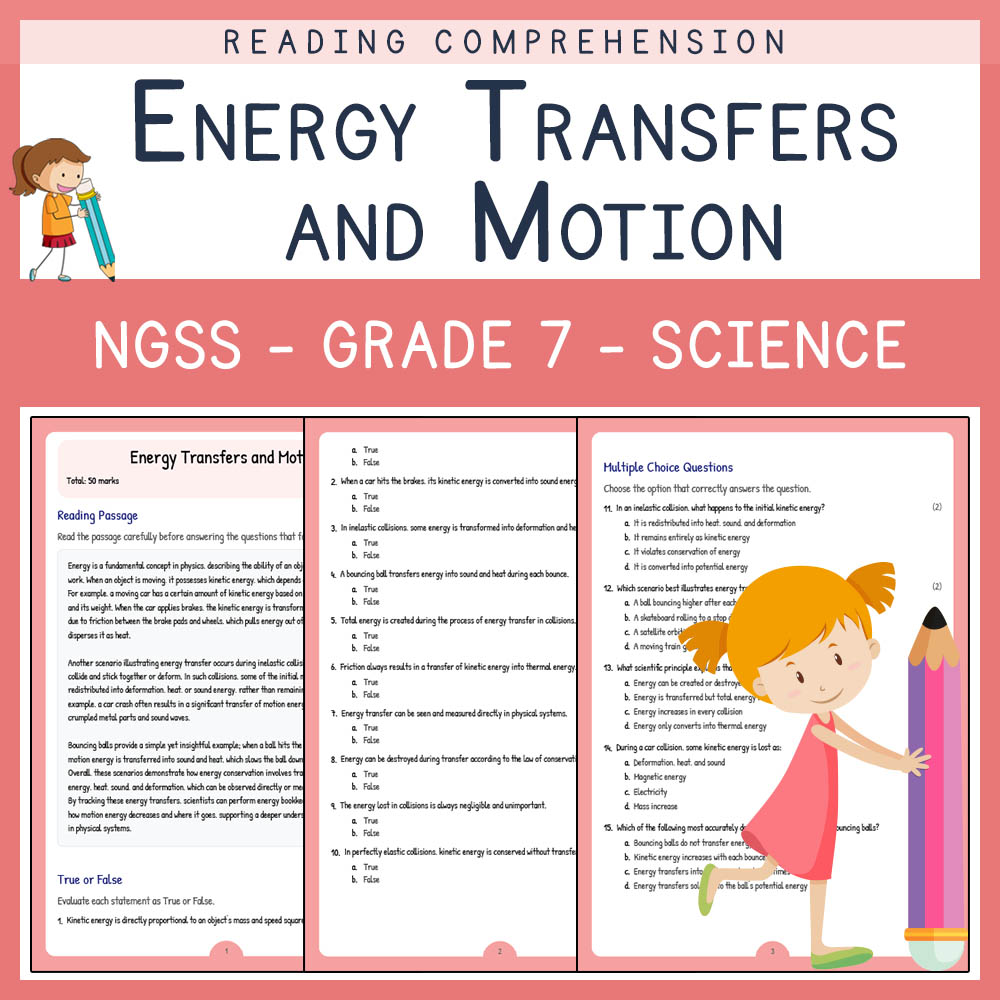
Grade 7 Science | Energy Transfers and Motion Worksheet (Answer Key) for NGSS Alignment
Created byLumora LearningLearning Objectives
- Understand how energy is transferred during changes in an object's motion.
- Explain real-world examples of energy transfer such as braking, bouncing, and collisions.
- Quantitatively and qualitatively analyze scenarios involving energy transfer in motion.
Instant download
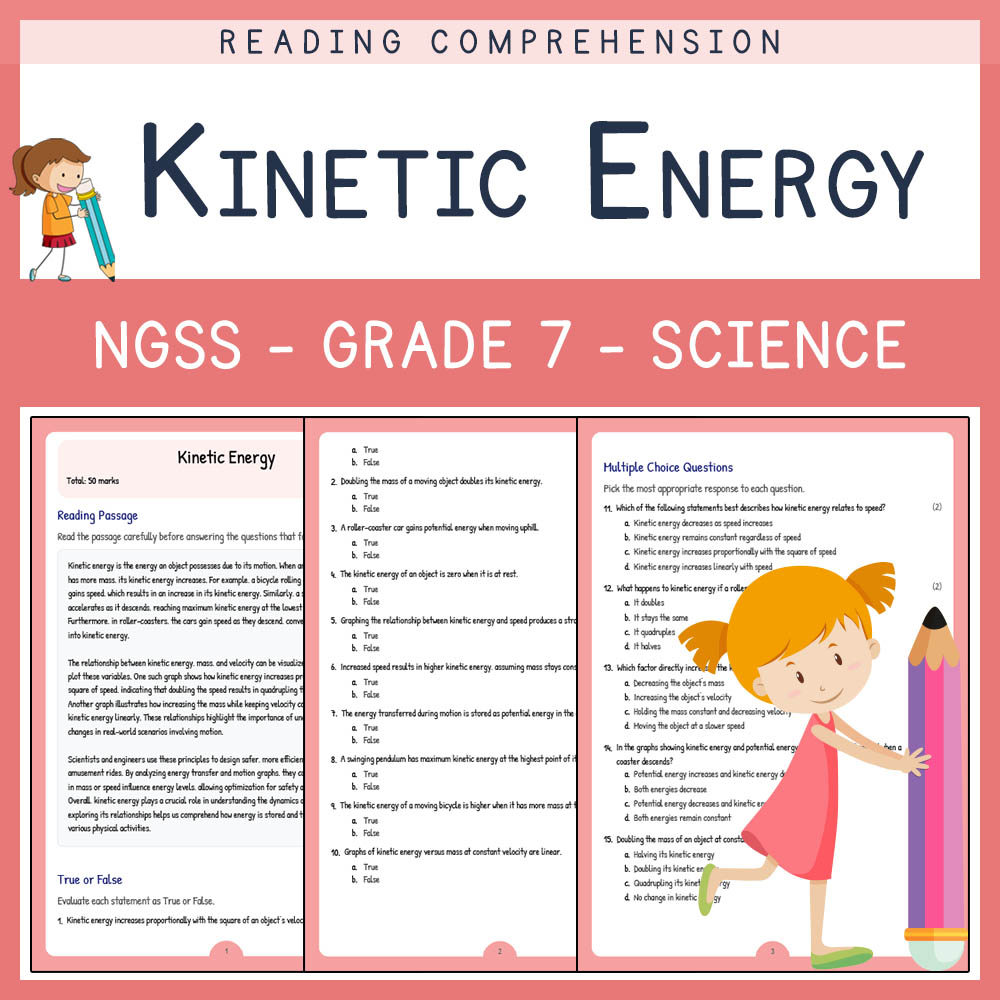
Grade 7 Science | Kinetic Energy Worksheet & Answer Key (NGSS-Aligned)
Created byLumora LearningLearning Objectives
- Construct and interpret graphical relationships between kinetic energy, potential energy, mass, and speed.
- Analyze how doubling the mass or speed of an object affects its kinetic energy through quantitative comparisons and graphs.
- Apply energy calculation formulas to real-world motion scenarios such as rolling bicycles, swinging pendulums, and roller-coaster cars.
Instant download
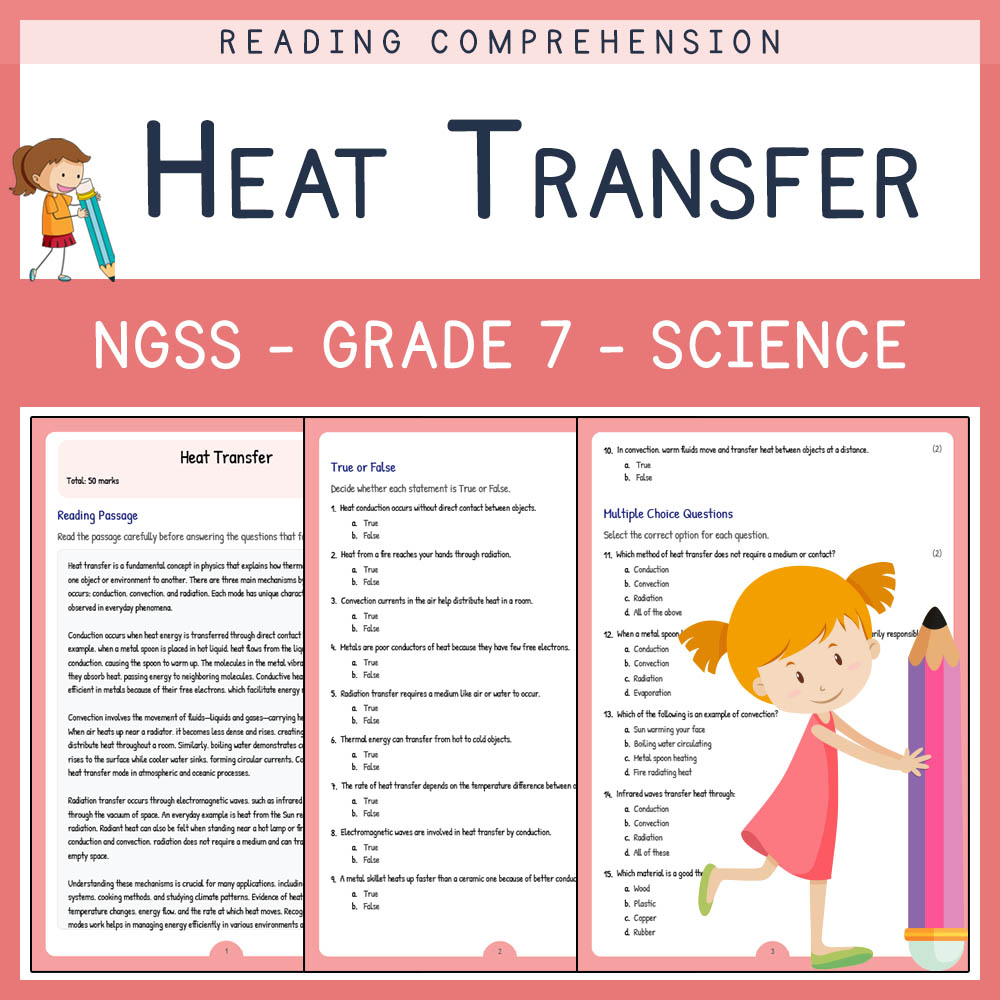
Grade 7 Science | Heat Transfer Worksheet & Answer Key for NGSS Standards
Created byLumora LearningLearning Objectives
- Describe the different mechanisms of heat transfer: conduction, convection, and radiation.
- Identify examples of heat transfer in everyday life.
- Explain how heat transfer affects temperature changes and energy flow in objects and environments.
Instant download
About Grade 7 Science Worksheets
Browse 6,039 printable Grade 7 Science worksheets — ready-to-print PDFs with answer keys where available.
Every worksheet on MyTeachingSheets is created by independent teacher-authors and reviewed before publication. All resources download as printable PDFs for classroom, homework, or at-home practice, and many include answer keys. Preview any worksheet free before buying.