
Grade 7 Science Worksheets
6,039 worksheets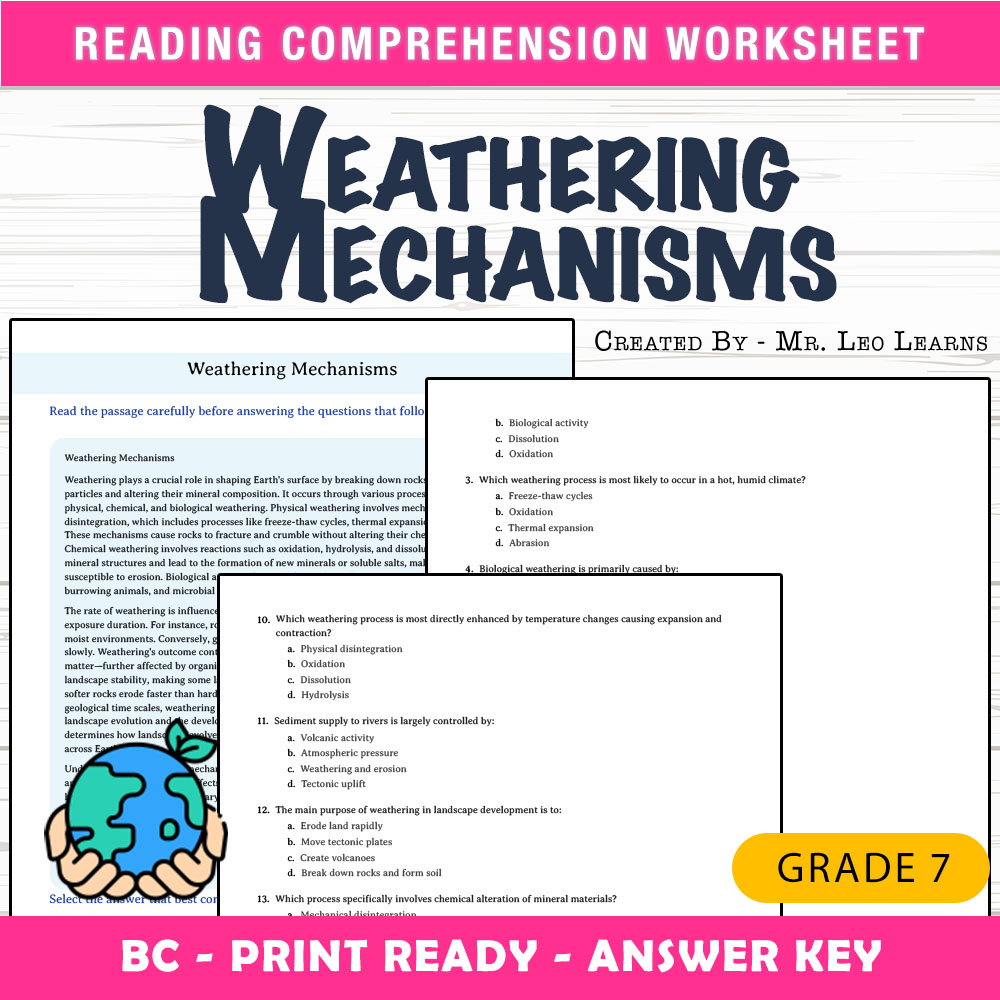
Grade 7 Science — Weathering Mechanisms Worksheet MCQ Paper
 Created byThe Resource Hub
Learning Objectives
- Understand different physical, chemical, and biological processes involved in weathering.
- Identify how weathering influences landscape features and sediment supply.
- Recognize factors affecting weathering rates and landform development.
Also included in: Grade 7 Science | Earth's Systems & Processes Worksheet Bundle – BC Framework +1 more
Instant download
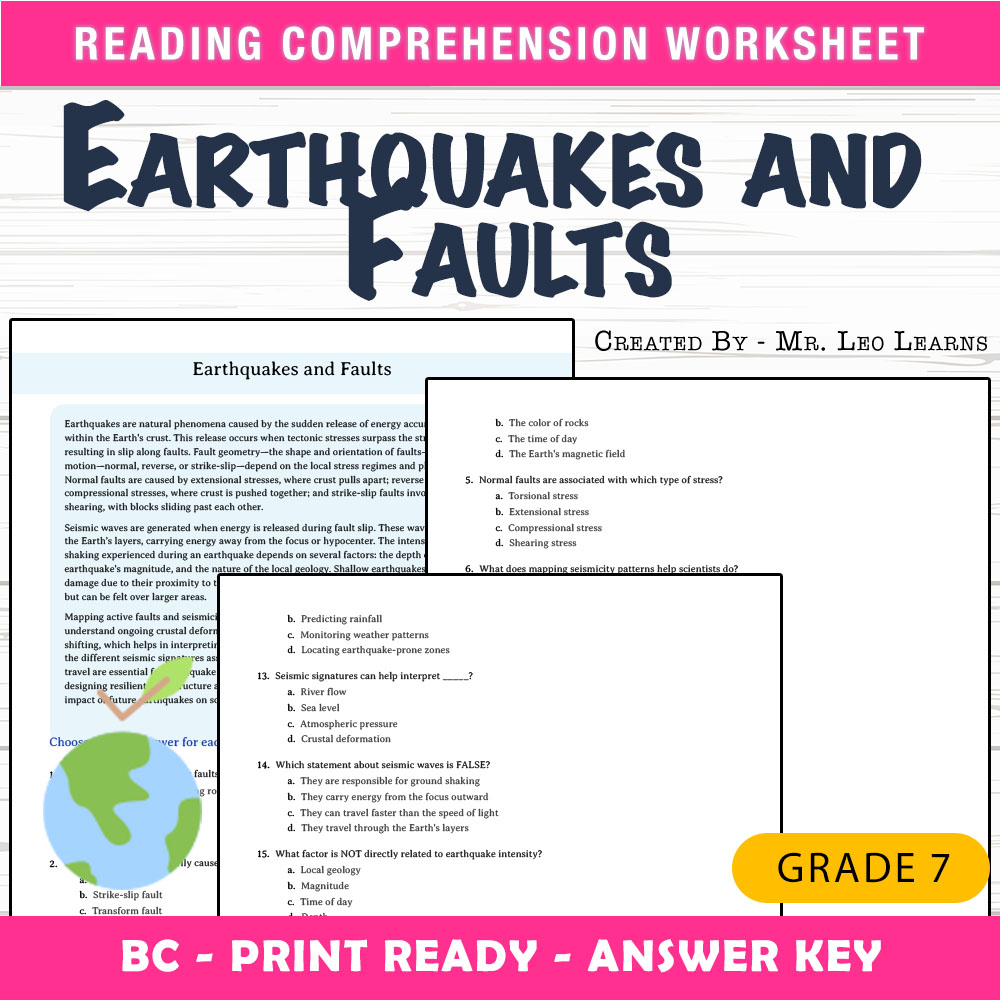
Grade 7 Science — Earthquakes and Faults Worksheet MCQ PDF + Answer Key
Created byThe Resource HubLearning Objectives
- Understand the causes and mechanisms of earthquakes and fault movement.
- Identify different types of faults and their seismic signatures.
- Describe how seismic waves travel and what influences earthquake intensity.
Also included in: Grade 7 Science | Earth's Systems & Processes Worksheet Bundle – BC Framework +1 more
Instant download
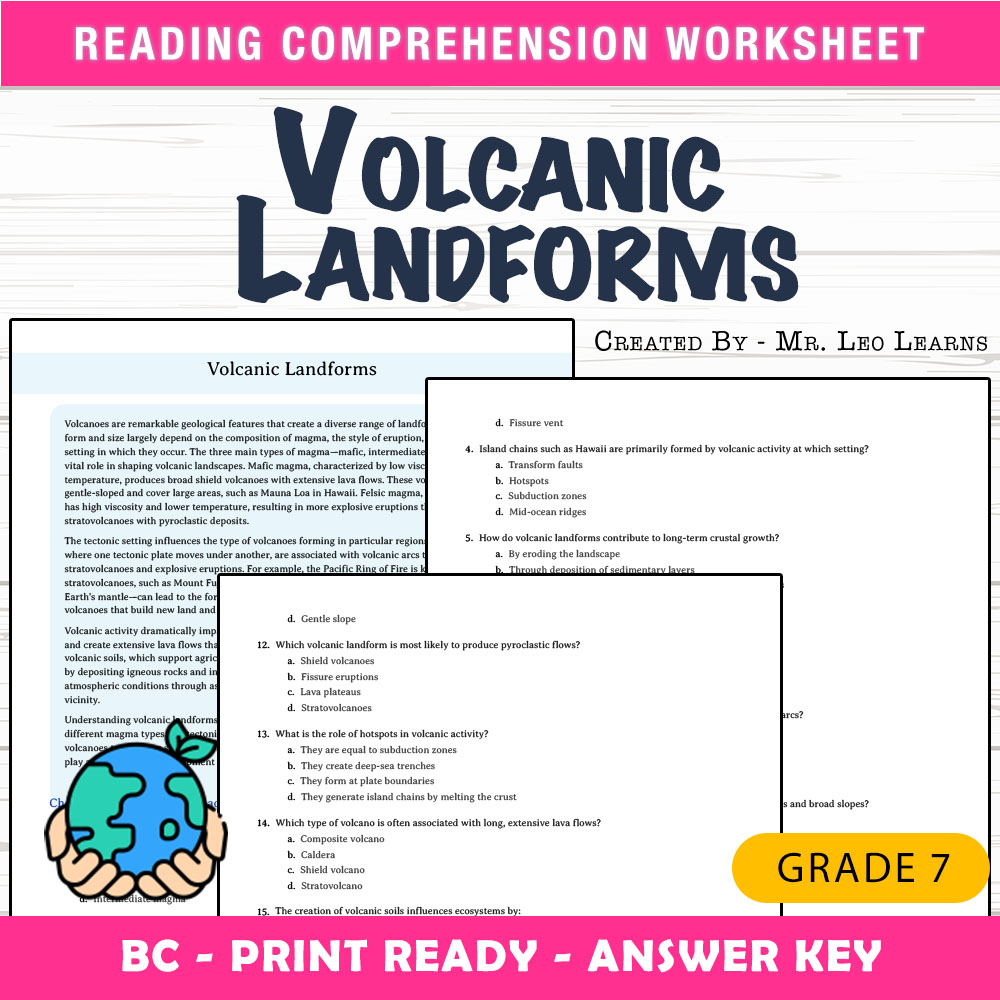
Grade 7 Science — Volcanic Landforms Worksheet MCQ Paper
Created byThe Resource HubLearning Objectives
- Understand different types of volcanic landforms and how magma composition influences their formation.
- Identify the characteristics of shield volcanoes and stratovolcanoes.
- Recognize tectonic settings such as subduction zones and hotspots that lead to volcanic activity.
Also included in: Grade 7 Science | Earth's Systems & Processes Worksheet Bundle – BC Framework +1 more
Instant download
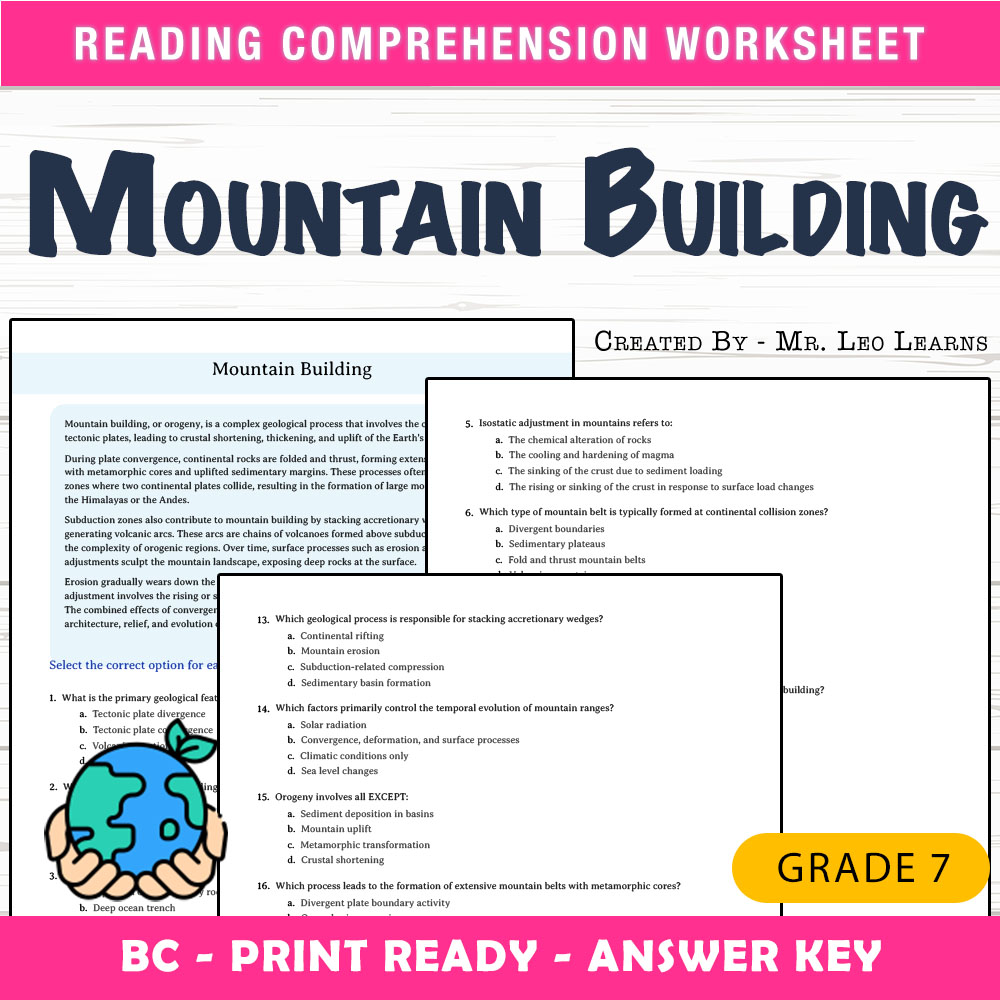
Grade 7 Science — Mountain Building Worksheet MCQ Paper
Created byThe Resource HubLearning Objectives
- Understand the geological processes involved in mountain formation during orogeny.
- Identify different tectonic plate interactions that lead to mountain building.
- Describe surface processes like erosion and isostatic adjustment that shape mountain relief.
Also included in: Grade 7 Science | Earth's Systems & Processes Worksheet Bundle – BC Framework +1 more
Instant download
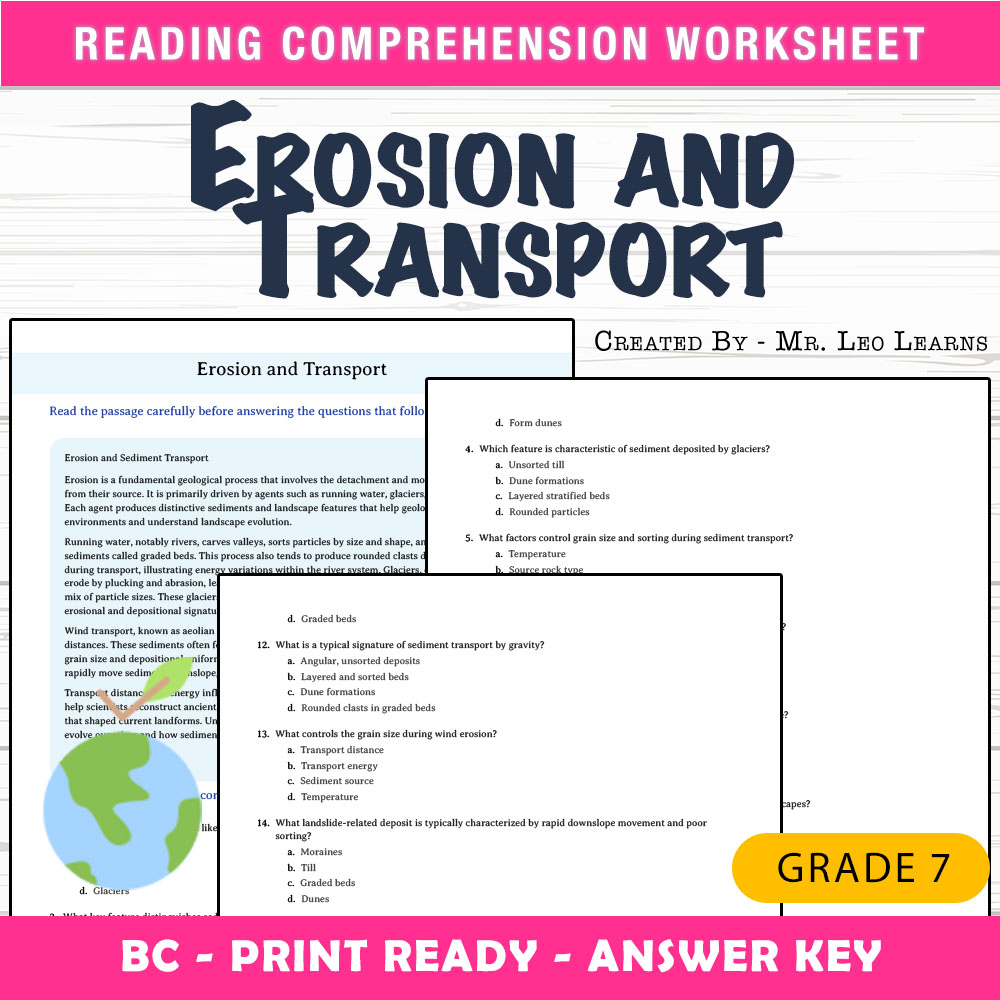
Grade 7 Science — Erosion and Transport Worksheet MCQ Paper
Created byThe Resource HubLearning Objectives
- Understand the agents responsible for erosion and transportation of sediments.
- Identify distinctive signatures of sediment transported by water, glaciers, wind, and gravity.
- Explain how sediment sorting and grain size relate to landscape evolution and paleoenvironments.
Also included in: Grade 7 Science | Earth's Systems & Processes Worksheet Bundle – BC Framework +1 more
Instant download
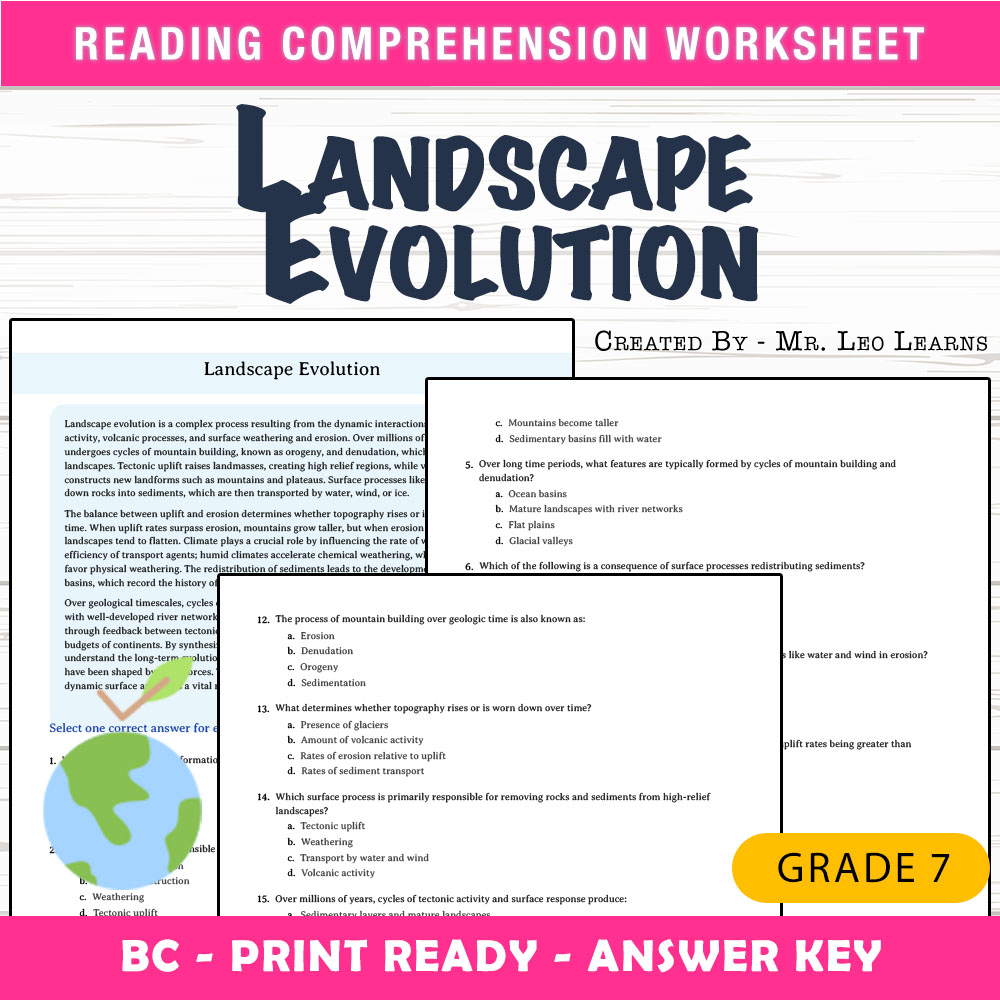
Grade 7 Science — Landscape Evolution Worksheet for Mastery
Created byThe Resource HubLearning Objectives
- Understand the key processes involved in landscape evolution, including tectonic uplift, volcanic activity, and surface processes.
- Identify how climate influences weathering, erosion, and sediment transport in landscape change.
- Explain the cycle of mountain building and denudation over geologic time.
Also included in: Grade 7 Science | Earth's Systems & Processes Worksheet Bundle – BC Framework +1 more
Instant download
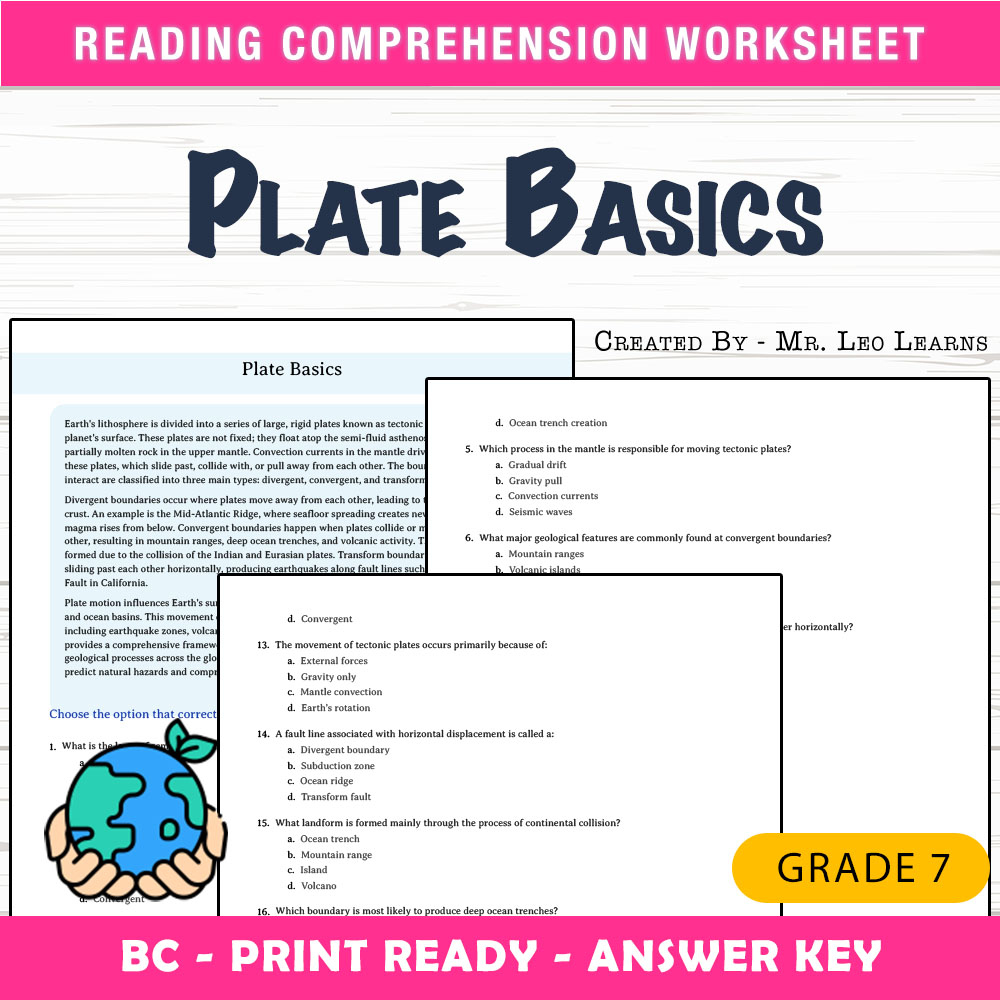
Grade 7 Science — Plate Basics Worksheet for Mastery
Created byThe Resource HubLearning Objectives
- Understand the structure and function of Earth's tectonic plates.
- Identify the three main types of plate boundaries and their effects.
- Explain how plate movements influence geological activity such as earthquakes and mountain formation.
Also included in: Grade 7 Science | Earth's Systems & Processes Worksheet Bundle – BC Framework +1 more
Instant download
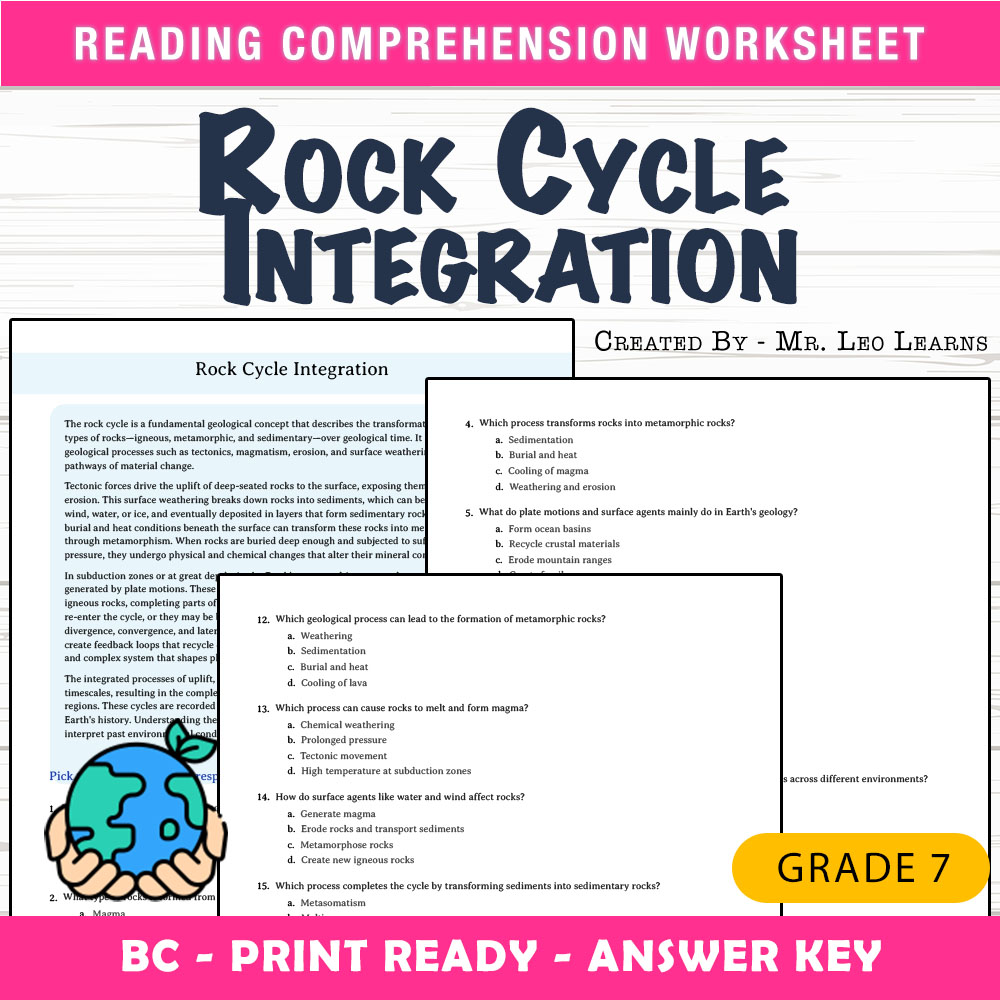
Grade 7 Science — Rock Cycle MCQ Practice Worksheet PDF + Answer Key
Created byThe Resource HubLearning Objectives
- Understand the processes involved in the rock cycle and how they connect tectonics, magmatism, and surface processes.
- Identify the roles of uplift, erosion, burial, and heat in transforming rocks.
- Explain how plate motions and surface agents contribute to crustal recycling.
Also included in: Grade 7 Science | Earth's Systems & Processes Worksheet Bundle – BC Framework +1 more
Instant download
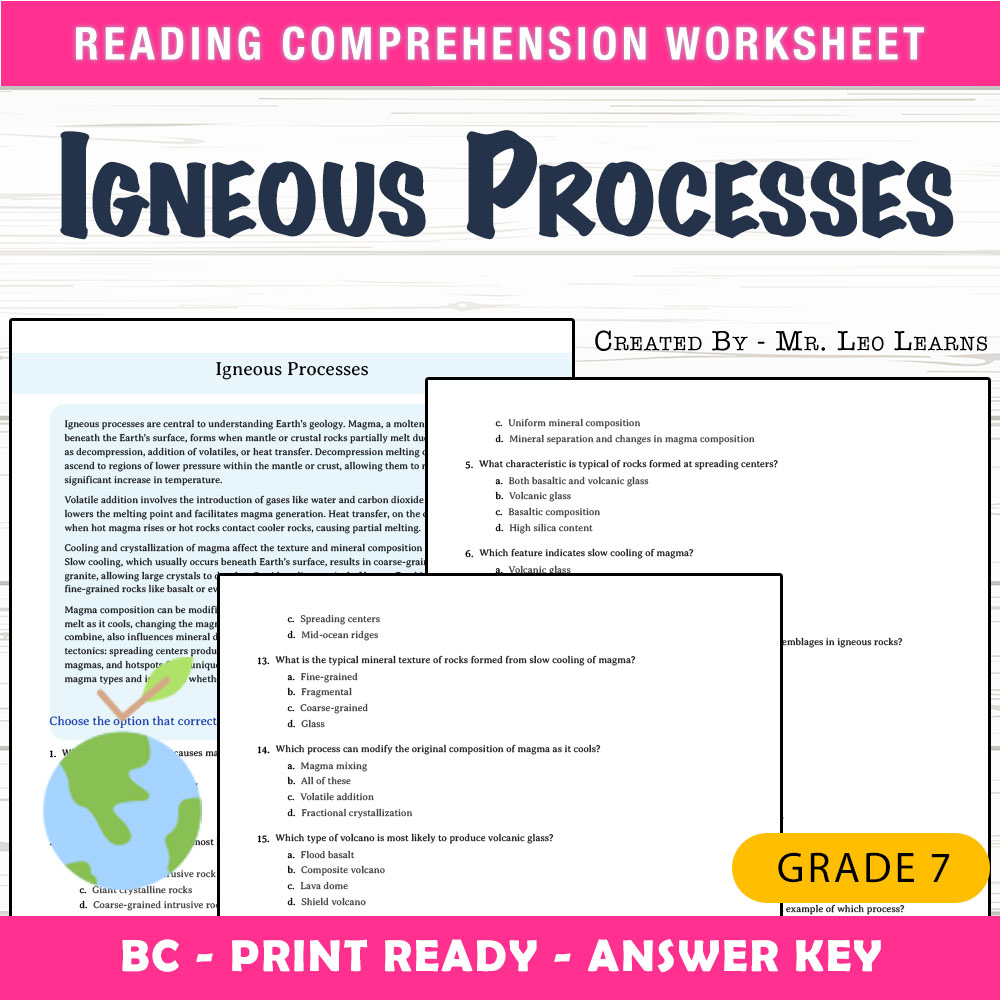
Grade 7 Science — Igneous Processes Worksheet MCQ Paper
Created byThe Resource HubLearning Objectives
- Understand how magma forms through different geological processes.
- Identify the characteristics of intrusive and extrusive igneous rocks.
- Explain how cooling rates affect mineral texture in igneous rocks.
Also included in: Grade 7 Science | Earth's Systems & Processes Worksheet Bundle – BC Framework +1 more
Instant download
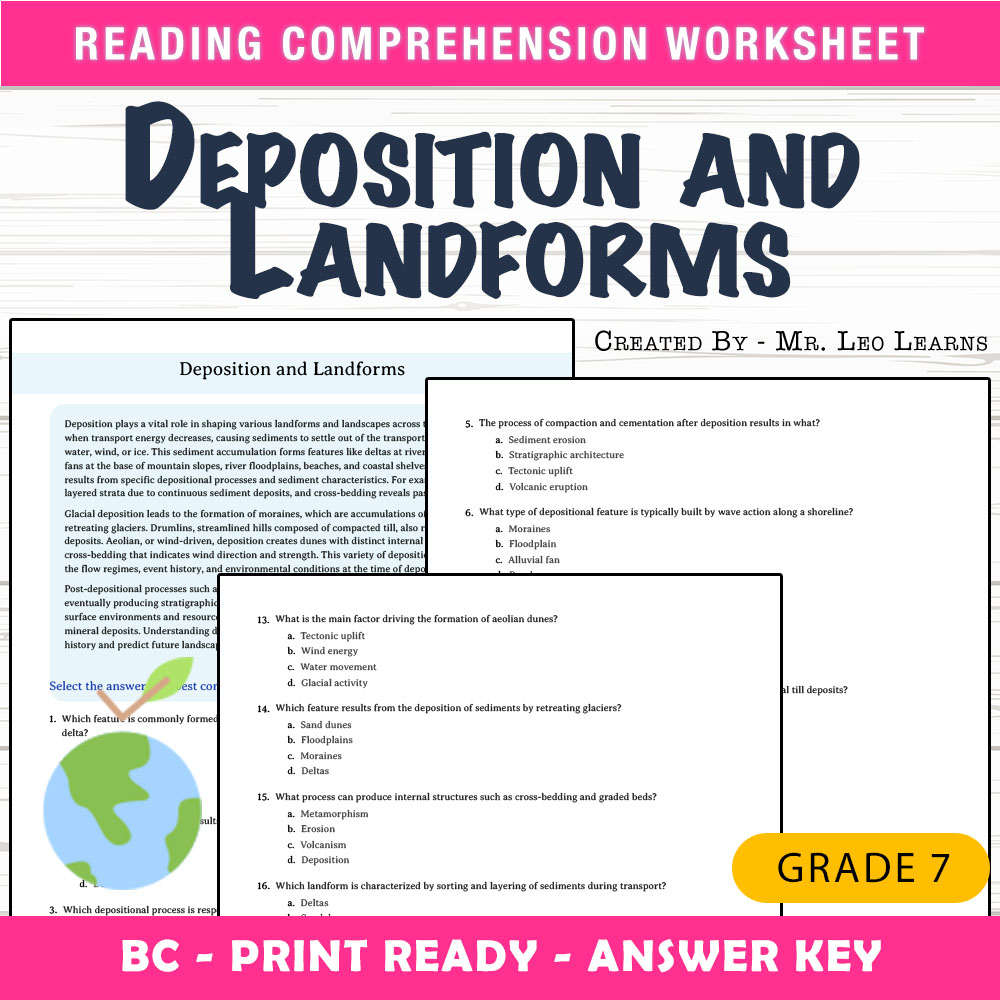
Grade 7 Science — Deposition and Landforms Worksheet MCQ Paper
Created byThe Resource HubLearning Objectives
- Understand the processes of deposition and how they form various landforms.
- Identify different types of depositional features such as deltas, beaches, and moraines.
- Recognize depositional structures like layered strata, cross-bedding, and graded beds.
Also included in: Grade 7 Science | Earth's Systems & Processes Worksheet Bundle – BC Framework +1 more
Instant download
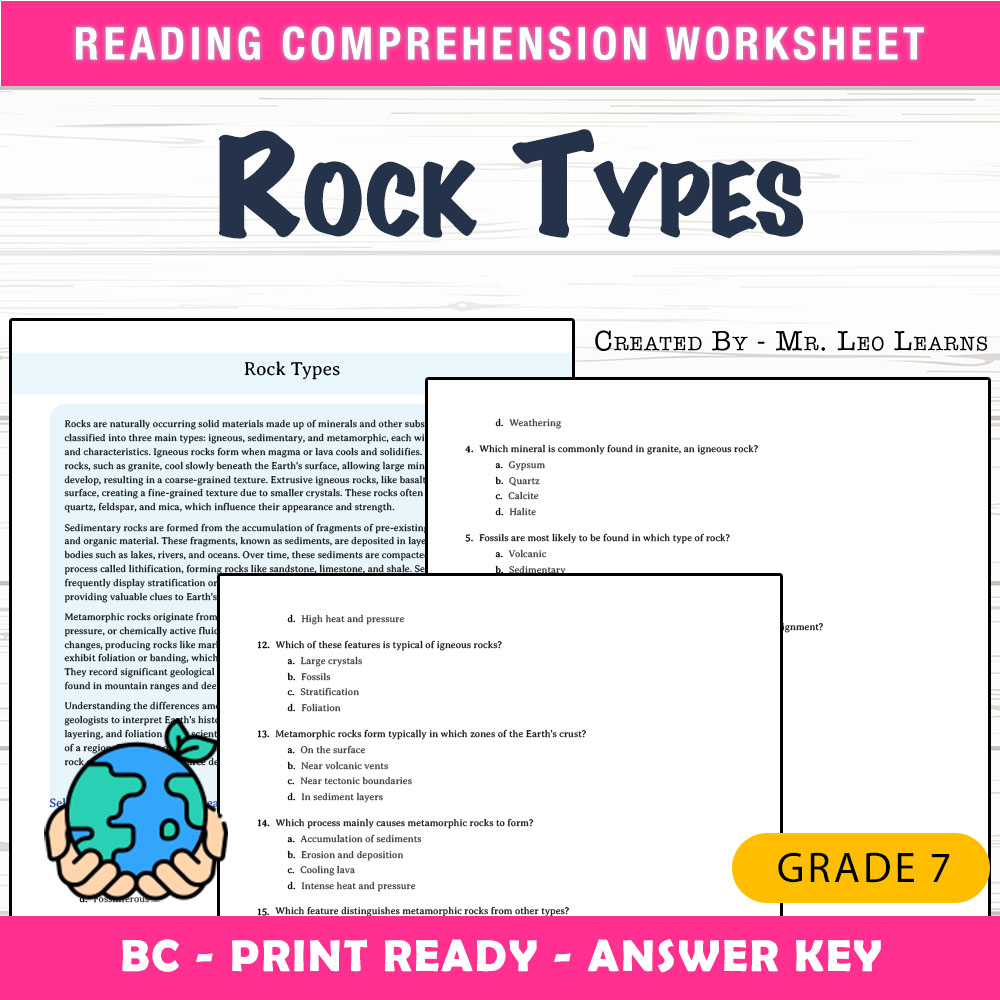
Grade 7 Science — Rock Types Worksheet MCQ Paper for Mastery
Created byThe Resource HubLearning Objectives
- Understand the three main types of rocks: igneous, sedimentary, and metamorphic.
- Identify key characteristics that distinguish rock types based on mineral content, texture, and structures.
- Describe the origins and formation processes of each rock type.
Also included in: Grade 7 Science | Earth's Systems & Processes Worksheet Bundle – BC Framework +1 more
Instant download
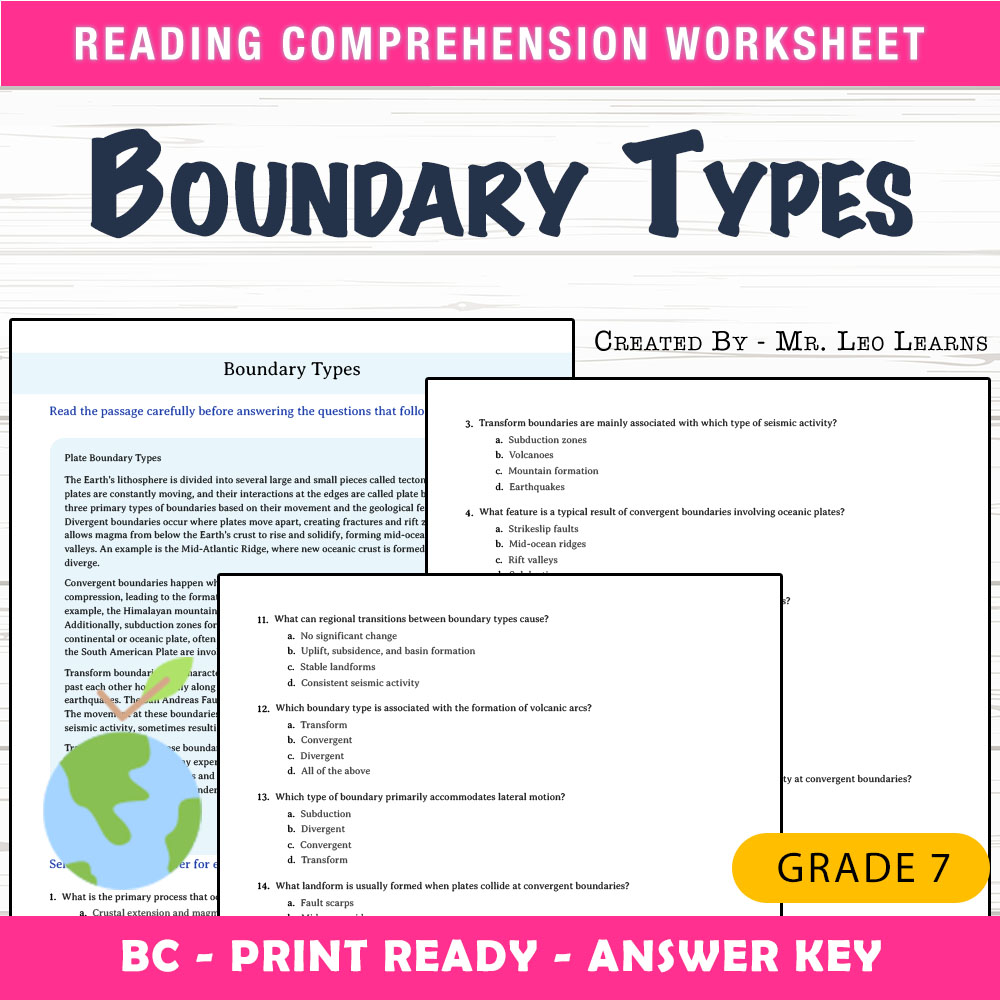
Grade 7 Science — Boundary Types Worksheet MCQ Paper for Mastery
Created byThe Resource HubLearning Objectives
- Identify and describe the three main types of plate boundaries.
- Understand the landforms and processes associated with divergent, convergent, and transform boundaries.
- Explain how boundary interactions influence Earth's surface features and seismic activity.
Also included in: Grade 7 Science | Earth's Systems & Processes Worksheet Bundle – BC Framework +1 more
Instant download
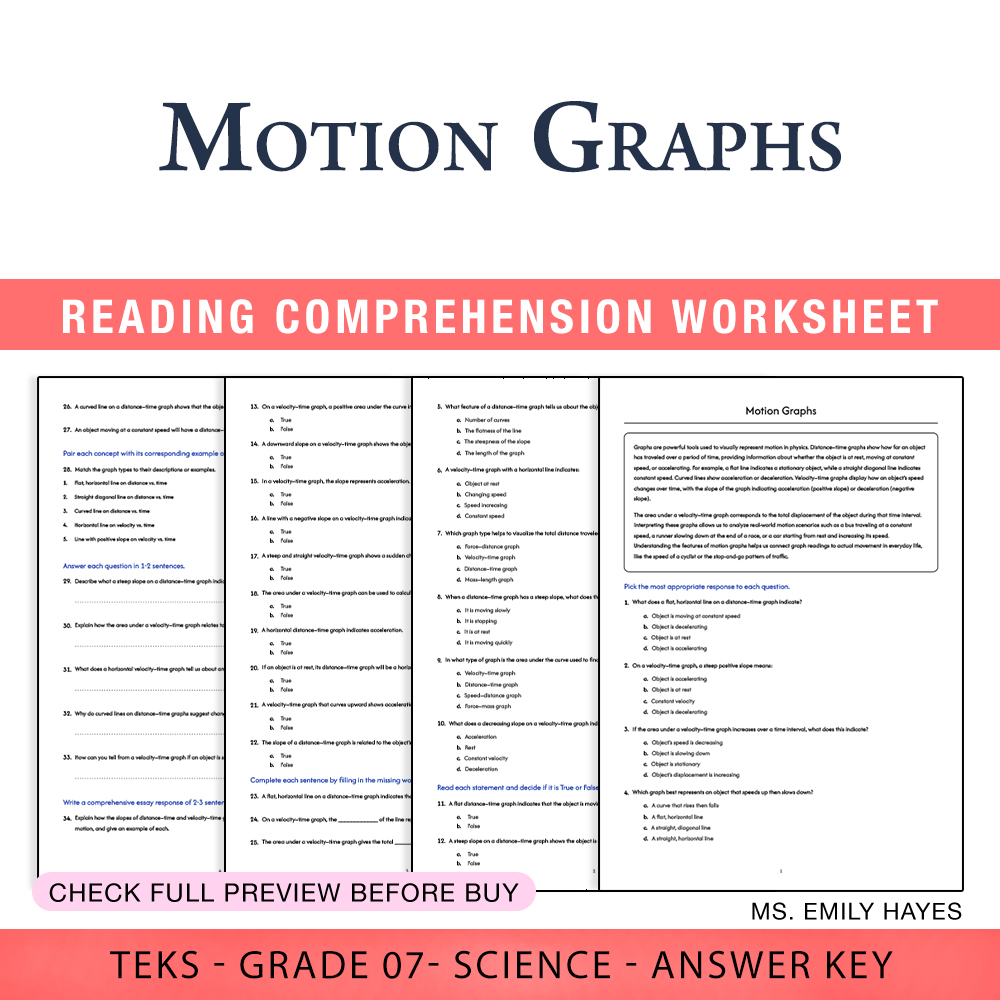
7th Grade Science | Motion Graphs Worksheet (PDF+ Answer Key)
 Created byCopper Leaf Classroom
Learning Objectives
- Interpret and analyze distance–time graphs to identify patterns like constant speed, acceleration, and rest periods.
- Understand velocity–time graphs and relate slopes to speed changes and areas to displacement.
- Compare different types of graphs qualitatively and relate them to real-world motion scenarios such as bus routes and running laps.
Instant download

Air Masses Fronts Worksheet | California Standards Grade 7 Science Practice
JCreated byJ.S SheetsLearning Objectives
- Understand how air masses and fronts influence weather patterns.
- Identify the characteristics of different air masses and types of fronts.
- Explain how boundaries between air masses lead to weather changes such as storms and precipitation.
Also included in: Grade 7 Engineering Tradeoffs & Optimization Science Lesson Bundle +1 more
Instant download

Grade 7 Science | Inherited Traits Worksheet | Florida NGSSS Aligned
 Created byLumora Learning
Learning Objectives
- Explain how inherited traits are passed from parents to offspring through genetic information carried in reproductive cells
- Describe how variation among parents can lead to observable differences in offspring
- Identify examples of inherited traits and relate them to heritable factors such as blood type, seed shape, or fur color
Instant download

Food Building Blocks Assessment | California Standards Grade 7 Science
 Created byPrism Point Learning
Learning Objectives
- Explain how food molecules can be used for building body structures and for providing usable energy
- Describe how digestion and cellular processes transform food molecules into forms the body can use
- Connect eating habits to changes in growth, repair, and body condition over time
Also included in: Grade 7 Energy Flow and Matter Cycling Science lesson bundle – California Standards +1 more
Instant download
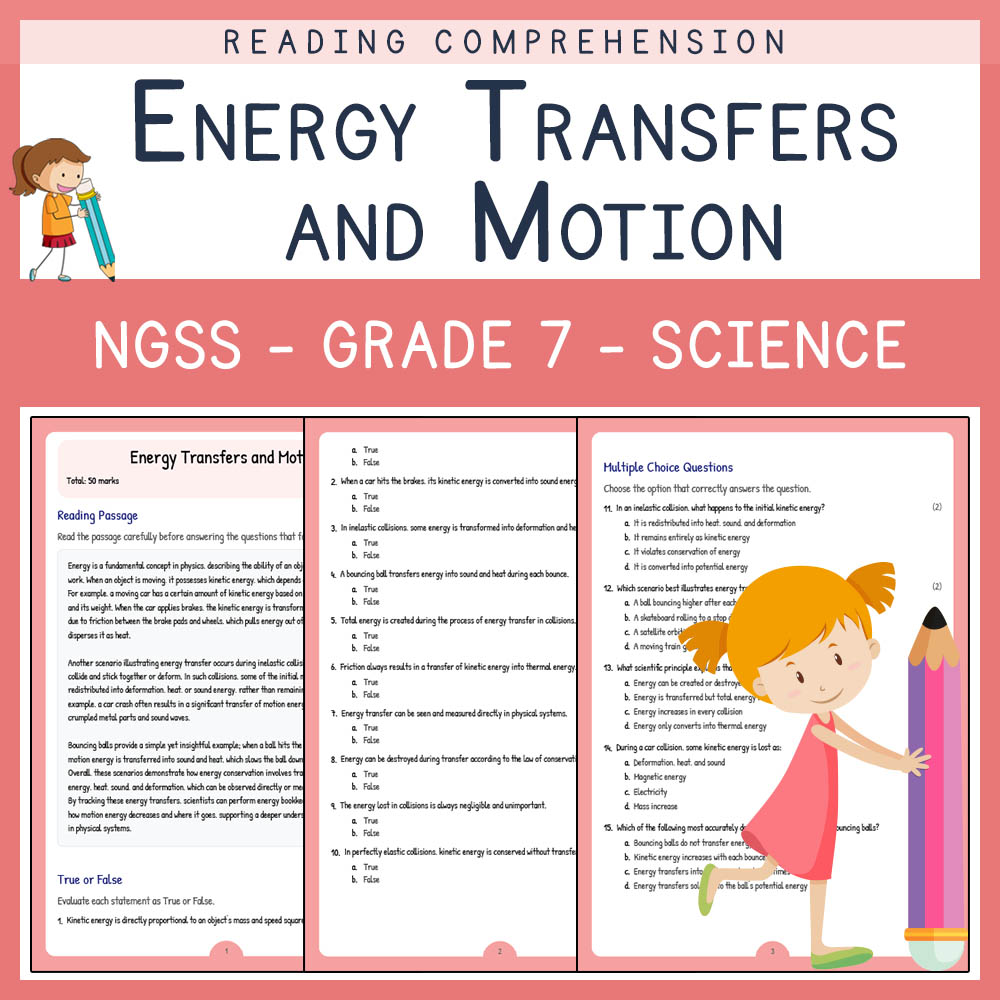
Grade 7 Science | Energy Transfers and Motion Worksheet (Answer Key) for NGSS Alignment
Created byLumora LearningLearning Objectives
- Understand how energy is transferred during changes in an object's motion.
- Explain real-world examples of energy transfer such as braking, bouncing, and collisions.
- Quantitatively and qualitatively analyze scenarios involving energy transfer in motion.
Instant download
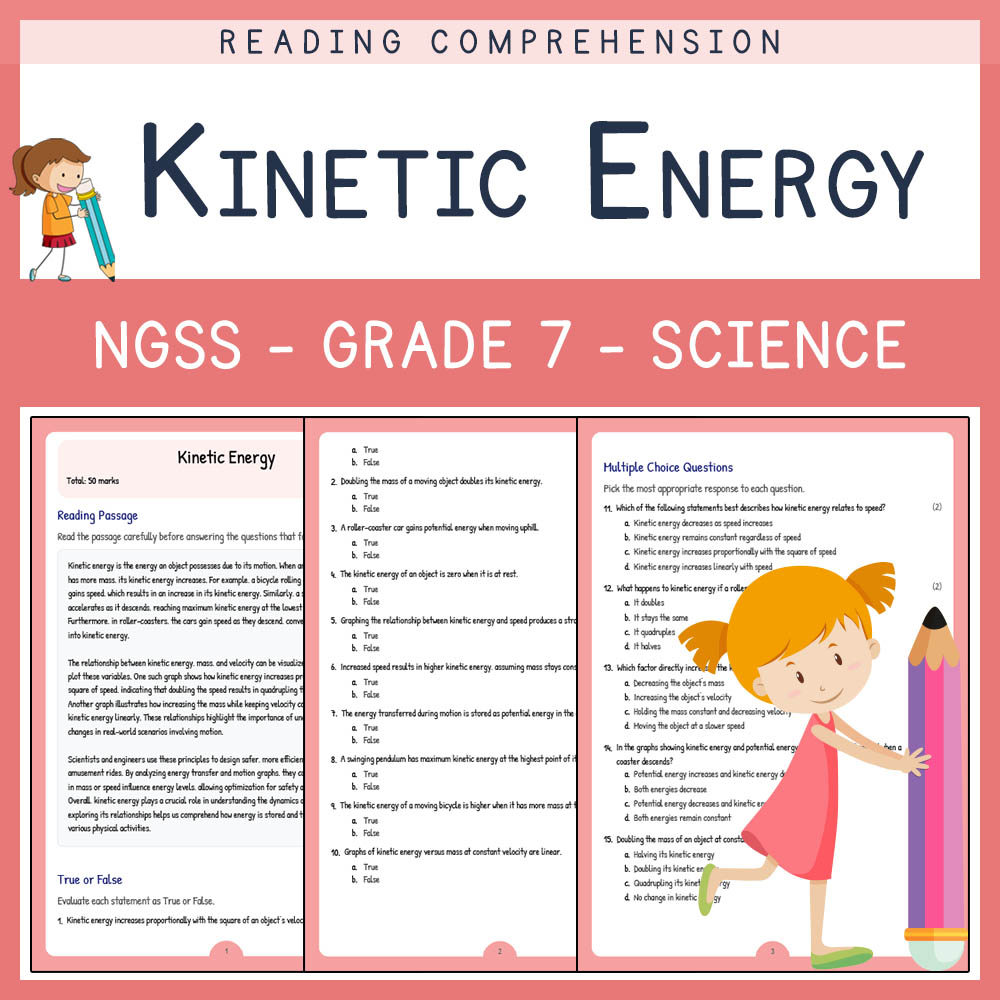
Grade 7 Science | Kinetic Energy Worksheet & Answer Key (NGSS-Aligned)
Created byLumora LearningLearning Objectives
- Construct and interpret graphical relationships between kinetic energy, potential energy, mass, and speed.
- Analyze how doubling the mass or speed of an object affects its kinetic energy through quantitative comparisons and graphs.
- Apply energy calculation formulas to real-world motion scenarios such as rolling bicycles, swinging pendulums, and roller-coaster cars.
Instant download
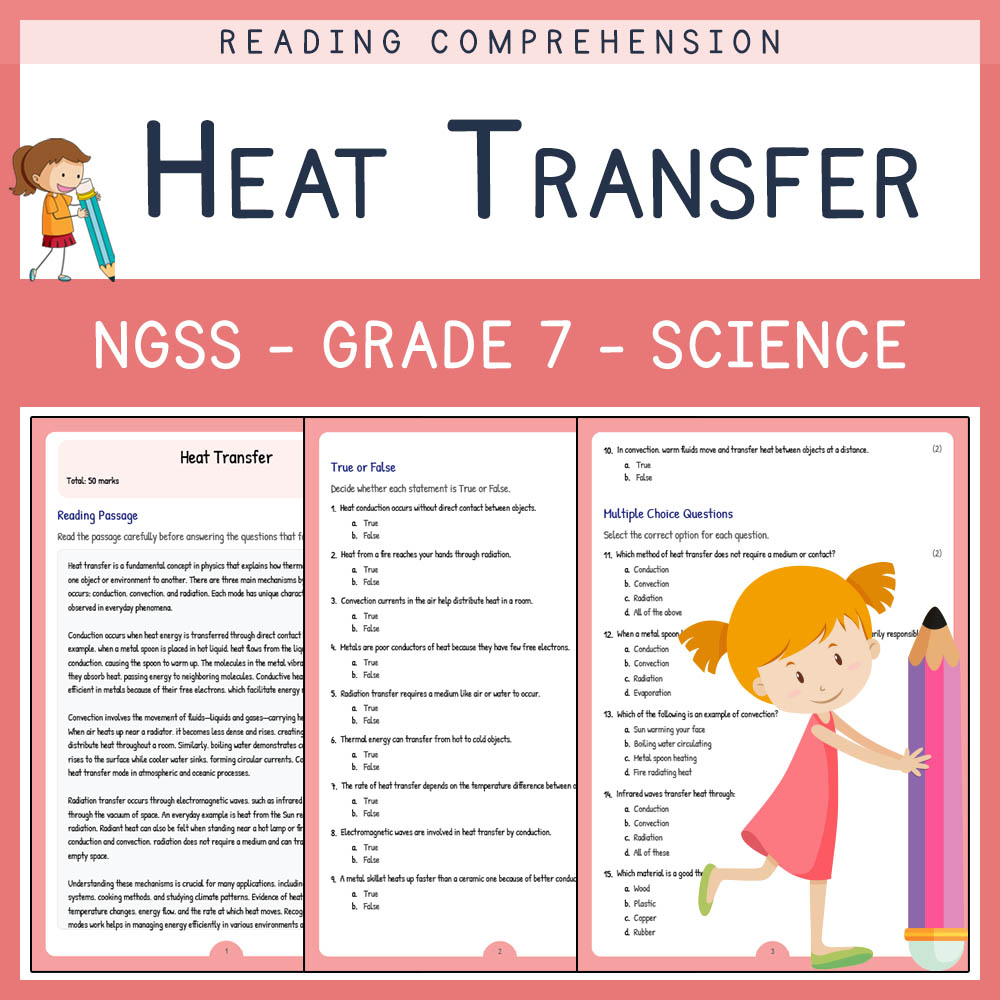
Grade 7 Science | Heat Transfer Worksheet & Answer Key for NGSS Standards
Created byLumora LearningLearning Objectives
- Describe the different mechanisms of heat transfer: conduction, convection, and radiation.
- Identify examples of heat transfer in everyday life.
- Explain how heat transfer affects temperature changes and energy flow in objects and environments.
Instant download
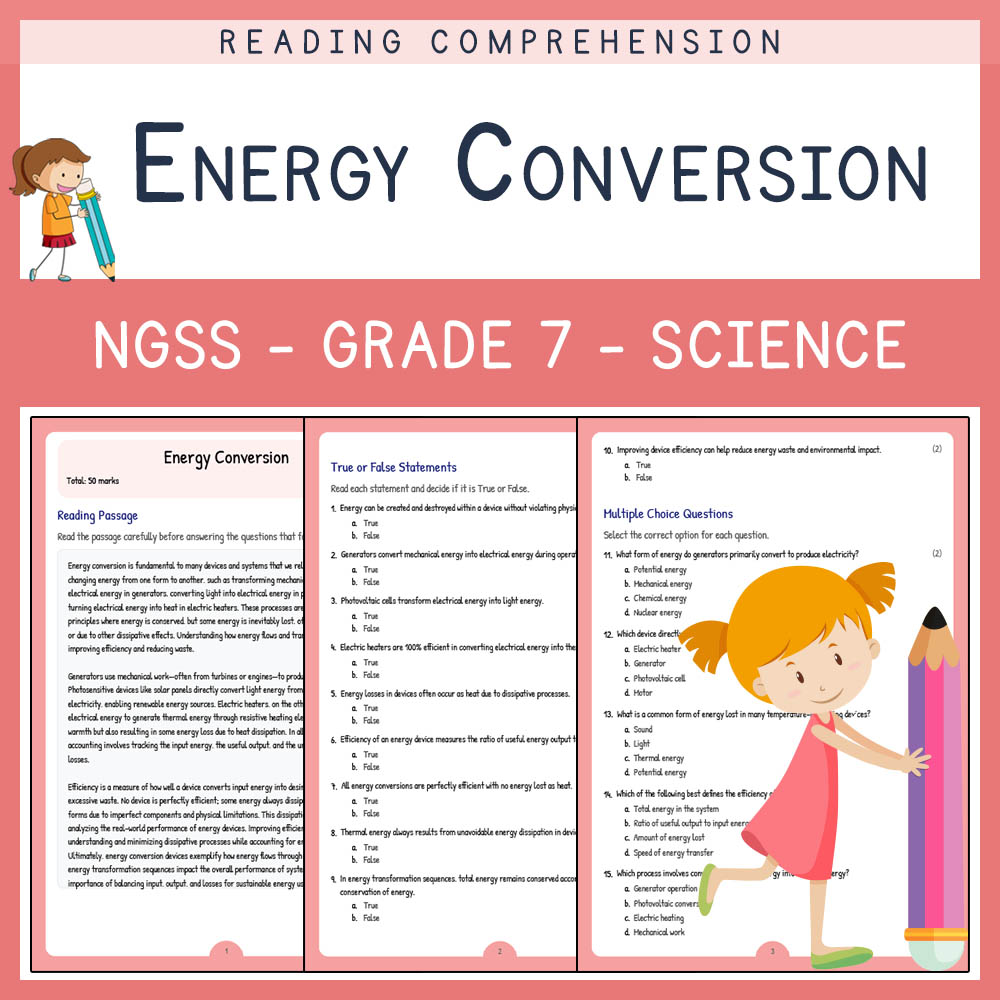
Grade 7 Science | Energy Conversion Worksheet PDF with Answer Key (NGSS Aligned)
Created byLumora LearningLearning Objectives
- Understand the principles of energy transfer and conservation during device operation.
- Identify examples of energy conversion in real-world devices such as generators, photovoltaic cells, and heaters.
- Describe the concept of efficiency and energy losses in energy transformation processes.
Instant download
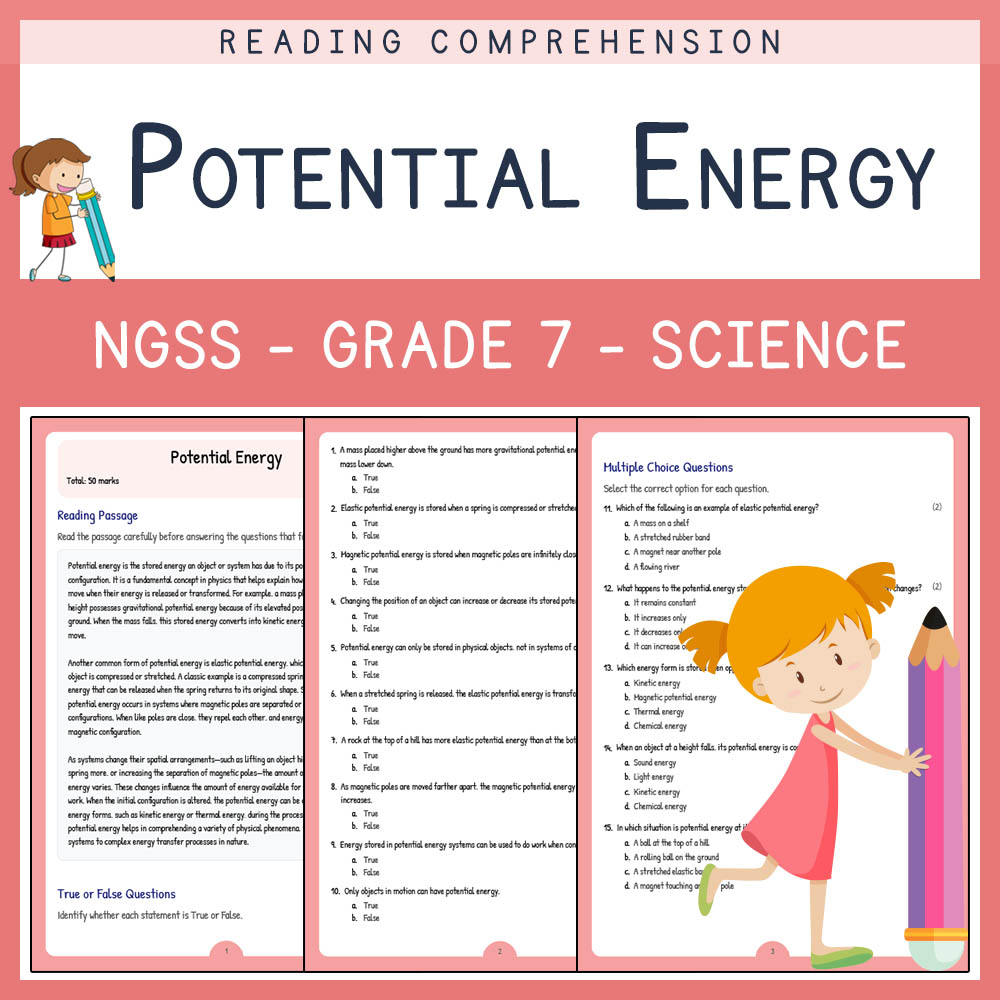
Grade 7 Science | Potential Energy Worksheet & Answer Key for NGSS Standards
Created byLumora LearningLearning Objectives
- Explain different types of potential energy and how they are stored in systems.
- Describe how changes in object arrangement and interactions can alter stored potential energy.
- Identify examples of gravitational, elastic, and magnetic potential energy in real-world situations.
Instant download
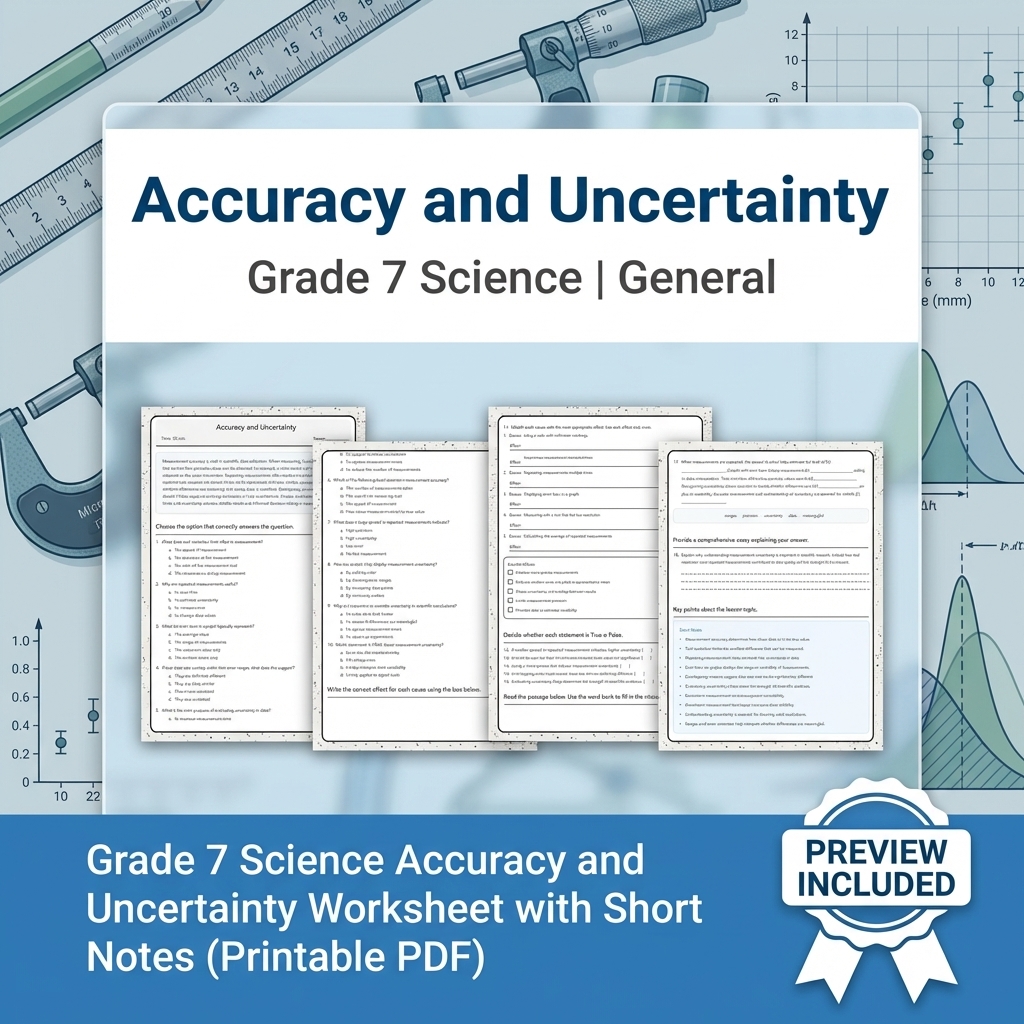
Grade 7 Science Accuracy and Uncertainty Worksheet with Short Notes
 Created byMeadowlark Worksheets
Learning Objectives
- Understand how measurement accuracy affects data quality and conclusions.
- Explain tool resolution limits and how repeated measurements estimate uncertainty.
- Interpret graphs and tables that incorporate ranges or error estimates.
Also included in: Grade 7 Science Scientific Modeling & Evidence Lesson Bundle: General Framework +1 more
Instant download
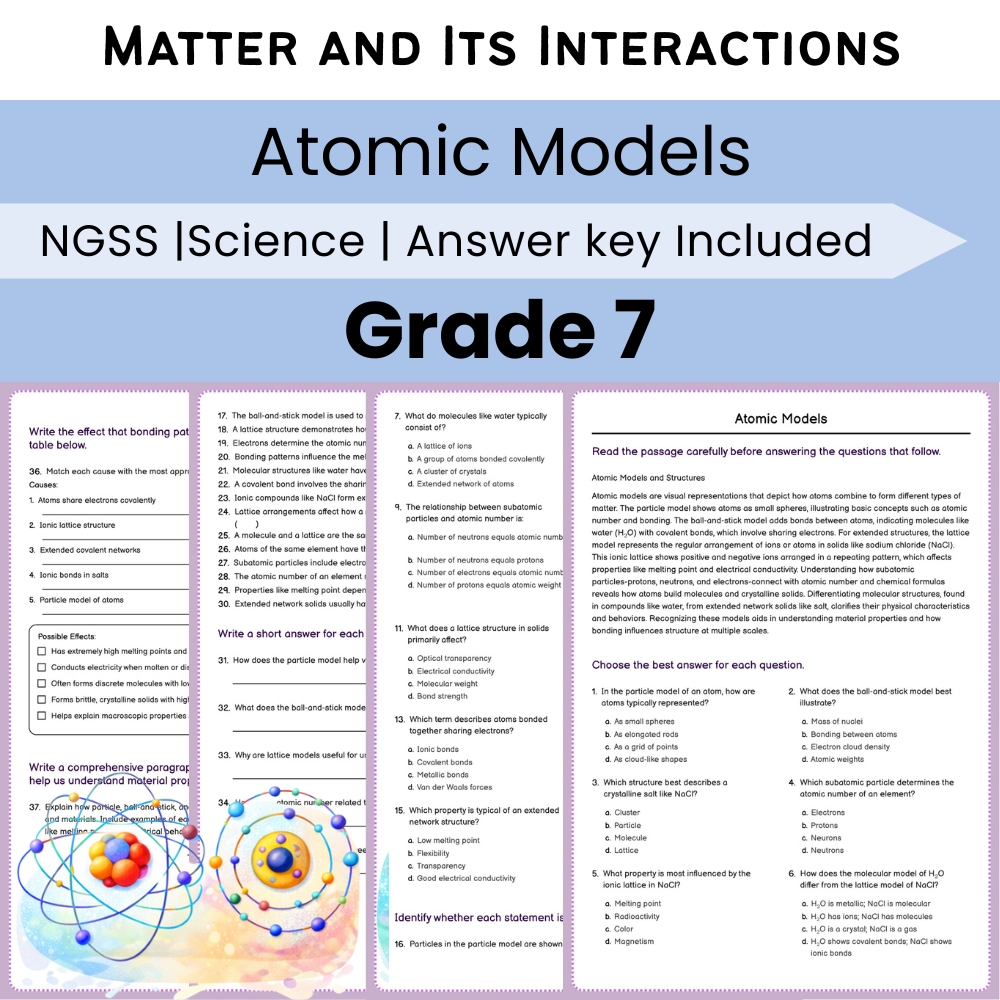
Atomic Models Worksheet | Grade 7 Science Printable PDF Assessment
Learning Objectives
- Describe different atomic models showing how atoms form molecules and structures.
- Compare particle, ball-and-stick, and lattice representations of atoms.
- Explain the relationship between subatomic particles, atomic number, and formula notation.
Also included in: Grade 7 Science Lesson Bundle – Matter and Its Interactions NGSS-Aligned +1 more
Instant download
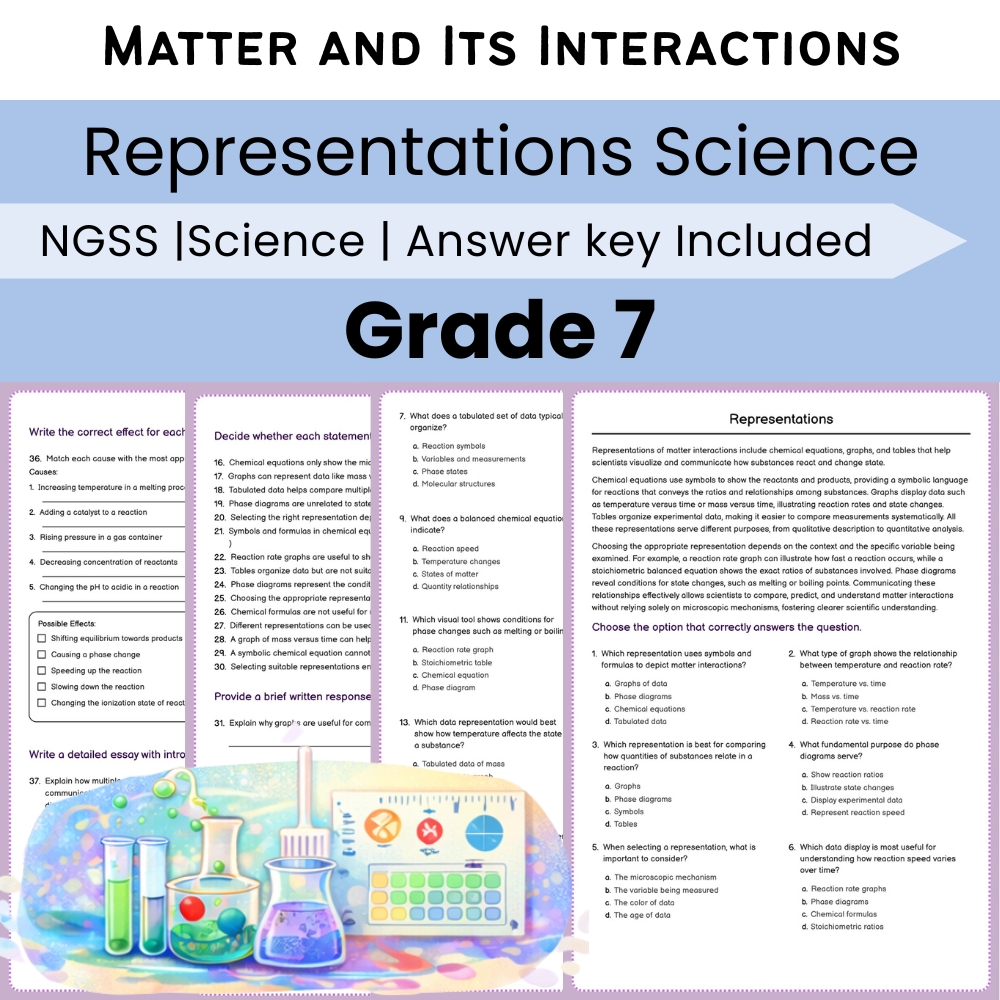
Representations Worksheet for Grade 7 Science | NGSS-Aligned Assessment
Learning Objectives
- Understand how different representations convey matter interactions.
- Interpret chemical equations, graphs, and tabulated data related to reactions.
- Identify appropriate representations for quantitative comparison.
Also included in: Grade 7 Science Lesson Bundle – Matter and Its Interactions NGSS-Aligned +1 more
Instant download
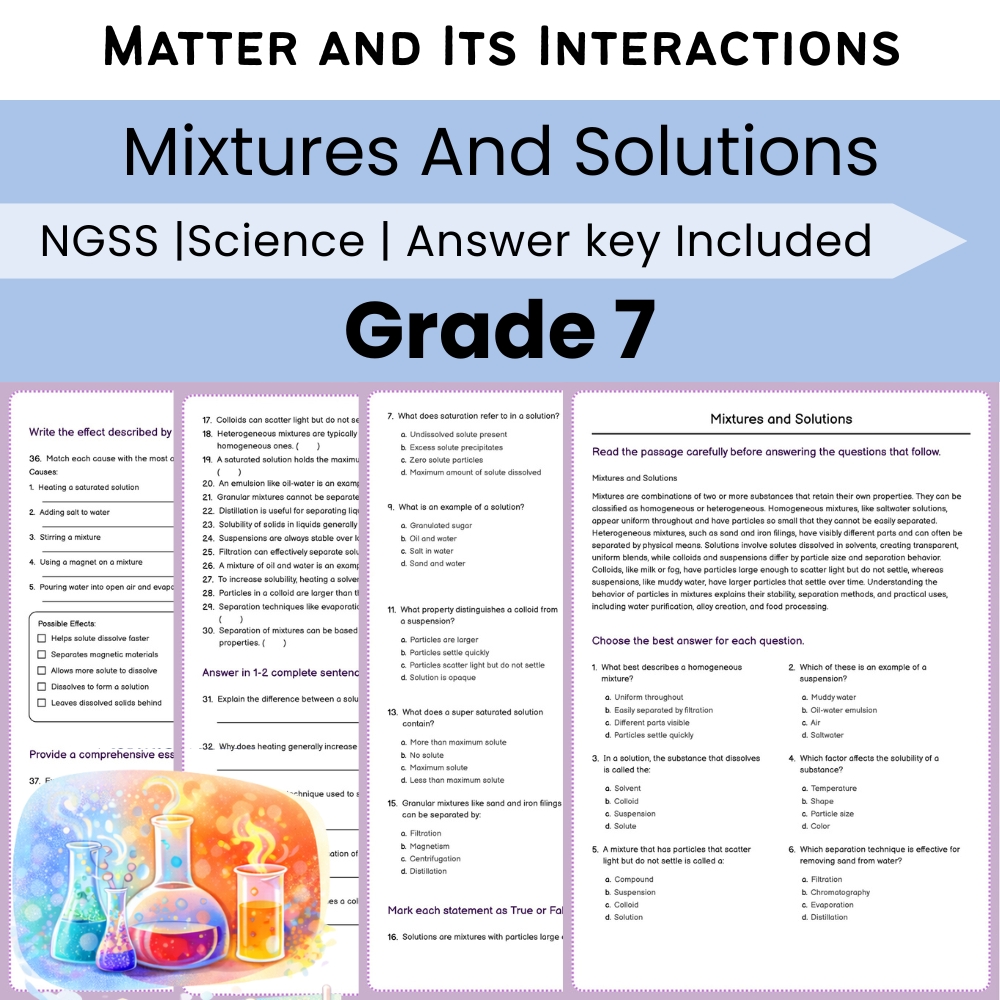
Mixtures and Solutions Worksheet | Grade 7 Science Assessment & Practice
Learning Objectives
- Distinguish between homogeneous and heterogeneous mixtures.
- Understand solubility, saturation, and concentration in solutions.
- Identify methods for separating mixtures and their practical applications.
Also included in: Grade 7 Science Lesson Bundle – Matter and Its Interactions NGSS-Aligned +1 more
Instant download
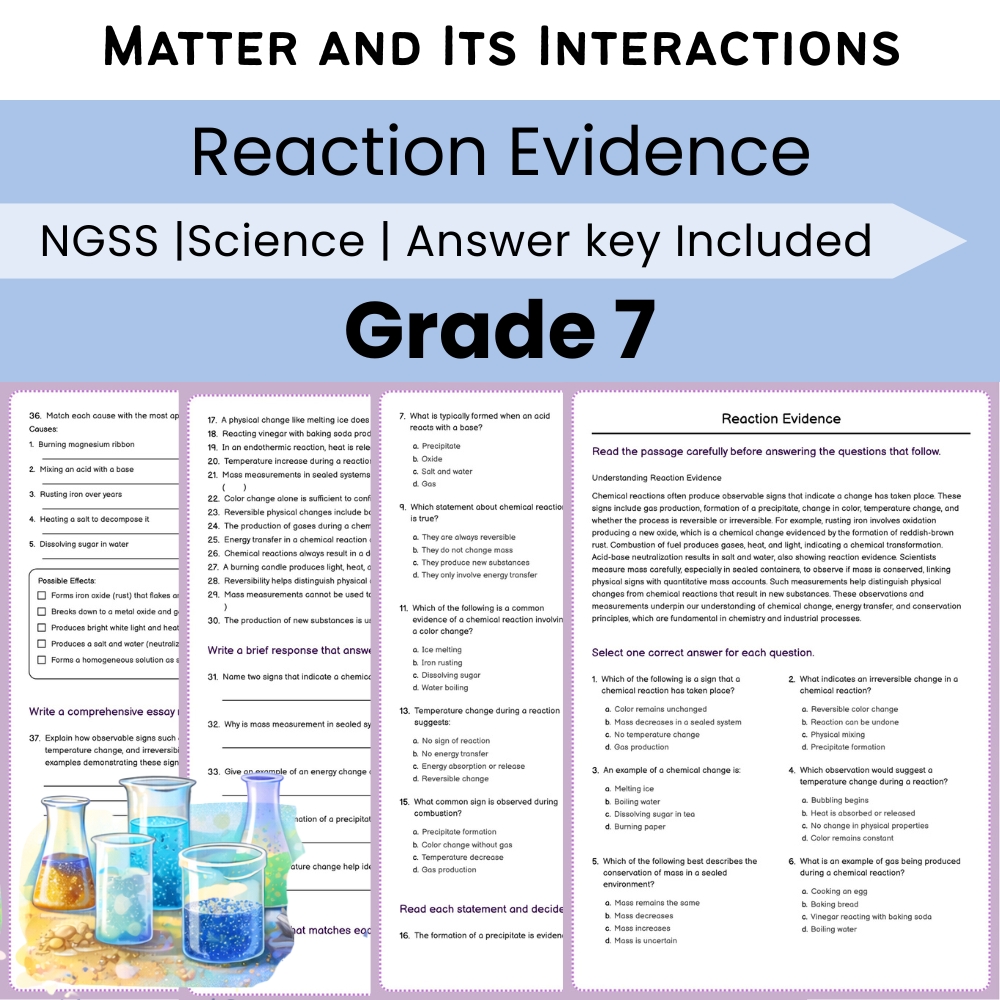
Reaction Evidence Science Worksheet | Assessment Grade 7 Science printable PDF
Learning Objectives
- Identify observable indicators that a chemical reaction has occurred.
- Explain examples of chemical reactions such as rusting, combustion, and neutralization.
- Understand how mass measurements in sealed systems relate to conservation of mass principle.
Also included in: Grade 7 Science Lesson Bundle – Matter and Its Interactions NGSS-Aligned +1 more
Instant download

Grade 7 Science | Species Interactions & Food Webs - Daily Reading Comprehension
 Created byCoral Reef Learning
Learning Objectives
- Identify predator-prey relationships in various ecosystems.
- Understand the structure of food chains and food webs.
- Recognize different types of species interactions such as predation, competition, parasitism, mutualism, and commensalism.
Instant download

Grade 7 Science – Gears & Mechanisms | Daily Reading Worksheet
 Created byBright Mind Resources
Learning Objectives
- Understand the basic function and purpose of gears in mechanical systems.
- Identify different types of gear mechanisms and their uses.
- Explain how gear ratios affect speed and torque in devices.
Also included in: Design & Tech Grade 7 Science Daily Reading Worksheets Lesson Bundle | General +1 more
Instant download
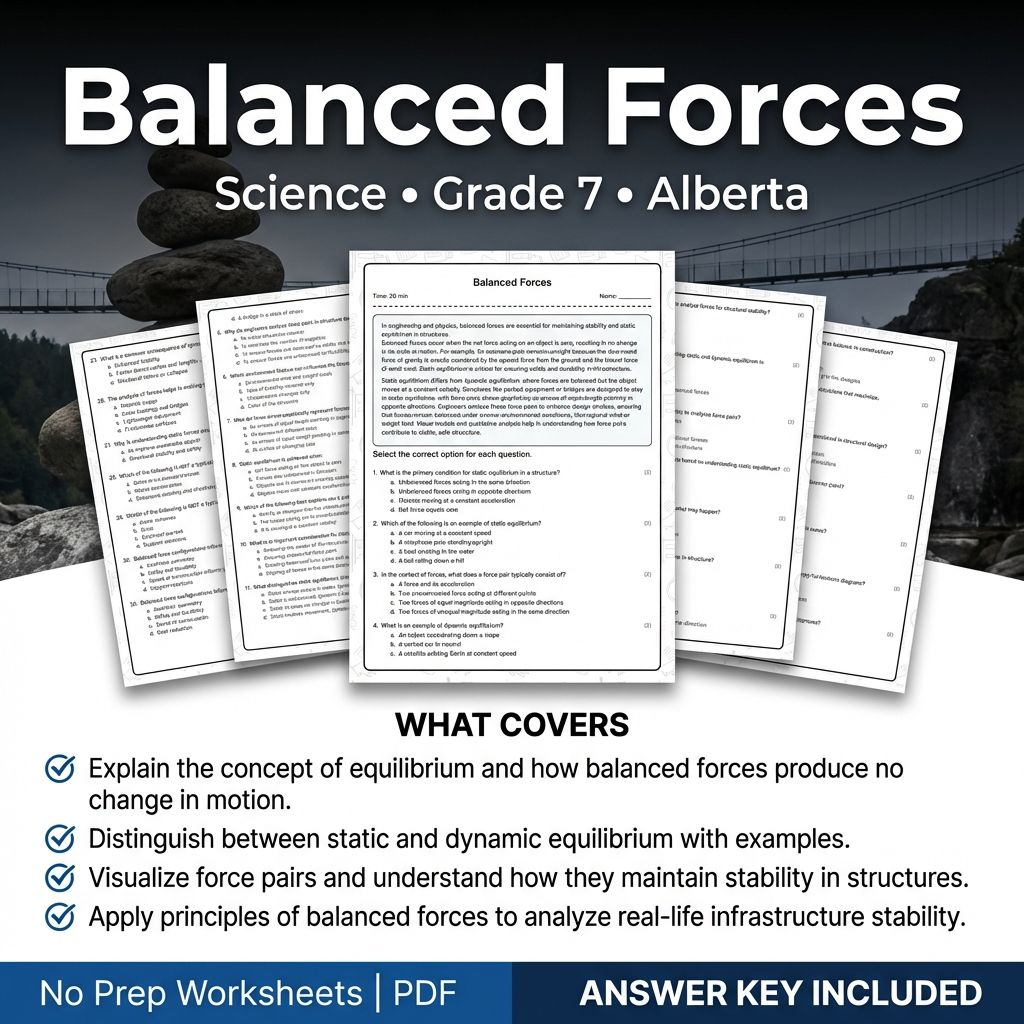
Balanced Forces Worksheet - 7th Grade Science Practice & Assessment
Created byCoral Reef LearningLearning Objectives
- Explain the concept of equilibrium and how balanced forces produce no change in motion.
- Distinguish between static and dynamic equilibrium with examples.
- Visualize force pairs and understand how they maintain stability in structures.
Instant download
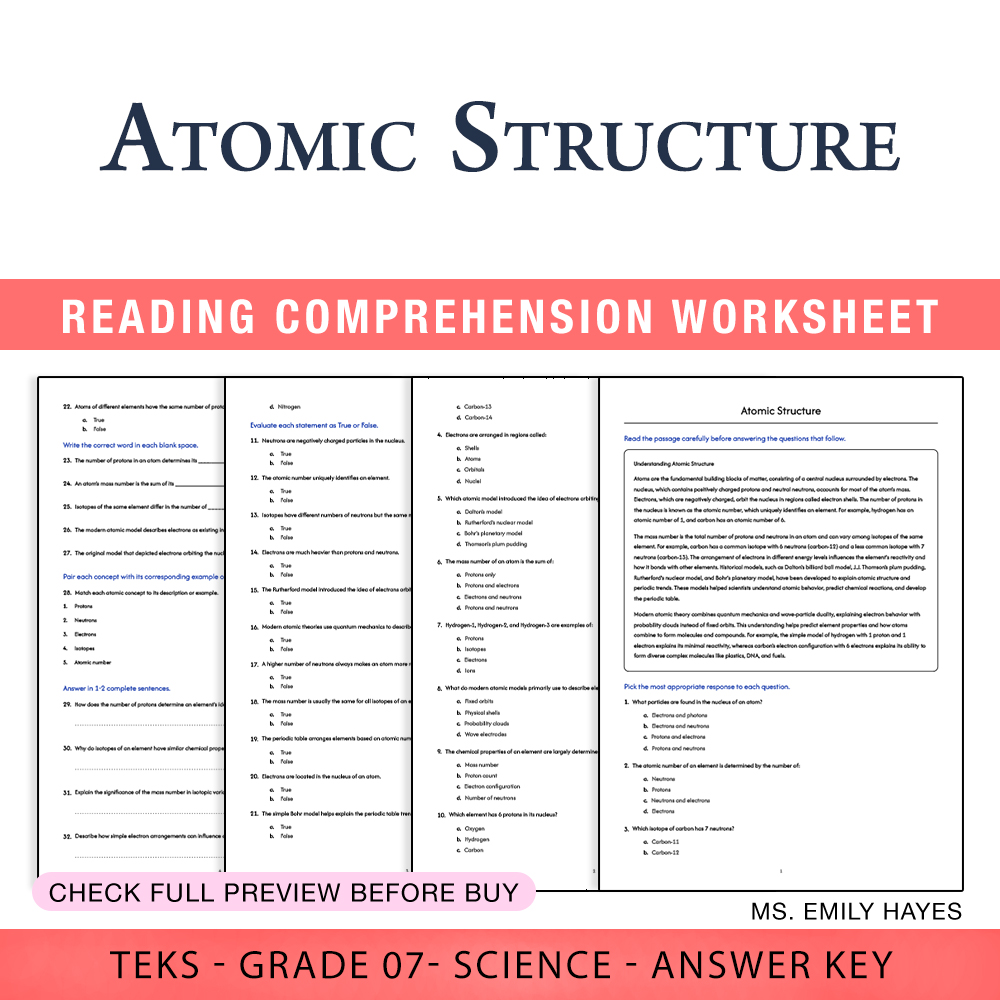
7th Grade Science | Atomic Structure Worksheet (PDF+ Answer Key)
Created byCopper Leaf ClassroomLearning Objectives
- Understand the composition of atoms including protons, neutrons, and electrons.
- Relate atomic number and mass number to element identity and isotopic variation.
- Describe simple electron arrangements and how they influence elemental properties.
Instant download

Grade 7 Science | Engineering Purpose - Daily Reading Comprehension
Created byCoral Reef LearningLearning Objectives
- Understand how bridge designs support weight and distribute loads
- Identify different engineering materials used in structural designs
- Explain how design constraints influence engineering choices
Instant download
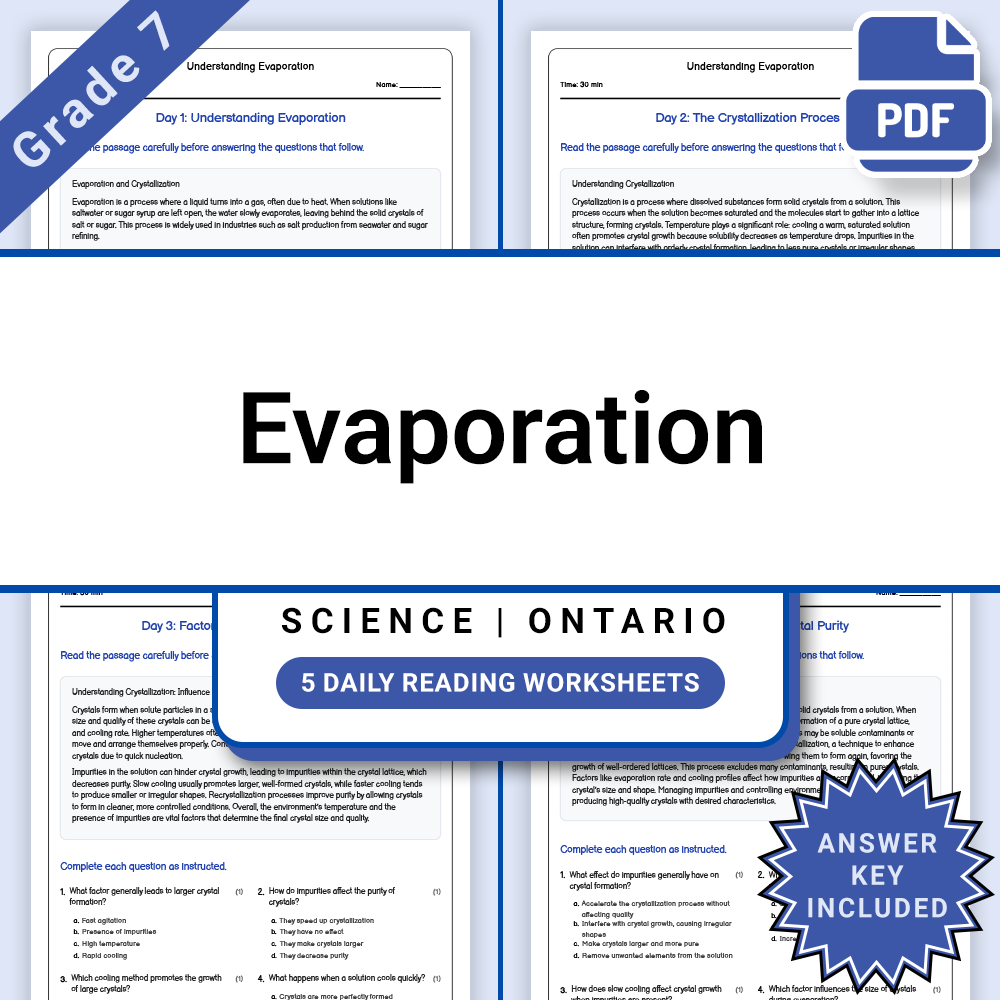
Grade 7 Science – Understanding Evaporation Daily Reading Worksheet + Answer Key
JCreated byJ.S SheetsLearning Objectives
- Explain the process of evaporation and how it contributes to crystallization.
- Identify factors that influence crystal formation, size, and purity.
- Describe real-life examples of evaporation crystallization, such as salt and sugar production.
Also included in: Grade 7 Science Lesson Group | Ontario Framework Worksheets Bundle +1 more
Instant download

Grade 7 Science | Choosing Best Solution - Daily Reading Comprehension
Created byCoral Reef LearningLearning Objectives
- Understand how to evaluate multiple design options based on criteria.
- Learn the process of iterative refinement to improve a solution.
- Identify tradeoffs and justify decisions with observed outcomes.
Instant download
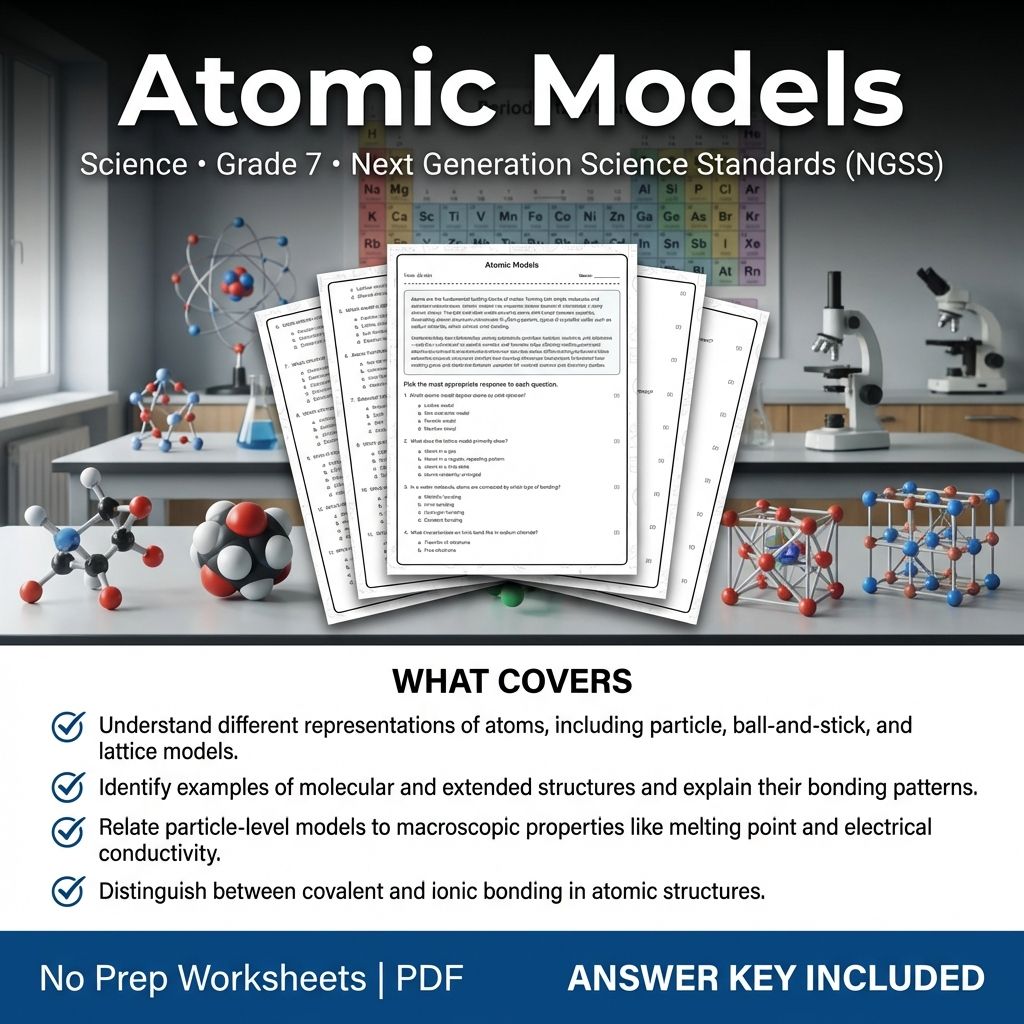
7th Grade Science | Atomic Models Worksheet + Answer Key (Printable PDF)
Created byCoral Reef LearningLearning Objectives
- Understand different representations of atoms, including particle, ball-and-stick, and lattice models.
- Identify examples of molecular and extended structures and explain their bonding patterns.
- Relate particle-level models to macroscopic properties like melting point and electrical conductivity.
Instant download
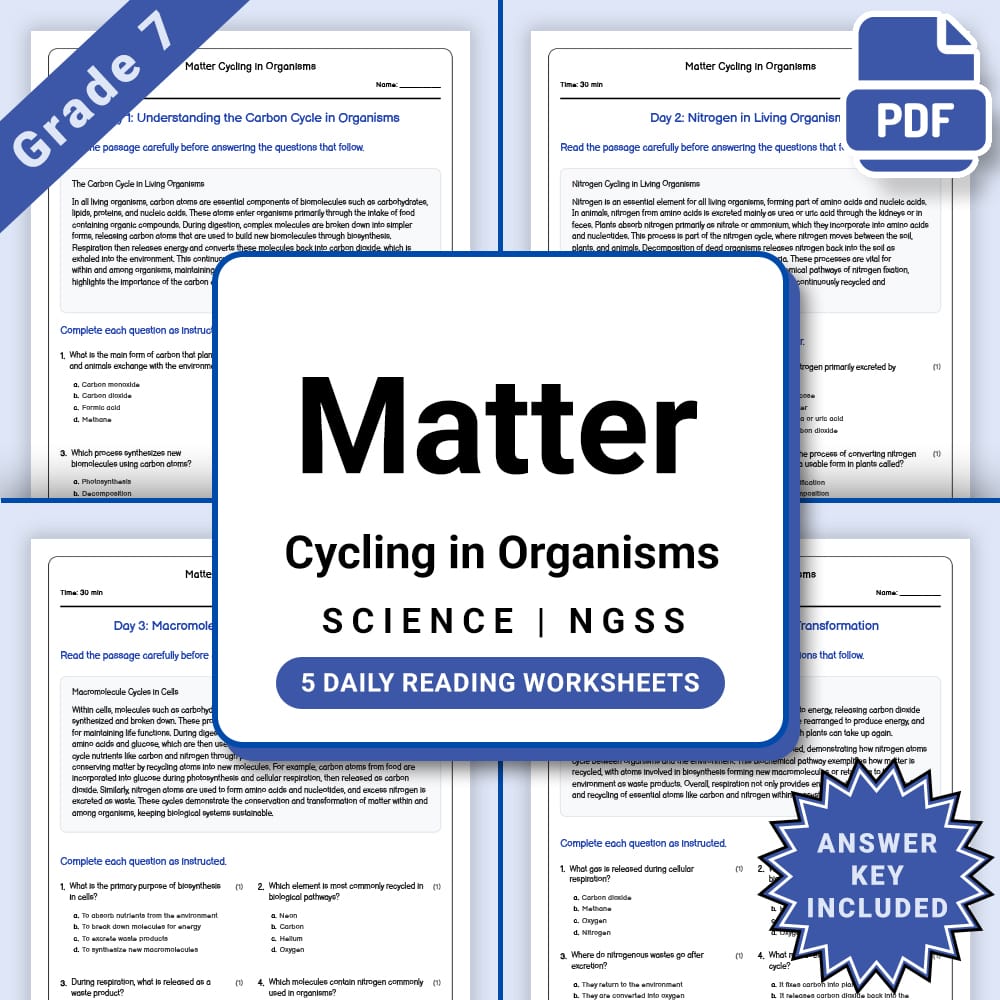
Grade 7 Science – Matter Cycling in Organisms Worksheet(PDF + Answer Key)
Created byCopper Leaf ClassroomLearning Objectives
- Understand how atoms are conserved and recycled during biological processes.
- Identify the flow of carbon in digestion, biosynthesis, and respiration.
- Explain how matter moves through organisms and the environment.
Instant download
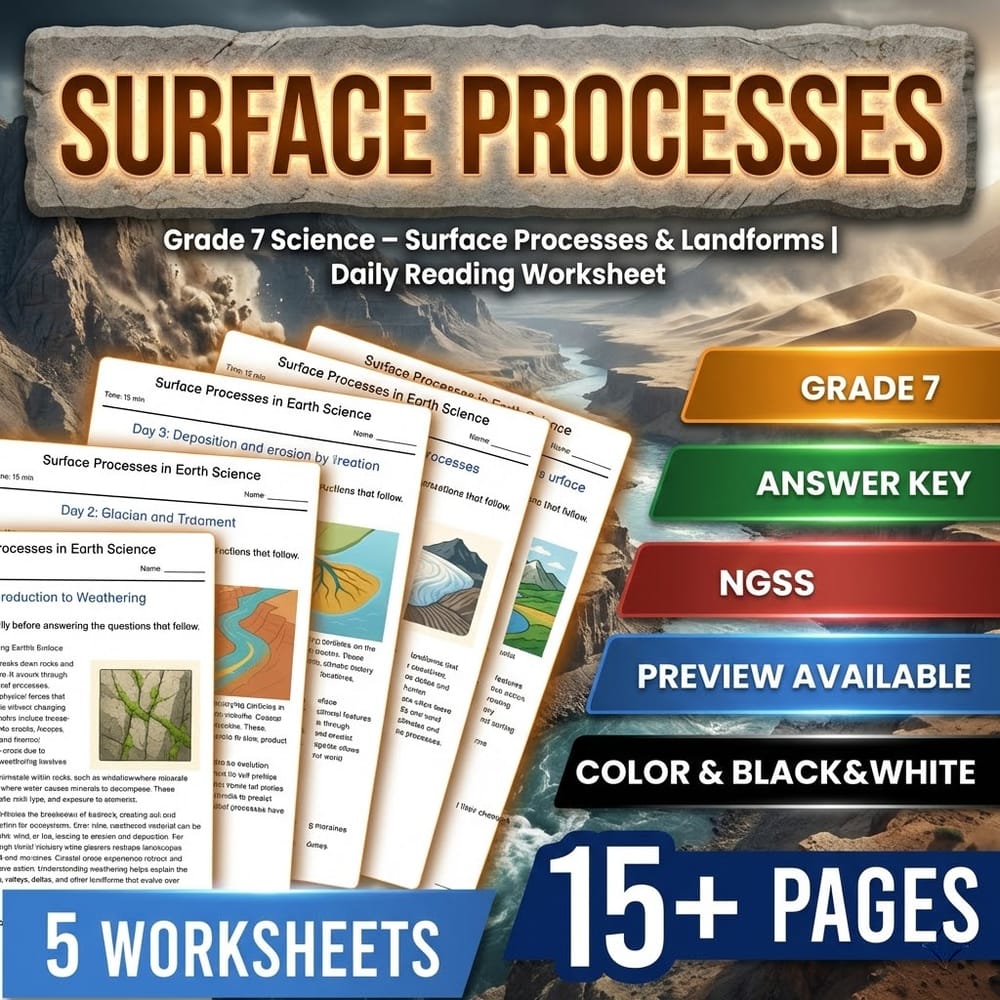
Grade 7 Science – Surface Processes & Landforms | Daily Reading Worksheet
 Created byElena Brooks
Learning Objectives
- Understand the different types of weathering: mechanical and chemical.
- Identify agents and signatures of erosion, transport, and deposition.
- Recognize landform examples created by surface processes.
Also included in: Water Cycle & Landforms Grade 7 Science Daily Reading Worksheets Bundle | NGSS +1 more
Instant download
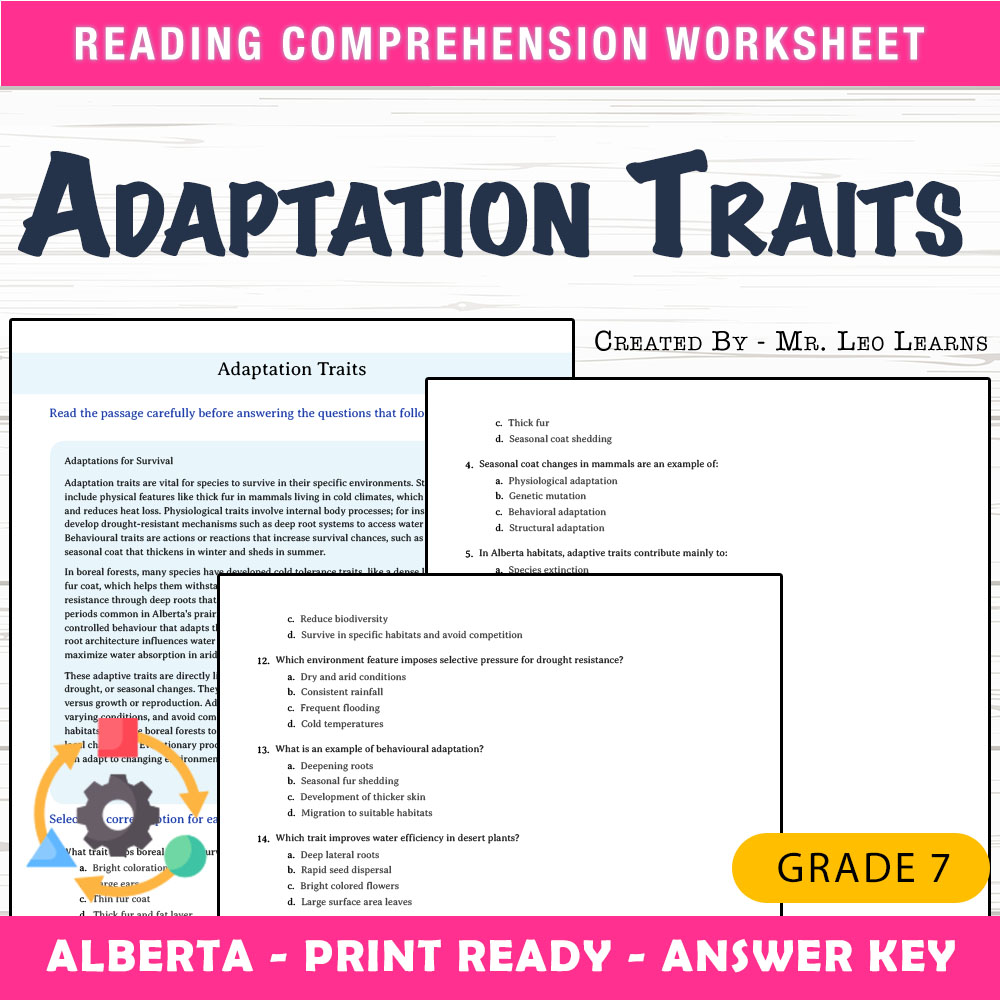
Grade 7 Science — Adaptation Traits Worksheet MCQ Paper
Created byThe Resource HubLearning Objectives
- Understand different types of adaptive traits in various species.
- Identify how environmental pressures influence trait development.
- Explain the role of traits in niche occupation and species survival.
Also included in: Grade 7 Science Alberta Ecosystems & Interactions Worksheet Collection +1 more
Instant download
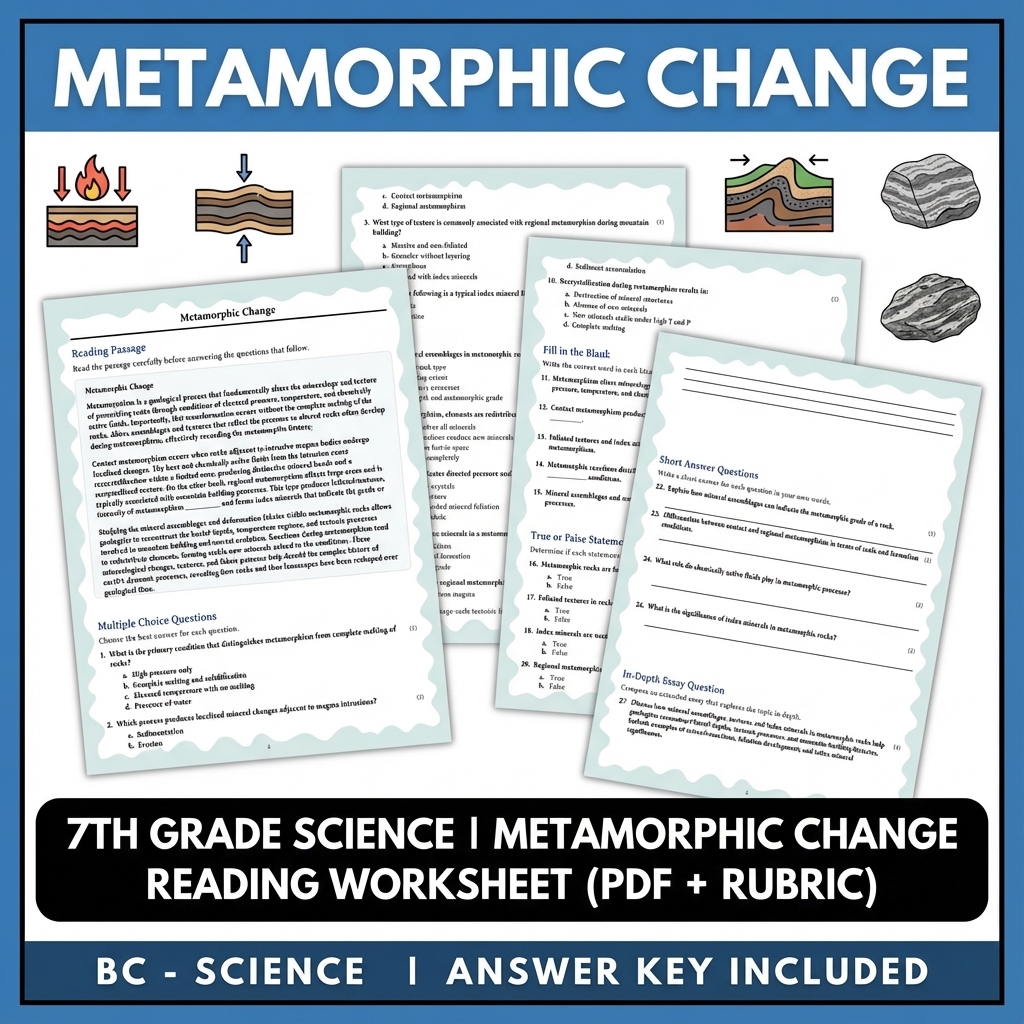
7th Grade Science | Metamorphic Change Reading Worksheet (PDF + Rubric)
JCreated byJ.S SheetsLearning Objectives
- Describe the processes and conditions involved in metamorphism of rocks.
- Differentiate between contact and regional metamorphism.
- Identify mineral clues that indicate metamorphic grade and history.
Instant download
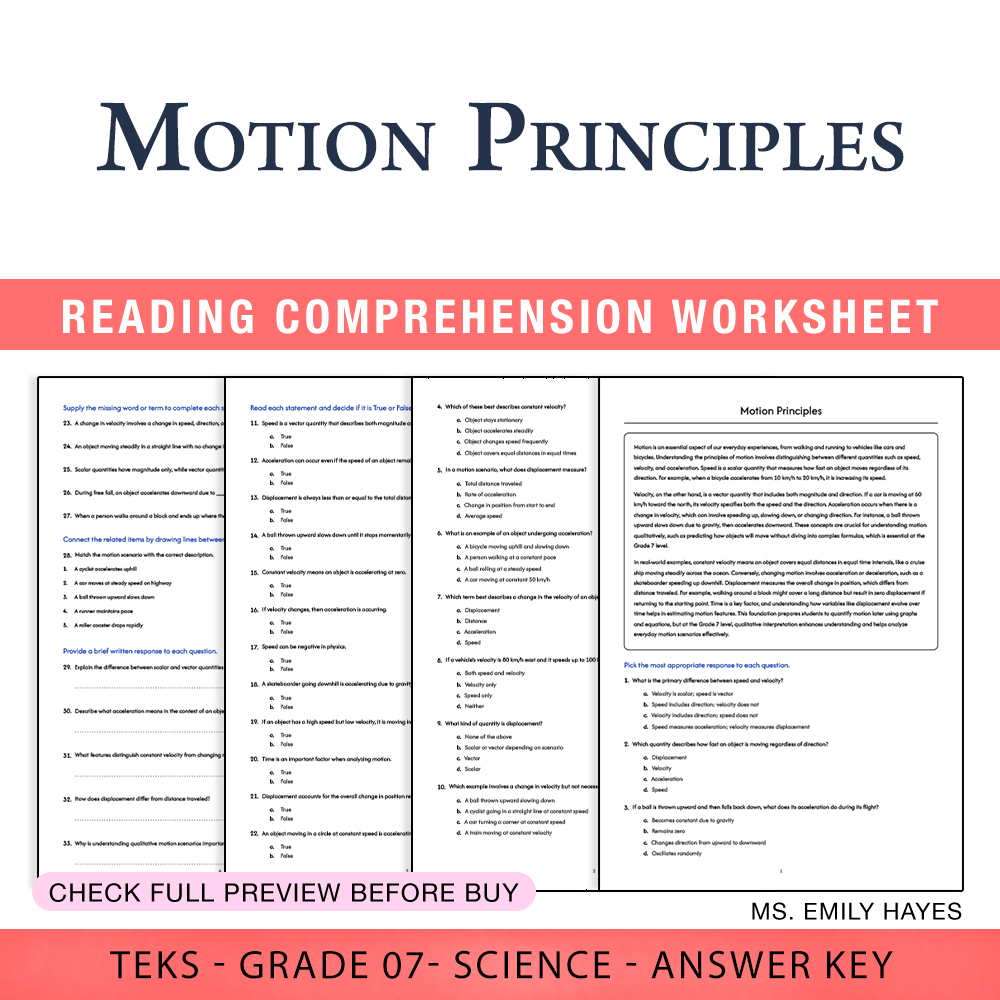
7th Grade Science | Motion Principles Worksheet (PDF+ Answer Key)
Created byCopper Leaf ClassroomLearning Objectives
- Explain the difference between speed, velocity, and acceleration with examples.
- Identify scalar versus vector quantities in motion scenarios.
- Describe how displacement, time, and rate of change relate in motion.
Instant download
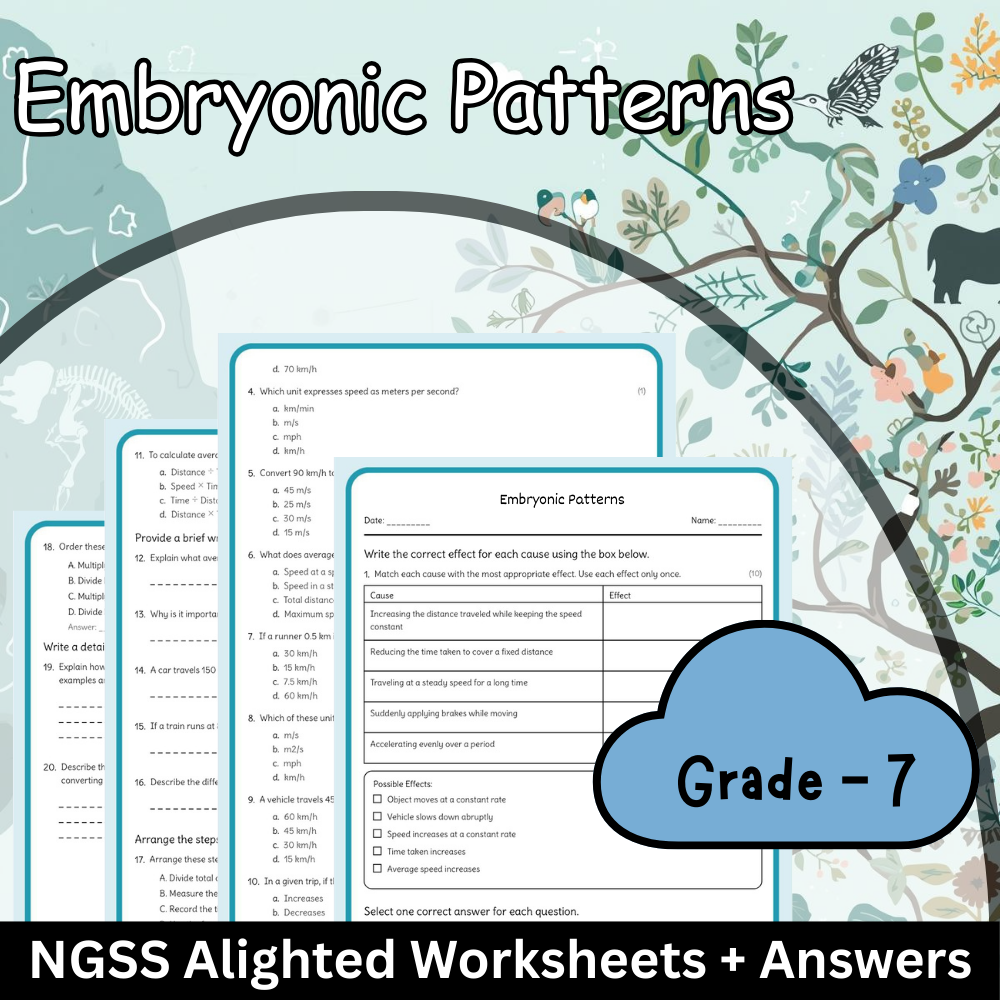
7th Grade Science | Embryonic Patterns Worksheet (Answer Key) NGSS Aligned
Created byBright Mind ResourcesLearning Objectives
- Compare embryonic development stages across different animal taxa.
- Identify conserved structures such as pharyngeal pouches and limb buds during development.
- Understand how developmental timing and patterning inform evolutionary relationships.
Instant download
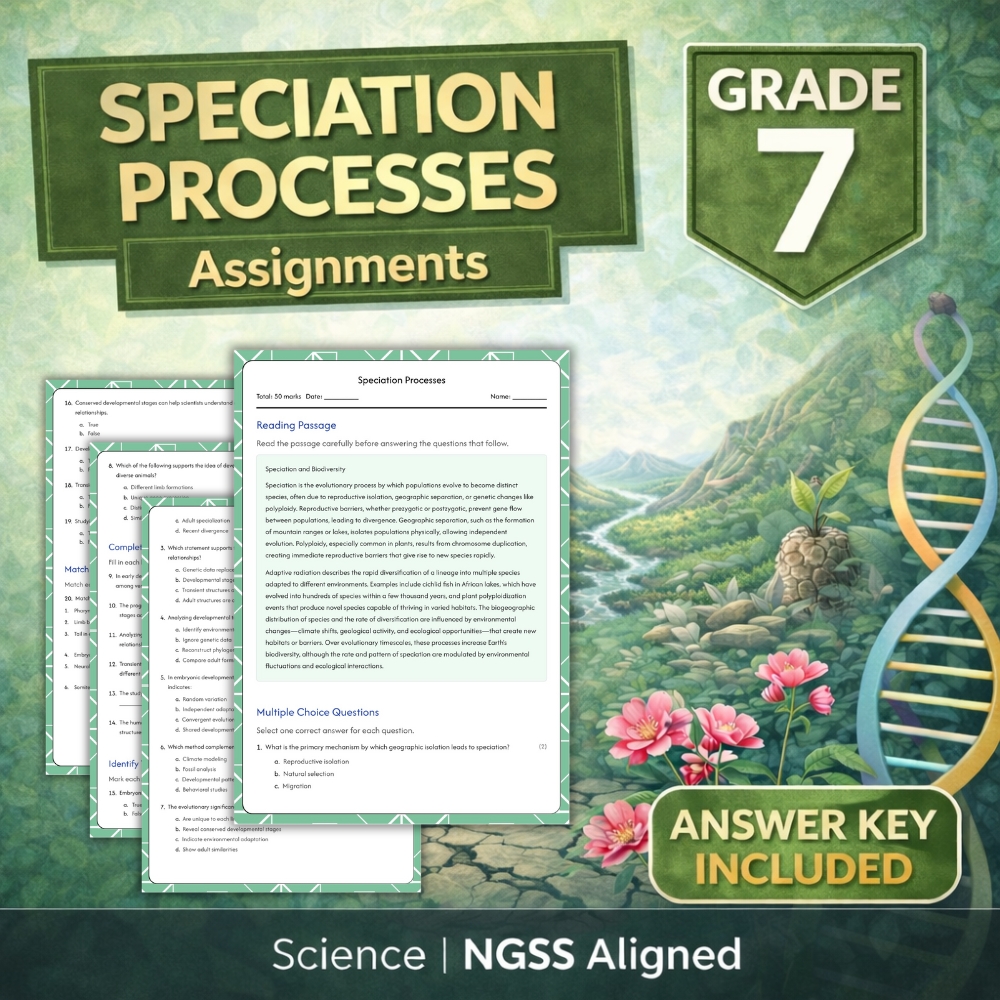
Grade 7 Science | Speciation Processes Worksheet (Answer Key) – NGSS Standards
 Created byCedar Grove Learning
Learning Objectives
- Describe the processes that lead to the formation of new species, including reproductive isolation and geographic separation.
- Explain how polyploidy and adaptive radiation contribute to biodiversity.
- Analyze examples of speciation such as cichlid radiations in African lakes and plant polyploidization.
Instant download
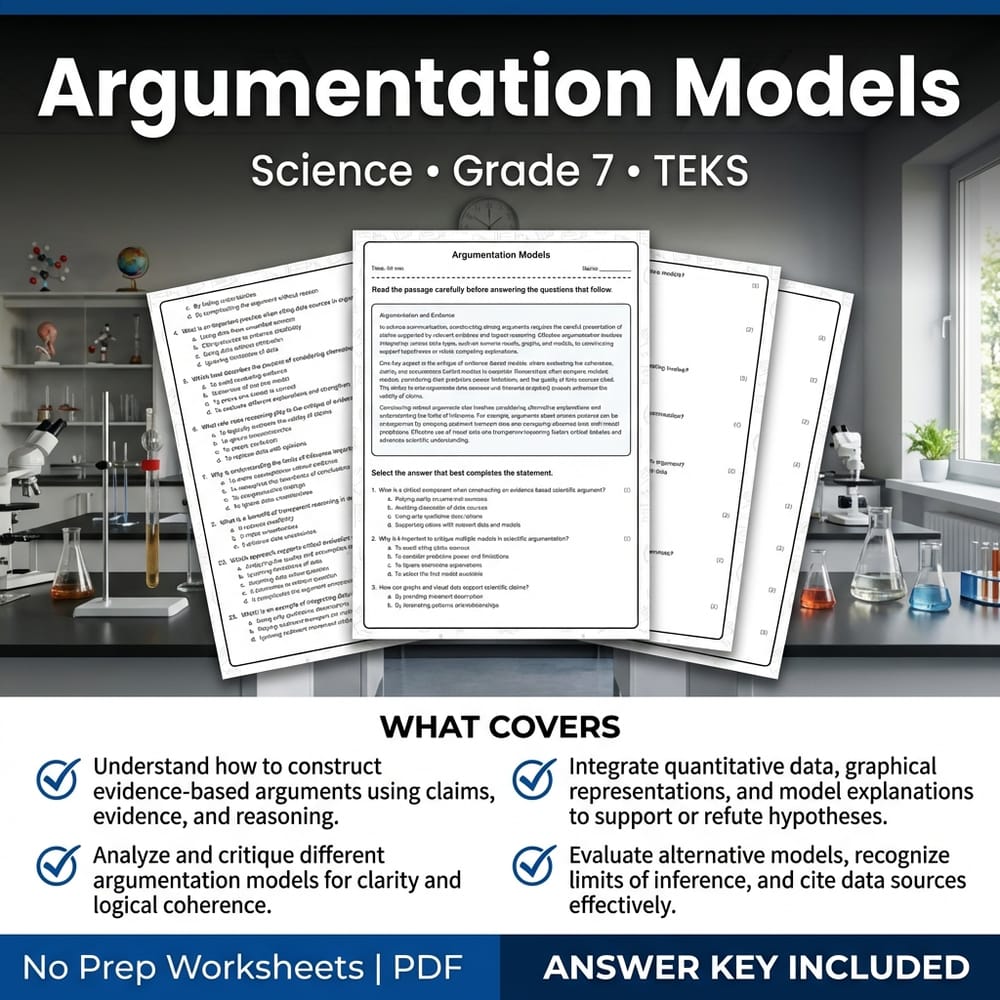
Grade 7 Science Worksheet on Argumentation Models | TEKS Alignment
Created byCoral Reef LearningLearning Objectives
- Understand how to construct evidence-based arguments using claims, evidence, and reasoning.
- Analyze and critique different argumentation models for clarity and logical coherence.
- Integrate quantitative data, graphical representations, and model explanations to support or refute hypotheses.
Instant download
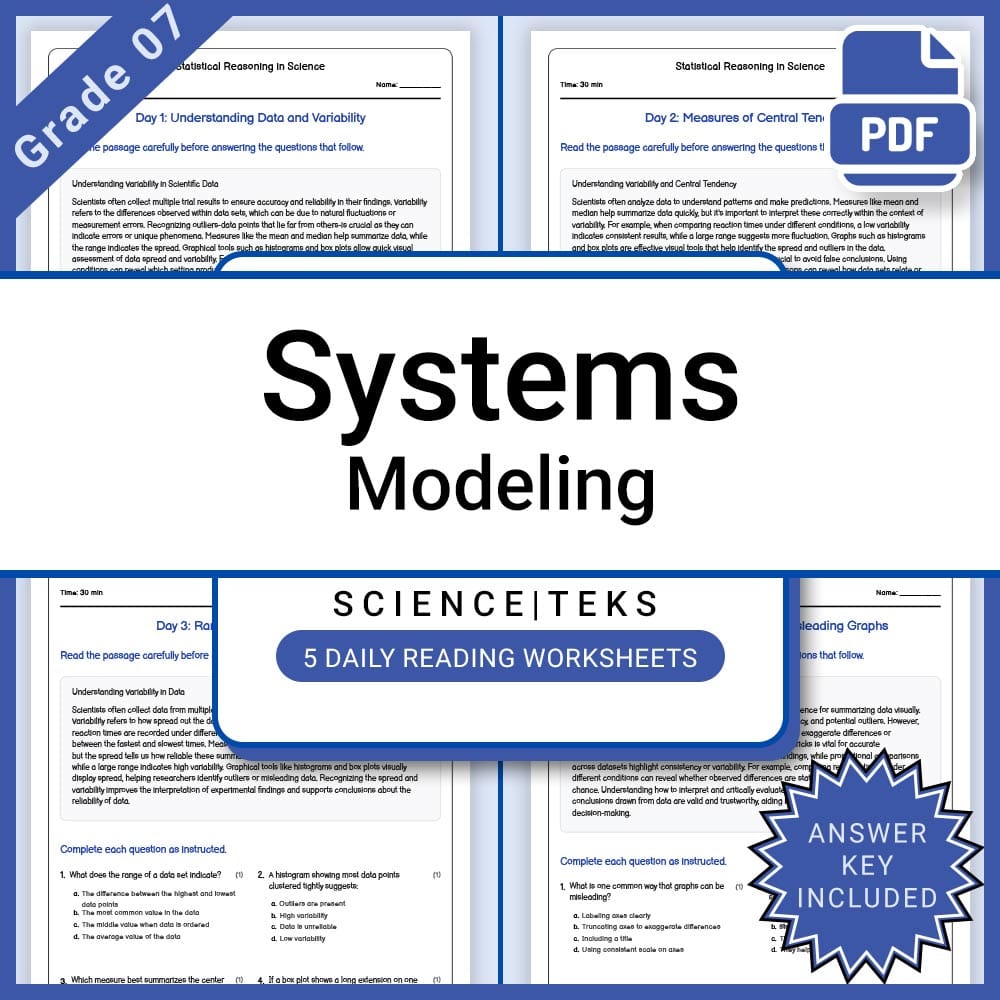
Grade 7 Science – Systems Modeling Daily Reading Worksheet with Answer Key
JCreated byJ.S SheetsLearning Objectives
- Understand the purpose of different science models
- Identify different types of systems models such as diagrams and schematics
- Recognize the uses and limitations of models in predicting system behavior
Also included in: Grade 7 Science Lesson Group TEKS Bundle – Standards and Inquiry Activities +1 more
Instant download
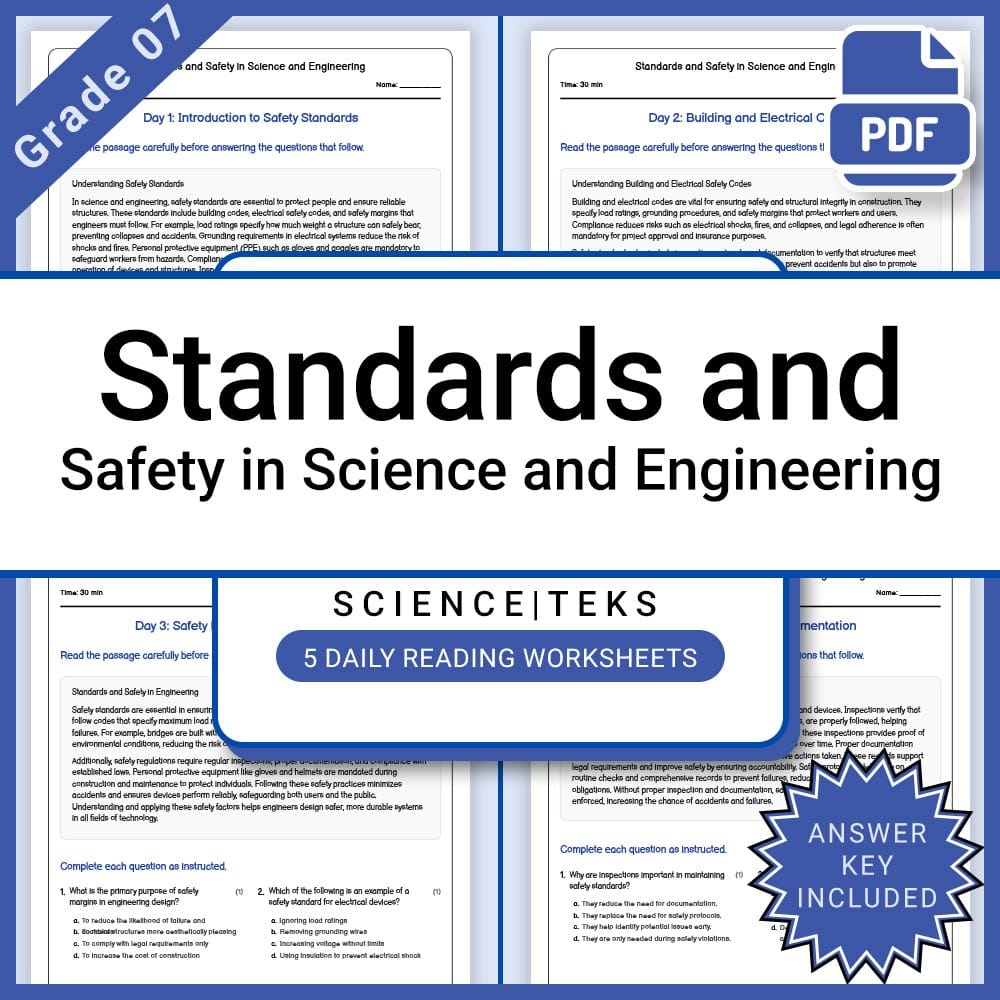
Grade 7 Science – Standards and Safety | Daily Reading Worksheet + Answer Key
JCreated byJ.S SheetsLearning Objectives
- Understand the importance of safety standards in scientific practice
- Identify key safety measures like load ratings and grounding requirements
- Recognize legal and procedural safety protocols in engineering design
Also included in: Grade 7 Science Lesson Group TEKS Bundle – Standards and Inquiry Activities +1 more
Instant download
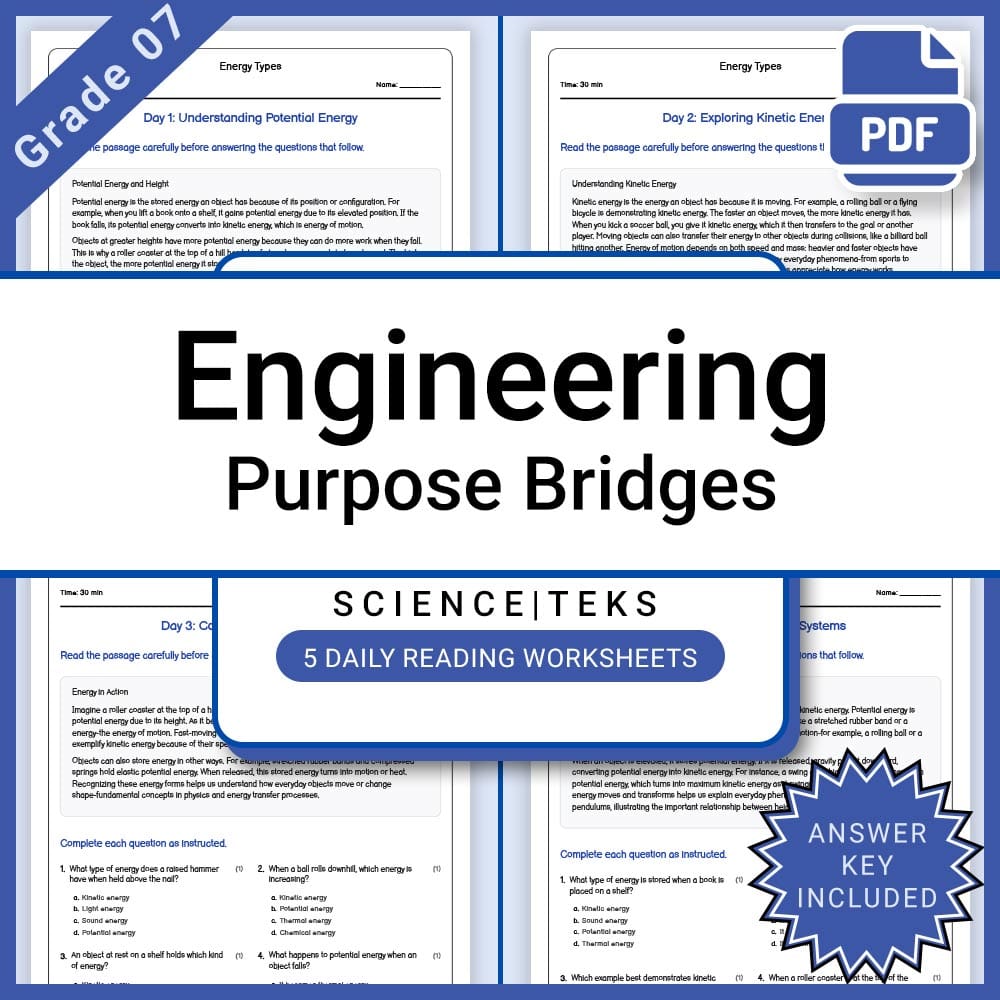
Grade 7 Science – Engineering Purpose Bridges Daily Worksheet + Answer Key
JCreated byJ.S SheetsLearning Objectives
- Understand the key design considerations for load-bearing structures like bridges.
- Identify how materials influence strength, durability, and cost of engineering systems.
- Analyze trade-offs engineers make between cost, reliability, and performance.
Also included in: Grade 7 Science Lesson Group TEKS Bundle – Standards and Inquiry Activities +1 more
Instant download
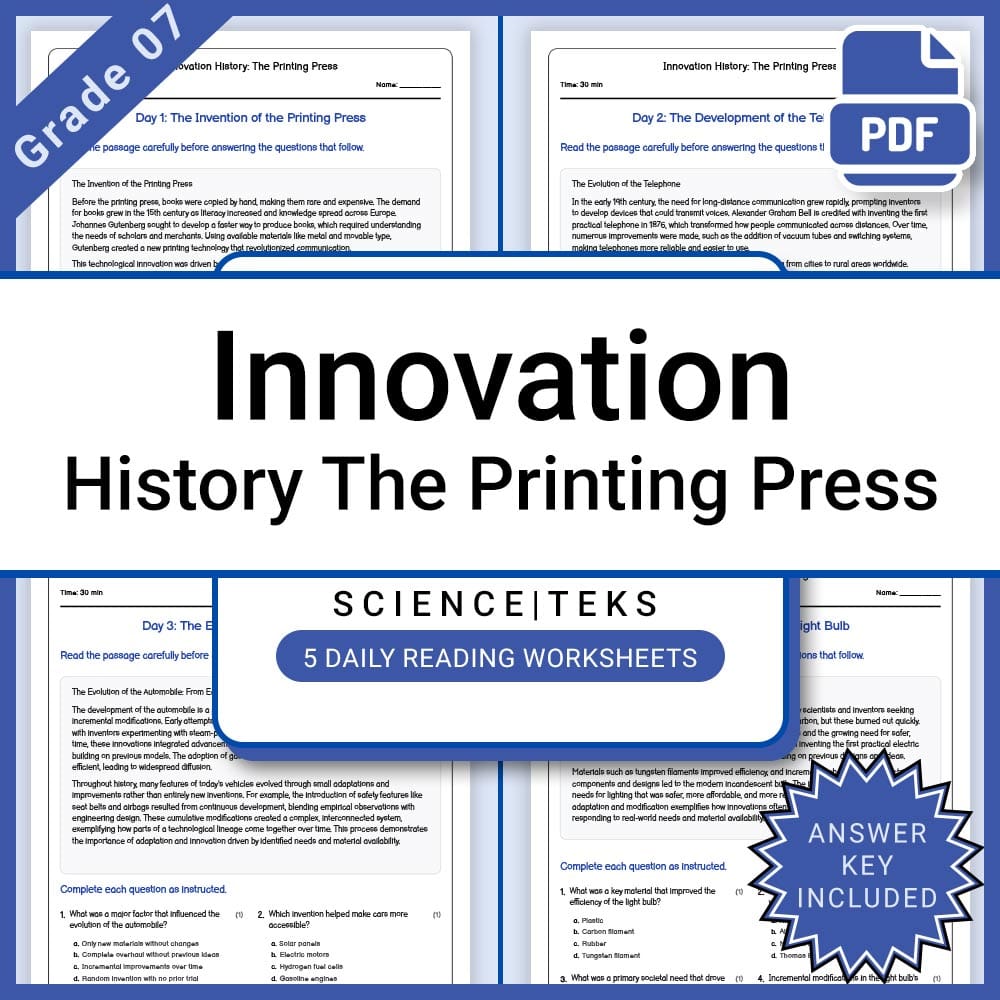
Grade 7 Science – Innovation History The Printing Daily Worksheet + Answer Key
JCreated byJ.S SheetsLearning Objectives
- Understand the causes that led to the invention of the printing press.
- Analyze how materials and needs influenced technological advancements.
- Explore the process of innovation through historical examples.
Also included in: Grade 7 Science Lesson Group TEKS Bundle – Standards and Inquiry Activities +1 more
Instant download
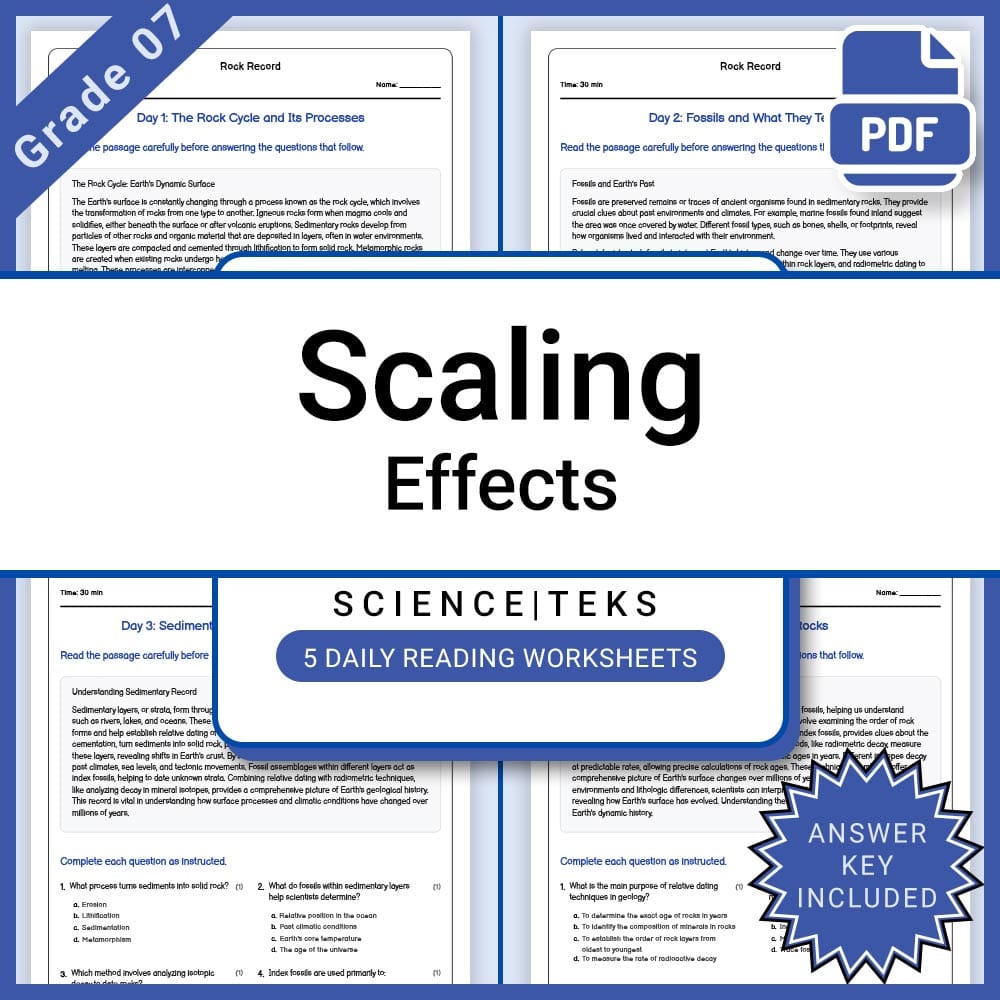
Grade 7 Science – Scaling Effects Daily Reading Worksheet with Answer Key
JCreated byJ.S SheetsLearning Objectives
- Understand how surface area and volume change as objects scale.
- Explain the square-cube law and its implications.
- Predict how physical properties like heat transfer and resistance are affected by size.
Also included in: Grade 7 Science Lesson Group TEKS Bundle – Standards and Inquiry Activities +1 more
Instant download
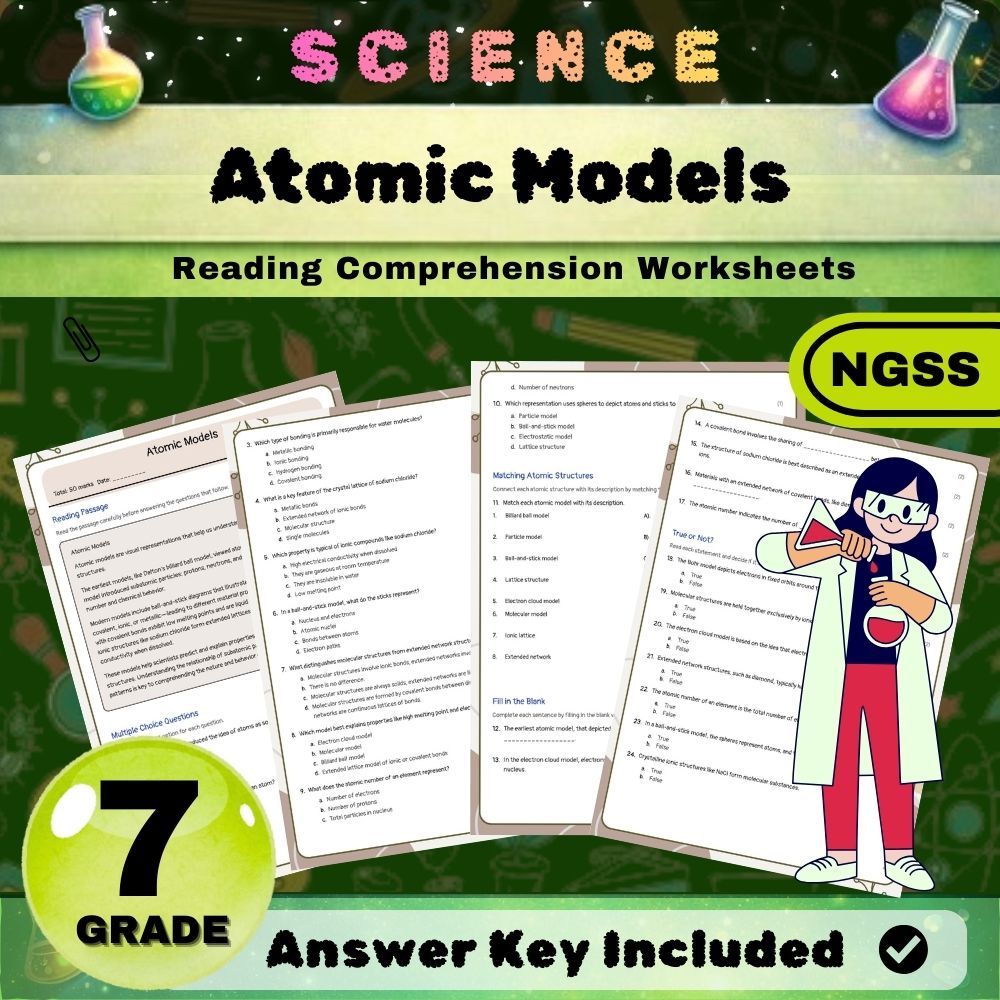
Grade 7 Science – Atomic Models Worksheet (PDF) NGSS Aligned
 Created byMaple Path Learning
Learning Objectives
- Understand how different atomic models represent atom structure and bonding.
- Identify how bonding patterns influence material properties such as melting point and electrical conductivity.
- Distinguish between molecular and extended network structures in atomic models.
Instant download
About Grade 7 Science Worksheets
Browse 6,039 printable Grade 7 Science worksheets — ready-to-print PDFs with answer keys where available.
Every worksheet on MyTeachingSheets is created by independent teacher-authors and reviewed before publication. All resources download as printable PDFs for classroom, homework, or at-home practice, and many include answer keys. Preview any worksheet free before buying.