
Grade 7 Science Worksheets
6,039 worksheets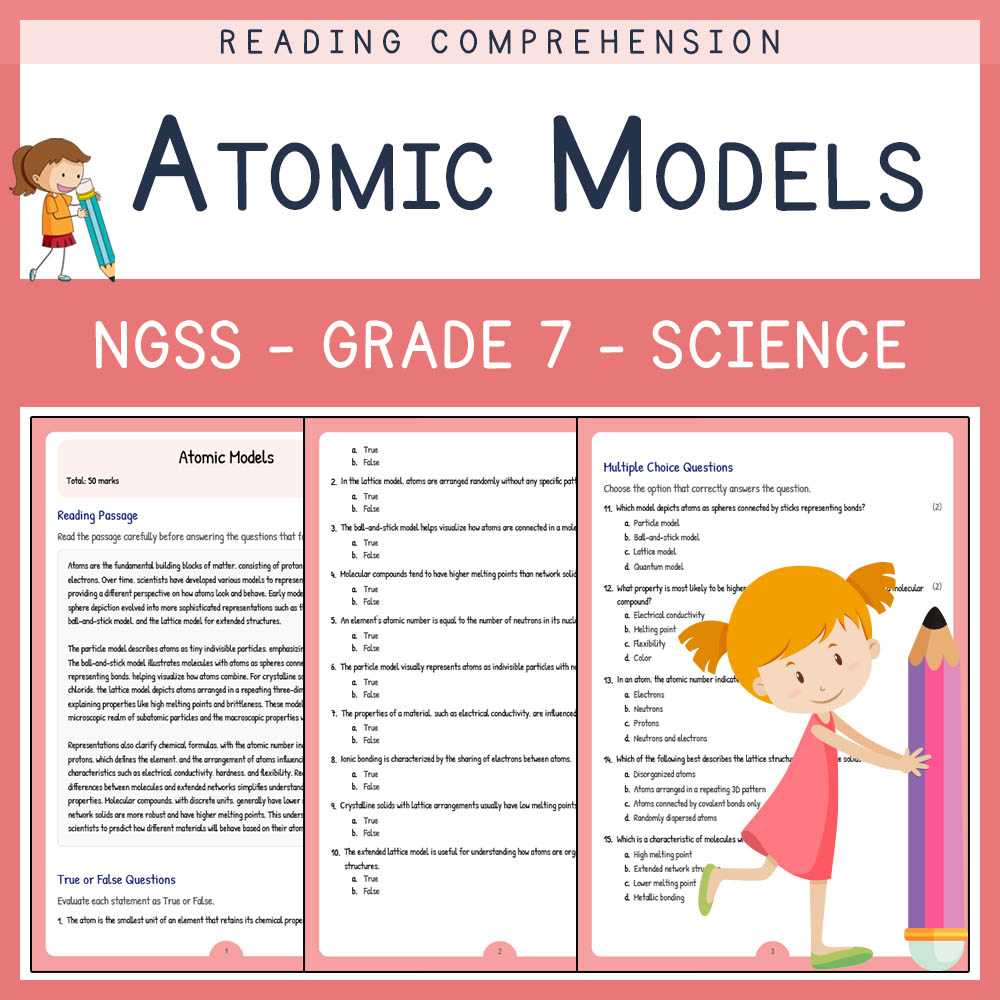
Grade 7 Science | Atomic Models Worksheet & Answer Key (NGSS-Aligned)
 Created byLumora Learning
Learning Objectives
- Understand different types of atomic models and their representations.
- Identify how atomic structure relates to bonding and material properties.
- Distinguish between molecular and extended network structures in materials.
Instant download
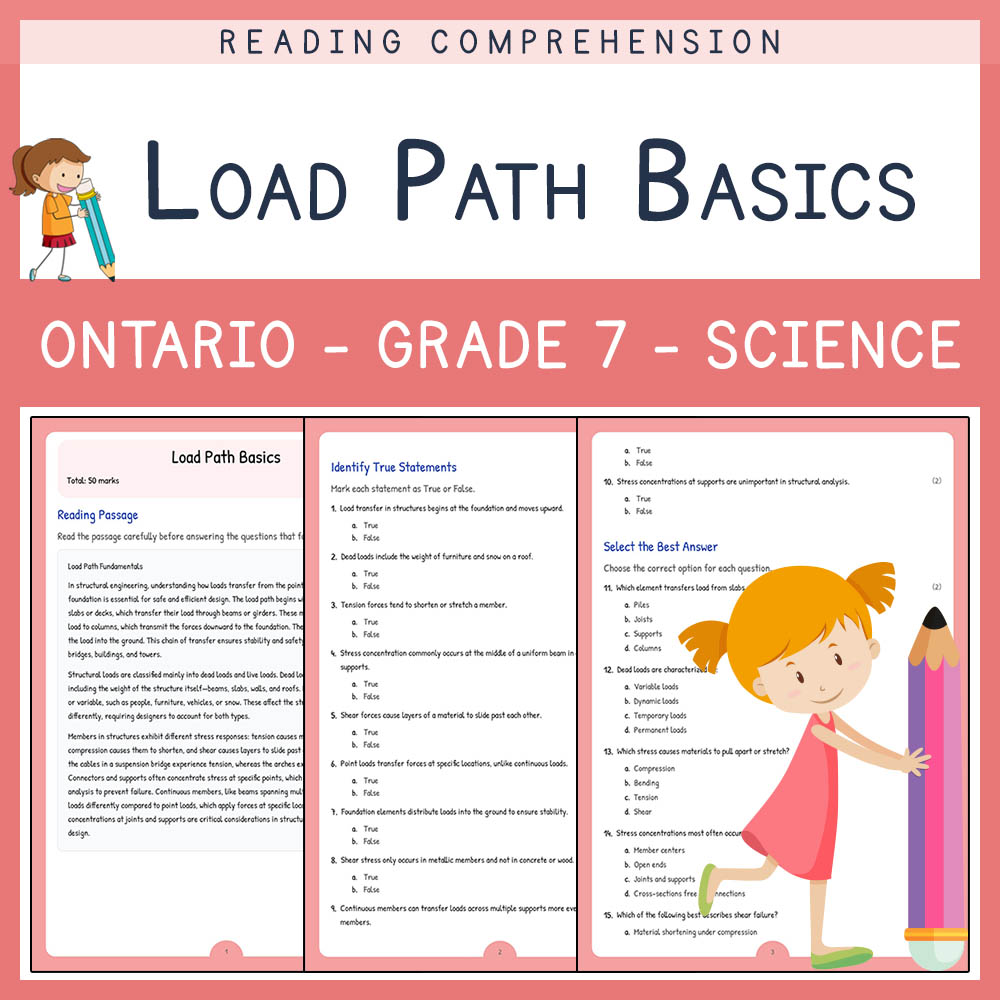
Grade 7 Science | Load Path Basics Worksheet with Answer Key – Ontario Standard
Created byLumora LearningLearning Objectives
- Define the primary structural elements involved in load transfer.
- Explain the concept of load paths in structures such as bridges and frames.
- Distinguish between dead loads and live loads and their effects on structures.
Also included in: Grade 7 Science | Form Function Design Structures Unit Bundle | Ontario
Instant download
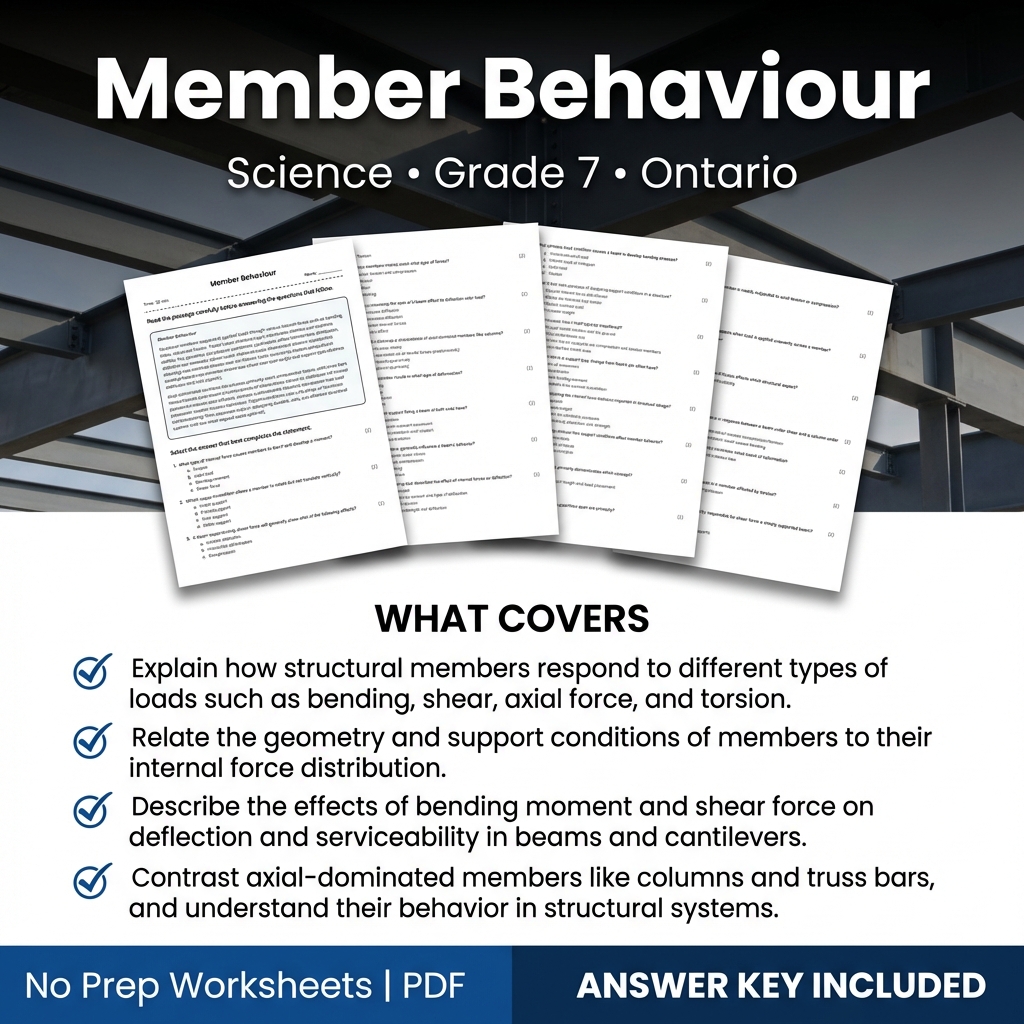
Member Behaviour Grade 7 Science Worksheet | Ontario Standards PDF
 Created byCoral Reef Learning
Learning Objectives
- Explain how structural members respond to different types of loads such as bending, shear, axial force, and torsion.
- Relate the geometry and support conditions of members to their internal force distribution.
- Describe the effects of bending moment and shear force on deflection and serviceability in beams and cantilevers.
Instant download
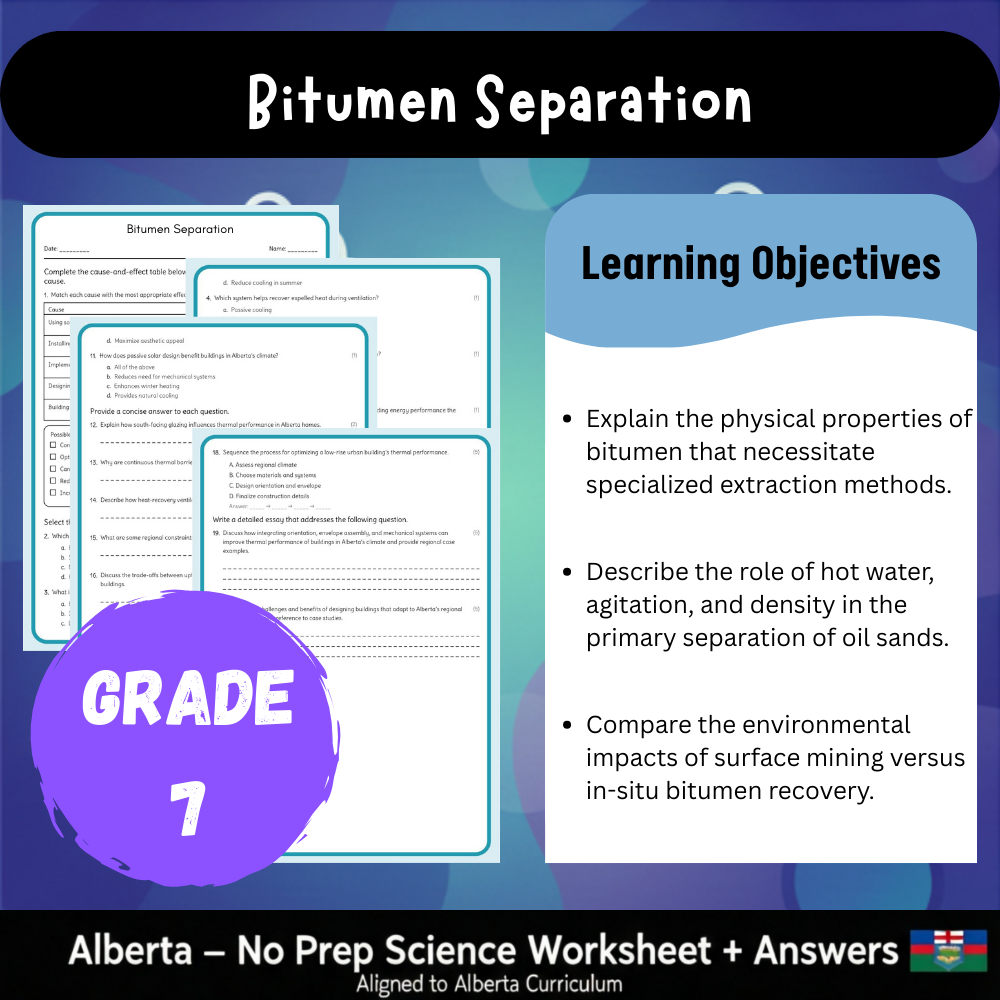
Grade 7 Science | Bitumen Separation Worksheet (PDF) – Alberta Standards
 Created byBright Mind Resources
Learning Objectives
- Understand the physical and chemical processes involved in separating mixtures like bitumen from oil sands.
- Identify and differentiate between physical separation techniques and chemical treatments in resource extraction.
- Describe how material classification helps explain mixture behaviors during separation processes.
Instant download
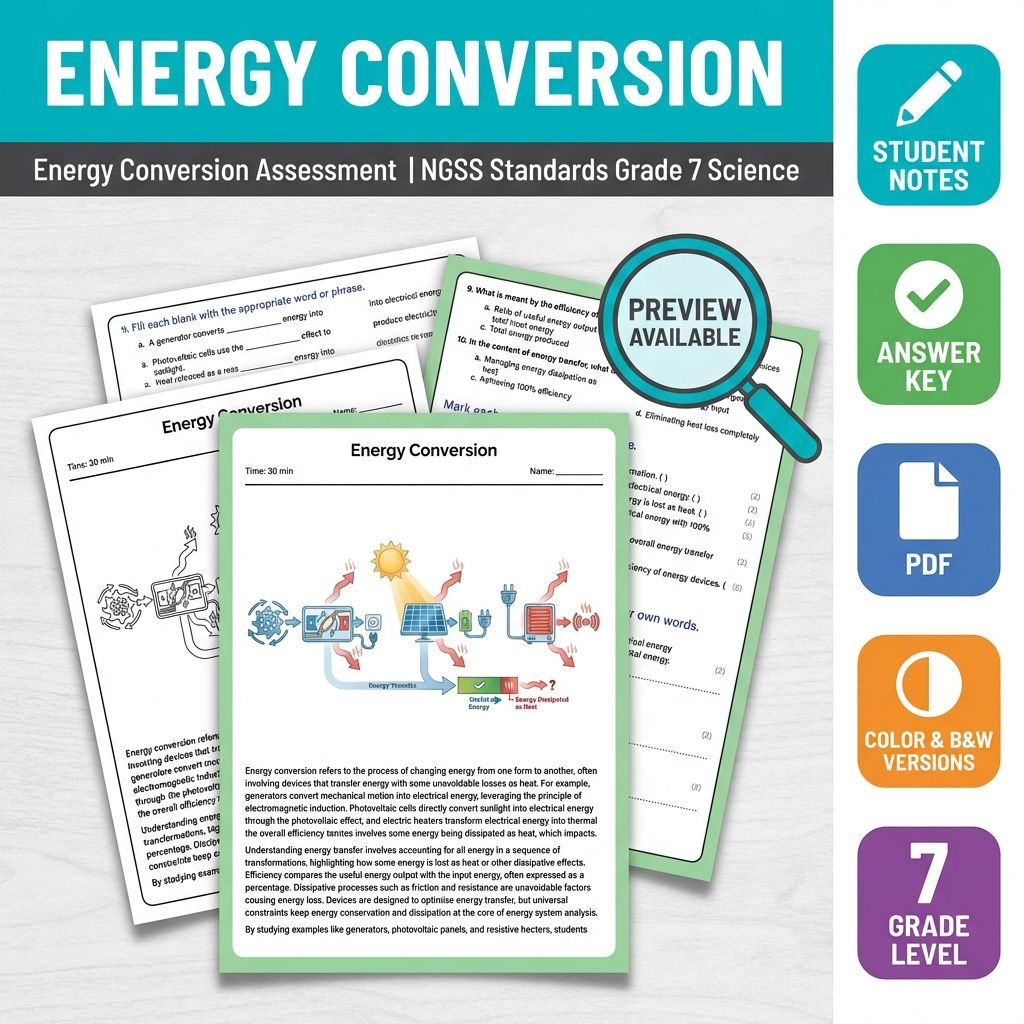
Energy Conversion Assessment | NGSS Standards Grade 7 Science
 Created byPrism Point Learning
Learning Objectives
- Explain the principles behind devices that convert energy from one form to another.
- Identify examples of energy transfer and conservation in everyday devices.
- Understand the concept of energy efficiency and dissipative processes in energy transformations.
Also included in: Grade 7 Science Mini Bundle | Energy Unit & NGSS Standards-Aligned Resources +1 more
Instant download
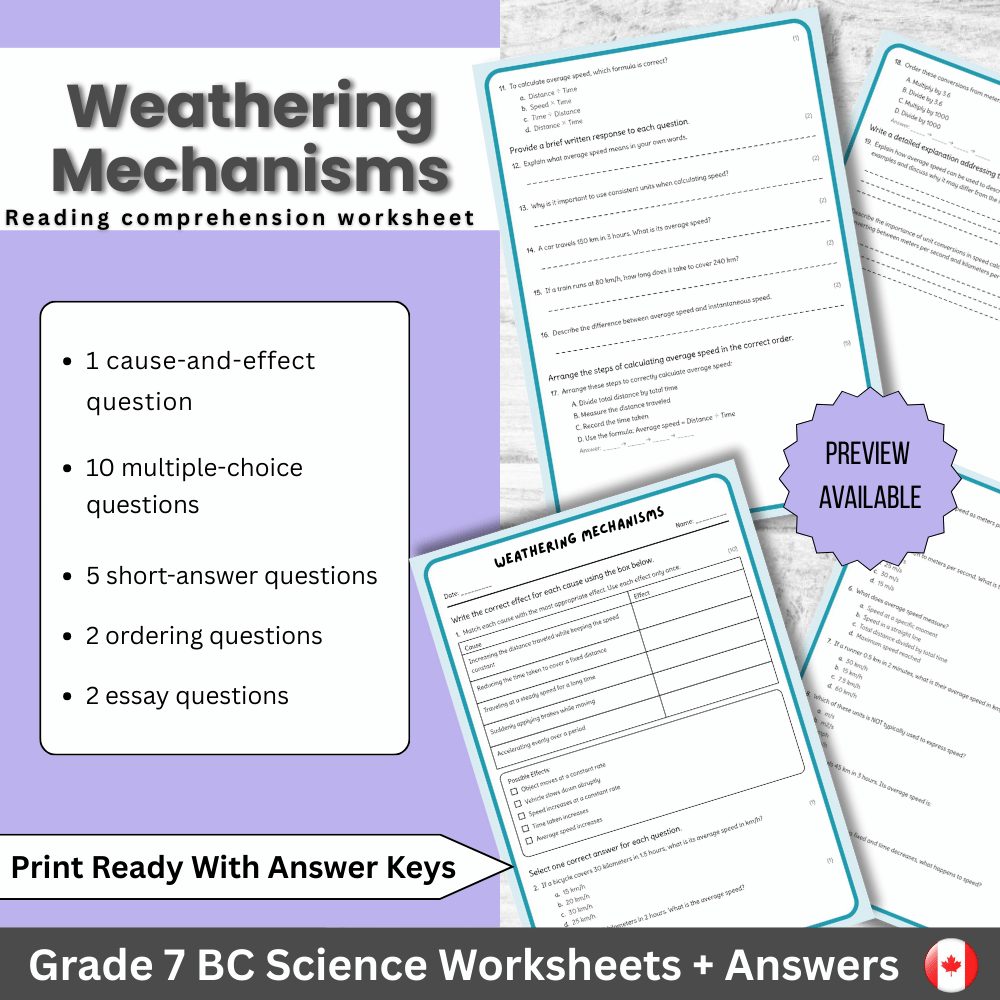
Grade 7 Science – Weathering Mechanisms Worksheet (PDF) | BC Standards
Created byBright Mind ResourcesLearning Objectives
- Describe the different types of weathering processes at Earth's surface.
- Identify examples of physical, chemical, and biological weathering.
- Explain how weathering influences landscape development and sediment supply.
Instant download
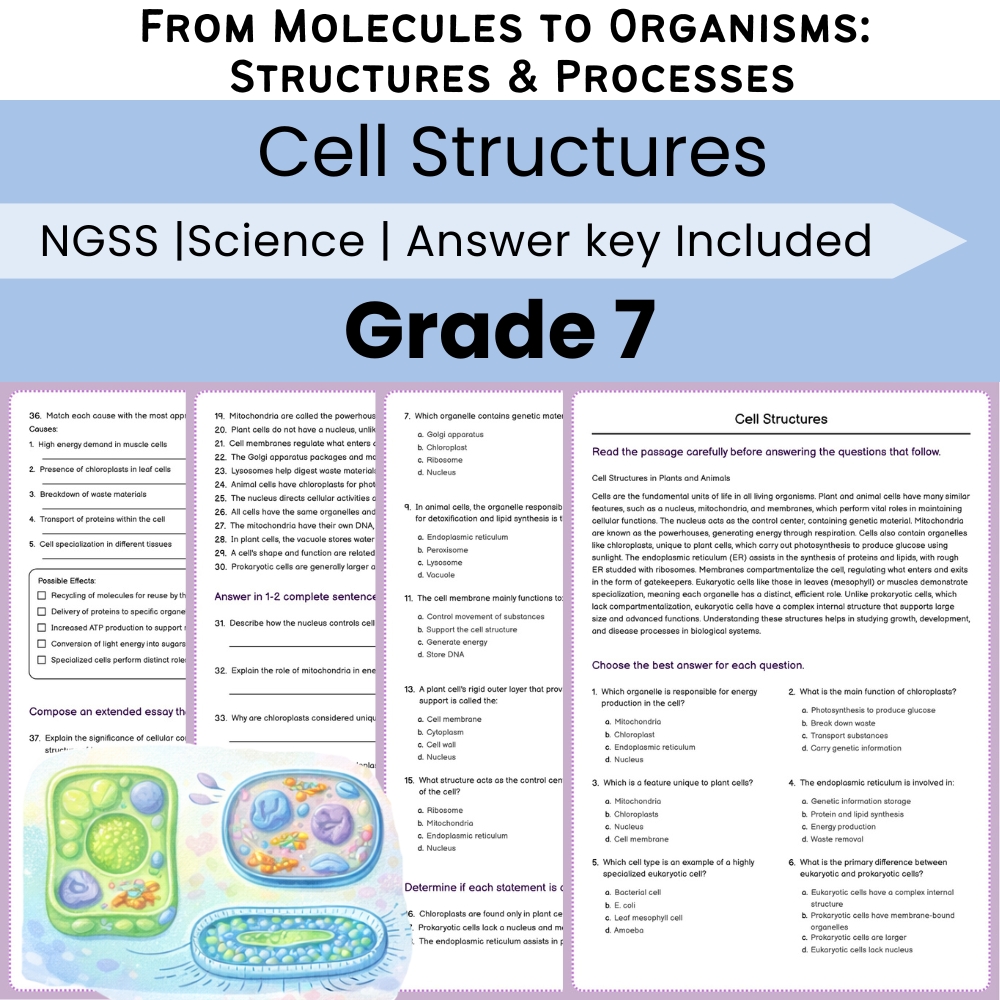
Cell Structures Worksheet for Grade 7 Science | NGSS Printable PDF Assessment
Learning Objectives
- Identify and describe the organelles in plant and animal cells.
- Explain the functions of nucleus, mitochondria, chloroplasts, endoplasmic reticulum, and membranes.
- Connect cell structure to its role in transportation, synthesis, and compartmentalization.
Also included in: Grade 7 Science Lesson Bundle | From Molecules to Organisms NGSS +1 more
Instant download

Grade 7 Climate Interactions Worksheet | NGSS Earth Science Activity
 Created byBRIGHT PATH RESOURCES
Learning Objectives
- Understand key concepts related to Science
- Apply knowledge through practice questions
- Demonstrate comprehension of the material
Also included in: Earth Systems Grade 7 Science Daily Reading Worksheets Lesson Bundle | NGSS +2 more
Instant download
Grade 7 Science | Integration & Homeostasis Worksheet (PDF) – BC Standards
Created byBright Mind ResourcesLearning Objectives
- Understand how cellular structures and transport processes work together to maintain homeostasis.
- Describe the roles of transport proteins, membrane pumps, and hormone signalling in regulating nutrient, ion, and water levels.
- Explain how disruptions at cellular or tissue levels can affect organ function and organism stability.
Instant download

Relative Geologic Time Worksheet | Grade 7 Earth Science Activity
Created byPrism Point LearningLearning Objectives
- Explain how relative dating uses rock order and observable relationships to determine which geologic event happened first.
- Use the principles of superposition and cross-cutting relationships to interpret a simple geologic history.
- Justify reasoning by connecting rock features (layers, intrusions, faults) to relative ages.
Also included in: Grade 7 Weather & Climate Science Lesson Bundle | Florida NGSSS
Instant download
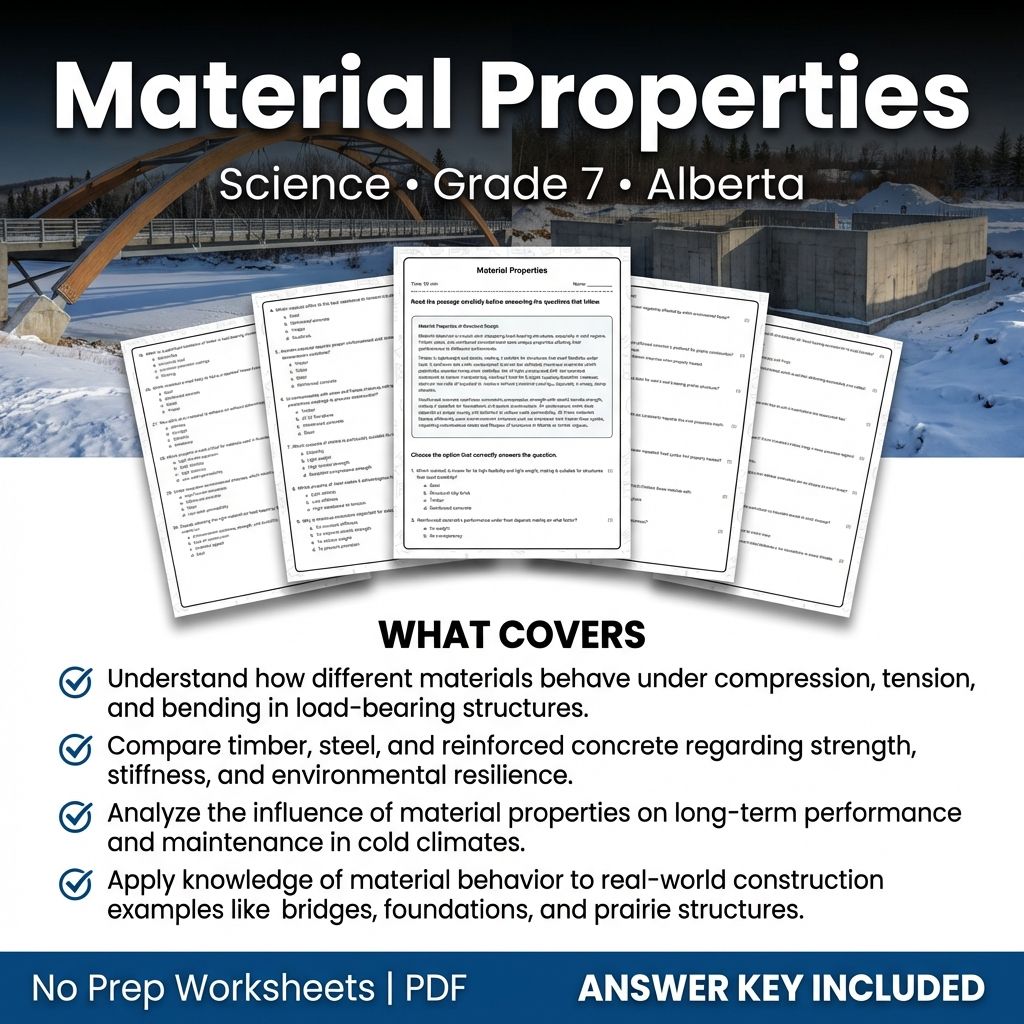
Material Properties Worksheet | Grade 7 Science | Alberta Standards
Created byCoral Reef LearningLearning Objectives
- Understand how different materials behave under compression, tension, and bending in load-bearing structures.
- Compare timber, steel, and reinforced concrete regarding strength, stiffness, and environmental resilience.
- Analyze the influence of material properties on long-term performance and maintenance in cold climates.
Instant download

Grade 7 Seasonal Energy Storage & Change Science Worksheet Alberta
Created byBRIGHT PATH RESOURCESLearning Objectives
- Explain how solar energy drives seasonal change.
- Use vocabulary such as albedo, sensible heat, and latent heat in context.
- Describe how phase changes and snow cover affect energy budgets.
Also included in: Grade 7 Alberta Science Energy Heat and Thermal Processes Worksheet Bundle +1 more
Instant download
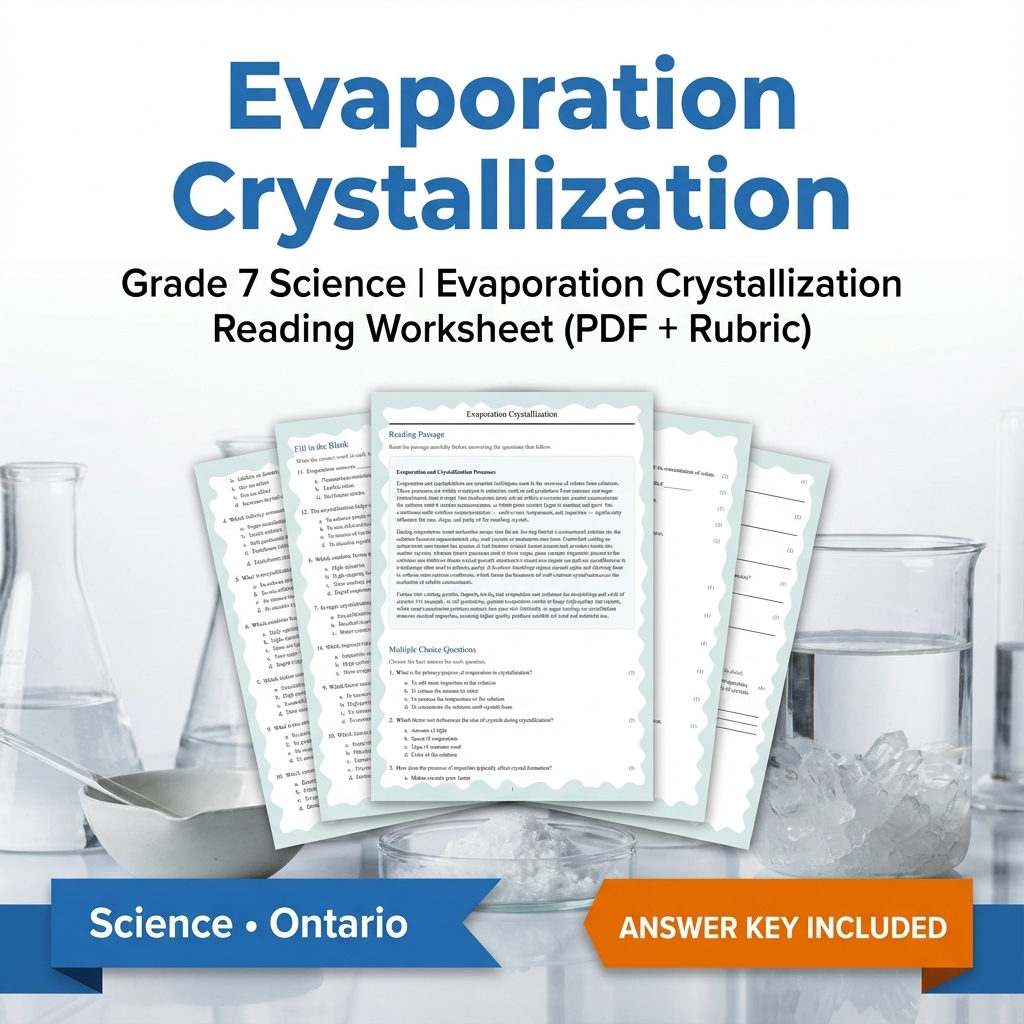
Grade 7 Science | Evaporation Crystallization Reading Worksheet (PDF + Rubric)
JCreated byJ.S SheetsLearning Objectives
- Understand the process of evaporation and crystallization in recovering solutes.
- Identify the factors affecting crystal growth, size, and purity.
- Describe examples of evaporation crystallization like salt production and sugar crystallization.
Also included in: Grade 7 Science Unit Bundle | Properties of Matter & Separation Techniques (Worksheet Pack) +1 more
Instant download
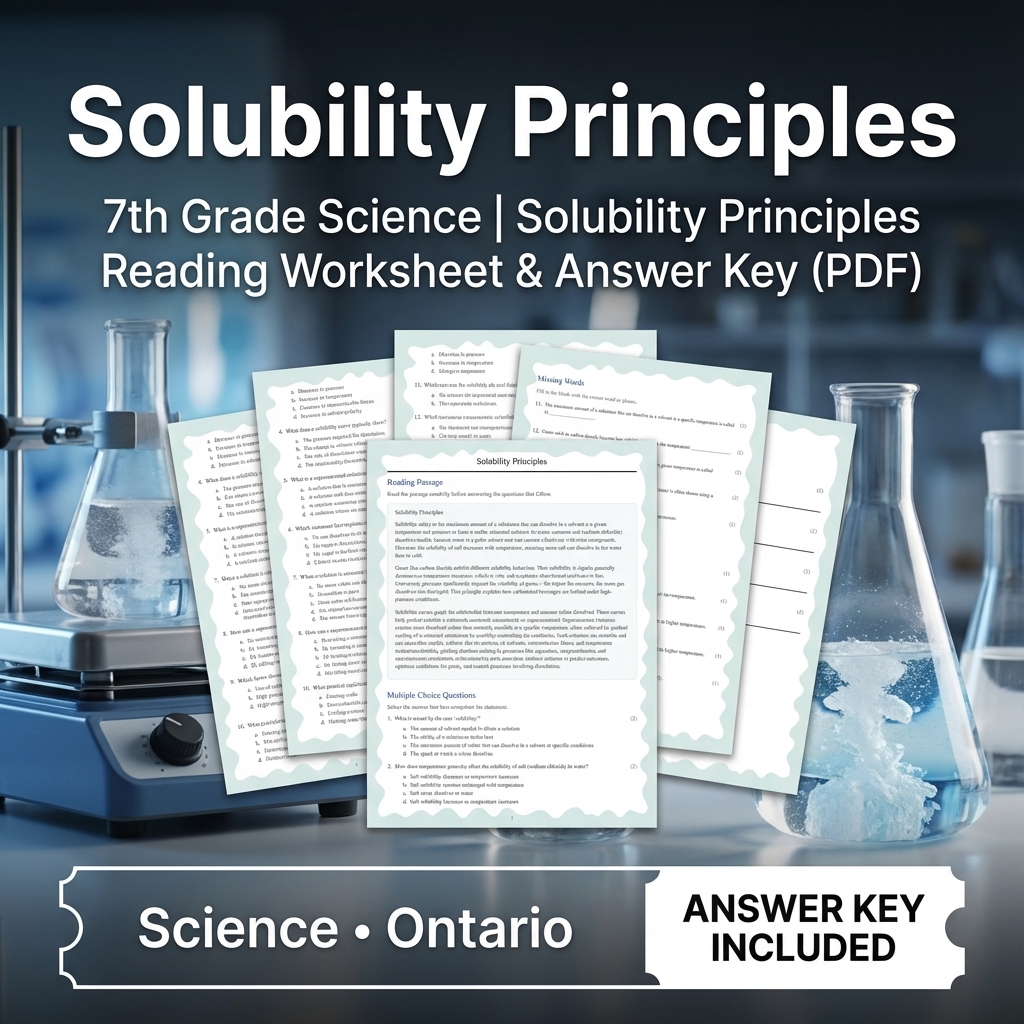
7th Grade Science | Solubility Principles Reading Worksheet & Answer Key (PDF)
JCreated byJ.S SheetsLearning Objectives
- Understand the fundamental concepts of solubility and the factors affecting dissolution.
- Identify how temperature, pressure, and solvent polarity influence solubility.
- Interpret solubility curves and understand saturation and supersaturation phenomena.
Also included in: Grade 7 Science Unit Bundle | Properties of Matter & Separation Techniques (Worksheet Pack) +1 more
Instant download
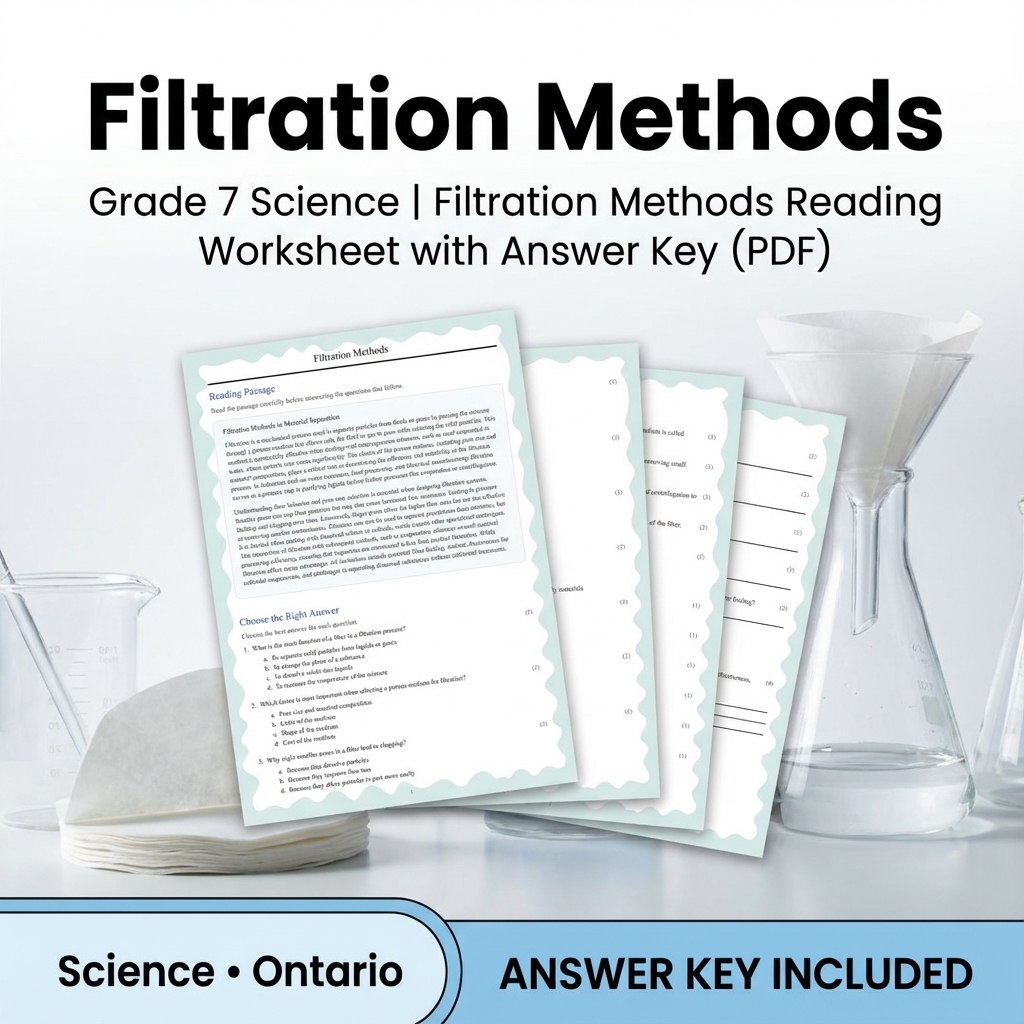
Grade 7 Science | Filtration Methods Reading Worksheet with Answer Key (PDF)
JCreated byJ.S SheetsLearning Objectives
- Understand the principles of filtration and sedimentation in separating mixtures.
- Identify different types of porous media and their roles in filtration processes.
- Explain the applications and limitations of filtration in material processing.
Also included in: Grade 7 Science Unit Bundle | Properties of Matter & Separation Techniques (Worksheet Pack) +1 more
Instant download
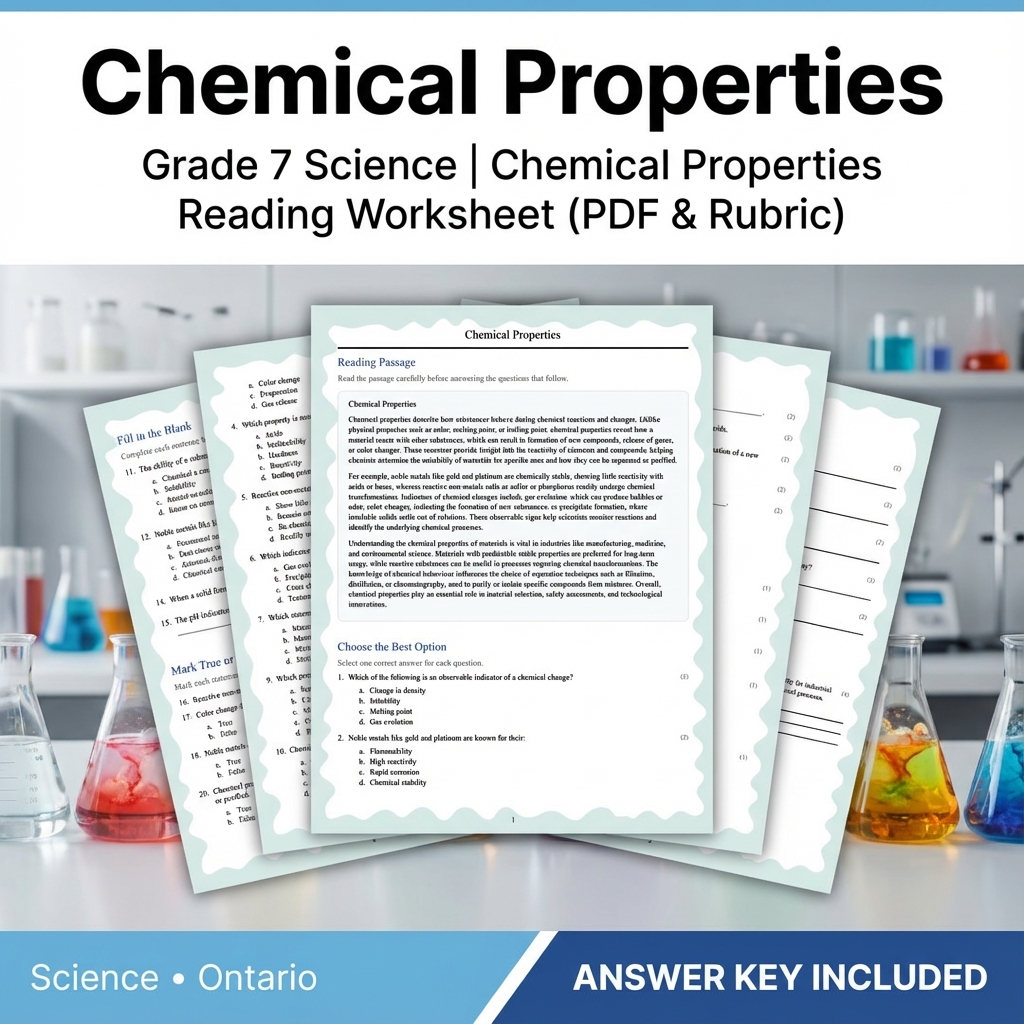
Grade 7 Science | Chemical Properties Reading Worksheet (PDF & Rubric)
JCreated byJ.S SheetsLearning Objectives
- Understand the definition and significance of chemical properties in materials
- Identify observable indicators of chemical changes such as gas evolution, color change, and precipitate formation
- Differentiate between chemical stability of noble metals and reactive non-metals
Also included in: Grade 7 Science Unit Bundle | Properties of Matter & Separation Techniques (Worksheet Pack) +1 more
Instant download
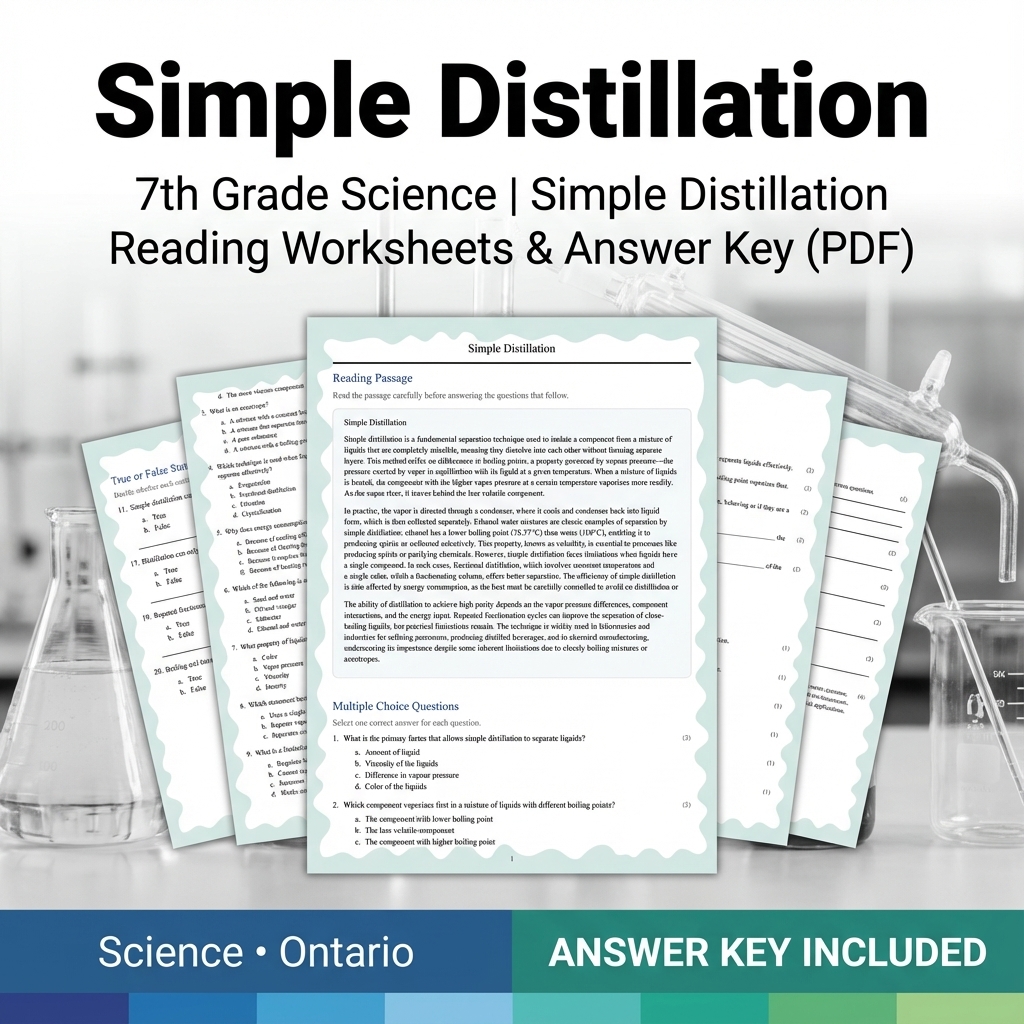
7th Grade Science | Simple Distillation Reading Worksheets & Answer Key (PDF)
JCreated byJ.S SheetsLearning Objectives
- Understand the principles of simple distillation and how it separates miscible liquids based on boiling points.
- Explain the concepts of vapor pressure, boiling point differences, and condensation in the distillation process.
- Identify practical applications of distillation, such as ethanol-water separation, and recognize its limitations.
Also included in: Grade 7 Science Unit Bundle | Properties of Matter & Separation Techniques (Worksheet Pack) +1 more
Instant download
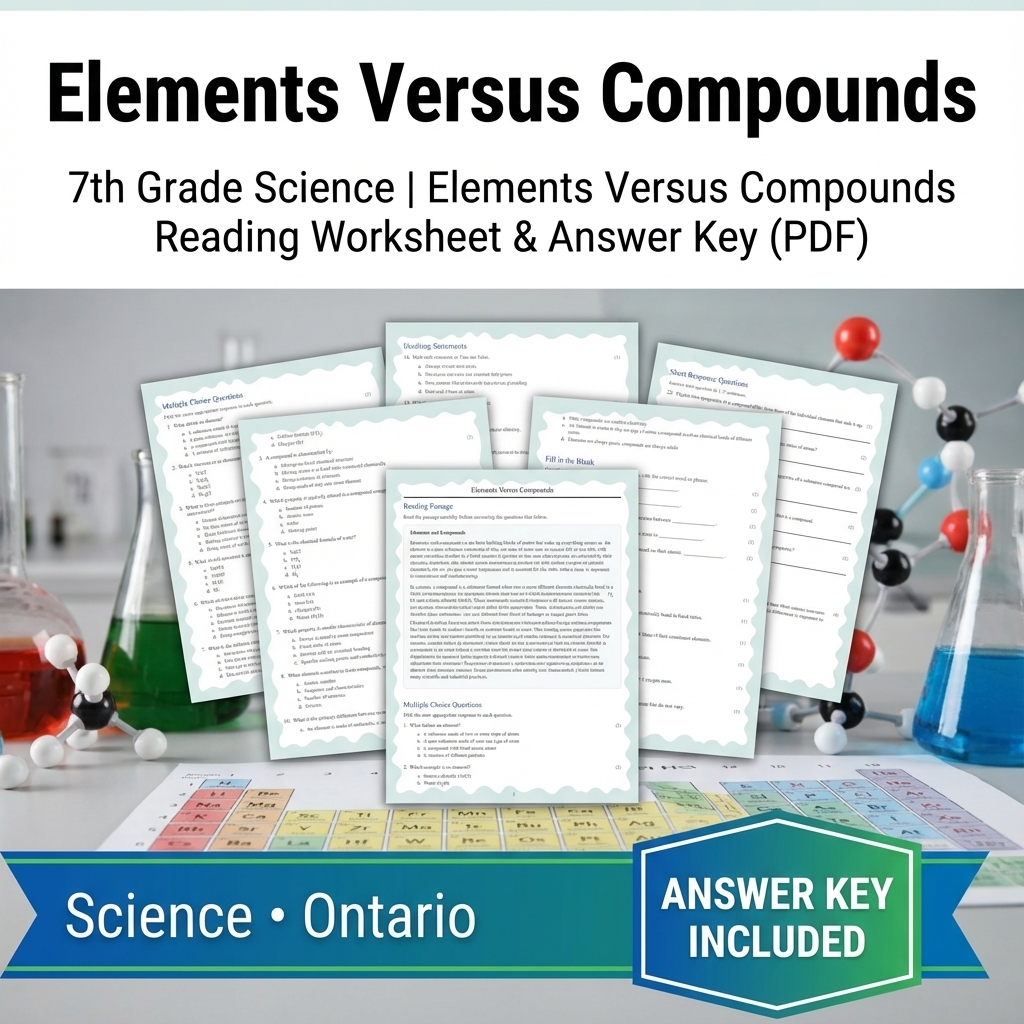
7th Grade Science | Elements Versus Compounds Reading Worksheet & Answer Key
JCreated byJ.S SheetsLearning Objectives
- Understand the differences between elements and compounds based on atomic composition and bonding.
- Identify examples of elements and compounds and describe their characteristic properties.
- Explain how chemical combinations alter properties compared to the constituent elements.
Also included in: Grade 7 Science Unit Bundle | Properties of Matter & Separation Techniques (Worksheet Pack) +1 more
Instant download
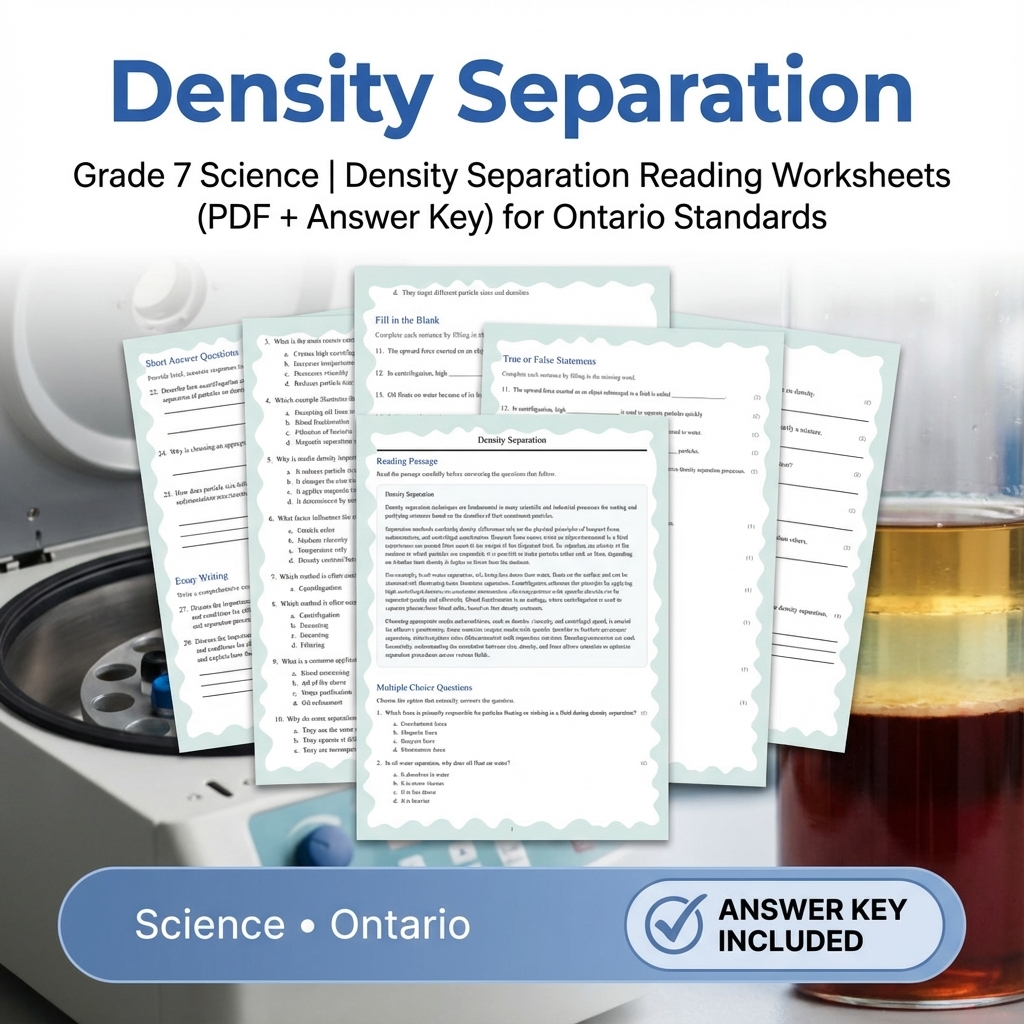
Grade 7 Science | Density Separation Reading Worksheets (PDF + Answer Key)
JCreated byJ.S SheetsLearning Objectives
- Explain the principles of density-driven separation techniques such as decanting, floatation, and centrifugation.
- Identify examples of density separation methods like oil-water separation and blood fractionation.
- Understand how buoyant force, sedimentation rate, and centrifugal acceleration relate to particle size and density.
Also included in: Grade 7 Science Unit Bundle | Properties of Matter & Separation Techniques (Worksheet Pack) +1 more
Instant download
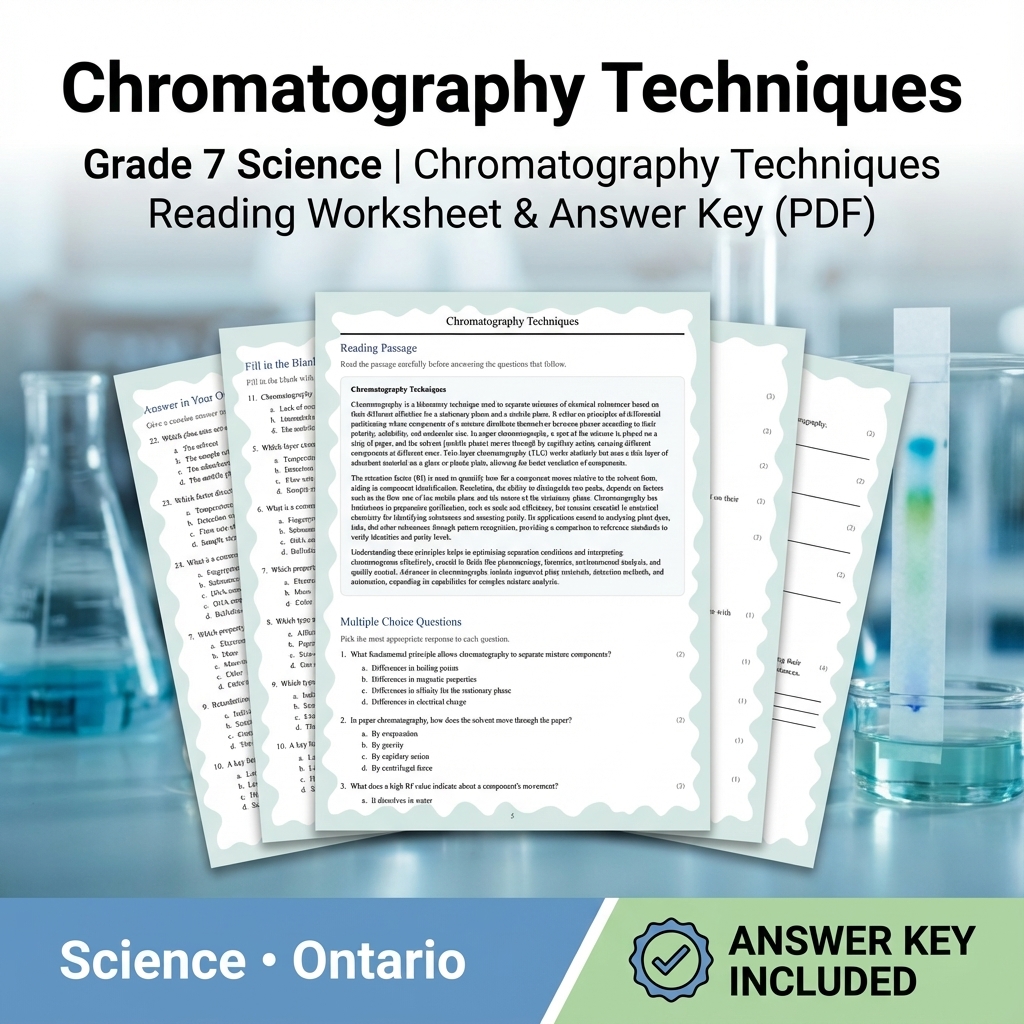
Grade 7 Science | Chromatography Techniques Reading Worksheet & Answer Key (PDF)
JCreated byJ.S SheetsLearning Objectives
- Understand the principles of chromatographic separation including differential partitioning.
- Identify the roles of stationary and mobile phases in chromatography.
- Describe how molecular polarity affects component separation.
Also included in: Grade 7 Science Unit Bundle | Properties of Matter & Separation Techniques (Worksheet Pack) +1 more
Instant download
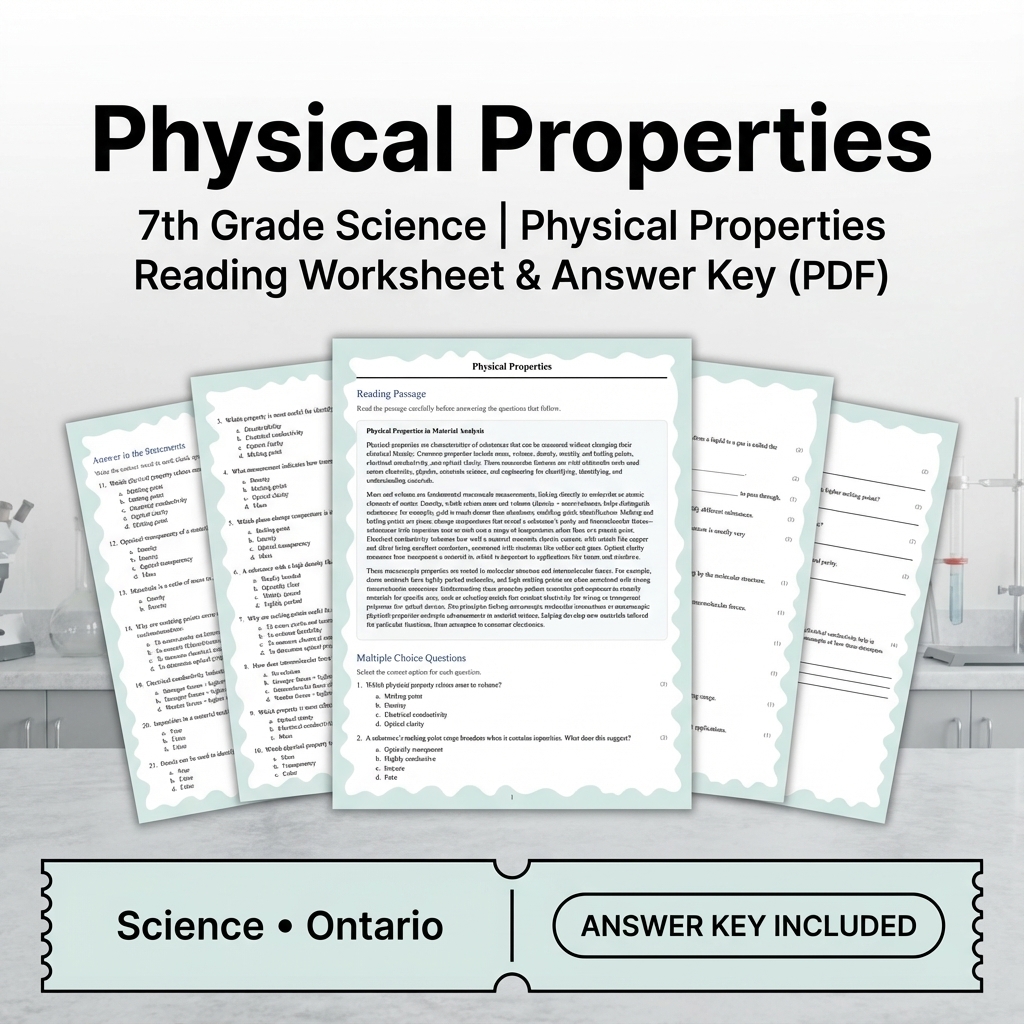
7th Grade Science | Physical Properties Reading Worksheet & Answer Key (PDF)
JCreated byJ.S SheetsLearning Objectives
- Define and describe key physical properties used to characterize materials.
- Link macroscopic measurements like density, melting point, and electrical conductivity to molecular structure and intermolecular forces.
- Explain how phase-change temperatures and other physical descriptors assist in material classification and selection.
Also included in: Grade 7 Science Unit Bundle | Properties of Matter & Separation Techniques (Worksheet Pack) +1 more
Instant download
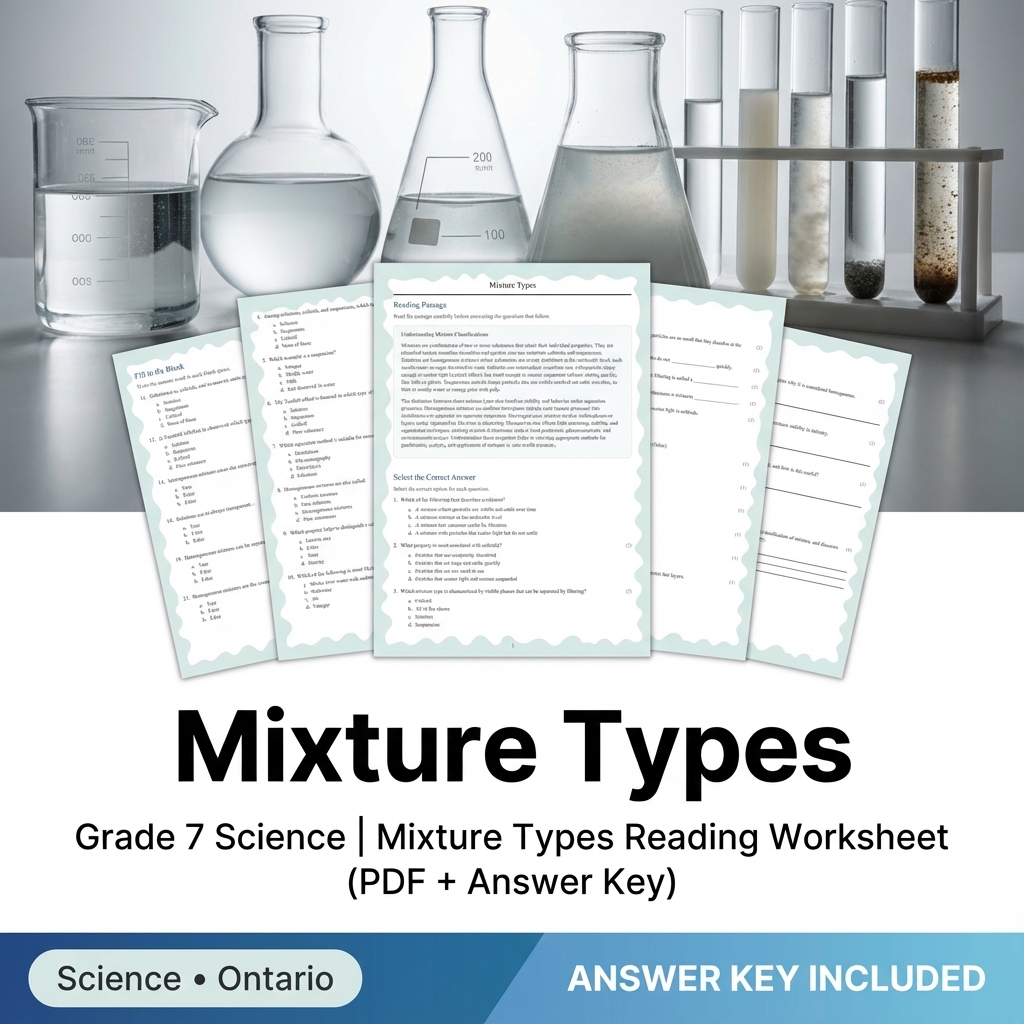
Grade 7 Science | Mixture Types Reading Worksheet (PDF + Answer Key)
JCreated byJ.S SheetsLearning Objectives
- Understand the classification of mixtures into solutions, colloids, and suspensions.
- Identify examples of different mixture types based on their properties.
- Describe the factors that distinguish homogeneous and heterogeneous mixtures.
Also included in: Grade 7 Science Unit Bundle | Properties of Matter & Separation Techniques (Worksheet Pack) +1 more
Instant download

Grade 7 Science | Purity Assessment Reading Worksheet & Answer Key (PDF)
JCreated byJ.S SheetsLearning Objectives
- Understand the analytical indicators used to assess material purity.
- Identify methods to detect contamination in chemical samples.
- Compare different techniques such as melting points, conductivity, and gravimetric analysis.
Also included in: Grade 7 Science Unit Bundle | Properties of Matter & Separation Techniques (Worksheet Pack) +1 more
Instant download
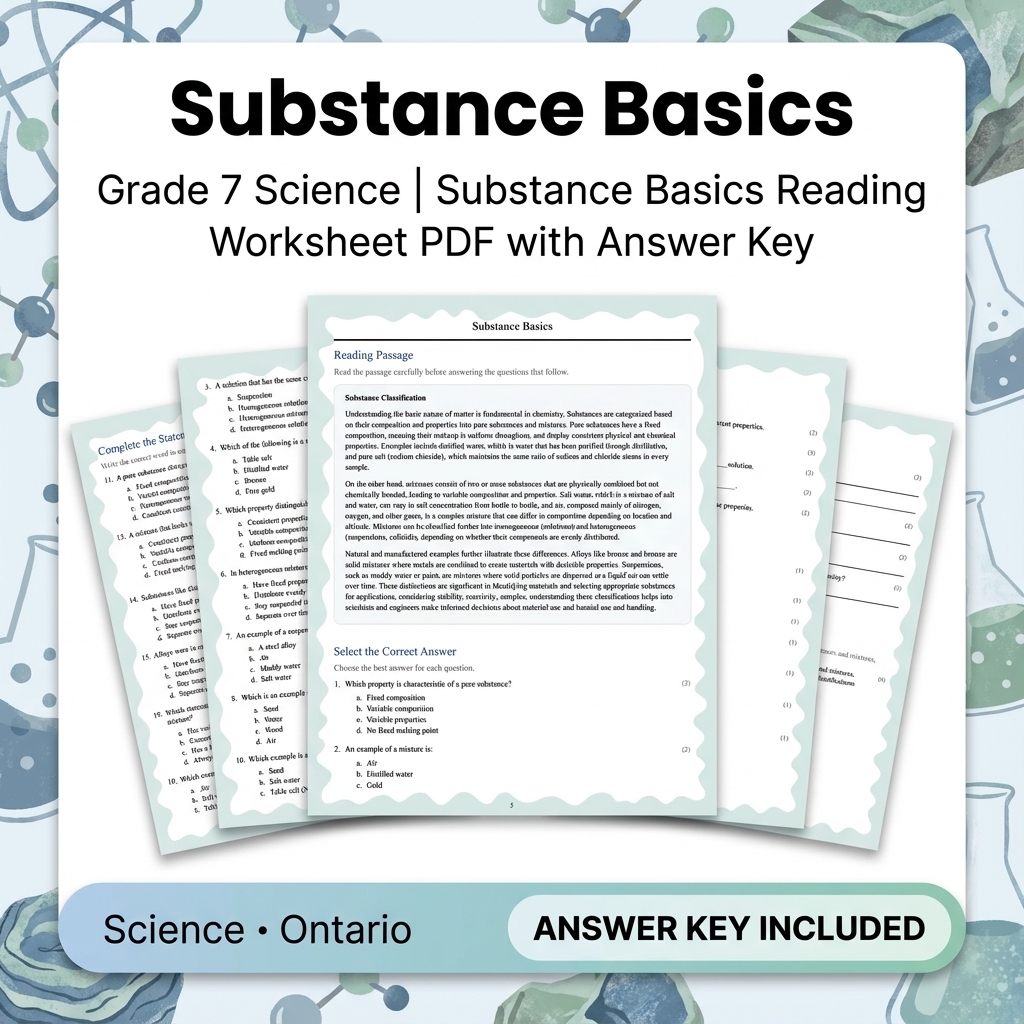
Grade 7 Science | Substance Basics Reading Worksheet PDF with Answer Key
JCreated byJ.S SheetsLearning Objectives
- Understand the classification of substances into pure substances and mixtures.
- Identify examples of elements, compounds, and mixtures in real-world contexts.
- Recognize the properties that distinguish pure substances from mixtures.
Also included in: Grade 7 Science Unit Bundle | Properties of Matter & Separation Techniques (Worksheet Pack) +1 more
Instant download
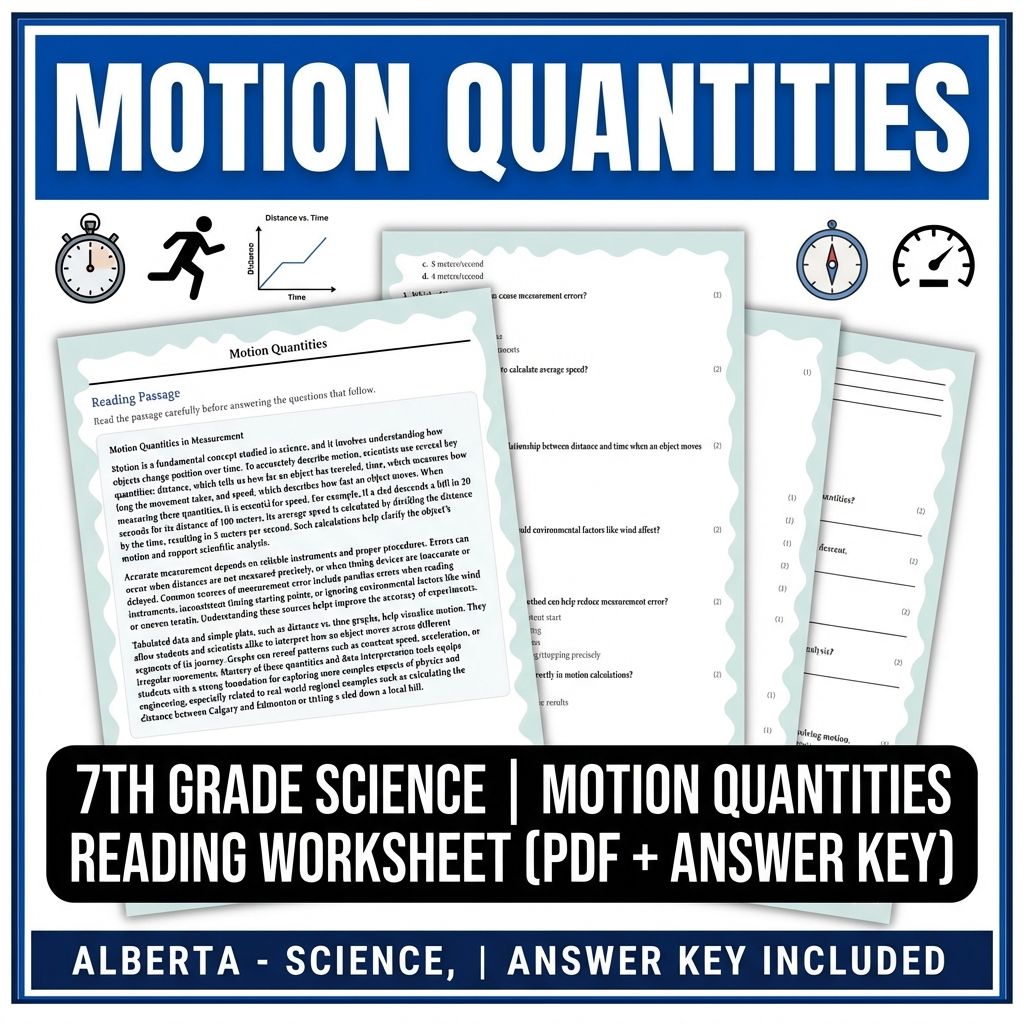
7th Grade Science | Motion Quantities Reading Worksheet (PDF + Answer Key)
JCreated byJ.S SheetsLearning Objectives
- Understand and explain the basic quantities used to describe motion: distance, time, and speed.
- Learn how to accurately record and interpret motion data.
- Calculate average speed from given distance and time.
Also included in: Grade 7 Science | Forces, Motion & Structural Concepts (Answer Keys Included) +1 more
Instant download
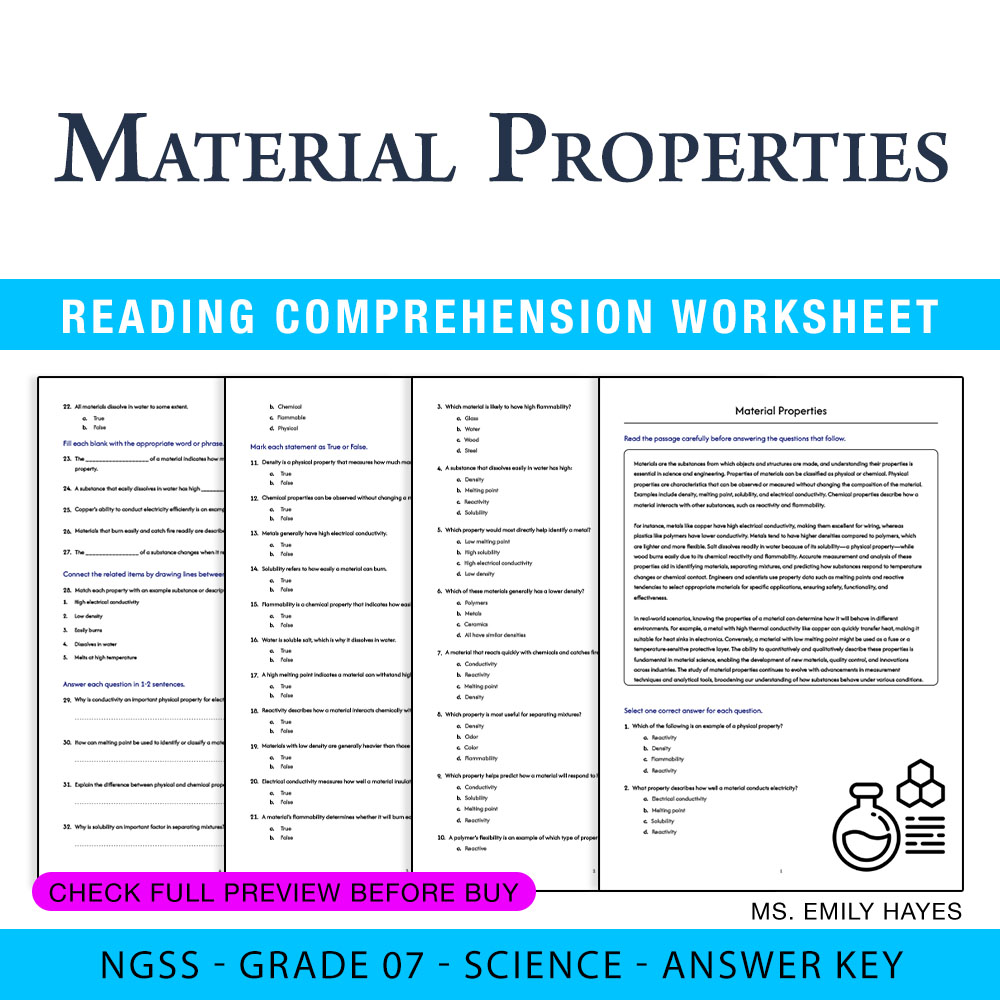
7th Grade Science | Material Properties Worksheet (PDF +Answer Key)
 Created byCopper Leaf Classroom
Learning Objectives
- Identify and differentiate between physical and chemical properties of materials with examples.
- Analyze data related to density, melting point, solubility, electrical conductivity, reactivity, and flammability to classify materials.
- Understand how measurable properties support material identification and separation techniques.
Instant download
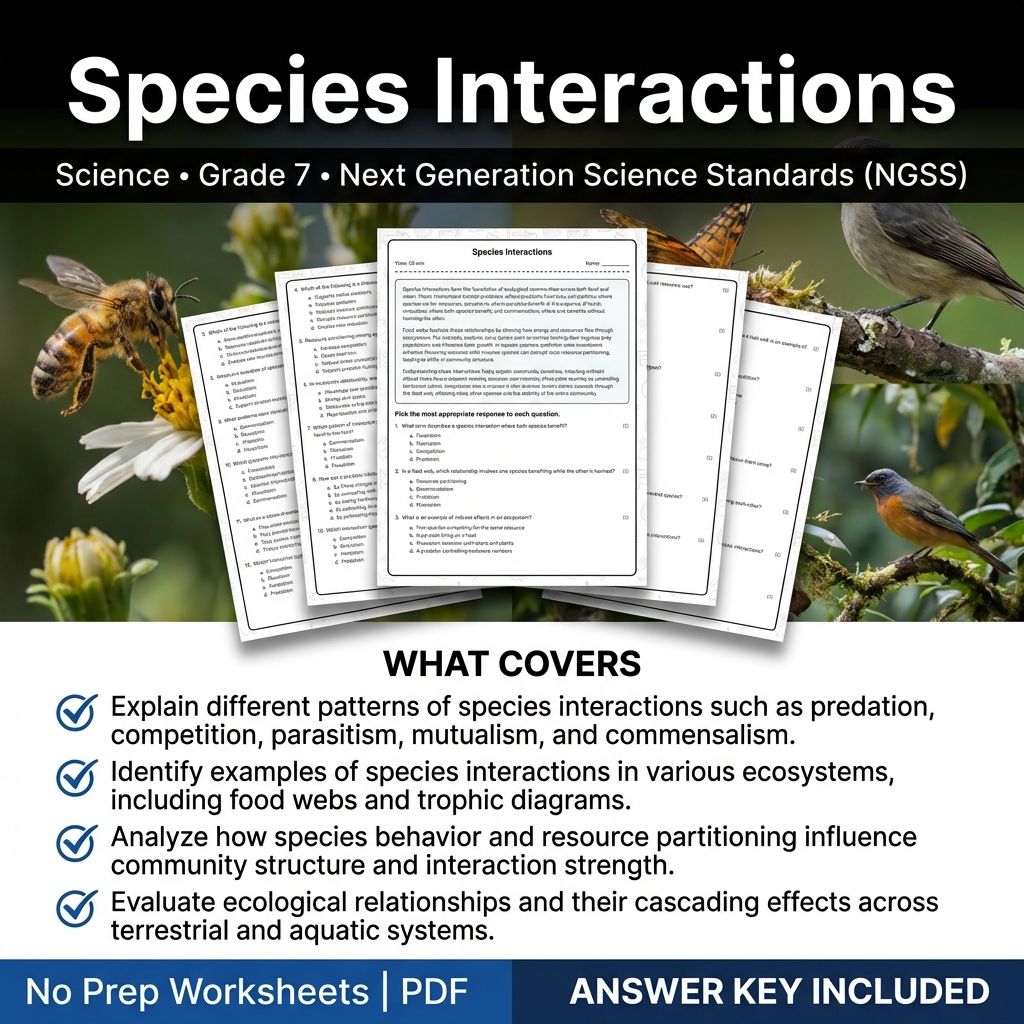
7th Grade Science | Species Interactions Worksheet & Answer Key (Printable PDF)
Created byCoral Reef LearningLearning Objectives
- Explain different patterns of species interactions such as predation, competition, parasitism, mutualism, and commensalism.
- Identify examples of species interactions in various ecosystems, including food webs and trophic diagrams.
- Analyze how species behavior and resource partitioning influence community structure and interaction strength.
Instant download
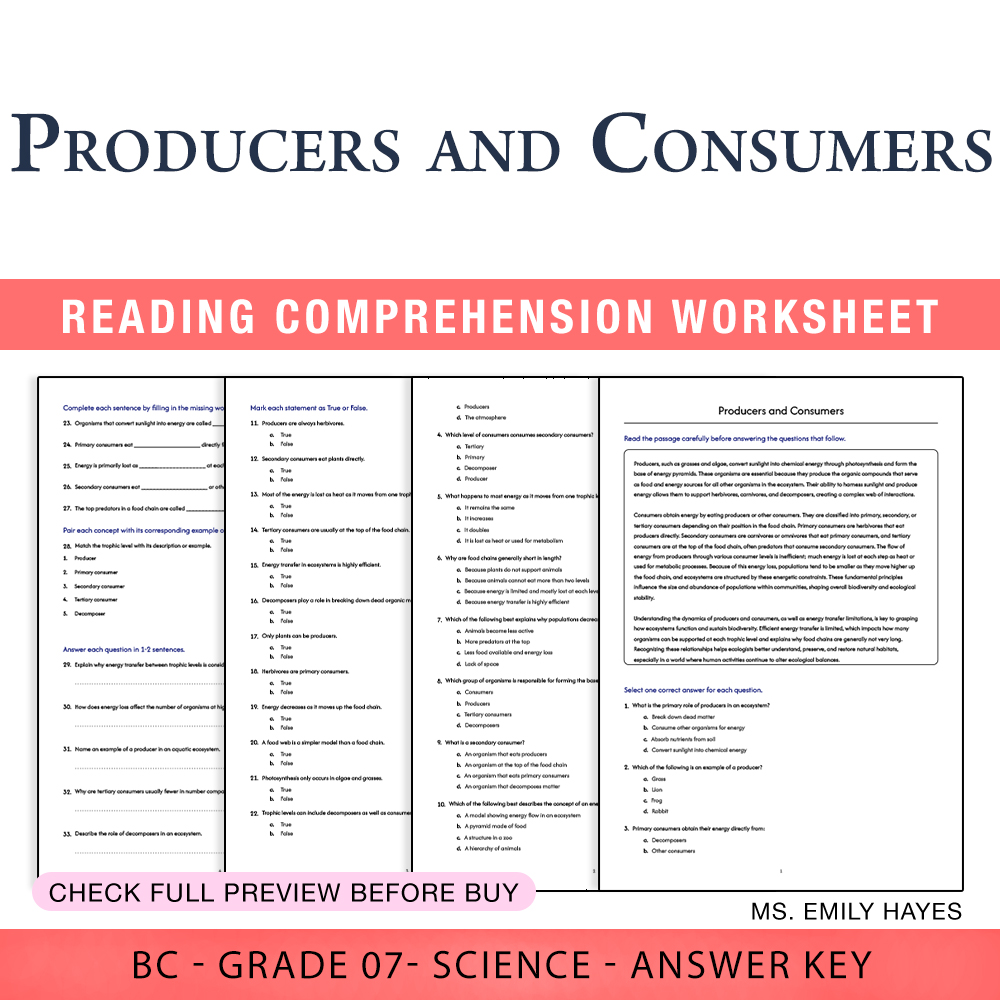
7th Grade Science | Producers and Consumers Worksheet (PDF+ Answer Key)
Created byCopper Leaf ClassroomLearning Objectives
- Understand the roles of producers and consumers in an ecosystem
- Explain how energy is transferred between trophic levels and why it is inefficient
- Describe how these energy dynamics influence population sizes and community structure
Also included in: Grade 7 Science Bundle | Ecosystem Dynamics & Population (PDF+ Answer Key) +1 more
Instant download
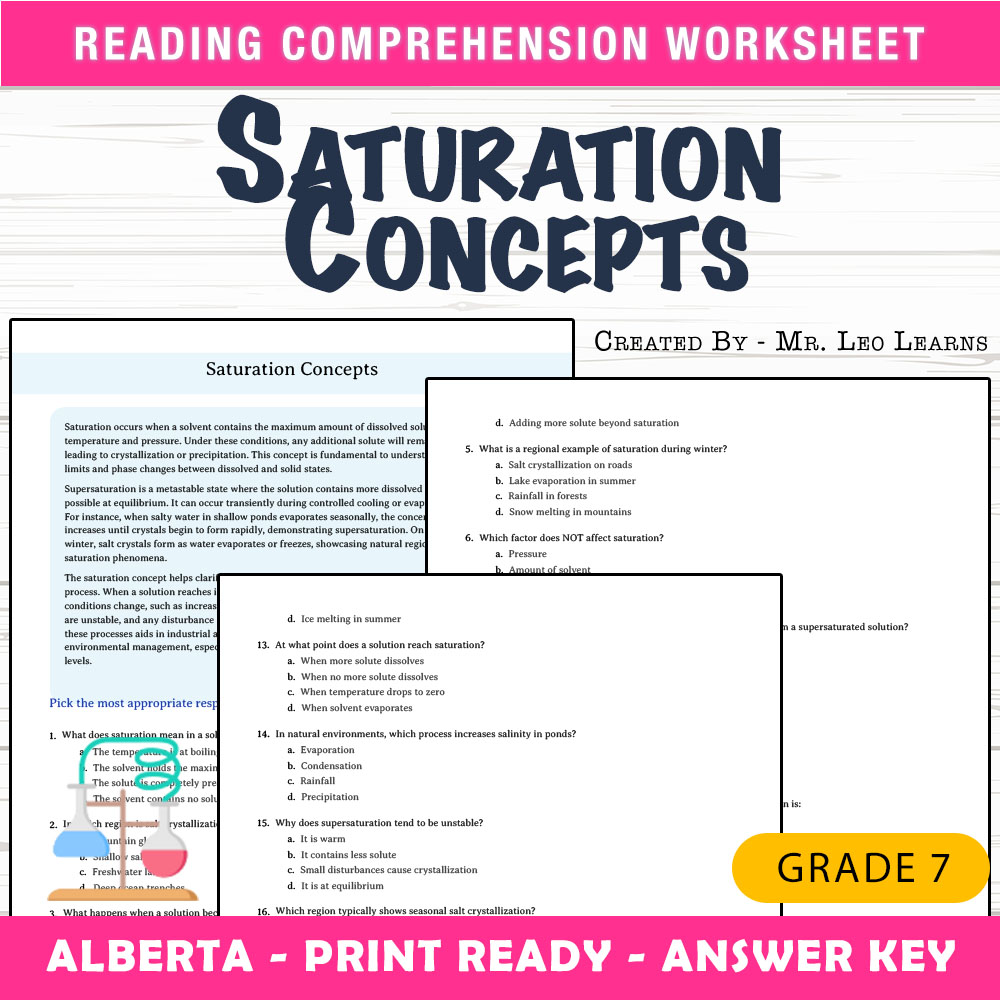
Grade 7 Science — Saturation Concepts Worksheet for Mastery
 Created byThe Resource Hub
Learning Objectives
- Understand the definition of saturation and supersaturation in solutions.
- Identify conditions leading to saturation and crystallization.
- Recognize regional examples of saturation phenomena.
Also included in: Grade 7 Science Alberta Matter and Chemical Change Worksheet Collection +1 more
Instant download

Argumentation Models Worksheet | Grade 7 Science Activities
Created byPrism Point LearningLearning Objectives
- Construct evidence-based scientific arguments using claims, evidence, and reasoning that are logically coherent.
- Critique and compare argumentation models by evaluating data quality, graphical representations, and limits of inference.
- Use quantitative results and model-based explanations to support or refute a hypothesis while citing sources of information.
Also included in: Grade 7 Scientific Data & Argumentation Science Lesson Bundle (TEKS)
Instant download
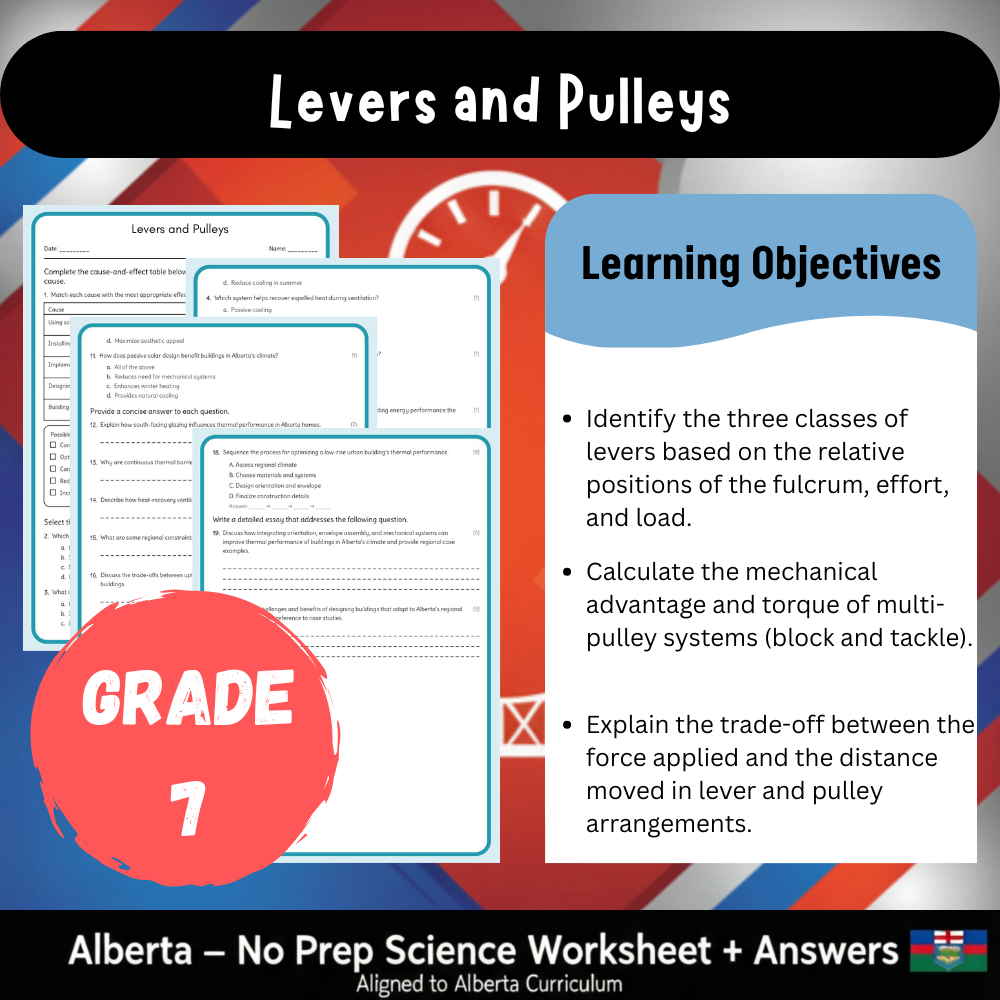
Grade 7 Science | Levers and Pulleys Worksheet (PDF) – Alberta Standard
Created byBright Mind ResourcesLearning Objectives
- Understand the basic principles of levers and pulley systems and how they modify effort and direction.
- Calculate torque and mechanical advantage in lever and pulley arrangements.
- Relate geometry and physics concepts to force multiplication in real-world examples.
Instant download
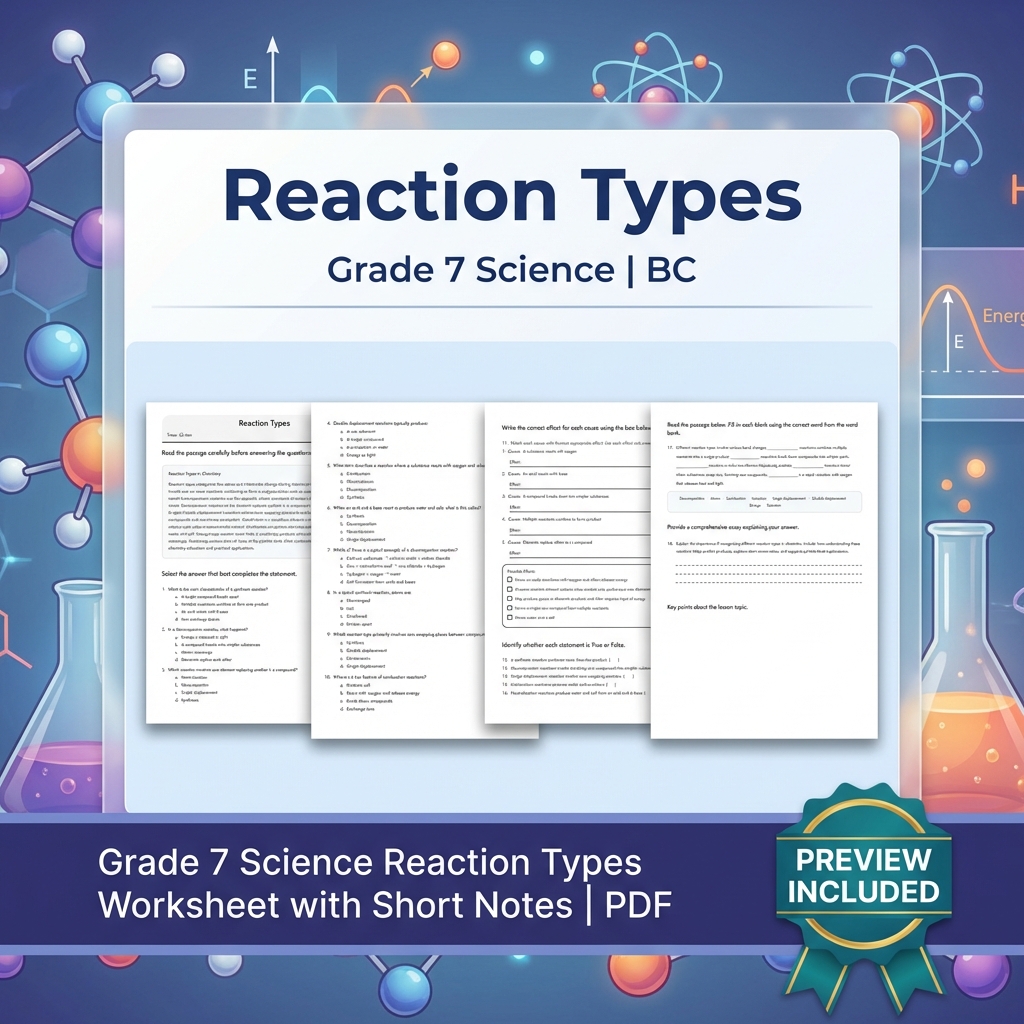
Grade 7 Science Reaction Types Worksheet with Short Notes | PDF
 Created byMeadowlark Worksheets
Learning Objectives
- Understand the different categories of chemical reactions, including synthesis, decomposition, single and double displacement, acid–base neutralization, and combustion.
- Identify and classify reaction types based on given chemical equations and descriptions.
- Explain particle-level processes involved in various reaction types and how atoms rearrange during reactions.
Also included in: Grade 7 Science Lesson Bundle | BC Framework on Matter & Reactions Worksheets +1 more
Instant download

Grade 7 Science - Conservation Status Worksheet (Alberta Standard) (PDF)
 Created byEvergreen Desk Education
Learning Objectives
- Explain how conservation status assessments use population trends, threat severity, and recovery potential.
- Interpret evidence from examples (such as swift fox and at-risk plants) to identify why a species is vulnerable.
- Describe how land use, genetic diversity, and habitat connectivity affect species persistence.
Instant download

Atomic Structure Assessment for Grade 7 Science | TEKS Standards
Created byPrism Point LearningLearning Objectives
- Describe the basic subatomic particles of protons, neutrons, and electrons and their roles in atomic structure.
- Explain how atomic number and mass number define element identity and isotopic variation.
- Identify simple electron arrangements and relate them to element properties and periodic trends.
Also included in: Grade 7 Matter and Energy Science Lesson Bundle: TEKS assessments
Instant download

Population Models Test Prep Printables | Grade 7 Science
Created byPrism Point LearningLearning Objectives
- Explain how exponential and logistic population models describe population growth over time.
- Distinguish density-dependent and density-independent factors using real examples.
- Use population model ideas to interpret patterns in how populations change in ecosystems.
Also included in: Ecosystems & Interactions Lesson Bundle – Grade 7 Science BC Framework +1 more
Instant download
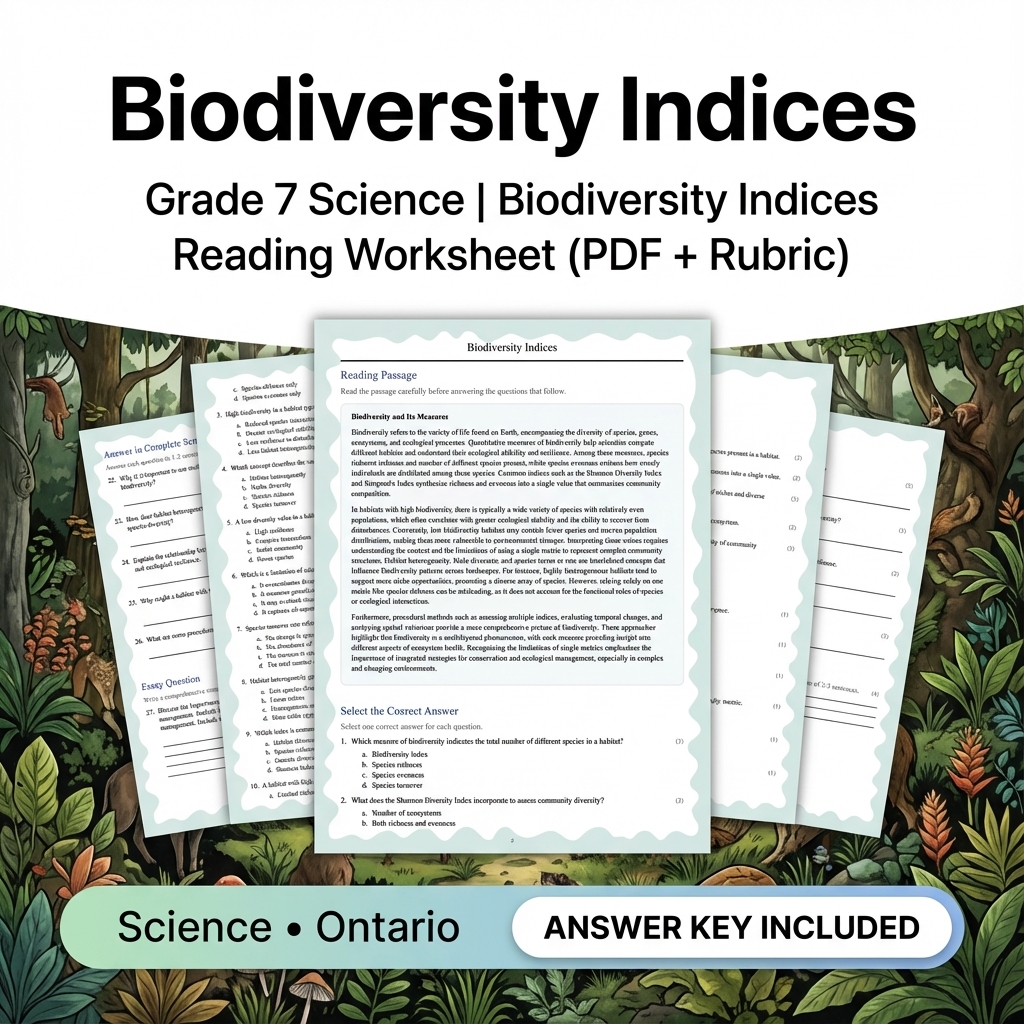
Grade 7 Science | Biodiversity Indices Reading Worksheet (PDF + Rubric)
JCreated byJ.S SheetsLearning Objectives
- Understand the concept of biodiversity and how it is measured using various indices.
- Interpret the significance of high and low biodiversity values across different habitats.
- Recognize the relationships between habitat heterogeneity, niche diversity, and species turnover.
Also included in: Grade 7 Science | Ecosystems, Biodiversity & Environmental Stewardship +1 more
Instant download
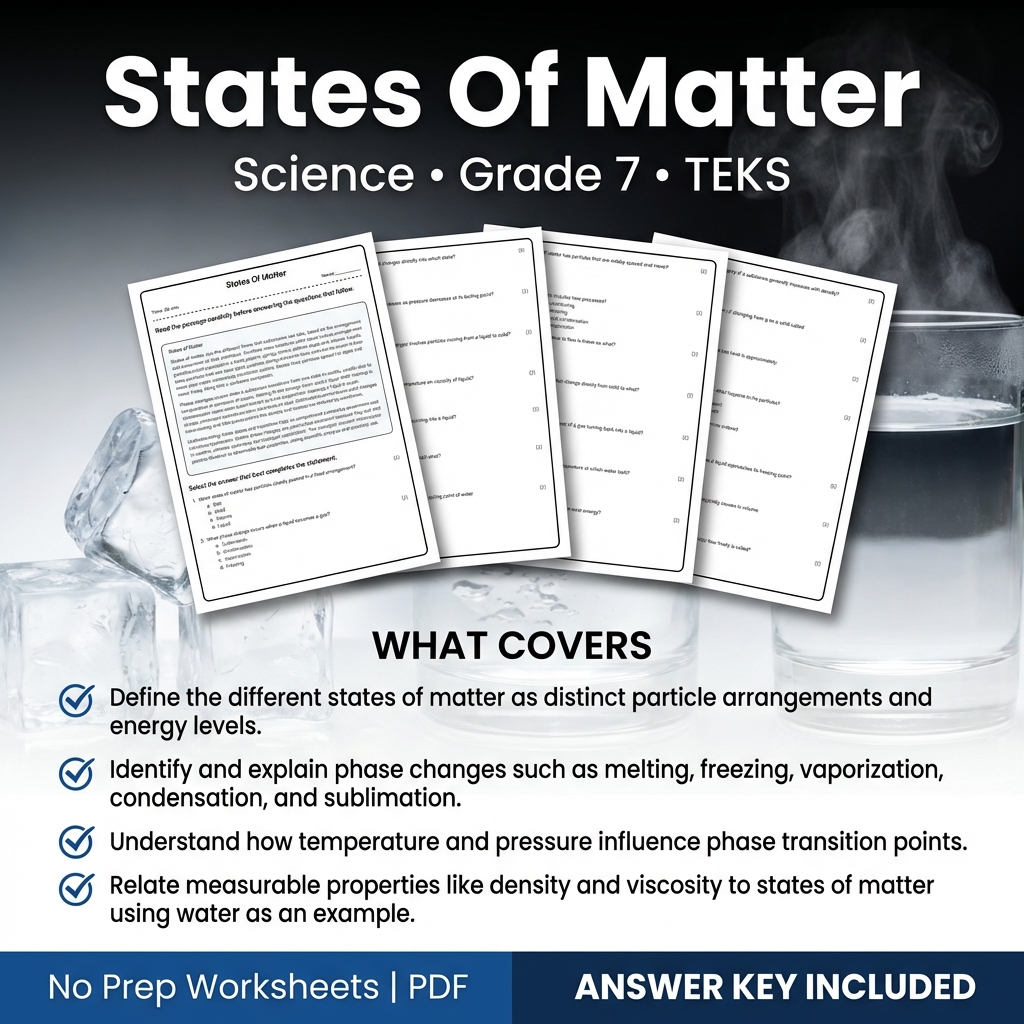
States Of Matter Grade 7 Science Worksheet | TEKS Aligned
Created byCoral Reef LearningLearning Objectives
- Define the different states of matter as distinct particle arrangements and energy levels.
- Identify and explain phase changes such as melting, freezing, vaporization, condensation, and sublimation.
- Understand how temperature and pressure influence phase transition points.
Instant download

Grade 7 Science – Cell Membrane Structure & Function | Daily Reading Worksheet
Created byBright Mind ResourcesLearning Objectives
- Identify the components of the cell membrane.
- Understand the functions of phospholipids, proteins, cholesterol, and carbohydrates in the membrane.
- Explain how the fluid mosaic model maintains cellular homeostasis.
Also included in: Cell Function & Transport Grade 7 Science Daily Reading Worksheets Bundle | BC +1 more
Instant download
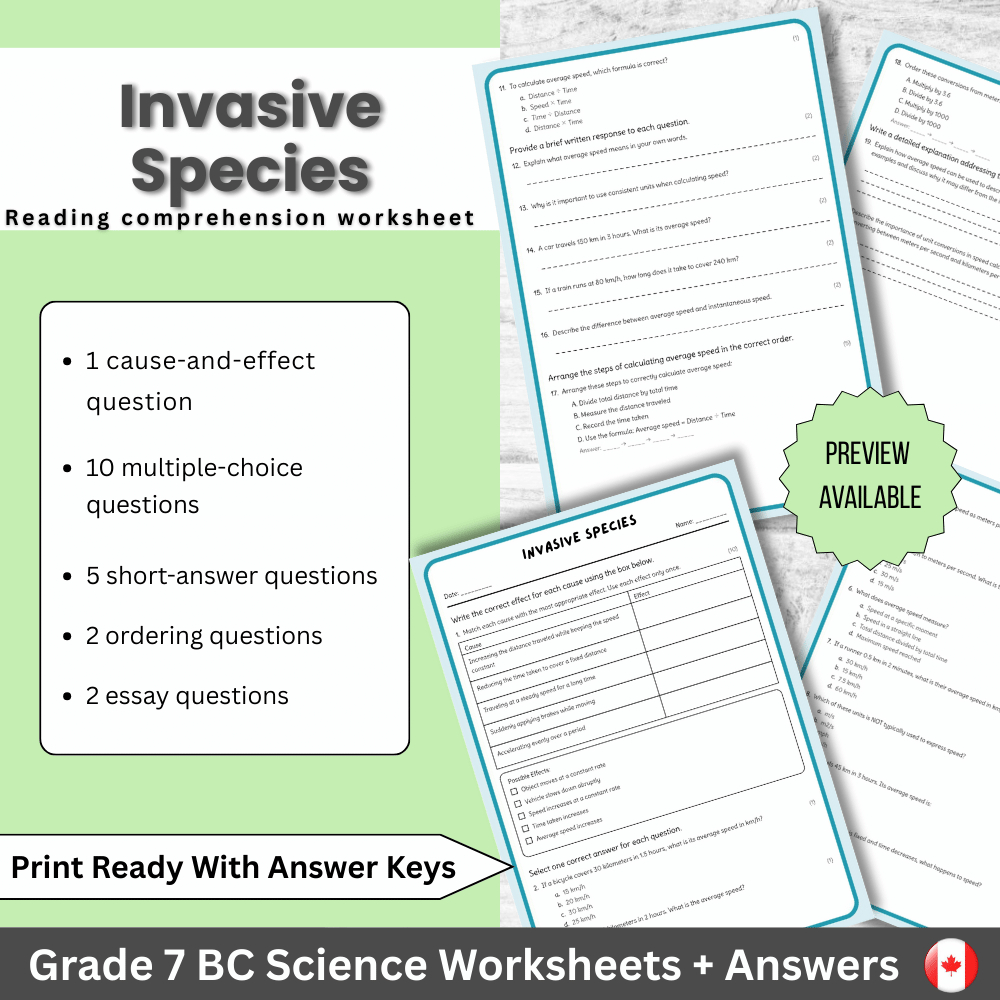
Grade 7 Science | Invasive Species Worksheet + Answer Key | BC Standards
Created byBright Mind ResourcesLearning Objectives
- Understand how invasive species spread and establish in new environments.
- Identify ecological impacts caused by invasive species.
- Explain the mechanisms behind invasion and their effect on native ecosystems.
Instant download

Grade 7 Science Equilibrium Worksheet | NGSS Forces & Balanced Systems
 Created byNorthstar Worksheets
Learning Objectives
- Explain equilibrium as the condition where the net force is zero.
- Differentiate static equilibrium from dynamic equilibrium using acceleration and motion.
- Identify examples of balanced forces, including normal and gravitational forces and tension.
Also included in: Grade 7 Science Forces & Motion Lesson Bundle | NGSS Equilibrium & Collisions +1 more
Instant download
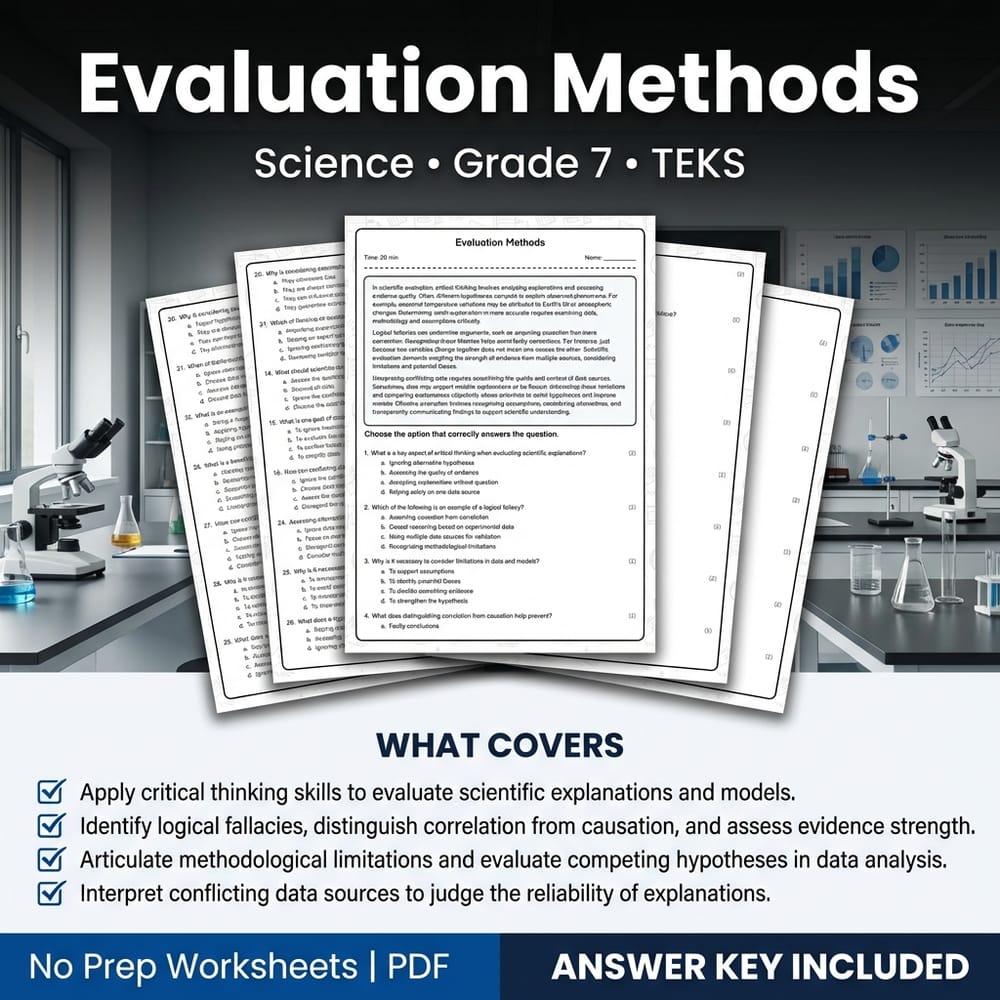
Grade 7 Science Worksheet on Evaluation Methods with Answer Key | TEKS Aligned
Created byCoral Reef LearningLearning Objectives
- Apply critical thinking skills to evaluate scientific explanations and models.
- Identify logical fallacies, distinguish correlation from causation, and assess evidence strength.
- Articulate methodological limitations and evaluate competing hypotheses in data analysis.
Instant download

Grade 7 Science Ecosystem Dynamics Worksheet | CA Standards PDF
Created byEvergreen Desk EducationLearning Objectives
- Explain how energy flows through trophic levels in an ecosystem.
- Describe how matter cycles through ecosystems via nutrient availability and decomposition.
- Predict how changes in resources can cause cascading effects in consumer populations.
Instant download

Grade 7 Science – Inclined Planes Daily Reading Worksheet + Answer Key
JCreated byJ.S SheetsLearning Objectives
- Identify the components of forces acting on inclined planes.
- Explain how inclined planes reduce the effort needed to move loads.
- Calculate mechanical advantage of inclined planes.
Also included in: Grade 7 Science Lesson Group | Structural Engineering & Motion Worksheets +1 more
Instant download
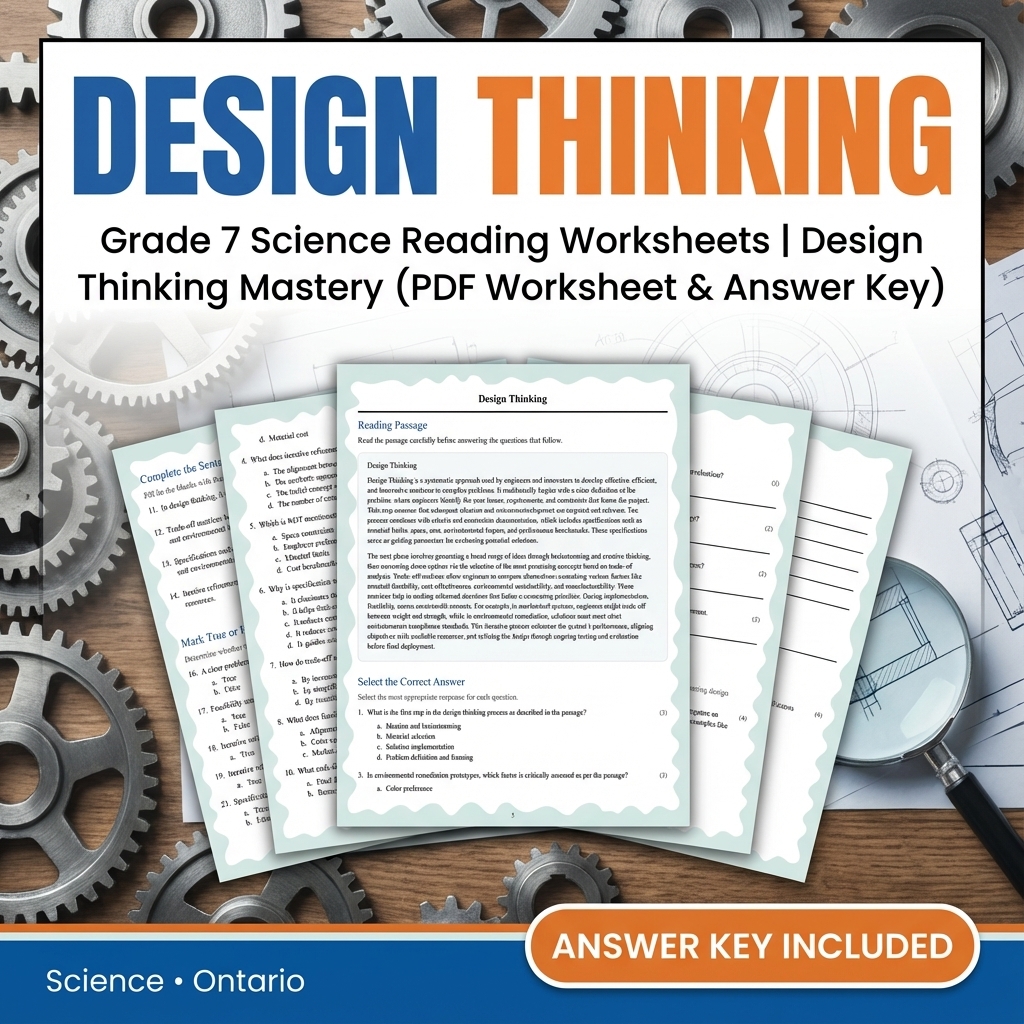
Grade 7 Science Reading | Design Thinking Mastery (PDF & Answer Key)
JCreated byJ.S SheetsLearning Objectives
- Understand the fundamental principles of engineering design, including problem definition, criteria, and constraints.
- Learn how to formulate specifications and evaluate feasible solutions considering materials, costs, and environmental factors.
- Explore the use of trade-off matrices and performance indicators in selecting optimal design concepts.
Also included in: Grade 7 Science Unit Bundle | Inquiry, Data & Modeling Skills +1 more
Instant download

Grade 7 Science | Cell Overview - Daily Reading Comprehension
Created byCoral Reef LearningLearning Objectives
- Identify the main parts of a cell
- Understand the functions of cell organelles
- Recognize the diversity of cell shapes and components
Instant download
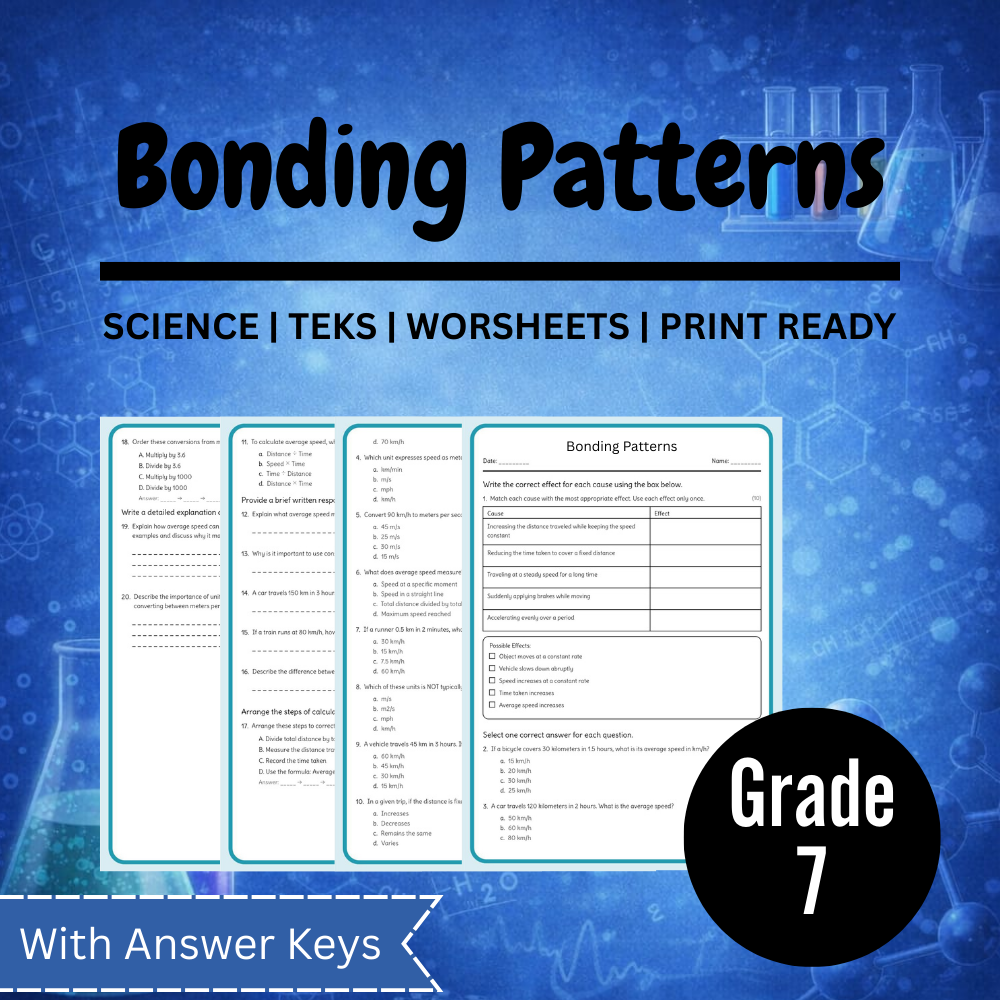
Grade 7 Science – Bonding Patterns Worksheet (Science 1 + TEKS) PDF
Created byBright Mind ResourcesLearning Objectives
- Distinguish between ionic and covalent bonding interactions
- Relate bonding types to properties like melting point, solubility, and electrical conductivity
- Describe formation of binary ionic salts and molecular compounds using empirical formulas
Also included in: Grade 7 Science Unit Bundle | States of Matter & Atomic Structure Worksheets +2 more
Instant download

Science Worksheet Filtration Methods Grade 7 | Standards-Aligned Practice
JCreated byJ.S SheetsLearning Objectives
- Explain how filtration separates particles based on pore size and particle properties.
- Compare filtration with sedimentation using particle size, density, and phase differences.
- Describe real-world applications and limitations of filtration for suspensions, precipitates, dissolved solutes, and colloids.
Instant download
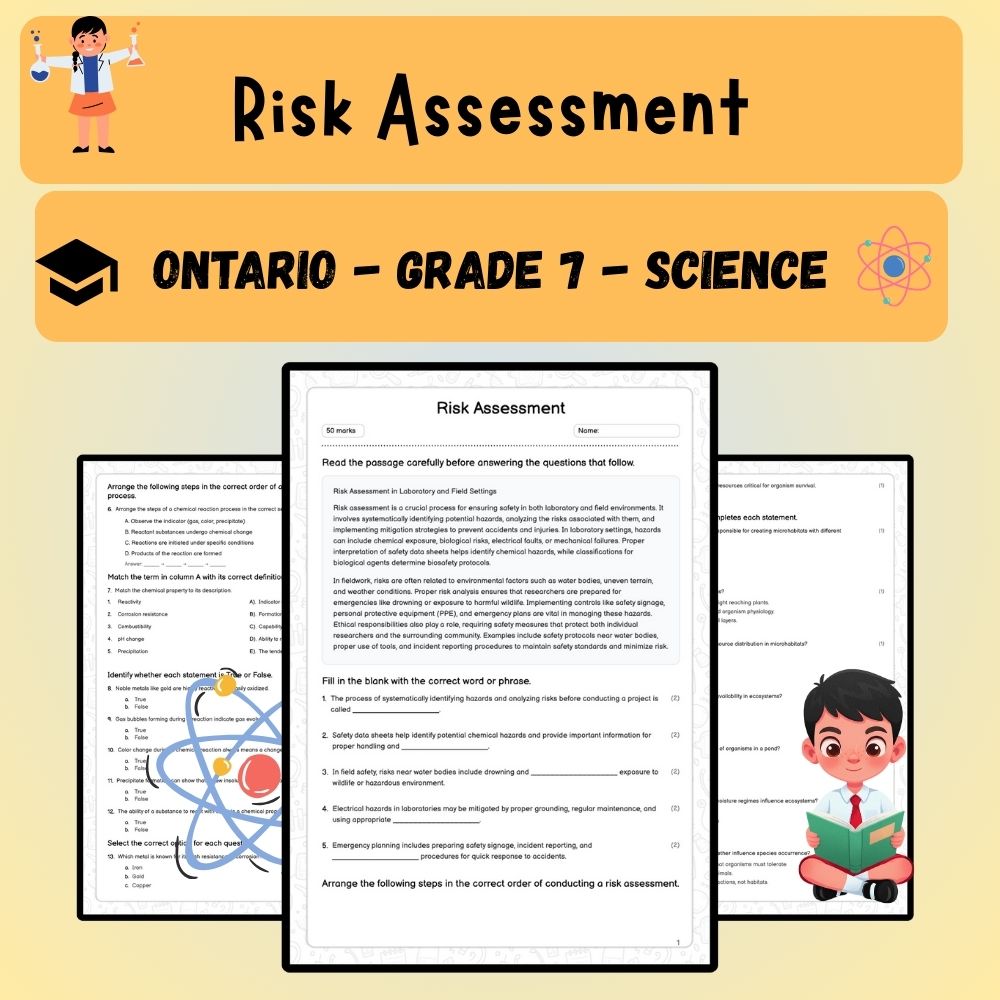
Grade 7 Science – Risk Assessment Worksheet (PDF ) | Ontario Standards
Created byPrism Point LearningLearning Objectives
- Understand the principles of hazard identification and risk analysis in laboratory and field environments.
- Identify different safety hazards including chemical, biological, electrical, and mechanical risks.
- Practice developing mitigation strategies and emergency planning measures for safety.
Also included in: Grade 7 Science UNIT Worksheet Bundle – Scientific Inquiry & Data Skills (PDF) +1 more
Instant download
About Grade 7 Science Worksheets
Browse 6,039 printable Grade 7 Science worksheets — ready-to-print PDFs with answer keys where available.
Every worksheet on MyTeachingSheets is created by independent teacher-authors and reviewed before publication. All resources download as printable PDFs for classroom, homework, or at-home practice, and many include answer keys. Preview any worksheet free before buying.