
Grade 7 Science Worksheets
6,039 worksheets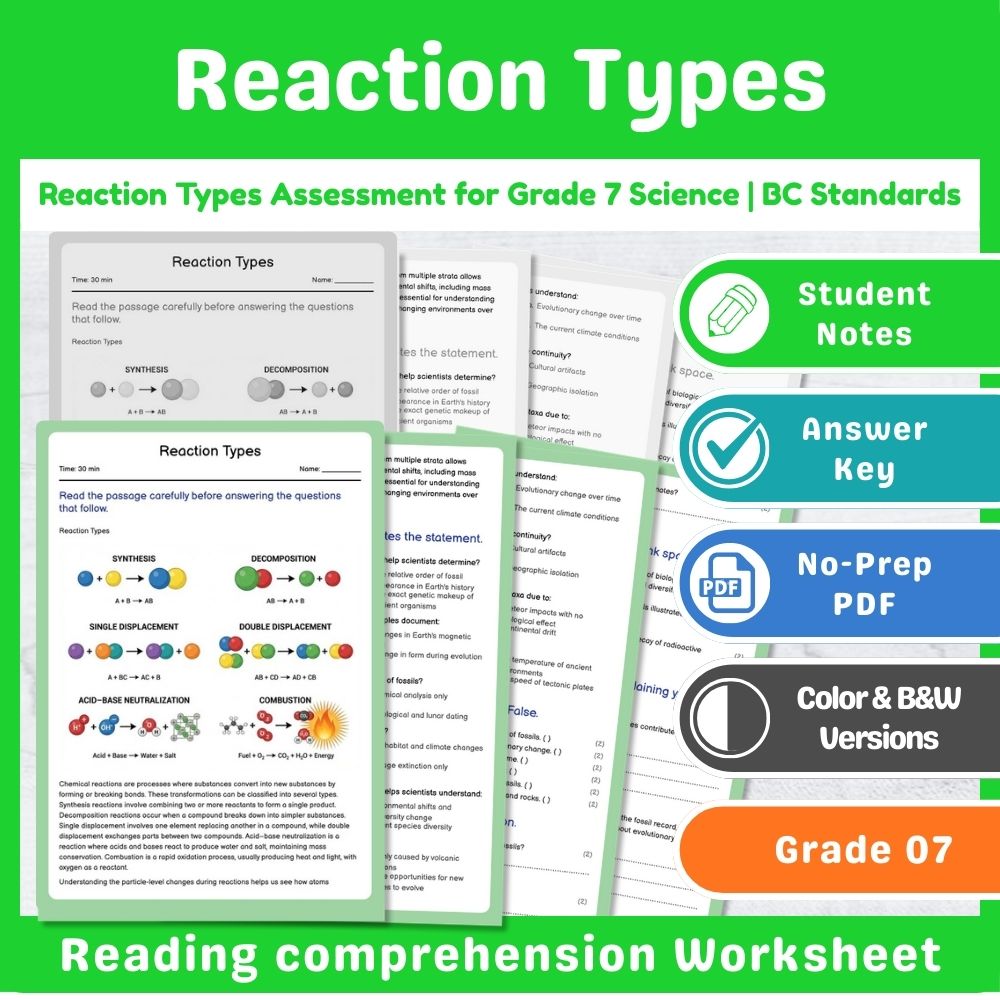
Reaction Types Assessment for Grade 7 Science | BC Standards
 Created byPrism Point Learning
Learning Objectives
- Identify and describe different types of chemical reactions including synthesis, decomposition, single and double displacement, acid-base neutralization, and combustion.
- Recognize patterns in reactant and product changes to classify reaction types.
- Explain particle-level processes such as bond breaking and forming during reactions.
Instant download
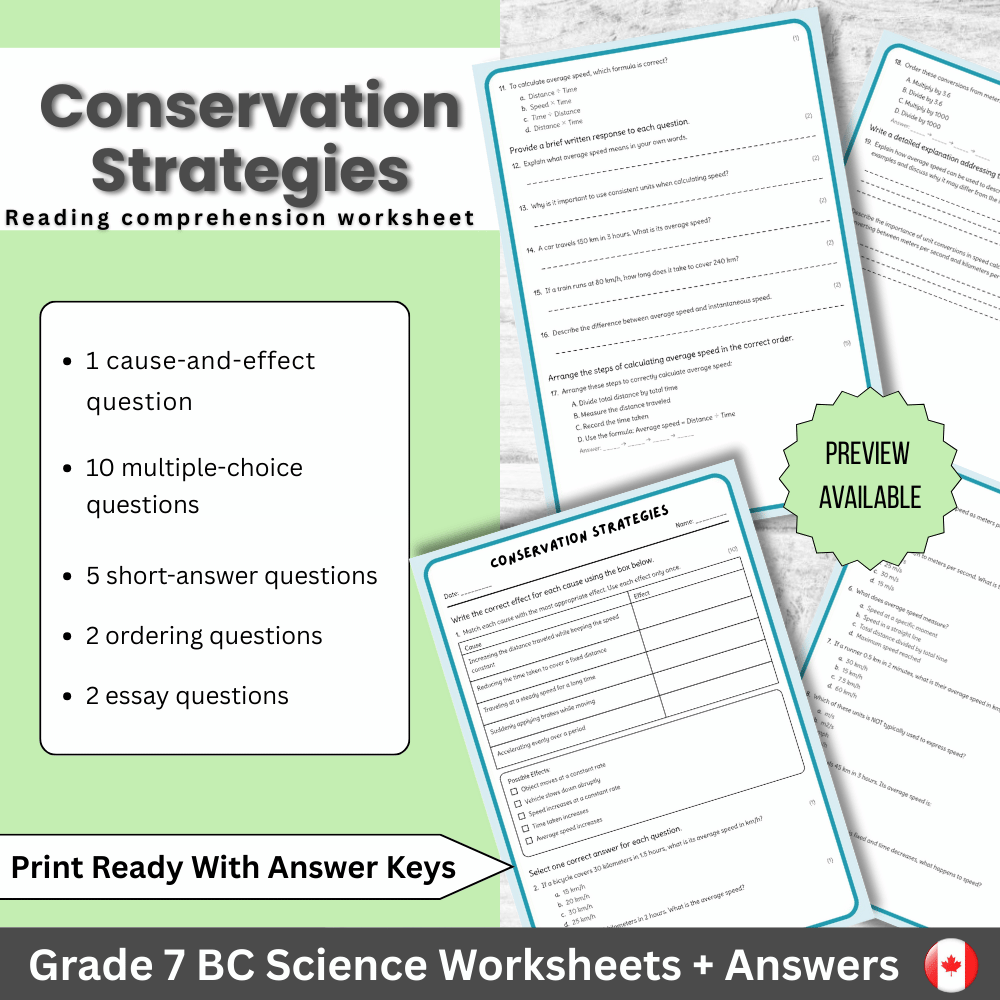
Grade 7 Science | Conservation Strategies Worksheet Aligned with BC Standards
 Created byBright Mind Resources
Learning Objectives
- Understand various conservation strategies including habitat protection, restoration, and species management.
- Identify methods used to reduce human impacts on ecosystems.
- Explain how ecological concepts like food webs and population dynamics inform conservation efforts.
Instant download

Grade 7 Science | Mass Wasting & Coastal Erosion - Daily Reading Comprehension
 Created byCoral Reef Learning
Learning Objectives
- Understand what causes landslides and coastal erosion.
- Analyze how water and gravity influence Earth's surface changes.
- Identify causes and effects of mass wasting and coastal processes.
Instant download

Evaluation Methods Worksheet for Grade 7 Science | TEKS Aligned
JCreated byJ.S SheetsLearning Objectives
- Evaluate scientific explanations by checking assumptions, evidence quality, and methodological limits.
- Distinguish correlation from causation and use alternative hypotheses to avoid misleading conclusions.
- Assess the strength and reliability of evidence by comparing models, data consistency, and measurement methods.
Instant download
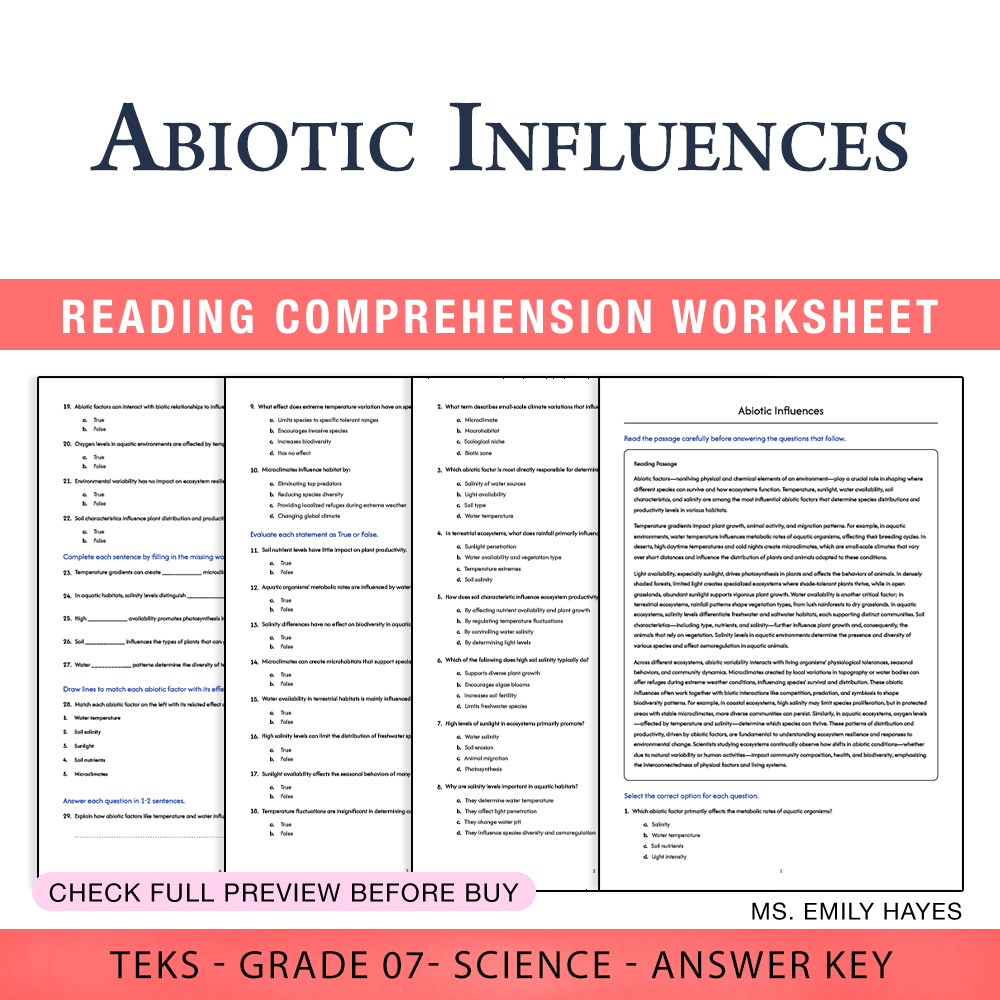
7th Grade Science | Abiotic Influences Worksheet (PDF+ Answer Key)
 Created byCopper Leaf Classroom
Learning Objectives
- Understand how nonliving factors such as temperature, light, water, soil, and salinity influence species distribution and ecosystem productivity.
- Describe how gradients and microclimates affect organism adaptations and seasonal patterns.
- Analyze the interaction between abiotic factors and biotic relationships in shaping biodiversity and ecosystem functions.
Instant download

Technical Communication Assessment | TEKS Grade 7 Science Standards
Created byPrism Point LearningLearning Objectives
- Understand the conventions used in technical drawings and schematics.
- Identify and interpret standardized symbols, units, and labels in technical documentation.
- Explain the importance of clarity, scale, and tolerances in technical communication.
Instant download
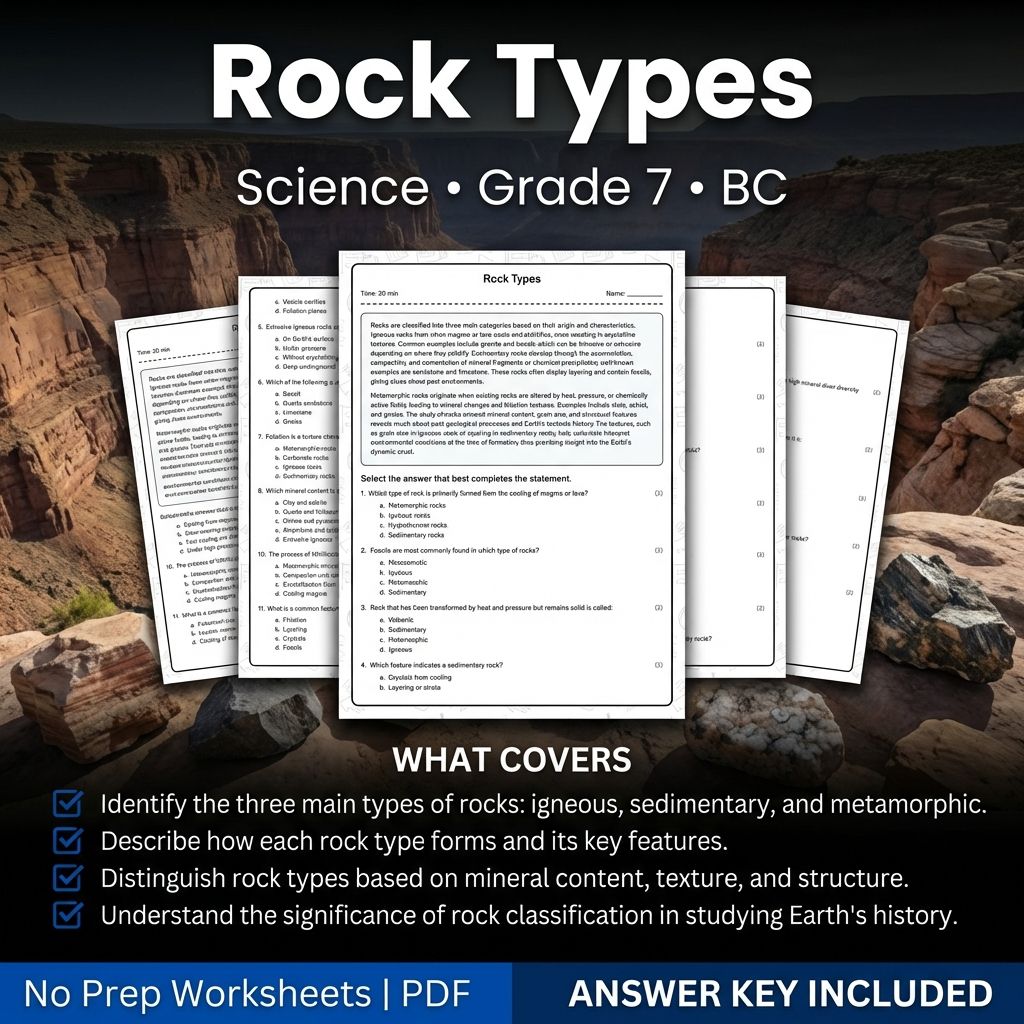
7th Grade Science | Rock Types Worksheet & Answer Key (Printable PDF)
Created byCoral Reef LearningLearning Objectives
- Identify the three main types of rocks: igneous, sedimentary, and metamorphic.
- Describe how each rock type forms and its key features.
- Distinguish rock types based on mineral content, texture, and structure.
Instant download
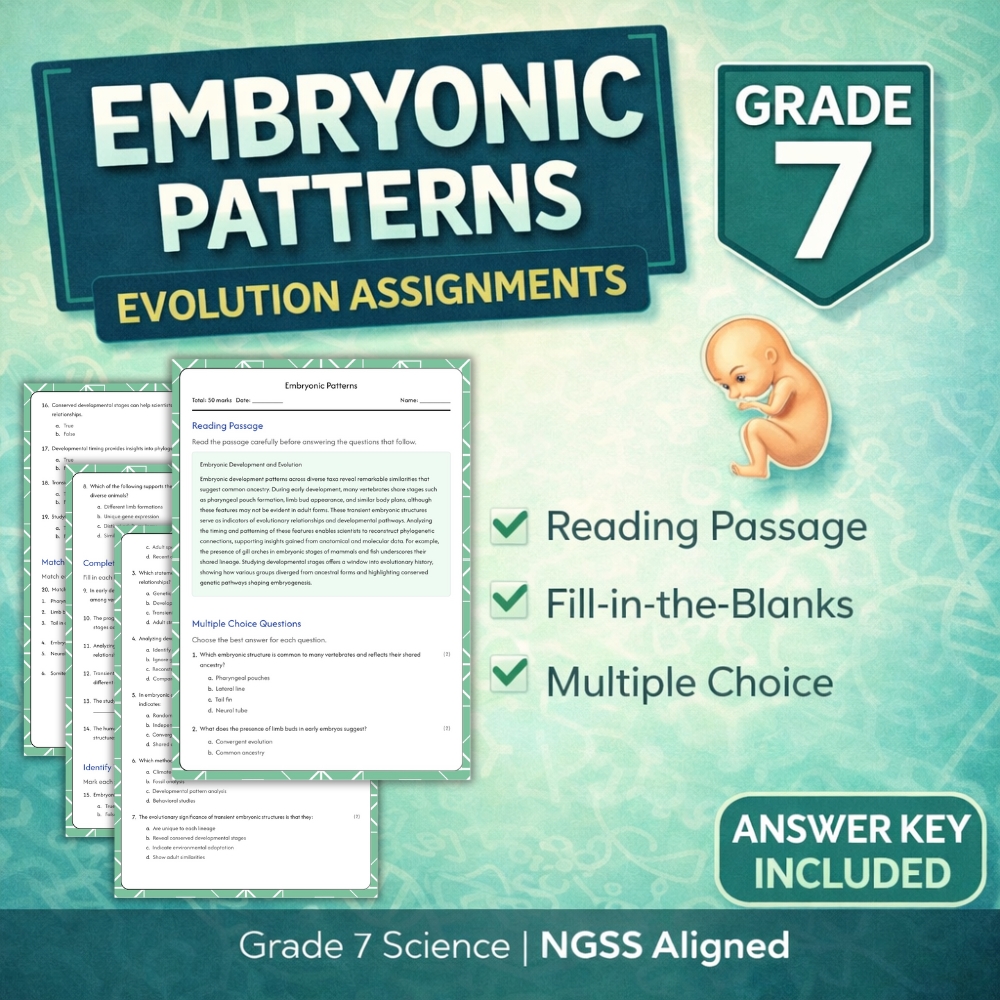
Grade 7 Science | Embryonic Patterns NGSS Worksheet (Answer Key) PDF
 Created byCedar Grove Learning
Learning Objectives
- Compare and identify developmental stages across different animal taxa.
- Explain the significance of conserved embryonic structures in evolutionary relationships.
- Analyze how patterning and timing support phylogenetic reconstruction.
Instant download

Conservation of Matter Assessment | California Standards Grade 7 Science
Created byPrism Point LearningLearning Objectives
- Explain conservation of matter in terms of atoms rearranging in a closed system
- Identify how physical and chemical changes differ while still conserving total mass
- Use evidence from mass measurements to support the claim that total mass stays constant in a closed system
Also included in: Grade 7 Forces and Matter Science Lesson Bundle: California Standards +1 more
Instant download
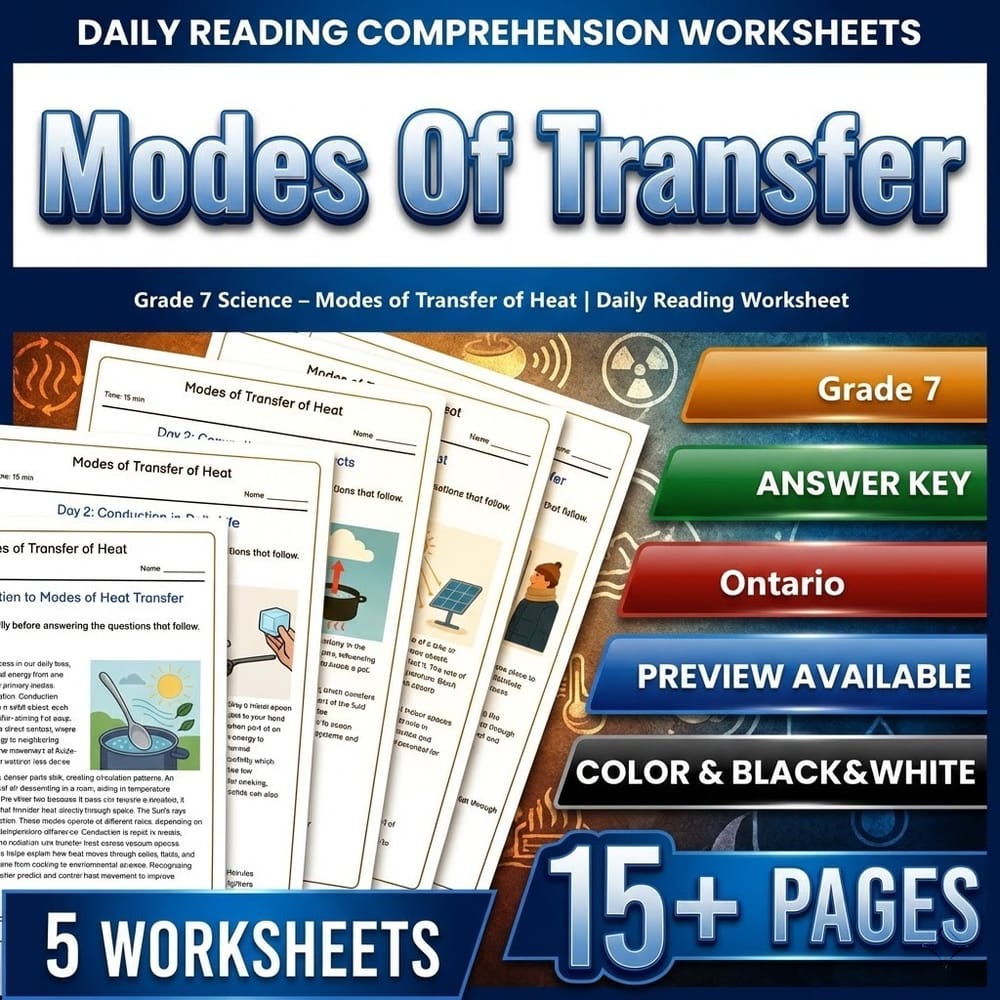
Grade 7 Science – Modes of Transfer of Heat | Daily Reading Worksheet
 Created byQuiet Forest Education
Learning Objectives
- Understand key concepts related to Science
- Apply knowledge through practice questions
- Demonstrate comprehension of the material
Also included in: Thermal Energy Grade 7 Science Daily Reading Worksheets Bundle | Ontario +1 more
Instant download

Grade 7 Design Solutions Worksheet | Practice & Alberta Standards PDF
 Created byClear Sky Classroom
Learning Objectives
- Explain how building orientation and south-facing glazing can support passive solar heating in Alberta’s climates.
- Describe how thermal barriers and reduced thermal bridging improve a building envelope’s thermal performance.
- Compare how heat-recovery ventilation can conserve energy while maintaining indoor air quality.
Instant download
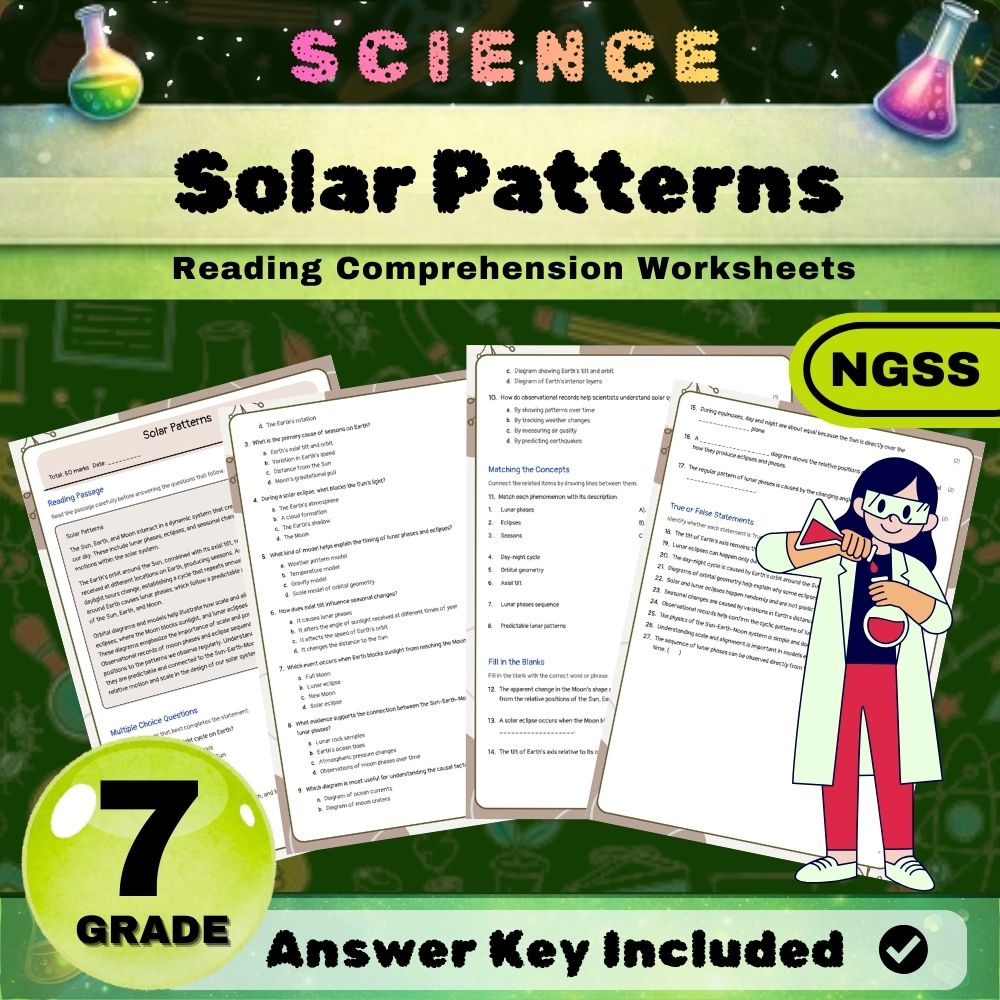
Grade 7 Science | Solar Patterns NGSS Worksheet (PDF) for Engaged Learning
 Created byMaple Path Learning
Learning Objectives
- Describe how relative motions of the Sun, Earth, and Moon produce observable cyclic patterns such as lunar phases, eclipses, and seasonal changes.
- Explain how diagrams of orbital geometry and axial tilt relate to day-night cycles and phase timing.
- Use observational records and phase sequences as evidence connecting positional relationships to predictable solar system patterns.
Instant download
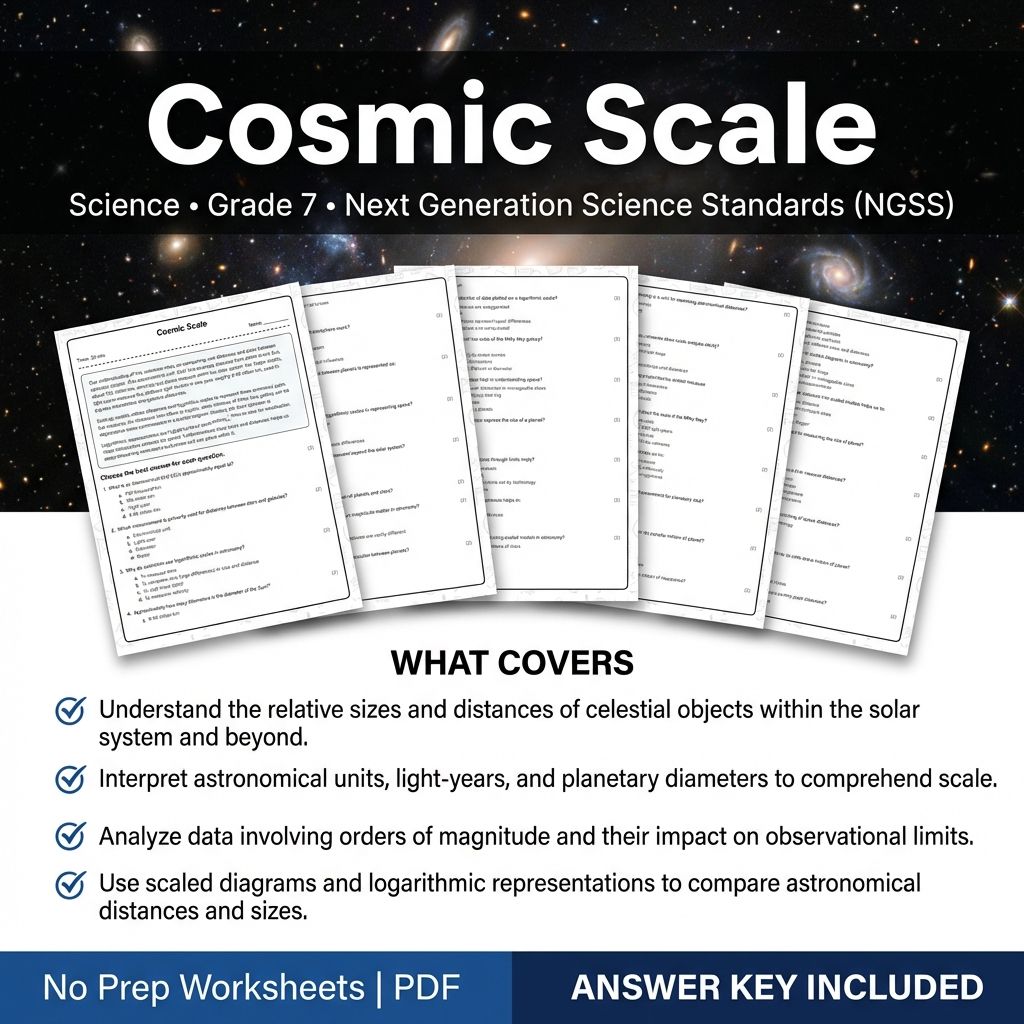
Grade 7 Science Worksheet | Cosmic Scale Concepts (PDF & Answer Key)
Created byCoral Reef LearningLearning Objectives
- Understand the relative sizes and distances of celestial objects within the solar system and beyond.
- Interpret astronomical units, light-years, and planetary diameters to comprehend scale.
- Analyze data involving orders of magnitude and their impact on observational limits.
Instant download
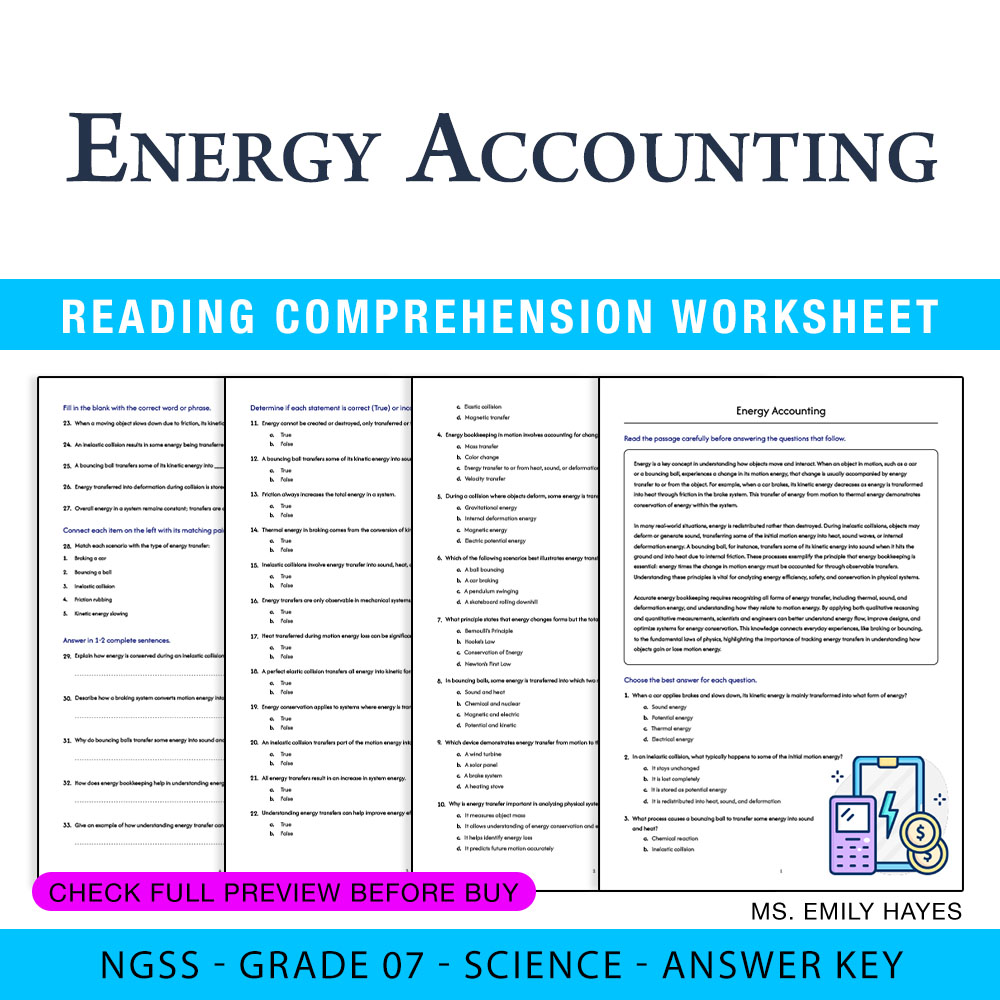
Grade 7 Science | Energy Accounting Worksheet (PDF+ Answer Key)
Created byCopper Leaf ClassroomLearning Objectives
- Describe how changes in an object's motion energy are linked to energy transfers into or out of the object.
- Analyze scenarios such as braking cars, inelastic collisions, and bouncing balls to identify energy transfers.
- Apply quantitative and qualitative reasoning to understand conservation and transfer of energy in motion.
Instant download
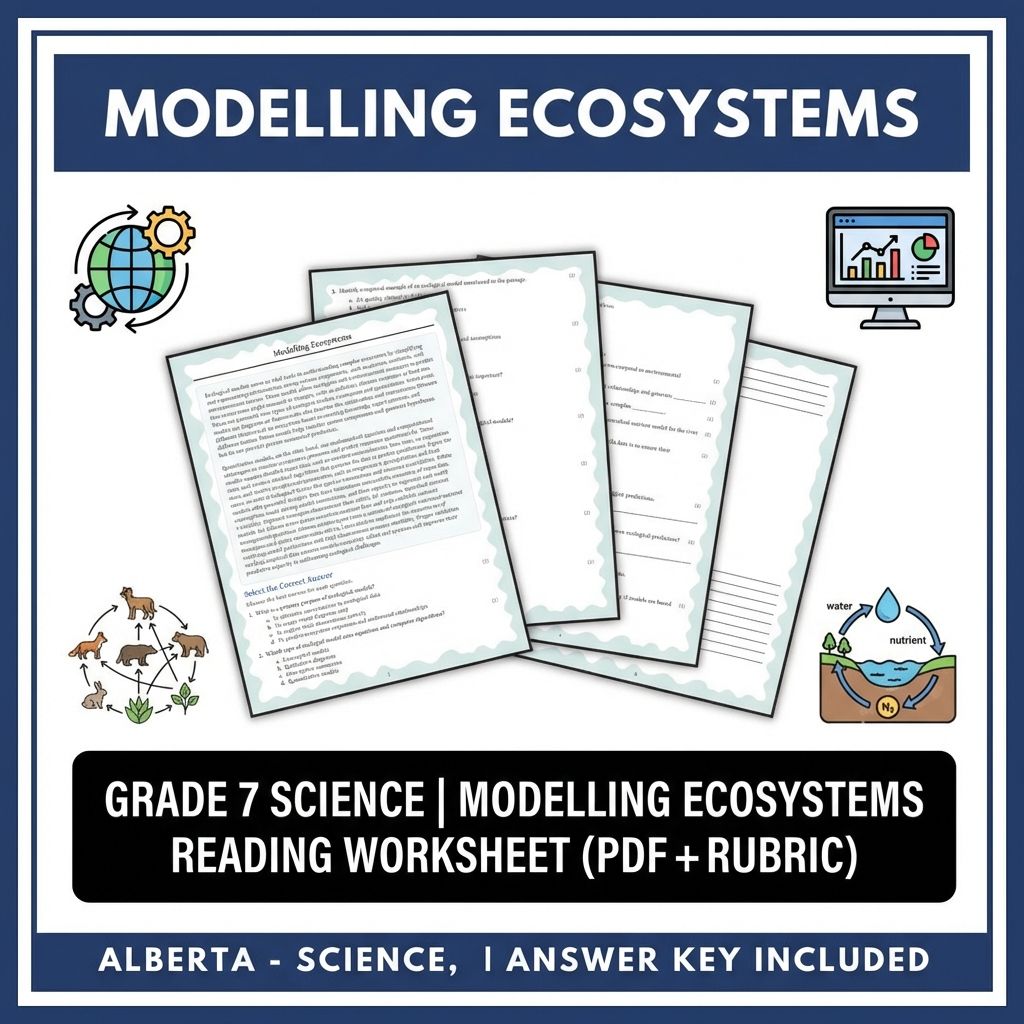
Grade 7 Science | Modelling Ecosystems Reading Worksheet (PDF + Rubric)
JCreated byJ.S SheetsLearning Objectives
- Understand the concept of ecological modelling and its applications.
- Differentiate between conceptual and quantitative models in ecology.
- Identify the inputs, limitations, and regional examples of ecological models.
Also included in: Grade 7 Science Bundle | Ecology, Ecosystems & Environmental Topics (Pack) +1 more
Instant download
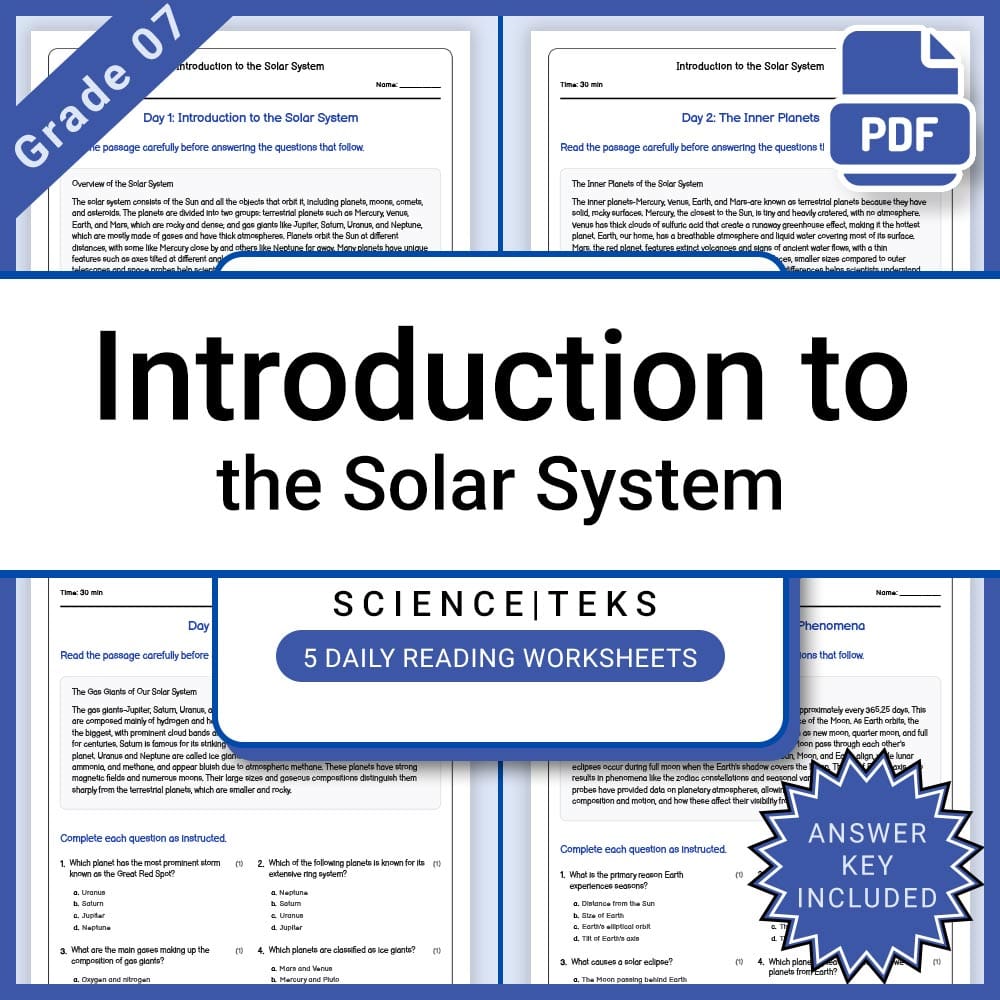
Grade 7 Science – Introduction to the Solar System Worksheet Answer Key
JCreated byJ.S SheetsLearning Objectives
- Understand key concepts related to Science
- Apply knowledge through practice questions
- Demonstrate comprehension of the material
Also included in: Grade 7 Science Lesson Group – TEKS Aligned & Concept-Focused Lesson Bundle +1 more
Instant download

Grade 7 Representations Worksheet | NGSS Practice PDF
Created byClear Sky ClassroomLearning Objectives
- Identify different types of representations used to convey matter interactions.
- Interpret graphs, equations, and tabulated data in scientific contexts.
- Select appropriate representations for quantitative comparison and communication.
Also included in: Grade 7 Matter and Its Interactions Science Lesson Bundle NGSS Worksheets +1 more
Instant download

Grade 7 Particle Model Worksheet | Practice & Assessment PDF
Created byClear Sky ClassroomLearning Objectives
- Explain how matter can be described as made of particles too small to see
- Relate temperature to the average motion of particles
- Describe how particle spacing and collisions affect properties such as pressure and diffusion
Instant download
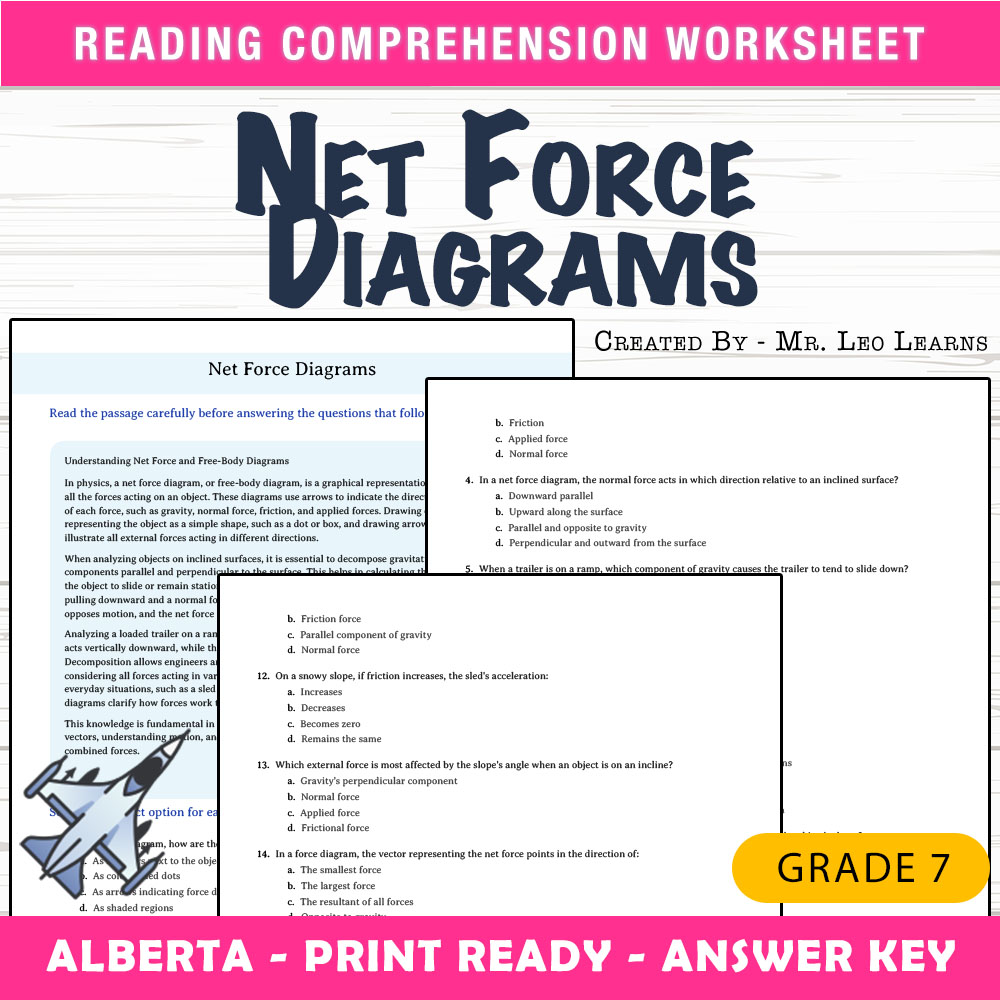
Grade 7 Science — Net Force Diagrams Worksheet for Mastery
 Created byThe Resource Hub
Learning Objectives
- Understand the purpose and drawing conventions of free-body diagrams.
- Identify the components of forces acting on objects on inclined surfaces.
- Apply vector addition to determine net force and acceleration.
Also included in: Grade 7 Science Alberta Forces Structures and Motion Worksheet Bundle +1 more
Instant download
Grade 7 Science — Human Impacts Worksheet for Mastery
Created byThe Resource HubLearning Objectives
- Identify major human-induced environmental changes such as habitat fragmentation, pollution, and invasive species.
- Explain the effects of human impacts on biodiversity, ecosystem services, and trophic structures.
- Describe approaches to mitigate and restore ecosystems affected by human activities.
Also included in: Grade 7 Science Unit Bundle – Ecosystems, Cells & Adaptations Worksheet Pack +1 more
Instant download

Grade 7 Science | Action-Reaction Forces - Daily Reading Comprehension
Created byCoral Reef LearningLearning Objectives
- Explain the concept of action-reaction forces.
- Identify examples of action-reaction forces in daily life.
- Describe how the forces are equal and opposite regardless of object movement.
Instant download
Grade 7 Science – Population Limits & Growth | Daily Worksheet
Created byQuiet Forest EducationLearning Objectives
- Understand basic concepts of population growth models
- Distinguish between exponential and logistic growth
- Identify limiting factors influencing population size
Also included in: Ecosystem Dynamics Grade 7 Science Daily Reading Worksheets Bundle | Ontario +1 more
Instant download
Grade 7 Science – Closed Systems Worksheet (Answer Key) | BC Standards
Created byBright Mind ResourcesLearning Objectives
- Understand the difference between closed and open systems regarding matter transfer.
- Recognize the importance of system boundaries in interpreting mass during reactions.
- Identify examples of closed and open systems in real-world scenarios.
Instant download

Grade 7 Science: Energy and Matter in Living Systems Worksheet | BC Practice PDF
Created byClear Sky ClassroomLearning Objectives
- Explain the roles of photosynthesis and cellular respiration in transferring energy in plants
- Use vocabulary correctly to describe gas exchange and energy conversion
- Identify the main idea of scientific paragraphs and choose supporting concepts
Instant download
Grade 7 Science — History of Innovation Worksheet for Mastery
Created byThe Resource HubLearning Objectives
- Understand the causes and factors that lead to technological inventions and innovations.
- Identify historical examples of inventions and analyze their diffusion and modification over time.
- Distinguish between invention and innovation using real-world examples.
Also included in: Grade 7 Science Unit | Engineering, Technology & Innovation Worksheet Bundle +1 more
Instant download

Grade 7 Science Worksheet | Reaction Observations (PDF) Aligned to Alberta
 Created byEvergreen Desk Education
Learning Objectives
- Describe common observable indicators of chemical reactions, such as gas production, heat change, colour shifts, and precipitate formation.
- Connect specific observations to likely reaction pathways and what they may suggest about particles and mass changes.
- Use precise scientific language to record observations and distinguish between qualitative evidence and explanations.
Instant download

Grade 7 Science | Connection Design in Structural Engineering - Comprehension
Created byCoral Reef LearningLearning Objectives
- Identify different types of structural connections such as bolted, welded, and bearing connections.
- Understand the roles of connections and joints in maintaining load paths.
- Describe shear, bearing, and slip phenomena at connections.
Instant download

Grade 7 Science – Weather Data & Patterns | Daily Reading Worksheet
Created byBright Mind ResourcesLearning Objectives
- Understand how to read and interpret weather data tables and graphs
- Identify key weather variables such as temperature, wind, humidity, and pressure
- Explain how daily weather data can reveal patterns and trends over time
Also included in: Weather, Earth Systems & Human Feedbacks Grade 7 Science Lesson Bundle | General +1 more
Instant download
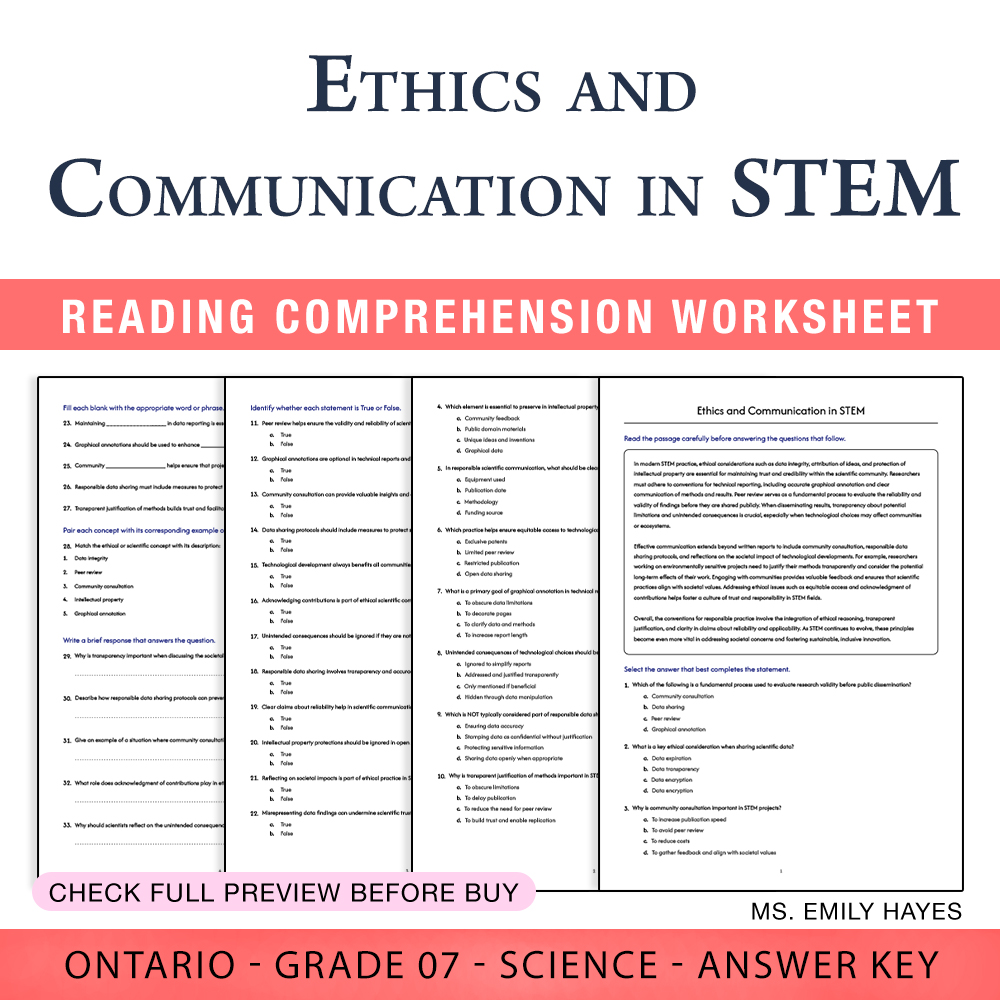
7th Grade Science | Ethics and Communication in STEM Worksheet (PDF+ Answer Key)
Created byCopper Leaf ClassroomLearning Objectives
- Understand the importance of ethical considerations such as data integrity, attribution, and intellectual property in STEM practice.
- Analyze effective communication practices including graphical annotation, peer review, and public presentation of findings.
- Evaluate scenarios involving responsible data sharing, community consultation, and reflection on technological impacts.
Instant download
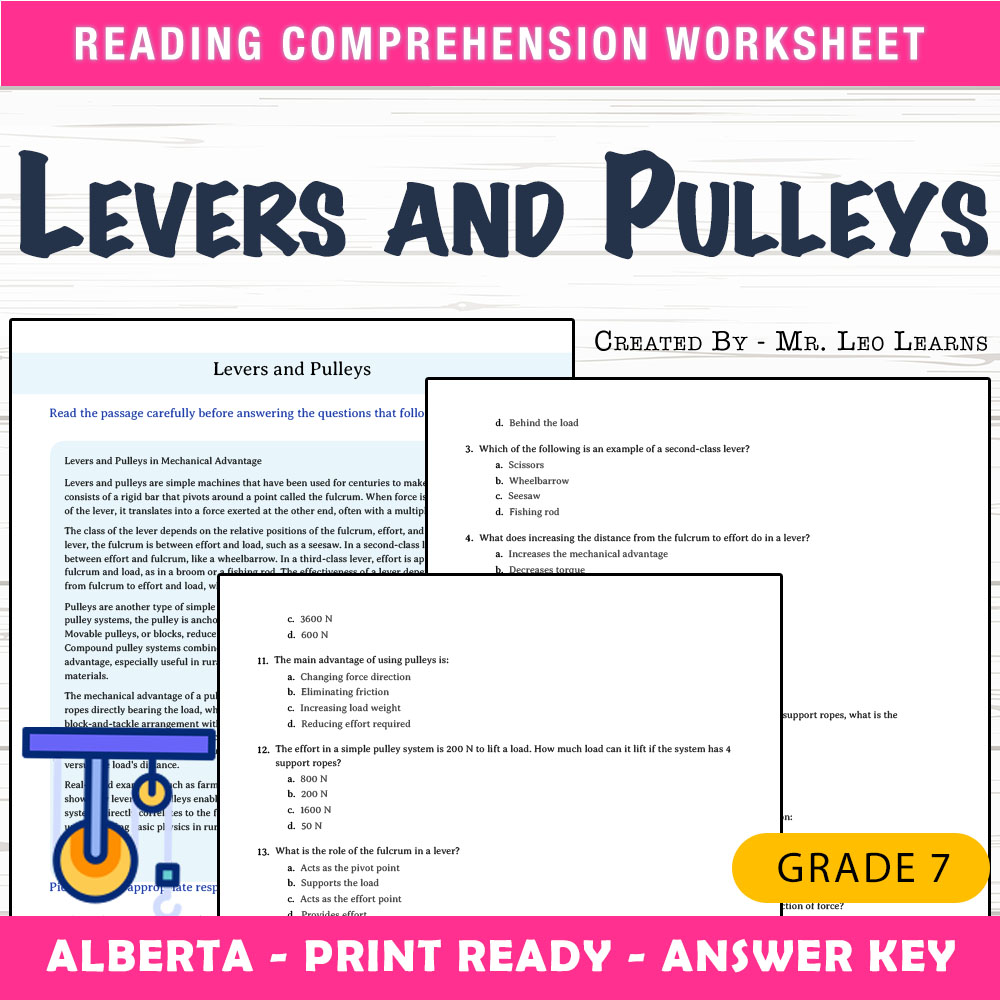
Grade 7 Science — Levers and Pulleys Worksheet MCQ Paper PDF + Answer Key
Created byThe Resource HubLearning Objectives
- Understand the principles of levers and pulley systems and how they provide mechanical advantage.
- Be able to calculate torque, effort, and load relationships in lever and pulley systems.
- Relate geometric arrangements to force multiplication in real-world examples like farm jacks and wheelbarrows.
Also included in: Grade 7 Science Alberta Forces Structures and Motion Worksheet Bundle +1 more
Instant download

Grade 7 Science | Integrated Analysis - Daily Reading Comprehension
Created byCoral Reef LearningLearning Objectives
- Understand different modes of heat transfer: conduction, convection, radiation.
- Analyze how each transfer mode affects energy efficiency in systems.
- Apply principles of energy transfer to real-world systems like passive solar houses.
Also included in: Energy, Heat and Thermal Processes Lesson Bundle: Grade 7 Science Alberta +1 more
Instant download
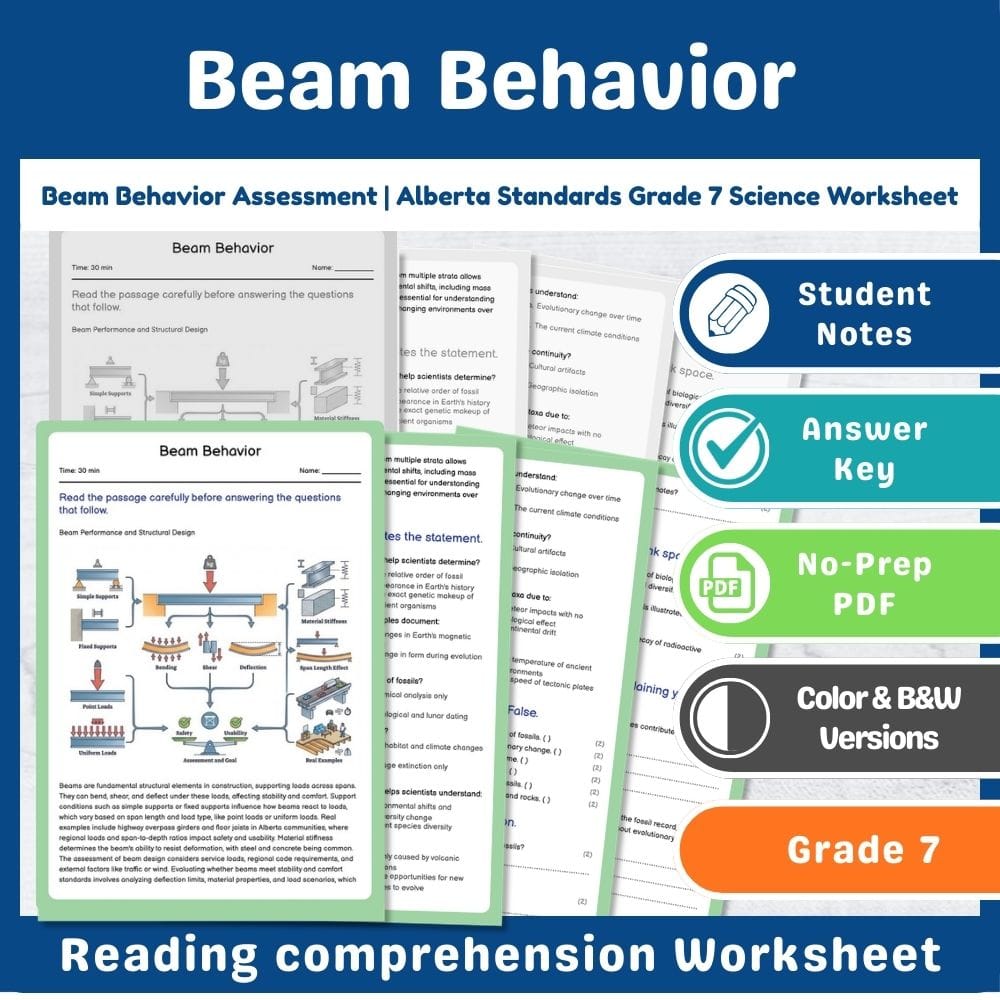
Beam Behavior Assessment | Alberta Standards Grade 7 Science Worksheet
Created byPrism Point LearningLearning Objectives
- Understand the key concepts of beam performance including bending, shear, and deflection.
- Relate support conditions, span, and load types to real-world structural examples.
- Evaluate criteria such as span-to-depth ratios and material stiffness for structural stability.
Also included in: Lesson Bundle Grade 7 Science Forces Structures and Motion | Alberta Standards +1 more
Instant download
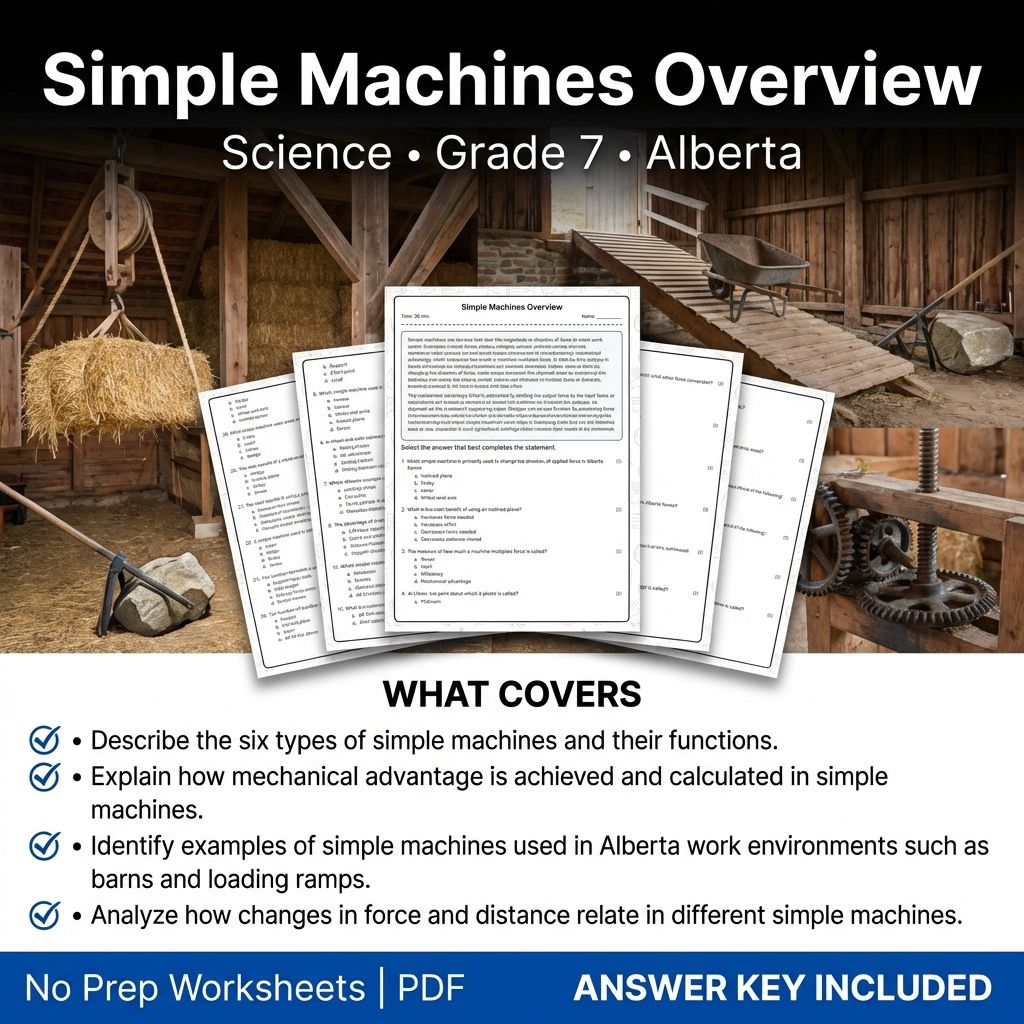
Grade 7 Science Worksheet | Simple Machines Overview | Alberta Standards
Created byCoral Reef LearningLearning Objectives
- Describe the six types of simple machines and their functions.
- Explain how mechanical advantage is achieved and calculated in simple machines.
- Identify examples of simple machines used in Alberta work environments such as barns and loading ramps.
Instant download

Grade 7 Surface Processes Worksheet | NGSS Practice PDF
Created byClear Sky ClassroomLearning Objectives
- Describe the key geologic surface processes such as weathering, erosion, transport, and deposition.
- Differentiate between mechanical and chemical weathering and their signatures.
- Explain how landforms like canyons, deltas, and moraines are created by surface processes over time.
Also included in: Grade 7 Earth Systems Science Lesson Bundle NGSS: 6 Worksheets +1 more
Instant download

Grade 7 Climate Patterns Worksheet | NGSS Practice PDF
Created byClear Sky ClassroomLearning Objectives
- Understand how solar heating influences regional climate patterns.
- Identify key atmospheric and oceanic circulation features affecting climate.
- Analyze how topography and ocean currents modify local climates.
Also included in: Grade 7 Earth Systems Science Lesson Bundle NGSS: 6 Worksheets +1 more
Instant download
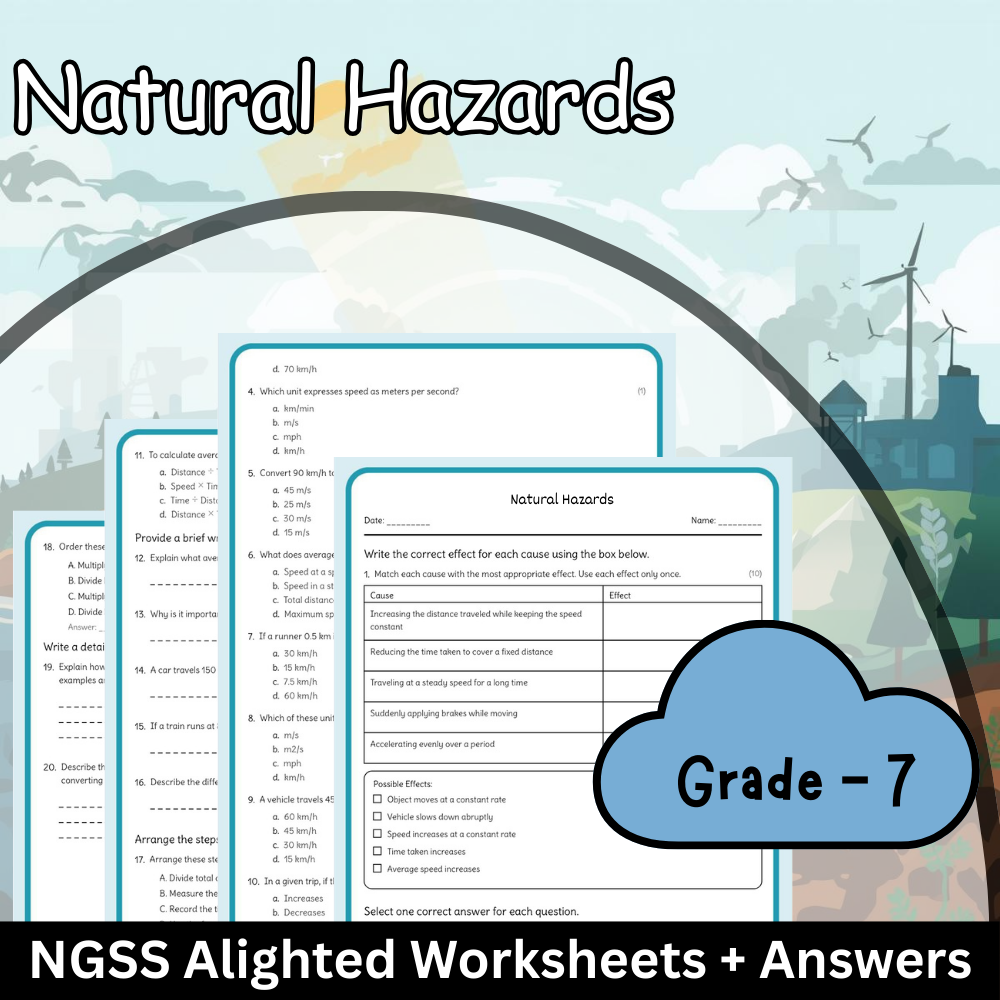
7th Grade Science | Natural Hazards Worksheet – NGSS-Aligned (PDF)
Created byBright Mind ResourcesLearning Objectives
- Analyze patterns and data related to earthquakes, volcanic eruptions, hurricanes, floods, and tsunamis.
- Interpret hazard maps, recurrence intervals, and probabilistic forecasts for risk assessment.
- Understand cascading impacts of natural hazards on infrastructure, ecosystems, and communities.
Instant download

Grade 7 Science – Bitumen Separation & Mixtures Daily Reading Worksheet
Created byBright Mind ResourcesLearning Objectives
- Understand the basic concepts of mixtures and their separation methods.
- Identify physical and chemical separation techniques used in extracting bitumen.
- Differentiate between physical and chemical processes in mixture treatment.
Also included in: Grade 7 Solutions Science Daily Reading Worksheets Lesson Bundle | Alberta +2 more
Instant download
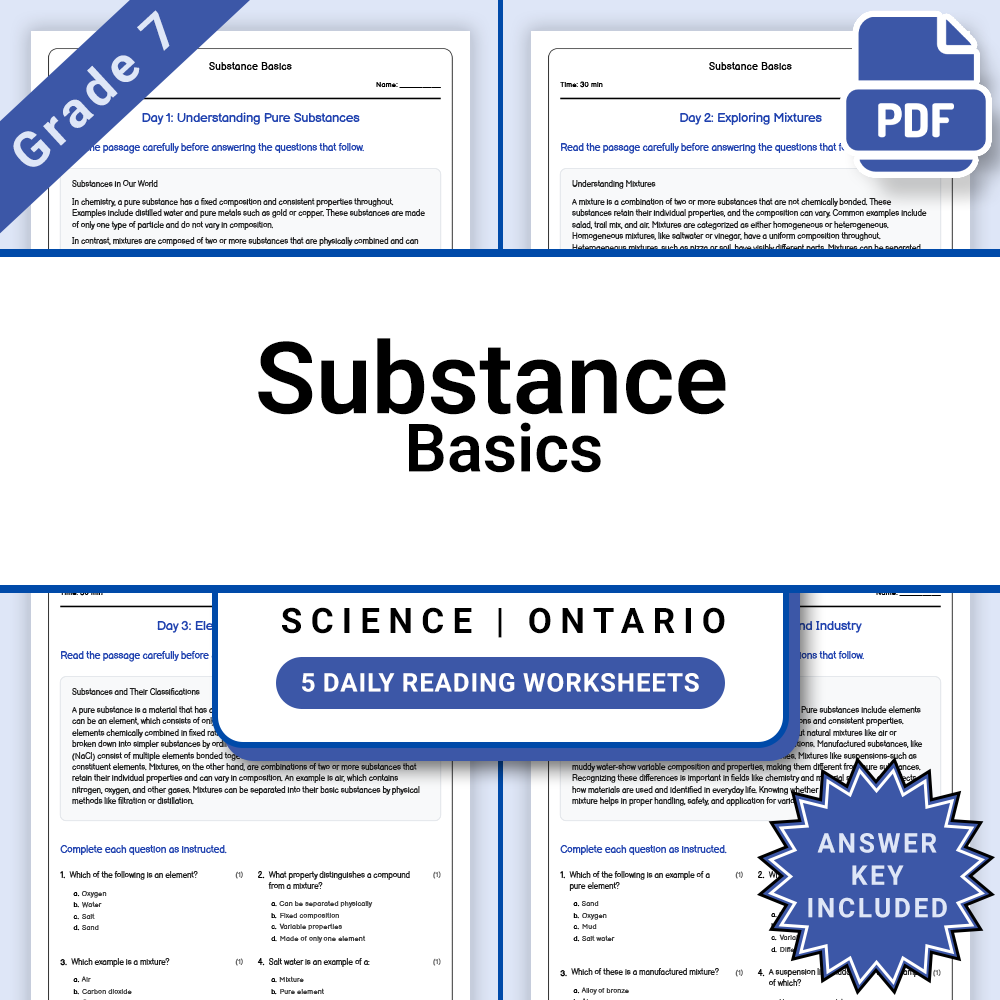
Grade 7 Science – Substance Basics Daily Reading Worksheet + Answer Key
JCreated byJ.S SheetsLearning Objectives
- Define and distinguish between pure substances and mixtures.
- Identify examples of elements, compounds, and mixtures.
- Describe the criteria that classify a substance as pure.
Also included in: Grade 7 Science Lesson Group | Ontario Framework Worksheets Bundle +1 more
Instant download
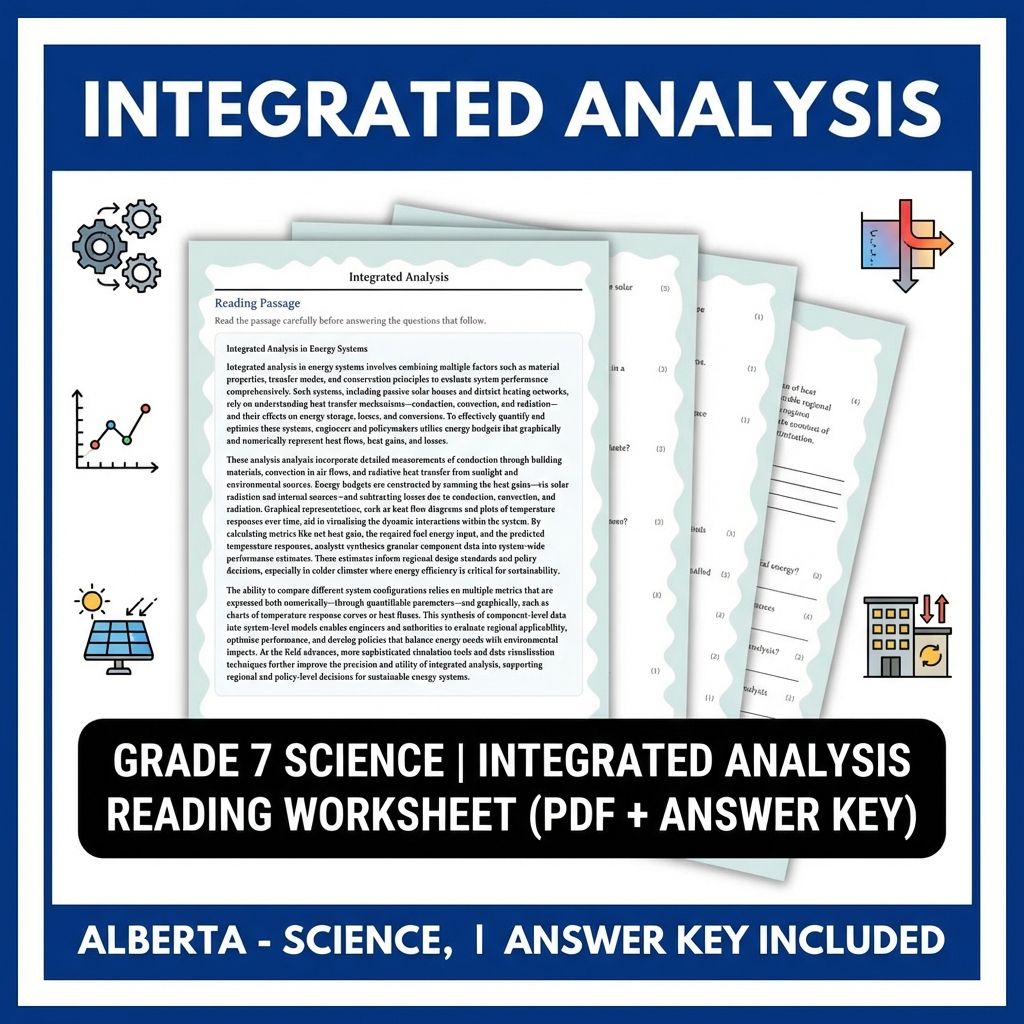
Grade 7 Science | Integrated Analysis Reading Worksheet (PDF + Answer Key)
JCreated byJ.S SheetsLearning Objectives
- Understand the principles of energy transfer modes, such as conduction, convection, and radiation.
- Analyze how energy budgets are constructed and interpreted in systems like passive solar houses and district heating loops.
- Compare system performance metrics including net heat gain, fuel energy requirements, and temperature responses.
Also included in: Grade 7 Science UNIT Bundle | Heat Transfer, Convection & Energy Worksheets +1 more
Instant download

Population Interactions Worksheet | California Standards Grade 7 Science
JCreated byJ.S SheetsLearning Objectives
- Understand how organisms influence each other's survival and reproduction through different types of interactions.
- Identify examples of predator-prey, competition, and mutualism relationships in ecosystems.
- Analyze how population sizes change over time due to interactions and resource availability.
Also included in: Grade 7 Ecosystem Energy & Matter Cycles Science Lesson Bundle +1 more
Instant download
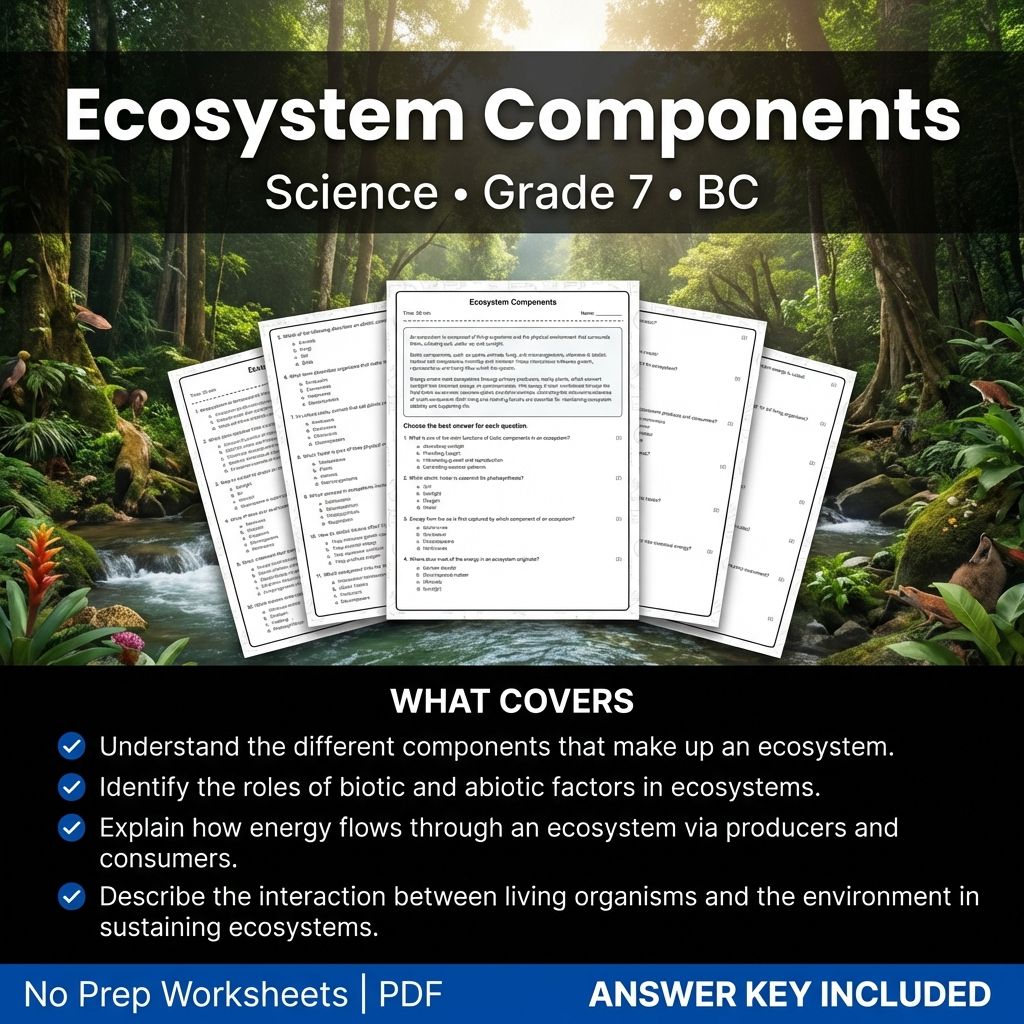
7th Grade Science | Ecosystem Components Worksheet & Answer Key (Printable PDF)
Created byCoral Reef LearningLearning Objectives
- Understand the different components that make up an ecosystem.
- Identify the roles of biotic and abiotic factors in ecosystems.
- Explain how energy flows through an ecosystem via producers and consumers.
Instant download
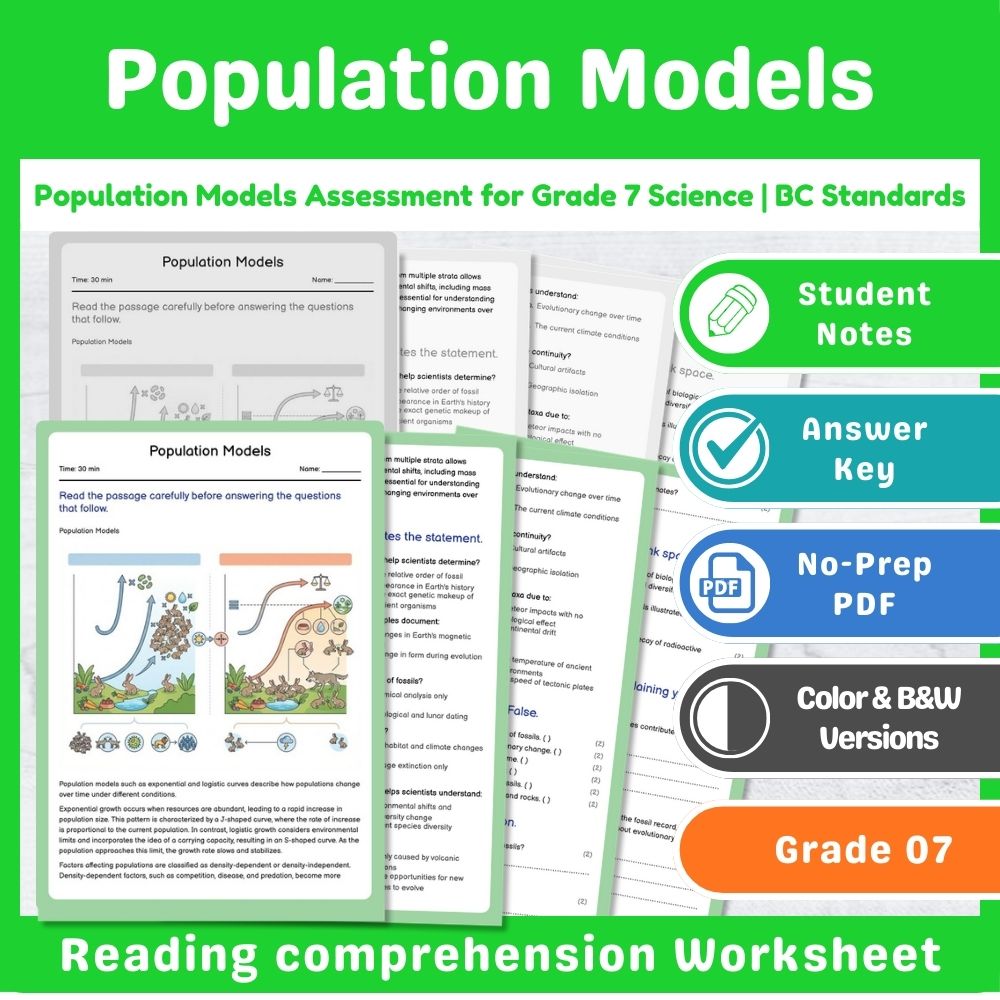
Population Models Assessment for Grade 7 Science | BC Standards
Created byPrism Point LearningLearning Objectives
- Understand the differences between exponential and logistic population growth models.
- Explain factors influencing population change, including density-dependent and density-independent factors.
- Interpret patterns in real-world population dynamics using simple models.
Instant download

Change Indicators Test Prep Printable | Grade 7 Science BC Standards
Created byPrism Point LearningLearning Objectives
- Identify observable indicators of chemical change, such as gas formation, persistent color change, temperature change, and precipitate formation
- Explain why multiple indicators together provide stronger evidence for chemical change than a single sign
- Use simple measurements alongside observations to support claims about whether a chemical change occurred
Also included in: Matter & Chemical Change Lesson Bundle — Grade 7 Science British Columbia +1 more
Instant download

Energy And Change Worksheet Practice | Grade 7 Science
Created byPrism Point LearningLearning Objectives
- Explain how energy changes during exothermic and endothermic chemical reactions using temperature evidence
- Relate energy input and release to bond breaking and bond formation
- Use energy-change evidence, along with other signs, to distinguish chemical from physical changes
Also included in: Matter & Chemical Change Lesson Bundle — Grade 7 Science British Columbia +1 more
Instant download

Heat Transfer Models Worksheet | Grade 7 Science Practice
Created byPrism Point LearningLearning Objectives
- Explain how temperature differences drive heat transfer in conduction, convection, and radiation.
- Use a simple heat-transfer model to describe the direction of energy flow during everyday processes.
- Connect observable temperature changes to changes in thermal energy and possible heat-transfer mechanisms.
Instant download

Grade 7 Fitness and Survival Worksheet | Natural Selection | NGSSS
Created byEvergreen Desk EducationLearning Objectives
- Explain how an organism’s traits can affect its fitness in a specific environment.
- Describe how natural selection can shift which heritable traits are favored as environments change.
- Connect heritable variation to how populations respond over time, even within the same species.
Instant download
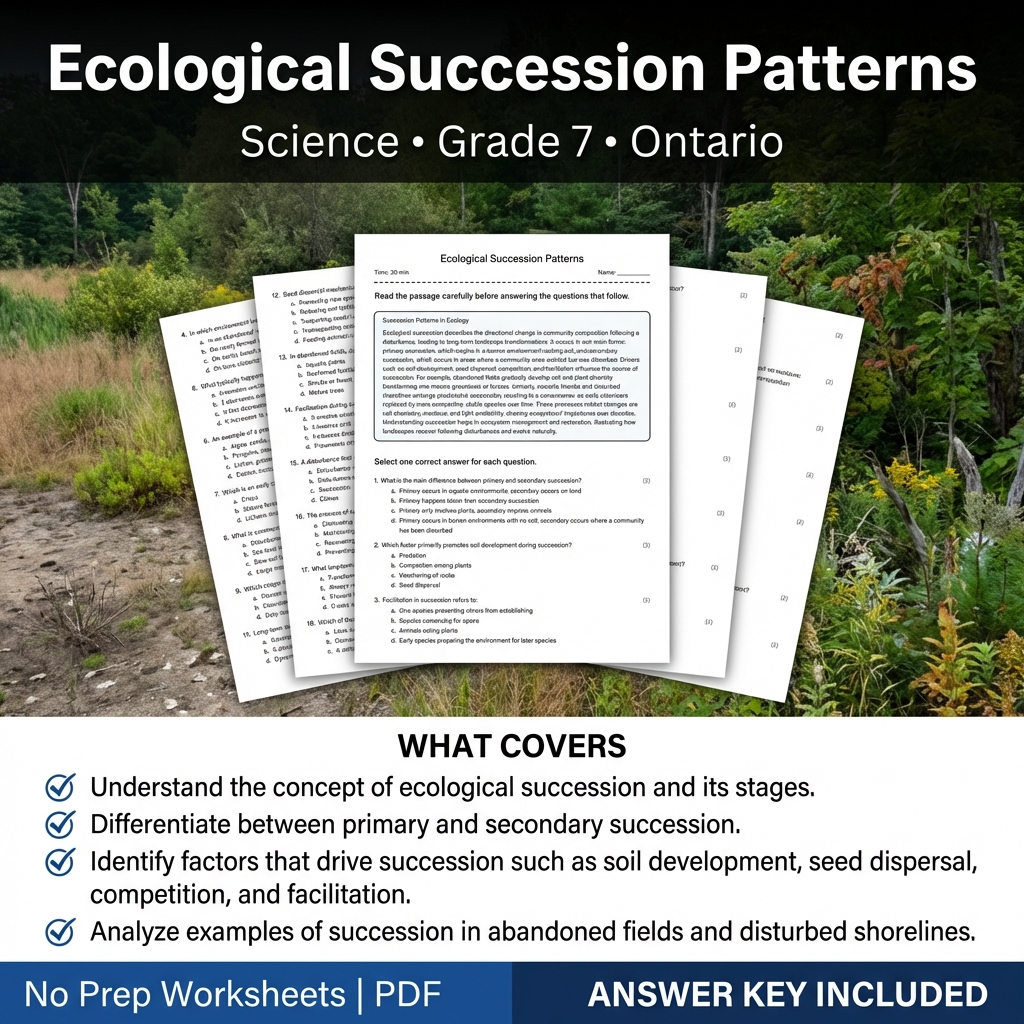
Ecological Succession Patterns Worksheet | Grade 7 Science Ontario Standards
Created byCoral Reef LearningLearning Objectives
- Understand the concept of ecological succession and its stages.
- Differentiate between primary and secondary succession.
- Identify factors that drive succession such as soil development, seed dispersal, competition, and facilitation.
Instant download
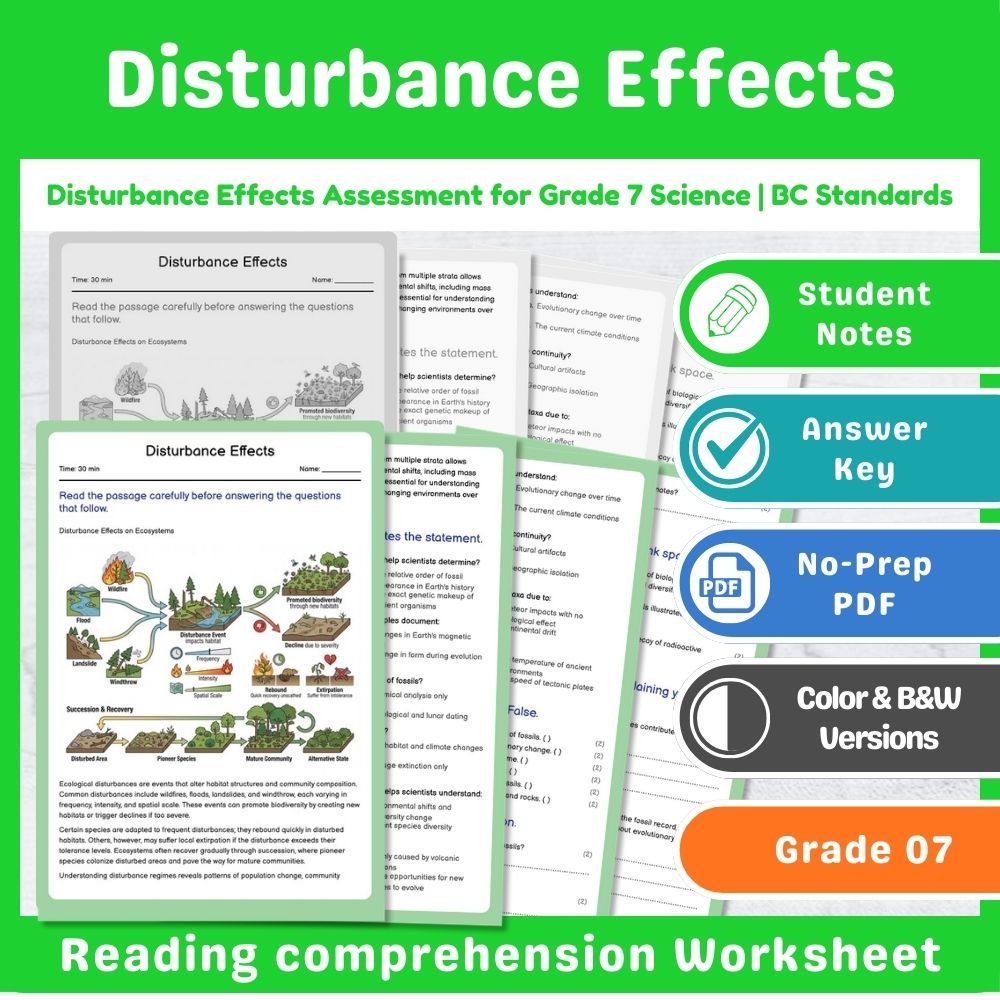
Disturbance Effects Assessment | BC Grade 7 Science Standards-Aligned
Created byPrism Point LearningLearning Objectives
- Understand how disturbances impact ecosystems and habitats.
- Identify different types of disturbance regimes and their ecological consequences.
- Analyze species adaptation to disturbance frequency and intensity.
Instant download
About Grade 7 Science Worksheets
Browse 6,039 printable Grade 7 Science worksheets — ready-to-print PDFs with answer keys where available.
Every worksheet on MyTeachingSheets is created by independent teacher-authors and reviewed before publication. All resources download as printable PDFs for classroom, homework, or at-home practice, and many include answer keys. Preview any worksheet free before buying.