
Grade 7 Science Worksheets
6,039 worksheets
Energy And Change Worksheet Practice | Grade 7 Science
 Created byPrism Point Learning
Learning Objectives
- Explain how energy changes during exothermic and endothermic chemical reactions using temperature evidence
- Relate energy input and release to bond breaking and bond formation
- Use energy-change evidence, along with other signs, to distinguish chemical from physical changes
Also included in: Matter & Chemical Change Lesson Bundle — Grade 7 Science British Columbia +1 more
Instant download

Heat Transfer Models Worksheet | Grade 7 Science Practice
Created byPrism Point LearningLearning Objectives
- Explain how temperature differences drive heat transfer in conduction, convection, and radiation.
- Use a simple heat-transfer model to describe the direction of energy flow during everyday processes.
- Connect observable temperature changes to changes in thermal energy and possible heat-transfer mechanisms.
Instant download

Grade 7 Fitness and Survival Worksheet | Natural Selection | NGSSS
 Created byEvergreen Desk Education
Learning Objectives
- Explain how an organism’s traits can affect its fitness in a specific environment.
- Describe how natural selection can shift which heritable traits are favored as environments change.
- Connect heritable variation to how populations respond over time, even within the same species.
Instant download
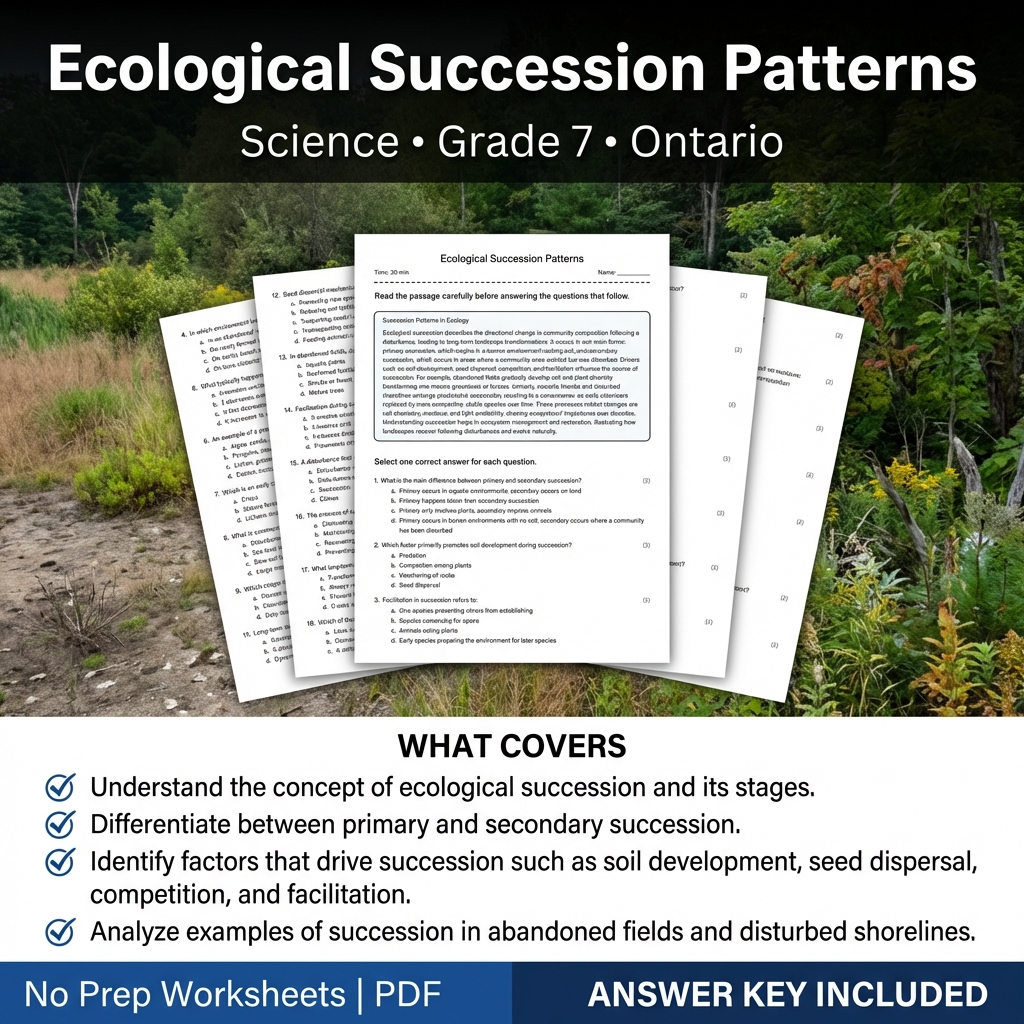
Ecological Succession Patterns Worksheet | Grade 7 Science Ontario Standards
 Created byCoral Reef Learning
Learning Objectives
- Understand the concept of ecological succession and its stages.
- Differentiate between primary and secondary succession.
- Identify factors that drive succession such as soil development, seed dispersal, competition, and facilitation.
Instant download
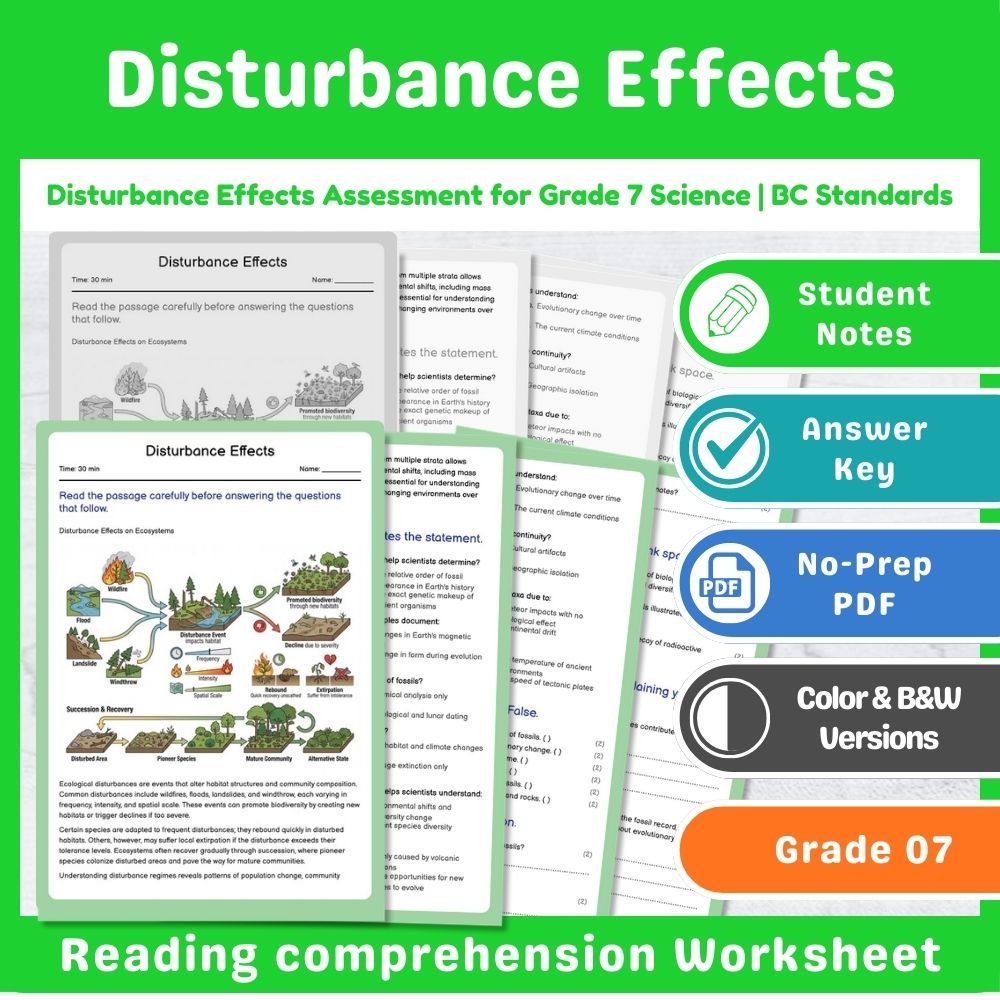
Disturbance Effects Assessment | BC Grade 7 Science Standards-Aligned
Created byPrism Point LearningLearning Objectives
- Understand how disturbances impact ecosystems and habitats.
- Identify different types of disturbance regimes and their ecological consequences.
- Analyze species adaptation to disturbance frequency and intensity.
Instant download
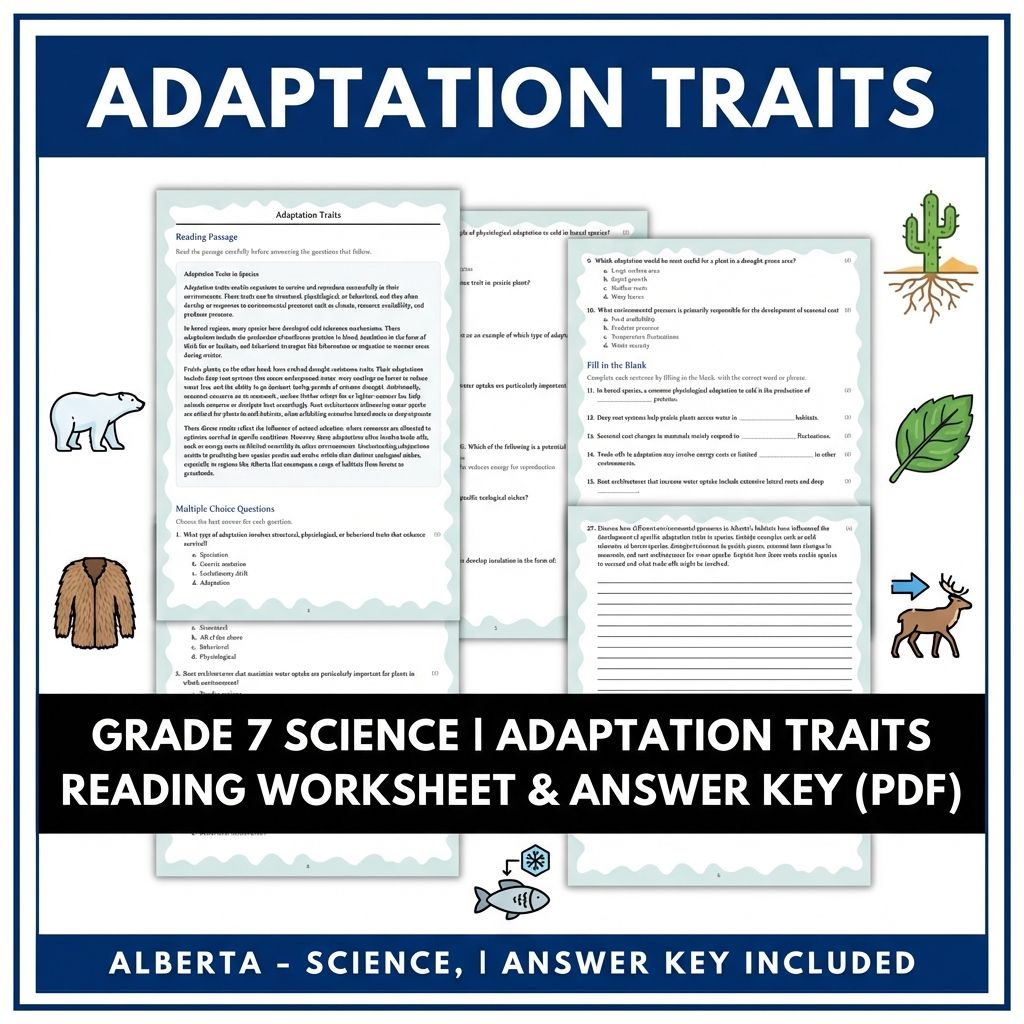
Grade 7 Science | Adaptation Traits Reading Worksheet & Answer Key (PDF)
JCreated byJ.S SheetsLearning Objectives
- Understand how structural, physiological, and behavioral traits contribute to survival in different environments.
- Identify specific adaptation traits such as cold tolerance, drought resistance, seasonal coat changes, and root architectures.
- Explain the relationship between adaptive traits and environmental pressures in various habitats.
Also included in: Grade 7 Science Bundle | Ecology, Ecosystems & Environmental Topics (Pack) +1 more
Instant download
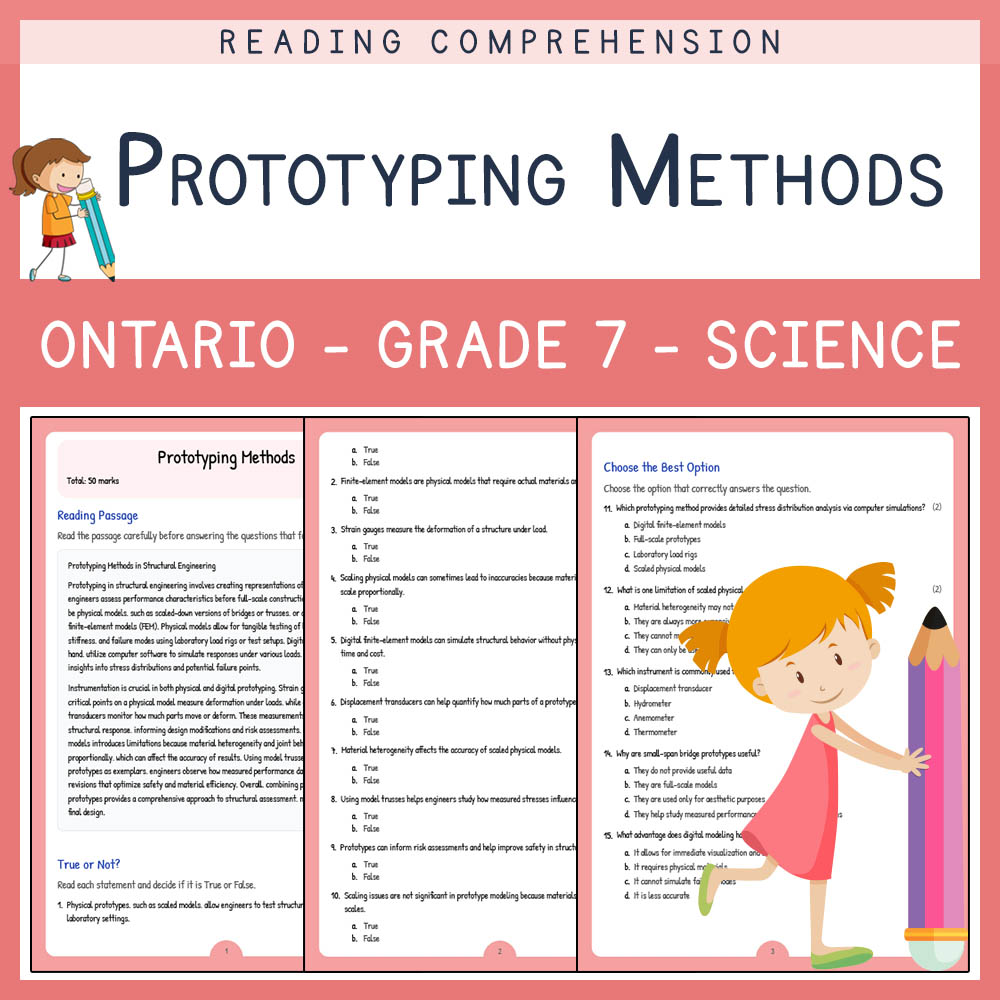
Grade 7 Science | Prototyping Methods Worksheet & Answer Key - Ontario Standard
 Created byLumora Learning
Learning Objectives
- Understand different prototyping approaches including scaled physical models, digital finite-element models, and laboratory load rigs.
- Compare advantages of each prototyping method for assessing strength, stiffness, and failure modes.
- Explain how instrumentation such as strain gauges and displacement transducers are used to quantify responses.
Also included in: Grade 7 Science | Form Function Design Structures Unit Bundle | Ontario
Instant download
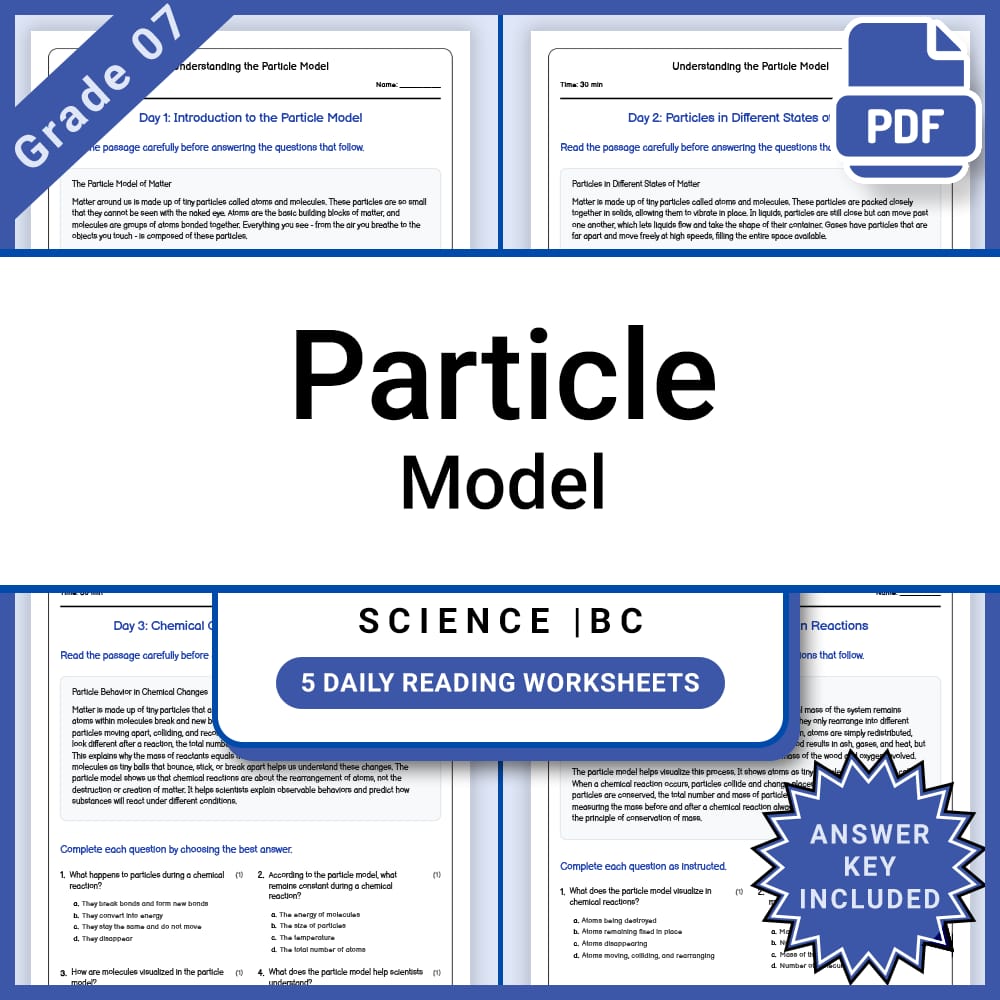
Grade 7 Science – the Particle Model Daily Reading Worksheet Answer Key
JCreated byJ.S SheetsLearning Objectives
- Explain what atoms and molecules are as the basic particles of matter.
- Describe how particles behave during chemical changes.
- Understand the principle of conservation of mass during reactions.
Also included in: Grade 7 Science Lesson Group Bundle | States, Reactions & Properties +1 more
Instant download
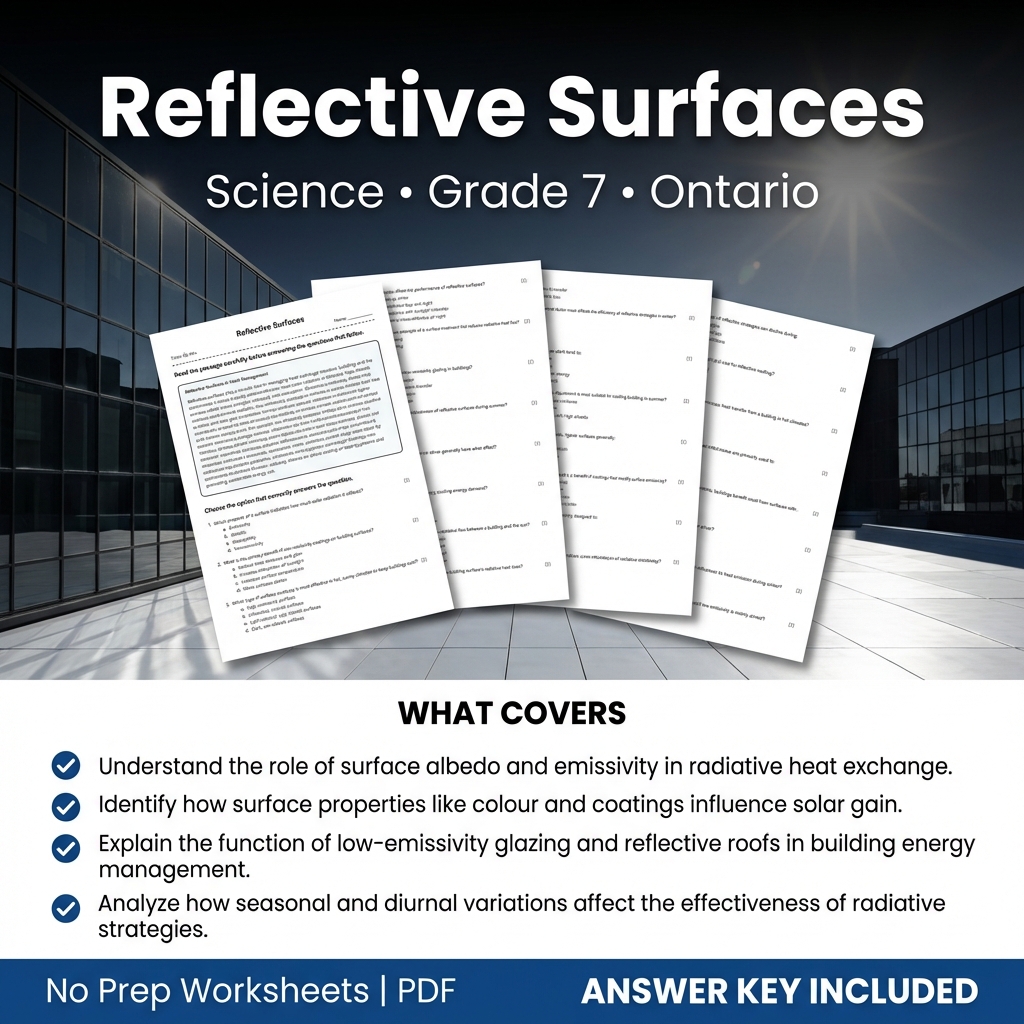
Reflective Surfaces Science Worksheet Grade 7 | Ontario Standards
Created byCoral Reef LearningLearning Objectives
- Understand the role of surface albedo and emissivity in radiative heat exchange.
- Identify how surface properties like colour and coatings influence solar gain.
- Explain the function of low-emissivity glazing and reflective roofs in building energy management.
Instant download
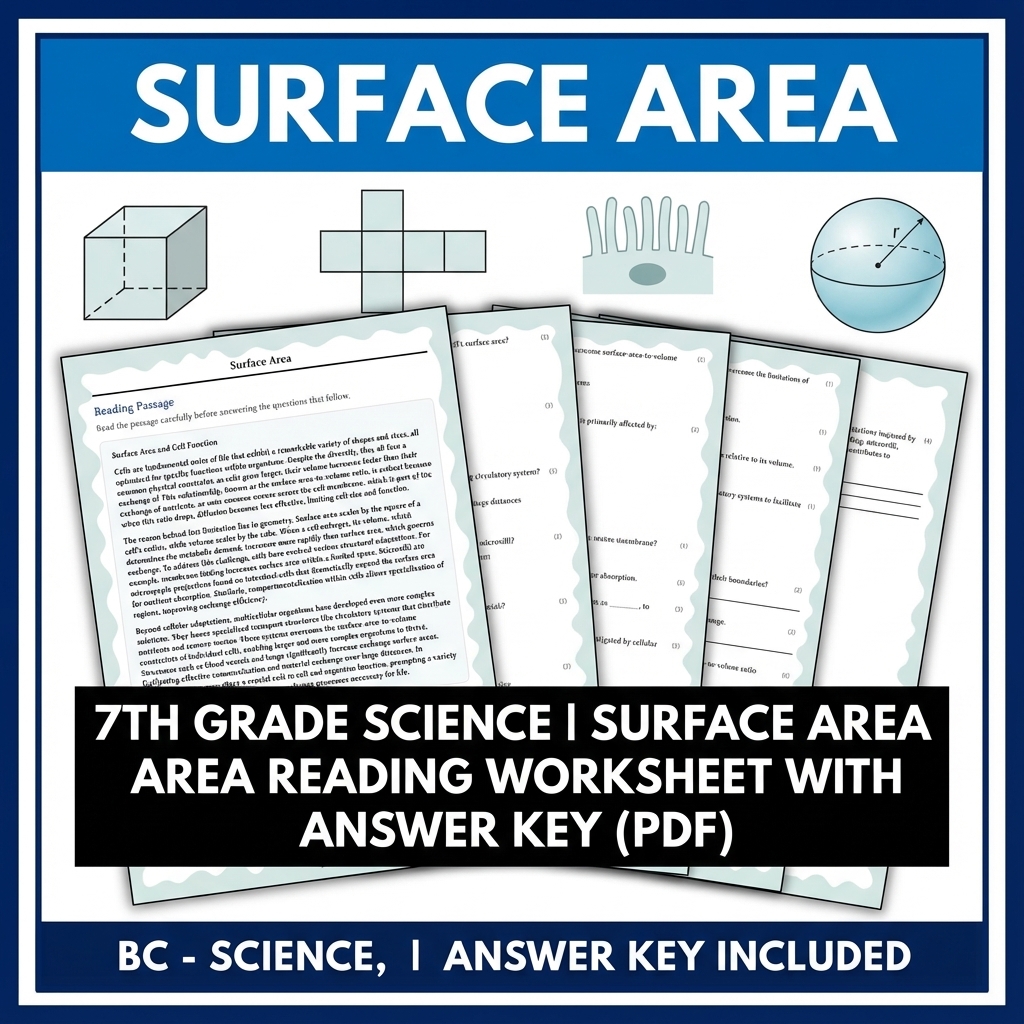
7th Grade Science | Surface Area Reading Worksheet with Answer Key (PDF)
JCreated byJ.S SheetsLearning Objectives
- Understand how surface-area-to-volume ratios limit cell size and function.
- Identify adaptations that increase exchange surfaces in cells and organisms.
- Explain how multicellular organisms overcome diffusion limitations through specialized structures.
Instant download
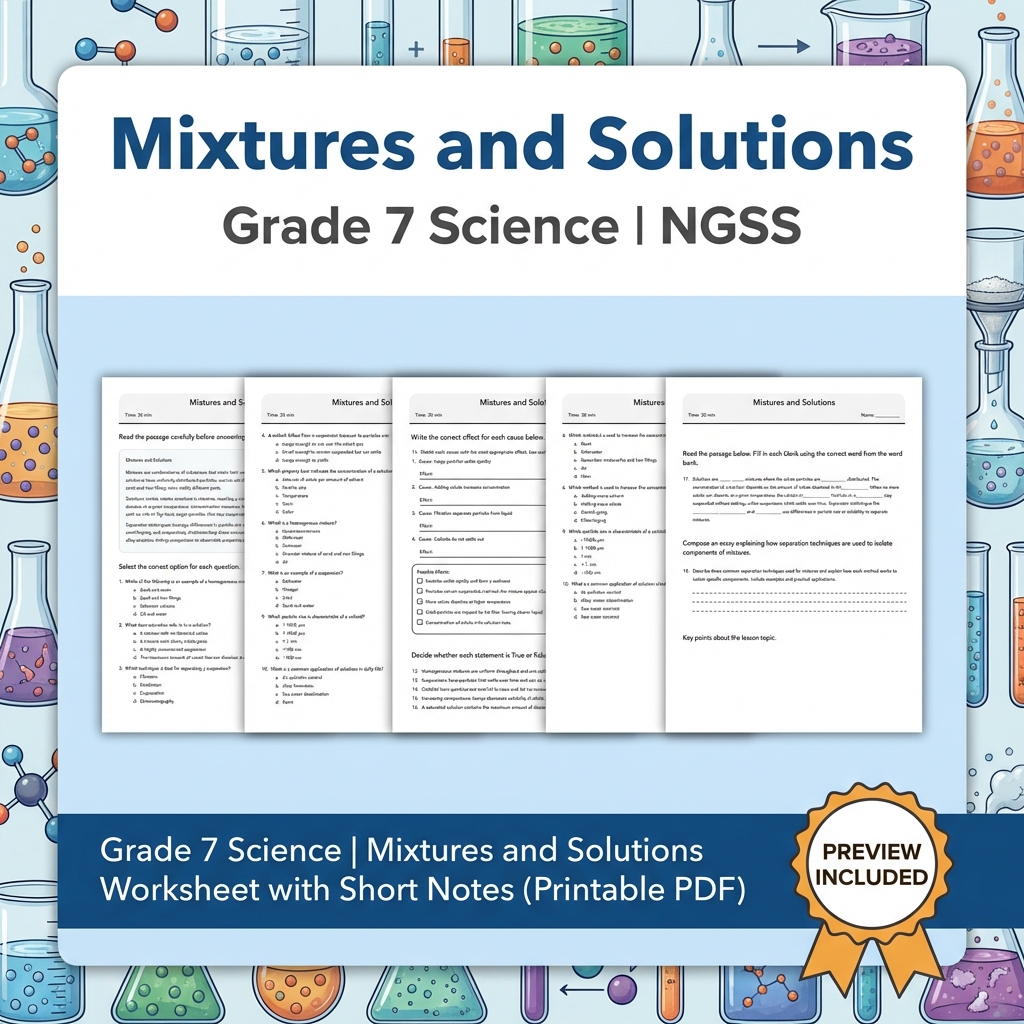
Grade 7 Science | Mixtures and Solutions Worksheet with Short Notes (PDF)
 Created byMeadowlark Worksheets
Learning Objectives
- Differentiate between homogeneous and heterogeneous mixtures and solutions.
- Explain the concepts of solubility, saturation, and concentration.
- Identify examples of colloids, suspensions, and true solutions.
Also included in: Grade 7 Science | Matter and Its Interactions NGSS Worksheet Collection +1 more
Instant download
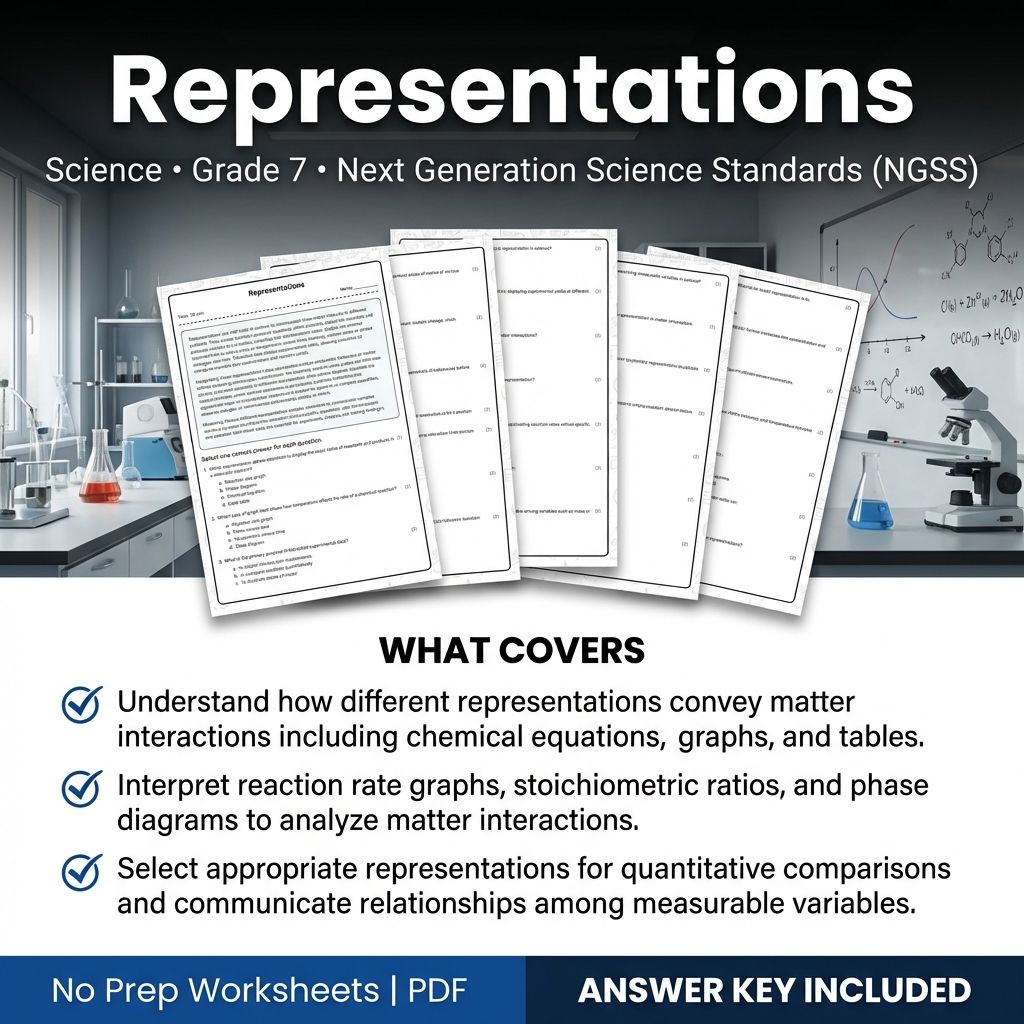
7th Grade Science Worksheet | Representations of Matter & Reactants (Printable PDF + Answer Key)
Created byCoral Reef LearningLearning Objectives
- Understand how different representations convey matter interactions including chemical equations, graphs, and tables.
- Interpret reaction rate graphs, stoichiometric ratios, and phase diagrams to analyze matter interactions.
- Select appropriate representations for quantitative comparisons and communicate relationships among measurable variables.
Instant download
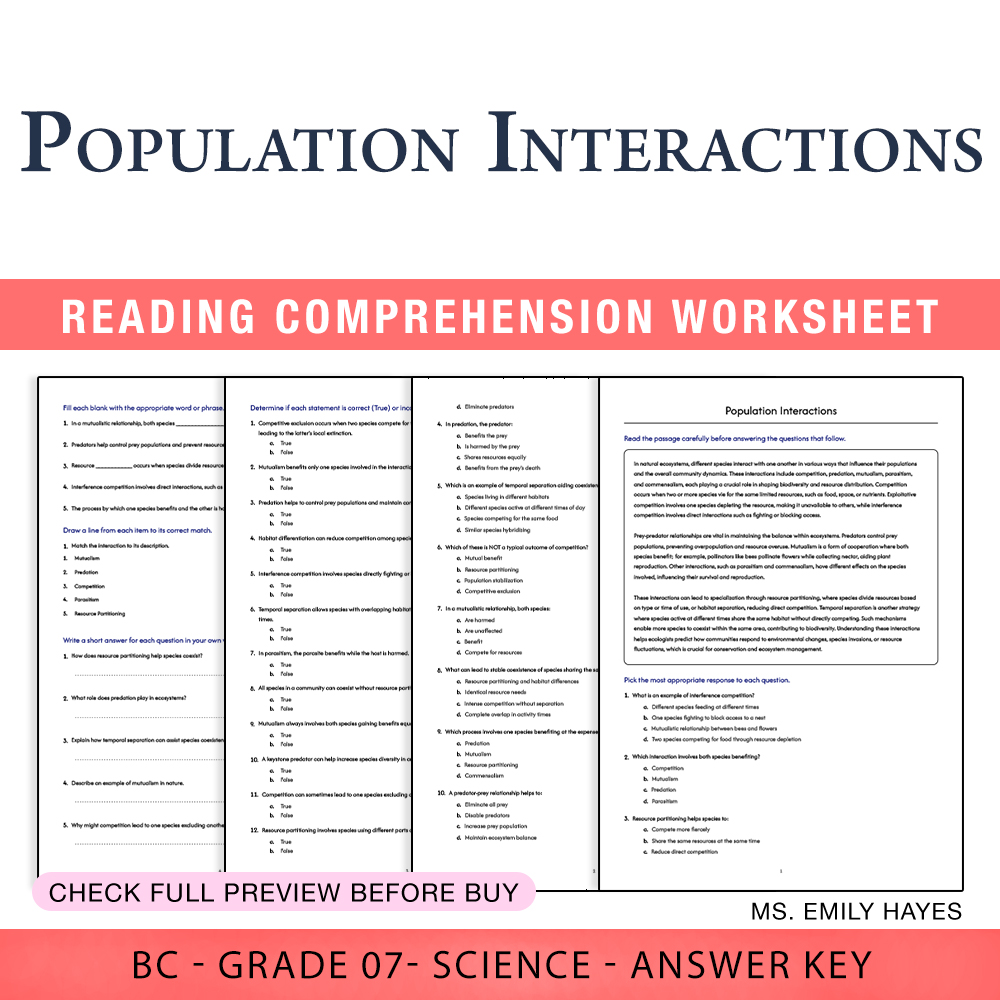
Grade 7 Science | Population Interactions Worksheet (PDF+ Answer Key)
 Created byCopper Leaf Classroom
Learning Objectives
- Explain different types of interactions between populations such as competition, predation, and mutualism.
- Describe how resource partitioning, habitat differences, and temporal separation allow species to coexist.
- Analyze the effects of population interactions on community diversity and stability.
Also included in: Grade 7 Science Bundle | Ecosystem Dynamics & Population (PDF+ Answer Key) +1 more
Instant download
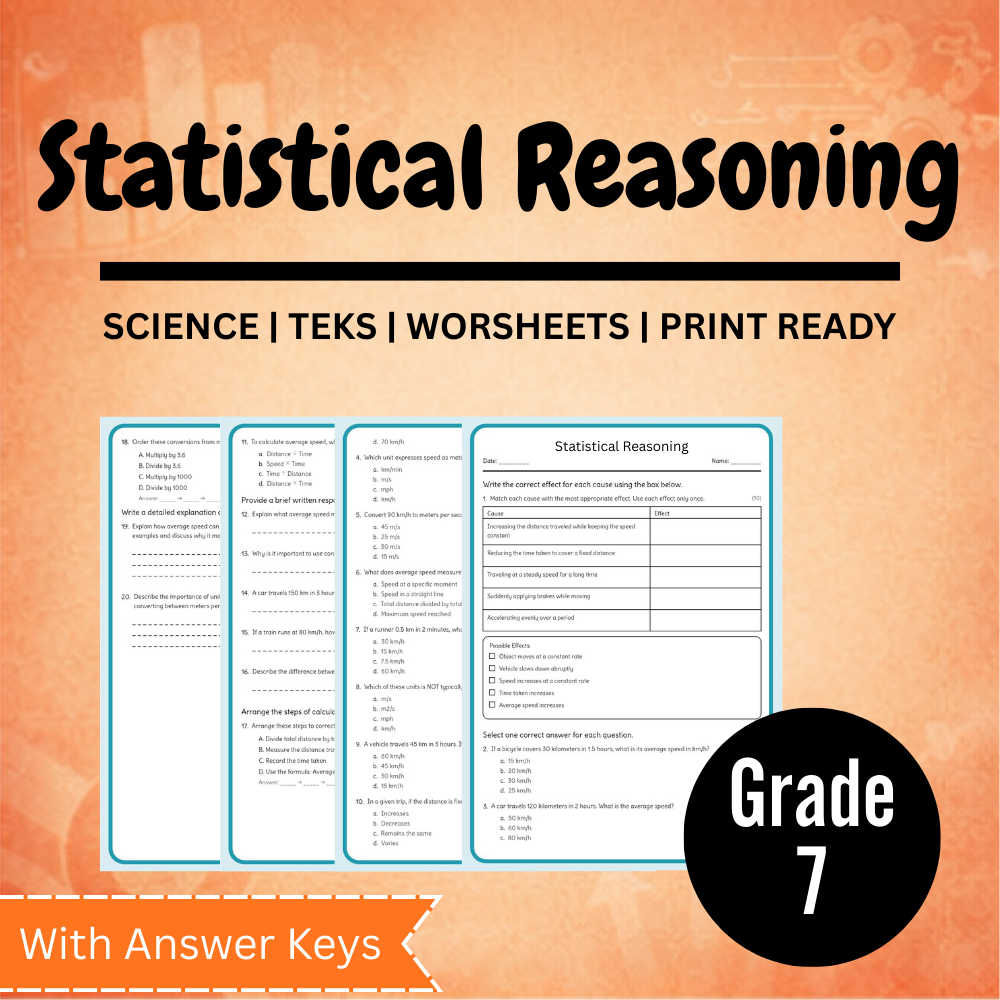
Grade 7 Science | Statistical Reasoning Worksheet (Worksheet + Answer Key) – TEKS Standards
 Created byBright Mind Resources
Learning Objectives
- Interpret variability and measures of central tendency in data sets.
- Analyze graphical representations such as box plots and histograms for spread and reliability.
- Calculate and compare mean, median, and range to assess data distribution.
Also included in: Grade 7 Science Unit Worksheet Pack- Data Analysis,Experimental Design & Inquiry +2 more
Instant download
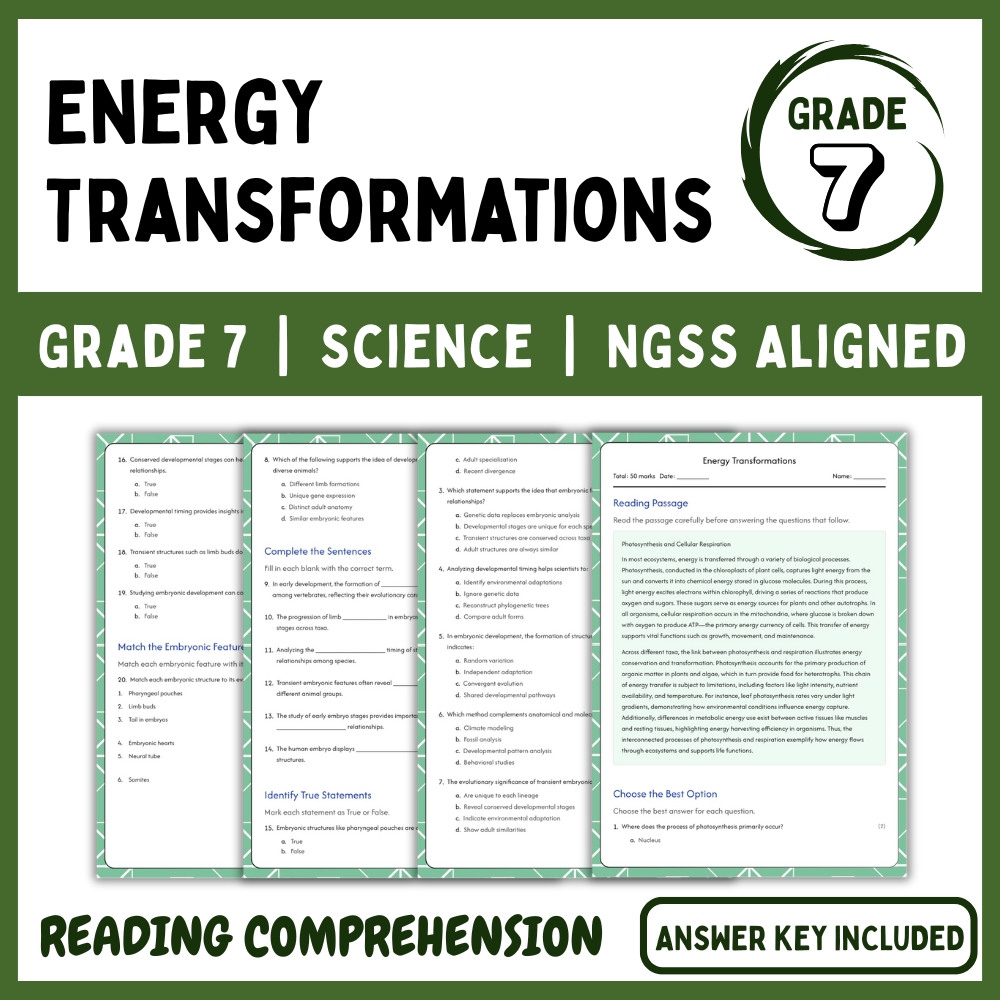
Grade 7 Science | Energy Transformations Worksheet (NGSS & Answer Key)
 Created byCedar Grove Learning
Learning Objectives
- Describe how light energy is converted into chemical energy during photosynthesis
- Explain how organisms harvest energy from food through cellular respiration
- Connect chloroplast-based sugar production with mitochondrial ATP generation across different taxa
Instant download
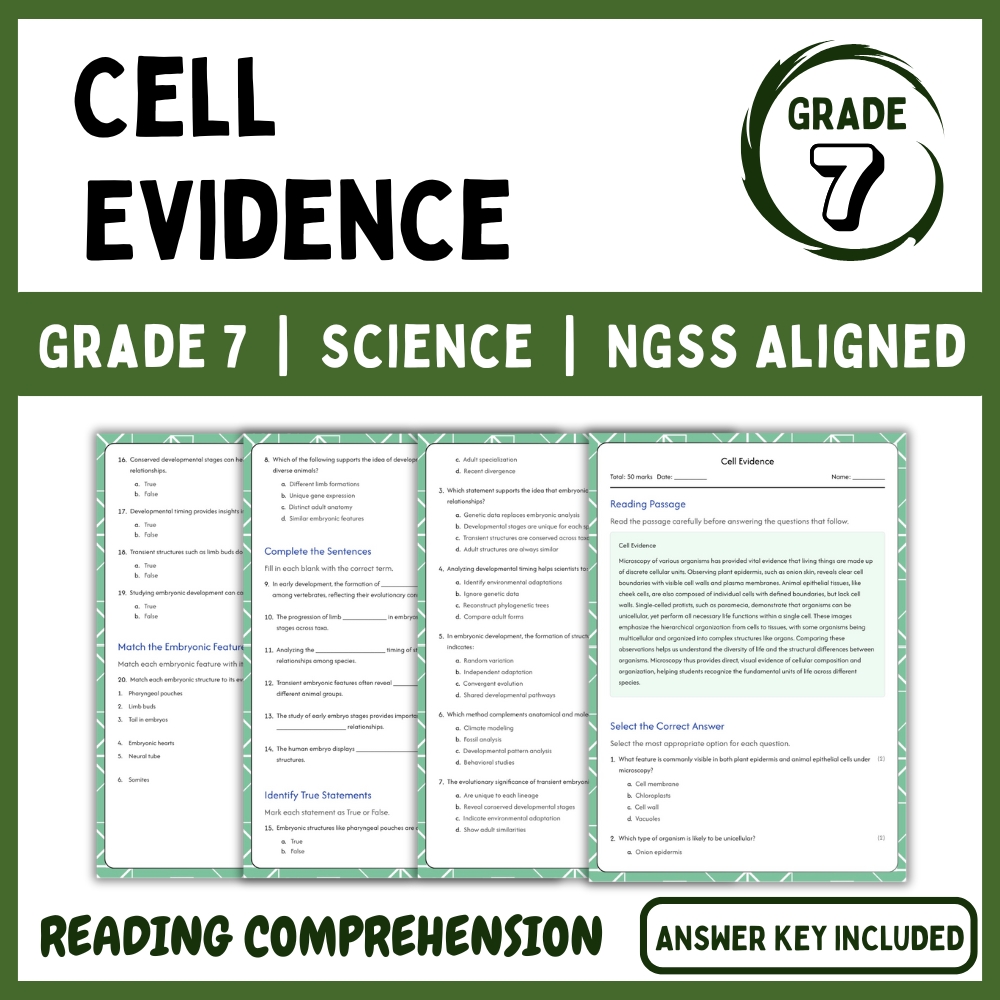
7th Grade Science | Cell Evidence Worksheet (NGSS Practice + Answer Key)
Created byCedar Grove LearningLearning Objectives
- Observe and compare plant epidermis, animal epithelial tissue, and protists using microscopy.
- Identify cell boundaries such as plasma membranes and cell walls in observed specimens.
- Distinguish between unicellular and multicellular organisms based on microscopic observations.
Instant download
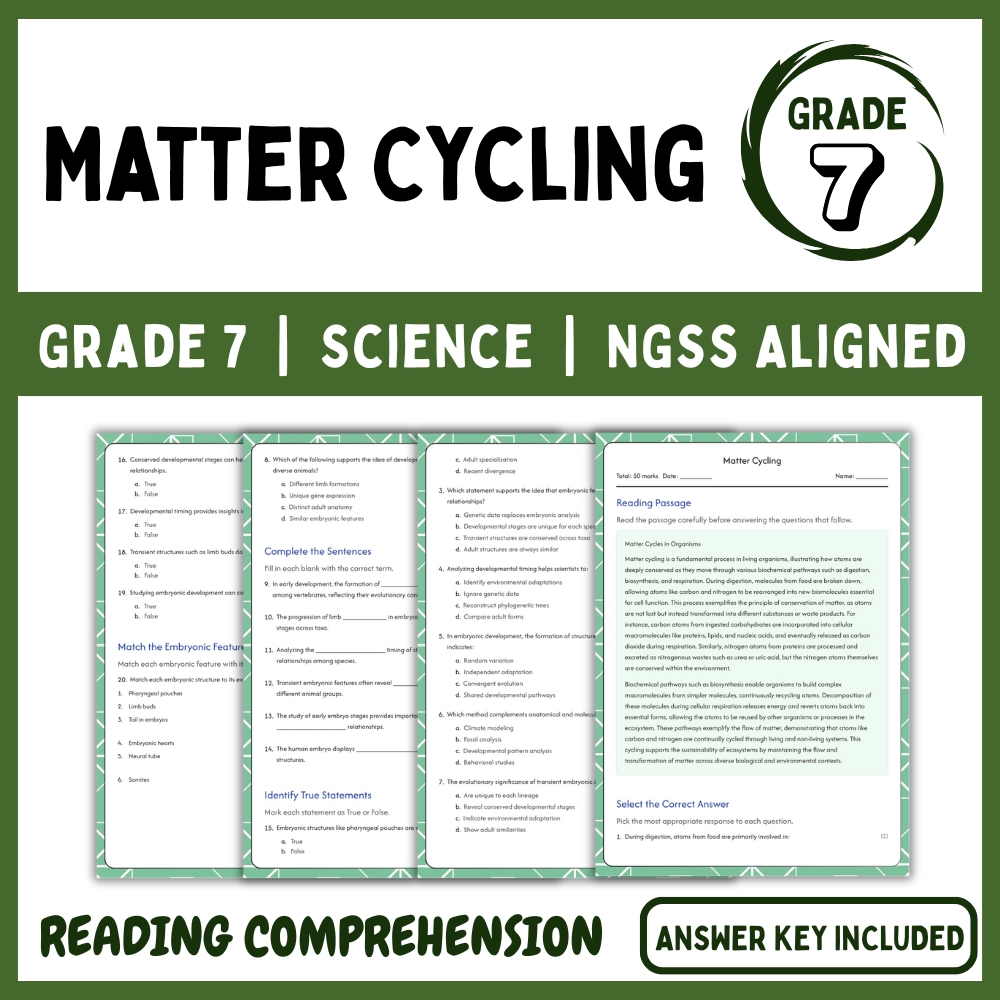
Grade 7 Science | Matter Cycling Worksheet (NGSS Practice & Assessment PDF)
Created byCedar Grove LearningLearning Objectives
- Describe how atoms are rearranged during digestion, biosynthesis, and respiration within organisms.
- Explain the conservation of matter during biochemical pathways like macromolecule synthesis and decomposition.
- Identify examples of carbon and nitrogen flow in biological processes.
Instant download
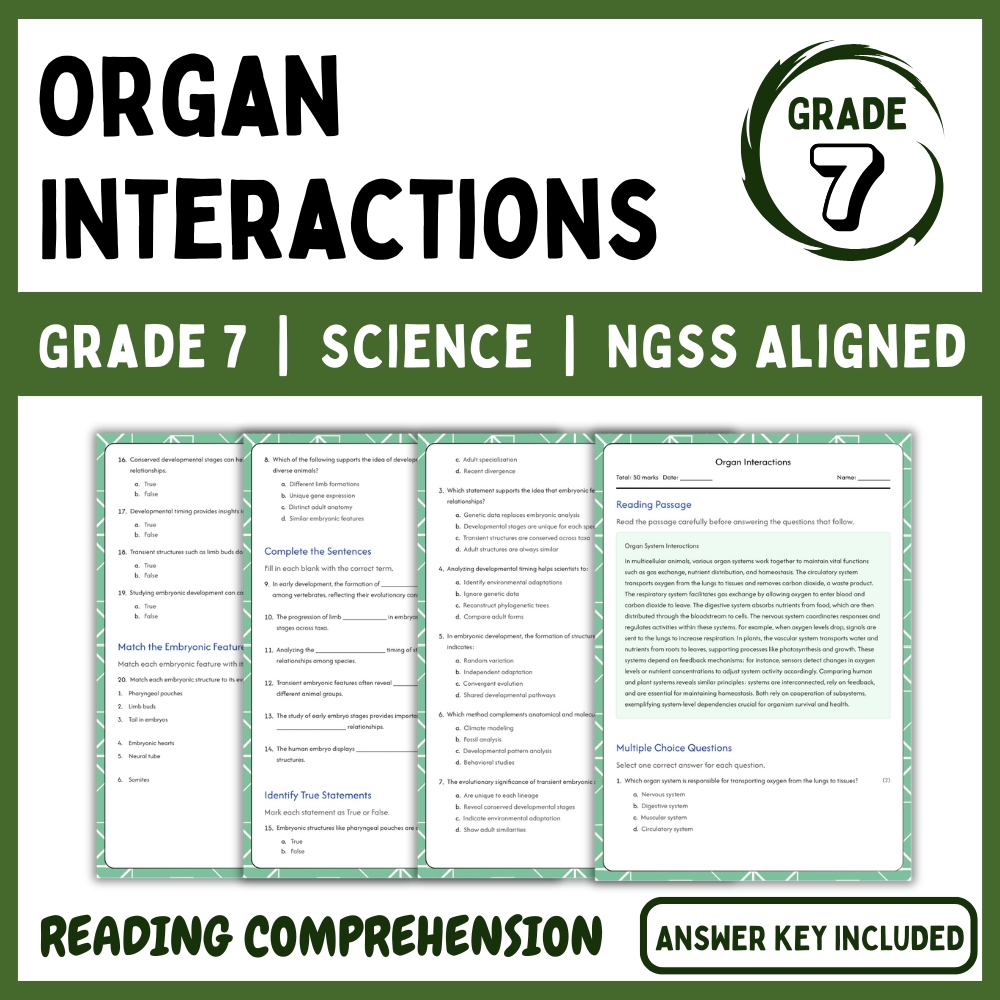
Grade 7 Science | Organ Interactions NGSS Worksheet PDF & Answer Key
Created byCedar Grove LearningLearning Objectives
- Describe the structure and function of major organ systems in multicellular animals.
- Explain how organ systems interact to support processes like gas exchange, nutrient transport, and homeostasis.
- Compare system interactions in mammals and plants, highlighting system dependencies and feedback mechanisms.
Instant download
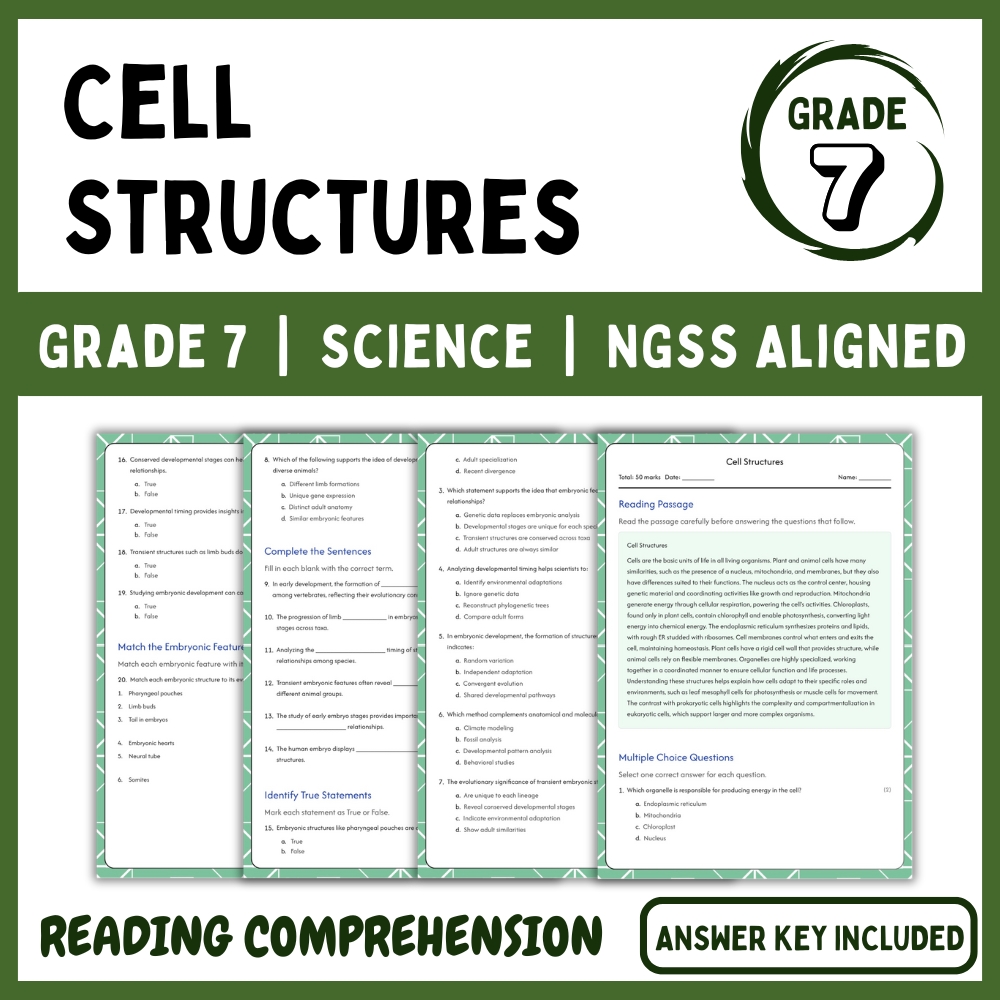
7th Grade Science | Cell Structures Worksheet (NGSS Practice & Review)
Created byCedar Grove LearningLearning Objectives
- Identify and describe the functions of key organelles in plant and animal cells.
- Differentiate between eukaryotic and prokaryotic cell organization.
- Connect cell structure features to their roles in processes like transport, synthesis, and compartmentalization.
Instant download

Grade 7 Science | Effects of Disturbances in Ecosystems - Reading Comprehension
Created byCoral Reef LearningLearning Objectives
- Understand how fire as a disturbance impacts forest habitats
- Identify both positive and negative effects of forest fires
- Learn about the role of disturbance regimes in ecological succession
Instant download

Grade 7 Science – Material Selection Properties | Daily Reading Worksheet
Created byBright Mind ResourcesLearning Objectives
- Identify physical properties such as density, hardness, and melting point.
- Explain chemical properties like corrosion resistance and reactivity.
- Match material properties to their practical applications.
Also included in: Grade 7 States of Matter & Reactions Science Daily Reading Lesson Bundle | BC +1 more
Instant download
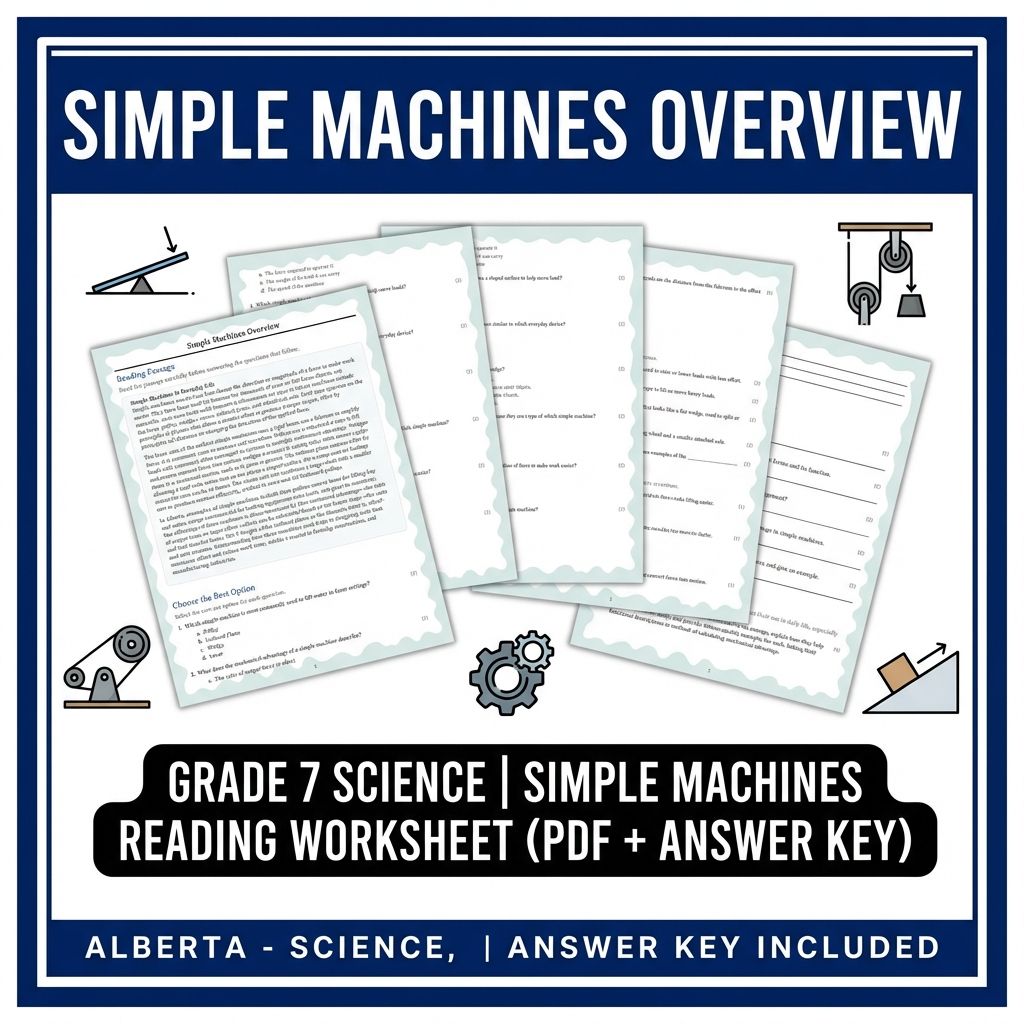
Grade 7 Science | Simple Machines Reading Worksheet (PDF + Answer Key)
JCreated byJ.S SheetsLearning Objectives
- Understand the principles and types of simple machines used in everyday tools.
- Identify how force, effort, and load relate in simple machines like levers and pulleys.
- Calculate mechanical advantage for different simple machines based on geometric relationships.
Also included in: Grade 7 Science | Forces, Motion & Structural Concepts (Answer Keys Included) +1 more
Instant download
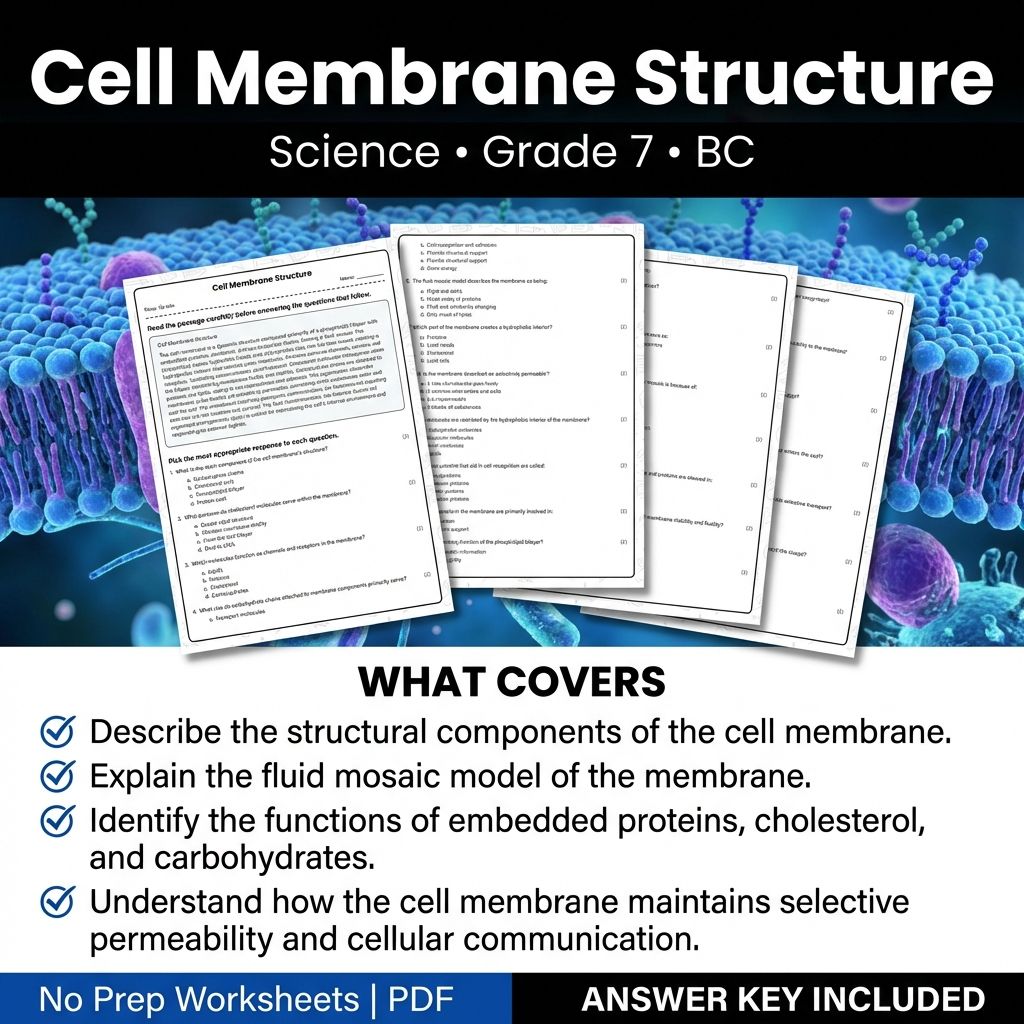
7th Grade Science Worksheet | Cell Membrane Structure - Printable PDF & Answer Key
Created byCoral Reef LearningLearning Objectives
- Describe the structural components of the cell membrane.
- Explain the fluid mosaic model of the membrane.
- Identify the functions of embedded proteins, cholesterol, and carbohydrates.
Instant download
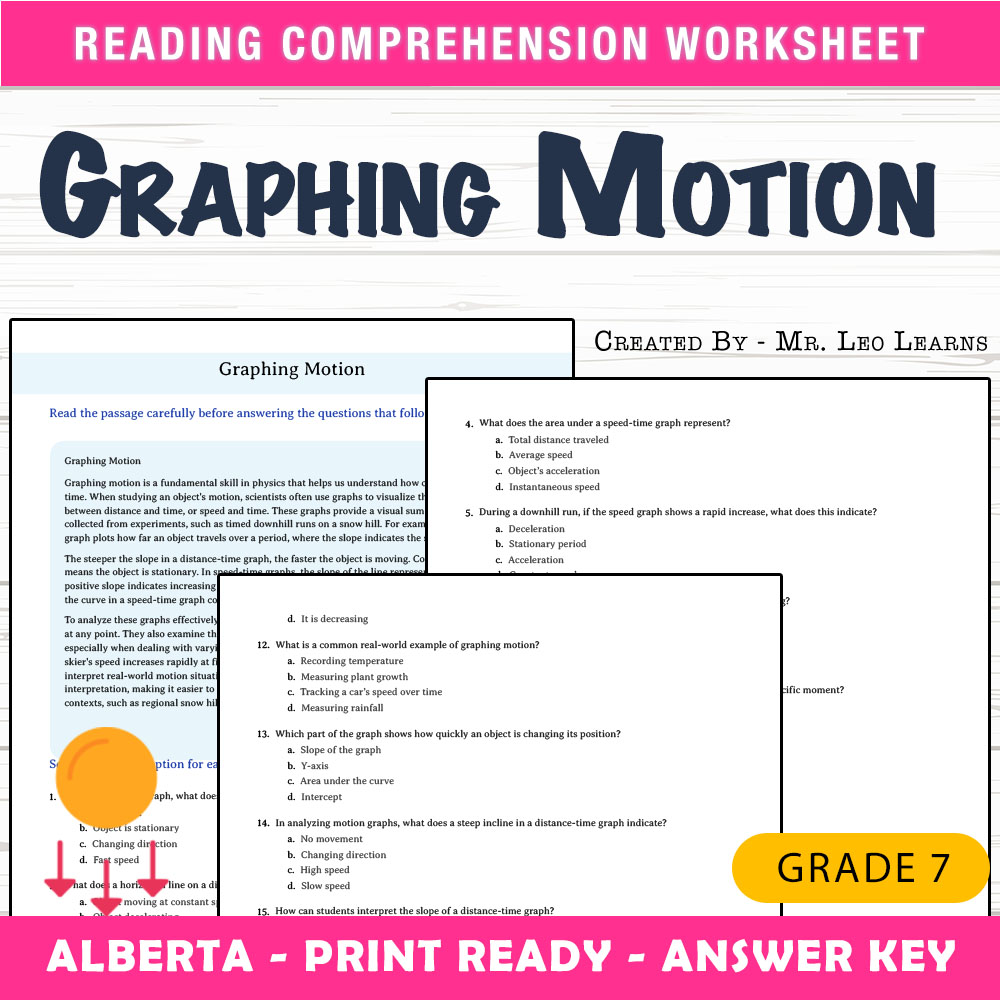
Grade 7 Science — Graphing Motion Worksheet MCQ Paper for Mastery
 Created byThe Resource Hub
Learning Objectives
- Understand how to create and interpret distance–time and speed–time graphs.
- Learn the significance of slope and area under curves in motion graphs.
- Develop skills to extract average and instantaneous rates from graphs using examples like downhill runs.
Also included in: Grade 7 Science Alberta Forces Structures and Motion Worksheet Bundle +1 more
Instant download
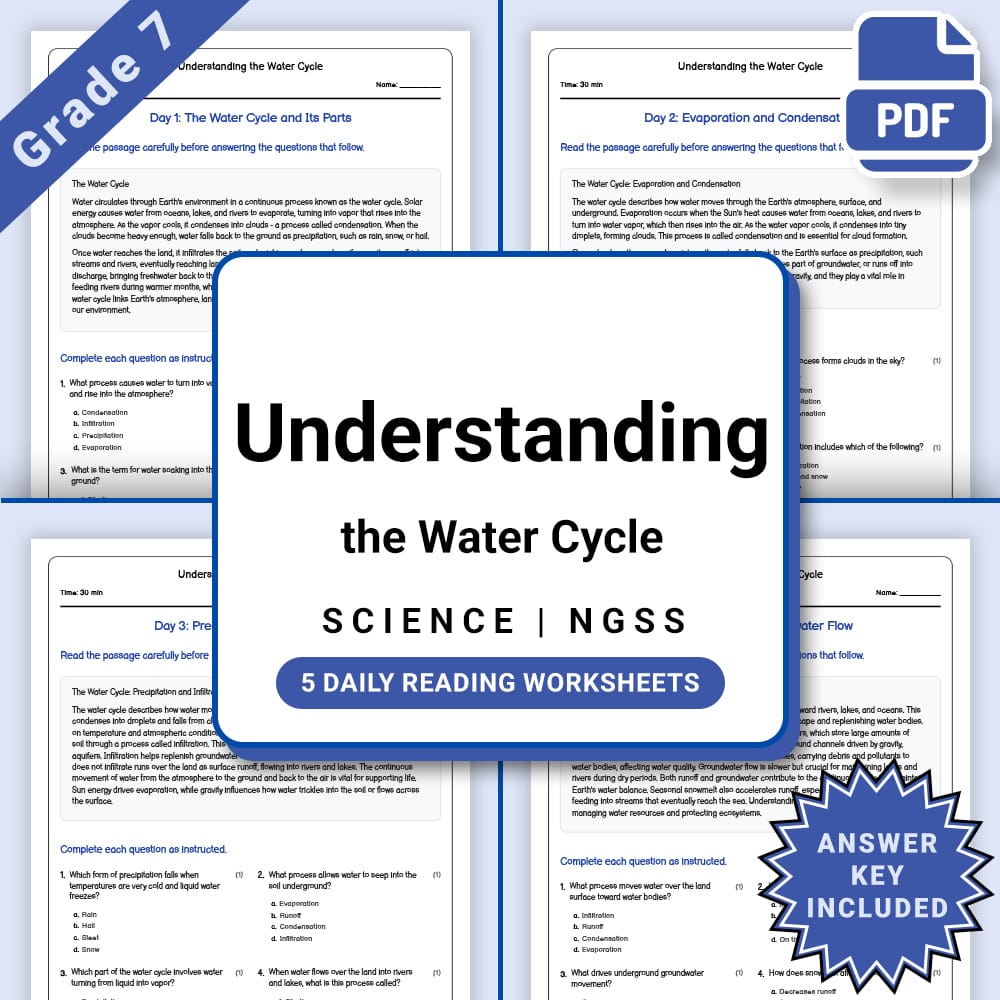
Grade 7 Science – Water Cycle Daily Reading Worksheet(PDF + Answer Key)
Created byCopper Leaf ClassroomLearning Objectives
- Identify the main processes involved in the water cycle
- Explain how water moves through Earth's atmosphere, hydrosphere, and geosphere
- Recognize the interactions between different water cycle components and Earth’s spheres
Instant download
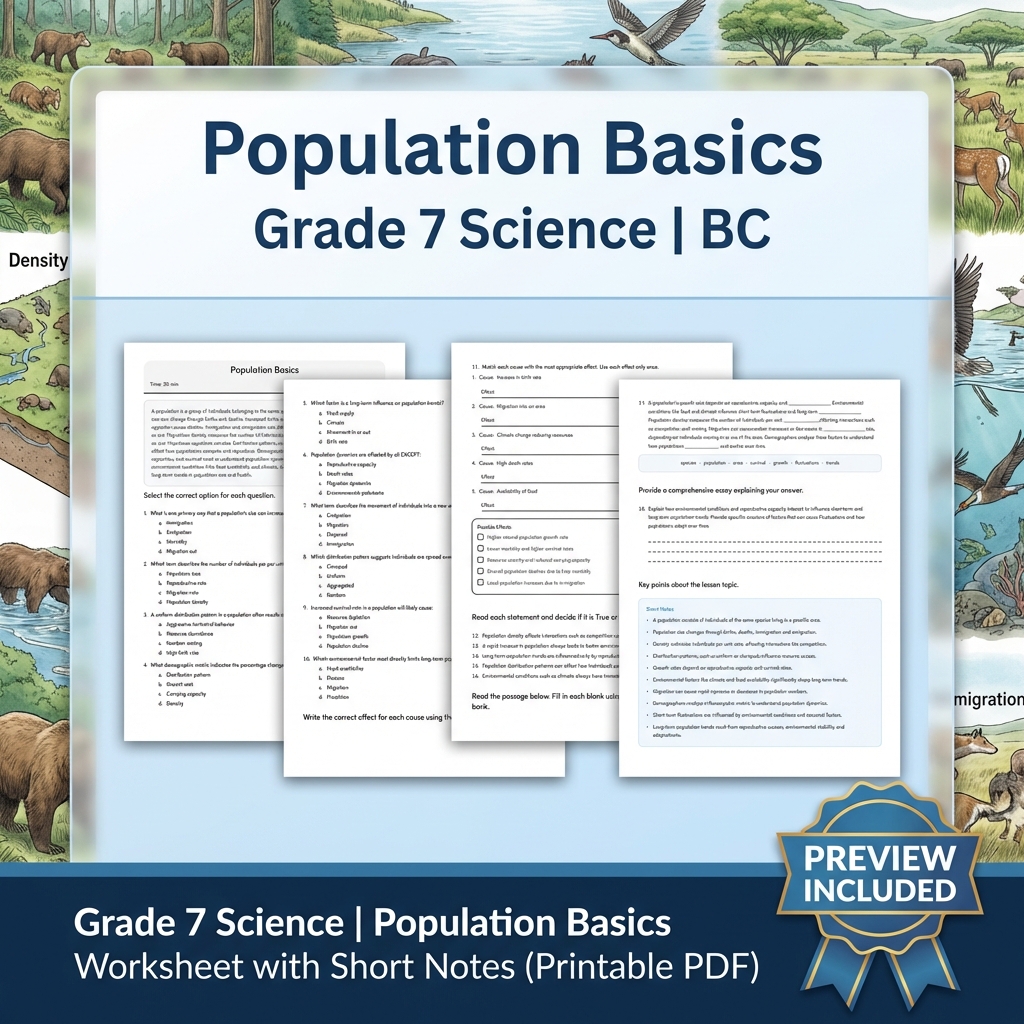
Grade 7 Science | Population Basics Worksheet with Short Notes (Printable PDF)
Created byMeadowlark WorksheetsLearning Objectives
- Understand the defining features of populations and their components.
- Identify factors influencing population size and distribution.
- Explain demographic metrics like growth rates and density.
Also included in: Grade 7 Science Lesson Bundle: Ecosystems and Population Dynamics Worksheets +1 more
Instant download
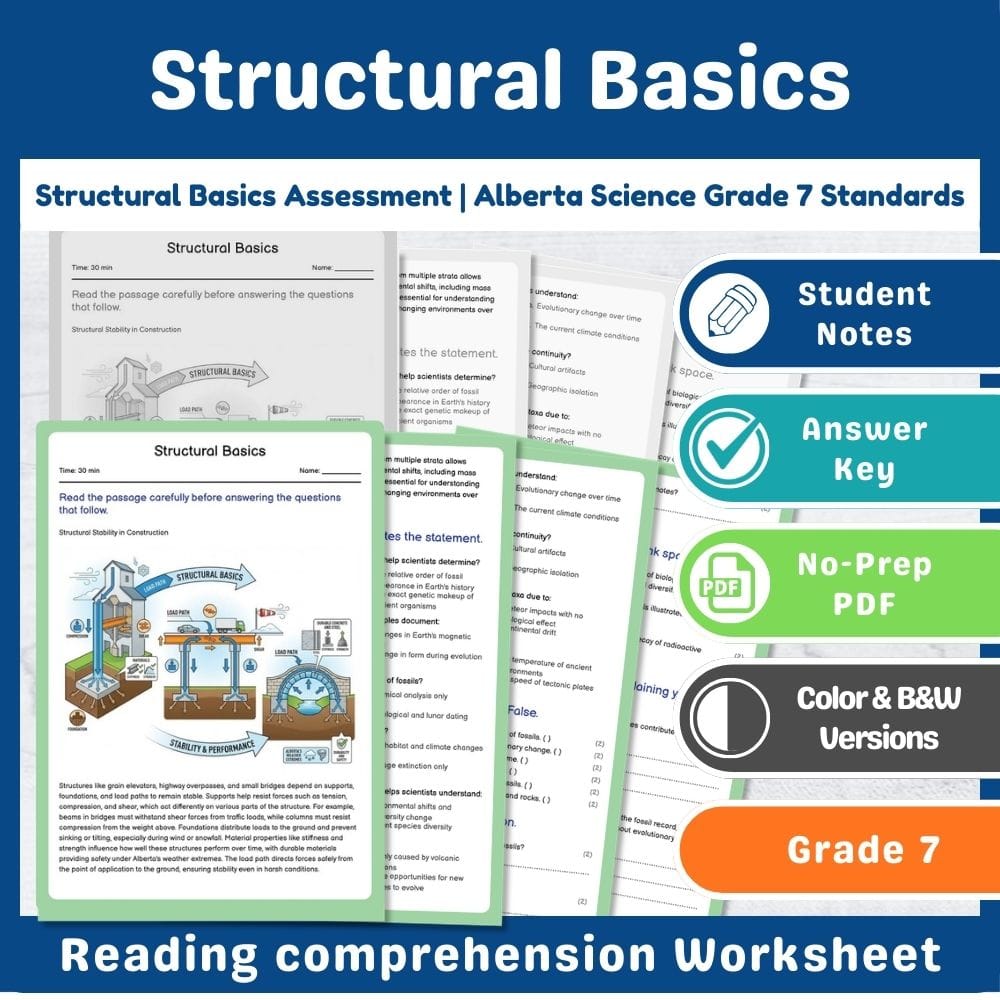
Structural Basics Assessment | Alberta Science Grade 7 Standards
Created byPrism Point LearningLearning Objectives
- Explain how supports, foundations, and load paths contribute to structural stability.
- Describe the effects of compression, tension, and shear on beams, columns, and foundations.
- Identify material properties such as stiffness, strength, and durability relevant to construction safety.
Also included in: Lesson Bundle Grade 7 Science Forces Structures and Motion | Alberta Standards +1 more
Instant download
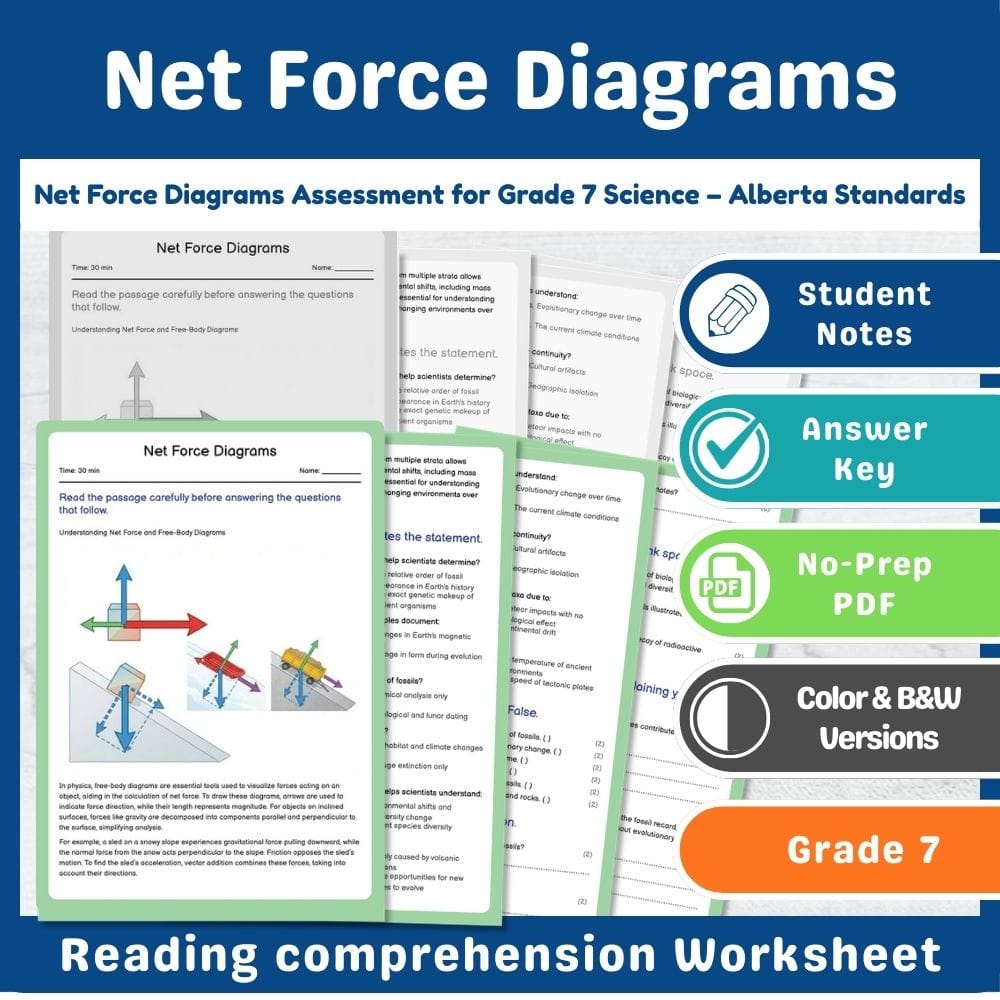
Net Force Diagrams Assessment for Grade 7 Science – Alberta Standards
Created byPrism Point LearningLearning Objectives
- Understand how to construct and interpret free-body diagrams for various objects and situations.
- Learn vector addition techniques to determine net force magnitude and direction on objects.
- Decompose forces on inclined surfaces into perpendicular components and combine them algebraically.
Also included in: Lesson Bundle Grade 7 Science Forces Structures and Motion | Alberta Standards +1 more
Instant download
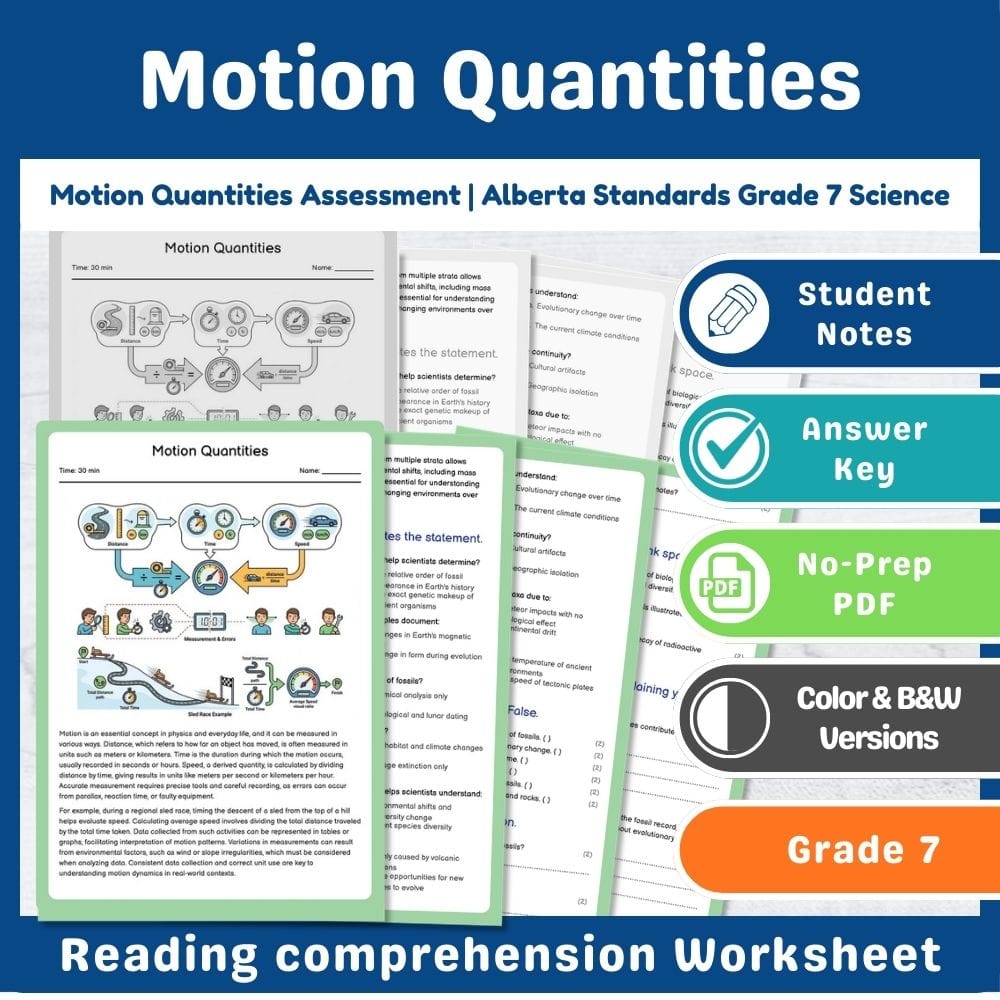
Motion Quantities Assessment | Alberta Standards Grade 7 Science
Created byPrism Point LearningLearning Objectives
- Understand the key concepts of distance, time, and speed in motion measurement.
- Calculate average speed using distance and time data accurately.
- Identify common sources of measurement error in motion data.
Also included in: Lesson Bundle Grade 7 Science Forces Structures and Motion | Alberta Standards +1 more
Instant download
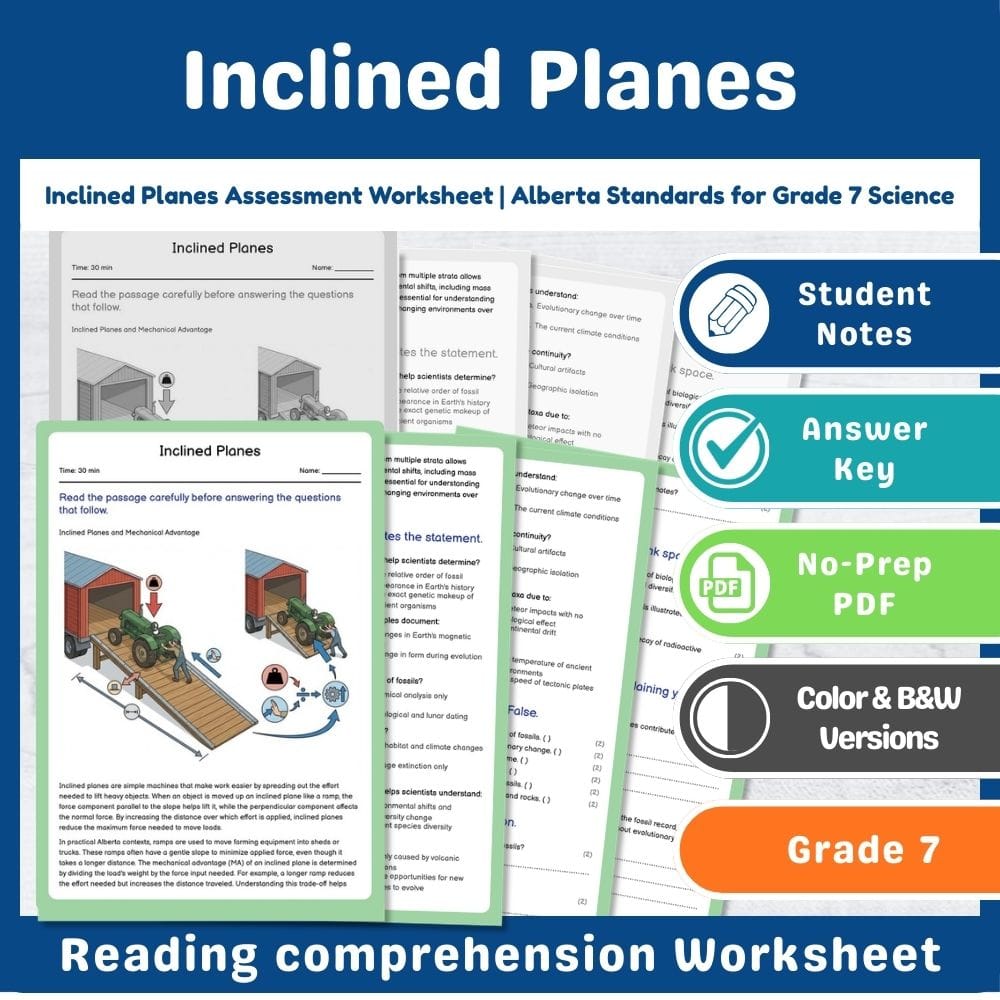
Inclined Planes Assessment Worksheet | Alberta Standards for Grade 7 Science
Created byPrism Point LearningLearning Objectives
- Understand how inclined planes reduce the force needed to move loads.
- Identify components of force parallel and perpendicular to an inclined plane.
- Calculate mechanical advantage of inclined planes based on input force and load.
Also included in: Lesson Bundle Grade 7 Science Forces Structures and Motion | Alberta Standards +1 more
Instant download
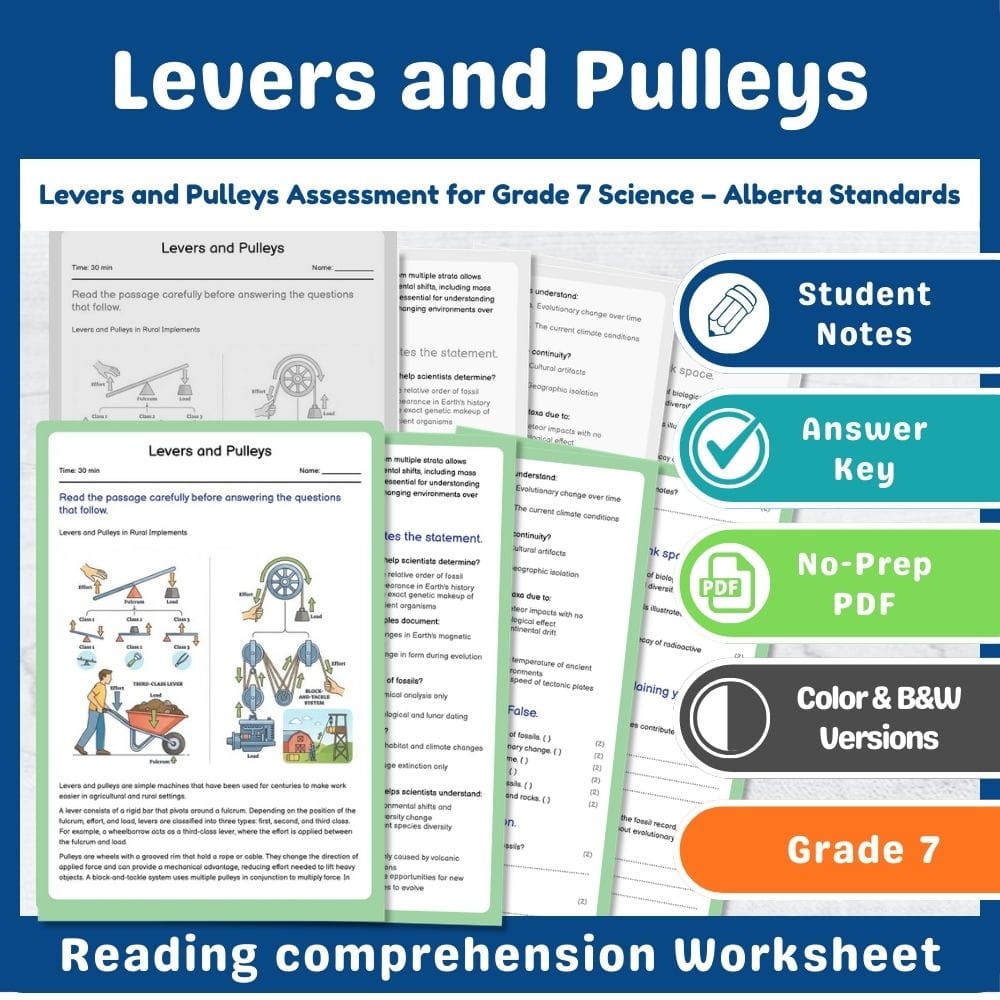
Levers and Pulleys Assessment for Grade 7 Science – Alberta Standards
Created byPrism Point LearningLearning Objectives
- Understand the principles of levers and pulleys and how they modify effort and direction.
- Explain torque, fulcrum placement, and mechanical advantage calculations.
- Identify examples of lever classes and pulley systems used in rural settings.
Also included in: Lesson Bundle Grade 7 Science Forces Structures and Motion | Alberta Standards +1 more
Instant download
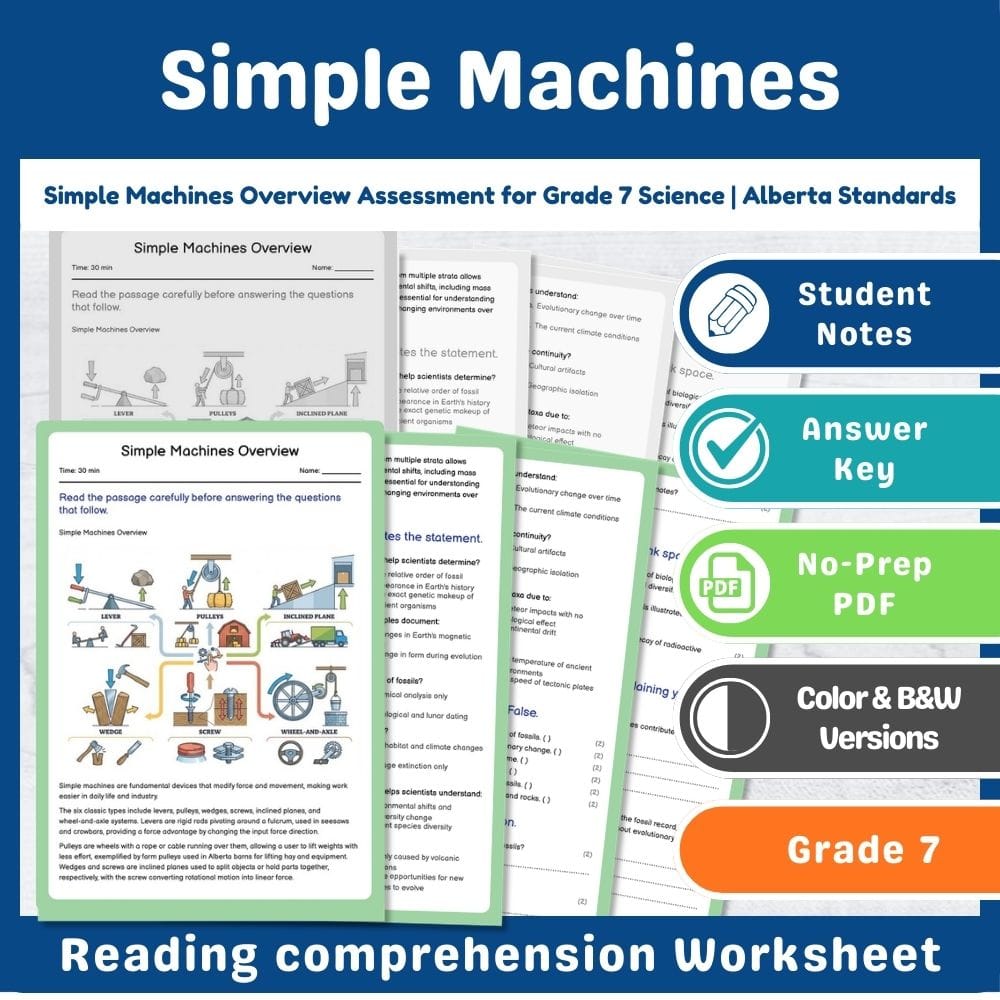
Simple Machines Overview Assessment for Grade 7 Science | Alberta Standards
Created byPrism Point LearningLearning Objectives
- Describe the six types of simple machines and their functions.
- Explain how mechanical advantage is calculated and its significance.
- Identify examples of simple machines in Alberta's agricultural and everyday contexts.
Also included in: Lesson Bundle Grade 7 Science Forces Structures and Motion | Alberta Standards +1 more
Instant download
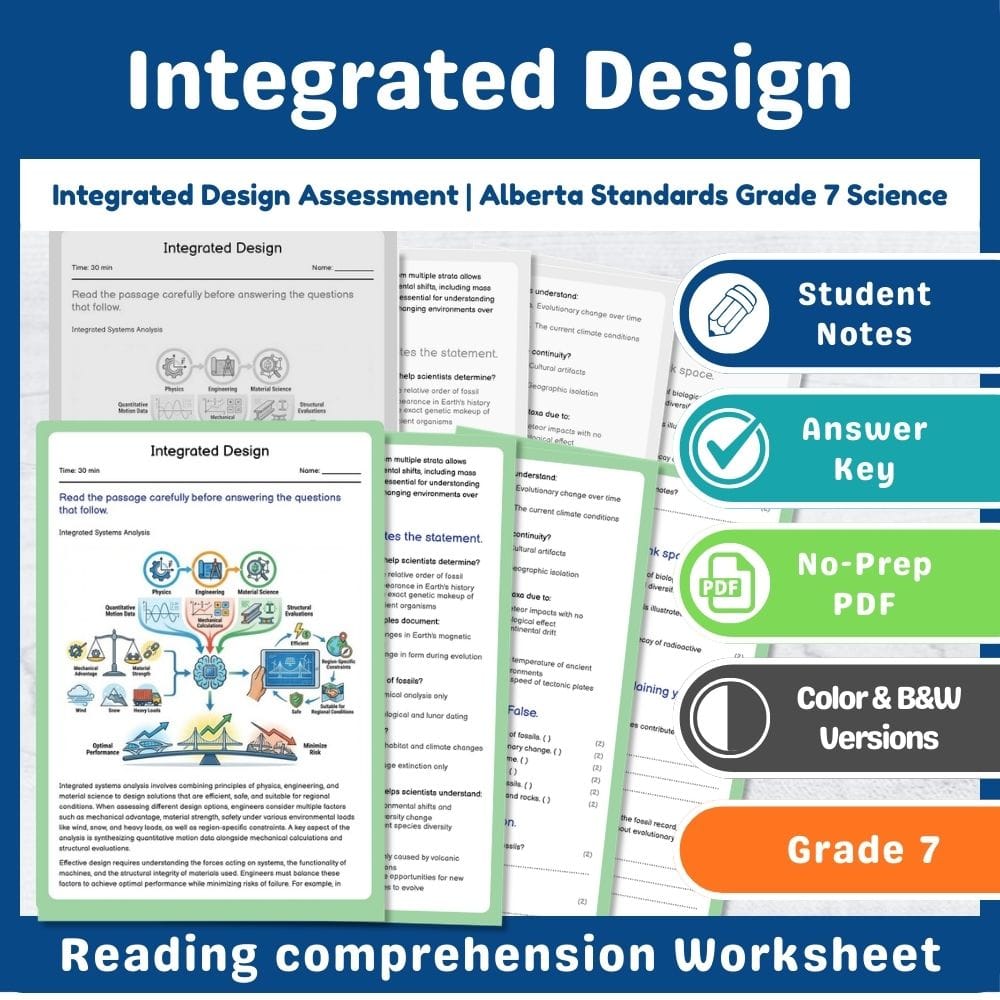
Integrated Design Assessment | Alberta Standards Grade 7 Science
Created byPrism Point LearningLearning Objectives
- Analyze how force understanding impacts mechanical system design.
- Evaluate structural stability and safety considerations for regional applications.
- Compare alternative design solutions based on multiple criteria including material choice and mechanical advantage.
Also included in: Lesson Bundle Grade 7 Science Forces Structures and Motion | Alberta Standards +1 more
Instant download
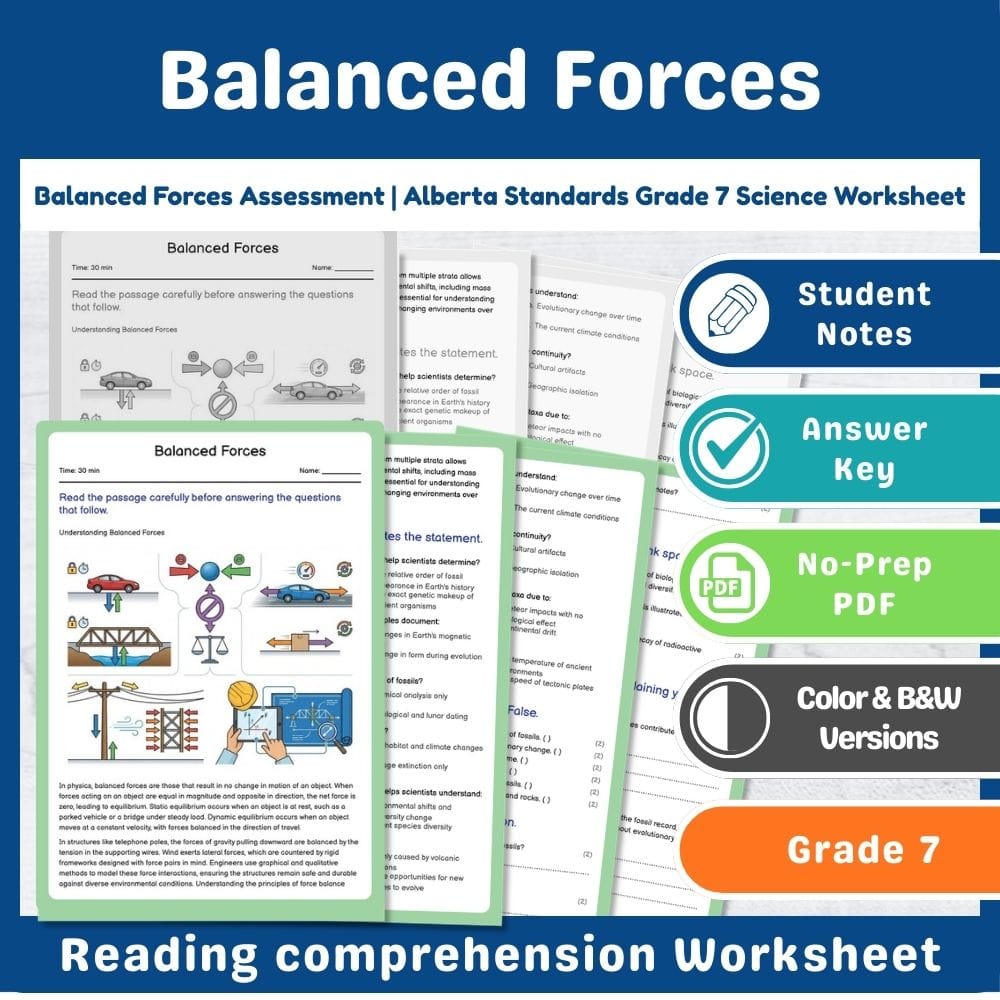
Balanced Forces Assessment | Alberta Standards Grade 7 Science Worksheet
Created byPrism Point LearningLearning Objectives
- Understand the concept of equilibrium and static balance in structures.
- Identify and describe examples of static and dynamic equilibrium.
- Graphically represent force pairs and analyze their effects on objects.
Also included in: Lesson Bundle Grade 7 Science Forces Structures and Motion | Alberta Standards +1 more
Instant download

Grade 7 Science Worksheet | Revision From Results (PDF) for Standard Practice
Created byEvergreen Desk EducationLearning Objectives
- Explain how test data are used to identify mismatches with success criteria.
- Describe how targeted design changes can improve performance while respecting constraints (safety, materials, and cost).
- Write clear cause-and-effect explanations connecting evidence to revised outcomes.
Also included in: Grade 7 Investigation & Engineering Science Lesson Bundle: General Framework +1 more
Instant download

Grade 7 Science Worksheet | Technology Impacts & Ethics (PDF)
Created byEvergreen Desk EducationLearning Objectives
- Explain how technologies create trade-offs between benefits and costs for people and the environment
- Evaluate ethical issues in technology such as fairness, privacy, and product responsibility across the life cycle
- Connect engineering and design choices to real-world impacts on ecosystems and communities
Also included in: Grade 7 Investigation & Engineering Science Lesson Bundle: General Framework +1 more
Instant download

Grade 7 Science Investigation Variables Worksheet (PDF) – Standards-Aligned
Created byEvergreen Desk EducationLearning Objectives
- Identify independent, dependent, and controlled variables in a science investigation.
- Describe how controlled variables help make evidence reliable and fair.
- Select appropriate measurement evidence and units that match a scientific question.
Also included in: Grade 7 Model-Based Scientific Reasoning Science Lesson Bundle (General) +1 more
Instant download

Grade 7 Science Worksheet – Accuracy & Uncertainty (PDF)
Created byEvergreen Desk EducationLearning Objectives
- Explain the difference between accuracy and uncertainty when making measurements.
- Describe how tool resolution and repeated trials affect the range (spread) of data.
- Use tables and graphs to represent uncertainty and decide whether two results meaningfully differ.
Also included in: Grade 7 Model-Based Scientific Reasoning Science Lesson Bundle (General) +1 more
Instant download

Grade 7 Science Control Methods Worksheet (PDF) - General Standards
Created byEvergreen Desk EducationLearning Objectives
- Explain how control methods reduce the influence of unrelated factors in an investigation.
- Identify control and comparison conditions and describe how they should be kept consistent.
- Use proper timing, calibration, and standardized procedures to support credible conclusions.
Also included in: Grade 7 Model-Based Scientific Reasoning Science Lesson Bundle (General) +1 more
Instant download

Grade 7 Science Worksheet on Simple Systems and Mechanisms (PDF)
Created byEvergreen Desk EducationLearning Objectives
- Explain how simple mechanisms transfer motion and force within engineered systems.
- Describe input-output relationships using the terms input energy, mechanism, and output performance.
- Predict how changing a mechanism (such as a gear ratio or pulley arrangement) affects speed and torque or force.
Also included in: Grade 7 Investigation & Engineering Science Lesson Bundle: General Framework +1 more
Instant download

Grade 7 Science Worksheet | Nutrient Cycles (PDF) for Assessment
Created byEvergreen Desk EducationLearning Objectives
- Explain how nutrients cycle through air, living things, water, and soil in an ecosystem
- Describe the main roles of photosynthesis, respiration, decomposition, and bacteria in nutrient transformations
- Use nutrient-cycle ideas to predict how limiting nutrients can affect ecosystem productivity
Also included in: Grade 7 Ecosystem Energy Flows Science Lesson Bundle - General Framework +1 more
Instant download
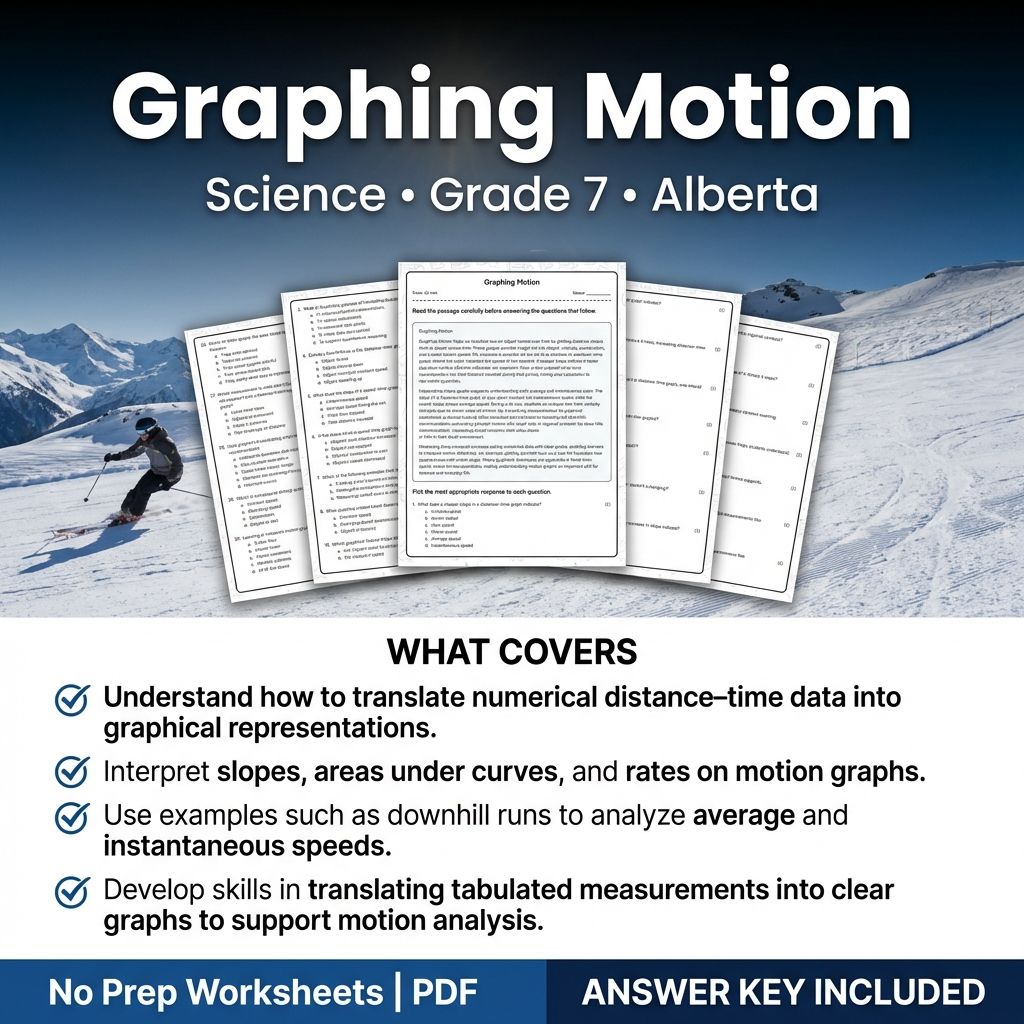
Grade 7 Science Worksheet on Graphing Motion | Alberta Standards
Created byCoral Reef LearningLearning Objectives
- Understand how to translate numerical distance–time data into graphical representations.
- Interpret slopes, areas under curves, and rates on motion graphs.
- Use examples such as downhill runs to analyze average and instantaneous speeds.
Instant download

Grade 7 Science Worksheet – Abiotic Influences (BC Standard) (PDF)
Created byEvergreen Desk EducationLearning Objectives
- Identify major abiotic factors (temperature, moisture, light, soil nutrients, pH) and describe how each affects organisms.
- Explain how daily and seasonal changes in abiotic conditions can create stress or opportunities for populations.
- Use carrying capacity and population resilience to predict how organisms may respond to extreme abiotic events.
Instant download

Forces and Change Worksheet | Standards-Aligned Grade 7 Science Practice
JCreated byJ.S SheetsLearning Objectives
- Explain how forces act as causes of changes in an object’s motion using the ideas of velocity and acceleration
- Differentiate balanced forces from unbalanced forces and predict the effect on net force and motion
- Describe how friction, air resistance, and gravity oppose or change motion near Earth
Also included in: Grade 7 Energy Transfer and Change Science Lesson Bundle – General Framework +1 more
Instant download
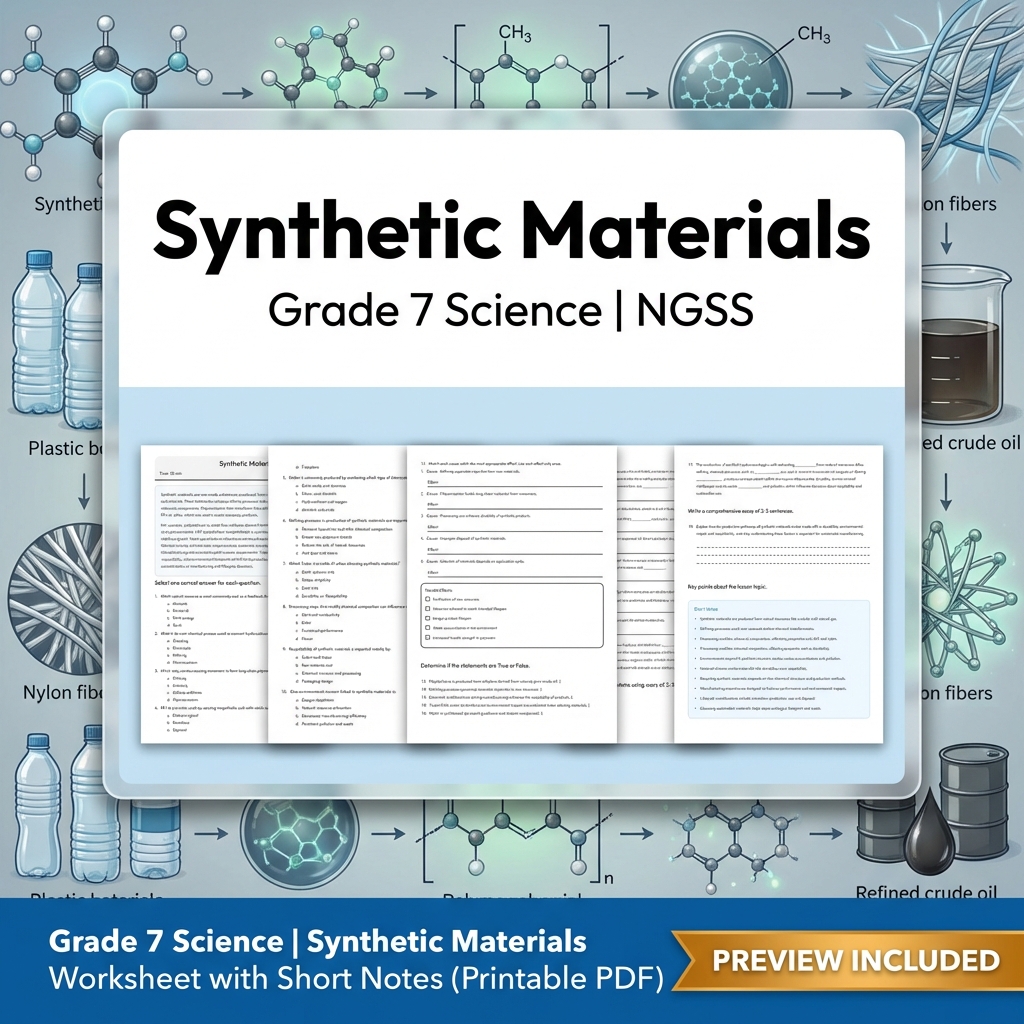
Grade 7 Science | Synthetic Materials Worksheet with Short Notes (Printable PDF)
Created byMeadowlark WorksheetsLearning Objectives
- Describe how natural resources are transformed into common synthetic materials.
- Explain the processes of polymerization, refining, and manufacturing of synthetic materials like polyethylene, PET, and nylon.
- Identify trade-offs associated with synthetic materials, including durability, recyclability, and environmental impacts.
Also included in: Grade 7 Science | Matter and Its Interactions NGSS Worksheet Collection +1 more
Instant download
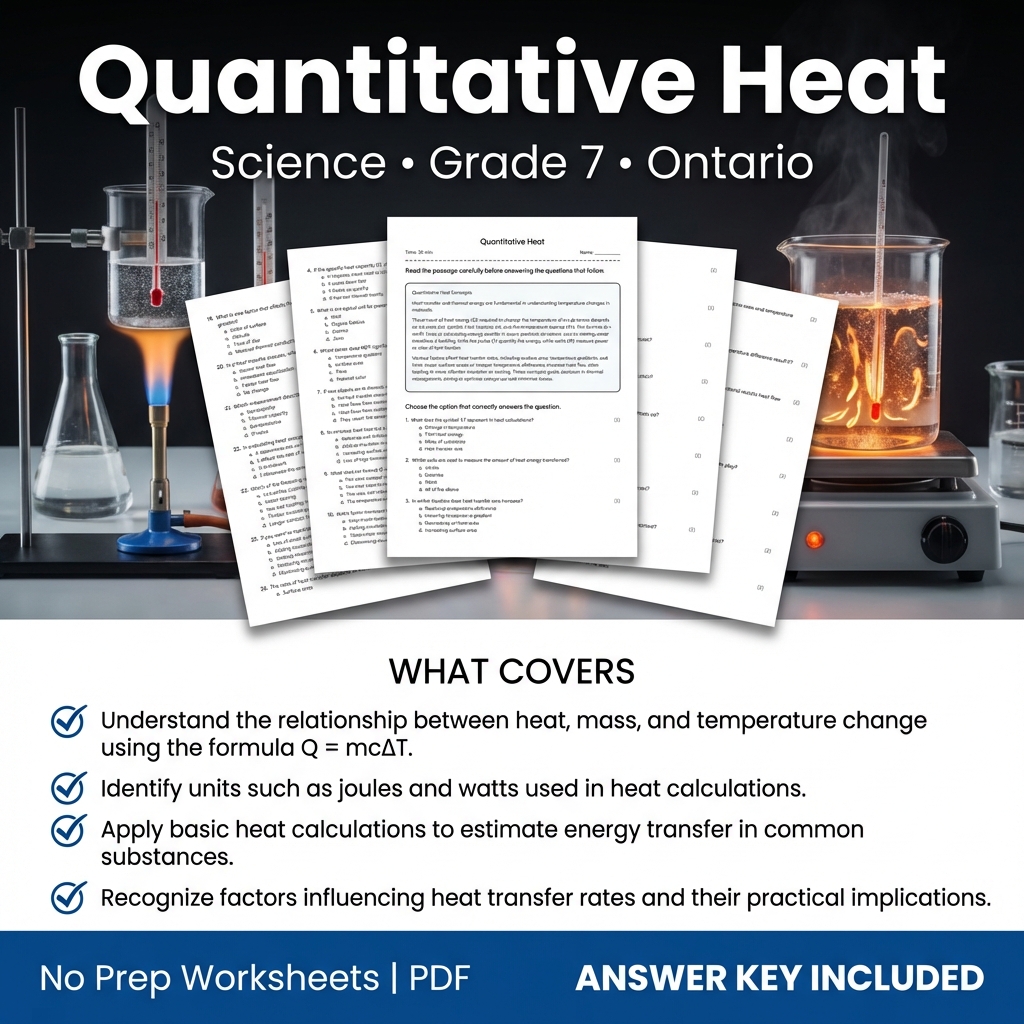
Grade 7 Science Worksheet on Quantitative Heat | Ontario Standards
Created byCoral Reef LearningLearning Objectives
- Understand the relationship between heat, mass, and temperature change using the formula Q = mcΔT.
- Identify units such as joules and watts used in heat calculations.
- Apply basic heat calculations to estimate energy transfer in common substances.
Instant download
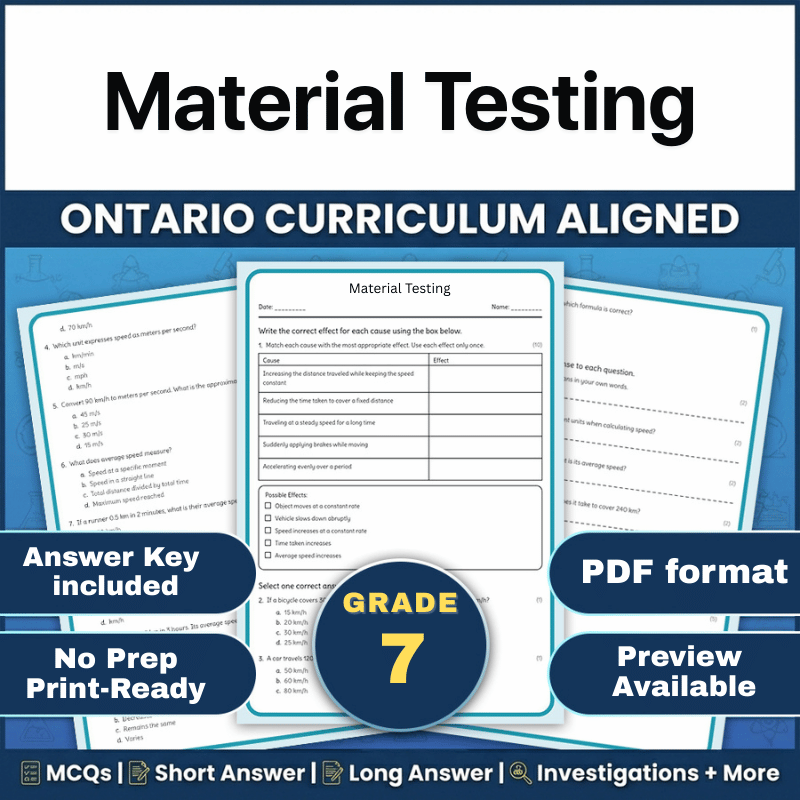
Grade 7 Science | Material Testing Worksheet (Ontario, PDF)
Created byBright Mind ResourcesLearning Objectives
- Describe characteristic methods for determining material behaviour, including tensile, compression, and bending assessments.
- Understand non-destructive testing techniques such as ultrasonic and hardness measurements.
- Explain the concepts of anisotropy in timber and composites, and the role of strain localization.
Instant download
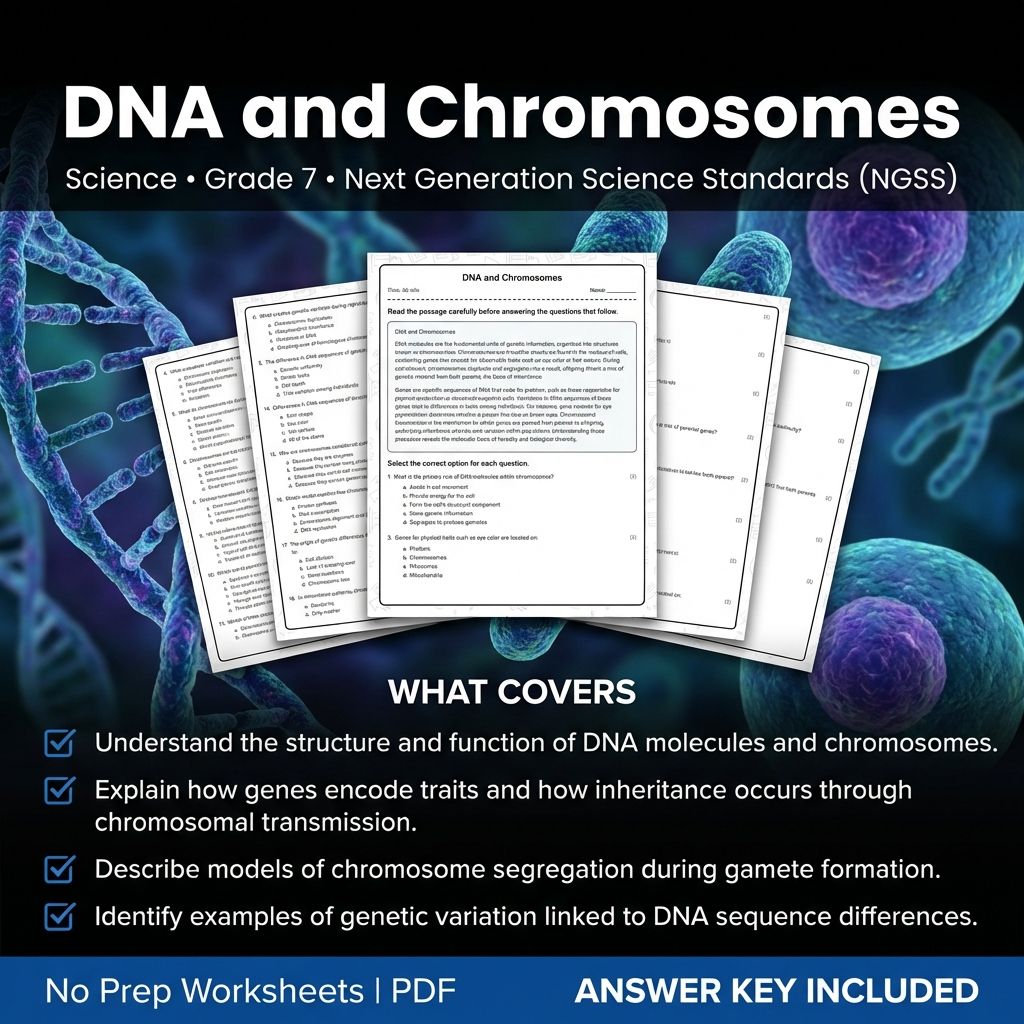
Grade 7 Science Worksheet | DNA and Chromosomes Practice & Answer Key (Printable PDF)
Created byCoral Reef LearningLearning Objectives
- Understand the structure and function of DNA molecules and chromosomes.
- Explain how genes encode traits and how inheritance occurs through chromosomal transmission.
- Describe models of chromosome segregation during gamete formation.
Instant download
About Grade 7 Science Worksheets
Browse 6,039 printable Grade 7 Science worksheets — ready-to-print PDFs with answer keys where available.
Every worksheet on MyTeachingSheets is created by independent teacher-authors and reviewed before publication. All resources download as printable PDFs for classroom, homework, or at-home practice, and many include answer keys. Preview any worksheet free before buying.