
Grade 7 Science Worksheets
6,039 worksheets
Grade 7 Science | Integrated Design Worksheet (Alberta Standards PDF)
 Created bySilver Birch Teaching
Learning Objectives
- Explain how integrated systems analysis connects forces, motion, and structural safety when comparing design options.
- Use mechanical advantage and simple reasoning about motion to predict how design changes affect performance.
- Evaluate structural factors such as deflection and safe stress levels under wind, snow, and load conditions.
Also included in: Grade 7 Simple Machines and Forces Science Lesson Bundle: Alberta +1 more
Instant download

7th Grade Science | Population Models Reading Worksheet with Answer Key (PDF)
JCreated byJ.S SheetsLearning Objectives
- Understand the differences between exponential and logistic population growth models.
- Identify factors that influence population dynamics, including density-dependent and density-independent factors.
- Describe how population models help interpret patterns observed in ecosystems.
Instant download

Population Basics Practice Worksheet | Grade 7 Science Review Assessment
 Created byPrism Point Learning
Learning Objectives
- Define population and explain how it changes over time using births, deaths, immigration, and emigration.
- Describe how population density and distribution patterns can affect interactions within a species.
- Explain how reproductive capacity and survival influence population growth rates.
Also included in: Ecosystems & Interactions Lesson Bundle – Grade 7 Science BC Framework +1 more
Instant download

Chromatography Techniques Worksheet Grade 7 Science Investigation
 Created byChalk and Compass
Learning Objectives
- Explain how chromatography separates mixtures using a stationary phase and a mobile phase.
- Describe how molecular polarity and differential partitioning lead to different migration distances.
- Interpret retention factors (Rf) and use resolution ideas to compare separations.
Also included in: Separation of Mixtures & Matter Properties Lesson Bundle – Grade 7 Science +1 more
Instant download

Grade 7 Science | Environmental Change Impacts Worksheet | General Standards
 Created byLumora Learning
Learning Objectives
- Explain how changes in climate and habitat conditions can affect ecosystem survival and reproduction
- Describe how changes in water quality and pollution can alter growth, mortality, and population size
- Analyze how shifts in key species can change predation, competition, and symbiosis within an ecosystem
Instant download
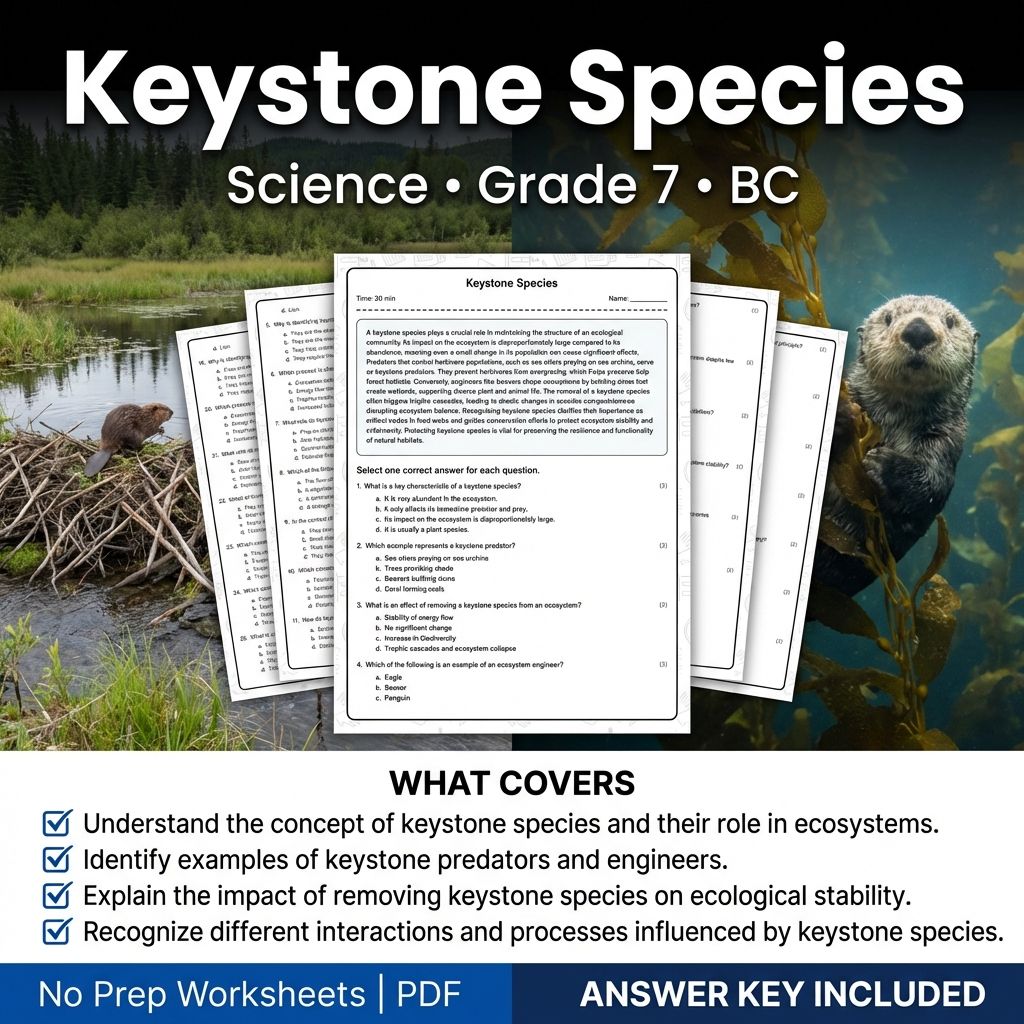
7th Grade Science | Keystone Species Worksheet & Answer Key (Printable PDF)
 Created byCoral Reef Learning
Learning Objectives
- Understand the concept of keystone species and their role in ecosystems.
- Identify examples of keystone predators and engineers.
- Explain the impact of removing keystone species on ecological stability.
Instant download

Grade 7 Science | Biotic and Abiotic Factors Worksheet (Alberta Standards) (PDF)
Created bySilver Birch TeachingLearning Objectives
- Explain how abiotic factors (sunlight, water, temperature, soil, and topography) influence where organisms can survive
- Describe how biotic interactions (plants, animals, and microbes) respond to changing abiotic conditions
- Use cause-and-effect reasoning to predict how ecosystem patterns differ across regional environmental gradients
Also included in: Grade 7 Ecosystems & Biodiversity Science Lesson Bundle for Alberta Framework +1 more
Instant download

Grade 7 Science | Migration Patterns Worksheet (Alberta Standards) PDF
Created bySilver Birch TeachingLearning Objectives
- Explain how food availability and breeding needs drive seasonal and annual migration patterns.
- Describe how timing cues and energetic demands influence when organisms move between habitats.
- Interpret how migratory connectivity links ecosystems and supports biodiversity across regions.
Also included in: Grade 7 Ecosystems & Biodiversity Science Lesson Bundle for Alberta Framework +1 more
Instant download

Grade 7 Science | Food Webs Worksheet – Alberta Standards (PDF)
Created bySilver Birch TeachingLearning Objectives
- Explain how energy flows through producers, consumers, and decomposers in a food web
- Describe how organisms are connected through feeding relationships and dependency chains
- Analyze how removing or adding a species can change trophic connections and affect ecosystem stability
Also included in: Grade 7 Ecosystems & Biodiversity Science Lesson Bundle for Alberta Framework +1 more
Instant download

Grade 7 Science | Wetland Functions Worksheet (Alberta Standards) (PDF)
Created bySilver Birch TeachingLearning Objectives
- Describe how wetlands regulate water at the landscape scale through storage, slow release, and flood buffering.
- Explain how wetlands support ecosystem services through nutrient cycling and filtration.
- Identify how wetland type (e.g., peatlands vs. marshes) relates to different habitats and biological functions.
Also included in: Grade 7 Ecosystems & Biodiversity Science Lesson Bundle for Alberta Framework +1 more
Instant download

Grade 7 Science – Symbiosis Types Worksheet (Alberta) | PDF & Answer Key
Created bySilver Birch TeachingLearning Objectives
- Identify and distinguish mutualism, commensalism, and parasitism using key features
- Explain how symbiosis relationships affect population size, resource use, and survival
- Use examples from Alberta habitats to describe real-world ecological consequences
Also included in: Grade 7 Ecosystems & Biodiversity Science Lesson Bundle for Alberta Framework +1 more
Instant download

Grade 7 Science Worksheet – Biodiversity Measures (PDF) | Alberta Standards
Created bySilver Birch TeachingLearning Objectives
- Explain how biodiversity can be described using richness, evenness, and habitat heterogeneity.
- Interpret what different biodiversity metrics may indicate about ecosystem resilience and ecological function.
- Connect habitat complexity to changes in species assemblages in Alberta-like environments.
Also included in: Grade 7 Ecosystems & Biodiversity Science Lesson Bundle for Alberta Framework +1 more
Instant download
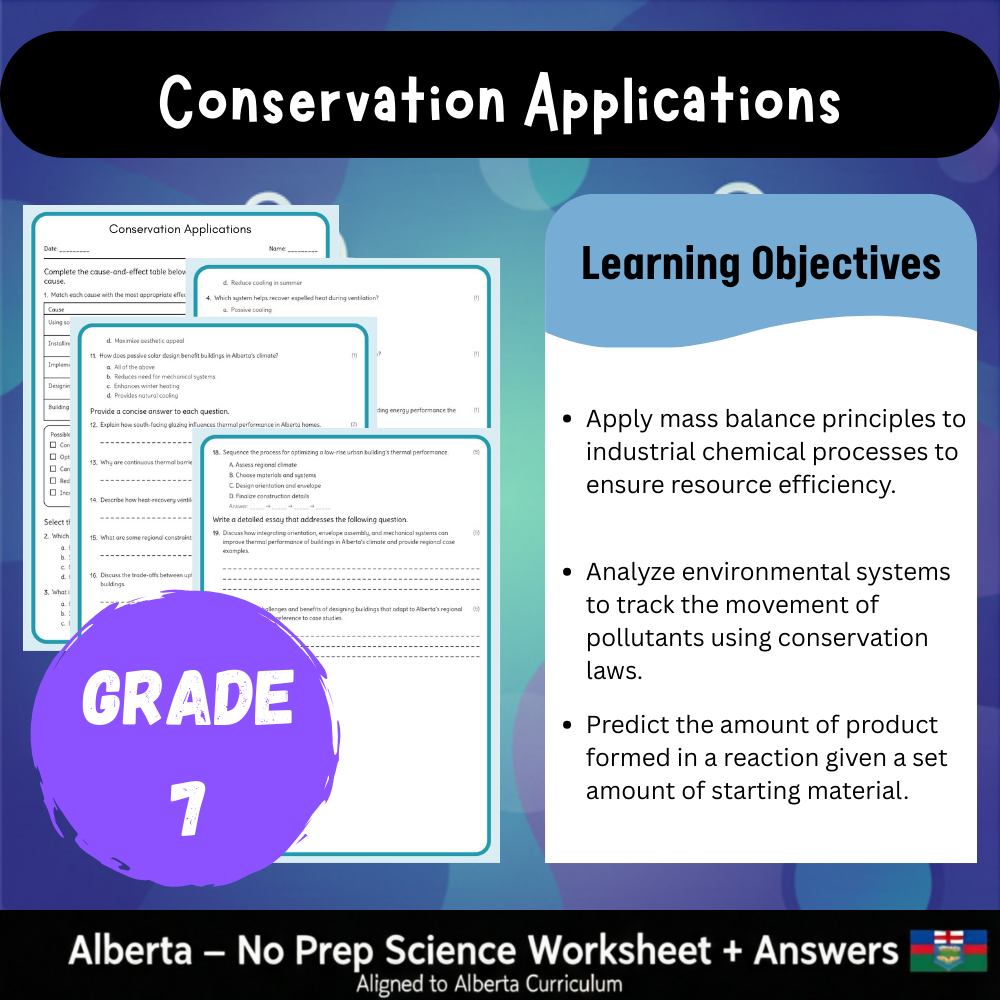
Grade 7 Science | Conservation Applications Worksheet (PDF) – Alberta Standards
 Created byBright Mind Resources
Learning Objectives
- Understand how mass conservation principles apply to chemical and environmental systems.
- Identify practical examples of mass balancing in real-world applications.
- Analyze scenarios involving mass accounting in closed or sealed systems.
Instant download

Adaptation Forms Worksheet | Grade 7 Science Practice
Created byPrism Point LearningLearning Objectives
- Define morphological, physiological, and behavioral adaptations and identify examples in real organisms.
- Explain how traits improve survival and reproductive success in specific environments.
- Differentiate adaptations from acclimation and describe adaptive trade-offs.
Also included in: Ecosystems & Adaptations Grade 7 Science Lesson Bundle TEKS Worksheets
Instant download

Abiotic Influences Worksheet | Grade 7 Science Practice Activities
Created byPrism Point LearningLearning Objectives
- Explain how abiotic factors (nonliving conditions) such as temperature, light, and water availability affect where organisms can live.
- Describe how gradients and microclimates create variation in habitat suitability across an ecosystem.
- Use terrestrial and aquatic examples to link abiotic constraints to species distribution and ecosystem productivity.
Also included in: Ecosystems & Adaptations Grade 7 Science Lesson Bundle TEKS Worksheets
Instant download

Ecosystem Dynamics Worksheet | Grade 7 Science Assessments
Created byPrism Point LearningLearning Objectives
- Explain how energy flows through food chains, food webs, and trophic pyramids
- Describe matter cycling in ecosystems, including the role of decomposers in nutrient recycling
- Compare how changes in inputs or energy pathways can shift community structure and ecosystem processes
Also included in: Ecosystems & Adaptations Grade 7 Science Lesson Bundle TEKS Worksheets
Instant download

Population Change Worksheet | Grade 7 Science Activities
Created byPrism Point LearningLearning Objectives
- Explain how birth and death rates and migration affect population size and distribution
- Compare exponential and logistic growth patterns using carrying capacity and limiting factors
- Describe how resources, disease, and competition influence population dynamics and species interactions
Also included in: Ecosystems & Adaptations Grade 7 Science Lesson Bundle TEKS Worksheets
Instant download
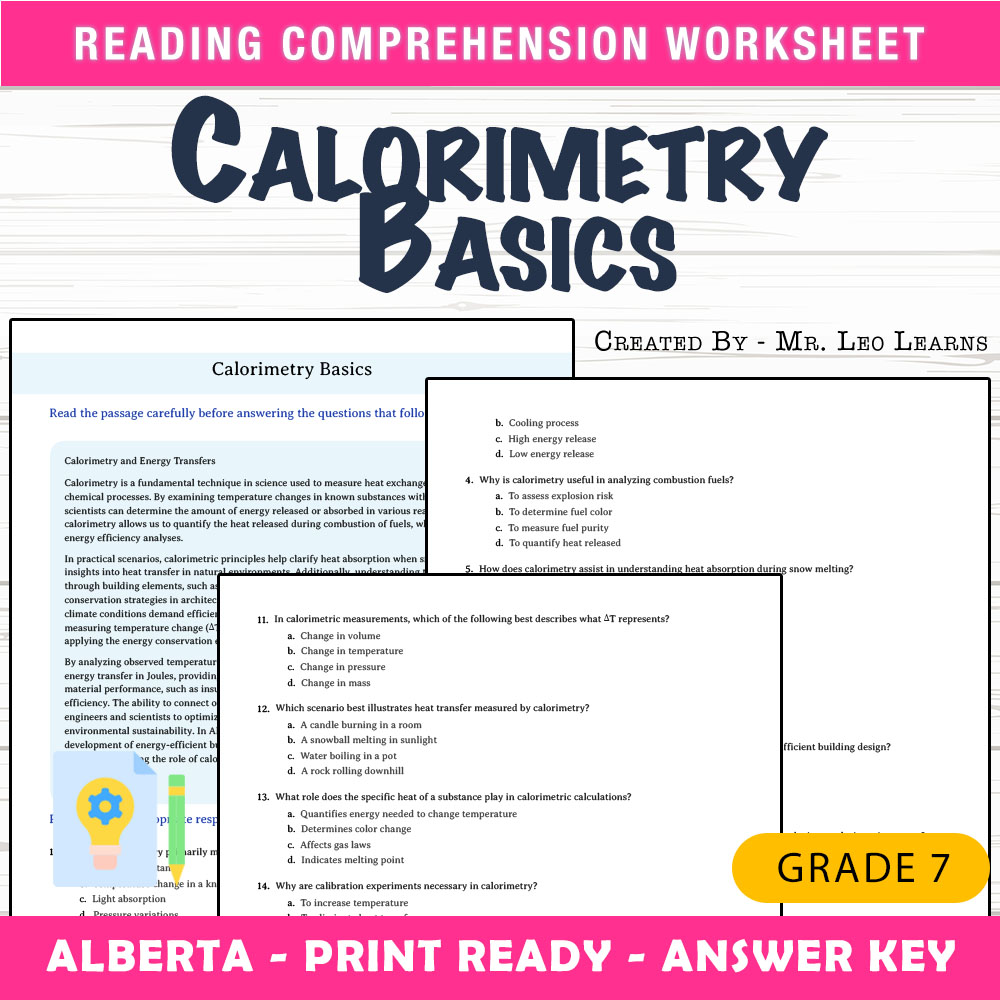
Grade 7 Science — Calorimetry MCQ Worksheet for Mastery
 Created byThe Resource Hub
Learning Objectives
- Understand the principles of calorimetry and energy transfer measurements.
- Apply calorimetric reasoning to real-world thermal scenarios.
- Interpret energy conservation equations related to heat transfer and temperature change.
Also included in: Grade 7 Science Alberta Energy Heat Thermal Processes Worksheet Bundle +1 more
Instant download
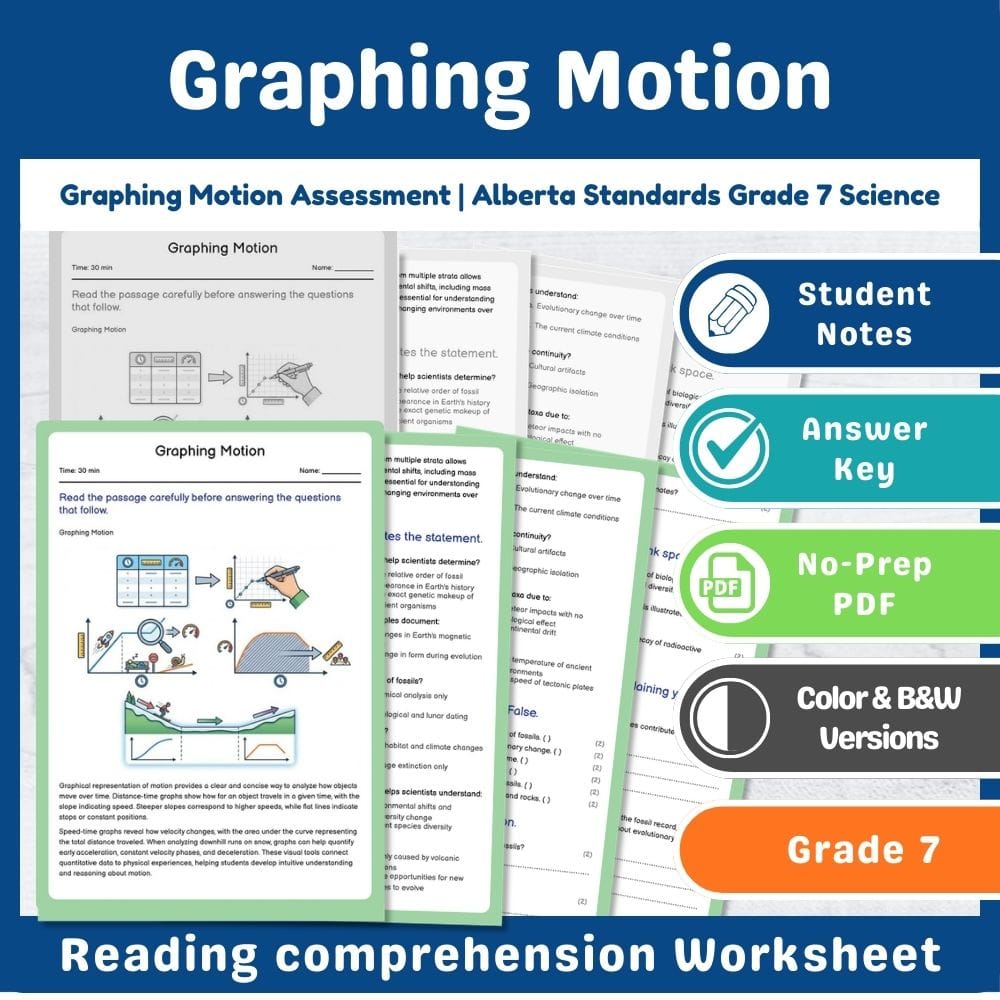
Graphing Motion Assessment | Alberta Standards Grade 7 Science
Created byPrism Point LearningLearning Objectives
- Understand how to interpret distance–time and speed–time graphs.
- Explain the significance of slope, area under curves, and rate calculations in motion graphs.
- Translate tabulated numerical data into accurate graphical representations.
Also included in: Lesson Bundle Grade 7 Science Forces Structures and Motion | Alberta Standards +1 more
Instant download
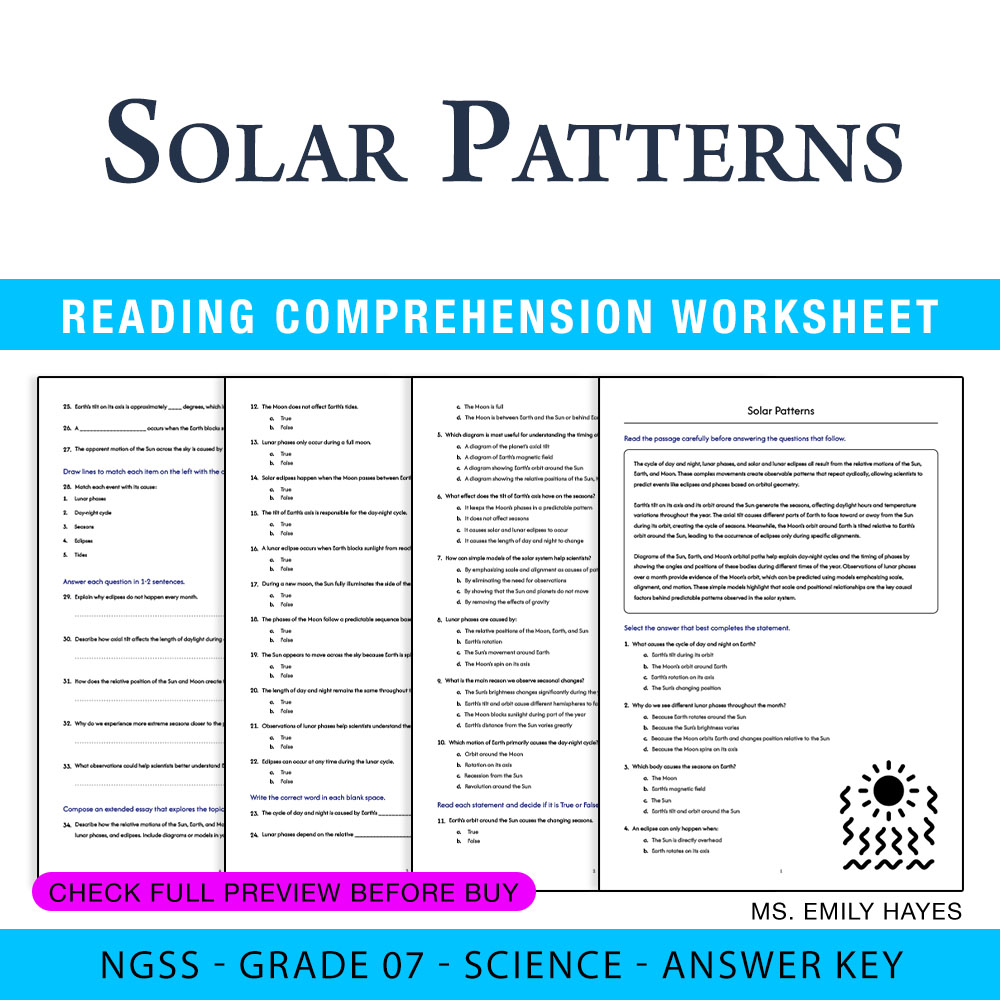
Grade 7 Science | Solar Patterns Worksheet (PDF+ Answer Key)
 Created byCopper Leaf Classroom
Learning Objectives
- Understand the cyclic patterns produced by the relative motions of the Sun, Earth, and Moon.
- Explain how lunar phases, eclipses, and seasonal changes are caused by orbital geometry and tilt.
- Interpret diagrams of orbital motion and axial tilt to describe day-night cycles.
Instant download

Modelling Ecosystems Worksheet | Grade 7 Science Practice
Created byPrism Point LearningLearning Objectives
- Explain how ecological models use assumptions to simplify complex ecosystem relationships.
- Identify common model inputs and how models are tested using real-world observations.
- Compare conceptual and quantitative modelling approaches and describe their strengths and limits.
Also included in: Grade 7 Ecosystems & Biodiversity Science Lesson Bundle | Alberta
Instant download

Conservation Status Worksheet | Grade 7 Science Activities
Created byPrism Point LearningLearning Objectives
- Explain how conservation status is assessed using population trends, threat severity, and recovery potential
- Describe how land use, genetic diversity, and habitat connectivity affect a species’ vulnerability
- Interpret conservation evidence to understand regional species persistence
Also included in: Grade 7 Ecosystems & Biodiversity Science Lesson Bundle | Alberta
Instant download
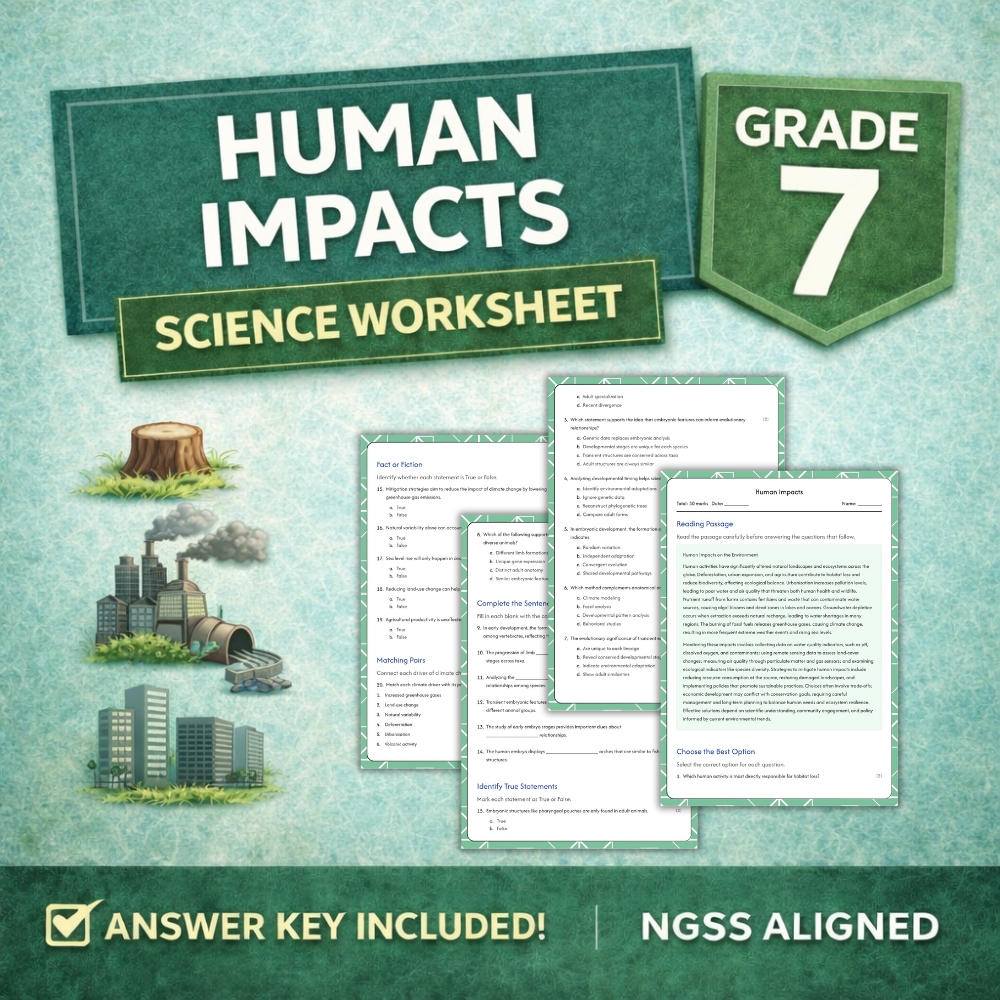
7th Grade Science | Human Impacts Worksheet (NGSS-Aligned Printable PDF)
 Created byCedar Grove Learning
Learning Objectives
- Understand how human activities affect ecosystems and environment.
- Use scientific indicators to monitor environmental changes.
- Evaluate strategies for reducing human impacts on ecosystems.
Instant download
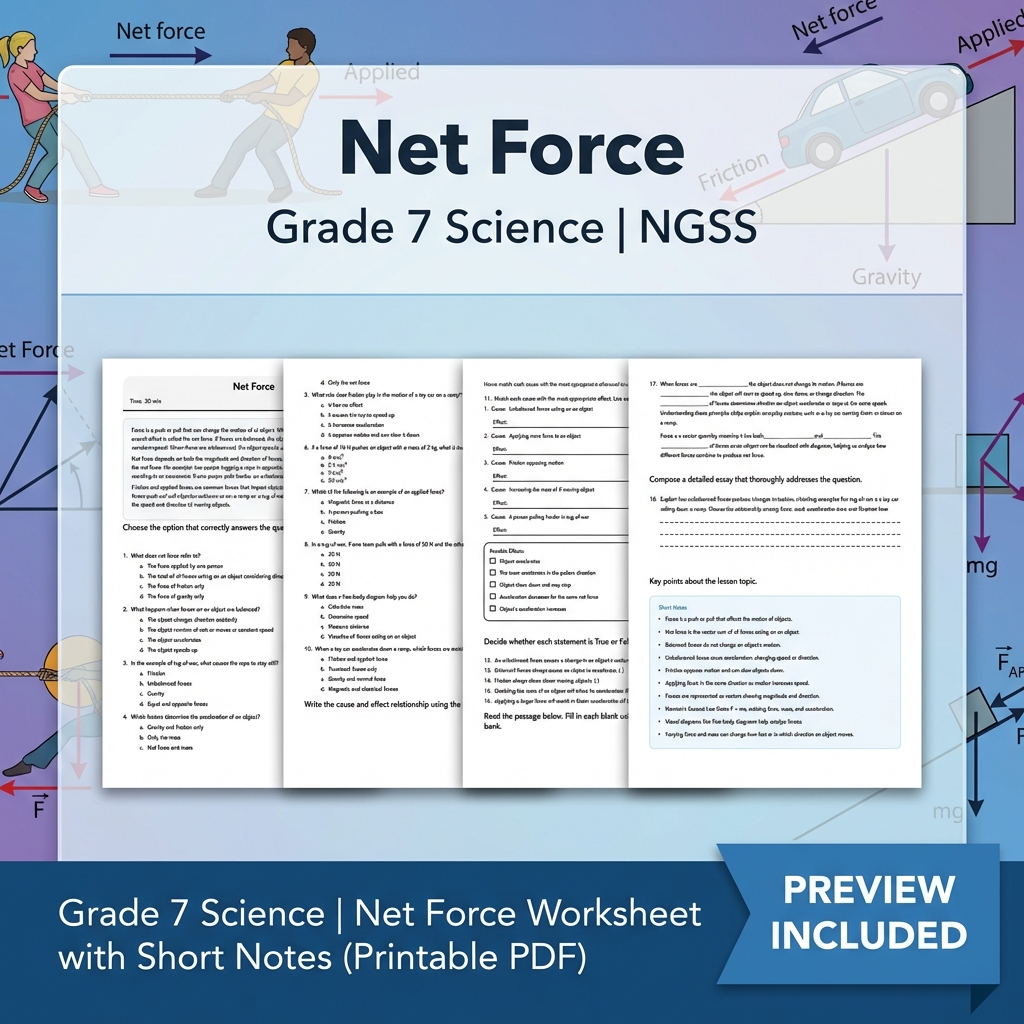
Grade 7 Science | Net Force Worksheet with Short Notes (Printable PDF)
 Created byMeadowlark Worksheets
Learning Objectives
- Define net force as the combination of all forces acting on an object.
- Understand how unbalanced forces cause changes in motion.
- Explore the relationship between net force, mass, and acceleration using diagrams and reasoning.
Also included in: Grade 7 Science | Motion and Stability Forces & Interactions NGSS Unit Bundle +1 more
Instant download
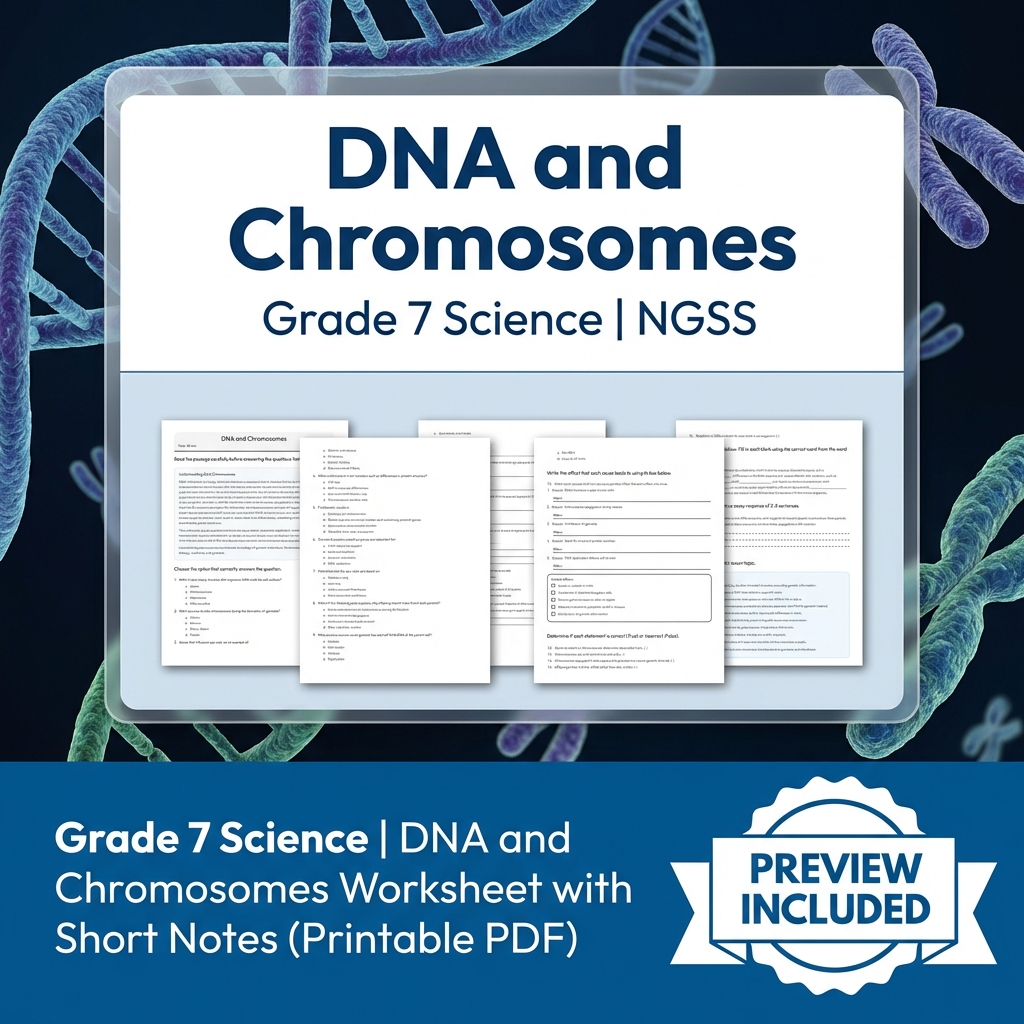
Grade 7 Science | DNA and Chromosomes Worksheet with Short Notes (Printable PDF)
Created byMeadowlark WorksheetsLearning Objectives
- Explain how DNA molecules are organized into chromosomes and how they encode genes that influence observable traits.
- Describe the process of chromosome segregation during gamete formation and fusion.
- Understand how genetic variation underpins trait differences such as eye color or structural proteins.
Also included in: Grade 7 Science | Heredity, Inheritance & Traits NGSS Unit Bundle +1 more
Instant download
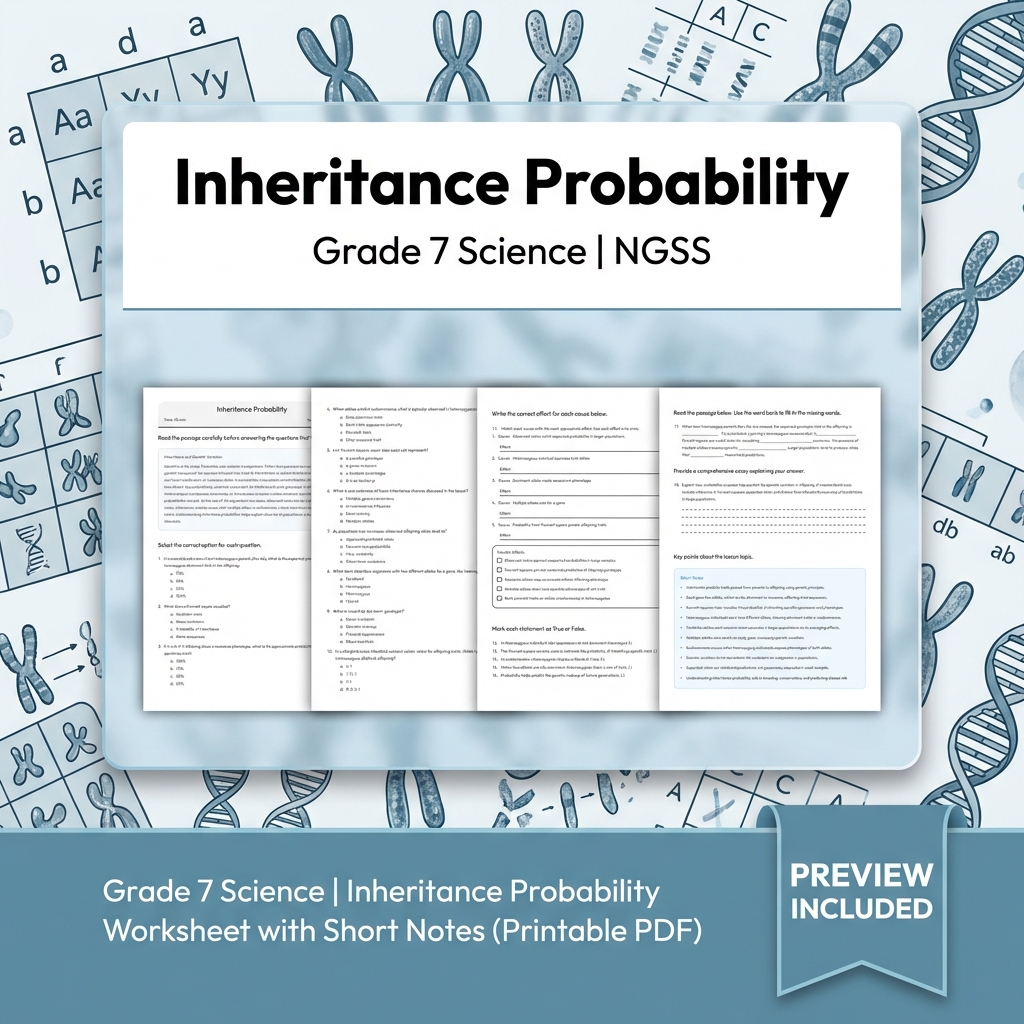
Grade 7 Science | Inheritance Probability Worksheet with Short Notes (PDF)
Created byMeadowlark WorksheetsLearning Objectives
- Understand how probability models predict genetic variation among offspring.
- Interpret Punnett square outcomes to estimate inheritance ratios.
- Calculate expected genotype and phenotype proportions in monohybrid crosses.
Also included in: Grade 7 Science | Heredity, Inheritance & Traits NGSS Unit Bundle +1 more
Instant download
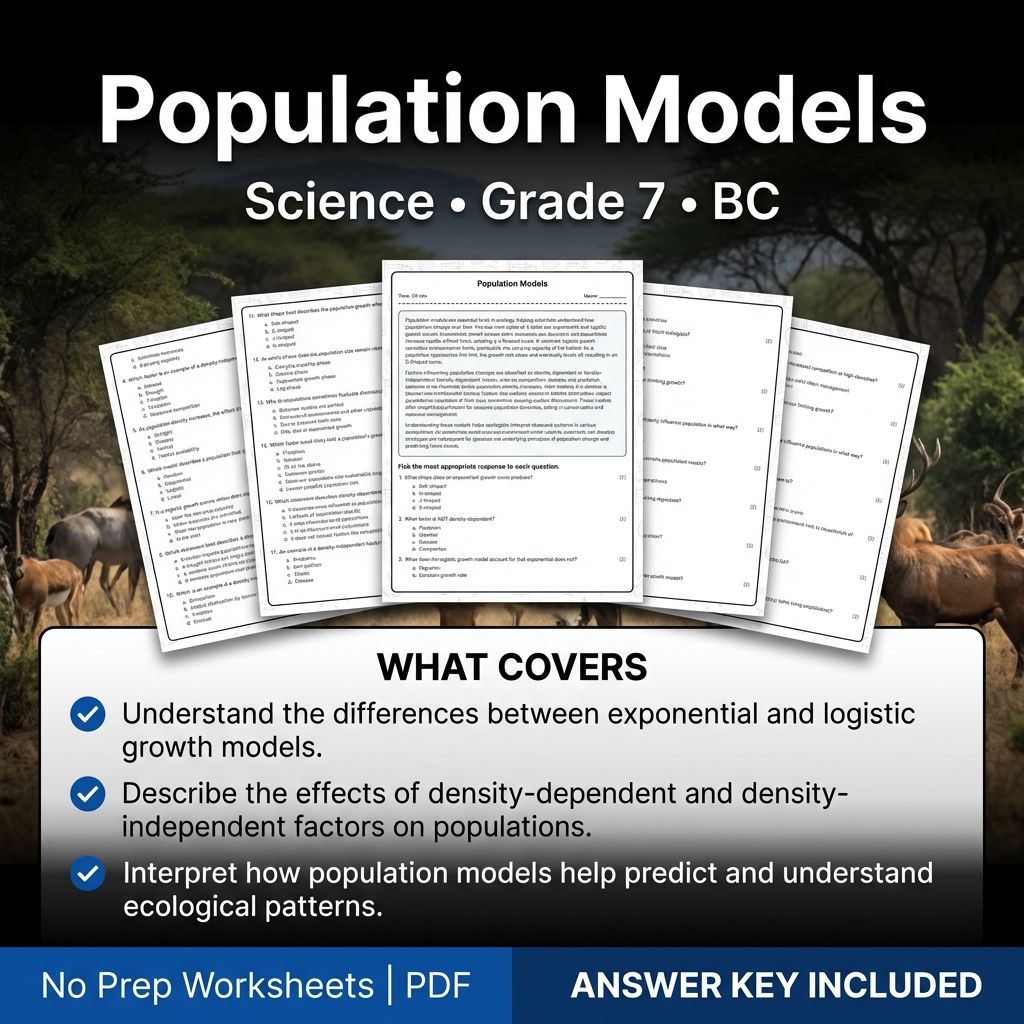
7th Grade Science Worksheet | Population Models Practice & Answer Key (Printable PDF)
Created byCoral Reef LearningLearning Objectives
- Understand the differences between exponential and logistic growth models.
- Describe the effects of density-dependent and density-independent factors on populations.
- Interpret how population models help predict and understand ecological patterns.
Instant download
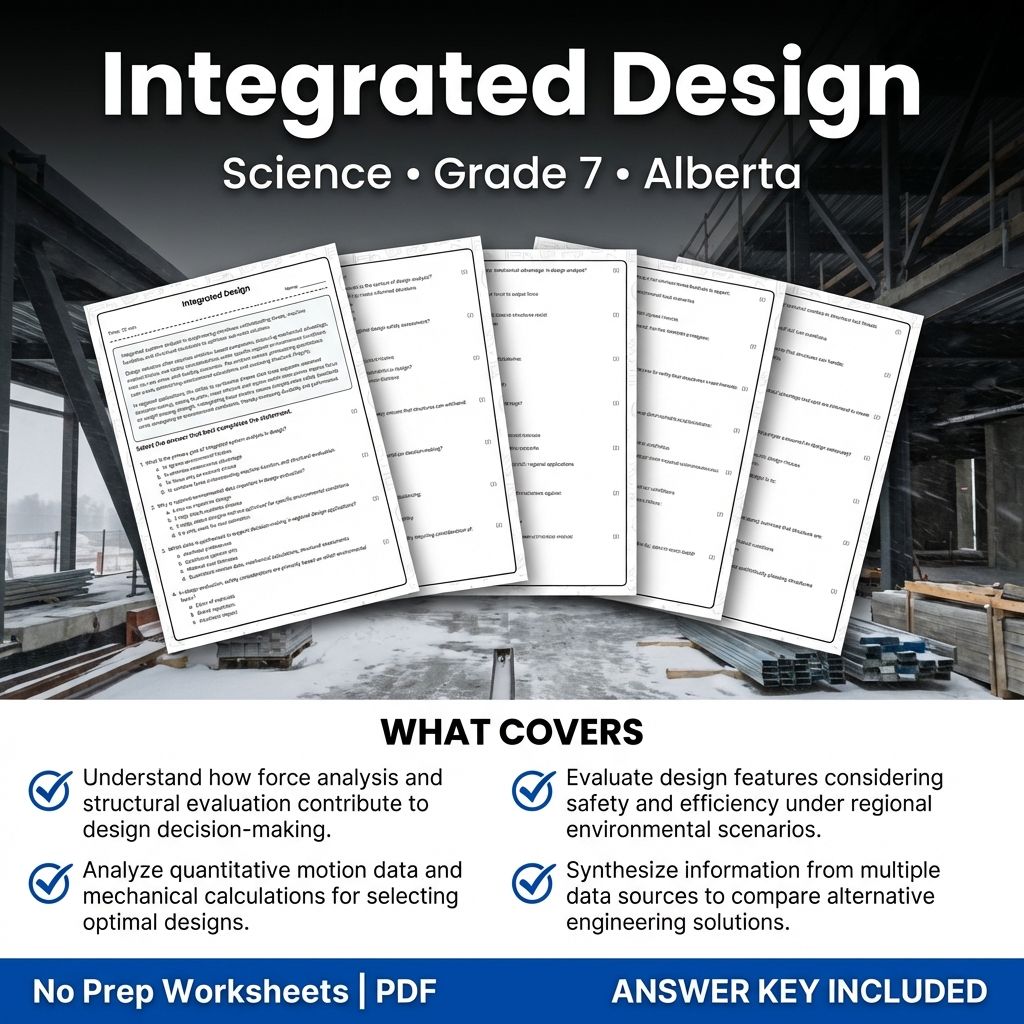
Grade 7 Science Worksheet on Integrated Design | Alberta Standards
Created byCoral Reef LearningLearning Objectives
- Understand how force analysis and structural evaluation contribute to design decision-making.
- Analyze quantitative motion data and mechanical calculations for selecting optimal designs.
- Evaluate design features considering safety and efficiency under regional environmental scenarios.
Instant download
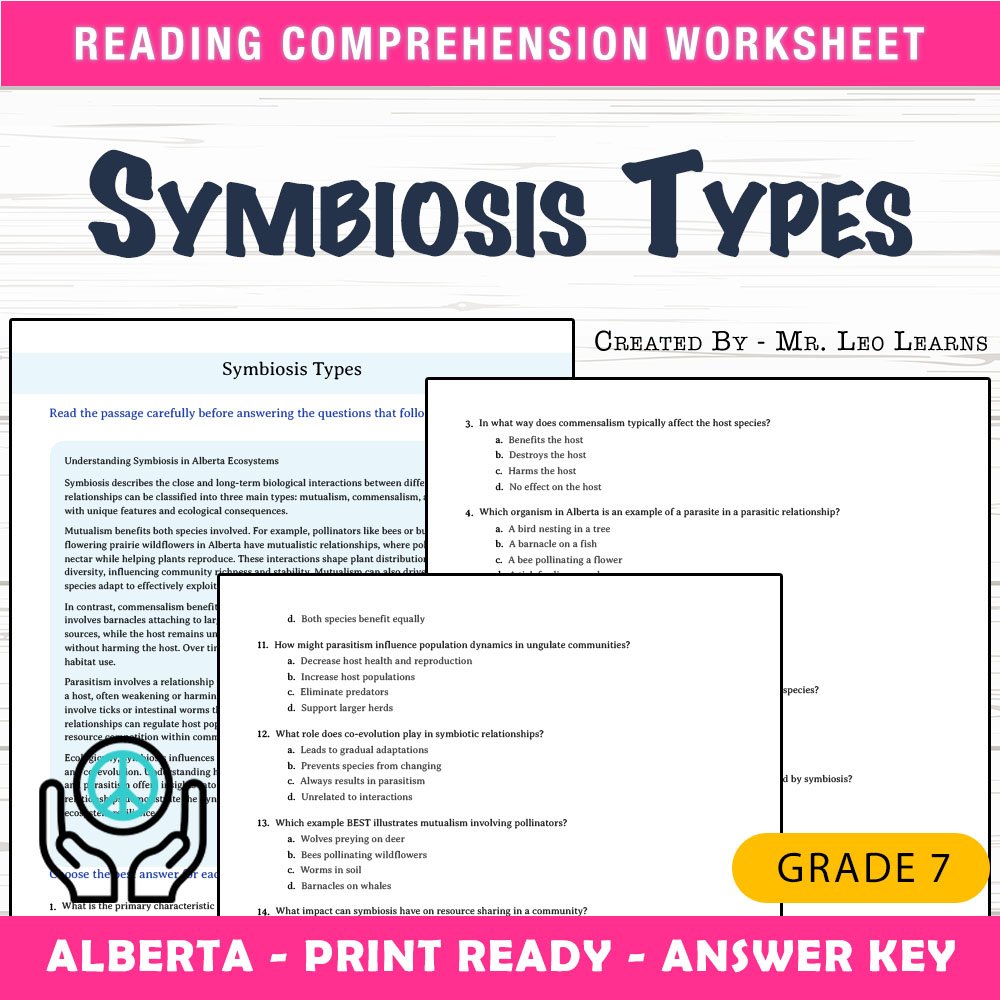
Grade 7 Science — Symbiosis Types Worksheet MCQ Paper for Mastery
Created byThe Resource HubLearning Objectives
- Understand the different types of symbiosis and their defining features.
- Identify examples of mutualism, commensalism, and parasitism in Alberta ecosystems.
- Explain the ecological and evolutionary consequences of symbiotic relationships on populations and resource distribution.
Also included in: Grade 7 Science Alberta Ecosystems & Interactions Worksheet Collection +1 more
Instant download
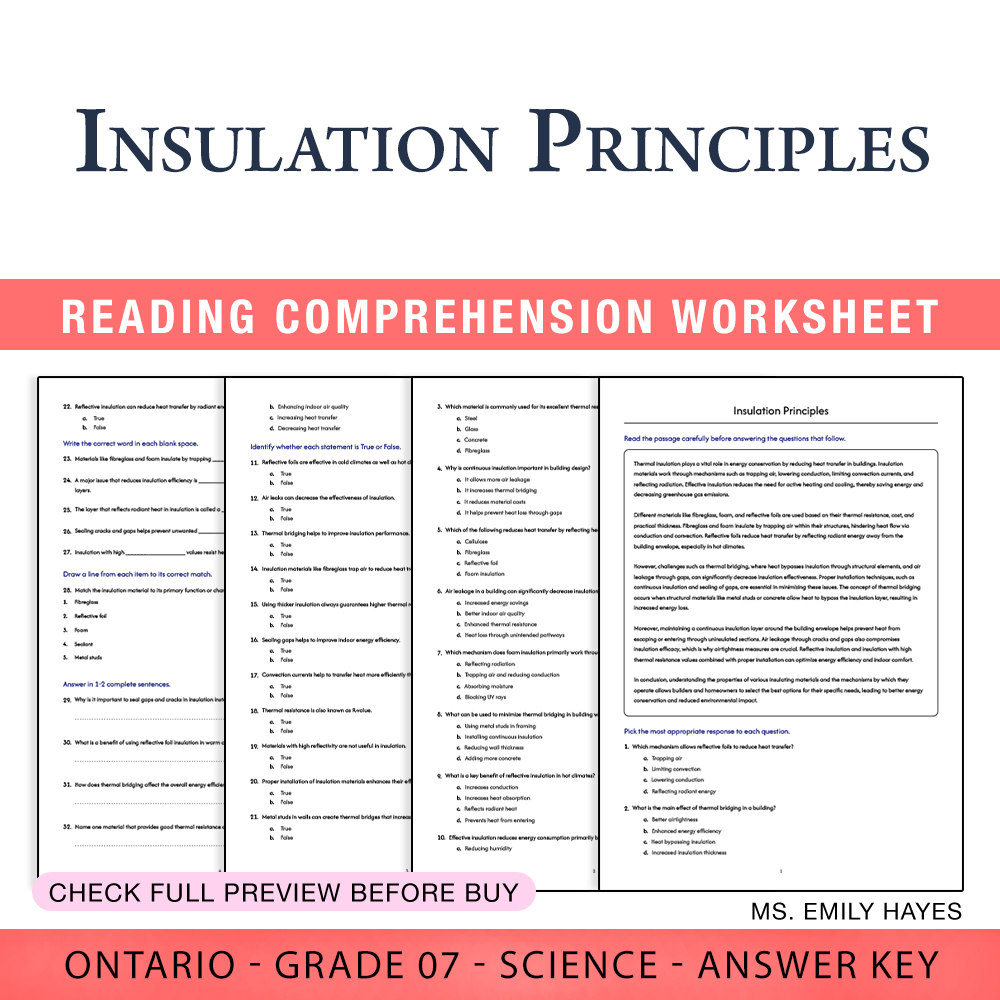
Grade 7 Science | Insulation Principles Worksheet (PDF+ Answer Key)
Created byCopper Leaf ClassroomLearning Objectives
- Describe how insulation materials reduce heat transfer through conduction, convection, and radiation.
- Compare common insulating materials such as fibreglass, foam, and reflective foils based on their thermal resistance and practical thickness.
- Explain concepts like thermal bridging, air leakage, and the importance of continuous insulation in reducing heat loss.
Instant download

Grade 7 Science Integration and Homeostasis Worksheet
JCreated byJ.S SheetsLearning Objectives
- Understand how cellular structures and transport processes work together to maintain homeostasis.
- Identify key mechanisms like transport proteins, membrane pumps, and hormone signaling in regulating nutrient and water balance.
- Explain how disruption at cellular or tissue levels can affect organ function and organism stability.
Instant download
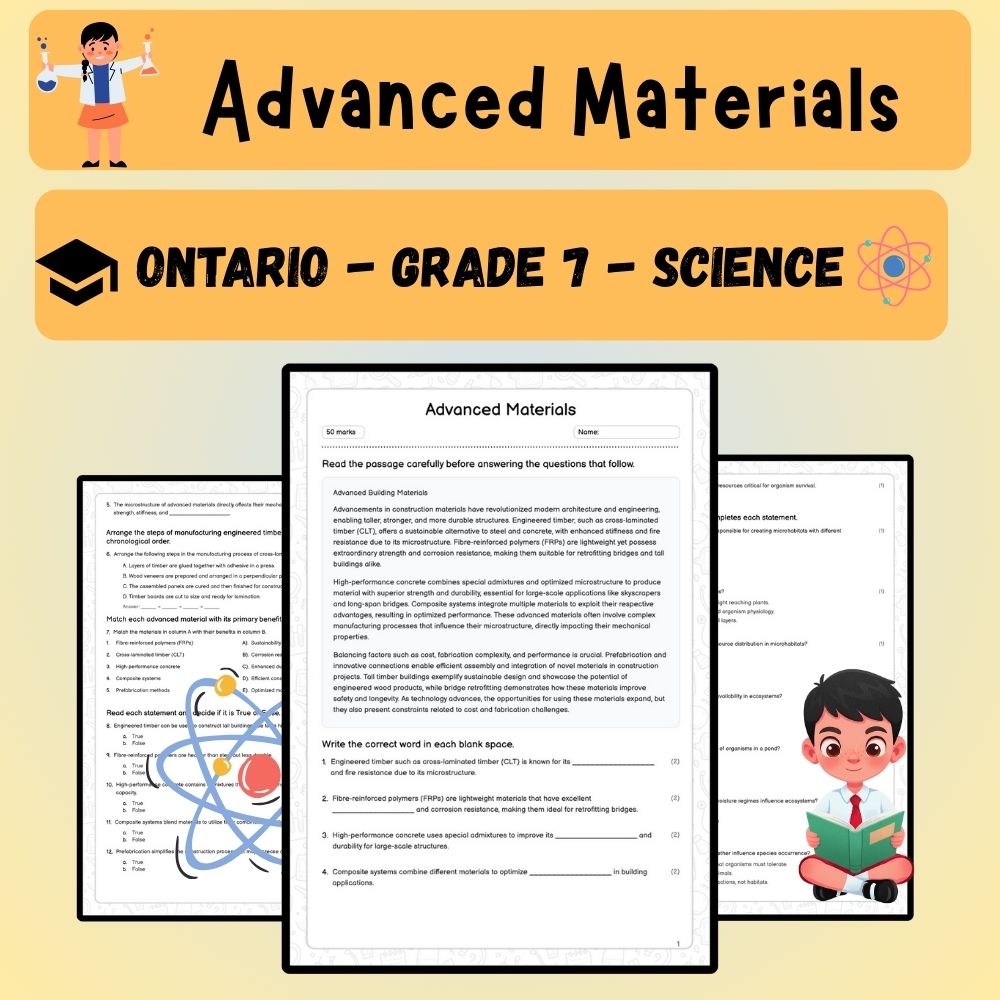
7th Grade Science | Advanced Materials Worksheet (PDF) – Ontario Standards
Created byPrism Point LearningLearning Objectives
- Understand the types and properties of modern construction materials such as engineered timber, fibre-reinforced polymers, and high-performance concrete
- Explain how manufacturing processes and microstructure contribute to material strength, durability, and performance
- Analyze trade-offs among cost, complexity, and performance in using advanced materials for building and infrastructure
Also included in: Grade 7 Science Unit | Structural Engineering & Material Testing Worksheets Bundle +1 more
Instant download

Grade 7 Monitoring Methods Worksheet | Practice & Assessment PDF
 Created byClear Sky Classroom
Learning Objectives
- Explain how long-term ecological monitoring uses standardized sampling to detect ecological trends.
- Compare common monitoring methods such as fixed-site surveys, point counts, remote sensing, and water quality sampling.
- Describe how sampling design and temporal replication improve data quality and interpretation over time.
Instant download
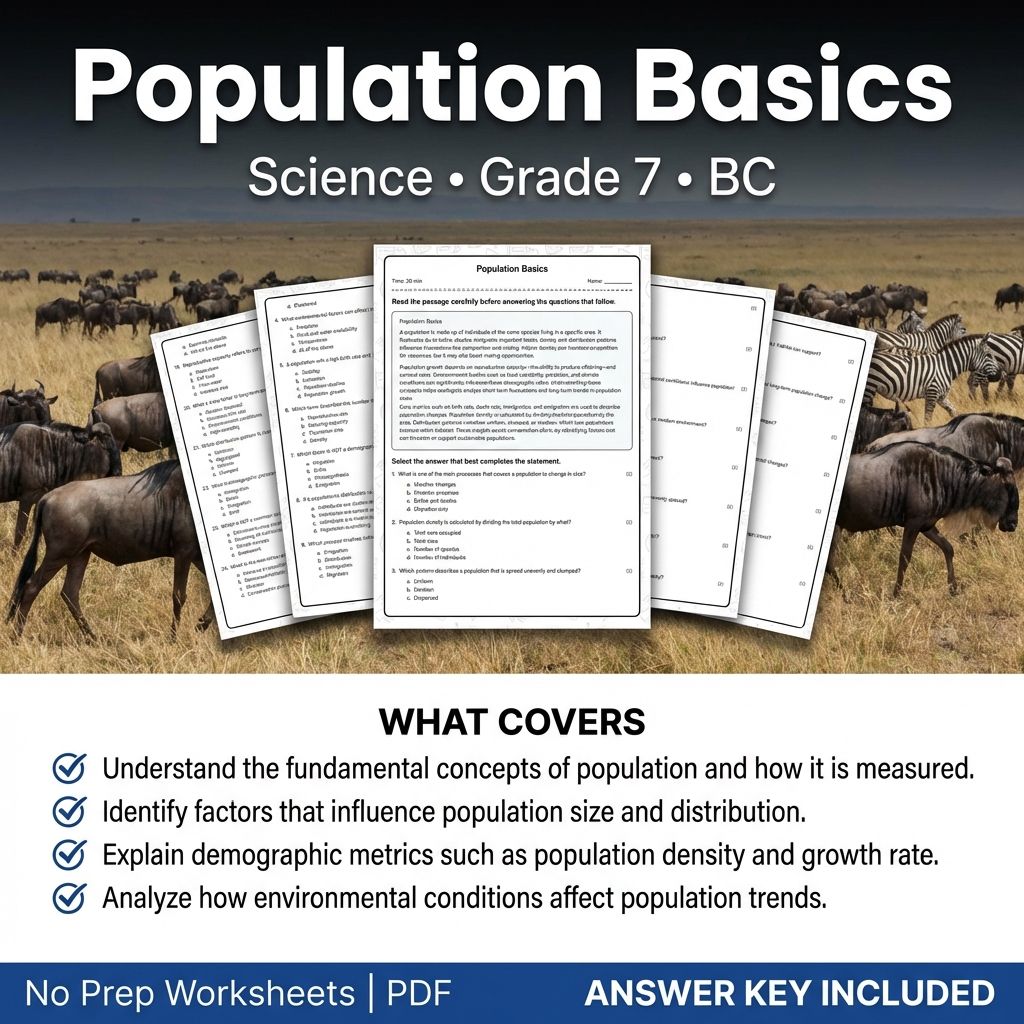
Grade 7 Science Worksheet | Population Basics Practice with Answer Key (PDF)
Created byCoral Reef LearningLearning Objectives
- Understand the fundamental concepts of population and how it is measured.
- Identify factors that influence population size and distribution.
- Explain demographic metrics such as population density and growth rate.
Instant download
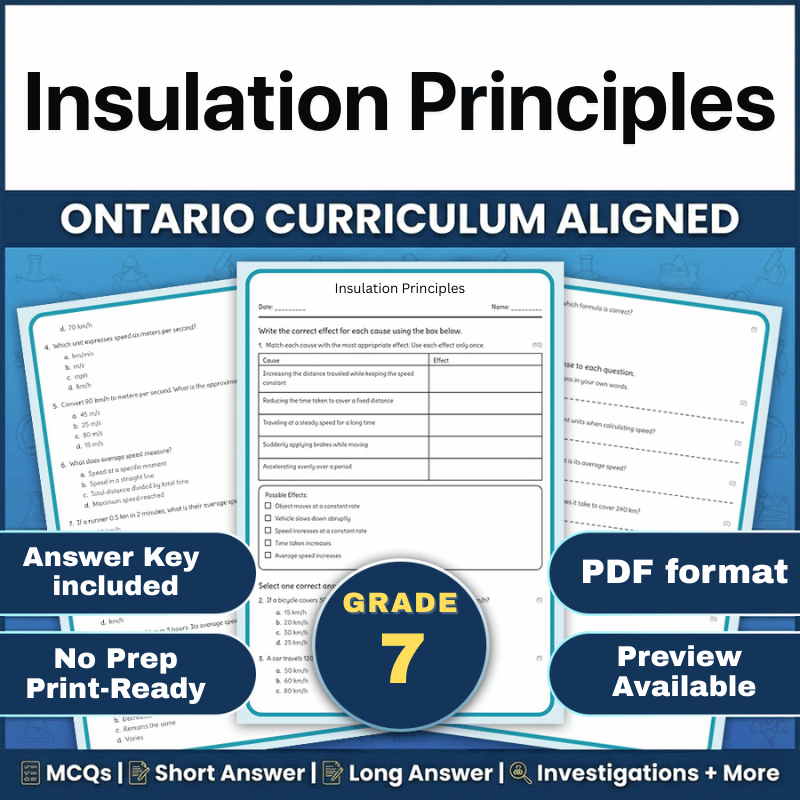
Grade 7 Science – Insulation Principles Worksheet (Ontario, PDF)
Created byBright Mind ResourcesLearning Objectives
- Explain how materials reduce heat transfer through conduction, convection, and radiation.
- Compare common insulating materials based on thermal resistance and thickness.
- Describe concepts of thermal bridging, air leakage, and continuous insulation in buildings.
Instant download
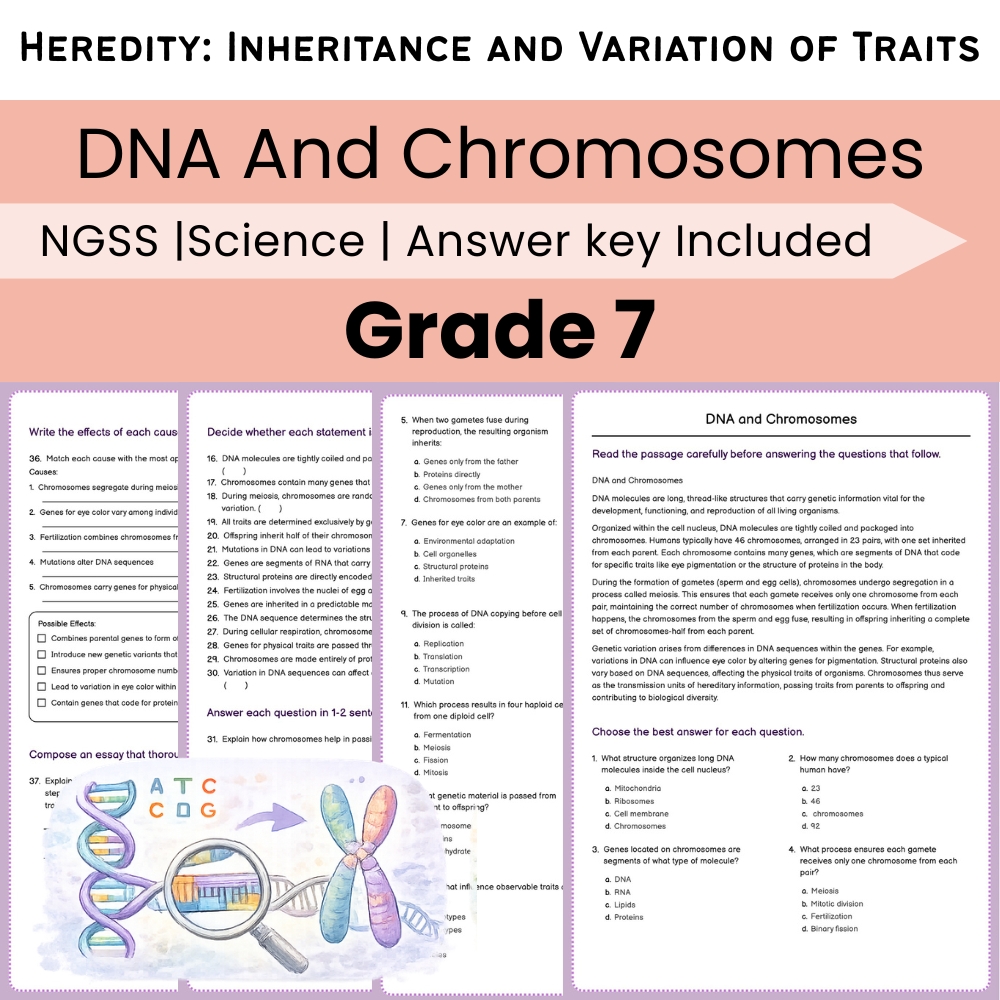
DNA and Chromosomes Worksheet | Grade 7 Science Printable PDF Assessment
Learning Objectives
- Understand how DNA molecules organize into chromosomes and encode genes influencing traits.
- Explain the process of chromosome segregation during gamete formation and fusion.
- Describe how genetic variations in DNA sequences result in trait differences, such as eye color or structural proteins.
Also included in: Grade 7 Science Worksheet Pack | Heredity and Trait Inheritance NGSS Bundle +1 more
Instant download
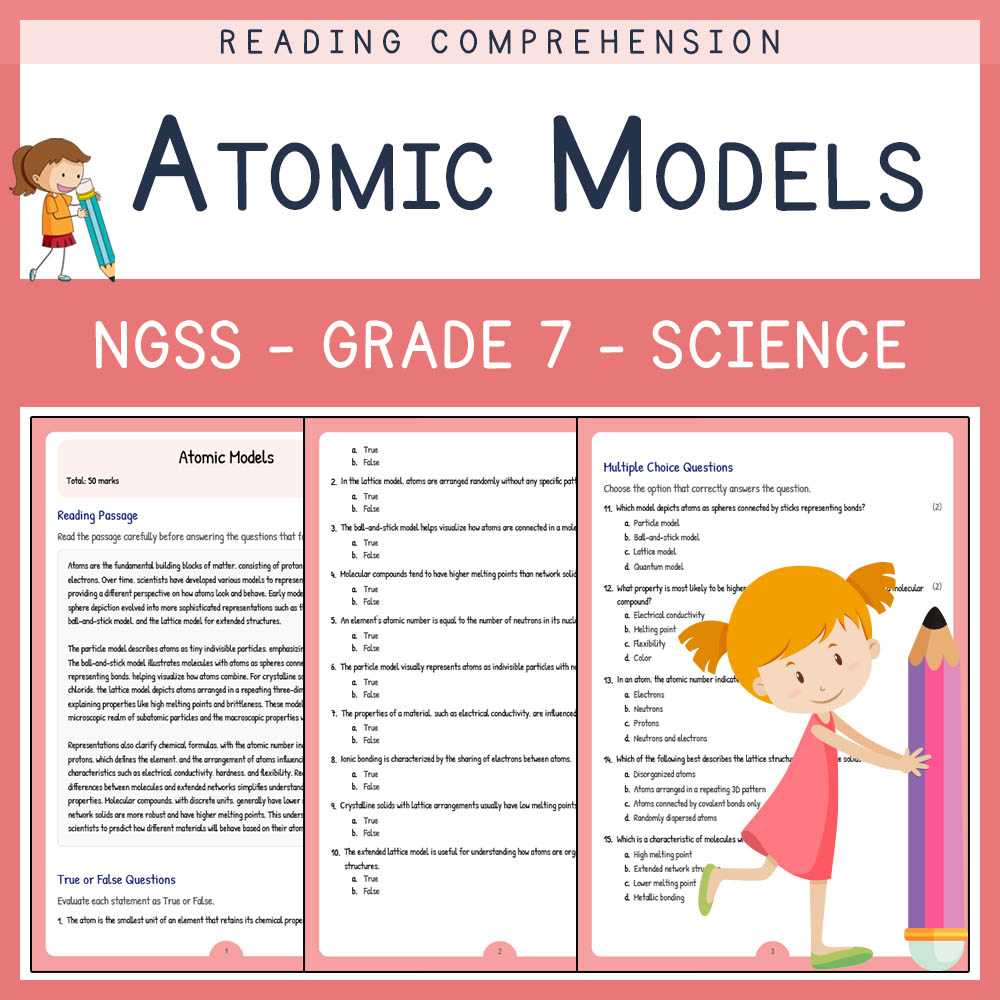
Grade 7 Science | Atomic Models Worksheet & Answer Key (NGSS-Aligned)
Created byLumora LearningLearning Objectives
- Understand different types of atomic models and their representations.
- Identify how atomic structure relates to bonding and material properties.
- Distinguish between molecular and extended network structures in materials.
Instant download
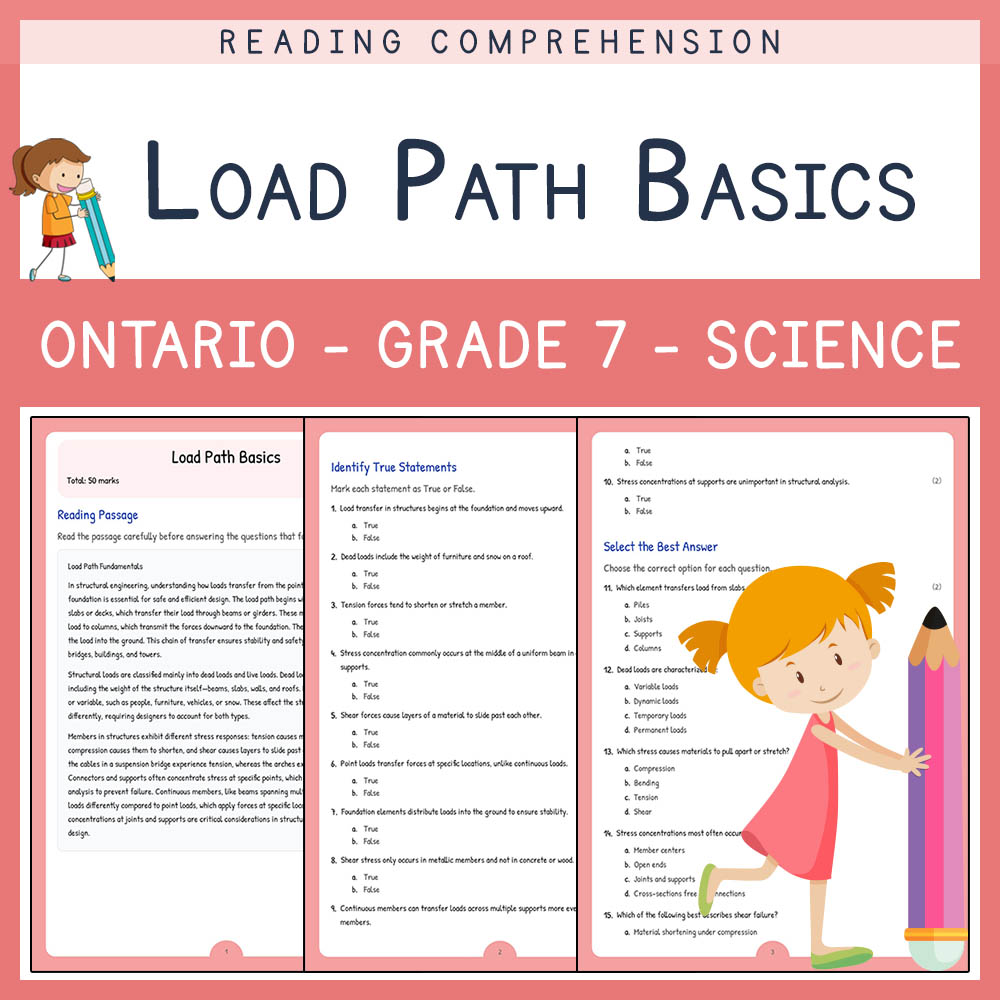
Grade 7 Science | Load Path Basics Worksheet with Answer Key – Ontario Standard
Created byLumora LearningLearning Objectives
- Define the primary structural elements involved in load transfer.
- Explain the concept of load paths in structures such as bridges and frames.
- Distinguish between dead loads and live loads and their effects on structures.
Also included in: Grade 7 Science | Form Function Design Structures Unit Bundle | Ontario
Instant download
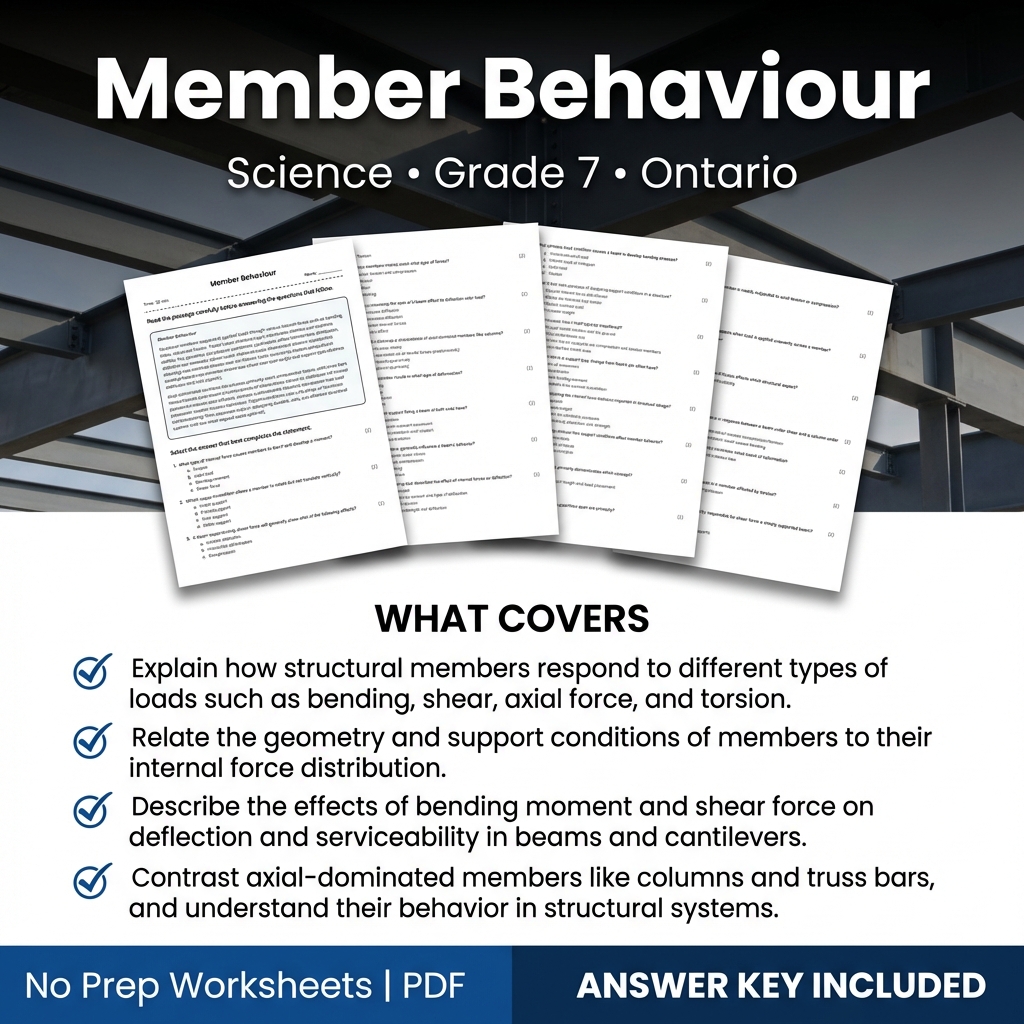
Member Behaviour Grade 7 Science Worksheet | Ontario Standards PDF
Created byCoral Reef LearningLearning Objectives
- Explain how structural members respond to different types of loads such as bending, shear, axial force, and torsion.
- Relate the geometry and support conditions of members to their internal force distribution.
- Describe the effects of bending moment and shear force on deflection and serviceability in beams and cantilevers.
Instant download
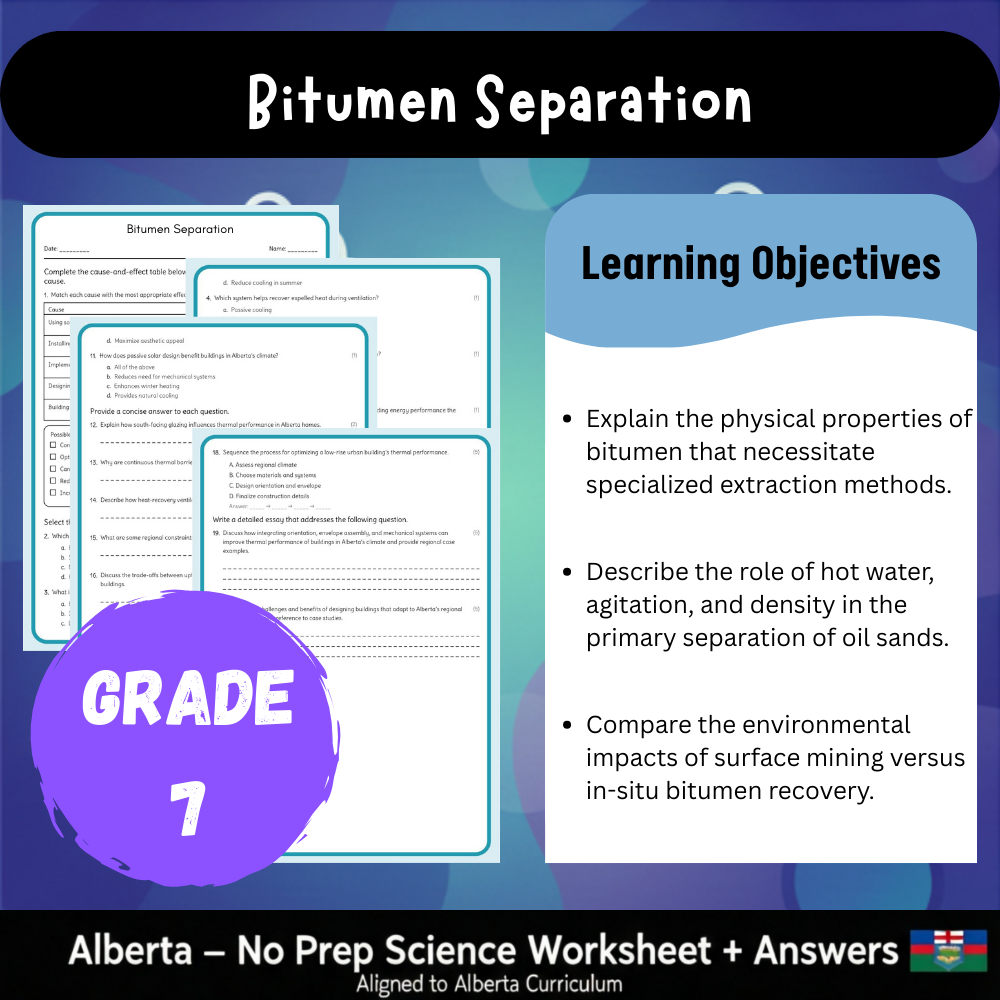
Grade 7 Science | Bitumen Separation Worksheet (PDF) – Alberta Standards
Created byBright Mind ResourcesLearning Objectives
- Understand the physical and chemical processes involved in separating mixtures like bitumen from oil sands.
- Identify and differentiate between physical separation techniques and chemical treatments in resource extraction.
- Describe how material classification helps explain mixture behaviors during separation processes.
Instant download
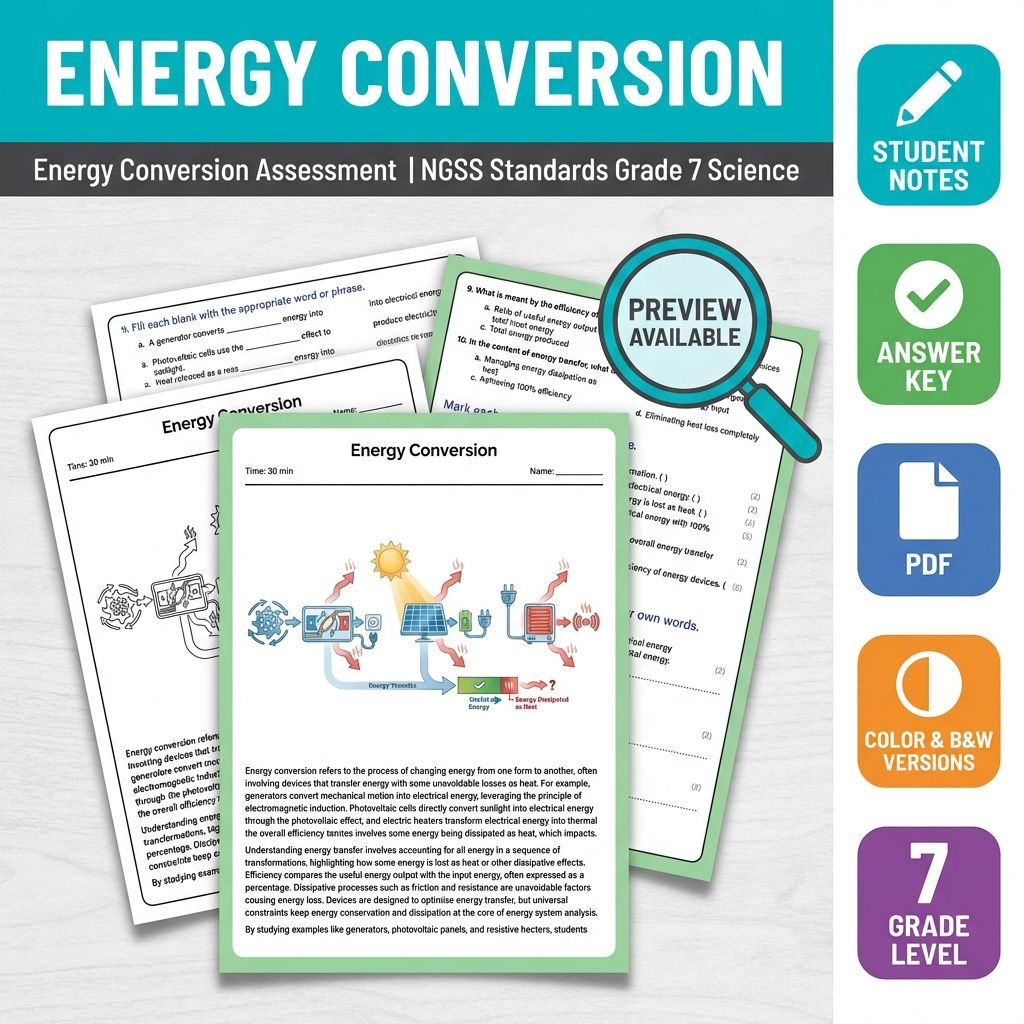
Energy Conversion Assessment | NGSS Standards Grade 7 Science
Created byPrism Point LearningLearning Objectives
- Explain the principles behind devices that convert energy from one form to another.
- Identify examples of energy transfer and conservation in everyday devices.
- Understand the concept of energy efficiency and dissipative processes in energy transformations.
Also included in: Grade 7 Science Mini Bundle | Energy Unit & NGSS Standards-Aligned Resources +1 more
Instant download
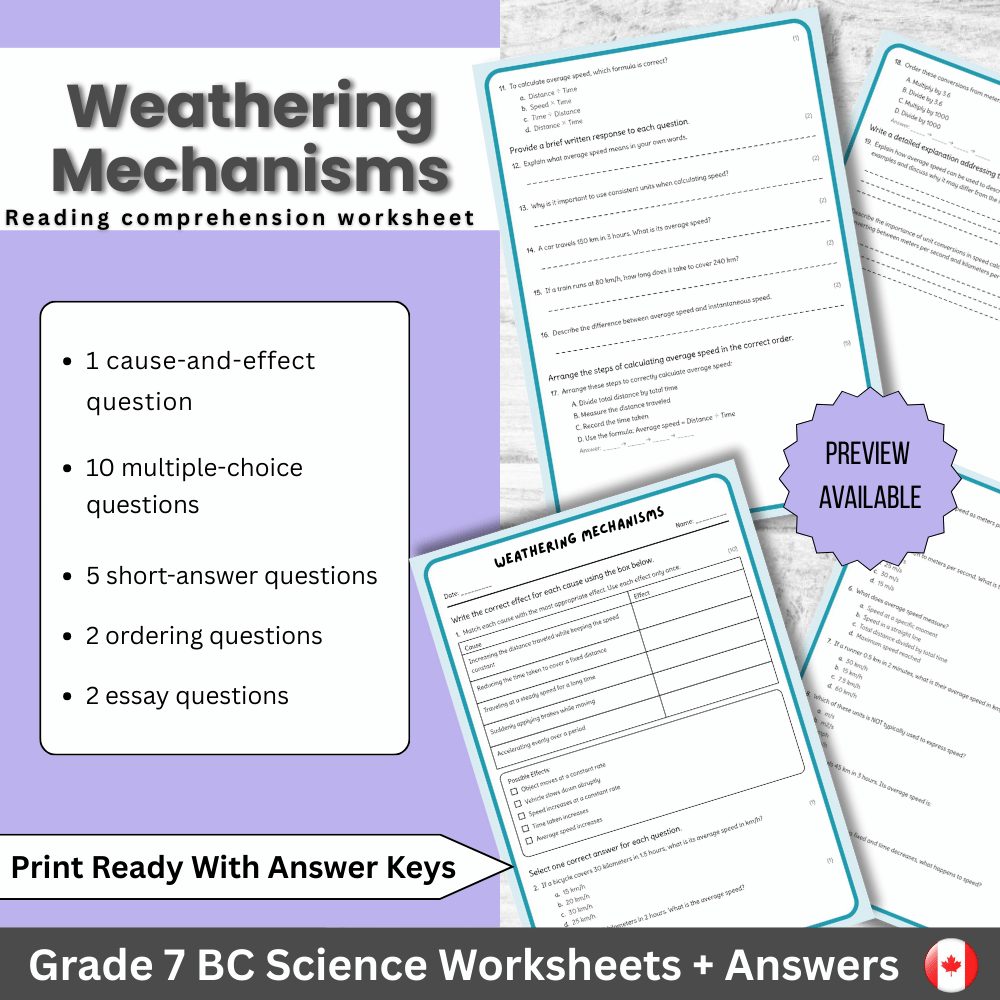
Grade 7 Science – Weathering Mechanisms Worksheet (PDF) | BC Standards
Created byBright Mind ResourcesLearning Objectives
- Describe the different types of weathering processes at Earth's surface.
- Identify examples of physical, chemical, and biological weathering.
- Explain how weathering influences landscape development and sediment supply.
Instant download
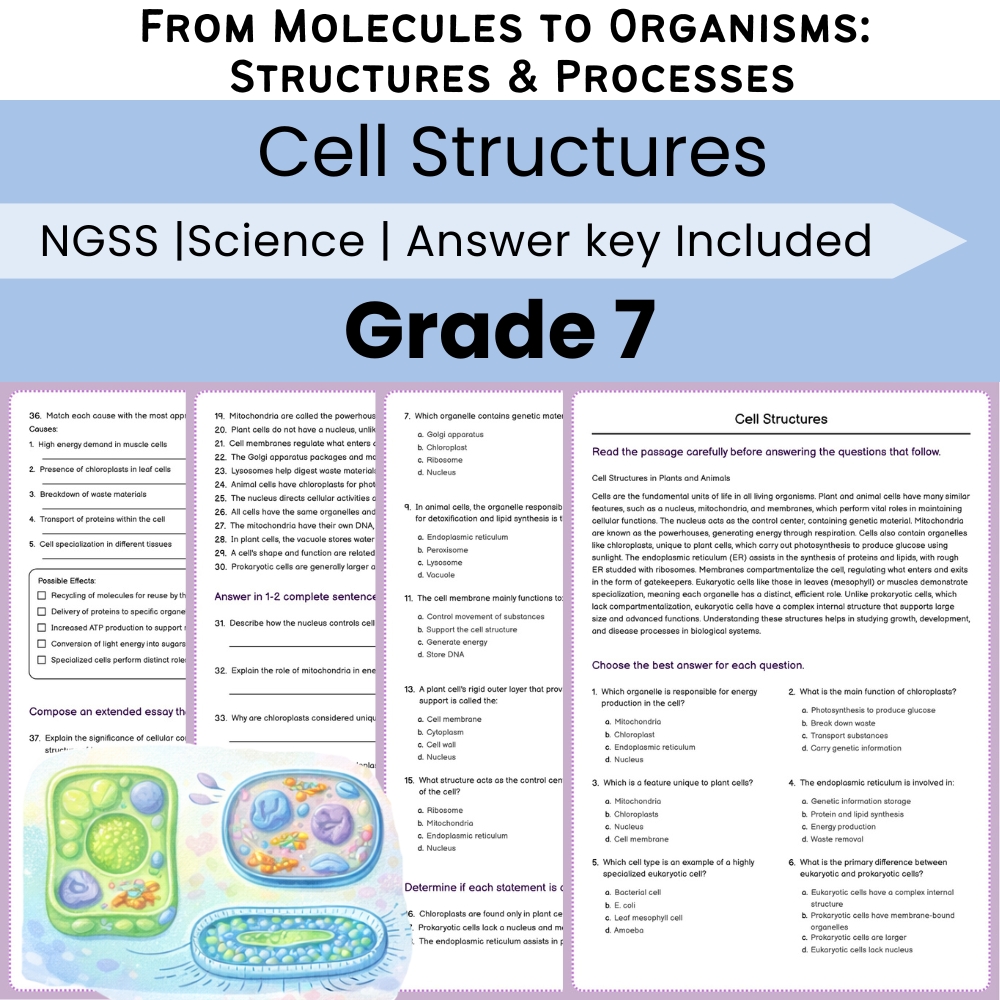
Cell Structures Worksheet for Grade 7 Science | NGSS Printable PDF Assessment
Learning Objectives
- Identify and describe the organelles in plant and animal cells.
- Explain the functions of nucleus, mitochondria, chloroplasts, endoplasmic reticulum, and membranes.
- Connect cell structure to its role in transportation, synthesis, and compartmentalization.
Also included in: Grade 7 Science Lesson Bundle | From Molecules to Organisms NGSS +1 more
Instant download

Grade 7 Climate Interactions Worksheet | NGSS Earth Science Activity
 Created byBRIGHT PATH RESOURCES
Learning Objectives
- Understand key concepts related to Science
- Apply knowledge through practice questions
- Demonstrate comprehension of the material
Also included in: Earth Systems Grade 7 Science Daily Reading Worksheets Lesson Bundle | NGSS +2 more
Instant download
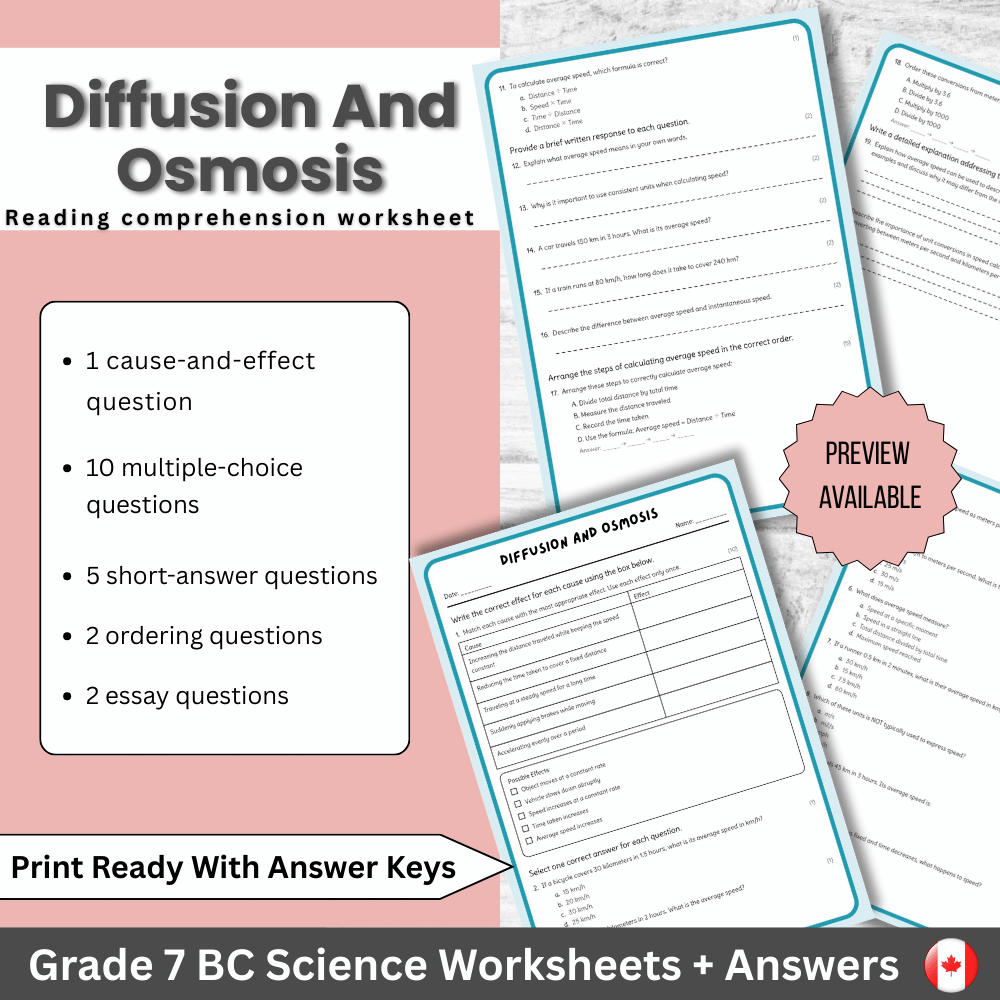
Grade 7 Science | Integration & Homeostasis Worksheet (PDF) – BC Standards
Created byBright Mind ResourcesLearning Objectives
- Understand how cellular structures and transport processes work together to maintain homeostasis.
- Describe the roles of transport proteins, membrane pumps, and hormone signalling in regulating nutrient, ion, and water levels.
- Explain how disruptions at cellular or tissue levels can affect organ function and organism stability.
Instant download

Relative Geologic Time Worksheet | Grade 7 Earth Science Activity
Created byPrism Point LearningLearning Objectives
- Explain how relative dating uses rock order and observable relationships to determine which geologic event happened first.
- Use the principles of superposition and cross-cutting relationships to interpret a simple geologic history.
- Justify reasoning by connecting rock features (layers, intrusions, faults) to relative ages.
Also included in: Grade 7 Weather & Climate Science Lesson Bundle | Florida NGSSS
Instant download
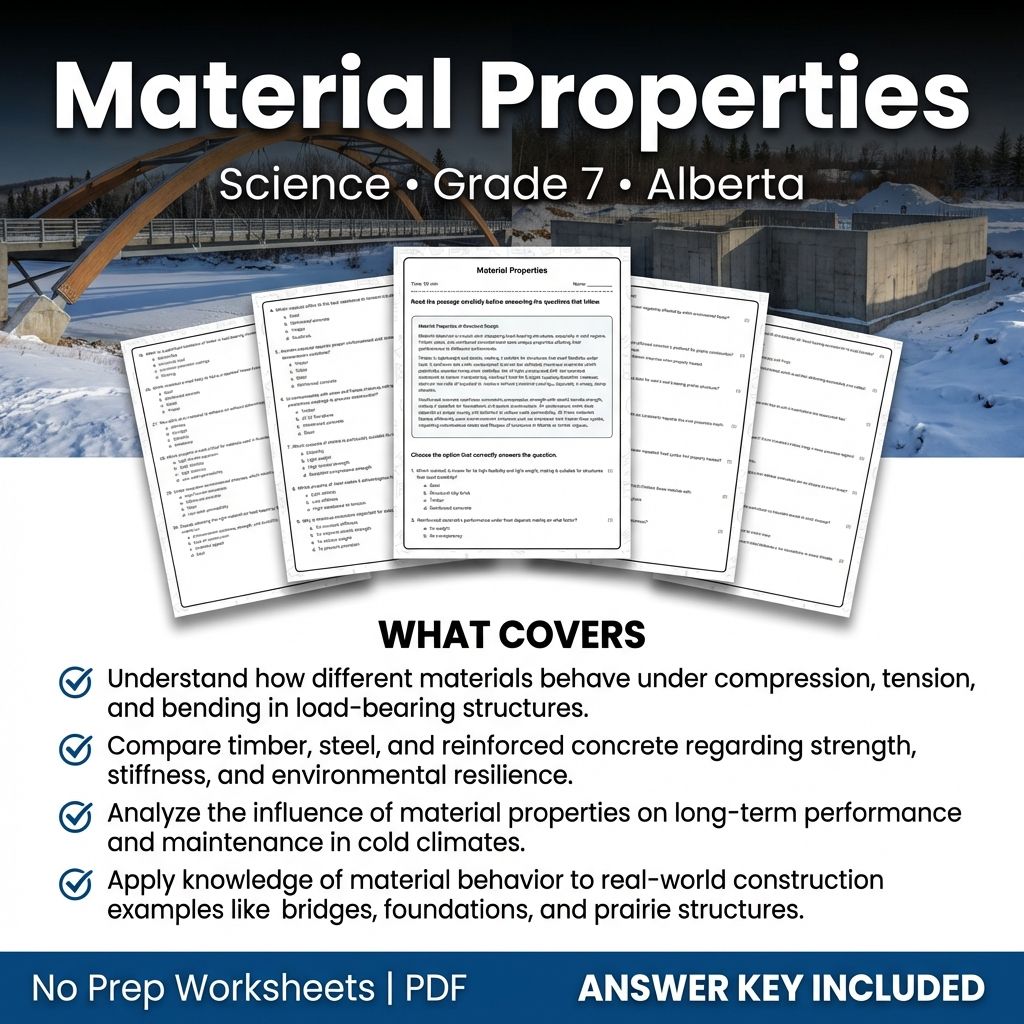
Material Properties Worksheet | Grade 7 Science | Alberta Standards
Created byCoral Reef LearningLearning Objectives
- Understand how different materials behave under compression, tension, and bending in load-bearing structures.
- Compare timber, steel, and reinforced concrete regarding strength, stiffness, and environmental resilience.
- Analyze the influence of material properties on long-term performance and maintenance in cold climates.
Instant download

Grade 7 Seasonal Energy Storage & Change Science Worksheet Alberta
Created byBRIGHT PATH RESOURCESLearning Objectives
- Explain how solar energy drives seasonal change.
- Use vocabulary such as albedo, sensible heat, and latent heat in context.
- Describe how phase changes and snow cover affect energy budgets.
Also included in: Grade 7 Alberta Science Energy Heat and Thermal Processes Worksheet Bundle +1 more
Instant download
About Grade 7 Science Worksheets
Browse 6,039 printable Grade 7 Science worksheets — ready-to-print PDFs with answer keys where available.
Every worksheet on MyTeachingSheets is created by independent teacher-authors and reviewed before publication. All resources download as printable PDFs for classroom, homework, or at-home practice, and many include answer keys. Preview any worksheet free before buying.