
Grade 7 Science Worksheets
6,039 worksheets
Grade 7 Science – Understanding Net Force & Motion | Daily Reading Worksheet
 Created byBright Mind Resources
Learning Objectives
- Define net force and explain how it affects motion.
- Differentiate between balanced and unbalanced forces.
- Describe how forces can change the velocity of an object.
Also included in: Grade 7 Matter & Forces Science Reading Lesson Bundle | California Standards +1 more
Instant download
Grade 7 Science — Diffusion and Osmosis Worksheet for Mastery
 Created byThe Resource Hub
Learning Objectives
- Define diffusion and osmosis as passive transport mechanisms.
- Explain how concentration gradients influence the rate of diffusion and osmosis.
- Describe the effects of diffusion and osmosis on plant and animal cells.
Also included in: Grade 7 Science | Cell Structure & Function Worksheet Bundle +1 more
Instant download
Grade 7 Science — Active Transport Worksheet MCQ Paper
Created byThe Resource HubLearning Objectives
- Understand the concept of active transport and how it moves molecules against concentration gradients.
- Identify the types of cellular energy used in active transport, such as ATP.
- Learn about membrane proteins called pumps and their role in active transport.
Also included in: Grade 7 Science | Cell Structure & Function Worksheet Bundle +1 more
Instant download
Grade 7 Science — Cell Organization Worksheet MCQ Paper for Mastery
Created byThe Resource HubLearning Objectives
- Understand how cells organize into tissues, organs, and systems.
- Identify different tissue types and their functions.
- Describe how multicellular organization supports organism activities.
Also included in: Grade 7 Science | Cell Structure & Function Worksheet Bundle +1 more
Instant download
Grade 7 Science — Nucleus Function Worksheet MCQ Paper
Created byThe Resource HubLearning Objectives
- Understand the role of the nucleus in cell functions.
- Identify how the nucleus controls growth, development, and protein synthesis.
- Describe the structure of the nucleus, including chromosomes and nuclear envelope.
Also included in: Grade 7 Science | Cell Structure & Function Worksheet Bundle +1 more
Instant download
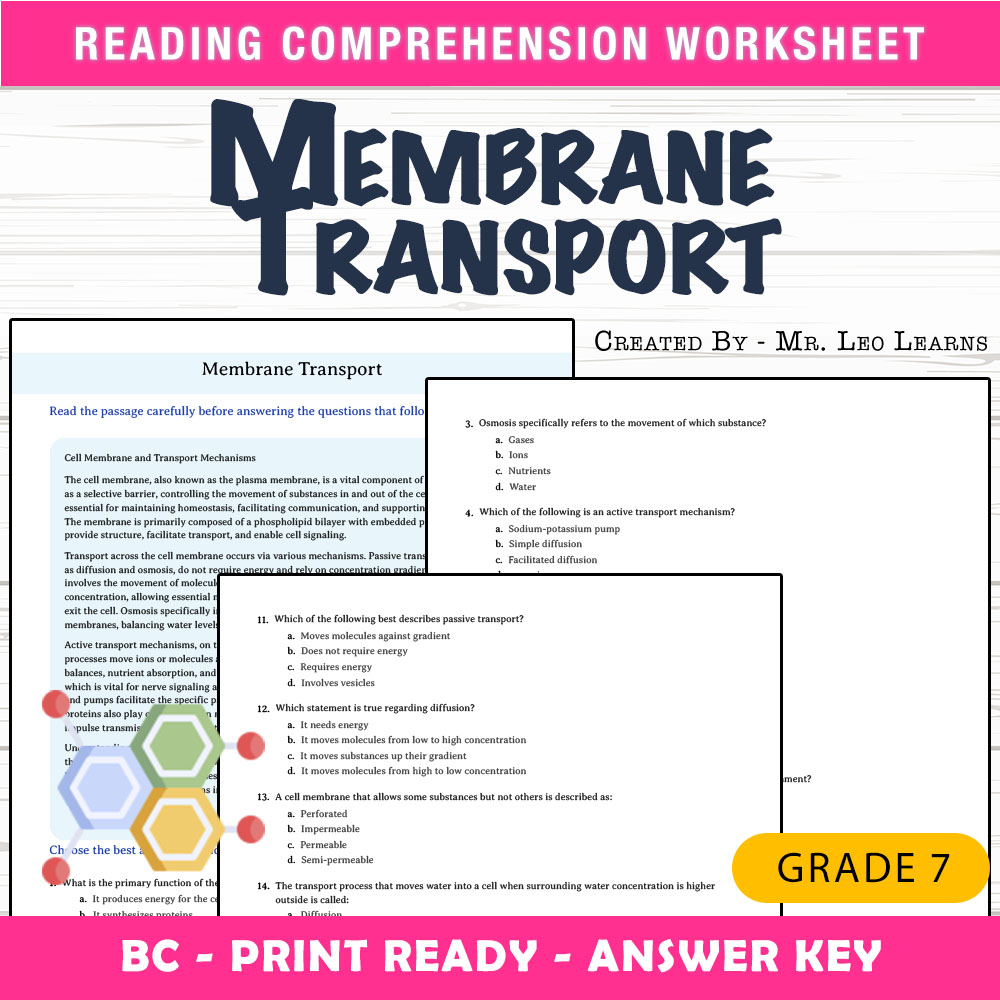
Grade 7 Science — Membrane Transport Worksheet for Mastery
Created byThe Resource HubLearning Objectives
- Understand the mechanisms of passive and active transport across cell membranes.
- Identify the roles of membrane proteins in substance passage and ion balance.
- Differentiate between diffusion, osmosis, and active transport mechanisms.
Also included in: Grade 7 Science | Cell Structure & Function Worksheet Bundle +1 more
Instant download
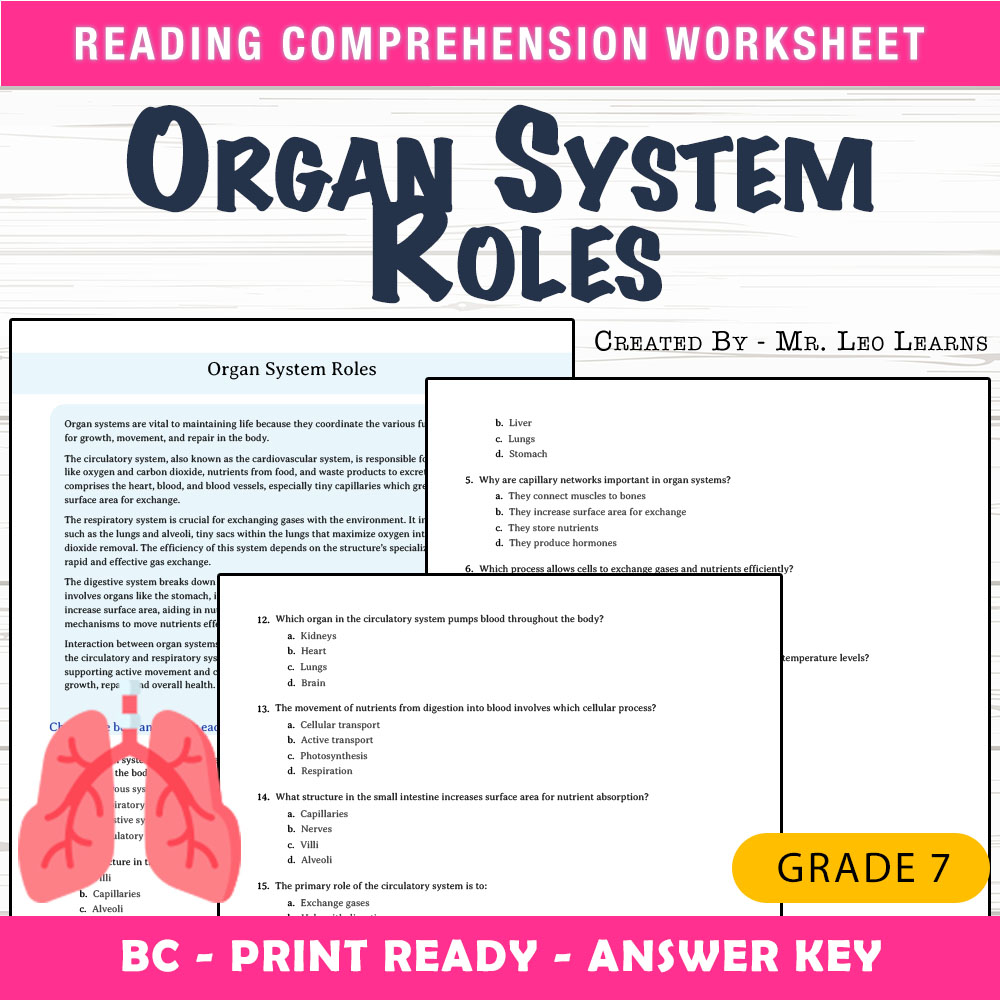
Grade 7 Science — Organ System Roles Worksheet MCQ Paper
Created byThe Resource HubLearning Objectives
- Identify the main functions of key organ systems in the human body.
- Understand how tissues and organs work together within organ systems.
- Recognize specialized structures that enhance functions like gas exchange and nutrient absorption.
Also included in: Grade 7 Science | Cell Structure & Function Worksheet Bundle +1 more
Instant download
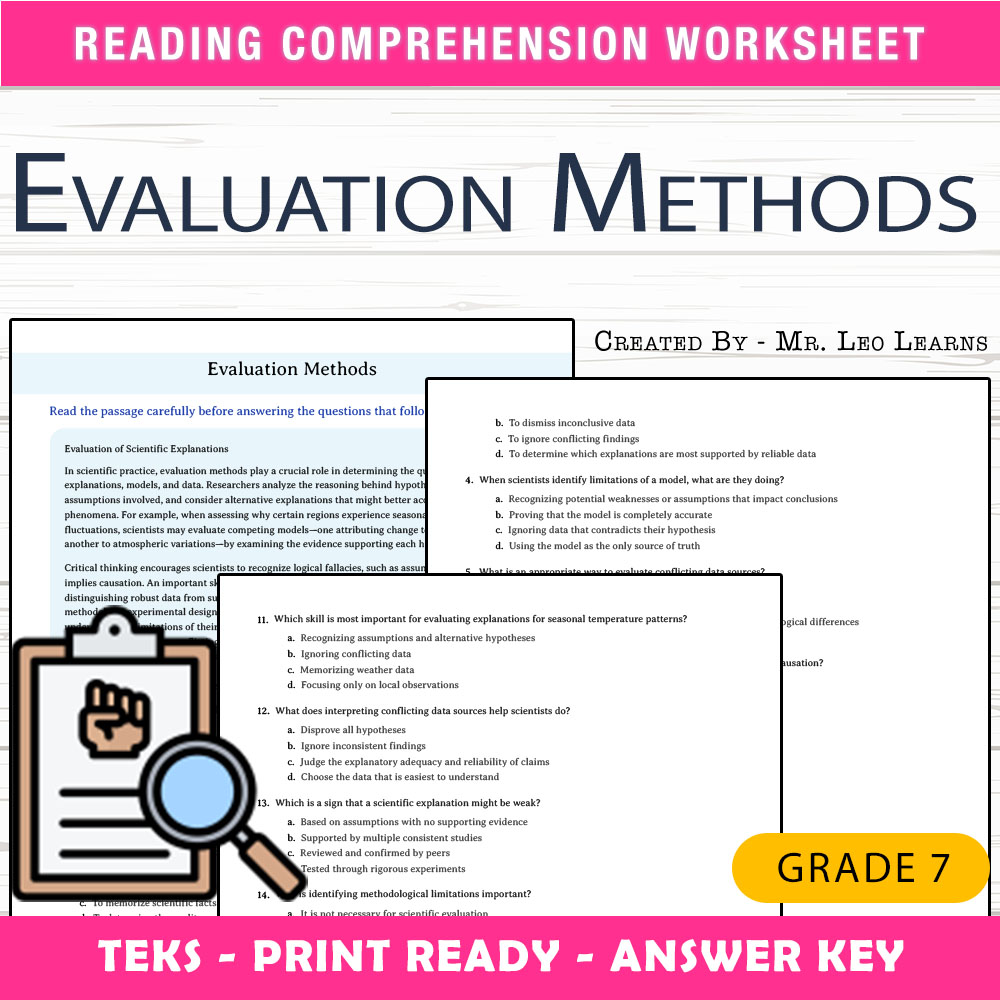
Grade 7 Science — Evaluation Methods Worksheet for Mastery
Created byThe Resource HubLearning Objectives
- Develop critical thinking skills to evaluate explanations, models, and evidence.
- Identify logical fallacies and distinguish correlation from causation.
- Assess strengths and limitations of data and models.
Also included in: Grade 7 Science Unit Bundle | Experimental Design & Data Analysis Worksheets +1 more
Instant download

Grade 7 Science – Organ System Roles | Daily Reading Worksheet
Created byBright Mind ResourcesLearning Objectives
- Identify the main functions of the circulatory system.
- Recognize key organs of the circulatory system, such as the heart and blood vessels.
- Understand how the circulatory system works with other body systems to support life functions.
Also included in: Cell Function & Transport Grade 7 Science Daily Reading Worksheets Bundle | BC +1 more
Instant download

Grade 7 Science | Biotic & Abiotic Factors in Ecosystems - Reading Practice
 Created byCoral Reef Learning
Learning Objectives
- Understand the effects of sunlight on plant growth
- Identify different regional environmental factors
- Explain cause-and-effect relationships between abiotic factors and organisms
Also included in: Interactions and Ecosystems Lesson Bundle Grade 7 Science – Alberta +1 more
Instant download
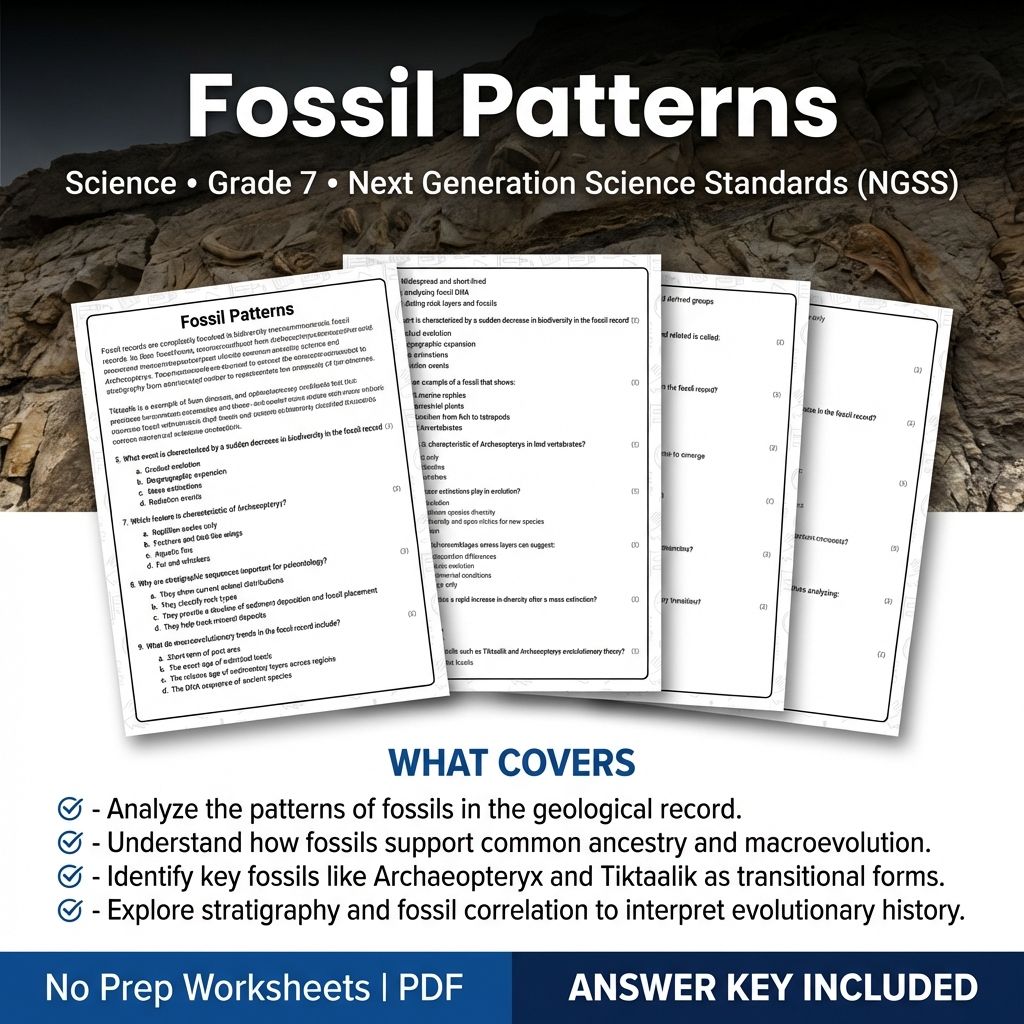
Grade 7 Science Worksheet | Fossil Patterns NGSS Practice & Answer Key (PDF)
Created byCoral Reef LearningLearning Objectives
- Analyze the patterns of fossils in the geological record.
- Understand how fossils support common ancestry and macroevolution.
- Identify key fossils like Archaeopteryx and Tiktaalik as transitional forms.
Instant download

Grade 7 Science – Wave Energy Transfer Reading Worksheet | Standards-Aligned
Created byBright Mind ResourcesLearning Objectives
- Understand the basic properties of waves such as amplitude, wavelength, and frequency.
- Identify different types of waves: transverse and longitudinal.
- Describe how waves transfer energy without transferring matter.
Also included in: Energy Transfer, Sound & Motion Lesson Bundle | Grade 7 Science | General +1 more
Instant download

Problem Definition Worksheet | NGSS Grade 7 Science Assessment PDF
JCreated byJ.S SheetsLearning Objectives
- Understand how to define design problems with clear criteria and measurable constraints.
- Identify real-world examples of specifying success measures and constraints.
- Translate societal and environmental requirements into quantitative targets.
Also included in: Grade 7 Engineering Design Optimization Science Lesson Bundle: NGSS +1 more
Instant download

Design Optimization Worksheet | NGSS-Aligned Grade 7 Science Practice
JCreated byJ.S SheetsLearning Objectives
- Analyze test data and parameters to refine and improve design solutions.
- Use quantitative comparisons to evaluate design modifications.
- Apply iterative adjustment techniques based on performance data.
Also included in: Grade 7 Engineering Design Optimization Science Lesson Bundle: NGSS +1 more
Instant download
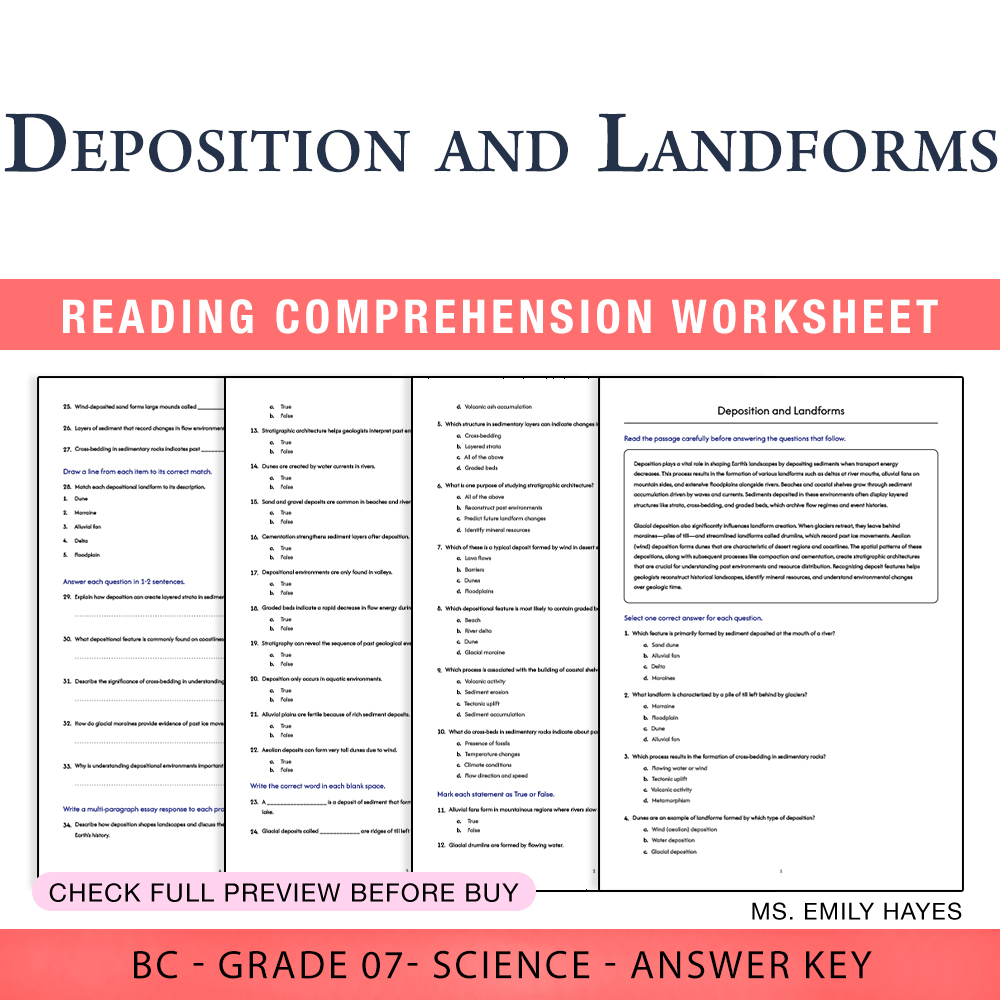
Grade 7 Science | Deposition and Landforms Worksheet (PDF + Answer Key)
 Created byCopper Leaf Classroom
Learning Objectives
- Explain how deposition processes contribute to landform development.
- Identify different landforms created by deposition such as deltas, beaches, and moraines.
- Describe depositional features visible in stratigraphy like layered strata and cross-bedding.
Also included in: Grade 7 Science | Earth Systems & Geology Unit (PDF+ Answer Keys) +1 more
Instant download
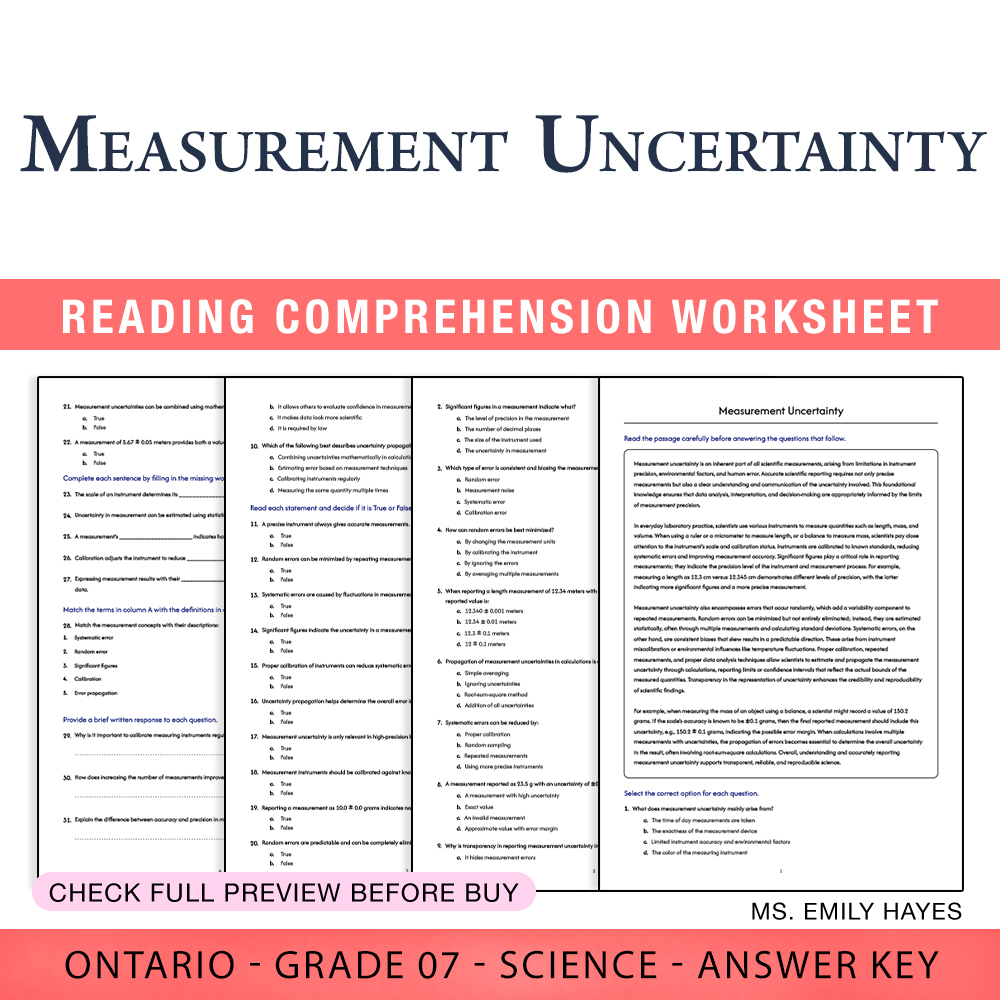
7th Grade Science | Measurement Uncertainty Worksheet (PDF+ Answer Key)
Created byCopper Leaf ClassroomLearning Objectives
- Understand the concept of measurement uncertainty and its importance in scientific measurements.
- Identify and distinguish between sources of systematic and random errors in measurements.
- Learn how to interpret significant figures and proper reporting of measurement results.
Instant download
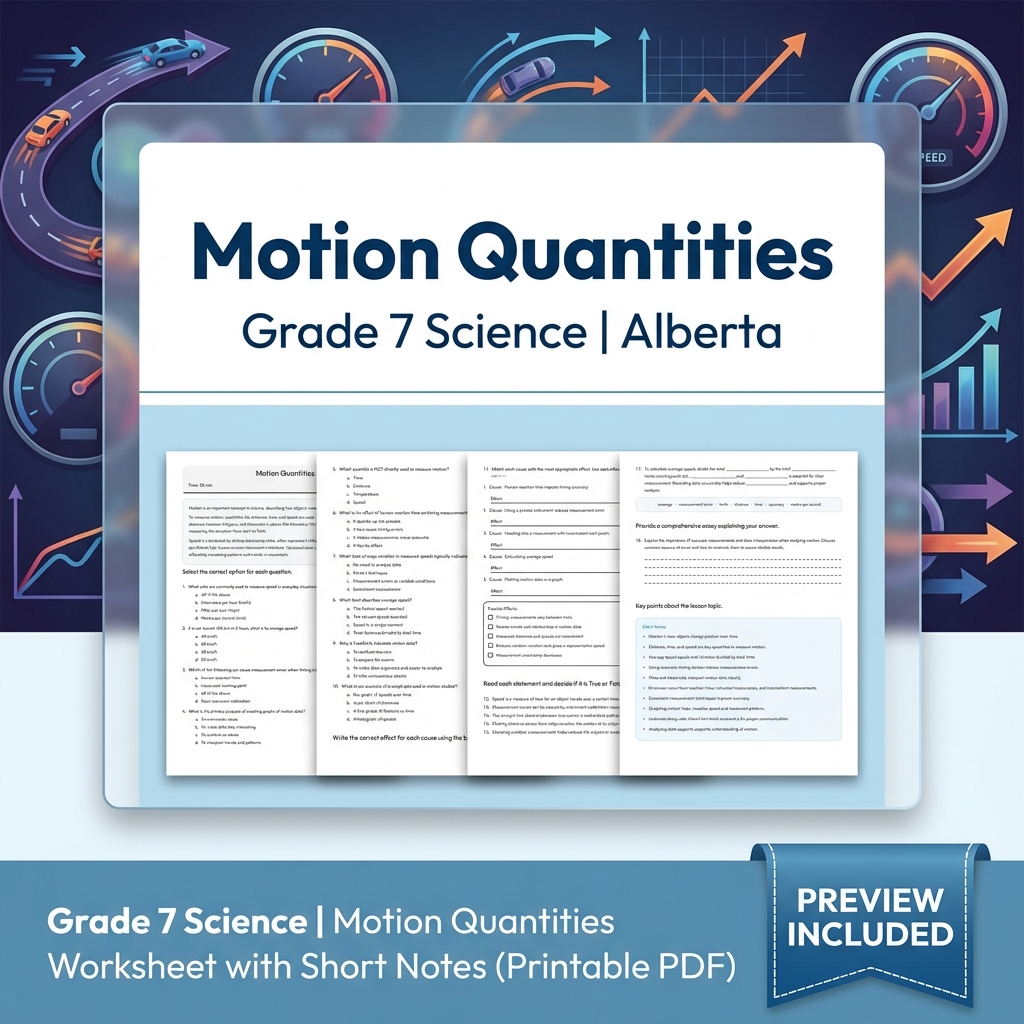
Grade 7 Science | Motion Quantities Worksheet with Short Notes (Printable PDF)
 Created byMeadowlark Worksheets
Learning Objectives
- Understand different quantities used to measure motion such as distance, time, and speed.
- Calculate average speed using distance and time data.
- Recognize common measurement errors and how to minimize them.
Also included in: Grade 7 Science | Forces, Structures & Motion UNIT Worksheet Bundle
Instant download
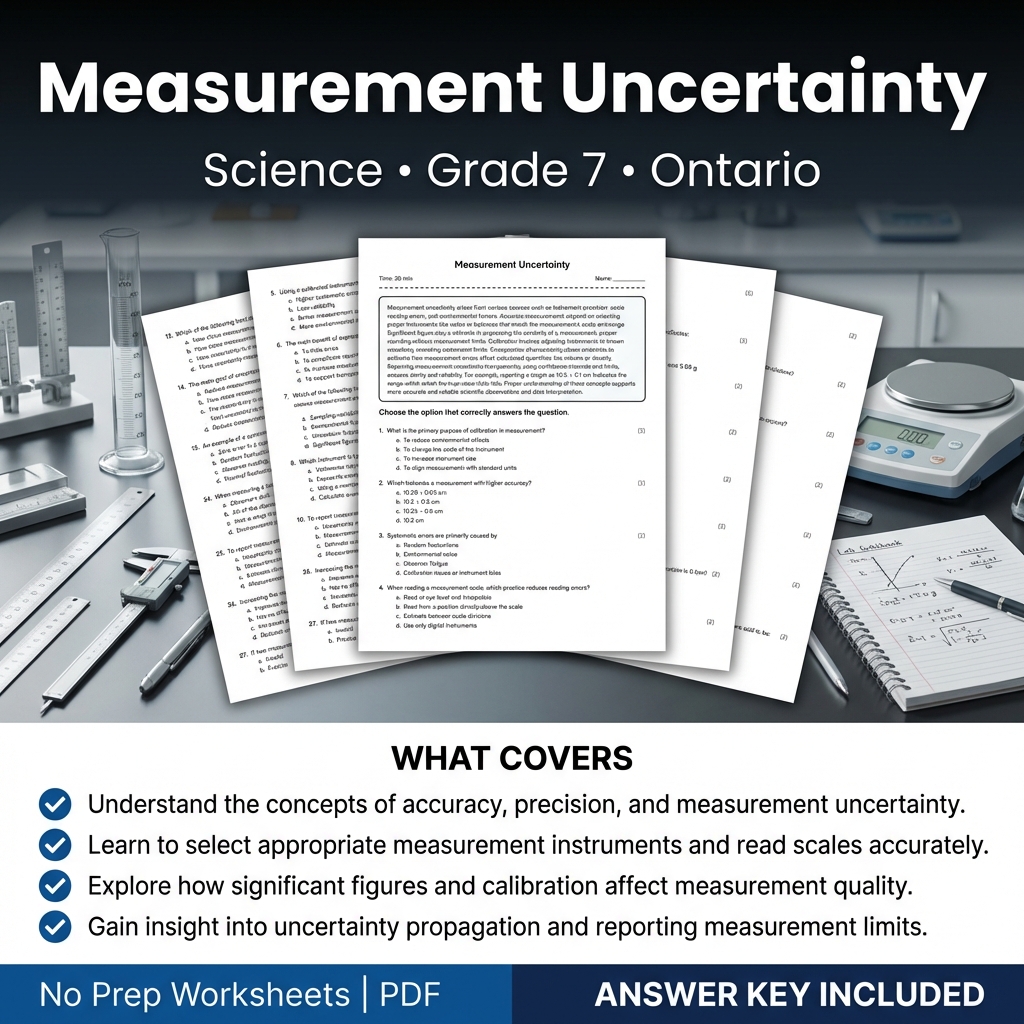
Measurement Uncertainty Worksheet for Grade 7 Science Ontario Standards
Created byCoral Reef LearningLearning Objectives
- Understand the concepts of accuracy, precision, and measurement uncertainty.
- Learn to select appropriate measurement instruments and read scales accurately.
- Explore how significant figures and calibration affect measurement quality.
Instant download
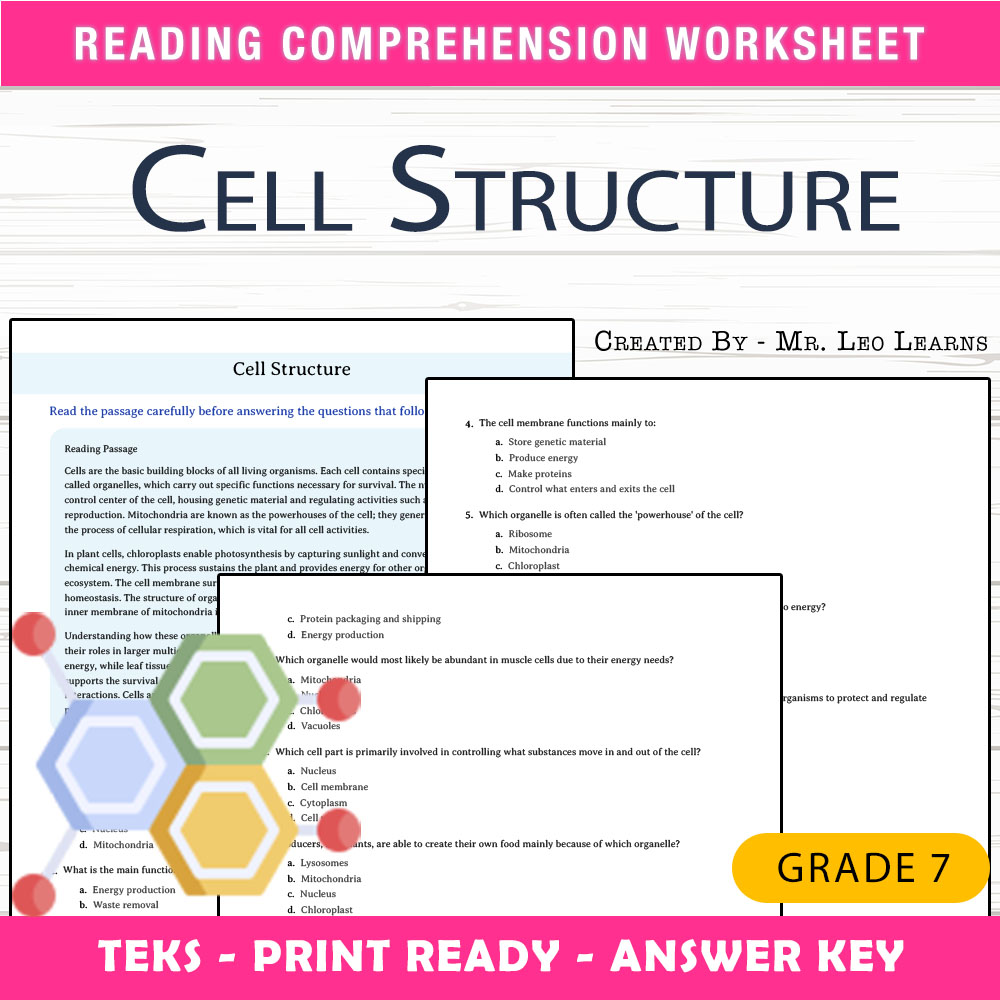
Grade 7 Science — Cell Structure Worksheet for Mastering Cells
Created byThe Resource HubLearning Objectives
- Describe the main organelles within a cell and their functions.
- Compare and contrast the structures and roles of nucleus, mitochondria, chloroplasts, and cell membranes.
- Explain how cellular organelles contribute to tissue, organ, and organismal functions.
Also included in: Grade 7 Science Unit Bundle – Ecosystems, Cells & Adaptations Worksheet Pack +1 more
Instant download
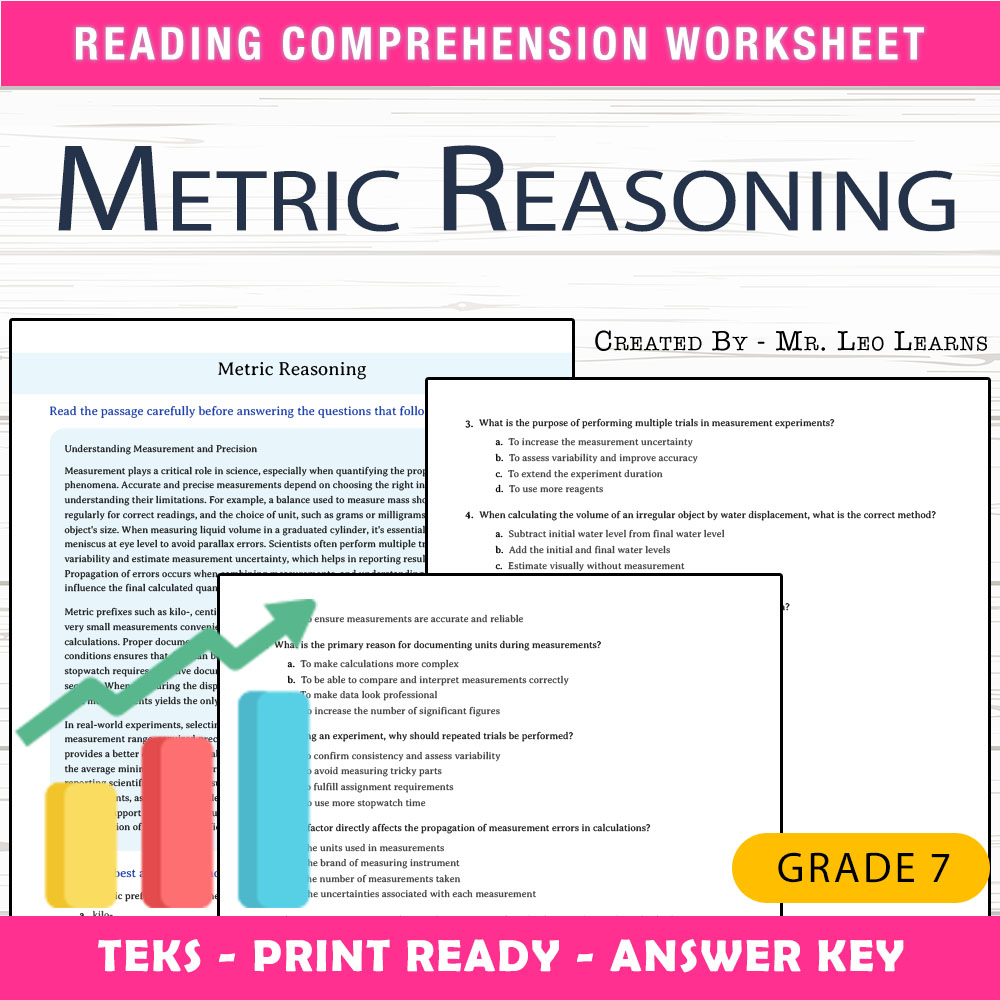
Grade 7 Science – Metric Reasoning Worksheet for Mastery
Created byThe Resource HubLearning Objectives
- Understand and apply metric prefixes in measurements
- Estimate and communicate measurement uncertainty
- Select appropriate measurement instruments for different tasks
Also included in: Grade 7 Science Unit Bundle | Experimental Design & Data Analysis Worksheets +1 more
Instant download
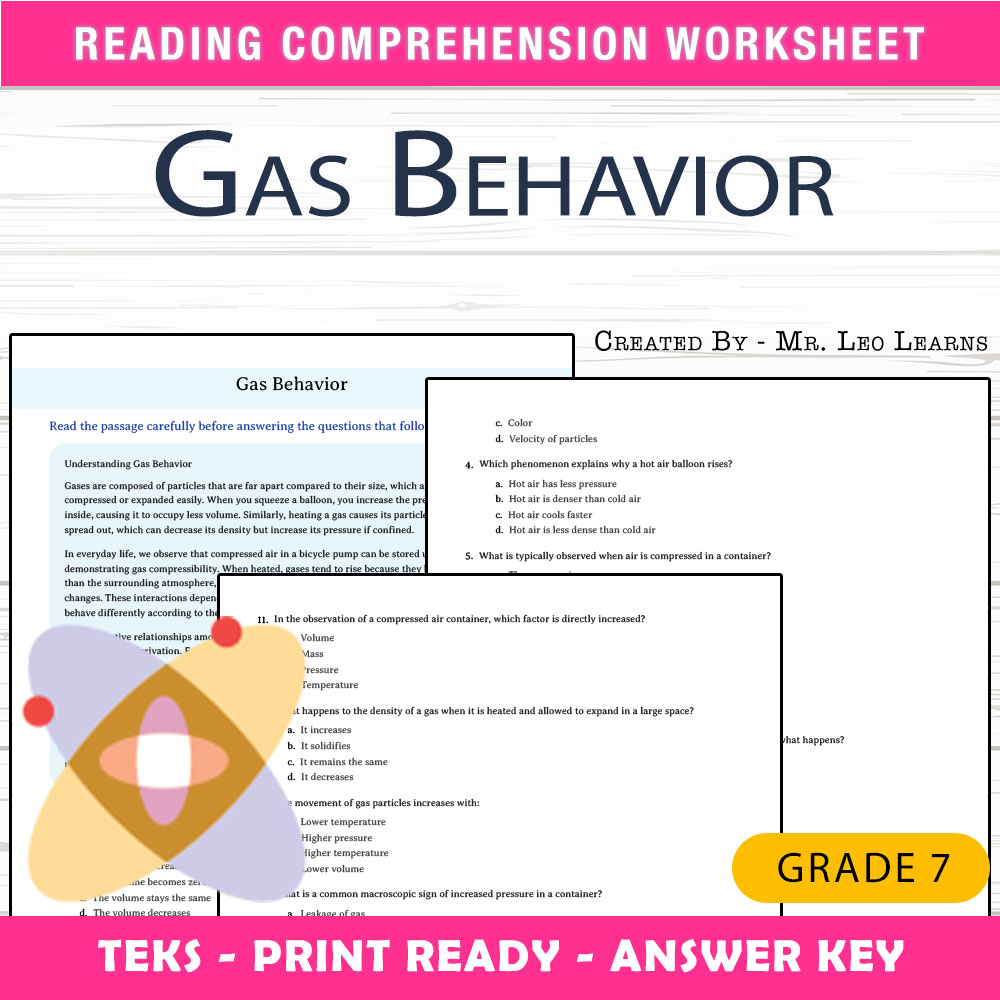
Grade 7 Science – Gas Behavior Worksheet for Mastery
Created byThe Resource HubLearning Objectives
- Understand how pressure, volume, and temperature interrelate in gases qualitatively.
- Describe phenomena such as diffusion and compressibility in gases.
- Relate macroscopic observations to gas behavior in different environmental conditions.
Also included in: Grade 7 Science Unit Bundle – States, Reactions & Atomic Structure Worksheets +1 more
Instant download
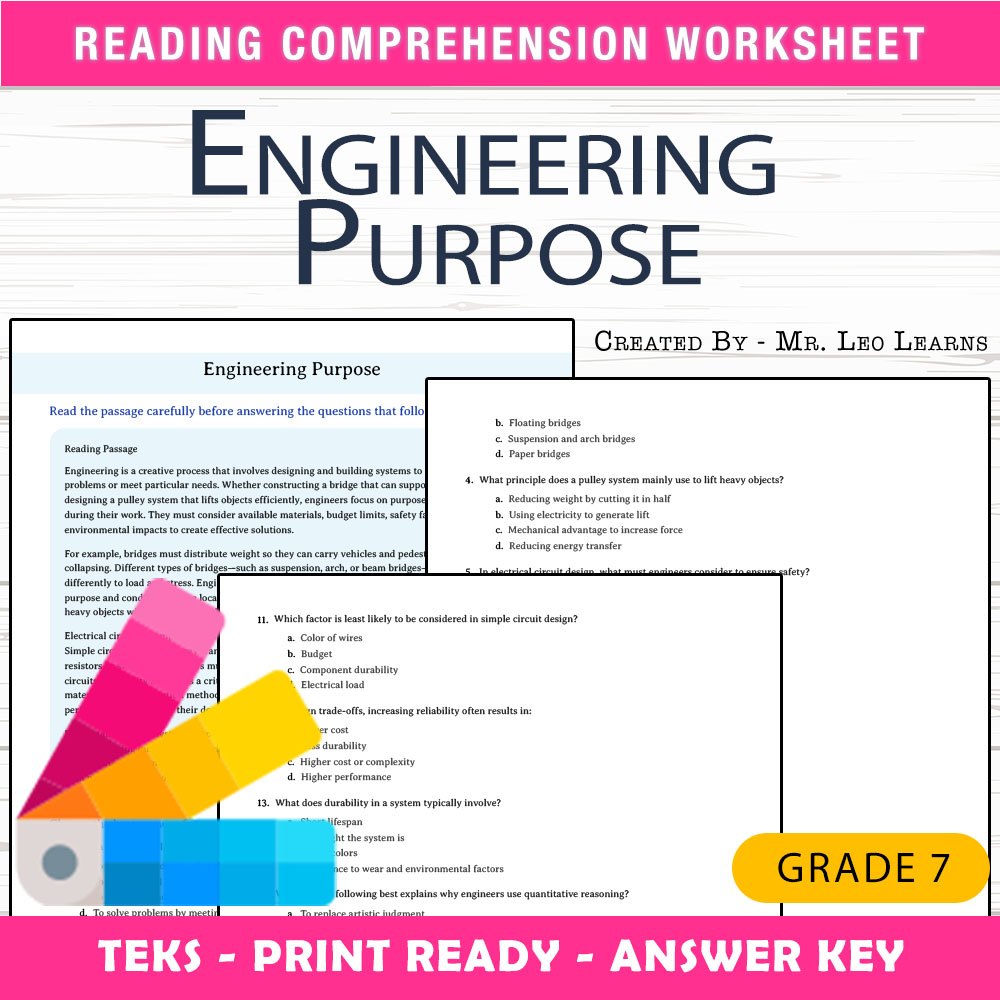
Grade 7 Science – Engineering Purpose Worksheet for Mastery
Created byThe Resource HubLearning Objectives
- Describe how engineering designs respond to their intended functions and constraints.
- Identify canonical engineering examples such as bridges, pulley systems, and circuits.
- Explain key concepts such as load distribution, energy transfer, durability, and trade-offs in engineering design.
Also included in: Grade 7 Science Unit | Engineering, Technology & Innovation Worksheet Bundle +1 more
Instant download
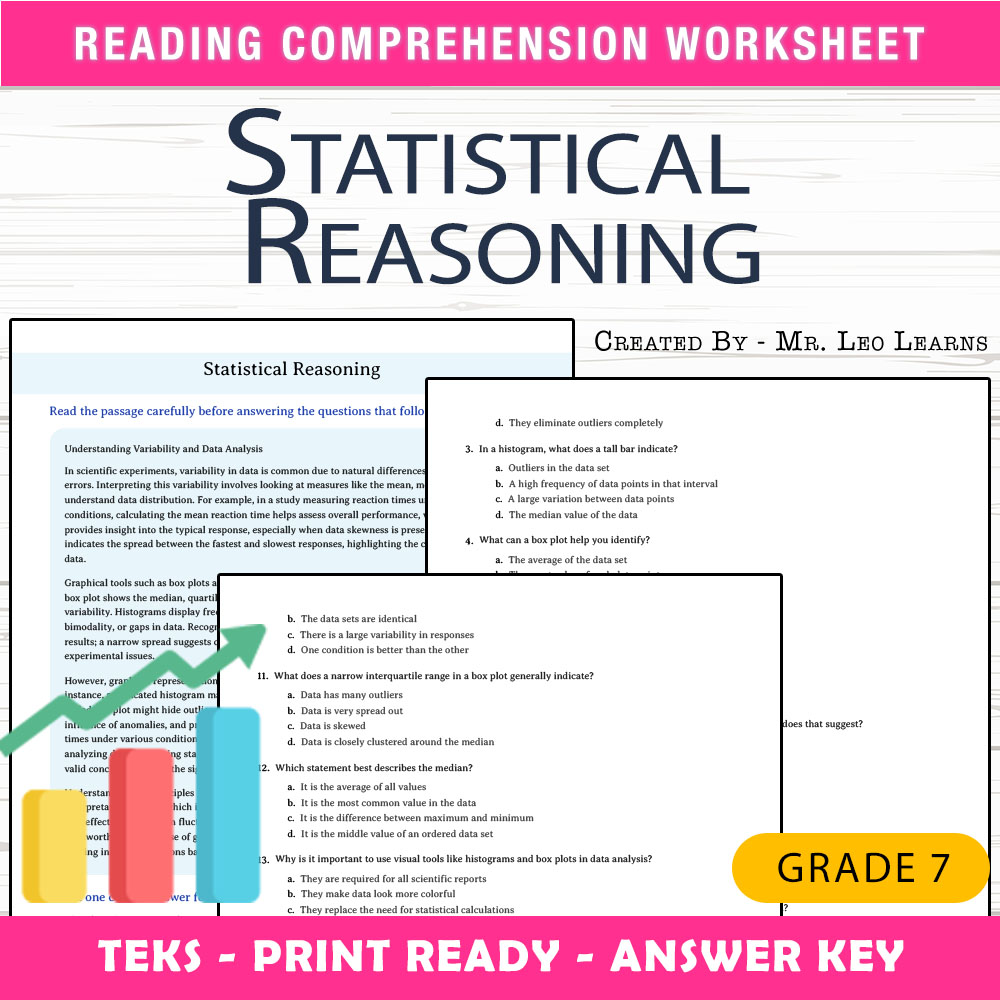
Grade 7 Science — Statistical Reasoning Worksheet for Data Analysis
Created byThe Resource HubLearning Objectives
- Interpret variability and measures of central tendency in data sets.
- Use graphical cues like box plots and histograms to assess data spread and reliability.
- Compare data sets through calculated measures and visual representations to evaluate consistency.
Also included in: Grade 7 Science Unit Bundle | Experimental Design & Data Analysis Worksheets +1 more
Instant download
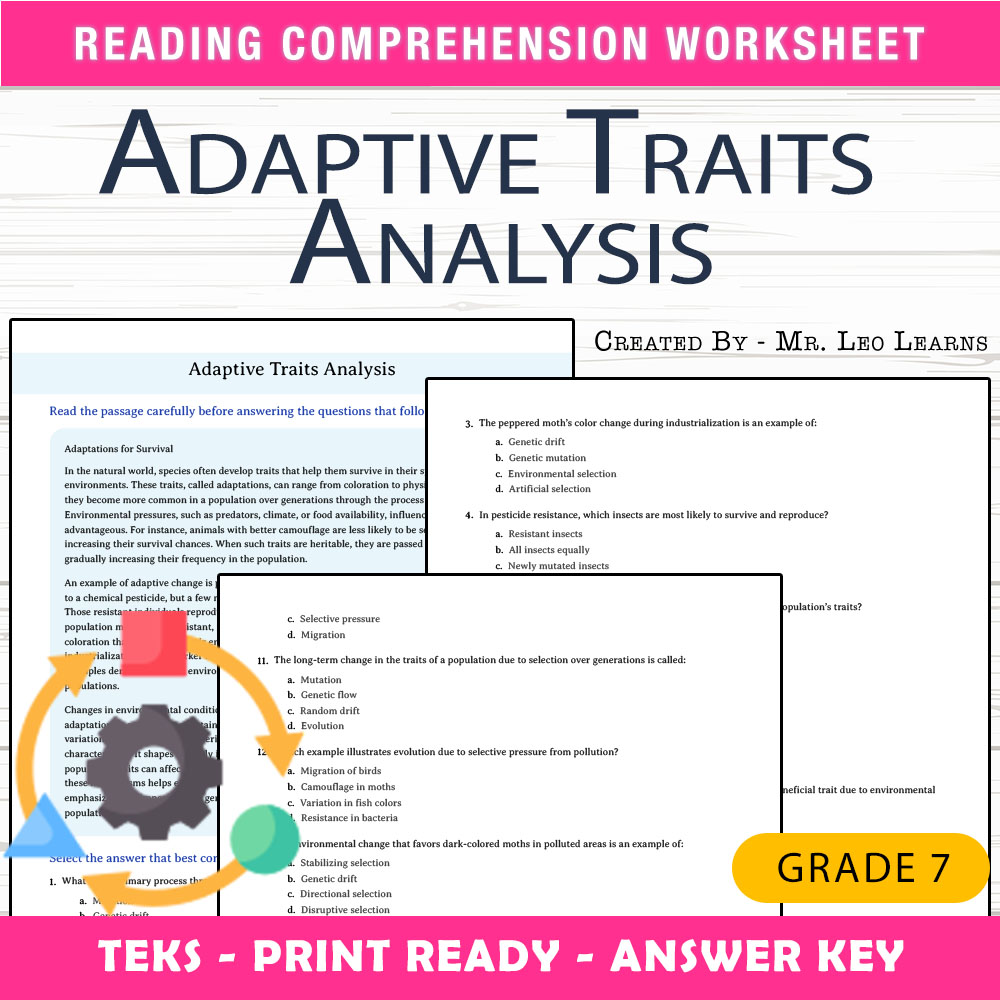
Grade 7 Science — Adaptive Traits Analysis Worksheet for Mastery
Created byThe Resource HubLearning Objectives
- Understand how adaptive traits increase in populations through natural selection.
- Analyze examples such as pesticide resistance and camouflage to identify mechanisms of adaptation.
- Explain the role of environmental pressures in shaping trait distributions across generations.
Also included in: Grade 7 Science Unit Bundle – Ecosystems, Cells & Adaptations Worksheet Pack +1 more
Instant download
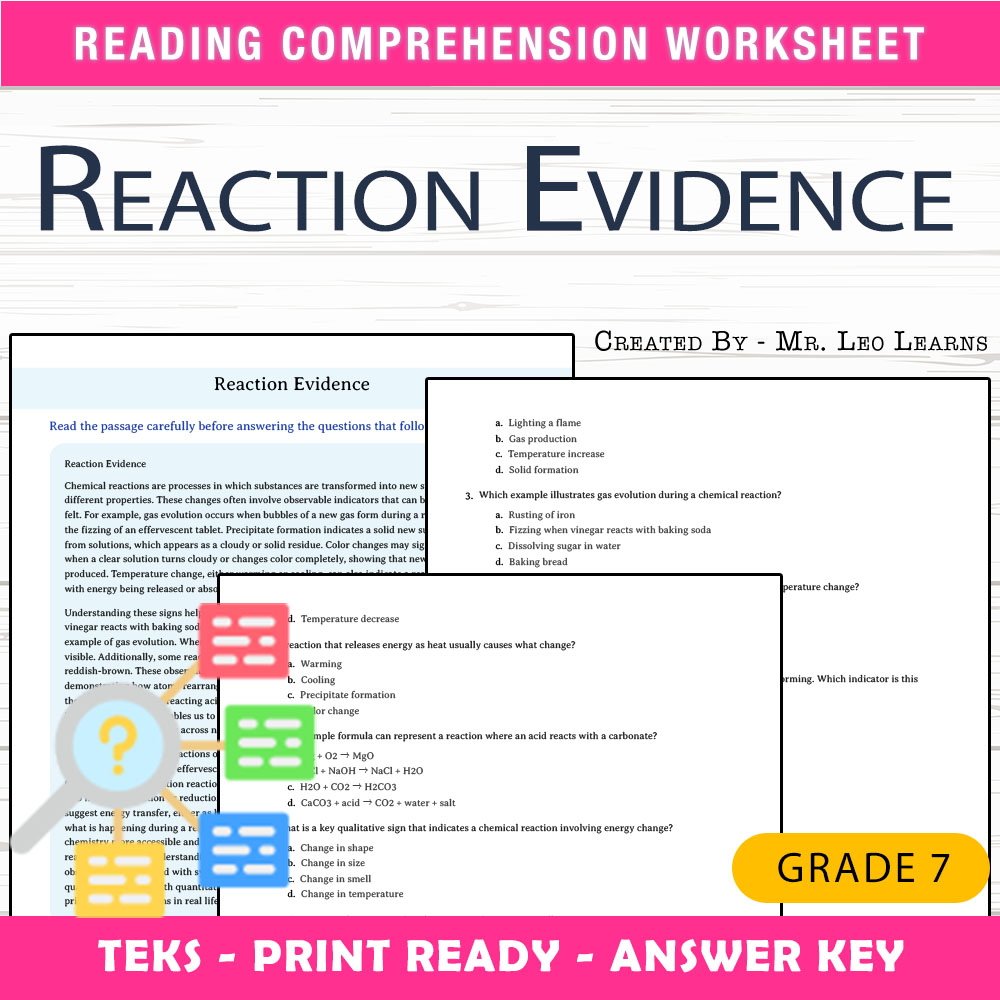
Grade 7 Science — Reaction Evidence Worksheet for Mastery
Created byThe Resource HubLearning Objectives
- Understand that chemical reactions produce observable indicators such as gas evolution, precipitate formation, color change, and temperature change.
- Connect observable signs of reactions to underlying mass and energy changes.
- Identify common reaction types like acid–carbonate effervescence and precipitation through qualitative evidence.
Also included in: Grade 7 Science Unit Bundle – States, Reactions & Atomic Structure Worksheets +1 more
Instant download
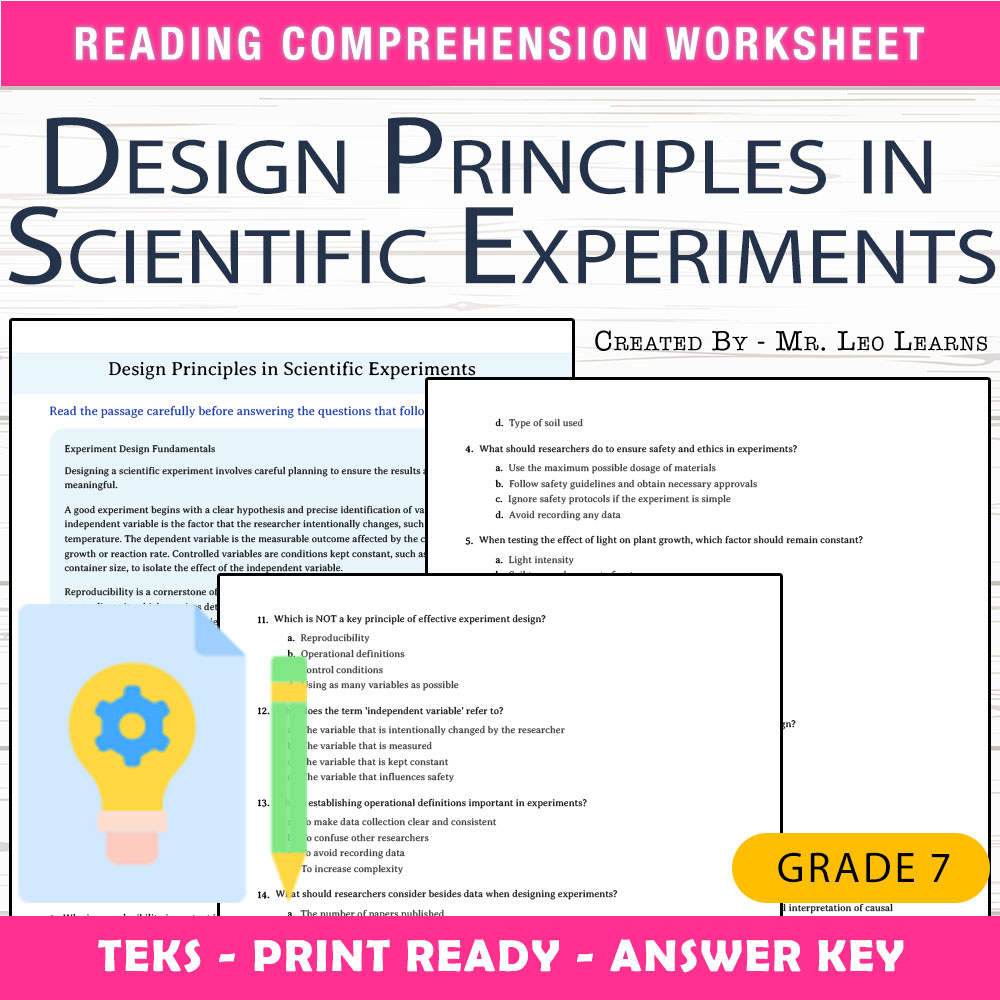
Grade 7 Science — Design Principles in Scientific Experiments Worksheet for Mastery
Created byThe Resource HubLearning Objectives
- Understand the key components of experimental design, including variables, control conditions, and operational definitions.
- Identify the importance of reproducibility, sample size, and safety in designing fair and valid experiments.
- Apply criteria for data collection and control conditions to plan effective experiments.
Also included in: Grade 7 Science Unit Bundle | Experimental Design & Data Analysis Worksheets +1 more
Instant download

Grade 7 Science — Variable Control Worksheet for Mastering Experimental Design
Created byThe Resource HubLearning Objectives
- Understand the importance of controlling variables in scientific experiments.
- Identify different types of variables and methods to manage them.
- Apply strategies such as randomization, blocking, and documentation to improve experiment accuracy.
Also included in: Grade 7 Science Unit Bundle | Experimental Design & Data Analysis Worksheets +1 more
Instant download
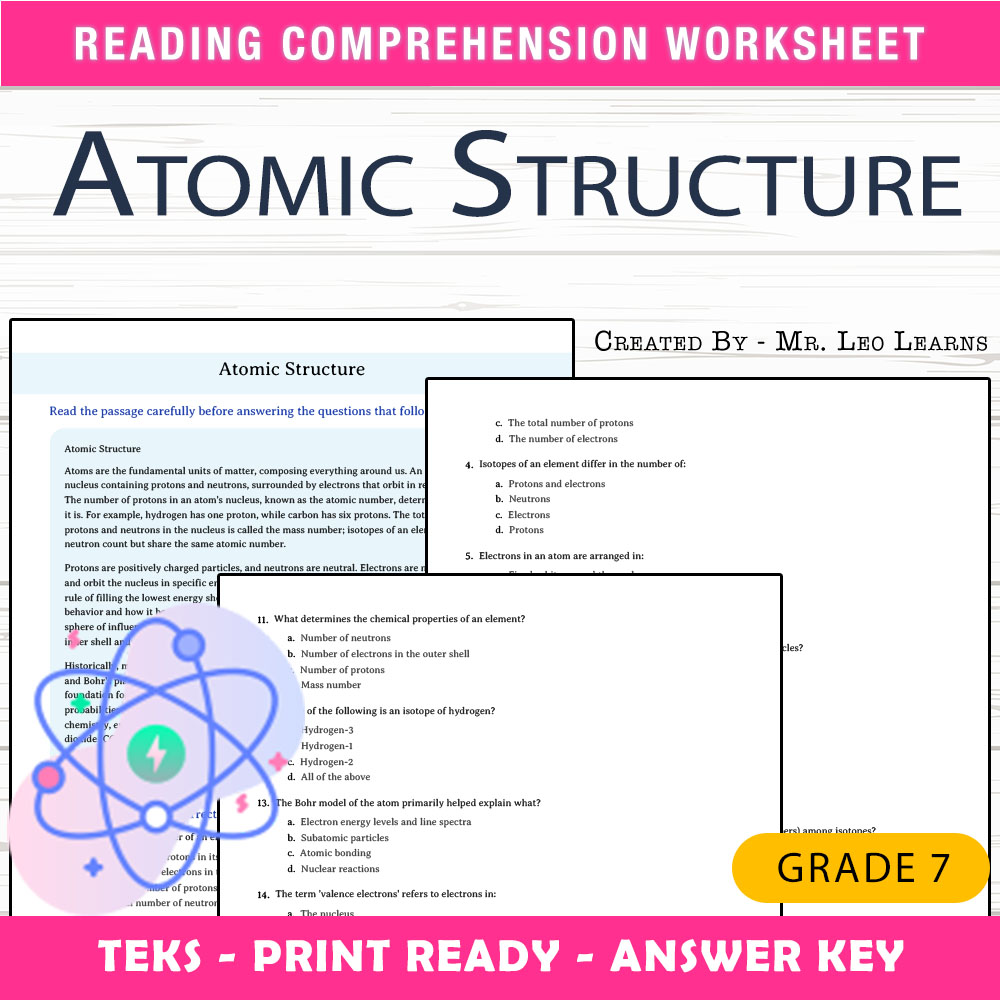
Grade 7 Science — Atomic Structure Worksheet for Mastery
Created byThe Resource HubLearning Objectives
- Understand the basic components of an atom: protons, neutrons, and electrons.
- Relate atomic number and mass number to element identity and isotopic variation.
- Describe simple electron arrangements and understand their role in periodic trends.
Also included in: Grade 7 Science Unit Bundle – States, Reactions & Atomic Structure Worksheets +1 more
Instant download

Grade 7 Science – Conservation of Mass Worksheet for Mastery
Created byThe Resource HubLearning Objectives
- Explain the principle of the conservation of mass in closed systems during physical and chemical processes.
- Apply mass accounting techniques to reactions and dissolution processes to relate reactant and product masses.
- Balance simple chemical formulas and use sealed-system measurements to reconcile observed mass distributions with stoichiometric calculations.
Also included in: Grade 7 Science Unit Bundle – States, Reactions & Atomic Structure Worksheets +1 more
Instant download
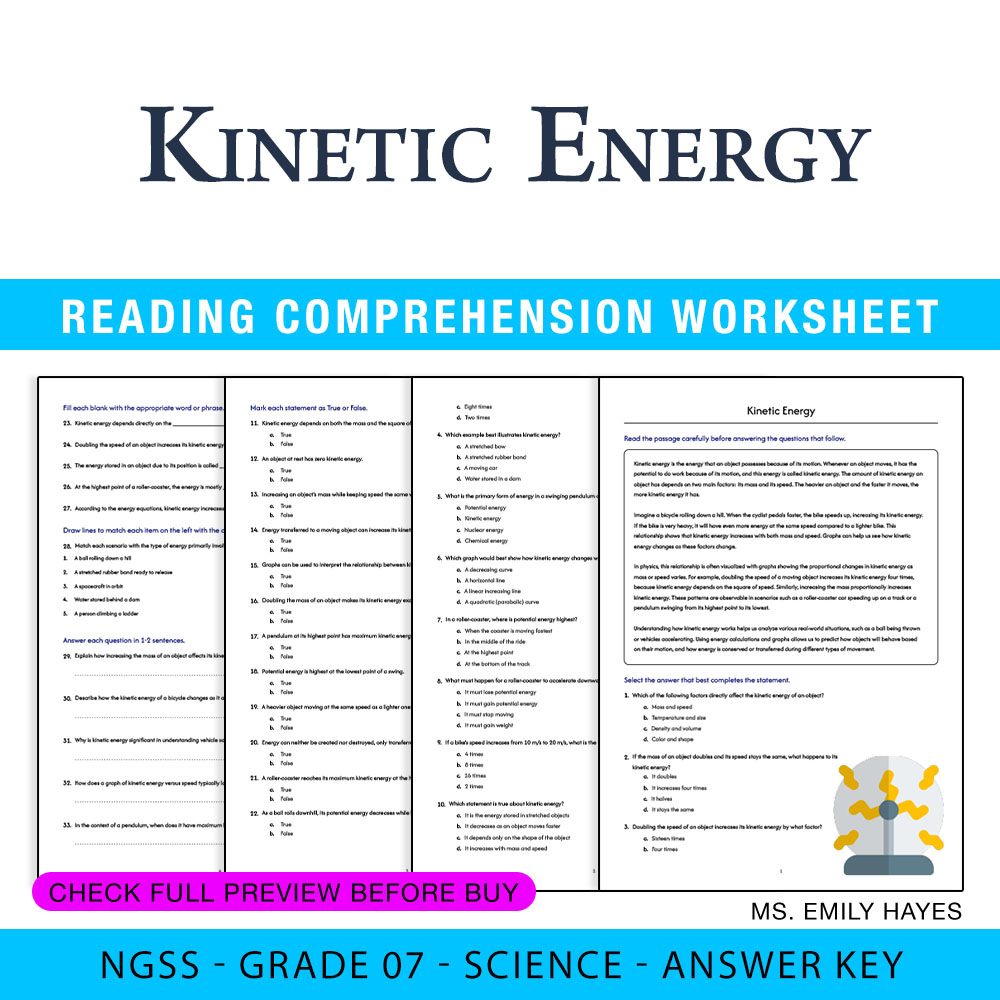
7th Grade Science | Kinetic Energy Worksheet (PDF+ Answer Key)
Created byCopper Leaf ClassroomLearning Objectives
- Construct and interpret graphical relationships between kinetic energy, potential energy, mass, and speed.
- Analyze how changes in mass and speed affect kinetic energy through graphs and calculations.
- Explain the concepts of kinetic and potential energy using real-world examples such as a rolling bicycle, a swinging pendulum, and a roller-coaster car.
Instant download

Potential Energy Worksheet for Grade 7 Science | NGSS Aligned Practice
JCreated byJ.S SheetsLearning Objectives
- Understand different models that represent potential energy stored in systems.
- Identify examples of gravitational, elastic, and magnetic potential energy.
- Explain how changes in object arrangement alter stored energy.
Also included in: Grade 7: Energy Transformations and Accounting Science Lesson Bundle NGSS +1 more
Instant download
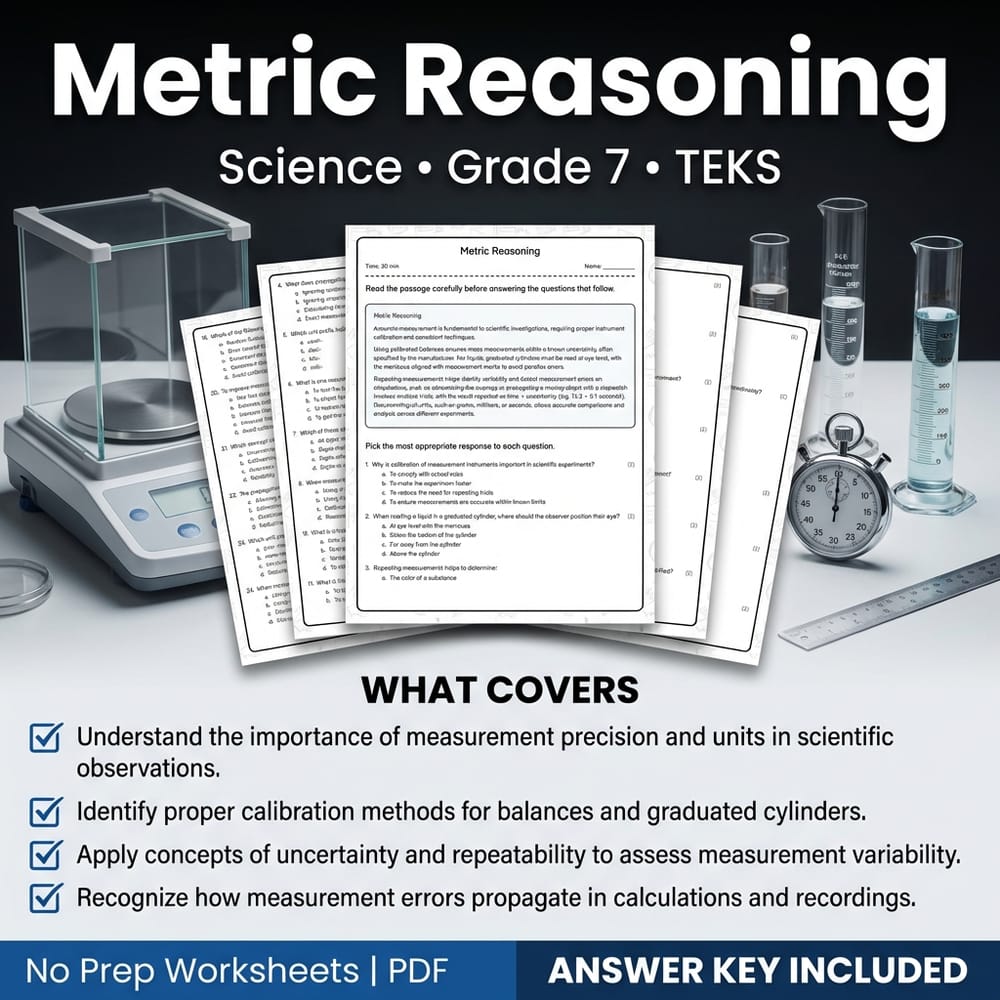
Grade 7 Science Worksheet on Metric Reasoning | TEKS Aligned Practice
Created byCoral Reef LearningLearning Objectives
- Understand the importance of measurement precision and units in scientific observations.
- Identify proper calibration methods for balances and graduated cylinders.
- Apply concepts of uncertainty and repeatability to assess measurement variability.
Instant download
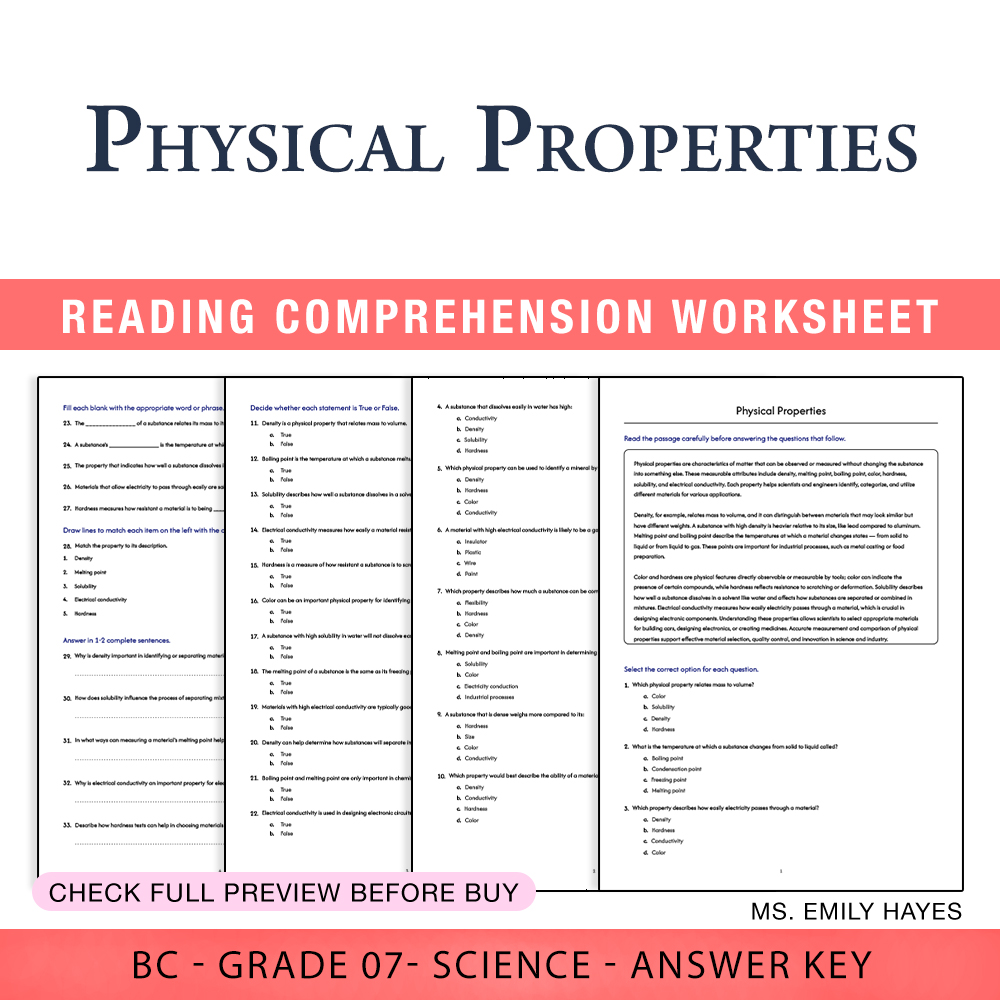
7th Grade Science | Physical Properties Worksheet (PDF+ Answer Key)
Created byCopper Leaf ClassroomLearning Objectives
- Understand and define physical properties such as density, melting point, boiling point, color, hardness, solubility, and electrical conductivity.
- Identify and describe how physical properties are used to categorize and separate different substances.
- Recognize the importance of observing measurable attributes for substance identification and material selection.
Also included in: Grade 7 Science Bundle| States of Matter & Chemical Reactions (PDF+ Answer Keys) +1 more
Instant download

Science Worksheet: Reaction Evidence Grade 7 | NGSS | Worksheet
 Created bySkylark Worksheets
Learning Objectives
- Identify observable indicators that a chemical reaction has occurred, including gas production, precipitate formation, color change, and temperature change.
- Explain irreversibility and how it differs from reversible physical changes.
- Use mass measurements from sealed systems to connect reaction evidence to the conservation of matter.
Also included in: Grade 7 Matter, Reactions & Atomic Models Science Lesson Bundle (NGSS) +1 more
Instant download
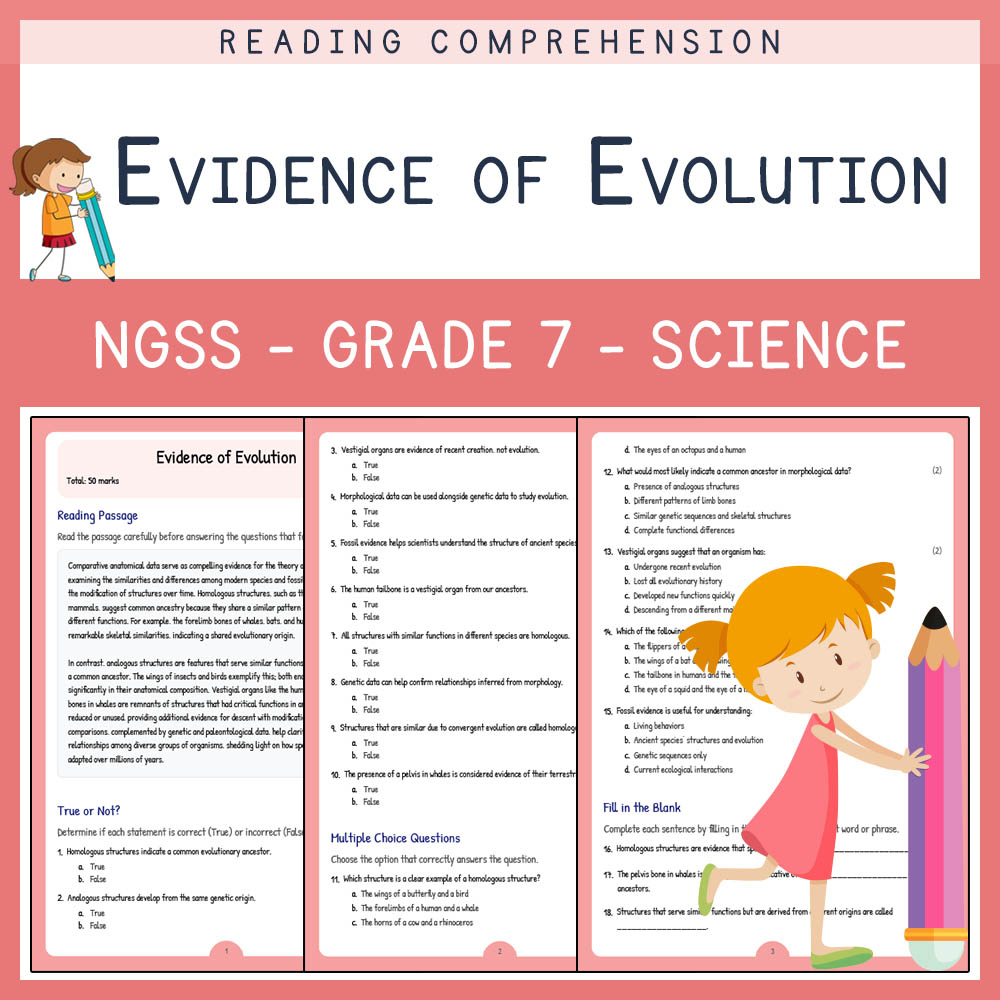
Grade 7 Science | Evidence of Evolution Worksheet with Answer Key (NGSS Aligned)
 Created byLumora Learning
Learning Objectives
- Understand how comparative anatomy provides evidence for evolution.
- Identify homologous and analogous structures in different species.
- Interpret morphological and genetic data to determine evolutionary relationships.
Instant download

Grade 7 Science Graphical Representation Worksheet | Ontario + Answer Key
 Created byClear Sky Classroom
Learning Objectives
- Select an appropriate graph type (bar chart, histogram, line graph, scatter plot) based on the type of data and research question.
- Construct graphs with correct axes, proportional scaling, labels, and clear annotations for clarity.
- Interpret patterns in graphs by analyzing slope, correlation, clusters, and variation without implying causation.
Instant download
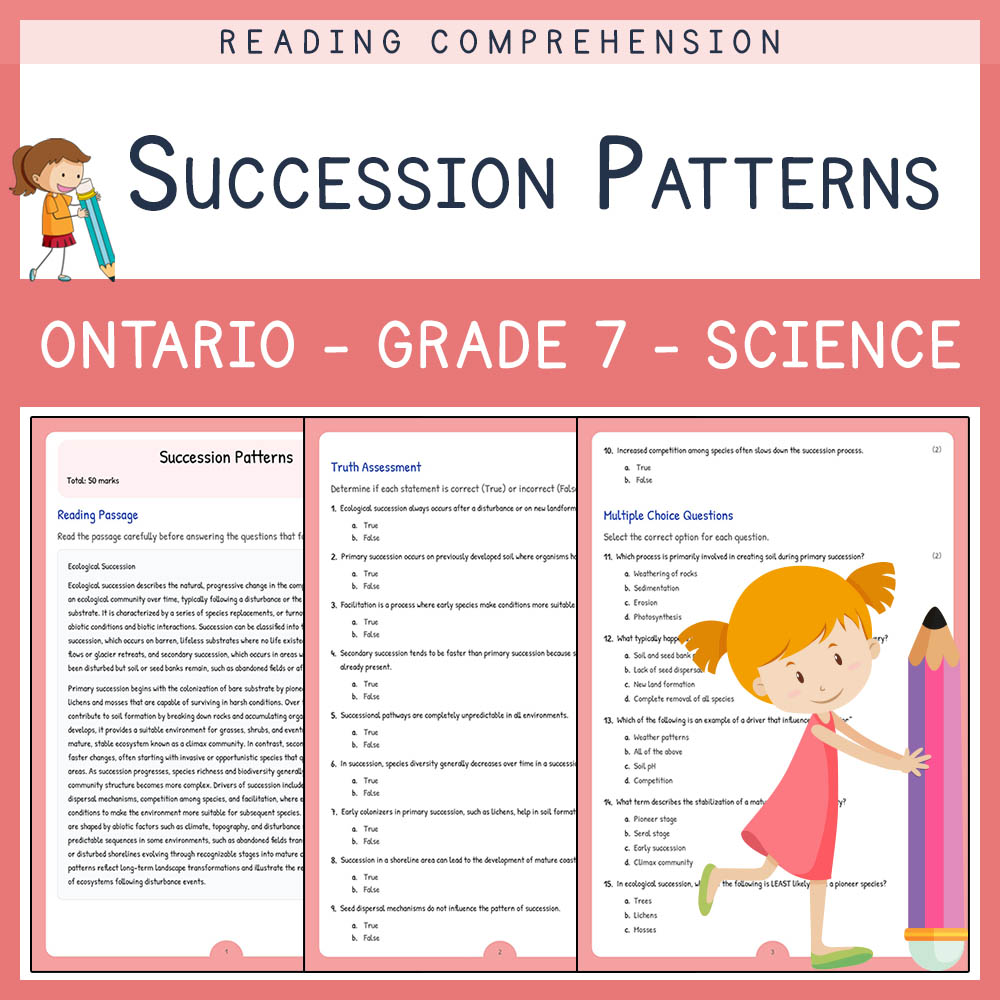
Grade 7 Science | Succession Patterns Worksheet (PDF + Answer Key) for Ontario
Created byLumora LearningLearning Objectives
- Understand the concept of ecological succession and its directional change in community composition.
- Differentiate between primary and secondary succession and identify their characteristic stages.
- Explain the drivers of succession such as soil development, seed dispersal, competition, and facilitation.
Instant download
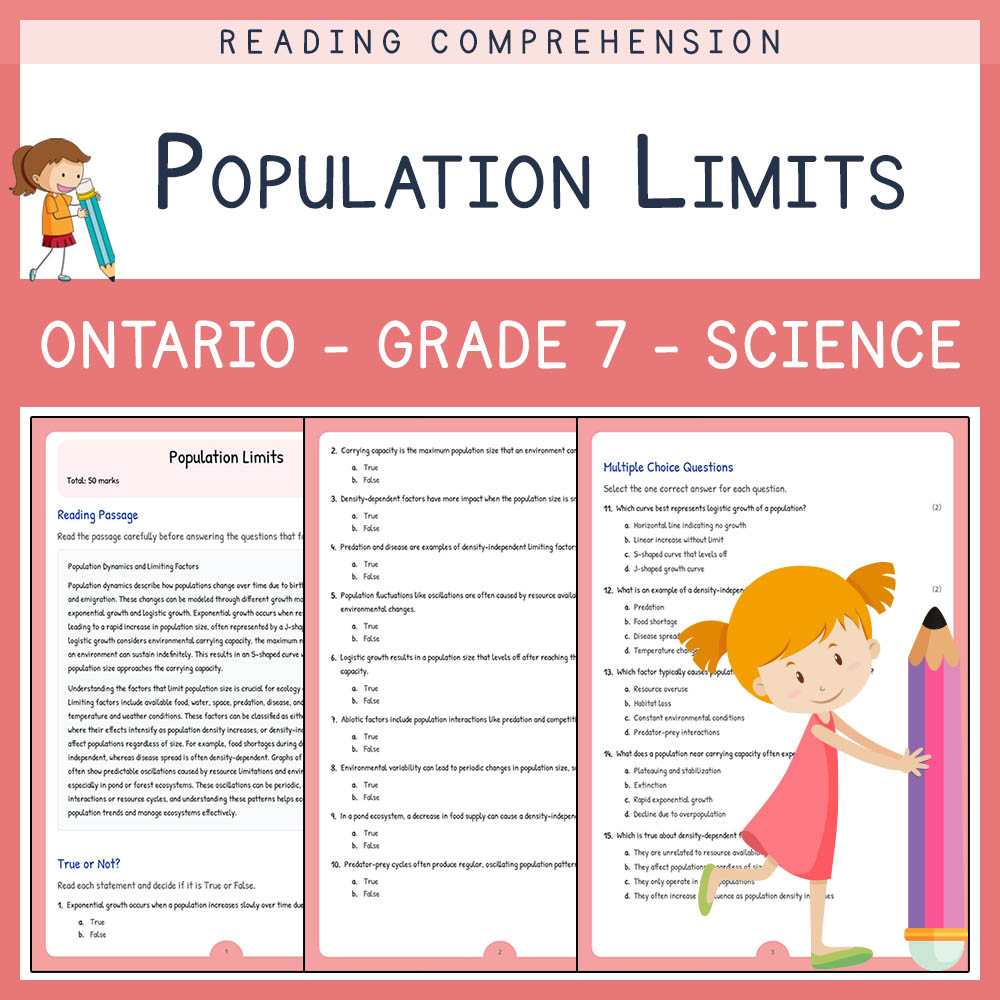
Grade 7 Science | Population Limits Worksheet & Answer Key (PDF)
Created byLumora LearningLearning Objectives
- Explain basic population growth models including exponential and logistic growth.
- Identify factors that limit populations such as resources and environmental stresses.
- Differentiate between density-dependent and density-independent influences on populations.
Instant download
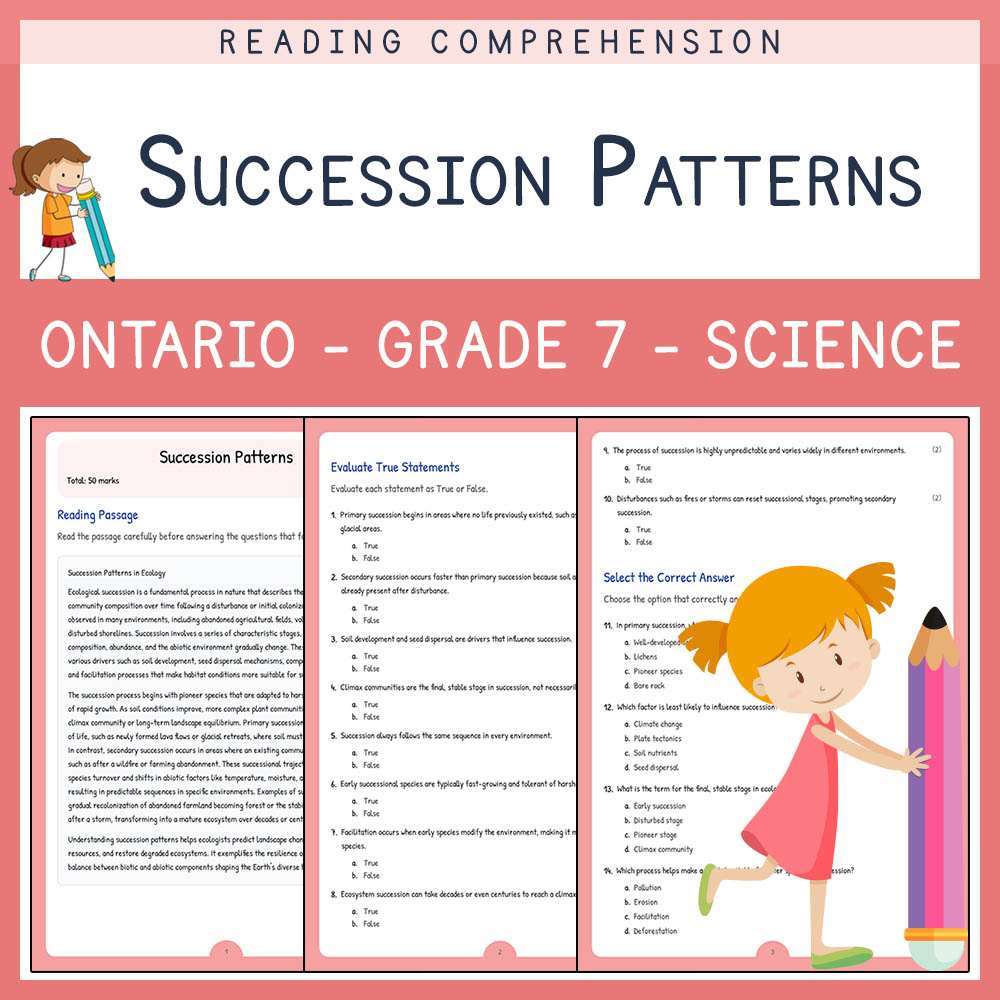
Grade 7 | Science Assessment | Succession Patterns Worksheet | Ontario
Created byLumora LearningLearning Objectives
- Understand the concept of ecological succession and its stages.
- Differentiate between primary and secondary succession.
- Identify the environmental drivers influencing succession.
Instant download
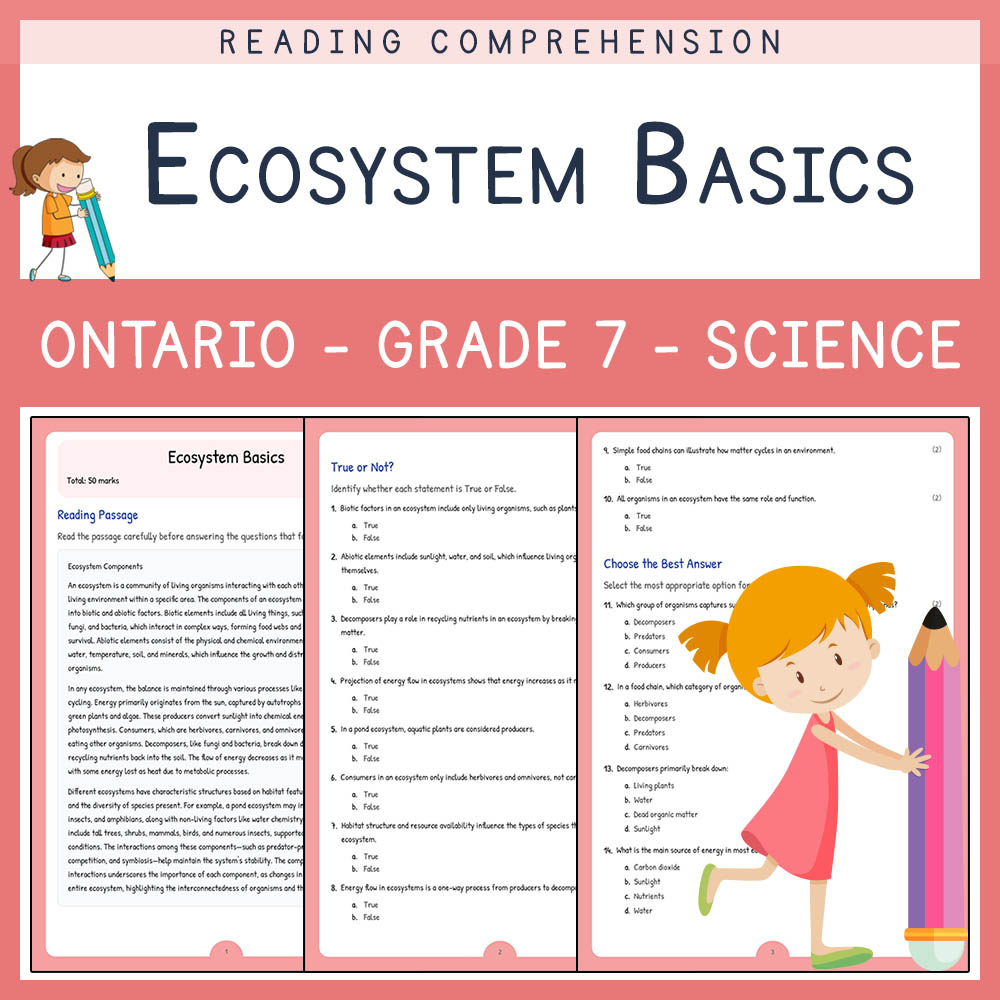
Grade 7 Science | Ecosystem Basics Worksheet & Answer Key (PDF)
Created byLumora LearningLearning Objectives
- Define components of ecosystems and distinguish between biotic and abiotic elements.
- Identify trophic categories and understand energy flow in ecosystems.
- Analyze simple food chains and describe matter cycling within ecosystems.
Instant download
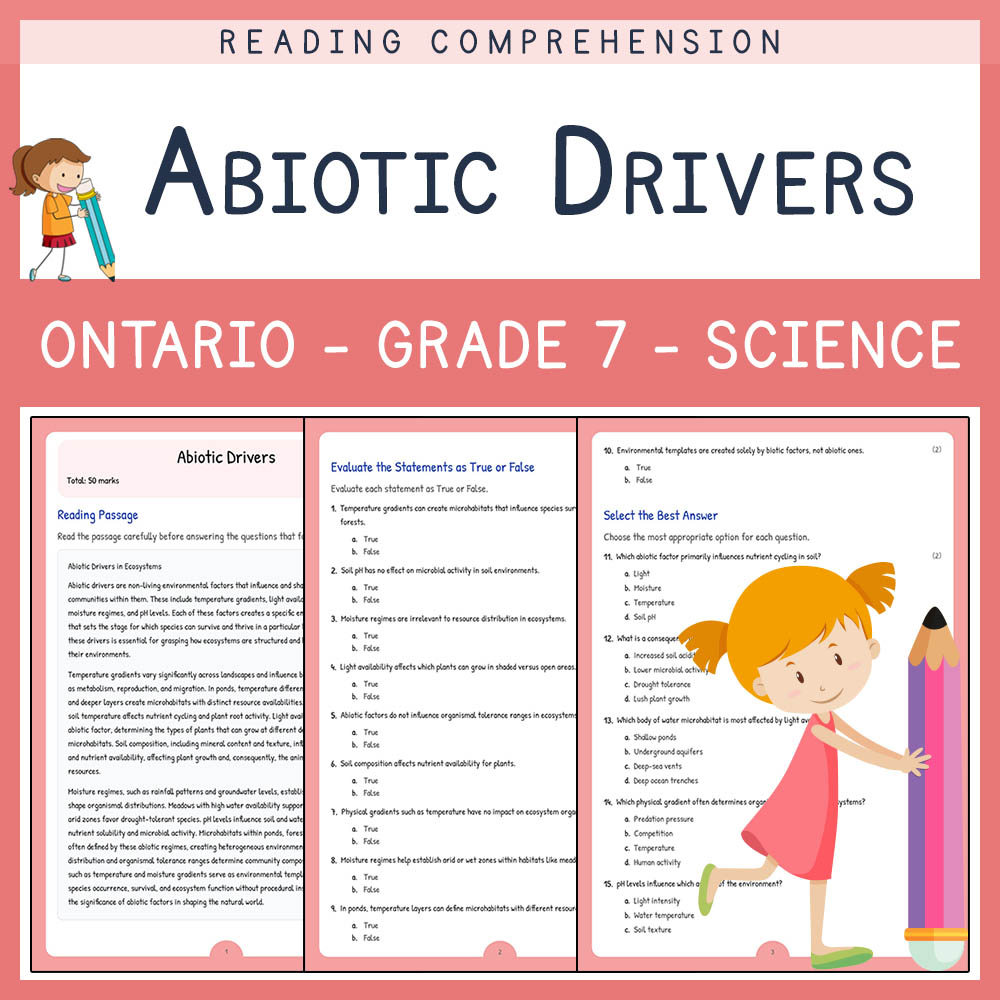
Grade 7 Science | Abiotic Drivers Worksheet (PDF Answer Key & Rubric)
Created byLumora LearningLearning Objectives
- Define and characterize abiotic drivers such as temperature gradients, light availability, soil composition, moisture regimes, and pH.
- Explain how abiotic factors influence resource distribution and physiological constraints within ecosystems.
- Describe microhabitats within ponds, forests, and meadows where abiotic variability impacts organisms and resource availability.
Instant download

Grade 7 Science | Human Stewardship Worksheet (Answer Key) - Ontario Standards
Created byLumora LearningLearning Objectives
- Describe human impacts on ecosystems including habitat alteration, pollution, resource extraction, and introduction of non-native species.
- Explain the consequences of human activities on species diversity and ecosystem functions.
- Identify principles of ecological stewardship such as mitigation, habitat protection, and restoration.
Instant download
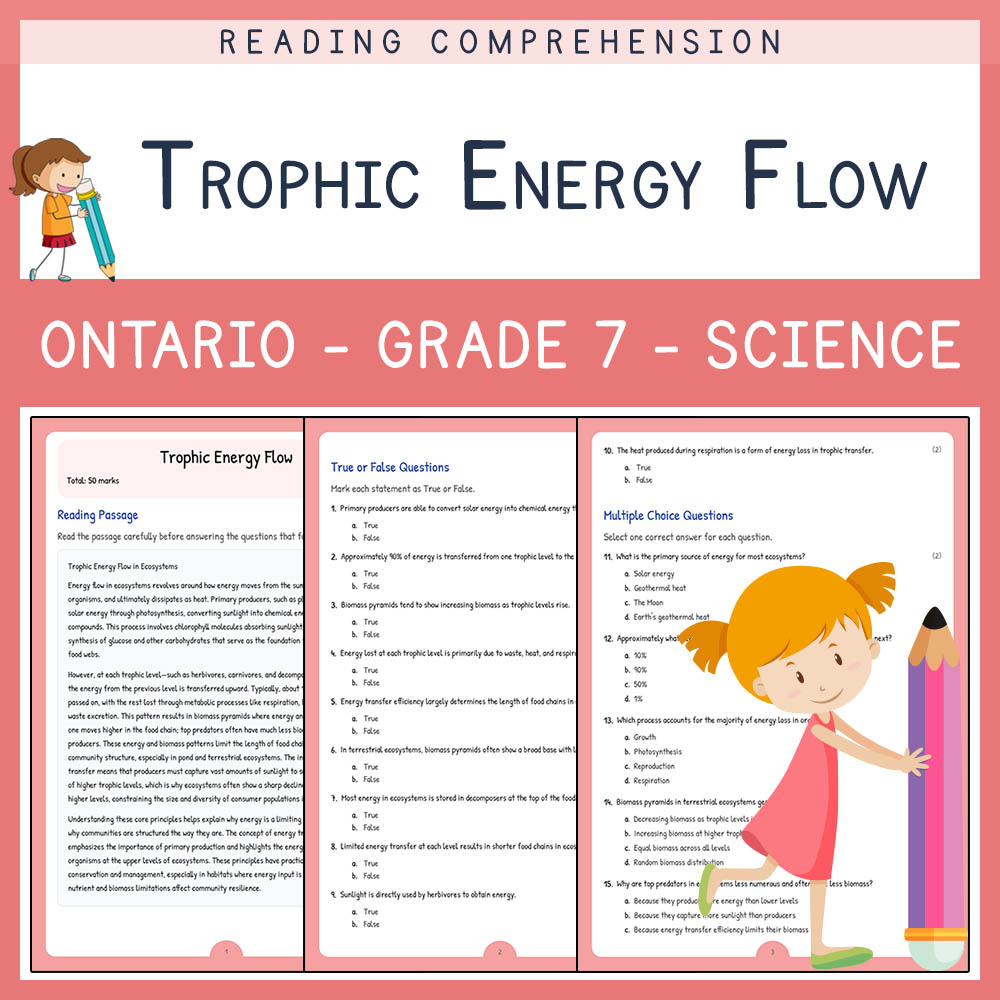
Grade 7 Science | Trophic Energy Flow Worksheet (Answer Key) Ontario Curriculum
Created byLumora LearningLearning Objectives
- Describe how energy is transferred through different trophic levels in ecosystems.
- Identify the patterns of energy efficiency and biomass distribution across trophic levels.
- Explain the processes of solar energy capture, energy conversion, and energy loss in ecosystems.
Instant download
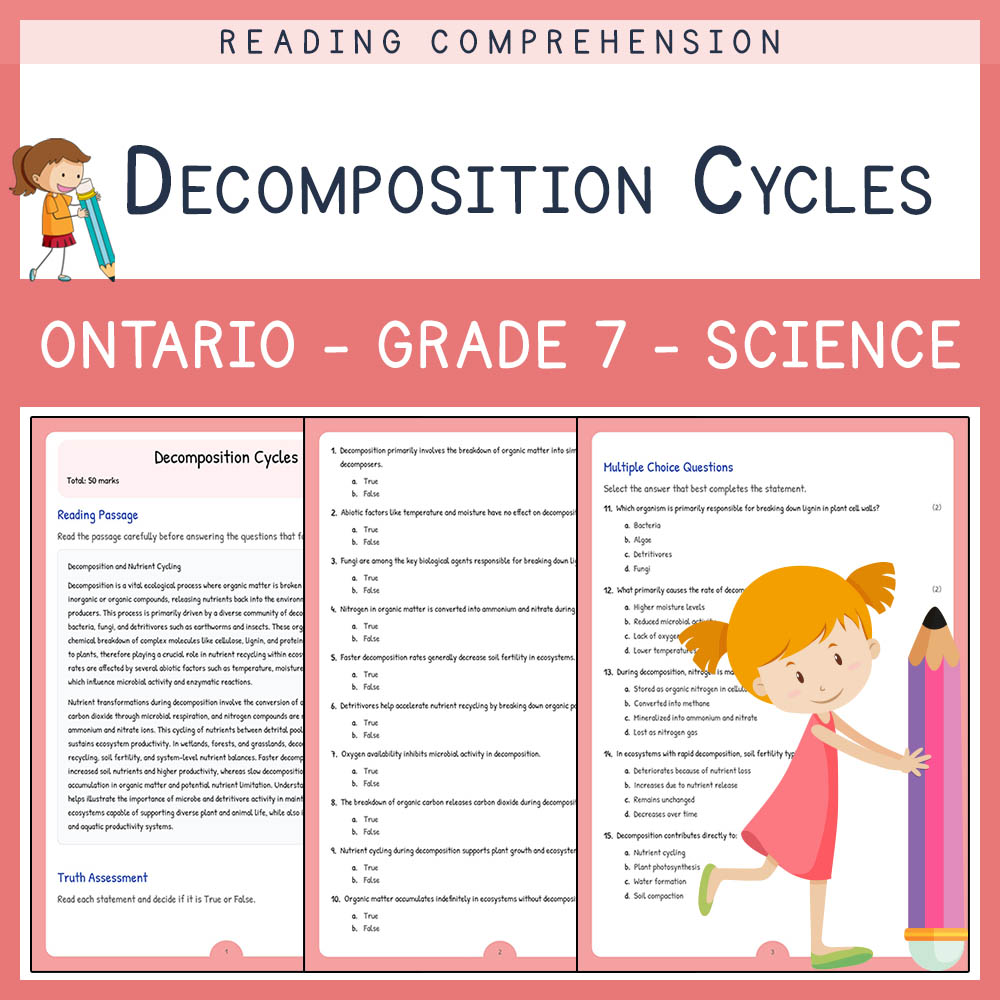
Grade 7 Science | Decomposition Cycles Worksheet & Answer Key (PDF)
Created byLumora LearningLearning Objectives
- Understand the processes involved in decomposition and nutrient cycling.
- Identify roles of detritivores, fungi, bacteria, and abiotic factors in decomposition.
- Describe carbon and nitrogen transformations during organic matter breakdown.
Instant download
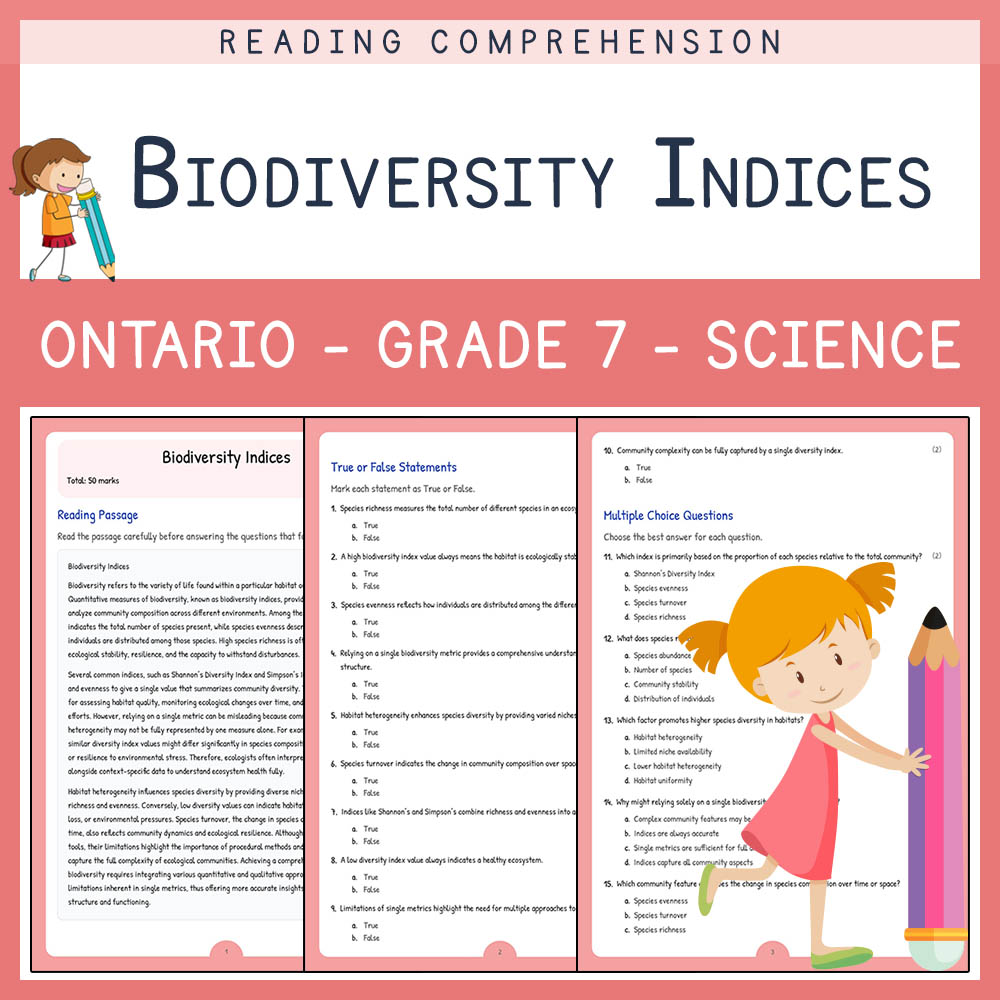
Grade 7 Science | Biodiversity Indices Worksheet (Answer Key) – Ontario Standard
Created byLumora LearningLearning Objectives
- Understand the concept of biodiversity and how it is measured using indices.
- Identify different biodiversity metrics such as species richness and evenness.
- Interpret diversity values across habitats and evaluate ecological stability.
Instant download
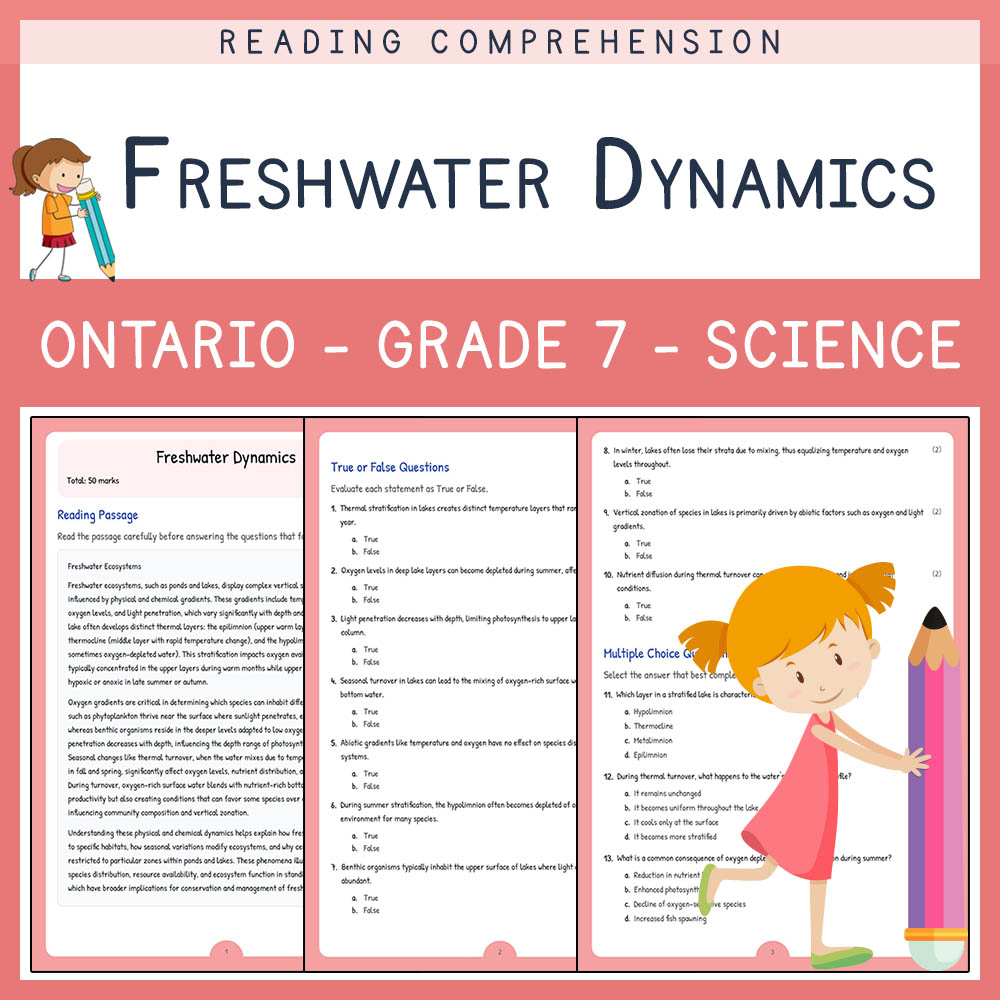
Grade 7 Science | Freshwater Dynamics Worksheet with Answer Key (PDF)
Created byLumora LearningLearning Objectives
- Describe the structure and stratification of freshwater systems like ponds and lakes.
- Explain how oxygen gradients and light penetration influence aquatic community composition.
- Analyze seasonal phenomena such as thermal turnover and their effects on dissolved oxygen and nutrient mixing.
Instant download
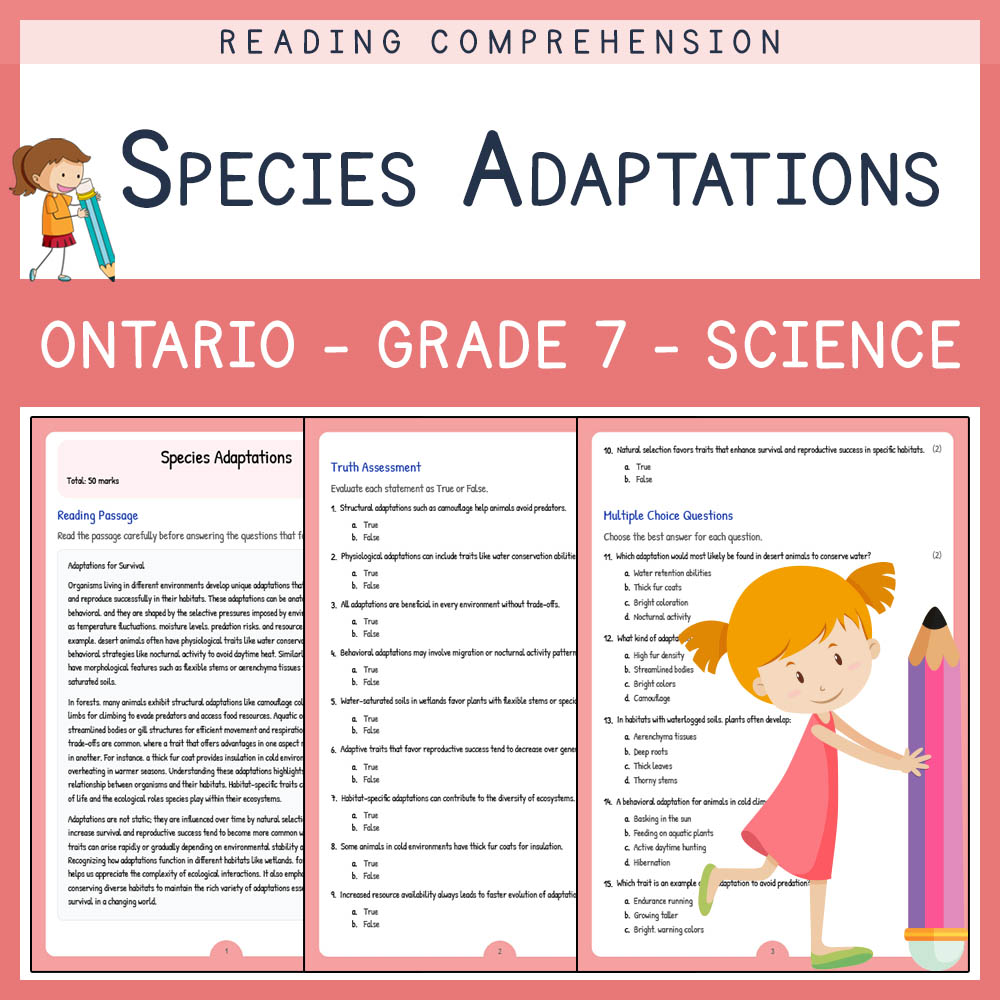
Grade 7 Science | Species Adaptations Worksheet (Answer Key & Rubric) - Ontario Standards
Created byLumora LearningLearning Objectives
- Identify various structural, physiological, and behavioral adaptations in organisms.
- Explain how environmental pressures like temperature, moisture, and predation influence adaptations.
- Relate specific adaptations to habitats such as wetlands, forests, and open meadows.
Instant download
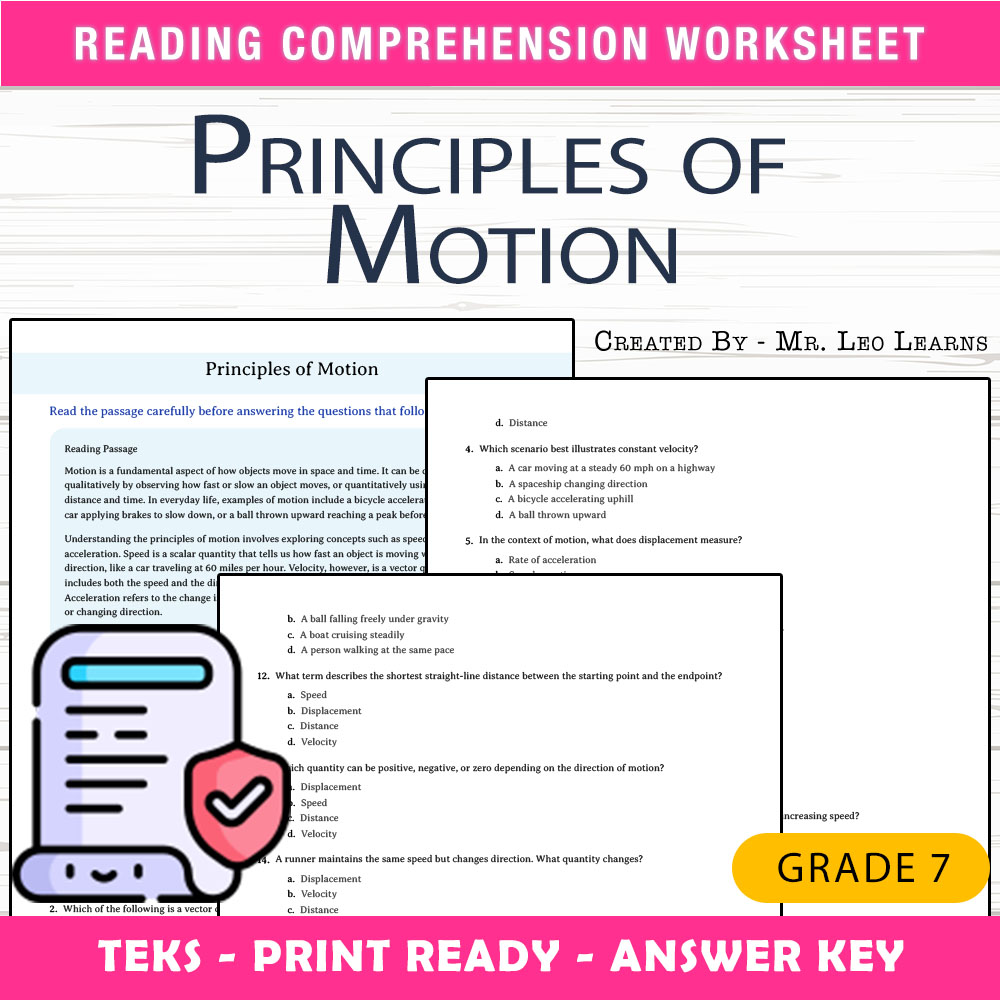
Grade 7 Science – Principles of Motion Worksheet for Mastery
Created byThe Resource HubLearning Objectives
- Explain the difference between speed, velocity, and acceleration with real-world examples.
- Identify scalar and vector quantities related to motion.
- Describe relationships between displacement, time, and rate of change in motion scenarios.
Also included in: Grade 7 Science Unit Bundle – Motion, Forces & Energy Worksheets for Mastery +1 more
Instant download
About Grade 7 Science Worksheets
Browse 6,039 printable Grade 7 Science worksheets — ready-to-print PDFs with answer keys where available.
Every worksheet on MyTeachingSheets is created by independent teacher-authors and reviewed before publication. All resources download as printable PDFs for classroom, homework, or at-home practice, and many include answer keys. Preview any worksheet free before buying.