
Grade 7 Science Worksheets
6,039 worksheets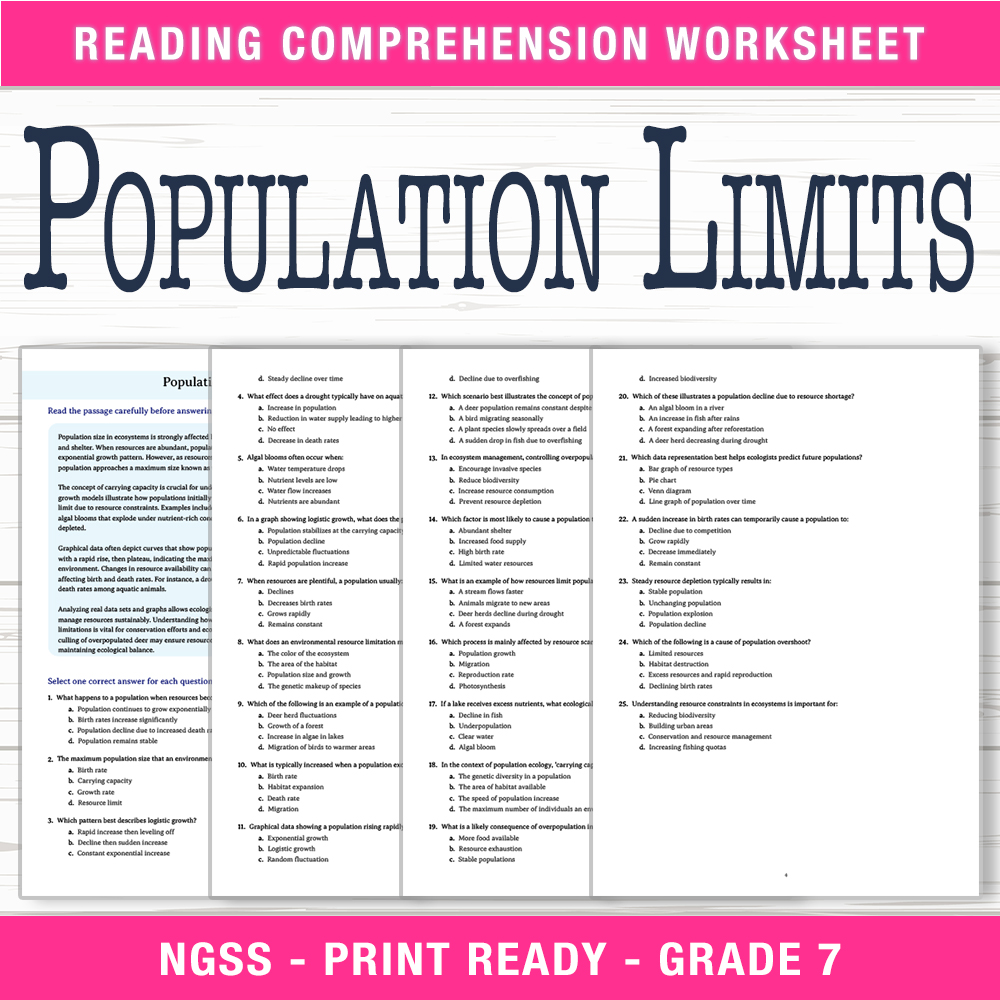
Grade 7 Science | Population Limits Worksheet (PDF + Answer Key)
 Created byRiverstone Classroom
Learning Objectives
- Explain how resource availability impacts population growth and size.
- Interpret logistic growth curves and concepts of carrying capacity.
- Analyze examples of population responses to limited resources, such as deer herd fluctuations and algal blooms.
Also included in: Grade 7 Science | Ecosystems & Biodiversity Unit Worksheet Pack
Instant download
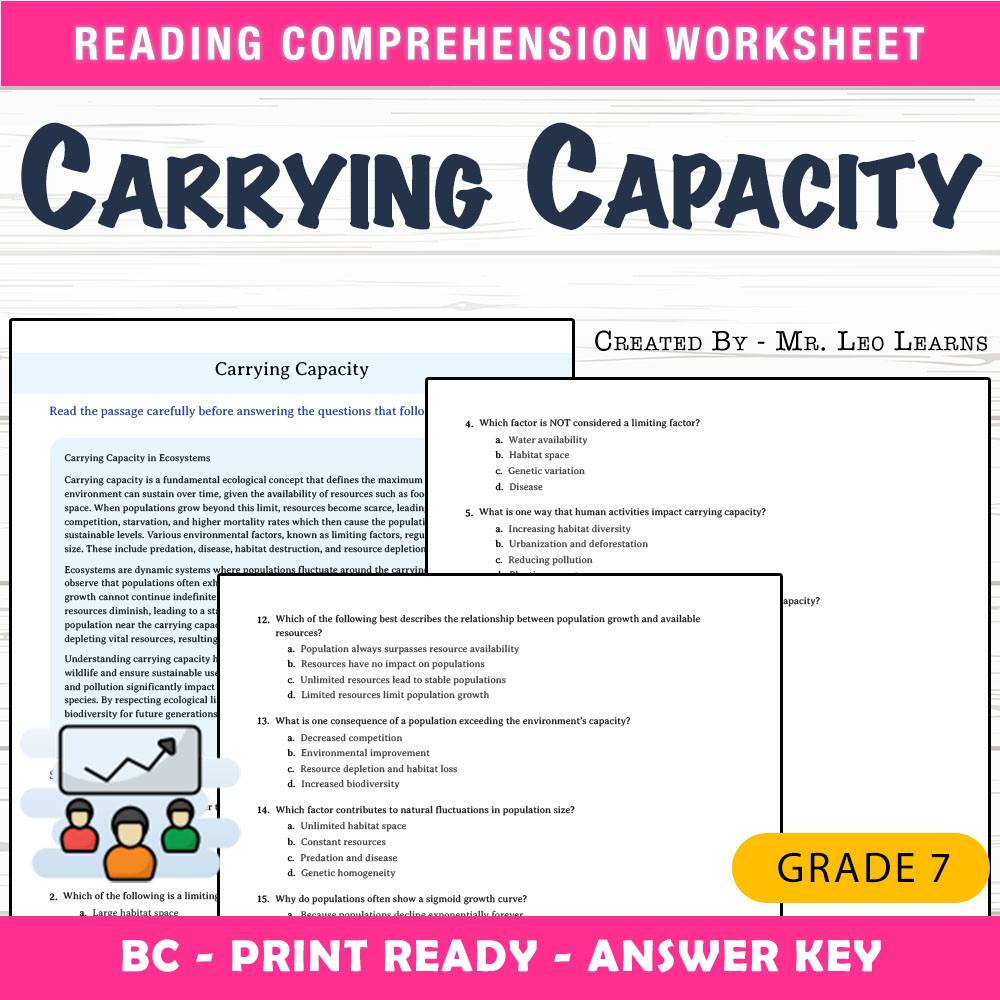
Grade 7 Science — Carrying Capacity Worksheet MCQ Paper
 Created byThe Resource Hub
Learning Objectives
- Understand the concept of carrying capacity in ecosystems.
- Identify limiting factors that affect population size.
- Explain how populations adjust to environmental constraints.
Also included in: Grade 7 Science Ecosystems & Interactions Worksheet Bundle +1 more
Instant download
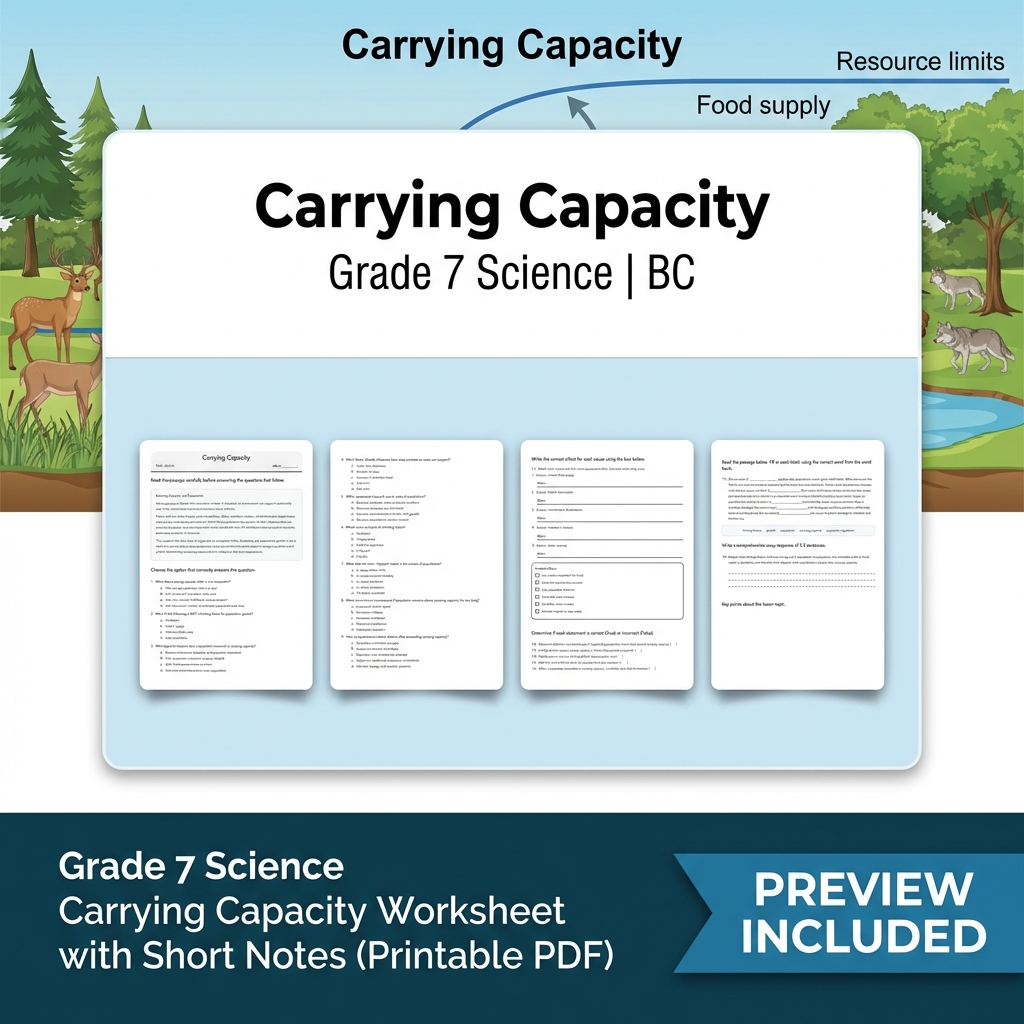
Grade 7 Science Carrying Capacity Worksheet with Short Notes (Printable PDF)
 Created byMeadowlark Worksheets
Learning Objectives
- Understand the concept of carrying capacity and its importance in ecosystems.
- Identify limiting factors that affect population growth.
- Explain how populations regulate themselves when exceeding carrying capacity.
Also included in: Grade 7 Science Lesson Bundle: Ecosystems and Population Dynamics Worksheets +1 more
Instant download
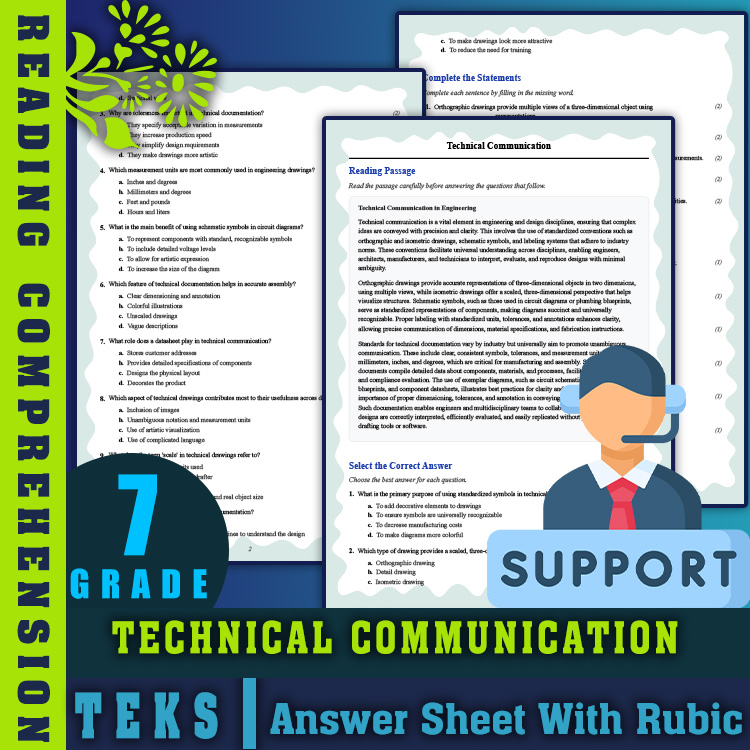
Grade 7 Science | Technical Communication Reading Worksheet & Answer Key (PDF)
JCreated byJ.S SheetsLearning Objectives
- Understand the conventions used in technical communication including drawings, symbols, and documentation.
- Identify the purpose and components of standardized units, labels, and schematic diagrams.
- Explain the importance of clarity, scale, and unambiguous dimensioning in technical documents.
Instant download
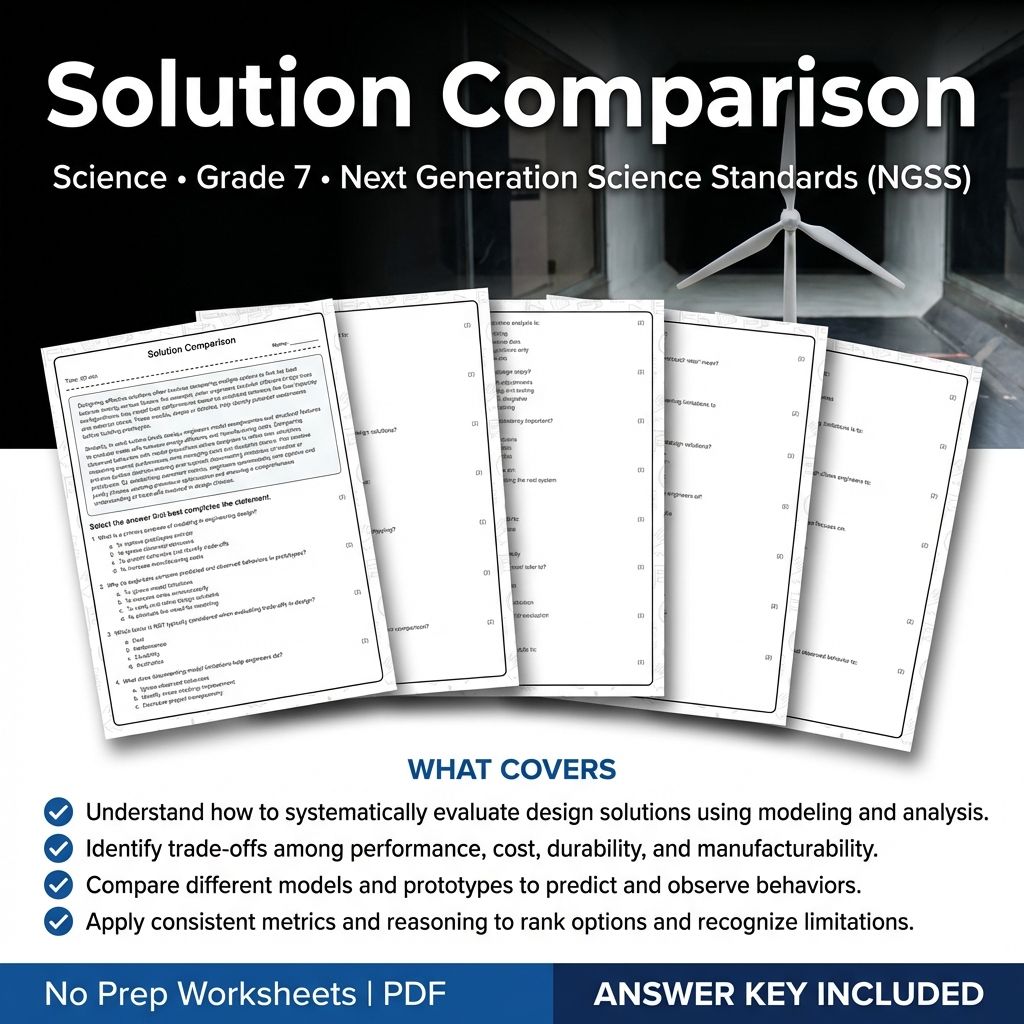
7th Grade Science | Solution Comparison Worksheet & Answer Key (Printable PDF)
 Created byCoral Reef Learning
Learning Objectives
- Understand how to systematically evaluate design solutions using modeling and analysis.
- Identify trade-offs among performance, cost, durability, and manufacturability.
- Compare different models and prototypes to predict and observe behaviors.
Instant download
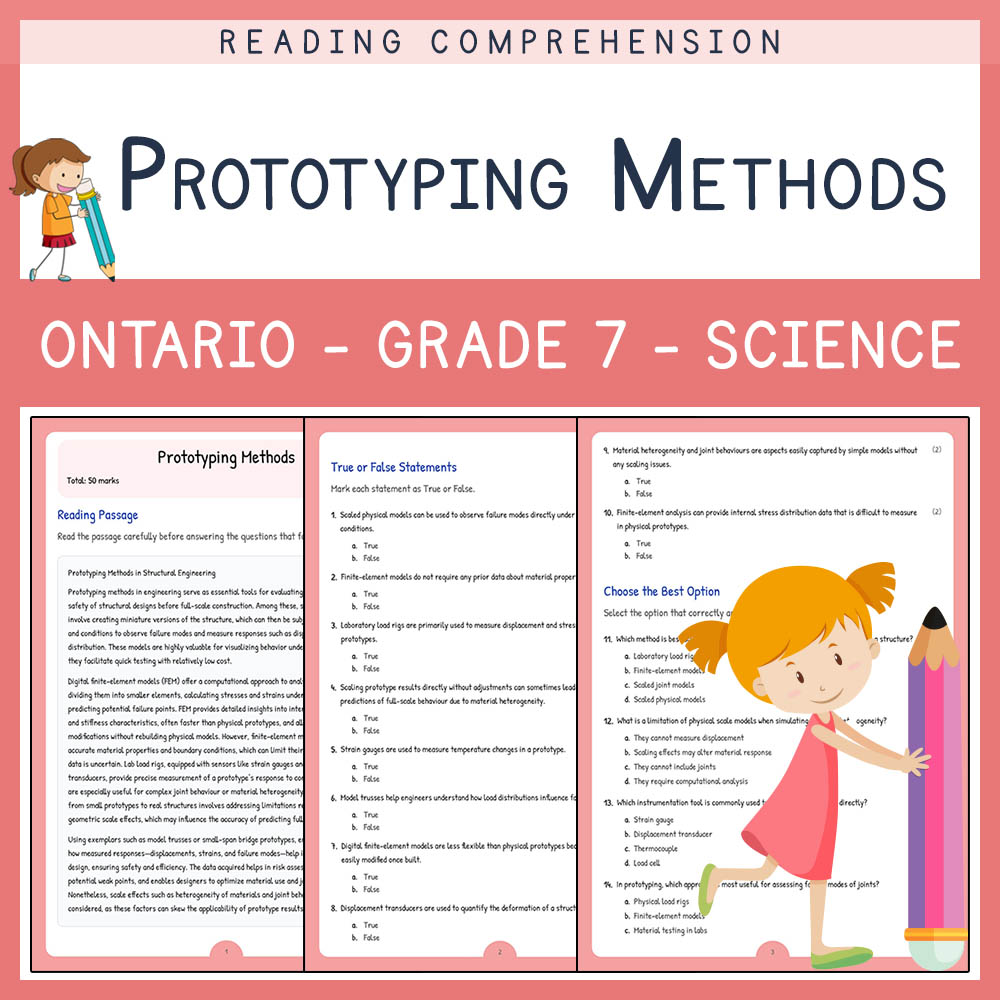
Grade 7 Science Assessment | Prototyping Methods Worksheet | Ontario
 Created byLumora Learning
Learning Objectives
- Understand different prototyping approaches including scaled physical models, digital finite-element models, and laboratory load rigs.
- Compare the advantages and limitations of each prototyping method for assessing strength, stiffness, and failure modes.
- Identify instrumentation tools such as strain gauges and displacement transducers used to quantify responses.
Also included in: Grade 7 Science | Form Function Design Structures Unit Bundle | Ontario
Instant download
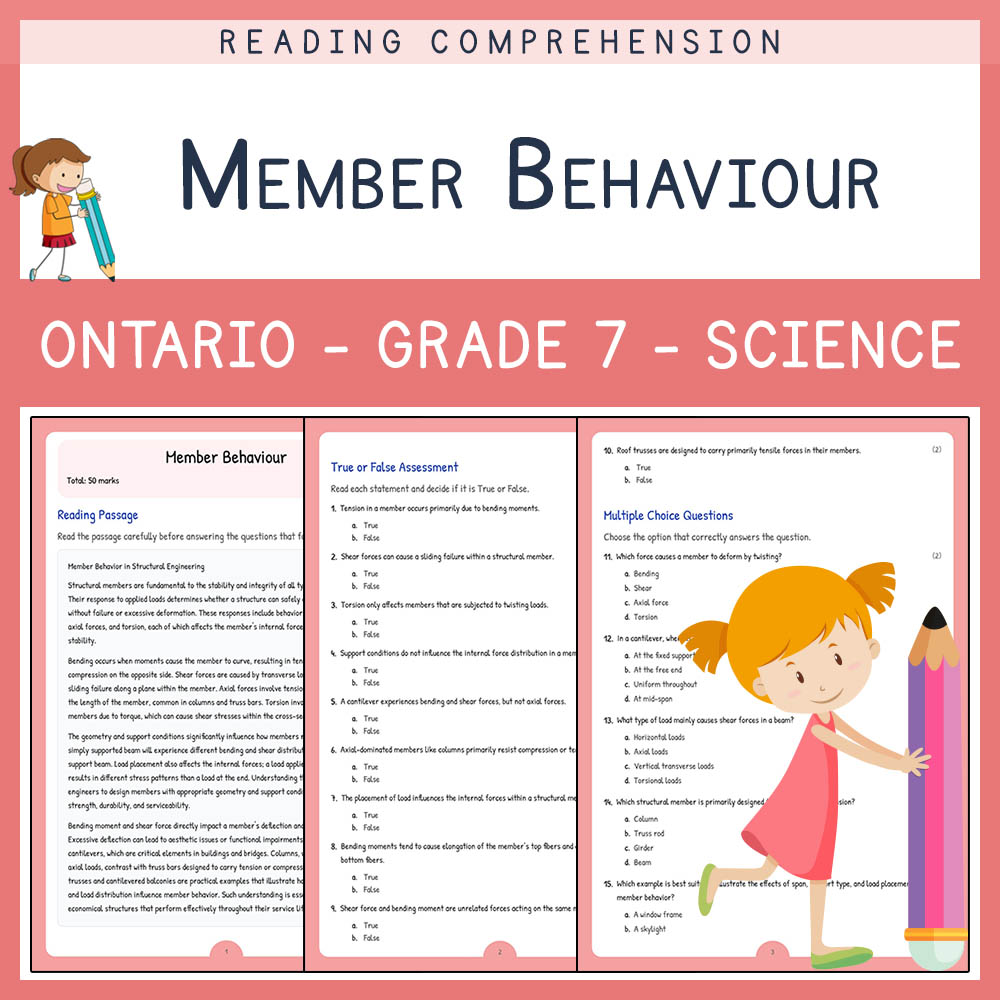
Grade 7 Science | Member Behaviour Worksheet (PDF + Answer Key) Aligned with Ontario
Created byLumora LearningLearning Objectives
- Describe how structural members respond to applied loads through bending, shear, axial force, and torsion.
- Relate the geometry and support conditions of members to internal force distribution.
- Explain the effects of bending moment and shear force on deflection and serviceability in beams and cantilevers.
Also included in: Grade 7 Science | Form Function Design Structures Unit Bundle | Ontario
Instant download
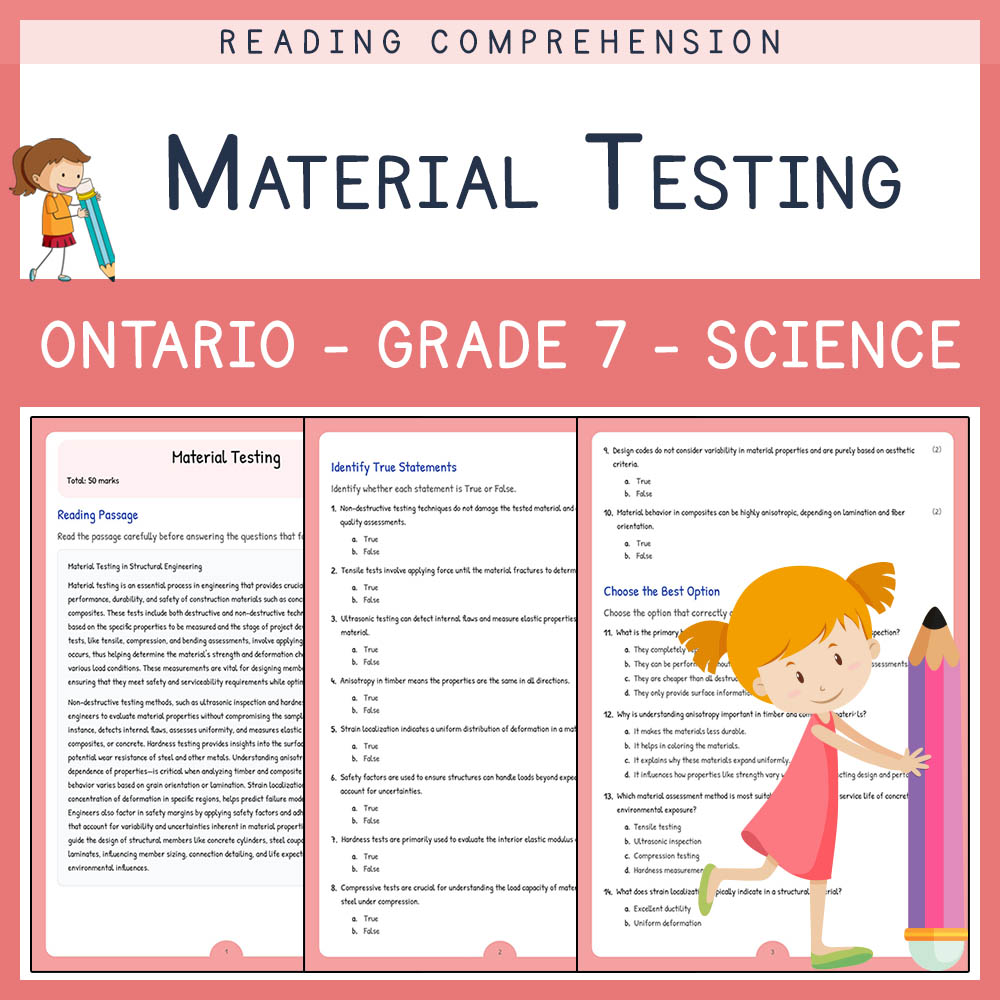
Grade 7 Science | Material Testing Worksheet Elena – Ontario Standards
Created byLumora LearningLearning Objectives
- Understand characteristic methods used for testing material behavior, including tensile, compression, and bending assessments.
- Learn about non-destructive techniques such as ultrasonic and hardness measurements.
- Explore the concepts of anisotropy, strain localization, and their implications in material performance.
Also included in: Grade 7 Science | Form Function Design Structures Unit Bundle | Ontario
Instant download
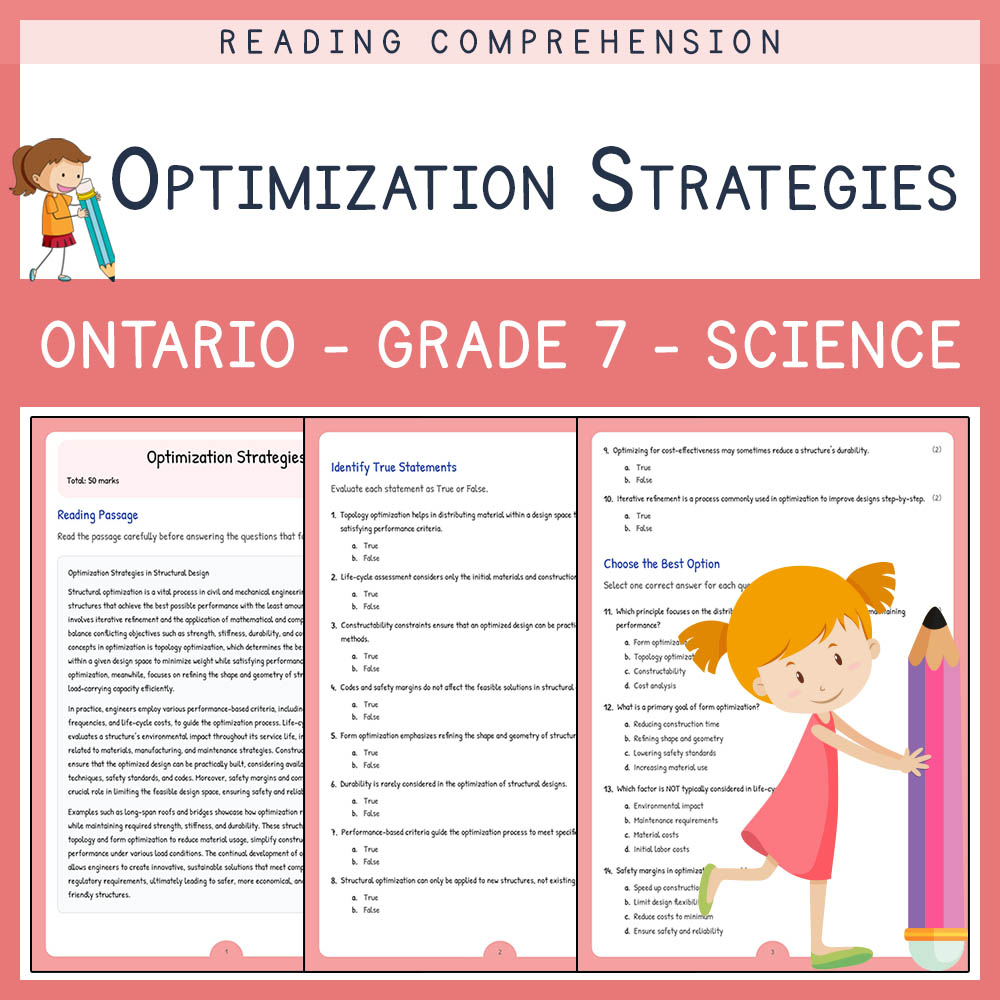
Grade 7 Science Assessment | Optimization Strategies Worksheet | Ontario
Created byLumora LearningLearning Objectives
- Understand key principles of structural optimization, including material efficiency, cost-effectiveness, and performance.
- Identify different optimization techniques such as topology and form optimization.
- Analyze how performance-based criteria, life-cycle assessment, and constructability constraints influence design decisions.
Also included in: Grade 7 Science | Form Function Design Structures Unit Bundle | Ontario
Instant download
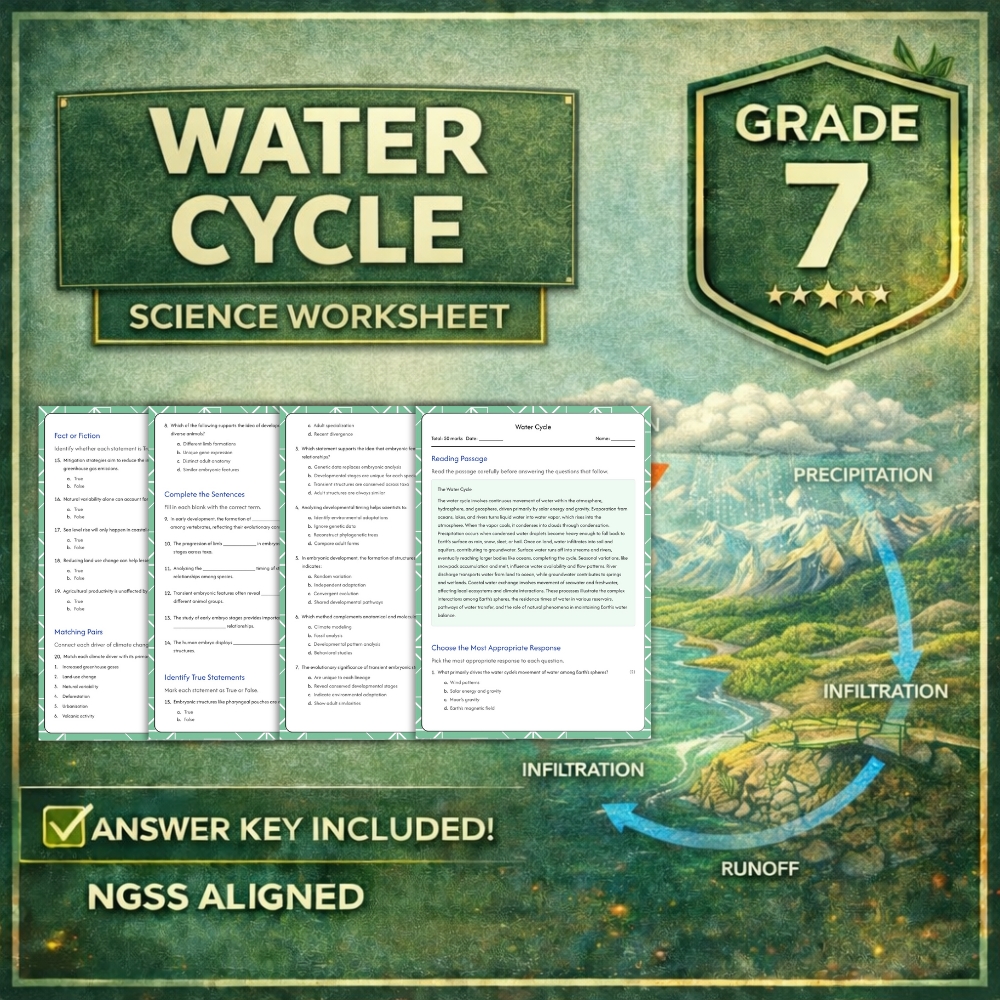
Grade 7 Science | Water Cycle Worksheet (NGSS) – Printable PDF & Answer Key
 Created byCedar Grove Learning
Learning Objectives
- Describe the key processes in the water cycle such as evaporation, condensation, and precipitation.
- Explain the interactions among Earth's atmosphere, hydrosphere, and geosphere in water movement.
- Identify pathways like river discharge, groundwater flow, and snowpack to understand water transfer.
Also included in: Grade 7 Science Bundle | Earth Systems & Processes NGSS (Worksheet Pack)
Instant download
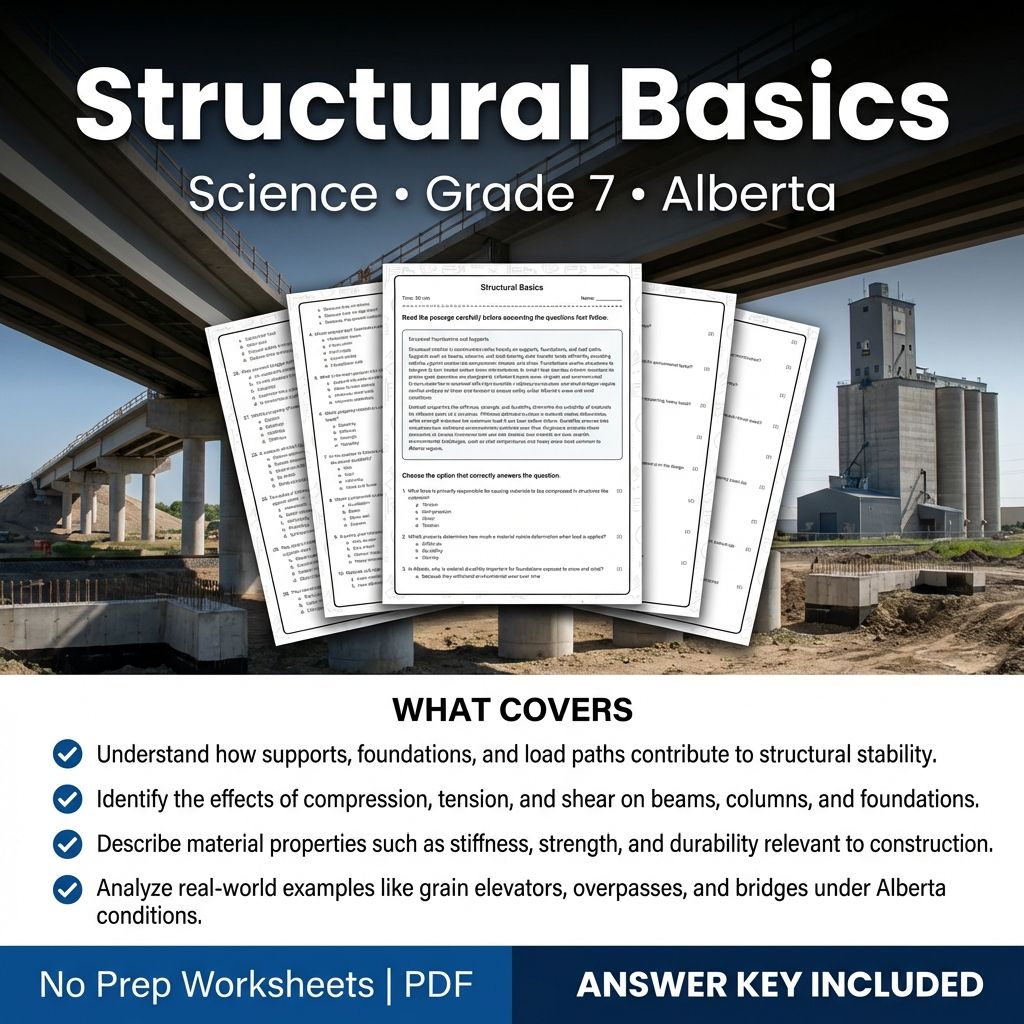
Grade 7 Science Worksheet on Structural Basics | Alberta Standards
Created byCoral Reef LearningLearning Objectives
- Understand how supports, foundations, and load paths contribute to structural stability.
- Identify the effects of compression, tension, and shear on beams, columns, and foundations.
- Describe material properties such as stiffness, strength, and durability relevant to construction.
Instant download
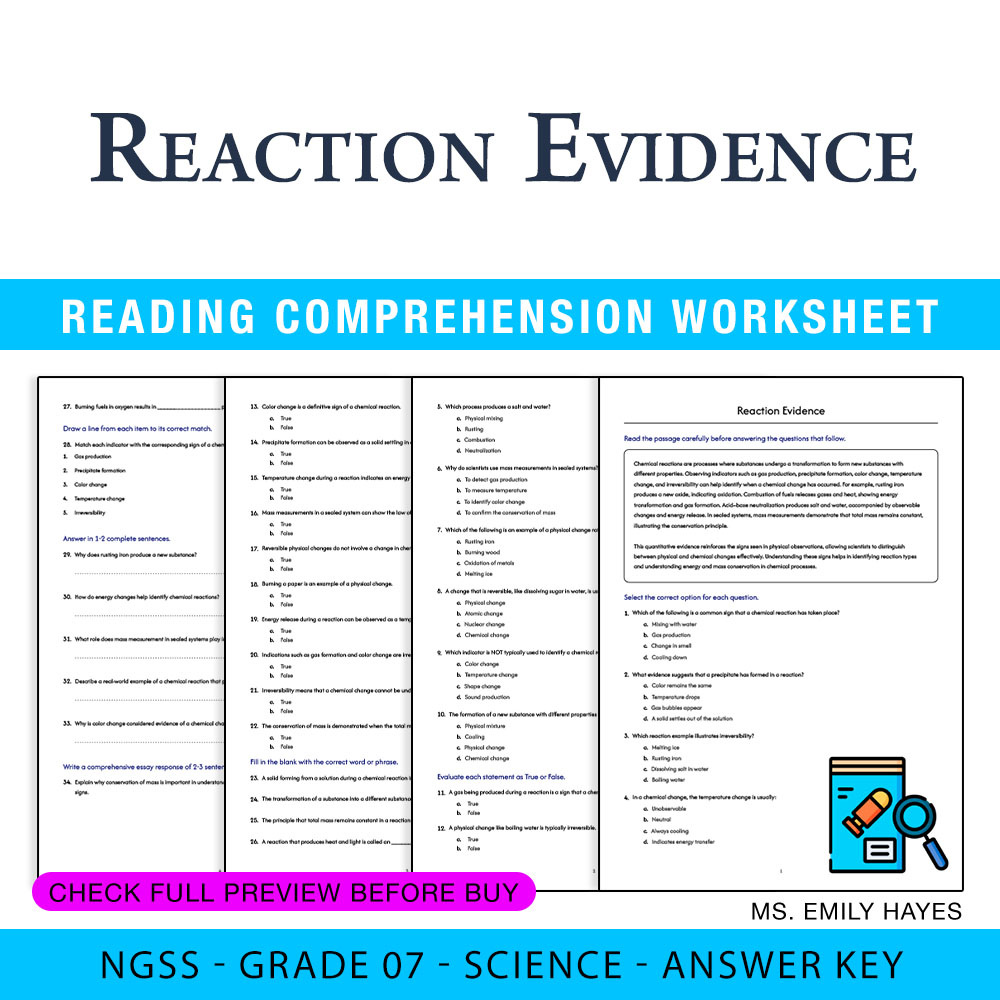
7th Grade Science | Reaction Evidence Worksheet (PDF +Answer Key)
 Created byCopper Leaf Classroom
Learning Objectives
- Identify observable signs indicating a chemical reaction has occurred, such as gas production, precipitate formation, color change, temperature change, and irreversibility.
- Explain the concept of irreversibility in chemical changes and how mass measurements in sealed systems support the conservation of mass principle.
- Describe real-world examples of chemical reactions including rusting, combustion, and acid–base neutralization, highlighting their signs and outcomes.
Instant download
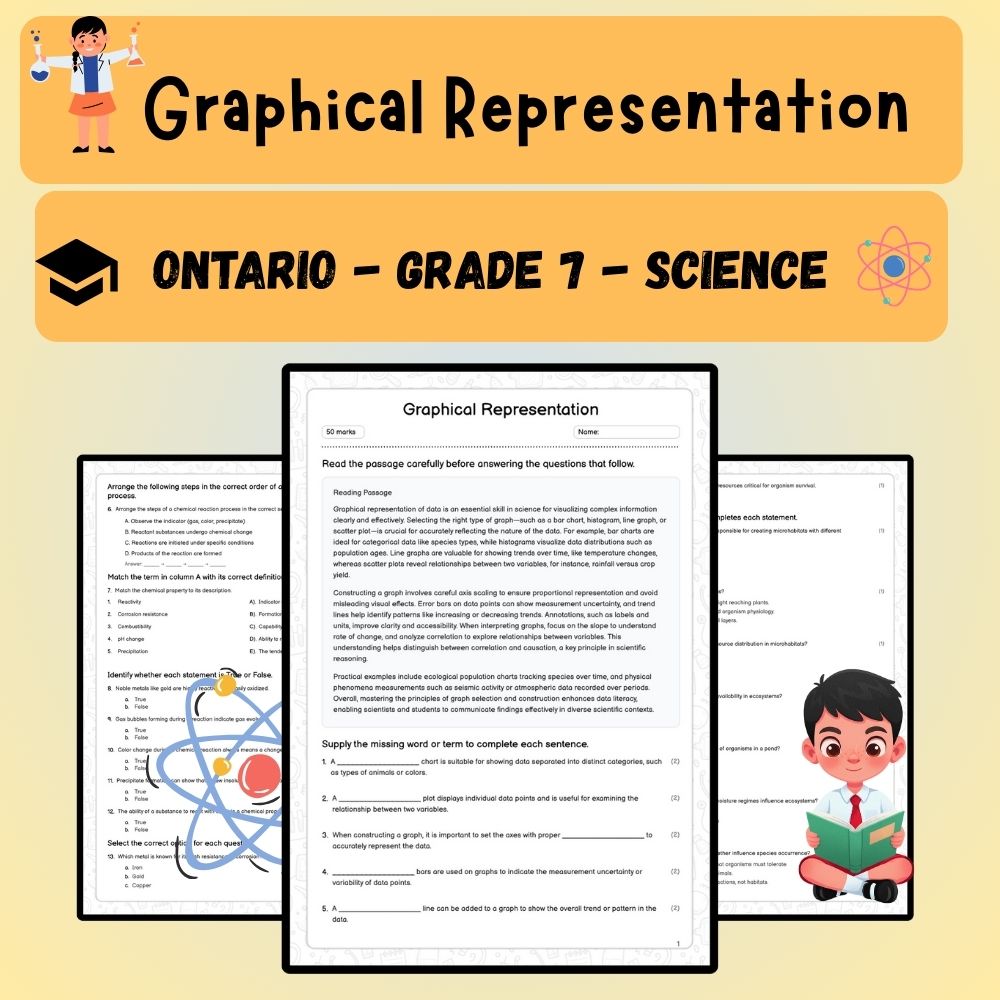
Grade 7 Science – Graphical Representation Worksheet (PDF) – Ontario Standards
 Created byPrism Point Learning
Learning Objectives
- Understand and identify various types of graphs such as bar charts, histograms, line graphs, and scatter plots.
- Learn how to select appropriate graph types to accurately reflect data distribution and measurement scales.
- Gain skills in constructing and interpreting axes, error bars, trend lines, and annotations for clarity.
Also included in: Grade 7 Science UNIT Worksheet Bundle – Scientific Inquiry & Data Skills (PDF) +1 more
Instant download

Sound Production Assessment for Grade 7 Science | Standards-Aligned
Created byPrism Point LearningLearning Objectives
- Understand how vibrating objects produce sound waves in a medium.
- Identify how frequency affects pitch and amplitude affects loudness.
- Explain the dependence of sound transmission on a medium like air.
Also included in: Grade 7 Physical Science Science Lesson Bundle: General Framework
Instant download

Motion Graphs Assessment for Grade 7 Science | Standards-Aligned Assessment
Created byPrism Point LearningLearning Objectives
- Understand how position-time graphs represent motion and interpret their slopes and curves.
- Identify patterns in velocity-time graphs and relate slopes to acceleration.
- Use data tables alongside graphs to analyze and interpret different types of motion.
Also included in: Grade 7 Physical Science Science Lesson Bundle: General Framework
Instant download

Physical Property Clues Assessment for Grade 7 Science | Standards-Aligned Test
Created byPrism Point LearningLearning Objectives
- Identify and describe various physical properties of substances such as color, density, melting point, boiling point, magnetism, conductivity, and solubility.
- Explain how observable behaviors related to physical properties assist in characterizing substances.
- Apply knowledge of physical properties to reason about how mixtures can be separated based on measurable differences.
Also included in: Grade 7 Physical Science Science Lesson Bundle: General Framework
Instant download
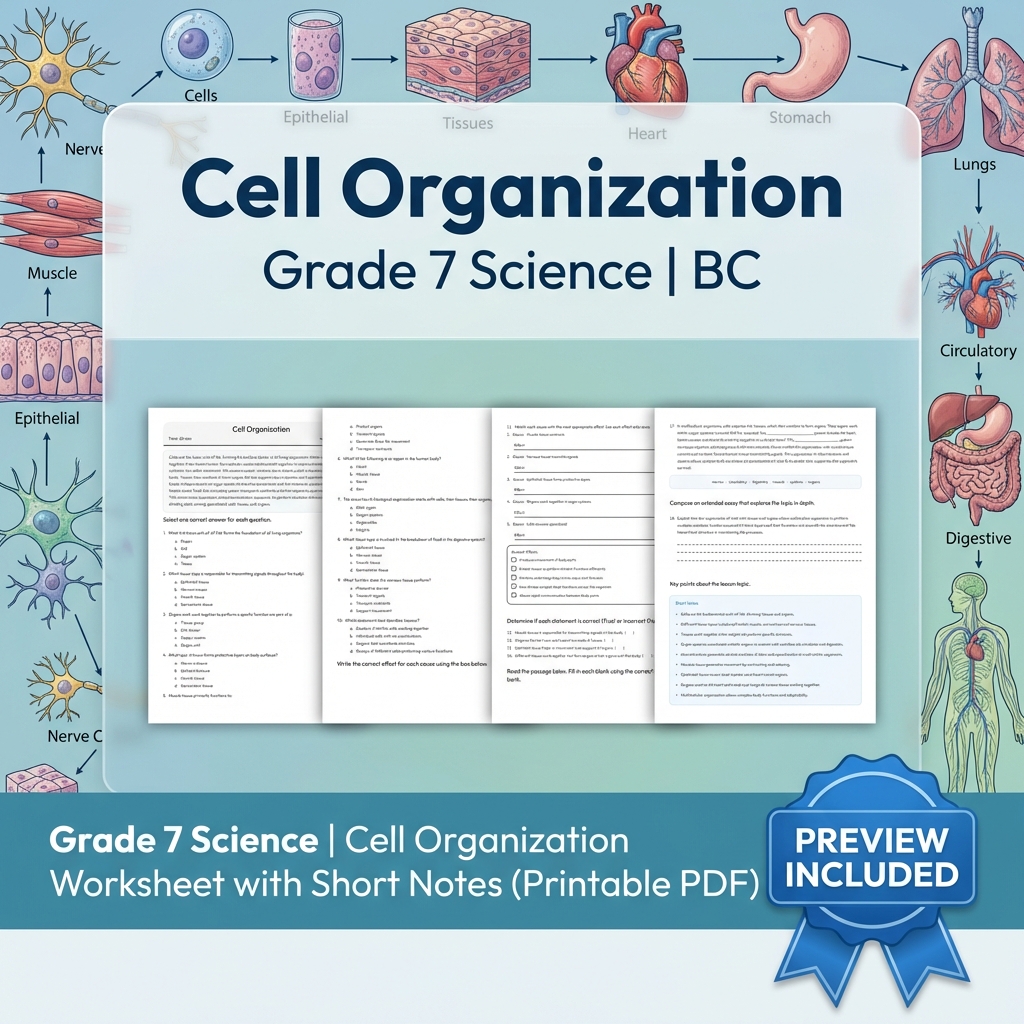
Grade 7 Science | Cell Organization Worksheet with Short Notes (Printable PDF)
Created byMeadowlark WorksheetsLearning Objectives
- Understand how cells organize into tissues, organs, and systems in multicellular organisms.
- Identify different tissue types and their functions.
- Explain the role of tissues in supporting bodily functions such as movement and protection.
Also included in: Grade 7 Science Lesson Bundle | Cell Structures & Functions Worksheets +1 more
Instant download
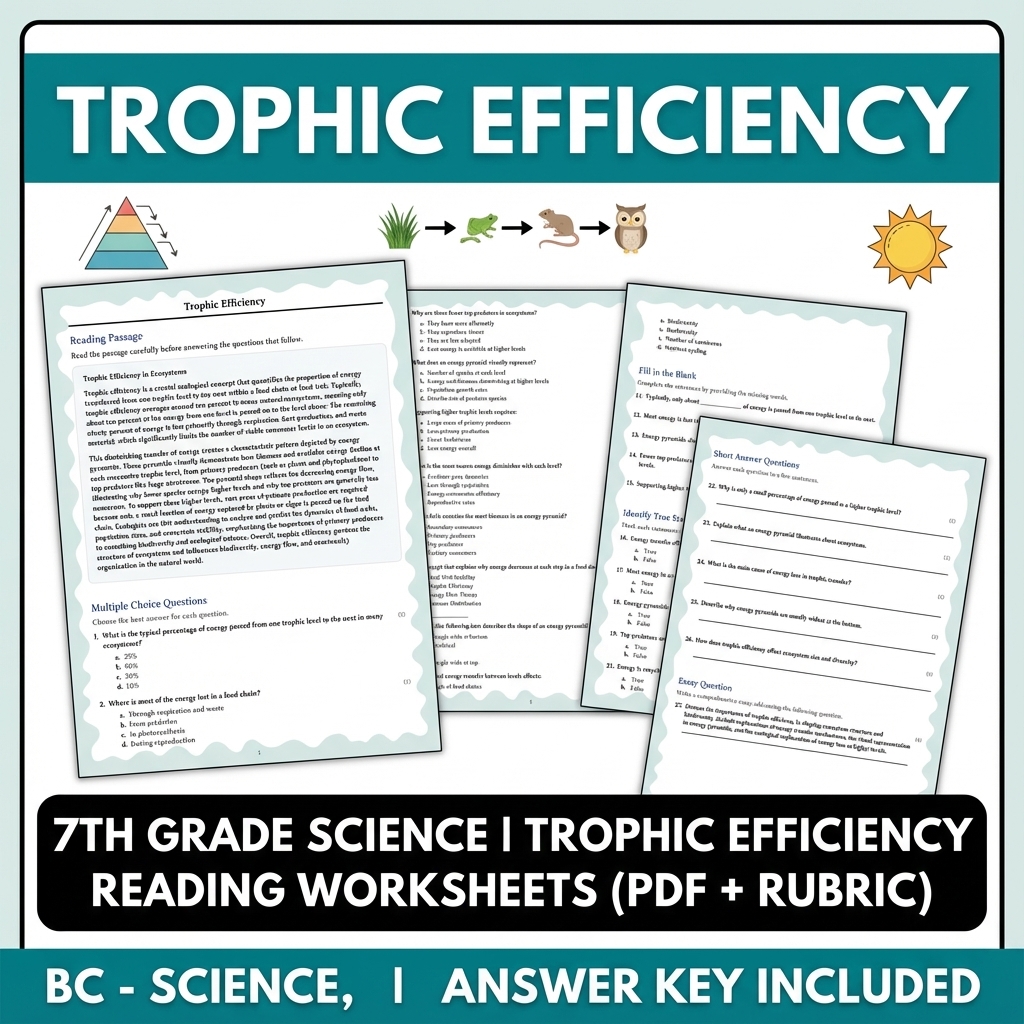
7th Grade Science | Trophic Efficiency Reading Worksheets (PDF + Rubric)
JCreated byJ.S SheetsLearning Objectives
- Understand the concept of trophic efficiency and its role in energy transfer within ecosystems.
- Describe how energy diminishes at higher trophic levels and interpret energy pyramids.
- Explain why fewer top predators exist and how energy availability affects ecological communities.
Instant download
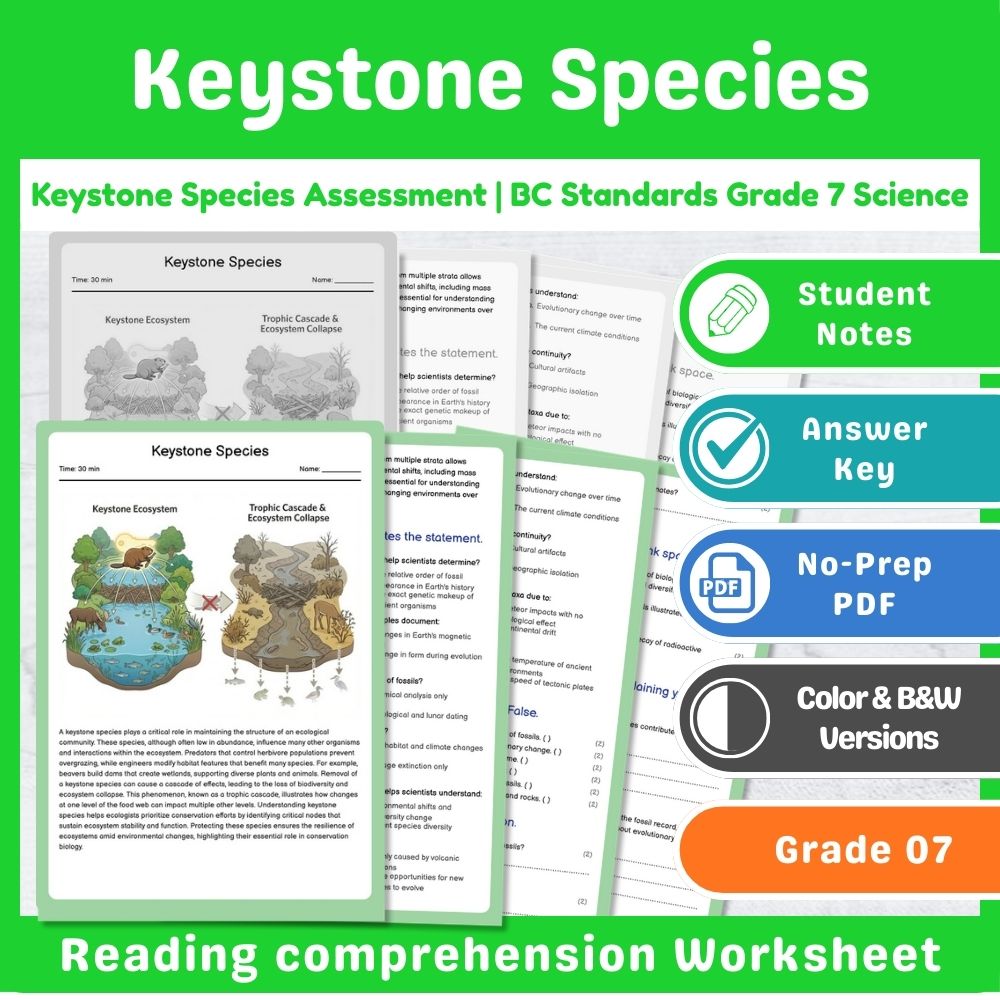
Keystone Species Assessment | BC Standards Grade 7 Science Worksheet
Created byPrism Point LearningLearning Objectives
- Define what a keystone species is and explain its importance in ecosystems.
- Identify different types of keystone species and their roles in maintaining ecosystem balance.
- Understand the effects of removing a keystone species on ecological communities.
Instant download

Grade 7 Science – Cell Nucleus & Function | Daily Reading Worksheet
 Created byBright Mind Resources
Learning Objectives
- Identify the structure of the cell nucleus
- Describe the basic functions of the nucleus
- Understand how the nucleus controls cell activities
Also included in: Cell Function & Transport Grade 7 Science Daily Reading Worksheets Bundle | BC +1 more
Instant download

Grade 7 Science – Tissue Types & Organ Function | Daily Reading Worksheet
Created byBright Mind ResourcesLearning Objectives
- Understand the functions of different tissue types
- Identify examples of epithelial, connective, muscle, and nervous tissues
- Explain how tissues work together within organs
Also included in: Cell Function & Transport Grade 7 Science Daily Reading Worksheets Bundle | BC +1 more
Instant download

Grade 7 Science – Diffusion & Osmosis Daily Reading Worksheet | BC Standards
Created byBright Mind ResourcesLearning Objectives
- Explain the concepts of diffusion and osmosis.
- Identify differences between diffusion and osmosis.
- Understand how these processes affect cells and living organisms.
Also included in: Cell Function & Transport Grade 7 Science Daily Reading Worksheets Bundle | BC +1 more
Instant download
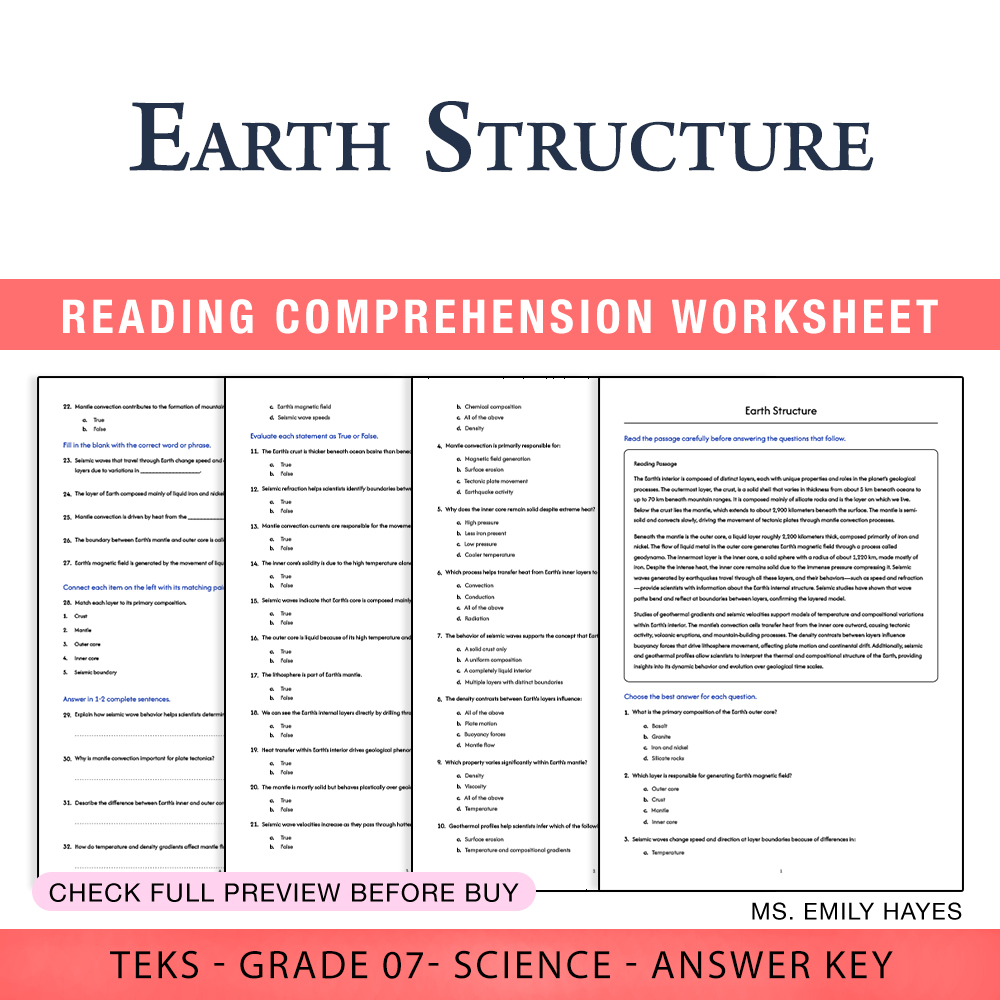
Grade 7 Science | Earth Structure Worksheet (PDF+ Answer Key)
Created byCopper Leaf ClassroomLearning Objectives
- Describe Earth's internal layers and their properties.
- Interpret seismic wave behavior and how it reveals Earth's structure.
- Explain mantle convection and its role in plate motion.
Instant download
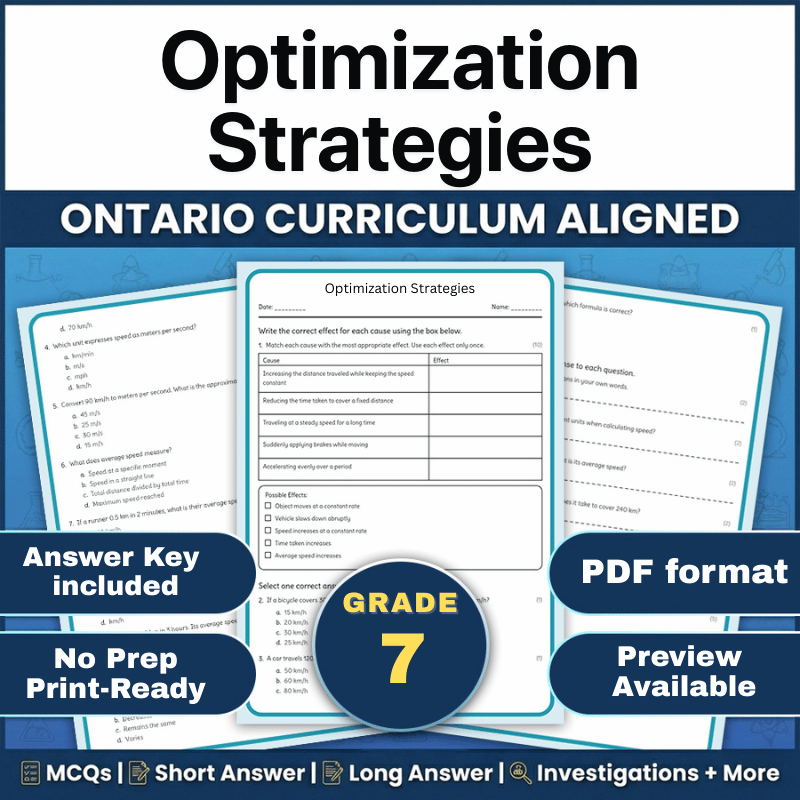
Grade 7 Science | Optimization Strategies Worksheet (Ontario) (PDF)
Created byBright Mind ResourcesLearning Objectives
- Understand the principles of structural optimization to balance material use, cost, and performance.
- Identify factors influencing topology and form optimization in engineering design.
- Apply performance-based criteria and life-cycle assessments in selecting optimal solutions.
Instant download
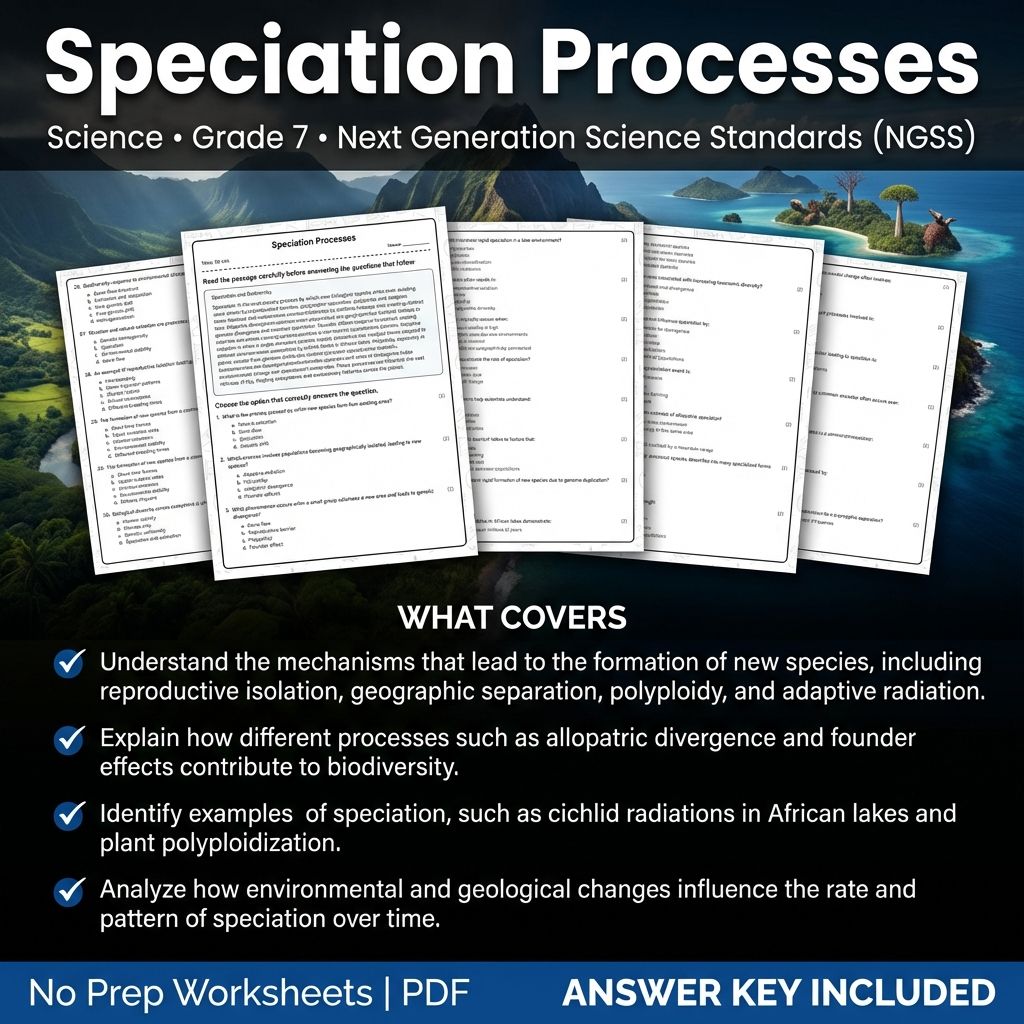
7th Grade Science | Speciation Processes Worksheet & Answer Key (Printable PDF)
Created byCoral Reef LearningLearning Objectives
- Understand the mechanisms that lead to the formation of new species, including reproductive isolation, geographic separation, polyploidy, and adaptive radiation.
- Explain how different processes such as allopatric divergence and founder effects contribute to biodiversity.
- Identify examples of speciation, such as cichlid radiations in African lakes and plant polyploidization.
Instant download
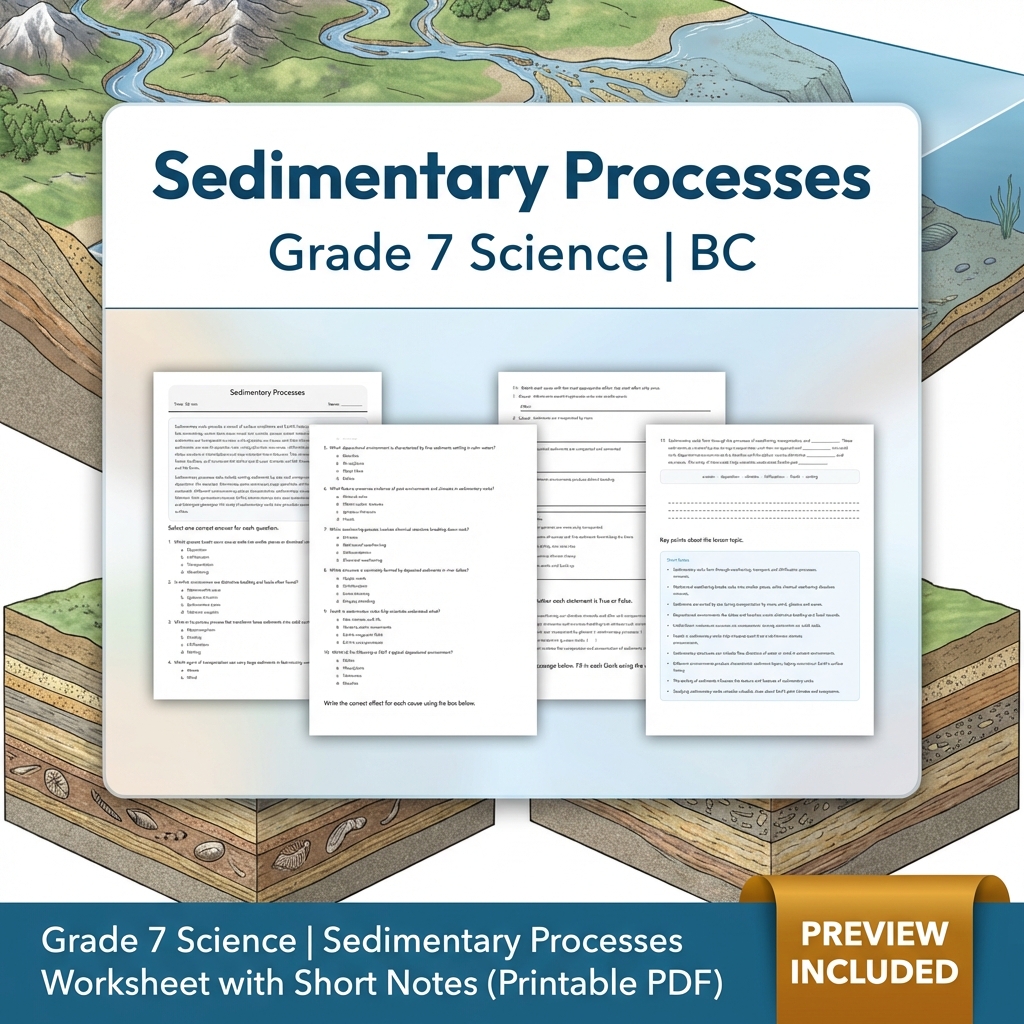
Grade 7 Science | Sedimentary Processes Worksheet with Short Notes (PDF)
Created byMeadowlark WorksheetsLearning Objectives
- Understand the stages involved in the formation of sedimentary rocks.
- Identify different types of weathering and depositional environments.
- Describe how sediments are transported and transformed into rock.
Also included in: Grade 7 Science Lesson Bundle | Earth Processes Worksheets Group +1 more
Instant download

Grade 7 Science – Conservation Applications in Chemistry | Reading Worksheet
Created byBright Mind ResourcesLearning Objectives
- Understand the principle of mass conservation in chemical reactions
- Identify real-world applications of mass balance concepts
- Recognize how mass conservation is monitored in different systems
Also included in: Grade 7 Solutions Science Daily Reading Worksheets Lesson Bundle | Alberta +2 more
Instant download
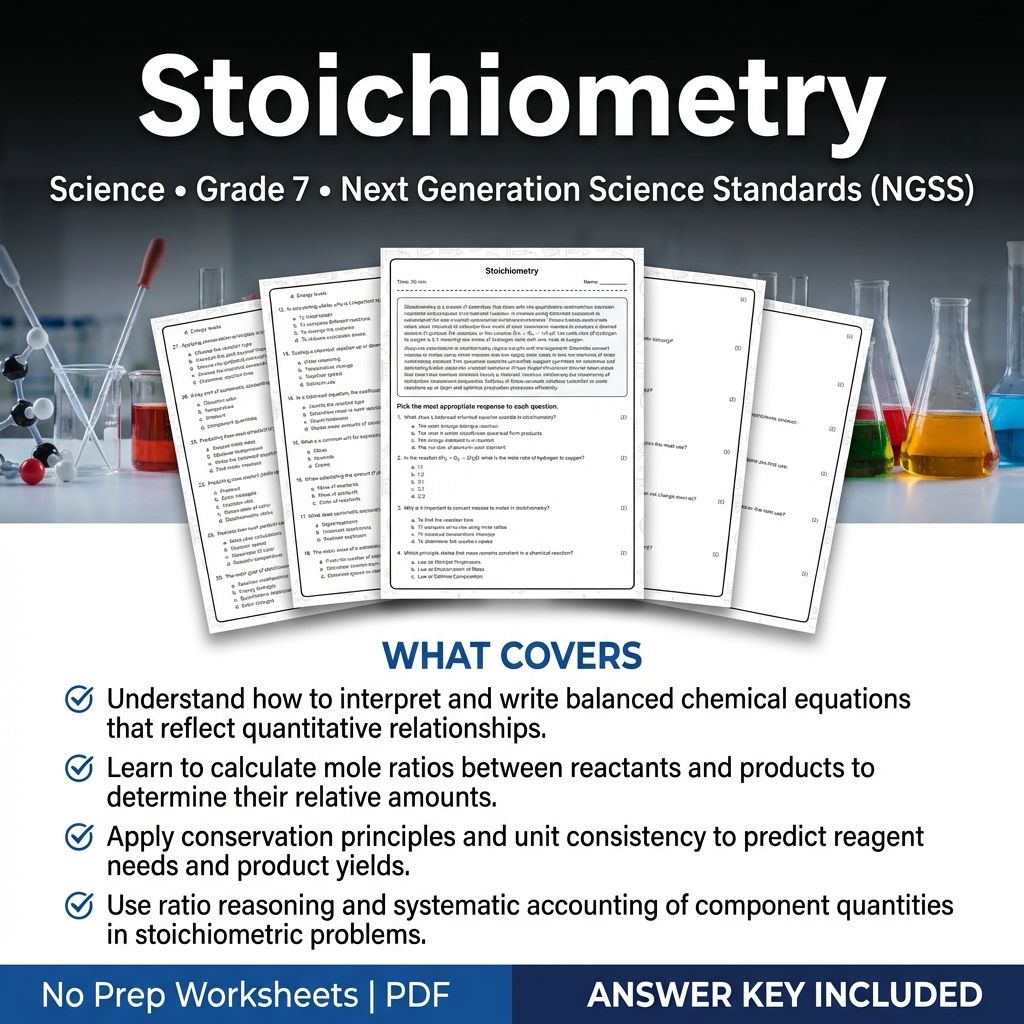
7th Grade Science | Stoichiometry Worksheet & PDF Answer Key (Printable)
Created byCoral Reef LearningLearning Objectives
- Understand how to interpret and write balanced chemical equations that reflect quantitative relationships.
- Learn to calculate mole ratios between reactants and products to determine their relative amounts.
- Apply conservation principles and unit consistency to predict reagent needs and product yields.
Instant download
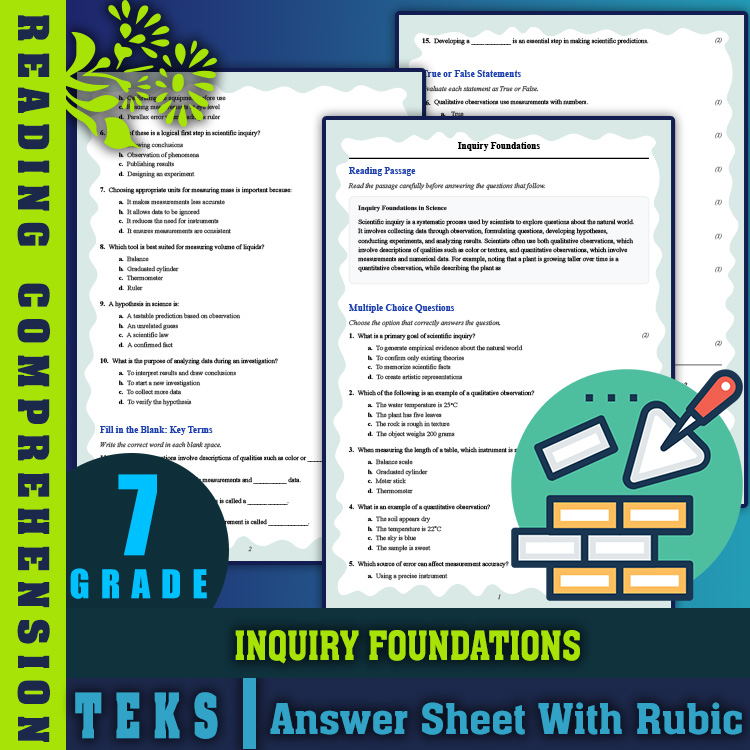
7th Grade Science Reading Worksheets | Inquiry Foundations PDF with Rubric
JCreated byJ.S SheetsLearning Objectives
- Understand the key components of the scientific inquiry process.
- Distinguish between quantitative and qualitative observations in experiments.
- Select appropriate metric units and instruments for measuring length, mass, and volume.
Instant download
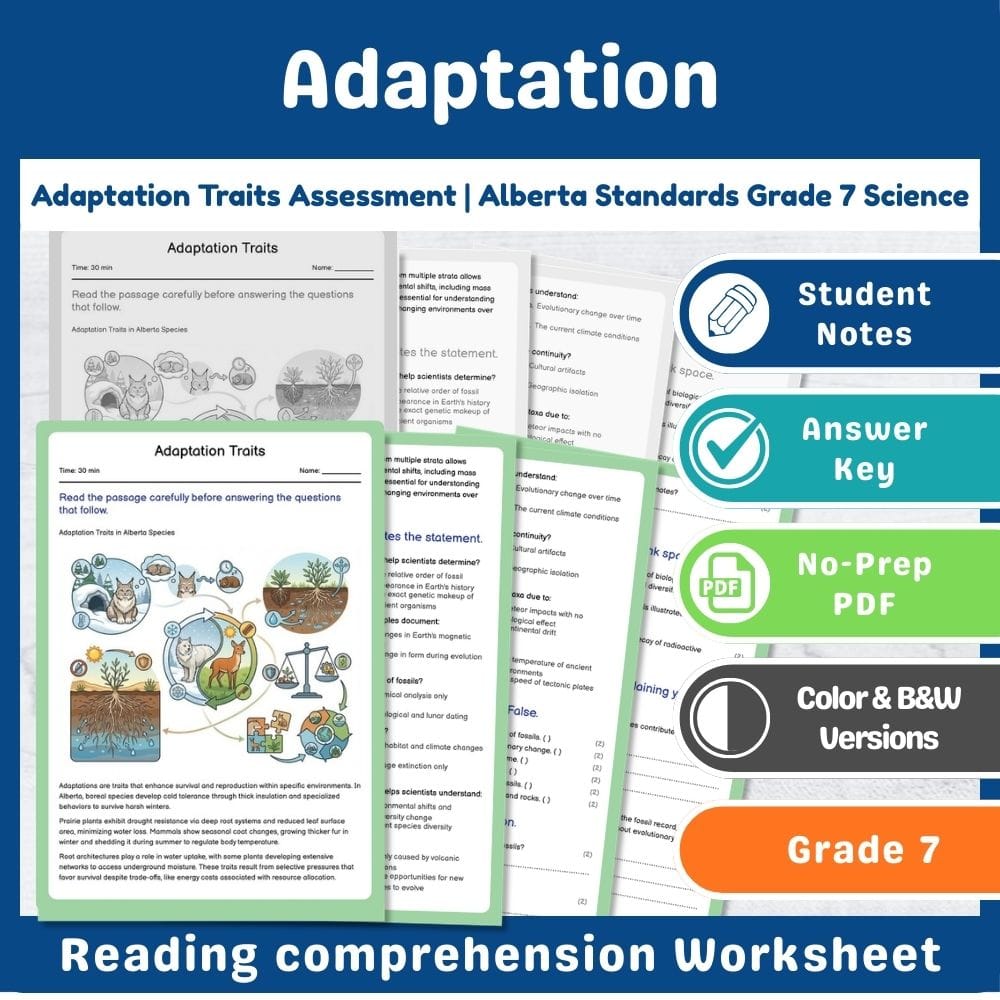
Adaptation Traits Assessment | Alberta Standards Grade 7 Science
Created byPrism Point LearningLearning Objectives
- Identify different types of adaptive traits in plants and animals.
- Understand how environmental pressures influence trait development.
- Describe various structural, physiological, and behavioral adaptations.
Also included in: Lesson Bundle Grade 7 Science - Interactions and Ecosystems +1 more
Instant download

Grade 7 Science Earth Structure Worksheet (TEKS) – PDF
 Created byEvergreen Desk Education
Learning Objectives
- Describe the layers of Earth (crust, mantle, outer core, inner core) and explain how their properties differ.
- Use seismic waves and mantle convection as evidence for Earth’s internal structure and plate motion.
- Explain how density, buoyancy, and heat transport relate to lithospheric behavior and geothermal gradients.
Instant download
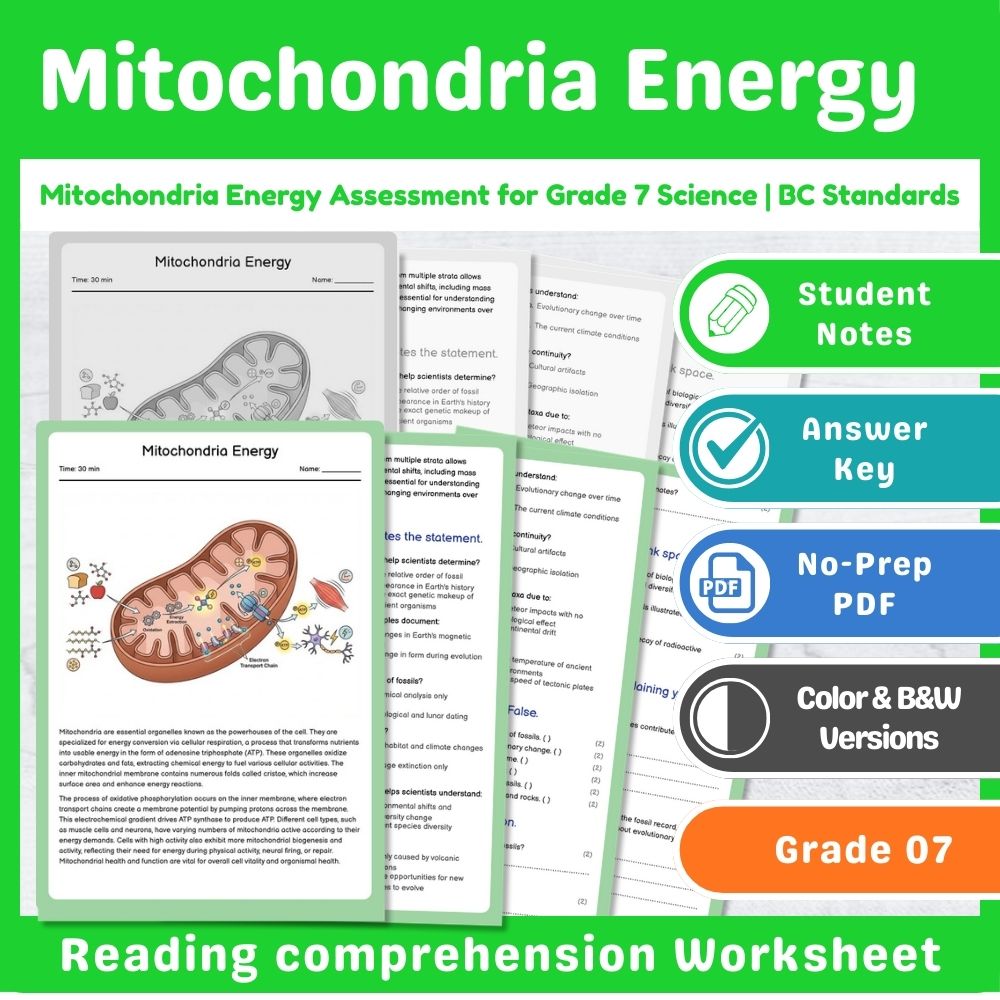
Mitochondria Energy Assessment for Grade 7 Science | BC Standards
Created byPrism Point LearningLearning Objectives
- Understand the structure and function of mitochondria in energy production.
- Explain how mitochondria oxidize nutrients to generate ATP.
- Describe the role of electron transport chains and membrane gradients in energy synthesis.
Instant download

Grade 7 Science – Fossil Evidence & Earth History | Daily Reading Worksheet
Created byBright Mind ResourcesLearning Objectives
- Understand how fossils are formed and preserved
- Recognize what fossils reveal about ancient environments
- Identify different types of fossil evidence
Also included in: Grade 7 Earth Science Daily Reading Worksheets Lesson Bundle | Florida NGSSS +1 more
Instant download

Grade 7 Science – Relative Geologic Time & Principles | Daily Reading Worksheet
Created byBright Mind ResourcesLearning Objectives
- Define the principle of superposition in geology.
- Explain the concept of cross-cutting relationships.
- Identify relative order of rock layers based on their positions and features.
Also included in: Grade 7 Earth Science Daily Reading Worksheets Lesson Bundle | Florida NGSSS +1 more
Instant download

7th Grade Science Worksheet | Material Selection & Properties (PDF)
Created byEvergreen Desk EducationLearning Objectives
- Explain how observable physical and chemical properties help determine whether a material is suitable for a specific application.
- Connect chemical stability and reactivity to real-world examples such as corrosion and acid resistance.
- Use properties like density, hardness, melting point, and solubility to justify material choices for engineering and environmental needs.
Instant download
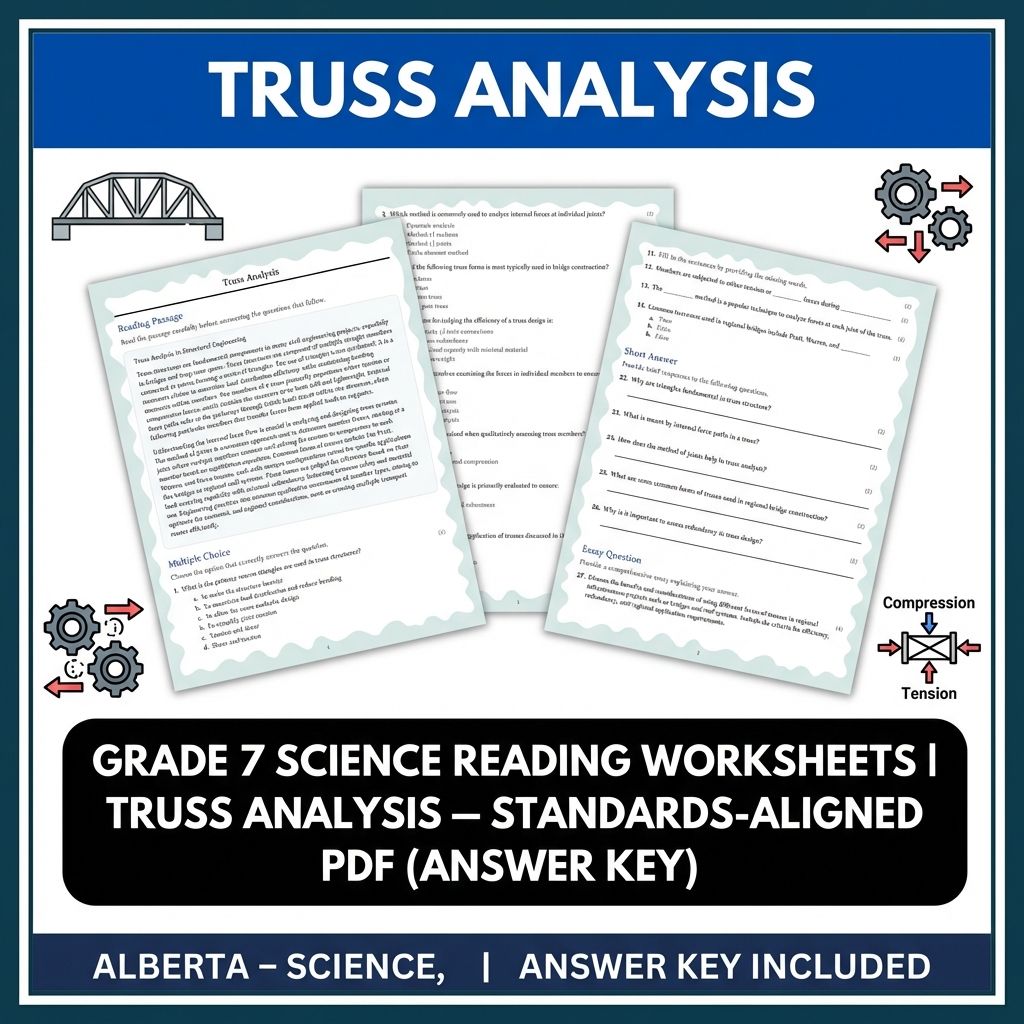
Grade 7 Science Worksheets | Truss Analysis – Standards-Aligned PDF (Answer Key)
JCreated byJ.S SheetsLearning Objectives
- Understand how truss structures distribute loads through triangular members.
- Identify the concepts of internal force paths, tension, and compression in truss members.
- Evaluate the efficiency and redundancy criteria in truss designs for regional applications.
Also included in: Grade 7 Science | Forces, Motion & Structural Concepts (Answer Keys Included) +1 more
Instant download

Energy Transfer Assessment | TEKS Standards Grade 7 Science
Created byPrism Point LearningLearning Objectives
- Describe the mechanisms of heat transfer: conduction, convection, and radiation.
- Identify real-world examples of different heat transfer mechanisms.
- Relate temperature gradients, specific heat, and phase changes to energy transfer.
Also included in: Grade 7 Matter and Energy Science Lesson Bundle: TEKS assessments
Instant download
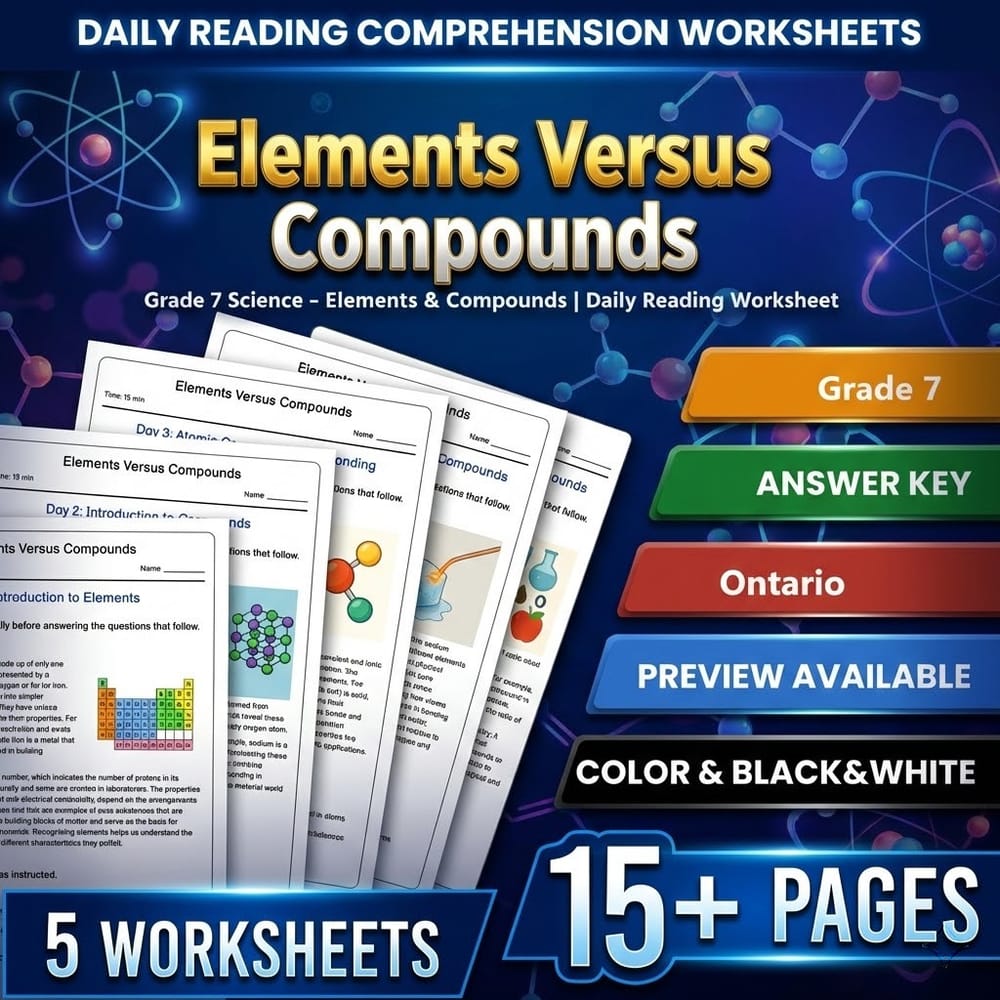
Grade 7 Science – Elements & Compounds | Daily Reading Worksheet
 Created byQuiet Forest Education
Learning Objectives
- Understand the difference between elements and compounds
- Identify examples of elements and compounds
- Recognize the atomic composition and properties of elements and compounds
Also included in: Elements & Compounds Grade 7 Science Daily Reading Worksheets Bundle | Ontario +1 more
Instant download

Grade 7 Science – Evidence Based Evaluation & Design Analysis | Worksheet
Created byBright Mind ResourcesLearning Objectives
- Understand the importance of evidence in evaluating scientific design solutions
- Identify different types of evidence obtained from tests and models
- Learn how to interpret test results for faults like leaks, overheating, or deformation
Also included in: Grade 7 Engineering Tradeoff Mapping Science Lesson Bundle California Standards +1 more
Instant download

Grade 7 Science – Tradeoff Mapping & Design Constraints | Reading Worksheet
Created byBright Mind ResourcesLearning Objectives
- Understand the concept of tradeoffs in engineering design
- Identify how improving one design feature can impact other features
- Learn to evaluate alternatives based on criteria and constraints
Also included in: Grade 7 Engineering Tradeoff Mapping Science Lesson Bundle California Standards +1 more
Instant download
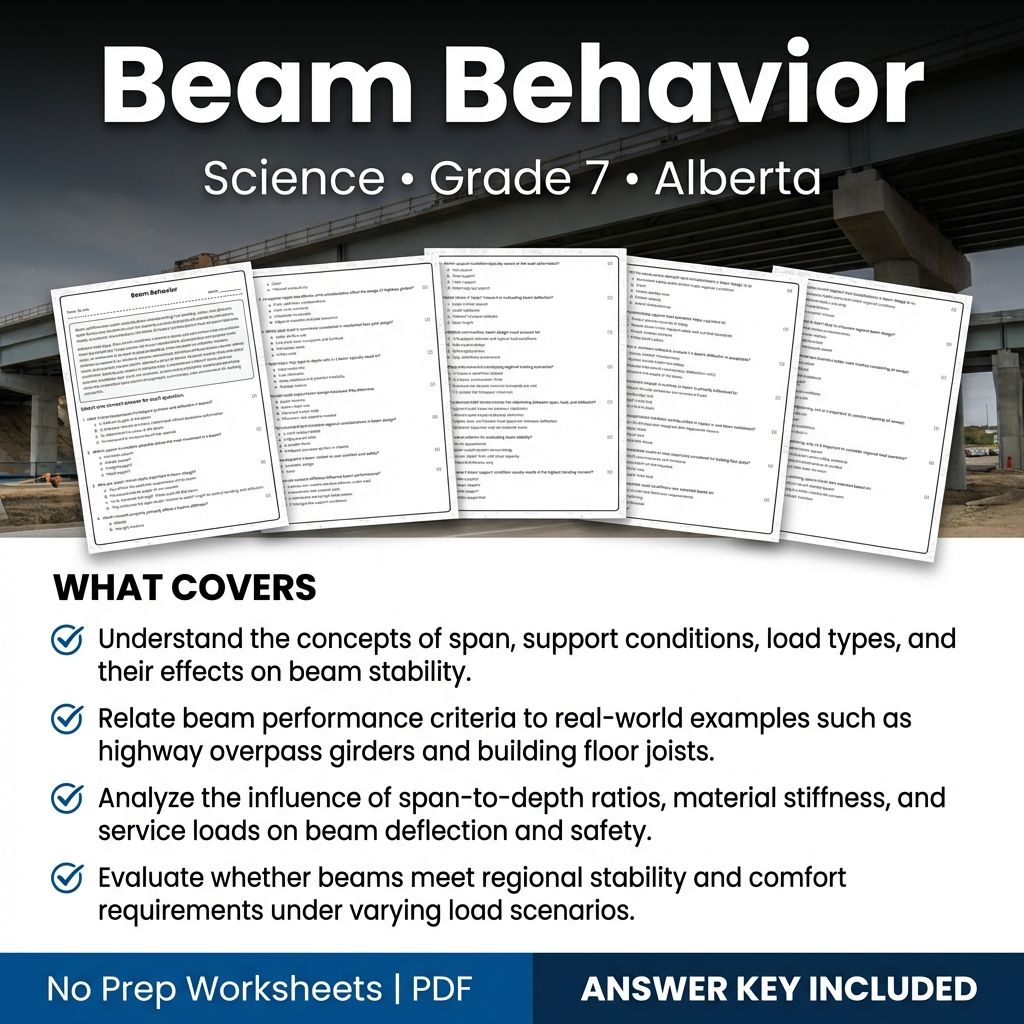
Grade 7 Science Worksheet on Beam Behavior | Alberta Standards
Created byCoral Reef LearningLearning Objectives
- Understand the concepts of span, support conditions, load types, and their effects on beam stability.
- Relate beam performance criteria to real-world examples such as highway overpass girders and building floor joists.
- Analyze the influence of span-to-depth ratios, material stiffness, and service loads on beam deflection and safety.
Instant download

Grade 7 Science – Conservation of Mass & Reactions | Daily Reading Worksheet
Created byBright Mind ResourcesLearning Objectives
- Understand the principle of conservation of mass in chemical reactions.
- Identify how atoms are conserved and rearranged during chemical changes.
- Explain the concept of closed systems and their relevance to mass conservation.
Also included in: Grade 7 States of Matter & Reactions Science Daily Reading Lesson Bundle | BC +1 more
Instant download
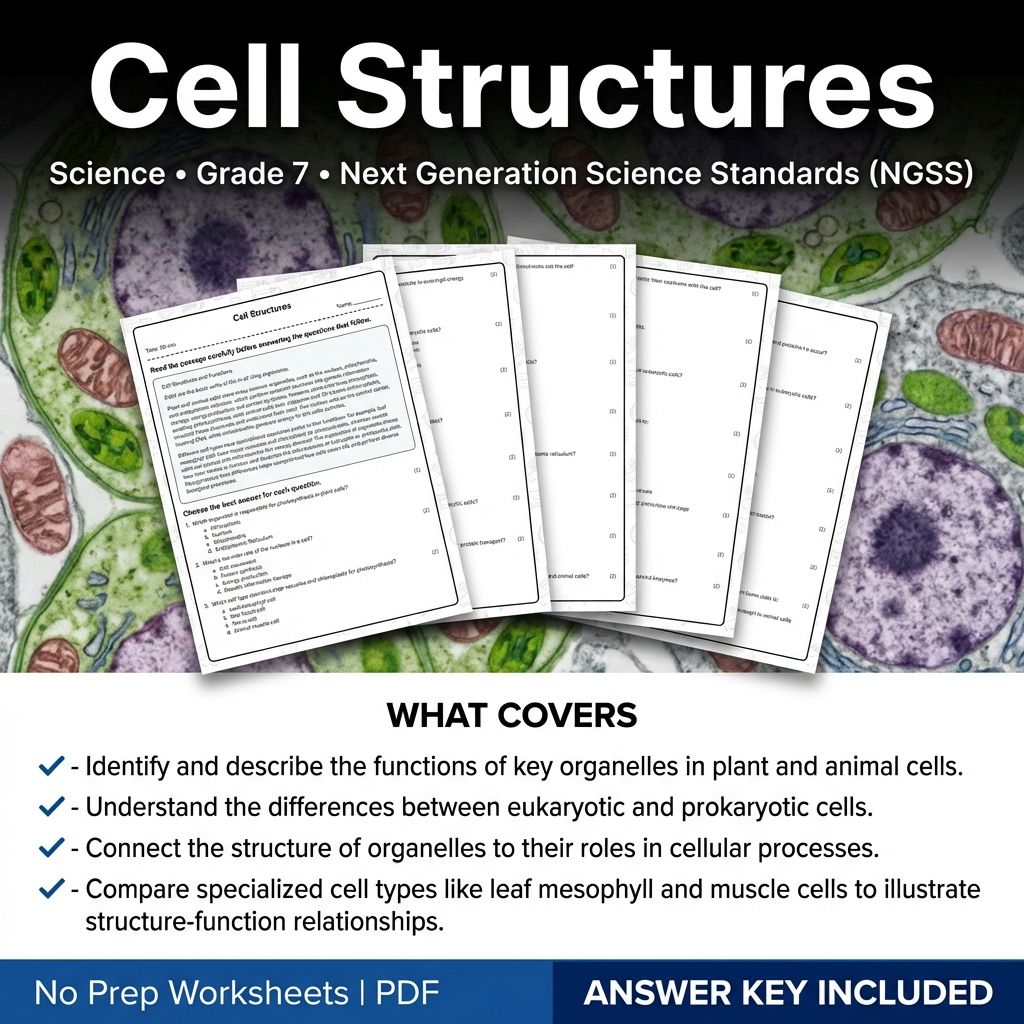
7th Grade Science | Cell Structures Worksheet & Answer Key (Printable PDF)
Created byCoral Reef LearningLearning Objectives
- Identify and describe the functions of key organelles in plant and animal cells.
- Understand the differences between eukaryotic and prokaryotic cells.
- Connect the structure of organelles to their roles in cellular processes.
Instant download
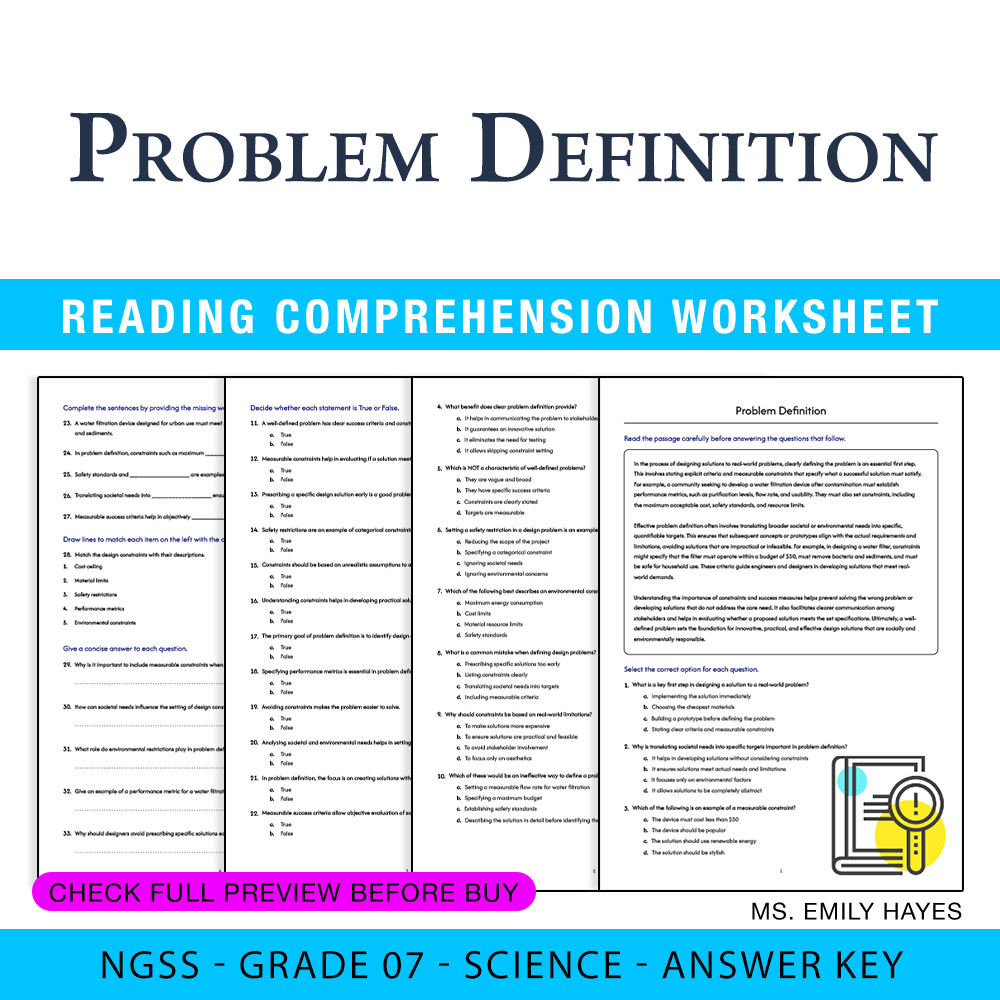
7th Grade Science | Problem Definition Worksheet (PDF+ Answer Key)
Created byCopper Leaf ClassroomLearning Objectives
- Understand how to define design problems with clear criteria and measurable constraints.
- Learn to translate societal and environmental needs into quantitative targets.
- Recognize real-world examples of problem specifications such as water filtration.
Instant download
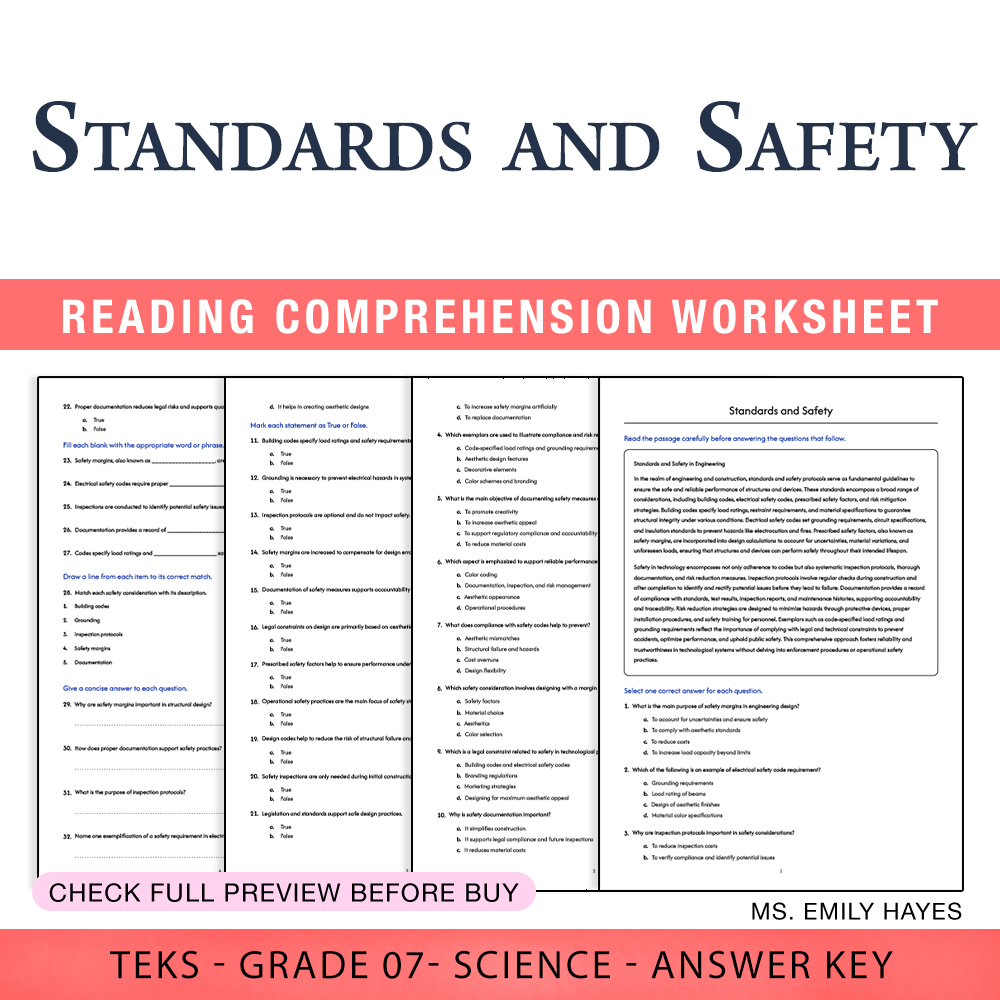
7th Grade Science | Standards and Safety Worksheet (PDF+ Answer Key)
Created byCopper Leaf ClassroomLearning Objectives
- Understand the key standards and safety considerations in technological practice.
- Identify safety codes and safety margins used in engineering and construction.
- Explain the importance of inspection, documentation, and risk reduction in safety compliance.
Instant download

Grade 7 Science – Substance Basics & Mixtures | Daily Reading Worksheet
Created byBright Mind ResourcesLearning Objectives
- Define pure substances and mixtures
- Identify examples of pure substances and mixtures
- Distinguish between elements, compounds, and mixtures based on characteristics
Also included in: Grade 7 Matter Science Daily Reading Worksheets Lesson Bundle | Ontario +1 more
Instant download

Grade 7 Science – Chemical Properties & Reactions | Daily Reading Worksheet
Created byBright Mind ResourcesLearning Objectives
- Define chemical properties and explain how they are different from physical properties.
- Identify observable indicators of chemical reactions such as gas evolution, color change, and precipitate formation.
- Understand the reactivity of noble metals versus reactive non-metals.
Also included in: Grade 7 Matter Science Daily Reading Worksheets Lesson Bundle | Ontario +1 more
Instant download
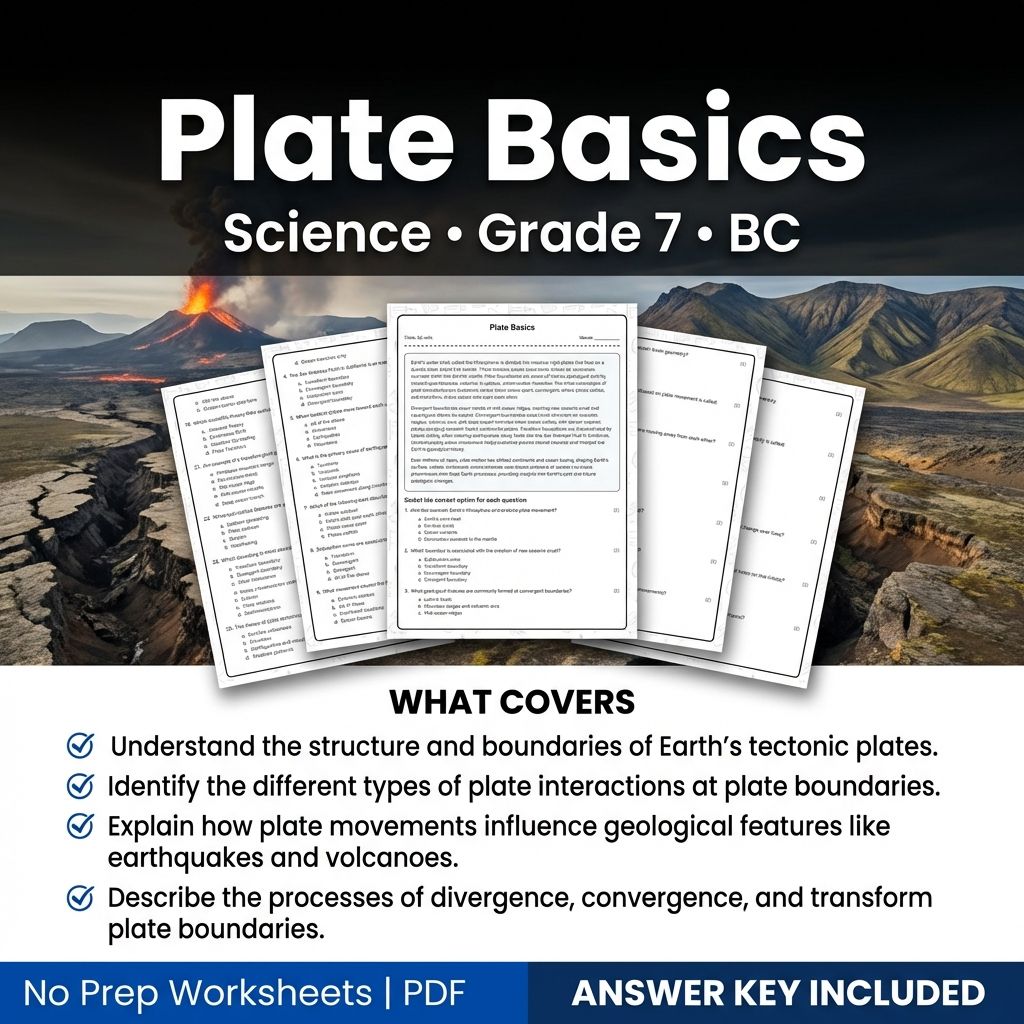
7th Grade Science | Plate Basics Worksheet & Answer Key (Printable PDF)
Created byCoral Reef LearningLearning Objectives
- Understand the structure and boundaries of Earth's tectonic plates.
- Identify the different types of plate interactions at plate boundaries.
- Explain how plate movements influence geological features like earthquakes and volcanoes.
Instant download
About Grade 7 Science Worksheets
Browse 6,039 printable Grade 7 Science worksheets — ready-to-print PDFs with answer keys where available.
Every worksheet on MyTeachingSheets is created by independent teacher-authors and reviewed before publication. All resources download as printable PDFs for classroom, homework, or at-home practice, and many include answer keys. Preview any worksheet free before buying.