
Grade 7 Science Worksheets
6,039 worksheets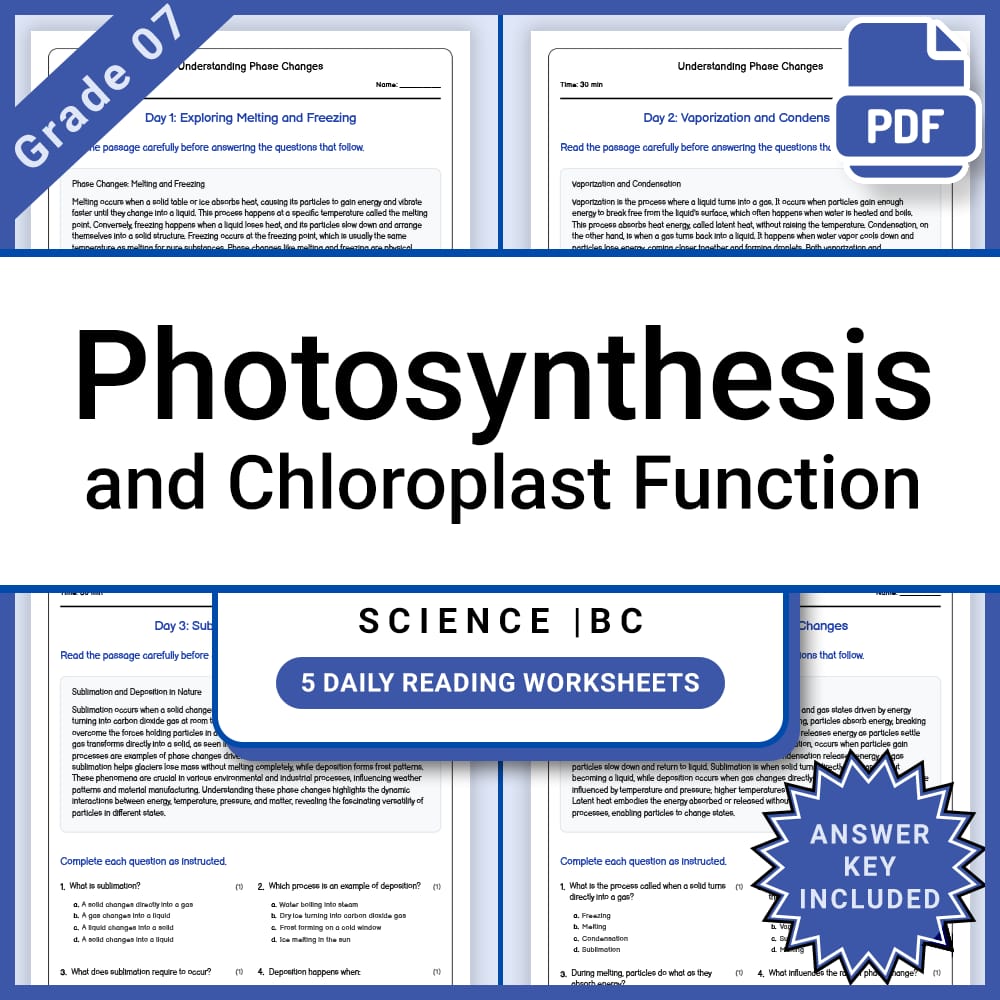
Grade 7 Science – Photosynthesis and Chloroplast Function | Daily Reading Worksheet + Answer Key
JCreated byJ.S SheetsLearning Objectives
- Explain the role of chloroplasts in photosynthesis.
- Identify key parts of the chloroplast and their functions.
- Describe the process by which light energy is converted into chemical energy.
Also included in: Grade 7 Science Lesson Group Bundle | Cell Structures and Processes +1 more
Instant download
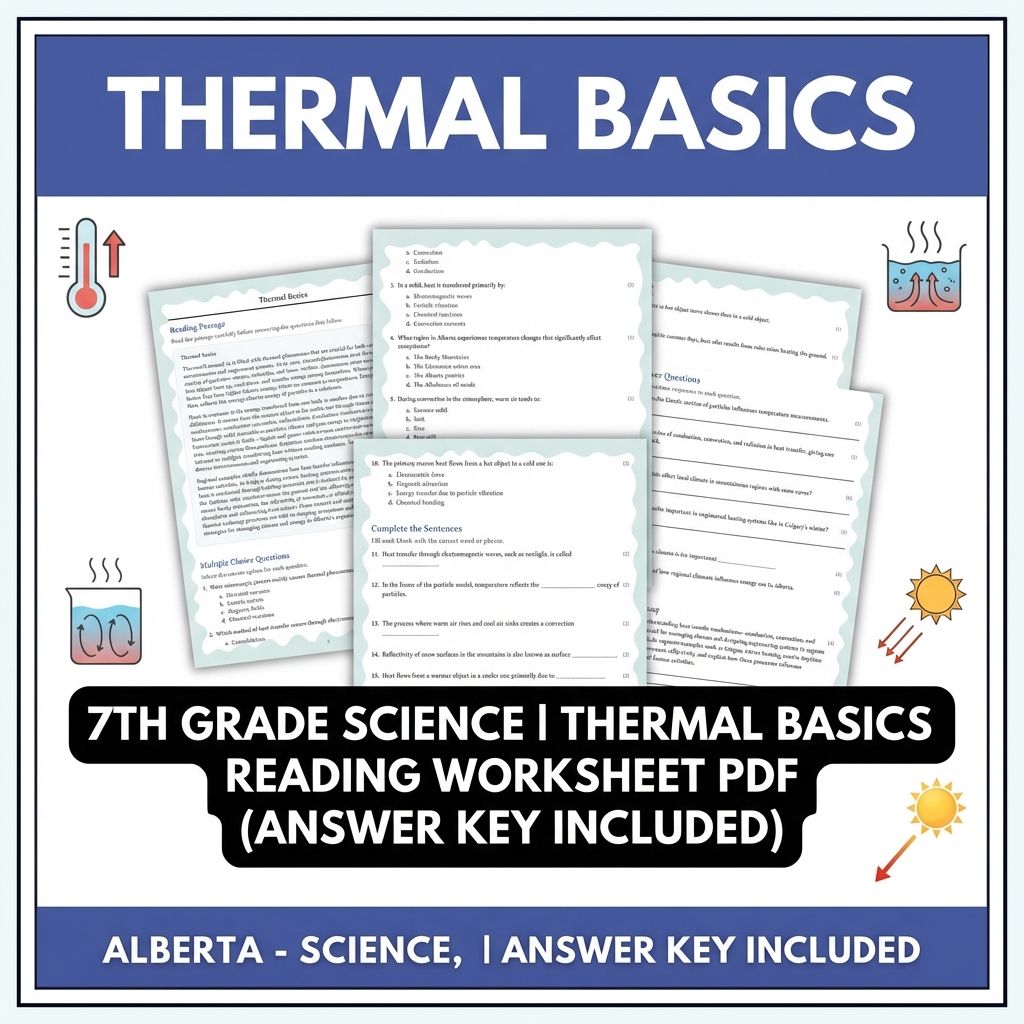
7th Grade Science | Thermal Basics Reading Worksheet PDF (Answer Key Included)
JCreated byJ.S SheetsLearning Objectives
- Understand the particle motion underlying thermal phenomena.
- Explain how temperature measures average kinetic energy of particles.
- Describe how heat energy is transferred through conduction, convection, and radiation.
Also included in: Grade 7 Science UNIT Bundle | Heat Transfer, Convection & Energy Worksheets +1 more
Instant download

Conservation of Mass: Reaction Accounting Worksheets Grade 7 Science
 Created bySunny Desk Resources
Learning Objectives
- Explain how conservation of mass applies to closed-system reactions.
- Use mass accounting to relate reactant masses to product masses.
- Compare theoretical and measured yields using completeness of a reaction.
Also included in: Matter and Chemical Change Grade 7 Alberta Science Worksheets Bundle +1 more
Instant download

Chemical Reactions Evidence Worksheets | Grade 7 Science
Created bySunny Desk ResourcesLearning Objectives
- Identify qualitative evidence of chemical reactions such as gas production, heat change, colour change, and precipitate formation
- Describe how the pattern of observations can help explain possible reaction types and reaction extent
- Use observation data to make and justify a claim about what likely happened at the particle level
Also included in: Matter and Chemical Change Grade 7 Alberta Science Worksheets Bundle +1 more
Instant download

Grade 7 Science | Forces Introduction Worksheet – Alberta (PDF)
 Created bySilver Birch Teaching
Learning Objectives
- Define forces as interactions that can change an object’s motion.
- Distinguish contact forces from non-contact forces using real examples.
- Explain how net force affects acceleration and motion.
Also included in: Grade 7 Simple Machines and Forces Science Lesson Bundle: Alberta +1 more
Instant download

Atomic Models Worksheet | NGSS-Aligned Grade 7 Science Practice PDF
JCreated byJ.S SheetsLearning Objectives
- Understand different types of atomic models and their representations.
- Identify the relationship between subatomic particles, atomic number, and chemical formulas.
- Distinguish between molecular structures and extended network structures based on bonding patterns.
Also included in: Grade 7 Structure and Properties of Matter Science Lesson Bundle: NGSS +1 more
Instant download

Grade 7 Science | Matter Classification Worksheet | NGSSS Aligned
 Created byLumora Learning
Learning Objectives
- Classify matter as an element, compound, or mixture based on composition and particle relationships.
- Distinguish homogeneous mixtures from heterogeneous mixtures using observable uniformity or visible parts.
- Use classification to predict what may happen during physical and chemical changes in matter.
Instant download
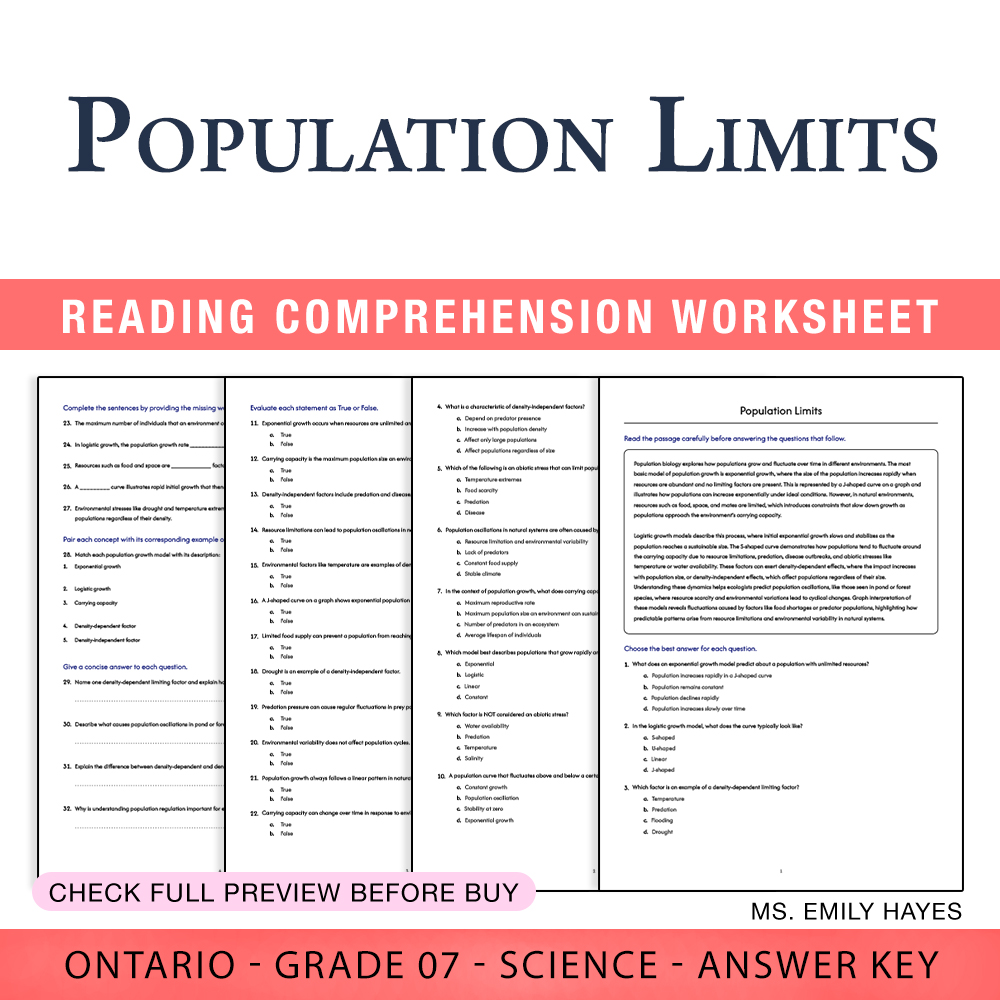
Grade 7 Science | Population Limits Worksheet (PDF+ Answer Key)
 Created byCopper Leaf Classroom
Learning Objectives
- Describe the basic concepts of population growth, including exponential and logistic models.
- Identify factors that limit population size, such as food, predation, and disease.
- Differentiate between density-dependent and density-independent limiting factors.
Instant download
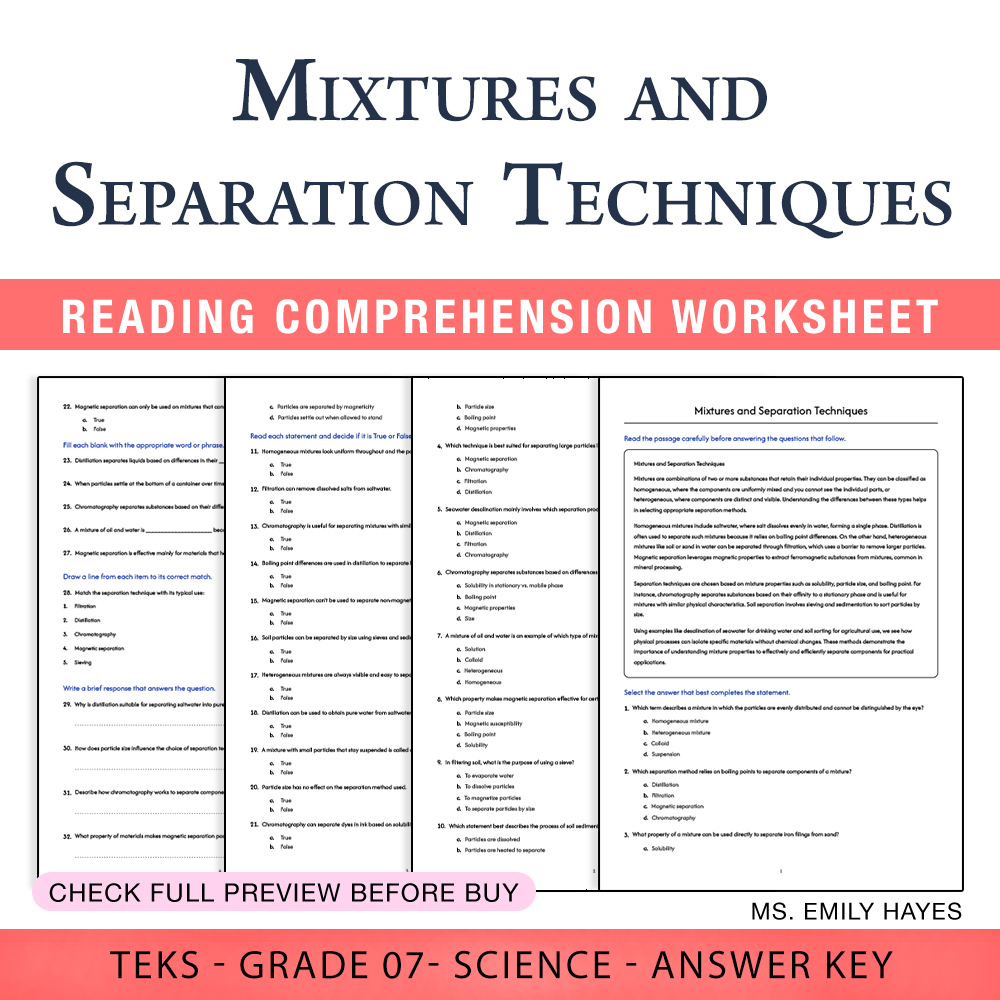
7th Grade Science | Mixtures & Separation Techniques Worksheet(PDF + Answer Key)
Created byCopper Leaf ClassroomLearning Objectives
- Distinguish between homogeneous and heterogeneous mixtures.
- Describe various separation techniques such as filtration, distillation, chromatography, and magnetic separation.
- Relate properties like solubility, particle size, and boiling point to the choice of separation methods.
Instant download
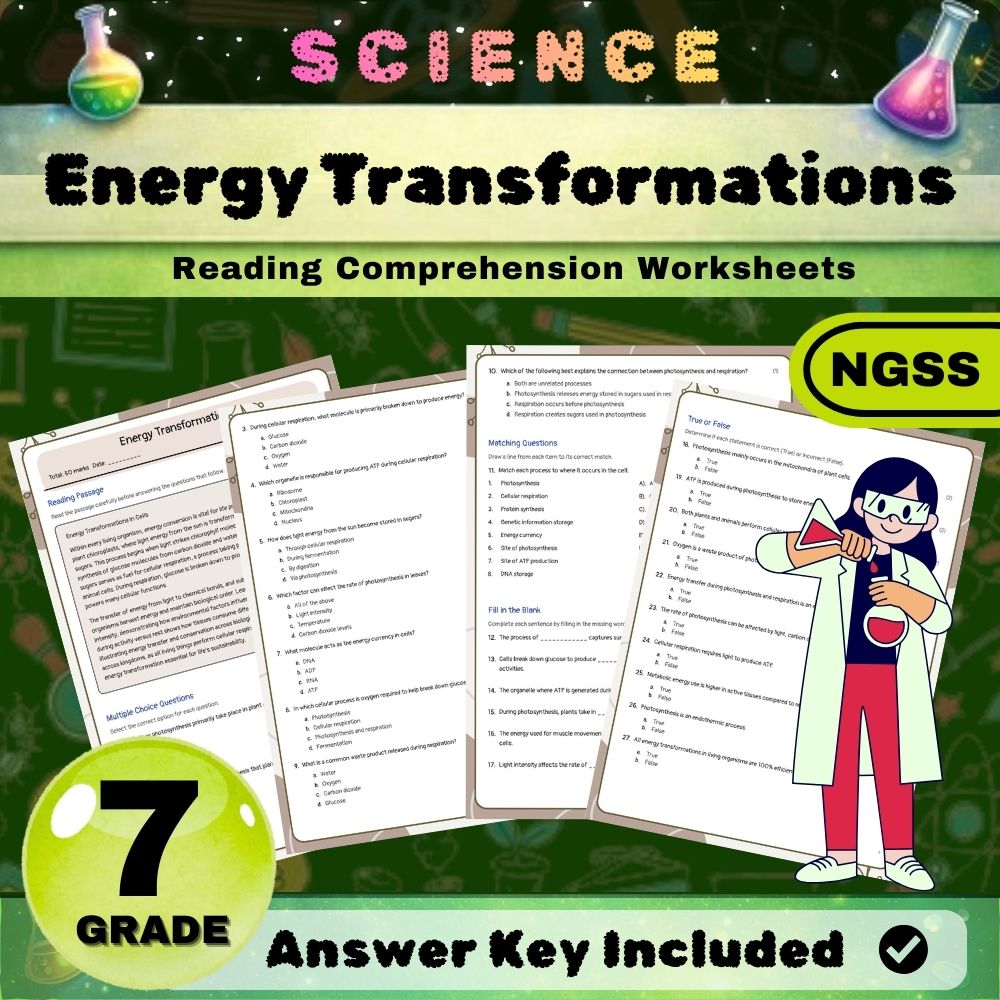
Grade 7 Science – Energy Transformations Worksheet (PDF + NGSS)
 Created byMaple Path Learning
Learning Objectives
- Explain how energy is transferred and transformed during photosynthesis and cellular respiration.
- Describe the connection between chloroplast activity in plants and mitochondria in various organisms.
- Analyze phenomena such as leaf photosynthesis rates and energy use differences in tissues.
Instant download
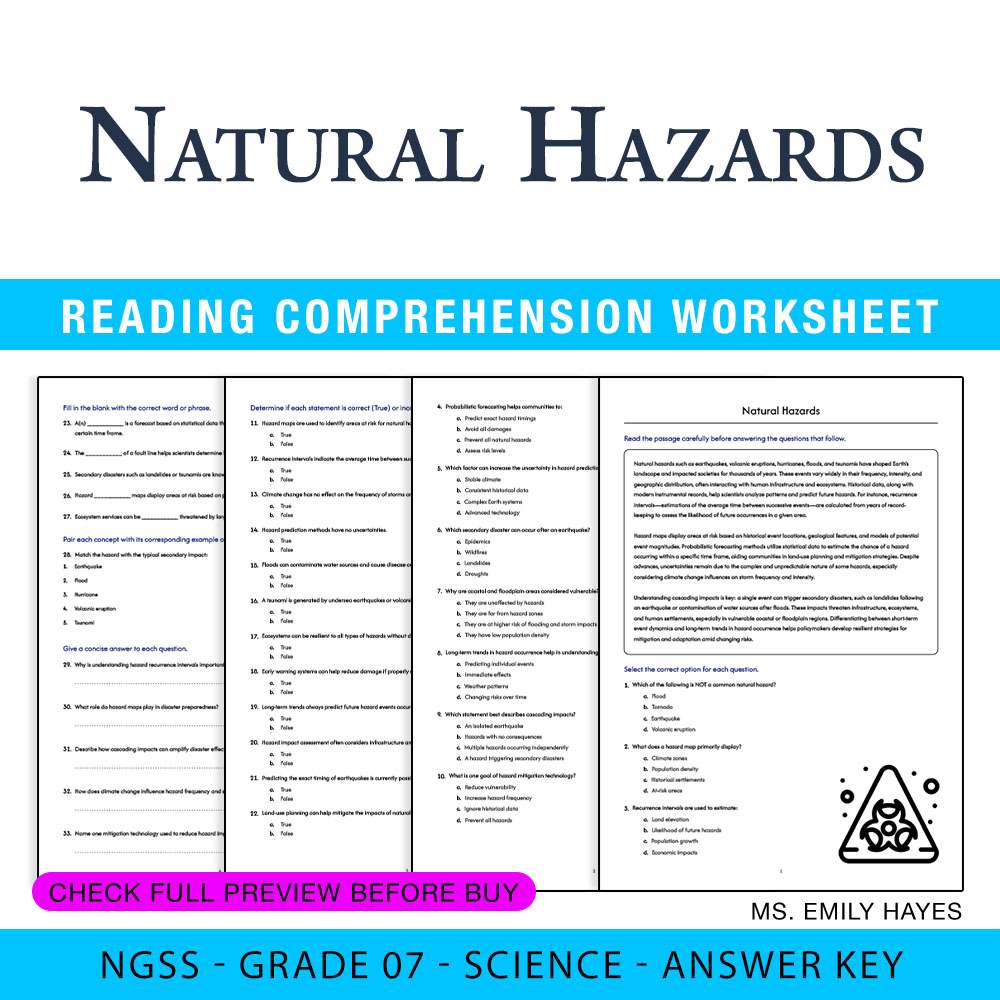
7th Grade Science | Natural Hazards Worksheet (PDF+ Answer Key)
Created byCopper Leaf ClassroomLearning Objectives
- Analyze patterns of frequency and magnitude for different natural hazards.
- Interpret hazard maps, recurrence intervals, and probabilistic data to assess risk.
- Understand the cascading impacts of hazards on infrastructure, ecosystems, and communities.
Instant download
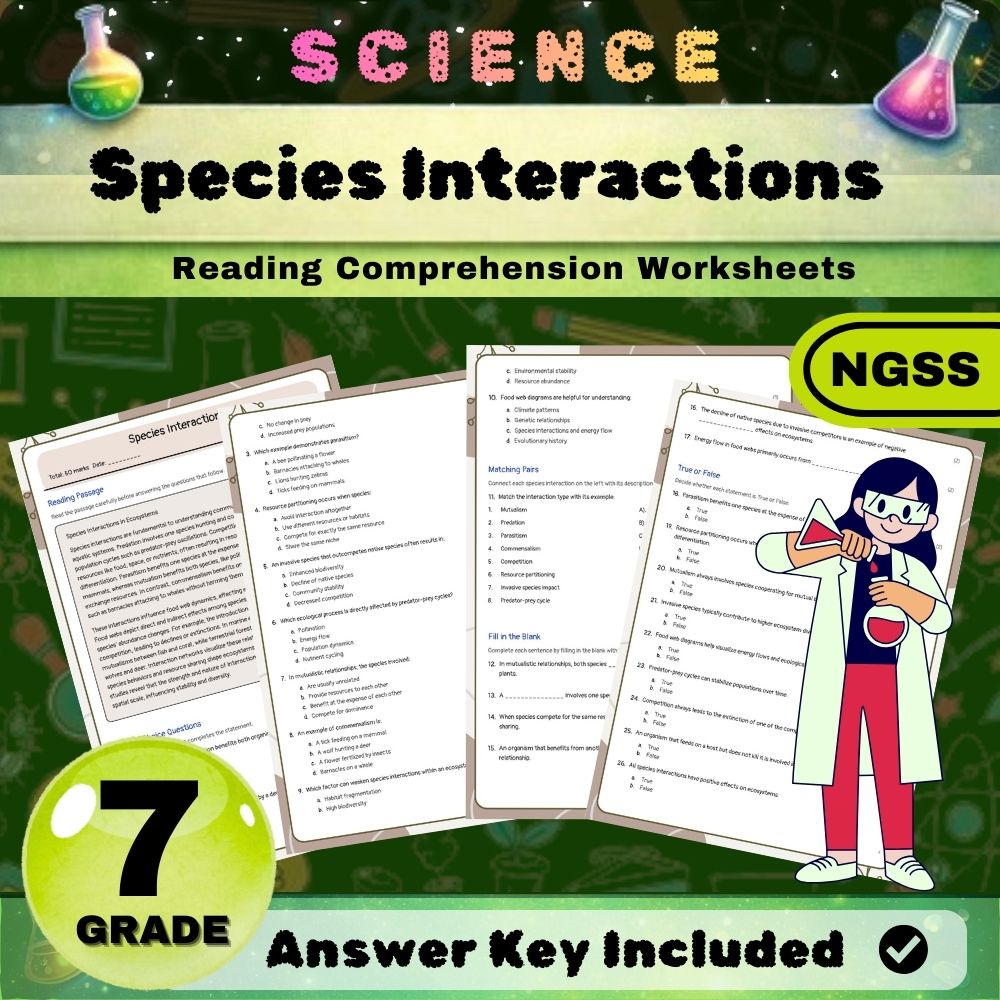
Grade 7 Science | Species Interactions NGSS Worksheet (PDF)
Created byMaple Path LearningLearning Objectives
- Describe different types of species interactions and provide examples.
- Analyze ecological food webs and predict effects of changes within communities.
- Explain how species behaviors influence community structure across ecosystems.
Also included in: Grade 7 Science Unit Bundle | Ecosystems, Biodiversity & Environmental Impact +1 more
Instant download
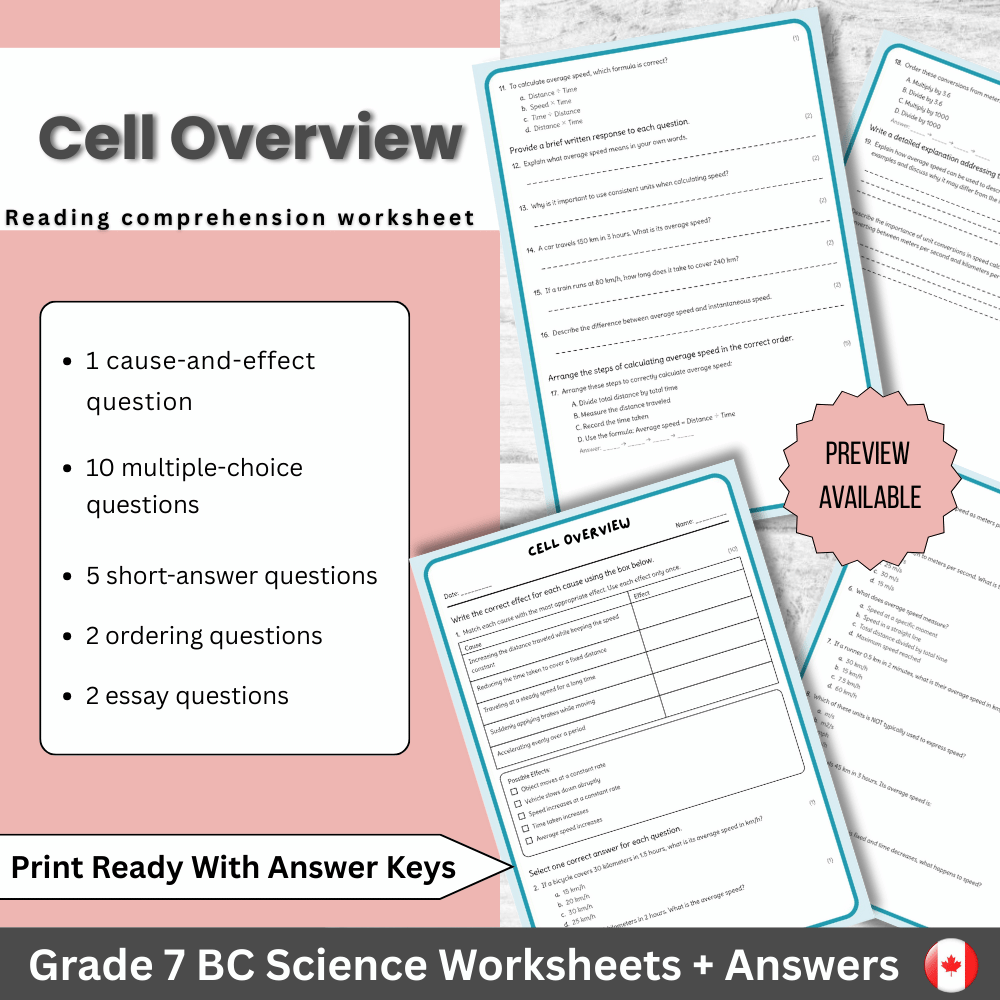
Grade 7 Science – Cell Overview Worksheet (PDF) | BC Standards & Key Concepts
 Created byBright Mind Resources
Learning Objectives
- Describe the basic structure and components of a cell.
- Identify functions of key organelles within cells.
- Explain how cell structure reflects its function in living organisms.
Instant download

Grade 7 Science – Diffusion & Mixing | Daily Reading Worksheet
Created byBright Mind ResourcesLearning Objectives
- Understand the basic concept of diffusion and how particles move.
- Learn how temperature affects the rate of diffusion.
- Explain how substances like perfume and sugar distribute evenly over time.
Also included in: Grade 7 Matter & Forces Science Reading Lesson Bundle | California Standards +1 more
Instant download

Human Impacts on Ecosystems Assessment | TEKS Grade 7 Science
 Created byPrism Point Learning
Learning Objectives
- Understand major human-induced alterations to ecosystems and their examples.
- Identify the effects of habitat fragmentation, pollution, and invasive species on biodiversity.
- Describe approaches for ecosystem restoration and mitigation.
Instant download
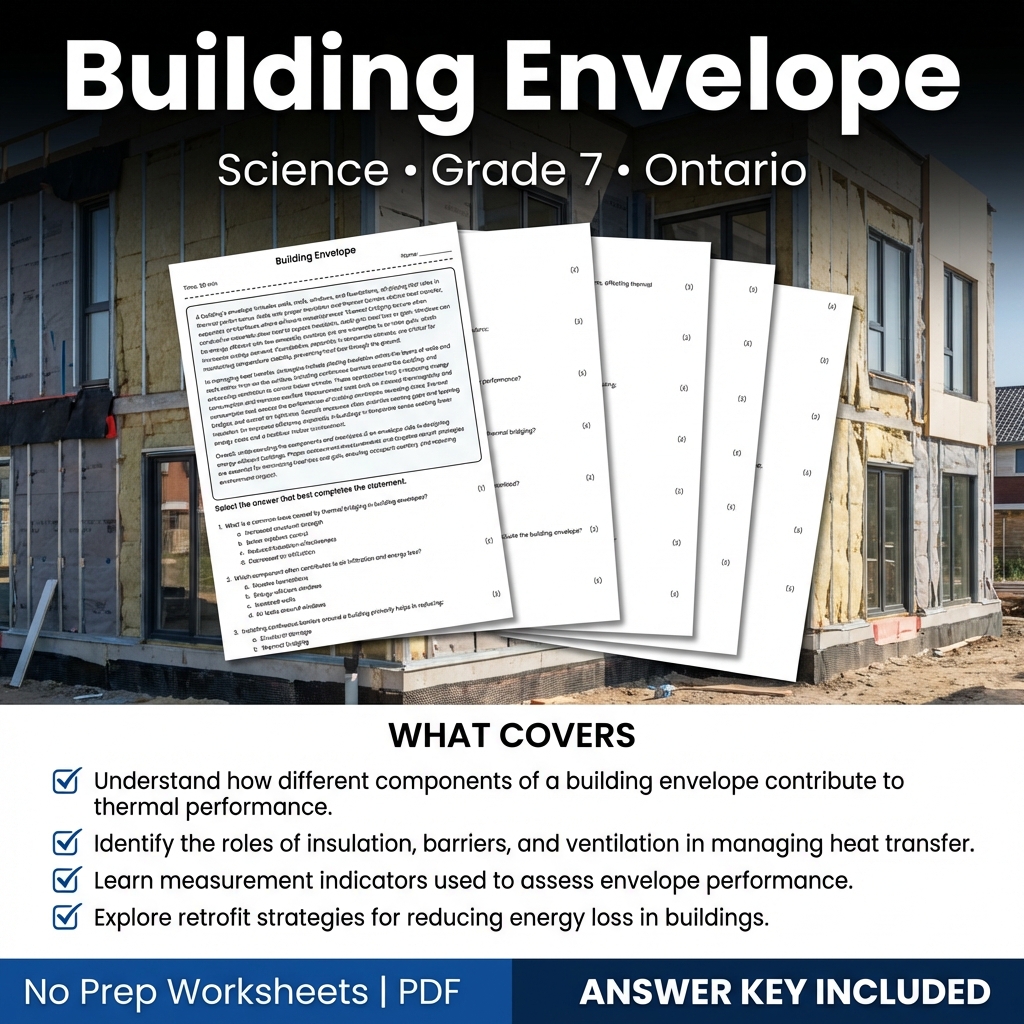
Grade 7 Science Worksheet on Building Envelope | Ontario Standards
 Created byCoral Reef Learning
Learning Objectives
- Understand how different components of a building envelope contribute to thermal performance.
- Identify the roles of insulation, barriers, and ventilation in managing heat transfer.
- Learn measurement indicators used to assess envelope performance.
Instant download

Adaptation Traits Worksheet Pack | Grade 7 Science Activities
Created byPrism Point LearningLearning Objectives
- Explain how adaptations (structural, physiological, and behavioural) help organisms survive in specific environments.
- Identify examples of adaptation traits related to temperature, water availability, and seasonal change.
- Describe trade-offs in resource allocation and how they affect which traits are favored by natural selection.
Also included in: Grade 7 Ecosystems & Biodiversity Science Lesson Bundle | Alberta
Instant download

Grade 7 Science – Adaptive Traits & Environmental Changes | Reading Worksheet
Created byBright Mind ResourcesLearning Objectives
- Understand what adaptive traits are and how they help animals survive.
- Identify examples of camouflage and other adaptive traits in animals.
- Analyze how environmental factors influence the development of adaptive traits.
Also included in: Grade 7 Ecosystems & Adaptations Science Daily Reading Lesson Bundle | TEKS +2 more
Instant download

Grade 7 Balanced Vs Unbalanced Worksheet | NGSS Practice PDF
 Created byClear Sky Classroom
Learning Objectives
- Distinguish between balanced and unbalanced forces using the idea of net force
- Predict how an object’s motion (speed and/or direction) changes when forces are balanced versus unbalanced
- Connect real-life examples, such as tug-of-war, to acceleration and constant velocity
Instant download
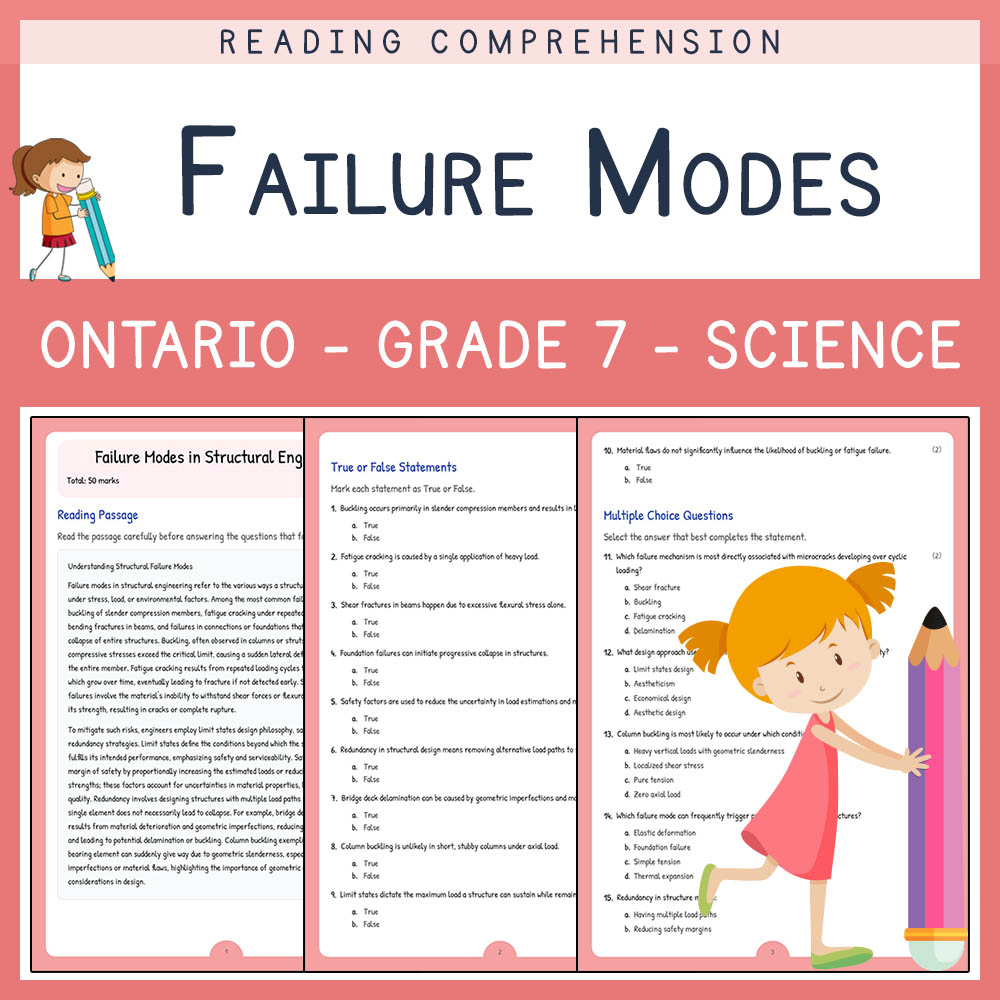
Grade 7 Science | Failure Modes in Structural Engineering Worksheet & Answer Key
Created byLumora LearningLearning Objectives
- Identify and explain common failure modes such as buckling, fatigue cracking, shear and bending fractures.
- Understand the principles of limit states design, safety factors, and redundancy in structural safety.
- Relate failure mechanisms to geometric, material, and loading characteristics using real-world exemplars.
Also included in: Grade 7 Science | Form Function Design Structures Unit Bundle | Ontario
Instant download
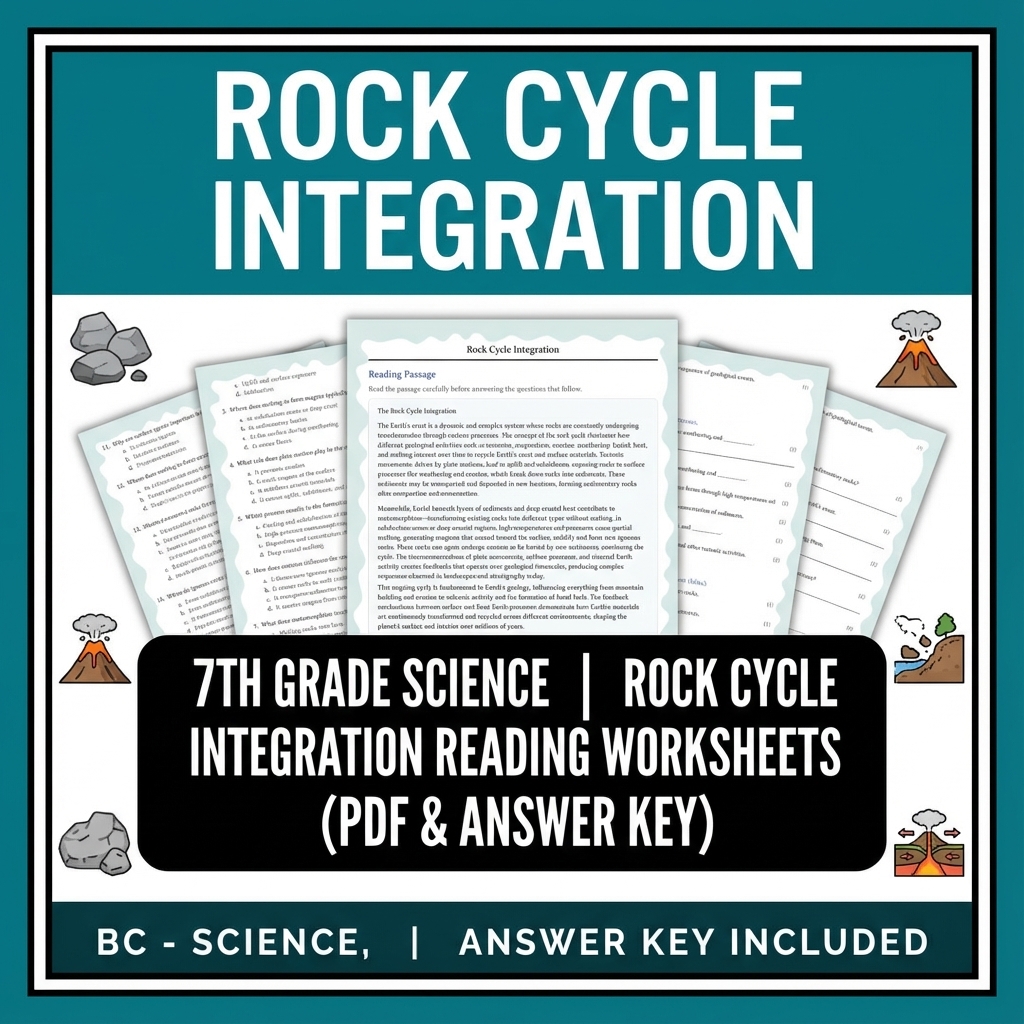
7th Grade Science | Rock Cycle Integration Reading Worksheets (PDF & Answer Key)
JCreated byJ.S SheetsLearning Objectives
- Explain the processes involved in the rock cycle and how they are interconnected.
- Identify the roles of tectonics, magmatism, weathering, and erosion in the formation and transformation of rocks.
- Describe how surface and deep Earth processes contribute to the recycling of crustal materials.
Instant download
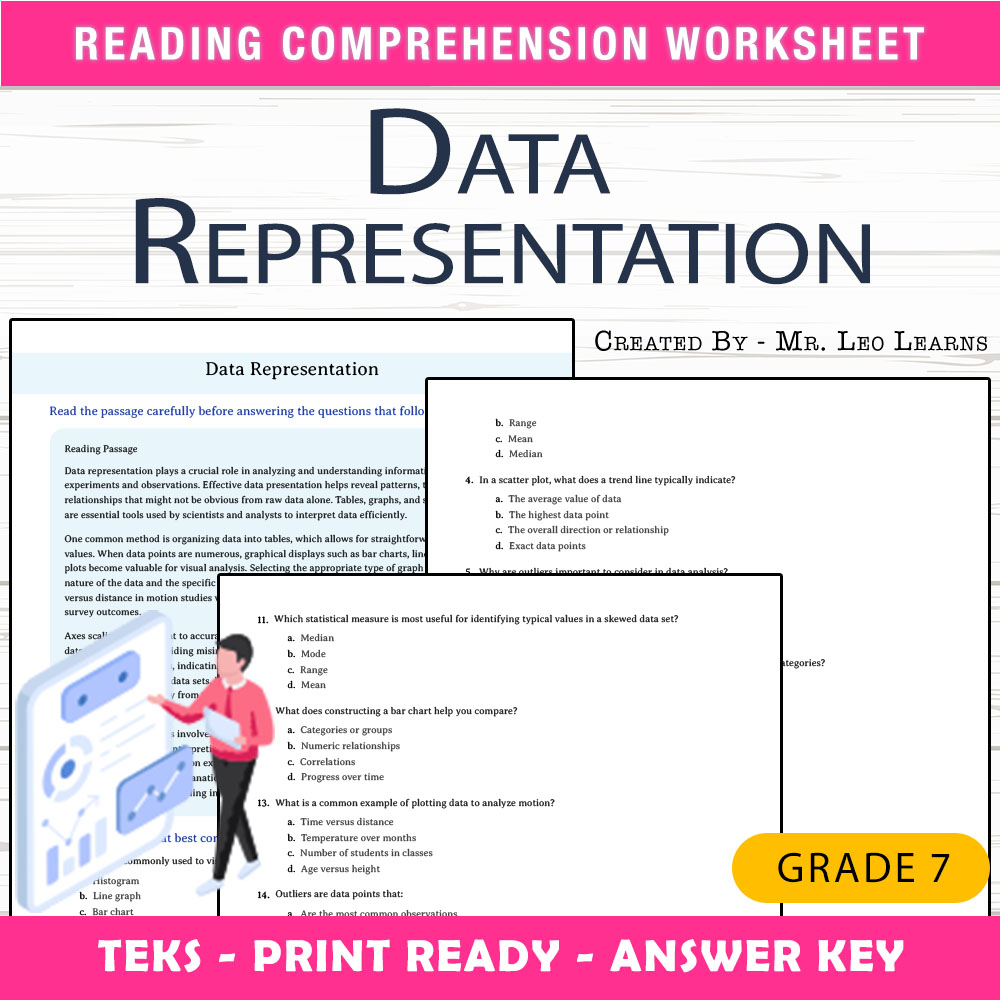
Grade 7 Science – Data Representation Worksheet for Mastery
 Created byThe Resource Hub
Learning Objectives
- Understand how to organize quantitative and qualitative data into tables and graphs.
- Learn to interpret trends and relationships from graphical displays and summary statistics.
- Select appropriate graph types, including axes scaling and trend lines, for data analysis.
Also included in: Grade 7 Science Unit Bundle | Experimental Design & Data Analysis Worksheets +1 more
Instant download

Grade 7 Science – Synthetic Materials Worksheet (NGSS Aligned) PDF
Created byBright Mind ResourcesLearning Objectives
- Describe production pathways from natural resources to common synthetic materials, including feedstocks, polymerization, and refining steps.
- Explain how chemical composition and functional performance are altered during production.
- Identify examples of synthetic materials such as polyethylene, PET, nylon, and metals.
Instant download
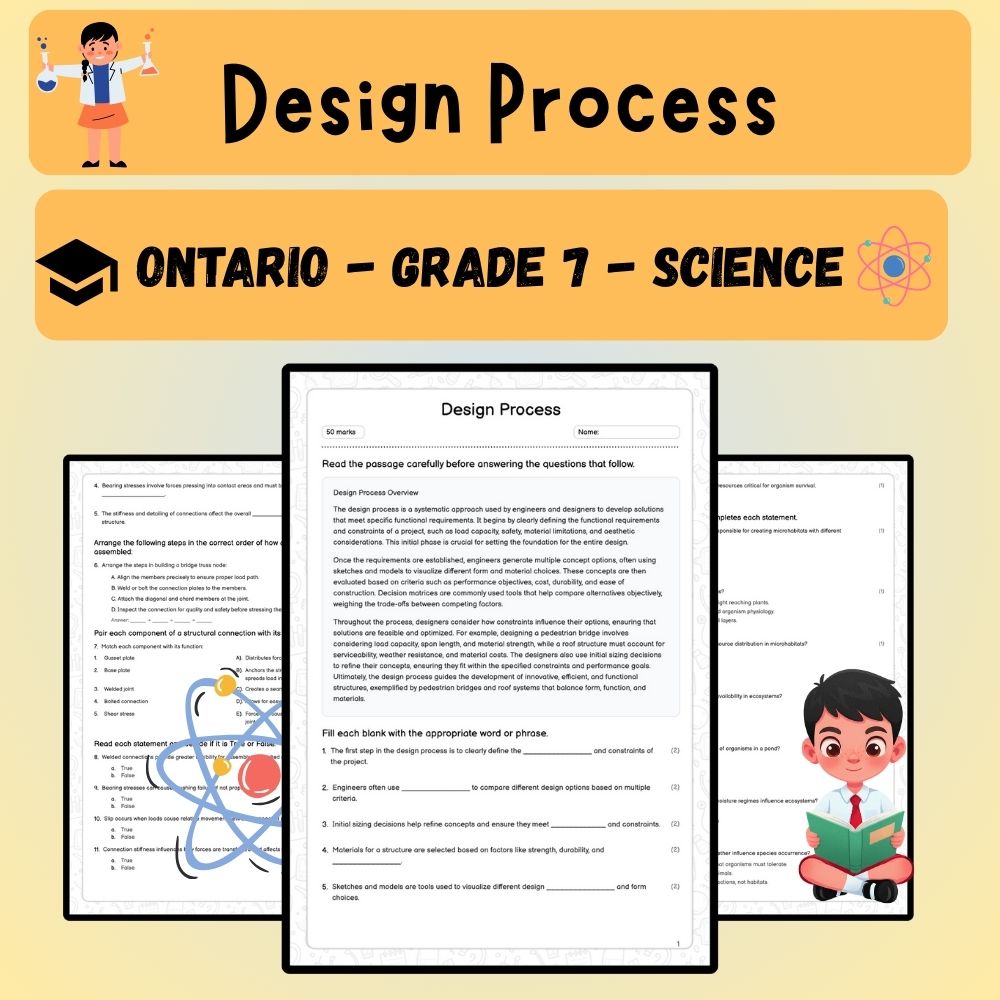
Grade 7 Science - Design Process Worksheet (PDF) – Ontario Standards
Created byPrism Point LearningLearning Objectives
- Understand the steps involved in the design process from defining requirements to selecting solutions.
- Identify key performance objectives and how they influence design choices.
- Apply decision matrices and sketches to compare different design alternatives.
Also included in: Grade 7 Science Unit | Structural Engineering & Material Testing Worksheets Bundle +1 more
Instant download
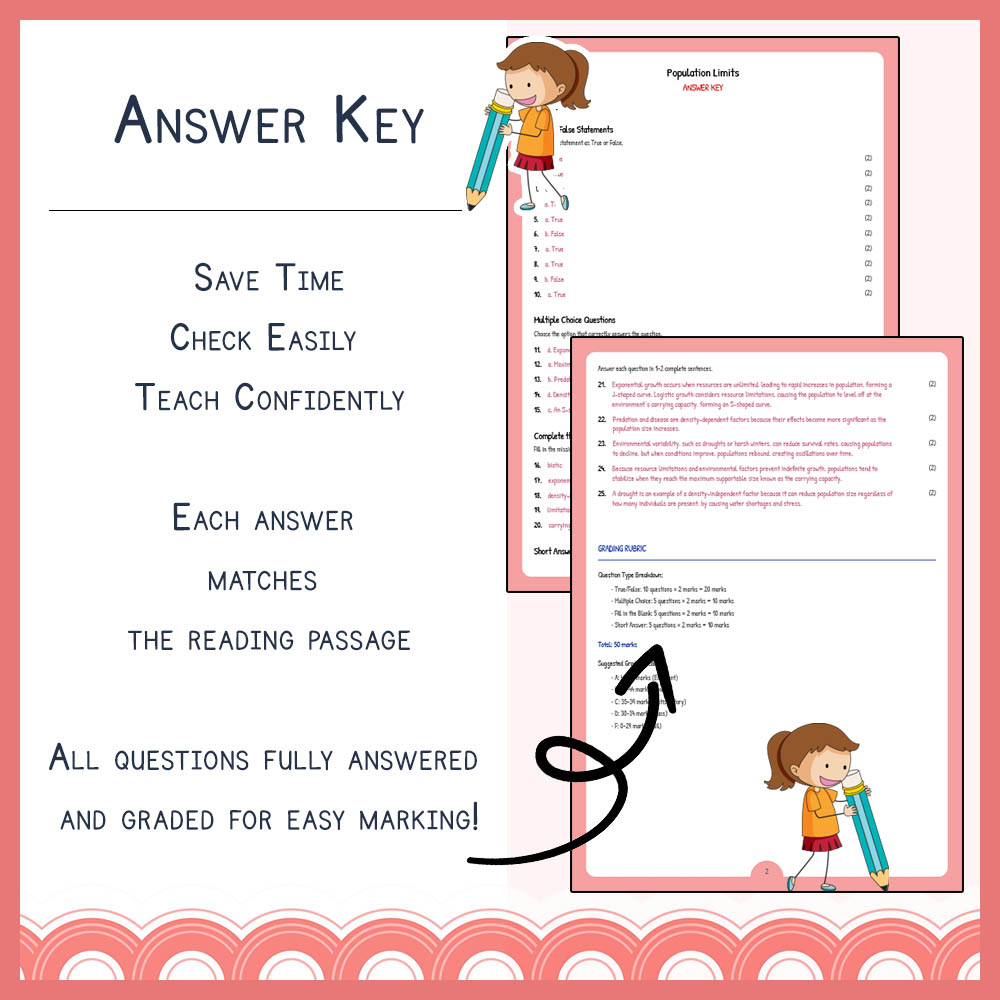
Grade 7 Science Assessment | Population Limits Worksheet | Ontario
Created byLumora LearningLearning Objectives
- Explain basic concepts of population growth models, including exponential and logistic growth.
- Identify limiting factors such as food, predation, disease, and abiotic stresses that affect populations.
- Distinguish between density-dependent and density-independent influences on populations.
Instant download
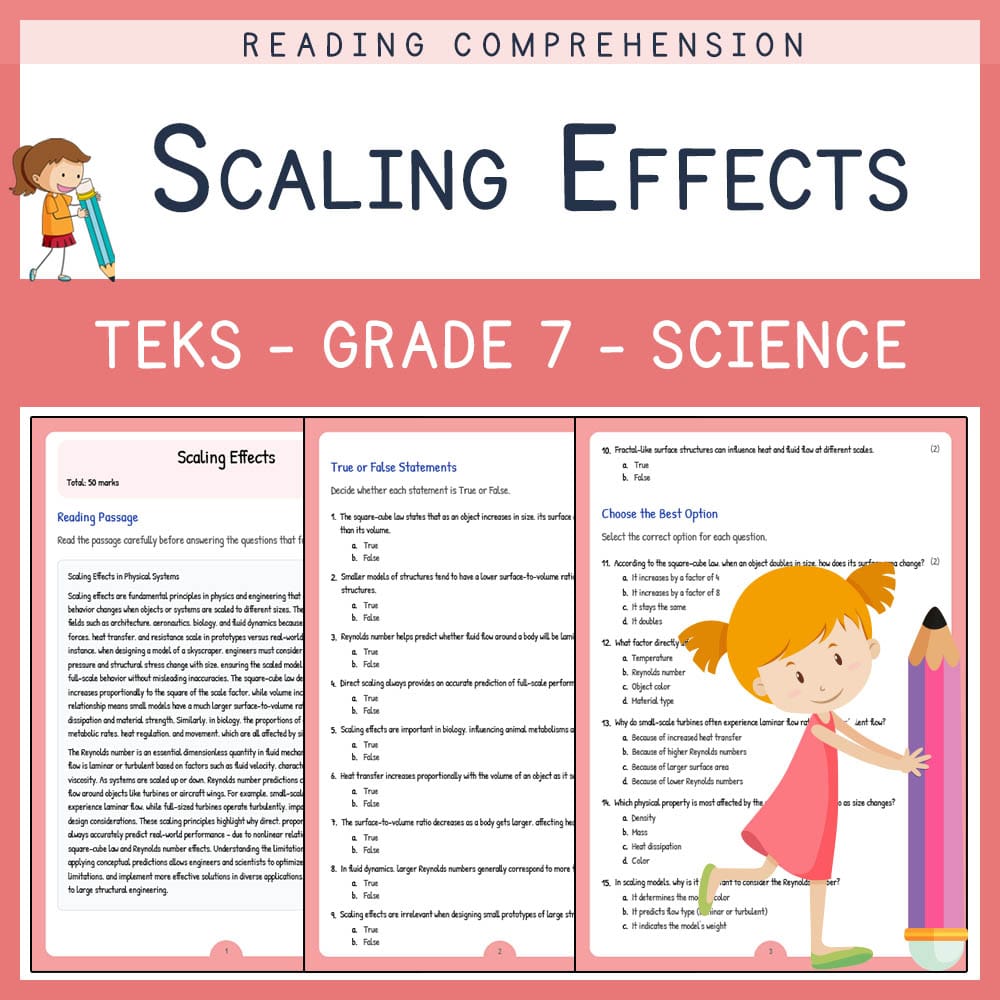
Grade 7 Science | Scaling Effects Worksheet | TEKS-Aligned
Created byLumora LearningLearning Objectives
- Understand how scaling impacts physical behavior in structures, turbines, and biological systems.
- Analyze the relationships between surface area, volume, and size in scaled models.
- Explain the significance of Reynolds number in fluid flow at different scales.
Instant download
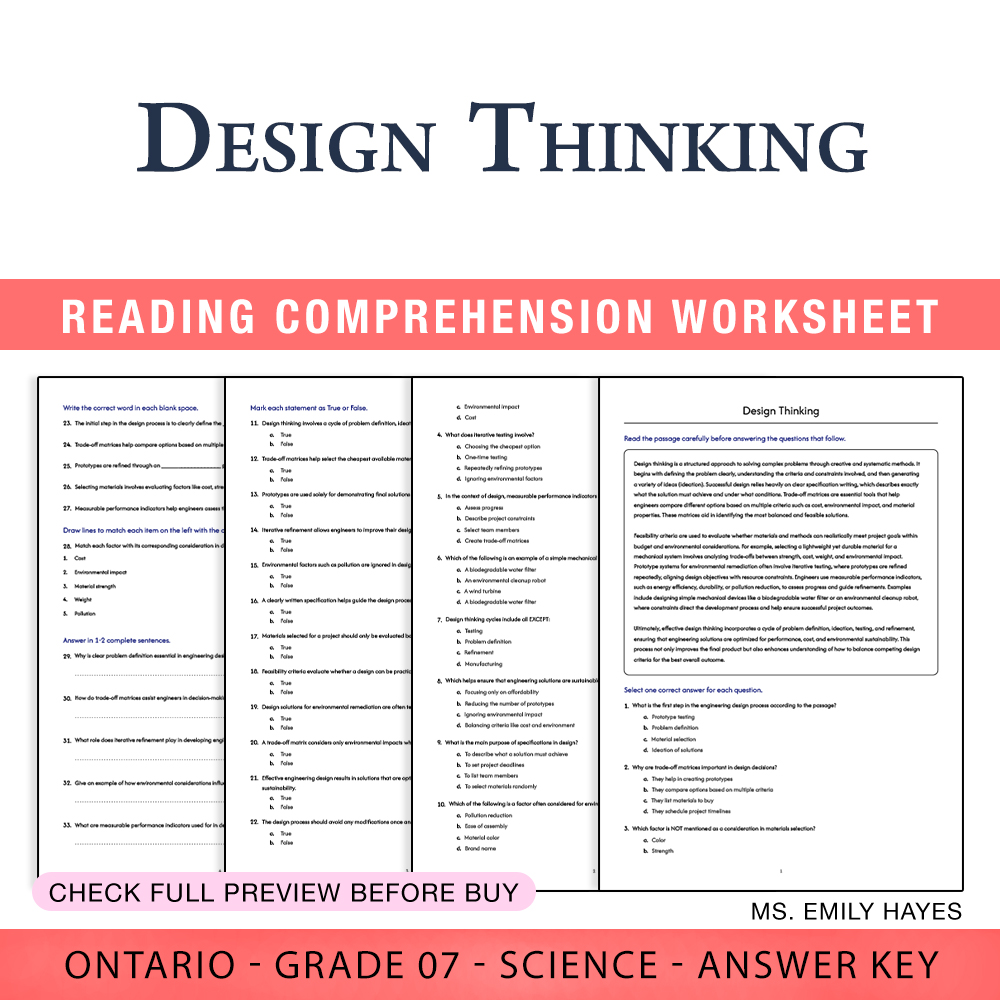
7th Grade Science | Design Thinking Worksheet (PDF+ Answer Key)
Created byCopper Leaf ClassroomLearning Objectives
- Understand the fundamentals of engineering design processes including problem definition, criteria, and constraints.
- Learn how to write clear specifications and use trade-off matrices for decision-making.
- Apply concepts of feasibility, material selection, and environmental factors in designing simple mechanical and environmental systems.
Instant download

Grade 7 Science | Modelling Ecosystems - Daily Reading Comprehension
Created byCoral Reef LearningLearning Objectives
- Understand the concept of ecological models
- Identify components of ecological models
- Differentiate between conceptual and quantitative models
Also included in: Interactions and Ecosystems Lesson Bundle Grade 7 Science – Alberta +1 more
Instant download
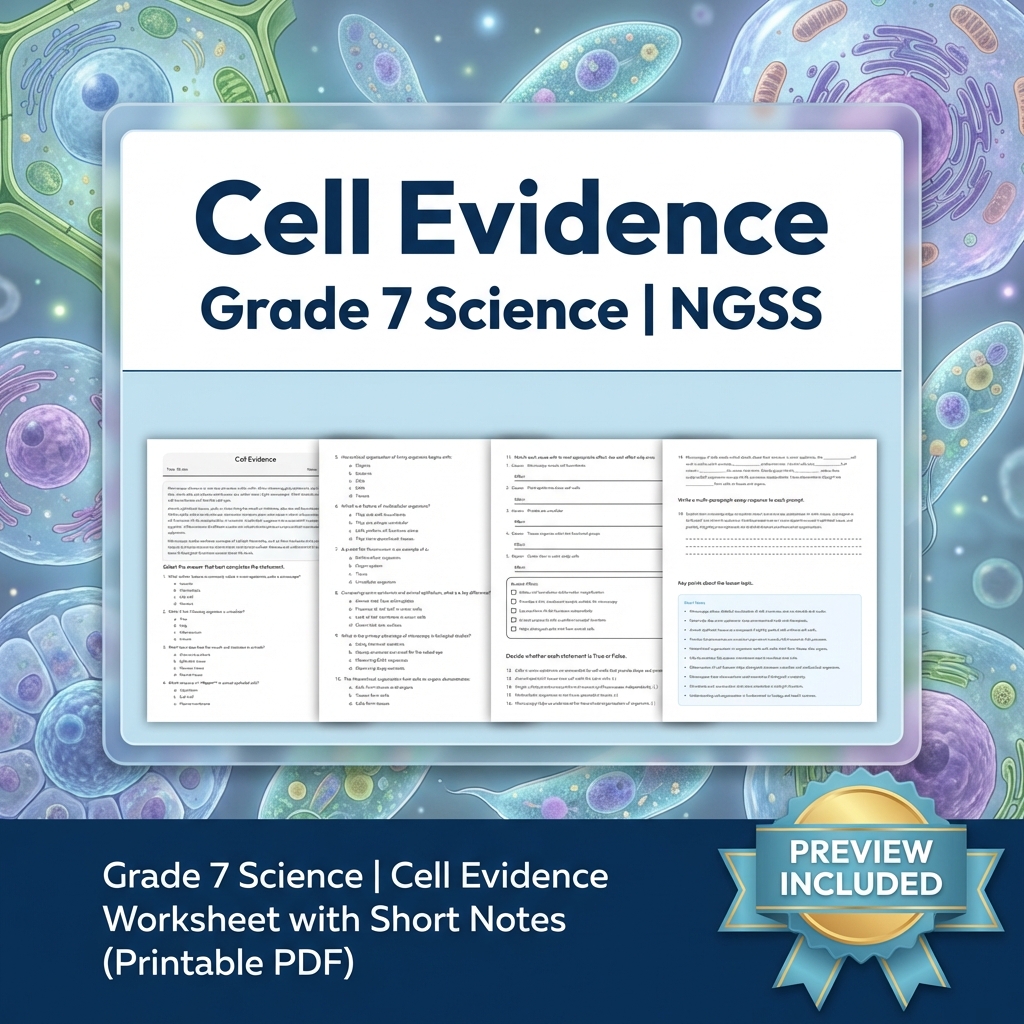
Grade 7 Science | Cell Evidence Worksheet with Short Notes (Printable PDF)
 Created byMeadowlark Worksheets
Learning Objectives
- Understand how microscopy reveals the structure of plant and animal cells.
- Identify and compare features of unicellular and multicellular organisms.
- Recognize cellular components such as cell walls, plasma membranes, and organelles.
Also included in: Grade 7 Science NGSS Unit Bundle Molecules to Organisms: Structures & Processes +1 more
Instant download
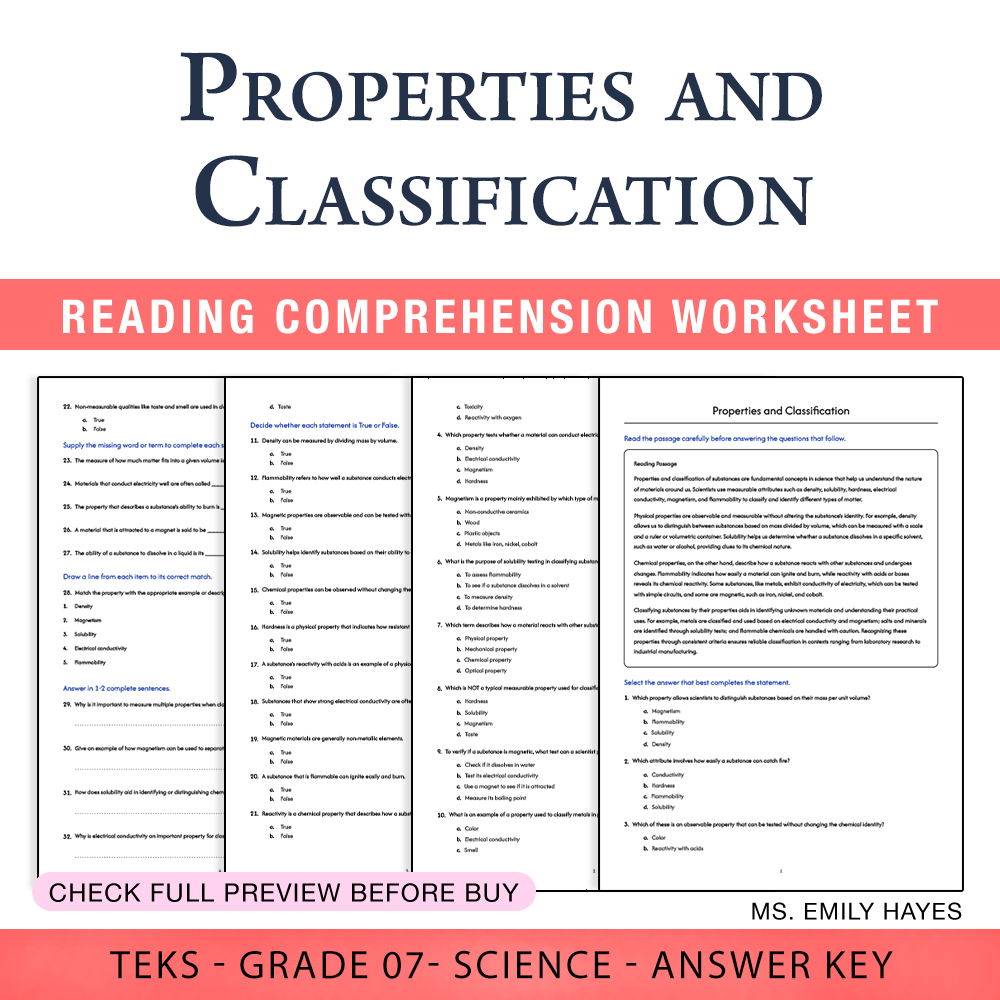
7th Grade Science | Properties and Classification Worksheet (PDF+ Answer Key)
Created byCopper Leaf ClassroomLearning Objectives
- Understand and define physical and chemical properties used to classify substances.
- Identify measurable attributes such as density, solubility, hardness, electrical conductivity, magnetism, and flammability.
- Apply observable and quantitative criteria to distinguish elements, compounds, and mixtures.
Instant download

Speed Calculations Worksheet | Grade 7 Science Practice
Created byPrism Point LearningLearning Objectives
- Calculate average speed using distance and time, with correct units
- Convert between meters per second (m/s) and kilometers per hour (km/h)
- Distinguish average speed from instantaneous speed using numerical examples
Also included in: Grade 7 Motion, Forces & Energy Science Lesson Bundle for TEKS Practice
Instant download

Grade 7 Types of Symbiosis & Their Effects Science Worksheet Alberta
 Created byBRIGHT PATH RESOURCES
Learning Objectives
- Distinguish mutualism, commensalism, and parasitism using defining evidence
- Explain how symbiotic relationships can change population size and resource use
- Use an example to describe a likely ecological consequence of each symbiosis type
Also included in: Grade 7 Alberta Science Interactions and Ecosystems Worksheet Bundle +1 more
Instant download
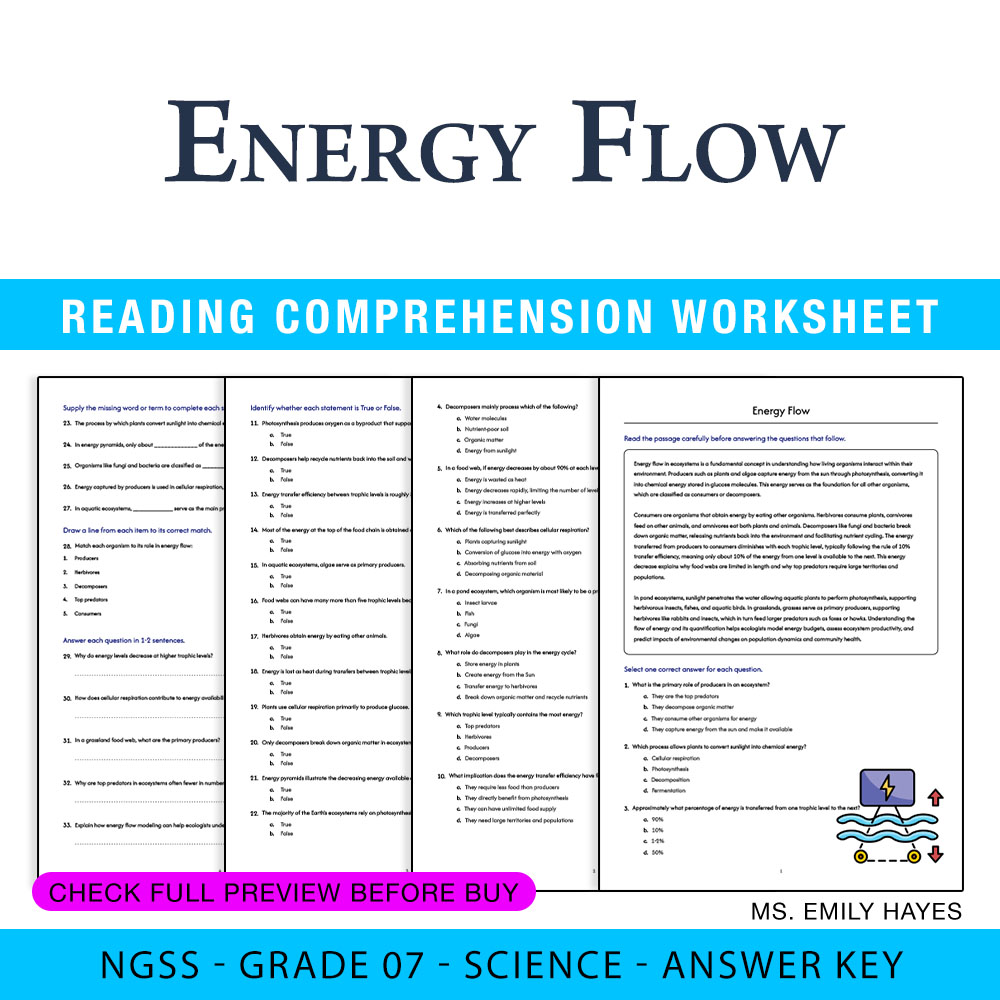
7th Grade Science | Energy Flow Worksheet (PDF +Answer Key)
Created byCopper Leaf ClassroomLearning Objectives
- Understand the transfer of energy through different trophic levels in ecosystems.
- Describe the roles of producers, consumers, and decomposers in energy pyramids and food webs.
- Explain how photosynthesis and cellular respiration contribute to energy transfer.
Instant download
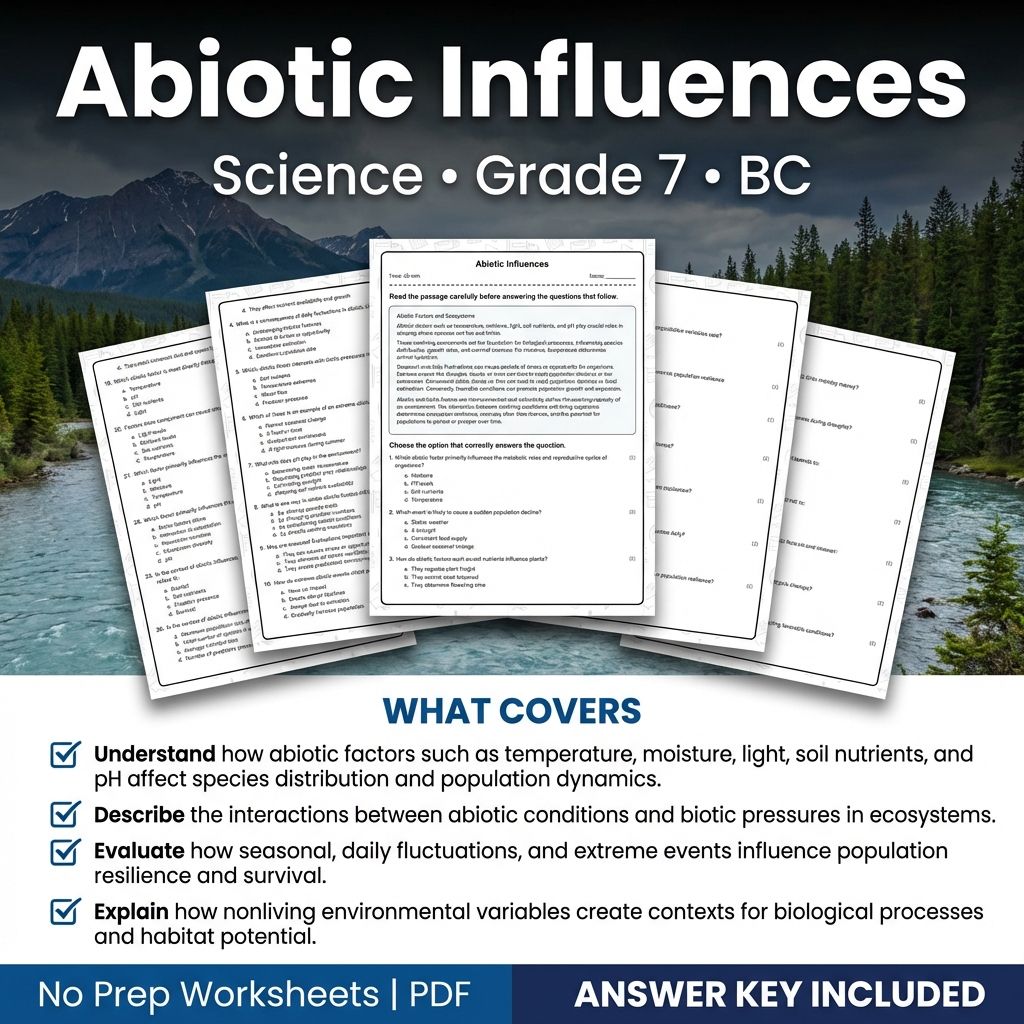
7th Grade Science | Abiotic Influences Worksheet & Answer Key (Printable PDF)
Created byCoral Reef LearningLearning Objectives
- Understand how abiotic factors such as temperature, moisture, light, soil nutrients, and pH affect species distribution and population dynamics.
- Describe the interactions between abiotic conditions and biotic pressures in ecosystems.
- Evaluate how seasonal, daily fluctuations, and extreme events influence population resilience and survival.
Instant download

Grade 7 Understanding Mixtures and Solutions Worksheet | NGSS Science
Created byBRIGHT PATH RESOURCESLearning Objectives
- Define and distinguish between homogeneous and heterogeneous mixtures.
- Identify examples of different types of mixtures, including solutions, suspensions, and colloids.
- Understand concepts of solubility, saturation, and concentration in mixtures.
Also included in: Chemical Reactions Grade 7 Science Daily Reading Worksheets Lesson Bundle | NGSS +2 more
Instant download
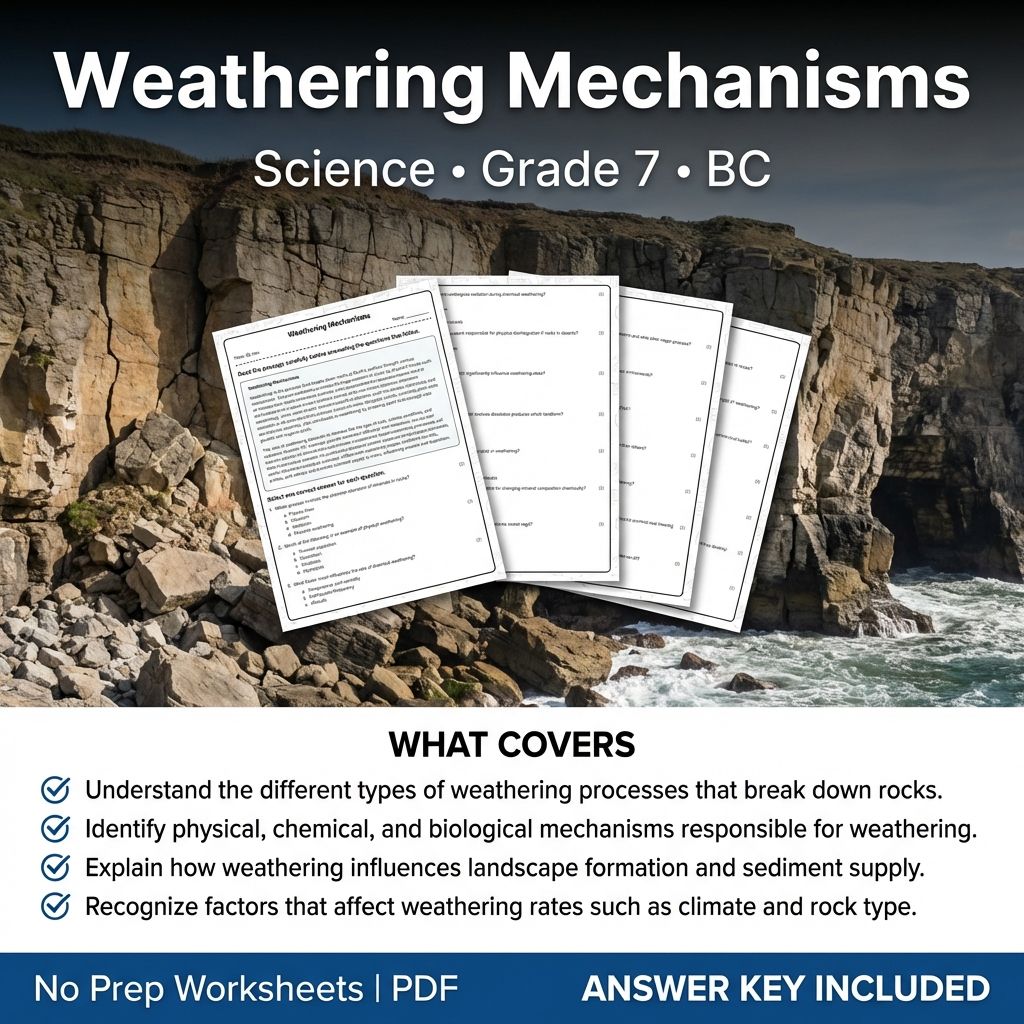
7th Grade Science | Weathering Mechanisms Worksheet & Answer Key (Printable PDF)
Created byCoral Reef LearningLearning Objectives
- Understand the different types of weathering processes that break down rocks.
- Identify physical, chemical, and biological mechanisms responsible for weathering.
- Explain how weathering influences landscape formation and sediment supply.
Instant download
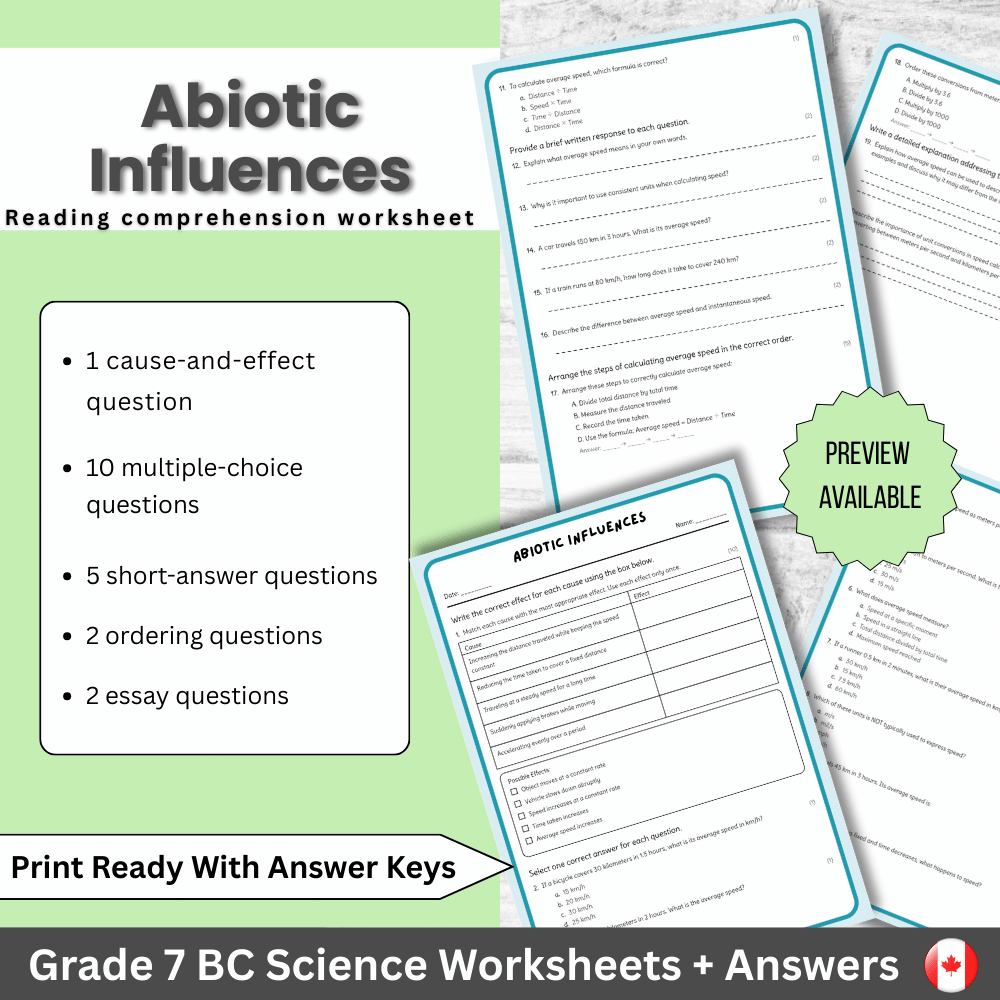
7th Grade Science | Abiotic Influences Worksheet (PDF) – BC Standards
Created byBright Mind ResourcesLearning Objectives
- Understand how abiotic factors such as temperature, moisture, light, soil nutrients, and pH affect species distribution and population dynamics.
- Identify examples of abiotic stresses and opportunities in the environment.
- Explain the interaction between abiotic conditions and biotic pressures in ecosystems.
Instant download
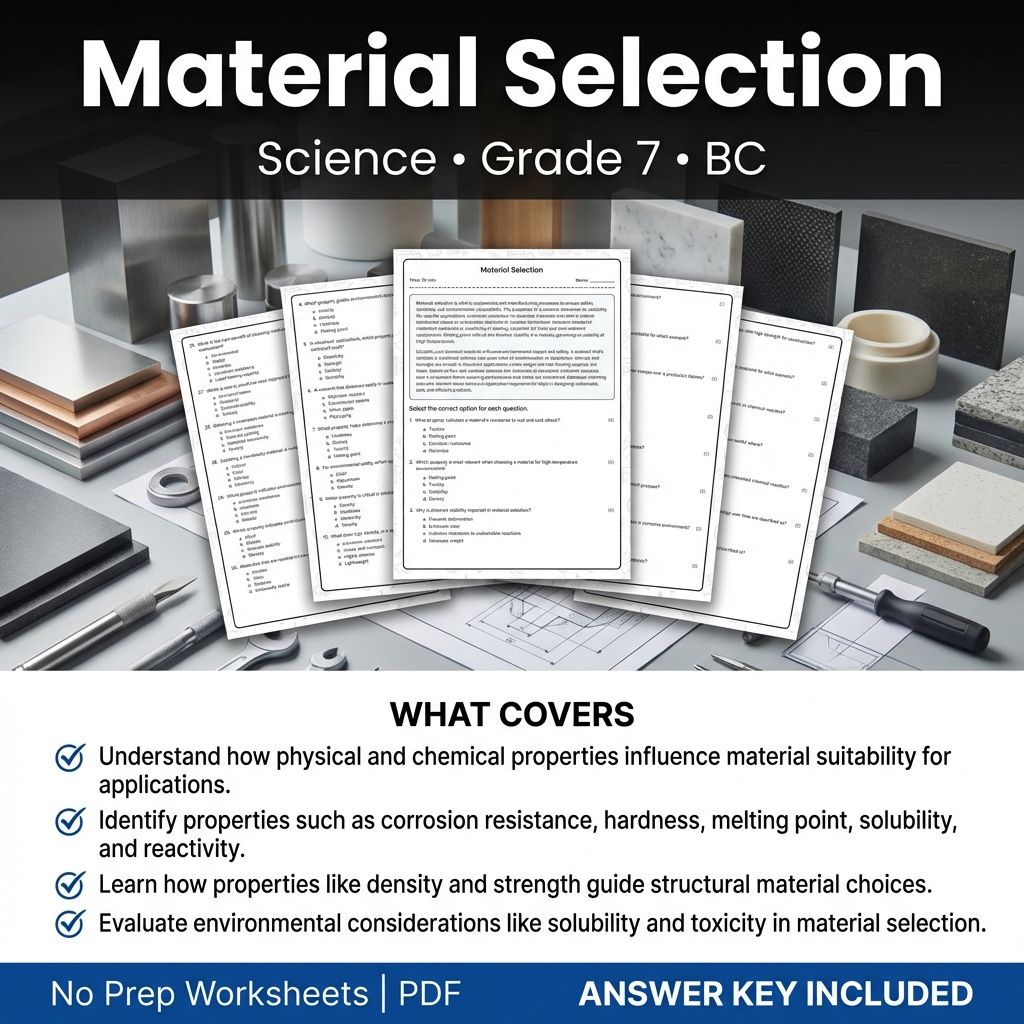
7th Grade Science | Material Selection Worksheet & Answer Key (Printable PDF)
Created byCoral Reef LearningLearning Objectives
- Understand how physical and chemical properties influence material suitability for applications.
- Identify properties such as corrosion resistance, hardness, melting point, solubility, and reactivity.
- Learn how properties like density and strength guide structural material choices.
Instant download
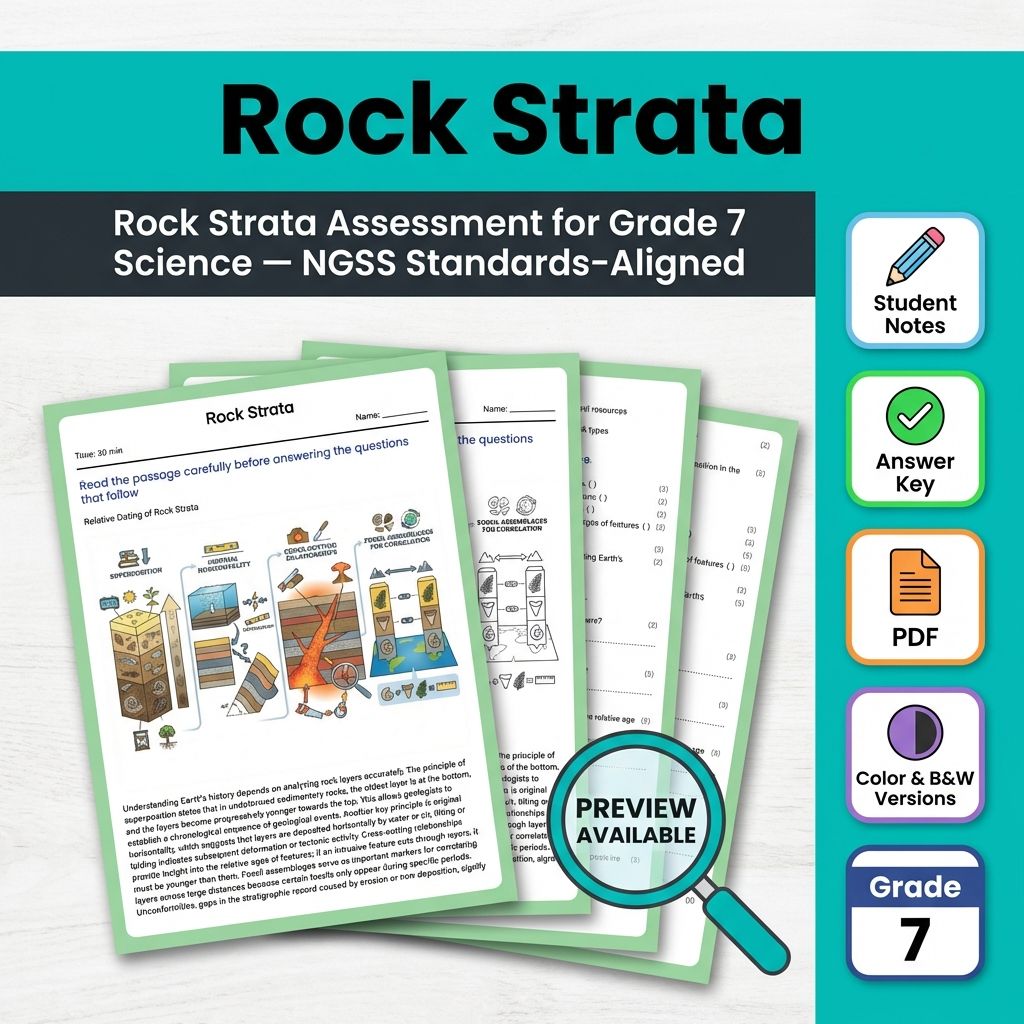
Rock Strata Assessment for Grade 7 Science – NGSS Standards-Aligned
Created byPrism Point LearningLearning Objectives
- Understand the principles of relative dating including superposition, original horizontality, and cross-cutting relationships.
- Identify key stratigraphic markers such as fossils, unconformities, and intrusive contacts used to correlate rock layers.
- Explain how field observations and stratigraphic data are synthesized to interpret Earth's geological history.
Also included in: Grade 7 Science Mini Bundle – Earth's Place in the Universe | NGSS Standards +1 more
Instant download
Grade 7 Science | Metric Reasoning Worksheet (PDF) – TEKS Aligned & Practical
Created byBright Mind ResourcesLearning Objectives
- Understand measurement precision and how to estimate uncertainty.
- Learn to select appropriate measurement instruments for accurate observations.
- Apply proper calibration techniques to balances and graduated cylinders.
Also included in: Grade 7 Science Unit Worksheet Pack- Data Analysis,Experimental Design & Inquiry +2 more
Instant download
Grade 7 Science | Inquiry Foundations Worksheet (PDF) – TEKS Standards & Activities
Created byBright Mind ResourcesLearning Objectives
- Distinguish between quantitative and qualitative observations in scientific inquiry.
- Identify appropriate metric units and instruments for measuring length, mass, and volume.
- Recognize sources of error in scientific data collection and how to minimize them.
Also included in: Grade 7 Science Unit Worksheet Pack- Data Analysis,Experimental Design & Inquiry +2 more
Instant download
Grade 7 Science | Design Principles Worksheet (Answer Key) – TEKS Standards
Created byBright Mind ResourcesLearning Objectives
- Understand the key components of experiment design, including variables and operational definitions.
- Identify appropriate control conditions in scientific experiments.
- Recognize the importance of reproducibility and sample size in research.
Also included in: Grade 7 Science Unit Worksheet Pack- Data Analysis,Experimental Design & Inquiry +2 more
Instant download
Grade 7 Science | Controlling Variables in Scientific Experiments (Worksheet + Answer Key) (PDF)
Created byBright Mind ResourcesLearning Objectives
- Identify and manage variables within controlled scientific experiments.
- Understand strategies for randomization, blocking, and replication in experiments.
- Apply systematic methods to control confounding influences in scientific testing.
Also included in: Grade 7 Science Unit Worksheet Pack- Data Analysis,Experimental Design & Inquiry +2 more
Instant download
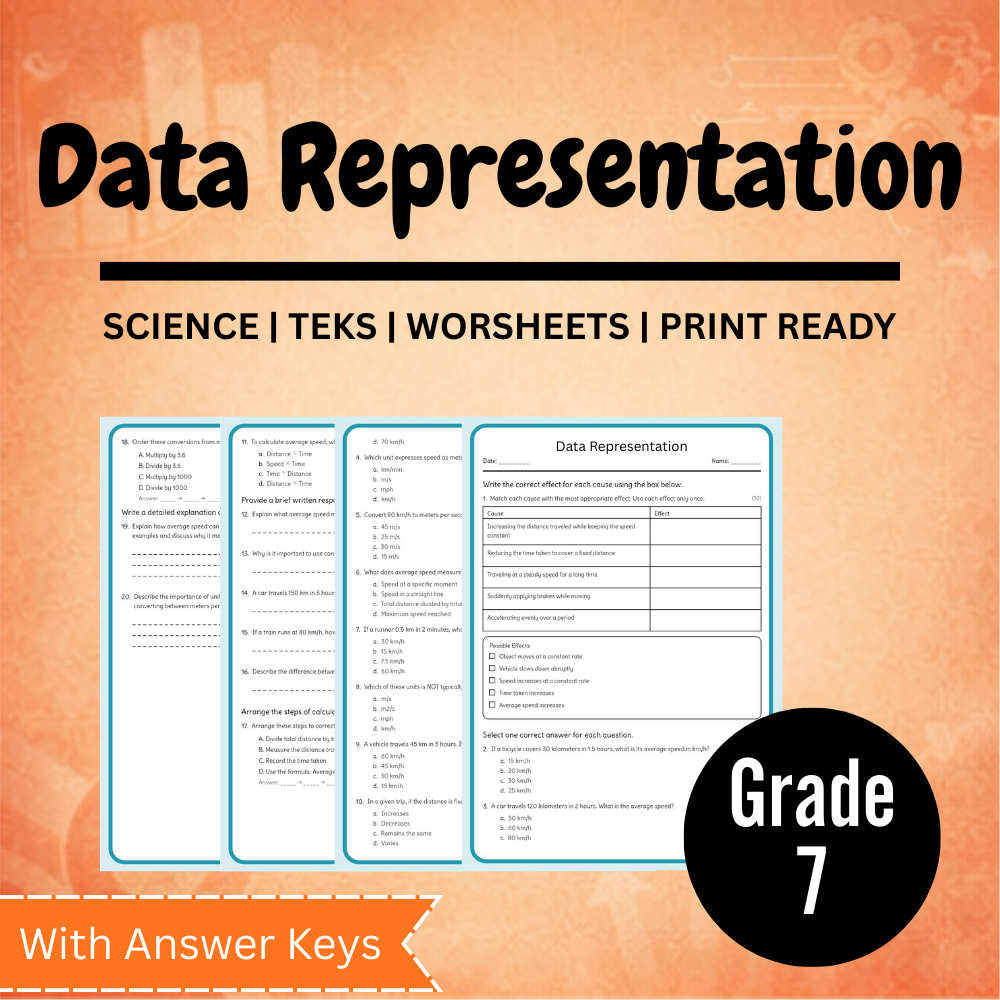
Grade 7 Science | Data Representation Worksheet + Answer Key (TEKS & PDF)
Created byBright Mind ResourcesLearning Objectives
- Organize quantitative and qualitative observations into tables and graphs
- Select appropriate graph types and interpret axis scales
- Understand trends and relationships through graphs and summary statistics
Also included in: Grade 7 Science Unit Worksheet Pack- Data Analysis,Experimental Design & Inquiry +2 more
Instant download

States of Matter Worksheet | California Standards Grade 7 Science Practice
JCreated byJ.S SheetsLearning Objectives
- Understand how energy transfer causes changes in states of matter.
- Identify the processes of melting, freezing, evaporation, and condensation.
- Explain particle behavior during phase changes using the particle model.
Also included in: Grade 7 Forces and Matter Science lesson bundle – California Standards +1 more
Instant download
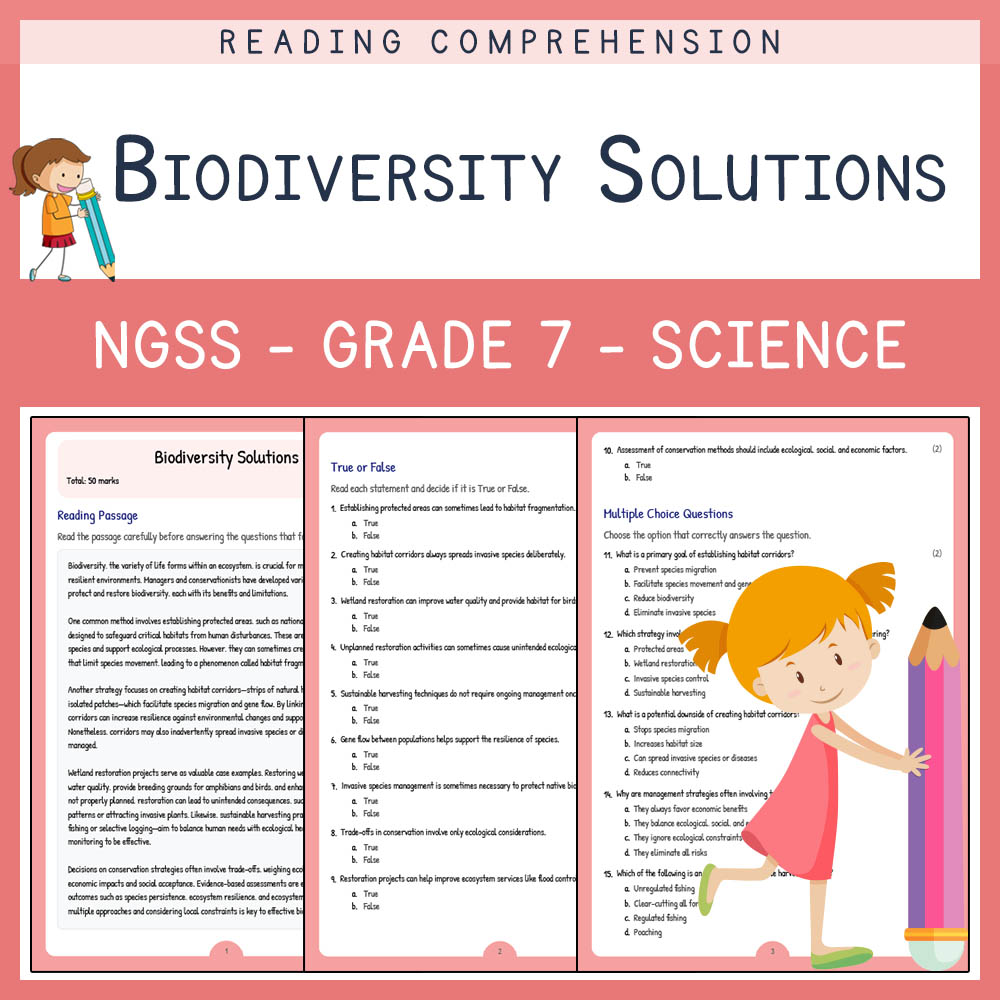
Grade 7 Science | Biodiversity Solutions Worksheet (Answer Key & Rubric)
Created byLumora LearningLearning Objectives
- Understand various management strategies for maintaining biodiversity and ecosystem services.
- Evaluate the benefits and potential trade-offs of approaches such as habitat corridors, protected areas, and restoration.
- Analyze case examples like wetland restoration and corridor establishment for their ecological, economic, and social impacts.
Instant download

Gas Behavior Worksheet | Grade 7 Science Activities and Assessment
Created byPrism Point LearningLearning Objectives
- Explain qualitatively how gas pressure, volume, and temperature affect one another
- Describe how diffusion and compressibility help explain everyday gas observations
- Use real-world examples (compressed air, heated air) to predict what changes and why
Also included in: Grade 7 Matter, States, and Reactions in Science Lesson Bundle TEKS
Instant download
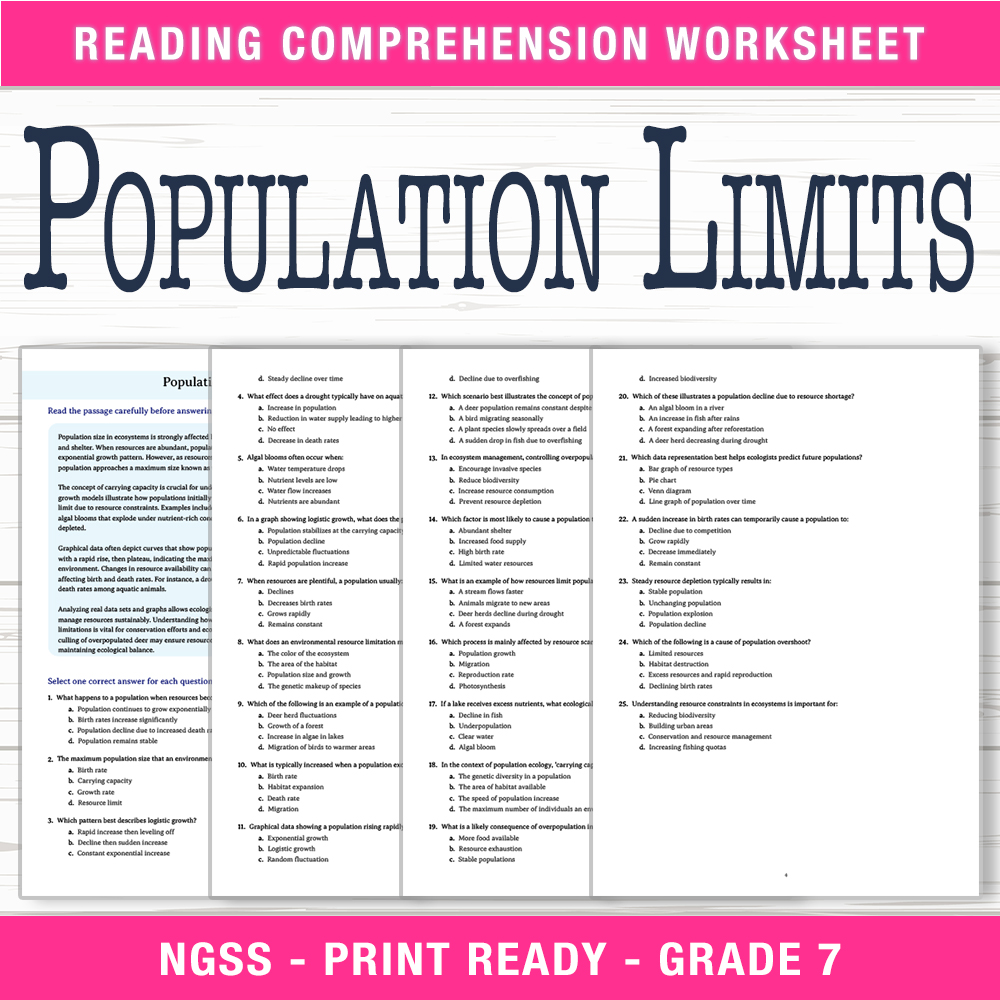
Grade 7 Science | Population Limits Worksheet (PDF + Answer Key)
 Created byRiverstone Classroom
Learning Objectives
- Explain how resource availability impacts population growth and size.
- Interpret logistic growth curves and concepts of carrying capacity.
- Analyze examples of population responses to limited resources, such as deer herd fluctuations and algal blooms.
Also included in: Grade 7 Science | Ecosystems & Biodiversity Unit Worksheet Pack
Instant download
About Grade 7 Science Worksheets
Browse 6,039 printable Grade 7 Science worksheets — ready-to-print PDFs with answer keys where available.
Every worksheet on MyTeachingSheets is created by independent teacher-authors and reviewed before publication. All resources download as printable PDFs for classroom, homework, or at-home practice, and many include answer keys. Preview any worksheet free before buying.