
Grade 7 Science Worksheets
6,039 worksheets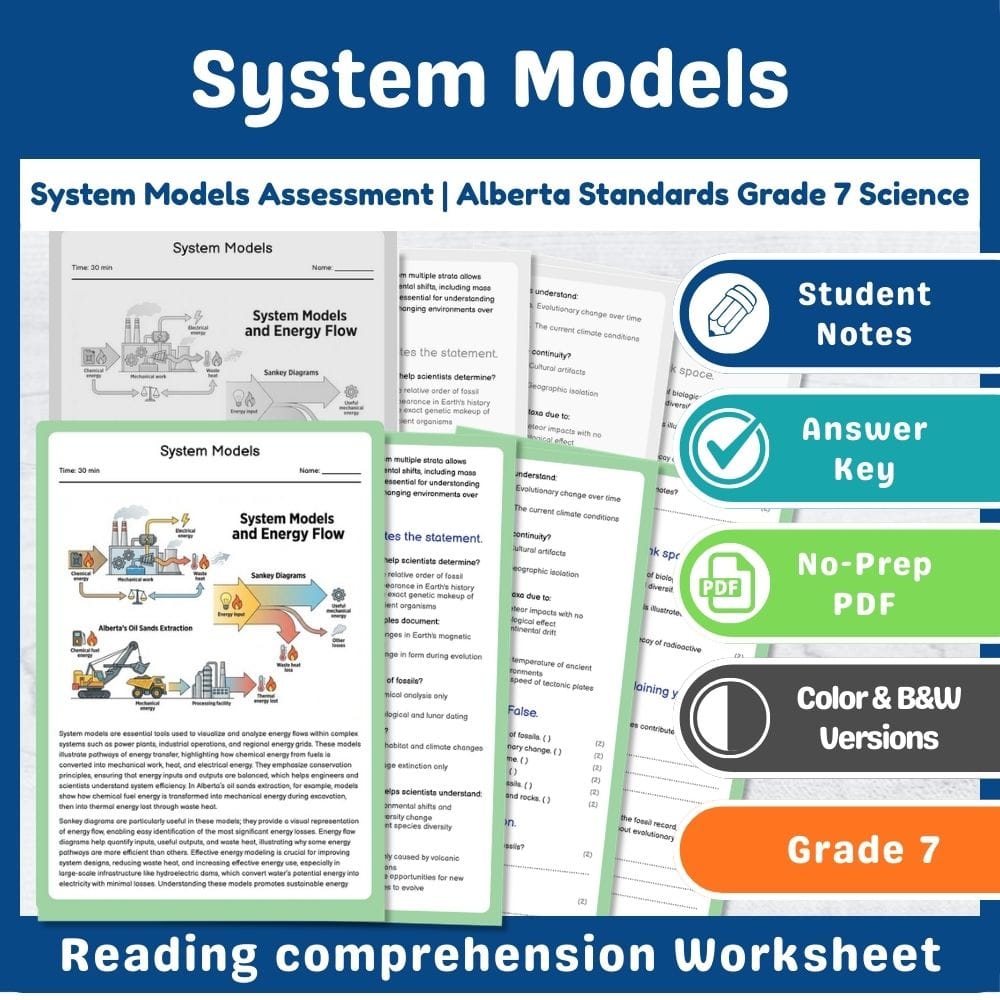
System Models Assessment | Alberta Standards Grade 7 Science
 Created byPrism Point Learning
Learning Objectives
- Understand how energy pathways are traced and represented in system models.
- Analyze energy transformations and identify loss mechanisms in regional energy systems.
- Utilize diagrams such as Sankey diagrams and energy flow charts to interpret energy data.
Also included in: Lesson Grade 7 Science Mini Bundle | Energy, Heat & Thermal Processes +1 more
Instant download

Natural Selection Assessment | NGSSS Standards Grade 7 Science Worksheet
Created byPrism Point LearningLearning Objectives
- Explain how natural selection depends on heritable variation and differential survival and reproduction
- Describe how trait frequencies in a population can change over many generations
- Distinguish natural selection from individual organisms “trying” to adapt during their lifetime
Instant download

Grade 7 Science – Structural Basics Worksheet (Alberta Standards) (PDF)
 Created byEvergreen Desk Education
Learning Objectives
- Explain how supports, foundations, and load paths work together to maintain structural stability.
- Differentiate compression, tension, and shear and predict where each force appears in common structures.
- Identify how material properties (stiffness, strength, durability) help determine safety under wind and snow loads.
Instant download
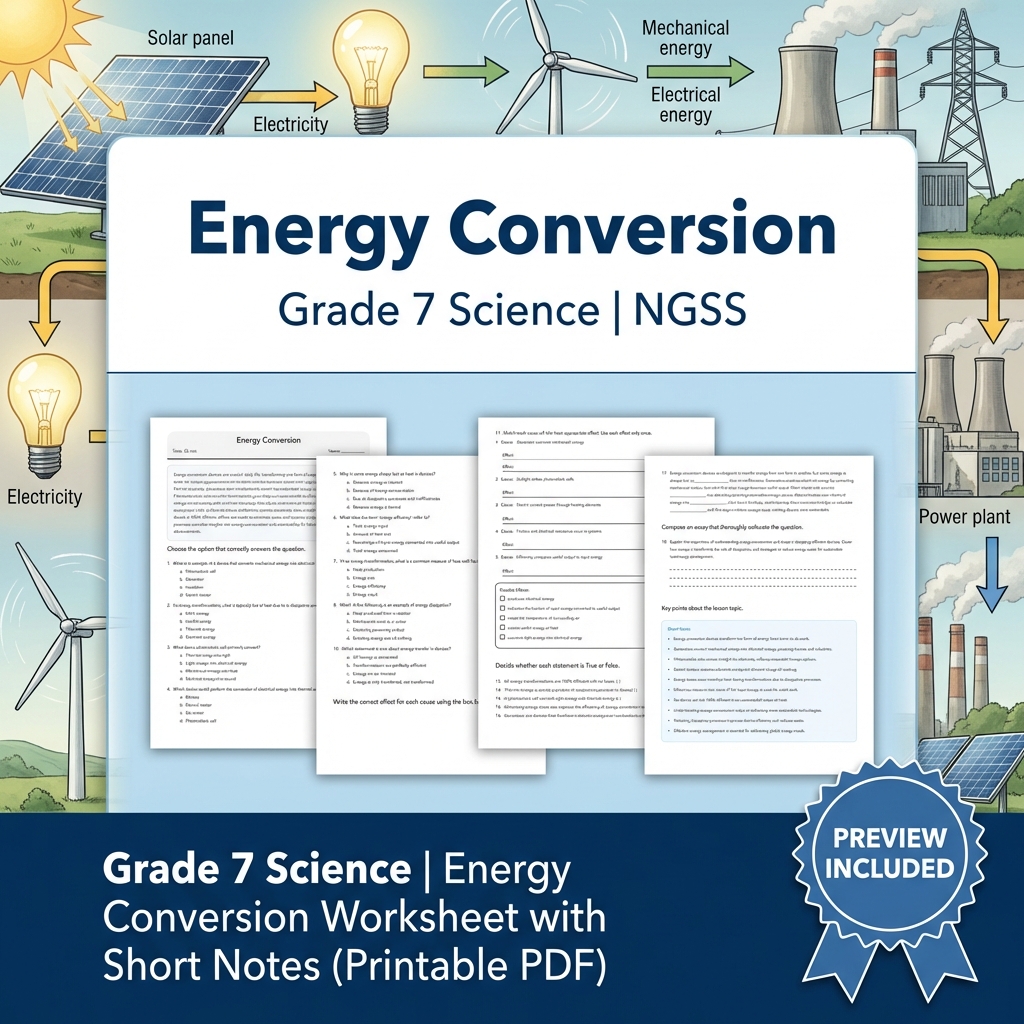
Grade 7 Science | Energy Conversion Worksheet with Short Notes (Printable PDF)
 Created byMeadowlark Worksheets
Learning Objectives
- Understand the principles of energy transfer and conversion in different devices.
- Identify examples of devices that convert energy from one form to another.
- Learn about energy accounting and the concept of efficiency in energy transformations.
Also included in: Grade 7 Science Energy Bundle Potential, Kinetic & Heat Transfer Worksheets +1 more
Instant download
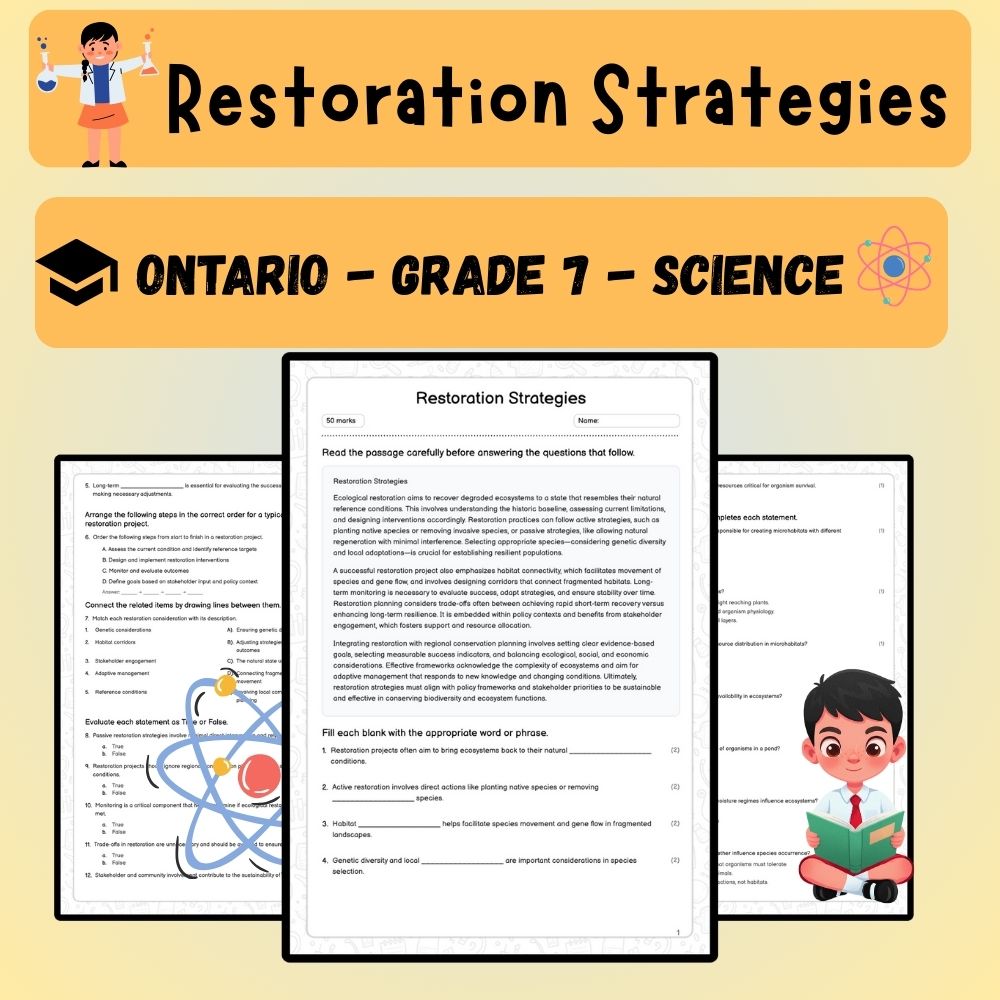
Grade 7 Science – Restoration Strategies Worksheet (PDF ) | Ontario Standards
Created byPrism Point LearningLearning Objectives
- Understand the principles of ecological restoration including reference conditions and approaches.
- Identify factors involved in species selection, habitat connectivity, and long-term monitoring in restoration projects.
- Evaluate trade-offs between short-term recovery and long-term resilience in restoration planning.
Also included in: Grade 7 Science UNIT Bundle | Ecosystems & Biodiversity Worksheets +1 more
Instant download
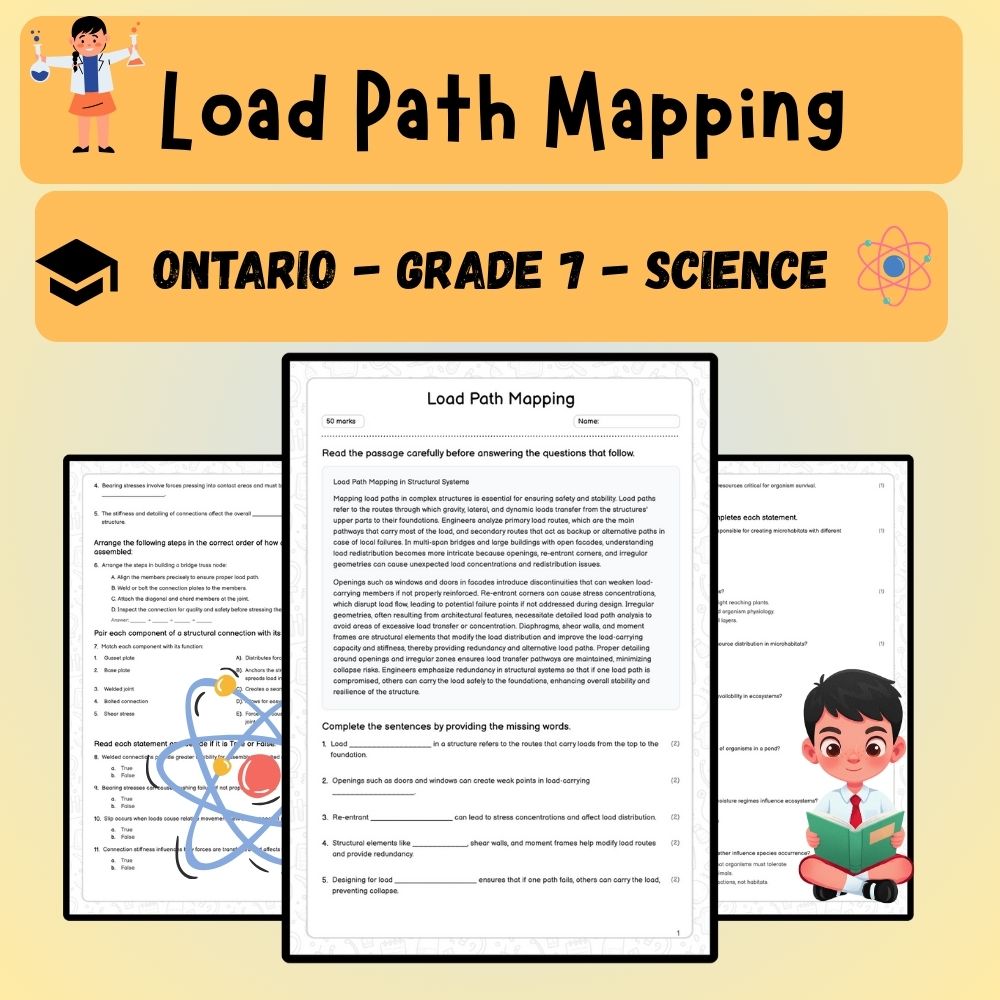
Grade 7 Science | Load Path Mapping Worksheet (PDF) - Ontario Standards
Created byPrism Point LearningLearning Objectives
- Understand methods for mapping load paths in complex structures.
- Identify primary and secondary load routes in structural systems.
- Analyze how openings and irregular geometries influence load redistribution.
Also included in: Grade 7 Science Unit | Structural Engineering & Material Testing Worksheets Bundle +1 more
Instant download
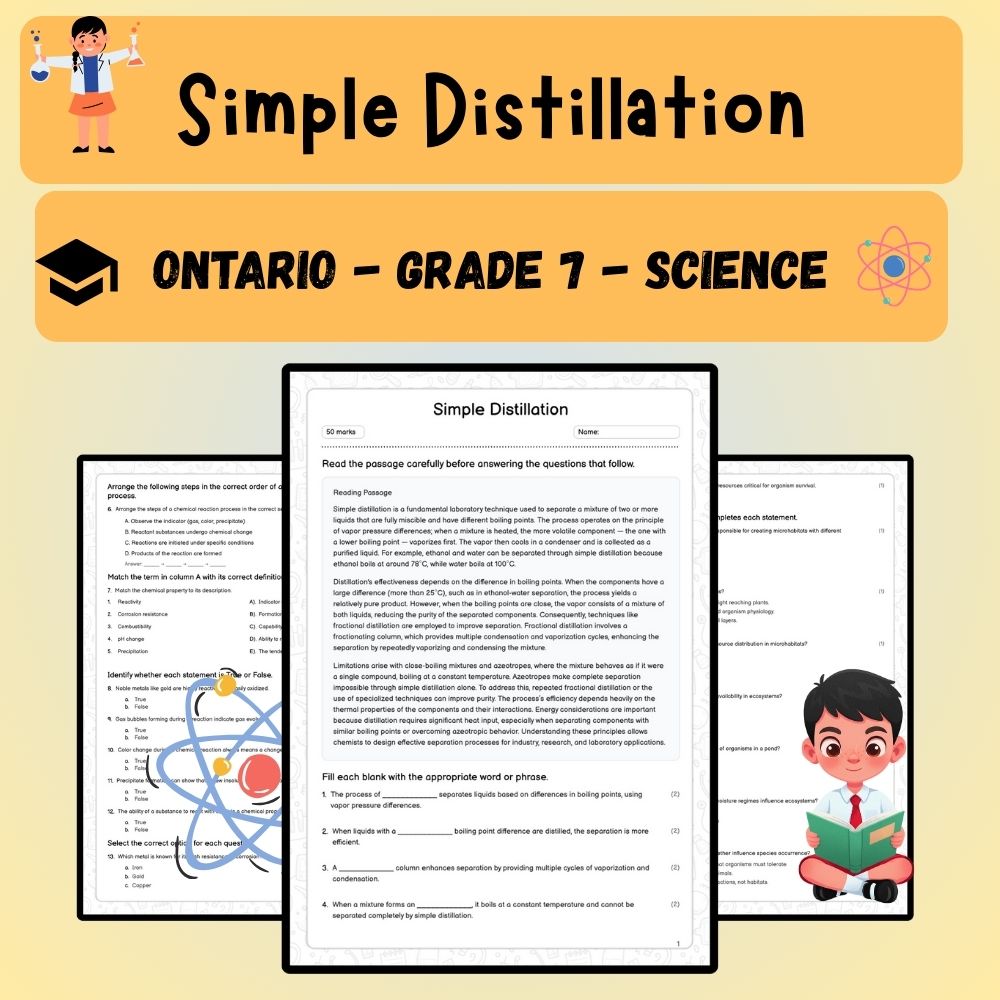
Grade 7 Science | Simple Distillation Worksheet (PDF ) – Ontario Standards
Created byPrism Point LearningLearning Objectives
- Understand the principles of simple distillation and vapor pressure differences.
- Identify the limitations of distillation when separating close-boiling mixtures and azeotropes.
- Explain how fractional distillation improves separation efficiency.
Also included in: Grade 7 Science Unit Bundle | Substances, Mixtures & Properties Worksheets +1 more
Instant download
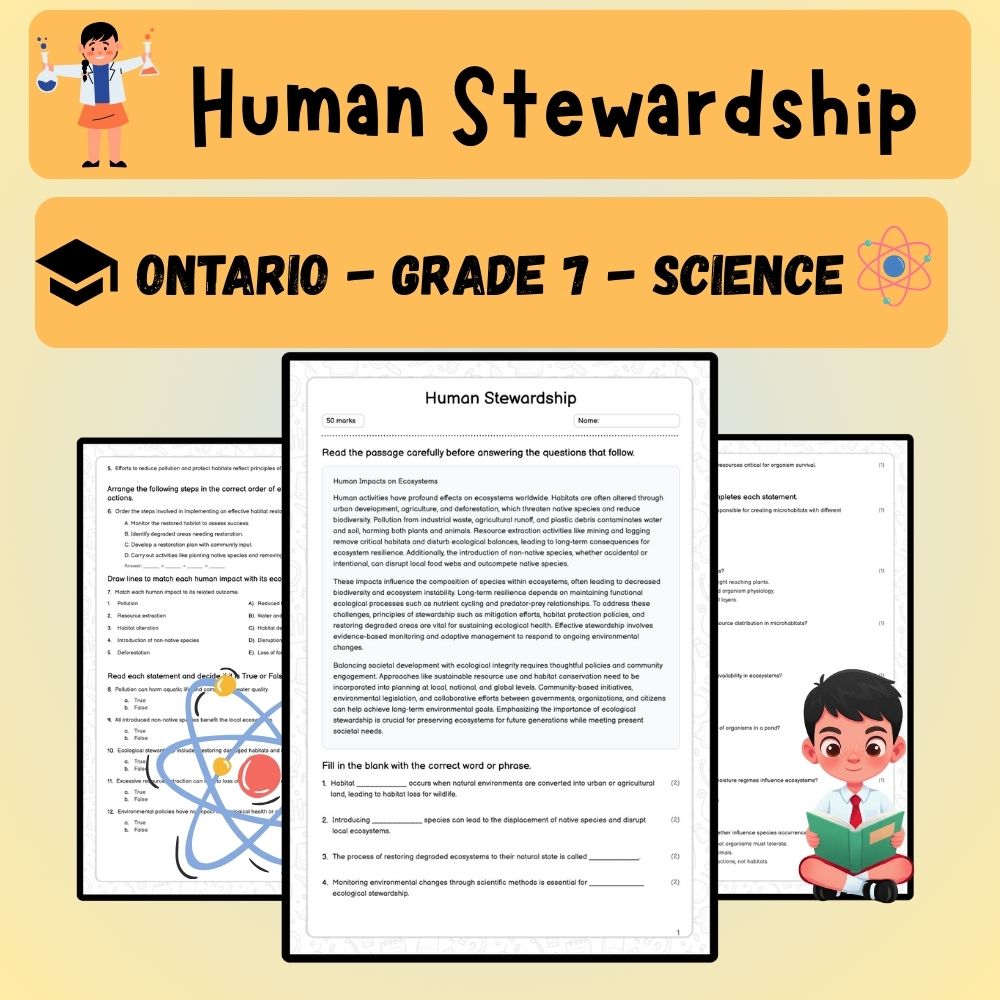
Grade 7 Science – Human Stewardship Worksheet (PDF) – Ontario Standards
Created byPrism Point LearningLearning Objectives
- Understand human impacts on ecosystems including habitat alteration, pollution, resource extraction, and invasive species.
- Identify principles of ecological stewardship such as mitigation, habitat protection, restoration, and monitoring.
- Analyze the balance between societal needs and ecological integrity in environmental decision-making.
Also included in: Grade 7 Science UNIT Bundle | Ecosystems & Biodiversity Worksheets +1 more
Instant download
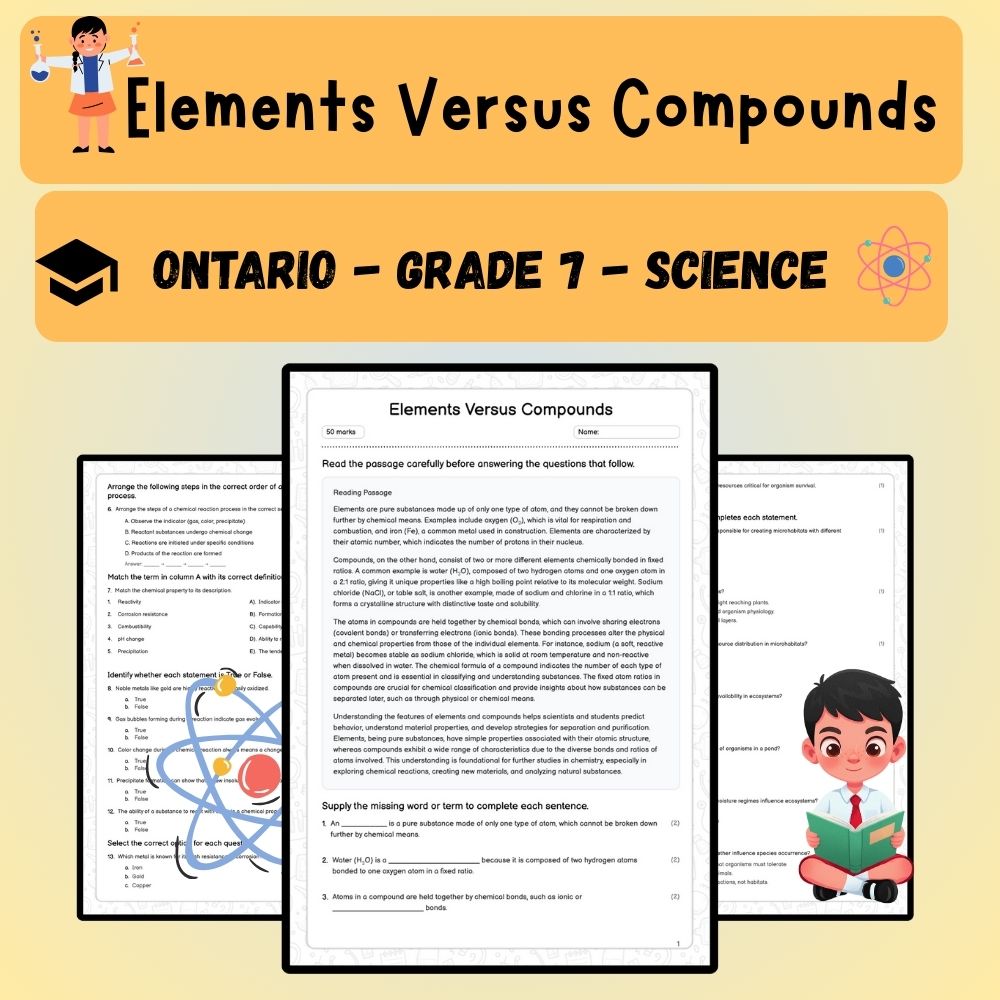
Grade 7 Science | Elements vs Compounds Worksheet (PDF )
Created byPrism Point LearningLearning Objectives
- Understand the differences between elements and compounds based on atomic composition and bonding.
- Identify characteristic properties of elements and compounds such as melting point and conductivity.
- Interpret chemical formulas and recognize fixed ratios of atoms in compounds.
Also included in: Grade 7 Science Unit Bundle | Substances, Mixtures & Properties Worksheets +1 more
Instant download
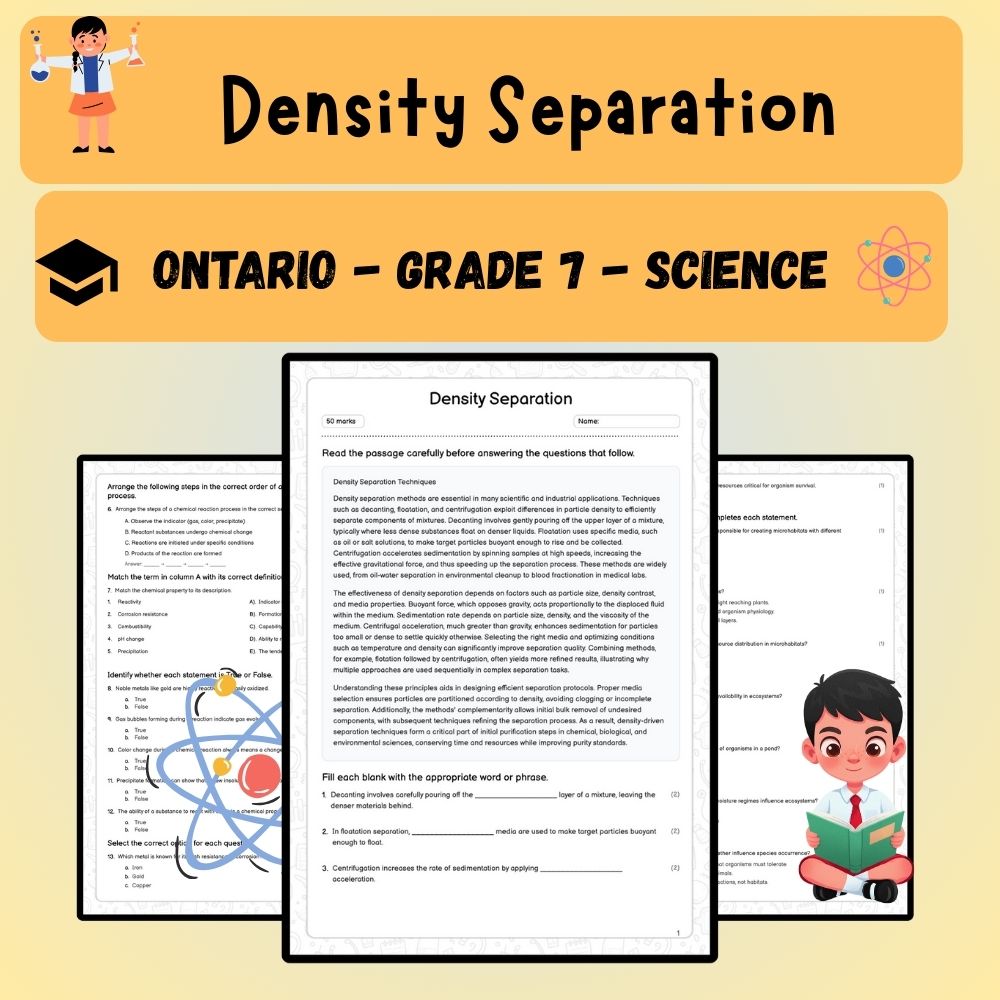
Grade 7 Science | Density Separation Worksheet (PDF) – Ontario Standards
Created byPrism Point LearningLearning Objectives
- Understand how density differences enable separation techniques such as decanting, floatation, and centrifugation.
- Explain the principles of buoyant force, sedimentation rate, and centrifugal acceleration in particle separation.
- Identify suitable media and conditions for effective density-based separation methods.
Also included in: Grade 7 Science Unit Bundle | Substances, Mixtures & Properties Worksheets +1 more
Instant download
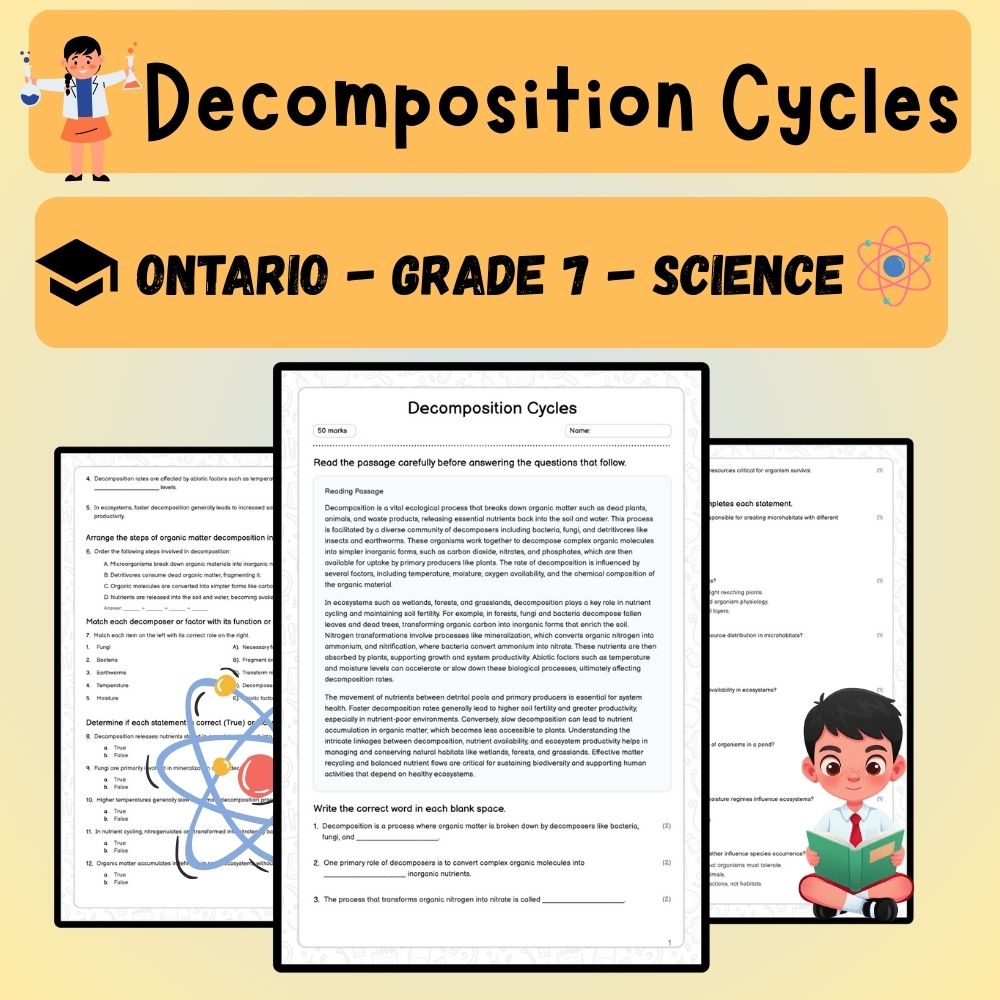
Grade 7 Science | Decomposition Cycles Worksheet (PDF )
Created byPrism Point LearningLearning Objectives
- Describe the processes involved in decomposition and nutrient cycling.
- Identify the roles of detritivores, fungi, bacteria, and abiotic factors in decomposition.
- Explain how carbon and nitrogen are transformed during decomposition.
Also included in: Grade 7 Science UNIT Bundle | Ecosystems & Biodiversity Worksheets +1 more
Instant download
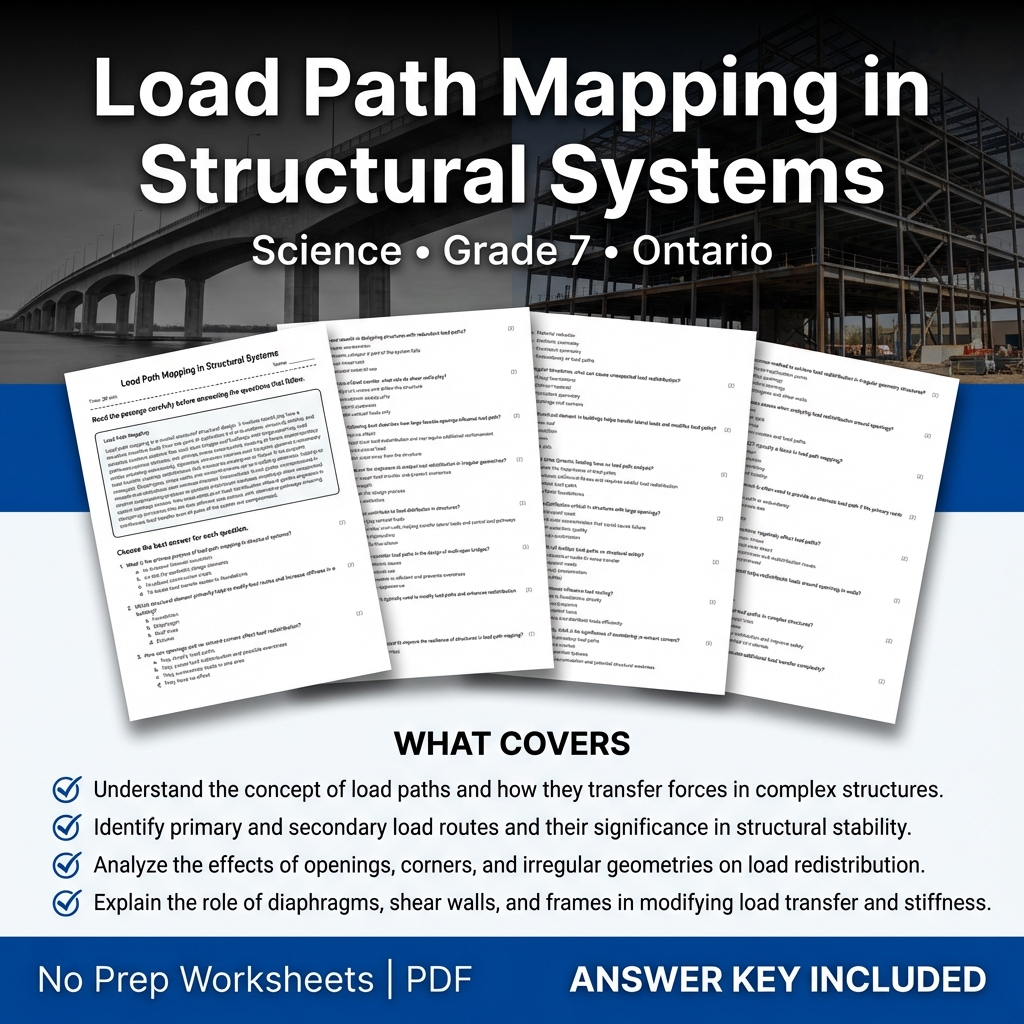
Load Path Mapping in Structural Systems Worksheet for Grade 7 Science
 Created byCoral Reef Learning
Learning Objectives
- Understand the concept of load paths and how they transfer forces in complex structures.
- Identify primary and secondary load routes and their significance in structural stability.
- Analyze the effects of openings, corners, and irregular geometries on load redistribution.
Instant download

Grade 7 Science Rock Strata Worksheet | NGSS Relative Dating & Geology
 Created byNorthstar Worksheets
Learning Objectives
- Explain how superposition, original horizontality, and cross-cutting relationships help determine the relative ages of rock layers.
- Identify how fossils, unconformities, and intrusive contacts act as markers for correlating strata across locations.
- Use stratigraphic evidence to construct a logical sequence of depositional, tectonic, and erosional events.
Also included in: Grade 7 Space Science Lesson Bundle | NGSS Solar System & Gravity +1 more
Instant download
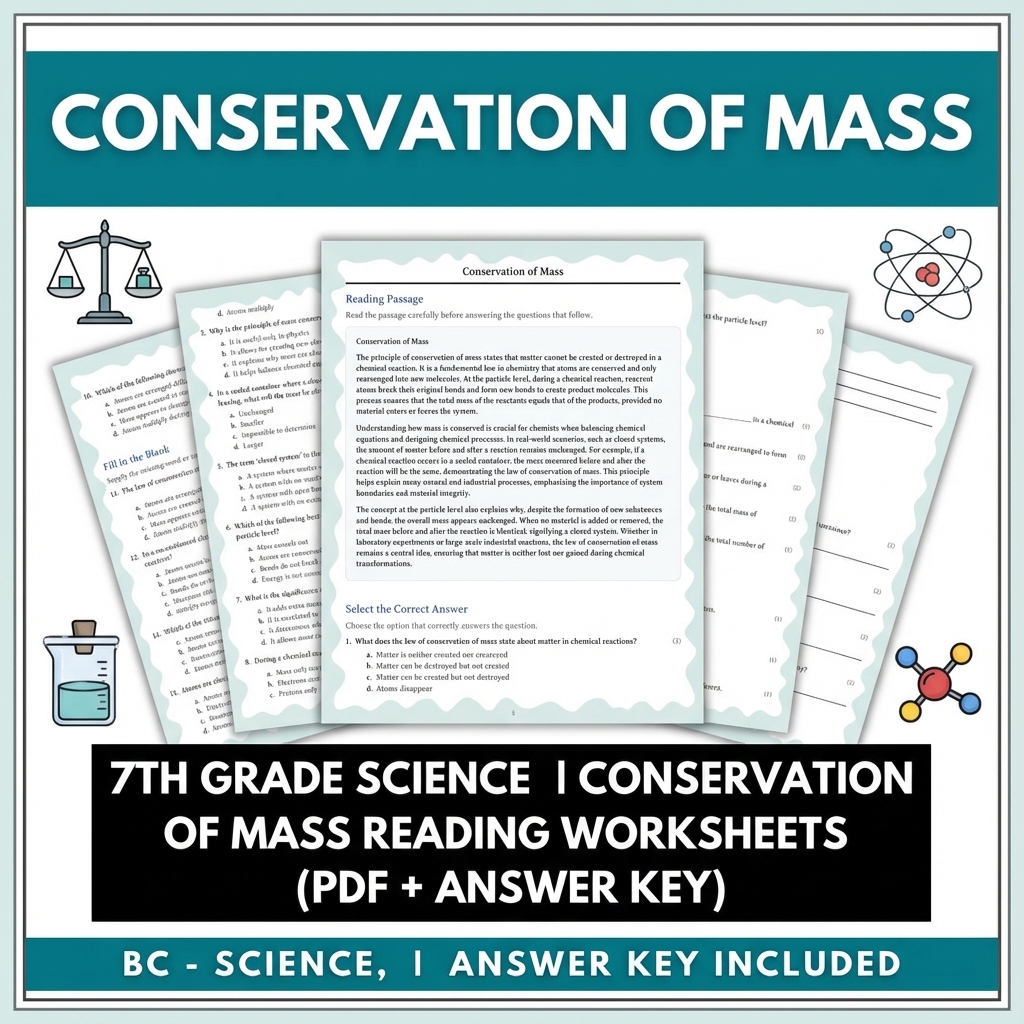
7th Grade Science | Conservation of Mass Reading Worksheets (PDF + Answer Key)
JCreated byJ.S SheetsLearning Objectives
- Understand the principle of conservation of mass in chemical reactions.
- Describe how atoms are conserved and rearranged during reactions.
- Explain the concept of closed systems and their importance in mass conservation.
Instant download
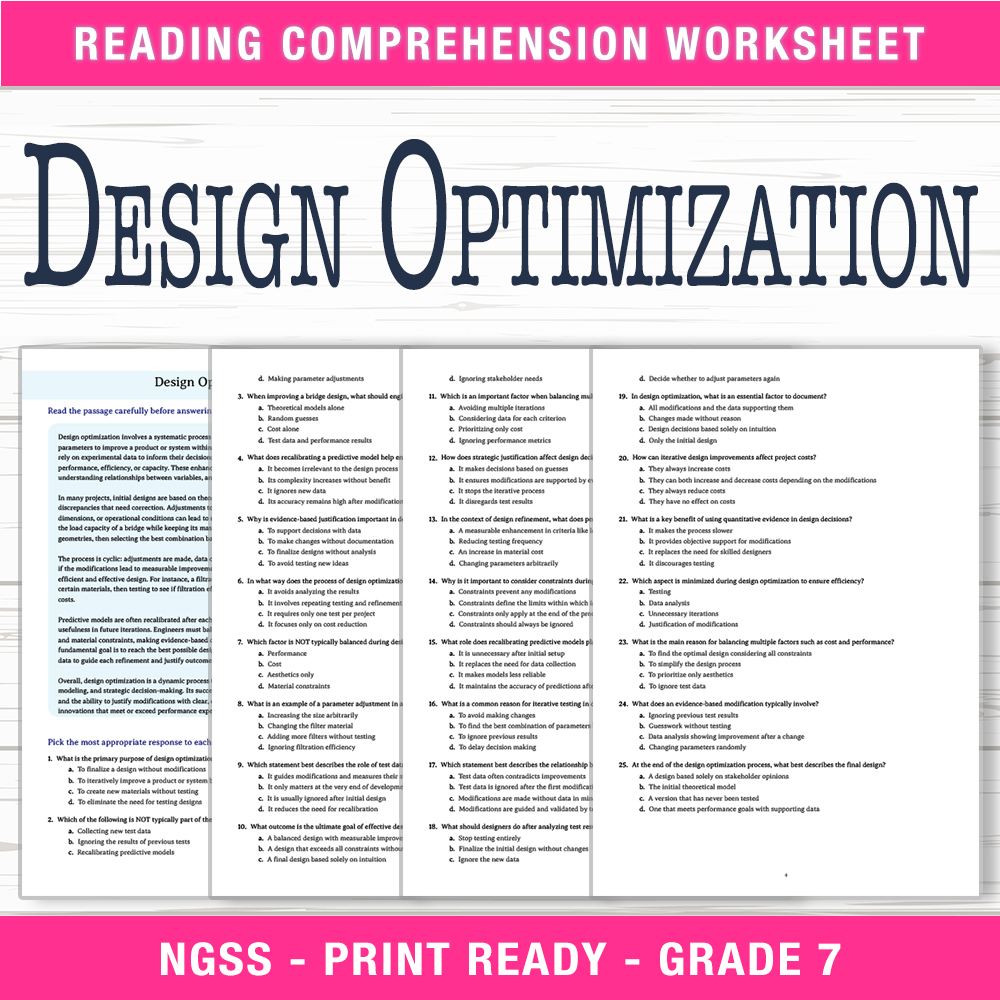
Grade 7 Science – Design Optimization Worksheet (PDF + Answer Key)
 Created byRiverstone Classroom
Learning Objectives
- Analyze test data to identify factors affecting design performance.
- Refine design parameters through iterative adjustments to improve outcomes.
- Develop justifications for modifications based on quantitative comparisons.
Instant download

Grade 7 Science – Standards & Safety in Technology | Daily Reading Worksheet
 Created byBright Mind Resources
Learning Objectives
- Understand the importance of building codes and safety standards.
- Identify common safety requirements in construction and technology.
- Explain the rationale behind safety margins and inspection protocols.
Also included in: Grade 7 Technology & Engineering Science Lesson Bundle: Daily Reading | TEKS +2 more
Instant download
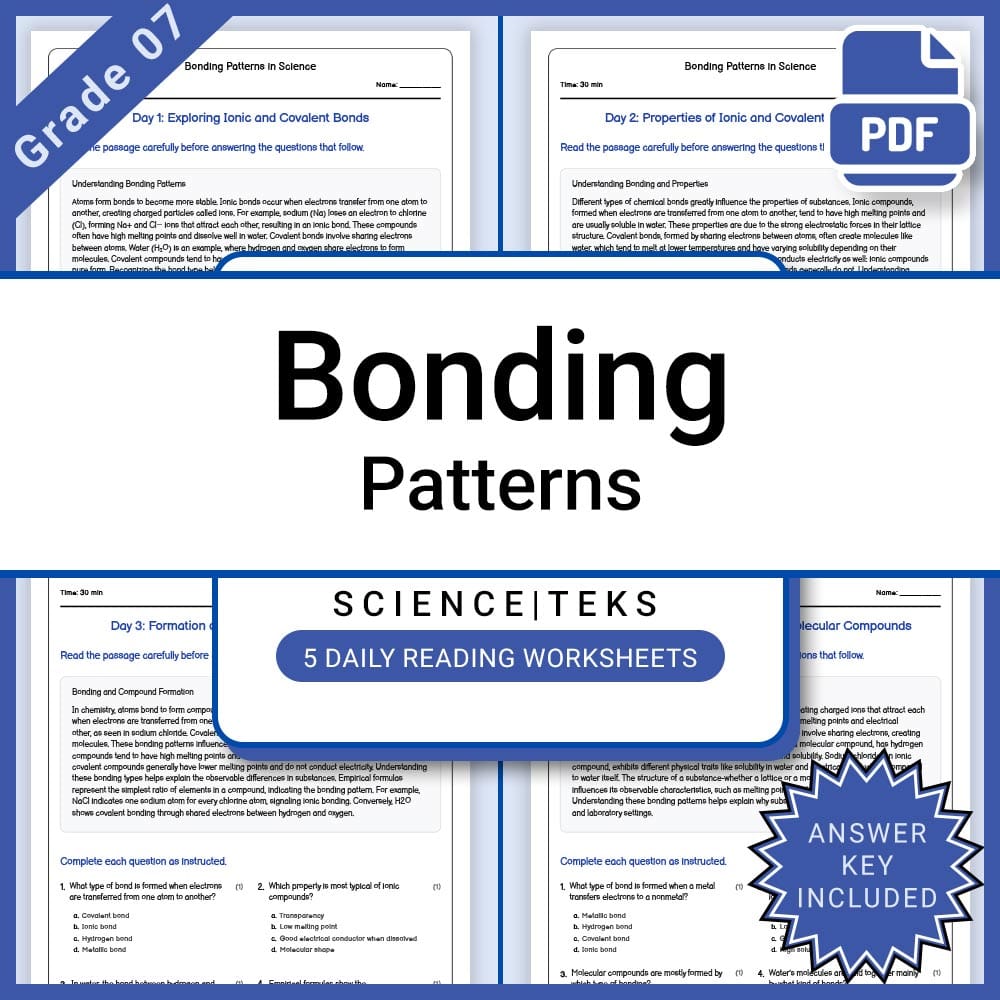
Grade 7 Science – Bonding Patterns Daily Reading Worksheet + Answer Key
JCreated byJ.S SheetsLearning Objectives
- Understand key concepts related to Science
- Apply knowledge through practice questions
- Demonstrate comprehension of the material
Also included in: Grade 7 Science Lesson Group: TEKS-Aligned Daily Reading Worksheets +1 more
Instant download
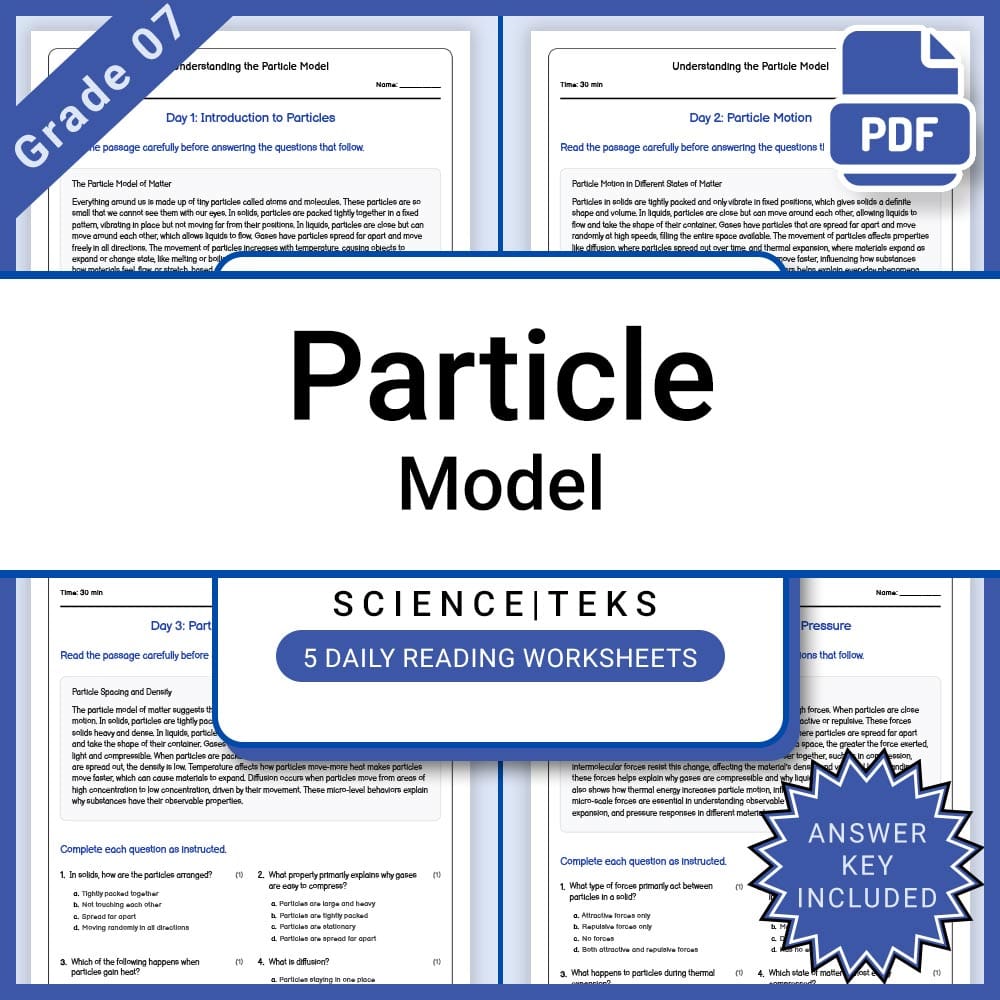
Grade 7 Science – Particle Model | Daily Reading Worksheet + Answer Key
JCreated byJ.S SheetsLearning Objectives
- Explain the basic idea of particles and how they are arranged in different states of matter
- Describe how particle movement relates to temperature and state changes
- Understand how microscopic particle interactions determine macroscopic properties like density, pressure, and compressibility
Also included in: Grade 7 Science Lesson Group: TEKS-Aligned Daily Reading Worksheets +1 more
Instant download
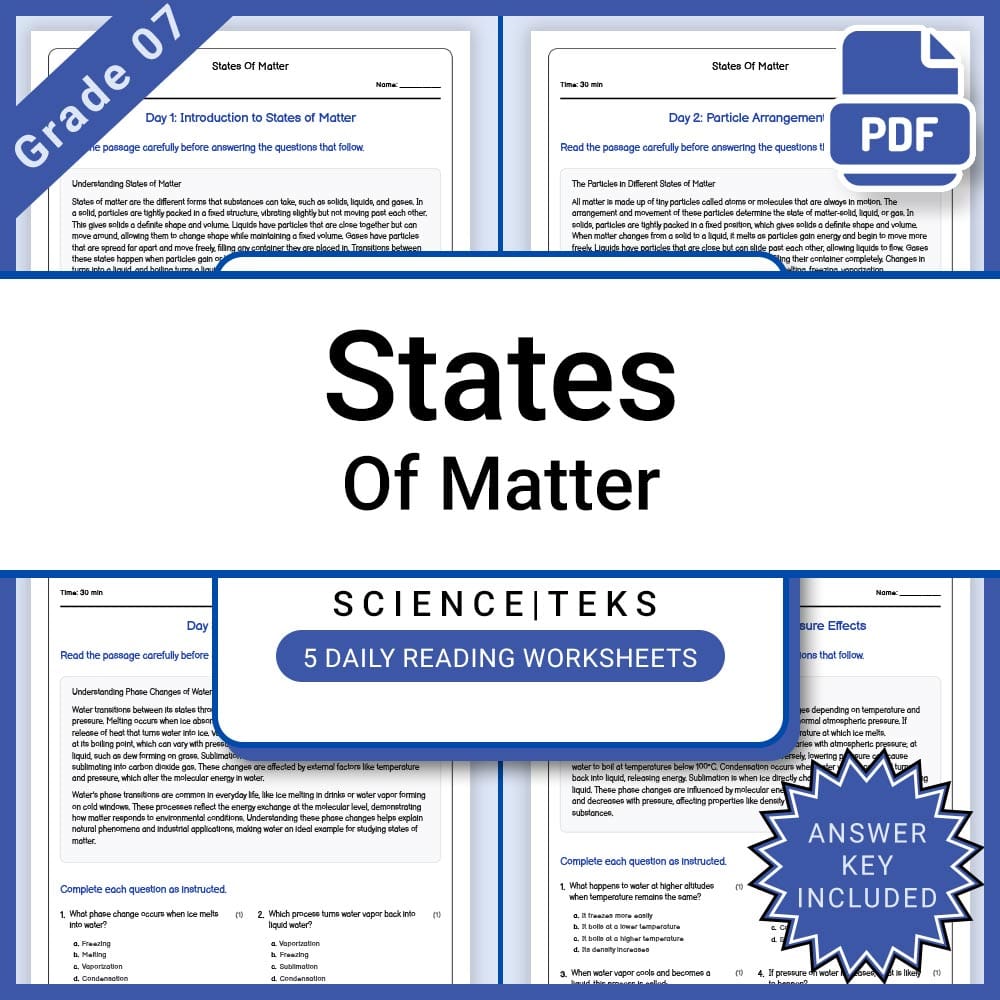
Grade 7 Science – States of Matter Daily Reading Worksheet with Answer Key
JCreated byJ.S SheetsLearning Objectives
- Recognize and describe the three main states of matter: solid, liquid, and gas.
- Understand the particle arrangements and energy regimes in each state.
- Identify phase changes and conditions that cause state transitions.
Also included in: Grade 7 Science Lesson Group: TEKS-Aligned Daily Reading Worksheets +1 more
Instant download
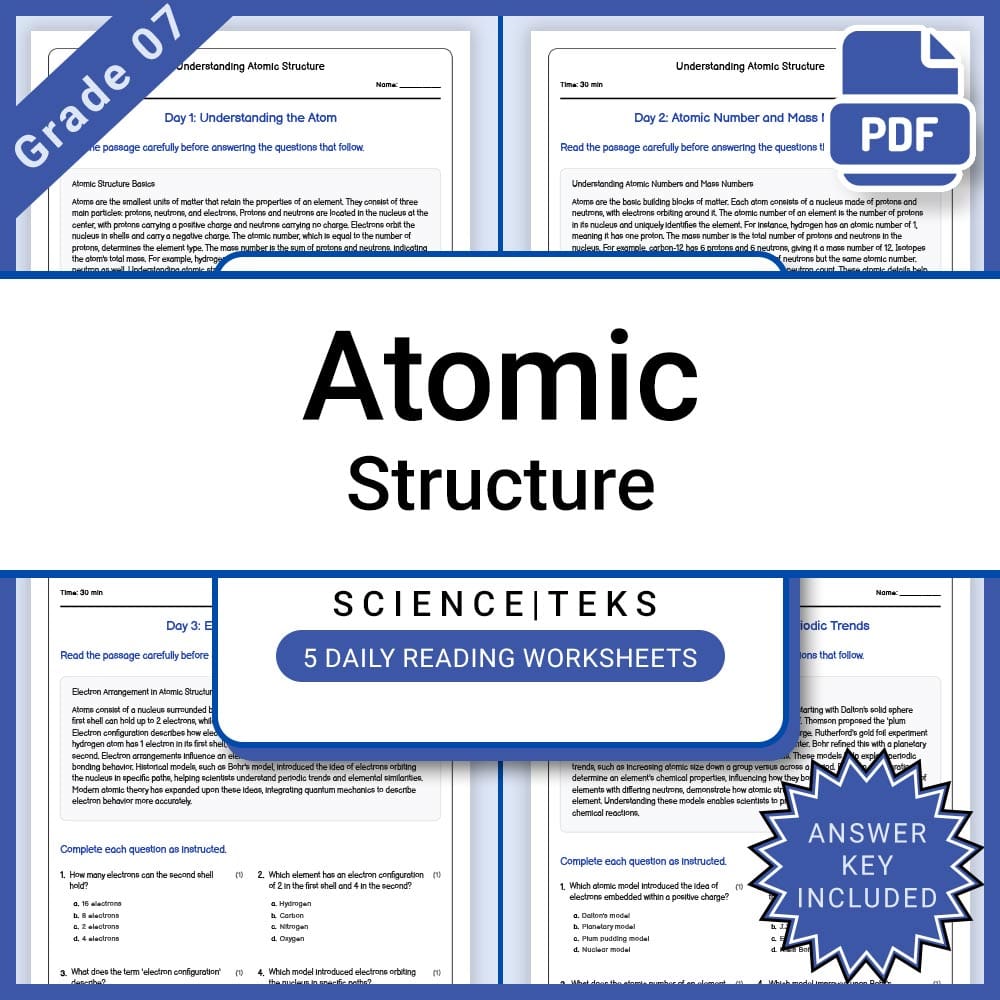
Grade 7 Science – Atomic Structure Daily Reading Worksheet with Answer Key
JCreated byJ.S SheetsLearning Objectives
- Identify the basic parts of an atom: protons, neutrons, and electrons.
- Explain how atomic number and mass number relate to element identity.
- Describe simple electron arrangements and atomic models.
Also included in: Grade 7 Science Lesson Group: TEKS-Aligned Daily Reading Worksheets +1 more
Instant download
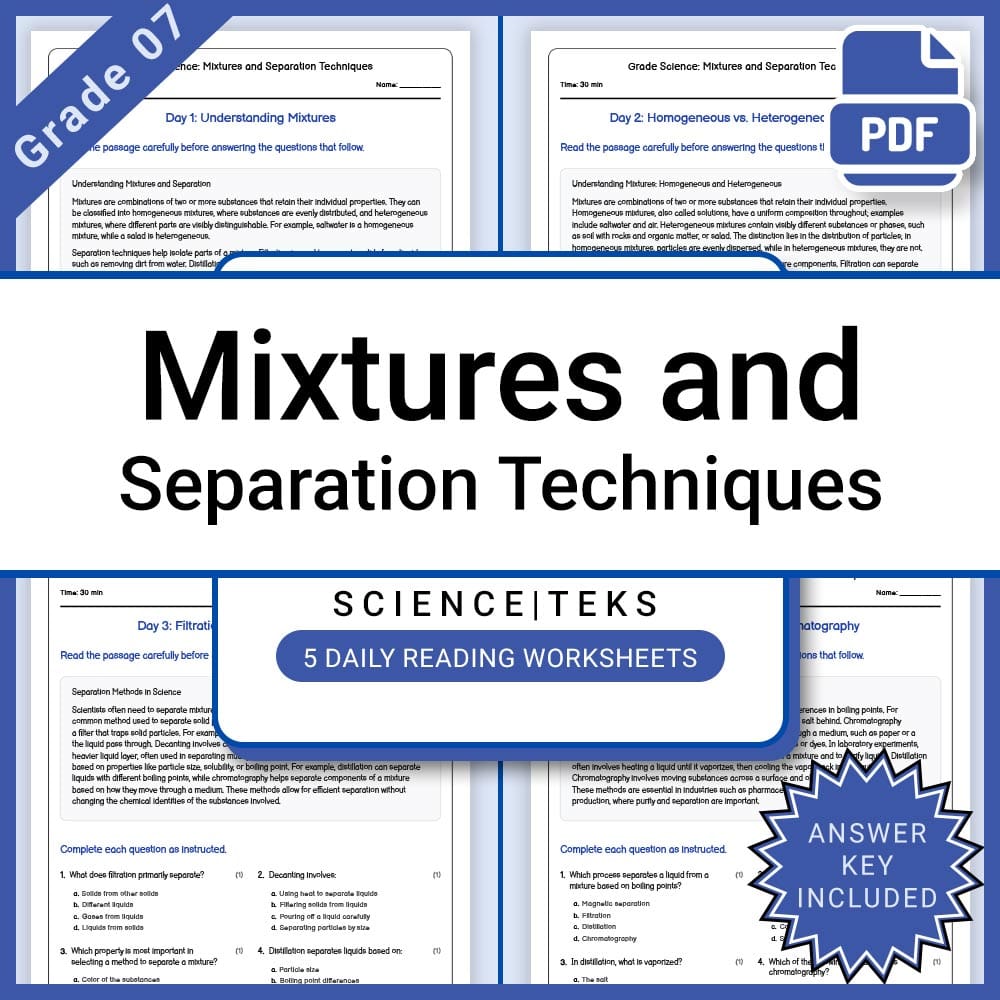
Grade 7 Science – Mixtures and Separation Techniques Worksheet + Answer Key
JCreated byJ.S SheetsLearning Objectives
- Identify and differentiate between homogeneous and heterogeneous mixtures.
- Describe various separation methods such as filtration, distillation, chromatography, and magnetic separation.
- Understand how properties like solubility, particle size, and boiling point influence separation techniques.
Also included in: Grade 7 Science Lesson Group: TEKS-Aligned Daily Reading Worksheets +1 more
Instant download
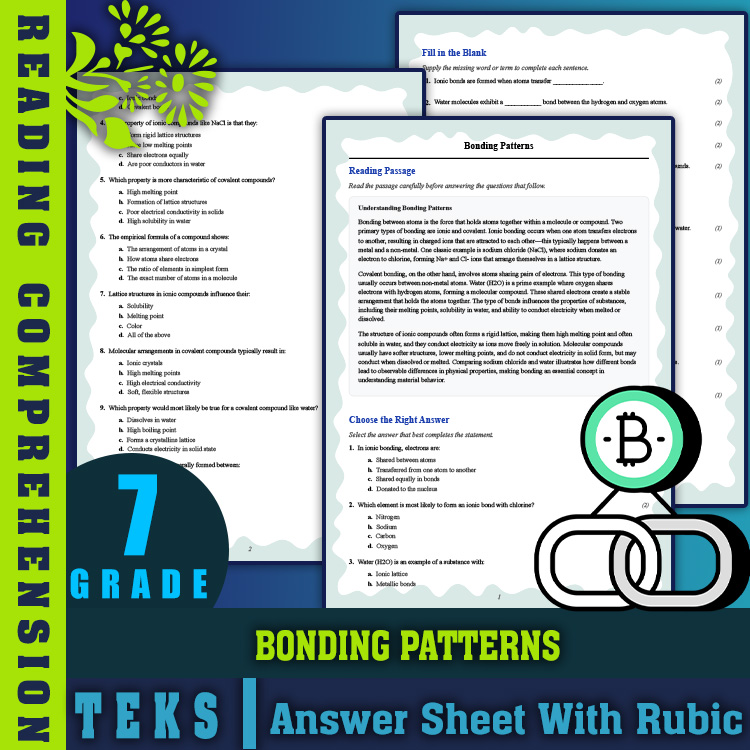
7th Grade Science | Bonding Patterns Reading Worksheet & Answer Key (PDF)
JCreated byJ.S SheetsLearning Objectives
- Understand the differences between ionic and covalent bonding.
- Relate bonding types to properties like melting point, solubility, and electrical conductivity.
- Describe how simple binary ionic salts and molecular compounds form using empirical formulas.
Instant download
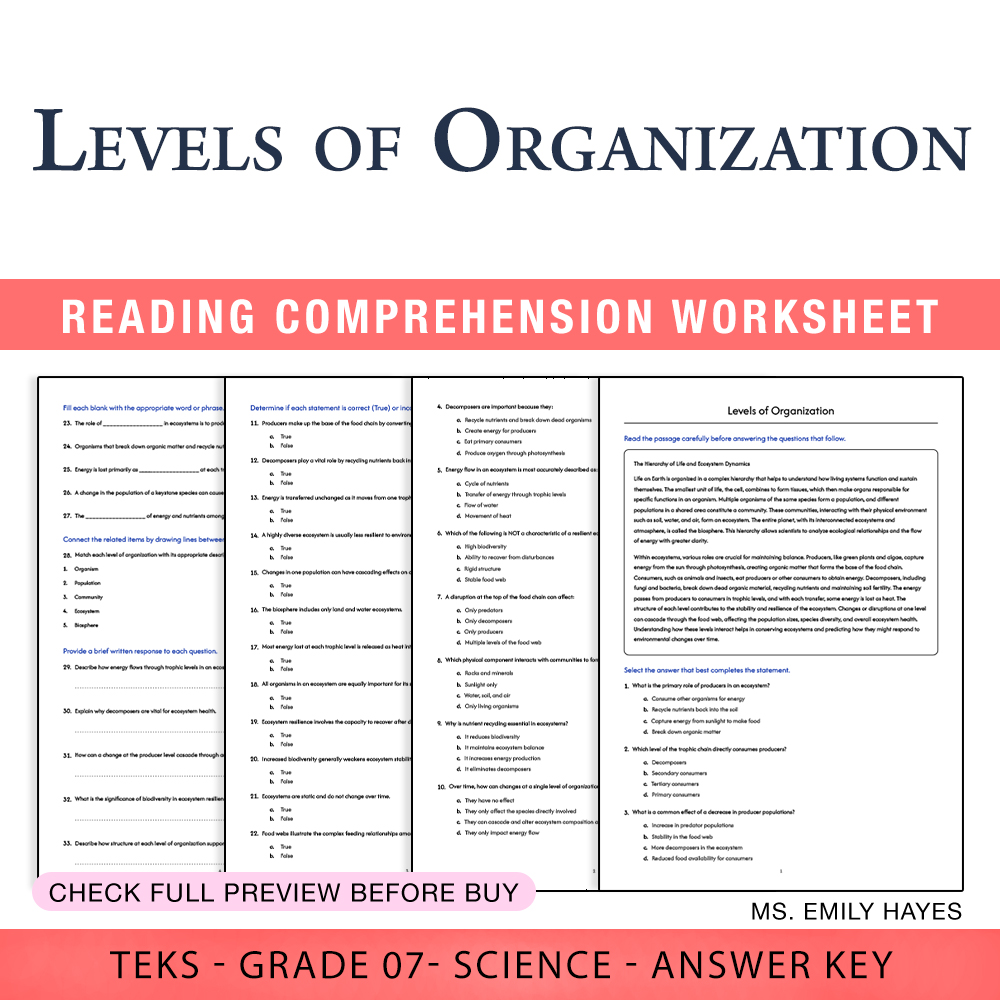
7th Grade Science | Levels of Organization Worksheet (PDF+ Answer Key)
 Created byCopper Leaf Classroom
Learning Objectives
- Describe the hierarchical levels in biological organization from individual organisms to the biosphere.
- Explain the roles of producers, consumers, and decomposers in ecosystems.
- Analyze how energy flows through trophic levels and its effect on ecosystem stability.
Instant download
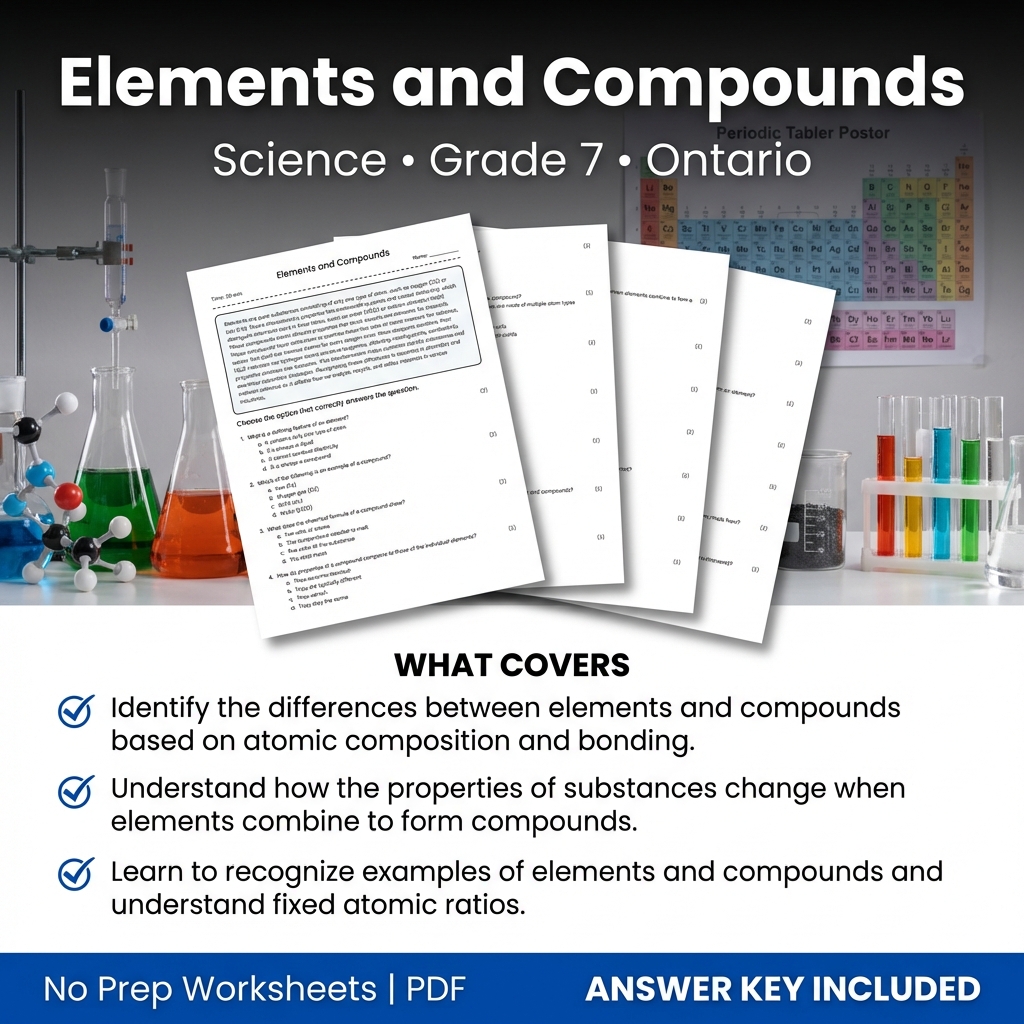
Elements and Compounds Worksheet | Grade 7 Science Ontario Standards
Created byCoral Reef LearningLearning Objectives
- Identify the differences between elements and compounds based on atomic composition and bonding.
- Understand how the properties of substances change when elements combine to form compounds.
- Learn to recognize examples of elements and compounds and understand fixed atomic ratios.
Instant download
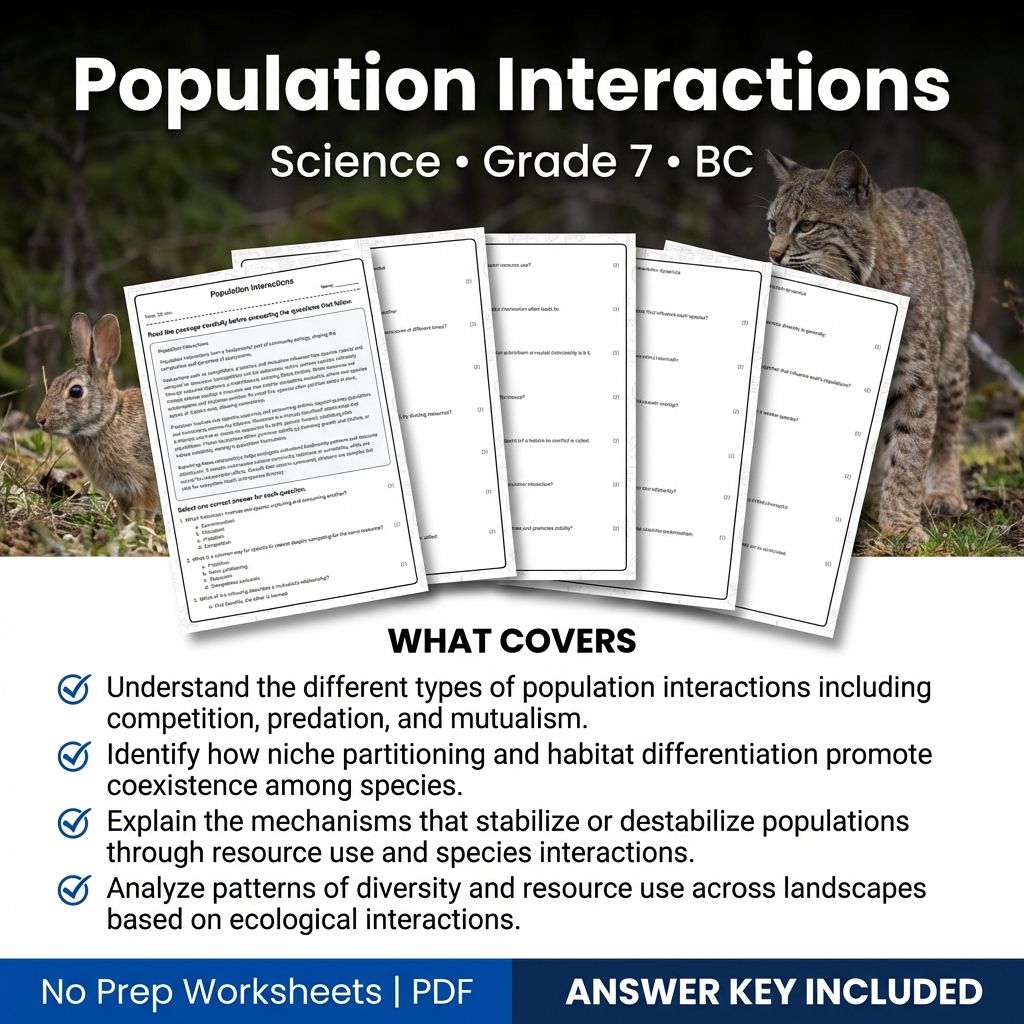
Grade 7 Science Worksheet | Population Interactions and Ecosystem Concepts (Printable PDF + Answer Key)
Created byCoral Reef LearningLearning Objectives
- Understand the different types of population interactions including competition, predation, and mutualism.
- Identify how niche partitioning and habitat differentiation promote coexistence among species.
- Explain the mechanisms that stabilize or destabilize populations through resource use and species interactions.
Instant download
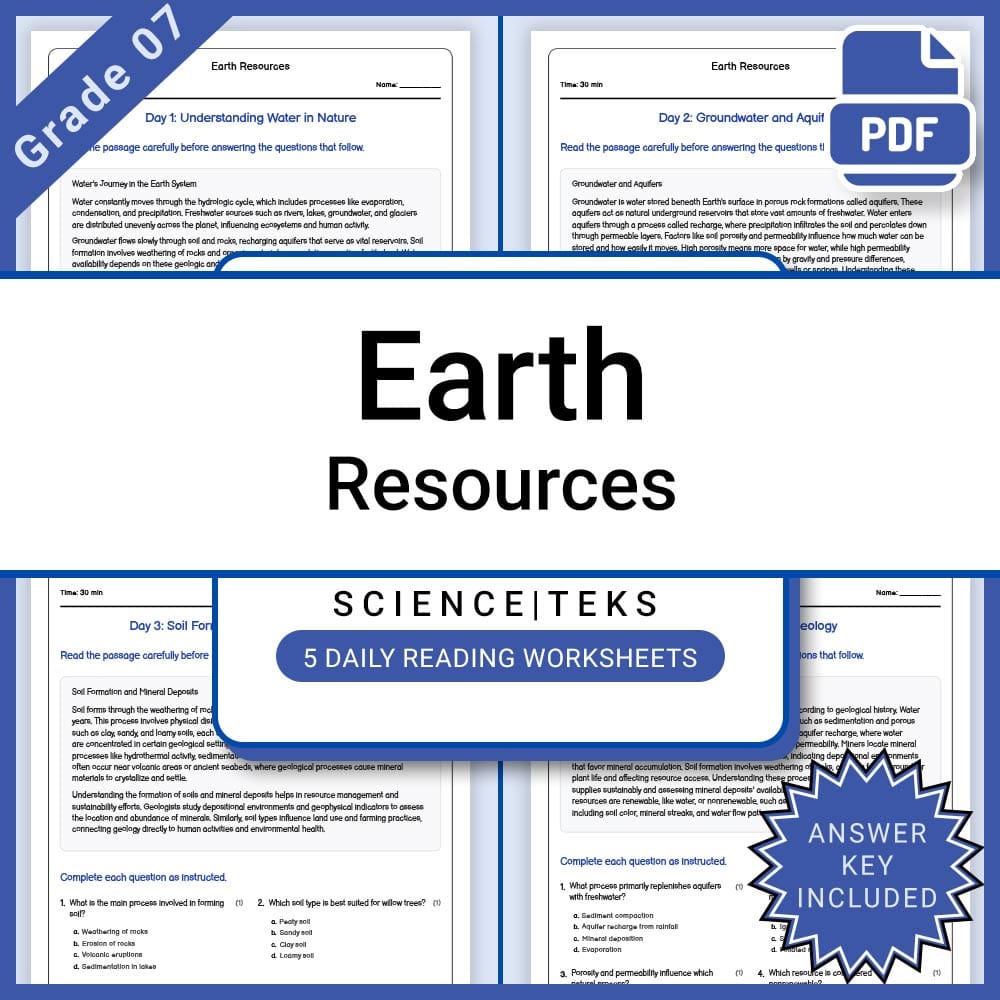
Grade 7 Science Earth Resources Daily Reading Worksheet with Answer Key
JCreated byJ.S SheetsLearning Objectives
- Identify sources of freshwater and understand how water moves through the Earth's hydrologic cycle.
- Describe processes involved in groundwater flow and soil formation.
- Explain how mineral deposits form and how geologic settings influence resource availability.
Also included in: Grade 7 Science Lesson Group – TEKS Aligned & Concept-Focused Lesson Bundle +1 more
Instant download
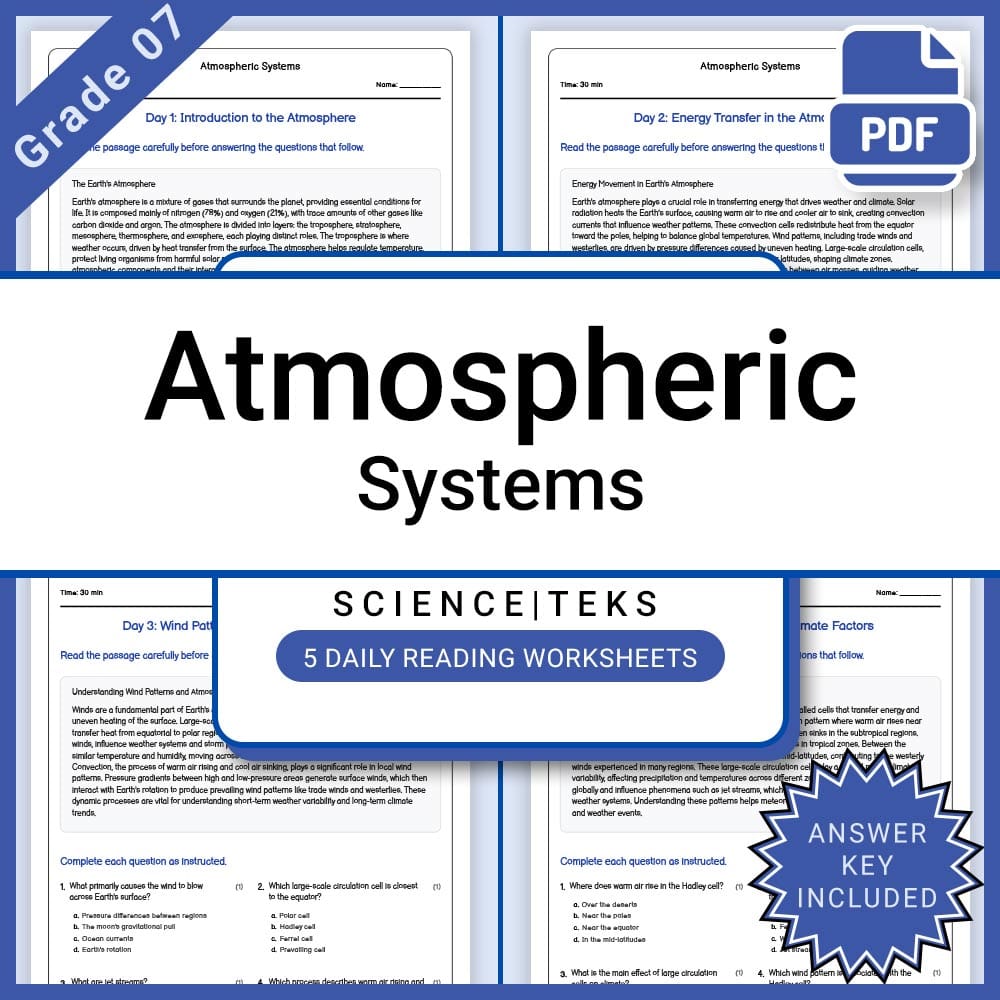
Grade 7 Science Atmospheric Systems Daily Reading Worksheet with Answer Key
JCreated byJ.S SheetsLearning Objectives
- Identify the main components of Earth's atmosphere
- Understand the processes of energy transfer within the atmosphere
- Describe the movement of air masses and pressure gradients
Also included in: Grade 7 Science Lesson Group – TEKS Aligned & Concept-Focused Lesson Bundle +1 more
Instant download
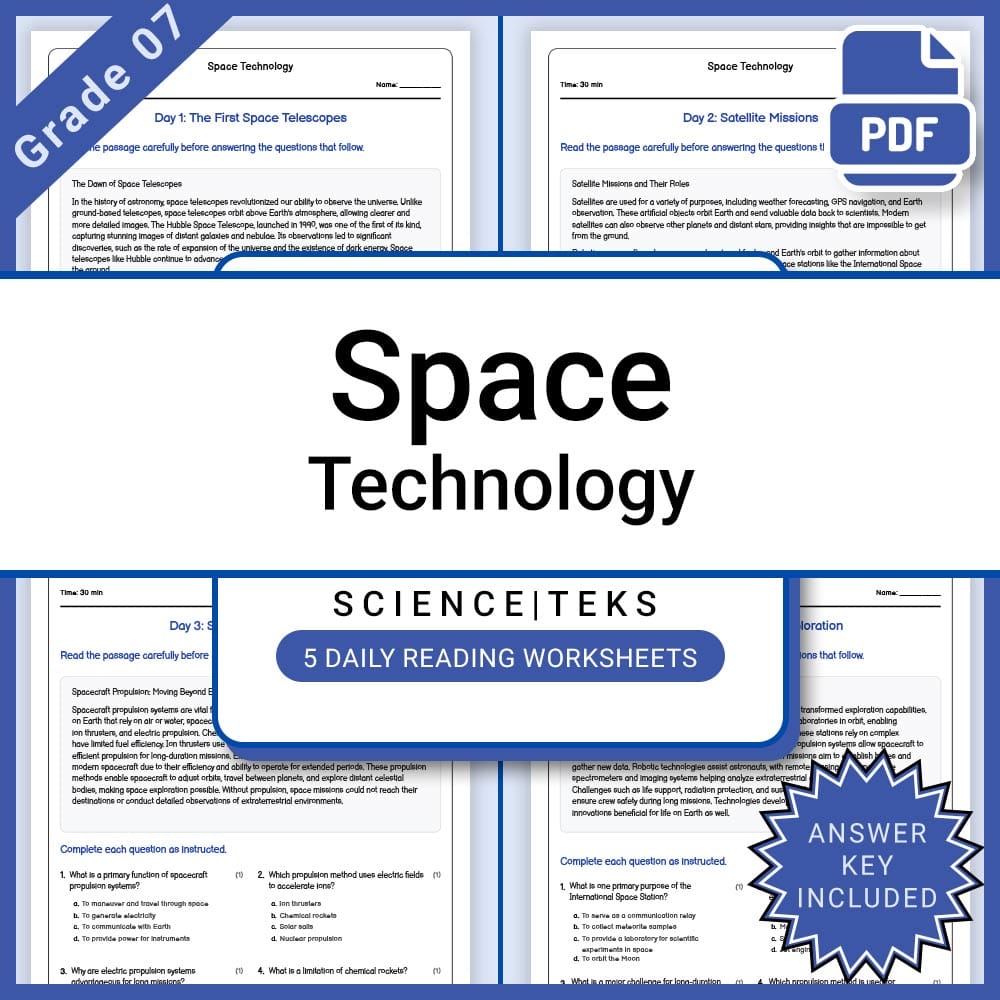
Grade 7 Science – Space Technology Daily Reading Worksheet with Answer Key
JCreated byJ.S SheetsLearning Objectives
- Understand the history and development of space telescopes.
- Learn how space telescopes extend our view of the universe.
- Recognize major space missions involving telescopes and satellites.
Also included in: Grade 7 Science Lesson Group – TEKS Aligned & Concept-Focused Lesson Bundle +1 more
Instant download
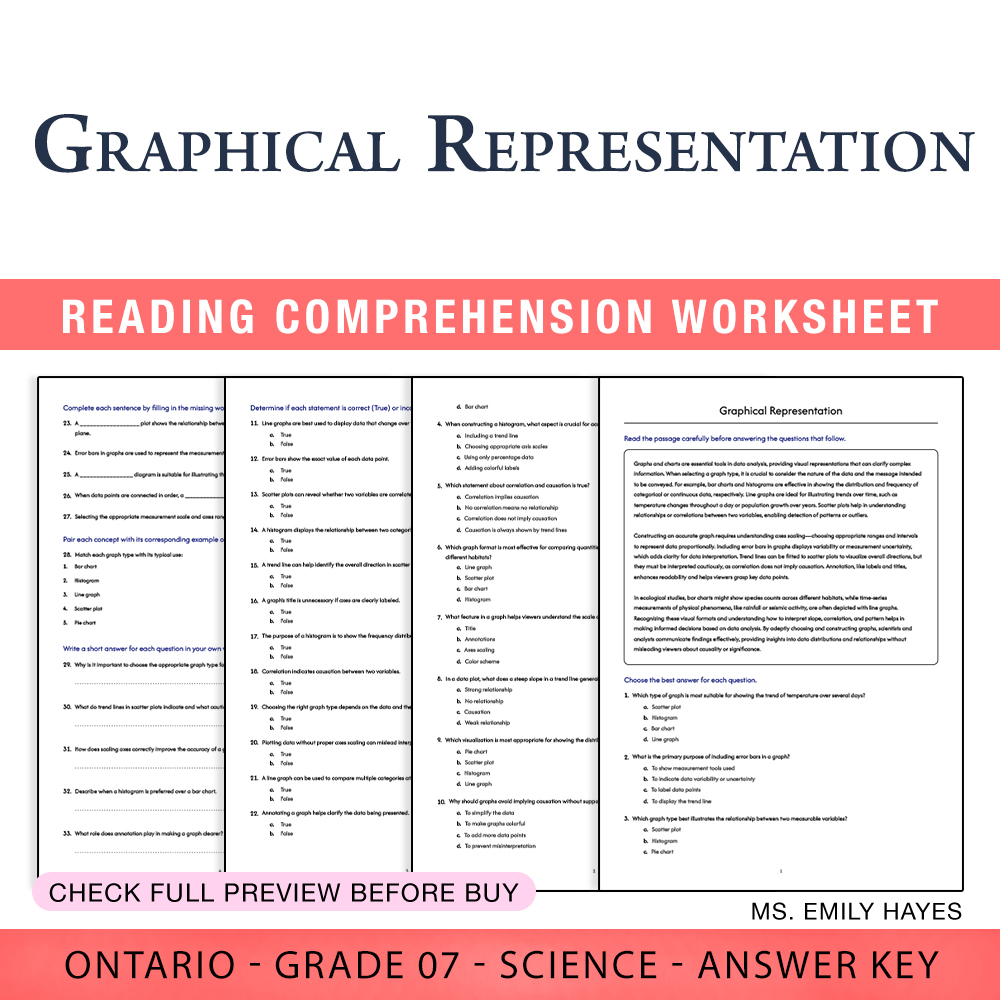
Grade 7 Science | Graphical Representation Worksheet (PDF+ Answer Key)
Created byCopper Leaf ClassroomLearning Objectives
- Understand the different types of graphs used to display data such as bar charts, histograms, line graphs, and scatter plots.
- Learn how to properly select and construct various graphs based on data type and measurement scales.
- Interpret elements of graphs including axes, error bars, trend lines, and patterns.
Instant download

Rock Strata Worksheet | NGSS Grade 7 Science Practice and Assessment
JCreated byJ.S SheetsLearning Objectives
- Understand the principles of relative dating such as superposition, original horizontality, and cross-cutting relationships.
- Identify key stratigraphic markers like fossils, unconformities, and intrusive contacts used to correlate layers.
- Explain how field observations and stratigraphic data help construct Earth's geological history.
Also included in: Grade 7 Cosmic Solar Rock and Gravity Science Lesson Bundle: NGSS +1 more
Instant download
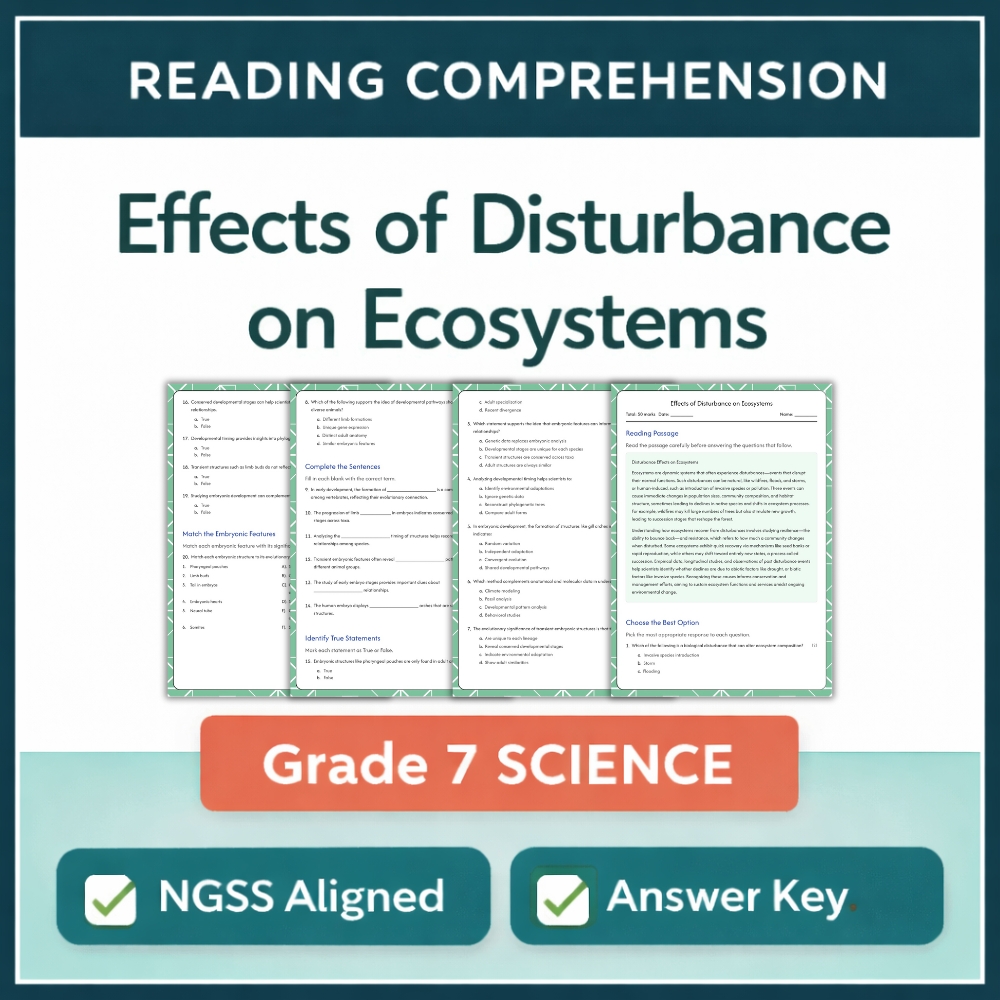
7th Grade Science | Effects of Disturbance on Ecosystems Worksheet (NGSS)
 Created byCedar Grove Learning
Learning Objectives
- Understand how physical and biological disturbances impact population sizes, community composition, and ecosystem functions.
- Identify examples of disturbances such as wildfires, flooding, invasive species, and disease outbreaks.
- Explain mechanisms of resilience, resistance, and succession in recovering ecosystems.
Instant download
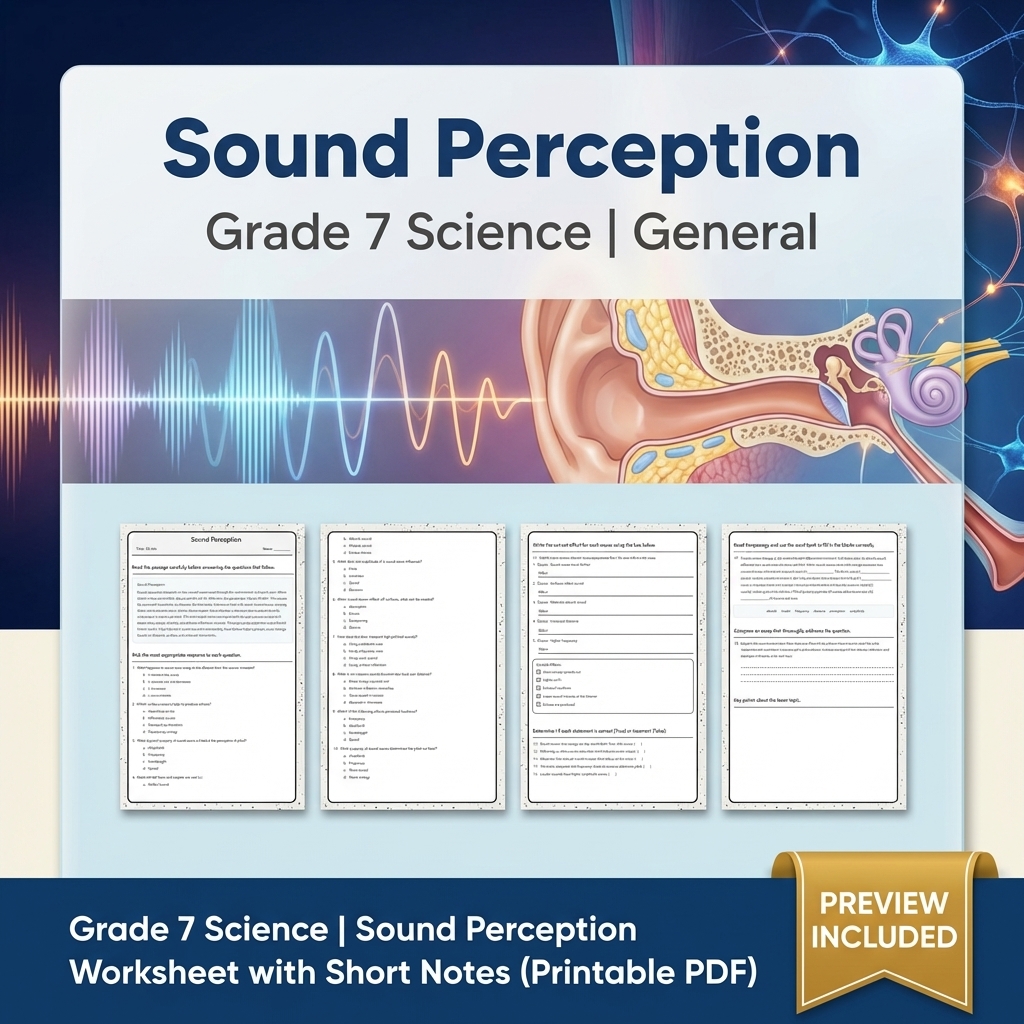
Grade 7 Science | Sound Perception Worksheet with Short Notes (Printable PDF)
Created byMeadowlark WorksheetsLearning Objectives
- Understand how sound waves reach and are perceived by the human ear.
- Identify factors affecting the loudness and pitch of sounds.
- Explain how surfaces reflect sound and materials absorb sound.
Also included in: Grade 7 Energy Transfer and Motion Science Lesson Bundle | General +1 more
Instant download
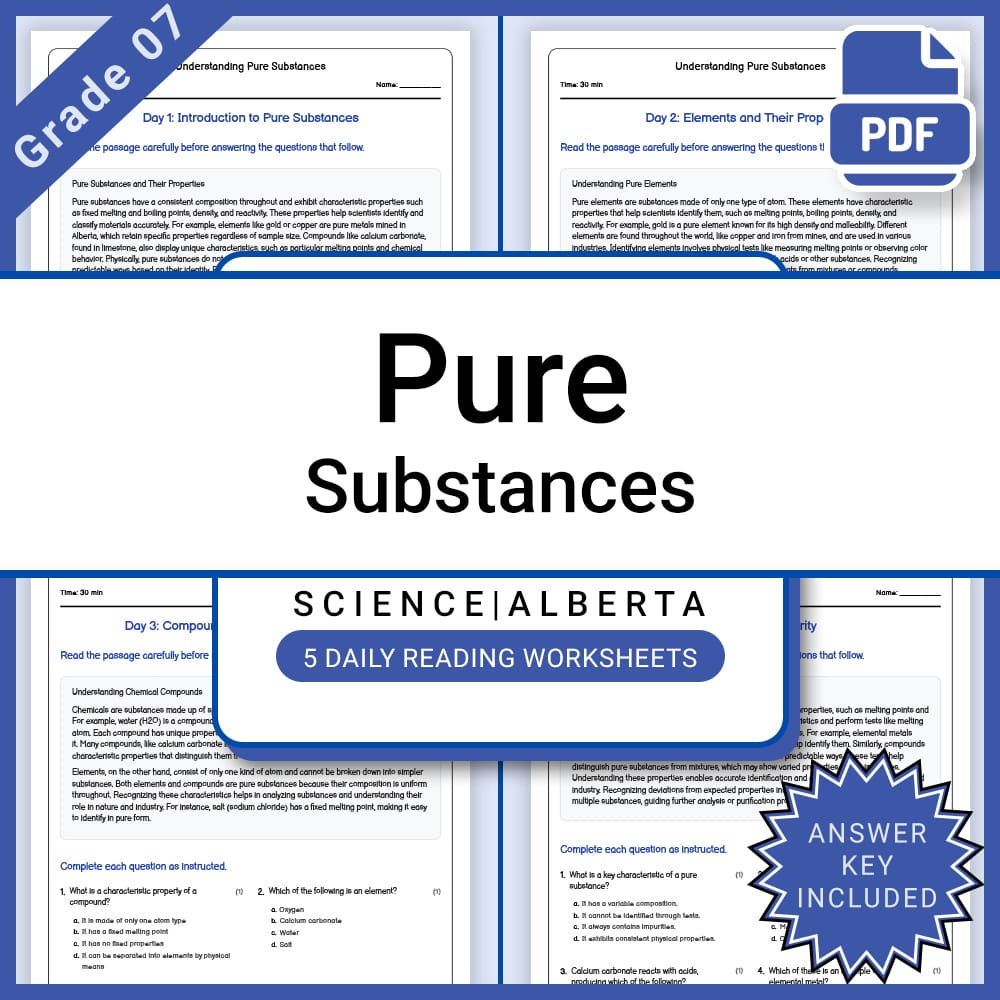
Grade 7 Science – Pure Substances Daily Reading Worksheet with Answer Key
JCreated byJ.S SheetsLearning Objectives
- Define what pure substances are and identify their key properties.
- Differentiate between elements and compounds.
- Understand how physical and chemical tests help identify pure substances.
Also included in: Grade 7 Science Lesson Bundle | Alberta Framework for Classroom Use +1 more
Instant download
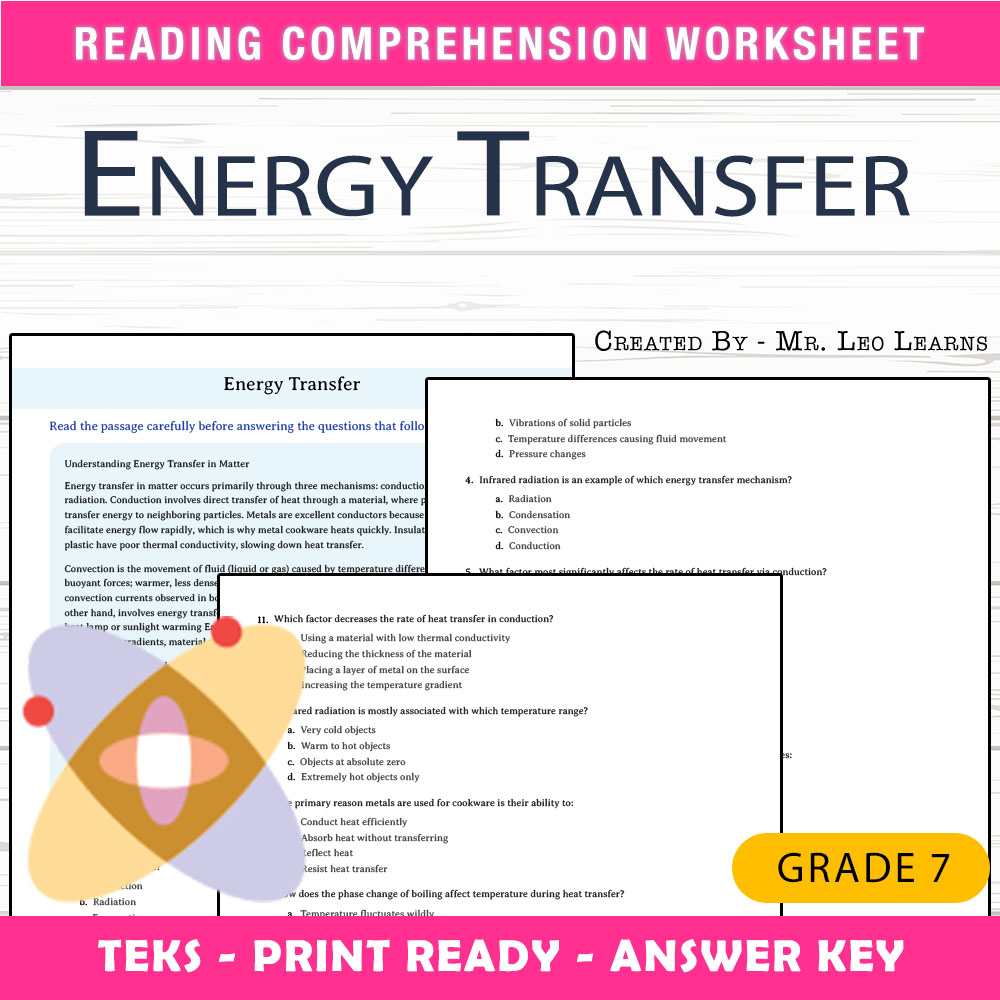
Grade 7 Science — Energy Transfer Worksheet for Mastery
 Created byThe Resource Hub
Learning Objectives
- Describe the mechanisms of energy transfer: conduction, convection, and radiation.
- Explain how temperature gradients and material properties affect heat flow.
- Apply knowledge of energy transfer to real-world phenomena like metal heating and heat radiation.
Also included in: Grade 7 Science Unit Bundle – States, Reactions & Atomic Structure Worksheets +1 more
Instant download
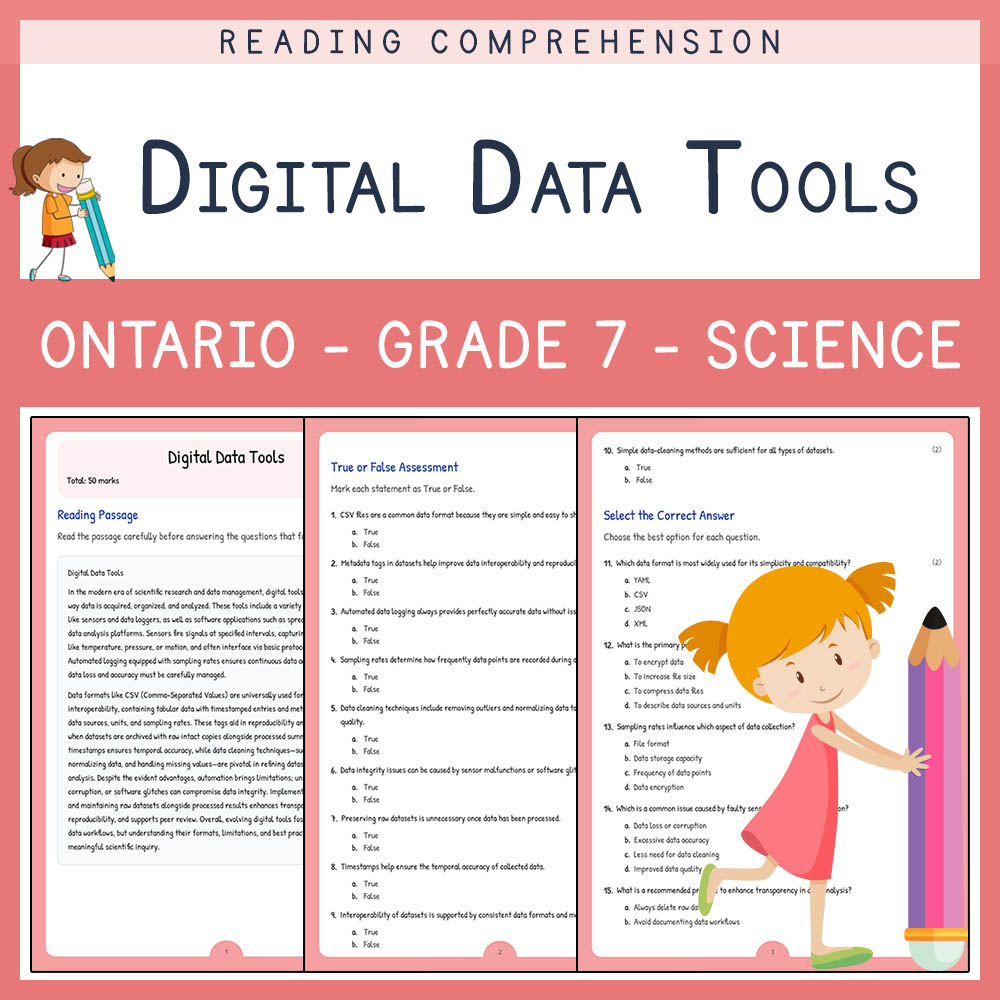
Grade 7 Science Assessment | Digital Data Tools Worksheet Elena | Ontario
 Created byLumora Learning
Learning Objectives
- Understand fundamental digital tools used for data acquisition, organization, and initial analysis.
- Identify common data formats such as CSV, timestamps, and metadata tags, and their roles in data interoperability.
- Learn basic sensor interfaces, spreadsheet functions, and techniques for data cleaning.
Also included in: Grade 7 Science | STEM Skills and Connections Custom Bundle | Ontario
Instant download
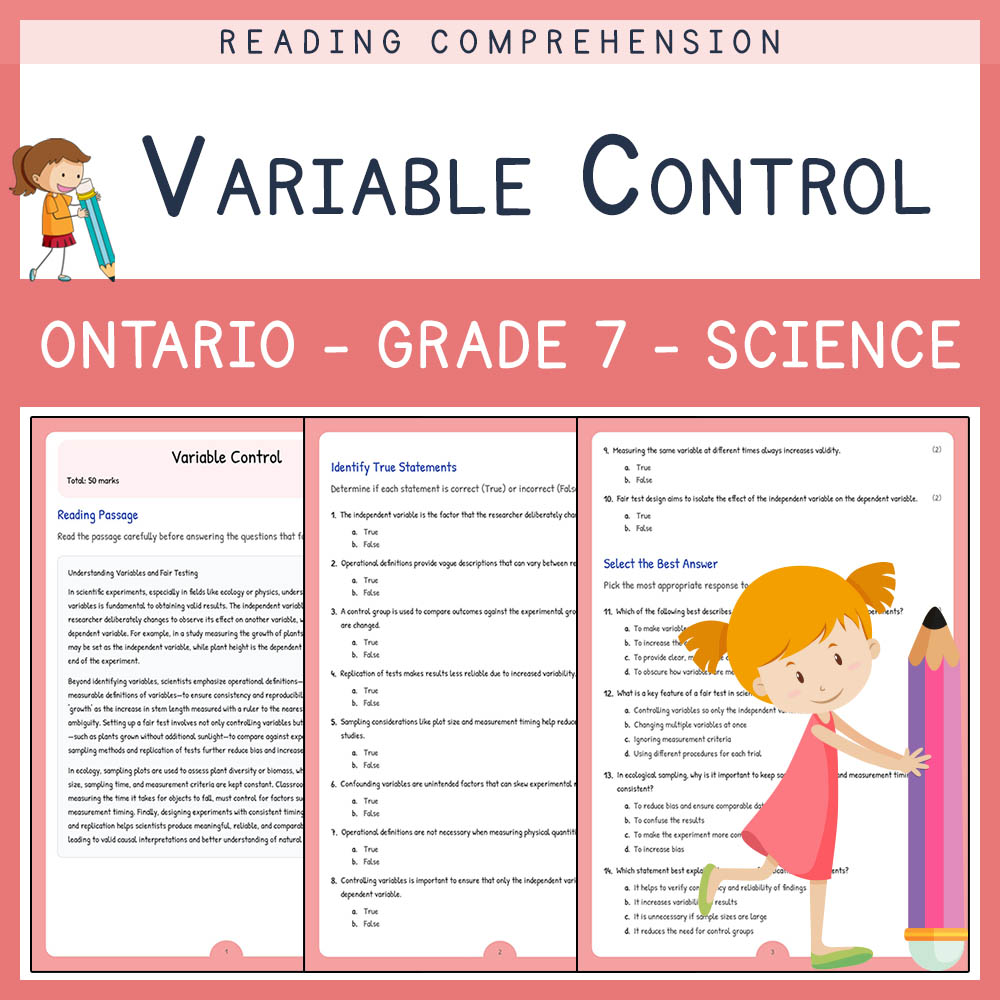
Grade 7 Science Worksheet | Variable Control | Ontario Standard
Created byLumora LearningLearning Objectives
- Understand the concepts of independent, dependent, and controlled variables in experiments.
- Identify sources of confounding factors and how to minimize bias in scientific testing.
- Learn the importance of operational definitions, control groups, sampling considerations, and replication for valid causal conclusions.
Also included in: Grade 7 Science | STEM Skills and Connections Custom Bundle | Ontario
Instant download
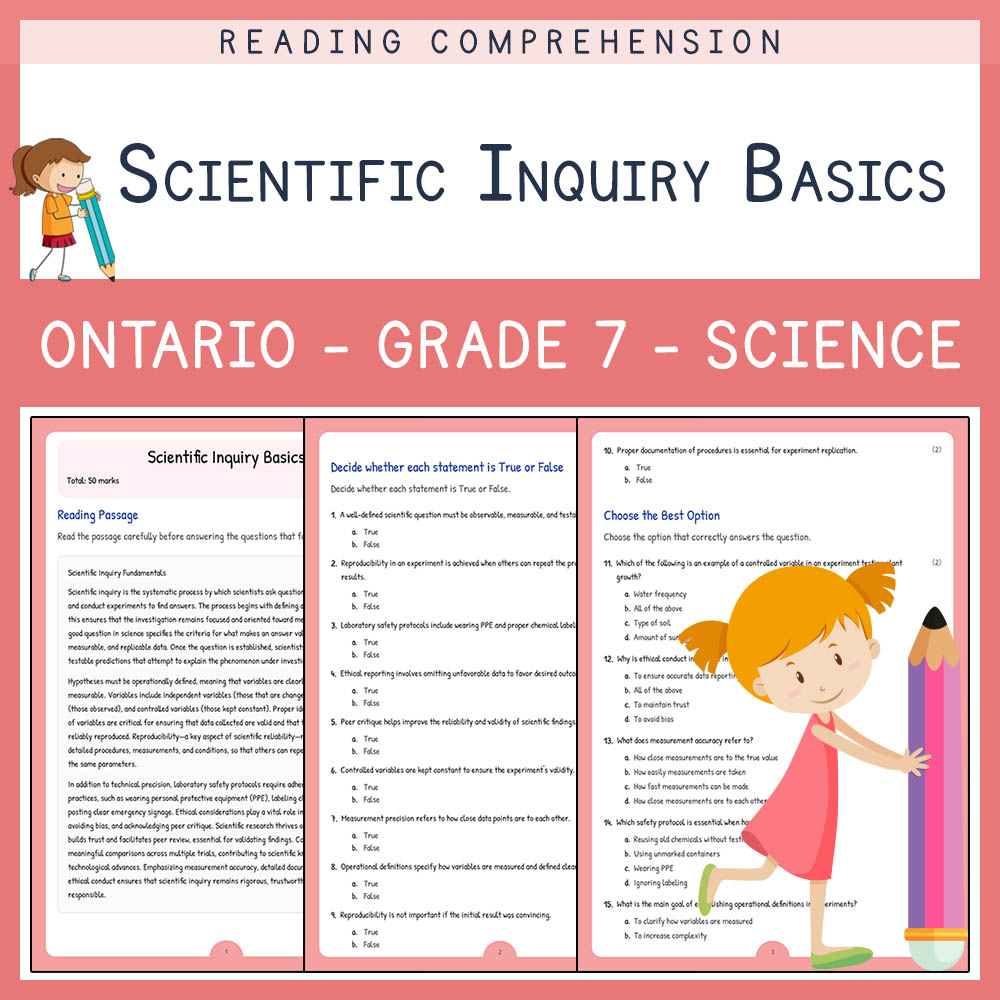
Grade 7 Science Assessment | Scientific Inquiry Basics Worksheet | Ontario
Created byLumora LearningLearning Objectives
- Understand the key steps of the scientific inquiry process including question formulation, hypothesis development, and operational definitions.
- Identify and explain variables, measurement accuracy, and reproducibility in experiments.
- Recognize laboratory safety protocols such as PPE, chemical labeling, and emergency signage.
Also included in: Grade 7 Science | STEM Skills and Connections Custom Bundle | Ontario
Instant download
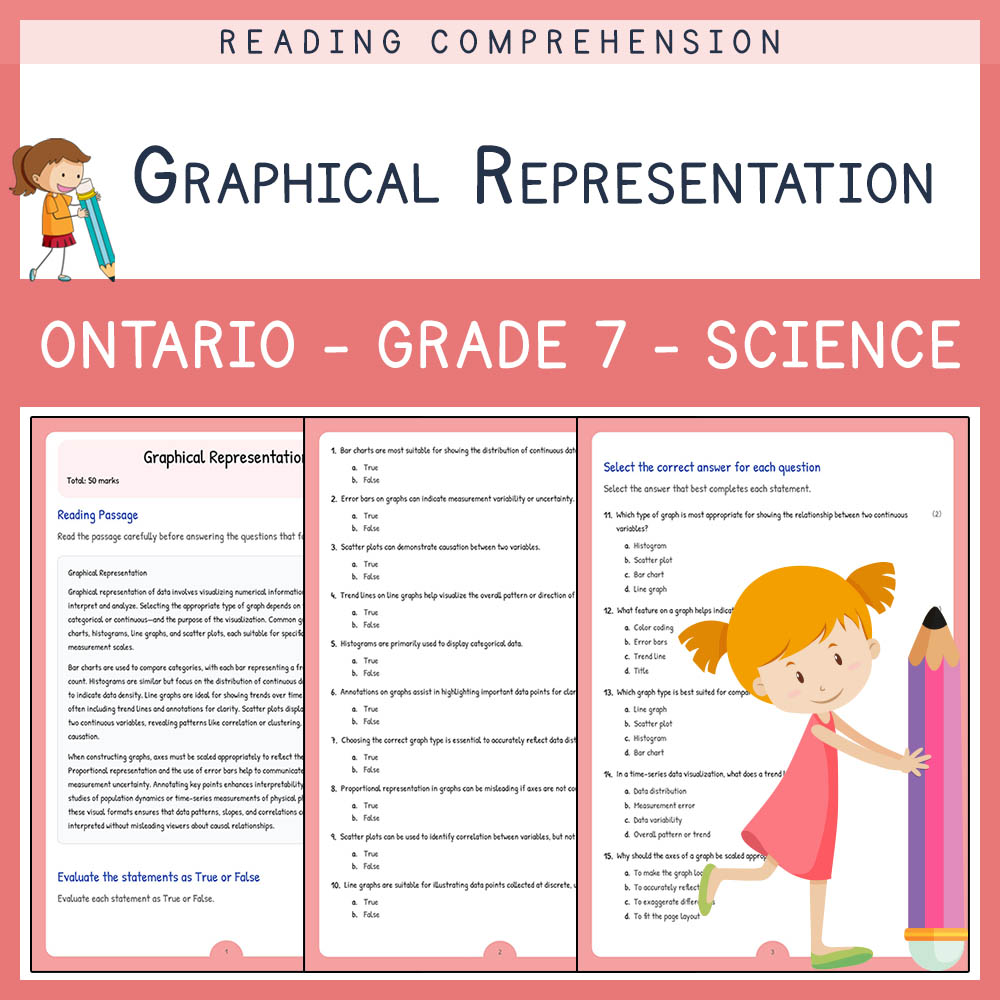
Grade 7 Science Assessment | Graphical Representation Worksheet | Ontario
Created byLumora LearningLearning Objectives
- Understand the principles of selecting appropriate graph types for data presentation.
- Learn how to construct and interpret various types of graphs, including bar charts, histograms, line graphs, and scatter plots.
- Identify key features such as axis scaling, error bars, trend lines, and annotations for clarity in data visualization.
Also included in: Grade 7 Science | STEM Skills and Connections Custom Bundle | Ontario
Instant download

Grade 7 Solution Comparison Worksheet | NGSS Practice PDF
 Created byClear Sky Classroom
Learning Objectives
- Understand how to systematically evaluate different design solutions using modeling and analysis.
- Identify and quantify trade-offs among performance, cost, durability, and manufacturability.
- Apply consistent metrics and model-based reasoning to compare options.
Also included in: Grade 7 Engineering Design Science Lesson Bundle Worksheets | NGSS +1 more
Instant download

Grade 7 Problem Definition Worksheet | NGSS Practice PDF
Created byClear Sky ClassroomLearning Objectives
- Understand how to define design problems with clear criteria and constraints.
- Identify measurable performance metrics and limits for proposed solutions.
- Translate societal and environmental needs into quantitative targets.
Also included in: Grade 7 Engineering Design Science Lesson Bundle Worksheets | NGSS +1 more
Instant download

Grade 7 Design Optimization Worksheet | Practice & NGSS PDF
Created byClear Sky ClassroomLearning Objectives
- Analyze test data and parameters to refine and improve design solutions.
- Compare quantitative results to determine the most effective modifications.
- Apply iterative adjustment techniques to optimize performance within constraints.
Also included in: Grade 7 Engineering Design Science Lesson Bundle Worksheets | NGSS +1 more
Instant download
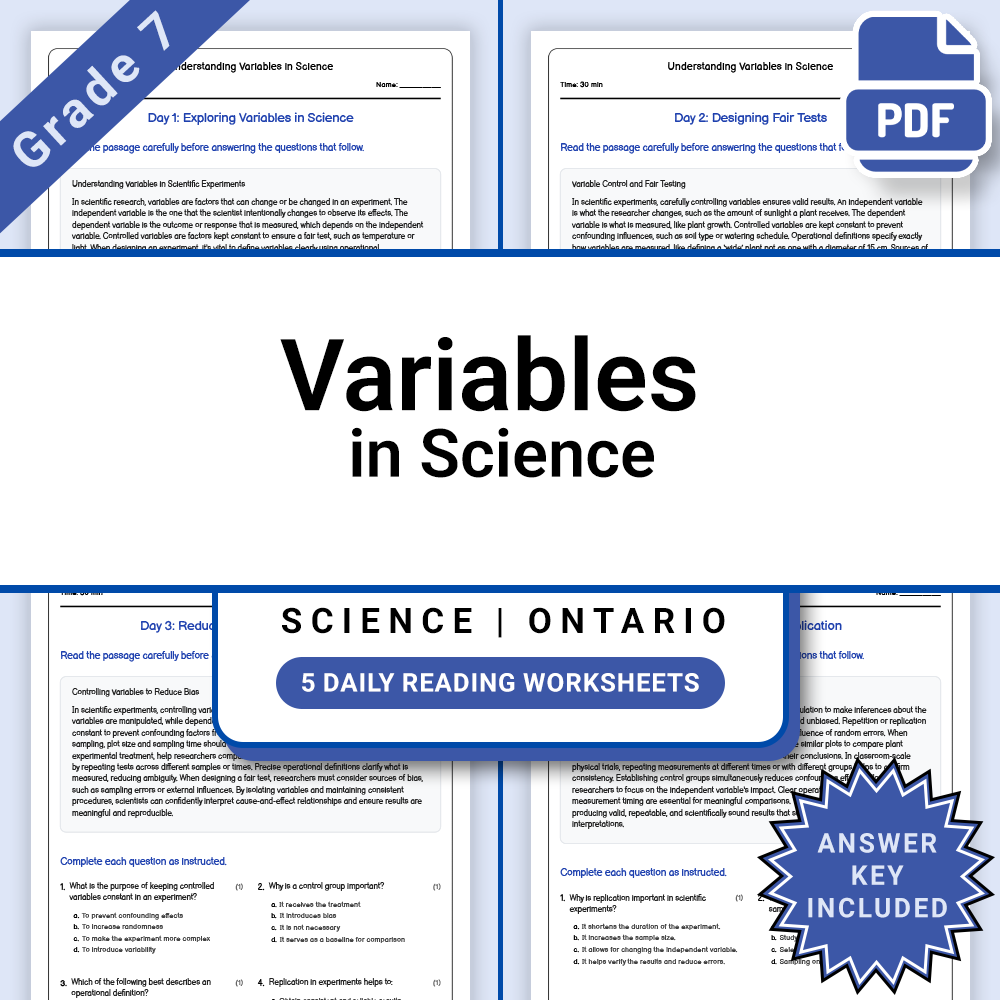
Grade 7 Science – Understanding Variables Daily Reading Worksheet + Answer Key
JCreated byJ.S SheetsLearning Objectives
- Define independent, dependent, and controlled variables in experiments.
- Explain the importance of operational definitions and fair test design.
- Identify sources of confounding and how to reduce bias.
Also included in: Grade 7 Science Lesson Bundle | Ontario Curriculum Reading Worksheets +1 more
Instant download

Grade 7 Science | Biodiversity Measures Worksheet (PDF) Alberta Standards
Created byEvergreen Desk EducationLearning Objectives
- Explain how biodiversity can be described using richness, evenness, and habitat heterogeneity.
- Interpret what biodiversity metrics can reveal about ecosystem resilience and function.
- Use evidence from habitat complexity and species assemblages to make ecological health claims.
Instant download

Grade 7 Science – Igneous Processes & Formation | Daily Reading Worksheet
Created byBright Mind ResourcesLearning Objectives
- Understand how magma is generated within Earth's mantle and crust.
- Identify the processes that influence magma composition and texture.
- Relate plate tectonic settings to types of magma and igneous rocks.
Also included in: Grade 7 Earth Processes Science Daily Reading Worksheets Lesson Bundle | BC +1 more
Instant download
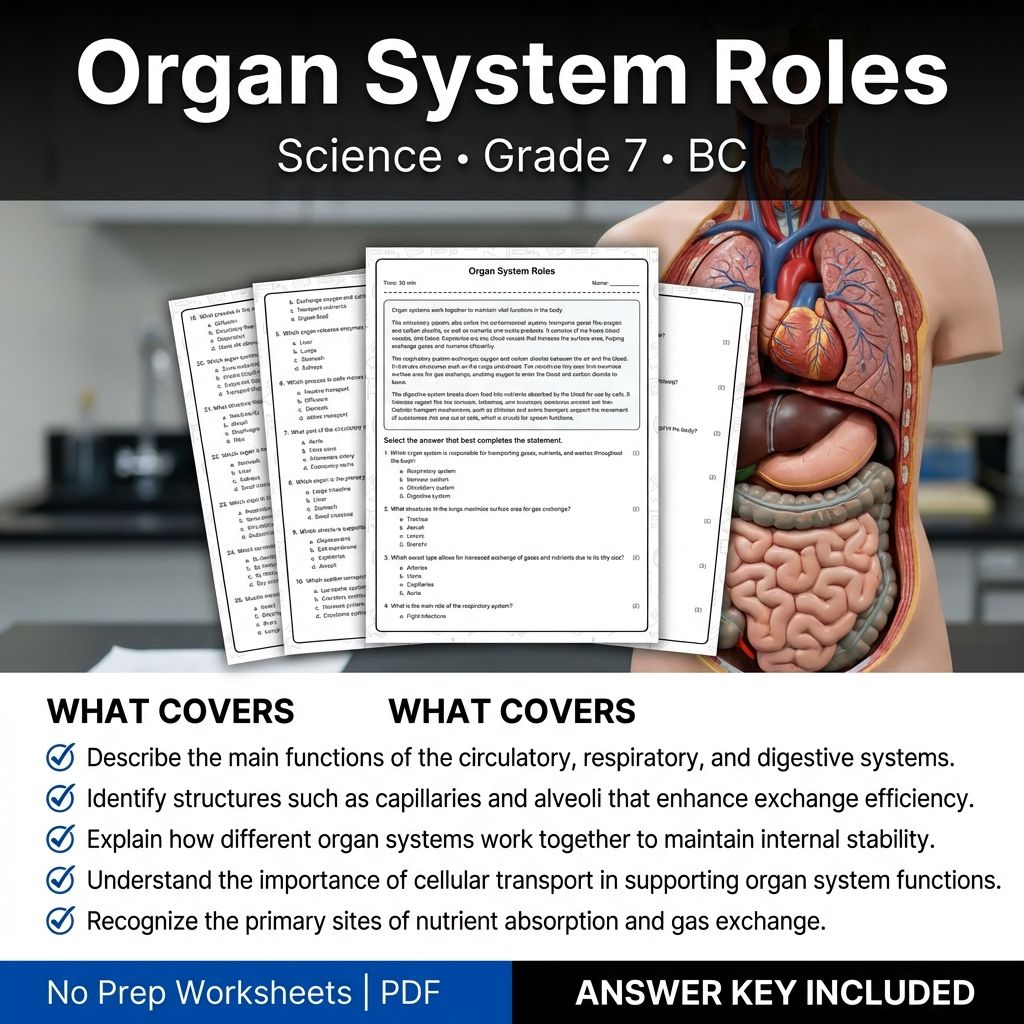
7th Grade Science | Organ System Roles Worksheet & Answer Key PDF
Created byCoral Reef LearningLearning Objectives
- Describe the main functions of the circulatory, respiratory, and digestive systems.
- Identify structures such as capillaries and alveoli that enhance exchange efficiency.
- Explain how different organ systems work together to maintain internal stability.
Instant download

Levels Of Organization Worksheet Pack | Grade 7 Science Activities
Created byPrism Point LearningLearning Objectives
- Explain the ecological levels of organization from individual organisms to ecosystems
- Identify examples of individual, population, community, and ecosystem using Alberta-style scenarios
- Describe why patterns at higher levels cannot always be predicted from single organisms
Also included in: Grade 7 Ecosystems & Biodiversity Science Lesson Bundle | Alberta
Instant download
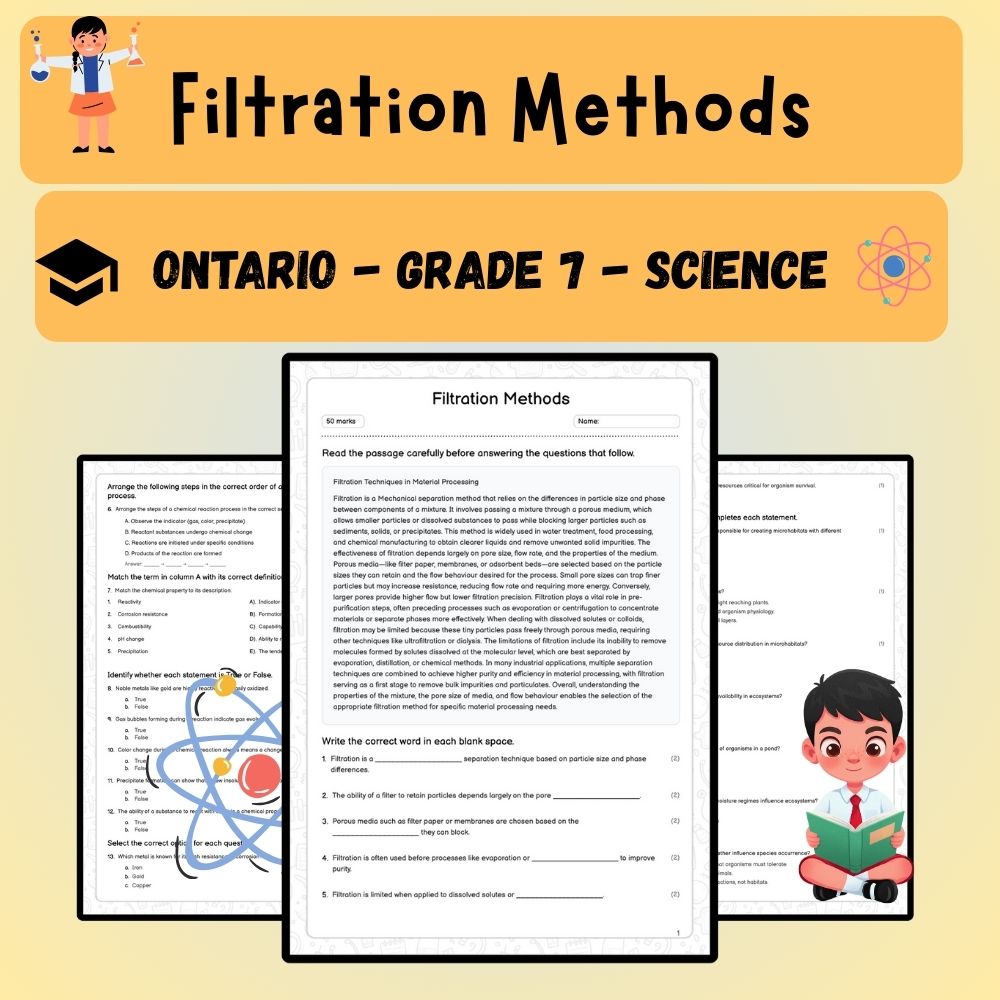
Grade 7 Science | Filtration Methods Worksheet (PDF ) – Ontario Standards
Created byPrism Point LearningLearning Objectives
- Understand the principles of mechanical separation techniques such as filtration and sedimentation.
- Identify the applications and limitations of filtration in separating heterogeneous mixtures.
- Describe the roles of pore size, flow behaviour, and media in filtration processes.
Also included in: Grade 7 Science Unit Bundle | Substances, Mixtures & Properties Worksheets +1 more
Instant download

Surface Changes Over Time Science Worksheet Grade 7 NGSSS
Created byEvergreen Desk EducationLearning Objectives
- Explain how runoff, erosion, and deposition can rapidly change Earth’s surface after heavy rainfall
- Describe how storms can reshape coastal landforms such as dunes and beaches
- Identify examples of sudden and gradual surface changes caused by earthquakes and volcanic activity
Instant download
About Grade 7 Science Worksheets
Browse 6,039 printable Grade 7 Science worksheets — ready-to-print PDFs with answer keys where available.
Every worksheet on MyTeachingSheets is created by independent teacher-authors and reviewed before publication. All resources download as printable PDFs for classroom, homework, or at-home practice, and many include answer keys. Preview any worksheet free before buying.