
Grade 7 Science Worksheets
6,039 worksheets
Grade 7 Science – Mountain Building & Plate Tectonics | Daily Reading Worksheet
 Created byBright Mind Resources
Learning Objectives
- Understand the process of mountain formation through tectonic plate movements.
- Identify key features of orogeny, including crustal deformation and uplift.
- Explain how surface processes shape mountain landscapes over time.
Also included in: Grade 7 Earth Processes Science Daily Reading Worksheets Lesson Bundle | BC +1 more
Instant download
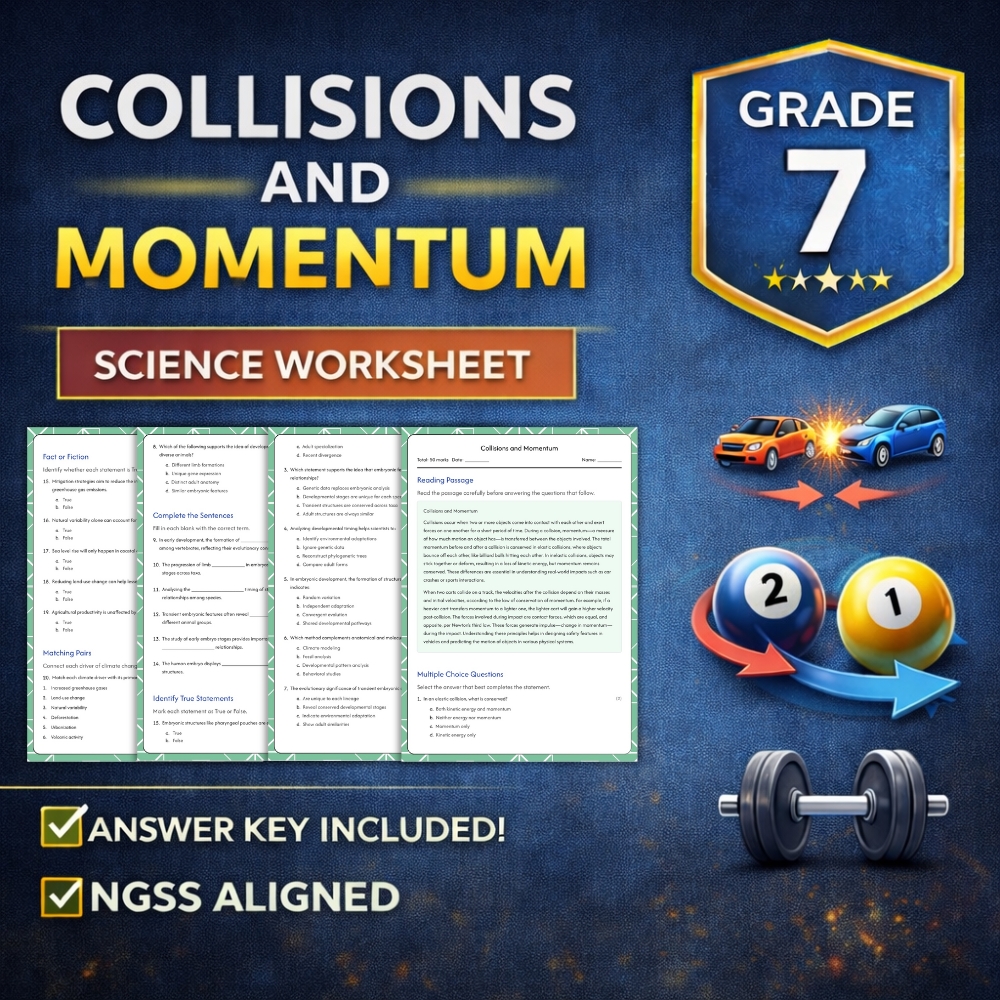
7th Grade Science | Collisions and Momentum Worksheet (NGSS Aligned +Answer Key)
 Created byCedar Grove Learning
Learning Objectives
- Explain how momentum is transferred during different types of collisions.
- Compare elastic and inelastic collisions and identify examples of each.
- Apply the principle of conservation of momentum to predict outcomes of collisions.
Instant download

Grade 7 Science Design Criteria Worksheet PDF | California Standards STEM
 Created byEvergreen Desk Education
Learning Objectives
- Explain the difference between design criteria and design constraints in a solution design.
- Write clear, testable design criteria using measurable success targets.
- Use constraints (materials, safety, cost, and science principles) to narrow possible solutions.
Instant download

Grade 7 Science | Bonding Patterns Worksheet (TEKS) PDF
Created byEvergreen Desk EducationLearning Objectives
- Distinguish ionic from covalent bonding using particle-level evidence and bonding patterns.
- Relate bonding type to macroscopic properties such as melting point, solubility, and electrical conductivity.
- Construct simple binary ionic salts and molecular compounds using empirical formulas.
Instant download
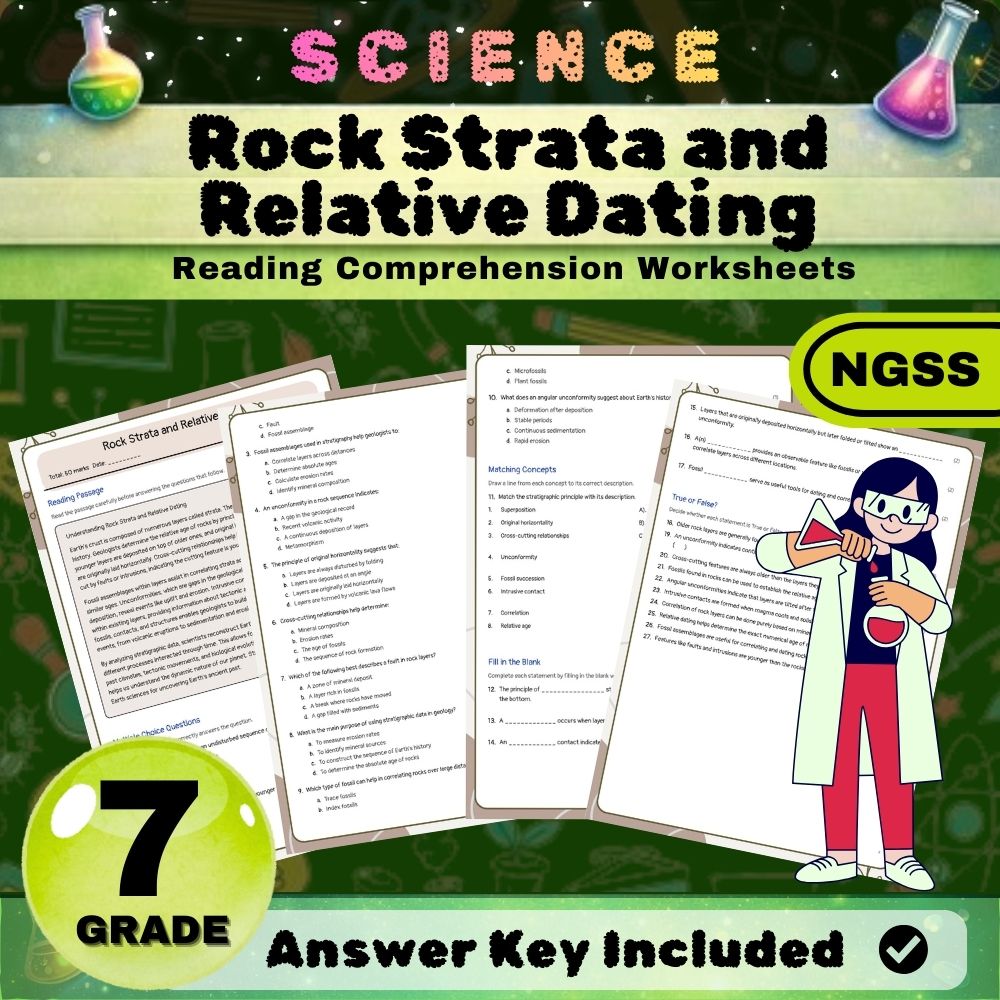
7th Grade Science | Rock Strata & Relative Dating NGSS Worksheet (PDF)
 Created byMaple Path Learning
Learning Objectives
- Understand the principles of relative dating such as superposition, original horizontality, and cross-cutting relationships.
- Identify how fossils, unconformities, and intrusive contacts act as markers for correlating layers and establishing relative ages.
- Synthesize field observations and stratigraphic data to construct sequences of Earth’s geological events.
Instant download
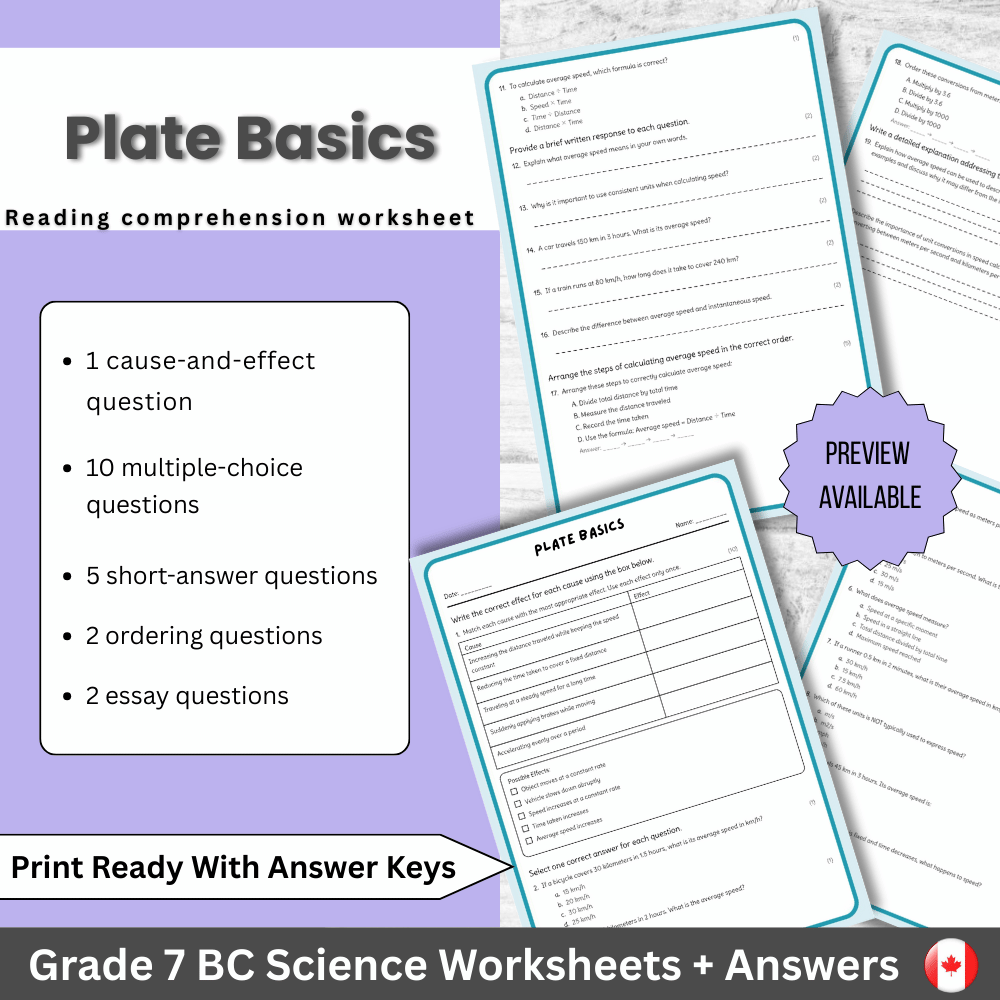
Grade 7 Science | Plate Tectonics & Plate Boundaries Worksheet (PDF)
Created byBright Mind ResourcesLearning Objectives
- Understand the structure and movement of Earth's lithospheric plates.
- Identify the different types of plate boundaries and their effects on landforms and geological activity.
- Explain how plate interactions influence earthquakes, volcanoes, and mountain formation.
Instant download

Grade 7 Statistical Reasoning Science Worksheet | Ontario Curriculum PDF
 Created byClear Sky Classroom
Learning Objectives
- Identify and compare descriptive statistics such as mean, median, mode, and interquartile range (IQR)
- Explain how outliers affect measures of center and spread
- Use simple graphical ideas to interpret differences between data sets
Instant download

Genotype and Phenotype Worksheet | Grade 7 Genetics Science Activity
 Created byPrism Point Learning
Learning Objectives
- Explain the difference between genotype and phenotype in terms of genes and observable traits
- Describe how dominant and recessive alleles affect which phenotype an organism shows
- Use the genotype–phenotype relationship to predict traits and explain why relatives may look different
Also included in: Grade 7 Evolution, Genetics & Ecosystems Lesson Bundle | Florida NGSSS
Instant download

Density and Volume Worksheet Grade 7 Science NGSSS Practice Activity
Created byEvergreen Desk EducationLearning Objectives
- Explain how density links mass to volume and why it helps identify materials.
- Use the relationship between density, mass, and volume to interpret and solve problems.
- Distinguish intensive from extensive properties by comparing density across samples.
Instant download

Kinetic and Potential Energy Relationships Worksheet | Grade 7 Science
 Created byBRIGHT PATH RESOURCES
Learning Objectives
- Identify kinetic and potential energy in everyday situations.
- Explain how changes in height and speed affect mechanical energy.
- Use energy conservation ideas to reason about safer motion and loading.
Also included in: Grade 7 Alberta Science Forces Structures and Motion Worksheet Bundle +1 more
Instant download

Grade 7 Free-Body Diagrams and Net Force Worksheet | Alberta Science
Created byBRIGHT PATH RESOURCESLearning Objectives
- Identify the forces shown on a free-body diagram
- Determine the net force direction from component forces
- Use perpendicular component addition to find the net force magnitude description
Also included in: Grade 7 Alberta Science Forces Structures and Motion Worksheet Bundle +1 more
Instant download

Grade 7 Distance & Time Units in Motion Science Worksheet Alberta
Created byBRIGHT PATH RESOURCESLearning Objectives
- Identify common SI units used to measure distance and time
- Use unit names correctly when describing motion
- Recognize that speed is distance divided by time
Also included in: Grade 7 Alberta Science Forces Structures and Motion Worksheet Bundle +1 more
Instant download
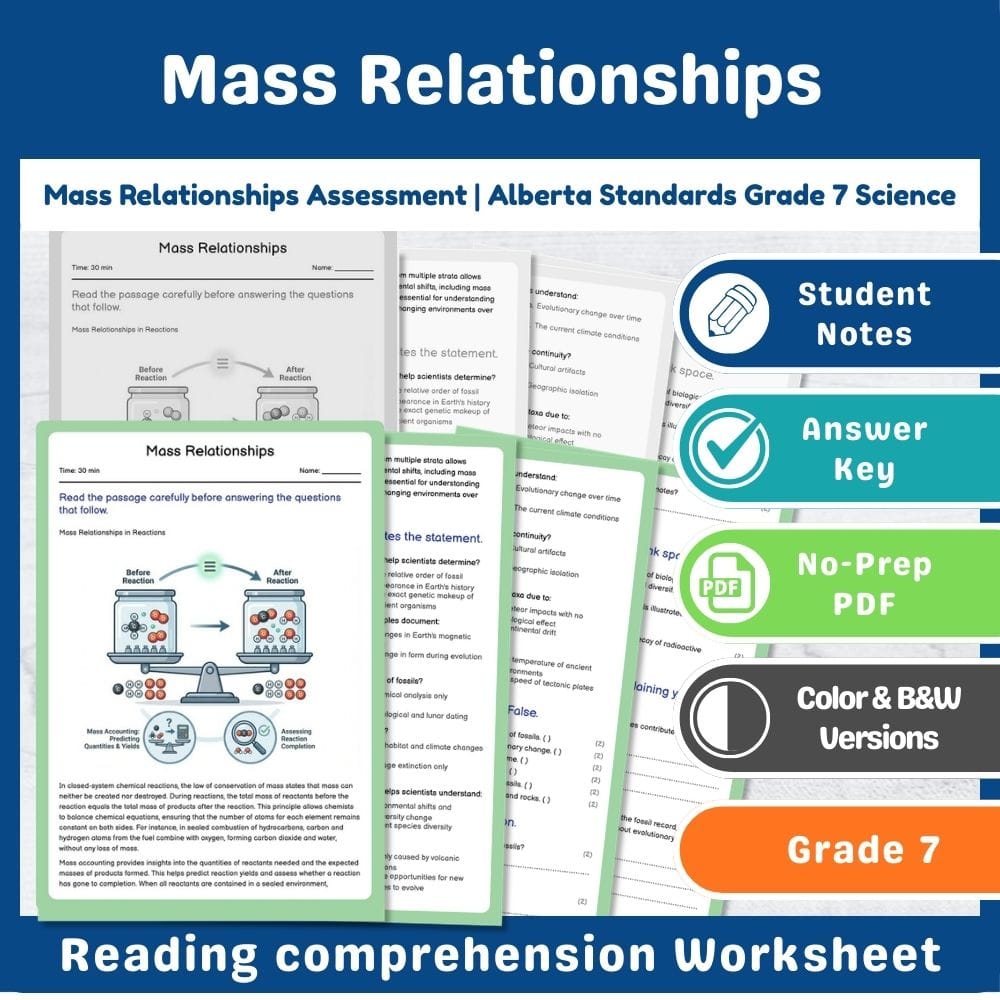
Mass Relationships Assessment | Alberta Standards Grade 7 Science
Created byPrism Point LearningLearning Objectives
- Understand how conservation of mass governs the behavior of substances in closed-system reactions.
- Learn to balance chemical inputs and outputs to predict reaction yields.
- Recognize examples like sealed combustion and closed corrosion assays that model mass transfers.
Also included in: Lesson Grade 7 Science Mini Bundle | Matter and Chemical Change +1 more
Instant download
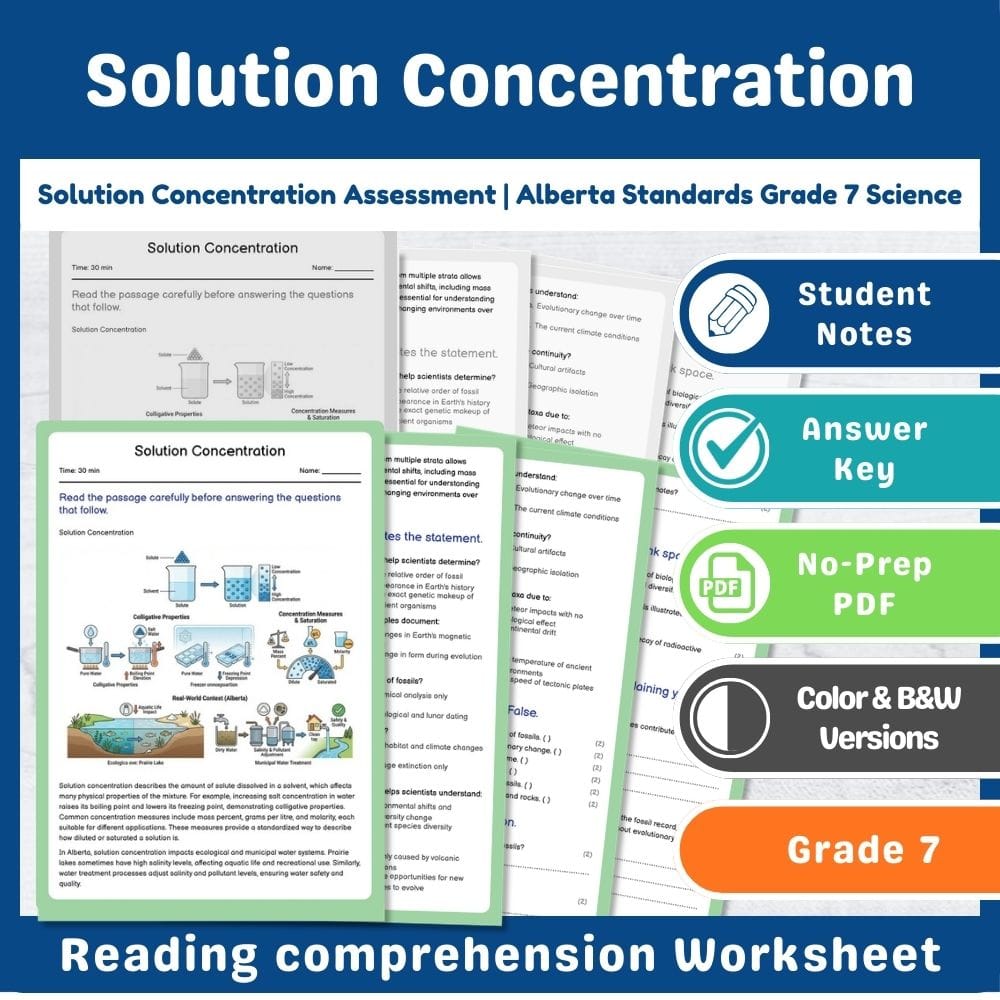
Solution Concentration Assessment | Alberta Standards Grade 7 Science
Created byPrism Point LearningLearning Objectives
- Understand how solution concentration quantifies the amount of solute relative to solvent.
- Recognize common measures of concentration such as mass percent and grams per litre.
- Explain the effects of concentration on physical properties like boiling point and freezing point.
Also included in: Lesson Grade 7 Science Mini Bundle | Matter and Chemical Change +1 more
Instant download
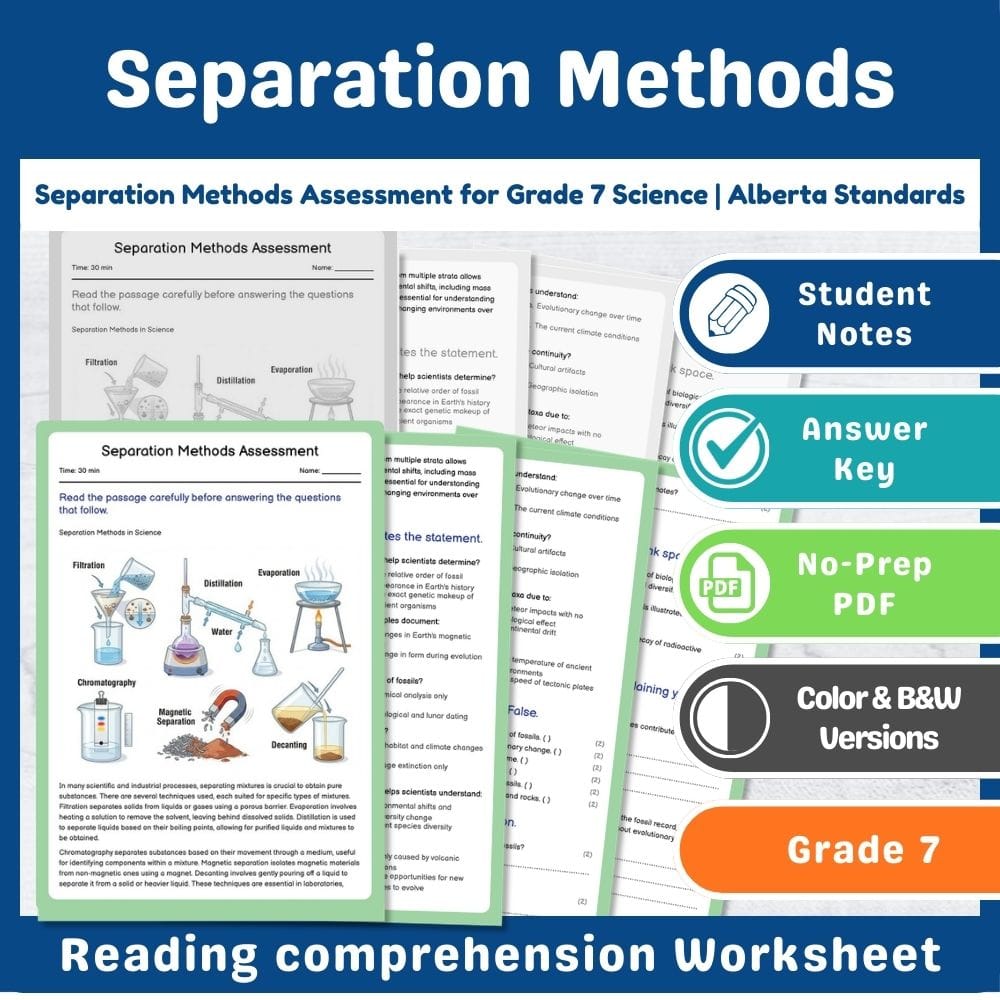
Separation Methods Assessment for Grade 7 Science | Alberta Standards
Created byPrism Point LearningLearning Objectives
- Understand the various separation techniques used in science.
- Identify the appropriate separation method for different mixtures.
- Explain the steps involved in processes such as filtration, evaporation, and distillation.
Also included in: Lesson Grade 7 Science Mini Bundle | Matter and Chemical Change +1 more
Instant download
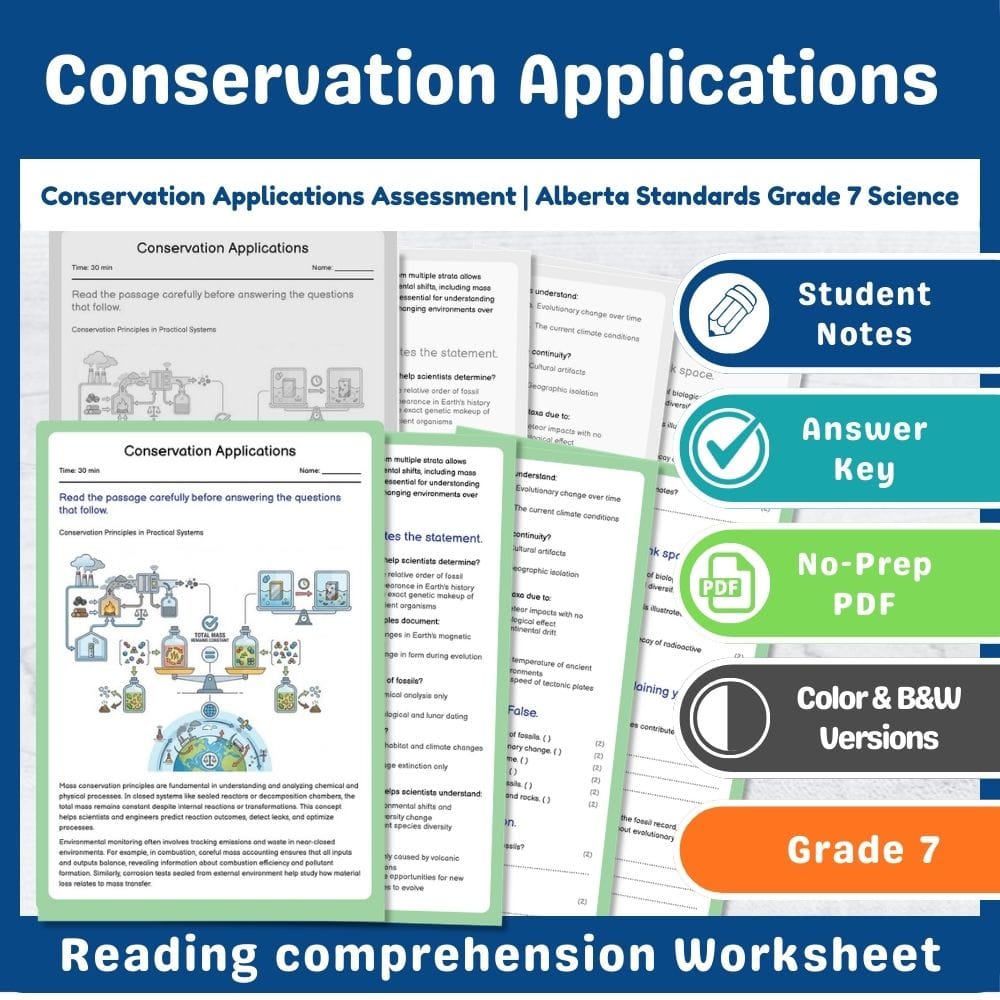
Conservation Applications Assessment | Alberta Standards Grade 7 Science
Created byPrism Point LearningLearning Objectives
- Understand the principle of mass conservation in chemical and physical systems.
- Apply mass conservation concepts to reaction stoichiometry, waste tracking, and environmental mass balances.
- Analyze real-world examples of closed systems to predict and reconcile measured versus expected masses.
Also included in: Lesson Grade 7 Science Mini Bundle | Matter and Chemical Change +1 more
Instant download
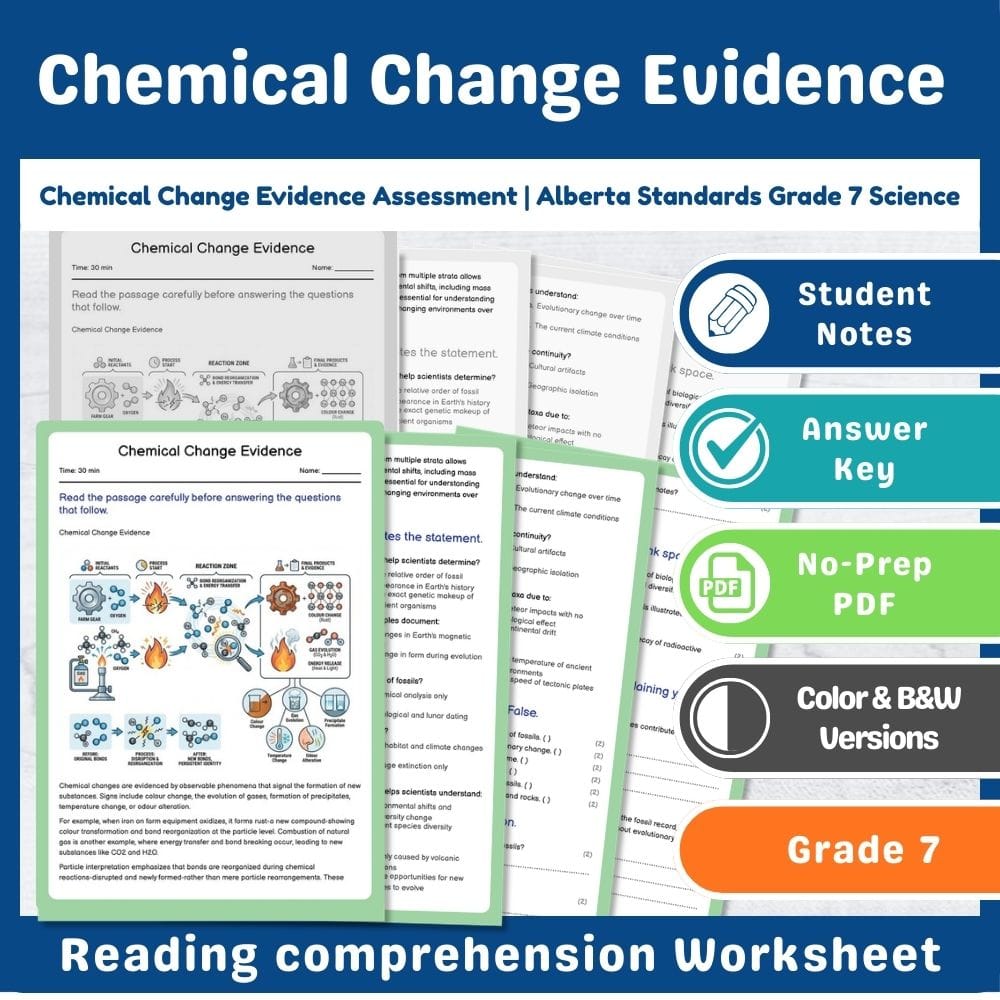
Chemical Change Evidence Assessment | Alberta Standards Grade 7 Science
Created byPrism Point LearningLearning Objectives
- Identify observable signs of chemical changes such as colour change, gas production, and precipitate formation.
- Understand the particle-level interpretation involving bond reorganization during chemical reactions.
- Differentiate between physical and chemical changes based on evidence of chemical alteration.
Also included in: Lesson Grade 7 Science Mini Bundle | Matter and Chemical Change +1 more
Instant download

Substance Basics Test Prep Worksheets | Grade 7 Science Assessment
Created byPrism Point LearningLearning Objectives
- Differentiate pure substances from mixtures using composition and uniformity
- Identify examples of elements, compounds, and mixtures from everyday materials
- Explain how properties can help determine whether a material is pure or mixed
Also included in: Grade 7 Substance & Mixture Properties Science Lesson Bundle (Ontario)
Instant download

Anatomical Evidence Worksheet | Evolution Evidence Activity Grade 7
 Created byAmber Owl Education
Learning Objectives
- Explain how homologous and analogous structures provide evidence for evolutionary relationships.
- Identify patterns in limb bones and skull morphology that suggest descent with modification.
- Use anatomical evidence alongside basic genetic and fossil information to make reasonable phylogenetic inferences.
Also included in: Grade 7 Science Evolution & Biodiversity Lesson Bundle – NGSS +1 more
Instant download
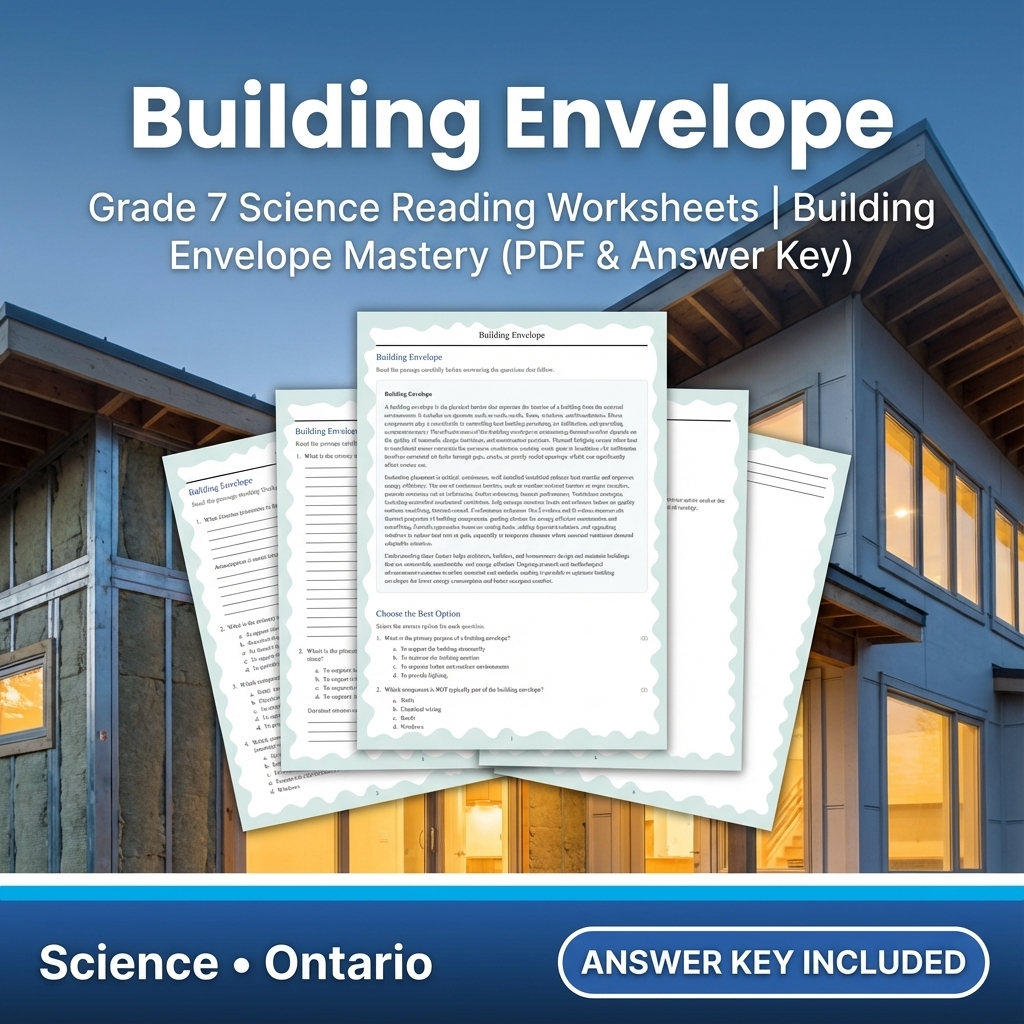
Grade 7 Science Reading | Building Envelope Mastery (PDF & Answer Key)
JCreated byJ.S SheetsLearning Objectives
- Understand the components and functions of building envelopes including walls, roofs, windows, and foundations.
- Identify how insulation, barriers, and ventilation contribute to thermal performance.
- Learn methods for measuring and assessing envelope performance.
Also included in: Grade 7 Science | Thermal Energy & Transfer Worksheet Bundle +1 more
Instant download
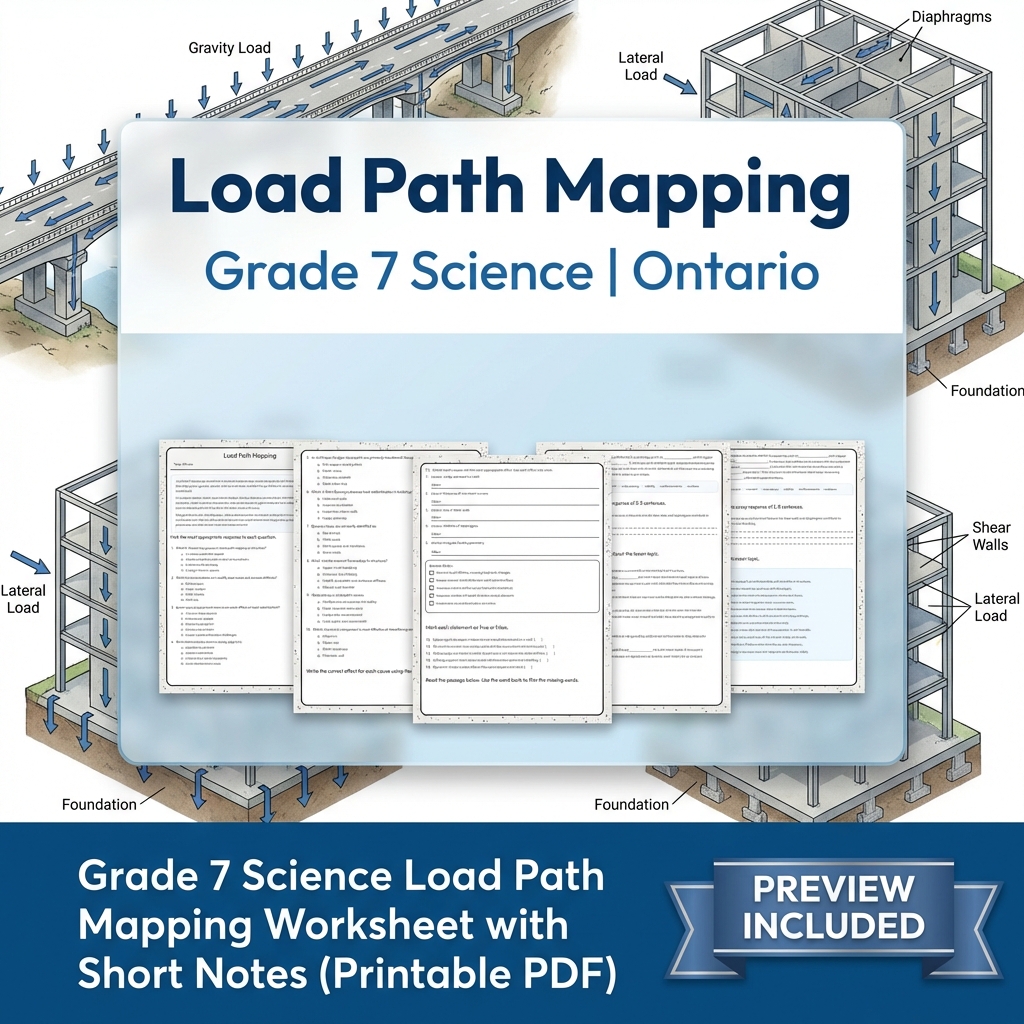
Grade 7 Science Load Path Mapping Worksheet with Short Notes (Printable PDF)
 Created byMeadowlark Worksheets
Learning Objectives
- Understand methods for mapping load paths in complex structures.
- Identify primary and secondary load routes transferring loads to foundations.
- Analyze the effects of openings, corners, and irregular geometries on load redistribution.
Also included in: Grade 7 Science Lesson Group | Ontario Curriculum Worksheets Bundle +1 more
Instant download
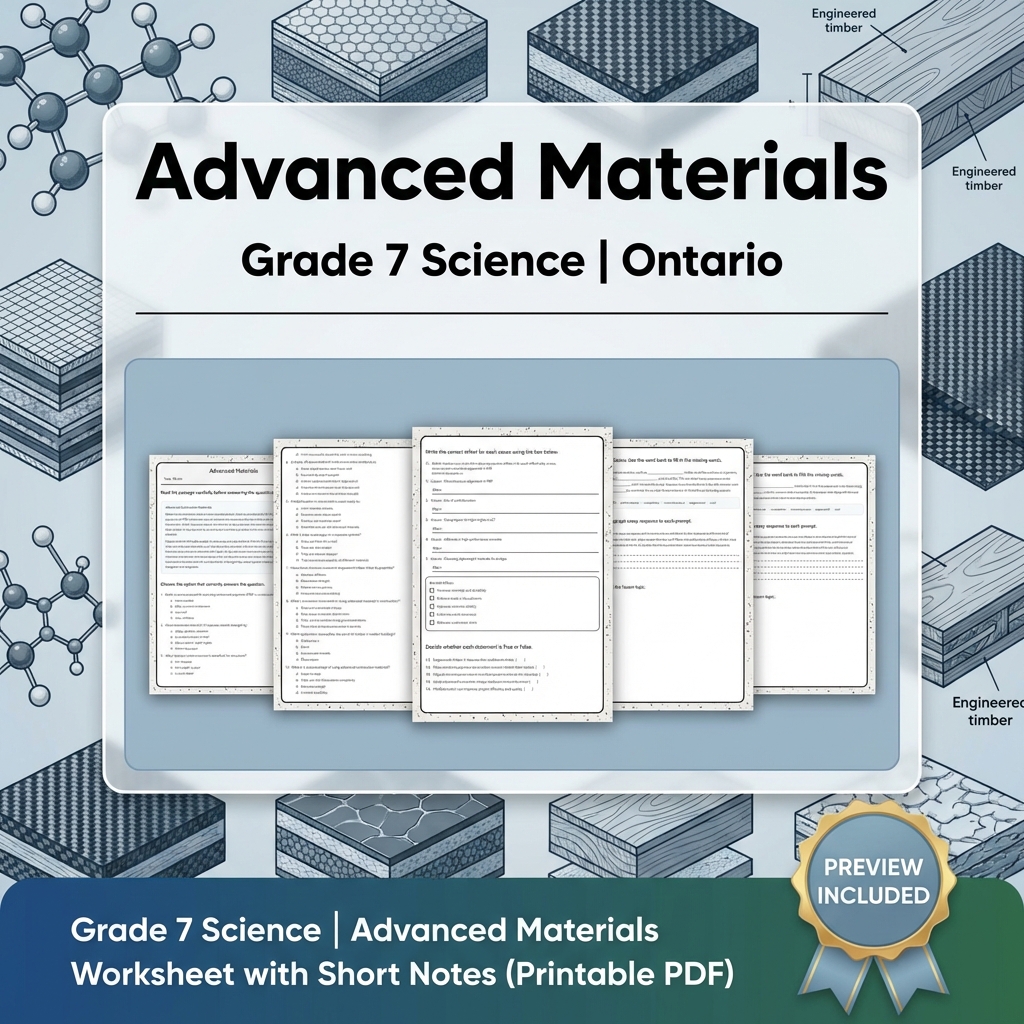
Grade 7 Science | Advanced Materials Worksheet with Short Notes (Printable PDF)
Created byMeadowlark WorksheetsLearning Objectives
- Understand different advanced construction materials and how they are manufactured.
- Explain how microstructure influences strength, stiffness, and durability of materials.
- Analyze the trade-offs related to cost, fabrication complexity, and performance of novel materials.
Also included in: Grade 7 Science Lesson Group | Ontario Curriculum Worksheets Bundle +1 more
Instant download
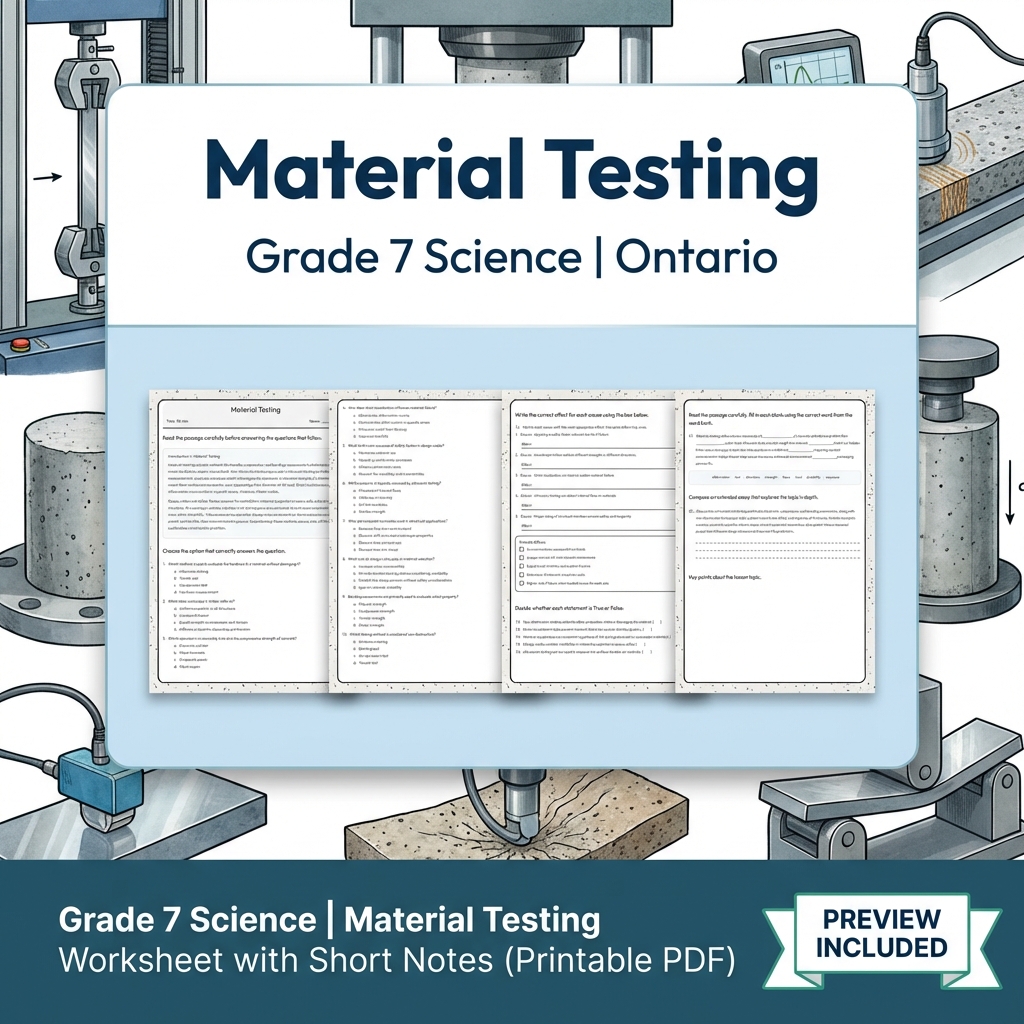
Grade 7 Science | Material Testing Worksheet with Short Notes (Printable PDF)
Created byMeadowlark WorksheetsLearning Objectives
- Explain characteristic methods for testing material behaviour including tensile, compression, and bending assessments.
- Describe non-destructive testing techniques such as ultrasonic and hardness measurements.
- Understand anisotropy in timber and composites and how it affects material performance.
Also included in: Grade 7 Science Lesson Group | Ontario Curriculum Worksheets Bundle +1 more
Instant download
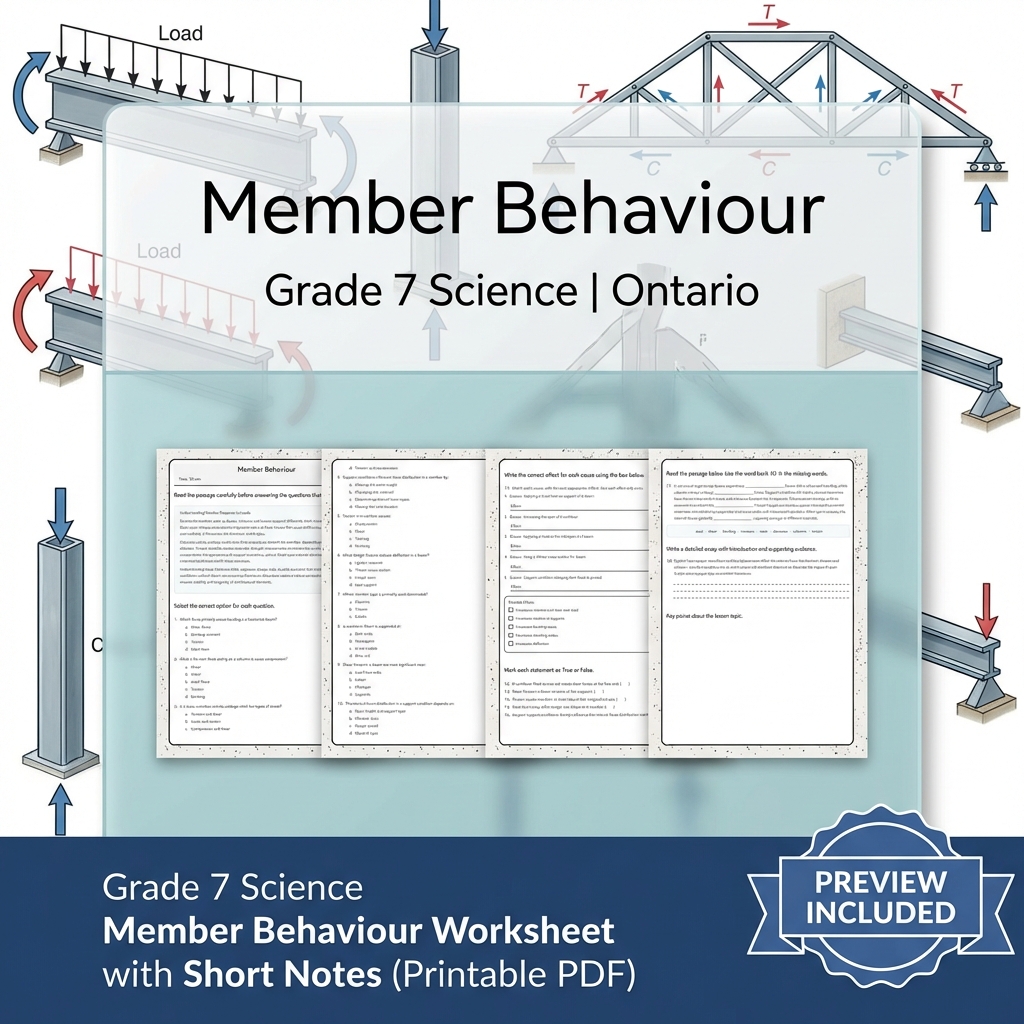
Grade 7 Science Member Behaviour Worksheet with Short Notes (Printable PDF)
Created byMeadowlark WorksheetsLearning Objectives
- Describe how structural members respond to applied loads through different types of forces.
- Relate geometry and support conditions to internal force distribution in beams and columns.
- Explain the effects of bending, shear, axial forces, and torsion on member deflection and serviceability.
Also included in: Grade 7 Science Lesson Group | Ontario Curriculum Worksheets Bundle +1 more
Instant download
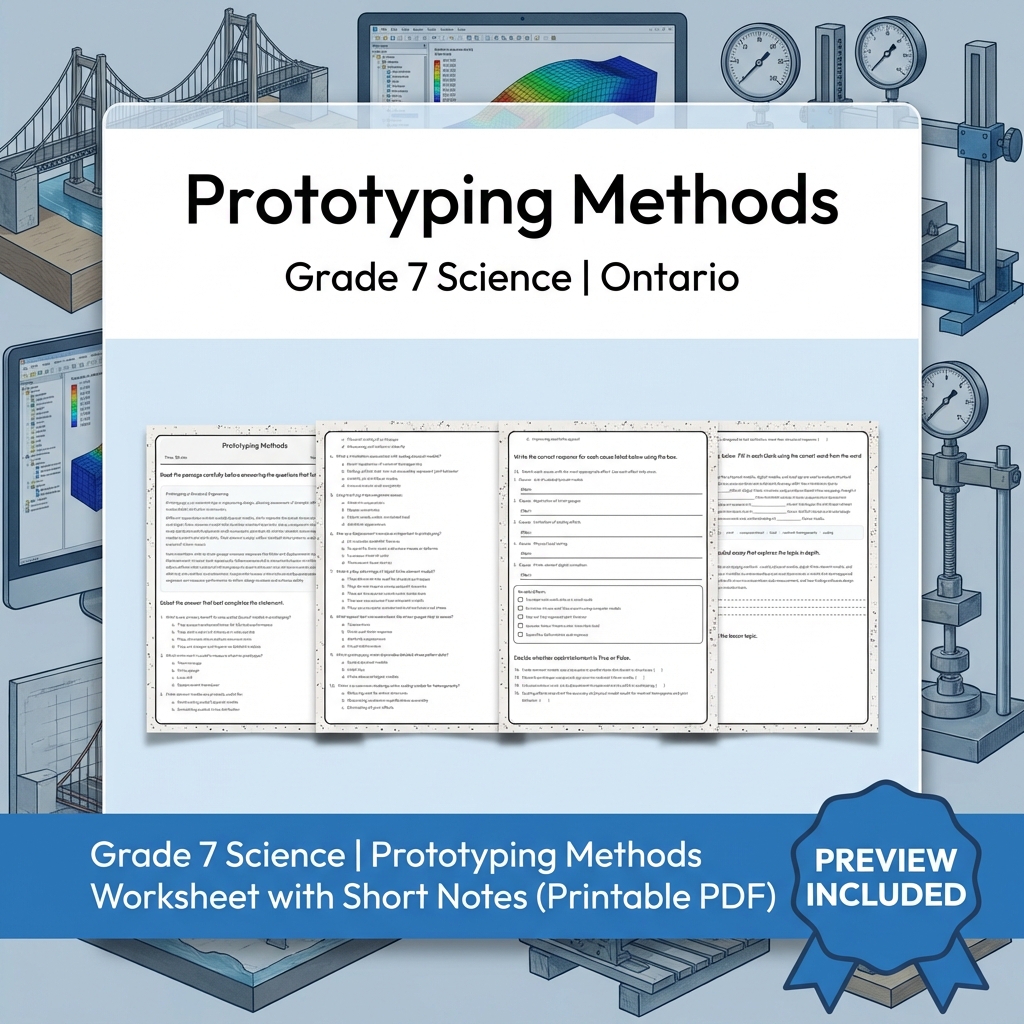
Grade 7 Science | Prototyping Methods Worksheet with Short Notes (Printable PDF)
Created byMeadowlark WorksheetsLearning Objectives
- Understand different prototyping techniques including physical models, digital analysis, and laboratory rigs.
- Compare the advantages and limitations of scaled physical models, finite-element digital models, and load rigs.
- Recognize instrumentation tools such as strain gauges and displacement transducers used to measure responses.
Also included in: Grade 7 Science Lesson Group | Ontario Curriculum Worksheets Bundle +1 more
Instant download
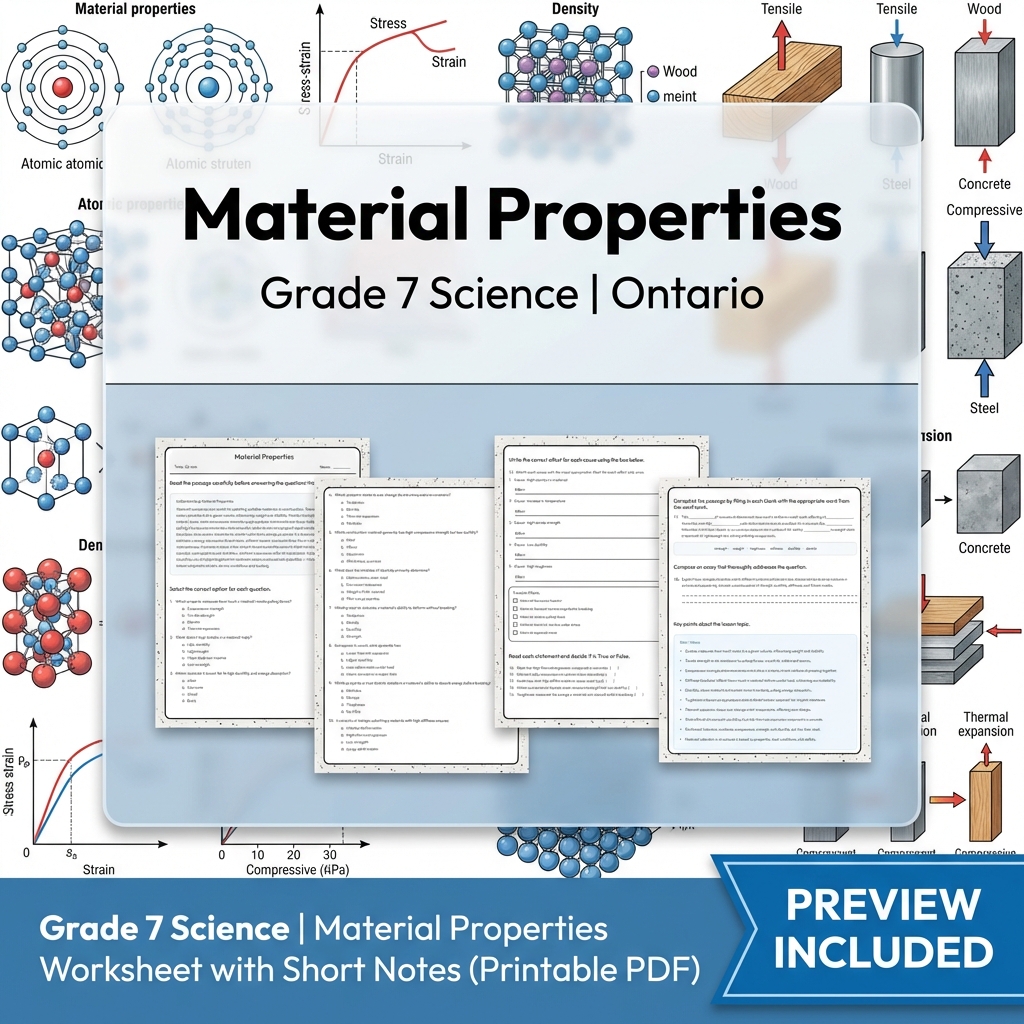
Grade 7 Science | Material Properties Worksheet with Short Notes (Printable PDF)
Created byMeadowlark WorksheetsLearning Objectives
- Define key material properties such as density, tensile and compressive strength, stiffness, ductility, toughness, and thermal expansion.
- Explain how these properties influence structural performance and failure modes.
- Contrast materials like wood, steel, and reinforced concrete in terms of strength-to-weight ratio and deformation behaviors.
Also included in: Grade 7 Science Lesson Group | Ontario Curriculum Worksheets Bundle +1 more
Instant download
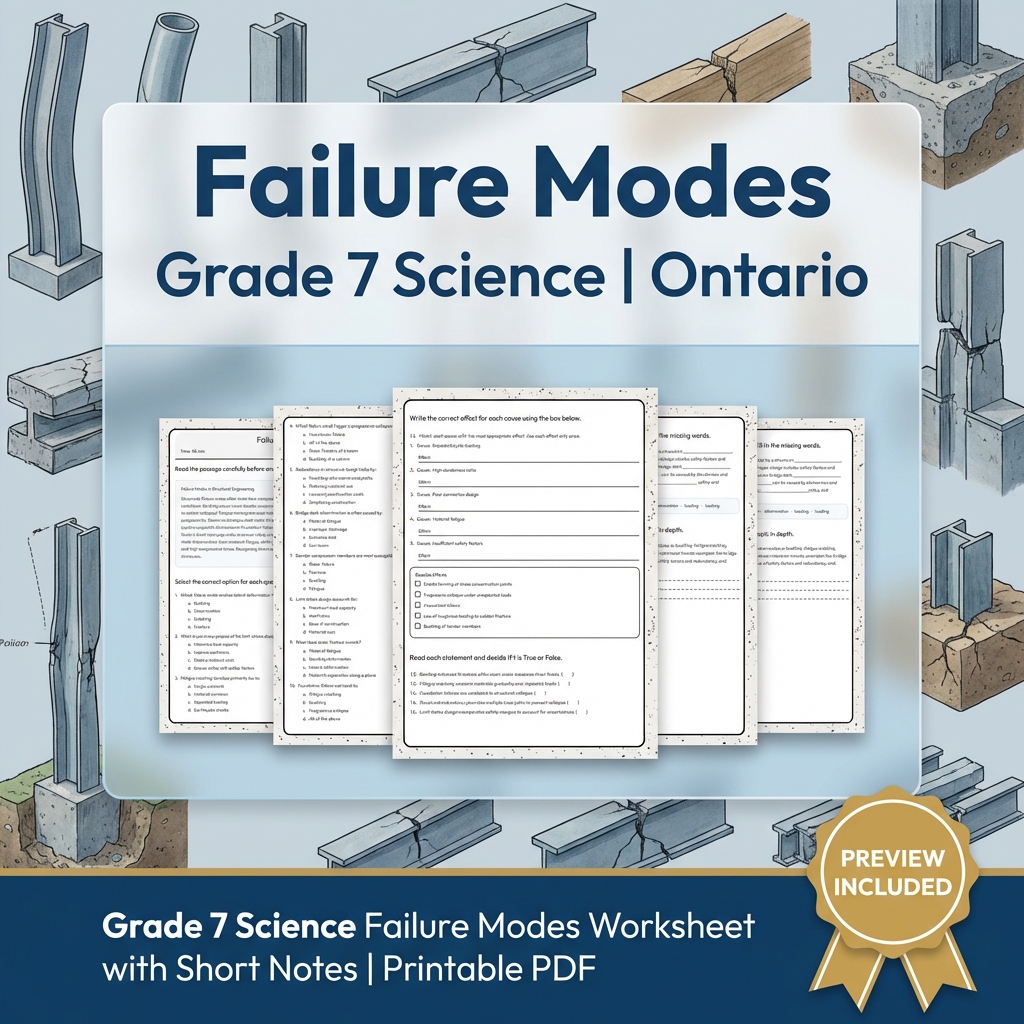
Grade 7 Science Failure Modes Worksheet with Short Notes | Printable PDF
Created byMeadowlark WorksheetsLearning Objectives
- Identify common structural failure modes such as buckling, fatigue cracking, and shear fracture.
- Explain the limits states design philosophy, safety factors, and redundancy in engineering.
- Relate failure mechanisms to geometric, material, and loading characteristics using real-world examples.
Also included in: Grade 7 Science Lesson Group | Ontario Curriculum Worksheets Bundle +1 more
Instant download
Grade 7 Science | Design Process Worksheet with Short Notes PDF
Created byMeadowlark WorksheetsLearning Objectives
- Describe the steps involved in the design process from defining requirements to selecting solutions.
- Explain how performance objectives like load capacity and stiffness guide design decisions.
- Understand the use of decision matrices and sketches to compare alternative designs.
Also included in: Grade 7 Science Lesson Group | Ontario Curriculum Worksheets Bundle +1 more
Instant download

Grade 7 Science | Exploring Physical Changes in Matter - Reading Comprehension
 Created byCoral Reef Learning
Learning Objectives
- Identify examples of physical changes
- Differentiate between physical and chemical changes
- Observe indicators of chemical reactions
Instant download
7th Grade Science | Plate Mechanisms Worksheet & Answer Key (Printable PDF)
Created byCoral Reef LearningLearning Objectives
- Understand the key force systems driving plate motion within the Earth.
- Describe how mantle convection, slab pull, and ridge push influence tectonic activity.
- Explain the interaction between different plate mechanisms and their effects on plate velocity and direction.
Instant download

Grade 7 Variable Control Worksheet | Ontario Science Investigation Activity
Created byClear Sky ClassroomLearning Objectives
- Identify independent, dependent, and controlled variables in real experimental scenarios.
- Create clear operational definitions for variables so measurements are consistent and replicable.
- Design fair tests by controlling confounding variables, using control groups, and planning replication.
Instant download

Grade 7 Science | Trophic Energy Transfer - Daily Reading Comprehension
Created byCoral Reef LearningLearning Objectives
- Understand the concept of food chains and trophic levels
- Explain how energy transfers from producers to consumers in an ecosystem
- Identify the reasons why food chains have limited numbers of trophic levels
Instant download

Grade 7 Science | Adaptive Traits Analysis - Daily Reading Comprehension
Created byCoral Reef LearningLearning Objectives
- Understand what adaptive traits are and how they help organisms survive
- Identify examples of adaptive traits in different species
- Learn how environmental pressures influence the frequency of traits in populations
Instant download

Grade 7 Science – Chemical Change Evidence Reading Worksheet | Alberta Standards
Created byBright Mind ResourcesLearning Objectives
- Understand key concepts related to Science
- Apply knowledge through practice questions
- Demonstrate comprehension of the material
Also included in: Grade 7 Solutions Science Daily Reading Worksheets Lesson Bundle | Alberta +2 more
Instant download
Grade 7 Science | Durability Factors Worksheet with Short Notes (Printable PDF)
Created byMeadowlark WorksheetsLearning Objectives
- Understand the main factors affecting material durability over time.
- Identify different protection measures for materials in structures.
- Analyze how environmental exposure influences material lifespan.
Also included in: Grade 7 Science Lesson Group | Ontario Curriculum Worksheets Bundle +1 more
Instant download
Grade 7 Science | Water Cycle Worksheet (PDF + Answer Key)
 Created byRiverstone Classroom
Learning Objectives
- Explain the processes involved in the water cycle including evaporation, condensation, and precipitation.
- Describe how water moves through Earth's spheres such as groundwater flow, river discharge, and ocean exchange.
- Identify the impacts of seasonal changes and human activities on water circulation and storage.
Instant download
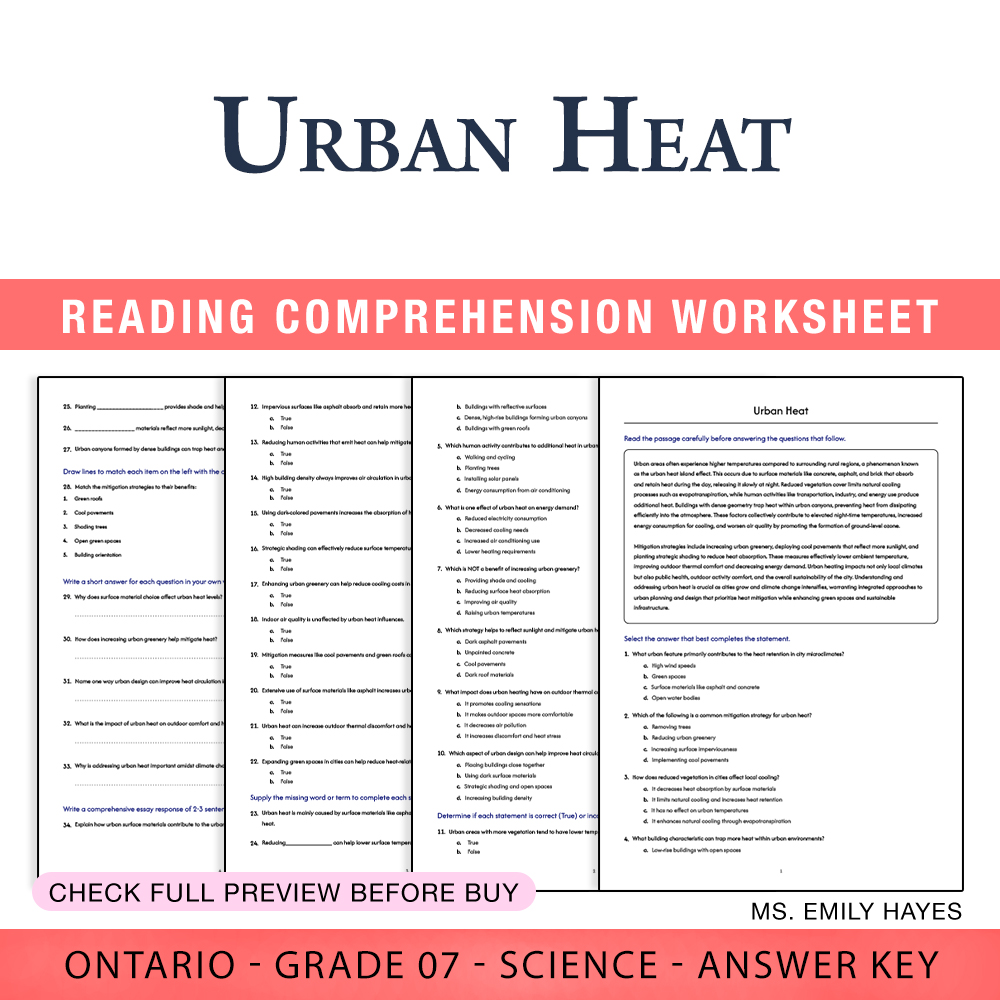
Grade 7 Science | Urban Heat Phenomenon Worksheet (PDF+ Answer Key)
 Created byCopper Leaf Classroom
Learning Objectives
- Understand the concept of urban heat island phenomena and its causes
- Identify the effects of surface materials, vegetation, and human activities on urban microclimates
- Analyze mitigation strategies to reduce urban heat and their impact on urban environments
Instant download

Urban Heat: Mitigating the Urban Heat Island Worksheet | Ontario Grade 7 Science
JCreated byJ.S SheetsLearning Objectives
- Explain what the urban heat island effect is and why cities often have higher temperatures than nearby rural areas.
- Describe how surface materials, vegetation, building geometry, and human activities influence urban microclimates.
- Evaluate mitigation strategies such as cool pavements, increased greenery, and strategic shading, and relate them to energy use and outdoor comfort.
Instant download

Grade 7 Transfer Mechanisms & Energy Forms Worksheet | NGSSS Science
Created byEvergreen Desk EducationLearning Objectives
- Explain how energy transfers through conduction, convection, and radiation using everyday examples
- Compare how energy moves in solids, liquids, and gases for each transfer mechanism
- Describe how energy can transform from one form to another (chemical, electrical, thermal, light)
Instant download

Density Particle View Assessment Grade 7 Science | California Standards
Created byPrism Point LearningLearning Objectives
- Explain density using the particle view of matter (mass and how particles are spaced).
- Predict how sinking, floating, and heating relate to changes in volume and average particle spacing.
- Use evidence from particle spacing to compare the densities of different substances.
Also included in: Grade 7 Forces and Matter Science Lesson Bundle: California Standards +1 more
Instant download

Pure Substances Worksheets: Properties and Identification Grade 7
 Created bySunny Desk Resources
Learning Objectives
- Explain that pure substances have uniform composition and characteristic properties.
- Distinguish elements from compounds using physical and chemical tests.
- Use fixed melting and boiling points to support identification of pure substances.
Also included in: Matter and Chemical Change Grade 7 Alberta Science Worksheets Bundle +1 more
Instant download

Species Adaptations Worksheets: Survival Strategies Grade 7 Science
Created byPrism Point LearningLearning Objectives
- Identify structural, physiological, and behavioral adaptations
- Explain how selective pressures influence trait frequencies over generations
- Compare adaptation examples across different habitat contexts
Also included in: Interactions in the Environment Lesson Bundle | Grade 7 Science | Ontario +1 more
Instant download

Grade 7 Science | Levels Of Organization in Ecology - Reading Comprehension
Created byCoral Reef LearningLearning Objectives
- Understand the concept of an individual organism and its characteristics
- Recognize examples of individual organisms in ecological contexts
- Identify how individual traits contribute to higher levels of ecological organization
Also included in: Interactions and Ecosystems Lesson Bundle Grade 7 Science – Alberta +1 more
Instant download

Insulation Principles Practice Worksheet | Grade 7 Science | Review
Created byPrism Point LearningLearning Objectives
- Explain how insulation reduces heat transfer through conduction, convection, and radiation.
- Compare common insulating materials (fibreglass, foam, reflective foils) using ideas like trapped air and thermal resistance.
- Describe how air leakage, thermal bridging, and continuous insulation affect overall heat loss in buildings.
Instant download
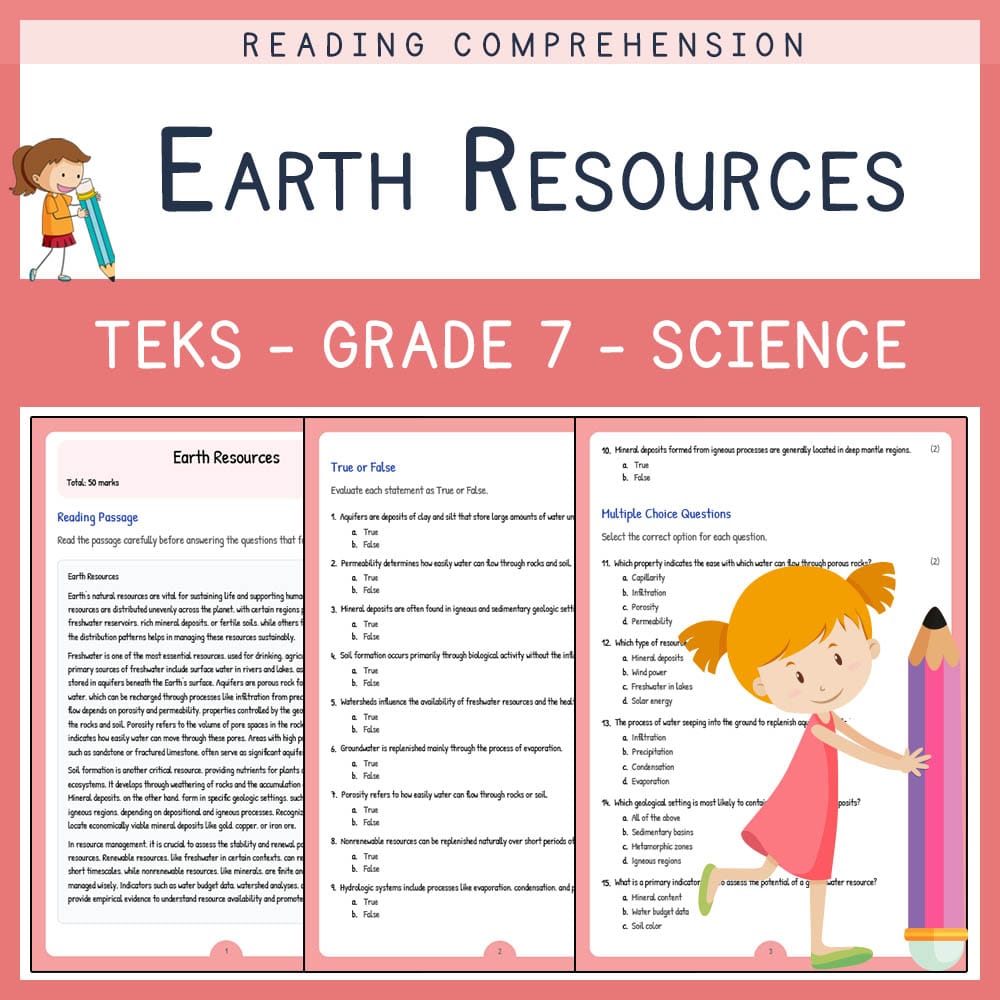
Grade 7 Science | Earth Resources Worksheet Elena | TEKS Aligned
 Created byLumora Learning
Learning Objectives
- Understand the role of natural resources such as groundwater, soil, and minerals.
- Explain processes of aquifer recharge, porosity, and permeability.
- Differentiate between renewable and nonrenewable resources based on geologic settings.
Also included in: Grade 7 Science | Earth and Space Systems Unit Bundle | TEKS Standard
Instant download
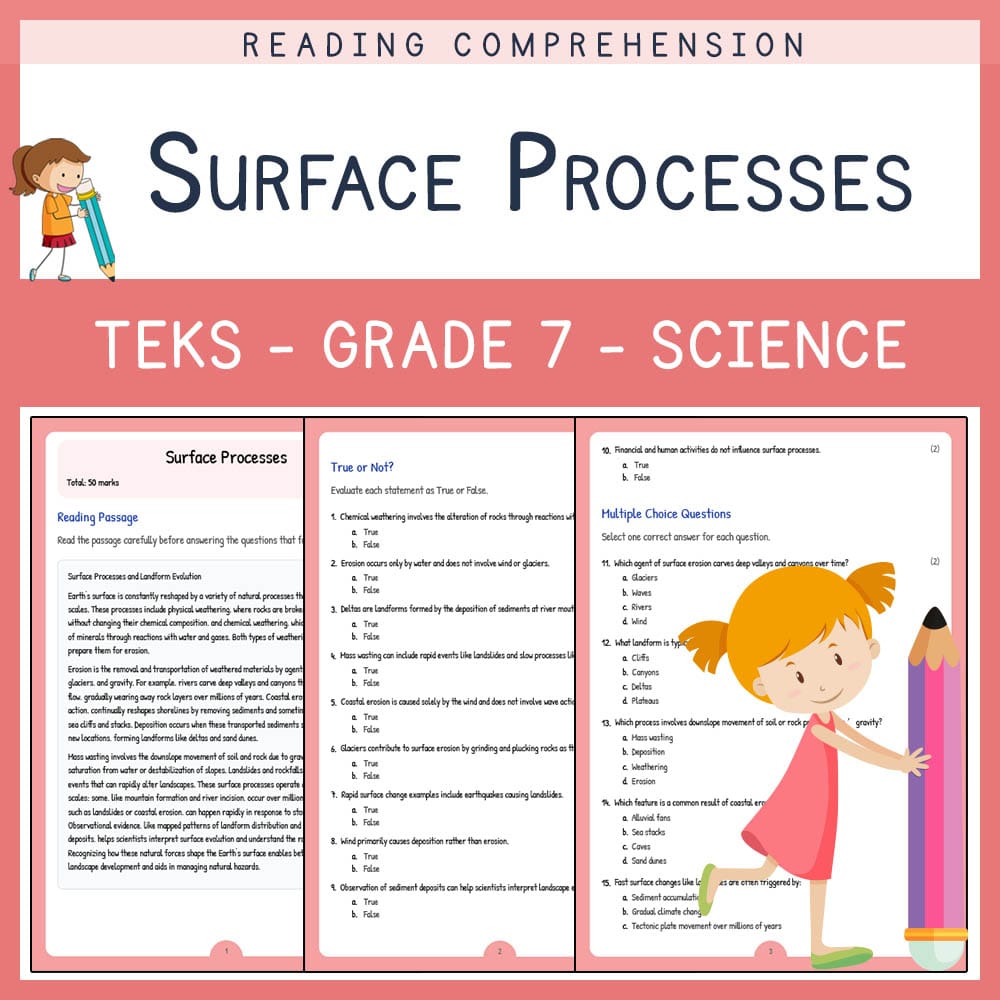
Grade 7 Science | Surface Processes Worksheet | TEKS Aligned
Created byLumora LearningLearning Objectives
- Describe the physical and chemical processes that shape Earth's surface, including weathering, erosion, deposition, and mass wasting.
- Identify driving forces such as water flow, wind, glaciers, and gravity, and explain their influence on landform development.
- Link observable landforms like deltas, canyons, and dunes to specific surface processes and understand their rates of change.
Also included in: Grade 7 Science | Earth and Space Systems Unit Bundle | TEKS Standard
Instant download
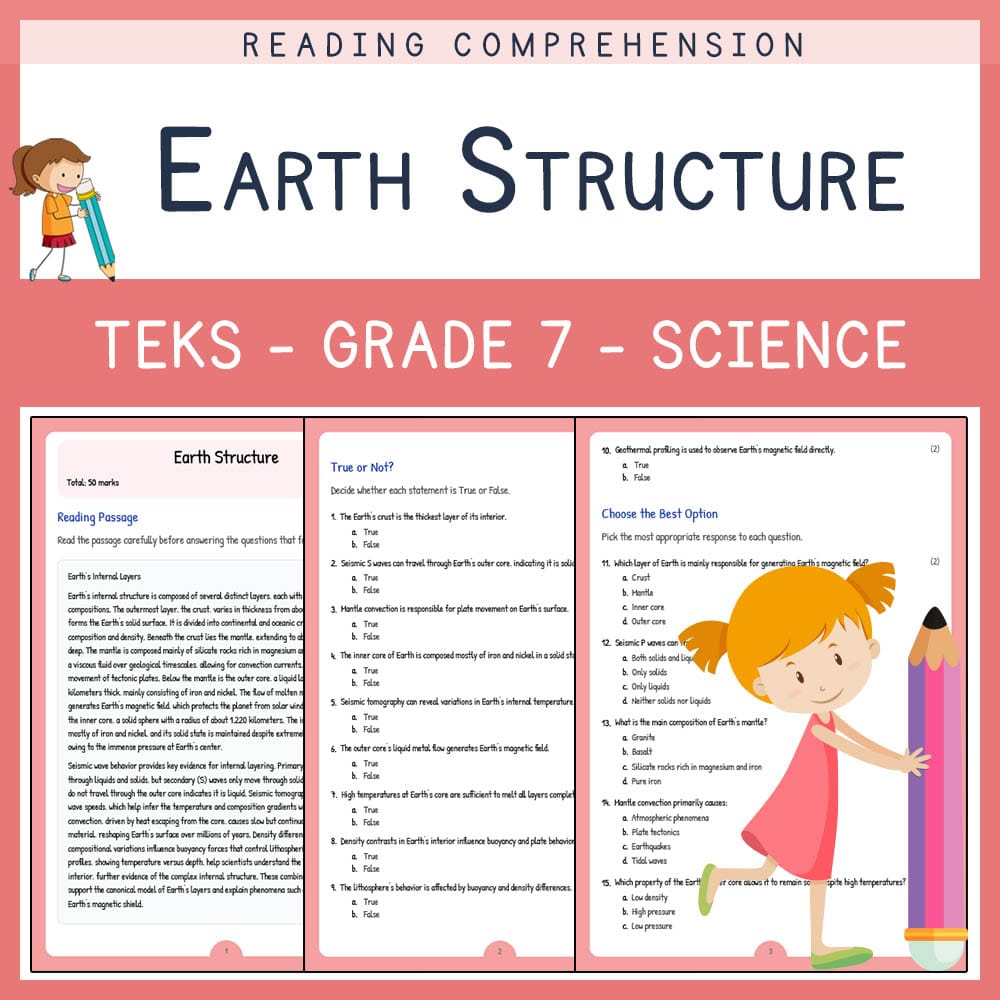
Grade 7 Science | Earth Structure Worksheet | TEKS-Aligned
Created byLumora LearningLearning Objectives
- Describe Earth's internal layering and the properties of each layer.
- Explain seismic wave behavior as evidence for Earth's internal structure.
- Understand mantle convection and its role in plate motion.
Also included in: Grade 7 Science | Earth and Space Systems Unit Bundle | TEKS Standard
Instant download
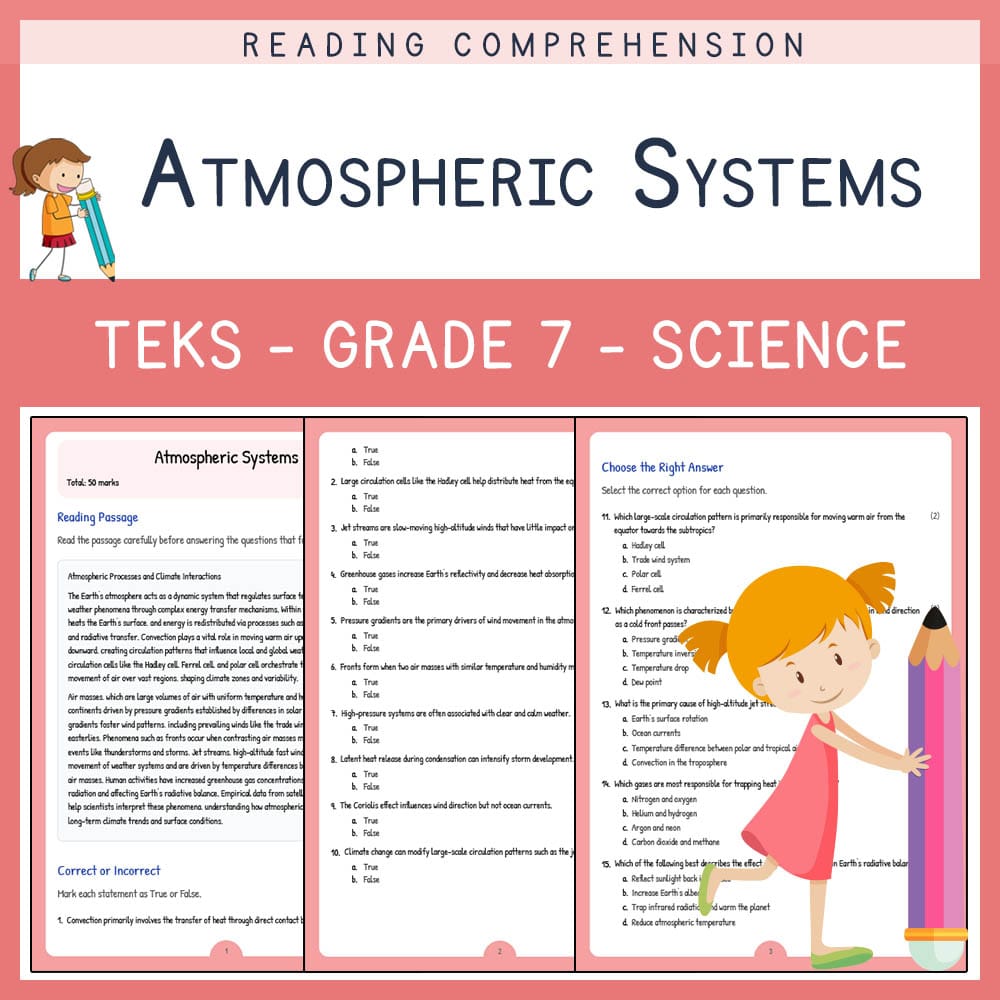
Grade 7 Science | Atmospheric Systems Worksheet Elena | TEKS-Aligned
Created byLumora LearningLearning Objectives
- Describe the processes involved in atmospheric energy transfer and circulation.
- Explain how air masses, pressure gradients, and large-scale circulation affect weather and climate.
- Identify observational phenomena like fronts and jet streams and their impacts.
Also included in: Grade 7 Science | Earth and Space Systems Unit Bundle | TEKS Standard
Instant download
About Grade 7 Science Worksheets
Browse 6,039 printable Grade 7 Science worksheets — ready-to-print PDFs with answer keys where available.
Every worksheet on MyTeachingSheets is created by independent teacher-authors and reviewed before publication. All resources download as printable PDFs for classroom, homework, or at-home practice, and many include answer keys. Preview any worksheet free before buying.