
Grade 7 Science Worksheets
6,039 worksheets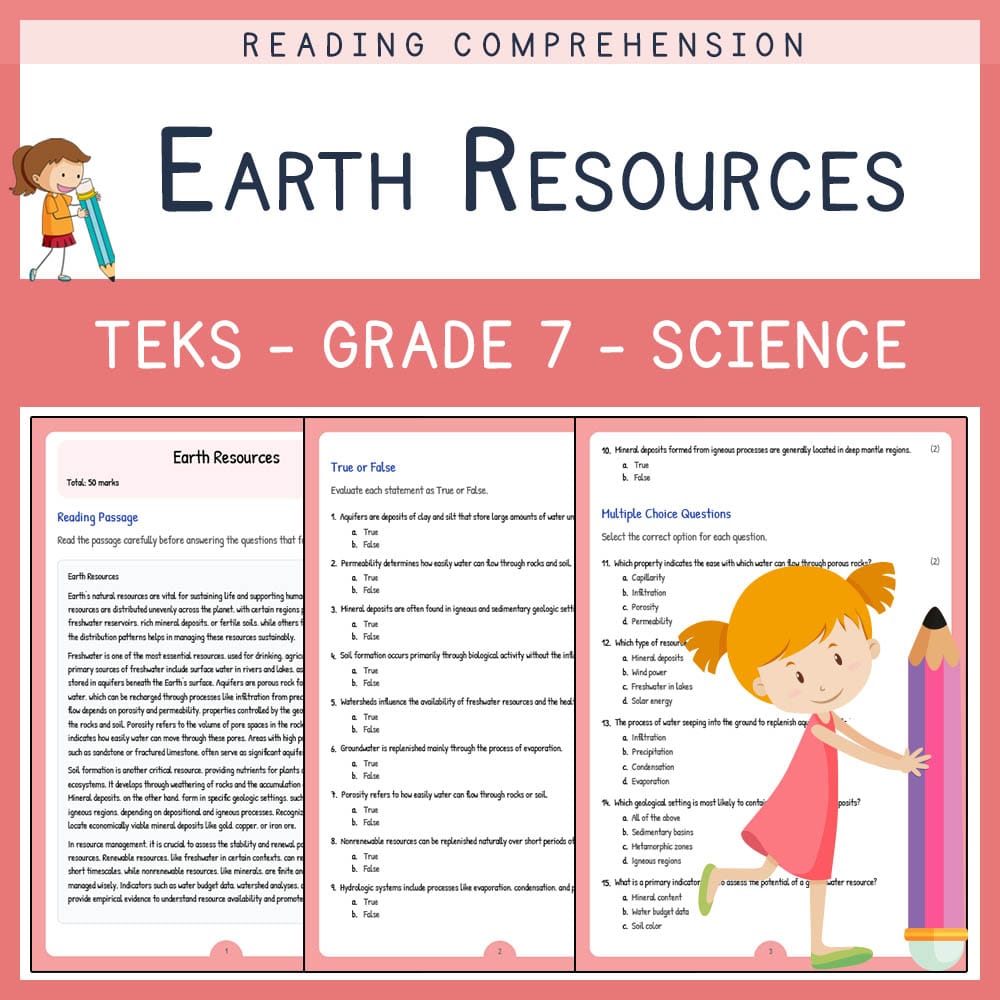
Grade 7 Science | Earth Resources Worksheet Elena | TEKS Aligned
 Created byLumora Learning
Learning Objectives
- Understand the role of natural resources such as groundwater, soil, and minerals.
- Explain processes of aquifer recharge, porosity, and permeability.
- Differentiate between renewable and nonrenewable resources based on geologic settings.
Also included in: Grade 7 Science | Earth and Space Systems Unit Bundle | TEKS Standard
Instant download
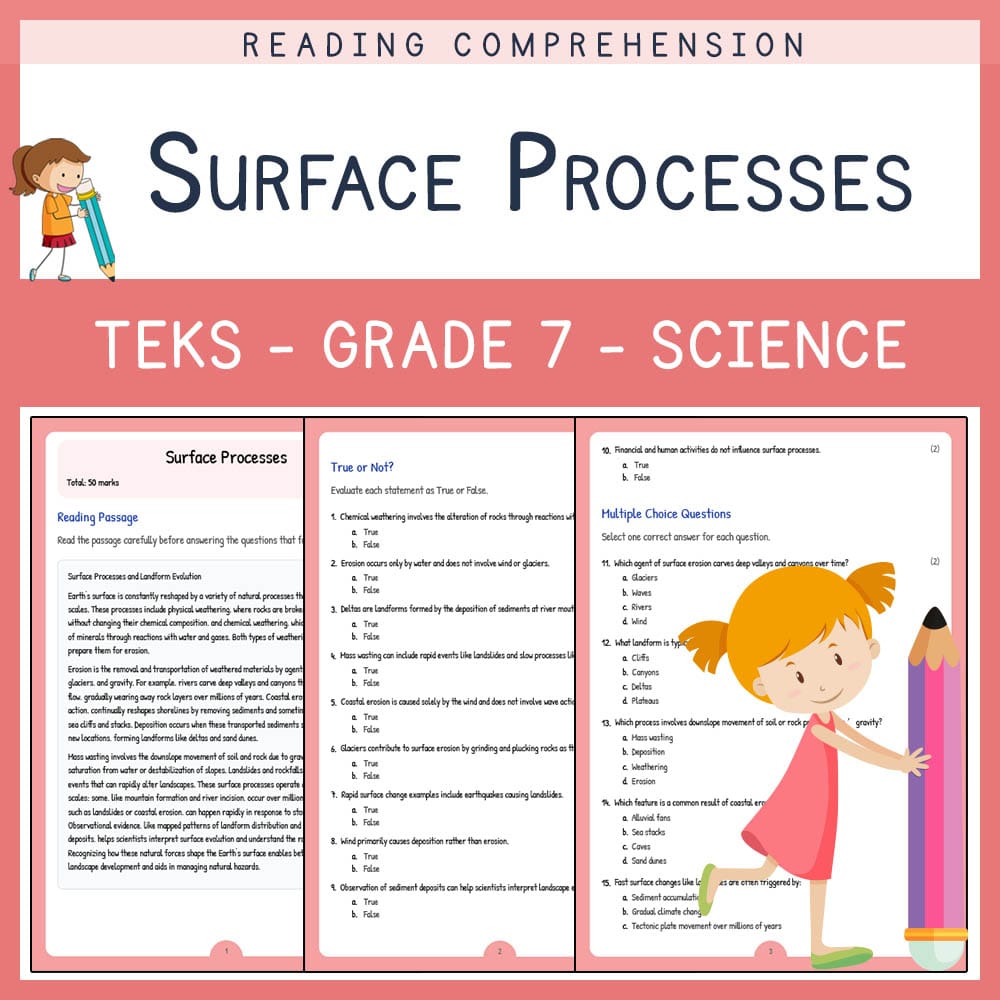
Grade 7 Science | Surface Processes Worksheet | TEKS Aligned
Created byLumora LearningLearning Objectives
- Describe the physical and chemical processes that shape Earth's surface, including weathering, erosion, deposition, and mass wasting.
- Identify driving forces such as water flow, wind, glaciers, and gravity, and explain their influence on landform development.
- Link observable landforms like deltas, canyons, and dunes to specific surface processes and understand their rates of change.
Also included in: Grade 7 Science | Earth and Space Systems Unit Bundle | TEKS Standard
Instant download
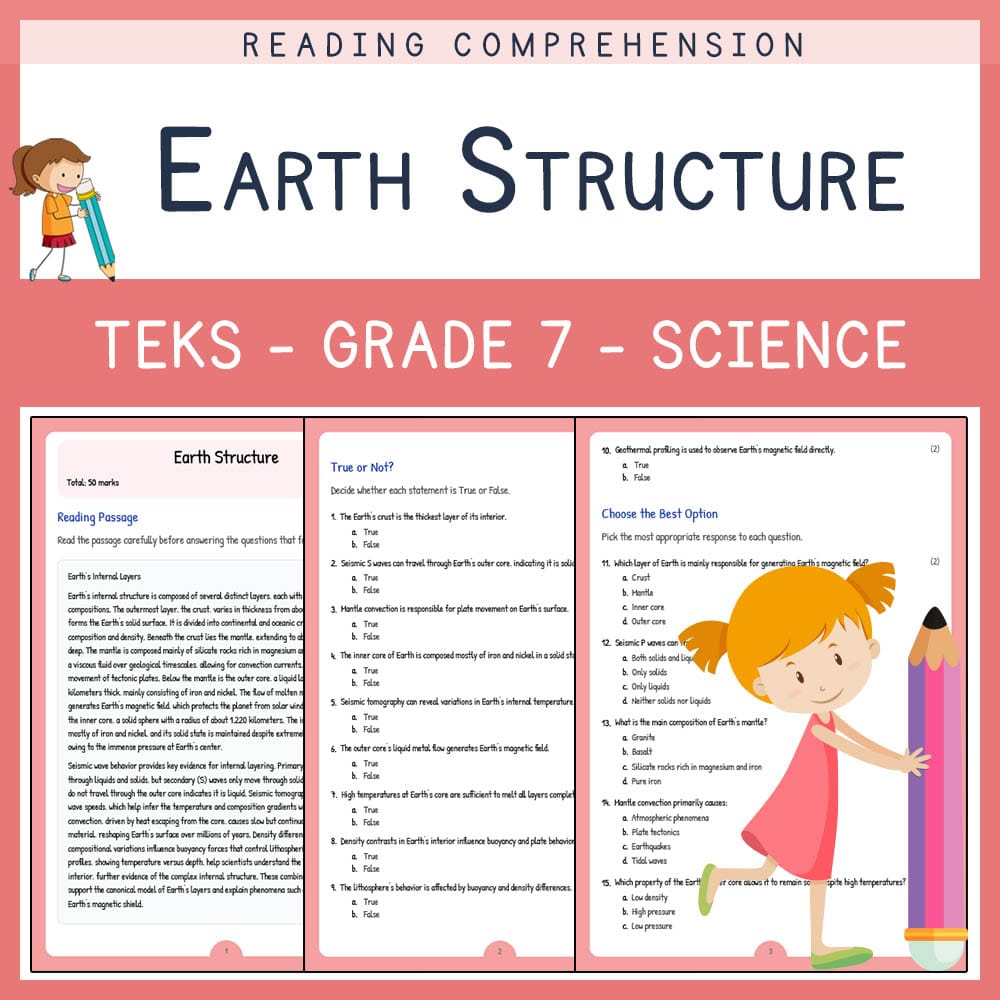
Grade 7 Science | Earth Structure Worksheet | TEKS-Aligned
Created byLumora LearningLearning Objectives
- Describe Earth's internal layering and the properties of each layer.
- Explain seismic wave behavior as evidence for Earth's internal structure.
- Understand mantle convection and its role in plate motion.
Also included in: Grade 7 Science | Earth and Space Systems Unit Bundle | TEKS Standard
Instant download
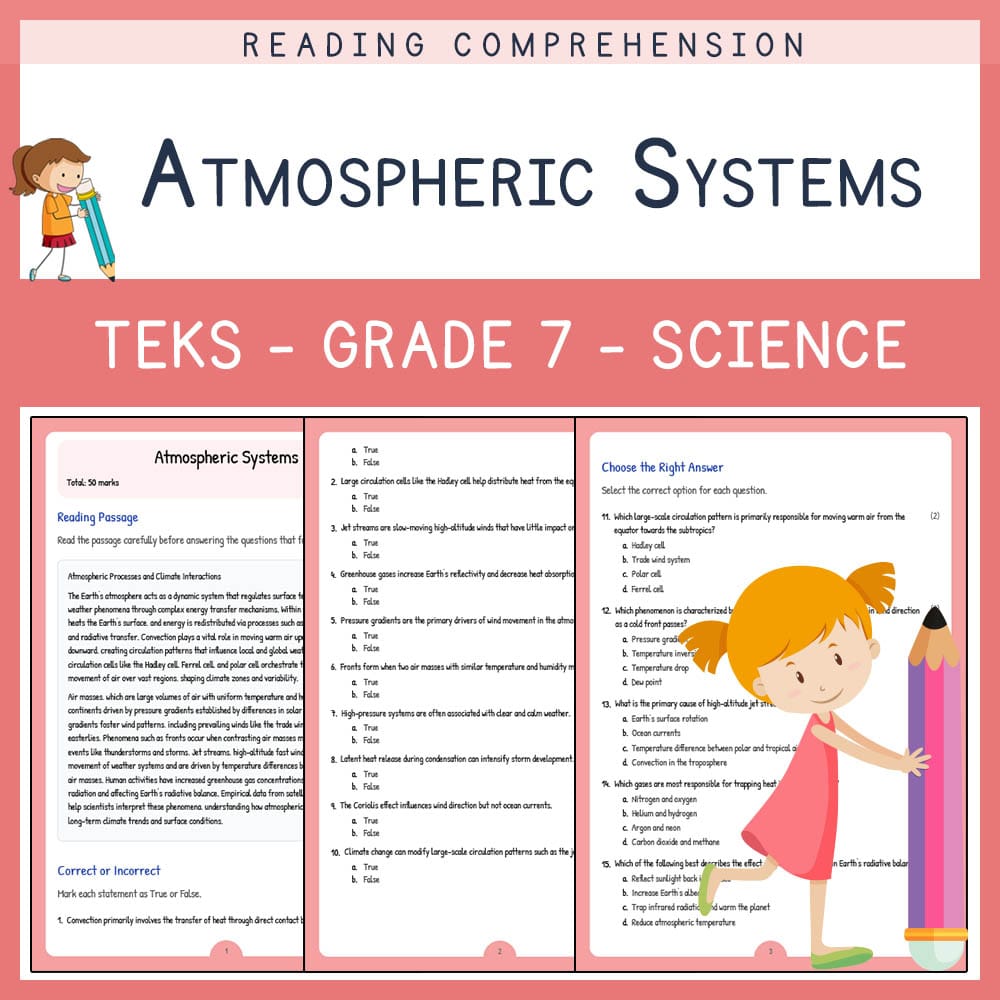
Grade 7 Science | Atmospheric Systems Worksheet Elena | TEKS-Aligned
Created byLumora LearningLearning Objectives
- Describe the processes involved in atmospheric energy transfer and circulation.
- Explain how air masses, pressure gradients, and large-scale circulation affect weather and climate.
- Identify observational phenomena like fronts and jet streams and their impacts.
Also included in: Grade 7 Science | Earth and Space Systems Unit Bundle | TEKS Standard
Instant download
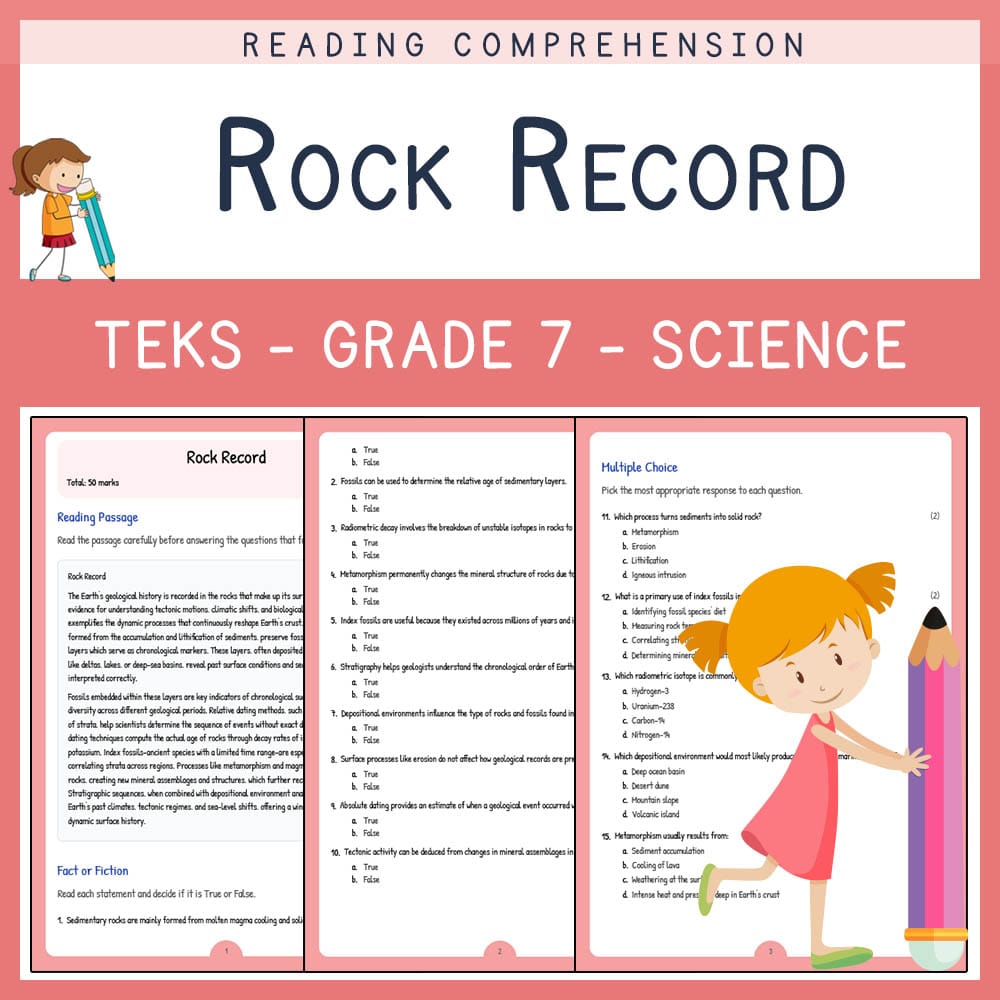
Grade 7 Science | Rock Record Worksheet | TEKS-Aligned
Created byLumora LearningLearning Objectives
- Understand the processes of the rock cycle, including sedimentation, lithification, metamorphism, and magmatism.
- Explain how fossils and stratigraphy serve as evidence of Earth's history and surface change.
- Identify relative and absolute dating techniques, including index fossils and radiometric decay methods.
Also included in: Grade 7 Science | Earth and Space Systems Unit Bundle | TEKS Standard
Instant download

Energy Types Assessment | TEKS Grade 7 Science Standards-Aligned
 Created byPrism Point Learning
Learning Objectives
- Define kinetic and potential energy with real-world examples.
- Explain how height and motion relate to different energy forms.
- Illustrate energy transfer and conservation concepts in systems.
Also included in: Grade 7 Motion and Energy Science: Lesson Bundle TEKS Unit Assessment
Instant download
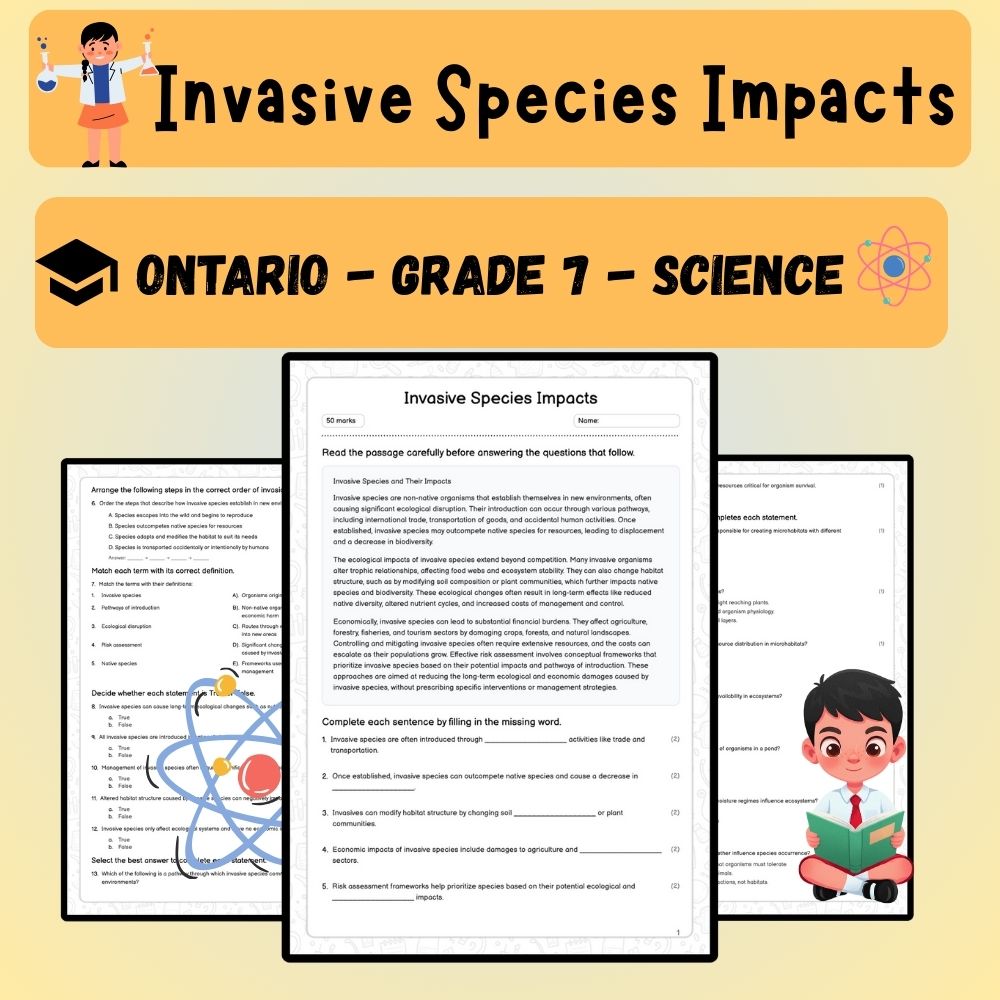
Grade 7 Science | Invasive Species Impacts Worksheet (PDF )
Created byPrism Point LearningLearning Objectives
- Understand the ecological consequences of non-native species introductions.
- Identify pathways through which invasive species are introduced and establish.
- Analyze long-term environmental and economic effects of invasive species.
Also included in: Grade 7 Science UNIT Bundle | Ecosystems & Biodiversity Worksheets +1 more
Instant download
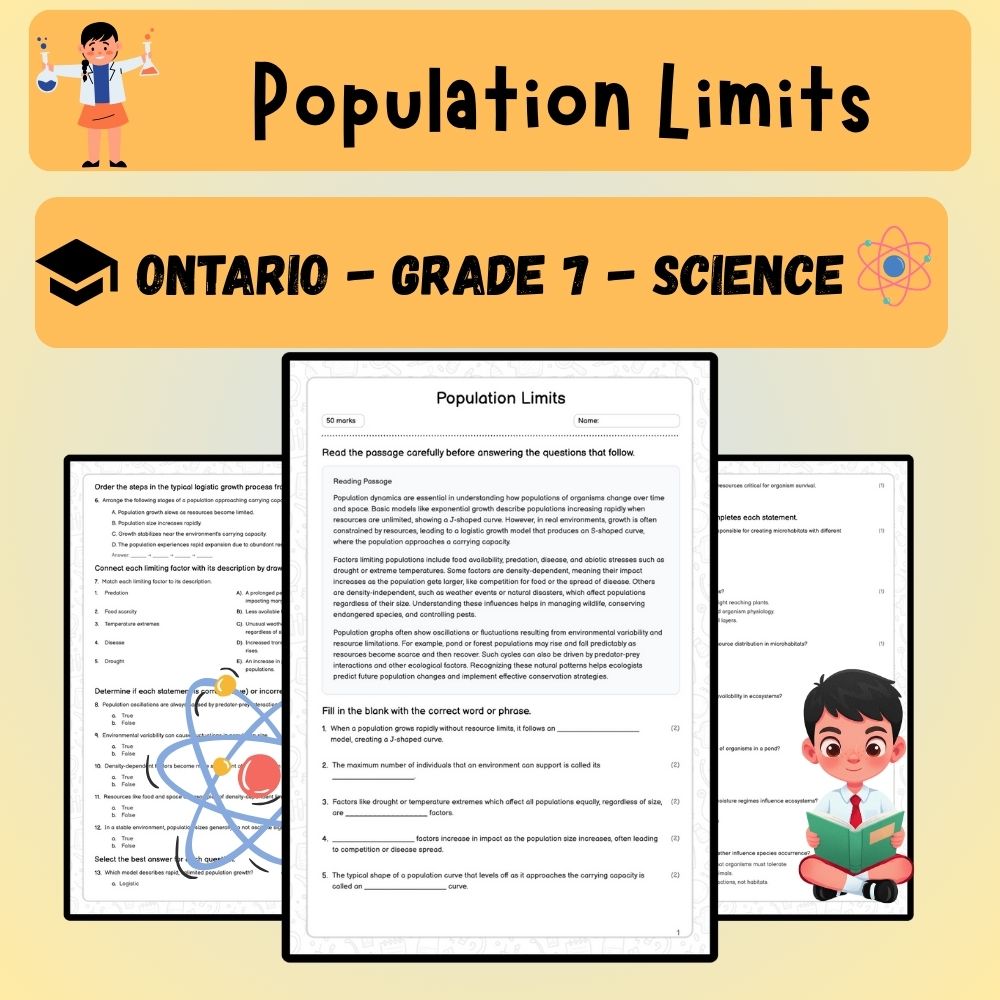
Grade 7 Science | Population Limits Worksheet (PDF ) – Ontario Standards
Created byPrism Point LearningLearning Objectives
- Understand basic models of population growth, including exponential and logistic growth.
- Identify factors that limit population size such as food, predation, disease, and environmental stresses.
- Differentiate between density-dependent and density-independent factors affecting populations.
Also included in: Grade 7 Science UNIT Bundle | Ecosystems & Biodiversity Worksheets +1 more
Instant download
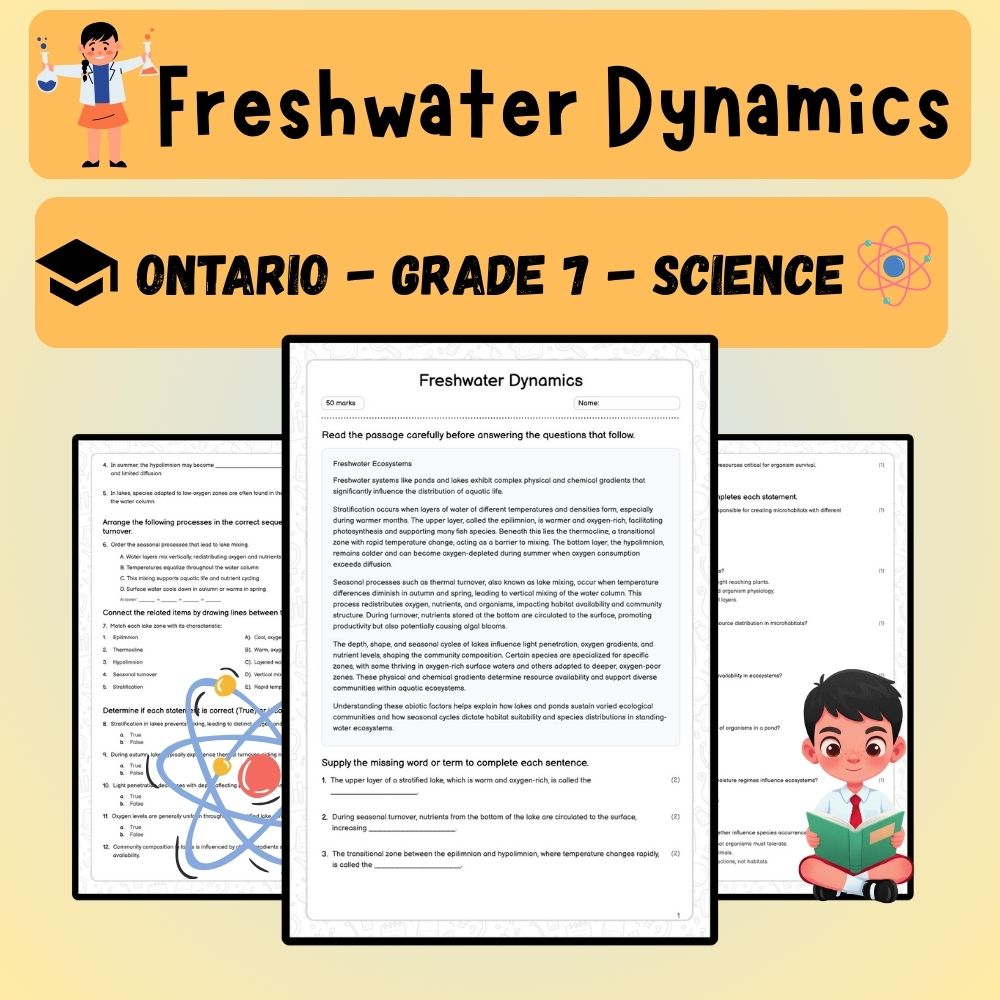
Grade 7 Science | Freshwater Dynamics Worksheet (PDF )
Created byPrism Point LearningLearning Objectives
- Describe the structure and stratification of freshwater systems such as ponds and lakes.
- Explain how abiotic gradients influence community composition and vertical zonation in standing-water ecosystems.
- Discuss seasonal changes like thermal turnover and their effects on oxygen levels, nutrient mixing, and habitat conditions in freshwater environments.
Also included in: Grade 7 Science UNIT Bundle | Ecosystems & Biodiversity Worksheets +1 more
Instant download

Science Worksheet Transfer Mechanisms and Energy Forms | Grade 7 NGSSS
JCreated byJ.S SheetsLearning Objectives
- Identify and describe conduction, convection, and radiation as energy transfer mechanisms.
- Explain how energy can transform from one form to another in everyday systems.
- Compare different energy transfers to predict what will happen in real-life situations.
Also included in: Grade 7 Matter, Energy & Forces Science Lesson Bundle – Florida NGSSS +1 more
Instant download

Grade 7 Saturation, Solubility & Supersaturation Science Worksheet Alberta
 Created byBRIGHT PATH RESOURCES
Learning Objectives
- Define saturation and solubility in terms of dissolved solute at a given temperature and pressure
- Explain what happens when more solute is added after a solution becomes saturated
- Describe supersaturation and why it can lead to sudden precipitation
Also included in: Grade 7 Alberta Science Matter and Chemical Change Worksheet Bundle +1 more
Instant download
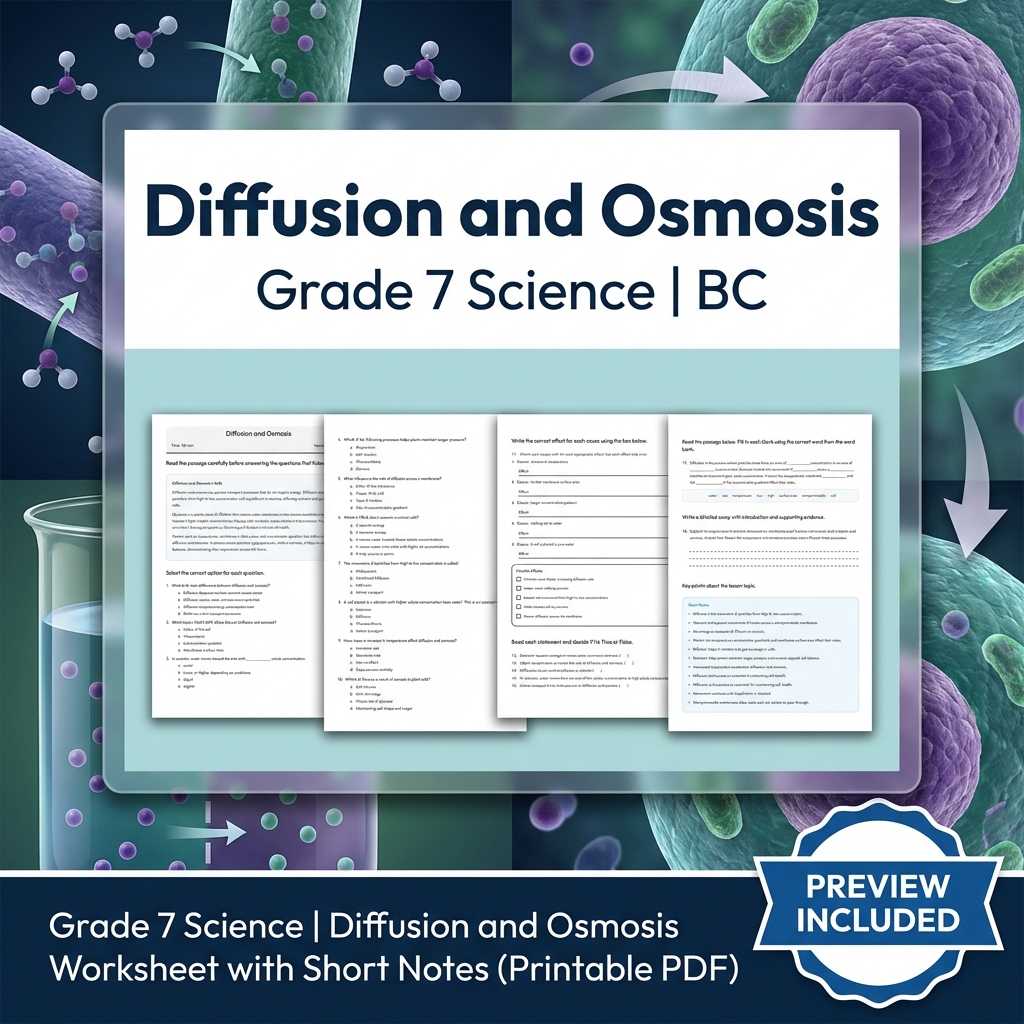
Grade 7 Science | Diffusion and Osmosis Worksheet with Short Notes(PDF)
 Created byMeadowlark Worksheets
Learning Objectives
- Understand the processes of diffusion and osmosis as passive transport mechanisms.
- Identify factors that influence the rate of diffusion and osmosis.
- Explain how diffusion and osmosis affect living cells and organisms.
Also included in: Grade 7 Science Lesson Bundle | Cell Structures & Functions Worksheets +1 more
Instant download
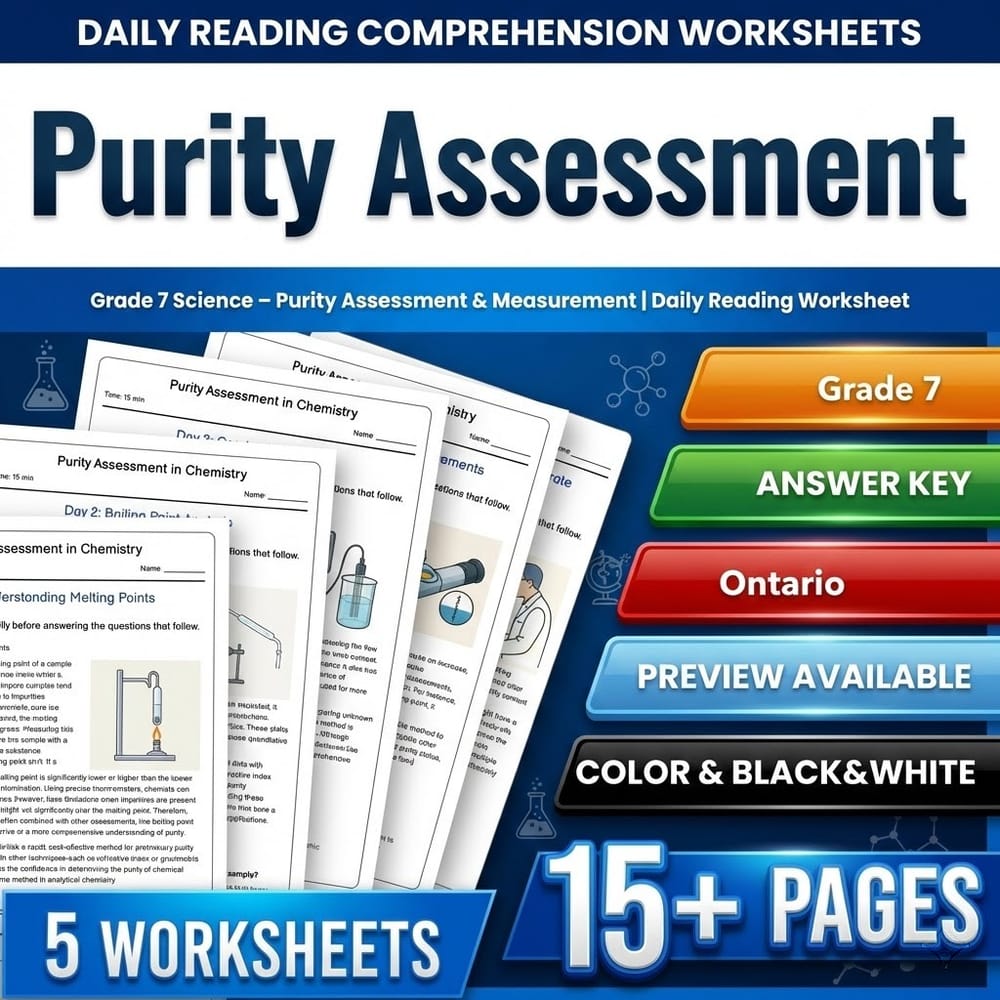
Grade 7 Science – Purity Assessment & Measurement | Daily Reading Worksheet
 Created byQuiet Forest Education
Learning Objectives
- Understand how melting point ranges can indicate the purity of a substance.
- Identify differences in conductivity to assess molecular composition.
- Explain how refractive index and gravimetric residue help determine contamination.
Also included in: Elements & Compounds Grade 7 Science Daily Reading Worksheets Bundle | Ontario +1 more
Instant download

Results-Driven Revision Assessment | General Grade 7 Science Standards
Created byPrism Point LearningLearning Objectives
- Understand how test results guide design modifications for improved performance.
- Identify specific weaknesses based on data and suggest targeted changes.
- Explain how evidence from results connects to design decisions and improvements.
Also included in: Grade 7 Science Assessment Practices Lesson Bundle | General Framework
Instant download

Grade 7 Science – Urban Heat Phenomena & Environmental Factors | Worksheet
 Created byBright Mind Resources
Learning Objectives
- To comprehend the causes of urban heat and the effect of surface materials, vegetation, and human activities.
- To develop skills in reading comprehension related to environmental science topics.
- To interpret scientific information through various question formats.
Also included in: Heat Transfer Grade 7 Science Daily Reading Worksheets Lesson Bundle | Ontario +1 more
Instant download

Biotic Interactions Worksheet - Grade 7 Science BC Standards Practice
JCreated byJ.S SheetsLearning Objectives
- Understand the different types of biotic interactions such as predation, competition, mutualism, commensalism, and parasitism.
- Identify examples of biotic relationships in ecosystems.
- Explain how human actions can disrupt biotic relationships and affect biodiversity.
Instant download

Grade 7 Science | Particle Model Worksheet | BC Alignment
Created byLumora LearningLearning Objectives
- Understand the concept of the particle model as a representation of matter.
- Explain how chemical reactions involve the breaking and forming of bonds between particles.
- Describe why mass remains constant during chemical changes in a closed system.
Also included in: Grade 7 Science | Matter & Chemical Change Unit Bundle | BC Aligned
Instant download

Grade 7 Water Cycle Journey Worksheet | NGSS Earth Science Activity
Created byBRIGHT PATH RESOURCESLearning Objectives
- Identify key processes in the water cycle such as evaporation, condensation, and precipitation.
- Explain how water moves through Earth's spheres including rivers, groundwater, and oceans.
- Describe the role of energy and gravity in the movement of water.
Also included in: Earth Systems Grade 7 Science Daily Reading Worksheets Lesson Bundle | NGSS +2 more
Instant download
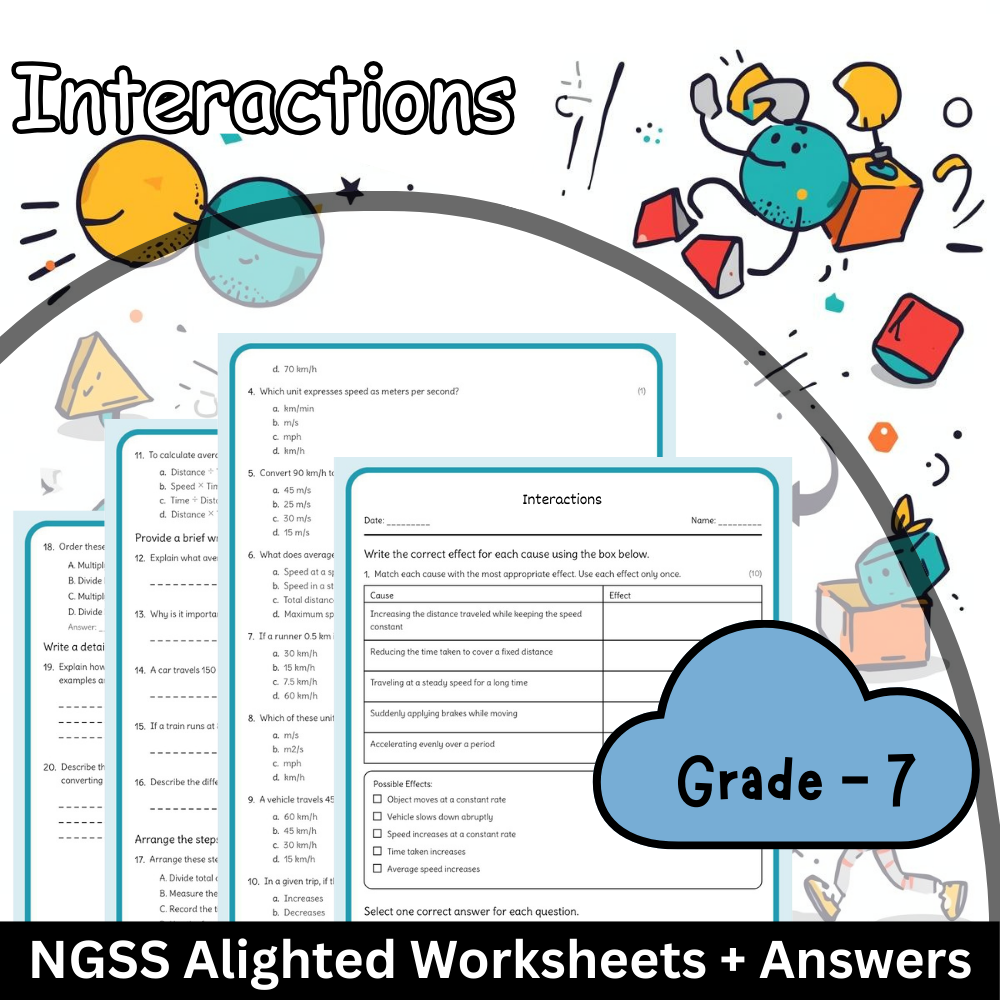
Grade 7 Science – Interactions Worksheet (NGSS Aligned) with Answer Key (PDF)
Created byBright Mind ResourcesLearning Objectives
- Understand the nature of gravitational, electric, and magnetic interactions as forces acting without contact.
- Explain how gravity is a universally attractive force influenced by mass and distance.
- Identify examples of electric and magnetic phenomena in everyday life, such as planetary motion, falling objects, and magnets.
Instant download

Disturbance Effects Practice Worksheet | Grade 7 Science Review
Created byPrism Point LearningLearning Objectives
- Explain how disturbances (fire, flood, landslide, windthrow) change habitats and trigger succession.
- Describe how disturbance frequency, intensity, and spatial scale affect diversity and population trends.
- Identify examples of species adapted to disturbance regimes and species that may be locally lost.
Also included in: Ecosystems & Interactions Lesson Bundle – Grade 7 Science BC Framework +1 more
Instant download

Engineered Materials Worksheets: Microstructure Grade 7 Science
Created byPrism Point LearningLearning Objectives
- Explain how microstructure influences material strength, stiffness, and durability
- Compare engineered materials using cost and fabrication trade-offs
- Describe how CLT structure improves resistance to bending
Also included in: Grade 7 Structural Performance Lesson Bundle | Ontario Science +1 more
Instant download

Grade 7 Science – Sound Production & Vibrations | Daily Reading Worksheet
Created byBright Mind ResourcesLearning Objectives
- Understand how vibrating objects produce sound
- Identify the relationship between frequency and pitch
- Explain how amplitude affects loudness
Also included in: Energy Transfer, Sound & Motion Lesson Bundle | Grade 7 Science | General +1 more
Instant download
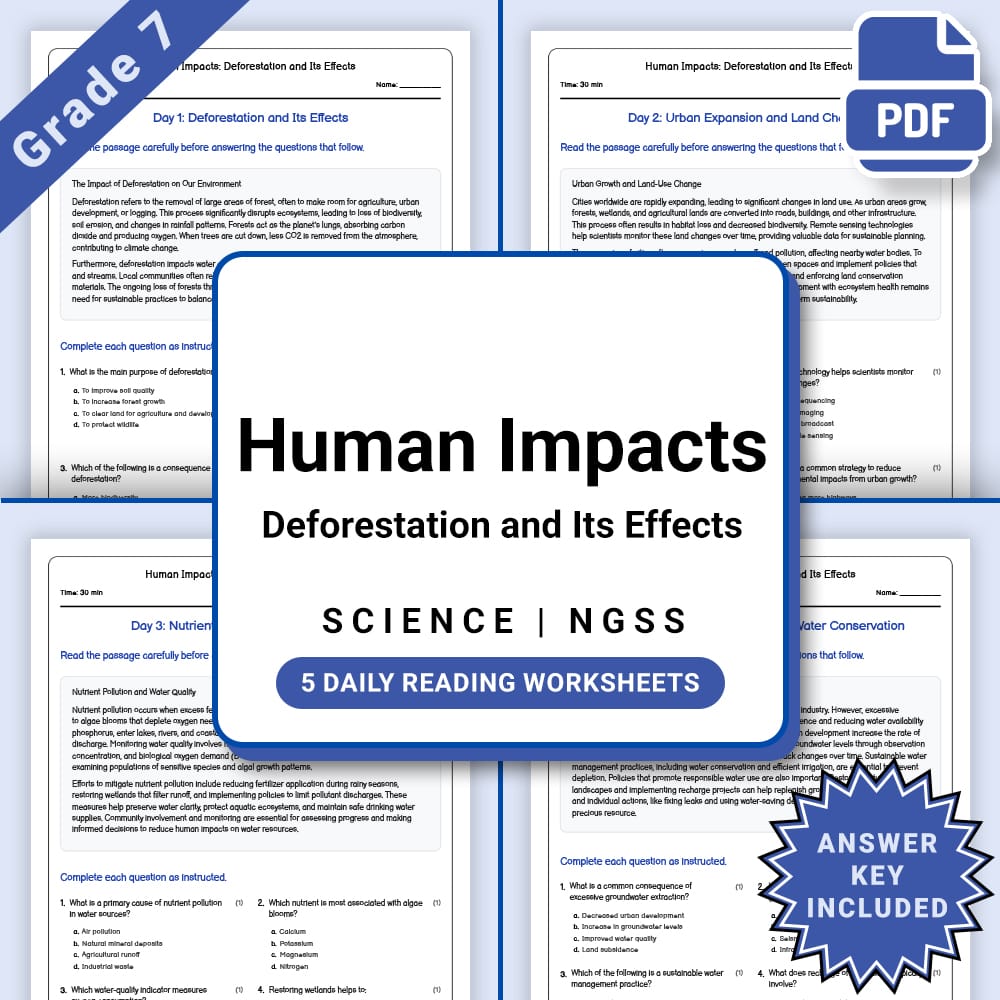
Grade 7 Science – Deforestation and Its Effects Worksheet(PDF + Answer Key)
 Created byCopper Leaf Classroom
Learning Objectives
- Understand what deforestation is and its causes.
- Explain how deforestation impacts ecosystems and humans.
- Identify ways to reduce the negative effects of deforestation.
Instant download

Grade 7 Science | Cell Energy Use Worksheet | California Standards
Created byLumora LearningLearning Objectives
- Explain how cells convert the chemical energy in food into usable energy for life functions
- Describe how ATP helps cells transfer and use energy during cellular processes
- Distinguish between conservation of energy and conservation of matter in cellular energy use
Instant download

Grade 7 Science | Gravity Shaping Orbits Worksheet | California Standards
Created byLumora LearningLearning Objectives
- Explain how gravity provides the centripetal force needed for orbital motion
- Describe why objects follow curved (often elliptical) paths instead of traveling in straight lines
- Use the balance between gravity and inertia to predict repeating orbital patterns
Instant download

Rock Cycles Worksheet for Grade 7 Science | NGSS-Aligned Practice
JCreated byJ.S SheetsLearning Objectives
- Understand the processes involved in the rock cycle, including melting, crystallization, and metamorphism.
- Identify the transformations among igneous, sedimentary, and metamorphic rocks.
- Describe how Earth's internal and surface processes drive the rock cycle.
Also included in: Grade 7 Earth Systems Science Worksheet Set Print Lesson Bundle – NGSS +1 more
Instant download

Grade 7 Ecosystem Energy Flow Worksheet | Food Webs | Florida NGSSS
 Created byEvergreen Desk Education
Learning Objectives
- Explain how energy moves through ecosystems from producers to consumers to decomposers.
- Describe why each energy transfer to the next trophic level reduces the amount of usable energy.
- Use trophic-level ideas to predict how changes in one organism group can affect other groups.
Instant download

Grade 7 Science – Friction & Stability Reading Worksheet | Standards Aligned
Created byBright Mind ResourcesLearning Objectives
- Understand what friction is and how it affects objects in motion.
- Identify different types of friction and their effects.
- Explain how surface texture changes influence friction and stability.
Also included in: Grade 7 Matter & Forces Science Reading Lesson Bundle | California Standards +1 more
Instant download

Grade 7 Science | Matter Cycling - Daily Reading Comprehension
 Created byCoral Reef Learning
Learning Objectives
- Understand the stages of the water cycle
- Explain how water moves within the environment
- Identify the processes involved in water cycling such as evaporation, condensation, precipitation, and collection
Instant download

Grade 7 Science | Understanding the Particle Model - Daily Reading Comprehension
Created byCoral Reef LearningLearning Objectives
- Define the particle model and explain its significance in understanding matter.
- Describe how particles behave in different states of matter.
- Relate particle arrangement and movement to properties like density, pressure, and compressibility.
Instant download
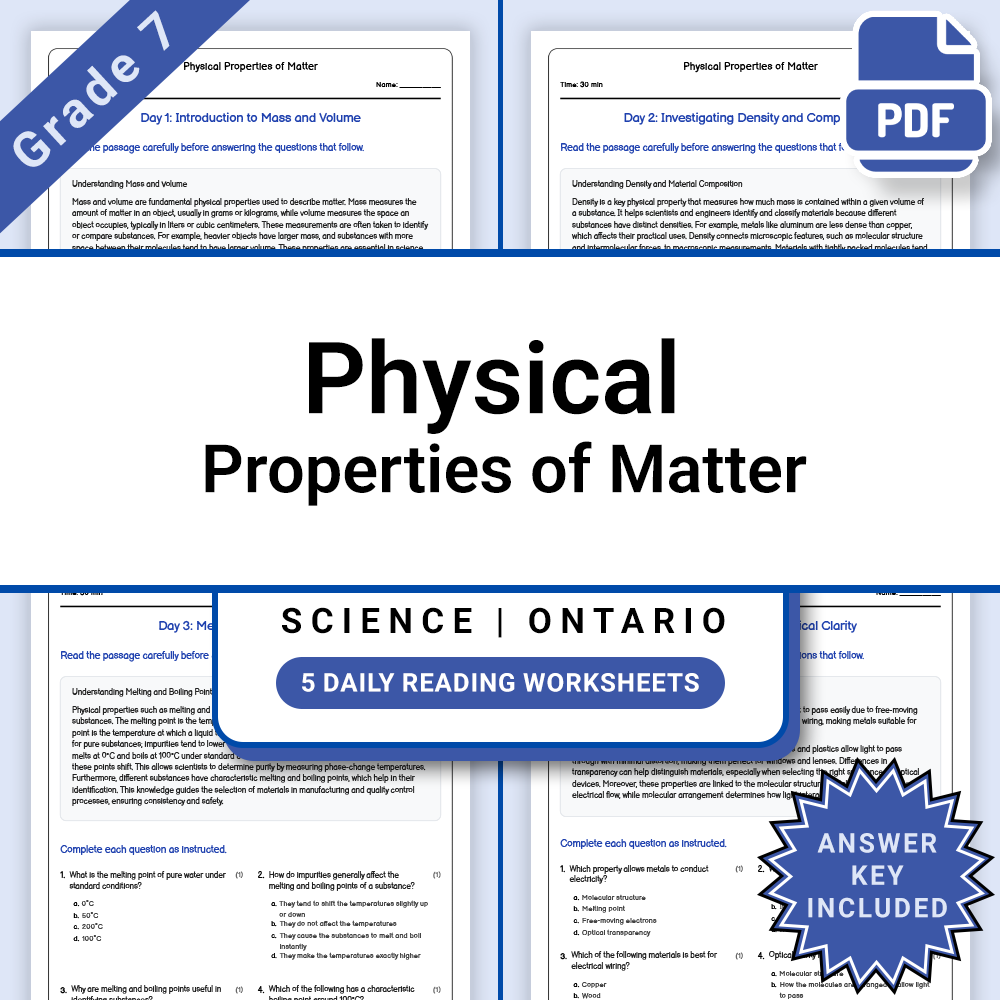
Grade 7 Science – Physical Properties Daily Reading Worksheet with Answer Key
JCreated byJ.S SheetsLearning Objectives
- Understand the basic physical measurements such as mass and volume
- Learn how to differentiate substances based on density
- Explore phase-change temperatures and what they indicate about purity
Also included in: Grade 7 Science Lesson Group | Ontario Framework Worksheets Bundle +1 more
Instant download

Grade 7 Science – Gravity & Forces | Daily Reading Worksheet
Created byBright Mind ResourcesLearning Objectives
- Understand what gravity is and how it affects objects.
- Identify the relationship between mass, force, and acceleration.
- Describe the role of support forces like normal force.
Also included in: Grade 7 Matter & Forces Science Reading Lesson Bundle | California Standards +1 more
Instant download

Grade 7 Science | Matter Cycling in Living Organisms - Reading Comprehension
Created byCoral Reef LearningLearning Objectives
- Understand the concept of matter cycling within organisms
- Identify how atoms are rearranged during digestion, biosynthesis, and respiration
- Explain how matter is conserved and transformed in biochemical pathways
Instant download

Grade 7 Science – Cell Overview Worksheet (PDF) – BC Standards
Created byEvergreen Desk EducationLearning Objectives
- Identify major parts of a cell (membrane, cytoplasm, nucleus, mitochondria, and other organelles) and describe their general functions.
- Explain how cells’ structures help them carry out specialized roles in living organisms.
- Compare plant and animal cell characteristics using evidence from cell structures.
Instant download
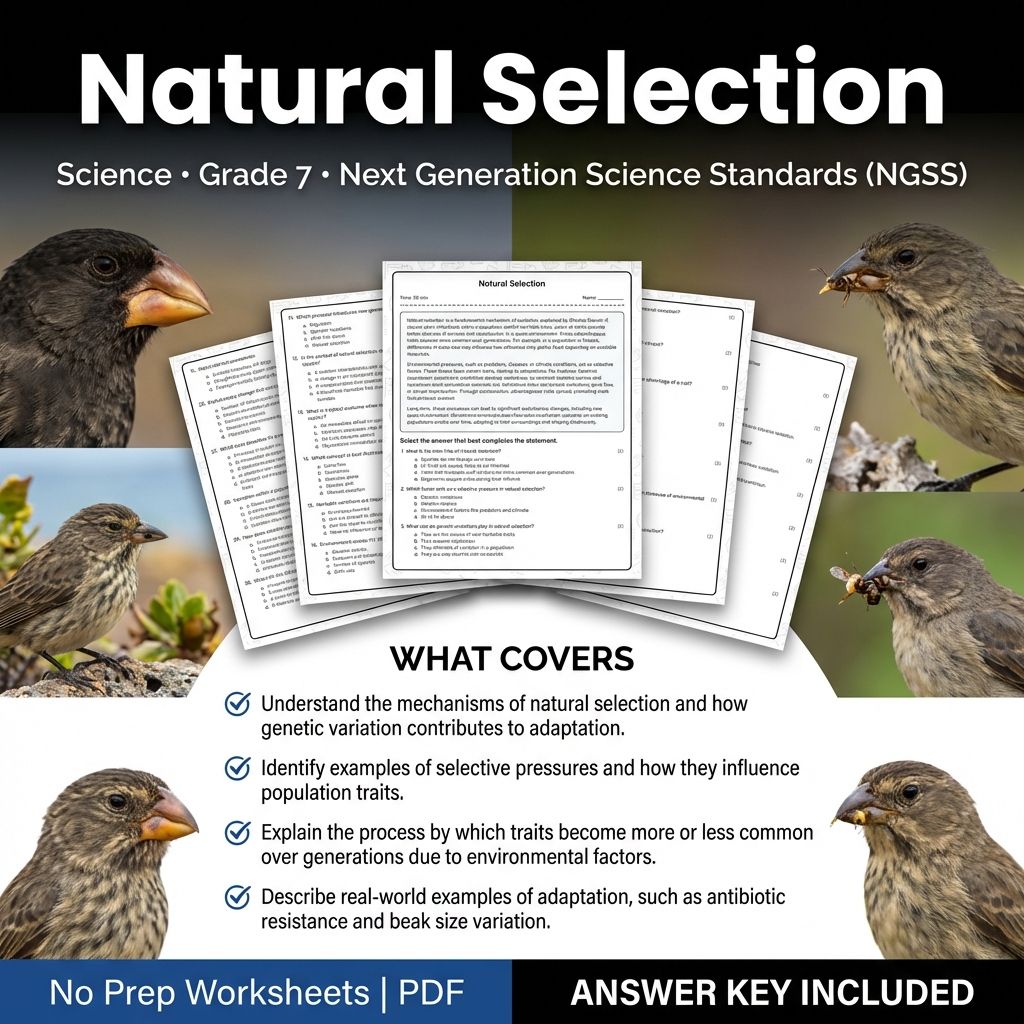
Grade 7 Science | Natural Selection Worksheet & Answer Key (Printable PDF)
Created byCoral Reef LearningLearning Objectives
- Understand the mechanisms of natural selection and how genetic variation contributes to adaptation.
- Identify examples of selective pressures and how they influence population traits.
- Explain the process by which traits become more or less common over generations due to environmental factors.
Instant download

Collisions Test Prep Worksheet | Grade 7 Science NGSS Practice
Created byPrism Point LearningLearning Objectives
- Explain how momentum is conserved during collisions using the idea that total momentum before equals total momentum after
- Describe how contact forces during an impact come in equal and opposite force pairs
- Distinguish elastic from inelastic collisions by how they affect kinetic energy and motion
Also included in: Grade 7 Forces & Interactions Science Lesson Bundle for NGSS Review
Instant download
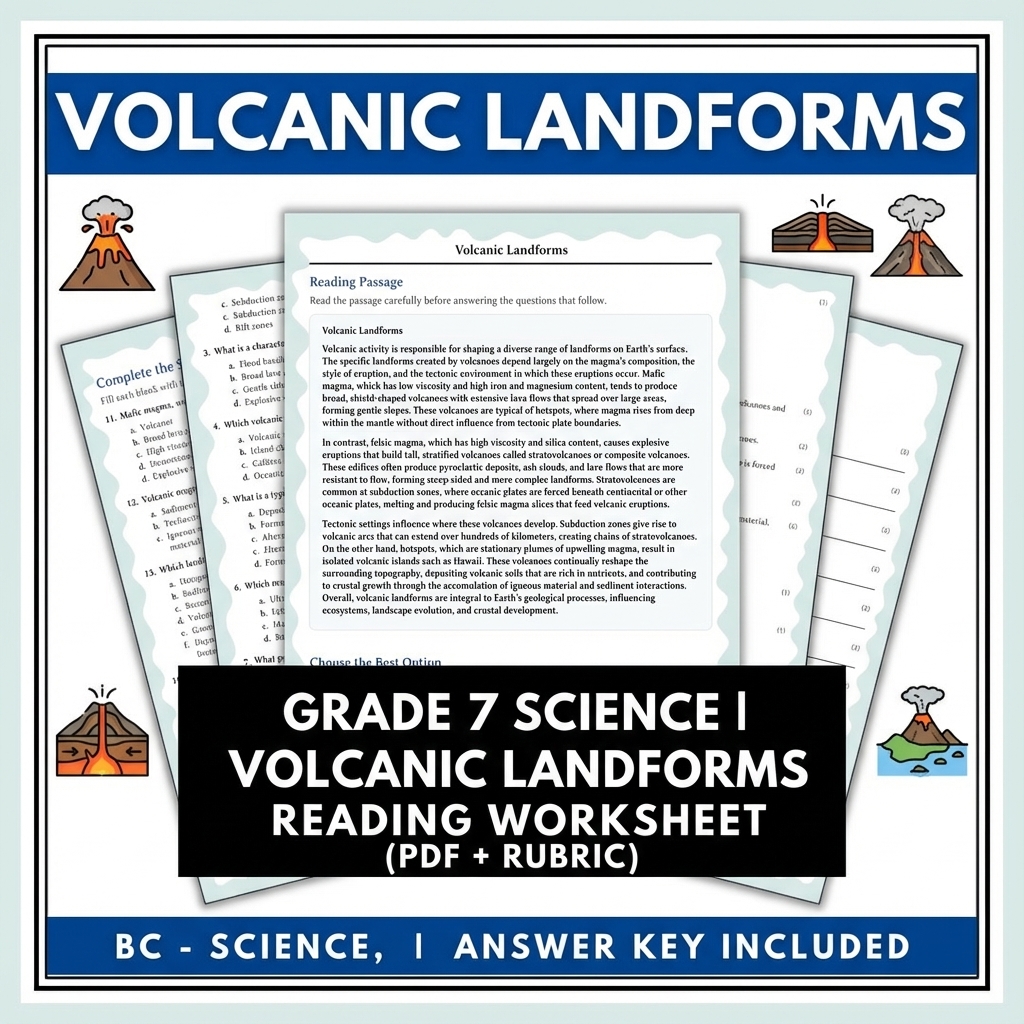
Grade 7 Science | Volcanic Landforms Reading Worksheet (PDF + Rubric)
JCreated byJ.S SheetsLearning Objectives
- Describe how magma composition and eruption style influence volcanic landforms.
- Identify different types of volcanic structures and their formation processes.
- Explain the roles of tectonic settings such as subduction zones and hotspots in volcanic activity.
Instant download

Grade 7 Science | Volcanic Landforms - Daily Reading Comprehension
Created byCoral Reef LearningLearning Objectives
- Understand the different types of volcanoes and their characteristics
- Identify the factors that influence volcanic landforms
- Recognize the global distribution of volcanoes in relation to tectonic activity
Instant download
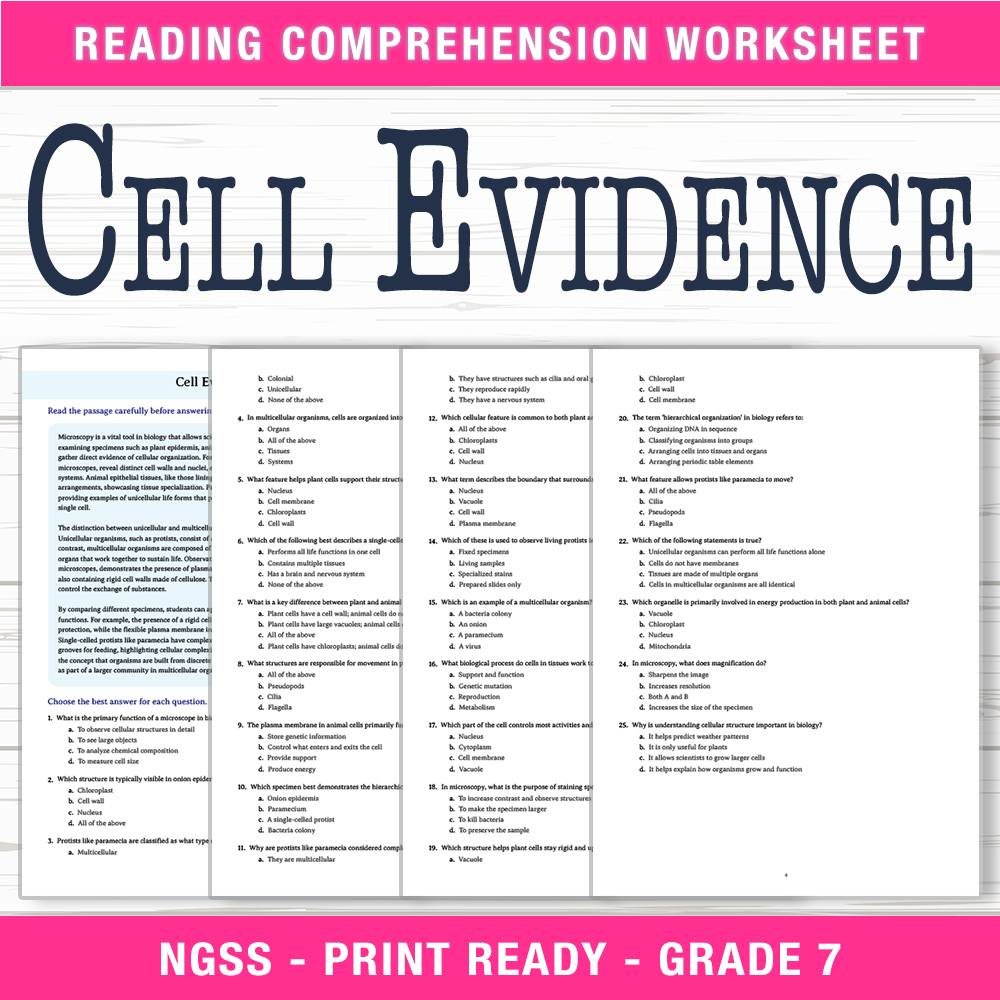
Grade 7 Science | Cell Evidence Worksheet (PDF + Answer Key)
 Created byRiverstone Classroom
Learning Objectives
- Understand how microscopy reveals cellular structures in plant and animal tissues
- Differentiate between unicellular and multicellular organisms based on cellular organization
- Identify anatomical examples like onion epidermis and protists such as paramecia
Instant download

Grade 7 Science | Membrane Transport Worksheet | BC Aligned
Created byLumora LearningLearning Objectives
- Explain the difference between passive and active transport mechanisms across cell membranes.
- Describe how diffusion, osmosis, and active transport operate to move substances in and out of cells.
- Identify the roles of membrane proteins in facilitating selective transport and maintaining ion balance.
Instant download

Grade 7 Science Cell Energy Use Worksheet | California Standards PDF
Created byEvergreen Desk EducationLearning Objectives
- Explain how cells convert chemical energy in food into usable energy for life processes
- Describe how energy changes form during cellular activities without creating or destroying matter
- Use examples such as movement, active transport, and maintaining body temperature to connect energy use to cellular processes
Instant download

Grade 7 Science | Understanding Thermal Expansion - Daily Reading Comprehension
Created byCoral Reef LearningLearning Objectives
- Describe how materials change in size with temperature variations.
- Identify examples of thermal expansion and contraction in everyday objects.
- Explain the microscopic particle behavior that causes macroscopic property changes.
Instant download
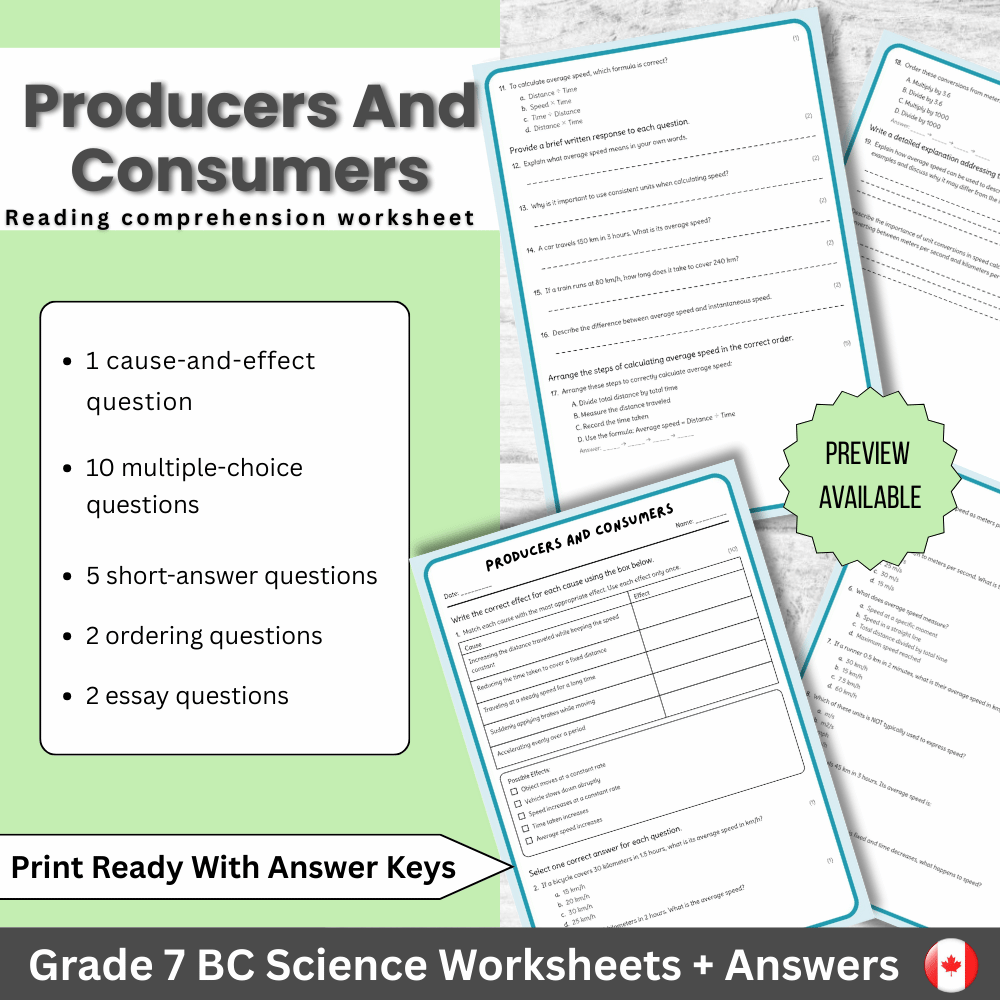
Grade 7 Science | Producers and Consumers Worksheet + Answer Key – BC Curriculum
Created byBright Mind ResourcesLearning Objectives
- Understand the roles of producers and consumers in ecosystems.
- Explain how energy transfer between trophic levels is inefficient.
- Describe the structure and dynamics of food chains and energy pyramids.
Instant download
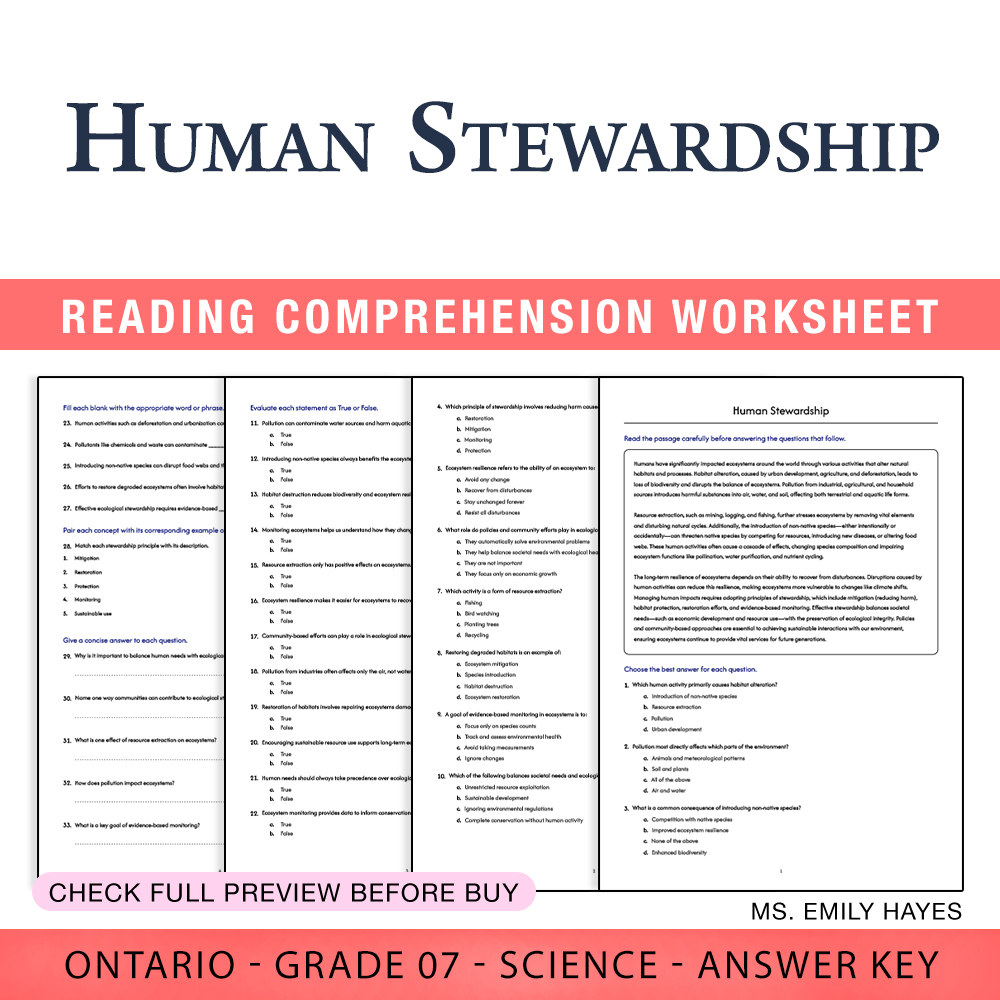
7th Grade Science | Human Stewardship Worksheet (PDF+ Answer Key)
Created byCopper Leaf ClassroomLearning Objectives
- Describe human impacts on ecosystems, including habitat alteration, pollution, resource extraction, and introduction of non-native species.
- Explain the consequences of human activities on species composition, ecosystem functions, and long-term resilience.
- Outline principles of ecological stewardship such as mitigation, habitat protection, restoration priorities, and evidence-based monitoring.
Instant download

Inclined Planes Science Worksheet | Grade 7 Alberta Standards Practice
JCreated byJ.S SheetsLearning Objectives
- Understand how inclined planes reduce the effort needed to move loads by distributing work over distance.
- Identify and explain the components of force parallel and perpendicular to an inclined plane.
- Calculate the mechanical advantage of inclined planes using input force and load.
Instant download

Grade 7 Science | Cell Structures in Plant and Animal Cells - Comprehension
Created byCoral Reef LearningLearning Objectives
- Understand the different types of cells: plant and animal
- Identify key organelles in eukaryotic cells
- Explain the functions of the nucleus, mitochondria, chloroplasts, endoplasmic reticulum, and membranes
Instant download
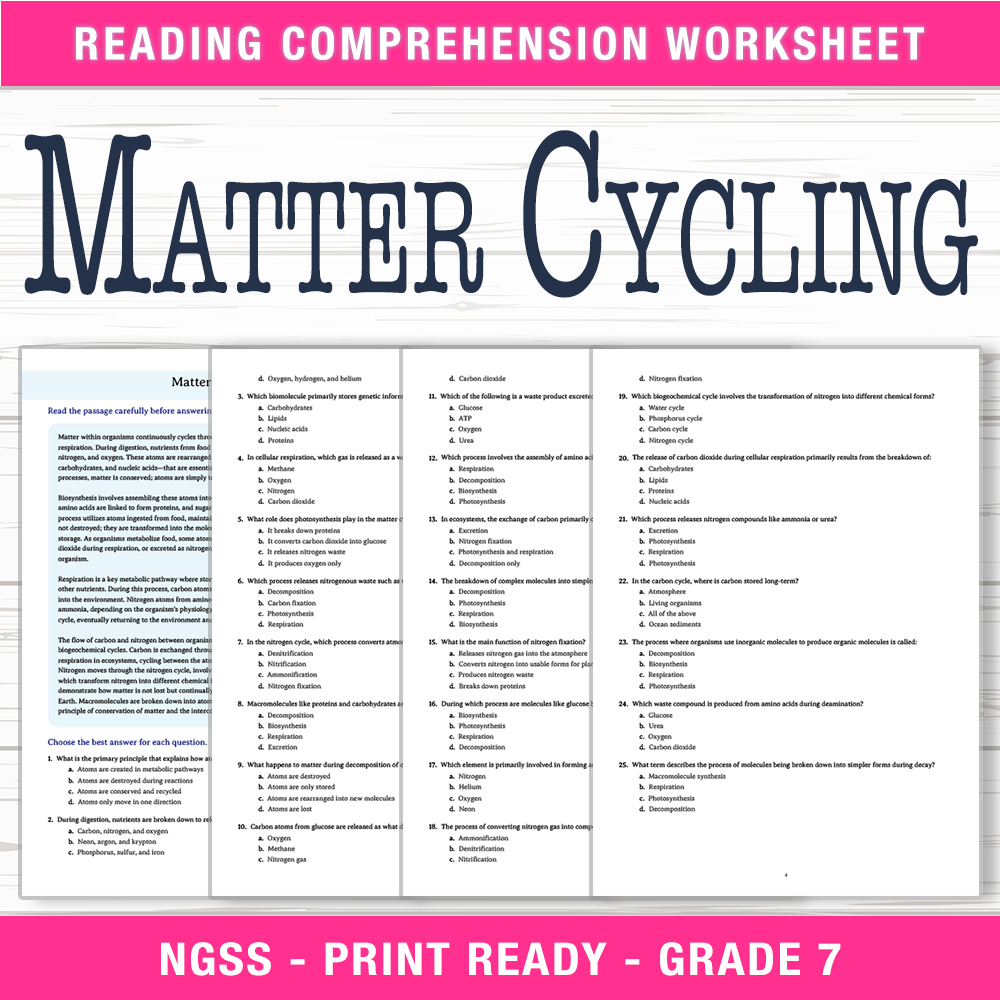
Grade 7 Science | Matter Cycling Worksheet (PDF + Answer Key)
Created byRiverstone ClassroomLearning Objectives
- Explain how atoms are conserved during digestion, biosynthesis, and respiration within organisms.
- Describe the flow of carbon and nitrogen through food chains and biochemical pathways.
- Identify key processes such as macromolecule synthesis and decomposition that recycle matter within ecosystems.
Instant download
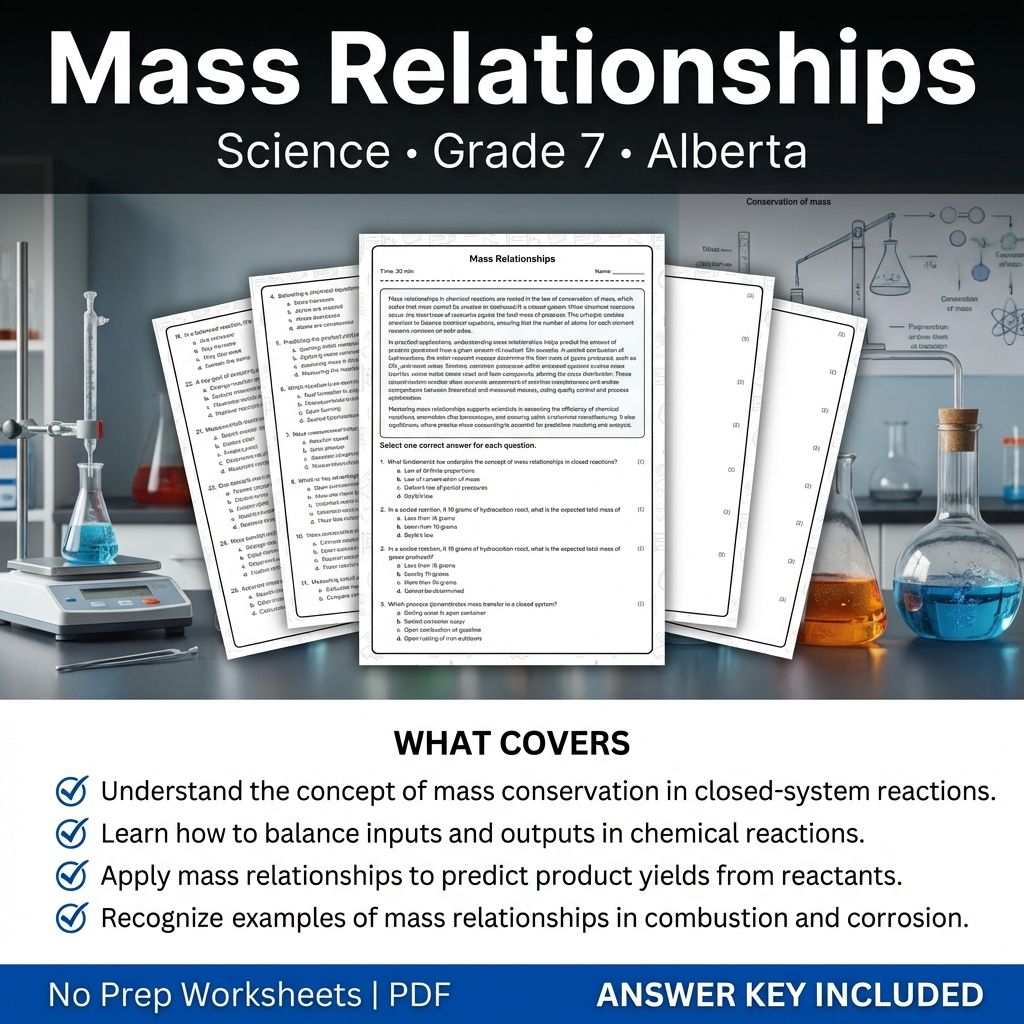
Mass Relationships Worksheet for Grade 7 Science Alberta Standards
Created byCoral Reef LearningLearning Objectives
- Understand the concept of mass conservation in closed-system reactions.
- Learn how to balance inputs and outputs in chemical reactions.
- Apply mass relationships to predict product yields from reactants.
Instant download
About Grade 7 Science Worksheets
Browse 6,039 printable Grade 7 Science worksheets — ready-to-print PDFs with answer keys where available.
Every worksheet on MyTeachingSheets is created by independent teacher-authors and reviewed before publication. All resources download as printable PDFs for classroom, homework, or at-home practice, and many include answer keys. Preview any worksheet free before buying.