
Grade 7 Science Worksheets
6,039 worksheets
Grade 7 Science | Population Limits Worksheet (PDF) – Ontario Standards
 Created byEvergreen Desk Education
Learning Objectives
- Explain how exponential and logistic growth models describe population changes over time
- Identify limiting factors (food, predation, disease, and abiotic stress) and predict their effects on populations
- Distinguish density-dependent from density-independent influences on population size
Also included in: Grade 7 Ecosystem Dynamics Science Lesson Bundle (Ontario) Worksheets +1 more
Instant download

Biodiversity Indices Practice Worksheet | Grade 7 Science Assessment
 Created byPrism Point Learning
Learning Objectives
- Explain how species richness, evenness, and diversity indices summarize biodiversity in a community.
- Interpret higher vs. lower diversity values across different habitats and predict impacts on stability and resilience.
- Describe how habitat heterogeneity relates to niche diversity and species turnover, and why single metrics can miss complexity.
Also included in: Grade 7 Ecosystem Science Lesson Bundle | Ontario Test Prep Worksheets
Instant download

Grade 7 Science Net Force Worksheet | NGSS Balanced & Unbalanced Forces
 Created byNorthstar Worksheets
Learning Objectives
- Define net force as the vector sum of all forces acting on an object.
- Explain how unbalanced forces change an object's motion, including changes in speed and direction.
- Use free-body diagrams to identify forces and determine the direction of the net force.
Also included in: Grade 7 Science Forces & Motion Lesson Bundle | NGSS Equilibrium & Collisions +1 more
Instant download

Grade 7 Science – Data Tables & Graphs Daily Reading Worksheet | TEKS Aligned
 Created byBright Mind Resources
Learning Objectives
- Learn how to organize observations into data tables.
- Identify trends and relationships from graphical displays.
- Understand the importance of scale and trend lines in graphs.
Also included in: Grade 7 Variables & Exp Design Science Lesson Bundle Daily Reading | TEKS +2 more
Instant download

Grade 7 Science – Conductive Materials & Heat Transfer | Daily Reading Worksheet
Created byBright Mind ResourcesLearning Objectives
- Understand the concept of thermal conductivity in different materials.
- Identify key factors affecting heat transfer in metals, ceramics, polymers, and composites.
- Explain how free electrons and lattice vibrations contribute to thermal conduction.
Also included in: Heat Transfer Grade 7 Science Daily Reading Worksheets Lesson Bundle | Ontario +1 more
Instant download

Grade 7 Science Worksheet – Filtration Techniques (PDF) Ontario Standards
Created byEvergreen Desk EducationLearning Objectives
- Explain how filtration separates mixtures based on particle size and pore structure
- Compare filtration with sedimentation and centrifugation in terms of what each method can remove
- Identify limitations of filtration for dissolved solutes and very small colloids
Also included in: Grade 7 Substances and Mixtures Science Lesson Bundle Worksheet (Ontario) +1 more
Instant download

Grade 7 Passive Solar Orientation & Thermal Performance Worksheet
 Created byBRIGHT PATH RESOURCES
Learning Objectives
- Identify how building orientation changes solar heat entering a home.
- Explain what passive solar gains are and how they affect seasonal heating needs.
- Describe trade-offs between comfort and energy demand in cold climates.
Also included in: Grade 7 Alberta Science Energy Heat and Thermal Processes Worksheet Bundle +1 more
Instant download

Grade 7 Science – Climate Drivers Over Time Worksheet (PDF)
Created byEvergreen Desk EducationLearning Objectives
- Explain how natural climate records (ice cores, sediment layers, and tree rings) reveal past temperature and precipitation.
- Describe how modern instruments confirm and refine recent climate trends.
- Identify major climate drivers that can change Earth’s energy balance and circulation over time.
Also included in: Earth & Weather Systems: Grade 7 Science Lesson Bundle (General Framework) +1 more
Instant download

Phase Changes Practice Test | Grade 7 Science Worksheet with Answer Key
Created byPrism Point LearningLearning Objectives
- Explain how energy transfer causes phase changes between solid, liquid, and gas states.
- Describe how particle motion and particle spacing change during heating and cooling.
- Differentiate melting, freezing, vaporization, condensation, sublimation, and deposition based on state changes.
Also included in: Matter & Chemical Change Lesson Bundle — Grade 7 Science British Columbia +1 more
Instant download

Science Worksheet: Fitness and Survival Grade 7 | NGSSS Standards Practice
JCreated byJ.S SheetsLearning Objectives
- Explain how fitness relates to survival and reproduction in a specific environment
- Describe how environmental changes can change which traits are favored by natural selection
- Connect fitness to heritable variation and how populations can respond over time
Also included in: Grade 7 Evolution and Population Dynamics Science Lesson Bundle – Florida NGSSS +1 more
Instant download
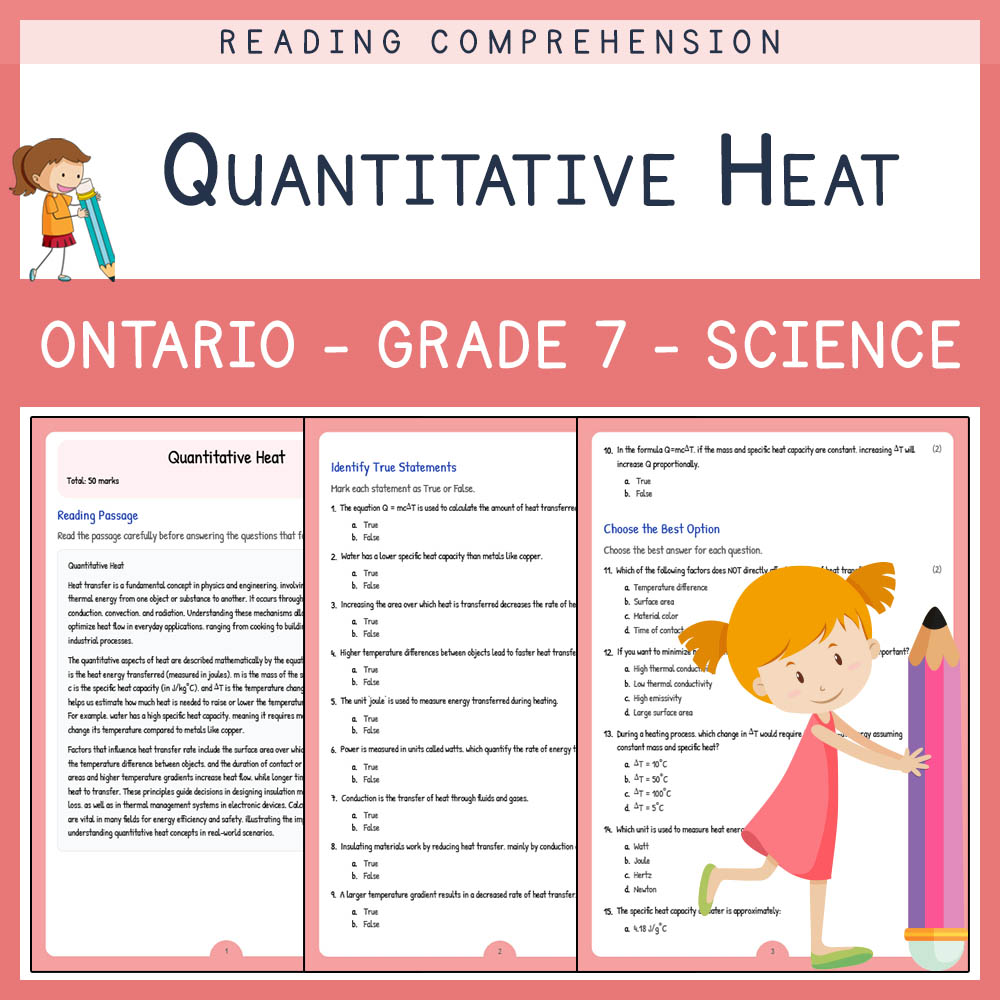
Grade 7 Science Assessment | Quantitative Heat Worksheet Elena | Ontario
 Created byLumora Learning
Learning Objectives
- Understand how heat transfer depends on mass, temperature change, and specific heat capacity.
- Apply the equation Q = mcΔT to calculate thermal energy changes in common substances.
- Identify units of energy and power such as joules and watts.
Instant download

Symbiosis Types Worksheet | Grade 7 Science Activities
Created byPrism Point LearningLearning Objectives
- Distinguish mutualism, commensalism, and parasitism by the effects on both species.
- Explain how symbiosis types can influence population dynamics and community structure.
- Use examples to describe ecological consequences such as resource distribution and coevolution.
Also included in: Grade 7 Ecosystems & Biodiversity Science Lesson Bundle | Alberta
Instant download
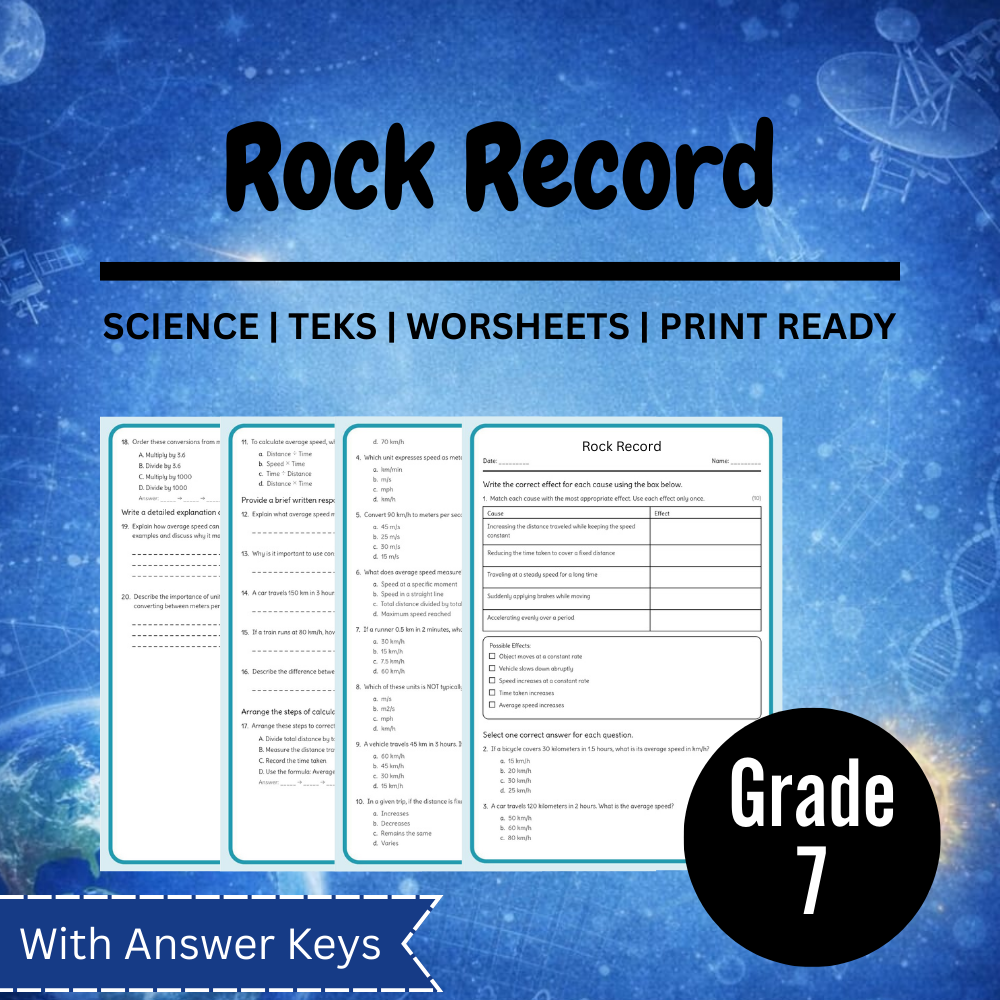
Grade 7 Science | Rock Record TEKS Standards Practice Worksheet (PDF)
Created byBright Mind ResourcesLearning Objectives
- Understand how sedimentary layers and fossils record Earth's history.
- Describe processes like lithification, metamorphism, and magmatism.
- Explain relative and absolute dating techniques, including index fossils and radiometric decay.
Also included in: Grade 7 Science Unit Bundle | Earth's Processes, Space & Resources TEKS Aligned +2 more
Instant download
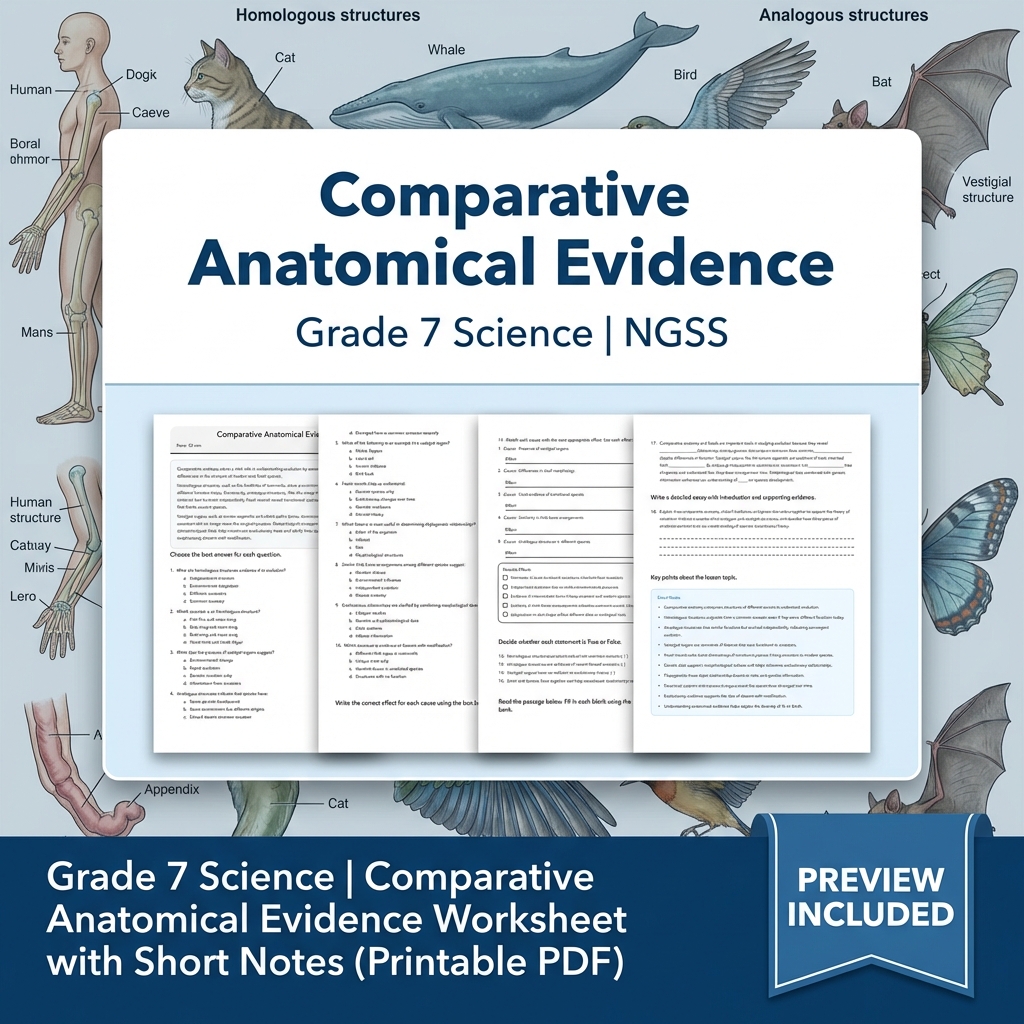
Grade 7 Science Comparative Anatomical Evidence Worksheet with Short Notes (PDF)
 Created byMeadowlark Worksheets
Learning Objectives
- Understand how comparative anatomy provides evidence for evolution.
- Identify homologous and analogous structures among species.
- Analyze morphological differences and similarities to infer phylogenetic relationships.
Also included in: Grade 7 Science | Biological Evolution Bundle – Unity & Diversity (NGSS Aligned) +1 more
Instant download

Resource Distribution Worksheet | Grade 7 Science NGSS with Doodle Note
 Created byAmber Owl Education
Learning Objectives
- Explain how plate tectonics, weathering, and sedimentation can create uneven distributions of Earth resources over time
- Connect past environmental conditions and biological activity to where fossils and fossil fuels form
- Describe how groundwater systems form and why access to aquifers varies by location
Also included in: Grade 7 Science Full-Year Bundle | NGSS Worksheets
Instant download

Grade 7 Understanding Earth's Resources Worksheet | NGSS Earth Science
Created byBRIGHT PATH RESOURCESLearning Objectives
- Identify different types of natural resources
- Understand how geologic processes affect resource distribution
- Connect Earth history with resource locations
Also included in: Earth Systems Grade 7 Science Daily Reading Worksheets Lesson Bundle | NGSS +2 more
Instant download

Grade 7 Science – Calorimetry & Heat Transfer | Daily Reading Worksheet
Created byBright Mind ResourcesLearning Objectives
- Define calorimetry and explain its purpose
- Identify components involved in calorimetric experiments
- Describe how temperature change relates to energy transfer
Also included in: Grade 7 Heat Transfer Science Daily Reading Worksheets Lesson Bundle | Alberta +2 more
Instant download

Variable Control Worksheet | Grade 7 Science TEKS Practice
Created byPrism Point LearningLearning Objectives
- Identify independent, dependent, and control variables in a controlled science investigation.
- Apply strategies such as randomization and replication to reduce confounding effects.
- Explain how documentation and constraints affect the reliability of experimental results.
Also included in: Grade 7 Scientific Data & Argumentation Science Lesson Bundle (TEKS)
Instant download

Speciation Processes Test Prep Worksheet | Grade 7 Science NGSS
Created byPrism Point LearningLearning Objectives
- Explain how reproductive isolation and geographic separation can lead to speciation.
- Describe how polyploidy and adaptive radiation can increase biodiversity.
- Use examples to connect biogeography and diversification rates to how new species form.
Also included in: Grade 7 Evolution, Natural Selection Science Lesson Bundle for NGSS
Instant download
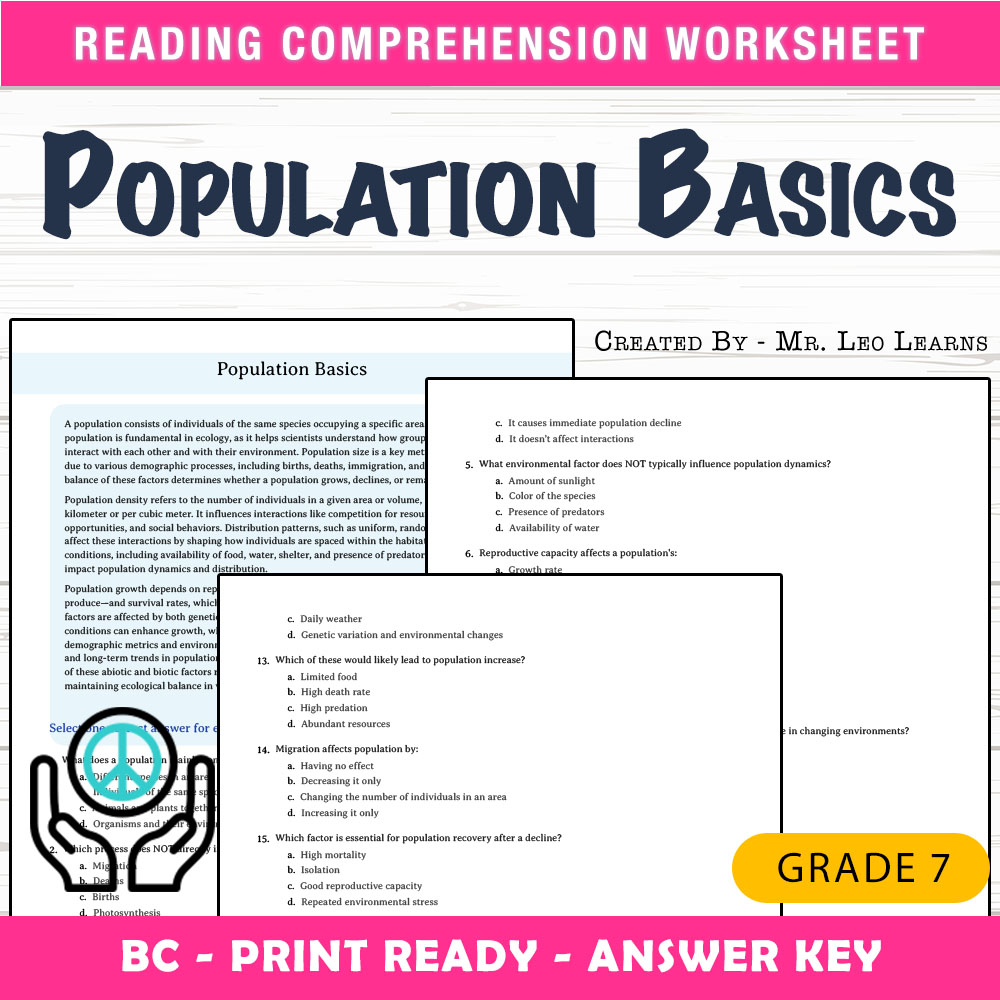
Grade 7 Science — Population Basics Worksheet for Mastery
 Created byThe Resource Hub
Learning Objectives
- Understand the definition of a population and how its size can change over time.
- Identify factors that influence population density and distribution patterns.
- Explain how reproductive capacity and survival rates affect population growth.
Also included in: Grade 7 Science Ecosystems & Interactions Worksheet Bundle +1 more
Instant download

Grade 7 Science – Population Dynamics & Ecosystem Changes | Reading Worksheet
Created byBright Mind ResourcesLearning Objectives
- Understand what population dynamics are and the factors influencing them
- Identify different processes that change population size
- Analyze the role of resources and ecosystems in population changes
Also included in: Populations & Traits Grade 7 Science Daily Reading Lesson Bundle | Florida NGSSS +1 more
Instant download

Matter Cycling Worksheet | NGSS-Aligned Grade 7 Science Practice
JCreated byJ.S SheetsLearning Objectives
- Describe how matter is recycled within organisms during digestion, biosynthesis, and respiration.
- Explain the flow of carbon and nitrogen through food chains and their transformation into waste products.
- Identify key biochemical pathways such as macromolecule synthesis and decomposition that facilitate matter cycling.
Also included in: Grade 7 Cellular and Organ Systems Science Lesson Bundle: NGSS Practice +1 more
Instant download
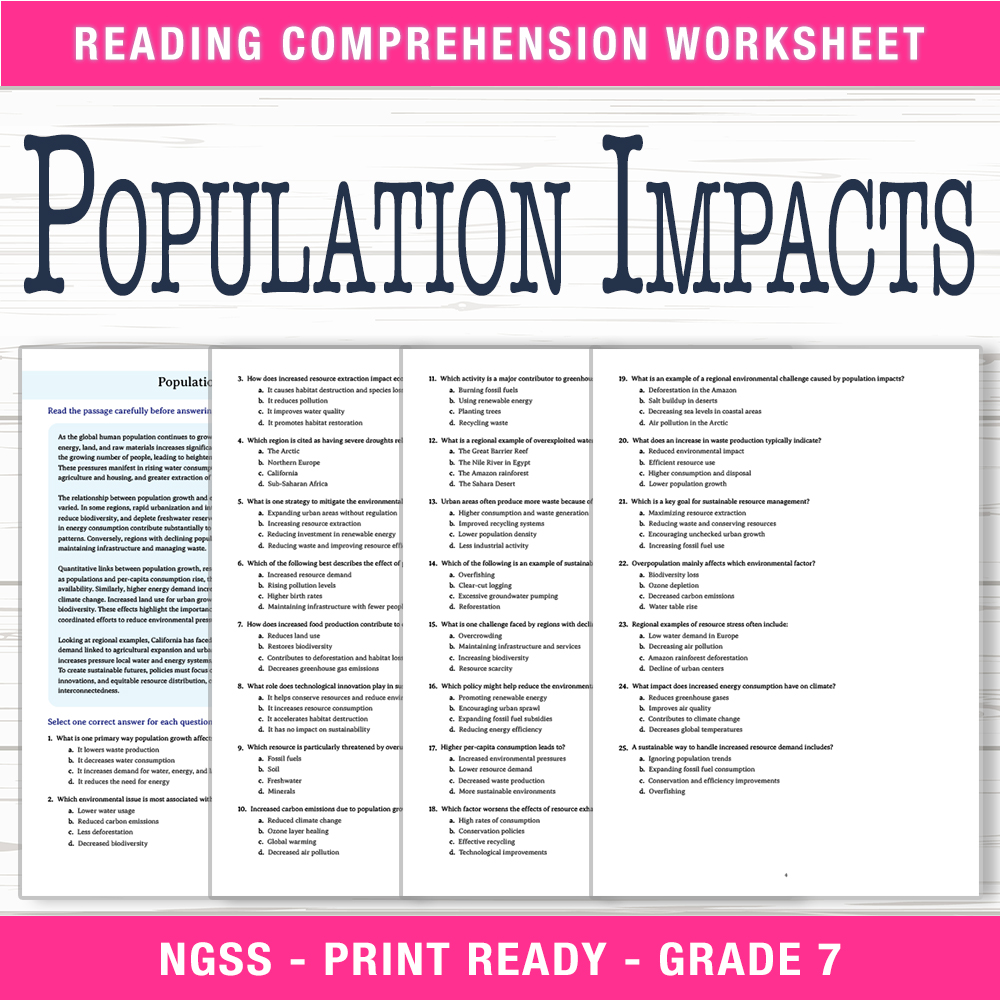
Grade 7 Science | Population Impacts Worksheet (PDF + Answer Key)
 Created byRiverstone Classroom
Learning Objectives
- Explain how human population growth influences demand for water, energy, and land resources.
- Analyze the environmental consequences of increased consumption patterns on ecosystems and biodiversity.
- Evaluate regional examples of how population and consumption affect resource cycles and sustainability.
Instant download

Grade 7 Science Worksheet | Temperature Measurement (PDF) | Ontario Standards
Created byEvergreen Desk EducationLearning Objectives
- Compare temperature measurement principles and instrument characteristics across liquid-in-glass, bimetallic, and digital thermometers.
- Use the Celsius scale conventions and understand the need for fixed points and calibration for reliable measurements.
- Identify sources of uncertainty and environmental influences (radiation and air flow) that affect recorded temperatures.
Also included in: Grade 7 Thermal Heat Transfer Science Lesson Bundle: Ontario Framework +1 more
Instant download

Failure Modes Test Prep Printable | Grade 7 Science
Created byPrism Point LearningLearning Objectives
- Identify common structural failure modes and describe what triggers each one.
- Explain limit states design, including safety factors, in reducing risk.
- Relate failure mechanisms to geometry, materials, and loading conditions.
Instant download
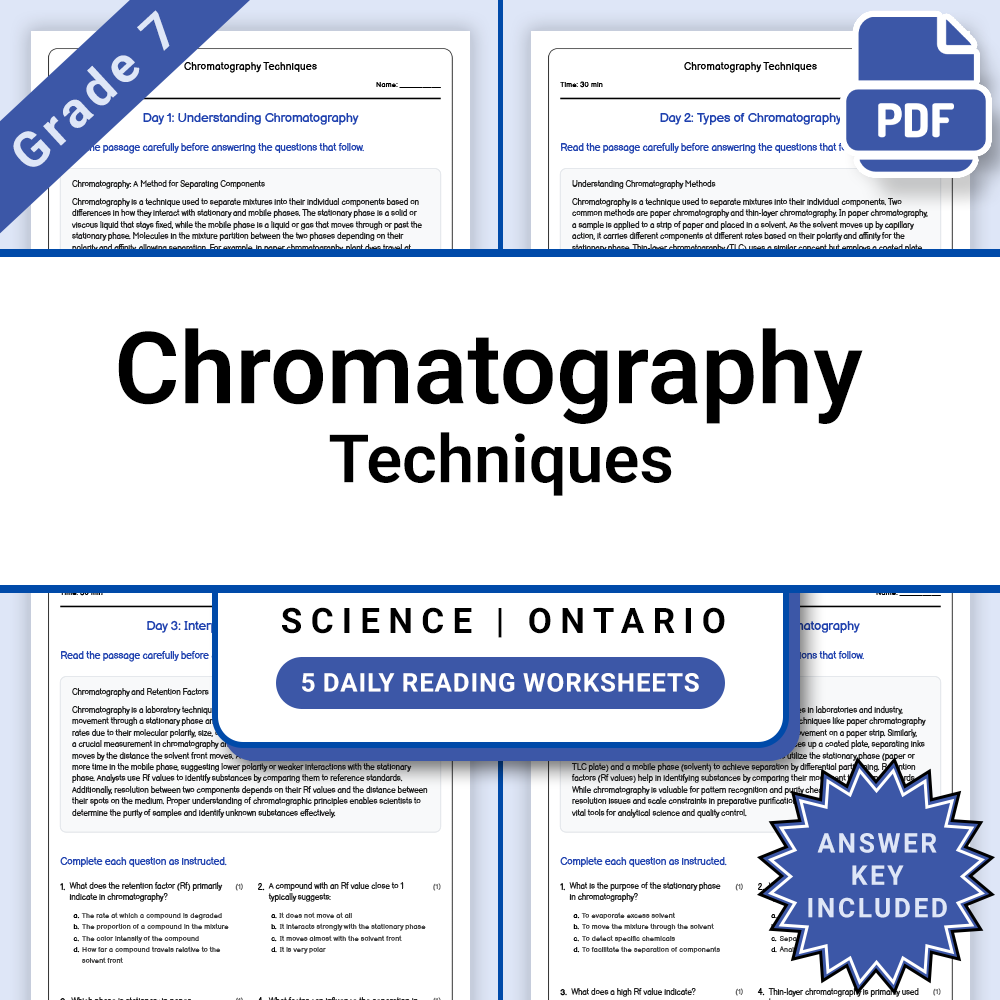
Grade 7 Science – Chromatography Techniques Daily Reading Worksheet + Answer Key
JCreated byJ.S SheetsLearning Objectives
- Understand the basic principles of chromatography, including the roles of stationary and mobile phases.
- Learn about the concepts of differential partitioning and molecular polarity in chromatography.
- Identify different types of chromatography such as paper and thin-layer chromatography.
Also included in: Grade 7 Science Lesson Group | Ontario Framework Worksheets Bundle +1 more
Instant download

Grade 7 Science – Forces & Motion | Daily Reading Worksheet
Created byBright Mind ResourcesLearning Objectives
- Define and distinguish between balanced and unbalanced forces
- Identify real-life scenarios of balanced and unbalanced forces
- Explain how forces affect the motion of objects
Also included in: Grade 7 Daily Reading Science Worksheets Lesson Bundle | Florida NGSSS +1 more
Instant download
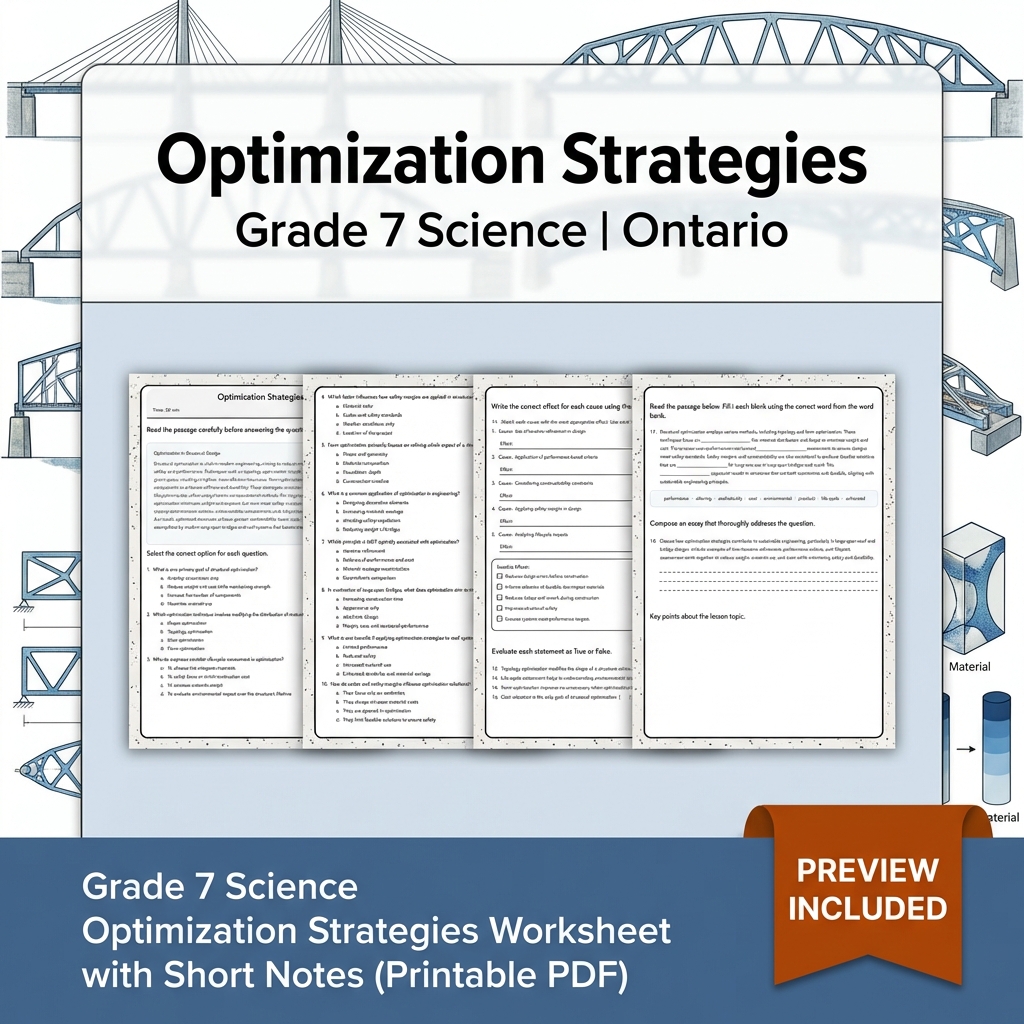
Grade 7 Science Optimization Strategies Worksheet with Short Notes (PDF)
Created byMeadowlark WorksheetsLearning Objectives
- Understand the principles of structural optimization that improve material efficiency and cost-effectiveness.
- Identify different optimization methods such as topology and form optimization.
- Analyze how performance-based criteria and life-cycle assessments influence design choices.
Also included in: Grade 7 Science Lesson Group | Ontario Curriculum Worksheets Bundle +1 more
Instant download

Grade 7 Science | Simple Distillation Worksheet (Ontario) (PDF)
Created byEvergreen Desk EducationLearning Objectives
- Explain how boiling point differences and vapour pressure enable separation of miscible liquids by simple distillation.
- Describe how condensation converts vapour back into liquid and how fractionation improves purity.
- Identify key limitations of distillation, including close-boiling mixtures and azeotropes.
Also included in: Grade 7 Substances and Mixtures Science Lesson Bundle Worksheet (Ontario) +1 more
Instant download

Conservation Mass Practice Worksheets | Grade 7 Science Assessment
Created byPrism Point LearningLearning Objectives
- Explain conservation of mass in chemical reactions using particle-level ideas.
- Describe how closed systems affect mass before and after a reaction.
- Use evidence from balanced equations and atom rearrangement to justify constant total mass.
Also included in: Matter & Chemical Change Lesson Bundle — Grade 7 Science British Columbia +1 more
Instant download

Standards and Safety Assessment | TEKS Grade 7 Science Worksheet
Created byPrism Point LearningLearning Objectives
- Understand the importance of safety standards in technological design and practice.
- Identify key safety codes and regulations related to building and electrical safety.
- Explain the rationale behind safety margins, inspection protocols, and documentation.
Instant download
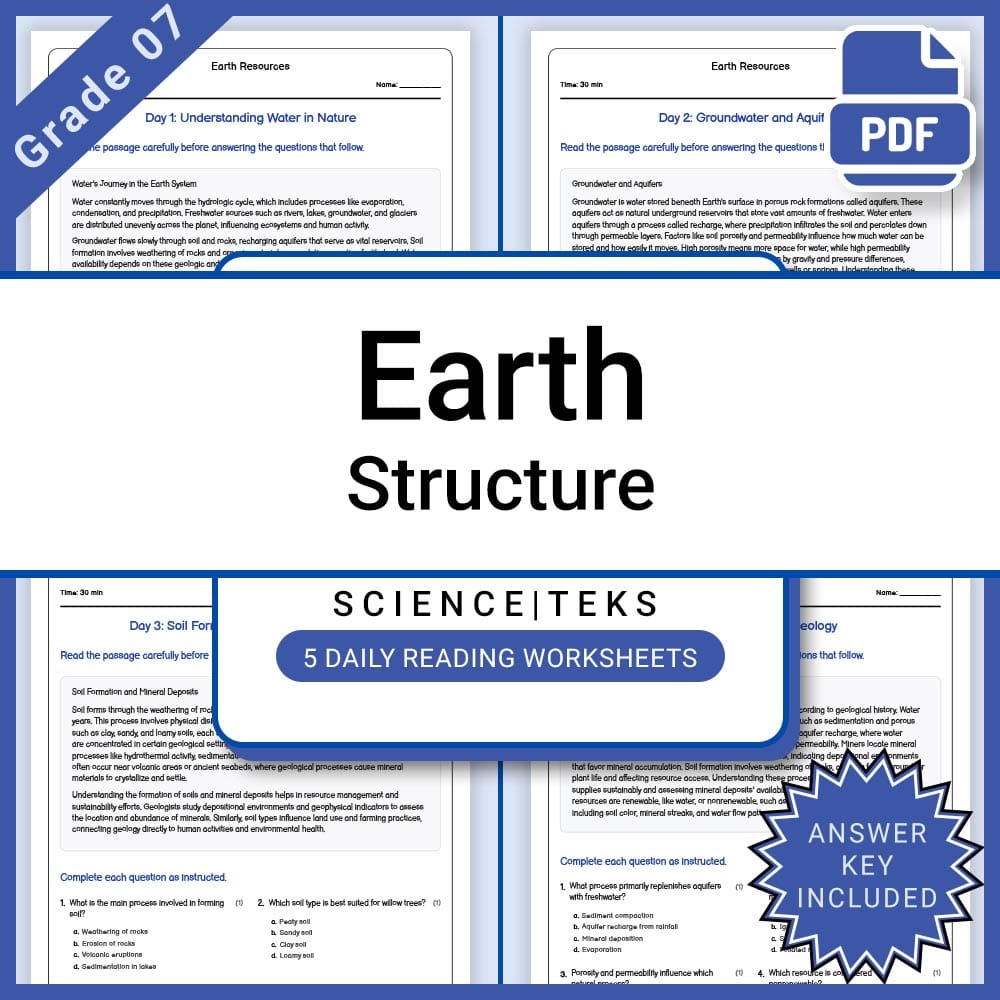
Grade 7 Science – Earth Structure Daily Reading Practice with Answer Key
JCreated byJ.S SheetsLearning Objectives
- Identify and describe Earth's main internal layers: crust, mantle, outer core, and inner core.
- Understand how seismic waves provide evidence for Earth's internal composition.
- Explain mantle convection and its role in plate movement.
Also included in: Grade 7 Science Lesson Group – TEKS Aligned & Concept-Focused Lesson Bundle +1 more
Instant download
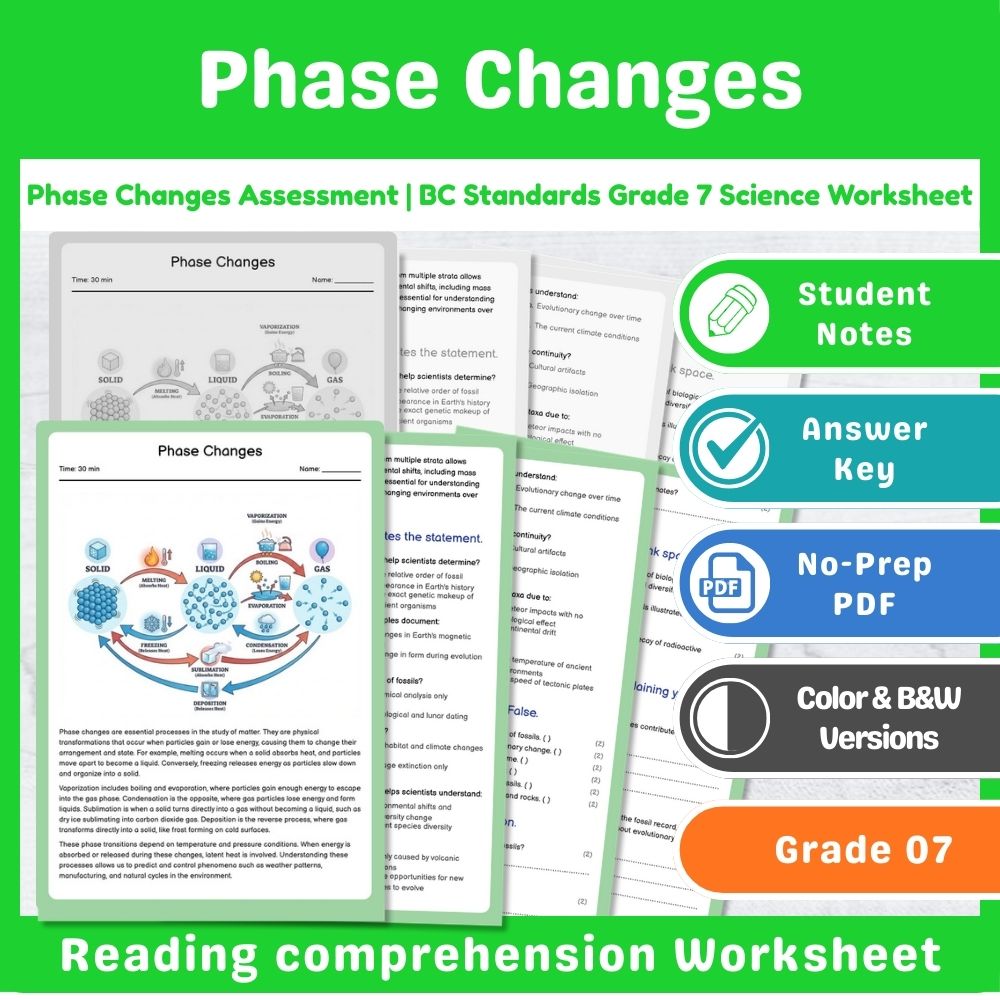
Phase Changes Assessment | BC Standards Grade 7 Science Worksheet
Created byPrism Point LearningLearning Objectives
- Describe the different types of phase changes and what causes them.
- Explain how energy transfer affects particle movement during phase changes.
- Identify the characteristics of melting, freezing, vaporization, condensation, sublimation, and deposition.
Instant download

Motion Graphs Worksheet Pack | Grade 7 Science Activities
Created byPrism Point LearningLearning Objectives
- Interpret distance–time and velocity–time graphs to describe motion patterns such as uniform motion, speeding up, slowing down, and rest intervals.
- Use the slope of a velocity–time or distance–time graph to explain how speed changes over time.
- Connect the shape of a velocity–time graph to displacement in a conceptual way by comparing areas under curves.
Also included in: Grade 7 Motion, Forces & Energy Science Lesson Bundle for TEKS Practice
Instant download

Grade 7 Science – Thermal Basics Worksheet (Ontario Standards) (PDF)
Created byEvergreen Desk EducationLearning Objectives
- Differentiate temperature from internal energy using particle motion and particle interactions.
- Explain that thermal energy transfer occurs from higher internal energy to lower internal energy.
- Use conservation of energy ideas to describe heat exchange between objects.
Also included in: Grade 7 Thermal Heat Transfer Science Lesson Bundle: Ontario Framework +1 more
Instant download
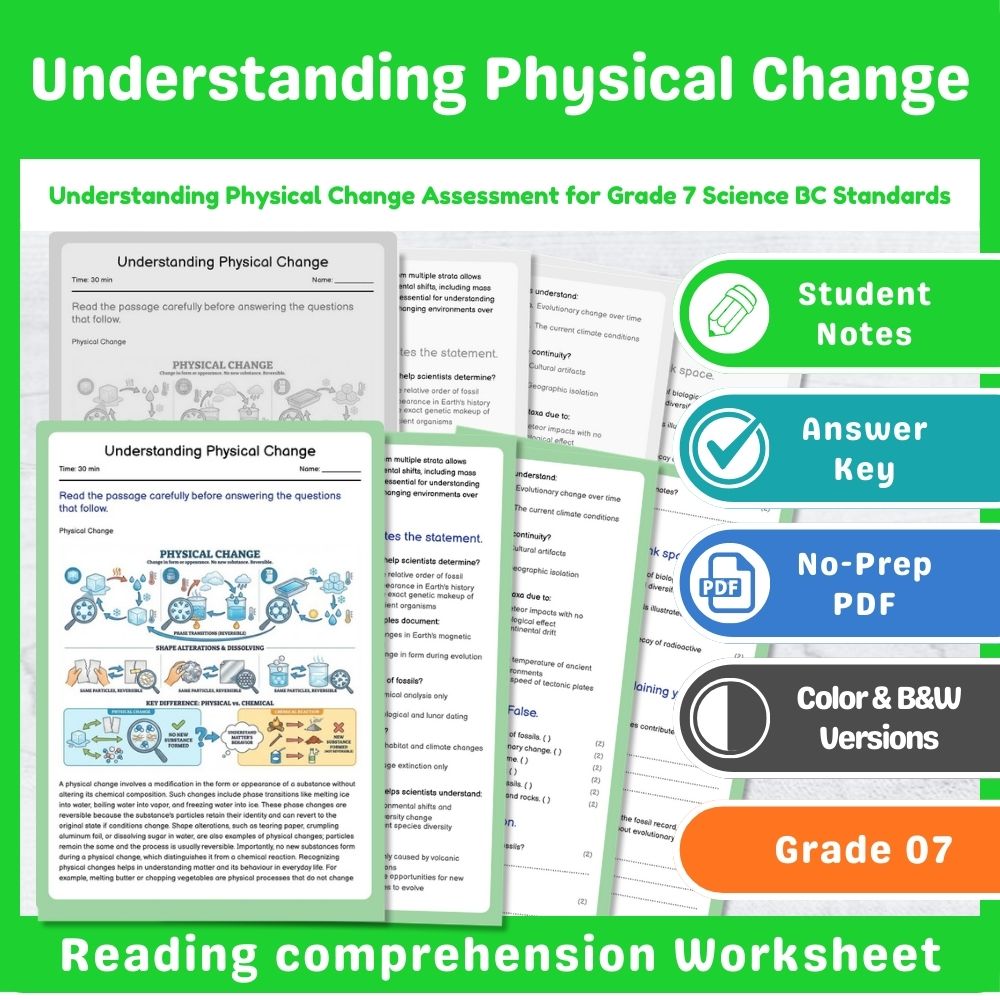
Understanding Physical Change Assessment for Grade 7 Science BC Standards
Created byPrism Point LearningLearning Objectives
- Define and identify physical change in substances.
- Differentiate between reversible and irreversible physical changes.
- Describe common examples of physical changes such as melting, freezing, and dissolving.
Instant download

Systems Modeling Assessment | TEKS Standards Grade 7 Science
Created byPrism Point LearningLearning Objectives
- Describe different forms of systems modeling such as diagrams, scale models, and quantitative representations.
- Explain the purpose and limitations of using models to predict system behavior and interpret outputs.
- Identify exemplar representations like free-body diagrams, circuit schematics, and block diagrams for control systems.
Instant download

Grade 7 Science – Action & Reaction Forces Worksheet | California Standards
Created byBright Mind ResourcesLearning Objectives
- Understand key concepts related to Science
- Apply knowledge through practice questions
- Demonstrate comprehension of the material
Also included in: Grade 7 Matter & Forces Science Reading Lesson Bundle | California Standards +1 more
Instant download

Grade 7 Science – Instrumentation Accuracy Worksheet (Ontario Standards) (PDF)
Created byEvergreen Desk EducationLearning Objectives
- Explain how calibration, traceable reference points, and uncertainty affect temperature measurements.
- Identify common sources of temperature error, including sensor response time, spatial placement, shielding, and thermal contact effects.
- Compare thermocouples, resistance temperature detectors (RTDs), and infrared (IR) sensors for environmental temperature monitoring.
Also included in: Grade 7 Thermal Heat Transfer Science Lesson Bundle: Ontario Framework +1 more
Instant download
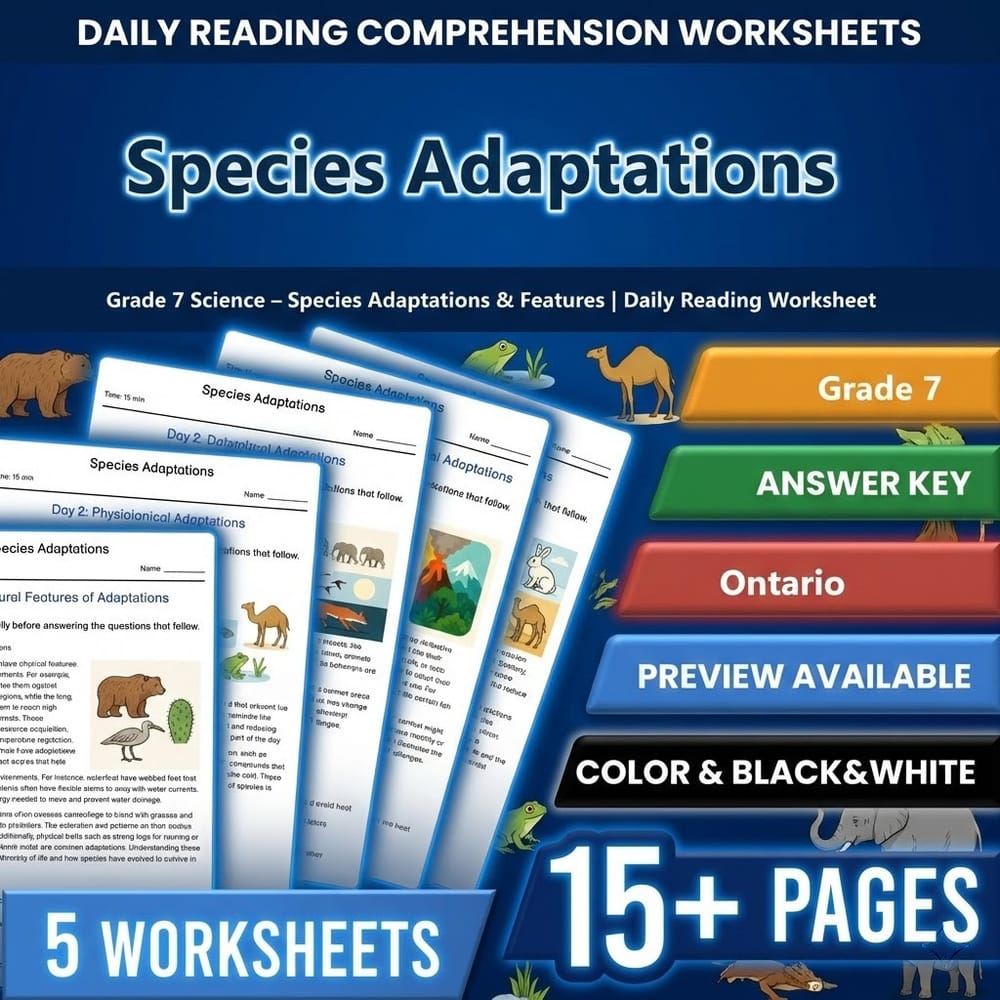
Grade 7 Science – Species Adaptations & Features | Daily Reading Worksheet
 Created byQuiet Forest Education
Learning Objectives
- Identify different structural features of species that help them survive in their environments.
- Understand how physical traits are adaptations to specific environmental conditions.
- Recognize the importance of morphological traits in survival and resource acquisition.
Also included in: Ecosystem Dynamics Grade 7 Science Daily Reading Worksheets Bundle | Ontario +1 more
Instant download

Grade 7 Science | Indicators of Physical Changes - Reading Comprehension
 Created byCoral Reef Learning
Learning Objectives
- Identify signs that indicate a physical change has occurred
- Differentiate between physical and chemical changes based on observable indicators
- Understand examples of physical changes in daily life
Also included in: Matter and Chemical Change Lesson Bundle: Grade 7 Science Alberta +1 more
Instant download

Geologic Processes Assessment | NGSSS Standards Grade 7 Science
Created byPrism Point LearningLearning Objectives
- Explain how tectonic activity, weathering, erosion, and deposition shape Earth’s surface.
- Identify how transporting agents and energy changes lead to deposition.
- Use geologic vocabulary (tectonic activity, weathering, erosion, deposition) to describe landform change over time.
Also included in: Grade 7 Earth and Climate Systems Science Lesson Bundle: Florida NGSSS
Instant download
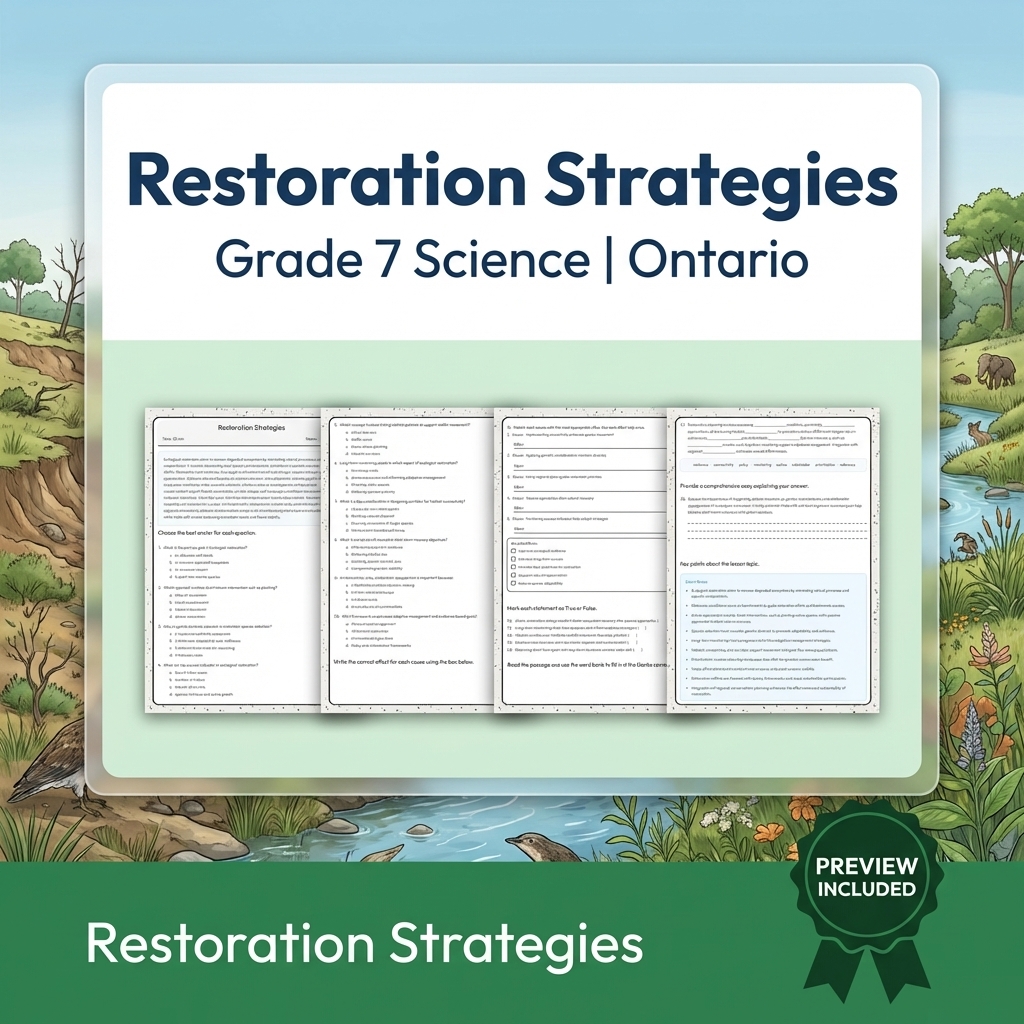
Grade 7 Science | Restoration Strategies Worksheet with Short Notes (PDF)
Created byMeadowlark WorksheetsLearning Objectives
- Understand core principles of ecological restoration and reference conditions.
- Differentiate between active and passive restoration approaches.
- Learn criteria for species selection and long-term landscape monitoring.
Also included in: Grade 7 Science Lesson Bundle with Ontario Framework | Ecosystems & Biodiversity +1 more
Instant download
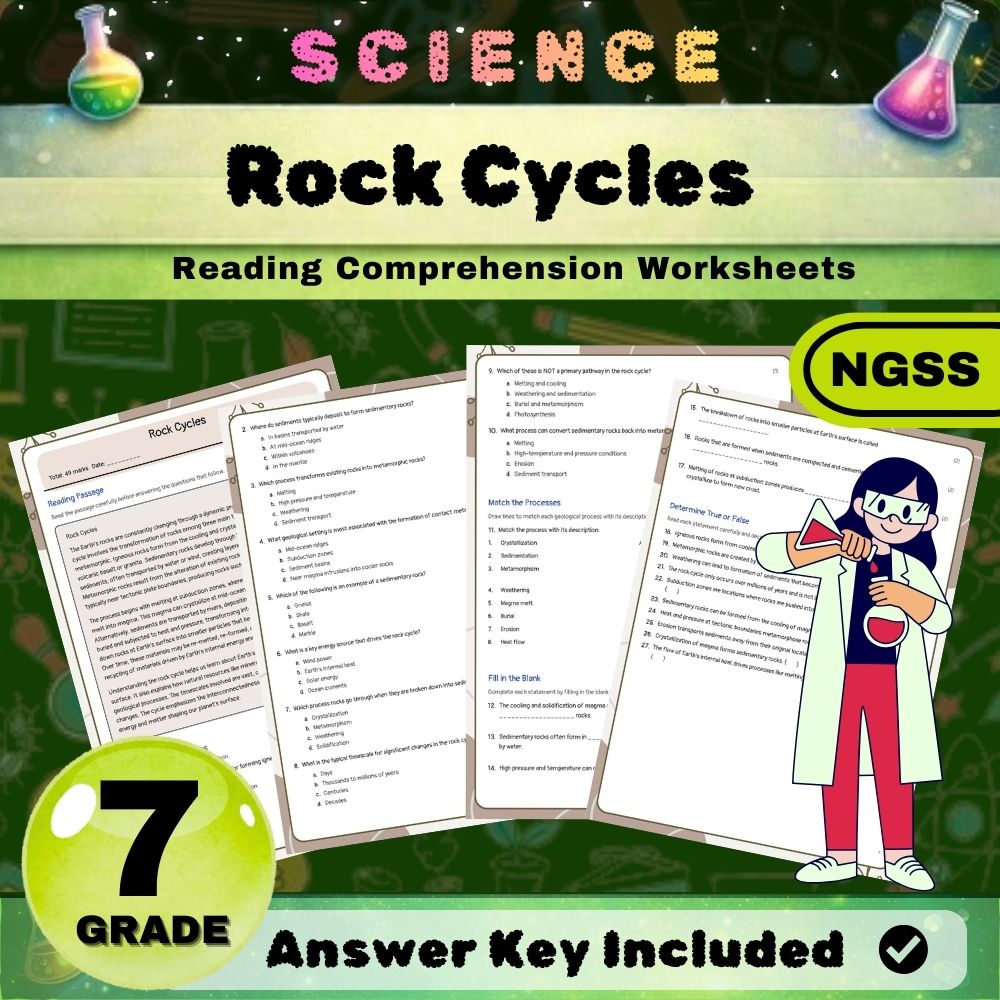
Grade 7 Science | Rock Cycles NGSS Worksheet (Answer Key)
 Created byMaple Path Learning
Learning Objectives
- Explain the processes that drive the transformation among igneous, sedimentary, and metamorphic rocks within the Earth's rock cycle.
- Describe how geological processes such as melting, crystallization, weathering, and sediment transport contribute to rock changes.
- Identify examples of rock formation processes like volcanic activity, sediment layering, and contact metamorphism.
Instant download
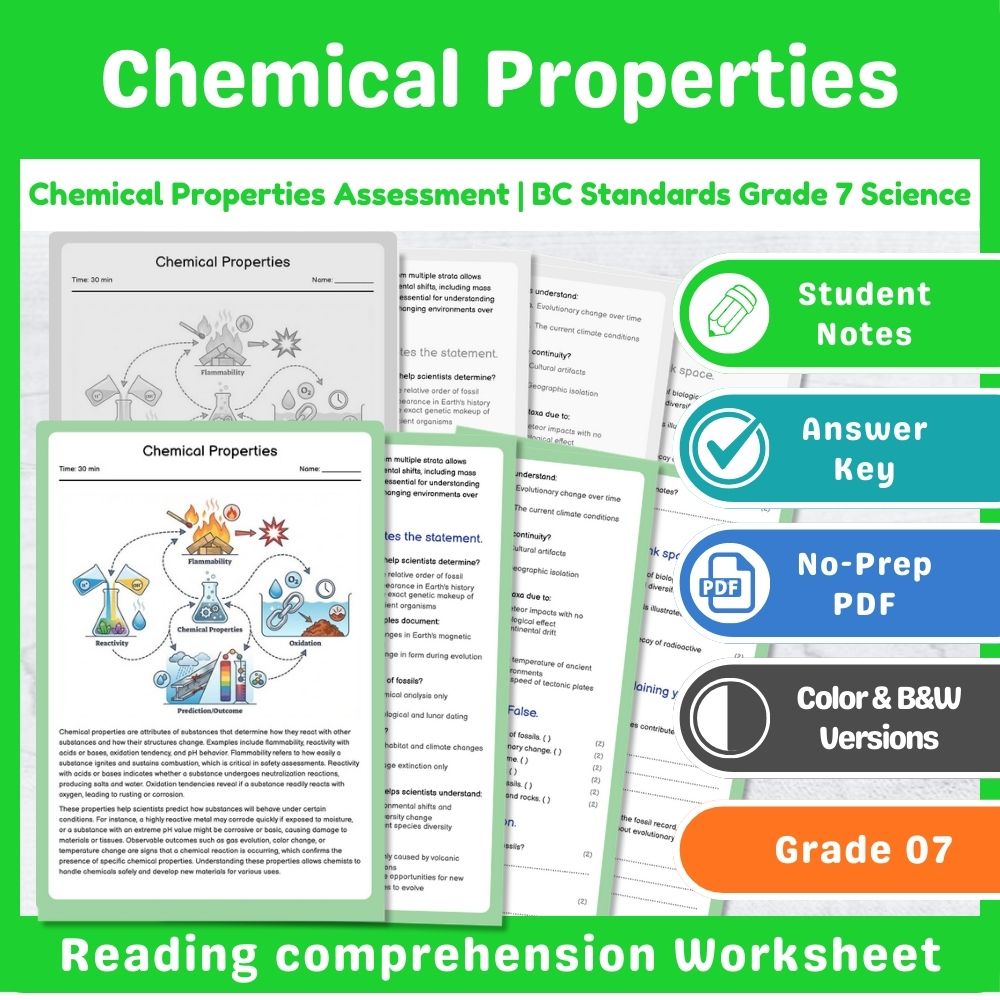
Chemical Properties Assessment | BC Standards Grade 7 Science
Created byPrism Point LearningLearning Objectives
- Understand the key chemical properties and how they describe a substance.
- Identify observable indicators of chemical reactions.
- Assist in predicting reactions based on chemical properties like flammability, reactivity, and pH.
Instant download
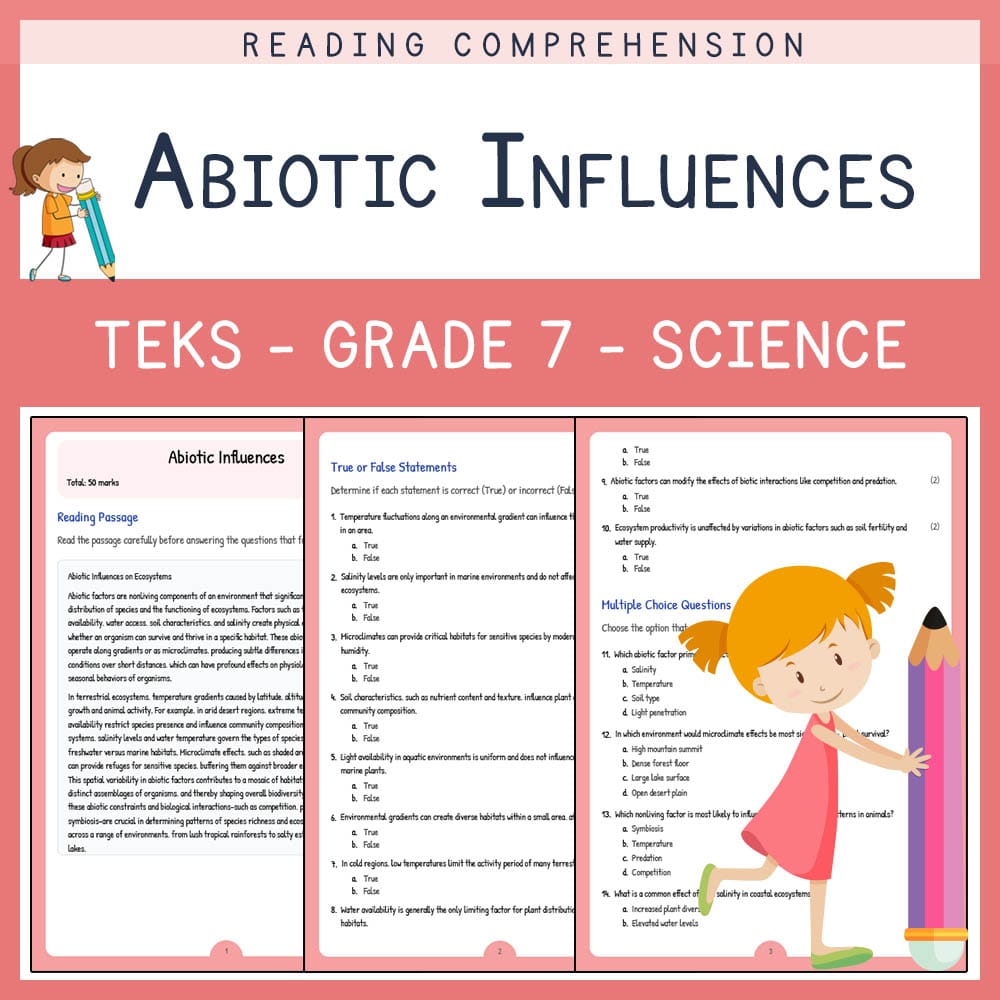
Grade 7 Science | Abiotic Influences Worksheet | TEKS Alligned
Created byLumora LearningLearning Objectives
- Understand how nonliving factors such as temperature, light, water, soil, and salinity influence species distributions and ecosystems.
- Explain the concept of environmental gradients and microclimate effects on organism tolerances.
- Describe how abiotic factors interact with biotic relationships to shape biodiversity and community structure.
Instant download
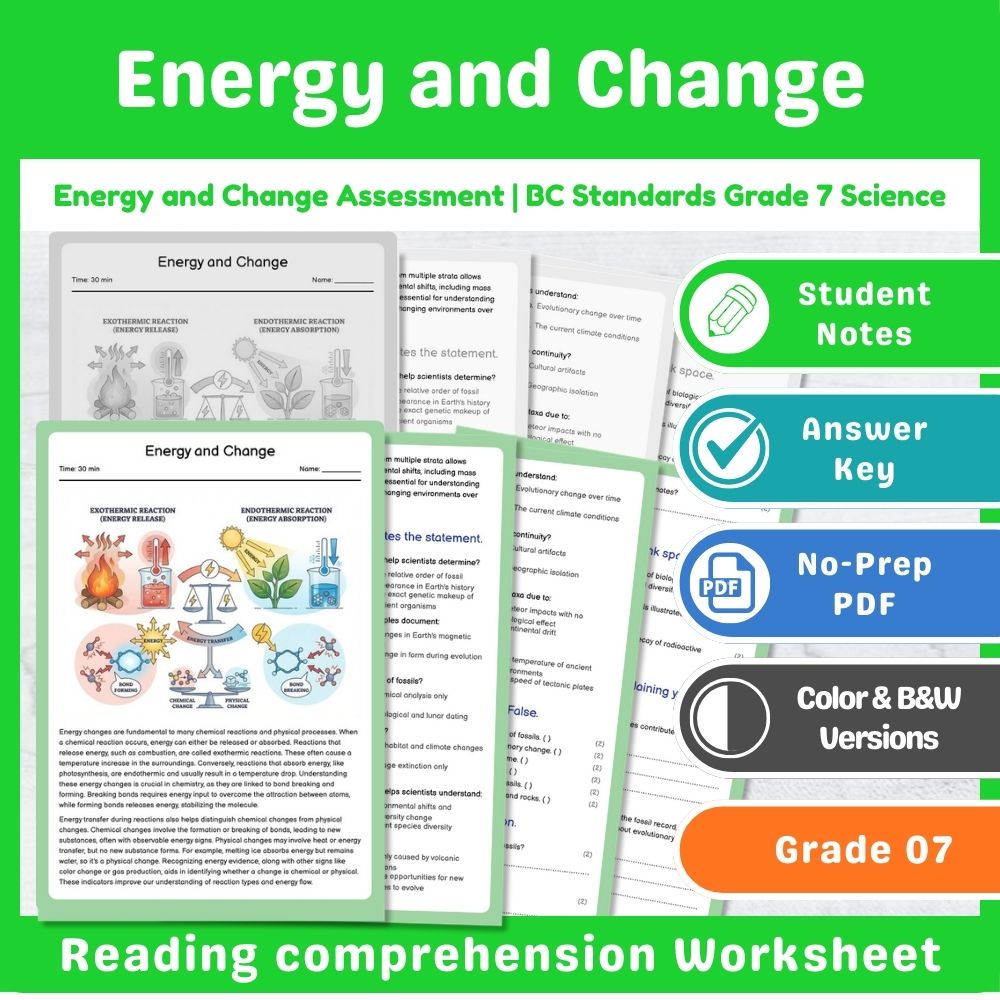
Energy and Change Assessment | BC Standards Grade 7 Science
Created byPrism Point LearningLearning Objectives
- Understand how energy changes occur during chemical reactions, including exothermic and endothermic processes.
- Explain how energy transfer relates to bond breaking and formation in chemical reactions.
- Distinguish between chemical and physical changes using energy evidence and other signs.
Instant download

Grade 7 Science – Conservation Status Daily Reading Worksheet with Answer Key
JCreated byJ.S SheetsLearning Objectives
- Understand key concepts related to Science
- Apply knowledge through practice questions
- Demonstrate comprehension of the material
Also included in: Grade 7 Science Lesson Group Bundle | Ecology, Environment & Sustainability +1 more
Instant download
About Grade 7 Science Worksheets
Browse 6,039 printable Grade 7 Science worksheets — ready-to-print PDFs with answer keys where available.
Every worksheet on MyTeachingSheets is created by independent teacher-authors and reviewed before publication. All resources download as printable PDFs for classroom, homework, or at-home practice, and many include answer keys. Preview any worksheet free before buying.