
Grade 7 Science Worksheets
6,039 worksheets
Geologic Processes Assessment | NGSSS Standards Grade 7 Science
 Created byPrism Point Learning
Learning Objectives
- Explain how tectonic activity, weathering, erosion, and deposition shape Earth’s surface.
- Identify how transporting agents and energy changes lead to deposition.
- Use geologic vocabulary (tectonic activity, weathering, erosion, deposition) to describe landform change over time.
Also included in: Grade 7 Earth and Climate Systems Science Lesson Bundle: Florida NGSSS
Instant download
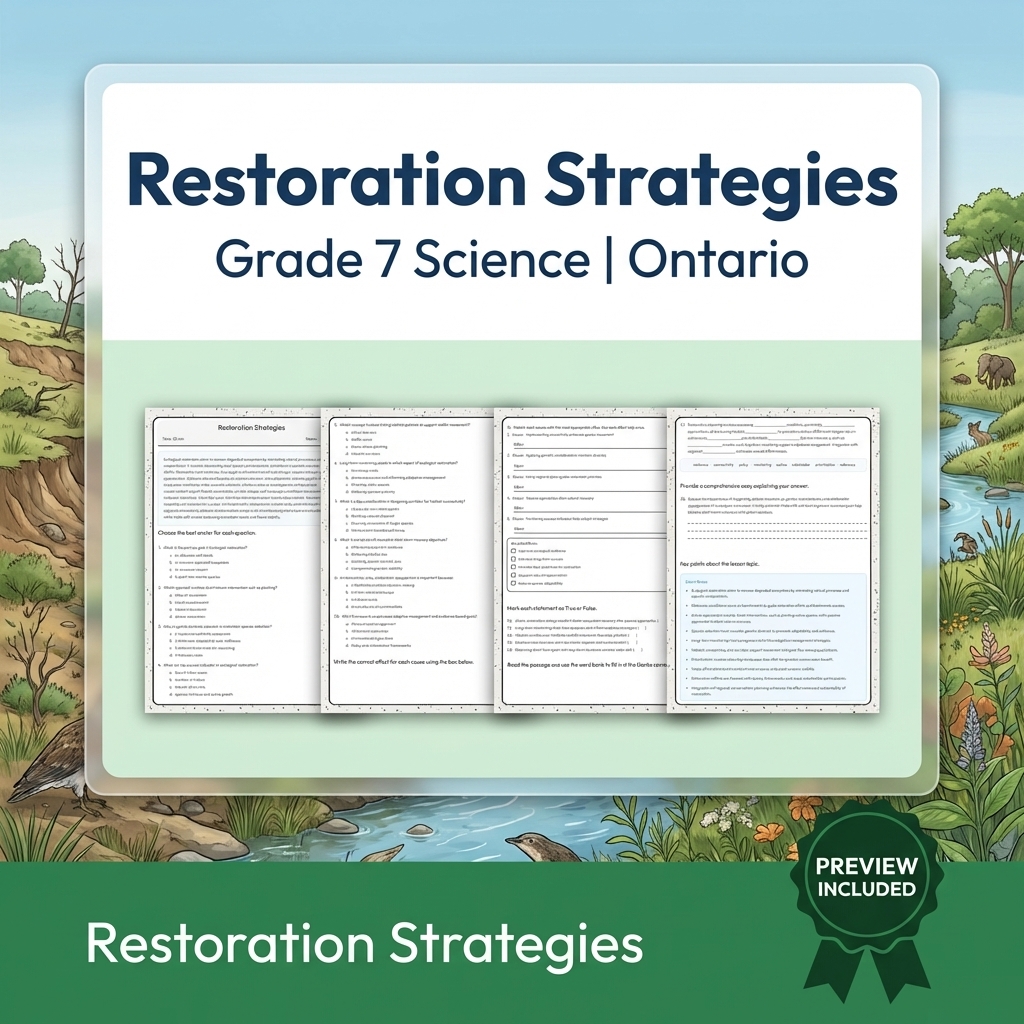
Grade 7 Science | Restoration Strategies Worksheet with Short Notes (PDF)
 Created byMeadowlark Worksheets
Learning Objectives
- Understand core principles of ecological restoration and reference conditions.
- Differentiate between active and passive restoration approaches.
- Learn criteria for species selection and long-term landscape monitoring.
Also included in: Grade 7 Science Lesson Bundle with Ontario Framework | Ecosystems & Biodiversity +1 more
Instant download
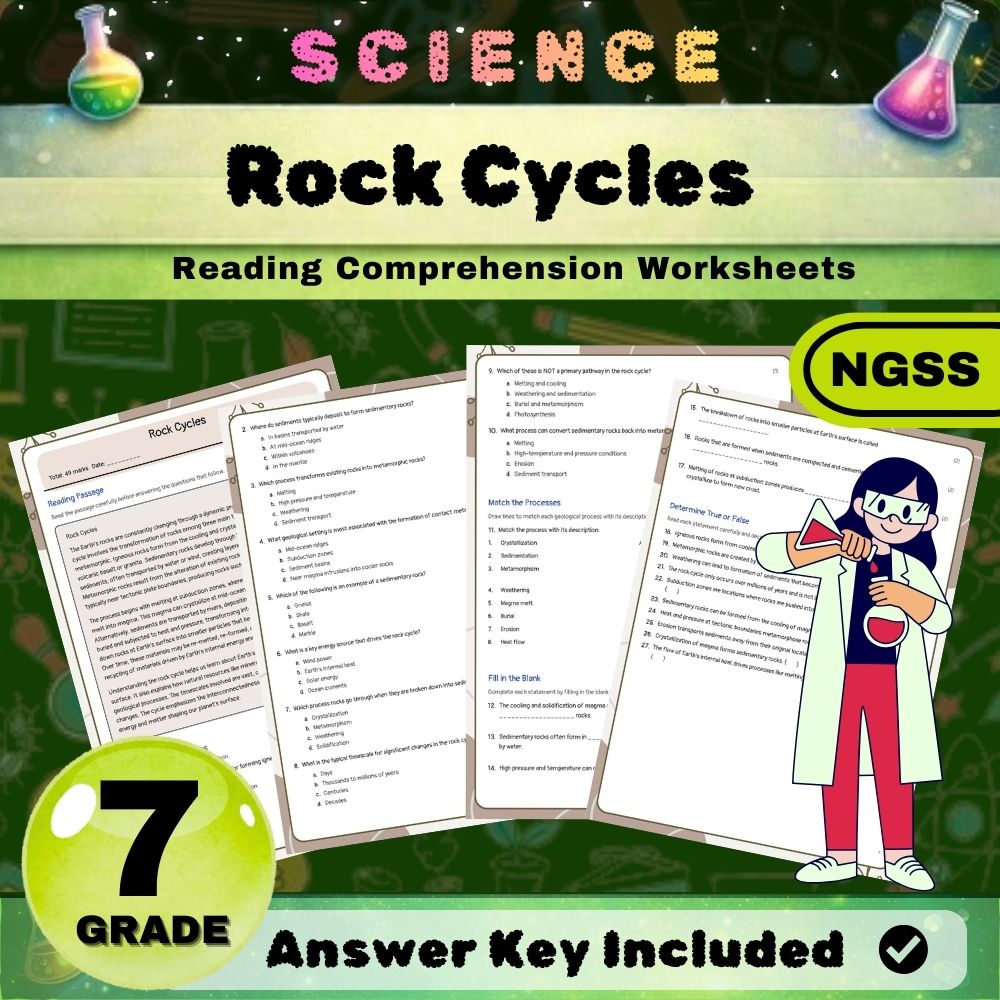
Grade 7 Science | Rock Cycles NGSS Worksheet (Answer Key)
 Created byMaple Path Learning
Learning Objectives
- Explain the processes that drive the transformation among igneous, sedimentary, and metamorphic rocks within the Earth's rock cycle.
- Describe how geological processes such as melting, crystallization, weathering, and sediment transport contribute to rock changes.
- Identify examples of rock formation processes like volcanic activity, sediment layering, and contact metamorphism.
Instant download
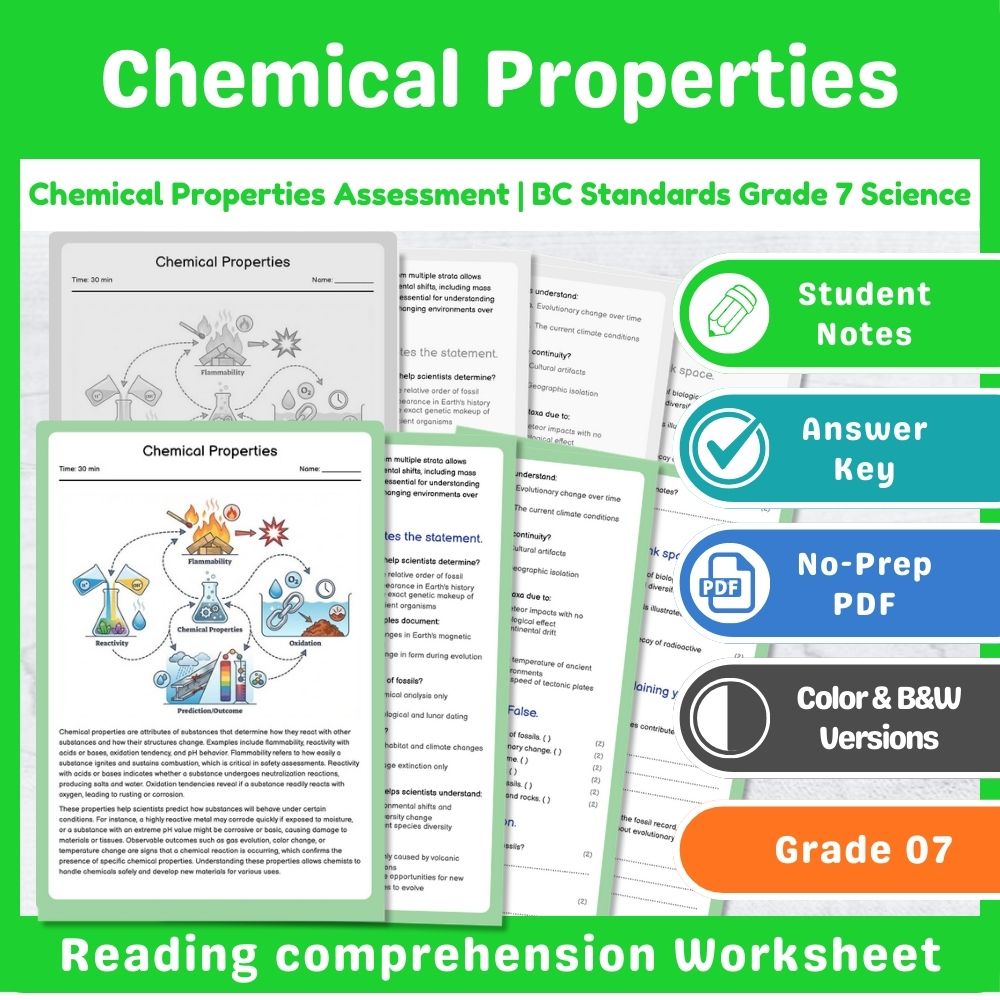
Chemical Properties Assessment | BC Standards Grade 7 Science
Created byPrism Point LearningLearning Objectives
- Understand the key chemical properties and how they describe a substance.
- Identify observable indicators of chemical reactions.
- Assist in predicting reactions based on chemical properties like flammability, reactivity, and pH.
Instant download
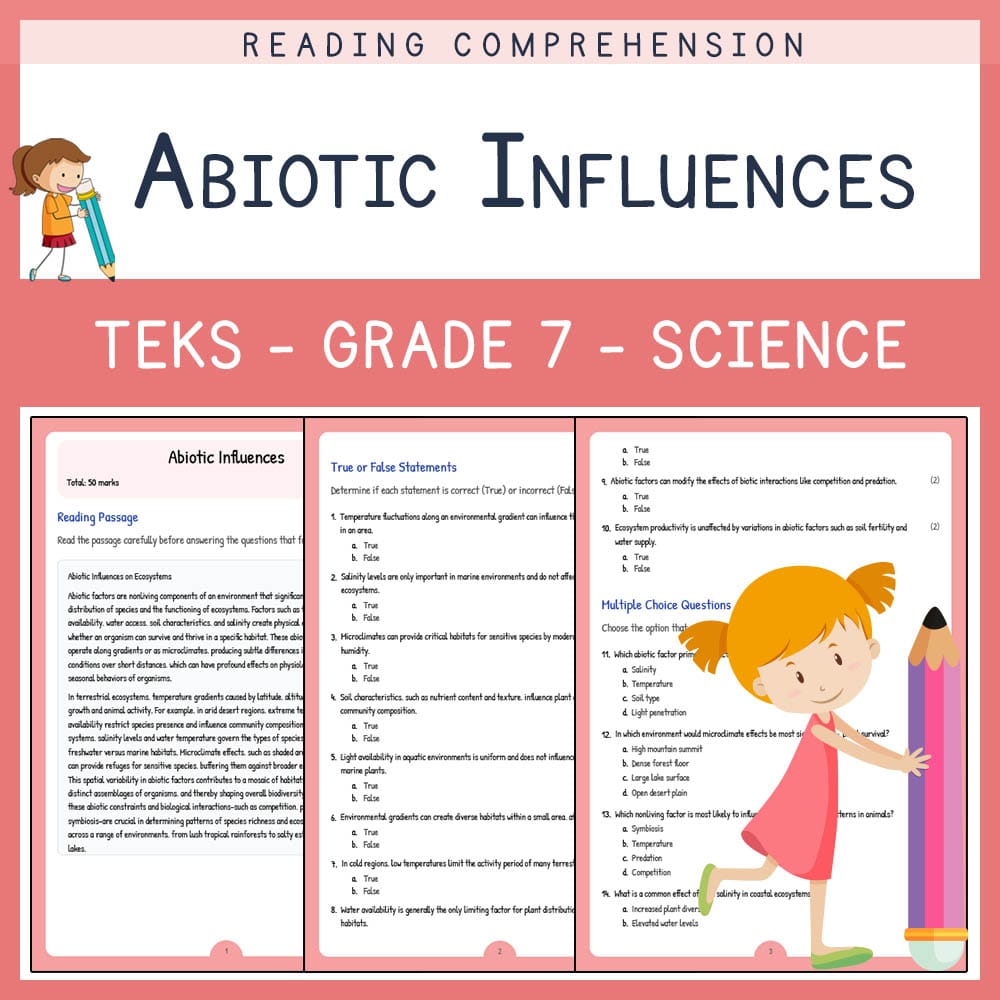
Grade 7 Science | Abiotic Influences Worksheet | TEKS Alligned
 Created byLumora Learning
Learning Objectives
- Understand how nonliving factors such as temperature, light, water, soil, and salinity influence species distributions and ecosystems.
- Explain the concept of environmental gradients and microclimate effects on organism tolerances.
- Describe how abiotic factors interact with biotic relationships to shape biodiversity and community structure.
Instant download
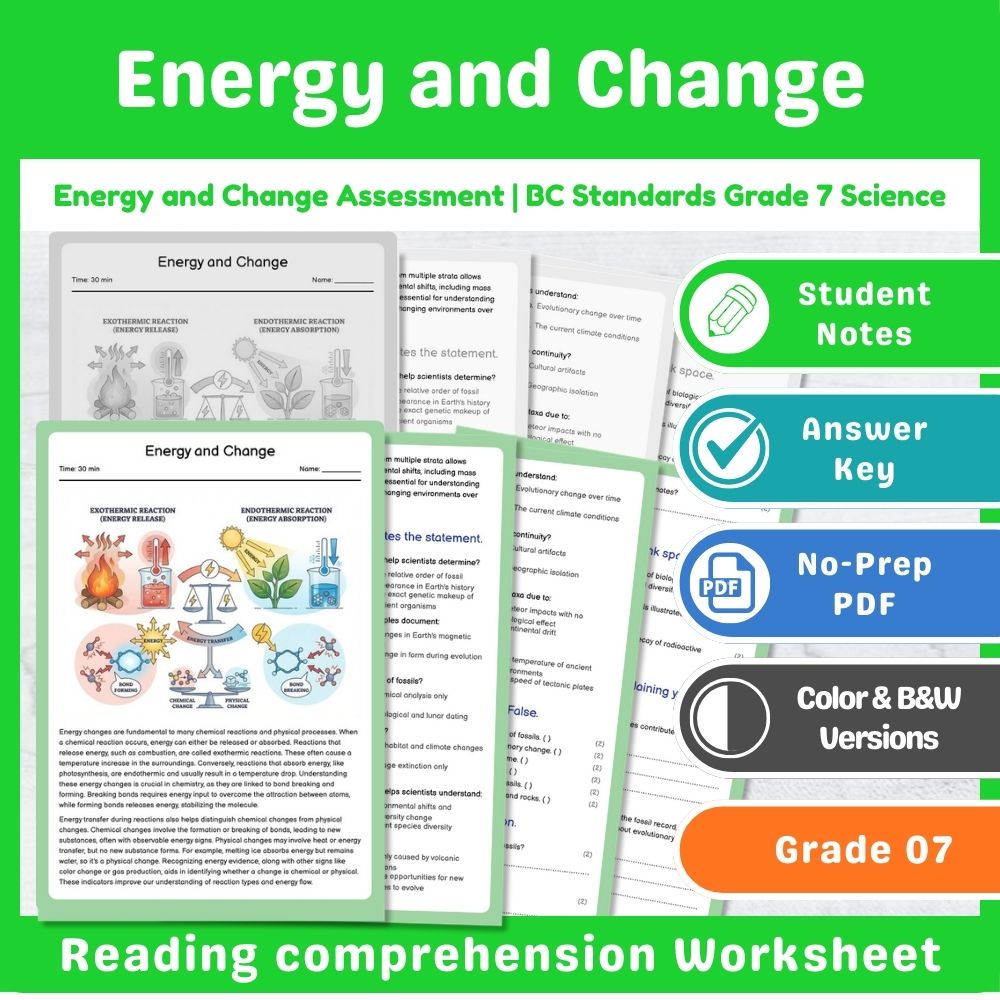
Energy and Change Assessment | BC Standards Grade 7 Science
Created byPrism Point LearningLearning Objectives
- Understand how energy changes occur during chemical reactions, including exothermic and endothermic processes.
- Explain how energy transfer relates to bond breaking and formation in chemical reactions.
- Distinguish between chemical and physical changes using energy evidence and other signs.
Instant download

Grade 7 Science – Conservation Status Daily Reading Worksheet with Answer Key
JCreated byJ.S SheetsLearning Objectives
- Understand key concepts related to Science
- Apply knowledge through practice questions
- Demonstrate comprehension of the material
Also included in: Grade 7 Science Lesson Group Bundle | Ecology, Environment & Sustainability +1 more
Instant download

Embryonic Patterns Worksheet | Evolution Evidence Activity Grade 7
 Created byAmber Owl Education
Learning Objectives
- Compare embryonic development stages across different animal groups and identify conserved features.
- Explain how shared embryonic structures and developmental timing can support evolutionary relationships.
- Use examples such as pharyngeal pouches and limb buds to interpret evidence for common developmental pathways.
Also included in: Grade 7 Science Evolution & Biodiversity Lesson Bundle – NGSS +1 more
Instant download

Grade 7 Science – Abiotic Influences on Ecosystems Daily Reading Worksheet
 Created byBright Mind Resources
Learning Objectives
- Identify how temperature impacts species distributions and survival
- Analyze the effects of temperature fluctuations on ecosystems
- Evaluate the role of abiotic factors in shaping biological processes
Also included in: Grade 7 Ecosystems & Population Ecology Science Lesson Bundle | BC +1 more
Instant download

Grade 7 Science – Understanding Metamorphic Change | Daily Reading Worksheet
Created byBright Mind ResourcesLearning Objectives
- Define metamorphism and explain how it alters rocks
- Identify different types of metamorphism and their features
- Recognize mineral changes occurring during metamorphism
Also included in: Grade 7 Earth Processes Science Daily Reading Worksheets Lesson Bundle | BC +1 more
Instant download

Grade 7 Science | Mitochondria Energy Worksheet | BC Standards
Created byLumora LearningLearning Objectives
- Understand the structure and function of mitochondria in energy production.
- Explain the process of cellular respiration and how ATP is generated.
- Identify the role of the electron transport chain and membrane gradients in energy synthesis.
Instant download
Grade 7 Science | Data Reasoning and Reliability Worksheet with Short Notes
Created byMeadowlark WorksheetsLearning Objectives
- Understand how repeated measurements improve data reliability.
- Identify sources of error that affect measurement accuracy.
- Interpret data patterns and variability in testing results.
Also included in: Grade 7 Technology Impacts and Ethics Science Lesson Bundle: General Framework +1 more
Instant download
Grade 7 Science | Technical Communication Worksheet | TEKS Aligned
Created byLumora LearningLearning Objectives
- Understand the conventions of technical communication including drawings, schematics, and documentation.
- Identify and interpret standardized symbols, units, and labels used in engineering diagrams.
- Explain the importance of clarity, scale, and unambiguous dimensioning in technical drawings.
Instant download

Cosmic Scale Grade 7 Science Worksheet | NGSS-Aligned Practice for Class
JCreated byJ.S SheetsLearning Objectives
- Understand the concept of scale in astronomy using units like astronomical units, light-years, and planetary diameters.
- Interpret scaled diagrams and logarithmic representations of distances within the solar system and galaxy.
- Analyze orders of magnitude differences and how scale influences observational limits and apparent motion.
Also included in: Grade 7 Cosmic Solar Rock and Gravity Science Lesson Bundle: NGSS +1 more
Instant download

Conservation of Matter Worksheet | Grade 7 Science Practice Activity
Created byPrism Point LearningLearning Objectives
- Explain the conservation of matter during chemical reactions using evidence such as equal total mass of substances before and after.
- Describe how atoms are rearranged in chemical reactions while the total number of atoms remains the same.
- Apply conservation of matter to everyday observations, like mass measurements in sealed containers.
Also included in: Physical Science Lesson Bundle | Grade 7 Science | Florida NGSSS
Instant download

Grade 7 Science | Resource Distribution & Earth's Geological Processes
 Created byCoral Reef Learning
Learning Objectives
- Understand how geological processes such as plate tectonics, sedimentation, weathering, and biological activity contribute to the formation of mineral and energy resources.
- Identify the relationship between Earth's history and the location of resource deposits.
- Analyze how geologic maps and cross sections illustrate resource distribution.
Instant download

Science: Cosmic Scale Worksheet | NGSS Grade 7 Science Assessment
 Created bySkylark Worksheets
Learning Objectives
- Use astronomical units (AU), planetary diameters, and light-years to compare distances in space.
- Interpret scaled diagrams and logarithmic ideas to explain orders of magnitude differences.
- Explain how scale affects what we can observe and how fast objects appear to move.
Also included in: Grade 7 Space, Gravity & Earth Processes Science Lesson Bundle (NGSS) +1 more
Instant download

Population Interactions Worksheet Grade 7 Science Ecosystems Activity
Created byPrism Point LearningLearning Objectives
- Explain how predators, prey, and competitors affect access to resources in a community
- Describe how mutualism can change resource availability and improve survival for both partners
- Connect population interactions to changes in survival, reproduction rates, and population size over time
Also included in: Life Science - Grade 7 Bundle
Instant download
Grade 7 Science Cell Organization and Tissues Daily Worksheet + Answer Key
JCreated byJ.S SheetsLearning Objectives
- Understand the structure and function of different tissues in the body
- Identify various types of tissues such as epithelial, muscle, and nervous tissue
- Explain how tissues combine to form organs and support organism functions
Also included in: Grade 7 Science Lesson Group Bundle | Cell Structures and Processes +1 more
Instant download

Grade 7 Population Impacts on Water and Ecosystems | NGSS Science Worksheet
 Created byBRIGHT PATH RESOURCES
Learning Objectives
- Understand how increasing human populations affect water demand.
- Learn the connection between population growth and ecosystem health.
- Analyze regional examples of resource consumption and environmental pressure.
Also included in: Earth Systems Grade 7 Science Daily Reading Worksheets Lesson Bundle | NGSS +2 more
Instant download

Grade 7 Science – Thermal Basics & Heat Transfer | Daily Reading Worksheet
Created byBright Mind ResourcesLearning Objectives
- Explain how the kinetic motion of particles affects temperature.
- Describe the differences between heat and temperature.
- Identify the methods of thermal transfer: conduction, convection, radiation.
Also included in: Grade 7 Heat Transfer Science Daily Reading Worksheets Lesson Bundle | Alberta +2 more
Instant download

Physical Change Signs Worksheet Grade 7 Science Activities
Created byPrism Point LearningLearning Objectives
- Identify signs of a physical change by linking particle behavior to observable properties.
- Explain how phase transitions and dissolving can occur without changing chemical identity.
- Use mass conservation in closed systems to support whether a change is physical.
Instant download

Grade 7 Science – Measurement & Uncertainty | Daily Reading Worksheet
Created byBright Mind ResourcesLearning Objectives
- Understand the basic units used in scientific measurements
- Learn the importance of accuracy and precision in measurements
- Recognize sources of measurement uncertainty, including systematic and random errors
Also included in: Grade 7 Modeling & Simulation Science Daily Reading Lesson Bundle | Ontario +1 more
Instant download

Grade 7 Population Variation Worksheet | NGSS Practice PDF
 Created byClear Sky Classroom
Learning Objectives
- Explain how inherited differences and recombination create variation within a population
- Describe how trait frequency can change across generations under environmental pressures
- Analyze data or statements to distinguish between heritable variation and non-heritable influences
Instant download

Grade 7 Science | Phase Energy: Melting and Freezing - Reading Comprehension
Created byCoral Reef LearningLearning Objectives
- Explain what happens at the particle level during melting and freezing.
- Identify energy absorption and release associated with phase changes.
- Describe how latent heat is involved in melting and freezing processes.
Also included in: Matter and Chemical Change Lesson Bundle: Grade 7 Science Alberta +1 more
Instant download

Grade 7 Science – Decomposition & Nutrient Cycling | Daily Reading Worksheet
Created byBright Mind ResourcesLearning Objectives
- Understand the process of decomposition and its role in ecosystems
- Identify key organisms involved in decomposition such as detritivores, fungi, and bacteria
- Explain how nutrients like carbon and nitrogen are transformed during decomposition
Also included in: Grade 7 Ecosystem Stewardship Science Daily Reading lesson bundle | Ontario +1 more
Instant download

Grade 7 Science – Engineering Purpose: Bridges & Structural Design | Worksheet
Created byBright Mind ResourcesLearning Objectives
- Understand the purpose and function of bridges in structural engineering
- Identify key design features that fulfill load-bearing requirements
- Analyze how design choices affect the durability and performance of bridges
Also included in: Grade 7 Technology & Engineering Science Lesson Bundle: Daily Reading | TEKS +2 more
Instant download

Earth Structure Worksheet | Grade 7 Science Activities
Created byPrism Point LearningLearning Objectives
- Describe the major layers of Earth (crust, mantle, outer core, inner core) and key properties of each.
- Explain how heat transport, density differences, and convection relate to Earth’s dynamic processes.
- Interpret seismic wave behavior as evidence for Earth’s internal structure.
Also included in: Grade 7 Earth and Space Systems Science Lesson Bundle TEKS Worksheets
Instant download

Failure Modes Worksheet Grade 7 Science | Ontario Standards Assessment
 Created byCedar Grove Learning
Learning Objectives
- Identify major structural failure modes (buckling, fatigue cracking, beam fracture, and connection/foundation failure) and describe what triggers them.
- Explain limit states design and how safety factors and redundancy reduce the risk of collapse.
- Relate failure mechanisms to geometry, materials, and loading conditions using bridge and structural examples.
Also included in: Grade 7 Materials Testing & Prototyping Science Lesson Bundle – Ontario +1 more
Instant download

Action-Reaction Forces Worksheet Grade 7 Science | Newton’s Third Law
Created byPrism Point LearningLearning Objectives
- Explain the action-reaction relationship between two interacting objects.
- Identify action-reaction force pairs in real-world examples (contact and noncontact).
- Relate acceleration to net force and mass when forces come from interactions.
Instant download

Grade 7 Gravity Motion Worksheet | NGSS Practice PDF
Created byClear Sky ClassroomLearning Objectives
- Understand the role of gravity in orbital motion within the solar system and galaxies.
- Identify mathematical relationships that describe orbital velocity and centripetal effects.
- Analyze observational evidence such as orbital trajectories and Keplerian patterns.
Also included in: Grade 7 Space Science NGSS Lesson Bundle for Science: Worksheet B +1 more
Instant download

Grade 7 Design Process Science Daily Reading Worksheet | TEKS STEM Activity
Created byBRIGHT PATH RESOURCESLearning Objectives
- Identify a design problem in a technology task.
- Distinguish criteria from constraints.
- Explain why clear criteria help guide brainstorming and prototype choices.
Also included in: Engineering Design Grade 7 Science Daily Reading Worksheets Lesson Bundle | TEKS +1 more
Instant download

Grade 7 Atomic Models Worksheet NGSS Matter Structure Activity Answer Key
 Created byNorthstar Worksheets
Learning Objectives
- Explain how atomic number relates to the number of protons and electrons in common cases.
- Compare particle, ball-and-stick, and lattice representations of atoms in molecules and extended structures.
- Use chemical formula notation to describe how bonding patterns affect properties such as melting point and conductivity.
Also included in: Grade 7 Physical Science: Matter & Chemical Reactions Lesson Bundle | NGSS +1 more
Instant download
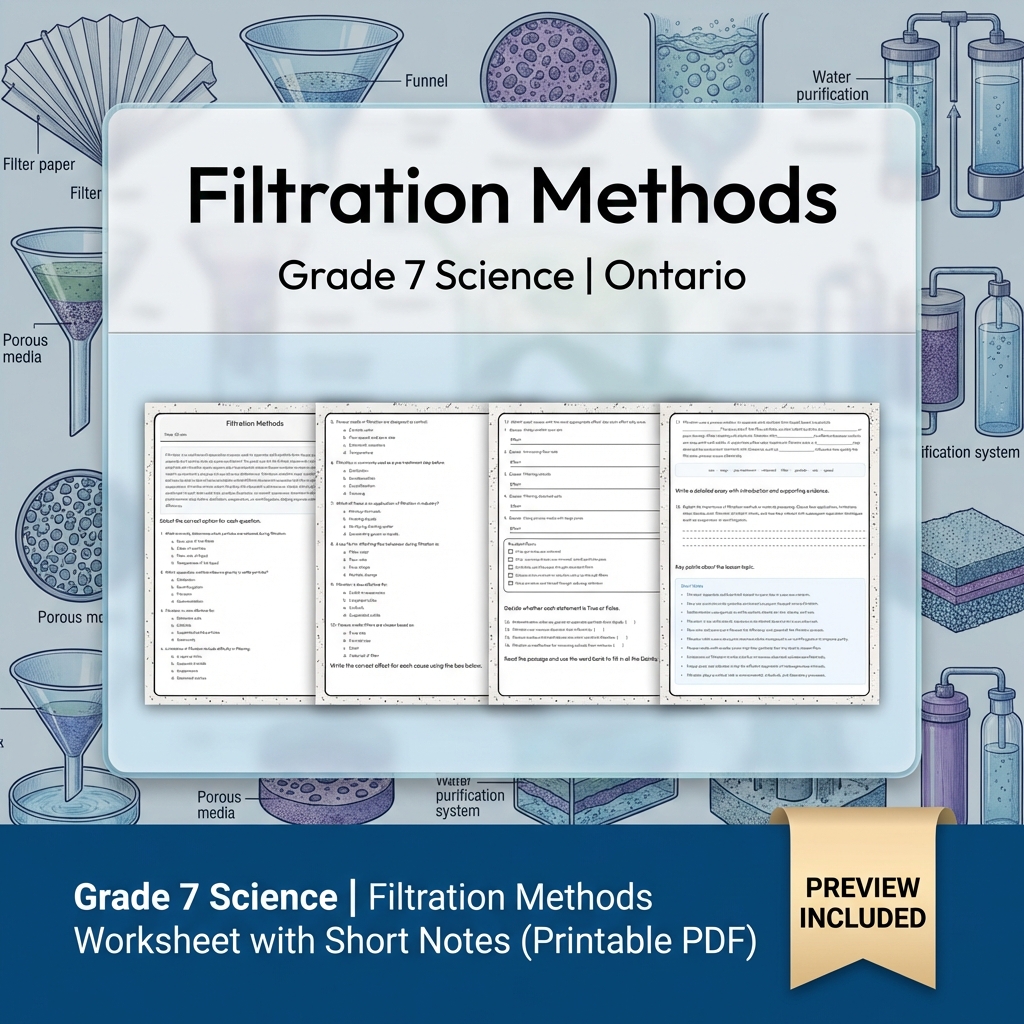
Grade 7 Science | Filtration Methods Worksheet with Short Notes (Printable PDF)
Created byMeadowlark WorksheetsLearning Objectives
- Understand the basic principles of filtration and sedimentation as mechanical separation techniques.
- Identify different pore sizes and their applications in filtration processes.
- Describe how flow behaviour affects filtration efficiency and separation quality.
Also included in: Grade 7 Science Lesson Group Bundle – Ontario Curriculum Worksheets +1 more
Instant download

Grade 7 Inheritance & Probability Worksheet | Genetics | NGSS Science
Created byBRIGHT PATH RESOURCESLearning Objectives
- Understand key concepts related to Science
- Apply knowledge through practice questions
- Demonstrate comprehension of the material
Also included in: Grade 7 Genetics Science Lesson Bundle Daily Reading Worksheets | NGSS +2 more
Instant download

Inheritance Probability Worksheet | Grade 7 Science NGSS Practice
Created byPrism Point LearningLearning Objectives
- Apply probability to monohybrid cross outcomes to predict expected genotype and phenotype ratios.
- Connect Punnett square results to the likelihood that offspring inherit dominant or recessive traits.
- Use expected ratios to explain why larger populations better match theoretical predictions.
Also included in: Grade 7 Genetics Science Lesson Bundle NGSS: Inheritance, Traits, DNA
Instant download

Grade 7 Science Load Path Mapping Worksheet (Ontario) – PDF
 Created byEvergreen Desk Education
Learning Objectives
- Describe how engineers map primary and secondary load paths in multi-span bridge and building systems
- Explain how diaphragms, shear walls, and moment frames change stiffness and redirect loads
- Predict how openings, re-entrant corners, and irregular geometry can redistribute gravity, lateral, and dynamic loads
Also included in: Grade 7 Engineering Design & Materials Science Lesson Bundle Ontario +1 more
Instant download

Grade 7 Science | Particle Model Worksheet (PDF) Aligned to Alberta Standards
 Created bySilver Birch Teaching
Learning Objectives
- Explain how the particle model describes matter as particles that have spaces and are in constant motion
- Use particle ideas to account for macroscopic properties and states of matter
- Describe how diffusion and density changes can be explained by particle arrangement and motion
Also included in: Grade 7 Matter, Concentration & Reactions Science Lesson Bundle - Alberta +1 more
Instant download
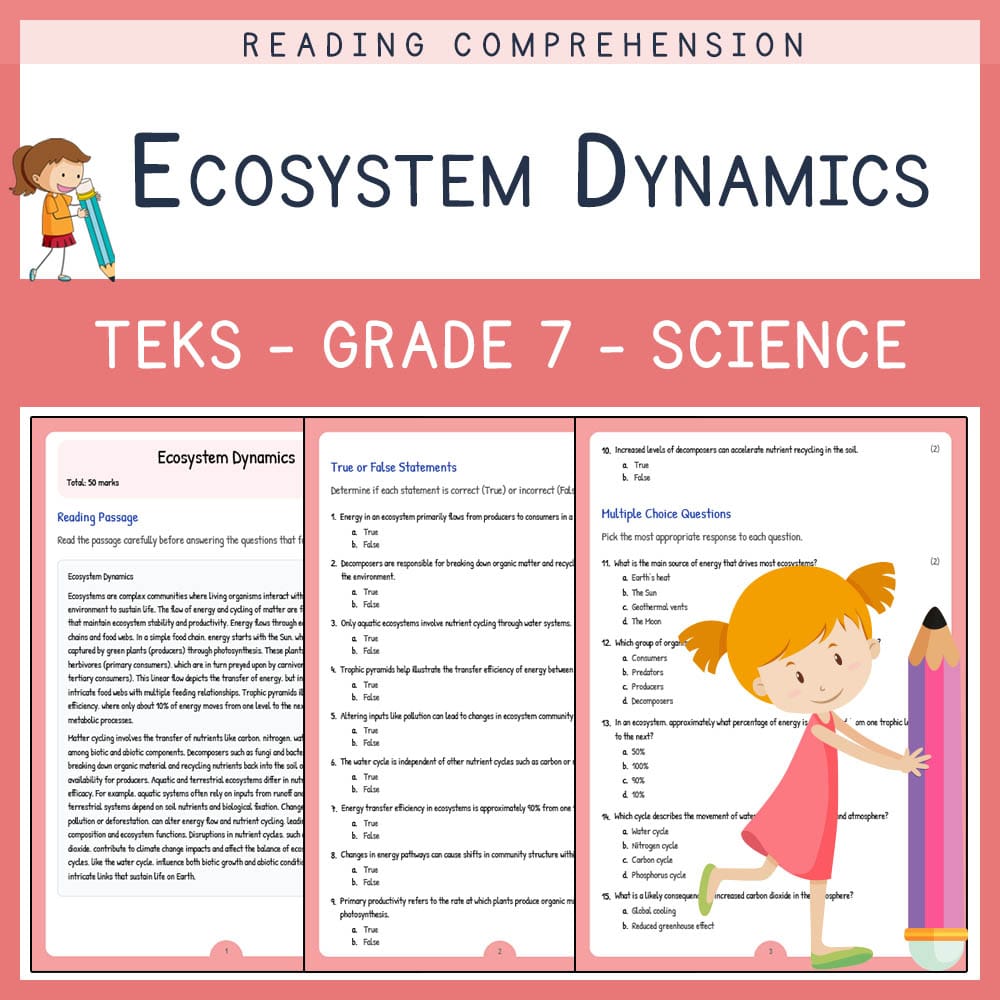
Grade 7 Science | Ecosystem Dynamics Worksheet | TEKS Alligned
Created byLumora LearningLearning Objectives
- Explain how energy flows within ecosystems through food chains, webs, and trophic pyramids.
- Describe the cycling of matter, including nutrients like carbon and water, in different ecosystems.
- Analyze how changes in energy pathways or inputs affect community structure and ecosystem processes.
Instant download

Grade 7 Science | Cell Communication Worksheet | BC Standards
Created byLumora LearningLearning Objectives
- Understand the mechanisms by which cells communicate through chemical and electrical signals.
- Identify the roles of receptor proteins, gap junctions, and plasmodesmata in cell communication.
- Explain how signal specificity, amplification, and feedback regulation control bodily processes.
Instant download

Friction and Stability Grade 7 Science Worksheet | Standards-Aligned Practice
JCreated byJ.S SheetsLearning Objectives
- Understand how friction influences movement and stability.
- Identify factors that affect friction between surfaces.
- Explain the relationship between applied force, friction, and motion.
Also included in: Grade 7 Forces and Matter Science lesson bundle – California Standards +1 more
Instant download

Grade 7 Science Design Criteria Worksheet | Standards-Aligned Practice
JCreated byJ.S SheetsLearning Objectives
- Explain how design criteria and explicit constraints help frame a design problem.
- Identify measurable or observable success criteria and recognize trade-offs between requirements.
- Connect a solution plan to constraints to show what counts as improvement.
Also included in: Grade 7 Science Fair Testing, Design, and Data Reliability Science Lesson Bundle +1 more
Instant download

Advanced Materials Test Prep Printable Worksheet | Grade 7 Science Ontario
Created byPrism Point LearningLearning Objectives
- Explain how manufacturing processes and microstructure affect strength, stiffness, and durability in advanced materials.
- Compare engineered timber, fibre-reinforced polymers, and high-performance concrete in terms of performance and practical use.
- Evaluate trade-offs among cost, fabrication complexity, and performance when selecting materials and connection methods.
Instant download
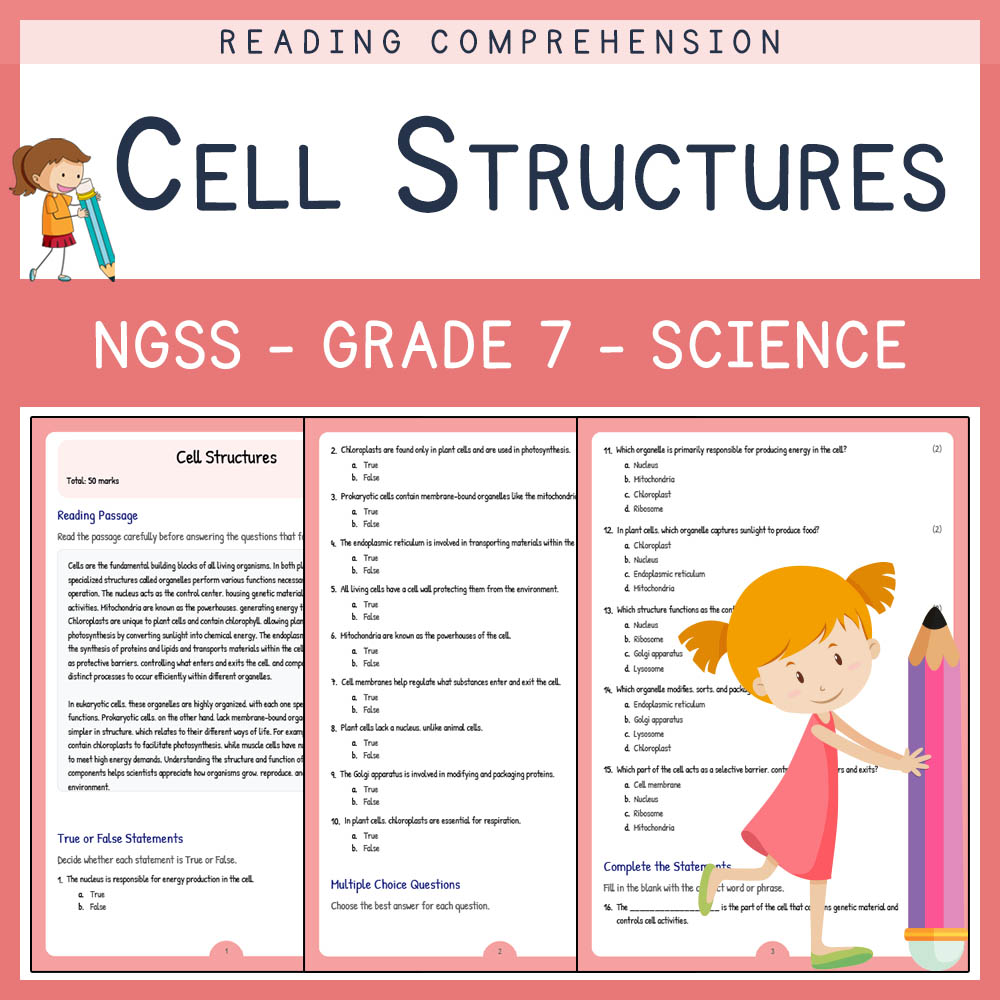
Grade 7 Science | Cell Structures Worksheet (PDF + Answer Key) | NGSS Standards
Created byLumora LearningLearning Objectives
- Identify the major organelles in plant and animal cells and describe their functions.
- Compare and contrast eukaryotic and prokaryotic cell organization.
- Explain the roles of nucleus, mitochondria, chloroplasts, endoplasmic reticulum, and membranes in cell function.
Instant download

Grade 7 Cell Structures Worksheet | NGSS Practice PDF
Created byClear Sky ClassroomLearning Objectives
- Identify and describe the functions of key organelles in plant and animal cells.
- Connect cell structure to its role in processes like transport, synthesis, and compartmentalization.
- Compare eukaryotic and prokaryotic cells, highlighting differences in organization and specialization.
Also included in: Grade 7 Cell Systems Science Lesson Bundle: NGSS Worksheet B +1 more
Instant download

Action-Reaction Forces Assessment for Grade 7 Science – California Standards
Created byPrism Point LearningLearning Objectives
- Explain Newton’s third law using the action-reaction force pair for interacting objects
- Identify how equal and opposite forces relate to contact and noncontact interactions
- Use mass and Newton’s second law to reason about why accelerations may differ
Also included in: Grade 7 Forces and Matter Science Lesson Bundle: California Standards +1 more
Instant download
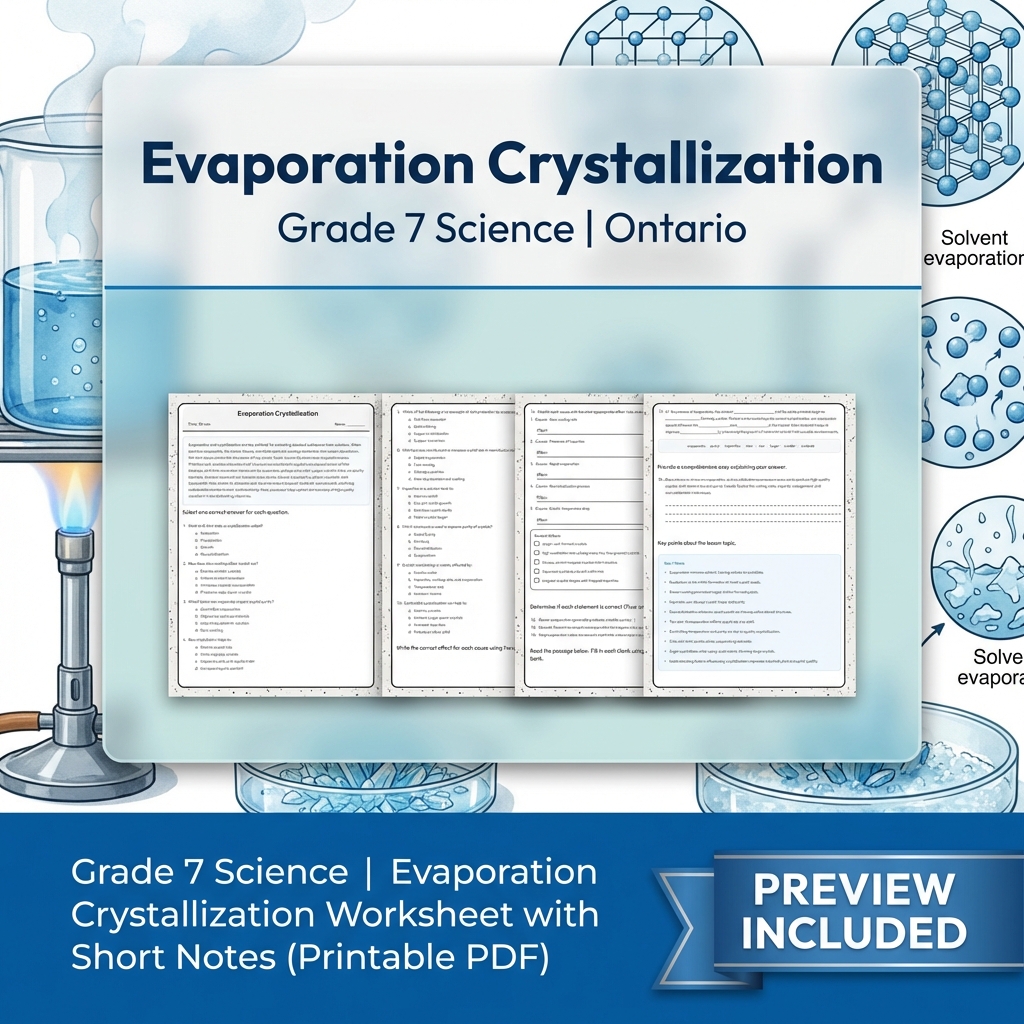
Grade 7 Science | Evaporation Crystallization Worksheet with Short Notes (PDF)
Created byMeadowlark WorksheetsLearning Objectives
- Explain the process of evaporation and crystallization in recovering solutes.
- Identify factors that influence crystal size, shape, and purity.
- Describe real-world examples of crystallization like salt and sugar production.
Also included in: Grade 7 Science Lesson Group Bundle – Ontario Curriculum Worksheets +1 more
Instant download

Grade 7 Science Worksheet on Advanced Materials | Ontario Standards
Created byCedar Grove LearningLearning Objectives
- Explain how microstructure and manufacturing choices can increase strength, stiffness, and durability in advanced materials.
- Compare engineered timber, fibre-reinforced polymers, high-performance concrete, and composite systems using key properties and limitations.
- Describe how prefabrication, connections, and retrofits affect the real-world performance of advanced materials.
Also included in: Grade 7 Materials Testing & Prototyping Science Lesson Bundle – Ontario +1 more
Instant download
About Grade 7 Science Worksheets
Browse 6,039 printable Grade 7 Science worksheets — ready-to-print PDFs with answer keys where available.
Every worksheet on MyTeachingSheets is created by independent teacher-authors and reviewed before publication. All resources download as printable PDFs for classroom, homework, or at-home practice, and many include answer keys. Preview any worksheet free before buying.