
Grade 7 Science Worksheets
6,039 worksheets
Action-Reaction Forces Assessment for Grade 7 Science – California Standards
 Created byPrism Point Learning
Learning Objectives
- Explain Newton’s third law using the action-reaction force pair for interacting objects
- Identify how equal and opposite forces relate to contact and noncontact interactions
- Use mass and Newton’s second law to reason about why accelerations may differ
Also included in: Grade 7 Forces and Matter Science Lesson Bundle: California Standards +1 more
Instant download
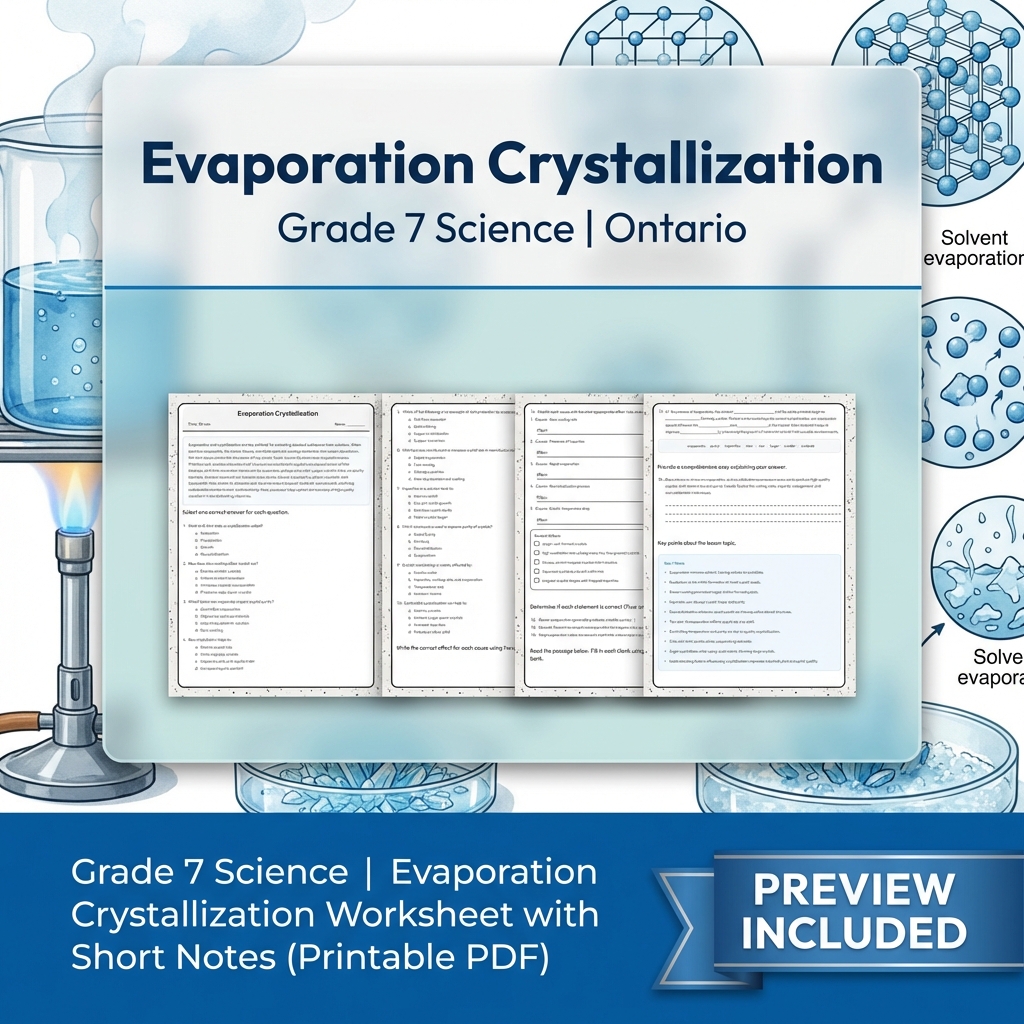
Grade 7 Science | Evaporation Crystallization Worksheet with Short Notes (PDF)
 Created byMeadowlark Worksheets
Learning Objectives
- Explain the process of evaporation and crystallization in recovering solutes.
- Identify factors that influence crystal size, shape, and purity.
- Describe real-world examples of crystallization like salt and sugar production.
Also included in: Grade 7 Science Lesson Group Bundle – Ontario Curriculum Worksheets +1 more
Instant download

Grade 7 Science Worksheet on Advanced Materials | Ontario Standards
 Created byCedar Grove Learning
Learning Objectives
- Explain how microstructure and manufacturing choices can increase strength, stiffness, and durability in advanced materials.
- Compare engineered timber, fibre-reinforced polymers, high-performance concrete, and composite systems using key properties and limitations.
- Describe how prefabrication, connections, and retrofits affect the real-world performance of advanced materials.
Also included in: Grade 7 Materials Testing & Prototyping Science Lesson Bundle – Ontario +1 more
Instant download

Energy Conversion Worksheet | Grade 7 NGSS Energy Transformations
 Created byNorthstar Worksheets
Learning Objectives
- Explain how devices convert energy from one form to another using energy transfer and conservation ideas
- Describe unavoidable thermal (heat) losses and relate them to efficiency in real systems
- Complete and interpret simple energy accounting across a transformation sequence
Also included in: Grade 7 Energy Transfer & Transformations Lesson Bundle | NGSS Science +1 more
Instant download
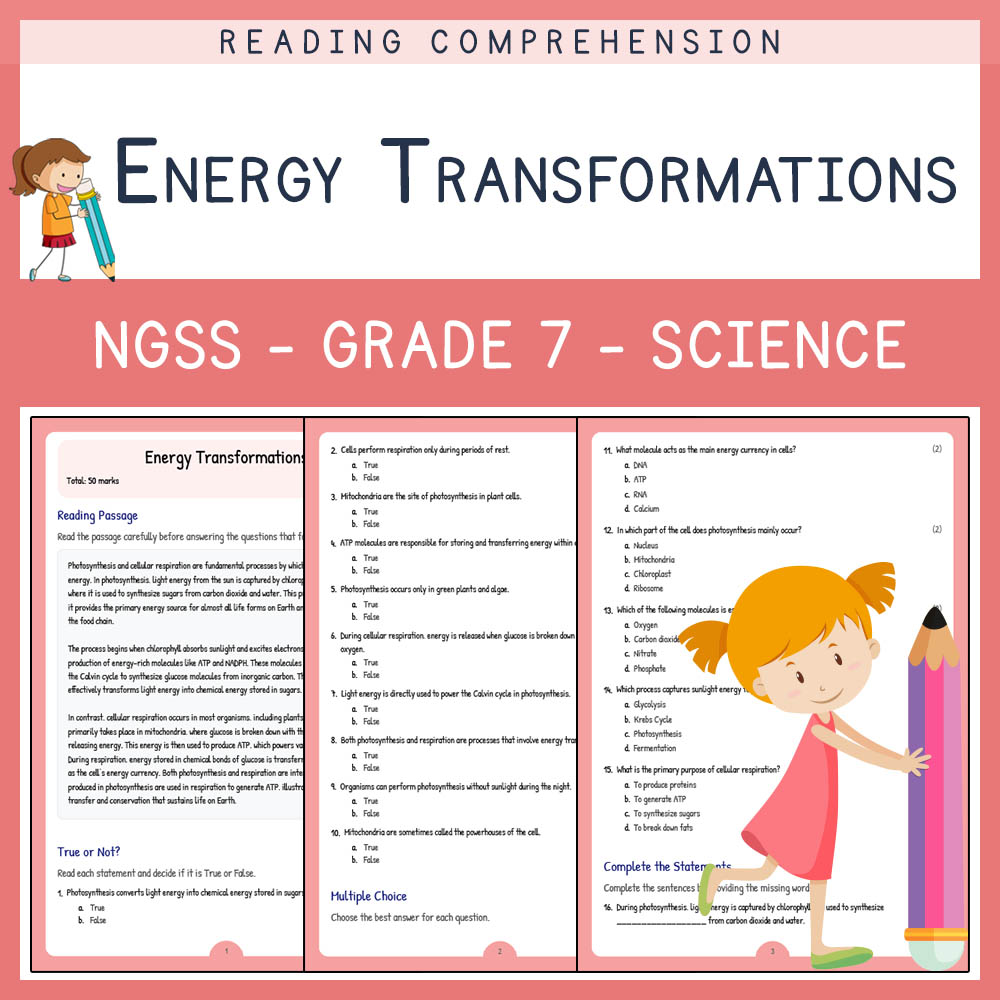
Grade 7 Science | Energy Transformations Worksheet (PDF + Answer Key)
 Created byLumora Learning
Learning Objectives
- Explain how light energy is converted into chemical energy during photosynthesis.
- Describe the process of cellular respiration and its role in energy transfer within cells.
- Illustrate how energy conservation occurs across biological systems during energy transformations.
Instant download
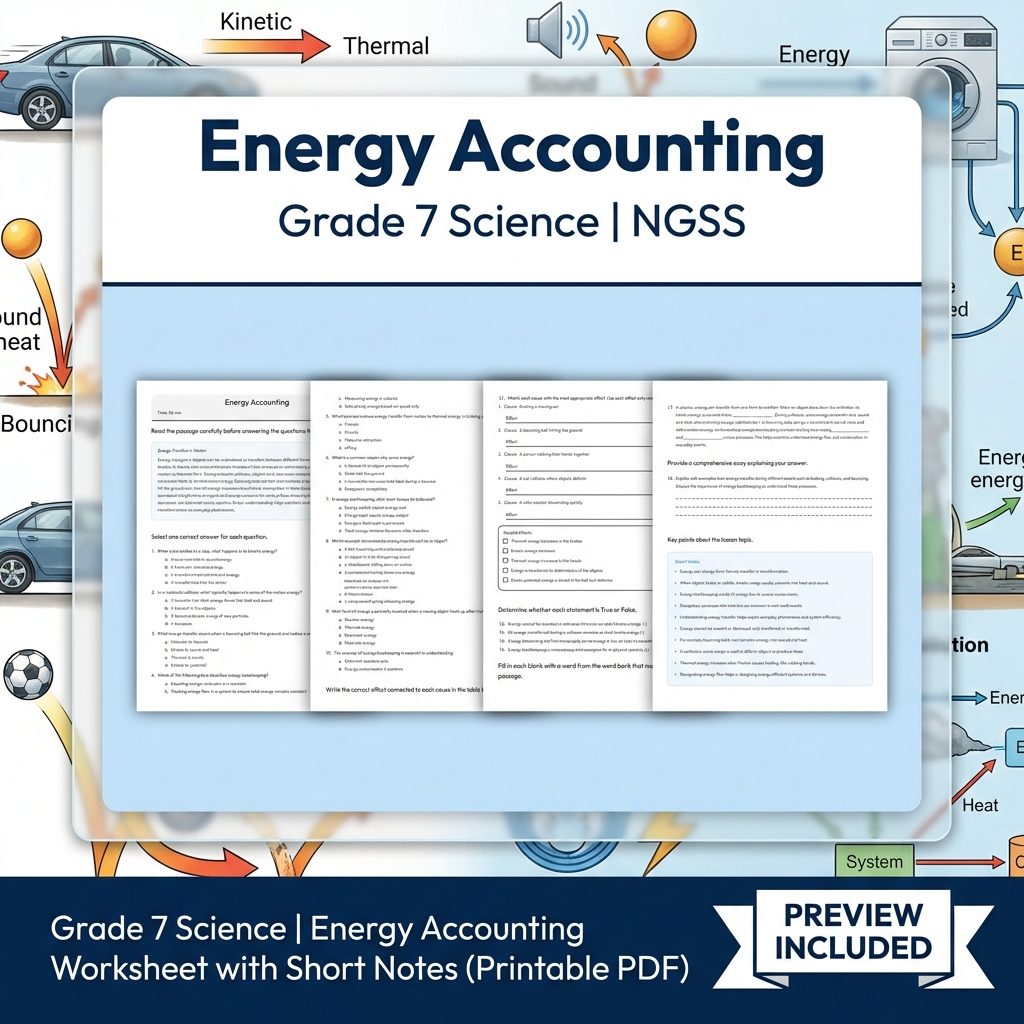
Grade 7 Science | Energy Accounting Worksheet with Short Notes (Printable PDF)
Created byMeadowlark WorksheetsLearning Objectives
- Explain how energy transfers occur during changes in an object's motion.
- Identify real-world examples of kinetic, thermal, sound, and other energy transfers.
- Analyze scenarios involving energy redistribution during collisions and bouncing.
Also included in: Grade 7 Science Energy Bundle Potential, Kinetic & Heat Transfer Worksheets +1 more
Instant download
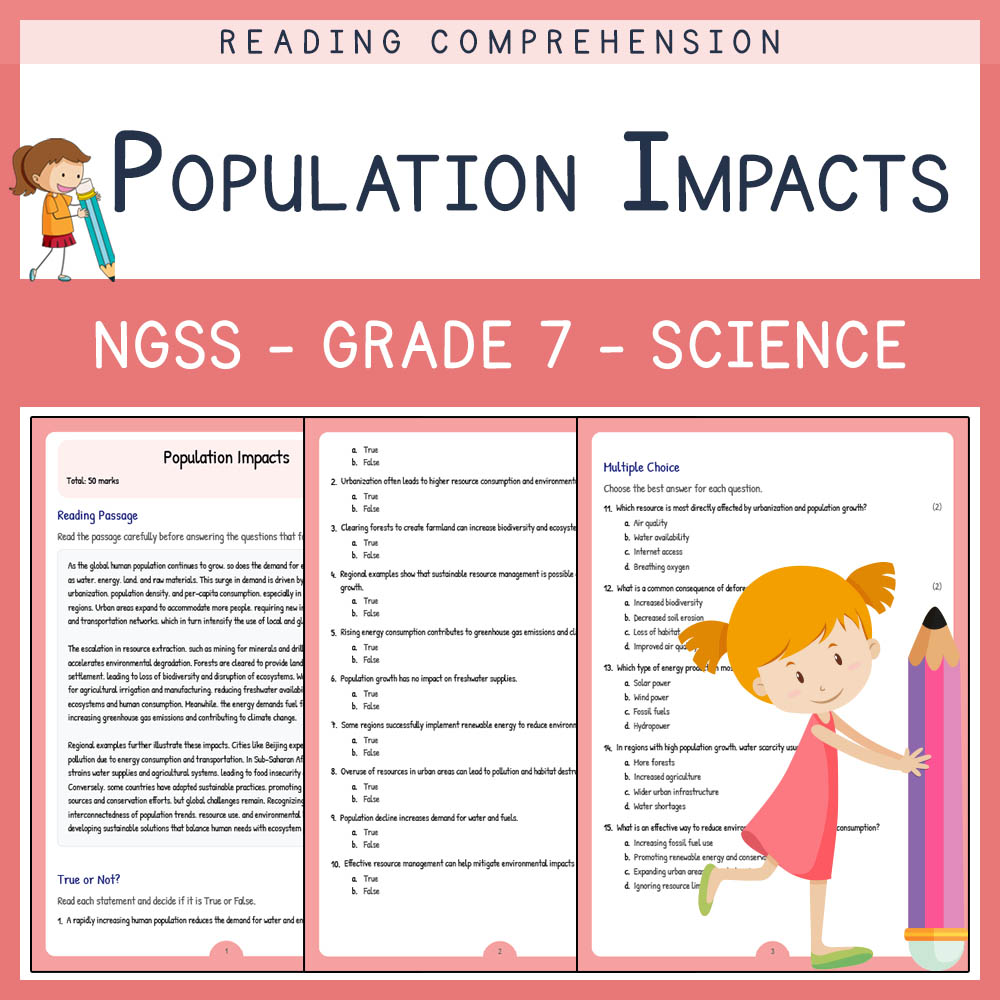
Grade 7 Science | Population Impacts Worksheet & Answer Key (NGSS Aligned)
Created byLumora LearningLearning Objectives
- Understand how human population growth influences demand for resources such as water, energy, land, and raw materials.
- Analyze the effects of increased consumption on ecosystems, biodiversity, and resource cycles.
- Evaluate regional examples to compare how consumption patterns shape environmental pressures.
Instant download

Solar System Worksheet | Grade 7 Science Activities & Practice
Created byPrism Point LearningLearning Objectives
- Explain how the solar system formed from smaller materials and how that relates to planet properties.
- Compare terrestrial and gas/ice giant planets using evidence such as composition, atmospheres, and geology.
- Describe how orbital relationships and planetary tilt/eccentricity affect motion, seasons, and observed phases/eclipses.
Also included in: Grade 7 Earth and Space Systems Science Lesson Bundle TEKS Worksheets
Instant download
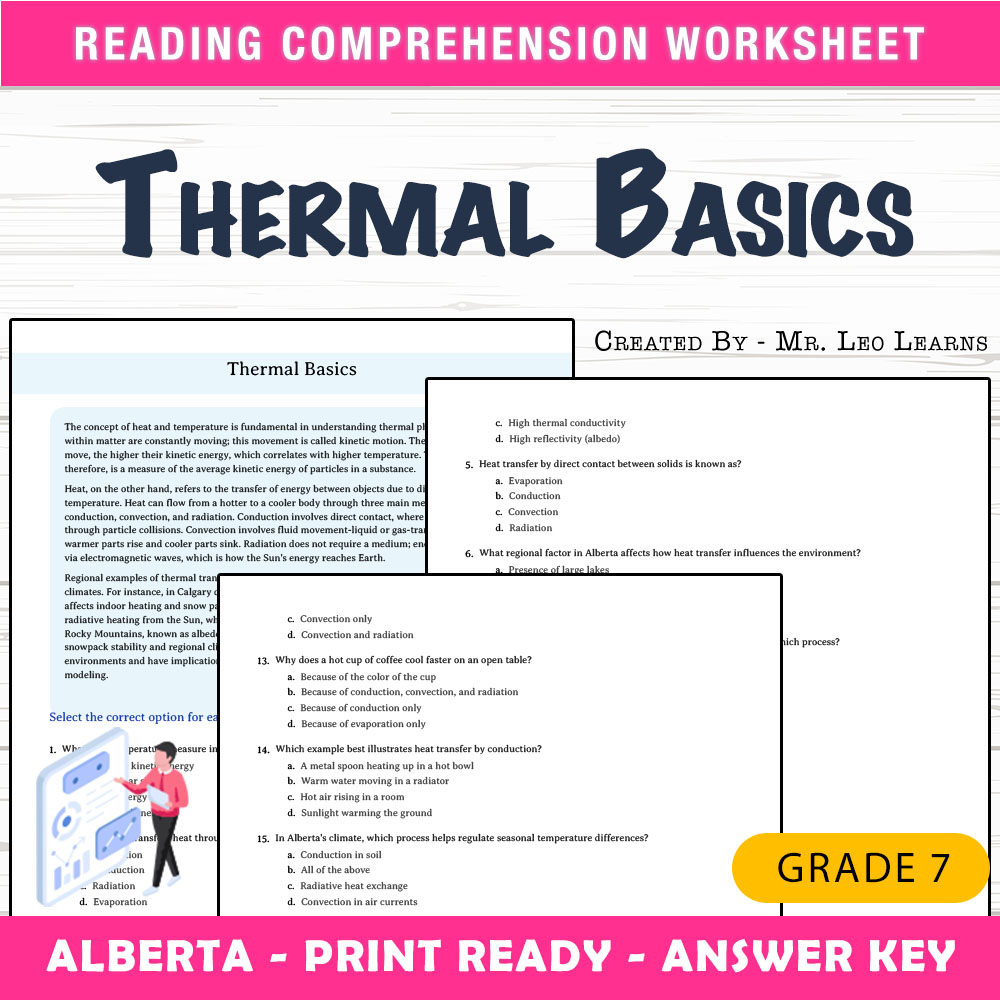
Grade 7 Science — Worksheet MCQ Paper for Mastering Thermal Basics
 Created byThe Resource Hub
Learning Objectives
- Understand the relationship between particle motion and temperature.
- Learn how heat transfer occurs through conduction, convection, and radiation.
- Explore regional examples of thermal phenomena in Alberta's climates.
Also included in: Grade 7 Science Alberta Energy Heat Thermal Processes Worksheet Bundle +1 more
Instant download

Biodiversity Indices Worksheet | Ontario Grade 7 Science Assessment
Created byCedar Grove LearningLearning Objectives
- Explain how species richness, species evenness, and diversity indices summarize biodiversity in a community.
- Interpret differences in diversity values across contrasting habitats and relate them to ecological stability and resilience.
- Describe conceptual links among habitat heterogeneity, niche diversity, and species turnover.
Also included in: Grade 7 Ecosystem Dynamics Science worksheets lesson bundle Ontario +1 more
Instant download

Grade 7 Science | Truss Analysis Worksheet (Alberta Standards) (PDF)
 Created bySilver Birch Teaching
Learning Objectives
- Explain how truss geometry (triangles) helps distribute loads through tension and compression instead of bending.
- Use qualitative reasoning with the method of joints to identify whether members are likely in tension or compression.
- Compare truss designs using efficiency and redundancy criteria for real bridge and roof applications.
Also included in: Grade 7 Simple Machines and Forces Science Lesson Bundle: Alberta +1 more
Instant download

Grade 7 Climate Patterns Worksheet | NGSS Earth Science Activity with Answer Key
Created byNorthstar WorksheetsLearning Objectives
- Explain how uneven solar heating and ocean surface conditions influence atmospheric circulation and regional climate.
- Use temperature gradients, wind vectors, sea-surface temperature, and precipitation records to interpret climate patterns such as El Niño and monsoons.
- Describe how topography and ocean currents can change local temperature, rainfall, and prevailing wind belts.
Also included in: Grade 7 Earth Systems Processes Lesson Bundle | NGSS Earth Science +1 more
Instant download
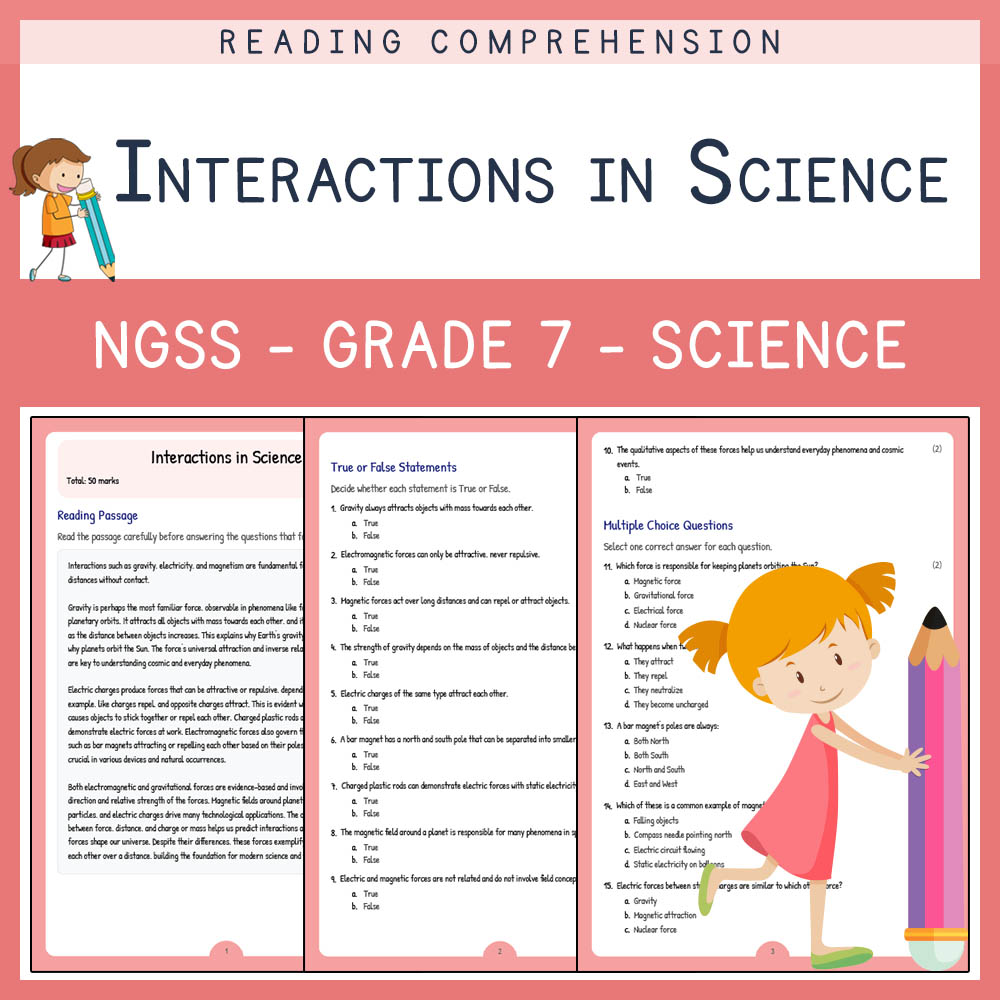
Grade 7 Science | Interactions in Science Worksheet (PDF) NGSS Aligned
Created byLumora LearningLearning Objectives
- Explain the concepts of gravitational, electric, and magnetic interactions as long-range forces.
- Describe how gravity acts universally and how electromagnetic forces can be attractive or repulsive.
- Relate force strength and direction to evidence and qualitative reasoning.
Instant download

Grade 7 Science Forces and Change Worksheet (PDF) – General Standards
 Created byEvergreen Desk Education
Learning Objectives
- Explain how net force changes an object’s velocity (speed and/or direction) over time
- Differentiate balanced and unbalanced forces and predict whether an object accelerates
- Describe how friction, air resistance, and gravity affect motion near Earth
Also included in: Grade 7 Energy Transfer & Motion Science Lesson Bundle Worksheets (General) +1 more
Instant download
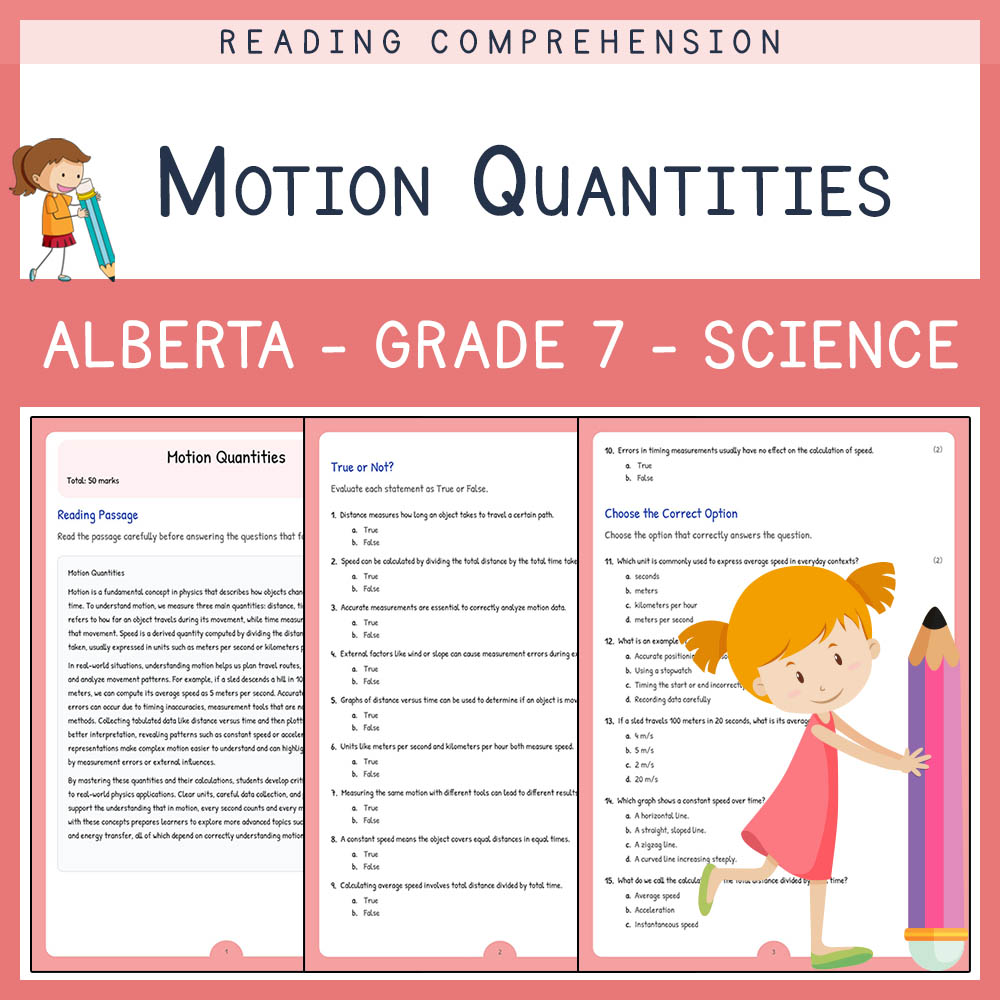
Grade 7 Science Assessment | Motion Quantities Worksheet | Alberta
Created byLumora LearningLearning Objectives
- Understand the key quantities used to measure motion: distance, time, and speed.
- Learn how to accurately compute average speed from given data.
- Identify common sources of measurement error in motion experiments.
Instant download

Motion Principles Worksheet | Grade 7 Science Practice
Created byPrism Point LearningLearning Objectives
- Distinguish speed and velocity, and explain how acceleration describes changing motion.
- Identify which motion quantities are scalar versus vector and interpret motion scenarios qualitatively.
- Relate displacement, time, and rate of change using simple, grade-appropriate examples.
Also included in: Grade 7 Motion, Forces & Energy Science Lesson Bundle for TEKS Practice
Instant download

Atmospheric Systems Grade 7 Science Worksheet | TEKS Standards Practice
JCreated byJ.S SheetsLearning Objectives
- Describe how energy transfer drives convection and influences weather and climate at Earth’s surface.
- Explain how pressure gradients and prevailing winds relate to air mass movement and large-scale circulation.
- Interpret how fronts and jet streams contribute to weather variability, and how greenhouse gases affect radiative balance.
Instant download

Grade 7 Science – Invasive Species Impacts & Spread | Daily Reading Worksheet
 Created byBright Mind Resources
Learning Objectives
- Understand what invasive species are and how they are introduced into new ecosystems
- Identify early signs of invasive species impact
- Learn pathways through which non-native species enter environments
Also included in: Grade 7 Ecosystem Stewardship Science Daily Reading lesson bundle | Ontario +1 more
Instant download

Risk Assessment Worksheet | Grade 7 Science Practice & Review
Created byPrism Point LearningLearning Objectives
- Identify hazards and explain why risk assessment is needed in laboratory and field work.
- Interpret basic safety information (including safety data sheet-style ideas) to select appropriate controls.
- Describe engineering and administrative controls and apply emergency planning and reporting responsibilities.
Instant download

Phase Energy Worksheet | Grade 7 Science Activities
Created byPrism Point LearningLearning Objectives
- Explain how phase changes relate to particle kinetic energy and potential energy
- Describe how energy is absorbed or released during melting, freezing, evaporation, and condensation
- Interpret latent heat as an energy change that occurs without changing chemical identity
Instant download

Grade 7 Kinetic Energy Worksheet | NGSS Science Activity & Doodle Notes
 Created byAmber Owl Education
Learning Objectives
- Construct and interpret graphs that relate kinetic energy to speed and mass
- Use quantitative patterns (including doubling) to predict changes in kinetic energy
- Connect stored potential energy to future motion and compare energy types
Also included in: Energy Transfer Worksheets Lesson Bundle – Grade 7 Science NGSS +1 more
Instant download

Diffusion And Mixing Assessment Graade 7 Science | California Standards
Created byPrism Point LearningLearning Objectives
- Explain diffusion using the particle model and concentration gradients.
- Describe how mixing occurs without requiring particles to stop moving or change into new substances.
- Predict how temperature affects the rate of diffusion and mixing.
Also included in: Grade 7 Forces and Matter Science Lesson Bundle: California Standards +1 more
Instant download

Particle Model Worksheet Grade 7 Science | Matter and Particle Theory
Created byPrism Point LearningLearning Objectives
- Explain how matter can be described using particles too small to see
- Describe how particle motion relates to temperature
- Use the particle model to predict changes in macroscopic properties like pressure and diffusion
Instant download

Grade 7 Science | Ecological Inquiry - Daily Reading Comprehension
 Created byCoral Reef Learning
Learning Objectives
- Understand the concept of ecological inquiry and its importance.
- Learn how to formulate scientific questions about ecosystems.
- Identify measurable variables in ecological studies.
Also included in: Interactions and Ecosystems Lesson Bundle Grade 7 Science – Alberta +1 more
Instant download

Grade 7 Understanding Earth's Atmospheric Circulation | NGSS Worksheet
 Created byBRIGHT PATH RESOURCES
Learning Objectives
- Understand key concepts related to Science
- Apply knowledge through practice questions
- Demonstrate comprehension of the material
Also included in: Earth Systems Grade 7 Science Daily Reading Worksheets Lesson Bundle | NGSS +2 more
Instant download

Habitat Fragmentation Test Prep Printable | Grade 7 Science
Created byPrism Point LearningLearning Objectives
- Explain how habitat fragmentation creates isolated habitat patches and increases edge effects
- Describe how fragmentation affects species interactions, dispersal, gene flow, and population sizes
- Evaluate how habitat connectivity (like corridors) can reduce extinction risk and support ecosystem processes
Also included in: Ecosystems & Interactions Lesson Bundle – Grade 7 Science BC Framework +1 more
Instant download

Grade 7 Science – Rock Cycle & Igneous Rocks | Daily Reading Worksheet
Created byBright Mind ResourcesLearning Objectives
- Understand the formation process of igneous rocks from cooled magma or lava.
- Identify the environments where igneous rocks can form.
- Describe the stages involved in the formation of igneous rocks through cooling and solidification.
Also included in: Grade 7 Earth Science Daily Reading Worksheets Lesson Bundle | Florida NGSSS +1 more
Instant download

Grade 7 Science – Restoration Strategies & Ecology | Daily Reading Worksheet
Created byBright Mind ResourcesLearning Objectives
- Understand basic principles of ecological restoration
- Identify reference conditions and recovery goals
- Differentiate between active and passive restoration approaches
Also included in: Grade 7 Ecosystem Stewardship Science Daily Reading lesson bundle | Ontario +1 more
Instant download

Grade 7 Science | Motion Quantities Worksheet (PDF) Alberta Standards
Created bySilver Birch TeachingLearning Objectives
- Describe motion using distance and time, and identify appropriate units for each quantity
- Calculate average speed using the relationship speed = distance ÷ time
- Recognize common sources of measurement error and explain how they affect calculated speed
Also included in: Grade 7 Simple Machines and Forces Science Lesson Bundle: Alberta +1 more
Instant download
Grade 7 Science Evidence Arguments Worksheet with Short Notes PDF
Created byMeadowlark WorksheetsLearning Objectives
- Understand how to connect evidence to reasoning using a clear chain from observations to claims.
- Identify specific data values, graph features, or direct observations that support scientific claims.
- Evaluate arguments for limitations, unsupported cause-and-effect claims, and consistency with data.
Also included in: Grade 7 Science Scientific Modeling & Evidence Lesson Bundle: General Framework +1 more
Instant download

Science Evidence Arguments Worksheet Grade 7 | Standard-Aligned
JCreated byJ.S SheetsLearning Objectives
- Explain how evidence, claims, and reasoning connect in a scientific argument.
- Use specific data values or graph features to support a claim.
- Identify limitations and avoid unsupported cause-and-effect in explanations.
Also included in: Grade 7 Evidence-Based Scientific Modeling Science Lesson Bundle: General +1 more
Instant download

Abiotic Influences Assessment Grade 7 Science | TEKS Standards
Created byPrism Point LearningLearning Objectives
- Understand how nonliving factors like temperature, light, water, soil, and salinity affect ecosystems.
- Explain how abiotic gradients and microclimates influence species distribution and community structure.
- Identify examples of abiotic factors from terrestrial and aquatic environments that impact biodiversity.
Instant download

Particle Model Worksheet | Grade 7 Science Activities
Created byPrism Point LearningLearning Objectives
- Explain how the kinetic particle model uses particle spacing, motion, and forces to describe macroscopic properties of matter.
- Use the particle model to predict how changes such as heating or applied pressure affect observable measurements.
- Connect diffusion, thermal expansion, and compressibility to micro-scale particle behavior.
Also included in: Grade 7 Matter, States, and Reactions in Science Lesson Bundle TEKS
Instant download
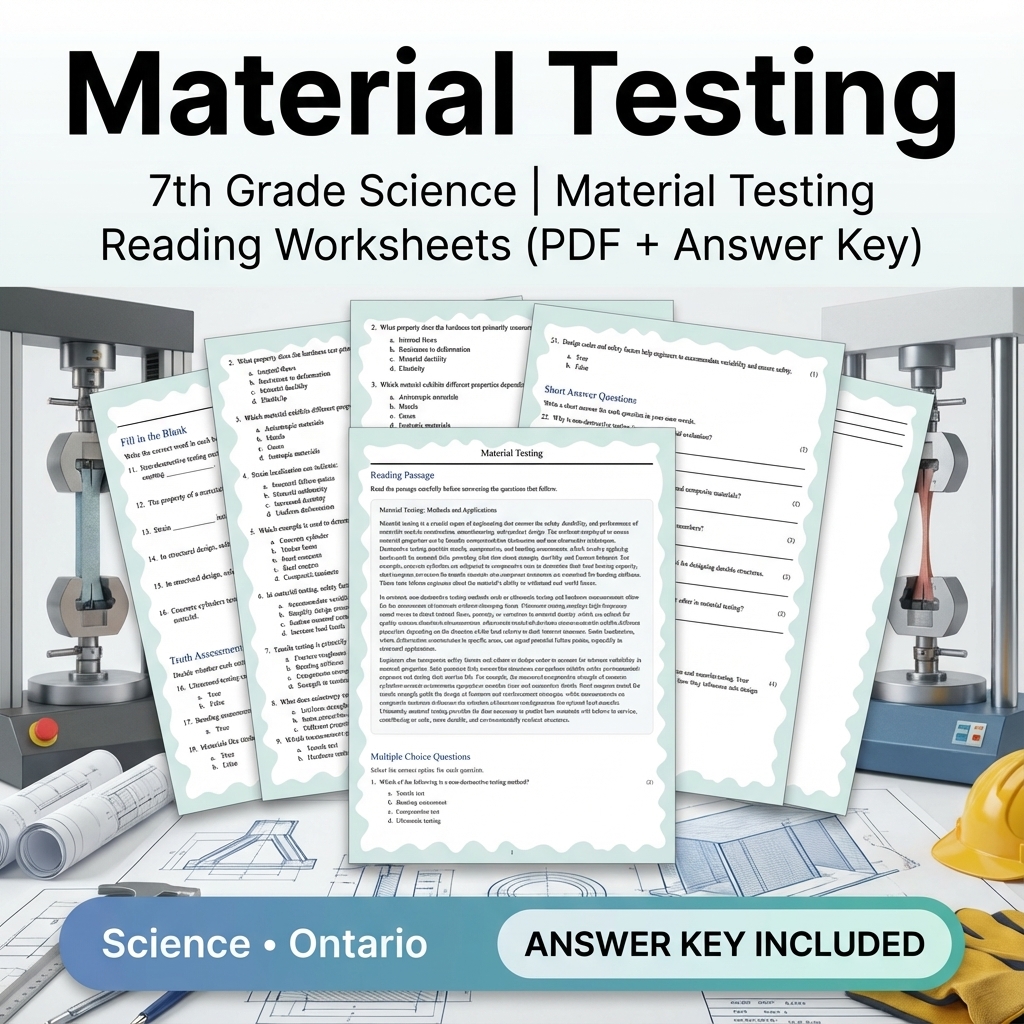
7th Grade Science | Material Testing Reading Worksheets (PDF + Answer Key)
JCreated byJ.S SheetsLearning Objectives
- Understand characteristic methods for testing material behavior, including tensile, compression, and bending assessments.
- Explore non-destructive testing techniques such as ultrasonic and hardness measurements.
- Learn about anisotropy, strain localization, and the application of safety factors and design codes in material testing.
Also included in: Grade 7 Science Unit Bundle – Structural Engineering & Material Testing +1 more
Instant download

Surface Processes Assessment for Grade 7 Science | TEKS Standards-Aligned
Created byPrism Point LearningLearning Objectives
- Describe the main physical and chemical processes that shape Earth's surface.
- Identify observable landforms associated with weathering, erosion, deposition, and mass wasting.
- Explain the driving forces such as water flow, wind, glaciers, and gravity in surface processes.
Also included in: Grade 7 Earth and Space Systems Science Lesson Bundle TEKS Worksheets
Instant download
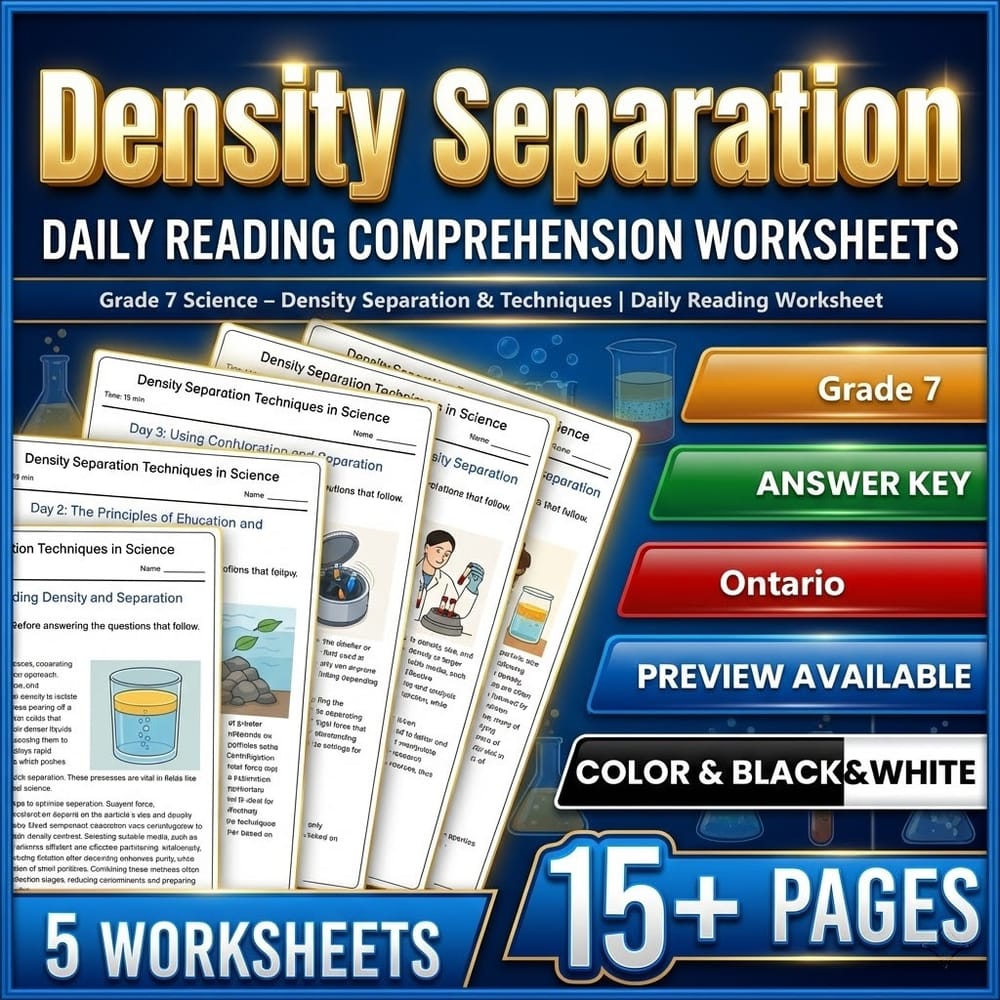
Grade 7 Science – Density Separation & Techniques | Daily Reading Worksheet
 Created byQuiet Forest Education
Learning Objectives
- Understand the concept of density and how it influences separation methods.
- Identify various separation techniques such as decanting, flotation, and centrifugation.
- Explain the principles behind each technique and their applications.
Also included in: Elements & Compounds Grade 7 Science Daily Reading Worksheets Bundle | Ontario +1 more
Instant download

Species Interactions Test Prep Worksheets | Grade 7 Science NGSS
Created byPrism Point LearningLearning Objectives
- Explain how predation, competition, parasitism, mutualism, and commensalism affect individual species and populations
- Describe direct and indirect effects in food webs using evidence-based causal reasoning
- Interpret interaction networks and trophic diagrams to predict cascading impacts across ecosystems
Also included in: Grade 7 Biodiversity & Ecosystem Stability Science Lesson Bundle | NGSS
Instant download
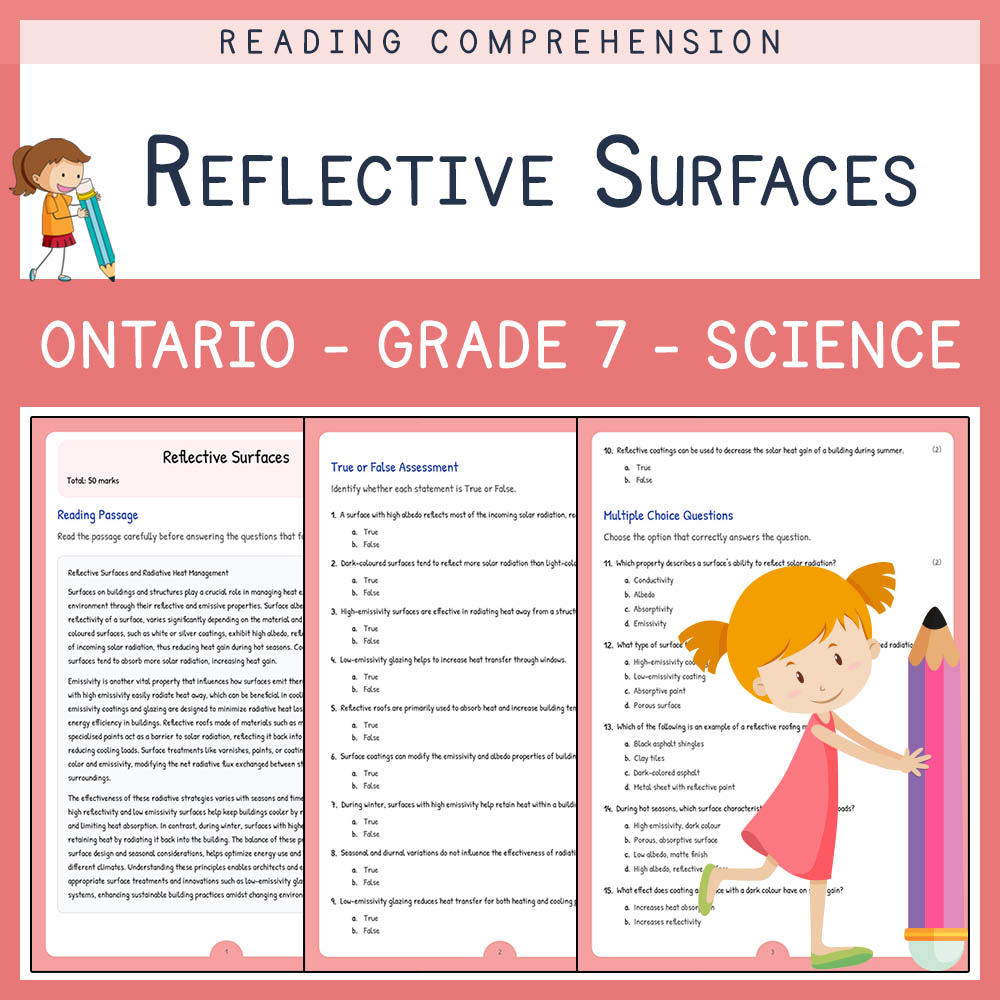
Grade 7 Science Assessment | Reflective Surfaces Worksheet Elena | Ontario
Created byLumora LearningLearning Objectives
- Understand how surface albedo, emissivity, and colour influence radiative heat exchange.
- Recognize the effects of coatings and surface treatments on solar gain and net radiative flux.
- Describe the purpose and function of low-emissivity glazing and reflective roofs.
Instant download
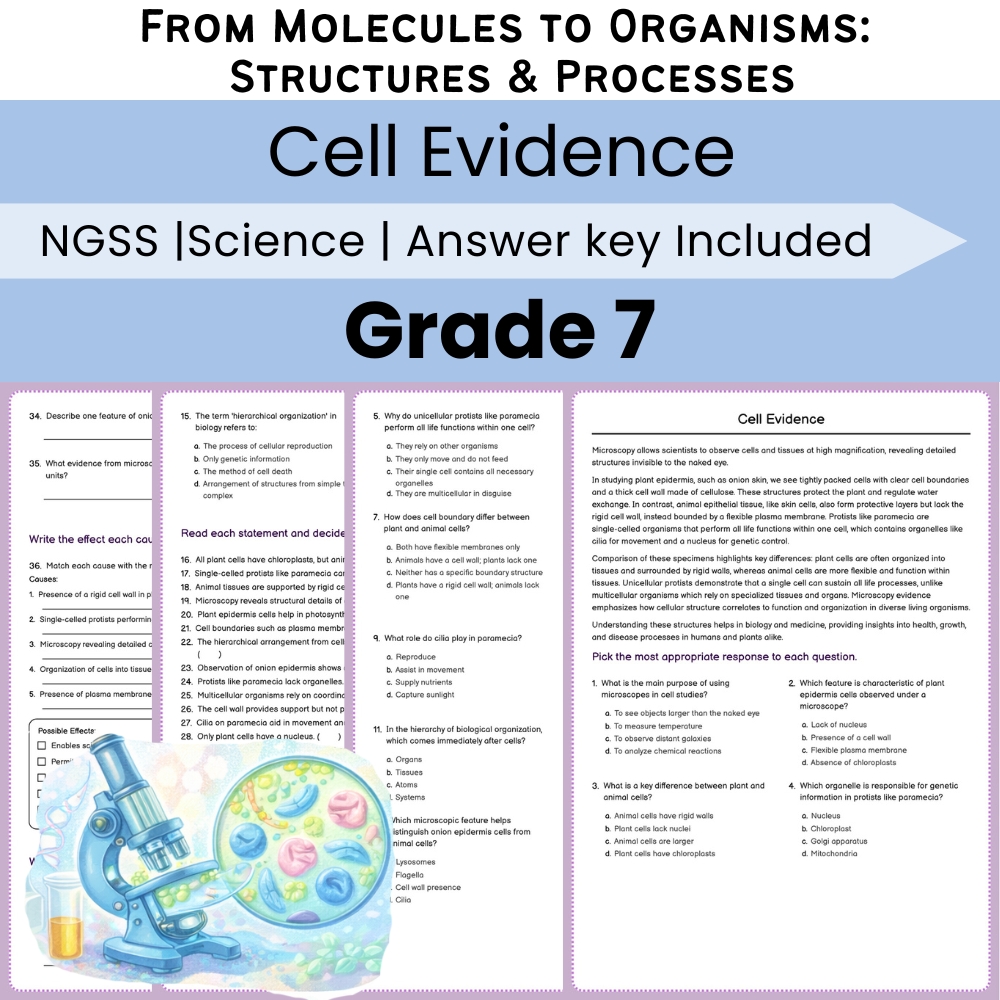
Cell Evidence Worksheet | Grade 7 Science Printables NGSS Assessment
Learning Objectives
- Understand how microscopy reveals the cellular structure of organisms.
- Differentiate between unicellular and multicellular organization.
- Identify key features such as cell boundaries, plasma membranes, and cell walls.
Also included in: Grade 7 Science Lesson Bundle | From Molecules to Organisms NGSS +1 more
Instant download
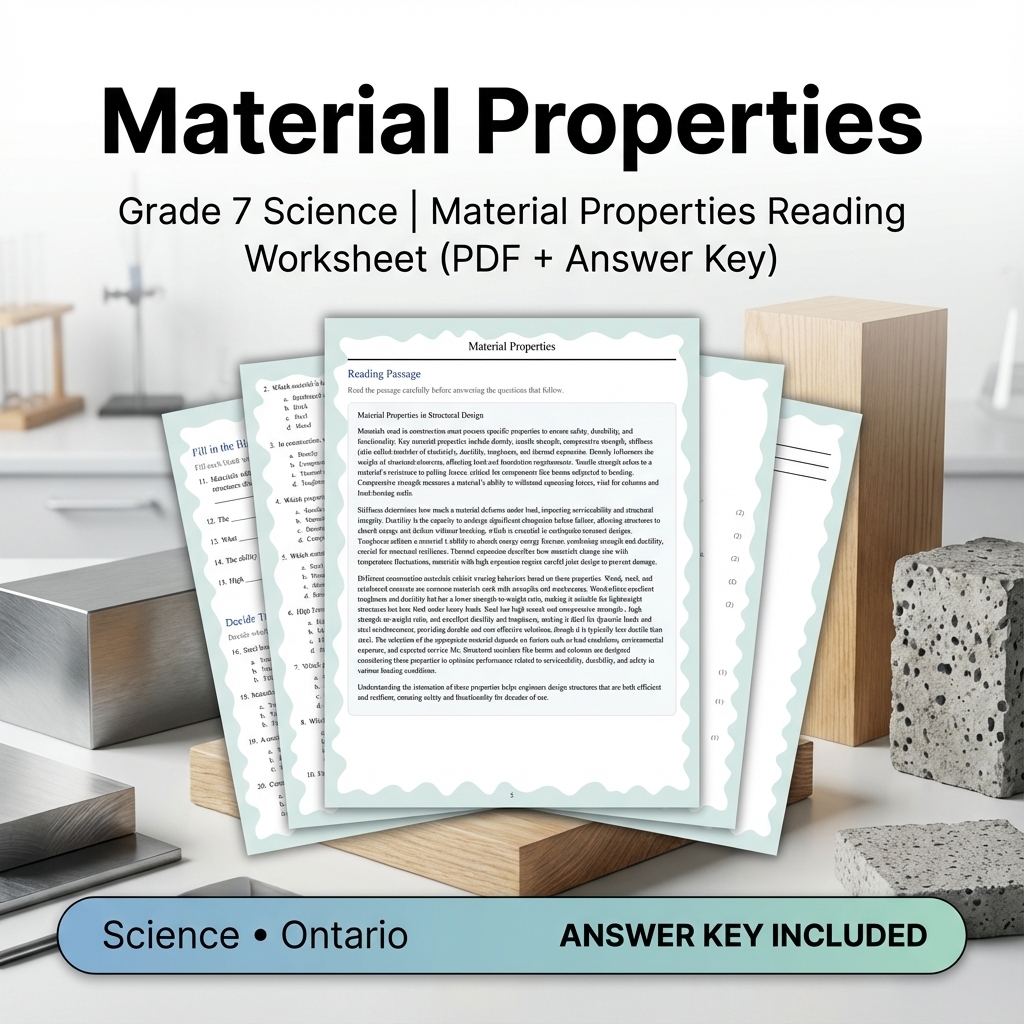
Grade 7 Science | Material Properties Reading Worksheet (PDF + Answer Key)
JCreated byJ.S SheetsLearning Objectives
- Understand key material properties such as density, strength, stiffness, ductility, toughness, and thermal expansion.
- Explain how these properties influence the structural performance of different construction materials.
- Compare common materials—wood, steel, and reinforced concrete—in terms of strength-to-weight ratio, deformation, and failure modes.
Also included in: Grade 7 Science Unit Bundle – Structural Engineering & Material Testing +1 more
Instant download
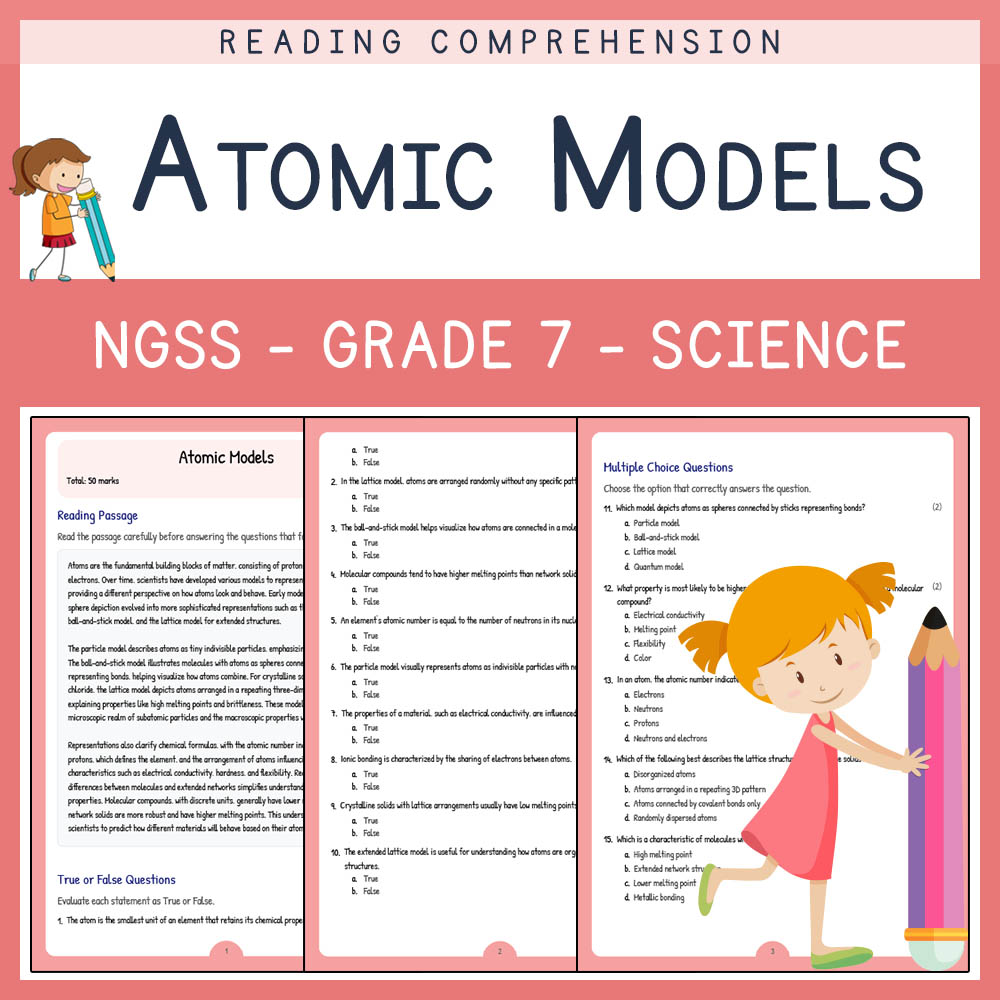
Grade 7 Science | Atomic Models Worksheet & Answer Key (NGSS-Aligned PDF)
Created byLumora LearningLearning Objectives
- Describe different representations of atomic models including particle, ball-and-stick, and lattice structures.
- Explain how atomic structure influences the properties of molecules and extended materials.
- Distinguish between molecular and extended network structures based on bonding patterns.
Instant download
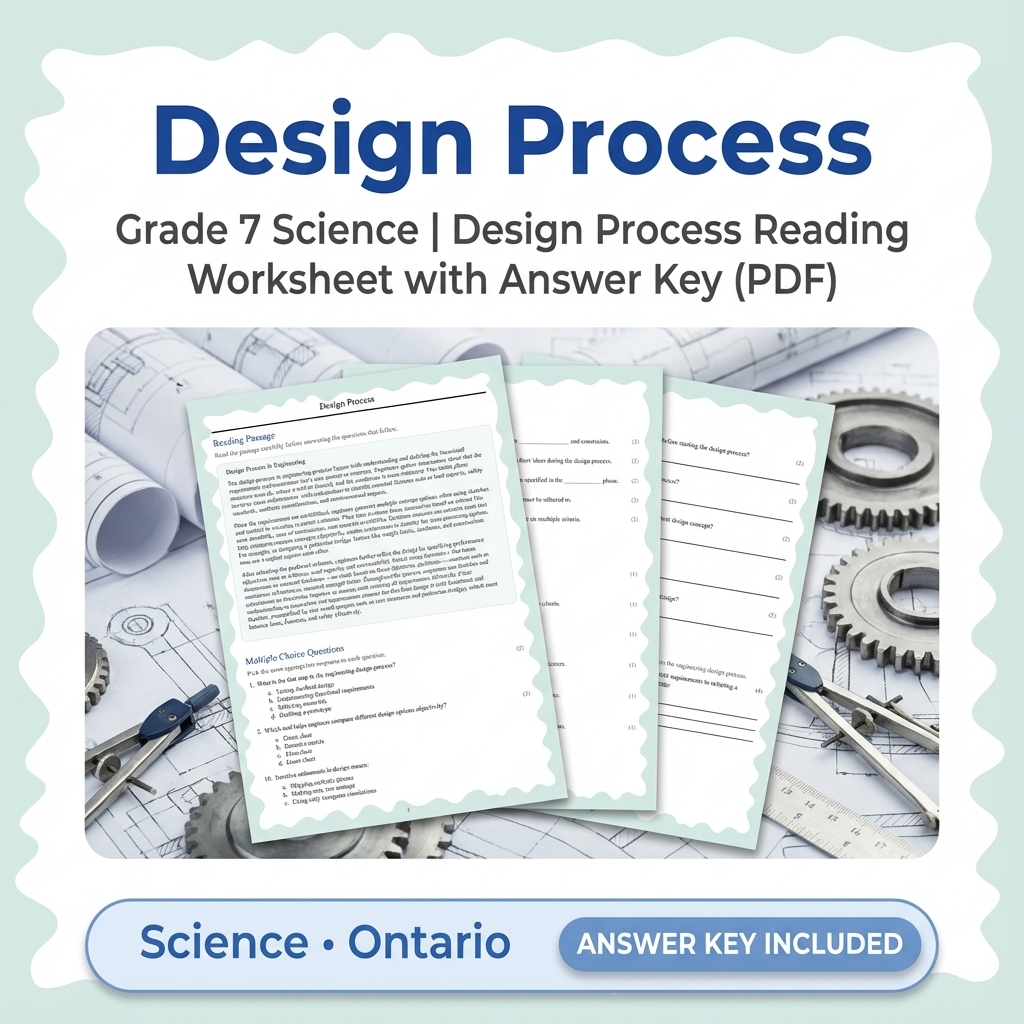
Grade 7 Science | Design Process Reading Worksheet with Answer Key (PDF)
JCreated byJ.S SheetsLearning Objectives
- Understand the steps involved in the design process from defining requirements to evaluating alternatives.
- Learn how to specify performance objectives and constraints for structural designs.
- Apply decision matrices and sketches to compare different design options.
Also included in: Grade 7 Science Unit Bundle – Structural Engineering & Material Testing +1 more
Instant download

Atomic Models Worksheet Grade 7 NGSS | Atoms Structure Activity
Created byAmber Owl EducationLearning Objectives
- Compare and explain atomic models using particle, ball-and-stick, and lattice representations.
- Relate subatomic particles and atomic number to formula notation for simple substances.
- Distinguish molecular structures from extended network (lattice) structures and predict material behavior.
Also included in: Grade 7 Science Stoichiometry, Mixtures & Material Properties Lesson Bundle | NGSS +1 more
Instant download

Grade 7 Science – Reaction Observations Gas Production | Daily Reading Worksheet
Created byBright Mind ResourcesLearning Objectives
- Identify gases produced during chemical reactions
- Describe observable signs of gas emissions
- Recognize different gases based on reaction clues
Also included in: Grade 7 Solutions Science Daily Reading Worksheets Lesson Bundle | Alberta +2 more
Instant download
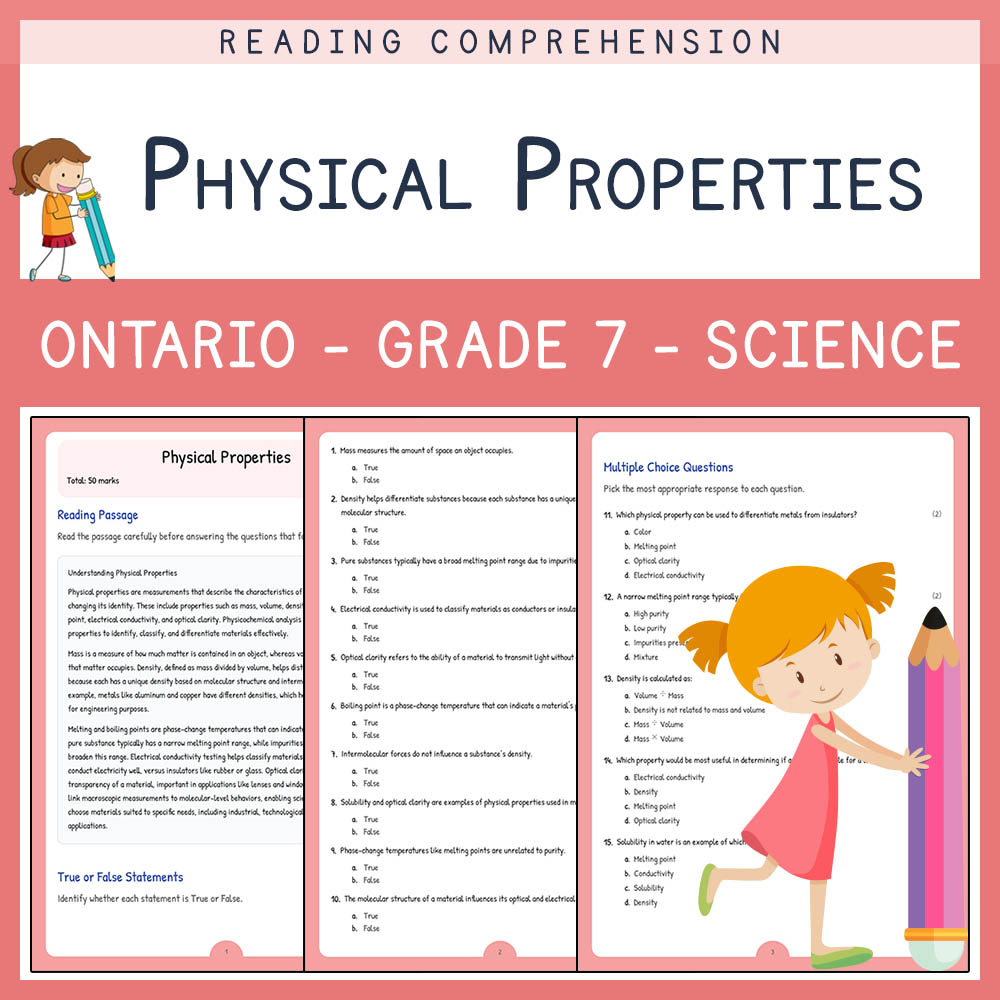
Grade 7 Science Assessment | Physical Properties Worksheet Elena | Ontario
Created byLumora LearningLearning Objectives
- Define and understand the physical properties used as diagnostic criteria.
- Link macroscopic measurements to molecular structure and intermolecular forces.
- Explain how density, phase-change temperatures, and conductivity differentiate substances.
Also included in: Grade 7 Science | Pure Substances and Mixtures Unit Bundle | Ontario
Instant download
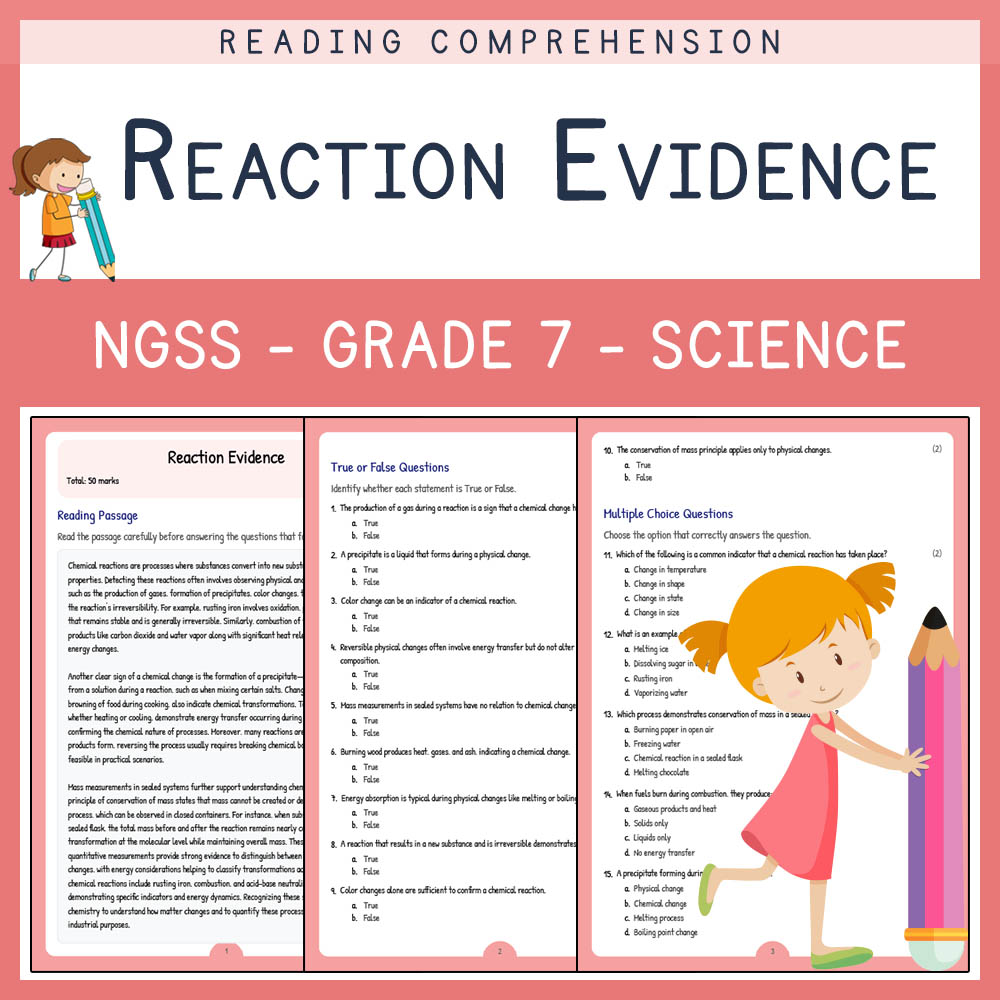
Grade 7 Science | Reaction Evidence Worksheet & Answer Key (NGSS Aligned)
Created byLumora LearningLearning Objectives
- Identify observable indicators that a chemical reaction has occurred, such as gas production, precipitate formation, color change, and temperature change.
- Explain irreversibility in chemical reactions and relate it to composition changes.
- Describe examples of chemical reactions, including rusting, combustion, and neutralization, and discuss how mass measurements in sealed systems demonstrate conservation principles.
Instant download

Grade 7 Science Worksheet | Decomposition Cycles (PDF) – Ontario Standards
Created byEvergreen Desk EducationLearning Objectives
- Explain how detritivores, fungi, and bacteria break down organic matter and how abiotic factors affect decomposition rates.
- Describe how carbon and nitrogen move and transform during decomposition (including formation of detritus, mineralization, and nutrient uptake).
- Connect decomposition rates to soil fertility and ecosystem productivity in wetlands, forests, and grasslands.
Also included in: Grade 7 Ecosystem Dynamics Science Lesson Bundle (Ontario) Worksheets +1 more
Instant download
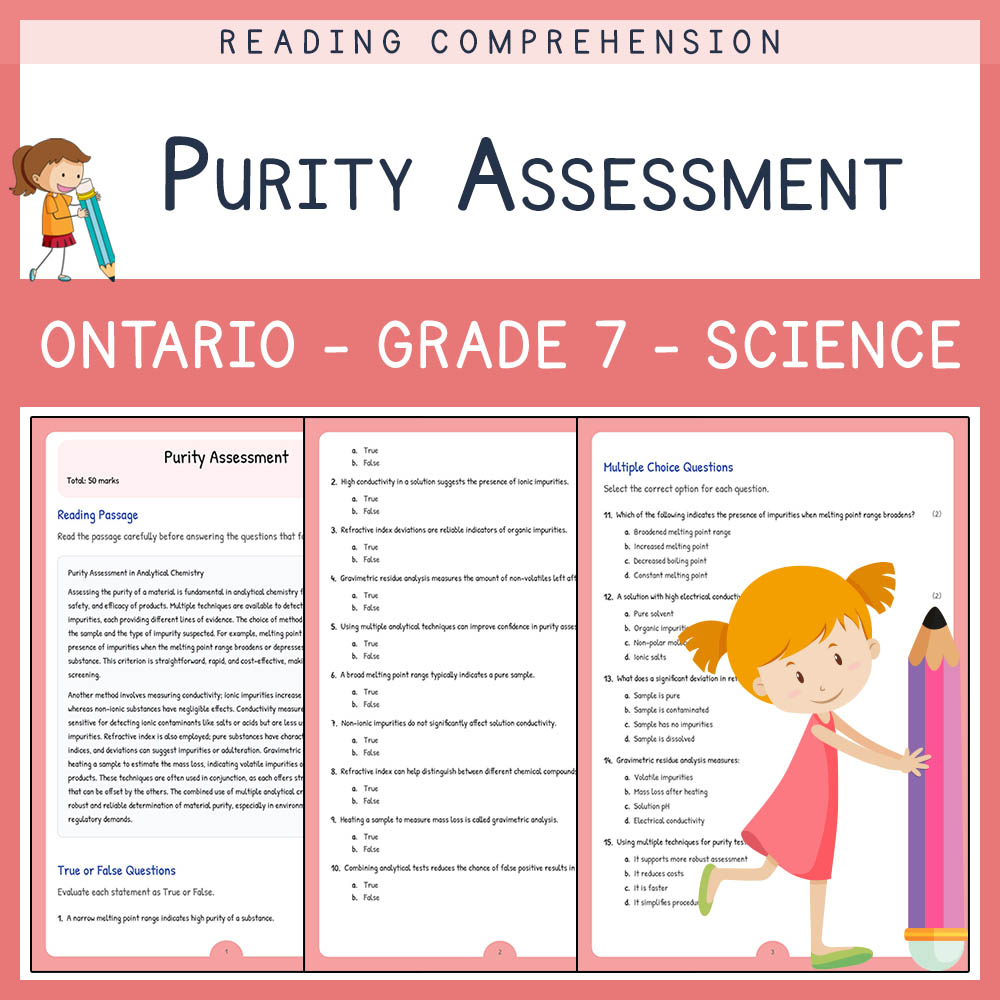
Grade 7 Science | Purity Assessment Worksheet | Ontario Standard
Created byLumora LearningLearning Objectives
- Understand the key analytical indicators used to assess the purity of substances.
- Identify various methods for detecting contamination and impurities.
- Compare and contrast techniques such as melting point ranges, conductivity differences, refractive index, and gravimetric residue.
Also included in: Grade 7 Science | Pure Substances and Mixtures Unit Bundle | Ontario
Instant download
About Grade 7 Science Worksheets
Browse 6,039 printable Grade 7 Science worksheets — ready-to-print PDFs with answer keys where available.
Every worksheet on MyTeachingSheets is created by independent teacher-authors and reviewed before publication. All resources download as printable PDFs for classroom, homework, or at-home practice, and many include answer keys. Preview any worksheet free before buying.