
Grade 7 Science Worksheets
6,039 worksheets
Grade 7 Conservation of Matter Worksheet | Mass Conservation & Reactions
 Created byPrism Point Learning
Learning Objectives
- Explain conservation of matter in a closed system using the idea that atoms are rearranged, not created or destroyed.
- Use evidence from comparing the mass of reactants and products to support the law of conservation of mass.
- Distinguish between physical changes (mixing/dissolving) and chemical changes (new substances) while tracking total matter.
Instant download

Grade 7 Science Worksheet – Prototyping Methods (Ontario) Practice (PDF)
 Created byEvergreen Desk Education
Learning Objectives
- Compare scaled physical models, digital finite-element models (FEM), and laboratory load rigs for evaluating strength, stiffness, and failure modes.
- Explain how instrumentation such as strain gauges and displacement transducers are used to quantify structural response.
- Identify limitations of scaling and describe how prototype test results can guide design revisions and risk assessment.
Also included in: Grade 7 Engineering Design & Materials Science Lesson Bundle Ontario +1 more
Instant download

Biodiversity Stability Worksheet | Grade 7 Science Activities
Created byPrism Point LearningLearning Objectives
- Explain how biodiversity helps ecosystems remain stable after disturbances.
- Describe how overlapping ecological roles can buffer the loss of a species.
- Identify examples of disturbances that reduce biodiversity and increase ecosystem vulnerability.
Also included in: Grade 7 Evolution, Genetics & Ecosystems Lesson Bundle | Florida NGSSS
Instant download
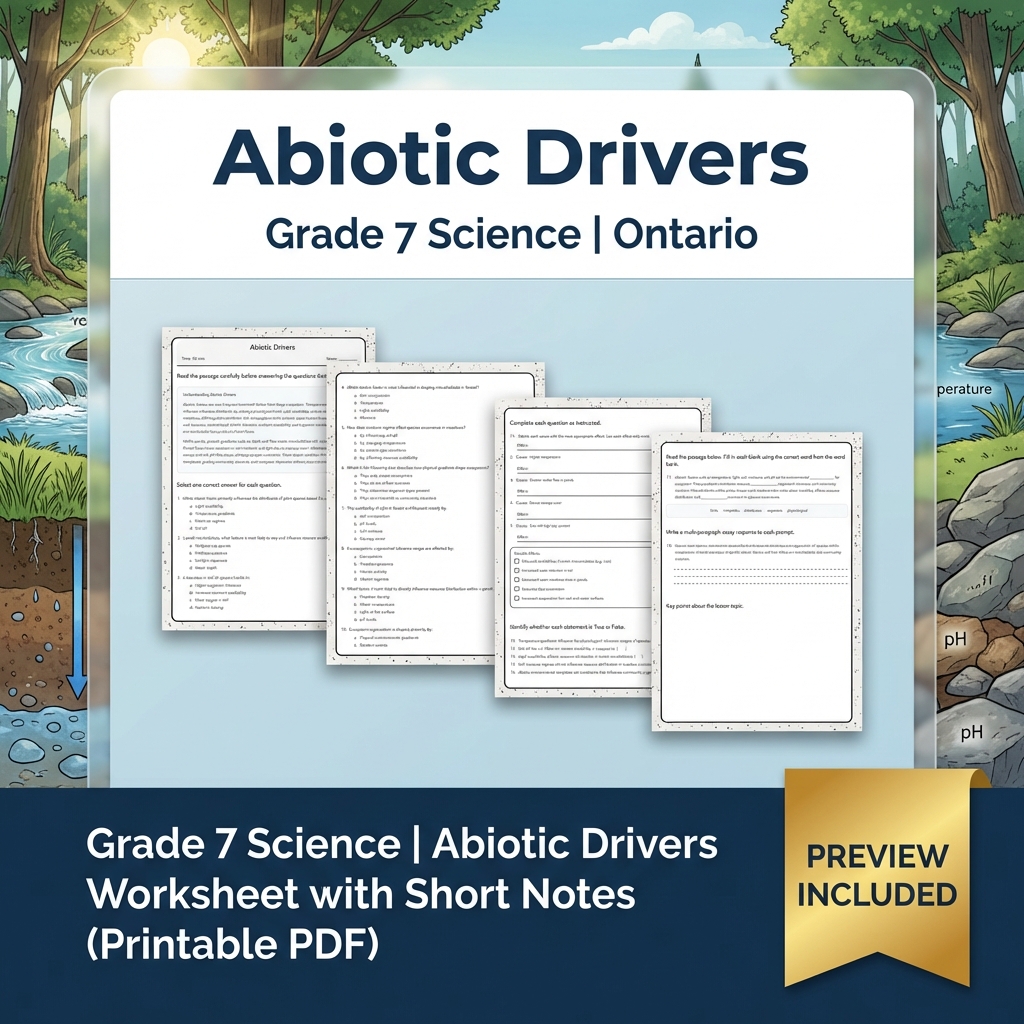
Grade 7 Science | Abiotic Drivers Worksheet with Short Notes (Printable PDF)
 Created byMeadowlark Worksheets
Learning Objectives
- Describe abiotic drivers such as temperature, light, soil, moisture, and pH and their roles in ecosystems.
- Explain how abiotic factors influence resource distribution and organismal tolerance.
- Identify microhabitats and their abiotic characteristics in pond, forest, and meadow environments.
Also included in: Grade 7 Science Lesson Bundle with Ontario Framework | Ecosystems & Biodiversity +1 more
Instant download

Cited Scientific Reasoning Assessment | General Grade 7 Science Standards-Aligned
Created byPrism Point LearningLearning Objectives
- Understand how scientific reasoning uses specific data references to support claims.
- Identify evidence such as graph changes, value comparisons, and observations that support scientific claims.
- Explain how evidence supports claims by using appropriate relationships, units, and explanations.
Also included in: Grade 7 Scientific Inquiry Practices Science Lesson Bundle: General
Instant download

Grade 7 Science – Quantitative Heat Concepts Worksheet | Ontario Standards
 Created byBright Mind Resources
Learning Objectives
- Understand the difference between heat and temperature.
- Learn about specific heat capacity and heat transfer.
- Practice basic heat calculations using Q=mcΔT.
Also included in: Heat Transfer Grade 7 Science Daily Reading Worksheets Lesson Bundle | Ontario +1 more
Instant download

Grade 7 Science - Solar Patterns Daily Reading Worksheet(PDF + Answer Key)
 Created byCopper Leaf Classroom
Learning Objectives
- Understand how Earth's rotation causes day and night.
- Identify the relationship between the Sun's position and Earth's daily cycle.
- Recognize the effect of axial tilt and orbit on solar patterns.
Instant download

Grade 7 Science | Quantitative Models in Evolutionary Biology - Comprehension
 Created byCoral Reef Learning
Learning Objectives
- Understand how allele frequencies are calculated from population data.
- Learn the importance of quantitative models in explaining evolutionary processes.
- Analyze trait distributions and their changes over generations.
Instant download

Grade 7 Data Organization Science Worksheet | Tables & Data Analysis
 Created byChalk and Compass
Learning Objectives
- Organize scientific observations using clear tables with consistent headings and correct units for numerical data.
- Use appropriate metadata and timestamp conventions to preserve provenance and support later validation.
- Distinguish between categorical and numerical data and record replication information in an observational log.
Also included in: Grade 7 Science Scientific Inquiry & Data Analysis Lesson Bundle | Ontario +1 more
Instant download

Quantitative Models Worksheet for Grade 7 Science | NGSS Standards
JCreated byJ.S SheetsLearning Objectives
- Understand how mathematical representations support explanations of evolutionary processes.
- Interpret statistical analyses related to trait frequencies, selection coefficients, and population dynamics.
- Apply Hardy-Weinberg principles and rate calculations to real-world genetic data.
Also included in: Grade 7 Evolution Evidence and Speciation Processes Science Lesson Bundle – NGSS +1 more
Instant download

Gas Behavior Assessment for Grade 7 Science | TEKS Standards-Aligned
Created byPrism Point LearningLearning Objectives
- Describe how pressure, volume, and temperature interdependently affect gases.
- Explain phenomena such as diffusion and compressibility in gases.
- Relate macroscopic observations to the qualitative relationships among gas variables.
Also included in: Grade 7 Matter and Energy Science Lesson Bundle: TEKS assessments
Instant download

Material Testing Worksheet Printables | Grade 7 Science Review Assessment
Created byPrism Point LearningLearning Objectives
- Explain how tensile, compression, and bending tests reveal key material properties used in structural design.
- Compare non-destructive testing (NDT) methods such as ultrasonic and hardness measurements with destructive tests.
- Describe how anisotropy and strain localization can affect the performance of timber and composite materials.
Instant download

Grade 7 Science – Energy Relationships Worksheet (Alberta Standards PDF)
 Created bySilver Birch Teaching
Learning Objectives
- Explain how gravitational potential energy changes into kinetic energy during motion in a mechanical system
- Use mass, height (elevation), and speed to reason about relative mechanical energy and forces
- Describe how energy conservation applies when friction is small and how real systems differ
Also included in: Grade 7 Simple Machines and Forces Science Lesson Bundle: Alberta +1 more
Instant download
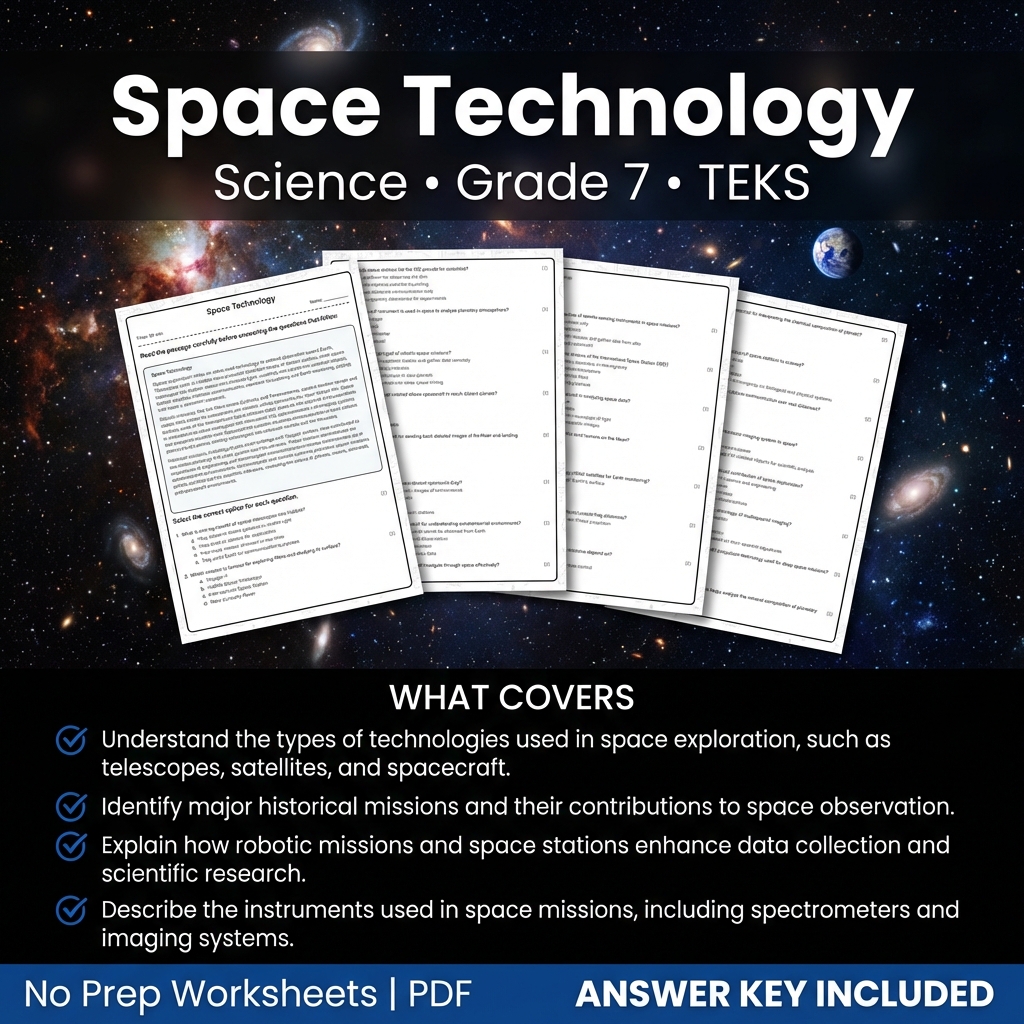
Grade 7 Science Worksheet on Space Technology | TEKS aligned
Created byCoral Reef LearningLearning Objectives
- Understand the types of technologies used in space exploration, such as telescopes, satellites, and spacecraft.
- Identify major historical missions and their contributions to space observation.
- Explain how robotic missions and space stations enhance data collection and scientific research.
Instant download

Science Grade 7 Defining a Problem Worksheet | NGSS Standards Assessment
 Created bySkylark Worksheets
Learning Objectives
- Define a science/engineering design problem using clear criteria and measurable success targets
- Identify constraints as limits related to materials, safety, time, and cost
- Translate real-world needs into quantitative performance metrics and acceptable boundaries
Also included in: Grade 7 Engineering Design Science Lesson Bundle: NGSS +1 more
Instant download

Grade 7 Plate Tectonics Worksheet | NGSS Earth Science Activity with Answer Key
 Created byNorthstar Worksheets
Learning Objectives
- Explain how evidence such as seafloor structures, earthquakes, and volcanoes supports the idea of moving tectonic plates.
- Use fossil distributions and continental margin features to infer past continental positions.
- Describe how magnetic striping and mountain building relate to plate motion and paleogeographic reconstructions.
Also included in: Grade 7 Earth Systems Processes Lesson Bundle | NGSS Earth Science +1 more
Instant download

Grade 7 Science | Air Masses & Fronts - Daily Reading Comprehension
Created byCoral Reef LearningLearning Objectives
- Understand what air masses are and how they are classified.
- Identify the characteristics of different air masses.
- Explain what fronts are and how they form.
Instant download

Grade 7 Science – Earth System Interactions & Water Cycle | Reading Worksheet
Created byBright Mind ResourcesLearning Objectives
- Understand the water cycle and how water moves among Earth's systems.
- Identify the interactions between the geosphere, hydrosphere, atmosphere, and biosphere.
- Explain how changes in one earth system can affect others.
Also included in: Grade 7 Earth Science Daily Reading Worksheets Lesson Bundle | Florida NGSSS +1 more
Instant download

Grade 7 Matter Energy Flow Worksheet | Practice & Assessment PDF
 Created byClear Sky Classroom
Learning Objectives
- Explain how matter and energy move through ecosystems using producers, consumers, and decomposers
- Describe how energy transfers through food chains and food webs and why less energy reaches higher trophic levels
- Connect the roles of metabolism and heat loss to patterns of energy flow in ecosystems
Instant download

Nutrient Transport Assessment | California Standards Grade 7 Science
Created byPrism Point LearningLearning Objectives
- Explain how nutrients move from digestion to body tissues through internal transport
- Describe how cells use transported nutrients for growth, repair, and energy
- Identify how the body removes wastes to maintain internal balance
Also included in: Grade 7 Energy Flow and Matter Cycling Science lesson bundle – California Standards +1 more
Instant download

Grade 7 Science – Evolution & Natural Selection | Daily Reading Worksheet
Created byBright Mind ResourcesLearning Objectives
- Understand the basic concept of evolution and how it involves populations, not individuals.
- Recognize genetic variation as the foundation for evolutionary change.
- Identify examples of changes in populations over generations.
Also included in: Populations & Traits Grade 7 Science Daily Reading Lesson Bundle | Florida NGSSS +1 more
Instant download

Grade 7 Science | Understanding Thermal Expansion - Daily Reading Comprehension
Created byCoral Reef LearningLearning Objectives
- Define thermal expansion and explain how particles behave when heated.
- Describe how solids, liquids, and gases respond differently to heat.
- Identify real-world examples of thermal expansion and contraction.
Instant download

Grade 7 Science – Predator-Prey Dynamics | Daily Reading Worksheet
Created byBright Mind ResourcesLearning Objectives
- Understand the cause-and-effect relationships between predator and prey populations.
- Identify how changes in predator numbers affect prey populations and vice versa.
- Analyze feedback mechanisms in ecological communities.
Also included in: Trophic Energy Grade 7 Science Daily Reading Worksheets Lesson Bundle | General +1 more
Instant download
Grade 7 Science – Static Equilibrium | Daily Reading Worksheet + Answer Key
JCreated byJ.S SheetsLearning Objectives
- Define static equilibrium and identify its characteristics.
- Analyze real-world structures to recognize balanced forces.
- Explain the importance of equilibrium in safety and design of structures.
Also included in: Grade 7 Science Lesson Group | Structural Engineering & Motion Worksheets +1 more
Instant download

Grade 7 Science – Earth System Spheres Daily Reading Worksheet | 5 Days
Created byBright Mind ResourcesLearning Objectives
- Understand the components of Earth's atmosphere and their functions.
- Learn how the atmosphere interacts with other Earth system spheres.
- Recognize the importance of the atmosphere to living things and the environment.
Also included in: Weather, Earth Systems & Human Feedbacks Grade 7 Science Lesson Bundle | General +1 more
Instant download

Grade 7 Science | Ecological Inquiry Worksheet (Alberta Standards) (PDF)
Created bySilver Birch TeachingLearning Objectives
- Explain how ecological inquiry uses hypotheses, measurable variables, and evidence to support conclusions.
- Identify examples of variables and explain why limits and natural variability matter when interpreting ecological data.
- Use data and reasoning to evaluate how human activities can affect ecological relationships.
Also included in: Grade 7 Ecosystems & Biodiversity Science Lesson Bundle for Alberta Framework +1 more
Instant download
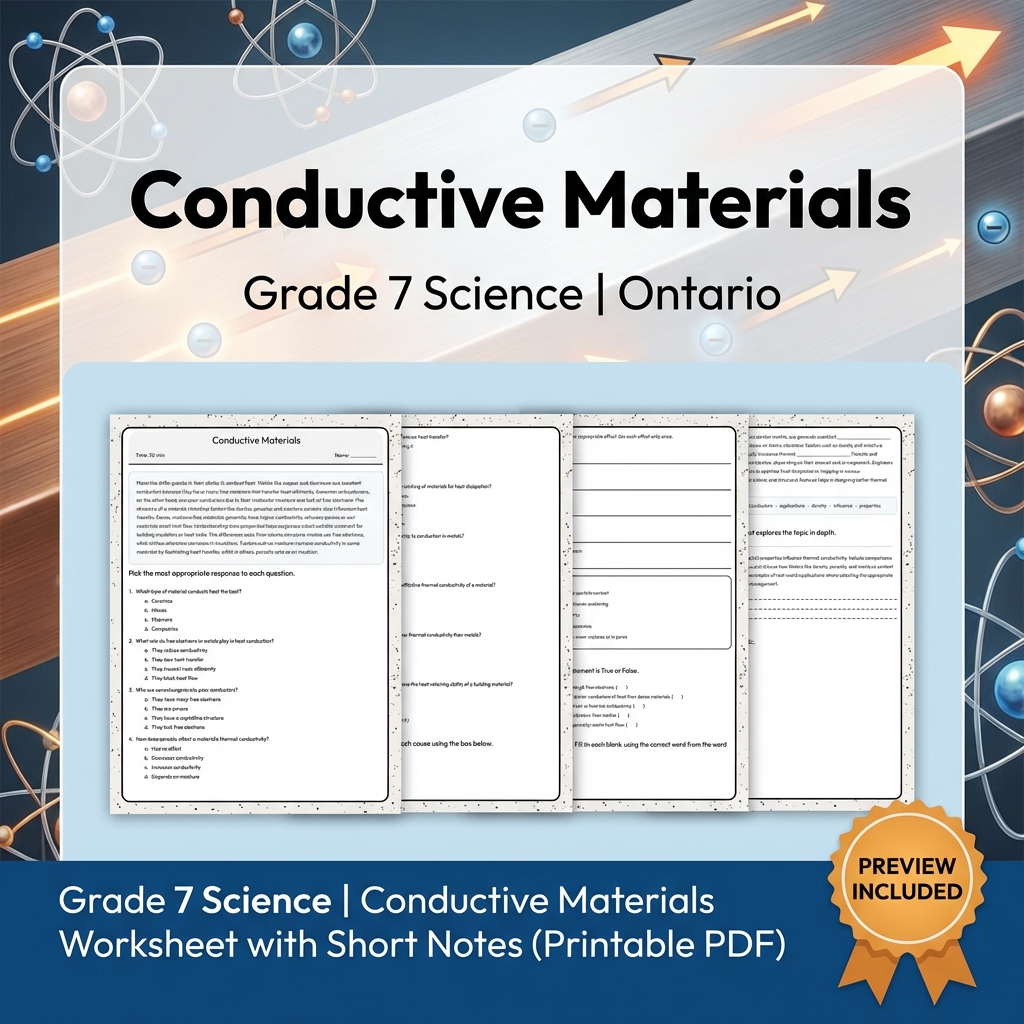
Grade 7 Science | Conductive Materials Worksheet with Short Notes (PDF)
Created byMeadowlark WorksheetsLearning Objectives
- Understand the differences in thermal conductivity among metals, ceramics, polymers, and composites.
- Analyze how factors such as free electrons, lattice vibrations, density, porosity, and moisture affect heat transfer.
- Compare qualitative measures used to rank materials for heat dissipation and retention.
Also included in: Grade 7 Science Lesson Group | Thermal Effects and Heat Transfer Worksheets +1 more
Instant download

Grade 7 Science – Plate Mechanisms & Mantle Convection | Daily Reading Worksheet
Created byBright Mind ResourcesLearning Objectives
- Understand the concept of mantle convection and its role in plate movement.
- Identify different force mechanisms driving plate tectonics.
- Explain how convection cells influence Earth's surface features.
Also included in: Grade 7 Earth Processes Science Daily Reading Worksheets Lesson Bundle | BC +1 more
Instant download

Grade 7 Science – Mechanical Energy & Pendulums Daily Reading Worksheet
Created byBright Mind ResourcesLearning Objectives
- Understand the concept of mechanical energy in systems like pendulums
- Identify how energy transfers between potential and kinetic forms
- Recognize observable effects of energy conservation and loss in simple systems
Also included in: Grade 7 Motion & Energy Science Daily Reading Worksheets Lesson Bundle | TEKS +2 more
Instant download

Friction and Drag Worksheet | Grade 7 Science Activities
Created byPrism Point LearningLearning Objectives
- Explain how static and kinetic friction oppose relative motion and affect acceleration and stopping distance.
- Describe aerodynamic drag as a force that opposes motion through air and influences speed of moving objects.
- Connect surface texture and normal force to changes in the frictional coefficient and real-world movement outcomes.
Instant download

Grade 7 Science – Radiant Transfer & Energy | Daily Reading Worksheet
Created byBright Mind ResourcesLearning Objectives
- Understand the concept of radiant energy transfer through electromagnetic waves
- Identify factors affecting radiative heating and cooling
- Recognize how solar angles and surface properties influence local microclimates
Also included in: Grade 7 Heat Transfer Science Daily Reading Worksheets Lesson Bundle | Alberta +2 more
Instant download
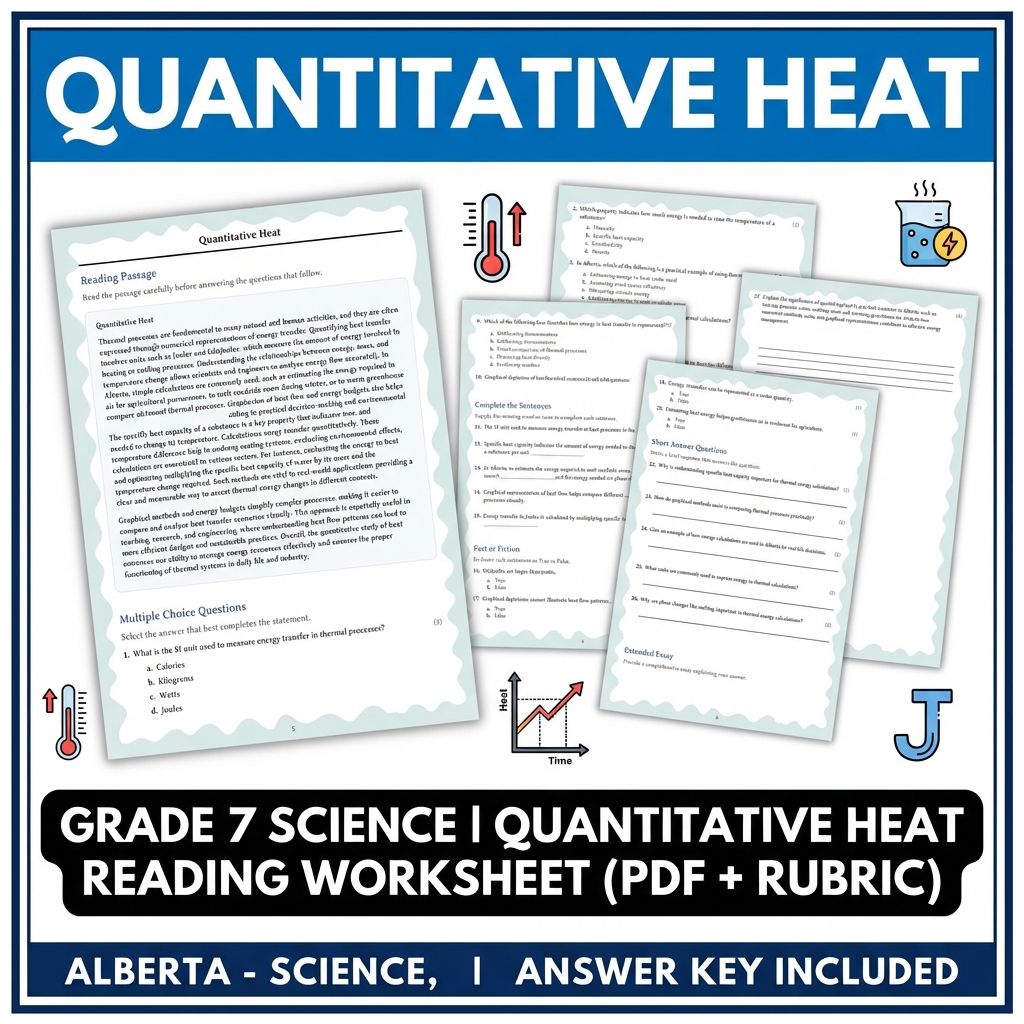
Grade 7 Science | Quantitative Heat Reading Worksheet (PDF + Rubric)
JCreated byJ.S SheetsLearning Objectives
- Understand how numerical representations measure heat transfer in different thermal processes.
- Learn about units of energy and temperature scales used in thermal calculations.
- Apply specific heat, mass, and temperature change to calculate energy transfer in Joules and kilojoules.
Also included in: Grade 7 Science UNIT Bundle | Heat Transfer, Convection & Energy Worksheets +1 more
Instant download
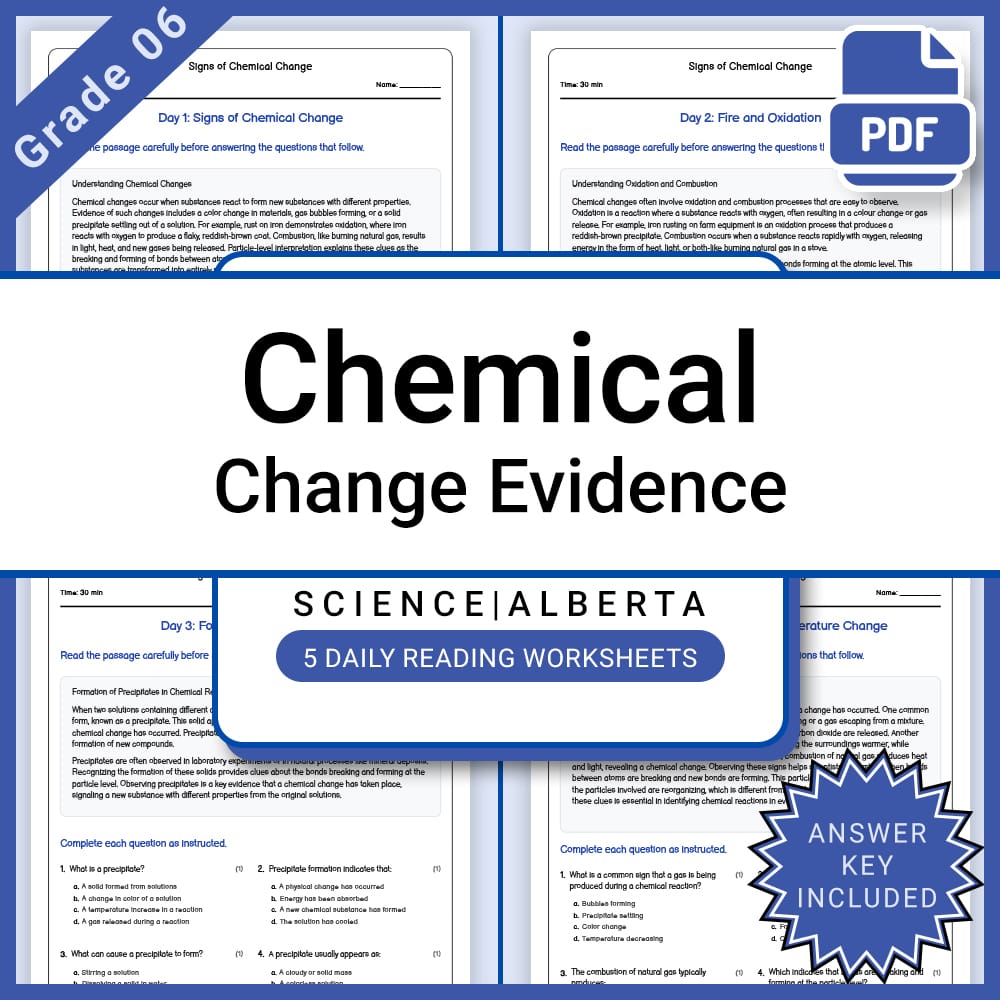
Grade 7 Science – Signs of Chemical Change Daily Reading Worksheet + Answer Key
JCreated byJ.S SheetsLearning Objectives
- Understand key concepts related to Science
- Apply knowledge through practice questions
- Demonstrate comprehension of the material
Also included in: Grade 7 Science Lesson Bundle | Alberta Framework for Classroom Use +1 more
Instant download

Grade 7 Science – Freshwater Reservoirs & Water Cycle Daily Reading Worksheet
Created byBright Mind ResourcesLearning Objectives
- Identify different sources of freshwater such as lakes and aquifers.
- Describe how groundwater systems operate and recharge.
- Explain the importance of porosity and permeability in aquifer function.
Also included in: Earth & Space Grade 7 Science Daily Reading Worksheets Bundle | TEKS +2 more
Instant download

Grade 7 Adaptation Forms Science Daily Reading Worksheet | TEKS Activity
 Created byBRIGHT PATH RESOURCES
Learning Objectives
- Define morphological adaptations as physical traits that improve survival and reproduction.
- Identify how camouflage and body structures help organisms in specific habitats.
- Distinguish adaptation from change caused only by immediate conditions (acclimation).
Also included in: Grade 7 Ecosystems Science Daily Reading Worksheets Bundle | TEKS +1 more
Instant download

Earth System Interactions Worksheet Grade 7 Science
JCreated byJ.S SheetsLearning Objectives
- Explain how the geosphere, hydrosphere, atmosphere, and biosphere exchange matter and energy
- Describe cause-and-effect relationships between Earth systems (e.g., erosion affecting waterways and habitats)
- Use evidence from observations to support an explanation of Earth system interactions over time
Also included in: Grade 7 Weather, Climate, and Earth Processes Science Lesson Bundle +1 more
Instant download

Grade 7 Science | Simple Machines Overview Worksheet (PDF) – Alberta Standards
Created bySilver Birch TeachingLearning Objectives
- Identify examples of the six simple machines and describe how each one changes force magnitude or direction
- Explain mechanical advantage as a comparison of output force to input force, using appropriate units and reasoning
- Apply relationships among force, distance, and machine geometry to predict outcomes for everyday tools
Also included in: Grade 7 Simple Machines and Forces Science Lesson Bundle: Alberta +1 more
Instant download

Grade 7 Science Worksheet – Design Criteria & Engineering Standards (PDF)
Created byEvergreen Desk EducationLearning Objectives
- Explain how design criteria for success can be measurable or observable in a science design problem.
- Identify common constraints (time, materials, cost, safety) and describe how they affect possible solutions.
- Describe trade-offs and improvement by connecting test evidence to criteria rather than appearance.
Also included in: Grade 7 Investigation & Engineering Science Lesson Bundle: General Framework +1 more
Instant download

Science Worksheet The Rock Cycle Grade 7 | Standards-Aligned Practice PDF
JCreated byJ.S SheetsLearning Objectives
- Explain how igneous, sedimentary, and metamorphic rocks form in the rock cycle.
- Describe the roles of heat, pressure, weathering, and mineral cementation in rock transformations.
- Use rock-cycle ideas to make connections between surface and subsurface Earth processes.
Also included in: Grade 7 Weather, Climate, and Earth Processes Science Lesson Bundle +1 more
Instant download

Design Principles Assessment | TEKS Grade 7 Science Standards-Aligned
Created byPrism Point LearningLearning Objectives
- Understand key concepts of designing fair and reproducible experiments.
- Identify variables, operational definitions, and control conditions in experiments.
- Recognize ethical, safety, and sample size considerations in research design.
Also included in: Scientific Inquiry Reasoning Grade 7 Science Lesson Bundle TEKS Unit
Instant download

Grade 7 Science | Heat Transfer Models Worksheet (PDF) for Standards
Created byEvergreen Desk EducationLearning Objectives
- Explain how heat transfers from warmer regions to cooler regions using conduction, convection, and radiation models.
- Use a simple heat-transfer model to predict the direction of energy flow based on temperature differences.
- Describe how energy can change form while heat moves through a system.
Also included in: Grade 7 Energy Transfer & Motion Science Lesson Bundle Worksheets (General) +1 more
Instant download

Grade 7 Population Limits Worksheet | Exponential vs Logistic Growth Ontario
 Created byTeacher's Corner
Learning Objectives
- Describe how carrying capacity limits population growth using logistic models.
- Differentiate exponential growth from logistic growth on population graphs.
- Identify limiting factors and explain how density-dependent and density-independent effects differ.
Instant download

Cell Energy Use Assessment Grade 7 Science California Standards
Created byPrism Point LearningLearning Objectives
- Explain how cells convert chemical energy in food into usable energy for life processes
- Describe how ATP functions as an energy carrier within cells
- Connect energy transformations to the idea that matter is conserved during cellular reactions
Also included in: Grade 7 Energy Flow and Matter Cycling Science lesson bundle – California Standards +1 more
Instant download

Grade 7 Science – Connecting Evidence & Claims | Daily Reading Worksheet
Created byBright Mind ResourcesLearning Objectives
- Identify how evidence supports scientific claims.
- Understand the importance of linking data to reasoning.
- Recognize the role of scientific principles in arguments.
Also included in: Scientific Models & Evidence Grade 7 Science Reading Lesson Bundle | General +1 more
Instant download

Earth System Interactions Worksheet Grade 7 Florida NGSSS Science
Created byEvergreen Desk EducationLearning Objectives
- Explain how matter and energy move between Earth’s geosphere, hydrosphere, atmosphere, and biosphere.
- Describe how changes in one Earth system can trigger changes in another system.
- Use evidence from everyday examples (weather, erosion, water availability) to model Earth system interactions.
Instant download
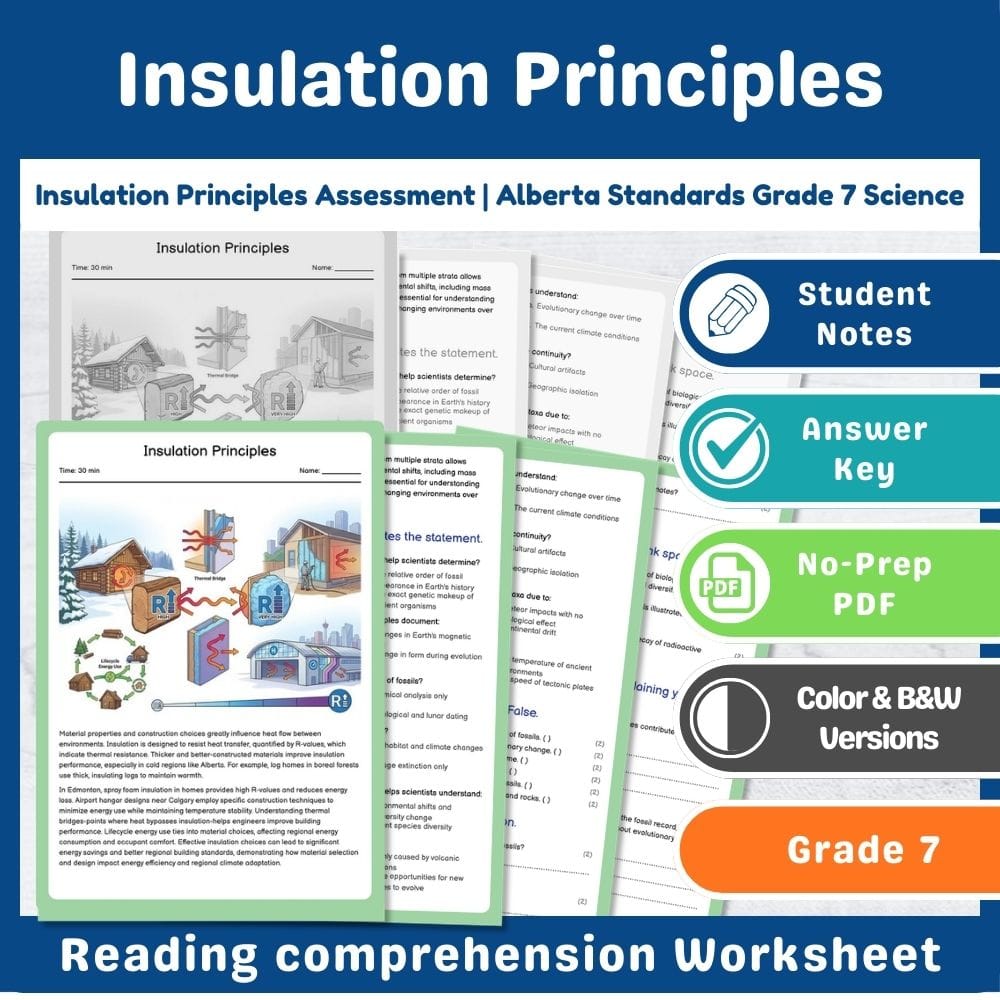
Insulation Principles Assessment | Alberta Standards Grade 7 Science
Created byPrism Point LearningLearning Objectives
- Understand how material properties influence heat flow.
- Identify regional examples of insulation techniques in Alberta.
- Determine the significance of R-values and thermal bridges in building design.
Also included in: Lesson Grade 7 Science Mini Bundle | Energy, Heat & Thermal Processes +1 more
Instant download
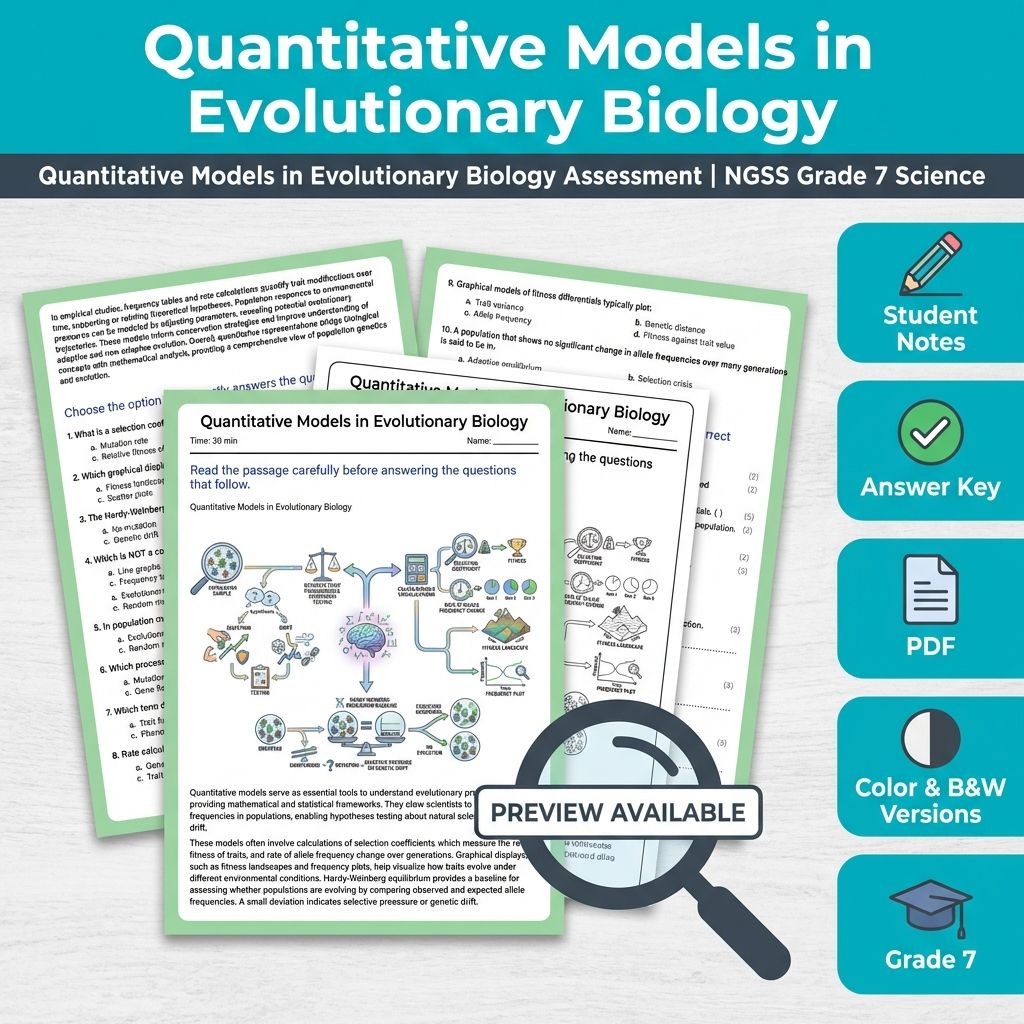
Quantitative Models in Evolutionary Biology Assessment | NGSS Grade 7 Science
Created byPrism Point LearningLearning Objectives
- Understand how mathematical models quantify trait frequencies, selection coefficients, and population dynamics.
- Interpret graphical displays of fitness differentials and allele frequency changes.
- Apply Hardy-Weinberg principles and rate calculations to analyze genetic data.
Also included in: Grade 7 Science Mini Bundle – Biological Evolution: Unity & Diversity +1 more
Instant download

Variable Control Worksheet | Ontario Grade 7 Science Assessment
 Created byCedar Grove Learning
Learning Objectives
- Distinguish independent, dependent, and controlled variables in a fair science investigation.
- Use operational definitions to define how variables are measured or identified during an experiment.
- Design fair tests using replication and controls to reduce confounding and sampling bias.
Also included in: Grade 7 Scientific Inquiry and Data Analysis Science Lesson Bundle - Ontario +1 more
Instant download
About Grade 7 Science Worksheets
Browse 6,039 printable Grade 7 Science worksheets — ready-to-print PDFs with answer keys where available.
Every worksheet on MyTeachingSheets is created by independent teacher-authors and reviewed before publication. All resources download as printable PDFs for classroom, homework, or at-home practice, and many include answer keys. Preview any worksheet free before buying.