
Grade 7 Science Worksheets
6,039 worksheets
Solubility Principles Worksheet | Ontario Grade 7 Science Assessment
 Created byCedar Grove Learning
Learning Objectives
- Explain how temperature and solvent polarity affect dissolution and solubility
- Use solubility curve ideas to predict whether a solution is unsaturated, saturated, or supersaturated
- Describe how pressure affects the solubility of gases and apply this to real-world situations
Also included in: Grade 7 Matter: Mixtures and Separation Science Lesson Bundle | Ontario +1 more
Instant download

Grade 7 Science – Genotype & Phenotype | Daily Reading Worksheet
 Created byBright Mind Resources
Learning Objectives
- Understand the difference between genotype and phenotype.
- Identify how genetic information influences observable traits.
- Explain how environment interacts with genetics to shape traits.
Also included in: Populations & Traits Grade 7 Science Daily Reading Lesson Bundle | Florida NGSSS +1 more
Instant download

Grade 7 Plate Tectonics Worksheet | NGSS Practice PDF
 Created byClear Sky Classroom
Learning Objectives
- Identify key geological evidence supporting plate tectonics and continental movement.
- Understand the significance of seafloor structures like mid-ocean ridges and trenches.
- Explain how fossils, rock types, and geologic features record Earth's past continents.
Also included in: Grade 7 Earth Systems Science Lesson Bundle NGSS: 6 Worksheets +1 more
Instant download

Grade 7 Science – Evidence From Data & Data Analysis | Daily Reading Worksheet
Created byBright Mind ResourcesLearning Objectives
- Understand how to gather and interpret data in scientific inquiries.
- Learn to distinguish between direct observations and interpretations.
- Recognize the importance of relevant evidence and measurement scales.
Also included in: Grade 7 Variables Science lesson-bundle daily reading worksheets | Florida NGSSS +1 more
Instant download
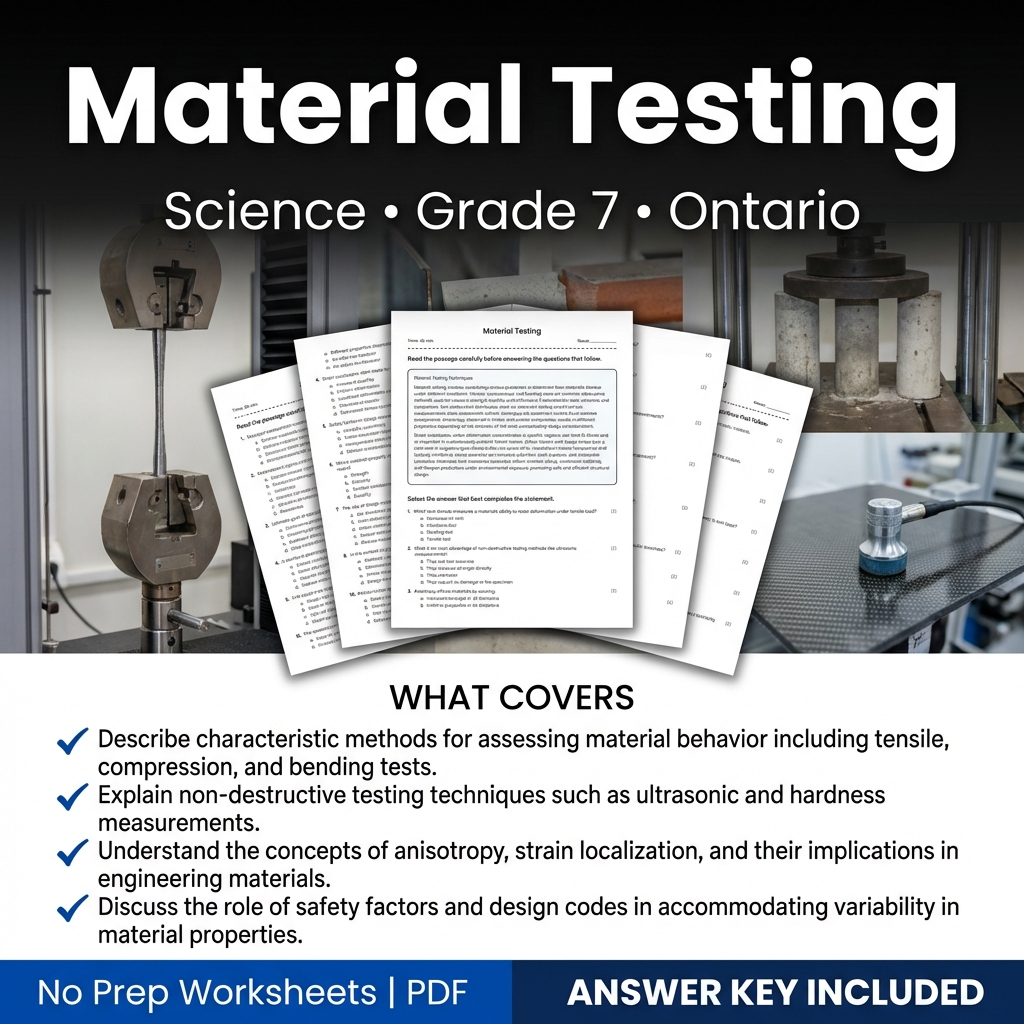
Grade 7 Science Worksheet on Material Testing | Ontario Standards
 Created byCoral Reef Learning
Learning Objectives
- Describe characteristic methods for assessing material behavior including tensile, compression, and bending tests.
- Explain non-destructive testing techniques such as ultrasonic and hardness measurements.
- Understand the concepts of anisotropy, strain localization, and their implications in engineering materials.
Instant download

Heat Transfer Worksheet | Grade 7 NGSS Conduction Convection Radiation
 Created byNorthstar Worksheets
Learning Objectives
- Identify the main mechanisms of heat transfer: conduction, convection, and radiation.
- Explain how heat transfer relates to temperature change and the movement of thermal energy.
- Use examples (spoon in hot liquid, air currents, a lamp, and an electrical circuit) to match evidence to the correct mode of heat flow.
Also included in: Grade 7 Energy Transfer & Transformations Lesson Bundle | NGSS Science +1 more
Instant download

Stoichiometry and Mole Ratios Worksheets Grade 7 Science
 Created bythe curious pencil
Learning Objectives
- Explain quantitative relationships shown by balanced chemical equations
- Identify mole ratios from coefficients in balanced equations
- Calculate related quantities using proportional reasoning
Also included in: Matter and Its Interactions Worksheets | Grade 7 Science NGSS +2 more
Instant download

Grade 7 Science | Understanding Heat Conduction - Daily Reading Comprehension
Created byCoral Reef LearningLearning Objectives
- Explain the process of heat conduction in solids.
- Identify materials with high and low thermal conductivity.
- Describe how conduction impacts everyday engineering structures.
Also included in: Energy, Heat and Thermal Processes Lesson Bundle: Grade 7 Science Alberta +1 more
Instant download

Design Solutions Worksheet | Grade 7 Science | Alberta Standards Practice
 Created byPrism Point Learning
Learning Objectives
- Explain how building orientation, the thermal envelope, and mechanical systems affect heat flow and seasonal energy use.
- Identify design strategies that improve comfort and reduce thermal bridges in cold Alberta climates.
- Describe trade-offs between upfront materials and ongoing energy/comfort needs.
Instant download

Mass Wasting and Coasts Assessment | Florida NGSSS Grade 7 Science
Created byPrism Point LearningLearning Objectives
- Explain how gravity and water-driven forces contribute to mass wasting and coastal erosion
- Describe how prolonged rain can trigger landslides by changing soil or rock stability
- Identify how waves and storm surge reshape coastlines by moving and removing sediment
Also included in: Grade 7 Earth and Climate Systems Science Lesson Bundle: Florida NGSSS
Instant download

Adaptation Forms Assessment | TEKS Grade 7 Science Standards-Aligned
Created byPrism Point LearningLearning Objectives
- Define and differentiate morphological, physiological, and behavioral adaptations in plants and animals.
- Identify examples of adaptations such as camouflage, water-storage tissues, and migratory behaviors.
- Explain how specific traits increase survival and reproductive success in particular habitats.
Instant download

Load Path Mapping Worksheet Grade 7 Science | Ontario Engineering Forces
 Created byChalk and Compass
Learning Objectives
- Describe how engineers map primary and secondary load paths in buildings and bridges to transfer gravity, lateral, and dynamic forces safely to foundations.
- Explain how openings, re-entrant corners, and irregular geometry can redistribute loads and change stiffness and internal force locations.
- Justify the importance of redundancy and alternative load paths to reduce the risk of collapse.
Also included in: Grade 7 Science Structural Engineering Design & Materials Lesson Bundle |Ontario +1 more
Instant download

Grade 7 Science – Understanding Systems Modeling | Daily Reading Worksheet
Created byBright Mind ResourcesLearning Objectives
- Define systems modeling and its purpose in science.
- Identify different types of system models such as diagrams and schematic representations.
- Describe how simplification, assumptions, and scaling affect model accuracy and interpretation.
Also included in: Grade 7 Technology & Engineering Science Lesson Bundle: Daily Reading | TEKS +2 more
Instant download

Grade 7 Science – Geologic Change Hazards Worksheet (PDF) – General Standards
 Created byEvergreen Desk Education
Learning Objectives
- Explain how plate tectonics can cause rapid geologic hazards such as earthquakes and volcanoes.
- Describe how weathering, erosion, and deposition reshape Earth’s surface over longer timescales.
- Identify evidence (fault features, lava flows, ash layers, sediment layers) that links past geologic processes to present landforms.
Also included in: Earth & Weather Systems: Grade 7 Science Lesson Bundle (General Framework) +1 more
Instant download

Fair Testing Measurements Worksheets | Grade 7 Science Engineering
 Created byBRIGHT PATH RESOURCES
Learning Objectives
- Explain what makes a test fair when comparing two designs.
- Choose appropriate measurement tools and units for collecting data.
- Use consistent starting conditions to interpret differences in results.
Also included in: Grade 7 Science Engineering Worksheets Bundle | Design & Data +2 more
Instant download

Design Revision & Performance Data Worksheet Grade 7 Science
Created byBRIGHT PATH RESOURCESLearning Objectives
- Explain how test results lead to specific design revisions.
- Connect evidence from measurements to targeted changes that improve performance.
- Describe how constraints (safety, materials, cost) shape what revisions are possible.
Also included in: Grade 7 Science Engineering Worksheets Bundle | Design & Data +2 more
Instant download
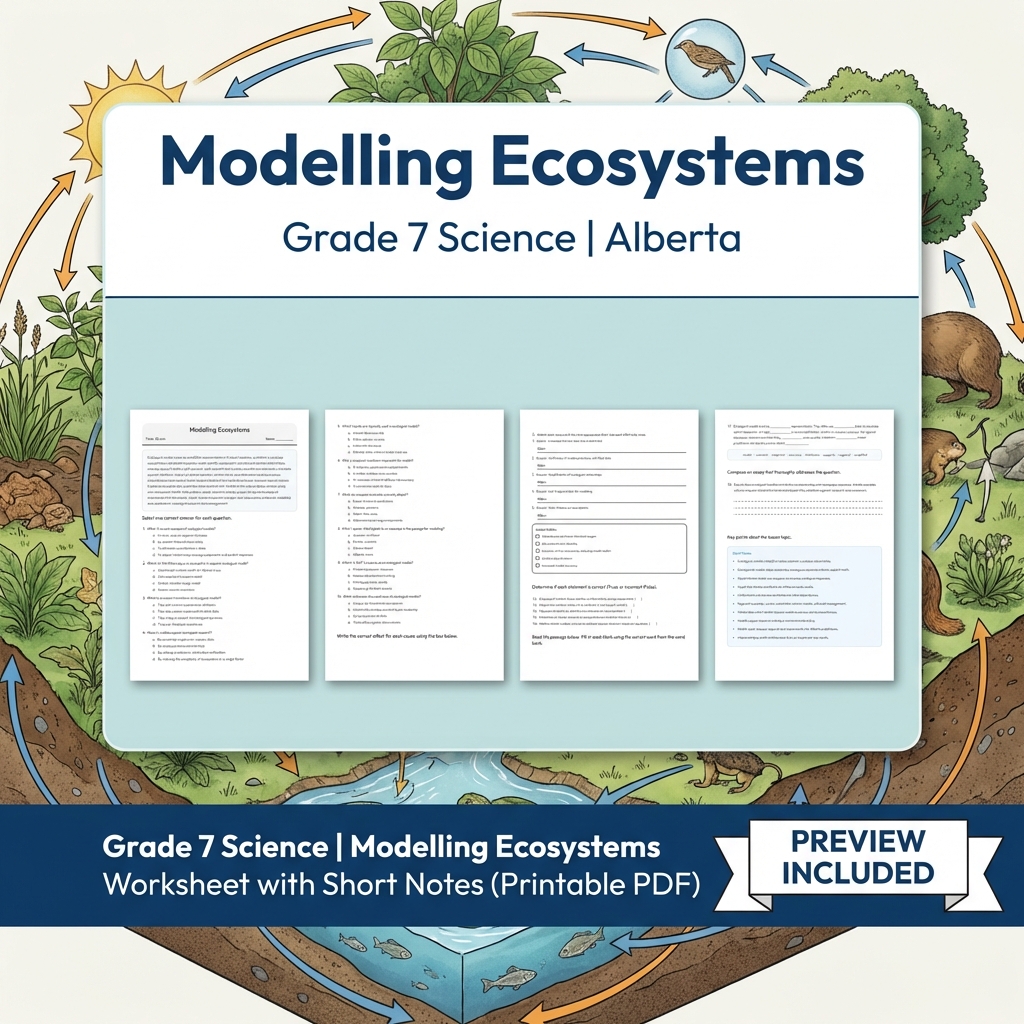
Grade 7 Science | Modelling Ecosystems Worksheet with Short Notes (PDF)
 Created byMeadowlark Worksheets
Learning Objectives
- Understand the purpose and types of ecological models used in environmental science.
- Identify the inputs, limitations, and regional examples of ecological models.
- Explain how models aid in interpreting complex ecological data and the importance of validation against real observations.
Instant download
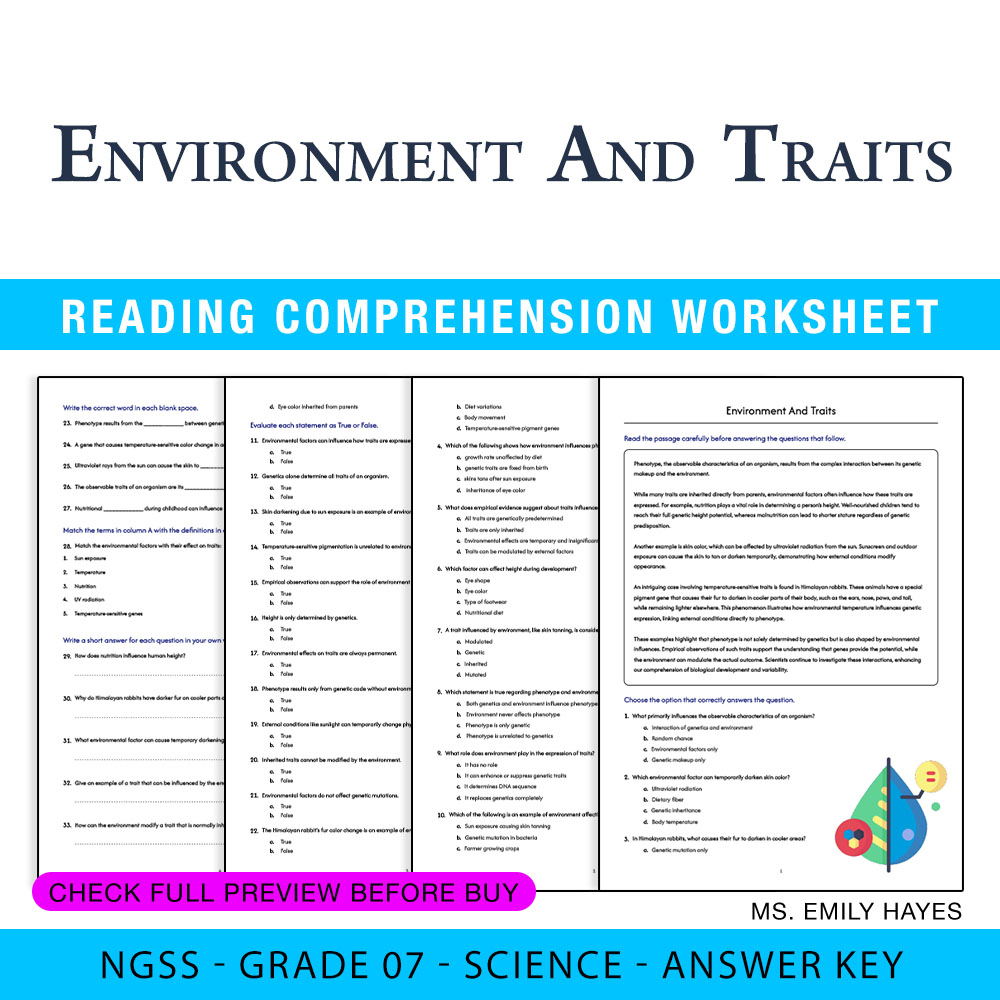
Grade 7 Science | Environment and Traits Worksheet (PDF+ Answer Key)
 Created byCopper Leaf Classroom
Learning Objectives
- Explain how phenotype results from interactions between genetic makeup and environmental factors.
- Identify examples where environmental factors influence traits such as height, skin color, and pigmentation.
- Distinguish inherited genetic traits from environmentally modulated traits.
Instant download

Grade 7 Mixtures and Solutions Worksheet | NGSS Physical Science Activity
Created byNorthstar WorksheetsLearning Objectives
- Distinguish homogeneous and heterogeneous mixtures and identify examples of each
- Explain solubility, concentration, and saturation using evidence from observations and simple scenarios
- Differentiate solutions, colloids, and suspensions based on particle size and whether particles separate
Also included in: Grade 7 Physical Science: Matter & Chemical Reactions Lesson Bundle | NGSS +1 more
Instant download

Density Separation Worksheet | Ontario Grade 7 Science Assessment
Created byCedar Grove LearningLearning Objectives
- Explain how density differences drive the movement of particles during separation
- Compare decanting, floatation, and centrifugation based on buoyant force, sedimentation rate, and centrifugal acceleration
- Predict which particles will separate together by considering density contrast and suitable media/conditions
Also included in: Grade 7 Matter: Mixtures and Separation Science Lesson Bundle | Ontario +1 more
Instant download
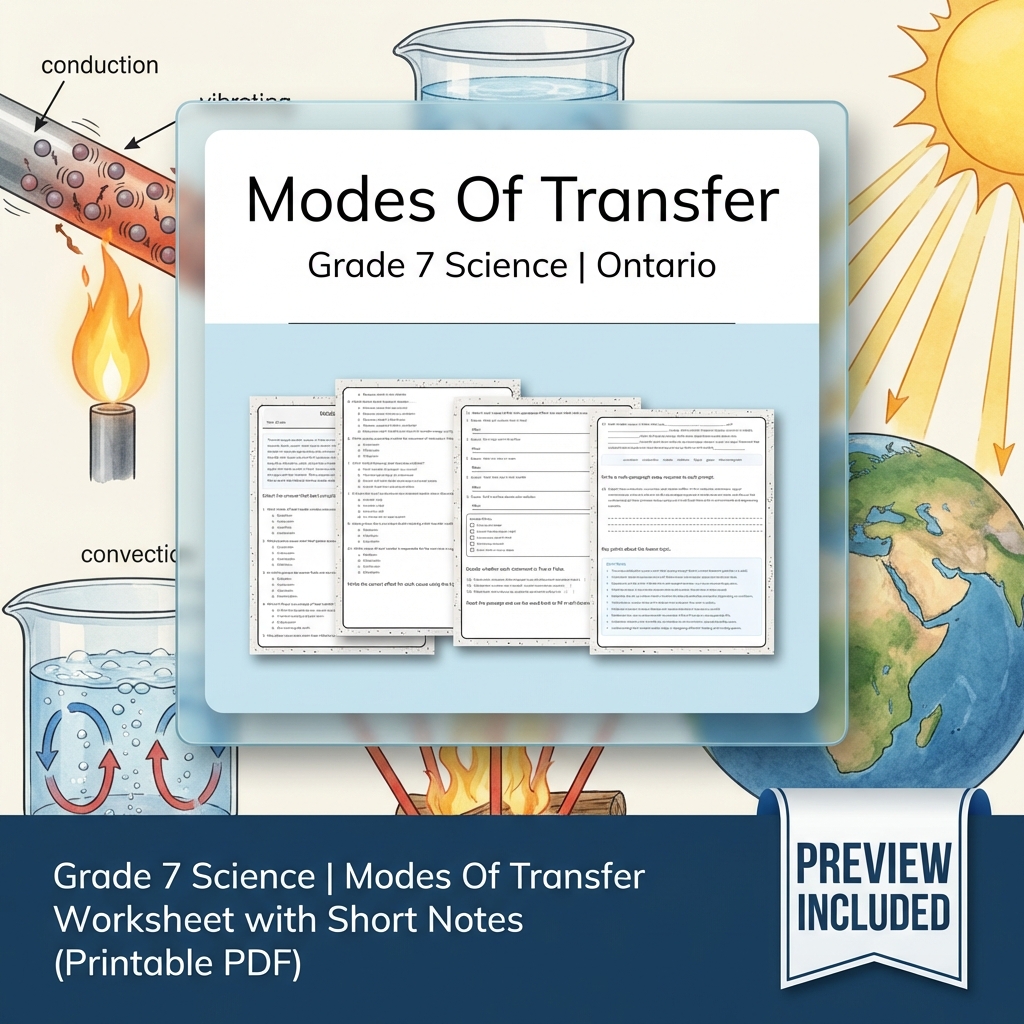
Grade 7 Science | Modes Of Transfer Worksheet with Short Notes (Printable PDF)
Created byMeadowlark WorksheetsLearning Objectives
- Identify and describe the three primary modes of thermal energy transfer: conduction, convection, and radiation.
- Explain the molecular mechanisms underlying each mode of heat transfer.
- Contrast the media and rates at which conduction, convection, and radiation transfer heat.
Also included in: Grade 7 Science Lesson Group | Thermal Effects and Heat Transfer Worksheets +1 more
Instant download

Science Grade 7 Risk Assessment Safety Basics Worksheet | Ontario
JCreated byJ.S SheetsLearning Objectives
- Identify common hazards in laboratory and field settings and explain how to assess risk.
- Interpret safety data sheet (SDS) information and classify hazards by properties such as flammability and toxicity.
- Select appropriate risk controls, including engineering and administrative controls, to reduce exposure to an acceptable level.
Instant download

Design Principles Worksheet for Grade 7 Science | Standards-Aligned Practice
JCreated byJ.S SheetsLearning Objectives
- Identify independent, dependent, and controlled variables in an experiment and explain how they support a fair test
- Write operational definitions for variables so an experiment can be repeated accurately
- Select appropriate control conditions and describe ethical and safety constraints in experiment design
Instant download

Grade 7 Digital Data Tools Worksheet | Data Logging & Science Skills
Created byChalk and CompassLearning Objectives
- Explain how digital tools capture, organize, and analyze scientific data (sensors, spreadsheets, and file formats).
- Identify key data concepts such as timestamps, sampling rates, and metadata tags that support interoperability.
- Apply basic data-cleaning ideas (checking integrity, handling missing values, and preserving raw data for reproducibility).
Also included in: Grade 7 Science Scientific Inquiry & Data Analysis Lesson Bundle | Ontario +1 more
Instant download
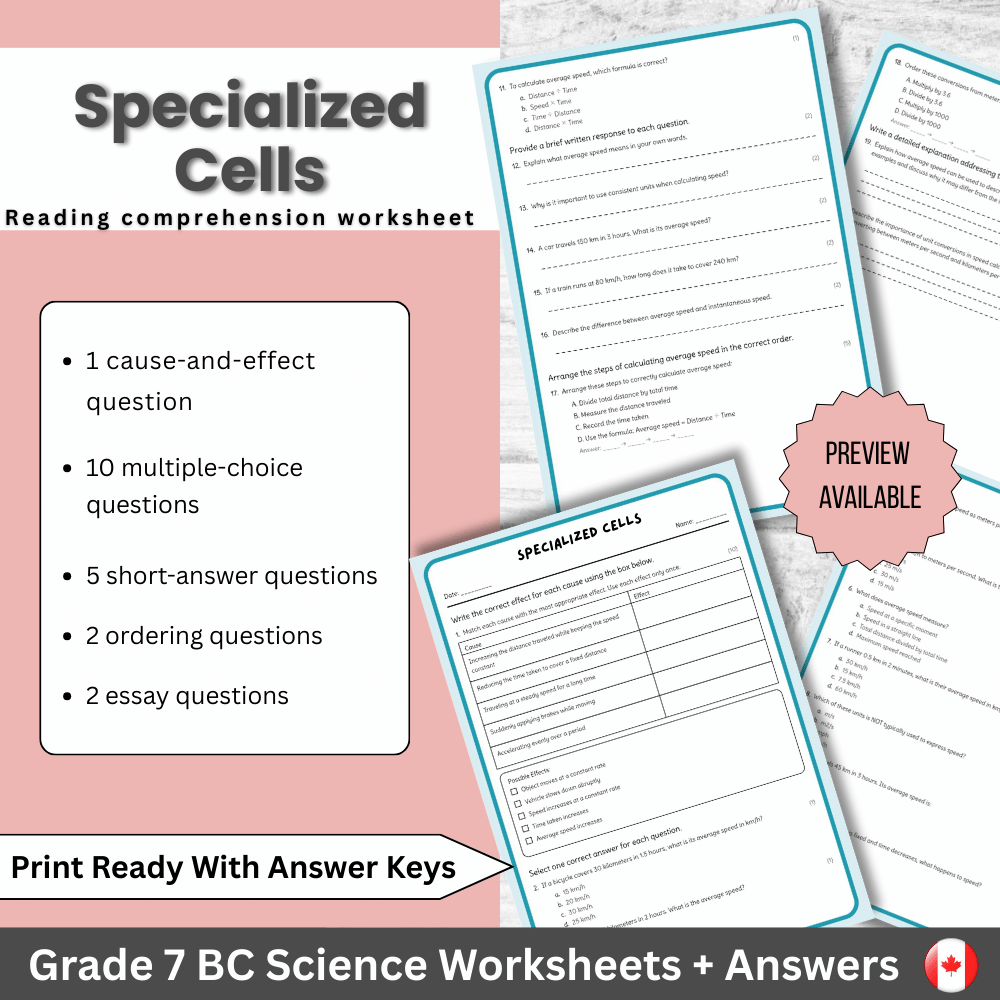
Grade 7 Science | Specialized Cells Worksheet (PDF) – BC Standards & Practice
Created byBright Mind ResourcesLearning Objectives
- Understand how the structure of specialized cells enables them to perform specific functions.
- Identify examples of different specialized cells and their morphological features.
- Explain how cellular specialization contributes to the functioning of tissues and organs.
Instant download

Grade 7 Science – Risk Assessment Worksheet (Ontario Standards) (PDF)
Created byEvergreen Desk EducationLearning Objectives
- Identify hazards and describe how risk assessments evaluate likelihood and severity in laboratory and field settings.
- Interpret safety information (e.g., safety data sheets) to classify hazards and choose safe procedures.
- Apply mitigation strategies using engineering and administrative controls and appropriate PPE.
Also included in: Grade 7 Science Inquiry & Data Lesson Bundle: Ontario Worksheet Set +1 more
Instant download

Grade 7 Cosmic Scale Worksheet | NGSS Earth and Space Science Activity
Created byBRIGHT PATH RESOURCESLearning Objectives
- Understand the relative sizes of planets in the solar system
- Learn about astronomical units, light-years, and planetary diameters
- Recognize how scale affects our perception of space phenomena
Also included in: Earth & Space Patterns and Gravity Lesson Bundle | Grade 7 Science | NGSS +2 more
Instant download

Gravity Motion Worksheet | Scientific Practice for Grade 7 NGSS Standards
JCreated byJ.S SheetsLearning Objectives
- Understand how gravitational attraction influences orbital motion within the solar system and galaxies.
- Describe the mathematical relationships that quantify orbital velocity and centripetal effects for planets and moons.
- Identify observational evidence such as orbital trajectories, Keplerian patterns, and perturbations that support the understanding of orbital motion.
Also included in: Grade 7 Cosmic Solar Rock and Gravity Science Lesson Bundle: NGSS +1 more
Instant download
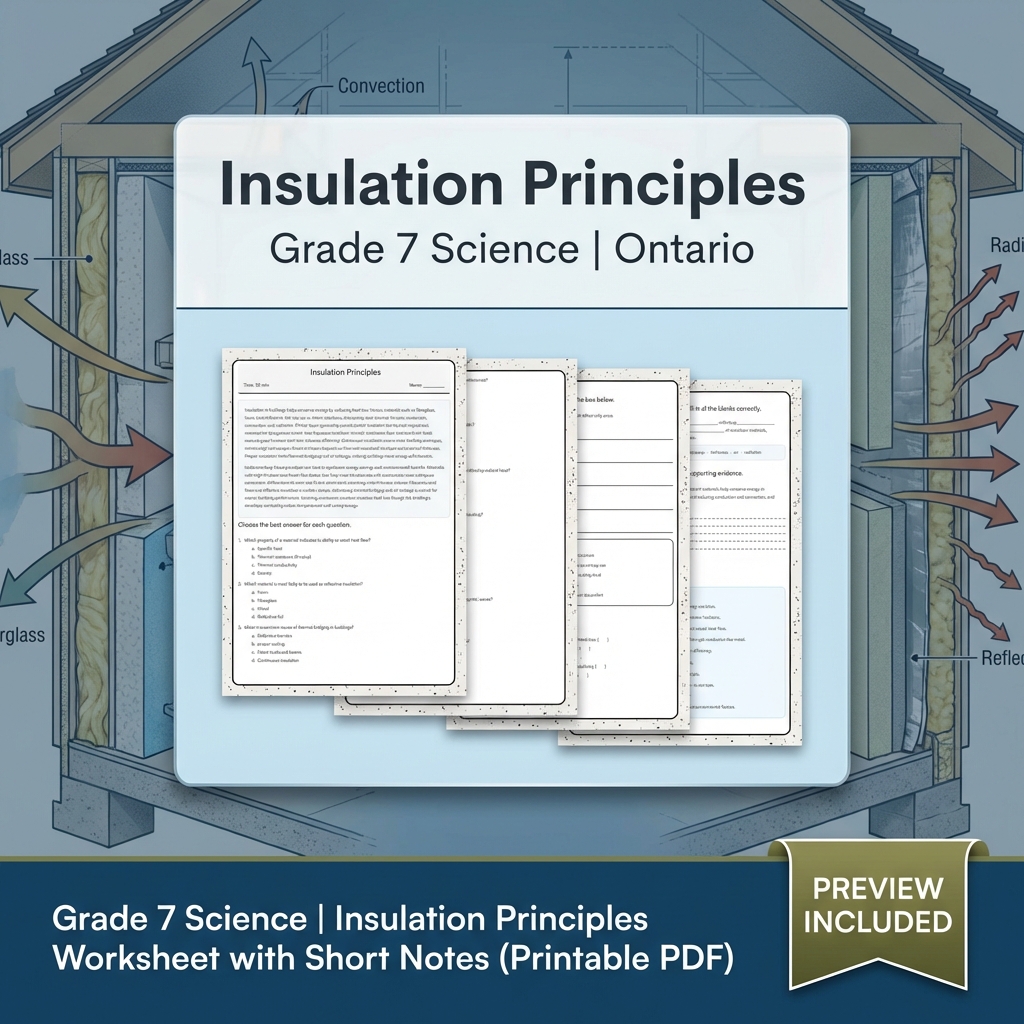
Grade 7 Science | Insulation Principles Worksheet with Short Notes (PDF)
Created byMeadowlark WorksheetsLearning Objectives
- Understand the mechanisms by which materials reduce heat transfer in buildings.
- Identify common insulating materials and compare their thermal resistance.
- Explain concepts of thermal bridging, air leakage, and continuous insulation in energy conservation.
Also included in: Grade 7 Science Lesson Group | Thermal Effects and Heat Transfer Worksheets +1 more
Instant download
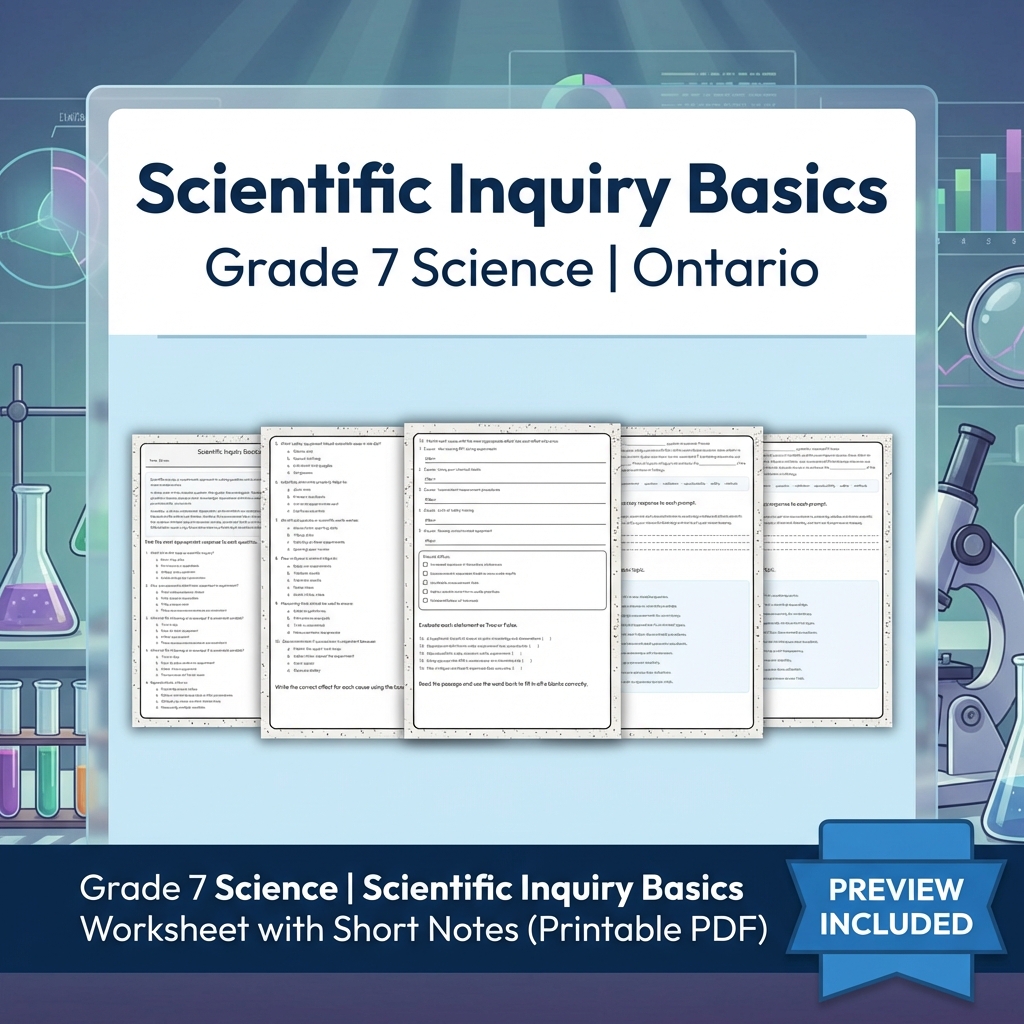
Grade 7 Science | Scientific Inquiry Basics Worksheet with Short Notes (PDF)
Created byMeadowlark WorksheetsLearning Objectives
- Understand the criteria for forming scientific questions and hypotheses.
- Describe the role of variables, operational definitions, and reproducibility in experiments.
- Identify laboratory safety protocols, including PPE, chemical labeling, and emergency procedures.
Also included in: Grade 7 Science Lesson Group Bundle – Ontario Framework Worksheets +1 more
Instant download

Relative Geologic Time Assessment | Florida NGSSS Grade 7 Science
Created byPrism Point LearningLearning Objectives
- Explain how the law of superposition and cross-cutting relationships help determine the relative order of geologic events.
- Identify which rock layers or features are older or younger based on observable evidence.
- Use relative dating reasoning to construct a simple geologic history when numerical ages are not available.
Also included in: Grade 7 Earth and Climate Systems Science Lesson Bundle: Florida NGSSS
Instant download

Science Worksheet: Population Impacts Assessment | NGSS Grade 7 Science
 Created bySkylark Worksheets
Learning Objectives
- Explain how population growth and consumption increase demand for water, energy, land, and raw materials.
- Describe how increased waste and intensified agriculture or energy systems can disrupt ecosystems and resource cycles.
- Use quantitative reasoning to compare how different regions experience biodiversity loss, freshwater stress, and carbon emissions.
Also included in: Grade 7 Ecosystems & Climate Interactions Science Lesson Bundle: NGSS +1 more
Instant download

Air Masses and Fronts Worksheet | Grade 7 Weather Science Activity
Created byPrism Point LearningLearning Objectives
- Explain what air masses are and how their temperature and moisture affect weather.
- Describe what fronts are and how they form when air masses meet.
- Compare the typical weather changes caused by cold fronts and warm fronts.
Also included in: Grade 7 Weather & Climate Science Lesson Bundle | Florida NGSSS
Instant download

Grade 7 Science – Evaporation & Crystallization | Daily Reading Worksheet
Created byBright Mind ResourcesLearning Objectives
- Understand the process of evaporation and how it leads to crystallization.
- Identify the factors that influence crystal growth and purity.
- Describe real-world examples of evaporation crystallization, such as salt and sugar production.
Also included in: Grade 7 Matter Science Daily Reading Worksheets Lesson Bundle | Ontario +1 more
Instant download

Grade 7 Understanding Quantitative Models in Genetics Worksheet | NGSS
Created byBRIGHT PATH RESOURCESLearning Objectives
- Understand key concepts related to Science
- Apply knowledge through practice questions
- Demonstrate comprehension of the material
Also included in: Evolution & Genetics Grade 7 Science Worksheets Lesson Bundle | NGSS +2 more
Instant download

Grade 7 Science | States Of Matter Worksheet | BC Standard
 Created byLumora Learning
Learning Objectives
- Describe the different states of matter in terms of particle arrangement, spacing, and movement.
- Explain how temperature and pressure influence phase changes between solids, liquids, and gases.
- Identify observable characteristics used to classify substances by their physical properties.
Also included in: Grade 7 Science | Matter & Chemical Change Unit Bundle | BC Aligned
Instant download

Grade 7 Density Particle View Worksheet | Practice & Standards PDF
Created byClear Sky ClassroomLearning Objectives
- Explain density using the particle view, including how particle spacing affects mass per unit volume.
- Describe how heating can change density by increasing volume while mass stays the same.
- Use density differences to interpret sinking and floating behavior in different materials.
Instant download

Grade 7 Science – Integrated Design & Mechanical Systems | Reading Worksheet
Created byBright Mind ResourcesLearning Objectives
- Understand the concept of mechanical advantage in integrated systems.
- Analyze various design criteria including material choice, safety, and efficiency.
- Evaluate how regional environmental factors influence design decisions.
Also included in: Grade 7 Structures & Forces Science Lesson Bundle Daily Reading | Alberta +2 more
Instant download

Grade 7 Science | Thermal Basics Worksheet (Alberta Standards) (PDF)
 Created bySilver Birch Teaching
Learning Objectives
- Explain how particle motion relates to temperature and thermal energy.
- Distinguish heat from temperature and describe heat transfer by conduction, convection, and radiation.
- Apply thermal transfer concepts to real-world Alberta climate examples.
Also included in: Grade 7 Thermal Systems Models and Heat Transfer Science Lesson Bundle – Alberta +1 more
Instant download

Science Worksheet Population Variation Grade 7 | NGSSS Standards Practice
JCreated byJ.S SheetsLearning Objectives
- Explain how variation in traits exists within populations
- Describe how reproduction and inheritance contribute to trait differences
- Analyze how trait frequencies can change across generations due to environmental pressures
Also included in: Grade 7 Evolution and Population Dynamics Science Lesson Bundle – Florida NGSSS +1 more
Instant download

Nutrient Transport Worksheet | Standard-Aligned Grade 7 Science Practice
JCreated byJ.S SheetsLearning Objectives
- Understand how molecules derived from food are transported within organisms.
- Identify systems involved in internal transport and waste removal.
- Explain the importance of continuous movement of matter for organism health.
Also included in: Grade 7 Ecosystem Energy & Matter Cycles Science Lesson Bundle +1 more
Instant download

Grade 7 Air Masses Fronts Worksheet | California Standards Practice PDF
Created byClear Sky ClassroomLearning Objectives
- Explain how air masses form and how their temperature and moisture influence weather
- Describe how fronts create zones where air rises, cools, and can form clouds and precipitation
- Predict how temperature and wind often change near a front
Instant download

Grade 7 Science Worksheet: Adaptation Function – Standards-Aligned Practice
JCreated byJ.S SheetsLearning Objectives
- Explain how structural adaptations connect to specific life functions (exchange, protection, and water regulation).
- Identify how behavioral and morphological adaptations support feeding and reproduction.
- Describe how trade-offs can limit an adaptation’s performance in another situation.
Also included in: Grade 7 Ecosystem Dynamics Science Lesson Bundle Worksheets – General +1 more
Instant download

Grade 7 Science – Rock Types & Identification | Daily Reading Worksheet
Created byBright Mind ResourcesLearning Objectives
- Understand the three main types of rocks: igneous, sedimentary, and metamorphic.
- Identify key features: mineral content, texture, and structure that distinguish igneous rocks.
- Learn how rocks are formed and their significance in Earth's history.
Also included in: Grade 7 Earth Processes Science Daily Reading Worksheets Lesson Bundle | BC +1 more
Instant download

Grade 7 Speed Calculations Science Daily Reading Worksheet | TEKS
Created byBRIGHT PATH RESOURCESLearning Objectives
- Define speed and explain what it measures in everyday motion.
- Distinguish average speed from instantaneous rate using a motion description.
- Use unit ideas (m/s and km/h) to support correct thinking about speed.
Also included in: Forces & Energy Grade 7 Science Daily Reading Worksheets Lesson Bundle | TEKS +1 more
Instant download

Grade 7 Science – Seasonal Sun Patterns & Earth's Tilt | Daily Reading Worksheet
Created byBright Mind ResourcesLearning Objectives
- Understand Earth's tilting axis and how it affects the Sun's apparent position in the sky.
- Explain how seasonal changes occur in different hemispheres due to Earth's tilt.
- Describe the relationship between Earth's tilt, daylight hours, and seasons throughout the year.
Also included in: Water Cycle & Weather Grade 7 Science Daily Reading Lesson Bundle | CA Standards +1 more
Instant download

Grade 7 Science Worksheet | Statistical Reasoning & Data Analysis (PDF)
Created byEvergreen Desk EducationLearning Objectives
- Interpret descriptive statistics (mean, median, mode, and interquartile range) in context
- Explain how outliers and variability affect comparisons across groups or measurements
- Use basic ideas from inference (confidence and limitations of small samples) to avoid overgeneralizing
Also included in: Grade 7 Science Inquiry & Data Lesson Bundle: Ontario Worksheet Set +1 more
Instant download

Science Design Optimization Worksheet | NGSS Grade 7 Science Assessment
Created bySkylark WorksheetsLearning Objectives
- Use test data to identify which design parameters limit performance.
- Apply iterative refinement to improve a design while staying within constraints.
- Justify design changes using quantitative comparisons and evidence.
Also included in: Grade 7 Engineering Design Science Lesson Bundle: NGSS +1 more
Instant download
About Grade 7 Science Worksheets
Browse 6,039 printable Grade 7 Science worksheets — ready-to-print PDFs with answer keys where available.
Every worksheet on MyTeachingSheets is created by independent teacher-authors and reviewed before publication. All resources download as printable PDFs for classroom, homework, or at-home practice, and many include answer keys. Preview any worksheet free before buying.