
Grade 7 Science Worksheets
6,039 worksheets
7th Grade Science Worksheet | Surface Process Evidence (PDF)
 Created byEvergreen Desk Education
Learning Objectives
- Explain how internal and external Earth processes can reshape landscapes.
- Identify evidence of surface processes using rock strata, landforms, and hazard history.
- Use clues from present-day topography to infer how a region may have changed over time.
Also included in: Earth & Weather Systems: Grade 7 Science Lesson Bundle (General Framework) +1 more
Instant download

Ecosystem Models and Their Limitations Worksheet | Grade 7 Alberta Science
 Created byBRIGHT PATH RESOURCES
Learning Objectives
- Explain the purpose of ecosystem models.
- Identify key details about conceptual and quantitative modelling.
- Describe model inputs, assumptions, and limitations.
Also included in: Grade 7 Alberta Science Interactions and Ecosystems Worksheet Bundle +1 more
Instant download

Energy Flow in Ecosystems: Food Webs and Energy Pyramids Worksheet | NGSS
 Created bySkylark Worksheets
Learning Objectives
- Explain how energy moves through trophic levels using producers, consumers, and decomposers.
- Describe how photosynthesis and cellular respiration capture and release energy.
- Interpret energy pyramids and estimate how energy decreases between trophic levels using typical transfer efficiencies.
Also included in: Grade 7 Ecosystem Dynamics Science Lesson Bundle (NGSS) Worksheets +1 more
Instant download

Grade 7 Science – Connection Design & Structural Engineering | Reading Worksheet
 Created byBright Mind Resources
Learning Objectives
- Understand the various types of structural connections such as bolted, welded, and bearing.
- Identify the roles of joints in load transfer, redundancy, and stability of structures.
- Describe shear, bearing, and slip phenomena at connections.
Also included in: Structural Eng. Grade 7 Science Daily Reading Worksheets Lesson Bundle | Ontario +1 more
Instant download

Grade 7 Science | Habitat Fragmentation Worksheet with Short Notes (PDF)
 Created byMeadowlark Worksheets
Learning Objectives
- Understand what habitat fragmentation is and how it affects ecosystems.
- Identify concepts like edge effects, connectivity, and biodiversity loss related to habitat fragmentation.
- Explain the impact of fragmentation on species interaction, gene flow, and extinction risk.
Also included in: Grade 7 Science Lesson Bundle: Ecosystems and Population Dynamics Worksheets +1 more
Instant download

Grade 7 Science | Measurement Uncertainty Worksheet with Short Notes (PDF)
Created byMeadowlark WorksheetsLearning Objectives
- Understand key concepts of measurement accuracy and precision.
- Identify sources of systematic and random errors in measurements.
- Apply significant figures and calibration techniques to experimental data.
Also included in: Grade 7 Science Lesson Group Bundle – Ontario Framework Worksheets +1 more
Instant download

Grade 7 Science | Mixtures and Separation Methods Worksheet (Answer Key) – TEKS Aligned
Created byBright Mind ResourcesLearning Objectives
- Distinguish between homogeneous and heterogeneous mixtures.
- Describe various separation techniques such as filtration, distillation, chromatography, and magnetic separation.
- Relate solubility, particle size, and boiling point differences to separation methods.
Also included in: Grade 7 Science Unit Bundle | States of Matter & Atomic Structure Worksheets +2 more
Instant download

Solar Patterns Worksheet | NGSS Grade 7 Science Assessment Practice
JCreated byJ.S SheetsLearning Objectives
- Describe cyclic patterns produced by the relative motions of the Sun, Earth, and Moon.
- Explain how orbital geometry and axial tilt influence day-night cycles and phases.
- Identify observational evidence that connects positional relationships to predictable solar and lunar patterns.
Also included in: Grade 7 Cosmic Solar Rock and Gravity Science Lesson Bundle: NGSS +1 more
Instant download

Surface Changes Over Time Assessment | NGSSS Standards Grade 7 Science
 Created byPrism Point Learning
Learning Objectives
- Explain how water, storms, earthquakes, and volcanic activity change Earth’s surface in both gradual and sudden ways
- Describe how erosion and sediment deposition reshape local landforms
- Identify evidence of surface change processes in real-world landscapes
Also included in: Grade 7 Earth and Climate Systems Science Lesson Bundle: Florida NGSSS
Instant download

Grade 7 Science – Inclined Planes & Forces | Daily Reading Worksheet
Created byBright Mind ResourcesLearning Objectives
- Identify the parts of an inclined plane
- Understand how force components work on an inclined plane
- Calculate mechanical advantage of inclined planes
Also included in: Grade 7 Structures & Forces Science Lesson Bundle Daily Reading | Alberta +2 more
Instant download

Grade 7 Science | Integrated Analysis Worksheet (Alberta Standards) (PDF)
 Created bySilver Birch Teaching
Learning Objectives
- Explain how conduction, convection, and radiation contribute to heat transfer in energy systems.
- Use energy budget ideas and conservation concepts to interpret net heat gain and energy losses.
- Connect component-level heat transfer information to system-level predictions (e.g., temperature response).
Also included in: Grade 7 Thermal Systems Models and Heat Transfer Science Lesson Bundle – Alberta +1 more
Instant download

Surface Processes Worksheet for Grade 7 Science | NGSS-Aligned Practice
JCreated byJ.S SheetsLearning Objectives
- Understand the different types of weathering, erosion, transport, and deposition processes shaping Earth's surface.
- Identify agent-specific signatures and landform examples associated with surface processes.
- Connect rates of landscape change with geologic timescales and agent activity.
Also included in: Grade 7 Earth Systems Science Worksheet Set Print Lesson Bundle – NGSS +1 more
Instant download

Natural Selection and Adaptation Worksheets | Grade 7 Science
 Created byTeachers Club
Learning Objectives
- Explain how heritable variation influences trait frequencies over generations
- Identify how environmental pressures affect survival and reproduction
- Explain how differential survival and reproduction can produce adaptation
Also included in: Biological Evolution Grade 7 Science NGSS Unit Bundle +2 more
Instant download

Human Impacts Practice Test | Grade 7 Science NGSS Worksheets Review
Created byPrism Point LearningLearning Objectives
- Explain how scientists monitor human impacts using environmental indicators.
- Analyze how land-cover change, water-quality indicators, and air-quality measurements reveal trends over time.
- Evaluate mitigation strategies and trade-offs between human needs and ecosystem resilience.
Also included in: Grade 7 Human Impacts & Climate Earth Science Lesson Bundle | NGSS
Instant download

Grade 7 Science | Wave Energy Transfer Worksheet (PDF) – General Standards
Created byEvergreen Desk EducationLearning Objectives
- Explain how waves transfer energy without permanently moving matter.
- Differentiate transverse and longitudinal waves using particle motion and wave features.
- Relate amplitude and wavelength to the energy and pattern of a wave.
Also included in: Grade 7 Energy Transfer & Motion Science Lesson Bundle Worksheets (General) +1 more
Instant download

Cosmic Scale Practice Worksheet | Grade 7 Science NGSS Review
Created byPrism Point LearningLearning Objectives
- Use astronomical units and light-years to compare distances in space.
- Interpret planetary diameters and orders of magnitude to understand scale.
- Explain how logarithmic thinking and scale change what we can observe.
Also included in: Grade 7 Earth and Space Science Lesson Bundle NGSS Test Prep Worksheets
Instant download

Grade 7 Science – Evaporation and Crystallization Worksheet (PDF)
Created byEvergreen Desk EducationLearning Objectives
- Explain how evaporation and controlled cooling can create supersaturation and lead to crystallization.
- Describe nucleation and crystal growth and how these steps affect crystal size and shape.
- Identify factors such as evaporation rate, temperature profile, and impurities that influence crystal purity and yield.
Also included in: Grade 7 Substances and Mixtures Science Lesson Bundle Worksheet (Ontario) +1 more
Instant download

Design Process Worksheet | Grade 7 Science Activities
Created byPrism Point LearningLearning Objectives
- Explain how the technological design process works as an iterative cycle from problem definition to optimization.
- Use criteria and constraints to make design trade-offs and justify design decisions with measurements or evidence.
- Describe how prototyping, evaluation, and refinement improve a prototype’s performance over time.
Also included in: Grade 7 Technology & Engineering Design in Science: Lesson Bundle TEKS
Instant download

Grade 7 Science | Design Process Worksheet (Ontario Standards) (PDF)
Created byEvergreen Desk EducationLearning Objectives
- Explain how functional requirements and constraints guide engineering design choices from problem definition to solution selection.
- Describe how performance objectives (such as load capacity, stiffness, and serviceability) influence design decisions.
- Use a simple decision matrix and sketches to compare concept options and justify a preferred solution using criteria and trade-offs.
Also included in: Grade 7 Engineering Design & Materials Science Lesson Bundle Ontario +1 more
Instant download

Grade 7 Science | Volcanic Landforms Worksheet | BC Aligned
 Created byLumora Learning
Learning Objectives
- Describe how magma composition and eruption style affect volcanic landforms.
- Identify different types of volcanoes and their characteristic features.
- Explain the tectonic settings that produce various volcanic structures.
Instant download

Grade 7 Science Worksheet | Ecosystem Resilience and Environmental Stability (PDF)
Created byEvergreen Desk EducationLearning Objectives
- Explain what ecosystem resilience is and how it relates to recovery after disturbances.
- Describe how disturbances can change habitat, resource timing, and species interactions.
- Use population growth and decline patterns to make predictions about future ecosystem stability.
Also included in: Grade 7 Ecosystem Energy Flows Science Lesson Bundle - General Framework +1 more
Instant download

Grade 7 Science Ecosystem Energy Flow Worksheet | Standards-Aligned Assessment
JCreated byJ.S SheetsLearning Objectives
- Explain how energy enters an ecosystem and moves through trophic levels (producers to consumers).
- Describe why energy decreases at each transfer between trophic levels.
- Compare the roles of producers, consumers, and decomposers in energy flow.
Also included in: Grade 7 Evolution and Population Dynamics Science Lesson Bundle – Florida NGSSS +1 more
Instant download

Natural Hazards Test Prep Worksheets | Grade 7 Science NGSS
Created byPrism Point LearningLearning Objectives
- Analyze and interpret hazard maps, recurrence intervals, and probabilistic forecasts to assess risk.
- Compare short-term event behavior with long-term trends in natural hazard occurrence and vulnerability.
- Explain how natural hazards can cause cascading impacts to infrastructure and ecosystems.
Also included in: Grade 7 Human Impacts & Climate Earth Science Lesson Bundle | NGSS
Instant download

Thermal Energy Transfer Worksheets: Conduction, Convection & Radiation
Created byPrism Point LearningLearning Objectives
- Identify conduction, convection, and radiation as heat-transfer modes
- Explain conduction using particle motion and direct contact
- Describe convection using density differences and fluid movement
Also included in: Thermal Energy & Heat Transfer Lesson Bundle | Grade 7 Science | Ontario +1 more
Instant download
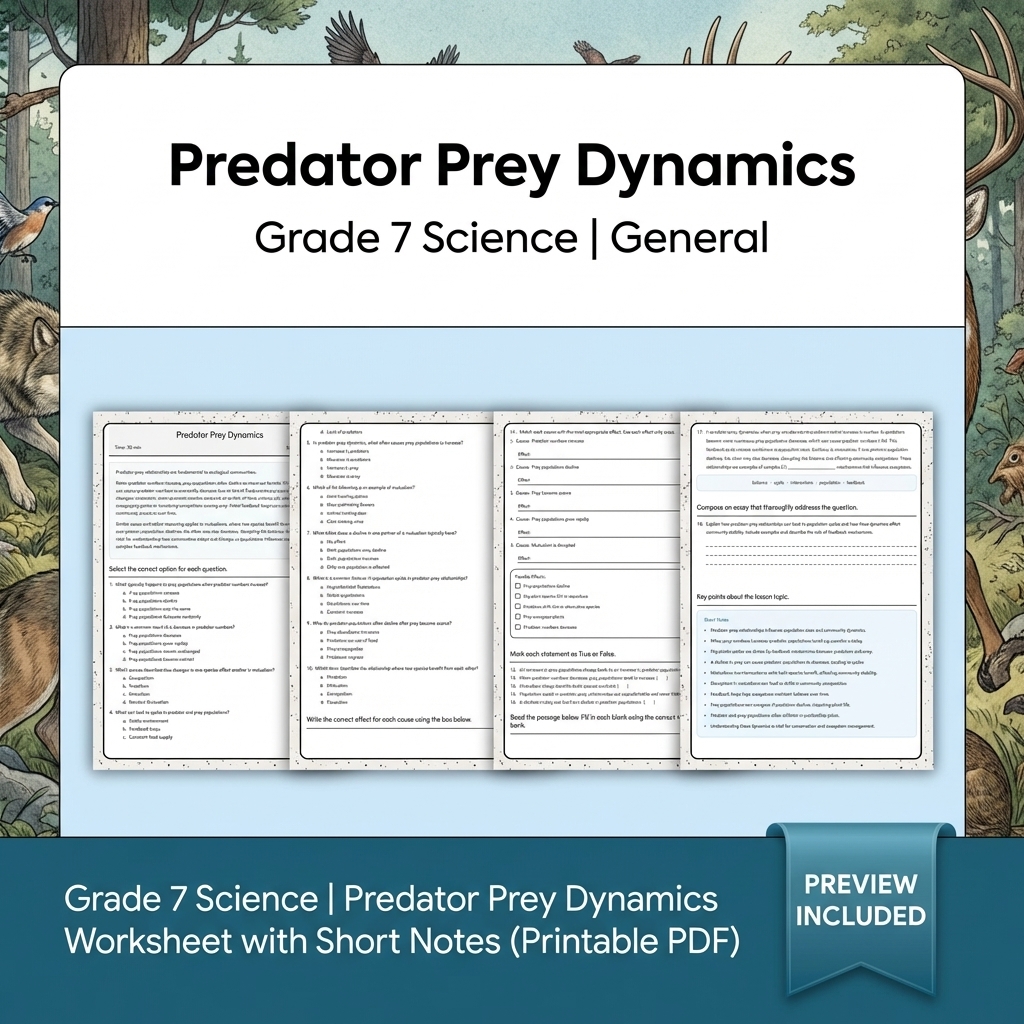
Grade 7 Science | Predator Prey Dynamics Worksheet with Short Notes
Created byMeadowlark WorksheetsLearning Objectives
- Understand the interactions between predator and prey populations.
- Identify cause-and-effect relationships in ecological communities.
- Analyze feedback loops that lead to population cycles.
Also included in: Grade 7 Ecosystem Dynamics Science Lesson Bundle: General Framework +1 more
Instant download

Grade 7 Potential Energy Worksheet | NGSS Science Activity & Doodle Notes
 Created byAmber Owl Education
Learning Objectives
- Explain how gravitational, elastic, and magnetic potential energy depend on an object’s arrangement or spacing.
- Use models to predict how changing position or interactions at a distance affects stored energy.
- Connect potential energy in a system to the motion or work that can happen when the configuration changes.
Also included in: Energy Transfer Worksheets Lesson Bundle – Grade 7 Science NGSS +1 more
Instant download

Grade 7 Science | Quantitative Heat Worksheet with Short Notes (Printable PDF)
Created byMeadowlark WorksheetsLearning Objectives
- Understand the relationship between heat, mass, and temperature change using the equation Q = mcΔT.
- Identify units such as joules and watts used for measuring heat energy.
- Apply heat calculation formulas to practical problems involving different substances.
Also included in: Grade 7 Science Lesson Group | Thermal Effects and Heat Transfer Worksheets +1 more
Instant download
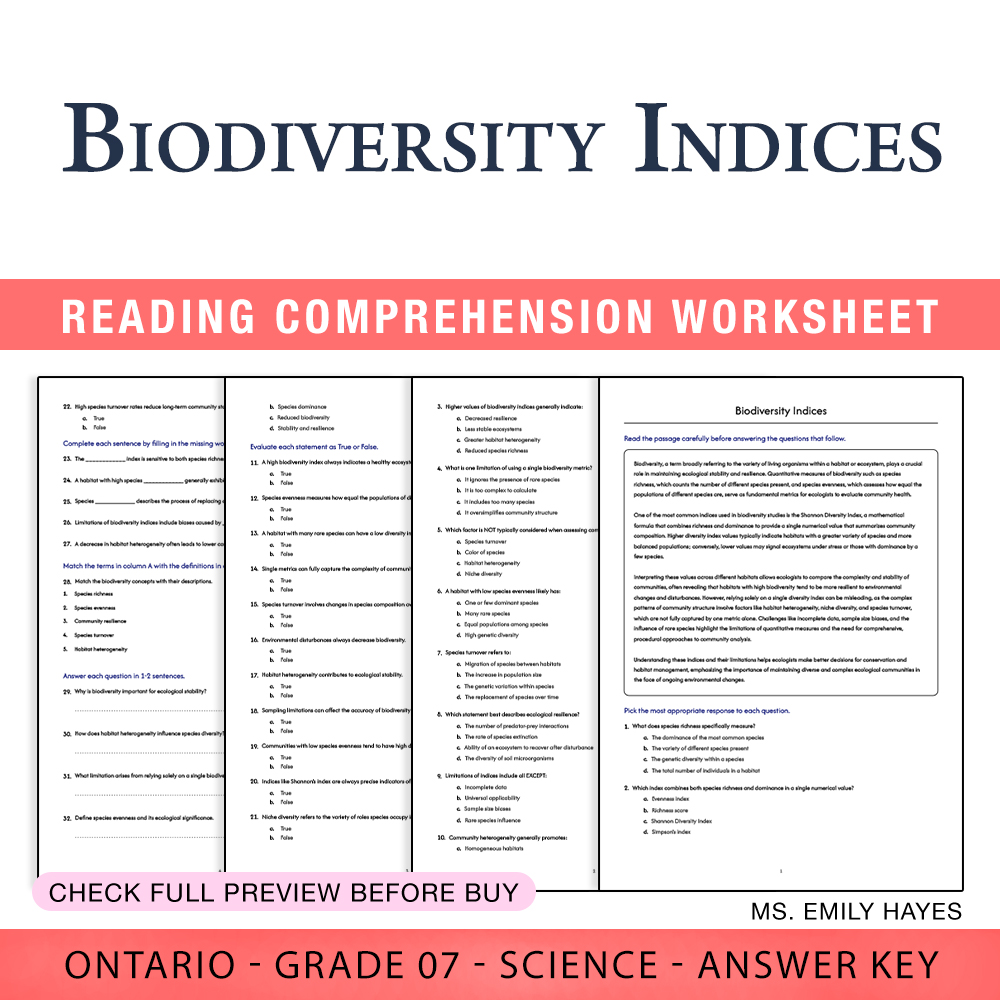
7th Grade Science | Biodiversity Indices Worksheet (PDF+ Answer Key)
 Created byCopper Leaf Classroom
Learning Objectives
- Understand the concept of biodiversity and why it matters in ecosystems
- Identify and interpret key biodiversity metrics such as species richness and evenness
- Explain how diversity indices reflect community structure across habitats
Instant download

Grade 7 Equilibrium Worksheet | NGSS Practice PDF
 Created byClear Sky Classroom
Learning Objectives
- Understand the concept of equilibrium as the balance of forces resulting in constant velocity or rest.
- Identify the differences between static and dynamic equilibrium.
- Apply qualitative and simple quantitative analyses to predict outcomes of objects at rest or moving uniformly.
Also included in: Grade 7 Net Force, Interactions, Collisions Science Lesson Bundle (NGSS) +1 more
Instant download

Grade 7 Science – Decomposition & Ecosystem Productivity | DailyWorksheet
 Created byQuiet Forest Education
Learning Objectives
- Explain the biological and chemical processes involved in decomposition.
- Identify the roles of detritivores, fungi, and bacteria in nutrient cycling.
- Describe how abiotic factors influence the rate of decomposition.
Also included in: Ecosystem Dynamics Grade 7 Science Daily Reading Worksheets Bundle | Ontario +1 more
Instant download

Grade 7 Stoichiometry Worksheet | NGSS Chemical Equations & Mole Ratios
 Created byNorthstar Worksheets
Learning Objectives
- Interpret balanced chemical equations to determine the mole-to-mole relationships between reactants and products.
- Use ratio reasoning and unit consistency to convert between amounts of substances during chemical transformations.
- Scale reactant and product quantities proportionally and predict outcomes using conservation of matter.
Also included in: Grade 7 Physical Science: Matter & Chemical Reactions Lesson Bundle | NGSS +1 more
Instant download

Grade 7 Science | Carrying Capacity Worksheet | BC Aligned
Created byLumora LearningLearning Objectives
- Define carrying capacity and explain its significance in ecosystems.
- Identify limiting factors that influence population size.
- Describe how excess populations affect available resources and environment health.
Instant download

Grade 7 Science Worksheet – Convection Dynamics (Ontario Standards) (PDF)
Created byEvergreen Desk EducationLearning Objectives
- Explain how buoyancy and density differences drive convection in air and water
- Describe how temperature gradients influence circulation cells and heat transport rates
- Connect convective processes to real-world examples such as sea/land breezes, thermals, and lake overturning
Also included in: Grade 7 Thermal Heat Transfer Science Lesson Bundle: Ontario Framework +1 more
Instant download

Energy Conversion Practice Worksheet | Grade 7 Science NGSS Review
Created byPrism Point LearningLearning Objectives
- Explain how energy can change from one form to another while obeying conservation of energy.
- Describe energy transfer and unavoidable thermal losses in real energy-conversion devices.
- Compare efficiency using qualitative ideas and energy accounting across transformation steps.
Also included in: Grade 7 Energy Transfer and Conversion Science Lesson Bundle (NGSS)
Instant download

Mountain Building Worksheet Practice | Grade 7 Science BC Standards
Created byPrism Point LearningLearning Objectives
- Explain how converging tectonic plates can cause crustal shortening, thickening, and uplift during orogeny.
- Describe how continental collisions and subduction zones produce different mountain-belt features.
- Connect erosion and isostatic adjustment to how mountains change over time.
Also included in: Earth's Systems & Processes Lesson Bundle | Grade 7 Science | BC +1 more
Instant download

Scientific Variables Assessment | Florida NGSSS Grade 7 Science
Created byPrism Point LearningLearning Objectives
- Identify independent, dependent, and controlled variables in a scientific investigation
- Explain why controlled variables are necessary for fair comparisons
- Interpret relationships shown in data tables and graphs by linking dependent and independent variables
Instant download

Grade 7 Science Worksheet | Understanding Heat Capacity (PDF) – Alberta Standards
Created bySilver Birch TeachingLearning Objectives
- Define specific heat capacity and explain what its units mean in terms of energy and temperature change.
- Use the heat equation to describe how mass, specific heat, and temperature change affect the energy transferred.
- Convert between joules and kilojoules and between grams and kilograms when solving heat-related problems.
Also included in: Grade 7 Thermal Systems Models and Heat Transfer Science Lesson Bundle – Alberta +1 more
Instant download

Grade 7 Science – Population Growth & Limits | Daily Reading Worksheet
Created byBright Mind ResourcesLearning Objectives
- Understand basic concepts of population growth and decline.
- Distinguish between exponential and logistic growth models.
- Identify limiting factors affecting populations.
Also included in: Grade 7 Ecosystem Stewardship Science Daily Reading lesson bundle | Ontario +1 more
Instant download

Grade 7 Science | Convection Dynamics Worksheet with Short Notes (Printable PDF)
Created byMeadowlark WorksheetsLearning Objectives
- Understand the principles of convective heat transfer in fluids.
- Identify the factors influencing buoyancy and density variations.
- Explain the formation of circulation cells in air and water environments.
Also included in: Grade 7 Science Lesson Group | Thermal Effects and Heat Transfer Worksheets +1 more
Instant download

Chemical Change Evidence Worksheet | Grade 7 Science Practice
Created byPrism Point LearningLearning Objectives
- Identify observable evidence that a chemical change has occurred.
- Explain, using a particle-level model, how bonds can break and form during a chemical change.
- Distinguish chemical changes from physical changes based on whether new substances form.
Instant download

Grade 7 Oral Histories and Seasonal Ecological Knowledge Worksheet | Alberta
Created byBRIGHT PATH RESOURCESLearning Objectives
- Identify the main idea and key details about oral histories as ecological records
- Explain how place-based knowledge helps interpret ecological relationships and seasonal cycles
- Describe how stewardship practices connect human choices to long-term environmental patterns
Also included in: Grade 7 Alberta Science Interactions and Ecosystems Worksheet Bundle +1 more
Instant download

Bitumen Separation Worksheet | Grade 7 Science Activities
Created byPrism Point LearningLearning Objectives
- Explain how physical separation can separate components of oil sands using density and particle size.
- Describe how chemical treatment and temperature changes affect emulsions and dissolved organics.
- Classify processing steps as physical versus chemical changes in bitumen extraction.
Instant download

Grade 7 Science Assessment | Ecological Inquiry Worksheet Elena | Alberta
Created byLumora LearningLearning Objectives
- Understand the systematic approaches used in ecological inquiry.
- Identify key variables and evidence used to interpret ecological data.
- Analyze local examples such as riparian health of the Bow River.
Also included in: Grade 7 Science | Interactions & Ecosystems Custom Bundle | Alberta
Instant download

Grade 7 Science – Niche Interactions & Ecological Relationships | Worksheet
Created byBright Mind ResourcesLearning Objectives
- Understand the concept of mutualism and identify examples in nature
- Analyze how species interactions influence ecological niches
- Recognize the roles of different interactions such as competition and parasitism
Also included in: Grade 7 Ecosystems & Adaptations Science Daily Reading Lesson Bundle | TEKS +2 more
Instant download

Grade 7 Science – Building Envelope Worksheet (PDF) Ontario Standards
Created byEvergreen Desk EducationLearning Objectives
- Explain how walls, roofs, windows, and foundations affect a building’s thermal performance.
- Describe how thermal bridging and air infiltration create heat loss or gain.
- Compare insulation placement and continuous barriers and how they reduce energy use.
Also included in: Grade 7 Thermal Heat Transfer Science Lesson Bundle: Ontario Framework +1 more
Instant download

Reaction Evidence Worksheet | Grade 7 Science Chemical Reactions NGSS
Created byAmber Owl EducationLearning Objectives
- Identify observable indicators that a chemical reaction has occurred, such as gas production, precipitate formation, color change, and temperature change.
- Explain why chemical reactions are often irreversible in composition, using evidence from reaction outcomes.
- Use mass measurements and the conservation of mass to distinguish chemical changes from physical changes.
Also included in: Grade 7 Science Stoichiometry, Mixtures & Material Properties Lesson Bundle | NGSS +1 more
Instant download

Food Web Flows Assessment | General Standards-Aligned Assessment Grade 7 Science
Created byPrism Point LearningLearning Objectives
- Understand how energy flows through food webs from producers to consumers.
- Explain the process of matter cycling in ecosystems and its importance.
- Identify the roles of producers, consumers, and decomposers in an ecosystem.
Instant download
Grade 7 Science – Urban Heat Worksheet (Ontario Standard) (PDF)
Created byBright Mind ResourcesLearning Objectives
- Explain the causes and effects of urban heat island phenomena.
- Identify factors contributing to urban heat and mitigation strategies.
- Analyze how urban surface materials and urban design influence local microclimates.
Instant download
About Grade 7 Science Worksheets
Browse 6,039 printable Grade 7 Science worksheets — ready-to-print PDFs with answer keys where available.
Every worksheet on MyTeachingSheets is created by independent teacher-authors and reviewed before publication. All resources download as printable PDFs for classroom, homework, or at-home practice, and many include answer keys. Preview any worksheet free before buying.