
Grade 7 Science Worksheets
6,039 worksheets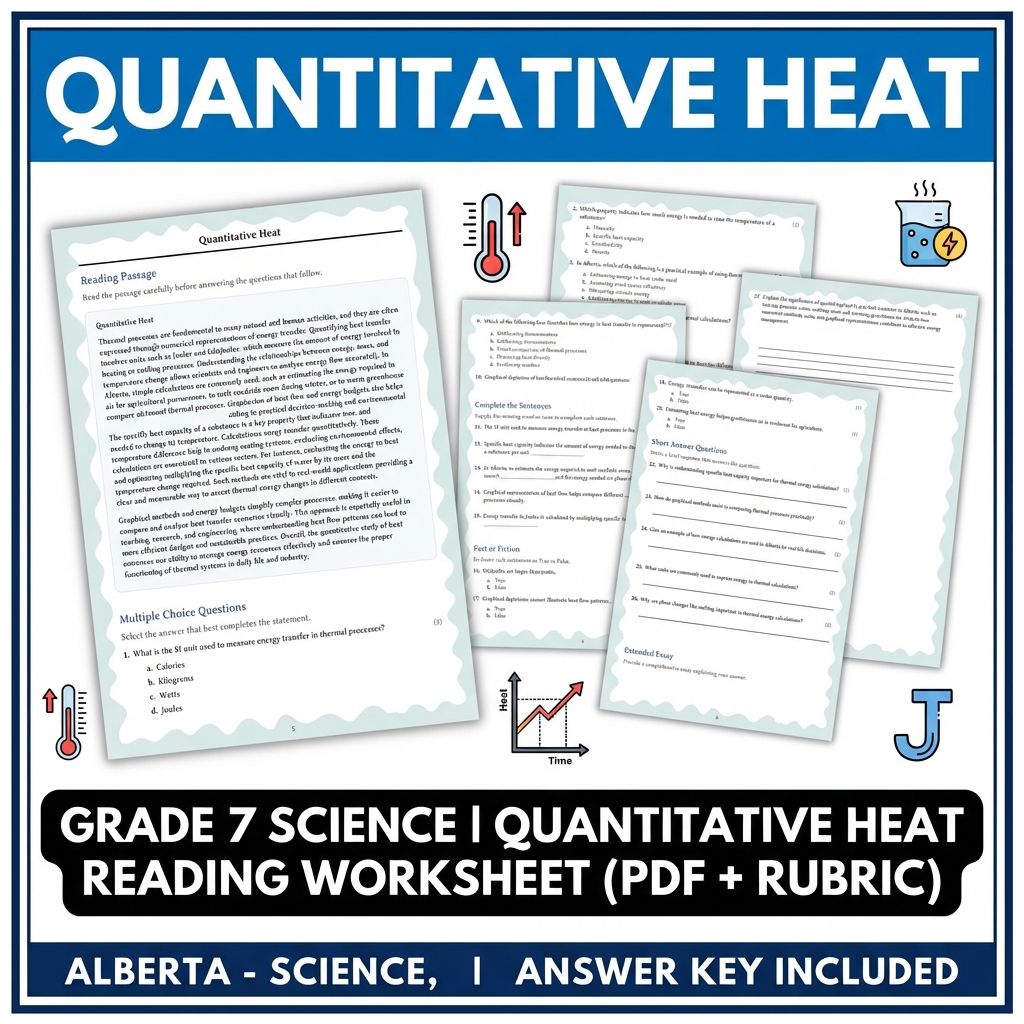
Grade 7 Science | Quantitative Heat Reading Worksheet (PDF + Rubric)
JCreated byJ.S SheetsLearning Objectives
- Understand how numerical representations measure heat transfer in different thermal processes.
- Learn about units of energy and temperature scales used in thermal calculations.
- Apply specific heat, mass, and temperature change to calculate energy transfer in Joules and kilojoules.
Also included in: Grade 7 Science UNIT Bundle | Heat Transfer, Convection & Energy Worksheets +1 more
Instant download
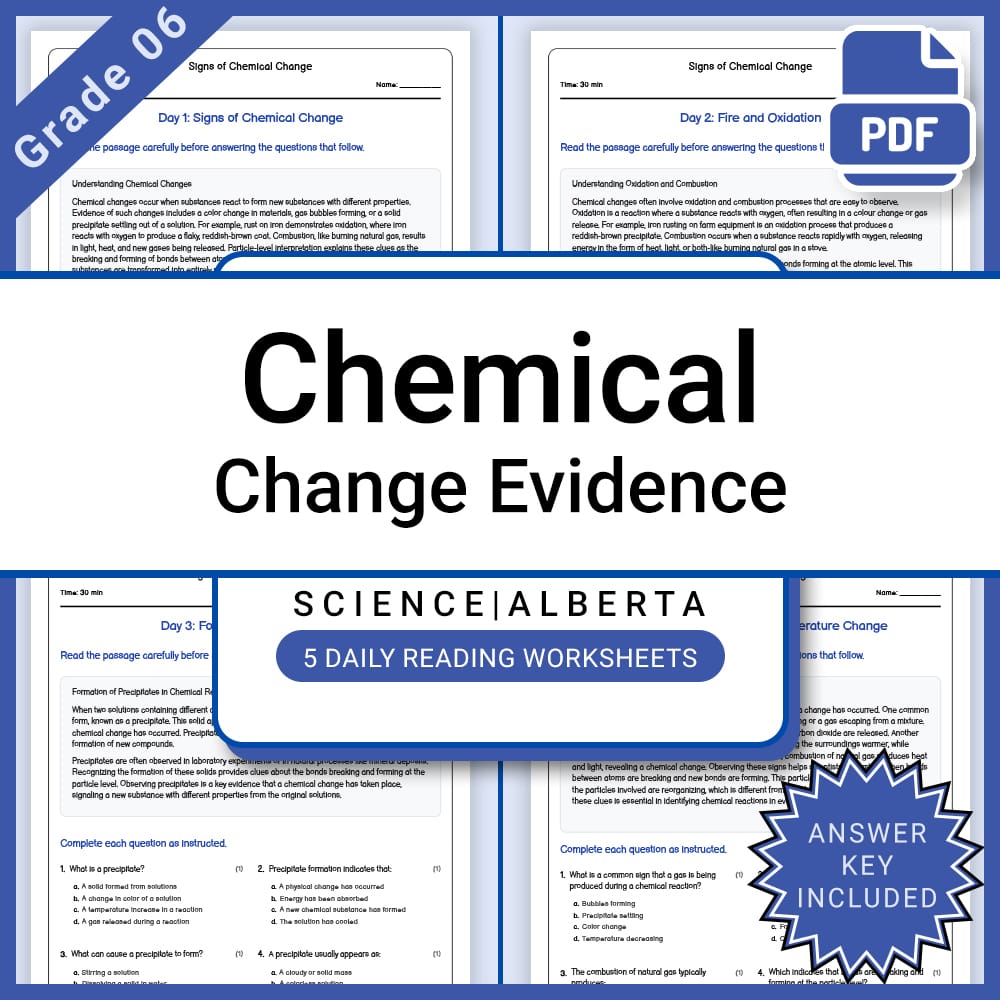
Grade 7 Science – Signs of Chemical Change Daily Reading Worksheet + Answer Key
JCreated byJ.S SheetsLearning Objectives
- Understand key concepts related to Science
- Apply knowledge through practice questions
- Demonstrate comprehension of the material
Also included in: Grade 7 Science Lesson Bundle | Alberta Framework for Classroom Use +1 more
Instant download

Grade 7 Science – Freshwater Reservoirs & Water Cycle Daily Reading Worksheet
 Created byBright Mind Resources
Learning Objectives
- Identify different sources of freshwater such as lakes and aquifers.
- Describe how groundwater systems operate and recharge.
- Explain the importance of porosity and permeability in aquifer function.
Also included in: Earth & Space Grade 7 Science Daily Reading Worksheets Bundle | TEKS +2 more
Instant download

Grade 7 Adaptation Forms Science Daily Reading Worksheet | TEKS Activity
 Created byBRIGHT PATH RESOURCES
Learning Objectives
- Define morphological adaptations as physical traits that improve survival and reproduction.
- Identify how camouflage and body structures help organisms in specific habitats.
- Distinguish adaptation from change caused only by immediate conditions (acclimation).
Also included in: Grade 7 Ecosystems Science Daily Reading Worksheets Bundle | TEKS +1 more
Instant download

Earth System Interactions Worksheet Grade 7 Science
JCreated byJ.S SheetsLearning Objectives
- Explain how the geosphere, hydrosphere, atmosphere, and biosphere exchange matter and energy
- Describe cause-and-effect relationships between Earth systems (e.g., erosion affecting waterways and habitats)
- Use evidence from observations to support an explanation of Earth system interactions over time
Also included in: Grade 7 Weather, Climate, and Earth Processes Science Lesson Bundle +1 more
Instant download

Grade 7 Science | Simple Machines Overview Worksheet (PDF) – Alberta Standards
 Created bySilver Birch Teaching
Learning Objectives
- Identify examples of the six simple machines and describe how each one changes force magnitude or direction
- Explain mechanical advantage as a comparison of output force to input force, using appropriate units and reasoning
- Apply relationships among force, distance, and machine geometry to predict outcomes for everyday tools
Also included in: Grade 7 Simple Machines and Forces Science Lesson Bundle: Alberta +1 more
Instant download

Grade 7 Science Worksheet – Design Criteria & Engineering Standards (PDF)
 Created byEvergreen Desk Education
Learning Objectives
- Explain how design criteria for success can be measurable or observable in a science design problem.
- Identify common constraints (time, materials, cost, safety) and describe how they affect possible solutions.
- Describe trade-offs and improvement by connecting test evidence to criteria rather than appearance.
Also included in: Grade 7 Investigation & Engineering Science Lesson Bundle: General Framework +1 more
Instant download

Science Worksheet The Rock Cycle Grade 7 | Standards-Aligned Practice PDF
JCreated byJ.S SheetsLearning Objectives
- Explain how igneous, sedimentary, and metamorphic rocks form in the rock cycle.
- Describe the roles of heat, pressure, weathering, and mineral cementation in rock transformations.
- Use rock-cycle ideas to make connections between surface and subsurface Earth processes.
Also included in: Grade 7 Weather, Climate, and Earth Processes Science Lesson Bundle +1 more
Instant download

Design Principles Assessment | TEKS Grade 7 Science Standards-Aligned
 Created byPrism Point Learning
Learning Objectives
- Understand key concepts of designing fair and reproducible experiments.
- Identify variables, operational definitions, and control conditions in experiments.
- Recognize ethical, safety, and sample size considerations in research design.
Also included in: Scientific Inquiry Reasoning Grade 7 Science Lesson Bundle TEKS Unit
Instant download

Grade 7 Science | Heat Transfer Models Worksheet (PDF) for Standards
Created byEvergreen Desk EducationLearning Objectives
- Explain how heat transfers from warmer regions to cooler regions using conduction, convection, and radiation models.
- Use a simple heat-transfer model to predict the direction of energy flow based on temperature differences.
- Describe how energy can change form while heat moves through a system.
Also included in: Grade 7 Energy Transfer & Motion Science Lesson Bundle Worksheets (General) +1 more
Instant download

Grade 7 Population Limits Worksheet | Exponential vs Logistic Growth Ontario
 Created byTeacher's Corner
Learning Objectives
- Describe how carrying capacity limits population growth using logistic models.
- Differentiate exponential growth from logistic growth on population graphs.
- Identify limiting factors and explain how density-dependent and density-independent effects differ.
Instant download

Cell Energy Use Assessment Grade 7 Science California Standards
Created byPrism Point LearningLearning Objectives
- Explain how cells convert chemical energy in food into usable energy for life processes
- Describe how ATP functions as an energy carrier within cells
- Connect energy transformations to the idea that matter is conserved during cellular reactions
Also included in: Grade 7 Energy Flow and Matter Cycling Science lesson bundle – California Standards +1 more
Instant download

Grade 7 Science – Connecting Evidence & Claims | Daily Reading Worksheet
Created byBright Mind ResourcesLearning Objectives
- Identify how evidence supports scientific claims.
- Understand the importance of linking data to reasoning.
- Recognize the role of scientific principles in arguments.
Also included in: Scientific Models & Evidence Grade 7 Science Reading Lesson Bundle | General +1 more
Instant download

Earth System Interactions Worksheet Grade 7 Florida NGSSS Science
Created byEvergreen Desk EducationLearning Objectives
- Explain how matter and energy move between Earth’s geosphere, hydrosphere, atmosphere, and biosphere.
- Describe how changes in one Earth system can trigger changes in another system.
- Use evidence from everyday examples (weather, erosion, water availability) to model Earth system interactions.
Instant download
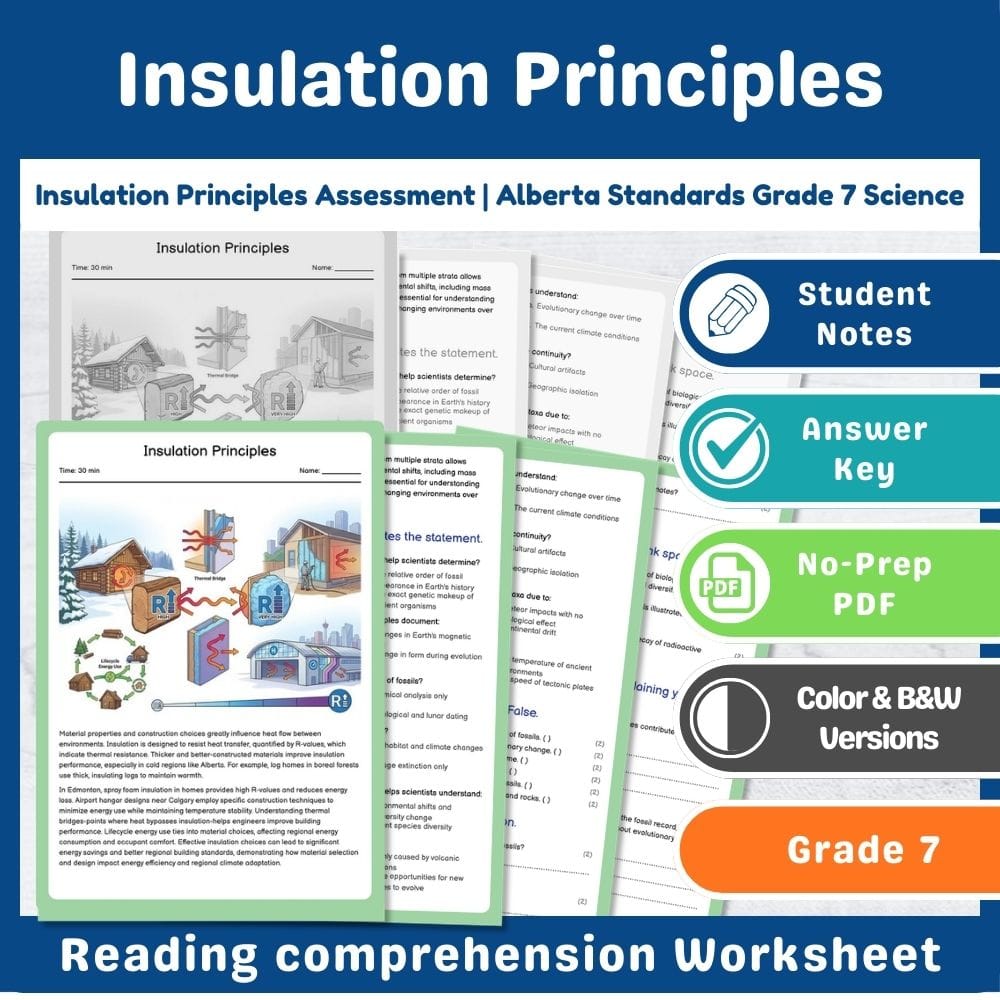
Insulation Principles Assessment | Alberta Standards Grade 7 Science
Created byPrism Point LearningLearning Objectives
- Understand how material properties influence heat flow.
- Identify regional examples of insulation techniques in Alberta.
- Determine the significance of R-values and thermal bridges in building design.
Also included in: Lesson Grade 7 Science Mini Bundle | Energy, Heat & Thermal Processes +1 more
Instant download
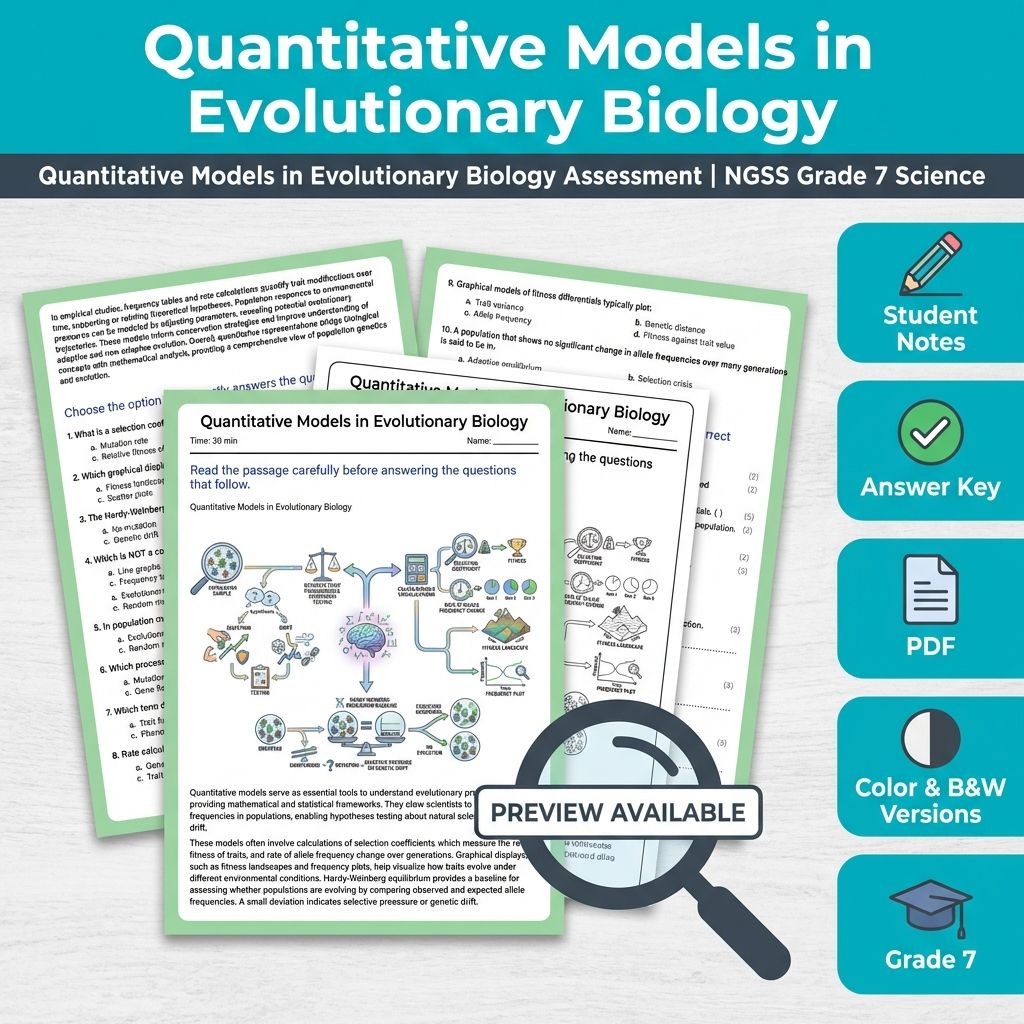
Quantitative Models in Evolutionary Biology Assessment | NGSS Grade 7 Science
Created byPrism Point LearningLearning Objectives
- Understand how mathematical models quantify trait frequencies, selection coefficients, and population dynamics.
- Interpret graphical displays of fitness differentials and allele frequency changes.
- Apply Hardy-Weinberg principles and rate calculations to analyze genetic data.
Also included in: Grade 7 Science Mini Bundle – Biological Evolution: Unity & Diversity +1 more
Instant download

Variable Control Worksheet | Ontario Grade 7 Science Assessment
 Created byCedar Grove Learning
Learning Objectives
- Distinguish independent, dependent, and controlled variables in a fair science investigation.
- Use operational definitions to define how variables are measured or identified during an experiment.
- Design fair tests using replication and controls to reduce confounding and sampling bias.
Also included in: Grade 7 Scientific Inquiry and Data Analysis Science Lesson Bundle - Ontario +1 more
Instant download

Abiotic Drivers Science Worksheet Grade 7 Ontario Ecosystems Activity
 Created byChalk and Compass
Learning Objectives
- Identify key abiotic drivers (temperature, light, soil composition, moisture, and pH) and describe how they influence where organisms live.
- Explain how gradients create environmental templates that affect community structure and species distribution.
- Use organism tolerance ranges to predict which habitats or microhabitats may support different species.
Also included in: Grade 7 Science Ecosystems & Sustainability Lesson Bundle | Ontario +1 more
Instant download

Grade 7 Energy Flow in Ecosystems Worksheet | NGSS Life Science Activity
Created byBRIGHT PATH RESOURCESLearning Objectives
- Understand key concepts related to Science
- Apply knowledge through practice questions
- Demonstrate comprehension of the material
Also included in: Ecosystems & Biodiversity Grade 7 Science Daily Reading Lesson Bundle | NGSS +2 more
Instant download

Grade 7 Science – Quantitative Heat Worksheet (PDF) Alberta Standards
Created bySilver Birch TeachingLearning Objectives
- Use the quantitative heat relationship to calculate energy changes using mass, specific heat, and temperature change
- Convert between joules (J) and kilojoules (kJ) to support correct thermal calculations
- Interpret and compare thermal processes using temperature change and energy budgets
Also included in: Grade 7 Thermal Systems Models and Heat Transfer Science Lesson Bundle – Alberta +1 more
Instant download

Grade 7 Science | Air Masses Fronts Worksheet | California Standards
 Created byLumora Learning
Learning Objectives
- Explain how air masses form and how their temperature and moisture affect local weather
- Describe how fronts act as boundaries where air rises, cools, and can produce clouds and precipitation
- Use evidence such as wind shifts and temperature changes to infer what type of front may be passing
Instant download

Matter Energy Flow Assessment Grade 7 Science California Standards
Created byPrism Point LearningLearning Objectives
- Explain how producers, consumers, and decomposers transfer matter and energy in ecosystems
- Describe how energy flows through food chains and food webs and why energy decreases at higher trophic levels
- Use key vocabulary (producer, consumer, decomposer, trophic level, metabolism, heat) to support scientific explanations
Also included in: Grade 7 Energy Flow and Matter Cycling Science lesson bundle – California Standards +1 more
Instant download

Grade 7 Science Motion Quantities Worksheet | Standards-Aligned Practice
JCreated byJ.S SheetsLearning Objectives
- Understand the basic quantities used to measure motion, including distance, time, and speed.
- Learn how to accurately represent and calculate average speed from tabulated data.
- Identify common sources of measurement error in motion experiments and how to minimize them.
Instant download

Wave Energy Transfer Worksheet Grade 7 Science | Standards-Aligned Practice
JCreated byJ.S SheetsLearning Objectives
- Explain how waves transfer energy without permanently moving matter.
- Differentiate transverse and longitudinal waves using particle motion and wave patterns.
- Use amplitude and wavelength to describe how wave characteristics relate to energy and spacing.
Also included in: Grade 7 Energy Transfer and Change Science Lesson Bundle – General Framework +1 more
Instant download

Earth-Sun Cycles and Seasonal Patterns Worksheet | Grade 7 Science
Created byBRIGHT PATH RESOURCESLearning Objectives
- Explain how Earth’s axial tilt and yearly orbit affect seasons in each hemisphere.
- Describe how Earth’s rotation creates day length and the sun’s apparent daily motion.
- Use patterns in daylight duration to support basic timekeeping ideas such as calendars.
Also included in: Grade 7 Earth Science Worksheets Bundle | Weather, Climate & Earth Systems +2 more
Instant download

Grade 7 Optimization Metrics Worksheet | Practice & Assessment PDF
 Created byClear Sky Classroom
Learning Objectives
- Define optimization metrics and explain how they help compare design options under constraints
- Identify tradeoffs in engineering/science problems using measurable criteria
- Use data and stated targets to justify whether a redesign improves overall performance
Instant download

Grade 7 Science | Inclined Planes - Daily Reading Comprehension
 Created byCoral Reef Learning
Learning Objectives
- Understand the components of forces acting on inclined planes
- Identify parallel and perpendicular force components relative to the slope
- Calculate the mechanical advantage of inclined planes
Also included in: Forces, Structures and Motion Lesson Bundle | Grade 7 Science Alberta +1 more
Instant download

Grade 7 Science – Failure Modes Worksheet (Ontario) (PDF)
Created byEvergreen Desk EducationLearning Objectives
- Identify key structural failure modes such as buckling, fatigue cracking, fracture, and connection/foundation failures.
- Explain how geometry, material properties, and loading conditions affect which failure mode occurs.
- Describe limit states design thinking using safety factors, redundancy, and risk reduction strategies.
Also included in: Grade 7 Engineering Design & Materials Science Lesson Bundle Ontario +1 more
Instant download

Grade 7 Urban Heat Worksheet | Ontario Science Climate & Environment PDF
Created byClear Sky ClassroomLearning Objectives
- Explain how the urban heat island effect forms from surface materials, vegetation loss, and human activities
- Describe how impervious surfaces, reduced evapotranspiration, and building geometry influence local temperature and air movement
- Evaluate mitigation strategies such as greenery, cool pavements, and strategic shading and predict their impacts
Instant download

Geologic Change Hazards Assessment for Grade 7 Science | Standards-Aligned
Created byPrism Point LearningLearning Objectives
- Understand the processes that cause rapid and gradual geologic changes.
- Identify evidence of geologic hazards such as faults, lava flows, and sediment layers.
- Explain how plate tectonics contributes to earthquakes and volcanic activity.
Also included in: Grade 7 Earth & Space Science Lesson Bundle: General Science Framework
Instant download

Net Force Assessment | TEKS Grade 7 Science Standards-Aligned
Created byPrism Point LearningLearning Objectives
- Understand the concept of net force and how it determines motion.
- Learn to interpret free-body diagrams for systems such as elevators, tug-of-war, and carts on ramps.
- Apply vector addition and equilibrium conditions to solve for net force in one dimension.
Also included in: Grade 7 Motion and Energy Science: Lesson Bundle TEKS Unit Assessment
Instant download

Speciation and Biodiversity Worksheets Grade 7 Science Evolution
 Created bythe curious pencil
Learning Objectives
- Explain how reproductive isolation contributes to speciation
- Describe how geographic separation can lead to divergence
- Compare founder effects, polyploidy, and adaptive radiation
Also included in: Biological Evolution Worksheets Bundle | Grade 7 Science NGSS +2 more
Instant download

Grade 7 Science – Chemical Properties & Reaction Types | Daily Reading Worksheet
Created byBright Mind ResourcesLearning Objectives
- Understand the concept of chemical properties
- Identify different chemical properties of substances
- Describe observable signs of chemical reactions
Also included in: Grade 7 States of Matter & Reactions Science Daily Reading Lesson Bundle | BC +1 more
Instant download

Grade 7 Population Dynamics Science Worksheet | Florida NGSSS + Answer Key
Created byEvergreen Desk EducationLearning Objectives
- Explain how births, deaths, immigration, and emigration change population size over time
- Describe how limiting factors and carrying capacity affect population growth
- Use predator-prey and resource competition ideas to predict patterns in population sizes
Instant download

Grade 7 Gas Behavior Science Daily Reading Worksheet | TEKS Activity
Created byBRIGHT PATH RESOURCESLearning Objectives
- Identify the main idea about how gas pressure changes when force is applied.
- Describe key details linking gas pressure to confined volume.
- Explain the idea of pressure as gas particles collide with surfaces.
Also included in: Matter-Energy Grade 7 Science Daily Reading Worksheets Lesson Bundle | TEKS +1 more
Instant download

Ecological Inquiry Worksheet | Grade 7 Science Activities
Created byPrism Point LearningLearning Objectives
- Explain how ecological inquiry uses questions, evidence, and clear conclusions to evaluate relationships in the environment.
- Identify measurable variables and describe how observations and data help test or revise a hypothesis.
- Interpret ecological data while accounting for natural variability and human impacts.
Also included in: Grade 7 Ecosystems & Biodiversity Science Lesson Bundle | Alberta
Instant download

Graphical Representation Science Worksheet Grade 7 Data Graphing Activity
Created byChalk and CompassLearning Objectives
- Select an appropriate graph type for different kinds of data (categorical vs. continuous).
- Construct graphs with clear axes, proportional scaling, units, and correctly interpreted measurements.
- Interpret patterns in graphs by using slope, correlation, trends, and error bars without assuming causation.
Also included in: Grade 7 Science Scientific Inquiry & Data Analysis Lesson Bundle | Ontario +1 more
Instant download

Grade 7 Science Design Optimization Worksheet | NGSS Engineering Design Activity
 Created byNorthstar Worksheets
Learning Objectives
- Explain how engineers use test data and models to refine design parameters under real-world constraints.
- Use quantitative comparisons to justify design changes that improve performance.
- Describe the iterative process of testing, recalibrating predictions, and re-testing to optimize results.
Also included in: ngss engineering design Grade 7 science Lesson Bundle | Solution & Optimization +1 more
Instant download
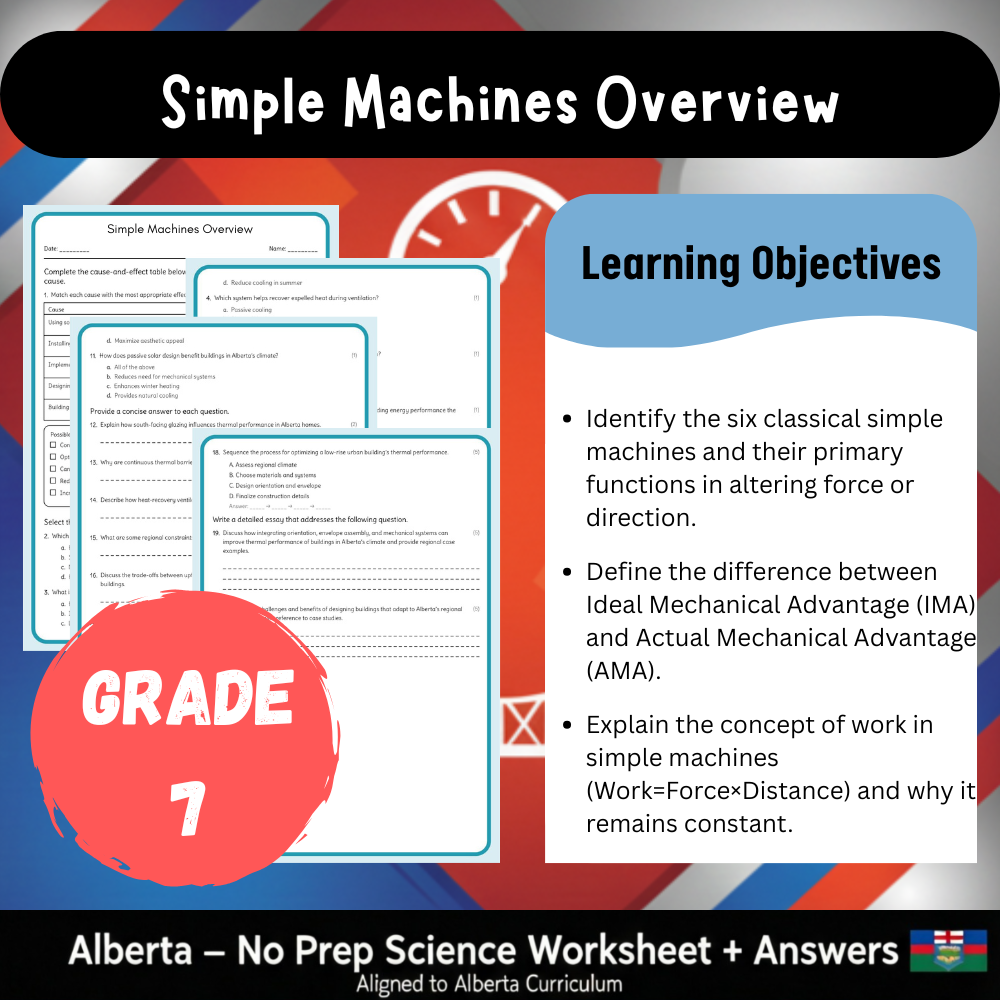
Grade 7 Science | Simple Machines Overview Worksheet (PDF)
Created byBright Mind ResourcesLearning Objectives
- Understand the basic concepts and types of simple machines.
- Explain how simple machines alter force and movement to achieve mechanical advantage.
- Calculate the mechanical advantage of different simple machines using geometric relationships.
Instant download

Grade 7 Science – Material Properties & Building Materials | Reading Worksheet
Created byBright Mind ResourcesLearning Objectives
- Understand the concept of thermal conductivity and factors affecting it.
- Compare thermal behavior of common Alberta construction materials.
- Analyze how porosity, moisture, and layering impact thermal resistance.
Also included in: Grade 7 Heat Transfer Science Daily Reading Worksheets Lesson Bundle | Alberta +2 more
Instant download

Solubility Principles Worksheet | Ontario Grade 7 Science Assessment
Created byCedar Grove LearningLearning Objectives
- Explain how temperature and solvent polarity affect dissolution and solubility
- Use solubility curve ideas to predict whether a solution is unsaturated, saturated, or supersaturated
- Describe how pressure affects the solubility of gases and apply this to real-world situations
Also included in: Grade 7 Matter: Mixtures and Separation Science Lesson Bundle | Ontario +1 more
Instant download

Grade 7 Science – Genotype & Phenotype | Daily Reading Worksheet
Created byBright Mind ResourcesLearning Objectives
- Understand the difference between genotype and phenotype.
- Identify how genetic information influences observable traits.
- Explain how environment interacts with genetics to shape traits.
Also included in: Populations & Traits Grade 7 Science Daily Reading Lesson Bundle | Florida NGSSS +1 more
Instant download

Grade 7 Plate Tectonics Worksheet | NGSS Practice PDF
Created byClear Sky ClassroomLearning Objectives
- Identify key geological evidence supporting plate tectonics and continental movement.
- Understand the significance of seafloor structures like mid-ocean ridges and trenches.
- Explain how fossils, rock types, and geologic features record Earth's past continents.
Also included in: Grade 7 Earth Systems Science Lesson Bundle NGSS: 6 Worksheets +1 more
Instant download

Grade 7 Science – Evidence From Data & Data Analysis | Daily Reading Worksheet
Created byBright Mind ResourcesLearning Objectives
- Understand how to gather and interpret data in scientific inquiries.
- Learn to distinguish between direct observations and interpretations.
- Recognize the importance of relevant evidence and measurement scales.
Also included in: Grade 7 Variables Science lesson-bundle daily reading worksheets | Florida NGSSS +1 more
Instant download
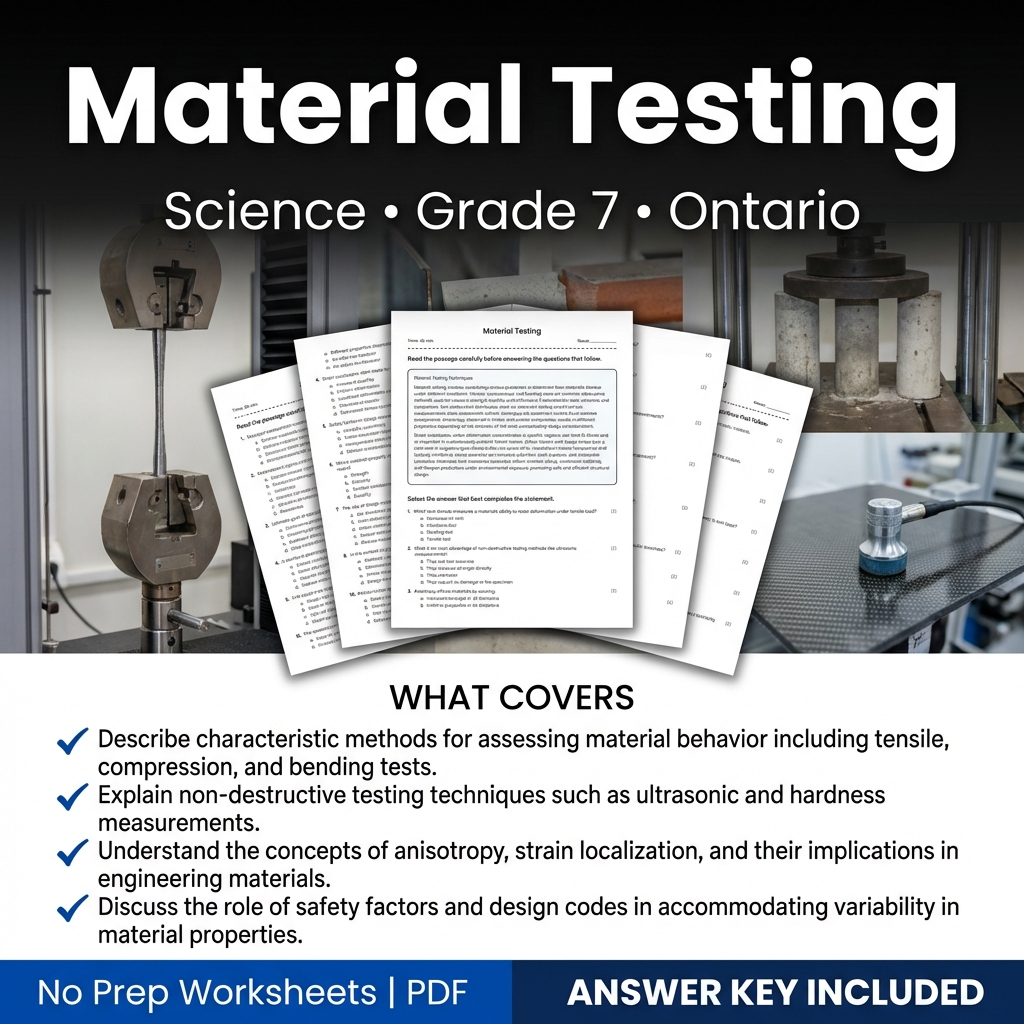
Grade 7 Science Worksheet on Material Testing | Ontario Standards
Created byCoral Reef LearningLearning Objectives
- Describe characteristic methods for assessing material behavior including tensile, compression, and bending tests.
- Explain non-destructive testing techniques such as ultrasonic and hardness measurements.
- Understand the concepts of anisotropy, strain localization, and their implications in engineering materials.
Instant download

Heat Transfer Worksheet | Grade 7 NGSS Conduction Convection Radiation
Created byNorthstar WorksheetsLearning Objectives
- Identify the main mechanisms of heat transfer: conduction, convection, and radiation.
- Explain how heat transfer relates to temperature change and the movement of thermal energy.
- Use examples (spoon in hot liquid, air currents, a lamp, and an electrical circuit) to match evidence to the correct mode of heat flow.
Also included in: Grade 7 Energy Transfer & Transformations Lesson Bundle | NGSS Science +1 more
Instant download

Stoichiometry and Mole Ratios Worksheets Grade 7 Science
Created bythe curious pencilLearning Objectives
- Explain quantitative relationships shown by balanced chemical equations
- Identify mole ratios from coefficients in balanced equations
- Calculate related quantities using proportional reasoning
Also included in: Matter and Its Interactions Worksheets | Grade 7 Science NGSS +2 more
Instant download

Grade 7 Science | Understanding Heat Conduction - Daily Reading Comprehension
Created byCoral Reef LearningLearning Objectives
- Explain the process of heat conduction in solids.
- Identify materials with high and low thermal conductivity.
- Describe how conduction impacts everyday engineering structures.
Also included in: Energy, Heat and Thermal Processes Lesson Bundle: Grade 7 Science Alberta +1 more
Instant download
About Grade 7 Science Worksheets
Browse 6,039 printable Grade 7 Science worksheets — ready-to-print PDFs with answer keys where available.
Every worksheet on MyTeachingSheets is created by independent teacher-authors and reviewed before publication. All resources download as printable PDFs for classroom, homework, or at-home practice, and many include answer keys. Preview any worksheet free before buying.