
Grade 7 Science Worksheets
6,039 worksheets
Ecosystem Models and Predicting Change Worksheets Grade 7 Science
 Created bySunny Desk Resources
Learning Objectives
- Describe how ecological models represent ecosystem relationships using inputs, assumptions, and outputs.
- Identify the difference between qualitative and quantitative modelling approaches.
- Explain why model predictions must be checked against real observations.
Also included in: Interactions & Ecosystems Grade 7 Alberta Science Worksheets Bundle +1 more
Instant download

Grade 7 Science Worksheet on Atomic Structure (TEKS) – PDF
 Created byEvergreen Desk Education
Learning Objectives
- Explain how protons, neutrons, and electrons determine an atom’s properties.
- Use atomic number and mass number to identify elements and describe isotopes.
- Describe how historical atomic models and electron arrangements help explain periodic trends.
Instant download

Grade 7 Technical Communication Science Daily Reading Worksheet | TEKS
 Created byBRIGHT PATH RESOURCES
Learning Objectives
- Identify the purpose of a technical text.
- Determine the main idea using evidence from the passage.
Also included in: Engineering Design Grade 7 Science Daily Reading Worksheets Lesson Bundle | TEKS +1 more
Instant download
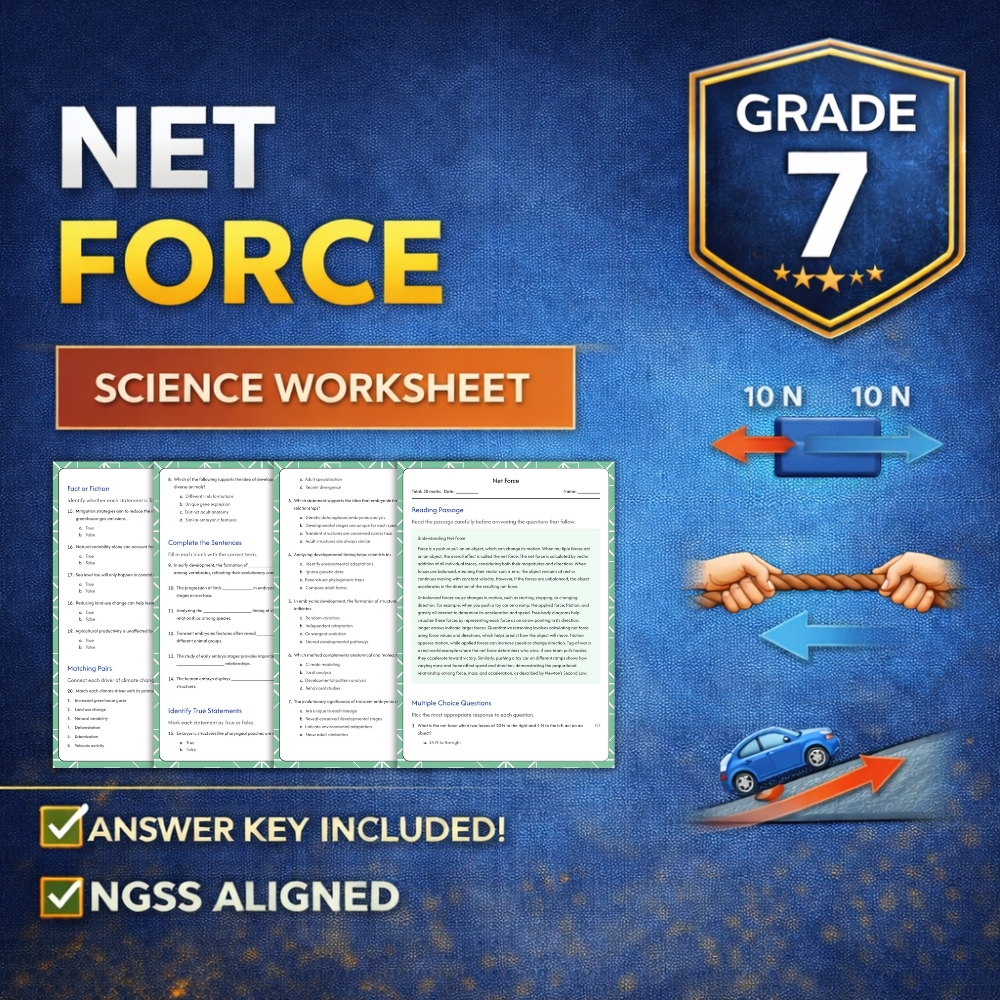
7th Grade Science | Net Force Practice Worksheet (Answer Key Included)
 Created byCedar Grove Learning
Learning Objectives
- Define net force as the vector sum of all forces acting on an object.
- Explain how unbalanced forces cause changes in motion.
- Use free-body diagrams and quantitative reasoning to analyze forces.
Instant download
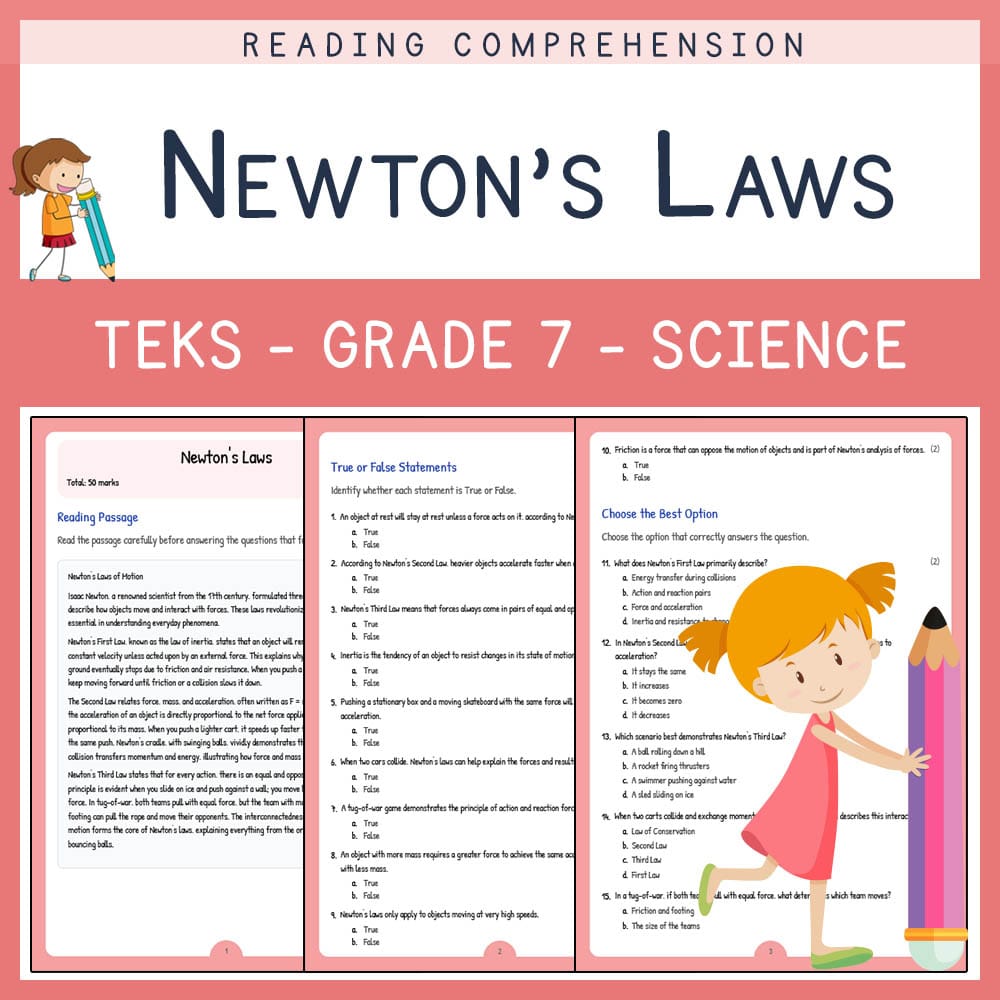
Grade 7 Science | Newton's Laws Worksheet | TEKS-Aligned
 Created byLumora Learning
Learning Objectives
- Understand and explain Newton's three laws of motion through real-world examples.
- Identify situations where inertia, acceleration, and action–reaction pairs occur in everyday life.
- Relate algebraic proportion ideas to force and mass to interpret cause-and-effect relationships.
Also included in: Grade 7 Science | Force, Motion, and Energy Lesson Bundle | TEKS Aligned
Instant download
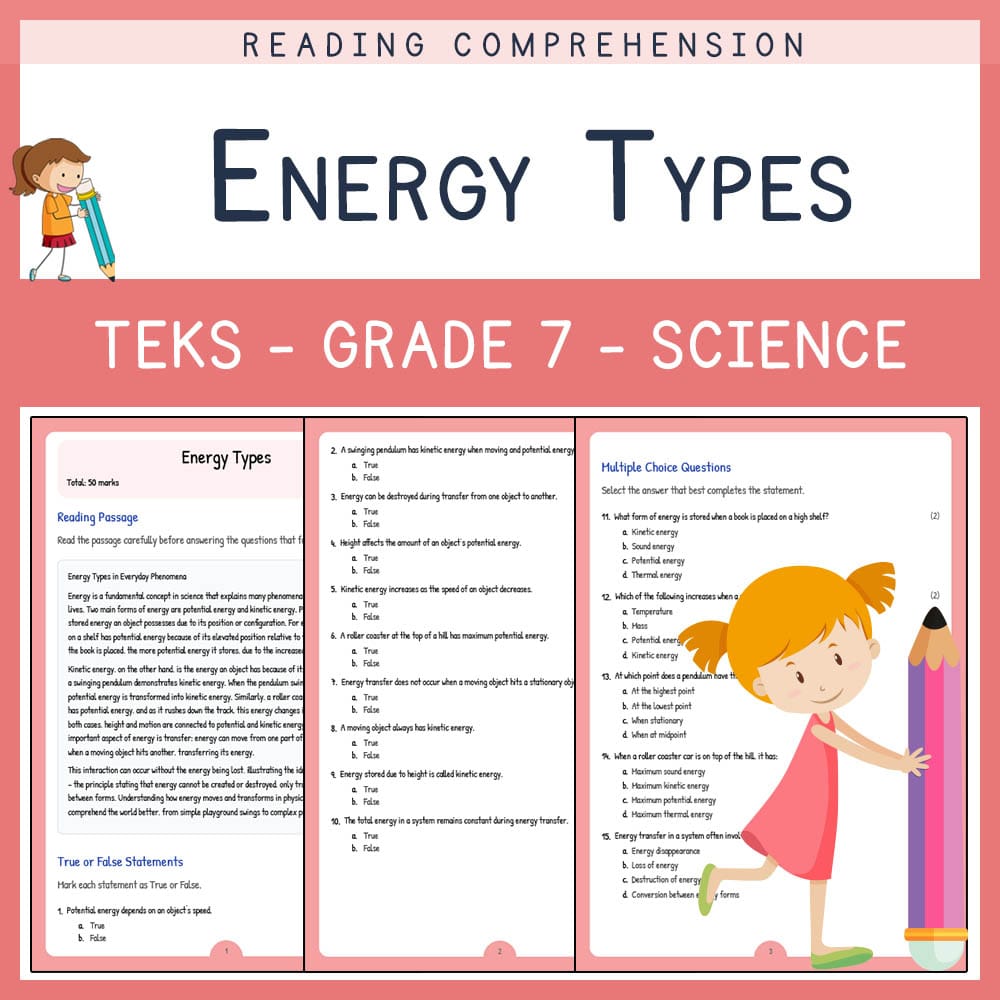
Grade 7 Science | Energy Types Worksheet | TEKS Aligned
Created byLumora LearningLearning Objectives
- Define kinetic and potential energy using everyday phenomena.
- Explain how height and motion influence energy forms.
- Illustrate energy transfer among system components.
Also included in: Grade 7 Science | Force, Motion, and Energy Lesson Bundle | TEKS Aligned
Instant download

Grade 7 Science – Quantitative Heat Worksheet (Ontario) (PDF)
Created byEvergreen Desk EducationLearning Objectives
- Use Q = mcΔT to calculate thermal energy needed to change a substance’s temperature
- Identify and convert key units (joules and watts) used in heat and power problems
- Explain how heat-transfer rate depends on area, temperature gradient, and time
Also included in: Grade 7 Thermal Heat Transfer Science Lesson Bundle: Ontario Framework +1 more
Instant download

Grade 7 Science | Thermal Effects Worksheet (Ontario Standard) PDF
Created byEvergreen Desk EducationLearning Objectives
- Explain how temperature changes cause thermal expansion and contraction in solids and affect volume and density.
- Describe how phase changes (melting/freezing) depend on temperature and how they influence systems.
- Use particle motion to connect microscopic behavior to macroscopic changes such as pressure, volume, and flow.
Also included in: Grade 7 Thermal Heat Transfer Science Lesson Bundle: Ontario Framework +1 more
Instant download

Grade 7 Science Worksheet – Modes of Transfer (Ontario Standard) (PDF)
Created byEvergreen Desk EducationLearning Objectives
- Identify and describe conduction, convection, and radiation as three primary modes of thermal energy transfer.
- Explain the molecular mechanisms behind each mode using grade-appropriate particle ideas.
- Compare the typical media and relative rates (slow/fast or fast/slow) for heat transfer in different situations.
Also included in: Grade 7 Thermal Heat Transfer Science Lesson Bundle: Ontario Framework +1 more
Instant download

Grade 7 Science – Reflective Surfaces Worksheet (Ontario Standard) (PDF)
Created byEvergreen Desk EducationLearning Objectives
- Explain how surface albedo and emissivity affect radiative heat exchange between surfaces and the environment
- Describe how colour and coatings change solar gain and infrared heat transfer
- Compare how reflective roofs and low-emissivity glazing help manage net radiative flux during different times of day and seasons
Also included in: Grade 7 Thermal Heat Transfer Science Lesson Bundle: Ontario Framework +1 more
Instant download
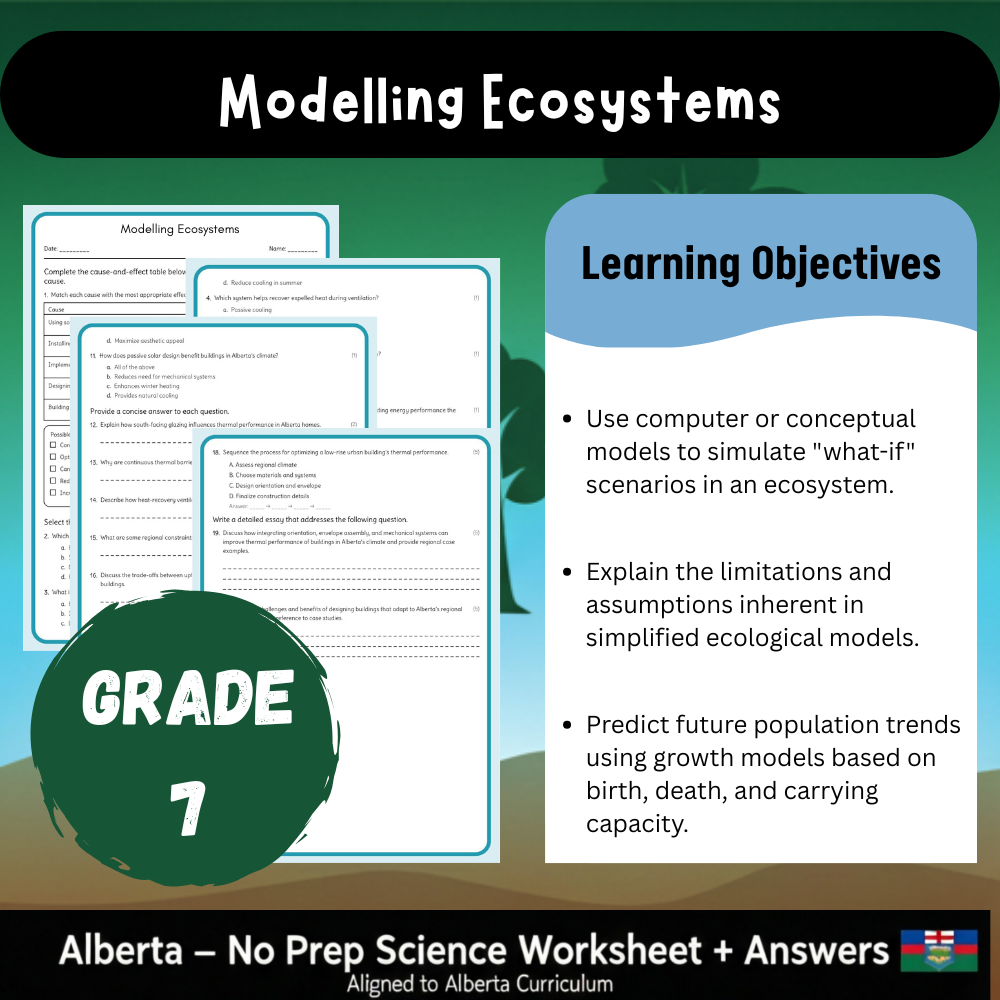
Grade 7 Science | Modelling Ecosystems Worksheet (PDF)
 Created byBright Mind Resources
Learning Objectives
- Explain the purpose and types of ecological models used in environmental science.
- Identify inputs, limitations, and applications of ecological models for regional ecosystems.
- Describe how models support interpretation of ecological data and verify predictions against observations.
Instant download

Mechanical Energy Worksheet | Grade 7 Science Activities
 Created byPrism Point Learning
Learning Objectives
- Explain how mechanical energy can transfer between kinetic and potential forms during motion (e.g., pendulums and springs).
- Describe mechanical energy conservation in ideal systems and account for observable energy losses in real systems.
- Use energy bookkeeping ideas to distinguish closed vs. open systems and nonmechanical energy transfers (like heat and sound).
Also included in: Grade 7 Motion, Forces & Energy Science Lesson Bundle for TEKS Practice
Instant download
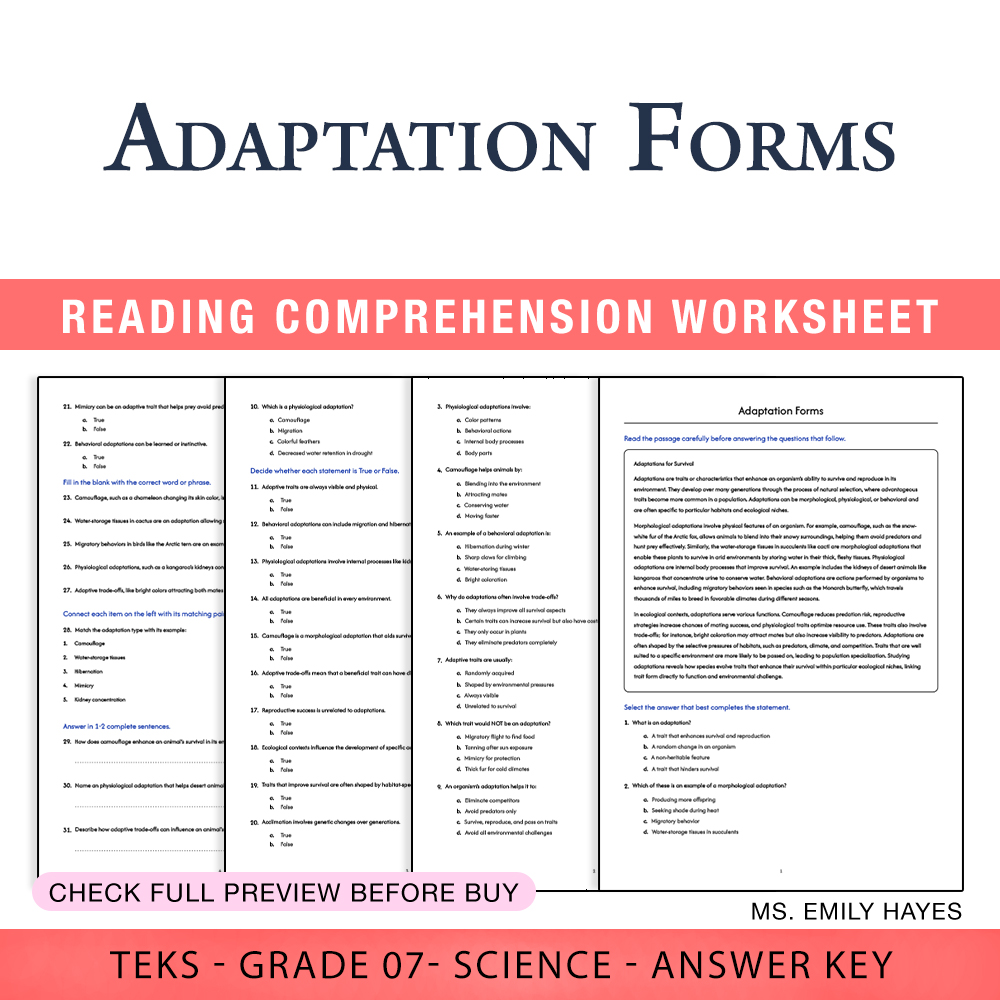
7th Grade Science | Adaptation Forms Worksheet (PDF+ Answer Key)
 Created byCopper Leaf Classroom
Learning Objectives
- Define and distinguish morphological, physiological, and behavioral adaptations with grade-appropriate examples.
- Explain how specific traits improve survival and reproductive success in different environments.
- Identify and analyze adaptive trade-offs and their ecological significance.
Instant download

Grade 7 Science | Acceleration Meaning Worksheet | General Standards
Created byLumora LearningLearning Objectives
- Explain that acceleration describes how quickly velocity changes, including whether the change is positive or negative relative to a chosen direction.
- Use Newton’s second law (Fnet = m·a) to connect net force, mass (inertia), and acceleration.
- Distinguish constant acceleration from changing acceleration by interpreting patterns on velocity–time descriptions.
Instant download
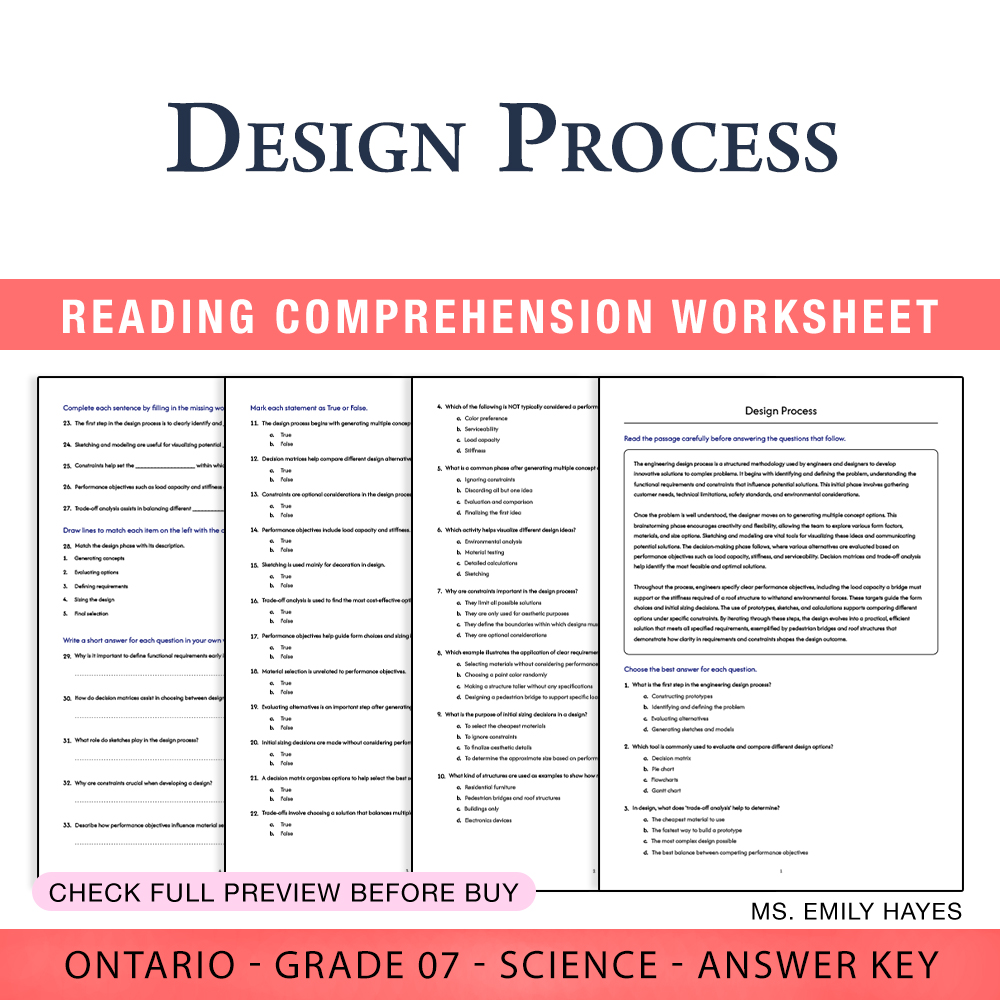
7th Grade Science | Design Process Worksheet (PDF+ Answer Key)
Created byCopper Leaf ClassroomLearning Objectives
- Understand the steps involved in the design process from defining requirements to evaluating alternatives.
- Identify key performance objectives such as load capacity, stiffness, and serviceability.
- Learn how to use decision-making tools like decision matrices and sketches to compare design options.
Instant download

Grade 7 Science – Heat Capacity Worksheet (Alberta Standard) (PDF)
Created byEvergreen Desk EducationLearning Objectives
- Define specific heat capacity and explain how it relates to thermal energy and temperature change
- Use the equation Q = m·c·ΔT to calculate heating energy (in J or kJ) for a given substance
- Convert between common mass and temperature units and report answers with correct units
Instant download
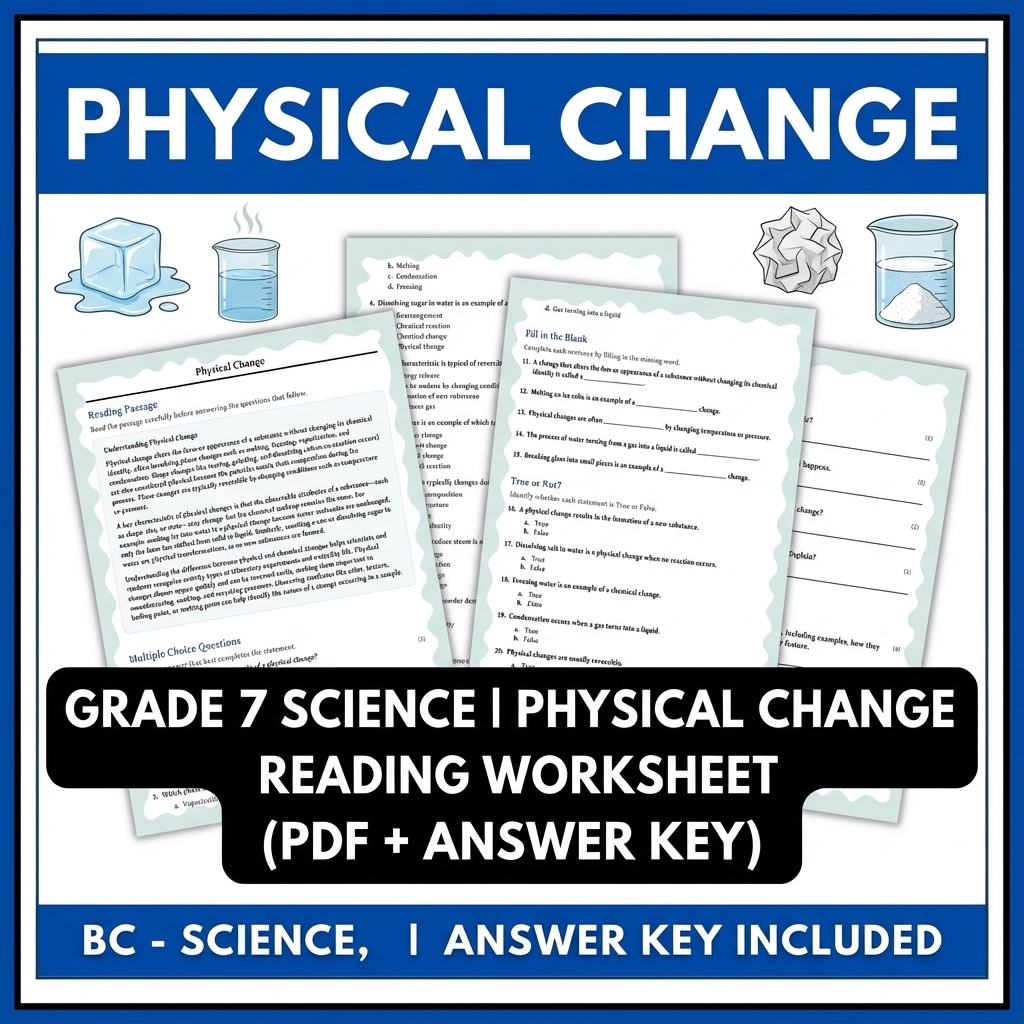
Grade 7 Science | Physical Change Reading Worksheet (PDF + Answer Key)
JCreated byJ.S SheetsLearning Objectives
- Define and describe what a physical change is and how it differs from a chemical change.
- Identify common examples of physical changes in everyday life.
- Explain the reversibility of physical changes under different conditions.
Instant download
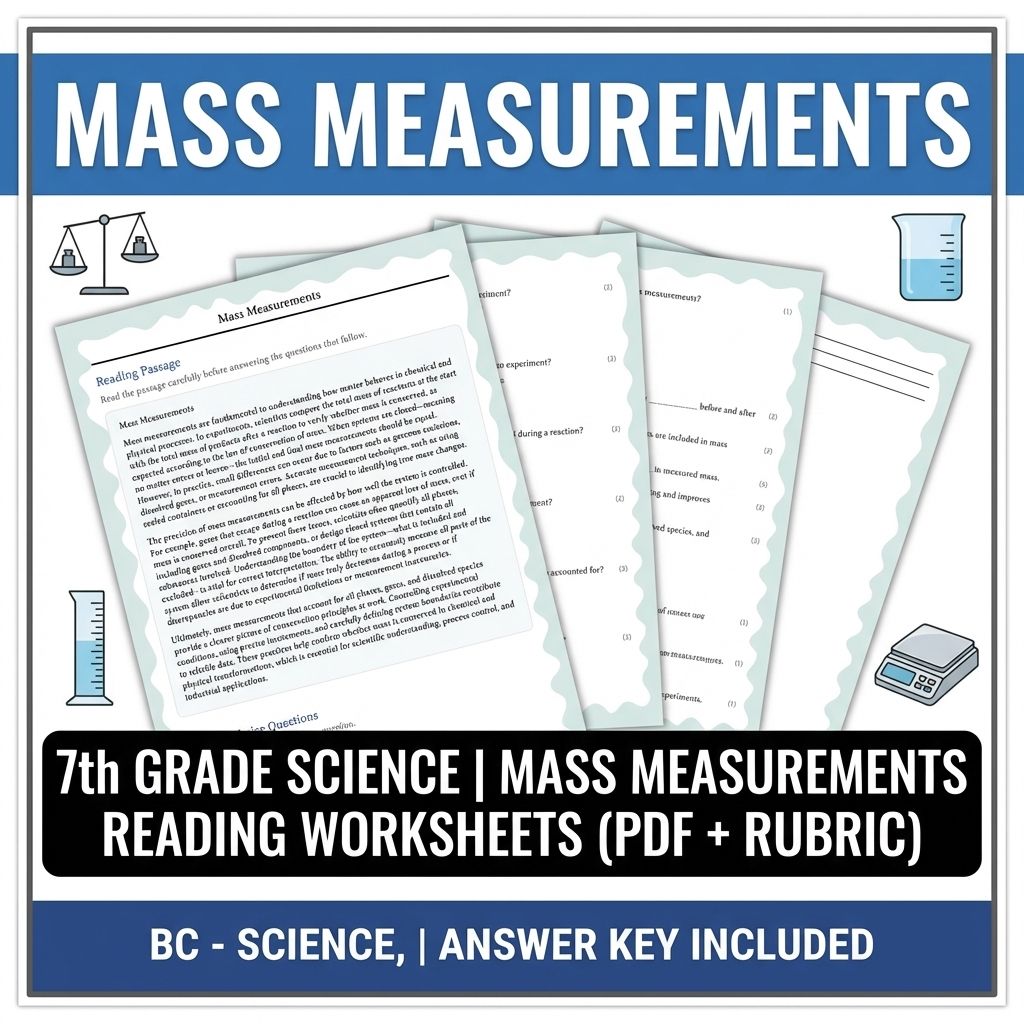
7th Grade Science | Mass Measurements Reading Worksheets (PDF + Rubric)
JCreated byJ.S SheetsLearning Objectives
- Understand the concept of mass conservation in closed systems.
- Learn how to measure and compare mass before and after chemical changes.
- Recognize the factors that influence observed mass differences, such as gases or dissolved species.
Instant download
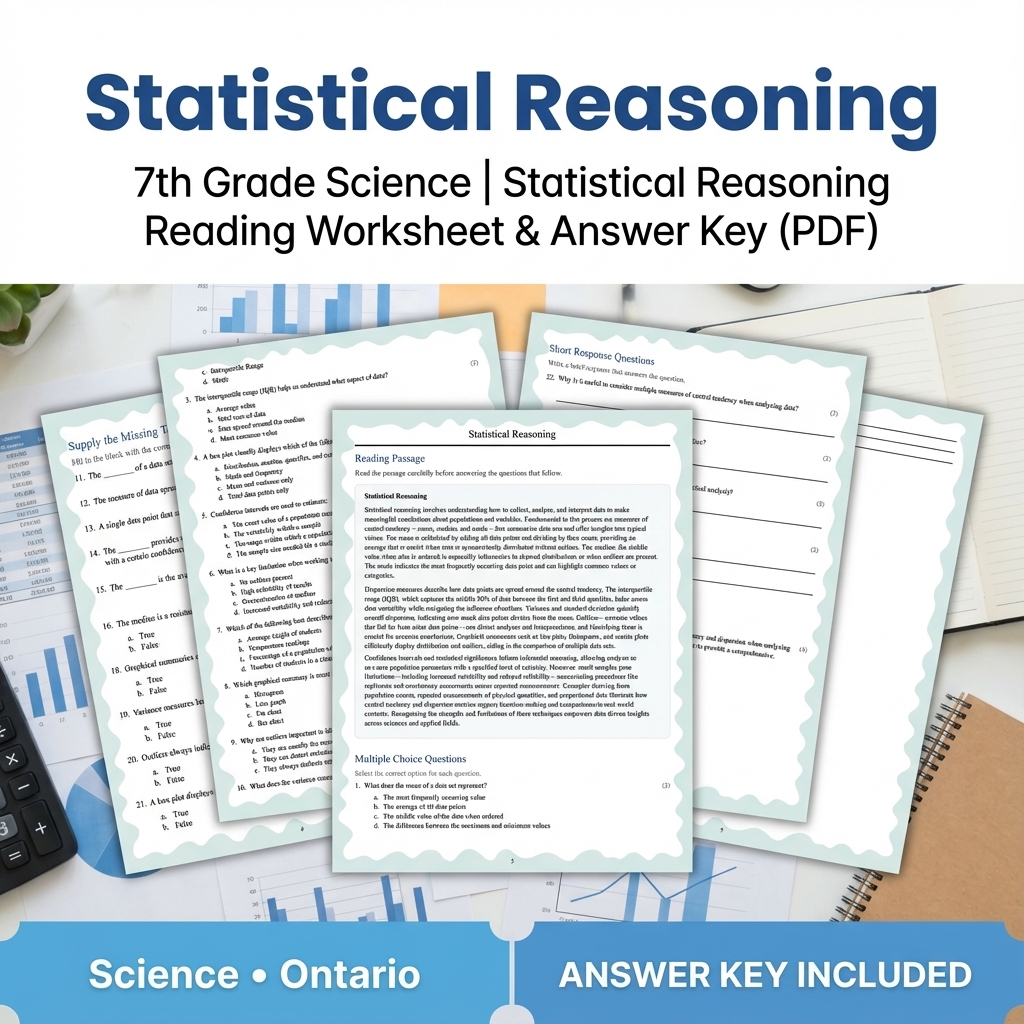
7th Grade Science | Statistical Reasoning Reading Worksheet & Answer Key (PDF)
JCreated byJ.S SheetsLearning Objectives
- Understand key concepts of descriptive statistics such as mean, median, and mode.
- Interpret measures of dispersion including interquartile range, variance, and the role of outliers.
- Identify and analyze simple graphical summaries of data.
Also included in: Grade 7 Science Unit Bundle | Inquiry, Data & Modeling Skills +1 more
Instant download
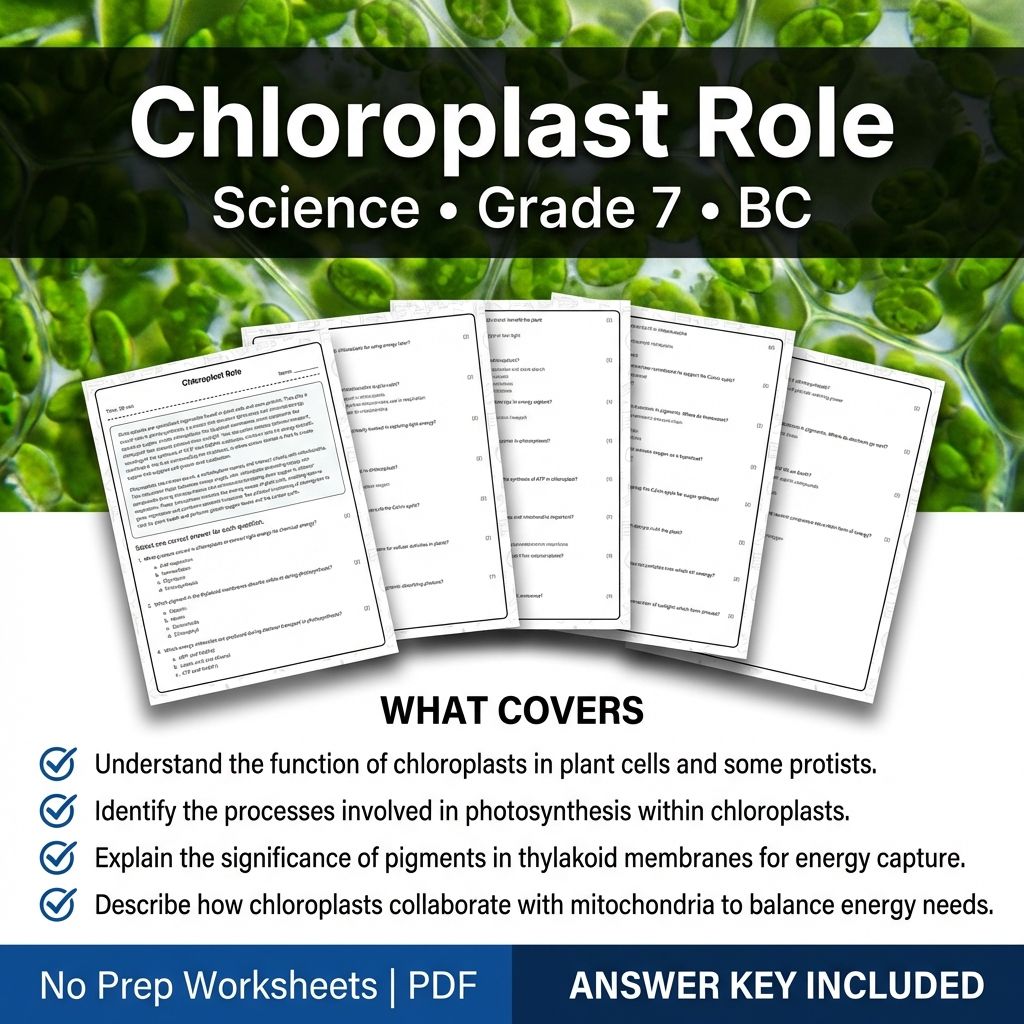
7th Grade Science | Chloroplast Role Worksheet & Answer Key (Printable PDF)
 Created byCoral Reef Learning
Learning Objectives
- Understand the function of chloroplasts in plant cells and some protists.
- Identify the processes involved in photosynthesis within chloroplasts.
- Explain the significance of pigments in thylakoid membranes for energy capture.
Instant download
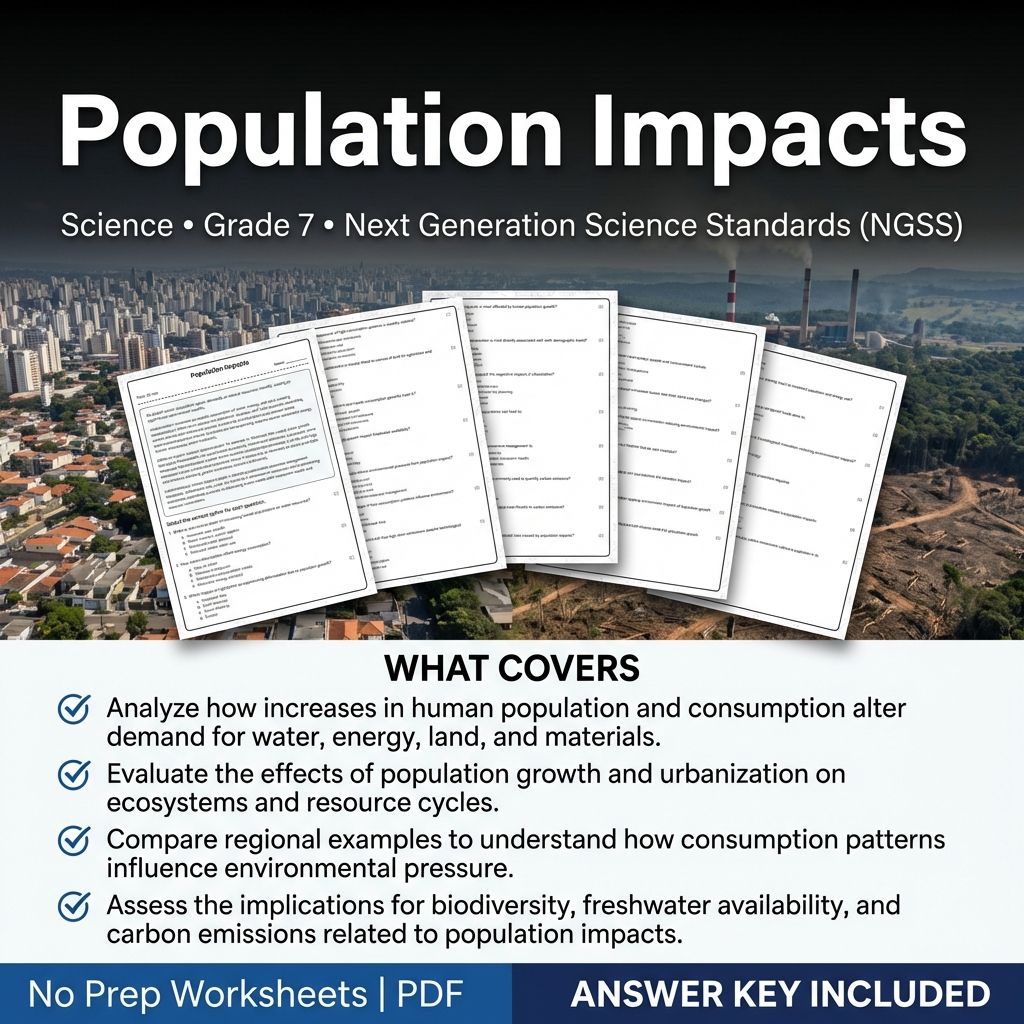
7th Grade Science Worksheet | Population Impacts & Environment (PDF & Answers)
Created byCoral Reef LearningLearning Objectives
- Analyze how increases in human population and consumption alter demand for water, energy, land, and materials.
- Evaluate the effects of population growth and urbanization on ecosystems and resource cycles.
- Compare regional examples to understand how consumption patterns influence environmental pressure.
Instant download
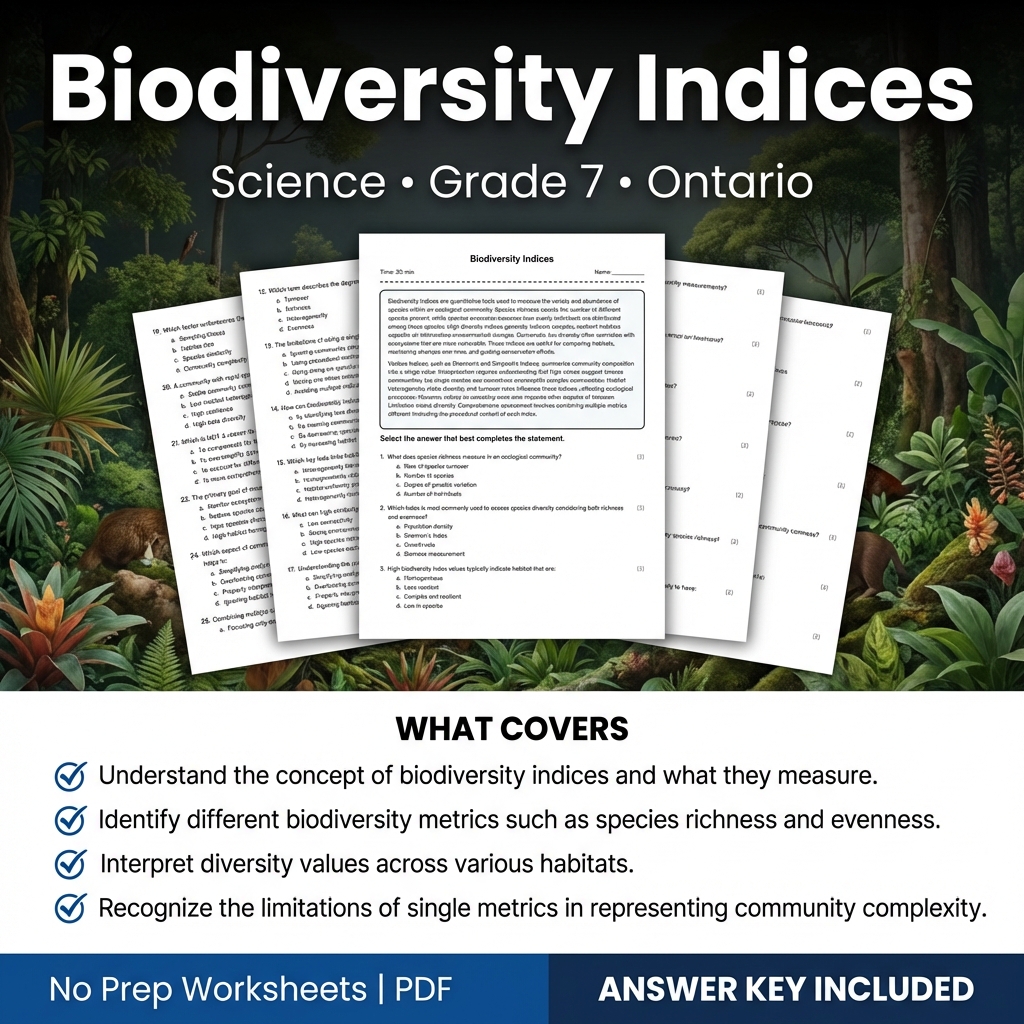
Grade 7 Science Worksheet on Biodiversity Indices | Ontario Standards
Created byCoral Reef LearningLearning Objectives
- Understand the concept of biodiversity indices and what they measure.
- Identify different biodiversity metrics such as species richness and evenness.
- Interpret diversity values across various habitats.
Instant download
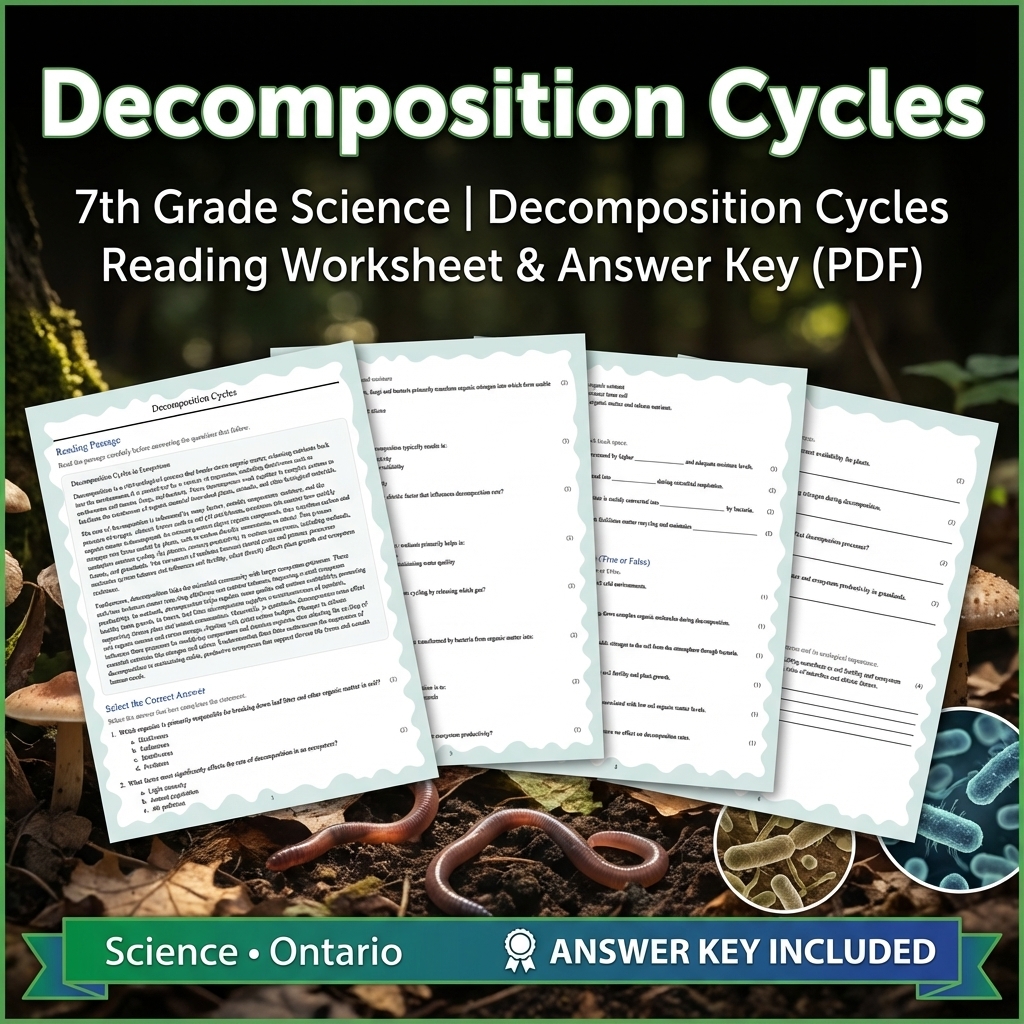
7th Grade Science | Decomposition Cycles Reading Worksheet & Answer Key (PDF)
JCreated byJ.S SheetsLearning Objectives
- Describe the processes involved in decomposition and nutrient cycling.
- Identify roles of detritivores, fungi, bacteria, and abiotic factors in decomposition.
- Explain carbon and nitrogen transformations during decomposition.
Also included in: Grade 7 Science | Ecosystems, Biodiversity & Environmental Stewardship +1 more
Instant download

Grade 7 Solar Patterns Day Worksheet | NGSS Earth and Space Science Activity
Created byBRIGHT PATH RESOURCESLearning Objectives
- Understand how Earth's rotation causes day and night
- Describe the cycle of day and night as observed from Earth's surface
- Identify the tilt of Earth's axis and its role in solar patterns
Also included in: Earth & Space Patterns and Gravity Lesson Bundle | Grade 7 Science | NGSS +2 more
Instant download

Grade 7 Science Worksheet – Producers and Consumers (PDF) Aligned to BC Standards
Created byEvergreen Desk EducationLearning Objectives
- Distinguish between producers and consumers in a food web using trophic roles.
- Explain how energy transfer through trophic levels affects energy pyramids.
- Identify primary, secondary, and tertiary consumers and predict their relationships.
Instant download
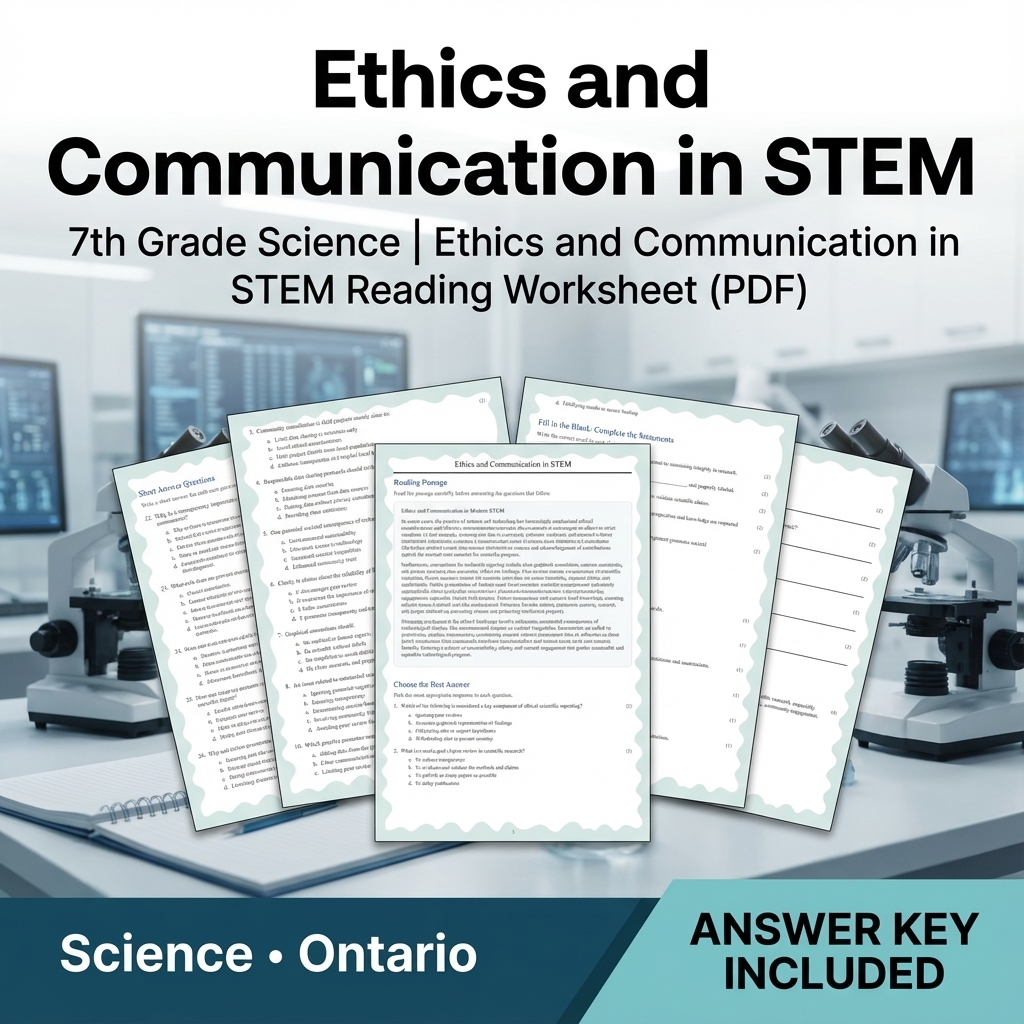
7th Grade Science | Ethics and Communication in STEM Reading Worksheet (PDF)
JCreated byJ.S SheetsLearning Objectives
- Understand the principles of ethical reporting and data integrity in scientific practice.
- Identify conventions for effective graphical annotation and peer review processes.
- Recognize the importance of community consultation and responsible data sharing.
Also included in: Grade 7 Science Unit Bundle | Inquiry, Data & Modeling Skills +1 more
Instant download
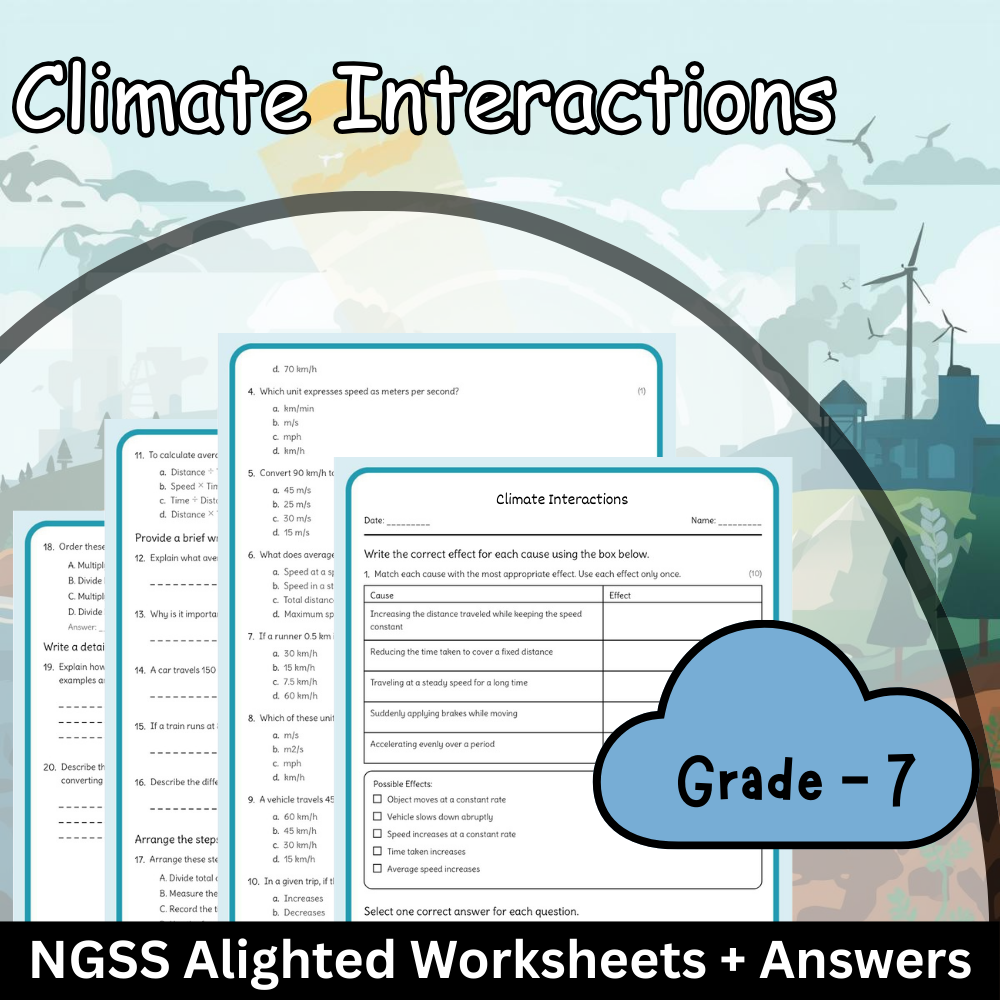
Grade 7 Science | Climate Interactions Worksheet (PDF) – NGSS-Aligned
Created byBright Mind ResourcesLearning Objectives
- Analyze evidence for climate change drivers such as greenhouse gases and land use.
- Assess impacts of climate change on sea levels, precipitation, and agriculture.
- Interpret temperature and CO2 records and understand carbon-cycle exchanges.
Instant download

Pure Substances Worksheet | Grade 7 Science Assessment & Practice
JCreated byJ.S SheetsLearning Objectives
- Understand the defining properties of pure substances such as fixed melting and boiling points, density, and reactivity.
- Distinguish between elements and compounds using physical and chemical tests.
- Identify examples of pure substances, including local minerals and common compounds.
Instant download
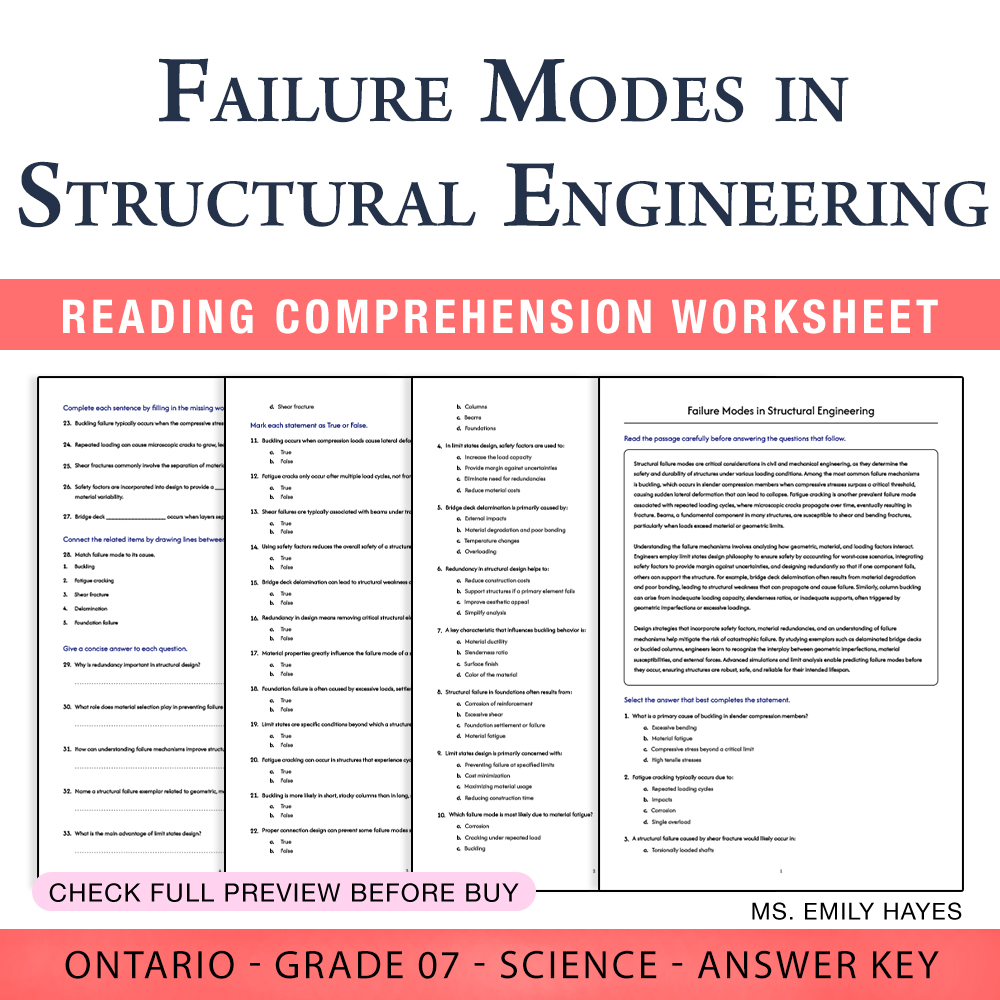
7th Grade Science | Failure Modes in Structural Engineering (PDF+ Answer Key)
Created byCopper Leaf ClassroomLearning Objectives
- Describe common failure modes such as buckling, fatigue cracking, shear and bending fractures, and foundation failures.
- Explain the principles of limit states design, safety factors, and redundancy in mitigating structural risks.
- Relate failure mechanisms to geometric, material, and loading characteristics using real-world exemplars like bridge deck delamination and column buckling.
Instant download

Science Grade 7 Population Dynamics Worksheet | Standards-Aligned Practice
JCreated byJ.S SheetsLearning Objectives
- Explain how population size changes over time due to births, deaths, immigration, and emigration.
- Identify limiting factors that reduce population growth.
- Describe how predator–prey interactions can create oscillations in population numbers.
Also included in: Grade 7 Evolution and Population Dynamics Science Lesson Bundle – Florida NGSSS +1 more
Instant download
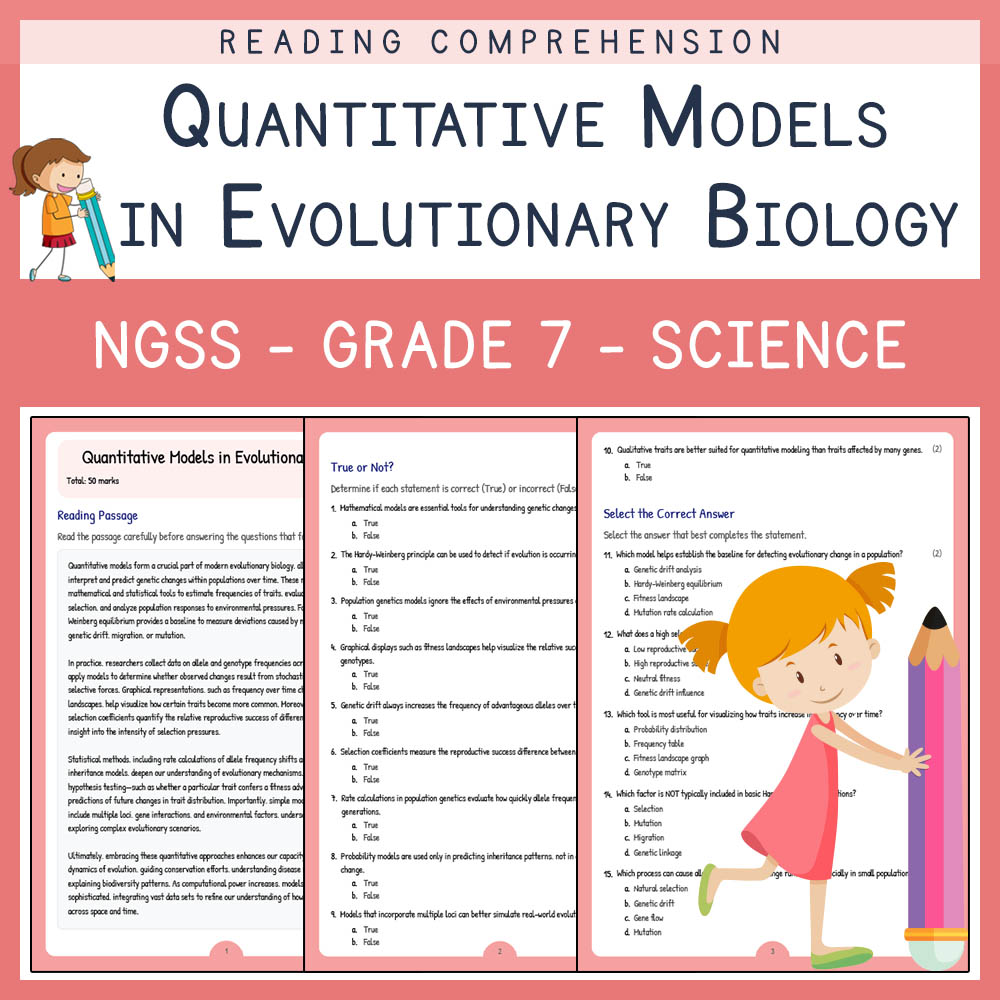
Grade 7 Science | Quantitative Models in Evolutionary Biology Worksheet | NGSS
Created byLumora LearningLearning Objectives
- Understand how mathematical models quantify trait frequencies, selection coefficients, and population dynamics.
- Apply basic Hardy-Weinberg principles and frequency calculations to real-world genetic data.
- Interpret graphical displays of fitness differentials and their implications for evolution.
Instant download
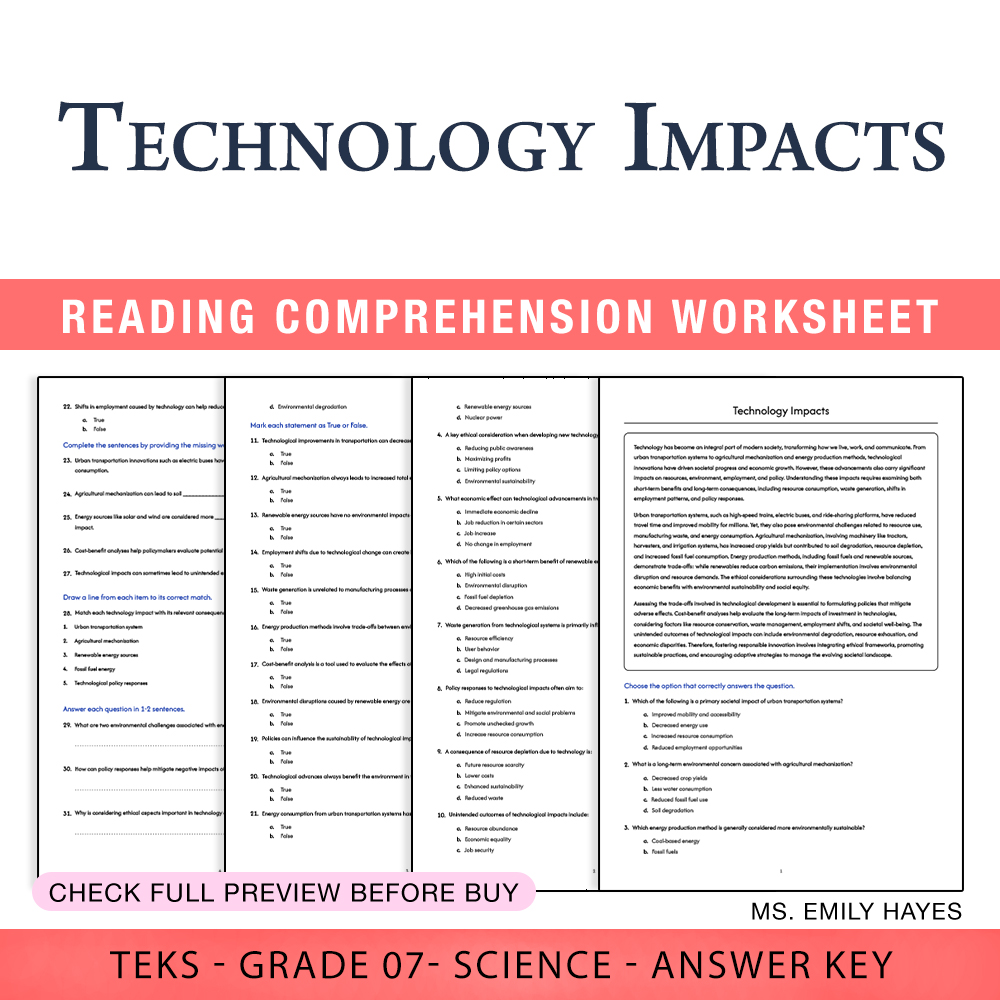
7th Grade Science | Technology Impacts Worksheet (PDF+ Answer Key)
Created byCopper Leaf ClassroomLearning Objectives
- Analyze the societal, economic, and environmental impacts of various technologies.
- Evaluate short- and long-term consequences of technological developments.
- Examine ethical considerations and policy responses related to technology impacts.
Instant download

Grade 7 Thermal Basics: Temperature & Heat Science Worksheet Alberta
Created byBRIGHT PATH RESOURCESLearning Objectives
- Define temperature as a measure of average kinetic energy of particles
- Explain heat as energy transfer due to a temperature difference
- Describe heat transfer by conduction, convection, and radiation
Also included in: Grade 7 Alberta Science Energy Heat and Thermal Processes Worksheet Bundle +1 more
Instant download

Grade 7 Science – Properties & Classification | Daily Reading Worksheet
Created byBright Mind ResourcesLearning Objectives
- Identify and describe physical properties of substances such as density, solubility, hardness, electrical conductivity, magnetism, and flammability.
- Understand how physical and chemical properties are used to classify substances into elements, compounds, and mixtures.
- Apply observation and measurement techniques to distinguish different types of materials based on their properties.
Also included in: 7th Grade States of Matter Science Daily Reading Lesson Bundle | TEKS +2 more
Instant download

Grade 7 Science – Mixtures & Separation Techniques | Daily Reading Worksheet
Created byBright Mind ResourcesLearning Objectives
- Identify different types of mixtures such as homogeneous and heterogeneous
- Describe common physical separation methods including filtration, distillation, chromatography, and magnetic separation
- Explain how differences in solubility, particle size, and boiling points influence separation techniques
Also included in: 7th Grade States of Matter Science Daily Reading Lesson Bundle | TEKS +2 more
Instant download
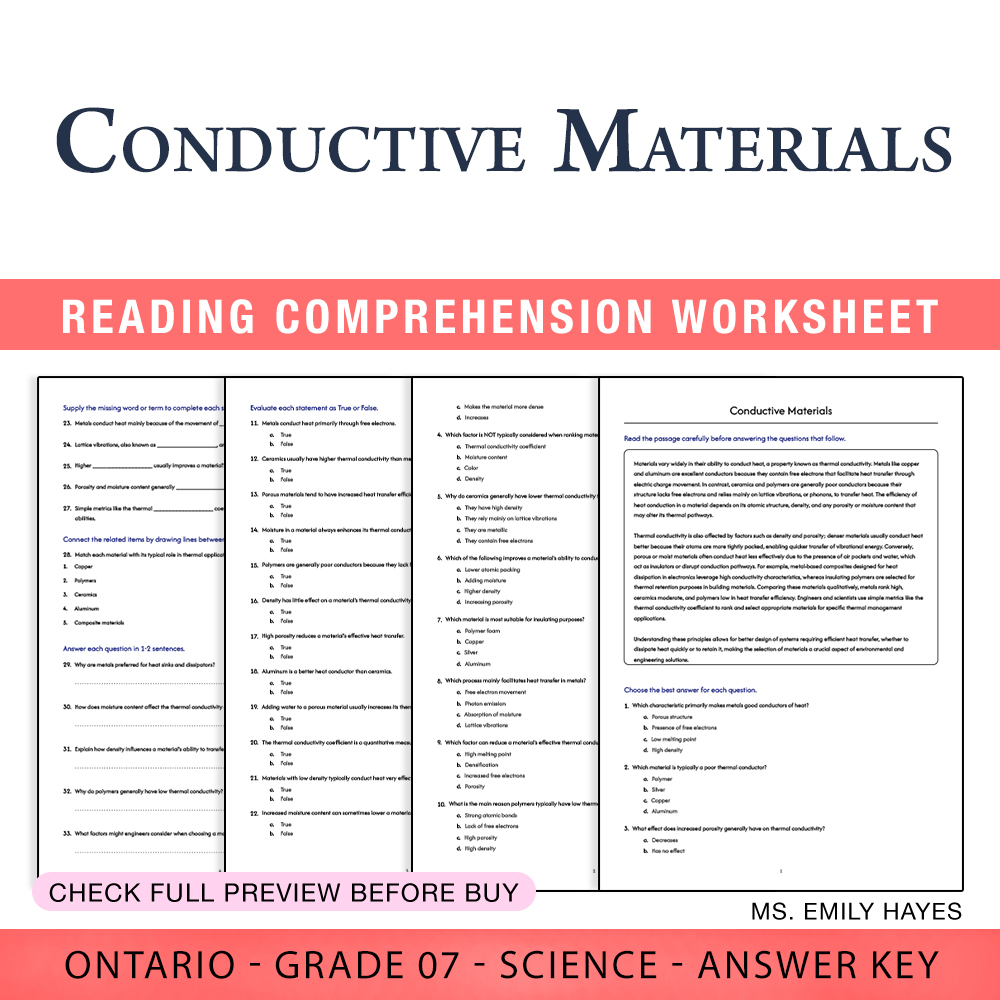
7th Grade Science | Conductive Materials Worksheet (PDF+ Answer Key)
Created byCopper Leaf ClassroomLearning Objectives
- Understand the differences in thermal conductivity among metals, ceramics, polymers, and composites.
- Explain how free electrons and lattice vibrations contribute to heat conduction.
- Analyze how factors like density, porosity, and moisture influence a material's effective thermal conductivity.
Instant download

Grade 7 Science | Measurement Uncertainty - Daily Reading Comprehension
Created byCoral Reef LearningLearning Objectives
- Understand the importance of accuracy and precision in scientific measurements
- Recognize different types of measurement errors
- Learn how to select appropriate measurement instruments
Instant download
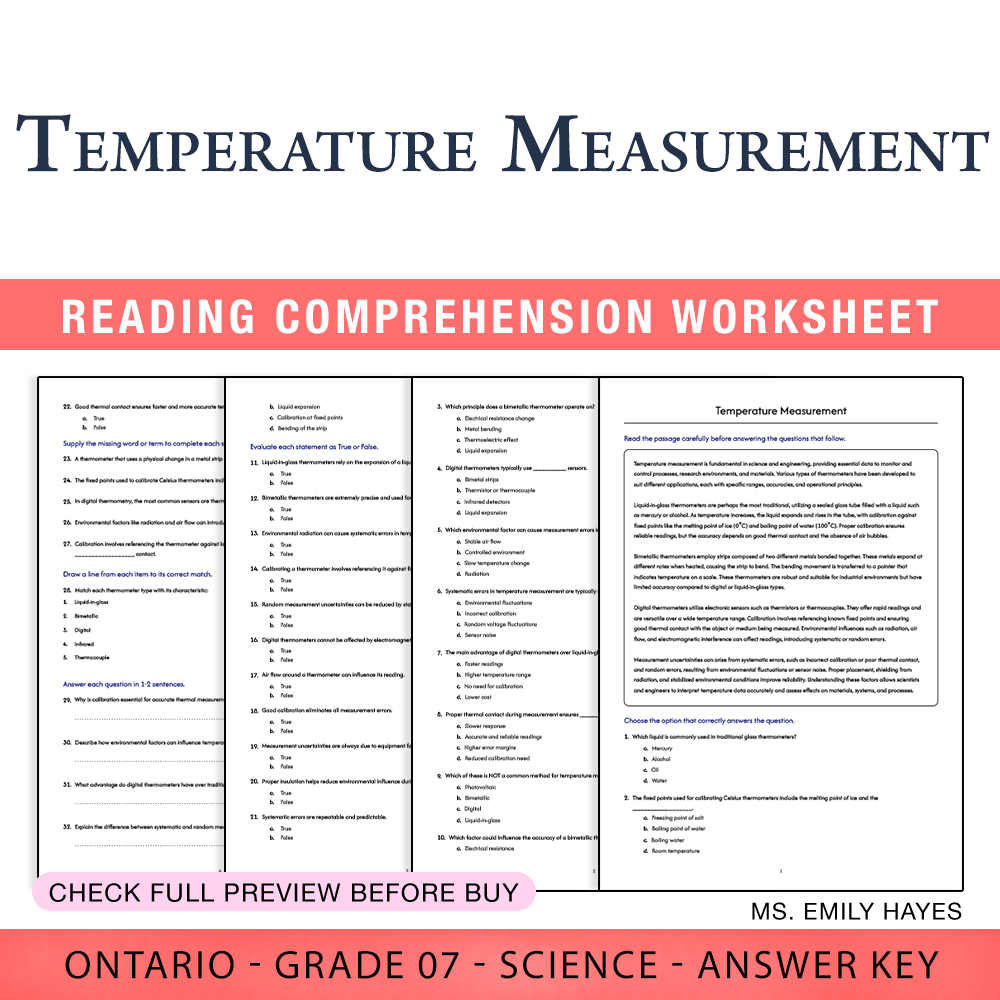
7th Grade Science | Temperature Measurement Worksheet (PDF+ Answer Key)
Created byCopper Leaf ClassroomLearning Objectives
- Understand the principles and instruments used for temperature measurement, including liquid-in-glass, bimetallic, and digital thermometers.
- Explain the concepts of Celsius scale, fixed points, and calibration for accurate temperature readings.
- Identify sources of measurement uncertainty and environmental influences like radiation and air flow on temperature recordings.
Instant download
7th Grade Science Worksheet | Problem Definition NGSS Practice & Answer Key (Printable)
Created byCoral Reef LearningLearning Objectives
- Understand how to clearly define a design problem with measurable constraints.
- Identify real-world examples of specifying performance, material, cost, and safety criteria.
- Translate societal and environmental needs into quantitative specifications.
Instant download
Grade 7 Science – Prototyping Methods Worksheet (PDF) aligned to Ontario
Created byBright Mind ResourcesLearning Objectives
- Understand different prototyping approaches including scaled physical models, digital models, and laboratory rigs.
- Compare advantages and limitations of each prototyping method for assessing structural response.
- Identify instrumentation like strain gauges and displacement transducers used to quantify prototype behavior.
Instant download
Grade 7 Science | Rock Types Worksheet with Short Notes (Printable PDF)
 Created byMeadowlark Worksheets
Learning Objectives
- Identify and differentiate between igneous, sedimentary, and metamorphic rocks based on origin and features.
- Understand the processes involved in the formation of each rock type.
- Analyze mineral content, grain size, and structures to classify rocks.
Also included in: Grade 7 Science Lesson Bundle | Earth Processes Worksheets Group +1 more
Instant download
7th Grade Science Worksheet | Plate Tectonics Practice PDF + Answer Key
Created byCoral Reef LearningLearning Objectives
- Understand the evidence supporting the theory of plate tectonics, including fossil distribution, matching continents, and seafloor features.
- Identify features such as mid-ocean ridges, trenches, volcanoes, and earthquake activity that indicate tectonic plate movement.
- Explain how rock types and fossil assemblages help reconstruct past continental arrangements.
Instant download

Climate Patterns Test Prep Worksheet | Grade 7 Science NGSS
Created byPrism Point LearningLearning Objectives
- Explain how uneven solar heating and surface properties drive atmospheric and ocean circulation.
- Use temperature, wind, and precipitation records to interpret regional climate patterns such as El Niño and monsoons.
- Describe how topography and ocean currents modify local climate conditions.
Also included in: Grade 7 Earth Systems Science Lesson Bundle: NGSS Review Worksheets
Instant download

Chemical Reaction Evidence Worksheets | Grade 7 Science
 Created bythe curious pencil
Learning Objectives
- Identify observations that provide evidence of chemical reactions
- Explain how new substances form during chemical reactions
- Describe conservation of matter using sealed-system mass measurements
Also included in: Matter and Its Interactions Worksheets | Grade 7 Science NGSS +2 more
Instant download

Atomic Models and Bonding Structures Science Worksheets for Grade 7
Created bythe curious pencilLearning Objectives
- Identify atomic models that represent particles and structures.
- Interpret formulas and atomic number using particle information.
- Compare covalent molecules with ionic crystal lattices.
Also included in: Matter and Its Interactions Worksheets | Grade 7 Science NGSS +2 more
Instant download

Synthetic Materials and Production Worksheets | Grade 7 Science
Created bythe curious pencilLearning Objectives
- Describe how natural resources become synthetic materials.
- Explain how feedstocks support material production.
- Explain how polymerization forms long polymer chains.
Also included in: Matter and Its Interactions Worksheets | Grade 7 Science NGSS +2 more
Instant download
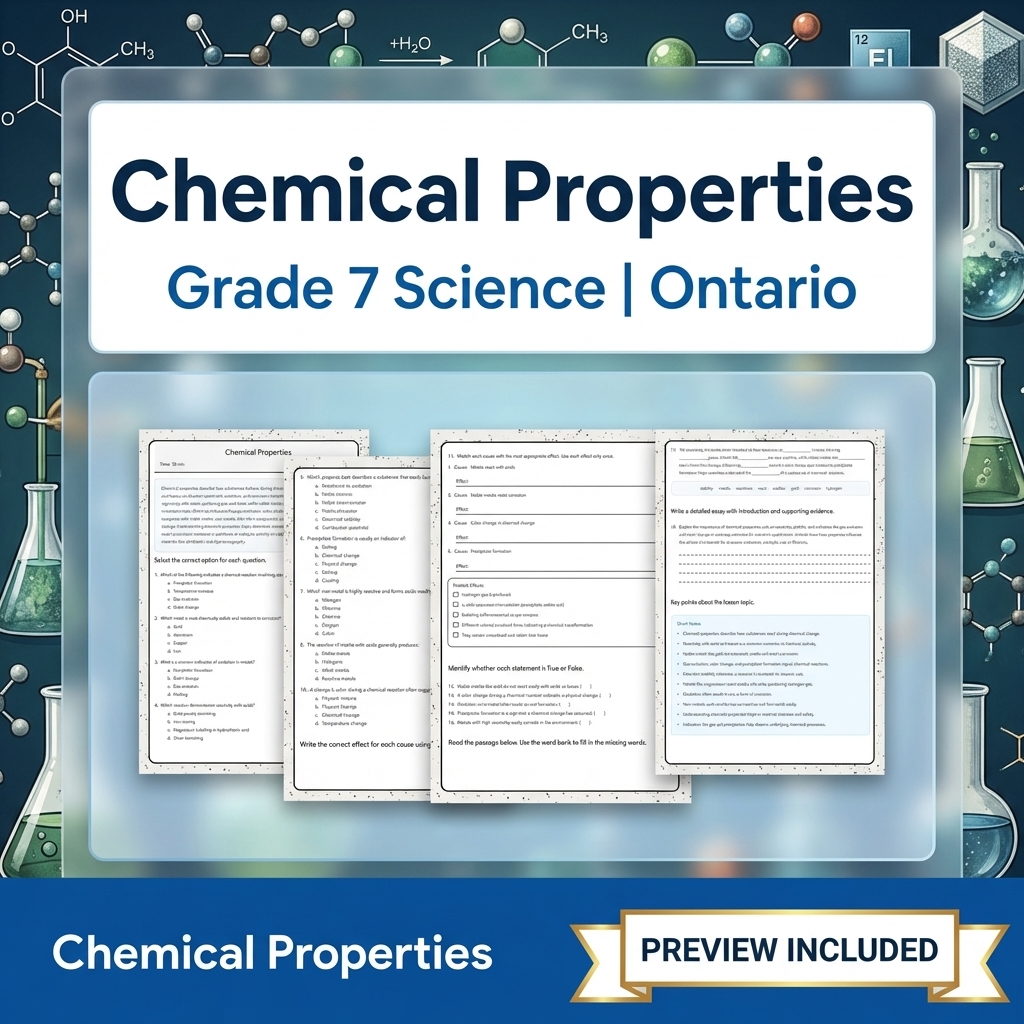
Grade 7 Science | Chemical Properties Worksheet with Short Notes (Printable PDF)
Created byMeadowlark WorksheetsLearning Objectives
- Describe observable indicators of chemical properties such as gas evolution, color change, and precipitate formation.
- Differentiate between chemical stability of noble metals and reactive non-metals.
- Explain how chemical properties influence material suitability and separation methods.
Also included in: Grade 7 Science Lesson Group Bundle – Ontario Curriculum Worksheets +1 more
Instant download

Science Grade 7 Control Methods Worksheet | Standards-Aligned Practice
JCreated byJ.S SheetsLearning Objectives
- Define control conditions and comparison conditions in an experiment.
- Explain how keeping variables the same (except the independent variable) improves credibility of results.
- Describe practical steps such as consistent timing, tool calibration, and standardized handling to reduce unrelated factors.
Also included in: Grade 7 Evidence-Based Scientific Modeling Science Lesson Bundle: General +1 more
Instant download
About Grade 7 Science Worksheets
Browse 6,039 printable Grade 7 Science worksheets — ready-to-print PDFs with answer keys where available.
Every worksheet on MyTeachingSheets is created by independent teacher-authors and reviewed before publication. All resources download as printable PDFs for classroom, homework, or at-home practice, and many include answer keys. Preview any worksheet free before buying.