
Grade 7 Science Worksheets
6,039 worksheets
7th Grade Science | Beam Behavior Reading Worksheet (PDF + Answer Key)
JCreated byJ.S SheetsLearning Objectives
- Understand the key concepts of beam performance under loads, including bending, shear, and deflection.
- Identify how span, support conditions, and load types affect beam stability and comfort.
- Relate real-world examples such as highway overpass girders and building floor joists to beam analysis.
Also included in: Grade 7 Science | Forces, Motion & Structural Concepts (Answer Keys Included) +1 more
Instant download

Grade 7 Science Worksheet on Stoichiometry | NGSS-Aligned Practice
JCreated byJ.S SheetsLearning Objectives
- Understand how to interpret and balance chemical equations to reflect quantitative relationships.
- Apply mole ratios from balanced equations to calculate amounts of reactants and products.
- Use conservation principles to predict reagent needs and product yields in chemical reactions.
Also included in: Grade 7 Structure and Properties of Matter Science Lesson Bundle: NGSS +1 more
Instant download
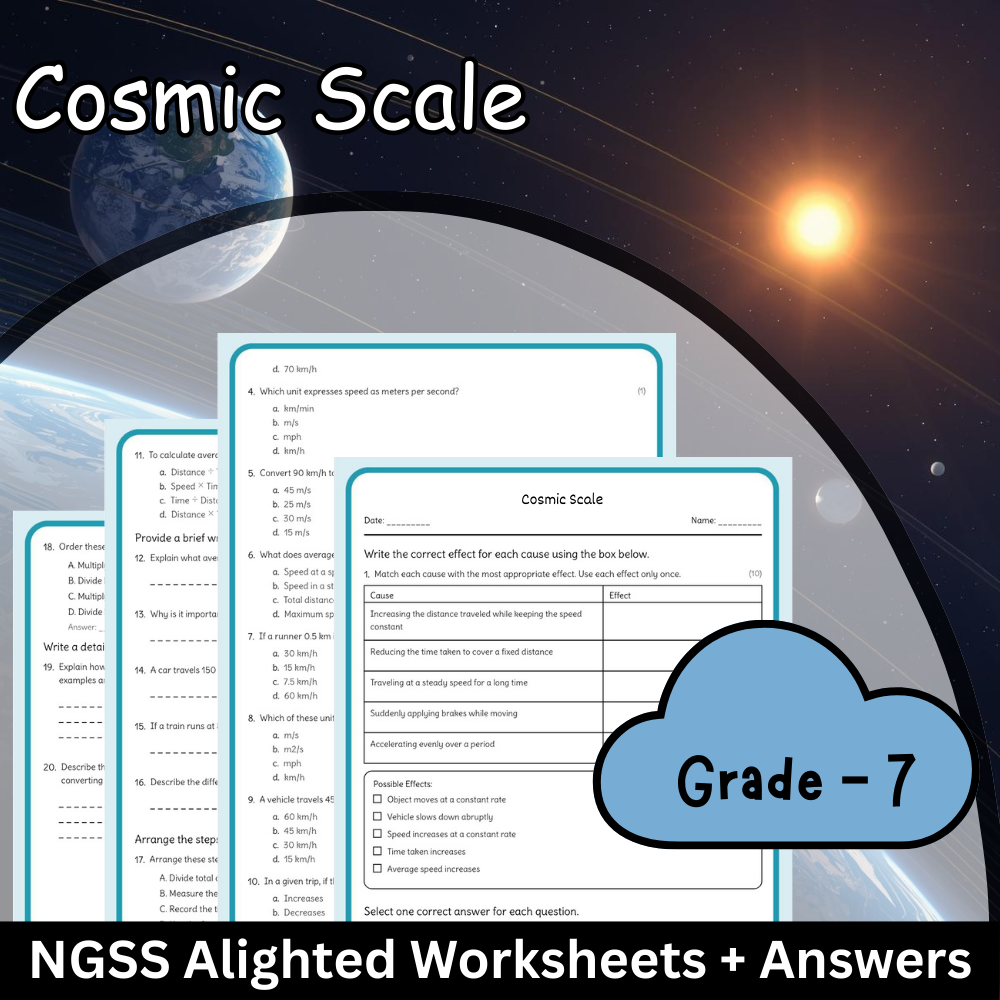
7th Grade Science | Cosmic Scale Worksheet (NGSS Aligned, PDF)
 Created byBright Mind Resources
Learning Objectives
- Understand how to compare sizes and distances within the solar system and beyond using different units of measurement.
- Interpret scaled diagrams and logarithmic representations of astronomical data.
- Analyze orders of magnitude differences and their effects on observation and perception.
Instant download
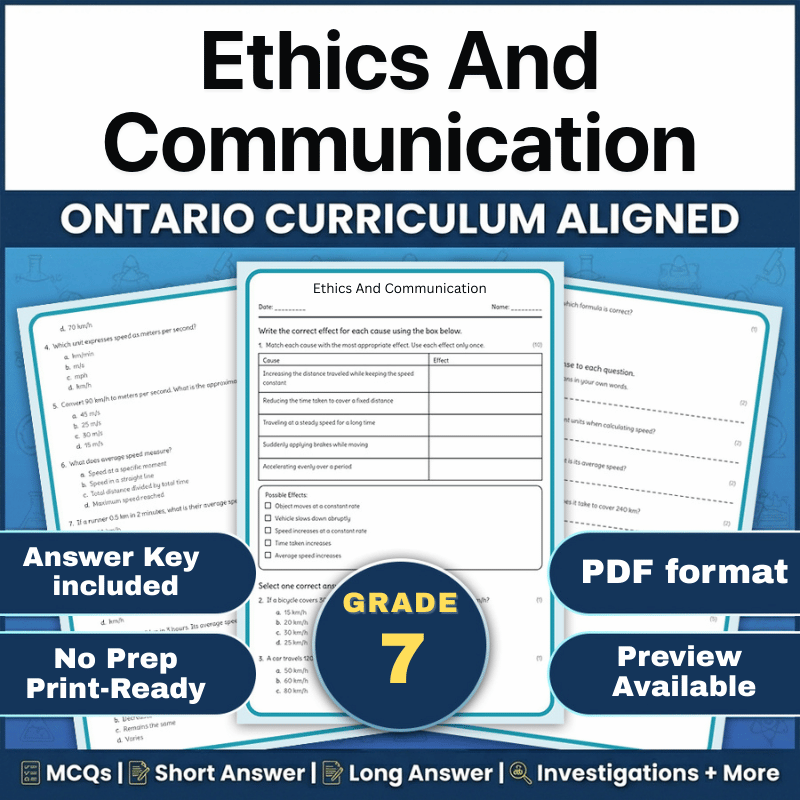
Grade 7 Science – Ethics and Communication Worksheet (Ontario Standards) (PDF)
Created byBright Mind ResourcesLearning Objectives
- Understand the importance of ethical practices in scientific and technological communication.
- Identify key conventions and protocols used in technical reporting and data sharing.
- Evaluate the societal implications and responsibilities associated with scientific communication.
Instant download

7th Grade Science Worksheet | Friction & Gravity TEKS (PDF)
 Created byEvergreen Desk Education
Learning Objectives
- Explain how friction acts as a contact force that resists motion and how surface roughness changes friction’s effect
- Describe how gravity is a long-range force that causes acceleration near planetary surfaces
- Differentiate weight, normal force, and friction using examples such as sliding blocks and objects on inclined planes
Instant download
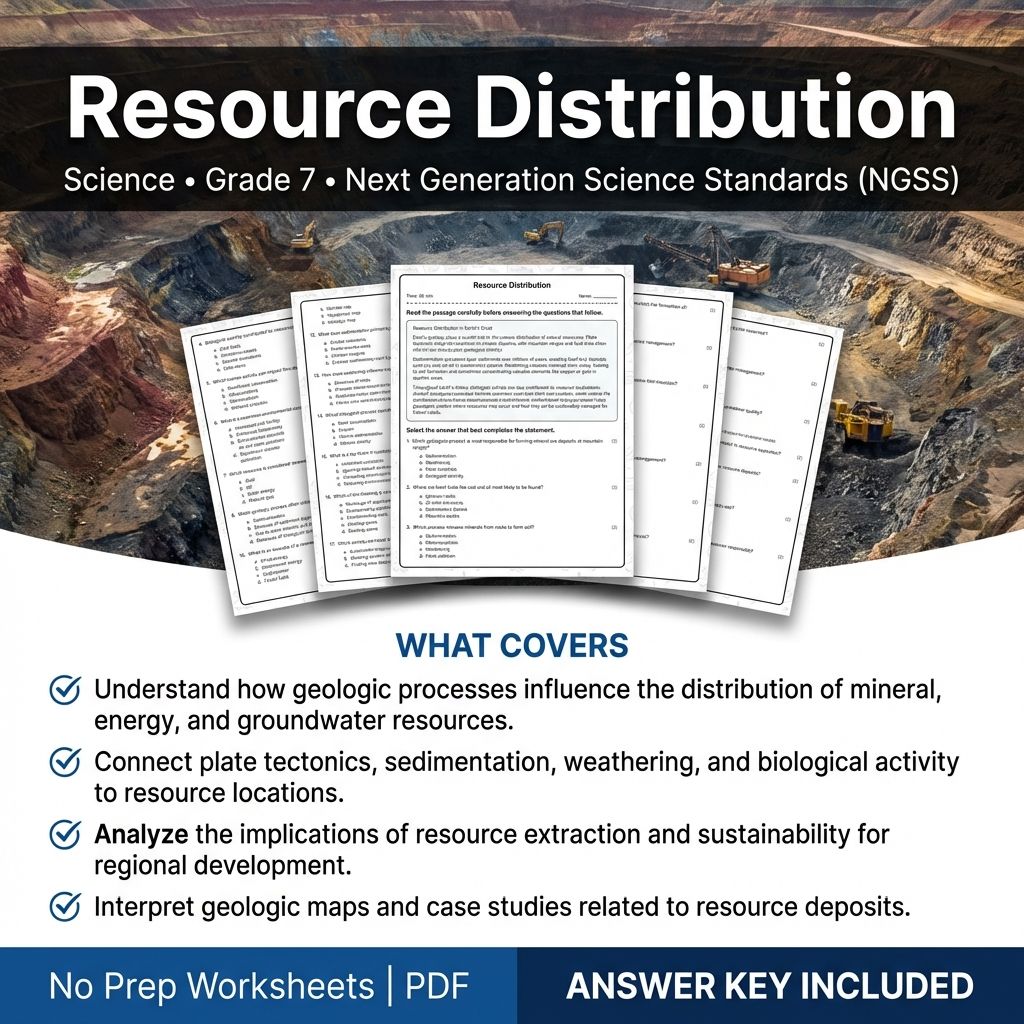
7th Grade Science Worksheet | Resource Distribution & Geology (PDF + Answer Key)
 Created byCoral Reef Learning
Learning Objectives
- Understand how geologic processes influence the distribution of mineral, energy, and groundwater resources.
- Connect plate tectonics, sedimentation, weathering, and biological activity to resource locations.
- Analyze the implications of resource extraction and sustainability for regional development.
Instant download

Grade 7 Science – Insulation Principles & Materials | Daily Reading Worksheet
Created byBright Mind ResourcesLearning Objectives
- Understand the basic concepts of heat transfer and insulation.
- Identify different materials used for insulation.
- Explain how insulation improves energy efficiency in buildings.
Also included in: Grade 7 Heat Transfer Science Daily Reading Worksheets Lesson Bundle | Alberta +2 more
Instant download

Grade 7 Science – Conduction & Heat Transfer | Daily Reading Worksheet
Created byBright Mind ResourcesLearning Objectives
- Define conduction and explain how it involves the transfer of kinetic energy between particles in solids.
- Identify materials that are good conductors of heat and those that are poor conductors.
- Describe how contact resistance and material properties affect heat conduction in structures.
Also included in: Grade 7 Heat Transfer Science Daily Reading Worksheets Lesson Bundle | Alberta +2 more
Instant download
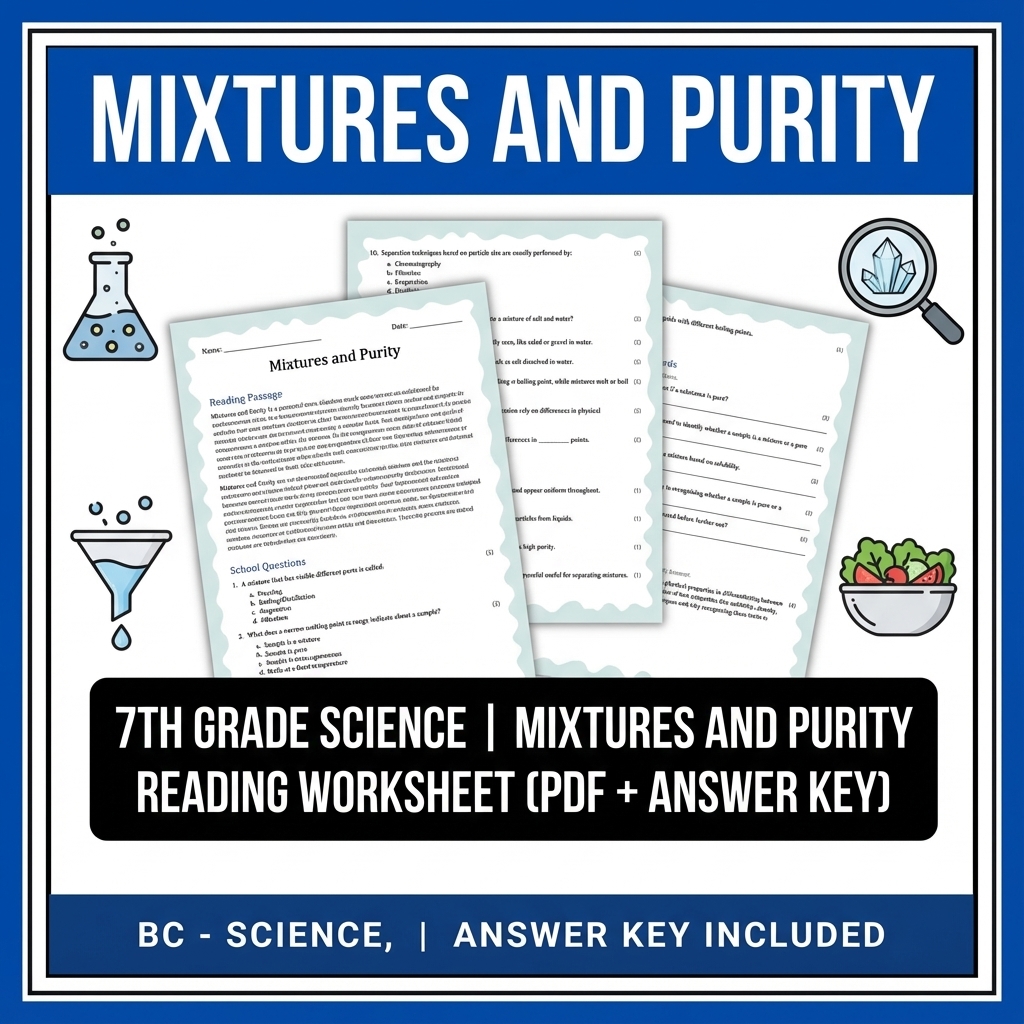
7th Grade Science | Mixtures and Purity Reading Worksheet (PDF + Answer Key)
JCreated byJ.S SheetsLearning Objectives
- Understand the difference between mixtures and pure substances.
- Identify the characteristics of heterogeneous and homogeneous mixtures.
- Explain how physical properties help in separating mixtures.
Instant download
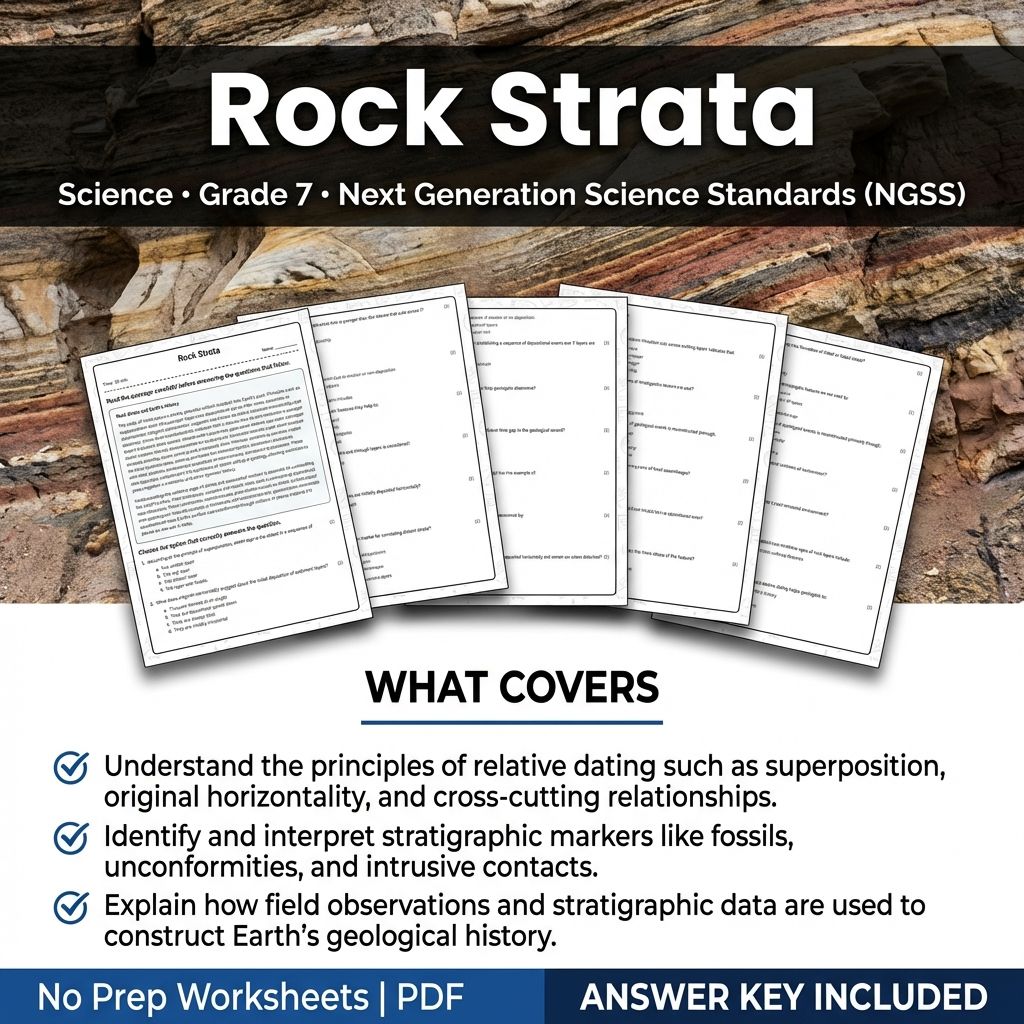
Grade 7 Science Worksheet | Rock Strata Principles & Earth's History (Printable PDF with Answer Key)
Created byCoral Reef LearningLearning Objectives
- Understand the principles of relative dating such as superposition, original horizontality, and cross-cutting relationships.
- Identify and interpret stratigraphic markers like fossils, unconformities, and intrusive contacts.
- Explain how field observations and stratigraphic data are used to construct Earth's geological history.
Instant download
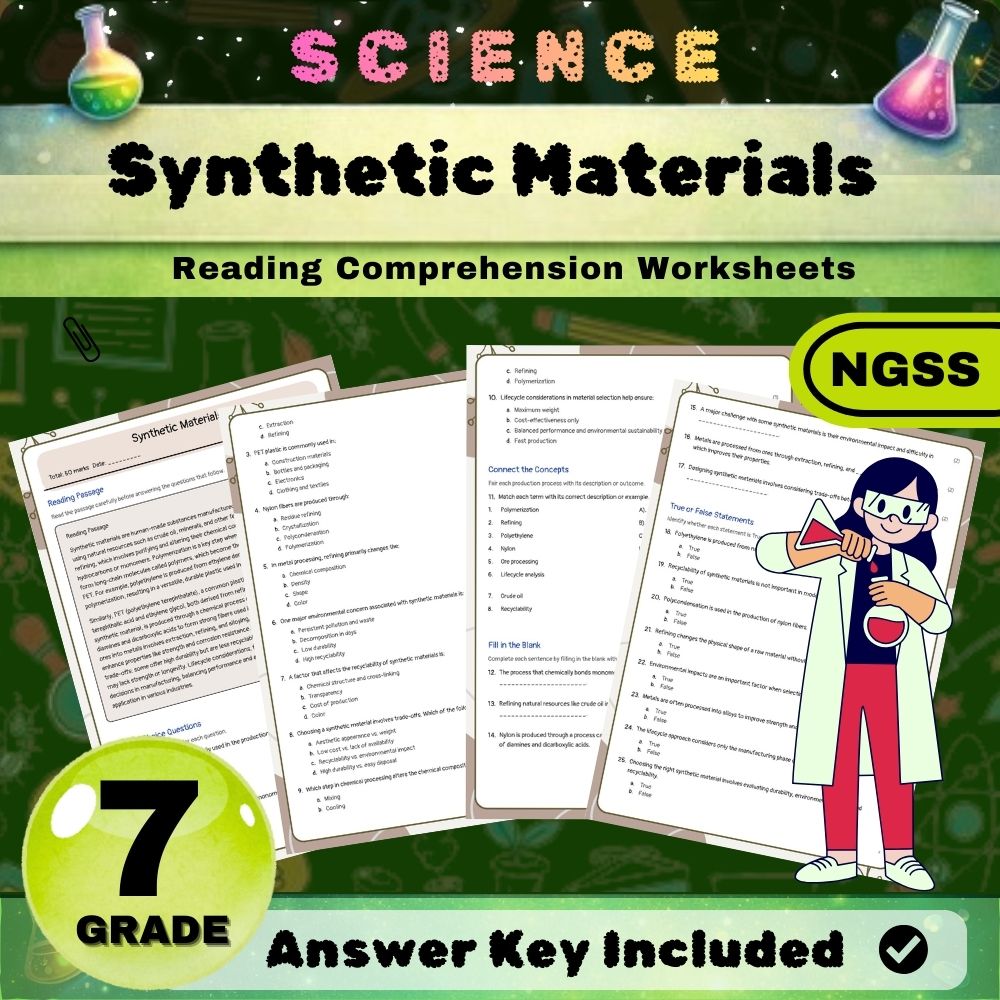
7th Grade Science | Synthetic Materials NGSS Worksheet (PDF)
 Created byMaple Path Learning
Learning Objectives
- Describe the production pathways from natural resources to common synthetic materials, including feedstocks, polymerization, and refining steps.
- Explain trade-offs such as durability, recyclability, and environmental impacts linked to synthetic material choices.
- Connect lifecycle considerations and manufacturing processes to the selection of synthetic materials for various applications.
Instant download
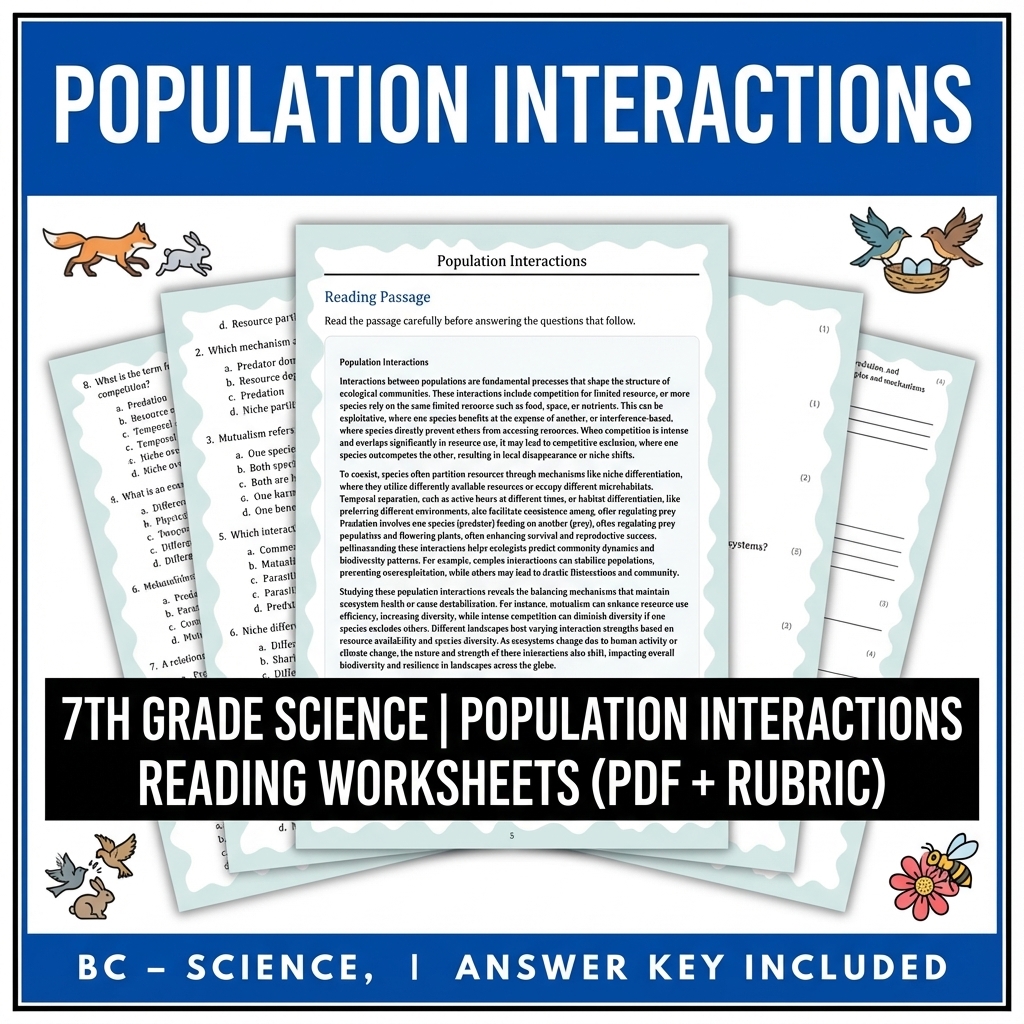
7th Grade Science | Population Interactions Reading Worksheets (PDF + Rubric)
JCreated byJ.S SheetsLearning Objectives
- Describe different types of population interactions such as competition, predation, and mutualism.
- Explain how populations compete for resources and how this affects community composition.
- Identify mechanisms like niche partitioning, temporal separation, and habitat differentiation that enable species to coexist.
Instant download

Grade 7 Scientific Inquiry Basics Worksheet | Ontario Science + Answer Key
 Created byClear Sky Classroom
Learning Objectives
- Identify key parts of scientific inquiry, including testable questions, hypotheses, and variables.
- Use operational definitions and precise measurement to make results comparable across trials.
- Apply basic laboratory safety and ethical data-reporting practices during investigations.
Instant download
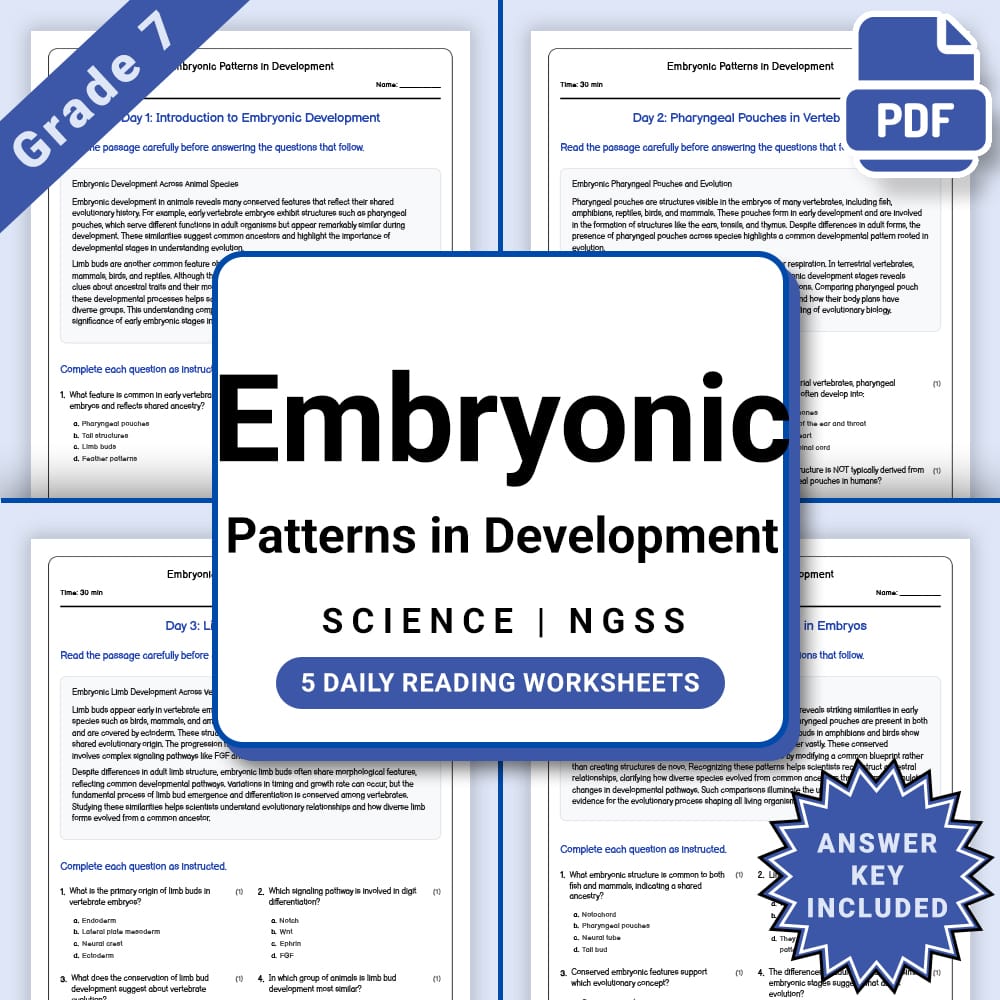
Grade 7 Science – Embryonic Patterns in Development Worksheet(PDF + Answer Key)
 Created byCopper Leaf Classroom
Learning Objectives
- Understand basic stages of embryonic development across different animal taxa.
- Recognize morphological similarities in embryonic structures such as pharyngeal pouches and limb buds.
- Explore how developmental timing and patterning support evolutionary relationships.
Instant download
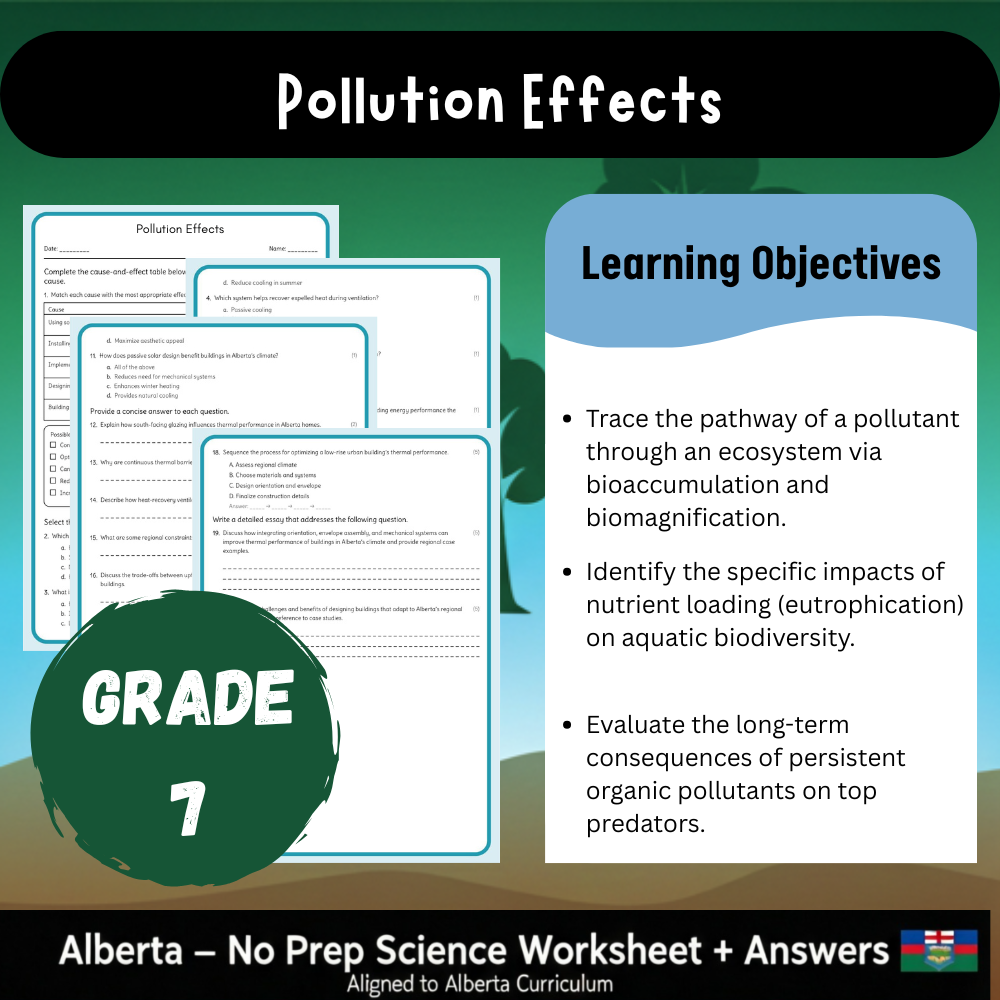
Grade 7 Science – Population Factors Worksheet (PDF) – Alberta Standards
Created byBright Mind ResourcesLearning Objectives
- Understand how birth and death rates, immigration, and emigration influence population size and distribution.
- Identify regional drivers that impact populations such as water availability, fire regimes, and land-use change.
- Explain how population trends are measured and used for species and biodiversity assessments.
Instant download

Elements Versus Compounds Test Prep Worksheet | Grade 7 Science
 Created byPrism Point Learning
Learning Objectives
- Explain how atomic composition and bonding distinguish elements from compounds.
- Use chemical formulas to identify fixed ratios of atoms in compounds.
- Compare physical properties (such as conductivity and melting point) of elements and compounds.
Also included in: Grade 7 Substance & Mixture Properties Science Lesson Bundle (Ontario)
Instant download

Grade 7 Science | Nutrient Transport Worksheet | California Standards
 Created byLumora Learning
Learning Objectives
- Explain why internal nutrient transport is necessary for organism survival and cell function.
- Describe how nutrients move from the digestive system (or source tissues) to body tissues that use them.
- Compare nutrient transport in animals and plants using basic systems vocabulary.
Instant download

Grade 7 Science | Reaction Evidence in Chemistry - Daily Reading Comprehension
Created byCoral Reef LearningLearning Objectives
- Recognize gas evolution as evidence of a chemical reaction
- Identify other indicators such as precipitate formation, color change, and temperature change
- Connect observable indicators to chemical mass and energy changes
Instant download

Grade 7 Rock Types Worksheet | BC Practice PDF
Created byClear Sky ClassroomLearning Objectives
- Classify rocks as igneous, sedimentary, or metamorphic based on their formation and textures.
- Use observable evidence such as grain size, mineral composition, and structures to infer rock type.
- Explain how tectonic processes and Earth’s changing conditions can transform rocks over time.
Instant download
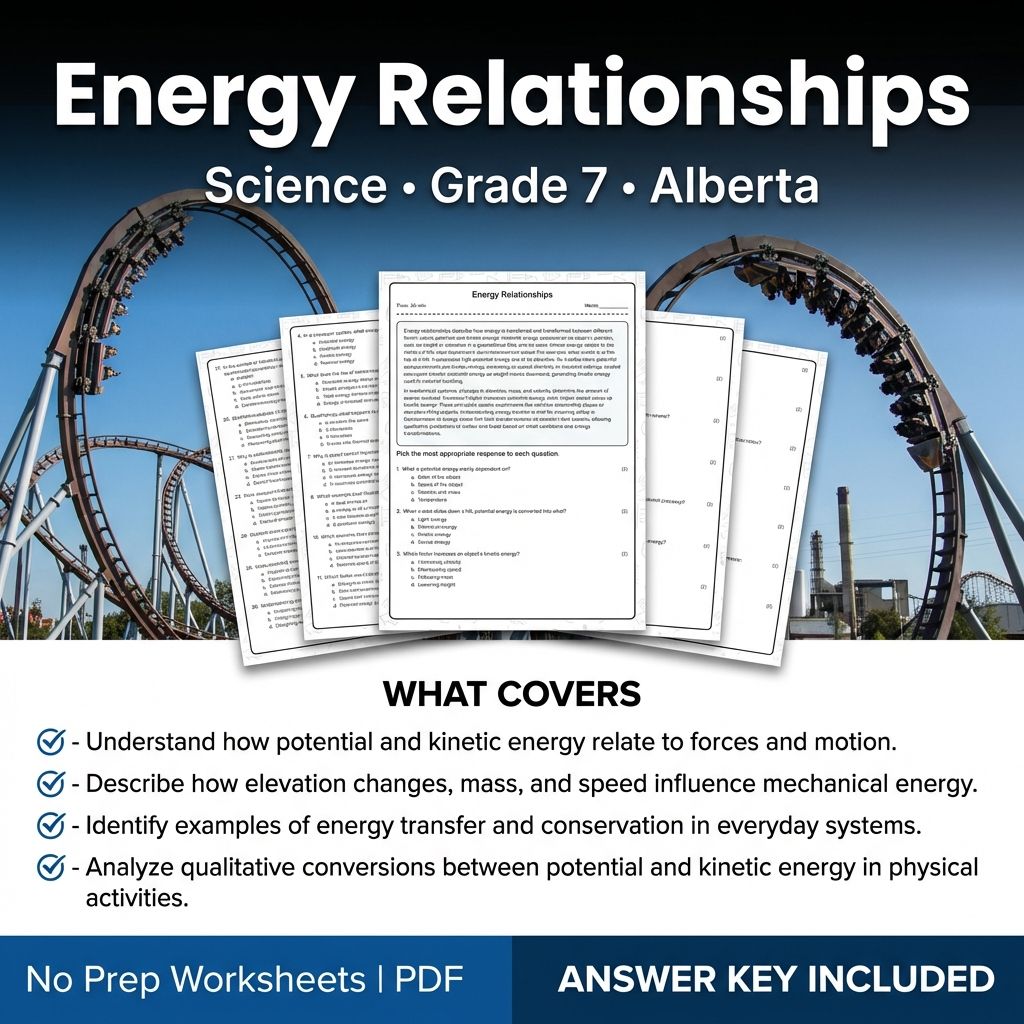
Energy Relationships Grade 7 Science Worksheet | Alberta Standards
Created byCoral Reef LearningLearning Objectives
- Understand how potential and kinetic energy relate to forces and motion.
- Describe how elevation changes, mass, and speed influence mechanical energy.
- Identify examples of energy transfer and conservation in everyday systems.
Instant download
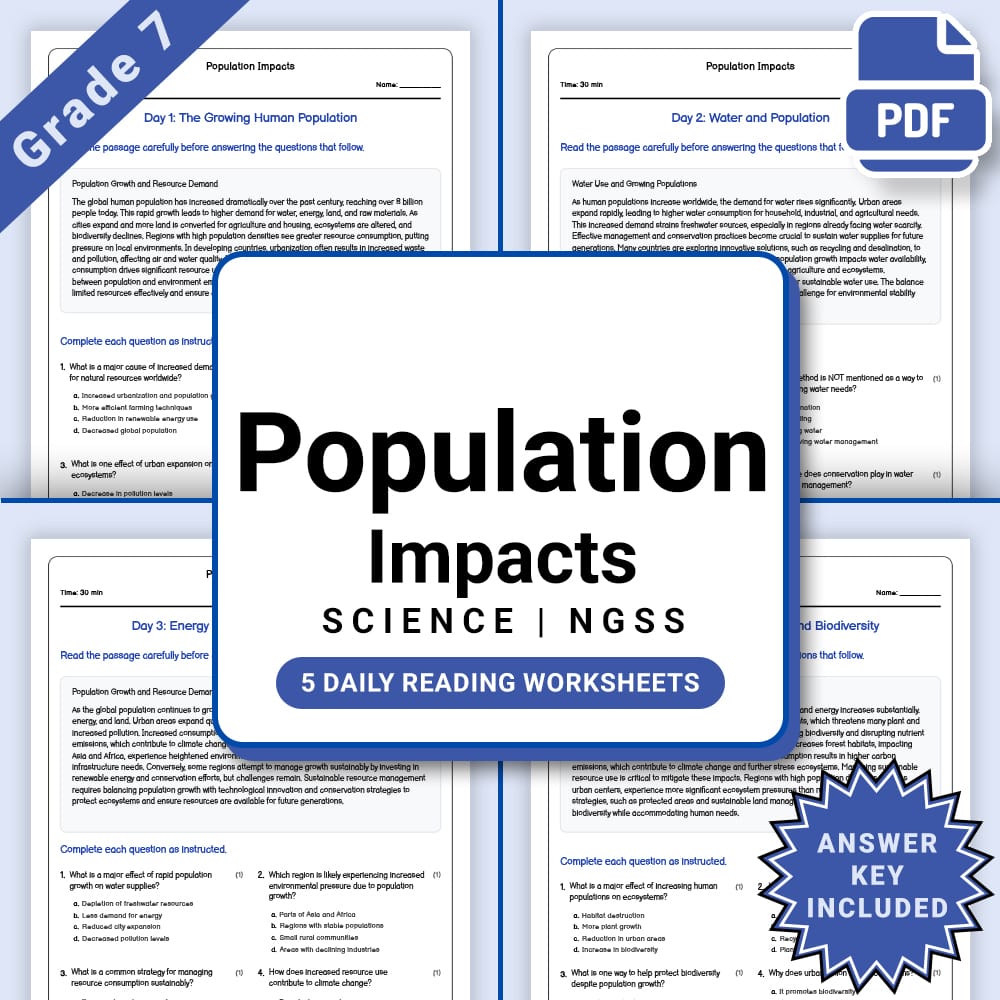
Grade 7 Science – Population Impacts Daily Reading Worksheet(PDF + Answer Key)
Created byCopper Leaf ClassroomLearning Objectives
- Understand how human population growth influences demand for natural resources
- Identify regional examples of environmental pressures caused by population changes
- Analyze the effects of increased resource consumption on ecosystems and biodiversity
Instant download
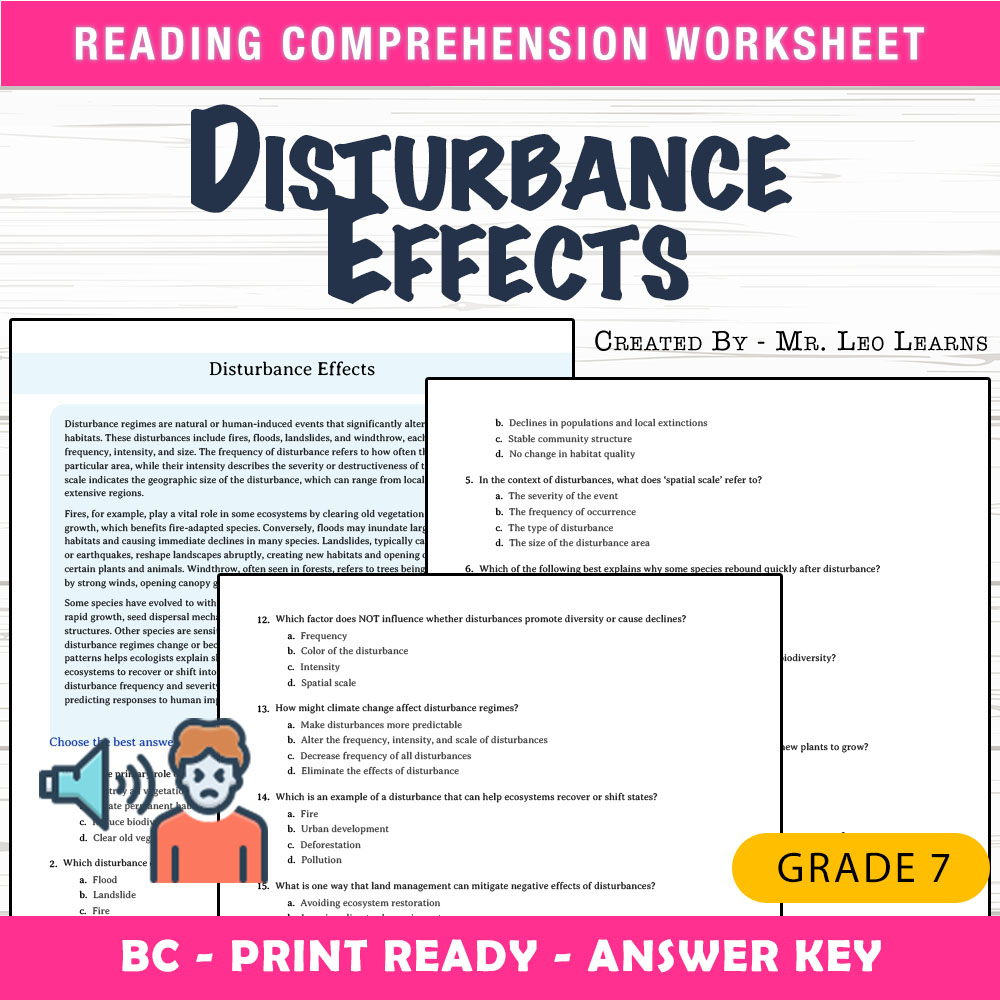
Grade 7 Science — Disturbance Effects Worksheet for Mastery
 Created byThe Resource Hub
Learning Objectives
- Understand how environmental disturbances affect habitats and species.
- Identify different types of disturbances such as fire, flood, landslide, and windthrow.
- Explain how disturbance frequency, intensity, and scale influence ecosystem diversity and recovery.
Also included in: Grade 7 Science Ecosystems & Interactions Worksheet Bundle +1 more
Instant download
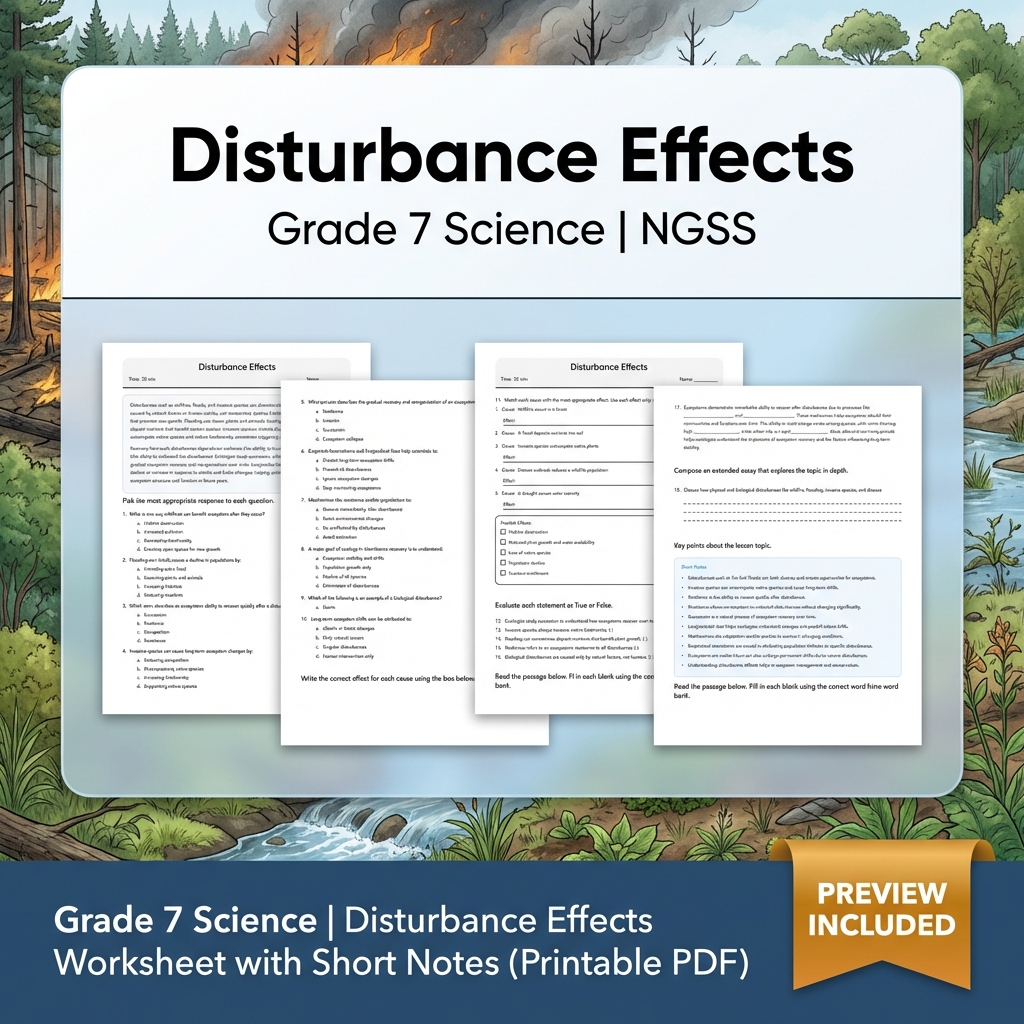
Grade 7 Science | Disturbance Effects Worksheet with Short Notes (PDF)
 Created byMeadowlark Worksheets
Learning Objectives
- Understand how physical and biological disturbances affect ecosystems.
- Identify examples of disturbances such as wildfires, flooding, invasive species, and diseases.
- Explain mechanisms like resilience, resistance, and succession in ecosystem recovery.
Also included in: Grade 7 Science Ecosystems Unit | Interactions, Energy & Dynamics NGSS Bundle +1 more
Instant download
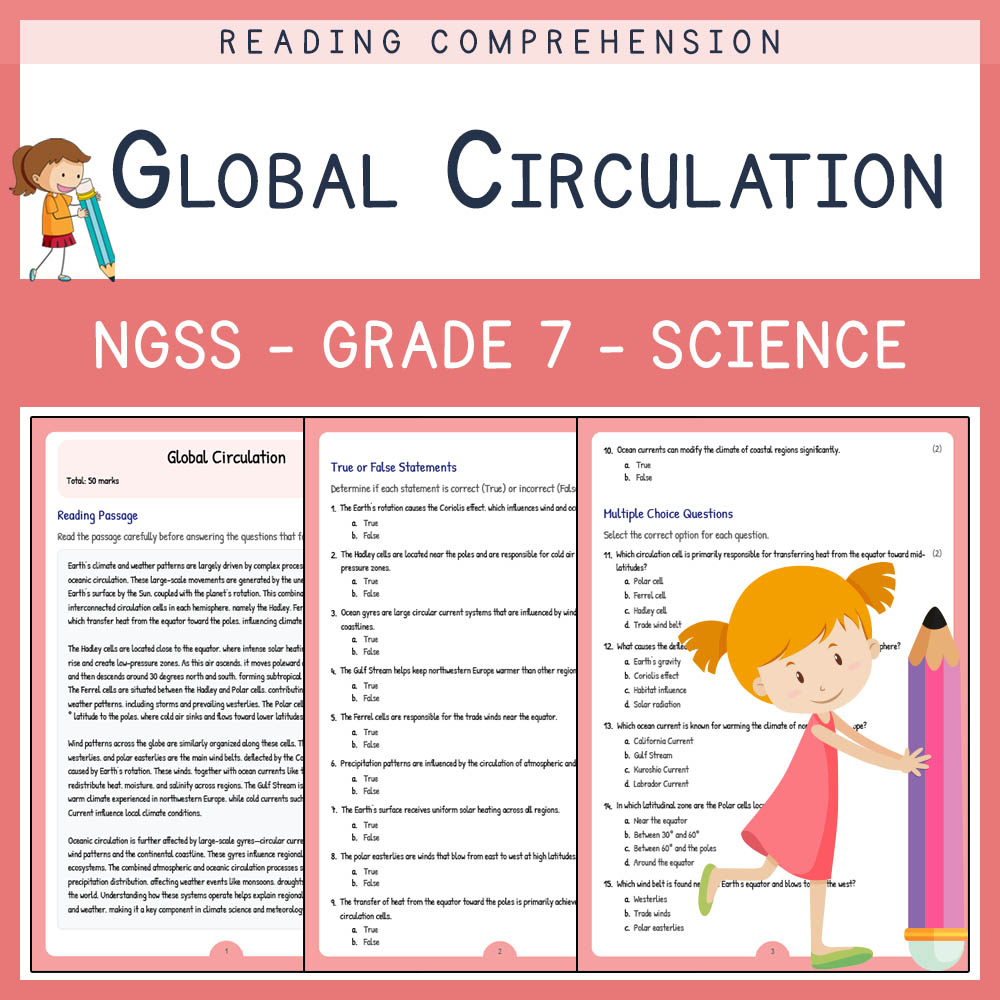
Grade 7 Science | Global Circulation Worksheet (NGSS-Aligned + Answer Key)
Created byLumora LearningLearning Objectives
- Explain the concept of Earth's atmospheric circulation cells and their impact on climate patterns.
- Identify the major wind belts, ocean currents, and their effect on regional climate.
- Describe the Coriolis effect and how it influences wind and current directions.
Instant download
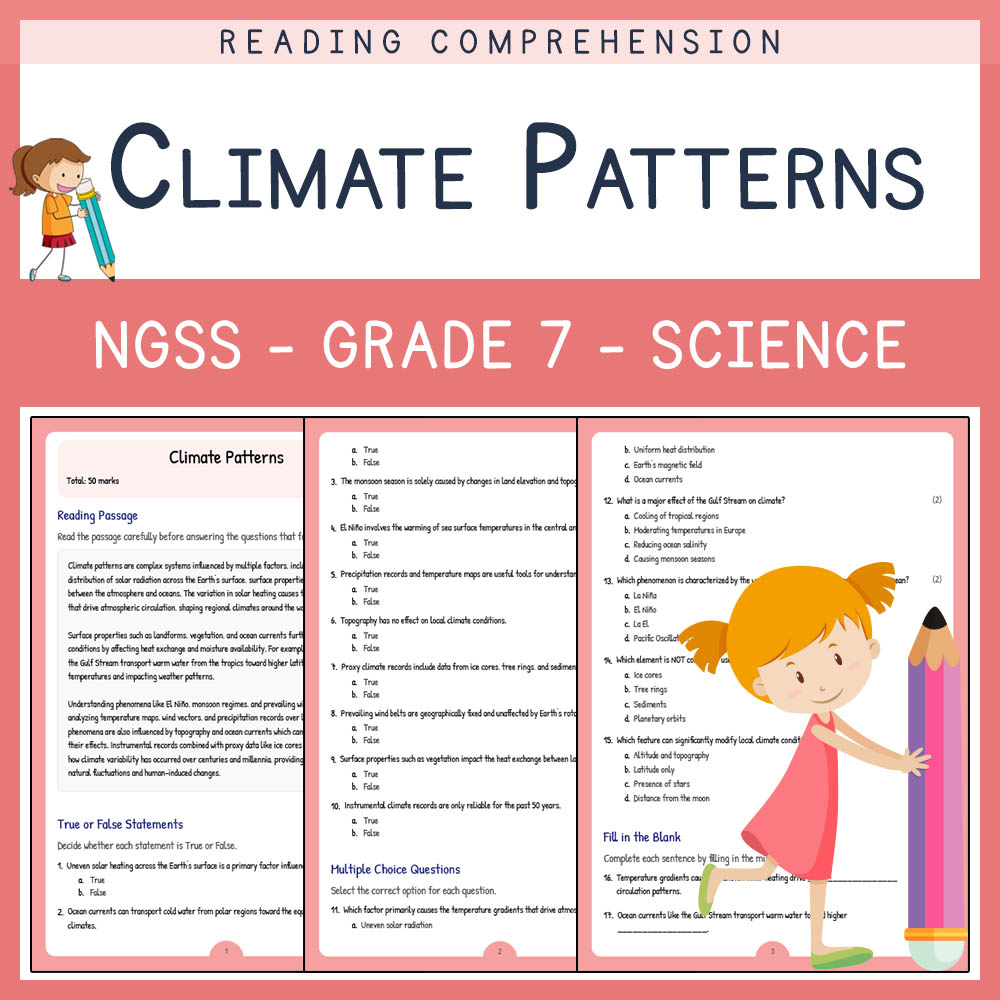
Grade 7 Science | Climate Patterns Worksheet with Answer Key (NGSS Aligned)
Created byLumora LearningLearning Objectives
- Understand how uneven solar heating influences regional and global climate patterns.
- Explain the roles of ocean currents, topography, and atmospheric circulation in shaping local climates.
- Interpret temperature gradients, wind vectors, and precipitation records related to climate phenomena.
Instant download
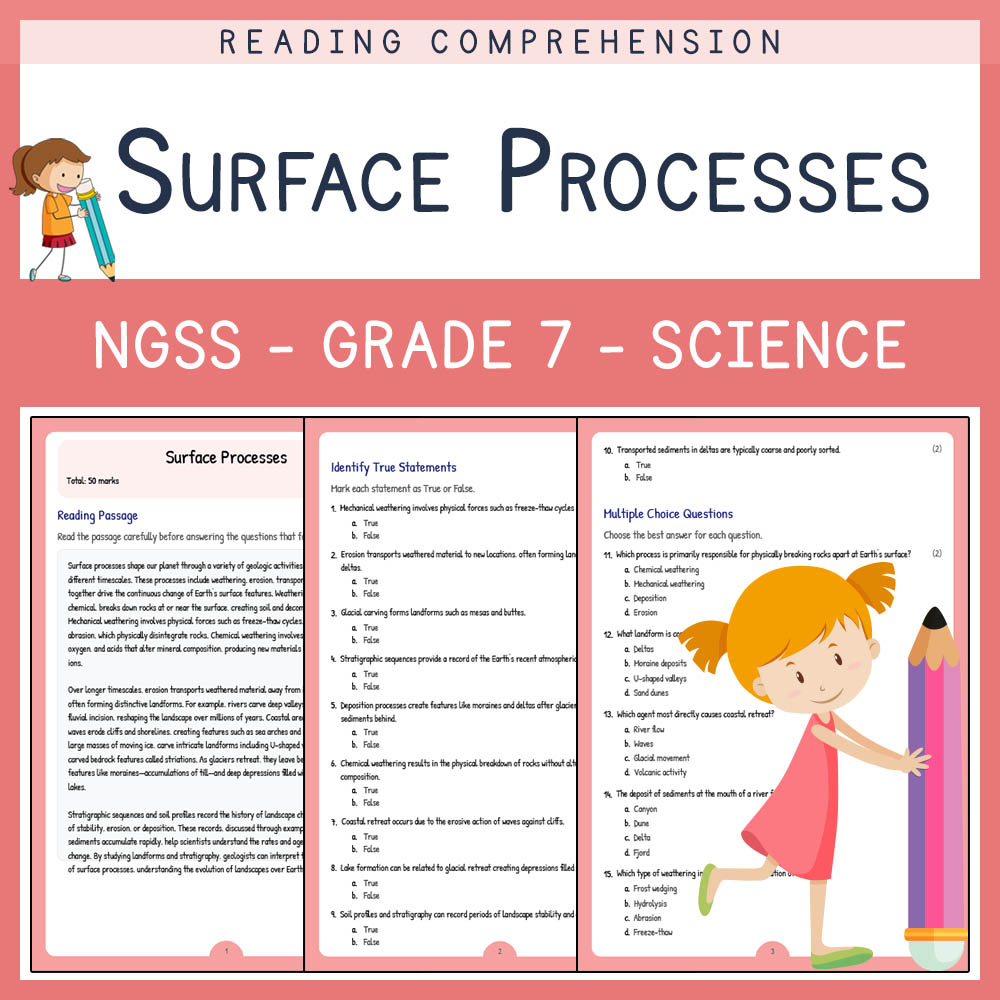
Grade 7 Science | Surface Processes Worksheet & Answer Key | NGSS Aligned
Created byLumora LearningLearning Objectives
- Describe the different types of weathering and erosion and how they modify Earth's surface.
- Explain how landforms such as canyons, deltas, and glacial features are formed by geological processes.
- Analyze the rates of landscape change and how agents leave specific signatures in landforms and stratigraphy.
Instant download
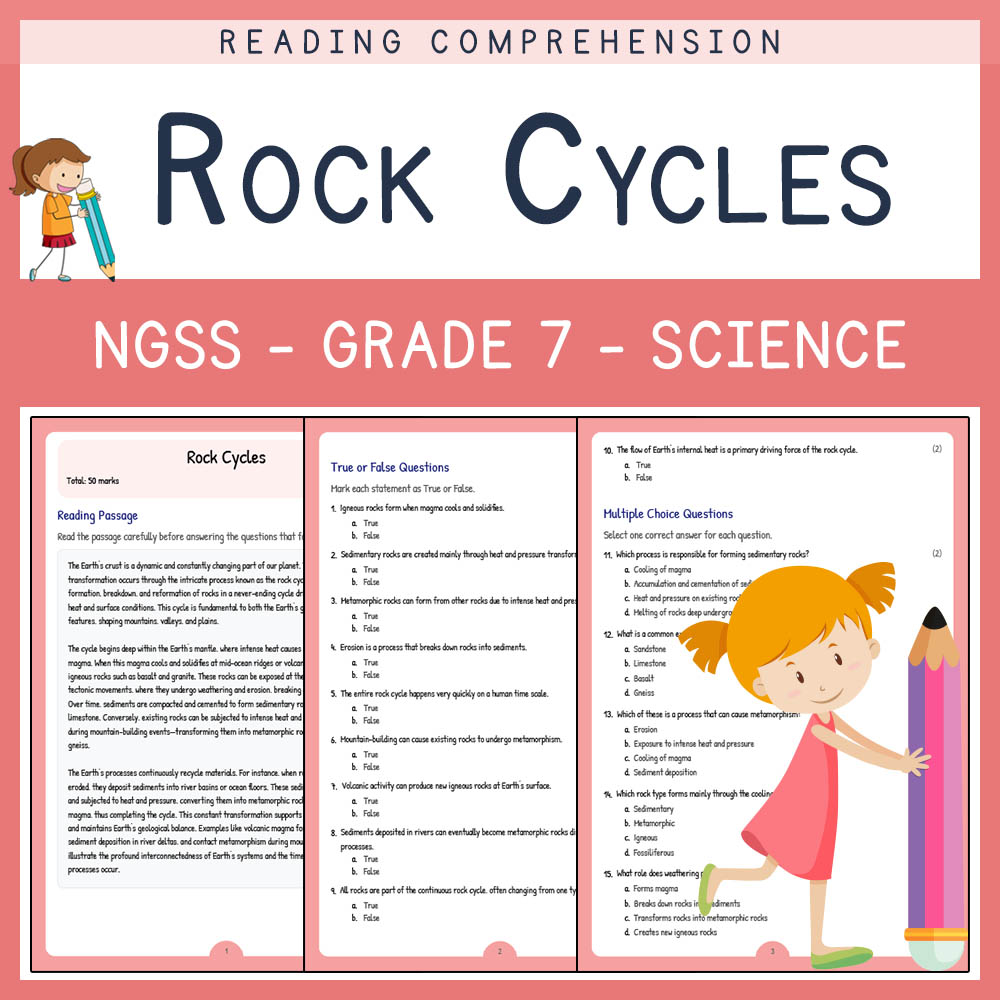
Grade 7 Science | Rock Cycles Worksheet & Answer Key for NGSS Standards (PDF)
Created byLumora LearningLearning Objectives
- Describe the processes involved in the rock cycle, including melting, cooling, erosion, and metamorphism.
- Identify different rock types—igneous, sedimentary, and metamorphic—and explain their formation pathways.
- Understand the role of Earth's internal heat and surface processes in transforming rocks over geological timescales.
Instant download
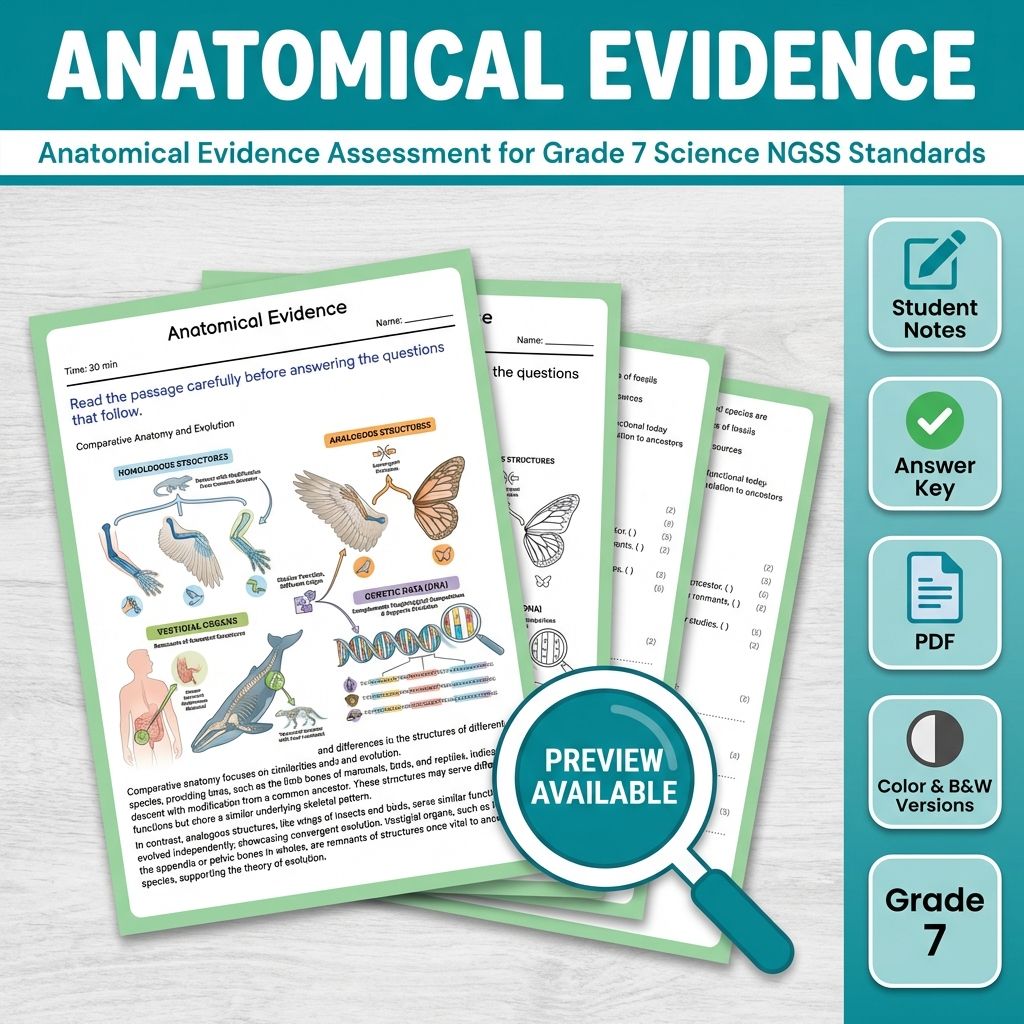
Anatomical Evidence Assessment for Grade 7 Science NGSS Standards
Created byPrism Point LearningLearning Objectives
- Understand how comparative anatomical data provide evidence for evolution.
- Identify homologous and analogous structures in different species.
- Explain how limb bone arrangements, skull morphology, and vestigial organs support descent with modification.
Also included in: Grade 7 Science Mini Bundle – Biological Evolution: Unity & Diversity +1 more
Instant download

Grade 7 Stoichiometry Worksheet | Mole Ratios, NGSS Science Activity Pack
 Created byAmber Owl Education
Learning Objectives
- Use balanced chemical equations to relate the mole amounts of reactants and products.
- Solve simple mole-ratio problems to predict relative mass or amount changes in reactions.
- Apply the conservation of atoms to check whether calculated quantities are consistent with a balanced equation.
Also included in: Grade 7 Science Stoichiometry, Mixtures & Material Properties Lesson Bundle | NGSS +1 more
Instant download

Adaptive Traits Analysis Worksheet | TEKS Grade 7 Science Practice
JCreated byJ.S SheetsLearning Objectives
- Explain how variation, heritability, and selective pressure can cause adaptive traits to become more common in a population
- Describe how differential survival and reproduction affect trait frequencies across generations
- Interpret examples such as pesticide resistance and camouflage frequency changes as evidence of natural selection
Instant download

Cell Energy Use Worksheet Grade 7 Science | Cellular Processes Activity
Created byPrism Point LearningLearning Objectives
- Explain how cells convert chemical energy in food into usable energy for life functions
- Describe how cells use energy to support movement, active transport, and maintaining body temperature
- Model energy and matter changes by explaining that energy changes form while matter is conserved
Also included in: Life Science - Grade 7 Bundle
Instant download
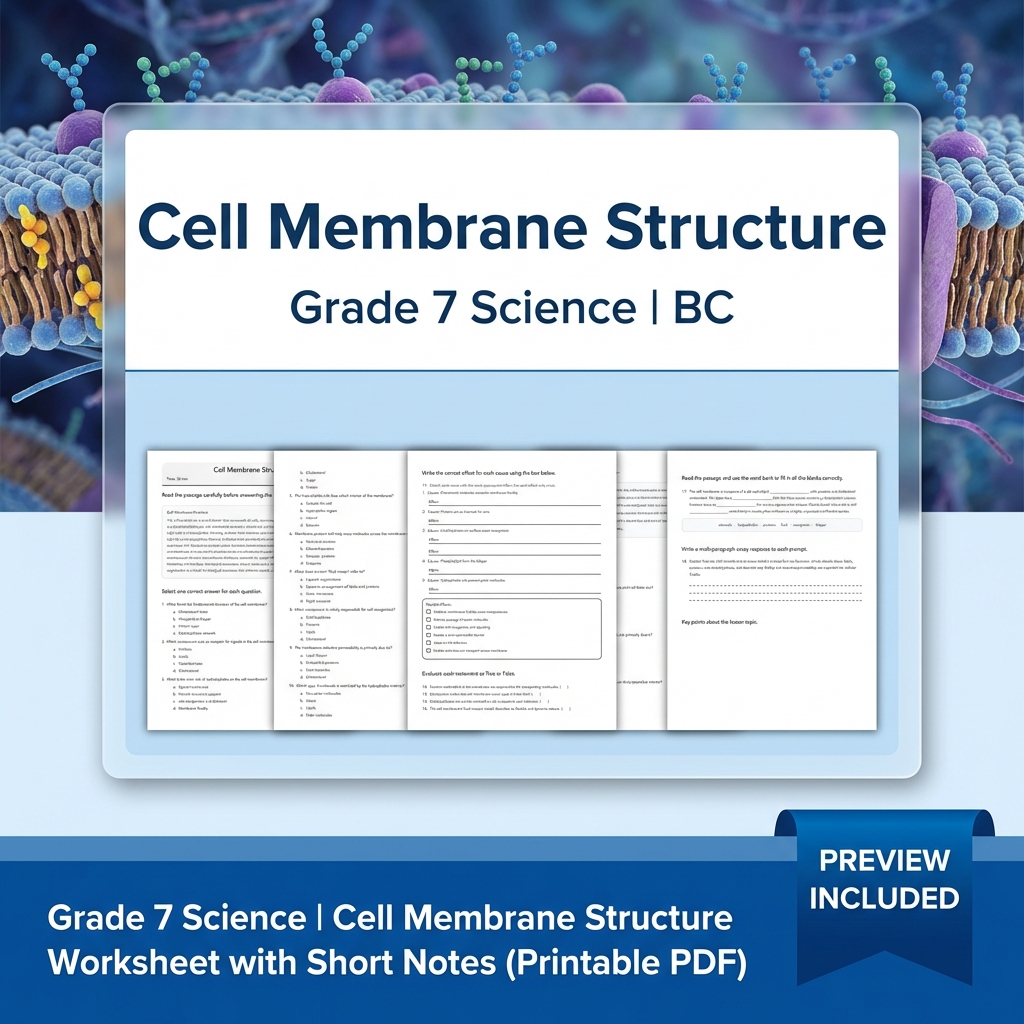
Grade 7 Science | Cell Membrane Structure Worksheet with Short Notes (PDF)
Created byMeadowlark WorksheetsLearning Objectives
- Describe the organization and composition of the cell membrane.
- Explain the functions of lipids, proteins, and carbohydrates in the membrane.
- Understand how the membrane maintains selective permeability and communication.
Also included in: Grade 7 Science Lesson Bundle | Cell Structures & Functions Worksheets +1 more
Instant download
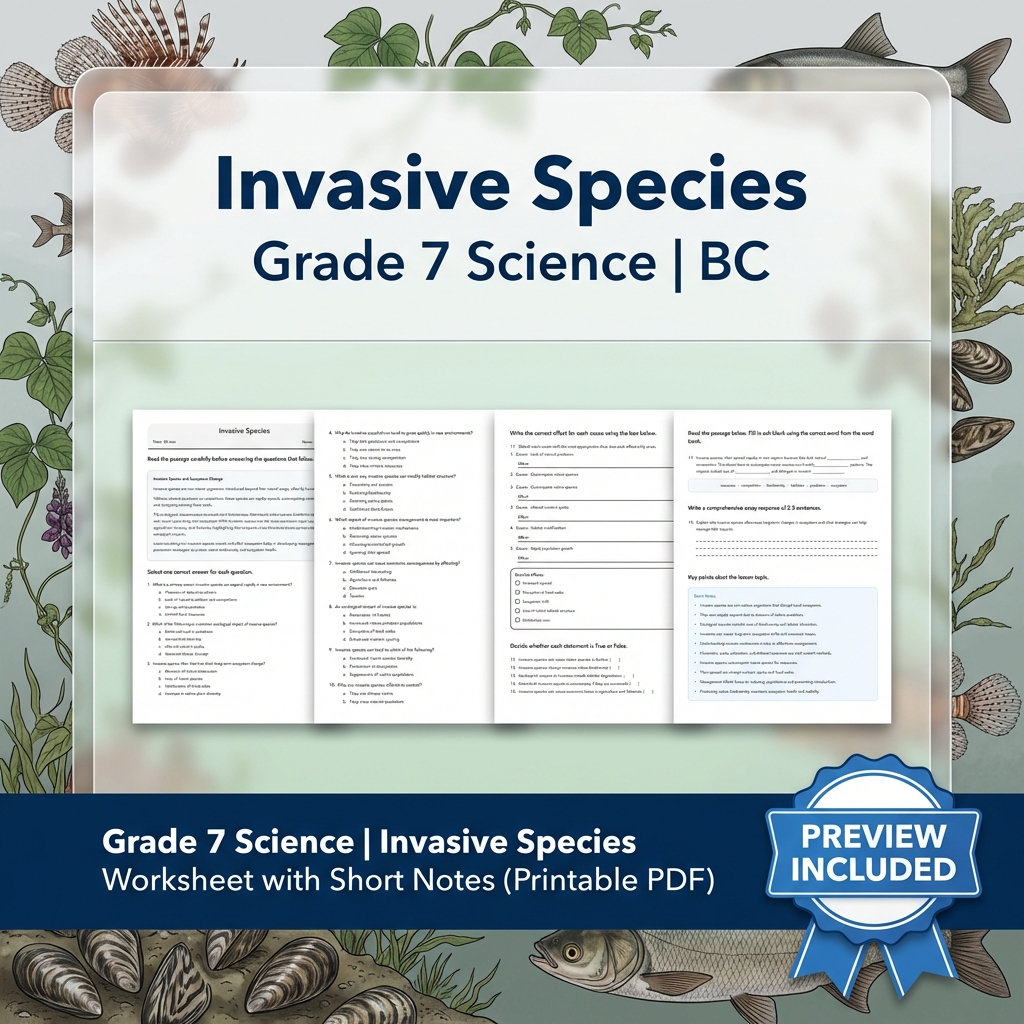
Grade 7 Science | Invasive Species Worksheet with Short Notes (Printable PDF)
Created byMeadowlark WorksheetsLearning Objectives
- Understand how invasive species outcompete native organisms and modify ecosystems.
- Identify mechanisms and ecological impacts of invasive species.
- Analyze how invasions lead to long-term shifts in ecosystem composition and function.
Also included in: Grade 7 Science Lesson Bundle: Ecosystems and Population Dynamics Worksheets +1 more
Instant download
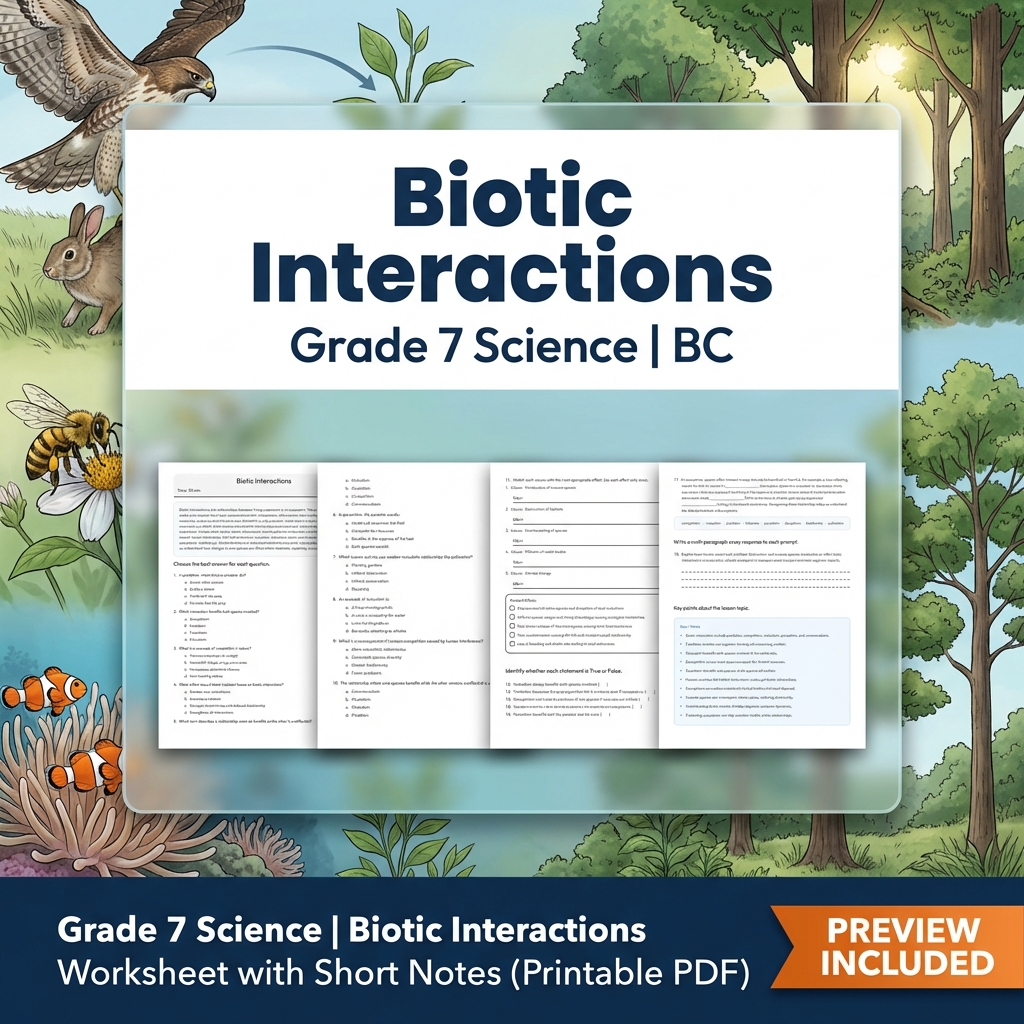
Grade 7 Science | Biotic Interactions Worksheet with Short Notes (Printable PDF)
Created byMeadowlark WorksheetsLearning Objectives
- Understand different types of biotic interactions such as predation, competition, mutualism, commensalism, and parasitism.
- Explain how human activities can disrupt biotic relationships in ecosystems.
- Describe the impact of biotic interactions on community structure and biodiversity.
Also included in: Grade 7 Science Lesson Bundle: Ecosystems and Population Dynamics Worksheets +1 more
Instant download
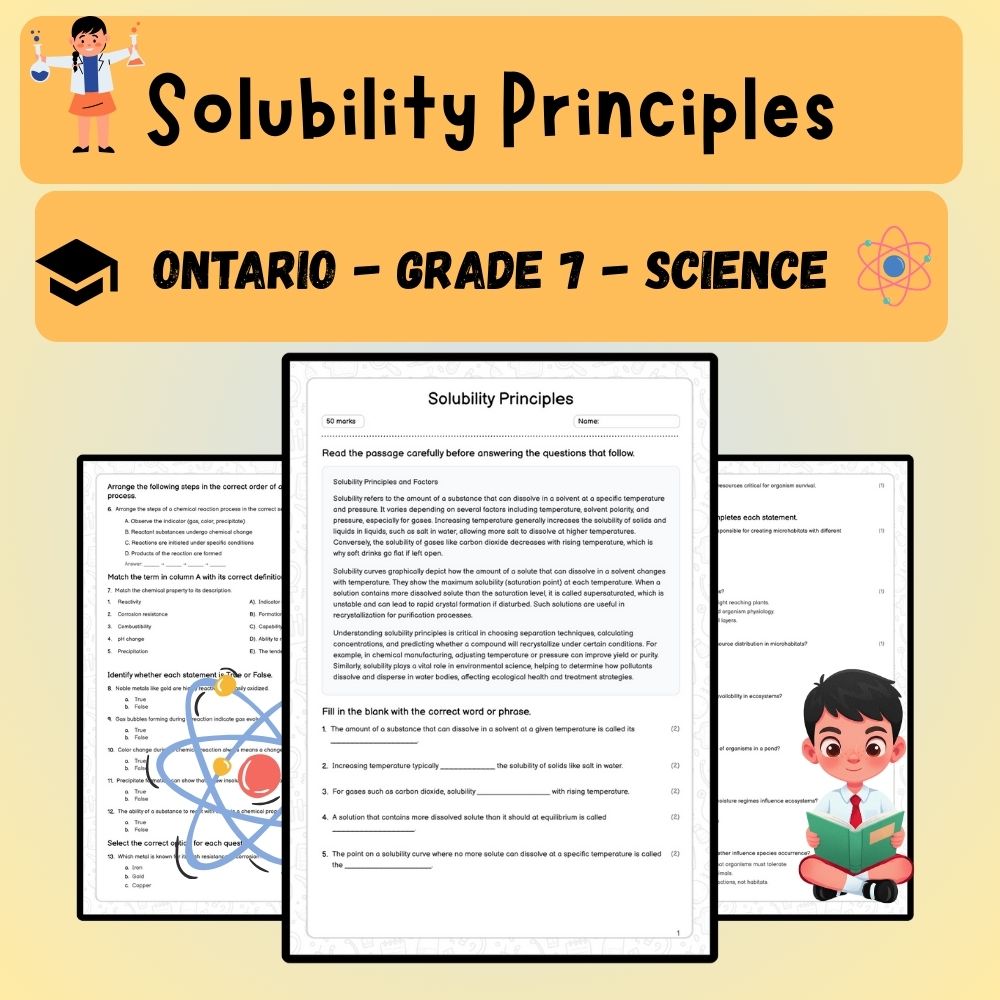
Grade 7 Science – Solubility Principles Worksheet (PDF ) – Ontario Standards
Created byPrism Point LearningLearning Objectives
- Understand the factors affecting the solubility of substances in solvents.
- Interpret and analyze solubility curves and saturation concepts.
- Identify conditions leading to supersaturated solutions and their applications.
Also included in: Grade 7 Science Unit Bundle | Substances, Mixtures & Properties Worksheets +1 more
Instant download

Science Worksheet Cited Scientific Reasoning Grade 7 | Standards Practice
JCreated byJ.S SheetsLearning Objectives
- Write scientific claims that cite specific evidence from observations and data.
- Explain how evidence supports a claim using appropriate relationships and units.
- Evaluate alternative explanations by deciding which evidence is stronger.
Also included in: Grade 7 Evidence-Based Scientific Modeling Science Lesson Bundle: General +1 more
Instant download

Grade 7 Science | Tradeoff Mapping Worksheet | California Standards
Created byLumora LearningLearning Objectives
- Explain what tradeoffs are when designing a solution with competing criteria and constraints
- Use a tradeoff map to compare how different design options meet evaluation criteria
- Identify acceptable limits (safety, efficiency, feasibility) and how meeting one requirement can worsen another
Instant download
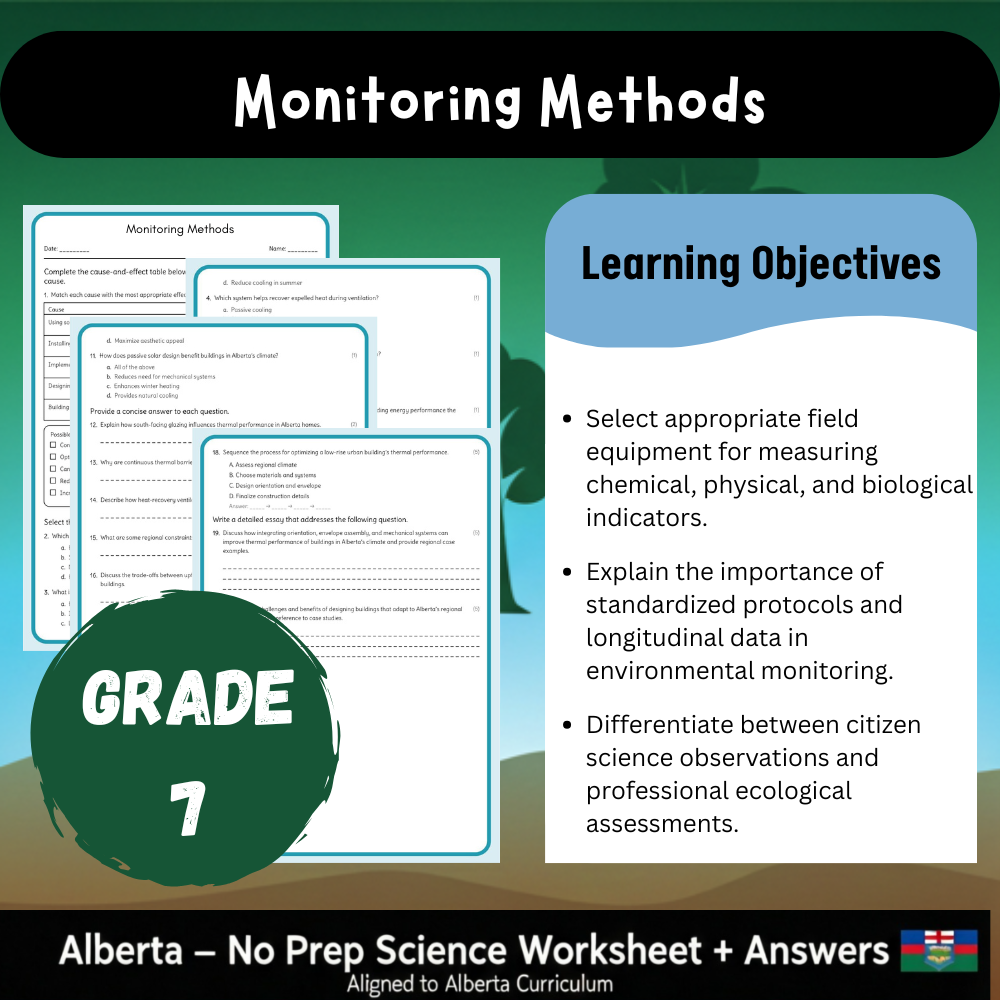
Grade 7 Science | Monitoring Methods Worksheet (PDF) – Alberta Standards
Created byBright Mind ResourcesLearning Objectives
- Understand the different data collection techniques used in ecological monitoring.
- Identify key considerations for designing effective monitoring protocols.
- Recognize how standardized sampling enables detection of ecological changes over time.
Instant download

Grade 7 Science | Urban Heat & Heat Islands - Daily Reading Comprehension
Created byCoral Reef LearningLearning Objectives
- Define urban heat and explain the heat island effect.
- Identify factors that contribute to elevated temperatures in cities.
- Describe mitigation strategies to reduce urban heat.
Instant download

Science Worksheet: Empirical Knowledge Practice | NGSSS Grade 7 Science
JCreated byJ.S SheetsLearning Objectives
- Explain what empirical knowledge means and why evidence from observations and measurements matters.
- Describe how uncertainty and transparency support scientific reasoning.
- Use evidence to evaluate an explanation and consider alternative interpretations.
Also included in: Grade 7 Scientific Variables, Data, and Models Science Lesson Bundle +1 more
Instant download

Science Models and Their Limits Worksheet | NGSSS Grade 7 Science Assessment
JCreated byJ.S SheetsLearning Objectives
- Explain how assumptions and simplifications create limits in scientific models
- Use discrepancy between observations and predictions to suggest model revisions
- Distinguish reliable predictions from approximate ones by recognizing where a model works best
Also included in: Grade 7 Scientific Variables, Data, and Models Science Lesson Bundle +1 more
Instant download
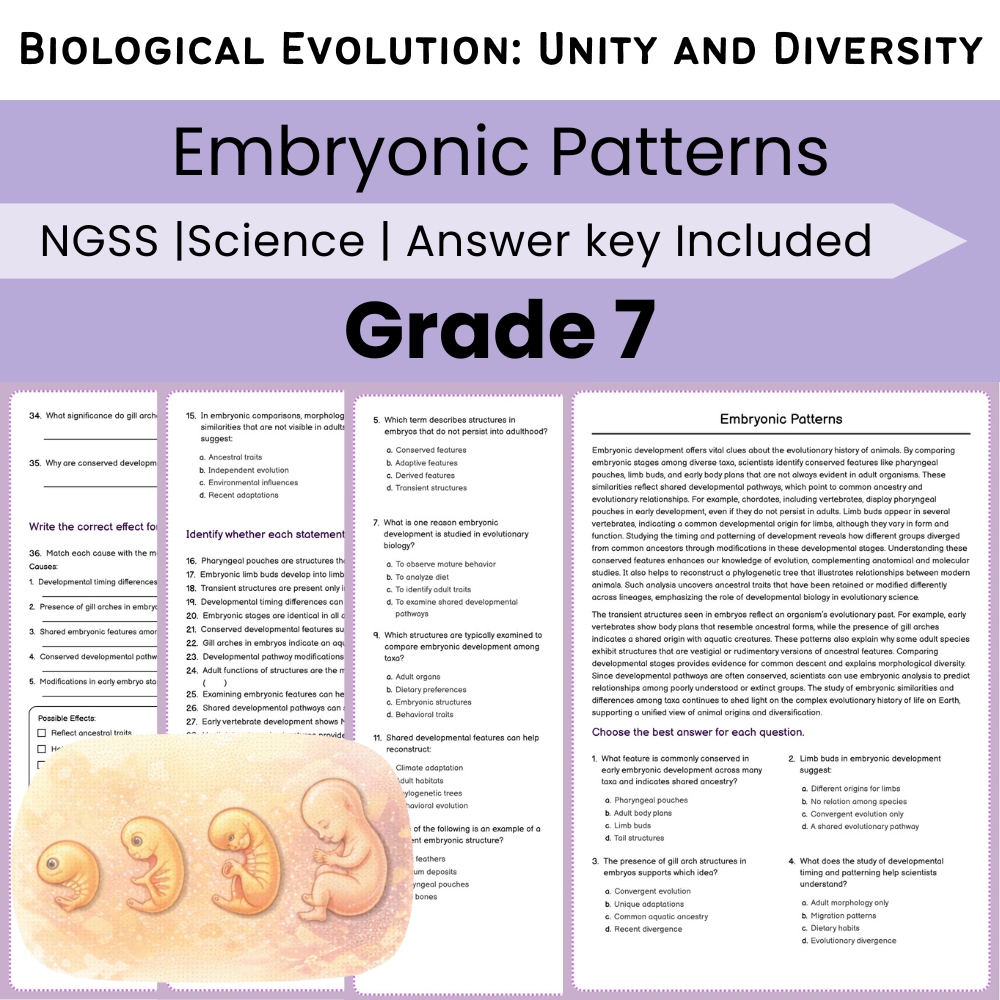
Embryonic Patterns Worksheet | Grade 7 Science Assessment & Practice | NGSS
Learning Objectives
- Understand key stages and structures involved in embryonic development across different taxa.
- Identify conserved developmental features such as pharyngeal pouches and limb buds.
- Analyze how embryonic patterns support the understanding of evolutionary relationships.
Also included in: Grade 7 Science Lesson Bundle | Biological Evolution: Unity and Diversity +1 more
Instant download
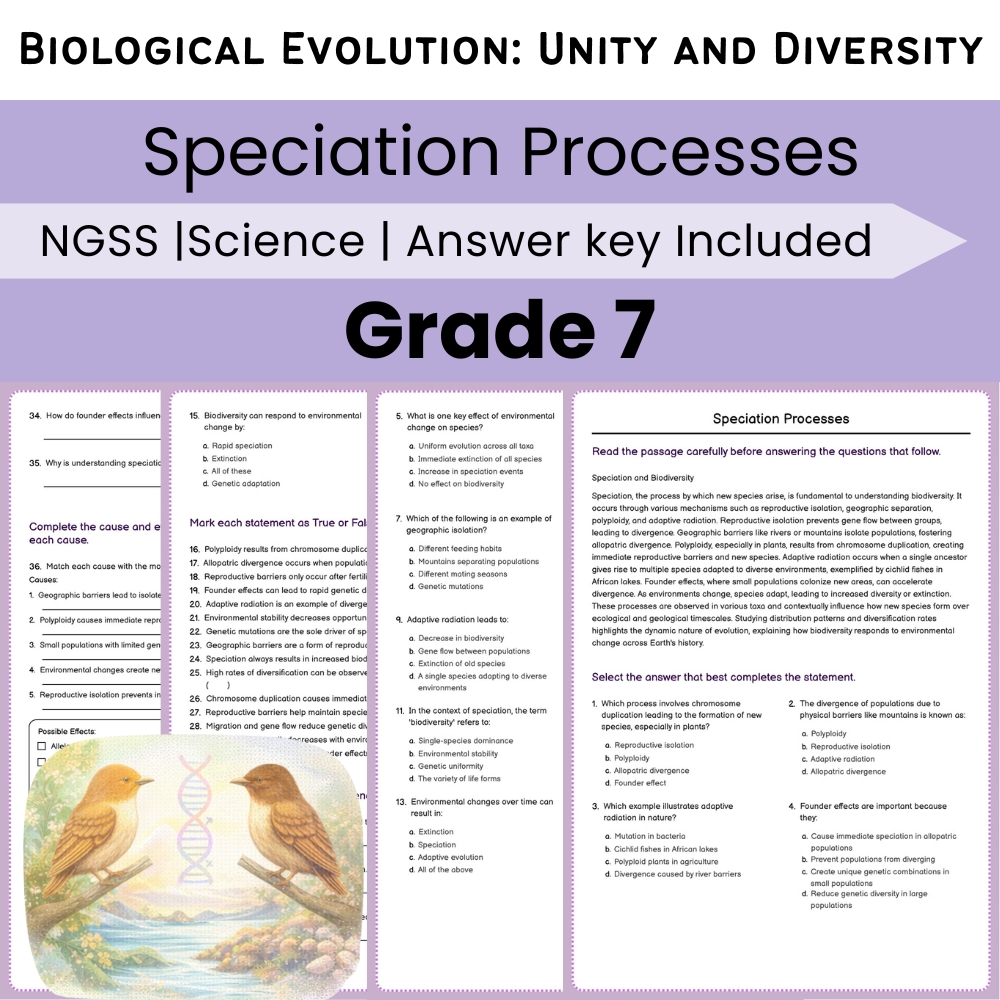
Speciation Processes Worksheet | Grade 7 Science Printable PDF NGSS
Learning Objectives
- Understand the mechanisms driving speciation and biodiversity.
- Identify key factors like reproductive isolation, geographic separation, and polyploidy.
- Analyze examples of speciation such as cichlid radiation and plant polyploidy.
Also included in: Grade 7 Science Lesson Bundle | Biological Evolution: Unity and Diversity +1 more
Instant download
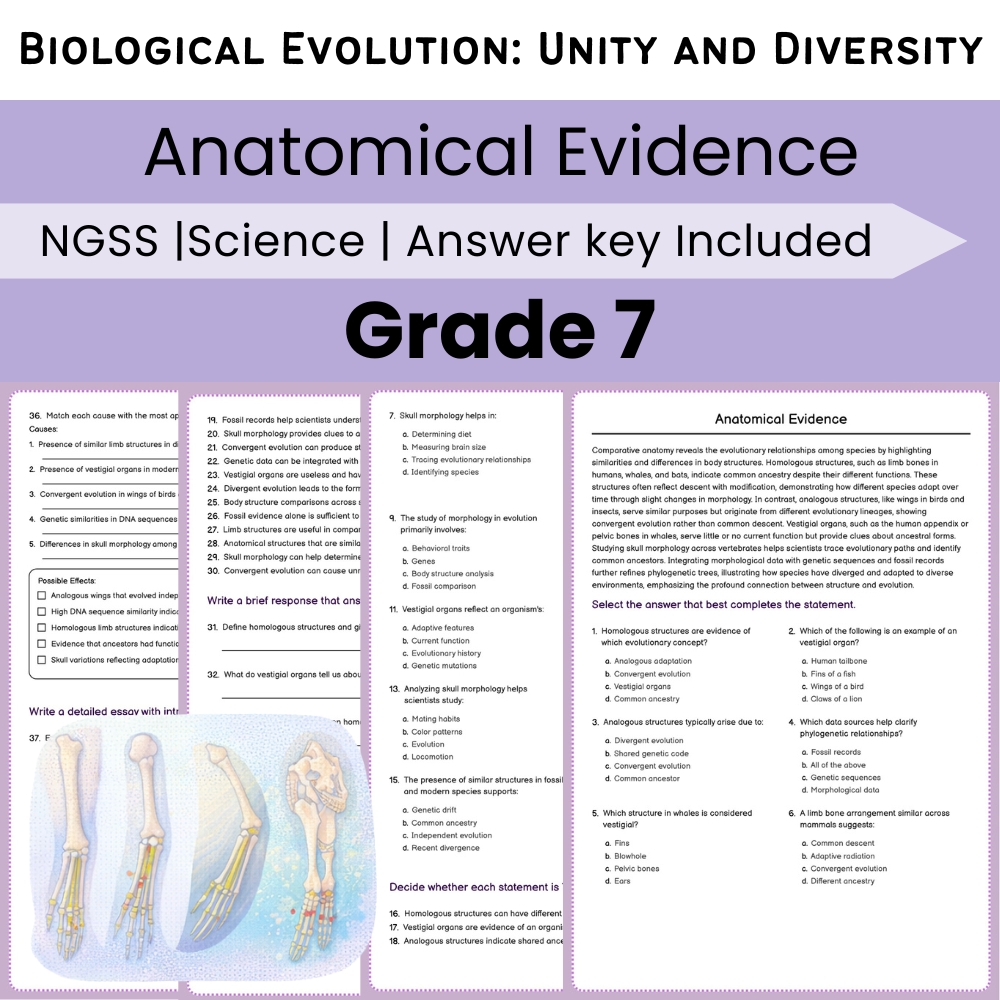
Anatomical Evidence Worksheet | Grade 7 Science Printable PDF Assessment
Learning Objectives
- Understand how comparative anatomy provides evidence for evolution.
- Identify homologous, analogous, and vestigial structures among species.
- Interpret morphological data to infer phylogenetic relationships and adaptive divergence.
Also included in: Grade 7 Science Lesson Bundle | Biological Evolution: Unity and Diversity +1 more
Instant download
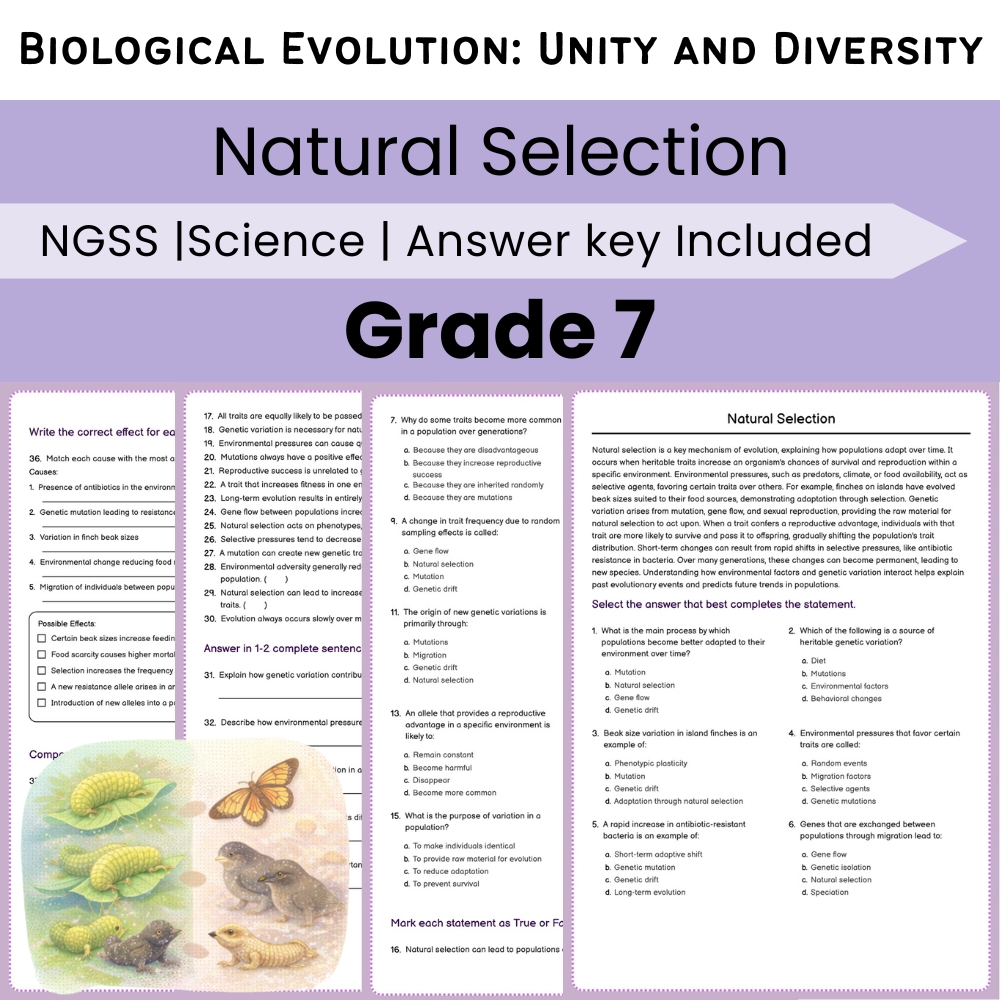
Natural Selection Worksheet | Grade 7 Science printable PDF assessment
Learning Objectives
- Understand the mechanisms of natural selection and how they lead to adaptation.
- Identify sources of genetic variation and their role in evolution.
- Explain how environmental pressures influence reproductive success.
Also included in: Grade 7 Science Lesson Bundle | Biological Evolution: Unity and Diversity +1 more
Instant download

Fossil Patterns Worksheet | Assessment & Student Practice | NGSS Grade 7 Science
Learning Objectives
- Understand how fossil records reveal patterns of succession, diversity, and extinction events.
- Identify key fossil types such as index fossils and transitional forms like Archaeopteryx and Tiktaalik.
- Analyze stratigraphic sequences to infer evolutionary relationships and timing of macroevolutionary trends.
Also included in: Grade 7 Science Lesson Bundle | Biological Evolution: Unity and Diversity +1 more
Instant download
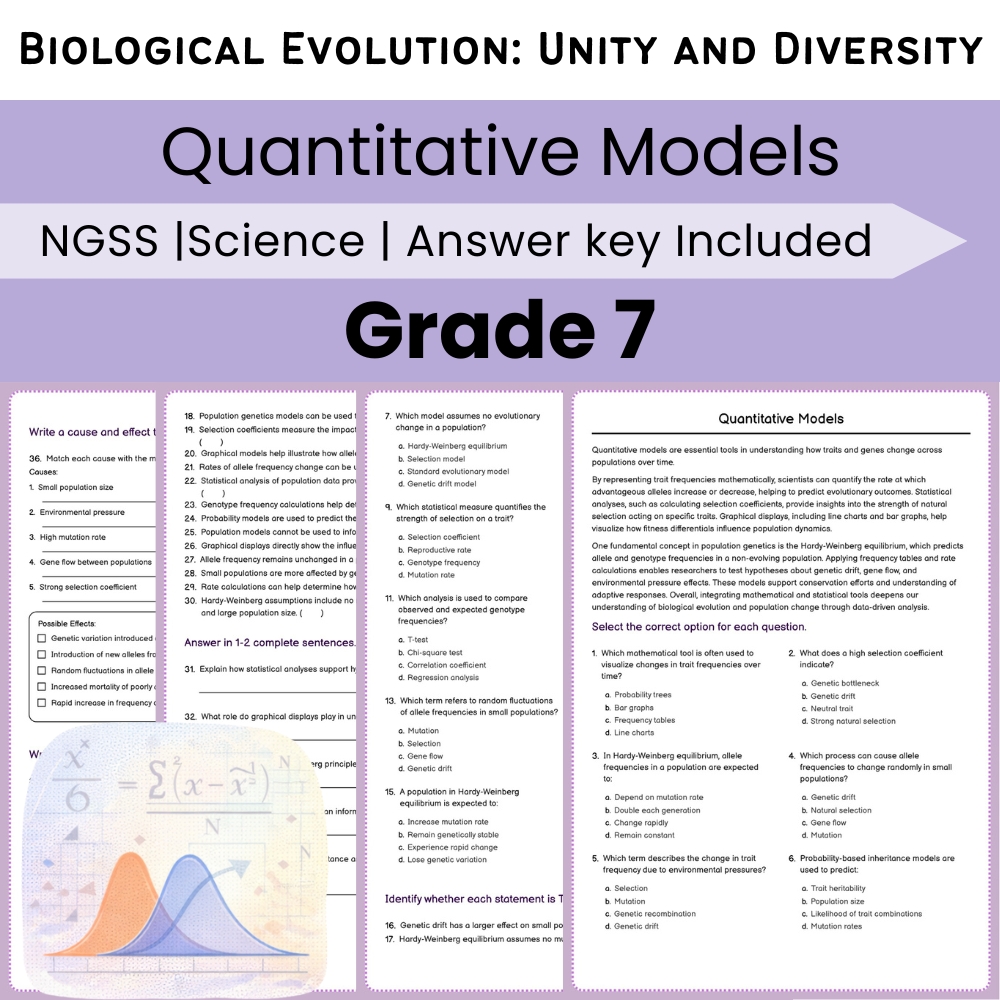
Quantitative Models Worksheet | NGSS Grade 7 Science Printable PDF
Learning Objectives
- Explain how mathematical representations support understanding of evolutionary processes.
- Apply statistical analyses such as frequency tables and rate calculations to genetic data.
- Interpret graphical displays of fitness and trait frequencies to analyze population changes.
Also included in: Grade 7 Science Lesson Bundle | Biological Evolution: Unity and Diversity +1 more
Instant download

Gravity on Objects Worksheet | Weight, Mass & Free Fall | Grade 7 Science
Created byEvergreen Desk EducationLearning Objectives
- Explain how gravitational force affects weight and motion near Earth
- Use the relationship between force and acceleration to compare objects with different masses
- Describe how support forces (normal forces) balance gravity when objects are at rest
Instant download
About Grade 7 Science Worksheets
Browse 6,039 printable Grade 7 Science worksheets — ready-to-print PDFs with answer keys where available.
Every worksheet on MyTeachingSheets is created by independent teacher-authors and reviewed before publication. All resources download as printable PDFs for classroom, homework, or at-home practice, and many include answer keys. Preview any worksheet free before buying.