
Grade 7 Science Worksheets
6,039 worksheets
Grade 7 Cell Membrane Structure Worksheet | BC Practice PDF
 Created byClear Sky Classroom
Learning Objectives
- Describe the structure of the cell membrane as a phospholipid bilayer with embedded components
- Explain how proteins, cholesterol, and carbohydrates contribute to selective permeability and communication
- Use evidence from membrane structure to predict how substances move in and out of cells
Instant download

Motion Graphs Worksheet for Grade 7 Science | Standards-Aligned Practice
JCreated byJ.S SheetsLearning Objectives
- Interpret distance–time graphs to describe rest intervals and different motion patterns (uniform motion, speeding up, slowing down).
- Interpret velocity–time graphs qualitatively by comparing velocity values over time and identifying zero-velocity rests.
- Explain how slope relates to speed for distance–time graphs and how area under a velocity graph relates to displacement (conceptually).
Instant download
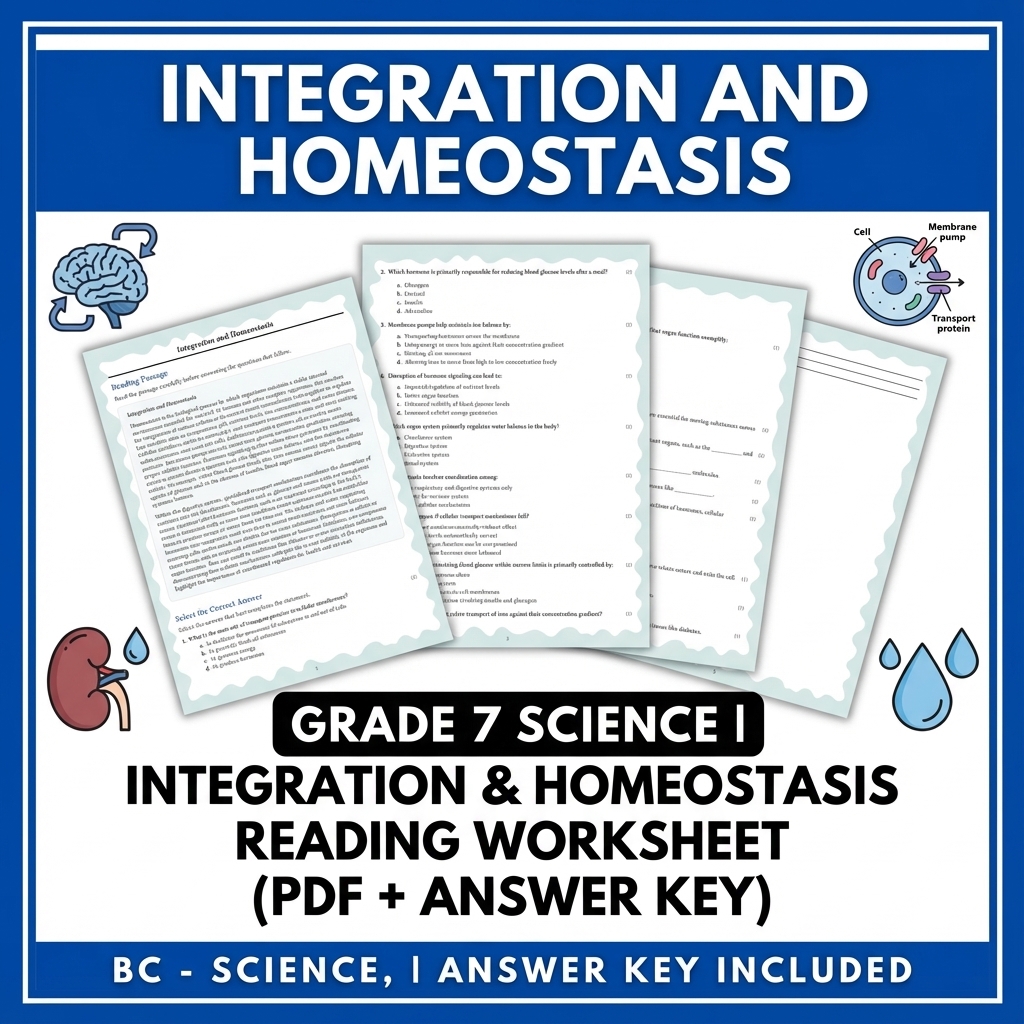
Grade 7 Science | Integration & Homeostasis Reading Worksheet (PDF + Answer Key)
JCreated byJ.S SheetsLearning Objectives
- Understand how cellular structures work together to maintain homeostasis in the body.
- Identify key transport processes like membrane pumps and hormone signaling that regulate nutrient and water balance.
- Explain how disruptions at cellular or tissue levels can impact overall organ function.
Instant download
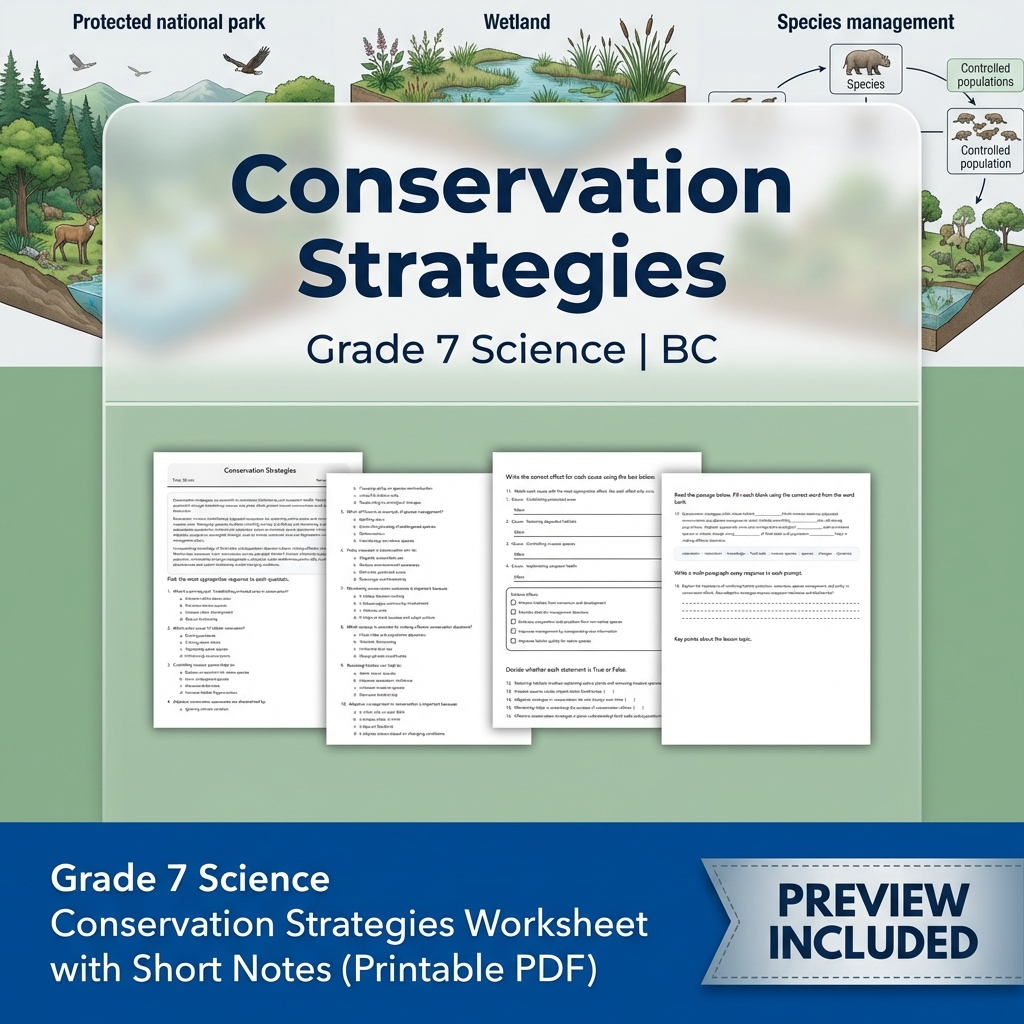
Grade 7 Science Conservation Strategies Worksheet with Short Notes (PDF)
 Created byMeadowlark Worksheets
Learning Objectives
- Understand key conservation methods such as habitat protection, restoration, and species management.
- Identify different adaptive approaches to ecosystem conservation.
- Analyze how human activities impact biodiversity and ecosystems.
Also included in: Grade 7 Science Lesson Bundle: Ecosystems and Population Dynamics Worksheets +1 more
Instant download

Material Properties Worksheet | Grade 7 NGSS Physical & Chemical Properties
 Created byAmber Owl Education
Learning Objectives
- Distinguish physical properties from chemical properties using qualitative and quantitative descriptors
- Interpret property data (e.g., density, melting point, solubility, conductivity, reactivity, flammability) to identify materials and predict behavior
- Use measurements and test results to classify substances and compare how materials respond to temperature and chemical contact
Also included in: Grade 7 Science Stoichiometry, Mixtures & Material Properties Lesson Bundle | NGSS +1 more
Instant download

Model Limits Worksheet Grade 7 Science | NGSSS Scientific Models & Thinking Skills
 Created byEvergreen Desk Education
Learning Objectives
- Explain why models can give useful predictions while still having limits.
- Identify assumptions and simplifications that affect what a model can explain.
- Describe how discrepancies can guide revisions to a model’s parameters or structure.
Instant download

Convection Systems Grade 7 Science Worksheet | Alberta Standards Practice
JCreated byJ.S SheetsLearning Objectives
- Explain the process of convection and how it transfers heat in fluids.
- Identify natural and forced convection examples in real-world scenarios.
- Describe boundary layers, buoyancy forces, and flow patterns related to convection.
Instant download

Grade 7 Solar Patterns Worksheet | NGSS Day Night Seasons Moon Phases
Created byAmber Owl EducationLearning Objectives
- Explain how Earth’s rotation and revolution create day-night cycles and predictable seasonal changes.
- Describe how the Moon’s position relative to the Sun and Earth leads to lunar phases and eclipses.
- Use simple models (alignment and scale) to connect relative motion to observable patterns over time.
Also included in: Grade 7 Science Space, Gravity, and Earth History Lesson Bundle | NGSS +1 more
Instant download
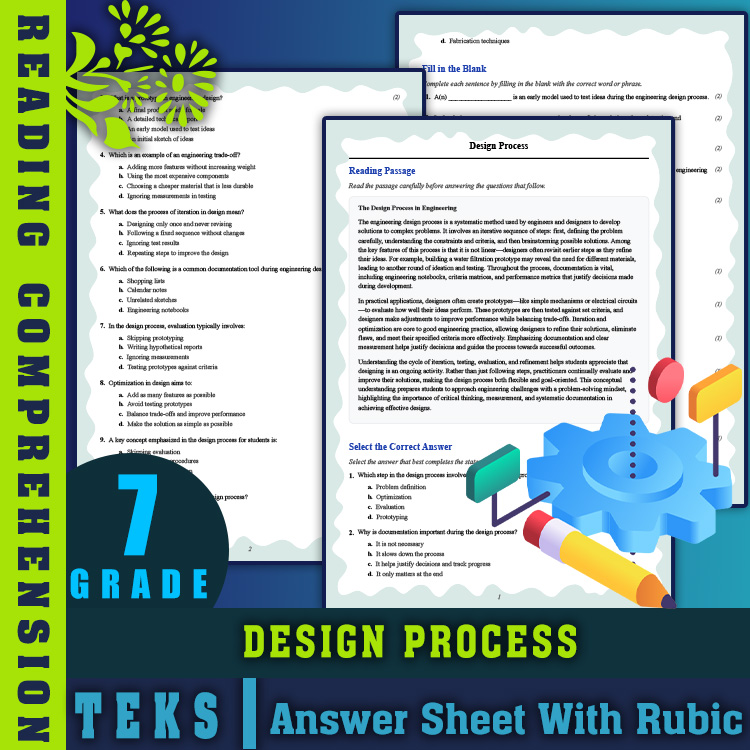
7th Grade Science | Design Process Reading Worksheet & Answer Key (PDF)
JCreated byJ.S SheetsLearning Objectives
- Understand the iterative nature of the engineering design process.
- Identify key steps such as problem definition, brainstorming, prototyping, evaluation, and optimization.
- Recognize examples of design trade-offs, measurement, and refinement.
Instant download
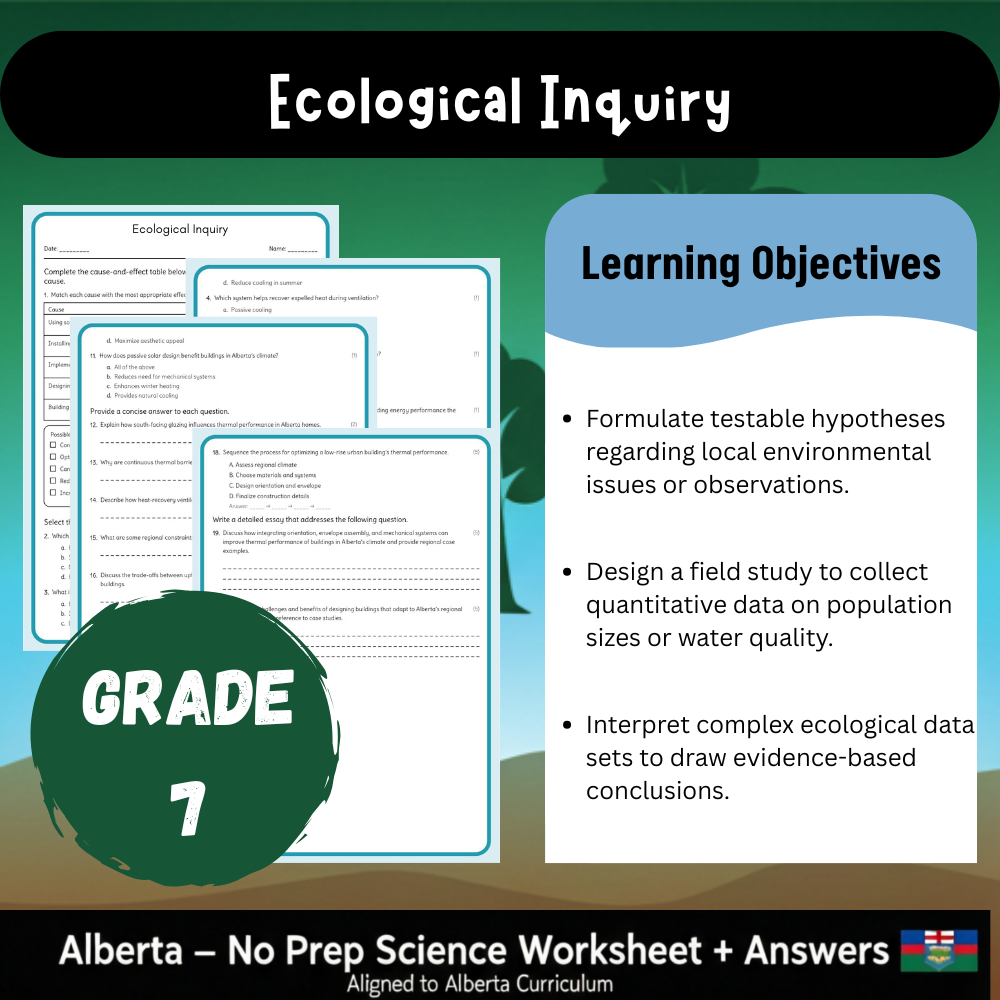
Grade 7 Science | Ecological Inquiry Worksheet (PDF) – Alberta Standards
 Created byBright Mind Resources
Learning Objectives
- Understand the systematic approach of ecological inquiry including hypothesis framing and data interpretation.
- Identify local examples of ecological relationships like riparian health of the Bow River.
- Evaluate the role of evidence and natural variability in ecological studies.
Instant download

Chromatography Techniques Worksheet | Ontario Grade 7 Science Assessment
 Created byCedar Grove Learning
Learning Objectives
- Explain how chromatography separates mixtures using differences in how molecules interact with stationary and mobile phases.
- Describe capillary action and adsorption in paper and thin-layer chromatography (TLC).
- Interpret retention factor (Rf) values to compare substances and make claims about relative purity.
Also included in: Grade 7 Matter: Mixtures and Separation Science Lesson Bundle | Ontario +1 more
Instant download

Grade 7 Science | Predicting Reactions Worksheet | BC Aligned
 Created byLumora Learning
Learning Objectives
- Understand how physical and chemical properties can predict reactivity.
- Identify patterns in reactivity that indicate specific chemical changes.
- Analyze evidence signaling chemical transformations during reactions.
Also included in: Grade 7 Science | Matter & Chemical Change Unit Bundle | BC Aligned
Instant download

Grade 7 Species Adaptations Worksheet | Ontario Science Activity
 Created byChalk and Compass
Learning Objectives
- Identify and classify structural, physiological, and behavioral adaptations in organisms.
- Explain how selective pressures (temperature, moisture, predation, and resource availability) can shape adaptations.
- Analyze how adaptation trade-offs can influence where species can survive and function.
Also included in: Grade 7 Science Ecosystems & Sustainability Lesson Bundle | Ontario +1 more
Instant download
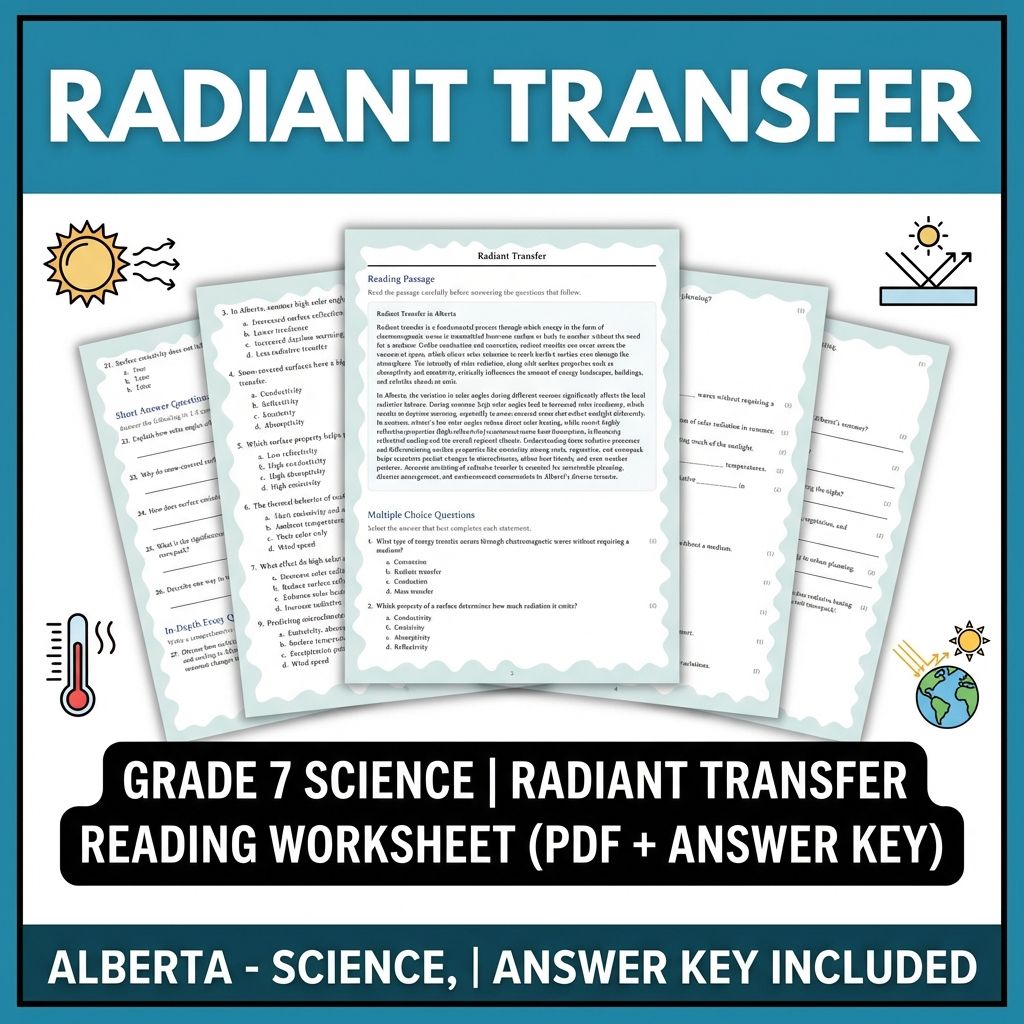
Grade 7 Science | Radiant Transfer Reading Worksheet (PDF + Answer Key)
JCreated byJ.S SheetsLearning Objectives
- Understand the concept of radiant transfer and its role in energy conveyance.
- Identify factors influencing radiative heating and cooling in different landscapes and structures.
- Explain how surface properties like absorptivity, emissivity, and solar angles affect local microclimates.
Also included in: Grade 7 Science UNIT Bundle | Heat Transfer, Convection & Energy Worksheets +1 more
Instant download
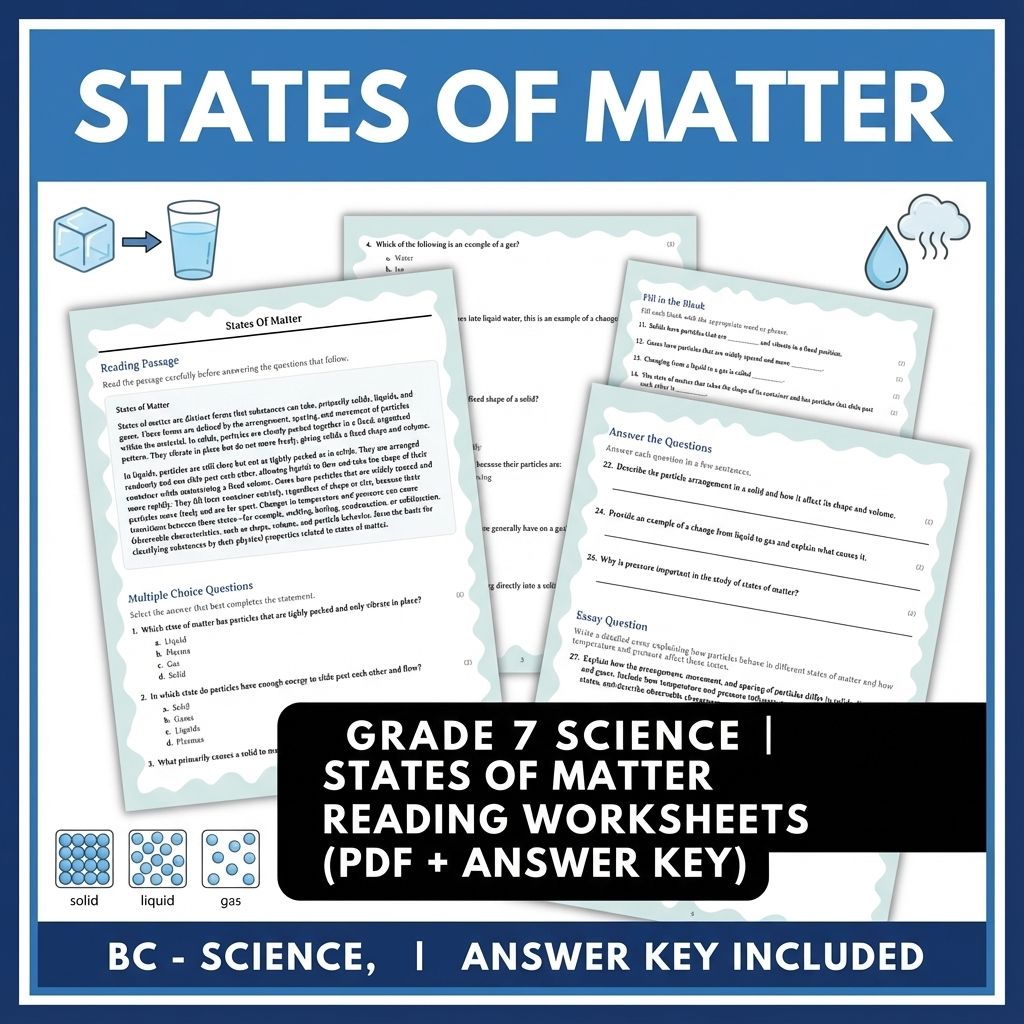
Grade 7 Science | States of Matter Reading Worksheets (PDF + Answer Key)
JCreated byJ.S SheetsLearning Objectives
- Describe the different states of matter—solids, liquids, and gases—based on particle arrangement, spacing, and movement.
- Explain how temperature and pressure influence transitions between states of matter.
- Identify observable characteristics used to classify substances by physical properties related to states of matter.
Instant download

Grade 7 Science | Environmental Impacts Worksheet | California Standards
Created byLumora LearningLearning Objectives
- Explain how environmental impacts can be connected to design constraints in real-world situations
- Identify potential trade-offs between performance, durability, and harm to people or ecosystems
- Use scientific reasoning to distinguish technically feasible solutions from environmentally responsible ones
Instant download

Science Worksheet: Relative Geologic Time | NGSSS Grade 7 Science
JCreated byJ.S SheetsLearning Objectives
- Use the principles of superposition and cross-cutting relationships to place geologic events in order.
- Explain how geologists infer relative ages of rock layers and features without exact numeric dates.
- Identify which rock relationships indicate older versus younger formations in a geologic history.
Also included in: Grade 7 Weather, Climate, and Earth Processes Science Lesson Bundle +1 more
Instant download

Mass Wasting and Coasts Surface Impacts Worksheet | NGSSS Grade 7 Science
JCreated byJ.S SheetsLearning Objectives
- Explain how gravity and water-driven forces contribute to mass wasting and coastal erosion
- Describe how saturation from prolonged rain can trigger landslides
- Identify how waves and storm surge reshape beaches, dunes, and shorelines over time
Also included in: Grade 7 Weather, Climate, and Earth Processes Science Lesson Bundle +1 more
Instant download

Mixtures And Solutions Practice Worksheet | Grade 7 Science NGSS
 Created byPrism Point Learning
Learning Objectives
- Differentiate homogeneous and heterogeneous mixtures based on how substances are distributed and how they can be separated.
- Describe solubility and saturation, and connect concentration to observable properties of solutions.
- Compare solutions, colloids, and suspensions using particle size and separation behavior.
Also included in: Grade 7 Matter & Atomic Models Science Lesson Bundle Review | NGSS
Instant download

Chemical Properties Test Prep Printable | Grade 7 Science
Created byPrism Point LearningLearning Objectives
- Explain how chemical properties affect what happens during chemical changes
- Identify observable indicators (gas, colour change, precipitates) linked to chemical processes
- Compare stability of different materials using reactivity, oxidation, corrosion, and pH-related behaviour
Also included in: Grade 7 Substance & Mixture Properties Science Lesson Bundle (Ontario)
Instant download
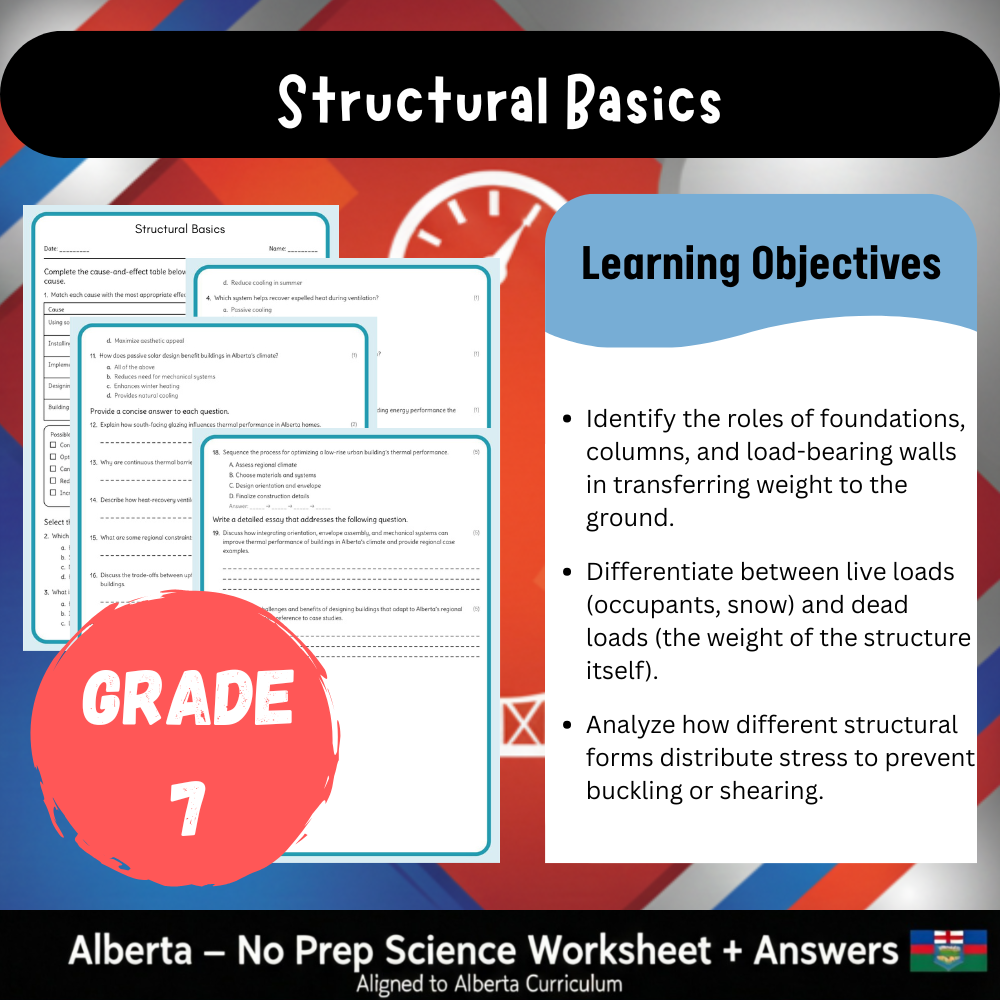
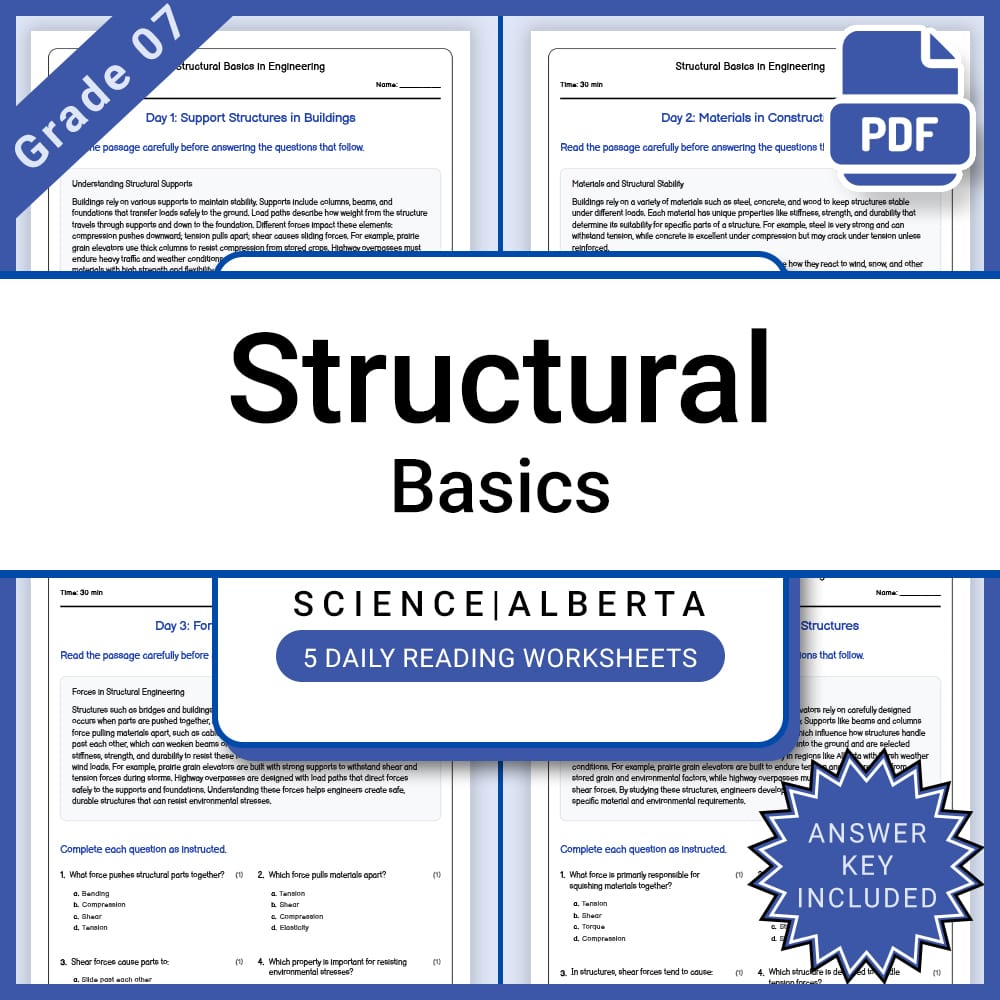
Grade 7 Science | Structural Basics Worksheet (PDF) – Alberta Standards
Created byBright Mind ResourcesLearning Objectives
- Understand the roles of supports, foundations, and load paths in construction.
- Identify how compression, tension, and shear forces affect structural elements.
- Evaluate materials based on properties like stiffness, strength, and durability.
Instant download

Grade 7 Gravity And Weight Worksheet | NGSS Practice PDF
Created byClear Sky ClassroomLearning Objectives
- Differentiate between gravity, weight, and mass and explain how they relate to motion near Earth.
- Use Newtonian ideas (net force and acceleration) to predict how objects move as they fall.
- Interpret simple scenarios comparing objects with different masses in the same gravitational field.
Instant download

Grade 7 Science – Ecosystem Resilience & Change | Daily Reading Worksheet
Created byBright Mind ResourcesLearning Objectives
- Understand the components that make up an ecosystem.
- Learn how ecosystems respond to disturbances.
- Identify factors that contribute to ecosystem resilience.
Also included in: Trophic Energy Grade 7 Science Daily Reading Worksheets Lesson Bundle | General +1 more
Instant download

Density Particle View Worksheet Grade 7 Science | Matter & Density
Created byPrism Point LearningLearning Objectives
- Explain density as mass per unit volume using the particle view.
- Describe how particle spacing and heating can change density even when mass stays the same.
- Use the particle view to predict and explain sinking and floating.
Instant download

Natural Hazards Patterns Risk and Mitigation Worksheet | NGSS Grade 7 Science
 Created bySkylark Worksheets
Learning Objectives
- Interpret historical and instrumental hazard data to identify patterns of frequency, magnitude, and geographic distribution.
- Use hazard maps and recurrence intervals to reason about risk and make evidence-based land-use choices.
- Explain how cascading impacts from natural hazards affect infrastructure, ecosystems, and communities, especially in coastal or floodplain areas.
Also included in: Grade 7 Ecosystems & Climate Interactions Science Lesson Bundle: NGSS +1 more
Instant download
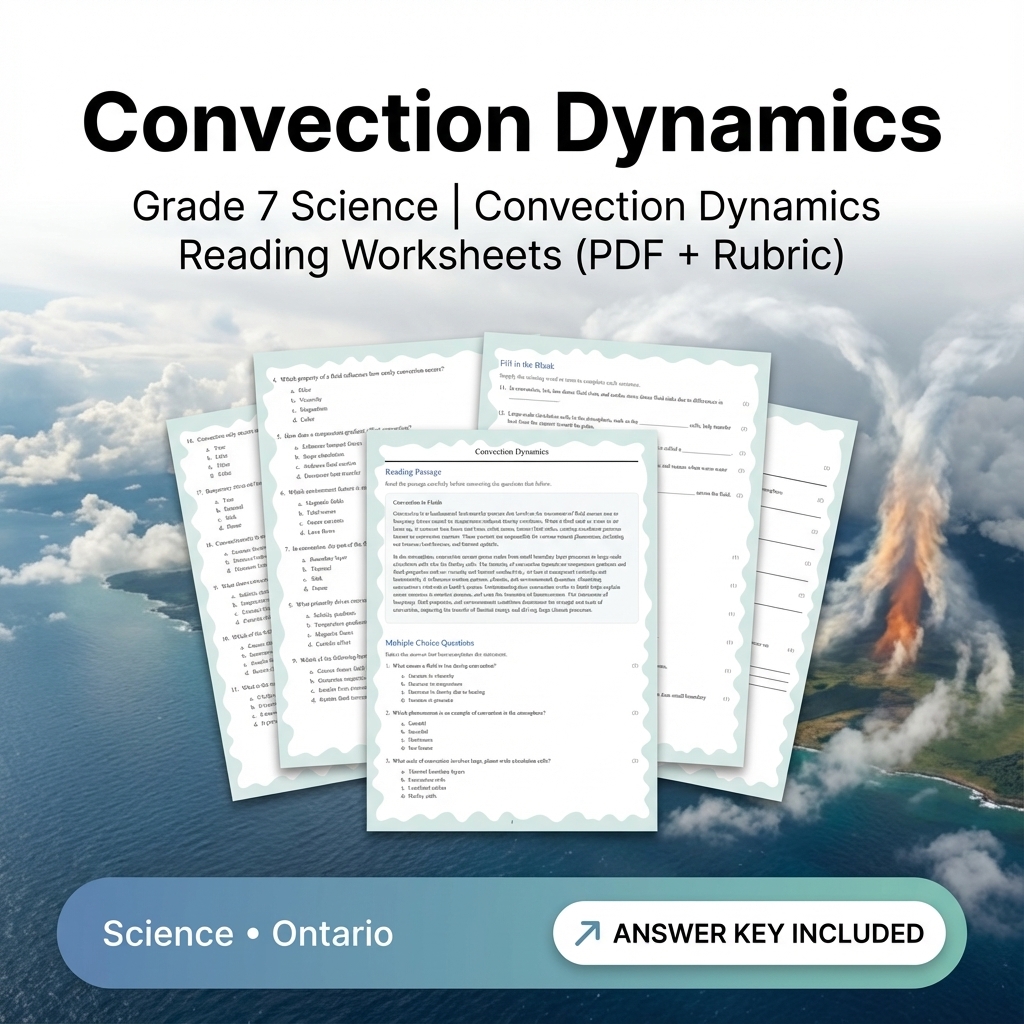
Grade 7 Science | Convection Dynamics Reading Worksheets (PDF + Rubric)
JCreated byJ.S SheetsLearning Objectives
- Understand the principles of convective heat transfer in fluids.
- Explain how buoyancy and density variations drive convection.
- Identify natural phenomena that result from convection processes.
Also included in: Grade 7 Science | Thermal Energy & Transfer Worksheet Bundle +1 more
Instant download

Science Worksheet Ethics and Communication in STEM | Grade 7 Assessment
JCreated byJ.S SheetsLearning Objectives
- Identify ethical expectations for data integrity, attribution, and responsible communication in STEM projects
- Explain how technical reports and graphs should present methods, uncertainty, and limitations clearly
- Describe why peer review and public presentation affect reliability and public understanding of findings
Instant download
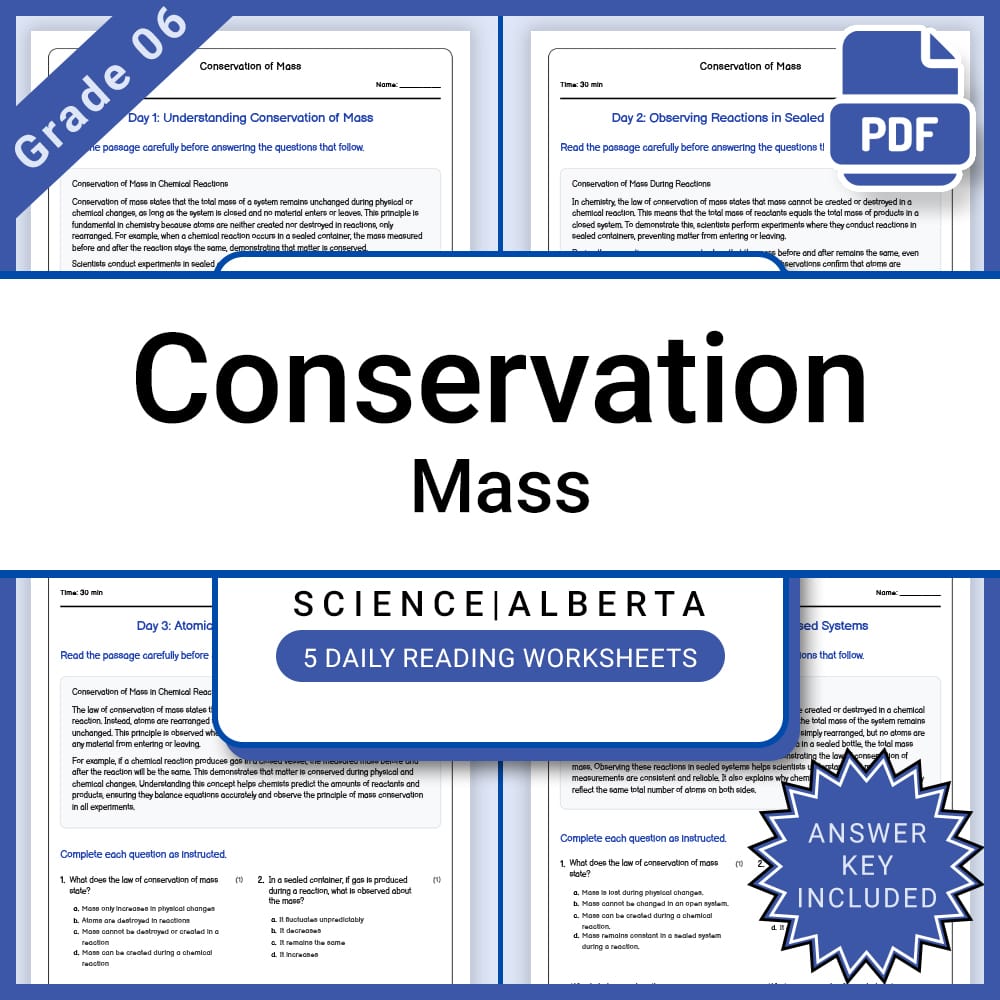
Grade 7 Science – Conservation of Mass Daily Reading Worksheet + Answer Key
JCreated byJ.S SheetsLearning Objectives
- Understand the principle of conservation of mass in physical and chemical changes.
- Identify examples of closed systems in experiments.
- Predict mass relationships in chemical reactions enclosed in a sealed environment.
Also included in: Grade 7 Science Lesson Bundle | Alberta Framework for Classroom Use +1 more
Instant download

Grade 7 Science | Material Selection in Science - Daily Reading Comprehension
 Created byCoral Reef Learning
Learning Objectives
- Understand different physical and chemical properties of materials
- Identify the importance of properties like corrosion resistance, hardness, melting point, and solubility
- Learn how properties influence the suitability of materials for specific applications
Instant download

Plate Tectonics Worksheet Grade 7 NGSS | Plate Boundaries & Earth Science
Created byAmber Owl EducationLearning Objectives
- Explain how geologic evidence (fossils, rock types, seafloor structures) supports the theory of plate tectonics.
- Identify key features of tectonic plate boundaries, including trenches, mid-ocean ridges, and earthquake/volcano patterns.
- Describe how magnetic striping and continental reconstructions (such as Pangaea) help infer plate motion.
Also included in: Earth's Systems Lesson Bundle | Grade 7 Science | Next-Gen Science Standards +1 more
Instant download
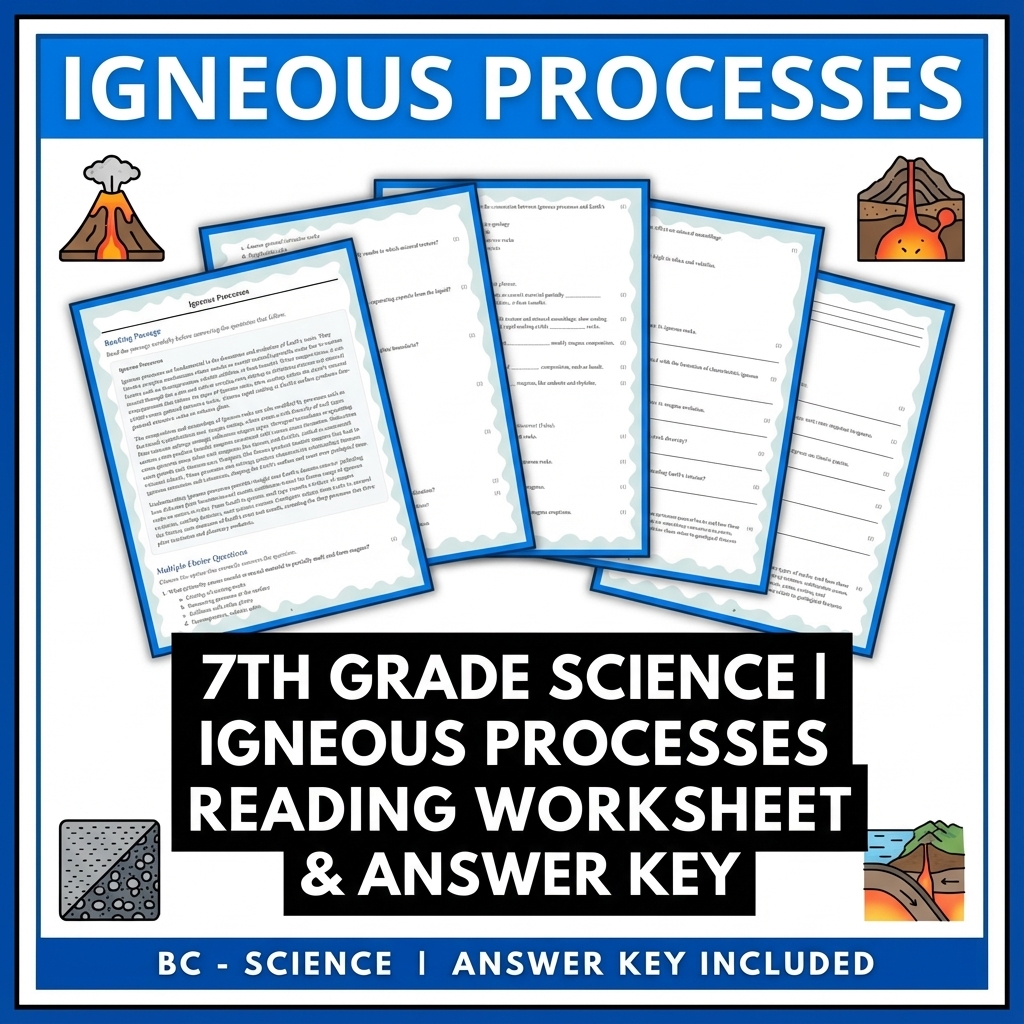
7th Grade Science | Igneous Processes Reading Worksheet & Answer Key
JCreated byJ.S SheetsLearning Objectives
- Understand the mechanisms of magma generation and its relation to tectonic settings.
- Identify the processes that influence texture and mineral composition in igneous rocks.
- Explain how cooling rates and crystallization affect igneous rock texture and mineral assemblage.
Instant download
Grade 7 Science – Saturation Daily Reading Worksheet & Answer Key
JCreated byJ.S SheetsLearning Objectives
- Define saturation and supersaturation in solutions.
- Identify real-life examples of solubility limits.
- Explain what triggers phase change between dissolved and solid states.
Also included in: Grade 7 Science Lesson Bundle | Alberta Framework for Classroom Use +1 more
Instant download

7th Grade Science Worksheet | Understanding Keystone Species (PDF)
Created byEvergreen Desk EducationLearning Objectives
- Explain what a keystone species is and why its impact can be larger than its abundance
- Use food-web and energy-flow ideas to predict effects of removing a keystone species (trophic cascades)
- Identify examples of how predators or habitat engineers can maintain ecosystem stability and diversity
Instant download
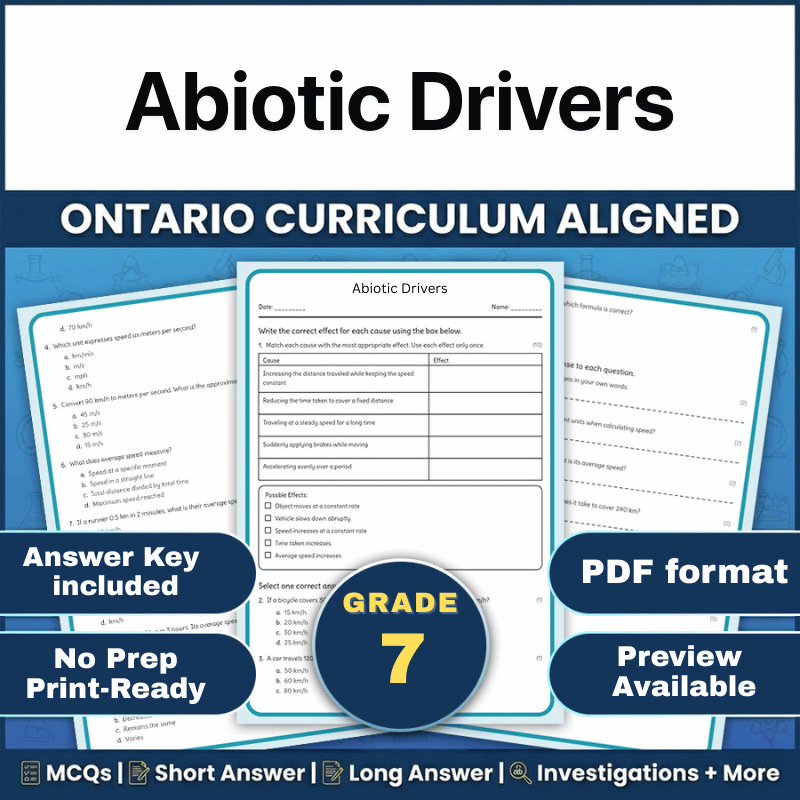
Grade 7 Science | Abiotic Drivers Worksheet (Ontario) (PDF)
Created byBright Mind ResourcesLearning Objectives
- Describe key abiotic factors such as temperature, light, soil, moisture, and pH that influence ecosystems.
- Explain how abiotic conditions create environmental templates for communities and affect resource distribution.
- Identify microhabitats within different ecosystems where abiotic variability impacts organisms.
Instant download
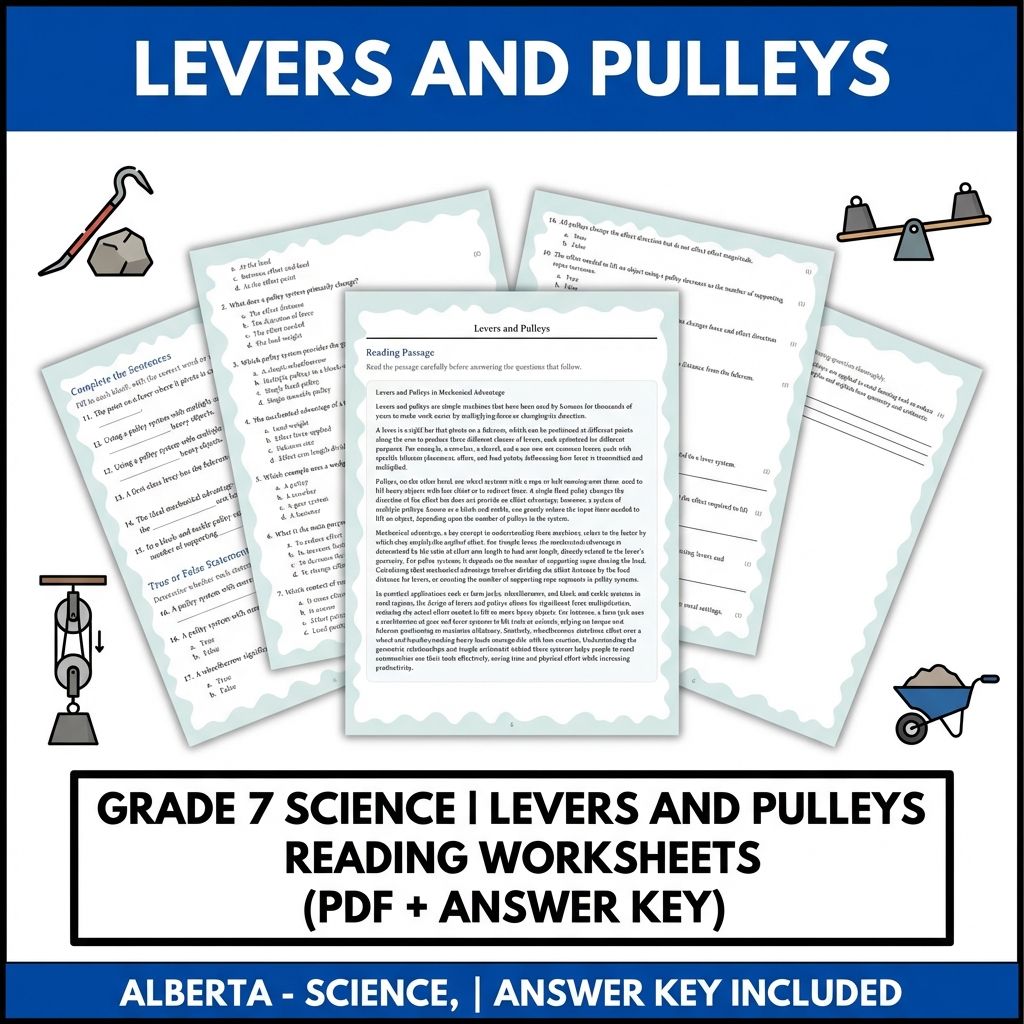
Grade 7 Science | Levers and Pulleys Reading Worksheets (PDF + Answer Key)
JCreated byJ.S SheetsLearning Objectives
- Understand how levers are classified into different classes based on fulcrum placement.
- Explain how pulleys modify effort and direction to achieve mechanical advantage.
- Calculate ideal mechanical advantage using simple arithmetic based on lever arm and pulley systems.
Also included in: Grade 7 Science | Forces, Motion & Structural Concepts (Answer Keys Included) +1 more
Instant download
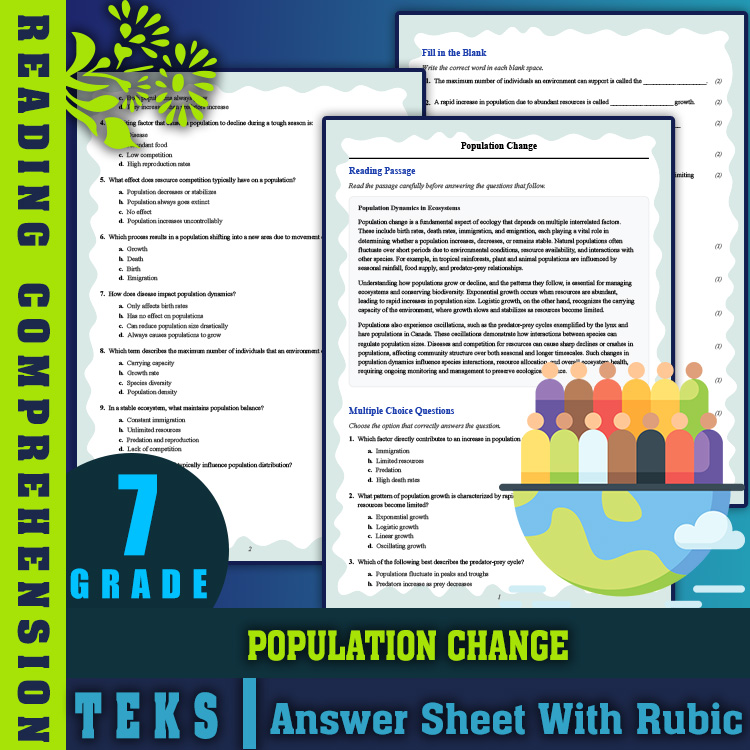
Grade 7 Science | Population Change Reading Worksheet (PDF + Answer Key)
JCreated byJ.S SheetsLearning Objectives
- Understand the key factors that influence population size and distribution.
- Differentiate between types of population growth patterns, including exponential and logistic growth.
- Analyze how species interactions and environmental factors affect populations over time.
Instant download
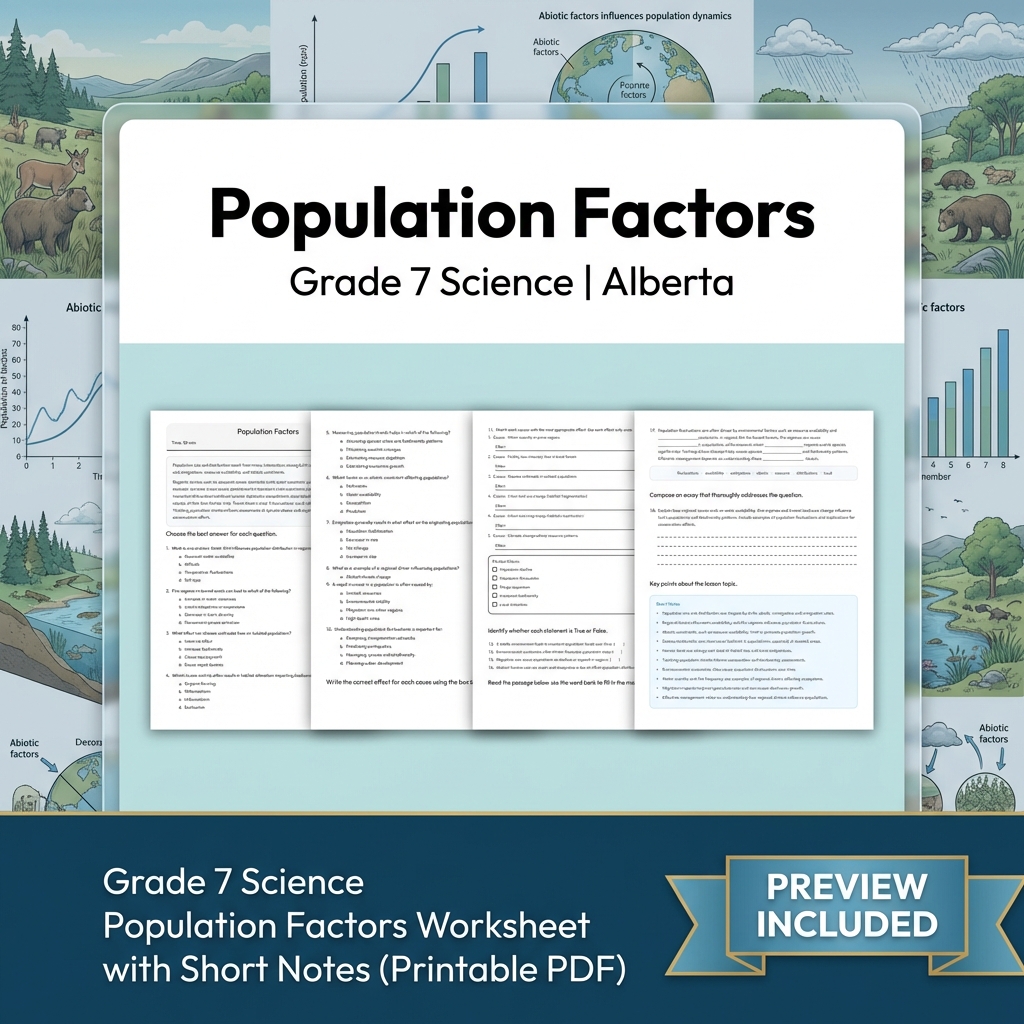
Grade 7 Science Population Factors Worksheet with Short Notes (Printable PDF)
Created byMeadowlark WorksheetsLearning Objectives
- Understand how birth and death rates influence population size.
- Identify regional factors that impact population distribution.
- Analyze how resource availability and environmental constraints affect populations.
Instant download

Grade 7 Explanatory Models Science Worksheet | NGSSS Aligned Practice
Created byEvergreen Desk EducationLearning Objectives
- Explain how explanatory models represent systems using simplified parts, symbols, and relationships
- Use cause-and-effect and energy-transfer ideas to interpret what a model predicts
- Evaluate how well a model fits observations and how it should be revised when new evidence disagrees
Instant download
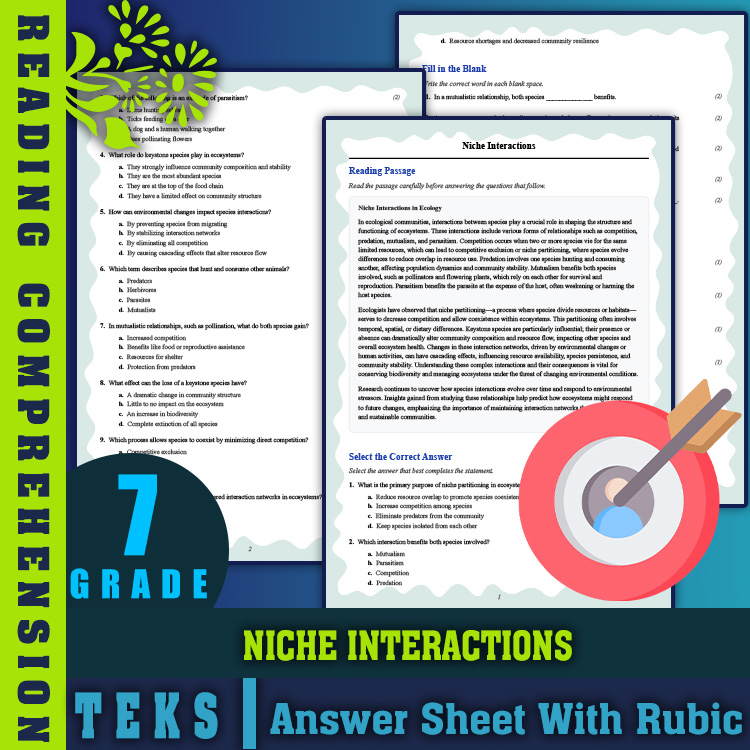
7th Grade Science | Niche Interactions Reading Worksheet & Answer Key PDF
JCreated byJ.S SheetsLearning Objectives
- Explain the different types of species interactions such as competition, predation, mutualism, and parasitism.
- Illustrate how niche partitioning reduces competition among species in an ecosystem.
- Describe the role of keystone species in shaping community composition.
Instant download
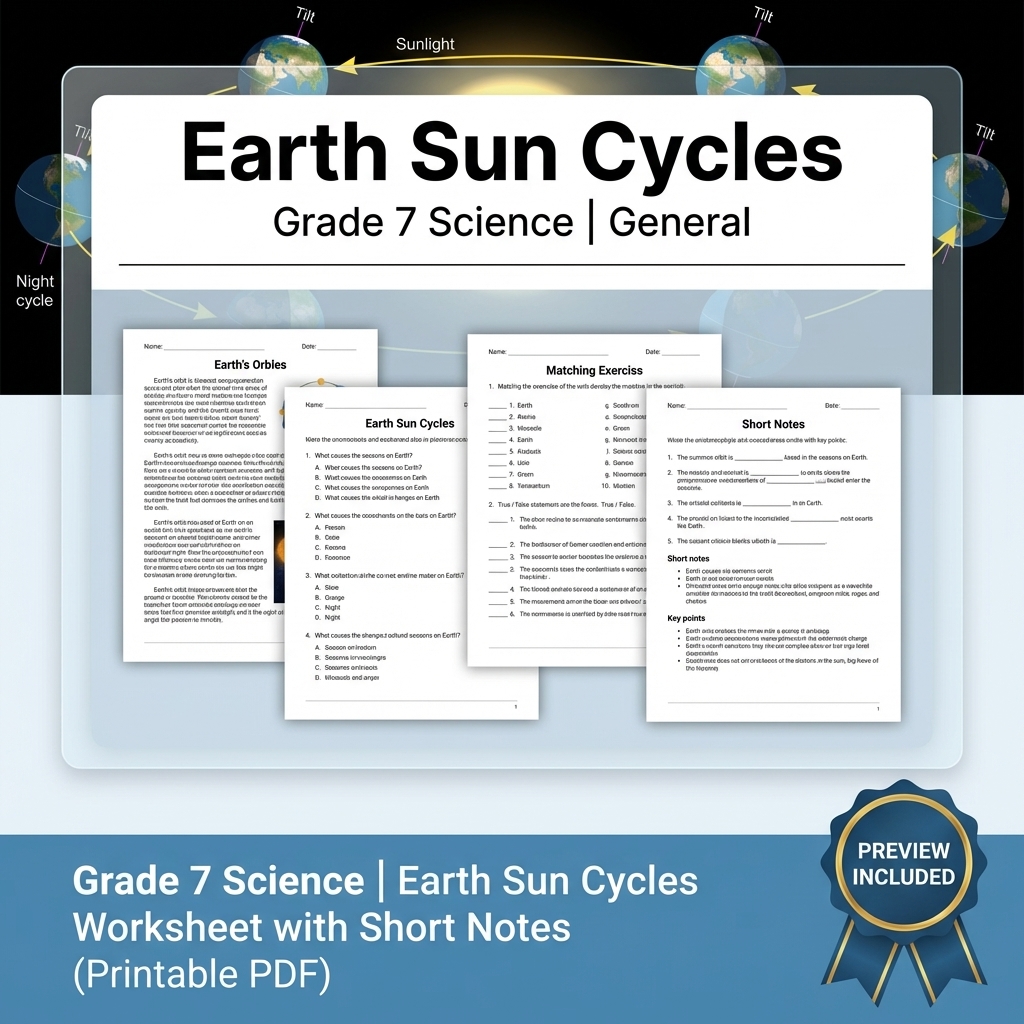
Grade 7 Science | Earth Sun Cycles Worksheet with Short Notes (Printable PDF)
Created byMeadowlark WorksheetsLearning Objectives
- Understand how Earth's tilt and orbit influence seasons and day length.
- Describe the relationship between Earth's position relative to the sun and observable patterns.
- Explain how axial tilt affects daylight duration at different times of year.
Also included in: Grade 7 Earth Systems Science Lesson Bundle: General Framework Notes +1 more
Instant download

Friction and Aerodynamic Drag Worksheets | Grade 7 Science
 Created bySunny Desk Resources
Learning Objectives
- Explain how friction opposes motion between surfaces and how it relates to static and kinetic friction
- Describe how aerodynamic drag affects objects moving through air and how it changes acceleration and stopping distance
- Use the relationships among surface texture, normal force, and frictional coefficient to predict when slipping is more likely
Also included in: Forces, Structures & Motion Grade 7 Science Bundle | Alberta +1 more
Instant download

Groundwater Storage Assessment | California Standards Grade 7 Science
Created byPrism Point LearningLearning Objectives
- Explain how infiltration and aquifer storage contribute to the groundwater portion of the water cycle
- Describe how gravity and pressure differences influence groundwater movement and discharge
- Analyze how recharge, permeability, and precipitation affect groundwater availability
Also included in: Grade 7 Earth Systems Science Lesson Bundle Assessments | California Standards +1 more
Instant download

Grade 7 Space Technology Science Daily Reading Worksheet | TEKS Activity
 Created byBRIGHT PATH RESOURCES
Learning Objectives
- Identify the main idea of a passage about space technology.
- Use evidence from the passage to support an answer.
- Explain how telescopes collect light to help scientists interpret objects in space.
Also included in: Earth Resources & Space Systems Grade 7 Science Lesson Bundle | TEKS +1 more
Instant download

Grade 7 Rock Record Science Daily Reading Worksheet | TEKS Activity
Created byBRIGHT PATH RESOURCESLearning Objectives
- Identify the main idea of how the rock cycle records Earth’s history.
- Use supporting details to explain how different rock types form and change.
Also included in: Earth Resources & Space Systems Grade 7 Science Lesson Bundle | TEKS +1 more
Instant download

Grade 7 Solar System Science Daily Reading Worksheet | TEKS Activity
Created byBRIGHT PATH RESOURCESLearning Objectives
- Identify the main idea of a text about how the solar system formed.
- Describe key details about accretion, planetesimals, and early planetary conditions.
- Use vocabulary from the passage to answer questions accurately.
Also included in: Earth Resources & Space Systems Grade 7 Science Lesson Bundle | TEKS +1 more
Instant download

Grade 7 Earth's Layers and Materials Science Reading Worksheet | TEKS
Created byBRIGHT PATH RESOURCESLearning Objectives
- Identify Earth’s main internal layers and describe how their materials differ.
- Use key vocabulary (crust, mantle, outer core, inner core, density, convection, seismic waves) to explain Earth structure.
- Explain how density and heat relate to the movement of material inside Earth.
Also included in: Earth Resources & Space Systems Grade 7 Science Lesson Bundle | TEKS +1 more
Instant download
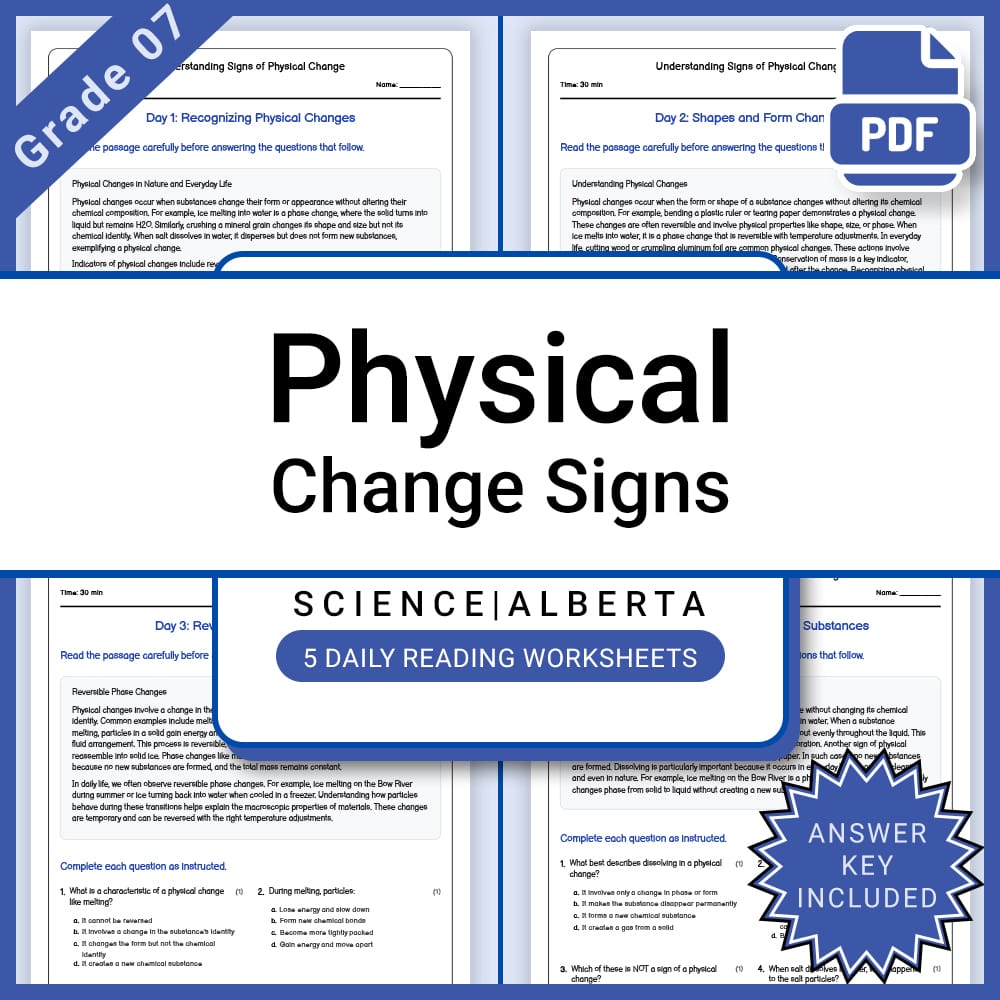
Grade 7 Science – Signs of Physical Change Daily Reading Worksheet + Answer Key
JCreated byJ.S SheetsLearning Objectives
- Identify different signs that indicate a physical change has occurred
- Describe examples of physical changes from real-life scenarios
- Differentiate between physical and chemical changes based on observable signs
Also included in: Grade 7 Science Lesson Bundle | Alberta Framework for Classroom Use +1 more
Instant download

Grade 7 Population Limits Worksheet | Ontario Science Activity PDF
Created byClear Sky ClassroomLearning Objectives
- Distinguish exponential growth from logistic growth using the idea of carrying capacity
- Explain how limiting factors (food, predation, disease, abiotic stress) affect population size
- Classify influences as density-dependent or density-independent
Instant download
About Grade 7 Science Worksheets
Browse 6,039 printable Grade 7 Science worksheets — ready-to-print PDFs with answer keys where available.
Every worksheet on MyTeachingSheets is created by independent teacher-authors and reviewed before publication. All resources download as printable PDFs for classroom, homework, or at-home practice, and many include answer keys. Preview any worksheet free before buying.