
Grade 7 Science Worksheets
6,039 worksheets
Grade 7 Science | Invasive Species Worksheet | BC-Aligned
 Created byLumora Learning
Learning Objectives
- Understand the ecological mechanisms by which invasive species establish and spread.
- Identify the environmental and economic impacts of invasive species on native ecosystems.
- Analyze how invasive species alter food webs, nutrient cycles, and habitat structures.
Instant download

Grade 7 Science | Understanding Measurement Tools - Daily Reading Comprehension
 Created byCoral Reef Learning
Learning Objectives
- Identify how different measurement tools have varying levels of resolution.
- Understand how repeated measurements estimate uncertainty.
- Learn how graphs and tables can display measurement ranges and error margins.
Instant download

Science Worksheet Insulation Principles Grade 7 | Standards-Aligned Practice
JCreated byJ.S SheetsLearning Objectives
- Explain how insulation reduces heat transfer by limiting conduction, convection, and radiation
- Compare common insulating materials (fiberglass, foam, and reflective foils) using thermal resistance ideas and practical thickness
- Describe how thermal bridging and air leakage increase heat loss and why continuous insulation helps
Instant download
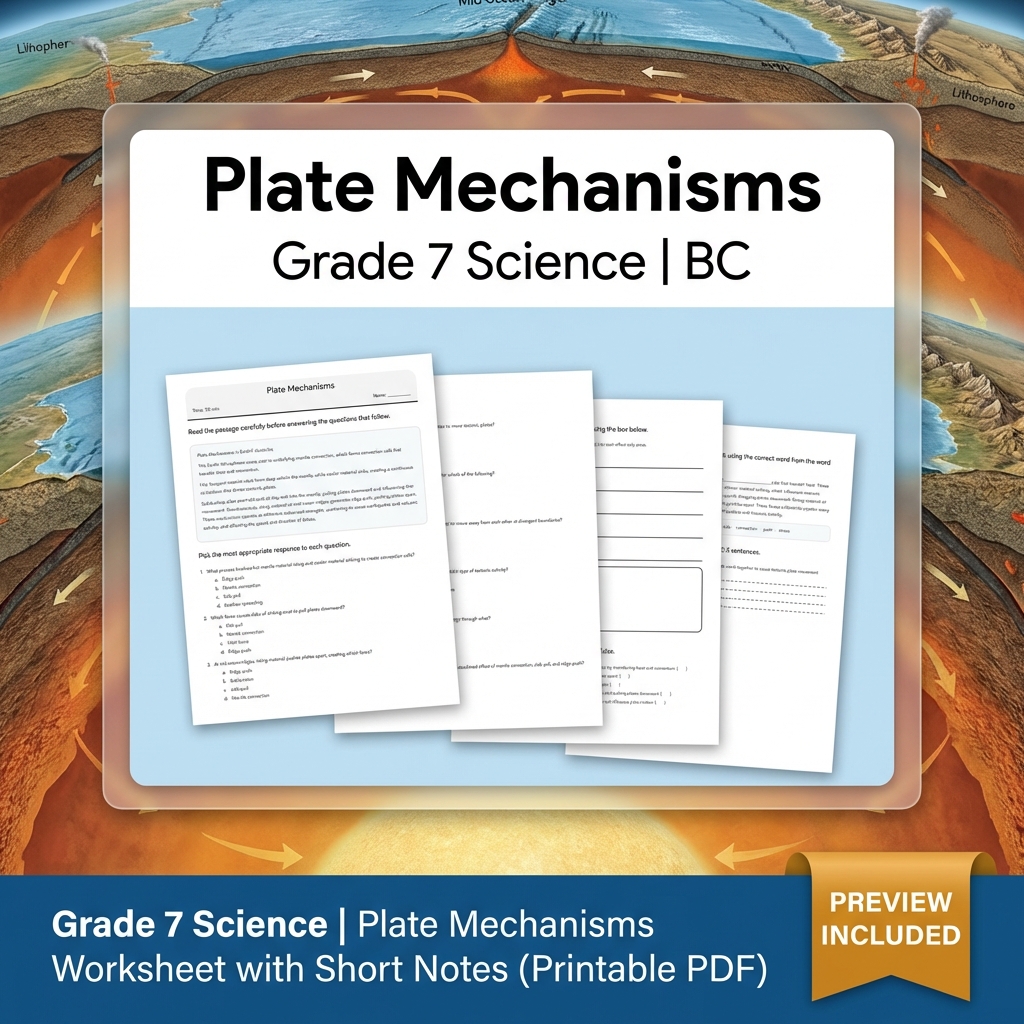
Grade 7 Science | Plate Mechanisms Worksheet with Short Notes (Printable PDF)
 Created byMeadowlark Worksheets
Learning Objectives
- Understand how mantle convection, slab pull, and ridge push influence plate motion.
- Describe the processes of mantle convection and their role in tectonic activity.
- Explain how slab pull and ridge push contribute to plate movement.
Also included in: Grade 7 Science Lesson Bundle | Earth Processes Worksheets Group +1 more
Instant download

Bonding Patterns Worksheet | Grade 7 Science TEKS Practice
 Created byPrism Point Learning
Learning Objectives
- Differentiate ionic and covalent bonding using evidence from bonding structure and particle interactions.
- Relate bonding type to observable properties such as melting point, solubility, and electrical conductivity.
- Use empirical formulas to describe simple binary ionic salts and molecular compounds.
Also included in: Grade 7 Matter, States, and Reactions in Science Lesson Bundle TEKS
Instant download
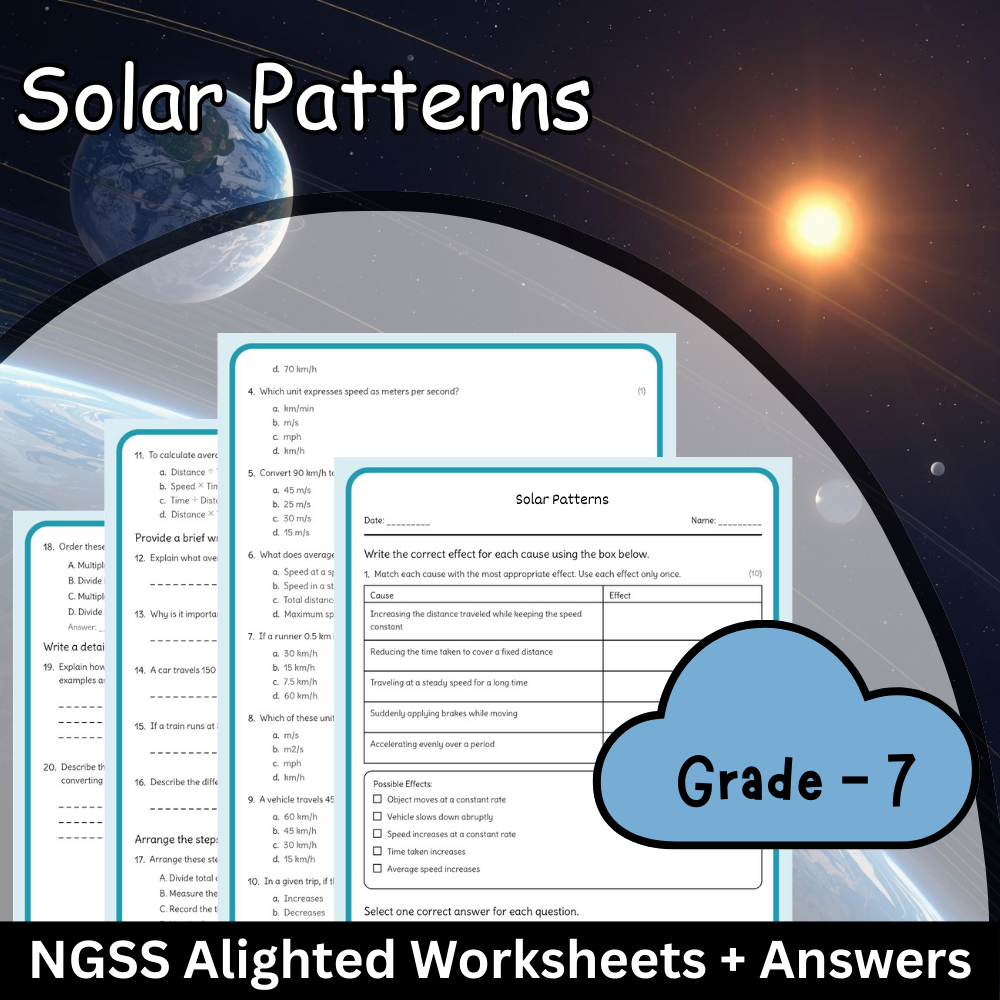
Grade 7 Science | Solar Patterns Worksheet + Answer Key (NGSS Standards)
 Created byBright Mind Resources
Learning Objectives
- Understand how relative motions of the Sun, Earth, and Moon produce observable cyclic patterns.
- Describe the causes of lunar phases, solar and lunar eclipses, and seasonal changes.
- Explain how diagrams of orbital geometry and axial tilt relate to day-night cycles and phases.
Instant download

Fitness and Survival Worksheet | Grade 7 Evolution & Natural Selection
Created byPrism Point LearningLearning Objectives
- Explain how fitness relates to survival and reproduction in a particular environment
- Describe how environmental changes can change which heritable traits are favored by natural selection
- Connect fitness outcomes to variation within a population and changing selection pressures
Also included in: Grade 7 Evolution, Genetics & Ecosystems Lesson Bundle | Florida NGSSS
Instant download

DNA and Chromosomes Worksheets: Grade 7 Heredity & Inheritance
 Created bythe curious pencil
Learning Objectives
- Explain how DNA is organized into chromosomes and contains genes.
- Describe how DNA sequence differences contribute to observable trait variation.
- Model chromosome separation during gamete formation.
Also included in: Heredity Inheritance and Variation of Traits NGSS Science Bundle +2 more
Instant download

Global Atmospheric and Oceanic Circulation Worksheets Grade 7 Science
Created bythe curious pencilLearning Objectives
- Explain how unequal solar heating drives atmospheric circulation.
- Describe how Earth’s rotation affects prevailing winds.
- Identify Hadley, Ferrel, and polar circulation cells.
Also included in: Earth's Systems Worksheets Grade 7 Science | NGSS Unit Bundle +2 more
Instant download

Rock Cycle Worksheets for Grade 7 Earth Science | Earth's Systems
Created bythe curious pencilLearning Objectives
- Identify how igneous, sedimentary, and metamorphic rocks form
- Explain how weathering and erosion move rock materials
- Describe how heat and pressure cause metamorphism
Also included in: Earth's Systems Worksheets Grade 7 Science | NGSS Unit Bundle +2 more
Instant download

Material Properties Worksheets: Physical & Chemical Properties Grade 7
Created bythe curious pencilLearning Objectives
- Distinguish physical properties from chemical properties
- Describe how density and melting point identify materials
- Explain how solubility and conductivity characterize materials
Also included in: Matter and Its Interactions Worksheets | Grade 7 Science NGSS +2 more
Instant download

Inheritance Probability and Genetic Variation Worksheets – Grade 7 Science
Created bythe curious pencilLearning Objectives
- Calculate genotype probabilities from simple monohybrid crosses.
- Calculate phenotype probabilities using dominant and recessive alleles.
- Use Punnett squares to connect allele combinations with probability.
Also included in: Heredity Inheritance and Variation of Traits NGSS Science Bundle +2 more
Instant download

Biodiversity and Ecosystem Services Worksheets | Grade 7 Science
Created bythe curious pencilLearning Objectives
- Compare strategies used to protect biodiversity and ecosystem services
- Identify benefits and trade-offs of habitat management strategies
- Evaluate ecological, economic, and social evidence
Also included in: Ecosystems Worksheets Grade 7 Science | NGSS Unit Bundle +2 more
Instant download

Heat Transfer Worksheets: Thermal Energy Movement | Grade 7 Science
Created bythe curious pencilLearning Objectives
- Identify conduction, convection, and radiation as energy-transfer mechanisms
- Explain how thermal energy moves between warmer and cooler regions
- Use temperature changes as evidence of thermal energy transfer
Also included in: Energy Grade 7 Science Worksheets | NGSS Energy Unit Bundle +2 more
Instant download

Ecosystem Disturbances and Resilience Worksheets | Grade 7 Science
Created bythe curious pencilLearning Objectives
- Identify physical and biological disturbances in ecosystems
- Explain resistance, resilience, and succession after disturbances
- Interpret population changes caused by ecosystem disturbances
Also included in: Ecosystems Worksheets Grade 7 Science | NGSS Unit Bundle +2 more
Instant download

Energy Flow in Ecosystems Worksheets for Grade 7 Science
Created bythe curious pencilLearning Objectives
- Identify producers, consumers, and decomposers in food webs
- Explain how photosynthesis captures energy in ecosystems
- Describe how cellular respiration contributes to energy flow
Also included in: Ecosystems Worksheets Grade 7 Science | NGSS Unit Bundle +2 more
Instant download

Anatomical Evidence for Evolution Worksheets Grade 7 Science
Created bythe curious pencilLearning Objectives
- Distinguish homologous, analogous, and vestigial structures
- Explain how anatomy provides evidence for evolutionary relationships
- Infer common ancestry from comparative anatomical patterns
Also included in: Biological Evolution Worksheets Bundle | Grade 7 Science NGSS +2 more
Instant download

Natural Selection and Adaptation Worksheets | Grade 7 Science
Created bythe curious pencilLearning Objectives
- Explain how heritable variation affects populations over generations
- Describe how environmental pressures influence trait frequencies
- Identify how survival and reproduction contribute to natural selection
Also included in: Biological Evolution Worksheets Bundle | Grade 7 Science NGSS +2 more
Instant download

Engineering Design Optimization Worksheets | Grade 7 Science
Created bythe curious pencilLearning Objectives
- Analyze test data to identify measurable design improvements
- Compare design results with performance requirements and constraints
- Explain how parameter changes affect design performance
Also included in: Engineering Design Grade 7 Science Worksheets | NGSS Bundle +2 more
Instant download

Energy Accounting Worksheets: Motion & Energy Transfers Grade 7
Created bythe curious pencilLearning Objectives
- Explain how motion energy changes during energy transfers
- Identify transfers from motion energy to thermal energy and sound
- Calculate simple changes in motion energy using joule values
Also included in: Energy Grade 7 Science Worksheets | NGSS Energy Unit Bundle +2 more
Instant download

Resource Distribution and Geologic Processes Worksheets Grade 7
Created bythe curious pencilLearning Objectives
- Explain how geologic processes create uneven resource distributions
- Connect plate tectonics and sedimentation to resource formation
- Describe how weathering affects minerals, soil, and groundwater
Also included in: Earth and Human Activity Worksheets Grade 7 Science | NGSS Bundle +2 more
Instant download

Human Impacts on Land, Water, and Air Worksheets | Grade 7
Created bythe curious pencilLearning Objectives
- Identify human activities that change land, water, and air
- Explain how environmental indicators reveal human impacts
- Interpret monitoring data to identify environmental changes
Also included in: Earth and Human Activity Worksheets Grade 7 Science | NGSS Bundle +2 more
Instant download

Environment and Phenotype Science Worksheets | Grade 7
Created bythe curious pencilLearning Objectives
- Explain how genes and environment interact to influence phenotype.
- Identify environmental factors that can influence observable traits.
- Distinguish inherited contributions from environmental influences on phenotype.
Also included in: Heredity Inheritance and Variation of Traits NGSS Science Bundle +2 more
Instant download

Balanced Forces & Equilibrium Worksheets | Grade 7 Science
Created bythe curious pencilLearning Objectives
- Explain equilibrium using the vector sum of forces.
- Distinguish static equilibrium from dynamic equilibrium.
- Identify balanced gravity, normal force, and tension.
Also included in: Motion and Stability Grade 7 Science Worksheets | NGSS Forces Bundle +2 more
Instant download

Earth's Place in the Universe Worksheets | Grade 7 Science
Created bythe curious pencilLearning Objectives
- Explain how Earth's rotation produces the day-night cycle
- Describe how Earth's axial tilt and orbit produce seasons
- Explain how the Moon's orbit creates repeating lunar phases
Also included in: Earth's Place in the Universe Worksheets Grade 7 | NGSS Bundle +2 more
Instant download

Gravitational, Electric, and Magnetic Interactions Worksheets Grade 7
Created bythe curious pencilLearning Objectives
- Describe gravity as an attractive non-contact force between masses.
- Explain how mass and distance affect gravitational attraction.
- Identify attractive and repulsive electric interactions between charges.
Also included in: Motion and Stability Grade 7 Science Worksheets | NGSS Forces Bundle +2 more
Instant download

Population Limits and Carrying Capacity Worksheets | Grade 7
Created bythe curious pencilLearning Objectives
- Explain how limited resources affect population growth rates
- Interpret logistic growth curves and identify carrying capacity
- Describe how births and deaths change population size
Also included in: Ecosystems Worksheets Grade 7 Science | NGSS Unit Bundle +2 more
Instant download

Momentum and Collisions Worksheets | Grade 7 Science
Created bythe curious pencilLearning Objectives
- Define momentum in terms of mass and velocity
- Calculate momentum using mass and velocity
- Explain conservation of momentum during simple collisions
Also included in: Motion and Stability Grade 7 Science Worksheets | NGSS Forces Bundle +2 more
Instant download

Organ System Interactions and Homeostasis Worksheets | Grade 7 Science
Created bythe curious pencilLearning Objectives
- Explain how organ systems cooperate to support body functions
- Describe how oxygen and nutrients are transported to cells
- Identify how organ systems contribute to homeostasis
Also included in: Grade 7 Science Cells & Organisms Worksheets Bundle | NGSS +2 more
Instant download

Kinetic Energy, Mass, and Speed Worksheets | Grade 7 Science
Created bythe curious pencilLearning Objectives
- Explain how mass affects an object's kinetic energy
- Calculate kinetic energy using mass and speed
- Compare kinetic energy changes caused by mass and speed
Also included in: Energy Grade 7 Science Worksheets | NGSS Energy Unit Bundle +2 more
Instant download

Gravity Motion and Orbital Patterns Worksheets Grade 7 Science
Created bythe curious pencilLearning Objectives
- Explain how gravity governs orbital motion.
- Describe how mass and distance affect gravitational attraction.
- Interpret elliptical orbits and orbital periods.
Also included in: Earth's Place in the Universe Worksheets Grade 7 | NGSS Bundle +2 more
Instant download

Embryonic Development and Evolution Worksheets | Grade 7 Science
Created bythe curious pencilLearning Objectives
- Describe how embryonic similarities provide evolutionary evidence
- Identify conserved developmental features in vertebrate embryos
- Explain the role of transient developmental structures
Also included in: Biological Evolution Worksheets Bundle | Grade 7 Science NGSS +2 more
Instant download

Climate Patterns and Regional Climate Worksheets Grade 7 Science
Created bythe curious pencilLearning Objectives
- Explain how uneven solar heating creates temperature gradients.
- Interpret wind, temperature, precipitation, and sea-surface temperature patterns.
- Describe how El Niño influences climate patterns.
Also included in: Earth's Systems Worksheets Grade 7 Science | NGSS Unit Bundle +2 more
Instant download

Species Interactions in Ecosystems Worksheets | Grade 7 Science
Created bythe curious pencilLearning Objectives
- Identify predation, competition, parasitism, mutualism, and commensalism
- Explain how species interactions affect populations and communities
- Trace direct and indirect effects through food webs
Also included in: Ecosystems Worksheets Grade 7 Science | NGSS Unit Bundle +2 more
Instant download

Water Cycle Worksheets: Pathways and Processes | Grade 7 Science
Created bythe curious pencilLearning Objectives
- Explain how solar energy drives evaporation in the water cycle
- Describe how gravity moves water through Earth's systems
- Identify processes that move water into and through groundwater
Also included in: Earth's Systems Worksheets Grade 7 Science | NGSS Unit Bundle +2 more
Instant download

Population Impacts on Natural Resources Worksheets Grade 7 Science
Created bythe curious pencilLearning Objectives
- Explain how population growth affects total resource demand
- Describe how per-capita consumption changes resource demand
- Identify ecosystem effects of urbanization and agriculture
Also included in: Earth and Human Activity Worksheets Grade 7 Science | NGSS Bundle +2 more
Instant download

Cosmic Scale: Sizes and Distances in Space Worksheets Grade 7
Created bythe curious pencilLearning Objectives
- Compare relative sizes and distances within the solar system
- Use astronomical units to describe distances in the solar system
- Use light-years to describe distances beyond the solar system
Also included in: Earth's Place in the Universe Worksheets Grade 7 | NGSS Bundle +2 more
Instant download

Relative Dating of Rock Strata Worksheets | Grade 7 Earth Science
Created bythe curious pencilLearning Objectives
- Apply superposition to determine relative ages of rock layers
- Explain original horizontality using changes to sedimentary layers
- Use cross-cutting relationships to sequence geologic events
Also included in: Earth's Place in the Universe Worksheets Grade 7 | NGSS Bundle +2 more
Instant download

Natural Hazards, Risk & Mitigation Worksheets | Grade 7 Science
Created bythe curious pencilLearning Objectives
- Identify patterns in the frequency and distribution of natural hazards
- Explain how recurrence intervals support natural hazard risk assessment
- Interpret how hazard maps and forecasts communicate potential risk
Also included in: Earth and Human Activity Worksheets Grade 7 Science | NGSS Bundle +2 more
Instant download

Matter Cycling in Organisms Worksheets | Grade 7 Science
Created bythe curious pencilLearning Objectives
- Explain how digestion makes atoms available for cellular use
- Describe how biosynthesis rearranges atoms into cellular materials
- Trace carbon and nitrogen through organisms and wastes
Also included in: Grade 7 Science Cells & Organisms Worksheets Bundle | NGSS +2 more
Instant download

Cell Evidence and Cellular Organization Worksheets Grade 7 Science
Created bythe curious pencilLearning Objectives
- Identify evidence that organisms are composed of cells
- Distinguish unicellular from multicellular organization
- Compare cell boundaries in plant and animal cells
Also included in: Grade 7 Science Cells & Organisms Worksheets Bundle | NGSS +2 more
Instant download

Surface Processes and Landscape Change Worksheets | Grade 7 Science
Created bythe curious pencilLearning Objectives
- Distinguish weathering, erosion, transport, and deposition
- Explain how water, ice, wind, waves, and gravity shape Earth
- Identify landforms produced by different surface processes
Also included in: Earth's Systems Worksheets Grade 7 Science | NGSS Unit Bundle +2 more
Instant download

Fossil Patterns & Common Ancestry Worksheets | Grade 7 Science
Created bythe curious pencilLearning Objectives
- Identify patterns in fossil records and sedimentary rock layers
- Explain how index fossils help compare rock-layer ages
- Describe how fossil assemblages help correlate rock layers
Also included in: Biological Evolution Worksheets Bundle | Grade 7 Science NGSS +2 more
Instant download

Quantitative Models of Evolution Worksheets | Grade 7 Science Practice
Created bythe curious pencilLearning Objectives
- Explain how quantitative models describe population changes
- Calculate simple trait and allele frequencies
- Interpret graphs showing changes across generations
Also included in: Biological Evolution Worksheets Bundle | Grade 7 Science NGSS +2 more
Instant download

Potential Energy in Systems Worksheets | Grade 7 Science Energy
Created bythe curious pencilLearning Objectives
- Identify gravitational, elastic, and magnetic potential energy
- Explain how object arrangement affects stored potential energy
- Compare potential energy in different system arrangements
Also included in: Energy Grade 7 Science Worksheets | NGSS Energy Unit Bundle +2 more
Instant download

Engineering Design Problem Definition Worksheets | Grade 7 Science
Created bythe curious pencilLearning Objectives
- Define criteria and constraints in an engineering design problem.
- Distinguish measurable performance criteria from design constraints.
- Translate real-world needs into measurable performance targets.
Also included in: Engineering Design Grade 7 Science Worksheets | NGSS Bundle +2 more
Instant download

Plate Tectonics and Continental Movement Worksheets Grade 7
Created bythe curious pencilLearning Objectives
- Identify evidence supporting continental and tectonic plate movement
- Explain how fossils reveal past continental connections
- Interpret matching rock layers and continental margins as evidence
Also included in: Earth's Systems Worksheets Grade 7 Science | NGSS Unit Bundle +2 more
Instant download

Engineering Design Trade-Offs Worksheets | Grade 7 Science
Created bythe curious pencilLearning Objectives
- Compare design solutions using consistent measurements.
- Identify trade-offs among competing design features.
- Distinguish predicted behavior from observed prototype behavior.
Also included in: Engineering Design Grade 7 Science Worksheets | NGSS Bundle +2 more
Instant download
About Grade 7 Science Worksheets
Browse 6,039 printable Grade 7 Science worksheets — ready-to-print PDFs with answer keys where available.
Every worksheet on MyTeachingSheets is created by independent teacher-authors and reviewed before publication. All resources download as printable PDFs for classroom, homework, or at-home practice, and many include answer keys. Preview any worksheet free before buying.